
<?xml version="1.0" encoding="UTF-8"?>
<!DOCTYPE article PUBLIC "-//NLM//DTD Journal Publishing DTD v2.3 20070202//EN" "journalpublishing.dtd">
<article xmlns:xlink="http://www.w3.org/1999/xlink" xml:lang="en" article-type="research-article">
<front>
<journal-meta>
<journal-id journal-id-type="publisher-id">Atmosphere</journal-id>
<journal-title>Atmosphere</journal-title>
<issn pub-type="epub">2073-4433</issn>
<publisher>
<publisher-name>Molecular Diversity Preservation International (MDPI)</publisher-name></publisher></journal-meta>
<article-meta>
<article-id pub-id-type="doi">10.3390/atmos2040688</article-id>
<article-id pub-id-type="publisher-id">atmosphere-02-00688</article-id>
<article-categories>
<subj-group>
<subject>Article</subject></subj-group></article-categories>
<title-group>
<article-title>A Comparison of Risk Estimates for the Effect of Short-Term Exposure to PM, NO<sub>2</sub> and CO on Cardiovascular Hospitalizations and Emergency Department Visits: Effect Size Modeling of Study Findings</article-title></title-group>
<contrib-group>
<contrib contrib-type="author">
<name><surname>Kirrane</surname><given-names>Ellen</given-names></name><xref ref-type="aff" rid="af1-atmosphere-02-00688"><sup>1</sup></xref><xref ref-type="corresp" rid="c1-atmosphere-02-00688"><sup>*</sup></xref></contrib>
<contrib contrib-type="author">
<name><surname>Svendsgaard</surname><given-names>David</given-names></name><xref ref-type="aff" rid="af1-atmosphere-02-00688"><sup>1</sup></xref></contrib>
<contrib contrib-type="author">
<name><surname>Ross</surname><given-names>Mary</given-names></name><xref ref-type="aff" rid="af1-atmosphere-02-00688"><sup>1</sup></xref></contrib>
<contrib contrib-type="author">
<name><surname>Buckley</surname><given-names>Barbara</given-names></name><xref ref-type="aff" rid="af1-atmosphere-02-00688"><sup>1</sup></xref></contrib>
<contrib contrib-type="author">
<name><surname>Davis</surname><given-names>Allen</given-names></name><xref ref-type="aff" rid="af1-atmosphere-02-00688"><sup>1</sup></xref></contrib>
<contrib contrib-type="author">
<name><surname>Johns</surname><given-names>Doug</given-names></name><xref ref-type="aff" rid="af1-atmosphere-02-00688"><sup>1</sup></xref></contrib>
<contrib contrib-type="author">
<name><surname>Kotchmar</surname><given-names>Dennis</given-names></name><xref ref-type="aff" rid="af1-atmosphere-02-00688"><sup>1</sup></xref></contrib>
<contrib contrib-type="author">
<name><surname>Long</surname><given-names>Thomas C.</given-names></name><xref ref-type="aff" rid="af1-atmosphere-02-00688"><sup>1</sup></xref></contrib>
<contrib contrib-type="author">
<name><surname>Luben</surname><given-names>Thomas J.</given-names></name><xref ref-type="aff" rid="af1-atmosphere-02-00688"><sup>1</sup></xref></contrib>
<contrib contrib-type="author">
<name><surname>Smith</surname><given-names>Genee</given-names></name><xref ref-type="aff" rid="af2-atmosphere-02-00688"><sup>2</sup></xref></contrib>
<contrib contrib-type="author">
<name><surname>Stanek</surname><given-names>Lindsay Wichers</given-names></name><xref ref-type="aff" rid="af1-atmosphere-02-00688"><sup>1</sup></xref></contrib></contrib-group>
<aff id="af1-atmosphere-02-00688">
<label>1</label> USEPA/ORD/NCEA, Mail Code 243B, 109 TW Alexander Drive, Research Triangle Park, NC 27709, USA; E-Mails: <email>svendsgaard.david@epa.gov</email> (D.S.); <email>ross.mary@epa.gov</email> (M.R.); <email>buckley.barbara@epa.gov</email> (B.B.); <email>davis.allen@epa.gov</email> (A.D.); <email>johns.doug@epa.gov</email> (D.J.); <email>kotchmar.dennis@epa.gov</email> (D.K.); <email>long.tom@epa.gov</email> (T.C.L.); <email>luben.tom@epa.gov</email> (T.J.L.); <email>stanek.lindsay@epa.gov</email> (L.W.-S.)</aff>
<aff id="af2-atmosphere-02-00688">
<label>2</label> USEPA/ORD/NCEA, 104 Mason Farm Road, Room #344, Chapel Hill, NC 27514, USA; E-Mail: <email>smith.genee@epa.gov</email></aff>
<author-notes>
<corresp id="c1-atmosphere-02-00688">
<label>*</label> Author to whom correspondence should be addressed; E-Mail: <email>kirrane.ellen@epa.gov</email>; Tel.: +1-919-541-1340; Fax: +1-919-541-2985.</corresp></author-notes>
<pub-date pub-type="collection">
<year>2011</year></pub-date>
<pub-date pub-type="epub">
<day>06</day>
<month>12</month>
<year>2011</year></pub-date>
<volume>2</volume>
<issue>4</issue>
<fpage>688</fpage>
<lpage>701</lpage>
<history>
<date date-type="received">
<day>15</day>
<month>09</month>
<year>2011</year></date>
<date date-type="rev-recd">
<day>19</day>
<month>11</month>
<year>2011</year></date>
<date date-type="accepted">
<day>22</day>
<month>11</month>
<year>2011</year></date></history>
<permissions>
<copyright-statement>© 2011 by the authors; licensee MDPI, Basel, Switzerland.</copyright-statement>
<copyright-year>2011</copyright-year>
<license>
<p>This article is an open access article distributed under the terms and conditions of the Creative Commons Attribution license (http://creativecommons.org/licenses/by/3.0/).</p></license></permissions>
<abstract>
<p>Although particulate matter (PM), nitrogen dioxide (NO<sub>2</sub>) and carbon monoxide (CO) typically exist as part of a complex air pollution mixture, the evidence linking these pollutants to health effects is evaluated separately in the scientific and policy reviews of the National Ambient Air Quality Standards (NAAQS). The objective of this analysis was to use meta-regression methods to model effect estimates for several individual yet correlated NAAQS pollutants in an effort to identify factors that explain differences in the effect sizes across studies and across pollutants. We expected that our consideration of the evidence for several correlated pollutants in parallel could lead to insights regarding exposure to the pollutant mixture. We focused on studies of hospital admissions for congestive heart failure (CHF) and ischemic heart disease (IHD), which have played an important role in the evaluation of the scientific evidence communicated in the PM, NO<sub>2</sub>, and CO Integrated Science Assessments (ISAs). Of the studies evaluated, 11 CHF studies and 21 IHD studies met our inclusion requirements. The size of the risk estimates was explained by factors related to the pollution mixture, study methods, and monitoring network characteristics. Our findings suggest that additional analyses focusing on understanding differences in effect sizes across geographic areas with different pollution mixtures and monitor network designs may improve our understanding of the independent and combined effects of correlated pollutants.</p></abstract>
<kwd-group>
<kwd>hospital admissions</kwd>
<kwd>air pollution</kwd>
<kwd>PM</kwd>
<kwd>NO<sub>2</sub></kwd>
<kwd>CO</kwd></kwd-group></article-meta></front>
<body>
<sec sec-type="intro">
<label>1.</label>
<title>Introduction</title>
<p>Recent reports outline strategies for evaluating the health effects of air pollutants using a multipollutant framework [<xref ref-type="bibr" rid="b1-atmosphere-02-00688">1</xref>,<xref ref-type="bibr" rid="b2-atmosphere-02-00688">2</xref>]. These reports address the importance of considering the combined effects of exposure to multiple pollutants as well as the independent effects of each pollutant. The multipollutant approach, however, poses challenges for the scientific and policy reviews required by the Clean Air Act because individual pollutants are evaluated separately, according to a five year cycle, under the Act. Despite the challenges, the US EPA is currently planning to develop a multipollutant science assessment to support reviews of the National Ambient Air Quality Standards (NAAQS) under the Clean Air Act [<xref ref-type="bibr" rid="b3-atmosphere-02-00688">3</xref>].</p>
<p>Although the science needed to inform our understanding of the health effects of air pollution mixtures is not adequately developed at present [<xref ref-type="bibr" rid="b4-atmosphere-02-00688">4</xref>], the current body of evidence on single pollutant effects can be leveraged to characterize the state of knowledge regarding the independent and the combined effects of exposure to multiple pollutants. The objective of this analysis was to consider the evidence on single pollutant associations of PM, CO and NO<sub>2</sub> with cardiovascular hospitalizations reported across a range studies. We applied meta-regression methods to understand the differences in the size of the observed effect estimates across studies. We hypothesized that several factors including those related to characteristics of the study design, pollution mixture and monitoring network would explain some of heterogeneity observed.</p>
<p>A large number of studies of the effect of air pollution on hospitalizations or emergency department (ED) visits for cardiovascular diseases were conducted since the early 1990's. Studies of ischemic heart disease (IHD) and Congestive Heart Failure (CHF) were the object of this analysis because evidence on these specific health outcomes formed the basis for EPA's conclusions regarding the short-term health effects attributed to CO and PM in the most recent Integrated Science Assessments (ISAs) conducted by EPA as part of the NAAQS review process [<xref ref-type="bibr" rid="b5-atmosphere-02-00688">5</xref>,<xref ref-type="bibr" rid="b6-atmosphere-02-00688">6</xref>]. Although evidence of the effect of NO<sub>2</sub> on cardiovascular diseases was more limited overall, associations of IHD and CHF with short term NO<sub>2</sub> exposure were consistently reported in hospitalization studies. Potential confounding by co-pollutants added uncertainty in determining whether causal association exists between CVD hospitalizations and each of these correlated individual pollutant exposures. We expected that our consideration of the evidence for these correlated pollutants, simultaneously and in parallel, would improve our understanding of the air pollution mixture and/or help to characterize what is not known about the health effects of the mixture.</p></sec>
<sec sec-type="methods">
<label>2.</label>
<title>Methods</title>
<p>Studies included in this analysis were selected from among those identified for inclusion in the ISAs. The methods employed for study selection and literature review are described in detail in Chapter 1 of these documents (e.g., [<xref ref-type="bibr" rid="b5-atmosphere-02-00688">5</xref>]). All hospital admission or ED visit studies that focused on cardiovascular-related outcomes from 1990 to 2009 were reviewed. From this group of studies we only included single-city short-term exposure studies of hospital admissions or ED visits for IHD or CHF. Studies were excluded if they used generalized additive models (GAM) in S-PLUS and default convergence criteria because this statistical approach was found to underestimate the standard errors of risk estimates [<xref ref-type="bibr" rid="b7-atmosphere-02-00688">7</xref>] and were given less weight in the ISAs. Additionally, studies were only included in this analysis if they presented quantitative results for at least one of the pollutants of interest (<italic>i.e.</italic>, PM<sub>2.5</sub>, PM<sub>10</sub>, NO<sub>2</sub> or CO).</p>
<p>An additional set of criteria were then applied to select one effect estimate for each pollutant from each study for inclusion in the meta-regression analysis. We selected effect estimates based on the following criteria: (1) if estimates for IHD and Myocardial Infarction (MI) were presented the MI estimate was selected; (2) if effect estimates for gases and PM<sub>10</sub> were available, but an effect estimate for PM<sub>2.5</sub> was not presented, the PM<sub>10</sub> estimate was selected; (3) if estimates for multiple age groups were presented, the estimate for older adults was selected; (4) if multiple averaging times were presented, the 24-h average was selected; (5) if multiple lags were presented, the multi-day average lag was included, and if only single day lags were presented, lag 0 was chosen first, then lag 1, otherwise the “most significant” lag if presented. No co-pollutant adjusted estimates were included in meta-regression analysis.</p>
<p>In order to compare risk estimates for different pollutants within studies we standardized the effect estimates by their interquartile range (IQR) and plotted the estimates with their 95% confidence intervals (CI's) (e.g., <xref ref-type="fig" rid="f1-atmosphere-02-00688">Figures 1</xref> and <xref ref-type="fig" rid="f2-atmosphere-02-00688">2</xref>).Effect estimates were standardized to the increments EPA used in previous assessments for specific averaging times for the meta-regression analysis(<italic>i.e.</italic>,10 μg/m<sup>3</sup> for PM, 0.5 ppm for 24-h average CO, 1 ppm for 1-h average CO and 25 ppb for NO<sub>2</sub> for 24-h average concentrations). The metareg procedure in STATA was used to model effect sizes and determine whether differences in the size of the single pollutant effect estimates across studies was related to study characteristics. Both fixed and random effects models were considered to analyze these data. Results from the random-effects meta-regression are presented because heterogeneity between study estimates was detected. Study level summary data were modeled and each effect estimate was assigned a weight based on the inverse variance of the log Relative Risk (RR). Random effects meta-regression assumes that the log RR's are approximately normally distributed. Tests to identify publication bias were conducted using STATA metabias, which performs the Begg and Mazumdar [<xref ref-type="bibr" rid="b8-atmosphere-02-00688">8</xref>] adjusted rank correlation test and the Egger <italic>et al.</italic> [<xref ref-type="bibr" rid="b9-atmosphere-02-00688">9</xref>] regression asymmetry test.</p>
<p>The regression coefficient obtained from a meta-regression analysis represents the change in the log RR per incremental increase the air pollutant. The study characteristics examined included: study location (<italic>i.e.</italic>, United States (US)/Canadian <italic>versus</italic> other); validation of cardiovascular outcome by health professional; PM<sub>10</sub> <italic>versus</italic> PM<sub>2.5</sub>; multiday average lag <italic>versus</italic> single day lag; and older adults <italic>versus</italic> all ages combined. Each of these potential predictors of effect size was modeled separately.</p>
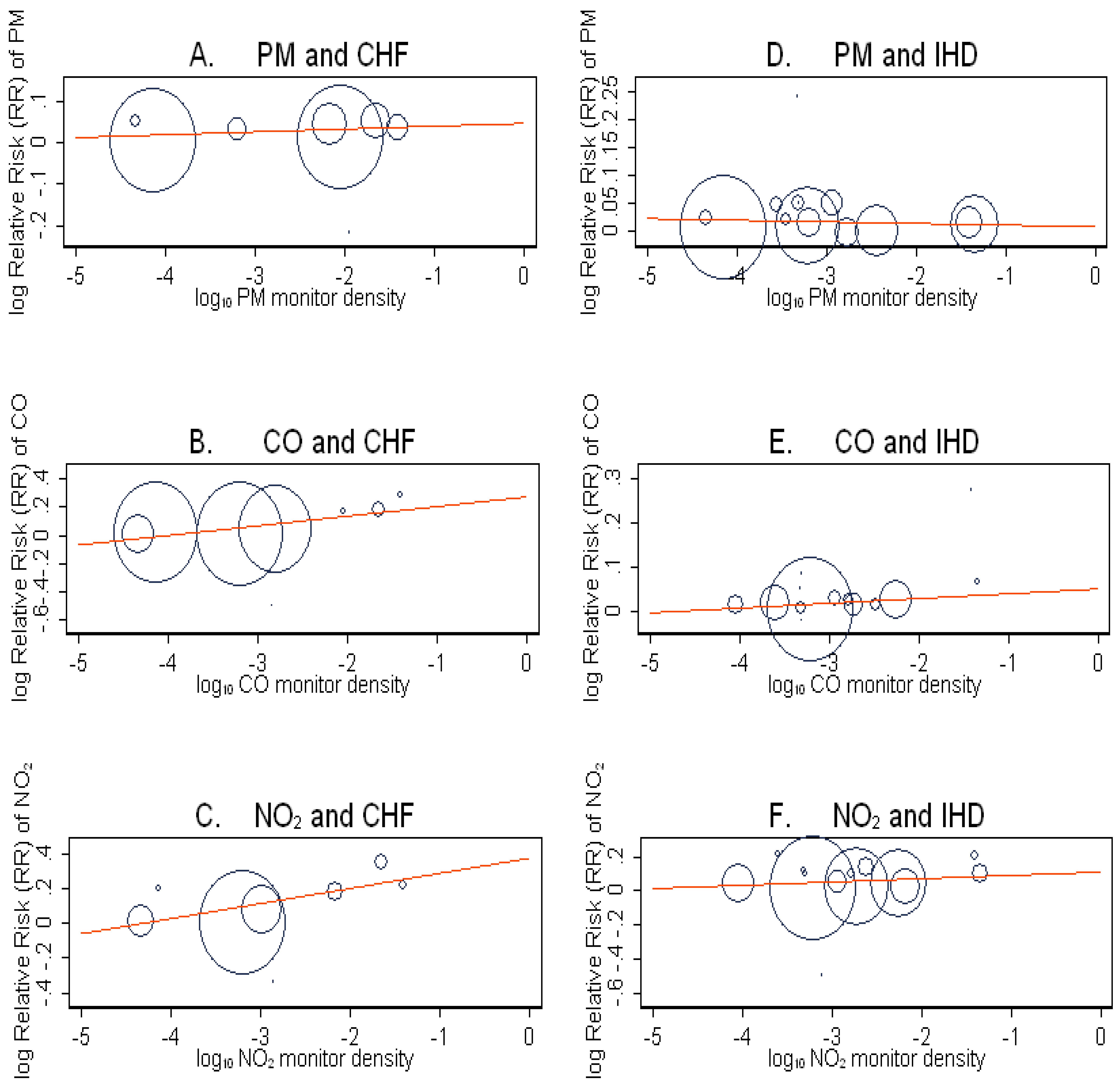
<p>The univariate relationship between the log RR and several continuous variables including, mean concentrations, correlations between pollutants and monitor density, was also determined and plotted. Monitor density was defined as the log of the number of monitors divided by the area of the study as reported by the investigators or as estimated independently using Geographic Information Systems (GIS) methods. The size of the circle on the plots of these univariate relationships is proportional to the inverse of the variance of the log RR. The lines represent the inverse variance weighted regression equations. Larger circles indicate larger studies that are given more weight in the meta-regression analysis.</p></sec>
<sec sec-type="results">
<label>3.</label>
<title>Results</title>
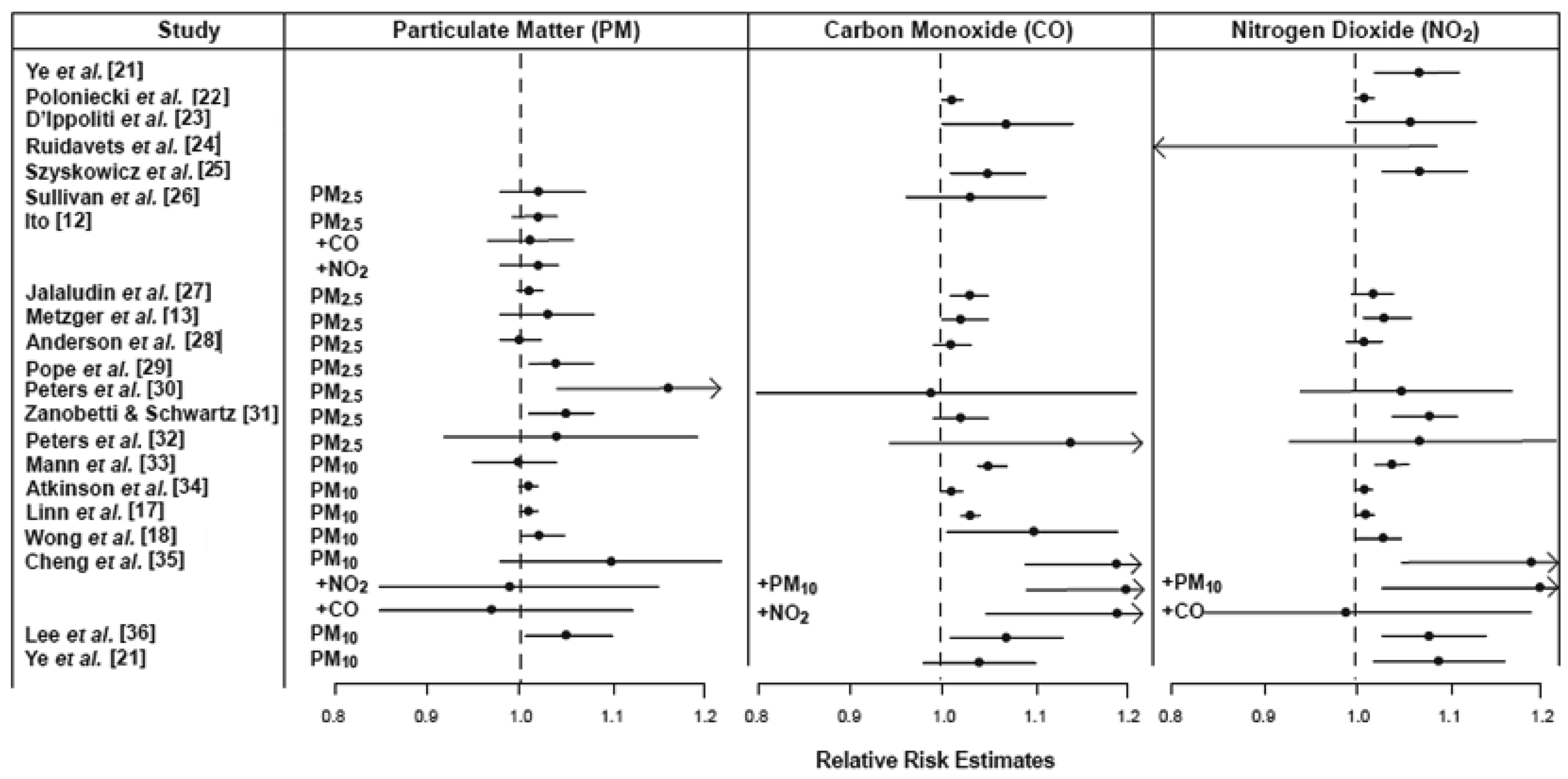
<p>Eleven studies of CHF met our inclusion criteria (<xref ref-type="fig" rid="f1-atmosphere-02-00688">Figure 1</xref>). The majority of the effect estimates are positive and statistically significant. Most studies do not examine all three pollutants (<italic>i.e.</italic>, PM, CO and NO<sub>2</sub>) nor do they consistently present quantitative results for the pollutants examined. Three studies present results from two-pollutant models and these results are not consistent regarding which pollutant remains robust after adjustment. Twenty-one studies of IHD/MI were included in the analysis (<xref ref-type="fig" rid="f2-atmosphere-02-00688">Figure 2</xref>). A similar pattern of positive, statistically significant results was observed. As shown in both figures, not all studies examined or presented results for each of the pollutants of interest. Risk estimates for both CHF and IHD/MI vary in their precision as well as their size.</p>
<p>Results of the meta-regression analysis are presented in <xref ref-type="table" rid="t1-atmosphere-02-00688">Tables 1</xref> and <xref ref-type="table" rid="t2-atmosphere-02-00688">2</xref>. Generally, the Begg's test, which has relatively low power, failed to detect statistical evidence of publication bias for most pollutant-outcome combinations while <italic>p</italic>-values generated using the Egger's test were smaller and more often significant at the <italic>p</italic> = 0.05 level. Overall, CHF effect estimates for US studies were smaller but this relationship did not hold for the IHD studies. Case crossover designs yielded somewhat larger estimates for both outcomes while the choice of single day lags resulted in somewhat smaller estimates. Studies restricted to older adults (&gt;64 years old) generally did not report larger estimates although the log RR for the effect of CO on CHF admissions was larger comparing populations restricted to adults 65 years to populations including all adults. Choice of PM size fraction (<italic>i.e.</italic>, PM<sub>10</sub> <italic>versus</italic> PM<sub>2.5</sub>) did not explain the differences in the size of estimates for PM across the CHF studies included. For the group of IHD/MI studies included in the analyses larger log RR's were observed depending on the PM size fraction (<italic>i.e.</italic>, PM<sub>10</sub> <italic>versus</italic> PM<sub>2.5</sub>) and independent confirmation of diagnosis (<xref ref-type="table" rid="t2-atmosphere-02-00688">Table 2</xref>). Overall, a small proportion of the variance (e.g., &lt;5%) was explained by the covariate evaluated separately.</p>
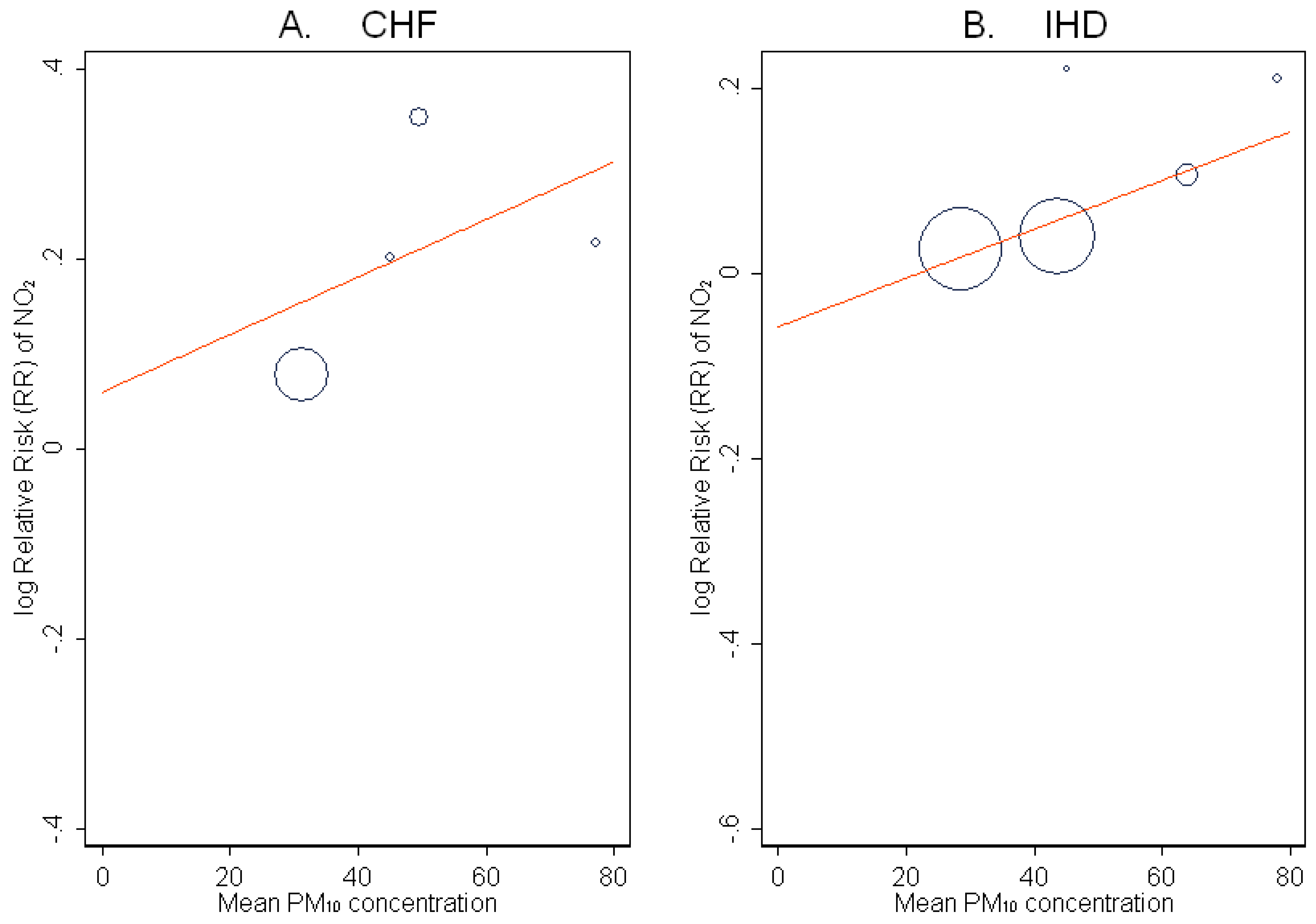
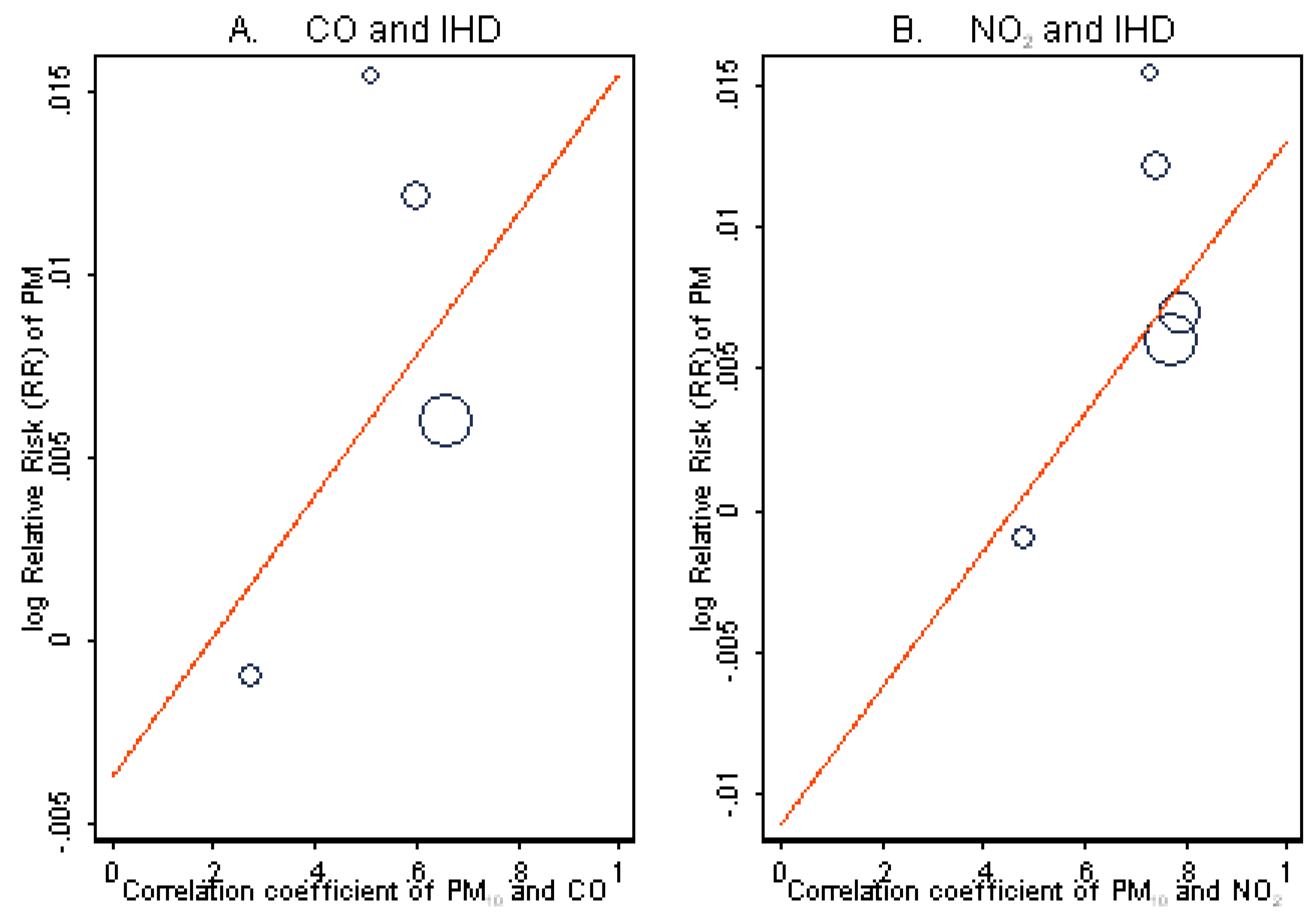
<p>The univariate relationships between the log RR for PM, NO<sub>2</sub> and CO and several continuous variables related to the pollutant mixture and monitoring network (<italic>i.e.</italic>, monitor density, mean concentration, and correlation between pollutants) are shown in <xref ref-type="fig" rid="f3-atmosphere-02-00688">Figures 3</xref>–<xref ref-type="fig" rid="f5-atmosphere-02-00688">5</xref>. Mean concentrations and correlations between pollutants were not reported for all pollutants in all studies that met our inclusion criteria (each circle on these figures represents one study). Since these covariates were not reported consistently across studies we interpret the results qualitatively and present results when there was a suggestion of a relationship. The log RR of CHF and IHD hospitalization with NO<sub>2</sub> exposure increases with PM<sub>10</sub> concentration (<xref ref-type="fig" rid="f3-atmosphere-02-00688">Figure 3</xref>).The log RR increased with log monitor density in most plots with the relationship for NO<sub>2</sub> and CHF hospitalization showing the largest increase with monitor density (<xref ref-type="fig" rid="f4-atmosphere-02-00688">Figure 4</xref>). The univariate relationship between the log RR for PM<sub>10</sub> and the correlations of PM<sub>10</sub> with CO and NO<sub>2</sub> for the IHD studies are in <xref ref-type="fig" rid="f5-atmosphere-02-00688">Figure 5</xref>. The log RR increased with stronger correlations in the limited number of studies available to evaluate this relationship. Too few studies presented the necessary data to evaluate the comparable plots for the CHF studies.</p></sec>
<sec sec-type="discussion">
<label>4.</label>
<title>Discussion</title>
<p>EPA currently plans to develop a multipollutant science assessment whereby the health effects of exposures to multiple pollutants may be systematically evaluated [<xref ref-type="bibr" rid="b3-atmosphere-02-00688">3</xref>]. Although the number of studies specifically designed to evaluate the effect of mixtures of air pollutants is limited, a National Research Council report suggests that review of multiple pollutants simultaneously and in parallel is scientifically prudent at this time [<xref ref-type="bibr" rid="b3-atmosphere-02-00688">3</xref>]. We conducted this effect size modeling analysis in an effort to consider the evidence for PM, CO and NO<sub>2</sub> in such a multipollutant context.</p>
<p>Not all studies included in this analysis reported results for all pollutants evaluated and publication bias was detected for associations with each of the pollutants. Studies also varied in their methods and analytical approach. It would have been ideal to evaluate effect modification by relevant parameters of the mixture and design network including the long-term average concentration of the co-pollutant, correlations between pollutants and monitor density, while holding the effect of study design and method constant. However, there were too few studies to include multiple variables in the meta-regression models. Consequently we did not evaluate potential predictors of effect size related to the pollutant mixtures while controlling for study design variables. Further, we did not account for the variable methods of temperature adjustment our analysis because too many strategies were employed across the studies (e.g., stratification, matching, and inclusion of nonlinear or linear terms for temperature).</p>
<p>Despite these limitations, effect size modeling confirmed that some variation in the log RR between studies was due to study design, choice of lag and other methodological differences across studies. We observed that the log RR for NO<sub>2</sub> associations increased with PM<sub>10</sub> concentration and the log RR for PM associations increased with the correlation of PM<sub>10</sub> and NO<sub>2</sub>. We also found that the size of the risk estimate for CVD hospitalizations increased with increasing monitor density. Enhanced spatial coverage of the monitors is expected to reduce the potential for exposure error and consequently reduce attenuation of the risk estimates. A similar result suggesting increased effect estimates for CVD hospitalizations was observed by Bell et al. [<xref ref-type="bibr" rid="b37-atmosphere-02-00688">37</xref>], who found that an IQR increase in monitor density corresponded to an 8% and 20% increase in the association with CO and NO<sub>2</sub>, respectively. Sarnat <italic>et al.</italic> [<xref ref-type="bibr" rid="b38-atmosphere-02-00688">38</xref>] did not find that effect estimates varied across different monitors in an urban area, although they were attenuated for CO and NO<sub>2</sub> (but not PM<sub>2.5</sub>) when a rural monitor located 60 km away was used for the analysis. This finding may be due to the somewhat greater variability for CO and NO<sub>2</sub> relative to PM<sub>2.5</sub>. This is also supported by a simulation study showing a smaller impact of measurement error on effect estimates for pollutants with less spatial heterogeneity [<xref ref-type="bibr" rid="b39-atmosphere-02-00688">39</xref>]. Further, these findings may also be due to chance since a large number of relationships were explored.</p>
<p>To date, only a few multicity studies of hospital admissions and ED visits for IHD/MI or CHF have included analyses of multiple pollutants, in contrast to the single-city analysis results described here. Bell <italic>et al.</italic> [<xref ref-type="bibr" rid="b37-atmosphere-02-00688">37</xref>] report a significant single pollutant effect of CO with all cardiovascular disease (CVD) admissions and reported that the effect was robust to adjustment for PM<sub>2.5</sub>, NO<sub>2</sub> and elemental carbon (EC). In a separate report, these authors found a significant effect for PM<sub>2.5</sub> in a single-pollutant model [<xref ref-type="bibr" rid="b40-atmosphere-02-00688">40</xref>]. These investigators have also analyzed PM<sub>2.5</sub> components and size fractions, attempting to distinguish their independent effects through the use of multipollutant models [<xref ref-type="bibr" rid="b41-atmosphere-02-00688">41</xref>–<xref ref-type="bibr" rid="b43-atmosphere-02-00688">43</xref>]. A report from the United Kingdom Department of Health [<xref ref-type="bibr" rid="b44-atmosphere-02-00688">44</xref>] presented pooled estimates for cardiovascular hospital admissions including IHD and CHF. Authors reported that both heterogeneity in the size of the effect estimates and publication bias were detected. Few studies have evaluated the sources of heterogeneity in risk estimates across single city studies of hospital admission and ED visits for cardiovascular diseases. One previous multicity analysis conducted in Europe reported that 84% of the heterogeneity in the PM<sub>10</sub> estimates across the cities examined could be explained by the PM<sub>10</sub>-NO<sub>2</sub> correlation. The PM<sub>10</sub>-NO<sub>2</sub> correlation explained a much smaller proportion (<italic>i.e.</italic>, &lt;4%) of the between estimate variation in these analyses.</p>
<p>The integration of findings across scientific disciplines in the ISA supported the independent effects of PM and CO exposure on IHD and CHF [<xref ref-type="bibr" rid="b5-atmosphere-02-00688">5</xref>,<xref ref-type="bibr" rid="b6-atmosphere-02-00688">6</xref>]. Associations between short term NO<sub>2</sub> exposure and cardiovascular hospitalizations were also consistently observed [<xref ref-type="bibr" rid="b45-atmosphere-02-00688">45</xref>].The simultaneous consideration of these highly correlated individual pollutants represents an initial step in assessing the health effects of multiple pollutants in the absence of a large number of studies designed specifically to evaluate the effects of complex pollutant mixtures. In this paper, we present preliminary results suggesting that study methodology, concentrations of other pollutants, and monitor density may influence the observed effect estimates in single-city studies of air pollution and cardiovascular hospitalizations or ED visits. Our results may be useful in the design of future studies or aid in interpreting health effects in a multipollutant context. For example, the suggestion that NO<sub>2</sub> effect estimates are higher when PM<sub>10</sub> concentrations are also elevated may suggest a joint effect of these pollutants, or that PM is an indicator for poor air quality in general. However, our analyses were limited because findings for various pollutants, lags and averaging times examined were not reported consistently across studies, nor were the mean levels of co-pollutants and correlations between pollutants. Efforts by investigators to report results for the complete set of associations examined would maximize the utility of single city studies of air pollution for these types of meta-regression analyses.</p></sec></body>
<back>
<sec sec-type="display-objects">
<title>Figures and Tables</title>
<fig id="f1-atmosphere-02-00688" position="float">
<label>Figure 1.</label>
<caption>
<p>Effect estimates and 95% Confidence Intervals for Studies of Congestive Heart Failure (CHF) included in the analysis.</p></caption>
<graphic xlink:href="atmosphere-02-00688f1.gif"/></fig>
<fig id="f2-atmosphere-02-00688" position="float">
<label>Figure 2.</label>
<caption>
<p>Effect estimates and 95% Confidence Intervals for Studies of Ischemic heart Disease (IHD) and Myocardial Infarction (MI) included in the analysis.</p></caption>
<graphic xlink:href="atmosphere-02-00688f2.gif"/></fig>
<fig id="f3-atmosphere-02-00688" position="float">
<label>Figure 3.</label>
<caption>
<p>Univariate relationships between the log Relative Risk (RR) of hospitalization for (<bold>A</bold>) congestive Heart Failure (CHF) and (<bold>B</bold>) Ischemic Heart Disease (IHD) in association with NO<sub>2</sub> and, mean PM<sub>10</sub> concentration.</p></caption>
<graphic xlink:href="atmosphere-02-00688f3.gif"/></fig>
<fig id="f4-atmosphere-02-00688" position="float">
<label>Figure 4.</label>
<caption>
<p>Univariate relationships between the log relative risks (RR) of hospitalizations for congestive heart failure (CHF) and ischemic heart disease (IHD) and in association with exposure to PM (<bold>A</bold> and <bold>D</bold>), CO (<bold>B</bold> and <bold>E</bold>), and NO<sub>2</sub> (<bold>C</bold> and <bold>F</bold>), and the log of the monitor density *.</p>
<p>* Monitor density is the number of monitors reported divided by the study area in square kilometers (km). If study area was not reported we estimated it from information provided in the study using a Geographical Information System (GIS) approach.</p></caption>
<graphic xlink:href="atmosphere-02-00688f4.gif"/></fig>
<fig id="f5-atmosphere-02-00688" position="float">
<label>Figure 5.</label>
<caption>
<p>Univariate relationship between the log relative risk (RR) of hospitalization for IHD in association with exposure to CO (<bold>A</bold>) and NO<sub>2</sub> (<bold>B</bold>), and the correlation of the pollutant with PM<sub>10</sub>.</p></caption>
<graphic xlink:href="atmosphere-02-00688f5.gif"/></fig>
<table-wrap id="t1-atmosphere-02-00688" position="float">
<label>Table 1.</label>
<caption>
<p>Results of the meta-regression models for studies of Congestive Heart Failure (CHF). Beta coefficients indicate the increase or decrease in the log RR that depends on the covariate.</p></caption>
<table frame="hsides" rules="groups">
<thead>
<tr>
<th align="center" valign="top"><bold>Covariate <xref ref-type="table-fn" rid="tfn1-atmosphere-02-00688">*</xref></bold></th>
<th align="center" valign="top"><bold>Statistic</bold></th>
<th align="center" valign="top"><bold>PM (<italic>n</italic> = 9)</bold></th>
<th align="center" valign="top"><bold>CO (<italic>n</italic> = 8)</bold></th>
<th align="center" valign="top"><bold>NO<sub>2</sub> (<italic>n</italic> = 8)</bold></th></tr></thead>
<tbody>
<tr>
<td align="center" valign="top" rowspan="4"><bold>USA or Canada</bold></td>
<td align="center" valign="top">Beta</td>
<td align="center" valign="top">−0.0355</td>
<td align="center" valign="top">−0.0967</td>
<td align="center" valign="top">−0.1117</td></tr>
<tr>
<td align="center" valign="top">Standard Error</td>
<td align="center" valign="top">0.0067</td>
<td align="center" valign="top">0.0697</td>
<td align="center" valign="top">0.0986</td></tr>
<tr>
<td align="center" valign="top"><italic>p</italic>-value</td>
<td align="center" valign="top">&lt;0.001</td>
<td align="center" valign="top">0.166</td>
<td align="center" valign="top">0.257</td></tr>
<tr>
<td align="center" valign="top">Sample Size</td>
<td align="center" valign="top"><italic>n</italic> = 6</td>
<td align="center" valign="top"><italic>n</italic> = 4</td>
<td align="center" valign="top"><italic>n</italic> = 4</td></tr>
<tr>
<td align="center" valign="top" rowspan="4"><bold>Case-crossover design</bold></td>
<td align="center" valign="top">Beta</td>
<td align="center" valign="top">0.0045</td>
<td align="center" valign="top">0.0360</td>
<td align="center" valign="top">0.1031</td></tr>
<tr>
<td align="center" valign="top">Standard Error</td>
<td align="center" valign="top">0.0091</td>
<td align="center" valign="top">0.0070</td>
<td align="center" valign="top">0.0933</td></tr>
<tr>
<td align="center" valign="top"><italic>p</italic>-value</td>
<td align="center" valign="top">0.621</td>
<td align="center" valign="top">&lt;0.001</td>
<td align="center" valign="top">0.269</td></tr>
<tr>
<td align="center" valign="top">Sample Size</td>
<td align="center" valign="top"/>
<td align="center" valign="top"/></tr>
<tr>
<td align="center" valign="top" rowspan="4"><bold>65 years or older</bold></td>
<td align="center" valign="top">Beta</td>
<td align="center" valign="top">−0.0153</td>
<td align="center" valign="top">0.0262</td>
<td align="center" valign="top">−0.0598</td></tr>
<tr>
<td align="center" valign="top">Standard Error</td>
<td align="center" valign="top">0.175</td>
<td align="center" valign="top">0.0073</td>
<td align="center" valign="top">0.1429</td></tr>
<tr>
<td align="center" valign="top"><italic>p</italic>-value</td>
<td align="center" valign="top">0.381</td>
<td align="center" valign="top">&lt;0.001</td>
<td align="center" valign="top">0.676</td></tr>
<tr>
<td align="center" valign="top">Sample Size</td>
<td align="center" valign="top"><italic>n</italic> = 5</td>
<td align="center" valign="top"><italic>n</italic> = 4</td>
<td align="center" valign="top"><italic>n</italic> = 4</td></tr>
<tr>
<td align="center" valign="top" rowspan="4"><bold>PM</bold><sub>10</sub></td>
<td align="center" valign="top">Beta</td>
<td align="center" valign="top">−0.0163</td>
<td align="center" valign="top"/>
<td align="center" valign="top"/></tr>
<tr>
<td align="center" valign="top">Standard Error</td>
<td align="center" valign="top">0.0141</td>
<td align="center" valign="top"/>
<td align="center" valign="top"/></tr>
<tr>
<td align="center" valign="top"><italic>p</italic>-value</td>
<td align="center" valign="top">0.244</td>
<td align="center" valign="top"/>
<td align="center" valign="top"/></tr>
<tr>
<td align="center" valign="top">Sample Size</td>
<td align="center" valign="top"><italic>n</italic> = 4</td>
<td align="center" valign="top"/>
<td align="center" valign="top"/></tr>
<tr>
<td align="center" valign="top" rowspan="4"><bold>Single day lag</bold></td>
<td align="center" valign="top">Beta</td>
<td align="center" valign="top">−0.0373</td>
<td align="center" valign="top">−0.0852</td>
<td align="center" valign="top">−0.0917</td></tr>
<tr>
<td align="center" valign="top">Standard Error</td>
<td align="center" valign="top">0065</td>
<td align="center" valign="top">0.0669</td>
<td align="center" valign="top">0.0964</td></tr>
<tr>
<td align="center" valign="top"><italic>p</italic>-value</td>
<td align="center" valign="top">&lt;0.001</td>
<td align="center" valign="top">0.203</td>
<td align="center" valign="top">0.341</td></tr>
<tr>
<td align="center" valign="top">Sample Size</td>
<td align="center" valign="top"><italic>n</italic> = 3</td>
<td align="center" valign="top"><italic>n</italic> = 4</td>
<td align="center" valign="top"><italic>n</italic> = 4</td></tr></tbody></table>
<table-wrap-foot><fn id="tfn1-atmosphere-02-00688">
<label>*</label>
<p>The meaning of the sign preceding the effect can be interpreted based on the following reference groups: USA and Canadian studies <italic>versus</italic> other; Case-crossover <italic>versus</italic> time series design; 65 years and older <italic>versus</italic> all ages combined; PM<sub>10</sub> <italic>versus</italic> PM<sub>2.5</sub>; Single day lag <italic>versus</italic> multi-day average lags.</p></fn></table-wrap-foot></table-wrap>
<table-wrap id="t2-atmosphere-02-00688" position="float">
<label>Table 2.</label>
<caption>
<p>Results of the meta-regression models for studies of Ischemic Heart Disease (IHD)<xref ref-type="table-fn" rid="tfn2-atmosphere-02-00688">*</xref>. Beta coefficients indicate the increase or decrease in the log RR that depends on the covariate.</p></caption>
<table frame="hsides" rules="groups">
<thead>
<tr>
<th align="center" valign="top"><bold>Covariate</bold> <xref ref-type="table-fn" rid="tfn3-atmosphere-02-00688">**</xref></th>
<th align="center" valign="top"><bold>Statistic</bold></th>
<th align="center" valign="top"><bold>PM (<italic>n</italic> = 16)</bold></th>
<th align="center" valign="top"><bold>CO (<italic>n</italic> = 15)</bold></th>
<th align="center" valign="top"><bold>NO<sub>2</sub>(<italic>n</italic> = 17)</bold></th></tr></thead>
<tbody>
<tr>
<td align="center" valign="top" rowspan="4"><bold>USA or Canada</bold></td>
<td align="center" valign="top">Beta</td>
<td align="center" valign="top">−0.0031</td>
<td align="center" valign="top">0.0154</td>
<td align="center" valign="top">0.0243</td></tr>
<tr>
<td align="center" valign="top">Standard Error</td>
<td align="center" valign="top">0.0035</td>
<td align="center" valign="top">0.0033</td>
<td align="center" valign="top">0.0108</td></tr>
<tr>
<td align="center" valign="top"><italic>p</italic>-value</td>
<td align="center" valign="top">0.382</td>
<td align="center" valign="top">&lt;0.001</td>
<td align="center" valign="top">0.025</td></tr>
<tr>
<td align="center" valign="top">Sample Size</td>
<td align="center" valign="top"><italic>n</italic> = 8</td>
<td align="center" valign="top"><italic>n</italic> = 7</td>
<td align="center" valign="top"><italic>n</italic> = 7</td></tr>
<tr>
<td align="center" valign="top" rowspan="4"><bold>Case-crossover design</bold></td>
<td align="center" valign="top">Beta</td>
<td align="center" valign="top">0.0192</td>
<td align="center" valign="top">0.0103</td>
<td align="center" valign="top">0.099</td></tr>
<tr>
<td align="center" valign="top">Standard Error</td>
<td align="center" valign="top">0.0077</td>
<td align="center" valign="top">0.0102</td>
<td align="center" valign="top">0.0271</td></tr>
<tr>
<td align="center" valign="top"><italic>p</italic>-value</td>
<td align="center" valign="top">0.012</td>
<td align="center" valign="top">0.312</td>
<td align="center" valign="top">&lt;0.001</td></tr>
<tr>
<td align="center" valign="top">Sample Size</td>
<td align="center" valign="top"><italic>n</italic> = 6</td>
<td align="center" valign="top"><italic>n</italic> = 6</td></tr>
<tr>
<td align="center" valign="top" rowspan="4"><bold>65 years or older</bold></td>
<td align="center" valign="top">Beta</td>
<td align="center" valign="top">0.0061</td>
<td align="center" valign="top">0.0070</td>
<td align="center" valign="top">0.0219</td></tr>
<tr>
<td align="center" valign="top">Standard Error</td>
<td align="center" valign="top">0.0036</td>
<td align="center" valign="top">0.0064</td>
<td align="center" valign="top">0.0244</td></tr>
<tr>
<td align="center" valign="top"><italic>p</italic>-value</td>
<td align="center" valign="top">0.095</td>
<td align="center" valign="top">0.276</td>
<td align="center" valign="top">0.369</td></tr>
<tr>
<td align="center" valign="top">Sample Size</td>
<td align="center" valign="top"><italic>n</italic> = 4</td>
<td align="center" valign="top"><italic>n</italic> = 5</td></tr>
<tr>
<td align="center" valign="top" rowspan="4"><bold>Confirmed diagnosis</bold></td>
<td align="center" valign="top">Beta</td>
<td align="center" valign="top">0.0330</td>
<td align="center" valign="top">−0.0052</td>
<td align="center" valign="top">−0.0005</td></tr>
<tr>
<td align="center" valign="top">Standard Error</td>
<td align="center" valign="top">0.0144</td>
<td align="center" valign="top">0.0148</td>
<td align="center" valign="top">0.0856</td></tr>
<tr>
<td align="center" valign="top"><italic>p</italic>-value</td>
<td align="center" valign="top">0.022</td>
<td align="center" valign="top">0.726</td>
<td align="center" valign="top">0.995</td></tr>
<tr>
<td align="center" valign="top">Sample Size</td>
<td align="center" valign="top"><italic>n</italic> = 3</td>
<td align="center" valign="top"><italic>n</italic> = 3</td></tr>
<tr>
<td align="center" valign="top" rowspan="4"><bold>PM<sub>10</sub></bold></td>
<td align="center" valign="top">Beta</td>
<td align="center" valign="top">−0.018</td>
<td align="center" valign="top"/>
<td align="center" valign="top"/></tr>
<tr>
<td align="center" valign="top">Standard Error</td>
<td align="center" valign="top">0.0059</td>
<td align="center" valign="top"/>
<td align="center" valign="top"/></tr>
<tr>
<td align="center" valign="top"><italic>p</italic>-value</td>
<td align="center" valign="top">0.002</td>
<td align="center" valign="top"/>
<td align="center" valign="top"/></tr>
<tr>
<td align="center" valign="top">Sample Size</td>
<td align="center" valign="top"><italic>n</italic> = 7</td>
<td align="center" valign="top"/>
<td align="center" valign="top"/></tr>
<tr>
<td align="center" valign="top" rowspan="4"><bold>Single day lag</bold></td>
<td align="center" valign="top">Beta</td>
<td align="center" valign="top">−0.0039</td>
<td align="center" valign="top">−0.0087</td>
<td align="center" valign="top">−0.187</td></tr>
<tr>
<td align="center" valign="top">Standard Error</td>
<td align="center" valign="top">0.0040</td>
<td align="center" valign="top">0.0065</td>
<td align="center" valign="top">0.0125</td></tr>
<tr>
<td align="center" valign="top"><italic>p</italic>-value</td>
<td align="center" valign="top">0.338</td>
<td align="center" valign="top">0.181</td>
<td align="center" valign="top">0.134</td></tr>
<tr>
<td align="center" valign="top">Sample Size</td>
<td align="center" valign="top"><italic>n</italic> = 4</td>
<td align="center" valign="top"><italic>n</italic> = 5</td>
<td align="center" valign="top"><italic>n</italic> = 6</td></tr></tbody></table>
<table-wrap-foot><fn id="tfn2-atmosphere-02-00688">
<label>*</label>
<p>Including studies of Myocardial Infarction (MI);</p></fn><fn id="tfn3-atmosphere-02-00688">
<label>**</label>
<p>The meaning of the sign preceding the effect can be interpreted based on the following reference groups: US and Canadian studies <italic>versus</italic> other; Case-crossover <italic>versus</italic> time series design; 65 years and older <italic>versus</italic> all ages combined; Confirmed diagnosis <italic>versus</italic> ICD code only; PM<sub>10</sub> <italic>versus</italic> PM<sub>2.5</sub>; Single day lag <italic>versus</italic> multi-day average lags.</p></fn></table-wrap-foot></table-wrap></sec>
<ack>
<p>The authors would like to acknowledge the skill and attention to detail of Kaylyn Siporin for the formatting and proofing of this manuscript. The views expressed in this article are those of the authors and do not necessarily represent the views or policies of the U.S. Environmental Protection Agency.</p></ack>
<ref-list>
<title>References</title>
<ref id="b1-atmosphere-02-00688"><label>1.</label><citation citation-type="journal"><person-group person-group-type="author"><name><surname>Dominici</surname><given-names>F.</given-names></name><name><surname>Peng</surname><given-names>R.D.</given-names></name><name><surname>Barr</surname><given-names>C.D.</given-names></name><name><surname>Bell</surname><given-names>M.L.</given-names></name></person-group><article-title>Protecting human health from air pollution: Shifting from a single-pollutant to a multipollutant approach</article-title><source>Epidemiology</source><year>2010</year><volume>21</volume><fpage>187</fpage><lpage>194</lpage><pub-id pub-id-type="doi">10.1097/EDE.0b013e3181cc86e8</pub-id><pub-id pub-id-type="pmid">20160561</pub-id></citation></ref>
<ref id="b2-atmosphere-02-00688"><label>2.</label><citation citation-type="journal"><person-group person-group-type="author"><name><surname>Mauderly</surname><given-names>J.L.</given-names></name><name><surname>Burnett</surname><given-names>R.T.</given-names></name><name><surname>Castillejos</surname><given-names>M.</given-names></name><name><surname>Ozkaynak</surname><given-names>H.</given-names></name><name><surname>Samet</surname><given-names>J.M.</given-names></name><name><surname>Stieb</surname><given-names>D.M.</given-names></name><name><surname>Vedal</surname><given-names>S.</given-names></name><name><surname>Wyzga</surname><given-names>R.E.</given-names></name></person-group><article-title>Is the air pollution health research community prepared to support a multipollutant air quality management framework?</article-title><source>Inhal. Toxicol.</source><year>2010</year><volume>22</volume><fpage>1</fpage><lpage>19</lpage><pub-id pub-id-type="pmid">21142795</pub-id></citation></ref>
<ref id="b3-atmosphere-02-00688"><label>3.</label><citation citation-type="confproc"><person-group person-group-type="author"><name><surname>Johns</surname><given-names>D.</given-names></name><name><surname>Stanek</surname><given-names>L.</given-names></name><name><surname>Luben</surname><given-names>T.</given-names></name><name><surname>Kirrane</surname><given-names>E.</given-names></name><name><surname>Vandenberg</surname><given-names>J.</given-names></name><name><surname>Ross</surname><given-names>M.</given-names></name></person-group><article-title>The Development of a Multipollutant Science Assessment to Support Reviews of the US Environmental Protection Agency's National Ambient Air Quality Standards</article-title><conf-name>Poster Presented at ISEE 2011, 23rd Congress of the International Society of Environmental Epidemiology</conf-name><conf-loc>Barcelona Spain</conf-loc><conf-date>13–16 September 2011</conf-date></citation></ref>
<ref id="b4-atmosphere-02-00688"><label>4.</label><citation citation-type="book"><person-group person-group-type="author"><collab>National Research Council (NRC)</collab></person-group><source>Air Quality Management in the United States</source><publisher-name>NRC</publisher-name><publisher-loc>Washington, DC, USA</publisher-loc><year>2004</year></citation></ref>
<ref id="b5-atmosphere-02-00688"><label>5.</label><citation citation-type="book"><person-group person-group-type="author"><collab>U.S. EPA</collab></person-group><source>Integrated Science Assessment for Carbon Monoxide</source><comment>EPA/600/R-09/019F</comment><publisher-name>Office of Research and Development, Research Triangle Park</publisher-name><publisher-loc>Durham, NC, USA</publisher-loc><year>2010</year></citation></ref>
<ref id="b6-atmosphere-02-00688"><label>6.</label><citation citation-type="book"><person-group person-group-type="author"><collab>U.S. EPA</collab></person-group><source>Integrated Science Assessment for Particulate Matter</source><comment>EPA/600/R-08/139F</comment><publisher-name>Office of Research and Development, Research Triangle Park</publisher-name><publisher-loc>Durham, NC, USA</publisher-loc><year>2009</year></citation></ref>
<ref id="b7-atmosphere-02-00688"><label>7.</label><citation citation-type="journal"><person-group person-group-type="author"><name><surname>Dominici</surname><given-names>F.</given-names></name><name><surname>McDermott</surname><given-names>A.</given-names></name><name><surname>Zeger</surname><given-names>S.L.</given-names></name><name><surname>Samet</surname><given-names>J.M.</given-names></name></person-group><article-title>On the use of generalized additive models in time-series studies of air pollution and health</article-title><source>Am. J. Epidemiol.</source><year>2002</year><volume>156</volume><fpage>193</fpage><lpage>203</lpage><pub-id pub-id-type="doi">10.1093/aje/kwf062</pub-id><pub-id pub-id-type="pmid">12142253</pub-id></citation></ref>
<ref id="b8-atmosphere-02-00688"><label>8.</label><citation citation-type="journal"><person-group person-group-type="author"><name><surname>Begg</surname><given-names>C.B.</given-names></name><name><surname>Mazumdar</surname><given-names>M.</given-names></name></person-group><article-title>Operating characteristics of a rank correlation test for publication bias</article-title><source>Biometrics</source><year>1994</year><volume>50</volume><fpage>1088</fpage><lpage>1101</lpage><pub-id pub-id-type="doi">10.2307/2533446</pub-id><pub-id pub-id-type="pmid">7786990</pub-id></citation></ref>
<ref id="b9-atmosphere-02-00688"><label>9.</label><citation citation-type="journal"><person-group person-group-type="author"><name><surname>Egger</surname><given-names>M.</given-names></name><name><surname>Smith</surname><given-names>G.D.</given-names></name><name><surname>Schneider</surname><given-names>M.</given-names></name><name><surname>Minder</surname><given-names>C.</given-names></name></person-group><article-title>Bias in meta-analysis detected by a simple, graphical test</article-title><source>British Medical Journal</source><year>1997</year><volume>315</volume><fpage>629</fpage><lpage>634</lpage><pub-id pub-id-type="doi">10.1136/bmj.315.7109.629</pub-id><pub-id pub-id-type="pmid">9310563</pub-id></citation></ref>
<ref id="b10-atmosphere-02-00688"><label>10.</label><citation citation-type="journal"><person-group person-group-type="author"><name><surname>Poloniecki</surname><given-names>J.D.</given-names></name><name><surname>Atkinson</surname><given-names>R.W.</given-names></name><name><surname>de Leon</surname><given-names>A.P.</given-names></name><name><surname>Anderson</surname><given-names>H.R.</given-names></name></person-group><article-title>Daily time series for cardiovascular hospital admissions and previous day's air pollution in London, UK</article-title><source>Occup. Environ. Med.</source><year>1997</year><volume>54</volume><fpage>535</fpage><lpage>540</lpage><pub-id pub-id-type="doi">10.1136/oem.54.8.535</pub-id><pub-id pub-id-type="pmid">9326156</pub-id></citation></ref>
<ref id="b11-atmosphere-02-00688"><label>11.</label><citation citation-type="journal"><person-group person-group-type="author"><name><surname>Koken</surname><given-names>P.J.M.</given-names></name><name><surname>Piver</surname><given-names>W.T.</given-names></name><name><surname>Ye</surname><given-names>F.</given-names></name><name><surname>Elixhauser</surname><given-names>A.</given-names></name><name><surname>Olsen</surname><given-names>L.M.</given-names></name><name><surname>Portier</surname><given-names>C.J.</given-names></name></person-group><article-title>Temperature, air pollution, and hospitalization for cardiovascular diseases among elderly people in Denver</article-title><source>Environ. Health Perspect.</source><year>2003</year><volume>111</volume><fpage>1312</fpage><lpage>1317</lpage><pub-id pub-id-type="doi">10.1289/ehp.5957</pub-id><pub-id pub-id-type="pmid">12896852</pub-id></citation></ref>
<ref id="b12-atmosphere-02-00688"><label>12.</label><citation citation-type="book"><person-group person-group-type="author"><name><surname>Ito</surname><given-names>K.</given-names></name></person-group><article-title>Associations of Particulate Matter Components with Daily Mortality and Morbidity in Detroit, Michigan</article-title><source>Revised Analyses of Time-Series Studies of Air Pollution and Health</source><comment>Special Report</comment><publisher-name>Health Effects Institute</publisher-name><publisher-loc>Boston, MA, USA</publisher-loc><year>2003</year><fpage>R828112</fpage></citation></ref>
<ref id="b13-atmosphere-02-00688"><label>13.</label><citation citation-type="journal"><person-group person-group-type="author"><name><surname>Metzger</surname><given-names>K.B.</given-names></name><name><surname>Tolbert</surname><given-names>P.E.</given-names></name><name><surname>Klein</surname><given-names>M.</given-names></name><name><surname>Peel</surname><given-names>J.L.</given-names></name><name><surname>Flanders</surname><given-names>W.D.</given-names></name><name><surname>Todd</surname><given-names>K.H.</given-names></name><name><surname>Mulholland</surname><given-names>J.A.</given-names></name><name><surname>Ryan</surname><given-names>P.B.</given-names></name><name><surname>Frumkin</surname><given-names>H.</given-names></name></person-group><article-title>Ambient air pollution and cardiovascular emergency department visits</article-title><source>Epidemiology</source><year>2004</year><volume>15</volume><fpage>46</fpage><lpage>56</lpage><pub-id pub-id-type="doi">10.1097/01.EDE.0000101748.28283.97</pub-id><pub-id pub-id-type="pmid">14712146</pub-id></citation></ref>
<ref id="b14-atmosphere-02-00688"><label>14.</label><citation citation-type="journal"><person-group person-group-type="author"><name><surname>Pope</surname><given-names>C.</given-names></name><name><surname>Renlund</surname><given-names>D.</given-names></name><name><surname>Kfoury</surname><given-names>A.</given-names></name><name><surname>May</surname><given-names>H.</given-names></name><name><surname>Horne</surname><given-names>B.</given-names></name></person-group><article-title>Relation of heart failure hospitalization to exposure to fine particulate air pollution</article-title><source>Am. J. Cardiol.</source><year>2008</year><volume>102</volume><fpage>1230</fpage><lpage>1234</lpage><pub-id pub-id-type="doi">10.1016/j.amjcard.2008.06.044</pub-id><pub-id pub-id-type="pmid">18940298</pub-id></citation></ref>
<ref id="b15-atmosphere-02-00688"><label>15.</label><citation citation-type="journal"><person-group person-group-type="author"><name><surname>Symons</surname><given-names>J.M.</given-names></name><name><surname>Wang</surname><given-names>L.</given-names></name><name><surname>Guallar</surname><given-names>E.</given-names></name><name><surname>Howell</surname><given-names>E.</given-names></name><name><surname>Dominici</surname><given-names>F.</given-names></name><name><surname>Schwab</surname><given-names>M.</given-names></name><name><surname>Ange</surname><given-names>B.A.</given-names></name><name><surname>Samet</surname><given-names>J.</given-names></name><name><surname>Ondov</surname><given-names>J.</given-names></name><name><surname>Harrison</surname><given-names>D.</given-names></name><etal/></person-group><article-title>A case-crossover study of fine particulate matter air pollution and onset of congestive heart failure symptom exacerbation leading to hospitalization</article-title><source>Am. J. Epidemiol.</source><year>2006</year><volume>164</volume><fpage>421</fpage><lpage>433</lpage><pub-id pub-id-type="doi">10.1093/aje/kwj206</pub-id><pub-id pub-id-type="pmid">16793862</pub-id></citation></ref>
<ref id="b16-atmosphere-02-00688"><label>16.</label><citation citation-type="journal"><person-group person-group-type="author"><name><surname>Wellenius</surname><given-names>G.A.</given-names></name><name><surname>Bateson</surname><given-names>T.F.</given-names></name><name><surname>Mittleman</surname><given-names>M.A.</given-names></name><name><surname>Schwartz</surname><given-names>J.</given-names></name></person-group><article-title>Particulate air pollution and the rate of hospitalization for congestive heart failure among Medicare beneficiaries in Pittsburgh, Pennsylvania</article-title><source>Am. J. Epidemiol.</source><year>2005</year><volume>161</volume><fpage>1030</fpage><lpage>1036</lpage><pub-id pub-id-type="doi">10.1093/aje/kwi135</pub-id><pub-id pub-id-type="pmid">15901623</pub-id></citation></ref>
<ref id="b17-atmosphere-02-00688"><label>17.</label><citation citation-type="journal"><person-group person-group-type="author"><name><surname>Linn</surname><given-names>W.S.</given-names></name><name><surname>Szlachcic</surname><given-names>Y.</given-names></name><name><surname>Gong</surname><given-names>H.</given-names><suffix>Jr.</suffix></name><name><surname>Kinney</surname><given-names>P.L.</given-names></name><name><surname>Berhane</surname><given-names>K.T.</given-names></name></person-group><article-title>Air pollution and daily hospital admissions in metropolitan Los Angeles</article-title><source>Environ. Health Perspect.</source><year>2000</year><volume>108</volume><fpage>427</fpage><lpage>434</lpage><pub-id pub-id-type="doi">10.1289/ehp.00108427</pub-id><pub-id pub-id-type="pmid">10811569</pub-id></citation></ref>
<ref id="b18-atmosphere-02-00688"><label>18.</label><citation citation-type="journal"><person-group person-group-type="author"><name><surname>Wong</surname><given-names>T.W.</given-names></name><name><surname>Lau</surname><given-names>T.S.</given-names></name><name><surname>Yu</surname><given-names>T.S.</given-names></name><name><surname>Neller</surname><given-names>A.</given-names></name><name><surname>Wong</surname><given-names>S.L.</given-names></name><name><surname>Tam</surname><given-names>W.</given-names></name><name><surname>Pang</surname><given-names>S.W.</given-names></name></person-group><article-title>Air pollution and hospital admissions for respiratory and cardiovascular diseases in Hong Kong</article-title><source>Occup. Environ. Med.</source><year>1999</year><volume>56</volume><fpage>679</fpage><lpage>683</lpage><pub-id pub-id-type="doi">10.1136/oem.56.10.679</pub-id><pub-id pub-id-type="pmid">10658547</pub-id></citation></ref>
<ref id="b19-atmosphere-02-00688"><label>19.</label><citation citation-type="journal"><person-group person-group-type="author"><name><surname>Lee</surname><given-names>I.M.</given-names></name><name><surname>Tsai</surname><given-names>S.S.</given-names></name><name><surname>Ho</surname><given-names>C.K.</given-names></name><name><surname>Chiu</surname><given-names>H.F.</given-names></name><name><surname>Yang</surname><given-names>C.Y.</given-names></name></person-group><article-title>Air pollution and hospital admissions for congestive heart failure in a tropical city: Kaohsiung, Taiwan</article-title><source>Inhal. Toxicol.</source><year>2007</year><volume>19</volume><fpage>899</fpage><lpage>904</lpage><pub-id pub-id-type="doi">10.1080/08958370701479406</pub-id><pub-id pub-id-type="pmid">17687721</pub-id></citation></ref>
<ref id="b20-atmosphere-02-00688"><label>20.</label><citation citation-type="journal"><person-group person-group-type="author"><name><surname>Yang</surname><given-names>C.Y.</given-names></name></person-group><article-title>Air pollution and hospital admissions for congestive heart failure in a subtropical city: Taipei, Taiwan</article-title><source>J. Toxicol. Environ. Health A Curr. Iss.</source><year>2008</year><volume>71</volume><fpage>1085</fpage><lpage>1090</lpage><pub-id pub-id-type="doi">10.1080/15287390802114428</pub-id></citation></ref>
<ref id="b21-atmosphere-02-00688"><label>21.</label><citation citation-type="journal"><person-group person-group-type="author"><name><surname>Ye</surname><given-names>F.</given-names></name><name><surname>Piver</surname><given-names>W.T.</given-names></name><name><surname>Ando</surname><given-names>M.</given-names></name><name><surname>Portier</surname><given-names>C.J.</given-names></name></person-group><article-title>Effects of temperature and air pollutants on cardiovascular and respiratory diseases for males and females older than 65 years of age in Tokyo, July and August 1980-1995</article-title><source>Environ. Health Perspect.</source><year>2001</year><volume>109</volume><fpage>355</fpage><lpage>359</lpage><pub-id pub-id-type="doi">10.1289/ehp.01109355</pub-id><pub-id pub-id-type="pmid">11335183</pub-id></citation></ref>
<ref id="b22-atmosphere-02-00688"><label>22.</label><citation citation-type="journal"><person-group person-group-type="author"><name><surname>Poloniecki</surname><given-names>J.D.</given-names></name><name><surname>Atkinson</surname><given-names>R.W.</given-names></name><name><surname>de Leon</surname><given-names>A.P.</given-names></name><name><surname>Anderson</surname><given-names>H.R.</given-names></name></person-group><article-title>Daily time series for cardiovascular hospital admissions and previous day's air pollution in London, UK</article-title><source>Occup. Environ. Med.</source><year>1997</year><volume>54</volume><fpage>535</fpage><lpage>540</lpage><pub-id pub-id-type="doi">10.1136/oem.54.8.535</pub-id><pub-id pub-id-type="pmid">9326156</pub-id></citation></ref>
<ref id="b23-atmosphere-02-00688"><label>23.</label><citation citation-type="journal"><person-group person-group-type="author"><name><surname>D'Ippoliti</surname><given-names>D.</given-names></name><name><surname>Forastiere</surname><given-names>F.</given-names></name><name><surname>Ancona</surname><given-names>C.</given-names></name><name><surname>Agabiti</surname><given-names>N.</given-names></name><name><surname>Fusco</surname><given-names>D.</given-names></name><name><surname>Michelozzi</surname><given-names>P.</given-names></name><name><surname>Perucci</surname><given-names>C.A.</given-names></name></person-group><article-title>Air pollution and myocardial infarction in Rome: a case-crossover analysis</article-title><source>Epidemiology</source><year>2003</year><volume>14</volume><fpage>528</fpage><lpage>535</lpage><pub-id pub-id-type="doi">10.1097/01.ede.0000082046.22919.72</pub-id><pub-id pub-id-type="pmid">14501267</pub-id></citation></ref>
<ref id="b24-atmosphere-02-00688"><label>24.</label><citation citation-type="journal"><person-group person-group-type="author"><name><surname>Ruidavets</surname><given-names>J.B.</given-names></name><name><surname>Cournot</surname><given-names>M.</given-names></name><name><surname>Cassadou</surname><given-names>S.</given-names></name><name><surname>Giroux</surname><given-names>M.</given-names></name><name><surname>Meybeck</surname><given-names>M.</given-names></name><name><surname>Ferrieres</surname><given-names>J.</given-names></name></person-group><article-title>Ozone air pollution is associated with acute myocardial infarction</article-title><source>Circulation</source><year>2005</year><volume>111</volume><fpage>563</fpage><lpage>569</lpage><pub-id pub-id-type="doi">10.1161/01.CIR.0000154546.32135.6E</pub-id><pub-id pub-id-type="pmid">15699276</pub-id></citation></ref>
<ref id="b25-atmosphere-02-00688"><label>25.</label><citation citation-type="journal"><person-group person-group-type="author"><name><surname>Szyszkowicz</surname><given-names>M.</given-names></name></person-group><article-title>Air pollution and emergency department visits for ischemic heart disease in Montreal, Canada</article-title><source>Int. J.Occup. Med. Environ. Health</source><year>2007</year><volume>20</volume><fpage>167</fpage><lpage>173</lpage><pub-id pub-id-type="doi">10.2478/v10001-007-0015-3</pub-id><pub-id pub-id-type="pmid">17638683</pub-id></citation></ref>
<ref id="b26-atmosphere-02-00688"><label>26.</label><citation citation-type="journal"><person-group person-group-type="author"><name><surname>Sullivan</surname><given-names>J.</given-names></name><name><surname>Sheppard</surname><given-names>L.</given-names></name><name><surname>Schreuder</surname><given-names>A.</given-names></name><name><surname>Ishikawa</surname><given-names>N.</given-names></name><name><surname>Siscovick</surname><given-names>D.</given-names></name><name><surname>Kaufman</surname><given-names>J.</given-names></name></person-group><article-title>Relation between short-term fine-particulate matter exposure and onset of myocardial infarction</article-title><source>Epidemiology</source><year>2005</year><volume>16</volume><fpage>41</fpage><lpage>48</lpage><pub-id pub-id-type="doi">10.1097/01.ede.0000147116.34813.56</pub-id><pub-id pub-id-type="pmid">15613944</pub-id></citation></ref>
<ref id="b27-atmosphere-02-00688"><label>27.</label><citation citation-type="journal"><person-group person-group-type="author"><name><surname>Jalaludin</surname><given-names>B.</given-names></name><name><surname>Morgan</surname><given-names>G.</given-names></name><name><surname>Lincoln</surname><given-names>D.</given-names></name><name><surname>Sheppeard</surname><given-names>V.</given-names></name><name><surname>Simpson</surname><given-names>R.</given-names></name><name><surname>Corbett</surname><given-names>S.</given-names></name></person-group><article-title>Associations between ambient air pollution and daily emergency department attendances for cardiovascular disease in the elderly (65+ years), Sydney, Australia</article-title><source>J. Expo. Sci. Environ. Epidemiol.</source><year>2006</year><volume>16</volume><fpage>225</fpage><lpage>237</lpage><pub-id pub-id-type="doi">10.1038/sj.jea.7500451</pub-id><pub-id pub-id-type="pmid">16118657</pub-id></citation></ref>
<ref id="b28-atmosphere-02-00688"><label>28.</label><citation citation-type="journal"><person-group person-group-type="author"><name><surname>Anderson</surname><given-names>H.R.</given-names></name><name><surname>Bremner</surname><given-names>S.A.</given-names></name><name><surname>Atkinson</surname><given-names>R.W.</given-names></name><name><surname>Harrison</surname><given-names>R.M.</given-names></name><name><surname>Walters</surname><given-names>S.</given-names></name></person-group><article-title>Particulate matter and daily mortality and hospital admissions in the west midlands conurbation of the United Kingdom: associations with fine and coarse particles, black smoke and sulphate</article-title><source>Occup. Environ. Med.</source><year>2001</year><volume>58</volume><fpage>504</fpage><lpage>510</lpage><pub-id pub-id-type="doi">10.1136/oem.58.8.504</pub-id><pub-id pub-id-type="pmid">11452044</pub-id></citation></ref>
<ref id="b29-atmosphere-02-00688"><label>29.</label><citation citation-type="journal"><person-group person-group-type="author"><name><surname>Pope</surname><given-names>C.</given-names></name><name><surname>Renlund</surname><given-names>D.</given-names></name><name><surname>Kfoury</surname><given-names>A.</given-names></name><name><surname>May</surname><given-names>H.</given-names></name><name><surname>Horne</surname><given-names>B.</given-names></name></person-group><article-title>Relation of heart failure hospitalization to exposure to fine particulate air pollution</article-title><source>Am. J. Cardiol.</source><year>2008</year><volume>102</volume><fpage>1230</fpage><lpage>1234</lpage><pub-id pub-id-type="doi">10.1016/j.amjcard.2008.06.044</pub-id><pub-id pub-id-type="pmid">18940298</pub-id></citation></ref>
<ref id="b30-atmosphere-02-00688"><label>30.</label><citation citation-type="journal"><person-group person-group-type="author"><name><surname>Peters</surname><given-names>A.</given-names></name><name><surname>Dockery</surname><given-names>D.W.</given-names></name><name><surname>Muller</surname><given-names>J.E.</given-names></name><name><surname>Mittleman</surname><given-names>M.A.</given-names></name></person-group><article-title>Increased particulate air pollution and the triggering of myocardial infarction</article-title><source>Circulation</source><year>2001</year><volume>103</volume><fpage>2810</fpage><lpage>2815</lpage><pub-id pub-id-type="doi">10.1161/01.CIR.103.23.2810</pub-id><pub-id pub-id-type="pmid">11401937</pub-id></citation></ref>
<ref id="b31-atmosphere-02-00688"><label>31.</label><citation citation-type="journal"><person-group person-group-type="author"><name><surname>Zanobetti</surname><given-names>A.</given-names></name><name><surname>Schwartz</surname><given-names>J.</given-names></name></person-group><article-title>Air pollution and emergency admissions in Boston, MA</article-title><source>J. Epidemiol. Community Health</source><year>2006</year><volume>60</volume><fpage>890</fpage><lpage>895</lpage><pub-id pub-id-type="doi">10.1136/jech.2005.039834</pub-id><pub-id pub-id-type="pmid">16973538</pub-id></citation></ref>
<ref id="b32-atmosphere-02-00688"><label>32.</label><citation citation-type="book"><person-group person-group-type="author"><name><surname>Peters</surname><given-names>A.</given-names></name><name><surname>von Klot</surname><given-names>S.</given-names></name><name><surname>Heier</surname><given-names>M.</given-names></name><name><surname>Trentinaglia</surname><given-names>I.</given-names></name><name><surname>Cyrys</surname><given-names>J.</given-names></name><name><surname>Hormann</surname><given-names>A.</given-names></name><name><surname>Hauptmann</surname><given-names>M.</given-names></name><name><surname>Wichmann</surname><given-names>H.E.</given-names></name><name><surname>Lowel</surname><given-names>H.</given-names></name></person-group><source>Particulate Air Pollution and Nonfatal Cardiac Events. Part I. Air Pollution, Personal Activities, and Onset of Myocardial Infarction in a Case-Crossover Study</source><publisher-name>Health Effects Institute</publisher-name><publisher-loc>Boston, MA, USA</publisher-loc><year>2005</year></citation></ref>
<ref id="b33-atmosphere-02-00688"><label>33.</label><citation citation-type="journal"><person-group person-group-type="author"><name><surname>Mann</surname><given-names>J.K.</given-names></name><name><surname>Tager</surname><given-names>I.B.</given-names></name><name><surname>Lurmann</surname><given-names>F.</given-names></name><name><surname>Segal</surname><given-names>M.</given-names></name><name><surname>Quesenberry</surname><given-names>C.P.</given-names><suffix>Jr.</suffix></name><name><surname>Lugg</surname><given-names>M.M.</given-names></name><name><surname>Shan</surname><given-names>J.</given-names></name><name><surname>van den Eeden</surname><given-names>S.K.</given-names></name></person-group><article-title>Air pollution and hospital admissions for ischemic heart disease in persons with congestive heart failure or arrhythmia</article-title><source>Environ. Health Perspect.</source><year>2002</year><volume>110</volume><fpage>1247</fpage><lpage>1252</lpage><pub-id pub-id-type="doi">10.1289/ehp.021101247</pub-id><pub-id pub-id-type="pmid">12460805</pub-id></citation></ref>
<ref id="b34-atmosphere-02-00688"><label>34.</label><citation citation-type="journal"><person-group person-group-type="author"><name><surname>Atkinson</surname><given-names>R.W.</given-names></name><name><surname>Bremner</surname><given-names>S.A.</given-names></name><name><surname>Anderson</surname><given-names>H.R.</given-names></name><name><surname>Strachan</surname><given-names>D.P.</given-names></name><name><surname>Bland</surname><given-names>J.M.</given-names></name><name><surname>de Leon</surname><given-names>A.P.</given-names></name></person-group><article-title>Short-term associations between emergency hospital admissions for respiratory and cardiovascular disease and outdoor air pollution in London</article-title><source>Arch. Environ. Occup. Health</source><year>1999</year><volume>54</volume><fpage>398</fpage><lpage>411</lpage><pub-id pub-id-type="doi">10.1080/00039899909603371</pub-id></citation></ref>
<ref id="b35-atmosphere-02-00688"><label>35.</label><citation citation-type="journal"><person-group person-group-type="author"><name><surname>Cheng</surname><given-names>M.F.</given-names></name><name><surname>Tsai</surname><given-names>S.S.</given-names></name><name><surname>Yang</surname><given-names>C.Y.</given-names></name></person-group><article-title>Air pollution and hospital admissions for myocardial infarction in a tropical city: Kaohsiung, Taiwan</article-title><source>J. Toxicol. Environ. Health A</source><year>2009</year><volume>72</volume><fpage>1135</fpage><lpage>1140</lpage><pub-id pub-id-type="doi">10.1080/15287390903091756</pub-id><pub-id pub-id-type="pmid">20077181</pub-id></citation></ref>
<ref id="b36-atmosphere-02-00688"><label>36.</label><citation citation-type="journal"><person-group person-group-type="author"><name><surname>Lee</surname><given-names>J.T.</given-names></name><name><surname>Kim</surname><given-names>H.</given-names></name><name><surname>Cho</surname><given-names>Y.S.</given-names></name><name><surname>Hong</surname><given-names>Y.C.</given-names></name><name><surname>Ha</surname><given-names>E.H.</given-names></name><name><surname>Park</surname><given-names>H.</given-names></name></person-group><article-title>Air pollution and hospital admissions for ischemic heart diseases among individuals 64+ years of age residing in Seoul, Korea</article-title><source>Arch. Environ. Health</source><year>2003</year><volume>58</volume><fpage>617</fpage><lpage>623</lpage><pub-id pub-id-type="doi">10.3200/AEOH.58.10.617-623</pub-id><pub-id pub-id-type="pmid">15562633</pub-id></citation></ref>
<ref id="b37-atmosphere-02-00688"><label>37.</label><citation citation-type="journal"><person-group person-group-type="author"><name><surname>Bell</surname><given-names>M.L.</given-names></name><name><surname>Peng</surname><given-names>R.D.</given-names></name><name><surname>Dominici</surname><given-names>F.</given-names></name><name><surname>Samet</surname><given-names>J.M.</given-names></name></person-group><article-title>Emergency admissions for cardiovascular disease and ambient levels of carbon monoxide: Results for 126 U.S. urban counties, 1999–2005</article-title><source>Circulation</source><year>2009</year><volume>120</volume><fpage>949</fpage><lpage>955</lpage><pub-id pub-id-type="doi">10.1161/CIRCULATIONAHA.109.851113</pub-id><pub-id pub-id-type="pmid">19720933</pub-id></citation></ref>
<ref id="b38-atmosphere-02-00688"><label>38.</label><citation citation-type="journal"><person-group person-group-type="author"><name><surname>Goldman</surname><given-names>G.T.</given-names></name><name><surname>Mulholland</surname><given-names>J.A.</given-names></name><name><surname>Russell</surname><given-names>A.G.</given-names></name><name><surname>Strickland</surname><given-names>M.J.</given-names></name><name><surname>Klein</surname><given-names>M.</given-names></name><name><surname>Waller</surname><given-names>L.A.</given-names></name><name><surname>Tolbert</surname><given-names>P.E.</given-names></name></person-group><article-title>Impact of exposure measurement error in air pollution epidemiology: Effect of error type in time-series studies</article-title><source>Environ. Health</source><year>2011</year><volume>10</volume><fpage>61</fpage><pub-id pub-id-type="doi">10.1186/1476-069X-10-61</pub-id><pub-id pub-id-type="pmid">21696612</pub-id></citation></ref>
<ref id="b39-atmosphere-02-00688"><label>39.</label><citation citation-type="journal"><person-group person-group-type="author"><name><surname>Sarnat</surname><given-names>S.E.</given-names></name><name><surname>Klein</surname><given-names>M.</given-names></name><name><surname>Sarnat</surname><given-names>J.A.</given-names></name><name><surname>Flanders</surname><given-names>W.D.</given-names></name><name><surname>Waller</surname><given-names>L.A.</given-names></name><name><surname>Mulholland</surname><given-names>J.A.</given-names></name><name><surname>Russell</surname><given-names>A.G.</given-names></name><name><surname>Tolbert</surname><given-names>P.E.</given-names></name></person-group><article-title>An examination of exposure measurement error from air pollutant spatial variability in time-series studies</article-title><source>J. Expo. Sci. Environ. Epidemiol.</source><year>2010</year><volume>20</volume><fpage>135</fpage><lpage>146</lpage><pub-id pub-id-type="doi">10.1038/jes.2009.10</pub-id><pub-id pub-id-type="pmid">19277071</pub-id></citation></ref>
<ref id="b40-atmosphere-02-00688"><label>40.</label><citation citation-type="journal"><person-group person-group-type="author"><name><surname>Bell</surname><given-names>M.L.</given-names></name><name><surname>Ebisu</surname><given-names>K.</given-names></name><name><surname>Peng</surname><given-names>R.D.</given-names></name><name><surname>Walker</surname><given-names>J.</given-names></name><name><surname>Samet</surname><given-names>J.M.</given-names></name><name><surname>Zeger</surname><given-names>S.L.</given-names></name><name><surname>Dominic</surname><given-names>F.</given-names></name></person-group><article-title>Seasonal and regional short-term effects of fine particles on hospital admissions in 202 U.S. counties, 1999-2005</article-title><source>Am. J. Epidemiol.</source><year>2008</year><volume>168</volume><fpage>1301</fpage><lpage>1310</lpage><pub-id pub-id-type="doi">10.1093/aje/kwn252</pub-id><pub-id pub-id-type="pmid">18854492</pub-id></citation></ref>
<ref id="b41-atmosphere-02-00688"><label>41.</label><citation citation-type="journal"><person-group person-group-type="author"><name><surname>Bell</surname><given-names>M.L.</given-names></name><name><surname>Ebisu</surname><given-names>K.</given-names></name><name><surname>Peng</surname><given-names>R.D.</given-names></name><name><surname>Samet</surname><given-names>J.M.</given-names></name><name><surname>Dominici</surname><given-names>F.</given-names></name></person-group><article-title>Hospital admissions and chemical composition of fine particle air pollution</article-title><source>Am. J. Respir. Crit. Care Med.</source><year>2009</year><volume>179</volume><fpage>1115</fpage><lpage>1120</lpage><pub-id pub-id-type="doi">10.1164/rccm.200808-1240OC</pub-id><pub-id pub-id-type="pmid">19299499</pub-id></citation></ref>
<ref id="b42-atmosphere-02-00688"><label>42.</label><citation citation-type="journal"><person-group person-group-type="author"><name><surname>Peng</surname><given-names>R.</given-names></name><name><surname>Bell</surname><given-names>M.</given-names></name><name><surname>Geyh</surname><given-names>A.</given-names></name><name><surname>McDermott</surname><given-names>A.</given-names></name><name><surname>Zeger</surname><given-names>S.</given-names></name><name><surname>Samet</surname><given-names>J.</given-names></name><name><surname>Dominici</surname><given-names>F.</given-names></name></person-group><article-title>Emergency admissions for cardiovascular and respiratory diseases and the chemical composition of fine particle air pollution</article-title><source>Environ. Health Perspect.</source><year>2009</year><volume>117</volume><fpage>957</fpage><lpage>963</lpage><pub-id pub-id-type="doi">10.1289/ehp.0800185</pub-id><pub-id pub-id-type="pmid">19590690</pub-id></citation></ref>
<ref id="b43-atmosphere-02-00688"><label>43.</label><citation citation-type="journal"><person-group person-group-type="author"><name><surname>Peng</surname><given-names>R.D.</given-names></name><name><surname>Chang</surname><given-names>H.H.</given-names></name><name><surname>Bell</surname><given-names>M.L.</given-names></name><name><surname>McDermott</surname><given-names>A.</given-names></name><name><surname>Zeger</surname><given-names>S.L.</given-names></name><name><surname>Samet</surname><given-names>J.M.</given-names></name><name><surname>Dominici</surname><given-names>F.</given-names></name></person-group><article-title>Coarse particulate matter air pollution and hospital admissions for cardiovascular and respiratory diseases among Medicare patients</article-title><source>JAMA</source><year>2008</year><volume>18</volume><fpage>2172</fpage><lpage>2179</lpage></citation></ref>
<ref id="b44-atmosphere-02-00688"><label>44.</label><citation citation-type="book"><source>Cardiovascular Disease and Air Pollution: A report by the Committee on the Medical Effects of Air Pollutants</source><publisher-name>Department of Health</publisher-name><publisher-loc>London, UK</publisher-loc><year>2006</year></citation></ref>
<ref id="b45-atmosphere-02-00688"><label>45.</label><citation citation-type="book"><person-group person-group-type="author"><collab>U.S. EPA</collab></person-group><source>Integrated Science Assessment for Oxides of Nitrogen-Health Criteria</source><comment>EPA/600/R-08/071</comment><publisher-name>Office of Research and Development, Research Triangle Park</publisher-name><publisher-loc>Durham, NC, USA</publisher-loc><year>2008</year></citation></ref></ref-list></back></article>