
<?xml version="1.0" encoding="UTF-8"?>
<!DOCTYPE article PUBLIC "-//NLM//DTD Journal Publishing DTD v2.3 20070202//EN" "journalpublishing.dtd">
<article xmlns:mml="http://www.w3.org/1998/Math/MathML" xmlns:xlink="http://www.w3.org/1999/xlink" xml:lang="en" article-type="review-article">
  <front>
    <journal-meta>
      <journal-id journal-id-type="publisher-id">cells</journal-id>
      <journal-title>Cells</journal-title>
      <abbrev-journal-title abbrev-type="publisher">Cells</abbrev-journal-title>
      <abbrev-journal-title abbrev-type="pubmed">Cells</abbrev-journal-title>
      <issn pub-type="epub">2073-4409</issn>
      <publisher>
        <publisher-name>MDPI</publisher-name>
      </publisher>
    </journal-meta>
    <article-meta>
      <article-id pub-id-type="doi">10.3390/cells1041182</article-id>
      <article-id pub-id-type="publisher-id">cells-01-01182</article-id>
      <article-categories>
        <subj-group>
          <subject>Review</subject>
        </subj-group>
      </article-categories>
      <title-group>
        <article-title>Genetic Systems to Investigate Regulation of Oncogenes and Tumour Suppressor Genes in <italic>Drosophila</italic></article-title>
      </title-group>
     
      <contrib-group>
        <contrib contrib-type="author">
          <name>
            <surname>Lee</surname>
            <given-names>Jue Er Amanda</given-names>
          </name>
          <xref rid="fn1-cells-01-01182" ref-type="fn">†</xref>
        </contrib>
        <contrib contrib-type="author">
          <name>
            <surname>Cranna</surname>
            <given-names>Nicola J.</given-names>
          </name>
          <xref rid="fn1-cells-01-01182" ref-type="fn">†</xref>
        </contrib>
        <contrib contrib-type="author">
          <name>
            <surname>Chahal</surname>
            <given-names>Arjun S.</given-names>
          </name>
        </contrib>
        <contrib contrib-type="author">
          <name>
            <surname>Quinn</surname>
            <given-names>Leonie M.</given-names>
          </name>
          <xref rid="c1-cells-01-01182" ref-type="corresp">*</xref>
        </contrib>
      </contrib-group>
       <aff id="af1-cells-01-01182">University of Melbourne, Parkville 3010, Melbourne, Australia; E-Mails: <email>jealee@student.unimelb.edu.au</email> (J.E.A.L.); <email>n.cranna@unimelb.edu.au</email> (N.J.C.); <email>aschahal@unimelb.edu.au</email> (A.S.C.)</aff>
      <author-notes>
        <fn id="fn1-cells-01-01182">
          <label>† </label>
          <p>These authors contributed equally to this work.</p>
        </fn>
        <corresp id="c1-cells-01-01182"><label>*</label> Author  to whom correspondence should be addressed; E-Mail: <email>l.quinn@unimelb.edu.au</email>; Tel.: +61-3-8344-5790; Fax: +61-3-9347-5219.</corresp>
      </author-notes>
      <pub-date pub-type="epub">
        <day>05</day>
        <month>12</month>
        <year>2012</year>
      </pub-date>
      <pub-date pub-type="collection"><month>12</month>
        <year>2012</year>
      </pub-date>
      <volume>1</volume>
      <issue>4</issue>
      <fpage>1182</fpage>
      <lpage>1196</lpage>
      <history>
        <date date-type="received">
          <day>26</day>
          <month>10</month>
          <year>2012</year>
        </date>
        <date date-type="rev-recd">
          <day>12</day>
          <month>11</month>
          <year>2012</year>
        </date>
        <date date-type="accepted">
          <day>28</day>
          <month>11</month>
          <year>2012</year>
        </date>
      </history>
      <permissions>
        <copyright-statement>©  2012 by the authors; licensee MDPI, Basel, Switzerland.</copyright-statement>
        <copyright-year>2012</copyright-year>
        <license xmlns:xlink="http://www.w3.org/1999/xlink" license-type="open-access" xlink:href="http://creativecommons.org/licenses/by/3.0/">
          <p>This article is an open-access article distributed under the terms and conditions of the Creative Commons Attribution license (http://creativecommons.org/licenses/by/3.0/).</p>
        </license>
      </permissions>
      <abstract>
        <p>Animal growth requires coordination of cell growth and cell cycle progression with developmental signaling. Loss of cell cycle control is extremely detrimental, with reduced cycles leading to impaired organ growth and excessive proliferation, potentially resulting in tissue overgrowth and driving tumour initiation. Due to the high level of conservation between the cell cycle machinery of <italic>Drosophila</italic> and humans, the appeal of the fly model continues to be the means with which we can use sophisticated genetics to provide novel insights into mammalian growth and cell cycle control. Over the last decade, there have been major additions to the genetic toolbox to study development in <italic>Drosophila</italic>. Here we discuss some of the approaches available to investigate the potent growth and cell cycle properties of the <italic>Drosophila</italic> counterparts of prominent cancer genes, with a focus on the c-Myc oncoprotein and the tumour suppressor protein FIR (Hfp in flies), which behaves as a transcriptional repressor of c-Myc.</p>
      </abstract>
      <kwd-group>
        <kwd><italic>Drosophila</italic>
        </kwd>
        <kwd>genetics</kwd>
        <kwd>cell cycle</kwd>
        <kwd>development</kwd>
        <kwd>growth</kwd>
      </kwd-group>
    </article-meta>
  </front>
  <body>
    <sec sec-type="intro">
      <title>1. Introduction</title>
      <p>Tight regulation of developmental signaling is essential for controlling the cell growth and division required for proper formation of tissues and organs. Impaired cell cycle progression can be extremely detrimental; reduced cell cycles can lead to small, impaired organs and, conversely, uncontrolled cell proliferation can lead to tissue overgrowth and cancer formation. In <italic>Drosophila</italic>, cell growth and cell cycle progression are regulated by a number of key genes, which have been shown to control cell cycle in an analogous manner in all multicellular organisms. The mammalian <italic>c-Myc</italic> (referred to as Myc from here on) transcription factor and oncogene and its <italic>Drosophila</italic> orthologue, <italic>d-Myc</italic>, are both key regulators of cell growth and division [<xref ref-type="bibr" rid="B1-cells-01-01182">1</xref>,<xref ref-type="bibr" rid="B2-cells-01-01182">2</xref>]. A collection of genetic experiments, transcriptome analyses and genome binding studies in mammals and <italic>Drosophila</italic> have revealed that Myc proteins can bind to the promoters and potentially control the transcription of 10%–15% of all genes [<xref ref-type="bibr" rid="B2-cells-01-01182">2</xref>,<xref ref-type="bibr" rid="B3-cells-01-01182">3</xref>,<xref ref-type="bibr" rid="B4-cells-01-01182">4</xref>,<xref ref-type="bibr" rid="B5-cells-01-01182">5</xref>,<xref ref-type="bibr" rid="B6-cells-01-01182">6</xref>,<xref ref-type="bibr" rid="B7-cells-01-01182">7</xref>] (reviewed in [<xref ref-type="bibr" rid="B8-cells-01-01182">8</xref>]). Thus the regulatory targets of Myc and dMyc include genes from virtually every biochemical and regulatory pathway in the cell, including growth, metabolism, cell cycle progression, differentiation and apoptosis (reviewed in [<xref ref-type="bibr" rid="B8-cells-01-01182">8</xref>,<xref ref-type="bibr" rid="B9-cells-01-01182">9</xref>,<xref ref-type="bibr" rid="B10-cells-01-01182">10</xref>]). </p>
    </sec>
    <sec>
      <title>2. Cell Cycle Control is Fundamental to Development and is Disrupted in Cancer: The Myc oncogene and FIR Tumour Suppressor are Conserved between <italic>Drosophila</italic> and Mammals</title>
      <p>In addition to regulating a wide range of genes, Myc targets can vary depending on the cell-type and developmental context, a complexity of function which has thwarted attempts to identify a universal transcriptome signature for Myc. In an effort to address these observations, two recent studies ([<xref ref-type="bibr" rid="B11-cells-01-01182">11</xref>,<xref ref-type="bibr" rid="B12-cells-01-01182">12</xref>] and reviewed in [<xref ref-type="bibr" rid="B13-cells-01-01182">13</xref>]) provide a potential explanation for the cell and context dependent variations between transcriptional signatures associated with Myc. Genome-wide ChIP-Seq analysis suggests that rather than driving its own transcriptional program, Myc behaves as a general amplifier of the cells transcriptional state at the time of <italic>Myc</italic> activation. By monitoring co-occupancy of the elongating form of RNA polymerase II and the presence of active chromatin marks, both studies observed that after overexpression, Myc protein is loaded quantitatively onto active promoters to enhance transcription. The observation that <italic>Myc</italic> overexpression does not increase its enrichment within the promoters of silent genes, suggested to the authors that elevation of <italic>Myc</italic> is not sufficient to activate transcription [<xref ref-type="bibr" rid="B11-cells-01-01182">11</xref>,<xref ref-type="bibr" rid="B12-cells-01-01182">12</xref>].</p>
      <p>These new models suggest that Myc behaves as an amplifier of existing cellular states, however, <italic>Myc</italic> activation has been largely linked with cell proliferation and elevated levels of Myc are sufficient to drive cell growth and cell cycle progression [<xref ref-type="bibr" rid="B1-cells-01-01182">1</xref>,<xref ref-type="bibr" rid="B8-cells-01-01182">8</xref>,<xref ref-type="bibr" rid="B14-cells-01-01182">14</xref>]. Moreover, the capacity of Myc to drive growth is critical to its oncogenic potential [<xref ref-type="bibr" rid="B15-cells-01-01182">15</xref>]. Indeed, many studies in mammals suggest that Myc is an instructive force, rather than a simple reinforcer of cell fate. In mammals, even physiological levels of Myc can drive quiescent cells to proliferate [<xref ref-type="bibr" rid="B8-cells-01-01182">8</xref>,<xref ref-type="bibr" rid="B14-cells-01-01182">14</xref>]. Extensive studies have shown that like mammalian Myc proteins, dMyc is not only essential but is also sufficient for accumulation of cellular mass or cell growth [<xref ref-type="bibr" rid="B1-cells-01-01182">1</xref>,<xref ref-type="bibr" rid="B2-cells-01-01182">2</xref>,<xref ref-type="bibr" rid="B16-cells-01-01182">16</xref>]. In <italic>Drosophila</italic>, <italic>dMyc</italic> regulates cell and organismal size; hypomorphic mutants of <italic>dMyc</italic> are small due to reduced cell growth [<xref ref-type="bibr" rid="B1-cells-01-01182">1</xref>], while null <italic>dMyc</italic> mutations lead to larval lethality due to a growth arrest [<xref ref-type="bibr" rid="B16-cells-01-01182">16</xref>]. Conversely, overexpression of <italic>dMyc</italic> produces larger flies [<xref ref-type="bibr" rid="B1-cells-01-01182">1</xref>,<xref ref-type="bibr" rid="B16-cells-01-01182">16</xref>]. A pertinent question then remains: how does Myc achieve this effect on growth?</p>
      <p>Transcription of ribosomal DNA (rDNA) is required to produce functional ribosomes, which is one of the most fundamental rate-limiting steps for growth and DNA synthesis. <italic>Myc</italic> and <italic>dMyc</italic> are both key regulators of rDNA transcription, ribosome biogenesis and cell growth [<xref ref-type="bibr" rid="B1-cells-01-01182">1</xref>,<xref ref-type="bibr" rid="B2-cells-01-01182">2</xref>]. The <italic>Myc</italic> oncogene regulates cell growth via three RNA polymerases; RNA polymerase I, II and III [<xref ref-type="bibr" rid="B17-cells-01-01182">17</xref>]. <italic>Myc</italic> regulates a large number of RNA polymerase II-transcribed genes, many of which encode ribosomal proteins and translation factors [<xref ref-type="bibr" rid="B6-cells-01-01182">6</xref>]. <italic>Myc</italic> is also very efficient at activating transcription via RNA polymerase I (Pol I) [<xref ref-type="bibr" rid="B2-cells-01-01182">2</xref>,<xref ref-type="bibr" rid="B7-cells-01-01182">7</xref>] and III (Pol III) [<xref ref-type="bibr" rid="B18-cells-01-01182">18</xref>] to drive rDNA transcription, ribosome biogenesis and protein translation. <italic>Drosophila</italic> microrarrays revealed upregulation of Pol I transcripts in <italic>dMyc</italic> overexpressing cells, and an associated increase in rDNA transcription, ribosome biogenesis and cell growth [<xref ref-type="bibr" rid="B2-cells-01-01182">2</xref>]. The capacity to drive production of rRNA (ribosomal RNA) is central to mammalian Myc's powerful cell growth effects and oncogenic ability [<xref ref-type="bibr" rid="B15-cells-01-01182">15</xref>]. Small changes, either up or down, in Myc protein levels will modify growth and potentially result in cancer initiation and/or progression, emphasizing the requirement for extremely tight control of <italic>Myc</italic> expression [<xref ref-type="bibr" rid="B19-cells-01-01182">19</xref>].</p>
      <p>In addition to the ability to drive growth in <italic>Drosophila</italic> and mammals, the Myc protein is also required to couple growth with cell cycle progression. Like <italic>Myc</italic>, early in the G1 phase of the cell cycle, <italic>dMyc</italic> activates the genes required for DNA replication and progression through S phase [<xref ref-type="bibr" rid="B1-cells-01-01182">1</xref>,<xref ref-type="bibr" rid="B2-cells-01-01182">2</xref>,<xref ref-type="bibr" rid="B4-cells-01-01182">4</xref>,<xref ref-type="bibr" rid="B16-cells-01-01182">16</xref>,<xref ref-type="bibr" rid="B20-cells-01-01182">20</xref>,<xref ref-type="bibr" rid="B21-cells-01-01182">21</xref>,<xref ref-type="bibr" rid="B22-cells-01-01182">22</xref>]. <italic>Myc</italic> and <italic>dMyc</italic> activate the G1 to S-phase Cyclin/Cyclin-dependent-kinase complexes, CycE/Cdk2 and CycD/Cdk4, in order to trigger DNA replication and S-phase progression [<xref ref-type="bibr" rid="B23-cells-01-01182">23</xref>,<xref ref-type="bibr" rid="B24-cells-01-01182">24</xref>,<xref ref-type="bibr" rid="B25-cells-01-01182">25</xref>] (<xref ref-type="fig" rid="cells-01-01182-f001">Figure 1</xref>A). As the loss of cell cycle control resulting from misregulation of <italic>Myc</italic> is associated with cancer [<xref ref-type="bibr" rid="B26-cells-01-01182">26</xref>,<xref ref-type="bibr" rid="B27-cells-01-01182">27</xref>], <italic>Myc</italic> must be tightly regulated during normal development [<xref ref-type="bibr" rid="B14-cells-01-01182">14</xref>,<xref ref-type="bibr" rid="B19-cells-01-01182">19</xref>,<xref ref-type="bibr" rid="B28-cells-01-01182">28</xref>,<xref ref-type="bibr" rid="B29-cells-01-01182">29</xref>]. The importance of maintaining a tight control of <italic>Myc</italic> levels is reflected by the multiple types of regulation observed for <italic>Myc</italic> and <italic>dMyc</italic>, including transcriptional initiation, RNA synthesis, translation and protein stability [<xref ref-type="bibr" rid="B8-cells-01-01182">8</xref>,<xref ref-type="bibr" rid="B30-cells-01-01182">30</xref>]. Therefore, the upstream signaling pathways and transcriptional, translational and proteolytic mechanisms that regulate <italic>Myc</italic> are of critical importance. In addition, the levels of <italic>Myc</italic> expression need to be responsive to growth and developmental signals to allow organ and tissue growth in response to nutrients and other external cues [<xref ref-type="bibr" rid="B1-cells-01-01182">1</xref>,<xref ref-type="bibr" rid="B20-cells-01-01182">20</xref>,<xref ref-type="bibr" rid="B31-cells-01-01182">31</xref>,<xref ref-type="bibr" rid="B32-cells-01-01182">32</xref>,<xref ref-type="bibr" rid="B33-cells-01-01182">33</xref>]. </p>
       <p>In mammals, one mechanism proposed for tight regulation of <italic>Myc</italic> levels and a quick response of <italic>Myc</italic> transcription to growth signals <italic>in vitro</italic> involves the presence of a paused, but transcriptionally engaged, RNA polymerase II (Pol II) within the <italic>Myc</italic> promoter [<xref ref-type="bibr" rid="B9-cells-01-01182">9</xref>,<xref ref-type="bibr" rid="B29-cells-01-01182">29</xref>,<xref ref-type="bibr" rid="B34-cells-01-01182">34</xref>,<xref ref-type="bibr" rid="B35-cells-01-01182">35</xref>]. Escape of Pol II from the promoter allows transcript elongation. Biochemical evidence has shown the movement of Pol II and elongation of the <italic>Myc</italic> transcript is dependent on the Transcription Factor IIH (TFIIH) complex and its DNA helicase subunit, XPB. Interactions with TFIIH/XPB helicase and two DNA structure-sensitive regulatory proteins called FUSE Binding Protein (FBP) and FBP Interacting Repressor (FIR) control the Pol II complex movement within the promoter of the <italic>Myc</italic> gene [<xref ref-type="bibr" rid="B35-cells-01-01182">35</xref>,<xref ref-type="bibr" rid="B36-cells-01-01182">36</xref>]. In this system, FBP and FIR act as dominant regulators of <italic>Myc</italic>: FBP is a potent activator of <italic>Myc</italic>, while FIR is required for repression of <italic>Myc</italic> transcription. FBP and FIR interact antagonistically and are essential for the transcriptional regulation of <italic>Myc</italic> transcription, and their actions are mediated by the XPB DNA helicase [<xref ref-type="bibr" rid="B9-cells-01-01182">9</xref>,<xref ref-type="bibr" rid="B29-cells-01-01182">29</xref>,<xref ref-type="bibr" rid="B34-cells-01-01182">34</xref>,<xref ref-type="bibr" rid="B35-cells-01-01182">35</xref>,<xref ref-type="bibr" rid="B37-cells-01-01182">37</xref>]. Consistent with a role for FIR in transcriptional repression of <italic>Myc</italic>, loss-of-function FIR mutations are associated with increased <italic>Myc</italic> mRNA levels in primary human colorectal cancer [<xref ref-type="bibr" rid="B38-cells-01-01182">38</xref>]. Mutations of <italic>XPB</italic> [<xref ref-type="bibr" rid="B35-cells-01-01182">35</xref>,<xref ref-type="bibr" rid="B36-cells-01-01182">36</xref>] and activation of FBP [<xref ref-type="bibr" rid="B39-cells-01-01182">39</xref>] have also been implicated in human cancer. </p>
      <fig id="cells-01-01182-f001" position="anchor">
        <label>Figure 1</label>
        <caption>
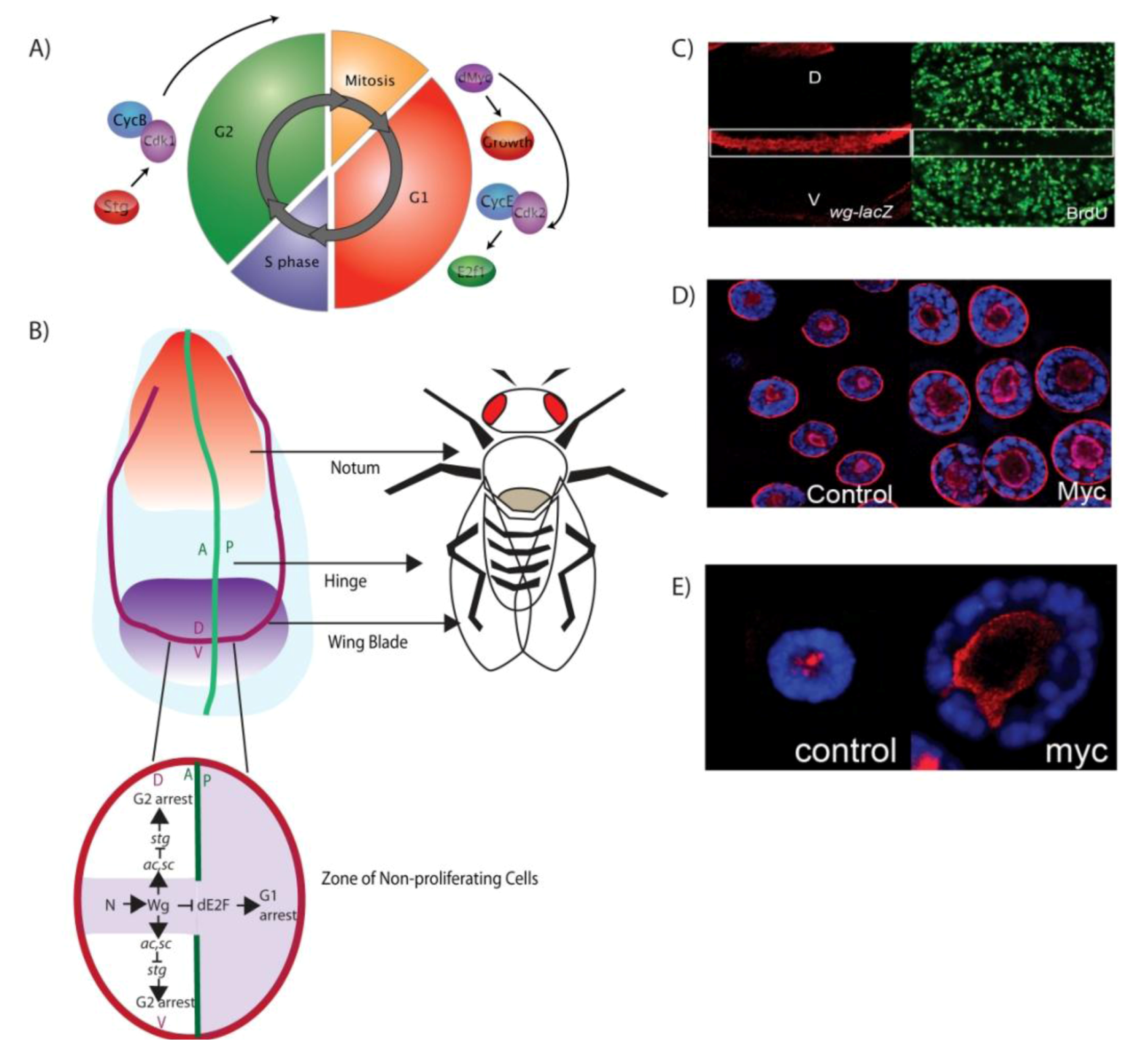
          <p>(<bold>A</bold>) dMyc drives ribosome biogenesis and cell growth and promotes S phase, CycE/Cdk2 triggers S-phase by activating E2F1. Stg/Cdc25 promotes G2-M progression by activating the Cdk1/Cyclin B complex (<bold>B</bold>) <italic>Drosophila</italic> wing imaginal disc. The red and blue region develops to form the notum and hinge, while the purple “pouch” region forms the wing blade. The green line marks the anterior-posterior (A/P) boundary while the red line defines the dorsal-ventral (D/V) boundary. Across the D/V boundary, the “zone of non-proliferating cells” (ZNC), is defined by Notch (N) triggering activation of Wingless (Wg). In the anterior ZNC, Wg induces G2 arrest via inhibition of Stg and in the posterior Wg induces G1 arrest via repression of dE2F. (<bold>C</bold>) Wg protein (red) is expressed along D/V boundary and correlates with reduce S phases detected with BrdU (Green). (<bold>D</bold>) dMyc drives ribosome biogenesis and cell growth in <italic>Drosophila</italic> salivary gland cells. Increased nucleolar size is shown with the fibrillarin (red) and (<bold>E</bold>) <italic>In situ</italic> hybridization shows increased 5'ETS (red) in Myc over expressing cells compared to the control.</p>
        </caption>
        <graphic xmlns:xlink="http://www.w3.org/1999/xlink" xlink:href="cells-01-01182-g001.tif"/>
      </fig>
     
      <p>Evidence suggests <italic>Drosophila</italic> Hfp is the functional homolog of FIR, being essential for repression of <italic>dMyc</italic> transcription and, furthermore, cell growth <italic>in vivo</italic> [<xref ref-type="bibr" rid="B31-cells-01-01182">31</xref>,<xref ref-type="bibr" rid="B40-cells-01-01182">40</xref>]. ChIP experiments have revealed enrichment of Hfp proximal to the <italic>dMyc</italic> transcriptional start site (TSS). In addition, loss of Hfp results in enhanced cell growth, which depends on the presence of dMyc. Furthermore, Hfp physically and genetically interacts with the XPB helicase component of the TFIIH transcription factor complex, Hay, which is required for normal levels of <italic>dMyc</italic> expression, cell growth and cell cycle progression. Below we review how the <italic>Drosophila</italic> model has been used to increase our understanding of how <italic>Myc</italic> expression is correctly patterned and modulated in multicellular organisms <italic>in vivo</italic>, particularly in response to the Hfp transcriptional repressor.</p>
    </sec>
    <sec>
      <title>3. Drosophila Models for Understanding the Genetics of Cell Cycle Control</title>
      <sec>
        <title>3.1. Larval Imaginal Discs: Models for Connecting Developmental Signals to Organ Growth</title>
        <p><italic>Drosophila</italic> has been used extensively as a model organism to understand the link between developmental signaling pathways and cell cycle progression [<xref ref-type="bibr" rid="B41-cells-01-01182">41</xref>,<xref ref-type="bibr" rid="B42-cells-01-01182">42</xref>]. A major benefit of this model organism is its short lifecycle. Within 10 days of egg deposition, the <italic>Drosophila</italic> larvae proceeds through the various stages (1st, 2nd, 3rd instar larvae and pupae) to eclosure as an adult fly. Each <italic>Drosophila</italic> larvae contains imaginal discs which are the precursors to many adult organs. Imaginal discs develop from invaginations of the embryonic epithelium into head structures (mouth parts, eyes and antenna), appendages (legs and wings) and genitalia. At the 1st instar stage, imaginal discs are bags of around 10–50 undifferentiated cells, which undergo massive growth and proliferation to comprise up to 100,000 cells by the end of the third larval instar. Differentiation starts at the end of the 3rd larval instar and is complete by the end of pupariation, when all adult structures such as the wings, legs and eyes have developed [<xref ref-type="bibr" rid="B43-cells-01-01182">43</xref>]. The 3rd larval instar is therefore a critical stage of <italic>Drosophila</italic> development, containing the major growth and proliferation of all tissues required to form the adult fly. </p>
        <p>The wing imaginal disc gives rise to the adult wing blade, hinge and part of the thorax (<xref ref-type="fig" rid="cells-01-01182-f001">Figure 1</xref>B). Cell cycle patterning in the wing imaginal disc pouch has been particularly well characterized [<xref ref-type="bibr" rid="B1-cells-01-01182">1</xref>,<xref ref-type="bibr" rid="B41-cells-01-01182">41</xref>,<xref ref-type="bibr" rid="B44-cells-01-01182">44</xref>,<xref ref-type="bibr" rid="B45-cells-01-01182">45</xref>,<xref ref-type="bibr" rid="B46-cells-01-01182">46</xref>]. For instance, clear connections have been made between developmental signals and the cell cycle delay that occurs late in the 3rd larval instar along the D/V boundary, which is required for differentiation of the margin of the wing blade (<xref ref-type="fig" rid="cells-01-01182-f001">Figure 1</xref>B) [<xref ref-type="bibr" rid="B1-cells-01-01182">1</xref>,<xref ref-type="bibr" rid="B30-cells-01-01182">30</xref>,<xref ref-type="bibr" rid="B41-cells-01-01182">41</xref>,<xref ref-type="bibr" rid="B42-cells-01-01182">42</xref>,<xref ref-type="bibr" rid="B44-cells-01-01182">44</xref>,<xref ref-type="bibr" rid="B45-cells-01-01182">45</xref>]. A major signaling molecule required for wing disc morphogenesis is the Wingless (Wg) protein, the founding member of the Wnt family of secreted morphogens [<xref ref-type="bibr" rid="B47-cells-01-01182">47</xref>,<xref ref-type="bibr" rid="B48-cells-01-01182">48</xref>]. Wg is secreted across the D/V boundary of the wing pouch during the 3rd larval instar and is required for inhibition of cell cycle and formation of the zone of non-proliferative cells (ZNC) (<xref ref-type="fig" rid="cells-01-01182-f001">Figure 1</xref>B) [<xref ref-type="bibr" rid="B44-cells-01-01182">44</xref>,<xref ref-type="bibr" rid="B46-cells-01-01182">46</xref>]. This zone gives rise to the adult wing margin and is characterized by reduced S phases as measured by incorporation of bromodeoxyuridine (BrdU) (<xref ref-type="fig" rid="cells-01-01182-f001">Figure 1</xref>C). The posterior portion of the ZNC is composed entirely of G1 cells, but the anterior portion of the ZNC can be divided into three subdomains (<xref ref-type="fig" rid="cells-01-01182-f001">Figure 1</xref>B). The central domain, where cells express Wg, is comprised of G1 cells and is flanked by the dorsal and ventral subdomains, where proneural transcription factors Achaete (Ac) and Scute (Sc) are expressed to delay these cells in G2 [<xref ref-type="bibr" rid="B44-cells-01-01182">44</xref>]. Wg induces G2 arrest via Ac and Sc, which act to repress the mitotic factor Stg/Cdc25 in the dorsal and ventral domains of the anterior compartment to result in cell cycle exit and differentiation [<xref ref-type="bibr" rid="B44-cells-01-01182">44</xref>]. In the posterior and central domain of the anterior compartment, Wg inactivates dE2F and results in G1 arrest in preparation for differentiation into the vein and intervein components of the adult wing during the pupal stage [<xref ref-type="bibr" rid="B44-cells-01-01182">44</xref>] (<xref ref-type="fig" rid="cells-01-01182-f001">Figure 1</xref>B).</p>
        <p>In the cell division cycles of the wing imaginal disc pouch, DNA synthesis is coupled with cell division; cells grow in G1, initiate DNA replication and enter S phase, which is separated from mitosis by G2. In these cells G1 progression is stimulated by growth factors, which trigger cell growth and activate the G1-S cell cycle machinery. The inhibition of Rbf, a member of the <italic>Drosophila</italic> Retinoblastoma family [<xref ref-type="bibr" rid="B22-cells-01-01182">22</xref>,<xref ref-type="bibr" rid="B49-cells-01-01182">49</xref>,<xref ref-type="bibr" rid="B50-cells-01-01182">50</xref>], results in release of E2F1 from the inhibitory complex with Rbf, which permits upregulation of E2F1 dependent S phase genes [<xref ref-type="bibr" rid="B51-cells-01-01182">51</xref>]. Imaginal disc cells maintain their size via the tight coupling of cell growth and cell cycle progression. S phase and G2-M can be coupled as CycE and Stg, the rate limiting factors for S-phase and mitosis, respectively, can both be activated by the <italic>Drosophila</italic> orthologue of human E2F1 protein, dE2F1, which thereby coordinates progression from S-phase into mitosis to maintain organ size [<xref ref-type="bibr" rid="B52-cells-01-01182">52</xref>].</p>
      </sec>
      <sec>
        <title>3.2. The Drosophila Salivary Gland: Models for Understanding Cell Growth Control</title>
        <p>In the mitotically dividing imaginal tissues discussed above, cell growth and cell cycle progression are tightly coordinated to allow cells to maintain a consistent size, which can mask potential effects on cell growth. In contrast, the salivary gland and many other tissues in the <italic>Drosophila</italic> larvae undergo endoreplication, <italic>i.e.</italic>, cell growth and DNA replication/S phase occur in the absence of cell division to result in large polyploid cells [<xref ref-type="bibr" rid="B53-cells-01-01182">53</xref>]. Indeed, the salivary gland has been used as a tissue to study the effect of dMyc on cell growth. In these endoreplicating cells, <italic>dMyc</italic> is both necessary and sufficient for rDNA synthesis and growth [<xref ref-type="bibr" rid="B2-cells-01-01182">2</xref>,<xref ref-type="bibr" rid="B16-cells-01-01182">16</xref>]. Salivary gland cells fail to grow and endoreplicate in <italic>dMyc</italic> mutants, while overexpression of <italic>dMyc</italic> dramatically increases cell growth (nucleolar size) and nuclear DNA content (DNA replication) [<xref ref-type="bibr" rid="B2-cells-01-01182">2</xref>,<xref ref-type="bibr" rid="B16-cells-01-01182">16</xref>]. </p>
        <p>In all eukaryotes, the clusters of rRNA genes are organized in the nucleolus, where rRNA transcription, processing and ribosome assembly occur [<xref ref-type="bibr" rid="B54-cells-01-01182">54</xref>]. Thus, nucleolar size is largely proportional to the level of rRNA transcription and provides an indirect measure of ribosomal gene transcription. As predicted, based on previous studies [<xref ref-type="bibr" rid="B2-cells-01-01182">2</xref>] overexpression of <italic>dMyc</italic> in the salivary gland results in increased nucleolar size, measured using an antibody to the nucleolar protein Fibrillarin in 3rd instar salivary glands (<xref ref-type="fig" rid="cells-01-01182-f001">Figure 1</xref>D). In addition, altered rDNA transcription can be measured directly in salivary glands by monitoring abundance of rRNA. As transcription of the rDNA repeat sequence by RNA Pol I begins within the 5' external transcribed spacer (ETS) region, fluorescent <italic>in situ</italic> hybridisation (FISH) using a DIG-labelled riboprobe for the 5'ETS can be used as a direct read out of rRNA abundance (<xref ref-type="fig" rid="cells-01-01182-f001">Figure 1</xref>E). Consistent with the increase in the size of the nucleolus detected with fibrillarin, dMyc overexpression results in more 5'ETS, as expected based on the ability of dMyc to increase ribosomal gene transcription [<xref ref-type="bibr" rid="B2-cells-01-01182">2</xref>].</p>
      </sec>
      <sec>
        <title>3.3. The Drosophila hemopoietic System; a Model for Mammalian Blood Development and Disease: Key Oncogenic Signaling Pathways Drive Overproliferation of Hemocytes</title>
        <p>Disruptions to normal hematopoietic function have been implicated in numerous forms of leukemia, anemia and other blood disorders. The first link between dysregulation of the <italic>Myc</italic> oncogene and human disease was in Burkitts lymphoma, where the <italic>Myc</italic> gene is translocated to the immunoglobulin heavy chain locus, which results in amplified <italic>Myc</italic> expression (reviewed in [<xref ref-type="bibr" rid="B55-cells-01-01182">55</xref>,<xref ref-type="bibr" rid="B56-cells-01-01182">56</xref>,<xref ref-type="bibr" rid="B57-cells-01-01182">57</xref>]). One of the many problems faced by medical researchers attempting to dissect the underlying cause of hemopoietic disease is the complex genetic control and functional redundancies acquired as a result of gene duplication and evolution in mammals. Morphologically, development of the <italic>Drosophila</italic> and mammalian blood lineages is considerably diverged. However, molecular genetic studies have revealed that many key hemopoietic signaling pathways and transcription factors are conserved between systems [<xref ref-type="bibr" rid="B58-cells-01-01182">58</xref>,<xref ref-type="bibr" rid="B59-cells-01-01182">59</xref>,<xref ref-type="bibr" rid="B60-cells-01-01182">60</xref>,<xref ref-type="bibr" rid="B61-cells-01-01182">61</xref>,<xref ref-type="bibr" rid="B62-cells-01-01182">62</xref>,<xref ref-type="bibr" rid="B63-cells-01-01182">63</xref>]. </p>
        <p>In <italic>Drosophila</italic>, the blood producing lymph gland (LG) is specified prior to the blastoderm stage of embryogenesis [<xref ref-type="bibr" rid="B64-cells-01-01182">64</xref>]. The LG initially consists of 2 lobes, known as the primary lobes, which first appear late in the embryonic stages. Expression of <italic>collier</italic>, the <italic>Drosophila</italic> orthologue of the vertebrate transcription factor Early B Cell Factor, is one of the earliest markers of LG precursors [<xref ref-type="bibr" rid="B65-cells-01-01182">65</xref>]. <italic>Collier</italic> expression becomes increasingly restricted until it is only expressed in the most posterior 2–3 cells of the approximately 20–25 cell LG, the future Posterior Signaling Center (PSC, see <xref ref-type="fig" rid="cells-01-01182-f002">Figure 2</xref>). The LG persists as the larval hematopoietic organ until the onset of metamorphosis, at which point it disintegrates and releases its contents into the hemolymph. There is no evidence of a hematopoietic organ in the adult <italic>Drosophila</italic>.</p>
        <fig id="cells-01-01182-f002" position="anchor">
          <label>Figure 2</label>
          <caption>
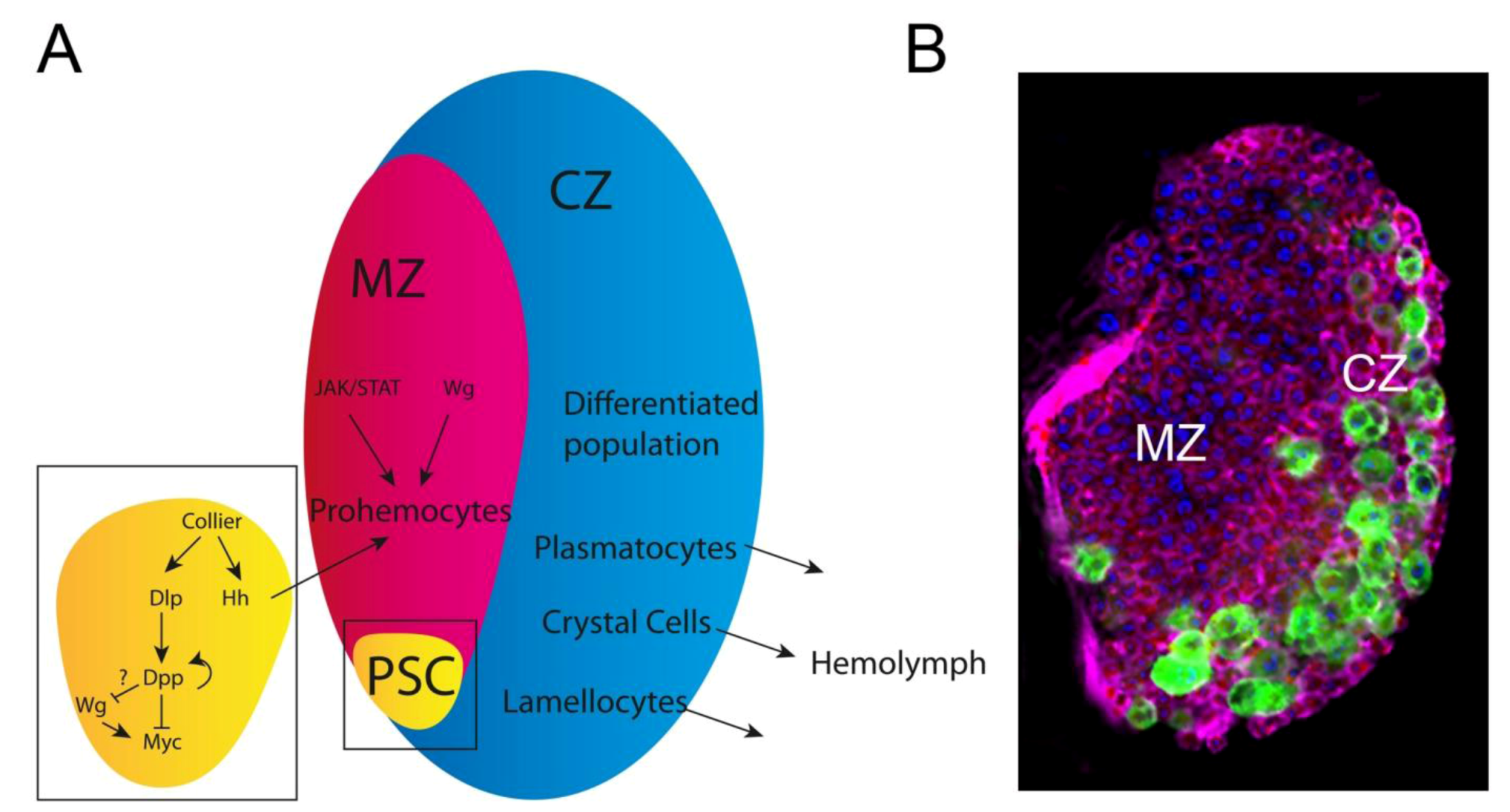
            <p>(<bold>A</bold>) Developmental signaling in the Lymph Gland. The primary lobe is divided into three subsections: the medulla (MZ, composed of prohemocytes or hematopoietic precursor cells), the cortex (CZ, predominantly comprising plasmatocytes and crystal cells that migrate into the hemolymph) and the PSC, which signals to the MZ to maintain blood cell homeostasis. (<bold>B</bold>) A primary lobe of a third instar larval stained for DNA (blue) and actin (pink), showing crystal cells marked by <italic>lozenge-GAL4/UAS-GFP</italic>.</p>
          </caption>
          <graphic xmlns:xlink="http://www.w3.org/1999/xlink" xlink:href="cells-01-01182-g002.tif"/>
        </fig>
        <p>The fully mature 3rd instar larval LG (<xref ref-type="fig" rid="cells-01-01182-f002">Figure 2</xref>) consists of a pair of primary lobes and 2–7 pairs of secondary lobes which develop during successive rounds of proliferation during the early 3rd instar. The primary lobe is divided into three subsections: the medulla (MZ, composed of prohemocytes or hematopoietic precursor cells), the cortex (CZ, comprising differentiating and mature cells) and the PSC, which is responsible for maintaining larval blood cell homeostasis [<xref ref-type="bibr" rid="B66-cells-01-01182">66</xref>,<xref ref-type="bibr" rid="B67-cells-01-01182">67</xref>,<xref ref-type="bibr" rid="B68-cells-01-01182">68</xref>]. Under normal conditions, two cell types are found in the LG: (1) plasmatocytes and (2) crystal cells [<xref ref-type="bibr" rid="B64-cells-01-01182">64</xref>]. Plasmatocytes make up the vast majority of the hemocyte population (~95%) and function to phagocytose bacterial or fungal infections along with removal of excess cells during development [<xref ref-type="bibr" rid="B69-cells-01-01182">69</xref>]. </p>
        <p>A number of key signals have been implicated in both the mammalian and <italic>Drosophila</italic> hematopoietic maintenance as well as lineage specification. Dysregulation of these pathways can lead to loss of hemocyte progenitors and/or differentiation blocks, and can result in LG overgrowth in <italic>Drosophila</italic> and malignancy in humans. Ras was amongst the first human oncogenes identified and belongs to the family of genes encoding GTP-binding proteins. This family of genes is implicated in regulating cell growth, proliferation, and differentiation and is dysregulated in approximately 30% of human cancers [<xref ref-type="bibr" rid="B70-cells-01-01182">70</xref>,<xref ref-type="bibr" rid="B71-cells-01-01182">71</xref>]. In <italic>Drosophila</italic> expression of the activated/oncogenic form of Ras (Ras<sup>V12</sup>) specifically in the hemocytes results in a 40-fold increase in hemocyte number [<xref ref-type="bibr" rid="B59-cells-01-01182">59</xref>]. The overproliferation can be suppressed by reducing Cdk2/cyclin E, suggesting the Ras-induced increase in hemocytes is a result of increased E2F activity [<xref ref-type="bibr" rid="B59-cells-01-01182">59</xref>]. These changes in cell proliferation may depend on Myc, as the Ras pathway signals through the MAP kinase pathway to both increase Myc/dMyc protein levels [<xref ref-type="bibr" rid="B72-cells-01-01182">72</xref>,<xref ref-type="bibr" rid="B73-cells-01-01182">73</xref>,<xref ref-type="bibr" rid="B74-cells-01-01182">74</xref>]. Consistent with this, in the <italic>Drosophila</italic> wing imaginal disc, Ras activity results in increased dMyc protein accumulation and accelerated cell cycle progression [<xref ref-type="bibr" rid="B75-cells-01-01182">75</xref>]. The ability to generate leukemia-like phenotypes with well-established oncogenes lends weight to the idea that <italic>Drosophila</italic> may be a useful model for human blood disorders.</p>
        <p>Further to this, the pathways implicated in PSC signaling and stem cell behavior also regulate activity of the mammalian HSC niche. The TGF-β super family member BMP4 regulates the mouse HSC niche [<xref ref-type="bibr" rid="B76-cells-01-01182">76</xref>] and in <italic>Drosophila</italic> hematopoiesis the orthologous BMP protein, Dpp, is necessary for maintaining PSC size and, as a result, larval blood homeostasis [<xref ref-type="bibr" rid="B63-cells-01-01182">63</xref>]. Similarly, Wg, and the BMPF1 ortholog, Dlp, are modulated by Dpp signaling and are required for hematopoiesis (<xref ref-type="fig" rid="cells-01-01182-f002">Figure 2</xref>A) [<xref ref-type="bibr" rid="B63-cells-01-01182">63</xref>]. Thus, many parallels exist between mammalian and <italic>Drosophila</italic> hematopoietic niches, and given the role of Myc in controlling development of the HSC lineage [<xref ref-type="bibr" rid="B77-cells-01-01182">77</xref>,<xref ref-type="bibr" rid="B78-cells-01-01182">78</xref>] and leukemia [<xref ref-type="bibr" rid="B55-cells-01-01182">55</xref>,<xref ref-type="bibr" rid="B56-cells-01-01182">56</xref>,<xref ref-type="bibr" rid="B57-cells-01-01182">57</xref>] it will be of interest to investigate potential roles for dMyc in <italic>Drosophila</italic> hematopoiesis in the future.</p>
      </sec>
    </sec>
    <sec>
      <title>4. Genetic Tools for Manipulating Gene Expression in Drosophila</title>
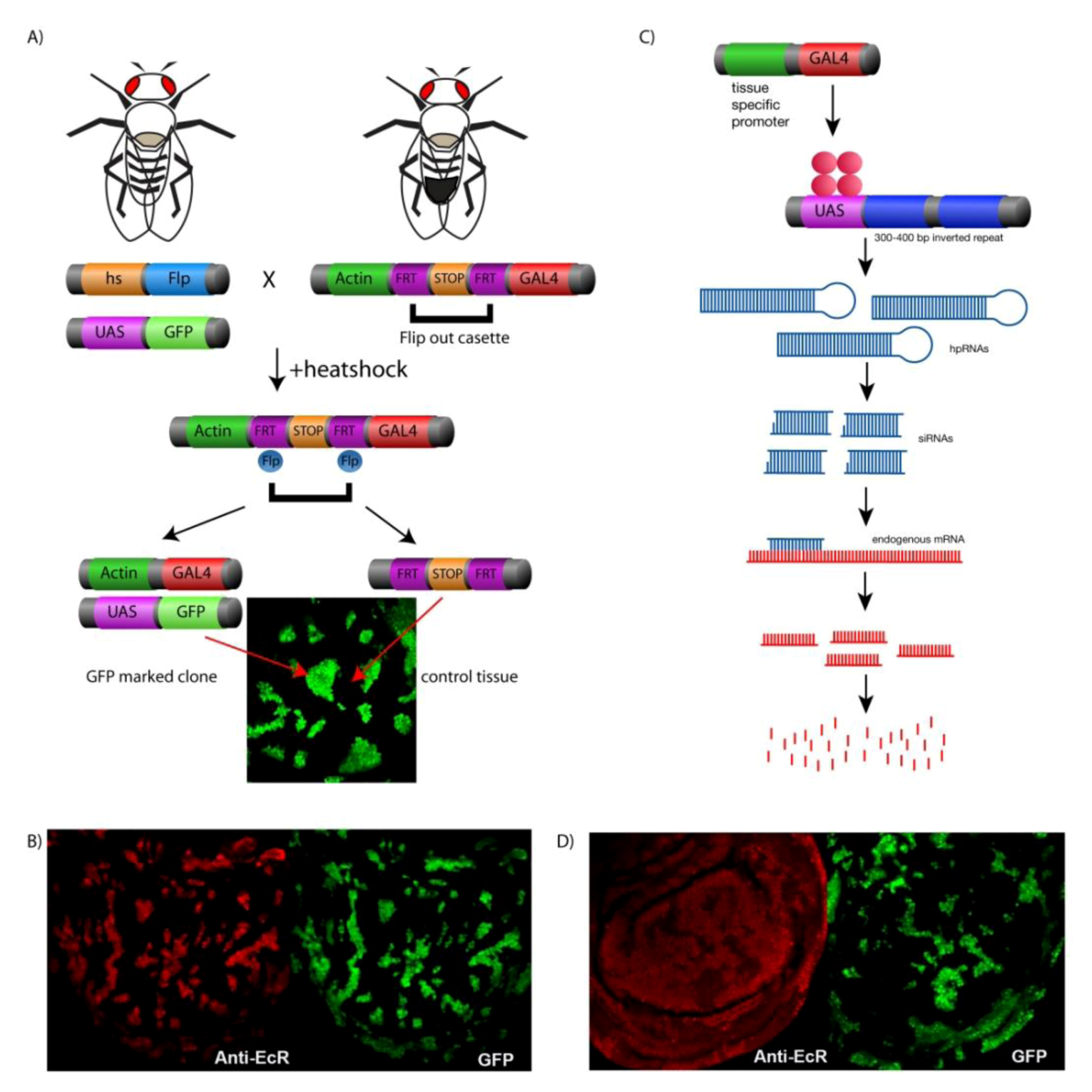
      <p>The <italic>UAS-GAL4</italic> system, derived from the yeast <italic>S. cereviase</italic>, has provided an invaluable genetic tool for studying the manipulation of gene expression during <italic>Drosophila</italic> development [<xref ref-type="bibr" rid="B79-cells-01-01182">79</xref>]. With a diverse variety of GAL4 drivers, temporal and tissue specific overexpression of a given <italic>UAS</italic>-transgene can be achieved in a specific tissue of interest. For example, cell cycle biologists combined the <italic>UAS-GAL4</italic> system with the <italic>FLP/FRT</italic> system to generate the Actin&lt;<italic>CD2</italic>&lt;<italic>GAL4</italic> “flip out” system in order to monitor cell growth and division in patches of tissue or “clones” over time (<xref ref-type="fig" rid="cells-01-01182-f003">Figure 3</xref>A [<xref ref-type="bibr" rid="B80-cells-01-01182">80</xref>,<xref ref-type="bibr" rid="B81-cells-01-01182">81</xref>]). Gene expression is controlled by heatshock induced expression of the Flip recombinase (<italic>Flp</italic>) [<xref ref-type="bibr" rid="B82-cells-01-01182">82</xref>]. <italic>Flp</italic> will recognise the <italic>FRT</italic> sites in the Act&lt;<italic>CD2&lt;GAL4</italic> cassette. The “flipping out” of the interruption cassette results in: (1) CD2 protein expression in the neighboring control clone and (2) the Actin promoter driving <italic>GAL4</italic> in the clone, which can be positively marked with co-expression of a fluorescent transgene e.g. <italic>UAS</italic>-<italic>GFP</italic> or <italic>RFP</italic> with the <italic>UAS</italic>-transgene of interest (<xref ref-type="fig" rid="cells-01-01182-f003">Figure 3</xref>A,B) [<xref ref-type="bibr" rid="B80-cells-01-01182">80</xref>,<xref ref-type="bibr" rid="B81-cells-01-01182">81</xref>,<xref ref-type="bibr" rid="B83-cells-01-01182">83</xref>]. This system is ideal for studying effects of manipulating gene expression on cell growth, proliferation, and signaling pathways in comparison to surrounding normal tissue, which is essential for understanding tumorigenesis. For gene knockdown, GAL4 drivers can be used for expression of a <italic>UAS</italic>-transgene for an inverted repeat targeting the gene of interest [<xref ref-type="bibr" rid="B84-cells-01-01182">84</xref>]. Extensive <italic>UAS</italic>-RNAi collections have been developed and made publicly available and, as these cover most (97%) of the <italic>Drosophila</italic> genome (e.g. Vienna <italic>Drosophila</italic> resource centre [<xref ref-type="bibr" rid="B85-cells-01-01182">85</xref>]), they have provided an invaluable resource for conducting non-biased genetic screens to elucidate novel signaling mechanisms and gene function (<xref ref-type="fig" rid="cells-01-01182-f003">Figure 3</xref>C,D). For example, “flip-out” clones generated using a hairpin targeting Hfp, were used to demonstrate that loss of Hfp results is increased growth compared with the surrounding control cells [<xref ref-type="bibr" rid="B40-cells-01-01182">40</xref>]. Moreover, using the <italic>dmyc</italic>-<italic>lacZ</italic> enhancer trap described below, we have demonstrated that Hfp is required for repressing <italic>dmyc</italic> promoter activity (<xref ref-type="fig" rid="cells-01-01182-f004">Figure 4</xref>, [<xref ref-type="bibr" rid="B40-cells-01-01182">40</xref>]).</p>
      <fig id="cells-01-01182-f003" position="anchor">
        <label>Figure 3</label>
        <caption>
          <p>(<bold>A</bold>) The <italic>hsflp</italic>, <italic>Actin</italic>&lt;<italic>Gal4</italic> system. Heat shock induces FLP expression and recombination removes the intervening stop sequence from the construct. The actin promoter drives GAL4 for <italic>UAS</italic>-transgene(s) expression in clones, including <italic>UAS</italic>-<italic>GFP</italic> to mark the clone (<bold>B</bold>) Wing imaginal discs from wandering third instar larvae containing "Flip out" clones marked with GFP (Green), overexpressing the ecdysone receptor gene (EcRB2) detected by the ecdysone receptor antibody (red). (<bold>C</bold>) "Flip out" clones expressing EcR RNAi marked with GFP showed ablation of ecdysone by the reduction of ecdysone antibody (red).</p>
        </caption>
        <graphic xmlns:xlink="http://www.w3.org/1999/xlink" xlink:href="cells-01-01182-g003.tif"/>
      </fig>
       <p>In mammalian systems, <italic>in vitro</italic> transcription assays (e.g., luciferase assays) are a standard method for monitoring effects of a particular factor on promoter/enhancer activity. However, if we are to draw connections between the signaling environment and changes to the expression of cell cycle genes, it is essential to investigate transcription from endogenous promoters <italic>in vivo</italic>. In <italic>Drosophila</italic>, promoter and enhancer trap activity can be measured using reporter elements inserted into endogenous promoters in order to determine factors capable of modulating transcription of a given gene. Furthermore, random P-element mutagenesis screens generated extensive enhancer trap collections, where each line contains the insertion of a visible reporter (e.g., LacZ or GFP) for monitoring gene activity within a particular region of the genome [<xref ref-type="bibr" rid="B86-cells-01-01182">86</xref>,<xref ref-type="bibr" rid="B87-cells-01-01182">87</xref>]. As these enhancer traps often land in regions of active chromatin, such as gene promoters, they can often be used to measure endogenous promoter or enhancer activity, as an indicator of transcriptional activation of the gene located downstream of the insertion [<xref ref-type="bibr" rid="B88-cells-01-01182">88</xref>]. </p>
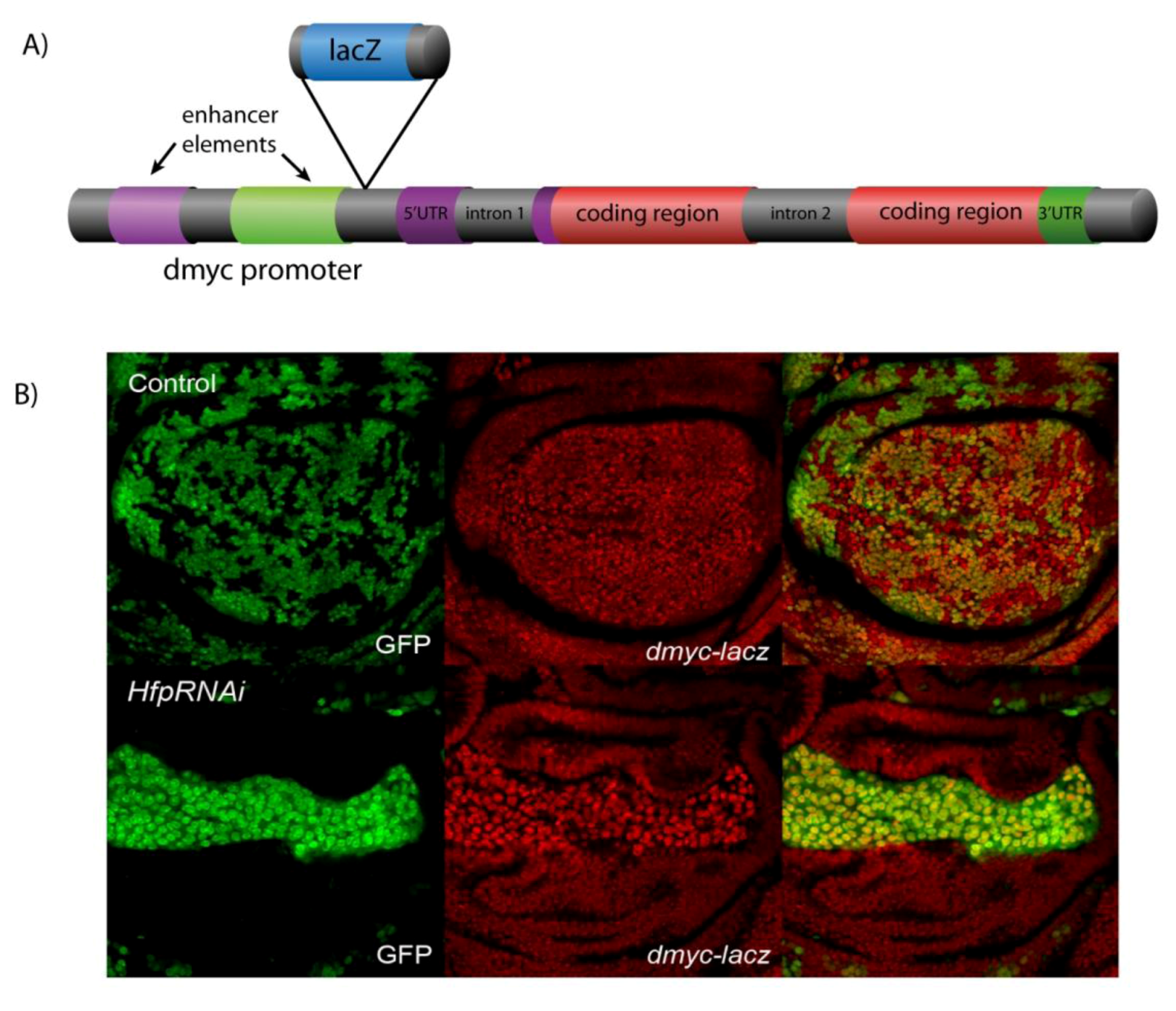
        <p>For example, a random <italic>P-lacZ</italic> insertional mutagenesis screen for the X-chromosome resulted in many hits in the <italic>dMyc</italic> promoter [<xref ref-type="bibr" rid="B89-cells-01-01182">89</xref>], providing potential enhancer traps to identify changes in <italic>dMyc</italic> promoter activity. Analysis of these <italic>lacZ</italic> insertions revealed that insert [<italic>P{lacW}l(1)G0354</italic> [<xref ref-type="bibr" rid="B89-cells-01-01182">89</xref>]], located just prior to the 5'UTR in the <italic>dMyc</italic> promoter, in a region that is responsive to wing enhancers of <italic>dMyc</italic> expression (<xref ref-type="fig" rid="cells-01-01182-f004">Figure 4</xref>A). By using the ®-gal antibody, this <italic>dMyc-lacZ</italic> line can, therefore, be used to monitor changes to <italic>dMyc</italic> promoter activity in wing imaginal discs [<xref ref-type="bibr" rid="B40-cells-01-01182">40</xref>,<xref ref-type="bibr" rid="B42-cells-01-01182">42</xref>]. In particular, <italic>UAS-hfp</italic> RNAi “flip-out” clones in the <italic>dMyc</italic>-<italic>lacZ</italic> enhancer trap background, revealed that Hfp is required for repression of <italic>dMyc</italic> promoter activity (<xref ref-type="fig" rid="cells-01-01182-f004">Figure 4</xref>B and [<xref ref-type="bibr" rid="B40-cells-01-01182">40</xref>]). The enhancer trap appears to reflect changes in <italic>dMyc</italic> transcription, as mRNA abundance is significantly increased in Hfp loss of function imaginal tissues [<xref ref-type="bibr" rid="B40-cells-01-01182">40</xref>] and can provide an <italic>in vivo</italic> read out for potential enhancers and suppressors of <italic>dMyc</italic> transcription.</p>
      <fig id="cells-01-01182-f004" position="anchor">
        <label>Figure 4</label>
        <caption>
          <p>(<bold>A</bold>) Schematic diagram of a <italic>dMyc-lacZ</italic> enhancer trap. (<bold>B</bold>) <italic>dMyc</italic> enhancer trap activity detected with β-gal (red) for wing imaginal disc containing control or Hfp RNAi GFP positive clones (green). </p>
        </caption>
        <graphic xmlns:xlink="http://www.w3.org/1999/xlink" xlink:href="cells-01-01182-g004.tif"/>
      </fig>
     
     
    </sec>
    <sec>
      <title>5. Conclusion</title>
      <p>As detailed above, Myc is a potent mitogen, but despite the large number of transcriptional targets and the associated oncogenic potential of <italic>Myc</italic> dysregulation, how <italic>Myc</italic> is regulated at the transcriptional level is largely unknown. In <italic>Drosophila</italic> using the genetic systems described above, we have demonstrated that repression of <italic>dMyc</italic> promoter activity and cell growth requires Hfp function (<xref ref-type="fig" rid="cells-01-01182-f004">Figure 4</xref>B and [<xref ref-type="bibr" rid="B40-cells-01-01182">40</xref>]). Furthermore, the increased <italic>dMyc</italic>-<italic>lacZ</italic> reporter activity, compared to surrounding wild type cells (<xref ref-type="fig" rid="cells-01-01182-f004">Figure 4</xref>B) was associated with significantly increased <italic>dMyc</italic> mRNA levels [<xref ref-type="bibr" rid="B40-cells-01-01182">40</xref>]. Thus like its mammalian counterpart FIR, Hfp behaves as a tumor suppressor to repress <italic>dMyc</italic>, which suggests that the mechanism proposed for transcriptional repression of <italic>c</italic>-<italic>Myc</italic> by FIR is conserved in <italic>Drosophila</italic>. These data suggest that the loss-of-function FIR mutants described in colorectal cancer may be sufficient to increase <italic>Myc</italic> expression, which would be predicted to lead to cancer initiation and progression. </p>
    </sec>
  </body>
  <back>
    <ref-list>
      <title>References</title>
      <ref id="B1-cells-01-01182">
        <label>1.</label>
        <citation citation-type="journal">
          <person-group person-group-type="author">
            <name>
              <surname>Johnston</surname>
              <given-names>L.A.</given-names>
            </name>
            <name>
              <surname>Prober</surname>
              <given-names>D.A.</given-names>
            </name>
            <name>
              <surname>Edgar</surname>
              <given-names>B.A.</given-names>
            </name>
            <name>
              <surname>Eisenman</surname>
              <given-names>R.N.</given-names>
            </name>
            <name>
              <surname>Gallant</surname>
              <given-names>P.</given-names>
            </name>
          </person-group>
          <article-title>Drosophila myc regulates cellular growth during development</article-title>
          <source>Cell</source>
          <year>1999</year>
          <volume>98</volume>
          <fpage>779</fpage>
          <lpage>790</lpage>
          <pub-id pub-id-type="doi">10.1016/S0092-8674(00)81512-3</pub-id>
        </citation>
      </ref>
      <ref id="B2-cells-01-01182">
        <label>2.</label>
        <citation citation-type="journal">
          <person-group person-group-type="author">
            <name>
              <surname>Grewal</surname>
              <given-names>S.S.</given-names>
            </name>
            <name>
              <surname>Li</surname>
              <given-names>L.</given-names>
            </name>
            <name>
              <surname>Orian</surname>
              <given-names>A.</given-names>
            </name>
            <name>
              <surname>Eisenman</surname>
              <given-names>R.N.</given-names>
            </name>
            <name>
              <surname>Edgar</surname>
              <given-names>B.A.</given-names>
            </name>
          </person-group>
          <article-title>Myc-dependent regulation of ribosomal RNA synthesis during Drosophila development</article-title>
          <source>Nat. Cell Biol.</source>
          <year>2005</year>
          <volume>7</volume>
          <fpage>295</fpage>
          <lpage>302</lpage>
          <pub-id pub-id-type="doi">10.1038/ncb1223</pub-id>
        </citation>
      </ref>
      <ref id="B3-cells-01-01182">
        <label>3.</label>
        <citation citation-type="journal">
          <person-group person-group-type="author">
            <name>
              <surname>Orian</surname>
              <given-names>A.</given-names>
            </name>
            <name>
              <surname>Grewal</surname>
              <given-names>S.S.</given-names>
            </name>
            <name>
              <surname>Knoepfler</surname>
              <given-names>P.S.</given-names>
            </name>
            <name>
              <surname>Edgar</surname>
              <given-names>B.A.</given-names>
            </name>
            <name>
              <surname>Parkhurst</surname>
              <given-names>S.M.</given-names>
            </name>
            <name>
              <surname>Eisenman</surname>
              <given-names>R.N.</given-names>
            </name>
          </person-group>
          <article-title>Genomic binding and transcriptional regulation by the Drosophila Myc and Mnt transcription factors</article-title>
          <source>Cold Spring Harb. Symp. Quant. Biol.</source>
          <year>2005</year>
          <volume>70</volume>
          <fpage>299</fpage>
          <lpage>307</lpage>
        <pub-id pub-id-type="doi">10.1101/sqb.2005.70.019</pub-id><pub-id pub-id-type="pmid">16869766</pub-id></citation>
      </ref>
      <ref id="B4-cells-01-01182">
        <label>4.</label>
        <citation citation-type="journal">
          <person-group person-group-type="author">
            <name>
              <surname>Orian</surname>
              <given-names>A.</given-names>
            </name>
            <name>
              <surname>van Steensel</surname>
              <given-names>B.</given-names>
            </name>
            <name>
              <surname>Delrow</surname>
              <given-names>J.</given-names>
            </name>
            <name>
              <surname>Bussemaker</surname>
              <given-names>H.J.</given-names>
            </name>
            <name>
              <surname>Li</surname>
              <given-names>L.</given-names>
            </name>
            <name>
              <surname>Sawado</surname>
              <given-names>T.</given-names>
            </name>
            <name>
              <surname>Williams</surname>
              <given-names>E.</given-names>
            </name>
            <name>
              <surname>Loo</surname>
              <given-names>L.W.M.</given-names>
            </name>
            <name>
              <surname>Cowley</surname>
              <given-names>S.M.</given-names>
            </name>
            <name>
              <surname>Yost</surname>
              <given-names>C.</given-names>
            </name>
            <etal/>
          </person-group>
          <article-title>Genomic binding by the Drosophila Myc, Max, Mad/Mnt transcription factor network</article-title>
          <source>Genes Dev.</source>
          <year>2003</year>
          <volume>17</volume>
          <fpage>1101</fpage>
          <lpage>1114</lpage>
          <pub-id pub-id-type="doi">10.1101/gad.1066903</pub-id>
        </citation>
      </ref>
      <ref id="B5-cells-01-01182">
        <label>5.</label>
        <citation citation-type="journal">
          <person-group person-group-type="author">
            <name>
              <surname>Grandori</surname>
              <given-names>C.</given-names>
            </name>
            <name>
              <surname>Cowley</surname>
              <given-names>S.M.</given-names>
            </name>
            <name>
              <surname>James</surname>
              <given-names>L.P.</given-names>
            </name>
            <name>
              <surname>Eisenman</surname>
              <given-names>R.N.</given-names>
            </name>
          </person-group>
          <article-title>The Myc/Max/Mad network and the transcriptional control of cell behavior</article-title>
          <source>Annu. Rev. Cell Dev. Biol.</source>
          <year>2000</year>
          <volume>16</volume>
          <fpage>653</fpage>
          <lpage>699</lpage>
          <pub-id pub-id-type="doi">10.1146/annurev.cellbio.16.1.653</pub-id>
        </citation>
      </ref>
      <ref id="B6-cells-01-01182">
        <label>6.</label>
        <citation citation-type="journal">
          <person-group person-group-type="author">
            <name>
              <surname>Coller</surname>
              <given-names>H.A.</given-names>
            </name>
            <name>
              <surname>Grandori</surname>
              <given-names>C.</given-names>
            </name>
            <name>
              <surname>Tamayo</surname>
              <given-names>P.</given-names>
            </name>
            <name>
              <surname>Colbert</surname>
              <given-names>T.</given-names>
            </name>
            <name>
              <surname>Lander</surname>
              <given-names>E.S.</given-names>
            </name>
            <name>
              <surname>Eisenman</surname>
              <given-names>R.N.</given-names>
            </name>
            <name>
              <surname>Golub</surname>
              <given-names>T.R.</given-names>
            </name>
          </person-group>
          <article-title>Expression analysis with oligonucleotide microarrays reveals that MYC regulates genes involved in growth, cell cycle, signaling, and adhesion</article-title>
          <source>Proc. Natl. Acad. Sci. USA</source>
          <year>2000</year>
          <volume>97</volume>
          <fpage>3260</fpage>
          <lpage>3265</lpage>
        <pub-id pub-id-type="doi">10.1073/pnas.97.7.3260</pub-id><pub-id pub-id-type="pmid">10737792</pub-id></citation>
      </ref>
      <ref id="B7-cells-01-01182">
        <label>7.</label>
        <citation citation-type="journal">
          <person-group person-group-type="author">
            <name>
              <surname>Grandori</surname>
              <given-names>C.</given-names>
            </name>
            <name>
              <surname>Gomez-Roman</surname>
              <given-names>N.</given-names>
            </name>
            <name>
              <surname>Felton-Edkins</surname>
              <given-names>Z.A.</given-names>
            </name>
            <name>
              <surname>Ngouenet</surname>
              <given-names>C.</given-names>
            </name>
            <name>
              <surname>Galloway</surname>
              <given-names>D.A.</given-names>
            </name>
            <name>
              <surname>Eisenman</surname>
              <given-names>R.N.</given-names>
            </name>
            <name>
              <surname>White</surname>
              <given-names>R.J.</given-names>
            </name>
          </person-group>
          <article-title>c-Myc binds to human ribosomal DNA and stimulates transcription of rRNA genes by RNA polymerase I</article-title>
          <source>Nat. Cell Biol.</source>
          <year>2005</year>
          <volume>7</volume>
          <fpage>311</fpage>
          <lpage>318</lpage>
          <pub-id pub-id-type="doi">10.1038/ncb1224</pub-id>
        </citation>
      </ref>
      <ref id="B8-cells-01-01182">
        <label>8.</label>
        <citation citation-type="journal">
          <person-group person-group-type="author">
            <name>
              <surname>Eilers</surname>
              <given-names>M.</given-names>
            </name>
            <name>
              <surname>Eisenman</surname>
              <given-names>R.N.</given-names>
            </name>
          </person-group>
          <article-title>Myc's broad reach</article-title>
          <source>Genes Dev.</source>
          <year>2008</year>
          <volume>22</volume>
          <fpage>2755</fpage>
          <lpage>2766</lpage>
        <pub-id pub-id-type="doi">10.1101/gad.1712408</pub-id><pub-id pub-id-type="pmid">18923074</pub-id></citation>
      </ref>
      <ref id="B9-cells-01-01182">
        <label>9.</label>
        <citation citation-type="journal">
          <person-group person-group-type="author">
            <name>
              <surname>Levens</surname>
              <given-names>D.</given-names>
            </name>
          </person-group>
          <article-title>Disentangling the MYC web</article-title>
          <source>Proc. Natl. Acad. Sci. USA</source>
          <year>2002</year>
          <volume>99</volume>
          <fpage>5757</fpage>
          <lpage>5759</lpage>
        <pub-id pub-id-type="doi">10.1073/pnas.102173199</pub-id><pub-id pub-id-type="pmid">11983876</pub-id></citation>
      </ref>
      <ref id="B10-cells-01-01182">
        <label>10.</label>
        <citation citation-type="journal">
          <person-group person-group-type="author">
            <name>
              <surname>Liu</surname>
              <given-names>J.</given-names>
            </name>
            <name>
              <surname>Levens</surname>
              <given-names>D.</given-names>
            </name>
          </person-group>
          <article-title>Making myc</article-title>
          <source>Curr. Top. Microbiol. Immunol.</source>
          <year>2006</year>
          <volume>302</volume>
          <fpage>1</fpage>
          <lpage>32</lpage>
        <pub-id pub-id-type="pmid">16620023</pub-id></citation>
      </ref>
      <ref id="B11-cells-01-01182">
        <label>11.</label>
        <citation citation-type="journal">
          <person-group person-group-type="author">
            <name>
              <surname>Nie</surname>
              <given-names>Z.</given-names>
            </name>
            <name>
              <surname>Hu</surname>
              <given-names>G.</given-names>
            </name>
            <name>
              <surname>Wei</surname>
              <given-names>G.</given-names>
            </name>
            <name>
              <surname>Cui</surname>
              <given-names>K.</given-names>
            </name>
            <name>
              <surname>Yamane</surname>
              <given-names>A.</given-names>
            </name>
            <name>
              <surname>Resch</surname>
              <given-names>W.</given-names>
            </name>
            <name>
              <surname>Wang</surname>
              <given-names>R.</given-names>
            </name>
            <name>
              <surname>Green</surname>
              <given-names>D.R.</given-names>
            </name>
            <name>
              <surname>Tessarollo</surname>
              <given-names>L.</given-names>
            </name>
            <name>
              <surname>Casellas</surname>
              <given-names>R.</given-names>
            </name>
            <etal/>
          </person-group>
          <article-title>c-Myc Is a Universal Amplifier of Expressed Genes in Lymphocytes and Embryonic Stem Cells</article-title>
          <source>Cell</source>
          <year>2012</year>
          <volume>151</volume>
          <fpage>68</fpage>
          <lpage>79</lpage>
        <pub-id pub-id-type="doi">10.1016/j.cell.2012.08.033</pub-id><pub-id pub-id-type="pmid">23021216</pub-id></citation>
      </ref>
      <ref id="B12-cells-01-01182">
        <label>12.</label>
        <citation citation-type="journal">
          <person-group person-group-type="author">
            <name>
              <surname>Lin</surname>
              <given-names>C.Y.</given-names>
            </name>
            <name>
              <surname>Lovén</surname>
              <given-names>J.</given-names>
            </name>
            <name>
              <surname>Rahl</surname>
              <given-names>P.B.</given-names>
            </name>
            <name>
              <surname>Paranal</surname>
              <given-names>R.M.</given-names>
            </name>
            <name>
              <surname>Burge</surname>
              <given-names>C.B.</given-names>
            </name>
            <name>
              <surname>Bradner</surname>
              <given-names>J.E.</given-names>
            </name>
            <name>
              <surname>Lee</surname>
              <given-names>T.I.</given-names>
            </name>
            <name>
              <surname>Young</surname>
              <given-names>R.A.</given-names>
            </name>
          </person-group>
          <article-title>Transcriptional Amplification in Tumor Cells with Elevated c-Myc</article-title>
          <source>Cell</source>
          <year>2012</year>
          <volume>151</volume>
          <fpage>56</fpage>
          <lpage>67</lpage>
          <pub-id pub-id-type="doi">10.1016/j.cell.2012.08.026</pub-id>
        </citation>
      </ref>
      <ref id="B13-cells-01-01182">
        <label>13.</label>
        <citation citation-type="journal">
          <person-group person-group-type="author">
            <name>
              <surname>Littlewood</surname>
              <given-names>T.D.</given-names>
            </name>
            <name>
              <surname>Kreuzaler</surname>
              <given-names>P.</given-names>
            </name>
            <name>
              <surname>Evan</surname>
              <given-names>G.I.</given-names>
            </name>
          </person-group>
          <article-title>All things to all people</article-title>
          <source>Cell</source>
          <year>2012</year>
          <volume>151</volume>
          <fpage>11</fpage>
          <lpage>13</lpage>
          <pub-id pub-id-type="doi">10.1016/j.cell.2012.09.006</pub-id>
        </citation>
      </ref>
      <ref id="B14-cells-01-01182">
        <label>14.</label>
        <citation citation-type="journal">
          <person-group person-group-type="author">
            <name>
              <surname>Trumpp</surname>
              <given-names>A.</given-names>
            </name>
            <name>
              <surname>Refaeli</surname>
              <given-names>Y.</given-names>
            </name>
            <name>
              <surname>Oskarsson</surname>
              <given-names>T.</given-names>
            </name>
            <name>
              <surname>Gasser</surname>
              <given-names>S.</given-names>
            </name>
            <name>
              <surname>Murphy</surname>
              <given-names>M.</given-names>
            </name>
            <name>
              <surname>Martin</surname>
              <given-names>G.R.</given-names>
            </name>
            <name>
              <surname>Bishop</surname>
              <given-names>J.M.</given-names>
            </name>
          </person-group>
          <article-title>c-Myc regulates mammalian body size by controlling cell number but not cell size</article-title>
          <source>Nature</source>
          <year>2001</year>
          <volume>414</volume>
          <fpage>768</fpage>
          <lpage>773</lpage>
        <pub-id pub-id-type="doi">10.1038/414768a</pub-id><pub-id pub-id-type="pmid">11742404</pub-id></citation>
      </ref>
      <ref id="B15-cells-01-01182">
        <label>15.</label>
        <citation citation-type="journal">
          <person-group person-group-type="author">
            <name>
              <surname>Ruggero</surname>
              <given-names>D.</given-names>
            </name>
          </person-group>
          <article-title>The role of Myc-induced protein synthesis in cancer</article-title>
          <source>Cancer Res.</source>
          <year>2009</year>
          <volume>69</volume>
          <fpage>8839</fpage>
          <lpage>8843</lpage>
          <pub-id pub-id-type="doi">10.1158/0008-5472.CAN-09-1970</pub-id>
        </citation>
      </ref>
      <ref id="B16-cells-01-01182">
        <label>16.</label>
        <citation citation-type="journal">
          <person-group person-group-type="author">
            <name>
              <surname>Pierce</surname>
              <given-names>S.B.</given-names>
            </name>
            <name>
              <surname>Yost</surname>
              <given-names>C.</given-names>
            </name>
            <name>
              <surname>Britton</surname>
              <given-names>J.S.</given-names>
            </name>
            <name>
              <surname>Loo</surname>
              <given-names>L.W.</given-names>
            </name>
            <name>
              <surname>Flynn</surname>
              <given-names>E.M.</given-names>
            </name>
            <name>
              <surname>Edgar</surname>
              <given-names>B.A.</given-names>
            </name>
            <name>
              <surname>Eisenman</surname>
              <given-names>R.N.</given-names>
            </name>
          </person-group>
          <article-title>dMyc is required for larval growth and endoreplication in Drosophila</article-title>
          <source>Development</source>
          <year>2004</year>
          <volume>131</volume>
          <fpage>2317</fpage>
          <lpage>2327</lpage>
          <pub-id pub-id-type="doi">10.1242/dev.01108</pub-id>
        </citation>
      </ref>
      <ref id="B17-cells-01-01182">
        <label>17.</label>
        <citation citation-type="journal">
          <person-group person-group-type="author">
            <name>
              <surname>Oskarsson</surname>
              <given-names>T.</given-names>
            </name>
            <name>
              <surname>Trumpp</surname>
              <given-names>A.</given-names>
            </name>
          </person-group>
          <article-title>The Myc trilogy: lord of RNA polymerases</article-title>
          <source>Nat. Cell Biol.</source>
          <year>2005</year>
          <volume>7</volume>
          <fpage>215</fpage>
          <lpage>217</lpage>
          <pub-id pub-id-type="doi">10.1038/ncb0305-215</pub-id>
        </citation>
      </ref>
      <ref id="B18-cells-01-01182">
        <label>18.</label>
        <citation citation-type="journal">
          <person-group person-group-type="author">
            <name>
              <surname>Gomez-Roman</surname>
              <given-names>N.</given-names>
            </name>
            <name>
              <surname>Grandori</surname>
              <given-names>C.</given-names>
            </name>
            <name>
              <surname>Eisenman</surname>
              <given-names>R.N.</given-names>
            </name>
            <name>
              <surname>White</surname>
              <given-names>R.J.</given-names>
            </name>
          </person-group>
          <article-title>Direct activation of RNA polymerase III transcription by c-Myc</article-title>
          <source>Nature</source>
          <year>2003</year>
          <volume>421</volume>
          <fpage>290</fpage>
          <lpage>294</lpage>
        <pub-id pub-id-type="doi">10.1038/nature01327</pub-id><pub-id pub-id-type="pmid">12529648</pub-id></citation>
      </ref>
      <ref id="B19-cells-01-01182">
        <label>19.</label>
        <citation citation-type="journal">
          <person-group person-group-type="author">
            <name>
              <surname>Levens</surname>
              <given-names>D.</given-names>
            </name>
          </person-group>
          <article-title>You Don't Muck with MYC</article-title>
          <source>Genes Cancer</source>
          <year>2010</year>
          <volume>1</volume>
          <fpage>547</fpage>
          <lpage>554</lpage>
          <pub-id pub-id-type="doi">10.1177/1947601910377492</pub-id>
        </citation>
      </ref>
      <ref id="B20-cells-01-01182">
        <label>20.</label>
        <citation citation-type="journal">
          <person-group person-group-type="author">
            <name>
              <surname>Johnston</surname>
              <given-names>L.A.</given-names>
            </name>
            <name>
              <surname>Gallant</surname>
              <given-names>P.</given-names>
            </name>
          </person-group>
          <article-title>Control of growth and organ size in Drosophila</article-title>
          <source>Bioessays</source>
          <year>2002</year>
          <volume>24</volume>
          <fpage>54</fpage>
          <lpage>64</lpage>
          <pub-id pub-id-type="doi">10.1002/bies.10021</pub-id>
        </citation>
      </ref>
      <ref id="B21-cells-01-01182">
        <label>21.</label>
        <citation citation-type="journal">
          <person-group person-group-type="author">
            <name>
              <surname>Maines</surname>
              <given-names>J.Z.</given-names>
            </name>
          </person-group>
          <article-title>Drosophila dMyc is required for ovary cell growth and endoreplication</article-title>
          <source>Development</source>
          <year>2004</year>
          <volume>131</volume>
          <fpage>775</fpage>
          <lpage>786</lpage>
          <pub-id pub-id-type="doi">10.1242/dev.00932</pub-id>
        </citation>
      </ref>
      <ref id="B22-cells-01-01182">
        <label>22.</label>
        <citation citation-type="journal">
          <person-group person-group-type="author">
            <name>
              <surname>Duman-Scheel</surname>
              <given-names>M.</given-names>
            </name>
            <name>
              <surname>Johnston</surname>
              <given-names>L.A.</given-names>
            </name>
            <name>
              <surname>Du</surname>
              <given-names>W.</given-names>
            </name>
          </person-group>
          <article-title>Repression of dMyc expression by Wingless promotes Rbf-induced G1 arrest in the presumptive Drosophila wing margin</article-title>
          <source>Proc. Natl. Acad. Sci. USA</source>
          <year>2004</year>
          <volume>101</volume>
          <fpage>3857</fpage>
          <lpage>3862</lpage>
          <pub-id pub-id-type="doi">10.1073/pnas.0400526101</pub-id>
        </citation>
      </ref>
      <ref id="B23-cells-01-01182">
        <label>23.</label>
        <citation citation-type="journal">
          <person-group person-group-type="author">
            <name>
              <surname>Hwang</surname>
              <given-names>H.C.</given-names>
            </name>
            <name>
              <surname>Clurman</surname>
              <given-names>B.E.</given-names>
            </name>
          </person-group>
          <article-title>Cyclin E in normal and neoplastic cell cycles</article-title>
          <source>Oncogene</source>
          <year>2005</year>
          <volume>24</volume>
          <fpage>2776</fpage>
          <lpage>2786</lpage>
        <pub-id pub-id-type="doi">10.1038/sj.onc.1208613</pub-id><pub-id pub-id-type="pmid">15838514</pub-id></citation>
      </ref>
      <ref id="B24-cells-01-01182">
        <label>24.</label>
        <citation citation-type="journal">
          <person-group person-group-type="author">
            <name>
              <surname>Zhang</surname>
              <given-names>H.</given-names>
            </name>
          </person-group>
          <article-title>Life without kinase: cyclin E promotes DNA replication licensing and beyond</article-title>
          <source>Mol. Cell</source>
          <year>2007</year>
          <volume>25</volume>
          <fpage>175</fpage>
          <lpage>176</lpage>
        <pub-id pub-id-type="doi">10.1016/j.molcel.2007.01.008</pub-id><pub-id pub-id-type="pmid">17244524</pub-id></citation>
      </ref>
      <ref id="B25-cells-01-01182">
        <label>25.</label>
        <citation citation-type="journal">
          <person-group person-group-type="author">
            <name>
              <surname>Araki</surname>
              <given-names>H.</given-names>
            </name>
          </person-group>
          <article-title>Cyclin-dependent kinase-dependent initiation of chromosomal DNA replication</article-title>
          <source>Curr. Opin. Cell Biol.</source>
          <year>2010</year>
          <volume>22</volume>
          <fpage>766</fpage>
          <lpage>771</lpage>
          <pub-id pub-id-type="doi">10.1016/j.ceb.2010.07.015</pub-id>
        </citation>
      </ref>
      <ref id="B26-cells-01-01182">
        <label>26.</label>
        <citation citation-type="journal">
          <person-group person-group-type="author">
            <name>
              <surname>Liao</surname>
              <given-names>D.J.</given-names>
            </name>
            <name>
              <surname>Dickson</surname>
              <given-names>R.B.</given-names>
            </name>
          </person-group>
          <article-title>c-Myc in breast cancer</article-title>
          <source>Endocr. Relat. Cancer</source>
          <year>2000</year>
          <volume>7</volume>
          <fpage>143</fpage>
          <lpage>164</lpage>
          <pub-id pub-id-type="doi">10.1677/erc.0.0070143</pub-id>
        </citation>
      </ref>
      <ref id="B27-cells-01-01182">
        <label>27.</label>
        <citation citation-type="journal">
          <person-group person-group-type="author">
            <name>
              <surname>Dang</surname>
              <given-names>C.V.</given-names>
            </name>
          </person-group>
          <article-title>Therapeutic Targeting of Myc-Reprogrammed Cancer Cell Metabolism</article-title>
          <source>Cold Spring Harb. Symp. Quant. Biol.</source>
          <year>2011</year>
        </citation>
      </ref>
      <ref id="B28-cells-01-01182">
        <label>28.</label>
        <citation citation-type="journal">
          <person-group person-group-type="author">
            <name>
              <surname>Eisenman</surname>
              <given-names>R.N.</given-names>
            </name>
            <name>
              <surname>Hann</surname>
              <given-names>S.R.</given-names>
            </name>
          </person-group>
          <article-title>myc-Encoded proteins of chickens and men</article-title>
          <source>Curr. Top. Microbiol. Immunol.</source>
          <year>1984</year>
          <volume>113</volume>
          <fpage>192</fpage>
          <lpage>197</lpage>
        <pub-id pub-id-type="pmid">6478866</pub-id></citation>
      </ref>
      <ref id="B29-cells-01-01182">
        <label>29.</label>
        <citation citation-type="journal">
          <person-group person-group-type="author">
            <name>
              <surname>Chung</surname>
              <given-names>H.J.</given-names>
            </name>
            <name>
              <surname>Levens</surname>
              <given-names>D.</given-names>
            </name>
          </person-group>
          <article-title>c-myc expression: keep the noise down!</article-title>
          <source>Mol. Cells</source>
          <year>2005</year>
          <volume>20</volume>
          <fpage>157</fpage>
          <lpage>166</lpage>
        <pub-id pub-id-type="pmid">16267388</pub-id></citation>
      </ref>
      <ref id="B30-cells-01-01182">
        <label>30.</label>
        <citation citation-type="journal">
          <person-group person-group-type="author">
            <name>
              <surname>Siddall</surname>
              <given-names>N.A.</given-names>
            </name>
            <name>
              <surname>Lin</surname>
              <given-names>J.I.</given-names>
            </name>
            <name>
              <surname>Hime</surname>
              <given-names>G.R.</given-names>
            </name>
            <name>
              <surname>Quinn</surname>
              <given-names>L.M.</given-names>
            </name>
          </person-group>
          <article-title>Myc—what we have learned from flies</article-title>
          <source>Current Curr. Drug Targets</source>
          <year>2009</year>
          <volume>10</volume>
          <fpage>590</fpage>
          <lpage>601</lpage>
          <pub-id pub-id-type="doi">10.2174/138945009788680400</pub-id>
        </citation>
      </ref>
      <ref id="B31-cells-01-01182">
        <label>31.</label>
        <citation citation-type="journal">
          <person-group person-group-type="author">
            <name>
              <surname>Quinn</surname>
              <given-names>L.M.</given-names>
            </name>
            <name>
              <surname>Dickins</surname>
              <given-names>R.A.</given-names>
            </name>
            <name>
              <surname>Coombe</surname>
              <given-names>M.</given-names>
            </name>
            <name>
              <surname>Hime</surname>
              <given-names>G.R.</given-names>
            </name>
            <name>
              <surname>Bowtell</surname>
              <given-names>D.D. L.</given-names>
            </name>
            <name>
              <surname>Richardson</surname>
              <given-names>H.</given-names>
            </name>
          </person-group>
          <article-title>Drosophila Hfp negatively regulates dmyc and stg to inhibit cell proliferation</article-title>
          <source>Development</source>
          <year>2004</year>
          <volume>131</volume>
          <fpage>1411</fpage>
          <lpage>1423</lpage>
          <pub-id pub-id-type="doi">10.1242/dev.01019</pub-id>
        </citation>
      </ref>
      <ref id="B32-cells-01-01182">
        <label>32.</label>
        <citation citation-type="journal">
          <person-group person-group-type="author">
            <name>
              <surname>Mitchell</surname>
              <given-names>N.</given-names>
            </name>
            <name>
              <surname>Cranna</surname>
              <given-names>N.</given-names>
            </name>
            <name>
              <surname>Richardson</surname>
              <given-names>H.</given-names>
            </name>
            <name>
              <surname>Quinn</surname>
              <given-names>L.</given-names>
            </name>
          </person-group>
          <article-title>The Ecdysone-inducible zinc-finger transcription factor Crol regulates Wg transcription and cell cycle progression in Drosophila</article-title>
          <source>Development</source>
          <year>2008</year>
          <volume>135</volume>
          <fpage>2707</fpage>
          <lpage>2716</lpage>
          <pub-id pub-id-type="doi">10.1242/dev.021766</pub-id>
        </citation>
      </ref>
      <ref id="B33-cells-01-01182">
        <label>33.</label>
        <citation citation-type="journal">
          <person-group person-group-type="author">
            <name>
              <surname>Wu</surname>
              <given-names>D.C.</given-names>
            </name>
            <name>
              <surname>Johnston</surname>
              <given-names>L.A.</given-names>
            </name>
          </person-group>
          <article-title>Control of wing size and proportions by Drosophila myc</article-title>
          <source>Genetics</source>
          <year>2010</year>
          <volume>184</volume>
          <fpage>199</fpage>
          <lpage>211</lpage>
        <pub-id pub-id-type="doi">10.1534/genetics.109.110379</pub-id><pub-id pub-id-type="pmid">19897747</pub-id></citation>
      </ref>
      <ref id="B34-cells-01-01182">
        <label>34.</label>
        <citation citation-type="journal">
          <person-group person-group-type="author">
            <name>
              <surname>Levens</surname>
              <given-names>D.L.</given-names>
            </name>
          </person-group>
          <article-title>Reconstructing MYC</article-title>
          <source>Genes Dev.</source>
          <year>2003</year>
          <volume>17</volume>
          <fpage>1071</fpage>
          <lpage>1077</lpage>
        <pub-id pub-id-type="doi">10.1101/gad.1095203</pub-id><pub-id pub-id-type="pmid">12730130</pub-id></citation>
      </ref>
      <ref id="B35-cells-01-01182">
        <label>35.</label>
        <citation citation-type="journal">
          <person-group person-group-type="author">
            <name>
              <surname>Liu</surname>
              <given-names>J.</given-names>
            </name>
            <name>
              <surname>Kouzine</surname>
              <given-names>F.</given-names>
            </name>
            <name>
              <surname>Nie</surname>
              <given-names>Z.</given-names>
            </name>
            <name>
              <surname>Chung</surname>
              <given-names>H.J.</given-names>
            </name>
            <name>
              <surname>Elisha-Feil</surname>
              <given-names>Z.</given-names>
            </name>
            <name>
              <surname>Weber</surname>
              <given-names>A.</given-names>
            </name>
            <name>
              <surname>Zhao</surname>
              <given-names>K.</given-names>
            </name>
            <name>
              <surname>Levens</surname>
              <given-names>D.</given-names>
            </name>
          </person-group>
          <article-title>The FUSE/FBP/FIR/TFIIH system is a molecular machine programming a pulse of c-myc expression</article-title>
          <source>EMBO</source>
          <year>2006</year>
          <volume>25</volume>
          <fpage>2119</fpage>
          <lpage>2130</lpage>
          <pub-id pub-id-type="doi">10.1038/sj.emboj.7601101</pub-id>
        </citation>
      </ref>
      <ref id="B36-cells-01-01182">
        <label>36.</label>
        <citation citation-type="journal">
          <person-group person-group-type="author">
            <name>
              <surname>Liu</surname>
              <given-names>J.</given-names>
            </name>
            <name>
              <surname>Akoulitchev</surname>
              <given-names>S.</given-names>
            </name>
            <name>
              <surname>Weber</surname>
              <given-names>A.</given-names>
            </name>
            <name>
              <surname>Ge</surname>
              <given-names>H.</given-names>
            </name>
            <name>
              <surname>Chuikov</surname>
              <given-names>S.</given-names>
            </name>
            <name>
              <surname>Libutti</surname>
              <given-names>D.</given-names>
            </name>
            <name>
              <surname>Wang</surname>
              <given-names>X.W.</given-names>
            </name>
            <name>
              <surname>Conaway</surname>
              <given-names>J.W.</given-names>
            </name>
            <name>
              <surname>Harris</surname>
              <given-names>C.C.</given-names>
            </name>
            <name>
              <surname>Conaway</surname>
              <given-names>R.C.</given-names>
            </name>
            <etal/>
          </person-group>
          <article-title>Defective interplay of activators and repressors with TFIH in xeroderma pigmentosum</article-title>
          <source>Cell</source>
          <year>2001</year>
          <volume>104</volume>
          <fpage>353</fpage>
          <lpage>363</lpage>
          <pub-id pub-id-type="doi">10.1016/S0092-8674(01)00223-9</pub-id>
        </citation>
      </ref>
      <ref id="B37-cells-01-01182">
        <label>37.</label>
        <citation citation-type="journal">
          <person-group person-group-type="author">
            <name>
              <surname>He</surname>
              <given-names>L.</given-names>
            </name>
            <name>
              <surname>Liu</surname>
              <given-names>J.</given-names>
            </name>
            <name>
              <surname>Collins</surname>
              <given-names>I.</given-names>
            </name>
            <name>
              <surname>Sanford</surname>
              <given-names>S.</given-names>
            </name>
            <name>
              <surname>O'Connell</surname>
              <given-names>B.</given-names>
            </name>
            <name>
              <surname>Benham</surname>
              <given-names>C.J.</given-names>
            </name>
            <name>
              <surname>Levens</surname>
              <given-names>D.</given-names>
            </name>
          </person-group>
          <article-title>Loss of FBP function arrests cellular proliferation and extinguishes c-myc expression</article-title>
          <source>EMBO</source>
          <year>2000</year>
          <volume>19</volume>
          <fpage>1034</fpage>
          <lpage>1044</lpage>
          <pub-id pub-id-type="doi">10.1093/emboj/19.5.1034</pub-id>
        </citation>
      </ref>
      <ref id="B38-cells-01-01182">
        <label>38.</label>
        <citation citation-type="journal">
          <person-group person-group-type="author">
            <name>
              <surname>Matsushita</surname>
              <given-names>K.</given-names>
            </name>
            <name>
              <surname>Tomonaga</surname>
              <given-names>T.</given-names>
            </name>
            <name>
              <surname>Shimada</surname>
              <given-names>H.</given-names>
            </name>
            <name>
              <surname>Shioya</surname>
              <given-names>A.</given-names>
            </name>
            <name>
              <surname>Higashi</surname>
              <given-names>M.</given-names>
            </name>
            <name>
              <surname>Matsubara</surname>
              <given-names>H.</given-names>
            </name>
            <name>
              <surname>Harigaya</surname>
              <given-names>K.</given-names>
            </name>
            <name>
              <surname>Nomura</surname>
              <given-names>F.</given-names>
            </name>
            <name>
              <surname>Libutti</surname>
              <given-names>D.</given-names>
            </name>
            <name>
              <surname>Levens</surname>
              <given-names>D.</given-names>
            </name>
            <etal/>
          </person-group>
          <article-title>An essential role of alternative splicing of c-myc suppressor FUSE-binding protein-interacting repressor in carcinogenesis</article-title>
          <source>Cancer Res.</source>
          <year>2006</year>
          <volume>66</volume>
          <fpage>1409</fpage>
          <lpage>1417</lpage>
          <pub-id pub-id-type="doi">10.1158/0008-5472.CAN-04-4459</pub-id>
        </citation>
      </ref>
      <ref id="B39-cells-01-01182">
        <label>39.</label>
        <citation citation-type="journal">
          <person-group person-group-type="author">
            <name>
              <surname>Rabenhorst</surname>
              <given-names>U.</given-names>
            </name>
            <name>
              <surname>Beinoraviciute-Kellner</surname>
              <given-names>R.</given-names>
            </name>
            <name>
              <surname>Brezniceanu</surname>
              <given-names>M.-L.</given-names>
            </name>
            <name>
              <surname>Joos</surname>
              <given-names>S.</given-names>
            </name>
            <name>
              <surname>Devens</surname>
              <given-names>F.</given-names>
            </name>
            <name>
              <surname>Lichter</surname>
              <given-names>P.</given-names>
            </name>
            <name>
              <surname>Rieker</surname>
              <given-names>R.J.</given-names>
            </name>
            <name>
              <surname>Trojan</surname>
              <given-names>J.</given-names>
            </name>
            <name>
              <surname>Chung</surname>
              <given-names>H.-J.</given-names>
            </name>
            <name>
              <surname>Levens</surname>
              <given-names>D.L.</given-names>
            </name>
            <etal/>
          </person-group>
          <article-title>Overexpression of the far upstream element binding protein 1 in hepatocellular carcinoma is required for tumor growth</article-title>
          <source>Hepatology</source>
          <year>2009</year>
          <volume>50</volume>
          <fpage>1121</fpage>
          <lpage>1129</lpage>
          <pub-id pub-id-type="doi">10.1002/hep.23098</pub-id>
        </citation>
      </ref>
      <ref id="B40-cells-01-01182">
        <label>40.</label>
        <citation citation-type="journal">
          <person-group person-group-type="author">
            <name>
              <surname>Mitchell</surname>
              <given-names>N.C.</given-names>
            </name>
            <name>
              <surname>Johanson</surname>
              <given-names>T.M.</given-names>
            </name>
            <name>
              <surname>Cranna</surname>
              <given-names>N.J.</given-names>
            </name>
            <name>
              <surname>Er</surname>
              <given-names>A.L.J.</given-names>
            </name>
            <name>
              <surname>Richardson</surname>
              <given-names>H.E.</given-names>
            </name>
            <name>
              <surname>Hannan</surname>
              <given-names>R.D.</given-names>
            </name>
            <name>
              <surname>Quinn</surname>
              <given-names>L.M.</given-names>
            </name>
          </person-group>
          <article-title>Hfp inhibits Drosophila myc transcription and cell growth in a TFIIH/Hay-dependent manner</article-title>
          <source>Development</source>
          <year>2010</year>
          <volume>137</volume>
          <fpage>2875</fpage>
          <lpage>2884</lpage>
          <pub-id pub-id-type="doi">10.1242/dev.049585</pub-id>
        </citation>
      </ref>
      <ref id="B41-cells-01-01182">
        <label>41.</label>
        <citation citation-type="journal">
          <person-group person-group-type="author">
            <name>
              <surname>Baker</surname>
              <given-names>N.E.</given-names>
            </name>
          </person-group>
          <article-title>Patterning signals and proliferation in Drosophila imaginal discs</article-title>
          <source>Curr. Opin. Genetics Dev.</source>
           <year>2007</year>
        </citation>
      </ref>
      <ref id="B42-cells-01-01182">
        <label>42.</label>
        <citation citation-type="journal">
          <person-group person-group-type="author">
            <name>
              <surname>Cranna</surname>
              <given-names>N.</given-names>
            </name>
            <name>
              <surname>Quinn</surname>
              <given-names>L.</given-names>
            </name>
          </person-group>
          <article-title>Impact of steroid hormone signals on Drosophila cell cycle during development</article-title>
          <source>Cell Div.</source>
          <year>2009</year>
          <volume>4</volume>
          <fpage>3</fpage>
          <pub-id pub-id-type="doi">10.1186/1747-1028-4-3</pub-id>
        </citation>
      </ref>
      <ref id="B43-cells-01-01182">
        <label>43.</label>
        <citation citation-type="journal">
          <person-group person-group-type="author">
            <name>
              <surname>Edgar</surname>
              <given-names>B.A.</given-names>
            </name>
            <name>
              <surname>Lehner</surname>
              <given-names>C.F.</given-names>
            </name>
          </person-group>
          <article-title>Developmental control of cell cycle regulators: a fly's perspective</article-title>
          <source>Science</source>
          <year>1996</year>
          <volume>274</volume>
          <fpage>1646</fpage>
          <lpage>1652</lpage>
          <pub-id pub-id-type="doi">10.1126/science.274.5293.1646</pub-id>
        </citation>
      </ref>
      <ref id="B44-cells-01-01182">
        <label>44.</label>
        <citation citation-type="journal">
          <person-group person-group-type="author">
            <name>
              <surname>Johnston</surname>
              <given-names>L.A.</given-names>
            </name>
            <name>
              <surname>Edgar</surname>
              <given-names>B.A.</given-names>
            </name>
          </person-group>
          <article-title>Wingless and Notch regulate cell-cycle arrest in the developing Drosophila wing</article-title>
          <source>Nature</source>
          <year>1998</year>
          <volume>394</volume>
          <fpage>82</fpage>
          <lpage>84</lpage>
        <pub-id pub-id-type="doi">10.1038/27925</pub-id><pub-id pub-id-type="pmid">9665132</pub-id></citation>
      </ref>
      <ref id="B45-cells-01-01182">
        <label>45.</label>
        <citation citation-type="journal">
          <person-group person-group-type="author">
            <name>
              <surname>Johnston</surname>
              <given-names>L.A.</given-names>
            </name>
            <name>
              <surname>Sanders</surname>
              <given-names>A.L.</given-names>
            </name>
          </person-group>
          <article-title>Wingless promotes cell survival but constrains growth during Drosophila wing development</article-title>
          <source>Nat. Cell Biol.</source>
          <year>2003</year>
          <volume>5</volume>
          <fpage>827</fpage>
          <lpage>833</lpage>
          <pub-id pub-id-type="doi">10.1038/ncb1041</pub-id>
        </citation>
      </ref>
      <ref id="B46-cells-01-01182">
        <label>46.</label>
        <citation citation-type="journal">
          <person-group person-group-type="author">
            <name>
              <surname>Herranz</surname>
              <given-names>H.</given-names>
            </name>
            <name>
              <surname>Pérez</surname>
              <given-names>L.</given-names>
            </name>
            <name>
              <surname>Martín</surname>
              <given-names>F.A.</given-names>
            </name>
            <name>
              <surname>Milán</surname>
              <given-names>M.A.</given-names>
            </name>
          </person-group>
          <article-title>Wingless and Notch double-repression mechanism regulates G1-S transition in the Drosophila wing</article-title>
          <source>EMBO</source>
          <year>2008</year>
          <volume>27</volume>
          <fpage>1633</fpage>
          <lpage>1645</lpage>
          <pub-id pub-id-type="doi">10.1038/emboj.2008.84</pub-id>
        </citation>
      </ref>
      <ref id="B47-cells-01-01182">
        <label>47.</label>
        <citation citation-type="journal">
          <person-group person-group-type="author">
            <name>
              <surname>Baker</surname>
              <given-names>N.E.</given-names>
            </name>
          </person-group>
          <article-title>Transcription of the segment-polarity gene wingless in the imaginal discs of Drosophila, and the phenotype of a pupal-lethal wg mutation</article-title>
          <source>Development</source>
          <year>1988</year>
          <volume>102</volume>
          <fpage>489</fpage>
          <lpage>497</lpage>
        <pub-id pub-id-type="pmid">3181031</pub-id></citation>
      </ref>
      <ref id="B48-cells-01-01182">
        <label>48.</label>
        <citation citation-type="journal">
          <person-group person-group-type="author">
            <name>
              <surname>Strigini</surname>
              <given-names>M.</given-names>
            </name>
            <name>
              <surname>Cohen</surname>
              <given-names>S.M.</given-names>
            </name>
          </person-group>
          <article-title>Wingless gradient formation in the Drosophila wing</article-title>
          <source>Curr. Biol.</source>
          <year>2000</year>
          <volume>10</volume>
          <fpage>293</fpage>
          <lpage>300</lpage>
          <pub-id pub-id-type="doi">10.1016/S0960-9822(00)00378-X</pub-id>
        </citation>
      </ref>
      <ref id="B49-cells-01-01182">
        <label>49.</label>
        <citation citation-type="journal">
          <person-group person-group-type="author">
            <name>
              <surname>Liao</surname>
              <given-names>D.J.</given-names>
            </name>
            <name>
              <surname>Thakur</surname>
              <given-names>A.</given-names>
            </name>
            <name>
              <surname>Wu</surname>
              <given-names>J.</given-names>
            </name>
            <name>
              <surname>Biliran</surname>
              <given-names>H.</given-names>
            </name>
            <name>
              <surname>Sarkar</surname>
              <given-names>F.H.</given-names>
            </name>
          </person-group>
          <article-title>Perspectives on c-Myc, Cyclin D1, and their interaction in cancer formation, progression, and response to chemotherapy</article-title>
          <source>Crit. Rev. Ontogenesis</source>
          <year>2007</year>
          <volume>13</volume>
          <fpage>93</fpage>
          <lpage>158</lpage>
          <pub-id pub-id-type="doi">10.1615/CritRevOncog.v13.i2.10</pub-id>
        </citation>
      </ref>
      <ref id="B50-cells-01-01182">
        <label>50.</label>
        <citation citation-type="journal">
          <person-group person-group-type="author">
            <name>
              <surname>Wang</surname>
              <given-names>C.</given-names>
            </name>
            <name>
              <surname>Lisanti</surname>
              <given-names>M.P.</given-names>
            </name>
            <name>
              <surname>Liao</surname>
              <given-names>D.J.</given-names>
            </name>
          </person-group>
          <article-title>Reviewing once more the c-myc and Ras collaboration: converging at the cyclin D1-CDK4 complex and challenging basic concepts of cancer biology</article-title>
          <source>Cell Cycle</source>
          <year>2011</year>
          <volume>10</volume>
          <fpage>57</fpage>
          <lpage>67</lpage>
          <pub-id pub-id-type="doi">10.4161/cc.10.1.14449</pub-id>
        </citation>
      </ref>
      <ref id="B51-cells-01-01182">
        <label>51.</label>
        <citation citation-type="journal">
          <person-group person-group-type="author">
            <name>
              <surname>Giacinti</surname>
              <given-names>C.</given-names>
            </name>
            <name>
              <surname>Giordano</surname>
              <given-names>A.</given-names>
            </name>
          </person-group>
          <article-title>RB and cell cycle progression</article-title>
          <source>Oncogene</source>
          <year>2006</year>
          <volume>25</volume>
          <fpage>5220</fpage>
          <lpage>5227</lpage>
        <pub-id pub-id-type="doi">10.1038/sj.onc.1209615</pub-id><pub-id pub-id-type="pmid">16936740</pub-id></citation>
      </ref>
      <ref id="B52-cells-01-01182">
        <label>52.</label>
        <citation citation-type="journal">
          <person-group person-group-type="author">
            <name>
              <surname>Reis</surname>
              <given-names>T.</given-names>
            </name>
            <name>
              <surname>Edgar</surname>
              <given-names>B.A.</given-names>
            </name>
          </person-group>
          <article-title>Negative regulation of dE2F1 by cyclin-dependent kinases controls cell cycle timing</article-title>
          <source>Cell</source>
          <year>2004</year>
          <volume>117</volume>
          <fpage>253</fpage>
          <lpage>264</lpage>
          <pub-id pub-id-type="doi">10.1016/S0092-8674(04)00247-8</pub-id>
        </citation>
      </ref>
      <ref id="B53-cells-01-01182">
        <label>53.</label>
        <citation citation-type="journal">
          <person-group person-group-type="author">
            <name>
              <surname>Edgar</surname>
              <given-names>B.A.</given-names>
            </name>
            <name>
              <surname>Orr-Weaver</surname>
              <given-names>T.L.</given-names>
            </name>
          </person-group>
          <article-title>Endoreplication cell cycles: more for less</article-title>
          <source>Cell</source>
          <year>2001</year>
          <volume>105</volume>
          <fpage>297</fpage>
          <lpage>306</lpage>
          <pub-id pub-id-type="doi">10.1016/S0092-8674(01)00334-8</pub-id>
        </citation>
      </ref>
      <ref id="B54-cells-01-01182">
        <label>54.</label>
        <citation citation-type="journal">
          <person-group person-group-type="author">
            <name>
              <surname>Boisvert</surname>
              <given-names>F.-M.</given-names>
            </name>
            <name>
              <surname>van Koningsbruggen</surname>
              <given-names>S.</given-names>
            </name>
            <name>
              <surname>Navascués</surname>
              <given-names>J.</given-names>
            </name>
            <name>
              <surname>Lamond</surname>
              <given-names>A.I.</given-names>
            </name>
          </person-group>
          <article-title>The multifunctional nucleolus</article-title>
          <source>Nat. Rev. Mol. Cell Biol.</source>
          <year>2007</year>
          <volume>8</volume>
          <fpage>574</fpage>
          <lpage>585</lpage>
          <pub-id pub-id-type="doi">10.1038/nrm2184</pub-id>
        </citation>
      </ref>
      <ref id="B55-cells-01-01182">
        <label>55.</label>
        <citation citation-type="journal">
          <person-group person-group-type="author">
            <name>
              <surname>Leder</surname>
              <given-names>P.</given-names>
            </name>
            <name>
              <surname>Battey</surname>
              <given-names>J.</given-names>
            </name>
            <name>
              <surname>Lenoir</surname>
              <given-names>G.</given-names>
            </name>
            <name>
              <surname>Moulding</surname>
              <given-names>C.</given-names>
            </name>
            <name>
              <surname>Murphy</surname>
              <given-names>W.</given-names>
            </name>
            <name>
              <surname>Potter</surname>
              <given-names>H.</given-names>
            </name>
            <name>
              <surname>Stewart</surname>
              <given-names>T.</given-names>
            </name>
            <name>
              <surname>Taub</surname>
              <given-names>R.</given-names>
            </name>
          </person-group>
          <article-title>Translocations among antibody genes in human cancer</article-title>
          <source>Science</source>
          <year>1983</year>
          <volume>222</volume>
          <fpage>765</fpage>
          <lpage>771</lpage>
        <pub-id pub-id-type="doi">10.1126/science.6356357</pub-id><pub-id pub-id-type="pmid">6356357</pub-id></citation>
      </ref>
      <ref id="B56-cells-01-01182">
        <label>56.</label>
        <citation citation-type="journal">
          <person-group person-group-type="author">
            <name>
              <surname>Kelly</surname>
              <given-names>K.</given-names>
            </name>
            <name>
              <surname>Cochran</surname>
              <given-names>B.H.</given-names>
            </name>
            <name>
              <surname>Stiles</surname>
              <given-names>C.D.</given-names>
            </name>
            <name>
              <surname>Leder</surname>
              <given-names>P.</given-names>
            </name>
          </person-group>
          <article-title>Cell-specific regulation of the <italic>c-myc</italic> gene by lymphocyte mitogens and platelet-derived growth factor</article-title>
          <source>Cell</source>
          <year>1983</year>
          <volume>35</volume>
          <fpage>603</fpage>
          <lpage>610</lpage>
          <pub-id pub-id-type="doi">10.1016/0092-8674(83)90092-2</pub-id>
        </citation>
      </ref>
      <ref id="B57-cells-01-01182">
        <label>57.</label>
        <citation citation-type="journal">
          <person-group person-group-type="author">
            <name>
              <surname>Langdon</surname>
              <given-names>W.Y.</given-names>
            </name>
            <name>
              <surname>Harris</surname>
              <given-names>A.W.</given-names>
            </name>
            <name>
              <surname>Cory</surname>
              <given-names>S.</given-names>
            </name>
            <name>
              <surname>Adams</surname>
              <given-names>J.M.</given-names>
            </name>
          </person-group>
          <article-title>The c-myconcogene perturbs B lymphocyte development in E-mu-myc transgenic mice</article-title>
          <source>Cell</source>
          <year>1986</year>
          <volume>47</volume>
          <fpage>11</fpage>
          <lpage>18</lpage>
          <pub-id pub-id-type="doi">10.1016/0092-8674(86)90361-2</pub-id>
        </citation>
      </ref>
      <ref id="B58-cells-01-01182">
        <label>58.</label>
        <citation citation-type="journal">
          <person-group person-group-type="author">
            <name>
              <surname>Evans</surname>
              <given-names>C.J.</given-names>
            </name>
            <name>
              <surname>Hartenstein</surname>
              <given-names>V.</given-names>
            </name>
            <name>
              <surname>Banerjee</surname>
              <given-names>U.</given-names>
            </name>
          </person-group>
          <article-title>Thicker than blood: conserved mechanisms in Drosophila and vertebrate hematopoiesis</article-title>
          <source>Dev. Cell</source>
          <year>2003</year>
          <volume>5</volume>
          <fpage>673</fpage>
          <lpage>690</lpage>
        <pub-id pub-id-type="doi">10.1016/S1534-5807(03)00335-6</pub-id><pub-id pub-id-type="pmid">14602069</pub-id></citation>
      </ref>
      <ref id="B59-cells-01-01182">
        <label>59.</label>
        <citation citation-type="journal">
          <person-group person-group-type="author">
            <name>
              <surname>Asha</surname>
              <given-names>H.</given-names>
            </name>
            <name>
              <surname>Nagy</surname>
              <given-names>I.</given-names>
            </name>
            <name>
              <surname>Kovacs</surname>
              <given-names>G.</given-names>
            </name>
            <name>
              <surname>Stetson</surname>
              <given-names>D.</given-names>
            </name>
            <name>
              <surname>Ando</surname>
              <given-names>I.</given-names>
            </name>
            <name>
              <surname>Dearolf</surname>
              <given-names>C.R.</given-names>
            </name>
          </person-group>
          <article-title>Analysis of Ras-induced overproliferation in Drosophila hemocytes</article-title>
          <source>Genetics</source>
          <year>2003</year>
          <volume>163</volume>
          <fpage>203</fpage>
          <lpage>215</lpage>
        <pub-id pub-id-type="pmid">12586708</pub-id></citation>
      </ref>
      <ref id="B60-cells-01-01182">
        <label>60.</label>
        <citation citation-type="journal">
          <person-group person-group-type="author">
            <name>
              <surname>Crozatier</surname>
              <given-names>M.</given-names>
            </name>
            <name>
              <surname>Vincent</surname>
              <given-names>A.</given-names>
            </name>
          </person-group>
          <article-title>Drosophila: A model for studying genetic and molecular aspects of haematopoiesis and associated leukaemias</article-title>
          <source>Dis. Models Mech.</source>
          <year>2011</year>
          <volume>4</volume>
          <fpage>439</fpage>
          <lpage>445</lpage>
          <pub-id pub-id-type="doi">10.1242/dmm.007351</pub-id>
        </citation>
      </ref>
      <ref id="B61-cells-01-01182">
        <label>61.</label>
        <citation citation-type="journal">
          <person-group person-group-type="author">
            <name>
              <surname>Crozatier</surname>
              <given-names>M.</given-names>
            </name>
            <name>
              <surname>Meister</surname>
              <given-names>M.</given-names>
            </name>
          </person-group>
          <article-title>Drosophila haematopoiesis</article-title>
          <source>Cell. Microbiol.</source>
          <year>2007</year>
          <volume>9</volume>
          <fpage>1117</fpage>
          <lpage>1126</lpage>
        <pub-id pub-id-type="doi">10.1111/j.1462-5822.2007.00930.x</pub-id><pub-id pub-id-type="pmid">17394559</pub-id></citation>
      </ref>
      <ref id="B62-cells-01-01182">
        <label>62.</label>
        <citation citation-type="journal">
          <person-group person-group-type="author">
            <name>
              <surname>Minakhina</surname>
              <given-names>S.</given-names>
            </name>
            <name>
              <surname>Steward</surname>
              <given-names>R.</given-names>
            </name>
          </person-group>
          <article-title>Hematopoietic stem cells in Drosophila</article-title>
          <source>Development</source>
          <year>2009</year>
          <volume>137</volume>
          <fpage>27</fpage>
          <lpage>31</lpage>
          <pub-id pub-id-type="doi">10.1242/dev.043943</pub-id>
        </citation>
      </ref>
      <ref id="B63-cells-01-01182">
        <label>63.</label>
        <citation citation-type="journal">
          <person-group person-group-type="author">
            <name>
              <surname>Pennetier</surname>
              <given-names>D.</given-names>
            </name>
            <name>
              <surname>Oyallon</surname>
              <given-names>J.</given-names>
            </name>
            <name>
              <surname>Morin-Poulard</surname>
              <given-names>I.</given-names>
            </name>
            <name>
              <surname>Dejean</surname>
              <given-names>S.</given-names>
            </name>
            <name>
              <surname>Vincent</surname>
              <given-names>A.</given-names>
            </name>
            <name>
              <surname>Crozatier</surname>
              <given-names>M.</given-names>
            </name>
          </person-group>
          <article-title>Size control of the Drosophila hematopoietic niche by bone morphogenetic protein signaling reveals parallels with mammals</article-title>
          <source>PNAS</source>
          <year>2012</year>
          <volume>109</volume>
          <fpage>3389</fpage>
          <lpage>3394</lpage>
        <pub-id pub-id-type="doi">10.1073/pnas.1109407109</pub-id><pub-id pub-id-type="pmid">22331866</pub-id></citation>
      </ref>
      <ref id="B64-cells-01-01182">
        <label>64.</label>
        <citation citation-type="journal">
          <person-group person-group-type="author">
            <name>
              <surname>Lanot</surname>
              <given-names>R.</given-names>
            </name>
            <name>
              <surname>Zachary</surname>
              <given-names>D.</given-names>
            </name>
            <name>
              <surname>Holder</surname>
              <given-names>F.</given-names>
            </name>
            <name>
              <surname>Meister</surname>
              <given-names>M.</given-names>
            </name>
          </person-group>
          <article-title>Postembryonic hematopoiesis in Drosophila</article-title>
          <source>Dev. Biol.</source>
          <year>2001</year>
          <volume>230</volume>
          <fpage>243</fpage>
          <lpage>257</lpage>
          <pub-id pub-id-type="doi">10.1006/dbio.2000.0123</pub-id>
        </citation>
      </ref>
      <ref id="B65-cells-01-01182">
        <label>65.</label>
        <citation citation-type="journal">
          <person-group person-group-type="author">
            <name>
              <surname>Crozatier</surname>
              <given-names>M.</given-names>
            </name>
            <name>
              <surname>Ubeda</surname>
              <given-names>J.-M.</given-names>
            </name>
            <name>
              <surname>Vincent</surname>
              <given-names>A.</given-names>
            </name>
            <name>
              <surname>Meister</surname>
              <given-names>M.</given-names>
            </name>
          </person-group>
          <article-title>Cellular immune response to parasitization in Drosophila requires the EBF orthologue collier</article-title>
          <source>PLoSBiol.</source>
          <year>2004</year>
          <volume>2</volume>
          <fpage>E196</fpage>
        </citation>
      </ref>
      <ref id="B66-cells-01-01182">
        <label>66.</label>
        <citation citation-type="journal">
          <person-group person-group-type="author">
            <name>
              <surname>Jung</surname>
              <given-names>S.-H.</given-names>
            </name>
            <name>
              <surname>Evans</surname>
              <given-names>C.J.</given-names>
            </name>
            <name>
              <surname>Uemura</surname>
              <given-names>C.</given-names>
            </name>
            <name>
              <surname>Banerjee</surname>
              <given-names>U.</given-names>
            </name>
          </person-group>
          <article-title>The Drosophila lymph gland as a developmental model of hematopoiesis</article-title>
          <source>Development</source>
          <year>2005</year>
          <volume>132</volume>
          <fpage>2521</fpage>
          <lpage>2533</lpage>
          <pub-id pub-id-type="doi">10.1242/dev.01837</pub-id>
        </citation>
      </ref>
      <ref id="B67-cells-01-01182">
        <label>67.</label>
        <citation citation-type="journal">
          <person-group person-group-type="author">
            <name>
              <surname>Krzemien</surname>
              <given-names>J.</given-names>
            </name>
            <name>
              <surname>Dubois</surname>
              <given-names>L.</given-names>
            </name>
            <name>
              <surname>Makki</surname>
              <given-names>R.</given-names>
            </name>
            <name>
              <surname>Meister</surname>
              <given-names>M.</given-names>
            </name>
            <name>
              <surname>Vincent</surname>
              <given-names>A.</given-names>
            </name>
            <name>
              <surname>Crozatier</surname>
              <given-names>M.</given-names>
            </name>
          </person-group>
          <article-title>Control of blood cell homeostasis in Drosophila larvae by the posterior signalling centre</article-title>
          <source>Nature</source>
          <year>2007</year>
          <volume>446</volume>
          <fpage>325</fpage>
          <lpage>328</lpage>
        <pub-id pub-id-type="doi">10.1038/nature05650</pub-id><pub-id pub-id-type="pmid">17361184</pub-id></citation>
      </ref>
      <ref id="B68-cells-01-01182">
        <label>68.</label>
        <citation citation-type="journal">
          <person-group person-group-type="author">
            <name>
              <surname>Krzemien</surname>
              <given-names>J.</given-names>
            </name>
            <name>
              <surname>Oyallon</surname>
              <given-names>J.</given-names>
            </name>
            <name>
              <surname>Crozatier</surname>
              <given-names>M.</given-names>
            </name>
            <name>
              <surname>Vincent</surname>
              <given-names>A.</given-names>
            </name>
          </person-group>
          <article-title>Hematopoietic progenitors and hemocyte lineages in the Drosophila lymph gland</article-title>
          <source>Dev. Biol.</source>
          <year>2010</year>
          <volume>346</volume>
          <fpage>310</fpage>
          <lpage>319</lpage>
          <pub-id pub-id-type="doi">10.1016/j.ydbio.2010.08.003</pub-id>
        </citation>
      </ref>
      <ref id="B69-cells-01-01182">
        <label>69.</label>
        <citation citation-type="journal">
          <person-group person-group-type="author">
            <name>
              <surname>Kocks</surname>
              <given-names>C.</given-names>
            </name>
            <name>
              <surname>Cho</surname>
              <given-names>J.H.</given-names>
            </name>
            <name>
              <surname>Nehme</surname>
              <given-names>N.</given-names>
            </name>
            <name>
              <surname>Ulvila</surname>
              <given-names>J.</given-names>
            </name>
            <name>
              <surname>Pearson</surname>
              <given-names>A.M.</given-names>
            </name>
            <name>
              <surname>Meister</surname>
              <given-names>M.</given-names>
            </name>
            <name>
              <surname>Strom</surname>
              <given-names>C.</given-names>
            </name>
            <name>
              <surname>Conto</surname>
              <given-names>S.L.</given-names>
            </name>
            <name>
              <surname>Hetru</surname>
              <given-names>C.</given-names>
            </name>
            <name>
              <surname>Stuart</surname>
              <given-names>L.M.</given-names>
            </name>
            <etal/>
          </person-group>
          <article-title>Eater, a transmembrane protein mediating phagocytosis of bacterial pathogens in Drosophila</article-title>
          <source>Cell</source>
          <year>2005</year>
          <volume>123</volume>
          <fpage>335</fpage>
          <lpage>346</lpage>
          <pub-id pub-id-type="doi">10.1016/j.cell.2005.08.034</pub-id>
        </citation>
      </ref>
      <ref id="B70-cells-01-01182">
        <label>70.</label>
        <citation citation-type="journal">
          <person-group person-group-type="author">
            <name>
              <surname>DeNicola</surname>
              <given-names>G.M.</given-names>
            </name>
            <name>
              <surname>Tuveson</surname>
              <given-names>D.A.</given-names>
            </name>
          </person-group>
          <article-title>RAS in cellular transformation and senescence</article-title>
          <source>Eur. J. Cancer</source>
          <year>2009</year>
          <volume>45 </volume>
          <fpage>211</fpage>
          <lpage>216</lpage>
          <supplement>Suppl 1</supplement>
          <pub-id pub-id-type="doi">10.1016/S0959-8049(09)70036-X</pub-id>
        </citation>
      </ref>
      <ref id="B71-cells-01-01182">
        <label>71.</label>
        <citation citation-type="journal">
          <person-group person-group-type="author">
            <name>
              <surname>Pylayeva-Gupta</surname>
              <given-names>Y.</given-names>
            </name>
            <name>
              <surname>Grabocka</surname>
              <given-names>E.</given-names>
            </name>
            <name>
              <surname>Bar-Sagi</surname>
              <given-names>D.</given-names>
            </name>
          </person-group>
          <article-title>RAS oncogenes: weaving a tumorigenic web</article-title>
          <source>Nat. Rev.</source>
          <year>2011</year>
          <volume>11</volume>
          <fpage>761</fpage>
          <lpage>774</lpage>
        <pub-id pub-id-type="doi">10.1038/nrc3106</pub-id></citation>
      </ref>
      <ref id="B72-cells-01-01182">
        <label>72.</label>
        <citation citation-type="journal">
          <person-group person-group-type="author">
            <name>
              <surname>Sears</surname>
              <given-names>R.</given-names>
            </name>
            <name>
              <surname>Leone</surname>
              <given-names>G.</given-names>
            </name>
            <name>
              <surname>DeGregori</surname>
              <given-names>J.</given-names>
            </name>
            <name>
              <surname>Nevins</surname>
              <given-names>J.R.</given-names>
            </name>
          </person-group>
          <article-title>Ras enhances Myc protein stability</article-title>
          <source>Mol. Cell</source>
          <year>1999</year>
          <volume>3</volume>
          <fpage>169</fpage>
          <lpage>179</lpage>
          <pub-id pub-id-type="doi">10.1016/S1097-2765(00)80308-1</pub-id>
        </citation>
      </ref>
      <ref id="B73-cells-01-01182">
        <label>73.</label>
        <citation citation-type="journal">
          <person-group person-group-type="author">
            <name>
              <surname>Sears</surname>
              <given-names>R.</given-names>
            </name>
            <name>
              <surname>Nuckolls</surname>
              <given-names>F.</given-names>
            </name>
            <name>
              <surname>Haura</surname>
              <given-names>E.</given-names>
            </name>
            <name>
              <surname>Taya</surname>
              <given-names>Y.</given-names>
            </name>
            <name>
              <surname>Tamai</surname>
              <given-names>K.</given-names>
            </name>
            <name>
              <surname>Nevins</surname>
              <given-names>J.R.</given-names>
            </name>
          </person-group>
          <article-title>Multiple Ras-dependent phosphorylation pathways regulate Myc protein stability</article-title>
          <source>Genes Dev.</source>
          <year>2000</year>
          <volume>14</volume>
          <fpage>2501</fpage>
          <lpage>2514</lpage>
          <pub-id pub-id-type="doi">10.1101/gad.836800</pub-id>
        </citation>
      </ref>
      <ref id="B74-cells-01-01182">
        <label>74.</label>
        <citation citation-type="journal">
          <person-group person-group-type="author">
            <name>
              <surname>Sears</surname>
              <given-names>R.C.</given-names>
            </name>
          </person-group>
          <article-title>The life cycle of C-myc: from synthesis to degradation</article-title>
          <source>Cell Cycle</source>
          <year>2004</year>
          <volume>3</volume>
          <fpage>1133</fpage>
          <lpage>1137</lpage>
        <pub-id pub-id-type="pmid">15467447</pub-id></citation>
      </ref>
      <ref id="B75-cells-01-01182">
        <label>75.</label>
        <citation citation-type="journal">
          <person-group person-group-type="author">
            <name>
              <surname>Prober</surname>
              <given-names>D.A.</given-names>
            </name>
            <name>
              <surname>Edgar</surname>
              <given-names>B.A.</given-names>
            </name>
          </person-group>
          <article-title>Interactions between Ras1, dMyc, and dPI3K signaling in the developing Drosophila wing</article-title>
          <source>Genes Dev.</source>
          <year>2002</year>
          <volume>16</volume>
          <fpage>2286</fpage>
          <lpage>2299</lpage>
          <pub-id pub-id-type="doi">10.1101/gad.991102</pub-id>
        </citation>
      </ref>
      <ref id="B76-cells-01-01182">
        <label>76.</label>
        <citation citation-type="journal">
          <person-group person-group-type="author">
            <name>
              <surname>Zhang</surname>
              <given-names>Y.W.</given-names>
            </name>
            <name>
              <surname>Nakayama</surname>
              <given-names>K.</given-names>
            </name>
            <name>
              <surname>Morita</surname>
              <given-names>I.</given-names>
            </name>
          </person-group>
          <article-title>A novel route for connexin 43 to inhibit cell proliferation: negative regulation of S-phase kinase-associated protein (Skp 2)</article-title>
          <source>Cancer Res.</source>
          <year>2003</year>
          <volume>63</volume>
          <fpage>1623</fpage>
          <lpage>1630</lpage>
        <pub-id pub-id-type="pmid">12670914</pub-id></citation>
      </ref>
      <ref id="B77-cells-01-01182">
        <label>77.</label>
        <citation citation-type="journal">
          <person-group person-group-type="author">
            <name>
              <surname>Laurenti</surname>
              <given-names>E.</given-names>
            </name>
            <name>
              <surname>Varnum-Finney</surname>
              <given-names>B.</given-names>
            </name>
            <name>
              <surname>Wilson</surname>
              <given-names>A.</given-names>
            </name>
            <name>
              <surname>Ferrero</surname>
              <given-names>I.</given-names>
            </name>
            <name>
              <surname>Blanco-Bose</surname>
              <given-names>W.E.</given-names>
            </name>
            <name>
              <surname>Ehninger</surname>
              <given-names>A.</given-names>
            </name>
            <name>
              <surname>Knoepfler</surname>
              <given-names>P.S.</given-names>
            </name>
            <name>
              <surname>Cheng</surname>
              <given-names>P.-F.</given-names>
            </name>
            <name>
              <surname>MacDonald</surname>
              <given-names>H.R.</given-names>
            </name>
            <name>
              <surname>Eisenman</surname>
              <given-names>R.N.</given-names>
            </name>
            <etal/>
          </person-group>
          <article-title>Hematopoietic stem cell function and survival depend on c-Myc and N-Myc activity</article-title>
          <source>Cell Stem Cell</source>
          <year>2008</year>
          <volume>3</volume>
          <fpage>611</fpage>
          <lpage>624</lpage>
          <pub-id pub-id-type="doi">10.1016/j.stem.2008.09.005</pub-id>
        </citation>
      </ref>
      <ref id="B78-cells-01-01182">
        <label>78.</label>
        <citation citation-type="journal">
          <person-group person-group-type="author">
            <name>
              <surname>Baena</surname>
              <given-names>E.</given-names>
            </name>
            <name>
              <surname>Ortiz</surname>
              <given-names>M.</given-names>
            </name>
            <name>
              <surname>Martinez</surname>
              <given-names>A.C.</given-names>
            </name>
            <name>
              <surname>de Alboran</surname>
              <given-names>I.M.</given-names>
            </name>
          </person-group>
          <article-title>c-Myc is essential for hematopoietic stem cell differentiation and regulates Lin(-)Sca-1(+)c-Kit(-) cell generation through p21</article-title>
          <source>Exp. Hematology</source>
          <year>2007</year>
          <volume>35</volume>
          <fpage>1333</fpage>
          <lpage>1343</lpage>
          <pub-id pub-id-type="doi">10.1016/j.exphem.2007.05.015</pub-id>
        </citation>
      </ref>
      <ref id="B79-cells-01-01182">
        <label>79.</label>
        <citation citation-type="journal">
          <person-group person-group-type="author">
            <name>
              <surname>Brand</surname>
              <given-names>A.H.</given-names>
            </name>
            <name>
              <surname>Perrimon</surname>
              <given-names>N.</given-names>
            </name>
          </person-group>
          <article-title>Targeted gene expression as a means of altering cell fates and generating dominant phenotypes</article-title>
          <source>Development</source>
          <year>1993</year>
          <volume>118</volume>
          <fpage>401</fpage>
          <lpage>415</lpage>
        <pub-id pub-id-type="pmid">8223268</pub-id></citation>
      </ref>
      <ref id="B80-cells-01-01182">
        <label>80.</label>
        <citation citation-type="journal">
          <person-group person-group-type="author">
            <name>
              <surname>Pignoni</surname>
              <given-names>F.</given-names>
            </name>
            <name>
              <surname>Zipursky</surname>
              <given-names>S.L.</given-names>
            </name>
          </person-group>
          <article-title>Induction of Drosophila eye development by decapentaplegic</article-title>
          <source>Development</source>
          <year>1997</year>
          <volume>124</volume>
          <fpage>271</fpage>
          <lpage>278</lpage>
        <pub-id pub-id-type="pmid">9053304</pub-id></citation>
      </ref>
      <ref id="B81-cells-01-01182">
        <label>81.</label>
        <citation citation-type="journal">
          <person-group person-group-type="author">
            <name>
              <surname>Neufeld</surname>
              <given-names>T.P.</given-names>
            </name>
            <name>
              <surname>La Cruz de</surname>
              <given-names>A.F.</given-names>
            </name>
            <name>
              <surname>Johnston</surname>
              <given-names>L.A.</given-names>
            </name>
            <name>
              <surname>Edgar</surname>
              <given-names>B.A.</given-names>
            </name>
          </person-group>
          <article-title>Coordination of growth and cell division in the Drosophila wing</article-title>
          <source>Cell</source>
          <year>1998</year>
          <volume>93</volume>
          <fpage>1183</fpage>
          <lpage>1193</lpage>
          <pub-id pub-id-type="doi">10.1016/S0092-8674(00)81462-2</pub-id>
        </citation>
      </ref>
      <ref id="B82-cells-01-01182">
        <label>82.</label>
        <citation citation-type="journal">
          <person-group person-group-type="author">
            <name>
              <surname>Golic</surname>
              <given-names>K.G.</given-names>
            </name>
          </person-group>
          <article-title>Site-specific recombination between homologous chromosomes in Drosophila</article-title>
          <source>Science</source>
          <year>1991</year>
          <volume>252</volume>
          <fpage>958</fpage>
          <lpage>961</lpage>
        <pub-id pub-id-type="doi">10.1126/science.2035025</pub-id><pub-id pub-id-type="pmid">2035025</pub-id></citation>
      </ref>
      <ref id="B83-cells-01-01182">
        <label>83.</label>
        <citation citation-type="journal">
          <person-group person-group-type="author">
            <name>
              <surname>Britton</surname>
              <given-names>J.S.</given-names>
            </name>
            <name>
              <surname>Lockwood</surname>
              <given-names>W.K.</given-names>
            </name>
            <name>
              <surname>Li</surname>
              <given-names>L.</given-names>
            </name>
            <name>
              <surname>Cohen</surname>
              <given-names>S.M.</given-names>
            </name>
            <name>
              <surname>Edgar</surname>
              <given-names>B.A.</given-names>
            </name>
          </person-group>
          <article-title>Drosophila's insulin/PI3-kinase pathway coordinates cellular metabolism with nutritional conditions</article-title>
          <source>Dev. Cell</source>
          <year>2002</year>
          <volume>2</volume>
          <fpage>239</fpage>
          <lpage>249</lpage>
          <pub-id pub-id-type="doi">10.1016/S1534-5807(02)00117-X</pub-id>
        </citation>
      </ref>
      <ref id="B84-cells-01-01182">
        <label>84.</label>
        <citation citation-type="journal">
          <person-group person-group-type="author">
            <name>
              <surname>Lam</surname>
              <given-names>G.</given-names>
            </name>
            <name>
              <surname>Thummel</surname>
              <given-names>C.S.</given-names>
            </name>
          </person-group>
          <article-title>Inducible expression of double-stranded RNA directs specific genetic interference in Drosophila</article-title>
          <source>Curr. Biol.</source>
          <year>2000</year>
          <volume>10</volume>
          <fpage>957</fpage>
          <lpage>963</lpage>
          <pub-id pub-id-type="doi">10.1016/S0960-9822(00)00631-X</pub-id>
        </citation>
      </ref>
      <ref id="B85-cells-01-01182">
        <label>85.</label>
        <citation citation-type="journal">
          <person-group person-group-type="author">
            <name>
              <surname>Dietzl</surname>
              <given-names>G.</given-names>
            </name>
            <name>
              <surname>Chen</surname>
              <given-names>D.</given-names>
            </name>
            <name>
              <surname>Schnorrer</surname>
              <given-names>F.</given-names>
            </name>
            <name>
              <surname>Su</surname>
              <given-names>K.C.</given-names>
            </name>
            <name>
              <surname>Barinova</surname>
              <given-names>Y.</given-names>
            </name>
            <name>
              <surname>Fellner</surname>
              <given-names>M.</given-names>
            </name>
            <name>
              <surname>Gasser</surname>
              <given-names>B.</given-names>
            </name>
            <name>
              <surname>Kinsey</surname>
              <given-names>K.</given-names>
            </name>
            <name>
              <surname>Oppel</surname>
              <given-names>S.</given-names>
            </name>
            <name>
              <surname>Scheiblauer</surname>
              <given-names>S.</given-names>
            </name>
            <etal/>
          </person-group>
          <article-title>A genome-wide transgenic RNAi library for conditional gene inactivation in Drosophila</article-title>
          <source>Nature</source>
          <year>2007</year>
          <volume>448</volume>
          <fpage>151</fpage>
          <lpage>156</lpage>
        <pub-id pub-id-type="doi">10.1038/nature05954</pub-id><pub-id pub-id-type="pmid">17625558</pub-id></citation>
      </ref>
      <ref id="B86-cells-01-01182">
        <label>86.</label>
        <citation citation-type="journal">
          <person-group person-group-type="author">
            <name>
              <surname>Spradling</surname>
              <given-names>A.C.</given-names>
            </name>
            <name>
              <surname>Stern</surname>
              <given-names>D.M.</given-names>
            </name>
            <name>
              <surname>Kiss</surname>
              <given-names>I.</given-names>
            </name>
            <name>
              <surname>Roote</surname>
              <given-names>J.</given-names>
            </name>
            <name>
              <surname>Laverty</surname>
              <given-names>T.</given-names>
            </name>
            <name>
              <surname>Rubin</surname>
              <given-names>G.M.</given-names>
            </name>
          </person-group>
          <article-title>Gene disruptions using P transposable elements: an integral component of the Drosophila genome project</article-title>
          <source>Proc. Natl. Acad. Sci. USA</source>
          <year>1995</year>
          <volume>92</volume>
          <fpage>10824</fpage>
          <lpage>10830</lpage>
          <pub-id pub-id-type="doi">10.1073/pnas.92.24.10824</pub-id>
        </citation>
      </ref>
      <ref id="B87-cells-01-01182">
        <label>87.</label>
        <citation citation-type="journal">
          <person-group person-group-type="author">
            <name>
              <surname>Bellen</surname>
              <given-names>H.J.</given-names>
            </name>
            <name>
              <surname>O'Kane</surname>
              <given-names>C.J.</given-names>
            </name>
            <name>
              <surname>Wilson</surname>
              <given-names>C.</given-names>
            </name>
            <name>
              <surname>Grossniklaus</surname>
              <given-names>U.</given-names>
            </name>
            <name>
              <surname>Pearson</surname>
              <given-names>R.K.</given-names>
            </name>
            <name>
              <surname>Gehring</surname>
              <given-names>W.J.</given-names>
            </name>
          </person-group>
          <article-title>P-element-mediated enhancer detection: a versatile method to study development in Drosophila</article-title>
          <source>Genes Dev.</source>
          <year>1989</year>
          <volume>3</volume>
          <fpage>1288</fpage>
          <lpage>1300</lpage>
          <pub-id pub-id-type="doi">10.1101/gad.3.9.1288</pub-id>
        </citation>
      </ref>
      <ref id="B88-cells-01-01182">
        <label>88.</label>
        <citation citation-type="journal">
          <person-group person-group-type="author">
            <name>
              <surname>Zhang</surname>
              <given-names>P.</given-names>
            </name>
            <name>
              <surname>Spradling</surname>
              <given-names>A.C.</given-names>
            </name>
          </person-group>
          <article-title>Insertional mutagenesis of Drosophila heterochromatin with single P elements</article-title>
          <source>Proc. Natl. Acad. Sci. USA</source>
          <year>1994</year>
          <volume>91</volume>
          <fpage>3539</fpage>
          <lpage>3543</lpage>
          <pub-id pub-id-type="doi">10.1073/pnas.91.9.3539</pub-id>
        </citation>
      </ref>
      <ref id="B89-cells-01-01182">
        <label>89.</label>
        <citation citation-type="journal">
          <person-group person-group-type="author">
            <name>
              <surname>Peter</surname>
              <given-names>A.</given-names>
            </name>
            <name>
              <surname>Schottler</surname>
              <given-names>P.</given-names>
            </name>
            <name>
              <surname>Werner</surname>
              <given-names>M.</given-names>
            </name>
            <name>
              <surname>Beinert</surname>
              <given-names>N.</given-names>
            </name>
            <name>
              <surname>Dowe</surname>
              <given-names>G.</given-names>
            </name>
            <name>
              <surname>Burkert</surname>
              <given-names>P.</given-names>
            </name>
            <name>
              <surname>Mourkioti</surname>
              <given-names>F.</given-names>
            </name>
            <name>
              <surname>Dentzer</surname>
              <given-names>L.</given-names>
            </name>
            <name>
              <surname>He</surname>
              <given-names>Y.</given-names>
            </name>
            <name>
              <surname>Deak</surname>
              <given-names>P.</given-names>
            </name>
            <etal/>
          </person-group>
          <article-title>Mapping and identification of essential gene functions on the X chromosome of Drosophila</article-title>
          <source>EMBO Rep.</source>
          <year>2002</year>
          <volume>3</volume>
          <fpage>34</fpage>
          <lpage>38</lpage>
          <pub-id pub-id-type="doi">10.1093/embo-reports/kvf012</pub-id>
        </citation>
      </ref>
    </ref-list>
  </back>
</article>