<?xml version="1.0" encoding="UTF-8"?>
<!DOCTYPE article PUBLIC "-//NLM//DTD Journal Publishing DTD v2.3 20070202//EN" "journalpublishing.dtd">
<article xmlns:mml="http://www.w3.org/1998/Math/MathML" xmlns:xlink="http://www.w3.org/1999/xlink" xml:lang="en" article-type="research-article">
  <front>
    <journal-meta>
      <journal-id journal-id-type="publisher-id">agronomy</journal-id>
      <journal-title>Agronomy</journal-title>
      <abbrev-journal-title abbrev-type="publisher">Agronomy</abbrev-journal-title>
      <abbrev-journal-title abbrev-type="pubmed">Agronomy</abbrev-journal-title>
      <issn pub-type="epub">2073-4395</issn>
      <publisher>
        <publisher-name>MDPI</publisher-name>
      </publisher>
    </journal-meta>
    <article-meta>
      <article-id pub-id-type="doi">10.3390/agronomy3010117</article-id>
      <article-id pub-id-type="publisher-id">agronomy-03-00117</article-id>
      <article-categories>
        <subj-group>
          <subject>Article</subject>
        </subj-group>
      </article-categories>
      <title-group>
        <article-title>Genetic Variation in Soybean at the Maturity Locus <italic>E4</italic> Is Involved in Adaptation to Long Days at High Latitudes</article-title>
      </title-group>
      
      <contrib-group>
        <contrib contrib-type="author">
          <name>
            <surname>Tsubokura</surname>
            <given-names>Yasutaka</given-names>
          </name>
          <xref rid="af1-agronomy-03-00117" ref-type="aff">1</xref>
          <xref rid="fn1-agronomy-03-00117" ref-type="fn">†</xref>
        </contrib>
        <contrib contrib-type="author">
          <name>
            <surname>Matsumura</surname>
            <given-names>Hisakazu</given-names>
          </name>
          <xref rid="af2-agronomy-03-00117" ref-type="aff">2</xref>
          <xref rid="fn1-agronomy-03-00117" ref-type="fn">†</xref>
        </contrib>
        <contrib contrib-type="author">
          <name>
            <surname>Xu</surname>
            <given-names>Meilan</given-names>
          </name>
          <xref rid="af3-agronomy-03-00117" ref-type="aff">3</xref>
          <xref rid="fn1-agronomy-03-00117" ref-type="fn">†</xref>
        </contrib>
        <contrib contrib-type="author">
          <name>
            <surname>Liu</surname>
            <given-names>Baohui</given-names>
          </name>
          <xref rid="af4-agronomy-03-00117" ref-type="aff">4</xref>
          <xref rid="c1-agronomy-03-00117" ref-type="corresp">*</xref>
        </contrib>
        <contrib contrib-type="author">
          <name>
            <surname>Nakashima</surname>
            <given-names>Hiroko</given-names>
          </name>
          <xref rid="af5-agronomy-03-00117" ref-type="aff">5</xref>
        </contrib>
        <contrib contrib-type="author">
          <name>
            <surname>Anai</surname>
            <given-names>Toyoaki</given-names>
          </name>
          <xref rid="af5-agronomy-03-00117" ref-type="aff">5</xref>
        </contrib>
        <contrib contrib-type="author">
          <name>
            <surname>Kong</surname>
            <given-names>Fanjiang</given-names>
          </name>
          <xref rid="af4-agronomy-03-00117" ref-type="aff">4</xref>
        </contrib>
        <contrib contrib-type="author">
          <name>
            <surname>Yuan</surname>
            <given-names>Xiaohui</given-names>
          </name>
          <xref rid="af4-agronomy-03-00117" ref-type="aff">4</xref>
        </contrib>
        <contrib contrib-type="author">
          <name>
            <surname>Kanamori</surname>
            <given-names>Hiroyuki</given-names>
          </name>
          <xref rid="af6-agronomy-03-00117" ref-type="aff">6</xref>
        </contrib>
        <contrib contrib-type="author">
          <name>
            <surname>Katayose</surname>
            <given-names>Yuichi</given-names>
          </name>
          <xref rid="af1-agronomy-03-00117" ref-type="aff">1</xref>
        </contrib>
        <contrib contrib-type="author">
          <name>
            <surname>Takahashi</surname>
            <given-names>Ryoji</given-names>
          </name>
          <xref rid="af2-agronomy-03-00117" ref-type="aff">2</xref>
          <xref rid="af7-agronomy-03-00117" ref-type="aff">7</xref>
        </contrib>
        <contrib contrib-type="author">
          <name>
            <surname>Harada</surname>
            <given-names>Kyuya</given-names>
          </name>
          <xref rid="af1-agronomy-03-00117" ref-type="aff">1</xref>
        </contrib>
        <contrib contrib-type="author">
          <name>
            <surname>Abe</surname>
            <given-names>Jun</given-names>
          </name>
          <xref rid="af3-agronomy-03-00117" ref-type="aff">3</xref>
          <xref rid="c1-agronomy-03-00117" ref-type="corresp">*</xref>
        </contrib>
      </contrib-group>
      <aff id="af1-agronomy-03-00117"><label>1 </label>National Institute of Agrobiological Sciences, Tsukuba, Ibaraki 305-8602, Japan; E-Mails: <email>Tsubokura@snowseed.co.jp</email> (Y.T.); <email>katayose@affrc.go.jp</email> (Y.K.); 
	  <email>haradaq@nifty.com</email> (K.H.)</aff>
      <aff id="af2-agronomy-03-00117"><label>2 </label>Graduate School of Life and Environmental Sciences, University of Tsukuba, Tsukuba, Ibaraki, 305-8518, Japan; E-Mails: <email>sm2193@cc.saga-u.ac.jp</email> (H.M.); <email>masako@affrc.go.jp</email> (R.T.)</aff>
      <aff id="af3-agronomy-03-00117"><label>3 </label>Research Faculty of Agriculture, Hokkaido University, Sapporo, 060-8589, Japan; E-Mail: <email>xumeilan_1984@yahoo.co.jp</email></aff>
      <aff id="af4-agronomy-03-00117"><label>4 </label>Northeast Institute of Geography and Agroecology, Chinese Academy of Sciences, Harbin, 150040, China; E-Mails: <email>kongfj@neigaehrb.ac.cn</email> (F.K.); <email>yuanxh@neigaehrb.ac.cn</email> (X.Y.)</aff>
      <aff id="af5-agronomy-03-00117"><label>5 </label>Saga University, Saga, 840-8502, Japan; E-Mails: <email>nakashima-hiroko@miyajima-soy.co.jp</email> (H.N.); <email>anai@cc.saga-u.ac.jp</email> (T.A.)</aff>
      <aff id="af6-agronomy-03-00117"><label>6 </label>Institute of the Society for Techno-innovation of Agriculture, Forestry and Fisheries, Tsukuba, Ibaraki 305-0854, Japan; E-Mail: <email>kanamo@affrc.go.jp</email></aff>
      <aff id="af7-agronomy-03-00117"><label>7 </label>National Institute of Crop Science, Tsukuba, Ibaraki, 305-8518, Japan</aff>
	  <author-notes>
        <fn id="fn1-agronomy-03-00117">
          <label>† </label>
          <p>These authors contributed equally to this work.</p>
        </fn>
        <corresp id="c1-agronomy-03-00117"><label>*</label> Authors to whom correspondence should be addressed; E-Mails: <email>jabe@res.agr.hokudai.ac.jp</email> (J.A.); <email>liubh@neigaehrb.ac.cn</email> (B.L.); Tel.: +81-11-706-2442 (J.A.); +86-451-86685735 (B.L.); Fax: +81-11-706-4933 (J.A.); +86-451-86603736 (B.L.).</corresp>
      </author-notes>
      <pub-date pub-type="epub">
        <day>04</day>
        <month>02</month>
        <year>2013</year>
      </pub-date>
      <pub-date pub-type="collection"> <month>03</month>
        <year>2013</year>
      </pub-date>
      <volume>3</volume>
      <issue>1</issue>
      <fpage>117</fpage>
      <lpage>134</lpage>
      <history>
        <date date-type="received">
          <day>11</day>
          <month>12</month>
          <year>2012</year>
        </date>
        <date date-type="rev-recd">
          <day>10</day>
          <month>01</month>
          <year>2013</year>
        </date>
        <date date-type="accepted">
          <day>25</day>
          <month>01</month>
          <year>2013</year>
        </date>
      </history>
      <permissions>
        <copyright-statement>© 2013 by the authors; licensee MDPI, Basel, Switzerland.</copyright-statement>
        <copyright-year>2013</copyright-year>
        <license xmlns:xlink="http://www.w3.org/1999/xlink" license-type="open-access" xlink:href="http://creativecommons.org/licenses/by/3.0/">
          <p>This article is an open access article distributed under the terms and conditions of the Creative Commons Attribution license (http://creativecommons.org/licenses/by/3.0/).</p>
        </license>
      </permissions>
      <abstract>
        <p>Soybean (<italic>Glycine max</italic>) cultivars adapted to high latitudes have a weakened or absent sensitivity to photoperiod. The purposes of this study were to determine the molecular basis for photoperiod insensitivity in various soybean accessions, focusing on the sequence diversity of the <italic>E4</italic> (<italic>GmphyA2</italic>) gene, which encodes a phytochrome A (phyA) protein, and its homoeolog (<italic>GmphyA1</italic>), and to disclose the evolutionary consequences of two <italic>phyA</italic> homoeologs after gene duplication. We detected four new single-base deletions in the exons of <italic>E4</italic>, all of which result in prematurely truncated proteins. A survey of 191 cultivated accessions sourced from various regions of East Asia with allele-specific molecular markers reliably determined that the accessions with dysfunctional alleles were limited to small geographical regions, suggesting the alleles’ recent and independent origins from functional <italic>E4</italic> alleles. Comparison of nucleotide diversity values revealed lower nucleotide diversity at non-synonymous sites in <italic>GmphyA1</italic> than in <italic>E4</italic>, although both have accumulated mutations at almost the same rate in synonymous and non-coding regions. Natural mutations have repeatedly generated loss-of-function alleles at the <italic>E4</italic> locus, and these have accumulated in local populations. The <italic>E4</italic> locus is a key player in the adaptation of soybean to high-latitude environments under diverse cropping systems.</p>
      </abstract>
      <kwd-group>
        <kwd>genetic diversity</kwd>
        <kwd>soybean</kwd>
        <kwd>flowering</kwd>
        <kwd>phytochrome A</kwd>
        <kwd>photoperiod insensitivity</kwd>
      </kwd-group>
    </article-meta>
  </front>
  <body>
    <sec sec-type="intro">
      <title>1. Introduction</title>
      <p>Flowering time determines the adaptability of plant species to diverse environments. Molecular dissection of flowering behavior in <italic>Arabidopsis thaliana</italic> has revealed that the transition from vegetative to reproductive growth is under the control of a complicated network involving more than 60 genes [<xref ref-type="bibr" rid="B1-agronomy-03-00117">1</xref>]. Natural allelic variation has been surveyed to explore the molecular mechanisms underlying the adaptation of <italic>Arabidopsis</italic> to diverse environments, but has been identified in only a few of these flowering genes [<xref ref-type="bibr" rid="B2-agronomy-03-00117">2</xref>]. Among the genes, <italic>FRIGIDA</italic> (<italic>FRI</italic>) and <italic>FLOWERING LOCUS C</italic> (<italic>FLC</italic>), which are pivotal regulators of the vernalization pathway, each exhibit a high degree of functional polymorphism, which likely underlies the extensive natural variation in flowering time [<xref ref-type="bibr" rid="B3-agronomy-03-00117">3</xref>,<xref ref-type="bibr" rid="B4-agronomy-03-00117">4</xref>,<xref ref-type="bibr" rid="B5-agronomy-03-00117">5</xref>,<xref ref-type="bibr" rid="B6-agronomy-03-00117">6</xref>,<xref ref-type="bibr" rid="B7-agronomy-03-00117">7</xref>]. More than 25 independent loss-of-function alleles have so far been described at the <italic>FRI</italic> locus [<xref ref-type="bibr" rid="B2-agronomy-03-00117">2</xref>]. Most early-flowering spring annual ecotypes have evolved multiple times from late-flowering winter annual ancestors through independent loss-of-function mutations in one or both genes.</p>
      <p>Natural variations in flowering time have been explored in another model plant species, rice (<italic>Oryza sativa</italic>). In contrast to <italic>Arabidopsis</italic>, rice is a short-day plant with no response to vernalization. The association of variation in flowering time with DNA polymorphisms of major flowering genes has been assayed in a core collection of 64 rice cultivars [<xref ref-type="bibr" rid="B8-agronomy-03-00117">8</xref>]. Flowering time in rice is closely correlated with expression levels of <italic>Hd3a</italic>, a rice ortholog of <italic>Arabidopsis FLOWERING LOCUS T</italic> (<italic>FT</italic>). Variability in the expression of <italic>Hd3a</italic> is due in part to sequence variations in the <italic>Hd3a</italic> promoter region, but is also likely to be affected by different alleles of <italic>Hd1</italic>, a rice ortholog of <italic>Arabidopsis CONSTANS</italic> (<italic>CO</italic>). Sequencing <italic>Hd1</italic> in the core collection identified 17 haplotypes, 9 of which are nonfunctional owing to frame-shift and nonsense mutations; the presence of these mutations suggests that polymorphism in <italic>Hd1</italic> is one of the main causes of the diversity of flowering time in rice [<xref ref-type="bibr" rid="B8-agronomy-03-00117">8</xref>]. The findings in <italic>Arabidopsis</italic> and rice thus suggest that different genes underlie the natural variation in the control of flowering in these two species, and that independently induced mutations at a few key loci have repeatedly contributed to the natural variation in flowering of the two species.</p>
      <p>Soybean (<italic>Glycine max</italic>) is cultivated over a wide range of latitudes, from the equator to high latitudes of at least 50° N. However, each cultivar is restricted to a relatively narrow range of latitudes. The wide adaptability of soybean has thus been created by natural variation in a number of major genes and quantitative trait loci (QTL) that control flowering behavior. Soybean is a short-day plant, and flowering is induced when the day length is shorter than a critical length. This sensitivity to photoperiod is weak or absent in soybean cultivars adapted to high latitudes, which should initiate flowering under long-day (LD) conditions of early summer to mature within limited frost-free seasons. Four major maturity loci—<italic>E1</italic>, <italic>E3</italic>, <italic>E4</italic>, and <italic>E7</italic>—have so far been reported to be involved in the control of this insensitivity [<xref ref-type="bibr" rid="B9-agronomy-03-00117">9</xref>,<xref ref-type="bibr" rid="B10-agronomy-03-00117">10</xref>,<xref ref-type="bibr" rid="B11-agronomy-03-00117">11</xref>,<xref ref-type="bibr" rid="B12-agronomy-03-00117">12</xref>,<xref ref-type="bibr" rid="B13-agronomy-03-00117">13</xref>,<xref ref-type="bibr" rid="B14-agronomy-03-00117">14</xref>,<xref ref-type="bibr" rid="B15-agronomy-03-00117">15</xref>, reviewed in <xref ref-type="bibr" rid="B16-agronomy-03-00117">16</xref>]. Recent molecular analyses have revealed that <italic>E3</italic> and <italic>E4</italic> encode the phytochrome A (phyA) proteins <italic>GmphyA3</italic> and <italic>GmphyA2</italic>, respectively [<xref ref-type="bibr" rid="B17-agronomy-03-00117">17</xref>,<xref ref-type="bibr" rid="B18-agronomy-03-00117">18</xref>]; and that <italic>E1</italic> encodes a protein that contains a putative bipartite nuclear localization signal and a region distantly related to a B3 domain, and controls time to flowering by suppressing the expression of two soybean orthologs of <italic>FT</italic>, <italic>GmFT2a</italic> and <italic>GmFT5a</italic>, under the regulation of <italic>E3</italic> and <italic>E4</italic> [<xref ref-type="bibr" rid="B19-agronomy-03-00117">19</xref>]. A phyA-regulated <italic>E1</italic>-<italic>GmFT</italic> pathway is thus a key determinant of the adaptation of soybean to long-daylength environments.</p>
      <p>The genetic mechanism of the photoperiod insensitivity varies among cultivars [<xref ref-type="bibr" rid="B16-agronomy-03-00117">16</xref>]. Genetic analyses have revealed that soybean cultivars and landraces that are adapted to the cool summers of northern Japan possess recessive genotypes at the <italic>E3</italic> and <italic>E4</italic> loci, namely <italic>e3e3e4e4</italic> [<xref ref-type="bibr" rid="B20-agronomy-03-00117">20</xref>,<xref ref-type="bibr" rid="B21-agronomy-03-00117">21</xref>]. Another group of photoperiod-insensitive cultivars are grown mainly as a short-season crop across Japan and the Korean peninsula. One of these cultivars, Sakamotowase, has the <italic>e3e3E4E4</italic> genotype [<xref ref-type="bibr" rid="B20-agronomy-03-00117">20</xref>,<xref ref-type="bibr" rid="B21-agronomy-03-00117">21</xref>] and an allele at or a gene tightly linked to the <italic>E1</italic> locus that controls the insensitivity in the presence of <italic>E4</italic> [<xref ref-type="bibr" rid="B21-agronomy-03-00117">21</xref>]. Xia <italic>et al.</italic> [<xref ref-type="bibr" rid="B19-agronomy-03-00117">19</xref>] analyzed the <italic>E1</italic> sequence of Sakamotowase, and found that it possessed a dysfunctional allele, <italic>e1-fs</italic>, that produced a truncated protein that was unable to suppress the function of <italic>GmFT</italic>s owing to a premature stop codon due to a frame shift caused by a single-base deletion. The photoperiod insensitivity of Sakamotowase is thus most likely controlled by a dysfunctional allele at the <italic>E1</italic> locus under the genetic background of the <italic>e3e3E4E4</italic> genotype. Accordingly, at least two genetic mechanisms are known so far to be involved in the insensitivity to photoperiod of soybean.</p>
      <p>In addition to these two cultivar groups, various other landraces and cultivars that are adapted to LD conditions of high latitudes are also insensitive to photoperiod, but the genetic mechanisms involved are unknown. Here, we report that most of these cultivars possess independently induced dysfunctional alleles at the <italic>E4</italic> locus. Our data suggest that independent mutations at this locus have contributed to the adaptation of soybean to LD conditions of high latitudes. </p>
    </sec>
    <sec sec-type="results">
      <title>2. Results</title>
      <sec>
        <title>2.1. Classification of Photoperiod-Insensitive Soybean Accessions</title>
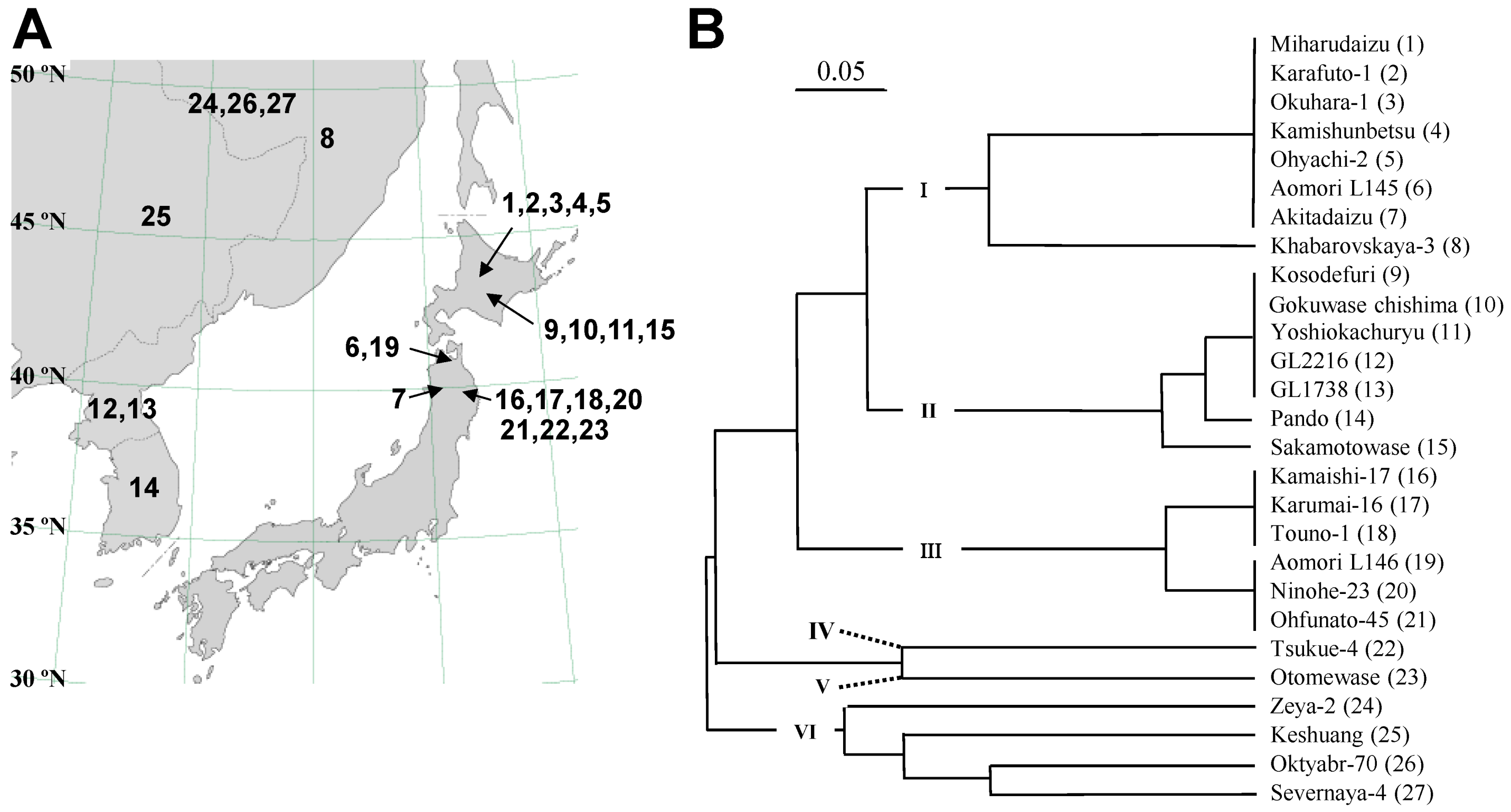
        <p>The genetic variation underlying photoperiod insensitivity was surveyed for the 27 accessions collected from various regions of East Asia (<xref ref-type="fig" rid="agronomy-03-00117-f001">Figure 1</xref>A). When sown in the late of May, these accessions flowered in the middle to late of July in Sapporo, Japan (43°06′ N, 141°35′ E) in which the natural daylength including twilight reached a maximum of 16.5 h, and exhibited no marked delay in flowering in artificially-induced LD conditions of 20 h generated by incandescent lamps. They were classified into three distinct groups (I–III), two singletons (IV, V), and a separate group (VI), by means of UPGMA cluster analysis of the combined data for 11 isozymes and 9 SSRs (<xref ref-type="fig" rid="agronomy-03-00117-f001">Figure 1</xref>B). Similar results were obtained in the analyses using isozymes and SSRs separately (data not shown). Group I consisted mainly of the landraces from Hokkaido, Japan, and far-eastern Russia (accessions 1–8), including Miharudaizu, whose genotype at the <italic>E1</italic>, <italic>E3</italic>, and <italic>E4</italic> loci was determined as <italic>E1E1e3e3e4e4</italic> [<xref ref-type="bibr" rid="B20-agronomy-03-00117">20</xref>]. The Group I accessions from northern Japan (accessions 1–7) possessed the same genotype at all of the marker loci tested, although they differed in their time to flowering and their seed coat colors. Group II consisted of landraces that are grown as a short-season crop across Japan and the Korean peninsula (9–15), including Sakamotowase, which has the genotype <italic>e3e3E4E4</italic> and a dysfunctional allele (<italic>e1-fs</italic>) at the <italic>E1</italic> locus [<xref ref-type="bibr" rid="B19-agronomy-03-00117">19</xref>,<xref ref-type="bibr" rid="B20-agronomy-03-00117">20</xref>,<xref ref-type="bibr" rid="B21-agronomy-03-00117">21</xref>]. Group III consisted of landraces collected in northern Honshu, Japan (16–21). Tsukue-4 (group IV, accession 22) and Otomewase (group V, accession 23) together formed a loose clade. The accessions from northeastern China and far-eastern Russia (24–27) formed a loose clade that was separate from the other five groups. The genotypes at the <italic>E1</italic>, <italic>E3</italic>, and <italic>E4</italic> maturity loci of the accessions in groups III to VI have not yet been determined.</p>
        <fig id="agronomy-03-00117-f001" position="float">
          <label>Figure 1</label>
          <caption>
            <p>Photoperiod-insensitive early-maturing soybean accessions analyzed in this study. (<bold>A</bold>) Geographical distribution of the photoperiod-insensitive accessions from East Asia; (<bold>B</bold>) Classification of the photoperiod-insensitive accessions by means of UPGMA, based on the similarity of 20 polymorphic isozyme and SSR marker loci.</p>
          </caption>
          <graphic xmlns:xlink="http://www.w3.org/1999/xlink" xlink:href="agronomy-03-00117-g001.tif"/>
        </fig>
      </sec>
      <sec>
        <title>2.2. Sequence and DNA Marker Analyses of <italic>E4</italic></title>
        <p>A crossing experiment between Miharudaizu (Group I) and Kamaishi-17 (Group III) exhibited no transgressive segregation in flowering time under the artificially-induced LD conditions (our unpublished data). This suggests that Kamaishi-17 possesses the same genotype (<italic>e3e3e4e4</italic>) at the <italic>E3</italic> and <italic>E4</italic> loci as is the case in Miharudaizu. The dysfunction of <italic>e4</italic> allele in Miharudaizu is caused by an insertion of a <italic>Ty1</italic>/<italic>copia</italic>-like retrotransposon, <italic>SORE-1</italic>, in exon 1 [<xref ref-type="bibr" rid="B17-agronomy-03-00117">17</xref>]. An analysis with allele-specific markers, which detect the presence or absence of the insertion, however, revealed that Kamaishi-17 did not have the <italic>e4</italic> allele in which <italic>SORE-1</italic> had been inserted [<xref ref-type="bibr" rid="B22-agronomy-03-00117">22</xref>]. This prompted us to analyze the <italic>E4</italic> (<italic>GmphyA2</italic>) sequences of Kamaishi-17 and the other photoperiod-insensitive accessions. </p>
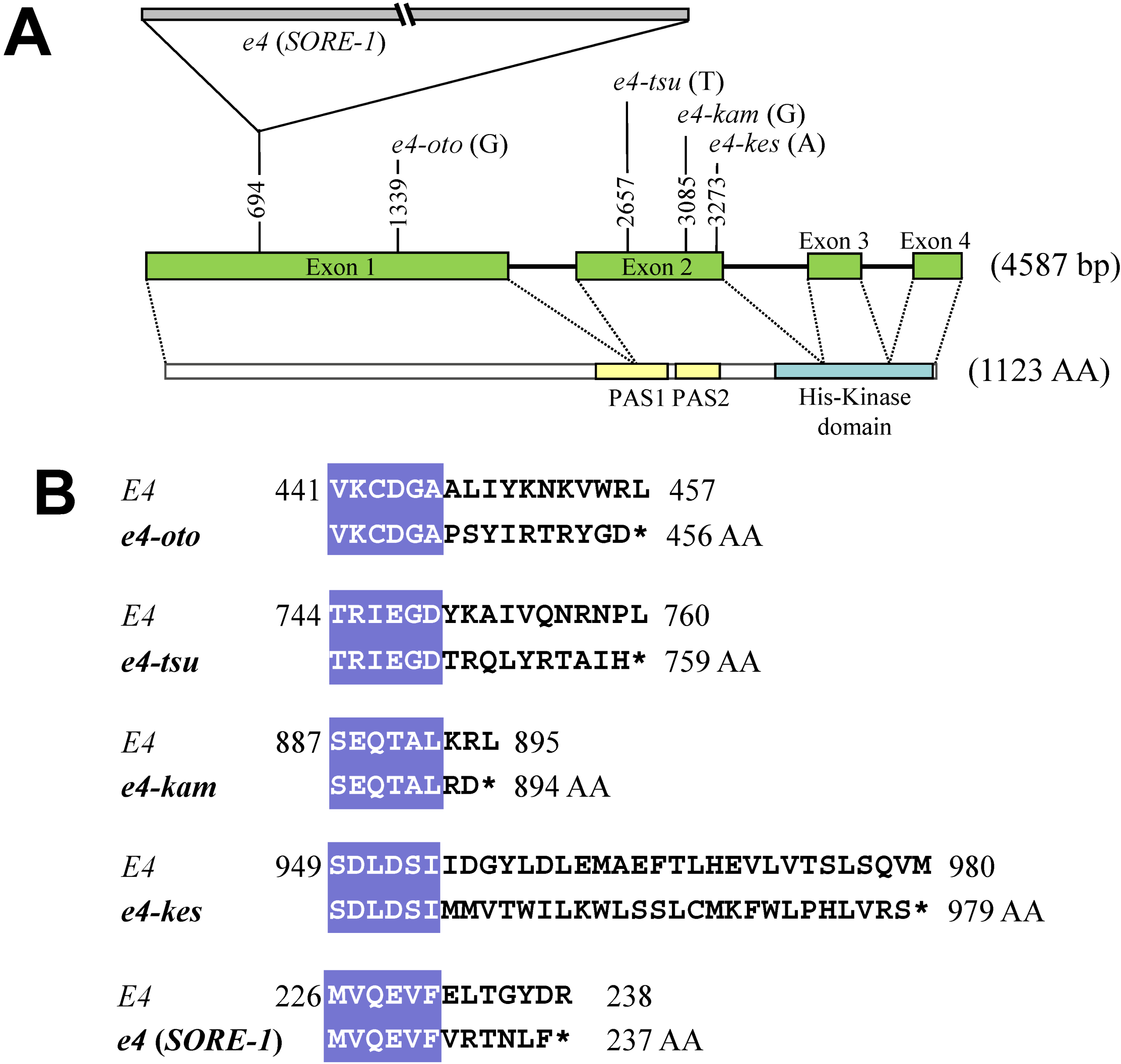
        <p>The sequence analysis revealed that Kamaishi-17 had a single-base deletion at position 3085 from the adenine of the start codon in exon 2 (<xref ref-type="fig" rid="agronomy-03-00117-f002">Figure 2</xref>A). This deletion resulted in a frame shift that led to premature termination of translation, and the gene was thus predicted to produce a truncated protein of 894 amino acids (AA) in length (<xref ref-type="fig" rid="agronomy-03-00117-f002">Figure 2</xref>B). The result obtained from the sequence analysis was thus in good agreement with our expectation from the crossing experiment, indicating that Kamaishi-17 possessed a dysfunctional <italic>e4</italic> allele, as was the case in Miharudaizu. We then extended the sequence analysis to the other three accessions, which were selected from each of groups IV to VI (Tsukue-4, Otomewase, and Keshuang). Interestingly, all had single-base deletions at different sites in exons 1 (Otomewase) or 2 (Tsukue-4 and Keshuang), and these variants were predicted to produce truncated proteins of different lengths: 456 AA in Otomewase, 759 AA in Tsukue-4, and 979 AA in Keshuang (<xref ref-type="fig" rid="agronomy-03-00117-f002">Figure 2</xref>A,B). The <italic>SORE-1</italic>-inserted <italic>e4</italic> allele produced a truncated protein of 237 AA [<xref ref-type="bibr" rid="B17-agronomy-03-00117">17</xref>]. The predicted AA sequences produced in Kamaishi-17 and Keshuang lacked a histidine-kinase domain required for phosphorylation, but retained the two PAS domains (PAS1 and PAS2) that are important for downstream signaling, whereas the Otomewase variant lacked all three domains, and the Tsukue-4 variant lacked both the PAS2 and histidine-kinase domains. No other DNA polymorphism was detected in the sequences, other than these deletions, among the accessions we tested or between those and Williams 82, a cultivar that was used for whole-genome sequencing (Glyma20g22160). We designated these variant alleles after the names of cultivars: <italic>e4</italic>-<italic>oto</italic> in Otomewase, <italic>e4</italic>-<italic>tsu</italic> in Tsukue-4, <italic>e4</italic>-<italic>kam</italic> in Kamaishi-17, and <italic>e4</italic>-<italic>kes</italic> in Keshuang. </p>
        <fig id="agronomy-03-00117-f002" position="float">
          <label>Figure 2</label>
          <caption>
            <p>Independent single-nucleotide deletions in the <italic>E4</italic> gene that result in premature stop codons that produce dysfunctional truncated proteins. (<bold>A</bold>) Sites of deletions and of the insertion of a <italic>Ty1/copia</italic>-like retrotransposon, <italic>SORE-1</italic>, in the <italic>GmphyA2</italic> exons. The deleted nucleotides are presented in parentheses; (<bold>B</bold>) Premature stop codons (<bold>*</bold>) generated by the deletions or by the insertion of <italic>SORE-1</italic>. </p>
          </caption>
          <graphic xmlns:xlink="http://www.w3.org/1999/xlink" xlink:href="agronomy-03-00117-g002.tif"/>
        </fig>
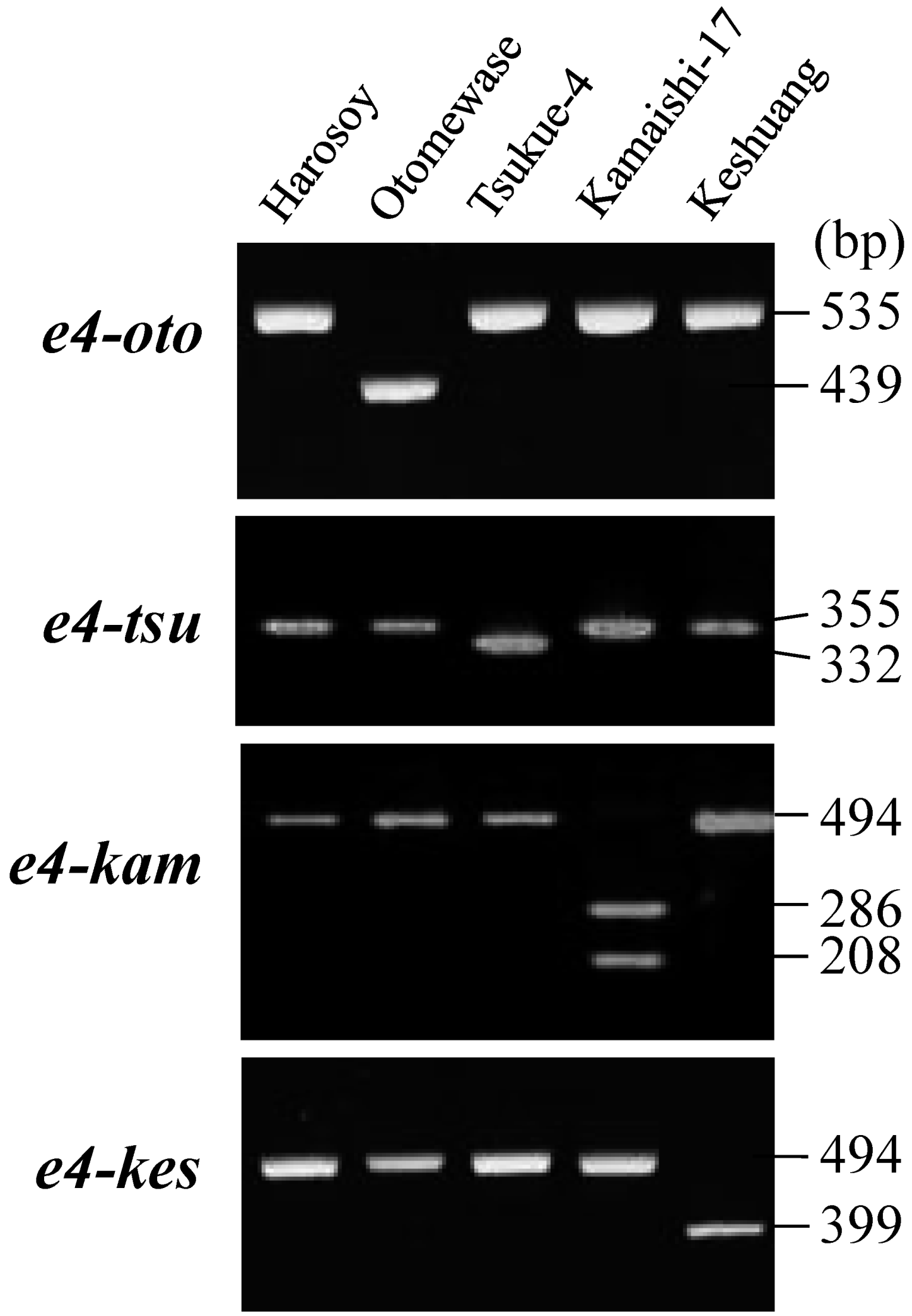
        <p>We then developed markers to reliably determine which alleles the remaining photoperiod-insensitive accessions possessed (<xref ref-type="fig" rid="agronomy-03-00117-f003">Figure 3</xref>). The five other accessions from Group III had a PCR product with the same digestion pattern as Kamaishi-17: when digested by <italic>Afl</italic>II, the amplified 494-bp product was separated into fragments of 286 and 208 bp. Similarly, the three accessions of Group VI from far-eastern Russia (Zeya-2, Oktyabr-70, and Severnaya-4) had a PCR product with the same digestion pattern as Keshuang: when digested by <italic>Bsp</italic>HI, the amplified 494-bp product was separated into fragments of 399 and 95 bp. The digestion patterns observed in <italic>e4</italic>-<italic>oto</italic> and <italic>e4</italic>-<italic>tsu</italic> were not detected in the rest of the collection of 27 accessions. Furthermore, the marker analyses for the four alleles and the <italic>e4</italic> allele containing the <italic>SORE</italic>-<italic>1</italic> insert revealed that the accessions in Group II all possessed the dominant <italic>E4</italic> allele, like Sakamotowase, whereas those in Group I all possessed the <italic>e4</italic> allele containing the <italic>SORE</italic>-<italic>1</italic> insert, like Miharudaizu. Accordingly, all of the photoperiod-insensitive accessions except for the Group II accessions had different loss-of-function alleles due to single-base deletions or the insertion of <italic>SORE-1</italic>. </p>
        <fig id="agronomy-03-00117-f003" position="float">
          <label>Figure 3</label>
          <caption>
            <p>Allele-specific DNA markers for the loss-of-function alleles at the <italic>E4</italic> locus. Harosoy possesses a dominant <italic>E4</italic> allele. The accessions, Otomewase, Tsukue-4, Kamaishi-17, and Keshuang possess loss-of-function alleles, <italic>e4</italic>-<italic>oto</italic>, <italic>e4</italic>-<italic>tsu</italic>, <italic>e4</italic>-<italic>kam</italic>, and <italic>e4</italic>-<italic>kes</italic>, respectively.</p>
          </caption>
          <graphic xmlns:xlink="http://www.w3.org/1999/xlink" xlink:href="agronomy-03-00117-g003.tif"/>
        </fig>
      </sec>
      <sec>
        <title>2.3. Survey of Genetic Variation Using Allele-Specific DNA Markers</title>
        <p>To determine the geographical distributions of the newly detected dysfunctional alleles at the <italic>E4</italic> locus, we extended the marker analysis to a total of 164 cultivated soybean accessions sourced from East Asia (64 from China, 30 from Korea, and 70 from Japan; <xref ref-type="supplementary-material" rid="agronomy-03-00117-s001">Supplemental Table S1</xref>), in addition to the 27 photoperiod-insensitive accessions. The digestion patterns at each of the four markers indicated that all of the accessions except for a landrace from northern Japan (Wasekeburi) possessed the dominant <italic>E4</italic> allele. Wasekeburi possessed the <italic>e4-kam</italic> allele, which was distributed mainly in northern Honshu (<xref ref-type="fig" rid="agronomy-03-00117-f001">Figure 1</xref>A). The other loss-of-function alleles were not detected in this collection. Therefore, these loss-of-function alleles appear to be rare in the cultivated soybean germplasm.</p>
      </sec>
      <sec>
        <title>2.4. Comparison of Nucleotide Diversity between <italic>E4</italic> and <italic>GmphyA1</italic></title>
        <p>Sequencing and DNA marker analyses revealed that photoperiod-insensitive accessions, except for those in Group II, possessed dysfunctional alleles at the <italic>E4</italic> (<italic>GmphyA2</italic>) locus. The <italic>E4</italic> gene possesses a homoeologous copy, <italic>GmphyA1</italic> (Glyma10g28170) [<xref ref-type="bibr" rid="B17-agronomy-03-00117">17</xref>], owing to the paleopolyploid nature of the soybean genome [<xref ref-type="bibr" rid="B23-agronomy-03-00117">23</xref>]. This raises questions about whether there are dysfunctional mutations responsible for earlier flowering in <italic>GmphyA1</italic>, and about the function, if any, of <italic>GmphyA1</italic>. To answer these questions, we sequenced <italic>E4</italic> and <italic>GmphyA1</italic> in wild and cultivated accessions collected from various regions of East Asia (<xref ref-type="supplementary-material" rid="agronomy-03-00117-s001">Supplemental Tables S2 and S3</xref>).</p>
        <p>Characteristics of the DNA polymorphisms in the <italic>E4</italic> and <italic>GmphyA1</italic> regions are summarized in <xref ref-type="table" rid="agronomy-03-00117-t001">Table 1</xref>. Recently released sequence data for 31 wild and cultivated soybeans [<xref ref-type="bibr" rid="B24-agronomy-03-00117">24</xref>], excluding those with missing or obscure data, were also included in the nucleotide diversity analysis. The <italic>E4</italic> region comprised a total of 6341 aligned base pairs; across this region, 44 sites were polymorphic, comprising 33 SNPs, 9 single- or multiple-base insertion– deletions (indels), and 2 SSRs (<xref ref-type="supplementary-material" rid="agronomy-03-00117-s002">Supplemental Figure S1</xref>). In addition to the 4 single-base deletions and the insertion of <italic>SORE-1</italic>, 10 SNPs occurred in exons, of which 4 generated amino acid substitutions. On the other hand, the <italic>GmphyA1</italic> region comprised a total of 5517 aligned base pairs; across this region, 20 sites were polymorphic. Of these, 7 were detected in exons, of which only 1 SNP caused an amino acid substitution (<xref ref-type="supplementary-material" rid="agronomy-03-00117-s002">Supplemental Figure S2</xref>). The analysis of <italic>GmphyA1</italic> included 9 photoperiod-insensitive accessions that were analyzed for the <italic>E4</italic> sequences. No sequence variation causing a dysfunction of <italic>GmphyA1</italic> was detected in the 9 accessions; all had the same amino acid sequence as Williams 82, a photoperiod-sensitive cultivar (<xref ref-type="supplementary-material" rid="agronomy-03-00117-s001">Supplemental Table S3</xref> and <xref ref-type="supplementary-material" rid="agronomy-03-00117-s002">Supplemental Figure S2</xref>). </p>
        <table-wrap id="agronomy-03-00117-t001" position="float">
          <object-id pub-id-type="pii">agronomy-03-00117-t001_Table 1</object-id>
          <label>Table 1</label>
          <caption>
            <p>DNA polymorphisms in two homoeologous phytochrome A genes, <italic>GmphyA1</italic> and <italic>E4</italic> (<italic>GmphyA2</italic>) in cultivated and wild soybeans.</p>
          </caption>
          <table>
            <thead>
              <tr>
                <th align="center" valign="middle"> </th>
                <th align="center" valign="middle">
                  <italic>n</italic>
                </th>
                <th align="center" valign="middle">
                  <italic>S</italic>
                </th>
                <th align="center" valign="middle">
                  <italic>Hap</italic>
                </th>
                <th align="center" valign="middle">π (s) (× 10<sup>−3</sup>)</th>
                <th align="center" valign="middle">θ (s) (× 10<sup>−3</sup>)</th>
                <th align="center" valign="middle">π (a) (× 10<sup>−3</sup>)</th>
                <th align="center" valign="middle">θ (a) (× 10<sup>−3</sup>)</th>
              </tr>
            </thead>
            <tbody>
              <tr>
                <td align="center" valign="middle">
                  <italic>GmphyA1</italic>
                </td>
                <td align="center" valign="middle"> </td>
                <td align="center" valign="middle"> </td>
                <td align="center" valign="middle"> </td>
                <td align="center" valign="middle"> </td>
                <td align="center" valign="middle"> </td>
                <td align="center" valign="middle"> </td>
                <td align="center" valign="middle"> </td>
              </tr>
              <tr>
                <td align="center" valign="middle">Cultivated soybean</td>
                <td align="center" valign="middle">35</td>
                <td align="center" valign="middle">17</td>
                <td align="center" valign="middle">6</td>
                <td align="center" valign="middle">1.35</td>
                <td align="center" valign="middle">1.03</td>
                <td align="center" valign="middle">0.02</td>
                <td align="center" valign="middle">0.09</td>
              </tr>
              <tr>
                <td align="center" valign="middle">Wild soybean</td>
                <td align="center" valign="middle">24</td>
                <td align="center" valign="middle">18</td>
                <td align="center" valign="middle">12</td>
                <td align="center" valign="middle">1.31</td>
                <td align="center" valign="middle">1.40</td>
                <td align="center" valign="middle">0.03</td>
                <td align="center" valign="middle">0.10</td>
              </tr>
              <tr>
                <td align="center" valign="middle">Combined</td>
                <td align="center" valign="middle">59</td>
                <td align="center" valign="middle">20</td>
                <td align="center" valign="middle">15</td>
                <td align="center" valign="middle">1.35</td>
                <td align="center" valign="middle">1.36</td>
                <td align="center" valign="middle">0.03</td>
                <td align="center" valign="middle">0.16</td>
              </tr>
              <tr>
                <td align="center" valign="middle">
                  <italic>E4 (GmphyA2)</italic>
                </td>
                <td align="center" valign="middle"> </td>
                <td align="center" valign="middle"> </td>
                <td align="center" valign="middle"> </td>
                <td align="center" valign="middle"> </td>
                <td align="center" valign="middle"> </td>
                <td align="center" valign="middle"> </td>
                <td align="center" valign="middle"> </td>
              </tr>
              <tr>
                <td align="center" valign="middle">Cultivated soybean</td>
                <td align="center" valign="middle">52</td>
                <td align="center" valign="middle">18</td>
                <td align="center" valign="middle">7</td>
                <td align="center" valign="middle">0.13</td>
                <td align="center" valign="middle">0.66</td>
                <td align="center" valign="middle">0.13</td>
                <td align="center" valign="middle">0.34</td>
              </tr>
              <tr>
                <td align="center" valign="middle">Wild soybean</td>
                <td align="center" valign="middle">25</td>
                <td align="center" valign="middle">39</td>
                <td align="center" valign="middle">13</td>
                <td align="center" valign="middle">2.11</td>
                <td align="center" valign="middle">2.01</td>
                <td align="center" valign="middle">0.56</td>
                <td align="center" valign="middle">0.61</td>
              </tr>
              <tr>
                <td align="center" valign="middle">Combined</td>
                <td align="center" valign="middle">77</td>
                <td align="center" valign="middle">44</td>
                <td align="center" valign="middle">19</td>
                <td align="center" valign="middle">1.12</td>
                <td align="center" valign="middle">1.65</td>
                <td align="center" valign="middle">0.39</td>
                <td align="center" valign="middle">0.70</td>
              </tr>
            </tbody>
          </table>
		  <table-wrap-foot><fn>
		  <p>n, number of accessions compared; S, total number of segregating sites; Hap, number of haplotypes; π, Nei’s nucleotide diversity; θ, Watterson’s estimator; s, nucleotide diversity at synonymous sites and non-coding regions; a, nucleotide diversity at nonsynonymous sites.</p>
		</fn></table-wrap-foot>
		  </table-wrap>
        
        <p>Two common measures of nucleotide diversity, Tajima’s estimator of diversity π [<xref ref-type="bibr" rid="B25-agronomy-03-00117">25</xref>] and Watterson’s estimator θ [<xref ref-type="bibr" rid="B26-agronomy-03-00117">26</xref>], were calculated for synonymous and non-coding regions (<italic>s</italic>) and for non-synonymous sites (<italic>a</italic>) (<xref ref-type="table" rid="agronomy-03-00117-t001">Table 1</xref>). All of the mutations except the SSRs were collectively considered to be SNPs and were subjected to nucleotide diversity analysis. For the synonymous sites and non-coding regions, the two homoeologs showed similar nucleotide diversities for all accessions combined: π = 1.35 × 10<sup>−3</sup> for <italic>GmphyA1</italic> and 1.12 × 10<sup>−3</sup> for <italic>E4</italic>, and θ = 1.36 × 10<sup>−3</sup> and 1.65 × 10<sup>−3</sup>, respectively. Accordingly, mutations appear to have accumulated at almost the same rate in the two homoeologs since gene duplication occurred. On the other hand, the nucleotide diversity values for non-synonymous sites in <italic>GmphyA1</italic> (π = 0.03 × 10<sup>−3</sup>, θ = 0.16 × 10<sup>−3</sup>) were only 8% and 23%, respectively, of the corresponding values in <italic>E4</italic> (π = 0.39 × 10<sup>−3</sup>, θ = 0.70 × 10<sup>−3</sup>). Comparison of nucleotide diversity in the cultivated and wild soybeans further produced different results between the two genes: <italic>GmphyA1</italic> had similar diversity in the cultivated and wild soybeans in all diversity parameters, whereas <italic>E4</italic> (<italic>GmphyA2</italic>) had lower diversity in the cultivated soybean than in the wild soybean in all diversity parameters; cultivated soybean retained only 6% (π<sub>(s)</sub>) to 33% (θ<sub>(s)</sub>) or 23% (π<sub>(a)</sub>) to 56% (θ<sub>(a)</sub>) of the diversity present in the wild soybean population.</p>
      </sec>
      <sec>
        <title>2.5. Haplotype Networks</title>
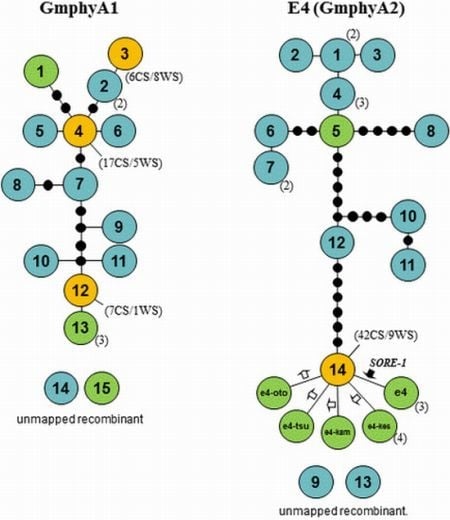
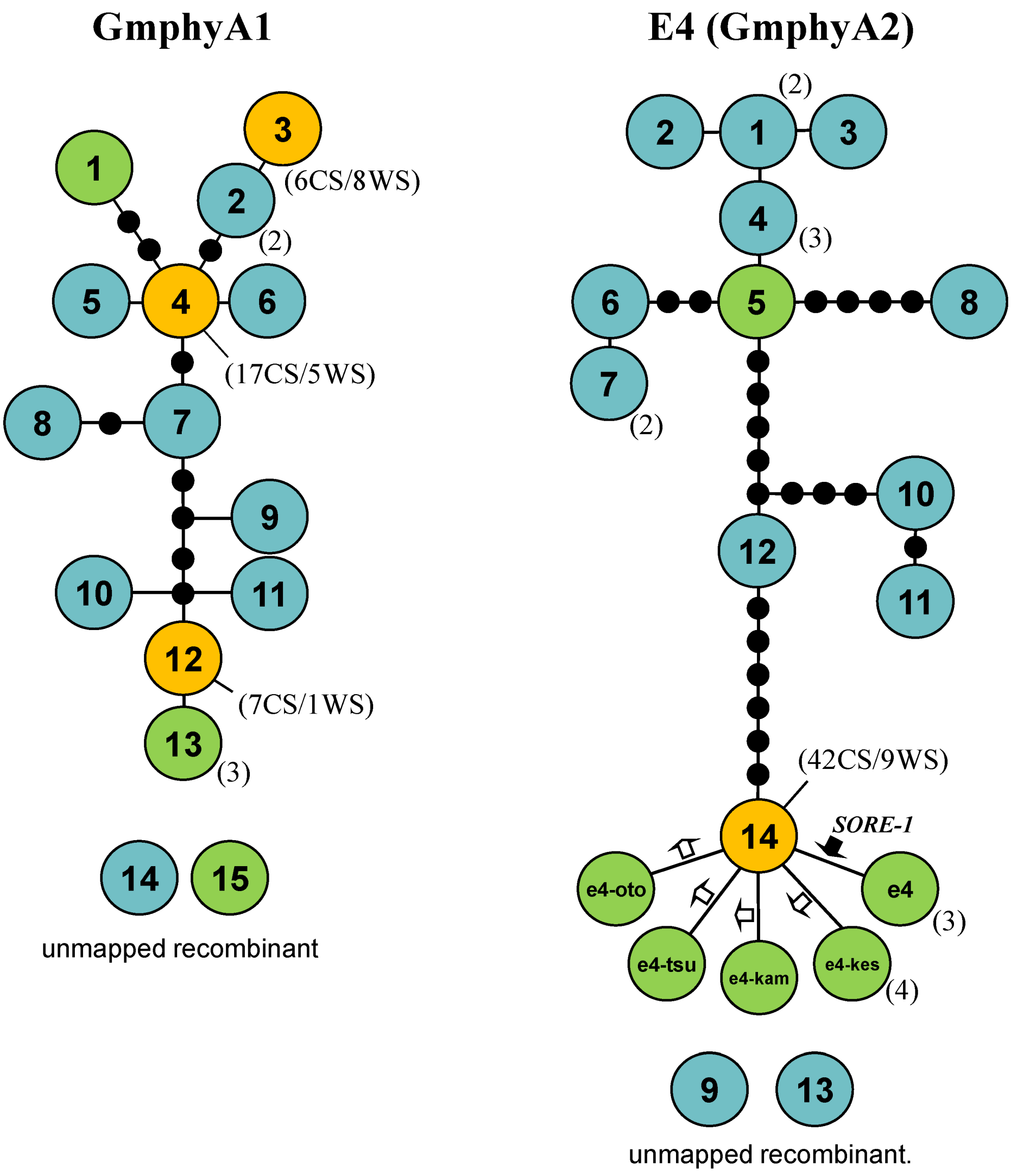
        <p>Minimum-span haplotype networks were constructed using all of the observed polymorphisms to determine the origins of the dysfunctional alleles and to elucidate the structure of the variations observed in the cultivated and wild soybeans (<xref ref-type="fig" rid="agronomy-03-00117-f004">Figure 4</xref>; <xref ref-type="supplementary-material" rid="agronomy-03-00117-s002">Supplemental Figures S1 and S2</xref>). The haplotype network for the <italic>E4</italic> region consisted of 17 haplotypes, including five non-functional alleles, four alleles detected in this study and the allele containing <italic>SORE</italic>-<italic>1</italic> [<xref ref-type="bibr" rid="B17-agronomy-03-00117">17</xref>], with 2 putative unmapped recombinants. All of the loss-of-function alleles appear to have derived from haplotype 14. Wild soybeans possessed 12 haplotypes that were not found in cultivated soybeans. Only haplotype 14 was common to both wild and cultivated soybeans. All of the cultivated accessions that we tested except for a Chinese one (in haplotype 5) possessed haplotype 14 or non-functional alleles that were derived from the former haplotype. On the other hand, the haplotype network for the <italic>GmphyA1</italic> region consisted of 13 haplotypes with 2 putative unmapped recombinants. Of these, 9 were specific to wild soybeans, 3 (haplotypes 3, 4, and 12) were common to both wild and cultivated soybeans, and 3 (haplotypes 1, 13, and 15) were specific to cultivated soybeans. The haplotypes for the <italic>GmphyA1</italic> region that were observed in the cultivated soybeans were divided into two clusters (haplotypes 1 to 11 and haplotypes 12 and 13) that differed by at least 7 SNPs. The existence of such distantly related haplotypes in cultivated soybeans resulted in a higher nucleotide diversity in <italic>GmphyA1</italic> than in wild soybeans (<xref ref-type="table" rid="agronomy-03-00117-t001">Table 1</xref>). In contrast, the reduction of nucleotide diversity in <italic>E4</italic> in cultivated soybeans (<xref ref-type="table" rid="agronomy-03-00117-t001">Table 1</xref>) may be attributable to the predominant distribution of haplotype 14.</p>
        <fig id="agronomy-03-00117-f004" position="float">
          <label>Figure 4</label>
          <caption>
            <p>Haplotype networks for two <italic>phytochrome A</italic> homoeologs, <italic>GmphyA1</italic> and <italic>E4</italic> (<italic>GmphyA2</italic>). Light blue circles, haplotypes specific to wild soybean (WS); orange, those common to both wild and cultivated soybeans; green, those specific to cultivated soybean (CS). Black arrows, insertions; white arrows, deletions. Black dots represent differences (e.g., SNPs) separating the haplotypes. The number of accessions that belong to each haplotype is given in parentheses.</p>
          </caption>
          <graphic xmlns:xlink="http://www.w3.org/1999/xlink" xlink:href="agronomy-03-00117-g004.tif"/>
        </fig>
      </sec>
    </sec>
    <sec sec-type="discussion">
      <title>3. Discussion</title>
      <p>Sequencing and DNA marker analyses of <italic>E4</italic> revealed that all of the photoperiod-insensitive accessions analyzed, except for those in Group II (<xref ref-type="fig" rid="agronomy-03-00117-f001">Figure 1</xref>), have a dysfunctional allele at the <italic>E4</italic> locus. We detected four new, independent dysfunctional alleles (<italic>e4-oto</italic>, <italic>e4-tsu</italic>, <italic>e4-kam</italic>, and <italic>e4-kes</italic>), all of which exhibited single-base deletions in the first or second exon. These deletions generated premature stop codons as a result of a frame shift, resulting in truncated proteins of different lengths. It is therefore likely that the loss of function in the <italic>E4</italic> gene played an important role in the evolution of insensitivity to photoperiod in early-flowering, photoperiod-insensitive accessions that are adapted to high latitudes. Like the natural variations observed in <italic>FLC</italic> and <italic>FRI</italic> in <italic>Arabidopsis</italic> [<xref ref-type="bibr" rid="B3-agronomy-03-00117">3</xref>,<xref ref-type="bibr" rid="B4-agronomy-03-00117">4</xref>,<xref ref-type="bibr" rid="B5-agronomy-03-00117">5</xref>,<xref ref-type="bibr" rid="B6-agronomy-03-00117">6</xref>,<xref ref-type="bibr" rid="B7-agronomy-03-00117">7</xref>] and in <italic>Hd1</italic> in rice [<xref ref-type="bibr" rid="B8-agronomy-03-00117">8</xref>], natural mutations have repeatedly generated loss-of-function alleles at the <italic>E4</italic> locus in soybean. The survey of 191 cultivated soybean accessions collected from various regions of East Asia further revealed that the 4 dysfunctional alleles were limited to relatively small geographical regions, as was the case in the <italic>e4</italic> allele containing the <italic>SORE</italic>-<italic>1</italic> insert, which was detected only in northern Japan out of 332 cultivated and 85 wild soybean accessions that were surveyed [<xref ref-type="bibr" rid="B22-agronomy-03-00117">22</xref>]. The loss-of-function alleles at the <italic>E4</italic> locus may therefore have originated relatively recently and independently in different soybean landraces that possess the functional <italic>E4</italic> allele of haplotype 14. Mutations leading to early flowering and the resultant early maturity would have permitted the use of diverse cropping systems and would consequently have extended the soybean production season. Under human selection, the loss-of-function alleles at the <italic>E4</italic> locus may have accumulated multiple times in local populations. The <italic>E4</italic> locus is therefore a key player in the adaptation of soybean to LD conditions of high latitudes and diverse cropping systems. </p>
      <p>Soybean is a paleopolyploid species with a complex genome, which is estimated to have become duplicated both 59 and 13 million years ago [<xref ref-type="bibr" rid="B23-agronomy-03-00117">23</xref>], reviewed in [<xref ref-type="bibr" rid="B27-agronomy-03-00117">27</xref>]. Approximately 75% of the genes are present as multiple copies, some of which have diverged in their functions, as suggested by different expression patterns between homoeologs [<xref ref-type="bibr" rid="B28-agronomy-03-00117">28</xref>,<xref ref-type="bibr" rid="B29-agronomy-03-00117">29</xref>]. <italic>phyA</italic> is one such example, and consists of 2 sets of homoeologous partners, <italic>GmphyA1</italic>/<italic>GmphyA2</italic>(<italic>E4</italic>) and <italic>GmphyA3</italic>(<italic>E3</italic>)/<italic>GmphyA4</italic> [<xref ref-type="bibr" rid="B16-agronomy-03-00117">16</xref>,<xref ref-type="bibr" rid="B17-agronomy-03-00117">17</xref>,<xref ref-type="bibr" rid="B18-agronomy-03-00117">18</xref>]. The presence of multiple copies of soybean <italic>phyA</italic> contrasts sharply with other legume species such as pea (<italic>Pisum sativum</italic>), <italic>Medicago truncatula</italic>, and <italic>Lotus japonicus</italic>, which all possess a single <italic>phyA</italic> gene [<xref ref-type="bibr" rid="B30-agronomy-03-00117">30</xref>]. Of the four copies, <italic>GmphyA2</italic> and <italic>GmphyA3</italic> correspond to the soybean maturity genes <italic>E4</italic> and <italic>E3</italic>, respectively; however, neither a major gene nor a QTL controlling flowering time has so far been reported near the genomic positions of <italic>GmphyA1</italic> and <italic>GmphyA4</italic>. In particular, <italic>GmphyA4</italic> is most likely dysfunctional in Williams 82, a cultivar that has been used for whole-genome sequencing, because of a deletion in the third exon [<xref ref-type="bibr" rid="B16-agronomy-03-00117">16</xref>,<xref ref-type="bibr" rid="B18-agronomy-03-00117">18</xref>].</p>
      <p><italic>E3</italic> and <italic>E4</italic> were originally identified by different responses of flowering to LD conditions induced by light with a high red (R) to far-red (FR) quantum ratio generated by R-enriched fluorescent lamps and by light with a low R:FR ratio generated FR-enriched incandescent lamps [<xref ref-type="bibr" rid="B9-agronomy-03-00117">9</xref>,<xref ref-type="bibr" rid="B10-agronomy-03-00117">10</xref>,<xref ref-type="bibr" rid="B11-agronomy-03-00117">11</xref>,<xref ref-type="bibr" rid="B12-agronomy-03-00117">12</xref>]. <italic>E3</italic> controls flowering under LD conditions with a high R:FR ratio; <italic>e3e3</italic> recessive homozygous plants can initiate flowering under these conditions [<xref ref-type="bibr" rid="B9-agronomy-03-00117">9</xref>]. <italic>E4</italic> is involved in flowering under LD conditions with a low R:FR ratio; a recessive <italic>e4</italic> allele is necessary for plants homozygous for the <italic>e3</italic> allele to flower under these conditions [<xref ref-type="bibr" rid="B10-agronomy-03-00117">10</xref>,<xref ref-type="bibr" rid="B11-agronomy-03-00117">11</xref>,<xref ref-type="bibr" rid="B12-agronomy-03-00117">12</xref>,<xref ref-type="bibr" rid="B13-agronomy-03-00117">13</xref>]. Both genes thus control flowering under LD conditions with a wide range of R:FR ratios, but in a non-additive manner. phyA is an FR sensor that is involved, directly or via interactions with other photoreceptors, in various developmental processes [<xref ref-type="bibr" rid="B31-agronomy-03-00117">31</xref>]. It also acts as a red-light photoreceptor, particularly under R light with a high photon irradiance; in <italic>Arabidopsis</italic>, quadruple-null mutants for the phytochrome family (<italic>phyBphyCphyDphyE</italic>) that only contain functional phyA were able to respond to the R-mediated de-etiolation of seedlings and survive until flowering under continuous R light with a high photon irradiance [<xref ref-type="bibr" rid="B32-agronomy-03-00117">32</xref>,<xref ref-type="bibr" rid="B33-agronomy-03-00117">33</xref>]. The different responses of <italic>E3</italic> and <italic>E4</italic> to LD conditions with different light qualities may therefore indicate that the two genes participate in different aspects of phyA functions.</p>
      <p>On the other hand, the function of <italic>GmphyA1</italic>, a homoeolog of <italic>E4</italic>, remains undetermined, because no genetic variants producing any phenotypic differences have been available at this locus. However, two findings suggest that like <italic>E4</italic>, <italic>GmphyA1</italic> is also involved in both the de-etiolation response and flowering under FR-enriched LD conditions [<xref ref-type="bibr" rid="B13-agronomy-03-00117">13</xref>,<xref ref-type="bibr" rid="B17-agronomy-03-00117">17</xref>]. First, the <italic>e4</italic> allele partially impaired the de-etiolation response to continuous FR light [<xref ref-type="bibr" rid="B17-agronomy-03-00117">17</xref>]. This is in sharp contrast to the <italic>phyA</italic> null mutants of <italic>Arabidopsis</italic>, pea, and rice, which show a complete loss of the de-etiolation response under continuous FR light [<xref ref-type="bibr" rid="B34-agronomy-03-00117">34</xref>,<xref ref-type="bibr" rid="B35-agronomy-03-00117">35</xref>,<xref ref-type="bibr" rid="B36-agronomy-03-00117">36</xref>,<xref ref-type="bibr" rid="B37-agronomy-03-00117">37</xref>]. <italic>E3</italic> is not involved in the de-etiolation responses under either continuous R or FR light, suggesting that the redundancy in the de-etiolation response of the <italic>e4</italic> allele may be attributable to <italic>GmphyA1</italic> [<xref ref-type="bibr" rid="B17-agronomy-03-00117">17</xref>]. Second, when combined with a dominant allele at the <italic>E1</italic> locus, a double-recessive genotype for the <italic>E3</italic> and <italic>E4</italic> loci retains the photoperiod sensitivity, particularly to LD conditions with a low R:FR ratio (&lt;1.0), although it is insensitive to LD conditions with a relatively high R:FR ratio (1.0–5.0) [<xref ref-type="bibr" rid="B13-agronomy-03-00117">13</xref>]. These findings suggest that the homoeolog of <italic>E4</italic>, <italic>GmphyA1</italic>, itself functions redundantly with <italic>E4</italic> in both de-etiolation responses and photoperiod responses under FR-enriched light.</p>
      <p>The results obtained from our sequencing analyses of a diverse collection that included both wild and cultivated accessions introduced mainly from various regions of East Asia reveal that <italic>E4</italic> and <italic>GmphyA1</italic> exhibit almost the same nucleotide diversities at synonymous sites and in non-coding regions among all accessions combined, suggesting that the two <italic>phyA</italic> genes have accumulated mutations at almost the same rate since gene duplication. However, the nucleotide diversity at non-synonymous sites, as a whole, was lower in <italic>GmphyA1</italic> than in <italic>E4</italic>. In particular, the dysfunctional mutations were concentrated in only <italic>E4</italic>, despite their predicted redundant functions in both photoperiod sensitivity and the de-etiolation response [<xref ref-type="bibr" rid="B13-agronomy-03-00117">13</xref>,<xref ref-type="bibr" rid="B17-agronomy-03-00117">17</xref>]. The low diversity in non-synonymous sites at <italic>GmphyA1</italic> may therefore indicate that there are some differences in phyA functions between the two homoeologs, and that <italic>GmphyA1</italic> might have been more amenable than <italic>E4</italic> to purifying selection. Further understanding of the function of <italic>GmphyA1</italic> will be needed before we can explain why the mutations are concentrated in only one of the two homoeologs.</p>
      <p>Nucleotide diversity in a homoeologous gene pair has also been evaluated in the soybean orthologs of <italic>Arabidopsis TERMINAL FLOWER 1</italic> (<italic>TFL1</italic>), a gene involved in the phase transition in the shoot apical meristem (SAM) [<xref ref-type="bibr" rid="B38-agronomy-03-00117">38</xref>]. The soybean <italic>TFL1</italic> ortholog consists of two homoeologs, <italic>GmTFL1a</italic> and <italic>GmTFL1b</italic>, the latter of which is the determinate growth habit gene <italic>Dt1</italic> [<xref ref-type="bibr" rid="B38-agronomy-03-00117">38</xref>,<xref ref-type="bibr" rid="B39-agronomy-03-00117">39</xref>]. The two homoeologs are expressed differently: <italic>GmTFL1b</italic> is expressed mainly in the vegetative SAM and the roots, whereas <italic>GmTFL1a</italic> is expressed mainly in the stem tip after flowering and in the immature cotyledons [<xref ref-type="bibr" rid="B39-agronomy-03-00117">39</xref>]. <italic>Arabidopsis TFL1</italic> is highly expressed in the shoot apex and roots and weakly in the seeds and siliques (Arabidopsis eFP Browser [<xref ref-type="bibr" rid="B40-agronomy-03-00117">40</xref>,<xref ref-type="bibr" rid="B41-agronomy-03-00117">41</xref>]). Therefore, the different expression profiles of <italic>GmTFL1a</italic> and <italic>GmTFL1b</italic> may reflect the subfunctionalization of the <italic>Arabidopsis TFL1</italic> gene. Tian <italic>et al.</italic> [<xref ref-type="bibr" rid="B38-agronomy-03-00117">38</xref>] found that at least four allelic variants at the <italic>Dt1</italic> locus in the cultivated soybean population caused stem termination in the SAM as a result of single amino acid substitutions, whereas no non-synonymous mutation in <italic>GmTFL1a</italic> was detected in either wild or cultivated soybeans. Subfunctionalization following duplication of the multifunctional ancestral gene may have enabled one of the homoeologs to accumulate functional mutations under human selection without any constraints imposed by the other functions of the ancestral gene. The asymmetrical accumulation of dysfunctional mutations observed in the maturity gene <italic>E4</italic> and its homoeolog may therefore reflect their subfunctionalization as well.</p>
    </sec>
    <sec>
      <title>4. Experimental Section</title>
      <sec>
        <title>4.1. Materials</title>
        <p>The 27 photoperiod-insensitive accessions used in this study included 19 accessions from northern Japan (9 from Hokkaido and 10 from the Tohoku region), 3 from the Korean Peninsula, and 5 from northeastern China and far-eastern Russia. cv. Harosoy was also included in the analysis because it carries a dominant <italic>E4</italic> allele [<xref ref-type="bibr" rid="B12-agronomy-03-00117">12</xref>]. The <italic>E4</italic> sequences were analyzed for 36 cultivated and 15 wild soybean accessions (<xref ref-type="supplementary-material" rid="agronomy-03-00117-s001">Supplemental Tables S2 and S3</xref>), including nine photoperiod-insensitive accessions. We also analyzed the sequences of <italic>GmphyA1</italic> (Glyma10g28170), a homoeolog of <italic>E4</italic>, from 26 cultivated and 13 wild soybean accessions to compare the molecular diversity of these two homoeologs (<xref ref-type="supplementary-material" rid="agronomy-03-00117-s001">Supplemental Tables S2 and S3</xref>). The DNA marker analysis was carried out for a total of 191 accessions, including the 27 photoperiod-insensitive accessions and 164 cultivated soybean accessions (<xref ref-type="supplementary-material" rid="agronomy-03-00117-s001">Supplemental Table S1</xref>), to determine the geographical distribution of the loss-of-function alleles of <italic>E4</italic>.</p>
      </sec>
      <sec>
        <title>4.2. Methods</title>
        <sec>
          <title>4.2.1. Classification of Photoperiod-Insensitive Accessions by Isozymes and SSRs</title>
          <p>We genotyped 11 isozyme and 9 simple sequence repeat (SSR) markers to classify the 27 accessions, as described in [<xref ref-type="bibr" rid="B42-agronomy-03-00117">42</xref>] for isozymes and in [<xref ref-type="bibr" rid="B43-agronomy-03-00117">43</xref>] for SSRs. The isozyme loci that we tested were <italic>Aco1</italic>, <italic>Aco2</italic>, <italic>Aco4</italic>, <italic>Aph</italic>, <italic>Enp</italic>, <italic>Est1</italic>, <italic>Dia1</italic>, <italic>Idh1</italic>, <italic>Idh2</italic>, <italic>Lap</italic>, <italic>Mpi</italic>, and <italic>Pgm1</italic>. The SSR markers were Satt002, Satt0038, Satt063, Satt156, Satt180, Satt197, Satt228, Satt262, and Satt600, and were selected from 20 SSRs tested in 131 Asian soybean accessions and shown to have high levels of genetic diversity [<xref ref-type="bibr" rid="B43-agronomy-03-00117">43</xref>]. Total genomic DNA was extracted from young trifoliate leaves, as described in [<xref ref-type="bibr" rid="B44-agronomy-03-00117">44</xref>]. SSR analysis used 6% denatured polyacrylamide gel electrophoresis with fluorescent-labeled primers, and was performed using an ABI 377 sequencer (Perkin Elmer/Applied Biosystems, Foster City, CA, USA). We used the GeneScan software (v. 3.1) to score the observed polymorphisms. The genetic distance between each pair of the 27 accessions was calculated as 1 − <italic>P</italic>, where <italic>P</italic> is the proportion of shared alleles for the loci tested. The genetic distance matrix was subjected to cluster analysis using the unweighted pair-group method with an arithmetic average (UPGMA), and was performed using the PHYLIP software [<xref ref-type="bibr" rid="B45-agronomy-03-00117">45</xref>].</p>
        </sec>
        <sec>
          <title>4.2.2. Sequence Analyses</title>
          <p>The region sequenced covered the full coding sequences, 4 introns, the 5'-untranslated region (UTR) and the 3'-UTR, and their flanking regions of <italic>E4</italic>; and the full coding sequences, 3 introns, 3'-UTR, and the 3'-flanking region of <italic>GmphyA1</italic>. Two overlapping fragments were amplified from the total genomic DNA for each homoeolog using <italic>ExTaq</italic> DNA polymerase (Takara, Ohtsu, Shiga, Japan) with the following homoeolog-specific primers: 5′-CACGTAGATTCTCCTAACAC-3′ and 5′-CAATCTCACTTGTCACTGCTTC-3′, 5′-CTGAGAAATGCATTCAAAGATAC-3′ and 5′-CTCTGTGCCAAACATATTCCG-3′ for <italic>GmphyA2</italic>; 5′-AGACATAGTGCTAGAATGGC-3′ and 5′-GTAATCACCTTCAATACGGATG-3′, 5′-ATGCAATTTATCTGACACAGTGG-3′ and 5′-AGCGAGAGACAGAATTAGCC-3′ for <italic>GmphyA1</italic>. They were then purified with the ExoSAP-IT enzyme kit (GE Life Sciences Japan, Tokyo Japan). The purified PCR products were used as templates for forward and reverse sequencing reactions, and sequenced with an ABI PRISM 3100 Avant Genetic Analyzer using a BigDye Terminator v3.1 Cycle Sequencing kit (Applied Biosystems Japan, Tokyo, Japan). The sequences for novel dysfunctional alleles were further confirmed by cloning with the pGEN-T easy vector system (Promega K. K. Japan, Tokyo, Japan), followed by sequencing as described above.</p>
        </sec>
        <sec>
          <title>4.2.3. Analysis of the Distribution of Loss-of-Function Alleles Using DNA Markers</title>
          <p>Allele-specific DNA markers were developed from sequences flanking the mutation sites. We used cleaved amplified polymorphic sequence (CAPS) markers and derived CAPS (dCAPS) markers. The targeted region for each mutation was amplified from the DNA preparations using <italic>ExTaq</italic> polymerase with primers specific to each mutation. The primers used were 5′-CCCAGACACTCTTGTGTGAT-3′ and 5′-CCATACTCTCGGTATCTTTG-3′ for <italic>e4-oto</italic>; 5′-CACCCTAGGAGTTGTGTTGTT-3′ and 5′-GCGGTTCTGTACAATTGCCTGATA-3′ for <italic>e4-tsu</italic>; 5′-CTTAATAAAGCCATGACTGGTTTG-3′ and 5′-CTTGAGTTTCAATGAGGTTTCAAC-3′ for <italic>e4-kam</italic> and <italic>e4-kes</italic>. A marker analysis for the <italic>e4</italic> allele containing inserted <italic>SORE</italic>-<italic>1</italic> to detect amplification products of different lengths was carried out as described in [<xref ref-type="bibr" rid="B17-agronomy-03-00117">17</xref>], using a common forward primer, 5′-AGACGTAGTGCTAGGGCTAT-3′, and two allele-specific primers, 5′-GCATCTCGCATCACCAGATCA-3′ for <italic>E4</italic> and 5′-GCTCATCCCTTCGAATTCAG-3′ for <italic>e4</italic>. The PCR products were digested with appropriate restriction enzymes for all of the alleles except for the <italic>SORE-1</italic>-inserted <italic>e4</italic> (<italic>Sac</italic>I for <italic>e4-oto</italic>, <italic>Eco</italic>RV for <italic>e4-tsu</italic>, <italic>Afl</italic>II for <italic>e4-kam</italic>, and <italic>Bsp</italic>HI for <italic>e4-kes</italic>). The PCR products or digestion products were separated by electrophoresis in 0.8% or 3% agarose gel, and visualized under UV light.</p>
        </sec>
        <sec>
          <title>4.2.4. Statistical Analyses</title>
          <p>Sequence alignment for <italic>GmphyA1</italic> and <italic>GmphyA2</italic> was done using the CLUSTALW algorithm [<xref ref-type="bibr" rid="B46-agronomy-03-00117">46</xref>]. Sequence variability was estimated using the DnaSP software (v. 5.0) [<xref ref-type="bibr" rid="B47-agronomy-03-00117">47</xref>]. Using this software, we calculated the number of segregating sites (<italic>S</italic>), the number of haplotypes (<italic>Hap</italic>), Tajima’s estimator of diversity (π) [<xref ref-type="bibr" rid="B25-agronomy-03-00117">25</xref>], and Watterson’s estimator (θ) [<xref ref-type="bibr" rid="B26-agronomy-03-00117">26</xref>] for synonymous sites and non-coding regions (<italic>s</italic>) and for non-synonymous sites (<italic>a</italic>). Haplotype networks were constructed from informative DNA polymorphisms, and then adjusted for haplotype-specific polymorphisms.</p>
        </sec>
      </sec>
    </sec>
    <sec sec-type="conclusions">
      <title>5. Conclusions</title>
      <p>We detected four novel dysfunctional alleles at the <italic>E4</italic> locus in early-maturing, photoperiod-insensitive soybean accessions from various geographical origins in East Asia. These alleles have accumulated independently and repeatedly in local populations of northern Japan and northeastern China. The <italic>E4</italic> locus may therefore be a key player in the adaptation of soybean to LD conditions of high latitudes and diverse cropping systems. The allele-specific markers developed in this study will be useful tools to assess the genotypes and facilitate marker-assisted selection in breeding of cultivars adapted to higher latitudes. Comparison of the two <italic>phyA</italic> sequences may provide insights into why the mutations have accumulated only in <italic>E4</italic>, and not in its homoeolog <italic>GmphyA1</italic>. The lower nucleotide diversity at non-synonymous sites in <italic>GmphyA1</italic> relative to <italic>E4</italic> suggests an unknown functional divergence between the two homoeologs despite their redundant functions in photoperiodic flowering and photomorphogenesis, as have been indicated by previous genetic analyses [<xref ref-type="bibr" rid="B13-agronomy-03-00117">13</xref>,<xref ref-type="bibr" rid="B17-agronomy-03-00117">17</xref>]. Further molecular dissection of the functions of the <italic>phyA</italic> gene copies may facilitate our understanding of the evolutionary consequences of duplicated genes and adaptation to higher latitudes in soybean.</p>
    </sec>


  </body>
  <back>
  <ack>
      <title>Acknowledgments</title>
      <p>The authors are grateful to Alexander Y. Ala (All Russian Research Institute of Soybean, Russia) and Helmut Knupffer (Leibniz Institute for Plant Genetics and Crop Plant Research, Germany) for providing us seeds of Russian and North Korean cultivars, respectively. This work was supported in part by Grants-in-Aid for Scientific Research from the Ministry of Education, Culture, Sports, Science and Technology of Japan (23380001) for Jun Abe, a grant from the Ministry of Agriculture, Forestry and Fisheries of Japan (Genomics for Agricultural Innovation, DD-2040) for Kyuya Harada, the Natural Science Foundation of China (30971813), the Program of “One Hundred Talented People” of Chinese Academy of Sciences (KZCX2-YW-BR-11), Grant No. 2009ZX08009-013B, and Grant No.JC200919 for Baohui Liu, and the Natural Science Foundation of China (31071445), the Natural Science Foundation of Heilongjiang Province (ZD201001), the Program of "One Hundred Talented People" of Chinese Academy of Sciences for Fanjiang Kong.</p>
    </ack>
	<app-group>
    <app>
      <title>Accession Numbers</title>
      <p>Sequence data from this article can be found in the GenBank/EMBL/DDBJ data libraries under the following accession number: Kamaishi-17 <italic>GmphyA2</italic> allele (<italic>e4-kam</italic>, AB643573), Keshuang <italic>GmphyA2</italic> allele (<italic>e4-kes</italic>, AB643574), Otomewase <italic>GmphyA2</italic> allele (<italic>e4-oto</italic>, AB643575), Tsukue-4 <italic>GmphyA2</italic> allele (<italic>e4-tsu</italic>, AB643576), Karafuto-1 <italic>SORE-1</italic>-inserted <italic>GmphyA2</italic> allele (<italic>e4</italic>, AB643577), 12 <italic>GmphyA1</italic> haplotypes (AB643550 to AB643561), and 11 <italic>GmphyA2</italic> haplotypes (AB643562 to AB643572).</p>
    </app>
    </app-group>
    <app-group>
    <app>
        <title>Supplementary Files</title>
        <supplementary-material xmlns:xlink="http://www.w3.org/1999/xlink" id="agronomy-03-00117-s001" xlink:href="agronomy-03-00117-s001.xls">
        <label>Supplementary File 1</label>
            <caption>
                <p>Supplemental Table (XLS, 61 KB)</p>
            </caption>
        </supplementary-material>
        <supplementary-material xmlns:xlink="http://www.w3.org/1999/xlink" id="agronomy-03-00117-s002" xlink:href="agronomy-03-00117-s002.pptx">
        <label>Supplementary File 2</label>
            <caption>
                <p>Supplemental Table (PPTX, 114 KB)</p>
            </caption>
        </supplementary-material>
    </app>
</app-group>
    <ref-list>
      <title>References</title>
      <ref id="B1-agronomy-03-00117">
        <label>1.</label>
        <citation citation-type="journal">
          <person-group person-group-type="author">
            <name>
              <surname>Ehrenreich</surname>
              <given-names>I.M.</given-names>
            </name>
            <name>
              <surname>Hanzawa</surname>
              <given-names>Y.</given-names>
            </name>
            <name>
              <surname>Chou</surname>
              <given-names>L.</given-names>
            </name>
            <name>
              <surname>Roe</surname>
              <given-names>J.L.</given-names>
            </name>
            <name>
              <surname>Kover</surname>
              <given-names>P.X.</given-names>
            </name>
            <name>
              <surname>Purugganan</surname>
              <given-names>M.D.</given-names>
            </name>
          </person-group>
          <article-title>Candidate gene association mapping of <italic>Arabidopsis</italic> flowering time</article-title>
          <source>Genetics</source>
          <year>2009</year>
          <volume>183</volume>
          <fpage>325</fpage>
          <lpage>335</lpage>
        <pub-id pub-id-type="doi">10.1534/genetics.109.105189</pub-id><pub-id pub-id-type="pmid">19581446</pub-id></citation>
      </ref>
      <ref id="B2-agronomy-03-00117">
        <label>2.</label>
        <citation citation-type="journal">
          <person-group person-group-type="author">
            <name>
              <surname>Alonso-Blanco</surname>
              <given-names>C.</given-names>
            </name>
            <name>
              <surname>Aarts</surname>
              <given-names>M.G.M.</given-names>
            </name>
            <name>
              <surname>Bentsink</surname>
              <given-names>L.</given-names>
            </name>
            <name>
              <surname>Keurentjes</surname>
              <given-names>J.J.B.</given-names>
            </name>
            <name>
              <surname>Reymond</surname>
              <given-names>M.</given-names>
            </name>
            <name>
              <surname> Vreugdenhil</surname>
              <given-names>D.</given-names>
            </name>
            <name>
              <surname>Koornneef</surname>
              <given-names>M.</given-names>
            </name>
          </person-group>
          <article-title>What has natural variation taught us about plant development, physiology, and adaptation?</article-title>
          <source>Plant Cell</source>
          <year>2009</year>
          <volume>21</volume>
          <fpage>1877</fpage>
          <lpage>1896</lpage>
        <pub-id pub-id-type="doi">10.1105/tpc.109.068114</pub-id><pub-id pub-id-type="pmid">19574434</pub-id></citation>
      </ref>
      <ref id="B3-agronomy-03-00117">
        <label>3.</label>
        <citation citation-type="journal">
          <person-group person-group-type="author">
            <name>
              <surname>Johanson</surname>
              <given-names>U.</given-names>
            </name>
            <name>
              <surname>West</surname>
              <given-names>J.</given-names>
            </name>
            <name>
              <surname>Lister</surname>
              <given-names>C.</given-names>
            </name>
            <name>
              <surname>Michaels</surname>
              <given-names>S.</given-names>
            </name>
            <name>
              <surname>Amashino</surname>
              <given-names>R.M.</given-names>
            </name>
            <name>
              <surname>Dean</surname>
              <given-names>C.</given-names>
            </name>
          </person-group>
          <article-title>Molecular analysis of FRIGIDA, a major determinant of natural variation in <italic>Arabidopsis</italic> flowering time</article-title>
          <source>Science</source>
          <year>2000</year>
          <volume>290</volume>
          <fpage>344</fpage>
          <lpage>347</lpage>
        <pub-id pub-id-type="doi">10.1126/science.290.5490.344</pub-id><pub-id pub-id-type="pmid">11030654</pub-id></citation>
      </ref>
      <ref id="B4-agronomy-03-00117">
        <label>4.</label>
        <citation citation-type="journal">
          <person-group person-group-type="author">
            <name>
              <surname>Gazzani</surname>
              <given-names>S.</given-names>
            </name>
            <name>
              <surname>Gendall</surname>
              <given-names>A.R.</given-names>
            </name>
            <name>
              <surname>Lister</surname>
              <given-names>C.</given-names>
            </name>
            <name>
              <surname>Dean</surname>
              <given-names>C.</given-names>
            </name>
          </person-group>
          <article-title>Analysis of the molecular basis of flowering time variation in <italic>Arabidopsis</italic> accessions</article-title>
          <source>Plant Physiol.</source>
          <year>2003</year>
          <volume>132</volume>
          <fpage>1107</fpage>
          <lpage>1114</lpage>
          <pub-id pub-id-type="doi">10.1104/pp.103.021212</pub-id>
        </citation>
      </ref>
      <ref id="B5-agronomy-03-00117">
        <label>5.</label>
        <citation citation-type="journal">
          <person-group person-group-type="author">
            <name>
              <surname>Michaels</surname>
              <given-names>S.D.</given-names>
            </name>
            <name>
              <surname>He</surname>
              <given-names>Y.</given-names>
            </name>
            <name>
              <surname>Scortecci</surname>
              <given-names>K.C.</given-names>
            </name>
            <name>
              <surname>Amasino</surname>
              <given-names>R.M.</given-names>
            </name>
          </person-group>
          <article-title>Attenuation of FLOWERING LOCUS C activity as a mechanism for the evolution of summer-annual flowering behavior in <italic>Arabidopsis</italic></article-title>
          <source>Proc. Natl. Acad. Sci. USA</source>
          <year>2003</year>
          <volume>100</volume>
          <fpage>10102</fpage>
          <lpage>10107</lpage>
          <pub-id pub-id-type="doi">10.1073/pnas.1531467100</pub-id>
        </citation>
      </ref>
      <ref id="B6-agronomy-03-00117">
        <label>6.</label>
        <citation citation-type="journal">
          <person-group person-group-type="author">
            <name>
              <surname>Shindo</surname>
              <given-names>C.</given-names>
            </name>
            <name>
              <surname>Aranzana</surname>
              <given-names>M.J.</given-names>
            </name>
            <name>
              <surname>Lister</surname>
              <given-names>C.</given-names>
            </name>
            <name>
              <surname>Baxter</surname>
              <given-names>C.;. Nicholls</given-names>
              <suffix>C.</suffix>
            </name>
            <name>
              <surname>Nordborg</surname>
              <given-names>M.</given-names>
            </name>
            <name>
              <surname>Dean</surname>
              <given-names>C.</given-names>
            </name>
          </person-group>
          <article-title>Role of <italic>FRIGIDA</italic> and <italic>FLOWERING LOCUS C</italic> in determining variation in flowering time of <italic>Arabidopsis</italic></article-title>
          <source>Plant Physiol.</source>
          <year>2005</year>
          <volume>138</volume>
          <fpage>1163</fpage>
          <lpage>1173</lpage>
          <pub-id pub-id-type="doi">10.1104/pp.105.061309</pub-id>
        </citation>
      </ref>
      <ref id="B7-agronomy-03-00117">
        <label>7.</label>
        <citation citation-type="journal">
          <person-group person-group-type="author">
            <name>
              <surname>Shindo</surname>
              <given-names>C.</given-names>
            </name>
            <name>
              <surname>Bernasconi</surname>
              <given-names>G.</given-names>
            </name>
            <name>
              <surname>Hardtke</surname>
              <given-names>C.S.</given-names>
            </name>
          </person-group>
          <article-title>Natural genetic variation in <italic>Arabidopsis</italic>: Tools, traits and prospects for evolutionary ecology</article-title>
          <source>Ann. Bot.</source>
          <year>2007</year>
          <volume>99</volume>
          <fpage>1043</fpage>
          <lpage>1054</lpage>
          <pub-id pub-id-type="doi">10.1093/aob/mcl281</pub-id>
        </citation>
      </ref>
      <ref id="B8-agronomy-03-00117">
        <label>8.</label>
        <citation citation-type="journal">
          <person-group person-group-type="author">
            <name>
              <surname>Takahashi</surname>
              <given-names>Y.</given-names>
            </name>
            <name>
              <surname>Teshima</surname>
              <given-names>K.M.</given-names>
            </name>
            <name>
              <surname>Yokoi</surname>
              <given-names>S.</given-names>
            </name>
            <name>
              <surname>Innan</surname>
              <given-names>H.</given-names>
            </name>
            <name>
              <surname>Shimamoto</surname>
              <given-names>K.</given-names>
            </name>
          </person-group>
          <article-title>Variation in Hd1 proteins, <italic>Hd3a</italic> promoters, and <italic>Ehd1</italic> expression levels contribute to diversity of flowering time in cultivated rice</article-title>
          <source>Proc. Natl. Acad. Sci. USA</source>
          <year>2009</year>
          <volume>106</volume>
          <fpage>4555</fpage>
          <lpage>4560</lpage>
        <pub-id pub-id-type="doi">10.1073/pnas.0812092106</pub-id><pub-id pub-id-type="pmid">19246394</pub-id></citation>
      </ref>
      <ref id="B9-agronomy-03-00117">
        <label>9.</label>
        <citation citation-type="journal">
          <person-group person-group-type="author">
            <name>
              <surname>Buzzell</surname>
              <given-names>R.I.</given-names>
            </name>
          </person-group>
          <article-title>Inheritance of a soybean flowering response to fluorescent-daylength conditions</article-title>
          <source>Can. J. Genet. Cytol.</source>
          <year>1971</year>
          <volume>13</volume>
          <fpage>703</fpage>
          <lpage>707</lpage>
        </citation>
      </ref>
      <ref id="B10-agronomy-03-00117">
        <label>10.</label>
        <citation citation-type="journal">
          <person-group person-group-type="author">
            <name>
              <surname>Buzzell</surname>
              <given-names>R.I.</given-names>
            </name>
            <name>
              <surname>Voldeng</surname>
              <given-names>H.D.</given-names>
            </name>
          </person-group>
          <article-title>Inheritance of insensitivity to long day length</article-title>
          <source>Soybean Genet. Newsl.</source>
          <year>1980</year>
          <volume>7</volume>
          <fpage>26</fpage>
          <lpage>29</lpage>
        </citation>
      </ref>
      <ref id="B11-agronomy-03-00117">
        <label>11.</label>
        <citation citation-type="journal">
          <person-group person-group-type="author">
            <name>
              <surname>Saindon</surname>
              <given-names>G.</given-names>
            </name>
            <name>
              <surname>Voldeng</surname>
              <given-names>H.D.</given-names>
            </name>
            <name>
              <surname>Beversdorf</surname>
              <given-names>W.D.</given-names>
            </name>
            <name>
              <surname>Buzzell</surname>
              <given-names>R.I.</given-names>
            </name>
          </person-group>
          <article-title>Genetic control of long daylength response in soybean</article-title>
          <source>Crop Sci.</source>
          <year>1989</year>
          <volume>29</volume>
          <fpage>1436</fpage>
          <lpage>1439</lpage>
        <pub-id pub-id-type="doi">10.2135/cropsci1989.0011183X002900060021x</pub-id></citation>
      </ref>
      <ref id="B12-agronomy-03-00117">
        <label>12.</label>
        <citation citation-type="journal">
          <person-group person-group-type="author">
            <name>
              <surname>Cober</surname>
              <given-names>E.R.</given-names>
            </name>
            <name>
              <surname>Tanner</surname>
              <given-names>J.W.</given-names>
            </name>
            <name>
              <surname>Voldeng</surname>
              <given-names>H.D.</given-names>
            </name>
          </person-group>
          <article-title>Genetic control of photoperiod response in early-maturing near-isogenic soybean lines</article-title>
          <source>Crop Sci.</source>
          <year>1996</year>
          <volume>36</volume>
          <fpage>601</fpage>
          <lpage>605</lpage>
        <pub-id pub-id-type="doi">10.2135/cropsci1996.0011183X003600030013x</pub-id></citation>
      </ref>
      <ref id="B13-agronomy-03-00117">
        <label>13.</label>
        <citation citation-type="journal">
          <person-group person-group-type="author">
            <name>
              <surname>Cober</surname>
              <given-names>E.R.</given-names>
            </name>
            <name>
              <surname>Tanner</surname>
              <given-names>J.W.</given-names>
            </name>
            <name>
              <surname>Voldeng</surname>
              <given-names>H.D.</given-names>
            </name>
          </person-group>
          <article-title>Soybean photoperiod-sensitivity loci respond differentially to light quality</article-title>
          <source>Crop Sci.</source>
          <year>1996</year>
          <volume>36</volume>
          <fpage>606</fpage>
          <lpage>610</lpage>
          <pub-id pub-id-type="doi">10.2135/cropsci1996.0011183X003600030014x</pub-id>
        </citation>
      </ref>
      <ref id="B14-agronomy-03-00117">
        <label>14.</label>
        <citation citation-type="journal">
          <person-group person-group-type="author">
            <name>
              <surname>Cober</surname>
              <given-names>E.R.</given-names>
            </name>
            <name>
              <surname>Voldeng</surname>
              <given-names>H.D.</given-names>
            </name>
          </person-group>
          <article-title>A new soybean maturity and photoperiod-sensitivity locus linked to <italic>E1</italic> and <italic>T</italic></article-title>
          <source>Crop Sci</source>
          <year>2001</year>
          <volume>41</volume>
          <fpage>698</fpage>
          <lpage>701</lpage>
          <pub-id pub-id-type="doi">10.2135/cropsci2001.413698x</pub-id>
        </citation>
      </ref>
      <ref id="B15-agronomy-03-00117">
        <label>15.</label>
        <citation citation-type="journal">
          <person-group person-group-type="author">
            <name>
              <surname>Cober</surname>
              <given-names>E.R.</given-names>
            </name>
            <name>
              <surname>Voldeng</surname>
              <given-names>H.D.</given-names>
            </name>
          </person-group>
          <article-title>Low R:FR light quality delays flowering of <italic>E7E7</italic> soybean lines</article-title>
          <source>Crop Sci.</source>
          <year>2001</year>
          <volume>41</volume>
          <fpage>1823</fpage>
          <lpage>1826</lpage>
        <pub-id pub-id-type="doi">10.2135/cropsci2001.1823</pub-id></citation>
      </ref>
      <ref id="B16-agronomy-03-00117">
        <label>16.</label>
        <citation citation-type="journal">
          <person-group person-group-type="author">
            <name>
              <surname>Watanabe</surname>
              <given-names>S.</given-names>
            </name>
            <name>
              <surname>Harada</surname>
              <given-names>K.</given-names>
            </name>
            <name>
              <surname>Abe</surname>
              <given-names>J.</given-names>
            </name>
          </person-group>
          <article-title>Genetic and molecular bases of photoperiod responses of flowering in soybean</article-title>
          <source>Breed Sci.</source>
          <year>2012</year>
          <volume>61</volume>
          <fpage>531</fpage>
          <lpage>543</lpage>
          <pub-id pub-id-type="doi">10.1270/jsbbs.61.531</pub-id>
        </citation>
      </ref>
      <ref id="B17-agronomy-03-00117">
        <label>17.</label>
        <citation citation-type="journal">
          <person-group person-group-type="author">
            <name>
              <surname>Liu</surname>
              <given-names>B.</given-names>
            </name>
            <name>
              <surname>Kanazawa</surname>
              <given-names>A.</given-names>
            </name>
            <name>
              <surname>Matsumura</surname>
              <given-names>H.</given-names>
            </name>
            <name>
              <surname>Takahashi</surname>
              <given-names>R.</given-names>
            </name>
            <name>
              <surname>Harada</surname>
              <given-names>K.</given-names>
            </name>
            <name>
              <surname>Abe</surname>
              <given-names>J.</given-names>
            </name>
          </person-group>
          <article-title>Genetic redundancy in soybean photoresponses associated with duplication of phytochrome A gene</article-title>
          <source>Genetics</source>
          <year>2008</year>
          <volume>180</volume>
          <fpage>996</fpage>
          <lpage>1007</lpage>
        </citation>
      </ref>
      <ref id="B18-agronomy-03-00117">
        <label>18.</label>
        <citation citation-type="journal">
          <person-group person-group-type="author">
            <name>
              <surname>Watanabe</surname>
              <given-names>S.</given-names>
            </name>
            <name>
              <surname>Hideshima</surname>
              <given-names>R.</given-names>
            </name>
            <name>
              <surname>Xia</surname>
              <given-names>Z.</given-names>
            </name>
            <name>
              <surname>Tsubokura</surname>
              <given-names>Y.</given-names>
            </name>
            <name>
              <surname>Sato</surname>
              <given-names>S.</given-names>
            </name>
            <name>
              <surname>Nakamoto</surname>
              <given-names>Y.</given-names>
            </name>
            <name>
              <surname>Yamanaka</surname>
              <given-names>N.</given-names>
            </name>
            <name>
              <surname>Takahashi</surname>
              <given-names>R.</given-names>
            </name>
            <name>
              <surname>Ishimoto</surname>
              <given-names>M.</given-names>
            </name>
            <name>
              <surname>Anai</surname>
              <given-names>T.</given-names>
            </name>
            <etal/>
          </person-group>
          <article-title>Map-based cloning of the gene associated with the soybean maturity locus <italic>E3</italic></article-title>
          <source>Genetics</source>
          <year>2009</year>
          <volume>182</volume>
          <fpage>1251</fpage>
          <lpage>1262</lpage>
        <pub-id pub-id-type="doi">10.1534/genetics.108.098772</pub-id><pub-id pub-id-type="pmid">19474204</pub-id></citation>
      </ref>
      <ref id="B19-agronomy-03-00117">
        <label>19.</label>
        <citation citation-type="journal">
          <person-group person-group-type="author">
            <name>
              <surname>Xia</surname>
              <given-names>Z.</given-names>
            </name>
            <name>
              <surname>Watanabe</surname>
              <given-names>S.</given-names>
            </name>
            <name>
              <surname>Yamada</surname>
              <given-names>T.</given-names>
            </name>
            <name>
              <surname>Tsubokura</surname>
              <given-names>Y.</given-names>
            </name>
            <name>
              <surname>Nakashima</surname>
              <given-names>H.</given-names>
            </name>
            <name>
              <surname>Zhai</surname>
              <given-names>H.</given-names>
            </name>
            <name>
              <surname>Anai</surname>
              <given-names>T.</given-names>
            </name>
            <name>
              <surname>Sato</surname>
              <given-names>S.</given-names>
            </name>
            <name>
              <surname>Yamazaki</surname>
              <given-names>T.</given-names>
            </name>
            <name>
              <surname>Lü</surname>
              <given-names>S.</given-names>
            </name>
            <etal/>
          </person-group>
          <article-title>Positional cloning and characterization reveal the molecular basis for soybean maturity locus <italic>E1</italic> that regulates photoperiodic flowering</article-title>
          <source>Proc. Natl. Acad. Sci. USA</source>
          <year>2012</year>
          <volume>109</volume>
          <fpage>E2155</fpage>
          <lpage>E2164</lpage>
        <pub-id pub-id-type="doi">10.1073/pnas.1117982109</pub-id><pub-id pub-id-type="pmid">22619331</pub-id></citation>
      </ref>
      <ref id="B20-agronomy-03-00117">
        <label>20.</label>
        <citation citation-type="journal">
          <person-group person-group-type="author">
            <name>
              <surname>Abe</surname>
              <given-names>J.</given-names>
            </name>
            <name>
              <surname>Xu</surname>
              <given-names>D.H.</given-names>
            </name>
            <name>
              <surname>Miyano</surname>
              <given-names>A.</given-names>
            </name>
            <name>
              <surname>Komatsu</surname>
              <given-names>K.</given-names>
            </name>
            <name>
              <surname>Kanazawa</surname>
              <given-names>A.</given-names>
            </name>
            <name>
              <surname>Shimamoto</surname>
              <given-names>Y.</given-names>
            </name>
          </person-group>
          <article-title>Photoperiod-insensitive Japanese soybean landraces differ at two maturity loci</article-title>
          <source>Crop Sci.</source>
          <year>2003</year>
          <volume>43</volume>
          <fpage>1300</fpage>
          <lpage>1304</lpage>
        <pub-id pub-id-type="doi">10.2135/cropsci2003.1300</pub-id></citation>
      </ref>
      <ref id="B21-agronomy-03-00117">
        <label>21.</label>
        <citation citation-type="journal">
          <person-group person-group-type="author">
            <name>
              <surname>Liu</surname>
              <given-names>B.</given-names>
            </name>
            <name>
              <surname>Abe</surname>
              <given-names>J.</given-names>
            </name>
          </person-group>
          <article-title>QTL mapping for photoperiod-insensitivity of a Japanese soybean landrace Sakamotowase</article-title>
          <source>J. Hered.</source>
          <year>2009</year>
          <volume>101</volume>
          <fpage>251</fpage>
          <lpage>256</lpage>
        <pub-id pub-id-type="pmid">19959597</pub-id></citation>
      </ref>
      <ref id="B22-agronomy-03-00117">
        <label>22.</label>
        <citation citation-type="journal">
          <person-group person-group-type="author">
            <name>
              <surname>Kanazawa</surname>
              <given-names>A.</given-names>
            </name>
            <name>
              <surname>Liu</surname>
              <given-names>B.</given-names>
            </name>
            <name>
              <surname>Kong</surname>
              <given-names>F.</given-names>
            </name>
            <name>
              <surname>Arase</surname>
              <given-names>S.</given-names>
            </name>
            <name>
              <surname>Abe</surname>
              <given-names>J.</given-names>
            </name>
          </person-group>
          <article-title>Adaptive evolution involving gene duplication and insertion of a novel <italic>Ty1/copia</italic>-like retrotransposon in soybean</article-title>
          <source>J. Mol. Evol.</source>
          <year>2009</year>
          <volume>69</volume>
          <fpage>164</fpage>
          <lpage>175</lpage>
          <pub-id pub-id-type="doi">10.1007/s00239-009-9262-1</pub-id>
        </citation>
      </ref>
      <ref id="B23-agronomy-03-00117">
        <label>23.</label>
        <citation citation-type="journal">
          <person-group person-group-type="author">
            <name>
              <surname>Schmutz</surname>
              <given-names>J.</given-names>
            </name>
            <name>
              <surname>Cannon</surname>
              <given-names>S.B.</given-names>
            </name>
            <name>
              <surname>Schlueter</surname>
              <given-names>J.</given-names>
            </name>
            <name>
              <surname>Ma</surname>
              <given-names>J.</given-names>
            </name>
            <name>
              <surname>Mitros</surname>
              <given-names>T.</given-names>
            </name>
            <name>
              <surname>Nelson</surname>
              <given-names>W.</given-names>
            </name>
            <name>
              <surname>Hyten</surname>
              <given-names>D.L.</given-names>
            </name>
            <name>
              <surname>Song</surname>
              <given-names>Q.</given-names>
            </name>
            <name>
              <surname>Thelen</surname>
              <given-names>J.J.</given-names>
            </name>
            <name>
              <surname>Cheng</surname>
              <given-names>J.</given-names>
            </name>
            <etal/>
          </person-group>
          <article-title>Genome sequence of the palaeopolyploid soybean</article-title>
          <source>Nature</source>
          <year>2010</year>
          <volume>463</volume>
          <fpage>178</fpage>
          <lpage>183</lpage>
        <pub-id pub-id-type="doi">10.1038/nature08670</pub-id><pub-id pub-id-type="pmid">20075913</pub-id></citation>
      </ref>
      <ref id="B24-agronomy-03-00117">
        <label>24.</label>
        <citation citation-type="journal">
          <person-group person-group-type="author">
            <name>
              <surname>Lam</surname>
              <given-names>H.M.</given-names>
            </name>
            <name>
              <surname>Xu</surname>
              <given-names>X.</given-names>
            </name>
            <name>
              <surname>Liu</surname>
              <given-names>X.</given-names>
            </name>
            <name>
              <surname>Chen</surname>
              <given-names>W.</given-names>
            </name>
            <name>
              <surname>Yang</surname>
              <given-names>G.</given-names>
            </name>
            <name>
              <surname>Wong</surname>
              <given-names>F.L.</given-names>
            </name>
            <name>
              <surname>Li</surname>
              <given-names>M.W.</given-names>
            </name>
            <name>
              <surname>He</surname>
              <given-names>W.</given-names>
            </name>
            <name>
              <surname>Qin</surname>
              <given-names>N.</given-names>
            </name>
            <name>
              <surname>Wang</surname>
              <given-names>B.</given-names>
            </name>
            <etal/>
          </person-group>
          <article-title>Resequencing of 31 wild and cultivated soybean genomes identifies patterns of genetic diversity and selection</article-title>
          <source>Nat. Genet.</source>
          <year>2010</year>
          <volume>42</volume>
          <fpage>1053</fpage>
          <lpage>1059</lpage>
          <pub-id pub-id-type="doi">10.1038/ng.715</pub-id>
        </citation>
      </ref>
      <ref id="B25-agronomy-03-00117">
        <label>25.</label>
        <citation citation-type="journal">
          <person-group person-group-type="author">
            <name>
              <surname>Tajima</surname>
              <given-names>F.</given-names>
            </name>
          </person-group>
          <article-title>Evolutionary relationship of DNA sequences in finite populations</article-title>
          <source>Genetics</source>
          <year>1983</year>
          <volume>105</volume>
          <fpage>437</fpage>
          <lpage>460</lpage>
        <pub-id pub-id-type="pmid">6628982</pub-id></citation>
      </ref>
      <ref id="B26-agronomy-03-00117">
        <label>26.</label>
        <citation citation-type="journal">
          <person-group person-group-type="author">
            <name>
              <surname>Watterson</surname>
              <given-names>G.</given-names>
            </name>
          </person-group>
          <article-title>On the number of segregating sites in genetical models without recombination</article-title>
          <source>Theor. Pop. Biol.</source>
          <year>1975</year>
          <volume>7</volume>
          <fpage>188</fpage>
          <lpage>193</lpage>
        </citation>
      </ref>
      <ref id="B27-agronomy-03-00117">
        <label>27.</label>
        <citation citation-type="journal">
          <person-group person-group-type="author">
            <name>
              <surname>Cannon</surname>
              <given-names>S.B.</given-names>
            </name>
            <name>
              <surname>Shoemaker</surname>
              <given-names>R.C.</given-names>
            </name>
          </person-group>
          <article-title>Evolutionary and comparative analyses of the soybean genome</article-title>
          <source>Breed Sci.</source>
          <year>2012</year>
          <volume>61</volume>
          <fpage>437</fpage>
          <lpage>444</lpage>
          <pub-id pub-id-type="doi">10.1270/jsbbs.61.437</pub-id>
        </citation>
      </ref>
      <ref id="B28-agronomy-03-00117">
        <label>28.</label>
        <citation citation-type="journal">
          <person-group person-group-type="author">
            <name>
              <surname>Schlueter</surname>
              <given-names>J.A.</given-names>
            </name>
            <name>
              <surname>Scheffler</surname>
              <given-names>B.E.</given-names>
            </name>
            <name>
              <surname>Schlueter</surname>
              <given-names>S.D.</given-names>
            </name>
            <name>
              <surname>Shoemaker</surname>
              <given-names>R.C.</given-names>
            </name>
          </person-group>
          <article-title>Sequence conservation of homeologous bacterial artificial chromosomes and transcription of homeologous genes in soybean (<italic>Glycine max</italic> L. Merr.)</article-title>
          <source>Genetics</source>
          <year>2006</year>
          <volume>174</volume>
          <fpage>1017</fpage>
          <lpage>1028</lpage>
        <pub-id pub-id-type="doi">10.1534/genetics.105.055020</pub-id><pub-id pub-id-type="pmid">16888343</pub-id></citation>
      </ref>
      <ref id="B29-agronomy-03-00117">
        <label>29.</label>
        <citation citation-type="journal">
          <person-group person-group-type="author">
            <name>
              <surname>Lin</surname>
              <given-names>J.Y.</given-names>
            </name>
            <name>
              <surname>Stupar</surname>
              <given-names>R.M.</given-names>
            </name>
            <name>
              <surname>Hans</surname>
              <given-names>C.</given-names>
            </name>
            <name>
              <surname>Hyten</surname>
              <given-names>D.L.</given-names>
            </name>
            <name>
              <surname>Jackson</surname>
              <given-names>S.A.</given-names>
            </name>
          </person-group>
          <article-title>Structural and functional divergence of a 1-Mb duplicated region in the soybean (<italic>Glycine max</italic>) genome and comparison to an orthologous region from <italic>Phaseolus vulgaris</italic></article-title>
          <source>Plant Cell</source>
          <year>2010</year>
          <volume>22</volume>
          <fpage>2545</fpage>
          <lpage>2561</lpage>
          <pub-id pub-id-type="doi">10.1105/tpc.110.074229</pub-id>
        </citation>
      </ref>
      <ref id="B30-agronomy-03-00117">
        <label>30.</label>
        <citation citation-type="journal">
          <person-group person-group-type="author">
            <name>
              <surname>Hecht</surname>
              <given-names>V.</given-names>
            </name>
            <name>
              <surname>Foucher</surname>
              <given-names>F.</given-names>
            </name>
            <name>
              <surname>Ferrándiz</surname>
              <given-names>C.</given-names>
            </name>
            <name>
              <surname>Macknight</surname>
              <given-names>R.</given-names>
            </name>
            <name>
              <surname>Navarro</surname>
              <given-names>C.</given-names>
            </name>
            <name>
              <surname>Morin</surname>
              <given-names>J.</given-names>
            </name>
            <name>
              <surname>Vardy</surname>
              <given-names>M.E.</given-names>
            </name>
            <name>
              <surname>Ellis</surname>
              <given-names>N.</given-names>
            </name>
            <name>
              <surname>Beltran</surname>
              <given-names>J.P.</given-names>
            </name>
            <name>
              <surname>Rameau</surname>
              <given-names>C.</given-names>
            </name>
            <name>
              <surname>Weller</surname>
              <given-names>J.L.</given-names>
            </name>
          </person-group>
          <article-title>Conservation of <italic>Arabidopsis</italic> flowering genes in model legumes</article-title>
          <source>Plant Physiol.</source>
          <year>2005</year>
          <volume>137</volume>
          <fpage>1420</fpage>
          <lpage>1434</lpage>
          <pub-id pub-id-type="doi">10.1104/pp.104.057018</pub-id>
        </citation>
      </ref>
      <ref id="B31-agronomy-03-00117">
        <label>31.</label>
        <citation citation-type="journal">
          <person-group person-group-type="author">
            <name>
              <surname>Casal</surname>
              <given-names>J.J.</given-names>
            </name>
            <name>
              <surname>Sanchez</surname>
              <given-names>R.A.</given-names>
            </name>
            <name>
              <surname>Yanovsky</surname>
              <given-names>M.J.</given-names>
            </name>
          </person-group>
          <article-title>The function of phytochrome A</article-title>
          <source>Plant Cell Environ.</source>
          <year>1997</year>
          <volume>20</volume>
          <fpage>813</fpage>
          <lpage>819</lpage>
        <pub-id pub-id-type="doi">10.1046/j.1365-3040.1997.d01-113.x</pub-id></citation>
      </ref>
      <ref id="B32-agronomy-03-00117">
        <label>32.</label>
        <citation citation-type="journal">
          <person-group person-group-type="author">
            <name>
              <surname>Franklin</surname>
              <given-names>K.A.</given-names>
            </name>
            <name>
              <surname>Allen</surname>
              <given-names>T.</given-names>
            </name>
            <name>
              <surname>Whitelam</surname>
              <given-names>G.C.</given-names>
            </name>
          </person-group>
          <article-title>Phytochrome A is an irradiance-dependent red light sensor</article-title>
          <source>Plant J.</source>
          <year>2007</year>
          <volume>50</volume>
          <fpage>108</fpage>
          <lpage>117</lpage>
          <pub-id pub-id-type="doi">10.1111/j.1365-313X.2007.03036.x</pub-id>
        </citation>
      </ref>
      <ref id="B33-agronomy-03-00117">
        <label>33.</label>
        <citation citation-type="journal">
          <person-group person-group-type="author">
            <name>
              <surname>Franklin</surname>
              <given-names>K.A.</given-names>
            </name>
            <name>
              <surname>Whitelam</surname>
              <given-names>G.C.</given-names>
            </name>
          </person-group>
          <article-title>Phytochrome A function in red light sensing</article-title>
          <source>Plant Signal. Behav.</source>
          <year>2007</year>
          <volume>2</volume>
          <fpage>383</fpage>
          <lpage>385</lpage>
        <pub-id pub-id-type="doi">10.4161/psb.2.5.4261</pub-id><pub-id pub-id-type="pmid">19704607</pub-id></citation>
      </ref>
      <ref id="B34-agronomy-03-00117">
        <label>34.</label>
        <citation citation-type="journal">
          <person-group person-group-type="author">
            <name>
              <surname>Weller</surname>
              <given-names>J.L.</given-names>
            </name>
            <name>
              <surname>Murfet</surname>
              <given-names>I.C.</given-names>
            </name>
            <name>
              <surname>Reid</surname>
              <given-names>J.B.</given-names>
            </name>
          </person-group>
          <article-title>Pea mutants with reduced sensitivity to far-red light define an important role for phytochrome A in day-length detection</article-title>
          <source>Plant Physiol.</source>
          <year>1997</year>
          <volume>114</volume>
          <fpage>1225</fpage>
          <lpage>1236</lpage>
        <pub-id pub-id-type="pmid">12223768</pub-id></citation>
      </ref>
      <ref id="B35-agronomy-03-00117">
        <label>35.</label>
        <citation citation-type="journal">
          <person-group person-group-type="author">
            <name>
              <surname>Weller</surname>
              <given-names>J.L.</given-names>
            </name>
            <name>
              <surname>Beauchamp</surname>
              <given-names>N.</given-names>
            </name>
            <name>
              <surname>Kerckhoffs</surname>
              <given-names>H.J.</given-names>
            </name>
            <name>
              <surname>Platten</surname>
              <given-names>D.</given-names>
            </name>
            <name>
              <surname>Reid</surname>
              <given-names>J.B.</given-names>
            </name>
          </person-group>
          <article-title>Interaction of phytochrome A and B in the control of de-etiolation and flowering in pea</article-title>
          <source>Plant J.</source>
          <year>2001</year>
          <volume>26</volume>
          <fpage>283</fpage>
          <lpage>294</lpage>
          <pub-id pub-id-type="doi">10.1046/j.1365-313X.2001.01027.x</pub-id>
        </citation>
      </ref>
      <ref id="B36-agronomy-03-00117">
        <label>36.</label>
        <citation citation-type="journal">
          <person-group person-group-type="author">
            <name>
              <surname>Takano</surname>
              <given-names>M.</given-names>
            </name>
            <name>
              <surname>Kanegae</surname>
              <given-names>H.</given-names>
            </name>
            <name>
              <surname>Shinomura</surname>
              <given-names>T.</given-names>
            </name>
            <name>
              <surname>Miyano</surname>
              <given-names>A.</given-names>
            </name>
            <name>
              <surname>Hirochika</surname>
              <given-names>H.</given-names>
            </name>
            <name>
              <surname>Furuya</surname>
              <given-names>M.</given-names>
            </name>
          </person-group>
          <article-title>Isolation and characterization of rice phytochrome A mutants</article-title>
          <source>Plant Cell</source>
          <year>2001</year>
          <volume>13</volume>
          <fpage>521</fpage>
          <lpage>534</lpage>
        <pub-id pub-id-type="pmid">11251094</pub-id></citation>
      </ref>
      <ref id="B37-agronomy-03-00117">
        <label>37.</label>
        <citation citation-type="journal">
          <person-group person-group-type="author">
            <name>
              <surname>Takano</surname>
              <given-names>M.</given-names>
            </name>
            <name>
              <surname>Inagaki</surname>
              <given-names>N.</given-names>
            </name>
            <name>
              <surname>Xie</surname>
              <given-names>X.</given-names>
            </name>
            <name>
              <surname>Yuzurihara</surname>
              <given-names>N.</given-names>
            </name>
            <name>
              <surname>Hihara</surname>
              <given-names>F.</given-names>
            </name>
            <name>
              <surname>Ishizuka</surname>
              <given-names>T.</given-names>
            </name>
            <name>
              <surname>Yano</surname>
              <given-names>M.</given-names>
            </name>
            <name>
              <surname>Nishimura</surname>
              <given-names>M.</given-names>
            </name>
            <name>
              <surname>Miyano</surname>
              <given-names>A.</given-names>
            </name>
            <name>
              <surname>Hirochika</surname>
              <given-names>H.</given-names>
            </name>
            <etal/>
          </person-group>
          <article-title>Distinct and cooperative functions of phytochromes A, B, and C in the control of deetiolation and flowering in rice</article-title>
          <source>Plant Cell</source>
          <year>2005</year>
          <volume>17</volume>
          <fpage>3311</fpage>
          <lpage>3325</lpage>
          <pub-id pub-id-type="doi">10.1105/tpc.105.035899</pub-id>
        </citation>
      </ref>
      <ref id="B38-agronomy-03-00117">
        <label>38.</label>
        <citation citation-type="journal">
          <person-group person-group-type="author">
            <name>
              <surname>Tian</surname>
              <given-names>Z.</given-names>
            </name>
            <name>
              <surname>Wang</surname>
              <given-names>X.</given-names>
            </name>
            <name>
              <surname>Lee</surname>
              <given-names>R.</given-names>
            </name>
            <name>
              <surname>Li</surname>
              <given-names>Y.</given-names>
            </name>
            <name>
              <surname>Specht</surname>
              <given-names>J.E.</given-names>
            </name>
            <name>
              <surname>Nelson</surname>
              <given-names>R.L.</given-names>
            </name>
            <name>
              <surname>McClean</surname>
              <given-names>P.E.</given-names>
            </name>
            <name>
              <surname>Qiu</surname>
              <given-names>L.</given-names>
            </name>
            <name>
              <surname>Ma</surname>
              <given-names>J.</given-names>
            </name>
          </person-group>
          <article-title>Artificial selection for determinate growth habit in soybean</article-title>
          <source>Proc. Natl. Acad. Sci. USA</source>
          <year>2010</year>
          <volume>107</volume>
          <fpage>8563</fpage>
          <lpage>8568</lpage>
        <pub-id pub-id-type="doi">10.1073/pnas.1000088107</pub-id><pub-id pub-id-type="pmid">20421496</pub-id></citation>
      </ref>
      <ref id="B39-agronomy-03-00117">
        <label>39.</label>
        <citation citation-type="journal">
          <person-group person-group-type="author">
            <name>
              <surname>Liu</surname>
              <given-names>B.</given-names>
            </name>
            <name>
              <surname>Watanabe</surname>
              <given-names>S.</given-names>
            </name>
            <name>
              <surname>Uchiyama</surname>
              <given-names>T.</given-names>
            </name>
            <name>
              <surname>Kong</surname>
              <given-names>F.</given-names>
            </name>
            <name>
              <surname>Kanazawa</surname>
              <given-names>A.</given-names>
            </name>
            <name>
              <surname>Xia</surname>
              <given-names>Z.</given-names>
            </name>
            <name>
              <surname>Nagamatsu</surname>
              <given-names>A.</given-names>
            </name>
            <name>
              <surname>Arai</surname>
              <given-names>M.</given-names>
            </name>
            <name>
              <surname>Yamada</surname>
              <given-names>T.</given-names>
            </name>
            <name>
              <surname>Kitamura</surname>
              <given-names>K.</given-names>
            </name>
            <etal/>
          </person-group>
          <article-title>The soybean stem growth habit gene <italic>Dt1</italic> is an ortholog of Arabidopsis <italic>TERMINAL FLOWER 1</italic></article-title>
          <source>Plant Physiol.</source>
          <year>2010</year>
          <volume>153</volume>
          <fpage>198</fpage>
          <lpage>210</lpage>
          <pub-id pub-id-type="doi">10.1104/pp.109.150607</pub-id>
        </citation>
      </ref>
      <ref id="B40-agronomy-03-00117">
        <label>40.</label>
        <citation citation-type="journal">
          <person-group person-group-type="author">
            <name>
              <surname>Winter</surname>
              <given-names>D.</given-names>
            </name>
            <name>
              <surname>Vinegar</surname>
              <given-names>B.</given-names>
            </name>
            <name>
              <surname>Nahal</surname>
              <given-names>H.</given-names>
            </name>
            <name>
              <surname>Ammar</surname>
              <given-names>R.</given-names>
            </name>
            <name>
              <surname>Wilson</surname>
              <given-names>G.V.</given-names>
            </name>
            <name>
              <surname>Provart</surname>
              <given-names>N.</given-names>
            </name>
          </person-group>
          <article-title>An “electronic fluorescent pictograph” browser for exploring and analyzing large-Scale biological data sets</article-title>
          <source>PloS One</source>
          <year>2007</year>
          <volume>8</volume>
          <fpage>e718</fpage>
        </citation>
      </ref>
      <ref id="B41-agronomy-03-00117">
        <label>41.</label>
        <citation citation-type="web">
          <comment>Available online:<ext-link xmlns:xlink="http://www.w3.org/1999/xlink" xlink:href="http://bar.utoronto.ca/efp/cgi-bin/efpWeb.cgi" ext-link-type="uri">http://bar.utoronto.ca/efp/cgi-bin/efpWeb.cgi</ext-link></comment>
          <access-date>(accessed on 10 December 2012)</access-date>
        </citation>
      </ref>
      <ref id="B42-agronomy-03-00117">
        <label>42.</label>
        <citation citation-type="journal">
          <person-group person-group-type="author">
            <name>
              <surname>Abe</surname>
              <given-names>J.</given-names>
            </name>
            <name>
              <surname>Ohara</surname>
              <given-names>M.</given-names>
            </name>
            <name>
              <surname>Shimamoto</surname>
              <given-names>Y.</given-names>
            </name>
          </person-group>
          <article-title>New electrophoretic mobility variants observed in wild soybean (<italic>Glycine soja</italic>) distributed in Japan and Korea</article-title>
          <source>Soybean Genet. Newsl.</source>
          <year>1992</year>
          <volume>19</volume>
          <fpage>63</fpage>
          <lpage>72</lpage>
        </citation>
      </ref>
      <ref id="B43-agronomy-03-00117">
        <label>43.</label>
        <citation citation-type="journal">
          <person-group person-group-type="author">
            <name>
              <surname>Abe</surname>
              <given-names>J.</given-names>
            </name>
            <name>
              <surname>Xu</surname>
              <given-names>D.H.</given-names>
            </name>
            <name>
              <surname>Suzuki</surname>
              <given-names>Y.</given-names>
            </name>
            <name>
              <surname>Kanazawa</surname>
              <given-names>A.</given-names>
            </name>
            <name>
              <surname>Shimamoto</surname>
              <given-names>Y.</given-names>
            </name>
          </person-group>
          <article-title>Soybean germplasm pools in Asia revealed by nuclear SSRs</article-title>
          <source>Theor. Appl. Genet.</source>
          <year>2003</year>
          <volume>106</volume>
          <fpage>445</fpage>
          <lpage>453</lpage>
        <pub-id pub-id-type="pmid">12589544</pub-id></citation>
      </ref>
      <ref id="B44-agronomy-03-00117">
        <label>44.</label>
        <citation citation-type="journal">
          <person-group person-group-type="author">
            <name>
              <surname>Doyle</surname>
              <given-names>J.J.</given-names>
            </name>
            <name>
              <surname>Doyle</surname>
              <given-names>J.L.</given-names>
            </name>
          </person-group>
          <article-title>Isolation of plant DNA from fresh tissue</article-title>
          <source>Focus</source>
          <year>1990</year>
          <volume>12</volume>
          <fpage>13</fpage>
          <lpage>15</lpage>
        </citation>
      </ref>
      <ref id="B45-agronomy-03-00117">
        <label>45.</label>
        <citation citation-type="book">
          <person-group person-group-type="author">
            <name>
              <surname>Felsenstein</surname>
              <given-names>J.</given-names>
            </name>
          </person-group>
          <source>PHYLIP (Phylogeny Inference Package), version 3.57c</source>
          <publisher-name>University of Washington Press</publisher-name>
          <publisher-loc>Seattle WA, USA</publisher-loc>
          <year>1997</year>
        </citation>
      </ref>
      <ref id="B46-agronomy-03-00117">
        <label>46.</label>
        <citation citation-type="journal">
          <person-group person-group-type="author">
            <name>
              <surname>Thompson</surname>
              <given-names>J.D.</given-names>
            </name>
            <name>
              <surname>Higgins</surname>
              <given-names>D.G.</given-names>
            </name>
            <name>
              <surname>Gibson</surname>
              <given-names>T.J.</given-names>
            </name>
          </person-group>
          <article-title>CLUSTAL W: Improving the sensitivity of progressive multiple sequence alignment through sequence weighting, positions-specific gap penalties and weight matrix choice</article-title>
          <source>Nucleic Acids Res.</source>
          <year>1994</year>
          <volume>22</volume>
          <fpage>4673</fpage>
          <lpage>4680</lpage>
          <pub-id pub-id-type="doi">10.1093/nar/22.22.4673</pub-id>
        </citation>
      </ref>
      <ref id="B47-agronomy-03-00117">
        <label>47.</label>
        <citation citation-type="journal">
          <person-group person-group-type="author">
            <name>
              <surname>Librado</surname>
              <given-names>P.</given-names>
            </name>
            <name>
              <surname>Rozas</surname>
              <given-names>J.</given-names>
            </name>
          </person-group>
          <article-title>DnaSP v5: A software for comprehensive analysis of DNA polymorphism data</article-title>
          <source>Bioinformatics</source>
          <year>2009</year>
          <volume>25</volume>
          <fpage>1451</fpage>
          <lpage>1452</lpage>
          <pub-id pub-id-type="doi">10.1093/bioinformatics/btp187</pub-id>
        </citation>
      </ref>
    </ref-list>
  </back>
</article>