
<?xml version="1.0" encoding="UTF-8"?>
<!DOCTYPE article PUBLIC "-//NLM//DTD Journal Publishing DTD v2.3 20070202//EN" "journalpublishing.dtd">
<article xmlns:mml="http://www.w3.org/1998/Math/MathML" xmlns:xlink="http://www.w3.org/1999/xlink" xml:lang="en" article-type="research-article">
<front>
<journal-meta>
<journal-id journal-id-type="publisher-id">Polymers</journal-id>
<journal-title>Polymers</journal-title>
<issn pub-type="epub">2073-4360</issn>
<publisher>
<publisher-name>Molecular Diversity Preservation International (MDPI)</publisher-name></publisher></journal-meta>
<article-meta>
<article-id pub-id-type="doi">10.3390/polym3031352</article-id>
<article-id pub-id-type="publisher-id">polymers-03-01352</article-id>
<article-categories>
<subj-group>
<subject>Article</subject></subj-group></article-categories>
<title-group>
<article-title>Nanocomposites Based on Metal and Metal Sulfide Clusters Embedded in Polystyrene</article-title></title-group>
<contrib-group>
<contrib contrib-type="author">
<name><surname>Carotenuto</surname><given-names>Gianfranco</given-names></name><xref ref-type="aff" rid="af1-polymers-03-01352"><sup>1</sup></xref><xref ref-type="corresp" rid="c1-polymers-03-01352"><sup>*</sup></xref></contrib>
<contrib contrib-type="author">
<name><surname>Giannini</surname><given-names>Cinzia</given-names></name><xref ref-type="aff" rid="af2-polymers-03-01352"><sup>2</sup></xref></contrib>
<contrib contrib-type="author">
<name><surname>Siliqi</surname><given-names>Dritan</given-names></name><xref ref-type="aff" rid="af2-polymers-03-01352"><sup>2</sup></xref></contrib>
<contrib contrib-type="author">
<name><surname>Nicolais</surname><given-names>Luigi</given-names></name><xref ref-type="aff" rid="af1-polymers-03-01352"><sup>1</sup></xref></contrib></contrib-group>
<aff id="af1-polymers-03-01352">
<label>1</label> Istituto per i Materiali Compositi e Biomedici, CNR, Piazzale V. Tecchio, Napoli 80-80125, Italy;E-Mail: <email>nicolais@unina.it</email> (L.N.)</aff>
<aff id="af2-polymers-03-01352">
<label>2</label> Istituto di Cristallografia, CNR, Via G. Amendola, Bari 122/O-70126, Italy;E-Mails: <email>cinzia.giannini@ic.cnr.it</email> (C.G.); <email>dritan.siliqi@ic.cnr.it</email> (D.S.)</aff>
<author-notes>
<corresp id="c1-polymers-03-01352">
<label>*</label> Author to whom correspondence should be addressed; E-Mail: <email>giancaro@unina.it</email>.</corresp></author-notes>
<pub-date pub-type="collection">
<year>2011</year></pub-date>
<pub-date pub-type="epub">
<day>22</day>
<month>08</month>
<year>2011</year></pub-date>
<volume>3</volume>
<issue>3</issue>
<fpage>1352</fpage>
<lpage>1362</lpage>
<history>
<date date-type="received">
<day>09</day>
<month>07</month>
<year>2011</year></date>
<date date-type="accepted">
<day>10</day>
<month>08</month>
<year>2011</year></date></history>
<permissions>
<copyright-statement>© 2011 by the authors; licensee MDPI, Basel, Switzerland.</copyright-statement>
<copyright-year>2011</copyright-year>
<license>
<p>This article is an open access article distributed under the terms and conditions of the Creative Commons Attribution license (http://creativecommons.org/licenses/by/3.0/).</p></license></permissions>
<abstract>
<p>Transition-metal alkane-thiolates (<italic>i.e.</italic>, organic salts with formula <italic>Me(SR)<sub>x</sub></italic>, where R is a linear aliphatic hydrocarbon group, –<italic>C<sub>n</sub>H<sub>2n</sub></italic><sub>+</sub><italic><sub>1</sub></italic>) undergo a thermolysis reaction at moderately low temperatures (close to 200 °C), which produces metal atoms or metal sulfide species and an organic by-product, disulfide (RSSR) or thioether (RSR) molecules, respectively. Alkane-thiolates are non-polar chemical compounds that dissolve in most techno-polymers and the resulting solid solutions can be annealed to generate polymer-embedded metal or metal sulfide clusters. Here, the preparation of silver and gold clusters embedded into amorphous polystyrene by thermolysis of a dodecyl-thiolate precursor is described in detail. However, this chemical approach is quite universal and a large variety of polymer-embedded metals or metal sulfides could be similarly prepared.</p></abstract>
<kwd-group>
<kwd>metal clusters</kwd>
<kwd>thiolates</kwd>
<kwd>nanocomposites</kwd>
<kwd>polymer</kwd>
<kwd>optical properties</kwd></kwd-group></article-meta></front>
<body>
<sec sec-type="intro">
<label>1.</label>
<title>Introduction</title>
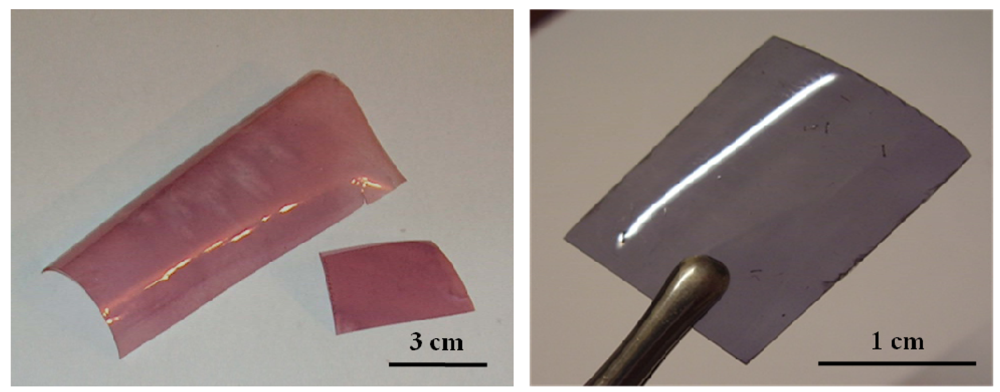
<p>New physical properties appear in a metallic phase when the size is reduced to a nanometric scale (for example, spherical particles with a diameter of only a few nanometers) [<xref ref-type="bibr" rid="b1-polymers-03-01352">1</xref>,<xref ref-type="bibr" rid="b2-polymers-03-01352">2</xref>]. Depending on the metal type, the nanoscopic particles can be colored (Au, Ag, Cu), fluorescent (Au, Ag), superparamagnetic (Co, Ni, Fe), melting at lower temperatures, <italic>etc.</italic> In addition, such new properties are strictly size-dependent and therefore they can be accurately tuned by simply changing the morphology of the metallic phase (both size and shape) or making alloyed metal nanoparticles. The color of nanoscopic coin metals is due to the easy polarization of these small metal domains under visible light; such phenomenon is known as surface plasmon resonance (SPR) and may produce very strong optical extinctions in well-defined spectral ranges (see <xref ref-type="fig" rid="f1-polymers-03-01352">Figure 1</xref>). The electronic structure of a metal domain depends on the number of contained atoms (and therefore on the number of atomic orbitals which are combined together). As a result, the electronic configuration of a small metal cluster is very different from that of the corresponding bulk-metal, and may resemble that of organic molecules (the band structure of bulk-metal is replaced by discrete energy levels). As a consequence, fluorescence and other typical molecular properties appear in these nano-phases. Also thermodynamic properties are modified in nanoscopic metals because of the large surface free energy contribution (for example, the melting point is lowered). Chemical reactivity is increased and other physicochemical characteristics are modified (e.g., the catalytic activity of noble-metal is strongly increased). Nanoscopic semiconductor phases like metal sulfides (Me<sub>x</sub>S<sub>y</sub>) and other chalcogenides show anomalous behavior, such as a strong and tunable fluorescence.</p>
<p>The novel properties of nanoscopic metal and sulfide phases can be used to functionalize optical plastics (<italic>i.e.</italic>, colorless amorphous polymers with a refractive index similar to glass, 1.5, e.g., polystyrene, poly(methyl methacrilate), polycarbonate, thermoplastic polyurethane, <italic>etc.</italic> [<xref ref-type="bibr" rid="b3-polymers-03-01352">3</xref>–<xref ref-type="bibr" rid="b5-polymers-03-01352">5</xref>]). Such polymer-embedded nanostructures can be easily handled and used for fabricating a number of optical devices exploitable for applications in different technological fields (linear optics, optoelectronics, magneto-optics, <italic>etc.</italic>). Optical plastics can be dyed, made magnetic or fluorescent without losing their transparency, and the resulting materials have great potential for functional applications. In addition, the nanostructures can be safely handled in a polymer-embedded form and aggregation, oxidation, and contamination by environmental molecules are prevented.</p>
<p>In order to investigate the technological potential of such nanostructured material class (metal/polymer and metal-sulfide/polymer nanocomposites), the availability of a general chemical route adequate to produce different combinations of polymers and atomic or molecular clusters should be made available. At present, only a few preparative schemes have been developed [<xref ref-type="bibr" rid="b6-polymers-03-01352">6</xref>], and these chemical approaches work only for some metal/polymer combinations.</p>
<p>Noble-metals, semimetals, and metal sulfides can be produced by thermal decomposition of alkane-thiolates at moderately low temperatures (close to 200 °C). The use of such reactions for the preparation of thioether and disulfide molecules is known in organic chemistry [<xref ref-type="bibr" rid="b7-polymers-03-01352">7</xref>]. However the same chemical process has only occasionally been exploited to produce the inorganic phase (e.g., noble-metal coatings on ceramic substrates [<xref ref-type="bibr" rid="b8-polymers-03-01352">8</xref>]). In the present work, the controlled thermolysis of alkane-thiolates dissolved in amorphous polystyrene has been used to generate polymer-embedded metals or metal sulfides of nanoscopic size. In particular, dodecyl-thiolates of gold, silver and other metals have been used because they derivate from an odorless thiol (dodecyl-thiol) and produce non-volatile thermolysis by-products, as required to avoid film foaming during the annealing process.</p></sec>
<sec>
<label>2.</label>
<title>Experimental</title>
<p>Dodecyl-thiolates of different metals (e.g., Au, Ag, Pd, Pt, Pb, Cd, Zn, <italic>etc.</italic>) were obtained by the following general preparative scheme based on the use of metal salts which are quite soluble in alcohol. A few milliliters of dodecanethiol (Aldrich, 98%) were dissolved in ethanol and added drop-wise and under stirring to a stoichiometric quantity of an alcoholic metal salt solution. During the reaction, the reactive system became a slurry because of thiolate precipitation, and reaction yields of close to 100% resulted because of the low metal thiolate solubility in alcohols. The reducing thiols can lower the oxidation number of the metallic ion before precipitation. In particular, with no change in the metal ion oxidation number (e.g., Cd<sup>2+</sup>, Pb<sup>2+</sup>, and Pd<sup>2+</sup> ions) a prompt precipitation occurred, while precipitation was delayed when the oxidation state of the metal changed (e.g., Au-SR formation from Au<sup>3+</sup> salt). The crystalline metal thiolates were separated by vacuum filtration and washed several times with acetone, then they were purified by dissolution in hot chloroform (50 °C), and precipitated again by adding of ethanol. In order to prepare thiolate-polymer solid solutions, the dry powder was dissolved in chloroform and mixed with a chloroform solution of amorphous polystyrene (PS, Aldrich, M<sub>w</sub> = 90,000). Then, the system was cast onto a glass substrate (Petri dish) and solvent allowed to evaporate. To obtain nano-sized metal or metal sulfide dispersions, a thiolate content lower than 10 wt% was required. Isothermal annealing treatments were made by a laboratory hot-plate at a temperature of <italic>ca.</italic> 200 °C for a few minutes.</p>
<p>In the preparation of TEM specimens, the nanocomposite material was dissolved in chloroform and the solution added drop-wise to a Formovar covered copper grid. The dry films were then coated with graphite by sputtering. Such an approach is quite simple, however, differently from a solid sample slicing by cryo-ultramicrotome, artifacts in the sample topology can be introduced because of a possible cluster reorganization in the liquid dispersion. Transmission electron micrographs were obtained by using a Philips EM208S microscope, with an accelerating voltage of 100 kV. In the case of metal clusters characterized by surface plasmon absorption, the cluster formation was verified by UV-Vis spectroscopy. Optical spectra were recorded using a UV-Vis-NIR spectrophotometer (HP-8453 UV-Vis Spectrophotometer), equipped with a Peltier apparatus to control the sample temperature with an accuracy of 0.1 °C. The conclusions about the structure of nanoparticles were mainly based on analysis of thermolysis product. In particular, the thermogravimetric analysis (TGA, TA-Instrument Mod.Q500) of nanocomposites and pure thiolate samples were carried out at 10 °C/min, under fluxing nitrogen.</p>
<p>The obtained polymer-embedded nano-crystals were characterized by X-ray Powder Diffraction (XPD). Data were collected with a D8 Discover-Bruker diffractometer equipped with a Goebel mirror for Cu radiation, an Eurelian cradle goniometer and a scintillation detector. The powder diffraction patterns were collected in the range 10–100° with a step size of 0.05°.</p></sec>
<sec sec-type="results|discussion">
<label>3.</label>
<title>Results and Discussion</title>
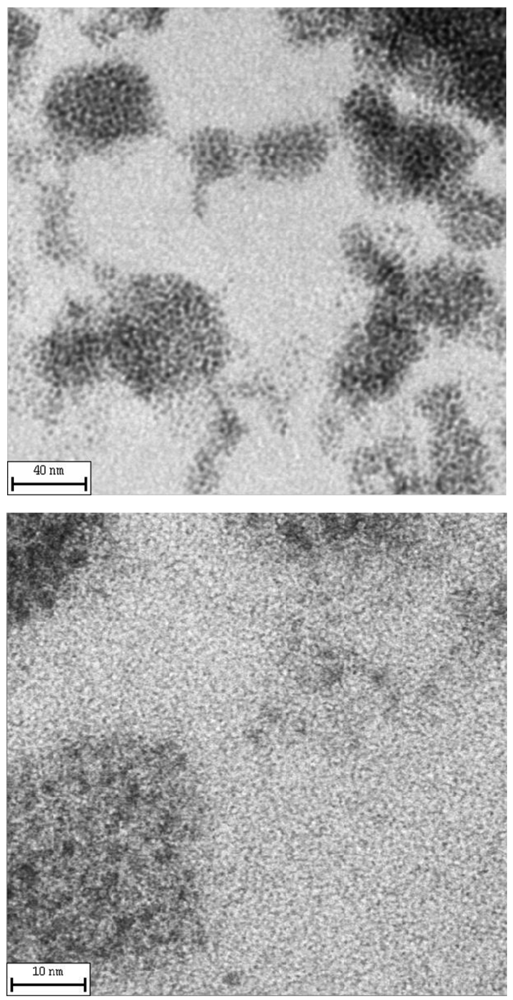
<p>The microstructure of the obtained nanocomposite materials was imaged by transmission electron microscopy (TEM). <xref ref-type="fig" rid="f2-polymers-03-01352">Figure 2</xref> shows the inner structure of a nanocomposite sample obtained by annealing an AuSC<sub>12</sub>H<sub>25</sub>/polystyrene solid solution for 5 min at 170 °C. In these nanocomposite films, the clusters were organized in form of large aggregates. Probably, the disulfide molecules produced as by-product of the annealing process are chemisorbed on the metal cluster surface, leading to thiol-derivatized clusters that interact with each other by interdigitation of thiolate chains [<xref ref-type="bibr" rid="b9-polymers-03-01352">9</xref>]. The presence of thiolate on the cluster surface caused the nanoparticles to be close-packed and uniformly spaced. Such a special topology of nanocomposite films was not observed with all types of metal particles probably because thiolate molecules can be chemisorbed only on some types of metallic surfaces (e.g., Au, Ag, <italic>etc.</italic>). However, the method of preparation of samples for electron microscopy through dissolution of nanocomposites in solution provides information about the particle sizes but, of course, does not provide direct information about the stage of aggregation of particles in the solid materials just after the annealing treatment (instead, the topology observed in SEM micrographs surely results after material processing by solution casting).</p>
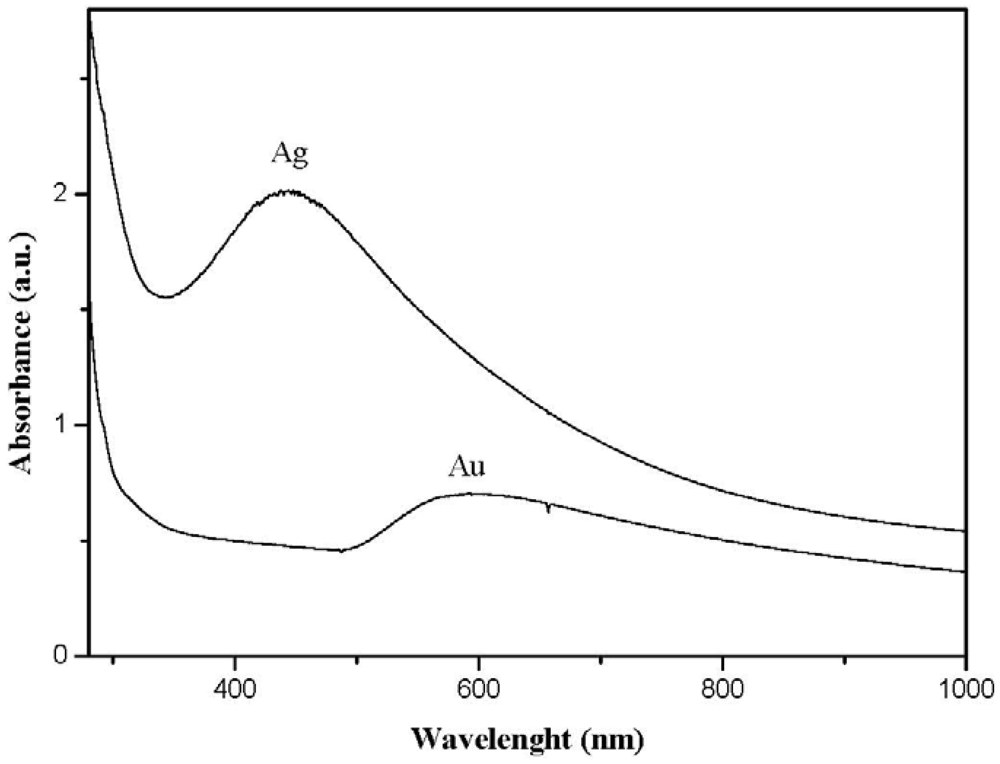
<p>When metals characterized by a surface plasmon absorption (e.g., gold and silver) were generated inside the polystyrene matrix by this technique, the nanocomposite films showed the characteristic color of the nano-sized metal (see <xref ref-type="fig" rid="f3-polymers-03-01352">Figure 3</xref>). In particular, polystyrene films containing silver thiolate (<italic>AgSC<sub>12</sub>H<sub>25</sub></italic>) developed a yellow color during the annealing treatment which changed to brown when cooling the films down. The color variation was probably produced by a multiple-splitting of the silver surface plasmon absorption as a result of a decrease in the interparticle distance which causes interactions among particle dipoles. In other words, when silver nanoparticles are close enough to each other (as usually happens at temperatures lower than the thiolate coating melting point), the system showed a broad absorption band in the whole visible spectra; whereas, when particles are well-spaced (at temperatures higher than the thiolate coating melting point), the spectrum revealed just the tight surface plasmon absorption band of silver clusters located at 430 nm. Such thermochromic behavior of polystyrene films filled by silver clusters can have important applications in the sensor field. Gold-filled polystyrene films appeared ruby-red but they become blue after prolonged annealing treatments because of a significant growth of the metal nanoparticles.</p>
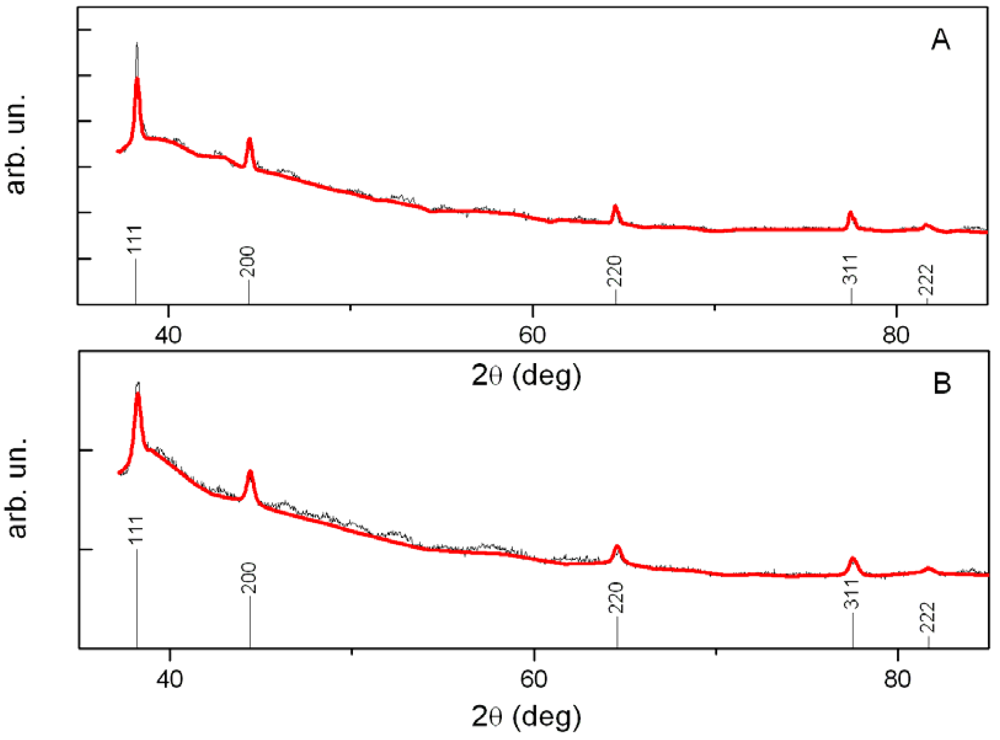
<p>The XPD patterns were collected on two samples: the first one consisted of a gold/polystyrene film obtained by thermal annealing of a gold dodecyl-thiolate solid solution at 200 °C, and the second sample was the same film after a dipping of 48 h in pure acetone. XPD data were analyzed by using a whole profile fitting Rietveld-based program, named FullProf [<xref ref-type="bibr" rid="b10-polymers-03-01352">10</xref>]. A three-step procedure was followed:
<list list-type="order">
<list-item>
<p>The instrumental resolution function (IRF) was evaluated by fitting the XPD pattern collected on a LaB6 NIST standard, measured in the same experimental conditions of the samples. The IRF file was provided separately to the program to refine the XPD patterns of the nanocrystals.</p></list-item>
<list-item>
<p>The crystal structure model used in the fits was Au</p></list-item>
<list-item>
<p>An isotropic peak broadening parameter of the diffraction pattern was refined with a phenomenological model based on a modified Scherrer formula. Another refinable parameter is the unit cell <italic>a</italic> value.</p></list-item></list></p>
<p>Two samples were used. The first one consisted of an as annealed Au/polystyrene film and the second was the same film after purification with acetone.</p>
<p>The refine cell parameter <italic>a</italic> is 4.088 Å and 4.0831 Å for the first and the second sample respectively. The average size of the nanoparticles is between 28–30 nm.</p>
<p>The results of the fits are shown in <xref ref-type="fig" rid="f4-polymers-03-01352">Figure 4(A)</xref> (for the first sample) and <xref ref-type="fig" rid="f4-polymers-03-01352">Figure 4(B)</xref> for the second sample, where the experimental pattern (black line) and the Rietveld best calculated profile (red line) are compared [Goodness of the Fit (GoF) is 3.1]. More sophisticated approaches based on total scattering methods are advisable at smaller particles size [<xref ref-type="bibr" rid="b11-polymers-03-01352">11</xref>–<xref ref-type="bibr" rid="b13-polymers-03-01352">13</xref>].</p>
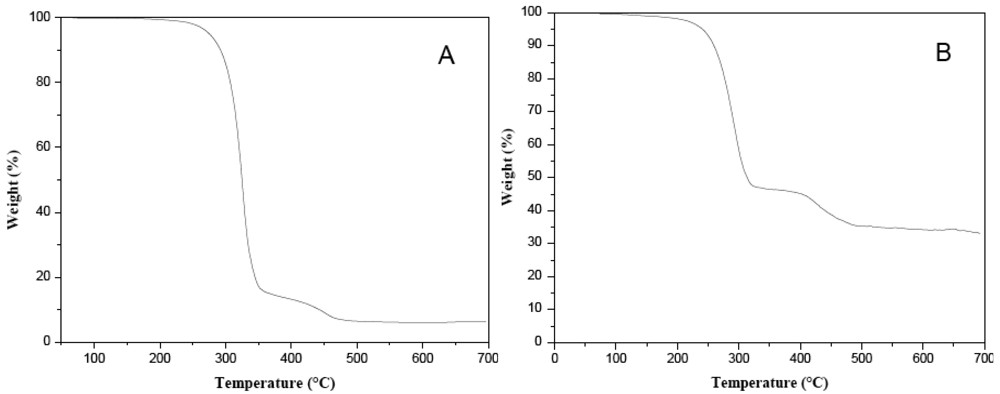
<p>Stoichiometric information on the thermolysis products was obtained by thermogravimetric analysis (TGA) of the pure thiolate compounds (see <xref ref-type="fig" rid="f5-polymers-03-01352">Figure 5</xref>). Thermolysis products and other experimental information for some thiolate compounds are given in <xref ref-type="table" rid="t1-polymers-03-01352">Table 1</xref>.</p>
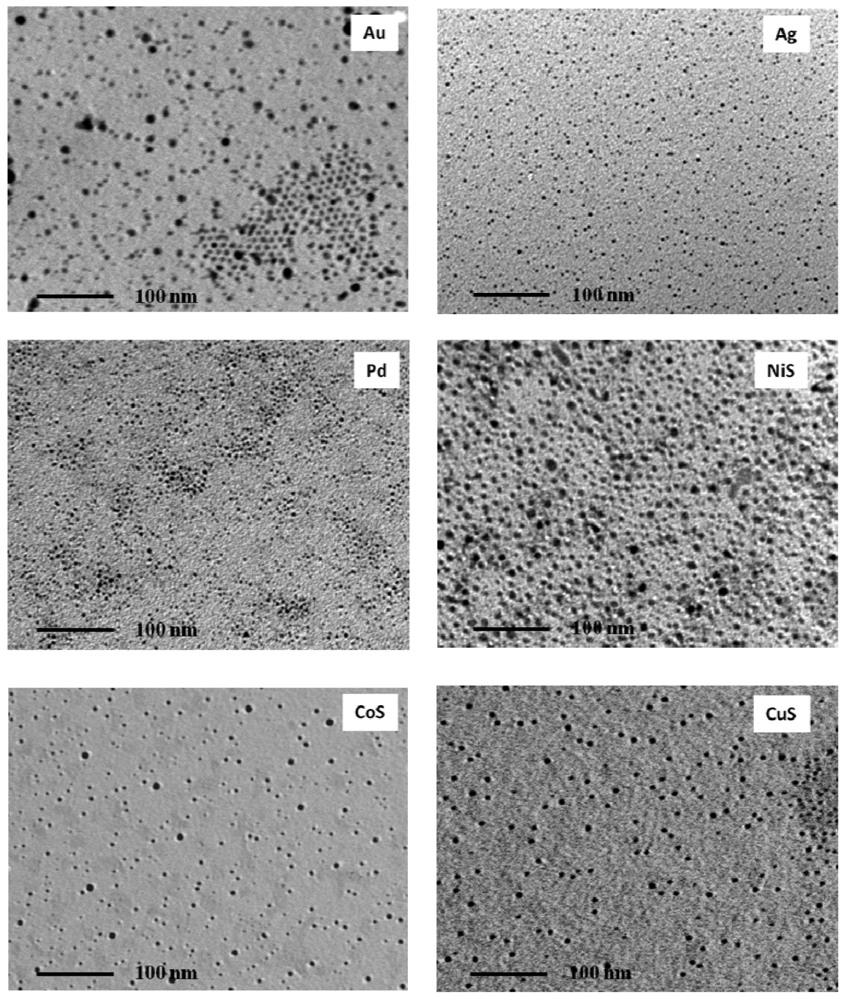
<p>Dodecylthiolates of transition metals are organic compounds very adequate as precursor for the generation of nano-sized metals or metal sulfides in molten thermoplastic polymers (see <xref ref-type="fig" rid="f6-polymers-03-01352">Figure 6</xref>). These compounds are of a non-polar nature because the ionic contribution to the Me-S bond is quite low, and consequently dissolution in non-polar organic media like techno-polymers and hydrophobic solvents (e.g., chloroform, ether, <italic>etc.</italic>) is possible. The use of dodecyl-thiolates (or heavier alkane-thiolates) is required to avoid nanocomposite film foaming during the annealing process caused by the volatile by-product of thermolysis reaction. Noble metal-sulfur bond energies are usually low (200–300 kJ mol<sup>−1</sup>) [<xref ref-type="bibr" rid="b14-polymers-03-01352">14</xref>] and dissociation may occur at temperatures close to 200 °C. However, these compounds are very stable at room temperature and can be handled/stored without special care. The thermal decomposition reaction occurs for alkane-thiolate of transition metals characterized by low electronegativity values (Cd, Zn, Pb, Cu, Co, <italic>etc.</italic>) according to the following reaction [<xref ref-type="bibr" rid="b15-polymers-03-01352">15</xref>–<xref ref-type="bibr" rid="b19-polymers-03-01352">19</xref>]:
<disp-formula id="FD1">
<label>(1)</label>
<mml:math id="mm1" display="block">
<mml:semantics id="sm1">
<mml:mrow>
<mml:mtext>Me</mml:mtext>
<mml:msub>
<mml:mrow>
<mml:mrow>
<mml:mo>(</mml:mo>
<mml:mrow>
<mml:mtext>SR</mml:mtext></mml:mrow>
<mml:mo>)</mml:mo></mml:mrow></mml:mrow>
<mml:mn>2</mml:mn></mml:msub>
<mml:mo>→</mml:mo>
<mml:mtext>MeS</mml:mtext>
<mml:mo>+</mml:mo>
<mml:mtext>RSR</mml:mtext></mml:mrow></mml:semantics></mml:math></disp-formula></p>
<p>However, noble-metals (Au, Ag, Pt, Pd, <italic>etc.</italic>) and most semi-metals (Sb) produce the metallic phase [<xref ref-type="bibr" rid="b20-polymers-03-01352">20</xref>–<xref ref-type="bibr" rid="b22-polymers-03-01352">22</xref>], according to the following reaction:
<disp-formula id="FD2">
<label>(2)</label>
<mml:math id="mm2" display="block">
<mml:semantics id="sm2">
<mml:mrow>
<mml:mtext>Me</mml:mtext>
<mml:msub>
<mml:mrow>
<mml:mrow>
<mml:mo>(</mml:mo>
<mml:mrow>
<mml:mtext>SR</mml:mtext></mml:mrow>
<mml:mo>)</mml:mo></mml:mrow></mml:mrow>
<mml:mn>2</mml:mn></mml:msub>
<mml:mo>→</mml:mo>
<mml:mtext>Me</mml:mtext>
<mml:mo>+</mml:mo>
<mml:mtext>RSSR</mml:mtext></mml:mrow></mml:semantics></mml:math></disp-formula></p>
<p>The temperature required for thermal degradation depends on the degradation mechanism and usually it is higher in the case of sulfide formation.</p></sec>
<sec sec-type="conclusions">
<label>4.</label>
<title>Conclusions</title>
<p>The use of dodecyl-thiolates of transition metals as precursors for the generation of nanoscopic metals and metal sulfides in a molten polymers phase has shown to be a very effective and general approach for the preparation of these materials. Usually, polymeric dispersions of monodisperse nanoparticles are obtained and the nanoparticle size and numerical density can be varied by controlling the amount of dissolved thiolate precursor and the annealing conditions (time and temperature).</p></sec></body>
<back>
<sec sec-type="display-objects">
<title>Figures and Table</title>
<fig id="f1-polymers-03-01352" position="float">
<label>Figure 1.</label>
<caption>
<p>Polystyrene films dyed by the surface plasmon resonance of gold nanoparticles. Depending on the average cluster size, films of different colors can be achieved (ruby-red, purple, and blue).</p></caption>
<graphic xlink:href="polymers-03-01352f1.gif"/></fig>
<fig id="f2-polymers-03-01352" position="float">
<label>Figure 2.</label>
<caption>
<p>TEM-micrographs of Au clusters embedded into amorphous polystyrene (the AuSC<sub>12</sub>H<sub>25</sub>/polystyrene solution was isothermally annealed for 5 min at 170 °C). Owing to the interdigitation and consequent co-crystallization of the thiol alkyl-chains coating the cluster surface, large cluster aggregates are present in this system.</p></caption>
<graphic xlink:href="polymers-03-01352f2.gif"/></fig>
<fig id="f3-polymers-03-01352" position="float">
<label>Figure 3.</label>
<caption>
<p>UV-Vis spectra of polystyrene-embedded gold and silver clusters. The characteristic surface plasmon absorptions of silver at 430 nm and of gold at 590 nm reveal the metal formation on a nano-sized scale.</p></caption>
<graphic xlink:href="polymers-03-01352f3.gif"/></fig>
<fig id="f4-polymers-03-01352" position="float">
<label>Figure 4.</label>
<caption>
<p>XRD diffractogram of gold clusters embedded in amorphous polystyrene before (<bold>A</bold>); and after (<bold>B</bold>) film dipping in pure acetone (the nanocomposite sample was obtained by isothermally annealing an AuSC<sub>12</sub>H<sub>25</sub>/polystyrene solution for 2 min at 200 °C).</p></caption>
<graphic xlink:href="polymers-03-01352f4.gif"/></fig>
<fig id="f5-polymers-03-01352" position="float">
<label>Figure 5.</label>
<caption>
<p>TGA-thermograms of pure thiolate compounds: (<bold>A</bold>) gold dodecyl-thiolate; and (<bold>B</bold>) lead dodecyl-thiolate. The residual weight corresponds respectively to the metal (Au) and metal sulfide (PbS) percentage in the thiolate compound.</p></caption>
<graphic xlink:href="polymers-03-01352f5.gif"/></fig>
<fig id="f6-polymers-03-01352" position="float">
<label>Figure 6.</label>
<caption>
<p>TEM-micrographs of different metal and metal sulfide clusters embedded into an amorphous polystyrene matrix, obtained by thermal decomposition of the corresponding metal-dodecylthiolate compounds [<xref ref-type="bibr" rid="b23-polymers-03-01352">23</xref>–<xref ref-type="bibr" rid="b29-polymers-03-01352">29</xref>].</p></caption>
<graphic xlink:href="polymers-03-01352f6.gif"/></fig>
<table-wrap id="t1-polymers-03-01352" position="float">
<label>Table 1.</label>
<caption>
<p>Some characteristics of metal thiolates used for the nanocomposite film preparation.</p></caption>
<table frame="hsides" rules="groups">
<thead>
<tr>
<th align="center" valign="top"><bold>Thiolate</bold></th>
<th align="center" valign="top"><bold>Thermolysis product</bold></th>
<th align="center" valign="top"><bold>Precursor salt</bold></th>
<th align="center" valign="top"><bold>Ref.</bold></th></tr></thead>
<tbody>
<tr>
<td align="center" valign="top">AgSC<sub>12</sub>H<sub>25</sub></td>
<td align="center" valign="top">Ag</td>
<td align="center" valign="top">AgNO<sub>3</sub></td>
<td align="center" valign="top">[<xref ref-type="bibr" rid="b23-polymers-03-01352">23</xref>,<xref ref-type="bibr" rid="b24-polymers-03-01352">24</xref>]</td></tr>
<tr>
<td align="center" valign="top">Pd(SC<sub>12</sub>H<sub>25</sub>)<sub>2</sub></td>
<td align="center" valign="top">Pd</td>
<td align="center" valign="top">PdCl<sub>2</sub></td>
<td align="center" valign="top">-</td></tr>
<tr>
<td align="center" valign="top">Co(SC<sub>12</sub>H<sub>25</sub>)<sub>2</sub></td>
<td align="center" valign="top">CoS</td>
<td align="center" valign="top">Co(OH)<sub>2</sub></td>
<td align="center" valign="top">[<xref ref-type="bibr" rid="b25-polymers-03-01352">25</xref>]</td></tr>
<tr>
<td align="center" valign="top">AuSC<sub>12</sub>H<sub>25</sub></td>
<td align="center" valign="top">Au</td>
<td align="center" valign="top">HAuCl<sub>4</sub></td>
<td align="center" valign="top">[<xref ref-type="bibr" rid="b26-polymers-03-01352">26</xref>–<xref ref-type="bibr" rid="b28-polymers-03-01352">28</xref>]</td></tr>
<tr>
<td align="center" valign="top">Co(SC<sub>12</sub>H<sub>25</sub>)<sub>2</sub></td>
<td align="center" valign="top">CoS</td>
<td align="center" valign="top">CoCl<sub>2</sub></td>
<td align="center" valign="top">[<xref ref-type="bibr" rid="b25-polymers-03-01352">25</xref>]</td></tr>
<tr>
<td align="center" valign="top">Pb(SC<sub>12</sub>H<sub>25</sub>)<sub>2</sub></td>
<td align="center" valign="top">PbS</td>
<td align="center" valign="top">Pb(ClO<sub>4</sub>)<sub>2</sub></td>
<td align="center" valign="top">-</td></tr>
<tr>
<td align="center" valign="top">Cd(SC<sub>12</sub>H<sub>25</sub>)<sub>2</sub></td>
<td align="center" valign="top">CdS</td>
<td align="center" valign="top">Cd(NO<sub>3</sub>)<sub>2</sub></td>
<td align="center" valign="top">[<xref ref-type="bibr" rid="b28-polymers-03-01352">28</xref>]</td></tr></tbody></table></table-wrap></sec>
<ref-list>
<title>References</title>
<ref id="b1-polymers-03-01352"><label>1.</label><citation citation-type="journal"><person-group person-group-type="author"><name><surname>Mayer</surname><given-names>A.B.R.</given-names></name></person-group><article-title>Formation of noble metal nanoparticles within a polymeric matrix: Nanoparticle features and overall morphologies</article-title><source>Mater. Sci. Eng. C</source><year>1998</year><volume>6</volume><fpage>155</fpage><lpage>166</lpage><pub-id pub-id-type="doi">10.1016/S0928-4931(98)00049-6</pub-id></citation></ref>
<ref id="b2-polymers-03-01352"><label>2.</label><citation citation-type="journal"><person-group person-group-type="author"><name><surname>Caseri</surname><given-names>W.</given-names></name></person-group><article-title>Nanocomposites of polymers and metals or semiconductor: Historical background and optical properties</article-title><source>Macromol. Rapid Commun.</source><year>2000</year><volume>21</volume><fpage>705</fpage><lpage>722</lpage><pub-id pub-id-type="doi">10.1002/1521-3927(20000701)21:11&lt;705::AID-MARC705&gt;3.0.CO;2-3</pub-id></citation></ref>
<ref id="b3-polymers-03-01352"><label>3.</label><citation citation-type="journal"><person-group person-group-type="author"><name><surname>Zimmerman</surname><given-names>L.</given-names></name><name><surname>Weibel</surname><given-names>M.</given-names></name><name><surname>Caseri</surname><given-names>W.</given-names></name><name><surname>Suter</surname><given-names>U.W.</given-names></name></person-group><article-title>High refractive index films of polymer nanocomposites</article-title><source>J. Mater. Res.</source><year>1993</year><volume>8</volume><fpage>1742</fpage><lpage>1748</lpage><pub-id pub-id-type="doi">10.1557/JMR.1993.1742</pub-id></citation></ref>
<ref id="b4-polymers-03-01352"><label>4.</label><citation citation-type="journal"><person-group person-group-type="author"><name><surname>Troger</surname><given-names>L.</given-names></name><name><surname>Hunnefeld</surname><given-names>H.</given-names></name><name><surname>Nunes</surname><given-names>S.</given-names></name><name><surname>Oehring</surname><given-names>M.</given-names></name><name><surname>Fritsch</surname><given-names>D.</given-names></name></person-group><article-title>Structural characterization of catalytically active metal clusters in polymer membranes</article-title><source>Z. Phys. D</source><year>1997</year><volume>40</volume><fpage>81</fpage><lpage>83</lpage><pub-id pub-id-type="doi">10.1007/s004600050163</pub-id></citation></ref>
<ref id="b5-polymers-03-01352"><label>5.</label><citation citation-type="journal"><person-group person-group-type="author"><name><surname>Gonsalves</surname><given-names>K.E.</given-names></name><name><surname>Carlson</surname><given-names>G.</given-names></name><name><surname>Chen</surname><given-names>X.</given-names></name><name><surname>Kumar</surname><given-names>J.</given-names></name><name><surname>Aranda</surname><given-names>F.</given-names></name><name><surname>Perez</surname><given-names>R.</given-names></name><name><surname>Jose-Yacaman</surname><given-names>M.</given-names></name></person-group><article-title>Surface-functionalized nanostructured gold/polymer composite films</article-title><source>J. Mater. Sci. Lett.</source><year>1996</year><volume>15</volume><fpage>948</fpage><lpage>951</lpage></citation></ref>
<ref id="b6-polymers-03-01352"><label>6.</label><citation citation-type="journal"><person-group person-group-type="author"><name><surname>Watkins</surname><given-names>J.J.</given-names></name><name><surname>McCarthy</surname><given-names>T.J.</given-names></name></person-group><article-title>Polymer/metal nanocomposite synthesis in supercritical CO<sub>2</sub></article-title><source>Chem. Mater.</source><year>1995</year><volume>7</volume><fpage>1991</fpage><lpage>1994</lpage><pub-id pub-id-type="doi">10.1021/cm00059a001</pub-id></citation></ref>
<ref id="b7-polymers-03-01352"><label>7.</label><citation citation-type="book"><source>Chimica Organica Superiore</source><person-group person-group-type="editor"><name><surname>Gilman</surname><given-names>H.</given-names></name></person-group><publisher-name>Edizioni Scientifiche Einaudi</publisher-name><publisher-loc>Torino, Italy</publisher-loc><year>1956</year><volume>II</volume><fpage>951</fpage></citation></ref>
<ref id="b8-polymers-03-01352"><label>8.</label><citation citation-type="journal"><person-group person-group-type="author"><name><surname>Bishop</surname><given-names>P.T.</given-names></name></person-group><article-title>The use of gold mercaptides for decorative precious metal applications</article-title><source>Gold. Bull.</source><year>2002</year><volume>35</volume><fpage>89</fpage><lpage>98</lpage><pub-id pub-id-type="doi">10.1007/BF03214844</pub-id></citation></ref>
<ref id="b9-polymers-03-01352"><label>9.</label><citation citation-type="journal"><person-group person-group-type="author"><name><surname>Prozorov</surname><given-names>T.</given-names></name><name><surname>Gedanken</surname><given-names>A.</given-names></name></person-group><article-title>The “melting point” of alkanethiol-coated amorphous Fe<sub>2</sub>O<sub>3</sub> nanoparticles</article-title><source>Adv. Mater.</source><year>1998</year><volume>10</volume><fpage>532</fpage><lpage>535</lpage><pub-id pub-id-type="doi">10.1002/(SICI)1521-4095(199805)10:7&lt;532::AID-ADMA532&gt;3.0.CO;2-1</pub-id></citation></ref>
<ref id="b10-polymers-03-01352"><label>10.</label><citation citation-type="journal"><person-group person-group-type="author"><name><surname>Rodriguez-Carvajal</surname><given-names>J.</given-names></name></person-group><article-title>Recent advances in magnetic structure determination by neutron powder diffraction</article-title><source>Phys. B</source><year>1993</year><volume>192</volume><fpage>55</fpage><lpage>69</lpage><pub-id pub-id-type="doi">10.1016/0921-4526(93)90108-I</pub-id></citation></ref>
<ref id="b11-polymers-03-01352"><label>11.</label><citation citation-type="journal"><person-group person-group-type="author"><name><surname>Cervellino</surname><given-names>A.</given-names></name><name><surname>Giannini</surname><given-names>C.</given-names></name><name><surname>Guagliardi</surname><given-names>A.</given-names></name></person-group><article-title>Determination of nanoparticle, size distribution and lattice parameter from X-ray data for monoatomic materials with f.c.c. cubic unit cell</article-title><source>J. Appl. Cryst.</source><year>2003</year><volume>36</volume><fpage>1148</fpage><lpage>1158</lpage><pub-id pub-id-type="doi">10.1107/S0021889803013542</pub-id></citation></ref>
<ref id="b12-polymers-03-01352"><label>12.</label><citation citation-type="journal"><person-group person-group-type="author"><name><surname>Cervellino</surname><given-names>A.</given-names></name><name><surname>Giannini</surname><given-names>C.</given-names></name><name><surname>Guagliardi</surname><given-names>A.</given-names></name></person-group><article-title>Debussy: A Debye user system for nanocrystalline materials</article-title><source>J. Appl. Cryst.</source><year>2010</year><volume>43</volume><fpage>1543</fpage><lpage>1547</lpage><pub-id pub-id-type="doi">10.1107/S0021889810041889</pub-id></citation></ref>
<ref id="b13-polymers-03-01352"><label>13.</label><citation citation-type="journal"><person-group person-group-type="author"><name><surname>Page</surname><given-names>K.</given-names></name><name><surname>Hood</surname><given-names>T.C.</given-names></name><name><surname>Proffen</surname><given-names>Th.</given-names></name><name><surname>Neder</surname><given-names>R.B.</given-names></name></person-group><article-title>Building and refining complete nanoparticle structures with total scattering data</article-title><source>J. Appl. Cryst.</source><year>2011</year><volume>44</volume><fpage>327</fpage><lpage>336</lpage><pub-id pub-id-type="doi">10.1107/S0021889811001968</pub-id></citation></ref>
<ref id="b14-polymers-03-01352"><label>14.</label><citation citation-type="book"><source>CRC Handbook of Chemistry and Physics</source><edition>82nd ed.</edition><person-group person-group-type="editor"><name><surname>Lide</surname><given-names>D.R.</given-names></name></person-group><publisher-name>Chemical Rubber Company</publisher-name><publisher-loc>Boca Raton, FL, USA</publisher-loc><year>2001</year><fpage>9</fpage><lpage>51</lpage></citation></ref>
<ref id="b15-polymers-03-01352"><label>15.</label><citation citation-type="journal"><person-group person-group-type="author"><name><surname>Nicolais</surname><given-names>F.</given-names></name><name><surname>Carotenuto</surname><given-names>G.</given-names></name></person-group><article-title>Synthesis of polymer-embedded metal, semimetal, or sulfide clusters by thermolysis of mercaptide molecules dissolved in polymers</article-title><source>Rec. Pat. Mater. Sci.</source><year>2008</year><volume>1</volume><fpage>1</fpage><lpage>11</lpage><pub-id pub-id-type="doi">10.2174/1874464810801010001</pub-id></citation></ref>
<ref id="b16-polymers-03-01352"><label>16.</label><citation citation-type="journal"><person-group person-group-type="author"><name><surname>Carotenuto</surname><given-names>G.</given-names></name><name><surname>Nicolais</surname><given-names>L.</given-names></name><name><surname>Perlo</surname><given-names>P.</given-names></name></person-group><article-title>Synthesis of polymer-embedded noble metal clusters by thermolysis of mercaptides dissolved in polymers</article-title><source>Polym. Eng. Sci.</source><year>2006</year><volume>46</volume><fpage>1016</fpage><lpage>1020</lpage><pub-id pub-id-type="doi">10.1002/pen.20562</pub-id></citation></ref>
<ref id="b17-polymers-03-01352"><label>17.</label><citation citation-type="journal"><person-group person-group-type="author"><name><surname>Carotenuto</surname><given-names>G.</given-names></name><name><surname>Nadal</surname><given-names>M.L.</given-names></name><name><surname>Repetto</surname><given-names>P.</given-names></name><name><surname>Perlo</surname><given-names>P.</given-names></name><name><surname>Ambrosio</surname><given-names>L.</given-names></name><name><surname>Nicolais</surname><given-names>L.</given-names></name></person-group><article-title>New polymeric additives for allowing photoelectric sensing of plastics during manufacturing</article-title><source>Adv. Comp. Lett.</source><year>2007</year><volume>16</volume><fpage>109</fpage><lpage>114</lpage></citation></ref>
<ref id="b18-polymers-03-01352"><label>18.</label><citation citation-type="journal"><person-group person-group-type="author"><name><surname>Capezzuto</surname><given-names>F.</given-names></name><name><surname>Carotenuto</surname><given-names>G.</given-names></name><name><surname>Antolini</surname><given-names>F.</given-names></name><name><surname>Burresi</surname><given-names>E.</given-names></name><name><surname>Palomba</surname><given-names>M.</given-names></name><name><surname>Perlo</surname><given-names>P.</given-names></name></person-group><article-title>New fluorescent polymeric nanocomposites synthesized by antimony dodecyl-mercaptide thermolysis in polymer</article-title><source>eXPRESS Polym. Lett.</source><year>2009</year><volume>3</volume><fpage>219</fpage><lpage>225</lpage><pub-id pub-id-type="doi">10.3144/expresspolymlett.2009.28</pub-id></citation></ref>
<ref id="b19-polymers-03-01352"><label>19.</label><citation citation-type="journal"><person-group person-group-type="author"><name><surname>Carotenuto</surname><given-names>G.</given-names></name><name><surname>Capezzuto</surname><given-names>F.</given-names></name><name><surname>Palomba</surname><given-names>M.</given-names></name><name><surname>Nicolais</surname><given-names>F.</given-names></name></person-group><article-title>Synthesis and characterization of fluorescent Cu<sub>2</sub>S nanoparticles embedded in amorphous polystyrene</article-title><source>Int. J. Nanosci.</source><year>2010</year><volume>9</volume><fpage>385</fpage><lpage>389</lpage><pub-id pub-id-type="doi">10.1142/S0219581X10007010</pub-id></citation></ref>
<ref id="b20-polymers-03-01352"><label>20.</label><citation citation-type="journal"><person-group person-group-type="author"><name><surname>Conte</surname><given-names>P.</given-names></name><name><surname>Carotenuto</surname><given-names>G.</given-names></name><name><surname>Piccolo</surname><given-names>A.</given-names></name><name><surname>Perlo</surname><given-names>P.</given-names></name><name><surname>Nicolais</surname><given-names>L.</given-names></name></person-group><article-title>NMR-investigation of the mechanism of silver mercaptide thermolysis in amorphous polystyrene</article-title><source>J. Mater. Chem.</source><year>2007</year><volume>17</volume><fpage>201</fpage><lpage>205</lpage><pub-id pub-id-type="doi">10.1039/b613228f</pub-id></citation></ref>
<ref id="b21-polymers-03-01352"><label>21.</label><citation citation-type="journal"><person-group person-group-type="author"><name><surname>Carotenuto</surname><given-names>G.</given-names></name><name><surname>Longo</surname><given-names>A.</given-names></name><name><surname>DePetrocellis</surname><given-names>L.</given-names></name><name><surname>DeNicola</surname><given-names>S.</given-names></name><name><surname>Repetto</surname><given-names>P.</given-names></name><name><surname>Perlo</surname><given-names>P.</given-names></name><name><surname>Ambrosio</surname><given-names>L.</given-names></name></person-group><article-title>Synthesis of molecular gold clusters with luminescence properties by mercaptide thermolysis in polymer matrices</article-title><source>Int. J. Nanosci.</source><year>2007</year><volume>6</volume><fpage>65</fpage><lpage>69</lpage><pub-id pub-id-type="doi">10.1142/S0219581X07004225</pub-id></citation></ref>
<ref id="b22-polymers-03-01352"><label>22.</label><citation citation-type="journal"><person-group person-group-type="author"><name><surname>Carotenuto</surname><given-names>G.</given-names></name><name><surname>Hison</surname><given-names>C.L.</given-names></name><name><surname>Capezzuto</surname><given-names>F.</given-names></name><name><surname>Palomba</surname><given-names>M.</given-names></name><name><surname>Perlo</surname><given-names>P.</given-names></name><name><surname>Conte</surname><given-names>P.</given-names></name></person-group><article-title>Synthesis and thermoelectric characterization of bismuth nanoparticles</article-title><source>J. Nanopart. Res.</source><year>2009</year><volume>11</volume><fpage>1729</fpage><lpage>1738</lpage><pub-id pub-id-type="doi">10.1007/s11051-008-9541-6</pub-id></citation></ref>
<ref id="b23-polymers-03-01352"><label>23.</label><citation citation-type="journal"><person-group person-group-type="author"><name><surname>Carotenuto</surname><given-names>G.</given-names></name><name><surname>la Peruta</surname><given-names>G.</given-names></name><name><surname>Nicolais</surname><given-names>L.</given-names></name></person-group><article-title>Thermo-chromic materials based on polymer-embedded silver clusters</article-title><source>Sens. Actuat. B</source><year>2006</year><volume>114</volume><fpage>1092</fpage><lpage>1095</lpage><pub-id pub-id-type="doi">10.1016/j.snb.2005.07.044</pub-id></citation></ref>
<ref id="b24-polymers-03-01352"><label>24.</label><citation citation-type="journal"><person-group person-group-type="author"><name><surname>Carotenuto</surname><given-names>G.</given-names></name><name><surname>Nicolais</surname><given-names>F.</given-names></name></person-group><article-title>Reversible thermochromic nanocomposites based on thiolate-capped silver nanoparticles embedded in amorphous polystyrene</article-title><source>Materials</source><year>2009</year><volume>2</volume><fpage>1323</fpage><lpage>1340</lpage><pub-id pub-id-type="doi">10.3390/ma2031323</pub-id></citation></ref>
<ref id="b25-polymers-03-01352"><label>25.</label><citation citation-type="journal"><person-group person-group-type="author"><name><surname>Carotenuto</surname><given-names>G.</given-names></name><name><surname>Pasquini</surname><given-names>L.</given-names></name><name><surname>Milella</surname><given-names>E.</given-names></name><name><surname>Pentimalli</surname><given-names>M.</given-names></name><name><surname>Lamanna</surname><given-names>R.</given-names></name><name><surname>Nicolais</surname><given-names>L.</given-names></name></person-group><article-title>Preparation and characterization of cobalt-based nanostructured materials</article-title><source>Eur. Phys. J. B</source><year>2003</year><volume>31</volume><fpage>545</fpage><lpage>551</lpage><pub-id pub-id-type="doi">10.1140/epjb/e2003-00064-0</pub-id></citation></ref>
<ref id="b26-polymers-03-01352"><label>26.</label><citation citation-type="journal"><person-group person-group-type="author"><name><surname>Susha</surname><given-names>A.S.</given-names></name><name><surname>Ringler</surname><given-names>M.</given-names></name><name><surname>Ohlinger</surname><given-names>A.</given-names></name><name><surname>Paderi</surname><given-names>M.</given-names></name><name><surname>Li Pira</surname><given-names>N.</given-names></name><name><surname>Carotenuto</surname><given-names>G.</given-names></name><name><surname>Rogach</surname><given-names>A.L.</given-names></name><name><surname>Feldmann</surname><given-names>J.</given-names></name></person-group><article-title>Strongly luminescent films fabricated by thermolysis of gold-thiolate complexes in a polymer matrix</article-title><source>Chem. Mater.</source><year>2008</year><volume>20</volume><fpage>6169</fpage><lpage>6175</lpage><pub-id pub-id-type="doi">10.1021/cm801634b</pub-id></citation></ref>
<ref id="b27-polymers-03-01352"><label>27.</label><citation citation-type="journal"><person-group person-group-type="author"><name><surname>Carotenuto</surname><given-names>G.</given-names></name><name><surname>Longo</surname><given-names>A.</given-names></name><name><surname>Hison</surname><given-names>C.L.</given-names></name></person-group><article-title>Tuned linear optical properties of gold-polymer nanocomposites</article-title><source>J. Mater. Chem.</source><year>2009</year><volume>19</volume><fpage>5744</fpage><lpage>5750</lpage><pub-id pub-id-type="doi">10.1039/b905047g</pub-id></citation></ref>
<ref id="b28-polymers-03-01352"><label>28.</label><citation citation-type="journal"><person-group person-group-type="author"><name><surname>Carotenuto</surname><given-names>G.</given-names></name><name><surname>Longo</surname><given-names>A.</given-names></name><name><surname>Repetto</surname><given-names>P.</given-names></name><name><surname>Perlo</surname><given-names>P.</given-names></name><name><surname>Ambrosio</surname><given-names>L.</given-names></name></person-group><article-title>New polymer additives for photoelectric sensing</article-title><source>Sens. Actuat. B</source><year>2007</year><volume>125</volume><fpage>202</fpage><lpage>206</lpage><pub-id pub-id-type="doi">10.1016/j.snb.2007.02.013</pub-id></citation></ref>
<ref id="b29-polymers-03-01352"><label>29.</label><citation citation-type="journal"><person-group person-group-type="author"><name><surname>Carotenuto</surname><given-names>G.</given-names></name><name><surname>Capezzuto</surname><given-names>F.</given-names></name><name><surname>Palomba</surname><given-names>M.</given-names></name><name><surname>Nicolais</surname><given-names>F.</given-names></name></person-group><article-title>Synthesis and characterization of fluorescent Cu<sub>2</sub>S nanoparticles embedded in amorphous polystyrene</article-title><source>Int. J. Nanosci.</source><year>2010</year><volume>9</volume><fpage>1</fpage><lpage>5</lpage><pub-id pub-id-type="doi">10.1142/S0219581X10006569</pub-id></citation></ref></ref-list></back></article>