
Effect of Moisture on the Orientation Birefringence of Cellulose Esters

Abstract
: Orientation birefringence and its wavelength dispersion are studied for hot-drawn films of cellulose esters such as cellulose triacetate (CTA), cellulose diacetate (CDA), and cellulose acetate propionate (CAP) exposed to three different humidities of environments. Hot-drawn CTA films show negative birefringence that decreases with increasing wavelength. On the other hand, CDA and CAP films show positive birefringence that increases with increasing wavelength, i.e., the so-called extraordinary wavelength dispersion of birefringence. Upon exposure to high humidity environment, the orientation birefringence of CDA and CAP decreases. The decrease is prominent for the samples containing a large amount of water. CTA, however, shows an increase in magnitude of its negative orientation birefringence with increasing moisture content. The results can be explained by the increase of the polarizability anisotropy perpendicular to the stretching direction in the cellulose esters. It is found from ATR-FTIR measurements that hydrogen bonds are formed between carbonyl groups of cellulose esters and water molecules. Considering that orientation birefringence of cellulose esters is determined mainly by ester groups, the formation of hydrogen bonds contributes to the polarizability anisotropy, thus affecting the orientation birefringence.1. Introduction
The growing awareness of the importance of sustainable development has prompted studies on biomass-based materials in various fields. In optical devices application, biomass-derived cellulose esters are being studied actively as a potential material for optical films. Besides being derived from abundantly available biomass resources, they also possess characteristics suitable as optical films such as high transparency and excellent heat resistance [1]. By virtue of these properties, cellulose esters provide huge possibilities for future development of optical films in order to meet changing market demands.
In liquid crystal display (LCD) application, polymeric films have been utilized as optical films such as polarizer protective film and retardation film. A retardation film is used for the purpose of improving contrast ratio and widening a view angle while a polarizer protective film is used to protect the polarizer from scratch and moisture [2,3]. For such applications, films have to show certain birefringence properties to perform the different roles in LCD assembly. For example, extraordinary wavelength dispersion of birefringence, in which the absolute value of birefringence increases with increasing wavelength, is required for a retardation film [4-6].
Using the model as proposed by Kuhn and Grun [7], orientation birefringence n can be expressed as
Yamaguchi et al. [8,9] have studied the orientation birefringence and the wavelength dispersion of various types of cellulose esters such as cellulose triacetate (CTA), cellulose diacetate (CDA), cellulose acetate propionate (CAP) and cellulose acetate butyrate (CAB), all drawn at a temperature above their respective glass transition temperature. It is found that CTA shows negative birefringence, in which the magnitude decreases with increasing wavelength. On the contrary, CAP, CAB and CDA show positive birefringence that increases with the wavelength. They also suggested that the orientation birefringence in cellulose esters is not determined by the orientation of the main chains, but rather by the species and amount of the ester groups.
Orientation birefringence of miscible blends of two-component polymers with mutually opposite sign of birefringence, e.g., cellulose acetate (CA) and Poly(N-vinylpyrrolidone-co-methyl methacrylate) (P(VP-co-MMA)) random copolymer, was studied by Ohno and Nishio [10]. It was reported that the birefringence of the blend decreases with decreasing CA fraction and eventually changes from positive to negative at a certain combination. The negative birefringence was found to increase in magnitude with the increase of degree of substitution of CA, and the VP fraction of the copolymer. Yamaguchi and Masuzawa [11] showed that a similar result can be obtained by employing CAP and polyvinylacetate), two polymers with mutually opposite sign of birefringence. Moreover, birefringence in cellulose esters can also be controlled, even by addition of liquid compounds [12].
As a cellulose ester is a derivative of cellulose in which hydroxyl groups attached to the cellulose chains have been replaced wholly or in part by ester groups, various properties are dependent on the amount of hydroxyl groups [13]. For example, the acetyl group in CA constitutes the hydrophobic sites whereas the hydroxyl group, which may form hydrogen bonds with water, is hydrophilic. For this reason, CTA has the highest moisture resistance among CA [2].
Moreover, in regards to moisture resistance property, a propionyl group is superior to the acetyl one when fully esterified [14]. With an equal degree of esterification and molecular weights, the somewhat larger hydrocarbon nature in cellulose esters containing propionyl groups leads to lower water absorption values [15].
Kusanagi and Yukawa [16] have studied the intermolecular interactions between various solid polymers and water molecules absorbed by means of infra-red spectroscopy in order to clarify the water structures in solid polymer matrices. They found that, as the polymer becomes more hydrophilic, the va(OH) and vs(OH) bands, which represent the asymmetric and symmetric OH stretching vibrations respectively, gradually shift to lower wavenumbers. The lowering of the OH stretching frequency in the IR spectrum is attributed to hydrogen bond formation as reported in previous studies [17,18].
A study on the structure of water in cellulose ester membranes by using attenuated total reflection (ATR) infrared spectroscopy has been performed by Dias et al. [15]. According to them, the band attributed to the carbonyl stretching v(C=O), which is around 1,735–1,740 cm−1, shifts gradually towards lower frequencies upon hydration. A similar phenomenon has also been reported by other researchers [19,20].
In actual applications, high resistance towards dimensional change upon changing temperature and relative humidity is essential to optical films. In this study, films of three types of cellulose ester, namely CTA, CDA and CAP, are prepared using a solution casting method and then subjected to hot-drawing process. The hot-drawn samples are exposed to three different conditions: low, medium and high humidity and subsequently measured for their orientation birefringence. The purpose is to study the impact of moisture content on orientation birefringence of cellulose esters and understanding the mechanism behind it.
2. Experimental
2.1. Materials
The polymeric materials employed in this study were commercially available cellulose esters such as cellulose triacetate (CTA), cellulose diacetate (CDA) and cellulose acetate propionate (CAP). CTA was produced by Acros Organics, while both CDA and CAP were produced by Eastman Chemical. The molecular characteristics are summarized in Table 1. As seen in the table, the nominal values of degree of substitution (DS) of CDA and CTA are 2.41 and 2.96, respectively. The molecular weights were evaluated using a gel permeation chromatograph (Tosoh, HLC-8020) with TSK-GEL® GMHXL.
The polymeric films used in this study were prepared using a solution casting method since melt processing is not applicable for CTA due to the severe thermal degradation [2,21]. Initially, CTA and CAP were dissolved into chloroform, while CDA in tetrahydrofuran, and stirred for 24-hours at room temperature. The solution was then poured onto a metal plate and left at room temperature for 48-hours to allow the solvent to evaporate slowly in order to obtain a smooth polymeric film. It was then cut into rectangular specimens of 10 mm in width and 20 mm in length. The thickness of the films obtained was about 150 μm.
Subsequently, the films were hot-drawn using a uniaxial tensile machine with temperature controller (UBM, DVE-4) to prepare uniaxial oriented films. All samples were drawn at temperatures where the tensile storage modulus E′ is 500 MPa at 10 Hz, upon considering their drawability. The initial distance between the clamps was 10 mm and the stretching rate used was 0.5 mm/s. All samples were stretched at a draw ratio of 1.5. Then, the drawn samples were quenched by cold air blowing to avoid relaxation of the molecular orientation. They were kept in a humidic chamber (Yamato, IG420) at 25 °C and 50%RH for one day. After that, the samples were removed from the humidic chamber and put in a vacuum oven at 70 °C for a day before finally being immersed in water at 25 °C for one day. The orientation birefringence and moisture content of the samples were measured and recorded after each process.
2.2. Measurements
The temperature dependence of oscillatory tensile moduli in the solid state was measured from −50 °C to 200 °C by a dynamic mechanical analyzer (UBM, E-4000) using rectangular specimens of 5 mm in width and 20 mm in length. The frequency and heating rate used were 10 Hz and 2 °C/min, respectively.
Moisture content was measured using a moisturemeter (Mitsubishi Chemical Corporation, CA-200) using the Karl Fischer method in which the Karl Fischer reagent, which consists of iodine, sulfur dioxide, a base and a solvent, reacts quantitatively and selectively with water [22].
The birefringence of the drawn films was measured at room temperature by an optical birefringence analyzer (Oji Scientific Instruments Inc., KOBRA-WPR) as a function of wavelength by changing color filters.
Attenuated Total Reflection (ATR) measurements using an infrared absorption spectrometer (Perkin Elmer, Spectrum 100) were performed to estimate the interaction of cellulose esters with water molecules upon exposure to three ambiences with different humidities.
3. Results and Discussion
3.1. Dynamic Mechanical Properties
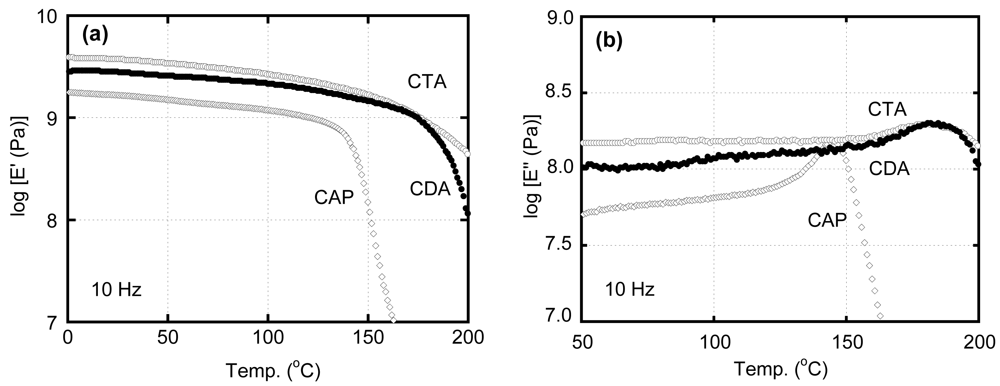
Oscillatory tensile moduli such as storage modulus E′ and loss modulus E″ of CTA, CDA and CAP have been measured to determine the stretching temperature. Figure 1 shows the temperature dependence of the oscillatory tensile modulus at 10 Hz for CTA, CDA and CAP. Both CTA and CDA show higher storage modulus than CAP in the glassy region, suggesting that chain packing density of CAP is lower than those of the others. Furthermore, the storage modulus in CTA shows a gradual decrease compared to a sharp drop observed in CDA and CAP. The gradual decrease observed in CTA is due to the presence of crystallites, which affects the mobility of CTA chains. Consequently, it leads to a broad distribution of relaxation time as demonstrated in Figure 1. On the other hand, both CDA and CAP are not affected by crystallites as they are fully amorphous [8,12].
The sharp drop in the E′ of CAP corresponds to the narrow peak of E″, around 144 °C. In contrast, both CTA and CDA show a broad peak, located at almost 40 ° C higher temperature than that of CAP. According to Ohno et al. [23], Tg of cellulose ester derivatives becomes lower with increasing the side-chain length, and with increasing degree of substitution (DS). However, the Tg which can be defined by the peak temperature of E″, of CTA in this study is found to be located almost at the same temperature with that of CDA. This is presumably due to the presence of crystallites that have contributed to the appearance of the loss modulus peak at a somewhat higher temperature position owing to the restriction of molecular motion. Moreover, the results also indicate that higher acyl groups such as propionyl and butyryl contribute toward the low Tg observed, instead of acetyl.
3.2. Wavelength Dispersion of Orientation Birefringence
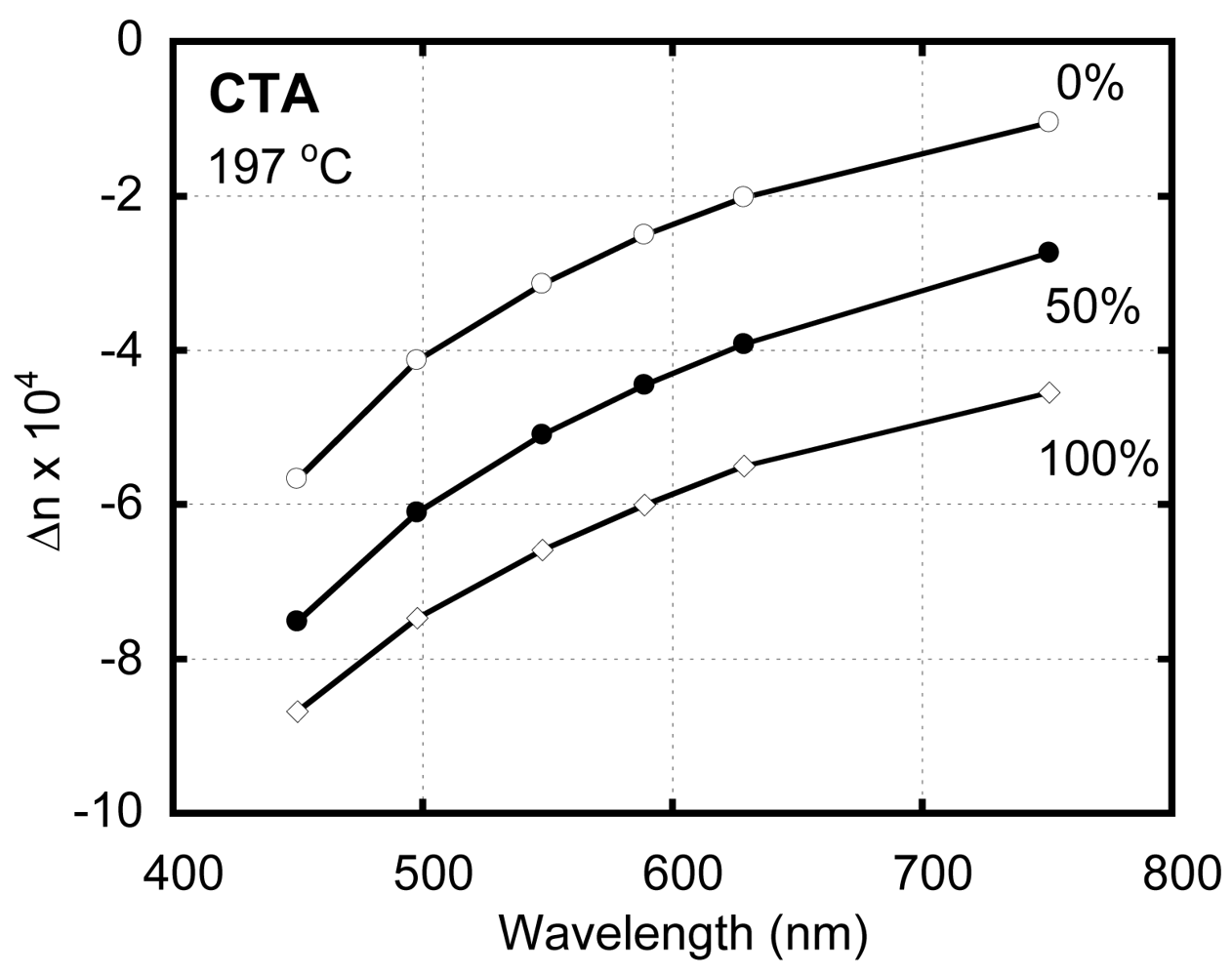
The wavelength dispersion of orientation birefringence of stretched CTA is shown in Figure 2. Numerals in the figure represent the ambient humidity. CTA shows negative birefringence that decreases with increasing wavelength, i.e., ordinary dispersion which is a typical behavior for most polymers [5,6]. As demonstrated in our previous papers [8,9], the orientation birefringence in cellulose esters is determined by polarizability anisotropy and orientation of the side groups, e.g., acetyl, propionyl and hydroxyl groups. The result in Figure 2 indicates that the acetyl group in stretched cellulose esters contributes to negative birefringence with ordinary dispersion. Moreover, it has been found that the amount of crystallites is not an important factor in determining the value of orientation birefringence in cellulose esters, as discussed in our previous paper [12].
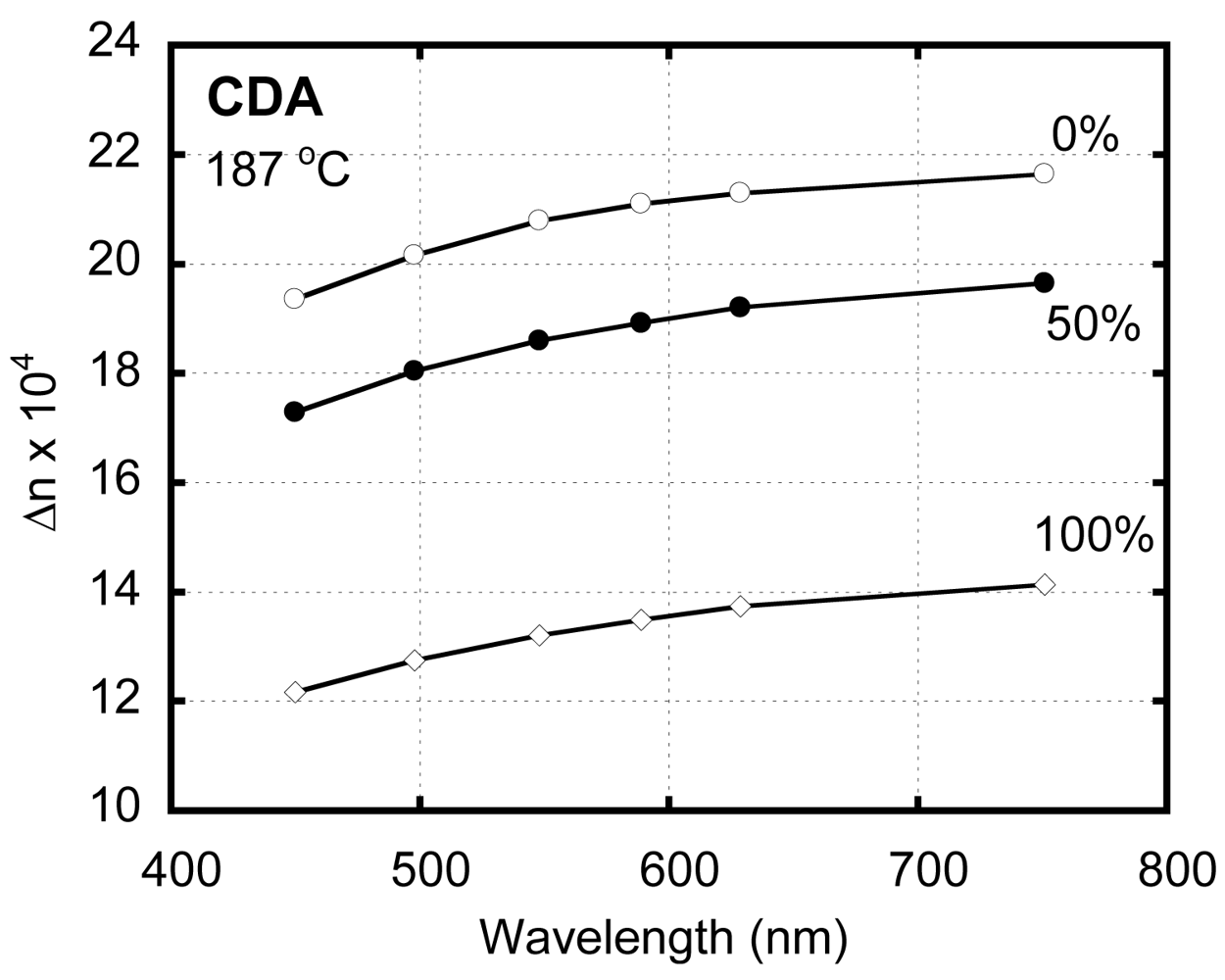
On the other hand, CDA produces positive orientation birefringence that increases with increasing wavelength, as shown in Figure 3. Considering that CDA contains the hydroxyl group as well as the acetyl group, the hydroxyl contribution to positive birefringence must be significantly large enough to offset the negative birefringence associated with the acetyl group [12]. Combination of (i) positive birefringence with ordinary dispersion and weak wavelength dependence from hydroxyl group with (ii) negative birefringence with ordinary dispersion and strong wavelength dependence from the acetyl group, results in positive birefringence with extraordinary wavelength dispersion.
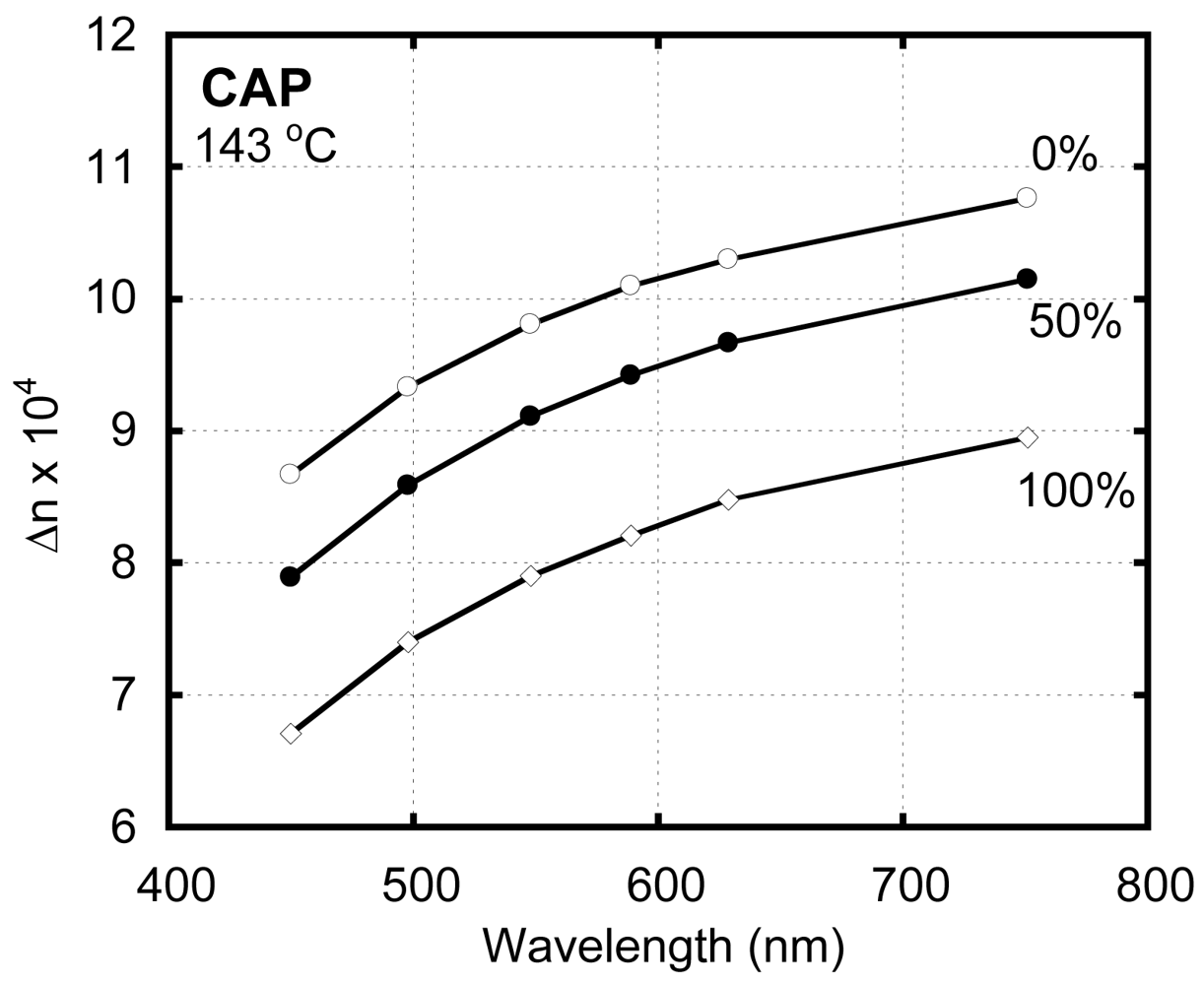
The orientation birefringence of CAP is shown in Figure 4. Similar to CDA, CAP shows positive birefringence with extraordinary dispersion. However, the magnitude of birefringence in CAP is small compared to that of CDA. The result suggests that the positive birefringence contribution associated with the propionyl group is smaller than that with the hydroxyl one.
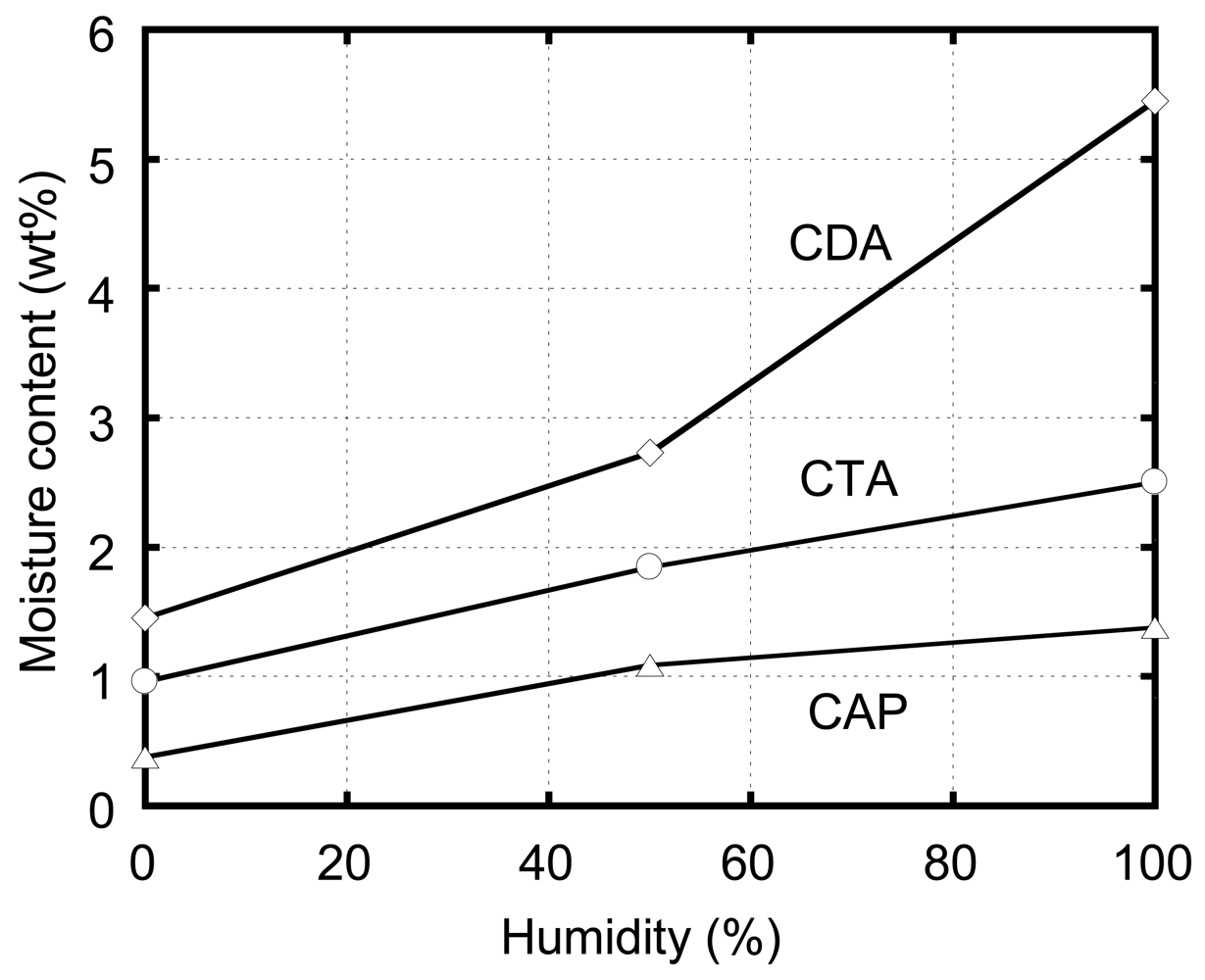
The moisture contents for CTA, CDA and CAP after exposure to three different levels of humidity, i.e., 0%, 50% and 100%, are shown in Figure 5. The samples were prepared by (i) drying in a vacuum oven at 70 °C for 24 hours, (ii) storing in a humid chamber at 50%RH, 25 ° C for 24 hours, and (iii) immersion in distilled water at 25 °C for 24 hours respectively.
As demonstrated in Figure 5, the value of moisture content increases with increasing ambient humidity. The increase is due to the interactions between water molecules and the carbonyl groups or the hydroxyl groups in the cellulose esters via weak hydrogen bonds. CDA shows the most significant water regain for 24 hours water immersion, more than twofold increase from the value obtained in 50% humidity. On the contrary, CAP shows the lowest moisture content at any conditions. The high water regain of CDA suggests that the unsubstituted hydroxyl groups are hydrophilic compared to the acetyl or propionyl groups, allowing the formation of more hydrogen bonds in cellulose esters.
Upon drying in the vacuum oven (0% humidity) for 24 hours, the orientation birefringence of CDA and CAP increases. Meanwhile, under the same condition, the negative birefringence of CTA decreases in magnitude. However, it should be noted that, in terms of the direction of polarizability anisotropy, the change observed in CTA corresponds to what is observed in the CDA and CAP. In other words, the orientation birefringence increases to the positive direction. Using the relation given in Equation (2), it can be concluded that exposure to low humidity ambience increases the polarizability anisotropy parallel to the stretching direction in cellulose esters.
After 24 hours of immersion in water, the orientation birefringence of CDA and CAP decreases while that of CTA increases in magnitude. The results show that the negativity of the birefringence, which is associated to the polarizability anisotropy perpendicular to the stretching direction, increases with increasing water content.
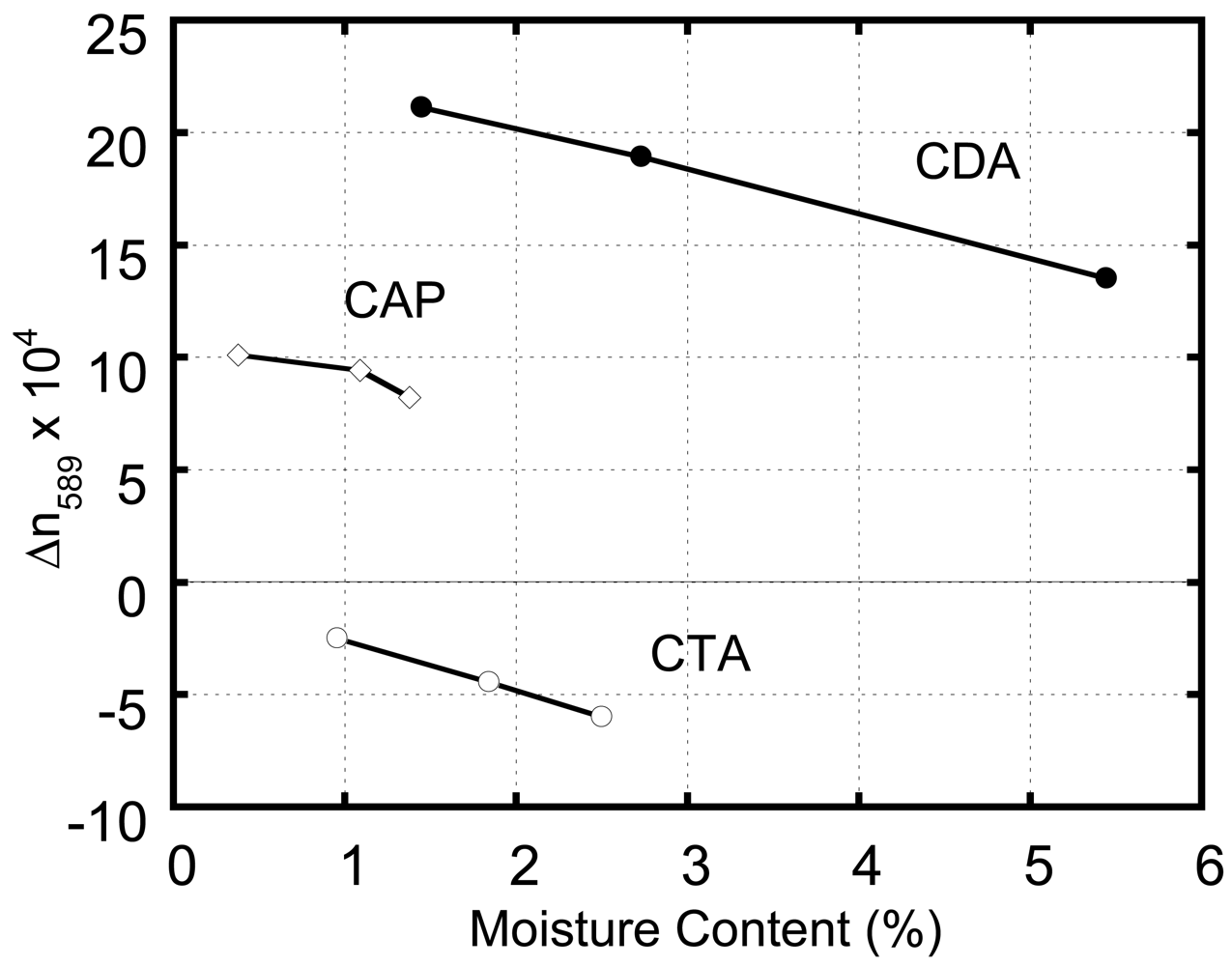
The relation between orientation birefringence at 589 nm and moisture content for CTA, CDA and CAP is shown in Figure 6. In more hygroscopic cellulose esters such as CTA and CDA, the orientation birefringence decreases linearly with moisture content. However, the more hydrophobic CAP does not show the similar characteristic. As the amount of moisture regain and the change in birefringence in CAP are miniscule even after 24 hours water immersion, the result could have been affected by experimental errors. In any case, the results suggest that moisture content has a greater effect on the polarizability anisotropy of the acetyl than propionyl groups.
3.3 ATR Spectra
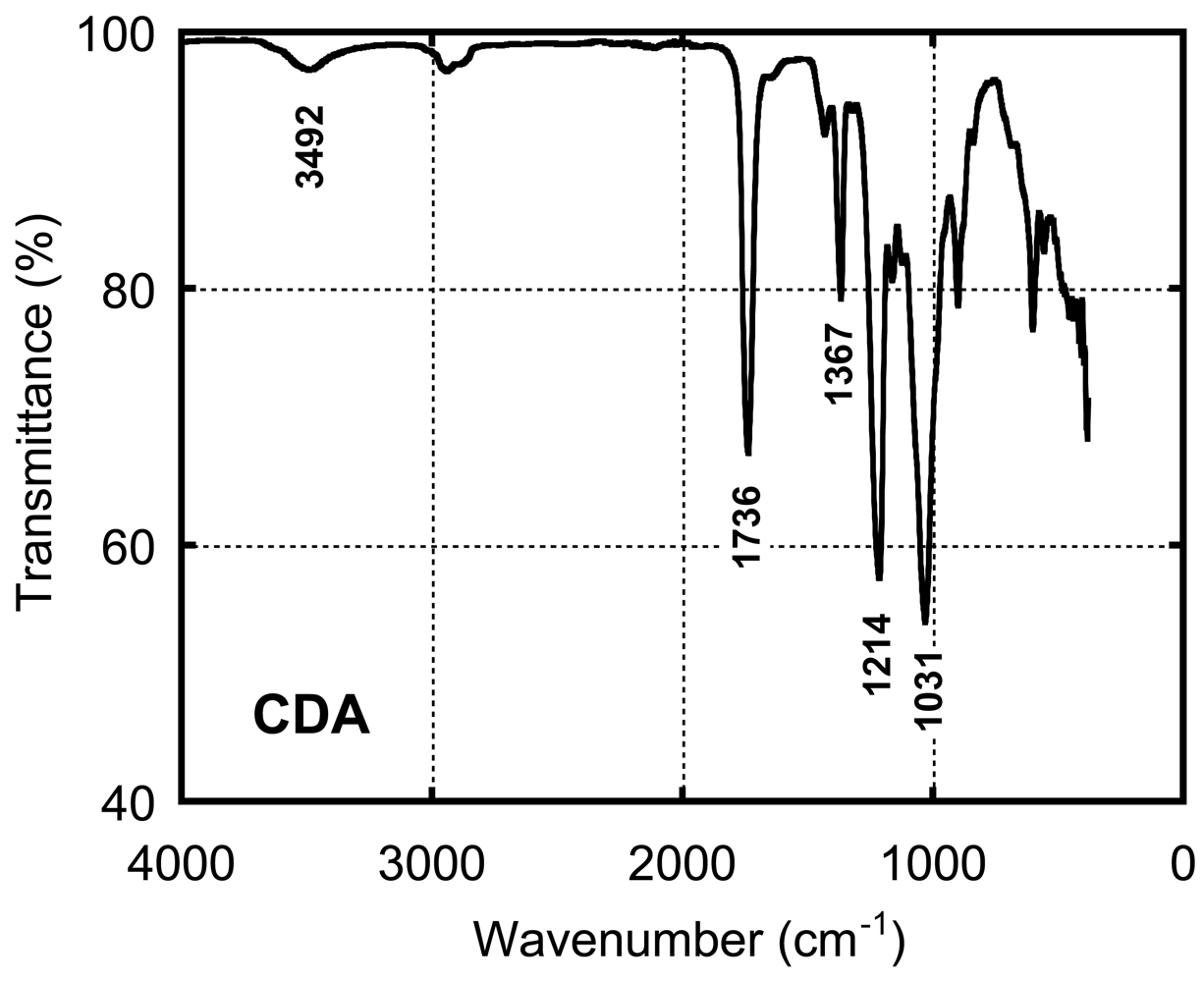
IR spectrum of CDA exposed to 0% humidity is exemplified in Figure 7. The anhydrous CDA shows an absorption band ascribed to OH stretching vibrations, centered at 3,492 cm−1. The band is more obvious in CDA than in CTA because of a large amount of hydroxyls available in CDA. Furthermore, an absorption peak ascribed to the stretching vibrations of the carbonyl bond is detected at 1,736 cm−1. Moreover, bands with strong intensity are also found at 1,214 cm−1 and 1,031 cm−1, both correspond to the stretching vibrations of C–O single bonds. A weak band caused by the vibrations of methyl groups can be observed at 1,367 cm−1.
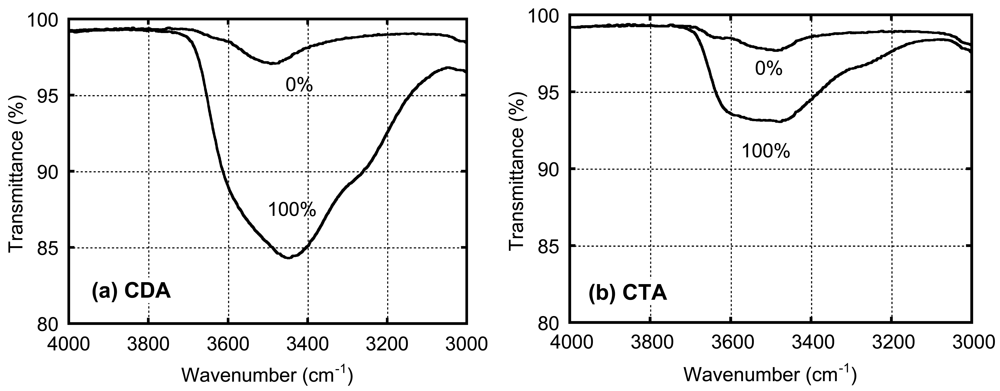
ATR-FTIR spectra (3,000–4,000 cm−1) for CDA and CTA exposed to 0% and 100% humidity are shown in Figure 8. Upon hydration, the band in the 3,200–3,600 cm−1 range which is associated with the OH stretching vibrations shows an increase in intensity accompanied with a widening of the band. This is due to the overlapping of the band associated with the hydroxyl groups in cellulose esters with the bands associated with OH stretching vibrations of the sorbed water molecules. The increase of the absorption peak is more prominent in CDA than that in CTA, while CAP is found to show the smallest increase, corresponding to the amount of moisture regain shown in Figure 5. For all ATR-FTIR measurements, the peak intensity for 50% humidity is almost at an intermediate value between those of 0% and 100% humidity.
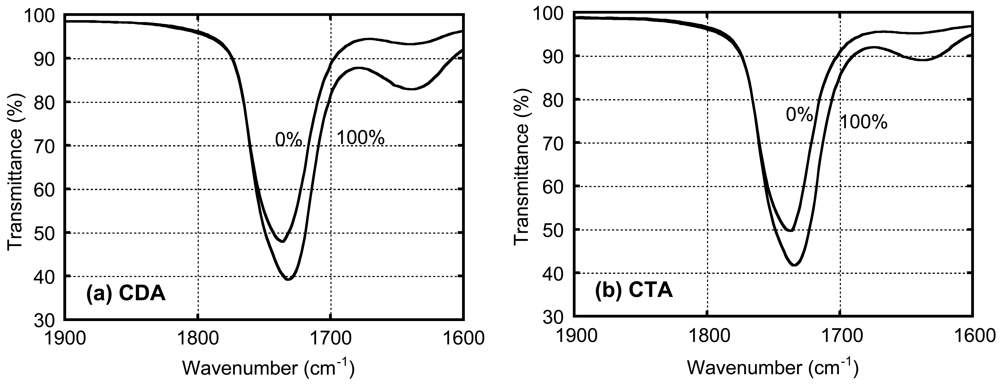
In cellulose esters, water molecules could form hydrogen bonds with the hydroxyl and the carbonyl groups [20,23]. Considering that CAP and CTA contain only a small amount of the hydroxyl group, hydrogen bonding between carbonyl groups and water molecules would mainly be responsible for the decrease in orientation birefringence upon hydration. Therefore, the formation of hydrogen bonds between cellulose esters and water molecules is determined by evaluating the band correspond to the stretching vibration of the carbonyl groups (1,660–1,760 cm−1). The formation of hydrogen bonds is demonstrated by the shift of the carbonyl band to lower wavenumbers as has been reported in previous studies [16,17].
The IR spectra in the 1,600–1,900 cm−1 range for CDA and CTA exposed to 0% and 100% humidity are shown in Figure 9. In the hydrated CDA, the absorption peak ascribed to the carbonyl groups shifts from 1,736 to 1,732 cm−1, while for the hydrated CTA, a similar displacement of the particular peak, from 1,737 to 1,734 cm−1 is observed. CAP shows the smallest displacement of the peak, from 1,739 to 1,737 cm−1, reflecting the hydrophobic nature of the propionyl groups. These results correspond to the amount of moisture regain observed in Figure 5.
As evident in Figure 6, the signs of the orientation birefringence of cellulose esters show a consistent change with moisture content, while the same does not hold true for the absolute values. The absolute value of orientation birefringence in CDA and CAP decreases with the increase of water content, while in CTA it increases. In particular, the increase in the absolute value of birefringence in CTA indicates that the change in orientation birefringence is not due to the disruption of the orientation of the side groups by absorbed water molecules, but rather by the increase of the polarizability anisotropy perpendicular to the stretching direction in the hydrated cellulose esters due to the formation of hydrogen bonding.
Moreover, a weak absorption band appears at 1,639 and 1,637 cm−1 in CDA and CTA spectra respectively. These bands are typical of bending vibrations of OH. The band is more obvious in CDA than in CTA, which corresponds to the higher moisture regain of CDA.
4. Conclusions
The orientation birefringence of hot-drawn CTA, CDA and CAP films exposed to three different levels of humidity was evaluated. A decrease in moisture content resulted in the increase of the magnitude of positive orientation birefringence in CAP and CDA, while CTA showed a decrease in the magnitude of its negative orientation birefringence. The result shows that the negativity of orientation birefringence increases with increasing moisture content and, correspondingly, decreases with decreasing moisture content. It suggests that the polarizability anisotropy perpendicular to the stretching direction increases with increasing the water content. ATR-FTIR spectra of the cellulose esters are also studied to evaluate the change of the intermolecular interactions upon hydration. An increase in width and intensity of the peak associated to the stretching vibrations of OH is observed in the hydrated cellulose esters, with an intense fashion in CDA. This is explained by availability of more hydrophilic hydroxyl groups in CDA which corresponds to its relatively high moisture regain. Hydrogen bonding in the hydrated cellulose esters is confirmed by the shift of the band associated to the carbonyl group towards lower frequencies. The hydrogen bonds in the hydrated cellulose esters is considered to contribute to polarizability anisotropy perpendicular to the stretching direction, as demonstrated by the decrease of the orientation birefringence in CAP and CDA.





Acknowledgments
The authors would like to express their gratitude to Taihei Chemicals Limited for their valuable advices and kind supplies of the samples employed in this study. Furthermore, the authors gratefully acknowledge financial supports from Regional Research and Development Resources Utilization Program, Japan Science and Technology Agency.
References
- Yamaguchi, M. Optical Properties of Cellulose Esters and Their Blends. In Cellulose: Structure and Properties, Derivatives and Industrial Uses; Lejeune, A., Deprez, T., Eds.; Nova Science Publishers Inc.: New York, NY, USA, 2010; pp. 325–340. [Google Scholar]
- Edgar, K.J.; Buchanan, C.M.; Debenham, J.S.; Rundquist, P.A.; Seiler, B.D.; Shelton, M.C.; Tindall, D. Advances in Cellulose Esters Performance and Application. Progr. Polym. Sci. 2001, 26, 1605–1688. [Google Scholar]
- Sata, H.; Murayama, M.; Shimamoto, S. Properties and Applications of Cellulose Triacetate Film. Macromol. Symp. 2004, 208, 323–333. [Google Scholar]
- Kuboyama, K.; Kuroda, T.; Ougizawa, T. Control of Wavelength Dispersion of Birefringence by Misicble Polymer Blends. Macromol. Symp. 2007, 249-250, 641–646. [Google Scholar]
- Uchiyama, A.; Yatabe, T. Control of Wavelength Dispersion of Birefringence for Oriented Copolycarbonate Films Containing Positive and Negative Birefringence Units. Jpn. J. Appl. Phys. 2003, 42, 6941–6945. [Google Scholar]
- Yamaguchi, M.; Lee, S.Y.; Abd Manaf, M.E.; Tsuji, M.; Yokohara, T. Modification of Orientation Birefringence of Cellulose Ester by Addition of Poly(lactic acid). Eur. Polym. J. 2010, 46, 2269–2274. [Google Scholar]
- Wilkes, G.L.; Stein, R.S. Physiochemical Approaches to the Measurement of Molecular Anisotropy. In Structure and Properties of Oriented Polymers; Ward, I.M., Ed.; Chapman & Hall: London, UK, 1975; pp. 44–90. [Google Scholar]
- Yamaguchi, M.; Okada, K.; Abd Manaf, M.E.; Shiroyama, Y.; Iwasaki, T.; Okamoto, K. Extraordinary Wavelength Dispersion of Orientation Birefringence for Cellulose Esters. Macromolecules 2009, 42, 9034–9040. [Google Scholar]
- Yamaguchi, M.; Iwasaki, T.; Okada, K.; Okamoto, K. Control of Optical Anisotropy of Cellulose Esters and Their Blends with Plasticizer. Acta Mater. 2009, 57, 823–829. [Google Scholar]
- Ohno, T.; Nishio, Y. Molecular Orientation and Optical Anisotropy in Drawn Films of Miscible Blends Composed of Cellulose Acetate and Poly(N-vinylpyrrolidone-co-methyl methacrylate). Macromolecules 2007, 40, 3468–3476. [Google Scholar]
- Yamaguchi, M.; Masuzawa, K. Birefringence Control for Binary Blends of Cellulose Acetate Propionate and Poly(vinyl acetate). Eur. Polym. J. 2007, 43, 3277–3282. [Google Scholar]
- Abd Manaf, M.E.; Tsuji, M.; Shiroyama, Y.; Yamaguchi, M. Wavelength Dispersion of Orientation Birefringence for Cellulose Esters Containing Tricresyl Phosphate. Macromolecules 2011, 44, 3942–3949. [Google Scholar]
- Rosato, D.V.; Rosato, M.G.; Rosato, D.V. Concise Encylopedia of Plastics; Kluwer Academic Publishers: Boston, MA, USA, 2000; p. 140. [Google Scholar]
- Malm, C.J.; Fordyce, C.R.; Tanner, H.A. Properties of Cellulose Esters of Acetic, Propionic and Butyric Acids. Ind. Eng. Chem. 1942, 34, 430–435. [Google Scholar]
- Dias, C.R.; Rosa, M.J.; De Pinho, M.N. Structure of Water in Asymmetric Cellulose Ester Membranes—An Atr-Ftir Study. J. Membr. Sci. 1998, 138, 259–267. [Google Scholar]
- Kusanagi, H.; Yukawa, S. Fourier Transform Infra-Red Spectroscopic Studies of Water Molecules Sorbed in Solid Polymers. Polymer 1994, 35, 5637–5640. [Google Scholar]
- Badger, R.M. The Relation between the Energy of a Hydrogen Bond and the Frequencies of the OH Band. J. Chem. Phys. 1940, 8, 288–289. [Google Scholar]
- Kalutskaya, E.P.; Gusev, S.S. An Infrared Spectroscopic Investigation of the Hydration of Cellulose. Polym. Sci. U.S.S.R. 1980, 22, 550–556. [Google Scholar]
- Toprak, C.; Agar, J.N.; Falks, M. State of Water in Cellulose Acetate Membranes. J. Chem. Soc. 1979, 75, 803–815. [Google Scholar]
- Kalutskaya, E.P.; Gusev, S.S. IR Spectroscopic Study of Hydration of Cellulose Acetates and Polyvinyl Acetate. Polym. Sci. U.S.S.R. 1982, 24, 2778–2787. [Google Scholar]
- Zugenmaier, P. Characterization and Physical Properties of Cellulose Acetates. Macromol. Symp. 2004, 208, 81–166. [Google Scholar]
- MacLeod, S.K. Moisture Determination Using Karl Fischer Titrations. Anal. Chem. 1991, 63, 557A–566A. [Google Scholar]
- Ohno, T.; Nishio, Y. Estimation of Miscibility and Interaction for Cellulose Acetate and Butyrate Blends with N-Vinylpyrrolidone Copolymers. Macromol. Chem. Phys. 2007, 208, 622–634. [Google Scholar]
- Skornyakov, I.V.; Komar, V.P. IR Spectra and the Structure of Plasticized Cellulose Acetate Films. J. Appl. Spectrosc. 1998, 65, 911–918. [Google Scholar]
© 2011 by the authors; licensee MDPI, Basel, Switzerland. This article is an open access article distributed under the terms and conditions of the Creative Commons Attribution license (http://creativecommons.org/licenses/by/3.0/).
Share and Cite
Manaf, M.E.A.; Tsuji, M.; Nobukawa, S.; Yamaguchi, M. Effect of Moisture on the Orientation Birefringence of Cellulose Esters. Polymers 2011, 3, 955-966. https://doi.org/10.3390/polym3020955
Manaf MEA, Tsuji M, Nobukawa S, Yamaguchi M. Effect of Moisture on the Orientation Birefringence of Cellulose Esters. Polymers. 2011; 3(2):955-966. https://doi.org/10.3390/polym3020955
Chicago/Turabian StyleManaf, Mohd Edeerozey Abd, Manami Tsuji, Shogo Nobukawa, and Masayuki Yamaguchi. 2011. "Effect of Moisture on the Orientation Birefringence of Cellulose Esters" Polymers 3, no. 2: 955-966. https://doi.org/10.3390/polym3020955