
<?xml version="1.0" encoding="UTF-8"?>
<!DOCTYPE article PUBLIC "-//NLM//DTD Journal Publishing DTD v2.3 20070202//EN" "journalpublishing.dtd">
<article xmlns:mml="http://www.w3.org/1998/Math/MathML" xmlns:xlink="http://www.w3.org/1999/xlink" xml:lang="en" article-type="research-article">
  <front>
    <journal-meta>
      <journal-id journal-id-type="publisher-id">crystals</journal-id>
      <journal-title>Crystals</journal-title>
      <abbrev-journal-title abbrev-type="publisher">Crystals</abbrev-journal-title>
      <abbrev-journal-title abbrev-type="pubmed">Crystals</abbrev-journal-title>
      <issn pub-type="epub">2073-4352</issn>
      <publisher>
        <publisher-name>MDPI</publisher-name>
      </publisher>
    </journal-meta>
    <article-meta>
      <article-id pub-id-type="doi">10.3390/cryst2020338</article-id>
      <article-id pub-id-type="publisher-id">crystals-02-00338</article-id>
      <article-categories>
        <subj-group>
          <subject>Article</subject>
        </subj-group>
      </article-categories>
      <title-group>
        <article-title>Electroactive Bisiminopyridine Ligands: Synthesis and Complexation Studies</article-title>
      </title-group>
      
      <contrib-group>
        <contrib contrib-type="author">
          <name>
            <surname>Nita</surname>
            <given-names>Gabriela</given-names>
          </name>
        </contrib>
        <contrib contrib-type="author">
          <name>
            <surname>Branzea</surname>
            <given-names>Diana</given-names>
          </name>
        </contrib>
        <contrib contrib-type="author">
          <name>
            <surname>Pop</surname>
            <given-names>Flavia</given-names>
          </name>
        </contrib>
        <contrib contrib-type="author">
          <name>
            <surname>El-Ghayoury</surname>
            <given-names>Abdelkrim</given-names>
          </name>
          <xref rid="c1-crystals-02-00338" ref-type="corresp">*</xref>
        </contrib>
        <contrib contrib-type="author">
          <name>
            <surname>Avarvari</surname>
            <given-names>Narcis</given-names>
          </name>
          <xref rid="c1-crystals-02-00338" ref-type="corresp">*</xref>
        </contrib>
      </contrib-group>
      <aff id="af1-crystals-02-00338">CIMI group, Laboratoire MOLTECH-Anjou, CNRS UMR 6200, Université d’Angers, LUNAM Université, 2 bd Lavoisier, 49045 ANGERS cedex, France; Email: <email>nitagabriela.t@gmail.com</email> (G.N.); <email>diana_branzea@yahoo.com</email> (D.B.); <email>flavia.piron@etud.univ-angers.fr</email> (F.P.)</aff>
      <author-notes>
        <corresp id="c1-crystals-02-00338"><label>*</label> Authors  to whom correspondence should be addressed; Email: <email>abdelkrim.elghayoury@univ-angers.fr</email> (A.E.-G.); <email>narcis.avarvari@univ-angers.fr</email> (N.A.); Tel.: +33-241-735-492 (A.E.-G.); Fax: +33-241-735-405 (A.E.-G.; N.A.).</corresp>
      </author-notes>
      <pub-date pub-type="epub">
        <day>24</day>
        <month>04</month>
        <year>2012</year>
      </pub-date>
      <pub-date pub-type="collection"><month>06</month>
        <year>2012</year>
      </pub-date>
      <volume>2</volume>
      <issue>2</issue>
      <fpage>338</fpage>
      <lpage>348</lpage>
      <history>
        <date date-type="received">
          <day>22</day>
          <month>03</month>
          <year>2012</year>
        </date>
        <date date-type="rev-recd">
          <day>06</day>
          <month>04</month>
          <year>2012</year>
        </date>
        <date date-type="accepted">
          <day>09</day>
          <month>04</month>
          <year>2012</year>
        </date>
      </history>
      <permissions>
        <copyright-statement>©  2012 by the authors; licensee MDPI, Basel, Switzerland.</copyright-statement>
        <copyright-year>2012</copyright-year>
        <license xmlns:xlink="http://www.w3.org/1999/xlink" license-type="open-access" xlink:href="http://creativecommons.org/licenses/by/3.0/">
          <p>This article is an open-access article distributed under the terms and conditions of the Creative Commons Attribution license (http://creativecommons.org/licenses/by/3.0/).</p>
        </license>
      </permissions>
      <abstract>
        <p>The condensation reaction of (4-(6,7-dimethyldithio-tetrathiafulvalene)-aniline) with 2,6-diformylpyridine afforded an electroactive Schiff base (N,N,N) pincer (<bold>3</bold>). This pincer was reacted with Zn(II) cation to yield the corresponding Zinc chloride complex (<bold>4</bold>). The crystal structure of the newly prepared electroactive zinc complex reveals that the tetrathiafulvalene (TTF) is neutral and the zinc cation is pentacoordinated. The two chlorines are involved in a set of hydrogen bonds giving rise to a 2D supramolecular grid arrangement. The electronic absorption properties and the electrochemical behavior have been elucidated. These two compounds are promising for the construction of crystalline radical cation salts. </p>
      </abstract>
      <kwd-group>
        <kwd>tetrathiafulvalene</kwd>
        <kwd>Schiff base</kwd>
        <kwd>transition metal complex</kwd>
        <kwd>cyclic voltammetry</kwd>
        <kwd>UV-Vis spectroscopy</kwd>
      </kwd-group>
    </article-meta>
  </front>
  <body>
    <sec sec-type="intro">
      <title>1. Introduction</title>
      <p>Tetrathiafulvalene (TTF) and its derivatives have attracted much interest because of their electron-donating ability and their attractive reversible redox properties. They have therefore been widely used as donor components in the preparation of molecular conductors and superconductors [<xref ref-type="bibr" rid="B1-crystals-02-00338">1</xref>,<xref ref-type="bibr" rid="B2-crystals-02-00338">2</xref>,<xref ref-type="bibr" rid="B3-crystals-02-00338">3</xref>]. However, one challenge is the construction of multifunctional molecular materials that can exhibit interplay between one or more physical properties such as magnetic properties and electrical conductivity [<xref ref-type="bibr" rid="B4-crystals-02-00338">4</xref>,<xref ref-type="bibr" rid="B5-crystals-02-00338">5</xref>]. In order to address this challenge, considerable effort has been devoted in associating the TTF moiety with an inorganic component and various organic mono- or polydentate ligands, and their corresponding electroactive metal complexes have therefore been reported [<xref ref-type="bibr" rid="B6-crystals-02-00338">6</xref>]. For example, metal complexes of phosphines [<xref ref-type="bibr" rid="B7-crystals-02-00338">7</xref>,<xref ref-type="bibr" rid="B8-crystals-02-00338">8</xref>,<xref ref-type="bibr" rid="B9-crystals-02-00338">9</xref>,<xref ref-type="bibr" rid="B10-crystals-02-00338">10</xref>,<xref ref-type="bibr" rid="B11-crystals-02-00338">11</xref>,<xref ref-type="bibr" rid="B12-crystals-02-00338">12</xref>], dithiolates [<xref ref-type="bibr" rid="B13-crystals-02-00338">13</xref>], acetylacetonates [<xref ref-type="bibr" rid="B14-crystals-02-00338">14</xref>], pyridines [<xref ref-type="bibr" rid="B15-crystals-02-00338">15</xref>,<xref ref-type="bibr" rid="B16-crystals-02-00338">16</xref>,<xref ref-type="bibr" rid="B17-crystals-02-00338">17</xref>], bipyridines [<xref ref-type="bibr" rid="B18-crystals-02-00338">18</xref>,<xref ref-type="bibr" rid="B19-crystals-02-00338">19</xref>] and more recently of Schiff bases [<xref ref-type="bibr" rid="B20-crystals-02-00338">20</xref>,<xref ref-type="bibr" rid="B21-crystals-02-00338">21</xref>,<xref ref-type="bibr" rid="B22-crystals-02-00338">22</xref>] have been synthesized. Pyridine based Schiff bases ligands such as 2,6-<italic>bis</italic>(imino)pyridyl, with chelating abilities, form stable complexes, with various transition metals, which have been extensively used as catalysts for olefin polymerization [<xref ref-type="bibr" rid="B23-crystals-02-00338">23</xref>,<xref ref-type="bibr" rid="B24-crystals-02-00338">24</xref>]. </p>
      <p>In order to obtain electroactive transition metal complexes with original structural and electronic properties, we report herein the synthesis of the <bold>TTF<sub>2</sub>-BisIm-Py</bold> (<bold>3</bold>) that can act as an (<italic>N,N,N</italic>) pincer. The TTF based donor with monoaniline moiety, (4-(6,7-dimethyldithio-tetrathiafulvalene)-aniline) (<bold>2</bold>), has been chosen for the Schiff base condensation reaction with 2,6-diformylpyridine. The reaction of this TTF based tridentate pincer with zinc metal cation afforded a new electroactive metal complex.</p>
    </sec>
    <sec sec-type="results">
      <title>2. Results and Discussion</title>
      <sec>
        <title>2.1. Synthesis and Characterization</title>
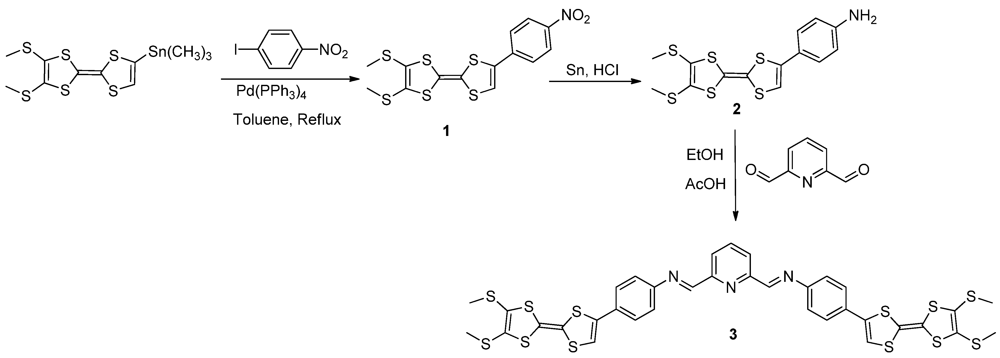
        <p>The protocol followed for the synthesis of the new (2,6-<italic>bis</italic>(4-(4',5'-<italic>bis</italic>(methylthio)-[2,2'-bi(1,3-dithiolylidene)]-4-yl)aniline)-iminopyridine) pincer (<bold>3, TTF<sub>2</sub>-BisIm-Py</bold>) is presented in <xref ref-type="fig" rid="crystals-02-00338-f001">Figure 1</xref>. </p>
        <fig id="crystals-02-00338-f001" position="anchor">
          <label>Figure 1</label>
          <caption>
            <p>Synthesis scheme of the <bold>TTF<sub>2</sub>-BisIm-Py</bold> Pincer (<bold>3</bold>).</p>
          </caption>
          <graphic xmlns:xlink="http://www.w3.org/1999/xlink" xlink:href="crystals-02-00338-g001.tif"/>
        </fig>
        <p>The starting stannic derivative (6,7-dimethyldithio-2-trimethyltin-tetrathiafulvalene) was synthesized as previously described [<xref ref-type="bibr" rid="B25-crystals-02-00338">25</xref>] and was reacted with 1-iodo-4-nitrobenzene under Stille coupling conditions to afford (1-(6,7-dimethyldithio-tétrathiafulvalene)-4-nitro-benzene) (<bold>1</bold>) in 67% yield [<xref ref-type="bibr" rid="B26-crystals-02-00338">26</xref>]. Reduction of the nitro group to the amine was achieved using a mixture of HCl ethanolic solution in the presence of metallic tin [<xref ref-type="bibr" rid="B26-crystals-02-00338">26</xref>]. The obtained amine (<bold>2</bold>) was further used in a condensation reaction with 2,6-diformylpyridine to afford the <bold>TTF<sub>2</sub>-BisIm-Py</bold> pincer (<bold>3</bold>).</p>
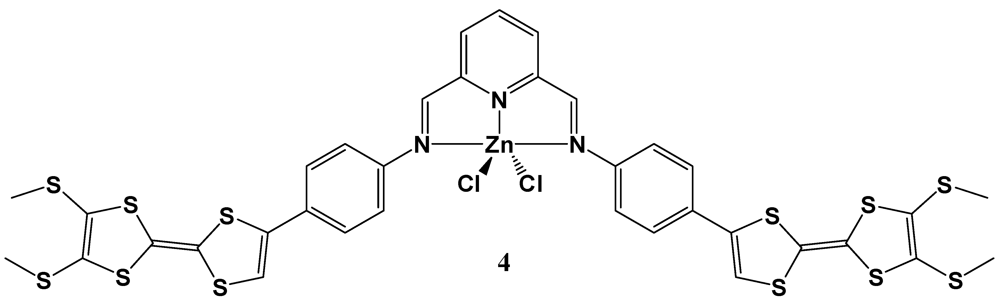
        <p>The <bold>TTF<sub>2</sub>-BisIm-Py</bold> pincer was reacted with one equivalent of zinc chloride (ZnCl<sub>2</sub>) in a dicloromethane/acetonitrile solvents mixture to afford good quality single crystals of <bold>[Zn(TTF<sub>2</sub>-BisIm-Py) Cl<sub>2</sub>] </bold>(<bold>4</bold>) (<xref ref-type="fig" rid="crystals-02-00338-f002">Figure 2</xref>) that were suitable for the X-ray crystal structure determination.</p>
        <fig id="crystals-02-00338-f002" position="anchor">
          <label>Figure 2</label>
          <caption>
            <p>Schematic drawing of the zinc metal complex (<bold>4</bold>).</p>
          </caption>
          <graphic xmlns:xlink="http://www.w3.org/1999/xlink" xlink:href="crystals-02-00338-g002.tif"/>
        </fig>
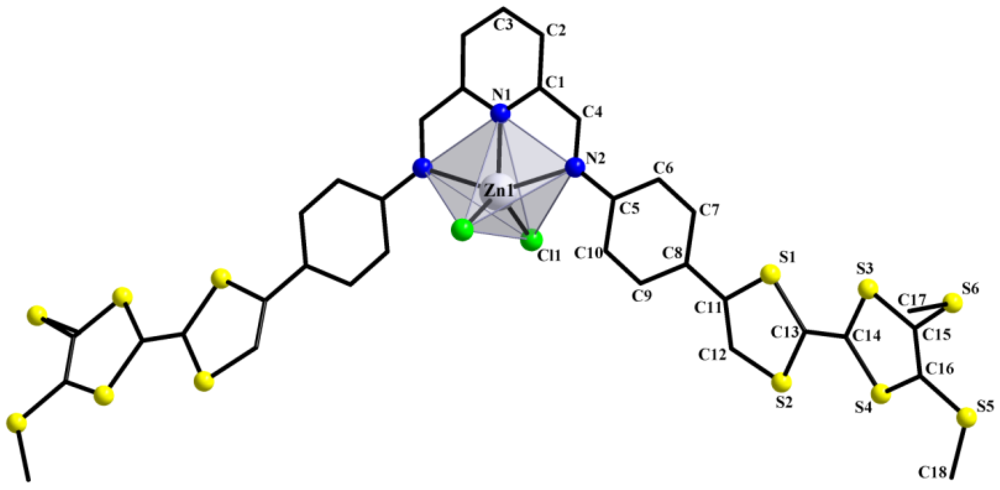
        <p>Single-crystal diffraction analysis revealed that the asymmetric unit (<xref ref-type="fig" rid="crystals-02-00338-f003">Figure 3</xref>) contains half of the molecule of complex (<bold>4</bold>). Within this complex the zinc ion is pentacoordinated, the coordination sphere being formed by the three nitrogen atoms of the pincer and two chlorines ions. For a more accurate description of the stereochemistry around the zinc ion, the <italic>τ</italic> parameter (<italic>τ</italic> = [(<italic>α</italic>− <italic>α</italic>')/60] [<xref ref-type="bibr" rid="B27-crystals-02-00338">27</xref>], where <italic>α</italic> and <italic>α</italic>' are the <italic>transoid</italic> angles formed by the metal ion and the donor atoms within the basal plane), also known as Adisson’s parameter, was calculated to be <italic>τ</italic> = 0.47. This indicates an intermediate between the two geometries corresponding number of five, square pyramidal and trigonal bipyramidal. </p>
        <fig id="crystals-02-00338-f003" position="anchor">
          <label>Figure 3</label>
          <caption>
            <p>The crystal structure of complex <bold>4</bold> with the labeling scheme of the atoms. Hydrogen atoms have been omitted for clarity.</p>
          </caption>
          <graphic xmlns:xlink="http://www.w3.org/1999/xlink" xlink:href="crystals-02-00338-g003.tif"/>
        </fig>
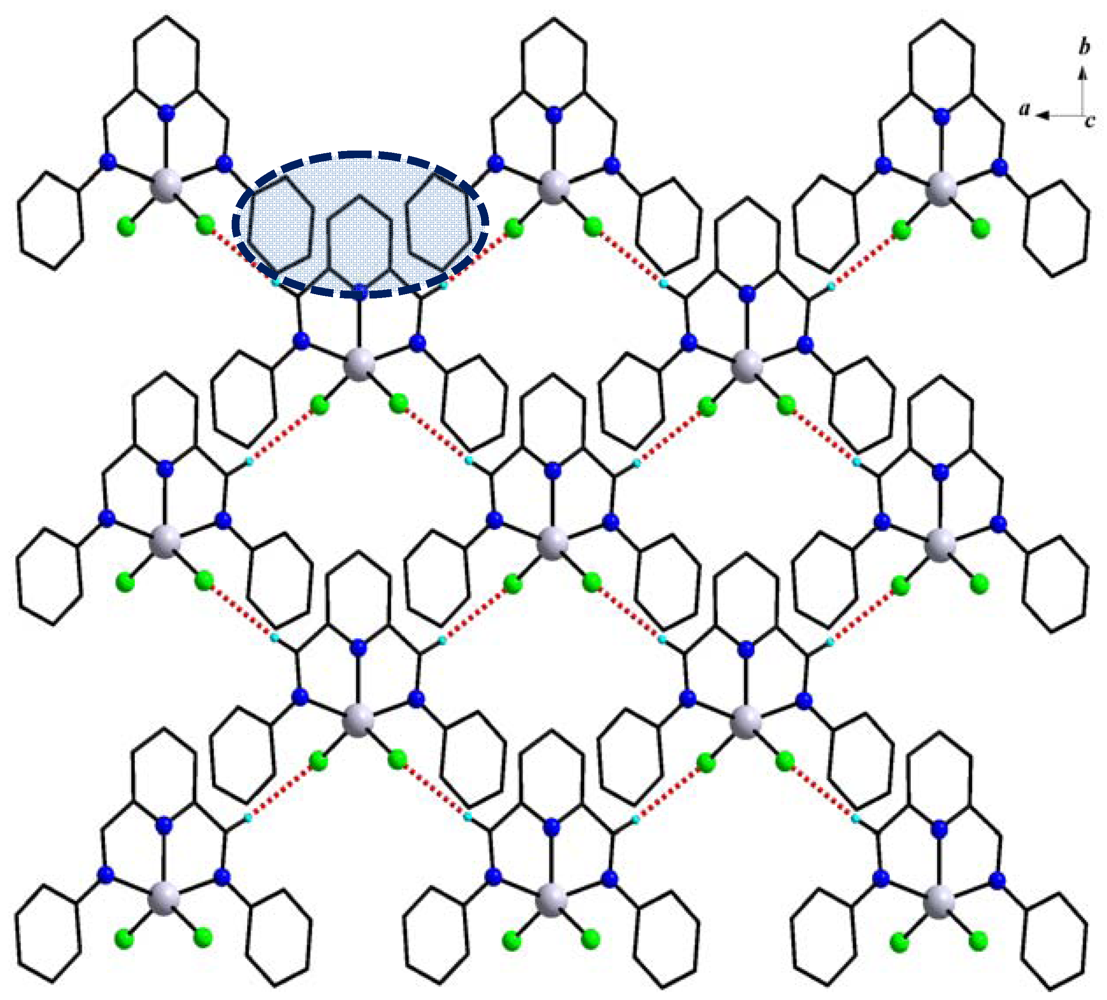
        <p>In the coordination polyhedron, Zn–(N/Cl)ligand distances are in the 2.052(5)–2.351(3) Å range. A selection of relevant bond lengths and angles are given in <xref ref-type="table" rid="crystals-02-00338-t001">Table 1</xref>. In the complex, the planarity of the ligand is disrupted by the TTF-(SMe)<sub>2</sub> units, as proven by the value of the dihedral angle least-squares planes of the pyridyl group and the dithiole ring (23.55°). In the solid state, each of the two chlorine atoms coordinated to the zinc ion are involved in non-conventional hydrogen bonds with hydrogen atoms from other two neighboring molecules to generate a grid-like sheet represented in <xref ref-type="fig" rid="crystals-02-00338-f004">Figure 4</xref>.</p>
        <table-wrap id="crystals-02-00338-t001" position="anchor">
          <object-id pub-id-type="pii">crystals-02-00338-t001_Table 1</object-id>
          <label>Table 1</label>
          <caption>
            <p>Selected bond lengths (Å) and angles (°) for compound <bold>4</bold>. </p>
          </caption>
                        <table>
            <thead>
              <tr>
                <th align="left" valign="middle">bond</th>
                <th align="center" valign="middle">length (Å)</th>
                <th align="center" valign="middle">bond</th>
                <th align="center" valign="middle">length (Å)</th>
                <th align="center" valign="middle">bond</th>
                <th align="center" valign="middle">length (Å)</th>
              </tr>
            </thead>
            <tbody>
              <tr>
                <td align="left" valign="middle">C11–C12</td>
                <td align="left" valign="middle">1.330(6)</td>
                <td align="center" valign="middle">C14–S4</td>
                <td align="left" valign="middle">1.761(5)</td>
                <td align="center" valign="middle">N1–Zn1</td>
                <td align="right" valign="middle">2.052(5)</td>
              </tr>
              <tr>
                <td align="left" valign="middle">C11–S1</td>
                <td align="left" valign="middle">1.774(4)</td>
                <td align="center" valign="middle">C15–C16</td>
                <td align="left" valign="middle">1.345(6)</td>
                <td align="center" valign="middle">N2–Zn1</td>
                <td align="right" valign="middle">2.351(3)</td>
              </tr>
              <tr>
                <td align="left" valign="middle">C12–S2</td>
                <td align="left" valign="middle">1.720(4)</td>
                <td align="center" valign="middle">C15–S6</td>
                <td align="left" valign="middle">1.743(4)</td>
                <td align="center" valign="middle">Cl1–Zn1</td>
                <td align="right" valign="middle">2.2345(13)</td>
              </tr>
              <tr>
                <td align="left" valign="middle">C13–C14</td>
                <td align="left" valign="middle">1.340(5)</td>
                <td align="center" valign="middle">C15–S3</td>
                <td align="left" valign="middle">1.769(4)</td>
                <td align="center" valign="middle">Zn1–Cl1 <sup>i</sup></td>
                <td align="right" valign="middle">2.2345(13)</td>
              </tr>
              <tr>
                <td align="left" valign="middle">C13–S2</td>
                <td align="left" valign="middle">1.756(4)</td>
                <td align="center" valign="middle">C16–S5</td>
                <td align="left" valign="middle">1.742(4)</td>
                <td align="center" valign="middle">Zn1–N2 <sup>i</sup></td>
                <td align="right" valign="middle">2.351(3)</td>
              </tr>
              <tr>
                <td align="left" valign="middle">C13–S1</td>
                <td align="left" valign="middle">1.759(4)</td>
                <td align="center" valign="middle">C18–S5</td>
                <td align="left" valign="middle">1.794(5)</td>
                <td align="center" valign="middle">H10–Cl1 <sup>i</sup></td>
                <td align="right" valign="middle">3.1536(15)</td>
              </tr>
              <tr>
                <td align="left" valign="middle">C14–S3</td>
                <td align="left" valign="middle">1.758(4)</td>
                <td align="center" valign="middle">N1–C1<sup>i</sup></td>
                <td align="left" valign="middle">1.342(5)</td>
                <td align="center" valign="middle">Cl1–Cl1 <sup>i</sup></td>
                <td align="right" valign="middle">3.8584(19)</td>
              </tr>
              <tr style="border-top: solid thin">
                <td align="left" valign="middle">
                  <bold>angle</bold>
                </td>
                <td align="left" valign="middle">
                  <bold>value (°)</bold>
                </td>
                <td align="center" valign="middle">
                  <bold>angle</bold>
                </td>
                <td align="left" valign="middle">
                  <bold>value (°)</bold>
                </td>
                <td align="center" valign="middle">
                  <bold>angle</bold>
                </td>
                <td align="right" valign="middle">
                  <bold>value (°)</bold>
                </td>
              </tr>
              <tr style="border-top: solid thin">
                <td align="left" valign="middle">N1–Zn1–Cl1</td>
                <td align="left" valign="middle">120.30(4)</td>
                <td align="center" valign="middle">N1–Zn1–N2 <sup>i</sup></td>
                <td align="left" valign="middle">74.31(9)</td>
                <td align="center" valign="middle">Cl1–Zn1–N2</td>
                <td align="right" valign="middle">97.74(9)</td>
              </tr>
              <tr>
                <td align="left" valign="middle">N1–Zn1–Cl1 <sup>i</sup></td>
                <td align="left" valign="middle">120.30(4)</td>
                <td align="center" valign="middle">Cl1–Zn1–N2 <sup>i</sup></td>
                <td align="left" valign="middle">97.94(9)</td>
                <td align="center" valign="middle">Cl1 <sup>i</sup>–Zn1–N2</td>
                <td align="right" valign="middle">97.94(9)</td>
              </tr>
              <tr>
                <td align="left" valign="middle">Cl1–Zn1–Cl1 <sup>i</sup></td>
                <td align="left" valign="middle">119.40(9)</td>
                <td align="center" valign="middle">N1–Zn1–N2</td>
                <td align="left" valign="middle">74.31(9)</td>
                <td align="center" valign="middle">N2 <sup>i</sup>–Zn1–N2</td>
                <td align="right" valign="middle">148.63(18)</td>
              </tr>
            </tbody>
          </table>
          <table-wrap-foot>
          <fn>
          <p><sup>i</sup> 2 − <italic>x</italic>, <italic>y</italic>, 0.5 − <italic>z</italic>.</p>
          </fn>
          </table-wrap-foot>
        </table-wrap>
        <fig id="crystals-02-00338-f004" position="anchor">
          <label>Figure 4</label>
          <caption>
            <p>Front view of the 2D supramolecular layer in <bold>4</bold> reinforced by non-conventional hydrogen bonds (2.69 Å) (red dashed lines) and π–π stacking (highlighted by the blue circle). The TTF-(SMe)<sub>2</sub> units were omitted for clarity.</p>
          </caption>
          <graphic xmlns:xlink="http://www.w3.org/1999/xlink" xlink:href="crystals-02-00338-g004.tif"/>
        </fig>
        
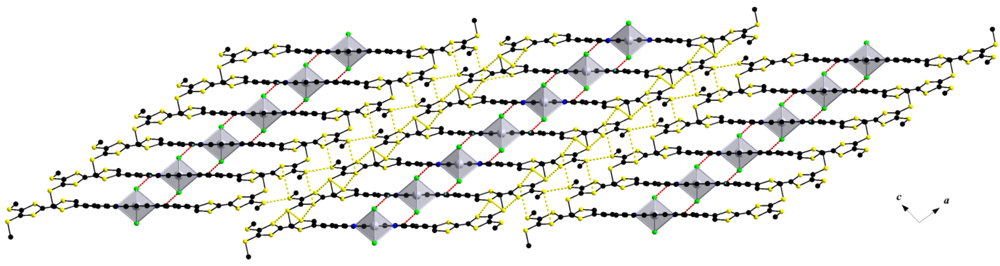
        <p>Within this supramolecular layer developed in the <italic>ab</italic> crystallographic plane, each of the three six-membered aromatic rings of the ligand are stacked in a face to face manner (centroid···centroid 3.56 Å) with two other rings forming the triads highlighted in <xref ref-type="fig" rid="crystals-02-00338-f005">Figure 5</xref>. The crystal packing (<xref ref-type="fig" rid="crystals-02-00338-f005">Figure 5</xref>) reveals a segregation between the TTF units and the rest of the molecule that can be associated with the presence of numerous sulfur-sulfur interactions (intralayer S···S: S2···S3 3.59 Å, S2···S6 3.66 Å, S4···S6 3.58 Å) reinforcing the above-mentioned layers but also connecting them into a 3D network (interlayer S···S: S3···S5 3.73 Å, S5···S5 3.30 Å). </p>
        <fig id="crystals-02-00338-f005" position="anchor">
          <label>Figure 5</label>
          <caption>
            <p>The crystal packing in <bold>4</bold> showing the non-conventional hydrogen bonds (red dashed lines) and S···S (yellow dashed lines) interactions.</p>
          </caption>
          <graphic xmlns:xlink="http://www.w3.org/1999/xlink" xlink:href="crystals-02-00338-g005.tif"/>
        </fig>
      </sec>
      <sec>
        <title>2.2. UV-Vis Spectroscopy</title>
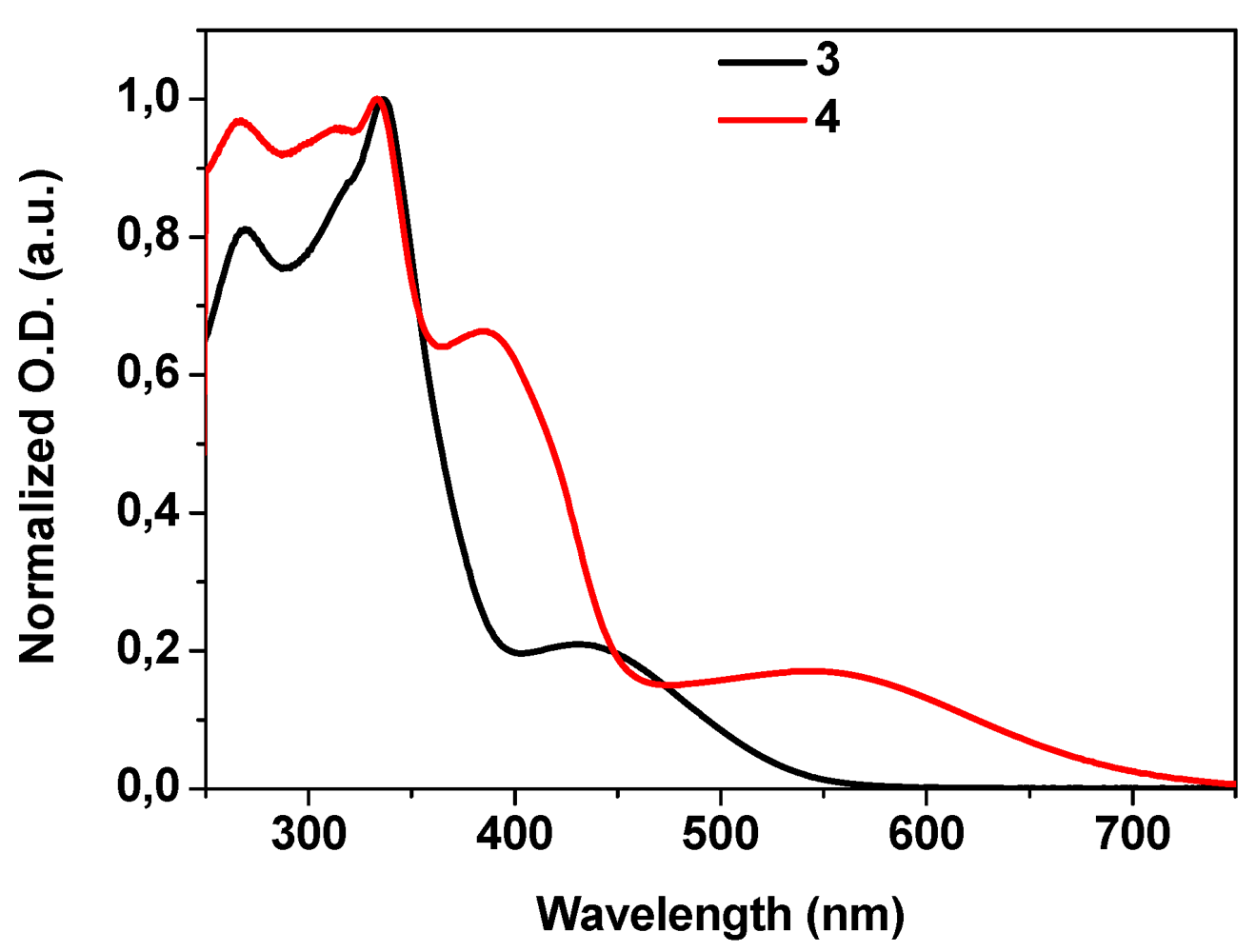
        <p>The electronic absorption spectra of the <bold>TTF<sub>2</sub>-BisIm-Py</bold> pincer (<bold>3</bold>) and of the <bold>[Zn(TTF<sub>2</sub>-BisIm-Py)</bold><bold> Cl<sub>2</sub>] </bold>(<bold>4</bold>) complex were recorded in dichloromethane solution (~2·10<sup>−</sup><sup>5</sup> M at room temperature; <xref ref-type="fig" rid="crystals-02-00338-f006">Figure 6</xref>). The <bold>TTF<sub>2</sub>-BisIm-Py</bold> pincer exhibits two strong electronic absorption bands at λ = 269 nm and 336 nm which are assigned to the π→π* absorption bands of the TTF and the phenyl ring. The broad band observed in the visible region at λ<sub>max</sub> = 433 nm is characteristic of the intramolecular charge transfer transition (ICT) from the highest occupied molecular orbital in the two TTFs to the lowest unoccupied molecular orbital in the electron-accepting pyridyl unit [<xref ref-type="bibr" rid="B20-crystals-02-00338">20</xref>,<xref ref-type="bibr" rid="B28-crystals-02-00338">28</xref>] and is responsible for the dark red color of this compound. Upon complexation of the pincer with zinc chloride (ZnCl<sub>2</sub>), the electronic absorption spectrum presents the same features as the free ligand in the high energy region (&lt;400 nm). However, the ICT transition is red shifted by about 80 nm indicating some effect on the electron acceptor behavior of this ligand upon complexation of zinc chloride. In addition, a shoulder (around 385 nm) is appearing, which is probably due to conformational change (all <italic>trans</italic> to all <italic>cis</italic>) of the pincer after complexation with zinc chloride.</p>
        <fig id="crystals-02-00338-f006" position="anchor">
          <label>Figure 6</label>
          <caption>
            <p>Electronic absorption spectra of the pincer <bold>3</bold> and the zinc complex <bold>4</bold>.</p>
          </caption>
          <graphic xmlns:xlink="http://www.w3.org/1999/xlink" xlink:href="crystals-02-00338-g006.tif"/>
        </fig>
      </sec>
      <sec>
        <title>2.3. Electrochemistry</title>
        <p>The electrochemical behaviors of the new pincer (<bold>3</bold>) and of the new complex (<bold>4</bold>) were examined by cyclic voltammetry (CV). The CV was performed in a three-electrode cell equipped with a platinum millielectrode, a platinum wire counter-electrode and a silver wire used as quasi-reference electrode. The electrochemical experiments were carried out under dry and oxygen-free atmosphere (H<sub>2</sub>O &lt; 1 ppm, O<sub>2</sub> &lt; 1 ppm) CH<sub>3</sub>CN (5.10<sup>−4</sup> M) with Bu<sub>4</sub>NPF<sub>6</sub> (TBAP) (0.1 M) as supporting electrolyte. The voltammograms were recorded on an EGG PAR 273A potentiostat with positive feedback compensation. Based on repetitive measurements, absolute errors on potentials were estimated around ±5 mV. </p>
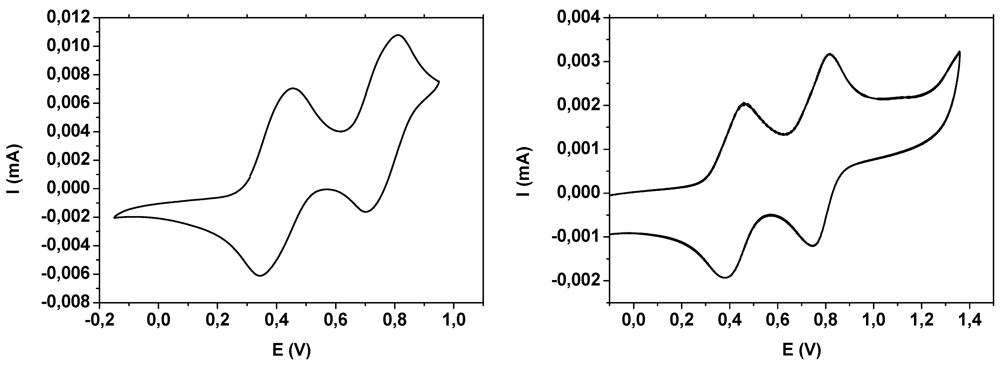
        <p>Cyclic voltammetry measurements (<xref ref-type="fig" rid="crystals-02-00338-f007">Figure 7</xref>) in the case of the pincer <bold>TTF<sub>2</sub>-BisIm-Py</bold> (<bold>3</bold>) show two reversible oxidations waves (at <italic>E</italic><sub>1/2</sub><sup>1</sup> = 0.400 V and <italic>E</italic><sub>1/2</sub><sup>2</sup> = 0.758 V <italic>vs</italic>. SCE). These potentials are anodically shifted from those of the free TTF (0.37 V <italic>vs.</italic> SCE) [1c)] because of the presence of the electrodeficient pyridine ring. The two oxidation bands, being broad, suggest very small differences between the oxidation potentials of the two TTF units present in the molecule. This behavior is similar to the one observed for <italic>bis</italic>(TTF) donors, described earlier by Avarvari <italic>et al</italic>. [<xref ref-type="bibr" rid="B29-crystals-02-00338">29</xref>], separated by a triazine ring.</p>
        <fig id="crystals-02-00338-f007" position="anchor">
          <label>Figure 7</label>
          <caption>
            <p>Cyclic voltammograms of both the pincer (<bold>3</bold>) (left) and of the zinc complex (<bold>4</bold>) (right) (2 × 10<sup>−5</sup> M) in CH<sub>3</sub>CN with <italic>n</italic>Bu<sub>4</sub>NPF<sub>6</sub> (0.1 M).</p>
          </caption>
          <graphic xmlns:xlink="http://www.w3.org/1999/xlink" xlink:href="crystals-02-00338-g007.tif"/>
        </fig>
        <p>After complexation, the oxidation potentials of the zinc metal complex (<bold>4</bold>) are slightly positively shifted (about 20 mV and 25 mV), suggesting that the zinc metal cation is affecting the oxidation potential of the TTF moieties by decreasing the electron density on the TTF units, a fact also suggested by the electronic absorption spectra. As a consequence of these electrochemical behaviors, we expect radical cation salts of both the TTF pincer and the corresponding zinc metal complex to form readily upon electrochemical oxidation into air-stable crystals [<xref ref-type="bibr" rid="B15-crystals-02-00338">15</xref>].</p>
      </sec>
    </sec>
    <sec>
      <title>3. Experimental Section</title>
      <sec>
        <title>3.1. X-Ray Structure Determinations</title>
        <p>Details about data collection and solution refinement are given in <xref ref-type="table" rid="crystals-02-00338-t002">Table 2</xref>. X-ray diffraction measurements were performed on a Bruker Kappa CCD diffractometer, operating with a Mo-Kα (<italic>λ</italic> = 0.71073 Å) X-ray tube with a graphite monochromator. The structures were solved (SHELXS-97) by direct methods and refined (SHELXL-97) by full matrix least-square procedures on <italic>F</italic><sup>2</sup>. All non-hydrogen atoms were refined anisotropically. Hydrogen atoms were introduced at calculated positions (riding model), included in structure factor calculations but not refined. CCDC reference number: 871185 for <bold>4</bold>. These data can be obtained free of charge from The Cambridge Crystallographic Data Centre via <uri>www.ccdc.cam.ac.uk/data_request/cif</uri>.</p>
        <table-wrap id="crystals-02-00338-t002" position="anchor">
          <object-id pub-id-type="pii">crystals-02-00338-t002_Table 2</object-id>
          <label>Table 2</label>
          <caption>
            <p>Crystal Data and Structure Refinement for compound <bold>4</bold>.</p>
          </caption>
                    <table>
            <thead>
              <tr>
                <th align="left" valign="middle">complex</th>
                <th align="center" valign="middle">4</th>
              </tr>
            </thead>
            <tbody>
              <tr>
                <td align="left" valign="middle">empirical formula </td>
                <td align="center" valign="middle">C<sub>35</sub>H<sub>27</sub>Cl<sub>2</sub>N<sub>3</sub>S<sub>12</sub>Zn</td>
              </tr>
              <tr>
                <td align="left" valign="middle">fw </td>
                <td align="center" valign="middle">1010.59</td>
              </tr>
              <tr>
                <td align="left" valign="middle"><italic>T</italic> (K) </td>
                <td align="center" valign="middle">293(2)</td>
              </tr>
              <tr>
                <td align="left" valign="middle">wavelength (Å)</td>
                <td align="center" valign="middle">0.71073</td>
              </tr>
              <tr>
                <td align="left" valign="middle">crystal system</td>
                <td align="center" valign="middle">monoclinic</td>
              </tr>
              <tr>
                <td align="left" valign="middle">space group </td>
                <td align="center" valign="middle">C2/c</td>
              </tr>
              <tr>
                <td align="left" valign="middle">unit cell dimensions:</td>
                <td align="center" valign="middle"> </td>
              </tr>
              <tr>
                <td align="left" valign="middle"><italic>a</italic> (Å) </td>
                <td align="center" valign="middle">11.8152(16)</td>
              </tr>
              <tr>
                <td align="left" valign="middle"><italic>b</italic> (Å) </td>
                <td align="center" valign="middle">10.100(2)</td>
              </tr>
              <tr>
                <td align="left" valign="middle"><italic>c</italic> (Å) </td>
                <td align="center" valign="middle">35.579(6)</td>
              </tr>
              <tr>
                <td align="left" valign="middle"><italic>α</italic>(deg) </td>
                <td align="center" valign="middle">90</td>
              </tr>
              <tr>
                <td align="left" valign="middle"><italic>β</italic>(deg) </td>
                <td align="center" valign="middle">98.111(13)</td>
              </tr>
              <tr>
                <td align="left" valign="middle"><italic>γ</italic>(deg) </td>
                <td align="center" valign="middle">90</td>
              </tr>
              <tr>
                <td align="left" valign="middle"><italic>V</italic> (Å<sup>3</sup>) </td>
                <td align="center" valign="middle">4202.2(12)</td>
              </tr>
              <tr>
                <td align="left" valign="middle">
                  <italic>Z</italic> 
                </td>
                <td align="center" valign="middle">4</td>
              </tr>
              <tr>
                <td align="left" valign="middle"><italic>D</italic><sub>c</sub> (g cm<sup>−3</sup>) </td>
                <td align="center" valign="middle">1.597</td>
              </tr>
              <tr>
                <td align="left" valign="middle">abs coeff (mm<sup>−1</sup>) </td>
                <td align="center" valign="middle">1.340</td>
              </tr>
              <tr>
                <td align="left" valign="middle"><italic>θ</italic> range for data collection (deg) </td>
                <td align="center" valign="middle">1.16–27.54</td>
              </tr>
              <tr>
                <td align="left" valign="middle">reflections collected </td>
                <td align="center" valign="middle">4760</td>
              </tr>
              <tr>
                <td align="left" valign="middle">indep reflns</td>
                <td align="center" valign="middle">3371</td>
              </tr>
              <tr>
                <td align="left" valign="middle">completeness (%) </td>
                <td align="center" valign="middle">98.5</td>
              </tr>
              <tr>
                <td align="left" valign="middle">data/restraints/param</td>
                <td align="center" valign="middle">4760/0/243</td>
              </tr>
              <tr>
                <td align="left" valign="middle">GOF on <italic>F</italic> <sup>2</sup></td>
                <td align="center" valign="middle">1.197</td>
              </tr>
              <tr>
                <td align="left" valign="middle">final <italic>R</italic> indices [<italic>I</italic> &gt; 2<italic>σ</italic>(<italic>I</italic>)] </td>
                <td align="center" valign="middle"><italic>R</italic>1 = 0.0597, <italic>wR</italic>2 = 0.1051</td>
              </tr>
              <tr>
                <td align="left" valign="middle"><italic>R</italic> indices (all data) </td>
                <td align="center" valign="middle"><italic>R</italic>1 = 0.0968, <italic>wR</italic>2 = 0.1227</td>
              </tr>
              <tr>
                <td align="left" valign="middle">largest diff. peak and hole (e Å<sup>−3</sup>) </td>
                <td align="center" valign="middle">0.394 and −0.416</td>
              </tr>
            </tbody>
          </table>
        </table-wrap>
      </sec>
      <sec>
        <title>3.2. General</title>
        <p>All the reactions were carried out under Argon and using HPLC solvents. Nuclear magnetic resonance spectra were recorded on a Bruker Avance DRX 500 spectrometer (operating at 500.04 MHz for 1H and 125 MHz for <sup>13</sup>C) and Bruker Avance DRX 300 automatic spectrometer (operating at 300 MHz for 1H, and 75 MHz for <sup>13</sup>C). Chemical shifts are expressed in parts per million (ppm) downfield from external TMS. The following abbreviations are used: s, singlet; d, doublet; t, triplet. MALDI- TOF MS spectra were recorded on Bruker Biflex-IIITM apparatus, equipped with a 337 nm N2 laser. Elemental analyses were recorded using a Flash 2000 Fisher Scientific Thermo Electron analyzer. </p>
      </sec>
      <sec>
        <title>3.3. Synthesis of (1-(6,7-Dimethyldithio-tétrathiafulvalene)-4-nitro-benzene) (1)</title>
        <p>1-Iodo-4-nitro-benzene (0.44 g, 1.78 mmol), 4-(trimethylstannyl)-4',5'-bis(methylthio)-tetrathiafulvalene (0.98 g, 2.14 mmol), and Pd(PPh<sub>3</sub>)<sub>4</sub> as catalyst (10% mmol) were mixed in 40 mL of dry toluene and refluxed overnight under argon. The mixture was filtered over Celite and silica, washed with toluene and dichloromethane and dried under vacuum. The residue was purified by column chromatography (pentane/dichloromethane 1/1) to give 0.50 g of dark blue solid, yield: 67%. <sup>1</sup>H-NMR (300 MHz, CDCl<sub>3</sub>) <italic>δ</italic>/ppm: 8.22 (d, 2H, <italic>J</italic><sup>3</sup> = 9 Hz), 7.53 (d, 2H, <italic>J</italic><sup>3</sup> = 9 Hz), 6.78 (s, 1H), 2.45 (s, 3H), 2.44 (s, 3H); <sup>13</sup>C-NMR (75 MHz, CDCl<sub>3</sub>) <italic>δ</italic>/ppm: 147.0, 138.0, 133.7, 127.7, 126.6, 124.3, 118.3, 112.2, 109.6, 19.2; MS (MALDI-TOF): <italic>m/z</italic>: 416.9 (<italic>M</italic><sub>th</sub> = 416.91) </p>
      </sec>
      <sec>
        <title>3.4. Synthesis of (4-(6,7-Dimethyldithio-tétrathiafulvalene)-aniline) (2)</title>
        <p>To a solution of compound <bold>1</bold> (0.25 g, 0.59 mmol in 20 mL ethanol), Sn (0.14 g, 1.2 mmol) and HCl 35% (0.31 mL) were added and the mixture was refluxed for 4 h under argon. After the removal of the solvent, the crude was solubilised in ethyl acetate and washed several times with a NaOH solution (1 M) and water. The residue was purified by column chromatography with dichloromethane as eluent to give 0.23 g of an orange solid, yield: 99%. <sup>1</sup>H-NMR (300 MHz, CDCl<sub>3</sub>) <italic>δ</italic>/ppm: 7.18 (d, 2H, <italic>J</italic><sup>3</sup> = 8.7 Hz), 6.62 (d, 2H, <italic>J</italic><sup>3</sup> = 8.4 Hz), 6.26 (s, 1H), 3.79 (broad s, 2H) 2.44 (s, 3H), 2.43 (s, 3H); <sup>13</sup>C-NMR (75 MHz, CDCl<sub>3</sub>) <italic>δ</italic>/ppm:146.9, 136.2, 127.6, 127.5, 122.8, 115.4, 114.9, 109.4, 106.3, 29.7, 19.2; MS (MALDI-TOF): <italic>m/z</italic>: 386.9 (<italic>M</italic><sub>th</sub> = 386.94). </p>
      </sec>
      <sec>
        <title>3.5. (2,6-<italic>Bis</italic>(4-(4',5'-<italic>bis</italic>(Methylthio)-[2,2'-bi(1,3-dithiolylidene)]-4-yl)aniline)-iminopyridine) (3)</title>
        <p>Compound <bold>2</bold> (0.115 g, 0.3 mmol) was solubilised in 50 mL ethanol, 2,6-Pyridinedicarboxaldehyde (0.019 g, 0.14 mmol) was added, followed by 3 drops of acetic acid and the mixture was refluxed overnight. After cooling the reaction, a red precipitate was formed which was filtered, washed with additional ethanol and dried to afford 116 mg of a red solid, yield: 94%. <sup>1</sup>H-NMR (300 MHz, CDCl<sub>3</sub>) <italic>δ</italic>/ppm: 8.67 (s, 2H), 8.29 (d, 2H, <italic>J</italic><sup>3</sup> = 7.7 Hz), 7.95 (t, 1H, <italic>J</italic><sup>3</sup> = 7.7 Hz), 7.46 (d, 4H, <italic>J</italic><sup>3</sup> = 8.4 Hz), 7.31 (d, 4H, <italic>J</italic><sup>3</sup> = 8.4 Hz), 6.55 (s, 2H), 2.45 (s, 6H), 2.44 (s, 6H); <sup>13</sup>C-NMR (75 MHz, CDCl<sub>3</sub>) <italic>δ</italic>/ppm:160.2, 154.4, 150.6, 135.4, 130.9, 127.2, 123.5, 121.7, 113.2, 19.2; <italic>λ</italic><sub>max</sub>(CH<sub>2</sub>Cl<sub>2</sub>)/nm 269 (<italic>ε</italic>/dm<sup>3</sup> mol<sup>−</sup><sup>1</sup> cm<sup>−</sup><sup>1</sup> 49260), 336 (60870), 433 (12670). Selected IR bands (cm<sup>−1</sup>): 2916, 1621, 1567, 1454, 1411, 1212, 958, 835, 769. MS (MALDI-TOF): <italic>m/z</italic>: 873.6 (<italic>M</italic><sub>th</sub> = 872.89).</p>
      </sec>
      <sec>
        <title>3.6. (2,6-<italic>Bis</italic>(4-(4',5'-<italic>bis</italic>(methylthio)-[2,2'-bi(1,3-dithiolylidene)]-4-yl)aniline)-iminopyridine) Zinc Chloride (4)</title>
        <p>In a test tube, a solution of the pincer <bold>3</bold> (20 mg, 0.023 mmol) in CH<sub>2</sub>Cl<sub>2</sub> (5 mL) was mixed with a solution of ZnCl<sub>2</sub> (3.1 mg, 0.023 mmol) in CH<sub>3</sub>CN (3 mL) and ultrasonicated for 2 min. On top of the resulting solution a layer of 1:1 diethyl-ether mixture was added which led to the formation of good quality single crystals of complex <bold>3</bold> after 1 week. Yield: 18 mg (77%). <italic>λ</italic><sub>max</sub>(CH<sub>2</sub>Cl<sub>2</sub>)/nm 267 (<italic>ε</italic>/dm<sup>3</sup> mol<sup>−</sup><sup>1</sup> cm<sup>−</sup><sup>1</sup> 40750), 333 (42040), 385 sh, 550 (7290). Selected IR bands (cm<sup>−1</sup>): 2916, 1622, 1568, 1457, 1418, 1215, 966, 888, 773. </p>
      </sec>
    </sec>
    <sec sec-type="conclusions">
      <title>4. Conclusions</title>
      <p>As a first step towards the realization of multifunctional materials, a new TTF based pincer has been synthesized and its chelating ability has been investigated in respect to transition metal cations such as Zn(II). The crystal structure of the newly prepared electroactive zinc complex reveals that the TTF is neutral and the zinc cation is pentacoordinated. The two chlorines are involved in a set of hydrogen bonds giving rise to a 2D supramolecular grid arrangement. The electrochemical behavior of both the ligand and the neutral metal complex suggests that these compounds are useful candidates for the preparation of chemically and/or electrochemically oxidized radical cation crystalline salts. Further studies will be performed in order to investigate the complexation ability of this novel electroactive pincer on other metal cations such as Cu(II), Fe(II), Co(II), <italic>etc</italic>. </p>
    </sec>
    
  </body>
  <back>
   <ack>
      <title>Acknowledgments</title>
      <p>Financial support from the CNRS, the University of Angers, the Region Pays de la Loire (grant for D.B.) and from the National Agency for Research (ANR, Project 09-BLAN-0045-01) is gratefully acknowledged. ERASMUS program exchange (between University of Angers and Technical Military Academy of Bucharest) is also acknowledged (grant for G.N.). </p>
    </ack>
    <notes>
      <title>Conflict of Interest</title>
      <p>The authors declare no conflict of interest. </p>
    </notes>
    <ref-list>
      <title>References</title>
      <ref id="B1-crystals-02-00338">
        <label>1.</label>
        <citation citation-type="book">
          <person-group person-group-type="author">
            <name>
              <surname>Williams</surname>
              <given-names>J.M.</given-names>
            </name>
            <name>
              <surname>Ferraro</surname>
              <given-names>J.R.</given-names>
            </name>
            <name>
              <surname>Thorn</surname>
              <given-names>R.J.</given-names>
            </name>
            <name>
              <surname>Carlson</surname>
              <given-names>K.D.</given-names>
            </name>
            <name>
              <surname>Geiser</surname>
              <given-names>U.</given-names>
            </name>
            <name>
              <surname>Wang</surname>
              <given-names>H.H.</given-names>
            </name>
            <name>
              <surname>Kini</surname>
              <given-names>A.M.</given-names>
            </name>
            <name>
              <surname>Whangbo</surname>
              <given-names>M.-H.</given-names>
            </name>
          </person-group>
          <source>Organic Superconductors (Including Fullerenes), Synthesis, Structure, Properties and Theory</source>
          <publisher-name>Prentice Hall</publisher-name>
          <publisher-loc>Upper Saddle River, NJ, USA</publisher-loc>
          <year>1992</year>
        </citation>
      </ref>
      <ref id="B2-crystals-02-00338">
        <label>2.</label>
        <citation citation-type="journal">
          <person-group person-group-type="author">
            <name>
              <surname>Bryce</surname>
              <given-names>M.R.</given-names>
            </name>
            <name>
              <surname>Murphy</surname>
              <given-names>L.C.</given-names>
            </name>
          </person-group>
          <article-title>Organic metals</article-title>
          <source>Nature</source>
          <year>1984</year>
          <volume>309</volume>
          <fpage>119</fpage>
          <lpage>126</lpage>
        <pub-id pub-id-type="doi">10.1038/309119a0</pub-id></citation>
      </ref>
      <ref id="B3-crystals-02-00338">
        <label>3.</label>
        <citation citation-type="journal">
          <person-group person-group-type="author">
            <name>
              <surname>Segura</surname>
              <given-names>J.L.</given-names>
            </name>
            <name>
              <surname>Martin</surname>
              <given-names>N.</given-names>
            </name>
          </person-group>
          <article-title>New concepts in tetrathiafulvalene chemistry</article-title>
          <source>Angew. Chem. Int. Ed.</source>
          <year>2001</year>
          <volume>40</volume>
          <fpage>1372</fpage>
          <lpage>1409</lpage>
          <pub-id pub-id-type="doi">10.1002/1521-3773(20010417)40:8&lt;1372::AID-ANIE1372&gt;3.0.CO;2-I</pub-id>
        </citation>
      </ref>
      <ref id="B4-crystals-02-00338">
        <label>4.</label>
        <citation citation-type="journal">
          <person-group person-group-type="author">
            <name>
              <surname>Coronado</surname>
              <given-names>E.</given-names>
            </name>
            <name>
              <surname>Galan-Marcos</surname>
              <given-names>J.R.</given-names>
            </name>
            <name>
              <surname>Gomez-Garcia</surname>
              <given-names>C.J.</given-names>
            </name>
            <name>
              <surname>Laukhin</surname>
              <given-names>V.</given-names>
            </name>
          </person-group>
          <article-title>Coexistence of ferromagnetism and metallic conductivity in a molecule-based layered compound</article-title>
          <source>Nature</source>
          <year>2000</year>
          <volume>408</volume>
          <fpage>447</fpage>
          <lpage>449</lpage>
        <pub-id pub-id-type="doi">10.1038/35044035</pub-id><pub-id pub-id-type="pmid">11100721</pub-id></citation>
      </ref>
      <ref id="B5-crystals-02-00338">
        <label>5.</label>
        <citation citation-type="journal">
          <person-group person-group-type="author">
            <name>
              <surname>Coronado</surname>
              <given-names>E.</given-names>
            </name>
            <name>
              <surname>Day</surname>
              <given-names>P.</given-names>
            </name>
          </person-group>
          <article-title>Magnetic molecular conductors</article-title>
          <source>Chem. Rev.</source>
          <year>2004</year>
          <volume>104</volume>
          <fpage>5419</fpage>
          <lpage>5448</lpage>
          <pub-id pub-id-type="doi">10.1021/cr030641n</pub-id>
        </citation>
      </ref>
      <ref id="B6-crystals-02-00338">
        <label>6.</label>
        <citation citation-type="journal">
          <person-group person-group-type="author">
            <name>
              <surname>Lorcy</surname>
              <given-names>D.</given-names>
            </name>
            <name>
              <surname>Bellec</surname>
              <given-names>N.</given-names>
            </name>
            <name>
              <surname>Fourmigué</surname>
              <given-names>M.</given-names>
            </name>
            <name>
              <surname>Avarvari</surname>
              <given-names>N.</given-names>
            </name>
          </person-group>
          <article-title>Tetrathiafulvalene-based group XV ligands: Synthesis, coordination chemistry and radical cation salts</article-title>
          <source>Coord. Chem. Rev.</source>
          <year>2009</year>
          <volume>253</volume>
          <fpage>1398</fpage>
          <lpage>1438</lpage>
        <pub-id pub-id-type="doi">10.1016/j.ccr.2008.09.012</pub-id></citation>
      </ref>
      <ref id="B7-crystals-02-00338">
        <label>7.</label>
        <citation citation-type="journal">
          <person-group person-group-type="author">
            <name>
              <surname>Avarvari</surname>
              <given-names>N.</given-names>
            </name>
            <name>
              <surname>Martin</surname>
              <given-names>D.</given-names>
            </name>
            <name>
              <surname>Fourmigué</surname>
              <given-names>M.</given-names>
            </name>
          </person-group>
          <article-title>Structural and electrochemical study of metal carbonyl complexes with chelating <italic>bis</italic>- and tetrakis(diphenylphosphino)tetrathiafulvalenes</article-title>
          <source>J. Organomet. Chem.</source>
          <year>2002</year>
          <volume>643/644</volume>
          <fpage>292</fpage>
          <lpage>300</lpage>
        <pub-id pub-id-type="doi">10.1016/S0022-328X(01)01249-9</pub-id></citation>
      </ref>
      <ref id="B8-crystals-02-00338">
        <label>8.</label>
        <citation citation-type="journal">
          <person-group person-group-type="author">
            <name>
              <surname>Pellon</surname>
              <given-names>P.</given-names>
            </name>
            <name>
              <surname>Gachot</surname>
              <given-names>G.</given-names>
            </name>
            <name>
              <surname>Le Bris</surname>
              <given-names>J.</given-names>
            </name>
            <name>
              <surname>Marchin</surname>
              <given-names>S.</given-names>
            </name>
            <name>
              <surname>Carlier</surname>
              <given-names>R.</given-names>
            </name>
            <name>
              <surname>Lorcy</surname>
              <given-names>D.</given-names>
            </name>
          </person-group>
          <article-title>Complexing ability of the versatile, redox-active, 3-[3-(Diphenylphosphino)propylthio]-3',4,4'-trimethyl-tetrathiafulvalene Ligand</article-title>
          <source>Inorg. Chem.</source>
          <year>2003</year>
          <volume>42</volume>
          <fpage>2056</fpage>
          <lpage>2060</lpage>
          <pub-id pub-id-type="doi">10.1021/ic026186f</pub-id>
        </citation>
      </ref>
      <ref id="B9-crystals-02-00338">
        <label>9.</label>
        <citation citation-type="journal">
          <person-group person-group-type="author">
            <name>
              <surname>Avarvari</surname>
              <given-names>N.</given-names>
            </name>
            <name>
              <surname>Fourmigué</surname>
              <given-names>M.</given-names>
            </name>
          </person-group>
          <article-title>First radical cation salt of a tetrathiafulvalene-based phosphine metal complex</article-title>
          <source>Chem. Commun.</source>
          <year>2004</year>
          <volume>2</volume>
          <fpage>1300</fpage>
          <lpage>1301</lpage>
          <pub-id pub-id-type="doi">10.1039/b403168g</pub-id>
        </citation>
      </ref>
      <ref id="B10-crystals-02-00338">
        <label>10.</label>
        <citation citation-type="journal">
          <person-group person-group-type="author">
            <name>
              <surname>Réthoré</surname>
              <given-names>C.</given-names>
            </name>
            <name>
              <surname>Fourmigué</surname>
              <given-names>M.</given-names>
            </name>
            <name>
              <surname>Avarvari</surname>
              <given-names>N.</given-names>
            </name>
          </person-group>
          <article-title>Tetrathiafulvalene based phosphino-oxazolines: A new family of redox active chiral ligands</article-title>
          <source>Chem. Commun.</source>
          <year>2004</year>
          <volume>34</volume>
          <fpage>1384</fpage>
          <lpage>1385</lpage>
        </citation>
      </ref>
      <ref id="B11-crystals-02-00338">
        <label>11.</label>
        <citation citation-type="journal">
          <person-group person-group-type="author">
            <name>
              <surname>Devic</surname>
              <given-names>T.</given-names>
            </name>
            <name>
              <surname>Batail</surname>
              <given-names>P.</given-names>
            </name>
            <name>
              <surname>Fourmigué</surname>
              <given-names>M.</given-names>
            </name>
            <name>
              <surname>Avarvari</surname>
              <given-names>N.</given-names>
            </name>
          </person-group>
          <article-title>Unexpected reactivity of PdCl<sub>2</sub> and PtCl<sub>2</sub> complexes of the unsaturated diphosphine <italic>o</italic>-Me<sub>2</sub>TTF(PPh<sub>2</sub>)<sub>2</sub> towards chloride abstraction with thallium triflate</article-title>
          <source>Inorg. Chem.</source>
          <year>2004</year>
          <volume>43</volume>
          <fpage>3136</fpage>
          <lpage>3141</lpage>
        <pub-id pub-id-type="doi">10.1021/ic035447y</pub-id><pub-id pub-id-type="pmid">15132619</pub-id></citation>
      </ref>
      <ref id="B12-crystals-02-00338">
        <label>12.</label>
        <citation citation-type="journal">
          <person-group person-group-type="author">
            <name>
              <surname>Gouverd</surname>
              <given-names>C.</given-names>
            </name>
            <name>
              <surname>Biaso</surname>
              <given-names>F.</given-names>
            </name>
            <name>
              <surname>Cataldo</surname>
              <given-names>L.</given-names>
            </name>
            <name>
              <surname>Berclaz</surname>
              <given-names>T.</given-names>
            </name>
            <name>
              <surname>Geoffroy</surname>
              <given-names>M.</given-names>
            </name>
            <name>
              <surname>Levillain</surname>
              <given-names>E.</given-names>
            </name>
            <name>
              <surname>Avarvari</surname>
              <given-names>N.</given-names>
            </name>
            <name>
              <surname>Fourmigué</surname>
              <given-names>M.</given-names>
            </name>
            <name>
              <surname>Sauvage</surname>
              <given-names>F.X.</given-names>
            </name>
            <name>
              <surname>Wartelle</surname>
              <given-names>C.</given-names>
            </name>
          </person-group>
          <article-title>Tetrathiafulvalene–phosphine-based iron and ruthenium carbonyl complexes: Electrochemical and EPR studies</article-title>
          <source>Phys. Chem. Chem. Phys.</source>
          <year>2005</year>
          <volume>7</volume>
          <fpage>85</fpage>
          <lpage>93</lpage>
        <pub-id pub-id-type="doi">10.1039/b409958c</pub-id><pub-id pub-id-type="pmid">19785176</pub-id></citation>
      </ref>
      <ref id="B13-crystals-02-00338">
        <label>13.</label>
        <citation citation-type="journal">
          <person-group person-group-type="author">
            <name>
              <surname>Kobayashi</surname>
              <given-names>A.</given-names>
            </name>
            <name>
              <surname>Fujiwara</surname>
              <given-names>E.</given-names>
            </name>
            <name>
              <surname>Kobayashi</surname>
              <given-names>H.</given-names>
            </name>
          </person-group>
          <article-title>Single-component molecular metals with extended-TTF dithiolateligands</article-title>
          <source>Chem. Rev.</source>
          <year>2004</year>
          <volume>104</volume>
          <fpage>5243</fpage>
          <lpage>5264</lpage>
          <pub-id pub-id-type="doi">10.1021/cr030656l</pub-id>
        </citation>
      </ref>
      <ref id="B14-crystals-02-00338">
        <label>14.</label>
        <citation citation-type="journal">
          <person-group person-group-type="author">
            <name>
              <surname>Massue</surname>
              <given-names>J.</given-names>
            </name>
            <name>
              <surname>Bellec</surname>
              <given-names>N.</given-names>
            </name>
            <name>
              <surname>Chopin</surname>
              <given-names>S.</given-names>
            </name>
            <name>
              <surname>Levillain</surname>
              <given-names>E.</given-names>
            </name>
            <name>
              <surname>Roisnel</surname>
              <given-names>T.</given-names>
            </name>
            <name>
              <surname>Clérac</surname>
              <given-names>R.</given-names>
            </name>
            <name>
              <surname>Lorcy</surname>
              <given-names>D.</given-names>
            </name>
          </person-group>
          <article-title>Electroactiveligands:  The first metal complexes of tetrathiafulvenyl−acetylacetonate</article-title>
          <source>Inorg. Chem.</source>
          <year>2005</year>
          <volume>44</volume>
          <fpage>8740</fpage>
          <lpage>8748</lpage>
        <pub-id pub-id-type="doi">10.1021/ic051017r</pub-id><pub-id pub-id-type="pmid">16296828</pub-id></citation>
      </ref>
      <ref id="B15-crystals-02-00338">
        <label>15.</label>
        <citation citation-type="journal">
          <person-group person-group-type="author">
            <name>
              <surname>Setifi</surname>
              <given-names>F.</given-names>
            </name>
            <name>
              <surname>Ouahab</surname>
              <given-names>L.</given-names>
            </name>
            <name>
              <surname>Golhen</surname>
              <given-names>S.</given-names>
            </name>
            <name>
              <surname>Yoshida</surname>
              <given-names>Y.</given-names>
            </name>
            <name>
              <surname>Saito</surname>
              <given-names>G.</given-names>
            </name>
          </person-group>
          <article-title>First radical cation salt of paramagnetic transition metal complex containing TTF as ligand, [Cu<sup>II</sup>(hfac)<sub>2</sub>(TTF-py)<sub>2</sub>](PF<sub>6</sub>)·2CH<sub>2</sub>Cl<sub>2</sub> (hfac = Hexafluoroacetylacetonate and TTF-py = 4-(2-Tetrathiafulvalenyl-ethenyl)pyridine)</article-title>
          <source>Inorg. Chem.</source>
          <year>2003</year>
          <volume>42</volume>
          <fpage>1791</fpage>
          <lpage>1793</lpage>
        <pub-id pub-id-type="doi">10.1021/ic026211h</pub-id><pub-id pub-id-type="pmid">12639109</pub-id></citation>
      </ref>
      <ref id="B16-crystals-02-00338">
        <label>16.</label>
        <citation citation-type="journal">
          <person-group person-group-type="author">
            <name>
              <surname>Liu</surname>
              <given-names>S.-X.</given-names>
            </name>
            <name>
              <surname>Dolder</surname>
              <given-names>S.</given-names>
            </name>
            <name>
              <surname>Franz</surname>
              <given-names>P.</given-names>
            </name>
            <name>
              <surname>Neels</surname>
              <given-names>A.</given-names>
            </name>
            <name>
              <surname>Stoeckli-Evans</surname>
              <given-names>H.</given-names>
            </name>
            <name>
              <surname>Decurtins</surname>
              <given-names>S.</given-names>
            </name>
          </person-group>
          <article-title>Structural studies of transition metal complexes with 4,5-<italic>Bis</italic>(2-pyridylmethylsulfanyl)-4',5'-ethylenedithiotetrathiafulvalene:  Probing their potential for the construction of multifunctional molecular assemblies</article-title>
          <source>Inorg. Chem.</source>
          <year>2003</year>
          <volume>42</volume>
          <fpage>4801</fpage>
          <lpage>4803</lpage>
        <pub-id pub-id-type="doi">10.1021/ic034348h</pub-id><pub-id pub-id-type="pmid">12895099</pub-id></citation>
      </ref>
      <ref id="B17-crystals-02-00338">
        <label>17.</label>
        <citation citation-type="journal">
          <person-group person-group-type="author">
            <name>
              <surname>Devic</surname>
              <given-names>T.</given-names>
            </name>
            <name>
              <surname>Avarvari</surname>
              <given-names>N.</given-names>
            </name>
            <name>
              <surname>Batail</surname>
              <given-names>P.</given-names>
            </name>
          </person-group>
          <article-title>A series of redox active, tetrathiafulvalene-based amidopyridines and bipyridinesligands: Syntheses, crystal structures, a radical cation salt and group 10 transition-metal complexes</article-title>
          <source>Chem. Eur. J.</source>
          <year>2004</year>
          <volume>10</volume>
          <fpage>3697</fpage>
          <lpage>3707</lpage>
          <pub-id pub-id-type="doi">10.1002/chem.200305776</pub-id>
        </citation>
      </ref>
      <ref id="B18-crystals-02-00338">
        <label>18.</label>
        <citation citation-type="journal">
          <person-group person-group-type="author">
            <name>
              <surname>Devic</surname>
              <given-names>T.</given-names>
            </name>
            <name>
              <surname>Rondeau</surname>
              <given-names>D.</given-names>
            </name>
            <name>
              <surname>Şahin</surname>
              <given-names>Y.</given-names>
            </name>
            <name>
              <surname>Levillain</surname>
              <given-names>E.</given-names>
            </name>
            <name>
              <surname>Clérac</surname>
              <given-names>R.</given-names>
            </name>
            <name>
              <surname>Batail</surname>
              <given-names>P.</given-names>
            </name>
            <name>
              <surname>Avarvari</surname>
              <given-names>N.</given-names>
            </name>
          </person-group>
          <article-title>Copper(I/II) complexes of a <italic>bis</italic>(tetrathiafulvalene)-2,2'-bipyridine: Synthesis, characterization, magnetic and electrochemical properties</article-title>
          <source>Dalton Trans.</source>
          <year>2006</year>
          <volume>10</volume>
          <fpage>1331</fpage>
          <lpage>1337</lpage>
        <pub-id pub-id-type="pmid">16505912</pub-id></citation>
      </ref>
      <ref id="B19-crystals-02-00338">
        <label>19.</label>
        <citation citation-type="journal">
          <person-group person-group-type="author">
            <name>
              <surname>Hervé</surname>
              <given-names>K.</given-names>
            </name>
            <name>
              <surname>Liu</surname>
              <given-names>S.-X.</given-names>
            </name>
            <name>
              <surname>Cador</surname>
              <given-names>O.</given-names>
            </name>
            <name>
              <surname>Golhen</surname>
              <given-names>S.</given-names>
            </name>
            <name>
              <surname>le Gal</surname>
              <given-names>Y.</given-names>
            </name>
            <name>
              <surname>Bousseksou</surname>
              <given-names>A.</given-names>
            </name>
            <name>
              <surname>Stoeckli-Evans</surname>
              <given-names>H.</given-names>
            </name>
            <name>
              <surname>Decurtins</surname>
              <given-names>S.</given-names>
            </name>
            <name>
              <surname>Ouahab</surname>
              <given-names>L.</given-names>
            </name>
          </person-group>
          <article-title>Synthesis of a BEDT-TTF bipyridine organic donor and the first FeII coordination complex with a redox-active ligand</article-title>
          <source>Eur. J. Inorg. Chem.</source>
          <year>2006</year>
          <volume>2006</volume>
          <fpage>3498</fpage>
          <lpage>3502</lpage>
        </citation>
      </ref>
      <ref id="B20-crystals-02-00338">
        <label>20.</label>
        <citation citation-type="journal">
          <person-group person-group-type="author">
            <name>
              <surname>Chahma</surname>
              <given-names>M.</given-names>
            </name>
            <name>
              <surname>Hassan</surname>
              <given-names>N.</given-names>
            </name>
            <name>
              <surname>Alberola</surname>
              <given-names>A.</given-names>
            </name>
            <name>
              <surname>Stoeckli-Evans</surname>
              <given-names>H.</given-names>
            </name>
            <name>
              <surname>Pilkington</surname>
              <given-names>M.</given-names>
            </name>
          </person-group>
          <article-title>Preparation and coordination complex of the first imine-bridged tetrathiafulvalene–pyridine donor ligand</article-title>
          <source>Inorg. Chem.</source>
          <year>2007</year>
          <volume>46</volume>
          <fpage>3807</fpage>
          <lpage>3809</lpage>
          <pub-id pub-id-type="doi">10.1021/ic062257p</pub-id>
        </citation>
      </ref>
      <ref id="B21-crystals-02-00338">
        <label>21.</label>
        <citation citation-type="journal">
          <person-group person-group-type="author">
            <name>
              <surname>Qin</surname>
              <given-names>J.</given-names>
            </name>
            <name>
              <surname>Qian</surname>
              <given-names>C.-X.</given-names>
            </name>
            <name>
              <surname>Zhou</surname>
              <given-names>N.</given-names>
            </name>
            <name>
              <surname>Zhu</surname>
              <given-names>R.-M.</given-names>
            </name>
            <name>
              <surname>Li</surname>
              <given-names>Y.-Z.</given-names>
            </name>
            <name>
              <surname>Zuo</surname>
              <given-names>J.-L.</given-names>
            </name>
            <name>
              <surname>You</surname>
              <given-names>X.-Z.</given-names>
            </name>
          </person-group>
          <article-title>Metal complexes based on tetrathiafulvalene-fused π-extended schiff base ligands—Syntheses, characterization, and properties</article-title>
          <source>Eur. J. Inorg. Chem.</source>
          <year>2012</year>
          <fpage>234</fpage>
          <lpage>245</lpage>
        </citation>
      </ref>
      <ref id="B22-crystals-02-00338">
        <label>22.</label>
        <citation citation-type="journal">
          <person-group person-group-type="author">
            <name>
              <surname>Wu</surname>
              <given-names>J.-C.</given-names>
            </name>
            <name>
              <surname>Liu</surname>
              <given-names>S.-X.</given-names>
            </name>
            <name>
              <surname>Keene</surname>
              <given-names>T.D.</given-names>
            </name>
            <name>
              <surname>Neels</surname>
              <given-names>A.</given-names>
            </name>
            <name>
              <surname>Mereacre</surname>
              <given-names>V.</given-names>
            </name>
            <name>
              <surname>Powell</surname>
              <given-names>A.K.</given-names>
            </name>
            <name>
              <surname>Decurtins</surname>
              <given-names>S.</given-names>
            </name>
          </person-group>
          <article-title>Coordination chemistry of a π-extended, rigid and redox-active tetrathiafulvalene-fused schiff-base ligand</article-title>
          <source>Inorg. Chem.</source>
          <year>2008</year>
          <volume>47</volume>
          <fpage>3452</fpage>
          <lpage>3459</lpage>
          <pub-id pub-id-type="doi">10.1021/ic800138x</pub-id>
        </citation>
      </ref>
      <ref id="B23-crystals-02-00338">
        <label>23.</label>
        <citation citation-type="journal">
          <person-group person-group-type="author">
            <name>
              <surname>Britovsek</surname>
              <given-names>G.J.P.</given-names>
            </name>
            <name>
              <surname>Gibson</surname>
              <given-names>V.C.</given-names>
            </name>
            <name>
              <surname>Kimberley</surname>
              <given-names>B.S.</given-names>
            </name>
            <name>
              <surname>Maddox</surname>
              <given-names>P.J.</given-names>
            </name>
            <name>
              <surname>McTavish</surname>
              <given-names>S.J.</given-names>
            </name>
            <name>
              <surname>Solan</surname>
              <given-names>G.A.</given-names>
            </name>
            <name>
              <surname>White</surname>
              <given-names>A.J.P.</given-names>
            </name>
            <name>
              <surname>Williams</surname>
              <given-names>D.J.</given-names>
            </name>
          </person-group>
          <article-title>Novel olefin polymerization catalysts based on iron and cobalt</article-title>
          <source>Chem. Commun.</source>
          <year>1998</year>
          <fpage>849</fpage>
          <lpage>850</lpage>
        </citation>
      </ref>
      <ref id="B24-crystals-02-00338">
        <label>24.</label>
        <citation citation-type="journal">
          <person-group person-group-type="author">
            <name>
              <surname>Small</surname>
              <given-names>B.L.</given-names>
            </name>
            <name>
              <surname>Brookhart</surname>
              <given-names>M.</given-names>
            </name>
            <name>
              <surname>Bennett</surname>
              <given-names>A.M.A.</given-names>
            </name>
          </person-group>
          <article-title>Highly active iron and cobalt catalysts for the polymerization of ethylene</article-title>
          <source>J. Am. Chem. Soc.</source>
          <year>1998</year>
          <volume>120</volume>
          <fpage>4049</fpage>
          <lpage>4050</lpage>
        <pub-id pub-id-type="doi">10.1021/ja9802100</pub-id></citation>
      </ref>
      <ref id="B25-crystals-02-00338">
        <label>25.</label>
        <citation citation-type="journal">
          <person-group person-group-type="author">
            <name>
              <surname>Iyoda</surname>
              <given-names>M.</given-names>
            </name>
            <name>
              <surname>Hara</surname>
              <given-names>K.</given-names>
            </name>
            <name>
              <surname>Kuwatani</surname>
              <given-names>Y.</given-names>
            </name>
            <name>
              <surname>Nagase</surname>
              <given-names>S.</given-names>
            </name>
          </person-group>
          <article-title>Helical tetrathiafulvalene oligomers. Synthesis and properties of Bi-, Ter-, and quatertetrathiafulvalenes</article-title>
          <source>Org. Lett.</source>
          <year>2000</year>
          <volume>2</volume>
          <fpage>2217</fpage>
          <lpage>2220</lpage>
        <pub-id pub-id-type="doi">10.1021/ol0000915</pub-id><pub-id pub-id-type="pmid">10930247</pub-id></citation>
      </ref>
      <ref id="B26-crystals-02-00338">
        <label>26.</label>
        <citation citation-type="journal">
          <person-group person-group-type="author">
            <name>
              <surname>Lamère</surname>
              <given-names>J.F.</given-names>
            </name>
            <name>
              <surname>Malfant</surname>
              <given-names>I.</given-names>
            </name>
            <name>
              <surname>Sournia-Saquet</surname>
              <given-names>A.</given-names>
            </name>
            <name>
              <surname>Lacroix</surname>
              <given-names>P.G.</given-names>
            </name>
          </person-group>
          <article-title>Quadric non linear optical response in partially charged donor-substituted tetrathiafulvalene: From a computational investigation to a rational synthetic feasibility</article-title>
          <source>Chem. Mater.</source>
          <year>2007</year>
          <volume>19</volume>
          <fpage>805</fpage>
          <lpage>815</lpage>
          <pub-id pub-id-type="doi">10.1021/cm0623110</pub-id>
        </citation>
      </ref>
      <ref id="B27-crystals-02-00338">
        <label>27.</label>
        <citation citation-type="journal">
          <person-group person-group-type="author">
            <name>
              <surname>Addison</surname>
              <given-names>A.W.</given-names>
            </name>
            <name>
              <surname>Rao</surname>
              <given-names>T.N.</given-names>
            </name>
            <name>
              <surname>Reedijk</surname>
              <given-names>J.</given-names>
            </name>
            <name>
              <surname>van Rijn</surname>
              <given-names>J.</given-names>
            </name>
            <name>
              <surname>Verschoor</surname>
              <given-names>G.C.</given-names>
            </name>
          </person-group>
          <article-title>Synthesis, structure, and spectroscopic properties of copper(II) compounds containing nitrogen-sulphur donor ligands; The crystal and molecular structure of aqua[1,7-<italic>bis</italic>(<italic>N</italic>-methylbenzimidazol-2'-yl)-2,6-dithiaheptane]copper(II) perchlorate</article-title>
          <source>J. Chem. Soc. Dalton Trans.</source>
          <year>1984</year>
          <fpage>1349</fpage>
          <lpage>1356</lpage>
        </citation>
      </ref>
      <ref id="B28-crystals-02-00338">
        <label>28.</label>
        <citation citation-type="journal">
          <person-group person-group-type="author">
            <name>
              <surname>Andreu</surname>
              <given-names>R.</given-names>
            </name>
            <name>
              <surname>Malfant</surname>
              <given-names>I.</given-names>
            </name>
            <name>
              <surname>Lacroix</surname>
              <given-names>P.G.</given-names>
            </name>
            <name>
              <surname>Cassoux</surname>
              <given-names>P.</given-names>
            </name>
          </person-group>
          <article-title>New tetrathiafulvalene-π-spacer-acceptor derivatives: Synthesis, crystal structure, optical and electrochemical properties</article-title>
          <source>Eur. J. Org. Chem.</source>
          <year>2000</year>
          <volume>2000</volume>
          <fpage>737</fpage>
          <lpage>741</lpage>
        <pub-id pub-id-type="doi">10.1002/(SICI)1099-0690(200003)2000:5&lt;737::AID-EJOC737&gt;3.0.CO;2-6</pub-id></citation>
      </ref>
      <ref id="B29-crystals-02-00338">
        <label>29.</label>
        <citation citation-type="journal">
          <person-group person-group-type="author">
            <name>
              <surname>Riobé</surname>
              <given-names>F.</given-names>
            </name>
            <name>
              <surname>Grosshans</surname>
              <given-names>P.</given-names>
            </name>
            <name>
              <surname>Sidorenkova</surname>
              <given-names>H.</given-names>
            </name>
            <name>
              <surname>Geoffroy</surname>
              <given-names>M.</given-names>
            </name>
            <name>
              <surname>Avarvari</surname>
              <given-names>N.</given-names>
            </name>
          </person-group>
          <article-title>Mono- and <italic>Bis</italic>(tetrathiafulvalene)-1,3,5-triazines as covalently linked donor–acceptor systems: Structural, spectroscopic, and theoretical investigations</article-title>
          <source>Chem. Eur. J.</source>
          <year>2009</year>
          <volume>15</volume>
          <fpage>380</fpage>
          <lpage>387</lpage>
          <pub-id pub-id-type="doi">10.1002/chem.200801851</pub-id>
        </citation>
      </ref>
    </ref-list>
  </back>
</article>