<?xml version="1.0" encoding="UTF-8"?>
<!DOCTYPE article PUBLIC "-//NLM//DTD Journal Publishing DTD v2.3 20070202//EN" "journalpublishing.dtd">
<article xmlns:mml="http://www.w3.org/1998/Math/MathML" xmlns:xlink="http://www.w3.org/1999/xlink" xml:lang="en" article-type="research-article">
  <front>
    <journal-meta>
      <journal-id journal-id-type="publisher-id">crystals</journal-id>
      <journal-title>Crystals</journal-title>
      <abbrev-journal-title abbrev-type="publisher">Crystals</abbrev-journal-title>
      <abbrev-journal-title abbrev-type="pubmed">Crystals</abbrev-journal-title>
      <issn pub-type="epub">2073-4352</issn>
      <publisher>
        <publisher-name>MDPI</publisher-name>
      </publisher>
    </journal-meta>
    <article-meta>
      <article-id pub-id-type="doi">10.3390/cryst2020327</article-id>
      <article-id pub-id-type="publisher-id">crystals-02-00327</article-id>
      <article-categories>
        <subj-group>
          <subject>Article</subject>
        </subj-group>
      </article-categories>
      <title-group>
        <article-title>Halogen Bonding Interactions in DDQ Charge Transfer Salts with Iodinated TTFs</article-title>
      </title-group>
      
      <contrib-group>
        <contrib contrib-type="author">
          <name>
            <surname>Lieffrig</surname>
            <given-names>Julien</given-names>
          </name>
          <xref rid="af1-crystals-02-00327" ref-type="aff">1</xref>
        </contrib>
        <contrib contrib-type="author">
          <name>
            <surname>Jeannin</surname>
            <given-names>Olivier</given-names>
          </name>
          <xref rid="af1-crystals-02-00327" ref-type="aff">1</xref>
        </contrib>
        <contrib contrib-type="author">
          <name>
            <surname>Shin</surname>
            <given-names>Kyoung-Soon</given-names>
          </name>
          <xref rid="af1-crystals-02-00327" ref-type="aff">1</xref>
        </contrib>
        <contrib contrib-type="author">
          <name>
            <surname>Auban-Senzier</surname>
            <given-names>Pascale</given-names>
          </name>
          <xref rid="af2-crystals-02-00327" ref-type="aff">2</xref>
        </contrib>
        <contrib contrib-type="author">
          <name>
            <surname>Fourmigué</surname>
            <given-names>Marc</given-names>
          </name>
          <xref rid="af1-crystals-02-00327" ref-type="aff">1</xref>
          <xref rid="c1-crystals-02-00327" ref-type="corresp">*</xref>
        </contrib>
      </contrib-group>
      <aff id="af1-crystals-02-00327"><label>1 </label>Institut des Sciences Chimiques de Rennes, Université Rennes 1, UMR CNRS 6226, Campus de Beaulieu, 35042 Rennes, France; Email: <email>julien.lieffrig@univ-rennes1.fr</email> (J.L.); <email>olivier.jeannin@univ-rennes1.fr</email> (O.J.); <email>kyoungsoon.shin@gmail.com</email> (K.-S.S.)</aff>
      <aff id="af2-crystals-02-00327"><label>2 </label>Laboratoire de Physique des Solides, Université Paris XI, UMR CNRS 8502, 91405 Orsay, France; Email: <email>senzier@lps.u-psud.fr</email></aff>
      <author-notes>
        <corresp id="c1-crystals-02-00327"><label>*</label> Author  to whom correspondence should be addressed; Email: <email>marc.fourmigue@univ-rennes1.fr</email>; Tel.: +33-2-2323-5243; Fax: +33-2-2323-6732.</corresp>
      </author-notes>
      <pub-date pub-type="epub">
        <day>24</day>
        <month>04</month>
        <year>2012</year>
      </pub-date>
      <pub-date pub-type="collection"><month>06</month>
        <year>2012</year>
      </pub-date>
      <volume>2</volume>
      <issue>2</issue>
      <fpage>327</fpage>
      <lpage>337</lpage>
      <history>
        <date date-type="received">
          <day>22</day>
          <month>03</month>
          <year>2012</year>
        </date>
        <date date-type="rev-recd">
          <day>11</day>
          <month>04</month>
          <year>2012</year>
        </date>
        <date date-type="accepted">
          <day>11</day>
          <month>04</month>
          <year>2012</year>
        </date>
      </history>
      <permissions>
        <copyright-statement>©  2012 by the authors; licensee MDPI, Basel, Switzerland.</copyright-statement>
        <copyright-year>2012</copyright-year>
        <license xmlns:xlink="http://www.w3.org/1999/xlink" license-type="open-access" xlink:href="http://creativecommons.org/licenses/by/3.0/">
          <p>This article is an open-access article distributed under the terms and conditions of the Creative Commons Attribution license (http://creativecommons.org/licenses/by/3.0/).</p>
        </license>
      </permissions>
      <abstract>
        <p>Oxidation of 3,4-ethylenedithio-3'-iodo-tetrathiafulvalene (EDT-TTF-I) and 3,4-ethylenedithio-3',4'-diiodo-tetrathiafulvalene (EDT-TTF-I<sub>2</sub>) with DDQ afforded two different salts formulated as (EDT-TTF-I)(DDQ) and (EDT-TTF-I<sub>2</sub>)<sub>2</sub>(DDQ)·(CH<sub>3</sub>CN), both characterized with a full charge transfer to the DDQ acceptor moiety and by short and linear halogen bonding interactions between the iodine atom as halogen bond donor, and the carbonyl oxygen or the nitrile nitrogen atoms of reduced DDQ. </p>
      </abstract>
      <kwd-group>
        <kwd>charge-transfer salts</kwd>
        <kwd>halogen bonding</kwd>
        <kwd>tetrathiafulvalene</kwd>
        <kwd>crystal structure</kwd>
        <kwd>iodine</kwd>
        <kwd>magnetism</kwd>
      </kwd-group>
    </article-meta>
  </front>
  <body>
    <sec sec-type="intro">
      <title>1. Introduction</title>
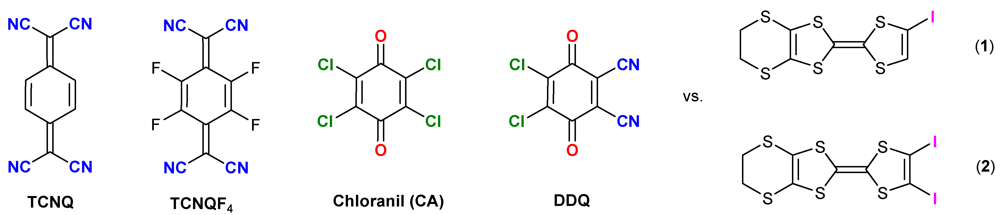
      <p>In the search for novel molecular materials based on radical donor and acceptor molecules, many efforts have been devoted to the introduction of additional non-bonding interactions such as hydrogen bonding to orient and control the solid state association of radical molecules [<xref ref-type="bibr" rid="B1-crystals-02-00327">1</xref>], in the hope to favor novel supramolecular arrangements. These efforts were mainly concentrated on cation radical salts of tetrathiafulvalene derivatives, obtained by electrocrystallization with various anions acting as hydrogen bond or halogen bond acceptors. Charge–transfers salts such as the prototypical TTF-TCNQ or TTF-CA (CA: chloranil) are also amenable to such supramolecular strategies. Most examples rely on TTF derivatives functionalized with hydrogen bond donor groups (−CH<sub>2</sub>OH, −CONHR), and chemically oxidized with TCNQ [<xref ref-type="bibr" rid="B2-crystals-02-00327">2</xref>] or TCNQF<sub>4 </sub>[<xref ref-type="bibr" rid="B3-crystals-02-00327">3</xref>,<xref ref-type="bibr" rid="B4-crystals-02-00327">4</xref>]. Halogen bonding interactions were also explored in charge-transfer salts, particularly by Iyoda [<xref ref-type="bibr" rid="B5-crystals-02-00327">5</xref>] and Bryce [<xref ref-type="bibr" rid="B6-crystals-02-00327">6</xref>], as in (EDT-TTFCl<sub>2</sub>)<sub>2</sub>(TCNQF<sub>4</sub>) [<xref ref-type="bibr" rid="B7-crystals-02-00327">7</xref>]. Note that, due to their strong electronegativity, the functionalization of the TTF core with electron-withdrawing halogen atoms rises the oxidation potential of the TTF molecules, making often impossible their oxidation with TCNQ itself whose reduction potential amounts to 0.17 V (<italic>vs</italic>. SCE). Thus stronger oxidants such as the tetrafluoro TCNQ (TCNQF<sub>4</sub>; <italic>E</italic><sub>red</sub> = 0.53 V <italic>vs</italic>. SCE) had to be considered [<xref ref-type="bibr" rid="B3-crystals-02-00327">3</xref>,<xref ref-type="bibr" rid="B4-crystals-02-00327">4</xref>,<xref ref-type="bibr" rid="B7-crystals-02-00327">7</xref>]. In all these examples, the TCNQ derivatives act as halogen bond acceptors only through their nitrile functionality.</p>
      <fig id="crystals-02-00327-f008" position="anchor">
          <label>Scheme 1</label>
          <caption>
            <p>Acceptor and donor molecules, for charge transfer salts as well as for halogen bonding interactions.</p>
          </caption>
          <graphic xmlns:xlink="http://www.w3.org/1999/xlink" xlink:href="crystals-02-00327-g008.tif"/>
          
        </fig>
      <p>In this paper, we want to describe our recent results involving DDQ (2,3-dichloro-5,6-dicyanobenzoquinone, <italic>E</italic><sub>red</sub> = 0.53 V <italic>vs</italic>. SCE) as a powerful oxidant toward iodinated TTFs, toward the formation of novel charge-transfer salts with original halogen bonding patterns. Note that only one example of halogenated TTF with DDQ has been mentioned, but without crystal structure or composition [<xref ref-type="bibr" rid="B8-crystals-02-00327">8</xref>]. Furthermore, DDQ is not only a strong oxidant comparable to TCNQF<sub>4</sub> but offers potentially three different halogen bonding acceptor sites, the carbonyl oxygen atoms, the nitrile nitrogen atoms and the chlorine atoms. We describe here the salts obtained upon oxidation of two iodinated TTF, namely 3,4-ethylenedithio-3'-iodo-tetrathiafulvalene (<bold>1</bold>) and 3,4-ethylenedithio-3',4'-diiodo-tetrathiafulvalene (<bold>2</bold>) with DDQ. As originally reported by Imakubo and Kato [<xref ref-type="bibr" rid="B9-crystals-02-00327">9</xref>], these two donor molecules have been already engaged in a variety of cation radical salts upon electrocrystallization with anions acting as halogen bond acceptors such as halides [<xref ref-type="bibr" rid="B9-crystals-02-00327">9</xref>,<xref ref-type="bibr" rid="B10-crystals-02-00327">10</xref>], polyhalides [<xref ref-type="bibr" rid="B11-crystals-02-00327">11</xref>], halometallates [<xref ref-type="bibr" rid="B12-crystals-02-00327">12</xref>,<xref ref-type="bibr" rid="B13-crystals-02-00327">13</xref>], cyanometallates [<xref ref-type="bibr" rid="B9-crystals-02-00327">9</xref>,<xref ref-type="bibr" rid="B14-crystals-02-00327">14</xref>,<xref ref-type="bibr" rid="B15-crystals-02-00327">15</xref>] or thiocyanatometallates [<xref ref-type="bibr" rid="B16-crystals-02-00327">16</xref>,<xref ref-type="bibr" rid="B17-crystals-02-00327">17</xref>], but not in charge transfer salts, comparable to the reported example of EDT-TTFCl<sub>2</sub> with TCNQF<sub>4</sub> mentioned above [<xref ref-type="bibr" rid="B7-crystals-02-00327">7</xref>]. </p>
    </sec>
    <sec sec-type="results">
      <title>2. Results and Discussion</title>
      <p>Diffusion of a CH<sub>3</sub>CN solution of DDQ on top of a CH<sub>2</sub>Cl<sub>2</sub> solution of either <bold>1</bold> or <bold>2</bold> afforded after several days dark parallelepipedic crystals. X-ray crystal structure analyses give the formulations (<bold>1</bold>)DDQ and (<bold>2</bold>)<sub>2</sub>(DDQ)·(CH<sub>3</sub>CN) respectively, that is with 1:1 and 2:1 stoichiometry with <bold>1</bold> and <bold>2</bold> respectively. This different behavior might be related to the relative redox potential of <bold>1</bold> and <bold>2</bold>, when compared with the reduction potential of DDQ. Indeed, the first oxidation potential of the two donor molecules amounts to 0.46 and 0.57 V <italic>vs</italic>. SCE (in CH<sub>3</sub>CN with Bu<sub>4</sub>NPF<sub>6</sub> 0.1 M as electrolyte at 1 V s<sup>−</sup><sup>1</sup> scan rate) for <bold>1</bold> and <bold>2</bold> respectively, a difference which illustrates the electron withdrawing nature of the iodine atom on the TTF core. With the first reduction potential of DDQ found at 0.53 V in the same conditions, it clearly appears that DDQ is an oxidant strong enough to favour a full charge transfer with <bold>1</bold> while a contrasted situation can be anticipated with <bold>2</bold>. A similar borderline situation has been already reported when <bold>1</bold> and <bold>2</bold> are oxidized in the presence of [Ni(mnt)<sub>2</sub>]<sup>1</sup><sup>−</sup> [<xref ref-type="bibr" rid="B18-crystals-02-00327">18</xref>], affording a fully oxidized <bold>1</bold><sup>+</sup><sup>·</sup> molecule in [1<sup>+</sup><sup>·</sup>]<sub>2</sub>[Ni(mnt)<sub>2</sub><sup>2</sup><sup>−</sup>], but a mixed valence salt with <bold>2</bold> in [<xref ref-type="bibr" rid="B2-crystals-02-00327">2</xref>]<sub>2</sub><sup>+</sup>[Ni(mnt)<sub>2</sub>]<sup>1</sup><sup>−</sup>. </p>
      <sec>
        <title>2.1. Structural and Magnetic Properties of (1)(DDQ)</title>
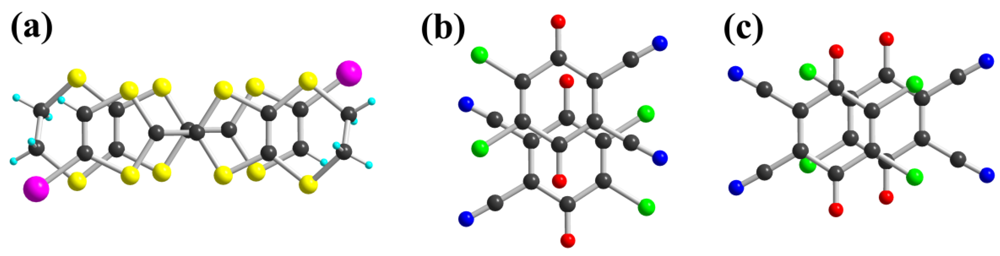
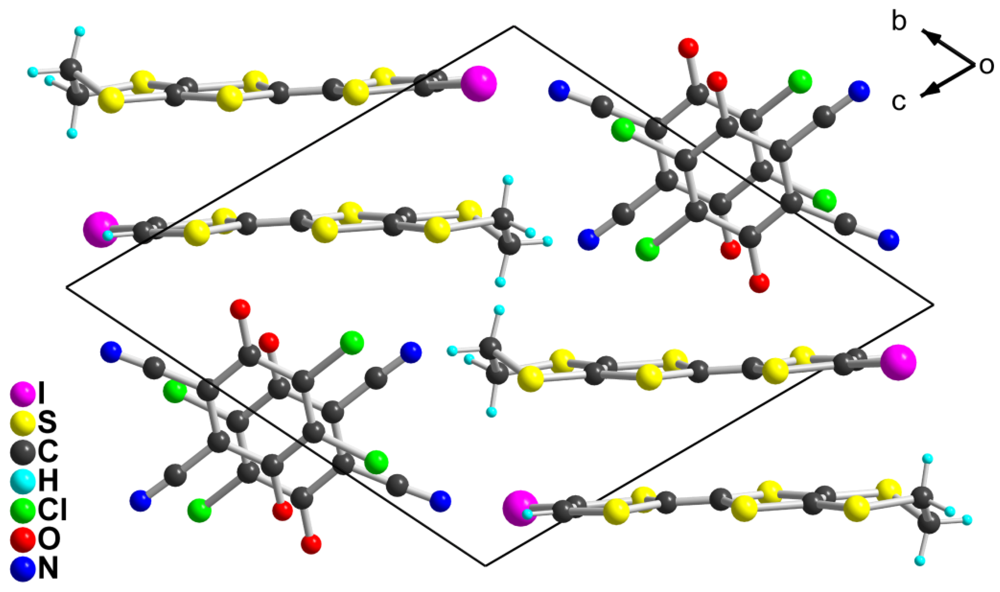
        <p>(<bold>1</bold>)(DDQ) crystallizes in the triclinic system, space group <inline-graphic xmlns:xlink="http://www.w3.org/1999/xlink" xlink:href="crystals-02-00327-i001.tif"/>  with both donor <bold>1</bold> and DDQ in general position in the unit cell (<xref ref-type="fig" rid="crystals-02-00327-f001">Figure 1</xref>). Intramolecular bond lengths within the TTF core in <bold>1</bold> and the DDQ molecule are highly sensitive to their oxidation state. As shown in <xref ref-type="table" rid="crystals-02-00327-t001">Table 1</xref>, <xref ref-type="table" rid="crystals-02-00327-t002">Table 2</xref>, by comparison with reference compounds, a full charge transfer between <bold>1</bold> and DDQ has occurred, leading unambiguously to a (<bold>1</bold><sup>+</sup><sup>·</sup>)(DDQ<sup>−·</sup>) formulation. In the solid state, the <bold>1</bold><sup>+</sup><sup>·</sup> cations are associated into face-to-face homo-dyads, which interact laterally along <italic>a</italic>-axis. A projection view of these dyads (<xref ref-type="fig" rid="crystals-02-00327-f002">Figure 2</xref>a) shows a typical bond-over-ring overlap, with a short plane-to-plane distance of 3.27 Å and a calculated <italic>β</italic><sub>HOMO</sub><sub>−HOMO</sub> interaction energy of 0.71 eV. On the other hand, the DDQ<sup>−·</sup> radical anions are stacked to form alternated chains running along <italic>a</italic>-axis with two different overlap modes shown in <xref ref-type="fig" rid="crystals-02-00327-f002">Figure 2</xref>b,c. Plane-to-plane distances amount to 2.79 and 3.42 Å respectively, demonstrating the strong dimerization of the DDQ chains. It is further confirmed by the calculated <italic>β</italic><sub>LUMO</sub><sub>−LUMO</sub> interaction energies for the two overlap modes, which amount to 0.65 and 0.04 eV respectively. It should be stressed here that these strong overlap between respectively <bold>1</bold><sup>+</sup><sup>·</sup> and DDQ<sup>−·</sup> species let us infer that the radical species are strongly associated into the bonding combination of respectively the TTF’s HOMO and the DDQ LUMO. This is confirmed by the temperature dependence of the magnetic susceptibility of the salt, which exhibits an essentially diamagnetic behavior, with a Curie tail associated to 2.5% magnetic defaults. </p>
        <fig id="crystals-02-00327-f001" position="anchor">
          <label>Figure 1</label>
          <caption>
            <p>Projection view (along <italic>a</italic>) of the unit cell of (<bold>1</bold>)(DDQ).</p>
          </caption>
          <graphic xmlns:xlink="http://www.w3.org/1999/xlink" xlink:href="crystals-02-00327-g001.tif"/>
        </fig>
        <table-wrap id="crystals-02-00327-t001" position="anchor">
          <object-id pub-id-type="pii">crystals-02-00327-t001_Table 1</object-id>
          <label>Table 1</label>
          <caption>
            <p>Intramolecular bond lengths (in Å) in the TTF core of <bold>1</bold> (averaged values). The formal charge of each molecule is given as <italic>ρ</italic>, C<sub>i</sub> and C<sub>o</sub> are the inner and outer C atoms in the TTF core. </p>
          </caption>
          <table>
            <thead>
              <tr>
                <th colspan="2" align="center" valign="middle">Compound</th>
                <th align="center" valign="middle">
                  <italic>ρ</italic>
                </th>
                <th align="center" valign="middle">C<sub>i</sub>=C<sub>i</sub></th>
                <th align="center" valign="middle">C<sub>i</sub>−S</th>
                <th align="center" valign="middle">C<sub>o</sub>−S </th>
                <th align="center" valign="middle">C<sub>o</sub>−C<sub>o</sub></th>
                <th align="center" valign="middle">Ref</th>
              </tr>
            </thead>
            <tbody>
              <tr>
                <td align="center" valign="middle">Neutral <bold>1</bold></td>
                <td align="center" valign="middle">mol A</td>
                <td align="center" valign="middle">0</td>
                <td align="center" valign="middle">1.332 (13)</td>
                <td align="center" valign="middle">1.763 (18)</td>
                <td align="center" valign="middle">1.759 (19)</td>
                <td align="center" valign="middle">1.331 (14)</td>
                <td align="center" valign="middle">[<xref ref-type="bibr" rid="B18-crystals-02-00327">18</xref>]</td>
              </tr>
              <tr>
                <td align="center" valign="middle"/>
                <td align="center" valign="middle">mol B</td>
                <td align="center" valign="middle"> </td>
                <td align="center" valign="middle">1.323 (14)</td>
                <td align="center" valign="middle">1.760 (17)</td>
                <td align="center" valign="middle">1.747 (16)</td>
                <td align="center" valign="middle">1.331 (13)</td>
                <td align="center" valign="middle"> </td>
              </tr>
              <tr>
                <td colspan="2" align="center" valign="middle">(<bold>1</bold>)<sub>2</sub>[Ag(CN)<sub>2</sub>]</td>
                <td align="center" valign="middle">+0.5</td>
                <td align="center" valign="middle">1.373</td>
                <td align="center" valign="middle">1.739</td>
                <td align="center" valign="middle">1.746</td>
                <td align="center" valign="middle">1.347</td>
                <td align="center" valign="middle">[<xref ref-type="bibr" rid="B9-crystals-02-00327">9</xref>]</td>
              </tr>
              <tr>
                <td colspan="2" align="center" valign="middle">(<bold>1</bold>)<sub>2</sub>[Ni(mnt)<sub>2</sub>]</td>
                <td align="center" valign="middle">+1</td>
                <td align="center" valign="middle">1.382 (19)</td>
                <td align="center" valign="middle">1.723 (25)</td>
                <td align="center" valign="middle">1.731 (3)</td>
                <td align="center" valign="middle">1.348 (19)</td>
                <td align="center" valign="middle">[<xref ref-type="bibr" rid="B18-crystals-02-00327">18</xref>]</td>
              </tr>
              <tr>
                <td colspan="2" align="center" valign="middle">(<bold>1</bold>)(DDQ)</td>
                <td align="center" valign="middle">1</td>
                <td align="center" valign="middle">1.390 (7)</td>
                <td align="center" valign="middle">1.721 (6)</td>
                <td align="center" valign="middle">1.736 (6)</td>
                <td align="center" valign="middle">1.350 (8)</td>
                <td align="center" valign="middle">this work</td>
              </tr>
            </tbody>
          </table>
        </table-wrap>
        <table-wrap id="crystals-02-00327-t002" position="anchor">
          <object-id pub-id-type="pii">crystals-02-00327-t002_Table 2</object-id>
          <label>Table 2</label>
          <caption>
            <p>Characteristic intramolecular bond lengths (in Å) in DDQ in various salts (averaged values). The formal charge and wave number of nitrile stretching absorption in IR spectra, for each molecule, are given as <italic>ρ</italic> and <italic>v</italic><sub>CN</sub> respectively.</p>
          </caption>
          <table>
            <thead>
              <tr>
                <th align="center" valign="middle">Compound</th>
                <th align="center" valign="middle">
                  <italic>ρ</italic>
                </th>
                <th align="center" valign="middle">C=O </th>
                <th align="center" valign="middle">C<sub>O</sub>−C<sub>Cl</sub></th>
                <th align="center" valign="middle">C<sub>O</sub>−C<sub>CN</sub></th>
                <th align="center" valign="middle">C<sub>Cl</sub>=C<sub>Cl</sub></th>
                <th align="center" valign="middle">C<sub>CN</sub>=C<sub>CN</sub></th>
                <th align="center" valign="middle">ν<sub>CN </sub>(cm<sup>−1</sup>)</th>
                <th align="center" valign="middle">Ref</th>
              </tr>
            </thead>
            <tbody>
              <tr>
                <td align="center" valign="middle">DDQ</td>
                <td align="center" valign="middle">0</td>
                <td align="center" valign="middle">1.202</td>
                <td align="center" valign="middle">1.483</td>
                <td align="center" valign="middle">1.501</td>
                <td align="center" valign="middle">1.340</td>
                <td align="center" valign="middle">1.343</td>
                <td align="center" valign="middle">2234</td>
                <td align="center" valign="middle">[<xref ref-type="bibr" rid="B19-crystals-02-00327">19</xref>]</td>
              </tr>
              <tr>
                <td align="center" valign="middle">(<bold>1</bold>)(DDQ)</td>
                <td align="center" valign="middle">–1</td>
                <td align="center" valign="middle">1.239 (5)</td>
                <td align="center" valign="middle">1.475 (7)</td>
                <td align="center" valign="middle">1.453 (8)</td>
                <td align="center" valign="middle">1.360 (6)</td>
                <td align="center" valign="middle">1.384 (6)</td>
                <td align="center" valign="middle">2202</td>
                <td align="center" valign="middle">–</td>
              </tr>
              <tr>
                <td align="center" valign="middle">(<bold>2</bold>)<sub>2</sub>(DDQ)</td>
                <td align="center" valign="middle">–1</td>
                <td align="center" valign="middle">1.265 (10)</td>
                <td align="center" valign="middle">1.479 (15)</td>
                <td align="center" valign="middle">1.422 (17)</td>
                <td align="center" valign="middle">1.379 (12)</td>
                <td align="center" valign="middle">1.402 (12)</td>
                <td align="center" valign="middle">2212</td>
                <td align="center" valign="middle">–</td>
              </tr>
              <tr>
                <td align="center" valign="middle">(Et<sub>4</sub>N)DDQ</td>
                <td align="center" valign="middle">–1</td>
                <td align="center" valign="middle">1.246</td>
                <td align="center" valign="middle">1.463</td>
                <td align="center" valign="middle">1.444</td>
                <td align="center" valign="middle">1.363</td>
                <td align="center" valign="middle">1.385</td>
                <td align="center" valign="middle">2217</td>
                <td align="center" valign="middle">[<xref ref-type="bibr" rid="B20-crystals-02-00327">20</xref>]</td>
              </tr>
            </tbody>
          </table>
        </table-wrap>
        
        <fig id="crystals-02-00327-f002" position="anchor">
          <label>Figure 2</label>
          <caption>
            <p>Overlap interactions (<bold>a</bold>): within (<bold>1</bold><sup>+</sup><sup>·</sup>)<sub>2</sub> dyads, (<bold>b</bold>) and (<bold>c</bold>) within the chains of (DDQ<sup>−·</sup>) running along a.</p>
          </caption>
          <graphic xmlns:xlink="http://www.w3.org/1999/xlink" xlink:href="crystals-02-00327-g002.tif"/>
        </fig>
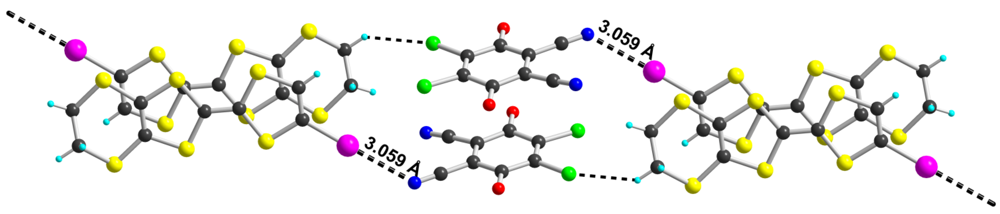
        <p>As shown in <xref ref-type="fig" rid="crystals-02-00327-f003">Figure 3</xref>, halogen bonding interaction is observed between the iodine atom of <bold>1</bold> and the nitrogen atom of one cyano group of DDQ, together with a short C−H···Cl interaction. The I···N distance is much shorter than the sum of van der Waals radii (1.98 + 1.55 = 3.53 Å) or the contact distance predicted from anisotropic models [<xref ref-type="bibr" rid="B21-crystals-02-00327">21</xref>] (<italic>r</italic><sub>min</sub>(I) + <italic>r</italic><sub>max</sub>(N) = 1.76 + 1.60 = 3.36 Å). The C–I···N angle of 175.6(2)° shows the strong halogen bond linearity but the I···N°C angle at 131.6(4)° demonstrates that the interaction here is not optimal as the iodine atom does not point perfectly toward the nitrile lone pair. Much shorter and linear interactions were found for example in (<bold>1</bold>)[Ag(CN)<sub>2</sub>] with I···N distance at 2.88 Å and C–I···N and I···C°N angles at 177° and 153° respectively [<xref ref-type="bibr" rid="B9-crystals-02-00327">9</xref>].</p>
        <fig id="crystals-02-00327-f003" position="anchor">
          <label>Figure 3</label>
          <caption>
            <p>Detail of the halogen bonding interactions in (<bold>1</bold>)(DDQ).</p>
          </caption>
          <graphic xmlns:xlink="http://www.w3.org/1999/xlink" xlink:href="crystals-02-00327-g003.tif"/>
        </fig>
      </sec>
      <sec>
        <title>2.2. Structural Properties of (2)<sub>2</sub>(DDQ)·(CH<sub>3</sub>CN)</title>
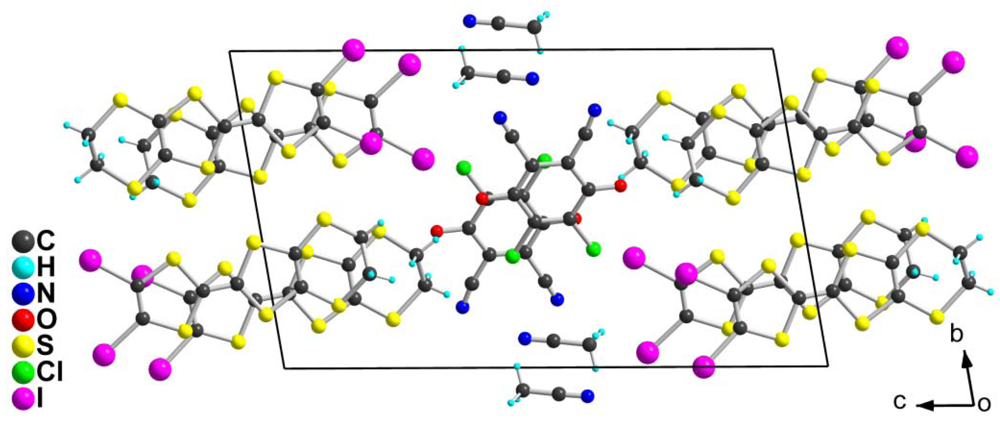
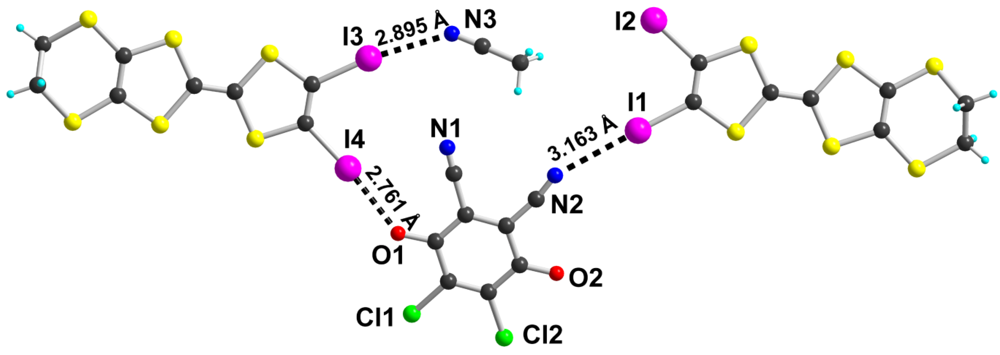
        <p>The mixed-valence salt with <bold>2</bold> is formulated as (<bold>2</bold>)<sub>2</sub>(DDQ)·(CH<sub>3</sub>CN). It crystallizes in the triclinic system, space group <inline-graphic xmlns:xlink="http://www.w3.org/1999/xlink" xlink:href="crystals-02-00327-i001.tif"/> with two crystallographically independent TTF molecules <bold>2</bold>, one DDQ in general position and one acetonitrile solvent molecule. A projection of the unit cell along <italic>a</italic>-axis (<xref ref-type="fig" rid="crystals-02-00327-f004">Figure 4</xref>), shows that the donor molecules form layers, separated from each other by the acetonitrile and DDQ molecules. As shown in <xref ref-type="table" rid="crystals-02-00327-t002">Table 2</xref>, the DDQ molecule appears as fully reduced radical anion form. Bond lengths within the TTF core (<xref ref-type="table" rid="crystals-02-00327-t003">Table 3</xref>) in <bold>2</bold> are also comparable to those described in other mixed-valence (<italic>ρ</italic> = 0.5) salts of <bold>2</bold> [<xref ref-type="bibr" rid="B11-crystals-02-00327">11</xref>,<xref ref-type="bibr" rid="B12-crystals-02-00327">12</xref>,<xref ref-type="bibr" rid="B13-crystals-02-00327">13</xref>,<xref ref-type="bibr" rid="B14-crystals-02-00327">14</xref>,<xref ref-type="bibr" rid="B15-crystals-02-00327">15</xref>,<xref ref-type="bibr" rid="B16-crystals-02-00327">16</xref>,<xref ref-type="bibr" rid="B17-crystals-02-00327">17</xref>]. Note that between the two crystallographically independent donor molecules <bold>2</bold>, the one bearing I3/I4 iodine atoms appears slightly more oxidized than molecule bearing I1/I2 iodine atoms. As shown in <xref ref-type="fig" rid="crystals-02-00327-f005">Figure 5</xref>, halogen bonding interactions develop at the interface between the mixed-valence slabs and the DDQ/CH<sub>3</sub>CN layer. Both crystallographically independent molecules <bold>2</bold> show short contacts with DDQ<sup>−·</sup> anion. Very short and linear interactions are found with I(3) and I(4) atoms, with the carbonyl oxygen atoms, the nitrile nitrogen atoms of both the DDQ and the CH<sub>3</sub>CN molecules. This donor molecule is also the one which appeared as the most oxidized one from comparison of intramolecular bond lengths (<xref ref-type="table" rid="crystals-02-00327-t004">Table 4</xref>). Comparison of the two structures demonstrates that the reduced DDQ acts as a powerful halogen bond acceptor, involving the oxygen and nitrogen atoms. Earlier theoretical calculations of the charge and spin density in DDQ<sup>−·</sup> have shown a negative charge on the N, O and Cl atoms in the order −0.24, −0.20 and −0.18 [<xref ref-type="bibr" rid="B22-crystals-02-00327">22</xref>], demonstrating a halogen bonding preference for the most negatively charged atoms. This behavior is in accordance with recent <italic>ab initio</italic> calculations showing that the electrostatic interaction between the positive <italic>σ</italic>-hole [<xref ref-type="bibr" rid="B23-crystals-02-00327">23</xref>] located on the halogen atom along the C−Hal bond and Lewis bases such as pyridine is indeed the main component of the halogen bonding interaction [<xref ref-type="bibr" rid="B24-crystals-02-00327">24</xref>].</p>
                <fig id="crystals-02-00327-f004" position="anchor">
          <label>Figure 4</label>
          <caption>
            <p>Projection view (along <italic>a</italic>-axis) of the unit cell of (<bold>2</bold>)<sub>2</sub>(DDQ)·(CH<sub>3</sub>CN).</p>
          </caption>
          <graphic xmlns:xlink="http://www.w3.org/1999/xlink" xlink:href="crystals-02-00327-g004.tif"/>
        </fig>

        <table-wrap id="crystals-02-00327-t003" position="anchor">
          <object-id pub-id-type="pii">crystals-02-00327-t003_Table 3</object-id>
          <label>Table 3</label>
          <caption>
            <p>Intramolecular bond lengths (in Å) in the TTF core of <bold>2</bold> (averaged values), depending on the actual charge (<italic>ρ</italic>). C<sub>i</sub> and C<sub>o</sub> are the inner and outer C atoms in the TTF core. </p>
          </caption>
          <table>
            <thead>
              <tr>
                <th colspan="2" align="center" valign="middle">Compound</th>
                <th align="center" valign="middle">
                  <italic>ρ</italic>
                </th>
                <th align="center" valign="middle">C<sub>i</sub>=C<sub>i</sub></th>
                <th align="center" valign="middle">C<sub>i</sub>−S</th>
                <th align="center" valign="middle">C<sub>o</sub>−S</th>
                <th align="center" valign="middle">C<sub>o</sub>−C<sub>o</sub></th>
                <th align="center" valign="middle">Ref</th>
              </tr>
            </thead>
            <tbody>
              <tr>
                <td colspan="2" align="left" valign="middle">(<bold>2</bold>)<sub>2</sub>(I<sub>3</sub>)</td>
                <td align="center" valign="middle">+0.5</td>
                <td align="center" valign="middle">1.365 (29)</td>
                <td align="center" valign="middle">1.740 (20)</td>
                <td align="center" valign="middle">1.749 (20)</td>
                <td align="center" valign="middle">1.348 (16)</td>
                <td align="center" valign="middle">[<xref ref-type="bibr" rid="B11-crystals-02-00327">11</xref>]</td>
              </tr>
              <tr>
                <td align="left" valign="middle">(<bold>2</bold>)<sub>2</sub>(DDQ) </td>
                <td align="center" valign="middle">mol (I1,I2)</td>
                <td align="center" valign="middle">≈0.5</td>
                <td align="center" valign="middle">1.354 (9)</td>
                <td align="center" valign="middle">1.757 (8)</td>
                <td align="center" valign="middle">1.762 (8)</td>
                <td align="center" valign="middle">1.336 (9)</td>
                <td rowspan="2" align="center" valign="middle">this work</td>
              </tr>
              <tr>
                <td align="center" valign="middle"> </td>
                <td align="center" valign="middle">mol (I3,I4)</td>
                <td align="center" valign="middle">≈0.5</td>
                <td align="center" valign="middle">1.365 (9)</td>
                <td align="center" valign="middle">1.736 (8)</td>
                <td align="center" valign="middle">1.745 (8)</td>
                <td align="center" valign="middle">1.348 (9)</td>
              </tr>
              <tr>
                <td colspan="2" align="left" valign="middle">(<bold>2</bold>)(I<sub>3</sub>)</td>
                <td align="center" valign="middle">+1</td>
                <td align="center" valign="middle">1.40 (2)</td>
                <td align="center" valign="middle">1.718 (9)</td>
                <td align="center" valign="middle">–</td>
                <td align="center" valign="middle">–</td>
                <td align="center" valign="middle">[<xref ref-type="bibr" rid="B18-crystals-02-00327">18</xref>]</td>
              </tr>
            </tbody>
          </table>
        </table-wrap>
        <fig id="crystals-02-00327-f005" position="anchor">
          <label>Figure 5</label>
          <caption>
            <p>Details of the halogen bonding interactions in (<bold>2</bold>)<sub>2</sub>(DDQ)·(CH<sub>3</sub>CN).</p>
          </caption>
          <graphic xmlns:xlink="http://www.w3.org/1999/xlink" xlink:href="crystals-02-00327-g005.tif"/>
        </fig>
        <table-wrap id="crystals-02-00327-t004" position="anchor">
          <object-id pub-id-type="pii">crystals-02-00327-t004_Table 4</object-id>
          <label>Table 4</label>
          <caption>
            <p>Structural characteristics of the halogen bonding interactions in (<bold>2</bold>)<sub>2</sub>(DDQ)·(CH<sub>3</sub>CN). For atom numbering see <xref ref-type="fig" rid="crystals-02-00327-f005">Figure 5</xref>. </p>
          </caption>
          <table>
            <thead>
              <tr>
                <th align="center" valign="middle">Interaction</th>
                <th align="center" valign="middle">∑vdw (Å)</th>
                <th align="center" valign="middle"><italic>D</italic><sub>anis </sub>(Å)</th>
                <th align="center" valign="middle">I···(O,N) (Å)</th>
                <th align="center" valign="middle">C−I···(O,N) (°)</th>
                <th align="center" valign="middle">I···(O,N)−C (°)</th>
              </tr>
            </thead>
            <tbody>
              <tr>
                <td align="center" valign="middle">I1···N2</td>
                <td align="center" valign="middle">3.53</td>
                <td align="center" valign="middle">3.36</td>
                <td align="center" valign="middle">3.163 (12)</td>
                <td align="center" valign="middle">178.2 (3)</td>
                <td align="center" valign="middle">147.8 (9)</td>
              </tr>
              <tr>
                <td align="center" valign="middle">I3···N3</td>
                <td align="center" valign="middle">3.53</td>
                <td align="center" valign="middle">3.36</td>
                <td align="center" valign="middle">2.895 (12)</td>
                <td align="center" valign="middle">171.0 (3)</td>
                <td align="center" valign="middle">139.2 (9)</td>
              </tr>
              <tr>
                <td align="center" valign="middle">I4···O1</td>
                <td align="center" valign="middle">3.50</td>
                <td align="center" valign="middle">3.30</td>
                <td align="center" valign="middle">2.761 (8)</td>
                <td align="center" valign="middle">178.2 (2)</td>
                <td align="center" valign="middle">138.7 (5)</td>
              </tr>
            </tbody>
          </table>
          <table-wrap-foot>
          <fn>
          <p>∑vdw: sum of the van der Waals radii; <italic>D</italic><sub>anis</sub>: contact distance in the anisotropic model [<xref ref-type="bibr" rid="B21-crystals-02-00327">21</xref>].</p>
          </fn>
          </table-wrap-foot>
        </table-wrap>
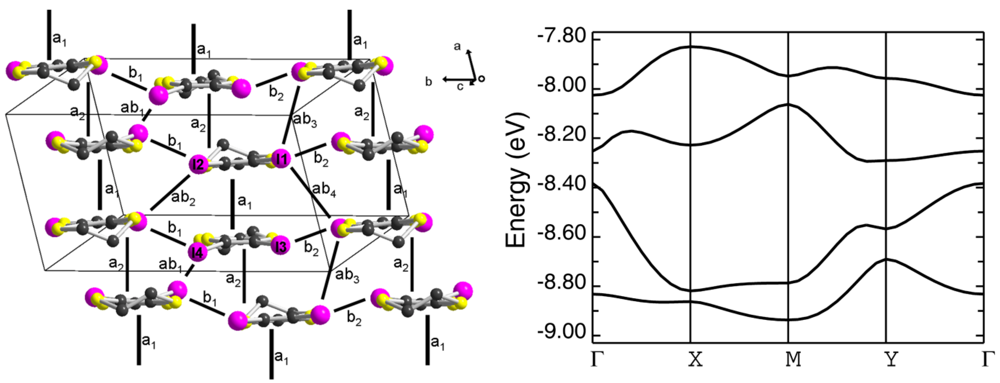
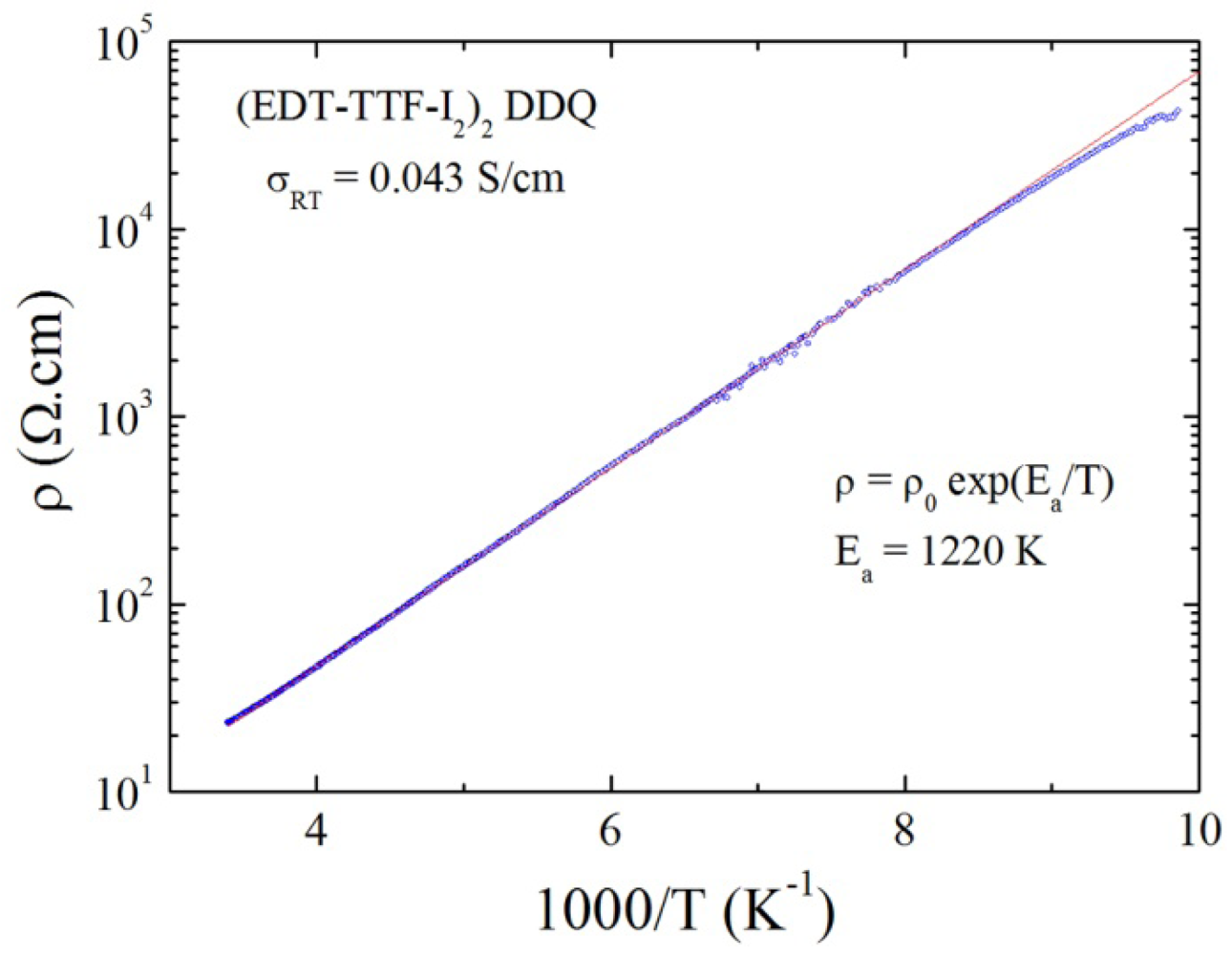
        <p>The mixed valence character of (<bold>2</bold>)<sub>2</sub>(DDQ)·(CH<sub>3</sub>CN) might favor a good conductivity for this ¾-filled salt. A side view of the conducting slab with calculated <italic>β</italic><sub>HOMO</sub><sub>−HOMO</sub> interaction energies is shown in <xref ref-type="fig" rid="crystals-02-00327-f006">Figure 6</xref> (left), together with the calculated band structure (<xref ref-type="fig" rid="crystals-02-00327-f006">Figure 6</xref>, right). Based on the stoichiometry, the three lower bands are filled while the upper one is empty, with an indirect band gap of 40 meV. Temperature dependence of the resistivity (<xref ref-type="fig" rid="crystals-02-00327-f007">Figure 7</xref>) shows indeed a semiconducting behavior with a room temperature conductivity, <italic>σ</italic><sub>RT</sub> = 0.043 S cm<sup>−1</sup> and an activation energy of 1220 K.</p>
        <fig id="crystals-02-00327-f006" position="anchor">
          <label>Figure 6</label>
          <caption>
            <p>Left: Side view of the slab of partially oxidized <bold>2</bold> molecules in (<bold>2</bold>)<sub>2</sub>(DDQ)·(CH<sub>3</sub>CN) together with calculated <italic>β</italic><sub>HOMO</sub><sub>−HOMO</sub> interaction energies, <italic>β</italic><sub>a1</sub> = −0.4742, <italic>β</italic><sub>a2</sub> = 0.1325, <italic>β</italic><sub>b1</sub> = 0.0648, <italic>β</italic><sub>b2</sub> = 0.1341, <italic>β</italic><sub>ab1</sub> = −0.2596, <italic>β</italic><sub>ab2</sub> = −0.0482, <italic>β</italic><sub>ab3</sub> = 0.1286, <italic>β</italic><sub>ab4</sub> = 0.0797 eV. Right: Calculated band structure; Г = (0, 0), X = (a*/2, 0), Y = (0, b*/2), M = (a*/2, b*/2). </p>
          </caption>
          <graphic xmlns:xlink="http://www.w3.org/1999/xlink" xlink:href="crystals-02-00327-g006.tif"/>
        </fig>
        <fig id="crystals-02-00327-f007" position="anchor">
          <label>Figure 7</label>
          <caption>
            <p>Temperature dependence of the resistivity of the mixed-valence salt (<bold>2</bold>)<sub>2</sub>(DDQ)·(CH<sub>3</sub>CN).</p>
          </caption>
          <graphic xmlns:xlink="http://www.w3.org/1999/xlink" xlink:href="crystals-02-00327-g007.tif"/>
        </fig>
      </sec>
    </sec>
    <sec>
      <title>3. Experimental Section</title>
      <sec>
        <title>3.1. Syntheses</title>
        <p>The TTF derivatives <bold>1</bold> and <bold>2</bold> were prepared as previously described [<xref ref-type="bibr" rid="B11-crystals-02-00327">11</xref>]. The charge-transfer salt with <bold>1</bold> was obtained by diffusion techniques in small glass tubes (Pasteur pipettes), with <bold>1</bold> (2.1 mg, 6.1 × 10<sup>−</sup><sup>6</sup> mol) dissolved in CH<sub>2</sub>Cl<sub>2</sub> (2.5 mL) and layered with a solution of DDQ (3.3 mg, 14.5 × 10<sup>−</sup><sup>6</sup> mol) in CH<sub>3</sub>CN (0.5 mL). Crystals were harvested after two weeks and washed with little CH<sub>3</sub>CN. The charge-transfer salt with <bold>2</bold> was obtained by diffusion techniques in small glass tubes, with <bold>2 </bold>(12.1 mg, 2.21 × 10<sup>−</sup><sup>5</sup> mol) dissolved in 1,1,2-trichloroethane (8 mL) and layered with a solution of DDQ (5.3 mg, 2.33 × 10<sup>−</sup><sup>5</sup> mol) in CH<sub>3</sub>CN (2 mL). Crystals were harvested after two weeks and washed with little CH<sub>3</sub>CN.</p>
        <p>(<bold>1</bold>)(DDQ): IR (ATR) <italic>v</italic><sub>CN</sub>: 2202 cm<sup>−</sup><sup>1</sup>. Elem. Anal. Calcd. for C<sub>16</sub>H<sub>5</sub>Cl<sub>2</sub>IN<sub>2</sub>O<sub>2</sub>S<sub>6</sub>: C, 29.68; H, 0.78; N, 4.33%. Found: C, 29.43; H, 1.06; N, 4.25.</p>
        <p>(<bold>2</bold>)<sub>2</sub>(DDQ)·(CH<sub>3</sub>CN): IR (ATR) <italic>v</italic><sub>CN</sub>: 2212 cm<sup>−</sup><sup>1</sup>. Only a few crystals of this phase were obtained, together with a 1:1 salt of poor crystallographic quality. Unit cell parameters of this 1:1 phase: <italic>a</italic> = 11.8443, <italic>b</italic> = 12.8752, <italic>c</italic> = 28.7860 Å, <italic>α</italic> = <italic>β</italic> = <italic>γ</italic> = 90.000, <italic>V</italic> = 4389.80(53) Å<sup>3</sup>, system: orthorhombic, space group: Pnma. This mixing does not allow for elemental analysis of one single phase. </p>
      </sec>
      <sec>
        <title>3.2. Crystallography</title>
        <p>Single crystals were taken in a loop in oil and put directly under the N<sub>2</sub> stream at 150 K to avoid solvent losses. Data were collected on a Bruker SMART II diffractometer with graphite-monochromated Mo-Kα radiation (<italic>λ</italic> = 0.71073 Å). Structures were solved by direct methods (SHELXS-97, SIR97) [<xref ref-type="bibr" rid="B25-crystals-02-00327">25</xref>] and refined (SHELXL-97) by full-matrix least-squares methods [<xref ref-type="bibr" rid="B26-crystals-02-00327">26</xref>], as implemented in the WinGX software package [<xref ref-type="bibr" rid="B27-crystals-02-00327">27</xref>]. Absorption corrections were applied. Hydrogen atoms were introduced at calculated positions (riding model), included in structure factor calculations, and not refined, with thermal parameters fixed as 1.2 times <italic>U</italic><sub>eq</sub> of the attached carbon atom. Further details of the crystal structures may be obtained from the Cambridge Crystallography Data Center, CCDC 871175 &amp; 871176, free of charge, on application from CCDC, 12 Union Road, Cambridge CB2 1EZ, UK (fax: +44 1223 336033 or e-mail: <email>deposit@ccdc.cam.ac.uk</email>).</p>
        <p>(<bold>1</bold>)(DDQ): C<sub>16</sub>H<sub>5</sub>Cl<sub>2</sub>IN<sub>2</sub>O<sub>2</sub>S<sub>6</sub>, <italic>M</italic> = 647.38, triclinic, <inline-graphic xmlns:xlink="http://www.w3.org/1999/xlink" xlink:href="crystals-02-00327-i001.tif"/>, <italic>a</italic> = 7.0227(2), <italic>b</italic> = 12.6760(3), <italic>c</italic> = 13.1732(3) Å, <italic>α</italic> = 62.169(1), <italic>β</italic> = 76.282(1), <italic>γ</italic> = 78.615(1)°, <italic>V</italic> = 1002.31(4) Å<sup>3</sup>, <italic>Z</italic> = 2, <italic>D</italic>c = 2.145 g cm<sup>−</sup><sup>3</sup>, <italic>T</italic> = 150(2) K, 14723 reflections collected, 4566 unique (<italic>R</italic><sub>int</sub> = 0.0303) with among them 3871 with <italic>I &gt;</italic> 2<italic>σ</italic>(<italic>I</italic>), <italic>R</italic>[<italic>I &gt;</italic> 2<italic>σ</italic>(<italic>I</italic>)] = 0.0341, <italic>wR</italic><sub>2</sub> (<italic>F</italic><sup>2</sup>, all data) = 0.0967, GoF = 1.083.</p>
        <p>(<bold>2</bold>)<sub>2</sub>(DDQ)·(CH<sub>3</sub>CN): C<sub>26</sub>H<sub>11</sub>Cl<sub>2</sub>I<sub>4</sub>N<sub>3</sub>O<sub>2</sub>S<sub>12</sub>, <italic>M</italic> = 1360.60, triclinic, <inline-graphic xmlns:xlink="http://www.w3.org/1999/xlink" xlink:href="crystals-02-00327-i001.tif"/>, <italic>a</italic> = 7.4173(9), <italic>b</italic> = 12.9354(15), <italic>c</italic> = 21.258(3) Å, <italic>σ</italic> = 79.600(4), <italic>β</italic> = 85.564(4), <italic>γ</italic> = 75.854(4)°, <italic>V</italic> = 1944.1(4) Å<sup>3</sup>, <italic>Z</italic> = 2, <italic>D</italic>c = 2.324 g cm<sup>−</sup><sup>3</sup>, <italic>T</italic> = 150(2) K, 23021 reflections collected, 8631 unique (<italic>R</italic><sub>int</sub> = 0.0373) with among them 6389 with <italic>I &gt;</italic> 2<italic>σ</italic>(<italic>I</italic>), <italic>R</italic>[<italic>I</italic><italic> &gt;</italic> 2<italic>σ</italic>(<italic>I</italic>)] = 0.0426, <italic>wR</italic><sub>2</sub> (<italic>F</italic><sup>2</sup>, all data) = 0.1444, GoF = 1.051.</p>
      </sec>
      <sec>
        <title>3.3. Band Structure Calculations</title>
        <p>The <italic>β</italic><sub>LUMO</sub><sub>−LUMO</sub> and <italic>β</italic><sub>HOMO</sub><sub>−HOMO</sub> interaction energies, the tight-binding band structure were calculated with the effective one-electron Hamiltonian of the extended Hückel method [<xref ref-type="bibr" rid="B28-crystals-02-00327">28</xref>], as implemented in the Caesar 1.0 chain of programs [<xref ref-type="bibr" rid="B29-crystals-02-00327">29</xref>]. The off-diagonal matrix elements of the Hamiltonian were calculated according to the modified Wolfsberg−Helmholz formula [<xref ref-type="bibr" rid="B30-crystals-02-00327">30</xref>]. All valence electrons were explicitly taken into account in the calculations and the basis set consisted of double-ζ Slater-type orbitals for all atoms except H (ζ Slater-type orbital) using the Roothaan−Hartree−Fock wave functions of Clementi and Roetti [<xref ref-type="bibr" rid="B31-crystals-02-00327">31</xref>].</p>
      </sec>
    </sec>
    <sec sec-type="conclusions">
      <title>4. Conclusions</title>
      <p>We have reported here the structural and electronic properties of novel charge-transfer salts of halogenated TTF <bold>1</bold> or <bold>2</bold> with DDQ, an acceptor molecule which provides three different possible halogen acceptor sites, the carbonyl oxygen atoms, the nitrile nitrogen atoms and the chlorine atoms. While a 1:1 salt with full charge transfer has been isolated with the most easily oxidized monoiodo TTF <bold>1</bold>, a mixed-valence, conducting salt is obtained with the diiodo derivative <bold>2</bold>, which combines short and directional halogen bonding contacts with both oxygen and nitrogen atoms of DDQ, and a semi conducting behavior attributable to an indirect band gap, as deduced from band structure calculations. It is hoped that other oxidants than DDQ, with a lower reduction potential, might also favor the formation of conducting mixed-valence salts or eventually neutral complexes with possible neutral-ionic transition. This work is in progress and will be reported in due course. </p>
    </sec>
    
  </body>
  <back>
   <ack>
      <title>Acknowledgments</title>
      <p>This work was performed with the support from ANR (Paris, France) under contract no. ANR-08-BLAN-0091-02. </p>
    </ack>
    <notes>
      <title>Conflict of Interest</title>
      <p>The authors declare no conflict of interest. </p>
    </notes>
    <ref-list>
      <title>References and Notes</title>
      <ref id="B1-crystals-02-00327">
        <label>1.</label>
        <citation citation-type="journal">
          <person-group person-group-type="author">
            <name>
              <surname>Fourmigué</surname>
              <given-names>M.</given-names>
            </name>
            <name>
              <surname>Batail</surname>
              <given-names>P.</given-names>
            </name>
          </person-group>
          <article-title>Activation of Hydrogen- and Halogen-Bonding Interactions in Tetrathiafulvalene-Based Crystalline Molecular Conductors</article-title>
          <source>Chem. Rev.</source>
          <year>2004</year>
          <volume>104</volume>
          <fpage>5379</fpage>
          <lpage>5418</lpage>
          <pub-id pub-id-type="doi">10.1021/cr030645s</pub-id>
        </citation>
      </ref>
      <ref id="B2-crystals-02-00327">
        <label>2.</label>
        <citation citation-type="journal">
          <person-group person-group-type="author">
            <name>
              <surname>Dolbecq</surname>
              <given-names>A.</given-names>
            </name>
            <name>
              <surname>Fourmigué</surname>
              <given-names>M.</given-names>
            </name>
            <name>
              <surname>Batail</surname>
              <given-names>P.</given-names>
            </name>
            <name>
              <surname>Coulon</surname>
              <given-names>C.</given-names>
            </name>
          </person-group>
          <article-title>From Racemic Mixtures of Chiral π-Donor molecules to Mixed Stacks of H-Bonded Centrosymmetrical Dimers of Cation and Anion Radicals with Singlet-Triplet Excitations: The Example of [(±)Me<sub>3</sub>TTF-C*HMe(OH)<sup>·+</sup>]<sub>2</sub>[TCNQ<sup>·–</sup>]<sub>2</sub></article-title>
          <source>Chem. Mater.</source>
          <year>1994</year>
          <volume>6</volume>
          <fpage>1413</fpage>
          <lpage>1418</lpage>
          <pub-id pub-id-type="doi">10.1021/cm00044a045</pub-id>
        </citation>
      </ref>
      <ref id="B3-crystals-02-00327">
        <label>3.</label>
        <citation citation-type="journal">
          <person-group person-group-type="author">
            <name>
              <surname>Baudron</surname>
              <given-names>S.A.</given-names>
            </name>
            <name>
              <surname>Mézière</surname>
              <given-names>C.</given-names>
            </name>
            <name>
              <surname>Heuzé</surname>
              <given-names>K.</given-names>
            </name>
            <name>
              <surname>Fourmigué</surname>
              <given-names>M.</given-names>
            </name>
            <name>
              <surname>Batail</surname>
              <given-names>P.</given-names>
            </name>
            <name>
              <surname>Auban-Senzier</surname>
              <given-names>P.</given-names>
            </name>
          </person-group>
          <article-title>Interplay of charge transfer, dimensionality and amide hydrogen bond network adaptability in TCNQF<sub>4</sub> complexes of EDO-TTF-CONH<sub>2</sub> and EDT-TTF-CONH<sub>2</sub></article-title>
          <source>J. Solid State Chem.</source>
          <year>2002</year>
          <volume>168</volume>
          <fpage>668</fpage>
          <lpage>674</lpage>
          <pub-id pub-id-type="doi">10.1006/jssc.2002.9765</pub-id>
        </citation>
      </ref>
      <ref id="B4-crystals-02-00327">
        <label>4.</label>
        <citation citation-type="journal">
          <person-group person-group-type="author">
            <name>
              <surname>Ono</surname>
              <given-names>G.</given-names>
            </name>
            <name>
              <surname>Terao</surname>
              <given-names>H.</given-names>
            </name>
            <name>
              <surname>Higuchi</surname>
              <given-names>S.</given-names>
            </name>
            <name>
              <surname>Sugawara</surname>
              <given-names>T.</given-names>
            </name>
            <name>
              <surname>Izuoka</surname>
              <given-names>A.</given-names>
            </name>
            <name>
              <surname>Mochida</surname>
              <given-names>T.</given-names>
            </name>
          </person-group>
          <article-title>One-dimensional double chain composed of carbamoylmethylthio-substituted TTF-based donor in ion radical salt</article-title>
          <source>J. Mater. Chem.</source>
          <year>2000</year>
          <volume>10</volume>
          <fpage>2277</fpage>
          <lpage>2282</lpage>
          <pub-id pub-id-type="doi">10.1039/b004557h</pub-id>
        </citation>
      </ref>
      <ref id="B5-crystals-02-00327">
        <label>5.</label>
        <citation citation-type="journal">
          <person-group person-group-type="author">
            <name>
              <surname>Iyoda</surname>
              <given-names>M.</given-names>
            </name>
            <name>
              <surname>Kuwatani</surname>
              <given-names>Y.</given-names>
            </name>
            <name>
              <surname>Ogura</surname>
              <given-names>E.</given-names>
            </name>
            <name>
              <surname>Hara</surname>
              <given-names>K.</given-names>
            </name>
            <name>
              <surname>Suzuki</surname>
              <given-names>H.</given-names>
            </name>
            <name>
              <surname>Takano</surname>
              <given-names>T.</given-names>
            </name>
            <name>
              <surname>Takeda</surname>
              <given-names>K.</given-names>
            </name>
            <name>
              <surname>Takano</surname>
              <given-names>J.-I.</given-names>
            </name>
            <name>
              <surname>Ugawa</surname>
              <given-names>K.</given-names>
            </name>
            <name>
              <surname>Yoshida</surname>
              <given-names>M.</given-names>
            </name>
            <etal/>
          </person-group>
          <article-title>Synthesis, structure and conducting properties of halogenated ethylenedioxytetrathiafulvalenes</article-title>
          <source>Heterocycles</source>
          <year>2001</year>
          <volume>54</volume>
          <fpage>833</fpage>
          <lpage>848</lpage>
          <pub-id pub-id-type="doi">10.3987/COM-00-S(I)79</pub-id>
        </citation>
      </ref>
      <ref id="B6-crystals-02-00327">
        <label>6.</label>
        <citation citation-type="journal">
          <person-group person-group-type="author">
            <name>
              <surname>Batsanov</surname>
              <given-names>A.S.</given-names>
            </name>
            <name>
              <surname>Bryce</surname>
              <given-names>M.R.</given-names>
            </name>
            <name>
              <surname>Chesney</surname>
              <given-names>A.</given-names>
            </name>
            <name>
              <surname>Howard</surname>
              <given-names>J.A.K.</given-names>
            </name>
            <name>
              <surname>John</surname>
              <given-names>D.E.</given-names>
            </name>
            <name>
              <surname>Moore</surname>
              <given-names>A.J.</given-names>
            </name>
            <name>
              <surname>Wood</surname>
              <given-names>C.L.</given-names>
            </name>
            <name>
              <surname>Gershtenman</surname>
              <given-names>H.</given-names>
            </name>
            <name>
              <surname>Becker</surname>
              <given-names>J.Y.</given-names>
            </name>
            <name>
              <surname>Khodorkovsky</surname>
              <given-names>V.Y.</given-names>
            </name>
            <etal/>
          </person-group>
          <article-title>Synthesis and crystal engineering of new halogenated tetrathiafulvalene (TTF) derivatives and their charge transfer complexes and radical ion salts</article-title>
          <source>J. Mater. Chem.</source>
          <year>2001</year>
          <volume>11</volume>
          <fpage>2181</fpage>
          <lpage>2191</lpage>
        <pub-id pub-id-type="doi">10.1039/b101866n</pub-id></citation>
      </ref>
      <ref id="B7-crystals-02-00327">
        <label>7.</label>
        <citation citation-type="journal">
          <person-group person-group-type="author">
            <name>
              <surname>Iyoda</surname>
              <given-names>M.</given-names>
            </name>
            <name>
              <surname>Suzuki</surname>
              <given-names>H.</given-names>
            </name>
            <name>
              <surname>Sasaki</surname>
              <given-names>S.</given-names>
            </name>
            <name>
              <surname>Yoshino</surname>
              <given-names>H.</given-names>
            </name>
            <name>
              <surname>Kikuchi</surname>
              <given-names>K.</given-names>
            </name>
            <name>
              <surname>Saito</surname>
              <given-names>K.</given-names>
            </name>
            <name>
              <surname>Ikemoto</surname>
              <given-names>I.</given-names>
            </name>
            <name>
              <surname>Matsuyama</surname>
              <given-names>H.</given-names>
            </name>
            <name>
              <surname>Mori</surname>
              <given-names>T.</given-names>
            </name>
          </person-group>
          <article-title>Charge-transfer complex and radical cation salt of a new donor EDT-TTFCl<sub>2</sub> unique conductivities and crystal structures</article-title>
          <source>J. Mater. Chem.</source>
          <year>1996</year>
          <volume>6</volume>
          <fpage>501</fpage>
          <lpage>503</lpage>
        <pub-id pub-id-type="doi">10.1039/jm9960600501</pub-id></citation>
      </ref>
      <ref id="B8-crystals-02-00327">
        <label>8.</label>
        <citation citation-type="journal">
          <person-group person-group-type="author">
            <name>
              <surname>Iyoda</surname>
              <given-names>M.</given-names>
            </name>
            <name>
              <surname>Kuwatani</surname>
              <given-names>Y.</given-names>
            </name>
            <name>
              <surname>Hara</surname>
              <given-names>K.</given-names>
            </name>
            <name>
              <surname>Ogura</surname>
              <given-names>E.</given-names>
            </name>
            <name>
              <surname>Suzuki</surname>
              <given-names>H.</given-names>
            </name>
            <name>
              <surname>Ito</surname>
              <given-names>H.</given-names>
            </name>
            <name>
              <surname>Mori</surname>
              <given-names>T.</given-names>
            </name>
          </person-group>
          <article-title>Halogenated <italic>Bis</italic>(methylthio)tetrathiafulvalenes as a Unique Donor System</article-title>
          <source>Chem. Lett.</source>
          <year>1997</year>
          <volume>26</volume>
          <fpage>599</fpage>
          <lpage>600</lpage>
        </citation>
      </ref>
      <ref id="B9-crystals-02-00327">
        <label>9.</label>
        <citation citation-type="journal">
          <person-group person-group-type="author">
            <name>
              <surname>Imakubo</surname>
              <given-names>T.</given-names>
            </name>
            <name>
              <surname>Sawa</surname>
              <given-names>H.</given-names>
            </name>
            <name>
              <surname>Kato</surname>
              <given-names>R.</given-names>
            </name>
          </person-group>
          <article-title>Novel radical cation salts of organic π-donors containing iodine atom(s): the first application of strong intermolecular-I···X<sup>−</sup> (X = CN, halogen atom) interaction to molecular conductors</article-title>
          <source>Synth. Metals</source>
          <year>1995</year>
          <volume>73</volume>
          <fpage>117</fpage>
          <lpage>122</lpage>
          <pub-id pub-id-type="doi">10.1016/0379-6779(95)03322-X</pub-id>
        </citation>
      </ref>
      <ref id="B10-crystals-02-00327">
        <label>10.</label>
        <citation citation-type="journal">
          <person-group person-group-type="author">
            <name>
              <surname>Imakubo</surname>
              <given-names>T.</given-names>
            </name>
            <name>
              <surname>Shirahata</surname>
              <given-names>T.</given-names>
            </name>
            <name>
              <surname>Hervé</surname>
              <given-names>K.</given-names>
            </name>
            <name>
              <surname>Ouahab</surname>
              <given-names>L.</given-names>
            </name>
          </person-group>
          <article-title>Supramolecular organic conductors based on diiodo-TTFs and spherical halide ion X<sup>-</sup> (X = Cl, Br)</article-title>
          <source>J. Mater. Chem.</source>
          <year>2006</year>
          <volume>16</volume>
          <fpage>162</fpage>
          <lpage>173</lpage>
          <pub-id pub-id-type="doi">10.1039/b512036e</pub-id>
        </citation>
      </ref>
      <ref id="B11-crystals-02-00327">
        <label>11.</label>
        <citation citation-type="journal">
          <person-group person-group-type="author">
            <name>
              <surname>Domercq</surname>
              <given-names>B.</given-names>
            </name>
            <name>
              <surname>Devic</surname>
              <given-names>T.</given-names>
            </name>
            <name>
              <surname>Fourmigué</surname>
              <given-names>M.</given-names>
            </name>
            <name>
              <surname>Auban-Senzier</surname>
              <given-names>P.</given-names>
            </name>
            <name>
              <surname>Canadell</surname>
              <given-names>E.</given-names>
            </name>
          </person-group>
          <article-title>Hal···Hal interactions in a series of three isostructural salts of halogenated tetrathiafulvalenes. Contribution of the halogen atoms to the HOMO–HOMO overlap interactions</article-title>
          <source>J. Mater. Chem.</source>
          <year>2001</year>
          <volume>11</volume>
          <fpage>1570</fpage>
          <lpage>1575</lpage>
          <pub-id pub-id-type="doi">10.1039/b100103p</pub-id>
        </citation>
      </ref>
      <ref id="B12-crystals-02-00327">
        <label>12.</label>
        <citation citation-type="journal">
          <person-group person-group-type="author">
            <name>
              <surname>Alberola</surname>
              <given-names>A.</given-names>
            </name>
            <name>
              <surname>Fourmigué</surname>
              <given-names>M.</given-names>
            </name>
            <name>
              <surname>Gómez-García</surname>
              <given-names>C.J.</given-names>
            </name>
            <name>
              <surname>Llusar</surname>
              <given-names>R.</given-names>
            </name>
            <name>
              <surname>Triguero</surname>
              <given-names>S.</given-names>
            </name>
          </person-group>
          <article-title>Halogen halogen interactions with the [Mo<sub>3</sub>S<sub>7</sub>Cl<sub>6</sub>]<sup>2−</sup> cluster anion in the mixed valence salt [EDT-TTFI<sub>2</sub>]<sub>4</sub>[Mo<sub>3</sub>S<sub>7</sub>Cl<sub>6</sub>]·CH<sub>3</sub>CN</article-title>
          <source>New J. Chem.</source>
          <year>2008</year>
          <volume>32</volume>
          <fpage>1103</fpage>
          <lpage>1109</lpage>
          <pub-id pub-id-type="doi">10.1039/b800298c</pub-id>
        </citation>
      </ref>
      <ref id="B13-crystals-02-00327">
        <label>13.</label>
        <citation citation-type="journal">
          <person-group person-group-type="author">
            <name>
              <surname>Devic</surname>
              <given-names>T.</given-names>
            </name>
            <name>
              <surname>Evain</surname>
              <given-names>M.</given-names>
            </name>
            <name>
              <surname>Moëlo</surname>
              <given-names>Y.</given-names>
            </name>
            <name>
              <surname>Canadell</surname>
              <given-names>E.</given-names>
            </name>
            <name>
              <surname>Senzier</surname>
              <given-names>P.</given-names>
            </name>
            <name>
              <surname>Fourmigué</surname>
              <given-names>M.</given-names>
            </name>
            <name>
              <surname>Batail</surname>
              <given-names>P.</given-names>
            </name>
          </person-group>
          <article-title>Single Crystalline Commensurate Metallic Assemblages of π-Slabs and CdI<sub>2</sub>-type Layers: Synthesis and Properties of β-[EDT-TTF-I<sub>2</sub>]<sub>2</sub>[Pb<sub>5/6</sub> square <sub>1/6</sub>I<sub>2</sub>]<sub>3</sub> and β-[EDT-TTF-I<sub>2</sub>]<sub>2</sub>[Pb<sub>2/3 + <italic>x</italic></sub>Ag<sub>1/3 - 2<italic>x</italic></sub> square <italic><sub>x</sub></italic>I<sub>2</sub>]<sub>3</sub>, <italic>X</italic> = 0.05</article-title>
          <source>05. J. Am. Chem. Soc.</source>
          <year>2003</year>
          <volume>125</volume>
          <fpage>3295</fpage>
          <lpage>3301</lpage>
          <pub-id pub-id-type="doi">10.1021/ja0290431</pub-id>
        </citation>
      </ref>
      <ref id="B14-crystals-02-00327">
        <label>14.</label>
        <citation citation-type="journal">
          <person-group person-group-type="author">
            <name>
              <surname>Imakubo</surname>
              <given-names>T.</given-names>
            </name>
            <name>
              <surname>Sawa</surname>
              <given-names>H.</given-names>
            </name>
            <name>
              <surname>Kato</surname>
              <given-names>R.</given-names>
            </name>
          </person-group>
          <article-title>Crystal engineering in molecular conductors based on iodine-bonded π-donors</article-title>
          <source>Synth. Metals</source>
          <year>1997</year>
          <volume>86</volume>
          <fpage>1847</fpage>
          <lpage>1848</lpage>
          <pub-id pub-id-type="doi">10.1016/S0379-6779(97)80933-2</pub-id>
        </citation>
      </ref>
      <ref id="B15-crystals-02-00327">
        <label>15.</label>
        <citation citation-type="journal">
          <person-group person-group-type="author">
            <name>
              <surname>Ranganathan</surname>
              <given-names>A.</given-names>
            </name>
            <name>
              <surname>El-Ghayoury</surname>
              <given-names>A.</given-names>
            </name>
            <name>
              <surname>Mézière</surname>
              <given-names>C.</given-names>
            </name>
            <name>
              <surname>Harté</surname>
              <given-names>E.</given-names>
            </name>
            <name>
              <surname>Clérac</surname>
              <given-names>R.</given-names>
            </name>
            <name>
              <surname>Batail</surname>
              <given-names>P.</given-names>
            </name>
          </person-group>
          <article-title>Balancing framework densification with charged, halogen-bonded-π-conjugated linkages: [PPh<sub>4</sub>]<sub>2</sub>{[<italic>E</italic>-TTF-I<sub>2</sub>][Re<sub>6</sub>Se<sub>8</sub>(CN)<sub>6</sub>]} <italic>vs</italic>. [PPh<sub>4</sub>]<sub>2</sub>[EDT-TTF-I]<sub>2</sub>{[EDT-TTF-I][Re<sub>6</sub>Se<sub>8</sub>(CN)<sub>6</sub>]}</article-title>
          <source>Chem. Commun.</source>
          <year>2006</year>
          <volume>21</volume>
          <fpage>2878</fpage>
          <lpage>2880</lpage>
        </citation>
      </ref>
      <ref id="B16-crystals-02-00327">
        <label>16.</label>
        <citation citation-type="journal">
          <person-group person-group-type="author">
            <name>
              <surname>Hervé</surname>
              <given-names>K.</given-names>
            </name>
            <name>
              <surname>Cador</surname>
              <given-names>O.</given-names>
            </name>
            <name>
              <surname>Golhen</surname>
              <given-names>S.</given-names>
            </name>
            <name>
              <surname>Costuas</surname>
              <given-names>K.</given-names>
            </name>
            <name>
              <surname>Halet</surname>
              <given-names>J.-F.</given-names>
            </name>
            <name>
              <surname>Shirahata</surname>
              <given-names>T.</given-names>
            </name>
            <name>
              <surname>Muto</surname>
              <given-names>T.</given-names>
            </name>
            <name>
              <surname>Imakubo</surname>
              <given-names>T.</given-names>
            </name>
            <name>
              <surname>Miyazaki</surname>
              <given-names>A.</given-names>
            </name>
            <name>
              <surname>Ouahab</surname>
              <given-names>L.</given-names>
            </name>
          </person-group>
          <article-title>Substituted tetrathiafulvalene radical cation salts with [M(isoq)<sub>2</sub>(NCS)<sub>4</sub>]<sup>−</sup> anions where <italic>M</italic> = Cr<sup>III</sup>, Ga<sup>III</sup>: role of I···S and S···S contacts on structural and magnetic properties</article-title>
          <source>Chem. Mater.</source>
          <year>2006</year>
          <volume>18</volume>
          <fpage>790</fpage>
          <lpage>797</lpage>
        <pub-id pub-id-type="doi">10.1021/cm052199q</pub-id></citation>
      </ref>
      <ref id="B17-crystals-02-00327">
        <label>17.</label>
        <citation citation-type="journal">
          <person-group person-group-type="author">
            <name>
              <surname>Fourmigué</surname>
              <given-names>M.</given-names>
            </name>
            <name>
              <surname>Auban-Senzier</surname>
              <given-names>P.</given-names>
            </name>
          </person-group>
          <article-title>Anionic layered networks reconstructed from [Cd(SCN)<sub>3</sub>]<sub>∞-</sub> chains in pseudo one dimensional conducting salts of halogenated tetrathiafulvalenes</article-title>
          <source>Inorg. Chem.</source>
          <year>2008</year>
          <volume>47</volume>
          <fpage>9979</fpage>
          <lpage>9986</lpage>
          <pub-id pub-id-type="doi">10.1021/ic801207v</pub-id>
        </citation>
      </ref>
      <ref id="B18-crystals-02-00327">
        <label>18.</label>
        <citation citation-type="journal">
          <person-group person-group-type="author">
            <name>
              <surname>Devic</surname>
              <given-names>T.</given-names>
            </name>
            <name>
              <surname>Domercq</surname>
              <given-names>B.</given-names>
            </name>
            <name>
              <surname>Auban-Senzier</surname>
              <given-names>P.</given-names>
            </name>
            <name>
              <surname>Molinié</surname>
              <given-names>P.</given-names>
            </name>
            <name>
              <surname>Fourmigué</surname>
              <given-names>M.</given-names>
            </name>
          </person-group>
          <article-title>Cyano-Halogen Interactions in [EDT-TTF-I]<sub>2</sub>[Ni(mnt)<sub>2</sub>] and [EDT-TTF-I<sub>2</sub>]<sub>2</sub>[Ni(mnt)<sub>2</sub>] and Geometrical Evolutions within Mixed-Valence or Fully Oxidized Dyads</article-title>
          <source>Eur. J. Inorg. Chem.</source>
          <year>2002</year>
          <volume>2002</volume>
          <fpage>2844</fpage>
          <lpage>2849</lpage>
        </citation>
      </ref>
      <ref id="B19-crystals-02-00327">
        <label>19.</label>
        <citation citation-type="journal">
          <person-group person-group-type="author">
            <name>
              <surname>Zanotti</surname>
              <given-names>G.</given-names>
            </name>
            <name>
              <surname>Bardi</surname>
              <given-names>R.</given-names>
            </name>
            <name>
              <surname>Del Pra</surname>
              <given-names>A.</given-names>
            </name>
          </person-group>
          <article-title>Structure of 2,3-dichloro-5,6-dicyano-<italic>p</italic>-benzoquinone (DDQ)</article-title>
          <source>Acta Crystallogr.</source>
          <year>1980</year>
          <volume>B36</volume>
          <fpage>168</fpage>
          <lpage>171</lpage>
        </citation>
      </ref>
      <ref id="B20-crystals-02-00327">
        <label>20.</label>
        <citation citation-type="journal">
          <person-group person-group-type="author">
            <name>
              <surname>Zanotti</surname>
              <given-names>G.</given-names>
            </name>
            <name>
              <surname>Del Pra</surname>
              <given-names>A.</given-names>
            </name>
            <name>
              <surname>Bozio</surname>
              <given-names>R.</given-names>
            </name>
          </person-group>
          <article-title>Structure of tetraethylammonium-2,3-dichloro-5,6-dicyano-<italic>p</italic>-benzoquinone</article-title>
          <source>Acta Crystallogr.</source>
          <year>1982</year>
          <volume>B38</volume>
          <fpage>1225</fpage>
          <lpage>1229</lpage>
        </citation>
      </ref>
      <ref id="B21-crystals-02-00327">
        <label>21.</label>
        <citation citation-type="journal">
          <person-group person-group-type="author">
            <name>
              <surname>Nyburg</surname>
              <given-names>S.C.</given-names>
            </name>
            <name>
              <surname>Faerman</surname>
              <given-names>C.H.</given-names>
            </name>
          </person-group>
          <article-title>A Revision of van der Waals Atomic Radii for Molecular Crystals: N, O, F, S, Cl, Se, Br and I Bonded to Carbon</article-title>
          <source>Acta Cryst</source>
          <year>1985</year>
          <volume>B41</volume>
          <fpage>274</fpage>
          <lpage>279</lpage>
        </citation>
      </ref>
      <ref id="B22-crystals-02-00327">
        <label>22.</label>
        <citation citation-type="journal">
          <person-group person-group-type="author">
            <name>
              <surname>Miller</surname>
              <given-names>J.S.</given-names>
            </name>
            <name>
              <surname>Krusic</surname>
              <given-names>P.J.</given-names>
            </name>
            <name>
              <surname>Dixon</surname>
              <given-names>D.A.</given-names>
            </name>
            <name>
              <surname>Reiff</surname>
              <given-names>W.M.</given-names>
            </name>
            <name>
              <surname>Zhang</surname>
              <given-names>J.H.</given-names>
            </name>
            <name>
              <surname>Anderson</surname>
              <given-names>E.C.</given-names>
            </name>
            <name>
              <surname>Epstein</surname>
              <given-names>A.J.</given-names>
            </name>
          </person-group>
          <article-title>Radical Ion Salts of 2,3-Dichloro-5,6-dicyanobenzoquinone and Metallocenes. A Reexamination of their Magnetic and Spectroscopic Properties</article-title>
          <source>J. Am. Chem. Soc.</source>
          <year>1986</year>
          <volume>108</volume>
          <fpage>4459</fpage>
          <lpage>4466</lpage>
        <pub-id pub-id-type="doi">10.1021/ja00275a036</pub-id></citation>
      </ref>
      <ref id="B23-crystals-02-00327">
        <label>23.</label>
        <citation citation-type="journal">
          <person-group person-group-type="author">
            <name>
              <surname>Politzer</surname>
              <given-names>P.</given-names>
            </name>
            <name>
              <surname>Murray</surname>
              <given-names>J.S.</given-names>
            </name>
            <name>
              <surname>Lane</surname>
              <given-names>P.</given-names>
            </name>
          </person-group>
          <article-title>Hole bonding and hydrogen bonding: Competitive interactions</article-title>
          <source>Int. J. Quantum Chem.</source>
          <year>2007</year>
          <volume>107</volume>
          <fpage>3046</fpage>
          <lpage>3052</lpage>
          <pub-id pub-id-type="doi">10.1002/qua.21419</pub-id>
        </citation>
      </ref>
      <ref id="B24-crystals-02-00327">
        <label>24.</label>
        <citation citation-type="journal">
          <person-group person-group-type="author">
            <name>
              <surname>Tsuzuki</surname>
              <given-names>S.</given-names>
            </name>
            <name>
              <surname>Wakisaka</surname>
              <given-names>A.</given-names>
            </name>
            <name>
              <surname>Ono</surname>
              <given-names>T.</given-names>
            </name>
            <name>
              <surname>Sonoda</surname>
              <given-names>T.</given-names>
            </name>
          </person-group>
          <article-title>Magnitude and Origin of the Attraction and Directionality of the Halogen Bonds of the Complexes of C<sub>6</sub>F<sub>5</sub><italic>X</italic> and C<sub>6</sub>H<sub>5</sub><italic>X</italic> (<italic>X</italic> = I, Br, Cl and F) with Pyridine</article-title>
          <source>Chem. Eur. J.</source>
          <year>2012</year>
          <volume>18</volume>
          <fpage>951</fpage>
          <lpage>960</lpage>
          <pub-id pub-id-type="doi">10.1002/chem.201102562</pub-id>
        </citation>
      </ref>
      <ref id="B25-crystals-02-00327">
        <label>25.</label>
        <citation citation-type="journal">
          <person-group person-group-type="author">
            <name>
              <surname>Altomare</surname>
              <given-names>A.</given-names>
            </name>
            <name>
              <surname>Burla</surname>
              <given-names>M.C.</given-names>
            </name>
            <name>
              <surname>Camalli</surname>
              <given-names>M.</given-names>
            </name>
            <name>
              <surname>Cascarano</surname>
              <given-names>G.</given-names>
            </name>
            <name>
              <surname>Giacovazzo</surname>
              <given-names>C.</given-names>
            </name>
            <name>
              <surname>Guagliardi</surname>
              <given-names>A.</given-names>
            </name>
            <name>
              <surname>Moliterni</surname>
              <given-names>A.G.G.</given-names>
            </name>
            <name>
              <surname>Polidori</surname>
              <given-names>G.</given-names>
            </name>
            <name>
              <surname>Spagna</surname>
              <given-names>R.</given-names>
            </name>
          </person-group>
          <article-title><italic>SIR</italic>97: a new tool for crystal structure determination and refinement</article-title>
          <source>J. Appl. Cryst.</source>
          <year>1999</year>
          <volume>32</volume>
          <fpage>115</fpage>
          <lpage>119</lpage>
          <pub-id pub-id-type="doi">10.1107/S0021889898007717</pub-id>
        </citation>
      </ref>
      <ref id="B26-crystals-02-00327">
        <label>26.</label>
        <citation citation-type="book">
          <person-group person-group-type="author">
            <name>
              <surname>Sheldrick</surname>
              <given-names>G.M.</given-names>
            </name>
          </person-group>
          <source>SHELX97—Programs for Crystal Structure Analysis (Release 97-2)</source>
          <publisher-name>University of Göttingen</publisher-name>
          <publisher-loc>Göttingen, Germany</publisher-loc>
          <year>1998</year>
        </citation>
      </ref>
      <ref id="B27-crystals-02-00327">
        <label>27.</label>
        <citation citation-type="journal">
          <person-group person-group-type="author">
            <name>
              <surname>Farrugia</surname>
              <given-names>L.J.</given-names>
            </name>
          </person-group>
          <article-title><italic>WinGX</italic> suite for small-molecule single-crystal crystallography</article-title>
          <source>J. Appl. Cryst.</source>
          <year>1999</year>
          <volume>32</volume>
          <fpage>837</fpage>
          <lpage>838</lpage>
          <pub-id pub-id-type="doi">10.1107/S0021889899006020</pub-id>
        </citation>
      </ref>
      <ref id="B28-crystals-02-00327">
        <label>28.</label>
        <citation citation-type="journal">
          <person-group person-group-type="author">
            <name>
              <surname>Whangbo</surname>
              <given-names>M.-H.</given-names>
            </name>
            <name>
              <surname>Hoffmann</surname>
              <given-names>R.</given-names>
            </name>
          </person-group>
          <article-title>The band structure of the tetracyanoplatinate chain</article-title>
          <source>J. Am. Chem. Soc.</source>
          <year>1978</year>
          <volume>100</volume>
          <fpage>6093</fpage>
          <lpage>6098</lpage>
        <pub-id pub-id-type="doi">10.1021/ja00487a020</pub-id></citation>
      </ref>
      <ref id="B29-crystals-02-00327">
        <label>29.</label>
        <citation citation-type="book">
          <person-group person-group-type="author">
            <name>
              <surname>Ren</surname>
              <given-names>J.</given-names>
            </name>
            <name>
              <surname>Liang</surname>
              <given-names>W.</given-names>
            </name>
            <name>
              <surname>Whangbo</surname>
              <given-names>M.-H.</given-names>
            </name>
          </person-group>
          <source>Crystal and Electronic Structure Analysis Using CAESAR</source>
          <publisher-name>PrimeColor Software, Inc.</publisher-name>
          <publisher-loc>Cary, NC, USA</publisher-loc>
          <year>1998</year>
        </citation>
      </ref>
      <ref id="B30-crystals-02-00327">
        <label>30.</label>
        <citation citation-type="journal">
          <person-group person-group-type="author">
            <name>
              <surname>Ammeter</surname>
              <given-names>J.</given-names>
            </name>
            <name>
              <surname>Bürgi</surname>
              <given-names>H.-B.</given-names>
            </name>
            <name>
              <surname>Thibeault</surname>
              <given-names>J.</given-names>
            </name>
            <name>
              <surname>Hoffmann</surname>
              <given-names>R.</given-names>
            </name>
          </person-group>
          <article-title>Counterintuitive orbital mixing in semiempirical and <italic>ab initio</italic> molecular orbital calculations</article-title>
          <source>J. Am. Chem. Soc.</source>
          <year>1978</year>
          <volume>100</volume>
          <fpage>3686</fpage>
          <lpage>3692</lpage>
        <pub-id pub-id-type="doi">10.1021/ja00480a005</pub-id></citation>
      </ref>
      <ref id="B31-crystals-02-00327">
        <label>31.</label>
        <citation citation-type="journal">
          <person-group person-group-type="author">
            <name>
              <surname>Clementi</surname>
              <given-names>E.</given-names>
            </name>
            <name>
              <surname>Roetti</surname>
              <given-names>C.</given-names>
            </name>
          </person-group>
          <article-title>Roothaan-Hartree-Fock atomic wavefunctions: Basis functions and their coefficients for ground and certain excited states of neutral and ionized atoms, Z ≤ 54</article-title>
          <source>At. Data Nucl. Data Tables</source>
          <year>1974</year>
          <volume>14</volume>
          <fpage>177</fpage>
          <lpage>478</lpage>
          <pub-id pub-id-type="doi">10.1016/S0092-640X(74)80016-1</pub-id>
        </citation>
      </ref>
    </ref-list>
  </back>
</article>