<?xml version="1.0" encoding="UTF-8"?>
<!DOCTYPE article PUBLIC "-//NLM//DTD Journal Publishing DTD v2.3 20070202//EN" "journalpublishing.dtd">
<article xmlns:mml="http://www.w3.org/1998/Math/MathML" xmlns:xlink="http://www.w3.org/1999/xlink" xml:lang="en" article-type="research-article">
  <front>
    <journal-meta>
      <journal-id journal-id-type="publisher-id">crystals</journal-id>
      <journal-title>Crystals</journal-title>
      <abbrev-journal-title abbrev-type="publisher">Crystals</abbrev-journal-title>
      <abbrev-journal-title abbrev-type="pubmed">Crystals</abbrev-journal-title>
      <issn pub-type="epub">2073-4352</issn>
      <publisher>
        <publisher-name>MDPI</publisher-name>
      </publisher>
    </journal-meta>
    <article-meta>
      <article-id pub-id-type="doi">10.3390/cryst2020294</article-id>
      <article-id pub-id-type="publisher-id">crystals-02-00294</article-id>
      <article-categories>
        <subj-group>
          <subject>Article</subject>
        </subj-group>
      </article-categories>
      <title-group>
        <article-title>Preparation and Crystal Structure of 5-Azido-3-nitro-1<italic>H</italic>-1,2,4-triazole, Its Methyl Derivative and Potassium Salt</article-title>
      </title-group>
      
      <contrib-group>
        <contrib contrib-type="author">
          <name>
            <surname>Izsák</surname>
            <given-names>Dániel</given-names>
          </name>
        </contrib>
        <contrib contrib-type="author">
          <name>
            <surname>Klapötke</surname>
            <given-names>Thomas M.</given-names>
          </name>
          <xref rid="c1-crystals-02-00294" ref-type="corresp">*</xref>
        </contrib>
      </contrib-group>
      <aff id="af1-crystals-02-00294">Department of Chemistry, University of Munich (LMU), Munich 81377, Germany; Email: <email>dizch@cup.uni-muenchen.de</email></aff>
      <author-notes>
        <corresp id="c1-crystals-02-00294"><label>*</label> Author  to whom correspondence should be addressed; Email: <email>tmk@cup.uni-muenchen.de</email>; Tel.: +49-89-2180-77491; Fax: +49-89-2180-77492.</corresp>
      </author-notes>
      <pub-date pub-type="epub">
        <day>23</day>
        <month>04</month>
        <year>2012</year>
      </pub-date>
      <pub-date pub-type="collection"><month>06</month>
        <year>2012</year>
      </pub-date>
      <volume>2</volume>
      <issue>2</issue>
      <fpage>294</fpage>
      <lpage>305</lpage>
      <history>
        <date date-type="received">
          <day>22</day>
          <month>03</month>
          <year>2012</year>
        </date>
        <date date-type="rev-recd">
          <day>11</day>
          <month>04</month>
          <year>2012</year>
        </date>
        <date date-type="accepted">
          <day>16</day>
          <month>04</month>
          <year>2012</year>
        </date>
      </history>
      <permissions>
        <copyright-statement>©  2012 by the authors; licensee MDPI, Basel, Switzerland.</copyright-statement>
        <copyright-year>2012</copyright-year>
        <license xmlns:xlink="http://www.w3.org/1999/xlink" license-type="open-access" xlink:href="http://creativecommons.org/licenses/by/3.0/">
          <p>This article is an open-access article distributed under the terms and conditions of the Creative Commons Attribution license (http://creativecommons.org/licenses/by/3.0/).</p>
        </license>
      </permissions>
      <abstract>
        <p>5-Azido-3-nitro-1<italic>H</italic>-1,2,4-triazole, its methyl derivative and potassium salt were synthesized and characterized by various spectroscopic methods. The crystal structures were determined by low temperature single crystal X-ray diffraction. The interactions between the molecules or ions were analyzed and discussed. Furthermore, all compounds were tested according to BAM (Bundesanstalt für Materialforschung und -prüfung) methods. </p>
      </abstract>
      <kwd-group>
        <kwd>energetic materials</kwd>
        <kwd>triazoles</kwd>
        <kwd>azides</kwd>
        <kwd>potassium</kwd>
      </kwd-group>
    </article-meta>
  </front>
  <body>
    <sec sec-type="intro">
      <title>1. Introduction</title>
      <p>New non-toxic and environmentally-friendly primary explosives, such as lead azide replacement, are of recent interest in our research group. In this study we report on the preparation and characterization of 5-azido-3-nitro-1<italic>H</italic>-1,2,4-triazole and its potassium salt, which shows the desired characteristics for primary explosives. Besides high sensitivities to various stimuli, for example impact or friction, a main characteristic is a fast deflagration-to-detonation transition. Although the title compound is already literature known at least since 1974 [<xref ref-type="bibr" rid="B1-crystals-02-00294">1</xref>], we were not able to find reliable data on its preparation or characterization (spectroscopy, X-ray, sensitivities, <italic>etc</italic>.).</p>
    </sec>
    <sec sec-type="results">
      <title>2. Results and Discussion</title>
      <p>The neutral compound 5-azido-3-nitro-1<italic>H</italic>-1,2,4-triazole (<bold>1</bold>) was synthesized by diazotation of 5-amino-3-nitro-1<italic>H</italic>-1,2,4-triazole (<bold>ANTA</bold>, prepared by modified literature procedures [<xref ref-type="bibr" rid="B2-crystals-02-00294">2</xref>]) with sodium nitrite in aqueous sulfuric acid and subsequent reaction with sodium azide. Further reaction with dimethyl sulfate in aqueous sodium hydroxide solution yielded the methyl derivative <bold>2</bold>, and with potassium carbonate in ethanol the potassium salt <bold>3</bold>.</p>
      <p>While suitable single crystals of the parent compound <bold>1</bold> were obtained upon removal of the ethyl acetate solvent in a rotary evaporator as colorless blocks, the methylated derivative <bold>2</bold> yielded colorless, fine needles directly from the reaction mixture upon cooling down to room temperature. Recrystallization of the potassium salt <bold>3</bold> from acetone yielded pale yellow needles. The crystallographic data for all compounds <bold>1</bold>–<bold>3</bold> are compiled in <xref ref-type="table" rid="crystals-02-00294-t001">Table 1</xref>. Thermal ellipsoids in structure depictions are drawn with 50% probability. Selected bond lengths, bond angles and torsion angles of all three compounds are available as supplementary information, together with the CIF files.</p>
      <table-wrap id="crystals-02-00294-t001" position="anchor">
        <object-id pub-id-type="pii">crystals-02-00294-t001_Table 1</object-id>
        <label>Table 1</label>
        <caption>
          <p>Crystallographic data for <bold>1</bold>–<bold>3</bold>.</p>
        </caption>
        <table>
          <thead>
            <tr>
              <th align="left" valign="middle"> </th>
              <th align="left" valign="middle">1</th>
              <th align="left" valign="middle">2</th>
              <th align="left" valign="middle">3</th>
            </tr>
          </thead>
          <tbody>
            <tr>
              <td align="left" valign="middle">Formula</td>
              <td align="left" valign="middle">C<sub>2</sub>HN<sub>7</sub>O<sub>2</sub></td>
              <td align="left" valign="middle">C<sub>3</sub>H<sub>3</sub>N<sub>7</sub>O<sub>2</sub></td>
              <td align="left" valign="middle">C<sub>2</sub>KN<sub>7</sub>O<sub>2</sub></td>
            </tr>
            <tr>
              <td align="left" valign="middle"><italic>M</italic>/g mol<sup>−1</sup></td>
              <td align="left" valign="middle">155.10</td>
              <td align="left" valign="middle">169.12</td>
              <td align="left" valign="middle">193.19</td>
            </tr>
            <tr>
              <td align="left" valign="middle">Color</td>
              <td align="left" valign="middle">colorless</td>
              <td align="left" valign="middle">colorless</td>
              <td align="left" valign="middle">pale yellow</td>
            </tr>
            <tr>
              <td align="left" valign="middle">Habit</td>
              <td align="left" valign="middle">block</td>
              <td align="left" valign="middle">needle</td>
              <td align="left" valign="middle">needle</td>
            </tr>
            <tr>
              <td align="left" valign="middle">Crystal size/mm</td>
              <td align="left" valign="middle">0.40 × 0.30 × 0.15</td>
              <td align="left" valign="middle">0.40 × 0.05 × 0.03</td>
              <td align="left" valign="middle">0.35 × 0.10 × 0.05</td>
            </tr>
            <tr>
              <td align="left" valign="middle">Crystal system</td>
              <td align="left" valign="middle">orthorhombic</td>
              <td align="left" valign="middle">monoclinic</td>
              <td align="left" valign="middle">monoclinic</td>
            </tr>
            <tr>
              <td align="left" valign="middle">Space group</td>
              <td align="left" valign="middle"><italic>Pnma</italic> (№ 62)</td>
              <td align="left" valign="middle"><italic>P</italic>2<sub>1</sub>/<italic>m</italic> (№ 11)</td>
              <td align="left" valign="middle"><italic>P</italic>2<sub>1</sub>/<italic>c</italic> (№ 14)</td>
            </tr>
            <tr>
              <td align="left" valign="middle"><italic>a</italic>/Å</td>
              <td align="left" valign="middle">10.4057(8)</td>
              <td align="left" valign="middle">6.9585(16)</td>
              <td align="left" valign="middle">4.4403(2)</td>
            </tr>
            <tr>
              <td align="left" valign="middle"><italic>b</italic>/Å</td>
              <td align="left" valign="middle">5.8792(6)</td>
              <td align="left" valign="middle">5.9641(13)</td>
              <td align="left" valign="middle">11.8862(4)</td>
            </tr>
            <tr>
              <td align="left" valign="middle"><italic>c</italic>/Å</td>
              <td align="left" valign="middle">9.4946(8)</td>
              <td align="left" valign="middle">8.5356(16)</td>
              <td align="left" valign="middle">12.7766(6)</td>
            </tr>
            <tr>
              <td align="left" valign="middle"><italic>α</italic>/°</td>
              <td align="left" valign="middle">90</td>
              <td align="left" valign="middle">90</td>
              <td align="left" valign="middle">90</td>
            </tr>
            <tr>
              <td align="left" valign="middle"><italic>β</italic>/°</td>
              <td align="left" valign="middle">90</td>
              <td align="left" valign="middle">106.59(2)</td>
              <td align="left" valign="middle">100.167(4)</td>
            </tr>
            <tr>
              <td align="left" valign="middle"><italic>γ</italic>/°</td>
              <td align="left" valign="middle">90</td>
              <td align="left" valign="middle">90</td>
              <td align="left" valign="middle">90</td>
            </tr>
            <tr>
              <td align="left" valign="middle"><italic>V</italic>/Å<sup>3</sup></td>
              <td align="left" valign="middle">580.85(9)</td>
              <td align="left" valign="middle">339.49(12)</td>
              <td align="left" valign="middle">663.74(5)</td>
            </tr>
            <tr>
              <td align="left" valign="middle">
                <italic>Z</italic>
              </td>
              <td align="left" valign="middle">4</td>
              <td align="left" valign="middle">2</td>
              <td align="left" valign="middle">4</td>
            </tr>
            <tr>
              <td align="left" valign="middle"><italic>ρ</italic><sub>calc.</sub>/g cm<sup>−3</sup></td>
              <td align="left" valign="middle">1.774</td>
              <td align="left" valign="middle">1.654</td>
              <td align="left" valign="middle">1.933</td>
            </tr>
            <tr>
              <td align="left" valign="middle"><italic>T</italic>/K</td>
              <td align="left" valign="middle">173(2)</td>
              <td align="left" valign="middle">173(2)</td>
              <td align="left" valign="middle">173(2)</td>
            </tr>
            <tr>
              <td align="left" valign="middle"><italic>F</italic>(000)</td>
              <td align="left" valign="middle">312</td>
              <td align="left" valign="middle">172</td>
              <td align="left" valign="middle">384</td>
            </tr>
            <tr>
              <td align="left" valign="middle"><italic>μ</italic>/mm<sup>−1</sup></td>
              <td align="left" valign="middle">0.156</td>
              <td align="left" valign="middle">0.141</td>
              <td align="left" valign="middle">0.768</td>
            </tr>
            <tr>
              <td align="left" valign="middle"><italic>θ</italic> range/°</td>
              <td align="left" valign="middle">4.29– 27.49</td>
              <td align="left" valign="middle">4.23–27.00</td>
              <td align="left" valign="middle">4.66–26.00</td>
            </tr>
            <tr>
              <td align="left" valign="middle">Dataset (<italic>h</italic>; <italic>k</italic>; <italic>l</italic>)</td>
              <td align="left" valign="middle">−13:13; −7:7; −11:12</td>
              <td align="left" valign="middle">−8:8; −7:6; −9:10</td>
              <td align="left" valign="middle">−5:5; −14:14; −15:15</td>
            </tr>
            <tr>
              <td align="left" valign="middle">Reflections collected</td>
              <td align="left" valign="middle">3230</td>
              <td align="left" valign="middle">1927</td>
              <td align="left" valign="middle">6582</td>
            </tr>
            <tr>
              <td align="left" valign="middle">Independent reflections</td>
              <td align="left" valign="middle">732</td>
              <td align="left" valign="middle">805</td>
              <td align="left" valign="middle">1307</td>
            </tr>
            <tr>
              <td align="left" valign="middle">Observed reflections</td>
              <td align="left" valign="middle">555</td>
              <td align="left" valign="middle">625</td>
              <td align="left" valign="middle">1132</td>
            </tr>
            <tr>
              <td align="left" valign="middle">
                <italic>R</italic>
                <sub>int</sub>
              </td>
              <td align="left" valign="middle">0.0314</td>
              <td align="left" valign="middle">0.0216</td>
              <td align="left" valign="middle">0.0268</td>
            </tr>
            <tr>
              <td align="left" valign="middle">Data</td>
              <td align="left" valign="middle">732</td>
              <td align="left" valign="middle">805</td>
              <td align="left" valign="middle">1307</td>
            </tr>
            <tr>
              <td align="left" valign="middle">Restraints</td>
              <td align="left" valign="middle">0</td>
              <td align="left" valign="middle">0</td>
              <td align="left" valign="middle">0</td>
            </tr>
            <tr>
              <td align="left" valign="middle">Parameters</td>
              <td align="left" valign="middle">70</td>
              <td align="left" valign="middle">73</td>
              <td align="left" valign="middle">109</td>
            </tr>
            <tr>
              <td align="left" valign="middle"><italic>R</italic><sub>1</sub> (obs.)</td>
              <td align="left" valign="middle">0.0309</td>
              <td align="left" valign="middle">0.0407</td>
              <td align="left" valign="middle">0.0215</td>
            </tr>
            <tr>
              <td align="left" valign="middle"><italic>wR</italic><sub>2</sub> (all data)</td>
              <td align="left" valign="middle">0.0873</td>
              <td align="left" valign="middle">0.1161</td>
              <td align="left" valign="middle">0.0527</td>
            </tr>
            <tr>
              <td align="left" valign="middle">
                <italic>S</italic>
              </td>
              <td align="left" valign="middle">1.034</td>
              <td align="left" valign="middle">1.082</td>
              <td align="left" valign="middle">1.041</td>
            </tr>
            <tr>
              <td align="left" valign="middle">Res. dens./e Å<sup>−3</sup></td>
              <td align="left" valign="middle">−0.238:0.144</td>
              <td align="left" valign="middle">−0.241:0.311</td>
              <td align="left" valign="middle">−0.157:0.227</td>
            </tr>
            <tr>
              <td align="left" valign="middle">Solution</td>
              <td align="left" valign="middle">SIR97</td>
              <td align="left" valign="middle">SIR97</td>
              <td align="left" valign="middle">SIR97</td>
            </tr>
            <tr>
              <td align="left" valign="middle">Refinement</td>
              <td align="left" valign="middle">SHELXL-97</td>
              <td align="left" valign="middle">SHELXL-97</td>
              <td align="left" valign="middle">SHELXL-97</td>
            </tr>
            <tr>
              <td align="left" valign="middle">Absorption correction</td>
              <td align="left" valign="middle">multi-scan</td>
              <td align="left" valign="middle">multi-scan</td>
              <td align="left" valign="middle">multi-scan</td>
            </tr>
            <tr>
              <td align="left" valign="middle">CCDC</td>
              <td align="left" valign="middle">871252</td>
              <td align="left" valign="middle">875278</td>
              <td align="left" valign="middle">871253</td>
            </tr>
          </tbody>
        </table>
      </table-wrap>
      <sec>
        <title>2.1. 5-Azido-3-nitro-1<italic>H</italic>-1,2,4-triazole (1)</title>
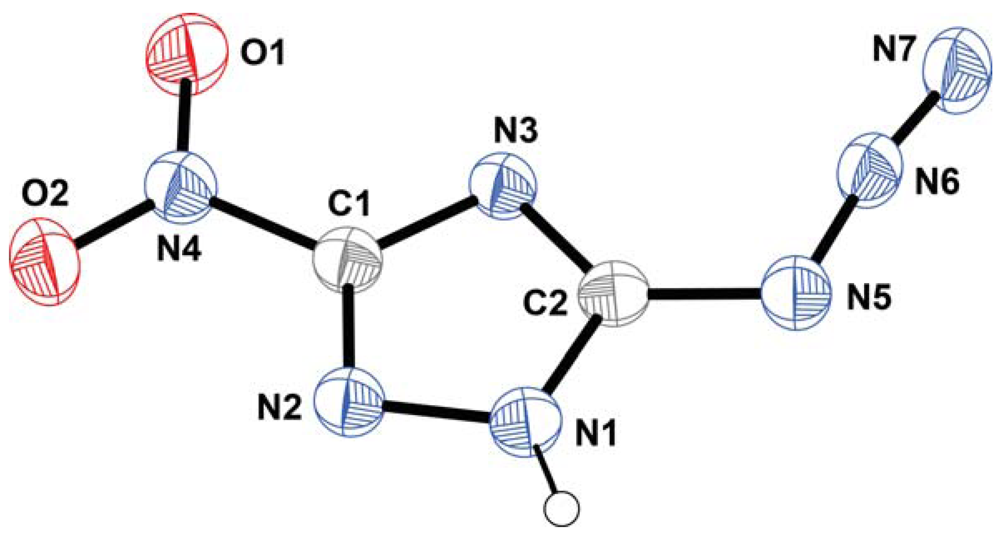
        <p>5-Azido-3-nitro-1<italic>H</italic>-1,2,4-triazole (<bold>1</bold>) crystallizes in the orthorhombic space group <italic>Pnma</italic> with a cell volume of 580.85(9) Å<sup>3</sup> and four molecules in the unit cell. The calculated density at −100 °C is 1.774 g cm<sup>−3</sup>, which is lower than that of the reactant (<bold>ANTA</bold>, 1.841 g cm<sup>−3</sup>). This may be due to fewer hydrogen bonds. The asymmetric unit consists of one complete molecule (<xref ref-type="fig" rid="crystals-02-00294-f001">Figure 1</xref>).</p>
        <fig id="crystals-02-00294-f001" position="anchor">
          <label>Figure 1</label>
          <caption>
            <p>Molecular structure of 5-azido-3-nitro-1<italic>H</italic>-1,2,4-triazole (<bold>1</bold>).</p>
          </caption>
          <graphic xmlns:xlink="http://www.w3.org/1999/xlink" xlink:href="crystals-02-00294-g001.tif"/>
        </fig>
        <p>The structure of <bold>1</bold> is similar to other disubstituted 1,2,4-triazoles with the C–N and N–N bonds of the ring being between formal single and double bonds (C–N: 1.47 Å, 1.22 Å; N–N: 1.48 Å, 1.20 Å) [<xref ref-type="bibr" rid="B3-crystals-02-00294">3</xref>]. N1–C2 (1.345(2) Å), N3–C1 (1.350(2) Å) and N1–N2 (1.356(2) Å) have a more single bond character, while N2–C1 (1.314(2) Å) and N3–C2 (1.327(2) Å) have a more double bond character. This also affects the angles within the ring, with only N2–C1–N3 (118.5(1)°) being close to sp<sup>2</sup> hybridization (120°). N1–C2–N3 and N2–N1–C2 are both around 110°, while C1–N3–C2 and N1–N2–C1 are both around 100°. The N4–C1 bond connecting the nitro group to the ring is the longest bond with 1.452(2) Å and therefore almost a true single bond. The O–N bonds are similar (O1–N4: 1.227(1) Å; O2–N4: 1.228(1) Å) with high double bond character (1.20 Å) [<xref ref-type="bibr" rid="B3-crystals-02-00294">3</xref>] and the O1–N4–O2 angle is 124.9(2)°, which is common for aromatic nitro groups. The N5–C2 bond shows a high single bond character with 1.383(2) Å. The constitution of the azide group is similar to other covalent azides, for example 5-azido-1<italic>H</italic>-tetrazole [<xref ref-type="bibr" rid="B4-crystals-02-00294">4</xref>]. The N5–N6 bond (1.256(2) Å) is in the range of a N–N double bond and N6–N7 (1.124(2) Å) is close to a formal N–N triple bond (1.10 Å) [<xref ref-type="bibr" rid="B3-crystals-02-00294">3</xref>]. The N5–N6–N7 angle (170.4(2)°) deviates as expected from 180°, which can be explained by hyperconjugation effects [<xref ref-type="bibr" rid="B5-crystals-02-00294">5</xref>]. The torsion angles N2–C1–N4–O1 and N1–C2–N5–N6 are both 180.0(2)°, showing a complete planarity of the molecule.</p>
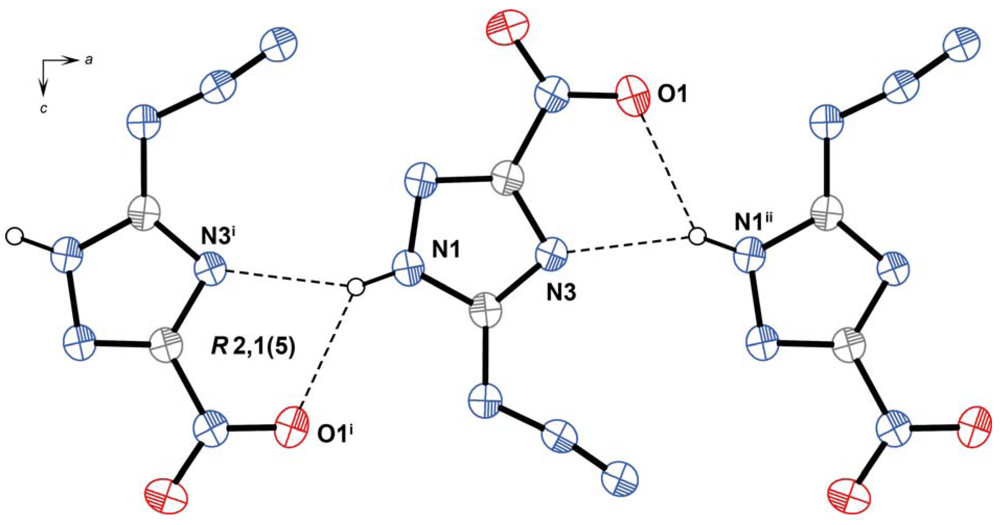
        <p>The structure of <bold>1</bold> in the crystalline state is characterized by infinite chains of alternating molecules along the <italic>a</italic>-axis in the <italic>a-c</italic> plane, connected by bifurcated hydrogen bonds (<xref ref-type="fig" rid="crystals-02-00294-f002">Figure 2</xref> and <xref ref-type="table" rid="crystals-02-00294-t002">Table 2</xref>). The N1–H71···O1<sup>i</sup> contact is less directed with an angle of 135(2)° than the N1–H71···N3<sup>i</sup> contact with 153(2)°, and both are fairly weak with practically identical donor acceptor distances (N1···O1<sup>i</sup>: 3.013(2) Å; N1···N3<sup>i</sup>: 3.015(2) Å) just slightly under the sum of the <italic>van der Waals</italic> radii (<italic>r</italic><sub>w</sub> (N) + <italic>r</italic><sub>w</sub> (O) = 3.1 Å, <italic>r</italic><sub>w</sub> (N) + <italic>r</italic><sub>w</sub> (N) = 3.2 Å) [<xref ref-type="bibr" rid="B3-crystals-02-00294">3</xref>]. The hydrogen bonds are therefore mostly of an electrostatic nature [<xref ref-type="bibr" rid="B6-crystals-02-00294">6</xref>], forming a five-membered ring with the graph set descriptor <italic>R</italic>2,1(5).</p>
        <fig id="crystals-02-00294-f002" position="anchor">
          <label>Figure 2</label>
          <caption>
            <p>Hydrogen bonding in the crystal structure of <bold>1</bold>, illustrating the infinite chains along the <italic>a</italic>-axis in the <italic>a</italic>–<italic>c</italic> plane. Symmetry codes: (i) <italic>x</italic> − 0.5, −<italic>y</italic> + 0.5, −<italic>z</italic> + 0.5; (ii) <italic>x</italic> + 0.5, −<italic>y</italic> + 0.5, −<italic>z</italic> + 0.5.</p>
          </caption>
          <graphic xmlns:xlink="http://www.w3.org/1999/xlink" xlink:href="crystals-02-00294-g002.tif"/>
        </fig>
        <table-wrap id="crystals-02-00294-t002" position="anchor">
          <object-id pub-id-type="pii">crystals-02-00294-t002_Table 2</object-id>
          <label>Table 2</label>
          <caption>
            <p>Distances and angles of the hydrogen bonds of <bold>1</bold>.</p>
          </caption>
          <table>
            <thead>
              <tr>
                <th align="center" valign="middle">D–H···A</th>
                <th align="center" valign="middle"><italic>d</italic> (D–H)/Å</th>
                <th align="center" valign="middle"><italic>d</italic> (H···A)/Å</th>
                <th align="center" valign="middle"><italic>d</italic> (D···A)/Å</th>
                <th align="center" valign="middle">&lt;(D–H···A)/°</th>
              </tr>
            </thead>
            <tbody>
              <tr>
                <td align="center" valign="middle">N1–H71···O1<sup>i</sup></td>
                <td align="center" valign="middle">0.85(3)</td>
                <td align="center" valign="middle">2.36(2)</td>
                <td align="center" valign="middle">3.013(2)</td>
                <td align="center" valign="middle">135(2)</td>
              </tr>
              <tr>
                <td align="center" valign="middle">N1–H71···N3<sup>i</sup></td>
                <td align="center" valign="middle">0.85(3)</td>
                <td align="center" valign="middle">2.24(3)</td>
                <td align="center" valign="middle">3.015(2)</td>
                <td align="center" valign="middle">153(2)</td>
              </tr>
            </tbody>
          </table>
          <table-wrap-foot>
          <fn>
          <p>Symmetry code: (i) <italic>x</italic> − 0.5, −<italic>y</italic> + 0.5, −<italic>z</italic> + 0.5.</p>
          </fn>
          </table-wrap-foot>
        </table-wrap>
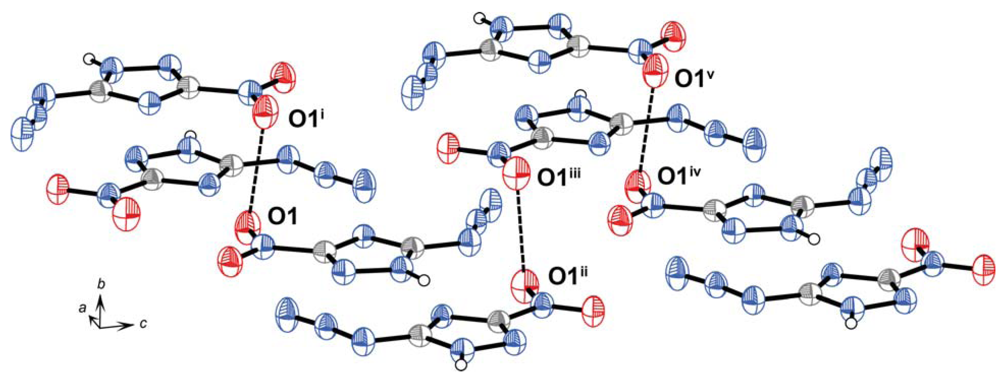
        <p>The chains build up a layer structure where one layer consists of identical parallel chains with no interaction between them. The second layer consists of anti-parallel chains, in relation to the first layer, with the molecules being above the gaps of the first layer. This leads to the layers being connected by an O–O short contact O1···O1<sup>iii</sup> where the atoms are almost directly above each other along the <italic>b</italic>-axis. The distance of 2.9633(4) Å is only slightly shorter than the sum of the van der Waals radii (<italic>r</italic><sub>w</sub> (O) + <italic>r</italic><sub>w</sub> (O) = 3.0 Å), indicating a weak interaction. The packing of the molecules is depicted in <xref ref-type="fig" rid="crystals-02-00294-f003">Figure 3</xref>, together with the O–O short contacts.</p>
        <fig id="crystals-02-00294-f003" position="anchor">
          <label>Figure 3</label>
          <caption>
            <p>Packing scheme of <bold>1</bold>, showing the short contacts connecting the layers along the <italic>b</italic>-axis. Symmetry codes: (i) −<italic>x</italic> + 1, <italic>y</italic> + 0.5, −<italic>z</italic>; (ii) <italic>x</italic> − 0.5, −<italic>y</italic> + 0.5, −<italic>z</italic> + 0.5; (iii) −<italic>x</italic> + 0.5, − <italic>y</italic>+ 1, <italic>z</italic> + 0.5; (iv) <italic>x</italic>, <italic>y</italic>, <italic>z</italic> + 1; (v) −<italic>x</italic> + 1, <italic>y</italic> + 0.5, −<italic>z</italic> + 1.</p>
          </caption>
          <graphic xmlns:xlink="http://www.w3.org/1999/xlink" xlink:href="crystals-02-00294-g003.tif"/>
        </fig>
      </sec>
      <sec>
        <title>2.2. 5-Azido-1-methyl-3-nitro-1,2,4-triazole (2)</title>
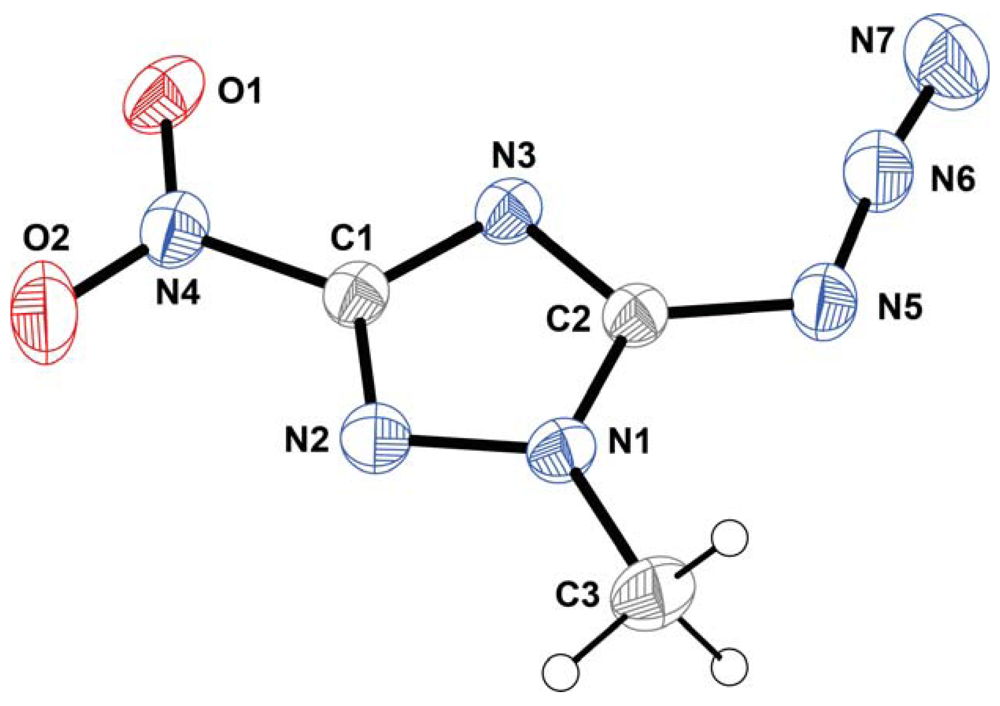
        <p>5-Azido-1-methyl-3-nitro-1,2,4-triazole (<bold>2</bold>) crystallizes in the monoclinic space group <italic>P</italic>2<sub>1</sub>/<italic>m</italic> with a cell volume of 339.49(12) Å<sup>3</sup> and two molecules in the unit cell. The calculated density at −100 °C is 1.654 g cm<sup>−3</sup>. The asymmetric unit consists of one molecule and is depicted in <xref ref-type="fig" rid="crystals-02-00294-f004">Figure 4</xref>, together with the atom labeling scheme.</p>
        <fig id="crystals-02-00294-f004" position="anchor">
          <label>Figure 4</label>
          <caption>
            <p>Molecular structure of 5-azido-1-methyl-3-nitro-1,2,4-triazole (<bold>2</bold>).</p>
          </caption>
          <graphic xmlns:xlink="http://www.w3.org/1999/xlink" xlink:href="crystals-02-00294-g004.tif"/>
        </fig>
        <p>The geometry of the ring system is identical to the parent compound <bold>1</bold>. The N1–C3 bond is a true single bond with 1.463(4) Å.</p>
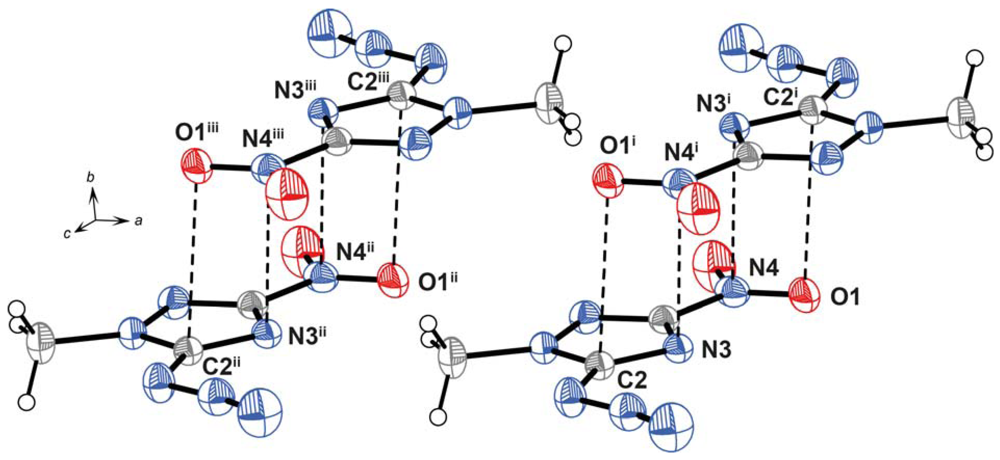
        <p>A discussion of hydrogen bonds is omitted due to the hydrogen atoms being calculated as an idealized methyl group (HFIX 33), although the crystal packing shows the possibility of a very weak electrostatic interaction between C3 and N3<sup>ii</sup> (<xref ref-type="fig" rid="crystals-02-00294-f005">Figure 5</xref>).</p>
        
        <p>The structure is again comprised of parallel chains along the <italic>a</italic>-axis forming a layer structure, whereby the alternating layers have antiparallel chains (<xref ref-type="fig" rid="crystals-02-00294-f005">Figure 5</xref>), quite similar to <bold>1</bold>. But contrary to <bold>1</bold>, the molecules are not above the gaps of the surrounding layers, but rather directly above each other. This is the result of four O–C and N–N short contacts (O1–C1<sup>i</sup>: 3.0351(9) Å; N3–N4<sup>i</sup>: 3.0448(8) Å), all of which are well below the sum of the respective van der Waals radii (<italic>r</italic><sub>w</sub> (O) + <italic>r</italic><sub>w</sub> (C) = 3.3 Å).</p>
        <fig id="crystals-02-00294-f005" position="anchor">
          <label>Figure 5</label>
          <caption>
            <p>Packing scheme of <bold>2</bold>, showing the short contacts connecting the layers along the <italic>b</italic>-axis. Symmetry codes: (i) −<italic>x</italic> + 2, <italic>y</italic> − 0.5, −<italic>z</italic>; (ii) <italic>x</italic> − 1, <italic>y</italic>, <italic>z</italic>; (iii) −<italic>x</italic> + 1, <italic>y</italic> − 0.5, −<italic>z</italic>.</p>
          </caption>
          <graphic xmlns:xlink="http://www.w3.org/1999/xlink" xlink:href="crystals-02-00294-g005.tif"/>
        </fig>
      </sec>
      <sec>
        <title>2.3. Potassium 5-Azido-3-nitro-1,2,4-triazolate (3)</title>
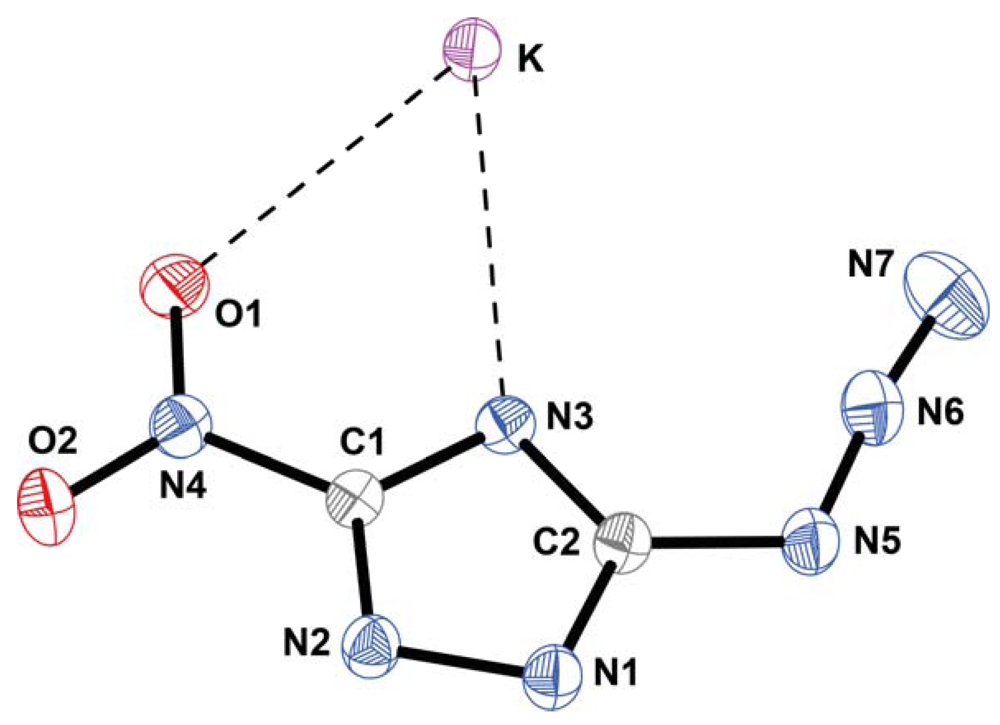
        <p>Potassium 5-azido-3-nitro-1,2,4-triazolate (<bold>3</bold>) crystallizes in the monoclinic space group <italic>P</italic>2<sub>1</sub>/<italic>c</italic> with a cell volume of 663.74(5) Å<sup>3</sup> and four molecules in the unit cell. The calculated density at −100 °C is 1.933 g cm<sup>−3</sup>. The asymmetric unit, depicted in <xref ref-type="fig" rid="crystals-02-00294-f006">Figure 6</xref>, consists of one ion pair.</p>
        <fig id="crystals-02-00294-f006" position="anchor">
          <label>Figure 6</label>
          <caption>
            <p>Molecular structure of potassium 5-azido-3-nitro-1,2,4-triazolate (<bold>3</bold>).</p>
          </caption>
          <graphic xmlns:xlink="http://www.w3.org/1999/xlink" xlink:href="crystals-02-00294-g006.tif"/>
        </fig>
        <p>The deprotonation of the ring leads to a fully delocalized π system, with C–N bond lengths between 1.327(2) Å (N2–C1) to 1.343(2) Å (N1–C2 and N3–C1) and a N1–N2 bond length of 1.374(2) Å. The angles of the ring are more symmetrical than in <bold>1</bold>, with N1–C2–N3 and N2–C1–N3 both being around 120°, close to an sp<sup>2</sup> hybridization. N1–N2–C1, N2–N1–C2 and C1–N3–C2 are all round 100°, with the former two slightly higher and the latter slightly lower. While the N4–C1 bond between the ring and the nitro group is shortened to 1.441(2) Å, the N5–C2 bond connecting the ring with the azide grew to 1.410(2) Å, with both still showing a high single bond character. The bond lengths and angles of the azide and the nitro group are nearly identical to those of <bold>1</bold>. While the N2–C1–N4–O1 torsion angle shows a nearly complete planarity between the ring and the nitro group (179.0(1)°), the azide is slightly bent out of ring plane with an N1–C2–N5–N6 angle of −174.9(1)°. The potassium cation lies slightly above the molecule plane with torsion angles around 20° for N3···K···O1–N4 and O1···K···N3–C1.</p>
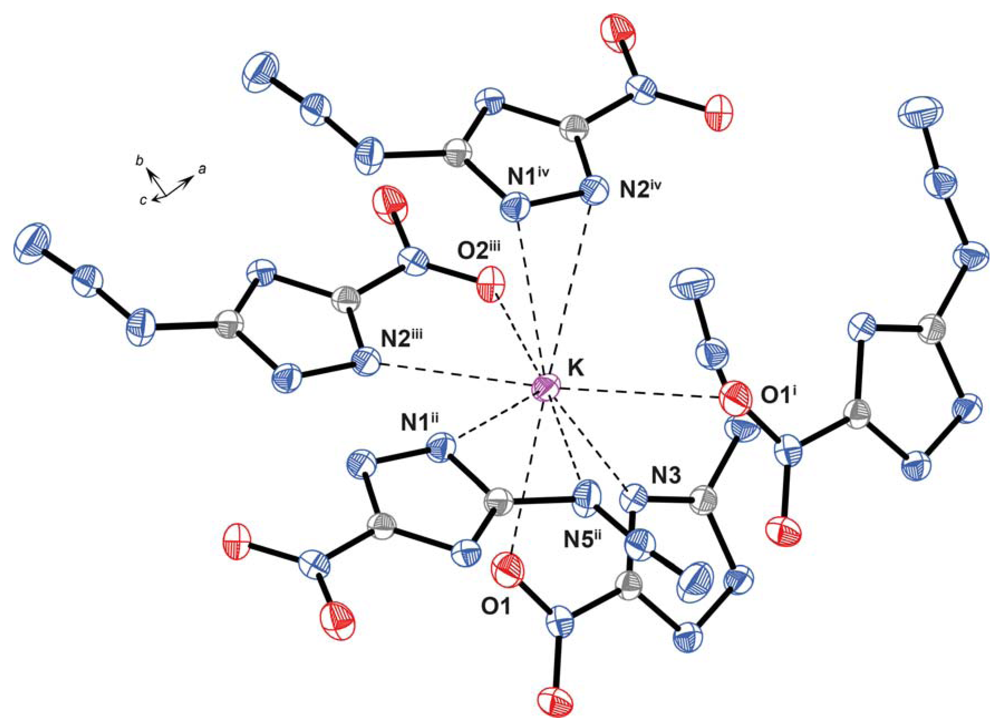
        <p>The coordination of the potassium cation is nine-fold, resembling a distorted singly capped tetragonal prism (<xref ref-type="fig" rid="crystals-02-00294-f007">Figure 7</xref>). The distances are between 2.847(1) Å (K···O1) and 3.084(1) Å (K···N2<sup>iv</sup>), with the contacts within the asymmetric unit being 2.847(1) Å (K···O1) and 2.902(1) Å (K···N3).</p>
        <fig id="crystals-02-00294-f007" position="anchor">
          <label>Figure 7</label>
          <caption>
            <p>Molecular structure of potassium 5-azido-3-nitro-1,2,4-triazolate (<bold>3</bold>). Symmetry codes: (i) <italic>x</italic> + 1, <italic>y</italic>, <italic>z</italic>; (ii) <italic>x</italic>, −<italic>y</italic> + 0.5, <italic>z</italic> + 0.5; (iii) −<italic>x</italic> + 1, <italic>y</italic> + 0.5, −<italic>z</italic> + 0.5; (iv) −<italic>x</italic> + 2, <italic>y</italic> + 0.5, −<italic>z</italic> + 0.5.</p>
          </caption>
          <graphic xmlns:xlink="http://www.w3.org/1999/xlink" xlink:href="crystals-02-00294-g007.tif"/>
        </fig>
      </sec>
    </sec>
    <sec>
      <title>3. Experimental Section</title>
      <p>All chemicals were used as supplied (ABCR, Acros Organics, AppliChem, Sigma-Aldrich, VWR).</p>
      <p>NMR spectra were recorded using the spectrometers JEOL Eclipse 400 and JEOL ECX 400. The measurements were conducted in regular glass NMR tubes (Ø 5 mm) and, if not stated otherwise, at 25 °C. Tetramethylsilane (<sup>1</sup>H, <sup>13</sup>C) and nitromethane (<sup>14/15</sup>N) were used as external standards. As an additional internal standard, the reference values of the partially deuterated solvent impurity (<sup>1</sup>H) and the fully deuterated solvent (<sup>13</sup>C) were used [<xref ref-type="bibr" rid="B7-crystals-02-00294">7</xref>]. Data analysis was performed using MestReNova [<xref ref-type="bibr" rid="B8-crystals-02-00294">8</xref>].</p>
      <p>IR spectra were recorded using a PerkinElmer BX FT IR spectrometer on a Smiths DuraSamplIR II diamond ATR unit with pure samples. Raman spectra were recorded using a Bruker RAM II, with 300 mW laser power (Nd:YAG laser, <italic>λ</italic> = 1064 nm) and 30 scans in open glass tubes (Ø 1 mm).</p>
      <p>The determinations of the carbon, hydrogen and nitrogen contents were carried out by combustion analysis using an Elementar Vario EL. The theoretical values are given in parentheses.</p>
      <p>Differential scanning calorimetry was conducted with a Linseis DSC-PT10 in closed aluminum pans, equipped with a hole (Ø 0.1 mm) for gas release, and a heating rate of 5 °C min<sup>−1</sup>. </p>
      <p>Crystal structures were determined by single crystal X-ray diffraction on an Oxford Diffraction Xcalibur 3 diffractometer with a Sapphire CCD detector, four circle kappa platform, Enhance molybdenum K<sub>α</sub> radiation source (<italic>λ</italic> = 71.073 pm) and Oxford Cryosystems Cryostream cooling unit. Data collection and reduction were performed with CrysAlisPro [<xref ref-type="bibr" rid="B9-crystals-02-00294">9</xref>]. The structures were solved with SIR97 [<xref ref-type="bibr" rid="B10-crystals-02-00294">10</xref>], refined with SHELXL-97 [<xref ref-type="bibr" rid="B11-crystals-02-00294">11</xref>] and checked with PLATON [<xref ref-type="bibr" rid="B12-crystals-02-00294">12</xref>], all integrated in the WinGX software suite [<xref ref-type="bibr" rid="B13-crystals-02-00294">13</xref>]. The finalized CIF files [<xref ref-type="bibr" rid="B14-crystals-02-00294">14</xref>] were checked with checkCIF [<xref ref-type="bibr" rid="B15-crystals-02-00294">15</xref>]. Intra- and intermolecular contacts were analyzed with Mercury [<xref ref-type="bibr" rid="B16-crystals-02-00294">16</xref>], graph set patterns [<xref ref-type="bibr" rid="B17-crystals-02-00294">17</xref>,<xref ref-type="bibr" rid="B18-crystals-02-00294">18</xref>] with RPluto [<xref ref-type="bibr" rid="B19-crystals-02-00294">19</xref>]. Illustrations of molecular structures were drawn with Diamond [<xref ref-type="bibr" rid="B20-crystals-02-00294">20</xref>].</p>
      <p>The sensitivities against impact (IS) and friction (FS) were determined according to BAM [<xref ref-type="bibr" rid="B21-crystals-02-00294">21</xref>] standards using a BAM drop hammer and a BAM friction apparatus [<xref ref-type="bibr" rid="B22-crystals-02-00294">22</xref>,<xref ref-type="bibr" rid="B23-crystals-02-00294">23</xref>,<xref ref-type="bibr" rid="B24-crystals-02-00294">24</xref>,<xref ref-type="bibr" rid="B25-crystals-02-00294">25</xref>,<xref ref-type="bibr" rid="B26-crystals-02-00294">26</xref>]. The compounds were classified in compliance with UN guidelines [<xref ref-type="bibr" rid="B27-crystals-02-00294">27</xref>]. The sensitivities against electrostatic discharge (ESD) were determined using an OZM Research ESD 2010 EN.</p>
      <p>CAUTION! Most compounds prepared herein are energetic compounds sensitive to impact, friction and electric discharge. Therefore proper protective measures (ear protection, Kevlar<sup>®</sup> gloves, face shield, body armor and earthed equipment) should be used, especially when handling the primary explosive <bold>2</bold>.</p>
      <sec>
        <title>3.1. 5-Azido-3-nitro-1H-1,2,4-triazole (1)</title>
        <p>Sodium nitrite (379 mg, 5.50 mmol) was added to a stirred suspension of ANTA (645 mg, 5.00 mmol) in sulfuric acid (25%, 30 mL) at 0–5 °C in small portions and the resulting yellow solution was stirred for 1 h at room temperature. After the addition of a small portion of urea, sodium azide (390 mg, 6.00 mmol) was added in small portions, followed by stirring for further 30 min. The reaction mixture was extracted with ethyl acetate (3 × 20 mL) and the combined organic phases were dried over magnesium sulfate, then evaporated to dryness at reduced pressure. The residue was stirred in <italic>n</italic>-pentane overnight, then filtered and washed with <italic>n</italic>-pentane to yield a pale colorless powder (685 mg, 4.42 mmol, 88%).</p>
        <p>DSC (5 °C min<sup>−1</sup>): <italic>T</italic><sub>m</sub> = 117 °C, <italic>T</italic><sub>d</sub> = 174 °C; <sup>1</sup>H NMR (CD<sub>3</sub>CN): <italic>δ</italic> = 10.74 (br) ppm; <sup>1</sup>H NMR (DMSO-<italic>d</italic><sub>6</sub>): <italic>δ</italic> = 9.73 (br) ppm; <sup>13</sup>C{<sup>1</sup>H} NMR (DMSO-<italic>d</italic><sub>6</sub>): <italic>δ</italic> = 160.3 (C–NO<sub>2</sub>), 151.8 (C–N<sub>3</sub>) ppm; <sup>14</sup>N NMR (DMSO-<italic>d</italic><sub>6</sub>): <italic>δ</italic> = −22 (NO<sub>2</sub>), −141 (N<sub>β</sub>) ppm; <sup>15</sup>N NMR (DMSO-<italic>d</italic><sub>6</sub>): <italic>δ</italic> = −20.9 (NO<sub>2</sub>), −91.6 (C=<italic>N</italic>–NH), −137.0 (N<sub>γ</sub>), −139.9 (N<sub>β</sub>), −154.0 (C–N=C), −172.7 (N–<italic>N</italic>H–C), −285.9 (N<sub>α</sub>) ppm; IR (ATR): <italic>ν</italic> = 3198 (m), 2367 (w), 2219 (w), 2148 (s), 1670 (w), 1630 (w), 1569 (m), 1525 (vs), 1489 (vs), 1443 (s), 1417 (s), 1378 (s), 1294 (s), 1187 (vs), 1165 (s), 1053 (m), 1035 (s), 1010 (m), 843 (vs), 787 (vs), 766 (s), 706 (vs) cm<sup>−1</sup>; Raman: <italic>ν</italic> = 2159 (9), 1543 (16), 1492 (100), 1422 (17), 1384 (25), 1369 (9), 1320 (6), 1299 (10), 1169 (17), 1037 (14), 1012 (5) cm<sup>−1</sup>; MS (DEI+): <italic>m</italic>/<italic>z</italic> = 155.1 ([M<sup>+</sup>]); EA (C<sub>2</sub>HN<sub>7</sub>O<sub>2</sub>): C 16.12 (15.49), H 0.80 (0.65), N 61.96 (63.23) %; Sensitivities (&lt;100 µm): IS 5 J, FS 42 N, ESD 50 mJ.</p>
      </sec>
      <sec>
        <title>3.2. 5-Azido-1-methyl-3-nitro-1,2,4-triazole (2)</title>
        <p>Dimethyl sulfate (1.26 g, 10.0 mmol) was added dropwise to a solution of <bold>1</bold> (1.55 g, 10.0 mmol) and sodium hydroxide (800 mg, 20.0 mmol) in water (10 mL). The reaction mixture was then stirred overnight at 105 °C. The precipitate obtained after cooling to room temperature was filtered off, washed with a small amount of water and dried in air to yield fine colorless needles suitable for X-ray diffraction (270 mg, 1.60 mmol, 16%).</p>
        <p>DSC (5 °C min<sup>−1</sup>): <italic>T</italic><sub>m</sub> = 122 °C, <italic>T</italic><sub>d</sub> = 161 °C; <sup>1</sup>H NMR (DMSO-<italic>d</italic><sub>6</sub>): <italic>δ</italic> = 3.74 (s) ppm; <sup>13</sup>C{<sup>1</sup>H} NMR (DMSO-<italic>d</italic><sub>6</sub>): <italic>δ</italic> = 158.7 (C–NO<sub>2</sub>), 150.3 (C–N<sub>3</sub>), 35.4 (CH<sub>3</sub>) ppm; <sup>14</sup>N NMR (DMSO-<italic>d</italic><sub>6</sub>): <italic>δ</italic> = −23 (NO<sub>2</sub>), −142 (N<sub>β</sub>) ppm; IR (ATR): <italic>ν</italic> = 2394 (w), 2294 (w), 2166 (s), 1551 (s), 1502 (vs), 1449 (s), 1398 (s), 1311 (vs), 1266 (s), 1252 (vs), 1044 (m), 1020 (m), 875 (s), 811 (s), 708 (s), 683 (s), 642 (m) cm<sup>−1</sup>; Raman: <italic>ν</italic> = 2960 (28), 2160 (11), 1551 (12), 1535 (52), 1499 (54), 1453 (39), 1398 (100), 1303 (32), 1271 (13), 1253 (28), 1046 (24), 1023 (12), 769 (6), 683 (13) cm<sup>−1</sup>; MS (DEI+): <italic>m</italic>/<italic>z</italic> = 169.0 ([M<sup>+</sup>]); EA (C<sub>3</sub>H<sub>3</sub>N<sub>7</sub>O<sub>2</sub>): C 21.58 (21.31), H 1.80 (1.79), N 56.59 (57.98) %; Sensitivities (100–500 µm): IS 40 J, FS 288 N, ESD 200 mJ.</p>
      </sec>
      <sec>
        <title>3.3. Potassium 5-Azido-3-nitro-1,2,4-triazolate (3)</title>
        <p>Potassium carbonate (138 mg, 1.00 mmol) and <bold>1</bold> (341 mg, 2.20 mmol) were refluxed in ethanol (40 mL) for 30 min, then filtered to remove undissolved solids. The solvent was then removed under reduced pressure and the residue was stirred in diethyl ether, then filtered off and washed with diethyl ether to yield a yellow powder (317 mg, 1.64 mmol, 82%).</p>
        <p>DSC (5 °C min<sup>−1</sup>): <italic>T</italic><sub>d</sub> = 175 °C; <sup>13</sup>C{<sup>1</sup>H} NMR (DMSO-<italic>d</italic><sub>6</sub>): <italic>δ</italic> = 163.9 (C–NO<sub>2</sub>), 156.2 (C–N3) ppm; <sup>14</sup>N NMR (DMSO-<italic>d</italic><sub>6</sub>): <italic>δ</italic> = −12 (NO<sub>2</sub>), −134 (N<sub>β</sub>) ppm; <sup>15</sup>N NMR (DMSO-<italic>d</italic><sub>6</sub>): <italic>δ</italic> = −12.4 (NO<sub>2</sub>), −48.5 (ring N–N), −67.2 (ring N–N), −130.4 (N<sub>β</sub>), −140.4 (N<sub>γ</sub>), −152.8 (C–N=C), −288.5 (N<sub>α</sub>) ppm; IR (ATR): <italic>ν</italic> = 2444 (w), 2243 (w), 2142 (s), 1531 (s), 1478 (m), 1441 (vs), 1386 (s), 1324 (vs), 1286 (m), 1226 (m), 1084 (s), 1054 (w), 1018 (w), 843 (m), 796 (w), 731 (m), 656 (m) cm<sup>−1</sup>; Raman: <italic>ν</italic> = 2153 (4), 1457 (11), 1445 (28), 1387 (44), 1323 (72), 1083 (100), 1019 (5) cm<sup>−1</sup>; MS (FAB+): <italic>m</italic>/<italic>z</italic> = 38.9 ([K<sup>+</sup>]); MS (FAB−): <italic>m</italic>/<italic>z</italic> = 153.9 ([M<sup>−</sup>]); EA (C<sub>2</sub>KN<sub>7</sub>O<sub>2</sub>): C 12.59 (12.44), N 48.84 (50.76) %; Sensitivities (&lt;100 µm): IS 1 J, FS 5 N, ESD 15 mJ.</p>
      </sec>
    </sec>
    <sec sec-type="conclusions">
      <title>4. Conclusions</title>
      <p>The thermally stable azidotriazole 5-azido-3-nitro-1<italic>H</italic>-1,2,4-triazole (<bold>1</bold>) was prepared by diazotation and subsequent reaction with sodium azide from 3-amino-5-nitro-1<italic>H</italic>-1,2,4-triazole (<bold>ANTA</bold>) in high yield and purity. Methylation with dimethyl sulfate yielded 5-azido-1-methyl-3-nitro-1,2,4-triazole (<bold>2</bold>). Reaction of the neutral compound with potassium carbonate led to the formation of potassium 5-azido-3-nitro-1,2,4-triazolate (<bold>3</bold>), which is a very sensitive primary explosive detonating in the flame. Deprotonation of the triazole ring practically does not result in a change of the decomposition temperature, in contrast to other azidotriazoles like 3,5-diazido-1<italic>H</italic>-1,2,4-triazole [<xref ref-type="bibr" rid="B28-crystals-02-00294">28</xref>].</p>
    </sec>
    
  </body>
  <back>
   <ack>
      <title>Acknowledgments</title>
      <p>Financial support of this work by the Ludwig-Maximilian University of Munich (LMU), the U.S. Army Research Laboratory (ARL), the Armament Research, Development and Engineering Center (ARDEC), the Strategic Environmental Research and Development Program (SERDP) and the Office of Naval Research (ONR Global, title: “Synthesis and Characterization of New High Energy Dense Oxidizers (HEDO)–NICOP Effort” under contracts W911NF-09-2-0018 (ARL), W911NF-09-1-0120 (ARDEC), W011NF-09-1-0056 (ARDEC) and 10 WPSEED01-002/WP-1765 (SERDP) is gratefully acknowledged. The authors acknowledge collaborations with <italic>Mila Krupka</italic> (OZM Research, Czech Republic) in the development of new testing and evaluation methods for energetic materials and with <italic>Muhamed Sućeska</italic> (Brodarski Institute, Croatia) in the development of new computational codes to predict the detonation and propulsion parameters of novel explosives. We are indebted to and thank <italic>Betsy M. Rice</italic> and <italic>Brad Forch</italic> (ARL, Aberdeen Proving Ground, MD, USA) and <italic>Gary Chen</italic> (ARDEC, Picatinny Arsenal, NJ, USA) for many helpful and inspired discussions and support of our work. <italic>Jörg Stierstorfer</italic> is thanked for a variety of advice and <italic>Stefan Huber</italic> for the sensitivity tests.</p>
    </ack>
    <notes>
      <title>Conflict of Interest</title>
      <p>The authors declare no conflict of interest. </p>
    </notes>
    <ref-list>
      <title>References</title>
      <ref id="B1-crystals-02-00294">
        <label>1.</label>
        <citation citation-type="journal">
          <person-group person-group-type="author">
            <name>
              <surname>Pevzner</surname>
              <given-names>M.S.</given-names>
            </name>
            <name>
              <surname>Martynova</surname>
              <given-names>M.N.</given-names>
            </name>
            <name>
              <surname>Timofeeva</surname>
              <given-names>T.N.</given-names>
            </name>
          </person-group>
          <article-title>Acid-base properties of 3-azido-1,2,4-triazoles</article-title>
          <source>Khim. Geterotsikl. Soed.</source>
          <year>1974</year>
          <volume>9</volume>
          <fpage>1288</fpage>
          <lpage>1291</lpage>
        </citation>
      </ref>
      <ref id="B2-crystals-02-00294">
        <label>2.</label>
        <citation citation-type="journal">
          <person-group person-group-type="author">
            <name>
              <surname>Simpson</surname>
              <given-names>R.L.</given-names>
            </name>
            <name>
              <surname>Pagoria</surname>
              <given-names>P.F.</given-names>
            </name>
            <name>
              <surname>Mitchell</surname>
              <given-names>A.R.</given-names>
            </name>
            <name>
              <surname>Coon</surname>
              <given-names>C.L.</given-names>
            </name>
          </person-group>
          <article-title>Synthesis, properties and performance of the high explosive ANTA</article-title>
          <source>Propellants Explos. Pyrotech.</source>
          <year>1994</year>
          <volume>19</volume>
          <fpage>174</fpage>
          <lpage>179</lpage>
          <pub-id pub-id-type="doi">10.1002/prep.19940190405</pub-id>
        </citation>
      </ref>
      <ref id="B3-crystals-02-00294">
        <label>3.</label>
        <citation citation-type="book">
          <person-group person-group-type="author">
            <name>
              <surname>Holleman</surname>
              <given-names>A.F.</given-names>
            </name>
            <name>
              <surname>Wiberg</surname>
              <given-names>E.</given-names>
            </name>
            <name>
              <surname>Wiberg</surname>
              <given-names>N.</given-names>
            </name>
          </person-group>
          <source>Lehrbuch der Anorganischen Chemie</source>
          <edition>102nd</edition>
          <publisher-name>Walter de Gruyter</publisher-name>
          <publisher-loc>Berlin, Germany</publisher-loc>
          <year>2007</year>
        </citation>
      </ref>
      <ref id="B4-crystals-02-00294">
        <label>4.</label>
        <citation citation-type="journal">
          <person-group person-group-type="author">
            <name>
              <surname>Stierstorfer</surname>
              <given-names>J.</given-names>
            </name>
            <name>
              <surname>Klapötke</surname>
              <given-names>T.M.</given-names>
            </name>
            <name>
              <surname>Hammerl</surname>
              <given-names>A.</given-names>
            </name>
            <name>
              <surname>Chapman</surname>
              <given-names>R.D.</given-names>
            </name>
          </person-group>
          <article-title>5-Azido-1<italic>H</italic>-tetrazole—Improved synthesis, crystal structure and sensitivity data</article-title>
          <source>Z. Anorg. Allg. Chem.</source>
          <year>2008</year>
          <volume>634</volume>
          <fpage>1051</fpage>
          <lpage>1057</lpage>
        <pub-id pub-id-type="doi">10.1002/zaac.200800003</pub-id></citation>
      </ref>
      <ref id="B5-crystals-02-00294">
        <label>5.</label>
        <citation citation-type="book">
          <person-group person-group-type="author">
            <name>
              <surname>Klapötke</surname>
              <given-names>T.M.</given-names>
            </name>
          </person-group>
          <article-title>Nichtmetallchemie</article-title>
          <source>Moderne Anorganische Chemie</source>
          <edition>3rd</edition>
          <person-group person-group-type="editor">
            <name>
              <surname>Riedel</surname>
              <given-names>E.</given-names>
            </name>
          </person-group>
          <publisher-name>Walter de Gruyter</publisher-name>
          <publisher-loc>Berlin, Germany</publisher-loc>
          <year>2007</year>
        </citation>
      </ref>
      <ref id="B6-crystals-02-00294">
        <label>6.</label>
        <citation citation-type="book">
          <person-group person-group-type="author">
            <name>
              <surname>Jeffrey</surname>
              <given-names>G.A.</given-names>
            </name>
          </person-group>
          <source>An Introduction to Hydrogen Bonding</source>
          <publisher-name>Oxford University Press</publisher-name>
          <publisher-loc>New York, NY, USA</publisher-loc>
          <year>1997</year>
        </citation>
      </ref>
      <ref id="B7-crystals-02-00294">
        <label>7.</label>
        <citation citation-type="journal">
          <person-group person-group-type="author">
            <name>
              <surname>Fulmer</surname>
              <given-names>G.R.</given-names>
            </name>
            <name>
              <surname>Miller</surname>
              <given-names>A.J.M.</given-names>
            </name>
            <name>
              <surname>Sherden</surname>
              <given-names>N.H.</given-names>
            </name>
            <name>
              <surname>Gottlieb</surname>
              <given-names>H.E.</given-names>
            </name>
            <name>
              <surname>Nudelman</surname>
              <given-names>A.</given-names>
            </name>
            <name>
              <surname>Stoltz</surname>
              <given-names>B.M.</given-names>
            </name>
            <name>
              <surname>Bercaw</surname>
              <given-names>J.E.</given-names>
            </name>
            <name>
              <surname>Goldberg</surname>
              <given-names>K.I.</given-names>
            </name>
          </person-group>
          <article-title>NMR chemical shifts of trace impurities: Common laboratory solvents, organics, and gases in deuterated solvents relevant to the organometallic chemist</article-title>
          <source>Organometallics</source>
          <year>2010</year>
          <volume>29</volume>
          <fpage>2176</fpage>
          <lpage>2179</lpage>
        <pub-id pub-id-type="doi">10.1021/om100106e</pub-id></citation>
      </ref>
      <ref id="B8-crystals-02-00294">
        <label>8.</label>
        <citation citation-type="book">
          <person-group person-group-type="author">
            <name>
              <surname>Cobas</surname>
              <given-names>J.C.</given-names>
            </name>
            <name>
              <surname>Domínguez</surname>
              <given-names>S.</given-names>
            </name>
            <name>
              <surname>Larin</surname>
              <given-names>N.</given-names>
            </name>
            <name>
              <surname>Iglesias</surname>
              <given-names>I.</given-names>
            </name>
            <name>
              <surname>Geada</surname>
              <given-names>C.</given-names>
            </name>
            <name>
              <surname>Seoane</surname>
              <given-names>F.</given-names>
            </name>
            <name>
              <surname>Sordo</surname>
              <given-names>M.</given-names>
            </name>
            <name>
              <surname>Monje</surname>
              <given-names>P.</given-names>
            </name>
            <name>
              <surname>Fraga</surname>
              <given-names>S.</given-names>
            </name>
            <name>
              <surname>Cobas</surname>
              <given-names>R.</given-names>
            </name>
          </person-group>
          <source>MestReNova 5.2.5-5780</source>
          <publisher-name>Mestrelab Research S.L.</publisher-name>
          <publisher-loc>Santiago de Compostela, Spain</publisher-loc>
          <year>2007</year>
        </citation>
      </ref>
      <ref id="B9-crystals-02-00294">
        <label>9.</label>
        <citation citation-type="book">
          <source>CrysAlisPro 1.171.35.11</source>
          <publisher-name>Agilent Technologies</publisher-name>
          <publisher-loc>UK: Yarnton, UK</publisher-loc>
          <year>2001</year>
        </citation>
      </ref>
      <ref id="B10-crystals-02-00294">
        <label>10.</label>
        <citation citation-type="journal">
          <person-group person-group-type="author">
            <name>
              <surname>Altomare</surname>
              <given-names>A.</given-names>
            </name>
            <name>
              <surname>Burla</surname>
              <given-names>M.C.</given-names>
            </name>
            <name>
              <surname>Camalli</surname>
              <given-names>M.</given-names>
            </name>
            <name>
              <surname>Cascarano</surname>
              <given-names>G.L.</given-names>
            </name>
            <name>
              <surname>Giacovazzo</surname>
              <given-names>C.</given-names>
            </name>
            <name>
              <surname>Guagliardi</surname>
              <given-names>A.</given-names>
            </name>
            <name>
              <surname>Moliterni</surname>
              <given-names>A.G.G.</given-names>
            </name>
            <name>
              <surname>Polidori</surname>
              <given-names>G.</given-names>
            </name>
            <name>
              <surname>Spagna</surname>
              <given-names>R.</given-names>
            </name>
          </person-group>
          <article-title>SIR97: A new tool for crystal structure determination and refinement</article-title>
          <source>J. Appl. Cryst.</source>
          <year>1999</year>
          <volume>32</volume>
          <fpage>115</fpage>
          <lpage>119</lpage>
          <pub-id pub-id-type="doi">10.1107/S0021889898007717</pub-id>
        </citation>
      </ref>
      <ref id="B11-crystals-02-00294">
        <label>11.</label>
        <citation citation-type="journal">
          <person-group person-group-type="author">
            <name>
              <surname>Sheldrick</surname>
              <given-names>G.M.</given-names>
            </name>
          </person-group>
          <article-title>A short history of SHELX</article-title>
          <source>Acta Cryst.</source>
          <year>2008</year>
          <volume>A64</volume>
          <fpage>112</fpage>
          <lpage>122</lpage>
        </citation>
      </ref>
      <ref id="B12-crystals-02-00294">
        <label>12.</label>
        <citation citation-type="book">
          <person-group person-group-type="author">
            <name>
              <surname>Spek</surname>
              <given-names>L.</given-names>
            </name>
          </person-group>
          <source>PLATON</source>
          <publisher-name>Utrecht University</publisher-name>
          <publisher-loc>Utrecht, The Netherlands</publisher-loc>
          <year>2011</year>
        </citation>
      </ref>
      <ref id="B13-crystals-02-00294">
        <label>13.</label>
        <citation citation-type="journal">
          <person-group person-group-type="author">
            <name>
              <surname>Farrugia</surname>
              <given-names>L.J.</given-names>
            </name>
          </person-group>
          <article-title>WinGX suite for small molecule single-crystal crystallography</article-title>
          <source>J. Appl. Cryst.</source>
          <year>1999</year>
          <volume>32</volume>
          <fpage>837</fpage>
          <lpage>838</lpage>
          <pub-id pub-id-type="doi">10.1107/S0021889899006020</pub-id>
        </citation>
      </ref>
      <ref id="B14-crystals-02-00294">
        <label>14.</label>
        <citation citation-type="journal">
          <person-group person-group-type="author">
            <name>
              <surname>Hall</surname>
              <given-names>S.R.</given-names>
            </name>
            <name>
              <surname>Allen</surname>
              <given-names>F.H.</given-names>
            </name>
            <name>
              <surname>Brown</surname>
              <given-names>I.D.</given-names>
            </name>
          </person-group>
          <article-title>The Crystallographic Information File (CIF): A new standard archive file for crystallography</article-title>
          <source>Acta Cryst.</source>
          <year>1991</year>
          <volume>A47</volume>
          <fpage>655</fpage>
          <lpage>685</lpage>
        </citation>
      </ref>
      <ref id="B15-crystals-02-00294">
        <label>15.</label>
        <citation citation-type="web">
		  <collab>International Union of Crystallography</collab>
           <article-title>checkCIF/PLATON (full publication check)</article-title>
          <access-date>(accessed on 17 March 2012)</access-date>
          <comment>Available online:<ext-link xmlns:xlink="http://www.w3.org/1999/xlink" xlink:href="http://journals.iucr.org/services/cif/checkcif.html" ext-link-type="uri">http://journals.iucr.org/services/cif/checkcif.html</ext-link></comment>
        </citation>
      </ref>
      <ref id="B16-crystals-02-00294">
        <label>16.</label>
        <citation citation-type="journal">
          <person-group person-group-type="author">
            <name>
              <surname>Macrae</surname>
              <given-names>C.F.</given-names>
            </name>
            <name>
              <surname>Edgington</surname>
              <given-names>P.R.</given-names>
            </name>
            <name>
              <surname>McCabe</surname>
              <given-names>P.</given-names>
            </name>
            <name>
              <surname>Pidcock</surname>
              <given-names>E.</given-names>
            </name>
            <name>
              <surname>Shields</surname>
              <given-names>G.P.</given-names>
            </name>
            <name>
              <surname>Taylor</surname>
              <given-names>R.</given-names>
            </name>
            <name>
              <surname>Towler</surname>
              <given-names>M.</given-names>
            </name>
            <name>
              <surname>van de Streek</surname>
              <given-names>J.</given-names>
            </name>
          </person-group>
          <article-title>Mercury: Visualization and analysis of crystal structures</article-title>
          <source>J. Appl. Crystallogr.</source>
          <year>2006</year>
          <volume>39</volume>
          <fpage>453</fpage>
          <lpage>457</lpage>
          <pub-id pub-id-type="doi">10.1107/S002188980600731X</pub-id>
        </citation>
      </ref>
      <ref id="B17-crystals-02-00294">
        <label>17.</label>
        <citation citation-type="journal">
          <person-group person-group-type="author">
            <name>
              <surname>Etter</surname>
              <given-names>M.C.</given-names>
            </name>
            <name>
              <surname>MacDonald</surname>
              <given-names>J.C.</given-names>
            </name>
            <name>
              <surname>Bernstein</surname>
              <given-names>J.</given-names>
            </name>
          </person-group>
          <article-title>Graph-set analysis of hydrogen-bond patterns in organic crystals</article-title>
          <source>Acta Cryst.</source>
          <year>1990</year>
          <volume>B46</volume>
          <fpage>256</fpage>
          <lpage>262</lpage>
        </citation>
      </ref>
      <ref id="B18-crystals-02-00294">
        <label>18.</label>
        <citation citation-type="journal">
          <person-group person-group-type="author">
            <name>
              <surname>Bernstein</surname>
              <given-names>J.</given-names>
            </name>
            <name>
              <surname>Davis</surname>
              <given-names>R.E.</given-names>
            </name>
            <name>
              <surname>Shimoni</surname>
              <given-names>L.</given-names>
            </name>
            <name>
              <surname>Chang</surname>
              <given-names>N.-L.</given-names>
            </name>
          </person-group>
          <article-title>Patterns in hydrogen bonding: Functionality and graph set analysis in crystals</article-title>
          <source>Angew. Chem. Int. Ed. Engl.</source>
          <year>1995</year>
          <volume>34</volume>
          <fpage>1555</fpage>
          <lpage>1573</lpage>
          <pub-id pub-id-type="doi">10.1002/anie.199515551</pub-id>
        </citation>
      </ref>
      <ref id="B19-crystals-02-00294">
        <label>19.</label>
        <citation citation-type="journal">
          <person-group person-group-type="author">
            <name>
              <surname>Motherwell</surname>
              <given-names>W.D.S.</given-names>
            </name>
            <name>
              <surname>Shields</surname>
              <given-names>G.P.</given-names>
            </name>
            <name>
              <surname>Allen</surname>
              <given-names>F.H.</given-names>
            </name>
          </person-group>
          <article-title>Automated assignment of graph-set descriptors for crystallographically symmetric molecules</article-title>
          <source>Acta Cryst.</source>
          <year>2000</year>
          <volume>B56</volume>
          <fpage>466</fpage>
          <lpage>473</lpage>
        </citation>
      </ref>
      <ref id="B20-crystals-02-00294">
        <label>20.</label>
        <citation citation-type="book">
          <person-group person-group-type="author">
            <name>
              <surname>Brandenburg</surname>
              <given-names>K.</given-names>
            </name>
          </person-group>
          <source>Diamond 3.2 h</source>
          <publisher-name>Crystal Impact GbR</publisher-name>
          <publisher-loc>Bonn, Germany</publisher-loc>
          <year>2012</year>
        </citation>
      </ref>
      <ref id="B21-crystals-02-00294">
        <label>21.</label>
        <citation citation-type="web">
          <article-title>BAM Bundesanstalt für Materialforschung und -prüfung</article-title>
          <access-date>(accessed on 17 March 2012)</access-date>
          <comment>Available online:<ext-link xmlns:xlink="http://www.w3.org/1999/xlink" xlink:href="http://www.bam.de" ext-link-type="uri">http://www.bam.de</ext-link></comment>
        </citation>
      </ref>
      <ref id="B22-crystals-02-00294">
        <label>22.</label>
        <citation citation-type="web">
		  <collab>DLA Document Services</collab>
           <article-title>ASSIST Database, NATO Standardization Agreement 4489, 17 September 1999</article-title>
          <access-date>(accessed on 17 March 2012)</access-date>
          <comment>Available online:<ext-link xmlns:xlink="http://www.w3.org/1999/xlink" xlink:href="http://assist.daps.dla.mil" ext-link-type="uri">http://assist.daps.dla.mil</ext-link></comment>
        </citation>
      </ref>
      <ref id="B23-crystals-02-00294">
        <label>23.</label>
        <citation citation-type="book">
          <source>Standardarbeitsanweisung 4-5.1.02</source>
          <publisher-name>Wehrwissenschaftliches Institut für Werk-, Explosiv- und Betriebsstoffe (WIWEB)</publisher-name>
          <publisher-loc>Erding, Germany</publisher-loc>
          <year>2002</year>
        </citation>
      </ref>
      <ref id="B24-crystals-02-00294">
        <label>24.</label>
        <citation citation-type="web">
          <article-title>DLA Document Services. ASSIST Database, NATO Standardization Agreement 4487, 22 August 2002</article-title>
          <access-date>(accessed on 17 March 2012)</access-date>
          <comment>Available online:<ext-link xmlns:xlink="http://www.w3.org/1999/xlink" xlink:href="http://assist.daps.dla.mil" ext-link-type="uri">http://assist.daps.dla.mil</ext-link></comment>
        </citation>
      </ref>
      <ref id="B25-crystals-02-00294">
        <label>25.</label>
        <citation citation-type="book">
          <source>Standardarbeitsanweisung 4-5.1.03</source>
          <publisher-name>Wehrwissenschaftliches Institut für Werk-, Explosiv- und Betriebsstoffe (WIWEB)</publisher-name>
          <publisher-loc>Erding, Germany</publisher-loc>
          <year>2002</year>
        </citation>
      </ref>
      <ref id="B26-crystals-02-00294">
        <label>26.</label>
        <citation citation-type="web">
          <article-title>Reichel &amp; Partner GmbH</article-title>
          <access-date>(accessed on 17 March 2012)</access-date>
          <comment>Available online:<ext-link xmlns:xlink="http://www.w3.org/1999/xlink" xlink:href="http://www.reichel-partner.de" ext-link-type="uri">http://www.reichel-partner.de</ext-link></comment>
        </citation>
      </ref>
      <ref id="B27-crystals-02-00294">
        <label>27.</label>
        <citation citation-type="book">
          <article-title>Impact: insensitive &gt; 40 J, less sensitive ≥ 35 J, sensitive ≥ 4 J, very sensitive ≥ 3 J; Friction: insensitive &gt; 360 N, less sensitive = 360 N, sensitive &lt; 360 N and &gt; 80 N, very sensitive ≤ 80 N, extremely sensitive ≤ 10 N</article-title>
          <source>Recommendations on the Transport of Dangerous Goods, Manual of Tests and Criteria</source>
          <edition>4th</edition>
          <publisher-name>United Nations</publisher-name>
          <publisher-loc>New York, NY, USA</publisher-loc>
          <year>1999</year>
        </citation>
      </ref>
      <ref id="B28-crystals-02-00294">
        <label>28.</label>
        <citation citation-type="confproc">
          <person-group person-group-type="author">
            <name>
              <surname>Fischer</surname>
              <given-names>N.</given-names>
            </name>
            <name>
              <surname>Klapötke</surname>
              <given-names>T.M.</given-names>
            </name>
            <name>
              <surname>Stierstorfer</surname>
              <given-names>J.</given-names>
            </name>
            <name>
              <surname>Wiedemann</surname>
              <given-names>E.N.</given-names>
            </name>
          </person-group>
          <article-title>Highly sensitive 3,5-diazidotriazole and the Binary C<sub>2</sub>N<sub>9</sub><sup>−</sup> Anion</article-title>
          <source>Proceedings of the 14th Seminar on New Trends in Research of Energetic Materials</source>
          <publisher-name>University Of Pardubice</publisher-name>
          <publisher-loc>Pardubice, Czech Republic</publisher-loc>
          <conf-loc>Pardubice, Czech Republic</conf-loc>
          <conf-date>13–15 April 2011</conf-date>
          <year>2011</year>
          <fpage>636</fpage>
          <lpage>645</lpage>
        </citation>
      </ref>
    </ref-list>
  </back>
</article>