<?xml version="1.0" encoding="UTF-8"?>
<!DOCTYPE article PUBLIC "-//NLM//DTD Journal Publishing DTD v2.3 20070202//EN" "journalpublishing.dtd">
<article xmlns:mml="http://www.w3.org/1998/Math/MathML" xmlns:xlink="http://www.w3.org/1999/xlink" xml:lang="en" article-type="research-article">
  <front>
    <journal-meta>
      <journal-id journal-id-type="publisher-id">crystals</journal-id>
      <journal-title>Crystals</journal-title>
      <abbrev-journal-title abbrev-type="publisher">Crystals</abbrev-journal-title>
      <abbrev-journal-title abbrev-type="pubmed">Crystals</abbrev-journal-title>
      <issn pub-type="epub">2073-4352</issn>
      <publisher>
        <publisher-name>MDPI</publisher-name>
      </publisher>
    </journal-meta>
    <article-meta>
      <article-id pub-id-type="doi">10.3390/cryst2020193</article-id>
      <article-id pub-id-type="publisher-id">crystals-02-00193</article-id>
      <article-categories>
        <subj-group>
          <subject>Article</subject>
        </subj-group>
      </article-categories>
      <title-group>
        <article-title>Ammonia Uptake and Release in the Mn<italic>X</italic><sub>2</sub>–NH<sub>3</sub> (<italic>X</italic> = Cl, Br) Systems and Structure of the Mn(NH<sub>3</sub>)<italic><sub>n</sub>X</italic><sub>2</sub> (<italic>n</italic> = 6, 2) Ammines</article-title>
      </title-group>
	  <contrib-group>
        <contrib contrib-type="author">
          <name>
            <surname>Reardon</surname>
            <given-names>Hazel</given-names>
          </name>
        </contrib>
        <contrib contrib-type="author">
          <name>
            <surname>Hanlon</surname>
            <given-names>James M.</given-names>
          </name>
        </contrib>
        <contrib contrib-type="author">
          <name>
            <surname>Grant</surname>
            <given-names>Michael</given-names>
          </name>
        </contrib>
        <contrib contrib-type="author">
          <name>
            <surname>Fullbrook</surname>
            <given-names>Imogen</given-names>
          </name>
        </contrib>
        <contrib contrib-type="author">
          <name>
            <surname>Gregory</surname>
            <given-names>Duncan H.</given-names>
          </name>
          <xref rid="c1-crystals-02-00193" ref-type="corresp">*</xref>
        </contrib>
      </contrib-group>
      
      <aff id="af1-crystals-02-00193">WestCHEM, School of Chemistry, University of Glasgow, Joseph Black Building, Glasgow G12 8QQ, UK; Email: <email>hazelr@chem.gla.ac.uk</email> (H.R.); <email>jamhan@chem.gla.ac.uk</email> (J.M.H.); <email>michaelgrant262@gmail.com</email> (M.G.); <email>0706652f@student.gla.ac.uk</email> (I.F.)</aff>
      <author-notes>
        <corresp id="c1-crystals-02-00193"><label>*</label> Author to whom correspondence should be addressed; Email: <email>duncan.gregory@glasgow.ac.uk</email>; Tel.: +44-141-330-6438; Fax: +44-141-330-4888.</corresp>
      </author-notes>
      <pub-date pub-type="epub">
        <day>10</day>
        <month>04</month>
        <year>2012</year>
      </pub-date>
      <pub-date pub-type="collection">
	  <month>06</month>
        <year>2012</year>
      </pub-date>
      <volume>2</volume>
      <issue>2</issue>
      <fpage>193</fpage>
      <lpage>212</lpage>
      <history>
        <date date-type="received">
          <day>21</day>
          <month>02</month>
          <year>2012</year>
        </date>
        <date date-type="rev-recd">
          <day>18</day>
          <month>03</month>
          <year>2012</year>
        </date>
        <date date-type="accepted">
          <day>30</day>
          <month>03</month>
          <year>2012</year>
        </date>
      </history>
      <permissions>
        <copyright-statement>©  2012 by the authors; licensee MDPI, Basel, Switzerland.</copyright-statement>
        <copyright-year>2012</copyright-year>
        <license xmlns:xlink="http://www.w3.org/1999/xlink" license-type="open-access" xlink:href="http://creativecommons.org/licenses/by/3.0/">
          <p>This article is an open-access article distributed under the terms and conditions of the Creative Commons Attribution license (<uri>http://creativecommons.org/licenses/by/3.0/</uri>).</p>
        </license>
      </permissions>
      <abstract>
        <p>Hexa-ammine complexes, Mn(NH<sub>3</sub>)<sub>6</sub><italic>X</italic><sub>2</sub> (<italic>X</italic> = Cl, Br), have been synthesized by ammoniation of the corresponding transition metal halide and characterized by Powder X-ray diffraction (PXRD) and Raman spectroscopy. The hexa-ammine complexes are isostructural (Cubic, <italic>Fm-</italic>3<italic>m</italic>, <italic>Z</italic> = 4; <italic>a</italic> = 10.2742(6) Å and 10.527(1) Å for <italic>X</italic> = Cl, Br respectively). Temperature programmed desorption (TPD) demonstrated that ammonia release from Mn(NH<sub>3</sub>)<sub>6</sub><italic>X</italic><sub>2</sub> complexes occurred in three stages corresponding to the release of 4, 1 and 1 NH<sub>3</sub> equivalents respectively. The chloride and bromide both exhibit a deammoniation onset temperature below 323 K. The di-ammoniates from the first desorption step were isolated during TPD measurements and their crystal structures determined by Rietveld refinement against PXRD data (<italic>X</italic> = Cl: orthorhombic <italic>Cmmm</italic>, <italic>a</italic> = 8.1991(9) Å, <italic>b</italic> = 8.2498(7) Å, <italic>c</italic> = 3.8212(4) Å, <italic>Z</italic> = 2; <italic>X</italic> = Br: orthorhombic <italic>Pbam</italic>, <italic>a</italic> = 6.0109(5) Å, <italic>b</italic> = 12.022(1) Å, <italic>c</italic> = 4.0230(2) Å, <italic>Z</italic> = 2).</p>
      </abstract>
      <kwd-group>
        <kwd>manganese</kwd>
        <kwd>ammines</kwd>
        <kwd>chloride</kwd>
        <kwd>bromide</kwd>
        <kwd>structure</kwd>
        <kwd>Raman</kwd>
        <kwd>ammonia storage</kwd>
        <kwd>hydrogen storage</kwd>
      </kwd-group>
    </article-meta>
  </front>
  <body>
    <sec sec-type="intro">
      <title>1. Introduction</title>
      <p>Fossil fuel depletion and societal demands are driving the need for more sustainable fuels. Hydrogen, a plausible high energy density alternative to fossil fuels, must comply with stringent performance requirements in order to be economically viable and safe for commercial and public use [<xref ref-type="bibr" rid="B1-crystals-02-00193">1</xref>]. It may be safely stored in a solid material and subsequently exploited to drive fuel cells, which form the basis of many automotive power systems [<xref ref-type="bibr" rid="B2-crystals-02-00193">2</xref>]. The storage of hydrogen in the solid state presents major technical challenges however, with the performance of many candidate materials hampered by poor thermodynamic and/or kinetic H<sub>2</sub> sorption properties. Synthesis, understanding and ultimately improvement of the properties of novel materials for hydrogen storage are critical to the development of sustainable energy stores and delivery systems [<xref ref-type="bibr" rid="B3-crystals-02-00193">3</xref>,<xref ref-type="bibr" rid="B4-crystals-02-00193">4</xref>,<xref ref-type="bibr" rid="B5-crystals-02-00193">5</xref>,<xref ref-type="bibr" rid="B6-crystals-02-00193">6</xref>,<xref ref-type="bibr" rid="B7-crystals-02-00193">7</xref>].</p>
      <p>The storage of hydrogen as ammonia presents an alternative to conventional metal/complex hydride stores. Previous work on ammines, <italic>M</italic>(NH<sub>3</sub>)<italic><sub>m</sub>X<sub>n</sub></italic>, (where <italic>M</italic> = metal and <italic>X</italic> = halide; typically 1 ≥ <italic>m</italic> ≥ 9 and 1 ≥ <italic>n</italic> ≥ 3) has highlighted their potential as indirect hydrogen stores [<xref ref-type="bibr" rid="B8-crystals-02-00193">8</xref>,<xref ref-type="bibr" rid="B9-crystals-02-00193">9</xref>]. However, structural characterization of metal ammines and their decomposition products is required to understand fully the mechanisms by which ammonia release occurs and hence establish where improvements may be made for such systems. Research on metal ammines as solid-state gas stores has recently focused on Mg(NH<sub>3</sub>)<sub>6</sub>Cl<sub>2</sub> [<xref ref-type="bibr" rid="B10-crystals-02-00193">10</xref>,<xref ref-type="bibr" rid="B11-crystals-02-00193">11</xref>,<xref ref-type="bibr" rid="B12-crystals-02-00193">12</xref>,<xref ref-type="bibr" rid="B13-crystals-02-00193">13</xref>]. This ammine has an exceptional high gravimetric capacity of ammonia and hence hydrogen (51.8 wt% and 9.2 wt% respectively), while the apparent toxicity of the ammonia held within the complex is less than that of alternative fuels such as methanol and gasoline [<xref ref-type="bibr" rid="B14-crystals-02-00193">14</xref>]. Mg(NH<sub>3</sub>)<sub>6</sub>Cl<sub>2</sub> releases ammonia in three stages, with the initial release of 4 ammonia equivalents occurring at 350 K, and subsequent single equivalent ammonia releases at 500 K and 620 K. Similarly, the complexation of transition metals with ammonia is well known and transition metal ammines, such as Fe(NH<sub>3</sub>)<italic><sub>n</sub></italic>Cl<sub>2</sub> and Ni(NH<sub>3</sub>)<italic><sub>n</sub></italic>Cl<sub>2</sub> [<xref ref-type="bibr" rid="B15-crystals-02-00193">15</xref>,<xref ref-type="bibr" rid="B16-crystals-02-00193">16</xref>], offer flexibility in the design of systems with tunable ammonia release thermodynamics. Such compounds are now at the point of being understood and developed. Hence there is scope for solid state ammonia stores both for ammonia-fed solid oxide fuel cells (SOFCs) at high temperature or via catalytic conversion of ammonia to hydrogen for use in polymer electrolyte membrane (PEM) FCs at lower temperature. Currently commercial liquid/gaseous ammonia is the predominant feed for high temperature systems [<xref ref-type="bibr" rid="B17-crystals-02-00193">17</xref>,<xref ref-type="bibr" rid="B18-crystals-02-00193">18</xref>,<xref ref-type="bibr" rid="B19-crystals-02-00193">19</xref>,<xref ref-type="bibr" rid="B20-crystals-02-00193">20</xref>], where most research efforts are focused on use of ammonia in SOFCs [<xref ref-type="bibr" rid="B21-crystals-02-00193">21</xref>,<xref ref-type="bibr" rid="B22-crystals-02-00193">22</xref>].</p>
      <p>One ammine system with promising desorption behavior is Mn(NH<sub>3</sub>)Cl<sub>2</sub> [<xref ref-type="bibr" rid="B23-crystals-02-00193">23</xref>]. The relatively high gravimetric capacity of ammonia—and hence potentially hydrogen capacity—in Mn(NH<sub>3</sub>)<sub>6</sub>Cl<sub>2</sub> and also Mn(NH<sub>3</sub>)<sub>6</sub>Br<sub>2</sub> indicates the potential of these materials for development as ammonia and/or hydrogen stores (<xref ref-type="table" rid="crystals-02-00193-t001">Table 1</xref>).</p>
      <table-wrap id="crystals-02-00193-t001" position="anchor">
        <object-id pub-id-type="pii">crystals-02-00193-t001_Table 1</object-id>
        <label>Table 1</label>
        <caption>
          <p>Theoretical gravimetric capacities for manganese halide ammines.</p>
        </caption>
        <table>
  <thead>
    <tr>
      <th align="center" valign="middle">Ammine</th>
      <th align="center" valign="middle">NH<sub>3</sub> content/wt%</th>
      <th align="center" valign="middle">H<sub>2</sub> content/wt%</th>
    </tr>
  </thead>
  <tbody>
    <tr>
      <td align="center" valign="middle">Mn(NH<sub>3</sub>)<sub>6</sub>Cl<sub>2</sub></td>
      <td align="center" valign="middle">44.83</td>
      <td align="center" valign="middle">7.89</td>
    </tr>
    <tr>
      <td align="center" valign="middle">Mn(NH<sub>3</sub>)<sub>6</sub>Br<sub>2</sub></td>
      <td align="center" valign="middle">32.25</td>
      <td align="center" valign="middle">5.74</td>
    </tr>
  </tbody>
</table>
</table-wrap>
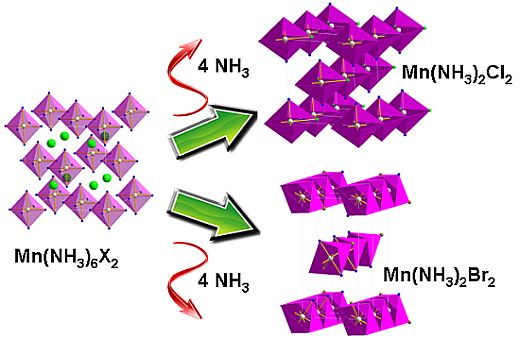
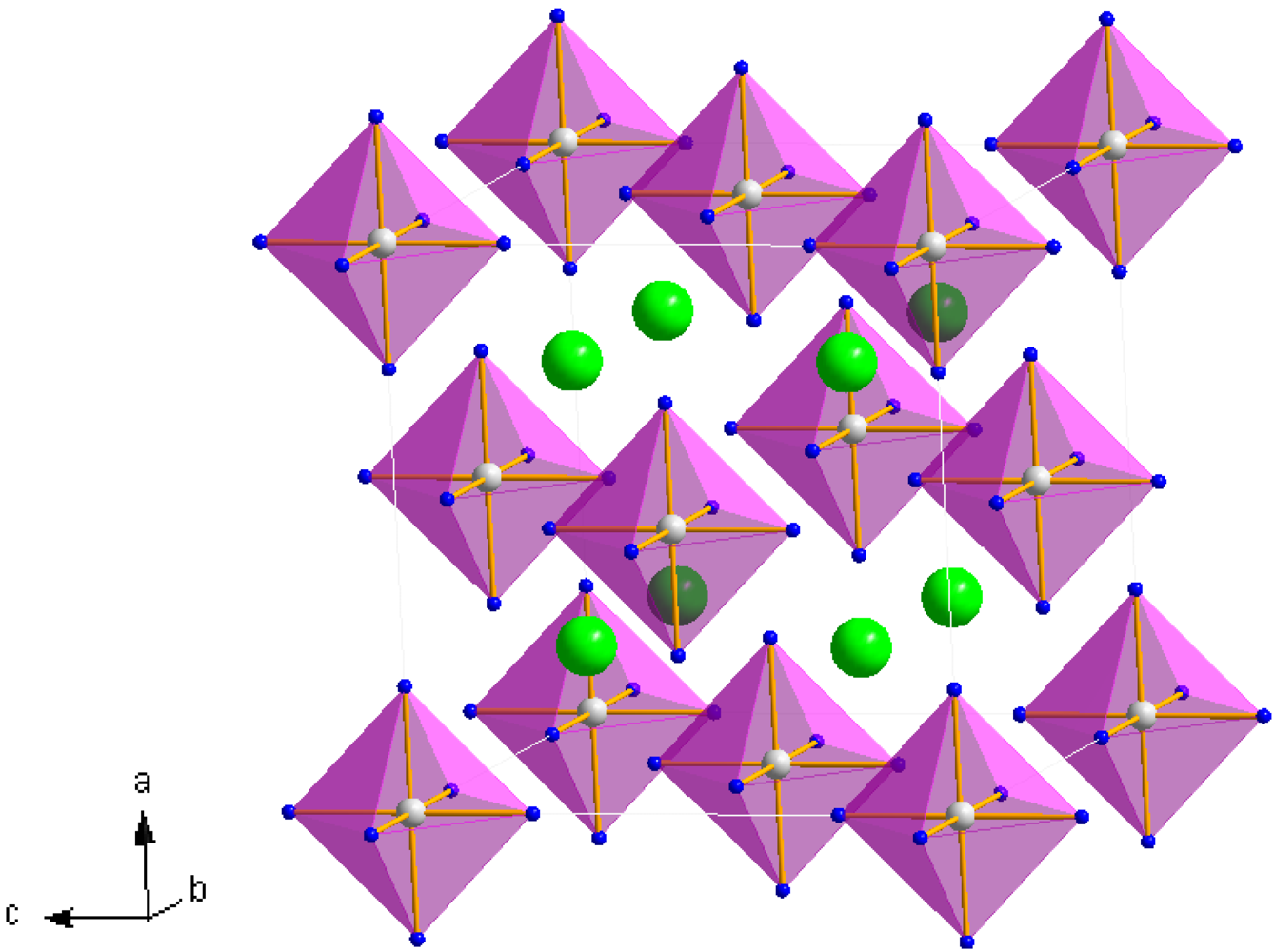
      <p>Olovosson originally proposed that transition metal hexa-ammines should form with cubic K<sub>2</sub>PtCl<sub>6</sub>-type structures [<xref ref-type="bibr" rid="B24-crystals-02-00193">24</xref>]. Almost 30 years later, single crystal X-ray data confirmed this premise for a number of transition metal hexa-ammines synthesized in supercritical ammonia, including Mn(NH<sub>3</sub>)<sub>6</sub>Cl<sub>2</sub> [<xref ref-type="bibr" rid="B25-crystals-02-00193">25</xref>]. The unit cell of the ammine, highlighting the arrangement of isolated octahedral [Mn(NH<sub>3</sub>)<sub>6</sub>]<sup>2+</sup> complex cations and Cl<sup>−</sup> counter anions is shown in <xref ref-type="fig" rid="crystals-02-00193-f001">Figure 1</xref>. The decomposition of Mn(NH<sub>3</sub>)<sub>6</sub>Cl<sub>2</sub> has been studied on two occasions previously and the thermodynamic parameters for desorption are listed in <xref ref-type="table" rid="crystals-02-00193-t002">Table 2</xref> [<xref ref-type="bibr" rid="B23-crystals-02-00193">23</xref>,<xref ref-type="bibr" rid="B26-crystals-02-00193">26</xref>]. By contrast, little is known regarding the deammoniation profile of Mn(NH<sub>3</sub>)<sub>6</sub>Br<sub>2</sub> and the structures of the lower ammonia adducts of both the chloride and bromide are unknown. We describe here a systematic study of the deammoniation behavior of the manganese chloride and bromide hexa-ammines. By using a combination of powder X-ray diffraction (PXRD) and Raman spectroscopy, we have confirmed the structure of Mn(NH<sub>3</sub>)<sub>6</sub>Cl<sub>2</sub>, determined the structure of the hexa-ammmine Mn(NH<sub>3</sub>)<sub>6</sub>Br<sub>2</sub> and the respective diammines Mn(NH<sub>3</sub>)<sub>2</sub>Cl(Br)<sub>2</sub> and verified the decomposition pathway in these systems from the fully ammoniated compounds to the respective dihalides.</p>
      <fig id="crystals-02-00193-f001" position="anchor">
        <label>Figure 1</label>
        <caption>
          <p>K<sub>2</sub>PtCl<sub>6</sub>-type cubic structure of Mn(NH<sub>3</sub>)<sub>6</sub>Cl<sub>2</sub> [<xref ref-type="bibr" rid="B24-crystals-02-00193">24</xref>]. Mn (grey spheres), N (blue spheres), Cl (green spheres).</p>
        </caption>
        <graphic xmlns:xlink="http://www.w3.org/1999/xlink" xlink:href="crystals-02-00193-g001.tif"/>
      </fig>
	  <table-wrap id="crystals-02-00193-t002" position="anchor">
        <object-id pub-id-type="pii">crystals-02-00193-t002_Table 2</object-id>
        <label>Table 2</label>
        <caption>
          <p>Reaction entropy and enthalpy values for the decomposition of manganese halide ammines given by Wentworth <italic>et al.</italic> [<xref ref-type="bibr" rid="B26-crystals-02-00193">26</xref>] Values in parenthesis are from the work of Lepinasse and Spinner [<xref ref-type="bibr" rid="B27-crystals-02-00193">27</xref>].</p>
        </caption>
        <table>
          <thead>
            <tr>
              <th rowspan="3" align="center" valign="middle"> </th>
              <th colspan="2" align="center" valign="middle" style="border-bottom:solid thin">Hexa-ammine → di-ammine</th>
              <th colspan="2" align="center" valign="middle" style="border-bottom:solid thin">Di-ammine → mono-ammine</th>
              <th colspan="2" align="center" valign="middle" style="border-bottom:solid thin">Mono-ammine → dihalide</th>
            </tr>
            <tr>
              <th align="center" valign="middle">Δ
              <italic>S</italic><sub>100 </sub><sup>†</sup></th>
              <th align="center" valign="middle">Δ
              <italic>H</italic></th>
              <th align="center" valign="middle">Δ
              <italic>S</italic><sub>100 </sub><sup>†</sup></th>
              <th align="center" valign="middle">Δ
              <italic>H</italic></th>
              <th align="center" valign="middle">Δ
              <italic>S</italic><sub>100 </sub><sup>†</sup></th>
              <th align="center" valign="middle">Δ
              <italic>H</italic></th>
            </tr>
            <tr>
              <th align="center" valign="middle">(J/K mol)</th>
              <th align="center" valign="middle">(kJ/mol)</th>
              <th align="center" valign="middle">(J/K mol)</th>
              <th align="center" valign="middle">(kJ/mol)</th>
              <th align="center" valign="middle">(J/K mol)</th>
              <th align="center" valign="middle">(kJ/mol)</th>
            </tr>
          </thead>
          <tbody>
            <tr>
              <td align="center" valign="middle">
                <bold>Cl</bold>              </td>
              <td align="center" valign="middle">148.53</td>
              <td align="center" valign="middle">47.28 (47.42)</td>
              <td align="center" valign="middle">153.55</td>
              <td align="center" valign="middle">71.13 (71.02)</td>
              <td align="center" valign="middle">153.97</td>
              <td align="center" valign="middle">84.10 (84.20)</td>
            </tr>
            <tr>
              <td align="center" valign="middle">
                <bold>Br</bold>              </td>
              <td align="center" valign="middle">149.79</td>
              <td align="center" valign="middle">53.14</td>
              <td align="center" valign="middle">152.30</td>
              <td align="center" valign="middle">76.99</td>
              <td align="center" valign="middle">154.39</td>
              <td align="center" valign="middle">83.68</td>
            </tr>
          </tbody>
        </table>
		<table-wrap-foot>
		<fn><p><sup>†</sup> Subscript (100) value refers to the vapor pressure, 100 Torr, of ammonia at which ammine equilibria have been characterized at a given temperature for the corresponding complexes. Values listed here are based on experimental data, which established the T<sub>100</sub> (temperature at which <italic>P</italic> = 100 torr) and ΔH in order to calculate Δ<italic>S</italic><sub>100 </sub>(=Δ<italic>H</italic>/<italic>T</italic><sub>100</sub>), allowing subsequent data fitting to the Nernst equation [<xref ref-type="bibr" rid="B28-crystals-02-00193">28</xref>]. </p>
		</fn>
		</table-wrap-foot>
      </table-wrap>
      
      
    </sec>
    <sec sec-type="results">
      <title>2. Results and Discussion</title>
      <sec>
        <title>2.1. Structural Characterization of the Hexa-ammines, Mn(NH<sub>3</sub>)<sub>6</sub><italic>X</italic><sub>2</sub> (<italic>X</italic> = Cl, Br)</title>
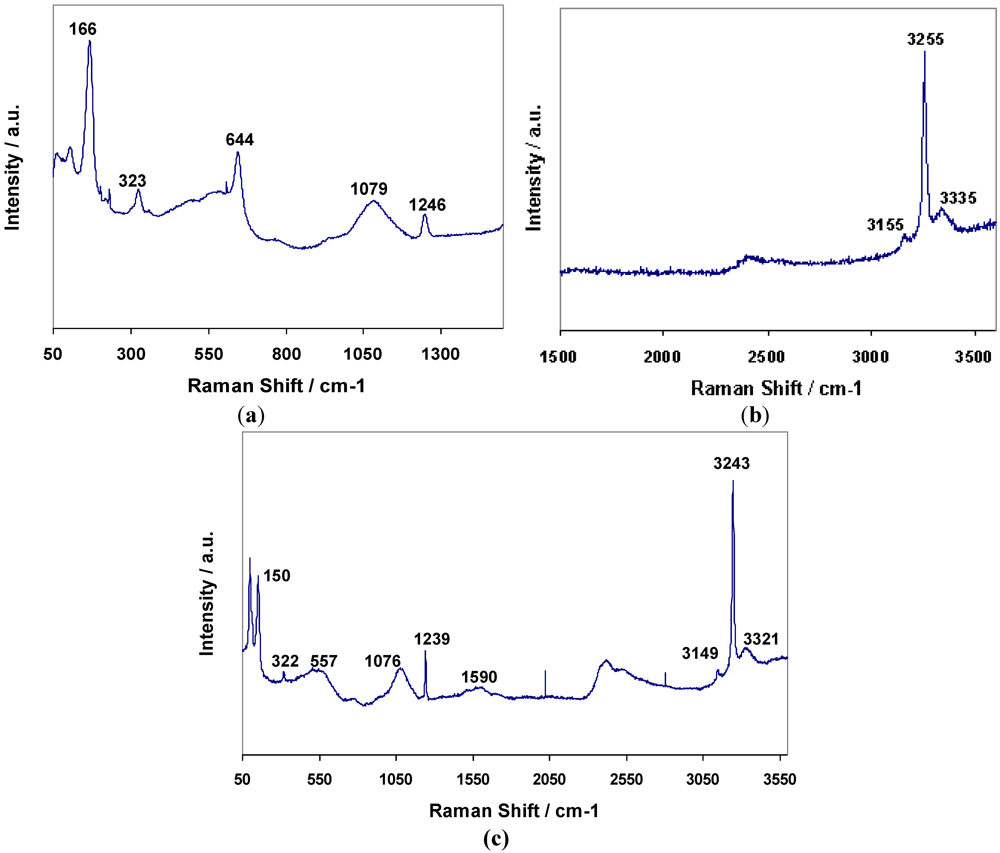
        <p>Reaction of MnCl<sub>2</sub> and MnBr<sub>2</sub> with ammonia gas at room temperature led to white air-sensitive powders of the ammine complexes, <bold>1</bold> and <bold>2</bold> respectively. Raman spectra for <bold>1</bold> and <bold>2</bold> are shown in <xref ref-type="fig" rid="crystals-02-00193-f002">Figure 2</xref> By comparison with published data for transition metal hexa-ammine complexes, the bands for <bold>1</bold> and <bold>2</bold> could be fully assigned to N–H and Mn–N vibrations (<xref ref-type="table" rid="crystals-02-00193-t003">Table 3</xref>) [<xref ref-type="bibr" rid="B29-crystals-02-00193">29</xref>,<xref ref-type="bibr" rid="B30-crystals-02-00193">30</xref>,<xref ref-type="bibr" rid="B31-crystals-02-00193">31</xref>,<xref ref-type="bibr" rid="B32-crystals-02-00193">32</xref>,<xref ref-type="bibr" rid="B33-crystals-02-00193">33</xref>]. Previous IR studies on the <italic>M</italic>(NH<sub>3</sub>)<sub>6</sub>I<sub>2</sub> (<italic>M</italic> = Mn, Fe) complexes have suggested that the rotation of ammonia molecules about the M-N axis is possible [<xref ref-type="bibr" rid="B34-crystals-02-00193">34</xref>]. From the results presented here we can establish that this is also the case at least for Mn(NH<sub>3</sub>)<sub>6</sub>Br<sub>2</sub> owing to the degenerate (<italic>δ</italic><sub>d</sub>) band observed in the Raman spectra at 1590 cm<sup>−1</sup> and also the large H-H bond lengths suggested from XRD refinements (<xref ref-type="table" rid="crystals-02-00193-t003">Table 3</xref>, <xref ref-type="table" rid="crystals-02-00193-t004">Table 4</xref>, <xref ref-type="table" rid="crystals-02-00193-t005">Table 5</xref> and <xref ref-type="table" rid="crystals-02-00193-t006">Table 6</xref>). Despite the apparent absence of the equivalent <italic>δ</italic><sub>d</sub> band in the Raman spectrum of 1, there are sizeable intermolecular distances between neighbouring H atoms in the ammonia molecules (indeed the partially occupied H positions in the model assume dynamic disorder) and no obvious structural reason why rotation should not occur, suggesting that the band is simply too weak in the spectrum of <bold>1</bold> to be observed. This is consistent with the study by Eβmann <italic>et al.</italic> who infer that the rotation of the ammonia molecules about the M-N axis in a number of transition metal ammine chlorides and bromides is free at room temperature [<xref ref-type="bibr" rid="B25-crystals-02-00193">25</xref>]. Further, the rotational effects observed for the ammonia molecules in single crystals of Ni(N<italic>Y</italic><sub>3</sub>)<sub>6</sub><italic>X</italic><sub>2</sub> (<italic>Y</italic> = H, D and <italic>X</italic> = Br, I, NO<sub>3</sub>, PF<sub>6</sub>) as investigated by neutron diffraction are described in more detail by Schiebel <italic>et al</italic>. [<xref ref-type="bibr" rid="B35-crystals-02-00193">35</xref>,<xref ref-type="bibr" rid="B36-crystals-02-00193">36</xref>].</p>
        <table-wrap id="crystals-02-00193-t003" position="anchor">
          <object-id pub-id-type="pii">crystals-02-00193-t003_Table 3</object-id>
          <label>Table 3</label>
          <caption>
            <p>Raman data for Mn(NH<sub>3</sub>)<sub>6</sub><italic>X</italic><sub>2 </sub>(<italic>X</italic> = Cl, Br).</p>
          </caption>
          <table>
          <thead>
              <tr>
                <th rowspan="3" align="center" valign="middle">Compound</th>
                <th colspan="9" align="center" valign="middle" style="border-bottom:solid thin">Raman Shift/cm<sup>−1</sup></th>
              </tr>
              <tr>
                <th align="center" valign="middle"><italic>ν</italic><sub>as</sub></th>
                <th align="center" valign="middle"><italic>ν</italic><sub>s</sub></th>
                <th align="center" valign="middle"><italic>ν</italic><sub>s</sub></th>
                <th align="center" valign="middle"><italic>δ</italic><sub>d</sub></th>
                <th align="center" valign="middle"><italic>δ</italic><sub>s</sub></th>
                <th align="center" valign="middle"><italic>δ</italic><sub>as</sub></th>
                <th align="center" valign="middle"><italic>ρ</italic><sub>r</sub></th>
                <th align="center" valign="middle"><italic>ν</italic></th>
                <th align="center" valign="middle"><italic>δ</italic></th>
              </tr>
              <tr>
                <th align="center" valign="middle">(NH<sub>3</sub>)</th>
                <th align="center" valign="middle">(NH<sub>3</sub>)</th>
                <th align="center" valign="middle">(NH<sub>3</sub>)</th>
                <th align="center" valign="middle">(HNH)</th>
                <th align="center" valign="middle">(HNH)</th>
                <th align="center" valign="middle">(HNH)</th>
                <th align="center" valign="middle">(NH<sub>3</sub>)</th>
                <th align="center" valign="middle">(MN)</th>
                <th align="center" valign="middle">(MNM)</th>
              </tr>
          </thead>
          <tbody>
              <tr>
                <td align="center" valign="middle">
                  <bold>1</bold>                </td>
                <td align="center" valign="middle">3335</td>
                <td align="center" valign="middle">3255</td>
                <td align="center" valign="middle">3155</td>
                <td align="center" valign="middle">-</td>
                <td align="center" valign="middle">1246</td>
                <td align="center" valign="middle">1079</td>
                <td align="center" valign="middle">644</td>
                <td align="center" valign="middle">323</td>
                <td align="center" valign="middle">166</td>
              </tr>
              <tr>
                <td align="center" valign="middle">
                  <bold>2</bold>                </td>
                <td align="center" valign="middle">3321</td>
                <td align="center" valign="middle">3243</td>
                <td align="center" valign="middle">3149</td>
                <td align="center" valign="middle">1590</td>
                <td align="center" valign="middle">1239</td>
                <td align="center" valign="middle">1076</td>
                <td align="center" valign="middle">557</td>
                <td align="center" valign="middle">322</td>
                <td align="center" valign="middle">150</td>
              </tr>
          </tbody>
          </table>
        </table-wrap>
        <table-wrap id="crystals-02-00193-t004" position="anchor">
          <object-id pub-id-type="pii">crystals-02-00193-t004_Table 4</object-id>
          <label>Table 4</label>
          <caption>
            <p>Crystallographic data for hexa-ammines <bold>1</bold> and <bold>2</bold>.</p>
          </caption>
          <table>
          <thead>
              <tr>
                <th align="left" valign="middle">Compound</th>
                <th align="center" valign="middle">1</th>
                <th align="center" valign="middle">2</th>
              </tr>
          </thead>
          <tbody>
              <tr>
                <td align="left" valign="middle">
                  <bold>Formula</bold>
                </td>
                <td align="center" valign="middle">Mn(NH<sub>3</sub>)<sub>6</sub>Cl<sub>2</sub></td>
                <td align="center" valign="middle">Mn(NH<sub>3</sub>)<sub>6</sub>Br<sub>2</sub></td>
              </tr>
              <tr>
                <td align="left" valign="middle">
                  <bold>Crystal System</bold>
                </td>
                <td align="center" valign="middle">Cubic</td>
                <td align="center" valign="middle">Cubic</td>
              </tr>
              <tr>
                <td align="left" valign="middle">
                  <bold>Space Group</bold>
                </td>
                <td align="center" valign="middle"><italic>Fm-</italic>3<italic>m</italic></td>
                <td align="center" valign="middle"><italic>Fm-</italic>3<italic>m</italic></td>
              </tr>
              <tr>
                <td align="left" valign="middle">
                  <bold><italic>a</italic>/Å</bold>
                </td>
                <td align="center" valign="middle">10.2742(6)</td>
                <td align="center" valign="middle">10.528(1)</td>
              </tr>
              <tr>
                <td align="left" valign="middle">
                  <bold>Volume/Å<sup>3</sup></bold>
                </td>
                <td align="center" valign="middle">1084.5(2)</td>
                <td align="center" valign="middle">1166.8(4)</td>
              </tr>
              <tr>
                <td align="left" valign="middle">
                  <bold>
                    <italic>Z</italic>
                  </bold>
                </td>
                <td align="center" valign="middle">4</td>
                <td align="center" valign="middle">4</td>
              </tr>
              <tr>
                <td align="left" valign="middle">
                  <bold>Formula Weight/g</bold>
                </td>
                <td align="center" valign="middle">912.120</td>
                <td align="center" valign="middle">1267.728</td>
              </tr>
              <tr>
                <td align="left" valign="middle">
                  <bold>Calculated density, ρ<sub>X</sub>/g·cm<sup>−3</sup></bold>
                </td>
                <td align="center" valign="middle">1.397</td>
                <td align="center" valign="middle">1.804</td>
              </tr>
              <tr>
                <td align="left" valign="middle">
                  <bold>No of data</bold>
                </td>
                <td align="center" valign="middle">4018</td>
                <td align="center" valign="middle">4137</td>
              </tr>
              <tr>
                <td align="left" valign="middle">
                  <bold>No of parameters</bold>
                </td>
                <td align="center" valign="middle">29</td>
                <td align="center" valign="middle">36</td>
              </tr>
              <tr>
                <td align="left" valign="middle">
                  <bold>
                    <italic>R</italic>
                    <sub>wp</sub>
                  </bold>
                </td>
                <td align="center" valign="middle">0.055</td>
                <td align="center" valign="middle">0.073</td>
              </tr>
              <tr>
                <td align="left" valign="middle">
                  <bold>
                    <italic>R</italic>
                    <sub>p</sub>
                  </bold>
                </td>
                <td align="center" valign="middle">0.043</td>
                <td align="center" valign="middle">0.058</td>
              </tr>
              <tr>
                <td align="left" valign="middle">
                  <bold>χ<sup>2</sup></bold>
                </td>
                <td align="center" valign="middle">1.101</td>
                <td align="center" valign="middle">1.073</td>
              </tr>
          </tbody>
          </table>
        </table-wrap>
        <table-wrap id="crystals-02-00193-t005" position="anchor">
          <object-id pub-id-type="pii">crystals-02-00193-t005_Table 5</object-id>
          <label>Table 5</label>
          <caption>
            <p>Atomic parameters for <bold>1</bold> and <bold>2</bold> from Rietveld refinement against PXRD data.</p>
          </caption>
          <table>
          <thead>
              <tr>
                <th align="left" valign="middle">Atom</th>
                <th align="center" valign="middle">Mn(NH<sub>3</sub>)<sub>6</sub>Cl<sub>2</sub> (1)</th>
                <th align="center" valign="middle">Mn(NH<sub>3</sub>)<sub>6</sub>Br<sub>2</sub> (2)</th>
              </tr>
          </thead>
          <tbody>
              <tr>
                <td align="left" valign="middle">Mn, 4<italic>a</italic> (0,0,0)</td>
                <td align="center" valign="middle"> </td>
                <td align="center" valign="middle"> </td>
              </tr>
              <tr>
                <td align="left" valign="middle"><italic>U</italic><sub>iso</sub> × 100/Å<sup>2</sup></td>
                <td align="center" valign="middle">5.7(4)</td>
                <td align="center" valign="middle">3.3(3)</td>
              </tr>
              <tr>
                <td align="left" valign="middle"><italic>X</italic>, 8<italic>c</italic> (¼, ¼, ¼)</td>
                <td align="center" valign="middle"> </td>
                <td align="center" valign="middle"> </td>
              </tr>
              <tr>
                <td align="left" valign="middle"><italic>U</italic><sub>iso</sub> × 100/Å<sup>2</sup></td>
                <td align="center" valign="middle">5.4(4)</td>
                <td align="center" valign="middle">5.0(2)</td>
              </tr>
              <tr>
                <td align="left" valign="middle">N, 24<italic>e</italic> (<italic>x</italic>, 0, 0)</td>
                <td align="center" valign="middle"> </td>
                <td align="center" valign="middle"> </td>
              </tr>
              <tr>
                <td align="left" valign="middle">
                  <italic>X</italic>
                </td>
                <td align="center" valign="middle">0.218(1)</td>
                <td align="center" valign="middle">0.220(2)</td>
              </tr>
              <tr>
                <td align="left" valign="middle"><italic>U<sub>i</sub></italic><sub>so</sub> × 100/Å<sup>2</sup></td>
                <td align="center" valign="middle">6.0(7)</td>
                <td align="center" valign="middle">6.3(9)</td>
              </tr>
              <tr>
                <td align="left" valign="middle">H, 96<italic>k</italic> (<italic>x</italic>, <italic>x</italic>, <italic>z</italic>)</td>
                <td align="center" valign="middle"> </td>
                <td align="center" valign="middle"> </td>
              </tr>
              <tr>
                <td align="left" valign="middle">
                  <italic>X</italic>
                </td>
                <td align="center" valign="middle">0.066(4)</td>
                <td align="center" valign="middle">0.055(3)</td>
              </tr>
              <tr>
                <td align="left" valign="middle">
                  <italic>Z</italic>
                </td>
                <td align="center" valign="middle">0.265(3)</td>
                <td align="center" valign="middle">0.248(5)</td>
              </tr>
              <tr>
                <td align="left" valign="middle"><italic>U</italic><sub>iso</sub> × 100/Å<sup>2</sup></td>
                <td align="center" valign="middle">2.5</td>
                <td align="center" valign="middle">2.5</td>
              </tr>
              <tr>
                <td align="left" valign="middle">
                  <italic>Occupancy</italic>
                </td>
                <td align="center" valign="middle">0.75</td>
                <td align="center" valign="middle">0.75</td>
              </tr>
          </tbody>
          </table>
        </table-wrap>
        <fig id="crystals-02-00193-f002" position="anchor">
          <label>Figure 2</label>
          <caption>
            <p>Raman spectra for 1; (<bold>a</bold>) 50–1500 cm<sup>−1</sup>, (<bold>b</bold>) 1500–3600 cm<sup>−1</sup>, and <bold>2</bold> (<bold>c</bold>) 50–3600 cm<sup>−1</sup>.</p>
          </caption>
          <graphic xmlns:xlink="http://www.w3.org/1999/xlink" xlink:href="crystals-02-00193-g002.tif"/>
        </fig>
		<table-wrap id="crystals-02-00193-t006" position="anchor">
          <object-id pub-id-type="pii">crystals-02-00193-t006_Table 6</object-id>
          <label>Table 6</label>
          <caption>
            <p>Interatomic distances and angles for <bold>1</bold> and <bold>2</bold>.</p>
          </caption>
          <table>
            <thead>
              <tr>
                <th align="left" valign="middle">Distance or angle/Å or °</th>
                <th align="left" valign="middle">Mn(NH<sub>3</sub>)<sub>6</sub>Cl<sub>2</sub> (1)</th>
                <th align="left" valign="middle">Mn(NH<sub>3</sub>)<sub>6</sub>Br<sub>2</sub> (2)</th>
              </tr>
            </thead>
            <tbody>
              <tr>
                <td align="left" valign="middle" style="border-bottom:solid thin">8 × Mn–X/Å</td>
                <td align="left" valign="middle" style="border-bottom:solid thin">4.44886(19) </td>
                <td align="left" valign="middle" style="border-bottom:solid thin">4.5586(4) </td>
              </tr>
              <tr>
                <td align="left" valign="middle" style="border-bottom:solid thin">6 × Mn–N/Å</td>
                <td align="left" valign="middle" style="border-bottom:solid thin">2.239(15) </td>
                <td align="left" valign="middle" style="border-bottom:solid thin">2.313(18) </td>
              </tr>
              <tr>
                <td rowspan="4" align="left" valign="middle" style="border-bottom:solid thin">N–H/Å</td>
                <td rowspan="2" align="left" valign="middle" style="border-bottom:solid thin">1.07(5) </td>
                <td align="left" valign="middle" style="border-bottom:solid thin">0.88(6)</td>
              </tr>
              <tr>
                <td align="left" valign="middle" style="border-bottom:solid thin">3.183(34) × 5</td>
              </tr>
              <tr>
                <td align="left" valign="middle" style="border-bottom:solid thin">3.210(26) × 6</td>
                <td align="left" valign="middle" style="border-bottom:solid thin">3.94(5) × 2</td>
              </tr>
              <tr>
                <td align="left" valign="middle" style="border-bottom:solid thin">4.05(4) × 4</td>
                <td align="left" valign="middle" style="border-bottom:solid thin">4.99(4) × 3</td>
              </tr>
              <tr>
                <td rowspan="5" align="left" valign="middle" style="border-bottom:solid thin">H1–H1/Å</td>
                <td align="left" valign="middle" style="border-bottom:solid thin">2.89(8) × 2</td>
                <td rowspan="2" align="left" valign="middle" style="border-bottom:solid thin">2.86(8) × 2</td>
              </tr>
              <tr>
                <td align="left" valign="middle" style="border-bottom:solid thin">3.97(4) × 2</td>
              </tr>
              <tr>
                <td align="left" valign="middle" style="border-bottom:solid thin">4.19(5) × 2</td>
                <td align="left" valign="middle" style="border-bottom:solid thin">3.78(8) × 2</td>
              </tr>
              <tr>
                <td align="left" valign="middle" style="border-bottom:solid thin">4.81(7) × 2</td>
                <td align="left" valign="middle" style="border-bottom:solid thin">3.95(8) × 2</td>
              </tr>
              <tr>
                <td align="left" valign="middle" style="border-bottom:solid thin">4.83(7)</td>
                <td align="left" valign="middle" style="border-bottom:solid thin">4.51(10) × 2</td>
              </tr>
              <tr>
                <td rowspan="4" align="left" valign="middle">X–Mn–X/°</td>
                <td align="left" valign="middle">70.529(2) × 2</td>
                <td align="left" valign="middle">109.471(5) × 3</td>
              </tr>
              <tr>
                <td align="left" valign="middle">70.529(4) </td>
                <td align="left" valign="middle">70.529(5) × 2</td>
              </tr>
              <tr>
                <td align="left" valign="middle">109.471(4) × 3</td>
                <td align="left" valign="middle">180.000 </td>
              </tr>
              <tr>
                <td align="left" valign="middle">179.972(1)</td>
                <td align="left" valign="middle">&nbsp;</td>
              </tr>
            </tbody>
          </table>
        </table-wrap>
        
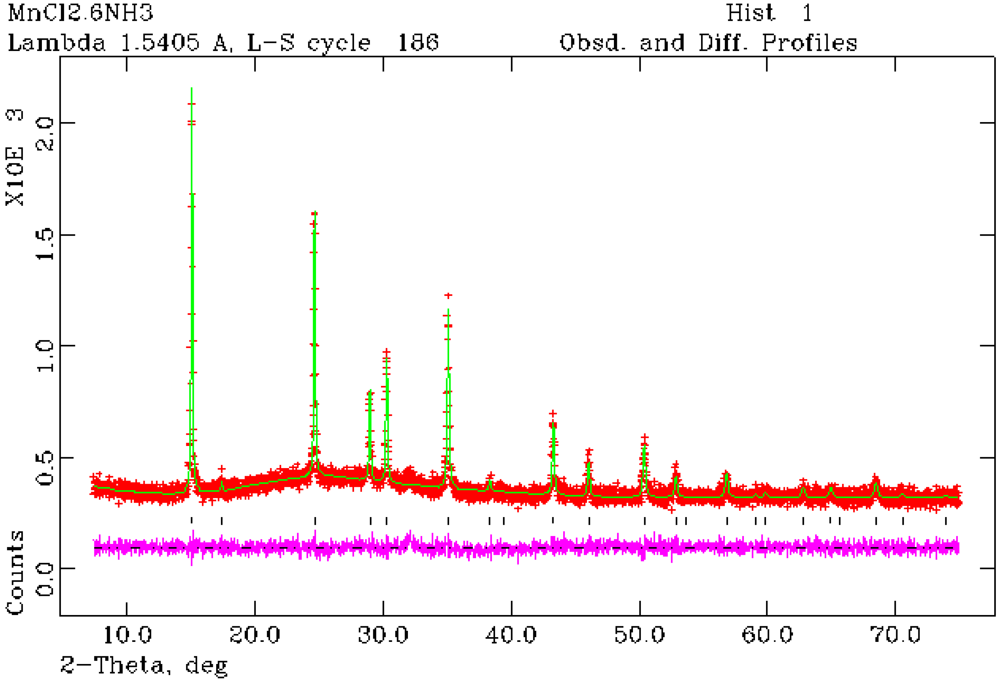
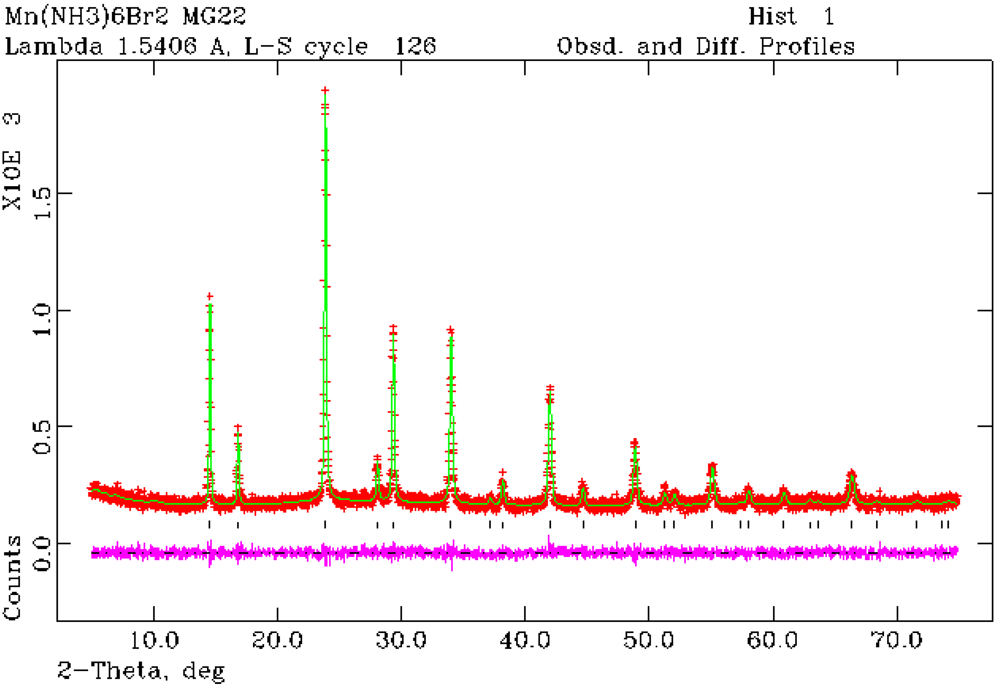
        <p>Initial search-matching procedures for the PXRD powder pattern of <bold>1</bold> revealed a match with that of the corresponding Mg analogue (PDF card No: 01-075-6756) and the pattern could be indexed to a cubic cell with <italic>a</italic> = 10.442 Å [<xref ref-type="bibr" rid="B9-crystals-02-00193">9</xref>]. Although there is no refined crystal structure for Mn(NH<sub>3</sub>)<sub>6</sub>Br<sub>2</sub>, Watt and Manhas reported XRD data (and elemental analysis) for the hexa-ammine formed by the reaction of MnBr<sub>2</sub> with liquid ammonia [<xref ref-type="bibr" rid="B37-crystals-02-00193">37</xref>]. The PXRD data obtained for <bold>2</bold> matched well with the pattern of Fe(NH<sub>3</sub>)<sub>6</sub>Br<sub>2</sub> (PDF card No: 01-085-2095), which was generated using the Powdercell software package from single crystal structural data, and could thus be indexed to a cubic unit cell with <italic>a</italic> = 10.249 Å [<xref ref-type="bibr" rid="B25-crystals-02-00193">25</xref>,<xref ref-type="bibr" rid="B38-crystals-02-00193">38</xref>]. From the observed reflections, it was thus deduced that Mn(NH<sub>3</sub>)<sub>6</sub>Br<sub>2</sub> and Mn(NH<sub>3</sub>)<sub>6</sub>Cl<sub>2</sub> were isostructural. Subsequent Rietveld refinements for <bold>1</bold> and <bold>2</bold> were performed taking the previous single crystal X-ray structure of Mn(NH<sub>3</sub>)<sub>6</sub>Cl<sub>2</sub> and isostructural Fe(NH<sub>3</sub>)<sub>6</sub>Br<sub>2</sub> as the respective starting models [<xref ref-type="bibr" rid="B25-crystals-02-00193">25</xref>]. The refinements of 1 and 2 were performed following an identical strategy in which the background coefficients (GSAS Function 8, a reciprocal interpolation function), scale factor and the unit cell parameters were varied in the initial cycles. The atomic parameters, peak profile parameters and isotropic displacement parameters (for non-hydrogen atoms) were varied subsequently. Modeling of the peak shapes used function 2, the Thompson-Cox-Hastings pseudo-Voigt function. The final crystallographic results for <bold>1</bold> and <bold>2</bold> are presented in <xref ref-type="table" rid="crystals-02-00193-t004">Table 4</xref>, atomic parameters in <xref ref-type="table" rid="crystals-02-00193-t005">Table 5</xref> and interatomic distances angles in <xref ref-type="table" rid="crystals-02-00193-t006">Table 6</xref>. Profile plots for the refinements are shown in <xref ref-type="fig" rid="crystals-02-00193-f003">Figure 3</xref> and <xref ref-type="fig" rid="crystals-02-00193-f004">Figure 4</xref>.</p>
        <fig id="crystals-02-00193-f003" position="anchor">
          <label>Figure 3</label>
          <caption>
            <p>Rietveld refinement profile for <bold>1</bold> from PXRD data. Crosses indicate the observed data, the upper continuous line shows the calculated profile and the lower continuous line the difference profile. Tick marks show reflection positions for cubic Mn(NH<sub>3</sub>)<sub>6</sub>Cl<sub>2</sub>.</p>
          </caption>
          <graphic xmlns:xlink="http://www.w3.org/1999/xlink" xlink:href="crystals-02-00193-g003.tif"/>
        </fig>
        <fig id="crystals-02-00193-f004" position="anchor">
          <label>Figure 4</label>
          <caption>
            <p>Rietveld refinement profile for <bold>2</bold> from PXRD data. Crosses indicate the observed data, the upper continuous line shows the calculated profile and the lower continuous line the difference profile. Tick marks show reflection positions for cubic Mn(NH<sub>3</sub>)<sub>6</sub>Br<sub>2</sub>.</p>
          </caption>
          <graphic xmlns:xlink="http://www.w3.org/1999/xlink" xlink:href="crystals-02-00193-g004.tif"/>
        </fig>
        <p>Structure refinement against PXRD data confirmed that Mn(NH<sub>3</sub>)<sub>6</sub>Cl<sub>2</sub> (<bold>1</bold>) forms with the cubic K<sub>2</sub>[PtCl<sub>6</sub>]-type structure as previously reported from single crystal X-ray analysis [<xref ref-type="bibr" rid="B24-crystals-02-00193">24</xref>]. Rietveld refinement has also established for the first time that Mn(NH<sub>3</sub>)<sub>6</sub>Br<sub>2</sub> also crystallizes with the K<sub>2</sub>[PtCl<sub>6</sub>]-type structure and is thus isostructural with the chloride and Fe(NH<sub>3</sub>)<sub>6</sub>Br<sub>2</sub> (<xref ref-type="fig" rid="crystals-02-00193-f004">Figure 4</xref>) [<xref ref-type="bibr" rid="B25-crystals-02-00193">25</xref>]. The hexa-ammine structures can be considered to be composed of a FCC lattice of isolated octahedral complex ammoniate cations, <italic>i.e.</italic>, [Mn(NH<sub>3</sub>)<sub>6</sub>]<sup>2+</sup>, with halide anions, <italic>X</italic> (<italic>X</italic> = Cl<sup>−</sup>, Br<sup>−</sup>), occupying the tetrahedral interstices of the unit cell in a distorted close-packed cubic configuration (<xref ref-type="fig" rid="crystals-02-00193-f001">Figure 1</xref>) [<xref ref-type="bibr" rid="B39-crystals-02-00193">39</xref>]. Although these [Mn(NH<sub>3</sub>)<sub>6</sub>]<sup>2+</sup> octahedra are effectively isolated, Sørensen <italic>et al.</italic> haveevoked the concept of weakly bound-[Mn(NH<sub>3</sub>)<sub>6</sub>]–X—“chains” in rationalizing the ammonia sorption mechanism [<xref ref-type="bibr" rid="B23-crystals-02-00193">23</xref>]. These chains are thus composed of metal octahedra connected along the chain length via the interceding halide anions. Alternatively, the cubic hexa-ammine structure could be viewed as a simple cubic lattice of halide anions with nitrogen occupying the faces of each halide cube and manganese located in the body centers of alternate halide cubes.</p>
        <p>We observe that the cubic structure expands as a result of the replacement of Cl<sup>−</sup> by Br<sup>−</sup> as would be anticipated from ionic radii arguments [<xref ref-type="bibr" rid="B40-crystals-02-00193">40</xref>,<xref ref-type="bibr" rid="B41-crystals-02-00193">41</xref>]. Previously reported structural models of the hexa-ammines have defined partially occupied hydrogen positions (96 <italic>k</italic> sites that are 75% occupied) reflecting the dynamic disorder of the ammonia ligands in the octahedral cations. Although it would not be expected that powder X-ray diffraction methods could resolve the positions and disorder of the hydrogen with any great accuracy, we were tentatively able to vary the hydrogen coordinates and achieve stable, convergent refinements with reasonable N–H bond distances. The Mn–N distances in the complex cations are similar to those observed for other transition metals in equivalent ammoniates and the bond length increases slightly from chloride to bromide [<xref ref-type="bibr" rid="B25-crystals-02-00193">25</xref>].</p>
      </sec>
      <sec>
        <title>2.2. Deammoniation of the Hexa-ammines by TPD</title>
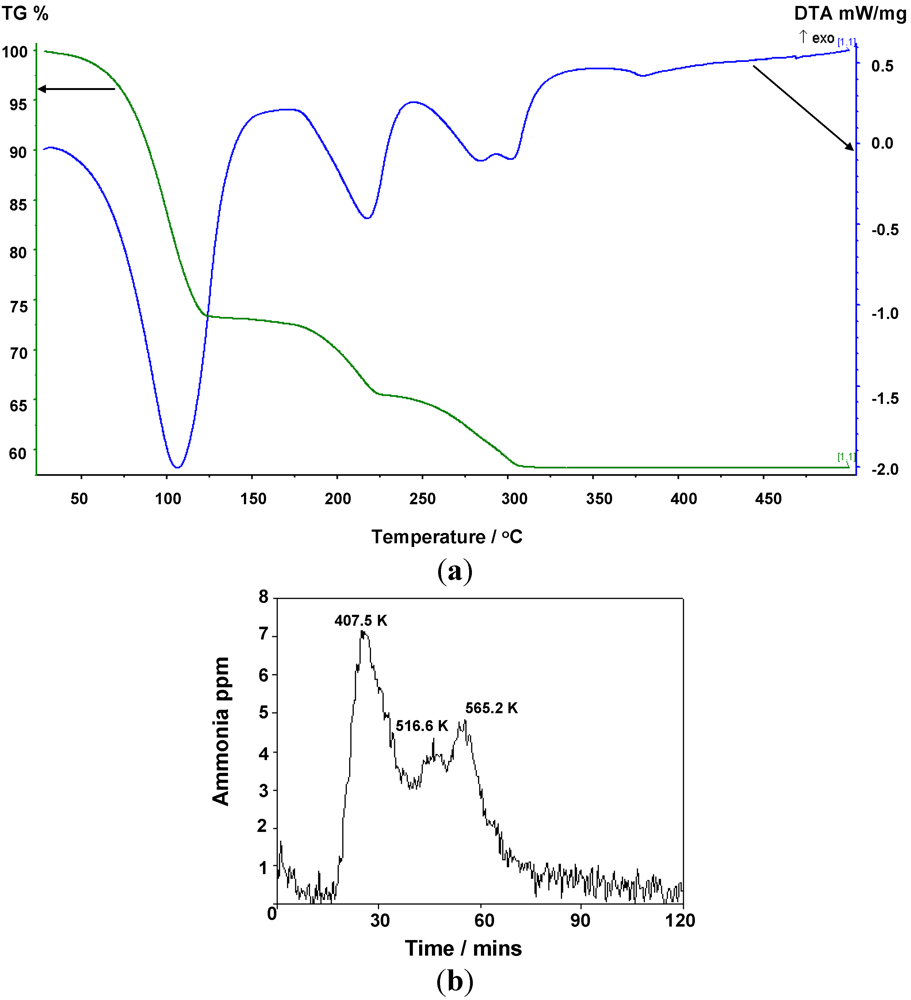
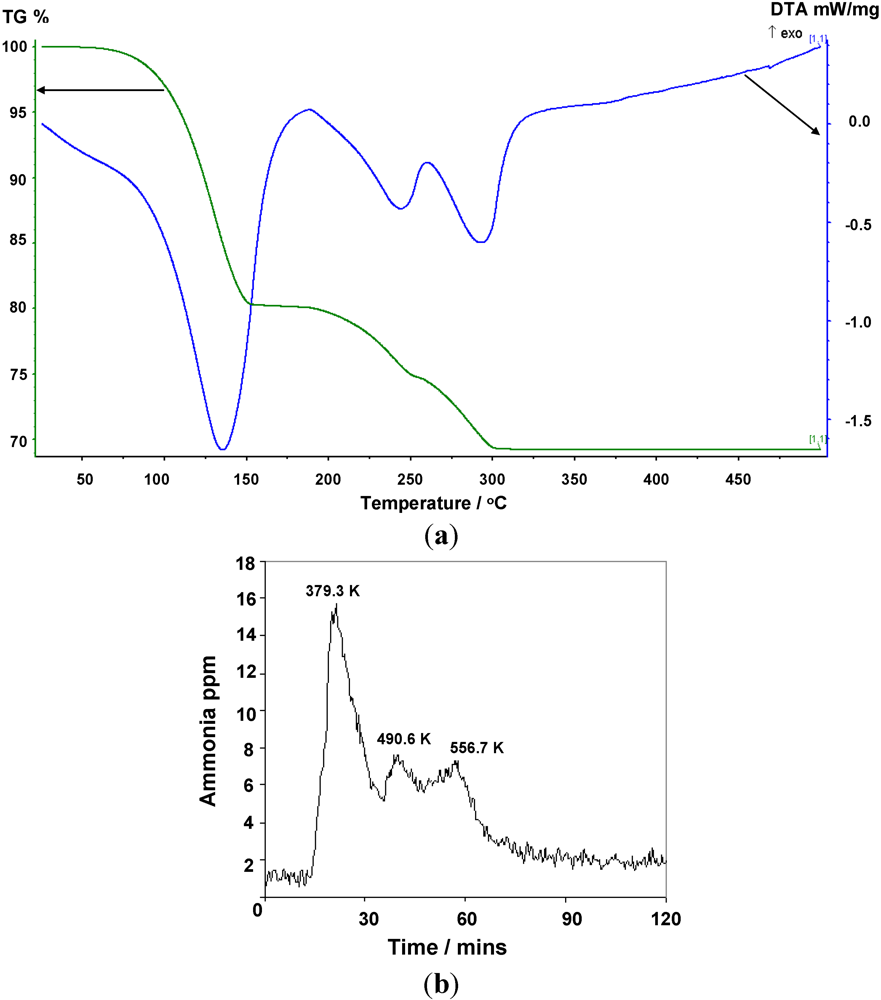
        <p>The TGA results collected to 773 K for <bold>1</bold> and <bold>2</bold> (<xref ref-type="fig" rid="crystals-02-00193-f005">Figure 5</xref>, <xref ref-type="fig" rid="crystals-02-00193-f006">Figure 6</xref> and <xref ref-type="table" rid="crystals-02-00193-t007">Table 7</xref>) show a 3-stage mass loss in each case which, by simultaneous MS analysis of the gases released, is associated solely with the loss of ammonia. The DTA data indicate four distinct endothermic events with minima at 379.3 K, 490.6 K, 556.7 K and 574.5 K respectively for <bold>1</bold>, and three distinct endothermic events at 407.5 K, 516.6 K and 565.2 K for <bold>2</bold> that correlate to each mass loss for both complexes. Careful isolation of the di- and mono-ammoniated compounds using TG-DTA has been possible by ceasing the heating process at the appropriate stage of decomposition. For the chloride complex, TGA analysis to 398 K and 498 K allowed isolation of the di- and mono-ammoniated decomposition products respectively. Slightly higher temperatures were used to isolate the di- and mono-ammoniates for the bromide; 423 K and 523 K respectively. The increase in deammoniation temperatures from the <bold>1</bold> to <bold>2</bold> is unsurprising upon consideration of the respective enthalpies for the ammines in <xref ref-type="table" rid="crystals-02-00193-t002">Table 2</xref>.</p>
        <table-wrap id="crystals-02-00193-t007" position="anchor">
          <object-id pub-id-type="pii">crystals-02-00193-t007_Table 7</object-id>
          <label>Table 7</label>
          <caption>
            <p>De-ammoniation parameters of Mn(NH<sub>3</sub>)<sub>6</sub>Cl<sub>2</sub> (Mn(NH<sub>3</sub>)<sub>6</sub>Br<sub>2</sub>).</p>
          </caption>
          <table>
          <thead>
              <tr>
                <th align="center" valign="middle">Step</th>
                <th align="center" valign="middle">Expected number of equivalent ammonia molecules lost</th>
                <th align="center" valign="middle">Expected weight loss/%</th>
                <th align="center" valign="middle">Observed weight loss/%</th>
                <th align="center" valign="middle">Onset temperature of deammoniation, 
                <italic>T</italic><sub>i/</sub><italic>K</italic></th>
                <th align="center" valign="middle">Final temperature of deammoniation, 
                <italic>T</italic><sub>f</sub>/<italic>K</italic></th>
              </tr>
          </thead>
          <tbody>
              <tr>
                <td align="center" valign="middle">1</td>
                <td align="center" valign="middle">4</td>
                <td align="center" valign="middle">29.8 (21.5)</td>
                <td align="center" valign="middle">26.9 (19.8)</td>
                <td align="center" valign="middle">300.8 (298.5)</td>
                <td align="center" valign="middle">401.1 (428.6)</td>
              </tr>
              <tr>
                <td align="center" valign="middle">2</td>
                <td align="center" valign="middle">1</td>
                <td align="center" valign="middle">7.5 (5.4)</td>
                <td align="center" valign="middle">7.8 (5.5)</td>
                <td align="center" valign="middle">410.3 (449.6)</td>
                <td align="center" valign="middle">504.0 (528.4)</td>
              </tr>
              <tr>
                <td align="center" valign="middle">3</td>
                <td align="center" valign="middle">1</td>
                <td align="center" valign="middle">7.5 (5.4)</td>
                <td align="center" valign="middle">7.2 (5.5)</td>
                <td align="center" valign="middle">504.0 (528.4)</td>
                <td align="center" valign="middle">590.1 (584.5)</td>
              </tr>
              <tr>
                <td align="center" valign="middle">
                  <bold>Total</bold>
                </td>
                <td align="center" valign="middle">6</td>
                <td align="center" valign="middle">44.8 (32.3)</td>
                <td align="center" valign="middle">41.8 (30.8)</td>
                <td align="center" valign="middle">-</td>
                <td align="center" valign="middle">-</td>
              </tr>
          </tbody>
          </table>
        </table-wrap>
        <fig id="crystals-02-00193-f005" position="anchor">
          <label>Figure 5</label>
          <caption>
            <p>(<bold>a</bold>) TG-DTA data, and (<bold>b</bold>) corresponding MS data for the thermal decomposition of Mn(NH<sub>3</sub>)<sub>6</sub>Cl<sub>2</sub>.</p>
          </caption>
          <graphic xmlns:xlink="http://www.w3.org/1999/xlink" xlink:href="crystals-02-00193-g005.tif"/>
        </fig>
        <fig id="crystals-02-00193-f006" position="anchor">
          <label>Figure 6</label>
          <caption>
            <p>(<bold>a</bold>) TG-DTA data, and (<bold>b</bold>) corresponding MS data for the thermal decomposition of Mn(NH<sub>3</sub>)<sub>6</sub>Br<sub>2</sub>.</p>
          </caption>
          <graphic xmlns:xlink="http://www.w3.org/1999/xlink" xlink:href="crystals-02-00193-g006.tif"/>
        </fig>
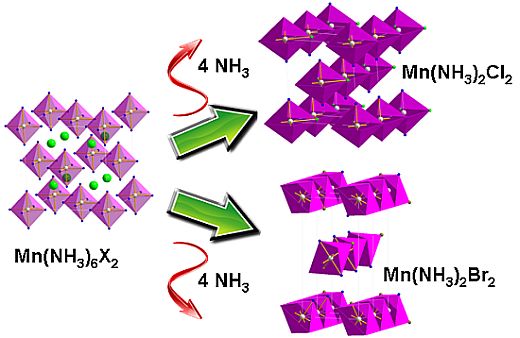
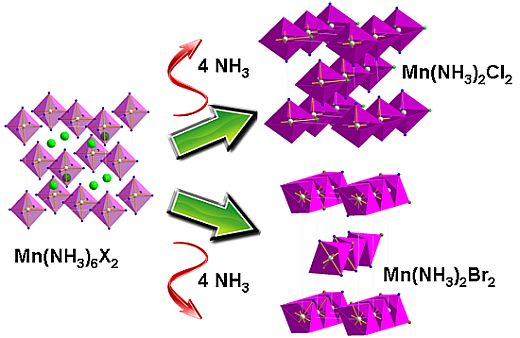
        <p>Reaction Scheme 1 hence describes the anticipated route by which the chloride and bromide ammoniates release ammonia in accordance with the TPD data observed in this study. These are comparable with data observed in literature for various dichloride ammines [<xref ref-type="bibr" rid="B9-crystals-02-00193">9</xref>]. The TGA profile in <xref ref-type="fig" rid="crystals-02-00193-f006">Figure 6</xref> suggests that weight loss for <bold>1</bold> occurs almost immediately (marginally above room temperature) and in contrast to previous work, ammonia desorption is complete below 600 K. The bromide, 2, begins to desorb ammonia at a higher temperature than the chloride commensurate with its higher desorption enthalpy (<xref ref-type="table" rid="crystals-02-00193-t002">Table 2</xref>), but this onset still lies below 373 K.</p>
        <disp-formula id="crystals-02-00193-i001">
<inline-graphic xmlns:xlink="http://www.w3.org/1999/xlink" xlink:href="crystals-02-00193-i001.tif">

</inline-graphic>
<label>(1)</label>
</disp-formula>

        <p>Although ostensibly both halides exhibit a three-step loss of ammonia with increasing temperature, it is evident from close examination of the chloride DTA profile (<xref ref-type="fig" rid="crystals-02-00193-f005">Figure 5</xref>) that the transformation from the presumed mono-ammine to the deammoniated chloride, MnCl<sub>2</sub>, appears to progress through two closely spaced (almost overlapping) thermal events. Indeed, a change in the slope of the TGA profile at the same temperature as the double minimum in the DTA trace (556.7 and 574.5 K) would also suggest that the loss of the final ammonia molecule is not a stoichiometric process from mono-ammine to MnCl<sub>2</sub>. This TG-DTA profile is in agreement with two (or more) gas releases from nominal Mn(NH<sub>3</sub>)Cl<sub>2</sub> measured by Sørensen <italic>et al.</italic>, although the equivalent desorption in their study appeared to occur at a temperature <italic>ca</italic>. 80 K above that seen herein [<xref ref-type="bibr" rid="B9-crystals-02-00193">9</xref>]. By contrast, the temperature range over which the dibromide deammoniates is narrower, which results in the successive deammoniation steps being less widely spaced (in temperature and time) and, for example a stability domain for the nominal mono-ammine of only several <italic>K</italic>. Although the final desorption step has not yet been resolved into more than one event in either the DTA or TGA traces, the asymmetry of the DTA peak and the fluctuations in slope of the TGA trace would suggest an analogous non-stoichiometric decomposition from mono-ammine to dihalide to that observed for <bold>1</bold>. A mechanism for ammonia absorption/desorption for <italic>M</italic>(NH<sub>3</sub>)<italic><sub>n</sub></italic>Cl<sub>2</sub> (<italic>M</italic> = Mg, Mn, Ni) ammines was proposed by Sørensen <italic>et al.</italic> using DFT calculations. This model indicated that ammonia molecules could enter and leave the bulk interface via the zipping/unzipping of the loosely-bound “chains” of octahedral ML<sub>6</sub> groups (where <italic>L</italic> could be either NH<sub>3</sub> and/or Cl depending on <italic>n</italic>) to allow conservation of the metal coordination geometry independent of n. This model necessarily also involves structural rearrangement in the bulk after each successive sorption step. In the later deammoniation steps, for example, it would be necessary not only for Cl to substitute for NH<sub>3</sub> in each ML<sub>6</sub> octahedron, but also for the resulting octahedra to condense and form edge sharing chains. The structures of the lower Mn ammines are discussed in more detail below, but the non-stoichiometric decomposition from mono-ammine to dihalide observed above could be rationalized in the intermediate loss of one NH<sub>3</sub> unit for every two Mn centers in the edge-sharing octahedral clusters in Mn(NH<sub>3</sub>)<italic>X</italic><sub>2</sub> and a process as described in Scheme 2:</p>
        <disp-formula id="crystals-02-00193-i002">
<inline-graphic xmlns:xlink="http://www.w3.org/1999/xlink" xlink:href="crystals-02-00193-i002.tif">

</inline-graphic>
<label>(2)</label>
</disp-formula>
      </sec>
      <sec>
        <title>2.3. Structural Characterization of the Lower Ammoniates</title>
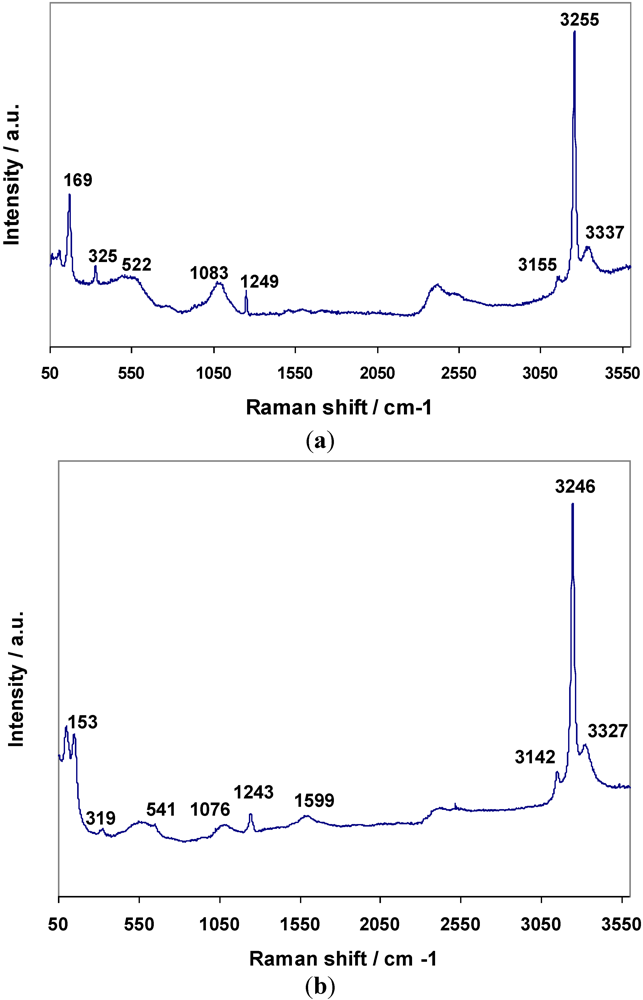
        <p>Decomposition of <bold>1</bold> and <bold>2</bold> to 398 K and 423 K respectively in the TG-DTA experiments led to small samples (<italic>ca</italic>. 50 mg) of air-sensitive, light pink and light orange/brown powders (<bold>3</bold> and <bold>4</bold>) respectively. Decomposition of <bold>1</bold> and <bold>2</bold> conducted to higher temperatures, 498 and 523 K respectively, led to air-sensitive, pink and light orange/brown powders to give the nominal mono-ammoniated complexes, <bold>5</bold> and <bold>6</bold> respectively. After weight losses were complete for both systems a blackened solid mass (<bold>7</bold>) and an orange/brown powder (<bold>8</bold>) respectively were the result. Raman spectra for <bold>3</bold> and <bold>4</bold> are shown in <xref ref-type="fig" rid="crystals-02-00193-f007">Figure 7</xref>a,b respectively, and assignments are given in <xref ref-type="table" rid="crystals-02-00193-t008">Table 8</xref>. The bands for <bold>3</bold> and <bold>4</bold> have been assigned to N–H and Mn–N vibrations based on the premise that similar bonding modes exist in both the hexa- and di-ammines. The presence of the weak degenerate <italic>δ</italic><sub>d</sub> band at 1599 cm<sup>−1</sup> in <bold>4</bold> would suggest that there is similar dynamic disorder (rotation) of NH<sub>3</sub> groups in the diammines to that observed in the hexammines (and again this band is observable in the bromide but not the chloride).</p>
		<fig id="crystals-02-00193-f007" position="anchor">
          <label>Figure 7</label>
          <caption>
            <p>Raman data for (<bold>a</bold>) Mn(NH<sub>3</sub>)<sub>2</sub>Cl<sub>2</sub> and (<bold>b</bold>) Mn(NH<sub>3</sub>)<sub>2</sub>Br<sub>2</sub>.</p>
          </caption>
          <graphic xmlns:xlink="http://www.w3.org/1999/xlink" xlink:href="crystals-02-00193-g007.tif"/>
        </fig>
        
        <table-wrap id="crystals-02-00193-t008" position="anchor">
          <object-id pub-id-type="pii">crystals-02-00193-t008_Table 8</object-id>
          <label>Table 8</label>
          <caption>
            <p>Raman data for Mn(NH<sub>3</sub>)<sub>2</sub><italic>X</italic><sub>2</sub> (<italic>X</italic> = Cl, Br).</p>
          </caption>
          <table>
          <thead>
              <tr>
                <th rowspan="3" align="center" valign="middle">Compound</th>
                <th colspan="9" align="center" valign="middle" style="border-bottom:solid thin">Raman Shift/cm<sup>−1</sup></th>
              </tr>
              <tr>
                <th align="center" valign="middle"><italic>ν</italic><sub>as</sub></th>
                <th align="center" valign="middle"><italic>ν</italic><sub>s</sub></th>
                <th align="center" valign="middle"><italic>ν</italic><sub>s</sub></th>
                <th align="center" valign="middle"><italic>δ</italic><sub>d</sub></th>
                <th align="center" valign="middle"><italic>δ</italic><sub>s</sub></th>
                <th align="center" valign="middle"><italic>δ</italic><sub>as</sub></th>
                <th align="center" valign="middle"><italic>ρ</italic><sub>r</sub></th>
                <th align="center" valign="middle"><italic>ν</italic></th>
                <th align="center" valign="middle"><italic>δ</italic></th>
              </tr>
              <tr>
                <th align="center" valign="middle">(NH<sub>3</sub>)</th>
                <th align="center" valign="middle">(NH<sub>3</sub>)</th>
                <th align="center" valign="middle">(NH<sub>3</sub>)</th>
                <th align="center" valign="middle">(HNH)</th>
                <th align="center" valign="middle">(HNH)</th>
                <th align="center" valign="middle">(HNH)</th>
                <th align="center" valign="middle">(NH<sub>3</sub>)</th>
                <th align="center" valign="middle">(MN)</th>
                <th align="center" valign="middle">(MNM)</th>
              </tr>
          </thead>
          <tbody>
              <tr>
                <td align="center" valign="middle">
                  <bold>3</bold>                </td>
                <td align="center" valign="middle">3337</td>
                <td align="center" valign="middle">3255</td>
                <td align="center" valign="middle">3155</td>
                <td align="center" valign="middle">-</td>
                <td align="center" valign="middle">1249</td>
                <td align="center" valign="middle">1083</td>
                <td align="center" valign="middle">522</td>
                <td align="center" valign="middle">325</td>
                <td align="center" valign="middle">169</td>
              </tr>
              <tr>
                <td align="center" valign="middle">
                  <bold>4</bold>                </td>
                <td align="center" valign="middle">3327</td>
                <td align="center" valign="middle">3246</td>
                <td align="center" valign="middle">3142</td>
                <td align="center" valign="middle">1599</td>
                <td align="center" valign="middle">1243</td>
                <td align="center" valign="middle">1076</td>
                <td align="center" valign="middle">541</td>
                <td align="center" valign="middle">319</td>
                <td align="center" valign="middle">153</td>
              </tr>
          </tbody>
          </table>
        </table-wrap>
        <p>Initial search-matching procedures for the PXRD powder pattern of <bold>3</bold> revealed a match with the Mg analogue (PDF card No: 01-073-4070) and the pattern could be indexed to an orthorhombic unit cell with <italic>a</italic> = 8.180 Å, <italic>b</italic> = 8.200 Å, <italic>c</italic> = 3.750 Å [<xref ref-type="bibr" rid="B41-crystals-02-00193">41</xref>]. From the observed reflections, it was deduced that <bold>3</bold> was isostructural with Fe(NH<sub>3</sub>)<sub>2</sub>Cl<sub>2</sub> and Mg(NH<sub>3</sub>)<sub>2</sub>Cl<sub>2</sub> and matched well to a powder pattern generated using Powdercell in which Mn was placed on the Fe positions of the orthorhombic <italic>Cmmm</italic> Fe(NH<sub>3</sub>)<sub>2</sub>Cl<sub>2</sub> structure [<xref ref-type="bibr" rid="B15-crystals-02-00193">15</xref>]. Inspection of patterns for <bold>4</bold> revealed a match with that of the corresponding Mg analogue (PDF card No: 01-089-6789) [<xref ref-type="bibr" rid="B38-crystals-02-00193">38</xref>,<xref ref-type="bibr" rid="B41-crystals-02-00193">41</xref>]. The pattern for <bold>4</bold> could be indexed to an orthorhombic unit cell with <italic>a</italic> = 5.944 Å, <italic>b</italic> = 11.876 Å, <italic>c</italic> = 3.983 Å and it was apparent that <bold>4</bold> was isostructural with Fe(NH<sub>3</sub>)<sub>2</sub>Br<sub>2 </sub>and Mg(NH<sub>3</sub>)<sub>2</sub>Br<sub>2</sub> (orthorhombic <italic>Pbam</italic>) [<xref ref-type="bibr" rid="B16-crystals-02-00193">16</xref>,<xref ref-type="bibr" rid="B38-crystals-02-00193">38</xref>,<xref ref-type="bibr" rid="B41-crystals-02-00193">41</xref>].</p>
        <p>Subsequent Rietveld refinements for <bold>3</bold> and <bold>4</bold> were performed taking the previous single crystal X-ray structures of the relevant isostructural iron ammines as the respective starting models [<xref ref-type="bibr" rid="B16-crystals-02-00193">16</xref>]. The refinements were conducted using PXRD data collected from the di-ammine products from the TG-DTA experiments,<italic>i.e.</italic>, <bold>3</bold> and <bold>4</bold>, which were isolated by heating <bold>1</bold> and <bold>2</bold> to 398 K and 423 K respectively. The refinements of <bold>3</bold> and <bold>4</bold> were performed following a similar sequence in which the background coefficients (GSAS Function 8, a reciprocal interpolation function), scale factor and the unit cell parameters were varied in the initial cycles. The peak profile parameters, atomic parameters including isotropic displacement parameters (for non-hydrogen atoms) were varied subsequently. Modeling of the peak shapes was performed using the Thompson-Cox-Hastings pseudo-Voigt function (function 2 in GSAS). It was not possible in the refinements of either <bold>3</bold> or <bold>4</bold> to refine the positions or displacement parameters of the hydrogen atoms, so these were fixed at values from the literature models of the equivalent iron compounds [<xref ref-type="bibr" rid="B16-crystals-02-00193">16</xref>]. The final crystallographic results for <bold>3</bold> and <bold>4</bold> are presented in <xref ref-type="table" rid="crystals-02-00193-t009">Table 9</xref>, atomic parameters in <xref ref-type="table" rid="crystals-02-00193-t010">Table 10</xref> and interatomic distances and angles in <xref ref-type="table" rid="crystals-02-00193-t011">Table 11</xref>. (STA data for the isolation of the di-ammines and profile plots for the refinements can be found in the supplementary material). </p>
        <table-wrap id="crystals-02-00193-t009" position="anchor">
          <object-id pub-id-type="pii">crystals-02-00193-t009_Table 9</object-id>
          <label>Table 9</label>
          <caption>
            <p>Crystallographic data from Rietveld refinement of PXRD data for di-ammines, <bold>3</bold> and <bold>4</bold>.</p>
          </caption>
          <table>
          <thead>
              <tr>
                <th align="left" valign="middle">Compound</th>
                <th align="center" valign="middle">3</th>
                <th align="center" valign="middle">4</th>
              </tr>
          </thead>
          <tbody>
              <tr>
                <td align="left" valign="middle">
                  <bold>Formula</bold>                </td>
                <td align="center" valign="middle">Mn(NH<sub>3</sub>)<sub>2</sub>Cl<sub>2</sub></td>
                <td align="center" valign="middle">Mn(NH<sub>3</sub>)<sub>2</sub>Br<sub>2</sub></td>
              </tr>
              <tr>
                <td align="left" valign="middle">
                  <bold>Crystal System</bold>                </td>
                <td align="center" valign="middle">Orthorhombic</td>
                <td align="center" valign="middle">Orthorhombic</td>
              </tr>
              <tr>
                <td align="left" valign="middle">
                  <bold>Space Group</bold>                </td>
                <td align="center" valign="middle">
                  <italic>Cmmm</italic>                </td>
                <td align="center" valign="middle">
                  <italic>Pbam</italic>                </td>
              </tr>
              <tr>
                <td align="left" valign="middle">
                  <bold><italic>a</italic>/Å</bold></td>
                <td align="center" valign="middle">8.1991(9)</td>
                <td align="center" valign="middle">6.0109(5)</td>
              </tr>
              <tr>
                <td align="left" valign="middle"><bold>
                  <italic>b</italic>
                  /Å</bold>
                  <bold/></td>
                <td align="center" valign="middle">8.2498(7)</td>
                <td align="center" valign="middle">12.022(1)</td>
              </tr>
              <tr>
                <td align="left" valign="middle"><italic>c</italic>
/Å</td>
                <td align="center" valign="middle">3.8212(4)</td>
                <td align="center" valign="middle">4.0230(2)</td>
              </tr>
              <tr>
                <td align="left" valign="middle">
                  <bold>Volume/Å<sup>3</sup></bold>                </td>
                <td align="center" valign="middle">258.47(7)</td>
                <td align="center" valign="middle">290.72(4)</td>
              </tr>
              <tr>
                <td align="left" valign="middle">
                  <bold>
                    <italic>Z</italic>
                  </bold>                </td>
                <td align="center" valign="middle">2</td>
                <td align="center" valign="middle">2</td>
              </tr>
              <tr>
                <td align="left" valign="middle">
                  <bold>Formula Weight/g</bold>                </td>
                <td align="center" valign="middle">319.812</td>
                <td align="center" valign="middle">497.616</td>
              </tr>
              <tr>
                <td align="left" valign="middle">
                  <bold>Calculated density, ρ<sub>X</sub>/g cm<sup>−3</sup></bold>                </td>
                <td align="center" valign="middle">2.055</td>
                <td align="center" valign="middle">2.842</td>
              </tr>
              <tr>
                <td align="left" valign="middle">
                  <bold>No of data</bold>                </td>
                <td align="center" valign="middle">3290</td>
                <td align="center" valign="middle">3410</td>
              </tr>
              <tr>
                <td align="left" valign="middle">
                  <bold>No of parameters</bold>                </td>
                <td align="center" valign="middle">34</td>
                <td align="center" valign="middle">36</td>
              </tr>
              <tr>
                <td align="left" valign="middle">
                  <bold>
                    <italic>R</italic>
                    <sub>wp</sub>                  </bold>                </td>
                <td align="center" valign="middle">0.034</td>
                <td align="center" valign="middle">0.065</td>
              </tr>
              <tr>
                <td align="left" valign="middle">
                  <bold>
                    <italic>R</italic>
                    <sub>p</sub>                  </bold>                </td>
                <td align="center" valign="middle">0.025</td>
                <td align="center" valign="middle">0.048</td>
              </tr>
              <tr>
                <td align="left" valign="middle">
                  <bold>
                    <italic>χ</italic>
                    <sup>2</sup>                  </bold>                </td>
                <td align="center" valign="middle">2.182</td>
                <td align="center" valign="middle">8.303</td>
              </tr>
          </tbody>
          </table>
        </table-wrap>
        <table-wrap id="crystals-02-00193-t010" position="anchor">
          <object-id pub-id-type="pii">crystals-02-00193-t010_Table 10</object-id>
          <label>Table 10</label>
          <caption>
            <p>Atomic parameters for <bold>3</bold> and <bold>4</bold> from Rietveld refinement against PXRD data.</p>
          </caption>
          <table>
          <thead>
              <tr>
                <th align="left" valign="middle">Compound</th>
                <th align="center" valign="middle">Mn(NH<sub>3</sub>)<sub>2</sub>Cl<sub>2</sub> (3)</th>
                <th align="center" valign="middle">Mn(NH<sub>3</sub>)<sub>2</sub>Br<sub>2</sub> (4)</th>
              </tr>
          </thead>
          <tbody>
              <tr>
                <td align="left" valign="middle">Mn</td>
                <td align="center" valign="middle"><italic>2a</italic> (0,0,0)</td>
                <td align="center" valign="middle"><italic>2a</italic> (0,0,0)</td>
              </tr>
              <tr>
                <td align="left" valign="middle">
                  <italic>U</italic>
                  <sub>iso</sub>
                </td>
                <td align="center" valign="middle">1.0(2)</td>
                <td align="center" valign="middle">2.0(2)</td>
              </tr>
              <tr>
                <td align="left" valign="middle">
                  <italic>X</italic>
                </td>
                <td align="center" valign="middle"><italic>4h</italic> (<italic>x</italic>, 0, ½)</td>
                <td align="center" valign="middle">4
                <italic>h</italic> (<italic>x</italic>, <italic>y</italic>, ½)</td>
              </tr>
              <tr>
                <td align="left" valign="middle">
                  <italic>X</italic>
                </td>
                <td align="center" valign="middle">0.2244(6)</td>
                <td align="center" valign="middle">0.2439(9)</td>
              </tr>
              <tr>
                <td align="left" valign="middle">
                  <italic>Y</italic>
                </td>
                <td align="center" valign="middle">0</td>
                <td align="center" valign="middle">0.3904(2)</td>
              </tr>
              <tr>
                <td align="left" valign="middle">
                  <italic>U</italic>
                  <sub>iso</sub>
                </td>
                <td align="center" valign="middle">0.4(3)</td>
                <td align="center" valign="middle">1.65(9)</td>
              </tr>
              <tr>
                <td align="left" valign="middle">N</td>
                <td align="center" valign="middle"><italic>4i</italic> (0, <italic>y</italic>, 0)</td>
                <td align="center" valign="middle"><italic>4g</italic> (<italic>x</italic>, <italic>y</italic>, 0)</td>
              </tr>
              <tr>
                <td align="left" valign="middle">
                  <italic>X</italic>
                </td>
                <td align="center" valign="middle">0</td>
                <td align="center" valign="middle">0.193(3)</td>
              </tr>
              <tr>
                <td align="left" valign="middle">
                  <italic>Y</italic>
                </td>
                <td align="center" valign="middle">0.270(2)</td>
                <td align="center" valign="middle">0.140(2)</td>
              </tr>
              <tr>
                <td align="left" valign="middle">
                  <italic>U</italic>
                  <sub>iso</sub>
                </td>
                <td align="center" valign="middle">2.50</td>
                <td align="center" valign="middle">2.50</td>
              </tr>
              <tr>
                <td align="left" valign="middle">H(1)</td>
                <td align="center" valign="middle">16
                <italic>r</italic> (<italic>x</italic>, <italic>y</italic>, <italic>z</italic>)</td>
                <td align="center" valign="middle">8
                <italic>i</italic> (<italic>x</italic>, <italic>y</italic>, <italic>z</italic>)</td>
              </tr>
              <tr>
                <td align="left" valign="middle">
                  <italic>X</italic>
                </td>
                <td align="center" valign="middle">0.045</td>
                <td align="center" valign="middle">0.355</td>
              </tr>
              <tr>
                <td align="left" valign="middle">
                  <italic>Y</italic>
                </td>
                <td align="center" valign="middle">0.312</td>
                <td align="center" valign="middle">0.109</td>
              </tr>
              <tr>
                <td align="left" valign="middle">
                  <italic>Z</italic>
                </td>
                <td align="center" valign="middle">0.158</td>
                <td align="center" valign="middle">0.143</td>
              </tr>
              <tr>
                <td align="left" valign="middle">
                  <italic>U</italic>
                  <sub>iso</sub>
                </td>
                <td align="center" valign="middle">2.50</td>
                <td align="center" valign="middle">2.50</td>
              </tr>
              <tr>
                <td align="left" valign="middle">
                  <italic>Occupancy</italic>
                </td>
                <td align="center" valign="middle">0.75</td>
                <td align="center" valign="middle">0.75</td>
              </tr>
              <tr>
                <td align="left" valign="middle">H(2)</td>
                <td align="center" valign="middle"> </td>
                <td align="center" valign="middle">8
                <italic>i</italic> (<italic>x</italic>, <italic>y</italic>, <italic>z</italic>)</td>
              </tr>
              <tr>
                <td align="left" valign="middle">
                  <italic>X</italic>
                </td>
                <td align="center" valign="middle"> </td>
                <td align="center" valign="middle">0.220</td>
              </tr>
              <tr>
                <td align="left" valign="middle">
                  <italic>Y</italic>
                </td>
                <td align="center" valign="middle"> </td>
                <td align="center" valign="middle">0.177</td>
              </tr>
              <tr>
                <td align="left" valign="middle">
                  <italic>Z</italic>
                </td>
                <td align="center" valign="middle"> </td>
                <td align="center" valign="middle">0.143</td>
              </tr>
              <tr>
                <td align="left" valign="middle">
                  <italic>U</italic>
                  <sub>iso</sub>
                </td>
                <td align="center" valign="middle"> </td>
                <td align="center" valign="middle">2.50</td>
              </tr>
              <tr>
                <td align="left" valign="middle">
                  <italic>Occupancy</italic>
                </td>
                <td align="center" valign="middle"> </td>
                <td align="center" valign="middle">0.75</td>
              </tr>
          </tbody>
          </table>
        </table-wrap>
        <table-wrap id="crystals-02-00193-t011" position="anchor">
          <object-id pub-id-type="pii">crystals-02-00193-t011_Table 11</object-id>
          <label>Table 11</label>
          <caption>
            <p>Interatomic distances and angles for <bold>3</bold> and <bold>4</bold>.</p>
          </caption>
          <table>
          <thead>
              <tr>
                <th align="left" valign="middle">Distance or angle/Å or°</th>
                <th align="center" valign="middle">Mn(NH<sub>3</sub>)<sub>2</sub>Cl<sub>2</sub> (3)</th>
                <th align="center" valign="middle">Mn(NH<sub>3</sub>)<sub>2</sub>Br<sub>2</sub> (4)</th>
              </tr>
          </thead>
          <tbody>
              <tr>
                <td align="left" valign="middle">Mn–N/Å</td>
                <td align="center" valign="middle">2.231(16) ×2</td>
                <td align="center" valign="middle">2.046(30) ×2</td>
              </tr>
              <tr>
                <td align="left" valign="middle">Mn–X/Å</td>
                <td align="center" valign="middle">2.653(4) ×4</td>
                <td align="center" valign="middle">2.855(3) ×4</td>
              </tr>
              <tr>
                <td align="left" valign="middle">N–H(1)/Å</td>
                <td align="center" valign="middle">0.786(7) ×4</td>
                <td align="center" valign="middle">1.190(13) ×2</td>
              </tr>
              <tr>
                <td align="left" valign="middle">N–H(2)/Å</td>
                <td align="center" valign="middle"> </td>
                <td align="center" valign="middle">0.743(19) ×2</td>
              </tr>
              <tr>
                <td align="left" valign="middle">X–H/Å</td>
                <td align="center" valign="middle">2.57(5) ×4</td>
                <td align="center" valign="middle">2.743(5) ×2</td>
              </tr>
              <tr>
                <td rowspan="3" align="left" valign="middle">H(1)–H(1)/Å</td>
                <td align="center" valign="middle">0.72(9)</td>
                <td rowspan="3" align="center" valign="middle">1.151(1)</td>
              </tr>
              <tr>
                <td align="center" valign="middle">0.93(6)</td>
              </tr>
              <tr>
                <td align="center" valign="middle">0.58(9)</td>
              </tr>
              <tr>
                <td rowspan="2" align="left" valign="middle">H(1)–H(2)/Å</td>
                <td rowspan="2" align="center" valign="middle"> </td>
                <td align="center" valign="middle">1.152(1)</td>
              </tr>
              <tr>
                <td align="center" valign="middle">1.628(1)</td>
              </tr>
              <tr>
                <td align="left" valign="middle">H(2)–H(2)/Å</td>
                <td align="center" valign="middle"> </td>
                <td align="center" valign="middle">1.151(1)</td>
              </tr>
              <tr>
                <td rowspan="3" align="left" valign="middle">X–Mn–X/°</td>
                <td align="center" valign="middle">87.85(16)</td>
                <td align="center" valign="middle">89.57(13)</td>
              </tr>
              <tr>
                <td align="center" valign="middle">92.15(16)</td>
                <td align="center" valign="middle">90.43(13)</td>
              </tr>
              <tr>
                <td align="center" valign="middle">179.966(1)</td>
                <td align="center" valign="middle">179.980(1)</td>
              </tr>
          </tbody>
          </table>
        </table-wrap>
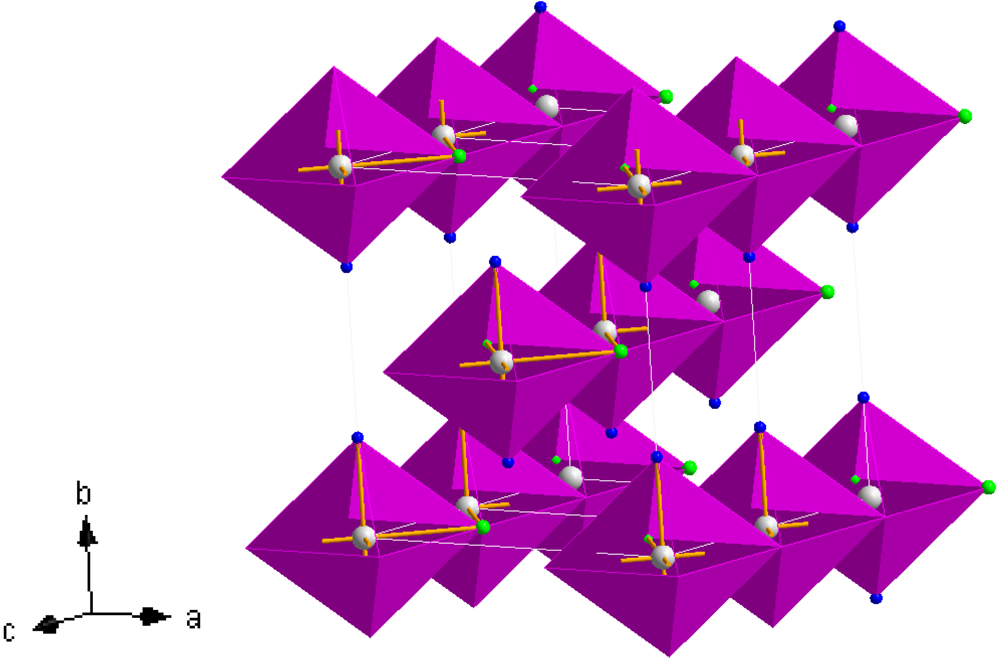
        <p>The unit cell parameters of <bold>3</bold> are slightly larger than those in both the isostructural magnesium and iron chloride ammines as would be expected by comparison of the respective ionic radii of high spin Mn<sup>2+</sup><italic>vs.</italic> Mg<sup>2+</sup> and high spin Fe<sup>2+</sup> (and as is also the case for the respective hexa-ammines) [<xref ref-type="bibr" rid="B37-crystals-02-00193">37</xref>,<xref ref-type="bibr" rid="B38-crystals-02-00193">38</xref>,<xref ref-type="bibr" rid="B40-crystals-02-00193">40</xref>,<xref ref-type="bibr" rid="B41-crystals-02-00193">41</xref>]. A representation of the structure of <bold>3</bold> is given in <xref ref-type="fig" rid="crystals-02-00193-f008">Figure 8</xref>. The structure is composed of edge sharing Mn(NH<sub>3</sub>)<sub>2</sub>Cl<sub>4</sub> octahedra (which can be termed as <inline-graphic xmlns:xlink="http://www.w3.org/1999/xlink" xlink:href="crystals-02-00193-i003.tif"/> chains in which the trans-NH<sub>3</sub> groups are thus terminal and the halide groups are bridging) which propagate parallel to the [001] direction. The chains are effectively aligned parallel in the (110) plane throughout the structure with each chain translated by half the [001] face diagonal with respect to its nearest neighbour. Leineweber <italic>et al</italic> have also rationalised the orthorhombic structure in terms of CsCl-type motifs and described isostructural Mg(NH<sub>3</sub>)<sub>2</sub>Cl<sub>2</sub> as a brick-like arrangement of double CsCl units in the <italic>ab</italic> plane [<xref ref-type="bibr" rid="B38-crystals-02-00193">38</xref>,<xref ref-type="bibr" rid="B41-crystals-02-00193">41</xref>]. The Mn–N bond length in <bold>3</bold> is broadly similar to those in the hexa-ammmines, <bold>1</bold> and <bold>2</bold>, and close to those observed in the equivalent magnesium and iron compounds [<xref ref-type="bibr" rid="B16-crystals-02-00193">16</xref>,<xref ref-type="bibr" rid="B38-crystals-02-00193">38</xref>,<xref ref-type="bibr" rid="B41-crystals-02-00193">41</xref>].</p>
        <fig id="crystals-02-00193-f008" position="anchor">
          <label>Figure 8</label>
          <caption>
            <p>Crystal structure of <bold>3</bold>, Mn(NH<sub>3</sub>)<sub>2</sub>Cl<sub>2</sub>; Mn (white sphere), Cl (green spheres), N (blue spheres) [<xref ref-type="bibr" rid="B38-crystals-02-00193">38</xref>,<xref ref-type="bibr" rid="B41-crystals-02-00193">41</xref>].</p>
          </caption>
          <graphic xmlns:xlink="http://www.w3.org/1999/xlink" xlink:href="crystals-02-00193-g008.tif"/>
        </fig>
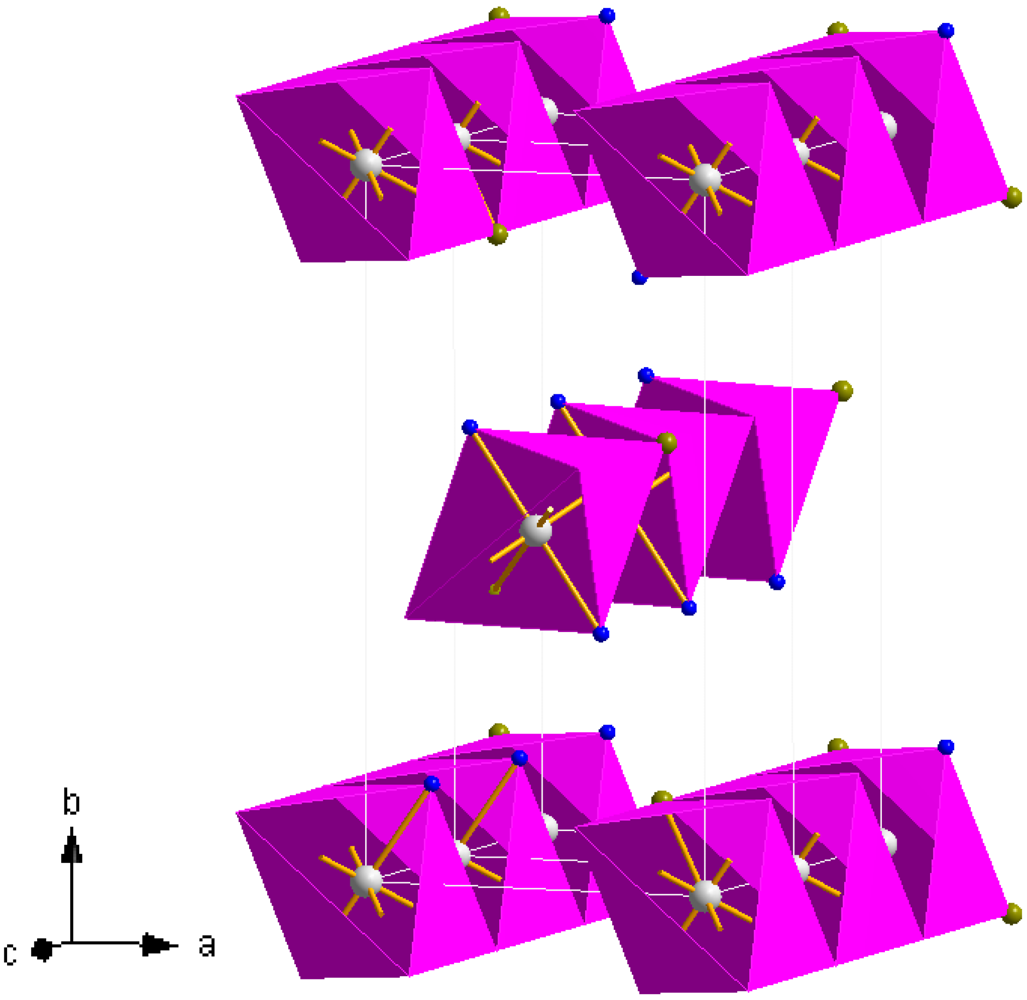
        <p><bold>4</bold> is isostructural with Fe(NH<sub>3</sub>)<sub>2</sub>Br<sub>2</sub> and Mg(NH<sub>3</sub>)<sub>2</sub>Br<sub>2</sub> (<xref ref-type="fig" rid="crystals-02-00193-f009">Figure 9</xref>) [<xref ref-type="bibr" rid="B16-crystals-02-00193">16</xref>,<xref ref-type="bibr" rid="B38-crystals-02-00193">38</xref>,<xref ref-type="bibr" rid="B41-crystals-02-00193">41</xref>]. As with <bold>3</bold>, the unit cell of <bold>4</bold> is larger than the Fe and Mg analogues. Similar to <bold>3</bold>, <bold>4</bold> is composed of <inline-graphic xmlns:xlink="http://www.w3.org/1999/xlink" xlink:href="crystals-02-00193-i004.tif"/> chains (where Br replaces Cl as X). The key difference in the structures of <bold>3</bold> and <bold>4</bold> lies in the relative arrangement of these edge sharing octahedral chains. As Bremm and Meyer point out, the packing of the chains in the <italic>Pbam</italic> structures is hexagonal as opposed to the tetragonal sequence in the <italic>Cmmm</italic> compounds [<xref ref-type="bibr" rid="B16-crystals-02-00193">16</xref>]. Hence, successive rows of edge-sharing octahedra running parallel to the [110] direction are rotated by 90°. Following the double CsCl unit notation used by Leineweber <italic>et al</italic>, the units are arranged in a herringbone pattern in the <italic>ab</italic> plane in the bromide (as opposed to the brick-like arrangement in the chloride). Mn–X distances are longer in <bold>4</bold> than <bold>3</bold> as would be expected on coordination of the metal to the larger halides [<xref ref-type="bibr" rid="B37-crystals-02-00193">37</xref>,<xref ref-type="bibr" rid="B40-crystals-02-00193">40</xref>]. The Mn–N distance in <bold>4</bold> is shorter however and comparable to that observed in Fe(NH<sub>3</sub>)<sub>2</sub>Cl<sub>2</sub>. Inevitably from the mismatch in Mn–N and Mn–X bond lengths in both <bold>3</bold> and <bold>4</bold> the MnX<sub>4</sub>(NH<sub>3</sub>)<sub>2</sub> octahedra are axially compressed in both compounds. We are unable to draw any firm conclusions regarding the positions or dynamics of the hydrogens from our relatively limited models from PXRD. The Mg(ND<sub>3</sub>)<sub>2</sub><italic>X</italic><sub>2 </sub>compoundshave been studied by neutron diffraction to resolve such issues and a similar approach would be required in the Mn–NH<sub>3</sub>–<italic>X</italic> systems to understand the relationships of NH<sub>3</sub> rotational disorder with halide and temperature [<xref ref-type="bibr" rid="B42-crystals-02-00193">42</xref>].</p>
        <fig id="crystals-02-00193-f009" position="anchor">
          <label>Figure 9</label>
          <caption>
            <p>Crystal structure of <bold>4</bold>, Mn(NH<sub>3</sub>)<sub>2</sub>Br<sub>2</sub>; Mn (white sphere), Br (yellow spheres), N (blue spheres) [<xref ref-type="bibr" rid="B38-crystals-02-00193">38</xref>,<xref ref-type="bibr" rid="B41-crystals-02-00193">41</xref>].</p>
          </caption>
          <graphic xmlns:xlink="http://www.w3.org/1999/xlink" xlink:href="crystals-02-00193-g009.tif"/>
        </fig>
        <p>Further de-ammoniation of <bold>1</bold> and <bold>2</bold> to yield the anticipated mono-ammoniated complexes <bold>5</bold> and <bold>6</bold> was performed although isolation of these phases is yet to be achieved owing to the apparent narrow stability range (prior to further desorption). In the available literature, among the transition metal ammines only the Fe(NH<sub>3</sub>)Cl<sub>2</sub> and Ni(NH<sub>3</sub>)<italic>X</italic><sub>2</sub> (<italic>X</italic> = Cl, Br) have been crystallographically characterized giving hexagonal <italic>P</italic>6<sub>3</sub><italic>/mmc</italic> and monoclinic <italic>I</italic>2<italic>/m</italic> structures for the Fe and Ni compounds respectively [<xref ref-type="bibr" rid="B16-crystals-02-00193">16</xref>,<xref ref-type="bibr" rid="B43-crystals-02-00193">43</xref>]. Further heating of <bold>1</bold> and <bold>2</bold> gave rise to <bold>7</bold> and <bold>8</bold> which were amorphous by PXRD. Raman spectra for <bold>7</bold> and <bold>8</bold> showed no notable features over the measurement range and none of the bands that were present in <bold>1</bold>–<bold>4</bold> from which one could infer that deammoniation was complete as suggested by the thermogravimetric data.</p>
      </sec>
    </sec>
    <sec>
      <title>3. Experimental Section</title>
      <p>MnCl<sub>2</sub> (Alfa Aesar, anhydrous, 97%) and MgBr<sub>2</sub> (Sigma Aldrich, anhydrous, 98%) powders were prepared for ammoniation in an N<sub>2</sub>-filled recirculating glovebox (Saffron Scientific; 1 ppm H<sub>2</sub>O, 1 ppm O<sub>2</sub>). Each halide was weighed and contained in a silica reaction tube fitted with a septum cap and parafilm prior to removal from the glovebox. In a fume hood, ammonia (BOC, anhydrous ammonia gas, 99.98%) was flowed over the transition metal halides at room temperature for 16 h, utilizing a water trap on the exhaust flow. The resultant products (<bold>1</bold> and <bold>2</bold>) were collected in the glovebox and prepared for the appropriate characterization methods below.</p>
      <p>Room temperature powder X-ray diffraction (PXRD) experiments were conducted with a PANalytical XPERT Pro MPD diffractometer in Bragg-Brentano reflection geometry (Cu Kα1 radiation) using a bespoke air sensitive sample holder [<xref ref-type="bibr" rid="B44-crystals-02-00193">44</xref>]. Diffraction data for phase identification were typically collected for 5° ≤ 2<italic>θ</italic> ≤ 85° with a 0.017° step size with scan times of from 1–12 h. Diffraction data were compared to patterns in the ICDD (JCPDS) powder diffraction file (PDF) using the PANalytical High Score Plus software package. Additional data for the structure refinement of selected samples were collected over longer scan times (12 h; 5° ≤ 2<italic>θ</italic> ≤ 85° with a step size of 0.017°). All data were indexed where possible using the CELREF software package and refined by least squares fitting [<xref ref-type="bibr" rid="B45-crystals-02-00193">45</xref>]. Structure refinements were performed using the Rietveld method via GSAS and EXPGUI software [<xref ref-type="bibr" rid="B46-crystals-02-00193">46</xref>,<xref ref-type="bibr" rid="B47-crystals-02-00193">47</xref>].</p>
      <p>Temperature programmed desorption, via thermogravimetric-differential thermal analysis-mass spectrometry (TG-DTA-MS; Netzsch STA 409 and Hiden Analytical HPR20 using Ar carrier gas) was conducted in an Ar-filled recirculating glovebox (MBraun UniLab; &lt;0.1 ppm H<sub>2</sub>O, 0.1 ppm O<sub>2</sub>). Using alumina sample pans, the hexa-ammine samples were initially heated to 773 K under a flow of Ar gas at a rate of 5 K min<sup>−1</sup> to fully de-ammoniate the sample. In initial experiments, MS data were collected up to 200 amu but in later runs only data at values for argon, ammonia, water, nitrogen and hydrogen were collected, given the absence of any other detectable species. Finally, the hexa-ammines were heated again to lower temperatures as appropriate to partially de-ammoniate them and to allow isolation of the decomposition products. Evolved gas analysis by simultaneous mass spectrometry using a Faraday cup detector was employed to provide definitive evidence of ammonia loss during TGA analysis.</p>
      <p>Room temperature Raman spectroscopy (Horiba LabRam HR confocal microscope, 532.17 nm green laser, 100 μm aperture, 600 groves/mm grating, Synapse CCD) was used to identify the Raman active bands in the ammines, and hence confirm the vibrational bonding modes occurring in the fully and partially ammoniated complexes. The samples were held in sealed glass capillaries to prevent exposure to air/moisture.</p>
    </sec>
    <sec sec-type="conclusions">
      <title>4. Conclusions</title>
      <p>MnCl<sub>2</sub> and MnBr<sub>2</sub> uptake ammonia readily at room temperature to form the respective hexa-ammoniate adducts. Mn(NH<sub>3</sub>)<sub>6</sub>Cl<sub>2</sub> and Mn(NH<sub>3</sub>)<sub>6</sub>Br<sub>2 </sub>release near-theoretical equivalents of ammonia in a three stage release process as evidenced by TG-DTA-MS. 4, 1 and 1 equivalents respectively of ammonia are lost by both the chloride and bromide. Generally each respective release occurs at a higher temperature in the bromide system although both hexa-ammines appear to begin losing ammonia under ambient conditions. The hexa-ammine complexes, Mn(NH<sub>3</sub>)<sub>6</sub>Cl<sub>2</sub> and Mn(NH<sub>3</sub>)<sub>6</sub>Br<sub>2</sub>, form with the K<sub>2</sub>[PtCl<sub>6</sub>]-type structure, with Raman data consistent with compounds containing NH<sub>3</sub> and are comparable to those in related magnesium and iron ammoniates.The product of the first de-ammoniation steps in each system is confirmed as the diammines Mn(NH<sub>3</sub>)<sub>2</sub>Cl<sub>2</sub> and Mn(NH<sub>3</sub>)<sub>2</sub>Br<sub>2</sub> respectively, which are isostructural with the corresponding Mg and Fe chloride and bromide compounds. Further ammonia loss events would suggest decomposition first to the respective monoamines and finally to the deammoniated dihalides.</p>
    </sec>
    
  </body>
  <back><ack>
      <title>Acknowledgments</title>
      <p>DHG thanks the EPSRC for funding under grants EP/E040071/1 and EP/I022570/1 and the EPSRC, the Materials KTN and EADS Innovation Works for a CASE studentship for HR.</p>
    </ack>
    <ref-list>
      <title>References</title>
      <ref id="B1-crystals-02-00193">
        <label>1.</label>
        <citation citation-type="web">
		<article-title>DOE Technical Plan—Storage (2011 Interim Update)</article-title>
          <access-date>(accessed on 20 February 2012)</access-date>
          <comment>Available online:<ext-link xmlns:xlink="http://www.w3.org/1999/xlink" xlink:href="http://www1.eere.energy.gov/hydrogenandfuelcells/mypp/pdfs/storage.pdf" ext-link-type="uri">http://www1.eere.energy.gov/hydrogenandfuelcells/mypp/pdfs/storage.pdf</ext-link></comment>
        </citation>
      </ref>
      <ref id="B2-crystals-02-00193">
        <label>2.</label>
        <citation citation-type="book">
          <person-group person-group-type="author">
            <name>
              <surname>Sørensen</surname>
              <given-names>B.</given-names>
            </name>
          </person-group>
          <source>Hydrogen and Fuel Cells: Emerging Technologies and Applications</source>
          <edition>2nd</edition>
          <publisher-name>Academic Press</publisher-name>
          <publisher-loc>New York, NY, USA</publisher-loc>
          <year>2005</year>
        </citation>
      </ref>
      <ref id="B3-crystals-02-00193">
        <label>3.</label>
        <citation citation-type="journal">
          <person-group person-group-type="author">
            <name>
              <surname>Mandal</surname>
              <given-names>T.K.</given-names>
            </name>
            <name>
              <surname>Gregory</surname>
              <given-names>D.H.</given-names>
            </name>
          </person-group>
          <article-title>Hydrogen Storage Materials: present scenarios and future directions</article-title>
          <source>Ann. Rep. Prog. Chem. Sect. A</source>
          <year>2009</year>
          <volume>105</volume>
          <fpage>21</fpage>
          <lpage>54</lpage>
        <pub-id pub-id-type="doi">10.1039/b818951j</pub-id></citation>
      </ref>
      <ref id="B4-crystals-02-00193">
        <label>4.</label>
        <citation citation-type="journal">
          <person-group person-group-type="author">
            <name>
              <surname>Mandal</surname>
              <given-names>T.K.</given-names>
            </name>
            <name>
              <surname>Gregory</surname>
              <given-names>D.H.</given-names>
            </name>
          </person-group>
          <article-title>Hydrogen: a future energy vector for sustainable development</article-title>
          <source>J. Mech. Eng. Sci.</source>
          <year>2010</year>
          <volume>224</volume>
          <fpage>539</fpage>
          <lpage>558</lpage>
        <pub-id pub-id-type="doi">10.1243/13506501JET671</pub-id></citation>
      </ref>
      <ref id="B5-crystals-02-00193">
        <label>5.</label>
        <citation citation-type="journal">
          <person-group person-group-type="author">
            <name>
              <surname>Orimo</surname>
              <given-names>S.</given-names>
            </name>
            <name>
              <surname>Nakamori</surname>
              <given-names>Y.</given-names>
            </name>
            <name>
              <surname>Eliseo</surname>
              <given-names>J.R.</given-names>
            </name>
            <name>
              <surname>Züttel</surname>
              <given-names>A.</given-names>
            </name>
            <name>
              <surname>Jensen</surname>
              <given-names>C.M.</given-names>
            </name>
          </person-group>
          <article-title>Complex Hydrides for Hydrogen Storage</article-title>
          <source>Chem. Rev.</source>
          <year>2007</year>
          <volume>107</volume>
          <fpage>4111</fpage>
          <lpage>4132</lpage>
        <pub-id pub-id-type="doi">10.1021/cr0501846</pub-id><pub-id pub-id-type="pmid">17848101</pub-id></citation>
      </ref>
      <ref id="B6-crystals-02-00193">
        <label>6.</label>
        <citation citation-type="journal">
          <person-group person-group-type="author">
            <name>
              <surname>Grochala</surname>
              <given-names>W.</given-names>
            </name>
            <name>
              <surname>Edwards</surname>
              <given-names>P.P.</given-names>
            </name>
          </person-group>
          <article-title>Thermal Decomposition of the Non-Interstitial Hydrides for the Storage and Production of Hydrogen</article-title>
          <source>Chem. Rev.</source>
          <year>2004</year>
          <volume>104</volume>
          <fpage>1238</fpage>
          <lpage>1315</lpage>
        </citation>
      </ref>
      <ref id="B7-crystals-02-00193">
        <label>7.</label>
        <citation citation-type="journal">
          <person-group person-group-type="author">
            <name>
              <surname>Schlapbach</surname>
              <given-names>L.</given-names>
            </name>
            <name>
              <surname>Züttel</surname>
              <given-names>A.</given-names>
            </name>
          </person-group>
          <article-title>Hydrogen-storage materials for mobile applications</article-title>
          <source>Nature</source>
          <year>2001</year>
          <volume>414</volume>
          <fpage>353</fpage>
          <lpage>358</lpage>
        <pub-id pub-id-type="doi">10.1038/35104634</pub-id><pub-id pub-id-type="pmid">11713542</pub-id></citation>
      </ref>
      <ref id="B8-crystals-02-00193">
        <label>8.</label>
        <citation citation-type="journal">
          <person-group person-group-type="author">
            <name>
              <surname>Christensen</surname>
              <given-names>C.H.</given-names>
            </name>
            <name>
              <surname>Sørensen</surname>
              <given-names>R.Z.</given-names>
            </name>
            <name>
              <surname>Johannessen</surname>
              <given-names>T.</given-names>
            </name>
            <name>
              <surname>Quaade</surname>
              <given-names>U.J.</given-names>
            </name>
            <name>
              <surname>Honkala</surname>
              <given-names>K.</given-names>
            </name>
            <name>
              <surname>Elmøe</surname>
              <given-names>T.D.</given-names>
            </name>
            <name>
              <surname>Køhler</surname>
              <given-names>R.</given-names>
            </name>
            <name>
              <surname>Nørskov</surname>
              <given-names>J.K.</given-names>
            </name>
          </person-group>
          <article-title>Metal ammine complexes for hydrogen storage</article-title>
          <source>J. Mater. Chem.</source>
          <year>2005</year>
          <volume>15</volume>
          <fpage>4106</fpage>
          <lpage>4108</lpage>
        <pub-id pub-id-type="doi">10.1039/b511589b</pub-id></citation>
      </ref>
      <ref id="B9-crystals-02-00193">
        <label>9.</label>
        <citation citation-type="journal">
          <person-group person-group-type="author">
            <name>
              <surname>Sørensen</surname>
              <given-names>R.Z.</given-names>
            </name>
            <name>
              <surname>Hummelshøj</surname>
              <given-names>J.S.</given-names>
            </name>
            <name>
              <surname>Klerke</surname>
              <given-names>A.</given-names>
            </name>
            <name>
              <surname>Reves</surname>
              <given-names>J.B.</given-names>
            </name>
            <name>
              <surname>Vegge</surname>
              <given-names>T.</given-names>
            </name>
            <name>
              <surname>Nørskov</surname>
              <given-names>J.K.</given-names>
            </name>
            <name>
              <surname>Christensen</surname>
              <given-names>C.H.</given-names>
            </name>
          </person-group>
          <article-title>Indirect, Reversible High-Density Hydrogen Storage in Compact Metal Ammine Salts</article-title>
          <source>J. Am. Chem. Soc.</source>
          <year>2008</year>
          <volume>130</volume>
          <fpage>8660</fpage>
          <lpage>8668</lpage>
        <pub-id pub-id-type="doi">10.1021/ja076762c</pub-id><pub-id pub-id-type="pmid">18549216</pub-id></citation>
      </ref>
      <ref id="B10-crystals-02-00193">
        <label>10.</label>
        <citation citation-type="journal">
          <person-group person-group-type="author">
            <name>
              <surname>Hwang</surname>
              <given-names>I.-C.</given-names>
            </name>
            <name>
              <surname>Drews</surname>
              <given-names>T.</given-names>
            </name>
            <name>
              <surname>Seppelt</surname>
              <given-names>K.</given-names>
            </name>
          </person-group>
          <article-title>Mg(NH<sub>3</sub>)<sub>6</sub>Hg<sub>22</sub>, a Mercury Intercalation Compound</article-title>
          <source>J. Am. Chem. Soc.</source>
          <year>2000</year>
          <volume>122</volume>
          <fpage>8486</fpage>
          <lpage>8489</lpage>
        <pub-id pub-id-type="doi">10.1021/ja000960l</pub-id></citation>
      </ref>
      <ref id="B11-crystals-02-00193">
        <label>11.</label>
        <citation citation-type="journal">
          <person-group person-group-type="author">
            <name>
              <surname>Jacobsen</surname>
              <given-names>H.S.</given-names>
            </name>
            <name>
              <surname>Hansen</surname>
              <given-names>H.A.</given-names>
            </name>
            <name>
              <surname>Andreasen</surname>
              <given-names>J.W.</given-names>
            </name>
            <name>
              <surname>Shi</surname>
              <given-names>Q.</given-names>
            </name>
            <name>
              <surname>Andreasen</surname>
              <given-names>A.</given-names>
            </name>
            <name>
              <surname>Feidenhans’l</surname>
              <given-names>R.</given-names>
            </name>
            <name>
              <surname>Nielsen</surname>
              <given-names>M.M.</given-names>
            </name>
            <name>
              <surname>Ståhl</surname>
              <given-names>K.</given-names>
            </name>
            <name>
              <surname>Vegge</surname>
              <given-names>T.</given-names>
            </name>
          </person-group>
          <article-title>Nanoscale structural characteriszation of Mg(NH<sub>3</sub>)<sub>6</sub>Cl<sub>2</sub> during NH<sub>3</sub> desorption: An <italic>in situ</italic> small angle X-ray scattering study</article-title>
          <source>Chem. Phys. Lett.</source>
          <year>2007</year>
          <volume>441</volume>
          <fpage>255</fpage>
          <lpage>260</lpage>
        <pub-id pub-id-type="doi">10.1016/j.cplett.2007.05.001</pub-id></citation>
      </ref>
      <ref id="B12-crystals-02-00193">
        <label>12.</label>
        <citation citation-type="journal">
          <person-group person-group-type="author">
            <name>
              <surname>Tsubota</surname>
              <given-names>M.</given-names>
            </name>
            <name>
              <surname>Hino</surname>
              <given-names>S.</given-names>
            </name>
            <name>
              <surname>Fujii</surname>
              <given-names>H.</given-names>
            </name>
            <name>
              <surname>Oomatsu</surname>
              <given-names>C.</given-names>
            </name>
            <name>
              <surname>Yamana</surname>
              <given-names>M.</given-names>
            </name>
            <name>
              <surname>Ichikawa</surname>
              <given-names>T.</given-names>
            </name>
            <name>
              <surname>Kojima</surname>
              <given-names>Y.</given-names>
            </name>
          </person-group>
          <article-title>Reaction between magnesium ammine complex compound and lithium hydride</article-title>
          <source>Int. J. Hydrogen Energy</source>
          <year>2010</year>
          <volume>35</volume>
          <fpage>2058</fpage>
          <lpage>2062</lpage>
        <pub-id pub-id-type="doi">10.1016/j.ijhydene.2009.12.169</pub-id></citation>
      </ref>
      <ref id="B13-crystals-02-00193">
        <label>13.</label>
        <citation citation-type="journal">
          <person-group person-group-type="author">
            <name>
              <surname>Tekin</surname>
              <given-names>A.</given-names>
            </name>
            <name>
              <surname>Hummelshøj</surname>
              <given-names>J.S.</given-names>
            </name>
            <name>
              <surname>Jacobsen</surname>
              <given-names>H.S.</given-names>
            </name>
            <name>
              <surname>Sveinbjørnsson</surname>
              <given-names>D.</given-names>
            </name>
            <name>
              <surname>Blanchard</surname>
              <given-names>D.</given-names>
            </name>
            <name>
              <surname>Nørskova</surname>
              <given-names>J.K.</given-names>
            </name>
            <name>
              <surname>Vegge</surname>
              <given-names>T.</given-names>
            </name>
          </person-group>
          <article-title>Ammonia dynamics in magnesium ammine from DFT and neutron scattering</article-title>
          <source>Energy Environ. Sci.</source>
          <year>2010</year>
          <volume>3</volume>
          <fpage>448</fpage>
          <lpage>456</lpage>
        <pub-id pub-id-type="doi">10.1039/b921442a</pub-id></citation>
      </ref>
      <ref id="B14-crystals-02-00193">
        <label>14.</label>
        <citation citation-type="journal">
          <person-group person-group-type="author">
            <name>
              <surname>Klerke</surname>
              <given-names>A.</given-names>
            </name>
            <name>
              <surname>Christensen</surname>
              <given-names>C.H.</given-names>
            </name>
            <name>
              <surname>Nørskov</surname>
              <given-names>J.K.</given-names>
            </name>
            <name>
              <surname>Vegge</surname>
              <given-names>T.</given-names>
            </name>
          </person-group>
          <article-title>Ammonia for hydrogen storage: challenges and opportunities</article-title>
          <source>J. Mater. Chem.</source>
          <year>2008</year>
          <volume>18</volume>
          <fpage>2304</fpage>
          <lpage>2310</lpage>
        <pub-id pub-id-type="doi">10.1039/b720020j</pub-id></citation>
      </ref>
      <ref id="B15-crystals-02-00193">
        <label>15.</label>
        <citation citation-type="journal">
          <person-group person-group-type="author">
            <name>
              <surname>Leineweber</surname>
              <given-names>A.</given-names>
            </name>
            <name>
              <surname>Jacobs</surname>
              <given-names>H.</given-names>
            </name>
          </person-group>
          <article-title>Preparation and Crystal Structures of Ni(NH<sub>3</sub>)<sub>2</sub>Cl<sub>2</sub>, and of Two Modifications of Ni(NH<sub>3</sub>)<sub>2</sub>Br<sub>2</sub> and Ni(NH<sub>3</sub>)<sub>2</sub>I<sub>2</sub></article-title>
          <source>J. Solid State Chem.</source>
          <year>2000</year>
          <volume>152</volume>
          <fpage>381</fpage>
          <lpage>387</lpage>
          <pub-id pub-id-type="doi">10.1006/jssc.2000.8666</pub-id>
        </citation>
      </ref>
      <ref id="B16-crystals-02-00193">
        <label>16.</label>
        <citation citation-type="journal">
          <person-group person-group-type="author">
            <name>
              <surname>Bremm</surname>
              <given-names>S.</given-names>
            </name>
            <name>
              <surname>Meyer</surname>
              <given-names>G.</given-names>
            </name>
          </person-group>
          <article-title>Reactivity of Ammonium Halides: Action of Ammonium Chloride and Bromide on Iron and Iron(III) Chloride and Bromide</article-title>
          <source>Z. Anorg. Allg. Chem.</source>
          <year>2003</year>
          <volume>629</volume>
          <fpage>1875</fpage>
          <lpage>1880</lpage>
        <pub-id pub-id-type="doi">10.1002/zaac.200300142</pub-id></citation>
      </ref>
      <ref id="B17-crystals-02-00193">
        <label>17.</label>
        <citation citation-type="journal">
          <person-group person-group-type="author">
            <name>
              <surname>Lan</surname>
              <given-names>R.</given-names>
            </name>
            <name>
              <surname>Irvine</surname>
              <given-names>J.T.S.</given-names>
            </name>
            <name>
              <surname>Tao</surname>
              <given-names>S.</given-names>
            </name>
          </person-group>
          <article-title>Ammonia and related chemical as potential indirect hydrogen storage materials</article-title>
          <source>Int. J. Hydrogen Energy</source>
          <year>2012</year>
          <volume>37</volume>
          <fpage>1482</fpage>
          <lpage>1494</lpage>
        <pub-id pub-id-type="doi">10.1016/j.ijhydene.2011.10.004</pub-id></citation>
      </ref>
      <ref id="B18-crystals-02-00193">
        <label>18.</label>
        <citation citation-type="journal">
          <person-group person-group-type="author">
            <name>
              <surname>Fuerte</surname>
              <given-names>A.</given-names>
            </name>
            <name>
              <surname>Valenzuela</surname>
              <given-names>R.X.</given-names>
            </name>
            <name>
              <surname>Escudero</surname>
              <given-names>M.J.</given-names>
            </name>
            <name>
              <surname>Daza</surname>
              <given-names>L.</given-names>
            </name>
          </person-group>
          <article-title>Ammonia as efficient fuel for SOFC</article-title>
          <source>J. Power Sources</source>
          <year>2009</year>
          <volume>192</volume>
          <fpage>170</fpage>
          <lpage>174</lpage>
        <pub-id pub-id-type="doi">10.1016/j.jpowsour.2008.11.037</pub-id></citation>
      </ref>
      <ref id="B19-crystals-02-00193">
        <label>19.</label>
        <citation citation-type="journal">
          <person-group person-group-type="author">
            <name>
              <surname>Farhad</surname>
              <given-names>S.</given-names>
            </name>
            <name>
              <surname>Hamdullahpur</surname>
              <given-names>F.</given-names>
            </name>
          </person-group>
          <article-title>Conceptual design of a novel ammonia-fuelled portable solid oxide fuel cell system</article-title>
          <source>J. Power Sources</source>
          <year>2010</year>
          <volume>195</volume>
          <fpage>3084</fpage>
          <lpage>3090</lpage>
        <pub-id pub-id-type="doi">10.1016/j.jpowsour.2009.11.115</pub-id></citation>
      </ref>
      <ref id="B20-crystals-02-00193">
        <label>20.</label>
        <citation citation-type="journal">
          <person-group person-group-type="author">
            <name>
              <surname>Ishak</surname>
              <given-names>F.</given-names>
            </name>
            <name>
              <surname>Dincer</surname>
              <given-names>I.</given-names>
            </name>
            <name>
              <surname>Zamfirescu</surname>
              <given-names>C.</given-names>
            </name>
          </person-group>
          <article-title>Thermodynamic analysis of ammonia-fed solid oxide fuel cells</article-title>
          <source>J. Power Sources</source>
          <year>2012</year>
          <volume>202</volume>
          <fpage>157</fpage>
          <lpage>165</lpage>
        <pub-id pub-id-type="doi">10.1016/j.jpowsour.2011.10.142</pub-id></citation>
      </ref>
      <ref id="B21-crystals-02-00193">
        <label>21.</label>
        <citation citation-type="journal">
          <person-group person-group-type="author">
            <name>
              <surname>Ma</surname>
              <given-names>S.</given-names>
            </name>
            <name>
              <surname>Wang</surname>
              <given-names>J.</given-names>
            </name>
            <name>
              <surname>Yan</surname>
              <given-names>Z.</given-names>
            </name>
            <name>
              <surname>Dai</surname>
              <given-names>W.</given-names>
            </name>
            <name>
              <surname>Lu</surname>
              <given-names>B.</given-names>
            </name>
          </person-group>
          <article-title>Thermodynamic analysis of a new combined cooling, heat and power system driven by solid oxide fuel cell based on ammonia-water mixture</article-title>
          <source>J. Power Sources</source>
          <year>2011</year>
          <volume>196</volume>
          <fpage>8463</fpage>
          <lpage>8471</lpage>
        <pub-id pub-id-type="doi">10.1016/j.jpowsour.2011.06.008</pub-id></citation>
      </ref>
      <ref id="B22-crystals-02-00193">
        <label>22.</label>
        <citation citation-type="journal">
          <person-group person-group-type="author">
            <name>
              <surname>Baniasadi</surname>
              <given-names>E.</given-names>
            </name>
            <name>
              <surname>Dincer</surname>
              <given-names>I.</given-names>
            </name>
          </person-group>
          <article-title>Energy and exergy analyses of a combined ammonia-fed solid oxide fuel cell system for vehicular applications</article-title>
          <source>Int. J. Hydrogen Energy</source>
          <year>2011</year>
          <volume>36</volume>
          <fpage>11128</fpage>
          <lpage>11136</lpage>
        <pub-id pub-id-type="doi">10.1016/j.ijhydene.2011.04.234</pub-id></citation>
      </ref>
      <ref id="B23-crystals-02-00193">
        <label>23.</label>
        <citation citation-type="journal">
          <person-group person-group-type="author">
            <name>
              <surname>Sørensen</surname>
              <given-names>R.Z.</given-names>
            </name>
            <name>
              <surname>Hummerlshøj</surname>
              <given-names>J.S.</given-names>
            </name>
            <name>
              <surname>Klerke</surname>
              <given-names>A.</given-names>
            </name>
            <name>
              <surname>Reves</surname>
              <given-names>J.B.</given-names>
            </name>
            <name>
              <surname>Vegge</surname>
              <given-names>T.</given-names>
            </name>
            <name>
              <surname>Nørskov</surname>
              <given-names>J.K.</given-names>
            </name>
            <name>
              <surname>Christensen</surname>
              <given-names>C.H.</given-names>
            </name>
          </person-group>
          <article-title>In direct, reversible high-density hydrogen storage in compact metal ammine salts</article-title>
          <source>J. Am. Chem. Soc.</source>
          <year>2008</year>
          <volume>130</volume>
          <fpage>8660</fpage>
          <lpage>8668</lpage>
        <pub-id pub-id-type="doi">10.1021/ja076762c</pub-id><pub-id pub-id-type="pmid">18549216</pub-id></citation>
      </ref>
      <ref id="B24-crystals-02-00193">
        <label>24.</label>
        <citation citation-type="journal">
          <person-group person-group-type="author">
            <name>
              <surname>Olovosson</surname>
              <given-names>I.</given-names>
            </name>
          </person-group>
          <article-title>Packing Principles in the Structures of Metal Ammine Salts</article-title>
          <source>Acta. Crystallogr.</source>
          <year>1965</year>
          <volume>18</volume>
          <fpage>889</fpage>
          <lpage>893</lpage>
        <pub-id pub-id-type="doi">10.1107/S0365110X65002165</pub-id></citation>
      </ref>
      <ref id="B25-crystals-02-00193">
        <label>25.</label>
        <citation citation-type="journal">
          <person-group person-group-type="author">
            <name>
              <surname>Eβmann</surname>
              <given-names>R.</given-names>
            </name>
            <name>
              <surname>Kreiner</surname>
              <given-names>G.</given-names>
            </name>
            <name>
              <surname>Niemann</surname>
              <given-names>A.</given-names>
            </name>
            <name>
              <surname>Rechenbach</surname>
              <given-names>D.</given-names>
            </name>
            <name>
              <surname>Schmieding</surname>
              <given-names>A.</given-names>
            </name>
            <name>
              <surname>Sichla</surname>
              <given-names>T.</given-names>
            </name>
            <name>
              <surname>Zachwieja</surname>
              <given-names>U.</given-names>
            </name>
            <name>
              <surname>Jacobs</surname>
              <given-names>H.</given-names>
            </name>
          </person-group>
          <article-title>The Structures of some Hexaammine Metal(II) Halides of 3d Metals: [V(NH<sub>3</sub>)<sub>6</sub>]I<sub>2</sub>, [Cr(NH<sub>3</sub>)<sub>6</sub>]I<sub>2</sub>, [Mn(NH<sub>3</sub>)<sub>6</sub>]Cl<sub>2</sub>, [Fe(NH<sub>3</sub>)<sub>6</sub>]Cl<sub>2</sub>, [Fe(NH<sub>3</sub>)<sub>6</sub>]Br<sub>2</sub>, [Co(NH<sub>3</sub>)<sub>6</sub>]Br<sub>2</sub>, [Ni(NH<sub>3</sub>)<sub>6</sub>]Cl<sub>2</sub></article-title>
          <source>Z. Anorg. Allg. Chem.</source>
          <year>1996</year>
          <volume>622</volume>
          <fpage>1161</fpage>
          <lpage>1166</lpage>
        <pub-id pub-id-type="doi">10.1002/zaac.19966220709</pub-id></citation>
      </ref>
      <ref id="B26-crystals-02-00193">
        <label>26.</label>
        <citation citation-type="journal">
          <person-group person-group-type="author">
            <name>
              <surname>Wentworth</surname>
              <given-names>W.E.</given-names>
            </name>
            <name>
              <surname>Raldrow</surname>
              <given-names>W.M.</given-names>
            </name>
            <name>
              <surname>Corbett</surname>
              <given-names>G.E.</given-names>
            </name>
          </person-group>
          <article-title>Correlation of Thermodynamic Properties for Dissociation of Ammines of Divalent Metal Halides</article-title>
          <source>Inorg. Chem. Acta</source>
          <year>1978</year>
          <volume>30</volume>
          <fpage>L299</fpage>
          <lpage>L301</lpage>
        <pub-id pub-id-type="doi">10.1016/S0020-1693(00)88985-9</pub-id></citation>
      </ref>
      <ref id="B27-crystals-02-00193">
        <label>27.</label>
        <citation citation-type="journal">
          <person-group person-group-type="author">
            <name>
              <surname>Lepinasse</surname>
              <given-names>E.</given-names>
            </name>
            <name>
              <surname>Spinner</surname>
              <given-names>B.</given-names>
            </name>
          </person-group>
          <article-title>Cold production through coupling of solid-gas reactors I: Performance analysis</article-title>
          <source>Rev. Int. Froid</source>
          <year>1994</year>
          <volume>17</volume>
          <fpage>309</fpage>
          <lpage>322</lpage>
        </citation>
      </ref>
      <ref id="B28-crystals-02-00193">
        <label>28.</label>
        <citation citation-type="journal">
          <person-group person-group-type="author">
            <name>
              <surname>Biltz</surname>
              <given-names>W.</given-names>
            </name>
            <name>
              <surname>Hüttig</surname>
              <given-names>G.F.</given-names>
            </name>
          </person-group>
          <article-title>Über die Ammoniakate der Magnesiumhalogenide</article-title>
          <source>Z. Anorg. Allg. Chem.</source>
          <year>1921</year>
          <volume>119</volume>
          <fpage>115</fpage>
          <lpage>131</lpage>
          <pub-id pub-id-type="doi">10.1002/zaac.19211190107</pub-id>
        </citation>
      </ref>
      <ref id="B29-crystals-02-00193">
        <label>29.</label>
        <citation citation-type="journal">
          <person-group person-group-type="author">
            <name>
              <surname>Schmidt</surname>
              <given-names>H.</given-names>
            </name>
            <name>
              <surname>Müller</surname>
              <given-names>A.</given-names>
            </name>
          </person-group>
          <article-title>Skeletal Vibrational Spectra, Force Constants, and Bond Properties of Transition Metal Ammine Complexes</article-title>
          <source>Inorg. Chem.</source>
          <year>1975</year>
          <volume>14</volume>
          <fpage>2183</fpage>
          <lpage>2187</lpage>
          <pub-id pub-id-type="doi">10.1021/ic50151a031</pub-id>
        </citation>
      </ref>
      <ref id="B30-crystals-02-00193">
        <label>30.</label>
        <citation citation-type="journal">
          <person-group person-group-type="author">
            <name>
              <surname>Schmidt</surname>
              <given-names>H.</given-names>
            </name>
            <name>
              <surname>Müller</surname>
              <given-names>A.</given-names>
            </name>
          </person-group>
          <article-title>Vibrational Spectra and Force Constants of Pure Ammine Complexes</article-title>
          <source>Coord. Chem. Rev.</source>
          <year>1976</year>
          <volume>19</volume>
          <fpage>41</fpage>
          <lpage>97</lpage>
        <pub-id pub-id-type="doi">10.1016/S0010-8545(00)80404-X</pub-id></citation>
      </ref>
      <ref id="B31-crystals-02-00193">
        <label>31.</label>
        <citation citation-type="journal">
          <person-group person-group-type="author">
            <name>
              <surname>Sacconi</surname>
              <given-names>L.</given-names>
            </name>
            <name>
              <surname>Sabatini</surname>
              <given-names>A.</given-names>
            </name>
            <name>
              <surname>Gans</surname>
              <given-names>P.</given-names>
            </name>
          </person-group>
          <article-title>Infrared Spectra from 80 to 2000 Cm<sup>−1</sup> of Some Metal-Ammine Complexes</article-title>
          <source>Inorg. Chem.</source>
          <year>1964</year>
          <volume>3</volume>
          <fpage>1772</fpage>
          <lpage>1774</lpage>
        <pub-id pub-id-type="doi">10.1021/ic50022a026</pub-id></citation>
      </ref>
      <ref id="B32-crystals-02-00193">
        <label>32.</label>
        <citation citation-type="book">
          <person-group person-group-type="author">
            <name>
              <surname>Larkin</surname>
              <given-names>P.</given-names>
            </name>
          </person-group>
          <article-title>IR and Raman spectra—Structure Correlations: Characteristic Group Frequencies</article-title>
          <source>Infrared and Raman Spectroscopy</source>
          <edition>1st</edition>
          <publisher-name>Elsevier</publisher-name>
          <publisher-loc>Amsterdam, The Netherlands</publisher-loc>
          <year>2011</year>
        </citation>
      </ref>
      <ref id="B33-crystals-02-00193">
        <label>33.</label>
        <citation citation-type="journal">
          <person-group person-group-type="author">
            <name>
              <surname>Plus</surname>
              <given-names>R.</given-names>
            </name>
          </person-group>
          <article-title>Spectroscopie Raman de Mg(NH<sub>3</sub>)<sub>6</sub>Cl<sub>2</sub> et Mg(ND<sub>3</sub>)<sub>6</sub>Cl<sub>2</sub></article-title>
          <source>J. Raman Spectrosc.</source>
          <year>1973</year>
          <volume>1</volume>
          <fpage>551</fpage>
          <lpage>563</lpage>
        <pub-id pub-id-type="doi">10.1002/jrs.1250010605</pub-id></citation>
      </ref>
      <ref id="B34-crystals-02-00193">
        <label>34.</label>
        <citation citation-type="journal">
          <person-group person-group-type="author">
            <name>
              <surname>Jacobs</surname>
              <given-names>H.</given-names>
            </name>
            <name>
              <surname>Brock</surname>
              <given-names>J.</given-names>
            </name>
            <name>
              <surname>Stüve</surname>
              <given-names>C.</given-names>
            </name>
          </person-group>
          <article-title>Rontgenographische Strukturbestimmung und IR-Spektroskopische Untersuchungen an Hexaammindiiodiden, [M(NH<sub>3</sub>)<sub>6</sub>I<sub>2</sub>], von Eisen und Mangan</article-title>
          <source>J. Less-Common. Met.</source>
          <year>1987</year>
          <volume>134</volume>
          <fpage>207</fpage>
          <lpage>214</lpage>
          <pub-id pub-id-type="doi">10.1016/0022-5088(87)90559-5</pub-id>
        </citation>
      </ref>
      <ref id="B35-crystals-02-00193">
        <label>35.</label>
        <citation citation-type="journal">
          <person-group person-group-type="author">
            <name>
              <surname>Schiebel</surname>
              <given-names>P.</given-names>
            </name>
            <name>
              <surname>Hoser</surname>
              <given-names>A.</given-names>
            </name>
            <name>
              <surname>Prandl</surname>
              <given-names>W.</given-names>
            </name>
            <name>
              <surname>Heger</surname>
              <given-names>G.</given-names>
            </name>
            <name>
              <surname>Schweiss</surname>
              <given-names>P.</given-names>
            </name>
          </person-group>
          <article-title>Orientational disorder in Ni(NH<sub>3</sub>)<sub>2</sub>I<sub>2</sub>. Evidence for rotation-translation coupling</article-title>
          <source>J. Phys. I. France</source>
          <year>1993</year>
          <volume>3</volume>
          <fpage>987</fpage>
          <lpage>1006</lpage>
          <pub-id pub-id-type="doi">10.1051/jp1:1993179</pub-id>
        </citation>
      </ref>
      <ref id="B36-crystals-02-00193">
        <label>36.</label>
        <citation citation-type="journal">
          <person-group person-group-type="author">
            <name>
              <surname>Schiebel</surname>
              <given-names>P.</given-names>
            </name>
            <name>
              <surname>Hoser</surname>
              <given-names>A.</given-names>
            </name>
            <name>
              <surname>Prandl</surname>
              <given-names>W.</given-names>
            </name>
            <name>
              <surname>Heger</surname>
              <given-names>G.</given-names>
            </name>
            <name>
              <surname>Paulus</surname>
              <given-names>W.</given-names>
            </name>
            <name>
              <surname>Schweiss</surname>
              <given-names>P.</given-names>
            </name>
          </person-group>
          <article-title>Proton density and orientational potential in nickelhexammine salts: a thermodynamic analysis of rotation-translation coupling</article-title>
          <source>J. Phys. Condens. Matter</source>
          <year>1994</year>
          <volume>6</volume>
          <fpage>10989</fpage>
          <lpage>11005</lpage>
        <pub-id pub-id-type="doi">10.1088/0953-8984/6/50/009</pub-id></citation>
      </ref>
      <ref id="B37-crystals-02-00193">
        <label>37.</label>
        <citation citation-type="journal">
          <person-group person-group-type="author">
            <name>
              <surname>Watt</surname>
              <given-names>M.</given-names>
            </name>
            <name>
              <surname>Manhas</surname>
              <given-names>B.S.</given-names>
            </name>
          </person-group>
          <article-title>Replacement of polydentate ligands in Mn(II) complexes by ammonia</article-title>
          <source>J. Inorg. Nucl. Chem.</source>
          <year>1966</year>
          <volume>28</volume>
          <fpage>1945</fpage>
          <lpage>1947</lpage>
        <pub-id pub-id-type="doi">10.1016/0022-1902(66)80284-1</pub-id></citation>
      </ref>
      <ref id="B38-crystals-02-00193">
        <label>38.</label>
        <citation citation-type="journal">
          <person-group person-group-type="author">
            <name>
              <surname>Kraus</surname>
              <given-names>W.</given-names>
            </name>
            <name>
              <surname>Nolze</surname>
              <given-names>G.</given-names>
            </name>
          </person-group>
          <article-title>POWDER CELL—a program for the representation and manipulation of crystal structures and calculation of the resulting X-ray powder patterns</article-title>
          <source>J. Appl. Cryst.</source>
          <year>1996</year>
          <volume>29</volume>
          <fpage>301</fpage>
          <lpage>303</lpage>
        <pub-id pub-id-type="doi">10.1107/S0021889895014920</pub-id></citation>
      </ref>
      <ref id="B39-crystals-02-00193">
        <label>39.</label>
        <citation citation-type="journal">
          <person-group person-group-type="author">
            <name>
              <surname>Schefer</surname>
              <given-names>J.</given-names>
            </name>
            <name>
              <surname>Schwarzenbach</surname>
              <given-names>D.</given-names>
            </name>
            <name>
              <surname>Fischer</surname>
              <given-names>P.</given-names>
            </name>
            <name>
              <surname>Koetzle</surname>
              <given-names>T.</given-names>
            </name>
            <name>
              <surname>Larsen</surname>
              <given-names>F.K.</given-names>
            </name>
            <name>
              <surname>Haussühl</surname>
              <given-names>S.</given-names>
            </name>
            <name>
              <surname>Rüdlinger</surname>
              <given-names>M.</given-names>
            </name>
            <name>
              <surname>McIntyre</surname>
              <given-names>G.G.</given-names>
            </name>
            <name>
              <surname>Birkedal</surname>
              <given-names>H.</given-names>
            </name>
            <name>
              <surname>Bürgi</surname>
              <given-names>H.-B.</given-names>
            </name>
          </person-group>
          <article-title>Neutron and X-ray Diffraction Study of the Thermal Motion in K<sub>2</sub>PtCl<sub>6</sub> as a function of Temperature</article-title>
          <source>Acta Crystallogr.</source>
          <year>1998</year>
          <volume>B54</volume>
          <fpage>121</fpage>
          <lpage>128</lpage>
        </citation>
      </ref>
      <ref id="B40-crystals-02-00193">
        <label>40.</label>
        <citation citation-type="journal">
          <person-group person-group-type="author">
            <name>
              <surname>Shannon</surname>
              <given-names>R.D.</given-names>
            </name>
          </person-group>
          <article-title>Revised Effective Ionic Radii and Systematic Studies of Interatomic Distances in Halides and Chalcogenides</article-title>
          <source>Acta Crystallogr.</source>
          <year>1976</year>
          <volume>A32</volume>
          <fpage>751</fpage>
          <lpage>767</lpage>
        </citation>
      </ref>
      <ref id="B41-crystals-02-00193">
        <label>41.</label>
        <citation citation-type="journal">
          <person-group person-group-type="author">
            <name>
              <surname>Leineweber</surname>
              <given-names>A.</given-names>
            </name>
            <name>
              <surname>Friedriszik</surname>
              <given-names>M.W.</given-names>
            </name>
            <name>
              <surname>Jacobs</surname>
              <given-names>H.</given-names>
            </name>
          </person-group>
          <article-title>Preparation and Crystal Structures of Mg(NH<sub>3</sub>)<sub>2</sub>Cl<sub>2</sub>, Mg(NH<sub>3</sub>)<sub>2</sub>Br<sub>2</sub>, Mg(NH<sub>3</sub>)<sub>2</sub>I<sub>2</sub></article-title>
          <source>J. Solid State Chem.</source>
          <year>1999</year>
          <volume>147</volume>
          <fpage>229</fpage>
          <lpage>234</lpage>
        <pub-id pub-id-type="doi">10.1006/jssc.1999.8238</pub-id></citation>
      </ref>
      <ref id="B42-crystals-02-00193">
        <label>42.</label>
        <citation citation-type="journal">
          <person-group person-group-type="author">
            <name>
              <surname>Leineweber</surname>
              <given-names>A.</given-names>
            </name>
            <name>
              <surname>Jacobs</surname>
              <given-names>H.</given-names>
            </name>
            <name>
              <surname>Fischer</surname>
              <given-names>P.</given-names>
            </name>
            <name>
              <surname>Böttger</surname>
              <given-names>G.</given-names>
            </name>
          </person-group>
          <article-title>Uniaxial Orientational Order-Disorder Transitions in Diammine Magnesium Halides, Mg(ND<sub>3</sub>)<sub>2</sub>Cl<sub>2</sub> and Mg(NH<sub>3</sub>)<sub>2</sub>Br<sub>2</sub>, Investigated by Neutron Diffraction</article-title>
          <source>J. Solid State Chem.</source>
          <year>2001</year>
          <volume>156</volume>
          <fpage>487</fpage>
          <lpage>499</lpage>
        <pub-id pub-id-type="doi">10.1006/jssc.2000.9028</pub-id></citation>
      </ref>
      <ref id="B43-crystals-02-00193">
        <label>43.</label>
        <citation citation-type="journal">
          <person-group person-group-type="author">
            <name>
              <surname>Leineweber</surname>
              <given-names>A.</given-names>
            </name>
            <name>
              <surname>Jacobs</surname>
              <given-names>H.</given-names>
            </name>
            <name>
              <surname>Ehrenberg</surname>
              <given-names>H.</given-names>
            </name>
          </person-group>
          <article-title>Crystal Structure of Ni(NH<sub>3</sub>)Cl<sub>2</sub> and Mg(NH<sub>3</sub>)Br<sub>2</sub></article-title>
          <source>Z. Anorg. Allg. Chem.</source>
          <year>2000</year>
          <volume>626</volume>
          <fpage>2146</fpage>
          <lpage>2152</lpage>
        <pub-id pub-id-type="doi">10.1002/1521-3749(200010)626:10&lt;2146::AID-ZAAC2146&gt;3.0.CO;2-H</pub-id></citation>
      </ref>
      <ref id="B44-crystals-02-00193">
        <label>44.</label>
        <citation citation-type="journal">
          <person-group person-group-type="author">
            <name>
              <surname>Barker</surname>
              <given-names>M.G.</given-names>
            </name>
            <name>
              <surname>Begley</surname>
              <given-names>M.J.</given-names>
            </name>
            <name>
              <surname>Edwards</surname>
              <given-names>P.P.</given-names>
            </name>
            <name>
              <surname>Gregory</surname>
              <given-names>D.H.</given-names>
            </name>
            <name>
              <surname>Smith</surname>
              <given-names>S.E.</given-names>
            </name>
          </person-group>
          <article-title>Synthesis and crystal structures of the new ternary nitrides Sr<sub>3</sub>CrN<sub>3</sub> and Ba<sub>3</sub>CrN<sub>3</sub></article-title>
          <source>J. Chem. Soc., Dalton Trans.</source>
          <year>1996</year>
          <volume>11</volume>
          <fpage>1</fpage>
          <lpage>5</lpage>
        </citation>
      </ref>
      <ref id="B45-crystals-02-00193">
        <label>45.</label>
        <citation citation-type="web">
          <person-group person-group-type="author">
            <name>
              <surname>Laugier</surname>
              <given-names>J.</given-names>
            </name>
            <name>
              <surname>Bochu</surname>
              <given-names>B.</given-names>
            </name>
          </person-group>
          <article-title>ENSP/Laboratoire des Matériaux et du Génie Physique, LMGP-Suite Suite of Programs for the Interpretation of X-ray Experiments</article-title>
          <access-date>(accessed on 20 February 2012)</access-date>
          <comment>Available online:<ext-link xmlns:xlink="http://www.w3.org/1999/xlink" xlink:href="http://www.inpg.fr/ LMGP" ext-link-type="uri">http://www.inpg.fr/ LMGP</ext-link> and <ext-link xmlns:xlink="http://www.w3.org/1999/xlink" xlink:href="http://www.inpg.fr/ LMGP" ext-link-type="uri">http://www.ccp14.ac.uk/tutorial/lmgp/</ext-link></comment>
        </citation>
      </ref>
      <ref id="B46-crystals-02-00193">
        <label>46.</label>
        <citation citation-type="book">
          <person-group person-group-type="author">
            <name>
              <surname>Larson</surname>
              <given-names>A.C.</given-names>
            </name>
            <name>
              <surname>von Dreele</surname>
              <given-names>R.B.</given-names>
            </name>
          </person-group>
          <source>General Structure Analysis System (GSAS)</source>
          <publisher-name>Los Alamos National Laboratory Report LAUR</publisher-name>
          <publisher-loc>86-748, Los Alamos, NM, USA</publisher-loc>
          <year>1995</year>
        </citation>
      </ref>
      <ref id="B47-crystals-02-00193">
        <label>47.</label>
        <citation citation-type="journal">
          <person-group person-group-type="author">
            <name>
              <surname>Toby</surname>
              <given-names>B.H.</given-names>
            </name>
          </person-group>
          <article-title>EXPGUI, a graphical user interface for GSAS</article-title>
          <source>J. Appl. Cryst.</source>
          <year>2001</year>
          <volume>34</volume>
          <fpage>210</fpage>
          <lpage>213</lpage>
        <pub-id pub-id-type="doi">10.1107/S0021889801002242</pub-id></citation>
      </ref>
    </ref-list>
  </back>
</article>