
<?xml version="1.0" encoding="UTF-8"?>
<!DOCTYPE article PUBLIC "-//NLM//DTD Journal Publishing DTD v2.3 20070202//EN" "journalpublishing.dtd">
<article xmlns:mml="http://www.w3.org/1998/Math/MathML" xmlns:xlink="http://www.w3.org/1999/xlink" xml:lang="en" article-type="rapid-communication">
  <front>
    <journal-meta>
      <journal-id journal-id-type="publisher-id">crystals</journal-id>
      <journal-title>Crystals</journal-title>
      <abbrev-journal-title abbrev-type="publisher">Crystals</abbrev-journal-title>
      <abbrev-journal-title abbrev-type="pubmed">Crystals</abbrev-journal-title>
      <issn pub-type="epub">2073-4352</issn>
      <publisher>
        <publisher-name>MDPI</publisher-name>
      </publisher>
    </journal-meta>
    <article-meta>
      <article-id pub-id-type="doi">10.3390/cryst2010137</article-id>
      <article-id pub-id-type="publisher-id">crystals-02-00137</article-id>
      <article-categories>
        <subj-group>
          <subject>Communication</subject>
        </subj-group>
      </article-categories>
      <title-group>
        <article-title>Synthesis and Crystal Structure of 1-Chloro-2-methyl-4-nitrobenzene</article-title>
      </title-group>
      <contrib-group>
        <contrib contrib-type="author">
          <name>
            <surname>Saeed</surname>
            <given-names>Aamer</given-names>
          </name>
          <xref rid="af1-crystals-02-00137" ref-type="aff">1</xref>
        </contrib>
        <contrib contrib-type="author">
          <name>
            <surname>Simpson</surname>
            <given-names>Jim</given-names>
          </name>
          <xref rid="af2-crystals-02-00137" ref-type="aff">2</xref>
          <xref rid="c1-crystals-02-00137" ref-type="corresp">*</xref>
        </contrib>
      </contrib-group>
      <aff id="af1-crystals-02-00137"><label>1</label> Department of Chemistry, Quaid-I-Azam University, Islamabad 45320, Pakistan</aff>
      <aff id="af2-crystals-02-00137"><label>2</label> Department of Chemistry, University of Otago, P.O. Box 56, Dunedin 9054, New Zealand</aff>
      <author-notes>
        <corresp id="c1-crystals-02-00137"><label>*</label> Author to whom correspondence should be addressed; Email: <email>jsimpson@alkali.otago.ac.nz</email>; Tel.: +64-3-479-7914; Fax: +64-3-479-7906.</corresp>
      </author-notes>
      <pub-date pub-type="epub">
        <day>19</day>
        <month>03</month>
        <year>2012</year>
      </pub-date>
      <pub-date pub-type="collection"><month>03</month>
        <year>2012</year>
      </pub-date>
      <volume>2</volume>
      <issue>1</issue>
      <fpage>137</fpage>
      <lpage>143</lpage>
      <history>
        <date date-type="received">
          <day>29</day>
          <month>12</month>
          <year>2011</year>
        </date>
        <date date-type="rev-recd">
          <day>12</day>
          <month>03</month>
          <year>2012</year>
        </date>
        <date date-type="accepted">
          <day>13</day>
          <month>03</month>
          <year>2012</year>
        </date>
      </history>
      <permissions>
        <copyright-statement>©  2012 by the authors; licensee MDPI, Basel, Switzerland.</copyright-statement>
        <copyright-year>2012</copyright-year>
        <license xmlns:xlink="http://www.w3.org/1999/xlink" license-type="open-access" xlink:href="http://creativecommons.org/licenses/by/3.0/">
          <p>This article is an open-access article distributed under the terms and conditions of the Creative Commons Attribution license (http://creativecommons.org/licenses/by/3.0/).</p>
        </license>
      </permissions>
      <abstract>
        <p>The title compound (<bold>3</bold>) was prepared from 4-chloroaniline in good yield on successive oxidation and methylation and its crystal and molecular structure is reported. The compound crystallizes in the monoclinic space group P 2<sub>1</sub>/n with unit cell dimensions <italic>a</italic> = 13.5698(8), <italic>b</italic> = 3.7195 (3), <italic>c</italic> = 13.5967 (8) Å, ß = 91.703(3) °, <italic>V</italic> = 685.96 (10) Å<sup>3</sup>. The molecule is essentially planar with a dihedral angle of 6.2(3) ° between the nitro group and the phenyl ring. The crystal structure is stabilised by π...π contacts between adjacent benzene rings together with C–H...O hydrogen bonds and close Cl...O contacts.</p>
      </abstract>
      <kwd-group>
        <kwd>chlorinated nitroaromatics</kwd>
        <kwd>pollutants</kwd>
        <kwd>X-ray structure</kwd>
      </kwd-group>
    </article-meta>
  </front>
  <body>
    <sec sec-type="intro">
      <title>1. Introduction</title>
      <p>1-Chloro-2-methyl-4-nitrobenzene, also called 2-chloro-5-nitrotoluene, belongs to the family of chlorinated nitroaromatic compounds. These are important building blocks for synthesis of diverse heterocycles and a number of industrial chemicals. Thus, the isomeric 2-chloro-6-nitrotoluene is a common intermediate in the synthesis of industrial chloronitrotoluenes, as well as of pharmaceuticals such as the bronchodilatory compound vasicine [<xref ref-type="bibr" rid="B1-crystals-02-00137">1</xref>]. It is toxic to the fresh water flea <italic>D. magna</italic> and freshwater protozoa <italic>T. pyriformis</italic>, suggesting it as a harmful pollutant [<xref ref-type="bibr" rid="B2-crystals-02-00137">2</xref>,<xref ref-type="bibr" rid="B3-crystals-02-00137">3</xref>]. Similarly, 1-chloro-4-nitrobenzene is used in the industrial production of azo and sulfur dyes, drugs and pesticides [<xref ref-type="bibr" rid="B4-crystals-02-00137">4</xref>]. It is found in industrial wastes [<xref ref-type="bibr" rid="B5-crystals-02-00137">5</xref>] and is a serious environmental pollutant [<xref ref-type="bibr" rid="B6-crystals-02-00137">6</xref>], causes methemoglobinemia in humans and animals [<xref ref-type="bibr" rid="B7-crystals-02-00137">7</xref>] and is weakly mutagenic and carcinogenic [<xref ref-type="bibr" rid="B8-crystals-02-00137">8</xref>]. Several <italic>Pseudomonas</italic> species have been reported to be able to reduce mono-nitro compounds to the corresponding anilines under aerobic conditions [<xref ref-type="bibr" rid="B9-crystals-02-00137">9</xref>]. The bacterial strain LW1 (family <italic>Comamonadaceae</italic>), utilizes 1-chloro-4-nitrobenzene as a sole source of carbon, nitrogen, and energy and transforms it into 2-amino-5-chlorophenol [<xref ref-type="bibr" rid="B10-crystals-02-00137">10</xref>]. The title compound was prepared as a key starting material towards some heterocyclic compounds and to study its biodegradation pathway.</p>
    </sec>
    <sec sec-type="results">
      <title>2. Results and Discussion</title>
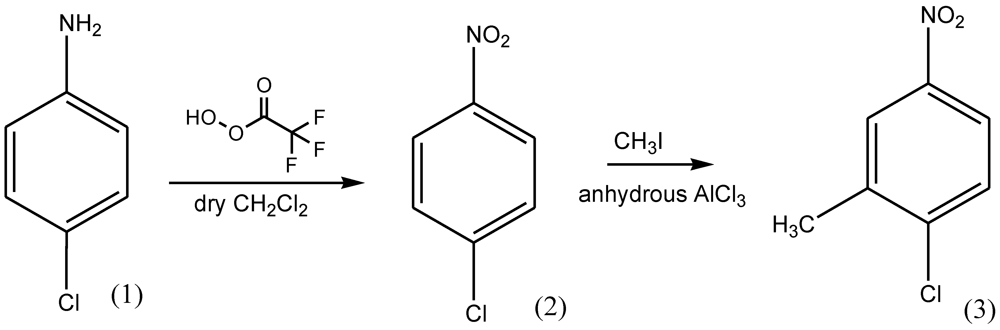
      <p>An efficient synthesis of the target compound was carried out according to the route depicted in <xref ref-type="fig" rid="crystals-02-00137-f001">Figure 1</xref>. It started from 4-chloroaniline (<bold>1</bold>) which, on oxidation using peroxy trifluoroacetic acid in dry dichloromethane, was converted to 4-nitrochlorobenzene (<bold>2</bold>) in nearly quantitative yield. Friedel-Crafts alkylation of (<bold>2</bold>) using methyl iodide in the presence of anhydrous aluminum chloride afforded the title compound (<bold>3</bold>) Figure (1). </p>
      <fig id="crystals-02-00137-f001" position="anchor">
        <label>Figure 1</label>
        <caption>
          <p>Synthesis of 1-chloro-2-methyl-4-nitrobenzene (3).</p>
        </caption>
        <graphic xmlns:xlink="http://www.w3.org/1999/xlink" xlink:href="crystals-02-00137-g001.tif"/>
      </fig>
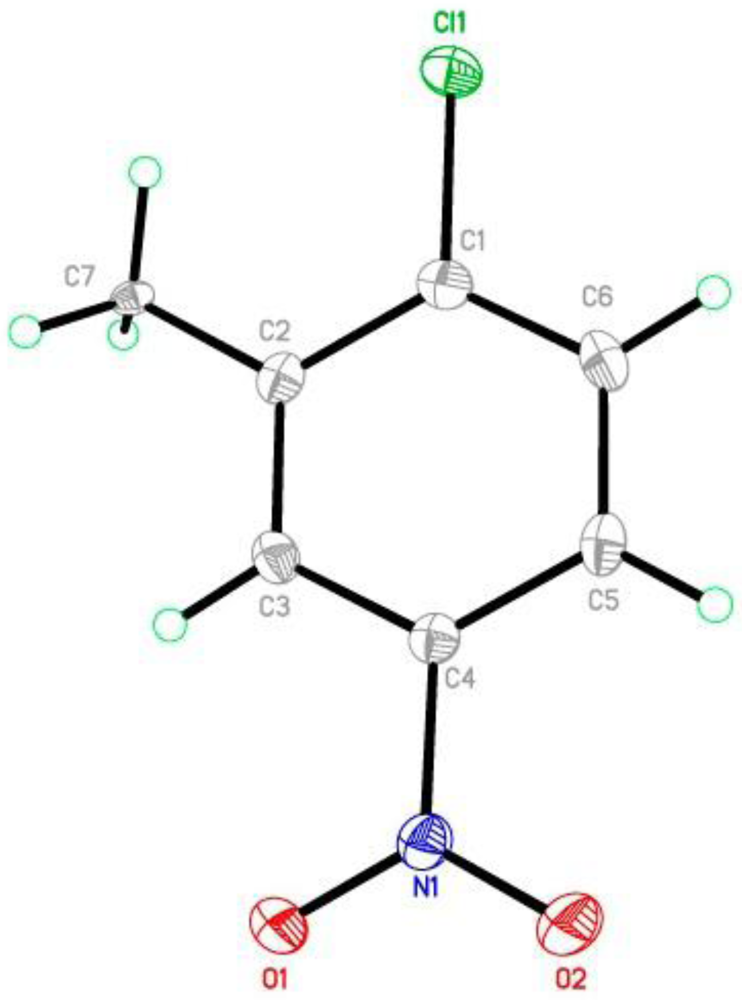
      <p>The molecular structure of 1-chloro-2-methyl-4-nitrobenzene shown in <xref ref-type="fig" rid="crystals-02-00137-f002">Figure 2</xref> is close to planar with the chloro- and methyl- substituents lying 0.022(4) and 0.067(4) Å from the meanplane of the benzene ring (rms deviation = 0.0022 Å). The nitro group is inclined at 6.2(3) ° to the ring plane. The hydrogen atoms of the methyl group are disordered over two positions of equal occupancy. Bond distances in the molecule are normal [<xref ref-type="bibr" rid="B11-crystals-02-00137">11</xref>], and bond lengths and angles are similar to those reported for the structure of 2-chloro-3,5-dinitro-p-xylene [<xref ref-type="bibr" rid="B12-crystals-02-00137">12</xref>,<xref ref-type="bibr" rid="B13-crystals-02-00137">13</xref>] when the difference in data collection temperature and the precision of the measurements are taken into account. </p>
      <fig id="crystals-02-00137-f002" position="anchor">
        <label>Figure 2</label>
        <caption>
          <p>The structure of <bold>3</bold> showing the atom numbering, with displacement ellipsoids drawn at the 50% probability level [<xref ref-type="bibr" rid="B16-crystals-02-00137">16</xref>]. For clarity in all of the figures, the H atoms of only one component of the disordered methyl group are shown. </p>
        </caption>
        <graphic xmlns:xlink="http://www.w3.org/1999/xlink" xlink:href="crystals-02-00137-g002.tif"/>
      </fig>
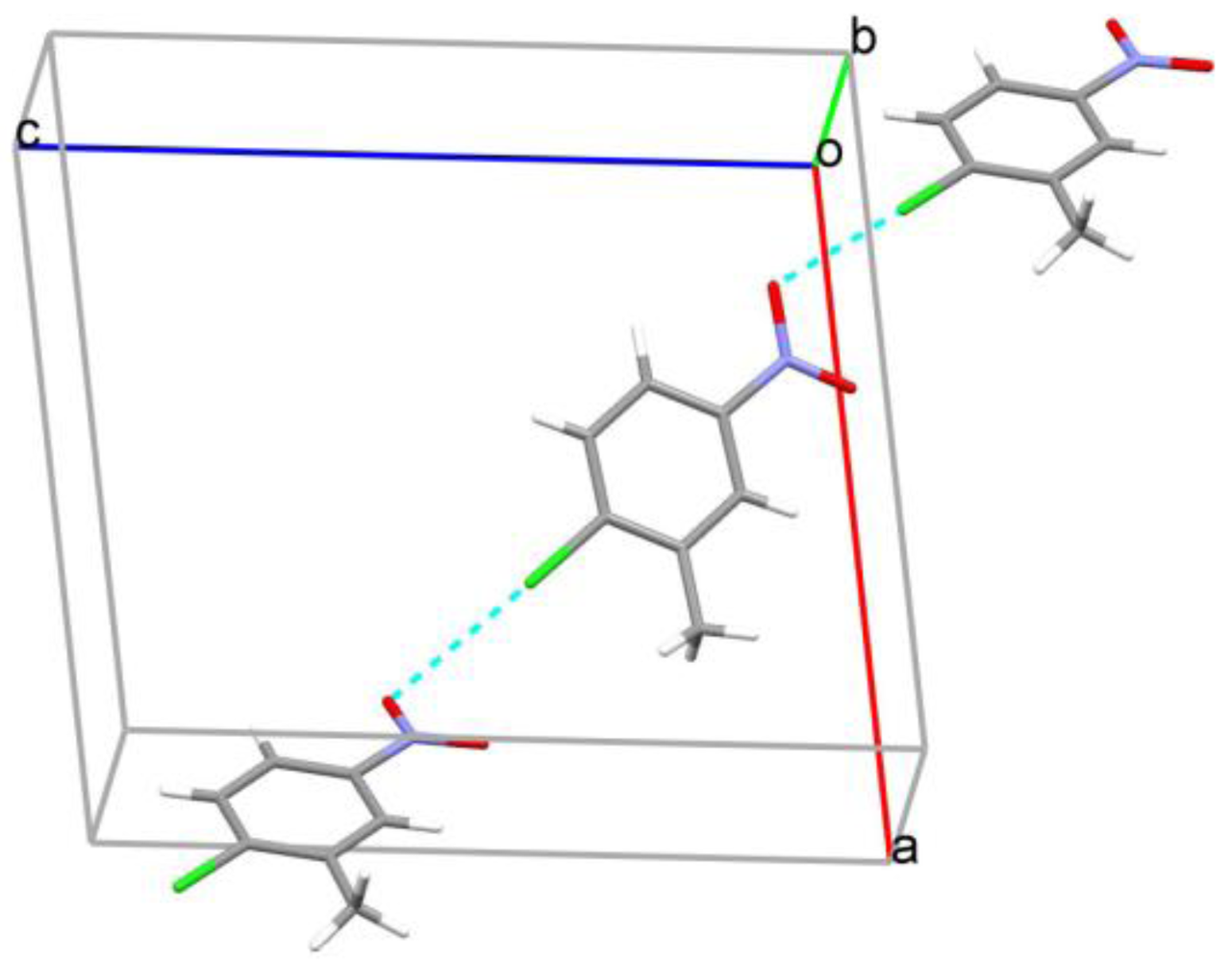
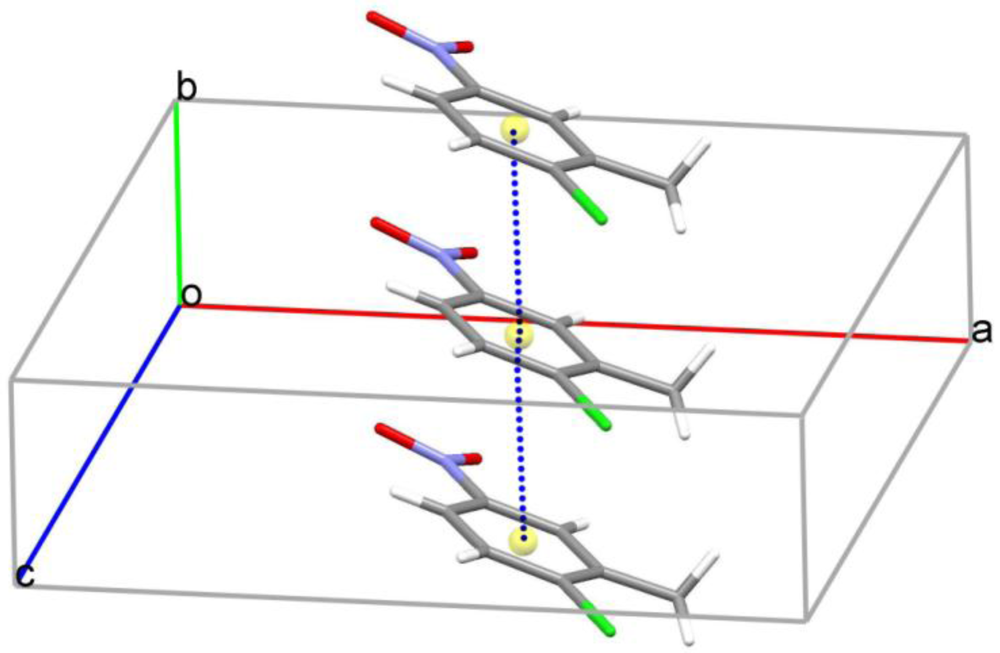
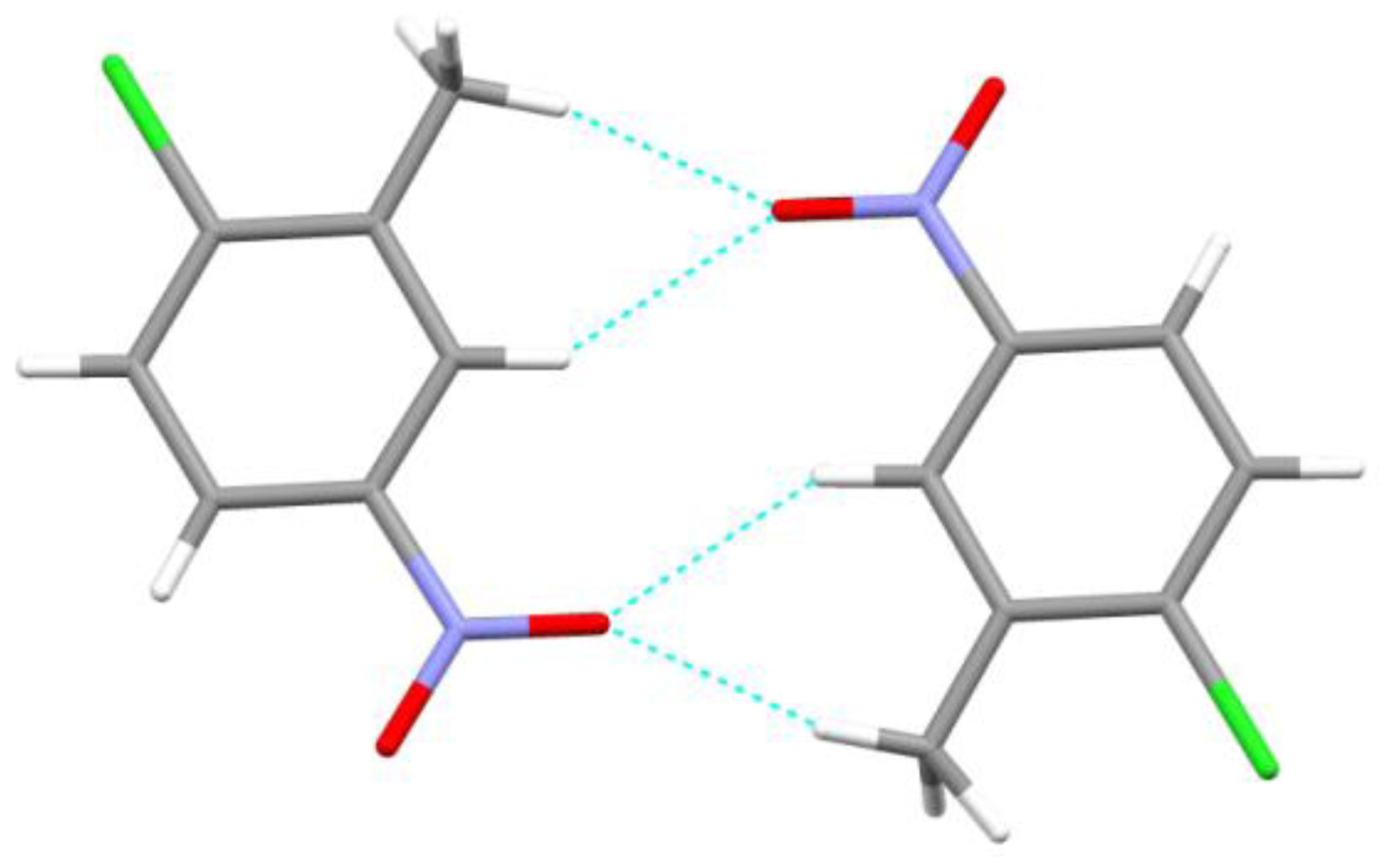
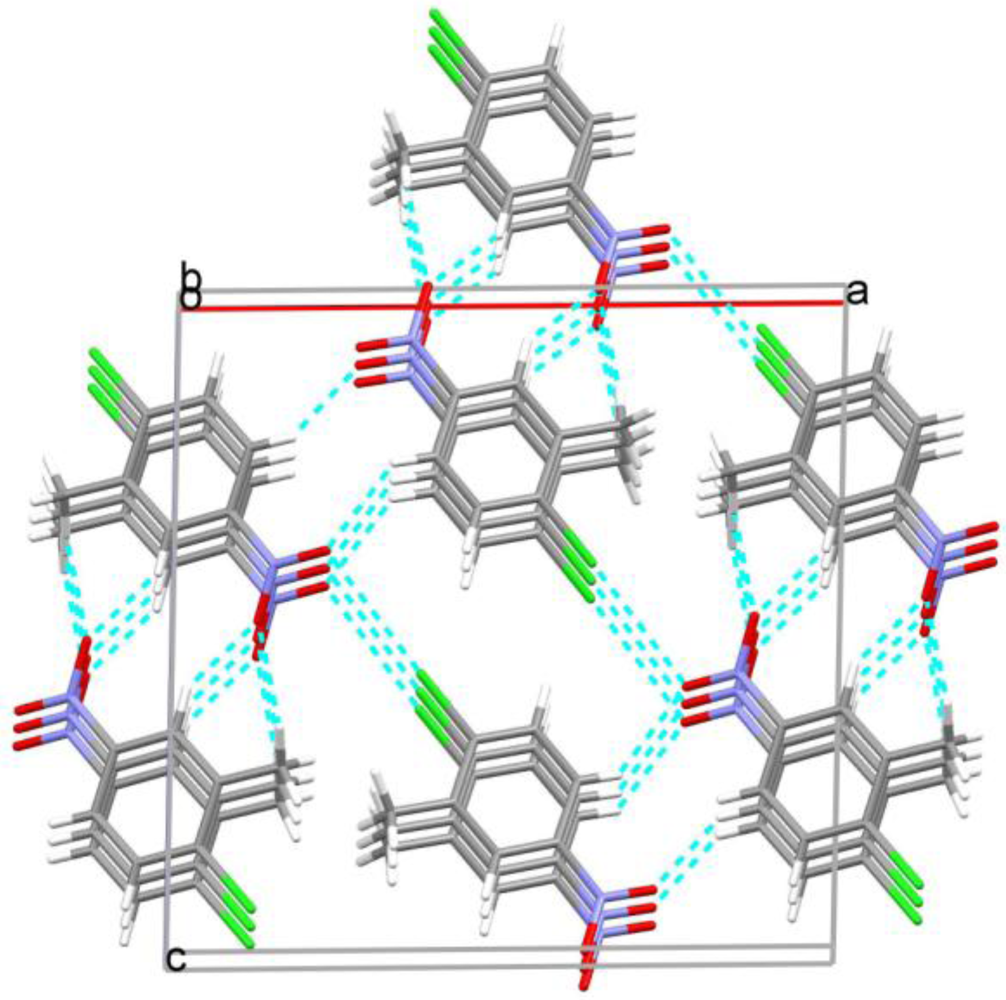
      <p>In the crystal structure, π…π contacts stack the molecules along the <italic>a</italic> axis with centroid to centroid distances 3.719(4) Å, <xref ref-type="fig" rid="crystals-02-00137-f003">Figure 3</xref>. In addition, bifurcated C–H...O hydrogen bonds, <xref ref-type="table" rid="crystals-02-00137-t001">Table 1</xref>, link adjacent molecules into centrosymmetric dimers generating R<sup>2</sup><sub>1</sub>(6), R<sup>2</sup><sub>2</sub>(10) and R<sup>2</sup><sub>2</sub>(14) ring motifs [<xref ref-type="bibr" rid="B14-crystals-02-00137">14</xref>], <xref ref-type="fig" rid="crystals-02-00137-f004">Figure 4</xref>. Cl...O contacts (3.215(3) Å) [<xref ref-type="bibr" rid="B15-crystals-02-00137">15</xref>] link the molecules into chains running approximately along the [010] diagonal, <xref ref-type="fig" rid="crystals-02-00137-f005">Figure 5</xref>. These and additional C–H...O contacts generate an extensive three dimensional network with layers of molecules stacked along the <italic>b</italic> axis, <xref ref-type="fig" rid="crystals-02-00137-f006">Figure 6</xref>.</p>
      <fig id="crystals-02-00137-f003" position="anchor">
        <label>Figure 3</label>
        <caption>
          <p>π…π stacking interactions [<xref ref-type="bibr" rid="B17-crystals-02-00137">17</xref>] between adjacent aromatic rings in <bold>3</bold>.</p>
        </caption>
        <graphic xmlns:xlink="http://www.w3.org/1999/xlink" xlink:href="crystals-02-00137-g003.tif"/>
      </fig>
      <fig id="crystals-02-00137-f004" position="anchor">
        <label>Figure 4</label>
        <caption>
          <p>Inversion related dimers formed from C–H…O hydrogen bonds [<xref ref-type="bibr" rid="B17-crystals-02-00137">17</xref>].</p>
        </caption>
        <graphic xmlns:xlink="http://www.w3.org/1999/xlink" xlink:href="crystals-02-00137-g004.tif"/>
      </fig>
      <fig id="crystals-02-00137-f005" position="anchor">
        <label>Figure 5</label>
        <caption>
          <p>Short Cl…O contacts forming chains along the [<italic>010</italic>] diagonal [<xref ref-type="bibr" rid="B17-crystals-02-00137">17</xref>].</p>
        </caption>
        <graphic xmlns:xlink="http://www.w3.org/1999/xlink" xlink:href="crystals-02-00137-g005.tif"/>
      </fig>
      <fig id="crystals-02-00137-f006" position="anchor">
        <label>Figure 6</label>
        <caption>
          <p>Overall crystal packing for <bold>3</bold> showing layers of molecules stacked along the <italic>b</italic> axis [<xref ref-type="bibr" rid="B17-crystals-02-00137">17</xref>].</p>
        </caption>
        <graphic xmlns:xlink="http://www.w3.org/1999/xlink" xlink:href="crystals-02-00137-g006.tif"/>
      </fig>
      <table-wrap id="crystals-02-00137-t001" position="anchor">
        <object-id pub-id-type="pii">crystals-02-00137-t001_Table 1</object-id>
        <label>Table 1</label>
        <caption>
          <p>Hydrogen-bond geometries for 3.</p>
        </caption>
        <table>
          <thead>
            <tr>
              <th align="center" valign="middle">Bond</th>
              <th align="center" valign="middle">D–H</th>
              <th align="center" valign="middle">H···A</th>
              <th align="center" valign="middle">D···A</th>
              <th align="center" valign="middle">D–H···A</th>
            </tr>
          </thead>
          <tbody>
            <tr>
              <td align="center" valign="middle">C5—H5···O2 <sup>i</sup></td>
              <td align="center" valign="middle">0.95</td>
              <td align="center" valign="middle">2.69</td>
              <td align="center" valign="middle">3.129(4)</td>
              <td align="center" valign="middle">109</td>
            </tr>
            <tr>
              <td align="center" valign="middle">C7—H7D···O1 <sup>ii</sup></td>
              <td align="center" valign="middle">0.98</td>
              <td align="center" valign="middle">2.20</td>
              <td align="center" valign="middle">3.137(4)</td>
              <td align="center" valign="middle">161</td>
            </tr>
            <tr>
              <td align="center" valign="middle">C3—H3···O1 <sup>ii</sup></td>
              <td align="center" valign="middle">0.95</td>
              <td align="center" valign="middle">2.57</td>
              <td align="center" valign="middle">3.320(4)</td>
              <td align="center" valign="middle">136</td>
            </tr>
          </tbody>
        </table>
    <table-wrap-foot>
      <fn>
        <p>Symmetry codes: (i) −<italic>x</italic> + 1/2, <italic>y</italic> − 1/2, −<italic>z</italic> + 1/2; (ii) −<italic>x</italic> + 1, −<italic>y</italic>, −<italic>z</italic></p>
      </fn>
    </table-wrap-foot>	  
	  </table-wrap>
    </sec>
    <sec>
      <title>3. Experimental Section</title>
      <p><italic>Synthesis</italic><italic> of 1-Chloro-2-methyl-4-nitrobenzene (3).</italic> A solution of peroxytrifluoroacetic acid was prepared by addition of 17.0 mL. (0.12 mole) of trifluoroacetic anhydride to a suspension of 2.7 mL. (0.1 mole) of 90% hydrogen peroxide in 50 ml of dichloromethane cooled in an ice-bath. The resulting solution was stirred for five minutes and the cooling bath was removed. To this solution was added dropwise over a 30 minute period 2.35 g. (0.025 mole) of 4-chloroaniline in 10 mL of dichloromethane. After the addition was complete, the reaction mixture was refluxed for one hour. It was successively washed with water and 10% sodium carbonate solution. The dichloromethane extract was dried and concentrated to afford 4-nitrochlorobenzene (<bold>2</bold>) which was converted to 1-chloro-2-methyl-4-nitrobenzene (<bold>3</bold>) using methyl iodide and anhydrous aluminum chloride according to standard procedure m.p. 46–47 °C (lit. 40–44 °C). A single crystal of the title compound was grown by slow evaporation of a chloroform solution of the compound over 5 days. </p>
      <p><italic>X-ray Data Collection and Structure Solution.</italic> Data for <bold>3 </bold>were collected on a Bruker APEX II CCD diffractometer using graphite monochromated Mo-Kα radiation, <italic>λ</italic> = 0.71073 Å at 92 K. The crystal was mounted on a mylar loop in a thin film of Paratone N oil. Intensity data were collected using 60 second ω scans with the APEX2 program and processed with SAINT with absorption corrections applied using SADABS [<xref ref-type="bibr" rid="B18-crystals-02-00137">18</xref>]. The structure was solved by direct methods using SHELXS and refined against ׀F׀<sup>2</sup> using SHELXL [<xref ref-type="bibr" rid="B16-crystals-02-00137">16</xref>] and TITAN [<xref ref-type="bibr" rid="B19-crystals-02-00137">19</xref>]. Crystals were very weakly diffracting which results in the measured fraction of data being somewhat low. However solution and refinement proceeded smoothly and residuals and standard uncertainties reported for the structure are acceptable. </p>
      <p><italic>Crystal Data for 3.</italic> C<sub>7</sub>H<sub>6</sub>NO<sub>2</sub>Cl, <italic>M</italic><sub>r</sub> = 171.58, yellow, rectangular plate, 0.34 × 0.13 × 0.08 mm. Monoclinic, P2<sub>1</sub>/n, <italic>a</italic> = 13.5698(8), <italic>b</italic> = 3.7195 (3), <italic>c</italic> = 13.5967 (8) Å, β = 91.703(3) °, <italic>V</italic> = 685.96 (10) Å<sup>3</sup>, Z = 4, F(000) = 352, T = 91(2) K, <italic>ρ</italic><sub>calc</sub> = 1.661,<italic>μ</italic> = 0.494 mm<sup>-1</sup>, 6202 reflections measured, <italic>R</italic><sub>int </sub>= 0.0536, 1229 merged reflections, 987 with <italic>I</italic> &gt; 2<italic>σ</italic>(I), 101 parameters, R indices [<italic>I</italic> &gt; 2<italic>σ</italic>(I)]: <italic>R</italic>1 = 0.0498, <italic>wR</italic>2 = 0.1482, [all data] <italic>R</italic>1 = 0.0607, <italic>wR</italic>2 = 0.1546, <italic>w</italic> = 1/[<italic>σ</italic><sup>2</sup>(<italic>F</italic><sub>o</sub><sup>2</sup>) + (0.0846<italic>P</italic>)<sup>2</sup>] where <italic>P</italic> = (<italic>F</italic><sub>o</sub><sup>2 </sup>+ 2<italic>F</italic>c<sup>2</sup>)/3, largest diff. peak and hole 0.497 and −0.376 e Å<sup>−3</sup>. CSD deposition number: CCDC 859847</p>
    </sec>
    <sec sec-type="conclusions">
      <title>4. Conclusions</title>
      <p>A nitroaromatic compound was synthesized as an intermediate towards some heterocycles and for biodegradation studies. The crystal structure of 3 is stabilized by C–H…O hydrogen bonds together with short Cl…O and π…π contacts</p>
    </sec>
  </body>
  <back>
    <ack>
      <title>Acknowledgments</title>
      <p>We thank the University of Otago for purchase of the diffractometer.</p>
    </ack>
    <ref-list>
      <title>References and Notes</title>
      <ref id="B1-crystals-02-00137">
        <label>1.</label>
        <citation citation-type="journal">
          <person-group person-group-type="author">
            <name>
              <surname>Katritzky</surname>
              <given-names>A.R.</given-names>
            </name>
            <name>
              <surname>Oliferenko</surname>
              <given-names>P.</given-names>
            </name>
            <name>
              <surname>Oliferenko</surname>
              <given-names>A.</given-names>
            </name>
            <name>
              <surname>Lomaka</surname>
              <given-names>A.</given-names>
            </name>
            <name>
              <surname>Karelson</surname>
              <given-names>M.</given-names>
            </name>
          </person-group>
          <article-title>Nitrobenzene toxicity; QSAR correlations and mechanistic interpretations</article-title>
          <source>J. Phys. Org. Chem.</source>
          <year>2003</year>
          <volume>16</volume>
          <fpage>811</fpage>
          <lpage>817</lpage>
        <pub-id pub-id-type="doi">10.1002/poc.643</pub-id></citation>
      </ref>
      <ref id="B2-crystals-02-00137">
        <label>2.</label>
        <citation citation-type="journal">
          <person-group person-group-type="author">
            <name>
              <surname>Ramos</surname>
              <given-names>E.U.</given-names>
            </name>
            <name>
              <surname>Vaal</surname>
              <given-names>M.A.</given-names>
            </name>
            <name>
              <surname>Hermens</surname>
              <given-names>J.L.M.</given-names>
            </name>
          </person-group>
          <article-title>Structure-toxicity relationships for benzenes evaluated with Tetrahymena pyriformis</article-title>
          <source>Environ. Toxicol. Pharmacol.</source>
          <year>2001</year>
          <volume>11</volume>
          <fpage>149</fpage>
          <lpage>158</lpage>
        </citation>
      </ref>
      <ref id="B3-crystals-02-00137">
        <label>3.</label>
        <citation citation-type="book">
          <person-group person-group-type="author">
            <name>
              <surname>Harttner</surname>
              <given-names>D.R.</given-names>
            </name>
          </person-group>
          <source>Toxicity of Nitroaromatic Compounds</source>
          <publisher-name>Hemisphere Publishing Corp.</publisher-name>
          <publisher-loc>Washington, D.C., USA</publisher-loc>
          <year>1985</year>
        </citation>
      </ref>
      <ref id="B4-crystals-02-00137">
        <label>4.</label>
        <citation citation-type="journal">
          <person-group person-group-type="author">
            <name>
              <surname>Schackmann</surname>
              <given-names>A.</given-names>
            </name>
            <name>
              <surname>Müller</surname>
              <given-names>R.</given-names>
            </name>
          </person-group>
          <article-title>Reduction of nitroaromatic compounds by different <italic>Pseudomonas</italic> species under aerobic conditions</article-title>
          <source>Appl. Microbiol. Biotechnol.</source>
          <year>1991</year>
          <volume>34</volume>
          <fpage>809</fpage>
          <lpage>813</lpage>
        </citation>
      </ref>
      <ref id="B5-crystals-02-00137">
        <label>5.</label>
        <citation citation-type="journal">
          <person-group person-group-type="author">
            <name>
              <surname>Shimizu</surname>
              <given-names>M.</given-names>
            </name>
            <name>
              <surname>Yasui</surname>
              <given-names>T.</given-names>
            </name>
            <name>
              <surname>Matsumoto</surname>
              <given-names>N.</given-names>
            </name>
          </person-group>
          <article-title>Structural specificity of aromatic compounds with special reference to mutagenic activity in Salmonellatyphimurium-a series of chloro- or fluoro-nitrobenzene derivatives</article-title>
          <source>Mutat. Res.</source>
          <year>1983</year>
          <volume>116</volume>
          <fpage>217</fpage>
          <lpage>238</lpage>
          <pub-id pub-id-type="doi">10.1016/0165-1218(83)90060-5</pub-id>
        </citation>
      </ref>
      <ref id="B6-crystals-02-00137">
        <label>6.</label>
        <citation citation-type="journal">
          <person-group person-group-type="author">
            <name>
              <surname>Spiess</surname>
              <given-names>T.F.</given-names>
            </name>
            <name>
              <surname>Desiere</surname>
              <given-names>P.</given-names>
            </name>
            <name>
              <surname>Fischer</surname>
              <given-names>J.C.</given-names>
            </name>
            <name>
              <surname>Spain</surname>
              <given-names>H.-J.</given-names>
            </name>
            <name>
              <surname>Lenke</surname>
              <given-names>H.</given-names>
            </name>
          </person-group>
          <article-title>A new 4-nitrotoluene degradation pathway in a<italic> Mycobacterium</italic> strain</article-title>
          <source>Appl. Environ. Microbiol.</source>
          <year>1998</year>
          <volume>64</volume>
          <fpage>446</fpage>
          <lpage>452</lpage>
        <pub-id pub-id-type="pmid">9464378</pub-id></citation>
      </ref>
      <ref id="B7-crystals-02-00137">
        <label>7.</label>
        <citation citation-type="journal">
          <person-group person-group-type="author">
            <name>
              <surname>Susarla</surname>
              <given-names>S.</given-names>
            </name>
            <name>
              <surname>Masunaga</surname>
              <given-names>S.</given-names>
            </name>
            <name>
              <surname>Yonezawa</surname>
              <given-names>Y.</given-names>
            </name>
          </person-group>
          <article-title>Transformations of chloronitrobenzenes in anaerobic sediment</article-title>
          <source>Chemosphere</source>
          <year>1996</year>
          <volume>32</volume>
          <fpage>967</fpage>
          <lpage>977</lpage>
          <pub-id pub-id-type="doi">10.1016/0045-6535(96)00006-9</pub-id>
        </citation>
      </ref>
      <ref id="B8-crystals-02-00137">
        <label>8.</label>
        <citation citation-type="journal">
          <person-group person-group-type="author">
            <name>
              <surname>Takenaka</surname>
              <given-names>S.</given-names>
            </name>
            <name>
              <surname>Murakami</surname>
              <given-names>S.</given-names>
            </name>
            <name>
              <surname>Shinke</surname>
              <given-names>R.</given-names>
            </name>
          </person-group>
          <article-title>Metabolism of 2-aminophenol by <italic>Pseudomonas</italic> sp. AP-3: modified <italic>meta</italic>-cleavage pathway</article-title>
          <source>Arch. Microbiol.</source>
          <year>1998</year>
          <volume>170</volume>
          <fpage>132</fpage>
          <lpage>137</lpage>
          <pub-id pub-id-type="doi">10.1007/s002030050624</pub-id>
        </citation>
      </ref>
      <ref id="B9-crystals-02-00137">
        <label>9.</label>
        <citation citation-type="journal">
          <person-group person-group-type="author">
            <name>
              <surname>Weisburger</surname>
              <given-names>E.K.</given-names>
            </name>
            <name>
              <surname>Russfield</surname>
              <given-names>F.</given-names>
            </name>
            <name>
              <surname>Homburger</surname>
              <given-names>J.</given-names>
            </name>
            <name>
              <surname>Weisburger</surname>
              <given-names>J.H.</given-names>
            </name>
            <name>
              <surname>Boger</surname>
              <given-names>E.</given-names>
            </name>
            <name>
              <surname>Van Dongen</surname>
              <given-names>C.G.</given-names>
            </name>
            <name>
              <surname>Chu</surname>
              <given-names>K.C.</given-names>
            </name>
          </person-group>
          <article-title>Testing of twenty-one environmental aromatic amines or derivatives for long-term toxicity or carcinogenicity</article-title>
          <source>Environ. Pathol. Toxicol.</source>
          <year>1978</year>
          <volume>2</volume>
          <fpage>325</fpage>
          <lpage>356</lpage>
        </citation>
      </ref>
      <ref id="B10-crystals-02-00137">
        <label>10.</label>
        <citation citation-type="journal">
          <person-group person-group-type="author">
            <name>
              <surname>Katsivela</surname>
              <given-names>E.</given-names>
            </name>
            <name>
              <surname>Wray</surname>
              <given-names>V.</given-names>
            </name>
            <name>
              <surname>Pieper</surname>
              <given-names>D.H.</given-names>
            </name>
            <name>
              <surname>Wittich</surname>
              <given-names>R.</given-names>
            </name>
          </person-group>
          <article-title>Initial reactions in the biodegradation of 1-chloro-4-nitrobenzene by a newly isolated bacterium, Strain LW1</article-title>
          <source>Appl. Environ. Microbiol.</source>
          <year>1999</year>
          <volume>65</volume>
          <fpage>1405</fpage>
          <lpage>1412</lpage>
        <pub-id pub-id-type="pmid">10103229</pub-id></citation>
      </ref>
      <ref id="B11-crystals-02-00137">
        <label>11.</label>
        <citation citation-type="journal">
          <person-group person-group-type="author">
            <name>
              <surname>Allen</surname>
              <given-names>F.H.</given-names>
            </name>
            <name>
              <surname>Kennard</surname>
              <given-names>O.</given-names>
            </name>
            <name>
              <surname>Watson</surname>
              <given-names>D.G.</given-names>
            </name>
            <name>
              <surname>Brammer</surname>
              <given-names>L.</given-names>
            </name>
            <name>
              <surname>Orpen</surname>
              <given-names>A.G.</given-names>
            </name>
            <name>
              <surname>Taylor</surname>
              <given-names>R.</given-names>
            </name>
          </person-group>
          <article-title>Tables of Bond Lengths determined by X-Ray and Neutron Diffraction. Part I. Bond Lengths in Organic Compounds</article-title>
          <source>J. Chem. Soc. Perkin Trans.</source>
          <year>1987</year>
          <volume>2</volume>
          <fpage>S1</fpage>
          <lpage>S19</lpage>
        </citation>
      </ref>
      <ref id="B12-crystals-02-00137">
        <label>12.</label>
        <citation citation-type="journal">
          <person-group person-group-type="author">
            <name>
              <surname>Henichart</surname>
              <given-names>J.-P.</given-names>
            </name>
            <name>
              <surname>Bernier</surname>
              <given-names>J.-L.</given-names>
            </name>
            <name>
              <surname>Vaccher</surname>
              <given-names>C.</given-names>
            </name>
            <name>
              <surname>Houssin</surname>
              <given-names>R.</given-names>
            </name>
            <name>
              <surname>Warin</surname>
              <given-names>V.</given-names>
            </name>
            <name>
              <surname>Baert</surname>
              <given-names>F.</given-names>
            </name>
          </person-group>
          <article-title>Cyclisation de dinitrodiarylamines en nitro-3 carbazoles inhibition sterique de la substitution nucleophile S<sub>N</sub>Ar par effet</article-title>
          <source>Tetrahedron Lett.</source>
          <year>1979</year>
          <volume>20</volume>
          <fpage>945</fpage>
          <lpage>948</lpage>
        <pub-id pub-id-type="doi">10.1016/S0040-4039(01)86057-3</pub-id></citation>
      </ref>
      <ref id="B13-crystals-02-00137">
        <label>13.</label>
        <citation citation-type="journal">
          <person-group person-group-type="author">
            <name>
              <surname>Henichart</surname>
              <given-names>J.-P.</given-names>
            </name>
            <name>
              <surname>Bernier</surname>
              <given-names>J.-L.</given-names>
            </name>
            <name>
              <surname>Vaccher</surname>
              <given-names>C.</given-names>
            </name>
            <name>
              <surname>Houssin</surname>
              <given-names>R.</given-names>
            </name>
            <name>
              <surname>Warin</surname>
              <given-names>V.</given-names>
            </name>
            <name>
              <surname>Baert</surname>
              <given-names>F.</given-names>
            </name>
          </person-group>
          <article-title>Acces aux dinitro-2,4 diarylamines par substitution nucleophile S<sub>N</sub>Ar-limites de la reaction et application a la synthese de cyanocarbazoles</article-title>
          <source>Tetrahedron</source>
          <year>1980</year>
          <volume>36</volume>
          <fpage>3535</fpage>
          <lpage>3541</lpage>
          <pub-id pub-id-type="doi">10.1016/0040-4020(80)88049-5</pub-id>
        </citation>
      </ref>
      <ref id="B14-crystals-02-00137">
        <label>14.</label>
        <citation citation-type="journal">
          <person-group person-group-type="author">
            <name>
              <surname>Bernstein</surname>
              <given-names>J.</given-names>
            </name>
            <name>
              <surname>Davis</surname>
              <given-names>R.E.</given-names>
            </name>
            <name>
              <surname>Shimoni</surname>
              <given-names>L.</given-names>
            </name>
            <name>
              <surname>Chang</surname>
              <given-names>N.-L.</given-names>
            </name>
          </person-group>
          <article-title>H bond motifs. Patterns in Hydrogen Bonding: Functionality and Graph Set Analysis in Crystals</article-title>
          <source>Angew. Chem. Int. Ed. Engl.</source>
          <year>1995</year>
          <volume>34</volume>
          <fpage>1555</fpage>
          <lpage>1573</lpage>
        <pub-id pub-id-type="doi">10.1002/anie.199515551</pub-id></citation>
      </ref>
      <ref id="B15-crystals-02-00137">
        <label>15.</label>
        <citation citation-type="journal">
          <person-group person-group-type="author">
            <name>
              <surname>Politzer</surname>
              <given-names>P.</given-names>
            </name>
            <name>
              <surname>Lane</surname>
              <given-names>P.</given-names>
            </name>
            <name>
              <surname>Concha</surname>
              <given-names>M.C.</given-names>
            </name>
            <name>
              <surname>Ma</surname>
              <given-names>Y.</given-names>
            </name>
            <name>
              <surname>Murray</surname>
              <given-names>J.S.</given-names>
            </name>
          </person-group>
          <article-title>An overview of halogen bonding</article-title>
          <source>J. Mol. Model.</source>
          <year>2007</year>
          <volume>13</volume>
          <fpage>305</fpage>
          <lpage>311</lpage>
          <pub-id pub-id-type="doi">10.1007/s00894-006-0154-7</pub-id>
        </citation>
      </ref>
      <ref id="B16-crystals-02-00137">
        <label>16.</label>
        <citation citation-type="journal">
          <person-group person-group-type="author">
            <name>
              <surname>Sheldrick</surname>
              <given-names>G.M.</given-names>
            </name>
          </person-group>
          <article-title>A short history of <italic>SHELX</italic></article-title>
          <source>Acta Cryst.</source>
          <year>2008</year>
          <volume>A64</volume>
          <fpage>112</fpage>
          <lpage>122</lpage>
        </citation>
      </ref>
      <ref id="B17-crystals-02-00137">
        <label>17.</label>
        <citation citation-type="journal">
          <person-group person-group-type="author">
            <name>
              <surname>Macrae</surname>
              <given-names>C.F.</given-names>
            </name>
            <name>
              <surname>Bruno</surname>
              <given-names>I.J.</given-names>
            </name>
            <name>
              <surname>Chisholm</surname>
              <given-names>J.A.</given-names>
            </name>
            <name>
              <surname>Edgington</surname>
              <given-names>P.R.</given-names>
            </name>
            <name>
              <surname>McCabe</surname>
              <given-names>P.</given-names>
            </name>
            <name>
              <surname>Pidcock</surname>
              <given-names>E.</given-names>
            </name>
            <name>
              <surname>Rodriguez-Monge</surname>
              <given-names>L.</given-names>
            </name>
            <name>
              <surname>Taylor</surname>
              <given-names>R.</given-names>
            </name>
            <name>
              <surname>van de Streek</surname>
              <given-names>J.</given-names>
            </name>
            <name>
              <surname>Wood</surname>
              <given-names>P.A.</given-names>
            </name>
          </person-group>
          <article-title><italic>Mercury CSD 2.0</italic>—New features for the visualization and investigation of crystal structures</article-title>
          <source>J. Appl. Cryst.</source>
          <year>2008</year>
          <volume>41</volume>
          <fpage>466</fpage>
          <lpage>470</lpage>
          <pub-id pub-id-type="doi">10.1107/S0021889807067908</pub-id>
        </citation>
      </ref>
      <ref id="B18-crystals-02-00137">
        <label>18.</label>
        <citation citation-type="book">
          <article-title><italic>APEX2</italic>, <italic>SAINT</italic> and <italic>SADABS</italic></article-title>
          <publisher-name>Bruker AXS Inc.</publisher-name>
          <publisher-loc>Madison, Wisconsin, USA</publisher-loc>
          <year>2009</year>
        </citation>
      </ref>
      <ref id="B19-crystals-02-00137">
        <label>19.</label>
        <citation citation-type="book">
          <person-group person-group-type="author">
            <name>
              <surname>Hunter</surname>
              <given-names>K.A.</given-names>
            </name>
            <name>
              <surname>Simpson</surname>
              <given-names>J.</given-names>
            </name>
          </person-group>
          <source>TITAN2000</source>
          <publisher-name>University of Otago</publisher-name>
          <publisher-loc>Dunedin, New Zealand</publisher-loc>
          <year>1999</year>
        </citation>
      </ref>
    </ref-list>
  </back>
</article>