<?xml version="1.0" encoding="UTF-8"?>
<!DOCTYPE article PUBLIC "-//NLM//DTD Journal Publishing DTD v2.3 20070202//EN" "journalpublishing.dtd">
<article xmlns:mml="http://www.w3.org/1998/Math/MathML" xmlns:xlink="http://www.w3.org/1999/xlink" xml:lang="en" article-type="research-article">
<front>
<journal-meta>
<journal-id journal-id-type="publisher-id">Crystals</journal-id>
<journal-title>Crystals</journal-title>
<issn pub-type="epub">2073-4352</issn>
<publisher>
<publisher-name>Molecular Diversity Preservation International (MDPI)</publisher-name></publisher></journal-meta>
<article-meta>
<article-id pub-id-type="doi">10.3390/cryst1030206</article-id>
<article-id pub-id-type="publisher-id">crystals-01-00206</article-id>
<article-categories>
<subj-group>
<subject>Article</subject></subj-group></article-categories>
<title-group>
<article-title>Ba<sub>5</sub>Cd<sub>2</sub>Sb<sub>4</sub>O<sub>2</sub>—A New Antimonide Oxide with a Complex Structure</article-title></title-group>
<contrib-group>
<contrib contrib-type="author">
<name><surname>Darone</surname><given-names>Gregory M.</given-names></name></contrib>
<contrib contrib-type="author">
<name><surname>Bobev</surname><given-names>Svilen</given-names></name><xref ref-type="corresp" rid="c1-crystals-01-00206"><sup>*</sup></xref></contrib>
<aff id="af1-crystals-01-00206">Department of Chemistry and Biochemistry, University of Delaware, Newark, DE 19716, USA</aff></contrib-group>
<author-notes>
<corresp id="c1-crystals-01-00206">
<label>*</label> Author to whom correspondence should be addressed; E-Mail: <email>bobev@udel.edu</email>; Tel.: +1-302-831-8720; Fax: +1-302-831-6335.</corresp></author-notes>
<pub-date pub-type="collection">
<year>2011</year></pub-date>
<pub-date pub-type="epub">
<day>20</day>
<month>09</month>
<year>2011</year></pub-date>
<volume>1</volume>
<issue>3</issue>
<fpage>206</fpage>
<lpage>214</lpage>
<history>
<date date-type="rev-recd">
<day>18</day>
<month>08</month>
<year>2011</year></date>
<date date-type="rev-recd">
<day>14</day>
<month>09</month>
<year>2011</year></date>
<date date-type="accepted">
<day>19</day>
<month>09</month>
<year>2011</year></date></history>
<permissions>
<copyright-statement>© 2011 by the authors; licensee MDPI, Basel, Switzerland.</copyright-statement>
<copyright-year>2011</copyright-year>
<license>
<p>This article is an open access article distributed under the terms and conditions of the Creative Commons Attribution license (http://creativecommons.org/licenses/by/3.0/).</p></license></permissions>
<abstract>
<p>Synthesis and single-crystal X-ray structure determination of the new antimonide oxide, Ba<sub>5</sub>Cd<sub>2</sub>Sb<sub>4</sub>O<sub>2</sub> are reported. Ba<sub>5</sub>Cd<sub>2</sub>Sb<sub>4</sub>O<sub>2</sub> crystallizes in the monoclinic space group <italic>C2</italic>/<italic>m</italic> (No. 12) with unit cell parameters: <italic>a</italic> = 17.247(7) Å, <italic>b</italic> = 4.9279(18) Å, <italic>c</italic> = 12.240(5) Å, and <italic>β</italic> = 132.558(4)°; <italic>Z</italic> = 2. Its crystal structure can be described as a polyanionic 
<inline-formula>
<mml:math id="mm1" display="inline">
<mml:semantics id="sm1">
<mml:mrow>
<mml:msup>
<mml:mstyle>
<mml:mrow>
<mml:mmultiscripts>
<mml:mrow>
<mml:mo stretchy="false">[</mml:mo>
<mml:msub>
<mml:mtext>Cd</mml:mtext>
<mml:mn>2</mml:mn></mml:msub>
<mml:msub>
<mml:mtext>Sb</mml:mtext>
<mml:mn>4</mml:mn></mml:msub>
<mml:mo stretchy="false">]</mml:mo></mml:mrow>
<mml:mprescripts/>
<mml:mo>∞</mml:mo>
<mml:mn>2</mml:mn></mml:mmultiscripts></mml:mrow></mml:mstyle>
<mml:mrow>
<mml:mn>6</mml:mn>
<mml:mo>−</mml:mo></mml:mrow></mml:msup></mml:mrow></mml:semantics></mml:math></inline-formula> sub-lattice made up of fused CdSb<sub>4</sub> tetrahedra, stacked between puckered slabs of oxo-anions, O<sup>2−</sup>, and Ba<sup>2+</sup> cations. This structure can also be described as a “double-salt”, <italic>i.e.</italic>, a structure composed of fragments from the Zintl phase Ba<sub>3</sub>Cd<sub>2</sub>Sb<sub>4</sub> intercalated by two BaO-like moieties. The topological similarities between the structures of these compounds are discussed.</p></abstract>
<kwd-group>
<kwd>barium</kwd>
<kwd>cadmium</kwd>
<kwd>antimonide</kwd>
<kwd>oxide</kwd></kwd-group></article-meta></front>
<body>
<sec sec-type="intro">
<label>1.</label>
<title>Introduction</title>
<p>Complex pnictide-oxide structures have been investigated for nearly two decades [<xref ref-type="bibr" rid="b1-crystals-01-00206">1</xref>], however they have garnered more interest lately because of the surprising discovery of high temperature superconductivity within their realm [<xref ref-type="bibr" rid="b2-crystals-01-00206">2</xref>]. For example, Fe-based arsenic-oxides, such as SmFeAsO<sub>∼0.85</sub>, have displayed superconductivity at temperatures as high as 55 K [<xref ref-type="bibr" rid="b3-crystals-01-00206">3</xref>]. Over the past seven years, our research group has systematically explored the alkaline-earth metal and rare-earth metal antimonide systems. The resulting new compounds have often been Zintl phases [<xref ref-type="bibr" rid="b4-crystals-01-00206">4</xref>-<xref ref-type="bibr" rid="b6-crystals-01-00206">6</xref>] with complex crystal and electronic structures, and unusual properties [<xref ref-type="bibr" rid="b7-crystals-01-00206">7</xref>-<xref ref-type="bibr" rid="b20-crystals-01-00206">20</xref>]. Although oxide research is not our focus, it is sometimes the case that adventurous oxygen molecules find their way into our experiments and surprise us with an atypical compound, such as the previously reported Ba<sub>5</sub>Cd<sub>2</sub>Sb<sub>5</sub>O<italic><sub>x</sub></italic> (0.5 &lt; <italic>x</italic> &lt; 0.7) [<xref ref-type="bibr" rid="b17-crystals-01-00206">17</xref>].</p>
<p>In a more recent experiment, serendipitous oxidation during the synthesis of a reaction containing Ba, Cd, and Sb occurred. Upon inspection, several atypical (for an intermetallic compound) crystals were identified among the reaction's main product, BaCdSb<sub>2</sub> [<xref ref-type="bibr" rid="b21-crystals-01-00206">21</xref>]—these turned out to be crystals of the novel antimonide oxide, Ba<sub>5</sub>Cd<sub>2</sub>Sb<sub>4</sub>O<sub>2</sub>, which is the subject of this paper.</p></sec>
<sec sec-type="results|discussion">
<label>2.</label>
<title>Results and Discussion</title>
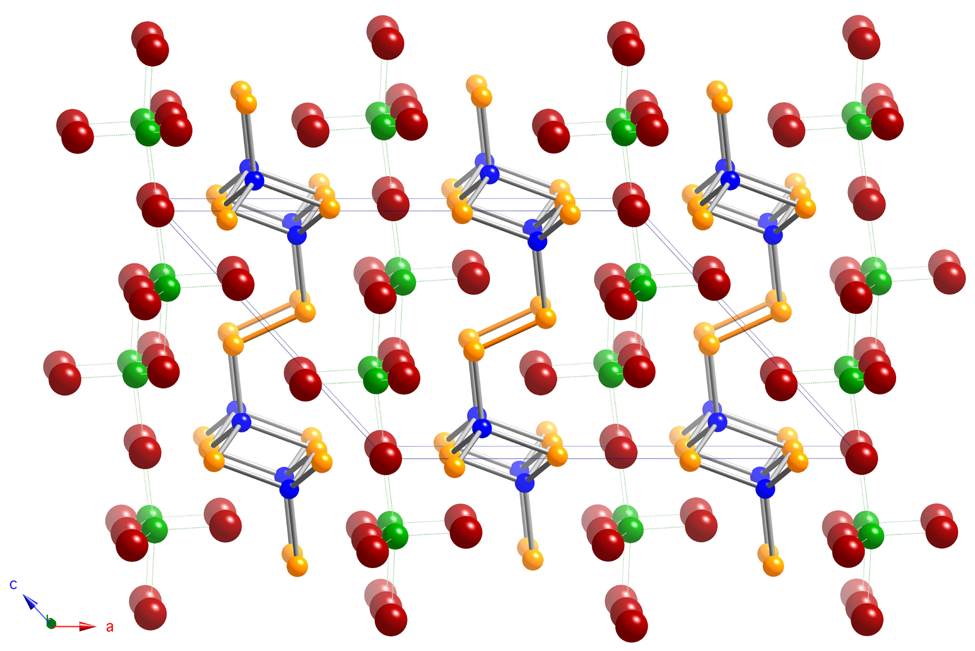
<p>Ba<sub>5</sub>Cd<sub>2</sub>Sb<sub>4</sub>O<sub>2</sub> crystallizes in the monoclinic space group <italic>C2</italic>/<italic>m</italic> (No. 12), and its crystal structure contains three unique barium positions, one unique cadmium position, two unique antimony positions, and one unique oxygen position in the asymmetric unit (<xref ref-type="table" rid="t1-crystals-01-00206">Tables 1</xref> and <xref ref-type="table" rid="t2-crystals-01-00206">2</xref>). The structure is best described as polyanionic 
<inline-formula>
<mml:math id="mm2" display="inline">
<mml:semantics id="sm2">
<mml:mrow>
<mml:msup>
<mml:mstyle>
<mml:mrow>
<mml:mmultiscripts>
<mml:mrow>
<mml:mo stretchy="false">[</mml:mo>
<mml:msub>
<mml:mtext>Cd</mml:mtext>
<mml:mn>2</mml:mn></mml:msub>
<mml:msub>
<mml:mtext>Sb</mml:mtext>
<mml:mn>4</mml:mn></mml:msub>
<mml:mo stretchy="false">]</mml:mo></mml:mrow>
<mml:mprescripts/>
<mml:mo>∞</mml:mo>
<mml:mn>2</mml:mn></mml:mmultiscripts></mml:mrow></mml:mstyle>
<mml:mrow>
<mml:mn>6</mml:mn>
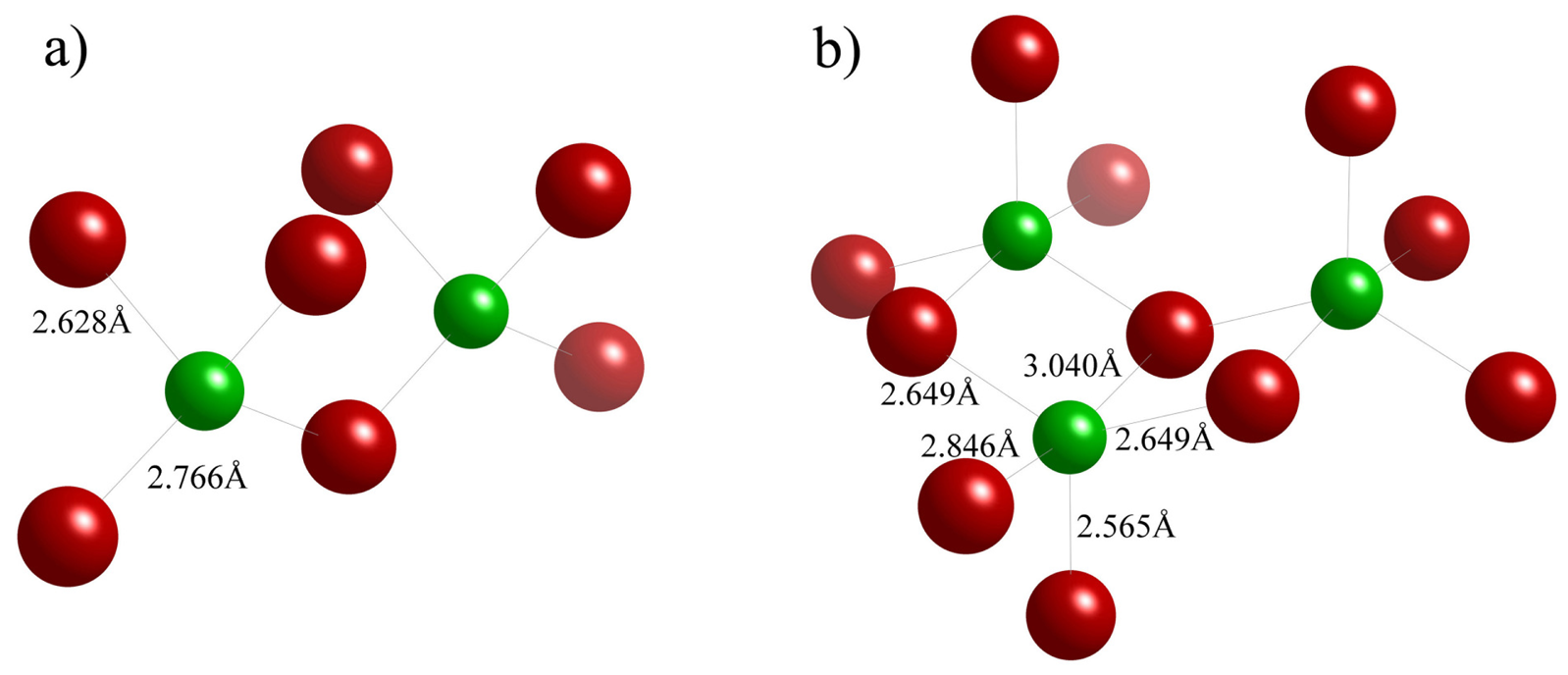
<mml:mo>−</mml:mo></mml:mrow></mml:msup></mml:mrow></mml:semantics></mml:math></inline-formula> layers made up of edge-shared CdSb<sub>4</sub> tetrahedra extending along the <italic>b</italic> axis, with O<sup>2−</sup> anions and Ba<sup>2+</sup> cations between them (<xref ref-type="fig" rid="f1-crystals-01-00206">Figure 1</xref>). The structure is similar to that of the previously reported Zintl phase Ba<sub>3</sub>Cd<sub>2</sub>Sb<sub>4</sub> (also with space group <italic>C2</italic>/<italic>m</italic>) [<xref ref-type="bibr" rid="b12-crystals-01-00206">12</xref>]. In fact, their lattice parameters are quite similar—<italic>a</italic> = 17.247(7) Å; <italic>b</italic> = 4.9279(18) Å; <italic>c</italic> = 12.240(5) Å; <italic>β</italic> = 132.558(4)° for the former and <italic>a</italic> = 17.835(2) Å, <italic>b</italic> = 4.8675(5) Å, <italic>c</italic> = 7.6837(7) Å, and <italic>β</italic> = 112.214(1)° for the latter. Recognizing this relationship and noting the expansion in the <italic>c</italic> axis and <italic>β</italic> angle, we can consider the Ba<sub>5</sub>Cd<sub>2</sub>Sb<sub>4</sub>O2 structure to be a 1:2 intergrowth of Ba<sub>3</sub>Cd<sub>2</sub>Sb<sub>4</sub> and BaO fragments, <italic>i.e.</italic>, the formula can be broken down as follows:
<disp-formula id="FD1">
<mml:math id="mm3" display="block">
<mml:semantics id="sm3">
<mml:mrow>
<mml:msub>
<mml:mtext>Ba</mml:mtext>
<mml:mn>5</mml:mn></mml:msub>
<mml:msub>
<mml:mtext>Cd</mml:mtext>
<mml:mn>2</mml:mn></mml:msub>
<mml:msub>
<mml:mtext>Sb</mml:mtext>
<mml:mn>4</mml:mn></mml:msub>
<mml:msub>
<mml:mtext>O</mml:mtext>
<mml:mn>2</mml:mn></mml:msub>
<mml:mo>=</mml:mo>
<mml:msub>
<mml:mtext>Ba</mml:mtext>
<mml:mn>3</mml:mn></mml:msub>
<mml:msub>
<mml:mtext>Cd</mml:mtext>
<mml:mn>2</mml:mn></mml:msub>
<mml:msub>
<mml:mtext>Sb</mml:mtext>
<mml:mn>4</mml:mn></mml:msub>
<mml:mo>+</mml:mo>
<mml:mn>2</mml:mn>
<mml:mo>×</mml:mo>
<mml:mtext>BaO</mml:mtext></mml:mrow></mml:semantics></mml:math></disp-formula>A schematic representation of this idea, also showing how the parent Ba<sub>3</sub>Cd<sub>2</sub>Sb<sub>4</sub> structure distorts to accommodate the O<sup>2−</sup> anions and the additional Ba<sup>2+</sup> cations is shown in <xref ref-type="fig" rid="f2-crystals-01-00206">Figure 2</xref>.</p>
<p>The length of the Cd–Sb bonds in Ba<sub>5</sub>Cd<sub>2</sub>Sb<sub>4</sub>O<sub>2</sub> range from 2.8190(13) Å to 2.9463(9) Å, with Sb–Cd–Sb angles varying from 101.76(3)° to 116.52(4)°. These distances and angles are very similar to those reported for Ba<sub>3</sub>Cd<sub>2</sub>Sb<sub>4</sub>. More specifically, the length of the Cd–Sb bonds in Ba<sub>3</sub>Cd<sub>2</sub>Sb<sub>4</sub> range from 2.9125(4) Å to 2.9531(5) Å, with Sb–Cd–Sb angles ranging from 101.95(1)° to 113.36(2)°.</p>
<p>Just like in Ba<sub>3</sub>Cd<sub>2</sub>Sb<sub>4</sub>, the CdSb<sub>4</sub> tetrahedra within the polyanionic 
<inline-formula>
<mml:math id="mm4" display="inline">
<mml:semantics id="sm4">
<mml:mrow>
<mml:msup>
<mml:mstyle>
<mml:mrow>
<mml:mmultiscripts>
<mml:mrow>
<mml:mo stretchy="false">[</mml:mo>
<mml:msub>
<mml:mtext>Cd</mml:mtext>
<mml:mn>2</mml:mn></mml:msub>
<mml:msub>
<mml:mtext>Sb</mml:mtext>
<mml:mn>4</mml:mn></mml:msub>
<mml:mo stretchy="false">]</mml:mo></mml:mrow>
<mml:mprescripts/>
<mml:mo>∞</mml:mo>
<mml:mn>2</mml:mn></mml:mmultiscripts></mml:mrow></mml:mstyle>
<mml:mrow>
<mml:mn>6</mml:mn>
<mml:mo>−</mml:mo></mml:mrow></mml:msup></mml:mrow></mml:semantics></mml:math></inline-formula> layers of Ba<sub>5</sub>Cd<sub>2</sub>Sb<sub>4</sub>O<sub>2</sub> are “bridged” through Sb–Sb bonds, which measure 2.8615(16) Å. Compared with Ba<sub>3</sub>Cd<sub>2</sub>Sb<sub>4</sub>, where the Sb–Sb bond length is 2.8114(8) Å, one sees a slight elongation, consistent with the idea that the Cd<sub>2</sub>Sb<sub>4</sub> layers in the parent structure have been “stretched” in order to accommodate the Ba-O slabs. We also draw attention to the fact that in both Ba<sub>5</sub>Cd<sub>2</sub>Sb<sub>4</sub>O<sub>2</sub> and Ba<sub>3</sub>Cd<sub>2</sub>Sb<sub>4</sub>, the Sb–Sb distance is shorter than the 2.908 Å distance found in elemental Sb [<xref ref-type="bibr" rid="b22-crystals-01-00206">22</xref>], indicating a strong covalent character for that bonding interaction.</p>
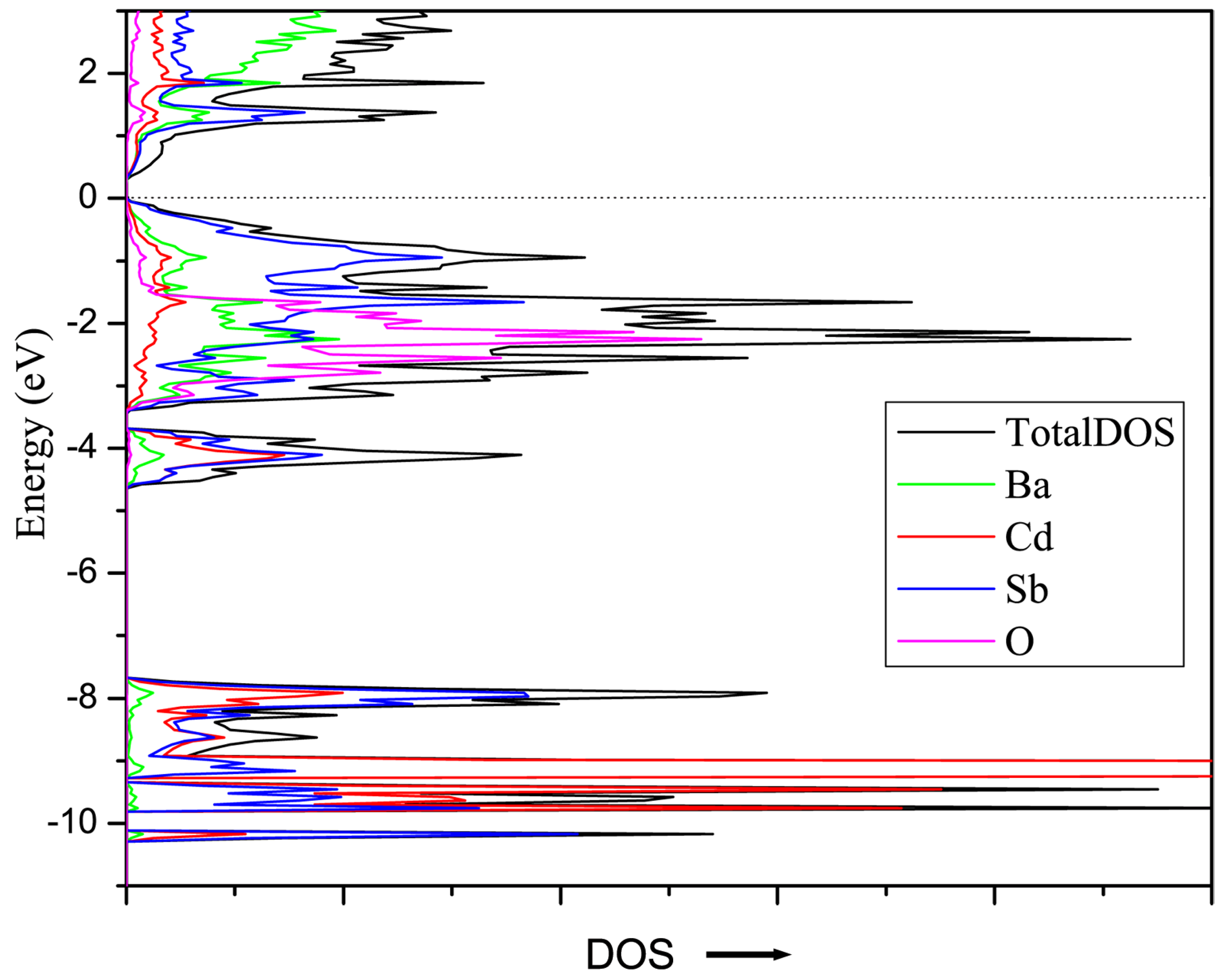
<p>The Ba–O fragments do not resemble the actual structure of BaO (NaCl type). The “BaO” layers in Ba<sub>5</sub>Cd<sub>2</sub>Sb<sub>4</sub>O<sub>2</sub> are composed of Ba2 and O atom positions (<xref ref-type="table" rid="t2-crystals-01-00206">Table 2</xref>), and are inserted into the Ba<sub>3</sub>Cd<sub>2</sub>Sb<sub>4</sub> structure template between the existing Ba1 and Ba3 atom positions. In this case, the neighboring Ba atoms form a distorted, square pyramidal, five-coordinate bonding environment around the O, with the Ba–O bond lengths on the order of 2.565(5) Å to 3.040(6) Å. These distances are comparable to the Ba–O bond lengths of 2.628(6) Å to 2.766(4) Å found in a similar compound, Ba<sub>5</sub>Cd<sub>2</sub>Sb<sub>5</sub>O<italic><sub>x</sub></italic> (0.5 &lt; <italic>x</italic> &lt; 0.7) [<xref ref-type="bibr" rid="b17-crystals-01-00206">17</xref>]. As seen in <xref ref-type="fig" rid="f3-crystals-01-00206">Figure 3</xref>, the O<sup>2−</sup> ions in Ba<sub>5</sub>Cd<sub>2</sub>Sb<sub>5</sub>O<italic><sub>x</sub></italic> (0.5 &lt; <italic>x</italic> &lt; 0.7) exist in a tetrahedral environment, where the Ba<sub>4</sub>O-tetrahedra share corners to form an infinite chain. In Ba<sub>5</sub>Cd<sub>2</sub>Sb<sub>4</sub>O<sub>2</sub>, however, the O<sup>2−</sup> ions are found in a five-coordinate environment of Ba<sup>2+</sup> cations. The shape of such a coordination polyhedron resembles a distorted square pyramid; the latter share edges and corners to form an infinite puckered ribbon.</p>
<p>Ba<sub>5</sub>Cd<sub>2</sub>Sb<sub>4</sub>O<sub>2</sub> is an electron precise, salt-like compound, where the electron count conforms to the Zintl-Klemm rules [<xref ref-type="bibr" rid="b4-crystals-01-00206">4</xref>,<xref ref-type="bibr" rid="b5-crystals-01-00206">5</xref>]. In addition to the notion of it being a “double-salt”, as described above, the formula can be rationalized as:
<disp-formula id="FD2">
<mml:math id="mm5" display="block">
<mml:semantics id="sm5">
<mml:mrow>
<mml:mn>5</mml:mn>
<mml:mo>×</mml:mo>
<mml:mo stretchy="false">[</mml:mo>
<mml:msup>
<mml:mtext>Ba</mml:mtext>
<mml:mrow>
<mml:mn>2</mml:mn>
<mml:mo>+</mml:mo></mml:mrow></mml:msup>
<mml:mo stretchy="false">]</mml:mo>
<mml:mo>+</mml:mo>
<mml:mn>2</mml:mn>
<mml:mo>×</mml:mo>
<mml:mo stretchy="false">[</mml:mo>
<mml:msup>
<mml:mtext>Cd</mml:mtext>
<mml:mrow>
<mml:mn>2</mml:mn>
<mml:mo>+</mml:mo></mml:mrow></mml:msup>
<mml:mo stretchy="false">]</mml:mo>
<mml:mo>+</mml:mo>
<mml:mn>2</mml:mn>
<mml:mo>×</mml:mo>
<mml:mo stretchy="false">[</mml:mo>
<mml:msup>
<mml:mtext>Sb</mml:mtext>
<mml:mrow>
<mml:mn>2</mml:mn>
<mml:mo>−</mml:mo></mml:mrow></mml:msup>
<mml:mo stretchy="false">]</mml:mo>
<mml:mo>+</mml:mo>
<mml:mn>2</mml:mn>
<mml:mo>×</mml:mo>
<mml:mo stretchy="false">[</mml:mo>
<mml:msup>
<mml:mtext>Sb</mml:mtext>
<mml:mrow>
<mml:mn>3</mml:mn>
<mml:mo>−</mml:mo></mml:mrow></mml:msup>
<mml:mo stretchy="false">]</mml:mo>
<mml:mo>+</mml:mo>
<mml:mn>2</mml:mn>
<mml:mo>×</mml:mo>
<mml:mo stretchy="false">[</mml:mo>
<mml:msup>
<mml:mtext>O</mml:mtext>
<mml:mrow>
<mml:mn>2</mml:mn>
<mml:mo>−</mml:mo></mml:mrow></mml:msup>
<mml:mo stretchy="false">]</mml:mo>
<mml:mo>=</mml:mo>
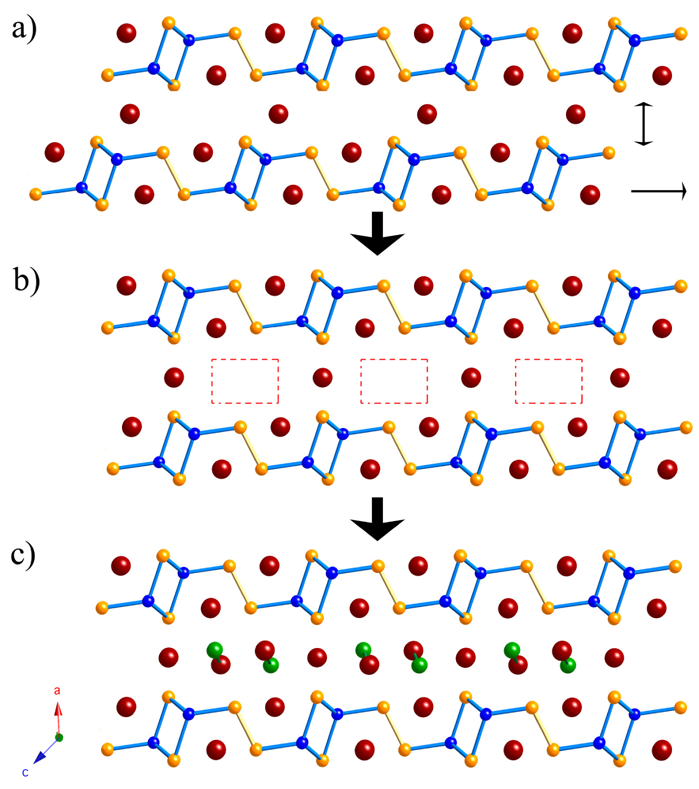
<mml:mn>0</mml:mn></mml:mrow></mml:semantics></mml:math></disp-formula>where the two different types of antimony atoms are the ones that are connected through a homoatomic Sb–Sb bond, and the ones that are only bound to Cd atoms, respectively. This simplistic structure rationalization is nicely supported by the electronic structure calculations, which show a band gap of about 0.3 eV at the Fermi level, indicative of a closed-shell system. As shown in <xref ref-type="fig" rid="f4-crystals-01-00206">Figure 4</xref>, just below the Fermi level, the main contributors to the DOS are the Sb p bands, admixed with states originated from Cd and Ba orbitals. The oxygen p bands are filled and situated <italic>ca.</italic> 2 eV below the top of the valence band, corroborating the assignment of the oxygen atoms as oxo-anions.</p>
<p>Based on electron counting and DOS calculations, and in an agreement with the dark-colored and brittle habits of the Ba<sub>5</sub>Cd<sub>2</sub>Sb<sub>4</sub>O<sub>2</sub> crystals, it is likely that this new antimonide oxide will exhibit semiconducting behavior. Regrettably, resistivity measurements were impeded because of the material's extreme sensitivity to air, and we were unable to experimentally confirm this.</p></sec>
<sec>
<label>3.</label>
<title>Experimental Section</title>
<p>Handling of all materials was performed inside an argon-filled glove-box with oxygen and moisture levels below 0.5 ppm, or under vacuum. Ba, Cd, Sb, and Pb were purchased from Alfa or Aldrich with stated purity greater than 99.9% and were used as received. Single crystals of Ba<sub>5</sub>Cd<sub>2</sub>Sb<sub>4</sub>O<sub>2</sub> were synthesized using the metal flux method. Ba, Cd, and Sb were measured in the elemental ratio of 6:4:7 and combined in an alumina crucible with an excess of Pb (ca. 10×, based on molar Ba content) and sealed in an evacuated fused silica jacket. The ampoule was heated in a programmable furnace from 100 °C to 1000 °C at a rate of 100 °C/h, allowed to homogenize at this temperature for 29 h, then cooled to 850 °C at a rate of −1.5 °C/h, and then cooled to 600 °C at a rate of −10 °C/h. At 600 °C, the ampoule was removed from the furnace, inverted, and spun in a centrifuge for 30 seconds to separate the Pb from the crystals. The ampoule was opened inside the argon-filled glove-box for inspection.</p>
<p>From this reaction, the majority phase was identified as BaCdSb<sub>2</sub>, however several plank-like single crystals of Ba<sub>5</sub>Cd<sub>2</sub>Sb<sub>4</sub>O<sub>2</sub> were identified and selected for single-crystal X-ray diffraction. Crystals of Ba<sub>5</sub>Cd<sub>2</sub>Sb<sub>4</sub>O<sub>2</sub> removed from the glove-box and exposed to the air and moisture in the laboratory decomposed and became tarnished, pockmarked, and brittle over 36 h. Because of the air-sensitivity of these crystals, no property measurements were attempted.</p>
<p>Single-crystal X-ray diffraction was performed on a single crystal of Ba<sub>5</sub>Cd<sub>2</sub>Sb<sub>4</sub>O<sub>2</sub> selected inside the argon-filled glove-box and placed in Paratone-N oil. This crystal was then quickly removed from the glove-box and cut to suitable dimensions (less than 0.1 mm) under the microscope and placed on the tip of a glass fiber on the goniometer of a Bruker SMART CCD-based diffractometer [<xref ref-type="bibr" rid="b23-crystals-01-00206">23</xref>]. The crystal was checked for quality, and full spheres of diffraction data were collected in four batch runs. Although the crystal was air-sensitive, the Paratone-N oil coating the surface of the crystal and the cold stream of nitrogen gas (<italic>ca.</italic> 200(2) K) protected it, and no sign of deterioration during the data collection was observed. SAINTPLUS was used for reduction and integration of the raw data [<xref ref-type="bibr" rid="b24-crystals-01-00206">24</xref>]. Semi-empirical absorption correction based on equivalents (<italic>i.e</italic>, multi-scan) was applied with the SADABS software [<xref ref-type="bibr" rid="b25-crystals-01-00206">25</xref>]. The SHELXTL software package was used for structure solution and refinement [<xref ref-type="bibr" rid="b26-crystals-01-00206">26</xref>]. Direct methods found the position of all seven unique atoms in the <italic>C2</italic>/<italic>m</italic> space group. The atomic coordinates were standardized using STRUCTURE TIDY, and anisotropic displacement parameters were included in the final least squares refinements and resulted in a featureless difference Fourier map [<xref ref-type="bibr" rid="b27-crystals-01-00206">27</xref>]. Selected details of the data collections and structure refinement parameters are summarized in <xref ref-type="table" rid="t1-crystals-01-00206">Table 1</xref>. The refined atomic coordinates and equivalent isotropic displacement parameters are given in <xref ref-type="table" rid="t2-crystals-01-00206">Table 2</xref>.</p>
<p>Additional details of the crystal structure investigations may be obtained from the Fachinformationszentrum Karlsruhe, D-76344 Eggenstein-Leopoldshafen, Germany (Fax: +49-7247808-666, E-Mail: <email>crysdata@fiz-karlsruhe.de</email>) on quoting the depository numbers CSD-423458.</p>
<p>TB-LMTO-ASA electronic structure calculations for Ba<sub>5</sub>Cd<sub>2</sub>Sb<sub>4</sub>O<sub>2</sub> were performed using the LMTO-4.7 package [<xref ref-type="bibr" rid="b28-crystals-01-00206">28</xref>]. This program is based on the tight-binding linear muffin-tin orbital (LMTO) method in the local density (LDA) and atomic sphere (ASA) approximations [<xref ref-type="bibr" rid="b29-crystals-01-00206">29</xref>-<xref ref-type="bibr" rid="b32-crystals-01-00206">32</xref>]. Atomic sphere radii used in the calculations were chosen using an automated procedure, and interstitial spheres were inserted to achieve the space filling automatically [<xref ref-type="bibr" rid="b33-crystals-01-00206">33</xref>]. The Fermi level was selected as the energy reference (ε<sub>F</sub> = 0 eV).</p></sec>
<sec sec-type="conclusions">
<label>4.</label>
<title>Conclusions</title>
<p>Ba<sub>5</sub>Cd<sub>2</sub>Sb<sub>4</sub>O<sub>2</sub> crystallizes in the monoclinic space group <italic>C2</italic>/<italic>m</italic> and its crystal structure can be derived from that of a similar compound, Ba<sub>3</sub>Cd<sub>2</sub>Sb<sub>4</sub>, which has been distorted and augmented. The Cd–Sb, Sb–Sb, and Ba–O bond lengths and Sb–Cd–Sb bond angles agree with those of similar compounds. The frailty of Ba<sub>5</sub>Cd<sub>2</sub>Sb<sub>4</sub>O<sub>2</sub> limits its utility to that of a laboratory curiosity, however there are undoubtedly more robust, and more interesting pnictide-oxide compounds waiting to be synthesized.</p></sec></body>
<back>
<sec sec-type="display-objects">
<title>Figures and Tables</title>
<fig id="f1-crystals-01-00206" position="float">
<label>Figure 1.</label>
<caption>
<p>Perspective view down the <italic>b</italic> axis of the monoclinic crystal structure of Ba<sub>5</sub>Cd<sub>2</sub>Sb<sub>4</sub>O<sub>2</sub> with unit cell outlined. Ba atoms are represented with red spheres, Cd atoms with blue spheres, Sb atoms with gold spheres, and O atoms with green spheres.</p></caption>
<graphic xlink:href="crystals-01-00206f1.gif"/></fig>
<fig id="f2-crystals-01-00206" position="float">
<label>Figure 2.</label>
<caption>
<p>(a) Perspective view down the <italic>b</italic> axis of the monoclinic crystal structure of the Zintl phase Ba<sub>3</sub>Cd<sub>2</sub>Sb<sub>4</sub> [<xref ref-type="bibr" rid="b12-crystals-01-00206">12</xref>]. (b) Space available for BaO fragments. Notice how the parent 
<inline-formula>
<mml:math id="mm6" display="inline">
<mml:semantics id="sm6">
<mml:mrow>
<mml:msup>
<mml:mstyle>
<mml:mrow>
<mml:mmultiscripts>
<mml:mrow>
<mml:mo stretchy="false">[</mml:mo>
<mml:msub>
<mml:mtext>Cd</mml:mtext>
<mml:mn>2</mml:mn></mml:msub>
<mml:msub>
<mml:mtext>Sb</mml:mtext>
<mml:mn>4</mml:mn></mml:msub>
<mml:mo stretchy="false">]</mml:mo></mml:mrow>
<mml:mprescripts/>
<mml:mo>∞</mml:mo>
<mml:mn>2</mml:mn></mml:mmultiscripts></mml:mrow></mml:mstyle>
<mml:mrow>
<mml:mn>6</mml:mn>
<mml:mo>−</mml:mo></mml:mrow></mml:msup></mml:mrow></mml:semantics></mml:math></inline-formula> layers are stretched and shifted, and the space between the layers is expanded. (c) Crystal structure of Ba<sub>5</sub>Cd<sub>2</sub>Sb<sub>4</sub>O<sub>2</sub>. Color code is identical to that in <xref ref-type="fig" rid="f1-crystals-01-00206">Figure 1</xref>.</p></caption>
<graphic xlink:href="crystals-01-00206f2.gif"/></fig>
<fig id="f3-crystals-01-00206" position="float">
<label>Figure 3.</label>
<caption>
<p>Coordination environment of the O<sup>2−</sup> ion in Ba<sub>5</sub>Cd<sub>2</sub>Sb<sub>5</sub>O<italic><sub>x</sub></italic> (0.5 &lt; <italic>x</italic> &lt; 0.7) (a), and in Ba<sub>5</sub>Cd<sub>2</sub>Sb<sub>4</sub>O<sub>2</sub> (b). Relevant interatomic distances are indicated. Color code is identical to that of <xref ref-type="fig" rid="f1-crystals-01-00206">Figure 1</xref>.</p></caption>
<graphic xlink:href="crystals-01-00206f3.gif"/></fig>
<fig id="f4-crystals-01-00206" position="float">
<label>Figure 4.</label>
<caption>
<p>Total and partial density of states plots (DOS) for Ba<sub>5</sub>Cd<sub>2</sub>Sb<sub>4</sub>O<sub>2</sub>. Contributions from different elements are color-coded. The Fermi level is depicted as a horizontal dotted line as a reference point at zero energy.</p></caption>
<graphic xlink:href="crystals-01-00206f4.gif"/></fig>
<table-wrap id="t1-crystals-01-00206" position="float">
<label>Table 1.</label>
<caption>
<p>Selected crystal data and structure refinement parameters for Ba<sub>5</sub>Cd<sub>2</sub>Sb<sub>4</sub>O<sub>2</sub>.</p></caption>
<table frame="hsides" rules="none">
<tbody>
<tr>
<td align="left" valign="top">Empirical formula</td>
<td align="left" valign="top">Ba<sub>5</sub>Cd<sub>2</sub>Sb<sub>4</sub>O<sub>2</sub></td></tr>
<tr>
<td align="left" valign="top">Formula weight/ g·mol<sup>−1</sup></td>
<td align="left" valign="top">1430.5</td></tr>
<tr>
<td align="left" valign="top">Crystal system</td>
<td align="left" valign="top">Monoclinic</td></tr>
<tr>
<td align="left" valign="top">Space group</td>
<td align="left" valign="top"><italic>C2</italic>/<italic>m</italic></td></tr>
<tr>
<td align="left" valign="top"><italic>Z</italic></td>
<td align="left" valign="top">2</td></tr>
<tr>
<td align="left" valign="top"><italic>T</italic> / K</td>
<td align="left" valign="top">200(2)</td></tr>
<tr>
<td align="left" valign="top"><italic>a/</italic> Å</td>
<td align="left" valign="top">17.247(7)</td></tr>
<tr>
<td align="left" valign="top"><italic>b</italic>/ Å</td>
<td align="left" valign="top">4.9279(18)</td></tr>
<tr>
<td align="left" valign="top"><italic>c</italic>/ Å</td>
<td align="left" valign="top">12.240(5)</td></tr>
<tr>
<td align="left" valign="top"><italic>β</italic>/ °</td>
<td align="left" valign="top">132.558(4)</td></tr>
<tr>
<td align="left" valign="top"><italic>V/</italic> Å<sup>3</sup></td>
<td align="left" valign="top">766.3(5)</td></tr>
<tr>
<td align="left" valign="top">ρ<sub>calc</sub>/ g·cm<sup>−3</sup></td>
<td align="left" valign="top">6.200</td></tr>
<tr>
<td align="left" valign="top">μ(Mo-Kα)/ cm<sup>−1</sup></td>
<td align="left" valign="top">222.3</td></tr>
<tr>
<td align="left" valign="top">Crystal size/ mm</td>
<td align="left" valign="top">0.072 × 0.070 × 0.056</td></tr>
<tr>
<td align="left" valign="top">Reflections collected</td>
<td align="left" valign="top">3359</td></tr>
<tr>
<td align="left" valign="top">Independent reflections</td>
<td align="left" valign="top">1147</td></tr>
<tr>
<td align="left" valign="top">Goodness-of-fit</td>
<td align="left" valign="top">1.048</td></tr>
<tr>
<td align="left" valign="top">R1 (I &gt; 2σ(I))<xref ref-type="table-fn" rid="tfn1-crystals-01-00206">a</xref></td>
<td align="left" valign="top">0.0241</td></tr>
<tr>
<td align="left" valign="top">wR2 (I &gt; 2σ(I))<xref ref-type="table-fn" rid="tfn1-crystals-01-00206">a</xref></td>
<td align="left" valign="top">0.0492</td></tr>
<tr>
<td align="left" valign="top">R<sub>1</sub> (all data)<xref ref-type="table-fn" rid="tfn1-crystals-01-00206">a</xref></td>
<td align="left" valign="top">0.0291</td></tr>
<tr>
<td align="left" valign="top">wR<sub>2</sub> (all data)<xref ref-type="table-fn" rid="tfn1-crystals-01-00206">a</xref></td>
<td align="left" valign="top">0.0513</td></tr>
<tr>
<td align="left" valign="top">Largest peak and hole/ e<sup>−</sup>·Å<sup>−3</sup></td>
<td align="left" valign="top">1.198; −2.176</td></tr></tbody></table>
<table-wrap-foot><fn id="tfn1-crystals-01-00206">
<label>a</label>
<p>R<sub>1</sub> = Σ‖F<sub>o</sub>| – |F<sub>c</sub>‖/Σ |F<sub>o</sub>|, wR<sub>2</sub>= [Σ[w(F<sub>o</sub><sup>2</sup>−F<sub>c</sub><sup>2</sup>)<sup>2</sup>]/Σ[w(F<sub>o</sub><sup>2</sup>)<sup>2</sup>]]<sup>1/2</sup>, and w = 1/[σ<sup>2</sup>F<sub>o</sub><sup>2</sup> + (0.022·P)<sup>2</sup>], P = (F<sub>o</sub><sup>2</sup> + 2F<sub>c</sub><sup>2</sup>)/3.</p></fn></table-wrap-foot></table-wrap>
<table-wrap id="t2-crystals-01-00206" position="float">
<label>Table 2.</label>
<caption>
<p>Atomic coordinates and equivalent isotropic displacement parameters (<italic>U<sub>eq</sub></italic><xref ref-type="table-fn" rid="tfn2-crystals-01-00206">a</xref>).</p></caption>
<table frame="hsides" rules="groups">
<thead>
<tr>
<th align="left" valign="top">Atom</th>
<th align="left" valign="top">Wyckoff site</th>
<th align="left" valign="top"><italic>x</italic></th>
<th align="left" valign="top"><italic>y</italic></th>
<th align="left" valign="top"><italic>z</italic></th>
<th align="left" valign="top"><italic>U<sub>eq</sub></italic>/ Å<sup>2</sup></th></tr></thead>
<tbody>
<tr>
<td align="left" valign="top">Ba1</td>
<td align="left" valign="top">4<italic>i</italic></td>
<td align="left" valign="top">0.02659(3)</td>
<td align="left" valign="top">0</td>
<td align="left" valign="top">0.70308(5)</td>
<td align="left" valign="top">0.0100(1)</td></tr>
<tr>
<td align="left" valign="top">Ba2</td>
<td align="left" valign="top">4<italic>i</italic></td>
<td align="left" valign="top">0.29970(3)</td>
<td align="left" valign="top">0</td>
<td align="left" valign="top">0.64996(5)</td>
<td align="left" valign="top">0.0145(1)</td></tr>
<tr>
<td align="left" valign="top">Ba3</td>
<td align="left" valign="top">2<italic>a</italic></td>
<td align="left" valign="top">0</td>
<td align="left" valign="top">0.0182(2)</td></tr>
<tr>
<td align="left" valign="top">Cd</td>
<td align="left" valign="top">4<italic>i</italic></td>
<td align="left" valign="top">0.26114(4)</td>
<td align="left" valign="top">0</td>
<td align="left" valign="top">0.12247(6)</td>
<td align="left" valign="top">0.0114(1)</td></tr>
<tr>
<td align="left" valign="top">Sb1</td>
<td align="left" valign="top">4<italic>i</italic></td>
<td align="left" valign="top">0.36548(3)</td>
<td align="left" valign="top">0</td>
<td align="left" valign="top">0.01038(5)</td>
<td align="left" valign="top">0.0096(1)</td></tr>
<tr>
<td align="left" valign="top">Sb2</td>
<td align="left" valign="top">4<italic>i</italic></td>
<td align="left" valign="top">0.39272(4)</td>
<td align="left" valign="top">0</td>
<td align="left" valign="top">0.43332(5)</td>
<td align="left" valign="top">0.0098(1)</td></tr>
<tr>
<td align="left" valign="top">O</td>
<td align="left" valign="top">4<italic>i</italic></td>
<td align="left" valign="top">0.1297(4)</td>
<td align="left" valign="top">0</td>
<td align="left" valign="top">0.3132(7)</td>
<td align="left" valign="top">0.0182(1)</td></tr></tbody></table>
<table-wrap-foot><fn id="tfn2-crystals-01-00206">
<label>a</label>
<p><italic>U<sub>eq</sub></italic> is defined as one third of the trace of the orthogonalized <italic>U<sub>ij</sub></italic> tensor.</p></fn></table-wrap-foot></table-wrap></sec>
<ack>
<p>The authors offer sincere thanks for the financial support provided for this research by the University of Delaware and the Undergraduate Research Program.</p></ack>
<ref-list>
<title>References</title>
<ref id="b1-crystals-01-00206"><label>1.</label><citation citation-type="journal"><person-group person-group-type="author"><name><surname>Zimmer</surname><given-names>B.I.</given-names></name><name><surname>Jeitschko</surname><given-names>W.</given-names></name><name><surname>Albering</surname><given-names>J.H.</given-names></name><name><surname>Glaum</surname><given-names>R.</given-names></name><name><surname>Reehuis</surname><given-names>M.</given-names></name></person-group><article-title>The rare earth transition metal oxides <italic>Ln</italic>FePO, <italic>Ln</italic>RuPO and <italic>Ln</italic>CoPO with ZrCuSiAs type structure</article-title><source>J. Alloys Compd.</source><year>1995</year><volume>229</volume><fpage>238</fpage><lpage>242</lpage><pub-id pub-id-type="doi">10.1016/0925-8388(95)01672-4</pub-id></citation></ref>
<ref id="b2-crystals-01-00206"><label>2.</label><citation citation-type="journal"><person-group person-group-type="author"><name><surname>Kamihara</surname><given-names>Y.</given-names></name><name><surname>Hiramatsu</surname><given-names>H.</given-names></name><name><surname>Hirano</surname><given-names>M.</given-names></name><name><surname>Kawamura</surname><given-names>R.</given-names></name><name><surname>Yanagi</surname><given-names>H.</given-names></name><name><surname>Kamiya</surname><given-names>T.</given-names></name><name><surname>Hosono</surname><given-names>H.</given-names></name></person-group><article-title>Iron-Based Layered Superconductor: LaOFeP</article-title><source>J. Am. Chem. Soc.</source><year>2006</year><volume>128</volume><fpage>10012</fpage><lpage>10013</lpage><pub-id pub-id-type="doi">10.1021/ja063355c</pub-id><pub-id pub-id-type="pmid">16881620</pub-id></citation></ref>
<ref id="b3-crystals-01-00206"><label>3.</label><citation citation-type="journal"><person-group person-group-type="author"><name><surname>Ren</surname><given-names>Z.-A.</given-names></name><name><surname>Che</surname><given-names>G.-C.</given-names></name><name><surname>Dong</surname><given-names>X.-L.</given-names></name><name><surname>Yang</surname><given-names>J.</given-names></name><name><surname>Lu</surname><given-names>W.</given-names></name><name><surname>Yi</surname><given-names>W.</given-names></name><name><surname>Shen</surname><given-names>X.-L.</given-names></name><name><surname>Li</surname><given-names>Z.-C.</given-names></name><name><surname>Sun</surname><given-names>L.-L.</given-names></name><name><surname>Zhou</surname><given-names>F.</given-names></name><name><surname>Zhao</surname><given-names>Z.-X.</given-names></name></person-group><article-title>Superconductivity and phase diagram in iron-based arsenic-oxides <italic>RE</italic>FeAsO<sub>1−δ</sub> (<italic>RE</italic> = rare-earth metal) without fluorine doping</article-title><source>Europhys. Lett.</source><year>2008</year><volume>83</volume><fpage>17002</fpage><pub-id pub-id-type="doi">10.1209/0295-5075/83/17002</pub-id></citation></ref>
<ref id="b4-crystals-01-00206"><label>4.</label><citation citation-type="journal"><person-group person-group-type="author"><name><surname>Zintl</surname><given-names>E.</given-names></name></person-group><article-title>Intermetallische Verbindungen</article-title><source>Angew. Chem.</source><year>1939</year><volume>52</volume><fpage>1</fpage><lpage>6</lpage><pub-id pub-id-type="doi">10.1002/ange.19390520102</pub-id></citation></ref>
<ref id="b5-crystals-01-00206"><label>5.</label><citation citation-type="journal"><person-group person-group-type="author"><name><surname>Schafer</surname><given-names>H.</given-names></name><name><surname>Eisenman.</surname><given-names>B.</given-names></name><name><surname>Muller</surname><given-names>W.</given-names></name></person-group><article-title>Zintl phases—transitions between metallic and ionic bonding</article-title><source>Angew. Chem. Int. Ed.</source><year>1973</year><volume>12</volume><fpage>694</fpage><lpage>712</lpage><pub-id pub-id-type="doi">10.1002/anie.197306941</pub-id></citation></ref>
<ref id="b6-crystals-01-00206"><label>6.</label><citation citation-type="book"><person-group person-group-type="editor"><name><surname>Kauzlarich</surname><given-names>S.M.</given-names></name></person-group><source>Chemistry, Structure and Bonding of Zintl Phases and Ions</source><publisher-name>VCH</publisher-name><publisher-loc>Weinheim Germany</publisher-loc><year>1996</year></citation></ref>
<ref id="b7-crystals-01-00206"><label>7.</label><citation citation-type="journal"><person-group person-group-type="author"><name><surname>Bobev</surname><given-names>S.</given-names></name><name><surname>Fritsch</surname><given-names>V.</given-names></name><name><surname>Thompson</surname><given-names>J.D.</given-names></name><name><surname>Sarrao</surname><given-names>J.L.</given-names></name><name><surname>Eck</surname><given-names>B.</given-names></name><name><surname>Dronskowski</surname><given-names>R.</given-names></name><name><surname>Kauzlarich</surname><given-names>S.M.</given-names></name></person-group><article-title>Synthesis, structure and properties of the new rare-earth Zintl phase Yb<sub>11</sub>GaSb<sub>9</sub></article-title><source>J. Solid State Chem.</source><year>2005</year><volume>178</volume><fpage>1071</fpage><lpage>1079</lpage><pub-id pub-id-type="doi">10.1016/j.jssc.2005.01.008</pub-id></citation></ref>
<ref id="b8-crystals-01-00206"><label>8.</label><citation citation-type="journal"><person-group person-group-type="author"><name><surname>Bobev</surname><given-names>S.</given-names></name><name><surname>Merz</surname><given-names>J.</given-names></name><name><surname>Lima</surname><given-names>A.</given-names></name><name><surname>Fritsch</surname><given-names>V.</given-names></name><name><surname>Thompson</surname><given-names>J.D.</given-names></name><name><surname>Sarrao</surname><given-names>J.L.</given-names></name><name><surname>Gillessen</surname><given-names>M.</given-names></name><name><surname>Dronskowski</surname><given-names>R.</given-names></name></person-group><article-title>Unusual Mn–Mn spin coupling in the polar intermetallic compounds CaMn<sub>2</sub>Sb<sub>2</sub> and SrMn<sub>2</sub>Sb2</article-title><source>Inorg. Chem.</source><year>2006</year><volume>45</volume><fpage>4047</fpage><lpage>4054</lpage><pub-id pub-id-type="doi">10.1021/ic060092e</pub-id><pub-id pub-id-type="pmid">16676965</pub-id></citation></ref>
<ref id="b9-crystals-01-00206"><label>9.</label><citation citation-type="journal"><person-group person-group-type="author"><name><surname>Xia</surname><given-names>S.-Q.</given-names></name><name><surname>Bobev</surname><given-names>S.</given-names></name></person-group><article-title>Diverse polyanions based on MnBi<sub>4</sub> and MnSb<sub>4</sub> tetrahedra: polymorphism, structure, and bonding in Ca<sub>21</sub>Mn<sub>4</sub>Bi<sub>18</sub> and Ca<sub>21</sub>Mn<sub>4</sub>Sb<sub>18</sub></article-title><source>Inorg. Chem.</source><year>2007</year><volume>46</volume><fpage>874</fpage><lpage>883</lpage><pub-id pub-id-type="doi">10.1021/ic061958j</pub-id><pub-id pub-id-type="pmid">17257031</pub-id></citation></ref>
<ref id="b10-crystals-01-00206"><label>10.</label><citation citation-type="journal"><person-group person-group-type="author"><name><surname>Xia</surname><given-names>S.-Q.</given-names></name><name><surname>Bobev</surname><given-names>S.</given-names></name></person-group><article-title>Interplay between size and electronic effects in determining the homogeneity range of the <italic>A</italic><sub>9</sub>Zn<sub>4+x</sub><italic>Pn</italic><sub>9</sub> and A<sub>9</sub>Cd<sub>4+x</sub><italic>Pn</italic><sub>9</sub> phases (0 ≤ <italic>x</italic> ≤ 0.5), <italic>A</italic> = Ca, Sr, Yb, Eu; <italic>Pn</italic> = Sb, Bi</article-title><source>J. Am. Chem. Soc.</source><year>2007</year><volume>129</volume><fpage>10011</fpage><lpage>10018</lpage><pub-id pub-id-type="doi">10.1021/ja0728425</pub-id><pub-id pub-id-type="pmid">17658807</pub-id></citation></ref>
<ref id="b11-crystals-01-00206"><label>11.</label><citation citation-type="journal"><person-group person-group-type="author"><name><surname>Xia</surname><given-names>S.-Q.</given-names></name><name><surname>Hullmann</surname><given-names>J.</given-names></name><name><surname>Bobev</surname><given-names>S.</given-names></name><name><surname>Ozbay</surname><given-names>A.</given-names></name><name><surname>Nowak</surname><given-names>E.R.</given-names></name><name><surname>Fritsch</surname><given-names>V.</given-names></name></person-group><article-title>Synthesis, crystal structures, magnetic and electric transport properties of Eu<sub>11</sub>InSb<sub>9</sub> and Yb<sub>11</sub>InSb<sub>9</sub></article-title><source>J. Solid State Chem.</source><year>2007</year><volume>180</volume><fpage>2088</fpage><lpage>2094</lpage><pub-id pub-id-type="doi">10.1016/j.jssc.2007.05.010</pub-id></citation></ref>
<ref id="b12-crystals-01-00206"><label>12.</label><citation citation-type="journal"><person-group person-group-type="author"><name><surname>Saparov</surname><given-names>B.</given-names></name><name><surname>Xia</surname><given-names>S.-Q.</given-names></name><name><surname>Bobev</surname><given-names>S.</given-names></name></person-group><article-title>Synthesis, structure, and bonding of the Zintl phase Ba<sub>3</sub>Cd<sub>2</sub>Sb<sub>4</sub></article-title><source>Inorg. Chem.</source><year>2008</year><volume>47</volume><fpage>11237</fpage><lpage>11244</lpage><pub-id pub-id-type="doi">10.1021/ic801530d</pub-id><pub-id pub-id-type="pmid">19228027</pub-id></citation></ref>
<ref id="b13-crystals-01-00206"><label>13.</label><citation citation-type="journal"><person-group person-group-type="author"><name><surname>Xia</surname><given-names>S.-Q.</given-names></name><name><surname>Bobev</surname><given-names>S.</given-names></name></person-group><article-title>Zintl phase variations through cation selection. Synthesis and structure of <italic>A</italic><sub>21</sub>Cd<sub>4</sub><italic>Pn</italic><sub>18</sub> (<italic>A</italic> = Eu, Sr, Ba; <italic>Pn</italic> = Sb, Bi)</article-title><source>Inorg. Chem.</source><year>2008</year><volume>47</volume><fpage>1919</fpage><lpage>1921</lpage><pub-id pub-id-type="doi">10.1021/ic800242a</pub-id><pub-id pub-id-type="pmid">18288797</pub-id></citation></ref>
<ref id="b14-crystals-01-00206"><label>14.</label><citation citation-type="journal"><person-group person-group-type="author"><name><surname>Xia</surname><given-names>S.-Q.</given-names></name><name><surname>Bobev</surname><given-names>S.</given-names></name></person-group><article-title>Are Ba<sub>11</sub>Cd<sub>6</sub>Sb<sub>12</sub> and Sr<sub>11</sub>Cd<sub>6</sub>Sb<sub>12</sub> Zintl phases or pot? A density-functional theory study</article-title><source>J. Comput. Chem.</source><year>2008</year><volume>29</volume><fpage>2125</fpage><lpage>2133</lpage><pub-id pub-id-type="doi">10.1002/jcc.20983</pub-id><pub-id pub-id-type="pmid">18432624</pub-id></citation></ref>
<ref id="b15-crystals-01-00206"><label>15.</label><citation citation-type="journal"><person-group person-group-type="author"><name><surname>Saparov</surname><given-names>B.</given-names></name><name><surname>Bobev</surname><given-names>S.</given-names></name><name><surname>Ozbay</surname><given-names>A.</given-names></name><name><surname>Nowak</surname><given-names>E.R.</given-names></name></person-group><article-title>Synthesis, structure and physical properties of the new Zintl phases Eu<sub>11</sub>Zn<sub>6</sub>Sb<sub>12</sub> and Eu<sub>11</sub>Cd<sub>6</sub>Sb<sub>12</sub></article-title><source>J. Solid State Chem.</source><year>2008</year><volume>181</volume><fpage>2690</fpage><lpage>2696</lpage><pub-id pub-id-type="doi">10.1016/j.jssc.2008.06.054</pub-id></citation></ref>
<ref id="b16-crystals-01-00206"><label>16.</label><citation citation-type="journal"><person-group person-group-type="author"><name><surname>Saparov</surname><given-names>B.</given-names></name><name><surname>He</surname><given-names>H.</given-names></name><name><surname>Zhang</surname><given-names>X.-H.</given-names></name><name><surname>Greene</surname><given-names>R.</given-names></name><name><surname>Bobev</surname><given-names>S.</given-names></name></person-group><article-title>Synthesis, crystallographic and theoretical studies of the new Zintl phases Ba<sub>2</sub>Cd<sub>2</sub>Pn<sub>3</sub> (<italic>Pn</italic> = As, Sb), and the solid solutions (Ba<sub>1−x</sub>Sr<sub>x</sub>)<sub>2</sub>Cd<sub>2</sub>Sb<sub>3</sub> and Ba<sub>2</sub>Cd<sub>2</sub>(Sb<sub>1−x</sub>As<sub>x</sub>)<sub>3</sub></article-title><source>Dalton Trans.</source><year>2010</year><volume>39</volume><fpage>1063</fpage><lpage>1070</lpage><pub-id pub-id-type="doi">10.1039/b914305j</pub-id><pub-id pub-id-type="pmid">20066192</pub-id></citation></ref>
<ref id="b17-crystals-01-00206"><label>17.</label><citation citation-type="journal"><person-group person-group-type="author"><name><surname>Saparov</surname><given-names>B.</given-names></name><name><surname>Bobev</surname><given-names>S.</given-names></name></person-group><article-title>Synthesis, crystal and electronic structures of the new quaternary phases <italic>A</italic><sub>5</sub>Cd<sub>2</sub>Sb<sub>5</sub>F (<italic>A</italic> = Sr, Ba, Eu), and Ba<sub>5</sub>Cd<sub>2</sub>Sb<sub>5</sub>O<sub>x</sub> (0.5 &lt; <italic>x</italic> &lt; 0.7)</article-title><source>Dalton Trans.</source><year>2010</year><volume>39</volume><fpage>11335</fpage><lpage>11343</lpage><pub-id pub-id-type="doi">10.1039/c0dt00595a</pub-id><pub-id pub-id-type="pmid">20944855</pub-id></citation></ref>
<ref id="b18-crystals-01-00206"><label>18.</label><citation citation-type="journal"><person-group person-group-type="author"><name><surname>Saparov</surname><given-names>B.</given-names></name><name><surname>Bobev</surname><given-names>S.</given-names></name></person-group><article-title>Isolated <inline-formula><mml:math id="mm7" display="inline"><mml:semantics id="sm7"><mml:mrow><mml:msup><mml:mstyle><mml:mrow><mml:mmultiscripts><mml:mrow><mml:mo stretchy="false">[</mml:mo><mml:mtext>Zn</mml:mtext><mml:mi>P</mml:mi><mml:msub><mml:mi>n</mml:mi><mml:mn>2</mml:mn></mml:msub><mml:mo stretchy="false">]</mml:mo></mml:mrow><mml:mprescripts/><mml:mo>∞</mml:mo><mml:mn>1</mml:mn></mml:mmultiscripts></mml:mrow></mml:mstyle><mml:mrow><mml:mn>4</mml:mn><mml:mo>−</mml:mo></mml:mrow></mml:msup></mml:mrow></mml:semantics></mml:math></inline-formula> chains in the Zintl phases Ba<sub>2</sub>Zn<italic>Pn</italic><sub>2</sub> (<italic>Pn</italic> = As, Sb, Bi)—Synthesis, structure, and bonding</article-title><source>Inorg. Chem.</source><year>2010</year><volume>49</volume><fpage>5173</fpage><lpage>5179</lpage><pub-id pub-id-type="doi">10.1021/ic100296x</pub-id><pub-id pub-id-type="pmid">20426404</pub-id></citation></ref>
<ref id="b19-crystals-01-00206"><label>19.</label><citation citation-type="journal"><person-group person-group-type="author"><name><surname>Saparov</surname><given-names>B.</given-names></name><name><surname>Bobev</surname><given-names>S.</given-names></name></person-group><article-title>Pentaeuropium dicadmium pentaantimonide oxide, Eu<sub>5</sub>Cd<sub>2</sub>Sb<sub>5</sub>O</article-title><source>Acta Cryst.</source><year>2011</year><volume>E67</volume><fpage>i11</fpage></citation></ref>
<ref id="b20-crystals-01-00206"><label>20.</label><citation citation-type="journal"><person-group person-group-type="author"><name><surname>Saparov</surname><given-names>B.</given-names></name><name><surname>Saito</surname><given-names>M.</given-names></name><name><surname>Bobev</surname><given-names>S.</given-names></name></person-group><article-title>Syntheses, and crystal and electronic structures of the new Zintl phases Na<sub>2</sub><italic>A</italic>CdSb<sub>2</sub> and K<sub>2</sub><italic>A</italic>CdSb<sub>2</sub> (<italic>A</italic> = Ca, Sr, Ba, Eu, Yb): Structural relationship with Yb<sub>2</sub>CdSb<sub>2</sub> and the solid solutions Sr<sub>2−x</sub><italic>A</italic><sub>x</sub>CdSb<sub>2</sub>, Ba<sub>2−x</sub><italic>A</italic><sub>x</sub>CdSb<sub>2</sub> and Eu<sub>2−x</sub>Yb<sub>x</sub>CdSb<sub>2</sub></article-title><source>J. Solid State Chem.</source><year>2011</year><volume>184</volume><fpage>432</fpage><lpage>440</lpage><pub-id pub-id-type="doi">10.1016/j.jssc.2010.12.015</pub-id></citation></ref>
<ref id="b21-crystals-01-00206"><label>21.</label><citation citation-type="journal"><person-group person-group-type="author"><name><surname>Brechtel</surname><given-names>E.</given-names></name><name><surname>Cordier</surname><given-names>G.</given-names></name><name><surname>Schaefer</surname><given-names>H.</given-names></name></person-group><article-title>Neue ternaere Erdalkali-Uebergangselement-Pnictide</article-title><source>J. Less-Common Metals</source><year>1981</year><volume>79</volume><fpage>131</fpage><lpage>138</lpage><pub-id pub-id-type="doi">10.1016/0022-5088(81)90057-6</pub-id></citation></ref>
<ref id="b22-crystals-01-00206"><label>22.</label><citation citation-type="journal"><person-group person-group-type="author"><name><surname>Barrett</surname><given-names>C.S.</given-names></name><name><surname>Cucka</surname><given-names>P.</given-names></name><name><surname>Haefner</surname><given-names>K.</given-names></name></person-group><article-title>The crystal structure of Antimony at 4.2, 78 and 298 K</article-title><source>Acta Cryst.</source><year>1963</year><volume>16</volume><fpage>451</fpage><lpage>453</lpage><pub-id pub-id-type="doi">10.1107/S0365110X63001262</pub-id></citation></ref>
<ref id="b23-crystals-01-00206"><label>23.</label><citation citation-type="book"><source>SMART NT, version 5.63</source><publisher-name>Bruker Analytical X-ray Systems Inc.</publisher-name><publisher-loc>Madison, WI, USA</publisher-loc><year>2003</year></citation></ref>
<ref id="b24-crystals-01-00206"><label>24.</label><citation citation-type="book"><source>SAINT NT, version 6.45</source><publisher-name>Bruker Analytical X-ray Systems Inc.</publisher-name><publisher-loc>Madison, WI, USA</publisher-loc><year>2003</year></citation></ref>
<ref id="b25-crystals-01-00206"><label>25.</label><citation citation-type="book"><person-group person-group-type="author"><name><surname>Sheldrick</surname><given-names>G.M.</given-names></name></person-group><source>SADABS</source><publisher-name>University of Göttingen</publisher-name><publisher-loc>Göttingen, Germany</publisher-loc><year>2003</year></citation></ref>
<ref id="b26-crystals-01-00206"><label>26.</label><citation citation-type="book"><person-group person-group-type="author"><name><surname>Sheldrick</surname><given-names>G.M.</given-names></name></person-group><source>SHELXTL</source><publisher-name>University of Göttingen</publisher-name><publisher-loc>Göttingen, Germany</publisher-loc><year>2001</year></citation></ref>
<ref id="b27-crystals-01-00206"><label>27.</label><citation citation-type="journal"><person-group person-group-type="author"><name><surname>Gelato</surname><given-names>L.M.</given-names></name><name><surname>Parthé</surname><given-names>E.</given-names></name></person-group><article-title>STRUCTURE TIDY</article-title><source>J. Appl. Crystallogr.</source><year>1987</year><volume>20</volume><fpage>139</fpage><lpage>143</lpage><pub-id pub-id-type="doi">10.1107/S0021889887086965</pub-id></citation></ref>
<ref id="b28-crystals-01-00206"><label>28.</label><citation citation-type="book"><person-group person-group-type="author"><name><surname>Jepsen</surname><given-names>O.</given-names></name><name><surname>Andersen</surname><given-names>O.K.</given-names></name></person-group><source>TB-LMTO-ASA Program, version 4.7</source><publisher-name>Max-Planck-Institut Fur Festkorperforschung</publisher-name><publisher-loc>Stuttgart, Germany</publisher-loc><year>1998</year></citation></ref>
<ref id="b29-crystals-01-00206"><label>29.</label><citation citation-type="journal"><person-group person-group-type="author"><name><surname>Andersen</surname><given-names>O.K.</given-names></name></person-group><article-title>Linear Methods in Band Theory</article-title><source>Phys. Rev. B</source><year>1975</year><volume>12</volume><fpage>3060</fpage><lpage>3083</lpage><pub-id pub-id-type="doi">10.1103/PhysRevB.12.3060</pub-id></citation></ref>
<ref id="b30-crystals-01-00206"><label>30.</label><citation citation-type="journal"><person-group person-group-type="author"><name><surname>Andersen</surname><given-names>O.K.</given-names></name><name><surname>Jepsen</surname><given-names>O.</given-names></name></person-group><article-title>Explicit, First-Principles Tight-Binding Theory</article-title><source>Phys. Rev. Lett.</source><year>1984</year><volume>53</volume><fpage>2571</fpage><lpage>2574</lpage><pub-id pub-id-type="doi">10.1103/PhysRevLett.53.2571</pub-id></citation></ref>
<ref id="b31-crystals-01-00206"><label>31.</label><citation citation-type="journal"><person-group person-group-type="author"><name><surname>Lambrecht</surname><given-names>W.R.L.</given-names></name><name><surname>Andersen</surname><given-names>O.K.</given-names></name></person-group><article-title>Minimal Basis-Sets in the Linear Muffin-Tin Orbital Method—Application to the Diamond-Structure Crystals C, Si, and Ge</article-title><source>Phys. Rev. B: Condens. Matter</source><year>1986</year><volume>34</volume><fpage>2439</fpage><lpage>2449</lpage><pub-id pub-id-type="doi">10.1103/PhysRevB.34.2439</pub-id></citation></ref>
<ref id="b32-crystals-01-00206"><label>32.</label><citation citation-type="book"><person-group person-group-type="author"><name><surname>Skriver</surname><given-names>H.L.</given-names></name></person-group><source>The LMTO Method</source><publisher-name>Springer</publisher-name><publisher-loc>Berlin, Germany</publisher-loc><year>1984</year></citation></ref>
<ref id="b33-crystals-01-00206"><label>33.</label><citation citation-type="journal"><person-group person-group-type="author"><name><surname>Jepsen</surname><given-names>O.</given-names></name><name><surname>Andersen</surname><given-names>O.K.</given-names></name></person-group><article-title>Calculated electronic structure of the sandwich d<sup>1</sup> metals LaI<sub>2</sub> and CeI<sub>2</sub>: Application of new LMTO techniques</article-title><source>Z. Phys. B</source><year>1995</year><volume>97</volume><fpage>35</fpage><lpage>47</lpage><pub-id pub-id-type="doi">10.1007/BF01317585</pub-id></citation></ref></ref-list></back></article>