
<?xml version="1.0" encoding="UTF-8"?>
<!DOCTYPE article PUBLIC "-//NLM//DTD Journal Publishing DTD v2.3 20070202//EN" "journalpublishing.dtd">
<article xmlns:xlink="http://www.w3.org/1999/xlink" xml:lang="en" article-type="rapid-communication">
<front>
<journal-meta>
<journal-id journal-id-type="publisher-id">Crystals</journal-id>
<journal-title>Crystals</journal-title>
<issn pub-type="epub">2073-4352</issn>
<publisher>
<publisher-name>Molecular Diversity Preservation International (MDPI)</publisher-name></publisher></journal-meta>
<article-meta>
<article-id pub-id-type="doi">10.3390/cryst1030171</article-id>
<article-id pub-id-type="publisher-id">crystals-01-00171</article-id>
<article-categories>
<subj-group>
<subject>Communication</subject></subj-group></article-categories>
<title-group>
<article-title>Synthesis and Crystal Structure of 3-(4-Methoxyphenyl)-2-thioxo-2,3-dihydroquinazolin-4(1<italic>H</italic>)-one</article-title></title-group>
<contrib-group>
<contrib contrib-type="author">
<name><surname>Saeed</surname><given-names>Aamer</given-names></name><xref ref-type="aff" rid="af1-crystals-01-00171"><sup>1</sup></xref><xref ref-type="corresp" rid="c1-crystals-01-00171"><sup>*</sup></xref></contrib>
<contrib contrib-type="author">
<name><surname>Mahmood</surname><given-names>Shams ul</given-names></name><xref ref-type="aff" rid="af1-crystals-01-00171"><sup>1</sup></xref></contrib>
<contrib contrib-type="author">
<name><surname>Ishida</surname><given-names>H.</given-names></name><xref ref-type="aff" rid="af2-crystals-01-00171"><sup>2</sup></xref></contrib></contrib-group>
<aff id="af1-crystals-01-00171">
<label>1</label> Department of Chemistry, Quaid-I-Azam University, Islamabad 45320, Pakistan</aff>
<aff id="af2-crystals-01-00171">
<label>2</label> Department of Chemistry, Faculty of Science, Okayama University, Okayama, 700-8530, Japan</aff>
<author-notes>
<corresp id="c1-crystals-01-00171">
<label>*</label> Author to whom correspondence should be addressed; E-Mail: <email>aamersaeed@yahoo.com</email>; Tel.: +92-51-9064-2128; Fax: +92-51-9064-2241.</corresp></author-notes>
<pub-date pub-type="collection">
<year>2011</year></pub-date>
<pub-date pub-type="epub">
<day>29</day>
<month>08</month>
<year>2011</year></pub-date>
<volume>1</volume>
<issue>3</issue>
<fpage>171</fpage>
<lpage>177</lpage>
<history>
<date date-type="received">
<day>13</day>
<month>07</month>
<year>2011</year></date>
<date date-type="rev-recd">
<day>19</day>
<month>09</month>
<year>2011</year></date>
<date date-type="accepted">
<day>24</day>
<month>08</month>
<year>2011</year></date></history>
<permissions>
<copyright-statement>© 2011 by the authors, licensee MDPI, Basel, Switzerland.</copyright-statement>
<copyright-year>2011</copyright-year>
<license>
<p>This article is an open access article distributed under the terms and conditions of the Creative Commons Attribution license (http://creativecommons.org/licenses/by/3.0/).</p></license></permissions>
<abstract>
<p>Synthesis of the title compound from 4-methoxyaniline was accomplished in three steps. The structure was supported by spectroscopic data and unambiguously confirmed by single crystal X-ray diffraction data. It crystallizes in the monoclinic space group P2<sub>1</sub> with unit cell dimensions <italic>a</italic> = 9.9349(8), <italic>b</italic> = 6.3377(5), <italic>c</italic> = 10.5783(10) Å, <italic>β</italic> = 97.752(3)°, <italic>V</italic> = 659.97(10) Å<sup>3</sup>, Z = 2.</p></abstract>
<kwd-group>
<kwd>quinazolinone</kwd>
<kwd>3-aryl-2-thioxo-2,3-dihydroquinazolin-4(1<italic>H</italic>)-ones</kwd>
<kwd>synthesis</kwd></kwd-group></article-meta></front>
<body>
<sec sec-type="intro">
<label>1.</label>
<title>Introduction</title>
<p>Quinazolinone is the building unit of approximately 150 naturally occurring alkaloids isolated from microorganisms, plants and animals [<xref ref-type="bibr" rid="b1-crystals-01-00171">1</xref>]. It is a very important heterocycle exhibiting excellent pharmacological activities such as antimicrobial [<xref ref-type="bibr" rid="b2-crystals-01-00171">2</xref>], antifungal [<xref ref-type="bibr" rid="b3-crystals-01-00171">3</xref>], antitumor [<xref ref-type="bibr" rid="b4-crystals-01-00171">4</xref>], anticancer [<xref ref-type="bibr" rid="b5-crystals-01-00171">5</xref>], antiinflammatory [<xref ref-type="bibr" rid="b6-crystals-01-00171">6</xref>], antidepressant [<xref ref-type="bibr" rid="b7-crystals-01-00171">7</xref>], and anticonvulsant [<xref ref-type="bibr" rid="b8-crystals-01-00171">8</xref>] activities. 3-Aryl-2-thioxo-2,3-dihydroquinazolin-4(1<italic>H</italic>)-one are derivatives of quinazolinones have a wide range of pharmacological and biological activities such as anticonvulsant and antitumor [<xref ref-type="bibr" rid="b9-crystals-01-00171">9</xref>]. Altanserin (3-(2-(4-(4-fluorobenzoyl)-l-piperidinyl)-ethyl)-2,3-dihydro-2-thioxo-1<italic>H</italic>-quinazolin-4-one) and nitro altanserin are used as drugs for 5-HT2A receptor antagonists [<xref ref-type="bibr" rid="b10-crystals-01-00171">10</xref>].</p></sec>
<sec sec-type="results|discussion">
<label>2.</label>
<title>Results and Discussion</title>
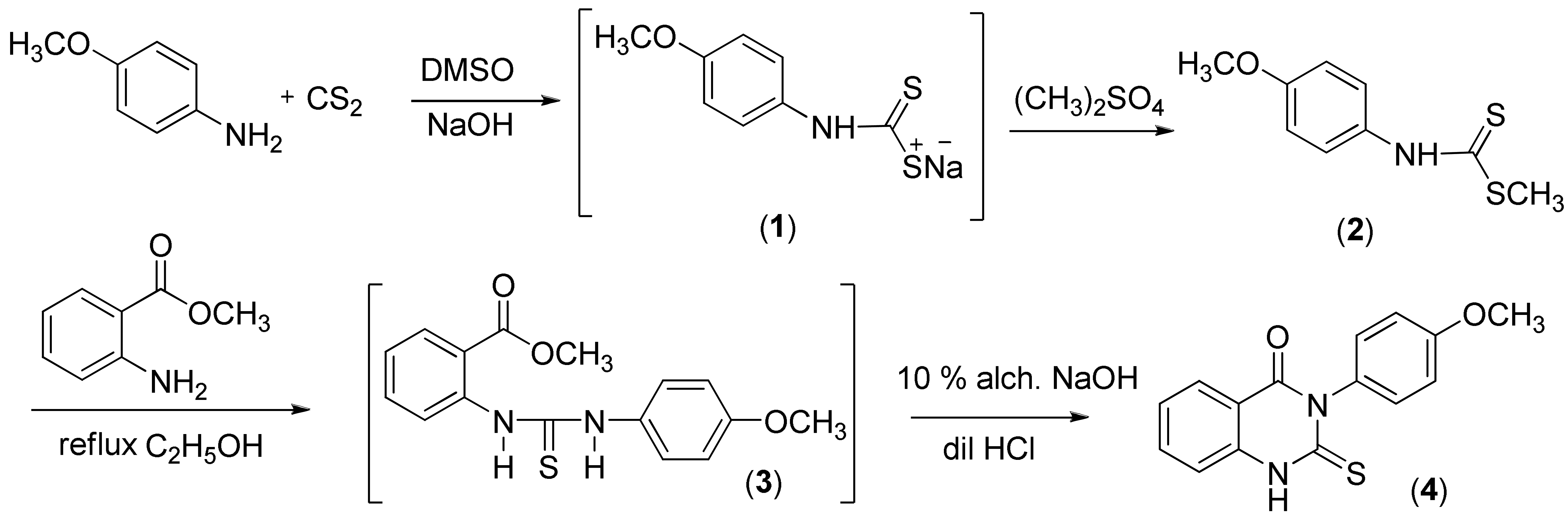
<p>The title compound was synthesized by slight modification of a reported method [<xref ref-type="bibr" rid="b11-crystals-01-00171">11</xref>] according to the route depicted in <xref ref-type="fig" rid="f1-crystals-01-00171">Figure 1</xref>. 4-Methoxyaniline in DMSO was treated with carbon disulfide and aqueous sodium hydroxide to afford sodium 4-methoxyphenylcarbamodithioate (<bold>1</bold>) followed by reaction with dimethyl sulfate to furnish the methyl 4-methoxyphenylcarbamodithioate (<bold>2</bold>). A solution of (<bold>2</bold>) in ethanol (20 mL) was treated with methyl anthranilate in presence of anhydrous potassium carbonate to provide the methyl 2-(3-(4-methoxyphenyl)thioureido)benzoate as intermediate (<bold>3</bold>), which on basic hydrolysis yielded the title compound (<bold>4</bold>) which was recrystallized from ethanol as colorless crystals.</p>
<p>Formation of (<bold>4</bold>) was confirmed by IR which showed peaks at 3187.6 cm<sup>−1</sup> for NH, 1706.6 cm<sup>−1</sup> for C=O and 1224.9 cm<sup>−1</sup> for C=S, respectively. In the <sup>1</sup>H-NMR spectrum a singlet at δ 3.88 ppm due to OCH<sub>3</sub> group, a multiplet at δ 7–8.1 ppm for aromatic (8H) protons and a singlet at d 10.36 ppm indicated the presence of NH.</p>
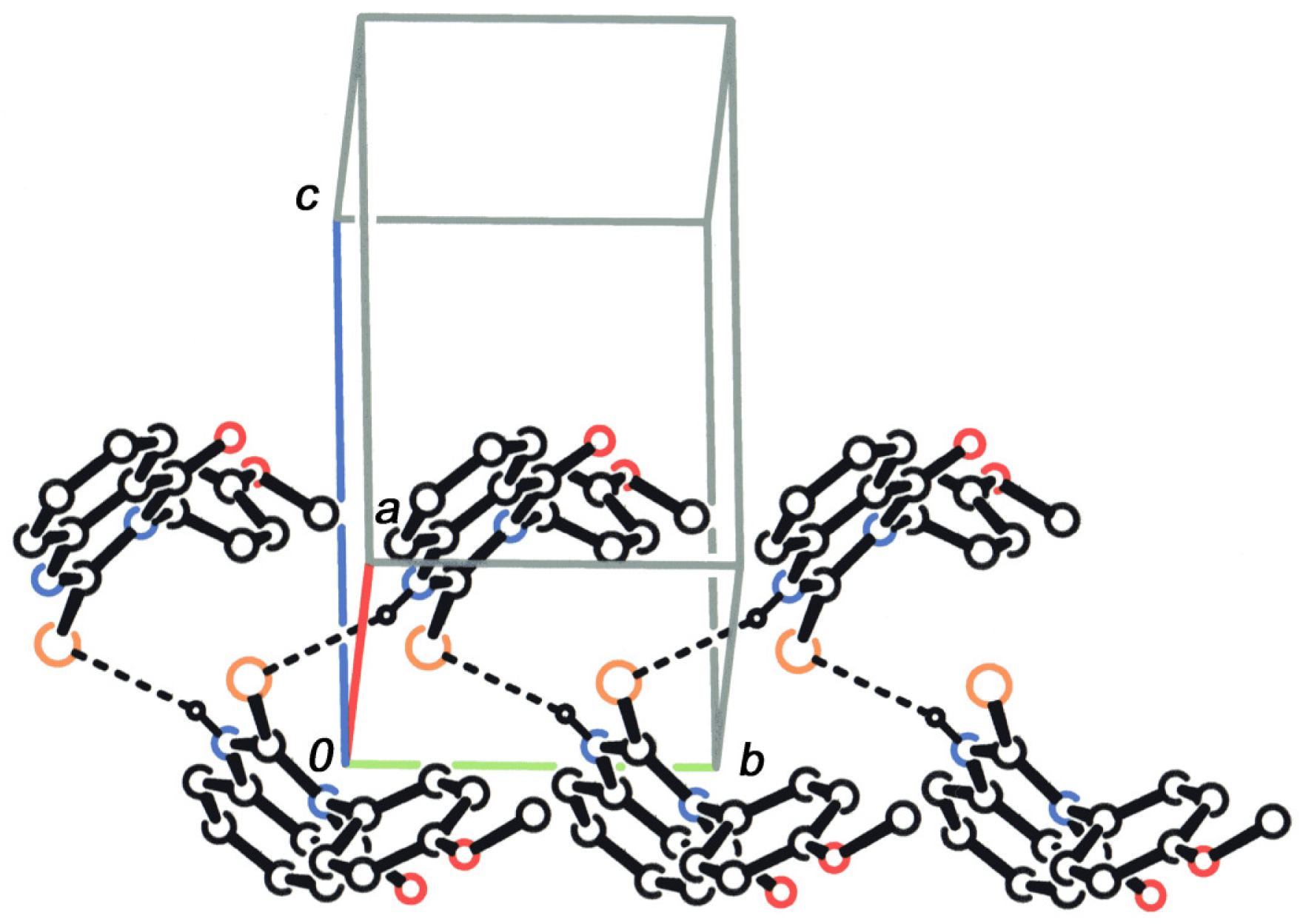
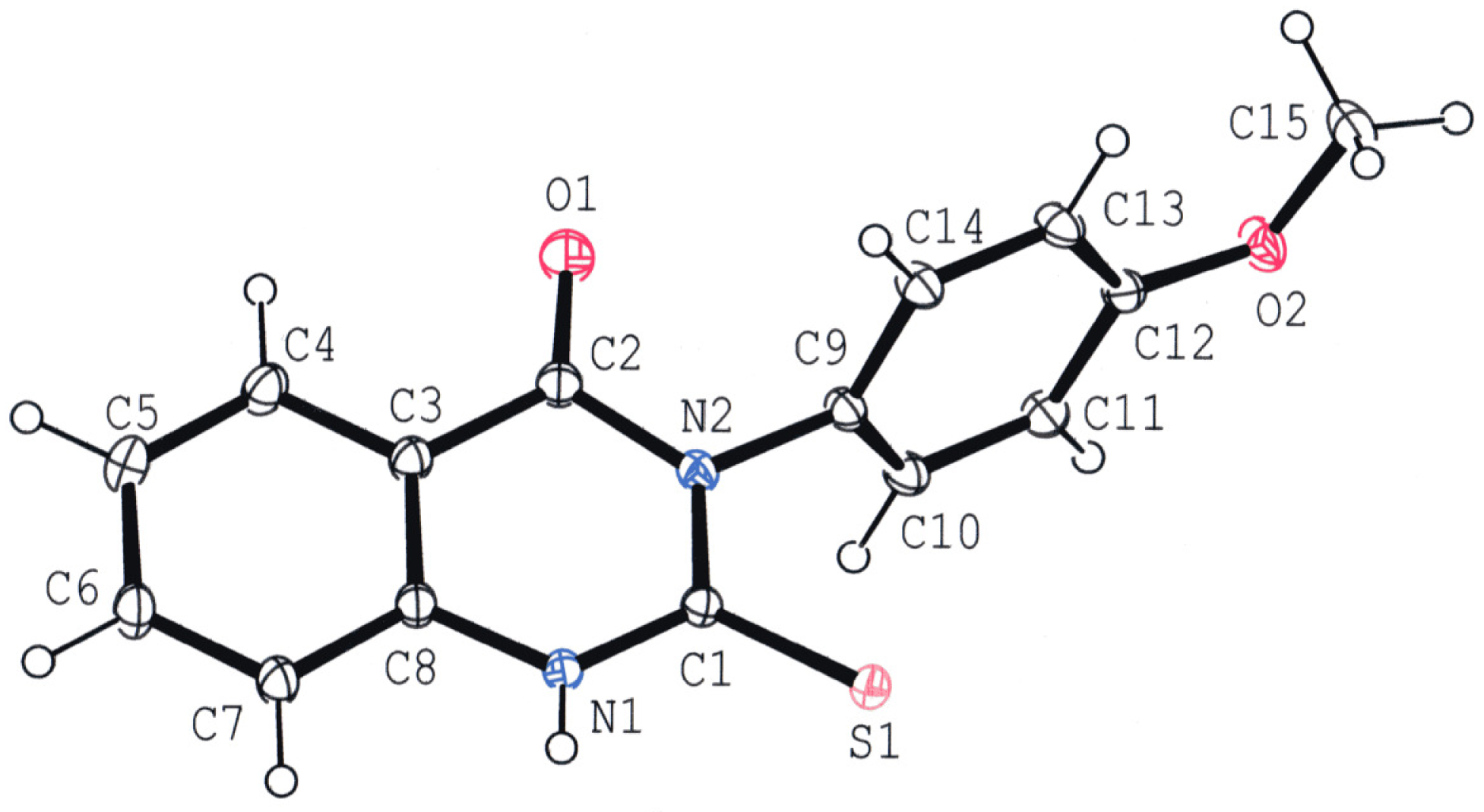
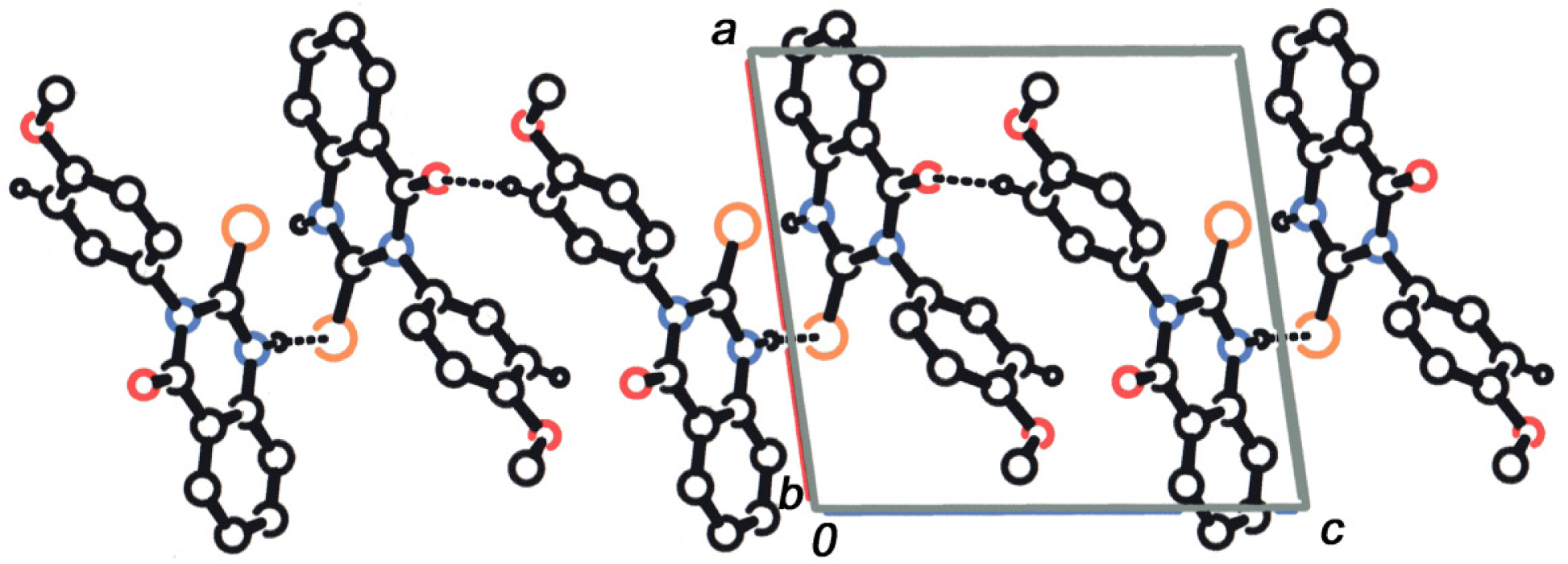
<p>The molecular structure of (<bold>4</bold>) is shown in <xref ref-type="fig" rid="f2-crystals-01-00171">Figure 2</xref>. The dihydroquinazoline N1/C1/N2/C2-C8 ring system essentially planar with an r.m.s. deviation of 0.052(1) Å. The molecule is twisted around the C9-N2 bond with a dihedral angle of 79.84(4)° between the dihydroquinazoline ring system and the substituted phenyl C9-C14 ring. The C1=S1 and C2=O1 bond lengths are 1.6799(10) and 1. 2119(14) Å, respectively, which are comparable with the reported double bond lengths [<xref ref-type="bibr" rid="b12-crystals-01-00171">12</xref>]. Packing diagrams of (<bold>4</bold>) are shown in <xref ref-type="fig" rid="f3-crystals-01-00171">Figures 3</xref> and <xref ref-type="fig" rid="f4-crystals-01-00171">4</xref>. The molecules are linked by an N-H… S hydrogen bond (N1-H1…S1<sup>i</sup> N1-H1 = 0.796(17) Å, H1…S1 = 2.656(18) Å, N1…S1 = 3.4181(10) Å, &lt;H1-N1…S1 = 160.9(16)°; symmetry code: (i) 1−x, −1/2+y, −z) forming a zig-zag chain structure along the b axis (<xref ref-type="fig" rid="f3-crystals-01-00171">Figure 3</xref>). The molecular chains are further connected by a C-H… O hydrogen bond (C11-H11…O1<sup>ii</sup> C11-H11 = 0.95 Å, H11…O1 = 2.36 Å, C11…O1 = 3.2543(15) Å, C11-H11…O1 = 157°; symmetry code: (ii) 1−x, −1/2+y, 1−z), forming a layer parallel to the bc plane (<xref ref-type="fig" rid="f4-crystals-01-00171">Figure 4</xref>).</p>
<sec>
<label>2.1.</label>
<title>Crystal Structure Determination</title>
<p>Data were collected at 180(1) K on a Rigaku RAPID II IP diffractometer using MoKα radiation. The numerical absorption correction with <italic>NUMABS</italic> were employed [<xref ref-type="bibr" rid="b13-crystals-01-00171">13</xref>]. The structure was solved by direct methods [<xref ref-type="bibr" rid="b14-crystals-01-00171">14</xref>], and refined by full-matrix least-squares refinement [<xref ref-type="bibr" rid="b14-crystals-01-00171">14</xref>] on F<sup>2</sup> with 185 parameters for 3719 unique intensities. All atoms except H were refined anisotropically. H atoms were found in a difference Fourier map and the N-bound H atom was refined freely. Other H atoms were refined on idealized positions (C-H = 0.95 or 0.98 Å) with U<sub>iso</sub>(H) = 1.2 U<sub>eq</sub>(C) or 1.5U<sub>eq</sub>(Cmethyl). Experimental data are listed in <xref ref-type="table" rid="t1-crystals-01-00171">Table 1</xref>.</p></sec></sec>
<sec>
<label>3.</label>
<title>Experimental Section</title>
<p>Melting points were recorded using a digital Gallenkamp (SANYO) model MPD BM 3.5 apparatus and are uncorrected. The FTIR spectra were recorded on FTS 3000 MX, Bio-Rad Merlin (Excalibur Model) spectrophotometer. <sup>1</sup>H NMR spectra were determined as CDCl<sub>3</sub> solutions at 300 MHz using a Bruker Mass Spectra (EI, 70 eV) on a GC-MS instrument. All compounds were purified by thick layer chromatography using silica gel from Merck.</p>
<sec>
<title>Synthesis of 3-(4-Methoxyphenyl)-2-thioxo-2,3-dihydroquinazolin-4(1H)-one (4)</title>

<p>To a solution of 4-methoxyaniline (0.02 mol) in DMSO (10 mL), carbon disulfide (1.6 mL, 0.026 mol) was added followed by an aqueous solution of sodium hydroxide (1.2 mL, 20 M) dropwise with stirring to afford salt (<bold>1</bold>) as an intermediate. After two hours, dimethyl sulfate (0.02 mol) was added gradually while the reaction mixture was kept stirring in a freezing mixture for five hours. After the completion, the reaction mixture was poured into ice water. The solid obtained was filtered, washed and re-crystallized from ethanol to obtain methyl 4-methoxyphenylcarbamodithioate (<bold>2</bold>). To the solution of (<bold>2</bold>) (0.01 mol) in ethanol (20 mL), methyl anthranilate (0.01 mol), anhydrous potassium carbonate (100 mg) was added and the solution was refluxed for 25 hours. The reaction mixture was poured onto cold water. Solid methyl 2-(3-(4-methoxyphenyl)thioureido)benzoate (<bold>3</bold>) obtained, was filtered and refluxed in 10% alcoholic sodium hydroxide solution for two hours. After cooling at room temperature, it was re-precipitated by treatment with dilute hydrochloric acid. The solid obtained was washed with water and recrystallized from ethanol to afford (<bold>4</bold>) as colourless crystals. (80%): m.p. 280 °C; R<sub>f</sub>: 0.15 (petroleum ether: ethyl acetate,4:1); IR (KBr) υ cm<sup>−1</sup>: 3187 (N-H),1704 (C=O), 1585 (Ar-C=C), 1196 (C=S); <sup>1</sup>H NMR (DMSO, 300 MHz) δ: 13.02 (s, 1H, NH), 7.9 (d, 1H, Ar-H), 7.7 (Pseudo t, 1H, Ar-H), 7.4 (d,1H, Ar-H), 7.3 (pseudo t, 1H, Ar-H), 7.1 (d, 2H, Ar-H), 7.0 (d, 2H, Ar-H), 3.8 (s, 3H, OCH3); <sup>13</sup>C NMR (75.4 MHz) δ: 176.8 (C=S), 160.4 (C=O), 159.19 (C-N), 139.9 (Ar), 136.0 (Ar), 132.4 (Ar), 130.4 (Ar), 127 (Ar), 124.7 (Ar), 116.6 (Ar), 116.1 (Ar), 114.5 (Ar), 55.7 (MeO); Anal. Calcd. For C<sub>15</sub>H<sub>12</sub>N<sub>2</sub>O<sub>2</sub>S: C, 63.36; H, 4.25; N, 9.85; S, 11.28; Found: C, 63.35; H, 4.24; N, 9.84; S, 11.27; GC-MS <italic>m/z</italic>: 284.06 (M·<sup>+</sup>, 100).</p></sec></sec>
<sec sec-type="conclusions">
<label>4.</label>
<title>Conclusions</title>
<p>Synthesis and molecular structure of a medicinally important compound is described. The dihydroquniazoline ring system is essentially planar; the molecule is twisted around the C9-N2 bond between the dihydroquinazoline ring system and the substituted phenyl C9-C14 ring. The molecules are linked by an N-H…S hydrogen bond forming a zig-zag chain structure along the b axis.</p></sec></body>
<back>
<sec sec-type="display-objects">
<title>Figures and Table</title>
<fig id="f1-crystals-01-00171" position="float">
<label>Figure 1.</label>
<caption>
<p>Synthetic route to 3-(4-methoxyphenyl)-2-thioxo-2,3-dihydroquinazolin-4(1H)-one.</p></caption>
<graphic xlink:href="crystals-01-00171f1.gif"/></fig>
<fig id="f2-crystals-01-00171" position="float">
<label>Figure 2.</label>
<caption>
<p>The molecular structure of (<bold>4</bold>). Anisotropic displacement ellipsoids are drawn at the 50% probability level.</p></caption>
<graphic xlink:href="crystals-01-00171f2.gif"/></fig>
<fig id="f3-crystals-01-00171" position="float">
<label>Figure 3.</label>
<caption>
<p>A packing diagram of (<bold>4</bold>), showing a zig-zag chain structure running along the b axis. N-H…S hydrogen bonds are indicated by dashed lines. H atoms not involved in the hydrogen bonds have been omitted.</p></caption>
<graphic xlink:href="crystals-01-00171f3.gif"/></fig>
<fig id="f4-crystals-01-00171" position="float">
<label>Figure 4.</label>
<caption>
<p>A packing diagram of (<bold>4</bold>) viewed along the b axis, showing a layer structure formed by N-H..S and C-H…O hydrogen bonds. The hydrogen bonds are indicated by dashed lines. H atoms not involved in the interactions have been omitted.</p></caption>
<graphic xlink:href="crystals-01-00171f4.gif"/></fig>
<table-wrap id="t1-crystals-01-00171" position="float">
<label>Table 1.</label>
<caption>
<p>Crystal data and structure refinement for (<bold>4</bold>).</p></caption>
<table frame="box" rules="all">
<tbody>
<tr>
<td align="center" valign="top">Empirical formula</td>
<td align="center" valign="top">C<sub>15</sub>H<sub>12</sub>N<sub>2</sub>O<sub>2</sub>S</td>
<td align="center" valign="top"/></tr>
<tr>
<td align="center" valign="top">Formula weight</td>
<td align="center" valign="top">284.33</td>
<td align="center" valign="top"/></tr>
<tr>
<td align="center" valign="top">Temperature</td>
<td align="center" valign="top">180(1)K</td>
<td align="center" valign="top"/></tr>
<tr>
<td align="center" valign="top">Wavelength</td>
<td align="center" valign="top">0.71075 Å</td>
<td align="center" valign="top"/></tr>
<tr>
<td align="center" valign="top">Crystal system</td>
<td align="center" valign="top">Monoclinic</td>
<td align="center" valign="top"/></tr>
<tr>
<td align="center" valign="top">Space group</td>
<td align="center" valign="top">P2<sub>1</sub></td>
<td align="center" valign="top"/></tr>
<tr>
<td align="center" valign="top">Unit cell dimensions</td>
<td align="center" valign="top">a = 9.9349(8) Å</td>
<td align="center" valign="top">α = 90°</td></tr>
<tr>
<td align="center" valign="top"/>
<td align="center" valign="top">b = 6.3377(5) Å</td>
<td align="center" valign="top">β = 97.752(3)°</td></tr>
<tr>
<td align="center" valign="top"/>
<td align="center" valign="top">c = 10.5783(10) Å</td>
<td align="center" valign="top">γ = 90°</td></tr>
<tr>
<td align="center" valign="top">Volume</td>
<td align="center" valign="top">659.97(10) Å<sup>3</sup></td>
<td align="center" valign="top"/></tr>
<tr>
<td align="center" valign="top">Z</td>
<td align="center" valign="top">2</td>
<td align="center" valign="top"/></tr>
<tr>
<td align="center" valign="top">Density (calculated)</td>
<td align="center" valign="top">1.431 mg/m<sup>3</sup></td>
<td align="center" valign="top"/></tr>
<tr>
<td align="center" valign="top">Absorption coefficient</td>
<td align="center" valign="top">0.247 mm<sup>−1</sup></td>
<td align="center" valign="top"/></tr>
<tr>
<td align="center" valign="top">F(000)</td>
<td align="center" valign="top">296</td>
<td align="center" valign="top"/></tr>
<tr>
<td align="center" valign="top">Crystal size</td>
<td align="center" valign="top">0.13 × 0.36 × 0.38 mm<sup>3</sup></td>
<td align="center" valign="top"/></tr>
<tr>
<td align="center" valign="top">Theta range for data collection</td>
<td align="center" valign="top">3.0 to 30.0°.</td>
<td align="center" valign="top"/></tr>
<tr>
<td align="center" valign="top">Index ranges</td>
<td align="center" valign="top">−13 ≤ h ≤ 13, −8 ≤ k ≤ 8, −14 ≤ l ≤ 14</td>
<td align="center" valign="top"/></tr>
<tr>
<td align="center" valign="top">Reflections collected</td>
<td align="center" valign="top">12985</td>
<td align="center" valign="top"/></tr>
<tr>
<td align="center" valign="top">Independent reflections</td>
<td align="center" valign="top">3719 [R(int) = 0.014]</td>
<td align="center" valign="top"/></tr>
<tr>
<td align="center" valign="top">Completeness to theta = 29.97°</td>
<td align="center" valign="top">99.8%</td>
<td align="center" valign="top"/></tr>
<tr>
<td align="center" valign="top">Absorption correction</td>
<td align="center" valign="top">Numerical</td>
<td align="center" valign="top"/></tr>
<tr>
<td align="center" valign="top">Max. and min. transmission</td>
<td align="center" valign="top">0.968 and 0.915</td>
<td align="center" valign="top"/></tr>
<tr>
<td align="center" valign="top">Refinement method</td>
<td align="center" valign="top">Full-matrix least-squares on F<sup>2</sup></td>
<td align="center" valign="top"/></tr>
<tr>
<td align="center" valign="top">Data/restraints/parameters</td>
<td align="center" valign="top">3719/1/185</td>
<td align="center" valign="top"/></tr>
<tr>
<td align="center" valign="top">Goodness-of-fit on F<sup>2</sup></td>
<td align="center" valign="top">1.07</td>
<td align="center" valign="top"/></tr>
<tr>
<td align="center" valign="top">Final R indices [I &gt; 2σ(I<sub>0</sub>)]</td>
<td align="center" valign="top">R1 = 0.0271, wR2 = 0.0704</td>
<td align="center" valign="top"/></tr>
<tr>
<td align="center" valign="top">R indices (all data)</td>
<td align="center" valign="top">R1 = 0.0266, wR2 = 0.0702</td>
<td align="center" valign="top"/></tr>
<tr>
<td align="center" valign="top">Extinction coefficient</td>
<td align="center" valign="top">none</td>
<td align="center" valign="top"/></tr>
<tr>
<td align="center" valign="top">Largest diff. peak and hole</td>
<td align="center" valign="top">0.347 and −0.150 eÅ<sup>−3</sup></td>
<td align="center" valign="top"/></tr>
<tr>
<td align="center" valign="top">Flack parameter</td>
<td align="center" valign="top">0.00(4)</td>
<td align="center" valign="top"/></tr>
<tr>
<td align="center" valign="top">CCDC No.</td>
<td align="center" valign="top">831309</td>
<td align="center" valign="top"/></tr></tbody></table></table-wrap></sec>
<ack>
<p>The author gratefully acknowledges a research grant from the Higher Education Commission of Pakistan under project No. 4-279/PAK-US/HEC 2010-917.</p></ack>
<ref-list>
<title>References and Notes</title>
<ref id="b1-crystals-01-00171"><label>1.</label><citation citation-type="journal"><person-group person-group-type="author"><name><surname>Mhaske</surname><given-names>S.B.</given-names></name><name><surname>Argade</surname><given-names>N.P.</given-names></name></person-group><article-title>The chemistry of recently isolated naturally occurring quinazolinone alkaloids</article-title><source>Tetrahedron</source><year>2006</year><volume>62</volume><fpage>9787</fpage><lpage>9826</lpage><pub-id pub-id-type="doi">10.1016/j.tet.2006.07.098</pub-id></citation></ref>
<ref id="b2-crystals-01-00171"><label>2.</label><citation citation-type="journal"><person-group person-group-type="author"><name><surname>Patel</surname><given-names>B.N.</given-names></name><name><surname>Patel</surname><given-names>C.J.</given-names></name></person-group><article-title>Synthesis and Antimicrobial Activity of 3-(1,3,4-Oxadiazol-2-yl)quinazolin-4(3H)-ones</article-title><source>Sci. Pharm.</source><year>2010</year><volume>78</volume><fpage>171</fpage><lpage>193</lpage><pub-id pub-id-type="doi">10.3797/scipharm.0912-16</pub-id><pub-id pub-id-type="pmid">21179342</pub-id></citation></ref>
<ref id="b3-crystals-01-00171"><label>3.</label><citation citation-type="journal"><person-group person-group-type="author"><name><surname>Bartroli</surname><given-names>J.</given-names></name><name><surname>Turmo</surname><given-names>E.</given-names></name><name><surname>Alguero</surname><given-names>M.</given-names></name><name><surname>Boncompte</surname><given-names>E.</given-names></name><name><surname>Vericat</surname><given-names>M.L.</given-names></name><name><surname>Conte</surname><given-names>L.</given-names></name><name><surname>Ramis</surname><given-names>J.</given-names></name><name><surname>Merlos</surname><given-names>M.</given-names></name><name><surname>Garcia-Rafanell</surname><given-names>J.</given-names></name><name><surname>Forn</surname><given-names>J.</given-names></name></person-group><article-title>Synthesis and Antifungal Activity of 3-Substituted-4(3H)-quinazolinones</article-title><source>J. Med. Chem.</source><year>1998</year><volume>41</volume><fpage>1869</fpage><lpage>1882</lpage><pub-id pub-id-type="doi">10.1021/jm9707277</pub-id><pub-id pub-id-type="pmid">9599237</pub-id></citation></ref>
<ref id="b4-crystals-01-00171"><label>4.</label><citation citation-type="journal"><person-group person-group-type="author"><name><surname>Al-Obaid</surname><given-names>A.M.</given-names></name><name><surname>Abdel-Hamide</surname><given-names>S.G.</given-names></name><name><surname>El-Kashef</surname><given-names>H.A.</given-names></name><name><surname>Abdel-Aziz</surname><given-names>A.A.-M.</given-names></name><name><surname>El-Azab</surname><given-names>A.S.</given-names></name><name><surname>Al-Khamees</surname><given-names>H.A.</given-names></name><name><surname>El-Subbagh.</surname><given-names>H.I.</given-names></name></person-group><article-title>Substituted quinazolines, part 3. Synthesis, <italic>in vitro</italic> antitumor activity and molecular modeling study of certain 2-thieno-4(3H)-quinazolinone analogs</article-title><source>Eur. J. Med. Chem.</source><year>2009</year><volume>44</volume><fpage>2379</fpage><lpage>2391</lpage><pub-id pub-id-type="doi">10.1016/j.ejmech.2008.09.015</pub-id><pub-id pub-id-type="pmid">18950904</pub-id></citation></ref>
<ref id="b5-crystals-01-00171"><label>5.</label><citation citation-type="journal"><person-group person-group-type="author"><name><surname>Kamal</surname><given-names>A.</given-names></name><name><surname>Vijaya</surname><given-names>B.E.</given-names></name><name><surname>Janaki Ramaiah</surname><given-names>M.</given-names></name><name><surname>Dastagiri</surname><given-names>D.</given-names></name><name><surname>Surendranadha</surname><given-names>R.J.</given-names></name><name><surname>Viswanath</surname><given-names>A.</given-names></name><name><surname>Sultana</surname><given-names>F.</given-names></name><name><surname>Pushpavalli</surname><given-names>S.N.C.V.L.</given-names></name><name><surname>Pal-Bhadra</surname><given-names>M.</given-names></name><name><surname>Srivastava</surname><given-names>H.K.</given-names></name><name><surname>Narahari</surname><given-names>S.G.</given-names></name><name><surname>Juvekar</surname><given-names>A.</given-names></name><name><surname>Sen</surname><given-names>S.</given-names></name><name><surname>Zingde</surname><given-names>S.</given-names></name></person-group><article-title>Quinazolinone linked pyrrolo[2,1-c][1,4]benzodiazepine (PBD) conjugates: Design, synthesis and biological evaluation as potential anticancer agents</article-title><source>Bioorg. Med. Chem.</source><year>2010</year><volume>18</volume><fpage>526</fpage><lpage>542</lpage><pub-id pub-id-type="doi">10.1016/j.bmc.2009.12.015</pub-id><pub-id pub-id-type="pmid">20031423</pub-id></citation></ref>
<ref id="b6-crystals-01-00171"><label>6.</label><citation citation-type="journal"><person-group person-group-type="author"><name><surname>Laddha</surname><given-names>S.S.</given-names></name><name><surname>Bhatnagar</surname><given-names>P.S.</given-names></name></person-group><article-title>A new therapeutic approach in Parkinson's disease: Some novel quinazoline derivatives as dual selective phosphodiesterase 1 inhibitors and anti-inflammatory agents</article-title><source>Bioorg. Med. Chem.</source><year>2009</year><volume>17</volume><fpage>6796</fpage><lpage>6802</lpage><pub-id pub-id-type="doi">10.1016/j.bmc.2009.08.041</pub-id><pub-id pub-id-type="pmid">19744861</pub-id></citation></ref>
<ref id="b7-crystals-01-00171"><label>7.</label><citation citation-type="journal"><person-group person-group-type="author"><name><surname>Gökhan-Kelekçi</surname><given-names>N.</given-names></name><name><surname>Koyunoglu</surname><given-names>S.</given-names></name><name><surname>Yabano˘lu</surname><given-names>S.</given-names></name><name><surname>Yelekçi</surname><given-names>K.</given-names></name><name><surname>Özgen</surname><given-names>Ö.</given-names></name><name><surname>Uçar</surname><given-names>G.</given-names></name><name><surname>Erol</surname><given-names>K.</given-names></name><name><surname>Kendi</surname><given-names>E.</given-names></name><name><surname>Yes_ilada</surname><given-names>A.</given-names></name></person-group><article-title>New pyrazoline bearing 4(3<italic>H</italic>)-quinazolinone inhibitors of monoamine oxidase: Synthesis, biological evaluation, and structural determinants of MAO-A and MAO-B selectivity</article-title><source>Bioorg. Med. Chem.</source><year>2009</year><volume>17</volume><fpage>675</fpage><lpage>689</lpage><pub-id pub-id-type="doi">10.1016/j.bmc.2008.11.068</pub-id><pub-id pub-id-type="pmid">19091581</pub-id></citation></ref>
<ref id="b8-crystals-01-00171"><label>8.</label><citation citation-type="journal"><person-group person-group-type="author"><name><surname>Mohsen</surname><given-names>M.A.</given-names></name><name><surname>Yahia</surname><given-names>A.M.</given-names></name><name><surname>Elkhairy</surname><given-names>A.M.</given-names></name><name><surname>Wahid</surname><given-names>M.B.</given-names></name><name><surname>Samir</surname><given-names>Y.A.</given-names></name></person-group><article-title>Synthesis of some new 4(3H)-quinazolinone-2-carboxaldehyde thiosemicarbazones and their metal complexes and a study on their anticonvulsant, analgesic, cytotoxic and antimicrobial activities - Part-1</article-title><source>Eur. J. Med. Chem.</source><year>2010</year><volume>45</volume><fpage>3365</fpage><lpage>3373</lpage><pub-id pub-id-type="doi">10.1016/j.ejmech.2010.04.020</pub-id><pub-id pub-id-type="pmid">20510483</pub-id></citation></ref>
<ref id="b9-crystals-01-00171"><label>9.</label><citation citation-type="journal"><person-group person-group-type="author"><name><surname>Abdel Gawad</surname><given-names>N.M.</given-names></name><name><surname>Georgey</surname><given-names>H.H.</given-names></name><name><surname>Youssef</surname><given-names>R.M.</given-names></name><name><surname>El Sayed</surname><given-names>A.N.</given-names></name></person-group><article-title>Design, synthesis, and anticonvulsant activity of novel quinazolinone analogues</article-title><source>Med. Chem. Res.</source><year>2010</year><pub-id pub-id-type="doi">10.1007/s00044-010-9465-4</pub-id></citation></ref>
<ref id="b10-crystals-01-00171"><label>10.</label><citation citation-type="journal"><person-group person-group-type="author"><name><surname>Du</surname><given-names>X.</given-names></name><name><surname>Jiang</surname><given-names>Y.</given-names></name><name><surname>Qian</surname><given-names>W.</given-names></name><name><surname>Lu</surname><given-names>X.</given-names></name><name><surname>Walsh</surname><given-names>J.P.</given-names></name></person-group><article-title>Fatty acids inhibit growth-factor-induced diacylglycerol kinase a activation in vascular smooth-muscle cells</article-title><source>Biochem. J.</source><year>2001</year><volume>357</volume><fpage>275</fpage><lpage>282</lpage><pub-id pub-id-type="doi">10.1042/0264-6021:3570275</pub-id><pub-id pub-id-type="pmid">11415460</pub-id></citation></ref>
<ref id="b11-crystals-01-00171"><label>11.</label><citation citation-type="journal"><person-group person-group-type="author"><name><surname>Bowman</surname><given-names>W.R.</given-names></name><name><surname>Elsegood</surname><given-names>M.R.J.</given-names></name><name><surname>Stein</surname><given-names>T.</given-names></name><name><surname>Weaver</surname><given-names>G.W.</given-names></name></person-group><article-title>Radical reactions with 3<italic>H</italic>-quinazolin-4-ones: synthesis of deoxyvasicinone, mackinazolinone, luotonin A, rutaecarpine and tryptanthrin</article-title><source>Org. Biomol. Chem.</source><year>2007</year><volume>5</volume><fpage>103</fpage><lpage>113</lpage><pub-id pub-id-type="doi">10.1039/b614075k</pub-id><pub-id pub-id-type="pmid">17164913</pub-id></citation></ref>
<ref id="b12-crystals-01-00171"><label>12.</label><citation citation-type="book"><person-group person-group-type="author"><name><surname>Higashi</surname><given-names>T.</given-names></name></person-group><source>NUMABS</source><publisher-name>Rigaku Corporation</publisher-name><publisher-loc>Tokyo, Japan</publisher-loc><year>1999</year></citation></ref>
<ref id="b13-crystals-01-00171"><label>13.</label><citation citation-type="journal"><person-group person-group-type="author"><name><surname>Sheldrick</surname><given-names>G.M.</given-names></name></person-group><article-title>A short history of <italic>SHELX</italic></article-title><source>Acta Cryst.</source><year>2008</year><volume>A64</volume><fpage>112</fpage><lpage>122</lpage></citation></ref>
<ref id="b14-crystals-01-00171"><label>14.</label><citation citation-type="journal"><person-group person-group-type="author"><name><surname>Allen</surname><given-names>F.H.</given-names></name><name><surname>Kennard</surname><given-names>O.</given-names></name><name><surname>Watson</surname><given-names>D.G.</given-names></name><name><surname>Brammer</surname><given-names>L.</given-names></name><name><surname>Orpen</surname><given-names>A.G.</given-names></name><name><surname>Taylor</surname><given-names>R.</given-names></name></person-group><article-title>Tables of bond lengths determined by X-ray and Neutron Diffraction. Part 1. Bond lengths in Organic compounds</article-title><source>J. Chem. Soc. Perkin Trans. II</source><year>1987</year><fpage>S1</fpage><lpage>S19</lpage></citation></ref></ref-list></back></article>