
<?xml version="1.0" encoding="UTF-8"?>
<!DOCTYPE article PUBLIC "-//NLM//DTD Journal Publishing DTD v2.3 20070202//EN" "journalpublishing.dtd">
<article xmlns:mml="http://www.w3.org/1998/Math/MathML" xmlns:xlink="http://www.w3.org/1999/xlink" xml:lang="en" article-type="research-article">
  <front>
    <journal-meta>
      <journal-id journal-id-type="publisher-id">catalysts</journal-id>
      <journal-title>Catalysts</journal-title>
      <abbrev-journal-title abbrev-type="publisher">Catalysts</abbrev-journal-title>
      <abbrev-journal-title abbrev-type="pubmed">Catalysts</abbrev-journal-title>
      <issn pub-type="epub">2073-4344</issn>
      <publisher>
        <publisher-name>MDPI</publisher-name>
      </publisher>
    </journal-meta>
    <article-meta>
      <article-id pub-id-type="doi">10.3390/catal2040532</article-id>
      <article-id pub-id-type="publisher-id">catalysts-02-00532</article-id>
      <article-categories>
        <subj-group>
          <subject>Article</subject>
        </subj-group>
      </article-categories>
      <title-group>
        <article-title>Catalytic Studies of Sodium Hydroxide and Carbon Monoxide Reaction</article-title>
      </title-group>
      <contrib-group>
        <contrib contrib-type="author">
          <name>
            <surname>Kumar</surname>
            <given-names>Sushant</given-names>
          </name>
          <xref rid="c1-catalysts-02-00532" ref-type="corresp">*</xref>
        </contrib>
        <contrib contrib-type="author">
          <name>
            <surname>Drozd</surname>
            <given-names>Vadym</given-names>
          </name>
        </contrib>
        <contrib contrib-type="author">
          <name>
            <surname>Saxena</surname>
            <given-names>Surendra K.</given-names>
          </name>
        </contrib>
      </contrib-group>
      <aff id="af1-catalysts-02-00532">Center for the Study of Matter at Extreme Conditions, College of Engineering and Computing, Florida International University, Miami, FL 33199, USA; Email: <email>drozdv@fiu.edu</email> (V.D.); <email>saxenas@fiu.edu</email> (S.K.S.)</aff>
      <author-notes>
        <corresp id="c1-catalysts-02-00532"><label>*</label> Author to whom correspondence should be addressed; Email: <email>skuma002@fiu.edu</email>; Tel.: +1-305-496-6655; Fax: +1-305-348-3070.</corresp>
      </author-notes>
      <pub-date pub-type="epub">
        <day>27</day>
        <month>11</month>
        <year>2012</year>
      </pub-date>
      <pub-date pub-type="collection">
        <month>12</month>
        <year>2012</year>
      </pub-date>
      <volume>2</volume>
      <issue>4</issue>
      <fpage>532</fpage>
      <lpage>543</lpage>
      <history>
        <date date-type="received">
          <day>25</day>
          <month>09</month>
          <year>2012</year>
        </date>
        <date date-type="rev-recd">
          <day>05</day>
          <month>11</month>
          <year>2012</year>
        </date>
        <date date-type="accepted">
          <day>20</day>
          <month>11</month>
          <year>2012</year>
        </date>
      </history>
      <permissions>
        <copyright-statement>© 2012 by the authors; licensee MDPI, Basel, Switzerland.</copyright-statement>
        <copyright-year>2012</copyright-year>
        <license xmlns:xlink="http://www.w3.org/1999/xlink" license-type="open-access" xlink:href="http://creativecommons.org/licenses/by/3.0/">
          <p>This article is an open-access article distributed under the terms and conditions of the Creative Commons Attribution license (http://creativecommons.org/licenses/by/3.0/).</p>
        </license>
      </permissions>
      <abstract>
        <p>We have studied the effect of ball milling on alumina mixed nickel, magnetite and Raney nickel on the reaction: 2NaOH(s) + CO (g) = Na<sub>2</sub>CO<sub>3</sub> (s) + H<sub>2</sub> (g) and determined the optimum particle size for the catalysts. The best performance was shown by a 2 h ball milled Raney nickel with average crystallite size of 209 Å. This reaction serves the dual purpose of carbon sequestration and yielding hydrogen gas.</p>
      </abstract>
      <kwd-group>
        <kwd>catalyst</kwd>
        <kwd>ball milling</kwd>
        <kwd>crystallite size</kwd>
        <kwd>carbon sequestration</kwd>
      </kwd-group>
    </article-meta>
  </front>
  <body>
    <sec sec-type="intro">
      <title>1. Introduction</title>
      <p>Sodium hydroxide (NaOH) has been used as a reactant to facilitate various reactions yielding hydrogen (H<sub>2</sub>). Its inclusion in the reaction brings many advantages such as lowered operating temperature and reduced consumption of heat. We have earlier studied the interaction of NaOH with methane (CH<sub>4</sub>), carbon monoxide (CO) and carbon(C) [<xref ref-type="bibr" rid="B1-catalysts-02-00532">1</xref>,<xref ref-type="bibr" rid="B2-catalysts-02-00532">2</xref>]. Recently, Reichman <italic>et al.</italic> [<xref ref-type="bibr" rid="B3-catalysts-02-00532">3</xref>] have also suggested a similar approach named ovonic renewable hydrogen (ORH). This method uses NaOH for the reformation of organic matter to produce H<sub>2</sub>. Kamo <italic>et al.</italic> [<xref ref-type="bibr" rid="B4-catalysts-02-00532">4</xref>] pyrolyzed dehydrochlorinated polyvinyl chloride (PVC) and activated carbon with NaOH and steam to generate H<sub>2</sub> and sodium carbonate (Na<sub>2</sub>CO<sub>3</sub>). This process has CH<sub>4</sub>, ethane (C<sub>2</sub>H<sub>6</sub>) and carbon dioxide (CO<sub>2</sub>) as byproducts in minor percent. Onwudili and William [<xref ref-type="bibr" rid="B5-catalysts-02-00532">5</xref>] performed the hydrothermal gasification of glucose and other biomass to produce H<sub>2</sub>. NaOH was used as a promoter in this case. </p>
      <p>The necessity to sequester carbon emission during the production of H<sub>2</sub> is the main goal of this work. Once this problem is solved, various technologies are already in existence which can use H<sub>2</sub> as a fuel-carrier in many applications. Other than using alternate energies for electrolysis of water or the biological methods, no techniques are available to produce carbon emission free H<sub>2</sub> from fossil fuels. Many researchers worldwide have realized the need to produce H<sub>2</sub> without any CO<sub>2</sub> emission [<xref ref-type="bibr" rid="B1-catalysts-02-00532">1</xref>,<xref ref-type="bibr" rid="B6-catalysts-02-00532">6</xref>,<xref ref-type="bibr" rid="B7-catalysts-02-00532">7</xref>,<xref ref-type="bibr" rid="B8-catalysts-02-00532">8</xref>,<xref ref-type="bibr" rid="B9-catalysts-02-00532">9</xref>,<xref ref-type="bibr" rid="B10-catalysts-02-00532">10</xref>,<xref ref-type="bibr" rid="B11-catalysts-02-00532">11</xref>,<xref ref-type="bibr" rid="B12-catalysts-02-00532">12</xref>,<xref ref-type="bibr" rid="B13-catalysts-02-00532">13</xref>,<xref ref-type="bibr" rid="B14-catalysts-02-00532">14</xref>]. Carbon monoxide (CO) is a toxic gas emitted by power plants and blast furnaces with a severe impact on global warming. Generally, water-gas shift reaction uses steam to lock CO and produces CO<sub>2</sub> and H<sub>2</sub>. A vast emission of anthropogenic gas (CO<sub>2</sub>) is a major drawback of the water-gas shift reaction. We propose to solve this problem of carbon emission using a hydroxide as a reactant with CO gas [<xref ref-type="bibr" rid="B2-catalysts-02-00532">2</xref>]. One should note that the present scheme serves the dual purpose of CO capture and H<sub>2</sub> production. 
	  <disp-formula>
          2NaOH (s) + CO (g) → Na<sub>2</sub>CO<sub>3</sub>(s) +H<sub>2</sub> (g) Δ<italic>H</italic> = −119 kJ (600 °C)
          <label>(1)</label>
          </disp-formula>
	  </p>
      <p>However, if NaOH is to be produced for carbonation, the method proposed here cannot be regarded as carbon-emission free because NaOH itself is produced from electrolysis of brine, which is very energy intensive process<italic>.</italic> Instead, if we use NaOH that is a byproduct from existing chlor-alkali plants, we can produce Na<sub>2</sub>CO<sub>3</sub> and H<sub>2</sub> gas using reaction (1). Na<sub>2</sub>CO<sub>3</sub> is a valuable byproduct and has many applications in chemical industries. Apart from the fact that the production of NaOH is an energy intensive process, there is also an imbalance between the global H<sub>2</sub> demand and NaOH production; hence reaction (1) cannot be seen as a global solution for H<sub>2</sub> gas. However, reaction (1) will be certainly helpful in mitigating the vast emission of greenhouse gases during production of H<sub>2</sub>.The purpose of present work is to study the effect of catalysis on the carbonation of the hydroxide. It is highly desirable to lower the reaction time or even the operating temperature of exothermic reaction (1). Thus, we have examined several catalysts to accelerate reaction (1).</p>
      <p>Nickel is a low cost, highly active and widely employed catalyst for industrial application [<xref ref-type="bibr" rid="B15-catalysts-02-00532">15</xref>,<xref ref-type="bibr" rid="B16-catalysts-02-00532">16</xref>,<xref ref-type="bibr" rid="B17-catalysts-02-00532">17</xref>,<xref ref-type="bibr" rid="B18-catalysts-02-00532">18</xref>,<xref ref-type="bibr" rid="B19-catalysts-02-00532">19</xref>]. Raney nickel catalysts possess high catalytic activity due to its highly porous microstructure and high surface area. It is extensively used in various industrial processes and also in organic synthesis process [<xref ref-type="bibr" rid="B20-catalysts-02-00532">20</xref>,<xref ref-type="bibr" rid="B21-catalysts-02-00532">21</xref>].Fe<sub>3</sub>O<sub>4</sub> (magnetite) acts as a catalyst for water gas shift reaction (CO (g) + H<sub>2</sub>O (g) ↔ CO<sub>2</sub> (g) +H<sub>2 </sub>(g), Δ<italic>H</italic> = −41.1kJ/mol) [<xref ref-type="bibr" rid="B22-catalysts-02-00532">22</xref>,<xref ref-type="bibr" rid="B23-catalysts-02-00532">23</xref>]. </p>
      <p>Previous results [<xref ref-type="bibr" rid="B24-catalysts-02-00532">24</xref>,<xref ref-type="bibr" rid="B25-catalysts-02-00532">25</xref>,<xref ref-type="bibr" rid="B26-catalysts-02-00532">26</xref>] show strong effect of the catalyst’s geometric factor, electronic factor and surface imperfections. Beeck [<xref ref-type="bibr" rid="B27-catalysts-02-00532">27</xref>] correlated the catalytic activity to the lattice parameter of the contact surface. The electronic factors are dependent on the extent to which <italic>d</italic>-band of the crystal filled up by the electrons [<xref ref-type="bibr" rid="B28-catalysts-02-00532">28</xref>,<xref ref-type="bibr" rid="B29-catalysts-02-00532">29</xref>]. The effect of the imperfections is due to the surface imperfections (e.g., kinks, screw dislocations) which can also behave as catalytically active sites [<xref ref-type="bibr" rid="B30-catalysts-02-00532">30</xref>]. Therefore, it is important to investigate the possible relation between the catalyst grain size and the reaction rate.</p>
      <p>In this work, different sized catalysts were prepared by mechanical milling. Mechanical milling is one of the common methods for milling powder materials to obtain uniform distribution of composition [<xref ref-type="bibr" rid="B31-catalysts-02-00532">31</xref>]. It is quite often employed due to its simplicity, low cost, and ability to form a large number of different materials [<xref ref-type="bibr" rid="B32-catalysts-02-00532">32</xref>]. During milling, powder particles experience intensive deformation which leads to various crystal defects such as lattice strains, dislocations, vacancies and morphological changes [<xref ref-type="bibr" rid="B31-catalysts-02-00532">31</xref>,<xref ref-type="bibr" rid="B33-catalysts-02-00532">33</xref>]. Here, we have studied the changes in catalysts powder morphology, average particle size and crystallite size with milling time. We also examined the relation between kinetics of reaction (1) and morphological and structural changes in the catalysts.</p>
    </sec>
    <sec>
      <title>2. Experimental Study</title>
      <sec>
        <title>2.1. Catalyst Preparation</title>
        <p>The catalysts used in this work are alumina (Al<sub>2</sub>O<sub>3</sub>) mixed nickel, magnetite and Raney nickel. Nickel Powder (-100 mesh), Raney nickel (-325 mesh) and alumina were delivered by Sigma Aldrich, Acros Organics and Good Fellow respectively. The various sizes of these catalysts were obtained using planetary Retsch PM100 ball mill. The cylindrical ball milling container has internal diameter of 1.6" and internal length of 1.6". The powder to ball weight ratio was 1/54. Magnetite was ball milled for 1 and 2 h. Al<sub>2</sub>O<sub>3</sub> mixed nickel was prepared in 2:1 ratio by weight. Then, this mixture was ground for 1 or 2 or 4 h. For Raney nickel, milling time was 2 and 4 h. The same revolution speed (250 rpm) was maintained for grinding all the catalyst particles.</p>
      </sec>
      <sec>
        <title>2.2. Catalyst Characterization</title>
        <p>X-ray diffraction patterns for different catalysts were obtained using Bruker GADDS/D8 X-ray system with Apex Smart CCD Detector and Mo direct-drive rotating anode (50 kV; 20mA). The surface morphology of the catalyst was studied using JEOL JSM-5910-LV and JEOL JSM-6330F scanning electron microscope.</p>
        <p>Image J software was used to determine the average particle size of catalysts. A total of nearly 50 particles of each catalyst were taken into consideration from 3–4 SEM images. </p>
      </sec>
      <sec>
        <title>2.3. Reaction Study</title>
        <p>Anhydrous NaOH with a purity of 98% was supplied by Sigma Aldrich. About 0.10 g of NaOH was dissolved using 1 mL of distilled water in an alumina boat. Then, the catalyst (3 wt.% of NaOH) was mixed with the solution. After that, the alumina boat was placed at the hot spot position in an alumina tubular furnace (18.5" long and 0.7" in diameter). The detailed experimental set up is explained elsewhere [<xref ref-type="bibr" rid="B1-catalysts-02-00532">1</xref>].</p>
        <p>Nitrogen (N<sub>2</sub>) gas was allowed to flow at the rate of 50 mL/min until the required temperature was achieved. After that, N<sub>2</sub> flow was ceased and CO was passed through the reaction chamber at the rate of 20 mL/min. </p>
        <p>The reaction (1) was studied at several temperatures using various sizes of the different catalysts. The extent of the reaction (1) was evaluated by calculating the amount of Na<sub>2</sub>CO<sub>3</sub> formed. The method used is the titration of mixture of formed soda ash and un-reacted NaOH against 0.1009 N volumetric standard solution of nitric acid (Aldrich). The equivalents can be detected by using acid-base indicators; here phenolphthalein and methyl orange were the indicators. NaHCO<sub>3</sub> does not form in the reaction but it does during titration:
		<disp-formula>
          Na<sub>2</sub>CO<sub>3</sub> + HNO<sub>3</sub>→ NaHCO<sub>3</sub>+ NaNO<sub>3 </sub>
          <label>(2)</label>
          </disp-formula>
		  and then
		  <disp-formula>
          NaHCO<sub>3</sub>+ HNO<sub>3</sub>→ NaNO<sub>3</sub>+CO<sub>2</sub>+H<sub>2</sub>O
          <label>(3)</label>
          </disp-formula></p>
      </sec>
    </sec>
    <sec sec-type="results">
      <title>3. Results and Discussion</title>
      <sec>
        <title>3.1. Characterization of Catalysts</title>
        <sec>
          <title>3.1.1. Catalysts Crystallite Size</title>
          <p>Catalyst crystallite size was determined by broadening of diffraction peaks using Scherrer’s equation:
		  <disp-formula>
          D = 0.9λ/(β − β<sub>0</sub>)cosθ
          <label>(4)</label>
          </disp-formula>
		  where, λ = wavelength of X-ray radiation (Mo <italic>K</italic><sub>α1</sub> = 0.7093171 Å), β = breadth at half maximum intensity of a diffraction peak; β<sub>0</sub> = instrumental broadening of diffraction peaks; θ = Bragg angle.</p>
          <p>Instrumental diffraction peak broadening was determined by measuring X-ray diffraction standard LaB<sub>6</sub>. </p>
          <p>Crystallite size represents the size of coherently diffracting domain and it cannot be always considered as particle size because of the presence of polycrystalline aggregates. </p>
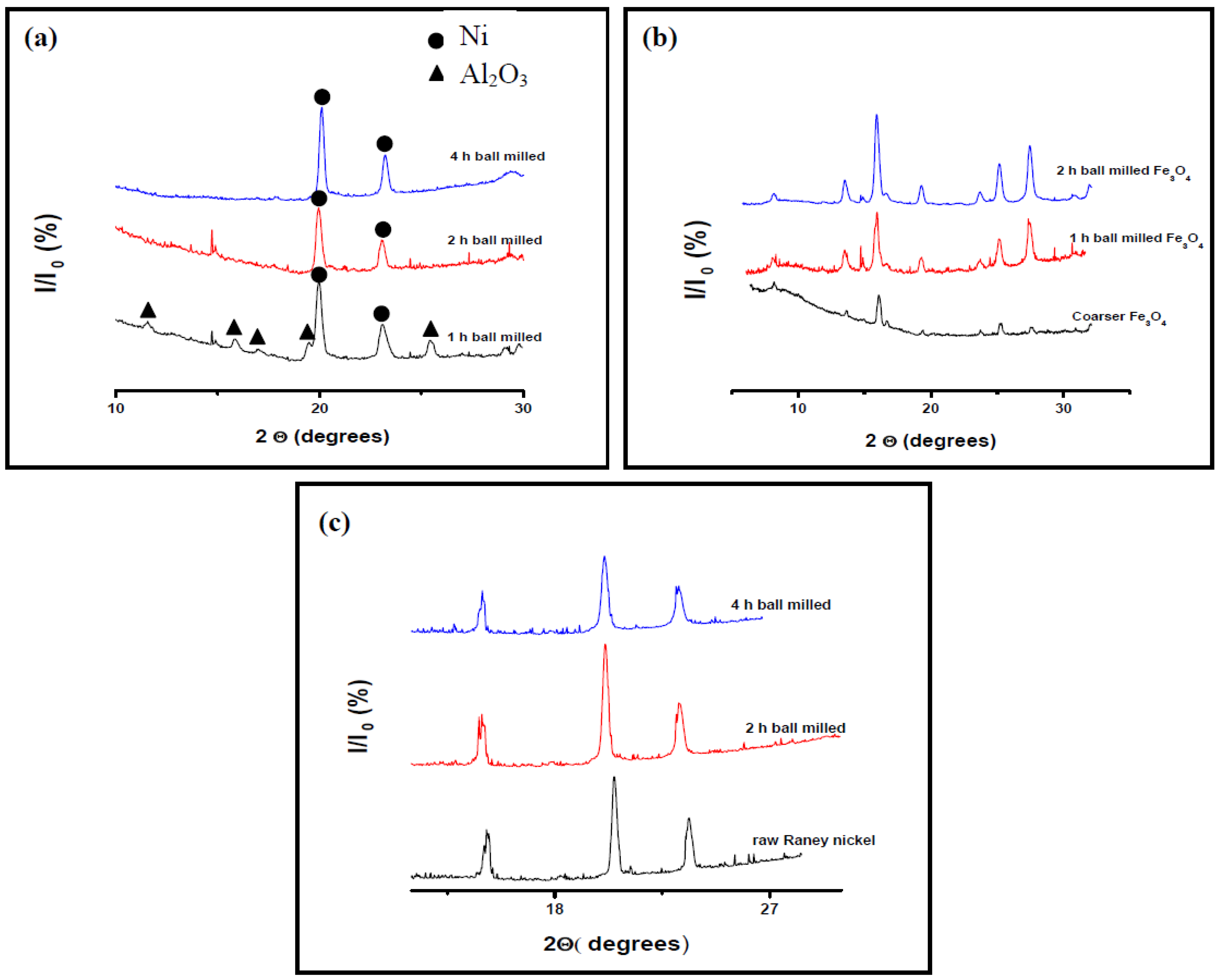
          <p>The powder X-ray diffraction pattern for Al<sub>2</sub>O<sub>3</sub> mixed nickel catalysts (2:1 wt.%) (<xref ref-type="fig" rid="catalysts-02-00532-f001">Figure 1</xref>a) shows the presence of alumina and nickel peaks. Few initial peaks of Al<sub>2</sub>O<sub>3</sub> disappeared as prolonged ball milling was carried out leading to the amorphorization of Al<sub>2</sub>O<sub>3</sub>. No oxidation of nickel was observed throughout the ball milling time. The calculated crystallite sizes for alumina mixed nickel ball milled for 1, 2 and 4 h are 184, 158 and 150 Å respectively.</p>
          <p>X-ray diffraction pattern for Fe<sub>3</sub>O<sub>4</sub> catalyst ball milled for different times are shown in <xref ref-type="fig" rid="catalysts-02-00532-f001">Figure 1</xref>b. As the crystallite sizes decreased due to prolonged ball milling, diffraction peaks shift towards the low angle direction and peak widths increase. The crystallite size of coarser magnetite (in micron) decreased to 181 and 169 Å for 1 and 2 h ball milling time respectively. </p>
          <p><xref ref-type="fig" rid="catalysts-02-00532-f001">Figure 1</xref>c depicts the X-ray diffraction pattern for variously ball milled Raney nickel. Peak width broadening can be observed for prolonged ball milling time. The crystallite sizes for raw, 2 and 4 h ball milled Raney nickel are 413, 209 and 190 Å respectively. <xref ref-type="table" rid="catalysts-02-00532-t001">Table 1</xref> summarizes the crystallite sizes of all the variously ball milled catalysts.</p>
          <p>During the prolonged milling time, the energy produced by ball milling drastically reduces the grain sizes and thus increases the lattice strain. It is a fact that the milling may cause several modifications such as vacancies [<xref ref-type="bibr" rid="B34-catalysts-02-00532">34</xref>]; atomic site interchanges [<xref ref-type="bibr" rid="B32-catalysts-02-00532">32</xref>] and dislocations [<xref ref-type="bibr" rid="B25-catalysts-02-00532">25</xref>]. Raney nickel is composed mainly of single element nickel and hence nullifies the effect of any atomic site interchanges for different ball milling time. Other modifications could be the formation of vacancies and dislocations in the unit cells of the catalysts powder particles. The developed lattice strain caused by mechanical milling is attributed to plastic deformation which is the generation and movement of dislocations [<xref ref-type="bibr" rid="B35-catalysts-02-00532">35</xref>,<xref ref-type="bibr" rid="B36-catalysts-02-00532">36</xref>]. According to Fecht [<xref ref-type="bibr" rid="B37-catalysts-02-00532">37</xref>], the generation and movement of dislocations could decrease grain size. High lattice strain implies to a high density of dislocation formation and which contributes to a reduction in grain size. If the grain size of catalysts particle decreases slowly that means there is a relatively less formation and movement of dislocations. Here, for both 2 h ball milled alumina mixed nickel and 2 h ball milled Raney nickel, there is a relatively higher % reduction in crystallite sizes. This suggests that the mechanical milling caused a severe plastic deformation to these catalysts powder particles.</p>
          <table-wrap id="catalysts-02-00532-t001" position="float">
            <object-id pub-id-type="pii">catalysts-02-00532-t001_Table 1</object-id>
            <label>Table 1</label>
            <caption>
              <p>Crystallite size of variously ball milled catalysts.</p>
            </caption>
            <table>
              <thead>
                <tr>
                  <th align="center" valign="middle">Ball milling time (h)</th>
                  <th align="center" valign="middle">Al<sub>2</sub>O<sub>3</sub> Mixed nickel (Å)</th>
                  <th align="center" valign="middle">Magnetite (Å)</th>
                  <th align="center" valign="middle">Raney nickel (Å)</th>
                </tr>
              </thead>
              <tbody>
                <tr>
                  <td align="center" valign="middle">0</td>
                  <td align="center" valign="middle">-</td>
                  <td align="center" valign="middle">Micron size</td>
                  <td align="center" valign="middle">413</td>
                </tr>
                <tr>
                  <td align="center" valign="middle">1</td>
                  <td align="center" valign="middle">184</td>
                  <td align="center" valign="middle">181</td>
                  <td align="center" valign="middle">-</td>
                </tr>
                <tr>
                  <td align="center" valign="middle">2</td>
                  <td align="center" valign="middle">158</td>
                  <td align="center" valign="middle">169</td>
                  <td align="center" valign="middle">209</td>
                </tr>
                <tr>
                  <td align="center" valign="middle">4</td>
                  <td align="center" valign="middle">150</td>
                  <td align="center" valign="middle">-</td>
                  <td align="center" valign="middle">190</td>
                </tr>
              </tbody>
            </table>
          </table-wrap>
          <fig id="catalysts-02-00532-f001" position="anchor">
            <label>Figure 1</label>
            <caption>
              <p>XRD Pattern for variously ball milled (<bold>a</bold>) Al<sub>2</sub>O<sub>3</sub>: Ni (<bold>b</bold>) magnetite (<bold>c</bold>) Raney nickel.</p>
            </caption>
            <graphic xmlns:xlink="http://www.w3.org/1999/xlink" xlink:href="catalysts-02-00532-g001.tif"/>
          </fig>
        </sec>
        <sec>
          <title>3.1.2. Morphology and Particle Size Analysis</title>
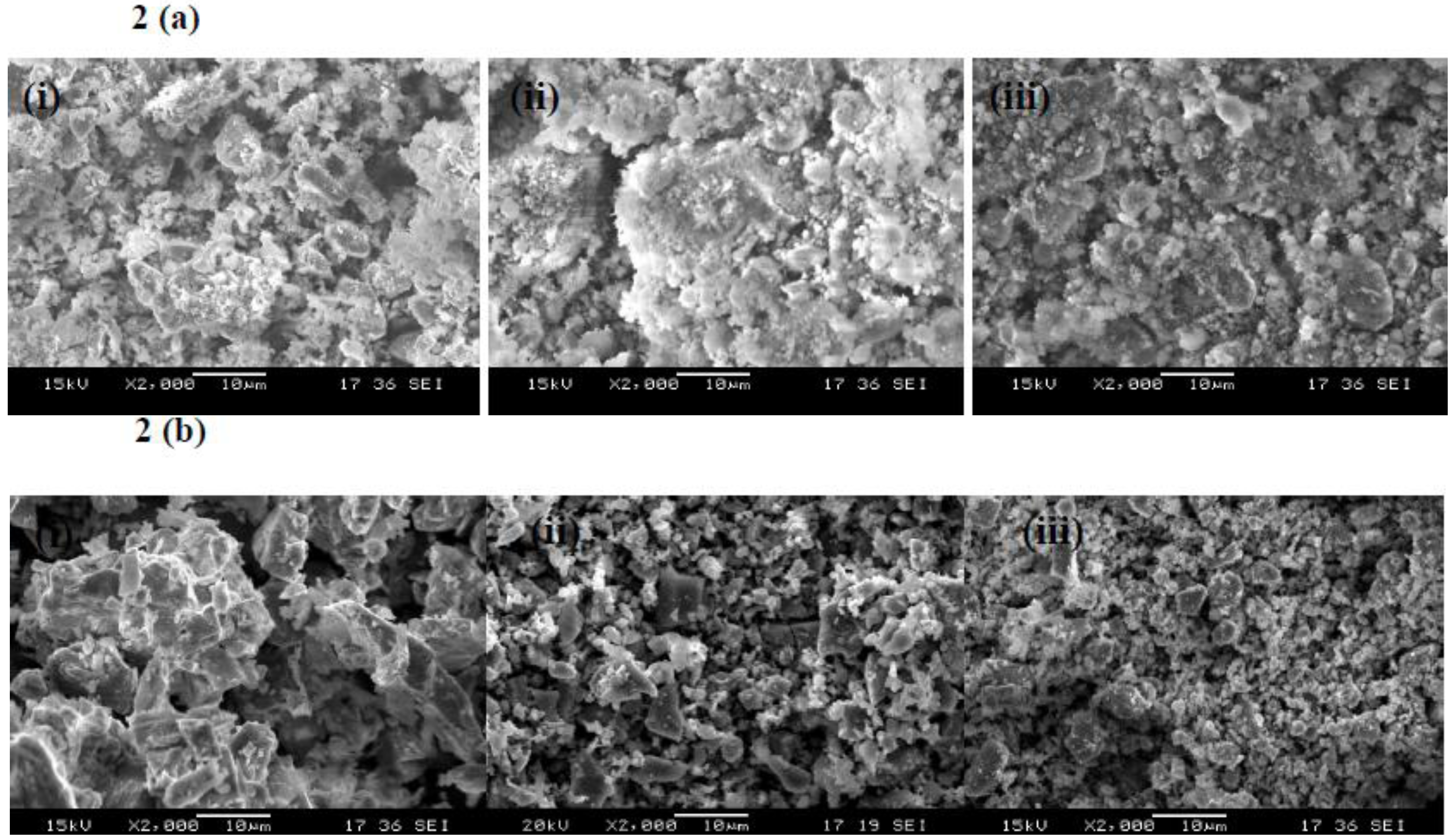
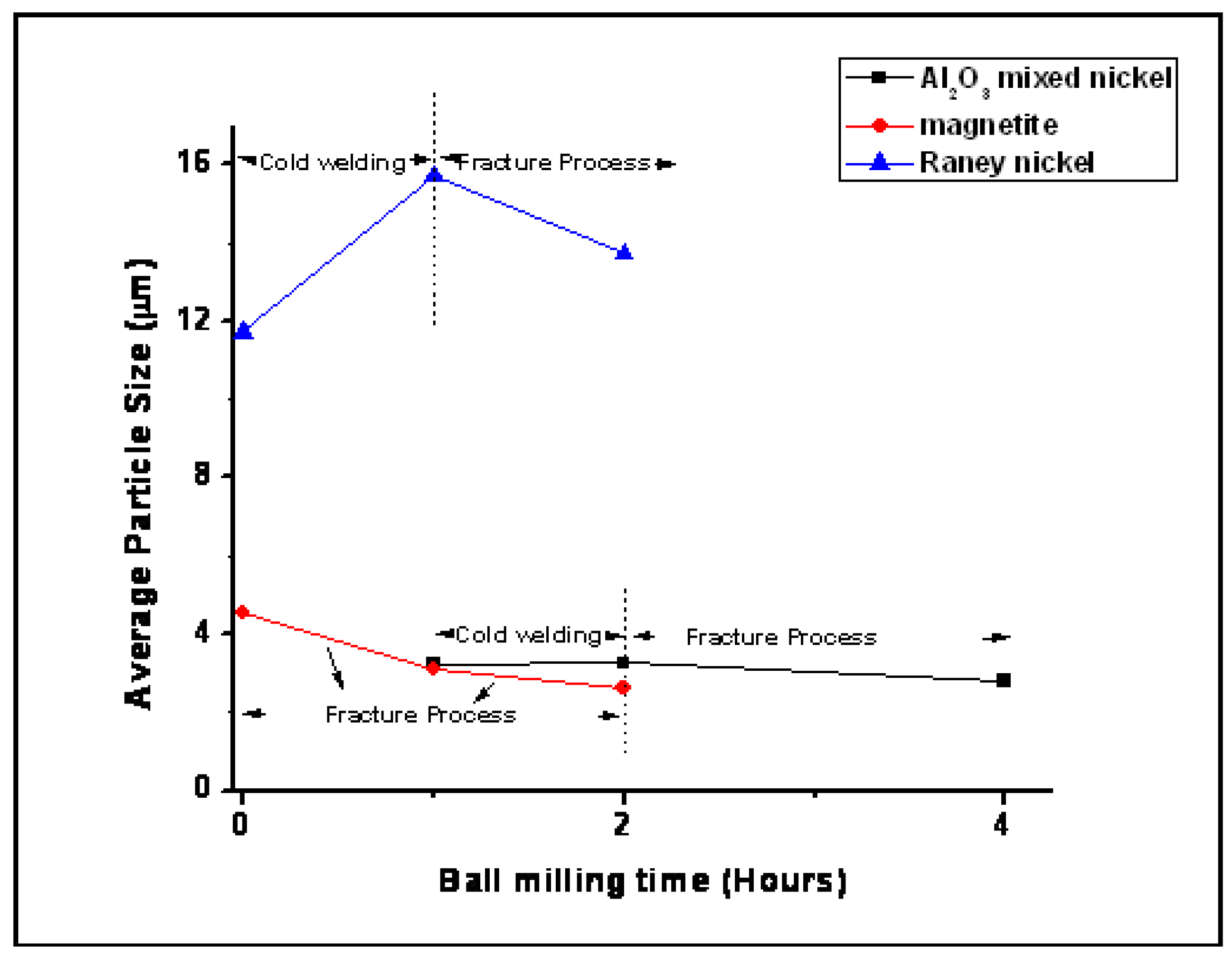
          <p>Scanning electron microscope (SEM) was used to determine the surface morphology of the catalysts. Al<sub>2</sub>O<sub>3</sub> mixed nickel ball milled for 2 h, shown in (<xref ref-type="fig" rid="catalysts-02-00532-f002">Figure 2</xref>a), exhibits sponge- like morphology and consists of many small particles. The average particle sizes are 3.24, 3.26 and 2.80 µm for the milling time of 1, 2 and 4 h, respectively.</p>
          <p><xref ref-type="fig" rid="catalysts-02-00532-f002">Figure 2</xref>b shows the surface morphology for variously ball milled magnetite catalyst particles. Coarse magnetite has relatively larger average particle size. The average particle sizes are 4.56, 3.09 and 2.62 µm for the milling time of 0, 1 and 2 h respectively. One should note that average particle size of magnetite decreases with increase in ball milling time. </p>
          <fig id="catalysts-02-00532-f002" position="anchor">
            <label>Figure 2</label>
            <caption>
              <p>SEM image of (<bold>a</bold>) alumina supported Nickel ball milled for (<bold>i</bold>) 1h. (<bold>ii</bold>) 2 h. (<bold>iii</bold>) 4 h and (<bold>b</bold>) Magnetite ball milled for (<bold>i</bold>) Without (<bold>ii</bold>) 1 h (<bold>iii</bold>) 2 h ball milling at 2000× each.</p>
            </caption>
            <graphic xmlns:xlink="http://www.w3.org/1999/xlink" xlink:href="catalysts-02-00532-g002.tif"/>
          </fig>
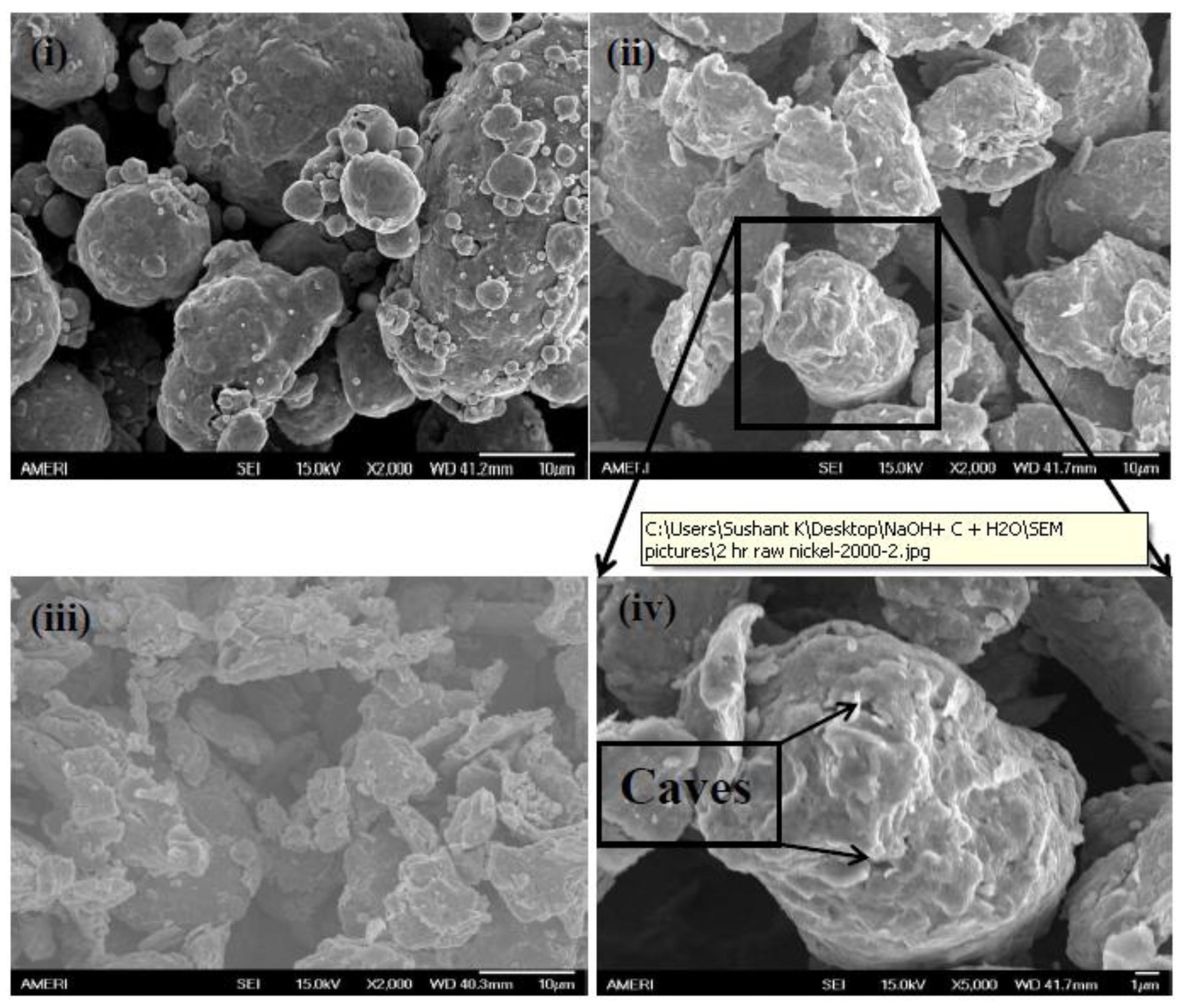
          <p><xref ref-type="fig" rid="catalysts-02-00532-f003">Figure 3</xref> depicts the SEM images for variously ball milled Raney nickel. A relatively high number of openings or caves are observed for 2 h ball milled catalyst as shown in <xref ref-type="fig" rid="catalysts-02-00532-f003">Figure 3</xref>iv. The globular particles of 2 h ball milled catalyst can be assumed to be a stacked layer of flaky disk particles (formed as an attrition product of raw Raney nickel). However, further attrition of these globular particles changed them back to platelet structure (<xref ref-type="fig" rid="catalysts-02-00532-f003">Figure 3</xref>iii).</p>
          <p>Moreover, the sizes of Raney nickel particles varied significantly over different ball milling periods. Initially, raw Raney nickel particles are almost spherical in shape and have a very wide distribution of the particle sizes. The average particle size of raw, 2 and 4 h ball milled Raney nickel are 11.74, 15.72, and 13.72 µm respectively. </p>
          <p>It is well known that milling process is controlled by the two processes of cold welding and fracture [<xref ref-type="bibr" rid="B38-catalysts-02-00532">38</xref>,<xref ref-type="bibr" rid="B39-catalysts-02-00532">39</xref>]. <xref ref-type="fig" rid="catalysts-02-00532-f004">Figure 4</xref> illustrates the change in average particle size with milling time for variously ball milled catalysts. It also demonstrates the dominant stages of milling process with time for different catalysts. The particle size and morphology of catalysts are determined by the competition between cold welding and fracture process. The average particle sizes of Raney nickel increases until 2 h milling time which is attributed to the dominant cold welding process. However, fracture process dominates only after 2 h and causes a decrease in the average particle size for 4 h milling time. Al<sub>2</sub>O<sub>3</sub> mixed nickel catalyst also shows the similar trends. Al<sub>2</sub>O<sub>3</sub> mixed nickel has almost constant particle size for first 2 h and then decrease in the average particle size was observed. It means that initially cold welding was dominant process and after 2 h milling time, it was the fracture process which prevailed. However, magnetite showed a different tendency for the milling process. The decrease in the magnetite average particle size with milling time is due to the dominant fracture process. It should be noted that for Al<sub>2</sub>O<sub>3</sub> mixed nickel and Raney nickel, fracture process dominates only after 2 h milling time.</p>
          <fig id="catalysts-02-00532-f003" position="anchor">
            <label>Figure 3</label>
            <caption>
              <p>SEM image of Raney nickel (<bold>i</bold>) without; (<bold>ii</bold>) 2 h; (<bold>iii</bold>) 4 h ball milling at 2000× each and (<bold>iv</bold>) 2hball milled Raney nickel with pores (at 5000×).</p>
            </caption>
            <graphic xmlns:xlink="http://www.w3.org/1999/xlink" xlink:href="catalysts-02-00532-g003.tif"/>
          </fig>
          <fig id="catalysts-02-00532-f004" position="anchor">
            <label>Figure 4</label>
            <caption>
              <p>Change of average particle size of catalysts with milling time.</p>
            </caption>
            <graphic xmlns:xlink="http://www.w3.org/1999/xlink" xlink:href="catalysts-02-00532-g004.tif"/>
          </fig>
        </sec>
      </sec>
      <sec>
        <title>3.2. Reaction Results</title>
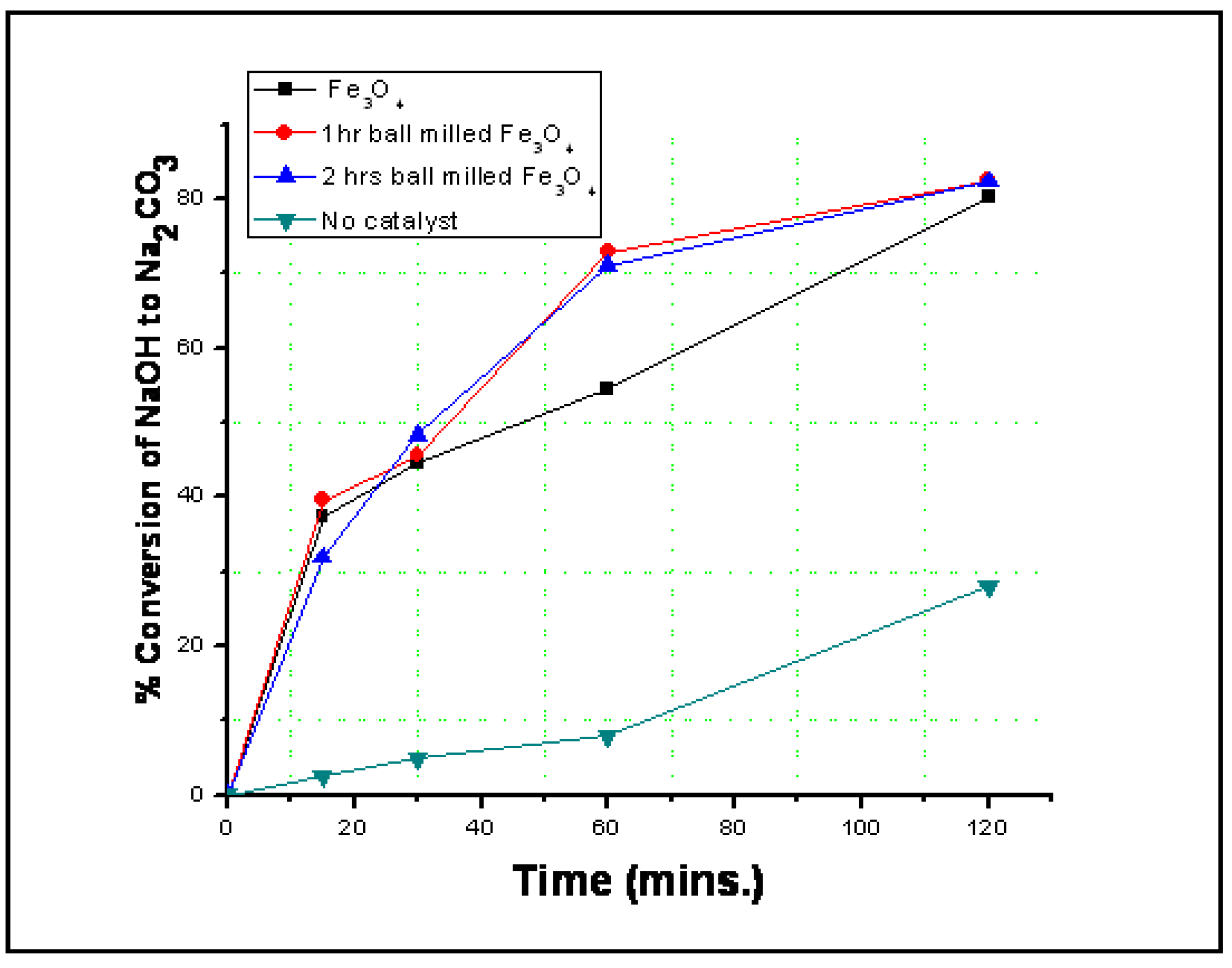
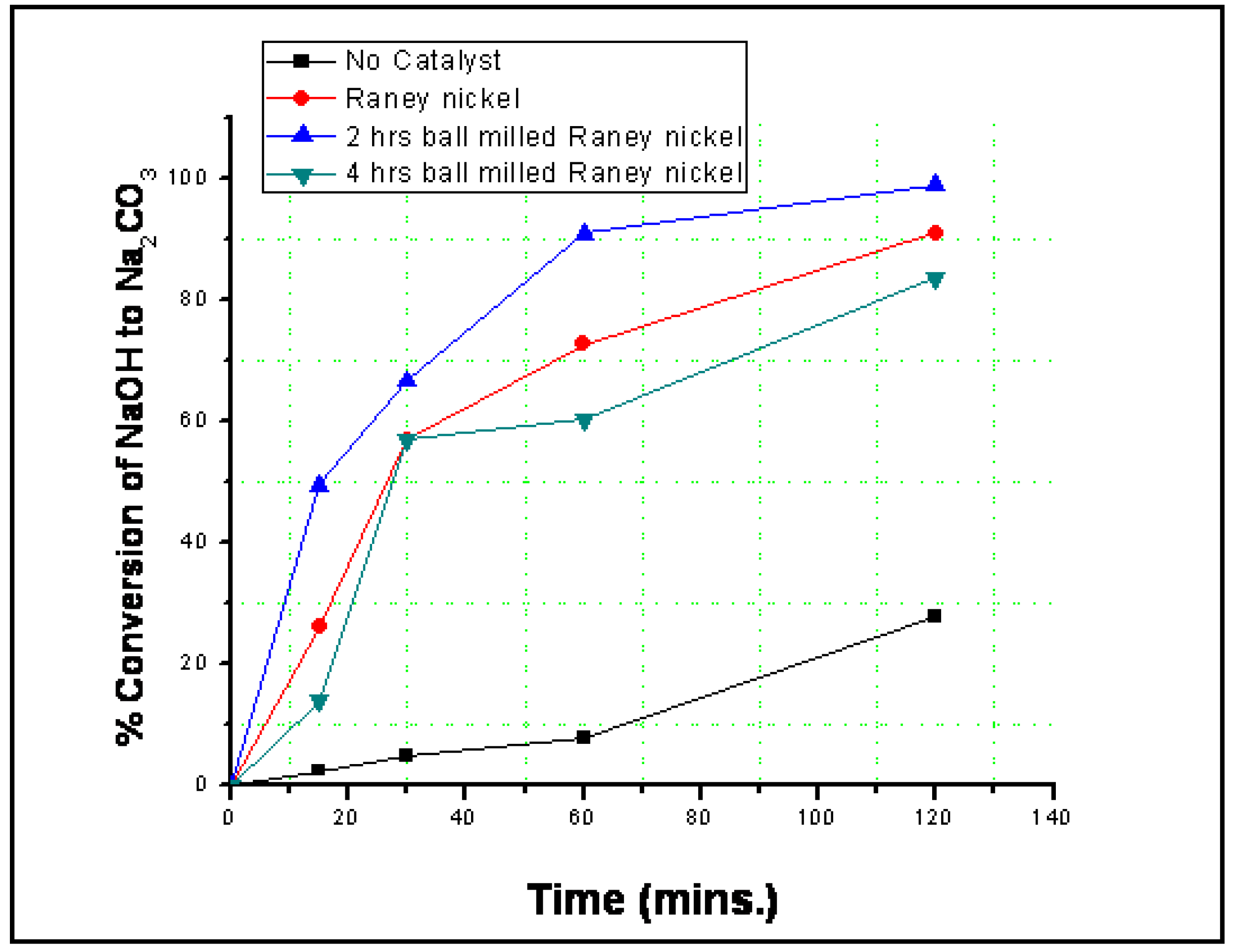
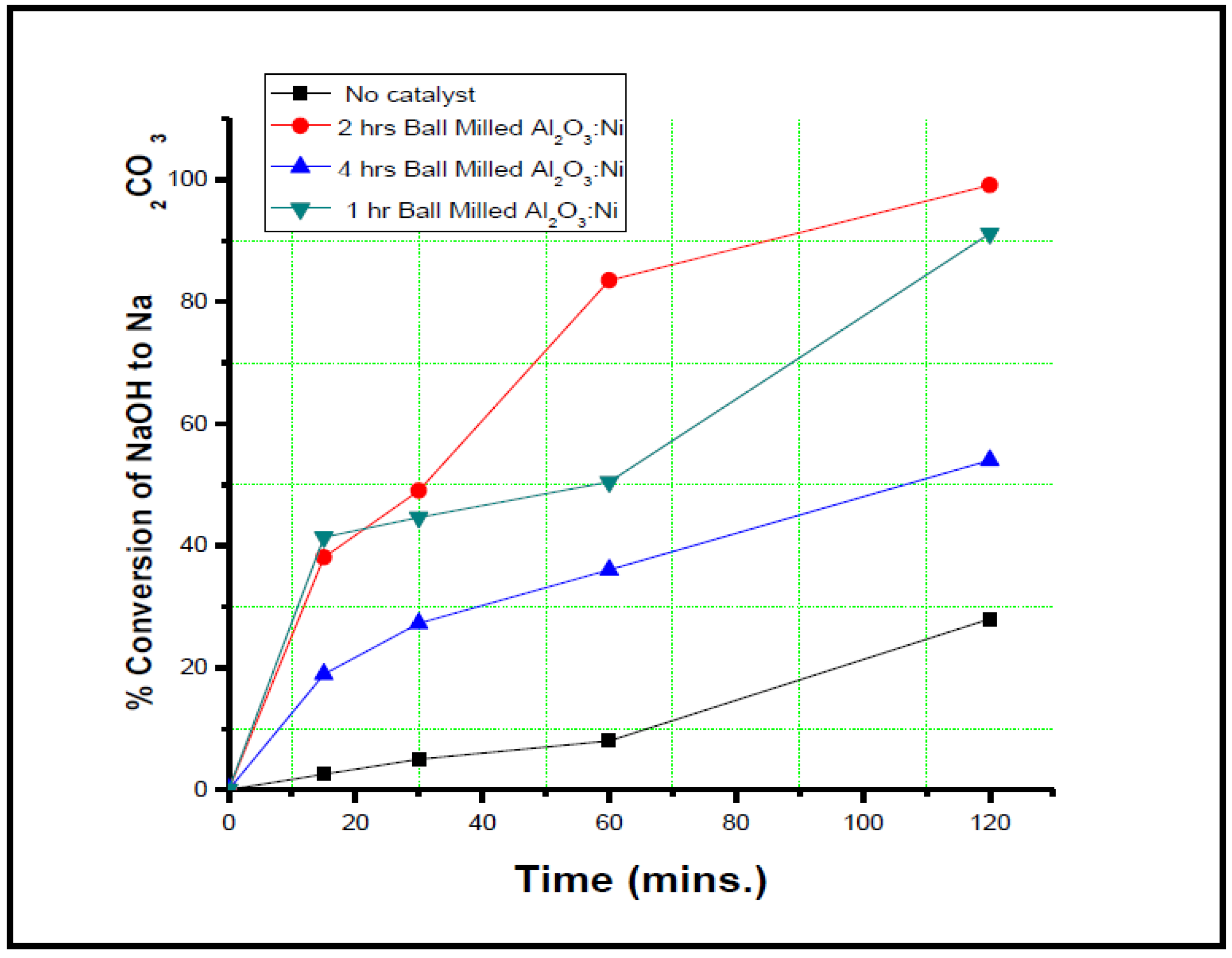
        <p>The curves for % conversion of NaOH to Na<sub>2</sub>CO<sub>3</sub> in the presence of variously ball milled Al<sub>2</sub>O<sub>3</sub> mixed nickel, magnetite and Raney nickel catalysts at 300 °C are shown in <xref ref-type="fig" rid="catalysts-02-00532-f005">Figure 5</xref>, <xref ref-type="fig" rid="catalysts-02-00532-f006">Figure 6</xref> and <xref ref-type="fig" rid="catalysts-02-00532-f007">Figure 7</xref> respectively. A substantial increase in the % conversion of NaOH to Na<sub>2</sub>CO<sub>3</sub> was observed due to addition of the catalyst. However, a clear distinction between the catalytic activities for these catalysts becomes discernible only after a 30 min run (<xref ref-type="fig" rid="catalysts-02-00532-f005">Figure 5</xref>, <xref ref-type="fig" rid="catalysts-02-00532-f006">Figure 6</xref> and <xref ref-type="fig" rid="catalysts-02-00532-f007">Figure 7</xref>). The obvious reason could be due to the formation of product Na<sub>2</sub>CO<sub>3</sub>, which once formed shows catalytic activity for the reaction [<xref ref-type="bibr" rid="B40-catalysts-02-00532">40</xref>]. </p>
        <fig id="catalysts-02-00532-f005" position="anchor">
          <label>Figure 5</label>
          <caption>
            <p>% Conversion of NaOH to Na<sub>2</sub>CO<sub>3</sub> for variously ball milled Al<sub>2</sub>O<sub>3</sub>: Ni (2:1) (wt.%) at 300 °C. 2 h ball milling time has exhibited the best result.</p>
          </caption>
          <graphic xmlns:xlink="http://www.w3.org/1999/xlink" xlink:href="catalysts-02-00532-g005.tif"/>
        </fig>
        <fig id="catalysts-02-00532-f006" position="anchor">
          <label>Figure 6</label>
          <caption>
            <p>% Conversion of NaOH to Na<sub>2</sub>CO<sub>3</sub> for variously ball milled Magnetite at 300 °C. 1 and 2 h Ball milling time has exhibited comparable result.</p>
          </caption>
          <graphic xmlns:xlink="http://www.w3.org/1999/xlink" xlink:href="catalysts-02-00532-g006.tif"/>
        </fig>
        <fig id="catalysts-02-00532-f007" position="anchor">
          <label>Figure 7</label>
          <caption>
            <p>% Conversion of NaOH to Na<sub>2</sub>CO<sub>3</sub> for Raney nickel at 300 °C. 2 h ball milling time has exhibited the best result.</p>
          </caption>
          <graphic xmlns:xlink="http://www.w3.org/1999/xlink" xlink:href="catalysts-02-00532-g007.tif"/>
        </fig>
        <p>A 2 h ball milled Al<sub>2</sub>O<sub>3</sub> mixed nickel catalyst was catalytically most effective compared to other Al<sub>2</sub>O<sub>3</sub> mixed catalysts. The purpose to add Al<sub>2</sub>O<sub>3</sub> with nickel was to avoid the chance of agglomeration. In our previous work [<xref ref-type="bibr" rid="B11-catalysts-02-00532">11</xref>], we observed that nickel particles tend to agglomerate when ball milled in the absence of dispersant (such as alumina) [<xref ref-type="bibr" rid="B11-catalysts-02-00532">11</xref>]. In this study, we have minimized the coalescence by mixing alumina with nickel. X-ray diffraction study (<xref ref-type="fig" rid="catalysts-02-00532-f001">Figure 1</xref>a) confirms the amorphorization of alumina over prolonged milling time. Smaller crystallite size for Al<sub>2</sub>O<sub>3</sub> mixed nickel was generated as ball milling time was increased. Therefore, a better specific surface area and thus a better reaction yield were expected but the amorphorization of alumina particles has caused the reverse effect. Therefore, the effective surface area available for the adsorption of the gas was decreased and hence a relatively lower reaction yield was observed. Higher mechanical attrition and thermally induced deactivation could be another major cause for low catalytic activity of 4 h alumina mixed nickel. It can also be observed that the maximum% reduction in crystallite size was observed for 2 h of ball milling time for alumina mixed nickel catalysts. Therefore, an increase in the formation and movement of dislocations or vacancies as well as exchange of atomic site positions have led to the increased catalytic activity for 2 h ball milled alumina mixed nickel catalysts.</p>
        <p>In the experiments using magnetite as a catalyst, the reaction yield shows a similar reaction yield for 1 and 2 h milling time (<xref ref-type="fig" rid="catalysts-02-00532-f006">Figure 6</xref>). Due to the larger crystallite size, coarser magnetite has a low surface area to volume ratio. The poor reaction yield in the presence of coarser magnetite was in consistent with its relative larger particle size. When magnetite was milled for 1 h, crystallite size reduced from several microns to 181 Å and that causes an increase in the catalytic activity. But for 2 h milling time, crystallite size reduced by only 12 Å compared to 1 h ball milled magnetite. Therefore, there is a relatively less plastic deformation for 2 h ball milled magnetite. Hence, 2 h ball milled exhibited identical catalytic activity to that of 1 h. Thus, it can be stated that the reaction yield goes hand in hand to the particle size of magnetite. 1 and 2 h ball milled magnetite has comparable crystallite size and therefore their reaction yields are also similar. </p>
        <p>The effect for the use of Raney nickel catalyst on reaction (1) is illustrated in <xref ref-type="fig" rid="catalysts-02-00532-f007">Figure 7</xref>. The curve shows that 2 h ball milled Raney nickel catalysts have the best results. 4 h ball milled Raney nickel catalysts have a low catalytic effect on reaction (1). The deactivation of 4 h ball milled Raney nickel can be due to either a high mechanical abrasion of the catalysts surface or thermally induced deactivation. The cold welding process dominates until 2 h of mechanical milling time for Raney nickel catalysts. As well as maximum % reduction in crystallite size was also observed for 2 h milling time only. Therefore, a large number of formations and movement of dislocations or vacancies have led to an increased catalytic activity for 2 h ball milled Raney nickel catalysts. However, there is a relatively less reduction in the crystallite size for 4 h milling time. Moreover, X-ray diffraction pattern for 4 h ball milling time clearly shows the amorphorization for the catalyst. Hence, 4 h milling time decreased the catalytic activity of Raney nickel. </p>
        <p>Raw Raney nickel has a very wide distribution of particle sizes. Due to globular shape, they possess higher surface area. The globular particles are formed by the agglomeration of the disk-shaped particles by folding, enclosure, unfolding and pile-up [<xref ref-type="bibr" rid="B41-catalysts-02-00532">41</xref>]. Large number of open pores or caves formation allowed 2 h ball milled Raney nickel to show the highest catalytic activity compared to others. In summary, globular particles for Raney nickel has shown a better effect on reaction (1) compared to platelet like structure. </p>
      </sec>
    </sec>
    <sec sec-type="conclusions">
      <title>4. Conclusions</title>
      <p>The exothermic reaction between NaOH and CO leads to the formation of Na<sub>2</sub>CO<sub>3</sub> and H<sub>2</sub>. This method of generating H<sub>2</sub> can be regarded as a carbon-free emission method. At 300 °C in the presence of 2 h ball milled alumina mixed nickel or Raney nickel catalyst, the reaction showed almost 100% conversion for a 120 min run. However, in the presence of 2 h ball milled Raney nickel, reaction (1) has highest % conversion of NaOH to Na<sub>2</sub>CO<sub>3</sub> at any reaction time. In conclusion, 2 h ball milled globular Raney nickel has an overall best effect for NaOH-CO reaction. Moreover, particle size of the catalysts has an effect on the reaction yield. Longer milling causes a decrease in the catalytic activity for both alumina mixed nickel or Raney nickel catalysts. The equal crystallite size of 1 and 2 h ball milled magnetite has shown similar reaction yield. </p>
    </sec>
  </body>
  <back>
    <ref-list>
      <title>References</title>
      <ref id="B1-catalysts-02-00532">
        <label>1.</label>
        <citation citation-type="journal">
          <person-group person-group-type="author">
            <name>
              <surname>Saxena</surname>
              <given-names>S.</given-names>
            </name>
            <name>
              <surname>Kumar</surname>
              <given-names>S.</given-names>
            </name>
            <name>
              <surname>Drozd</surname>
              <given-names>V.A.</given-names>
            </name>
          </person-group>
          <article-title>Modified steam-methane-reformation reaction for hydrogen production</article-title>
          <source>Int. J. Hydrog. Energy</source>
          <year>2011</year>
          <volume>36</volume>
          <fpage>4366</fpage>
          <lpage>4369</lpage>
          <pub-id pub-id-type="doi">10.1016/j.ijhydene.2010.12.133</pub-id>
        </citation>
      </ref>
      <ref id="B2-catalysts-02-00532">
        <label>2.</label>
        <citation citation-type="journal">
          <person-group person-group-type="author">
            <name>
              <surname>Saxena</surname>
              <given-names>S.K.</given-names>
            </name>
            <name>
              <surname>Drozd</surname>
              <given-names>V.</given-names>
            </name>
            <name>
              <surname>Durygin</surname>
              <given-names>A.</given-names>
            </name>
          </person-group>
          <article-title>A fossil-fuel based recipe for clean energy</article-title>
          <source>Int. J. Hydrog. Energy</source>
          <year>2008</year>
          <volume>33</volume>
          <fpage>3625</fpage>
          <lpage>3631</lpage>
          <pub-id pub-id-type="doi">10.1016/j.ijhydene.2008.04.050</pub-id>
        </citation>
      </ref>
      <ref id="B3-catalysts-02-00532">
        <label>3.</label>
        <citation citation-type="journal">
          <person-group person-group-type="author">
            <name>
              <surname>Reichman</surname>
              <given-names>B.</given-names>
            </name>
            <name>
              <surname>Mays</surname>
              <given-names>W.</given-names>
            </name>
            <name>
              <surname>Strebe</surname>
              <given-names>J.</given-names>
            </name>
            <name>
              <surname>Fetcenko</surname>
              <given-names>M.</given-names>
            </name>
          </person-group>
          <article-title>Ovonic Renewable Hydrogen (ORH—low temperature hydrogen from renewable fuels</article-title>
          <source>Int. J. Hydrog. Energy</source>
          <year>2010</year>
          <volume>35</volume>
          <fpage>4918</fpage>
          <lpage>4924</lpage>
          <pub-id pub-id-type="doi">10.1016/j.ijhydene.2009.08.097</pub-id>
        </citation>
      </ref>
      <ref id="B4-catalysts-02-00532">
        <label>4.</label>
        <citation citation-type="journal">
          <person-group person-group-type="author">
            <name>
              <surname>Kamo</surname>
              <given-names>T.</given-names>
            </name>
            <name>
              <surname>Takaoka</surname>
              <given-names>K.</given-names>
            </name>
            <name>
              <surname>Otomo</surname>
              <given-names>J.</given-names>
            </name>
            <name>
              <surname>Takahashi</surname>
              <given-names>H.</given-names>
            </name>
          </person-group>
          <article-title>Effect of steam and sodium hydroxide for the production of hydrogen on gasification of dehydrochlrinated poly (vinyl chloride)</article-title>
          <source>Fuel</source>
          <year>2006</year>
          <volume>85</volume>
          <fpage>1052</fpage>
          <lpage>1059</lpage>
          <pub-id pub-id-type="doi">10.1016/j.fuel.2005.10.002</pub-id>
        </citation>
      </ref>
      <ref id="B5-catalysts-02-00532">
        <label>5.</label>
        <citation citation-type="journal">
          <person-group person-group-type="author">
            <name>
              <surname>Onwudili</surname>
              <given-names>J.A.</given-names>
            </name>
            <name>
              <surname>Williams</surname>
              <given-names>P.T.</given-names>
            </name>
          </person-group>
          <article-title>Role of sodium hydroxide in the production of hydrogen gas from the hydrothermal gasification of biomass</article-title>
          <source>Int. J. Hydrog. Energy</source>
          <year>2009</year>
          <volume>34</volume>
          <fpage>5645</fpage>
          <lpage>5656</lpage>
          <pub-id pub-id-type="doi">10.1016/j.ijhydene.2009.05.082</pub-id>
        </citation>
      </ref>
      <ref id="B6-catalysts-02-00532">
        <label>6.</label>
        <citation citation-type="journal">
          <person-group person-group-type="author">
            <name>
              <surname>Wang</surname>
              <given-names>H.Z.</given-names>
            </name>
            <name>
              <surname>Leung</surname>
              <given-names>D.Y.C.</given-names>
            </name>
            <name>
              <surname>Leung</surname>
              <given-names>M.K.H.</given-names>
            </name>
          </person-group>
          <article-title>A review on hydrogen production using aluminum and aluminum alloys</article-title>
          <source>Renew. Sustain. Energy Rev.</source>
          <year>2009</year>
          <volume>13</volume>
          <fpage>845</fpage>
          <lpage>853</lpage>
          <pub-id pub-id-type="doi">10.1016/j.rser.2008.02.009</pub-id>
        </citation>
      </ref>
      <ref id="B7-catalysts-02-00532">
        <label>7.</label>
        <citation citation-type="journal">
          <person-group person-group-type="author">
            <name>
              <surname>Ahmad</surname>
              <given-names>S.</given-names>
            </name>
            <name>
              <surname>Aitani</surname>
              <given-names>A.</given-names>
            </name>
            <name>
              <surname>Rahman</surname>
              <given-names>F.</given-names>
            </name>
            <name>
              <surname>Al-Dawood</surname>
              <given-names>A.</given-names>
            </name>
            <name>
              <surname>Al-Muhaish</surname>
              <given-names>F.</given-names>
            </name>
          </person-group>
          <article-title>Decomposition of hydrocarbons to hydrogen and carbon</article-title>
          <source>Appl. Catal. A</source>
          <year>2009</year>
          <volume>359</volume>
          <fpage>1</fpage>
          <lpage>24</lpage>
          <pub-id pub-id-type="doi">10.1016/j.apcata.2009.02.038</pub-id>
        </citation>
      </ref>
      <ref id="B8-catalysts-02-00532">
        <label>8.</label>
        <citation citation-type="journal">
          <person-group person-group-type="author">
            <name>
              <surname>Muradov</surname>
              <given-names>N.</given-names>
            </name>
          </person-group>
          <article-title>Hydrogen via methane decomposition: An application for decarbonization of fossil fuels</article-title>
          <source>Int. J. Hydrog. Energy</source>
          <year>2001</year>
          <volume>26</volume>
          <fpage>1165</fpage>
          <lpage>1175</lpage>
          <pub-id pub-id-type="doi">10.1016/S0360-3199(01)00073-8</pub-id>
        </citation>
      </ref>
      <ref id="B9-catalysts-02-00532">
        <label>9.</label>
        <citation citation-type="journal">
          <person-group person-group-type="author">
            <name>
              <surname>Drozd</surname>
              <given-names>V.</given-names>
            </name>
            <name>
              <surname>Saxena</surname>
              <given-names>S.K.</given-names>
            </name>
            <name>
              <surname>Garimella</surname>
              <given-names>S.V.</given-names>
            </name>
            <name>
              <surname>Durygin</surname>
              <given-names>A.</given-names>
            </name>
          </person-group>
          <article-title>Hydrogen release from a mixture of NaBH<sub>4</sub> and Mg(OH)<sub>2</sub></article-title>
          <source>Int. J. Hydrog. Energy</source>
          <year>2007</year>
          <volume>32</volume>
          <fpage>3370</fpage>
          <lpage>3375</lpage>
          <pub-id pub-id-type="doi">10.1016/j.ijhydene.2007.02.007</pub-id>
        </citation>
      </ref>
      <ref id="B10-catalysts-02-00532">
        <label>10.</label>
        <citation citation-type="journal">
          <person-group person-group-type="author">
            <name>
              <surname>Kalinci</surname>
              <given-names>Y.</given-names>
            </name>
            <name>
              <surname>Hepbasli</surname>
              <given-names>A.</given-names>
            </name>
            <name>
              <surname>Dincer</surname>
              <given-names>I.</given-names>
            </name>
          </person-group>
          <article-title>Biomass-based hydrogen production: A review and analysis</article-title>
          <source>Int. J. Hydrog. Energy</source>
          <year>2009</year>
          <volume>34</volume>
          <fpage>8799</fpage>
          <lpage>8817</lpage>
          <pub-id pub-id-type="doi">10.1016/j.ijhydene.2009.08.078</pub-id>
        </citation>
      </ref>
      <ref id="B11-catalysts-02-00532">
        <label>11.</label>
        <citation citation-type="journal">
          <person-group person-group-type="author">
            <name>
              <surname>Kumar</surname>
              <given-names>S.</given-names>
            </name>
            <name>
              <surname>Saxena</surname>
              <given-names>S.</given-names>
            </name>
            <name>
              <surname>Drozd</surname>
              <given-names>V.A.</given-names>
            </name>
          </person-group>
          <article-title>Modified method for production of Hydrogen from Methane</article-title>
          <source>Int. J. Energy Res.</source>
          <year>2012</year>
          <volume>36</volume>
          <fpage>1133</fpage>
          <lpage>1138</lpage>
          <pub-id pub-id-type="doi">10.1002/er.1854</pub-id>
        </citation>
      </ref>
      <ref id="B12-catalysts-02-00532">
        <label>12.</label>
        <citation citation-type="journal">
          <person-group person-group-type="author">
            <name>
              <surname>Muradova</surname>
              <given-names>N.Z.</given-names>
            </name>
            <name>
              <surname>Veziroglu</surname>
              <given-names>T.N.</given-names>
            </name>
          </person-group>
          <article-title>Green path from fossil-based to hydrogen economy: An overview of carbon-neutral technologies</article-title>
          <source>Int. J. Hydrog. Energy</source>
          <year>2008</year>
          <volume>33</volume>
          <fpage>6804</fpage>
          <lpage>6839</lpage>
          <pub-id pub-id-type="doi">10.1016/j.ijhydene.2008.08.054</pub-id>
        </citation>
      </ref>
      <ref id="B13-catalysts-02-00532">
        <label>13.</label>
        <citation citation-type="journal">
          <person-group person-group-type="author">
            <name>
              <surname>Ishida</surname>
              <given-names>M.</given-names>
            </name>
            <name>
              <surname>Otsuka</surname>
              <given-names>K.</given-names>
            </name>
            <name>
              <surname>Takenaka</surname>
              <given-names>S.</given-names>
            </name>
            <name>
              <surname>Yamanaka</surname>
              <given-names>I.</given-names>
            </name>
          </person-group>
          <article-title>One-step production of CO- and CO<sub>2</sub> -free hydrogen from biomass</article-title>
          <source>J. Chem. Tech. Biotech.</source>
          <year>2005</year>
          <volume>80</volume>
          <fpage>281</fpage>
          <lpage>284</lpage>
          <pub-id pub-id-type="doi">10.1002/jctb.1188</pub-id>
        </citation>
      </ref>
      <ref id="B14-catalysts-02-00532">
        <label>14.</label>
        <citation citation-type="journal">
          <person-group person-group-type="author">
            <name>
              <surname>Su</surname>
              <given-names>S.</given-names>
            </name>
            <name>
              <surname>Li</surname>
              <given-names>W.</given-names>
            </name>
            <name>
              <surname>Bai</surname>
              <given-names>Z.</given-names>
            </name>
            <name>
              <surname>Xiang</surname>
              <given-names>H.</given-names>
            </name>
            <name>
              <surname>Bai</surname>
              <given-names>J.</given-names>
            </name>
          </person-group>
          <article-title>Effects of ionic catalysis on hydrogen production by the steam gasification of cellulose</article-title>
          <source>Int. J. Hydrog. Energy</source>
          <year>2010</year>
          <volume>35</volume>
          <fpage>4459</fpage>
          <lpage>4465</lpage>
          <pub-id pub-id-type="doi">10.1016/j.ijhydene.2010.02.066</pub-id>
        </citation>
      </ref>
      <ref id="B15-catalysts-02-00532">
        <label>15.</label>
        <citation citation-type="journal">
          <person-group person-group-type="author">
            <name>
              <surname>Pistonesi</surname>
              <given-names>C.</given-names>
            </name>
            <name>
              <surname>Juan</surname>
              <given-names>A.</given-names>
            </name>
            <name>
              <surname>Irigoyen</surname>
              <given-names>B.</given-names>
            </name>
            <name>
              <surname>Amadeo</surname>
              <given-names>N.</given-names>
            </name>
          </person-group>
          <article-title>Theoretical and experimental study of methane steam reforming reactions over nickel catalyst</article-title>
          <source>Appl. Surface Sci.</source>
          <year>2007</year>
          <volume>253</volume>
          <fpage>4427</fpage>
          <lpage>4437</lpage>
          <pub-id pub-id-type="doi">10.1016/j.apsusc.2006.09.054</pub-id>
        </citation>
      </ref>
      <ref id="B16-catalysts-02-00532">
        <label>16.</label>
        <citation citation-type="journal">
          <person-group person-group-type="author">
            <name>
              <surname>Matsumura</surname>
              <given-names>Y.</given-names>
            </name>
            <name>
              <surname>Nakamori</surname>
              <given-names>T.</given-names>
            </name>
          </person-group>
          <article-title>Steam reforming of methane over nickel catalysts at low reaction temperature</article-title>
          <source>Appl. Catal.</source>
          <year>2004</year>
          <volume>258</volume>
          <fpage>107</fpage>
          <lpage>114</lpage>
          <pub-id pub-id-type="doi">10.1016/j.apcata.2003.08.009</pub-id>
        </citation>
      </ref>
      <ref id="B17-catalysts-02-00532">
        <label>17.</label>
        <citation citation-type="journal">
          <person-group person-group-type="author">
            <name>
              <surname>Hou</surname>
              <given-names>K.</given-names>
            </name>
            <name>
              <surname>Hughes</surname>
              <given-names>R.</given-names>
            </name>
          </person-group>
          <article-title>The kinetics of methane steam reforming over a Ni/α-Al<sub>2</sub>O catalyst</article-title>
          <source>Chem. Eng. J.</source>
          <year>2001</year>
          <volume>82</volume>
          <fpage>311</fpage>
          <lpage>328</lpage>
          <pub-id pub-id-type="doi">10.1016/S1385-8947(00)00367-3</pub-id>
        </citation>
      </ref>
      <ref id="B18-catalysts-02-00532">
        <label>18.</label>
        <citation citation-type="journal">
          <person-group person-group-type="author">
            <name>
              <surname>Numaguchi</surname>
              <given-names>T.</given-names>
            </name>
            <name>
              <surname>Shoji</surname>
              <given-names>K.</given-names>
            </name>
            <name>
              <surname>Yoshida</surname>
              <given-names>S.</given-names>
            </name>
          </person-group>
          <article-title>Hydrogen effect on α-Al<sub>2</sub>O<sub>3</sub> supported Ni catalyst for steam methane reforming reaction</article-title>
          <source>Appl. Catal. A</source>
          <year>1995</year>
          <volume>133</volume>
          <fpage>241</fpage>
          <lpage>262</lpage>
          <pub-id pub-id-type="doi">10.1016/0926-860X(95)00188-3</pub-id>
        </citation>
      </ref>
      <ref id="B19-catalysts-02-00532">
        <label>19.</label>
        <citation citation-type="journal">
          <person-group person-group-type="author">
            <name>
              <surname>Nozaki</surname>
              <given-names>T.</given-names>
            </name>
            <name>
              <surname>Muto</surname>
              <given-names>N.</given-names>
            </name>
            <name>
              <surname>Kado</surname>
              <given-names>S.</given-names>
            </name>
            <name>
              <surname>Okazaki</surname>
              <given-names>K.</given-names>
            </name>
          </person-group>
          <article-title>Dissociation of vibrationally excited methane on Ni catalyst Part 1. Application to methane steam reforming</article-title>
          <source>Catal. Today</source>
          <year>2004</year>
          <volume>89</volume>
          <fpage>57</fpage>
          <lpage>65</lpage>
        <pub-id pub-id-type="doi">10.1016/j.cattod.2003.11.040</pub-id></citation>
      </ref>
      <ref id="B20-catalysts-02-00532">
        <label>20.</label>
        <citation citation-type="journal">
          <person-group person-group-type="author">
            <name>
              <surname>Hauptmann</surname>
              <given-names>H.</given-names>
            </name>
            <name>
              <surname>Walter</surname>
              <given-names>W.F.</given-names>
            </name>
          </person-group>
          <article-title>The action of raney nickel on organic sulfur compounds</article-title>
          <source>Chem. Rev.</source>
          <year>1962</year>
          <volume>62</volume>
          <fpage>347</fpage>
          <lpage>404</lpage>
          <pub-id pub-id-type="doi">10.1021/cr60219a001</pub-id>
        </citation>
      </ref>
      <ref id="B21-catalysts-02-00532">
        <label>21.</label>
        <citation citation-type="journal">
          <person-group person-group-type="author">
            <name>
              <surname>Gerhard</surname>
              <given-names>E.</given-names>
            </name>
            <name>
              <surname>Helmut</surname>
              <given-names>K.</given-names>
            </name>
          </person-group>
          <article-title>Bulk Catalysts and supports</article-title>
          <source>Prep. Solid Catal.</source>
          <year>1997</year>
          <volume>1</volume>
          <fpage>30</fpage>
          <lpage>34</lpage>
        </citation>
      </ref>
      <ref id="B22-catalysts-02-00532">
        <label>22.</label>
        <citation citation-type="journal">
          <person-group person-group-type="author">
            <name>
              <surname>Lund</surname>
              <given-names>C.R.F.</given-names>
            </name>
            <name>
              <surname>Kubsh</surname>
              <given-names>J.E.</given-names>
            </name>
            <name>
              <surname>Dumesic</surname>
              <given-names>J.A.</given-names>
            </name>
          </person-group>
          <article-title>Water-Gas Shift Over Magnetite-Based Catalysts: Nature of Active Sites for Adsorption and Catalysis</article-title>
          <source>ACS Symp. Ser.</source>
          <year>1985</year>
          <volume>279</volume>
          <fpage>313</fpage>
          <pub-id pub-id-type="doi">10.1021/bk-1985-0279.ch019</pub-id>
        </citation>
      </ref>
      <ref id="B23-catalysts-02-00532">
        <label>23.</label>
        <citation citation-type="journal">
          <person-group person-group-type="author">
            <name>
              <surname>Rethwisch</surname>
              <given-names>D.G.</given-names>
            </name>
            <name>
              <surname>Phillips</surname>
              <given-names>J.</given-names>
            </name>
            <name>
              <surname>Chen</surname>
              <given-names>Y.</given-names>
            </name>
            <name>
              <surname>Hayden</surname>
              <given-names>T.F.</given-names>
            </name>
            <name>
              <surname>Dumesic</surname>
              <given-names>J.A.</given-names>
            </name>
          </person-group>
          <article-title>Water gas shift over magnetite particles supported on graphite: Effects of treatments in CO/CO<sub>2</sub> and H<sub>2</sub>/H<sub>2</sub>O gas mixtures</article-title>
          <source>J. Catal.</source>
          <year>1985</year>
          <volume>91</volume>
          <fpage>167</fpage>
          <lpage>180</lpage>
        <pub-id pub-id-type="doi">10.1016/0021-9517(85)90298-2</pub-id></citation>
      </ref>
      <ref id="B24-catalysts-02-00532">
        <label>24.</label>
        <citation citation-type="journal">
          <person-group person-group-type="author">
            <name>
              <surname>Beeck</surname>
              <given-names>O.</given-names>
            </name>
          </person-group>
          <article-title>Catalysis and the Adsorption of Hydrogen on Metal Catalysts</article-title>
          <source>Adv. Catal.</source>
          <year>1950</year>
          <volume>2</volume>
          <fpage>151</fpage>
          <lpage>195</lpage>
          <pub-id pub-id-type="doi">10.1016/S0360-0564(08)60377-6</pub-id>
        </citation>
      </ref>
      <ref id="B25-catalysts-02-00532">
        <label>25.</label>
        <citation citation-type="journal">
          <person-group person-group-type="author">
            <name>
              <surname>Trapnell</surname>
              <given-names>B.M.W.</given-names>
            </name>
          </person-group>
          <article-title>Specificity in catalysis by metals</article-title>
          <source>Quart. Rev.</source>
          <year>1954</year>
          <volume>8</volume>
          <fpage>404</fpage>
          <lpage>421</lpage>
          <pub-id pub-id-type="doi">10.1039/qr9540800404</pub-id>
        </citation>
      </ref>
      <ref id="B26-catalysts-02-00532">
        <label>26.</label>
        <citation citation-type="book">
          <person-group person-group-type="author">
            <name>
              <surname>Gregg</surname>
              <given-names>S.J.</given-names>
            </name>
          </person-group>
          <source>The Surface Chemistry of Solids</source>
          <publisher-name>Reinhold Pub. Corp.</publisher-name>
          <publisher-loc>New York, NY, USA</publisher-loc>
          <year>1969</year>
          <fpage>233</fpage>
        </citation>
      </ref>
      <ref id="B27-catalysts-02-00532">
        <label>27.</label>
        <citation citation-type="journal">
          <person-group person-group-type="author">
            <name>
              <surname>Beeck</surname>
              <given-names>O.</given-names>
            </name>
          </person-group>
          <article-title>Catalysis—A challenge to the Physicist</article-title>
          <source>Rev. Mod. Phys.</source>
          <year>1945</year>
          <volume>17</volume>
          <fpage>61</fpage>
          <lpage>71</lpage>
          <pub-id pub-id-type="doi">10.1103/RevModPhys.17.61</pub-id>
        </citation>
      </ref>
      <ref id="B28-catalysts-02-00532">
        <label>28.</label>
        <citation citation-type="journal">
          <person-group person-group-type="author">
            <name>
              <surname>Couper</surname>
              <given-names>A.</given-names>
            </name>
            <name>
              <surname>Eley</surname>
              <given-names>D.D.</given-names>
            </name>
          </person-group>
          <article-title>The parahydrogen conversion of palladium-gold alloys</article-title>
          <source>Discuss. Faraday Soc.</source>
          <year>1950</year>
          <volume>8</volume>
          <fpage>172</fpage>
          <lpage>184</lpage>
          <pub-id pub-id-type="doi">10.1039/df9500800172</pub-id>
        </citation>
      </ref>
      <ref id="B29-catalysts-02-00532">
        <label>29.</label>
        <citation citation-type="journal">
          <person-group person-group-type="author">
            <name>
              <surname>Dowden</surname>
              <given-names>D.A.</given-names>
            </name>
            <name>
              <surname>Reynolds</surname>
              <given-names>P.W.</given-names>
            </name>
          </person-group>
          <article-title>Some reactions over alloy catalysts</article-title>
          <source>Discuss. Faraday Soc.</source>
          <year>1950</year>
          <volume>8</volume>
          <fpage>184</fpage>
          <lpage>190</lpage>
          <pub-id pub-id-type="doi">10.1039/df9500800184</pub-id>
        </citation>
      </ref>
      <ref id="B30-catalysts-02-00532">
        <label>30.</label>
        <citation citation-type="journal">
          <person-group person-group-type="author">
            <name>
              <surname>Hofer</surname>
              <given-names>E.M.</given-names>
            </name>
            <name>
              <surname>Hintermann</surname>
              <given-names>H.E.</given-names>
            </name>
          </person-group>
          <article-title>Correlation between catalytic activity of Raney nickel and its structure</article-title>
          <source>Trans. Faraday Soc.</source>
          <year>1964</year>
          <volume>60</volume>
          <fpage>1457</fpage>
          <lpage>1465</lpage>
          <pub-id pub-id-type="doi">10.1039/tf9646001457</pub-id>
        </citation>
      </ref>
      <ref id="B31-catalysts-02-00532">
        <label>31.</label>
        <citation citation-type="journal">
          <person-group person-group-type="author">
            <name>
              <surname>Suryanarayan</surname>
              <given-names>C.</given-names>
            </name>
          </person-group>
          <article-title>Mechanical alloying and milling</article-title>
          <source>Prog. Mater. Sci.</source>
          <year>2001</year>
          <volume>46</volume>
          <fpage>1</fpage>
          <lpage>184</lpage>
          <pub-id pub-id-type="doi">10.1016/S0079-6425(99)00010-9</pub-id>
        </citation>
      </ref>
      <ref id="B32-catalysts-02-00532">
        <label>32.</label>
        <citation citation-type="journal">
          <person-group person-group-type="author">
            <name>
              <surname>Koch</surname>
              <given-names>C.C.</given-names>
            </name>
          </person-group>
          <article-title>Synthesis of nanostructured materials by mechanical milling: Problems and opportunities</article-title>
          <source>Nanostruct. Mater.</source>
          <year>1997</year>
          <volume>9</volume>
          <fpage>13</fpage>
          <lpage>22</lpage>
          <pub-id pub-id-type="doi">10.1016/S0965-9773(97)00014-7</pub-id>
        </citation>
      </ref>
      <ref id="B33-catalysts-02-00532">
        <label>33.</label>
        <citation citation-type="journal">
          <person-group person-group-type="author">
            <name>
              <surname>Guerrero-Paz</surname>
              <given-names>J.</given-names>
            </name>
            <name>
              <surname>Jaramillo-Vigueras</surname>
              <given-names>D.</given-names>
            </name>
          </person-group>
          <article-title>Nanometric grain formation in ductile powders by low energy ball milling</article-title>
          <source>Nanostruct. Mater.</source>
          <year>1999</year>
          <volume>11</volume>
          <fpage>1123</fpage>
          <lpage>1132</lpage>
          <pub-id pub-id-type="doi">10.1016/S0965-9773(99)00403-1</pub-id>
        </citation>
      </ref>
      <ref id="B34-catalysts-02-00532">
        <label>34.</label>
        <citation citation-type="journal">
          <person-group person-group-type="author">
            <name>
              <surname>Zhou</surname>
              <given-names>L.Z.</given-names>
            </name>
            <name>
              <surname>Guo</surname>
              <given-names>J.T.</given-names>
            </name>
            <name>
              <surname>Jiang</surname>
              <given-names>T.D.</given-names>
            </name>
            <name>
              <surname>Wang</surname>
              <given-names>S.H.</given-names>
            </name>
          </person-group>
          <article-title>Investigation of defects in a mechanically alloyed nanocrystalline NiAl alloy by positron annihilation spectroscopy</article-title>
          <source>J. Mater. Sci. Lett.</source>
          <year>1998</year>
          <volume>17</volume>
          <fpage>137</fpage>
          <lpage>139</lpage>
        </citation>
      </ref>
      <ref id="B35-catalysts-02-00532">
        <label>35.</label>
        <citation citation-type="journal">
          <person-group person-group-type="author">
            <name>
              <surname>Liang</surname>
              <given-names>G.</given-names>
            </name>
            <name>
              <surname>Huot</surname>
              <given-names>J.</given-names>
            </name>
            <name>
              <surname>Schulz</surname>
              <given-names>R.</given-names>
            </name>
          </person-group>
          <article-title>Hydrogen storage properties of the mechanically alloyed LaNi5-based materials</article-title>
          <source>J. Alloys Compd.</source>
          <year>2001</year>
          <volume>320</volume>
          <fpage>133</fpage>
          <lpage>139</lpage>
          <pub-id pub-id-type="doi">10.1016/S0925-8388(01)00929-X</pub-id>
        </citation>
      </ref>
      <ref id="B36-catalysts-02-00532">
        <label>36.</label>
        <citation citation-type="journal">
          <person-group person-group-type="author">
            <name>
              <surname>Mohamed</surname>
              <given-names>F.A.</given-names>
            </name>
          </person-group>
          <article-title>A dislocation model for the minimum grain size obtainable by milling</article-title>
          <source>Acta Mater.</source>
          <year>2003</year>
          <volume>51</volume>
          <fpage>4107</fpage>
          <lpage>4119</lpage>
          <pub-id pub-id-type="doi">10.1016/S1359-6454(03)00230-1</pub-id>
        </citation>
      </ref>
      <ref id="B37-catalysts-02-00532">
        <label>37.</label>
        <citation citation-type="journal">
          <person-group person-group-type="author">
            <name>
              <surname>Fecht</surname>
              <given-names>H.J.</given-names>
            </name>
          </person-group>
          <article-title>Nanostructure formation by mechanical attrition</article-title>
          <source>Nanostruct. Mater.</source>
          <year>1995</year>
          <volume>6</volume>
          <fpage>33</fpage>
          <lpage>42</lpage>
          <pub-id pub-id-type="doi">10.1016/0965-9773(95)00027-5</pub-id>
        </citation>
      </ref>
      <ref id="B38-catalysts-02-00532">
        <label>38.</label>
        <citation citation-type="journal">
          <person-group person-group-type="author">
            <name>
              <surname>Zhou</surname>
              <given-names>J.B.</given-names>
            </name>
            <name>
              <surname>Rao</surname>
              <given-names>K.P.</given-names>
            </name>
          </person-group>
          <article-title>Structure and morphology evolution during mechanical alloying Ti-Al-Si powder systems</article-title>
          <source>J. Alloys Compd.</source>
          <year>2004</year>
          <volume>384</volume>
          <fpage>125</fpage>
          <lpage>130</lpage>
          <pub-id pub-id-type="doi">10.1016/j.jallcom.2004.03.127</pub-id>
        </citation>
      </ref>
      <ref id="B39-catalysts-02-00532">
        <label>39.</label>
        <citation citation-type="journal">
          <person-group person-group-type="author">
            <name>
              <surname>Zhao</surname>
              <given-names>X.</given-names>
            </name>
            <name>
              <surname>Ding</surname>
              <given-names>Y.</given-names>
            </name>
            <name>
              <surname>Ma</surname>
              <given-names>L.</given-names>
            </name>
            <name>
              <surname>Shen</surname>
              <given-names>X.</given-names>
            </name>
            <name>
              <surname>Xu</surname>
              <given-names>S.</given-names>
            </name>
          </person-group>
          <article-title>Structure, morphology and electrocatalytic characteristics if nickel powders treated by mechanical milling</article-title>
          <source>Int. J. Hydrog. Energy</source>
          <year>2008</year>
          <volume>33</volume>
          <fpage>6351</fpage>
          <lpage>6356</lpage>
          <pub-id pub-id-type="doi">10.1016/j.ijhydene.2008.07.117</pub-id>
        </citation>
      </ref>
      <ref id="B40-catalysts-02-00532">
        <label>40.</label>
        <citation citation-type="book">
          <person-group person-group-type="author">
            <name>
              <surname>Lee</surname>
              <given-names>S.</given-names>
            </name>
          </person-group>
          <source>Alternative Fuels</source>
          <publisher-name>Taylors&amp; Francis</publisher-name>
          <publisher-loc>Washington, DC, USA</publisher-loc>
          <year>1996</year>
          <fpage>127</fpage>
        </citation>
      </ref>
      <ref id="B41-catalysts-02-00532">
        <label>41.</label>
        <citation citation-type="journal">
          <person-group person-group-type="author">
            <name>
              <surname>Lee</surname>
              <given-names>G.G.</given-names>
            </name>
            <name>
              <surname>Hashimoto</surname>
              <given-names>H.</given-names>
            </name>
            <name>
              <surname>Watanabe</surname>
              <given-names>R.</given-names>
            </name>
          </person-group>
          <article-title>Development of Particle Morphology during Dry Ball Milling of Cu Powder</article-title>
          <source>Mater. Trans. JIM</source>
          <year>1995</year>
          <volume>36</volume>
          <fpage>548</fpage>
          <lpage>554</lpage>
        </citation>
      </ref>
    </ref-list>
  </back>
</article>