<?xml version="1.0" encoding="UTF-8"?>
<!DOCTYPE article PUBLIC "-//NLM//DTD Journal Publishing DTD v2.3 20070202//EN" "journalpublishing.dtd">
<article xmlns:mml="http://www.w3.org/1998/Math/MathML" xmlns:xlink="http://www.w3.org/1999/xlink" xml:lang="en" article-type="research-article">
  <front>
    <journal-meta>
      <journal-id journal-id-type="publisher-id">games</journal-id>
      <journal-title>Games</journal-title>
      <abbrev-journal-title abbrev-type="publisher">Games</abbrev-journal-title>
      <abbrev-journal-title abbrev-type="pubmed">games</abbrev-journal-title>
      <issn pub-type="epub">2073-4336</issn>
      <publisher>
        <publisher-name>MDPI</publisher-name>
      </publisher>
    </journal-meta>
    <article-meta>
      <article-id pub-id-type="doi">10.3390/g4010021</article-id>
      <article-id pub-id-type="publisher-id">games-04-00021</article-id>
      <article-categories>
        <subj-group>
          <subject>Article</subject>
        </subj-group>
      </article-categories>
      <title-group>
        <article-title>An Equilibrium Analysis of Knaster’s Fair Division Procedure</article-title>
      </title-group>
      <contrib-group>
        <contrib contrib-type="author">
          <name>
            <surname>Van Essen</surname>
            <given-names>Matt</given-names>
          </name>
        </contrib>
      </contrib-group>
      <aff id="af1-games-04-00021">Department of Economics, Finance, and Legal Studies, University of Alabama, Tuscaloosa, AL 35487, USA; E-Mail: <email>mjvanessen@cba.ua.edu</email></aff>
      <pub-date pub-type="epub">
        <day>18</day>
        <month>01</month>
        <year>2013</year>
      </pub-date>
      <pub-date pub-type="collection">
        <month>03</month>
        <year>2013</year>
      </pub-date>
      <volume>4</volume>
      <issue>1</issue>
      <fpage>21</fpage>
      <lpage>37</lpage>
      <history>
        <date date-type="received">
          <day>19</day>
          <month>10</month>
          <year>2012</year>
        </date>
        <date date-type="rev-recd">
          <day>08</day>
          <month>01</month>
          <year>2013</year>
        </date>
        <date date-type="accepted">
          <day>08</day>
          <month>01</month>
          <year>2013</year>
        </date>
      </history>
      <permissions>
        <copyright-statement>© 2013 by the authors; licensee MDPI, Basel, Switzerland.</copyright-statement>
        <copyright-year>2013</copyright-year>
        <license xmlns:xlink="http://www.w3.org/1999/xlink" license-type="open-access" xlink:href="http://creativecommons.org/licenses/by/3.0/">
          <p>This article is an open-access article distributed under the terms and conditions of the Creative Commons Attribution license (http://creativecommons.org/licenses/by/3.0/).</p>
        </license>
      </permissions>
      <abstract>
        <p>In an incomplete information setting, we analyze the sealed bid auction proposed by Knaster (cf. Steinhaus (1948)). This procedure was designed to efficiently and fairly allocate multiple indivisible items when participants report their valuations truthfully. In equilibrium, players do not follow truthful bidding strategies. We find that, ex-post, the equilibrium allocation is still efficient but may not be fair. However, on average, participants receive the same outcome they would have received if everyone had reported truthfully—<italic>i.e.</italic>, the mechanism is ex-ante fair.</p>
      </abstract>
      <kwd-group kwd-group-type="keywords">
	  <title>Keywords</title>
        <kwd>fair division</kwd>
        <kwd>auction</kwd>
      </kwd-group>
      <kwd-group kwd-group-type="JEL Codes">
	  <title>JEL Codes</title>
        <kwd>C72</kwd>
        <kwd>C78</kwd>
        <kwd>C82</kwd>
      </kwd-group>
    </article-meta>
  </front>
  <body>
    <sec sec-type="intro">
      <title>1. Introduction</title>
      <p>This paper conducts an equilibrium analysis of a sealed-bid auction proposed by famed mathematician Bronislaw Knaster. This auction was designed to <italic>efficiently</italic> and <italic>fairly</italic> allocate multiple indivisible items and has played an important role in the early development of the fair division literature.<xref ref-type="fn" rid="fn001-games-04-00021">1</xref> As in standard auctions, players in Knaster’s auction simultaneously submit a bid for each of the items, where each item is allocated to the bidder who submitted the highest bid for that item. Unlike standard auctions, however, the winning bidder of each item compensates the losing bidders in the form of side payments.<xref ref-type="fn" rid="fn002-games-04-00021">2</xref> When players are truthful, Knaster’s process generates an efficient assignment of the indivisible items and side payments so that each person receives, in their view, a <italic>proportional outcome</italic>.<xref ref-type="fn" rid="fn003-games-04-00021">3</xref> This is a basic notion of fairness. The workings of auction are best introduced via a simple “inheritance” example.<xref ref-type="fn" rid="fn004-games-04-00021">4</xref></p>
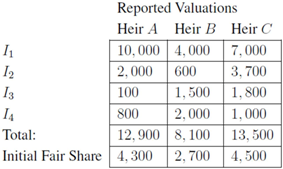
      <p>Suppose Ann, Bob, and Carol are heirs to an estate containing four indivisible objects <inline-graphic xmlns:xlink="http://www.w3.org/1999/xlink" xlink:href="games-04-00021-i001.tif"/>, <inline-graphic xmlns:xlink="http://www.w3.org/1999/xlink" xlink:href="games-04-00021-i002.tif"/>, <inline-graphic xmlns:xlink="http://www.w3.org/1999/xlink" xlink:href="games-04-00021-i003.tif"/>, and <inline-graphic xmlns:xlink="http://www.w3.org/1999/xlink" xlink:href="games-04-00021-i004.tif"/>. The heirs have an equal clam to the objects and are looking to “ fairly” divide these items using Knaster’s procedure. In particular, each heir submits a bid for each item. In the table below, we display bid vectors for the three heirs, the sum of these bids (or total reported value), and each bidder’s <italic>initial fair share</italic>—<italic>i.e.</italic>, <inline-graphic xmlns:xlink="http://www.w3.org/1999/xlink" xlink:href="games-04-00021-i005.tif"/> of their total reported value.</p>
      <disp-formula id="games-04-00021-i006">
          <inline-graphic xmlns:xlink="http://www.w3.org/1999/xlink" xlink:href="games-04-00021-i006.tif"/>
          </disp-formula>
      <p>Knaster’s procedure allocates each item to the highest bidder and uses these bid vectors to determine side payments for each player. In particular, side payments are constructed so that each heir receives an equal “surplus” over their initial fair share.</p>
      <p>Since items go to the high bidder, heir <inline-graphic xmlns:xlink="http://www.w3.org/1999/xlink" xlink:href="games-04-00021-i007.tif"/> receives <inline-graphic xmlns:xlink="http://www.w3.org/1999/xlink" xlink:href="games-04-00021-i001.tif"/>, heir <inline-graphic xmlns:xlink="http://www.w3.org/1999/xlink" xlink:href="games-04-00021-i008.tif"/> receives <inline-graphic xmlns:xlink="http://www.w3.org/1999/xlink" xlink:href="games-04-00021-i004.tif"/>, and heir <inline-graphic xmlns:xlink="http://www.w3.org/1999/xlink" xlink:href="games-04-00021-i009.tif"/> receives items <inline-graphic xmlns:xlink="http://www.w3.org/1999/xlink" xlink:href="games-04-00021-i002.tif"/> and <inline-graphic xmlns:xlink="http://www.w3.org/1999/xlink" xlink:href="games-04-00021-i003.tif"/>. These items received create value for the recipient. The amount of value created above the initial fair share for the recipient is the bidder’s <italic>initial excess</italic> valuation. If we add up the initial excess values for the three heirs we get <italic>surplus</italic>. In this example, the surplus is 6000.
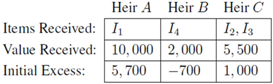
      <disp-formula id="games-04-00021-i010">
          <inline-graphic xmlns:xlink="http://www.w3.org/1999/xlink" xlink:href="games-04-00021-i010.tif"/>
          </disp-formula>
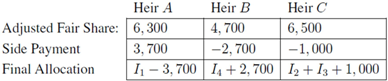
      Next, we divide the surplus equally among the participants and add this amount to each participant’s initial fair share to compute an <italic>adjusted fair share</italic>. An individual’s side payment is their value received minus their total adjusted fair share.</p>
      <disp-formula id="games-04-00021-i011">
          <inline-graphic xmlns:xlink="http://www.w3.org/1999/xlink" xlink:href="games-04-00021-i011.tif"/>
          </disp-formula>
      <p>In summary, Knaster’s procedure awards each of the items to the high bidder and the bidders “ pay” their final excess valuation (players with negative excess valuation receive a payment). Heirs leave the auction with value equal to their adjusted fair share. In the example, <inline-graphic xmlns:xlink="http://www.w3.org/1999/xlink" xlink:href="games-04-00021-i007.tif"/> ends up with item 1 and pays $3700 to compensate the other two heirs, <inline-graphic xmlns:xlink="http://www.w3.org/1999/xlink" xlink:href="games-04-00021-i008.tif"/> gets item 4 and receives $2700, <inline-graphic xmlns:xlink="http://www.w3.org/1999/xlink" xlink:href="games-04-00021-i009.tif"/> receives items <inline-graphic xmlns:xlink="http://www.w3.org/1999/xlink" xlink:href="games-04-00021-i012.tif"/> and <inline-graphic xmlns:xlink="http://www.w3.org/1999/xlink" xlink:href="games-04-00021-i013.tif"/> and receives $1000. By construction, the side payment made by <inline-graphic xmlns:xlink="http://www.w3.org/1999/xlink" xlink:href="games-04-00021-i007.tif"/> balances with the amounts paid to <inline-graphic xmlns:xlink="http://www.w3.org/1999/xlink" xlink:href="games-04-00021-i008.tif"/> and <inline-graphic xmlns:xlink="http://www.w3.org/1999/xlink" xlink:href="games-04-00021-i009.tif"/>.</p>
      <p>Knaster’s procedure generates efficient proportional outcomes when the heirs report truthfully.<xref ref-type="fn" rid="fn005-games-04-00021">5</xref> Despite this nice property, Knaster’s auction is vulnerable to manipulation if the players have knowledge of one another’s preferences. Suppose, for instance, Heir B increases his bid for item 1 from $4000 to $9400. Each bidder still wins the same items, however <inline-graphic xmlns:xlink="http://www.w3.org/1999/xlink" xlink:href="games-04-00021-i008.tif"/>’s side payment (compensation) increases from to $2700 to $3900, which is a clear improvement for <inline-graphic xmlns:xlink="http://www.w3.org/1999/xlink" xlink:href="games-04-00021-i008.tif"/>. Kuhn (1967) provides a similar example in his analysis of Knaster’s procedure and concludes by saying,
	  <disp-quote>
      <p>“ The numbers in this example have been chosen only to exhibit the advantages that can accrue to a player who falsely portrays his own valuations with a knowledge of the other player’s true valuations. It points up a clear need for an analysis of the strategic opportunities of this situation.”</p>
	  </disp-quote></p>
      <p>It is unclear, however, if such manipulation could or would take place when bidder information is incomplete. We therefore seek to answer Kuhn’s call for strategic analysis of Knaster’s auction, but provide the analysis in an incomplete information setting. In <xref ref-type="sec" rid="sec2-games-04-00021">Section 2</xref>, we model Knaster’s procedure as a sealed bid auction. In <xref ref-type="sec" rid="sec3-games-04-00021">Section 3</xref>, we find equilibrium bidding strategies for the Bayesian game induced by Knaster’s auction. Welfare consequences of strategic behavior are explored in <xref ref-type="sec" rid="sec4-games-04-00021">Section 4</xref>.</p>
    </sec>
    <sec id="sec2-games-04-00021">
      <title>2. Knaster’s Fair Division Procedure</title>
      <p>In this section, we formalize Knaster’s procedure as an auction.<xref ref-type="fn" rid="fn006-games-04-00021">6</xref> Let <inline-graphic xmlns:xlink="http://www.w3.org/1999/xlink" xlink:href="games-04-00021-i014.tif"/> be a set of <inline-graphic xmlns:xlink="http://www.w3.org/1999/xlink" xlink:href="games-04-00021-i015.tif"/> unrelated items to be allocated among <inline-graphic xmlns:xlink="http://www.w3.org/1999/xlink" xlink:href="games-04-00021-i016.tif"/> heirs, whom we shall henceforth refer to as players. Each player <inline-graphic xmlns:xlink="http://www.w3.org/1999/xlink" xlink:href="games-04-00021-i017.tif"/> assigns the value <inline-graphic xmlns:xlink="http://www.w3.org/1999/xlink" xlink:href="games-04-00021-i018.tif"/> to item <inline-graphic xmlns:xlink="http://www.w3.org/1999/xlink" xlink:href="games-04-00021-i019.tif"/>, for <inline-graphic xmlns:xlink="http://www.w3.org/1999/xlink" xlink:href="games-04-00021-i020.tif"/>. The <inline-graphic xmlns:xlink="http://www.w3.org/1999/xlink" xlink:href="games-04-00021-i021.tif"/> private values for each item <inline-graphic xmlns:xlink="http://www.w3.org/1999/xlink" xlink:href="games-04-00021-i019.tif"/> are independently distributed according to cumulative distribution function <inline-graphic xmlns:xlink="http://www.w3.org/1999/xlink" xlink:href="games-04-00021-i022.tif"/> with support <inline-graphic xmlns:xlink="http://www.w3.org/1999/xlink" xlink:href="games-04-00021-i023.tif"/>, where the probability density function of <inline-graphic xmlns:xlink="http://www.w3.org/1999/xlink" xlink:href="games-04-00021-i022.tif"/> by <inline-graphic xmlns:xlink="http://www.w3.org/1999/xlink" xlink:href="games-04-00021-i024.tif"/> Individual values are private, but the distribution function for each item is known to all players. Last, since objects are unrelated, the value to a player of receiving multiple items is simply the sum of each item’s value.</p>

      <p>Knaster’s procedure solicits bids from each player and uses this information to make an allocation decision. Specifically, each player submits a bid vector <inline-graphic xmlns:xlink="http://www.w3.org/1999/xlink" xlink:href="games-04-00021-i025.tif"/> to a mediator who awards each item to the high bidder. Thus, player <inline-graphic xmlns:xlink="http://www.w3.org/1999/xlink" xlink:href="games-04-00021-i017.tif"/> is awarded item <inline-graphic xmlns:xlink="http://www.w3.org/1999/xlink" xlink:href="games-04-00021-i026.tif"/> if <inline-graphic xmlns:xlink="http://www.w3.org/1999/xlink" xlink:href="games-04-00021-i027.tif"/>.<xref ref-type="fn" rid="fn007-games-04-00021">7</xref> Next, side payments are computed for each item <inline-graphic xmlns:xlink="http://www.w3.org/1999/xlink" xlink:href="games-04-00021-i026.tif"/> as follows:
	  <list list-type="order">
	  <list-item>
      <p>First, each player <inline-graphic xmlns:xlink="http://www.w3.org/1999/xlink" xlink:href="games-04-00021-i017.tif"/>’s <italic>initial fair share</italic> of item <inline-graphic xmlns:xlink="http://www.w3.org/1999/xlink" xlink:href="games-04-00021-i019.tif"/> (defined as <inline-graphic xmlns:xlink="http://www.w3.org/1999/xlink" xlink:href="games-04-00021-i028.tif"/>-th of their reported value) is computed—<italic>i.e</italic><italic>.</italic>,
	  <disp-formula id="games-04-00021-i029">
          <inline-graphic xmlns:xlink="http://www.w3.org/1999/xlink" xlink:href="games-04-00021-i029.tif"/>
          </disp-formula></p>
	  </list-item>
	  <list-item>
      <p>Second, <italic>surplus</italic> value for unit <inline-graphic xmlns:xlink="http://www.w3.org/1999/xlink" xlink:href="games-04-00021-i019.tif"/> (defined as the difference between the high bid and the average bid) is computed—<italic>i.e</italic><italic>.</italic>, 
	  <disp-formula id="games-04-00021-i030">
          <inline-graphic xmlns:xlink="http://www.w3.org/1999/xlink" xlink:href="games-04-00021-i030.tif"/>
          </disp-formula></p>
	  </list-item>
	  <list-item>
      <p>Third, a player <inline-graphic xmlns:xlink="http://www.w3.org/1999/xlink" xlink:href="games-04-00021-i017.tif"/>’s <italic>adjusted fair share</italic> is computed from the bids. This is the player’s initial fair share of item <inline-graphic xmlns:xlink="http://www.w3.org/1999/xlink" xlink:href="games-04-00021-i026.tif"/> plus an even share of the surplus—<italic>i.e</italic><italic>.</italic>, 
	  <disp-formula id="games-04-00021-i031">
          <inline-graphic xmlns:xlink="http://www.w3.org/1999/xlink" xlink:href="games-04-00021-i031.tif"/>
          </disp-formula>
		  <disp-formula id="games-04-00021-i032">
          <inline-graphic xmlns:xlink="http://www.w3.org/1999/xlink" xlink:href="games-04-00021-i032.tif"/>
          </disp-formula></p>
	  </list-item>
	  <list-item>
      <p>Last, player <inline-graphic xmlns:xlink="http://www.w3.org/1999/xlink" xlink:href="games-04-00021-i017.tif"/>’s <italic>side payment</italic> for item <inline-graphic xmlns:xlink="http://www.w3.org/1999/xlink" xlink:href="games-04-00021-i019.tif"/> is their reported value received (if they win the item) minus their adjusted fair share—<italic>i.e</italic><italic>.</italic>, 
	  <disp-formula id="games-04-00021-i033">
          <inline-graphic xmlns:xlink="http://www.w3.org/1999/xlink" xlink:href="games-04-00021-i033.tif"/>
          </disp-formula></p>
      <p>It is easy to verify that <inline-graphic xmlns:xlink="http://www.w3.org/1999/xlink" xlink:href="games-04-00021-i034.tif"/>.<xref ref-type="fn" rid="fn008-games-04-00021">8</xref></p>
	  </list-item>
	  </list></p>
      <p>This concludes the description of the mechanism. Note that our definition of initial fair share and surplus is for each item. If we sum up a player’s initial fair share (surplus) for each item, we arrive at that player’s total initial fair share (total surplus) as in the example found in the introduction. Player <inline-graphic xmlns:xlink="http://www.w3.org/1999/xlink" xlink:href="games-04-00021-i017.tif"/>’s payoff for the <inline-graphic xmlns:xlink="http://www.w3.org/1999/xlink" xlink:href="games-04-00021-i019.tif"/>-th item as a function of submitted bids <inline-graphic xmlns:xlink="http://www.w3.org/1999/xlink" xlink:href="games-04-00021-i035.tif"/> is therefore 
	  <disp-formula id="games-04-00021-i036">
          <inline-graphic xmlns:xlink="http://www.w3.org/1999/xlink" xlink:href="games-04-00021-i036.tif"/>
          </disp-formula>
	  Since Knaster’s auction can be analyzed item by item, a player’s total payoff is just the sum of the player’s payoffs from each individual item—<italic>i.e.</italic>, <inline-graphic xmlns:xlink="http://www.w3.org/1999/xlink" xlink:href="games-04-00021-i037.tif"/>.</p>
    </sec>
    <sec id="sec3-games-04-00021">
      <title>3. Equilibrium</title>
      <p>Knaster’s procedure is a mechanism that induces a Bayesian game between <inline-graphic xmlns:xlink="http://www.w3.org/1999/xlink" xlink:href="games-04-00021-i021.tif"/> players. In this section, we find the Bayes–Nash equilibrium for this induced game in symmetric and increasing bidding strategies.</p>
      <sec>
        <title>3.1. Knaster’s Procedure with a Single Object</title>
        <p>We begin with a heuristic derivation of a Bayes–Nash equilibrium when only one object is being auctioned.</p>
        <p>Suppose players <inline-graphic xmlns:xlink="http://www.w3.org/1999/xlink" xlink:href="games-04-00021-i038.tif"/> follow the symmetric and increasing strategy <inline-graphic xmlns:xlink="http://www.w3.org/1999/xlink" xlink:href="games-04-00021-i039.tif"/>. We consider player 1’s best response problem. Player 1 wins the object if he has the high bid—<italic>i.e.</italic>, <inline-graphic xmlns:xlink="http://www.w3.org/1999/xlink" xlink:href="games-04-00021-i040.tif"/> <inline-graphic xmlns:xlink="http://www.w3.org/1999/xlink" xlink:href="games-04-00021-i041.tif"/>. He receives compensation if one of the other players is the high bidder. For instance, Player 2 wins if <inline-graphic xmlns:xlink="http://www.w3.org/1999/xlink" xlink:href="games-04-00021-i042.tif"/>, <inline-graphic xmlns:xlink="http://www.w3.org/1999/xlink" xlink:href="games-04-00021-i043.tif"/>, <inline-graphic xmlns:xlink="http://www.w3.org/1999/xlink" xlink:href="games-04-00021-i044.tif"/>, ...., and <inline-graphic xmlns:xlink="http://www.w3.org/1999/xlink" xlink:href="games-04-00021-i045.tif"/>. It is convenient to define the following functions:

		<disp-formula id="games-04-00021-i046">
          <inline-graphic xmlns:xlink="http://www.w3.org/1999/xlink" xlink:href="games-04-00021-i046.tif"/>
          </disp-formula>
		  <disp-formula id="games-04-00021-i047">
          <inline-graphic xmlns:xlink="http://www.w3.org/1999/xlink" xlink:href="games-04-00021-i047.tif"/>
          </disp-formula>
		The best response problem for player 1 is to choose a bid <inline-graphic xmlns:xlink="http://www.w3.org/1999/xlink" xlink:href="games-04-00021-i048.tif"/> to maximize his expected payoff—<italic>i.e.</italic>, to solve:
		<disp-formula id="games-04-00021-i049">
          <inline-graphic xmlns:xlink="http://www.w3.org/1999/xlink" xlink:href="games-04-00021-i049.tif"/>
          </disp-formula>
		The first order condition for the problem is found using Leibniz’s Rule:
		<disp-formula id="games-04-00021-i050">
          <inline-graphic xmlns:xlink="http://www.w3.org/1999/xlink" xlink:href="games-04-00021-i050.tif"/>
          </disp-formula>
		<disp-formula id="games-04-00021-i051">
          <inline-graphic xmlns:xlink="http://www.w3.org/1999/xlink" xlink:href="games-04-00021-i051.tif"/>
          </disp-formula>
		  <disp-formula id="games-04-00021-i052">
          <inline-graphic xmlns:xlink="http://www.w3.org/1999/xlink" xlink:href="games-04-00021-i052.tif"/>
          </disp-formula>
		  <disp-formula id="games-04-00021-i053">
          <inline-graphic xmlns:xlink="http://www.w3.org/1999/xlink" xlink:href="games-04-00021-i053.tif"/>
          </disp-formula>
		Since the function <inline-graphic xmlns:xlink="http://www.w3.org/1999/xlink" xlink:href="games-04-00021-i054.tif"/> is symmetric in its last <inline-graphic xmlns:xlink="http://www.w3.org/1999/xlink" xlink:href="games-04-00021-i055.tif"/> arguments and the partial derivative of <inline-graphic xmlns:xlink="http://www.w3.org/1999/xlink" xlink:href="games-04-00021-i056.tif"/> is 
		<disp-formula id="games-04-00021-i057">
          <inline-graphic xmlns:xlink="http://www.w3.org/1999/xlink" xlink:href="games-04-00021-i057.tif"/>
          </disp-formula>
		the first order condition simplifies to: 
		<disp-formula id="games-04-00021-i058">
          <inline-graphic xmlns:xlink="http://www.w3.org/1999/xlink" xlink:href="games-04-00021-i058.tif"/>
          </disp-formula>
		  <disp-formula id="games-04-00021-i059">
          <inline-graphic xmlns:xlink="http://www.w3.org/1999/xlink" xlink:href="games-04-00021-i059.tif"/>
          </disp-formula>
		  <disp-formula id="games-04-00021-i060">
          <inline-graphic xmlns:xlink="http://www.w3.org/1999/xlink" xlink:href="games-04-00021-i060.tif"/>
          </disp-formula>
		  <disp-formula id="games-04-00021-i061">
          <inline-graphic xmlns:xlink="http://www.w3.org/1999/xlink" xlink:href="games-04-00021-i061.tif"/>
          <label>(1)</label>
          </disp-formula>
		In a symmetric Bayes–Nash equilibrium <inline-graphic xmlns:xlink="http://www.w3.org/1999/xlink" xlink:href="games-04-00021-i062.tif"/>, which, after inputting into (1), combining terms and simplifying, yields:

		<disp-formula id="games-04-00021-i063">
          <inline-graphic xmlns:xlink="http://www.w3.org/1999/xlink" xlink:href="games-04-00021-i063.tif"/>
          </disp-formula>
		  <disp-formula id="games-04-00021-i064">
          <inline-graphic xmlns:xlink="http://www.w3.org/1999/xlink" xlink:href="games-04-00021-i064.tif"/>
          </disp-formula>
		  <disp-formula id="games-04-00021-i065">
          <inline-graphic xmlns:xlink="http://www.w3.org/1999/xlink" xlink:href="games-04-00021-i065.tif"/>
          </disp-formula>
		  <disp-formula id="games-04-00021-i066">
          <inline-graphic xmlns:xlink="http://www.w3.org/1999/xlink" xlink:href="games-04-00021-i066.tif"/>
          </disp-formula>
		Thus, we are left with the differential equation
		<disp-formula id="games-04-00021-i067">
          <inline-graphic xmlns:xlink="http://www.w3.org/1999/xlink" xlink:href="games-04-00021-i067.tif"/>
          <label>(2)</label>
          </disp-formula>
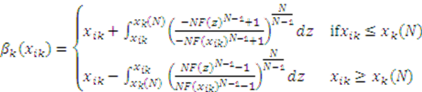
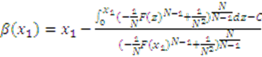
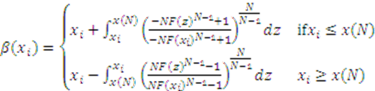
		In standard auctions, the boundary condition <inline-graphic xmlns:xlink="http://www.w3.org/1999/xlink" xlink:href="games-04-00021-i068.tif"/> is used to solve the differential equation. However, in Knaster’s auction, this condition is not optimal. Fortunately, there is a unique value <inline-graphic xmlns:xlink="http://www.w3.org/1999/xlink" xlink:href="games-04-00021-i069.tif"/> such that <inline-graphic xmlns:xlink="http://www.w3.org/1999/xlink" xlink:href="games-04-00021-i070.tif"/>. At this value, the differential equation reduces to the expression <inline-graphic xmlns:xlink="http://www.w3.org/1999/xlink" xlink:href="games-04-00021-i071.tif"/>. This is our boundary condition. The solution to Equation (2) is found to be 
		<disp-formula id="games-04-00021-i068">
          <inline-graphic xmlns:xlink="http://www.w3.org/1999/xlink" xlink:href="games-04-00021-i072.tif"/>
          <label>(3)</label>
          </disp-formula>
		where <inline-graphic xmlns:xlink="http://www.w3.org/1999/xlink" xlink:href="games-04-00021-i073.tif"/> is defined such that <inline-graphic xmlns:xlink="http://www.w3.org/1999/xlink" xlink:href="games-04-00021-i074.tif"/>.<xref ref-type="fn" rid="fn009-games-04-00021">9</xref> It remains to show that strategy profile where every player follows (3) forms a Bayes–Nash equilibrium.</p>
        <p><bold>Proposition 1 </bold><italic>Symmetric equilibrium strategies in the Bayesian game induced Knaster’s Fair Division Procedure with</italic> <inline-graphic xmlns:xlink="http://www.w3.org/1999/xlink" xlink:href="games-04-00021-i021.tif"/> <italic>players and one object are given by (3).</italic> </p>
        <p><bold>Proof.</bold> We need to check that following <inline-graphic xmlns:xlink="http://www.w3.org/1999/xlink" xlink:href="games-04-00021-i039.tif"/> is an equilibrium. First, it is easily checked that the bidding strategy <inline-graphic xmlns:xlink="http://www.w3.org/1999/xlink" xlink:href="games-04-00021-i039.tif"/> is increasing and continuous. Second, a bidder will never want to bid above <inline-graphic xmlns:xlink="http://www.w3.org/1999/xlink" xlink:href="games-04-00021-i075.tif"/> or below <inline-graphic xmlns:xlink="http://www.w3.org/1999/xlink" xlink:href="games-04-00021-i076.tif"/>. Bidder 1, for instance, should not submit a bid <inline-graphic xmlns:xlink="http://www.w3.org/1999/xlink" xlink:href="games-04-00021-i077.tif"/> <inline-graphic xmlns:xlink="http://www.w3.org/1999/xlink" xlink:href="games-04-00021-i075.tif"/>. A bid equal to <inline-graphic xmlns:xlink="http://www.w3.org/1999/xlink" xlink:href="games-04-00021-i075.tif"/> wins the item with probability one, thus increasing one’s bid only decreases bidder 1’s expected payoff. Similarly, Bidder 1 should not submit a bid <inline-graphic xmlns:xlink="http://www.w3.org/1999/xlink" xlink:href="games-04-00021-i078.tif"/> <inline-graphic xmlns:xlink="http://www.w3.org/1999/xlink" xlink:href="games-04-00021-i076.tif"/>. A bid equal to <inline-graphic xmlns:xlink="http://www.w3.org/1999/xlink" xlink:href="games-04-00021-i076.tif"/> is guaranteed to lose the item with probability one (but win the compensation), so decreasing one’s bid only decreases 1’s expected payoff since it lowers the compensation. Finally, the expected payoff of bidder 1 whose type is <inline-graphic xmlns:xlink="http://www.w3.org/1999/xlink" xlink:href="games-04-00021-i079.tif"/> but bids as if his type were <inline-graphic xmlns:xlink="http://www.w3.org/1999/xlink" xlink:href="games-04-00021-i080.tif"/> is
		<disp-formula id="games-04-00021-i081">
          <inline-graphic xmlns:xlink="http://www.w3.org/1999/xlink" xlink:href="games-04-00021-i081.tif"/>
          </disp-formula>
		  <disp-formula id="games-04-00021-i082">
          <inline-graphic xmlns:xlink="http://www.w3.org/1999/xlink" xlink:href="games-04-00021-i082.tif"/>
          </disp-formula>
		  <disp-formula id="games-04-00021-i083">
          <inline-graphic xmlns:xlink="http://www.w3.org/1999/xlink" xlink:href="games-04-00021-i083.tif"/>
          </disp-formula>
		Differentiating with respect to <inline-graphic xmlns:xlink="http://www.w3.org/1999/xlink" xlink:href="games-04-00021-i080.tif"/> and simplifying the resulting expression yields:

		<disp-formula id="games-04-00021-i084">
          <inline-graphic xmlns:xlink="http://www.w3.org/1999/xlink" xlink:href="games-04-00021-i084.tif"/>
          </disp-formula>
		Now setting <inline-graphic xmlns:xlink="http://www.w3.org/1999/xlink" xlink:href="games-04-00021-i085.tif"/> we have
		<disp-formula id="games-04-00021-i086">
          <inline-graphic xmlns:xlink="http://www.w3.org/1999/xlink" xlink:href="games-04-00021-i086.tif"/>
          </disp-formula>
		  <disp-formula id="games-04-00021-i087">
          <inline-graphic xmlns:xlink="http://www.w3.org/1999/xlink" xlink:href="games-04-00021-i087.tif"/>
          </disp-formula>
		If <inline-graphic xmlns:xlink="http://www.w3.org/1999/xlink" xlink:href="games-04-00021-i088.tif"/>, then <inline-graphic xmlns:xlink="http://www.w3.org/1999/xlink" xlink:href="games-04-00021-i089.tif"/>. If <inline-graphic xmlns:xlink="http://www.w3.org/1999/xlink" xlink:href="games-04-00021-i090.tif"/>, then <inline-graphic xmlns:xlink="http://www.w3.org/1999/xlink" xlink:href="games-04-00021-i091.tif"/>. Hence, <inline-graphic xmlns:xlink="http://www.w3.org/1999/xlink" xlink:href="games-04-00021-i092.tif"/> is maximized at <inline-graphic xmlns:xlink="http://www.w3.org/1999/xlink" xlink:href="games-04-00021-i093.tif"/>. Therefore bidding truthfully according to <inline-graphic xmlns:xlink="http://www.w3.org/1999/xlink" xlink:href="games-04-00021-i039.tif"/> is a best response.</p>
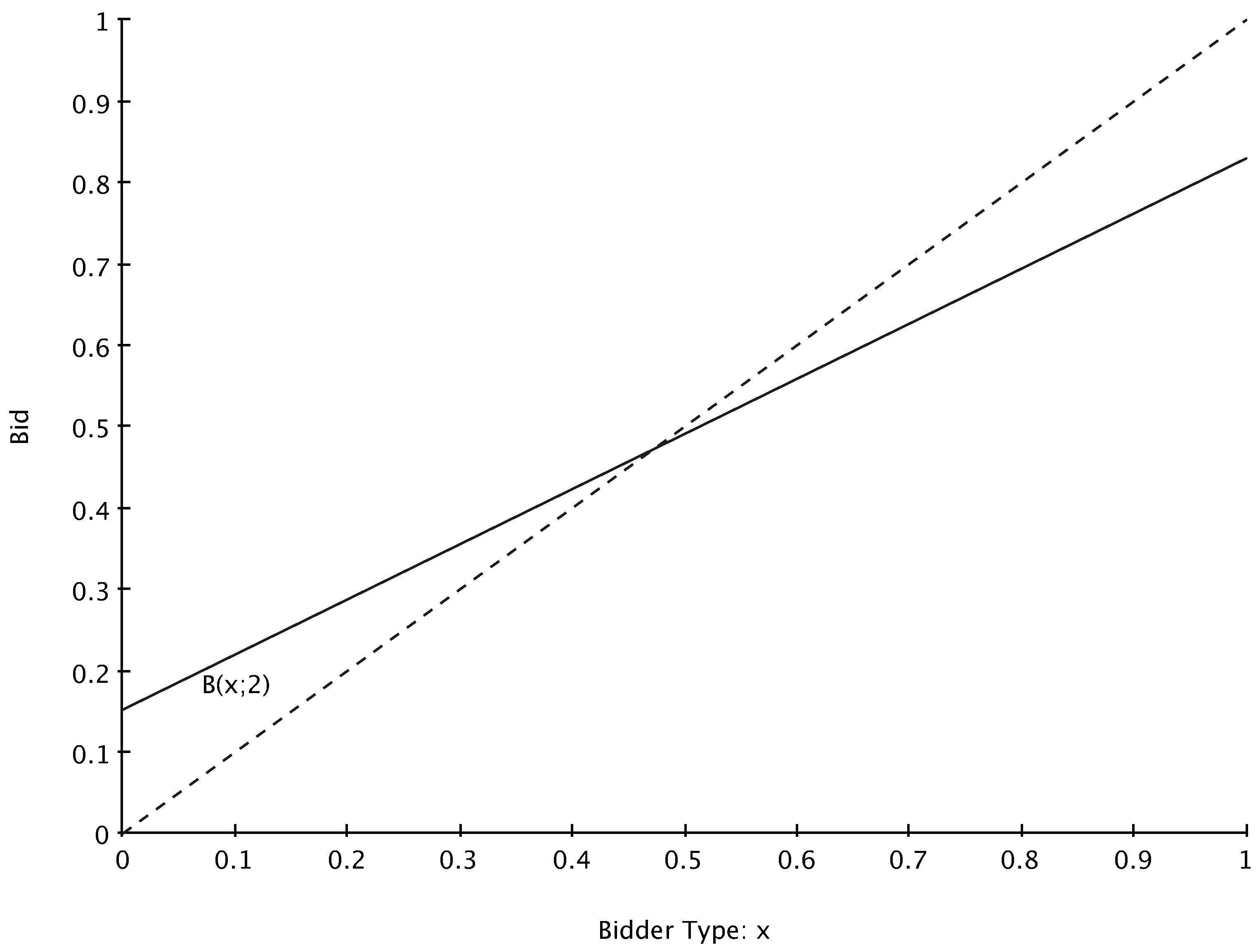
        <p><bold>Example 1 </bold><italic>Suppose</italic> <inline-graphic xmlns:xlink="http://www.w3.org/1999/xlink" xlink:href="games-04-00021-i094.tif"/> <italic>and each player</italic> <inline-graphic xmlns:xlink="http://www.w3.org/1999/xlink" xlink:href="games-04-00021-i017.tif"/><italic>’s private value is distributed according to the uniform distribution—i.e.,</italic> <inline-graphic xmlns:xlink="http://www.w3.org/1999/xlink" xlink:href="games-04-00021-i095.tif"/> <italic>for</italic> <inline-graphic xmlns:xlink="http://www.w3.org/1999/xlink" xlink:href="games-04-00021-i096.tif"/> <italic>and</italic> <inline-graphic xmlns:xlink="http://www.w3.org/1999/xlink" xlink:href="games-04-00021-i097.tif"/><italic>, then the equilibrium bidding strategy for each player is given by</italic> <inline-graphic xmlns:xlink="http://www.w3.org/1999/xlink" xlink:href="games-04-00021-i098.tif"/><italic>.<xref ref-type="fn" rid="fn010-games-04-00021">10</xref></italic></p>
        <p><italic>The equilibrium bidding strategy prescribes over reporting when the player is less likely to win the item and more likely to earn compensation (i.e., when</italic> <inline-graphic xmlns:xlink="http://www.w3.org/1999/xlink" xlink:href="games-04-00021-i099.tif"/><italic>), truth telling at</italic> <inline-graphic xmlns:xlink="http://www.w3.org/1999/xlink" xlink:href="games-04-00021-i100.tif"/><italic>, and for a player to shade his bid when more likely to win the item and less likely to earn compensation (i.e.,</italic> <inline-graphic xmlns:xlink="http://www.w3.org/1999/xlink" xlink:href="games-04-00021-i101.tif"/><italic>).</italic> </p>
        <fig id="games-04-00021-f001" position="float">
          <label>Figure 1</label>
          <caption>
            <p>Equilibrium Bidding Strategy for u(0,1) and <italic>N</italic> = 2.</p>
          </caption>
          <graphic xmlns:xlink="http://www.w3.org/1999/xlink" xlink:href="games-04-00021-g001.tif"/>
        </fig>
        <p>In general, the equilibrium bidding strategy prescribed in (3) recommends players shade their bids when their type is higher than the threshold type and to pad their bid when their type is lower than the threshold. This is intuitive. When a player is not likely to win the auction, he can gain compensation by increasing his bid. Similarly, a high type player who is more likely to win the item can gain by lowering his bid to reduce the compensation he must pay others. As in other auctions with shading/padding, there is a marginal benefit/cost to such actions—<italic>i.e.</italic>, increasing one’s bid increases the probability a player will win the auction and decreasing one’s bid increases the probability a player will lose the auction. In the optimal bid, a player continues shading/padding until the marginal benefit falls short of the marginal cost.</p>
      </sec>
      <sec>
        <title>3.2. Multiple Objects</title>
        <p>Since the items are unrelated, we can treat each item independently when searching for the optimal bid. The next theorem follows immediately.</p>
        <p><bold>Proposition 2 </bold><italic>Symmetric equilibrium strategies in the Bayesian game induced Knaster’s Fair Division Procedure with</italic> <inline-graphic xmlns:xlink="http://www.w3.org/1999/xlink" xlink:href="games-04-00021-i016.tif"/><italic> players and multiple objects are given by the vector valued bid function</italic> <inline-graphic xmlns:xlink="http://www.w3.org/1999/xlink" xlink:href="games-04-00021-i104.tif"/><italic>, where for</italic> <inline-graphic xmlns:xlink="http://www.w3.org/1999/xlink" xlink:href="games-04-00021-i105.tif"/><italic>,</italic> <inline-graphic xmlns:xlink="http://www.w3.org/1999/xlink" xlink:href="games-04-00021-i106.tif"/><italic> is defined as</italic> 
		<disp-formula id="games-04-00021-i107">
          <inline-graphic xmlns:xlink="http://www.w3.org/1999/xlink" xlink:href="games-04-00021-i107.tif"/>
          </disp-formula>
		<italic>where</italic><italic>each</italic> <inline-graphic xmlns:xlink="http://www.w3.org/1999/xlink" xlink:href="games-04-00021-i108.tif"/><italic> is defined as the</italic> <inline-graphic xmlns:xlink="http://www.w3.org/1999/xlink" xlink:href="games-04-00021-i109.tif"/><italic> such that</italic> <inline-graphic xmlns:xlink="http://www.w3.org/1999/xlink" xlink:href="games-04-00021-i110.tif"/><italic>.</italic> </p>
      </sec>
    </sec>
    <sec id="sec4-games-04-00021">
      <title>4. Welfare and Comparative Statics</title>
      <p>Knaster’s auction was designed to achieve an efficient and proportional outcome when all players report their true valuations—<italic>i.e.</italic>, allocations where the items ended up with the people who valued them the most and each player receives, in their estimation, at least <inline-graphic xmlns:xlink="http://www.w3.org/1999/xlink" xlink:href="games-04-00021-i028.tif"/>-th of the item’s value. However, in equilibrium, bidders typically do not report truthfully. We now check to see if this behavior has welfare consequences.<xref ref-type="fn" rid="fn011-games-04-00021">11</xref></p>
      <p>We are interested in the impact that strategic behavior has on the <italic>fairness</italic> and the <italic>efficiency</italic> of the equilibrium allocation. However, in an incomplete information environment, the notion of fairness is slightly ambiguous. Specifically, we need to clarify what information players have at the time they are evaluating the outcome or expected outcome. In particular, we need to know if the players are evaluating the outcome before they know their type (<italic>i.e.</italic>, ex-ante) or evaluating the outcome after the auction is done (<italic>i.e.</italic>, ex-post).<xref ref-type="fn" rid="fn012-games-04-00021">12</xref> While Knaster was clearly interested in the ex-post case, we mention some results from the ex-ante case, which is of interest. It is useful to define these notions in terms of general allocation rules.</p>
      <p>Let <inline-graphic xmlns:xlink="http://www.w3.org/1999/xlink" xlink:href="games-04-00021-i111.tif"/> be an allocation rule—<italic>i.e.</italic>, a function that assigns to each realization of types a specific allocation, then the following properties are of interest:</p>
      <p><bold>Definition 1 </bold><italic>The item assignment of an allocation rule</italic> <inline-graphic xmlns:xlink="http://www.w3.org/1999/xlink" xlink:href="games-04-00021-i111.tif"/><italic> is ex-post efficient if, for each realization of types, the object in the allocation prescribed is assigned to the player with the highest realized type for that object.</italic> </p>
      <p><bold>Definition 2 </bold><italic>An allocation rule</italic> <inline-graphic xmlns:xlink="http://www.w3.org/1999/xlink" xlink:href="games-04-00021-i111.tif"/><italic> is ex-post proportional if, for each realization of types, after the allocation rule has been applied, each player</italic> <inline-graphic xmlns:xlink="http://www.w3.org/1999/xlink" xlink:href="games-04-00021-i017.tif"/><italic> with realized type</italic> <inline-graphic xmlns:xlink="http://www.w3.org/1999/xlink" xlink:href="games-04-00021-i112.tif"/><italic> gets a utility of at least</italic> <inline-graphic xmlns:xlink="http://www.w3.org/1999/xlink" xlink:href="games-04-00021-i113.tif"/><italic>.</italic> </p>
      <p><bold>Definition 3 </bold><italic>An allocation rule</italic> <inline-graphic xmlns:xlink="http://www.w3.org/1999/xlink" xlink:href="games-04-00021-i111.tif"/><italic> is ex-ante proportional if, prior to observing types, each player</italic> <inline-graphic xmlns:xlink="http://www.w3.org/1999/xlink" xlink:href="games-04-00021-i017.tif"/><italic>’s expected utility from his part of the allocation rule is greater than</italic> <inline-graphic xmlns:xlink="http://www.w3.org/1999/xlink" xlink:href="games-04-00021-i114.tif"/><italic>.</italic> </p>
      <p>Knaster’s auction, when players follow truth telling strategies, is an allocation rule that satisfies all three of the above properties. However, we are interested in whether Knaster’s auction, when players follow equilibrium strategies.</p>
      <p>Several welfare results are immediate. First, the ex-post assignment of the items in equilibrium is the same as when players report truthfully—<italic>i.e.</italic>, the item assignment is ex-post efficient. This follows since equilibrium bidding strategies are increasing. Second, aggregate welfare is the same in equilibrium as it is under truth telling. This follows from the fact that the ex-post assignment of items is the same and that side payments always sum to zero. Third, although aggregate welfare is the same, there are bidders whose expected utility in equilibrium is smaller than their expected utility when everyone tells the truth. This is easily demonstrated when <inline-graphic xmlns:xlink="http://www.w3.org/1999/xlink" xlink:href="games-04-00021-i094.tif"/>, where the <inline-graphic xmlns:xlink="http://www.w3.org/1999/xlink" xlink:href="games-04-00021-i115.tif"/> type always prefers the truth telling outcome. The reason is intuitive. This player’s bid in equilibrium is his true value—<italic>i.e.</italic>, <inline-graphic xmlns:xlink="http://www.w3.org/1999/xlink" xlink:href="games-04-00021-i116.tif"/>. At the Bayes–Nash equilibrium, relative to the truth telling outcome, the <inline-graphic xmlns:xlink="http://www.w3.org/1999/xlink" xlink:href="games-04-00021-i115.tif"/> player wins the object with the same probability, has to pay more in compensation if he wins (since types lower than <inline-graphic xmlns:xlink="http://www.w3.org/1999/xlink" xlink:href="games-04-00021-i115.tif"/> bid above their value), and receives less in compensation if he loses (since types above <inline-graphic xmlns:xlink="http://www.w3.org/1999/xlink" xlink:href="games-04-00021-i115.tif"/> bid below their value).<xref ref-type="fn" rid="fn013-games-04-00021">13</xref> In contrast, low and high types, relative to the truth telling outcome, are better off at the equilibrium outcome.</p>
      <p>Our next result concerns ex-ante fairness— <italic>i.e.</italic>, a player’s belief about the outcome he will receive in the auction before he knows his value. Denote the expected utility of a player with type <inline-graphic xmlns:xlink="http://www.w3.org/1999/xlink" xlink:href="games-04-00021-i112.tif"/> in the truth telling and equilibrium outcomes by <inline-graphic xmlns:xlink="http://www.w3.org/1999/xlink" xlink:href="games-04-00021-i117.tif"/> and <inline-graphic xmlns:xlink="http://www.w3.org/1999/xlink" xlink:href="games-04-00021-i118.tif"/> respectively. Specifically, we show that, on average, there is no difference in the truth telling outcome and the equilibrium outcome. Since the truth telling outcome is known to be proportional, the expectation is that the equilibrium allocation must also be proportional.</p>

      <p>
        <bold>Proposition 3 </bold>
        <italic>The equilibrium outcome of Knaster’s auction is ex-ante proportional. In particular, the expected difference in the truth telling outcome and the equilibrium outcome is zero—i.e.,</italic>
		<disp-formula id="games-04-00021-i119">
          <inline-graphic xmlns:xlink="http://www.w3.org/1999/xlink" xlink:href="games-04-00021-i119.tif"/>
          </disp-formula></p>
      <p><bold>Proof.</bold> We illustrate the proof for <inline-graphic xmlns:xlink="http://www.w3.org/1999/xlink" xlink:href="games-04-00021-i094.tif"/>, the general case is similar and is left to the reader. Since the probability of winning the item is the same in equilibrium as in truth telling, the expected difference in <inline-graphic xmlns:xlink="http://www.w3.org/1999/xlink" xlink:href="games-04-00021-i120.tif"/> is just the expected difference in the side payments. By design, the transfers always sum to zero regardless of whether we are at the Bayes–Nash equilibrium or the truth telling outcome—<italic>i.e.</italic>, <inline-graphic xmlns:xlink="http://www.w3.org/1999/xlink" xlink:href="games-04-00021-i121.tif"/> and <inline-graphic xmlns:xlink="http://www.w3.org/1999/xlink" xlink:href="games-04-00021-i122.tif"/>. Thus, 

	  <disp-formula id="games-04-00021-i23">
          <inline-graphic xmlns:xlink="http://www.w3.org/1999/xlink" xlink:href="games-04-00021-i123.tif"/>
          </disp-formula>
	  The expected difference is
	  <disp-formula id="games-04-00021-i124">
          <inline-graphic xmlns:xlink="http://www.w3.org/1999/xlink" xlink:href="games-04-00021-i124.tif"/>
          </disp-formula>
		  <disp-formula id="games-04-00021-i125">
          <inline-graphic xmlns:xlink="http://www.w3.org/1999/xlink" xlink:href="games-04-00021-i125.tif"/>
          </disp-formula>
	  The transfer function <inline-graphic xmlns:xlink="http://www.w3.org/1999/xlink" xlink:href="games-04-00021-i126.tif"/> is symmetric—<italic>i.e.</italic>, <inline-graphic xmlns:xlink="http://www.w3.org/1999/xlink" xlink:href="games-04-00021-i127.tif"/>. So, the above equality can be re-written as:

	  <disp-formula id="games-04-00021-i128">
          <inline-graphic xmlns:xlink="http://www.w3.org/1999/xlink" xlink:href="games-04-00021-i128.tif"/>
          </disp-formula>
	  This implies 
	  <disp-formula id="games-04-00021-i215">
          <inline-graphic xmlns:xlink="http://www.w3.org/1999/xlink" xlink:href="games-04-00021-i215.tif"/>
          </disp-formula>
	  Since we know the truth telling outcome is proportional, the result follows. </p>
      <p><bold>Example 2 </bold><italic>Consider</italic> <inline-graphic xmlns:xlink="http://www.w3.org/1999/xlink" xlink:href="games-04-00021-i120.tif"/><italic> when types are uniformly distributed over the interval</italic> <inline-graphic xmlns:xlink="http://www.w3.org/1999/xlink" xlink:href="games-04-00021-i129.tif"/><italic> and there are only two bidders. Using the bidding strategies computed in Example 1, this difference simplifies to</italic> <inline-graphic xmlns:xlink="http://www.w3.org/1999/xlink" xlink:href="games-04-00021-i130.tif"/><italic>. From this expression we can see that high types and low types both prefer the outcome under strategic behavior whereas middle types prefer the outcome under truth telling. The expression is maximized at</italic> <inline-graphic xmlns:xlink="http://www.w3.org/1999/xlink" xlink:href="games-04-00021-i131.tif"/><italic>. In addition, the expected difference is</italic>
	  <disp-formula id="games-04-00021-i132">
          <inline-graphic xmlns:xlink="http://www.w3.org/1999/xlink" xlink:href="games-04-00021-i132.tif"/>
          </disp-formula>
	  </p>
      <p>While this result is nice, Knaster was interested in ex-post fairness—<italic>i.e.</italic>, the values people had after the auction was finished. Unfortunately, Knaster’s auction does not yield an ex-post proportional outcome in equilibrium as our next result demonstrates.</p>
      <p>
        <bold>Proposition 4 </bold>
        <italic>The equilibrium outcome of Knaster’s auction is not ex-post proportional.</italic> 
      </p>
      <p><bold>Proof.</bold> Suppose types are uniformly distributed over the interval <inline-graphic xmlns:xlink="http://www.w3.org/1999/xlink" xlink:href="games-04-00021-i129.tif"/> and there are only two bidders. Specifically, let Player 1 have the type <inline-graphic xmlns:xlink="http://www.w3.org/1999/xlink" xlink:href="games-04-00021-i133.tif"/> and Player 2 have the type <inline-graphic xmlns:xlink="http://www.w3.org/1999/xlink" xlink:href="games-04-00021-i134.tif"/>. The symmetric equilibrium bid function, as given in Example 1, for each player <inline-graphic xmlns:xlink="http://www.w3.org/1999/xlink" xlink:href="games-04-00021-i017.tif"/> is <inline-graphic xmlns:xlink="http://www.w3.org/1999/xlink" xlink:href="games-04-00021-i098.tif"/>. So, Player 1’s bid is <inline-graphic xmlns:xlink="http://www.w3.org/1999/xlink" xlink:href="games-04-00021-i135.tif"/> and Player 2’s bid is <inline-graphic xmlns:xlink="http://www.w3.org/1999/xlink" xlink:href="games-04-00021-i136.tif"/>. Therefore, Player 1 wins the object and pays Player 2 a compensation of <inline-graphic xmlns:xlink="http://www.w3.org/1999/xlink" xlink:href="games-04-00021-i137.tif"/>. The outcome results in a profit of <inline-graphic xmlns:xlink="http://www.w3.org/1999/xlink" xlink:href="games-04-00021-i138.tif"/>, which is worse than the ex-post proportional outcome for Player 1 of <inline-graphic xmlns:xlink="http://www.w3.org/1999/xlink" xlink:href="games-04-00021-i139.tif"/> </p>
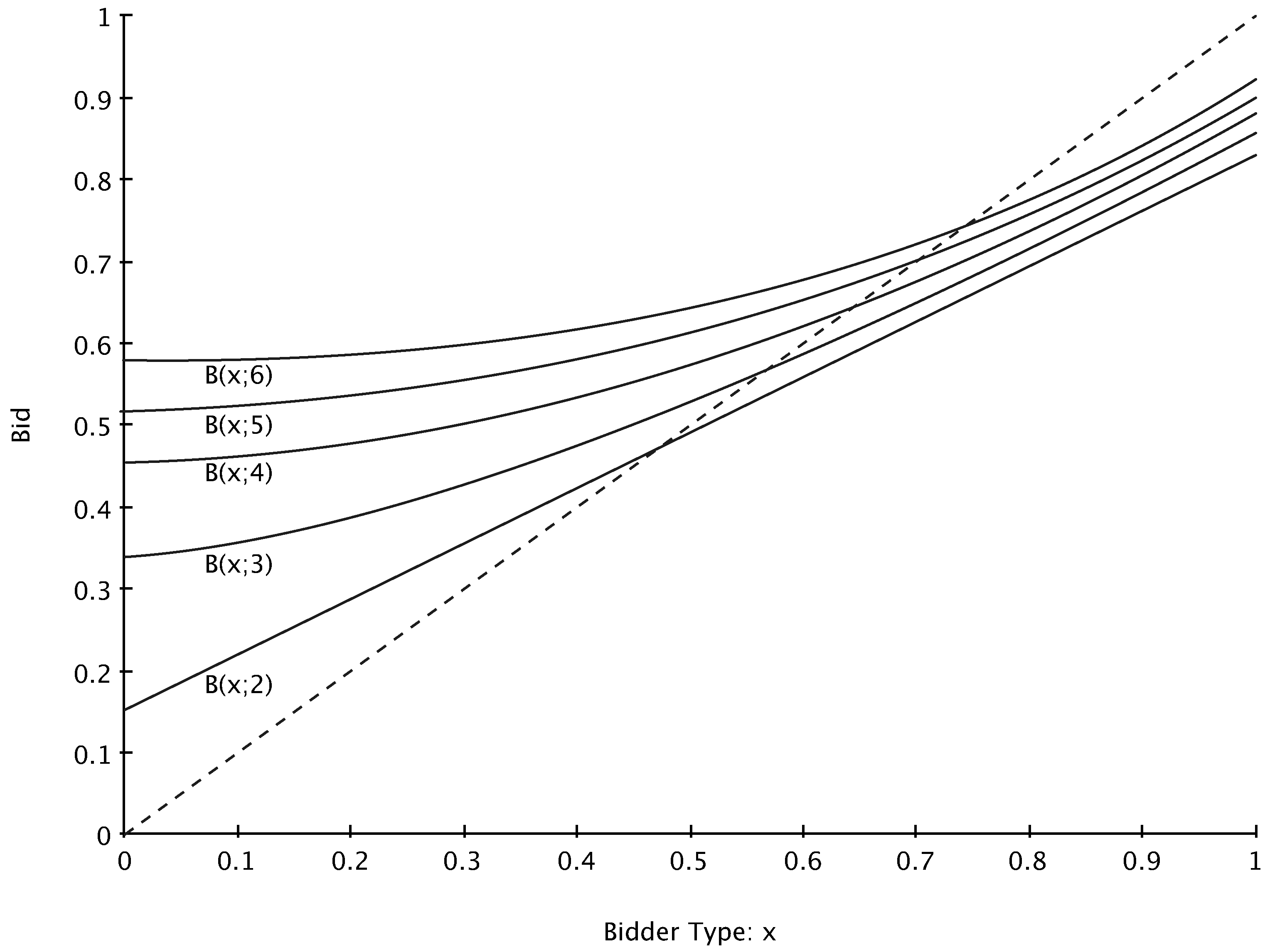
      <p>Proposition 4 is discouraging, but expected given the form of the equilibrium bid function.<xref ref-type="fn" rid="fn014-games-04-00021">14</xref> Our last result explores if competition might eliminate this negative feature of Knaster’s auction. In particular, we want to know whether the equilibrium bid functions converge to truth telling as the number of players increases. Why? If this were true, as it is in the first price sealed bid auction, we would know that in the limit Knaster’s auction is ex-post proportional. Alas, this is not the case. The bid function in Knaster’s auction diverges from the 45 <inline-graphic xmlns:xlink="http://www.w3.org/1999/xlink" xlink:href="games-04-00021-i140.tif"/> line as <inline-graphic xmlns:xlink="http://www.w3.org/1999/xlink" xlink:href="games-04-00021-i021.tif"/> increases. To establish this claim, we demonstrate that the bid of the lowest type player is diverging from the truth as the number of players increases. First, however, we need the following lemma concerning the threshold type.</p>
      <p><bold>Lemma 1 </bold><italic>Threshold type</italic> <inline-graphic xmlns:xlink="http://www.w3.org/1999/xlink" xlink:href="games-04-00021-i073.tif"/><italic> is strictly increasing in</italic> <inline-graphic xmlns:xlink="http://www.w3.org/1999/xlink" xlink:href="games-04-00021-i021.tif"/><italic> for</italic> <inline-graphic xmlns:xlink="http://www.w3.org/1999/xlink" xlink:href="games-04-00021-i141.tif"/><italic>.</italic> </p>
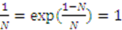
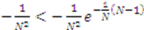
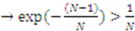
      <p><bold>Proof.</bold> <inline-graphic xmlns:xlink="http://www.w3.org/1999/xlink" xlink:href="games-04-00021-i142.tif"/> if and only if <inline-graphic xmlns:xlink="http://www.w3.org/1999/xlink" xlink:href="games-04-00021-i143.tif"/>. At <inline-graphic xmlns:xlink="http://www.w3.org/1999/xlink" xlink:href="games-04-00021-i144.tif"/>, <inline-graphic xmlns:xlink="http://www.w3.org/1999/xlink" xlink:href="games-04-00021-i145.tif"/>. Taking the derivative of the left hand side and right hand side yields <inline-graphic xmlns:xlink="http://www.w3.org/1999/xlink" xlink:href="games-04-00021-i146.tif"/> and <inline-graphic xmlns:xlink="http://www.w3.org/1999/xlink" xlink:href="games-04-00021-i147.tif"/> respectively. Now <inline-graphic xmlns:xlink="http://www.w3.org/1999/xlink" xlink:href="games-04-00021-i148.tif"/> for <inline-graphic xmlns:xlink="http://www.w3.org/1999/xlink" xlink:href="games-04-00021-i141.tif"/>, which implies <inline-graphic xmlns:xlink="http://www.w3.org/1999/xlink" xlink:href="games-04-00021-i149.tif"/>. Thus, the right hand side is decreasing at a slower rate than the left hand side for all <inline-graphic xmlns:xlink="http://www.w3.org/1999/xlink" xlink:href="games-04-00021-i141.tif"/>. So, <inline-graphic xmlns:xlink="http://www.w3.org/1999/xlink" xlink:href="games-04-00021-i143.tif"/> for <inline-graphic xmlns:xlink="http://www.w3.org/1999/xlink" xlink:href="games-04-00021-i141.tif"/>. Hence, <inline-graphic xmlns:xlink="http://www.w3.org/1999/xlink" xlink:href="games-04-00021-i150.tif"/> is increasing in <inline-graphic xmlns:xlink="http://www.w3.org/1999/xlink" xlink:href="games-04-00021-i021.tif"/>. Now <inline-graphic xmlns:xlink="http://www.w3.org/1999/xlink" xlink:href="games-04-00021-i151.tif"/> is a cdf that , by assumption, is differentiable and strictly increasing. Thus, <inline-graphic xmlns:xlink="http://www.w3.org/1999/xlink" xlink:href="games-04-00021-i151.tif"/> has an inverse <inline-graphic xmlns:xlink="http://www.w3.org/1999/xlink" xlink:href="games-04-00021-i152.tif"/> that is strictly increasing. Thus, <inline-graphic xmlns:xlink="http://www.w3.org/1999/xlink" xlink:href="games-04-00021-i153.tif"/> is also increasing in <inline-graphic xmlns:xlink="http://www.w3.org/1999/xlink" xlink:href="games-04-00021-i021.tif"/>. </p>
      <p>Now, we show that the bid function does not converge to the 45 <inline-graphic xmlns:xlink="http://www.w3.org/1999/xlink" xlink:href="games-04-00021-i140.tif"/> line by demonstrating that the bid of the lowest type bidder is moving in the wrong direction.</p>
      <p><bold>Proposition 5 </bold><italic>Equilibrium bid functions do not converge to the truth telling function as the number of bidders increases. In particular, the bid of the player with a type of zero,</italic> <inline-graphic xmlns:xlink="http://www.w3.org/1999/xlink" xlink:href="games-04-00021-i154.tif"/><italic>, is strictly increasing in</italic> <inline-graphic xmlns:xlink="http://www.w3.org/1999/xlink" xlink:href="games-04-00021-i021.tif"/><italic> for</italic> <inline-graphic xmlns:xlink="http://www.w3.org/1999/xlink" xlink:href="games-04-00021-i016.tif"/><italic>.</italic> </p>
      <p><bold>Proof.</bold> <inline-graphic xmlns:xlink="http://www.w3.org/1999/xlink" xlink:href="games-04-00021-i155.tif"/>, where <inline-graphic xmlns:xlink="http://www.w3.org/1999/xlink" xlink:href="games-04-00021-i156.tif"/>, <inline-graphic xmlns:xlink="http://www.w3.org/1999/xlink" xlink:href="games-04-00021-i157.tif"/>, and <inline-graphic xmlns:xlink="http://www.w3.org/1999/xlink" xlink:href="games-04-00021-i158.tif"/>.
	  <disp-formula id="games-04-00021-i159">
          <inline-graphic xmlns:xlink="http://www.w3.org/1999/xlink" xlink:href="games-04-00021-i159.tif"/>
          </disp-formula>
		  <disp-formula id="games-04-00021-i160">
          <inline-graphic xmlns:xlink="http://www.w3.org/1999/xlink" xlink:href="games-04-00021-i160.tif"/>
          </disp-formula>
	  The last equality follows from Leibniz’s rule and the fact that <inline-graphic xmlns:xlink="http://www.w3.org/1999/xlink" xlink:href="games-04-00021-i161.tif"/> by definition of <inline-graphic xmlns:xlink="http://www.w3.org/1999/xlink" xlink:href="games-04-00021-i073.tif"/>. Now from the chain rule:
	  <disp-formula id="games-04-00021-i162">
          <inline-graphic xmlns:xlink="http://www.w3.org/1999/xlink" xlink:href="games-04-00021-i162.tif"/>
          </disp-formula>
		  <disp-formula id="games-04-00021-i163">
          <inline-graphic xmlns:xlink="http://www.w3.org/1999/xlink" xlink:href="games-04-00021-i163.tif"/>
          </disp-formula>
	  Since <inline-graphic xmlns:xlink="http://www.w3.org/1999/xlink" xlink:href="games-04-00021-i164.tif"/> we have <inline-graphic xmlns:xlink="http://www.w3.org/1999/xlink" xlink:href="games-04-00021-i165.tif"/>. Thus, a sufficient condition for <inline-graphic xmlns:xlink="http://www.w3.org/1999/xlink" xlink:href="games-04-00021-i166.tif"/> to be positive is for 
	  <disp-formula id="games-04-00021-i167">
          <inline-graphic xmlns:xlink="http://www.w3.org/1999/xlink" xlink:href="games-04-00021-i167.tif"/>
          </disp-formula>
		  <disp-formula id="games-04-00021-i168">
          <inline-graphic xmlns:xlink="http://www.w3.org/1999/xlink" xlink:href="games-04-00021-i168.tif"/>
          </disp-formula>
		  <disp-formula id="games-04-00021-i169">
          <inline-graphic xmlns:xlink="http://www.w3.org/1999/xlink" xlink:href="games-04-00021-i169.tif"/>
          </disp-formula>
		  <disp-formula id="games-04-00021-i170">
          <inline-graphic xmlns:xlink="http://www.w3.org/1999/xlink" xlink:href="games-04-00021-i170.tif"/>
          </disp-formula>
	  Now since <inline-graphic xmlns:xlink="http://www.w3.org/1999/xlink" xlink:href="games-04-00021-i080.tif"/> is less than or equal to <inline-graphic xmlns:xlink="http://www.w3.org/1999/xlink" xlink:href="games-04-00021-i073.tif"/> we can form a bound on <inline-graphic xmlns:xlink="http://www.w3.org/1999/xlink" xlink:href="games-04-00021-i171.tif"/>. In particular, the largest <inline-graphic xmlns:xlink="http://www.w3.org/1999/xlink" xlink:href="games-04-00021-i171.tif"/> can get is
	  <disp-formula id="games-04-00021-i172">
          <inline-graphic xmlns:xlink="http://www.w3.org/1999/xlink" xlink:href="games-04-00021-i172.tif"/>
          </disp-formula>
		  <disp-formula id="games-04-00021-i173">
          <inline-graphic xmlns:xlink="http://www.w3.org/1999/xlink" xlink:href="games-04-00021-i173.tif"/>
          </disp-formula>
	  We now show <inline-graphic xmlns:xlink="http://www.w3.org/1999/xlink" xlink:href="games-04-00021-i174.tif"/>.
	  <disp-formula id="games-04-00021-i175">
          <inline-graphic xmlns:xlink="http://www.w3.org/1999/xlink" xlink:href="games-04-00021-i175.tif"/>
          </disp-formula>
		  <disp-formula id="games-04-00021-i176">
          <inline-graphic xmlns:xlink="http://www.w3.org/1999/xlink" xlink:href="games-04-00021-i176.tif"/>
          </disp-formula>
		  <disp-formula id="games-04-00021-i177">
          <inline-graphic xmlns:xlink="http://www.w3.org/1999/xlink" xlink:href="games-04-00021-i177.tif"/>
          </disp-formula>
	  The last inequality was established in Lemma 1. Therefore <inline-graphic xmlns:xlink="http://www.w3.org/1999/xlink" xlink:href="games-04-00021-i178.tif"/> for all <inline-graphic xmlns:xlink="http://www.w3.org/1999/xlink" xlink:href="games-04-00021-i080.tif"/>. It follows
	  <disp-formula id="games-04-00021-i179">
          <inline-graphic xmlns:xlink="http://www.w3.org/1999/xlink" xlink:href="games-04-00021-i179.tif"/>
          </disp-formula>
	  </p>
      <p><bold>Example 3 </bold><italic>The following diagram plots the graph of the bid function</italic> <inline-graphic xmlns:xlink="http://www.w3.org/1999/xlink" xlink:href="games-04-00021-i180.tif"/><italic> for the uniform distribution case when</italic> <inline-graphic xmlns:xlink="http://www.w3.org/1999/xlink" xlink:href="games-04-00021-i094.tif"/><italic>,</italic> <inline-graphic xmlns:xlink="http://www.w3.org/1999/xlink" xlink:href="games-04-00021-i013.tif"/><italic>,</italic> <inline-graphic xmlns:xlink="http://www.w3.org/1999/xlink" xlink:href="games-04-00021-i181.tif"/><italic>,</italic> <inline-graphic xmlns:xlink="http://www.w3.org/1999/xlink" xlink:href="games-04-00021-i182.tif"/><italic>, and</italic> <inline-graphic xmlns:xlink="http://www.w3.org/1999/xlink" xlink:href="games-04-00021-i183.tif"/><italic>. The bid functions displayed are each increasing in</italic> <inline-graphic xmlns:xlink="http://www.w3.org/1999/xlink" xlink:href="games-04-00021-i021.tif"/><italic>.</italic></p>
      <fig id="games-04-00021-f002" position="float">
        <label>Figure 2</label>
        <caption>
          <p>Bidding Strategies for u(0,1) <italic>N</italic> = 2,...,6.</p>
        </caption>
        <graphic xmlns:xlink="http://www.w3.org/1999/xlink" xlink:href="games-04-00021-g002.tif"/>
      </fig>
    </sec>
    <sec sec-type="discussion">
      <title>5. Discussion</title>
      <p>The results in this paper contribute to several literatures: auctions, dissolving a partnership, bargaining, and fair division. In particular, we have used techniques frequently used in the auctions literature to analyze a well-known fair division procedure. Specifically, we have modeled Knaster’s fair division procedure as a sealed bid auction, computed the symmetric Bayes–Nash equilibrium in increasing bidding strategies, analyzed the welfare consequences of strategic behavior, and then performed some simple comparative statics of the equilibrium bidding functions.</p>
      <p>Knaster’s auction remains efficient at the Bayes–Nash equilibrium outcome. However, the expected side payments made by bidders are typically different than under truth telling. As a consequence, the auction is no longer ex-post proportional.<xref ref-type="fn" rid="fn015-games-04-00021">15</xref> Additionally, since bidding strategies do not approach truth telling with competition, the distortions from truth telling created by strategic behavior do diminish with the number of players. However, despite these distortions, the auction does maintain some semblance of fairness. Specifically, the expected difference between the truth telling outcome and the Bayes–Nash equilibrium outcome is zero.</p>
      <p>Fair division mechanisms, such as Knaster’s auction, are appealing when all individuals involved have a claim to an object or objects. Divorce, inheritance, and dissolving a partnership are natural contexts to apply such mechanisms. The later topic has been well studied in economics under the guise of efficiency when agents are strategic. Crampton, Gibbons, and Klemperer (1987), McAfee (1992), Morgan (2004), Moldovanu (2002) all study mechanisms for dissolving a partnership in an incomplete information environment.<xref ref-type="fn" rid="fn016-games-04-00021">16</xref> Specifically, Crampton, Gibbons, and Klemperer, working an independent private values framework, find a simple and efficient way to dissolve a partnership that is interim individually rational. This is in contrast to the well known impossibility theorem of Myerson and Satterthwaite.<xref ref-type="fn" rid="fn017-games-04-00021">17</xref> McAfee and Morgan’s papers are of interest to us because both papers consider fair division mechanisms. In particular, McAfee looks at an independent private values model and examines several simple auction mechanisms (including a simple cake cutting algorithm). In contrast, Morgan looks at several simple mechanisms in a two player common values setting and compares the outcomes of these mechanisms based on a fairness criterion. Clearly, Knaster’s auction could also be applied to any of these applied settings.</p>
      <p>Brams and Taylor (1999) analyze the fairness properties of several simple fair division mechanisms and discuss how these procedures could be applied to bargaining scenarios.<xref ref-type="fn" rid="fn018-games-04-00021">18</xref> One of these mechanisms, the <italic>Adjusted Winner Procedure,</italic> for two players generates allocations that have several nice properties. Brams and Taylor (1996) compare Adjusted Winner with Knaster’s auction in several examples. Finally, we note that it is still an open question whether any of these mechanisms (or to what extent) are effective resource allocation mechanisms in practice. This question is well posed for future research.</p>
    </sec>
    <sec>
      <title>6. Appendix</title>
      <p>In this appendix, we provide the details for solving the differential equation (2). First, putting (2) in the standard form we have:
	  <disp-formula id="games-04-00021-i185">
          <inline-graphic xmlns:xlink="http://www.w3.org/1999/xlink" xlink:href="games-04-00021-i185.tif"/>
          <label>(4)</label>
          </disp-formula>
	  This can be solved using the integrated factor <inline-graphic xmlns:xlink="http://www.w3.org/1999/xlink" xlink:href="games-04-00021-i186.tif"/>.<xref ref-type="fn" rid="fn019-games-04-00021">19</xref> Multiplying both sides of equation (4) by the integrating factor, we have:

	  <disp-formula id="games-04-00021-i187">
          <inline-graphic xmlns:xlink="http://www.w3.org/1999/xlink" xlink:href="games-04-00021-i187.tif"/>
          </disp-formula>
	  Therefore, from the Fundamental Theorem of Calculus, 
	  <disp-formula id="games-04-00021-i188">
          <inline-graphic xmlns:xlink="http://www.w3.org/1999/xlink" xlink:href="games-04-00021-i188.tif"/>
          </disp-formula>
	  To dispense with the absolute value signs, we look at the function in two cases: <inline-graphic xmlns:xlink="http://www.w3.org/1999/xlink" xlink:href="games-04-00021-i189.tif"/> and <inline-graphic xmlns:xlink="http://www.w3.org/1999/xlink" xlink:href="games-04-00021-i190.tif"/>.</p>
      <p>First, suppose <inline-graphic xmlns:xlink="http://www.w3.org/1999/xlink" xlink:href="games-04-00021-i189.tif"/>, then by definition of absolute value <inline-graphic xmlns:xlink="http://www.w3.org/1999/xlink" xlink:href="games-04-00021-i191.tif"/>. So, if <inline-graphic xmlns:xlink="http://www.w3.org/1999/xlink" xlink:href="games-04-00021-i192.tif"/> , then 
	  <disp-formula id="games-04-00021-i193">
          <inline-graphic xmlns:xlink="http://www.w3.org/1999/xlink" xlink:href="games-04-00021-i193.tif"/>
          </disp-formula>
		  <disp-formula id="games-04-00021-i194">
          <inline-graphic xmlns:xlink="http://www.w3.org/1999/xlink" xlink:href="games-04-00021-i194.tif"/>
          </disp-formula>
	  Now solving for the bid function yields: 
		  <disp-formula id="games-04-00021-i195">
	  <inline-graphic xmlns:xlink="http://www.w3.org/1999/xlink" xlink:href="games-04-00021-i195.tif"/>
          </disp-formula>
	  Applying integration be parts, the last equation can be alternatively stated as 
		  <disp-formula id="games-04-00021-i196">
	  <inline-graphic xmlns:xlink="http://www.w3.org/1999/xlink" xlink:href="games-04-00021-i196.tif"/>
          <label>(5)</label>
          </disp-formula>
	  Second, suppose <inline-graphic xmlns:xlink="http://www.w3.org/1999/xlink" xlink:href="games-04-00021-i197.tif"/> , then
		  <disp-formula id="games-04-00021-i198">
	  <inline-graphic xmlns:xlink="http://www.w3.org/1999/xlink" xlink:href="games-04-00021-i198.tif"/>
          </disp-formula>
		  <disp-formula id="games-04-00021-i199">
		  <inline-graphic xmlns:xlink="http://www.w3.org/1999/xlink" xlink:href="games-04-00021-i199.tif"/>
          </disp-formula>
	  Next, applying integration by parts on the two integrals on the right hand side of the equation gives us:
		  <disp-formula id="games-04-00021-i200">
	  <inline-graphic xmlns:xlink="http://www.w3.org/1999/xlink" xlink:href="games-04-00021-i200.tif"/>
          </disp-formula>
		  <disp-formula id="games-04-00021-i1201">
		  <inline-graphic xmlns:xlink="http://www.w3.org/1999/xlink" xlink:href="games-04-00021-i201.tif"/>
          </disp-formula>
	  Solving for the bid function yields:
		  <disp-formula id="games-04-00021-i202">
	  <inline-graphic xmlns:xlink="http://www.w3.org/1999/xlink" xlink:href="games-04-00021-i202.tif"/>
          <label>(6)</label>
          </disp-formula>
	  Finally, the two cases give us bidding functions (5) and (6). Applying the “initial” condition <inline-graphic xmlns:xlink="http://www.w3.org/1999/xlink" xlink:href="games-04-00021-i071.tif"/> defines the constant of integration to be <inline-graphic xmlns:xlink="http://www.w3.org/1999/xlink" xlink:href="games-04-00021-i203.tif"/> for both functions. The equilibrium bid function (3) is found by combining (5) and (9) and inserting the value of <inline-graphic xmlns:xlink="http://www.w3.org/1999/xlink" xlink:href="games-04-00021-i009.tif"/>.</p>

    </sec>
  </body>
  <back>
	  <fn-group>
      <fn id="fn001-games-04-00021"><label>1 </label><p>This auction first appeared in Steinhaus’s now classic 1948 article on fair division. Steinhaus credits the auction to Knaster. Subsequently, descriptions of the procedure have appeared in Luce and Raiffa (1957), Raiffa (1982), Young (1994), and Brams and Taylor (1996) among others. Kuhn (1967) demoststrates how Knanster’s procedure could be “ discovered” using linear programming.</p></fn>
      <fn id="fn002-games-04-00021"><label>2 </label><p>Several such auctions are studied in Morgan (2004). In this paper, Morgan analyzes auctions that could be used to “ fairly” dissolve a partnership. He does not consider Knaster’s auction.</p></fn>
      <fn id="fn003-games-04-00021"><label>3 </label><p>An outcome is proportional if each of the <inline-graphic xmlns:xlink="http://www.w3.org/1999/xlink" xlink:href="games-04-00021-i204.tif"/> participating players receive at least <inline-graphic xmlns:xlink="http://www.w3.org/1999/xlink" xlink:href="games-04-00021-i205.tif"/>-th of their value for the whole collection of items.</p></fn>
      <fn id="fn004-games-04-00021"><label>4 </label><p>The following is adopted from Luce and Raiffa (1957). The numbers have been adapted to ease some of the calculations.</p></fn>
      <fn id="fn005-games-04-00021"><label>5 </label><p>In addition, when <inline-graphic xmlns:xlink="http://www.w3.org/1999/xlink" xlink:href="games-04-00021-i206.tif"/> the procedure generates an envy-free allocation.</p></fn>
      <fn id="fn006-games-04-00021"><label>6 </label><p>See Krishna (2010) for an introduction to auction theory.</p></fn>
      <fn id="fn007-games-04-00021"><label>7 </label><p>Ties are broken via random assignment.</p></fn>
      <fn id="fn008-games-04-00021"><label>8 </label><p>Written out, the side payment rule is:  
      <disp-formula id="games-04-00021-i207">
          <inline-graphic xmlns:xlink="http://www.w3.org/1999/xlink" xlink:href="games-04-00021-i207.tif"/>
          </disp-formula>
      </p></fn>
      <fn id="fn009-games-04-00021"><label>9 </label><p>The steps used to solve equation (2) are provided in the Appendix.</p></fn>
      <fn id="fn010-games-04-00021"><label>10 </label><p>This is easy to check using equation (2).</p></fn>
      <fn id="fn011-games-04-00021"><label>11 </label><p>For notational simplicity, our results will be for the one item case. The generalization is straightforward and left to the reader.</p></fn>
      <fn id="fn012-games-04-00021"><label>12 </label><p>There is also a case where players evaluate the outcome when they know their type, but not the types of the other players (<italic>i.e.</italic>, interim).</p></fn>
      <fn id="fn013-games-04-00021"><label>13 </label><p>It straightforward to verify that, when <inline-graphic xmlns:xlink="http://www.w3.org/1999/xlink" xlink:href="games-04-00021-i206.tif"/>, the difference <inline-graphic xmlns:xlink="http://www.w3.org/1999/xlink" xlink:href="games-04-00021-i208.tif"/> is maximized at <inline-graphic xmlns:xlink="http://www.w3.org/1999/xlink" xlink:href="games-04-00021-i209.tif"/>.</p></fn>
      <fn id="fn014-games-04-00021"><label>14 </label><p>For <inline-graphic xmlns:xlink="http://www.w3.org/1999/xlink" xlink:href="games-04-00021-i206.tif"/>, when values are uniformly distributed over the interval <inline-graphic xmlns:xlink="http://www.w3.org/1999/xlink" xlink:href="games-04-00021-i210.tif"/>, it is straightforward to verify that Knaster’s procedure is interim proportional. However, it is unknown whether this is true in general.</p></fn>
      <fn id="fn015-games-04-00021"><label>15 </label><p>Proportional allocations satisfy a basic notion of fairness, but stronger concepts have been developed since Steinhaus’s paper. Concepts such as envy-freeness, egalitarian, consistency, population monotonicity, and transparent inequity have all been studied in the fair division literature. See, for instance, Varian (1974), Crawford (1977), Crawford and Heller (1979), Crawford (1980), Demange (1984), Takenuma and Thomson (1993), Moulin (1990b), and Alkan, Demange, and Gale (1991). Young (1994) and Moulin (1988, 1990a, and 2003) survey this large literature.</p></fn>
      <fn id="fn016-games-04-00021"><label>16 </label><p>Also related is Segal and Whinston (2011) who provide general conditions under which efficient bargaining is possible.</p></fn>
      <fn id="fn017-games-04-00021"><label>17 </label><p>See Krishna, Chapter 5, for a streamlined discussion of this result.</p></fn>
      <fn id="fn018-games-04-00021"><label>18 </label><p>There is a large body of work on fair division mechanisms presented throughout the mathematics, economics, and political science literature. For instance, the problem of how to fairly divide a cake has generated a significant body of interest and can be applied to both divisible good and indivisible good allocation problems. Introductions to this cake cutting literature can be found in Brams and Taylor (1996), Robertson and Webb (1998), or Su (1999).</p></fn>
      <fn id="fn019-games-04-00021"><label>19 </label><p>In particular, our integrating factor <inline-graphic xmlns:xlink="http://www.w3.org/1999/xlink" xlink:href="games-04-00021-i211.tif"/> is found by solving the differential equation  
      <disp-formula id="games-04-00021-i212">
          <inline-graphic xmlns:xlink="http://www.w3.org/1999/xlink" xlink:href="games-04-00021-i212.tif"/>
          </disp-formula>
		  <disp-formula id="games-04-00021-i213">
          <inline-graphic xmlns:xlink="http://www.w3.org/1999/xlink" xlink:href="games-04-00021-i213.tif"/>
          </disp-formula>
		  <disp-formula id="games-04-00021-i214">
          <inline-graphic xmlns:xlink="http://www.w3.org/1999/xlink" xlink:href="games-04-00021-i214.tif"/>
          </disp-formula>
	  We do not need the most general solution to this differential equation. Hence, we dispense with the arbitrary constant.</p></fn>
	  </fn-group>
    <ref-list>
      <title>References</title>
      <ref id="B1-games-04-00021">
        <label>1.</label>
        <citation citation-type="journal">
          <person-group person-group-type="author">
            <name>
              <surname>Alkan</surname>
              <given-names>A.</given-names>
            </name>
            <name>
              <surname>Demange</surname>
              <given-names>G.</given-names>
            </name>
            <name>
              <surname>Gale</surname>
              <given-names>D.</given-names>
            </name>
          </person-group>
          <article-title>Fair allocation of indivisible goods and criteria of justice</article-title>
          <source>Econometrica</source>
          <year>1991</year>
          <volume>59</volume>
          <fpage>1023</fpage>
          <lpage>1039</lpage>
          <pub-id pub-id-type="doi">10.2307/2938172</pub-id>
        </citation>
      </ref>
      <ref id="B2-games-04-00021">
        <label>2.</label>
        <citation citation-type="book">
          <person-group person-group-type="author">
            <name>
              <surname>Brams</surname>
              <given-names>S.</given-names>
            </name>
            <name>
              <surname>Taylor</surname>
              <given-names>A.</given-names>
            </name>
          </person-group>
          <source>Fair Division. From Cake Cutting to Dispute Resolution</source>
          <publisher-name>Cambridge University Press</publisher-name>
          <publisher-loc>Cambridge, UK</publisher-loc>
          <year>1996</year>
        </citation>
      </ref>
      <ref id="B3-games-04-00021">
        <label>3.</label>
        <citation citation-type="book">
          <person-group person-group-type="author">
            <name>
              <surname>Brams</surname>
              <given-names>S.</given-names>
            </name>
            <name>
              <surname>Taylor</surname>
              <given-names>A.</given-names>
            </name>
          </person-group>
          <source>The Win-Win Solution: Guaranteeing Fair Shares to Everybody</source>
          <publisher-name>W.W. Norton and Company</publisher-name>
          <publisher-loc>New York, NY, USA</publisher-loc>
          <year>1999</year>
        </citation>
      </ref>
      <ref id="B4-games-04-00021">
        <label>4.</label>
        <citation citation-type="journal">
          <person-group person-group-type="author">
            <name>
              <surname>Crampton</surname>
              <given-names>P.</given-names>
            </name>
            <name>
              <surname>Gibbons</surname>
              <given-names>R.</given-names>
            </name>
            <name>
              <surname>Klemperer</surname>
              <given-names>P.</given-names>
            </name>
          </person-group>
          <article-title>Dissolving a partnership efficiently</article-title>
          <source>Econometrica</source>
          <year>1987</year>
          <volume>55</volume>
          <fpage>615</fpage>
          <lpage>632</lpage>
          <pub-id pub-id-type="doi">10.2307/1913602</pub-id>
        </citation>
      </ref>
      <ref id="B5-games-04-00021">
        <label>5.</label>
        <citation citation-type="journal">
          <person-group person-group-type="author">
            <name>
              <surname>Crawford</surname>
              <given-names>V</given-names>
            </name>
          </person-group>
          <article-title>A game of fair division</article-title>
          <source>Rev. Econ. Stud.</source>
          <year>1977</year>
          <volume>44</volume>
          <fpage>235</fpage>
          <lpage>247</lpage>
          <pub-id pub-id-type="doi">10.2307/2297064</pub-id>
        </citation>
      </ref>
      <ref id="B6-games-04-00021">
        <label>6.</label>
        <citation citation-type="journal">
          <person-group person-group-type="author">
            <name>
              <surname>Crawford</surname>
              <given-names>V.</given-names>
            </name>
            <name>
              <surname>Heller</surname>
              <given-names>P.</given-names>
            </name>
          </person-group>
          <article-title>Fair division with indivisible commodities</article-title>
          <source>J. Econ. Theory</source>
          <year>1979</year>
          <volume>21</volume>
          <fpage>10</fpage>
          <lpage>27</lpage>
          <pub-id pub-id-type="doi">10.1016/0022-0531(79)90003-6</pub-id>
        </citation>
      </ref>
      <ref id="B7-games-04-00021">
        <label>7.</label>
        <citation citation-type="journal">
          <person-group person-group-type="author">
            <name>
              <surname>Crawford</surname>
              <given-names>V.</given-names>
            </name>
          </person-group>
          <article-title>A self-administered solution of the bargaining problem</article-title>
          <source>Rev. Econ. Stud.</source>
          <year>1980</year>
          <volume>47</volume>
          <fpage>385</fpage>
          <lpage>392</lpage>
          <pub-id pub-id-type="doi">10.2307/2296999</pub-id>
        </citation>
      </ref>
      <ref id="B8-games-04-00021">
        <label>8.</label>
        <citation citation-type="journal">
          <person-group person-group-type="author">
            <name>
              <surname>Demange</surname>
              <given-names>G.</given-names>
            </name>
          </person-group>
          <article-title>Implementing efficient egalitarian equivalent allocations</article-title>
          <source>Econometrica</source>
          <year>1984</year>
          <volume>52</volume>
          <fpage>1167</fpage>
          <lpage>1178</lpage>
          <pub-id pub-id-type="doi">10.2307/1910993</pub-id>
        </citation>
      </ref>
      <ref id="B9-games-04-00021">
        <label>9.</label>
        <citation citation-type="journal">
          <person-group person-group-type="author">
            <name>
              <surname>Dubins</surname>
              <given-names>E.</given-names>
            </name>
            <name>
              <surname>Spaniers</surname>
              <given-names>E.</given-names>
            </name>
          </person-group>
          <article-title>How to cut a cake fairly</article-title>
          <source>Am. Math. Mon.</source>
          <year>1961</year>
          <volume>68</volume>
          <fpage>1</fpage>
          <lpage>17</lpage>
          <pub-id pub-id-type="doi">10.2307/2311357</pub-id>
        </citation>
      </ref>
      <ref id="B10-games-04-00021">
        <label>10.</label>
        <citation citation-type="journal">
          <person-group person-group-type="author">
            <name>
              <surname>Guth</surname>
              <given-names>W.</given-names>
            </name>
            <name>
              <surname>van Damme</surname>
              <given-names>E.</given-names>
            </name>
          </person-group>
          <article-title>A comparison of pricing rules for auctions and fair division games</article-title>
          <source>Soc. Choice Welfare</source>
          <year>1986</year>
          <volume>3</volume>
          <fpage>177</fpage>
          <lpage>198</lpage>
          <pub-id pub-id-type="doi">10.1007/BF00433534</pub-id>
        </citation>
      </ref>
      <ref id="B11-games-04-00021">
        <label>11.</label>
        <citation citation-type="book">
          <person-group person-group-type="author">
            <name>
              <surname>Krishna</surname>
              <given-names>V.</given-names>
            </name>
          </person-group>
          <source>Auction Theory</source>
          <edition>2nd</edition>
          <publisher-name>Academic Press</publisher-name>
          <publisher-loc>Waltham, MA, USA</publisher-loc>
          <year>2010</year>
        </citation>
      </ref>
      <ref id="B12-games-04-00021">
        <label>12.</label>
        <citation citation-type="book">
          <person-group person-group-type="author">
            <name>
              <surname>Kuhn</surname>
              <given-names>H.</given-names>
            </name>
          </person-group>
          <article-title>On games of fair division</article-title>
          <source>Essays in Mathematical Economics in Honor of Oskar Morgenstern</source>
          <person-group person-group-type="editor">
            <name>
              <surname>Shubik</surname>
              <given-names>M.</given-names>
            </name>
          </person-group>
          <publisher-name>Princeton University Press</publisher-name>
          <publisher-loc>Princeton, NJ, USA</publisher-loc>
          <year>1967</year>
          <fpage>29</fpage>
          <lpage>37</lpage>
        </citation>
      </ref>
      <ref id="B13-games-04-00021">
        <label>13.</label>
        <citation citation-type="book">
          <person-group person-group-type="author">
            <name>
              <surname>Luce</surname>
              <given-names>D.</given-names>
            </name>
            <name>
              <surname>Raiffa</surname>
              <given-names>H.</given-names>
            </name>
          </person-group>
          <source>Games and Decisions: Introduction and Critical Survey</source>
          <publisher-name>Wiley</publisher-name>
          <publisher-loc>New York, NY, USA</publisher-loc>
          <year>1957</year>
        </citation>
      </ref>
      <ref id="B14-games-04-00021">
        <label>14.</label>
        <citation citation-type="journal">
          <person-group person-group-type="author">
            <name>
              <surname>McAfee</surname>
              <given-names>R.P.</given-names>
            </name>
          </person-group>
          <article-title>Amicable divorce: Dissolving a Partnership with Simple Mechanisms</article-title>
          <source>J. Econ. Theory</source>
          <year>1992</year>
          <volume>56</volume>
          <fpage>266</fpage>
          <lpage>293</lpage>
          <pub-id pub-id-type="doi">10.1016/0022-0531(92)90083-T</pub-id>
        </citation>
      </ref>
      <ref id="B15-games-04-00021">
        <label>15.</label>
        <citation citation-type="journal">
          <person-group person-group-type="author">
            <name>
              <surname>Moldovanu</surname>
              <given-names>B.</given-names>
            </name>
          </person-group>
          <article-title>How to Dissolve a Partnership</article-title>
          <source>J. Inst. Theor. Econ.</source>
          <year>2002</year>
          <volume>158</volume>
          <fpage>66</fpage>
          <lpage>80</lpage>
          <pub-id pub-id-type="doi">10.1628/0932456022975619</pub-id>
        </citation>
      </ref>
      <ref id="B16-games-04-00021">
        <label>16.</label>
        <citation citation-type="journal">
          <person-group person-group-type="author">
            <name>
              <surname>Morgan</surname>
              <given-names>J.</given-names>
            </name>
          </person-group>
          <article-title>Dissolving a partnership (un)fairly</article-title>
          <source>Econ.Theory bf</source>
          <year>2004</year>
          <volume>24</volume>
          <fpage>909</fpage>
          <lpage>923</lpage>
          <pub-id pub-id-type="doi">10.1007/s00199-003-0409-9</pub-id>
        </citation>
      </ref>
      <ref id="B17-games-04-00021">
        <label>17.</label>
        <citation citation-type="book">
          <person-group person-group-type="author">
            <name>
              <surname>Moulin</surname>
              <given-names>H.</given-names>
            </name>
          </person-group>
          <source>Axioms of Cooperative Decision Making</source>
          <publisher-name>Cambridge University Press</publisher-name>
          <publisher-loc>New York, NY, USA</publisher-loc>
          <year>1988</year>
        </citation>
      </ref>
      <ref id="B18-games-04-00021">
        <label>18.</label>
        <citation citation-type="journal">
          <person-group person-group-type="author">
            <name>
              <surname>Moulin</surname>
              <given-names>H.</given-names>
            </name>
          </person-group>
          <article-title>Fair Division under joint ownership: Recent results and open problems</article-title>
          <source>Soc. Choice Welfare</source>
          <year>1990a</year>
          <volume>7</volume>
          <fpage>149</fpage>
          <lpage>170</lpage>
          <pub-id pub-id-type="doi">10.1007/BF01560582</pub-id>
        </citation>
      </ref>
      <ref id="B19-games-04-00021">
        <label>19.</label>
        <citation citation-type="journal">
          <person-group person-group-type="author">
            <name>
              <surname>Moulin</surname>
              <given-names>H.</given-names>
            </name>
          </person-group>
          <article-title>Uniform externalities: Two axioms for fair allocation</article-title>
          <source>J. Public Econ.</source>
          <year>1990b</year>
          <volume>43</volume>
          <fpage>305</fpage>
          <lpage>326</lpage>
          <pub-id pub-id-type="doi">10.1016/0047-2727(90)90003-Z</pub-id>
        </citation>
      </ref>
      <ref id="B20-games-04-00021">
        <label>20.</label>
        <citation citation-type="book">
          <person-group person-group-type="author">
            <name>
              <surname>Moulin</surname>
              <given-names>H.</given-names>
            </name>
          </person-group>
          <source>Fair Division and Collective Welfare</source>
          <publisher-name>The MIT Press</publisher-name>
          <publisher-loc>Cambridge, MA, USA</publisher-loc>
          <year>2003</year>
        </citation>
      </ref>
      <ref id="B21-games-04-00021">
        <label>21.</label>
        <citation citation-type="book">
          <person-group person-group-type="author">
            <name>
              <surname>Raiffa</surname>
              <given-names>H.</given-names>
            </name>
          </person-group>
          <source>The Art and Science of Negotiation</source>
          <publisher-name>Harvard University Press</publisher-name>
          <publisher-loc>Cambridge, MA, USA</publisher-loc>
          <year>1982</year>
        </citation>
      </ref>
      <ref id="B22-games-04-00021">
        <label>22.</label>
        <citation citation-type="book">
          <person-group person-group-type="author">
            <name>
              <surname>Robertson</surname>
              <given-names>J.</given-names>
            </name>
            <name>
              <surname>Webb</surname>
              <given-names>W.</given-names>
            </name>
          </person-group>
          <source>Cake-Cutting Algorithms: Be Fair if You Can</source>
          <publisher-name>AK Peters</publisher-name>
          <publisher-loc>Natick, MA, USA</publisher-loc>
          <year>1998</year>
        </citation>
      </ref>
      <ref id="B23-games-04-00021">
        <label>23.</label>
        <citation citation-type="journal">
          <person-group person-group-type="author">
            <name>
              <surname>Segal</surname>
              <given-names>I.</given-names>
            </name>
            <name>
              <surname>Whinston</surname>
              <given-names>M.D.</given-names>
            </name>
          </person-group>
          <article-title>A simple status quo that assures participation (with application to efficient bargaining)</article-title>
          <source>Theor. Econ.</source>
          <year>2011</year>
          <volume>6</volume>
          <fpage>109</fpage>
          <lpage>125</lpage>
          <pub-id pub-id-type="doi">10.3982/TE591</pub-id>
        </citation>
      </ref>
      <ref id="B24-games-04-00021">
        <label>24.</label>
        <citation citation-type="journal">
          <person-group person-group-type="author">
            <name>
              <surname>Su</surname>
              <given-names>F.</given-names>
            </name>
          </person-group>
          <article-title>Rental harmony: Sperner’s lemma in fair division</article-title>
          <source>Am. Math. Mon.</source>
          <year>1999</year>
          <volume>106</volume>
          <fpage>930</fpage>
          <lpage>942</lpage>
          <pub-id pub-id-type="doi">10.2307/2589747</pub-id>
        </citation>
      </ref>
      <ref id="B25-games-04-00021">
        <label>25.</label>
        <citation citation-type="journal">
          <person-group person-group-type="author">
            <name>
              <surname>Steinhaus</surname>
              <given-names>H.</given-names>
            </name>
          </person-group>
          <article-title>The problem of fair division</article-title>
          <source>Econometrica</source>
          <year>1948</year>
          <volume>16</volume>
          <fpage>101</fpage>
          <lpage>104</lpage>
        </citation>
      </ref>
      <ref id="B26-games-04-00021">
        <label>26.</label>
        <citation citation-type="journal">
          <person-group person-group-type="author">
            <name>
              <surname>Takenuma</surname>
              <given-names>K.</given-names>
            </name>
            <name>
              <surname>Thomson</surname>
              <given-names>W.</given-names>
            </name>
          </person-group>
          <article-title>The fair allocation of an indivisible good when monetary compensations are possible</article-title>
          <source>Math.Soc. Sci.</source>
          <year>1993</year>
          <volume>25</volume>
          <fpage>117</fpage>
          <lpage>132</lpage>
          <pub-id pub-id-type="doi">10.1016/0165-4896(93)90047-M</pub-id>
        </citation>
      </ref>
      <ref id="B27-games-04-00021">
        <label>27.</label>
        <citation citation-type="journal">
          <person-group person-group-type="author">
            <name>
              <surname>Varian</surname>
              <given-names>H.</given-names>
            </name>
          </person-group>
          <article-title>Equity, envy, and efficiency</article-title>
          <source>J. Econ. Theor.</source>
          <year>1974</year>
          <volume>9</volume>
          <fpage>63</fpage>
          <lpage>91</lpage>
          <pub-id pub-id-type="doi">10.1016/0022-0531(74)90075-1</pub-id>
        </citation>
      </ref>
      <ref id="B28-games-04-00021">
        <label>28.</label>
        <citation citation-type="book">
          <person-group person-group-type="author">
            <name>
              <surname>Young</surname>
              <given-names>H.P.</given-names>
            </name>
          </person-group>
          <source>Equity: In Theory and in Practice</source>
          <publisher-name>Princeton University Press</publisher-name>
          <publisher-loc>Princeton, NJ, USA</publisher-loc>
          <year>1994</year>
        </citation>
      </ref>
    </ref-list>
  </back>
</article>