


Abstract
In two-person generosity games, the proposer’s agreement payoff is exogenously given, whereas that of the responder is endogenously determined by the proposer’s choice of the pie size. In three-person generosity games, equal agreement payoffs for two of the players are either exogenously excluded or imposed. We predict that the latter crowds out - or at least weakens - efficiency seeking. Our treatments rely on a 2x3 factorial design, differing in whether the responder or the third (dummy) player is the residual claimant and whether the proposer’s agreement payoff is larger, equal, or smaller than the other exogenously given agreement payoff.
1. Introduction
There is ample evidence from the laboratory as well as from the field that people are not only motivated by self-interest but also care for the payoffs of others. Efficiency or welfare maximization is the traditional concern of economists whereas equity (theory) has been strongly propagated by (social) psychologists and economic philosophers. In experimental economics (see, for instance, [2,3,4,6]) the debate has been on how to weigh own payoff concerns and payoff equity, i.e., how to model inequ(al)ity aversion. Whereas in most experimental games, whose findings were used in this debate, a player can only increase others’ payoff by giving up something himself, in the so-called "generosity game" [7] there is no trade-off between self-interest and other-regarding concerns. The proposer’s agreement payoff is exogenously fixed, and he decides only on the size of the "pie", i.e., on the monetary amount that is at stake. While the generosity game is still characterized by scarcity (there is a finite upper bound for the pie size), there is no trade-off between one player’s own and another player’s agreement payoff. Rather, the conflict is between being "generous" or efficiency seeking on the one hand (by choosing the largest possible pie), or equity seeking on the other hand (by choosing a pie size twice as large as the own agreement payoff).
A scenario where parties confront scarcity (in the sense of an upper bound for what they can share) but no trade off (allowing to give more to one party without having to reduce what others get) is especially suitable for assessing the importance of different types of other regarding concerns (like equity or efficiency/generosity concerns). Real life situations resembling such a stylized scenario could be adviser-advisee(s) relationships with an exogenously fixed fee but more or less valuable advice and negligible costs of providing better advice. Of course, in many such real life situations, reputation, e.g. due to future dealings, may matter. But one can easily imagine cases where one consults only once an expert, e.g. when deciding on one’s testimony, and where reputational concerns seem less relevant.
According to the experimental analysis by [8] of two-person generosity games, both types of concerns, efficiency/generosity as well as equity seeking, are observable in dictator and ultimatum settings, but efficiency/generosity concerns dominate. Thus, veto power does not matter much. While it may be hard to think of direct analogies of the generosity game in real life situations, the range of practical applications still seems to be wide, especially for the ultimatum rules: for instance, people may ask for costly advice (in personal interactions or online communities) for a fixed fee (or no fee at all) only when knowing how valuable it is.
While one may also explore generosity in the field by, e.g., econometric studies of charitable giving or other acts of solidarity, we proceed to further elaborate on the experimental analysis of generosity, allowing us to investigate in more detail when and why people are generous. In so doing, however, we are aware that the experimental approach can at best only supplement field research.
Unlike the analysis of two-person generosity games with dictator and ultimatum game rules by [8], we use a three-person setup similar to the one [9] use for the ultimatum game with a fixed pie size. In our three-person setup, the proposer (player X) chooses the size of the pie from some generic interval. The responder (player Y) then decides on either acceptance, meaning that the chosen pie is distributed, or rejection. Rejection leads to zero payoffs for all three players. The powerless dummy (player Z) can only accept or reject whatever is being offered to him and does not influence the others’ payoffs.
In case of acceptance, the agreement payoffs of two players are exogenously given so that the choice of the pie size determines only the payoff of one player. This "residual claimant" may either be the responder Y (Z-Game with the agreement payoffs of X and Z being given), or it may be the dummy player Z (Y-Game with the agreement payoffs of X and Y being given). This hopefully allows to disentangle generosity and strategic concerns of proposer participants since in Z-Games, but not in Y-Games, X can “bribe” the responder Y. We expect generosity concerns (also “strategic generosity”) to be stronger in the Z- than in the Y-Game, and further crowding out of generosity concerns in those treatments where the two exogenously given agreement payoffs are equal: when proposers can propose equal agreement payoffs for all three players, efficiency seeking should be considerably weakened and dominated by equity concerns.
Equity is typically important when groups of individuals jointly invest efforts whose proceeds then have to be distributed [12]. This is experimentally captured by so-called advance production protocols, where participants first have to produce (with costs being incurred) what they can finally share (see the reward allocation experiments by [14], and the advance production experiments by [10,13]). Most reward allocation experiments, however, distribute “manna from heaven.” What the parties can share is given to them as a gift without any attempt of inducing entitlement [11]. Let us admit it frankly: We also allow participants to distribute “manna from heaven.” Since it is far from obvious how to implement an advance production protocol for generosity bargaining games1, entitlement could be induced via auctioning off player roles.2
We continue as follows. Section II introduces the experimental design with the class of games that we study, the main hypotheses, and the experimental protocol. Section III first describes the structure of our experimental data and then elaborates on proposer as well as responder and dummy behavior. Section IV concludes.
2. Experimental design
2.1. The class of games
Our extended three-person generosity game involves three players:
- Proposer X, whose exogenous agreement payoff is , chooses the pie size p from some interval with .
- Responder Y accepts or rejects proposer X’s choice of pie size p.
- Recipient Z can only reject what is assigned to him or not , rendering Z a dummy player.
(i) X chooses .
(ii) Y accepts or rejects with , implying the end of the game with all three players earning nothing.
(iii) In case of , dummy player Z can collect or refuse his share of p.
The payoff of player X is given by . Regarding the payoffs of players Y and Z, we distinguish two different settings:
- Y-games where Y earns with and , yielding the payoff for Z, and
- Z-games where Y earns with and , yielding the payoff for Z.
Table 1.
The three Y- respectively Z-games based on the same interval with
The benchmark solutions are based on commonly known priority of opportunism in the sense of own payoff maximization. This requires of player Z the choice of if in Z-games and if in Y-games, respectively. Similarly, Y should choose due to in Y-games and, in case of , in Z-games. Only for in Z-games secondary concerns of responder Y would come into play, e.g., by suggesting when caring secondarily for efficiency or when secondarily caring for equity.
This leaves X’s choice of p indeterminate
- in the interval in Y-games where due to one has for all and
- in the interval in Z-games where due to one has .
- either arbitrarily weak efficiency concerns3 implying the unambiguous play prediction , and
- or arbitrarily weak equity seeking4 with the unambiguous play prediction , , and for the symmetric b-variants of Y-games () and Z-games () due to .For the asymmetric a- and c-variants of Y- and Z-games with , partial inequity avoidance would suggest or to avoid unequal payoffs between X and Y or respectively X and Z. Furthermore, proposers in the asymmetric a- and c-variants may also consider the average respectively of the exogenously given payoffs and choose as in the symmetric b-variants.
Proposition:
The benchmark prediction, based on commonly known priority of opportunism and only secondary concerns for either efficiency or equity, suggests that
- dummy Z, observing , chooses in Z-games and, in case of , in Y-games; Z will reject if is negative in Y-games, and will be indifferent if his share is 0, i.e., in case of or
- responder Y chooses in Y-games and, in case of , in Z-games; if in Z-games, a secondary concern of Y for efficiency suggests , whereas a secondary concern of Y for equity calls for ; if in Z-games, responder Y should reject ;
- proposer X, due to and , will select when secondarily caring for efficiency and in case of the b-variants and some in the asymmetric a- and c-variants of Table 1 when secondarily caring for equality.
2.2. Experimental protocol and hypotheses
As we are mainly interested in the “natural” attitudes of participants who confront a three-person generosity game for the first time and only once, we implemented a one-shot game. In such a (one-shot) game, still inexperienced participants should seriously consider their choice. This is more likely when using pen and paper in a classroom experiment than in a computer laboratory.
The experiments were run as classroom experiments5 at the Eberhard Karls Universität Tübingen with members of two courses: a large course on introductory economics (I) and a smaller course on organization economics on a more advanced level (A). After reading their instructions carefully and privately answering questions, participants filled out the control questionnaires and the decision forms. Only the decisions of those students who correctly answered the control questions entered the empirical analysis.
Rather than playing the game sequentially, we implemented it as a normal form game by employing the strategy method for players Y and Z. Setting , , and (see Table 1), we allowed only for integer pie sizes . Thus, X has eleven possible pie choices p, and Y chooses for each of these possible values of p. In the Y-Game, Z chooses for each of these possible values of p. In the Z-Game, Z’s agreement payoff is predetermined and, in case of , he can only decide whether he wants to accept this predefined payoff or not (see the English translation of materials in the appendix).
General predictions, based on earlier findings [8], are
(i) a dominance of efficiency in the sense of , and
(ii) a weaker mode of equity seeking via or if and via if (see Table 1). If proposers in the asymmetric game variants (a, c) were to consider the average or of the exogenously given payoffs, equity seeking would suggest the choice of , irrespective of the game variant a, b, c or the game type (Y or Z).
Whereas, according to (i), the residual claimant will receive considerably more than the average earnings of the two others, according to (ii), either all three players will receive the same (symmetric variant) or - in the asymmetric variants - the residual claimant will receive just what one of the two others receives or - alternatively - the average of what the two others receive. We are interested whether and when efficiency seeking according to (i) is the dominant mode of behavior and whether and when (partial) equity seeking in the sense of (ii) can be observed.
Regarding crowding in or out, we expect the impossibility of general equity due to in the asymmetric variants to crowd out equity concerns and strengthen efficiency seeking, i.e., we predict more frequent efficient plays for the asymmetric variants () than for the symmetric variants (). However, if (asymmetric variant c), it may be difficult for proposer X to choose a pie size that leads to a situation, where both his co-players receive much more than he does. Will this "sucker aversion" limit efficiency seeking to those game variants where, in case of acceptance, the proposer earns at least as much as one of his co-players? Sucker aversion may hence induce proposer X to choose if rather than or .
Confronting a(n) (un)favored responder Y in the asymmetric variants of the Y-game () may induce a proposer X to decide more carefully. One possibility of comforting responder Y could be to display generosity in the sense of "Look, how nice I am!" Another possibility could be to appeal to the responder’s equity concerns via choices of , or . Comforting responder Y is much easier in Z-games where the responder gains from generosity. We therefore predict more efficiency seeking/generosity in Z-games and no dominance of efficiency seeking/generosity in Y-games.
3. Results
3.1. Structure of the data
We ran two pen-and-paper classroom experiments. Students were either attending an introductory economics course (373 participants, of whom 261 answered all control questions correctly) or attending an advanced course in organization economics (87 participants, of whom 71 answered all control questions correctly). Only in the latter course, students were familiar with basic aspects of game theory; double participation was explicitly excluded.
Table 2 displays the number of participants with correct answers to all control questions for each role (X,Y,Z), in total (∑), and separately for lecture I (Introductory course) and lecture A (Advanced course), for all game variants in total (∑) and separately for each treatment (Ya, Yb, and Yc, Za, Zb, and Zc) in Table 1.
Table 2.
Number of participants in the different lectures and treatments
To decide whether we can pool the data of courses I and A, we compared the aggregate distribution of pie choices by proposers X and, using a Wilcoxon rank-sum test, found no significant difference. Similar tests separately for the six different treatments rejected homogeneity only for game variants with . Concerning responder behavior, we compared the share of monotonic responder strategies (if Y accepts p, he also accepts all pie choices larger than p), which is () in the introductory (advanced) course. The acceptance rate of the minimal pie is () in the introductory (advanced) lecture; for other pie sizes the acceptance rates usually differ less. Although the more advanced students were slightly better prepared to understand the instructions and to respond monotonically, the differences are minor, what, in our view, justifies pooling the data of the two courses with the possible exception of and proposer behavior. In what follows, we mainly rely on pooled data and mention the results for the introductory lecture only when the findings significantly differ between courses.
3.2. Proposer behavior
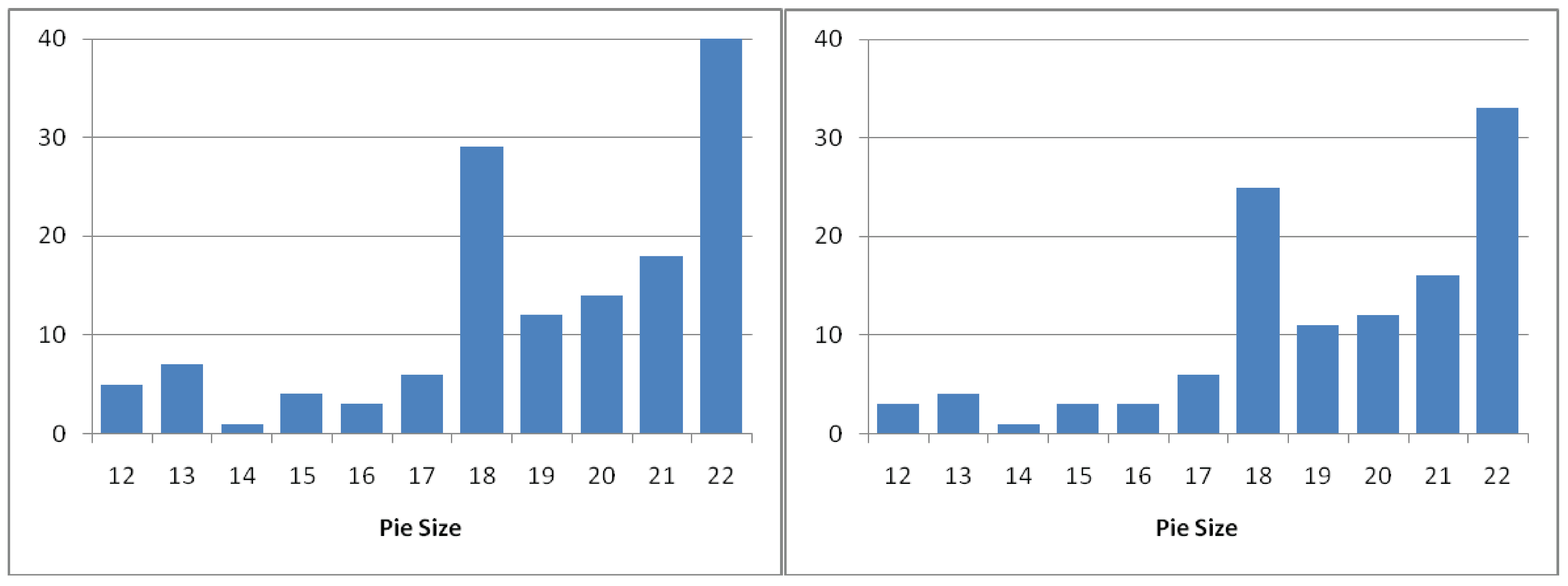
Let us first focus on the X-decisions: Figure 1, combining all pie choices, provides a clear intuition that most proposers X are
- either equity seeking by pie choice , corresponding to in Table 1,
- or efficiency minded, i.e., choose the maximal pie size .
Figure 1.
Pie choices of proposers X for all treatments pooled across courses I and A (left diagram) and for all treatments of the Introductory course I only (right diagram)
Concerning the different game variants, interestingly, efficiency seeking in the sense of choosing is almost nonexistent in the symmetric b-variants (treatment Yb as well as treatment Zb) where, by choosing , proposers X can implement perfect equality between all three players (see Figure 2). In our view, this provides new and particularly convincing evidence for equity theory: even without a trade-off in payoffs, so that, at least locally, more can be given to one party without having to hurt others, equality is still preferred.
Figure 2.
Pie choices of proposers X by treatments pooled across lectures I and A
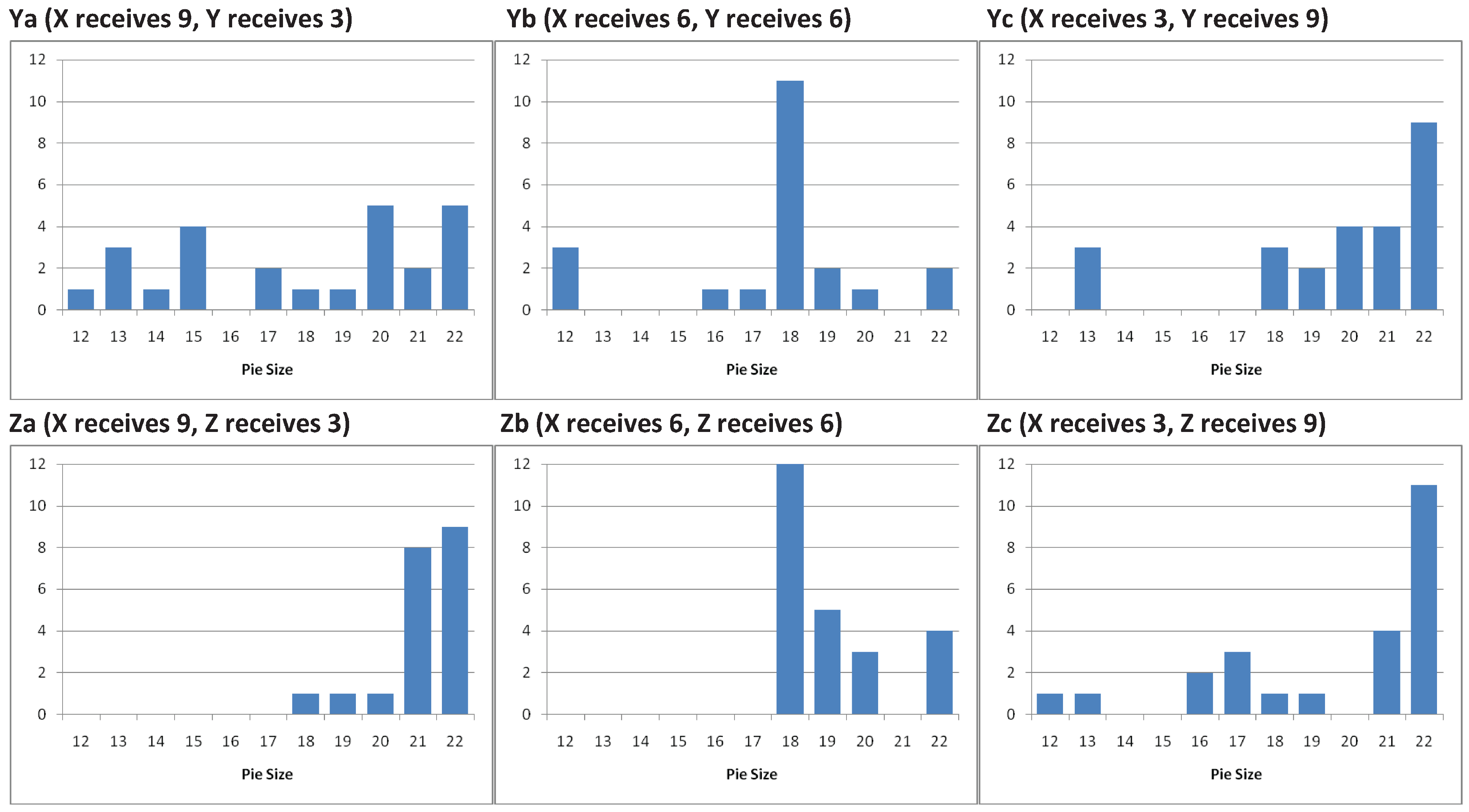
Comparing the X-choices for the symmetric b-variants with those for the asymmetric a- and c-variants separately for Y- and Z-games, confirms the obvious intuition statistically at a significance level (t-test): the chosen pie size p was always higher in the a- and c-variants than in the b-variants in Y-games (Z-games). When the same t-tests are performed only for the data from the Introductory course, the significance levels further increase from to for Y-games and from to for Z-games, confirming higher (efficiency seeking) pie choices for the a- and c-variants as compared with the b-variants that promote equity seeking.
Generosity toward player Y (who is the residual claimant in the Z-game and who is equipped with considerable veto power) is stronger than generosity toward dummy player Z (who is the residual claimant in the Y-game). More specifically, for the a- and b-variants, a t-test shows that, at the -significance level, the Z-game triggers higher pie choices than the Y-game.6 Only for the c-variants, where X-participants may be influenced by "sucker aversion," the difference between the two games is not statistically significant.
Figure 3.
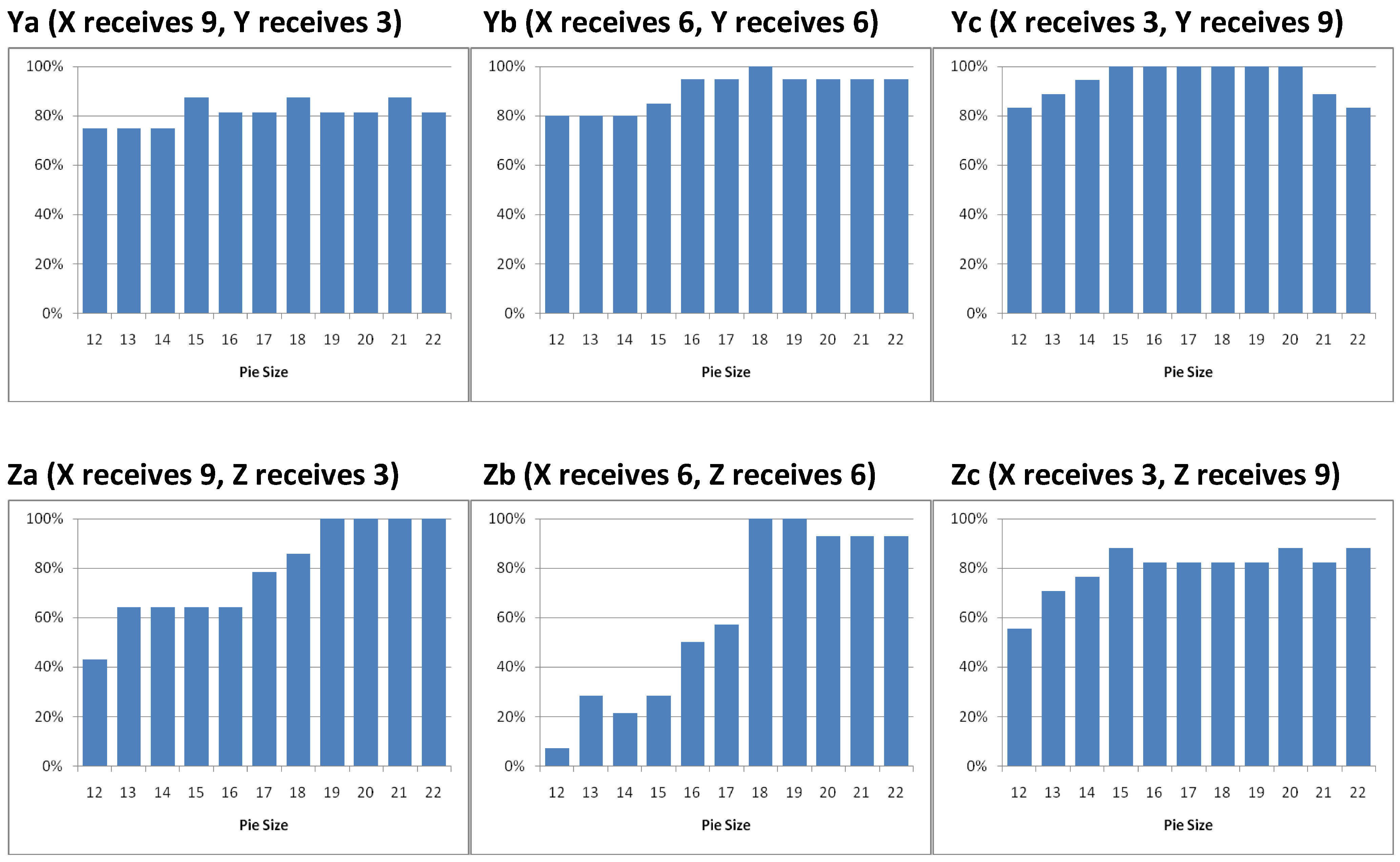
Responder acceptance rates for the eleven possible pie sizes p, separated by treatments but pooled across lectures I and A
3.3. Acceptance behavior
Having applied the strategy method, we can test for monotonicity of acceptance behavior. We start with responder Y. Over all treatments, 89 of altogether 100 Y-responders reveal monotonicity, i.e., if they accept p, they also accept all pie sizes larger than p. Forty-seven () of them even accept the smallest possible pie size of . In Y-games, where X’s choice does not affect Y’s agreement payoff, of Y-responders (47 out of 54) reveal monotonic acceptance behavior with of them accepting even the smallest possible pie choice. For the Z-game, where Y represents the residual claimant, of Y-responders (42 out of 46) are monotonic in their acceptance behavior; here, however, only of them accept the smallest pie (). For all standard significance levels the acceptability of the smallest pie choice is smaller in the Z-game than in the Y-Game.7
Y-Responders are all in all more sensitive to the proposer’s choice of p in Z-games, where this decision matters for their own agreement payoff, and they are more yielding in Y-games where y is exogenously given. We observe the lowest acceptance rate of responders in the Zb treatment for pie choices , i.e., in situations where proposers intentionally prevent equal agreement payoffs. The differences of responder behavior in the a-, b-, and c-variants of Y- and Z-games are graphically illustrated in Figure 3.
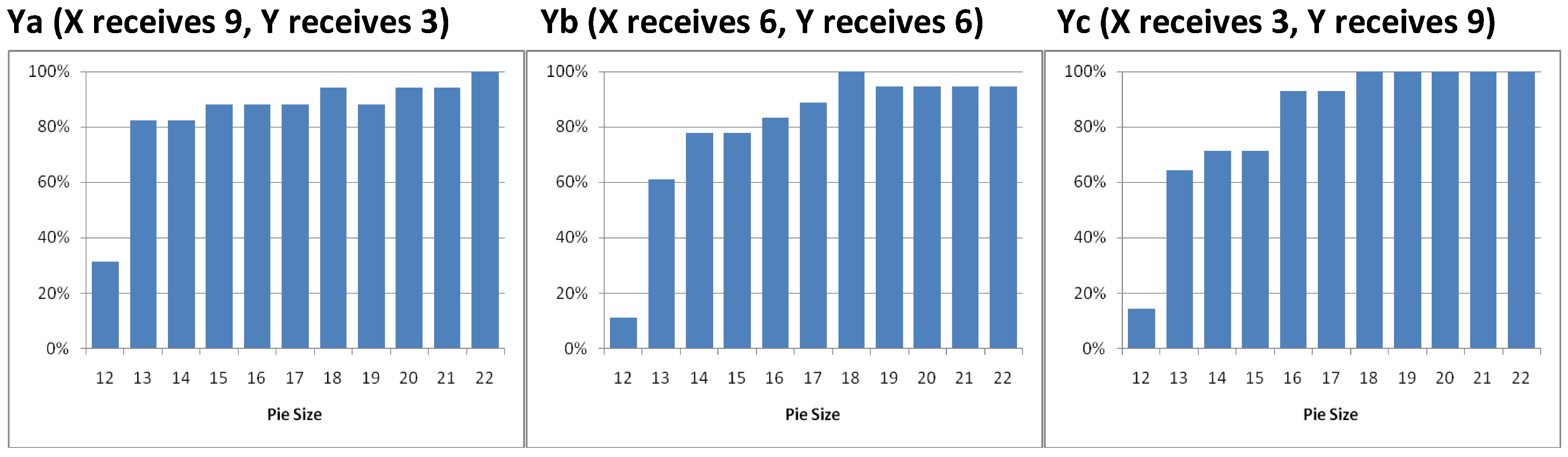
For the acceptance behavior of dummy player Z, who can only reject his own payoff but whose decision does not affect the other players’ payoffs, we observe the following: in Z-games (where z is either 3, 6, or 9), no Z-player ever rejected. In Y-games, 15 of 49 players would rather take nothing than only "1." But the more is offered, the higher the acceptance rate8 (see Figure 4) where, interestingly, the major "jump" occurs from to .
Figure 4.
Dummy acceptance rates by variants of Y-games pooled across lectures I and A
Conclusions
The experimental literature provides convincing evidence that people care for both, equality in the sense of equity theory and efficiency in the sense that they are willing to make one party better off as long as this does not hurt the others. Whereas so far the lively debate (see, for instance, [1], and the reaction by [5]) has been based on findings of game experiments with costly generosity, the generosity game inspires both concerns and allows to explore which of the two concerns dominates the other. In the two-person generosity game, for instance, the dominant tendency is to choose the maximal pie size, although there is a minor mode of equal payoffs. Furthermore, generosity is not simply a means to pacify the responder [2].
Here we have introduced a three-person generosity game including a proposer, a responder, and a dummy player and combining in one game aspects of ultimatum and dictator settings [9]. Our systematic 2x3 factorial design relies on two players with exogenous agreement payoffs and one residual claimant whose agreement payoff is determined by the proposer’s pie choice. What differs is whether the residual claimant is responder Y or dummy Z, whether the exogenous agreement payoffs do allow for general equality (treatment b) or not, and, in the latter case, whether proposer X receives more (treatment a) or less (treatment c) than the other player whose payoff is fixed. In our view, this already indicates how dangerous it can be to draw far reaching conclusions from special findings what also justifies our rather systematic treatment design.
We find that (i) equity seeking is indeed the only modal behavior when general equality is feasible (treatment b), and (ii) efficiency seeking dominates equity concerns if inequality of agreement payoffs is unavoidable (treatments a and c). Observation (i) questions drawing general conclusions from two-person generosity game experiments, where proposers apparently do not mind receiving less than the other player - even when equal agreement payoffs are feasible [8]. Surprisingly, both, the coexistence of the two modes of behavioral concerns and the predominance of efficiency seeking, to some extent confirm earlier findings but apparently require different preconditions and crowd in and out different reasons. "Bribing" the responder is possible in Z-games but not in Y-games. And whether the impossibility of general equality of agreement payoffs crowds out equity seeking can be explored by comparing the a- and c-treatments of the Y- and Z-game.
Acknowledgments
We gratefully acknowledge the advice of the editor and two anonymous referees how to revise the paper.
Appendix
Instructions for the Y-Game (a-, b-, and c-variants)
Thank you for your participation in this experiment. You will interact with two other participants. We will not inform you about their identity. Due to time constraints, it is not possible to give you the money that you can earn in this experiment today. But on presentation of your code card, you will receive it after next weeks’s lecture.
For the statistical analysis of the decision-making process, it is essential that you make your decision independently of other participants. Therefore we ask you to refrain from contacting anyone; otherwise we have to exclude you from the experiment and the payoff.
How is your payoff determined? Three interacting participants - you and two other randomly selected participants - will each be randomly assigned one of three roles, namely X, Y, and Z. The tasks of these roles vary.
The participant in role X can choose an integer amount B between 12 and 22 (), which will be divided among X, Y, and Z if the participant in role Y accepts the chosen amount B. That implies that the participant in role Y has to decide for every possible amount B whether he accepts or not.
If the participant in role Y accepts the offer,
- the participant in role X receives a payoff of [a-variant: 9, b-variant: 6, c-variant: 3]
- the participant in role Y receives a payoff of [a-variant: 3, b-variant: 6, c-variant: 9]
- the participant in role Z receives a payoff of B - 12 on the condition that the participant in role Z accepts his amount.
But if the participant in role Y rejects the offer, all three participants receive nothing.
These are the rules for the interaction of the participants in role X, Y, and Z. You will be informed shortly of your role.
First, we briefly recapitulate the rules again:
- X chooses an integer amount B with .
- For every given amount B, Y has to decide whether he accepts the offer or not.
- For every given payoff Z will receive, Z has to decide whether he accepts or not.
- If Y accepts the decision of X and if Z also accepts his payoff, the payoffs for the following roles are
- ‒
- X: [a-variant: 9, b-variant: 6, c-variant: 3]
- ‒
- Y: [a-variant: 3, b-variant: 6, c-variant: 9]
- ‒
- Z: B - 12
- If Y accepts the decision of X, but Z rejects his payoff, the payoffs for the following roles are
- ‒
- X: [a-variant: 9, b-variant: 6, c-variant: 3]
- ‒
- Y: [a-variant: 3, b-variant: 6, c-variant: 9]
- ‒
- Z: 0
- If Y rejects the decision of X, then X, Y, and Z receive nothing (0).
Instructions for the Z-Game (a-, b-, and c-variants)
Thank you for your participation in this experiment. You will interact with two other participants. We will not inform you about their identity. Due to time constraints it is not possible to give you the money that you can earn in this experiment today. But on presentation of your code-card you will receive it after next weeks’s lecture.
For the statistical analysis of the decision-making process, it is essential that you make your decision independently of other participants. Therefore we ask you to refrain from contacting anyone; otherwise we have to exclude you from the experiment and the payoff.
How is your payoff determined? Three interacting participants - you and two other randomly selected participants - will each be randomly assigned one of three roles, namely X, Y, and Z. The tasks of these roles vary.
The participant in role X can choose an integer amount B between 12 and 22 (), which will be divided among X, Y, and Z if the participant in role Y accepts the chosen amount B. That implies that the participant in role Y has to decide for every possible amount B whether he accepts or not.
If the participant in role Y accepts the offer,
- the participant in role X receives a payoff of [a-variant: 9, b-variant: 6, c-variant: 3]
- the participant in role Y receives a payoff of B - 12
- the participant in role Z receives a payoff of [a-variant: 3, b-variant: 6, c-variant: 9] on the condition that the participant in role Z accepts his amount.
But if the participant in role Y rejects the offer, all three parties receive nothing.
These are the rules for the interaction of the participants in role X, Y, and Z. You will be informed shortly of your role.
First, we briefly recapitulate the rules again:
- X chooses an integer amount B with
- For every given amount B, Y has to decide whether he accepts the offer or not.
- Z has to decide whether he accepts his amount or not.
- If Y accepts the decision of X, and if Z also accepts his payoff, the payoffs for the following roles are
- ‒
- X: [a-variant: 9, b-variant: 6, c-variant: 3]
- ‒
- Y: B - 12
- ‒
- Z: [a-variant: 3, b-variant: 6, c-variant: 9]
- If Y accepts the decision of X, but Z rejects his payoff, the payoffs for the following roles are
- ‒
- X: [a-variant: 9, b-variant: . 6, c-variant: 3]
- ‒
- Y: B - 12
- ‒
- Z: 0
- If Y rejects the decision of X, then X, Y, and Z receive nothing (0).
References
- Binmore, K.; Shaked, A. Experimental Economics: Where Next? Rejoinder. Journal of Economic Behavior and Organization 2010, 73, 120–121. [Google Scholar] [CrossRef]
- Bolton, G. A Comparative Model of Bargaining: Theory and Evidence. American Economic Review 1991, 81, 1096–1136. [Google Scholar]
- Bolton, G.; Ockenfels, A. ERC: A Theory of Equity, Reciprocity, and Competition. American Economic Review 2000, 90, 166–193. [Google Scholar] [CrossRef]
- Engelmann, D.; Strobel, M. Inequality Aversion, Efficiency, and Maximin Preferences in Simple Distribution Experiments. American Economic Review 2004, 94, 857–869. [Google Scholar] [CrossRef]
- Fehr, E.; Schmidt, K. On Inequity Aversion: A Reply to Binmore and Shaked. Journal of Economic Behavior and Organization 2010, 73, 101–108. [Google Scholar] [CrossRef]
- Fehr, E.; Schmidt, K. A Theory of Fairness, Competition, and Cooperation. The Quarterly Journal of Economics 1999, 114, 817–868. [Google Scholar]
- Güth, W. The Generosity Game and its Use for Calibrating Linear Inequity Aversion. J. Socio-Econ. 2010, 39, 155–157. [Google Scholar] [CrossRef]
- Güth, W.; Levati, M. V.; Ploner, M. Making the World a Better Place: Experimental Evidence from the Generosity Game. Working paper series of the Max Planck Institute of Economics and Friedrich Schiller University of Jena. 2009; No. #2009-071. [Google Scholar]
- Güth, W.; Van Damme, E. Information, Strategic Behavior and Fairness in Ultimatum Bargaining - An Experimental Study. J. Math. Psychol. 1998, 42, 227–247. [Google Scholar] [CrossRef] [PubMed]
- Hackett, S. Incomplete Contracting: A Laboratory Experimental Analysis. Economic Inquiry 1993, 31, 274–297. [Google Scholar] [CrossRef]
- Hoffmann, E.; Spitzer, M. Entitlements, Rights, and Fairness: An Experimental Examination of Subjects’ Concepts of Distributive Justice. J. Legal Stud. 1985, 14, 259–298. [Google Scholar] [CrossRef]
- Homans, G.C. Social Behaviour: Its Elementary Forms; Routledge and Keegan Paul: London, UK, 1961. [Google Scholar]
- Königstein, M. Equity, Efficiency and Evolutionary Stability in Bargaining Games with Joint Production. Lecture Notes in Economics and Mathematical Systems; Springer: Berlin, Germany, 2000. [Google Scholar]
- Shapiro, E.G. Effects of future interaction reward allocation in dyads: equity or equality. J. Pers. Soc. Psychol. 1975, 32, 873–880. [Google Scholar] [CrossRef]
- 1.It seems questionable whether participants will invest “real effort” when anticipating that their (agreement) payoff is exogenously given.
- 2.One could independently auction off the player roles, meaning that players earn only what they receive in the game minus their role price as determined by the auction.
- 3.Actually, we could rely on lexicographical preferences, primarily for own (monetary) earnings and only secondarily for efficiency.
- 4.This means an equal payoff distribution is preferred over an unequal one when both yield the same payoff for the proposer.
- 5.Different colors were used for the instructions of the six different games in Table 1. After blocks of X-, Y-, and Z-participants were formed in the large lecture room, neighboring participants in the same block and thus with the same role type (X, Y, or Z) received the instructions, control questionnaires, and decision forms of different games to discourage any attempts to learn from others.
- 6.The results are similar if we separately look at the data from the Introductory I-lecture and the Advanced A-course; only the statistical significance is reduced (but is still significant on the level).
- 7.Again, the results do not change much if we separately look at the data from the Introductory I-lecture and the Advanced A-course.
- 8.Only one of 49 Z-participants, and actually one of the introductory course, rejected a payoff of ten. In the advanced course, only one participant decided to reject an amount equal to four or larger, virtually no one rejected an amount of eight or larger.
© 2010 by the authors; licensee MDPI, Switzerland. This article is an open-access article distributed under the terms and conditions of the Creative Commons Attribution license http://creativecommons.org/licenses/by/3.0/.