
<?xml version="1.0" encoding="UTF-8"?>
<!DOCTYPE article PUBLIC "-//NLM//DTD Journal Publishing DTD v2.3 20070202//EN" "journalpublishing.dtd">
<article xmlns:mml="http://www.w3.org/1998/Math/MathML" xmlns:xlink="http://www.w3.org/1999/xlink" xml:lang="en" article-type="review-article">
  <front>
    <journal-meta>
      <journal-id journal-id-type="publisher-id">cancers</journal-id>
      <journal-title>Cancers</journal-title>
      <abbrev-journal-title abbrev-type="publisher">Cancers</abbrev-journal-title>
      <abbrev-journal-title abbrev-type="pubmed">cancers</abbrev-journal-title>
      <issn pub-type="epub">2072-6694</issn>
      <publisher>
        <publisher-name>MDPI</publisher-name>
      </publisher>
    </journal-meta>
    <article-meta>
      <article-id pub-id-type="doi">10.3390/cancers5010092</article-id>
      <article-id pub-id-type="publisher-id">cancers-05-00092</article-id>
      <article-categories>
        <subj-group>
          <subject>Review</subject>
        </subj-group>
      </article-categories>
      <title-group>
        <article-title>Mouse Models of Gastric Cancer</article-title>
      </title-group>
	  <contrib-group>
        <contrib contrib-type="author">
          <name>
            <surname>Hayakawa</surname>
            <given-names>Yoku</given-names>
          </name>
          <xref rid="af1-cancers-05-00092" ref-type="aff">1</xref>
        </contrib>
        <contrib contrib-type="author">
          <name>
            <surname>Fox</surname>
            <given-names>James G.</given-names>
          </name>
          <xref rid="af2-cancers-05-00092" ref-type="aff">2</xref>
        </contrib>
        <contrib contrib-type="author">
          <name>
            <surname>Gonda</surname>
            <given-names>Tamas</given-names>
          </name>
          <xref rid="af1-cancers-05-00092" ref-type="aff">1</xref>
        </contrib>
        <contrib contrib-type="author">
          <name>
            <surname>Worthley</surname>
            <given-names>Daniel L.</given-names>
          </name>
          <xref rid="af1-cancers-05-00092" ref-type="aff">1</xref>
        </contrib>
        <contrib contrib-type="author">
          <name>
            <surname>Muthupalani</surname>
            <given-names>Sureshkumar</given-names>
          </name>
          <xref rid="af2-cancers-05-00092" ref-type="aff">2</xref>
        </contrib>
        <contrib contrib-type="author">
          <name>
            <surname>Wang</surname>
            <given-names>Timothy C.</given-names>
          </name>
          <xref rid="af1-cancers-05-00092" ref-type="aff">1</xref>
          <xref rid="c1-cancers-05-00092" ref-type="corresp">*</xref>
        </contrib>
      </contrib-group>
      
      <aff id="af1-cancers-05-00092"><label>1 </label>Department of Medicine and Irving Cancer Research Center, Columbia University Medical Center, New York, NY 10032, USA</aff>
      <aff id="af2-cancers-05-00092"><label>2 </label>Division of Comparative Medicine, MIT, Cambridge, MA 02139, USA</aff>
      <author-notes>
        <corresp id="c1-cancers-05-00092"><label>*</label> Author to whom correspondence should be addressed; E-Mail: <email>tcw21@columbia.edu</email>.</corresp>
      </author-notes>
      <pub-date pub-type="epub">
        <day>24</day>
        <month>01</month>
        <year>2013</year>
      </pub-date>
      <pub-date pub-type="collection">
	  <month>03</month>
        <year>2013</year>
      </pub-date>
      <volume>5</volume>
      <issue>1</issue>
      <fpage>92</fpage>
      <lpage>130</lpage>
      <history>
        <date date-type="received">
          <day>05</day>
          <month>12</month>
          <year>2012</year>
        </date>
        <date date-type="rev-recd">
          <day>08</day>
          <month>01</month>
          <year>2013</year>
        </date>
        <date date-type="accepted">
          <day>15</day>
          <month>01</month>
          <year>2013</year>
        </date>
      </history>
      <permissions>
        <copyright-statement>© 2013 by the authors; licensee MDPI, Basel, Switzerland.</copyright-statement>
        <copyright-year>2013</copyright-year>
        <license xmlns:xlink="http://www.w3.org/1999/xlink" license-type="open-access" xlink:href="http://creativecommons.org/licenses/by/3.0/">
          <p>This article is an open-access article distributed under the terms and conditions of the Creative Commons Attribution license (<uri>http://creativecommons.org/licenses/by/3.0/</uri>).</p>
        </license>
      </permissions>
      <abstract>
        <p>Animal models have greatly enriched our understanding of the molecular mechanisms of numerous types of cancers. Gastric cancer is one of the most common cancers worldwide, with a poor prognosis and high incidence of drug-resistance. However, most inbred strains of mice have proven resistant to gastric carcinogenesis. To establish useful models which mimic human gastric cancer phenotypes, investigators have utilized animals infected with <italic>Helicobacter</italic> species and treated with carcinogens. In addition, by exploiting genetic engineering, a variety of transgenic and knockout mouse models of gastric cancer have emerged, such as INS-GAS mice and TFF1 knockout mice. Investigators have used the combination of carcinogens and gene alteration to accelerate gastric cancer development, but rarely do mouse models show an aggressive and metastatic gastric cancer phenotype that could be relevant to preclinical studies, which may require more specific targeting of gastric progenitor cells. Here, we review current gastric carcinogenesis mouse models and provide our future perspectives on this field.</p>
      </abstract>
      <kwd-group>
        <kwd>gastric cancer</kwd>
        <kwd>mouse model</kwd>
        <kwd>metaplasia</kwd>
        <kwd>
          <italic>Helicobacter felis</italic>
        </kwd>
        <kwd>
          <italic>Helicobacter pylori</italic>
        </kwd>
        <kwd>INS-GAS mice</kwd>
      </kwd-group>
    </article-meta>
  </front>
  <body>
    <sec sec-type="intro">
      <title>1. Introduction</title>
      <p>Gastric cancer remains the 2nd leading cause of cancer mortality worldwide, with an overall 5-year survival rate that is less than 25% [<xref ref-type="bibr" rid="B1-cancers-05-00092">1</xref>,<xref ref-type="bibr" rid="B2-cancers-05-00092">2</xref>]. Critical to understanding the mechanisms involved in gastric cancer, and devising preventive and therapeutic interventions, is the need to develop an authentic animal model. Mice have a different gastric anatomy compared to humans. In mice the gastric fundus equivalent is lined by squamous, rather than oxyntic glandular epithelium. Thus, in mice, the squamocolumnar junction does not universally approximate the gastroesophageal junction as it does in normal human anatomy. In addition, rodents rarely develop spontaneous gastric cancer, although some reports have described spontaneous gastric adenocarcinomas in cotton rats (<italic>Sigmodon hispidus</italic>), and in the Z strain of the African rodent <italic>Mastomys natalensis</italic> [<xref ref-type="bibr" rid="B3-cancers-05-00092">3</xref>,<xref ref-type="bibr" rid="B4-cancers-05-00092">4</xref>,<xref ref-type="bibr" rid="B5-cancers-05-00092">5</xref>,<xref ref-type="bibr" rid="B6-cancers-05-00092">6</xref>,<xref ref-type="bibr" rid="B7-cancers-05-00092">7</xref>]. However, these animals when they develop gastric tumors more frequently exhibit enterochromaffin-like cell carcinoids. Thus, experimental efforts have focused on identifying chemical, infectious or genetic means to induce gastric cancer in animals.</p>
      <p>Prior to the discovery of <italic>Helicobacter pylori</italic> infection, major etiological factors were thought to be a diet rich in salt and nitrates/nitrites, along with a low intake of ascorbic acid and carotenoids [<xref ref-type="bibr" rid="B8-cancers-05-00092">8</xref>], and thus early animal models utilized nitrosamines, such MNNG in rats [<xref ref-type="bibr" rid="B9-cancers-05-00092">9</xref>,<xref ref-type="bibr" rid="B10-cancers-05-00092">10</xref>] and MNU in mice to induce gastric tumors [<xref ref-type="bibr" rid="B11-cancers-05-00092">11</xref>].</p>
      <p>With the discovery of <italic>H. pylori</italic> by Marshall and Warren [<xref ref-type="bibr" rid="B12-cancers-05-00092">12</xref>], and subsequently studies showing a strong association with gastric cancer [<xref ref-type="bibr" rid="B13-cancers-05-00092">13</xref>,<xref ref-type="bibr" rid="B14-cancers-05-00092">14</xref>,<xref ref-type="bibr" rid="B15-cancers-05-00092">15</xref>,<xref ref-type="bibr" rid="B16-cancers-05-00092">16</xref>,<xref ref-type="bibr" rid="B17-cancers-05-00092">17</xref>], the focus shifted to the development of animal models of <italic>Helicobacter</italic>-associated gastric cancer. A variety of animals, including mice, rats, Mongolian gerbils, cats, guinea, pigs, ferrets, pigs, and macaques, have been experimentally infected with a variety of different <italic>Helicobacter</italic> species. Because of the ability to manipulate the mouse genome, mice have become the animal model of choice for cancer research. While the greatest interest has been in mouse models, only a limited number of <italic>H. pylori</italic> strains have been identified that successfully colonize the mouse stomach. The most robust and useful models to date have been <italic>H. pylori</italic> SS1-infected mice, and <italic>H. felis</italic> originally isolated from the stomach of cats and dogs [<xref ref-type="bibr" rid="B18-cancers-05-00092">18</xref>]. Both of these gastric <italic>Helicobacters</italic> are capable of long-term colonization and have the ability to induce chronic gastritis and precancerous lesions in mice. However, the SS1 strain is not able to induce gastric cancer in most inbred strains of mice, while it does cause gastric carcinoma in C57BL/129 mice [<xref ref-type="bibr" rid="B19-cancers-05-00092">19</xref>,<xref ref-type="bibr" rid="B20-cancers-05-00092">20</xref>]. Chronic <italic>H. felis</italic> infection has been shown to induce severe inflammation, atrophy, metaplasia, dysplasia and gastric cancer in C57BL/6 mice [<xref ref-type="bibr" rid="B21-cancers-05-00092">21</xref>].</p>
      <p>While genetically engineered mouse models of cancer were developed in the 1980’s, transgenic models of gastric cancer were slow to emerge. Initial models included some containing a variety of oncogenes that were known to transform but had no known association with human gastric cancer, such as the SV40 T antigen, which binds to pRb and disrupts its function [<xref ref-type="bibr" rid="B22-cancers-05-00092">22</xref>]. Human carcino-embryonic antigen (CEA) promoter/SV40 T antigen transgenic mice were reported to develop antral hyperplasia or gastric cancer [<xref ref-type="bibr" rid="B23-cancers-05-00092">23</xref>,<xref ref-type="bibr" rid="B24-cancers-05-00092">24</xref>]. Stomach-specific SV40 T antigen transgenic mice using H/K-ATPase-β subunit gene promoter [<xref ref-type="bibr" rid="B25-cancers-05-00092">25</xref>] developed hyperplasia and abnormal cell distribution within the gastric glandular unit, and rarely developed dysplasia. Other early models included transgenic mice carrying the human adenovirus type 12 (Ad12) early region 1 under control of the mouse mammary tumor virus (MMTV) long terminal repeat (LTR), which developed adenocarcinoma or adenosquamous carcinoma [<xref ref-type="bibr" rid="B26-cancers-05-00092">26</xref>]. In addition, transgenic mice expressing HPV-16 early region of the bovine keratin 6 gene promoter developed glandular stomach tumors [<xref ref-type="bibr" rid="B27-cancers-05-00092">27</xref>]. However, these models did not progress to cancer through the atrophy-metaplasia-dysplasia sequence, as described by Correa [<xref ref-type="bibr" rid="B28-cancers-05-00092">28</xref>], nor were they associated with <italic>Helicobacter</italic> infection or chronic inflammation.</p>
      <p>INS-GAS mice as a model of spontaneous gastric cancer were first described in 2000. These mice were reported to develop atrophic gastritis and intestinal metaplasia, followed by corpus cancer with a high incidence rate, and tumor development was accelerated by <italic>H. felis</italic> infection, suggesting that this model closely mimicked the clinical course of human gastric carcinogenesis [<xref ref-type="bibr" rid="B29-cancers-05-00092">29</xref>]. This initial mouse model was followed by the H/K-ATPase-IL-1β transgenic mice, which progressed through the atrophy-metaplasia-dysplasia sequence and validated human genetic data that implicated the IL-1β gene locus as a major risk factor for gastric cancer [<xref ref-type="bibr" rid="B30-cancers-05-00092">30</xref>]. Other studies using genetic mouse models of gastric cancer have been reported, and are detailed below. These genetic mouse models have provided considerable insight on the role of the stroma, also known as the tumor microenvironment, which has been recognized as a critical factor in various types of cancer. Modulation of cytokines, chemokines or the signaling pathways upstream has also demonstrated unequivocally the importance of inflammatory responses in gastric cancer development [<xref ref-type="bibr" rid="B31-cancers-05-00092">31</xref>,<xref ref-type="bibr" rid="B32-cancers-05-00092">32</xref>,<xref ref-type="bibr" rid="B33-cancers-05-00092">33</xref>,<xref ref-type="bibr" rid="B34-cancers-05-00092">34</xref>].</p>
      <p>Nevertheless, despite the significant advances made utilizing diverse mouse models, these models have all shown some limitations, including modest gastric pathology, slow time course, and the absence of invasive or metastatic tumors. In addition, it is important to keep in mind that the response to infection or genetic manipulation is highly dependent on the mouse genetic background, gender, diet and housing conditions. Animal stress associated with overcrowding, inadequate sanitation, and variations in temperature, humidity, and light cycles may predispose resistant animals to adverse disease outcomes. Especially in the case of the enterohepatic <italic>Helicobacter</italic> species, differences in study outcomes may be attributed to persistent colonization by these murine <italic>Helicobacters</italic> [<xref ref-type="bibr" rid="B35-cancers-05-00092">35</xref>,<xref ref-type="bibr" rid="B36-cancers-05-00092">36</xref>,<xref ref-type="bibr" rid="B37-cancers-05-00092">37</xref>].</p>
      <p>Here we review these genetic or chemical models of gastric carcinogenesis, and compare their pathological features, limitations and contribution to our understanding of gastric carcinogenesis. We also emphasize the impact of comprehensive genomic analysis on new or emerging transgenic mouse models.</p>
    </sec>
    <sec>
      <title>2. Chemical Carcinogenesis Models of Gastric Cancer</title>
      <p>To explore the mechanisms of gastric cancer development and establish a useful animal model of gastric tumorigenesis, investigators examined the utility of a variety of chemical carcinogens. In particular, researchers focused on <italic>N</italic>-nitroso compounds, which are generated in the stomach by anaerobic bacteria following ingestion of nitrates and nitrites, which were thought to be an important inducer of human cancer. <italic>N</italic>-methyl-<italic>N</italic>-nitro-<italic>N</italic>-nitrosoguanidine (MNNG) was the first nitrosamine shown by researchers to induce stomach tumors in rats. In 1966, Schoental <italic>et al.</italic> administered MNNG to rats using a stomach tube, resulting in squamous cell carcinoma in the rat forestomach [<xref ref-type="bibr" rid="B38-cancers-05-00092">38</xref>]. In 1967, Sugimura <italic>et al.</italic> modified their method, administering MNNG orally to rats continuously in the drinking water, and achieved for the first time a high incidence of antropyloric adenocarcinoma [<xref ref-type="bibr" rid="B10-cancers-05-00092">10</xref>]. MNNG was later found to be a very potent gastric carcinogen in Mongolian gerbils [<xref ref-type="bibr" rid="B39-cancers-05-00092">39</xref>,<xref ref-type="bibr" rid="B40-cancers-05-00092">40</xref>]. Exposure to 400 ppm MNNG in drinking water for 50 weeks resulted in gastric adenocarcinomas in 63.6% of gerbils [<xref ref-type="bibr" rid="B40-cancers-05-00092">40</xref>]. Using MNNG-induced gastric cancer model, it has been reported that administration of high-salt diet [<xref ref-type="bibr" rid="B41-cancers-05-00092">41</xref>,<xref ref-type="bibr" rid="B42-cancers-05-00092">42</xref>], calcium-deficient diet [<xref ref-type="bibr" rid="B43-cancers-05-00092">43</xref>], catechol [<xref ref-type="bibr" rid="B44-cancers-05-00092">44</xref>], or IL-1β [<xref ref-type="bibr" rid="B45-cancers-05-00092">45</xref>] promotes gastric cancer development.</p>
      <p>Rats and gerbils are limited as model systems, given the absence of genetic models, and thus investigators explored the effect of oral administration of nitrosamines in inbred strains of mice. However, mice proved to be remarkably resistant to MNNG-induced gastric carcinogenesis. Danon <italic>et al.</italic> infected female Balb/c mice with <italic>H. heilmannii</italic> and administered 150 ppm MNNG in drinking water for 38 weeks and found that the treated mice developed squamous cell carcinomas in the mouth and forestomach, but not adenocarcinoma in the glandular stomach [<xref ref-type="bibr" rid="B46-cancers-05-00092">46</xref>].</p>
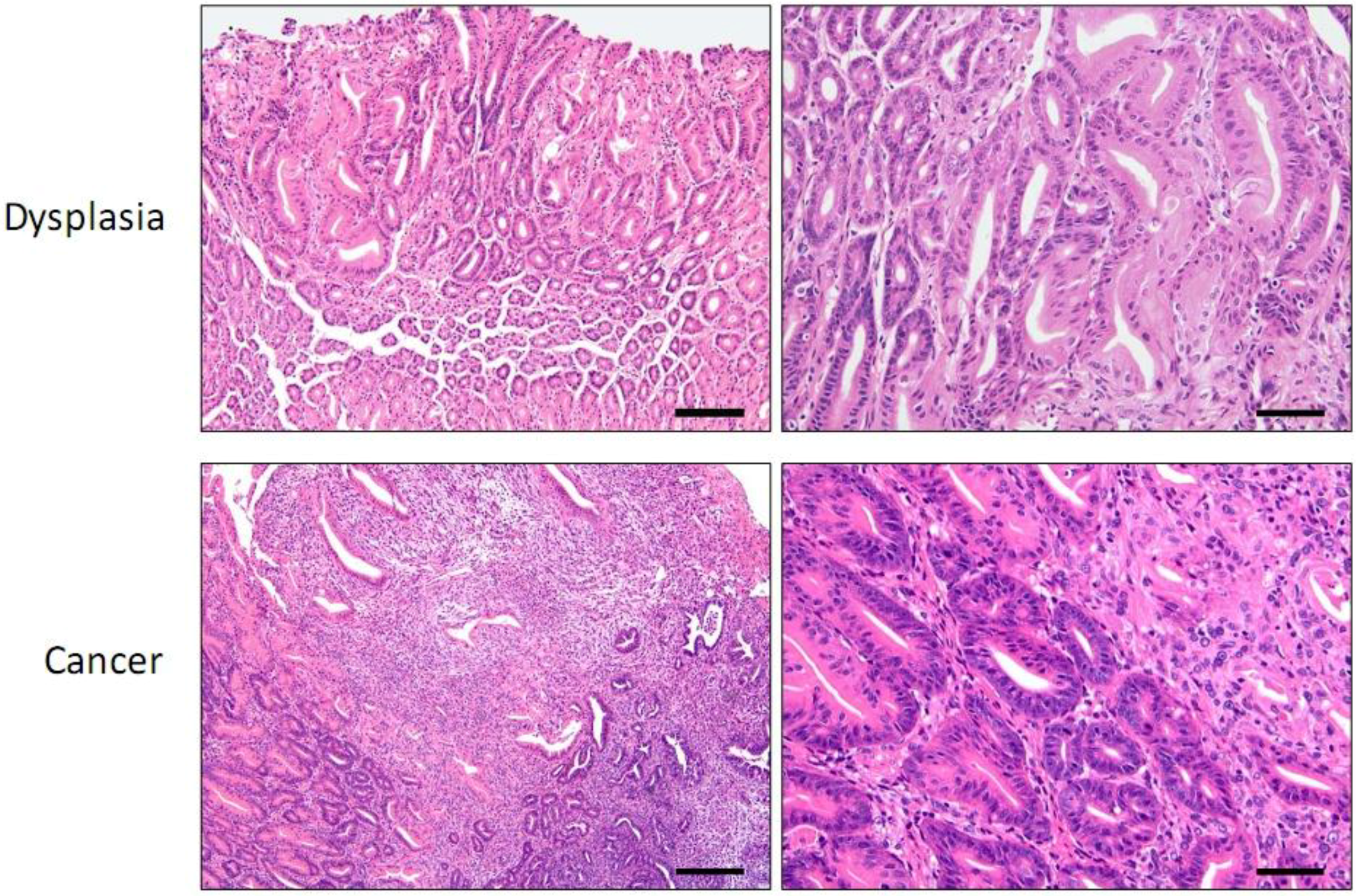
      <p>Researchers then explored the utility of <italic>N</italic>-methyl-<italic>N</italic>-nitrosourea (MNU) as a gastric carcinogen in mouse models. Tatematsu <italic>et al.</italic> treated Balb/c mice with 0.5 mg MNU by weekly intragastric intubation, but found that most of the mice died due to squamous cell carcinoma in the forestomach. Interestingly, when the mouse forestomach was removed surgically prior to MNU treatment, well-differentiated adenocarcinoma developed in the glandular stomach with 100% incidence rate by 40 weeks [<xref ref-type="bibr" rid="B11-cancers-05-00092">11</xref>]. Thus, the glandular stomach was indeed sensitive to the carcinogenic effects of MNU, but the phenotype was obscured by the greater sensitivity of the forestomach, at least at that specific dose and route of administration. Tatematsu <italic>et al.</italic> went on to demonstrate that 30–120 ppm MNU given in drinking water was preferable to oral gavage, without the induction of tumors of the forestomach [<xref ref-type="bibr" rid="B47-cancers-05-00092">47</xref>]. The efficiency of tumor induction by MNU was found to depend on its concentration rather than total intake [<xref ref-type="bibr" rid="B48-cancers-05-00092">48</xref>], and MNU in the drinking water at 240 ppm on alternate weeks (total exposure; 5 weeks) was effective in inducing gastric cancer in 6 strains of mice that were studied [<xref ref-type="bibr" rid="B49-cancers-05-00092">49</xref>]. Consequently, the protocol of 240 ppm MNU treatment in the drinking water for 5 weeks (every other week) is currently a standard and widely used murine method of gastric carcinogenesis. MNU-induced tumors in mice are located mainly in the gastric antrum, and pathologically are uniformly well- or moderately-differentiated adenocarcinomas (<xref ref-type="fig" rid="cancers-05-00092-f001">Figure 1</xref>). The tumors are rich in stromal cells, and occasionally invade into the submucosa although signet ring-cell carcinoma and metastatic tumors are rarely, if ever seen.</p>
      <p>The MNU mouse model of gastric cancer has been extensively used for investigating the role of various signaling pathways or transcription factors in gastric carcinogenesis, including the roles of p53 [<xref ref-type="bibr" rid="B50-cancers-05-00092">50</xref>], NF-κB [<xref ref-type="bibr" rid="B51-cancers-05-00092">51</xref>], MAPK pathway [<xref ref-type="bibr" rid="B52-cancers-05-00092">52</xref>,<xref ref-type="bibr" rid="B53-cancers-05-00092">53</xref>], Cox-2 [<xref ref-type="bibr" rid="B54-cancers-05-00092">54</xref>,<xref ref-type="bibr" rid="B55-cancers-05-00092">55</xref>], β-catenin [<xref ref-type="bibr" rid="B54-cancers-05-00092">54</xref>], E-cadherin [<xref ref-type="bibr" rid="B56-cancers-05-00092">56</xref>], and KLF4 [<xref ref-type="bibr" rid="B57-cancers-05-00092">57</xref>]. Although MNU is an alkylating agent that can potentially induce the formation of DNA adducts and GC &gt; TA transversion mutations, only rare mutations have been observed in <italic>N</italic>-nitroso-compounds (NOC)-induced gastric tumors of rodents [<xref ref-type="bibr" rid="B58-cancers-05-00092">58</xref>], raising questions about the precise mechanism of carcinogenesis. MNU is also known to modify amino acids in histone proteins, especially histone H3 lysine residues, leading to chromatin remodeling [<xref ref-type="bibr" rid="B59-cancers-05-00092">59</xref>]. Indeed, MNU treatment in mice affects the expression of TFF1, an important gastric-specific tumor suppressor gene, through epigenetic modifications. DNA and histone methylation, and promoter methylation of the TFF1 gene have also been observed in human gastric cancer [<xref ref-type="bibr" rid="B60-cancers-05-00092">60</xref>]. This suggests that epigenetic effects are likely to constitute a key mechanism of NOC-induced carcinogenesis.</p>
      <p>One potential criticism of the MNU mouse model of gastric cancer is the absence of <italic>Helicobacter</italic> spp.-associated chronic inflammation. While the MNU model does not proceed through a classical atrophy-metaplasia-dysplasia sequence, this latter <italic>H. pylori</italic>-dependent pathway results in achlorhydria with subsequent bacterial overgrowth; NOCs may be generated from nitrates and nitrites in this setting, and thus the argument can be made that the generation of <italic>N</italic>-nitroso compounds may play a role in <italic>Helicobacter</italic>-associated carcinogenesis. A recent study used a combination of MNU and <italic>H. felis</italic> infection [<xref ref-type="bibr" rid="B60-cancers-05-00092">60</xref>], and achieved a very rapid induction of antral gastric cancer. This same combination was reported to induce a high frequency of gastric cancer in <italic>H. pylori-</italic>infected Mongolian gerbils compared to gerbils receiving MNU only [<xref ref-type="bibr" rid="B61-cancers-05-00092">61</xref>,<xref ref-type="bibr" rid="B62-cancers-05-00092">62</xref>]. Thus, the combination of <italic>Helicobacter</italic> spp. infection followed by MNU treatment mimics in some ways the proposed pathogenesis of human antral carcinogenesis.</p>
	  <fig id="cancers-05-00092-f001" position="float">
        <label>Figure 1</label>
        <caption>
          <p>MNU-induced mouse tumor. Top panels: Low and high magnification images of the distal corpus showing gastric dysplasia (glandular proliferation with architectural distortion and cytological atypia in the superficial half of the mucosa) associated with oxyntic loss and pyloric-type glandular metaplasia. (Bar: Left 200× or 80 μM, Right 400× or 40 μM) Bottom panels: Low and high magnification images of a gastric tumor biopsy specimen showing dysplastic glands with lamina propria invasion, effacement and associated desmoplasia and inflammation. (Bar: Left 100× or 160 μM, Right 400× or 40 μM).</p>
        </caption>
        <graphic xmlns:xlink="http://www.w3.org/1999/xlink" xlink:href="cancers-05-00092-g001.tif"/>
      </fig>
      
    </sec>
    <sec>
      <title>3. <italic>Helicobacter</italic> Infection Models</title>
      <p>Given the key role of <italic>Helicobacter pylori</italic> infection in the etiology and pathogenesis of gastric cancer, researchers pursued the development of animal models of gastric <italic>Helicobacter</italic> infection. The first studies supporting a potent carcinogenic role for <italic>Helicobacter</italic> species in the gastric mucosa was the ferret model of <italic>Helicobacter mustelae</italic> infection [<xref ref-type="bibr" rid="B63-cancers-05-00092">63</xref>,<xref ref-type="bibr" rid="B64-cancers-05-00092">64</xref>,<xref ref-type="bibr" rid="B65-cancers-05-00092">65</xref>]. Ferrets naturally infected with <italic>H. mustelae</italic> exposed to one dose of 100 mg/kg MNNG developed gastric cancer, while <italic>H. mustalae</italic> infected ferrets did not [<xref ref-type="bibr" rid="B63-cancers-05-00092">63</xref>]. Unfortunately, SPF ferrets not infected with <italic>H. mustelae</italic> were not available to ascertain whether these animals also would develop MNNG-induced gastric cancer. Subsequently, aged <italic>H. mustelae-</italic>infected ferrets have been reported to develop gastritis, dysplasia, and gastric adenocarcinoma [<xref ref-type="bibr" rid="B66-cancers-05-00092">66</xref>].</p>
      <p>With respect to <italic>H. pylori</italic>, several <italic>H. pylori</italic> strains, such as the G1.1 strain [<xref ref-type="bibr" rid="B67-cancers-05-00092">67</xref>], the TN2 strain [<xref ref-type="bibr" rid="B68-cancers-05-00092">68</xref>], or the B128 strain [<xref ref-type="bibr" rid="B69-cancers-05-00092">69</xref>], have the ability to colonize Mongolian gerbils, and induce gastric adenocarcinoma. This has allowed researchers to infect Mongolian gerbils with a variety strains, including their isogenic mutants, in order to investigate the importance of bacterial virulence factors in gastric carcinogenesis [<xref ref-type="bibr" rid="B67-cancers-05-00092">67</xref>,<xref ref-type="bibr" rid="B68-cancers-05-00092">68</xref>,<xref ref-type="bibr" rid="B70-cancers-05-00092">70</xref>].</p>
      <p>Interestingly, mice in general and the C57BL/6 strain in particular are proved to be remarkably resistant to colonization with various <italic>H. pylori</italic> strains [<xref ref-type="bibr" rid="B71-cancers-05-00092">71</xref>,<xref ref-type="bibr" rid="B72-cancers-05-00092">72</xref>]. Thus, alternative mouse models of gastric <italic>Helicobacter</italic> infection were explored. In 1990, <italic>Helicobacter felis</italic>, a close relative of <italic>H. pylori</italic> that was isolated from the cat stomach, was shown to readily colonize the mouse stomach in large numbers [<xref ref-type="bibr" rid="B73-cancers-05-00092">73</xref>]. Several papers reported that <italic>H. felis</italic> had the ability to induce severe gastritis and atrophy in mice [<xref ref-type="bibr" rid="B73-cancers-05-00092">73</xref>,<xref ref-type="bibr" rid="B74-cancers-05-00092">74</xref>,<xref ref-type="bibr" rid="B75-cancers-05-00092">75</xref>]. Moreover, with a longer time period of observation, analysis of <italic>H. felis</italic>-infected mice showed gastric metaplasia, dysplasia and invasive cancer [<xref ref-type="bibr" rid="B21-cancers-05-00092">21</xref>,<xref ref-type="bibr" rid="B76-cancers-05-00092">76</xref>]. After 12–16 months of infection, extensive dysplastic lesions were evident in the gastric corpus at the squamocolumnar junction (SCJ) along the lesser curvature. After more extended periods of infection (up to 2 years), large polypoid antral tumors develop and mimic closely lesions found in humans infected with <italic>H. pylori</italic> [<xref ref-type="bibr" rid="B77-cancers-05-00092">77</xref>,<xref ref-type="bibr" rid="B78-cancers-05-00092">78</xref>]. In the <italic>H. felis</italic> infection model, eradication of <italic>Helicobacter</italic> infection at early time points led to a regression of inflammation, restoration of parietal cells, reestablishment of normal architecture, and prevention against development of adenocarcinoma. Bacterial eradication at 1 year was also associated with the reappearance of parietal cells and partial restoration of architecture. Thus, eradication studies in mice have revealed that inflammation, metaplasia, and dysplasia are reversible with early eradication therapy, and that progression to dysplasia can be arrested with eradication therapy at a later time point [<xref ref-type="bibr" rid="B79-cancers-05-00092">79</xref>,<xref ref-type="bibr" rid="B80-cancers-05-00092">80</xref>]. In humans, eradication of <italic>H. pylori</italic> in patients with gastritis but not dysplasia is linked to a decrease in the incidence of gastric adenocarcinoma epidemiologically [<xref ref-type="bibr" rid="B81-cancers-05-00092">81</xref>,<xref ref-type="bibr" rid="B82-cancers-05-00092">82</xref>], thus supporting findings in mouse models. Antibiotic treatment to eradicate <italic>H. pylori</italic> in gerbils and INS-GAS mice also arrests progression to gastric lesions [<xref ref-type="bibr" rid="B73-cancers-05-00092">73</xref>,<xref ref-type="bibr" rid="B83-cancers-05-00092">83</xref>].</p>
      <p>Strains of <italic>H. pylori</italic> that can colonize mice—the so-called “mouse adopted strains of <italic>H. pylori</italic>”—have been developed. Among <italic>H. pylori</italic> mouse adapted strains reported to date, the Sydney strain of <italic>H. pylori</italic> (SS1) has been the best characterized and most useful in murine model systems [<xref ref-type="bibr" rid="B20-cancers-05-00092">20</xref>]. Relatively high levels of colonization were achieved in inbred C57BL/6 mice, while colonization levels in Balb/c, DBA/2, and C3H/He strains were lower [<xref ref-type="bibr" rid="B20-cancers-05-00092">20</xref>]. After 8 months of infection, active gastritis and severe atrophy were observed, along with detectable levels of bacteria [<xref ref-type="bibr" rid="B20-cancers-05-00092">20</xref>]. However, even with a 2-year follow-up, lesions did not progress to gastric cancer in mice infected with SS1 or other strains, 119p and G50, although some mice developed gastric lymphoma [<xref ref-type="bibr" rid="B84-cancers-05-00092">84</xref>]. <italic>H. pylori</italic> SS1 infection did result in development of carcinomas <italic>in situ</italic> in C57BL/129 mice 15 months after infection [<xref ref-type="bibr" rid="B19-cancers-05-00092">19</xref>]. <italic>H. pylori</italic> infection also causes gastric cancer in genetically modified mice, for example, INS-GAS mice (see below) [<xref ref-type="bibr" rid="B85-cancers-05-00092">85</xref>].</p>
      <p>In <italic>H. pylori</italic>, the <italic>cag</italic> pathogenicity island (cag-PAI), a 40-kb genomic fragment containing 31 genes, encodes a type IV secretion (TFSS) apparatus used to inject bacterial proteins such as the 120-kilodalton protein CagA into host epithelial cells [<xref ref-type="bibr" rid="B78-cancers-05-00092">78</xref>]. A series of <italic>in vitro</italic> reports have established that injection of CagA into host cells leads to phosphorylation of CagA by host cell kinases, resulting in activation of SHP-2 tyrosine phosphatase, NF-κB signaling pathways, and MAPK signaling pathways [<xref ref-type="bibr" rid="B86-cancers-05-00092">86</xref>,<xref ref-type="bibr" rid="B87-cancers-05-00092">87</xref>,<xref ref-type="bibr" rid="B88-cancers-05-00092">88</xref>]. The <italic>H. pylori</italic> peptidoglycan is also injected into host cells via the type IV secretory system, leading to activation of Nod1, an intracellular pathogen recognition molecule with specificity for gram-negative peptidoglycans [<xref ref-type="bibr" rid="B89-cancers-05-00092">89</xref>], and mice deficient in Nod1 are more susceptible than wild-type (WT) mice to infection by <italic>cag</italic>-positive strains of <italic>H. pylori</italic> [<xref ref-type="bibr" rid="B89-cancers-05-00092">89</xref>].</p>
      <p>Interestingly, while the <italic>H. pylori</italic> SS1 strain was initially reported to possess an intact cag-PAI, the SS1 strain used in subsequent studies does not appear to express CagA, which may be explain to some extent the limited virulence of SS1 in mice [<xref ref-type="bibr" rid="B90-cancers-05-00092">90</xref>]. Systemic expression of CagA in transgenic mice has led to the development of gastrointestinal and hematological malignancies [<xref ref-type="bibr" rid="B91-cancers-05-00092">91</xref>]. mice deficient in Nod1 are more susceptible than wild-type mice to infection by <italic>cag</italic>-positive strains of <italic>H. pylori</italic> [<xref ref-type="bibr" rid="B89-cancers-05-00092">89</xref>]. Arnold <italic>et al.</italic> used CagA-positive SS-1 (PMSS1, which was original strain isolated from a patient) and showed that mice infected with PMSS1 rapidly develop gastritis, gastric atrophy, epithelial hyperplasia, and metaplasia in a type IV secretion system-dependent manner [<xref ref-type="bibr" rid="B92-cancers-05-00092">92</xref>]. These results suggest that CagA and/or the cag-PAI may play an important role in gastric carcinogenesis. Nevertheless, in mice, <italic>cag</italic>-negative strains such as <italic>H. felis</italic> appear to be at least as carcinogenic as <italic>cag</italic>-positive <italic>H. pylori</italic> strains. Although the ability of PMSS1 to inject CagA into host cells decreases gradually after 1 month infection and disappear after 3 months, strong inflammation and phenotypic changes could be sustained for more than 6 months [<xref ref-type="bibr" rid="B92-cancers-05-00092">92</xref>]. In addition, inactivation in a <italic>H. pylori</italic> strain of the <italic>cagE</italic> gene coding for TFSS delayed the progression to carcinoma, but neoplasia ultimately developed in all infected INS-GAS mice with the <italic>H. pylori</italic> mutant [<xref ref-type="bibr" rid="B85-cancers-05-00092">85</xref>]. Thus, taken together, these observations might suggest that the induction of gastric preneoplasia in mice is affected by host factors, such as the inflammatory response or other genetic factors.</p>
      <p>Support for the importance of host genetic factors modulating gastric carcinogenesis includes observations regarding <italic>Helicobacter</italic> colonization of various inbred mouse strains, which revealed markedly different responses [<xref ref-type="bibr" rid="B75-cancers-05-00092">75</xref>,<xref ref-type="bibr" rid="B76-cancers-05-00092">76</xref>,<xref ref-type="bibr" rid="B93-cancers-05-00092">93</xref>]. For example, the C57BL/6 strain is more sensitive than the Balb/c strain to <italic>H. felis</italic>-induced gastric atrophy. Potential explanations include the more T-helper-1 (Th1)-dependent immune response in C57BL/6 mice, compared to a Th2-dominant immune response in Balb/c mice [<xref ref-type="bibr" rid="B76-cancers-05-00092">76</xref>], or possibly the reduced activity of phospholipase A2 in C57BL/6 mice [<xref ref-type="bibr" rid="B76-cancers-05-00092">76</xref>,<xref ref-type="bibr" rid="B94-cancers-05-00092">94</xref>]. Susceptible strains such as C57BL/6 mice show much higher levels of pro-inflammatory cytokines such as IFN-γ. The use of immunodeficient mice or mice which are deficient or overexpressing cytokines such as IFN-γ, IL-10, IL-4, or IL-7, have been useful for investigating the role of the host’s immune system in development and severity of gastritis and following mucosal changes [<xref ref-type="bibr" rid="B32-cancers-05-00092">32</xref>,<xref ref-type="bibr" rid="B95-cancers-05-00092">95</xref>,<xref ref-type="bibr" rid="B96-cancers-05-00092">96</xref>,<xref ref-type="bibr" rid="B97-cancers-05-00092">97</xref>,<xref ref-type="bibr" rid="B98-cancers-05-00092">98</xref>,<xref ref-type="bibr" rid="B99-cancers-05-00092">99</xref>,<xref ref-type="bibr" rid="B100-cancers-05-00092">100</xref>,<xref ref-type="bibr" rid="B101-cancers-05-00092">101</xref>,<xref ref-type="bibr" rid="B102-cancers-05-00092">102</xref>]. In addition, in susceptible strains such as C57BL/6 mice, <italic>H. felis</italic>-induced proliferation and apoptosis are markedly increased compared with resistant strains [<xref ref-type="bibr" rid="B76-cancers-05-00092">76</xref>]. The role of apoptosis was further studied through the combination of <italic>Helicobacter</italic> infection and mice which lack apoptosis-related genes, such as Fas [<xref ref-type="bibr" rid="B103-cancers-05-00092">103</xref>,<xref ref-type="bibr" rid="B104-cancers-05-00092">104</xref>], p53 [<xref ref-type="bibr" rid="B21-cancers-05-00092">21</xref>], or IKK-β [<xref ref-type="bibr" rid="B105-cancers-05-00092">105</xref>]. These studies have supported the notion that increased apoptosis is critical in the development of atrophy, metaplasia, and dysplasia.</p>
      <p>Mouse models of <italic>Helicobacter</italic> infection have been used to examine the role of other co-factors in gastric carcinogenesis, such as gender, diet, and co-infection. Gender may be important, since gastric cancer is much more prevalent in men compared to women. <italic>Helicobacter</italic> infection of some murine strains, such as <italic>H. felis</italic> or <italic>H. pylori</italic> infection of INS-GAS mice (see below), results in greater gastric carcinogenesis in male mice compared to female mice [<xref ref-type="bibr" rid="B85-cancers-05-00092">85</xref>,<xref ref-type="bibr" rid="B106-cancers-05-00092">106</xref>]. However, C57BL/6 mice infected with <italic>H. felis</italic> did not show significant gender differences in the incidence of gastric carcinoma [<xref ref-type="bibr" rid="B21-cancers-05-00092">21</xref>,<xref ref-type="bibr" rid="B85-cancers-05-00092">85</xref>], suggesting the different mechanisms of carcinogenesis in these models. Indeed, some studies of <italic>Helicobacter</italic> infection in mice indicate that female C57BL/6 mice are more susceptible to gastric disease [<xref ref-type="bibr" rid="B107-cancers-05-00092">107</xref>,<xref ref-type="bibr" rid="B108-cancers-05-00092">108</xref>]. High salt diets, and diets rich in nitrates and nitrites, have been associated with an increased gastric cancer risk. Treatment with <italic>N</italic>-nitroso compounds, such as MNU, prior to <italic>H. pylori</italic> infection caused more severe preneoplastic changes and increased gastric cancer as mentioned above [<xref ref-type="bibr" rid="B109-cancers-05-00092">109</xref>,<xref ref-type="bibr" rid="B110-cancers-05-00092">110</xref>]. C57BL/6 mice infected with SS1 and fed a high-salt diet developed more pronounced gastric atrophy and foveolar hyperplasia [<xref ref-type="bibr" rid="B111-cancers-05-00092">111</xref>]. Concurrent parasitic infection may also alter the effects of <italic>Helicobacter</italic> infection. Co-infection of C57BL/6 mice with the helminth, <italic>Heligmosomoides polygyrus</italic>, along with <italic>H. felis</italic>, reduced the severity of gastric atrophy and preneoplastic lesions seen with <italic>H. felis</italic> alone [<xref ref-type="bibr" rid="B112-cancers-05-00092">112</xref>]. This was associated with a shift from the usual Th1 mucosal immune response to a polarized Th2 response. Finally, gastric atrophy due to chronic <italic>H. pylori</italic> infection is associated with bacterial overgrowth, which has been postulated to be an additional risk factor for gastric cancer. Germ-free INS-GAS mice infected with <italic>H. pylori</italic> developed less severe and delayed gastric preneoplastic lesions compared with SPF-conditioned INS-GAS mice [<xref ref-type="bibr" rid="B113-cancers-05-00092">113</xref>], suggesting that commensal bacterial flora in the stomach also influenced the development of gastric cancer.</p>
      <p>Mouse models of <italic>Helicobacter</italic>-induced gastric cancer make it possible to explore the origin of cancer cells and surrounding tissues. By using a bone marrow transplantation technique, Houghton <italic>et al.</italic> reported that chronic infection of C57BL/6 mice with <italic>H. felis</italic> results in population of the stomach with bone marrow-derived cells (BMDCs), and that these cells progress through metaplasia and dysplasia to intraepithelial cancer [<xref ref-type="bibr" rid="B114-cancers-05-00092">114</xref>]. These findings were confirmed in an independent study, which showed that <italic>H. pylori</italic> infection also recruits and accumulates BMDCs in gastric epithelium [<xref ref-type="bibr" rid="B115-cancers-05-00092">115</xref>]. Fibroblasts around gastric cancer, which have been called cancer-associated fibroblasts (CAFs) recently, are expanded by <italic>H. felis</italic> infection, and they were reported to be partly derived from bone marrow [<xref ref-type="bibr" rid="B31-cancers-05-00092">31</xref>,<xref ref-type="bibr" rid="B116-cancers-05-00092">116</xref>].</p>
      <p>Taken together, studies to date have demonstrated that mouse models of chronic <italic>Helicobacter</italic> infection are robust and reproducible models that provide insights into the molecular mechanism of gastric carcinogenesis. However, there are limitations to <italic>Helicobacter</italic> mouse models, which include: the limited strains of <italic>H. pylori</italic>, particularly <italic>cag</italic> positive strains, that are able to colonize in mice; the slow time course for the development of tumors; the low incidence rate of advanced or invasive gastric cancer; anatomical differences (e.g., forestomach) between human and mice; the predominance of high grade dysplasia/early gastric cancers; and the absence of metastatic disease in these carcinogenesis models.</p>
    </sec>
    <sec>
      <title>4. Genetically Engineered Mouse Models</title>
      <p>Progress in genetic engineering technology leading to the development of transgenic or knockout mice has been useful for developing additional models of gastric cancer that have also shed light on the role of host genetic factors in gastric cancer development. These have included overexpression (or deficiencies) of growth factors and cytokines, as well as mutation of classical tumor suppressor genes and oncogenes. Below we have summarized six sets of animal models that have been reasonably well validated and that have provided unique insights into the pathogenesis of gastric adenocarcinoma. In addition, we mention briefly several other useful genetic models.</p>
      <sec>
        <title>4.1. INS-GAS Mice</title>
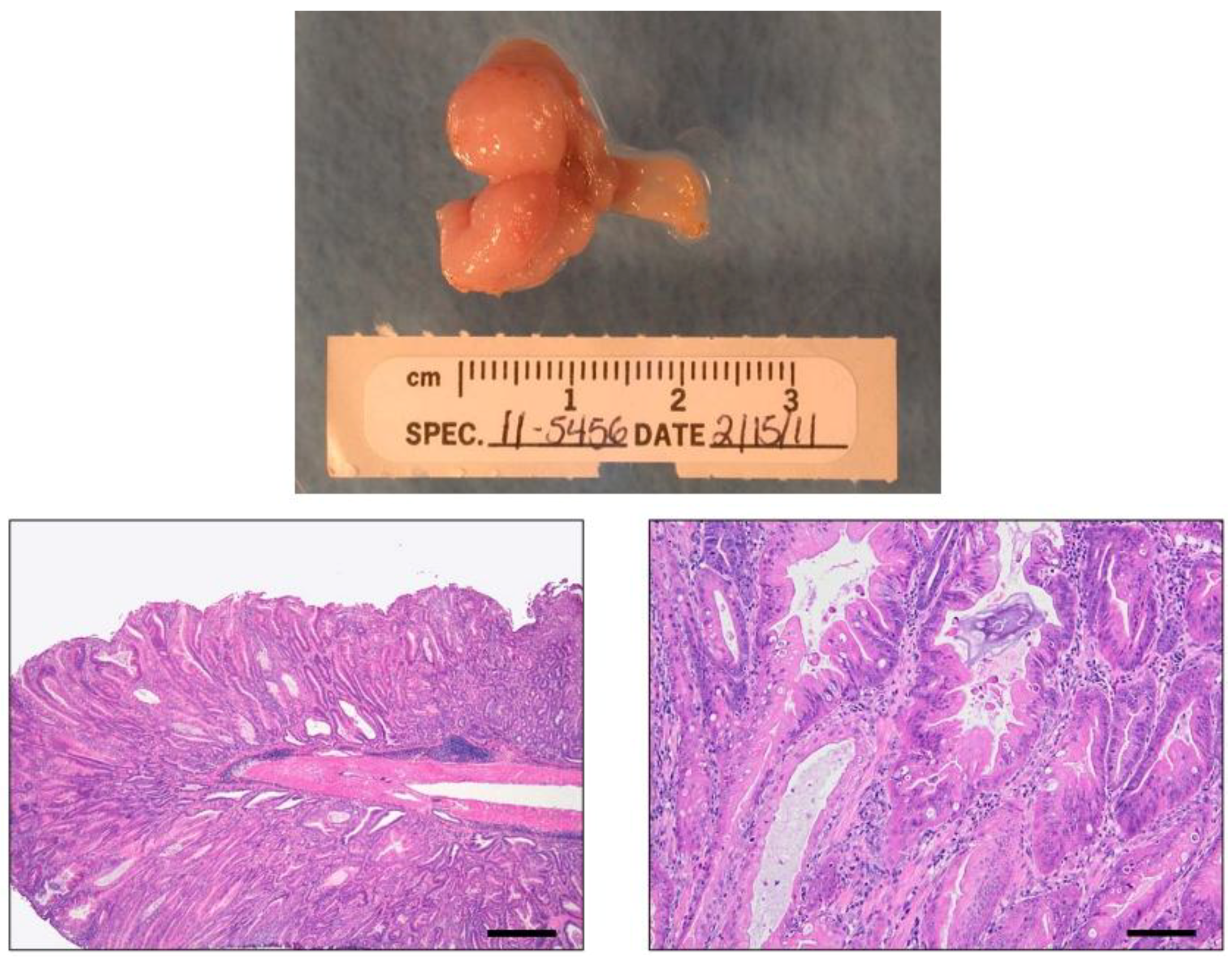
        <p>Although Zollinger-Ellison syndrome patients associated with syndrome type I MEN are likely to develop ECL cell carcinoid tumors [<xref ref-type="bibr" rid="B117-cancers-05-00092">117</xref>], clear evidence of epidemiological correlation between hypergastrinemia and gastric cancer in human has not been reported. However, a subset of patients infected with H. pylori show mild-moderate increases in circulating levels of amidated gastrin, and thus a role for gastrin in gastric cancer was suggested, given its known role as a growth factor for the stomach [<xref ref-type="bibr" rid="B118-cancers-05-00092">118</xref>]. Twenty years ago, the insulin-gastrin (INS-GAS) transgenic mice were created, initially to study the role of gastrin on pancreatic islet cell formation [<xref ref-type="bibr" rid="B119-cancers-05-00092">119</xref>]. The INS-GAS transgene consisted of the insulin promoter upstream of the human gastrin coding sequences, and resulted in the overexpression of amidated gastrin (primarily G-17) in the pancreatic β-cells, leading to two-fold elevations in serum levels of human amidated gastrin. When crossed with MT-TGF-α transgenic mice, the combination of gastrin and TGF-α was able to synergistically stimulate islet growth, although neither peptide alone was sufficient to stimulate pancreatic islet growth [<xref ref-type="bibr" rid="B120-cancers-05-00092">120</xref>]. However, given the increases in circulating gastrin, subsequent investigations focused on the effects of gastrin on the gastric mucosa [<xref ref-type="bibr" rid="B29-cancers-05-00092">29</xref>]. Young INS-GAS mice showed increased maximal gastric acid secretion and parietal cell mass, but interestingly progressed later to decreased parietal cell mass (atrophy), hypochloryhydria and worsening hypergastrinemia, in association with increased epithelial proliferation [<xref ref-type="bibr" rid="B29-cancers-05-00092">29</xref>,<xref ref-type="bibr" rid="B121-cancers-05-00092">121</xref>,<xref ref-type="bibr" rid="B122-cancers-05-00092">122</xref>]. Over time, INS-GAS mice (in an FVB background) showed progression to gastric metaplasia and dysplasia, with the development of invasive gastric cancer in the corpus at 20 months of age (<xref ref-type="fig" rid="cancers-05-00092-f002">Figure 2</xref>). Infection of INS-GAS mice with <italic>H. felis</italic> or <italic>H. pylori</italic> led to accelerated development of intramucosal carcinoma (in &lt;12 months), with submucosal invasion and intravascular invasion [<xref ref-type="bibr" rid="B29-cancers-05-00092">29</xref>,<xref ref-type="bibr" rid="B85-cancers-05-00092">85</xref>]. Interestingly, the FVB/N inbred strain was most susceptible, while uninfected INS-GAS mice in a C57BL/6-background also developed mild gastric corpus hyperplasia and low-grade dysplasia [<xref ref-type="bibr" rid="B123-cancers-05-00092">123</xref>], they did not progress to gastric cancer, even in the setting of <italic>H. felis</italic> infection.</p>
        <fig id="cancers-05-00092-f002" position="float">
          <label>Figure 2</label>
          <caption>
            <p>INS-GAS mouse tumor. Gross image: Stomach of a <italic>H. pylori</italic>-infected male INS-GAS mouse at 7 mpi showing coalescing diffuse tumors of the glandular stomach. Bottom panels: Low and high magnification H&amp;E images of the stomach of an <italic>Hp</italic>-infected male INS-GAS mouse at 7 mpi showing diffuse high grade dysplastic/neoplastic glandular proliferation with lamina propria invasion consistent with the diagnosis of intramucosal carcinoma. Other features present include prominent mixed inflammation, erosions, mucosal/glandular degeneration/necrosis, glandular ectasia, oxyntic loss, severe hyperplasia, pseudopyloric and foveolar type metaplasia as well as glandular herniation.</p>
          </caption>
          <graphic xmlns:xlink="http://www.w3.org/1999/xlink" xlink:href="cancers-05-00092-g002.tif"/>
        </fig>
        <p>Although <italic>H. pylori</italic> infection on its own is slow to induce gastric atrophy, and is unable to induce gastric cancer in the majority of strains of WT mice, it is highly effective as a gastric carcinogen in INS-GAS mice. Thus, multiple studies from independent laboratories have now confirmed that <italic>H. pylori</italic> infection of INS-GAS mice leads to accelerated gastric cancer. The model has been widely used, particularly to examine the importance of various kinds of gene expressions [<xref ref-type="bibr" rid="B34-cancers-05-00092">34</xref>,<xref ref-type="bibr" rid="B124-cancers-05-00092">124</xref>,<xref ref-type="bibr" rid="B125-cancers-05-00092">125</xref>,<xref ref-type="bibr" rid="B126-cancers-05-00092">126</xref>,<xref ref-type="bibr" rid="B127-cancers-05-00092">127</xref>,<xref ref-type="bibr" rid="B128-cancers-05-00092">128</xref>], antagonists or inhibitors [<xref ref-type="bibr" rid="B129-cancers-05-00092">129</xref>,<xref ref-type="bibr" rid="B130-cancers-05-00092">130</xref>], bacterial factors or commensal flora [<xref ref-type="bibr" rid="B80-cancers-05-00092">80</xref>,<xref ref-type="bibr" rid="B83-cancers-05-00092">83</xref>,<xref ref-type="bibr" rid="B85-cancers-05-00092">85</xref>,<xref ref-type="bibr" rid="B113-cancers-05-00092">113</xref>], gender difference or sex hormones [<xref ref-type="bibr" rid="B106-cancers-05-00092">106</xref>,<xref ref-type="bibr" rid="B131-cancers-05-00092">131</xref>,<xref ref-type="bibr" rid="B132-cancers-05-00092">132</xref>,<xref ref-type="bibr" rid="B133-cancers-05-00092">133</xref>], dietary cofactors [<xref ref-type="bibr" rid="B134-cancers-05-00092">134</xref>], and apoptotic factors [<xref ref-type="bibr" rid="B135-cancers-05-00092">135</xref>,<xref ref-type="bibr" rid="B136-cancers-05-00092">136</xref>] in gastric carcinogenesis, as well as to analyze non-gastric diseases such as colon cancer [<xref ref-type="bibr" rid="B137-cancers-05-00092">137</xref>,<xref ref-type="bibr" rid="B138-cancers-05-00092">138</xref>], intestinal crypt regeneration [<xref ref-type="bibr" rid="B139-cancers-05-00092">139</xref>], or iron-deficiency anemia [<xref ref-type="bibr" rid="B140-cancers-05-00092">140</xref>] (<xref ref-type="table" rid="cancers-05-00092-t001">Table 1</xref>). In addition, the model has proved highly useful for studies of cancer prevention, given the high degree of reproducibility and the relative rapid development of cancer in this model.</p>
        <table-wrap id="cancers-05-00092-t001" position="float">
          <object-id pub-id-type="pii">cancers-05-00092-t001_Table 1</object-id>
          <label>Table 1</label>
          <caption>
            <p>Applications of INS-GAS mouse model.</p>
          </caption>
          <table>
            <thead>
              <tr>
                <th align="left" valign="middle">Purpose of analysis</th>
                <th align="left" valign="middle">Results</th>
              </tr>
            </thead>
            <tbody>
              <tr>
                <td align="left" valign="middle">Pancreatic islet cell formation [<xref ref-type="bibr" rid="B120-cancers-05-00092">120</xref>]</td>
                <td align="left" valign="middle">gastrin and TGF-α synergistically stimulate islet growth</td>
              </tr>
              <tr>
                <td align="left" valign="middle"><italic>H. pylori</italic> and gastric mucosa [<xref ref-type="bibr" rid="B29-cancers-05-00092">29</xref>]</td>
                <td align="left" valign="middle">progression to gastric atrophy, metaplasia, dysplasia, and cancer</td>
              </tr>
              <tr>
                <td align="left" valign="middle">Colonic carcinogenesis by AOM [<xref ref-type="bibr" rid="B137-cancers-05-00092">137</xref>,<xref ref-type="bibr" rid="B138-cancers-05-00092">138</xref>]</td>
                <td align="left" valign="middle">progastrin, not gastrin, promotes colon carcinogenesis</td>
              </tr>
              <tr>
                <td align="left" valign="middle">Gender differences [<xref ref-type="bibr" rid="B85-cancers-05-00092">85</xref>,<xref ref-type="bibr" rid="B106-cancers-05-00092">106</xref>]</td>
                <td align="left" valign="middle">greater gastric carcinogenesis in male INS-GAS mice with <italic>H. pylori</italic></td>
              </tr>
              <tr>
                <td align="left" valign="middle">Importance of CagE [<xref ref-type="bibr" rid="B85-cancers-05-00092">85</xref>]</td>
                <td align="left" valign="middle">loss of cagE temporally retards but does not abrogate cancer progression</td>
              </tr>
              <tr>
                <td align="left" valign="middle">Interaction with G-Gly [<xref ref-type="bibr" rid="B124-cancers-05-00092">124</xref>]</td>
                <td align="left" valign="middle">G-gly synergizes with amidated gastrin to stimulate acid secretion and inhibits atrophy</td>
              </tr>
              <tr>
                <td align="left" valign="middle">CCK2R and Histamine receptor inhibitors [<xref ref-type="bibr" rid="B129-cancers-05-00092">129</xref>]</td>
                <td align="left" valign="middle">CCK2R and H2R antagonists synergistically inhibit gastric atrophy and cancer</td>
              </tr>
              <tr>
                <td align="left" valign="middle">Intestinal crypt regeneration [<xref ref-type="bibr" rid="B139-cancers-05-00092">139</xref>]</td>
                <td align="left" valign="middle">hypergastrinemia increases regeneration of intestinal injury</td>
              </tr>
              <tr>
                <td align="left" valign="middle">Apoptosis of gastric epithelium [<xref ref-type="bibr" rid="B135-cancers-05-00092">135</xref>,<xref ref-type="bibr" rid="B136-cancers-05-00092">136</xref>]</td>
                <td align="left" valign="middle">gastrin induces apoptosis and contribute to gastric carcinogenesis</td>
              </tr>
              <tr>
                <td align="left" valign="middle">Gene expression profiling [<xref ref-type="bibr" rid="B125-cancers-05-00092">125</xref>]</td>
                <td align="left" valign="middle">identify up- and down-regulating genes among 12,000 cDNA</td>
              </tr>
              <tr>
                <td align="left" valign="middle">TFF2 expression [<xref ref-type="bibr" rid="B126-cancers-05-00092">126</xref>]</td>
                <td align="left" valign="middle">TFF2 expression in the gastric fundus was elevated in INS-GAS mice</td>
              </tr>
              <tr>
                <td align="left" valign="middle">Swedish variant of moist oral smokeless tobacco [<xref ref-type="bibr" rid="B134-cancers-05-00092">134</xref>]</td>
                <td align="left" valign="middle">tobacco promotes cancer formation in <italic>H. pylori</italic>-infected INS-GAS mice</td>
              </tr>
              <tr>
                <td align="left" valign="middle">Reg-1 expression [<xref ref-type="bibr" rid="B127-cancers-05-00092">127</xref>]</td>
                <td align="left" valign="middle">Reg1 is increased in the stomachs of <italic>H. felis</italic>-infected INS-GAS mice</td>
              </tr>
              <tr>
                <td align="left" valign="middle">Role of 17-beta-estradiol [<xref ref-type="bibr" rid="B131-cancers-05-00092">131</xref>,<xref ref-type="bibr" rid="B132-cancers-05-00092">132</xref>,<xref ref-type="bibr" rid="B133-cancers-05-00092">133</xref>]</td>
                <td align="left" valign="middle">17beta-estradiol has protective effects on gastric cancer development</td>
              </tr>
              <tr>
                <td align="left" valign="middle">Eradication of <italic>Helicobacter</italic> [<xref ref-type="bibr" rid="B79-cancers-05-00092">79</xref>,<xref ref-type="bibr" rid="B80-cancers-05-00092">80</xref>,<xref ref-type="bibr" rid="B83-cancers-05-00092">83</xref>]</td>
                <td align="left" valign="middle">eradication inhibits mouse gastric carcinogenesis</td>
              </tr>
              <tr>
                <td align="left" valign="middle">Commensal bacterial flora in the stomach [<xref ref-type="bibr" rid="B113-cancers-05-00092">113</xref>]</td>
                <td align="left" valign="middle">SPF mice are more susceptible to gastric cancer than germ-free mice</td>
              </tr>
              <tr>
                <td align="left" valign="middle">Antral carcinogenesis [<xref ref-type="bibr" rid="B60-cancers-05-00092">60</xref>,<xref ref-type="bibr" rid="B123-cancers-05-00092">123</xref>]</td>
                <td align="left" valign="middle">gastrin suppresses antral carcinogenesis</td>
              </tr>
              <tr>
                <td align="left" valign="middle">HB-EGF, MMP-7, EMT protein [<xref ref-type="bibr" rid="B128-cancers-05-00092">128</xref>]</td>
                <td align="left" valign="middle">neutralisation of gastrin in INS-GAS mice reduced MMP-7, HB-EGF and EMT proteins</td>
              </tr>
              <tr>
                <td align="left" valign="middle">Acetic acid and cytoreduction [<xref ref-type="bibr" rid="B130-cancers-05-00092">130</xref>]</td>
                <td align="left" valign="middle">acetic acid could be a potent cytoreductive treatment of gastric cancer</td>
              </tr>
              <tr>
                <td align="left" valign="middle">Effect of IL-8 [<xref ref-type="bibr" rid="B34-cancers-05-00092">34</xref>]</td>
                <td align="left" valign="middle">IL-8 promotes gastric carcinogenesis in INS-GAS mice</td>
              </tr>
              <tr>
                <td align="left" valign="middle"><italic>H. pylori</italic>-induced iron deficiency [<xref ref-type="bibr" rid="B140-cancers-05-00092">140</xref>]</td>
                <td align="left" valign="middle">marked changes in expression of gastric iron transporters in <italic>H. felis</italic>-infected INS-GAS mice</td>
              </tr>
            </tbody>
          </table>
        </table-wrap>
      </sec>
      <sec>
        <title>4.2. Gastrin Knockout Mice</title>
        <p>As noted above, while a subset of <italic>H. pylori</italic>-infected patients exhibit significant hypergastrinemia (e.g., 2-fold elevations in gastrin), most patients infected with <italic>H. pylori</italic> do not. In fact, many <italic>H. pylori</italic> infected patients with pan-gastritis who develop gastric atrophy show depressed levels of circulating gastrin. Thus, it was not entirely surprising when several laboratories reported that gastrin knockout (GAS-KO or GAS<sup>−/−</sup>) mice were also susceptible to stomach cancer. However, in contrast to the hypergastrinemic INS-GAS mice which developed corpus cancers, GAS<sup>−/−</sup> mice exhibited antral gastric cancers. GAS<sup>−/−</sup> mice (C57BL/6 strain) were first generated by Koh <italic>et al.</italic>, and the initial phenotype reported was fairly unremarkable, with mild changes in gastric architecture, including a slight decrease in the number of parietal and enterochromaffin-like cells [<xref ref-type="bibr" rid="B141-cancers-05-00092">141</xref>]. However, an independent group reported that a separate line of 129/Sv GAS<sup>−/−</sup> mice, showed hypochlorhydria and bacterial overgrowth, resulting in increased gastric inflammation [<xref ref-type="bibr" rid="B142-cancers-05-00092">142</xref>]. Moreover, these GAS<sup>−/−</sup> mice that were kept in conventional (non-SPF) housing conditions developed spontaneous antral tumors [<xref ref-type="bibr" rid="B143-cancers-05-00092">143</xref>]. These findings were confirmed by an independent group, and the GAS<sup>−/−</sup> mice were also found to be more susceptible to MNU-induced antral cancer compared to WT mice in the same genetic background [<xref ref-type="bibr" rid="B60-cancers-05-00092">60</xref>].</p>
        <p>Taken together, these reports suggest that gastrin has distinct functions in the gastric corpus and gastric antrum. Indeed, in contrast to the gastrin response observed in the corpus, hypergastrinemic INS-GAS FVB mice infected with <italic>H. felis</italic> showed decreased mucosal changes in the antrum relative to WT mice [<xref ref-type="bibr" rid="B123-cancers-05-00092">123</xref>], and INS-GAS mice were found to be more resistant to MNU-induced antral tumors [<xref ref-type="bibr" rid="B60-cancers-05-00092">60</xref>]. The antral tumor suppressive function of gastrin could be explained to some extent by its effect on stimulating acid secretion leading to inhibition of bacterial overgrowth. However, Dimaline <italic>et al.</italic> first reported that gastrin regulates TFF1 gene expression, providing a link between gastrin and a known tumor suppressor gene (see below). Tomita <italic>et al.</italic> went on to demonstrate that gastrin regulates TFF1 expression <italic>in vivo</italic> and <italic>in vitro</italic> through DNA methylation and histone modification [<xref ref-type="bibr" rid="B60-cancers-05-00092">60</xref>]. Therefore, these studies suggest that amidated gastrin (e.g., G-17) increases corpus proliferation and cancer susceptibility, but (through TFF1) decreases antral proliferation and cancer susceptibility. The distinct effects of gastrin on proximal versus distal gastric cancers are consistent with the distinct epidemiology and behavior of tumors at these two anatomical sites, and emphasizes the importance of pathological descriptions clearly distinguishing the corpus and the antrum as separate tumor sites.</p>
      </sec>
      <sec>
        <title>4.3. TFF1 Knockout Mice and Gp130 Mutant Mice</title>
        <p>The human and mouse TFF1 (formerly known as pS2) proteins belong to the family of trefoil peptides, which are characterized by the presence of one to six cysteine-rich P domains. TFF1 proteins are normally expressed in the epithelial cells of the gastric mucosa, and are abnormally expressed in gastrointestinal diseases and various cancers. To elucidate the function of TFF1, Lefebvre <italic>et al.</italic> disrupted the mouse TFF1 gene by homologous recombination, generating TFF1<sup>−/−</sup> mice (F2 129/Svj mixed background) [<xref ref-type="bibr" rid="B144-cancers-05-00092">144</xref>]. Mice deficient in TFF1 expression displayed hyperplastic gastric epithelium with markedly elongated gastric pits, and multifocal intraepithelial or intramucosal carcinomas were observed in 30% of mice [<xref ref-type="bibr" rid="B144-cancers-05-00092">144</xref>]. A recent study has shown that loss of TFF1 leads to activation of IKK complex-regulated NF-κB transcription factors, resulting in enhanced NF-κB-mediated inflammatory responses during the progression to gastric tumorigenesis [<xref ref-type="bibr" rid="B145-cancers-05-00092">145</xref>].</p>
        <p>A reduction in TFF1 gene expression has been observed in about 50% of human distal stomach cancers, and promoter hypermethylation has also been found rather than mutation of the TFF1 gene [<xref ref-type="bibr" rid="B146-cancers-05-00092">146</xref>,<xref ref-type="bibr" rid="B147-cancers-05-00092">147</xref>,<xref ref-type="bibr" rid="B148-cancers-05-00092">148</xref>]. A well-defined positive transcriptional regulator of TFF1 is the peptide hormone gastrin [<xref ref-type="bibr" rid="B149-cancers-05-00092">149</xref>]. Gastrin inhibits TFF1 repression and thus suppresses MNU-induced antral gastric carcinogenesis [<xref ref-type="bibr" rid="B60-cancers-05-00092">60</xref>]. In <italic>Helicobacter</italic>-infected human or mouse tissues, TFF1 was moderately epigenetically repressed, but much greater TFF2 repression was observed in stomach cancer [<xref ref-type="bibr" rid="B60-cancers-05-00092">60</xref>]. Clyne <italic>et al.</italic> reported that <italic>H. pylori</italic> bound to the TFF1 dimer <italic>in vitro</italic> and that this interaction enables binding to gastric mucin, suggesting that TFF1 may act as a receptor for the organism [<xref ref-type="bibr" rid="B150-cancers-05-00092">150</xref>,<xref ref-type="bibr" rid="B151-cancers-05-00092">151</xref>]. However, <italic>in vivo</italic> evidence for direct <italic>H. pylori</italic>-TFF1 interaction has been lacking. Thus, further studies are needed to clarify the possible association between TFF1 and <italic>H. pylori</italic>.</p>
        <p>While TFF1 is expressed predominantly in foveolar surface mucous or pit cells of the stomach, TFF2 is expressed in the deeper glandular epithelium in the distal stomach and the acini of Brunners glands in the duodenum [<xref ref-type="bibr" rid="B152-cancers-05-00092">152</xref>,<xref ref-type="bibr" rid="B153-cancers-05-00092">153</xref>,<xref ref-type="bibr" rid="B154-cancers-05-00092">154</xref>]. Genetically engineered mice deficient in TFF2 show a minimal phenotype, with only a slight reduction in proliferation rates in the gastric mucosa [<xref ref-type="bibr" rid="B155-cancers-05-00092">155</xref>] but <italic>H. pylori</italic>-infected TFF2-deficient mice develop more advanced premalignant lesions of atrophy, metaplasia, and dysplasia than WT mice [<xref ref-type="bibr" rid="B156-cancers-05-00092">156</xref>]. Furthermore, the fundus of gp130<sup>F/F</sup><italic>/</italic>TFF2<sup>−/−</sup> mice displayed glandular atrophy and metaplasia. These results suggest that TFF2 negatively regulates preneoplastic progression and subsequent tumor development in the stomach [<xref ref-type="bibr" rid="B157-cancers-05-00092">157</xref>].</p>
        <p>Gp130 is a common co-receptor for the cytokines IL-6 and IL-11. Mice with a mutation of the gp130 receptor (gp130<sup>F/F</sup> mice), which abrogates Src-homology tyrosine phosphatase 2 (SHP2)-Ras-ERK signaling following gp130 engagement, have a dramatic gastric phenotype. Gp130<sup>F/F</sup> mice progress rapidly to gastric neoplasia, with evidence of gastric adenomas by 3 months of age [<xref ref-type="bibr" rid="B158-cancers-05-00092">158</xref>,<xref ref-type="bibr" rid="B159-cancers-05-00092">159</xref>]. Interestingly, mutation of the gp130 receptor leads to downregulation of the TFF1 gene, and the phenotype of gp130<sup>F/F</sup> mice in many ways mimics that of TFF1<sup>−/−</sup> mice. The main cytokine driver of gp130 signaling in the stomach is IL-11, with IL-6 having little activity in the antral stomach [<xref ref-type="bibr" rid="B160-cancers-05-00092">160</xref>,<xref ref-type="bibr" rid="B161-cancers-05-00092">161</xref>]. IL-11 appears to promote chronic gastric inflammation and associated tumorigenesis mediated by excessive activation of STAT3 and STAT1 [<xref ref-type="bibr" rid="B162-cancers-05-00092">162</xref>].</p>
      </sec>
      <sec>
        <title>4.4. H/K-ATPase-IL-1β Transgenic Mice</title>
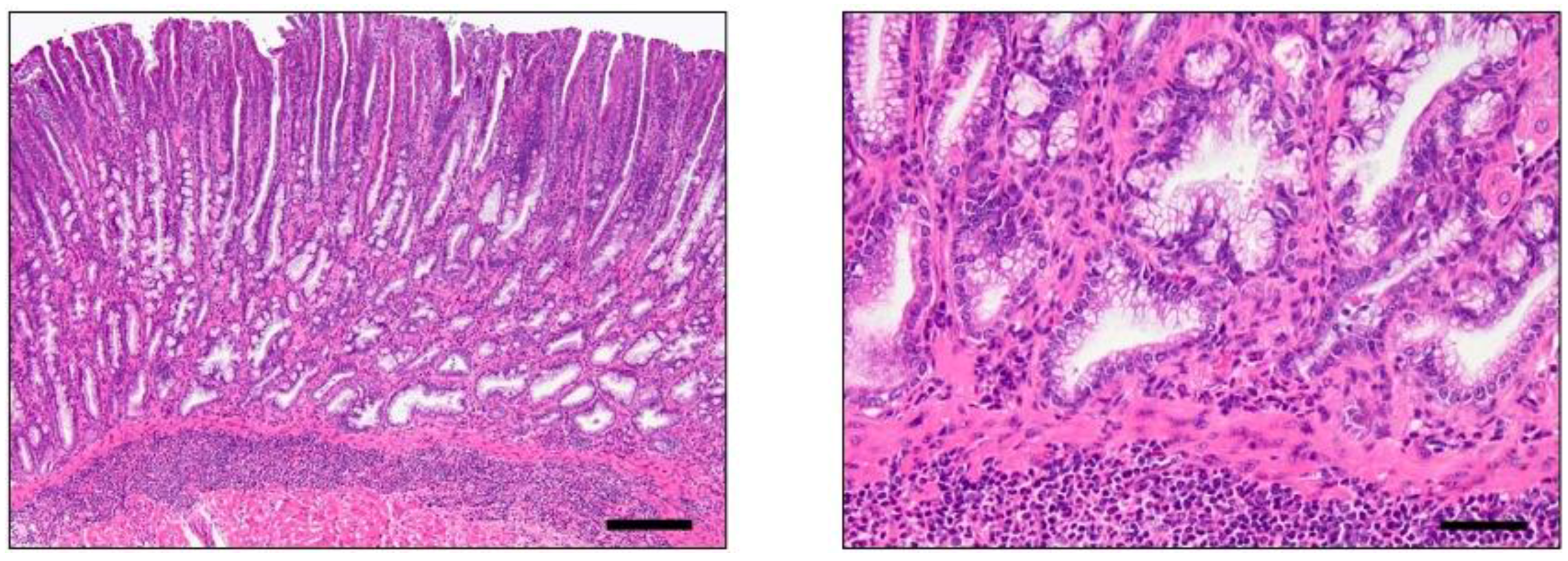
        <p>Polymorphisms of the IL-1β that are predicted to increase IL-1β signaling have been shown to increase the risk of a number of human tumors, particularly gastric cancer [<xref ref-type="bibr" rid="B30-cancers-05-00092">30</xref>]. IL-1β is a pleiotropic proinflammatory cytokine that has profound effects on inflammation and immunity, and is upregulated by <italic>H. pylori</italic> infection [<xref ref-type="bibr" rid="B30-cancers-05-00092">30</xref>]. Tu <italic>et al.</italic> generated stomach-specific expression of human IL-1β in transgenic mice by using the murine H/K-ATPase promoter to direct expression of a constitutively active form of human IL-1β. H/K-ATPase-IL-1β transgenic mice (C57BL/6 background) exhibited spontaneous gastric inflammation and slow progression (over 1.5 years) to gastric atrophy, metaplasia and gastric cancer (<xref ref-type="fig" rid="cancers-05-00092-f003">Figure 3</xref>). In addition, infection of these mice with <italic>H. felis</italic> resulted in strong synergy and rapid progression (in &lt;1 year) to cancer [<xref ref-type="bibr" rid="B163-cancers-05-00092">163</xref>]. Thus, H/K-ATPase-IL-1β transgenic mice confirm the genetic findings in human patients that elevated expression of IL-1β represents a risk factor for gastric cancer, and that IL-1β can synergize with <italic>Helicobacter</italic> infection to drive cancer formation. In addition, it raises the possibility that IL-1β itself may represent a final common pathway for <italic>Helicobacter</italic> pathogenesis.</p>
        <fig id="cancers-05-00092-f003" position="float">
          <label>Figure 3</label>
          <caption>
            <p>H/K-ATPase-IL-1β mouse: Inflammation, Metaplasia and Dysplasia. Low and high magnification images of the gastric corpus depicting prominent mucosal and submucosal granulocytic and lymphocytic inflammation with oxyntic loss, mucous metaplasia, foveolar and glandular hyperplasia, as well as dysplasia characterized by glandular architectural abnormalities such as misorientation, splitting, elongation, back to back formation, crowding and mild cellular atypia. (Bar: Left 100× or 160 μM, Right 400× or 40 μM).</p>
          </caption>
          <graphic xmlns:xlink="http://www.w3.org/1999/xlink" xlink:href="cancers-05-00092-g003.tif"/>
        </fig>
        <p>Several molecular mechanisms of cancer development in IL-1β transgenic mice have been suggested. First, IL-1β stimulates through the IL-1 receptor the NF-κB pathway, which is strongly associated with a variety of cancers. NF-κB activation in inflammatory cells leads to increased production of IL-6, TNF-α, and other cytokines that have been associated with cancer development. Second, IL-1β of tumor cell origin has been shown in other studies to stimulate hematological alterations manifested by extensive accumulation in the spleen of Gr-1+CD11b+ immature myeloid cells that induce tumor-mediated immune suppression [<xref ref-type="bibr" rid="B164-cancers-05-00092">164</xref>]. Indeed, IL-1β transgenic mice showed early recruitment of myeloid-derived suppressor cells (MDSCs) to the stomach [<xref ref-type="bibr" rid="B163-cancers-05-00092">163</xref>]. Third, a recent study suggested that IL-1β suppresses Sonic Hedgehog (Shh) gene expression in parietal cells by inhibiting acid secretion and the release of cellular calcium, followed by gastric atrophy [<xref ref-type="bibr" rid="B165-cancers-05-00092">165</xref>].</p>
        <p>The H/K-ATPase-IL-1β mouse model of gastric cancer has been useful for elucidating the important contributions of stromal cells in the tumor microenvironments, including CAFs or inflammatory cells. Quante <italic>et al.</italic> showed that at least 20% of CAFs originate from bone marrow (BM) and are derived from mesenchymal stem cells (MSCs), and that MSC-derived CAFs which are recruited to the dysplastic stomach express IL-6, Wnt5a and BMP4, show DNA hypomethylation, and promote tumor growth [<xref ref-type="bibr" rid="B31-cancers-05-00092">31</xref>]. Moreover, CAFs are involved in creation of a niche to sustain cancer progression in SDF-1-dependent manner [<xref ref-type="bibr" rid="B33-cancers-05-00092">33</xref>]. Tu <italic>et al.</italic> analyzed the role of T cells in gastric carcinogenesis by using IL-1β the transgenic model, and reported that IFN-γ overexpression suppressed gastric carcinogenesis because helper T cell (Th) 1 and Th17 immune responses were inhibited by IFN-γ through Fas induction and apoptosis in CD4 T cells [<xref ref-type="bibr" rid="B32-cancers-05-00092">32</xref>].</p>
        <p>Taken together, the IL-1β transgenic mouse model is considered to be one of the best mouse models of gastric cancer reported to date. In combination with other strains of genetically engineered mice, it should be useful for clarifying further the early steps of cancer initiation and the critical interactions that take place between the epithelial and stromal components of the gastric mucosa.</p>
      </sec>
      <sec>
        <title>4.5. K-ras Transgenic Mice</title>
        <p>K-ras is one of the most commonly mutated proto-oncogene in a variety of human cancers [<xref ref-type="bibr" rid="B166-cancers-05-00092">166</xref>]. While normally its activity is tightly regulated, somatic mutations occur that render its activity constitutive and thereby oncogenic [<xref ref-type="bibr" rid="B167-cancers-05-00092">167</xref>]. Oncogenic activations of K-ras have been found in human gastric cancers, although they are not as common (0–18%) in both intestinal type and diffuse type gastric cancers as reported in other solid tumors, such as pancreatic or colorectal cancer [<xref ref-type="bibr" rid="B168-cancers-05-00092">168</xref>]. While oncogenic K-ras leads to increased signaling through a number of proliferative (e.g., MAPK) pathways, it has also been strongly linked to the development of chronic inflammation and cancer [<xref ref-type="bibr" rid="B169-cancers-05-00092">169</xref>]. In genetically engineered mouse models of pancreatic cancer based on PDX1-directed K-ras mutations, significant inflammatory and stromal responses correlate with cancer progression [<xref ref-type="bibr" rid="B170-cancers-05-00092">170</xref>]. To analyze the function of oncogenic K-ras on the stomach cancer development in mice, the K19-promoter, which targets expression to the progenitor zone of the gastric neck/isthmus [<xref ref-type="bibr" rid="B171-cancers-05-00092">171</xref>], was used to direct expression of K-ras-V12 mutant gene. K19-K-ras-V12 transgenic mice (F2 mixed C57BL/6 × DBA background) showed an early upregulation of chemokines such as CXCL1 and recruitment of bone marrow-derived inflammatory cells and fibroblasts, following by the gradual development of parietal cell loss, metaplasia and dysplasia, in a manner that closely resembled <italic>H. felis</italic>-induced gastric preneoplasia and carcinogenesis [<xref ref-type="bibr" rid="B171-cancers-05-00092">171</xref>,<xref ref-type="bibr" rid="B172-cancers-05-00092">172</xref>]. Thus, these data suggest that K-ras-dependent chronic inflammation, leading to the recruitment of bone marrow-derived cells that contribute to the stromal microenvironment, can initiate gastric carcinogenesis.</p>
        <p>In a separate study, investigators introduced a conditional K-ras G12D mutation in the K19-positive lineage in adult mice by crossing K19-CreERT knock-in mice with LoxP-STOP-LoxP-KrasG12D mice. The phenotype of these mice included numerous hyperplasias, metaplasias and adenomas in the stomach as well as in the oral cavity, colon and lungs [<xref ref-type="bibr" rid="B173-cancers-05-00092">173</xref>]. Another group bred UBC9-CreERT transgenic mice with LoxP-STOP-LoxP-KrasG12D mice in order to determine the effect in mice of widespread, systemic activation of K-ras [<xref ref-type="bibr" rid="B174-cancers-05-00092">174</xref>]. Ubiquitous K-ras activation in mice had rapid and dramatic effects on both the forestomach and glandular stomach, and resulted in severe inflammation, hyperplasia, metaplasia, and activated progenitor cells, although neoplastic changes in other organs were not detected. These latter results suggest that, amongst all the tissues in which K-ras is activated, the stomach appears to be unusually susceptible to the effects of K-ras mutation at early time points, pointing to a crucial role of K-ras activation in initiation of gastric precancerous changes.</p>
      </sec>
      <sec>
        <title>4.6. Wnt1 and COX-2 Transgenic Mice</title>
        <p>Oncogenic activations of β-catenin have been found in about 20% of intestinal type gastric cancers, but not in diffuse type gastric cancers [<xref ref-type="bibr" rid="B168-cancers-05-00092">168</xref>,<xref ref-type="bibr" rid="B175-cancers-05-00092">175</xref>]. On the other hand, mutation of the Apc gene, while extremely common in colorectal cancer, is rarely seen in gastric cancer [<xref ref-type="bibr" rid="B168-cancers-05-00092">168</xref>]. Nevertheless, familial adenomatous polyposis (FAP) due to germ-line mutations in the Apc gene, and characterized by the formation of thousands of colonic polyps and a high likelihood of colon carcinoma, is also associated with an increased risk of gastric polyps and cancer [<xref ref-type="bibr" rid="B176-cancers-05-00092">176</xref>,<xref ref-type="bibr" rid="B177-cancers-05-00092">177</xref>]. This suggests that Wnt signaling is likely to play a causal role in gastric cancer development. Thus, mice carrying a heterozygous Apc gene mutation (Apc1648) developed gastric dysplasia and polyposis in the antrum [<xref ref-type="bibr" rid="B178-cancers-05-00092">178</xref>]. In addition, K19-Wnt1 transgenic mice were noted to have an increase of undifferentiated gastric epithelial cells along with the spontaneous development of small preneoplastic lesions in the gastric mucosa [<xref ref-type="bibr" rid="B179-cancers-05-00092">179</xref>]. These data support a potential role for Wnt signaling in gastric carcinogenesis.</p>
        <p>The COX-2/PGE2 pathway is also thought to play an important role in gastric tumorigenesis. Overexpression of cyclooxygenase 2 (COX-2) is frequently detected in gastric cancer [<xref ref-type="bibr" rid="B180-cancers-05-00092">180</xref>]. COX-2 transgenic mice, where the human COX-2 cDNA was driven from the cytomegalovirus (CMV) promoter, showed an increase in MNU-induced gastric cancer development [<xref ref-type="bibr" rid="B55-cancers-05-00092">55</xref>]. Treatment with celecoxib, a selective COX-2 inhibitor, reduced MNNG-induced gastric cancer incidence and growth in rats [<xref ref-type="bibr" rid="B181-cancers-05-00092">181</xref>]. A combination of sulindac (a nonspecific COX inhibitor) and antimicrobial eradication prevent progression of gastric cancer in <italic>H. pylori</italic>-infected INS-GAS mice [<xref ref-type="bibr" rid="B182-cancers-05-00092">182</xref>]. Finally, hyperplastic gastritis induced by <italic>H. pylori</italic> is associated with upregulated COX-2 expression, and gastric hyperplasia was significantly reduced by treatment with the selective COX-2 inhibitors [<xref ref-type="bibr" rid="B183-cancers-05-00092">183</xref>,<xref ref-type="bibr" rid="B184-cancers-05-00092">184</xref>,<xref ref-type="bibr" rid="B185-cancers-05-00092">185</xref>].</p>
        <p>In 2004, K19-C2mE transgenic mice were reported that simultaneously expressed both COX-2 and microsomal prostaglandin E synthase (PGES)-1 in the gastric epithelial cells. The transgenic mice developed hyperplastic lesions, metaplasia (SPEM), and tumorous growths in the glandular stomach with heavy macrophage infiltrations [<xref ref-type="bibr" rid="B186-cancers-05-00092">186</xref>,<xref ref-type="bibr" rid="B187-cancers-05-00092">187</xref>]. These findings suggest that an increased level of PGE2 enhances macrophage infiltration, thus contributing to gastric tumor development. When K19-Wnt1 mice were crossed with K19-C2mE to construct compound transgenic mice (K19-Wnt1/C2mE mice), the K19-Wnt1/C2mE mice developed mucous metaplasia followed by the spontaneous development of gastric adenocarcinoma [<xref ref-type="bibr" rid="B179-cancers-05-00092">179</xref>]. The tumors consisted of dysplastic epithelial cells, which sometimes invaded the smooth muscle layers. These results clearly indicate that the simultaneous activation of the Wnt and PGE2 pathways can promote dysplastic gastric tumors through a metaplasia-carcinoma sequence. Moreover, ablation of CD44 (a gastric cancer stem cell marker [<xref ref-type="bibr" rid="B188-cancers-05-00092">188</xref>]) in K19-Wnt1/C2mE mice (<italic>i.e</italic>., CD44<sup>−/−</sup>K19-Wnt1/C2mE mice) suppressed gastric tumor growth [<xref ref-type="bibr" rid="B189-cancers-05-00092">189</xref>], suggesting that CD44-targeted therapy may impair tumor growth ability.</p>
      </sec>
      <sec>
        <title>4.7. Other Mouse Models of Gastric Cancer</title>
        <p>Other murine models have been reported that show a significant gastric neoplastic phenotype, and these will be discussed briefly. These have included manipulations of genes in the TGF-β/Smad pathway, RUNX3, MLH1/MSH2, p53, KLF4 and CDH1 (<xref ref-type="table" rid="cancers-05-00092-t002">Table 2</xref>).</p>
        <p>The TGF-β/Smad signaling pathway is commonly altered in gastric cancer [<xref ref-type="bibr" rid="B190-cancers-05-00092">190</xref>,<xref ref-type="bibr" rid="B191-cancers-05-00092">191</xref>,<xref ref-type="bibr" rid="B192-cancers-05-00092">192</xref>], and TGF-β1 knockout mice (mixed C57BL/6/Sv/129 background) developed severe epithelial hyperplasia and metaplasia in the stomach [<xref ref-type="bibr" rid="B193-cancers-05-00092">193</xref>]. Hahm <italic>et al.</italic> established TGF-β2 dominant-negative mice (mixed C57BL/6 × Sv/129 background) under the TFF1 promoter, and these mice showed a higher proliferation index and a higher incidence of gastric cancer with <italic>H. pylori</italic> infection [<xref ref-type="bibr" rid="B194-cancers-05-00092">194</xref>]. Heterozygous Smad4 knockout mice (mixed C57BL/6 × Sv/129 background and C57BL/6 background) exhibited spontaneous gastric tumor development [<xref ref-type="bibr" rid="B195-cancers-05-00092">195</xref>,<xref ref-type="bibr" rid="B196-cancers-05-00092">196</xref>]. Interestingly, T-cell specific deletion of Smad4 induces gastric tumors, as well as colon, duodenal and oral cavity tumors, with induction of inflammatory cytokines [<xref ref-type="bibr" rid="B197-cancers-05-00092">197</xref>,<xref ref-type="bibr" rid="B198-cancers-05-00092">198</xref>].</p>
		<table-wrap id="cancers-05-00092-t002" position="float">
          <object-id pub-id-type="pii">cancers-05-00092-t002_Table 2</object-id>
          <label>Table 2</label>
          <caption>
            <p>Mouse models of gastric cancer.</p>
          </caption>
          <table rules="all" style="border:solid thin">
            <thead>
              <tr>
                <th align="left" valign="middle">Model</th>
                <th align="left" valign="middle">Incidence</th>
                <th align="left" valign="middle">Duration</th>
                <th align="left" valign="middle">Location</th>
                <th align="left" valign="middle">Phenotype</th>
              </tr>
            </thead>
            <tbody>
              <tr>
                <td align="left" valign="middle">MNU</td>
                <td align="left" valign="middle">&lt;70%</td>
                <td align="left" valign="middle">12 months</td>
                <td align="left" valign="middle">Antrum</td>
                <td align="left" valign="middle">AdenoCa, Dysplasia [<xref ref-type="bibr" rid="B11-cancers-05-00092">11</xref>,<xref ref-type="bibr" rid="B47-cancers-05-00092">47</xref>,<xref ref-type="bibr" rid="B48-cancers-05-00092">48</xref>,<xref ref-type="bibr" rid="B49-cancers-05-00092">49</xref>]</td>
              </tr>
              <tr>
                <td align="left" valign="middle">
                  <italic>H. felis</italic>
                </td>
                <td align="left" valign="middle">80%</td>
                <td align="left" valign="middle">18 months</td>
                <td align="left" valign="middle">SCJ/Transition</td>
                <td align="left" valign="middle">AdenoCa, Dysplasia, Metaplasia, Atrophy [<xref ref-type="bibr" rid="B21-cancers-05-00092">21</xref>]</td>
              </tr>
              <tr>
                <td align="left" valign="middle">MNU + <italic>H. pylori</italic></td>
                <td align="left" valign="middle">80%</td>
                <td align="left" valign="middle">12 months</td>
                <td align="left" valign="middle">Antrum</td>
                <td align="left" valign="middle">AdenoCa, Dysplasia, Metaplasia, Atrophy [<xref ref-type="bibr" rid="B110-cancers-05-00092">110</xref>]</td>
              </tr>
              <tr>
                <td align="left" valign="middle">MNU + <italic>H. felis</italic></td>
                <td align="left" valign="middle">100%</td>
                <td align="left" valign="middle">36 weeks</td>
                <td align="left" valign="middle">Antrum</td>
                <td align="left" valign="middle">AdenoCa, Dysplasia, Metaplasia, Atrophy [<xref ref-type="bibr" rid="B60-cancers-05-00092">60</xref>]</td>
              </tr>
              <tr>
                <td align="left" valign="middle">CEA/SV40</td>
                <td align="left" valign="middle">100%</td>
                <td align="left" valign="middle">50 days</td>
                <td align="left" valign="middle">Antrum</td>
                <td align="left" valign="middle">AdenoCa, Dysplasia, Invasion to submucosa and duodenum [<xref ref-type="bibr" rid="B24-cancers-05-00092">24</xref>]</td>
              </tr>
              <tr>
                <td align="left" valign="middle">MMTV/Ad12</td>
                <td align="left" valign="middle">82%(male)</td>
                <td align="left" valign="middle">3–4 months</td>
                <td align="left" valign="middle">SCJ</td>
                <td align="left" valign="middle">AdenoCa, AdenosquamousCa [<xref ref-type="bibr" rid="B26-cancers-05-00092">26</xref>]</td>
              </tr>
              <tr>
                <td align="left" valign="middle">HPV-16</td>
                <td align="left" valign="middle">100%</td>
                <td align="left" valign="middle">246–352 days</td>
                <td align="left" valign="middle">Antrum</td>
                <td align="left" valign="middle">Carcinoid, Metastasis to lymph node and liver [<xref ref-type="bibr" rid="B27-cancers-05-00092">27</xref>]</td>
              </tr>
              <tr>
                <td align="left" valign="middle">MTH1<sup>−/−</sup></td>
                <td align="left" valign="middle">13%</td>
                <td align="left" valign="middle">18 months</td>
                <td align="left" valign="middle">Antrum</td>
                <td align="left" valign="middle">AdenoCa, Dysplasia, Hyperplasia, Lung and liver tumors [<xref ref-type="bibr" rid="B199-cancers-05-00092">199</xref>]</td>
              </tr>
              <tr>
                <td align="left" valign="middle">TFF1<sup>−/−</sup></td>
                <td align="left" valign="middle">30%</td>
                <td align="left" valign="middle">5 months</td>
                <td align="left" valign="middle">Antrum</td>
                <td align="left" valign="middle">Intramucosal carcinoma, Hyperplasia, Activation of NF-kB [<xref ref-type="bibr" rid="B144-cancers-05-00092">144</xref>,<xref ref-type="bibr" rid="B145-cancers-05-00092">145</xref>]</td>
              </tr>
              <tr>
                <td align="left" valign="middle">Smad4<sup>+/−</sup></td>
                <td align="left" valign="middle">100%</td>
                <td align="left" valign="middle">12–18 months</td>
                <td align="left" valign="middle">Corpus/Antrum</td>
                <td align="left" valign="middle">AdenoCa, Dysplasia, Hyperplasia, Duodenal tumor [<xref ref-type="bibr" rid="B195-cancers-05-00092">195</xref>,<xref ref-type="bibr" rid="B196-cancers-05-00092">196</xref>]</td>
              </tr>
              <tr>
                <td align="left" valign="middle">GB-Smad4<sup>F/F</sup></td>
                <td align="left" valign="middle">100%</td>
                <td align="left" valign="middle">12–18 months</td>
                <td align="left" valign="middle">Antrum</td>
                <td align="left" valign="middle">Dysplasia, Hyperplasia [<xref ref-type="bibr" rid="B197-cancers-05-00092">197</xref>]</td>
              </tr>
              <tr>
                <td align="left" valign="middle">INS-GAS</td>
                <td align="left" valign="middle">75%</td>
                <td align="left" valign="middle">20 months</td>
                <td align="left" valign="middle">Corpus</td>
                <td align="left" valign="middle">AdenoCa, Dysplasia, Metaplasia, Atrophy, Synergized with <italic>H. felis</italic> [<xref ref-type="bibr" rid="B29-cancers-05-00092">29</xref>]</td>
              </tr>
              <tr>
                <td align="left" valign="middle">GAS<sup>−/−</sup></td>
                <td align="left" valign="middle">60%</td>
                <td align="left" valign="middle">12 months</td>
                <td align="left" valign="middle">Antrum</td>
                <td align="left" valign="middle">Dysplasia, Metaplasia, Atrophy, Susceptible to MNU [<xref ref-type="bibr" rid="B60-cancers-05-00092">60</xref>,<xref ref-type="bibr" rid="B143-cancers-05-00092">143</xref>]</td>
              </tr>
              <tr>
                <td align="left" valign="middle">Gp130<sup>F/F</sup></td>
                <td align="left" valign="middle">100%</td>
                <td align="left" valign="middle">6 months</td>
                <td align="left" valign="middle">Antrum</td>
                <td align="left" valign="middle">Adenoma, Decreased TFF1 expression [<xref ref-type="bibr" rid="B158-cancers-05-00092">158</xref>,<xref ref-type="bibr" rid="B159-cancers-05-00092">159</xref>]</td>
              </tr>
              <tr>
                <td align="left" valign="middle">IL-1β</td>
                <td align="left" valign="middle">&lt;70%</td>
                <td align="left" valign="middle">12 months</td>
                <td align="left" valign="middle">Transition</td>
                <td align="left" valign="middle">AdenoCa, Dysplasia, Metaplasia, Atrophy, Synergized with <italic>H. felis</italic> [<xref ref-type="bibr" rid="B163-cancers-05-00092">163</xref>]</td>
              </tr>
              <tr>
                <td align="left" valign="middle">K19/K-ras</td>
                <td align="left" valign="middle">37.5%</td>
                <td align="left" valign="middle">16 months</td>
                <td align="left" valign="middle">Corpus</td>
                <td align="left" valign="middle">Dysplasia, Metaplasia, Atrophy [<xref ref-type="bibr" rid="B172-cancers-05-00092">172</xref>]</td>
              </tr>
              <tr>
                <td align="left" valign="middle">Wnt1/C2me</td>
                <td align="left" valign="middle">100%</td>
                <td align="left" valign="middle">20 weeks</td>
                <td align="left" valign="middle">SCJ</td>
                <td align="left" valign="middle">AdenoCa, Dysplasia, Metaplasia, Attenuated by CD44 ablation [<xref ref-type="bibr" rid="B179-cancers-05-00092">179</xref>,<xref ref-type="bibr" rid="B189-cancers-05-00092">189</xref>]</td>
              </tr>
              <tr>
                <td align="left" valign="middle">CDH1<sup>+/−</sup> + MNU</td>
                <td align="left" valign="middle">45.8%</td>
                <td align="left" valign="middle">40 weeks</td>
                <td align="left" valign="middle">Antrum</td>
                <td align="left" valign="middle">Signet-ring cell Ca, Adenoma [<xref ref-type="bibr" rid="B56-cancers-05-00092">56</xref>]</td>
              </tr>
              <tr>
                <td align="left" valign="middle">CDH1/p53</td>
                <td align="left" valign="middle">100%</td>
                <td align="left" valign="middle">12 months</td>
                <td align="left" valign="middle">Corpus</td>
                <td align="left" valign="middle">Poorly differentiated AdenoCa, Signet-ring cell Ca [<xref ref-type="bibr" rid="B200-cancers-05-00092">200</xref>]</td>
              </tr>
              <tr>
                <td align="left" valign="middle">RUNX3<sup>−/−</sup> + MNU</td>
                <td align="left" valign="middle">71%</td>
                <td align="left" valign="middle">52 weeks</td>
                <td align="left" valign="middle">Corpus/Antrum</td>
                <td align="left" valign="middle">AdenoCa, Metaplasia, Hyperplasia [<xref ref-type="bibr" rid="B201-cancers-05-00092">201</xref>]</td>
              </tr>
              <tr>
                <td align="left" valign="middle">Villin-KLF4<sup>F/F</sup></td>
                <td align="left" valign="middle">29%</td>
                <td align="left" valign="middle">80 weeks</td>
                <td align="left" valign="middle">Antrum</td>
                <td align="left" valign="middle">Adenoma, Susceptible to MNU [<xref ref-type="bibr" rid="B57-cancers-05-00092">57</xref>]</td>
              </tr>
            </tbody>
          </table>
        </table-wrap>
        
        <p>RUNX3 is a member of the RUNX gene family which regulates the Smad gene family transcription and TGF-β signaling. RUNX3 is frequently inactivated in gastric cancer by protein mislocalization [<xref ref-type="bibr" rid="B202-cancers-05-00092">202</xref>]. RUNX3 knockout mice (F2 offspring) showed elongated gastric glands and increased proliferation in the gastric mucosa [<xref ref-type="bibr" rid="B203-cancers-05-00092">203</xref>]. Ito <italic>et al.</italic> recently reported that RUNX3 knockout mice (Balb/c background) showed loss of chief cells and development of SPEM, and also displayed higher susceptibility to adenocarcinoma by treatment with MNU [<xref ref-type="bibr" rid="B201-cancers-05-00092">201</xref>], supporting a role for RUNX3 as a tumor suppressor of gastric cancer.</p>
        <p>Interestingly, alterations in p53 and DNA mismatch repair genes in mice have not produced dramatic gastric phenotypes, pointing to important differences between mice and humans. Alterations in DNA mismatch repair genes, such as MLH1 and MSH2, are associated with the Lynch syndrome (formerly known as hereditary non-polyposis colorectal cancer or HNPCC), which is characterized with increases in not only colorectal cancer but also ovarian, endometrium, liver, skin, brain, and gastric cancer [<xref ref-type="bibr" rid="B204-cancers-05-00092">204</xref>]. However, mice lacking MLH1 or MSH2 do not develop gastric cancer, even with <italic>H. felis</italic> infection (Fox JG and Wang TC, unpublished data). Similarly, the p53 gene is the most commonly mutated tumor suppressor in a wide variety of human cancers. However, while <italic>H. felis</italic>-infected p53 hemizygous mice were reported to have a higher proliferative index and a higher gene mutation frequency than the infected control mice [<xref ref-type="bibr" rid="B205-cancers-05-00092">205</xref>,<xref ref-type="bibr" rid="B206-cancers-05-00092">206</xref>], they did not show increased progress to gastric cancer, although p53 heterozygous mice were more sensitive than WT counterparts to MNU [<xref ref-type="bibr" rid="B50-cancers-05-00092">50</xref>,<xref ref-type="bibr" rid="B207-cancers-05-00092">207</xref>]. However, a subsequent study demonstrated that the incidence of pre-neoplastic and invasive gastric carcinomas was decreased in p53 hemizygous mice [<xref ref-type="bibr" rid="B21-cancers-05-00092">21</xref>], and an independent group reported that no differences in gastric apoptotic or proliferation indices between p53<sup>+/+</sup> and p53<sup>+/–</sup> mice after infection with <italic>H. pylori</italic> SS1 strain [<xref ref-type="bibr" rid="B208-cancers-05-00092">208</xref>]. These results point to the limitations of using constitutive p53 knockout mice in modeling gastric cancer in mice, given the likely distinct roles of p53 in epithelial cells and inflammatory cells.</p>
        <p>Krüppel-like factor 4 (KLF4) is a potential tumor suppressor in patients with various cancers, including gastric cancer [<xref ref-type="bibr" rid="B209-cancers-05-00092">209</xref>]. Disruption of Klf4 in mice using the Villin-Cre-mediated system, which targets not only the intestine but also antral stem/progenitor cells [<xref ref-type="bibr" rid="B57-cancers-05-00092">57</xref>] induced spontaneous antral tumors. MNU treatment enhanced cancer development in these mice. Therefore, inactivation of Klf4 in Villin-positive gastric progenitor cells can lead to transformation of the gastric mucosa and tumorigenesis of the gastric antrum.</p>
        <p>To date, most murine models that develop gastric cancer have shown similarities to the well differentiated, intestinal-type of gastric cancer, but not to the diffuse type of gastric cancer. In human gastric cancer, loss of expression of the CDH1 gene encoding for E-cadherin has frequently been detected [<xref ref-type="bibr" rid="B210-cancers-05-00092">210</xref>], often due to promoter hypermethylation [<xref ref-type="bibr" rid="B168-cancers-05-00092">168</xref>,<xref ref-type="bibr" rid="B211-cancers-05-00092">211</xref>], particularly in diffuse-type lesions. Germline mutations of the CDH1 gene have been observed in hereditary diffuse type gastric cancer [<xref ref-type="bibr" rid="B212-cancers-05-00092">212</xref>]. CDH1 knockout mice (C57BL/6 background) have been generated, and in the MNU carcinogenesis model, CDH1<sup>+/−</sup> mice developed signet ring cell carcinoma with a high tumor incidence rate [<xref ref-type="bibr" rid="B56-cancers-05-00092">56</xref>]. Recently Shimada <italic>et al.</italic> generated conditional CDH1 and p53 double knockout mice under targeting by the H/K-ATPase promoter [<xref ref-type="bibr" rid="B200-cancers-05-00092">200</xref>]. In these conditional double knockout mice, intramucosal and invasive cancers composed of signet ring cells were found from 6 to 9 months, while mice lacking only the CDH1 gene developed no cancers. These observations support the notion that CDH1 plays a critical role in especially diffuse type gastric cancer, but mouse gastric cancer development requires not only CDH1 loss but also an additional mutation or carcinogen exposure.</p>
      </sec>
    </sec>
    <sec>
      <title>5. Models of Precancerous Change</title>
      <p><italic>H. pylori-</italic>associated gastric cancer in humans is preceded by a cascade of precancerous lesions, and cancer emerges following a number of discrete stages, including chronic gastritis, gastric atrophy, intestinal metaplasia, and dysplasia. Thus, in addition to mouse models of gastric cancer, there are a number of genetically engineered models that show decreased numbers of parietal cells, or gastric atrophy, along with metaplasia. In this section, we review briefly a number of models of atrophy and metaplasia that could be considered for use in experimental studies (<xref ref-type="table" rid="cancers-05-00092-t003">Table 3</xref>). However, most of these models do not appear to progress to neoplasia, and most have not been examined for susceptibility to cancer in response to carcinogens.</p>
      <table-wrap id="cancers-05-00092-t003" position="float">
        <object-id pub-id-type="pii">cancers-05-00092-t003_Table 3</object-id>
        <label>Table 3</label>
        <caption>
          <p>Mouse models of precancerous changes.</p>
        </caption>
        <table rules="all" style="border:solid thin">
          <thead>
            <tr>
              <th align="left" valign="middle">Model</th>
              <th align="left" valign="middle">Duration</th>
              <th align="left" valign="middle">Phenotype</th>
            </tr>
          </thead>
          <tbody>
            <tr>
              <td align="left" valign="middle"><italic>H.pylori</italic> (SS-1)</td>
              <td align="left" valign="middle">6–9 months</td>
              <td align="left" valign="middle">Atrophy, SPEM [<xref ref-type="bibr" rid="B20-cancers-05-00092">20</xref>]</td>
            </tr>
            <tr>
              <td align="left" valign="middle">TGF-α transgenic</td>
              <td align="left" valign="middle">3 months</td>
              <td align="left" valign="middle">Atrophy [<xref ref-type="bibr" rid="B122-cancers-05-00092">122</xref>,<xref ref-type="bibr" rid="B213-cancers-05-00092">213</xref>]</td>
            </tr>
            <tr>
              <td align="left" valign="middle">H/K-ATPase/DT</td>
              <td align="left" valign="middle">28–80 days</td>
              <td align="left" valign="middle">Atrophy [<xref ref-type="bibr" rid="B214-cancers-05-00092">214</xref>]</td>
            </tr>
            <tr>
              <td align="left" valign="middle">H/K-ATPase/Tk</td>
              <td align="left" valign="middle">Ganciclovir treatment</td>
              <td align="left" valign="middle">Atrophy [<xref ref-type="bibr" rid="B215-cancers-05-00092">215</xref>]</td>
            </tr>
            <tr>
              <td align="left" valign="middle">H/K-ATPase-α<sup>−/−</sup></td>
              <td align="left" valign="middle">10 weeks</td>
              <td align="left" valign="middle">Atrophy [<xref ref-type="bibr" rid="B216-cancers-05-00092">216</xref>]</td>
            </tr>
            <tr>
              <td align="left" valign="middle">H/K-ATPase-β<sup>−/−</sup></td>
              <td align="left" valign="middle">17 days</td>
              <td align="left" valign="middle">Atrophy [<xref ref-type="bibr" rid="B217-cancers-05-00092">217</xref>,<xref ref-type="bibr" rid="B218-cancers-05-00092">218</xref>]</td>
            </tr>
            <tr>
              <td align="left" valign="middle">NHE2<sup>−/−</sup></td>
              <td align="left" valign="middle">17 days</td>
              <td align="left" valign="middle">Atrophy [<xref ref-type="bibr" rid="B219-cancers-05-00092">219</xref>]</td>
            </tr>
            <tr>
              <td align="left" valign="middle">Car9<sup>−/−</sup></td>
              <td align="left" valign="middle">4 weeks</td>
              <td align="left" valign="middle">Atrophy [<xref ref-type="bibr" rid="B220-cancers-05-00092">220</xref>]</td>
            </tr>
            <tr>
              <td align="left" valign="middle">CCK2R<sup>−/−</sup></td>
              <td align="left" valign="middle">18 weeks</td>
              <td align="left" valign="middle">Atrophy [<xref ref-type="bibr" rid="B221-cancers-05-00092">221</xref>,<xref ref-type="bibr" rid="B222-cancers-05-00092">222</xref>]</td>
            </tr>
            <tr>
              <td align="left" valign="middle">H/K-ATPase/Shh<sup>−/−</sup></td>
              <td align="left" valign="middle">3–8 months</td>
              <td align="left" valign="middle">Pit cell hyperplasia, loss of parietal cell function [<xref ref-type="bibr" rid="B223-cancers-05-00092">223</xref>]</td>
            </tr>
            <tr>
              <td align="left" valign="middle">DMP-777</td>
              <td align="left" valign="middle">7–14 days</td>
              <td align="left" valign="middle">Atrophy, SPEM [<xref ref-type="bibr" rid="B224-cancers-05-00092">224</xref>,<xref ref-type="bibr" rid="B225-cancers-05-00092">225</xref>]</td>
            </tr>
            <tr>
              <td align="left" valign="middle">L-635</td>
              <td align="left" valign="middle">7 days</td>
              <td align="left" valign="middle">Atrophy, SPEM [<xref ref-type="bibr" rid="B226-cancers-05-00092">226</xref>]</td>
            </tr>
            <tr>
              <td align="left" valign="middle">Cdx2 transgenic</td>
              <td align="left" valign="middle">120 days</td>
              <td align="left" valign="middle">Intestinal metaplasia [<xref ref-type="bibr" rid="B227-cancers-05-00092">227</xref>,<xref ref-type="bibr" rid="B228-cancers-05-00092">228</xref>]</td>
            </tr>
            <tr>
              <td align="left" valign="middle">Cdx1 transgenic</td>
              <td align="left" valign="middle">120 days</td>
              <td align="left" valign="middle">Intestinal metaplasia [<xref ref-type="bibr" rid="B229-cancers-05-00092">229</xref>]</td>
            </tr>
          </tbody>
        </table>
      </table-wrap>
      <sec>
        <title>5.1. Models of Gastric Atrophy</title>
        <p>There are a number of genetically engineered mouse models, which exhibit parietal cell loss, <italic>i.e</italic>., gastric atrophy. Indeed, one strategy to achieve more rapid progression to gastric cancer is to ablate parietal cells, which appear to protect the homeostasis of the stomach in part through acid secretion. As mentioned above, MT-TGF-α transgenic mice show a form of atrophic gastritis, with loss of parietal cells along with foveolar hyperplasia [<xref ref-type="bibr" rid="B122-cancers-05-00092">122</xref>,<xref ref-type="bibr" rid="B213-cancers-05-00092">213</xref>]. Using the promoter of the β-subunit of the H/K-ATPase gene driving diphtheria toxin or herpes simplex 1 thymidine kinase, researchers were able to partially ablate parietal cells [<xref ref-type="bibr" rid="B214-cancers-05-00092">214</xref>,<xref ref-type="bibr" rid="B215-cancers-05-00092">215</xref>]. Interestingly, with loss of mature parietal cells in both of these models, there was concomitant loss of chief or zymogenic cells, along with an increase in progenitor cells. Thus, accumulating data indicate that the parietal cell itself or its secreted products plays a critical role on maintaining gastric gland homeostasis and controlling the development of cancerous changes. </p>
        <p>In many of these mouse models with impaired parietal cell function, hypochlorhydria leads to hypergastrinemia, which then induces foveolar hyperplasia. Thus, mice with a disrupted H/K-ATPase β-subunit gene exhibit abnormal parietal cell morphology, achlorhydria, hypergastrinemia, and hypertrophied gastric mucosa [<xref ref-type="bibr" rid="B216-cancers-05-00092">216</xref>,<xref ref-type="bibr" rid="B217-cancers-05-00092">217</xref>]. When crossed with GAS<sup>−/−</sup> mice, gastric hypertrophy in the H/K-ATPase-β-deficient mice disappeared, confirming that this phenotype is largely hypergastrinemia-dependent [<xref ref-type="bibr" rid="B218-cancers-05-00092">218</xref>]. Similarly, targeted disruption of the Na+/H+ exchanger isoform 2 (NHE2) gene or carbonic anhydrase gene have also been reported to induce parietal cell loss [<xref ref-type="bibr" rid="B219-cancers-05-00092">219</xref>,<xref ref-type="bibr" rid="B220-cancers-05-00092">220</xref>]. Transgenic mice with parietal cell-specific deletion of Sonic Hedgehog (Shh) (H/K-ATPase-Cre/Shh<sup>−/−</sup>) also developed gastric hypochlorhydria, hypergastrinemia, and a phenotype that resembled foveolar hyperplasia with hyperproliferation of surface mucous cells [<xref ref-type="bibr" rid="B223-cancers-05-00092">223</xref>]. Therefore, Shh may also function as a gastric morphogen, regulating gastric epithelial cell function and differentiation. In contrast, mice deficient in gastrin or its receptor cholecystokinin-B exhibit impaired acid secretion and reduced parietal cell numbers, but do not show foveolar hyperplasia [<xref ref-type="bibr" rid="B141-cancers-05-00092">141</xref>,<xref ref-type="bibr" rid="B221-cancers-05-00092">221</xref>,<xref ref-type="bibr" rid="B222-cancers-05-00092">222</xref>,<xref ref-type="bibr" rid="B230-cancers-05-00092">230</xref>]. As noted above, gastrin knockout mice are more susceptible to mouse induced antral carcinogenesis, but most other mouse models have not been tested in carcinogenesis trials.</p>
      </sec>
      <sec>
        <title>5.2. Models of Metaplasia</title>
        <p>Recently, it has become clear that there are two distinct types of metaplasia in the stomach that precede and are associated with gastric cancer [<xref ref-type="bibr" rid="B231-cancers-05-00092">231</xref>]. (1) Spasmolytic polypeptide-expressing metaplasia (SPEM), also known as pseudopyloric metaplasia, is characterized by the presence of TFF2- and MUC6-immunoreactive cells in the gastric fundus with morphological characteristics similar to deep antral gland cells or Brunner’s gland cells. (2) The other is classical intestinal metaplasia (IM), which is characterized by the presence of cells with the morphology of goblet cells and expression of MUC2 and TFF3. Both types of metaplasia are Alcian blue-positive. For many years, IM was thought to be a direct precursor of gastric cancer; however, while the association of intestinal-type cancers with chronic <italic>H. pylori</italic> infection and oxyntic atrophy in human is well accepted, little evidence directly links intestinal metaplasia with dysplastic transformation [<xref ref-type="bibr" rid="B232-cancers-05-00092">232</xref>]. Indeed, many investigators have come to the conclusion that SPEM is more likely to be the relevant precursor to gastric adenocarcinoma [<xref ref-type="bibr" rid="B233-cancers-05-00092">233</xref>].</p>
        <p>In most of the mouse models progressing to dysplasia described above, including mouse models of <italic>H. felis</italic> infection and transgenic mouse models (such as INS-GAS and H/K-ATPase-IL-1β mice), which demonstrate severe parietal cell loss, the fundic mucosa is replaced with a mucous cell metaplasia which was shown to be TFF2-expressing SPEM. Importantly, in these mouse models which progress to cancer, SPEM represents the only observed metaplasia, with no goblet cell IM being present. In addition, a short term model of parietal cell ablation has been described, using the neutrophil elastase inhibitor, DMP-777, which was shown to be a parietal cell-specific protonophore. DMP-777 treatment has allowed the examination of SPEM induction after acute oxyntic atrophy in the absence of significant inflammatory infiltrate. Mice or rats treated for 3 days with DMP-777 demonstrate a rapid loss of parietal cells [<xref ref-type="bibr" rid="B224-cancers-05-00092">224</xref>,<xref ref-type="bibr" rid="B225-cancers-05-00092">225</xref>]. The acute oxyntic atrophy is followed by SPEM in the fundus after 7–10 days. A structurally related β-lactam compound L-635, which retains potent parietal cell protonophore activity, but does not have any significant activity against neutrophil elastase, also induces gastric atrophy. In contrast with DMP-777 treatment, submucosal and intramucosal inflammatory infiltration was observed, and L-635 caused a more rapid and marked mucous cell TFF2-positive metaplasia [<xref ref-type="bibr" rid="B226-cancers-05-00092">226</xref>]. These results indicated that a combination of parietal cell loss and inflammation could potentiate the development of SPEM.</p>
        <p>Transgenic mice expressing the intestine-specific homeobox gene, Cdx2, under H/K-ATPase or Foxa3 promoter showed the disappearance of parietal cells and the replacement by classical IM [<xref ref-type="bibr" rid="B227-cancers-05-00092">227</xref>,<xref ref-type="bibr" rid="B228-cancers-05-00092">228</xref>]. Moreover, mice overexpressing Cdx1, another intestine-specific homeobox gene, also developed IM [<xref ref-type="bibr" rid="B229-cancers-05-00092">229</xref>]. However, no further progression to gastric carcinogenesis was observed in these transgenic mice, consistent with the notion that IM may not be the primary precursor of gastric cancer. However, the effect of <italic>Helicobacter</italic> infection on the gastric phenotype of these mice has not been assessed. Thus, further studies are needed to clarify the precise relationship between classical intestinal metaplasia and malignant transformation.</p>
      </sec>
    </sec>
    <sec sec-type="conclusions">
      <title>6. Conclusions and Future Perspectives</title>
      <p>Numerous mouse models with interesting gastric phenotypes are now available for studies of gastric carcinogenesis. These include transgenic mice (e.g., INS-GAS, H/K-ATPase-IL-1β, K19-Wnt1/C2mE), knockout mice (GAS<sup>−/−</sup>, Tff1<sup>−/−</sup>, gp130<sup>F/F</sup>), <italic>Helicobacter</italic> infection (<italic>H. felis</italic>, <italic>H. pylori</italic>) and carcinogen (MNU) models. These models have defined potential roles for gender, diet, bacterial flora, inflammatory cytokines, T helper immune response, acid secretion, virulence, and colonization properties of <italic>H. pylori</italic> strains and host genetic background. Reasonable models are now available for studies of early stage pathogenesis and cancer prevention.</p>
      <p>The mouse stomach consists of four different parts: forestomach, cardia, corpus, and antrum. Some models have been described in which forestomach tumor, <italic>i.e</italic>., squamous cell carcinoma, is induced with a carcinogen or by genetic alterations [<xref ref-type="bibr" rid="B26-cancers-05-00092">26</xref>,<xref ref-type="bibr" rid="B46-cancers-05-00092">46</xref>,<xref ref-type="bibr" rid="B47-cancers-05-00092">47</xref>]. These models are not useful for investigating the mechanism of human gastric cancer, as humans do not have a forestomach and gastric squamous cell carcinoma is very rare. While there has been no model that resembles human cardia cancer, a variety of corpus and antral cancer models have been reported as described above. However, in order to select appropriate mouse models of gastric cancer, investigators need to consider the histopathology, the cell type of origin and the geographic distribution of the resultant cancer. Sometimes, a given physiological stimuli will show a different phenotype between the corpus and antrum, such as seen in gastrin transgenic and knockout mice [<xref ref-type="bibr" rid="B29-cancers-05-00092">29</xref>,<xref ref-type="bibr" rid="B60-cancers-05-00092">60</xref>,<xref ref-type="bibr" rid="B143-cancers-05-00092">143</xref>].</p>
      <p>Unfortunately, genetic models of metastatic gastric cancer similar to those developed for pancreatic cancer, comprising two or three mutations targeted to specific cell lineages, are not available. These models could facilitate preclinical studies and the testing of newer therapeutics. The major limitations in the development of these models have been the weak and scattered activity of promoters used in the stomach and the lack of stomach specific promoters that target antral progenitors but are not expressed elsewhere (<xref ref-type="table" rid="cancers-05-00092-t004">Table 4</xref>). K19-Cre and Foxa3-Cre constructs, for example, are expressed in the stomach and can be used as a model for the analysis of gastric cancer, but these promoter constructs are also expressed in the intestine, colon and pancreas, as well as other tissues [<xref ref-type="bibr" rid="B105-cancers-05-00092">105</xref>,<xref ref-type="bibr" rid="B172-cancers-05-00092">172</xref>]. Recent lineage tracing studies revealed several stem/progenitor markers of gastrointestinal tissue, including Lgr5, Bmi1, Hopx, Lrig, Sox2, and Sox9 [<xref ref-type="bibr" rid="B234-cancers-05-00092">234</xref>,<xref ref-type="bibr" rid="B235-cancers-05-00092">235</xref>,<xref ref-type="bibr" rid="B236-cancers-05-00092">236</xref>,<xref ref-type="bibr" rid="B237-cancers-05-00092">237</xref>,<xref ref-type="bibr" rid="B238-cancers-05-00092">238</xref>,<xref ref-type="bibr" rid="B239-cancers-05-00092">239</xref>]. Among them, Lgr5, Lrig, and Sox2 have been reported to be expressed in the mouse stomach. Lgr5 positive cells are likely to be stem cells in the gastric antrum [<xref ref-type="bibr" rid="B234-cancers-05-00092">234</xref>,<xref ref-type="bibr" rid="B240-cancers-05-00092">240</xref>], and can be used for mutagenic targeting to the distal stomach, but Lgr5 is also widely expressed in the intestine and elsewhere making targeted stomach mutations impractical. Similarly, Lrig and Sox2 are expressed in the intestine and other organs as well as the stomach. Villin-Cre constructs also can target antral glands, but are also expressed in whole intestine [<xref ref-type="bibr" rid="B241-cancers-05-00092">241</xref>]. On the other hand, stomach specific promoters such as the H/K-ATPase promoter are not ideal since they target more mature parietal cells, which are unlikely to be the precursor lineage of distal gastric cancers.</p>
      <table-wrap id="cancers-05-00092-t004" position="float">
        <object-id pub-id-type="pii">cancers-05-00092-t004_Table 4</object-id>
        <label>Table 4</label>
        <caption>
          <p>Promoters for establishing gene expression in the stomach.</p>
        </caption>
        <table rules="all" style="border:solid thin">
          <thead>
            <tr>
              <th align="left" valign="middle">Gene</th>
              <th align="left" valign="middle">Location</th>
              <th align="left" valign="middle">Lineage tracing in the stomach</th>
            </tr>
          </thead>
          <tbody>
            <tr>
              <td align="left" valign="middle">TFF1</td>
              <td align="left" valign="middle">Surface of stomach (pit cell area)</td>
              <td align="left" valign="middle"> </td>
            </tr>
            <tr>
              <td align="left" valign="middle">TFF2</td>
              <td align="left" valign="middle">Isthmus of corpus &amp; base of antrum</td>
              <td align="left" valign="middle">Give rise to parietal, mucous neck, and chief cells [<xref ref-type="bibr" rid="B242-cancers-05-00092">242</xref>]</td>
            </tr>
            <tr>
              <td align="left" valign="middle">H/K-ATPase</td>
              <td align="left" valign="middle">Corpus (parietal cell)</td>
              <td align="left" valign="middle">Give rise to all gastric lineages of the corpus glands with Notch activation [<xref ref-type="bibr" rid="B243-cancers-05-00092">243</xref>]</td>
            </tr>
            <tr>
              <td align="left" valign="middle">Foxa3</td>
              <td align="left" valign="middle">Whole stomach, other organ from endoderm</td>
              <td align="left" valign="middle"> </td>
            </tr>
            <tr>
              <td align="left" valign="middle">K19</td>
              <td align="left" valign="middle">Whole stomach, intestine, colon, <italic>etc</italic>.</td>
              <td align="left" valign="middle"> </td>
            </tr>
            <tr>
              <td align="left" valign="middle">Lgr5</td>
              <td align="left" valign="middle">Cardia, Antrum, intestine, colon, <italic>etc.</italic></td>
              <td align="left" valign="middle">Give rise to all major cell types in the cardia, antrum and transition zone [<xref ref-type="bibr" rid="B240-cancers-05-00092">240</xref>]</td>
            </tr>
            <tr>
              <td align="left" valign="middle">Sox2</td>
              <td align="left" valign="middle">Corpus, Antrum, Esophagus, Forestomach, <italic>etc</italic>.</td>
              <td align="left" valign="middle">Give rise to all major cell types in the corpus and the antrum [<xref ref-type="bibr" rid="B236-cancers-05-00092">236</xref>]</td>
            </tr>
            <tr>
              <td align="left" valign="middle">Mist1</td>
              <td align="left" valign="middle">Corpus (chief cell), Brunner gland, pancreas</td>
              <td align="left" valign="middle">Give rise to chief cell and drug-induced SPEM [<xref ref-type="bibr" rid="B226-cancers-05-00092">226</xref>]</td>
            </tr>
            <tr>
              <td align="left" valign="middle">Villin</td>
              <td align="left" valign="middle">Antrum, intestine, colon</td>
              <td align="left" valign="middle">Give rise to all gastric lineages of the antral glands with IFN-γ treatment [<xref ref-type="bibr" rid="B241-cancers-05-00092">241</xref>]</td>
            </tr>
          </tbody>
        </table>
      </table-wrap>
      <p>One potential candidate for a gastric targeting vector might be TFF1, which shows specific expression in foveolar cells of the stomach. To date, one study has reported the use of the TFF1 promoter to disrupt TGF-β2 specifically in the stomach [<xref ref-type="bibr" rid="B194-cancers-05-00092">194</xref>]. Further studies using TFF1-specific gene engineering should be considered. Both TFF2-CreERT and Mist1-Cre mice are available. In the corpus, TFF2 and Mist1 are known to be potent progenitor cell lineages. Mist1-expressing cells in the stomach give rise to SPEM after stimulation [<xref ref-type="bibr" rid="B226-cancers-05-00092">226</xref>]. TFF2mRNA-expressing cells are localized to the isthmus and are progenitors for mucus neck, parietal and zymogenic cells, but not for pit or enterochromaffin-like cell lineages [<xref ref-type="bibr" rid="B242-cancers-05-00092">242</xref>]. TFF2 is also expressed in the base of the antral glands, suggesting that TFF2 could be a potent candidate promoter vector for targeting the stomach. In order to obtain stomach-specific gene control, other stomach-specific stem/progenitor markers should be explored by using emerging lineage tracing technique <italic>in vivo</italic> and stem cell culture methods <italic>in vitro</italic>.</p>
      <p>Recent exome sequencing or GWAS studies have clarified significant gene mutations in human gastric cancer, such as PSCA, PLCE1, FAT4 and ARID1A [<xref ref-type="bibr" rid="B244-cancers-05-00092">244</xref>,<xref ref-type="bibr" rid="B245-cancers-05-00092">245</xref>,<xref ref-type="bibr" rid="B246-cancers-05-00092">246</xref>,<xref ref-type="bibr" rid="B247-cancers-05-00092">247</xref>]. Newer mouse models which contain these gene alterations should be useful for investigating the function of these genes. In turn, comprehensive analysis of genetic and epigenetic changes of mouse gastric cancer should also be helpful for identifying additional genetic changes or epigenetic modifications which are not covered by exome sequencing or GWAS studies focusing on human gastric cancer.</p>
      <p>In summary, several mouse models of gastric cancer are available, which have distinct mechanisms, as well as different tumor phenotypes such as time course, locations, and pathology. Researchers are thus able to use appropriate mouse models for their studies and are commensurate with their rationale and hypothesis. Newly emerging research methods, including lineage tracing or genome-wide comprehensive analysis, and also by examining non-epithelial targets, should prove helpful for understanding both the cause and ultimately the cure of gastric cancer.</p>
    </sec>
  </body>
  <back>
    <ref-list>
      <title>References</title>
      <ref id="B1-cancers-05-00092">
        <label>1.</label>
        <citation citation-type="journal">
          <person-group person-group-type="author">
            <name>
              <surname>Ferlay</surname>
              <given-names>J.</given-names>
            </name>
            <name>
              <surname>Shin</surname>
              <given-names>H.R.</given-names>
            </name>
            <name>
              <surname>Bray</surname>
              <given-names>F.</given-names>
            </name>
            <name>
              <surname>Forman</surname>
              <given-names>D.</given-names>
            </name>
            <name>
              <surname>Mathers</surname>
              <given-names>C.</given-names>
            </name>
            <name>
              <surname>Parkin</surname>
              <given-names>D.M.</given-names>
            </name>
          </person-group>
          <article-title>Estimates of worldwide burden of cancer in 2008: GLOBOCAN 2008</article-title>
          <source>Int. J. Cancer</source>
          <year>2010</year>
          <volume>127</volume>
          <fpage>2893</fpage>
          <lpage>2917</lpage>
          <pub-id pub-id-type="doi">10.1002/ijc.25516</pub-id>
        </citation>
      </ref>
      <ref id="B2-cancers-05-00092">
        <label>2.</label>
        <citation citation-type="journal">
          <person-group person-group-type="author">
            <name>
              <surname>Jemal</surname>
              <given-names>A.</given-names>
            </name>
            <name>
              <surname>Bray</surname>
              <given-names>F.</given-names>
            </name>
            <name>
              <surname>Center</surname>
              <given-names>M.M.</given-names>
            </name>
            <name>
              <surname>Ferlay</surname>
              <given-names>J.</given-names>
            </name>
            <name>
              <surname>Ward</surname>
              <given-names>E.</given-names>
            </name>
            <name>
              <surname>Forman</surname>
              <given-names>D.</given-names>
            </name>
          </person-group>
          <article-title>Global cancer statistics</article-title>
          <source>CA Cancer J. Clin.</source>
          <year>2011</year>
          <volume>61</volume>
          <fpage>69</fpage>
          <lpage>90</lpage>
          <pub-id pub-id-type="doi">10.3322/caac.20107</pub-id>
        </citation>
      </ref>
      <ref id="B3-cancers-05-00092">
        <label>3.</label>
        <citation citation-type="journal">
          <person-group person-group-type="author">
            <name>
              <surname>Kawase</surname>
              <given-names>S.</given-names>
            </name>
            <name>
              <surname>Ishikura</surname>
              <given-names>H.</given-names>
            </name>
          </person-group>
          <article-title>Female-predominant occurrence of spontaneous gastric adenocarcinoma in cotton rats</article-title>
          <source>Lab. Anim. Sci.</source>
          <year>1995</year>
          <volume>45</volume>
          <fpage>244</fpage>
          <lpage>248</lpage>
        <pub-id pub-id-type="pmid">7650892</pub-id></citation>
      </ref>
      <ref id="B4-cancers-05-00092">
        <label>4.</label>
        <citation citation-type="journal">
          <person-group person-group-type="author">
            <name>
              <surname>Waldum</surname>
              <given-names>H.L.</given-names>
            </name>
            <name>
              <surname>Rørvik</surname>
              <given-names>H.</given-names>
            </name>
            <name>
              <surname>Falkmer</surname>
              <given-names>S.</given-names>
            </name>
            <name>
              <surname>Kawase</surname>
              <given-names>S.</given-names>
            </name>
          </person-group>
          <article-title>Neuroendocrine (ECL cell) differentiation of spontaneous gastric carcinomas of cotton rats (Sigmodon hispidus)</article-title>
          <source>Lab. Anim. Sci.</source>
          <year>1999</year>
          <volume>49</volume>
          <fpage>241</fpage>
          <lpage>247</lpage>
        <pub-id pub-id-type="pmid">10403437</pub-id></citation>
      </ref>
      <ref id="B5-cancers-05-00092">
        <label>5.</label>
        <citation citation-type="journal">
          <person-group person-group-type="author">
            <name>
              <surname>Cui</surname>
              <given-names>G.</given-names>
            </name>
            <name>
              <surname>Qvigstad</surname>
              <given-names>G.</given-names>
            </name>
            <name>
              <surname>Falkmer</surname>
              <given-names>S.</given-names>
            </name>
            <name>
              <surname>Sandvik</surname>
              <given-names>A.K.</given-names>
            </name>
            <name>
              <surname>Kawase</surname>
              <given-names>S.</given-names>
            </name>
            <name>
              <surname>Waldum</surname>
              <given-names>H.L.</given-names>
            </name>
          </person-group>
          <article-title>Spontaneous ECLomas in cotton rats (Sigmodon hispidus): Tumours occurring in hypoacidic/hypergastrinaemic animals with normal parietal cells</article-title>
          <source>Carcinogenesis</source>
          <year>2000</year>
          <volume>21</volume>
          <fpage>23</fpage>
          <lpage>27</lpage>
          <pub-id pub-id-type="doi">10.1093/carcin/21.1.23</pub-id>
        </citation>
      </ref>
      <ref id="B6-cancers-05-00092">
        <label>6.</label>
        <citation citation-type="journal">
          <person-group person-group-type="author">
            <name>
              <surname>Koga</surname>
              <given-names>T.</given-names>
            </name>
            <name>
              <surname>Takahashi</surname>
              <given-names>K.</given-names>
            </name>
            <name>
              <surname>Sato</surname>
              <given-names>K.</given-names>
            </name>
            <name>
              <surname>Kikuchi</surname>
              <given-names>I.</given-names>
            </name>
            <name>
              <surname>Okazaki</surname>
              <given-names>Y.</given-names>
            </name>
            <name>
              <surname>Miura</surname>
              <given-names>T.</given-names>
            </name>
            <name>
              <surname>Katsuta</surname>
              <given-names>M.</given-names>
            </name>
            <name>
              <surname>Narita</surname>
              <given-names>T.</given-names>
            </name>
          </person-group>
          <article-title>The effect of colonisation by <italic>Helicobacter</italic> <italic>pylori</italic> in Praomys (Mastomys) natalensis on the incidence of carcinoids</article-title>
          <source>J. Med. Microbiol.</source>
          <year>2002</year>
          <volume>51</volume>
          <fpage>777</fpage>
          <lpage>785</lpage>
        <pub-id pub-id-type="pmid">12358069</pub-id></citation>
      </ref>
      <ref id="B7-cancers-05-00092">
        <label>7.</label>
        <citation citation-type="journal">
          <person-group person-group-type="author">
            <name>
              <surname>Kumazawa</surname>
              <given-names>H.</given-names>
            </name>
            <name>
              <surname>Takagi</surname>
              <given-names>H.</given-names>
            </name>
            <name>
              <surname>Sudo</surname>
              <given-names>K.</given-names>
            </name>
            <name>
              <surname>Nakamura</surname>
              <given-names>W.</given-names>
            </name>
            <name>
              <surname>Hosoda</surname>
              <given-names>S.</given-names>
            </name>
          </person-group>
          <article-title>Adenocarcinoma and carcinoid developing spontaneously in the stomach of mutant strains of Mastomys natalensis</article-title>
          <source>Virchows Arch. A Pathol. Anat. Histopathol.</source>
          <year>1989</year>
          <volume>416</volume>
          <fpage>141</fpage>
          <lpage>151</lpage>
          <pub-id pub-id-type="doi">10.1007/BF01606319</pub-id>
        </citation>
      </ref>
      <ref id="B8-cancers-05-00092">
        <label>8.</label>
        <citation citation-type="journal">
          <person-group person-group-type="author">
            <name>
              <surname>Correa</surname>
              <given-names>P.</given-names>
            </name>
            <name>
              <surname>Haenszel</surname>
              <given-names>W.</given-names>
            </name>
            <name>
              <surname>Cuello</surname>
              <given-names>C.</given-names>
            </name>
            <name>
              <surname>Tannenbaum</surname>
              <given-names>S.</given-names>
            </name>
            <name>
              <surname>Archer</surname>
              <given-names>M.</given-names>
            </name>
          </person-group>
          <article-title>A model for gastric cancer epidemiology</article-title>
          <source>Lancet</source>
          <year>1975</year>
          <volume>2</volume>
          <fpage>58</fpage>
          <lpage>60</lpage>
        <pub-id pub-id-type="pmid">49653</pub-id></citation>
      </ref>
      <ref id="B9-cancers-05-00092">
        <label>9.</label>
        <citation citation-type="journal">
          <person-group person-group-type="author">
            <name>
              <surname>Saito</surname>
              <given-names>T.</given-names>
            </name>
            <name>
              <surname>Sugimura</surname>
              <given-names>T.</given-names>
            </name>
          </person-group>
          <article-title>Biochemical studies on carcinogenesis in the glandular stomach of rats with <italic>N</italic>-methyl-<italic>N</italic>'-nitro-<italic>N</italic>-nitrosoguanidine</article-title>
          <source>Gann</source>
          <year>1973</year>
          <volume>64</volume>
          <fpage>373</fpage>
          <lpage>381</lpage>
        <pub-id pub-id-type="pmid">4752372</pub-id></citation>
      </ref>
      <ref id="B10-cancers-05-00092">
        <label>10.</label>
        <citation citation-type="journal">
          <person-group person-group-type="author">
            <name>
              <surname>Sugimura</surname>
              <given-names>T.</given-names>
            </name>
            <name>
              <surname>Fujimura</surname>
              <given-names>S.</given-names>
            </name>
          </person-group>
          <article-title>Tumour production in glandular stomach of rat by <italic>N</italic>-methyl-<italic>N</italic>'-nitro-<italic>N</italic>-nitrosoguanidine</article-title>
          <source>Nature</source>
          <year>1967</year>
          <volume>216</volume>
          <fpage>943</fpage>
          <lpage>944</lpage>
          <pub-id pub-id-type="doi">10.1038/216943a0</pub-id>
        </citation>
      </ref>
      <ref id="B11-cancers-05-00092">
        <label>11.</label>
        <citation citation-type="journal">
          <person-group person-group-type="author">
            <name>
              <surname>Tatematsu</surname>
              <given-names>M.</given-names>
            </name>
            <name>
              <surname>Ogawa</surname>
              <given-names>K.</given-names>
            </name>
            <name>
              <surname>Hoshiya</surname>
              <given-names>T.</given-names>
            </name>
            <name>
              <surname>Shichino</surname>
              <given-names>Y.</given-names>
            </name>
            <name>
              <surname>Kato</surname>
              <given-names>T.</given-names>
            </name>
            <name>
              <surname>Imaida</surname>
              <given-names>K.</given-names>
            </name>
            <name>
              <surname>Ito</surname>
              <given-names>N.</given-names>
            </name>
          </person-group>
          <article-title>Induction of adenocarcinomas in the glandular stomach of BALB/c mice treated with <italic>N</italic>-methyl-<italic>N</italic>-nitrosourea</article-title>
          <source>Jpn. J. Cancer Res.</source>
          <year>1992</year>
          <volume>83</volume>
          <fpage>915</fpage>
          <lpage>918</lpage>
          <pub-id pub-id-type="doi">10.1111/j.1349-7006.1992.tb01999.x</pub-id>
        </citation>
      </ref>
      <ref id="B12-cancers-05-00092">
        <label>12.</label>
        <citation citation-type="journal">
          <person-group person-group-type="author">
            <name>
              <surname>Marshall</surname>
              <given-names>B.J.</given-names>
            </name>
            <name>
              <surname>Warren</surname>
              <given-names>J.R.</given-names>
            </name>
          </person-group>
          <article-title>Unidentified curved bacilli in the stomach of patients with gastritis and peptic ulceration</article-title>
          <source>Lancet</source>
          <year>1984</year>
          <volume>1</volume>
          <fpage>1311</fpage>
          <lpage>1315</lpage>
          <pub-id pub-id-type="doi">10.1016/S0140-6736(84)91816-6</pub-id>
        </citation>
      </ref>
      <ref id="B13-cancers-05-00092">
        <label>13.</label>
        <citation citation-type="journal">
          <person-group person-group-type="author">
            <name>
              <surname>Forman</surname>
              <given-names>D.</given-names>
            </name>
            <name>
              <surname>Newell</surname>
              <given-names>D.G.</given-names>
            </name>
            <name>
              <surname>Fullerton</surname>
              <given-names>F.</given-names>
            </name>
            <name>
              <surname>Yarnell</surname>
              <given-names>J.W.</given-names>
            </name>
            <name>
              <surname>Stacey</surname>
              <given-names>A.R.</given-names>
            </name>
            <name>
              <surname>Wald</surname>
              <given-names>N.</given-names>
            </name>
            <name>
              <surname>Sitas</surname>
              <given-names>F.</given-names>
            </name>
          </person-group>
          <article-title>Association between infection with <italic>Helicobacter pylori</italic> and risk of gastric cancer: Evidence from a prospective investigation</article-title>
          <source>BMJ</source>
          <year>1991</year>
          <volume>302</volume>
          <fpage>1302</fpage>
          <lpage>1305</lpage>
          <pub-id pub-id-type="doi">10.1136/bmj.302.6788.1302</pub-id>
        </citation>
      </ref>
      <ref id="B14-cancers-05-00092">
        <label>14.</label>
        <citation citation-type="journal">
          <person-group person-group-type="author">
            <name>
              <surname>Nomura</surname>
              <given-names>A.</given-names>
            </name>
            <name>
              <surname>Stemmermann</surname>
              <given-names>G.N.</given-names>
            </name>
            <name>
              <surname>Chyou</surname>
              <given-names>P.H.</given-names>
            </name>
            <name>
              <surname>Kato</surname>
              <given-names>I.</given-names>
            </name>
            <name>
              <surname>Perez-Perez</surname>
              <given-names>G.I.</given-names>
            </name>
            <name>
              <surname>Blaser</surname>
              <given-names>M.J.</given-names>
            </name>
          </person-group>
          <article-title><italic>Helicobacter pylori</italic> infection and gastric carcinoma among Japanese Americans in Hawaii</article-title>
          <source>N. Engl. J. Med.</source>
          <year>1991</year>
          <volume>325</volume>
          <fpage>1132</fpage>
          <lpage>1136</lpage>
          <pub-id pub-id-type="doi">10.1056/NEJM199110173251604</pub-id>
        </citation>
      </ref>
      <ref id="B15-cancers-05-00092">
        <label>15.</label>
        <citation citation-type="journal">
          <person-group person-group-type="author">
            <name>
              <surname>Parsonnet</surname>
              <given-names>J.</given-names>
            </name>
            <name>
              <surname>Friedman</surname>
              <given-names>G.D.</given-names>
            </name>
            <name>
              <surname>Vandersteen</surname>
              <given-names>D.P.</given-names>
            </name>
            <name>
              <surname>Chang</surname>
              <given-names>Y.</given-names>
            </name>
            <name>
              <surname>Vogelman</surname>
              <given-names>J.H.</given-names>
            </name>
            <name>
              <surname>Orentreich</surname>
              <given-names>N.</given-names>
            </name>
            <name>
              <surname>Sibley</surname>
              <given-names>R.K.</given-names>
            </name>
          </person-group>
          <article-title><italic>Helicobacter pylori</italic> infection and the risk of gastric carcinoma</article-title>
          <source>N. Engl. J. Med.</source>
          <year>1991</year>
          <volume>325</volume>
          <fpage>1127</fpage>
          <lpage>1131</lpage>
          <pub-id pub-id-type="doi">10.1056/NEJM199110173251603</pub-id>
        </citation>
      </ref>
      <ref id="B16-cancers-05-00092">
        <label>16.</label>
        <citation citation-type="journal">
          <person-group person-group-type="author">
            <name>
              <surname>Uemura</surname>
              <given-names>N.</given-names>
            </name>
            <name>
              <surname>Okamoto</surname>
              <given-names>S.</given-names>
            </name>
            <name>
              <surname>Yamamoto</surname>
              <given-names>S.</given-names>
            </name>
            <name>
              <surname>Matsumura</surname>
              <given-names>N.</given-names>
            </name>
            <name>
              <surname>Yamaguchi</surname>
              <given-names>S.</given-names>
            </name>
            <name>
              <surname>Yamakido</surname>
              <given-names>M.</given-names>
            </name>
            <name>
              <surname>Taniyama</surname>
              <given-names>K.</given-names>
            </name>
            <name>
              <surname>Sasaki</surname>
              <given-names>N.</given-names>
            </name>
            <name>
              <surname>Schlemper</surname>
              <given-names>R.J.</given-names>
            </name>
          </person-group>
          <article-title><italic>Helicobacter pylori</italic> infection and the development of gastric cancer</article-title>
          <source>N. Engl. J. Med.</source>
          <year>2001</year>
          <volume>345</volume>
          <fpage>784</fpage>
          <lpage>789</lpage>
          <pub-id pub-id-type="doi">10.1056/NEJMoa001999</pub-id>
        </citation>
      </ref>
      <ref id="B17-cancers-05-00092">
        <label>17.</label>
        <citation citation-type="journal">
          <person-group person-group-type="author">
            <name>
              <surname>Fox</surname>
              <given-names>J.G.</given-names>
            </name>
            <name>
              <surname>Wang</surname>
              <given-names>T.C.</given-names>
            </name>
          </person-group>
          <article-title><italic>Helicobacter pylori</italic>—Not a good bug after all!</article-title>
          <source>N. Engl. J. Med.</source>
          <year>2001</year>
          <volume>345</volume>
          <fpage>829</fpage>
          <lpage>832</lpage>
          <pub-id pub-id-type="doi">10.1056/NEJM200109133451111</pub-id>
        </citation>
      </ref>
      <ref id="B18-cancers-05-00092">
        <label>18.</label>
        <citation citation-type="journal">
          <person-group person-group-type="author">
            <name>
              <surname>Lee</surname>
              <given-names>A.</given-names>
            </name>
            <name>
              <surname>Hazell</surname>
              <given-names>S.L.</given-names>
            </name>
            <name>
              <surname>O’Rourke</surname>
              <given-names>J.</given-names>
            </name>
            <name>
              <surname>Kouprach</surname>
              <given-names>S.</given-names>
            </name>
          </person-group>
          <article-title>Isolation of a spiral-shaped bacterium from the cat stomach</article-title>
          <source>Infect. Immun.</source>
          <year>1988</year>
          <volume>56</volume>
          <fpage>2843</fpage>
          <lpage>2850</lpage>
        <pub-id pub-id-type="pmid">3169989</pub-id></citation>
      </ref>
      <ref id="B19-cancers-05-00092">
        <label>19.</label>
        <citation citation-type="journal">
          <person-group person-group-type="author">
            <name>
              <surname>Rogers</surname>
              <given-names>A.B.</given-names>
            </name>
            <name>
              <surname>Taylor</surname>
              <given-names>N.S.</given-names>
            </name>
            <name>
              <surname>Whary</surname>
              <given-names>M.T.</given-names>
            </name>
            <name>
              <surname>Stefanich</surname>
              <given-names>E.D.</given-names>
            </name>
            <name>
              <surname>Wang</surname>
              <given-names>T.C.</given-names>
            </name>
            <name>
              <surname>Fox</surname>
              <given-names>J.G.</given-names>
            </name>
          </person-group>
          <article-title><italic>Helicobacter pylori</italic> but not high salt induces gastric intraepithelial neoplasia in B6129 mice</article-title>
          <source>Cancer Res.</source>
          <year>2005</year>
          <volume>65</volume>
          <fpage>10709</fpage>
          <lpage>10715</lpage>
          <pub-id pub-id-type="doi">10.1158/0008-5472.CAN-05-1846</pub-id>
        </citation>
      </ref>
      <ref id="B20-cancers-05-00092">
        <label>20.</label>
        <citation citation-type="journal">
          <person-group person-group-type="author">
            <name>
              <surname>Lee</surname>
              <given-names>A.</given-names>
            </name>
            <name>
              <surname>O'Rourke</surname>
              <given-names>J.</given-names>
            </name>
            <name>
              <surname>de Ungria</surname>
              <given-names>M.C.</given-names>
            </name>
            <name>
              <surname>Robertson</surname>
              <given-names>B.</given-names>
            </name>
            <name>
              <surname>Daskalopoulos</surname>
              <given-names>G.</given-names>
            </name>
            <name>
              <surname>Dixon</surname>
              <given-names>M.F.</given-names>
            </name>
          </person-group>
          <article-title>A standardized mouse model of <italic>Helicobacter pylori</italic> infection: Introducing the Sydney strain</article-title>
          <source>Gastroenterology</source>
          <year>1997</year>
          <volume>112</volume>
          <fpage>1386</fpage>
          <lpage>1397</lpage>
          <pub-id pub-id-type="doi">10.1016/S0016-5085(97)70155-0</pub-id>
        </citation>
      </ref>
      <ref id="B21-cancers-05-00092">
        <label>21.</label>
        <citation citation-type="journal">
          <person-group person-group-type="author">
            <name>
              <surname>Fox</surname>
              <given-names>J.G.</given-names>
            </name>
            <name>
              <surname>Sheppard</surname>
              <given-names>B.J.</given-names>
            </name>
            <name>
              <surname>Dangler</surname>
              <given-names>C.A.</given-names>
            </name>
            <name>
              <surname>Whary</surname>
              <given-names>M.T.</given-names>
            </name>
            <name>
              <surname>Ihrig</surname>
              <given-names>M.</given-names>
            </name>
            <name>
              <surname>Wang</surname>
              <given-names>T.C.</given-names>
            </name>
          </person-group>
          <article-title>Germ-line p53-targeted disruption inhibits helicobacter-induced premalignant lesions and invasive gastric carcinoma through down-regulation of Th1 proinflammatory responses</article-title>
          <source>Cancer Res.</source>
          <year>2002</year>
          <volume>62</volume>
          <fpage>696</fpage>
          <lpage>702</lpage>
        <pub-id pub-id-type="pmid">11830522</pub-id></citation>
      </ref>
      <ref id="B22-cancers-05-00092">
        <label>22.</label>
        <citation citation-type="journal">
          <person-group person-group-type="author">
            <name>
              <surname>Fanning</surname>
              <given-names>E.</given-names>
            </name>
            <name>
              <surname>Knippers</surname>
              <given-names>R.</given-names>
            </name>
          </person-group>
          <article-title>Structure and function of simian virus 40 large tumor antigen</article-title>
          <source>Annu. Rev. Biochem.</source>
          <year>1992</year>
          <volume>61</volume>
          <fpage>55</fpage>
          <lpage>85</lpage>
          <pub-id pub-id-type="doi">10.1146/annurev.bi.61.070192.000415</pub-id>
        </citation>
      </ref>
      <ref id="B23-cancers-05-00092">
        <label>23.</label>
        <citation citation-type="journal">
          <person-group person-group-type="author">
            <name>
              <surname>Montag</surname>
              <given-names>A.G.</given-names>
            </name>
            <name>
              <surname>Oka</surname>
              <given-names>T.</given-names>
            </name>
            <name>
              <surname>Baek</surname>
              <given-names>K.H.</given-names>
            </name>
            <name>
              <surname>Choi</surname>
              <given-names>C.S.</given-names>
            </name>
            <name>
              <surname>Jay</surname>
              <given-names>G.</given-names>
            </name>
            <name>
              <surname>Agarwal</surname>
              <given-names>K.</given-names>
            </name>
          </person-group>
          <article-title>Tumors in hepatobiliary tract and pancreatic islet tissues of transgenic mice harboring gastrin simian virus 40 large tumor antigen fusion gene</article-title>
          <source>Proc. Natl. Acad. Sci. USA</source>
          <year>1993</year>
          <volume>90</volume>
          <fpage>6696</fpage>
          <lpage>6700</lpage>
        <pub-id pub-id-type="doi">10.1073/pnas.90.14.6696</pub-id><pub-id pub-id-type="pmid">8393573</pub-id></citation>
      </ref>
      <ref id="B24-cancers-05-00092">
        <label>24.</label>
        <citation citation-type="journal">
          <person-group person-group-type="author">
            <name>
              <surname>Thompson</surname>
              <given-names>J.</given-names>
            </name>
            <name>
              <surname>Epting</surname>
              <given-names>T.</given-names>
            </name>
            <name>
              <surname>Schwarzkopf</surname>
              <given-names>G.</given-names>
            </name>
            <name>
              <surname>Singhofen</surname>
              <given-names>A.</given-names>
            </name>
            <name>
              <surname>Eades-Perner</surname>
              <given-names>A.M.</given-names>
            </name>
            <name>
              <surname>van der Putten</surname>
              <given-names>H.</given-names>
            </name>
            <name>
              <surname>Zimmermann</surname>
              <given-names>W.</given-names>
            </name>
          </person-group>
          <article-title>A transgenic mouse line that develops early-onset invasive gastric carcinoma provides a model for carcinoembryonic antigen-targeted tumor therapy</article-title>
          <source>Int. J. Cancer</source>
          <year>2000</year>
          <volume>86</volume>
          <fpage>863</fpage>
          <lpage>869</lpage>
          <pub-id pub-id-type="doi">10.1002/(SICI)1097-0215(20000615)86:6&lt;863::AID-IJC16&gt;3.0.CO;2-4</pub-id>
        </citation>
      </ref>
      <ref id="B25-cancers-05-00092">
        <label>25.</label>
        <citation citation-type="journal">
          <person-group person-group-type="author">
            <name>
              <surname>Li</surname>
              <given-names>Q.</given-names>
            </name>
            <name>
              <surname>Karam</surname>
              <given-names>S.M.</given-names>
            </name>
            <name>
              <surname>Gordon</surname>
              <given-names>J.I.</given-names>
            </name>
          </person-group>
          <article-title>Simian virus 40 T antigen-induced amplification of pre-parietal cells in transgenic mice. Effects on other gastric epithelial cell lineages and evidence for a p53-independent apoptotic mechanism that operates in a committed progenitor</article-title>
          <source>J. Biol. Chem.</source>
          <year>1995</year>
          <volume>270</volume>
          <fpage>15777</fpage>
          <lpage>15788</lpage>
        <pub-id pub-id-type="doi">10.1074/jbc.270.26.15777</pub-id><pub-id pub-id-type="pmid">7797580</pub-id></citation>
      </ref>
      <ref id="B26-cancers-05-00092">
        <label>26.</label>
        <citation citation-type="journal">
          <person-group person-group-type="author">
            <name>
              <surname>Koike</surname>
              <given-names>K.</given-names>
            </name>
            <name>
              <surname>Hinrichs</surname>
              <given-names>S.H.</given-names>
            </name>
            <name>
              <surname>Isselbacher</surname>
              <given-names>K.J.</given-names>
            </name>
            <name>
              <surname>Jay</surname>
              <given-names>G.</given-names>
            </name>
          </person-group>
          <article-title>Transgenic mouse model for human gastric carcinoma</article-title>
          <source>Proc. Natl. Acad. Sci. USA</source>
          <year>1989</year>
          <volume>86</volume>
          <fpage>5615</fpage>
          <lpage>5619</lpage>
          <pub-id pub-id-type="doi">10.1073/pnas.86.14.5615</pub-id>
        </citation>
      </ref>
      <ref id="B27-cancers-05-00092">
        <label>27.</label>
        <citation citation-type="journal">
          <person-group person-group-type="author">
            <name>
              <surname>Searle</surname>
              <given-names>P.F.</given-names>
            </name>
            <name>
              <surname>Thomas</surname>
              <given-names>D.P.</given-names>
            </name>
            <name>
              <surname>Faulkner</surname>
              <given-names>K.B.</given-names>
            </name>
            <name>
              <surname>Tinsley</surname>
              <given-names>J.M.</given-names>
            </name>
          </person-group>
          <article-title>Stomach cancer in transgenic mice expressing human papillomavirus type 16 early region genes from a keratin promoter</article-title>
          <source>J. Gen. Virol.</source>
          <year>1994</year>
          <volume>75</volume>
          <fpage>1125</fpage>
          <lpage>1137</lpage>
          <pub-id pub-id-type="doi">10.1099/0022-1317-75-5-1125</pub-id>
        </citation>
      </ref>
      <ref id="B28-cancers-05-00092">
        <label>28.</label>
        <citation citation-type="journal">
          <person-group person-group-type="author">
            <name>
              <surname>Correa</surname>
              <given-names>P.</given-names>
            </name>
          </person-group>
          <article-title>Human gastric carcinogenesis: A multistep and multifactorial process—First American Cancer Society Award Lecture on Cancer Epidemiology and Prevention</article-title>
          <source>Cancer Res.</source>
          <year>1992</year>
          <volume>52</volume>
          <fpage>6735</fpage>
          <lpage>6740</lpage>
        <pub-id pub-id-type="pmid">1458460</pub-id></citation>
      </ref>
      <ref id="B29-cancers-05-00092">
        <label>29.</label>
        <citation citation-type="journal">
          <person-group person-group-type="author">
            <name>
              <surname>Wang</surname>
              <given-names>T.C.</given-names>
            </name>
            <name>
              <surname>Dangler</surname>
              <given-names>C.A.</given-names>
            </name>
            <name>
              <surname>Chen</surname>
              <given-names>D.</given-names>
            </name>
            <name>
              <surname>Goldenring</surname>
              <given-names>J.R.</given-names>
            </name>
            <name>
              <surname>Koh</surname>
              <given-names>T.</given-names>
            </name>
            <name>
              <surname>Raychowdhury</surname>
              <given-names>R.</given-names>
            </name>
            <name>
              <surname>Coffey</surname>
              <given-names>R.J.</given-names>
            </name>
            <name>
              <surname>Ito</surname>
              <given-names>S.</given-names>
            </name>
            <name>
              <surname>Varro</surname>
              <given-names>A.</given-names>
            </name>
            <name>
              <surname>Dockray</surname>
              <given-names>G.J.</given-names>
            </name>
            <etal/>
          </person-group>
          <article-title>Synergistic interaction between hypergastrinemia and Helicobacter infection in a mouse model of gastric cancer</article-title>
          <source>Gastroenterology</source>
          <year>2000</year>
          <volume>118</volume>
          <fpage>36</fpage>
          <lpage>47</lpage>
        <pub-id pub-id-type="doi">10.1016/S0016-5085(00)70412-4</pub-id><pub-id pub-id-type="pmid">10611152</pub-id></citation>
      </ref>
      <ref id="B30-cancers-05-00092">
        <label>30.</label>
        <citation citation-type="journal">
          <person-group person-group-type="author">
            <name>
              <surname>El-Omar</surname>
              <given-names>E.M.</given-names>
            </name>
            <name>
              <surname>Carrington</surname>
              <given-names>M.</given-names>
            </name>
            <name>
              <surname>Chow</surname>
              <given-names>W.H.</given-names>
            </name>
            <name>
              <surname>McColl</surname>
              <given-names>K.E.</given-names>
            </name>
            <name>
              <surname>Bream</surname>
              <given-names>J.H.</given-names>
            </name>
            <name>
              <surname>Young</surname>
              <given-names>H.A.</given-names>
            </name>
            <name>
              <surname>Herrera</surname>
              <given-names>J.</given-names>
            </name>
            <name>
              <surname>Lissowska</surname>
              <given-names>J.</given-names>
            </name>
            <name>
              <surname>Yuan</surname>
              <given-names>C.C.</given-names>
            </name>
            <name>
              <surname>Rothman</surname>
              <given-names>N.</given-names>
            </name>
            <etal/>
          </person-group>
          <article-title>The role of interleukin-1 polymorphisms in the pathogenesis of gastric cancer</article-title>
          <source>Nature</source>
          <year>2001</year>
          <volume>412</volume>
          <fpage>99</fpage>
        <pub-id pub-id-type="pmid">11808612</pub-id></citation>
      </ref>
      <ref id="B31-cancers-05-00092">
        <label>31.</label>
        <citation citation-type="journal">
          <person-group person-group-type="author">
            <name>
              <surname>Quante</surname>
              <given-names>M.</given-names>
            </name>
            <name>
              <surname>Tu</surname>
              <given-names>S.P.</given-names>
            </name>
            <name>
              <surname>Tomita</surname>
              <given-names>H.</given-names>
            </name>
            <name>
              <surname>Gonda</surname>
              <given-names>T.</given-names>
            </name>
            <name>
              <surname>Wang</surname>
              <given-names>S.S.</given-names>
            </name>
            <name>
              <surname>Takashi</surname>
              <given-names>S.</given-names>
            </name>
            <name>
              <surname>Baik</surname>
              <given-names>G.H.</given-names>
            </name>
            <name>
              <surname>Shibata</surname>
              <given-names>W.</given-names>
            </name>
            <name>
              <surname>Diprete</surname>
              <given-names>B.</given-names>
            </name>
            <name>
              <surname>Betz</surname>
              <given-names>K.S.</given-names>
            </name>
            <etal/>
          </person-group>
          <article-title>Bone marrow-derived myofibroblasts contribute to the mesenchymal stem cell niche and promote tumor growth</article-title>
          <source>Cancer Cell</source>
          <year>2011</year>
          <volume>19</volume>
          <fpage>257</fpage>
          <lpage>272</lpage>
          <pub-id pub-id-type="doi">10.1016/j.ccr.2011.01.020</pub-id>
        </citation>
      </ref>
      <ref id="B32-cancers-05-00092">
        <label>32.</label>
        <citation citation-type="journal">
          <person-group person-group-type="author">
            <name>
              <surname>Tu</surname>
              <given-names>S.P.</given-names>
            </name>
            <name>
              <surname>Quante</surname>
              <given-names>M.</given-names>
            </name>
            <name>
              <surname>Bhagat</surname>
              <given-names>G.</given-names>
            </name>
            <name>
              <surname>Takaishi</surname>
              <given-names>S.</given-names>
            </name>
            <name>
              <surname>Cui</surname>
              <given-names>G.</given-names>
            </name>
            <name>
              <surname>Yang</surname>
              <given-names>X.D.</given-names>
            </name>
            <name>
              <surname>Muthuplani</surname>
              <given-names>S.</given-names>
            </name>
            <name>
              <surname>Shibata</surname>
              <given-names>W.</given-names>
            </name>
            <name>
              <surname>Fox</surname>
              <given-names>J.G.</given-names>
            </name>
            <name>
              <surname>Pritchard</surname>
              <given-names>D.M.</given-names>
            </name>
            <etal/>
          </person-group>
          <article-title>IFN-γ inhibits gastric carcinogenesis by inducing epithelial cell autophagy and T-cell apoptosis</article-title>
          <source>Cancer Res.</source>
          <year>2011</year>
          <volume>71</volume>
          <fpage>4247</fpage>
          <lpage>4259</lpage>
          <pub-id pub-id-type="doi">10.1158/0008-5472.CAN-10-4009</pub-id>
        </citation>
      </ref>
      <ref id="B33-cancers-05-00092">
        <label>33.</label>
        <citation citation-type="journal">
          <person-group person-group-type="author">
            <name>
              <surname>Shibata</surname>
              <given-names>W.</given-names>
            </name>
            <name>
              <surname>Ariyama</surname>
              <given-names>H.</given-names>
            </name>
            <name>
              <surname>Westphalen</surname>
              <given-names>C.B.</given-names>
            </name>
            <name>
              <surname>Worthley</surname>
              <given-names>D.L.</given-names>
            </name>
            <name>
              <surname>Muthupalani</surname>
              <given-names>S.</given-names>
            </name>
            <name>
              <surname>Asfaha</surname>
              <given-names>S.</given-names>
            </name>
            <name>
              <surname>Dubeykovskaya</surname>
              <given-names>Z.</given-names>
            </name>
            <name>
              <surname>Quante</surname>
              <given-names>M.</given-names>
            </name>
            <name>
              <surname>Fox</surname>
              <given-names>J.G.</given-names>
            </name>
            <name>
              <surname>Wang</surname>
              <given-names>T.C.</given-names>
            </name>
          </person-group>
          <article-title>Stromal cell-derived factor-1 overexpression induces gastric dysplasia through expansion of stromal myofibroblasts and epithelial progenitors</article-title>
          <source>Gut</source>
          <year>2012</year>
          <volume>62</volume>
          <fpage>192</fpage>
          <lpage>200</lpage>
        <pub-id pub-id-type="pmid">22362916</pub-id></citation>
      </ref>
      <ref id="B34-cancers-05-00092">
        <label>34.</label>
        <citation citation-type="journal">
          <person-group person-group-type="author">
            <name>
              <surname>Asfaha</surname>
              <given-names>S.</given-names>
            </name>
            <name>
              <surname>Dubeykovskiy</surname>
              <given-names>A.N.</given-names>
            </name>
            <name>
              <surname>Tomita</surname>
              <given-names>H.</given-names>
            </name>
            <name>
              <surname>Yang</surname>
              <given-names>X.</given-names>
            </name>
            <name>
              <surname>Stokes</surname>
              <given-names>S.</given-names>
            </name>
            <name>
              <surname>Shibata</surname>
              <given-names>W.</given-names>
            </name>
            <name>
              <surname>Friedman</surname>
              <given-names>R.A.</given-names>
            </name>
            <name>
              <surname>Ariyama</surname>
              <given-names>H.</given-names>
            </name>
            <name>
              <surname>Dubeykovskaya</surname>
              <given-names>Z.A.</given-names>
            </name>
            <name>
              <surname>Muthupalani</surname>
              <given-names>S.</given-names>
            </name>
            <etal/>
          </person-group>
          <article-title>Mice that Express Human Interleukin-8 Have Increased Mobilization of Immature Myeloid Cells, which Exacerbates Inflammation and Accelerates Colon Carcinogenesis</article-title>
          <source>Gastroenterology</source>
          <year>2012</year>
          <volume>144</volume>
          <fpage>155</fpage>
          <lpage>166</lpage>
        <pub-id pub-id-type="pmid">23041326</pub-id></citation>
      </ref>
      <ref id="B35-cancers-05-00092">
        <label>35.</label>
        <citation citation-type="journal">
          <person-group person-group-type="author">
            <name>
              <surname>Rogers</surname>
              <given-names>A.B.</given-names>
            </name>
            <name>
              <surname>Fox</surname>
              <given-names>J.G.</given-names>
            </name>
          </person-group>
          <article-title>Inflammation and Cancer. I. Rodent models of infectious gastrointestinal and liver cancer</article-title>
          <source>Am. J. Physiol. Gastrointest. Liver Physiol.</source>
          <year>2004</year>
          <volume>286</volume>
          <fpage>G361</fpage>
          <lpage>G366</lpage>
          <pub-id pub-id-type="doi">10.1152/ajpgi.00499.2003</pub-id>
        </citation>
      </ref>
      <ref id="B36-cancers-05-00092">
        <label>36.</label>
        <citation citation-type="journal">
          <person-group person-group-type="author">
            <name>
              <surname>Lemke</surname>
              <given-names>L.B.</given-names>
            </name>
            <name>
              <surname>Ge</surname>
              <given-names>Z.</given-names>
            </name>
            <name>
              <surname>Whary</surname>
              <given-names>M.T.</given-names>
            </name>
            <name>
              <surname>Feng</surname>
              <given-names>Y.</given-names>
            </name>
            <name>
              <surname>Rogers</surname>
              <given-names>A.B.</given-names>
            </name>
            <name>
              <surname>Muthupalani</surname>
              <given-names>S.</given-names>
            </name>
            <name>
              <surname>Fox</surname>
              <given-names>J.G. </given-names>
            </name>
          </person-group>
          <article-title>Concurrent <italic>Helicobacter bilis</italic> infection in C57BL/6 mice attenuates proinflammatory <italic>H. pylori</italic>-induced gastric pathology</article-title>
          <source>Infect. Immun.</source>
          <year>2009</year>
          <volume>77</volume>
          <fpage>2147</fpage>
          <lpage>2158</lpage>
          <pub-id pub-id-type="doi">10.1128/IAI.01395-08</pub-id>
        </citation>
      </ref>
      <ref id="B37-cancers-05-00092">
        <label>37.</label>
        <citation citation-type="journal">
          <person-group person-group-type="author">
            <name>
              <surname>Ge</surname>
              <given-names>Z.</given-names>
            </name>
            <name>
              <surname>Feng</surname>
              <given-names>Y.</given-names>
            </name>
            <name>
              <surname>Muthupalani</surname>
              <given-names>S.</given-names>
            </name>
            <name>
              <surname>Eurell</surname>
              <given-names>L.L.</given-names>
            </name>
            <name>
              <surname>Taylor</surname>
              <given-names>N.S.</given-names>
            </name>
            <name>
              <surname>Whary</surname>
              <given-names>M.T.</given-names>
            </name>
            <name>
              <surname>Fox</surname>
              <given-names>J.G.</given-names>
            </name>
          </person-group>
          <article-title>Coinfection with Enterohepatic Helicobacter species can ameliorate or promote <italic>Helicobacter pylori</italic>-induced gastric pathology in C57BL/6 mice</article-title>
          <source>Infect. Immun.</source>
          <year>2011</year>
          <volume>79</volume>
          <fpage>3861</fpage>
          <lpage>3871</lpage>
          <pub-id pub-id-type="doi">10.1128/IAI.05357-11</pub-id>
        </citation>
      </ref>
      <ref id="B38-cancers-05-00092">
        <label>38.</label>
        <citation citation-type="journal">
          <person-group person-group-type="author">
            <name>
              <surname>Schoental</surname>
              <given-names>R.</given-names>
            </name>
          </person-group>
          <article-title>Carcinogenic activity of <italic>N</italic>-methyl-<italic>N</italic>-nitroso-<italic>N</italic>'-nitroguanidine</article-title>
          <source>Nature</source>
          <year>1966</year>
          <volume>209</volume>
          <fpage>726</fpage>
          <lpage>727</lpage>
          <pub-id pub-id-type="doi">10.1038/209726a0</pub-id>
        </citation>
      </ref>
      <ref id="B39-cancers-05-00092">
        <label>39.</label>
        <citation citation-type="journal">
          <person-group person-group-type="author">
            <name>
              <surname>Ohgaki</surname>
              <given-names>H.</given-names>
            </name>
            <name>
              <surname>Kawachi</surname>
              <given-names>T.</given-names>
            </name>
            <name>
              <surname>Matsukura</surname>
              <given-names>N.</given-names>
            </name>
            <name>
              <surname>Morino</surname>
              <given-names>K.</given-names>
            </name>
            <name>
              <surname>Miyamoto</surname>
              <given-names>M.</given-names>
            </name>
            <name>
              <surname>Sugimura</surname>
              <given-names>T.</given-names>
            </name>
          </person-group>
          <article-title>Genetic control of susceptibility of rats to gastric carcinoma</article-title>
          <source>Cancer Res.</source>
          <year>1983</year>
          <volume>43</volume>
          <fpage>3663</fpage>
          <lpage>3667</lpage>
        <pub-id pub-id-type="pmid">6861136</pub-id></citation>
      </ref>
      <ref id="B40-cancers-05-00092">
        <label>40.</label>
        <citation citation-type="journal">
          <person-group person-group-type="author">
            <name>
              <surname>Tatematsu</surname>
              <given-names>M.</given-names>
            </name>
            <name>
              <surname>Yamamoto</surname>
              <given-names>M.</given-names>
            </name>
            <name>
              <surname>Shimizu</surname>
              <given-names>N.</given-names>
            </name>
            <name>
              <surname>Yoshikawa</surname>
              <given-names>A.</given-names>
            </name>
            <name>
              <surname>Fukami</surname>
              <given-names>H.</given-names>
            </name>
            <name>
              <surname>Kaminishi</surname>
              <given-names>M.</given-names>
            </name>
            <name>
              <surname>Oohara</surname>
              <given-names>T.</given-names>
            </name>
            <name>
              <surname>Sugiyama</surname>
              <given-names>A.</given-names>
            </name>
            <name>
              <surname>Ikeno</surname>
              <given-names>T.</given-names>
            </name>
          </person-group>
          <article-title>Induction of glandular stomach cancers in <italic>Helicobacter pylori</italic>-sensitive Mongolian gerbils treated with <italic>N</italic>-methyl-<italic>N</italic>-nitrosourea and <italic>N</italic>-methyl-<italic>N</italic>'-nitro-<italic>N</italic>-nitrosoguanidine in drinking water</article-title>
          <source>Jpn. J. Cancer Res.</source>
          <year>1998</year>
          <volume>89</volume>
          <fpage>97</fpage>
          <lpage>104</lpage>
          <pub-id pub-id-type="doi">10.1111/j.1349-7006.1998.tb00535.x</pub-id>
        </citation>
      </ref>
      <ref id="B41-cancers-05-00092">
        <label>41.</label>
        <citation citation-type="journal">
          <person-group person-group-type="author">
            <name>
              <surname>Takahashi</surname>
              <given-names>M.</given-names>
            </name>
            <name>
              <surname>Kokubo</surname>
              <given-names>T.</given-names>
            </name>
            <name>
              <surname>Furukawa</surname>
              <given-names>F.</given-names>
            </name>
            <name>
              <surname>Kurokawa</surname>
              <given-names>Y.</given-names>
            </name>
            <name>
              <surname>Tatematsu</surname>
              <given-names>M.</given-names>
            </name>
            <name>
              <surname>Hayashi</surname>
              <given-names>Y.</given-names>
            </name>
          </person-group>
          <article-title>Effect of high salt diet on rat gastric carcinogenesis induced by <italic>N</italic>-methyl-<italic>N</italic>'-nitro-<italic>N</italic>-nitrosoguanidine</article-title>
          <source>Gann</source>
          <year>1983</year>
          <volume>74</volume>
          <fpage>28</fpage>
          <lpage>34</lpage>
        <pub-id pub-id-type="pmid">6840437</pub-id></citation>
      </ref>
      <ref id="B42-cancers-05-00092">
        <label>42.</label>
        <citation citation-type="journal">
          <person-group person-group-type="author">
            <name>
              <surname>Tatematsu</surname>
              <given-names>M.</given-names>
            </name>
            <name>
              <surname>Takahashi</surname>
              <given-names>M.</given-names>
            </name>
            <name>
              <surname>Fukushima</surname>
              <given-names>S.</given-names>
            </name>
            <name>
              <surname>Hananouchi</surname>
              <given-names>M.</given-names>
            </name>
            <name>
              <surname>Shirai</surname>
              <given-names>T.</given-names>
            </name>
          </person-group>
          <article-title>Effects in rats of sodium chloride on experimental gastric cancers induced by <italic>N</italic>-methyl-<italic>N</italic>-nitro-<italic>N</italic>-nitrosoguanidine or 4-nitroquinoline-1-oxide</article-title>
          <source>J. Natl. Cancer Inst.</source>
          <year>1975</year>
          <volume>55</volume>
          <fpage>101</fpage>
          <lpage>106</lpage>
        <pub-id pub-id-type="pmid">808633</pub-id></citation>
      </ref>
      <ref id="B43-cancers-05-00092">
        <label>43.</label>
        <citation citation-type="journal">
          <person-group person-group-type="author">
            <name>
              <surname>Tatsuta</surname>
              <given-names>M.</given-names>
            </name>
            <name>
              <surname>Iishi</surname>
              <given-names>H.</given-names>
            </name>
            <name>
              <surname>Baba</surname>
              <given-names>M.</given-names>
            </name>
            <name>
              <surname>Uehara</surname>
              <given-names>H.</given-names>
            </name>
            <name>
              <surname>Nakaizumi</surname>
              <given-names>A.</given-names>
            </name>
            <name>
              <surname>Taniguchi</surname>
              <given-names>H.</given-names>
            </name>
          </person-group>
          <article-title>Enhancing effects of calcium-deficient diet on gastric carcinogenesis by <italic>N</italic>-methyl-<italic>N</italic>'-nitro-<italic>N</italic>-nitrosoguanidine in Wistar rats</article-title>
          <source>Jpn. J. Cancer Res.</source>
          <year>1993</year>
          <volume>84</volume>
          <fpage>945</fpage>
          <lpage>950</lpage>
          <pub-id pub-id-type="doi">10.1111/j.1349-7006.1993.tb00182.x</pub-id>
        </citation>
      </ref>
      <ref id="B44-cancers-05-00092">
        <label>44.</label>
        <citation citation-type="journal">
          <person-group person-group-type="author">
            <name>
              <surname>Wada</surname>
              <given-names>S.</given-names>
            </name>
            <name>
              <surname>Hirose</surname>
              <given-names>M.</given-names>
            </name>
            <name>
              <surname>Shichino</surname>
              <given-names>Y.</given-names>
            </name>
            <name>
              <surname>Ozaki</surname>
              <given-names>K.</given-names>
            </name>
            <name>
              <surname>Hoshiya</surname>
              <given-names>T.</given-names>
            </name>
            <name>
              <surname>Kato</surname>
              <given-names>K.</given-names>
            </name>
            <name>
              <surname>Shirai</surname>
              <given-names>T.</given-names>
            </name>
          </person-group>
          <article-title>Effects of catechol, sodium chloride and ethanol either alone or in combination on gastric carcinogenesis in rats pretreated with <italic>N</italic>-methyl-<italic>N</italic>'-nitro-<italic>N</italic>-nitrosoguanidine</article-title>
          <source>Cancer Lett.</source>
          <year>1998</year>
          <volume>123</volume>
          <fpage>127</fpage>
          <lpage>134</lpage>
          <pub-id pub-id-type="doi">10.1016/S0304-3835(97)00407-2</pub-id>
        </citation>
      </ref>
      <ref id="B45-cancers-05-00092">
        <label>45.</label>
        <citation citation-type="journal">
          <person-group person-group-type="author">
            <name>
              <surname>Uedo</surname>
              <given-names>N.</given-names>
            </name>
            <name>
              <surname>Tatsuta</surname>
              <given-names>M.</given-names>
            </name>
            <name>
              <surname>Iishi</surname>
              <given-names>H.</given-names>
            </name>
            <name>
              <surname>Baba</surname>
              <given-names>M.</given-names>
            </name>
            <name>
              <surname>Yano</surname>
              <given-names>H.</given-names>
            </name>
            <name>
              <surname>Ishihara</surname>
              <given-names>R.</given-names>
            </name>
            <name>
              <surname>Higashino</surname>
              <given-names>K.</given-names>
            </name>
            <name>
              <surname>Ishiguro</surname>
              <given-names>S.</given-names>
            </name>
          </person-group>
          <article-title>Enhancement by interleukin-1 beta of gastric carcinogenesis induced by <italic>N</italic>-methyl-<italic>N</italic>'-nitro-<italic>N</italic>-nitrosoguanidine in Wistar rats: A possible mechanism for <italic>Helicobacter pylori</italic>-associated gastric carcinogenesis</article-title>
          <source>Cancer Lett.</source>
          <year>2003</year>
          <volume>198</volume>
          <fpage>161</fpage>
          <lpage>168</lpage>
          <pub-id pub-id-type="doi">10.1016/S0304-3835(03)00342-2</pub-id>
        </citation>
      </ref>
      <ref id="B46-cancers-05-00092">
        <label>46.</label>
        <citation citation-type="journal">
          <person-group person-group-type="author">
            <name>
              <surname>Danon</surname>
              <given-names>S.J.</given-names>
            </name>
            <name>
              <surname>Eaton</surname>
              <given-names>K.A.</given-names>
            </name>
          </person-group>
          <article-title>The role of gastric Helicobacter and <italic>N</italic>-methyl-<italic>N</italic>'-nitro-<italic>N</italic>-nitrosoguanidine in carcinogenesis of mice</article-title>
          <source>Helicobacter</source>
          <year>1998</year>
          <volume>3</volume>
          <fpage>260</fpage>
          <lpage>268</lpage>
          <pub-id pub-id-type="doi">10.1046/j.1523-5378.1998.08017.x</pub-id>
        </citation>
      </ref>
      <ref id="B47-cancers-05-00092">
        <label>47.</label>
        <citation citation-type="journal">
          <person-group person-group-type="author">
            <name>
              <surname>Tatematsu</surname>
              <given-names>M.</given-names>
            </name>
            <name>
              <surname>Yamamoto</surname>
              <given-names>M.</given-names>
            </name>
            <name>
              <surname>Iwata</surname>
              <given-names>H.</given-names>
            </name>
            <name>
              <surname>Fukami</surname>
              <given-names>H.</given-names>
            </name>
            <name>
              <surname>Yuasa</surname>
              <given-names>H.</given-names>
            </name>
            <name>
              <surname>Tezuka</surname>
              <given-names>N.</given-names>
            </name>
            <name>
              <surname>Masui</surname>
              <given-names>T.</given-names>
            </name>
            <name>
              <surname>Nakanishi</surname>
              <given-names>H.</given-names>
            </name>
          </person-group>
          <article-title>Induction of glandular stomach cancers in C3H mice treated with <italic>N</italic>-methyl-<italic>N</italic>-nitrosourea in the drinking water</article-title>
          <source>Jpn. J. Cancer Res.</source>
          <year>1993</year>
          <volume>84</volume>
          <fpage>1258</fpage>
          <lpage>1264</lpage>
          <pub-id pub-id-type="doi">10.1111/j.1349-7006.1993.tb02831.x</pub-id>
        </citation>
      </ref>
      <ref id="B48-cancers-05-00092">
        <label>48.</label>
        <citation citation-type="journal">
          <person-group person-group-type="author">
            <name>
              <surname>Yamachika</surname>
              <given-names>T.</given-names>
            </name>
            <name>
              <surname>Nakanishi</surname>
              <given-names>H.</given-names>
            </name>
            <name>
              <surname>Inada</surname>
              <given-names>K.</given-names>
            </name>
            <name>
              <surname>Tsukamoto</surname>
              <given-names>T.</given-names>
            </name>
            <name>
              <surname>Shimizu</surname>
              <given-names>N.</given-names>
            </name>
            <name>
              <surname>Kobayashi</surname>
              <given-names>K.</given-names>
            </name>
            <name>
              <surname>Fukushima</surname>
              <given-names>S.</given-names>
            </name>
            <name>
              <surname>Tatematsu</surname>
              <given-names>M.</given-names>
            </name>
          </person-group>
          <article-title><italic>N</italic>-methyl-<italic>N</italic>-nitrosourea concentration-dependent, rather than total intake-dependent, induction of adenocarcinomas in the glandular stomach of BALB/c mice</article-title>
          <source>Jpn. J. Cancer Res.</source>
          <year>1998</year>
          <volume>89</volume>
          <fpage>385</fpage>
          <lpage>391</lpage>
          <pub-id pub-id-type="doi">10.1111/j.1349-7006.1998.tb00575.x</pub-id>
        </citation>
      </ref>
      <ref id="B49-cancers-05-00092">
        <label>49.</label>
        <citation citation-type="journal">
          <person-group person-group-type="author">
            <name>
              <surname>Yamamoto</surname>
              <given-names>M.</given-names>
            </name>
            <name>
              <surname>Furihata</surname>
              <given-names>C.</given-names>
            </name>
            <name>
              <surname>Ogiu</surname>
              <given-names>T.</given-names>
            </name>
            <name>
              <surname>Tsukamoto</surname>
              <given-names>T.</given-names>
            </name>
            <name>
              <surname>Inada</surname>
              <given-names>K.</given-names>
            </name>
            <name>
              <surname>Hirano</surname>
              <given-names>K.</given-names>
            </name>
            <name>
              <surname>Tatematsu</surname>
              <given-names>M.</given-names>
            </name>
          </person-group>
          <article-title>Independent variation in susceptibilities of six different mouse strains to induction of pepsinogen-altered pyloric glands and gastric tumor intestinalization by <italic>N</italic>-methyl-<italic>N</italic>-nitrosourea</article-title>
          <source>Cancer Lett.</source>
          <year>2002</year>
          <volume>179</volume>
          <fpage>121</fpage>
          <lpage>132</lpage>
          <pub-id pub-id-type="doi">10.1016/S0304-3835(02)00013-7</pub-id>
        </citation>
      </ref>
      <ref id="B50-cancers-05-00092">
        <label>50.</label>
        <citation citation-type="journal">
          <person-group person-group-type="author">
            <name>
              <surname>Yamamoto</surname>
              <given-names>M.</given-names>
            </name>
            <name>
              <surname>Tsukamoto</surname>
              <given-names>T.</given-names>
            </name>
            <name>
              <surname>Sakai</surname>
              <given-names>H.</given-names>
            </name>
            <name>
              <surname>Shirai</surname>
              <given-names>N.</given-names>
            </name>
            <name>
              <surname>Ohgaki</surname>
              <given-names>H.</given-names>
            </name>
            <name>
              <surname>Furihata</surname>
              <given-names>C.</given-names>
            </name>
            <name>
              <surname>Donehower</surname>
              <given-names>L.A.</given-names>
            </name>
            <name>
              <surname>Yoshida</surname>
              <given-names>K.</given-names>
            </name>
            <name>
              <surname>Tatematsu</surname>
              <given-names>M.</given-names>
            </name>
          </person-group>
          <article-title>p53 knockout mice (−/−) are more susceptible than (+/−) or (+/+) mice to <italic>N</italic>-methyl-<italic>N</italic>-nitrosourea stomach carcinogenesis</article-title>
          <source>Carcinogenesis</source>
          <year>2000</year>
          <volume>21</volume>
          <fpage>1891</fpage>
          <lpage>1897</lpage>
          <pub-id pub-id-type="doi">10.1093/carcin/21.10.1891</pub-id>
        </citation>
      </ref>
      <ref id="B51-cancers-05-00092">
        <label>51.</label>
        <citation citation-type="journal">
          <person-group person-group-type="author">
            <name>
              <surname>Sakamoto</surname>
              <given-names>K.</given-names>
            </name>
            <name>
              <surname>Hikiba</surname>
              <given-names>Y.</given-names>
            </name>
            <name>
              <surname>Nakagawa</surname>
              <given-names>H.</given-names>
            </name>
            <name>
              <surname>Hayakawa</surname>
              <given-names>Y.</given-names>
            </name>
            <name>
              <surname>Yanai</surname>
              <given-names>A.</given-names>
            </name>
            <name>
              <surname>Akanuma</surname>
              <given-names>M.</given-names>
            </name>
            <name>
              <surname>Ogura</surname>
              <given-names>K.</given-names>
            </name>
            <name>
              <surname>Hirata</surname>
              <given-names>Y.</given-names>
            </name>
            <name>
              <surname>Kaestner</surname>
              <given-names>K.H.</given-names>
            </name>
            <name>
              <surname>Omata</surname>
              <given-names>M.</given-names>
            </name>
            <etal/>
          </person-group>
          <article-title>Inhibitor of kappaB Kinase Beta Regulates Gastric Carcinogenesis via Interleukin-1alpha Expression</article-title>
          <source>Gastroenterology</source>
          <year>2010</year>
          <volume>139</volume>
          <fpage>226</fpage>
          <lpage>238</lpage>
          <pub-id pub-id-type="doi">10.1053/j.gastro.2010.03.047</pub-id>
        </citation>
      </ref>
      <ref id="B52-cancers-05-00092">
        <label>52.</label>
        <citation citation-type="journal">
          <person-group person-group-type="author">
            <name>
              <surname>Shibata</surname>
              <given-names>W.</given-names>
            </name>
            <name>
              <surname>Maeda</surname>
              <given-names>S.</given-names>
            </name>
            <name>
              <surname>Hikiba</surname>
              <given-names>Y.</given-names>
            </name>
            <name>
              <surname>Yanai</surname>
              <given-names>A.</given-names>
            </name>
            <name>
              <surname>Sakamoto</surname>
              <given-names>K.</given-names>
            </name>
            <name>
              <surname>Nakagawa</surname>
              <given-names>H.</given-names>
            </name>
            <name>
              <surname>Ogura</surname>
              <given-names>K.</given-names>
            </name>
            <name>
              <surname>Karin</surname>
              <given-names>M.</given-names>
            </name>
            <name>
              <surname>Omata</surname>
              <given-names>M.</given-names>
            </name>
          </person-group>
          <article-title>c-Jun NH2-terminal kinase 1 is a critical regulator for the development of gastric cancer in mice</article-title>
          <source>Cancer Res.</source>
          <year>2008</year>
          <volume>68</volume>
          <fpage>5031</fpage>
          <lpage>5039</lpage>
        <pub-id pub-id-type="doi">10.1158/0008-5472.CAN-07-6332</pub-id><pub-id pub-id-type="pmid">18593901</pub-id></citation>
      </ref>
      <ref id="B53-cancers-05-00092">
        <label>53.</label>
        <citation citation-type="journal">
          <person-group person-group-type="author">
            <name>
              <surname>Hayakawa</surname>
              <given-names>Y.</given-names>
            </name>
            <name>
              <surname>Hirata</surname>
              <given-names>Y.</given-names>
            </name>
            <name>
              <surname>Nakagawa</surname>
              <given-names>H.</given-names>
            </name>
            <name>
              <surname>Sakamoto</surname>
              <given-names>K.</given-names>
            </name>
            <name>
              <surname>Hikiba</surname>
              <given-names>Y.</given-names>
            </name>
            <name>
              <surname>Kinoshita</surname>
              <given-names>H.</given-names>
            </name>
            <name>
              <surname>Nakata</surname>
              <given-names>W.</given-names>
            </name>
            <name>
              <surname>Takahashi</surname>
              <given-names>R.</given-names>
            </name>
            <name>
              <surname>Tateishi</surname>
              <given-names>K.</given-names>
            </name>
            <name>
              <surname>Tada</surname>
              <given-names>M.</given-names>
            </name>
            <etal/>
          </person-group>
          <article-title>Apoptosis signal-regulating kinase 1 and cyclin D1 compose a positive feedback loop contributing to tumor growth in gastric cancer</article-title>
          <source>Proc. Natl. Acad. Sci. USA</source>
          <year>2011</year>
          <volume>108</volume>
          <fpage>780</fpage>
          <lpage>785</lpage>
        <pub-id pub-id-type="doi">10.1073/pnas.1011418108</pub-id><pub-id pub-id-type="pmid">21187402</pub-id></citation>
      </ref>
      <ref id="B54-cancers-05-00092">
        <label>54.</label>
        <citation citation-type="journal">
          <person-group person-group-type="author">
            <name>
              <surname>Takasu</surname>
              <given-names>S.</given-names>
            </name>
            <name>
              <surname>Tsukamoto</surname>
              <given-names>T.</given-names>
            </name>
            <name>
              <surname>Cao</surname>
              <given-names>X.Y.</given-names>
            </name>
            <name>
              <surname>Toyoda</surname>
              <given-names>T.</given-names>
            </name>
            <name>
              <surname>Hirata</surname>
              <given-names>A.</given-names>
            </name>
            <name>
              <surname>Ban</surname>
              <given-names>H.</given-names>
            </name>
            <name>
              <surname>Yamamoto</surname>
              <given-names>M.</given-names>
            </name>
            <name>
              <surname>Sakai</surname>
              <given-names>H.</given-names>
            </name>
            <name>
              <surname>Yanai</surname>
              <given-names>T.</given-names>
            </name>
            <name>
              <surname>Masegi</surname>
              <given-names>T.</given-names>
            </name>
            <etal/>
          </person-group>
          <article-title>Roles of cyclooxygenase-2 and microsomal prostaglandin E synthase-1 expression and beta-catenin activation in gastric carcinogenesis in <italic>N</italic>-methyl-<italic>N</italic>-nitrosourea-treated K19-C2mE transgenic mice</article-title>
          <source>Cancer Sci.</source>
          <year>2008</year>
          <volume>99</volume>
          <fpage>2356</fpage>
          <lpage>2364</lpage>
          <pub-id pub-id-type="doi">10.1111/j.1349-7006.2008.00983.x</pub-id>
        </citation>
      </ref>
      <ref id="B55-cancers-05-00092">
        <label>55.</label>
        <citation citation-type="journal">
          <person-group person-group-type="author">
            <name>
              <surname>Leung</surname>
              <given-names>W.K.</given-names>
            </name>
            <name>
              <surname>Wu</surname>
              <given-names>K.C.</given-names>
            </name>
            <name>
              <surname>Wong</surname>
              <given-names>C.Y.</given-names>
            </name>
            <name>
              <surname>Cheng</surname>
              <given-names>A.S.</given-names>
            </name>
            <name>
              <surname>Ching</surname>
              <given-names>A.K.</given-names>
            </name>
            <name>
              <surname>Chan</surname>
              <given-names>A.W.</given-names>
            </name>
            <name>
              <surname>Chong</surname>
              <given-names>W.W.</given-names>
            </name>
            <name>
              <surname>Go</surname>
              <given-names>M.Y.</given-names>
            </name>
            <name>
              <surname>Yu</surname>
              <given-names>J.</given-names>
            </name>
            <name>
              <surname>To</surname>
              <given-names>K.F.</given-names>
            </name>
            <etal/>
          </person-group>
          <article-title>Transgenic cyclooxygenase-2 expression and high salt enhanced susceptibility to chemical-induced gastric cancer development in mice</article-title>
          <source>Carcinogenesis</source>
          <year>2008</year>
          <volume>29</volume>
          <fpage>1648</fpage>
          <lpage>1654</lpage>
          <pub-id pub-id-type="doi">10.1093/carcin/bgn156</pub-id>
        </citation>
      </ref>
      <ref id="B56-cancers-05-00092">
        <label>56.</label>
        <citation citation-type="journal">
          <person-group person-group-type="author">
            <name>
              <surname>Humar</surname>
              <given-names>B.</given-names>
            </name>
            <name>
              <surname>Blair</surname>
              <given-names>V.</given-names>
            </name>
            <name>
              <surname>Charlton</surname>
              <given-names>A.</given-names>
            </name>
            <name>
              <surname>More</surname>
              <given-names>H.</given-names>
            </name>
            <name>
              <surname>Martin</surname>
              <given-names>I.</given-names>
            </name>
            <name>
              <surname>Guilford</surname>
              <given-names>P.</given-names>
            </name>
          </person-group>
          <article-title>E-cadherin deficiency initiates gastric signet-ring cell carcinoma in mice and man</article-title>
          <source>Cancer Res.</source>
          <year>2009</year>
          <volume>69</volume>
          <fpage>2050</fpage>
          <lpage>2056</lpage>
          <pub-id pub-id-type="doi">10.1158/0008-5472.CAN-08-2457</pub-id>
        </citation>
      </ref>
      <ref id="B57-cancers-05-00092">
        <label>57.</label>
        <citation citation-type="journal">
          <person-group person-group-type="author">
            <name>
              <surname>Li</surname>
              <given-names>Q.</given-names>
            </name>
            <name>
              <surname>Jia</surname>
              <given-names>Z.</given-names>
            </name>
            <name>
              <surname>Wang</surname>
              <given-names>L.</given-names>
            </name>
            <name>
              <surname>Kong</surname>
              <given-names>X.</given-names>
            </name>
            <name>
              <surname>Guo</surname>
              <given-names>K.</given-names>
            </name>
            <name>
              <surname>Tan</surname>
              <given-names>D.</given-names>
            </name>
            <name>
              <surname>Le</surname>
              <given-names>X.</given-names>
            </name>
            <name>
              <surname>Wei</surname>
              <given-names>D.</given-names>
            </name>
            <name>
              <surname>Huang</surname>
              <given-names>S.</given-names>
            </name>
            <name>
              <surname>Mishra</surname>
              <given-names>L.</given-names>
            </name>
            <etal/>
          </person-group>
          <article-title>Disruption of Klf4 in villin-positive gastric progenitor cells promotes formation and progression of tumors of the antrum in mice</article-title>
          <source>Gastroenterology</source>
          <year>2012</year>
          <volume>142</volume>
          <fpage>531</fpage>
          <lpage>542</lpage>
          <pub-id pub-id-type="doi">10.1053/j.gastro.2011.11.034</pub-id>
        </citation>
      </ref>
      <ref id="B58-cancers-05-00092">
        <label>58.</label>
        <citation citation-type="journal">
          <person-group person-group-type="author">
            <name>
              <surname>Tsukamoto</surname>
              <given-names>T.</given-names>
            </name>
            <name>
              <surname>Mizoshita</surname>
              <given-names>T.</given-names>
            </name>
            <name>
              <surname>Tatematsu</surname>
              <given-names>M.</given-names>
            </name>
          </person-group>
          <article-title>Animal models of stomach carcinogenesis</article-title>
          <source>Toxicol. Pathol.</source>
          <year>2007</year>
          <volume>35</volume>
          <fpage>636</fpage>
          <lpage>648</lpage>
          <pub-id pub-id-type="doi">10.1080/01926230701420632</pub-id>
        </citation>
      </ref>
      <ref id="B59-cancers-05-00092">
        <label>59.</label>
        <citation citation-type="journal">
          <person-group person-group-type="author">
            <name>
              <surname>Boffa</surname>
              <given-names>L.C.</given-names>
            </name>
            <name>
              <surname>Bolognesi</surname>
              <given-names>C.</given-names>
            </name>
          </person-group>
          <article-title>Methylating agents: Their target amino acids in nuclear proteins</article-title>
          <source>Carcinogenesis</source>
          <year>1985</year>
          <volume>6</volume>
          <fpage>1399</fpage>
          <lpage>1401</lpage>
          <pub-id pub-id-type="doi">10.1093/carcin/6.9.1399</pub-id>
        </citation>
      </ref>
      <ref id="B60-cancers-05-00092">
        <label>60.</label>
        <citation citation-type="journal">
          <person-group person-group-type="author">
            <name>
              <surname>Tomita</surname>
              <given-names>H.</given-names>
            </name>
            <name>
              <surname>Takaishi</surname>
              <given-names>S.</given-names>
            </name>
            <name>
              <surname>Menheniott</surname>
              <given-names>T.R.</given-names>
            </name>
            <name>
              <surname>Yang</surname>
              <given-names>X.</given-names>
            </name>
            <name>
              <surname>Shibata</surname>
              <given-names>W.</given-names>
            </name>
            <name>
              <surname>Jin</surname>
              <given-names>G.</given-names>
            </name>
            <name>
              <surname>Betz</surname>
              <given-names>K.S.</given-names>
            </name>
            <name>
              <surname>Kawakami</surname>
              <given-names>K.</given-names>
            </name>
            <name>
              <surname>Minamoto</surname>
              <given-names>T.</given-names>
            </name>
            <name>
              <surname>Tomasetto</surname>
              <given-names>C.</given-names>
            </name>
            <etal/>
          </person-group>
          <article-title>Inhibition of gastric carcinogenesis by the hormone gastrin is mediated by suppression of TFF1 epigenetic silencing</article-title>
          <source>Gastroenterology</source>
          <year>2011</year>
          <volume>140</volume>
          <fpage>879</fpage>
          <lpage>891</lpage>
          <pub-id pub-id-type="doi">10.1053/j.gastro.2010.11.037</pub-id>
        </citation>
      </ref>
      <ref id="B61-cancers-05-00092">
        <label>61.</label>
        <citation citation-type="journal">
          <person-group person-group-type="author">
            <name>
              <surname>Cao</surname>
              <given-names>X.</given-names>
            </name>
            <name>
              <surname>Tsukamoto</surname>
              <given-names>T.</given-names>
            </name>
            <name>
              <surname>Nozaki</surname>
              <given-names>K.</given-names>
            </name>
            <name>
              <surname>Tanaka</surname>
              <given-names>H.</given-names>
            </name>
            <name>
              <surname>Shimizu</surname>
              <given-names>N.</given-names>
            </name>
            <name>
              <surname>Kaminishi</surname>
              <given-names>M.</given-names>
            </name>
            <name>
              <surname>Kumagai</surname>
              <given-names>T.</given-names>
            </name>
            <name>
              <surname>Tatematsu</surname>
              <given-names>M.</given-names>
            </name>
          </person-group>
          <article-title>Earlier <italic>Helicobacter pylori</italic> infection increases the risk for the <italic>N</italic>-methyl-<italic>N</italic>-nitrosourea-induced stomach carcinogenesis in Mongolian gerbils</article-title>
          <source>Jpn. J. Cancer Res.</source>
          <year>2002</year>
          <volume>93</volume>
          <fpage>1293</fpage>
          <lpage>1298</lpage>
          <pub-id pub-id-type="doi">10.1111/j.1349-7006.2002.tb01237.x</pub-id>
        </citation>
      </ref>
      <ref id="B62-cancers-05-00092">
        <label>62.</label>
        <citation citation-type="journal">
          <person-group person-group-type="author">
            <name>
              <surname>Maruta</surname>
              <given-names>F.</given-names>
            </name>
            <name>
              <surname>Sugiyama</surname>
              <given-names>A.</given-names>
            </name>
            <name>
              <surname>Ishida</surname>
              <given-names>K.</given-names>
            </name>
            <name>
              <surname>Ikeno</surname>
              <given-names>T.</given-names>
            </name>
            <name>
              <surname>Murakami</surname>
              <given-names>M.</given-names>
            </name>
            <name>
              <surname>Kawasaki</surname>
              <given-names>S.</given-names>
            </name>
            <name>
              <surname>Ota</surname>
              <given-names>H.</given-names>
            </name>
            <name>
              <surname>Tatematsu</surname>
              <given-names>M.</given-names>
            </name>
            <name>
              <surname>Katsuyama</surname>
              <given-names>T.</given-names>
            </name>
          </person-group>
          <article-title>Timing of <italic>N</italic>-methyl-<italic>N</italic>-nitrosourea administration affects gastric carcinogenesis in Mongolian gerbils infected with <italic>Helicobacter pylori</italic></article-title>
          <source>Cancer Lett.</source>
          <year>2000</year>
          <volume>160</volume>
          <fpage>99</fpage>
          <lpage>105</lpage>
          <pub-id pub-id-type="doi">10.1016/S0304-3835(00)00571-1</pub-id>
        </citation>
      </ref>
      <ref id="B63-cancers-05-00092">
        <label>63.</label>
        <citation citation-type="journal">
          <person-group person-group-type="author">
            <name>
              <surname>Fox</surname>
              <given-names>J.G.</given-names>
            </name>
            <name>
              <surname>Wishnok</surname>
              <given-names>J.S.</given-names>
            </name>
            <name>
              <surname>Murphy</surname>
              <given-names>J.C.</given-names>
            </name>
            <name>
              <surname>Tannenbaum</surname>
              <given-names>S.R.</given-names>
            </name>
            <name>
              <surname>Correa</surname>
              <given-names>P.</given-names>
            </name>
          </person-group>
          <article-title>MNNG-induced gastric carcinoma in ferrets infected with Helicobacter mustelae</article-title>
          <source>Carcinogenesis</source>
          <year>1993</year>
          <volume>14</volume>
          <fpage>1957</fpage>
          <lpage>1961</lpage>
          <pub-id pub-id-type="doi">10.1093/carcin/14.9.1957</pub-id>
        </citation>
      </ref>
      <ref id="B64-cancers-05-00092">
        <label>64.</label>
        <citation citation-type="journal">
          <person-group person-group-type="author">
            <name>
              <surname>Fox</surname>
              <given-names>J.G.</given-names>
            </name>
          </person-group>
          <article-title>Gastric disease in ferrets: Effects of Helicobacter mustelae, nitrosamines and reconstructive gastric surgery</article-title>
          <source>Eur. J. Gastroenterol. Hepatol.</source>
          <year>1994</year>
          <volume>6</volume>
          <fpage>S57</fpage>
          <lpage>S65</lpage>
        <pub-id pub-id-type="pmid">7735938</pub-id></citation>
      </ref>
      <ref id="B65-cancers-05-00092">
        <label>65.</label>
        <citation citation-type="journal">
          <person-group person-group-type="author">
            <name>
              <surname>Fox</surname>
              <given-names>J.G.</given-names>
            </name>
            <name>
              <surname>Dangler</surname>
              <given-names>C.A.</given-names>
            </name>
            <name>
              <surname>Sager</surname>
              <given-names>W.</given-names>
            </name>
            <name>
              <surname>Borkowski</surname>
              <given-names>R.</given-names>
            </name>
            <name>
              <surname>Gliatto</surname>
              <given-names>J.M.</given-names>
            </name>
          </person-group>
          <article-title>Helicobacter mustelae-associated gastric adenocarcinoma in ferrets (Mustela putorius furo)</article-title>
          <source>Vet. Pathol.</source>
          <year>1997</year>
          <volume>34</volume>
          <fpage>225</fpage>
          <lpage>229</lpage>
          <pub-id pub-id-type="doi">10.1177/030098589703400308</pub-id>
        </citation>
      </ref>
      <ref id="B66-cancers-05-00092">
        <label>66.</label>
        <citation citation-type="journal">
          <person-group person-group-type="author">
            <name>
              <surname>Fox</surname>
              <given-names>J.G.</given-names>
            </name>
            <name>
              <surname>Correa</surname>
              <given-names>P.</given-names>
            </name>
            <name>
              <surname>Taylor</surname>
              <given-names>N.S.</given-names>
            </name>
            <name>
              <surname>Lee</surname>
              <given-names>A.</given-names>
            </name>
            <name>
              <surname>Otto</surname>
              <given-names>G.</given-names>
            </name>
            <name>
              <surname>Murphy</surname>
              <given-names>J.C.</given-names>
            </name>
            <name>
              <surname>Rose</surname>
              <given-names>R.</given-names>
            </name>
          </person-group>
          <article-title>Helicobacter mustelae-associated gastritis in ferrets. An animal model of <italic>Helicobacter pylori</italic> gastritis in humans</article-title>
          <source>Gastroenterology</source>
          <year>1990</year>
          <volume>99</volume>
          <fpage>352</fpage>
          <lpage>361</lpage>
        <pub-id pub-id-type="pmid">2365188</pub-id></citation>
      </ref>
      <ref id="B67-cancers-05-00092">
        <label>67.</label>
        <citation citation-type="journal">
          <person-group person-group-type="author">
            <name>
              <surname>Wirth</surname>
              <given-names>H.P.</given-names>
            </name>
            <name>
              <surname>Beins</surname>
              <given-names>M.H.</given-names>
            </name>
            <name>
              <surname>Yang</surname>
              <given-names>M.</given-names>
            </name>
            <name>
              <surname>Tham</surname>
              <given-names>K.T.</given-names>
            </name>
            <name>
              <surname>Blaser</surname>
              <given-names>M.J.</given-names>
            </name>
          </person-group>
          <article-title>Experimental infection of Mongolian gerbils with wild-type and mutant <italic>Helicobacter pylori</italic> strains</article-title>
          <source>Infect. Immun.</source>
          <year>1998</year>
          <volume>66</volume>
          <fpage>4856</fpage>
          <lpage>4866</lpage>
        <pub-id pub-id-type="pmid">9746590</pub-id></citation>
      </ref>
      <ref id="B68-cancers-05-00092">
        <label>68.</label>
        <citation citation-type="journal">
          <person-group person-group-type="author">
            <name>
              <surname>Ogura</surname>
              <given-names>K.</given-names>
            </name>
            <name>
              <surname>Maeda</surname>
              <given-names>S.</given-names>
            </name>
            <name>
              <surname>Nakao</surname>
              <given-names>M.</given-names>
            </name>
            <name>
              <surname>Watanabe</surname>
              <given-names>T.</given-names>
            </name>
            <name>
              <surname>Tada</surname>
              <given-names>M.</given-names>
            </name>
            <name>
              <surname>Kyutoku</surname>
              <given-names>T.</given-names>
            </name>
            <name>
              <surname>Yoshida</surname>
              <given-names>H.</given-names>
            </name>
            <name>
              <surname>Shiratori</surname>
              <given-names>Y.</given-names>
            </name>
            <name>
              <surname>Omata</surname>
              <given-names>M.</given-names>
            </name>
          </person-group>
          <article-title>Virulence factors of <italic>Helicobacter pylori</italic> responsible for gastric diseases in Mongolian gerbil</article-title>
          <source>J. Exp. Med.</source>
          <year>2000</year>
          <volume>192</volume>
          <fpage>1601</fpage>
          <lpage>1610</lpage>
          <pub-id pub-id-type="doi">10.1084/jem.192.11.1601</pub-id>
        </citation>
      </ref>
      <ref id="B69-cancers-05-00092">
        <label>69.</label>
        <citation citation-type="journal">
          <person-group person-group-type="author">
            <name>
              <surname>Israel</surname>
              <given-names>D.A.</given-names>
            </name>
            <name>
              <surname>Salama</surname>
              <given-names>N.</given-names>
            </name>
            <name>
              <surname>Arnold</surname>
              <given-names>C.N.</given-names>
            </name>
            <name>
              <surname>Moss</surname>
              <given-names>S.F.</given-names>
            </name>
            <name>
              <surname>Ando</surname>
              <given-names>T.</given-names>
            </name>
            <name>
              <surname>Wirth</surname>
              <given-names>H.P.</given-names>
            </name>
            <name>
              <surname>Tham</surname>
              <given-names>K.T.</given-names>
            </name>
            <name>
              <surname>Camorlinga</surname>
              <given-names>M.</given-names>
            </name>
            <name>
              <surname>Blaser</surname>
              <given-names>M.J.</given-names>
            </name>
            <name>
              <surname>Falkow</surname>
              <given-names>S.</given-names>
            </name>
            <etal/>
          </person-group>
          <article-title><italic>Helicobacter pylori</italic> strain-specific differences in genetic content, identified by microarray, influence host inflammatory responses</article-title>
          <source>J. Clin. Invest.</source>
          <year>2001</year>
          <volume>107</volume>
          <fpage>611</fpage>
          <lpage>620</lpage>
          <pub-id pub-id-type="doi">10.1172/JCI11450</pub-id>
        </citation>
      </ref>
      <ref id="B70-cancers-05-00092">
        <label>70.</label>
        <citation citation-type="journal">
          <person-group person-group-type="author">
            <name>
              <surname>Marchetti</surname>
              <given-names>M.</given-names>
            </name>
            <name>
              <surname>Rappuoli</surname>
              <given-names>R.</given-names>
            </name>
          </person-group>
          <article-title>Isogenic mutants of the cag pathogenicity island of <italic>Helicobacter pylori</italic> in the mouse model of infection: Effects on colonization efficiency</article-title>
          <source>Microbiology</source>
          <year>2002</year>
          <volume>148</volume>
          <fpage>1447</fpage>
          <lpage>1456</lpage>
        <pub-id pub-id-type="pmid">11988519</pub-id></citation>
      </ref>
      <ref id="B71-cancers-05-00092">
        <label>71.</label>
        <citation citation-type="journal">
          <person-group person-group-type="author">
            <name>
              <surname>Ehlers</surname>
              <given-names>S.</given-names>
            </name>
            <name>
              <surname>Warrelmann</surname>
              <given-names>M.</given-names>
            </name>
            <name>
              <surname>Hahn</surname>
              <given-names>H.</given-names>
            </name>
          </person-group>
          <article-title>In search of an animal model for experimental <italic>Campylobacter pylori</italic> infection: Administration of <italic>Campylobacter pylori</italic> to rodents</article-title>
          <source>Zentralbl. Bakteriol. Mikrobiol. Hyg. A</source>
          <year>1988</year>
          <volume>268</volume>
          <fpage>341</fpage>
          <lpage>346</lpage>
        <pub-id pub-id-type="pmid">3261481</pub-id></citation>
      </ref>
      <ref id="B72-cancers-05-00092">
        <label>72.</label>
        <citation citation-type="journal">
          <person-group person-group-type="author">
            <name>
              <surname>Cantorna</surname>
              <given-names>M.T.</given-names>
            </name>
            <name>
              <surname>Balish</surname>
              <given-names>E.</given-names>
            </name>
          </person-group>
          <article-title>Inability of human clinical strains of <italic>Helicobacter pylori</italic> to colonize the alimentary tract of germfree rodents</article-title>
          <source>Can. J. Microbiol.</source>
          <year>1990</year>
          <volume>36</volume>
          <fpage>237</fpage>
          <lpage>241</lpage>
          <pub-id pub-id-type="doi">10.1139/m90-041</pub-id>
        </citation>
      </ref>
      <ref id="B73-cancers-05-00092">
        <label>73.</label>
        <citation citation-type="journal">
          <person-group person-group-type="author">
            <name>
              <surname>Lee</surname>
              <given-names>A.</given-names>
            </name>
            <name>
              <surname>Fox</surname>
              <given-names>J.G.</given-names>
            </name>
            <name>
              <surname>Otto</surname>
              <given-names>G.</given-names>
            </name>
            <name>
              <surname>Murphy</surname>
              <given-names>J.</given-names>
            </name>
          </person-group>
          <article-title>A small animal model of human <italic>Helicobacter pylori</italic> active chronic gastritis</article-title>
          <source>Gastroenterology</source>
          <year>1990</year>
          <volume>99</volume>
          <fpage>1315</fpage>
          <lpage>1323</lpage>
        <pub-id pub-id-type="pmid">2210240</pub-id></citation>
      </ref>
      <ref id="B74-cancers-05-00092">
        <label>74.</label>
        <citation citation-type="journal">
          <person-group person-group-type="author">
            <name>
              <surname>Lee</surname>
              <given-names>A.</given-names>
            </name>
            <name>
              <surname>Chen</surname>
              <given-names>M.</given-names>
            </name>
            <name>
              <surname>Coltro</surname>
              <given-names>N.</given-names>
            </name>
            <name>
              <surname>O'Rourke</surname>
              <given-names>J.</given-names>
            </name>
            <name>
              <surname>Hazell</surname>
              <given-names>S.</given-names>
            </name>
            <name>
              <surname>Hu</surname>
              <given-names>P.</given-names>
            </name>
            <name>
              <surname>Li</surname>
              <given-names>Y.</given-names>
            </name>
          </person-group>
          <article-title>Long term infection of the gastric mucosa with Helicobacter species does induce atrophic gastritis in an animal model of <italic>Helicobacter pylori</italic> infection</article-title>
          <source>Zentralbl Bakteriol</source>
          <year>1993</year>
          <volume>280</volume>
          <fpage>38</fpage>
          <lpage>50</lpage>
          <pub-id pub-id-type="doi">10.1016/S0934-8840(11)80939-4</pub-id>
        </citation>
      </ref>
      <ref id="B75-cancers-05-00092">
        <label>75.</label>
        <citation citation-type="journal">
          <person-group person-group-type="author">
            <name>
              <surname>Sakagami</surname>
              <given-names>T.</given-names>
            </name>
            <name>
              <surname>Dixon</surname>
              <given-names>M.</given-names>
            </name>
            <name>
              <surname>O'Rourke</surname>
              <given-names>J.</given-names>
            </name>
            <name>
              <surname>Howlett</surname>
              <given-names>R.</given-names>
            </name>
            <name>
              <surname>Alderuccio</surname>
              <given-names>F.</given-names>
            </name>
            <name>
              <surname>Vella</surname>
              <given-names>J.</given-names>
            </name>
            <name>
              <surname>Shimoyama</surname>
              <given-names>T.</given-names>
            </name>
            <name>
              <surname>Lee</surname>
              <given-names>A.</given-names>
            </name>
          </person-group>
          <article-title>Atrophic gastric changes in both <italic>Helicobacter felis</italic> and <italic>Helicobacter pylori</italic> infected mice are host dependent and separate from antral gastritis</article-title>
          <source>Gut</source>
          <year>1996</year>
          <volume>39</volume>
          <fpage>639</fpage>
          <lpage>648</lpage>
          <pub-id pub-id-type="doi">10.1136/gut.39.5.639</pub-id>
        </citation>
      </ref>
      <ref id="B76-cancers-05-00092">
        <label>76.</label>
        <citation citation-type="journal">
          <person-group person-group-type="author">
            <name>
              <surname>Wang</surname>
              <given-names>T.C.</given-names>
            </name>
            <name>
              <surname>Goldenring</surname>
              <given-names>J.R.</given-names>
            </name>
            <name>
              <surname>Dangler</surname>
              <given-names>C.</given-names>
            </name>
            <name>
              <surname>Ito</surname>
              <given-names>S.</given-names>
            </name>
            <name>
              <surname>Mueller</surname>
              <given-names>A.</given-names>
            </name>
            <name>
              <surname>Jeon</surname>
              <given-names>W.K.</given-names>
            </name>
            <name>
              <surname>Koh</surname>
              <given-names>T.J.</given-names>
            </name>
            <name>
              <surname>Fox</surname>
              <given-names>J.G.</given-names>
            </name>
          </person-group>
          <article-title>Mice lacking secretory phospholipase A2 show altered apoptosis and differentiation with <italic>Helicobacter felis</italic> infection</article-title>
          <source>Gastroenterology</source>
          <year>1998</year>
          <volume>114</volume>
          <fpage>675</fpage>
          <lpage>689</lpage>
        <pub-id pub-id-type="doi">10.1016/S0016-5085(98)70581-5</pub-id><pub-id pub-id-type="pmid">9516388</pub-id></citation>
      </ref>
      <ref id="B77-cancers-05-00092">
        <label>77.</label>
        <citation citation-type="journal">
          <person-group person-group-type="author">
            <name>
              <surname>Stoicov</surname>
              <given-names>C.</given-names>
            </name>
            <name>
              <surname>Saffari</surname>
              <given-names>R.</given-names>
            </name>
            <name>
              <surname>Cai</surname>
              <given-names>X.</given-names>
            </name>
            <name>
              <surname>Hasyagar</surname>
              <given-names>C.</given-names>
            </name>
            <name>
              <surname>Houghton</surname>
              <given-names>J.</given-names>
            </name>
          </person-group>
          <article-title>Molecular biology of gastric cancer: Helicobacter infection and gastric adenocarcinoma: Bacterial and host factors responsible for altered growth signaling</article-title>
          <source>Gene</source>
          <year>2004</year>
          <volume>341</volume>
          <fpage>1</fpage>
          <lpage>17</lpage>
          <pub-id pub-id-type="doi">10.1016/j.gene.2004.07.023</pub-id>
        </citation>
      </ref>
      <ref id="B78-cancers-05-00092">
        <label>78.</label>
        <citation citation-type="journal">
          <person-group person-group-type="author">
            <name>
              <surname>Houghton</surname>
              <given-names>J.</given-names>
            </name>
            <name>
              <surname>Wang</surname>
              <given-names>T.C.</given-names>
            </name>
          </person-group>
          <article-title><italic>Helicobacter pylori</italic> and gastric cancer: A new paradigm for inflammation-associated epithelial cancers</article-title>
          <source>Gastroenterology</source>
          <year>2005</year>
          <volume>128</volume>
          <fpage>1567</fpage>
          <lpage>1578</lpage>
          <pub-id pub-id-type="doi">10.1053/j.gastro.2005.03.037</pub-id>
        </citation>
      </ref>
      <ref id="B79-cancers-05-00092">
        <label>79.</label>
        <citation citation-type="journal">
          <person-group person-group-type="author">
            <name>
              <surname>Cai</surname>
              <given-names>X.</given-names>
            </name>
            <name>
              <surname>Carlson</surname>
              <given-names>J.</given-names>
            </name>
            <name>
              <surname>Stoicov</surname>
              <given-names>C.</given-names>
            </name>
            <name>
              <surname>Li</surname>
              <given-names>H.</given-names>
            </name>
            <name>
              <surname>Wang</surname>
              <given-names>T.C.</given-names>
            </name>
            <name>
              <surname>Houghton</surname>
              <given-names>J.</given-names>
            </name>
          </person-group>
          <article-title><italic>Helicobacter felis</italic> eradication restores normal architecture and inhibits gastric cancer progression in C57BL/6 mice</article-title>
          <source>Gastroenterology</source>
          <year>2005</year>
          <volume>128</volume>
          <fpage>1937</fpage>
          <lpage>1952</lpage>
          <pub-id pub-id-type="doi">10.1053/j.gastro.2005.02.066</pub-id>
        </citation>
      </ref>
      <ref id="B80-cancers-05-00092">
        <label>80.</label>
        <citation citation-type="journal">
          <person-group person-group-type="author">
            <name>
              <surname>Lee</surname>
              <given-names>C.W.</given-names>
            </name>
            <name>
              <surname>Rickman</surname>
              <given-names>B.</given-names>
            </name>
            <name>
              <surname>Rogers</surname>
              <given-names>A.B.</given-names>
            </name>
            <name>
              <surname>Ge</surname>
              <given-names>Z.</given-names>
            </name>
            <name>
              <surname>Wang</surname>
              <given-names>T.C.</given-names>
            </name>
            <name>
              <surname>Fox</surname>
              <given-names>J.G.</given-names>
            </name>
          </person-group>
          <article-title><italic>Helicobacter pylori</italic> eradication prevents progression of gastric cancer in hypergastrinemic INS-GAS mice</article-title>
          <source>Cancer Res.</source>
          <year>2008</year>
          <volume>68</volume>
          <fpage>3540</fpage>
          <lpage>3548</lpage>
          <pub-id pub-id-type="doi">10.1158/0008-5472.CAN-07-6786</pub-id>
        </citation>
      </ref>
      <ref id="B81-cancers-05-00092">
        <label>81.</label>
        <citation citation-type="journal">
          <person-group person-group-type="author">
            <name>
              <surname>Sepulveda</surname>
              <given-names>A.R.</given-names>
            </name>
            <name>
              <surname>Coelho</surname>
              <given-names>L.G.</given-names>
            </name>
          </person-group>
          <article-title><italic>Helicobacter pylori</italic> and gastric malignancies</article-title>
          <source>Helicobacter</source>
          <year>2002</year>
          <volume>7</volume>
          <fpage>37</fpage>
          <lpage>42</lpage>
          <pub-id pub-id-type="doi">10.1046/j.1523-5378.7.s1.6.x</pub-id>
        </citation>
      </ref>
      <ref id="B82-cancers-05-00092">
        <label>82.</label>
        <citation citation-type="journal">
          <person-group person-group-type="author">
            <name>
              <surname>Ley</surname>
              <given-names>C.</given-names>
            </name>
            <name>
              <surname>Mohar</surname>
              <given-names>A.</given-names>
            </name>
            <name>
              <surname>Guarner</surname>
              <given-names>J.</given-names>
            </name>
            <name>
              <surname>Herrera-Goepfert</surname>
              <given-names>R.</given-names>
            </name>
            <name>
              <surname>Figueroa</surname>
              <given-names>L.S.</given-names>
            </name>
            <name>
              <surname>Halperin</surname>
              <given-names>D.</given-names>
            </name>
            <name>
              <surname>Johnstone</surname>
              <given-names>I.</given-names>
            </name>
            <name>
              <surname>Parsonnet</surname>
              <given-names>J.</given-names>
            </name>
          </person-group>
          <article-title><italic>Helicobacter pylori</italic> eradication and gastric preneoplastic conditions: A randomized, double-blind, placebo-controlled trial</article-title>
          <source>Cancer Epidemiol. Biomarkers Prev.</source>
          <year>2004</year>
          <volume>13</volume>
          <fpage>4</fpage>
          <lpage>10</lpage>
          <pub-id pub-id-type="doi">10.1158/1055-9965.EPI-03-0124</pub-id>
        </citation>
      </ref>
      <ref id="B83-cancers-05-00092">
        <label>83.</label>
        <citation citation-type="journal">
          <person-group person-group-type="author">
            <name>
              <surname>Lee</surname>
              <given-names>C.W.</given-names>
            </name>
            <name>
              <surname>Rickman</surname>
              <given-names>B.</given-names>
            </name>
            <name>
              <surname>Rogers</surname>
              <given-names>A.B.</given-names>
            </name>
            <name>
              <surname>Muthupalani</surname>
              <given-names>S.</given-names>
            </name>
            <name>
              <surname>Takaishi</surname>
              <given-names>S.</given-names>
            </name>
            <name>
              <surname>Yang</surname>
              <given-names>P.</given-names>
            </name>
            <name>
              <surname>Wang</surname>
              <given-names>T.C.</given-names>
            </name>
            <name>
              <surname>Fox</surname>
              <given-names>J.G.</given-names>
            </name>
          </person-group>
          <article-title>Combination of sulindac and antimicrobial eradication of <italic>Helicobacter pylori</italic> prevents progression of gastric cancer in hypergastrinemic INS-GAS mice</article-title>
          <source>Cancer Res.</source>
          <year>2009</year>
          <volume>69</volume>
          <fpage>8166</fpage>
          <lpage>8174</lpage>
          <pub-id pub-id-type="doi">10.1158/0008-5472.CAN-08-3856</pub-id>
        </citation>
      </ref>
      <ref id="B84-cancers-05-00092">
        <label>84.</label>
        <citation citation-type="journal">
          <person-group person-group-type="author">
            <name>
              <surname>Wang</surname>
              <given-names>X.</given-names>
            </name>
            <name>
              <surname>Willén</surname>
              <given-names>R.</given-names>
            </name>
            <name>
              <surname>Svensson</surname>
              <given-names>M.</given-names>
            </name>
            <name>
              <surname>Ljungh</surname>
              <given-names>A.</given-names>
            </name>
            <name>
              <surname>Wadström</surname>
              <given-names>T.</given-names>
            </name>
          </person-group>
          <article-title>Two-year follow-up of <italic>Helicobacter pylori</italic> infection in C57BL/6 and Balb/cA mice</article-title>
          <source>APMIS</source>
          <year>2003</year>
          <volume>111</volume>
          <fpage>514</fpage>
          <lpage>522</lpage>
          <pub-id pub-id-type="doi">10.1034/j.1600-0463.2003.1110410.x</pub-id>
        </citation>
      </ref>
      <ref id="B85-cancers-05-00092">
        <label>85.</label>
        <citation citation-type="journal">
          <person-group person-group-type="author">
            <name>
              <surname>Fox</surname>
              <given-names>J.G.</given-names>
            </name>
            <name>
              <surname>Wang</surname>
              <given-names>T.C.</given-names>
            </name>
            <name>
              <surname>Rogers</surname>
              <given-names>A.B.</given-names>
            </name>
            <name>
              <surname>Poutahidis</surname>
              <given-names>T.</given-names>
            </name>
            <name>
              <surname>Ge</surname>
              <given-names>Z.</given-names>
            </name>
            <name>
              <surname>Taylor</surname>
              <given-names>N.</given-names>
            </name>
            <name>
              <surname>Dangler</surname>
              <given-names>C.A.</given-names>
            </name>
            <name>
              <surname>Israel</surname>
              <given-names>D.A.</given-names>
            </name>
            <name>
              <surname>Krishna</surname>
              <given-names>U.</given-names>
            </name>
            <name>
              <surname>Gaus</surname>
              <given-names>K.</given-names>
            </name>
            <etal/>
          </person-group>
          <article-title>Host and microbial constituents influence <italic>Helicobacter pylori</italic>-induced cancer in a murine model of hypergastrinemia</article-title>
          <source>Gastroenterology</source>
          <year>2003</year>
          <volume>124</volume>
          <fpage>1879</fpage>
          <lpage>1890</lpage>
        <pub-id pub-id-type="doi">10.1016/S0016-5085(03)00406-2</pub-id><pub-id pub-id-type="pmid">12806621</pub-id></citation>
      </ref>
      <ref id="B86-cancers-05-00092">
        <label>86.</label>
        <citation citation-type="journal">
          <person-group person-group-type="author">
            <name>
              <surname>Higashi</surname>
              <given-names>H.</given-names>
            </name>
            <name>
              <surname>Tsutsumi</surname>
              <given-names>R.</given-names>
            </name>
            <name>
              <surname>Muto</surname>
              <given-names>S.</given-names>
            </name>
            <name>
              <surname>Sugiyama</surname>
              <given-names>T.</given-names>
            </name>
            <name>
              <surname>Azuma</surname>
              <given-names>T.</given-names>
            </name>
            <name>
              <surname>Asaka</surname>
              <given-names>M.</given-names>
            </name>
            <name>
              <surname>Hatakeyama</surname>
              <given-names>M.</given-names>
            </name>
          </person-group>
          <article-title>SHP-2 tyrosine phosphatase as an intracellular target of <italic>Helicobacter pylori</italic> CagA protein</article-title>
          <source>Science</source>
          <year>2002</year>
          <volume>295</volume>
          <fpage>683</fpage>
          <lpage>686</lpage>
          <pub-id pub-id-type="doi">10.1126/science.1067147</pub-id>
        </citation>
      </ref>
      <ref id="B87-cancers-05-00092">
        <label>87.</label>
        <citation citation-type="journal">
          <person-group person-group-type="author">
            <name>
              <surname>Maeda</surname>
              <given-names>S.</given-names>
            </name>
            <name>
              <surname>Yoshida</surname>
              <given-names>H.</given-names>
            </name>
            <name>
              <surname>Ogura</surname>
              <given-names>K.</given-names>
            </name>
            <name>
              <surname>Mitsuno</surname>
              <given-names>Y.</given-names>
            </name>
            <name>
              <surname>Hirata</surname>
              <given-names>Y.</given-names>
            </name>
            <name>
              <surname>Yamaji</surname>
              <given-names>Y.</given-names>
            </name>
            <name>
              <surname>Akanuma</surname>
              <given-names>M.</given-names>
            </name>
            <name>
              <surname>Shiratori</surname>
              <given-names>Y.</given-names>
            </name>
            <name>
              <surname>Omata</surname>
              <given-names>M.</given-names>
            </name>
          </person-group>
          <article-title><italic>H. pylori</italic> activates NF-kappaB through a signaling pathway involving IkappaB kinases, NF-kappaB-inducing kinase, TRAF2, and TRAF6 in gastric cancer cells</article-title>
          <source>Gastroenterology</source>
          <year>2000</year>
          <volume>119</volume>
          <fpage>97</fpage>
          <lpage>108</lpage>
          <pub-id pub-id-type="doi">10.1053/gast.2000.8540</pub-id>
        </citation>
      </ref>
      <ref id="B88-cancers-05-00092">
        <label>88.</label>
        <citation citation-type="journal">
          <person-group person-group-type="author">
            <name>
              <surname>Mitsuno</surname>
              <given-names>Y.</given-names>
            </name>
            <name>
              <surname>Yoshida</surname>
              <given-names>H.</given-names>
            </name>
            <name>
              <surname>Maeda</surname>
              <given-names>S.</given-names>
            </name>
            <name>
              <surname>Ogura</surname>
              <given-names>K.</given-names>
            </name>
            <name>
              <surname>Hirata</surname>
              <given-names>Y.</given-names>
            </name>
            <name>
              <surname>Kawabe</surname>
              <given-names>T.</given-names>
            </name>
            <name>
              <surname>Shiratori</surname>
              <given-names>Y.</given-names>
            </name>
            <name>
              <surname>Omata</surname>
              <given-names>M.</given-names>
            </name>
          </person-group>
          <article-title><italic>Helicobacter pylori</italic> induced transactivation of SRE and AP-1 through the ERK signalling pathway in gastric cancer cells</article-title>
          <source>Gut</source>
          <year>2001</year>
          <volume>49</volume>
          <fpage>18</fpage>
          <lpage>22</lpage>
          <pub-id pub-id-type="doi">10.1136/gut.49.1.18</pub-id>
        </citation>
      </ref>
      <ref id="B89-cancers-05-00092">
        <label>89.</label>
        <citation citation-type="journal">
          <person-group person-group-type="author">
            <name>
              <surname>Viala</surname>
              <given-names>J.</given-names>
            </name>
            <name>
              <surname>Chaput</surname>
              <given-names>C.</given-names>
            </name>
            <name>
              <surname>Boneca</surname>
              <given-names>I.G.</given-names>
            </name>
            <name>
              <surname>Cardona</surname>
              <given-names>A.</given-names>
            </name>
            <name>
              <surname>Girardin</surname>
              <given-names>S.E.</given-names>
            </name>
            <name>
              <surname>Moran</surname>
              <given-names>A.P.</given-names>
            </name>
            <name>
              <surname>Athman</surname>
              <given-names>R.</given-names>
            </name>
            <name>
              <surname>Memet</surname>
              <given-names>S.</given-names>
            </name>
            <name>
              <surname>Huerre</surname>
              <given-names>M.R.</given-names>
            </name>
            <name>
              <surname>Coyle</surname>
              <given-names>A.J.</given-names>
            </name>
            <etal/>
          </person-group>
          <article-title>Nod1 responds to peptidoglycan delivered by the <italic>Helicobacter pylori</italic> cag pathogenicity island</article-title>
          <source>Nat. Immunol.</source>
          <year>2004</year>
          <volume>5</volume>
          <fpage>1166</fpage>
          <lpage>1174</lpage>
          <pub-id pub-id-type="doi">10.1038/ni1131</pub-id>
        </citation>
      </ref>
      <ref id="B90-cancers-05-00092">
        <label>90.</label>
        <citation citation-type="journal">
          <person-group person-group-type="author">
            <name>
              <surname>Crabtree</surname>
              <given-names>J.E.</given-names>
            </name>
            <name>
              <surname>Ferrero</surname>
              <given-names>R.L.</given-names>
            </name>
            <name>
              <surname>Kusters</surname>
              <given-names>J.G.</given-names>
            </name>
          </person-group>
          <article-title>The mouse colonizing <italic>Helicobacter pylori</italic> strain SS1 may lack a functional cag pathogenicity island</article-title>
          <source>Helicobacter</source>
          <year>2002</year>
          <volume>7</volume>
          <fpage>139</fpage>
          <lpage>140</lpage>
          <pub-id pub-id-type="doi">10.1046/j.1083-4389.2002.00071.x</pub-id>
        </citation>
      </ref>
      <ref id="B91-cancers-05-00092">
        <label>91.</label>
        <citation citation-type="journal">
          <person-group person-group-type="author">
            <name>
              <surname>Ohnishi</surname>
              <given-names>N.</given-names>
            </name>
            <name>
              <surname>Yuasa</surname>
              <given-names>H.</given-names>
            </name>
            <name>
              <surname>Tanaka</surname>
              <given-names>S.</given-names>
            </name>
            <name>
              <surname>Sawa</surname>
              <given-names>H.</given-names>
            </name>
            <name>
              <surname>Miura</surname>
              <given-names>M.</given-names>
            </name>
            <name>
              <surname>Matsui</surname>
              <given-names>A.</given-names>
            </name>
            <name>
              <surname>Higashi</surname>
              <given-names>H.</given-names>
            </name>
            <name>
              <surname>Musashi</surname>
              <given-names>M.</given-names>
            </name>
            <name>
              <surname>Iwabuchi</surname>
              <given-names>K.</given-names>
            </name>
            <name>
              <surname>Suzuki</surname>
              <given-names>M.</given-names>
            </name>
            <etal/>
          </person-group>
          <article-title>Transgenic expression of <italic>Helicobacter pylori</italic> CagA induces gastrointestinal and hematopoietic neoplasms in mouse</article-title>
          <source>Proc. Natl. Acad. Sci. USA</source>
          <year>2008</year>
          <volume>105</volume>
          <fpage>1003</fpage>
          <lpage>1008</lpage>
        <pub-id pub-id-type="doi">10.1073/pnas.0711183105</pub-id><pub-id pub-id-type="pmid">18192401</pub-id></citation>
      </ref>
      <ref id="B92-cancers-05-00092">
        <label>92.</label>
        <citation citation-type="journal">
          <person-group person-group-type="author">
            <name>
              <surname>Arnold</surname>
              <given-names>I.C.</given-names>
            </name>
            <name>
              <surname>Lee</surname>
              <given-names>J.Y.</given-names>
            </name>
            <name>
              <surname>Amieva</surname>
              <given-names>M.R.</given-names>
            </name>
            <name>
              <surname>Roers</surname>
              <given-names>A.</given-names>
            </name>
            <name>
              <surname>Flavell</surname>
              <given-names>R.A.</given-names>
            </name>
            <name>
              <surname>Sparwasser</surname>
              <given-names>T.</given-names>
            </name>
            <name>
              <surname>Müller</surname>
              <given-names>A.</given-names>
            </name>
          </person-group>
          <article-title>Tolerance rather than immunity protects from <italic>Helicobacter pylori</italic>-induced gastric preneoplasia</article-title>
          <source>Gastroenterology</source>
          <year>2011</year>
          <volume>140</volume>
          <fpage>199</fpage>
          <lpage>209</lpage>
          <pub-id pub-id-type="doi">10.1053/j.gastro.2010.06.047</pub-id>
        </citation>
      </ref>
      <ref id="B93-cancers-05-00092">
        <label>93.</label>
        <citation citation-type="journal">
          <person-group person-group-type="author">
            <name>
              <surname>Mohammadi</surname>
              <given-names>M.</given-names>
            </name>
            <name>
              <surname>Redline</surname>
              <given-names>R.</given-names>
            </name>
            <name>
              <surname>Nedrud</surname>
              <given-names>J.</given-names>
            </name>
            <name>
              <surname>Czinn</surname>
              <given-names>S.</given-names>
            </name>
          </person-group>
          <article-title>Role of the host in pathogenesis of Helicobacter-associated gastritis: <italic>H. felis</italic> infection of inbred and congenic mouse strains</article-title>
          <source>Infect. Immun.</source>
          <year>1996</year>
          <volume>64</volume>
          <fpage>238</fpage>
          <lpage>245</lpage>
        <pub-id pub-id-type="pmid">8557346</pub-id></citation>
      </ref>
      <ref id="B94-cancers-05-00092">
        <label>94.</label>
        <citation citation-type="journal">
          <person-group person-group-type="author">
            <name>
              <surname>Ottlecz</surname>
              <given-names>A.</given-names>
            </name>
            <name>
              <surname>Romero</surname>
              <given-names>J.J.</given-names>
            </name>
            <name>
              <surname>Lichtenberger</surname>
              <given-names>L.M.</given-names>
            </name>
          </person-group>
          <article-title>Helicobacter infection and phospholipase A2 enzymes: Effect of <italic>Helicobacter felis</italic>-infection on the expression and activity of sPLA2 enzymes in mouse stomach</article-title>
          <source>Mol. Cell. Biochem.</source>
          <year>2001</year>
          <volume>221</volume>
          <fpage>71</fpage>
          <lpage>77</lpage>
          <pub-id pub-id-type="doi">10.1023/A:1010971910866</pub-id>
        </citation>
      </ref>
      <ref id="B95-cancers-05-00092">
        <label>95.</label>
        <citation citation-type="journal">
          <person-group person-group-type="author">
            <name>
              <surname>Roth</surname>
              <given-names>K.A.</given-names>
            </name>
            <name>
              <surname>Kapadia</surname>
              <given-names>S.B.</given-names>
            </name>
            <name>
              <surname>Martin</surname>
              <given-names>S.M.</given-names>
            </name>
            <name>
              <surname>Lorenz</surname>
              <given-names>R.G.</given-names>
            </name>
          </person-group>
          <article-title>Cellular immune responses are essential for the development of <italic>Helicobacter felis</italic>-associated gastric pathology</article-title>
          <source>J. Immunol.</source>
          <year>1999</year>
          <volume>163</volume>
          <fpage>1490</fpage>
          <lpage>1497</lpage>
        <pub-id pub-id-type="pmid">10415051</pub-id></citation>
      </ref>
      <ref id="B96-cancers-05-00092">
        <label>96.</label>
        <citation citation-type="journal">
          <person-group person-group-type="author">
            <name>
              <surname>Eaton</surname>
              <given-names>K.A.</given-names>
            </name>
            <name>
              <surname>Mefford</surname>
              <given-names>M.</given-names>
            </name>
            <name>
              <surname>Thevenot</surname>
              <given-names>T.</given-names>
            </name>
          </person-group>
          <article-title>The role of T cell subsets and cytokines in the pathogenesis of <italic>Helicobacter pylori</italic> gastritis in mice</article-title>
          <source>J. Immunol.</source>
          <year>2001</year>
          <volume>166</volume>
          <fpage>7456</fpage>
          <lpage>7461</lpage>
        <pub-id pub-id-type="pmid">11390498</pub-id></citation>
      </ref>
      <ref id="B97-cancers-05-00092">
        <label>97.</label>
        <citation citation-type="journal">
          <person-group person-group-type="author">
            <name>
              <surname>Smythies</surname>
              <given-names>L.E.</given-names>
            </name>
            <name>
              <surname>Waites</surname>
              <given-names>K.B.</given-names>
            </name>
            <name>
              <surname>Lindsey</surname>
              <given-names>J.R.</given-names>
            </name>
            <name>
              <surname>Harris</surname>
              <given-names>P.R.</given-names>
            </name>
            <name>
              <surname>Ghiara</surname>
              <given-names>P.</given-names>
            </name>
            <name>
              <surname>Smith</surname>
              <given-names>P.D.</given-names>
            </name>
          </person-group>
          <article-title><italic>Helicobacter pylori</italic>-induced mucosal inflammation is Th1 mediated and exacerbated in IL-4, but not IFN-gamma, gene-deficient mice</article-title>
          <source>J. Immunol.</source>
          <year>2000</year>
          <volume>165</volume>
          <fpage>1022</fpage>
          <lpage>1029</lpage>
        <pub-id pub-id-type="pmid">10878379</pub-id></citation>
      </ref>
      <ref id="B98-cancers-05-00092">
        <label>98.</label>
        <citation citation-type="journal">
          <person-group person-group-type="author">
            <name>
              <surname>Ismail</surname>
              <given-names>H.F.</given-names>
            </name>
            <name>
              <surname>Fick</surname>
              <given-names>P.</given-names>
            </name>
            <name>
              <surname>Zhang</surname>
              <given-names>J.</given-names>
            </name>
            <name>
              <surname>Lynch</surname>
              <given-names>R.G.</given-names>
            </name>
            <name>
              <surname>Berg</surname>
              <given-names>D.J.</given-names>
            </name>
          </person-group>
          <article-title>Depletion of neutrophils in IL-10<sup>−/−</sup> mice delays clearance of gastric Helicobacter infection and decreases the Th1 immune response to Helicobacter</article-title>
          <source>J. Immunol.</source>
          <year>2003</year>
          <volume>170</volume>
          <fpage>3782</fpage>
          <lpage>3789</lpage>
        <pub-id pub-id-type="pmid">12646644</pub-id></citation>
      </ref>
      <ref id="B99-cancers-05-00092">
        <label>99.</label>
        <citation citation-type="journal">
          <person-group person-group-type="author">
            <name>
              <surname>Berg</surname>
              <given-names>D.J.</given-names>
            </name>
            <name>
              <surname>Lynch</surname>
              <given-names>N.A.</given-names>
            </name>
            <name>
              <surname>Lynch</surname>
              <given-names>R.G.</given-names>
            </name>
            <name>
              <surname>Lauricella</surname>
              <given-names>D.M.</given-names>
            </name>
          </person-group>
          <article-title>Rapid development of severe hyperplastic gastritis with gastric epithelial dedifferentiation in <italic>Helicobacter felis</italic>-infected IL-10<sup>−/−</sup> mice</article-title>
          <source>Am. J. Pathol.</source>
          <year>1998</year>
          <volume>152</volume>
          <fpage>1377</fpage>
          <lpage>1386</lpage>
        <pub-id pub-id-type="pmid">9588906</pub-id></citation>
      </ref>
      <ref id="B100-cancers-05-00092">
        <label>100.</label>
        <citation citation-type="journal">
          <person-group person-group-type="author">
            <name>
              <surname>Ohana</surname>
              <given-names>M.</given-names>
            </name>
            <name>
              <surname>Okazaki</surname>
              <given-names>K.</given-names>
            </name>
            <name>
              <surname>Oshima</surname>
              <given-names>C.</given-names>
            </name>
            <name>
              <surname>Andra’s</surname>
              <given-names>D.</given-names>
            </name>
            <name>
              <surname>Nishi</surname>
              <given-names>T.</given-names>
            </name>
            <name>
              <surname>Uchida</surname>
              <given-names>K.</given-names>
            </name>
            <name>
              <surname>Uose</surname>
              <given-names>S.</given-names>
            </name>
            <name>
              <surname>Nakase</surname>
              <given-names>H.</given-names>
            </name>
            <name>
              <surname>Matsushima</surname>
              <given-names>Y.</given-names>
            </name>
            <name>
              <surname>Chiba</surname>
              <given-names>T.</given-names>
            </name>
          </person-group>
          <article-title>A critical role for IL-7R signaling in the development of <italic>Helicobacter felis</italic>-induced gastritis in mice</article-title>
          <source>Gastroenterology</source>
          <year>2001</year>
          <volume>121</volume>
          <fpage>329</fpage>
          <lpage>336</lpage>
          <pub-id pub-id-type="doi">10.1053/gast.2001.26289</pub-id>
        </citation>
      </ref>
      <ref id="B101-cancers-05-00092">
        <label>101.</label>
        <citation citation-type="journal">
          <person-group person-group-type="author">
            <name>
              <surname>Sayi</surname>
              <given-names>A.</given-names>
            </name>
            <name>
              <surname>Kohler</surname>
              <given-names>E.</given-names>
            </name>
            <name>
              <surname>Hitzler</surname>
              <given-names>I.</given-names>
            </name>
            <name>
              <surname>Arnold</surname>
              <given-names>I.</given-names>
            </name>
            <name>
              <surname>Schwendener</surname>
              <given-names>R.</given-names>
            </name>
            <name>
              <surname>Rehrauer</surname>
              <given-names>H.</given-names>
            </name>
            <name>
              <surname>Müller</surname>
              <given-names>A.</given-names>
            </name>
          </person-group>
          <article-title>The CD4+ T cell-mediated IFN-gamma response to Helicobacter infection is essential for clearance and determines gastric cancer risk</article-title>
          <source>J. Immunol.</source>
          <year>2009</year>
          <volume>182</volume>
          <fpage>7085</fpage>
          <lpage>7101</lpage>
        <pub-id pub-id-type="doi">10.4049/jimmunol.0803293</pub-id><pub-id pub-id-type="pmid">19454706</pub-id></citation>
      </ref>
      <ref id="B102-cancers-05-00092">
        <label>102.</label>
        <citation citation-type="journal">
          <person-group person-group-type="author">
            <name>
              <surname>Sayi</surname>
              <given-names>A.</given-names>
            </name>
            <name>
              <surname>Kohler</surname>
              <given-names>E.</given-names>
            </name>
            <name>
              <surname>Toller</surname>
              <given-names>I.M.</given-names>
            </name>
            <name>
              <surname>Flavell</surname>
              <given-names>R.A.</given-names>
            </name>
            <name>
              <surname>Müller</surname>
              <given-names>W.</given-names>
            </name>
            <name>
              <surname>Roers</surname>
              <given-names>A.</given-names>
            </name>
            <name>
              <surname>Müller</surname>
              <given-names>A.</given-names>
            </name>
          </person-group>
          <article-title>TLR-2-activated B cells suppress Helicobacter-induced preneoplastic gastric immunopathology by inducing T regulatory-1 cells</article-title>
          <source>J. Immunol.</source>
          <year>2011</year>
          <volume>186</volume>
          <fpage>878</fpage>
          <lpage>890</lpage>
          <pub-id pub-id-type="doi">10.4049/jimmunol.1002269</pub-id>
        </citation>
      </ref>
      <ref id="B103-cancers-05-00092">
        <label>103.</label>
        <citation citation-type="journal">
          <person-group person-group-type="author">
            <name>
              <surname>Jones</surname>
              <given-names>N.L.</given-names>
            </name>
            <name>
              <surname>Day</surname>
              <given-names>A.S.</given-names>
            </name>
            <name>
              <surname>Jennings</surname>
              <given-names>H.</given-names>
            </name>
            <name>
              <surname>Shannon</surname>
              <given-names>P.T.</given-names>
            </name>
            <name>
              <surname>Galindo-Mata</surname>
              <given-names>E.</given-names>
            </name>
            <name>
              <surname>Sherman</surname>
              <given-names>P.M.</given-names>
            </name>
          </person-group>
          <article-title>Enhanced disease severity in <italic>Helicobacter pylori</italic>-infected mice deficient in Fas signaling</article-title>
          <source>Infect. Immun.</source>
          <year>2002</year>
          <volume>70</volume>
          <fpage>2591</fpage>
          <lpage>2597</lpage>
          <pub-id pub-id-type="doi">10.1128/IAI.70.5.2591-2597.2002</pub-id>
        </citation>
      </ref>
      <ref id="B104-cancers-05-00092">
        <label>104.</label>
        <citation citation-type="journal">
          <person-group person-group-type="author">
            <name>
              <surname>Houghton</surname>
              <given-names>J.M.</given-names>
            </name>
            <name>
              <surname>Bloch</surname>
              <given-names>L.M.</given-names>
            </name>
            <name>
              <surname>Goldstein</surname>
              <given-names>M.</given-names>
            </name>
            <name>
              <surname>von Hagen</surname>
              <given-names>S.</given-names>
            </name>
            <name>
              <surname>Korah</surname>
              <given-names>R.M.</given-names>
            </name>
          </person-group>
          <article-title><italic>In vivo</italic> disruption of the fas pathway abrogates gastric growth alterations secondary to Helicobacter infection</article-title>
          <source>J. Infect. Dis.</source>
          <year>2000</year>
          <volume>182</volume>
          <fpage>856</fpage>
          <lpage>864</lpage>
          <pub-id pub-id-type="doi">10.1086/315788</pub-id>
        </citation>
      </ref>
      <ref id="B105-cancers-05-00092">
        <label>105.</label>
        <citation citation-type="journal">
          <person-group person-group-type="author">
            <name>
              <surname>Shibata</surname>
              <given-names>W.</given-names>
            </name>
            <name>
              <surname>Takaishi</surname>
              <given-names>S.</given-names>
            </name>
            <name>
              <surname>Muthupalani</surname>
              <given-names>S.</given-names>
            </name>
            <name>
              <surname>Pritchard</surname>
              <given-names>D.M.</given-names>
            </name>
            <name>
              <surname>Whary</surname>
              <given-names>M.T.</given-names>
            </name>
            <name>
              <surname>Rogers</surname>
              <given-names>A.B.</given-names>
            </name>
            <name>
              <surname>Fox</surname>
              <given-names>J.G.</given-names>
            </name>
            <name>
              <surname>Betz</surname>
              <given-names>K.S.</given-names>
            </name>
            <name>
              <surname>Kaestner</surname>
              <given-names>K.H.</given-names>
            </name>
            <name>
              <surname>Karin</surname>
              <given-names>M.</given-names>
            </name>
            <etal/>
          </person-group>
          <article-title>Conditional deletion of IkappaB-kinase-beta accelerates helicobacter-dependent gastric apoptosis, proliferation, and preneoplasia</article-title>
          <source>Gastroenterology</source>
          <year>2010</year>
          <volume>138</volume>
          <fpage>1022</fpage>
          <lpage>1034.e10</lpage>
        <pub-id pub-id-type="doi">10.1053/j.gastro.2009.11.054</pub-id><pub-id pub-id-type="pmid">19962981</pub-id></citation>
      </ref>
      <ref id="B106-cancers-05-00092">
        <label>106.</label>
        <citation citation-type="journal">
          <person-group person-group-type="author">
            <name>
              <surname>Fox</surname>
              <given-names>J.G.</given-names>
            </name>
            <name>
              <surname>Rogers</surname>
              <given-names>A.B.</given-names>
            </name>
            <name>
              <surname>Ihrig</surname>
              <given-names>M.</given-names>
            </name>
            <name>
              <surname>Taylor</surname>
              <given-names>N.S.</given-names>
            </name>
            <name>
              <surname>Whary</surname>
              <given-names>M.T.</given-names>
            </name>
            <name>
              <surname>Dockray</surname>
              <given-names>G.</given-names>
            </name>
            <name>
              <surname>Varro</surname>
              <given-names>A.</given-names>
            </name>
            <name>
              <surname>Wang</surname>
              <given-names>T.C.</given-names>
            </name>
          </person-group>
          <article-title><italic>Helicobacter pylori</italic>-associated gastric cancer in INS-GAS mice is gender specific</article-title>
          <source>Cancer Res.</source>
          <year>2003</year>
          <volume>63</volume>
          <fpage>942</fpage>
          <lpage>950</lpage>
        <pub-id pub-id-type="pmid">12615707</pub-id></citation>
      </ref>
      <ref id="B107-cancers-05-00092">
        <label>107.</label>
        <citation citation-type="journal">
          <person-group person-group-type="author">
            <name>
              <surname>Sheh</surname>
              <given-names>A.</given-names>
            </name>
            <name>
              <surname>Lee</surname>
              <given-names>C.W.</given-names>
            </name>
            <name>
              <surname>Masumura</surname>
              <given-names>K.</given-names>
            </name>
            <name>
              <surname>Rickman</surname>
              <given-names>B.H.</given-names>
            </name>
            <name>
              <surname>Nohmi</surname>
              <given-names>T.</given-names>
            </name>
            <name>
              <surname>Wogan</surname>
              <given-names>G.N.</given-names>
            </name>
            <name>
              <surname>Fox</surname>
              <given-names>J.G.</given-names>
            </name>
            <name>
              <surname>Schauer</surname>
              <given-names>D.B.</given-names>
            </name>
          </person-group>
          <article-title>Mutagenic potency of <italic>Helicobacter pylori</italic> in the gastric mucosa of mice is determined by sex and duration of infection</article-title>
          <source>Proc. Natl. Acad. Sci. USA</source>
          <year>2010</year>
          <volume>107</volume>
          <fpage>15217</fpage>
          <lpage>15222</lpage>
        <pub-id pub-id-type="doi">10.1073/pnas.1009017107</pub-id><pub-id pub-id-type="pmid">20699385</pub-id></citation>
      </ref>
      <ref id="B108-cancers-05-00092">
        <label>108.</label>
        <citation citation-type="journal">
          <person-group person-group-type="author">
            <name>
              <surname>Crabtree</surname>
              <given-names>J.E.</given-names>
            </name>
            <name>
              <surname>Court</surname>
              <given-names>M.</given-names>
            </name>
            <name>
              <surname>Aboshkiwa</surname>
              <given-names>M.A.</given-names>
            </name>
            <name>
              <surname>Jeremy</surname>
              <given-names>A.H.</given-names>
            </name>
            <name>
              <surname>Dixon</surname>
              <given-names>M.F.</given-names>
            </name>
            <name>
              <surname>Robinson</surname>
              <given-names>P.A.</given-names>
            </name>
          </person-group>
          <article-title>Gastric mucosal cytokine and epithelial cell responses to <italic>Helicobacter pylori</italic> infection in Mongolian gerbils</article-title>
          <source>J. Pathol.</source>
          <year>2004</year>
          <volume>202</volume>
          <fpage>197</fpage>
          <lpage>207</lpage>
          <pub-id pub-id-type="doi">10.1002/path.1498</pub-id>
        </citation>
      </ref>
      <ref id="B109-cancers-05-00092">
        <label>109.</label>
        <citation citation-type="journal">
          <person-group person-group-type="author">
            <name>
              <surname>Shimizu</surname>
              <given-names>N.</given-names>
            </name>
            <name>
              <surname>Kaminishi</surname>
              <given-names>M.</given-names>
            </name>
            <name>
              <surname>Tatematsu</surname>
              <given-names>M.</given-names>
            </name>
            <name>
              <surname>Tsuji</surname>
              <given-names>E.</given-names>
            </name>
            <name>
              <surname>Yoshikawa</surname>
              <given-names>A.</given-names>
            </name>
            <name>
              <surname>Yamaguchi</surname>
              <given-names>H.</given-names>
            </name>
            <name>
              <surname>Aoki</surname>
              <given-names>F.</given-names>
            </name>
            <name>
              <surname>Oohara</surname>
              <given-names>T.</given-names>
            </name>
          </person-group>
          <article-title><italic>Helicobacter pylori</italic> promotes development of pepsinogen-altered pyloric glands, a preneoplastic lesion of glandular stomach of BALB/c mice pretreated with <italic>N</italic>-methyl-<italic>N</italic>-nitrosourea</article-title>
          <source>Cancer Lett.</source>
          <year>1998</year>
          <volume>123</volume>
          <fpage>63</fpage>
          <lpage>69</lpage>
          <pub-id pub-id-type="doi">10.1016/S0304-3835(97)00405-9</pub-id>
        </citation>
      </ref>
      <ref id="B110-cancers-05-00092">
        <label>110.</label>
        <citation citation-type="journal">
          <person-group person-group-type="author">
            <name>
              <surname>Han</surname>
              <given-names>S.U.</given-names>
            </name>
            <name>
              <surname>Kim</surname>
              <given-names>Y.B.</given-names>
            </name>
            <name>
              <surname>Joo</surname>
              <given-names>H.J.</given-names>
            </name>
            <name>
              <surname>Hahm</surname>
              <given-names>K.B.</given-names>
            </name>
            <name>
              <surname>Lee</surname>
              <given-names>W.H.</given-names>
            </name>
            <name>
              <surname>Cho</surname>
              <given-names>Y.K.</given-names>
            </name>
            <name>
              <surname>Kim</surname>
              <given-names>D.Y.</given-names>
            </name>
            <name>
              <surname>Kim</surname>
              <given-names>M.W.</given-names>
            </name>
          </person-group>
          <article-title><italic>Helicobacter pylori</italic> infection promotes gastric carcinogenesis in a mice model</article-title>
          <source>J. Gastroenterol. Hepatol.</source>
          <year>2002</year>
          <volume>17</volume>
          <fpage>253</fpage>
          <lpage>261</lpage>
          <pub-id pub-id-type="doi">10.1046/j.1440-1746.2002.02684.x</pub-id>
        </citation>
      </ref>
      <ref id="B111-cancers-05-00092">
        <label>111.</label>
        <citation citation-type="journal">
          <person-group person-group-type="author">
            <name>
              <surname>Fox</surname>
              <given-names>J.G.</given-names>
            </name>
            <name>
              <surname>Dangler</surname>
              <given-names>C.A.</given-names>
            </name>
            <name>
              <surname>Taylor</surname>
              <given-names>N.S.</given-names>
            </name>
            <name>
              <surname>King</surname>
              <given-names>A.</given-names>
            </name>
            <name>
              <surname>Koh</surname>
              <given-names>T.J.</given-names>
            </name>
            <name>
              <surname>Wang</surname>
              <given-names>T.C.</given-names>
            </name>
          </person-group>
          <article-title>High-salt diet induces gastric epithelial hyperplasia and parietal cell loss, and enhances <italic>Helicobacter pylori</italic> colonization in C57BL/6 mice</article-title>
          <source>Cancer Res.</source>
          <year>1999</year>
          <volume>59</volume>
          <fpage>4823</fpage>
          <lpage>4828</lpage>
        <pub-id pub-id-type="pmid">10519391</pub-id></citation>
      </ref>
      <ref id="B112-cancers-05-00092">
        <label>112.</label>
        <citation citation-type="journal">
          <person-group person-group-type="author">
            <name>
              <surname>Fox</surname>
              <given-names>J.G.</given-names>
            </name>
            <name>
              <surname>Beck</surname>
              <given-names>P.</given-names>
            </name>
            <name>
              <surname>Dangler</surname>
              <given-names>C.A.</given-names>
            </name>
            <name>
              <surname>Whary</surname>
              <given-names>M.T.</given-names>
            </name>
            <name>
              <surname>Wang</surname>
              <given-names>T.C.</given-names>
            </name>
            <name>
              <surname>Shi</surname>
              <given-names>H.N.</given-names>
            </name>
            <name>
              <surname>Nagler-Anderson</surname>
              <given-names>C.</given-names>
            </name>
          </person-group>
          <article-title>Concurrent enteric helminth infection modulates inflammation and gastric immune responses and reduces helicobacter-induced gastric atrophy</article-title>
          <source>Nat. Med.</source>
          <year>2000</year>
          <volume>6</volume>
          <fpage>536</fpage>
          <lpage>542</lpage>
          <pub-id pub-id-type="doi">10.1038/75015</pub-id>
        </citation>
      </ref>
      <ref id="B113-cancers-05-00092">
        <label>113.</label>
        <citation citation-type="journal">
          <person-group person-group-type="author">
            <name>
              <surname>Lofgren</surname>
              <given-names>J.L.</given-names>
            </name>
            <name>
              <surname>Whary</surname>
              <given-names>M.T.</given-names>
            </name>
            <name>
              <surname>Ge</surname>
              <given-names>Z.</given-names>
            </name>
            <name>
              <surname>Muthupalani</surname>
              <given-names>S.</given-names>
            </name>
            <name>
              <surname>Taylor</surname>
              <given-names>N.S.</given-names>
            </name>
            <name>
              <surname>Mobley</surname>
              <given-names>M.</given-names>
            </name>
            <name>
              <surname>Potter</surname>
              <given-names>A.</given-names>
            </name>
            <name>
              <surname>Varro</surname>
              <given-names>A.</given-names>
            </name>
            <name>
              <surname>Eibach</surname>
              <given-names>D.</given-names>
            </name>
            <name>
              <surname>Suerbaum</surname>
              <given-names>S.</given-names>
            </name>
            <etal/>
          </person-group>
          <article-title>Lack of commensal flora in <italic>Helicobacter pylori</italic>-infected INS-GAS mice reduces gastritis and delays intraepithelial neoplasia</article-title>
          <source>Gastroenterology</source>
          <year>2011</year>
          <volume>140</volume>
          <fpage>210</fpage>
          <lpage>220</lpage>
          <pub-id pub-id-type="doi">10.1053/j.gastro.2010.09.048</pub-id>
        </citation>
      </ref>
      <ref id="B114-cancers-05-00092">
        <label>114.</label>
        <citation citation-type="journal">
          <person-group person-group-type="author">
            <name>
              <surname>Houghton</surname>
              <given-names>J.</given-names>
            </name>
            <name>
              <surname>Stoicov</surname>
              <given-names>C.</given-names>
            </name>
            <name>
              <surname>Nomura</surname>
              <given-names>S.</given-names>
            </name>
            <name>
              <surname>Rogers</surname>
              <given-names>A.B.</given-names>
            </name>
            <name>
              <surname>Carlson</surname>
              <given-names>J.</given-names>
            </name>
            <name>
              <surname>Li</surname>
              <given-names>H.</given-names>
            </name>
            <name>
              <surname>Cai</surname>
              <given-names>X.</given-names>
            </name>
            <name>
              <surname>Fox</surname>
              <given-names>J.G.</given-names>
            </name>
            <name>
              <surname>Goldenring</surname>
              <given-names>J.R.</given-names>
            </name>
            <name>
              <surname>Wang</surname>
              <given-names>T.C.</given-names>
            </name>
          </person-group>
          <article-title>Gastric cancer originating from bone marrow-derived cells</article-title>
          <source>Science</source>
          <year>2004</year>
          <volume>306</volume>
          <fpage>1568</fpage>
          <lpage>1571</lpage>
        <pub-id pub-id-type="doi">10.1126/science.1099513</pub-id><pub-id pub-id-type="pmid">15567866</pub-id></citation>
      </ref>
      <ref id="B115-cancers-05-00092">
        <label>115.</label>
        <citation citation-type="journal">
          <person-group person-group-type="author">
            <name>
              <surname>Varon</surname>
              <given-names>C.</given-names>
            </name>
            <name>
              <surname>Dubus</surname>
              <given-names>P.</given-names>
            </name>
            <name>
              <surname>Mazurier</surname>
              <given-names>F.</given-names>
            </name>
            <name>
              <surname>Asencio</surname>
              <given-names>C.</given-names>
            </name>
            <name>
              <surname>Chambonnier</surname>
              <given-names>L.</given-names>
            </name>
            <name>
              <surname>Ferrand</surname>
              <given-names>J.</given-names>
            </name>
            <name>
              <surname>Giese</surname>
              <given-names>A.</given-names>
            </name>
            <name>
              <surname>Senant-Dugot</surname>
              <given-names>N.</given-names>
            </name>
            <name>
              <surname>Carlotti</surname>
              <given-names>M.</given-names>
            </name>
            <name>
              <surname>Mégraud</surname>
              <given-names>F.</given-names>
            </name>
          </person-group>
          <article-title><italic>Helicobacter pylori</italic> infection recruits bone marrow-derived cells that participate in gastric preneoplasia in mice</article-title>
          <source>Gastroenterology</source>
          <year>2012</year>
          <volume>142</volume>
          <fpage>281</fpage>
          <lpage>291</lpage>
          <pub-id pub-id-type="doi">10.1053/j.gastro.2011.10.036</pub-id>
        </citation>
      </ref>
      <ref id="B116-cancers-05-00092">
        <label>116.</label>
        <citation citation-type="journal">
          <person-group person-group-type="author">
            <name>
              <surname>Worthley</surname>
              <given-names>D.L.</given-names>
            </name>
            <name>
              <surname>Giraud</surname>
              <given-names>A.S.</given-names>
            </name>
            <name>
              <surname>Wang</surname>
              <given-names>T.C.</given-names>
            </name>
          </person-group>
          <article-title>Stromal fibroblasts in digestive cancer</article-title>
          <source>Cancer Microenviron</source>
          <year>2010</year>
          <volume>3</volume>
          <fpage>117</fpage>
          <lpage>125</lpage>
          <pub-id pub-id-type="doi">10.1007/s12307-009-0033-8</pub-id>
        </citation>
      </ref>
      <ref id="B117-cancers-05-00092">
        <label>117.</label>
        <citation citation-type="journal">
          <person-group person-group-type="author">
            <name>
              <surname>Rindi</surname>
              <given-names>G.</given-names>
            </name>
            <name>
              <surname>Bordi</surname>
              <given-names>C.</given-names>
            </name>
            <name>
              <surname>Rappel</surname>
              <given-names>S.</given-names>
            </name>
            <name>
              <surname>La Rosa</surname>
              <given-names>S.</given-names>
            </name>
            <name>
              <surname>Stolte</surname>
              <given-names>M.</given-names>
            </name>
            <name>
              <surname>Solcia</surname>
              <given-names>E.</given-names>
            </name>
          </person-group>
          <article-title>Gastric carcinoids and neuroendocrine carcinomas: Pathogenesis, pathology, and behavior</article-title>
          <source>World J. Surg.</source>
          <year>1996</year>
          <volume>20</volume>
          <fpage>168</fpage>
          <lpage>172</lpage>
          <pub-id pub-id-type="doi">10.1007/s002689900026</pub-id>
        </citation>
      </ref>
      <ref id="B118-cancers-05-00092">
        <label>118.</label>
        <citation citation-type="journal">
          <person-group person-group-type="author">
            <name>
              <surname>Ferrand</surname>
              <given-names>A.</given-names>
            </name>
            <name>
              <surname>Wang</surname>
              <given-names>T.C.</given-names>
            </name>
          </person-group>
          <article-title>Gastrin and cancer: A review</article-title>
          <source>Cancer Lett.</source>
          <year>2006</year>
          <volume>238</volume>
          <fpage>15</fpage>
          <lpage>29</lpage>
          <pub-id pub-id-type="doi">10.1016/j.canlet.2005.06.025</pub-id>
        </citation>
      </ref>
      <ref id="B119-cancers-05-00092">
        <label>119.</label>
        <citation citation-type="journal">
          <person-group person-group-type="author">
            <name>
              <surname>Wang</surname>
              <given-names>T.C.</given-names>
            </name>
            <name>
              <surname>Brand</surname>
              <given-names>S.J.</given-names>
            </name>
          </person-group>
          <article-title>Function and regulation of gastrin in transgenic mice: A review</article-title>
          <source>Yale J. Biol. Med.</source>
          <year>1992</year>
          <volume>65</volume>
          <fpage>705</fpage>
          <lpage>740</lpage>
        <pub-id pub-id-type="pmid">1341073</pub-id></citation>
      </ref>
      <ref id="B120-cancers-05-00092">
        <label>120.</label>
        <citation citation-type="journal">
          <person-group person-group-type="author">
            <name>
              <surname>Wang</surname>
              <given-names>T.C.</given-names>
            </name>
            <name>
              <surname>Bonner-Weir</surname>
              <given-names>S.</given-names>
            </name>
            <name>
              <surname>Oates</surname>
              <given-names>P.S.</given-names>
            </name>
            <name>
              <surname>Chulak</surname>
              <given-names>M.</given-names>
            </name>
            <name>
              <surname>Simon</surname>
              <given-names>B.</given-names>
            </name>
            <name>
              <surname>Merlino</surname>
              <given-names>G.T.</given-names>
            </name>
            <name>
              <surname>Schmidt</surname>
              <given-names>E.V.</given-names>
            </name>
            <name>
              <surname>Brand</surname>
              <given-names>S.J.</given-names>
            </name>
          </person-group>
          <article-title>Pancreatic gastrin stimulates islet differentiation of transforming growth factor alpha-induced ductular precursor cells</article-title>
          <source>J. Clin. Invest.</source>
          <year>1993</year>
          <volume>92</volume>
          <fpage>1349</fpage>
          <lpage>1356</lpage>
          <pub-id pub-id-type="doi">10.1172/JCI116708</pub-id>
        </citation>
      </ref>
      <ref id="B121-cancers-05-00092">
        <label>121.</label>
        <citation citation-type="journal">
          <person-group person-group-type="author">
            <name>
              <surname>Miyazaki</surname>
              <given-names>Y.</given-names>
            </name>
            <name>
              <surname>Shinomura</surname>
              <given-names>Y.</given-names>
            </name>
            <name>
              <surname>Tsutsui</surname>
              <given-names>S.</given-names>
            </name>
            <name>
              <surname>Zushi</surname>
              <given-names>S.</given-names>
            </name>
            <name>
              <surname>Higashimoto</surname>
              <given-names>Y.</given-names>
            </name>
            <name>
              <surname>Kanayama</surname>
              <given-names>S.</given-names>
            </name>
            <name>
              <surname>Higashiyama</surname>
              <given-names>S.</given-names>
            </name>
            <name>
              <surname>Taniguchi</surname>
              <given-names>N.</given-names>
            </name>
            <name>
              <surname>Matsuzawa</surname>
              <given-names>Y.</given-names>
            </name>
          </person-group>
          <article-title>Gastrin induces heparin-binding epidermal growth factor-like growth factor in rat gastric epithelial cells transfected with gastrin receptor</article-title>
          <source>Gastroenterology</source>
          <year>1999</year>
          <volume>116</volume>
          <fpage>78</fpage>
          <lpage>89</lpage>
          <pub-id pub-id-type="doi">10.1016/S0016-5085(99)70231-3</pub-id>
        </citation>
      </ref>
      <ref id="B122-cancers-05-00092">
        <label>122.</label>
        <citation citation-type="journal">
          <person-group person-group-type="author">
            <name>
              <surname>Goldenring</surname>
              <given-names>J.R.</given-names>
            </name>
            <name>
              <surname>Ray</surname>
              <given-names>G.S.</given-names>
            </name>
            <name>
              <surname>Soroka</surname>
              <given-names>C.J.</given-names>
            </name>
            <name>
              <surname>Smith</surname>
              <given-names>J.</given-names>
            </name>
            <name>
              <surname>Modlin</surname>
              <given-names>I.M.</given-names>
            </name>
            <name>
              <surname>Meise</surname>
              <given-names>K.S.</given-names>
            </name>
            <name>
              <surname>Coffey</surname>
              <given-names>R.J.</given-names>
            </name>
          </person-group>
          <article-title>Overexpression of transforming growth factor-alpha alters differentiation of gastric cell lineages</article-title>
          <source>Dig. Dis. Sci.</source>
          <year>1996</year>
          <volume>41</volume>
          <fpage>773</fpage>
          <lpage>784</lpage>
          <pub-id pub-id-type="doi">10.1007/BF02213134</pub-id>
        </citation>
      </ref>
      <ref id="B123-cancers-05-00092">
        <label>123.</label>
        <citation citation-type="journal">
          <person-group person-group-type="author">
            <name>
              <surname>Takaishi</surname>
              <given-names>S.</given-names>
            </name>
            <name>
              <surname>Tu</surname>
              <given-names>S.</given-names>
            </name>
            <name>
              <surname>Dubeykovskaya</surname>
              <given-names>Z.A.</given-names>
            </name>
            <name>
              <surname>Whary</surname>
              <given-names>M.T.</given-names>
            </name>
            <name>
              <surname>Muthupalani</surname>
              <given-names>S.</given-names>
            </name>
            <name>
              <surname>Rickman</surname>
              <given-names>B.H.</given-names>
            </name>
            <name>
              <surname>Rogers</surname>
              <given-names>A.B.</given-names>
            </name>
            <name>
              <surname>Lertkowit</surname>
              <given-names>N.</given-names>
            </name>
            <name>
              <surname>Varro</surname>
              <given-names>A.</given-names>
            </name>
            <name>
              <surname>Fox</surname>
              <given-names>J.G.</given-names>
            </name>
            <etal/>
          </person-group>
          <article-title>Gastrin is an essential cofactor for helicobacter-associated gastric corpus carcinogenesis in C57BL/6 mice</article-title>
          <source>Am. J. Pathol.</source>
          <year>2009</year>
          <volume>175</volume>
          <fpage>365</fpage>
          <lpage>375</lpage>
          <pub-id pub-id-type="doi">10.2353/ajpath.2009.081165</pub-id>
        </citation>
      </ref>
      <ref id="B124-cancers-05-00092">
        <label>124.</label>
        <citation citation-type="journal">
          <person-group person-group-type="author">
            <name>
              <surname>Cui</surname>
              <given-names>G.</given-names>
            </name>
            <name>
              <surname>Koh</surname>
              <given-names>T.J.</given-names>
            </name>
            <name>
              <surname>Chen</surname>
              <given-names>D.</given-names>
            </name>
            <name>
              <surname>Zhao</surname>
              <given-names>C.M.</given-names>
            </name>
            <name>
              <surname>Takaishi</surname>
              <given-names>S.</given-names>
            </name>
            <name>
              <surname>Dockray</surname>
              <given-names>G.J.</given-names>
            </name>
            <name>
              <surname>Varro</surname>
              <given-names>A.</given-names>
            </name>
            <name>
              <surname>Rogers</surname>
              <given-names>A.B.</given-names>
            </name>
            <name>
              <surname>Fox</surname>
              <given-names>J.G.</given-names>
            </name>
            <name>
              <surname>Wang</surname>
              <given-names>T.C.</given-names>
            </name>
          </person-group>
          <article-title>Overexpression of glycine-extended gastrin inhibits parietal cell loss and atrophy in the mouse stomach</article-title>
          <source>Cancer Res.</source>
          <year>2004</year>
          <volume>64</volume>
          <fpage>8160</fpage>
          <lpage>8166</lpage>
        <pub-id pub-id-type="doi">10.1158/0008-5472.CAN-04-0876</pub-id><pub-id pub-id-type="pmid">15548680</pub-id></citation>
      </ref>
      <ref id="B125-cancers-05-00092">
        <label>125.</label>
        <citation citation-type="journal">
          <person-group person-group-type="author">
            <name>
              <surname>Takaishi</surname>
              <given-names>S.</given-names>
            </name>
            <name>
              <surname>Wang</surname>
              <given-names>T.C.</given-names>
            </name>
          </person-group>
          <article-title>Gene expression profiling in a mouse model of Helicobacter-induced gastric cancer</article-title>
          <source>Cancer Sci.</source>
          <year>2007</year>
          <volume>98</volume>
          <fpage>284</fpage>
          <lpage>293</lpage>
          <pub-id pub-id-type="doi">10.1111/j.1349-7006.2007.00392.x</pub-id>
        </citation>
      </ref>
      <ref id="B126-cancers-05-00092">
        <label>126.</label>
        <citation citation-type="journal">
          <person-group person-group-type="author">
            <name>
              <surname>Tu</surname>
              <given-names>S.</given-names>
            </name>
            <name>
              <surname>Chi</surname>
              <given-names>A.L.</given-names>
            </name>
            <name>
              <surname>Lim</surname>
              <given-names>S.</given-names>
            </name>
            <name>
              <surname>Cui</surname>
              <given-names>G.</given-names>
            </name>
            <name>
              <surname>Dubeykovskaya</surname>
              <given-names>Z.</given-names>
            </name>
            <name>
              <surname>Ai</surname>
              <given-names>W.</given-names>
            </name>
            <name>
              <surname>Fleming</surname>
              <given-names>J.V.</given-names>
            </name>
            <name>
              <surname>Takaishi</surname>
              <given-names>S.</given-names>
            </name>
            <name>
              <surname>Wang</surname>
              <given-names>T.C.</given-names>
            </name>
          </person-group>
          <article-title>Gastrin regulates the TFF2 promoter through gastrin-responsive cis-acting elements and multiple signaling pathways</article-title>
          <source>Am. J. Physiol. Gastrointest. Liver Physiol.</source>
          <year>2007</year>
          <volume>292</volume>
          <fpage>G1726</fpage>
          <lpage>G1737</lpage>
          <pub-id pub-id-type="doi">10.1152/ajpgi.00348.2006</pub-id>
        </citation>
      </ref>
      <ref id="B127-cancers-05-00092">
        <label>127.</label>
        <citation citation-type="journal">
          <person-group person-group-type="author">
            <name>
              <surname>Steele</surname>
              <given-names>I.A.</given-names>
            </name>
            <name>
              <surname>Dimaline</surname>
              <given-names>R.</given-names>
            </name>
            <name>
              <surname>Pritchard</surname>
              <given-names>D.M.</given-names>
            </name>
            <name>
              <surname>Peek</surname>
              <given-names>R.M.</given-names>
            </name>
            <name>
              <surname>Wang</surname>
              <given-names>T.C.</given-names>
            </name>
            <name>
              <surname>Dockray</surname>
              <given-names>G.J.</given-names>
            </name>
            <name>
              <surname>Varro</surname>
              <given-names>A.</given-names>
            </name>
          </person-group>
          <article-title>Helicobacter and gastrin stimulate Reg1 expression in gastric epithelial cells through distinct promoter elements</article-title>
          <source>Am. J. Physiol. Gastrointest. Liver Physiol.</source>
          <year>2007</year>
          <volume>293</volume>
          <fpage>G347</fpage>
          <lpage>G354</lpage>
          <pub-id pub-id-type="doi">10.1152/ajpgi.00076.2007</pub-id>
        </citation>
      </ref>
      <ref id="B128-cancers-05-00092">
        <label>128.</label>
        <citation citation-type="journal">
          <person-group person-group-type="author">
            <name>
              <surname>Yin</surname>
              <given-names>Y.</given-names>
            </name>
            <name>
              <surname>Grabowska</surname>
              <given-names>A.M.</given-names>
            </name>
            <name>
              <surname>Clarke</surname>
              <given-names>P.A.</given-names>
            </name>
            <name>
              <surname>Whelband</surname>
              <given-names>E.</given-names>
            </name>
            <name>
              <surname>Robinson</surname>
              <given-names>K.</given-names>
            </name>
            <name>
              <surname>Argent</surname>
              <given-names>R.H.</given-names>
            </name>
            <name>
              <surname>Tobias</surname>
              <given-names>A.</given-names>
            </name>
            <name>
              <surname>Kumari</surname>
              <given-names>R.</given-names>
            </name>
            <name>
              <surname>Atherton</surname>
              <given-names>J.C.</given-names>
            </name>
            <name>
              <surname>Watson</surname>
              <given-names>S.A.</given-names>
            </name>
          </person-group>
          <article-title><italic>Helicobacter pylori</italic> potentiates epithelial:mesenchymal transition in gastric cancer: Links to soluble HB-EGF, gastrin and matrix metalloproteinase-7</article-title>
          <source>Gut</source>
          <year>2010</year>
          <volume>59</volume>
          <fpage>1037</fpage>
          <lpage>1045</lpage>
        <pub-id pub-id-type="doi">10.1136/gut.2009.199794</pub-id><pub-id pub-id-type="pmid">20584780</pub-id></citation>
      </ref>
      <ref id="B129-cancers-05-00092">
        <label>129.</label>
        <citation citation-type="journal">
          <person-group person-group-type="author">
            <name>
              <surname>Takaishi</surname>
              <given-names>S.</given-names>
            </name>
            <name>
              <surname>Cui</surname>
              <given-names>G.</given-names>
            </name>
            <name>
              <surname>Frederick</surname>
              <given-names>D.M.</given-names>
            </name>
            <name>
              <surname>Carlson</surname>
              <given-names>J.E.</given-names>
            </name>
            <name>
              <surname>Houghton</surname>
              <given-names>J.</given-names>
            </name>
            <name>
              <surname>Varro</surname>
              <given-names>A.</given-names>
            </name>
            <name>
              <surname>Dockray</surname>
              <given-names>G.J.</given-names>
            </name>
            <name>
              <surname>Ge</surname>
              <given-names>Z.</given-names>
            </name>
            <name>
              <surname>Whary</surname>
              <given-names>M.T.</given-names>
            </name>
            <name>
              <surname>Rogers</surname>
              <given-names>A.B.</given-names>
            </name>
            <etal/>
          </person-group>
          <article-title>Synergistic inhibitory effects of gastrin and histamine receptor antagonists on Helicobacter-induced gastric cancer</article-title>
          <source>Gastroenterology</source>
          <year>2005</year>
          <volume>128</volume>
          <fpage>1965</fpage>
          <lpage>1983</lpage>
          <pub-id pub-id-type="doi">10.1053/j.gastro.2005.03.027</pub-id>
        </citation>
      </ref>
      <ref id="B130-cancers-05-00092">
        <label>130.</label>
        <citation citation-type="journal">
          <person-group person-group-type="author">
            <name>
              <surname>Okabe</surname>
              <given-names>S.</given-names>
            </name>
            <name>
              <surname>Kodama</surname>
              <given-names>Y.</given-names>
            </name>
            <name>
              <surname>Cao</surname>
              <given-names>H.</given-names>
            </name>
            <name>
              <surname>Johannessen</surname>
              <given-names>H.</given-names>
            </name>
            <name>
              <surname>Zhao</surname>
              <given-names>C.M.</given-names>
            </name>
            <name>
              <surname>Wang</surname>
              <given-names>T.C.</given-names>
            </name>
            <name>
              <surname>Takahashi</surname>
              <given-names>R.</given-names>
            </name>
            <name>
              <surname>Chen</surname>
              <given-names>D.</given-names>
            </name>
          </person-group>
          <article-title>Topical application of acetic acid in cytoreduction of gastric cancer. A technical report using mouse model</article-title>
          <source>J. Gastroenterol. Hepatol.</source>
          <year>2012</year>
          <volume>27</volume>
          <fpage>40</fpage>
          <lpage>48</lpage>
          <pub-id pub-id-type="doi">10.1111/j.1440-1746.2012.07070.x</pub-id>
        </citation>
      </ref>
      <ref id="B131-cancers-05-00092">
        <label>131.</label>
        <citation citation-type="journal">
          <person-group person-group-type="author">
            <name>
              <surname>Ohtani</surname>
              <given-names>M.</given-names>
            </name>
            <name>
              <surname>García</surname>
              <given-names>A.</given-names>
            </name>
            <name>
              <surname>Rogers</surname>
              <given-names>A.B.</given-names>
            </name>
            <name>
              <surname>Ge</surname>
              <given-names>Z.</given-names>
            </name>
            <name>
              <surname>Taylor</surname>
              <given-names>N.S.</given-names>
            </name>
            <name>
              <surname>Xu</surname>
              <given-names>S.</given-names>
            </name>
            <name>
              <surname>Watanabe</surname>
              <given-names>K.</given-names>
            </name>
            <name>
              <surname>Marini</surname>
              <given-names>R.P.</given-names>
            </name>
            <name>
              <surname>Whary</surname>
              <given-names>M.T.</given-names>
            </name>
            <name>
              <surname>Wang</surname>
              <given-names>T.C.</given-names>
            </name>
            <etal/>
          </person-group>
          <article-title>Protective role of 17 beta-estradiol against the development of <italic>Helicobacter pylori</italic>-induced gastric cancer in INS-GAS mice</article-title>
          <source>Carcinogenesis</source>
          <year>2007</year>
          <volume>28</volume>
          <fpage>2597</fpage>
          <lpage>2604</lpage>
          <pub-id pub-id-type="doi">10.1093/carcin/bgm150</pub-id>
        </citation>
      </ref>
      <ref id="B132-cancers-05-00092">
        <label>132.</label>
        <citation citation-type="journal">
          <person-group person-group-type="author">
            <name>
              <surname>Ohtani</surname>
              <given-names>M.</given-names>
            </name>
            <name>
              <surname>Ge</surname>
              <given-names>Z.</given-names>
            </name>
            <name>
              <surname>García</surname>
              <given-names>A.</given-names>
            </name>
            <name>
              <surname>Rogers</surname>
              <given-names>A.B.</given-names>
            </name>
            <name>
              <surname>Muthupalani</surname>
              <given-names>S.</given-names>
            </name>
            <name>
              <surname>Taylor</surname>
              <given-names>N.S.</given-names>
            </name>
            <name>
              <surname>Xu</surname>
              <given-names>S.</given-names>
            </name>
            <name>
              <surname>Watanabe</surname>
              <given-names>K.</given-names>
            </name>
            <name>
              <surname>Feng</surname>
              <given-names>Y.</given-names>
            </name>
            <name>
              <surname>Marini</surname>
              <given-names>R.P.</given-names>
            </name>
            <etal/>
          </person-group>
          <article-title>17 β-estradiol suppresses <italic>Helicobacter pylori</italic>-induced gastric pathology in male hypergastrinemic INS-GAS mice</article-title>
          <source>Carcinogenesis</source>
          <year>2011</year>
          <volume>32</volume>
          <fpage>1244</fpage>
          <lpage>1250</lpage>
          <pub-id pub-id-type="doi">10.1093/carcin/bgr072</pub-id>
        </citation>
      </ref>
      <ref id="B133-cancers-05-00092">
        <label>133.</label>
        <citation citation-type="journal">
          <person-group person-group-type="author">
            <name>
              <surname>Sheh</surname>
              <given-names>A.</given-names>
            </name>
            <name>
              <surname>Ge</surname>
              <given-names>Z.</given-names>
            </name>
            <name>
              <surname>Parry</surname>
              <given-names>N.M.</given-names>
            </name>
            <name>
              <surname>Muthupalani</surname>
              <given-names>S.</given-names>
            </name>
            <name>
              <surname>Rager</surname>
              <given-names>J.E.</given-names>
            </name>
            <name>
              <surname>Raczynski</surname>
              <given-names>A.R.</given-names>
            </name>
            <name>
              <surname>Mobley</surname>
              <given-names>M.W.</given-names>
            </name>
            <name>
              <surname>McCabe</surname>
              <given-names>A.F.</given-names>
            </name>
            <name>
              <surname>Fry</surname>
              <given-names>R.C.</given-names>
            </name>
            <name>
              <surname>Wang</surname>
              <given-names>T.C.</given-names>
            </name>
            <etal/>
          </person-group>
          <article-title>17β-estradiol and tamoxifen prevent gastric cancer by modulating leukocyte recruitment and oncogenic pathways in <italic>Helicobacter pylori</italic>-infected INS-GAS male mice</article-title>
          <source>Cancer Prev. Res. (Phila.)</source>
          <year>2011</year>
          <volume>4</volume>
          <fpage>1426</fpage>
          <lpage>1435</lpage>
          <pub-id pub-id-type="doi">10.1158/1940-6207.CAPR-11-0219</pub-id>
        </citation>
      </ref>
      <ref id="B134-cancers-05-00092">
        <label>134.</label>
        <citation citation-type="journal">
          <person-group person-group-type="author">
            <name>
              <surname>Stenström</surname>
              <given-names>B.</given-names>
            </name>
            <name>
              <surname>Zhao</surname>
              <given-names>C.M.</given-names>
            </name>
            <name>
              <surname>Rogers</surname>
              <given-names>A.B.</given-names>
            </name>
            <name>
              <surname>Nilsson</surname>
              <given-names>H.O.</given-names>
            </name>
            <name>
              <surname>Sturegård</surname>
              <given-names>E.</given-names>
            </name>
            <name>
              <surname>Lundgren</surname>
              <given-names>S.</given-names>
            </name>
            <name>
              <surname>Fox</surname>
              <given-names>J.G.</given-names>
            </name>
            <name>
              <surname>Wang</surname>
              <given-names>T.C.</given-names>
            </name>
            <name>
              <surname>Wadström</surname>
              <given-names>T.M.</given-names>
            </name>
            <name>
              <surname>Chen</surname>
              <given-names>D.</given-names>
            </name>
          </person-group>
          <article-title>Swedish moist snuff accelerates gastric cancer development in <italic>Helicobacter pylori</italic>-infected wild-type and gastrin transgenic mice</article-title>
          <source>Carcinogenesis</source>
          <year>2007</year>
          <volume>28</volume>
          <fpage>2041</fpage>
          <lpage>2046</lpage>
          <pub-id pub-id-type="doi">10.1093/carcin/bgm071</pub-id>
        </citation>
      </ref>
      <ref id="B135-cancers-05-00092">
        <label>135.</label>
        <citation citation-type="journal">
          <person-group person-group-type="author">
            <name>
              <surname>Cui</surname>
              <given-names>G.</given-names>
            </name>
            <name>
              <surname>Takaishi</surname>
              <given-names>S.</given-names>
            </name>
            <name>
              <surname>Ai</surname>
              <given-names>W.</given-names>
            </name>
            <name>
              <surname>Betz</surname>
              <given-names>K.S.</given-names>
            </name>
            <name>
              <surname>Florholmen</surname>
              <given-names>J.</given-names>
            </name>
            <name>
              <surname>Koh</surname>
              <given-names>T.J.</given-names>
            </name>
            <name>
              <surname>Houghton</surname>
              <given-names>J.</given-names>
            </name>
            <name>
              <surname>Pritchard</surname>
              <given-names>D.M.</given-names>
            </name>
            <name>
              <surname>Wang</surname>
              <given-names>T.C.</given-names>
            </name>
          </person-group>
          <article-title>Gastrin-induced apoptosis contributes to carcinogenesis in the stomach</article-title>
          <source>Lab. Invest.</source>
          <year>2006</year>
          <volume>86</volume>
          <fpage>1037</fpage>
          <lpage>1051</lpage>
          <pub-id pub-id-type="doi">10.1038/labinvest.3700462</pub-id>
        </citation>
      </ref>
      <ref id="B136-cancers-05-00092">
        <label>136.</label>
        <citation citation-type="journal">
          <person-group person-group-type="author">
            <name>
              <surname>Przemeck</surname>
              <given-names>S.M.</given-names>
            </name>
            <name>
              <surname>Varro</surname>
              <given-names>A.</given-names>
            </name>
            <name>
              <surname>Berry</surname>
              <given-names>D.</given-names>
            </name>
            <name>
              <surname>Steele</surname>
              <given-names>I.</given-names>
            </name>
            <name>
              <surname>Wang</surname>
              <given-names>T.C.</given-names>
            </name>
            <name>
              <surname>Dockray</surname>
              <given-names>G.J.</given-names>
            </name>
            <name>
              <surname>Pritchard</surname>
              <given-names>D.M.</given-names>
            </name>
          </person-group>
          <article-title>Hypergastrinemia increases gastric epithelial susceptibility to apoptosis</article-title>
          <source>Regul. Pept.</source>
          <year>2008</year>
          <volume>146</volume>
          <fpage>147</fpage>
          <lpage>156</lpage>
          <pub-id pub-id-type="doi">10.1016/j.regpep.2007.09.002</pub-id>
        </citation>
      </ref>
      <ref id="B137-cancers-05-00092">
        <label>137.</label>
        <citation citation-type="journal">
          <person-group person-group-type="author">
            <name>
              <surname>Singh</surname>
              <given-names>P.</given-names>
            </name>
            <name>
              <surname>Velasco</surname>
              <given-names>M.</given-names>
            </name>
            <name>
              <surname>Given</surname>
              <given-names>R.</given-names>
            </name>
            <name>
              <surname>Wargovich</surname>
              <given-names>M.</given-names>
            </name>
            <name>
              <surname>Varro</surname>
              <given-names>A.</given-names>
            </name>
            <name>
              <surname>Wang</surname>
              <given-names>T.C.</given-names>
            </name>
          </person-group>
          <article-title>Mice overexpressing progastrin are predisposed for developing aberrant colonic crypt foci in response to AOM</article-title>
          <source>Am. J. Physiol. Gastrointest. Liver Physiol.</source>
          <year>2000</year>
          <volume>278</volume>
          <fpage>G390</fpage>
          <lpage>G399</lpage>
        <pub-id pub-id-type="pmid">10712258</pub-id></citation>
      </ref>
      <ref id="B138-cancers-05-00092">
        <label>138.</label>
        <citation citation-type="journal">
          <person-group person-group-type="author">
            <name>
              <surname>Singh</surname>
              <given-names>P.</given-names>
            </name>
            <name>
              <surname>Velasco</surname>
              <given-names>M.</given-names>
            </name>
            <name>
              <surname>Given</surname>
              <given-names>R.</given-names>
            </name>
            <name>
              <surname>Varro</surname>
              <given-names>A.</given-names>
            </name>
            <name>
              <surname>Wang</surname>
              <given-names>T.C.</given-names>
            </name>
          </person-group>
          <article-title>Progastrin expression predisposes mice to colon carcinomas and adenomas in response to a chemical carcinogen</article-title>
          <source>Gastroenterology</source>
          <year>2000</year>
          <volume>119</volume>
          <fpage>162</fpage>
          <lpage>171</lpage>
          <pub-id pub-id-type="doi">10.1053/gast.2000.8527</pub-id>
        </citation>
      </ref>
      <ref id="B139-cancers-05-00092">
        <label>139.</label>
        <citation citation-type="journal">
          <person-group person-group-type="author">
            <name>
              <surname>Ottewell</surname>
              <given-names>P.D.</given-names>
            </name>
            <name>
              <surname>Duckworth</surname>
              <given-names>C.A.</given-names>
            </name>
            <name>
              <surname>Varro</surname>
              <given-names>A.</given-names>
            </name>
            <name>
              <surname>Dimaline</surname>
              <given-names>R.</given-names>
            </name>
            <name>
              <surname>Wang</surname>
              <given-names>T.C.</given-names>
            </name>
            <name>
              <surname>Watson</surname>
              <given-names>A.J.</given-names>
            </name>
            <name>
              <surname>Dockray</surname>
              <given-names>G.J.</given-names>
            </name>
            <name>
              <surname>Pritchard</surname>
              <given-names>D.M.</given-names>
            </name>
          </person-group>
          <article-title>Gastrin increases murine intestinal crypt regeneration following injury</article-title>
          <source>Gastroenterology</source>
          <year>2006</year>
          <volume>130</volume>
          <fpage>1169</fpage>
          <lpage>1180</lpage>
          <pub-id pub-id-type="doi">10.1053/j.gastro.2005.12.033</pub-id>
        </citation>
      </ref>
      <ref id="B140-cancers-05-00092">
        <label>140.</label>
        <citation citation-type="journal">
          <person-group person-group-type="author">
            <name>
              <surname>Thomson</surname>
              <given-names>M.J.</given-names>
            </name>
            <name>
              <surname>Pritchard</surname>
              <given-names>D.M.</given-names>
            </name>
            <name>
              <surname>Boxall</surname>
              <given-names>S.A.</given-names>
            </name>
            <name>
              <surname>Abuderman</surname>
              <given-names>A.A.</given-names>
            </name>
            <name>
              <surname>Williams</surname>
              <given-names>J.M.</given-names>
            </name>
            <name>
              <surname>Varro</surname>
              <given-names>A.</given-names>
            </name>
            <name>
              <surname>Crabtree</surname>
              <given-names>J.E.</given-names>
            </name>
          </person-group>
          <article-title>Gastric Helicobacter Infection Induces Iron Deficiency in the INS-GAS Mouse</article-title>
          <source>PLoS One</source>
          <year>2012</year>
          <volume>7</volume>
          <fpage>e50194</fpage>
        <pub-id pub-id-type="doi">10.1371/journal.pone.0050194</pub-id><pub-id pub-id-type="pmid">23185574</pub-id></citation>
      </ref>
      <ref id="B141-cancers-05-00092">
        <label>141.</label>
        <citation citation-type="journal">
          <person-group person-group-type="author">
            <name>
              <surname>Koh</surname>
              <given-names>T.J.</given-names>
            </name>
            <name>
              <surname>Goldenring</surname>
              <given-names>J.R.</given-names>
            </name>
            <name>
              <surname>Ito</surname>
              <given-names>S.</given-names>
            </name>
            <name>
              <surname>Mashimo</surname>
              <given-names>H.</given-names>
            </name>
            <name>
              <surname>Kopin</surname>
              <given-names>A.S.</given-names>
            </name>
            <name>
              <surname>Varro</surname>
              <given-names>A.</given-names>
            </name>
            <name>
              <surname>Dockray</surname>
              <given-names>G.J.</given-names>
            </name>
            <name>
              <surname>Wang</surname>
              <given-names>T.C.</given-names>
            </name>
          </person-group>
          <article-title>Gastrin deficiency results in altered gastric differentiation and decreased colonic proliferation in mice</article-title>
          <source>Gastroenterology</source>
          <year>1997</year>
          <volume>113</volume>
          <fpage>1015</fpage>
          <lpage>1025</lpage>
          <pub-id pub-id-type="doi">10.1016/S0016-5085(97)70199-9</pub-id>
        </citation>
      </ref>
      <ref id="B142-cancers-05-00092">
        <label>142.</label>
        <citation citation-type="journal">
          <person-group person-group-type="author">
            <name>
              <surname>Zavros</surname>
              <given-names>Y.</given-names>
            </name>
            <name>
              <surname>Rieder</surname>
              <given-names>G.</given-names>
            </name>
            <name>
              <surname>Ferguson</surname>
              <given-names>A.</given-names>
            </name>
            <name>
              <surname>Samuelson</surname>
              <given-names>L.C.</given-names>
            </name>
            <name>
              <surname>Merchant</surname>
              <given-names>J.L.</given-names>
            </name>
          </person-group>
          <article-title>Genetic or chemical hypochlorhydria is associated with inflammation that modulates parietal and G-cell populations in mice</article-title>
          <source>Gastroenterology</source>
          <year>2002</year>
          <volume>122</volume>
          <fpage>119</fpage>
          <lpage>133</lpage>
          <pub-id pub-id-type="doi">10.1053/gast.2002.30298</pub-id>
        </citation>
      </ref>
      <ref id="B143-cancers-05-00092">
        <label>143.</label>
        <citation citation-type="journal">
          <person-group person-group-type="author">
            <name>
              <surname>Zavros</surname>
              <given-names>Y.</given-names>
            </name>
            <name>
              <surname>Eaton</surname>
              <given-names>K.A.</given-names>
            </name>
            <name>
              <surname>Kang</surname>
              <given-names>W.</given-names>
            </name>
            <name>
              <surname>Rathinavelu</surname>
              <given-names>S.</given-names>
            </name>
            <name>
              <surname>Katukuri</surname>
              <given-names>V.</given-names>
            </name>
            <name>
              <surname>Kao</surname>
              <given-names>J.Y.</given-names>
            </name>
            <name>
              <surname>Samuelson</surname>
              <given-names>L.C.</given-names>
            </name>
            <name>
              <surname>Merchant</surname>
              <given-names>J.L.</given-names>
            </name>
          </person-group>
          <article-title>Chronic gastritis in the hypochlorhydric gastrin-deficient mouse progresses to adenocarcinoma</article-title>
          <source>Oncogene</source>
          <year>2005</year>
          <volume>24</volume>
          <fpage>2354</fpage>
          <lpage>2366</lpage>
        <pub-id pub-id-type="doi">10.1038/sj.onc.1208407</pub-id><pub-id pub-id-type="pmid">15735748</pub-id></citation>
      </ref>
      <ref id="B144-cancers-05-00092">
        <label>144.</label>
        <citation citation-type="journal">
          <person-group person-group-type="author">
            <name>
              <surname>Lefebvre</surname>
              <given-names>O.</given-names>
            </name>
            <name>
              <surname>Chenard</surname>
              <given-names>M.P.</given-names>
            </name>
            <name>
              <surname>Masson</surname>
              <given-names>R.</given-names>
            </name>
            <name>
              <surname>Linares</surname>
              <given-names>J.</given-names>
            </name>
            <name>
              <surname>Dierich</surname>
              <given-names>A.</given-names>
            </name>
            <name>
              <surname>LeMeur</surname>
              <given-names>M.</given-names>
            </name>
            <name>
              <surname>Wendling</surname>
              <given-names>C.</given-names>
            </name>
            <name>
              <surname>Tomasetto</surname>
              <given-names>C.</given-names>
            </name>
            <name>
              <surname>Chambon</surname>
              <given-names>P.</given-names>
            </name>
            <name>
              <surname>Rio</surname>
              <given-names>M.C.</given-names>
            </name>
          </person-group>
          <article-title>Gastric mucosa abnormalities and tumorigenesis in mice lacking the pS2 trefoil protein</article-title>
          <source>Science</source>
          <year>1996</year>
          <volume>274</volume>
          <fpage>259</fpage>
          <lpage>262</lpage>
          <pub-id pub-id-type="doi">10.1126/science.274.5285.259</pub-id>
        </citation>
      </ref>
      <ref id="B145-cancers-05-00092">
        <label>145.</label>
        <citation citation-type="journal">
          <person-group person-group-type="author">
            <name>
              <surname>Soutto</surname>
              <given-names>M.</given-names>
            </name>
            <name>
              <surname>Belkhiri</surname>
              <given-names>A.</given-names>
            </name>
            <name>
              <surname>Piazuelo</surname>
              <given-names>M.B.</given-names>
            </name>
            <name>
              <surname>Schneider</surname>
              <given-names>B.G.</given-names>
            </name>
            <name>
              <surname>Peng</surname>
              <given-names>D.</given-names>
            </name>
            <name>
              <surname>Jiang</surname>
              <given-names>A.</given-names>
            </name>
            <name>
              <surname>Washington</surname>
              <given-names>M.K.</given-names>
            </name>
            <name>
              <surname>Kokoye</surname>
              <given-names>Y.</given-names>
            </name>
            <name>
              <surname>Crowe</surname>
              <given-names>S.E.</given-names>
            </name>
            <name>
              <surname>Zaika</surname>
              <given-names>A.</given-names>
            </name>
            <etal/>
          </person-group>
          <article-title>Loss of TFF1 is associated with activation of NF-κB-mediated inflammation and gastric neoplasia in mice and humans</article-title>
          <source>J. Clin. Invest.</source>
          <year>2011</year>
          <volume>121</volume>
          <fpage>1753</fpage>
          <lpage>1767</lpage>
          <pub-id pub-id-type="doi">10.1172/JCI43922</pub-id>
        </citation>
      </ref>
      <ref id="B146-cancers-05-00092">
        <label>146.</label>
        <citation citation-type="journal">
          <person-group person-group-type="author">
            <name>
              <surname>Beckler</surname>
              <given-names>A.D.</given-names>
            </name>
            <name>
              <surname>Roche</surname>
              <given-names>J.K.</given-names>
            </name>
            <name>
              <surname>Harper</surname>
              <given-names>J.C.</given-names>
            </name>
            <name>
              <surname>Petroni</surname>
              <given-names>G.</given-names>
            </name>
            <name>
              <surname>Frierson</surname>
              <given-names>H.F.</given-names>
            </name>
            <name>
              <surname>Moskaluk</surname>
              <given-names>C.A.</given-names>
            </name>
            <name>
              <surname>El-Rifai</surname>
              <given-names>W.</given-names>
            </name>
            <name>
              <surname>Powell</surname>
              <given-names>S.M.</given-names>
            </name>
          </person-group>
          <article-title>Decreased abundance of trefoil factor 1 transcript in the majority of gastric carcinomas</article-title>
          <source>Cancer</source>
          <year>2003</year>
          <volume>98</volume>
          <fpage>2184</fpage>
          <lpage>2191</lpage>
          <pub-id pub-id-type="doi">10.1002/cncr.11789</pub-id>
        </citation>
      </ref>
      <ref id="B147-cancers-05-00092">
        <label>147.</label>
        <citation citation-type="journal">
          <person-group person-group-type="author">
            <name>
              <surname>Fujimoto</surname>
              <given-names>J.</given-names>
            </name>
            <name>
              <surname>Yasui</surname>
              <given-names>W.</given-names>
            </name>
            <name>
              <surname>Tahara</surname>
              <given-names>H.</given-names>
            </name>
            <name>
              <surname>Tahara</surname>
              <given-names>E.</given-names>
            </name>
            <name>
              <surname>Kudo</surname>
              <given-names>Y.</given-names>
            </name>
            <name>
              <surname>Yokozaki</surname>
              <given-names>H.</given-names>
            </name>
          </person-group>
          <article-title>DNA hypermethylation at the pS2 promoter region is associated with early stage of stomach carcinogenesis</article-title>
          <source>Cancer Lett.</source>
          <year>2000</year>
          <volume>149</volume>
          <fpage>125</fpage>
          <lpage>134</lpage>
          <pub-id pub-id-type="doi">10.1016/S0304-3835(99)00349-3</pub-id>
        </citation>
      </ref>
      <ref id="B148-cancers-05-00092">
        <label>148.</label>
        <citation citation-type="journal">
          <person-group person-group-type="author">
            <name>
              <surname>Carvalho</surname>
              <given-names>R.</given-names>
            </name>
            <name>
              <surname>Kayademir</surname>
              <given-names>T.</given-names>
            </name>
            <name>
              <surname>Soares</surname>
              <given-names>P.</given-names>
            </name>
            <name>
              <surname>Canedo</surname>
              <given-names>P.</given-names>
            </name>
            <name>
              <surname>Sousa</surname>
              <given-names>S.</given-names>
            </name>
            <name>
              <surname>Oliveira</surname>
              <given-names>C.</given-names>
            </name>
            <name>
              <surname>Leistenschneider</surname>
              <given-names>P.</given-names>
            </name>
            <name>
              <surname>Seruca</surname>
              <given-names>R.</given-names>
            </name>
            <name>
              <surname>Gött</surname>
              <given-names>P.</given-names>
            </name>
            <name>
              <surname>Blin</surname>
              <given-names>N.</given-names>
            </name>
            <etal/>
          </person-group>
          <article-title>Loss of heterozygosity and promoter methylation, but not mutation, may underlie loss of TFF1 in gastric carcinoma</article-title>
          <source>Lab. Invest.</source>
          <year>2002</year>
          <volume>82</volume>
          <fpage>1319</fpage>
          <lpage>1326</lpage>
        <pub-id pub-id-type="pmid">12379766</pub-id></citation>
      </ref>
      <ref id="B149-cancers-05-00092">
        <label>149.</label>
        <citation citation-type="journal">
          <person-group person-group-type="author">
            <name>
              <surname>Khan</surname>
              <given-names>Z.E.</given-names>
            </name>
            <name>
              <surname>Wang</surname>
              <given-names>T.C.</given-names>
            </name>
            <name>
              <surname>Cui</surname>
              <given-names>G.</given-names>
            </name>
            <name>
              <surname>Chi</surname>
              <given-names>A.L.</given-names>
            </name>
            <name>
              <surname>Dimaline</surname>
              <given-names>R.</given-names>
            </name>
          </person-group>
          <article-title>Transcriptional regulation of the human trefoil factor, TFF1, by gastrin</article-title>
          <source>Gastroenterology</source>
          <year>2003</year>
          <volume>125</volume>
          <fpage>510</fpage>
          <lpage>521</lpage>
          <pub-id pub-id-type="doi">10.1016/S0016-5085(03)00908-9</pub-id>
        </citation>
      </ref>
      <ref id="B150-cancers-05-00092">
        <label>150.</label>
        <citation citation-type="journal">
          <person-group person-group-type="author">
            <name>
              <surname>Clyne</surname>
              <given-names>M.</given-names>
            </name>
            <name>
              <surname>Dillon</surname>
              <given-names>P.</given-names>
            </name>
            <name>
              <surname>Daly</surname>
              <given-names>S.</given-names>
            </name>
            <name>
              <surname>O'Kennedy</surname>
              <given-names>R.</given-names>
            </name>
            <name>
              <surname>May</surname>
              <given-names>F.E.</given-names>
            </name>
            <name>
              <surname>Westley</surname>
              <given-names>B.R.</given-names>
            </name>
            <name>
              <surname>Drumm</surname>
              <given-names>B.</given-names>
            </name>
          </person-group>
          <article-title><italic>Helicobacter pylori</italic> interacts with the human single-domain trefoil protein TFF1</article-title>
          <source>Proc. Natl. Acad. Sci. USA</source>
          <year>2004</year>
          <volume>101</volume>
          <fpage>7409</fpage>
          <lpage>7414</lpage>
        <pub-id pub-id-type="doi">10.1073/pnas.0308489101</pub-id><pub-id pub-id-type="pmid">15123808</pub-id></citation>
      </ref>
      <ref id="B151-cancers-05-00092">
        <label>151.</label>
        <citation citation-type="journal">
          <person-group person-group-type="author">
            <name>
              <surname>Reeves</surname>
              <given-names>E.P.</given-names>
            </name>
            <name>
              <surname>Ali</surname>
              <given-names>T.</given-names>
            </name>
            <name>
              <surname>Leonard</surname>
              <given-names>P.</given-names>
            </name>
            <name>
              <surname>Hearty</surname>
              <given-names>S.</given-names>
            </name>
            <name>
              <surname>O'Kennedy</surname>
              <given-names>R.</given-names>
            </name>
            <name>
              <surname>May</surname>
              <given-names>F.E.</given-names>
            </name>
            <name>
              <surname>Westley</surname>
              <given-names>B.R.</given-names>
            </name>
            <name>
              <surname>Josenhans</surname>
              <given-names>C.</given-names>
            </name>
            <name>
              <surname>Rust</surname>
              <given-names>M.</given-names>
            </name>
            <name>
              <surname>Suerbaum</surname>
              <given-names>S.</given-names>
            </name>
            <etal/>
          </person-group>
          <article-title><italic>Helicobacter pylori</italic> lipopolysaccharide interacts with TFF1 in a pH-dependent manner</article-title>
          <source>Gastroenterology</source>
          <year>2008</year>
          <volume>135</volume>
          <fpage>2043</fpage>
          <lpage>2054.e2</lpage>
          <pub-id pub-id-type="doi">10.1053/j.gastro.2008.08.049</pub-id>
        </citation>
      </ref>
      <ref id="B152-cancers-05-00092">
        <label>152.</label>
        <citation citation-type="journal">
          <person-group person-group-type="author">
            <name>
              <surname>Rio</surname>
              <given-names>M.C.</given-names>
            </name>
            <name>
              <surname>Bellocq</surname>
              <given-names>J.P.</given-names>
            </name>
            <name>
              <surname>Daniel</surname>
              <given-names>J.Y.</given-names>
            </name>
            <name>
              <surname>Tomasetto</surname>
              <given-names>C.</given-names>
            </name>
            <name>
              <surname>Lathe</surname>
              <given-names>R.</given-names>
            </name>
            <name>
              <surname>Chenard</surname>
              <given-names>M.P.</given-names>
            </name>
            <name>
              <surname>Batzenschlager</surname>
              <given-names>A.</given-names>
            </name>
            <name>
              <surname>Chambon</surname>
              <given-names>P.</given-names>
            </name>
          </person-group>
          <article-title>Breast cancer-associated pS2 protein: Synthesis and secretion by normal stomach mucosa</article-title>
          <source>Science</source>
          <year>1988</year>
          <volume>241</volume>
          <fpage>705</fpage>
          <lpage>708</lpage>
        <pub-id pub-id-type="doi">10.1126/science.3041593</pub-id><pub-id pub-id-type="pmid">3041593</pub-id></citation>
      </ref>
      <ref id="B153-cancers-05-00092">
        <label>153.</label>
        <citation citation-type="journal">
          <person-group person-group-type="author">
            <name>
              <surname>Hanby</surname>
              <given-names>A.M.</given-names>
            </name>
            <name>
              <surname>Poulsom</surname>
              <given-names>R.</given-names>
            </name>
            <name>
              <surname>Singh</surname>
              <given-names>S.</given-names>
            </name>
            <name>
              <surname>Elia</surname>
              <given-names>G.</given-names>
            </name>
            <name>
              <surname>Jeffery</surname>
              <given-names>R.E.</given-names>
            </name>
            <name>
              <surname>Wright</surname>
              <given-names>N.A.</given-names>
            </name>
          </person-group>
          <article-title>Spasmolytic polypeptide is a major antral peptide: Distribution of the trefoil peptides human spasmolytic polypeptide and pS2 in the stomach</article-title>
          <source>Gastroenterology</source>
          <year>1993</year>
          <volume>105</volume>
          <fpage>1110</fpage>
          <lpage>1116</lpage>
        <pub-id pub-id-type="pmid">8405856</pub-id></citation>
      </ref>
      <ref id="B154-cancers-05-00092">
        <label>154.</label>
        <citation citation-type="journal">
          <person-group person-group-type="author">
            <name>
              <surname>Hanby</surname>
              <given-names>A.M.</given-names>
            </name>
            <name>
              <surname>Poulsom</surname>
              <given-names>R.</given-names>
            </name>
            <name>
              <surname>Elia</surname>
              <given-names>G.</given-names>
            </name>
            <name>
              <surname>Singh</surname>
              <given-names>S.</given-names>
            </name>
            <name>
              <surname>Longcroft</surname>
              <given-names>J.M.</given-names>
            </name>
            <name>
              <surname>Wright</surname>
              <given-names>N.A.</given-names>
            </name>
          </person-group>
          <article-title>The expression of the trefoil peptides pS2 and human spasmolytic polypeptide (hSP) in “gastric metaplasia” of the proximal duodenum: Implications for the nature of “gastric metaplasia”</article-title>
          <source>J. Pathol.</source>
          <year>1993</year>
          <volume>169</volume>
          <fpage>355</fpage>
          <lpage>360</lpage>
          <pub-id pub-id-type="doi">10.1002/path.1711690313</pub-id>
        </citation>
      </ref>
      <ref id="B155-cancers-05-00092">
        <label>155.</label>
        <citation citation-type="journal">
          <person-group person-group-type="author">
            <name>
              <surname>Farrell</surname>
              <given-names>J.J.</given-names>
            </name>
            <name>
              <surname>Taupin</surname>
              <given-names>D.</given-names>
            </name>
            <name>
              <surname>Koh</surname>
              <given-names>T.J.</given-names>
            </name>
            <name>
              <surname>Chen</surname>
              <given-names>D.</given-names>
            </name>
            <name>
              <surname>Zhao</surname>
              <given-names>C.M.</given-names>
            </name>
            <name>
              <surname>Podolsky</surname>
              <given-names>D.K.</given-names>
            </name>
            <name>
              <surname>Wang</surname>
              <given-names>T.C.</given-names>
            </name>
          </person-group>
          <article-title>TFF2/SP-deficient mice show decreased gastric proliferation, increased acid secretion, and increased susceptibility to NSAID injury</article-title>
          <source>J. Clin. Invest.</source>
          <year>2002</year>
          <volume>109</volume>
          <fpage>193</fpage>
          <lpage>204</lpage>
        <pub-id pub-id-type="pmid">11805131</pub-id></citation>
      </ref>
      <ref id="B156-cancers-05-00092">
        <label>156.</label>
        <citation citation-type="journal">
          <person-group person-group-type="author">
            <name>
              <surname>Fox</surname>
              <given-names>J.G.</given-names>
            </name>
            <name>
              <surname>Rogers</surname>
              <given-names>A.B.</given-names>
            </name>
            <name>
              <surname>Whary</surname>
              <given-names>M.T.</given-names>
            </name>
            <name>
              <surname>Ge</surname>
              <given-names>Z.</given-names>
            </name>
            <name>
              <surname>Ohtani</surname>
              <given-names>M.</given-names>
            </name>
            <name>
              <surname>Jones</surname>
              <given-names>E.K.</given-names>
            </name>
            <name>
              <surname>Wang</surname>
              <given-names>T.C.</given-names>
            </name>
          </person-group>
          <article-title>Accelerated progression of gastritis to dysplasia in the pyloric antrum of TFF2<sup>−/−</sup> C57BL6 × Sv129 <italic>Helicobacter pylori</italic>-infected mice</article-title>
          <source>Am. J. Pathol.</source>
          <year>2007</year>
          <volume>171</volume>
          <fpage>1520</fpage>
          <lpage>1528</lpage>
          <pub-id pub-id-type="doi">10.2353/ajpath.2007.070249</pub-id>
        </citation>
      </ref>
      <ref id="B157-cancers-05-00092">
        <label>157.</label>
        <citation citation-type="journal">
          <person-group person-group-type="author">
            <name>
              <surname>Peterson</surname>
              <given-names>A.J.</given-names>
            </name>
            <name>
              <surname>Menheniott</surname>
              <given-names>T.R.</given-names>
            </name>
            <name>
              <surname>O'Connor</surname>
              <given-names>L.</given-names>
            </name>
            <name>
              <surname>Walduck</surname>
              <given-names>A.K.</given-names>
            </name>
            <name>
              <surname>Fox</surname>
              <given-names>J.G.</given-names>
            </name>
            <name>
              <surname>Kawakami</surname>
              <given-names>K.</given-names>
            </name>
            <name>
              <surname>Minamoto</surname>
              <given-names>T.</given-names>
            </name>
            <name>
              <surname>Ong</surname>
              <given-names>E.K.</given-names>
            </name>
            <name>
              <surname>Wang</surname>
              <given-names>T.C.</given-names>
            </name>
            <name>
              <surname>Judd</surname>
              <given-names>L.M.</given-names>
            </name>
            <etal/>
          </person-group>
          <article-title><italic>Helicobacter pylori</italic> infection promotes methylation and silencing of trefoil factor 2, leading to gastric tumor development in mice and humans</article-title>
          <source>Gastroenterology</source>
          <year>2010</year>
          <volume>139</volume>
          <fpage>2005</fpage>
          <lpage>2017</lpage>
          <pub-id pub-id-type="doi">10.1053/j.gastro.2010.08.043</pub-id>
        </citation>
      </ref>
      <ref id="B158-cancers-05-00092">
        <label>158.</label>
        <citation citation-type="journal">
          <person-group person-group-type="author">
            <name>
              <surname>Jenkins</surname>
              <given-names>B.J.</given-names>
            </name>
            <name>
              <surname>Grail</surname>
              <given-names>D.</given-names>
            </name>
            <name>
              <surname>Nheu</surname>
              <given-names>T.</given-names>
            </name>
            <name>
              <surname>Najdovska</surname>
              <given-names>M.</given-names>
            </name>
            <name>
              <surname>Wang</surname>
              <given-names>B.</given-names>
            </name>
            <name>
              <surname>Waring</surname>
              <given-names>P.</given-names>
            </name>
            <name>
              <surname>Inglese</surname>
              <given-names>M.</given-names>
            </name>
            <name>
              <surname>McLoughlin</surname>
              <given-names>R.M.</given-names>
            </name>
            <name>
              <surname>Jones</surname>
              <given-names>S.A.</given-names>
            </name>
            <name>
              <surname>Topley</surname>
              <given-names>N.</given-names>
            </name>
            <etal/>
          </person-group>
          <article-title>Hyperactivation of Stat3 in gp130 mutant mice promotes gastric hyperproliferation and desensitizes TGF-beta signaling</article-title>
          <source>Nat. Med.</source>
          <year>2005</year>
          <volume>11</volume>
          <fpage>845</fpage>
          <lpage>852</lpage>
        <pub-id pub-id-type="doi">10.1038/nm1282</pub-id><pub-id pub-id-type="pmid">16041381</pub-id></citation>
      </ref>
      <ref id="B159-cancers-05-00092">
        <label>159.</label>
        <citation citation-type="journal">
          <person-group person-group-type="author">
            <name>
              <surname>Tebbutt</surname>
              <given-names>N.C.</given-names>
            </name>
            <name>
              <surname>Giraud</surname>
              <given-names>A.S.</given-names>
            </name>
            <name>
              <surname>Inglese</surname>
              <given-names>M.</given-names>
            </name>
            <name>
              <surname>Jenkins</surname>
              <given-names>B.</given-names>
            </name>
            <name>
              <surname>Waring</surname>
              <given-names>P.</given-names>
            </name>
            <name>
              <surname>Clay</surname>
              <given-names>F.J.</given-names>
            </name>
            <name>
              <surname>Malki</surname>
              <given-names>S.</given-names>
            </name>
            <name>
              <surname>Alderman</surname>
              <given-names>B.M.</given-names>
            </name>
            <name>
              <surname>Grail</surname>
              <given-names>D.</given-names>
            </name>
            <name>
              <surname>Hollande</surname>
              <given-names>F.</given-names>
            </name>
            <etal/>
          </person-group>
          <article-title>Reciprocal regulation of gastrointestinal homeostasis by SHP2 and STAT-mediated trefoil gene activation in gp130 mutant mice</article-title>
          <source>Nat. Med.</source>
          <year>2002</year>
          <volume>8</volume>
          <fpage>1089</fpage>
          <lpage>1097</lpage>
        <pub-id pub-id-type="doi">10.1038/nm763</pub-id><pub-id pub-id-type="pmid">12219085</pub-id></citation>
      </ref>
      <ref id="B160-cancers-05-00092">
        <label>160.</label>
        <citation citation-type="journal">
          <person-group person-group-type="author">
            <name>
              <surname>Jackson</surname>
              <given-names>C.B.</given-names>
            </name>
            <name>
              <surname>Judd</surname>
              <given-names>L.M.</given-names>
            </name>
            <name>
              <surname>Menheniott</surname>
              <given-names>T.R.</given-names>
            </name>
            <name>
              <surname>Kronborg</surname>
              <given-names>I.</given-names>
            </name>
            <name>
              <surname>Dow</surname>
              <given-names>C.</given-names>
            </name>
            <name>
              <surname>Yeomans</surname>
              <given-names>N.D.</given-names>
            </name>
            <name>
              <surname>Boussioutas</surname>
              <given-names>A.</given-names>
            </name>
            <name>
              <surname>Robb</surname>
              <given-names>L.</given-names>
            </name>
            <name>
              <surname>Giraud</surname>
              <given-names>A.S.</given-names>
            </name>
          </person-group>
          <article-title>Augmented gp130-mediated cytokine signalling accompanies human gastric cancer progression</article-title>
          <source>J. Pathol.</source>
          <year>2007</year>
          <volume>213</volume>
          <fpage>140</fpage>
          <lpage>151</lpage>
          <pub-id pub-id-type="doi">10.1002/path.2218</pub-id>
        </citation>
      </ref>
      <ref id="B161-cancers-05-00092">
        <label>161.</label>
        <citation citation-type="journal">
          <person-group person-group-type="author">
            <name>
              <surname>Judd</surname>
              <given-names>L.M.</given-names>
            </name>
            <name>
              <surname>Ulaganathan</surname>
              <given-names>M.</given-names>
            </name>
            <name>
              <surname>Howlett</surname>
              <given-names>M.</given-names>
            </name>
            <name>
              <surname>Giraud</surname>
              <given-names>A.S.</given-names>
            </name>
          </person-group>
          <article-title>Cytokine signalling by gp130 regulates gastric mucosal healing after ulceration and, indirectly, antral tumour progression</article-title>
          <source>J. Pathol.</source>
          <year>2009</year>
          <volume>217</volume>
          <fpage>552</fpage>
          <lpage>562</lpage>
          <pub-id pub-id-type="doi">10.1002/path.2479</pub-id>
        </citation>
      </ref>
      <ref id="B162-cancers-05-00092">
        <label>162.</label>
        <citation citation-type="journal">
          <person-group person-group-type="author">
            <name>
              <surname>Ernst</surname>
              <given-names>M.</given-names>
            </name>
            <name>
              <surname>Najdovska</surname>
              <given-names>M.</given-names>
            </name>
            <name>
              <surname>Grail</surname>
              <given-names>D.</given-names>
            </name>
            <name>
              <surname>Lundgren-May</surname>
              <given-names>T.</given-names>
            </name>
            <name>
              <surname>Buchert</surname>
              <given-names>M.</given-names>
            </name>
            <name>
              <surname>Tye</surname>
              <given-names>H.</given-names>
            </name>
            <name>
              <surname>Matthews</surname>
              <given-names>V.B.</given-names>
            </name>
            <name>
              <surname>Armes</surname>
              <given-names>J.</given-names>
            </name>
            <name>
              <surname>Bhathal</surname>
              <given-names>P.S.</given-names>
            </name>
            <name>
              <surname>Hughes</surname>
              <given-names>N.R.</given-names>
            </name>
            <etal/>
          </person-group>
          <article-title>STAT3 and STAT1 mediate IL-11-dependent and inflammation-associated gastric tumorigenesis in gp130 receptor mutant mice</article-title>
          <source>J. Clin. Invest.</source>
          <year>2008</year>
          <volume>118</volume>
          <fpage>1727</fpage>
          <lpage>1738</lpage>
        <pub-id pub-id-type="pmid">18431520</pub-id></citation>
      </ref>
      <ref id="B163-cancers-05-00092">
        <label>163.</label>
        <citation citation-type="journal">
          <person-group person-group-type="author">
            <name>
              <surname>Tu</surname>
              <given-names>S.</given-names>
            </name>
            <name>
              <surname>Bhagat</surname>
              <given-names>G.</given-names>
            </name>
            <name>
              <surname>Cui</surname>
              <given-names>G.</given-names>
            </name>
            <name>
              <surname>Takaishi</surname>
              <given-names>S.</given-names>
            </name>
            <name>
              <surname>Kurt-Jones</surname>
              <given-names>E.A.</given-names>
            </name>
            <name>
              <surname>Rickman</surname>
              <given-names>B.</given-names>
            </name>
            <name>
              <surname>Betz</surname>
              <given-names>K.S.</given-names>
            </name>
            <name>
              <surname>Penz-Oesterreicher</surname>
              <given-names>M.</given-names>
            </name>
            <name>
              <surname>Bjorkdahl</surname>
              <given-names>O.</given-names>
            </name>
            <name>
              <surname>Fox</surname>
              <given-names>J.G.</given-names>
            </name>
            <etal/>
          </person-group>
          <article-title>Overexpression of interleukin-1beta induces gastric inflammation and cancer and mobilizes myeloid-derived suppressor cells in mice</article-title>
          <source>Cancer Cell</source>
          <year>2008</year>
          <volume>14</volume>
          <fpage>408</fpage>
          <lpage>419</lpage>
          <pub-id pub-id-type="doi">10.1016/j.ccr.2008.10.011</pub-id>
        </citation>
      </ref>
      <ref id="B164-cancers-05-00092">
        <label>164.</label>
        <citation citation-type="journal">
          <person-group person-group-type="author">
            <name>
              <surname>Song</surname>
              <given-names>X.</given-names>
            </name>
            <name>
              <surname>Krelin</surname>
              <given-names>Y.</given-names>
            </name>
            <name>
              <surname>Dvorkin</surname>
              <given-names>T.</given-names>
            </name>
            <name>
              <surname>Bjorkdahl</surname>
              <given-names>O.</given-names>
            </name>
            <name>
              <surname>Segal</surname>
              <given-names>S.</given-names>
            </name>
            <name>
              <surname>Dinarello</surname>
              <given-names>C.A.</given-names>
            </name>
            <name>
              <surname>Voronov</surname>
              <given-names>E.</given-names>
            </name>
            <name>
              <surname>Apte</surname>
              <given-names>R.N.</given-names>
            </name>
          </person-group>
          <article-title>CD11b+/Gr-1+ immature myeloid cells mediate suppression of T cells in mice bearing tumors of IL-1beta-secreting cells</article-title>
          <source>J. Immunol.</source>
          <year>2005</year>
          <volume>175</volume>
          <fpage>8200</fpage>
          <lpage>8208</lpage>
        <pub-id pub-id-type="pmid">16339559</pub-id></citation>
      </ref>
      <ref id="B165-cancers-05-00092">
        <label>165.</label>
        <citation citation-type="journal">
          <person-group person-group-type="author">
            <name>
              <surname>Waghray</surname>
              <given-names>M.</given-names>
            </name>
            <name>
              <surname>Zavros</surname>
              <given-names>Y.</given-names>
            </name>
            <name>
              <surname>Saqui-Salces</surname>
              <given-names>M.</given-names>
            </name>
            <name>
              <surname>El-Zaatari</surname>
              <given-names>M.</given-names>
            </name>
            <name>
              <surname>Alamelumangapuram</surname>
              <given-names>C.B.</given-names>
            </name>
            <name>
              <surname>Todisco</surname>
              <given-names>A.</given-names>
            </name>
            <name>
              <surname>Eaton</surname>
              <given-names>K.A.</given-names>
            </name>
            <name>
              <surname>Merchant</surname>
              <given-names>J.L.</given-names>
            </name>
          </person-group>
          <article-title>Interleukin-1beta promotes gastric atrophy through suppression of Sonic Hedgehog</article-title>
          <source>Gastroenterology</source>
          <year>2010</year>
          <volume>138</volume>
          <fpage>562</fpage>
          <lpage>572.e2</lpage>
        <pub-id pub-id-type="doi">10.1053/j.gastro.2009.10.043</pub-id><pub-id pub-id-type="pmid">19883649</pub-id></citation>
      </ref>
      <ref id="B166-cancers-05-00092">
        <label>166.</label>
        <citation citation-type="journal">
          <person-group person-group-type="author">
            <name>
              <surname>Bos</surname>
              <given-names>J.L.</given-names>
            </name>
          </person-group>
          <article-title>Ras oncogenes in human cancer: A review</article-title>
          <source>Cancer Res.</source>
          <year>1989</year>
          <volume>49</volume>
          <fpage>4682</fpage>
          <lpage>4689</lpage>
        <pub-id pub-id-type="pmid">2547513</pub-id></citation>
      </ref>
      <ref id="B167-cancers-05-00092">
        <label>167.</label>
        <citation citation-type="journal">
          <person-group person-group-type="author">
            <name>
              <surname>Ellis</surname>
              <given-names>C.A.</given-names>
            </name>
            <name>
              <surname>Clark</surname>
              <given-names>G.</given-names>
            </name>
          </person-group>
          <article-title>The importance of being K-Ras</article-title>
          <source>Cell. Signal.</source>
          <year>2000</year>
          <volume>12</volume>
          <fpage>425</fpage>
          <lpage>434</lpage>
          <pub-id pub-id-type="doi">10.1016/S0898-6568(00)00084-X</pub-id>
        </citation>
      </ref>
      <ref id="B168-cancers-05-00092">
        <label>168.</label>
        <citation citation-type="journal">
          <person-group person-group-type="author">
            <name>
              <surname>Ushijima</surname>
              <given-names>T.</given-names>
            </name>
            <name>
              <surname>Sasako</surname>
              <given-names>M.</given-names>
            </name>
          </person-group>
          <article-title>Focus on gastric cancer</article-title>
          <source>Cancer Cell</source>
          <year>2004</year>
          <volume>5</volume>
          <fpage>121</fpage>
          <lpage>125</lpage>
          <pub-id pub-id-type="doi">10.1016/S1535-6108(04)00033-9</pub-id>
        </citation>
      </ref>
      <ref id="B169-cancers-05-00092">
        <label>169.</label>
        <citation citation-type="journal">
          <person-group person-group-type="author">
            <name>
              <surname>Frame</surname>
              <given-names>S.</given-names>
            </name>
            <name>
              <surname>Balmain</surname>
              <given-names>A.</given-names>
            </name>
          </person-group>
          <article-title>Integration of positive and negative growth signals during ras pathway activation <italic>in vivo</italic></article-title>
          <source>Curr. Opin. Genet. Dev.</source>
          <year>2000</year>
          <volume>10</volume>
          <fpage>106</fpage>
          <lpage>113</lpage>
          <pub-id pub-id-type="doi">10.1016/S0959-437X(99)00052-0</pub-id>
        </citation>
      </ref>
      <ref id="B170-cancers-05-00092">
        <label>170.</label>
        <citation citation-type="journal">
          <person-group person-group-type="author">
            <name>
              <surname>Hingorani</surname>
              <given-names>S.R.</given-names>
            </name>
            <name>
              <surname>Petricoin</surname>
              <given-names>E.F.</given-names>
            </name>
            <name>
              <surname>Maitra</surname>
              <given-names>A.</given-names>
            </name>
            <name>
              <surname>Rajapakse</surname>
              <given-names>V.</given-names>
            </name>
            <name>
              <surname>King</surname>
              <given-names>C.</given-names>
            </name>
            <name>
              <surname>Jacobetz</surname>
              <given-names>M.A.</given-names>
            </name>
            <name>
              <surname>Ross</surname>
              <given-names>S.</given-names>
            </name>
            <name>
              <surname>Conrads</surname>
              <given-names>T.P.</given-names>
            </name>
            <name>
              <surname>Veenstra</surname>
              <given-names>T.D.</given-names>
            </name>
            <name>
              <surname>Hitt</surname>
              <given-names>B.A.</given-names>
            </name>
            <etal/>
          </person-group>
          <article-title>Preinvasive and invasive ductal pancreatic cancer and its early detection in the mouse</article-title>
          <source>Cancer Cell</source>
          <year>2003</year>
          <volume>4</volume>
          <fpage>437</fpage>
          <lpage>450</lpage>
          <pub-id pub-id-type="doi">10.1016/S1535-6108(03)00309-X</pub-id>
        </citation>
      </ref>
      <ref id="B171-cancers-05-00092">
        <label>171.</label>
        <citation citation-type="journal">
          <person-group person-group-type="author">
            <name>
              <surname>Brembeck</surname>
              <given-names>F.H.</given-names>
            </name>
            <name>
              <surname>Schreiber</surname>
              <given-names>F.S.</given-names>
            </name>
            <name>
              <surname>Deramaudt</surname>
              <given-names>T.B.</given-names>
            </name>
            <name>
              <surname>Craig</surname>
              <given-names>L.</given-names>
            </name>
            <name>
              <surname>Rhoades</surname>
              <given-names>B.</given-names>
            </name>
            <name>
              <surname>Swain</surname>
              <given-names>G.</given-names>
            </name>
            <name>
              <surname>Grippo</surname>
              <given-names>P.</given-names>
            </name>
            <name>
              <surname>Stoffers</surname>
              <given-names>D.A.</given-names>
            </name>
            <name>
              <surname>Silberg</surname>
              <given-names>D.G.</given-names>
            </name>
            <name>
              <surname>Rustgi</surname>
              <given-names>A.K.</given-names>
            </name>
          </person-group>
          <article-title>The mutant K-ras oncogene causes pancreatic periductal lymphocytic infiltration and gastric mucous neck cell hyperplasia in transgenic mice</article-title>
          <source>Cancer Res.</source>
          <year>2003</year>
          <volume>63</volume>
          <fpage>2005</fpage>
          <lpage>2009</lpage>
        <pub-id pub-id-type="pmid">12727809</pub-id></citation>
      </ref>
      <ref id="B172-cancers-05-00092">
        <label>172.</label>
        <citation citation-type="journal">
          <person-group person-group-type="author">
            <name>
              <surname>Okumura</surname>
              <given-names>T.</given-names>
            </name>
            <name>
              <surname>Ericksen</surname>
              <given-names>R.E.</given-names>
            </name>
            <name>
              <surname>Takaishi</surname>
              <given-names>S.</given-names>
            </name>
            <name>
              <surname>Wang</surname>
              <given-names>S.S.</given-names>
            </name>
            <name>
              <surname>Dubeykovskiy</surname>
              <given-names>Z.</given-names>
            </name>
            <name>
              <surname>Shibata</surname>
              <given-names>W.</given-names>
            </name>
            <name>
              <surname>Betz</surname>
              <given-names>K.S.</given-names>
            </name>
            <name>
              <surname>Muthupalani</surname>
              <given-names>S.</given-names>
            </name>
            <name>
              <surname>Rogers</surname>
              <given-names>A.B.</given-names>
            </name>
            <name>
              <surname>Fox</surname>
              <given-names>J.G.</given-names>
            </name>
            <etal/>
          </person-group>
          <article-title>K-ras mutation targeted to gastric tissue progenitor cells results in chronic inflammation, an altered microenvironment, and progression to intraepithelial neoplasia</article-title>
          <source>Cancer Res.</source>
          <year>2010</year>
          <volume>70</volume>
          <fpage>8435</fpage>
          <lpage>8445</lpage>
        <pub-id pub-id-type="doi">10.1158/0008-5472.CAN-10-1506</pub-id><pub-id pub-id-type="pmid">20959488</pub-id></citation>
      </ref>
      <ref id="B173-cancers-05-00092">
        <label>173.</label>
        <citation citation-type="journal">
          <person-group person-group-type="author">
            <name>
              <surname>Ray</surname>
              <given-names>K.C.</given-names>
            </name>
            <name>
              <surname>Bell</surname>
              <given-names>K.M.</given-names>
            </name>
            <name>
              <surname>Yan</surname>
              <given-names>J.</given-names>
            </name>
            <name>
              <surname>Gu</surname>
              <given-names>G.</given-names>
            </name>
            <name>
              <surname>Chung</surname>
              <given-names>C.H.</given-names>
            </name>
            <name>
              <surname>Washington</surname>
              <given-names>M.K.</given-names>
            </name>
            <name>
              <surname>Means</surname>
              <given-names>A.L.</given-names>
            </name>
          </person-group>
          <article-title>Epithelial tissues have varying degrees of susceptibility to Kras(G12D)-initiated tumorigenesis in a mouse model</article-title>
          <source>PLoS One</source>
          <year>2011</year>
          <volume>6</volume>
          <fpage>e16786</fpage>
        <pub-id pub-id-type="doi">10.1371/journal.pone.0016786</pub-id><pub-id pub-id-type="pmid">21311774</pub-id></citation>
      </ref>
      <ref id="B174-cancers-05-00092">
        <label>174.</label>
        <citation citation-type="journal">
          <person-group person-group-type="author">
            <name>
              <surname>Matkar</surname>
              <given-names>S.S.</given-names>
            </name>
            <name>
              <surname>Durham</surname>
              <given-names>A.</given-names>
            </name>
            <name>
              <surname>Brice</surname>
              <given-names>A.</given-names>
            </name>
            <name>
              <surname>Wang</surname>
              <given-names>T.C.</given-names>
            </name>
            <name>
              <surname>Rustgi</surname>
              <given-names>A.K.</given-names>
            </name>
            <name>
              <surname>Hua</surname>
              <given-names>X.</given-names>
            </name>
          </person-group>
          <article-title>Systemic activation of K-ras rapidly induces gastric hyperplasia and metaplasia in mice</article-title>
          <source>Am. J. Cancer Res.</source>
          <year>2011</year>
          <volume>1</volume>
          <fpage>432</fpage>
          <lpage>445</lpage>
        <pub-id pub-id-type="pmid">21761008</pub-id></citation>
      </ref>
      <ref id="B175-cancers-05-00092">
        <label>175.</label>
        <citation citation-type="journal">
          <person-group person-group-type="author">
            <name>
              <surname>Park</surname>
              <given-names>W.S.</given-names>
            </name>
            <name>
              <surname>Oh</surname>
              <given-names>R.R.</given-names>
            </name>
            <name>
              <surname>Park</surname>
              <given-names>J.Y.</given-names>
            </name>
            <name>
              <surname>Lee</surname>
              <given-names>S.H.</given-names>
            </name>
            <name>
              <surname>Shin</surname>
              <given-names>M.S.</given-names>
            </name>
            <name>
              <surname>Kim</surname>
              <given-names>Y.S.</given-names>
            </name>
            <name>
              <surname>Kim</surname>
              <given-names>S.Y.</given-names>
            </name>
            <name>
              <surname>Lee</surname>
              <given-names>H.K.</given-names>
            </name>
            <name>
              <surname>Kim</surname>
              <given-names>P.J.</given-names>
            </name>
            <name>
              <surname>Oh</surname>
              <given-names>S.T.</given-names>
            </name>
            <etal/>
          </person-group>
          <article-title>Frequent somatic mutations of the beta-catenin gene in intestinal-type gastric cancer</article-title>
          <source>Cancer Res.</source>
          <year>1999</year>
          <volume>59</volume>
          <fpage>4257</fpage>
          <lpage>4260</lpage>
        <pub-id pub-id-type="pmid">10485468</pub-id></citation>
      </ref>
      <ref id="B176-cancers-05-00092">
        <label>176.</label>
        <citation citation-type="journal">
          <person-group person-group-type="author">
            <name>
              <surname>Park</surname>
              <given-names>J.G.</given-names>
            </name>
            <name>
              <surname>Park</surname>
              <given-names>K.J.</given-names>
            </name>
            <name>
              <surname>Ahn</surname>
              <given-names>Y.O.</given-names>
            </name>
            <name>
              <surname>Song</surname>
              <given-names>I.S.</given-names>
            </name>
            <name>
              <surname>Choi</surname>
              <given-names>K.W.</given-names>
            </name>
            <name>
              <surname>Moon</surname>
              <given-names>H.Y.</given-names>
            </name>
            <name>
              <surname>Choo</surname>
              <given-names>S.Y.</given-names>
            </name>
            <name>
              <surname>Kim</surname>
              <given-names>J.P.</given-names>
            </name>
          </person-group>
          <article-title>Risk of gastric cancer among Korean familial adenomatous polyposis patients. Report of three cases</article-title>
          <source>Dis. Colon Rectum.</source>
          <year>1992</year>
          <volume>35</volume>
          <fpage>996</fpage>
          <lpage>998</lpage>
          <pub-id pub-id-type="doi">10.1007/BF02253505</pub-id>
        </citation>
      </ref>
      <ref id="B177-cancers-05-00092">
        <label>177.</label>
        <citation citation-type="journal">
          <person-group person-group-type="author">
            <name>
              <surname>Abraham</surname>
              <given-names>S.C.</given-names>
            </name>
            <name>
              <surname>Nobukawa</surname>
              <given-names>B.</given-names>
            </name>
            <name>
              <surname>Giardiello</surname>
              <given-names>F.M.</given-names>
            </name>
            <name>
              <surname>Hamilton</surname>
              <given-names>S.R.</given-names>
            </name>
            <name>
              <surname>Wu</surname>
              <given-names>T.T.</given-names>
            </name>
          </person-group>
          <article-title>Fundic gland polyps in familial adenomatous polyposis: Neoplasms with frequent somatic adenomatous polyposis coli gene alterations</article-title>
          <source>Am. J. Pathol.</source>
          <year>2000</year>
          <volume>157</volume>
          <fpage>747</fpage>
          <lpage>754</lpage>
        <pub-id pub-id-type="doi">10.1016/S0002-9440(10)64588-9</pub-id><pub-id pub-id-type="pmid">10980114</pub-id></citation>
      </ref>
      <ref id="B178-cancers-05-00092">
        <label>178.</label>
        <citation citation-type="journal">
          <person-group person-group-type="author">
            <name>
              <surname>Fox</surname>
              <given-names>J.G.</given-names>
            </name>
            <name>
              <surname>Dangler</surname>
              <given-names>C.A.</given-names>
            </name>
            <name>
              <surname>Whary</surname>
              <given-names>M.T.</given-names>
            </name>
            <name>
              <surname>Edelman</surname>
              <given-names>W.</given-names>
            </name>
            <name>
              <surname>Kucherlapati</surname>
              <given-names>R.</given-names>
            </name>
            <name>
              <surname>Wang</surname>
              <given-names>T.C.</given-names>
            </name>
          </person-group>
          <article-title>Mice carrying a truncated Apc gene have diminished gastric epithelial proliferation, gastric inflammation, and humoral immunity in response to <italic>Helicobacter felis</italic> infection</article-title>
          <source>Cancer Res.</source>
          <year>1997</year>
          <volume>57</volume>
          <fpage>3972</fpage>
          <lpage>3978</lpage>
        <pub-id pub-id-type="pmid">9307281</pub-id></citation>
      </ref>
      <ref id="B179-cancers-05-00092">
        <label>179.</label>
        <citation citation-type="journal">
          <person-group person-group-type="author">
            <name>
              <surname>Oshima</surname>
              <given-names>H.</given-names>
            </name>
            <name>
              <surname>Matsunaga</surname>
              <given-names>A.</given-names>
            </name>
            <name>
              <surname>Fujimura</surname>
              <given-names>T.</given-names>
            </name>
            <name>
              <surname>Tsukamoto</surname>
              <given-names>T.</given-names>
            </name>
            <name>
              <surname>Taketo</surname>
              <given-names>M.M.</given-names>
            </name>
            <name>
              <surname>Oshima</surname>
              <given-names>M.</given-names>
            </name>
          </person-group>
          <article-title>Carcinogenesis in mouse stomach by simultaneous activation of the Wnt signaling and prostaglandin E2 pathway</article-title>
          <source>Gastroenterology</source>
          <year>2006</year>
          <volume>131</volume>
          <fpage>1086</fpage>
          <lpage>1095</lpage>
          <pub-id pub-id-type="doi">10.1053/j.gastro.2006.07.014</pub-id>
        </citation>
      </ref>
      <ref id="B180-cancers-05-00092">
        <label>180.</label>
        <citation citation-type="journal">
          <person-group person-group-type="author">
            <name>
              <surname>Ristimäki</surname>
              <given-names>A.</given-names>
            </name>
            <name>
              <surname>Honkanen</surname>
              <given-names>N.</given-names>
            </name>
            <name>
              <surname>Jänkälä</surname>
              <given-names>H.</given-names>
            </name>
            <name>
              <surname>Sipponen</surname>
              <given-names>P.</given-names>
            </name>
            <name>
              <surname>Härkönen</surname>
              <given-names>M.</given-names>
            </name>
          </person-group>
          <article-title>Expression of cyclooxygenase-2 in human gastric carcinoma</article-title>
          <source>Cancer Res.</source>
          <year>1997</year>
          <volume>57</volume>
          <fpage>1276</fpage>
          <lpage>1280</lpage>
        <pub-id pub-id-type="pmid">9102213</pub-id></citation>
      </ref>
      <ref id="B181-cancers-05-00092">
        <label>181.</label>
        <citation citation-type="journal">
          <person-group person-group-type="author">
            <name>
              <surname>Hu</surname>
              <given-names>P.J.</given-names>
            </name>
            <name>
              <surname>Yu</surname>
              <given-names>J.</given-names>
            </name>
            <name>
              <surname>Zeng</surname>
              <given-names>Z.R.</given-names>
            </name>
            <name>
              <surname>Leung</surname>
              <given-names>W.K.</given-names>
            </name>
            <name>
              <surname>Lin</surname>
              <given-names>H.L.</given-names>
            </name>
            <name>
              <surname>Tang</surname>
              <given-names>B.D.</given-names>
            </name>
            <name>
              <surname>Bai</surname>
              <given-names>A.H.</given-names>
            </name>
            <name>
              <surname>Sung</surname>
              <given-names>J.J.</given-names>
            </name>
          </person-group>
          <article-title>Chemoprevention of gastric cancer by celecoxib in rats</article-title>
          <source>Gut</source>
          <year>2004</year>
          <volume>53</volume>
          <fpage>195</fpage>
          <lpage>200</lpage>
          <pub-id pub-id-type="doi">10.1136/gut.2003.021477</pub-id>
        </citation>
      </ref>
      <ref id="B182-cancers-05-00092">
        <label>182.</label>
        <citation citation-type="journal">
          <person-group person-group-type="author">
            <name>
              <surname>Lee</surname>
              <given-names>C.W.</given-names>
            </name>
            <name>
              <surname>Rickman</surname>
              <given-names>B.</given-names>
            </name>
            <name>
              <surname>Rogers</surname>
              <given-names>A.B.</given-names>
            </name>
            <name>
              <surname>Muthupalani</surname>
              <given-names>S.</given-names>
            </name>
            <name>
              <surname>Takaishi</surname>
              <given-names>S.</given-names>
            </name>
            <name>
              <surname>Yang</surname>
              <given-names>P.</given-names>
            </name>
            <name>
              <surname>Wang</surname>
              <given-names>T.C.</given-names>
            </name>
            <name>
              <surname>Fox</surname>
              <given-names>J.G.</given-names>
            </name>
          </person-group>
          <article-title>Combination of sulindac and antimicrobial eradication of <italic>Helicobacter pylori</italic> prevents progression of gastric cancer in hypergastrinemic INS-GAS mice</article-title>
          <source>Cancer Res.</source>
          <year>2009</year>
          <volume>69</volume>
          <fpage>8166</fpage>
          <lpage>8174</lpage>
        <pub-id pub-id-type="doi">10.1158/0008-5472.CAN-08-3856</pub-id><pub-id pub-id-type="pmid">19826057</pub-id></citation>
      </ref>
      <ref id="B183-cancers-05-00092">
        <label>183.</label>
        <citation citation-type="journal">
          <person-group person-group-type="author">
            <name>
              <surname>Xiao</surname>
              <given-names>F.</given-names>
            </name>
            <name>
              <surname>Furuta</surname>
              <given-names>T.</given-names>
            </name>
            <name>
              <surname>Takashima</surname>
              <given-names>M.</given-names>
            </name>
            <name>
              <surname>Shirai</surname>
              <given-names>N.</given-names>
            </name>
            <name>
              <surname>Hanai</surname>
              <given-names>H.</given-names>
            </name>
          </person-group>
          <article-title>Effects of cyclooxygenase-2 inhibitor on gastric acid secretion in <italic>Helicobacter pylori</italic>-infected C57BL/6 mice</article-title>
          <source>Scand. J. Gastroenterol.</source>
          <year>2001</year>
          <volume>36</volume>
          <fpage>577</fpage>
          <lpage>583</lpage>
          <pub-id pub-id-type="doi">10.1080/00365520117925</pub-id>
        </citation>
      </ref>
      <ref id="B184-cancers-05-00092">
        <label>184.</label>
        <citation citation-type="journal">
          <person-group person-group-type="author">
            <name>
              <surname>Xiao</surname>
              <given-names>F.</given-names>
            </name>
            <name>
              <surname>Furuta</surname>
              <given-names>T.</given-names>
            </name>
            <name>
              <surname>Takashima</surname>
              <given-names>M.</given-names>
            </name>
            <name>
              <surname>Shirai</surname>
              <given-names>N.</given-names>
            </name>
            <name>
              <surname>Hanai</surname>
              <given-names>H.</given-names>
            </name>
          </person-group>
          <article-title>Involvement of cyclooxygenase-2 in hyperplastic gastritis induced by <italic>Helicobacter pylori</italic> infection in C57BL/6 mice</article-title>
          <source>Aliment. Pharmacol. Ther.</source>
          <year>2001</year>
          <volume>15</volume>
          <fpage>875</fpage>
          <lpage>886</lpage>
          <pub-id pub-id-type="doi">10.1046/j.1365-2036.2001.00965.x</pub-id>
        </citation>
      </ref>
      <ref id="B185-cancers-05-00092">
        <label>185.</label>
        <citation citation-type="journal">
          <person-group person-group-type="author">
            <name>
              <surname>Hahm</surname>
              <given-names>K.B.</given-names>
            </name>
            <name>
              <surname>Song</surname>
              <given-names>Y.J.</given-names>
            </name>
            <name>
              <surname>Oh</surname>
              <given-names>T.Y.</given-names>
            </name>
            <name>
              <surname>Lee</surname>
              <given-names>J.S.</given-names>
            </name>
            <name>
              <surname>Surh</surname>
              <given-names>Y.J.</given-names>
            </name>
            <name>
              <surname>Kim</surname>
              <given-names>Y.B.</given-names>
            </name>
            <name>
              <surname>Yoo</surname>
              <given-names>B.M.</given-names>
            </name>
            <name>
              <surname>Kim</surname>
              <given-names>J.H.</given-names>
            </name>
            <name>
              <surname>Han</surname>
              <given-names>S.U.</given-names>
            </name>
            <name>
              <surname>Nahm</surname>
              <given-names>K.T.</given-names>
            </name>
            <etal/>
          </person-group>
          <article-title>Chemoprevention of <italic>Helicobacter pylori</italic>-associated gastric carcinogenesis in a mouse model: Is it possible?</article-title>
          <source>J. Biochem. Mol. Biol.</source>
          <year>2003</year>
          <volume>36</volume>
          <fpage>82</fpage>
          <lpage>94</lpage>
          <pub-id pub-id-type="doi">10.5483/BMBRep.2003.36.1.082</pub-id>
        </citation>
      </ref>
      <ref id="B186-cancers-05-00092">
        <label>186.</label>
        <citation citation-type="journal">
          <person-group person-group-type="author">
            <name>
              <surname>Oshima</surname>
              <given-names>H.</given-names>
            </name>
            <name>
              <surname>Oshima</surname>
              <given-names>M.</given-names>
            </name>
            <name>
              <surname>Inaba</surname>
              <given-names>K.</given-names>
            </name>
            <name>
              <surname>Taketo</surname>
              <given-names>M.M.</given-names>
            </name>
          </person-group>
          <article-title>Hyperplastic gastric tumors induced by activated macrophages in COX-2/mPGES-1 transgenic mice</article-title>
          <source>EMBO J.</source>
          <year>2004</year>
          <volume>23</volume>
          <fpage>1669</fpage>
          <lpage>1678</lpage>
          <pub-id pub-id-type="doi">10.1038/sj.emboj.7600170</pub-id>
        </citation>
      </ref>
      <ref id="B187-cancers-05-00092">
        <label>187.</label>
        <citation citation-type="journal">
          <person-group person-group-type="author">
            <name>
              <surname>Oshima</surname>
              <given-names>M.</given-names>
            </name>
            <name>
              <surname>Oshima</surname>
              <given-names>H.</given-names>
            </name>
            <name>
              <surname>Matsunaga</surname>
              <given-names>A.</given-names>
            </name>
            <name>
              <surname>Taketo</surname>
              <given-names>M.M.</given-names>
            </name>
          </person-group>
          <article-title>Hyperplastic gastric tumors with spasmolytic polypeptide-expressing metaplasia caused by tumor necrosis factor-alpha-dependent inflammation in cyclooxygenase-2/microsomal prostaglandin E synthase-1 transgenic mice</article-title>
          <source>Cancer Res.</source>
          <year>2005</year>
          <volume>65</volume>
          <fpage>9147</fpage>
          <lpage>9151</lpage>
          <pub-id pub-id-type="doi">10.1158/0008-5472.CAN-05-1936</pub-id>
        </citation>
      </ref>
      <ref id="B188-cancers-05-00092">
        <label>188.</label>
        <citation citation-type="journal">
          <person-group person-group-type="author">
            <name>
              <surname>Takaishi</surname>
              <given-names>S.</given-names>
            </name>
            <name>
              <surname>Okumura</surname>
              <given-names>T.</given-names>
            </name>
            <name>
              <surname>Tu</surname>
              <given-names>S.</given-names>
            </name>
            <name>
              <surname>Wang</surname>
              <given-names>S.S.</given-names>
            </name>
            <name>
              <surname>Shibata</surname>
              <given-names>W.</given-names>
            </name>
            <name>
              <surname>Vigneshwaran</surname>
              <given-names>R.</given-names>
            </name>
            <name>
              <surname>Gordon</surname>
              <given-names>S.A.</given-names>
            </name>
            <name>
              <surname>Shimada</surname>
              <given-names>Y.</given-names>
            </name>
            <name>
              <surname>Wang</surname>
              <given-names>T.C.</given-names>
            </name>
          </person-group>
          <article-title>Identification of gastric cancer stem cells using the cell surface marker CD44</article-title>
          <source>Stem Cells</source>
          <year>2009</year>
          <volume>27</volume>
          <fpage>1006</fpage>
          <lpage>1020</lpage>
          <pub-id pub-id-type="doi">10.1002/stem.30</pub-id>
        </citation>
      </ref>
      <ref id="B189-cancers-05-00092">
        <label>189.</label>
        <citation citation-type="journal">
          <person-group person-group-type="author">
            <name>
              <surname>Ishimoto</surname>
              <given-names>T.</given-names>
            </name>
            <name>
              <surname>Nagano</surname>
              <given-names>O.</given-names>
            </name>
            <name>
              <surname>Yae</surname>
              <given-names>T.</given-names>
            </name>
            <name>
              <surname>Tamada</surname>
              <given-names>M.</given-names>
            </name>
            <name>
              <surname>Motohara</surname>
              <given-names>T.</given-names>
            </name>
            <name>
              <surname>Oshima</surname>
              <given-names>H.</given-names>
            </name>
            <name>
              <surname>Oshima</surname>
              <given-names>M.</given-names>
            </name>
            <name>
              <surname>Ikeda</surname>
              <given-names>T.</given-names>
            </name>
            <name>
              <surname>Asaba</surname>
              <given-names>R.</given-names>
            </name>
            <name>
              <surname>Yagi</surname>
              <given-names>H.</given-names>
            </name>
            <etal/>
          </person-group>
          <article-title>CD44 variant regulates redox status in cancer cells by stabilizing the xCT subunit of system xc(-) and thereby promotes tumor growth</article-title>
          <source>Cancer Cell</source>
          <year>2011</year>
          <volume>19</volume>
          <fpage>387</fpage>
          <lpage>400</lpage>
          <pub-id pub-id-type="doi">10.1016/j.ccr.2011.01.038</pub-id>
        </citation>
      </ref>
      <ref id="B190-cancers-05-00092">
        <label>190.</label>
        <citation citation-type="journal">
          <person-group person-group-type="author">
            <name>
              <surname>Markowitz</surname>
              <given-names>S.D.</given-names>
            </name>
            <name>
              <surname>Roberts</surname>
              <given-names>A.B.</given-names>
            </name>
          </person-group>
          <article-title>Tumor suppressor activity of the TGF-beta pathway in human cancers</article-title>
          <source>Cytokine Growth Factor Rev.</source>
          <year>1996</year>
          <volume>7</volume>
          <fpage>93</fpage>
          <lpage>102</lpage>
        <pub-id pub-id-type="doi">10.1016/1359-6101(96)00001-9</pub-id><pub-id pub-id-type="pmid">8864357</pub-id></citation>
      </ref>
      <ref id="B191-cancers-05-00092">
        <label>191.</label>
        <citation citation-type="journal">
          <person-group person-group-type="author">
            <name>
              <surname>Yang</surname>
              <given-names>H.K.</given-names>
            </name>
            <name>
              <surname>Kang</surname>
              <given-names>S.H.</given-names>
            </name>
            <name>
              <surname>Kim</surname>
              <given-names>Y.S.</given-names>
            </name>
            <name>
              <surname>Won</surname>
              <given-names>K.</given-names>
            </name>
            <name>
              <surname>Bang</surname>
              <given-names>Y.J.</given-names>
            </name>
            <name>
              <surname>Kim</surname>
              <given-names>S.J.</given-names>
            </name>
          </person-group>
          <article-title>Truncation of the TGF-beta type II receptor gene results in insensitivity to TGF-beta in human gastric cancer cells</article-title>
          <source>Oncogene</source>
          <year>1999</year>
          <volume>18</volume>
          <fpage>2213</fpage>
          <lpage>2219</lpage>
          <pub-id pub-id-type="doi">10.1038/sj.onc.1202535</pub-id>
        </citation>
      </ref>
      <ref id="B192-cancers-05-00092">
        <label>192.</label>
        <citation citation-type="journal">
          <person-group person-group-type="author">
            <name>
              <surname>Wu</surname>
              <given-names>M.S.</given-names>
            </name>
            <name>
              <surname>Lee</surname>
              <given-names>C.W.</given-names>
            </name>
            <name>
              <surname>Shun</surname>
              <given-names>C.T.</given-names>
            </name>
            <name>
              <surname>Wang</surname>
              <given-names>H.P.</given-names>
            </name>
            <name>
              <surname>Lee</surname>
              <given-names>W.J.</given-names>
            </name>
            <name>
              <surname>Chang</surname>
              <given-names>M.C.</given-names>
            </name>
            <name>
              <surname>Sheu</surname>
              <given-names>J.C.</given-names>
            </name>
            <name>
              <surname>Lin</surname>
              <given-names>J.T.</given-names>
            </name>
          </person-group>
          <article-title>Distinct clinicopathologic and genetic profiles in sporadic gastric cancer with different mutator phenotypes</article-title>
          <source>Genes Chromosomes Cancer</source>
          <year>2000</year>
          <volume>27</volume>
          <fpage>403</fpage>
          <lpage>411</lpage>
          <pub-id pub-id-type="doi">10.1002/(SICI)1098-2264(200004)27:4&lt;403::AID-GCC10&gt;3.0.CO;2-1</pub-id>
        </citation>
      </ref>
      <ref id="B193-cancers-05-00092">
        <label>193.</label>
        <citation citation-type="journal">
          <person-group person-group-type="author">
            <name>
              <surname>Crawford</surname>
              <given-names>S.E.</given-names>
            </name>
            <name>
              <surname>Stellmach</surname>
              <given-names>V.</given-names>
            </name>
            <name>
              <surname>Murphy-Ullrich</surname>
              <given-names>J.E.</given-names>
            </name>
            <name>
              <surname>Ribeiro</surname>
              <given-names>S.M.</given-names>
            </name>
            <name>
              <surname>Lawler</surname>
              <given-names>J.</given-names>
            </name>
            <name>
              <surname>Hynes</surname>
              <given-names>R.O.</given-names>
            </name>
            <name>
              <surname>Boivin</surname>
              <given-names>G.P.</given-names>
            </name>
            <name>
              <surname>Bouck</surname>
              <given-names>N.</given-names>
            </name>
          </person-group>
          <article-title>Thrombospondin-1 is a major activator of TGF-beta1 <italic>in vivo</italic></article-title>
          <source>Cell</source>
          <year>1998</year>
          <volume>93</volume>
          <fpage>1159</fpage>
          <lpage>1170</lpage>
          <pub-id pub-id-type="doi">10.1016/S0092-8674(00)81460-9</pub-id>
        </citation>
      </ref>
      <ref id="B194-cancers-05-00092">
        <label>194.</label>
        <citation citation-type="journal">
          <person-group person-group-type="author">
            <name>
              <surname>Hahm</surname>
              <given-names>K.B.</given-names>
            </name>
            <name>
              <surname>Lee</surname>
              <given-names>K.M.</given-names>
            </name>
            <name>
              <surname>Kim</surname>
              <given-names>Y.B.</given-names>
            </name>
            <name>
              <surname>Hong</surname>
              <given-names>W.S.</given-names>
            </name>
            <name>
              <surname>Lee</surname>
              <given-names>W.H.</given-names>
            </name>
            <name>
              <surname>Han</surname>
              <given-names>S.U.</given-names>
            </name>
            <name>
              <surname>Kim</surname>
              <given-names>M.W.</given-names>
            </name>
            <name>
              <surname>Ahn</surname>
              <given-names>B.O.</given-names>
            </name>
            <name>
              <surname>Oh</surname>
              <given-names>T.Y.</given-names>
            </name>
            <name>
              <surname>Lee</surname>
              <given-names>M.H.</given-names>
            </name>
            <etal/>
          </person-group>
          <article-title>Conditional loss of TGF-beta signalling leads to increased susceptibility to gastrointestinal carcinogenesis in mice</article-title>
          <source>Aliment. Pharmacol. Ther.</source>
          <year>2002</year>
          <volume>16</volume>
          <fpage>115</fpage>
          <lpage>127</lpage>
        <pub-id pub-id-type="pmid">12047270</pub-id></citation>
      </ref>
      <ref id="B195-cancers-05-00092">
        <label>195.</label>
        <citation citation-type="journal">
          <person-group person-group-type="author">
            <name>
              <surname>Xu</surname>
              <given-names>X.</given-names>
            </name>
            <name>
              <surname>Brodie</surname>
              <given-names>S.G.</given-names>
            </name>
            <name>
              <surname>Yang</surname>
              <given-names>X.</given-names>
            </name>
            <name>
              <surname>Im</surname>
              <given-names>Y.H.</given-names>
            </name>
            <name>
              <surname>Parks</surname>
              <given-names>W.T.</given-names>
            </name>
            <name>
              <surname>Chen</surname>
              <given-names>L.</given-names>
            </name>
            <name>
              <surname>Zhou</surname>
              <given-names>Y.X.</given-names>
            </name>
            <name>
              <surname>Weinstein</surname>
              <given-names>M.</given-names>
            </name>
            <name>
              <surname>Kim</surname>
              <given-names>S.J.</given-names>
            </name>
            <name>
              <surname>Deng</surname>
              <given-names>C.X.</given-names>
            </name>
          </person-group>
          <article-title>Haploid loss of the tumor suppressor Smad4/Dpc4 initiates gastric polyposis and cancer in mice</article-title>
          <source>Oncogene</source>
          <year>2000</year>
          <volume>19</volume>
          <fpage>1868</fpage>
          <lpage>1874</lpage>
          <pub-id pub-id-type="doi">10.1038/sj.onc.1203504</pub-id>
        </citation>
      </ref>
      <ref id="B196-cancers-05-00092">
        <label>196.</label>
        <citation citation-type="journal">
          <person-group person-group-type="author">
            <name>
              <surname>Takaku</surname>
              <given-names>K.</given-names>
            </name>
            <name>
              <surname>Miyoshi</surname>
              <given-names>H.</given-names>
            </name>
            <name>
              <surname>Matsunaga</surname>
              <given-names>A.</given-names>
            </name>
            <name>
              <surname>Oshima</surname>
              <given-names>M.</given-names>
            </name>
            <name>
              <surname>Sasaki</surname>
              <given-names>N.</given-names>
            </name>
            <name>
              <surname>Taketo</surname>
              <given-names>M.M.</given-names>
            </name>
          </person-group>
          <article-title>Gastric and duodenal polyps in Smad4 (Dpc4) knockout mice</article-title>
          <source>Cancer Res.</source>
          <year>1999</year>
          <volume>59</volume>
          <fpage>6113</fpage>
          <lpage>6117</lpage>
        <pub-id pub-id-type="pmid">10626800</pub-id></citation>
      </ref>
      <ref id="B197-cancers-05-00092">
        <label>197.</label>
        <citation citation-type="journal">
          <person-group person-group-type="author">
            <name>
              <surname>Hahn</surname>
              <given-names>J.N.</given-names>
            </name>
            <name>
              <surname>Falck</surname>
              <given-names>V.G.</given-names>
            </name>
            <name>
              <surname>Jirik</surname>
              <given-names>F.R.</given-names>
            </name>
          </person-group>
          <article-title>Smad4 deficiency in T cells leads to the Th17-associated development of premalignant gastroduodenal lesions in mice</article-title>
          <source>J. Clin. Invest.</source>
          <year>2011</year>
          <volume>121</volume>
          <fpage>4030</fpage>
          <lpage>4042</lpage>
          <pub-id pub-id-type="doi">10.1172/JCI45114</pub-id>
        </citation>
      </ref>
      <ref id="B198-cancers-05-00092">
        <label>198.</label>
        <citation citation-type="journal">
          <person-group person-group-type="author">
            <name>
              <surname>Kim</surname>
              <given-names>B.G.</given-names>
            </name>
            <name>
              <surname>Li</surname>
              <given-names>C.</given-names>
            </name>
            <name>
              <surname>Qiao</surname>
              <given-names>W.</given-names>
            </name>
            <name>
              <surname>Mamura</surname>
              <given-names>M.</given-names>
            </name>
            <name>
              <surname>Kasprzak</surname>
              <given-names>B.</given-names>
            </name>
            <name>
              <surname>Kasperczak</surname>
              <given-names>B.</given-names>
            </name>
            <name>
              <surname>Anver</surname>
              <given-names>M.</given-names>
            </name>
            <name>
              <surname>Wolfraim</surname>
              <given-names>L.</given-names>
            </name>
            <name>
              <surname>Hong</surname>
              <given-names>S.</given-names>
            </name>
            <name>
              <surname>Mushinski</surname>
              <given-names>E.</given-names>
            </name>
            <etal/>
          </person-group>
          <article-title>Smad4 signalling in T cells is required for suppression of gastrointestinal cancer</article-title>
          <source>Nature</source>
          <year>2006</year>
          <volume>441</volume>
          <fpage>1015</fpage>
          <lpage>1019</lpage>
        <pub-id pub-id-type="doi">10.1038/nature04846</pub-id><pub-id pub-id-type="pmid">16791201</pub-id></citation>
      </ref>
      <ref id="B199-cancers-05-00092">
        <label>199.</label>
        <citation citation-type="journal">
          <person-group person-group-type="author">
            <name>
              <surname>Tsuzuki</surname>
              <given-names>T.</given-names>
            </name>
            <name>
              <surname>Egashira</surname>
              <given-names>A.</given-names>
            </name>
            <name>
              <surname>Igarashi</surname>
              <given-names>H.</given-names>
            </name>
            <name>
              <surname>Iwakuma</surname>
              <given-names>T.</given-names>
            </name>
            <name>
              <surname>Nakatsuru</surname>
              <given-names>Y.</given-names>
            </name>
            <name>
              <surname>Tominaga</surname>
              <given-names>Y.</given-names>
            </name>
            <name>
              <surname>Kawate</surname>
              <given-names>H.</given-names>
            </name>
            <name>
              <surname>Nakao</surname>
              <given-names>K.</given-names>
            </name>
            <name>
              <surname>Nakamura</surname>
              <given-names>K.</given-names>
            </name>
            <name>
              <surname>Ide</surname>
              <given-names>F.</given-names>
            </name>
            <etal/>
          </person-group>
          <article-title>Spontaneous tumorigenesis in mice defective in the MTH1 gene encoding 8-oxo-dGTPase</article-title>
          <source>Proc. Natl. Acad. Sci. USA</source>
          <year>2001</year>
          <volume>98</volume>
          <fpage>11456</fpage>
          <lpage>11461</lpage>
        <pub-id pub-id-type="doi">10.1073/pnas.191086798</pub-id><pub-id pub-id-type="pmid">11572992</pub-id></citation>
      </ref>
      <ref id="B200-cancers-05-00092">
        <label>200.</label>
        <citation citation-type="journal">
          <person-group person-group-type="author">
            <name>
              <surname>Shimada</surname>
              <given-names>S.</given-names>
            </name>
            <name>
              <surname>Mimata</surname>
              <given-names>A.</given-names>
            </name>
            <name>
              <surname>Sekine</surname>
              <given-names>M.</given-names>
            </name>
            <name>
              <surname>Mogushi</surname>
              <given-names>K.</given-names>
            </name>
            <name>
              <surname>Akiyama</surname>
              <given-names>Y.</given-names>
            </name>
            <name>
              <surname>Fukamachi</surname>
              <given-names>H.</given-names>
            </name>
            <name>
              <surname>Jonkers</surname>
              <given-names>J.</given-names>
            </name>
            <name>
              <surname>Tanaka</surname>
              <given-names>H.</given-names>
            </name>
            <name>
              <surname>Eishi</surname>
              <given-names>Y.</given-names>
            </name>
            <name>
              <surname>Yuasa</surname>
              <given-names>Y.</given-names>
            </name>
          </person-group>
          <article-title>Synergistic tumour suppressor activity of E-cadherin and p53 in a conditional mouse model for metastatic diffuse-type gastric cancer</article-title>
          <source>Gut</source>
          <year>2012</year>
          <volume>61</volume>
          <fpage>344</fpage>
          <lpage>353</lpage>
        <pub-id pub-id-type="doi">10.1136/gutjnl-2011-300050</pub-id><pub-id pub-id-type="pmid">21865403</pub-id></citation>
      </ref>
      <ref id="B201-cancers-05-00092">
        <label>201.</label>
        <citation citation-type="journal">
          <person-group person-group-type="author">
            <name>
              <surname>Ito</surname>
              <given-names>K.</given-names>
            </name>
            <name>
              <surname>Chuang</surname>
              <given-names>L.S.</given-names>
            </name>
            <name>
              <surname>Ito</surname>
              <given-names>T.</given-names>
            </name>
            <name>
              <surname>Chang</surname>
              <given-names>T.L.</given-names>
            </name>
            <name>
              <surname>Fukamachi</surname>
              <given-names>H.</given-names>
            </name>
            <name>
              <surname>Salto-Tellez</surname>
              <given-names>M.</given-names>
            </name>
            <name>
              <surname>Ito</surname>
              <given-names>Y.</given-names>
            </name>
          </person-group>
          <article-title>Loss of Runx3 is a key event in inducing precancerous state of the stomach</article-title>
          <source>Gastroenterology</source>
          <year>2011</year>
          <volume>140</volume>
          <fpage>1536</fpage>
          <lpage>1546.e8</lpage>
          <pub-id pub-id-type="doi">10.1053/j.gastro.2011.01.043</pub-id>
        </citation>
      </ref>
      <ref id="B202-cancers-05-00092">
        <label>202.</label>
        <citation citation-type="journal">
          <person-group person-group-type="author">
            <name>
              <surname>Ito</surname>
              <given-names>K.</given-names>
            </name>
            <name>
              <surname>Liu</surname>
              <given-names>Q.</given-names>
            </name>
            <name>
              <surname>Salto-Tellez</surname>
              <given-names>M.</given-names>
            </name>
            <name>
              <surname>Yano</surname>
              <given-names>T.</given-names>
            </name>
            <name>
              <surname>Tada</surname>
              <given-names>K.</given-names>
            </name>
            <name>
              <surname>Ida</surname>
              <given-names>H.</given-names>
            </name>
            <name>
              <surname>Huang</surname>
              <given-names>C.</given-names>
            </name>
            <name>
              <surname>Shah</surname>
              <given-names>N.</given-names>
            </name>
            <name>
              <surname>Inoue</surname>
              <given-names>M.</given-names>
            </name>
            <name>
              <surname>Rajnakova</surname>
              <given-names>A.</given-names>
            </name>
            <etal/>
          </person-group>
          <article-title>RUNX3, a novel tumor suppressor, is frequently inactivated in gastric cancer by protein mislocalization</article-title>
          <source>Cancer Res.</source>
          <year>2005</year>
          <volume>65</volume>
          <fpage>7743</fpage>
          <lpage>7750</lpage>
        <pub-id pub-id-type="pmid">16140942</pub-id></citation>
      </ref>
      <ref id="B203-cancers-05-00092">
        <label>203.</label>
        <citation citation-type="journal">
          <person-group person-group-type="author">
            <name>
              <surname>Li</surname>
              <given-names>Q.L.</given-names>
            </name>
            <name>
              <surname>Ito</surname>
              <given-names>K.</given-names>
            </name>
            <name>
              <surname>Sakakura</surname>
              <given-names>C.</given-names>
            </name>
            <name>
              <surname>Fukamachi</surname>
              <given-names>H.</given-names>
            </name>
            <name>
              <surname>Inoue</surname>
              <given-names>K.</given-names>
            </name>
            <name>
              <surname>Chi</surname>
              <given-names>X.Z.</given-names>
            </name>
            <name>
              <surname>Lee</surname>
              <given-names>K.Y.</given-names>
            </name>
            <name>
              <surname>Nomura</surname>
              <given-names>S.</given-names>
            </name>
            <name>
              <surname>Lee</surname>
              <given-names>C.W.</given-names>
            </name>
            <name>
              <surname>Han</surname>
              <given-names>S.B.</given-names>
            </name>
            <etal/>
          </person-group>
          <article-title>Causal relationship between the loss of RUNX3 expression and gastric cancer</article-title>
          <source>Cell</source>
          <year>2002</year>
          <volume>109</volume>
          <fpage>113</fpage>
          <lpage>124</lpage>
          <pub-id pub-id-type="doi">10.1016/S0092-8674(02)00690-6</pub-id>
        </citation>
      </ref>
      <ref id="B204-cancers-05-00092">
        <label>204.</label>
        <citation citation-type="journal">
          <person-group person-group-type="author">
            <name>
              <surname>Desai</surname>
              <given-names>T.K.</given-names>
            </name>
            <name>
              <surname>Barkel</surname>
              <given-names>D.</given-names>
            </name>
          </person-group>
          <article-title>Syndromic colon cancer: Lynch syndrome and familial adenomatous polyposis</article-title>
          <source>Gastroenterol. Clin. North. Am.</source>
          <year>2008</year>
          <volume>37</volume>
          <fpage>47</fpage>
          <lpage>72</lpage>
          <pub-id pub-id-type="doi">10.1016/j.gtc.2007.12.006</pub-id>
        </citation>
      </ref>
      <ref id="B205-cancers-05-00092">
        <label>205.</label>
        <citation citation-type="journal">
          <person-group person-group-type="author">
            <name>
              <surname>Fox</surname>
              <given-names>J.G.</given-names>
            </name>
            <name>
              <surname>Li</surname>
              <given-names>X.</given-names>
            </name>
            <name>
              <surname>Cahill</surname>
              <given-names>R.J.</given-names>
            </name>
            <name>
              <surname>Andrutis</surname>
              <given-names>K.</given-names>
            </name>
            <name>
              <surname>Rustgi</surname>
              <given-names>A.K.</given-names>
            </name>
            <name>
              <surname>Odze</surname>
              <given-names>R.</given-names>
            </name>
            <name>
              <surname>Wang</surname>
              <given-names>T.C.</given-names>
            </name>
          </person-group>
          <article-title>Hypertrophic gastropathy in <italic>Helicobacter felis</italic>-infected wild-type C57BL/6 mice and p53 hemizygous transgenic mice</article-title>
          <source>Gastroenterology</source>
          <year>1996</year>
          <volume>110</volume>
          <fpage>155</fpage>
          <lpage>166</lpage>
          <pub-id pub-id-type="doi">10.1053/gast.1996.v110.pm8536852</pub-id>
        </citation>
      </ref>
      <ref id="B206-cancers-05-00092">
        <label>206.</label>
        <citation citation-type="journal">
          <person-group person-group-type="author">
            <name>
              <surname>Jenks</surname>
              <given-names>P.J.</given-names>
            </name>
            <name>
              <surname>Jeremy</surname>
              <given-names>A.H.</given-names>
            </name>
            <name>
              <surname>Robinson</surname>
              <given-names>P.A.</given-names>
            </name>
            <name>
              <surname>Walker</surname>
              <given-names>M.M.</given-names>
            </name>
            <name>
              <surname>Crabtree</surname>
              <given-names>J.E.</given-names>
            </name>
          </person-group>
          <article-title>Long-term infection with <italic>Helicobacter felis</italic> and inactivation of the tumour suppressor gene p53 cumulatively enhance the gastric mutation frequency in Big Blue transgenic mice</article-title>
          <source>J. Pathol.</source>
          <year>2003</year>
          <volume>201</volume>
          <fpage>596</fpage>
          <lpage>602</lpage>
          <pub-id pub-id-type="doi">10.1002/path.1488</pub-id>
        </citation>
      </ref>
      <ref id="B207-cancers-05-00092">
        <label>207.</label>
        <citation citation-type="journal">
          <person-group person-group-type="author">
            <name>
              <surname>Ohgaki</surname>
              <given-names>H.</given-names>
            </name>
            <name>
              <surname>Fukuda</surname>
              <given-names>M.</given-names>
            </name>
            <name>
              <surname>Tohma</surname>
              <given-names>Y.</given-names>
            </name>
            <name>
              <surname>Huang</surname>
              <given-names>H.</given-names>
            </name>
            <name>
              <surname>Stoica</surname>
              <given-names>G.</given-names>
            </name>
            <name>
              <surname>Tatematsu</surname>
              <given-names>M.</given-names>
            </name>
            <name>
              <surname>Donehower</surname>
              <given-names>L.A.</given-names>
            </name>
          </person-group>
          <article-title>Effect of intragastric application of N-methylnitrosourea in p53 knockout mice</article-title>
          <source>Mol. Carcinog.</source>
          <year>2000</year>
          <volume>28</volume>
          <fpage>97</fpage>
          <lpage>101</lpage>
          <pub-id pub-id-type="doi">10.1002/1098-2744(200006)28:2&lt;97::AID-MC5&gt;3.0.CO;2-O</pub-id>
        </citation>
      </ref>
      <ref id="B208-cancers-05-00092">
        <label>208.</label>
        <citation citation-type="journal">
          <person-group person-group-type="author">
            <name>
              <surname>Suzuki</surname>
              <given-names>H.</given-names>
            </name>
            <name>
              <surname>Miyazawa</surname>
              <given-names>M.</given-names>
            </name>
            <name>
              <surname>Kai</surname>
              <given-names>A.</given-names>
            </name>
            <name>
              <surname>Suzuki</surname>
              <given-names>M.</given-names>
            </name>
            <name>
              <surname>Suematsu</surname>
              <given-names>M.</given-names>
            </name>
            <name>
              <surname>Miura</surname>
              <given-names>S.</given-names>
            </name>
            <name>
              <surname>Ishii</surname>
              <given-names>H.</given-names>
            </name>
          </person-group>
          <article-title>No difference in the level of gastric mucosal cell apoptosis and proliferation in <italic>Helicobacter pylori</italic>-colonized p53 heterozygous knockout mice</article-title>
          <source>Aliment. Pharmacol. Ther.</source>
          <year>2002</year>
          <volume>16</volume>
          <fpage>158</fpage>
          <lpage>166</lpage>
          <pub-id pub-id-type="doi">10.1046/j.1365-2036.16.s2.18.x</pub-id>
        </citation>
      </ref>
      <ref id="B209-cancers-05-00092">
        <label>209.</label>
        <citation citation-type="journal">
          <person-group person-group-type="author">
            <name>
              <surname>Wei</surname>
              <given-names>D.</given-names>
            </name>
            <name>
              <surname>Gong</surname>
              <given-names>W.</given-names>
            </name>
            <name>
              <surname>Kanai</surname>
              <given-names>M.</given-names>
            </name>
            <name>
              <surname>Schlunk</surname>
              <given-names>C.</given-names>
            </name>
            <name>
              <surname>Wang</surname>
              <given-names>L.</given-names>
            </name>
            <name>
              <surname>Yao</surname>
              <given-names>J.C.</given-names>
            </name>
            <name>
              <surname>Wu</surname>
              <given-names>T.T.</given-names>
            </name>
            <name>
              <surname>Huang</surname>
              <given-names>S.</given-names>
            </name>
            <name>
              <surname>Xie</surname>
              <given-names>K.</given-names>
            </name>
          </person-group>
          <article-title>Drastic down-regulation of Krüppel-like factor 4 expression is critical in human gastric cancer development and progression</article-title>
          <source>Cancer Res.</source>
          <year>2005</year>
          <volume>65</volume>
          <fpage>2746</fpage>
          <lpage>2754</lpage>
        <pub-id pub-id-type="doi">10.1158/0008-5472.CAN-04-3619</pub-id><pub-id pub-id-type="pmid">15805274</pub-id></citation>
      </ref>
      <ref id="B210-cancers-05-00092">
        <label>210.</label>
        <citation citation-type="journal">
          <person-group person-group-type="author">
            <name>
              <surname>Becker</surname>
              <given-names>K.F.</given-names>
            </name>
            <name>
              <surname>Atkinson</surname>
              <given-names>M.J.</given-names>
            </name>
            <name>
              <surname>Reich</surname>
              <given-names>U.</given-names>
            </name>
            <name>
              <surname>Becker</surname>
              <given-names>I.</given-names>
            </name>
            <name>
              <surname>Nekarda</surname>
              <given-names>H.</given-names>
            </name>
            <name>
              <surname>Siewert</surname>
              <given-names>J.R.</given-names>
            </name>
            <name>
              <surname>Höfler</surname>
              <given-names>H.</given-names>
            </name>
          </person-group>
          <article-title>E-cadherin gene mutations provide clues to diffuse type gastric carcinomas</article-title>
          <source>Cancer Res.</source>
          <year>1994</year>
          <volume>54</volume>
          <fpage>3845</fpage>
          <lpage>3852</lpage>
        <pub-id pub-id-type="pmid">8033105</pub-id></citation>
      </ref>
      <ref id="B211-cancers-05-00092">
        <label>211.</label>
        <citation citation-type="journal">
          <person-group person-group-type="author">
            <name>
              <surname>Tamura</surname>
              <given-names>G.</given-names>
            </name>
            <name>
              <surname>Yin</surname>
              <given-names>J.</given-names>
            </name>
            <name>
              <surname>Wang</surname>
              <given-names>S.</given-names>
            </name>
            <name>
              <surname>Fleisher</surname>
              <given-names>A.S.</given-names>
            </name>
            <name>
              <surname>Zou</surname>
              <given-names>T.</given-names>
            </name>
            <name>
              <surname>Abraham</surname>
              <given-names>J.M.</given-names>
            </name>
            <name>
              <surname>Kong</surname>
              <given-names>D.</given-names>
            </name>
            <name>
              <surname>Smolinski</surname>
              <given-names>K.N.</given-names>
            </name>
            <name>
              <surname>Wilson</surname>
              <given-names>K.T.</given-names>
            </name>
            <name>
              <surname>James</surname>
              <given-names>S.P.</given-names>
            </name>
            <etal/>
          </person-group>
          <article-title>E-Cadherin gene promoter hypermethylation in primary human gastric carcinomas</article-title>
          <source>J. Natl. Cancer Inst.</source>
          <year>2000</year>
          <volume>92</volume>
          <fpage>569</fpage>
          <lpage>573</lpage>
          <pub-id pub-id-type="doi">10.1093/jnci/92.7.569</pub-id>
        </citation>
      </ref>
      <ref id="B212-cancers-05-00092">
        <label>212.</label>
        <citation citation-type="journal">
          <person-group person-group-type="author">
            <name>
              <surname>Guilford</surname>
              <given-names>P.</given-names>
            </name>
            <name>
              <surname>Hopkins</surname>
              <given-names>J.</given-names>
            </name>
            <name>
              <surname>Harraway</surname>
              <given-names>J.</given-names>
            </name>
            <name>
              <surname>McLeod</surname>
              <given-names>M.</given-names>
            </name>
            <name>
              <surname>McLeod</surname>
              <given-names>N.</given-names>
            </name>
            <name>
              <surname>Harawira</surname>
              <given-names>P.</given-names>
            </name>
            <name>
              <surname>Taite</surname>
              <given-names>H.</given-names>
            </name>
            <name>
              <surname>Scoular</surname>
              <given-names>R.</given-names>
            </name>
            <name>
              <surname>Miller</surname>
              <given-names>A.</given-names>
            </name>
            <name>
              <surname>Reeve</surname>
              <given-names>A.E.</given-names>
            </name>
          </person-group>
          <article-title>E-cadherin germline mutations in familial gastric cancer</article-title>
          <source>Nature</source>
          <year>1998</year>
          <volume>392</volume>
          <fpage>402</fpage>
          <lpage>405</lpage>
          <pub-id pub-id-type="doi">10.1038/32918</pub-id>
        </citation>
      </ref>
      <ref id="B213-cancers-05-00092">
        <label>213.</label>
        <citation citation-type="journal">
          <person-group person-group-type="author">
            <name>
              <surname>Takagi</surname>
              <given-names>H.</given-names>
            </name>
            <name>
              <surname>Fukusato</surname>
              <given-names>T.</given-names>
            </name>
            <name>
              <surname>Kawaharada</surname>
              <given-names>U.</given-names>
            </name>
            <name>
              <surname>Kuboyama</surname>
              <given-names>S.</given-names>
            </name>
            <name>
              <surname>Merlino</surname>
              <given-names>G.</given-names>
            </name>
            <name>
              <surname>Tsutsumi</surname>
              <given-names>Y.</given-names>
            </name>
          </person-group>
          <article-title>Histochemical analysis of hyperplastic stomach of TGF-alpha transgenic mice</article-title>
          <source>Dig. Dis. Sci.</source>
          <year>1997</year>
          <volume>42</volume>
          <fpage>91</fpage>
          <lpage>98</lpage>
          <pub-id pub-id-type="doi">10.1023/A:1018837121947</pub-id>
        </citation>
      </ref>
      <ref id="B214-cancers-05-00092">
        <label>214.</label>
        <citation citation-type="journal">
          <person-group person-group-type="author">
            <name>
              <surname>Li</surname>
              <given-names>Q.</given-names>
            </name>
            <name>
              <surname>Karam</surname>
              <given-names>S.M.</given-names>
            </name>
            <name>
              <surname>Gordon</surname>
              <given-names>J.I.</given-names>
            </name>
          </person-group>
          <article-title>Diphtheria toxin-mediated ablation of parietal cells in the stomach of transgenic mice</article-title>
          <source>J. Biol. Chem.</source>
          <year>1996</year>
          <volume>271</volume>
          <fpage>3671</fpage>
          <lpage>3676</lpage>
        <pub-id pub-id-type="doi">10.1074/jbc.271.7.3671</pub-id><pub-id pub-id-type="pmid">8631979</pub-id></citation>
      </ref>
      <ref id="B215-cancers-05-00092">
        <label>215.</label>
        <citation citation-type="journal">
          <person-group person-group-type="author">
            <name>
              <surname>Canfield</surname>
              <given-names>V.</given-names>
            </name>
            <name>
              <surname>West</surname>
              <given-names>A.B.</given-names>
            </name>
            <name>
              <surname>Goldenring</surname>
              <given-names>J.R.</given-names>
            </name>
            <name>
              <surname>Levenson</surname>
              <given-names>R.</given-names>
            </name>
          </person-group>
          <article-title>Genetic ablation of parietal cells in transgenic mice: A new model for analyzing cell lineage relationships in the gastric mucosa</article-title>
          <source>Proc. Natl. Acad. Sci. USA</source>
          <year>1996</year>
          <volume>93</volume>
          <fpage>2431</fpage>
          <lpage>2435</lpage>
        <pub-id pub-id-type="doi">10.1073/pnas.93.6.2431</pub-id><pub-id pub-id-type="pmid">8637891</pub-id></citation>
      </ref>
      <ref id="B216-cancers-05-00092">
        <label>216.</label>
        <citation citation-type="journal">
          <person-group person-group-type="author">
            <name>
              <surname>Spicer</surname>
              <given-names>Z.</given-names>
            </name>
            <name>
              <surname>Miller</surname>
              <given-names>M.L.</given-names>
            </name>
            <name>
              <surname>Andringa</surname>
              <given-names>A.</given-names>
            </name>
            <name>
              <surname>Riddle</surname>
              <given-names>T.M.</given-names>
            </name>
            <name>
              <surname>Duffy</surname>
              <given-names>J.J.</given-names>
            </name>
            <name>
              <surname>Doetschman</surname>
              <given-names>T.</given-names>
            </name>
            <name>
              <surname>Shull</surname>
              <given-names>G.E.</given-names>
            </name>
          </person-group>
          <article-title>Stomachs of mice lacking the gastric H,K-ATPase alpha -subunit have achlorhydria, abnormal parietal cells, and ciliated metaplasia</article-title>
          <source>J. Biol. Chem.</source>
          <year>2000</year>
          <volume>275</volume>
          <fpage>21555</fpage>
          <lpage>21565</lpage>
        <pub-id pub-id-type="doi">10.1074/jbc.M001558200</pub-id><pub-id pub-id-type="pmid">10764766</pub-id></citation>
      </ref>
      <ref id="B217-cancers-05-00092">
        <label>217.</label>
        <citation citation-type="journal">
          <person-group person-group-type="author">
            <name>
              <surname>Scarff</surname>
              <given-names>K.L.</given-names>
            </name>
            <name>
              <surname>Judd</surname>
              <given-names>L.M.</given-names>
            </name>
            <name>
              <surname>Toh</surname>
              <given-names>B.H.</given-names>
            </name>
            <name>
              <surname>Gleeson</surname>
              <given-names>P.A.</given-names>
            </name>
            <name>
              <surname>van Driel</surname>
              <given-names>I.R.</given-names>
            </name>
          </person-group>
          <article-title>Gastric H(+),K(+)-adenosine triphosphatase beta subunit is required for normal function, development, and membrane structure of mouse parietal cells</article-title>
          <source>Gastroenterology</source>
          <year>1999</year>
          <volume>117</volume>
          <fpage>605</fpage>
          <lpage>618</lpage>
          <pub-id pub-id-type="doi">10.1016/S0016-5085(99)70453-1</pub-id>
        </citation>
      </ref>
      <ref id="B218-cancers-05-00092">
        <label>218.</label>
        <citation citation-type="journal">
          <person-group person-group-type="author">
            <name>
              <surname>Franic</surname>
              <given-names>T.V.</given-names>
            </name>
            <name>
              <surname>Judd</surname>
              <given-names>L.M.</given-names>
            </name>
            <name>
              <surname>Robinson</surname>
              <given-names>D.</given-names>
            </name>
            <name>
              <surname>Barrett</surname>
              <given-names>S.P.</given-names>
            </name>
            <name>
              <surname>Scarff</surname>
              <given-names>K.L.</given-names>
            </name>
            <name>
              <surname>Gleeson</surname>
              <given-names>P.A.</given-names>
            </name>
            <name>
              <surname>Samuelson</surname>
              <given-names>L.C.</given-names>
            </name>
            <name>
              <surname>van Driel</surname>
              <given-names>I.R.</given-names>
            </name>
          </person-group>
          <article-title>Regulation of gastric epithelial cell development revealed in H(+)/K(+)-ATPase beta-subunit- and gastrin-deficient mice</article-title>
          <source>Am. J. Physiol. Gastrointest. Liver Physiol.</source>
          <year>2001</year>
          <volume>281</volume>
          <fpage>G1502</fpage>
          <lpage>G1511</lpage>
        <pub-id pub-id-type="pmid">11705756</pub-id></citation>
      </ref>
      <ref id="B219-cancers-05-00092">
        <label>219.</label>
        <citation citation-type="journal">
          <person-group person-group-type="author">
            <name>
              <surname>Schultheis</surname>
              <given-names>P.J.</given-names>
            </name>
            <name>
              <surname>Clarke</surname>
              <given-names>L.L.</given-names>
            </name>
            <name>
              <surname>Meneton</surname>
              <given-names>P.</given-names>
            </name>
            <name>
              <surname>Harline</surname>
              <given-names>M.</given-names>
            </name>
            <name>
              <surname>Boivin</surname>
              <given-names>G.P.</given-names>
            </name>
            <name>
              <surname>Stemmermann</surname>
              <given-names>G.</given-names>
            </name>
            <name>
              <surname>Duffy</surname>
              <given-names>J.J.</given-names>
            </name>
            <name>
              <surname>Doetschman</surname>
              <given-names>T.</given-names>
            </name>
            <name>
              <surname>Miller</surname>
              <given-names>M.L.</given-names>
            </name>
            <name>
              <surname>Shull</surname>
              <given-names>G.E.</given-names>
            </name>
          </person-group>
          <article-title>Targeted disruption of the murine Na+/H+ exchanger isoform 2 gene causes reduced viability of gastric parietal cells and loss of net acid secretion</article-title>
          <source>J. Clin. Invest.</source>
          <year>1998</year>
          <volume>101</volume>
          <fpage>1243</fpage>
          <lpage>1253</lpage>
          <pub-id pub-id-type="doi">10.1172/JCI1249</pub-id>
        </citation>
      </ref>
      <ref id="B220-cancers-05-00092">
        <label>220.</label>
        <citation citation-type="journal">
          <person-group person-group-type="author">
            <name>
              <surname>Gut</surname>
              <given-names>M.O.</given-names>
            </name>
            <name>
              <surname>Parkkila</surname>
              <given-names>S.</given-names>
            </name>
            <name>
              <surname>Vernerová</surname>
              <given-names>Z.</given-names>
            </name>
            <name>
              <surname>Rohde</surname>
              <given-names>E.</given-names>
            </name>
            <name>
              <surname>Závada</surname>
              <given-names>J.</given-names>
            </name>
            <name>
              <surname>Höcker</surname>
              <given-names>M.</given-names>
            </name>
            <name>
              <surname>Pastorek</surname>
              <given-names>J.</given-names>
            </name>
            <name>
              <surname>Karttunen</surname>
              <given-names>T.</given-names>
            </name>
            <name>
              <surname>Gibadulinová</surname>
              <given-names>A.</given-names>
            </name>
            <name>
              <surname>Závadová</surname>
              <given-names>Z.</given-names>
            </name>
            <etal/>
          </person-group>
          <article-title>Gastric hyperplasia in mice with targeted disruption of the carbonic anhydrase gene Car9</article-title>
          <source>Gastroenterology</source>
          <year>2002</year>
          <volume>123</volume>
          <fpage>1889</fpage>
          <lpage>1903</lpage>
          <pub-id pub-id-type="doi">10.1053/gast.2002.37052</pub-id>
        </citation>
      </ref>
      <ref id="B221-cancers-05-00092">
        <label>221.</label>
        <citation citation-type="journal">
          <person-group person-group-type="author">
            <name>
              <surname>Nagata</surname>
              <given-names>A.</given-names>
            </name>
            <name>
              <surname>Ito</surname>
              <given-names>M.</given-names>
            </name>
            <name>
              <surname>Iwata</surname>
              <given-names>N.</given-names>
            </name>
            <name>
              <surname>Kuno</surname>
              <given-names>J.</given-names>
            </name>
            <name>
              <surname>Takano</surname>
              <given-names>H.</given-names>
            </name>
            <name>
              <surname>Minowa</surname>
              <given-names>O.</given-names>
            </name>
            <name>
              <surname>Chihara</surname>
              <given-names>K.</given-names>
            </name>
            <name>
              <surname>Matsui</surname>
              <given-names>T.</given-names>
            </name>
            <name>
              <surname>Noda</surname>
              <given-names>T.</given-names>
            </name>
          </person-group>
          <article-title>G protein-coupled cholecystokinin-B/gastrin receptors are responsible for physiological cell growth of the stomach mucosa <italic>in vivo</italic></article-title>
          <source>Proc. Natl. Acad. Sci. USA</source>
          <year>1996</year>
          <volume>93</volume>
          <fpage>11825</fpage>
          <lpage>11830</lpage>
        <pub-id pub-id-type="doi">10.1073/pnas.93.21.11825</pub-id><pub-id pub-id-type="pmid">8876222</pub-id></citation>
      </ref>
      <ref id="B222-cancers-05-00092">
        <label>222.</label>
        <citation citation-type="journal">
          <person-group person-group-type="author">
            <name>
              <surname>Langhans</surname>
              <given-names>N.</given-names>
            </name>
            <name>
              <surname>Rindi</surname>
              <given-names>G.</given-names>
            </name>
            <name>
              <surname>Chiu</surname>
              <given-names>M.</given-names>
            </name>
            <name>
              <surname>Rehfeld</surname>
              <given-names>J.F.</given-names>
            </name>
            <name>
              <surname>Ardman</surname>
              <given-names>B.</given-names>
            </name>
            <name>
              <surname>Beinborn</surname>
              <given-names>M.</given-names>
            </name>
            <name>
              <surname>Kopin</surname>
              <given-names>A.S.</given-names>
            </name>
          </person-group>
          <article-title>Abnormal gastric histology and decreased acid production in cholecystokinin-B/gastrin receptor-deficient mice</article-title>
          <source>Gastroenterology</source>
          <year>1997</year>
          <volume>112</volume>
          <fpage>280</fpage>
          <lpage>286</lpage>
          <pub-id pub-id-type="doi">10.1016/S0016-5085(97)90000-7</pub-id>
        </citation>
      </ref>
      <ref id="B223-cancers-05-00092">
        <label>223.</label>
        <citation citation-type="journal">
          <person-group person-group-type="author">
            <name>
              <surname>Xiao</surname>
              <given-names>C.</given-names>
            </name>
            <name>
              <surname>Ogle</surname>
              <given-names>S.A.</given-names>
            </name>
            <name>
              <surname>Schumacher</surname>
              <given-names>M.A.</given-names>
            </name>
            <name>
              <surname>Orr-Asman</surname>
              <given-names>M.A.</given-names>
            </name>
            <name>
              <surname>Miller</surname>
              <given-names>M.L.</given-names>
            </name>
            <name>
              <surname>Lertkowit</surname>
              <given-names>N.</given-names>
            </name>
            <name>
              <surname>Varro</surname>
              <given-names>A.</given-names>
            </name>
            <name>
              <surname>Hollande</surname>
              <given-names>F.</given-names>
            </name>
            <name>
              <surname>Zavros</surname>
              <given-names>Y.</given-names>
            </name>
          </person-group>
          <article-title>Loss of parietal cell expression of Sonic hedgehog induces hypergastrinemia and hyperproliferation of surface mucous cells</article-title>
          <source>Gastroenterology</source>
          <year>2010</year>
          <volume>138</volume>
          <fpage>550</fpage>
          <lpage>561.e8</lpage>
        <pub-id pub-id-type="doi">10.1053/j.gastro.2009.11.002</pub-id><pub-id pub-id-type="pmid">19909751</pub-id></citation>
      </ref>
      <ref id="B224-cancers-05-00092">
        <label>224.</label>
        <citation citation-type="journal">
          <person-group person-group-type="author">
            <name>
              <surname>Goldenring</surname>
              <given-names>J.R.</given-names>
            </name>
            <name>
              <surname>Ray</surname>
              <given-names>G.S.</given-names>
            </name>
            <name>
              <surname>Coffey</surname>
              <given-names>R.J.</given-names>
            </name>
            <name>
              <surname>Meunier</surname>
              <given-names>P.C.</given-names>
            </name>
            <name>
              <surname>Haley</surname>
              <given-names>P.J.</given-names>
            </name>
            <name>
              <surname>Barnes</surname>
              <given-names>T.B.</given-names>
            </name>
            <name>
              <surname>Car</surname>
              <given-names>B.D.</given-names>
            </name>
          </person-group>
          <article-title>Reversible drug-induced oxyntic atrophy in rats</article-title>
          <source>Gastroenterology</source>
          <year>2000</year>
          <volume>118</volume>
          <fpage>1080</fpage>
          <lpage>1093</lpage>
        <pub-id pub-id-type="doi">10.1016/S0016-5085(00)70361-1</pub-id><pub-id pub-id-type="pmid">10833483</pub-id></citation>
      </ref>
      <ref id="B225-cancers-05-00092">
        <label>225.</label>
        <citation citation-type="journal">
          <person-group person-group-type="author">
            <name>
              <surname>Nomura</surname>
              <given-names>S.</given-names>
            </name>
            <name>
              <surname>Settle</surname>
              <given-names>S.H.</given-names>
            </name>
            <name>
              <surname>Leys</surname>
              <given-names>C.M.</given-names>
            </name>
            <name>
              <surname>Means</surname>
              <given-names>A.L.</given-names>
            </name>
            <name>
              <surname>Peek</surname>
              <given-names>R.M.</given-names>
            </name>
            <name>
              <surname>Leach</surname>
              <given-names>S.D.</given-names>
            </name>
            <name>
              <surname>Wright</surname>
              <given-names>C.V.</given-names>
            </name>
            <name>
              <surname>Coffey</surname>
              <given-names>R.J.</given-names>
            </name>
            <name>
              <surname>Goldenring</surname>
              <given-names>J.R.</given-names>
            </name>
          </person-group>
          <article-title>Evidence for repatterning of the gastric fundic epithelium associated with Ménétrier's disease and TGFalpha overexpression</article-title>
          <source>Gastroenterology</source>
          <year>2005</year>
          <volume>128</volume>
          <fpage>1292</fpage>
          <lpage>1305</lpage>
          <pub-id pub-id-type="doi">10.1053/j.gastro.2005.03.019</pub-id>
        </citation>
      </ref>
      <ref id="B226-cancers-05-00092">
        <label>226.</label>
        <citation citation-type="journal">
          <person-group person-group-type="author">
            <name>
              <surname>Nam</surname>
              <given-names>K.T.</given-names>
            </name>
            <name>
              <surname>Lee</surname>
              <given-names>H.J.</given-names>
            </name>
            <name>
              <surname>Sousa</surname>
              <given-names>J.F.</given-names>
            </name>
            <name>
              <surname>Weis</surname>
              <given-names>V.G.</given-names>
            </name>
            <name>
              <surname>O'Neal</surname>
              <given-names>R.L.</given-names>
            </name>
            <name>
              <surname>Finke</surname>
              <given-names>P.E.</given-names>
            </name>
            <name>
              <surname>Romero-Gallo</surname>
              <given-names>J.</given-names>
            </name>
            <name>
              <surname>Shi</surname>
              <given-names>G.</given-names>
            </name>
            <name>
              <surname>Mills</surname>
              <given-names>J.C.</given-names>
            </name>
            <name>
              <surname>Peek</surname>
              <given-names>R.M.</given-names>
            </name>
            <etal/>
          </person-group>
          <article-title>Mature chief cells are cryptic progenitors for metaplasia in the stomach</article-title>
          <source>Gastroenterology</source>
          <year>2010</year>
          <volume>139</volume>
          <fpage>2028</fpage>
          <lpage>2037.e9</lpage>
          <pub-id pub-id-type="doi">10.1053/j.gastro.2010.09.005</pub-id>
        </citation>
      </ref>
      <ref id="B227-cancers-05-00092">
        <label>227.</label>
        <citation citation-type="journal">
          <person-group person-group-type="author">
            <name>
              <surname>Silberg</surname>
              <given-names>D.G.</given-names>
            </name>
            <name>
              <surname>Sullivan</surname>
              <given-names>J.</given-names>
            </name>
            <name>
              <surname>Kang</surname>
              <given-names>E.</given-names>
            </name>
            <name>
              <surname>Swain</surname>
              <given-names>G.P.</given-names>
            </name>
            <name>
              <surname>Moffett</surname>
              <given-names>J.</given-names>
            </name>
            <name>
              <surname>Sund</surname>
              <given-names>N.J.</given-names>
            </name>
            <name>
              <surname>Sackett</surname>
              <given-names>S.D.</given-names>
            </name>
            <name>
              <surname>Kaestner</surname>
              <given-names>K.H.</given-names>
            </name>
          </person-group>
          <article-title>Cdx2 ectopic expression induces gastric intestinal metaplasia in transgenic mice</article-title>
          <source>Gastroenterology</source>
          <year>2002</year>
          <volume>122</volume>
          <fpage>689</fpage>
          <lpage>696</lpage>
          <pub-id pub-id-type="doi">10.1053/gast.2002.31902</pub-id>
        </citation>
      </ref>
      <ref id="B228-cancers-05-00092">
        <label>228.</label>
        <citation citation-type="journal">
          <person-group person-group-type="author">
            <name>
              <surname>Mutoh</surname>
              <given-names>H.</given-names>
            </name>
            <name>
              <surname>Hakamata</surname>
              <given-names>Y.</given-names>
            </name>
            <name>
              <surname>Sato</surname>
              <given-names>K.</given-names>
            </name>
            <name>
              <surname>Eda</surname>
              <given-names>A.</given-names>
            </name>
            <name>
              <surname>Yanaka</surname>
              <given-names>I.</given-names>
            </name>
            <name>
              <surname>Honda</surname>
              <given-names>S.</given-names>
            </name>
            <name>
              <surname>Osawa</surname>
              <given-names>H.</given-names>
            </name>
            <name>
              <surname>Kaneko</surname>
              <given-names>Y.</given-names>
            </name>
            <name>
              <surname>Sugano</surname>
              <given-names>K.</given-names>
            </name>
          </person-group>
          <article-title>Conversion of gastric mucosa to intestinal metaplasia in Cdx2-expressing transgenic mice</article-title>
          <source>Biochem. Biophys. Res. Commun.</source>
          <year>2002</year>
          <volume>294</volume>
          <fpage>470</fpage>
          <lpage>479</lpage>
          <pub-id pub-id-type="doi">10.1016/S0006-291X(02)00480-1</pub-id>
        </citation>
      </ref>
      <ref id="B229-cancers-05-00092">
        <label>229.</label>
        <citation citation-type="journal">
          <person-group person-group-type="author">
            <name>
              <surname>Mutoh</surname>
              <given-names>H.</given-names>
            </name>
            <name>
              <surname>Sakurai</surname>
              <given-names>S.</given-names>
            </name>
            <name>
              <surname>Satoh</surname>
              <given-names>K.</given-names>
            </name>
            <name>
              <surname>Osawa</surname>
              <given-names>H.</given-names>
            </name>
            <name>
              <surname>Hakamata</surname>
              <given-names>Y.</given-names>
            </name>
            <name>
              <surname>Takeuchi</surname>
              <given-names>T.</given-names>
            </name>
            <name>
              <surname>Sugano</surname>
              <given-names>K.</given-names>
            </name>
          </person-group>
          <article-title>Cdx1 induced intestinal metaplasia in the transgenic mouse stomach: Comparative study with Cdx2 transgenic mice</article-title>
          <source>Gut</source>
          <year>2004</year>
          <volume>53</volume>
          <fpage>1416</fpage>
          <lpage>1423</lpage>
          <pub-id pub-id-type="doi">10.1136/gut.2003.032482</pub-id>
        </citation>
      </ref>
      <ref id="B230-cancers-05-00092">
        <label>230.</label>
        <citation citation-type="journal">
          <person-group person-group-type="author">
            <name>
              <surname>Friis-Hansen</surname>
              <given-names>L.</given-names>
            </name>
            <name>
              <surname>Sundler</surname>
              <given-names>F.</given-names>
            </name>
            <name>
              <surname>Li</surname>
              <given-names>Y.</given-names>
            </name>
            <name>
              <surname>Gillespie</surname>
              <given-names>P.J.</given-names>
            </name>
            <name>
              <surname>Saunders</surname>
              <given-names>T.L.</given-names>
            </name>
            <name>
              <surname>Greenson</surname>
              <given-names>J.K.</given-names>
            </name>
            <name>
              <surname>Owyang</surname>
              <given-names>C.</given-names>
            </name>
            <name>
              <surname>Rehfeld</surname>
              <given-names>J.F.</given-names>
            </name>
            <name>
              <surname>Samuelson</surname>
              <given-names>L.C.</given-names>
            </name>
          </person-group>
          <article-title>Impaired gastric acid secretion in gastrin-deficient mice</article-title>
          <source>Am. J. Physiol.</source>
          <year>1998</year>
          <volume>274</volume>
          <fpage>G561</fpage>
          <lpage>G568</lpage>
        <pub-id pub-id-type="pmid">9530158</pub-id></citation>
      </ref>
      <ref id="B231-cancers-05-00092">
        <label>231.</label>
        <citation citation-type="journal">
          <person-group person-group-type="author">
            <name>
              <surname>Goldenring</surname>
              <given-names>J.R.</given-names>
            </name>
            <name>
              <surname>Nomura</surname>
              <given-names>S.</given-names>
            </name>
          </person-group>
          <article-title>Differentiation of the gastric mucosa III. Animal models of oxyntic atrophy and metaplasia</article-title>
          <source> Am. J. Physiol. Gastrointest. Liver Physiol.</source>
          <year>2006</year>
          <volume>291</volume>
          <fpage>G999</fpage>
          <lpage>G1004</lpage>
          <pub-id pub-id-type="doi">10.1152/ajpgi.00187.2006</pub-id>
        </citation>
      </ref>
      <ref id="B232-cancers-05-00092">
        <label>232.</label>
        <citation citation-type="journal">
          <person-group person-group-type="author">
            <name>
              <surname>Hattori</surname>
              <given-names>T.</given-names>
            </name>
          </person-group>
          <article-title>Development of adenocarcinomas in the stomach</article-title>
          <source>Cancer</source>
          <year>1986</year>
          <volume>57</volume>
          <fpage>1528</fpage>
          <lpage>1534</lpage>
          <pub-id pub-id-type="doi">10.1002/1097-0142(19860415)57:8&lt;1528::AID-CNCR2820570815&gt;3.0.CO;2-3</pub-id>
        </citation>
      </ref>
      <ref id="B233-cancers-05-00092">
        <label>233.</label>
        <citation citation-type="journal">
          <person-group person-group-type="author">
            <name>
              <surname>Goldenring</surname>
              <given-names>J.R.</given-names>
            </name>
            <name>
              <surname>Wang</surname>
              <given-names>T.C.</given-names>
            </name>
            <name>
              <surname>Mills</surname>
              <given-names>J.C.</given-names>
            </name>
            <name>
              <surname>Wright</surname>
              <given-names>N.A.</given-names>
            </name>
          </person-group>
          <article-title>Spasmolytic polypeptide-expressing metaplasia: Time for reevaluation of metaplasias and the origins of gastric cancer</article-title>
          <source>Gastroenterology</source>
          <year>2010</year>
          <volume>138</volume>
          <fpage>2207</fpage>
          <lpage>2210</lpage>
        <pub-id pub-id-type="doi">10.1053/j.gastro.2010.04.023</pub-id><pub-id pub-id-type="pmid">20450866</pub-id></citation>
      </ref>
      <ref id="B234-cancers-05-00092">
        <label>234.</label>
        <citation citation-type="journal">
          <person-group person-group-type="author">
            <name>
              <surname>Barker</surname>
              <given-names>N.</given-names>
            </name>
            <name>
              <surname>van Es</surname>
              <given-names>J.H.</given-names>
            </name>
            <name>
              <surname>Kuipers</surname>
              <given-names>J.</given-names>
            </name>
            <name>
              <surname>Kujala</surname>
              <given-names>P.</given-names>
            </name>
            <name>
              <surname>van den Born</surname>
              <given-names>M.</given-names>
            </name>
            <name>
              <surname>Cozijnsen</surname>
              <given-names>M.</given-names>
            </name>
            <name>
              <surname>Haegebarth</surname>
              <given-names>A.</given-names>
            </name>
            <name>
              <surname>Korving</surname>
              <given-names>J.</given-names>
            </name>
            <name>
              <surname>Begthel</surname>
              <given-names>H.</given-names>
            </name>
            <name>
              <surname>Peters</surname>
              <given-names>P.J.</given-names>
            </name>
            <etal/>
          </person-group>
          <article-title>Identification of stem cells in small intestine and colon by marker gene Lgr5</article-title>
          <source>Nature</source>
          <year>2007</year>
          <volume>449</volume>
          <fpage>1003</fpage>
          <lpage>1007</lpage>
          <pub-id pub-id-type="doi">10.1038/nature06196</pub-id>
        </citation>
      </ref>
      <ref id="B235-cancers-05-00092">
        <label>235.</label>
        <citation citation-type="journal">
          <person-group person-group-type="author">
            <name>
              <surname>Powell</surname>
              <given-names>A.E.</given-names>
            </name>
            <name>
              <surname>Wang</surname>
              <given-names>Y.</given-names>
            </name>
            <name>
              <surname>Li</surname>
              <given-names>Y.</given-names>
            </name>
            <name>
              <surname>Poulin</surname>
              <given-names>E.J.</given-names>
            </name>
            <name>
              <surname>Means</surname>
              <given-names>A.L.</given-names>
            </name>
            <name>
              <surname>Washington</surname>
              <given-names>M.K.</given-names>
            </name>
            <name>
              <surname>Higginbotham</surname>
              <given-names>J.N.</given-names>
            </name>
            <name>
              <surname>Juchheim</surname>
              <given-names>A.</given-names>
            </name>
            <name>
              <surname>Prasad</surname>
              <given-names>N.</given-names>
            </name>
            <name>
              <surname>Levy</surname>
              <given-names>S.E.</given-names>
            </name>
            <etal/>
          </person-group>
          <article-title>The pan-ErbB negative regulator Lrig1 is an intestinal stem cell marker that functions as a tumor suppressor</article-title>
          <source>Cell</source>
          <year>2012</year>
          <volume>149</volume>
          <fpage>146</fpage>
          <lpage>158</lpage>
          <pub-id pub-id-type="doi">10.1016/j.cell.2012.02.042</pub-id>
        </citation>
      </ref>
      <ref id="B236-cancers-05-00092">
        <label>236.</label>
        <citation citation-type="journal">
          <person-group person-group-type="author">
            <name>
              <surname>Arnold</surname>
              <given-names>K.</given-names>
            </name>
            <name>
              <surname>Sarkar</surname>
              <given-names>A.</given-names>
            </name>
            <name>
              <surname>Yram</surname>
              <given-names>M.A.</given-names>
            </name>
            <name>
              <surname>Polo</surname>
              <given-names>J.M.</given-names>
            </name>
            <name>
              <surname>Bronson</surname>
              <given-names>R.</given-names>
            </name>
            <name>
              <surname>Sengupta</surname>
              <given-names>S.</given-names>
            </name>
            <name>
              <surname>Seandel</surname>
              <given-names>M.</given-names>
            </name>
            <name>
              <surname>Geijsen</surname>
              <given-names>N.</given-names>
            </name>
            <name>
              <surname>Hochedlinger</surname>
              <given-names>K.</given-names>
            </name>
          </person-group>
          <article-title>Sox2(+) adult stem and progenitor cells are important for tissue regeneration and survival of mice</article-title>
          <source>Cell Stem Cell</source>
          <year>2011</year>
          <volume>9</volume>
          <fpage>317</fpage>
          <lpage>329</lpage>
          <pub-id pub-id-type="doi">10.1016/j.stem.2011.09.001</pub-id>
        </citation>
      </ref>
      <ref id="B237-cancers-05-00092">
        <label>237.</label>
        <citation citation-type="journal">
          <person-group person-group-type="author">
            <name>
              <surname>Furuyama</surname>
              <given-names>K.</given-names>
            </name>
            <name>
              <surname>Kawaguchi</surname>
              <given-names>Y.</given-names>
            </name>
            <name>
              <surname>Akiyama</surname>
              <given-names>H.</given-names>
            </name>
            <name>
              <surname>Horiguchi</surname>
              <given-names>M.</given-names>
            </name>
            <name>
              <surname>Kodama</surname>
              <given-names>S.</given-names>
            </name>
            <name>
              <surname>Kuhara</surname>
              <given-names>T.</given-names>
            </name>
            <name>
              <surname>Hosokawa</surname>
              <given-names>S.</given-names>
            </name>
            <name>
              <surname>Elbahrawy</surname>
              <given-names>A.</given-names>
            </name>
            <name>
              <surname>Soeda</surname>
              <given-names>T.</given-names>
            </name>
            <name>
              <surname>Koizumi</surname>
              <given-names>M.</given-names>
            </name>
            <etal/>
          </person-group>
          <article-title>Continuous cell supply from a Sox9-expressing progenitor zone in adult liver, exocrine pancreas and intestine</article-title>
          <source>Nat. Genet.</source>
          <year>2011</year>
          <volume>43</volume>
          <fpage>34</fpage>
          <lpage>41</lpage>
          <pub-id pub-id-type="doi">10.1038/ng.722</pub-id>
        </citation>
      </ref>
      <ref id="B238-cancers-05-00092">
        <label>238.</label>
        <citation citation-type="journal">
          <person-group person-group-type="author">
            <name>
              <surname>Sangiorgi</surname>
              <given-names>E.</given-names>
            </name>
            <name>
              <surname>Capecchi</surname>
              <given-names>M.R.</given-names>
            </name>
          </person-group>
          <article-title>Bmi1 is expressed <italic>in vivo</italic> in intestinal stem cells</article-title>
          <source>Nat. Genet.</source>
          <year>2008</year>
          <volume>40</volume>
          <fpage>915</fpage>
          <lpage>920</lpage>
          <pub-id pub-id-type="doi">10.1038/ng.165</pub-id>
        </citation>
      </ref>
      <ref id="B239-cancers-05-00092">
        <label>239.</label>
        <citation citation-type="journal">
          <person-group person-group-type="author">
            <name>
              <surname>Takeda</surname>
              <given-names>N.</given-names>
            </name>
            <name>
              <surname>Jain</surname>
              <given-names>R.</given-names>
            </name>
            <name>
              <surname>LeBoeuf</surname>
              <given-names>M.R.</given-names>
            </name>
            <name>
              <surname>Wang</surname>
              <given-names>Q.</given-names>
            </name>
            <name>
              <surname>Lu</surname>
              <given-names>M.M.</given-names>
            </name>
            <name>
              <surname>Epstein</surname>
              <given-names>J.A.</given-names>
            </name>
          </person-group>
          <article-title>Interconversion between intestinal stem cell populations in distinct niches</article-title>
          <source>Science</source>
          <year>2011</year>
          <volume>334</volume>
          <fpage>1420</fpage>
          <lpage>1424</lpage>
          <pub-id pub-id-type="doi">10.1126/science.1213214</pub-id>
        </citation>
      </ref>
      <ref id="B240-cancers-05-00092">
        <label>240.</label>
        <citation citation-type="journal">
          <person-group person-group-type="author">
            <name>
              <surname>Barker</surname>
              <given-names>N.</given-names>
            </name>
            <name>
              <surname>Huch</surname>
              <given-names>M.</given-names>
            </name>
            <name>
              <surname>Kujala</surname>
              <given-names>P.</given-names>
            </name>
            <name>
              <surname>van de Wetering</surname>
              <given-names>M.</given-names>
            </name>
            <name>
              <surname>Snippert</surname>
              <given-names>H.J.</given-names>
            </name>
            <name>
              <surname>van Es</surname>
              <given-names>J.H.</given-names>
            </name>
            <name>
              <surname>Sato</surname>
              <given-names>T.</given-names>
            </name>
            <name>
              <surname>Stange</surname>
              <given-names>D.E.</given-names>
            </name>
            <name>
              <surname>Begthel</surname>
              <given-names>H.</given-names>
            </name>
            <name>
              <surname>van den Born</surname>
              <given-names>M.</given-names>
            </name>
            <etal/>
          </person-group>
          <article-title>Lgr5(+ve) stem cells drive self-renewal in the stomach and build long-lived gastric units <italic>in vitro</italic></article-title>
          <source>Cell Stem Cell</source>
          <year>2010</year>
          <volume>6</volume>
          <fpage>25</fpage>
          <lpage>36</lpage>
          <pub-id pub-id-type="doi">10.1016/j.stem.2009.11.013</pub-id>
        </citation>
      </ref>
      <ref id="B241-cancers-05-00092">
        <label>241.</label>
        <citation citation-type="journal">
          <person-group person-group-type="author">
            <name>
              <surname>Qiao</surname>
              <given-names>X.T.</given-names>
            </name>
            <name>
              <surname>Ziel</surname>
              <given-names>J.W.</given-names>
            </name>
            <name>
              <surname>McKimpson</surname>
              <given-names>W.</given-names>
            </name>
            <name>
              <surname>Madison</surname>
              <given-names>B.B.</given-names>
            </name>
            <name>
              <surname>Todisco</surname>
              <given-names>A.</given-names>
            </name>
            <name>
              <surname>Merchant</surname>
              <given-names>J.L.</given-names>
            </name>
            <name>
              <surname>Samuelson</surname>
              <given-names>L.C.</given-names>
            </name>
            <name>
              <surname>Gumucio</surname>
              <given-names>D.L.</given-names>
            </name>
          </person-group>
          <article-title>Prospective identification of a multilineage progenitor in murine stomach epithelium</article-title>
          <source>Gastroenterology</source>
          <year>2007</year>
          <volume>133</volume>
          <fpage>1989</fpage>
          <lpage>1998</lpage>
          <pub-id pub-id-type="doi">10.1053/j.gastro.2007.09.031</pub-id>
        </citation>
      </ref>
      <ref id="B242-cancers-05-00092">
        <label>242.</label>
        <citation citation-type="journal">
          <person-group person-group-type="author">
            <name>
              <surname>Quante</surname>
              <given-names>M.</given-names>
            </name>
            <name>
              <surname>Marrache</surname>
              <given-names>F.</given-names>
            </name>
            <name>
              <surname>Goldenring</surname>
              <given-names>J.R.</given-names>
            </name>
            <name>
              <surname>Wang</surname>
              <given-names>T.C.</given-names>
            </name>
          </person-group>
          <article-title>TFF2 mRNA transcript expression marks a gland progenitor cell of the gastric oxyntic mucosa</article-title>
          <source>Gastroenterology</source>
          <year>2010</year>
          <volume>139</volume>
          <fpage>2018</fpage>
          <lpage>2027.e2</lpage>
          <pub-id pub-id-type="doi">10.1053/j.gastro.2010.08.003</pub-id>
        </citation>
      </ref>
      <ref id="B243-cancers-05-00092">
        <label>243.</label>
        <citation citation-type="journal">
          <person-group person-group-type="author">
            <name>
              <surname>Kim</surname>
              <given-names>T.H.</given-names>
            </name>
            <name>
              <surname>Shivdasani</surname>
              <given-names>R.A.</given-names>
            </name>
          </person-group>
          <article-title>Notch signaling in stomach epithelial stem cell homeostasis</article-title>
          <source>J. Exp. Med.</source>
          <year>2011</year>
          <volume>208</volume>
          <fpage>677</fpage>
          <lpage>688</lpage>
          <pub-id pub-id-type="doi">10.1084/jem.20101737</pub-id>
        </citation>
      </ref>
      <ref id="B244-cancers-05-00092">
        <label>244.</label>
        <citation citation-type="journal">
          <person-group person-group-type="author">
            <name>
              <surname>Zang</surname>
              <given-names>Z.J.</given-names>
            </name>
            <name>
              <surname>Cutcutache</surname>
              <given-names>I.</given-names>
            </name>
            <name>
              <surname>Poon</surname>
              <given-names>S.L.</given-names>
            </name>
            <name>
              <surname>Zhang</surname>
              <given-names>S.L.</given-names>
            </name>
            <name>
              <surname>McPherson</surname>
              <given-names>J.R.</given-names>
            </name>
            <name>
              <surname>Tao</surname>
              <given-names>J.</given-names>
            </name>
            <name>
              <surname>Rajasegaran</surname>
              <given-names>V.</given-names>
            </name>
            <name>
              <surname>Heng</surname>
              <given-names>H.L.</given-names>
            </name>
            <name>
              <surname>Deng</surname>
              <given-names>N.</given-names>
            </name>
            <name>
              <surname>Gan</surname>
              <given-names>A.</given-names>
            </name>
            <etal/>
          </person-group>
          <article-title>Exome sequencing of gastric adenocarcinoma identifies recurrent somatic mutations in cell adhesion and chromatin remodeling genes</article-title>
          <source>Nat. Genet.</source>
          <year>2012</year>
          <volume>44</volume>
          <fpage>570</fpage>
          <lpage>574</lpage>
          <pub-id pub-id-type="doi">10.1038/ng.2246</pub-id>
        </citation>
      </ref>
      <ref id="B245-cancers-05-00092">
        <label>245.</label>
        <citation citation-type="journal">
          <person-group person-group-type="author">
            <name>
              <surname>Sakamoto</surname>
              <given-names>H.</given-names>
            </name>
            <name>
              <surname>Yoshimura</surname>
              <given-names>K.</given-names>
            </name>
            <name>
              <surname>Saeki</surname>
              <given-names>N.</given-names>
            </name>
            <name>
              <surname>Katai</surname>
              <given-names>H.</given-names>
            </name>
            <name>
              <surname>Shimoda</surname>
              <given-names>T.</given-names>
            </name>
            <name>
              <surname>Matsuno</surname>
              <given-names>Y.</given-names>
            </name>
            <name>
              <surname>Saito</surname>
              <given-names>D.</given-names>
            </name>
            <name>
              <surname>Sugimura</surname>
              <given-names>H.</given-names>
            </name>
            <name>
              <surname>Tanioka</surname>
              <given-names>F.</given-names>
            </name>
            <name>
              <surname>Kato</surname>
              <given-names>S.</given-names>
            </name>
            <etal/>
          </person-group>
          <article-title>Genetic variation in PSCA is associated with susceptibility to diffuse-type gastric cancer</article-title>
          <source>Nat. Genet.</source>
          <year>2008</year>
          <volume>40</volume>
          <fpage>730</fpage>
          <lpage>740</lpage>
          <pub-id pub-id-type="doi">10.1038/ng.152</pub-id>
        </citation>
      </ref>
      <ref id="B246-cancers-05-00092">
        <label>246.</label>
        <citation citation-type="journal">
          <person-group person-group-type="author">
            <name>
              <surname>Shi</surname>
              <given-names>Y.</given-names>
            </name>
            <name>
              <surname>Hu</surname>
              <given-names>Z.</given-names>
            </name>
            <name>
              <surname>Wu</surname>
              <given-names>C.</given-names>
            </name>
            <name>
              <surname>Dai</surname>
              <given-names>J.</given-names>
            </name>
            <name>
              <surname>Li</surname>
              <given-names>H.</given-names>
            </name>
            <name>
              <surname>Dong</surname>
              <given-names>J.</given-names>
            </name>
            <name>
              <surname>Wang</surname>
              <given-names>M.</given-names>
            </name>
            <name>
              <surname>Miao</surname>
              <given-names>X.</given-names>
            </name>
            <name>
              <surname>Zhou</surname>
              <given-names>Y.</given-names>
            </name>
            <name>
              <surname>Lu</surname>
              <given-names>F.</given-names>
            </name>
            <etal/>
          </person-group>
          <article-title>A genome-wide association study identifies new susceptibility loci for non-cardia gastric cancer at 3q13.3.31 and 5p13.1</article-title>
          <source>Nat. Genet.</source>
          <year>2011</year>
          <volume>43</volume>
          <fpage>1215</fpage>
          <lpage>1218</lpage>
          <pub-id pub-id-type="doi">10.1038/ng.978</pub-id>
        </citation>
      </ref>
      <ref id="B247-cancers-05-00092">
        <label>247.</label>
        <citation citation-type="journal">
          <person-group person-group-type="author">
            <name>
              <surname>Abnet</surname>
              <given-names>C.C.</given-names>
            </name>
            <name>
              <surname>Freedman</surname>
              <given-names>N.D.</given-names>
            </name>
            <name>
              <surname>Hu</surname>
              <given-names>N.</given-names>
            </name>
            <name>
              <surname>Wang</surname>
              <given-names>Z.</given-names>
            </name>
            <name>
              <surname>Yu</surname>
              <given-names>K.</given-names>
            </name>
            <name>
              <surname>Shu</surname>
              <given-names>X.O.</given-names>
            </name>
            <name>
              <surname>Yuan</surname>
              <given-names>J.M.</given-names>
            </name>
            <name>
              <surname>Zheng</surname>
              <given-names>W.</given-names>
            </name>
            <name>
              <surname>Dawsey</surname>
              <given-names>S.M.</given-names>
            </name>
            <name>
              <surname>Dong</surname>
              <given-names>L.M.</given-names>
            </name>
            <etal/>
          </person-group>
          <article-title>A shared susceptibility locus in PLCE1 at 10q23 for gastric adenocarcinoma and esophageal squamous cell carcinoma</article-title>
          <source>Nat. Genet.</source>
          <year>2010</year>
          <volume>42</volume>
          <fpage>764</fpage>
          <lpage>767</lpage>
          <pub-id pub-id-type="doi">10.1038/ng.649</pub-id>
        </citation>
      </ref>
    </ref-list>
  </back>
</article>