<?xml version="1.0" encoding="UTF-8"?>
<!DOCTYPE article PUBLIC "-//NLM//DTD Journal Publishing DTD v2.3 20070202//EN" "journalpublishing.dtd">
<article xmlns:xlink="http://www.w3.org/1999/xlink" xml:lang="en" article-type="review-article">
<front>
<journal-meta>
<journal-id journal-id-type="publisher-id">Cancers</journal-id>
<journal-title>Cancers</journal-title>
<issn pub-type="epub">2072-6694</issn>
<publisher>
<publisher-name>Molecular Diversity Preservation International (MDPI)</publisher-name></publisher></journal-meta>
<article-meta>
<article-id pub-id-type="doi">10.3390/cancers3021622</article-id>
<article-id pub-id-type="publisher-id">cancers-03-01622</article-id>
<article-categories>
<subj-group>
<subject>Review</subject></subj-group></article-categories>
<title-group>
<article-title>Predictive and Prognostic Factors in Colorectal Cancer: A Personalized Approach</article-title></title-group>
<contrib-group>
<contrib contrib-type="author">
<name><surname>Kulendran</surname><given-names>Myutan</given-names></name><xref ref-type="corresp" rid="c1-cancers-03-01622"><sup>*</sup></xref></contrib>
<contrib contrib-type="author">
<name><surname>Stebbing</surname><given-names>John F.</given-names></name></contrib>
<contrib contrib-type="author">
<name><surname>Marks</surname><given-names>Christopher G.</given-names></name></contrib>
<contrib contrib-type="author">
<name><surname>Rockall</surname><given-names>Timothy A.</given-names></name></contrib>
<aff id="af1-cancers-03-01622">Department of Coloproctology, Royal Surrey County Hospital NHS Foundation Trust, Egerton Road, Guildford, UK</aff></contrib-group>
<author-notes>
<corresp id="c1-cancers-03-01622">
<label>*</label> Author to whom correspondence should be addressed; E-Mail: <email>myutan@hotmail.co.uk</email>; Tel.: +0044-208-500-4527; Fax: +0044-208-500-4527.</corresp></author-notes>
<pub-date pub-type="collection">
<year>2011</year></pub-date>
<pub-date pub-type="epub">
<day>29</day>
<month>03</month>
<year>2011</year></pub-date>
<volume>3</volume>
<issue>2</issue>
<fpage>1622</fpage>
<lpage>1638</lpage>
<history>
<date date-type="received">
<day>23</day>
<month>01</month>
<year>2011</year></date>
<date date-type="rev-recd">
<day>13</day>
<month>03</month>
<year>2011</year></date>
<date date-type="accepted">
<day>18</day>
<month>03</month>
<year>2011</year></date></history>
<permissions>
<copyright-statement>© 2011 by the authors; licensee MDPI, Basel, Switzerland.</copyright-statement>
<copyright-year>2011</copyright-year>
<license>
<p>This article is an open access article distributed under the terms and conditions of the Creative Commons Attribution license (http://creativecommons.org/licenses/by/3.0/).</p></license></permissions>
<abstract>
<p>It is an exciting time for all those engaged in the treatment of colorectal cancer. The advent of new therapies presents the opportunity for a personalized approach to the patient. This approach considers the complex genetic mechanisms involved in tumorigenesis in addition to classical clinicopathological staging. The potential predictive and prognostic biomarkers which have stemmed from the study of the genetic basis of colorectal cancer and therapeutics are discussed with a focus on mismatch repair status, KRAS, BRAF, 18qLOH, CIMP and TGF-β.</p></abstract>
<kwd-group>
<kwd>predictive and prognostic factors</kwd>
<kwd>colorectal cancer</kwd>
<kwd>personalized medicine</kwd>
<kwd>APC</kwd>
<kwd>MSI</kwd>
<kwd>MMR</kwd>
<kwd>KRAS</kwd>
<kwd>BRAF</kwd>
<kwd>18qLOH</kwd>
<kwd>CIMP</kwd>
<kwd>TGF-β</kwd>
<kwd>CIN</kwd>
<kwd>MGMT</kwd>
<kwd>TP53</kwd>
<kwd>FOBT</kwd>
<kwd>vimentin</kwd>
<kwd>circulating tumor cells</kwd></kwd-group></article-meta></front>
<body>
<sec sec-type="intro">
<label>1.</label>
<title>Introduction</title>
<p>The idea of personalized medicine in colorectal cancer (CRC) is becoming a reality. Research into biomarkers in CRC lags behind other tumors, such as breast and lymphoma, in which gene testing results in the use of licensed medication [<xref ref-type="bibr" rid="b1-cancers-03-01622">1</xref>]. Extensive investigation into metastatic disease has provided a better understanding of the genetic basis of tumorgenesis and more importantly identified the significance of the EGFR pathway and KRAS mutation [<xref ref-type="bibr" rid="b2-cancers-03-01622">2</xref>-<xref ref-type="bibr" rid="b4-cancers-03-01622">4</xref>]. The knowledge that patients with mutated KRAS do not respond to monoclonal antibody treatment in the metastatic setting has been an important step forward in attempting to tailor medication to the individual. This has led to careful genotyping of patients and identifying those with wild type-KRAS (WT-KRAS) for cetuximab and panitumumab therapy, leading to a reduction in chemotherapy toxicity and cost-effectiveness [<xref ref-type="bibr" rid="b5-cancers-03-01622">5</xref>]. This finding has led to a host of other genetic biomarkers being studied in an aim to identify alterations that allow us to predict the prognosis of individual tumors and their response to therapy.</p>
<p>Clinicopathological staging determines treatment and plays a key role in selecting patients for clinical trials. The most robust determinants of prognosis include [<xref ref-type="bibr" rid="b6-cancers-03-01622">6</xref>]:
<list list-type="simple">
<list-item>
<label>-</label>
<p>Local involvement (pT category of TNM);</p></list-item>
<list-item>
<label>-</label>
<p>Regional lymph node metastasis (pN category of TNM staging);</p></list-item>
<list-item>
<label>-</label>
<p>Lymphovascular invasion;</p></list-item>
<list-item>
<label>-</label>
<p>Positive surgical margin;</p></list-item>
<list-item>
<label>-</label>
<p>Pre-operative elevation of CEA;</p></list-item>
<list-item>
<label>-</label>
<p>High tumor grade;</p></list-item>
<list-item>
<label>-</label>
<p>Tumor budding.</p></list-item></list></p>
<p>In addition, patients who present with bowel perforation and obstruction are likely to have a poorer outcome because of locally advanced disease [<xref ref-type="bibr" rid="b7-cancers-03-01622">7</xref>]. Although clinicopathological parameters determine the management of patients in the multi-disciplinary team setting they are not reliable predictors of treatment outcome. It is hoped the development of genetic biomarkers can be used in combination with clinicopathological staging. The current thinking behind CRC tumorgenesis and potential biomarkers that have been identified in the synthesis of this model will be discussed.</p></sec>
<sec>
<label>2.</label>
<title>Adenoma-Carcinoma Sequence</title>
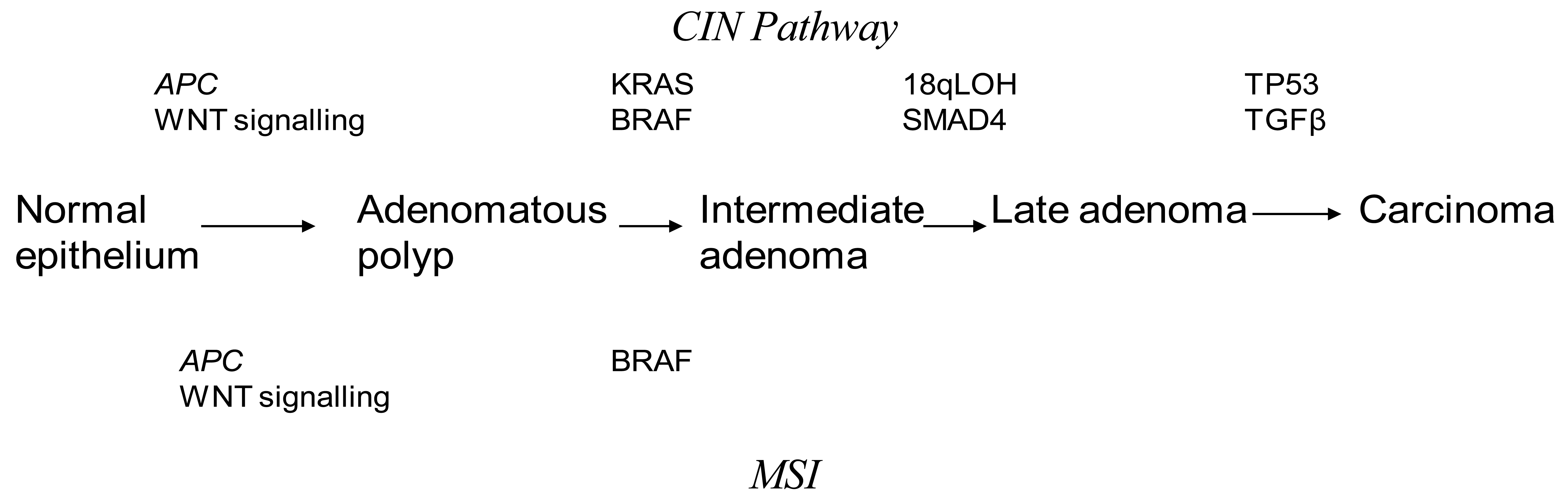
<p>Discovery of genetic alterations in the pathogenesis of CRC are beginning to piece together how they may relate to the Fearson and Volgelstein Model [<xref ref-type="bibr" rid="b8-cancers-03-01622">8</xref>]. Epigenetic alterations are thought to be precursor events in tumor progression through the serrated, alternate Vogelstein model [<xref ref-type="bibr" rid="b9-cancers-03-01622">9</xref>]. It is believed that CRC may arise from at least three interlinked mechanisms. Chromosomal Instability (CIN) is the most commonly found in CRC accounting for up to 80% of cases [<xref ref-type="bibr" rid="b10-cancers-03-01622">10</xref>]. The classic Vogelstein report, which describes the step by step mutational process starting from a small adenoma to invasive cancer, is the theoretical basis for our understanding of the CIN pathway [<xref ref-type="bibr" rid="b11-cancers-03-01622">11</xref>]. CRC progresses through activating mutations in oncogenes or deactivation of tumor suppressor genes. This leads to a selection of clonal tumor cells which continue to divide through a growth advantage. Inactivating mutations in APC and activating mutations in KRAS are thought to be early changes in the Vogelstein sequence. Mutations in p53 and TGF-β have been described as late changes in tumorgenesis. An understanding of the CIN pathways has been pivotal in investigating potential predictive and prognostic markers in CRC. Unlike MSI tumors, the mechanism underlying CIN is poorly understood. CIN tumors are characterized by aneuploidy, multiple chromosomal rearrangements and an accumulation of somatic mutations [<xref ref-type="bibr" rid="b12-cancers-03-01622">12</xref>] (<xref ref-type="fig" rid="f1-cancers-03-01622">Figure 1</xref>). CIN tumors have a poor prognosis compared to MSI tumors [<xref ref-type="bibr" rid="b10-cancers-03-01622">10</xref>].</p>
<p>The loss of heterozygosity on the long arm of chromosome 18 (18qLOH) is the most common genetic alteration in colorectal cancer. SMAD4 and deleted in Colorectal Cancer (DCC) are two important tumor suppressor genes found on the long are of chromosome 18 [<xref ref-type="bibr" rid="b13-cancers-03-01622">13</xref>,<xref ref-type="bibr" rid="b14-cancers-03-01622">14</xref>]. Studies have shown that 18qLOH is an indicator of poor prognosis in early stage CRC, which has not been proven by multi-variate studies against other biomarkers, making 18qLOH an unlikely independent prognostic marker [<xref ref-type="bibr" rid="b15-cancers-03-01622">15</xref>]. Furthermore 18qLOH has associations with CIN [<xref ref-type="bibr" rid="b16-cancers-03-01622">16</xref>].</p>
<p>Deletion of SMAD4 by 18qLOH results in tumorgensis via the TGFβ pathway [<xref ref-type="bibr" rid="b17-cancers-03-01622">17</xref>]. The loss of SMAD4 is a poor prognostic indicator. The retention of the SMAD4 diploidy results in a three-fold higher benefit from 5-Fluorouracil therapy (5-FU) chemotherapy [<xref ref-type="bibr" rid="b18-cancers-03-01622">18</xref>].</p>
<p>Mutations in the tumor suppressor gene TP53 are found in almost half of CRC [<xref ref-type="bibr" rid="b19-cancers-03-01622">19</xref>]. Mutations in different domains of the gene lead to a variable prognosis [<xref ref-type="bibr" rid="b20-cancers-03-01622">20</xref>-<xref ref-type="bibr" rid="b24-cancers-03-01622">24</xref>]. TP53 mutations are found more commonly in distal CRC [<xref ref-type="bibr" rid="b25-cancers-03-01622">25</xref>,<xref ref-type="bibr" rid="b26-cancers-03-01622">26</xref>]. Proximal tumors found to have mutations in TP53 were more likely to exhibit lymphatic invasion and be more responsive to 5-FU therapy. Mutation in exon 5 of the TP53 gene is associated with a poorer outcome [<xref ref-type="bibr" rid="b27-cancers-03-01622">27</xref>]. Individuals with wild type TP53 have a superior survival rate with 5-FU therapy in rectal cancer [<xref ref-type="bibr" rid="b19-cancers-03-01622">19</xref>]. At present there is no strong data to support the role of TP53 as a prognostic or predictive marker in CRC.</p>
<sec>
<label>2.1.</label>
<title>MSI</title>
<p>The most widely studied and understood genomic instability is Microsatellite Instability (MSI). MSI are found in 15% of CRC and is characterized by the inactivation of the Mismatch Repair Genes (MMR) [<xref ref-type="bibr" rid="b28-cancers-03-01622">28</xref>,<xref ref-type="bibr" rid="b29-cancers-03-01622">29</xref>]. MSI are the cause of hereditary CRC but are also found in sporadic cancers. In sporadic cases of MSI the MMR gene activity is silenced by promoter methylation of the hMLH1 gene [<xref ref-type="bibr" rid="b30-cancers-03-01622">30</xref>,<xref ref-type="bibr" rid="b31-cancers-03-01622">31</xref>]. Several genes affected by MSI have been identified including TGF-β [<xref ref-type="bibr" rid="b32-cancers-03-01622">32</xref>], those encoding regulation of cell proliferation, cell cycle or apoptosis and DNA repair [<xref ref-type="bibr" rid="b33-cancers-03-01622">33</xref>]. MSI represents a unique pathway for tumor development that does not involve loss of heterozygosity [<xref ref-type="bibr" rid="b34-cancers-03-01622">34</xref>].</p>
<p>In Hereditary Non-Polyposis Coli Syndrome (HNPCC) a germline mutation in MMR occurs in an autosomal dominant fashion leading to MSI [<xref ref-type="bibr" rid="b30-cancers-03-01622">30</xref>]. Although most research into MSI has focused on familial CRC only 3% of all CRC come from HNPCC and most MSI CRC are sporadic [<xref ref-type="bibr" rid="b35-cancers-03-01622">35</xref>]. Macroscopically sporadic MSI tumors are characteristically proximally located, poorly differentiated and of a mucinous histology with lymphocytic infiltration [<xref ref-type="bibr" rid="b36-cancers-03-01622">36</xref>]. The genetic properties of sporadic CRC include bialleleic methylation of the MLHI promoter, absence of MLH1 and PM2 protein and frequent mutations in BRAF [<xref ref-type="bibr" rid="b37-cancers-03-01622">37</xref>].</p>
<p>MSI is a potential predictor of treatment response to 5-FU and prognosis of disease when used in conjunction with TNM staging [<xref ref-type="bibr" rid="b38-cancers-03-01622">38</xref>]. Cultured CRC cells with intact MMR activity were more significantly sensitive to therapeutic concentration of 5-FU than DNA MMR deficient cells [<xref ref-type="bibr" rid="b39-cancers-03-01622">39</xref>]. <italic>In vitro</italic> studies on CRC cells that do not express MLH1 has shown that exposure to the demethylating agent 5-azacytidine led to the expression of MLH1 and sensitivity to 5-FU [<xref ref-type="bibr" rid="b40-cancers-03-01622">40</xref>].</p>
<p>MSI can be divided into MSI-High (MSI-H) tumors, which are MMR deficient, and MSI-Low (MSI-L) tumors, found to be proficient in MMR genes [<xref ref-type="bibr" rid="b41-cancers-03-01622">41</xref>]. In the National Surgical Adjuvant Breast and Bowel Project (NSABP), CRC patients were divided into a non-treatment arm and an adjuvant chemotherapy arm and the MSI status was determined. The prognostic analyses showed increased recurrence-free survival (RFS) for MSI-H patients <italic>versus</italic> MSS/MSI-L patients (<italic>P</italic> = 10), but showed no difference in overall survival (OS; <italic>P</italic> = 67).</p>
<p>Retrospective studies on resected stage II and stage III CRC have shown that MSI-H tumors have a better prognosis compared to MSI-L tumors when not subjected to adjuvant chemotherapy [<xref ref-type="bibr" rid="b42-cancers-03-01622">42</xref>]. <italic>In vitro</italic> studies have hypothesized that defective DNA MMR leads to 5-FU therapy resistance in CRC [<xref ref-type="bibr" rid="b43-cancers-03-01622">43</xref>]. The Quick and Simple and Reliable Study (QUASAR) has shown that 5-FU therapy is beneficial in stage II CRC with the Overall Survival (OS) ranging between 1–5% [<xref ref-type="bibr" rid="b6-cancers-03-01622">6</xref>]. In contrast the International Multi-centre Pooled Analysis of Colon Cancer Trials (IMPACT) B2 study did not show any advantage from combined 5-FU/leucovarin over surgery alone in Stage II CRC [<xref ref-type="bibr" rid="b44-cancers-03-01622">44</xref>]. Furthermore 5-FU therapy may in fact be detrimental in this sub-group. Similar finding have been found in MSI-H, Stage III CRC <italic>in vivo</italic> [<xref ref-type="bibr" rid="b41-cancers-03-01622">41</xref>]. There has been little evidence for the benefit of chemotherapy in patients with MSI CRC. The addition of topoisomerase-I inhibitor irinotecan in the chemotherapeutic regimen leads to increased survival times in patients with MSI tumors [<xref ref-type="bibr" rid="b45-cancers-03-01622">45</xref>,<xref ref-type="bibr" rid="b46-cancers-03-01622">46</xref>].</p>
<p>More recently, a new entity of MSI has been has been described. The signature is termed elevated microsatellite alterations at selected tetranucleotide repeats (EMAST). EMAST can be found in up to 60% of sporadic CRC and co-exists with MSI-H and MSI-L tumors. EMAST is thought to occur due to down regulation of MSH-3 [<xref ref-type="bibr" rid="b47-cancers-03-01622">47</xref>].</p>
<p>It can be argued that MSI status should be routinely determined as part of staging CRC. At present there is no general consensus for deciding on who should receive adjuvant chemotherapy in stage II disease. It is unclear if all patients with stage II disease will benefit from adjuvant chemotherapy, MSI status may be a candidate for determining suitability for adjuvant chemotherapy.</p>
<p>The addition of oxaliplatin with infusional 5-FU in FOLFOX therapy has demonstrated a significant improvement in three-year disease free survival in patients with stage II, node negative disease. There is currently no published data with regard to the interaction between oxaliplatin and MSI status. The prognostic significance of MSI is unquestionable but it is essential to know more about CRC genetic status than MSI alone, these potential biomarkers shall be discussed below.</p></sec>
<sec>
<label>2.2.</label>
<title>KRAS</title>
<p>Kirsten-ras (KRAS) mutations are the most widely studied and promising biomarker for treatment strategies in CRC. It is a downstream mediator of the EGFR signaling pathway [<xref ref-type="bibr" rid="b16-cancers-03-01622">16</xref>]. KRAS mutations are an early event in the adenoma-carcinoma sequence and are found in 40% of CRC [<xref ref-type="bibr" rid="b8-cancers-03-01622">8</xref>]. KRAS mutations are thought to be a poor prognostic marker in CRC [<xref ref-type="bibr" rid="b48-cancers-03-01622">48</xref>]. There is, however, conflicting evidence. The KRAS in-colorectal-cancer collaborative group (RASCAL II) study has shown that a glycine to valine mutation on codon 12 of the KRAS gene is aggressive in patients with Duke's C CRC [<xref ref-type="bibr" rid="b49-cancers-03-01622">49</xref>]. It was associated with a 50% increased risk of relapse or death in this group of patients.</p>
<p>KRAS mutations are maintained in metastatic CRC [<xref ref-type="bibr" rid="b50-cancers-03-01622">50</xref>,<xref ref-type="bibr" rid="b51-cancers-03-01622">51</xref>]. Mutant KRAS exhibits resistance to monoclonal antibody (mAb) therapy [<xref ref-type="bibr" rid="b3-cancers-03-01622">3</xref>,<xref ref-type="bibr" rid="b4-cancers-03-01622">4</xref>]. This phenomenon has been studied extensively in metastatic disease. Randomized controlled trials have shown no survival benefit from adding cetuximab to chemotherapy in unselected patients [<xref ref-type="bibr" rid="b52-cancers-03-01622">52</xref>-<xref ref-type="bibr" rid="b54-cancers-03-01622">54</xref>]. The large, randomized, phase II Oxaliplatin and Cetuximab in First-Line Treatment of CRC (OPUS) trial has indicated that it may be harmful to add cetuximab to those with mutated KRAS [<xref ref-type="bibr" rid="b55-cancers-03-01622">55</xref>]. A Phase III trial (the CRYSTAL study) confirms that a combination of cetuximab and FOLFIRI statistically improves response rate and PFS in the WT-KRAS population [<xref ref-type="bibr" rid="b52-cancers-03-01622">52</xref>]. Current practice involves genotyping patients with metastatic CRC prior to starting mAb therapy. The European Health Committee for human medicinal products has recommended the use of panitumumab monotherapy and cetuximab therapy in patients with metastatic CRC found to have WT-KRAS in the primary tumor [<xref ref-type="bibr" rid="b56-cancers-03-01622">56</xref>].</p>
<p>PIK3CA is a downstream effector of the KRAS pathway and is down regulated by the tumor-suppressor gene PTEN. PIK3CA is a potential marker of resistance to mAb therapy [<xref ref-type="bibr" rid="b57-cancers-03-01622">57</xref>].</p></sec>
<sec>
<label>2.3.</label>
<title>BRAF</title>
<p>BRAF mutations are found in 10% of CRC. Most B-Raf mutations involve the V600E amino acid substitution, resulting in constitutive activation of the MEK-ERK signaling pathway. They are mutually exclusive of KRAS mutations and are thus a candidate for an independent biomarker for CRC [<xref ref-type="bibr" rid="b58-cancers-03-01622">58</xref>]. Studies on WT-KRAS tumors treated by either a combination of chemotherapy and cetuximab or cetuximab alone have shown that progression free survival (PFS) and OS were significantly better among patient without mutated BRAF (WT-BRAF) [<xref ref-type="bibr" rid="b59-cancers-03-01622">59</xref>]. The presence of BRAF mutations in an MSI tumor makes a hereditary cause unlikely [<xref ref-type="bibr" rid="b60-cancers-03-01622">60</xref>,<xref ref-type="bibr" rid="b61-cancers-03-01622">61</xref>]. Therefore the strategy for identifying individuals with Lynch syndrome is a two tier approach. The initial test involves immunohistochemistry testing for MMR protein in tissue and MSI DNA testing. Individuals found to be MSI<sup>+</sup> with a loss of MMR proteins (MSH2, MHS6 and PMS2) undergo further DNA testing for the appropriate gene. Patients who are MSI<sup>+</sup> with either a loss of MLH1 or no MMR protein loss undergo Tier 2 screening. This consists of BRAF mutational analysis at V600E and MLH1 promoter methylation, both of which are associated with sporadic CRC [<xref ref-type="bibr" rid="b62-cancers-03-01622">62</xref>,<xref ref-type="bibr" rid="b63-cancers-03-01622">63</xref>].</p>
<p>At present, inhibitors of BRAF have been tested <italic>in vitro</italic> and the inhibitor PLX4032 has been shown to potentiate the anti-proliferative action of 5-FU therapy [<xref ref-type="bibr" rid="b64-cancers-03-01622">64</xref>]. At present, further <italic>in vivo</italic> studies investigating the action of the tyrosine kinase inhibitor (BAY 43-9006) and cetuximab in the metastatic setting are being undertaken. Tyrosine kinase inhibitors are believed to restore sensitivity to mAb therapy in mutant-BRAF cell lines [<xref ref-type="bibr" rid="b4-cancers-03-01622">4</xref>]. They show promise as potential treatment methods. However deliverability and costs of treatment are yet to be evaluated.</p></sec>
<sec>
<label>2.4.</label>
<title>CIMP</title>
<p>DNA methylation is recognized as one of the most common gene alterations in human tumors including CRC [<xref ref-type="bibr" rid="b65-cancers-03-01622">65</xref>]. A subset of CRC exhibit promoter methylation at multiple sites and are referred to as the CpG island methylator phenotype (CIMP) [<xref ref-type="bibr" rid="b66-cancers-03-01622">66</xref>,<xref ref-type="bibr" rid="b67-cancers-03-01622">67</xref>]. The CIMP is observed in 30% of CRC. This has been hypothesis as an early contributor to CRC progression [<xref ref-type="bibr" rid="b68-cancers-03-01622">68</xref>]. Both hyper and hypo-methylation of DNA play a role in CRC tumorogenesis [<xref ref-type="bibr" rid="b69-cancers-03-01622">69</xref>]. Before the entity of CIMP was identified, CRC was classified into either MSI or CIN in origin. It now apparent that come tumors are neither MSI or CIN and that hypermethylation of DNA is a common finding in CRC [<xref ref-type="bibr" rid="b70-cancers-03-01622">70</xref>,<xref ref-type="bibr" rid="b71-cancers-03-01622">71</xref>]. Sporadic MSI tumors are secondary to CIMP related silencing of the MMR gene MLH1 [<xref ref-type="bibr" rid="b63-cancers-03-01622">63</xref>,<xref ref-type="bibr" rid="b72-cancers-03-01622">72</xref>]. The difficulty producing a standardized marker and the unclear distinction between the CIMP tumors and sporadic MSI tumors has meant that the clinical importance of CIMP tumors is difficult to quantify. CIMP can be divided into CIMP-High (CIMP-H) and CIMP-Low (CIMP-L) groups [<xref ref-type="bibr" rid="b70-cancers-03-01622">70</xref>]. The CIMP-H tumors are associated with the BRAF mutation whereas CIMP-L are associated with KRAS mutations [<xref ref-type="bibr" rid="b73-cancers-03-01622">73</xref>-<xref ref-type="bibr" rid="b75-cancers-03-01622">75</xref>]. CIMP-H tumors found to be MSI positive and haboring the BRAF mutation have a good prognosis [<xref ref-type="bibr" rid="b59-cancers-03-01622">59</xref>]. However MSI negative tumors which are positive for CIMP and the BRAF mutation hold a poor prognosis [<xref ref-type="bibr" rid="b76-cancers-03-01622">76</xref>]. Global hypomethylation of DNA is associated with CIN tumors and may also confer a poor prognosis [<xref ref-type="bibr" rid="b77-cancers-03-01622">77</xref>,<xref ref-type="bibr" rid="b78-cancers-03-01622">78</xref>].</p>
<p><italic>In vitro</italic> it is possible to demethylate some promoters using the DNA methyltransferase inhibitor 5-azacytidine although remethylation occurs on removal of the agent. The search for a targeted and more prolonged acting agent may be of therapeutic use [<xref ref-type="bibr" rid="b79-cancers-03-01622">79</xref>].</p>
<p>Gene expression arrays comparing CRC tissue with adjacent normal mucosa are identifying and validating novel methylated genes that may in the future be candidate prognostic biomarkers [<xref ref-type="bibr" rid="b80-cancers-03-01622">80</xref>-<xref ref-type="bibr" rid="b85-cancers-03-01622">85</xref>]. Aberrant DNA methylation can be detected from a variety of samples including blood, stool and tissue, giving it a wide variety of clinical uses [<xref ref-type="bibr" rid="b86-cancers-03-01622">86</xref>-<xref ref-type="bibr" rid="b88-cancers-03-01622">88</xref>].</p>
<p>CIMP positivity in CRC was thought to be a significant independent predictor of survival benefit from 5-FU chemotherapy [<xref ref-type="bibr" rid="b89-cancers-03-01622">89</xref>]. However, recent studies have failed to prove this for Stage II-III CRC [<xref ref-type="bibr" rid="b90-cancers-03-01622">90</xref>].</p>
<p>It would be ideal to combine the molecular classification of CRC with DNA methylation status to predict treatment response and prognosis. The role of epigenetic therapy has been proven to be effective in treating hematological malignancies and is likely to extend to CRC in the future [<xref ref-type="bibr" rid="b91-cancers-03-01622">91</xref>].</p></sec>
<sec>
<label>2.5.</label>
<title>MGMT</title>
<p>The DNA repair gene 06-methylguanine-DNA methyletransferase (MGMT) is often methylated in CRC [<xref ref-type="bibr" rid="b92-cancers-03-01622">92</xref>]. Sporadic cancer is thought to arise from regions of cells with field change. MGMT has been detected in healthy tissue surrounding tumor cells [<xref ref-type="bibr" rid="b93-cancers-03-01622">93</xref>]. It has been hypothesized that MGMT field change may represent a preneoplastic state for the development of MSI tumors. In support of this there is an increase in promoter DNA methylation as tumors progress through the adenoma sequence with increasing malignant potential. MGMT may serve as a prognostic marker for CRC, however recent immunohistochemistry studies have failed to show any association of MGMT promoter methylation or loss as a prognostic biomarker in CRC [<xref ref-type="bibr" rid="b94-cancers-03-01622">94</xref>].</p></sec>
<sec>
<label>2.6.</label>
<title>Early Detection of CRC</title>
<p>The most evaluated screening tool for the detection of CRC is the biennel Faecal Occult Blood Test (FOBT). The sensitivity of the FOBT for important neoplasms remains low, between 30–50% [<xref ref-type="bibr" rid="b95-cancers-03-01622">95</xref>]. Those who test positive are invited for colonoscopy which detects and allows excision of adenomas reducing the incidence of cancers by 16% [<xref ref-type="bibr" rid="b96-cancers-03-01622">96</xref>,<xref ref-type="bibr" rid="b97-cancers-03-01622">97</xref>]. The early detection of cancers allows for treatment of less advanced disease. An alternative to FOBT would be fecal DNA based tests. Such tests that detect DNA mutations are complicated, expensive and also sensitive to adenomas [<xref ref-type="bibr" rid="b98-cancers-03-01622">98</xref>].</p>
<p>In the USA, stool based methylated Vimentin (m-Vimentib) is currently available commercially. The vimentin gene, which is transcriptionally silent in normal colorectal epithelial cells, becomes methylated in colorectal cancers [<xref ref-type="bibr" rid="b99-cancers-03-01622">99</xref>]. The development of more sensitive technology enables absolute quantification of the number of methylated molecules in a sample, and detection of m-Vimentin in plasma may act as a potential biomarker or tumor marker [<xref ref-type="bibr" rid="b100-cancers-03-01622">100</xref>].</p>
<p>Circulating tumor cells is FDA approved for patient prognosis in metastatic colorectal cancer [<xref ref-type="bibr" rid="b101-cancers-03-01622">101</xref>-<xref ref-type="bibr" rid="b103-cancers-03-01622">103</xref>] and may in the future act as a predictive biomarker as well as give an indication of cell dissemination during surgery [<xref ref-type="bibr" rid="b104-cancers-03-01622">104</xref>].</p></sec></sec>
<sec sec-type="discussion">
<label>3.</label>
<title>Discussion</title>
<p>New evidence highlighting the variation in altered pathways leading to CRC has provided a modified version of the classic Vogelstein and Fearson model. At present it is thought that there are three parallel pathways which give rise to sporadic colorectal cancer with distinct clinicopathological features.</p>
<p>MSI tumors are associated with the serrated neoplasia pathway and frequently carry the BRAF mutation [<xref ref-type="bibr" rid="b105-cancers-03-01622">105</xref>]. These tumors are often CIMP positive. CIN tumors are activated by biallelic loss of APC and p53 mutation classically forming tubular adenomas of the distal colon. The CIMP pathway is heterogenous in nature; again there is a strong association with the BRAF mutation. The prognostic value of promoter hypermethylation is still under investigation. The role of BRAF mutation in V600E and MSI already play a role in determining a hereditary cause for CRC, their usefulness in sporadic CRC is now beginning to merge.</p>
<p>Identification of KRAS and subsequent testing for this marker has opened the doors for personalized medicine and further research into other potential biomarkers. MAb therapy targeting the EGFR pathway has shown great efficacy in the treatment of patients with metastatic CRC. However, anti-EGFR therapy is only useful for a fraction of patients, making it essential to look for alternative pathways and inhibitors. There is a vast array of new targets being studied as possible new biomarkers, some of which are being tested clinically to patients.</p>
<p>The commercially available OncoTypeDx is a RT-PCR gene assay, which detects 12 validated genes in CRC and produces a recurrence score for Stage II and II disease after resection. The assay is not predictive of treatment response. The seven prognostic genes include three stromal: FAP, INHBA and BGN; three cell type genes: Ki-67, c-myc and MYBL2 and GADD45B [<xref ref-type="bibr" rid="b106-cancers-03-01622">106</xref>].</p>
<p>The evolution of CRC progression from an adenomatous polyp to invasive cancer and metastasis may be dependent on protein markers [<xref ref-type="bibr" rid="b107-cancers-03-01622">107</xref>]. Among those studied, cell surface markers show promise for further development. Cell surface markers are necessary for cell-cell adhesion and communication. The role of stroma-derived biomarkers, tumor-associated macrophages, infiltrating lymphocytes and small transmembrane proteins have been described [<xref ref-type="bibr" rid="b108-cancers-03-01622">108</xref>]. Despite the discovery of a wide range of protein biomarkers for CRC, the translation into clinical practice is challenging due to the difficulty in detecting and characterizing low abundance proteins in complex mixtures and the validation of biomarkers in clinical practice. Issues with regard to validity arise from the multitude of marker assessment methods, feasibility of obtaining the specimens, reliability and reproducibility of the assay and the costs involved with assessing the marker status on every patient [<xref ref-type="bibr" rid="b109-cancers-03-01622">109</xref>].</p>
<p>An ideal way to assess tumor status would be a serum marker. Serum markers allow for a minimally invasive method of CRC screening that could easily integrated into regular health checks. Six serum biomarkers have been studied using ELISA. CEA showed the best sensitivity at 95%, with a specificity of 43.9% followed by seprase (42.4% sensitivity), CYFRA 21-1 (35.5%), osteopntin (30.2%), ferritin (23.9%) and anti-p53 (20.0%). When used in combination the sensitivity of these markers was equal to fecal immunohistochemical testing [<xref ref-type="bibr" rid="b110-cancers-03-01622">110</xref>].</p>
<p>Other novel markers for further investigation include Single-Nucleotide Polymorphisms (SNPs). The study of SNPs has identified variants in SMAD7 associated with CRC. The SNPs rs4939827, rs1295317 and rs4464148 have shown evidence of an association between genotype and risk in three independent CRC case-controlled series by allelic-specific PCR. The locus on SMAD 7 may contribute up to 15% of CRC [<xref ref-type="bibr" rid="b111-cancers-03-01622">111</xref>].</p></sec>
<sec sec-type="conclusions">
<label>4.</label>
<title>Conclusions</title>
<p>The revolution of personalized medicine not only benefits the patient by reducing drug toxicity and optimizing patient outcome but can also reduce costs for an already burdened health system. In the future, personalized medicine means that therapeutic regimens will be tailored more and more to the individual. The era of personalized medicine opens a very exciting time for the management of colorectal cancer and in combination with minimally invasive surgical techniques will benefit the patient greatly.</p></sec></body>
<back>
<sec sec-type="display-objects">
<title>Figure</title>
<fig id="f1-cancers-03-01622" position="float">
<label>Figure 1.</label>
<caption>
<p>The modified Fearson and Volgenstein Model. Colorectal cancer (CRC) progression can occur through either the chromosomal instability (CIN) or microsatellite instability (MSI) pathway. Early adenomatous changes are secondary to loss of APC. KRAS loss initiates the formation of larger adenomas in the CIN pathway followed by 18qLOH. Mutations in TP53 are a late change. Sporadic MSI tumors are commonly part of the serrated neoplasia pathway and BRAF mutations are more common finding.</p></caption>
<graphic xlink:href="cancers-03-01622f1.gif"/></fig></sec>
<ack>
<p>The leading author would like to express their deepest gratitude and warmth appreciation to the Royal Surrey Hospital for the vast research opportunities made available to me.</p></ack>
<ref-list>
<title>References</title>
<ref id="b1-cancers-03-01622"><label>1.</label><citation citation-type="journal"><person-group person-group-type="author"><name><surname>Van't Veer</surname><given-names>L.</given-names></name><name><surname>Dai</surname><given-names>H.</given-names></name><name><surname>van de Vijver</surname><given-names>M.J.</given-names></name><name><surname>He</surname><given-names>Y.D.</given-names></name><name><surname>Hart</surname><given-names>A.A.</given-names></name><name><surname>Mao</surname><given-names>M.</given-names></name><name><surname>Peterse</surname><given-names>H.L.</given-names></name><name><surname>van der Kooy</surname><given-names>K.</given-names></name><name><surname>Marton</surname><given-names>M.J.</given-names></name><name><surname>Witteveen</surname><given-names>A.T.</given-names></name><etal/></person-group><article-title>Gene expression profiling predicts clinical outcome of breast cancer</article-title><source>Nature</source><year>2002</year><volume>415</volume><fpage>530</fpage><lpage>536</lpage><pub-id pub-id-type="doi">10.1038/415530a</pub-id><pub-id pub-id-type="pmid">11823860</pub-id></citation></ref>
<ref id="b2-cancers-03-01622"><label>2.</label><citation citation-type="journal"><person-group person-group-type="author"><name><surname>Allegra</surname><given-names>C.J.</given-names></name><name><surname>Jessup</surname><given-names>J.M.</given-names></name><name><surname>Somerfield</surname><given-names>M.R.</given-names></name><name><surname>Hamilton</surname><given-names>S.R.</given-names></name><name><surname>Hammond</surname><given-names>E.H.</given-names></name><name><surname>Hayes</surname><given-names>D.F.</given-names></name><name><surname>McAllister</surname><given-names>P.K.</given-names></name><name><surname>Morton</surname><given-names>R.F.</given-names></name><name><surname>Schilsky</surname><given-names>R.L.</given-names></name></person-group><article-title>American Society of Clinical Oncology provisional clinical opinion: Testing for KRAS gene mutations in patients with metastatic colorectal carcinoma to predict response to anti-epidermal growth factor receptor monoclonal antibody therapy</article-title><source>J. Clin. Oncol.</source><year>2009</year><volume>27</volume><fpage>2091</fpage><lpage>2096</lpage><pub-id pub-id-type="doi">10.1200/JCO.2009.21.9170</pub-id><pub-id pub-id-type="pmid">19188670</pub-id></citation></ref>
<ref id="b3-cancers-03-01622"><label>3.</label><citation citation-type="journal"><person-group person-group-type="author"><name><surname>Karapetis</surname><given-names>C.S.</given-names></name><name><surname>Khambata-Ford</surname><given-names>S.</given-names></name><name><surname>Jonker</surname><given-names>D.J.</given-names></name><name><surname>O'Callaghan</surname><given-names>C.J.</given-names></name><name><surname>Tu</surname><given-names>D.</given-names></name><name><surname>Tebbutt</surname><given-names>N.C.</given-names></name><name><surname>Simes</surname><given-names>R.J.</given-names></name><name><surname>Chalchal</surname><given-names>H.</given-names></name><name><surname>Shapiro</surname><given-names>J.D.</given-names></name><name><surname>Robitaille</surname><given-names>S.</given-names></name><etal/></person-group><article-title>K-ras mutations and benefit from cetuximab in advanced colorectal cancer</article-title><source>N. Eng. J. Med.</source><year>2008</year><volume>359</volume><fpage>1757</fpage><lpage>1765</lpage><pub-id pub-id-type="doi">10.1056/NEJMoa0804385</pub-id></citation></ref>
<ref id="b4-cancers-03-01622"><label>4.</label><citation citation-type="journal"><person-group person-group-type="author"><name><surname>Siena</surname><given-names>S.</given-names></name><name><surname>Sartore-Bianchi</surname><given-names>A.</given-names></name><name><surname>Di Nicolantonio</surname><given-names>F.</given-names></name><name><surname>Balfour</surname><given-names>J.</given-names></name><name><surname>Bardelli</surname><given-names>A.</given-names></name></person-group><article-title>Biomarkers predicting clinical outcomeof epidermal growth factor receptor-targeted therapy in metastatic colorectal cancer</article-title><source>J. Nat. Cancer Inst.</source><year>2009</year><volume>101</volume><fpage>1308</fpage><lpage>1324</lpage><pub-id pub-id-type="doi">10.1093/jnci/djp280</pub-id><pub-id pub-id-type="pmid">19738166</pub-id></citation></ref>
<ref id="b5-cancers-03-01622"><label>5.</label><citation citation-type="web"><article-title>National Comprehensive Cancer Network (NCCN) Clinical Practice Guidelines in Oncology: Colon CancerV.2.2010</article-title><year>2010</year><comment><ext-link xlink:href="http://www.nccn.org/professionals/physician_gls/PDF/colon.pdf/" ext-link-type="uri">http://www.nccn.org/professionals/physician_gls/PDF/colon.pdf/</ext-link></comment></citation></ref>
<ref id="b6-cancers-03-01622"><label>6.</label><citation citation-type="journal"><person-group person-group-type="author"><name><surname>Compton</surname><given-names>C.C.</given-names></name><name><surname>Fielding</surname><given-names>L.P.</given-names></name><name><surname>Burgart</surname><given-names>L.J.</given-names></name><name><surname>Conley</surname><given-names>B.</given-names></name><name><surname>Cooper</surname><given-names>H.S.</given-names></name><name><surname>Hamilton</surname><given-names>S.R.</given-names></name><name><surname>Hammond</surname><given-names>M.E.</given-names></name><name><surname>Henson</surname><given-names>D.E.</given-names></name><name><surname>Hutter</surname><given-names>R.V.</given-names></name><name><surname>Nagle</surname><given-names>R.B.</given-names></name><etal/></person-group><article-title>Prognostic factors in colorectal cancer. College of American pathologists consensus statement, 1999</article-title><source>Arch. Pathol. Lab. Med.</source><year>2000</year><volume>124</volume><fpage>979</fpage><lpage>994</lpage><pub-id pub-id-type="pmid">10888773</pub-id></citation></ref>
<ref id="b7-cancers-03-01622"><label>7.</label><citation citation-type="journal"><person-group person-group-type="author"><name><surname>Steinberg</surname><given-names>S.M.</given-names></name><name><surname>Barkin</surname><given-names>J.S.</given-names></name><name><surname>Kaplan</surname><given-names>R.S.</given-names></name><name><surname>Stablein</surname><given-names>D.M.</given-names></name></person-group><article-title>Prognostic indicators of colon tumours. The Gastrointestinal Tumour Study Group experience</article-title><source>Cancer</source><year>1986</year><volume>57</volume><fpage>1866</fpage><lpage>1870</lpage><pub-id pub-id-type="doi">10.1002/1097-0142(19860501)57:9&lt;1866::AID-CNCR2820570928&gt;3.0.CO;2-T</pub-id><pub-id pub-id-type="pmid">3485470</pub-id></citation></ref>
<ref id="b8-cancers-03-01622"><label>8.</label><citation citation-type="journal"><person-group person-group-type="author"><name><surname>Vogelstein</surname><given-names>B.</given-names></name><name><surname>Fearson</surname><given-names>E.R.</given-names></name><name><surname>Hamilton</surname><given-names>S.R.</given-names></name><name><surname>Kern</surname><given-names>S.E.</given-names></name><name><surname>Preisinger</surname><given-names>A.C.</given-names></name><name><surname>Leppert</surname><given-names>M.</given-names></name><name><surname>Nakamura</surname><given-names>Y.</given-names></name><name><surname>White</surname><given-names>R.</given-names></name><name><surname>Smits</surname><given-names>A.M.</given-names></name><name><surname>Bos</surname><given-names>J.L.</given-names></name></person-group><article-title>Genetic alterations during colorectal-tumor development</article-title><source>N. Engl. J. Med.</source><year>1988</year><volume>319</volume><fpage>525</fpage><lpage>532</lpage><pub-id pub-id-type="doi">10.1056/NEJM198809013190901</pub-id><pub-id pub-id-type="pmid">2841597</pub-id></citation></ref>
<ref id="b9-cancers-03-01622"><label>9.</label><citation citation-type="journal"><person-group person-group-type="author"><name><surname>Leggett</surname><given-names>B.</given-names></name><name><surname>Whitehall</surname><given-names>V.</given-names></name></person-group><article-title>Role of the serrated pathway in colorectal pathogenesis</article-title><source>Gastroenterology</source><year>2010</year><volume>138</volume><fpage>2088</fpage><lpage>2100</lpage><pub-id pub-id-type="doi">10.1053/j.gastro.2009.12.066</pub-id><pub-id pub-id-type="pmid">20420948</pub-id></citation></ref>
<ref id="b10-cancers-03-01622"><label>10.</label><citation citation-type="journal"><person-group person-group-type="author"><name><surname>Grady</surname><given-names>W.M.</given-names></name><name><surname>Carethers</surname><given-names>J.M.</given-names></name></person-group><article-title>Genomic and epigenetic instability in colorectal cancer pathogenesis</article-title><source>Gastroenterology</source><year>2008</year><volume>135</volume><fpage>1079</fpage><lpage>1099</lpage><pub-id pub-id-type="doi">10.1053/j.gastro.2008.07.076</pub-id><pub-id pub-id-type="pmid">18773902</pub-id></citation></ref>
<ref id="b11-cancers-03-01622"><label>11.</label><citation citation-type="book"><person-group person-group-type="author"><name><surname>Kinzler</surname><given-names>K.W.</given-names></name><name><surname>Vogelstein</surname><given-names>B.</given-names></name></person-group><article-title>Colorectal tumors</article-title><source>The Genetic Basis of Human Cancer</source><person-group person-group-type="editor"><name><surname>Vogelstein</surname><given-names>B.</given-names></name><name><surname>Kinzler</surname><given-names>K.W.</given-names></name></person-group><publisher-name>McGraw-Hill</publisher-name><publisher-loc>New York, NY, USA</publisher-loc><year>1998</year><fpage>565</fpage><lpage>587</lpage></citation></ref>
<ref id="b12-cancers-03-01622"><label>12.</label><citation citation-type="journal"><person-group person-group-type="author"><name><surname>Kane</surname><given-names>M.F.</given-names></name><name><surname>Loda</surname><given-names>M.</given-names></name><name><surname>Gaida</surname><given-names>G.M.</given-names></name><name><surname>Lipman</surname><given-names>J.</given-names></name><name><surname>Mishra</surname><given-names>R.</given-names></name><name><surname>Goldman</surname><given-names>H.</given-names></name><name><surname>Jessup</surname><given-names>J.M.</given-names></name><name><surname>Kolodner</surname><given-names>R.</given-names></name></person-group><article-title>Methylation of the hMLH1 promoter correlates with lack of expression og hMLH1 in sporadic colon tumours and mismatch repair-defective human tumor cell lines</article-title><source>Cancer Res.</source><year>1997</year><volume>57</volume><fpage>808</fpage><lpage>811</lpage><pub-id pub-id-type="pmid">9041175</pub-id></citation></ref>
<ref id="b13-cancers-03-01622"><label>13.</label><citation citation-type="journal"><person-group person-group-type="author"><name><surname>Carethers</surname><given-names>J.M.</given-names></name><name><surname>Hawn</surname><given-names>M.T.</given-names></name><name><surname>Greenson</surname><given-names>J.K.</given-names></name><name><surname>Hitchcock</surname><given-names>C.L.</given-names></name><name><surname>Boland</surname><given-names>C.R.</given-names></name></person-group><article-title>Prognostic significance of allelic lost at chromosome 18q21 for stage II colorectal cancer</article-title><source>Gastroenterology</source><year>1998</year><volume>114</volume><fpage>1188</fpage><lpage>1195</lpage><pub-id pub-id-type="doi">10.1016/S0016-5085(98)70424-X</pub-id><pub-id pub-id-type="pmid">9609755</pub-id></citation></ref>
<ref id="b14-cancers-03-01622"><label>14.</label><citation citation-type="journal"><person-group person-group-type="author"><name><surname>Alhopuro</surname><given-names>P.</given-names></name><name><surname>Alazzouzi</surname><given-names>H.</given-names></name><name><surname>Sammalkorpi</surname><given-names>H.</given-names></name><name><surname>Dávalos</surname><given-names>V.</given-names></name><name><surname>Salovaara</surname><given-names>R.</given-names></name><name><surname>Hemminki</surname><given-names>A.</given-names></name><name><surname>Järvinen</surname><given-names>H.</given-names></name><name><surname>Mecklin</surname><given-names>J.P.</given-names></name><name><surname>Schwartz</surname><given-names>S.</given-names><suffix>Jr.</suffix></name><name><surname>Aaltonen</surname><given-names>L.A.</given-names></name><name><surname>Arango</surname><given-names>D.</given-names></name></person-group><article-title>SMAD4 levels and response 5-fluoouracil in colorectal cancer</article-title><source>Clin. Cancer Res.</source><year>2005</year><volume>11</volume><fpage>6311</fpage><lpage>6316</lpage><pub-id pub-id-type="doi">10.1158/1078-0432.CCR-05-0244</pub-id><pub-id pub-id-type="pmid">16144935</pub-id></citation></ref>
<ref id="b15-cancers-03-01622"><label>15.</label><citation citation-type="journal"><person-group person-group-type="author"><name><surname>Rowan</surname><given-names>A.</given-names></name><name><surname>Halford</surname><given-names>S.</given-names></name><name><surname>Gaasenbeek</surname><given-names>M.</given-names></name><name><surname>Kemp</surname><given-names>Z.</given-names></name><name><surname>Sieber</surname><given-names>O.</given-names></name><name><surname>Volikos</surname><given-names>E.</given-names></name><name><surname>Douglas</surname><given-names>E.</given-names></name><name><surname>Fiegler</surname><given-names>H.</given-names></name><name><surname>Carter</surname><given-names>N.</given-names></name><name><surname>Talbot</surname><given-names>I.</given-names></name><name><surname>Silver</surname><given-names>A.</given-names></name><etal/></person-group><article-title>Refining molecular analysis in the pathway of colorectal carcinogenesis</article-title><source>Clin. Gastroenterol. Hepatol.</source><year>2005</year><volume>3</volume><fpage>1115</fpage><lpage>1123</lpage><pub-id pub-id-type="doi">10.1016/S1542-3565(05)00618-X</pub-id><pub-id pub-id-type="pmid">16271343</pub-id></citation></ref>
<ref id="b16-cancers-03-01622"><label>16.</label><citation citation-type="journal"><person-group person-group-type="author"><name><surname>Olschwang</surname><given-names>S.</given-names></name><name><surname>Hamelin</surname><given-names>R.</given-names></name><name><surname>Laurent-Puig</surname><given-names>P.</given-names></name><name><surname>Thuille</surname><given-names>B.</given-names></name><name><surname>De Rycke</surname><given-names>Y.</given-names></name><name><surname>Li</surname><given-names>Y.J.</given-names></name><name><surname>Muzeau</surname><given-names>F.</given-names></name><name><surname>Girodet</surname><given-names>J.</given-names></name><name><surname>Salmon</surname><given-names>R.J.</given-names></name><name><surname>Thomas</surname><given-names>G.</given-names></name></person-group><article-title>Alternative genetic pathways of colorectal carcinogenesis</article-title><source>Proc. Natl. Acad. Sci. USA</source><year>1997</year><volume>94</volume><fpage>12122</fpage><lpage>12127</lpage><pub-id pub-id-type="doi">10.1073/pnas.94.22.12122</pub-id><pub-id pub-id-type="pmid">9342373</pub-id></citation></ref>
<ref id="b17-cancers-03-01622"><label>17.</label><citation citation-type="book"><person-group person-group-type="author"><name><surname>Alberts</surname><given-names>J.</given-names></name><name><surname>Lewis</surname><given-names>R.</given-names></name><name><surname>Roberts</surname><given-names>W.</given-names></name></person-group><article-title>The molecular basis of cancer cell behaviour</article-title><source>Molecular Biology of the Cell</source><edition>5th ed.</edition><publisher-name>Garland Science, Taylor and Francis Group</publisher-name><publisher-loc>New York, NY, USA</publisher-loc><year>2008</year><fpage>1251</fpage><lpage>1252</lpage></citation></ref>
<ref id="b18-cancers-03-01622"><label>18.</label><citation citation-type="journal"><person-group person-group-type="author"><name><surname>Boulay</surname><given-names>J.L.</given-names></name><name><surname>Mild</surname><given-names>G.</given-names></name><name><surname>Lowy</surname><given-names>A.</given-names></name><name><surname>Reuter</surname><given-names>J.</given-names></name><name><surname>Lagrange</surname><given-names>M.</given-names></name><name><surname>Terracciano</surname><given-names>L.</given-names></name><name><surname>Laffer</surname><given-names>U.</given-names></name><name><surname>Herrmann</surname><given-names>R.</given-names></name><name><surname>Rochlitz</surname><given-names>C.</given-names></name></person-group><article-title>SMAD4 is a predictive marker for 5-fluoraucil-based chemotherapy in patients with colorectal cancer</article-title><source>Br. J. Cancer</source><year>2002</year><volume>87</volume><fpage>630</fpage><lpage>634</lpage><pub-id pub-id-type="doi">10.1038/sj.bjc.6600511</pub-id><pub-id pub-id-type="pmid">12237773</pub-id></citation></ref>
<ref id="b19-cancers-03-01622"><label>19.</label><citation citation-type="journal"><person-group person-group-type="author"><name><surname>Iacopetta</surname><given-names>B.</given-names></name></person-group><article-title>TP53 mutation in colorectal cancer</article-title><source>Hum. Mutat.</source><year>2003</year><volume>21</volume><fpage>271</fpage><lpage>276</lpage><pub-id pub-id-type="doi">10.1002/humu.10175</pub-id><pub-id pub-id-type="pmid">12619112</pub-id></citation></ref>
<ref id="b20-cancers-03-01622"><label>20.</label><citation citation-type="journal"><person-group person-group-type="author"><name><surname>Borresen-Dale</surname><given-names>A.</given-names></name><name><surname>Lothe</surname><given-names>R.A.</given-names></name><name><surname>Meling</surname><given-names>G.I.</given-names></name><name><surname>Hainaut</surname><given-names>P.</given-names></name><name><surname>Rognum</surname><given-names>T.O.</given-names></name><name><surname>Skovlund</surname><given-names>E.</given-names></name></person-group><article-title>TP53 and long-term prognosis in colorectal cancer: Mutations in the L3 Zinc-binding predict poor survival</article-title><source>Clin. Cancer Res.</source><year>1998</year><volume>4</volume><fpage>203</fpage><lpage>210</lpage><pub-id pub-id-type="pmid">9516972</pub-id></citation></ref>
<ref id="b21-cancers-03-01622"><label>21.</label><citation citation-type="journal"><person-group person-group-type="author"><name><surname>Iniesta</surname><given-names>P.</given-names></name><name><surname>Vega</surname><given-names>F.J.</given-names></name><name><surname>Caldes</surname><given-names>T.</given-names></name><name><surname>Massa</surname><given-names>M.</given-names></name><name><surname>de Juan</surname><given-names>C.</given-names></name><name><surname>Cerdán</surname><given-names>F.J.</given-names></name><name><surname>Sánchez</surname><given-names>A.</given-names></name><name><surname>López</surname><given-names>J.A.</given-names></name><name><surname>Torres</surname><given-names>A.J.</given-names></name><name><surname>Balibrea</surname><given-names>J.L.</given-names></name><etal/></person-group><article-title>p53 exon 7 mutations as a predictor of poor prognosis in patients with colorectal cancer</article-title><source>Cancer Lett.</source><year>1998</year><volume>130</volume><fpage>153</fpage><lpage>160</lpage><pub-id pub-id-type="doi">10.1016/S0304-3835(98)00138-4</pub-id><pub-id pub-id-type="pmid">9751268</pub-id></citation></ref>
<ref id="b22-cancers-03-01622"><label>22.</label><citation citation-type="journal"><person-group person-group-type="author"><name><surname>Samowitz</surname><given-names>W.S.</given-names></name><name><surname>Curtin</surname><given-names>K.</given-names></name><name><surname>Ma</surname><given-names>K.N.</given-names></name><name><surname>Edwards</surname><given-names>S.</given-names></name><name><surname>Schaffer</surname><given-names>D.</given-names></name><name><surname>Leppert</surname><given-names>M.F.</given-names></name><name><surname>Slattery</surname><given-names>M.L.</given-names></name></person-group><article-title>Prognostic significance of p53 mutations in colon cancer at the population level</article-title><source>Int. J. Cancer</source><year>2002</year><volume>99</volume><fpage>597</fpage><lpage>602</lpage><pub-id pub-id-type="doi">10.1002/ijc.10405</pub-id><pub-id pub-id-type="pmid">11992552</pub-id></citation></ref>
<ref id="b23-cancers-03-01622"><label>23.</label><citation citation-type="journal"><person-group person-group-type="author"><name><surname>Jernval</surname><given-names>P.</given-names></name><name><surname>Makinen</surname><given-names>M.</given-names></name><name><surname>Kerttunen</surname><given-names>T.</given-names></name><name><surname>Mäkelä</surname><given-names>J.</given-names></name><name><surname>Vihko</surname><given-names>P.</given-names></name></person-group><article-title>Conserved region mutations of the p53gene are concentrated in distal colorectal cancers</article-title><source>Int. J. Cancer</source><year>1997</year><volume>74</volume><fpage>97</fpage><lpage>101</lpage><pub-id pub-id-type="doi">10.1002/(SICI)1097-0215(19970220)74:1&lt;97::AID-IJC17&gt;3.0.CO;2-F</pub-id><pub-id pub-id-type="pmid">9036877</pub-id></citation></ref>
<ref id="b24-cancers-03-01622"><label>24.</label><citation citation-type="journal"><person-group person-group-type="author"><name><surname>Russo</surname><given-names>A.</given-names></name><name><surname>Migliavacca</surname><given-names>M.</given-names></name><name><surname>Zanna</surname><given-names>I.</given-names></name><name><surname>Valerio</surname><given-names>M.R.</given-names></name><name><surname>Latteri</surname><given-names>M.A.</given-names></name><name><surname>Grassi</surname><given-names>N.</given-names></name><name><surname>Pantuso</surname><given-names>G.</given-names></name><name><surname>Salerno</surname><given-names>S.</given-names></name><name><surname>Dardanoni</surname><given-names>G.</given-names></name><name><surname>Albanese</surname><given-names>I.</given-names></name><etal/></person-group><article-title>p53 mutations in L3-loop zinc binding domain, DNA-ploidy and S phase fraction are independent prognostic indicators in colorectal cancer: A prospective study with a 5 year follow-up</article-title><source>Cancer Epidem. Biomarker. Prev.</source><year>2002</year><volume>11</volume><fpage>1322</fpage><lpage>1331</lpage></citation></ref>
<ref id="b25-cancers-03-01622"><label>25.</label><citation citation-type="journal"><person-group person-group-type="author"><name><surname>Hamelin</surname><given-names>R.</given-names></name><name><surname>Laurent-Puig</surname><given-names>P.</given-names></name><name><surname>Olschwang</surname><given-names>S.</given-names></name><name><surname>Jego</surname><given-names>N.</given-names></name><name><surname>Asselain</surname><given-names>B.</given-names></name><name><surname>Remvikos</surname><given-names>Y.</given-names></name><name><surname>Girodet</surname><given-names>J.</given-names></name><name><surname>Salmon</surname><given-names>R.J.</given-names></name><name><surname>Thomas</surname><given-names>G.</given-names></name></person-group><article-title>Association of p53 mutations with short survival in colorectal cancer</article-title><source>Gastroenterology</source><year>1994</year><volume>106</volume><fpage>42</fpage><lpage>48</lpage><pub-id pub-id-type="pmid">8276207</pub-id></citation></ref>
<ref id="b26-cancers-03-01622"><label>26.</label><citation citation-type="journal"><person-group person-group-type="author"><name><surname>Goh</surname><given-names>H.S.</given-names></name><name><surname>Elnatan</surname><given-names>J.</given-names></name><name><surname>Low</surname><given-names>C.H.</given-names></name><name><surname>Smith</surname><given-names>D.R.</given-names></name></person-group><article-title>p53 point mutation and survival in colorectal cancer patients: Effect of disease dissemination and tumour location</article-title><source>Int. J. Oncol.</source><year>1999</year><volume>15</volume><fpage>491</fpage><lpage>498</lpage><pub-id pub-id-type="pmid">10427130</pub-id></citation></ref>
<ref id="b27-cancers-03-01622"><label>27.</label><citation citation-type="journal"><person-group person-group-type="author"><name><surname>Russo</surname><given-names>A.</given-names></name><name><surname>Bazan</surname><given-names>V.</given-names></name><name><surname>Iacopetta</surname><given-names>B.</given-names></name><name><surname>Kerr</surname><given-names>D.</given-names></name><name><surname>Soussi</surname><given-names>T.</given-names></name><name><surname>Gebbia</surname><given-names>N.</given-names></name></person-group><article-title>The TP53 colorectal cancer international collaborative study on the prognostic and predicitve significance of p53 mutation: Influence of tumour site, type of mutation and adjuvant treatment</article-title><source>J. Clin. Oncol.</source><year>2005</year><volume>23</volume><fpage>7518</fpage><lpage>7528</lpage><pub-id pub-id-type="doi">10.1200/JCO.2005.00.471</pub-id><pub-id pub-id-type="pmid">16172461</pub-id></citation></ref>
<ref id="b28-cancers-03-01622"><label>28.</label><citation citation-type="journal"><person-group person-group-type="author"><name><surname>Shibata</surname><given-names>D.</given-names></name><name><surname>Pienado</surname><given-names>M.A.</given-names></name><name><surname>Ionov</surname><given-names>Y.</given-names></name><name><surname>Malkhosyan</surname><given-names>S.</given-names></name><name><surname>Perucho</surname><given-names>M.</given-names></name></person-group><article-title>Genomic instability in repeated sequences is an early somatic event in colorectal tumorigenesis that persists after transformation</article-title><source>Nat. Genet.</source><year>1994</year><volume>6</volume><fpage>273</fpage><lpage>281</lpage><pub-id pub-id-type="doi">10.1038/ng0394-273</pub-id><pub-id pub-id-type="pmid">8012390</pub-id></citation></ref>
<ref id="b29-cancers-03-01622"><label>29.</label><citation citation-type="journal"><person-group person-group-type="author"><name><surname>Aaltonen</surname><given-names>L.A.</given-names></name><name><surname>Peltomaki</surname><given-names>P.</given-names></name><name><surname>Mecklin</surname><given-names>J.P.</given-names></name><name><surname>Järvinen</surname><given-names>H.</given-names></name><name><surname>Jass</surname><given-names>J.R.</given-names></name><name><surname>Green</surname><given-names>J.S.</given-names></name><name><surname>Lynch</surname><given-names>H.T.</given-names></name><name><surname>Watson</surname><given-names>P.</given-names></name><name><surname>Tallqvist</surname><given-names>G.</given-names></name><name><surname>Juhola</surname><given-names>M.</given-names></name></person-group><article-title>Replication errors in benign and malignant tumors from hereditary nonpolyposis colorectal cancer patients</article-title><source>Cancer Res.</source><year>1994</year><volume>54</volume><fpage>1645</fpage><lpage>1648</lpage><pub-id pub-id-type="pmid">8137274</pub-id></citation></ref>
<ref id="b30-cancers-03-01622"><label>30.</label><citation citation-type="journal"><person-group person-group-type="author"><name><surname>Grady</surname><given-names>W.M.</given-names></name></person-group><article-title>Genomic instability and colon cancer</article-title><source>Cancer Metast. Rev.</source><year>2004</year><volume>23</volume><fpage>11</fpage><lpage>27</lpage><pub-id pub-id-type="doi">10.1023/A:1025861527711</pub-id></citation></ref>
<ref id="b31-cancers-03-01622"><label>31.</label><citation citation-type="journal"><person-group person-group-type="author"><name><surname>Walther</surname><given-names>A.</given-names></name><name><surname>Houlston</surname><given-names>R.</given-names></name><name><surname>Tomlinson</surname><given-names>I.</given-names></name></person-group><article-title>Association between chromosomal instability and prognosis in colorectal cancer: A meta-analysis</article-title><source>Gut</source><year>2008</year><volume>57</volume><fpage>941</fpage><lpage>950</lpage><pub-id pub-id-type="doi">10.1136/gut.2007.135004</pub-id><pub-id pub-id-type="pmid">18364437</pub-id></citation></ref>
<ref id="b32-cancers-03-01622"><label>32.</label><citation citation-type="journal"><person-group person-group-type="author"><name><surname>Markowitz</surname><given-names>S.</given-names></name><name><surname>Wang</surname><given-names>J.</given-names></name><name><surname>Myeroff</surname><given-names>L.</given-names></name><name><surname>Parsons</surname><given-names>R.</given-names></name><name><surname>Sun</surname><given-names>L.</given-names></name><name><surname>Lutterbaugh</surname><given-names>J.</given-names></name><name><surname>Fan</surname><given-names>R.S.</given-names></name><name><surname>Zborowska</surname><given-names>E.</given-names></name><name><surname>Kinzler</surname><given-names>K.W.</given-names></name><name><surname>Vogelstein</surname><given-names>B.</given-names></name></person-group><article-title>Inactivation of the type II TGF-beta receptor in colon cancer cells with microsatellite instability</article-title><source>Science</source><year>1995</year><volume>268</volume><fpage>1336</fpage><lpage>1338</lpage><pub-id pub-id-type="doi">10.1126/science.7761852</pub-id><pub-id pub-id-type="pmid">7761852</pub-id></citation></ref>
<ref id="b33-cancers-03-01622"><label>33.</label><citation citation-type="journal"><person-group person-group-type="author"><name><surname>Duval</surname><given-names>A.</given-names></name><name><surname>Hamelin</surname><given-names>R.</given-names></name></person-group><article-title>Mutations at coding repeat sequences in mismatch repair-deficient human cancers: toward a new concept of target genes for instability</article-title><source>Cancer Res.</source><year>2002</year><volume>62</volume><fpage>2447</fpage><lpage>2454</lpage><pub-id pub-id-type="pmid">11980631</pub-id></citation></ref>
<ref id="b34-cancers-03-01622"><label>34.</label><citation citation-type="journal"><person-group person-group-type="author"><name><surname>Thibodeau</surname><given-names>S.N.</given-names></name><name><surname>Bren</surname><given-names>G.</given-names></name><name><surname>Schaid</surname><given-names>D.</given-names></name></person-group><article-title>Microsatellite instability in cancer of the proximal colon</article-title><source>Science</source><year>1993</year><volume>260</volume><fpage>816</fpage><lpage>819</lpage><pub-id pub-id-type="doi">10.1126/science.8484122</pub-id><pub-id pub-id-type="pmid">8484122</pub-id></citation></ref>
<ref id="b35-cancers-03-01622"><label>35.</label><citation citation-type="journal"><person-group person-group-type="author"><name><surname>Hampel</surname><given-names>H.</given-names></name><name><surname>Frankel</surname><given-names>W.L.</given-names></name><name><surname>Martin</surname><given-names>E.</given-names></name><name><surname>Arnold</surname><given-names>M.</given-names></name><name><surname>Khanduja</surname><given-names>K.</given-names></name><name><surname>Kuebler</surname><given-names>P.</given-names></name><name><surname>Nakagawa</surname><given-names>H.</given-names></name><name><surname>Sotamaa</surname><given-names>K.</given-names></name><name><surname>Prior</surname><given-names>T.W.</given-names></name><name><surname>Westman</surname><given-names>J.</given-names></name><etal/></person-group><article-title>Screening for the Lynch syndrome (hereditary nonpolyposis colorectal cancer)</article-title><source>N. Engl. J. Med.</source><year>2005</year><volume>352</volume><fpage>1851</fpage><lpage>1860</lpage><pub-id pub-id-type="doi">10.1056/NEJMoa043146</pub-id><pub-id pub-id-type="pmid">15872200</pub-id></citation></ref>
<ref id="b36-cancers-03-01622"><label>36.</label><citation citation-type="journal"><person-group person-group-type="author"><name><surname>Young</surname><given-names>J.</given-names></name><name><surname>Simms</surname><given-names>L.A.</given-names></name><name><surname>Biden</surname><given-names>K.G.</given-names></name><name><surname>Wynter</surname><given-names>C.</given-names></name><name><surname>Whitehall</surname><given-names>V.</given-names></name><name><surname>Karamatic</surname><given-names>R.</given-names></name><name><surname>George</surname><given-names>J.</given-names></name><name><surname>Goldblatt</surname><given-names>J.</given-names></name><name><surname>Walpole</surname><given-names>I.</given-names></name><name><surname>Robin</surname><given-names>S.A.</given-names></name><etal/></person-group><article-title>Features of colorectal cancers with high-level microsatellite instability occurring in familial and sporadic settings: Parallel pathways of tumorigenesis</article-title><source>Am. J. Pathol.</source><year>2001</year><volume>159</volume><fpage>2107</fpage><lpage>2116</lpage><pub-id pub-id-type="doi">10.1016/S0002-9440(10)63062-3</pub-id><pub-id pub-id-type="pmid">11733361</pub-id></citation></ref>
<ref id="b37-cancers-03-01622"><label>37.</label><citation citation-type="journal"><person-group person-group-type="author"><name><surname>Wang</surname><given-names>L.</given-names></name><name><surname>Cunningham</surname><given-names>J.M.</given-names></name><name><surname>Winters</surname><given-names>J.L.</given-names></name><name><surname>Guenther</surname><given-names>J.C.</given-names></name><name><surname>French</surname><given-names>A.J.</given-names></name><name><surname>Boardman</surname><given-names>L.A.</given-names></name><name><surname>Burgart</surname><given-names>L.J.</given-names></name><name><surname>McDonnell</surname><given-names>S.K.</given-names></name><name><surname>Schaid</surname><given-names>D.J.</given-names></name><name><surname>Thibodeau</surname><given-names>S.N.</given-names></name></person-group><article-title>BRAF mutations in colon cancer are not likely attributable to defective DNA mismatch repair</article-title><source>Cancer Res.</source><year>2003</year><volume>63</volume><fpage>5209</fpage><lpage>5212</lpage><pub-id pub-id-type="pmid">14500346</pub-id></citation></ref>
<ref id="b38-cancers-03-01622"><label>38.</label><citation citation-type="journal"><person-group person-group-type="author"><name><surname>George</surname><given-names>P.</given-names></name><name><surname>Kim</surname><given-names>L.H.</given-names></name><name><surname>Colangelo</surname><given-names>H.</given-names></name><name><surname>Samuel</surname><given-names>W.</given-names></name><name><surname>Soonmyung</surname><given-names>P.</given-names></name><name><surname>Ilan</surname><given-names>R.K.</given-names></name><name><surname>Norman</surname><given-names>W.</given-names></name><name><surname>Carmen</surname><given-names>J.A.</given-names></name></person-group><article-title>Prognostic and predictive roles of high-degree microsatellite instability in colon cancer: A national cancer institute-national surgical adjuvant breast and bowel project collaborative study</article-title><source>J. Clin. Oncol.</source><year>2007</year><volume>25</volume><fpage>767</fpage><lpage>772</lpage><pub-id pub-id-type="doi">10.1200/JCO.2006.05.8172</pub-id><pub-id pub-id-type="pmid">17228023</pub-id></citation></ref>
<ref id="b39-cancers-03-01622"><label>39.</label><citation citation-type="journal"><person-group person-group-type="author"><name><surname>Carethers</surname><given-names>J.M.</given-names></name><name><surname>Chauhan</surname><given-names>D.P.</given-names></name><name><surname>Fink</surname><given-names>D.</given-names></name><name><surname>Nebel</surname><given-names>S.</given-names></name><name><surname>Bresalier</surname><given-names>R.S.</given-names></name><name><surname>Howell</surname><given-names>S.B.</given-names></name><name><surname>Boland</surname><given-names>C.R.</given-names></name></person-group><article-title>Mismatch repair proficiency and in vitro response to 5-fluorouracil</article-title><source>Gastroenterology</source><year>1999</year><volume>117</volume><fpage>123</fpage><lpage>131</lpage><pub-id pub-id-type="doi">10.1016/S0016-5085(99)70558-5</pub-id><pub-id pub-id-type="pmid">10381918</pub-id></citation></ref>
<ref id="b40-cancers-03-01622"><label>40.</label><citation citation-type="journal"><person-group person-group-type="author"><name><surname>Arnold</surname><given-names>C.N.</given-names></name><name><surname>Goel</surname><given-names>A.</given-names></name><name><surname>Boland</surname><given-names>C.R.</given-names></name></person-group><article-title>Role of hMLH1 promoter hypermethylation in drug resistance to 5-fluorouracil in colorectal cancer cell lines</article-title><source>Int. J. Cancer</source><year>2003</year><volume>106</volume><fpage>66</fpage><lpage>73</lpage><pub-id pub-id-type="doi">10.1002/ijc.11176</pub-id><pub-id pub-id-type="pmid">12794758</pub-id></citation></ref>
<ref id="b41-cancers-03-01622"><label>41.</label><citation citation-type="journal"><person-group person-group-type="author"><name><surname>Pawlik</surname><given-names>T.M.</given-names></name><name><surname>Raut</surname><given-names>C.P.</given-names></name><name><surname>Rodriguez-Bigas</surname><given-names>M.A.</given-names></name></person-group><article-title>Colorectal carcinogenesis: MSI-H versus MSI-L</article-title><source>Disease Marker.</source><year>2004</year><volume>20</volume><fpage>199</fpage><lpage>206</lpage></citation></ref>
<ref id="b42-cancers-03-01622"><label>42.</label><citation citation-type="journal"><person-group person-group-type="author"><name><surname>Ribic</surname><given-names>C.M.</given-names></name><name><surname>Sargent</surname><given-names>D.J.</given-names></name><name><surname>Moore</surname><given-names>M.J.</given-names></name><name><surname>Thibodeau</surname><given-names>S.N.</given-names></name><name><surname>French</surname><given-names>A.J.</given-names></name><name><surname>Goldberg</surname><given-names>R.M.</given-names></name><name><surname>Hamilton</surname><given-names>S.R.</given-names></name><name><surname>Laurent-Puig</surname><given-names>P.</given-names></name><name><surname>Gryfe</surname><given-names>R.</given-names></name><name><surname>Shepherd</surname><given-names>L.E.</given-names></name><etal/></person-group><article-title>Tumor microsatellite-instability status as a predictor of benefit from fluorouracil-based adjuvant chemotherapy for colon cancer</article-title><source>N. Engl. J. Med.</source><year>2003</year><volume>349</volume><fpage>247</fpage><lpage>257</lpage><pub-id pub-id-type="doi">10.1056/NEJMoa022289</pub-id><pub-id pub-id-type="pmid">12867608</pub-id></citation></ref>
<ref id="b43-cancers-03-01622"><label>43.</label><citation citation-type="journal"><person-group person-group-type="author"><name><surname>Jo</surname><given-names>W.</given-names></name><name><surname>Carethers</surname><given-names>J.M.</given-names></name></person-group><article-title>Chemotherapeutic implications in microsatellite unstable colorectal cancer</article-title><source>Cancer Biomark.</source><year>2006</year><volume>2</volume><fpage>51</fpage><lpage>60</lpage><pub-id pub-id-type="pmid">17192059</pub-id></citation></ref>
<ref id="b44-cancers-03-01622"><label>44.</label><citation citation-type="journal"><article-title>International multicentre pooled analysis of B2 colon cancer trials (IMPACT B2) investigators. Efficacy of adjuvant fluorouracil and folinic acid in B2 colon cancer</article-title><source>J. Clin. Oncol.</source><year>1999</year><volume>17</volume><fpage>1356</fpage><lpage>1363</lpage><pub-id pub-id-type="pmid">10334519</pub-id></citation></ref>
<ref id="b45-cancers-03-01622"><label>45.</label><citation citation-type="journal"><person-group person-group-type="author"><name><surname>Fallik</surname><given-names>D.</given-names></name><name><surname>Borrini</surname><given-names>F.</given-names></name><name><surname>Boige</surname><given-names>V.</given-names></name><name><surname>Viguier</surname><given-names>J.</given-names></name><name><surname>Jacob</surname><given-names>S.</given-names></name><name><surname>Miquel</surname><given-names>C.</given-names></name><name><surname>Sabourin</surname><given-names>J.C.</given-names></name><name><surname>Ducreux</surname><given-names>M.</given-names></name><name><surname>Praz</surname><given-names>F.</given-names></name></person-group><article-title>Microsatellite instability is a predictive factor of the tumor response to irinotecan in patients with advanced colorectal cancer</article-title><source>Cancer Res.</source><year>2003</year><volume>63</volume><fpage>5738</fpage><lpage>5744</lpage><pub-id pub-id-type="pmid">14522894</pub-id></citation></ref>
<ref id="b46-cancers-03-01622"><label>46.</label><citation citation-type="journal"><person-group person-group-type="author"><name><surname>Bertagnolli</surname><given-names>M.M.</given-names></name><name><surname>Niedzwiecki</surname><given-names>D.</given-names></name><name><surname>Compton</surname><given-names>C.C.</given-names></name><name><surname>Hahn</surname><given-names>H.P.</given-names></name><name><surname>Hall</surname><given-names>M.</given-names></name><name><surname>Damas</surname><given-names>B.</given-names></name><name><surname>Jewell</surname><given-names>S.D.</given-names></name><name><surname>Mayer</surname><given-names>R.J.</given-names></name><name><surname>Goldberg</surname><given-names>R.M.</given-names></name><name><surname>Saltz</surname><given-names>L.B.</given-names></name><etal/></person-group><article-title>Microsatellite instability predicts improved response to adjuvant therapy with irinotecan, fluorouracil, and leucovorin in stage III colon cancer: Cancer and Leukemia Group B Protocol 89803</article-title><source>J. Clin. Oncol.</source><year>2009</year><volume>27</volume><fpage>1814</fpage><lpage>1821</lpage><pub-id pub-id-type="doi">10.1200/JCO.2008.18.2071</pub-id><pub-id pub-id-type="pmid">19273709</pub-id></citation></ref>
<ref id="b47-cancers-03-01622"><label>47.</label><citation citation-type="journal"><person-group person-group-type="author"><name><surname>Ahrendt</surname><given-names>S.A.</given-names></name><name><surname>Decker</surname><given-names>P.A.</given-names></name><name><surname>Doffek</surname><given-names>K.</given-names></name><name><surname>Wang</surname><given-names>B.</given-names></name><name><surname>Xu</surname><given-names>L.</given-names></name><name><surname>Demeure</surname><given-names>M.J.</given-names></name><name><surname>Jen</surname><given-names>J.</given-names></name><name><surname>Sidransky</surname><given-names>D.</given-names></name></person-group><article-title>Microsatellite instability at selected tetranucleotide repeats is associated with p53 mutations in non-small cell lung cancer</article-title><source>Cancer Res.</source><year>2000</year><volume>60</volume><fpage>2488</fpage><lpage>2491</lpage><pub-id pub-id-type="pmid">10811129</pub-id></citation></ref>
<ref id="b48-cancers-03-01622"><label>48.</label><citation citation-type="journal"><person-group person-group-type="author"><name><surname>Richman</surname><given-names>S.D.</given-names></name><name><surname>Seymour</surname><given-names>M.T.</given-names></name><name><surname>Chambers</surname><given-names>M.T.</given-names></name><name><surname>Elliott</surname><given-names>F.</given-names></name><name><surname>Daly</surname><given-names>C.L.</given-names></name><name><surname>Meade</surname><given-names>A.M.</given-names></name><name><surname>Taylor</surname><given-names>G.</given-names></name><name><surname>Barrett</surname><given-names>J.H.</given-names></name><name><surname>Quirke</surname><given-names>P.</given-names></name></person-group><article-title><italic>KRAS</italic> and <italic>BRAF</italic> mutations in advanced colorectal cancer are associated with poor prognosis but do not preclude benefit from oxaliplatin or irinotecan: Results from the MRC FOCUS trial</article-title><source>J. Clin. Oncol.</source><year>2009</year><volume>27</volume><fpage>5931</fpage><lpage>5937</lpage><pub-id pub-id-type="doi">10.1200/JCO.2009.22.4295</pub-id><pub-id pub-id-type="pmid">19884549</pub-id></citation></ref>
<ref id="b49-cancers-03-01622"><label>49.</label><citation citation-type="journal"><person-group person-group-type="author"><name><surname>Andreyev</surname><given-names>H.J.</given-names></name><name><surname>Norman</surname><given-names>A.R.</given-names></name><name><surname>Cunningham</surname><given-names>D.</given-names></name><name><surname>Oates</surname><given-names>J.</given-names></name><name><surname>Dix</surname><given-names>B.R.</given-names></name><name><surname>Iacopetta</surname><given-names>B.J.</given-names></name><name><surname>Young</surname><given-names>J</given-names></name><name><surname>Walsh</surname><given-names>T.</given-names></name><name><surname>Ward</surname><given-names>R.</given-names></name><name><surname>Hawkins</surname><given-names>N.</given-names></name><etal/></person-group><article-title>Kirsten ras mutations in patients with colorectal cancer: the ‘RASCAL II’ study</article-title><source>Br. J. Cancer</source><year>2001</year><volume>5</volume><fpage>692</fpage><lpage>696</lpage></citation></ref>
<ref id="b50-cancers-03-01622"><label>50.</label><citation citation-type="journal"><person-group person-group-type="author"><name><surname>Artale</surname><given-names>S.</given-names></name><name><surname>Satore-Bianchi</surname><given-names>A.</given-names></name><name><surname>Veronese</surname><given-names>S.M.</given-names></name><name><surname>Gambi</surname><given-names>V.</given-names></name><name><surname>Sarnataro</surname><given-names>C.S.</given-names></name><name><surname>Gambacorta</surname><given-names>M.</given-names></name><name><surname>Lauricella</surname><given-names>C.</given-names></name><name><surname>Siena</surname><given-names>S.</given-names></name></person-group><article-title>Mutations of KRAS and BRAF in primary and matched metastatic sites of colorectal cancer</article-title><source>J. Clin. Oncol.</source><year>2008</year><volume>26</volume><fpage>4217</fpage><lpage>4219</lpage><pub-id pub-id-type="doi">10.1200/JCO.2008.18.7286</pub-id><pub-id pub-id-type="pmid">18757341</pub-id></citation></ref>
<ref id="b51-cancers-03-01622"><label>51.</label><citation citation-type="journal"><person-group person-group-type="author"><name><surname>Zauber</surname><given-names>P.</given-names></name><name><surname>Sabbath-Solitare</surname><given-names>M.</given-names></name><name><surname>Marotta</surname><given-names>S.P.</given-names></name><name><surname>Bishop</surname><given-names>D.T.</given-names></name></person-group><article-title>Molecular changes in the Ki-RAS and APC genes in primary colorectal carcinoma and synchronous metastases compared with the findings in accompanying adenomas</article-title><source>Mol. Pathol.</source><year>2003</year><volume>56</volume><fpage>137</fpage><lpage>140</lpage><pub-id pub-id-type="doi">10.1136/mp.56.3.137</pub-id><pub-id pub-id-type="pmid">12782759</pub-id></citation></ref>
<ref id="b52-cancers-03-01622"><label>52.</label><citation citation-type="journal"><person-group person-group-type="author"><name><surname>Van Cutsem</surname><given-names>E.</given-names></name><name><surname>Kohne</surname><given-names>C.H.</given-names></name><name><surname>Hitre</surname><given-names>E.</given-names></name><name><surname>Zaluski</surname><given-names>J.</given-names></name><name><surname>Chang Chien</surname><given-names>C.R.</given-names></name><name><surname>Makhson</surname><given-names>A.</given-names></name><name><surname>D'Haens</surname><given-names>G.</given-names></name><name><surname>Pintér</surname><given-names>T.</given-names></name><name><surname>Lim</surname><given-names>R.</given-names></name><name><surname>Bodoky</surname><given-names>G.</given-names></name><etal/></person-group><article-title>Cetuximab and chemotherapy as initial treatment for metastatic colorectal cancer</article-title><source>N. Engl. J. Med.</source><year>2009</year><volume>360</volume><fpage>1408</fpage><lpage>1417</lpage><pub-id pub-id-type="doi">10.1056/NEJMoa0805019</pub-id><pub-id pub-id-type="pmid">19339720</pub-id></citation></ref>
<ref id="b53-cancers-03-01622"><label>53.</label><citation citation-type="confproc"><person-group person-group-type="author"><name><surname>Tabernero</surname><given-names>J.</given-names></name><name><surname>Cervantes</surname><given-names>A.</given-names></name><name><surname>Ciardiello</surname><given-names>F.</given-names></name></person-group><source>Correlation of Efficacy to KRAS Status (wt versus mut) in Patients (pts) with Metastatic Colorectal Cancer (mCRC), Treated with Weekly (q1w) and q2w Schedules of Cetuximab Combined with FOLFIRI</source><conf-name>Proceedings of ASCO Gastrointestinal Cancers Symposium</conf-name><conf-loc>Orlando, Florida</conf-loc><conf-date>January 2008</conf-date></citation></ref>
<ref id="b54-cancers-03-01622"><label>54.</label><citation citation-type="journal"><person-group person-group-type="author"><name><surname>Bokemeyer</surname><given-names>C.</given-names></name><name><surname>Bondarenko</surname><given-names>I.</given-names></name><name><surname>Makhson</surname><given-names>A.</given-names></name><name><surname>Hartmann</surname><given-names>J.T.</given-names></name><name><surname>Aparicio</surname><given-names>J.</given-names></name><name><surname>de Braud</surname><given-names>F.</given-names></name><name><surname>Donea</surname><given-names>S.</given-names></name><name><surname>Ludwig</surname><given-names>H.</given-names></name><name><surname>Schuch</surname><given-names>G.</given-names></name><name><surname>Stroh</surname><given-names>C.</given-names></name><etal/></person-group><article-title>Fluorouracil, leucovorin and oxaliplatin with and without cetuximab in the first-line treatment of metastatic colorectal cancer</article-title><source>J. Clin. Oncol.</source><year>2009</year><volume>27</volume><fpage>663</fpage><lpage>671</lpage><pub-id pub-id-type="doi">10.1200/JCO.2008.20.8397</pub-id><pub-id pub-id-type="pmid">19114683</pub-id></citation></ref>
<ref id="b55-cancers-03-01622"><label>55.</label><citation citation-type="confproc"><person-group person-group-type="author"><name><surname>Bokemeyer</surname><given-names>C.</given-names></name><name><surname>Bondarenko</surname><given-names>I.</given-names></name><name><surname>Makhson</surname><given-names>A.</given-names></name></person-group><source>Cetuximab Plus 5-FU/FA/Oxaliplatin (FOLFOX-4) versus FOLFOX-4 in the First-Line Treatment of Metastatic Colorectal Cancer (mCRC): OPUS, A Randomized Phase II Study</source><conf-name>Proceedings of the American Society of Clinical Oncology Conference</conf-name><conf-loc>Chicago, IL, USA</conf-loc><year>2007</year></citation></ref>
<ref id="b56-cancers-03-01622"><label>56.</label><citation citation-type="web"><person-group person-group-type="author"><collab>Europeans Medicines Agency</collab></person-group><comment>Committee for Medicinal Products for Human Use May 2008 Plenary Monthly report.2008. <ext-link xlink:href="http://www.emea.europe.eu/pdfs/human/press/pr.27923508en.pdf/" ext-link-type="uri">http://www.emea.europe.eu/pdfs/human/press/pr.27923508en.pdf/</ext-link></comment></citation></ref>
<ref id="b57-cancers-03-01622"><label>57.</label><citation citation-type="journal"><person-group person-group-type="author"><name><surname>Danielson</surname><given-names>S.A.</given-names></name><name><surname>Lind</surname><given-names>G.E.</given-names></name><name><surname>Bjornslett</surname><given-names>M.</given-names></name><name><surname>Meling</surname><given-names>G.I.</given-names></name><name><surname>Rognum</surname><given-names>T.O.</given-names></name><name><surname>Heim</surname><given-names>S.</given-names></name><name><surname>Lothe</surname><given-names>R.A.</given-names></name></person-group><article-title>Novel mutations of the suppressor gene PTEN in colorectal carcinoma stratified by microsatellite instability- and TP53 mutation status</article-title><source>Hum. Mutat.</source><year>2008</year><volume>29</volume><fpage>E252</fpage><lpage>E262</lpage><pub-id pub-id-type="doi">10.1002/humu.20860</pub-id><pub-id pub-id-type="pmid">18781614</pub-id></citation></ref>
<ref id="b58-cancers-03-01622"><label>58.</label><citation citation-type="journal"><person-group person-group-type="author"><name><surname>Rajagopalan</surname><given-names>H.</given-names></name><name><surname>Bardelli</surname><given-names>A.</given-names></name><name><surname>Lengauer</surname><given-names>C.</given-names></name><name><surname>Kinzler</surname><given-names>K.W.</given-names></name><name><surname>Vogelstein</surname><given-names>B.</given-names></name><name><surname>Velculescu</surname><given-names>V.E.</given-names></name></person-group><article-title>Tumorigenesis: RAF/RAS oncogenes and mismatch-repair status</article-title><source>Nature</source><year>2002</year><volume>418</volume><fpage>934</fpage><pub-id pub-id-type="doi">10.1038/418934a</pub-id><pub-id pub-id-type="pmid">12198537</pub-id></citation></ref>
<ref id="b59-cancers-03-01622"><label>59.</label><citation citation-type="journal"><person-group person-group-type="author"><name><surname>Di Nicolantonio</surname><given-names>F.</given-names></name><name><surname>Martini</surname><given-names>M.</given-names></name><name><surname>Molinari</surname><given-names>F.</given-names></name><name><surname>Sartore-Bianchi</surname><given-names>A.</given-names></name><name><surname>Arena</surname><given-names>S.</given-names></name><name><surname>Saletti</surname><given-names>P.</given-names></name><name><surname>De Dosso</surname><given-names>S.</given-names></name><name><surname>Mazzucchelli</surname><given-names>L.</given-names></name><name><surname>Frattini</surname><given-names>M.</given-names></name><name><surname>Siena</surname><given-names>S.</given-names></name><etal/></person-group><article-title>Wild-type BRAF is required for response to panitumumab or cetuximab in metastatic colorectal cancer</article-title><source>J. Clin. Oncol.</source><year>2008</year><volume>26</volume><fpage>5705</fpage><lpage>5712</lpage><pub-id pub-id-type="doi">10.1200/JCO.2008.18.0786</pub-id><pub-id pub-id-type="pmid">19001320</pub-id></citation></ref>
<ref id="b60-cancers-03-01622"><label>60.</label><citation citation-type="journal"><person-group person-group-type="author"><name><surname>Domingo</surname><given-names>E.</given-names></name><name><surname>Laiho</surname><given-names>P.</given-names></name><name><surname>Ollikainen</surname><given-names>M.</given-names></name><name><surname>Pinto</surname><given-names>M.</given-names></name><name><surname>Wang</surname><given-names>L.</given-names></name><name><surname>French</surname><given-names>A.J.</given-names></name><name><surname>Westra</surname><given-names>J.</given-names></name><name><surname>Frebourg</surname><given-names>T.</given-names></name><name><surname>Espín</surname><given-names>E.</given-names></name><name><surname>Armengol</surname><given-names>M.</given-names></name><etal/></person-group><article-title>BRAF screening as a low-cost effective strategy for simplifying HNPCC genetic testing</article-title><source>J. Med. Genet.</source><year>2004</year><volume>41</volume><fpage>664</fpage><lpage>668</lpage><pub-id pub-id-type="doi">10.1136/jmg.2004.020651</pub-id><pub-id pub-id-type="pmid">15342696</pub-id></citation></ref>
<ref id="b61-cancers-03-01622"><label>61.</label><citation citation-type="journal"><person-group person-group-type="author"><name><surname>Weisenberger</surname><given-names>D.J.</given-names></name><name><surname>Siegmund</surname><given-names>K.D.</given-names></name><name><surname>Campan</surname><given-names>M.</given-names></name><name><surname>Young</surname><given-names>J.</given-names></name><name><surname>Long</surname><given-names>T.I.</given-names></name><name><surname>Faasse</surname><given-names>M.A.</given-names></name><name><surname>Kang</surname><given-names>G.H.</given-names></name><name><surname>Widschwendter</surname><given-names>M.</given-names></name><name><surname>Weener</surname><given-names>D.</given-names></name><name><surname>Buchanan</surname><given-names>D.</given-names></name><etal/></person-group><article-title>CpG island methylator phenotype underlies sporadic microsatellite instability and is tightly associated with the BRAF mutation in colorectal cancer</article-title><source>Nat. Genet</source><year>2006</year><volume>38</volume><fpage>787</fpage><lpage>793</lpage><pub-id pub-id-type="doi">10.1038/ng1834</pub-id><pub-id pub-id-type="pmid">16804544</pub-id></citation></ref>
<ref id="b62-cancers-03-01622"><label>62.</label><citation citation-type="journal"><person-group person-group-type="author"><name><surname>Bettstetter</surname><given-names>M.</given-names></name><name><surname>Dechant</surname><given-names>S.</given-names></name><name><surname>Ruemmele</surname><given-names>P.</given-names></name><name><surname>Grabowski</surname><given-names>M.</given-names></name><name><surname>Keller</surname><given-names>G.</given-names></name><name><surname>Holinski-Feder</surname><given-names>E.</given-names></name><name><surname>Hartmann</surname><given-names>A.</given-names></name><name><surname>Hofstaedter</surname><given-names>F.</given-names></name><name><surname>Dietmaier</surname><given-names>W.</given-names></name></person-group><article-title>Distinction of hereditary nonpolyposis colorectal cancer and sporadic microsatellite-unstable colorectal cancer through quantification of MLH1 methylation by real time PCR</article-title><source>Clin. Res.</source><year>2007</year><volume>13</volume><fpage>3221</fpage><lpage>3228</lpage><pub-id pub-id-type="doi">10.1158/1078-0432.CCR-06-3064</pub-id></citation></ref>
<ref id="b63-cancers-03-01622"><label>63.</label><citation citation-type="journal"><person-group person-group-type="author"><name><surname>Zhang</surname><given-names>L.</given-names></name></person-group><article-title>Immunohistochemistry versus microsatellite instability testing for screening colorectal cancer patients at risk for hereditary nonpolyposis colorectal cancer syndrome. Part II. The utility of microsatellite instability testing</article-title><source>J. Mol. Diagn.</source><year>2008</year><volume>10</volume><fpage>301</fpage><lpage>307</lpage><pub-id pub-id-type="doi">10.2353/jmoldx.2008.080062</pub-id><pub-id pub-id-type="pmid">18556776</pub-id></citation></ref>
<ref id="b64-cancers-03-01622"><label>64.</label><citation citation-type="confproc"><person-group person-group-type="author"><name><surname>Kolinsky</surname><given-names>K.D.</given-names></name><name><surname>Su</surname><given-names>F.</given-names></name><name><surname>Bollag</surname><given-names>G.</given-names></name><name><surname>Lee</surname><given-names>R.</given-names></name><name><surname>Packman</surname><given-names>K.</given-names></name><name><surname>Schostack</surname><given-names>K.</given-names></name><name><surname>Heimbrook</surname><given-names>D.</given-names></name><name><surname>Kohles</surname><given-names>J.</given-names></name><name><surname>Higgins</surname><given-names>B.</given-names></name></person-group><source>Efficacy of PLX4032, A Selective <sup>V600E</sup>B-Raf Inhibitor, as Monotherapy or in Combination with Capecitabine ± Bevacizumab in a Colorectal Cancer Xenograft Model</source><conf-name>Proceedings of the 2009 Gastrointestinal Cancers Symposium</conf-name><conf-loc>San Francisco, CA</conf-loc><conf-date>January 15–17, 2009</conf-date><comment>Abstract 632</comment></citation></ref>
<ref id="b65-cancers-03-01622"><label>65.</label><citation citation-type="journal"><person-group person-group-type="author"><name><surname>Laird</surname><given-names>P.W.</given-names></name></person-group><article-title>Cancer epigenetics</article-title><source>Hum. Mol. Genet.</source><year>2005</year><volume>14</volume><fpage>R65</fpage><lpage>R76</lpage><pub-id pub-id-type="doi">10.1093/hmg/ddi113</pub-id><pub-id pub-id-type="pmid">15809275</pub-id></citation></ref>
<ref id="b66-cancers-03-01622"><label>66.</label><citation citation-type="journal"><person-group person-group-type="author"><name><surname>Issa</surname><given-names>J.P.</given-names></name></person-group><article-title>CpG island methylator phenotype in cancer</article-title><source>Nat. Rev. Cancer</source><year>2004</year><volume>4</volume><fpage>988</fpage><lpage>993</lpage><pub-id pub-id-type="doi">10.1038/nrc1507</pub-id><pub-id pub-id-type="pmid">15573120</pub-id></citation></ref>
<ref id="b67-cancers-03-01622"><label>67.</label><citation citation-type="journal"><person-group person-group-type="author"><name><surname>Toyota</surname><given-names>M.</given-names></name><name><surname>Ahuja</surname><given-names>N.</given-names></name><name><surname>Ohe-Toyota</surname><given-names>M.</given-names></name><name><surname>Herman</surname><given-names>J.G.</given-names></name><name><surname>Baylin</surname><given-names>S.</given-names></name><name><surname>Issa</surname><given-names>J.P.</given-names></name></person-group><article-title>CpG island methylation in colorectal cancer</article-title><source>Proc. Natl. Acad. Sci. USA</source><year>1999</year><volume>96</volume><fpage>8681</fpage><lpage>8686</lpage><pub-id pub-id-type="doi">10.1073/pnas.96.15.8681</pub-id><pub-id pub-id-type="pmid">10411935</pub-id></citation></ref>
<ref id="b68-cancers-03-01622"><label>68.</label><citation citation-type="journal"><person-group person-group-type="author"><name><surname>Matsuzaki</surname><given-names>K.</given-names></name><name><surname>Deng</surname><given-names>G</given-names></name><name><surname>Tanaka</surname><given-names>H.</given-names></name><name><surname>Kakar</surname><given-names>S.</given-names></name><name><surname>Miura</surname><given-names>S.</given-names></name><name><surname>Kim</surname><given-names>Y.S.</given-names></name></person-group><article-title>The relationship between global methylation level, loss of heterozygosity and microsatellite instability in sporadic colorectal cancer</article-title><source>Clin. Cancer Res.</source><year>2005</year><volume>11</volume><fpage>8564</fpage><lpage>8569</lpage><pub-id pub-id-type="doi">10.1158/1078-0432.CCR-05-0859</pub-id><pub-id pub-id-type="pmid">16361538</pub-id></citation></ref>
<ref id="b69-cancers-03-01622"><label>69.</label><citation citation-type="journal"><person-group person-group-type="author"><name><surname>Rodriguez</surname><given-names>J.</given-names></name><name><surname>Frigola</surname><given-names>J.</given-names></name><name><surname>Vendrell</surname><given-names>E.</given-names></name><name><surname>Risques</surname><given-names>R.A.</given-names></name><name><surname>Fraga</surname><given-names>M.F.</given-names></name><name><surname>Morales</surname><given-names>C.</given-names></name><name><surname>Moreno</surname><given-names>V.</given-names></name><name><surname>Esteller</surname><given-names>M.</given-names></name><name><surname>Capellà</surname><given-names>G.</given-names></name><name><surname>Ribas</surname><given-names>M.</given-names></name><etal/></person-group><article-title>Chromosomal instability correlates with genome wide DNA demethylation in human primary colorectal cancer</article-title><source>Cancer Res.</source><year>2006</year><volume>66</volume><fpage>8462</fpage><lpage>9468</lpage><pub-id pub-id-type="doi">10.1158/0008-5472.CAN-06-0293</pub-id><pub-id pub-id-type="pmid">16951157</pub-id></citation></ref>
<ref id="b70-cancers-03-01622"><label>70.</label><citation citation-type="journal"><person-group person-group-type="author"><name><surname>Georgiades</surname><given-names>I.B.</given-names></name><name><surname>Curtis</surname><given-names>L.J.</given-names></name><name><surname>Morris</surname><given-names>R.M.</given-names></name><name><surname>Bord</surname><given-names>C.C.</given-names></name><name><surname>Wyllie</surname><given-names>A.H.</given-names></name></person-group><article-title>Heterogeneity studies identify a subset of sporadic colorectal cancers without evidence for chromosomal or microsatellite instability</article-title><source>Oncogene</source><year>1999</year><volume>18</volume><fpage>7933</fpage><lpage>7940</lpage><pub-id pub-id-type="pmid">10637503</pub-id></citation></ref>
<ref id="b71-cancers-03-01622"><label>71.</label><citation citation-type="journal"><person-group person-group-type="author"><name><surname>Barault</surname><given-names>L.</given-names></name><name><surname>Charon-Barra</surname><given-names>C.</given-names></name><name><surname>Jooste</surname><given-names>V.</given-names></name><name><surname>de la Vega</surname><given-names>M.F.</given-names></name><name><surname>Martin</surname><given-names>L.</given-names></name><name><surname>Roignot</surname><given-names>P.</given-names></name><name><surname>Rat</surname><given-names>P</given-names></name><name><surname>Bouvier</surname><given-names>A.M.</given-names></name><name><surname>Laurent-Puig</surname><given-names>P.</given-names></name><name><surname>Faivre</surname><given-names>J.</given-names></name><etal/></person-group><article-title>Hypermethylator phenotype in sporadic colon cancer: study on a population-based series of 582 cases</article-title><source>Cancer Res.</source><year>2008</year><volume>68</volume><fpage>8541</fpage><lpage>8546</lpage><pub-id pub-id-type="doi">10.1158/0008-5472.CAN-08-1171</pub-id><pub-id pub-id-type="pmid">18922929</pub-id></citation></ref>
<ref id="b72-cancers-03-01622"><label>72.</label><citation citation-type="journal"><person-group person-group-type="author"><name><surname>Jass</surname><given-names>J.R.</given-names></name></person-group><article-title>Serrated adenoma of the colorectum and the DNA methylator phenotype</article-title><source>Nat. Clin. Pract. Oncol.</source><year>2005</year><volume>2</volume><fpage>398</fpage><lpage>405</lpage><pub-id pub-id-type="pmid">16130936</pub-id></citation></ref>
<ref id="b73-cancers-03-01622"><label>73.</label><citation citation-type="journal"><person-group person-group-type="author"><name><surname>Lumbomierski</surname><given-names>N.</given-names></name><name><surname>Plotz</surname><given-names>G.</given-names></name><name><surname>Wormek</surname><given-names>M.</given-names></name><name><surname>Engels</surname><given-names>K.</given-names></name><name><surname>Kriener</surname><given-names>S.</given-names></name><name><surname>Trojan</surname><given-names>J.</given-names></name><name><surname>Jungling</surname><given-names>B.</given-names></name><name><surname>Zeuzem</surname><given-names>S.</given-names></name><name><surname>Raedle</surname><given-names>J.</given-names></name></person-group><article-title>BRAF mutations in colorectal carcinoma suggests two entities of microsatellite-unstable tumours</article-title><source>Cancers</source><year>2005</year><volume>104</volume><fpage>952</fpage><lpage>961</lpage><pub-id pub-id-type="doi">10.1002/cncr.21266</pub-id></citation></ref>
<ref id="b74-cancers-03-01622"><label>74.</label><citation citation-type="journal"><person-group person-group-type="author"><name><surname>Ogino</surname><given-names>S.</given-names></name><name><surname>Kawasaki</surname><given-names>T.</given-names></name><name><surname>Kirkner</surname><given-names>G.J.</given-names></name><name><surname>Loda</surname><given-names>M.</given-names></name><name><surname>Fuchs</surname><given-names>C.</given-names></name></person-group><article-title>CpG island methylator phenotype-low (CIMP-low) in colorectal cancer: possible associations with male sex and KRAS mutations</article-title><source>J. Mol. Diagn.</source><year>2006</year><volume>8</volume><fpage>582</fpage><lpage>588</lpage><pub-id pub-id-type="doi">10.2353/jmoldx.2006.060082</pub-id><pub-id pub-id-type="pmid">17065427</pub-id></citation></ref>
<ref id="b75-cancers-03-01622"><label>75.</label><citation citation-type="journal"><person-group person-group-type="author"><name><surname>Samowitz</surname><given-names>W.S.</given-names></name><name><surname>Sweeney</surname><given-names>C.</given-names></name><name><surname>Herrick</surname><given-names>J.</given-names></name><name><surname>Albertsen</surname><given-names>H.</given-names></name><name><surname>Levin</surname><given-names>T.R.</given-names></name><name><surname>Murtaugh</surname><given-names>M.A.</given-names></name><name><surname>Wolff</surname><given-names>R.K.</given-names></name><name><surname>Slattery</surname><given-names>M.L.</given-names></name></person-group><article-title>Poor survival associated with the BRAF V600E mutation in microsatellite-stable colon cancers</article-title><source>Cancers Res.</source><year>2005</year><volume>65</volume><fpage>6063</fpage><lpage>6069</lpage><pub-id pub-id-type="doi">10.1158/0008-5472.CAN-05-0404</pub-id></citation></ref>
<ref id="b76-cancers-03-01622"><label>76.</label><citation citation-type="journal"><person-group person-group-type="author"><name><surname>Russo</surname><given-names>A.</given-names></name><name><surname>Bazan</surname><given-names>V.</given-names></name><name><surname>Iacopetta</surname><given-names>B.</given-names></name><name><surname>Kerr</surname><given-names>D.</given-names></name><name><surname>Soussi</surname><given-names>T.</given-names></name><name><surname>Gebbia</surname><given-names>N.</given-names></name></person-group><article-title>The TP53 colorectal cancer international collaborative study on the prognostic and predictive significance of p53 mutation: Influence of tumour site, type of mutation and adjuvant treatment</article-title><source>J. Clin. Oncol.</source><year>2005</year><volume>23</volume><fpage>7518</fpage><lpage>7528</lpage><pub-id pub-id-type="doi">10.1200/JCO.2005.00.471</pub-id><pub-id pub-id-type="pmid">16172461</pub-id></citation></ref>
<ref id="b77-cancers-03-01622"><label>77.</label><citation citation-type="journal"><person-group person-group-type="author"><name><surname>Matsuzaki</surname><given-names>K.</given-names></name><name><surname>Deng</surname><given-names>G.</given-names></name><name><surname>Tanaka</surname><given-names>H.</given-names></name><name><surname>Kakar</surname><given-names>S.</given-names></name><name><surname>Miura</surname><given-names>S.</given-names></name><name><surname>Kim</surname><given-names>Y.S.</given-names></name></person-group><article-title>The relationship between global methylation level, loss of heterozygosity and microsatellite instabilityin sporadic colorectal cancer</article-title><source>Clin. Cancer Res.</source><year>2005</year><volume>11</volume><fpage>8564</fpage><lpage>8569</lpage><pub-id pub-id-type="doi">10.1158/1078-0432.CCR-05-0859</pub-id><pub-id pub-id-type="pmid">16361538</pub-id></citation></ref>
<ref id="b78-cancers-03-01622"><label>78.</label><citation citation-type="journal"><person-group person-group-type="author"><name><surname>Rodriguez</surname><given-names>J.</given-names></name><name><surname>Frigola</surname><given-names>J.</given-names></name><name><surname>Vendrell</surname><given-names>E.</given-names></name><name><surname>Risques</surname><given-names>R.A.</given-names></name><name><surname>Fraga</surname><given-names>M.F.</given-names></name><name><surname>Morales</surname><given-names>C.</given-names></name><name><surname>Moreno</surname><given-names>V.</given-names></name><name><surname>Esteller</surname><given-names>M.</given-names></name><name><surname>Capellà</surname><given-names>G.</given-names></name><name><surname>Ribas</surname><given-names>M.</given-names></name><name><surname>Peinado</surname><given-names>M.A.</given-names></name></person-group><article-title>Chromosomal instability correlates with genome wide DNA demethylation in human primary colorectal cancer</article-title><source>Cancer Res.</source><year>2006</year><volume>66</volume><fpage>8462</fpage><lpage>9458</lpage><pub-id pub-id-type="doi">10.1158/0008-5472.CAN-06-0293</pub-id><pub-id pub-id-type="pmid">16951157</pub-id></citation></ref>
<ref id="b79-cancers-03-01622"><label>79.</label><citation citation-type="journal"><person-group person-group-type="author"><name><surname>Kondo</surname><given-names>Y.</given-names></name><name><surname>Issa</surname><given-names>J.P.</given-names></name></person-group><article-title>Epigenetic changes in colorectal cancer</article-title><source>Cancer Metast. Rev.</source><year>2004</year><volume>23</volume><fpage>29</fpage><lpage>39</lpage><pub-id pub-id-type="doi">10.1023/A:1025806911782</pub-id></citation></ref>
<ref id="b80-cancers-03-01622"><label>80.</label><citation citation-type="journal"><person-group person-group-type="author"><name><surname>Cunningham</surname><given-names>J.M.</given-names></name><name><surname>Christensen</surname><given-names>E.R.</given-names></name><name><surname>Tester</surname><given-names>D.J.</given-names></name><name><surname>Kim</surname><given-names>C.Y.</given-names></name><name><surname>Roche</surname><given-names>P.C.</given-names></name><name><surname>Burgart</surname><given-names>L.J.</given-names></name><name><surname>Thibodeau</surname><given-names>S.N.</given-names></name></person-group><article-title>Hypermethylation of the hMLH1 promoter in colon cancer with microsatellite instability</article-title><source>Cancer Res.</source><year>1998</year><volume>58</volume><fpage>3455</fpage><lpage>3460</lpage><pub-id pub-id-type="pmid">9699680</pub-id></citation></ref>
<ref id="b81-cancers-03-01622"><label>81.</label><citation citation-type="journal"><person-group person-group-type="author"><name><surname>Herman</surname><given-names>J.G.</given-names></name><name><surname>Umar</surname><given-names>A.</given-names></name><name><surname>Polyak</surname><given-names>K.</given-names></name><name><surname>Graff</surname><given-names>J.R.</given-names></name><name><surname>Ahuja</surname><given-names>N.</given-names></name><name><surname>Issa</surname><given-names>J.P.</given-names></name><name><surname>Markowitz</surname><given-names>S.</given-names></name><name><surname>Willson</surname><given-names>J.K.</given-names></name><name><surname>Hamilton</surname><given-names>S.R.</given-names></name><name><surname>Kinzler</surname><given-names>K.W.</given-names></name><etal/></person-group><article-title>Incidence and functional consequences of hMLH1 promoter hypermethylation in colorectal carcinoma</article-title><source>Proc. Natl. Acad. Sci. USA</source><year>1998</year><volume>95</volume><fpage>6870</fpage><lpage>6875</lpage><pub-id pub-id-type="doi">10.1073/pnas.95.12.6870</pub-id><pub-id pub-id-type="pmid">9618505</pub-id></citation></ref>
<ref id="b82-cancers-03-01622"><label>82.</label><citation citation-type="journal"><person-group person-group-type="author"><name><surname>Wheeler</surname><given-names>J.M.</given-names></name><name><surname>Beck</surname><given-names>N.E.</given-names></name><name><surname>Kim</surname><given-names>H.C.</given-names></name><name><surname>Tomlinson</surname><given-names>I.P.</given-names></name><name><surname>Mortensen</surname><given-names>N.J.</given-names></name><name><surname>Bodmer</surname><given-names>W.F.</given-names></name></person-group><article-title>Mechanisms of inactivation of mismatch repair genes in human colorectal cancer cell lines: The redominant role of hMLH1</article-title><source>Proc. Natl. Acad. Sci. USA</source><year>1999</year><volume>96</volume><fpage>10296</fpage><lpage>10301</lpage><pub-id pub-id-type="doi">10.1073/pnas.96.18.10296</pub-id><pub-id pub-id-type="pmid">10468602</pub-id></citation></ref>
<ref id="b83-cancers-03-01622"><label>83.</label><citation citation-type="journal"><person-group person-group-type="author"><name><surname>Kane</surname><given-names>M.F.</given-names></name><name><surname>Loda</surname><given-names>M.</given-names></name><name><surname>Gaida</surname><given-names>G.M.</given-names></name><name><surname>Lipman</surname><given-names>J.</given-names></name><name><surname>Mishra</surname><given-names>R.</given-names></name><name><surname>Goldman</surname><given-names>H.</given-names></name><name><surname>Jessup</surname><given-names>J.M.</given-names></name><name><surname>Kolodner</surname><given-names>R.</given-names></name></person-group><article-title>Methylation of the hMLH1 promoter correlates with lack of expression of hMLH1 in sporadic colon tumors and mismatch repair-defective human tumor cell lines</article-title><source>Cancer Res.</source><year>1997</year><volume>57</volume><fpage>808</fpage><lpage>811</lpage><pub-id pub-id-type="pmid">9041175</pub-id></citation></ref>
<ref id="b84-cancers-03-01622"><label>84.</label><citation citation-type="journal"><person-group person-group-type="author"><name><surname>Veigl</surname><given-names>M.L.</given-names></name><name><surname>Kasturi</surname><given-names>L.</given-names></name><name><surname>Olechnowicz</surname><given-names>J.</given-names></name><name><surname>Ma</surname><given-names>A.H.</given-names></name><name><surname>Lutterbaugh</surname><given-names>J.D.</given-names></name><name><surname>Periyasamy</surname><given-names>S.</given-names></name><name><surname>Li</surname><given-names>G.M.</given-names></name><name><surname>Drummond</surname><given-names>J.</given-names></name><name><surname>Modrich</surname><given-names>P.L.</given-names></name><name><surname>Sedwick</surname><given-names>W.D.</given-names></name><name><surname>Markowitz</surname><given-names>S.D.</given-names></name></person-group><article-title>Biallelic inactivation of hMLH1 by epigenetic gene silencing, a novel mechanism causing human MSI cancers</article-title><source>Proc. Natl. Acad. Sci. USA</source><year>1998</year><volume>95</volume><fpage>8698</fpage><lpage>8702</lpage><pub-id pub-id-type="doi">10.1073/pnas.95.15.8698</pub-id><pub-id pub-id-type="pmid">9671741</pub-id></citation></ref>
<ref id="b85-cancers-03-01622"><label>85.</label><citation citation-type="journal"><person-group person-group-type="author"><name><surname>Suzuki</surname><given-names>H.</given-names></name><name><surname>Watkins</surname><given-names>D.N.</given-names></name><name><surname>Jair</surname><given-names>K.W.</given-names></name><name><surname>Schuebel</surname><given-names>K.E.</given-names></name><name><surname>Markowitz</surname><given-names>S.D.</given-names></name><name><surname>Chen</surname><given-names>W.D.</given-names></name><name><surname>Pretlow</surname><given-names>T.P.</given-names></name><name><surname>Yang</surname><given-names>B.</given-names></name><name><surname>Akiyama</surname><given-names>Y.</given-names></name><name><surname>Van Engeland</surname><given-names>M.</given-names></name><etal/></person-group><article-title>Epigenetic inactivation of SFRP genes allows constitutive WNT signaling in colorectal cancer</article-title><source>Nat. Genet.</source><year>2004</year><volume>36</volume><fpage>417</fpage><lpage>422</lpage><pub-id pub-id-type="doi">10.1038/ng1330</pub-id><pub-id pub-id-type="pmid">15034581</pub-id></citation></ref>
<ref id="b86-cancers-03-01622"><label>86.</label><citation citation-type="journal"><person-group person-group-type="author"><name><surname>Chen</surname><given-names>W.D.</given-names></name><name><surname>Han</surname><given-names>Z.J.</given-names></name><name><surname>Skoletsky</surname><given-names>J.</given-names></name><name><surname>Olson</surname><given-names>J.</given-names></name><name><surname>Sah</surname><given-names>J.</given-names></name><name><surname>Myeroff</surname><given-names>L.</given-names></name><name><surname>Platzer</surname><given-names>P.</given-names></name><name><surname>Lu</surname><given-names>S.</given-names></name><name><surname>Dawson</surname><given-names>D.</given-names></name><name><surname>Willis</surname><given-names>J.</given-names></name><etal/></person-group><article-title>Detection in fecal DNA of colon cancer-specific methylation of the nonexpressed vimentin gene</article-title><source>J. Nat. Cancer Inst.</source><year>2005</year><volume>97</volume><fpage>1124</fpage><lpage>1132</lpage><pub-id pub-id-type="doi">10.1093/jnci/dji204</pub-id><pub-id pub-id-type="pmid">16077070</pub-id></citation></ref>
<ref id="b87-cancers-03-01622"><label>87.</label><citation citation-type="journal"><person-group person-group-type="author"><name><surname>Petko</surname><given-names>Z.</given-names></name><name><surname>Ghiassi</surname><given-names>M.</given-names></name><name><surname>Shuber</surname><given-names>A.</given-names></name><name><surname>Gorham</surname><given-names>J.</given-names></name><name><surname>Smalley</surname><given-names>W.</given-names></name><name><surname>Washington</surname><given-names>M.K.</given-names></name><name><surname>Schultenover</surname><given-names>S.</given-names></name><name><surname>Gautam</surname><given-names>S.</given-names></name><name><surname>Markowitz</surname><given-names>S.D.</given-names></name><name><surname>Grady</surname><given-names>W.M.</given-names></name></person-group><article-title>Aberrantly methylated CDKN2A, MGMT, and MLH1 in colon polyps and in fecal DNA from patients with colorectal polyps</article-title><source>Clin. Cancer Res.</source><year>2005</year><volume>11</volume><fpage>1203</fpage><lpage>1209</lpage><pub-id pub-id-type="pmid">15709190</pub-id></citation></ref>
<ref id="b88-cancers-03-01622"><label>88.</label><citation citation-type="journal"><person-group person-group-type="author"><name><surname>Grady</surname><given-names>W.M.</given-names></name><name><surname>Rajput</surname><given-names>A.</given-names></name><name><surname>Lutterbaugh</surname><given-names>J.D.</given-names></name><name><surname>Markowitz</surname><given-names>S.D.</given-names></name></person-group><article-title>Detection of aberrantly methylated hMLH1 promoter DNA in the serum of patients with microsatellite unstable colon cancer</article-title><source>Cancer Res.</source><year>2001</year><volume>61</volume><fpage>900</fpage><lpage>902</lpage><pub-id pub-id-type="pmid">11221878</pub-id></citation></ref>
<ref id="b89-cancers-03-01622"><label>89.</label><citation citation-type="journal"><person-group person-group-type="author"><name><surname>Rijnsoever</surname><given-names>M.</given-names></name><name><surname>Elsaleh</surname><given-names>H.</given-names></name><name><surname>Joseph</surname><given-names>D.</given-names></name><name><surname>McCaul</surname><given-names>K.</given-names></name><name><surname>Iacopetta</surname><given-names>B.</given-names></name></person-group><article-title>CpG island methylator phenotype is an independent predictor of survival benefit from 5-fluorouracil in stage II colorectal cancer</article-title><source>Clin. Cancer Res.</source><year>2003</year><volume>9</volume><fpage>2898</fpage><lpage>2903</lpage><pub-id pub-id-type="pmid">12912934</pub-id></citation></ref>
<ref id="b90-cancers-03-01622"><label>90.</label><citation citation-type="journal"><person-group person-group-type="author"><name><surname>Jover</surname><given-names>R.</given-names></name><name><surname>Nguyen</surname><given-names>T.P.</given-names></name><name><surname>Pérez-Carbonell</surname><given-names>L.</given-names></name><name><surname>Zapater</surname><given-names>P.</given-names></name><name><surname>Payá</surname><given-names>A.</given-names></name><name><surname>Alenda</surname><given-names>C.</given-names></name><name><surname>Rojas</surname><given-names>E.</given-names></name><name><surname>Cubiella</surname><given-names>J.</given-names></name><name><surname>Balaguer</surname><given-names>F.</given-names></name><name><surname>Morillas</surname><given-names>J.D.</given-names></name><etal/></person-group><article-title>5-Fluorouracil adjuvant chemotherapy does not increase survival in patients with CpG island methylator phenotype colorectal cancer</article-title><source>Gastroenterology</source><year>2010</year><volume>140</volume><fpage>1174</fpage><lpage>1181</lpage><pub-id pub-id-type="pmid">21185836</pub-id></citation></ref>
<ref id="b91-cancers-03-01622"><label>91.</label><citation citation-type="journal"><person-group person-group-type="author"><name><surname>Griffiths</surname><given-names>E.A.</given-names></name><name><surname>Gore</surname><given-names>S.D.</given-names></name></person-group><article-title>DNA methyltransferase and histone deacetylase inhibitors in the treatment of myelodysplastic syndromes</article-title><source>Semin. Hematol.</source><year>2008</year><volume>45</volume><fpage>23</fpage><lpage>30</lpage><pub-id pub-id-type="doi">10.1053/j.seminhematol.2007.11.007</pub-id><pub-id pub-id-type="pmid">18179966</pub-id></citation></ref>
<ref id="b92-cancers-03-01622"><label>92.</label><citation citation-type="journal"><person-group person-group-type="author"><name><surname>Ogino</surname><given-names>S.</given-names></name><name><surname>Hazra Tranah</surname><given-names>G.J.</given-names></name><name><surname>Kirkner</surname><given-names>G.J.</given-names></name><name><surname>Kawasaki</surname><given-names>T.</given-names></name><name><surname>Nosho</surname><given-names>K.</given-names></name><name><surname>Ohnishi</surname><given-names>M.</given-names></name><name><surname>Suemoto</surname><given-names>Y.</given-names></name><name><surname>Meyerhardt</surname><given-names>J.A.</given-names></name><name><surname>Hunter</surname><given-names>D.J.</given-names></name><name><surname>Fuchs</surname><given-names>C.S.</given-names></name></person-group><article-title>MGMT germline polymorphism is associated with somatic MGMT promoter methylation and gene silencing in colorectal cancer</article-title><source>Carcinogenesis</source><year>2007</year><volume>28</volume><fpage>1985</fpage><lpage>1990</lpage><pub-id pub-id-type="doi">10.1093/carcin/bgm160</pub-id><pub-id pub-id-type="pmid">17621591</pub-id></citation></ref>
<ref id="b93-cancers-03-01622"><label>93.</label><citation citation-type="journal"><person-group person-group-type="author"><name><surname>Shen</surname><given-names>L.</given-names></name><name><surname>Kondo</surname><given-names>Y.</given-names></name><name><surname>Rosner</surname><given-names>G.L.</given-names></name><name><surname>Xiao</surname><given-names>L.</given-names></name><name><surname>Hernandez</surname><given-names>N.S.</given-names></name><name><surname>Vilaythong</surname><given-names>J.</given-names></name><name><surname>Houlihan</surname><given-names>P.S.</given-names></name><name><surname>Krouse</surname><given-names>R.S.</given-names></name><name><surname>Prasad</surname><given-names>A.R.</given-names></name><name><surname>Einspahr</surname><given-names>J.G.</given-names></name><etal/></person-group><article-title>MGMT promoter methylation and field defect in sporadic colorectal cancer</article-title><source>J. Nat. Cancer Inst.</source><year>2005</year><volume>21</volume><fpage>1317</fpage><lpage>1379</lpage></citation></ref>
<ref id="b94-cancers-03-01622"><label>94.</label><citation citation-type="journal"><person-group person-group-type="author"><name><surname>Shima</surname><given-names>K.</given-names></name><name><surname>Morikawa</surname><given-names>T.</given-names></name><name><surname>Baba</surname><given-names>Y.</given-names></name><name><surname>Suzuki</surname><given-names>M.</given-names></name><name><surname>Yamauchi</surname><given-names>M.</given-names></name><name><surname>Hayashi</surname><given-names>M.</given-names></name><name><surname>Giovannucci</surname><given-names>E.</given-names></name><name><surname>Fuchs</surname><given-names>C.S.</given-names></name><name><surname>Ogino</surname><given-names>S.</given-names></name></person-group><article-title>MGMT promoter methylation, loss of expression and prognosis in 855 colorectal cancers</article-title><source>Cancer Causes Control</source><year>2011</year><volume>22</volume><fpage>301</fpage><lpage>309</lpage><pub-id pub-id-type="doi">10.1007/s10552-010-9698-z</pub-id><pub-id pub-id-type="pmid">21140203</pub-id></citation></ref>
<ref id="b95-cancers-03-01622"><label>95.</label><citation citation-type="journal"><person-group person-group-type="author"><collab>American College of Physicians</collab></person-group><article-title>Suggested technique for fecal occult blood testing and interpretation in colorectal cancer screening</article-title><source>Ann. Int. Med.</source><year>1997</year><volume>126</volume><fpage>808</fpage><lpage>810</lpage><pub-id pub-id-type="pmid">9148657</pub-id></citation></ref>
<ref id="b96-cancers-03-01622"><label>96.</label><citation citation-type="journal"><person-group person-group-type="author"><name><surname>Mandel</surname><given-names>J.S.</given-names></name><name><surname>Bond</surname><given-names>J.H.</given-names></name><name><surname>Church</surname><given-names>T.R.</given-names></name><name><surname>Snover</surname><given-names>D.C.</given-names></name><name><surname>Bradley</surname><given-names>G.M.</given-names></name><name><surname>Schuman</surname><given-names>L.M.</given-names></name><name><surname>Ederer</surname><given-names>F.</given-names></name></person-group><article-title>Reducing mortality from colorectal cancer by screening for fecal occult blood</article-title><source>N. Engl. J. Med.</source><year>1993</year><volume>328</volume><fpage>1365</fpage><lpage>1371</lpage><pub-id pub-id-type="doi">10.1056/NEJM199305133281901</pub-id><pub-id pub-id-type="pmid">8474513</pub-id></citation></ref>
<ref id="b97-cancers-03-01622"><label>97.</label><citation citation-type="journal"><person-group person-group-type="author"><name><surname>Mandel</surname><given-names>J.S.</given-names></name><name><surname>Church</surname><given-names>T.R.</given-names></name><name><surname>Ederer</surname><given-names>F.</given-names></name><name><surname>Bond</surname><given-names>J.H.</given-names></name></person-group><article-title>Colorectal cancer mortality: Effectiveness of biennial screening for fecal occult blood</article-title><source>J. Nat. Cancer Inst.</source><year>1999</year><volume>91</volume><fpage>434</fpage><lpage>437</lpage><pub-id pub-id-type="doi">10.1093/jnci/91.5.434</pub-id><pub-id pub-id-type="pmid">10070942</pub-id></citation></ref>
<ref id="b98-cancers-03-01622"><label>98.</label><citation citation-type="journal"><person-group person-group-type="author"><name><surname>Kim</surname><given-names>Y.H.</given-names></name><name><surname>Lee</surname><given-names>H.C.</given-names></name><name><surname>Kim</surname><given-names>S.Y.</given-names></name><name><surname>Yeom</surname><given-names>Y.I.</given-names></name><name><surname>Ryu</surname><given-names>K.J.</given-names></name><name><surname>Min</surname><given-names>B.H.</given-names></name><name><surname>Kim</surname><given-names>D.H.</given-names></name><name><surname>Son</surname><given-names>H.J.</given-names></name><name><surname>Rhee</surname><given-names>P.L.</given-names></name><name><surname>Kim</surname><given-names>J.J.</given-names></name><etal/></person-group><article-title>Epigenomic analysis of aberrantly methylated genes in colorectal cancer identifies genes commonly affected by epigenetic alterations</article-title><source>Ann Surg Oncol.</source><year>2011</year><pub-id pub-id-type="doi">10.1245/s10434-011-1573-y</pub-id></citation></ref>
<ref id="b99-cancers-03-01622"><label>99.</label><citation citation-type="journal"><person-group person-group-type="author"><name><surname>Brenner</surname><given-names>D.E.</given-names></name><name><surname>Rennert</surname><given-names>G.</given-names></name></person-group><article-title>Fecal DNA biomarkers for the detection of colorectal neoplasia: Attractive, but is it feasible?</article-title><source>J. Nat. Cancer Inst.</source><year>2005</year><volume>97</volume><fpage>1107</fpage><lpage>1109</lpage><pub-id pub-id-type="doi">10.1093/jnci/dji244</pub-id><pub-id pub-id-type="pmid">16077063</pub-id></citation></ref>
<ref id="b100-cancers-03-01622"><label>100.</label><citation citation-type="journal"><person-group person-group-type="author"><name><surname>Li</surname><given-names>M.</given-names></name><name><surname>Chen</surname><given-names>W.D.</given-names></name><name><surname>Papadopoulos</surname><given-names>N.</given-names></name><name><surname>Goodman</surname><given-names>S.N.</given-names></name><name><surname>Bjerregaard</surname><given-names>N.C.</given-names></name><name><surname>Laurberg</surname><given-names>S.</given-names></name><name><surname>Levin</surname><given-names>B.</given-names></name><name><surname>Juhl</surname><given-names>H.</given-names></name><name><surname>Arber</surname><given-names>N.</given-names></name><name><surname>Moinova</surname><given-names>H.</given-names></name><etal/></person-group><article-title>Sensitive digital quantification of DNA methylation in clinical samples</article-title><source>Nat. Biotechnol.</source><year>2009</year><volume>27</volume><fpage>853</fpage><lpage>863</lpage></citation></ref>
<ref id="b101-cancers-03-01622"><label>101.</label><citation citation-type="journal"><person-group person-group-type="author"><name><surname>Cohen</surname><given-names>S.J.</given-names></name><name><surname>Punt</surname><given-names>C.J.A.</given-names></name><name><surname>Iannotti</surname><given-names>N.</given-names></name><name><surname>Saidman</surname><given-names>B.H.</given-names></name><name><surname>Sabbath</surname><given-names>K.D.</given-names></name><name><surname>Gabrail</surname><given-names>N.Y.</given-names></name><name><surname>Picus</surname><given-names>J.</given-names></name><name><surname>Morse</surname><given-names>M.A.</given-names></name><name><surname>Mitchell</surname><given-names>E.</given-names></name><name><surname>Miller</surname><given-names>M.C.</given-names></name><etal/></person-group><article-title>Prognostic significance of circulating tumour cells in patients with metastatic colorectal cancer</article-title><source>Ann. Oncol.</source><year>2009</year><volume>20</volume><fpage>1223</fpage><lpage>1229</lpage><pub-id pub-id-type="doi">10.1093/annonc/mdn786</pub-id><pub-id pub-id-type="pmid">19282466</pub-id></citation></ref>
<ref id="b102-cancers-03-01622"><label>102.</label><citation citation-type="journal"><person-group person-group-type="author"><name><surname>Cohen</surname><given-names>S.J.</given-names></name><name><surname>Punt</surname><given-names>C.J.A.</given-names></name><name><surname>Iannotti</surname><given-names>N.</given-names></name><name><surname>Saidman</surname><given-names>B.H.</given-names></name><name><surname>Sabbath</surname><given-names>K.D.</given-names></name><name><surname>Gabrail</surname><given-names>N.Y.</given-names></name><name><surname>Picus</surname><given-names>J.</given-names></name><name><surname>Morse</surname><given-names>M.</given-names></name><name><surname>Mitchell</surname><given-names>E.</given-names></name><name><surname>Miller</surname><given-names>M.C.</given-names></name><etal/></person-group><article-title>Relationship of circulating tumour cells to tumour response, progression-free survival, and overall survival in patients with metastatic colorectal cancer</article-title><source>J. Clin. Oncol.</source><year>2008</year><volume>26</volume><fpage>3213</fpage><lpage>3221</lpage><pub-id pub-id-type="doi">10.1200/JCO.2007.15.8923</pub-id><pub-id pub-id-type="pmid">18591556</pub-id></citation></ref>
<ref id="b103-cancers-03-01622"><label>103.</label><citation citation-type="journal"><person-group person-group-type="author"><name><surname>Tol</surname><given-names>J.</given-names></name><name><surname>Koopman</surname><given-names>M.</given-names></name><name><surname>Miller</surname><given-names>M.C.</given-names></name><name><surname>Tibbe</surname><given-names>A.</given-names></name><name><surname>Cats</surname><given-names>A.</given-names></name><name><surname>Creemers</surname><given-names>G.J.</given-names></name><name><surname>Vos</surname><given-names>A.H.</given-names></name><name><surname>Nagtegaal</surname><given-names>I.D.</given-names></name><name><surname>Terstappen</surname><given-names>L.W.</given-names></name><name><surname>Punt</surname><given-names>C.J.</given-names></name></person-group><article-title>Circulating tumour cells early predict progression-free and overall survival in advanced colorectal cancer patients treated with chemotherapy and targeted agents</article-title><source>Ann. Oncol.</source><year>2009</year><volume>21</volume><fpage>1006</fpage><lpage>1012</lpage><pub-id pub-id-type="pmid">19861577</pub-id></citation></ref>
<ref id="b104-cancers-03-01622"><label>104.</label><citation citation-type="journal"><person-group person-group-type="author"><name><surname>Uen</surname><given-names>Y.H.</given-names></name><name><surname>Lu</surname><given-names>C.Y.</given-names></name><name><surname>Tsai</surname><given-names>H.L.</given-names></name><name><surname>Yu</surname><given-names>F.J.</given-names></name><name><surname>Huang</surname><given-names>M.Y.</given-names></name><name><surname>Cheng</surname><given-names>T.L.</given-names></name><name><surname>Lin</surname><given-names>S.R.</given-names></name><name><surname>Wang</surname><given-names>J.Y.</given-names></name></person-group><article-title>Persistent presence of postoperative circulating tumour cells is a poor prognostic factor for patients with stage I-III colorectal cancer after curative resection</article-title><source>Ann. Surg. Oncol.</source><year>2008</year><volume>15</volume><fpage>2120</fpage><lpage>2128</lpage><pub-id pub-id-type="doi">10.1245/s10434-008-9961-7</pub-id><pub-id pub-id-type="pmid">18481151</pub-id></citation></ref>
<ref id="b105-cancers-03-01622"><label>105.</label><citation citation-type="journal"><person-group person-group-type="author"><name><surname>Harvey</surname><given-names>N.T.</given-names></name><name><surname>Ruszkiewicz</surname><given-names>A.</given-names></name></person-group><article-title>Serrated neoplasia of the colorectum</article-title><source>World J. Gastroenterol.</source><year>2007</year><volume>28</volume><fpage>3792</fpage><lpage>3798</lpage></citation></ref>
<ref id="b106-cancers-03-01622"><label>106.</label><citation citation-type="confproc"><person-group person-group-type="author"><name><surname>O'Connell</surname><given-names>M.J.</given-names></name><name><surname>Lavery</surname><given-names>I.C.</given-names></name><name><surname>Gray</surname><given-names>R.G.</given-names></name><name><surname>Quirke</surname><given-names>P.</given-names></name><name><surname>Kerr</surname><given-names>D.J.</given-names></name><name><surname>Lopatin</surname><given-names>M.</given-names></name><name><surname>Yothers</surname><given-names>G.A.</given-names></name><name><surname>Lee</surname><given-names>M.</given-names></name><name><surname>Clark-Langone</surname><given-names>K.</given-names></name><name><surname>Wolmark</surname><given-names>N.</given-names></name></person-group><source>Comparison of Molecular and Pathologic Features of Stage II and Stage III Colon Cancer in Four Large Studies Conducted for Development of the 12-Gene Colon Cancer Recurrenced Score</source><conf-name>Proceeding of 2010 Gastrointestinal Cancer Symposium</conf-name><conf-loc>Orlando, Florida</conf-loc><conf-date>January 22–24, 2010</conf-date><comment>Abstract 280</comment></citation></ref>
<ref id="b107-cancers-03-01622"><label>107.</label><citation citation-type="journal"><person-group person-group-type="author"><name><surname>McAllister</surname><given-names>S.S.</given-names></name><name><surname>Weinberg</surname><given-names>R.A.</given-names></name></person-group><article-title>Tumor-host interactions: A far-reaching relationship</article-title><source>J. Clin. Oncol.</source><year>2010</year><volume>28</volume><fpage>4022</fpage><lpage>4028</lpage><pub-id pub-id-type="doi">10.1200/JCO.2010.28.4257</pub-id><pub-id pub-id-type="pmid">20644094</pub-id></citation></ref>
<ref id="b108-cancers-03-01622"><label>108.</label><citation citation-type="journal"><person-group person-group-type="author"><name><surname>Belov</surname><given-names>L.</given-names></name><name><surname>Zhou</surname><given-names>J.</given-names></name><name><surname>Richard</surname><given-names>I.</given-names></name></person-group><article-title>Christopherson, cell surface markers in colorectal cancer prognosis</article-title><source>Int. J. Mol. Sci.</source><year>2011</year><volume>12</volume><fpage>78</fpage><lpage>113</lpage></citation></ref>
<ref id="b109-cancers-03-01622"><label>109.</label><citation citation-type="journal"><person-group person-group-type="author"><name><surname>Mandrekar</surname><given-names>S.J.</given-names></name><name><surname>Sargent</surname><given-names>D.J.</given-names></name></person-group><article-title>Clinical trial designs for predictive biomarker validation: theoretical considerations and practical challenges</article-title><source>J. Clin. Oncol.</source><year>2009</year><volume>24</volume><fpage>4027</fpage><lpage>4034</lpage></citation></ref>
<ref id="b110-cancers-03-01622"><label>110.</label><citation citation-type="journal"><person-group person-group-type="author"><name><surname>Wild</surname><given-names>N.</given-names></name><name><surname>Andres</surname><given-names>H.</given-names></name><name><surname>Rollinger</surname><given-names>W.</given-names></name><name><surname>Krause</surname><given-names>F.</given-names></name><name><surname>Dilba</surname><given-names>P.</given-names></name><name><surname>Tacke</surname><given-names>M.</given-names></name><name><surname>Karl</surname><given-names>J.</given-names></name></person-group><article-title>A combination of serum markers for the early detection of colorectal cancer</article-title><source>Clin. Cancer Res.</source><year>2010</year><volume>24</volume><fpage>6111</fpage><lpage>6121</lpage></citation></ref>
<ref id="b111-cancers-03-01622"><label>111.</label><citation citation-type="journal"><person-group person-group-type="author"><name><surname>Broderick</surname><given-names>P.</given-names></name><name><surname>Carvajal-Carmona</surname><given-names>L.</given-names></name><name><surname>Pittman</surname><given-names>A.M.</given-names></name><name><surname>Webb</surname><given-names>E.</given-names></name><name><surname>Howarth</surname><given-names>K.</given-names></name><name><surname>Rowan</surname><given-names>A.</given-names></name><name><surname>Lubbe</surname><given-names>S.</given-names></name><name><surname>Spain</surname><given-names>S.</given-names></name><name><surname>Sullivan</surname><given-names>K.</given-names></name><name><surname>Fielding</surname><given-names>S.</given-names></name><etal/></person-group><article-title>A genome-wide association study shows that common alleles of SMAD7 influence colorectal cancer risk</article-title><source>Nat. Genet.</source><year>2007</year><volume>11</volume><fpage>1315</fpage><lpage>1317</lpage></citation></ref></ref-list>
<glossary>
<title>Glossary of Abbreviations</title>
<def-list>
<def-item>
<term>CEA</term>
<def>
<p>Carcinoembryonic antigen, tumor marker</p></def></def-item>
<def-item>
<term>Cetuximab</term>
<def>
<p>Chimeric monoclonal antibody, Epidermal growth factor receptor inhibitor</p></def></def-item>
<def-item>
<term>CRC</term>
<def>
<p>Colorectal cancer</p></def></def-item>
<def-item>
<term>CIMP</term>
<def>
<p>CpG Island methylator phenotype, DNA hypermethylation characterized by epigenetic instability</p></def></def-item>
<def-item>
<term>CIN</term>
<def>
<p>Chromosomal Instability, Mutation of CIN genes increases the probability that whole chromosomes or large fractions of chromosomes are gained or lost during cell division</p></def></def-item>
<def-item>
<term>EGFR</term>
<def>
<p>Epidermal Growth Factor Receptor, cell surface receptor</p></def></def-item>
<def-item>
<term>KRAS</term>
<def>
<p>Kirsten-ras, oncogene</p></def></def-item>
<def-item>
<term>MMR</term>
<def>
<p>DNA Mismatch Repair system, functions during replication, Mismatch repair protein include: MLH1, MSH2, MSH6 and PMS2</p></def></def-item>
<def-item>
<term>MSI</term>
<def>
<p>Microsatellite Instability, secondary to defect in normal DNA repair process, Resulting in variable microsatellite lengths</p></def></def-item>
<def-item>
<term>MSS</term>
<def>
<p>Microsatellite stable tumors</p></def></def-item>
<def-item>
<term>Pantuximab</term>
<def>
<p>Chimeric monoclonal antibody, Epidermal growth factor receptor inhibitor</p></def></def-item>
<def-item>
<term>TNM</term>
<def>
<p>Tumor, Node, Metastasis, cancer staging system</p></def></def-item>
<def-item>
<term>WT-KRAS</term>
<def>
<p>Wild Type KRAS, non-mutated form</p></def></def-item>
<def-item>
<term>SNP</term>
<def>
<p>Single-nucleotide polymorphisms</p></def></def-item></def-list></glossary></back></article>