<?xml version="1.0" encoding="UTF-8"?>
<!DOCTYPE article PUBLIC "-//NLM//DTD Journal Publishing DTD v2.3 20070202//EN" "journalpublishing.dtd">
<article xmlns:mml="http://www.w3.org/1998/Math/MathML" xmlns:xlink="http://www.w3.org/1999/xlink" xml:lang="en" article-type="rapid-communication">
  <front>
    <journal-meta>
      <journal-id journal-id-type="publisher-id">micromachines</journal-id>
      <journal-title>Micromachines</journal-title>
      <abbrev-journal-title abbrev-type="publisher">Micromachines</abbrev-journal-title>
      <abbrev-journal-title abbrev-type="pubmed">Micromachines</abbrev-journal-title>
      <issn pub-type="epub">2072-666X</issn>
      <publisher>
        <publisher-name>MDPI</publisher-name>
      </publisher>
    </journal-meta>
    <article-meta>
      <article-id pub-id-type="doi">10.3390/mi3030574</article-id>
      <article-id pub-id-type="publisher-id">micromachines-03-00574</article-id>
      <article-categories>
        <subj-group>
          <subject>Communication</subject>
        </subj-group>
      </article-categories>
      <title-group>
        <article-title>Very High Throughput Electrical Cell Lysis and Extraction of Intracellular Compounds Using 3D Carbon Electrodes in Lab-on-a-Chip Devices</article-title>
      </title-group>
      
      <contrib-group>
        <contrib contrib-type="author">
          <name>
            <surname>Mernier</surname>
            <given-names>Guillaume</given-names>
          </name>
          <xref rid="af1-micromachines-03-00574" ref-type="aff">1</xref>
          <xref rid="fn1-micromachines-03-00574" ref-type="fn">†</xref>
        </contrib>
        <contrib contrib-type="author">
          <name>
            <surname>Martinez-Duarte</surname>
            <given-names>Rodrigo</given-names>
          </name>
          <xref rid="af1-micromachines-03-00574" ref-type="aff">1</xref>
          <xref rid="fn1-micromachines-03-00574" ref-type="fn">†</xref>
          <xref rid="c1-micromachines-03-00574" ref-type="corresp">*</xref>
        </contrib>
        <contrib contrib-type="author">
          <name>
            <surname>Lehal</surname>
            <given-names>Rajwinder</given-names>
          </name>
          <xref rid="af2-micromachines-03-00574" ref-type="aff">2</xref>
        </contrib>
        <contrib contrib-type="author">
          <name>
            <surname>Radtke</surname>
            <given-names>Freddy</given-names>
          </name>
          <xref rid="af2-micromachines-03-00574" ref-type="aff">2</xref>
        </contrib>
        <contrib contrib-type="author">
          <name>
            <surname>Renaud</surname>
            <given-names>Philippe</given-names>
          </name>
          <xref rid="af1-micromachines-03-00574" ref-type="aff">1</xref>
        </contrib>
      </contrib-group>
      <aff id="af1-micromachines-03-00574"><label>1 </label>Microsystems Laboratory LMIS4, Ecole Polytechnique Fédérale de Lausanne (EPFL), Station 17, CH-1015 Lausanne, Switzerland; Email: <email>guillaume.mernier@epfl.ch</email> (G.M.); <email>philippe.renaud@epfl.ch</email> (P.R.)</aff>
      <aff id="af2-micromachines-03-00574"><label>2 </label>Swiss Institute for Experimental Cancer Research, Ecole Polytechnique Fédérale de Lausanne (EPFL), Station 19, Lausanne, Vaud 1015, Switzerland; Email: <email>rajwinder.lehal@epfl.ch</email> (R.L.);  <email>freddy.radtke@epfl.ch</email> (F.R.)</aff>
	  <author-notes>
        <fn id="fn1-micromachines-03-00574">
          <label>† </label>
          <p>These authors contributed equally to this work.</p>
        </fn>
        <corresp id="c1-micromachines-03-00574">
		<label>*</label> Author to whom correspondence should be addressed; Email: <email>drmartnz@gmail.com</email>; Tel.: +41-21-69-36582; Fax: +41-21-69-35950.</corresp>
      </author-notes>
      <pub-date pub-type="epub">
        <day>16</day>
        <month>08</month>
        <year>2012</year>
      </pub-date>
      <pub-date pub-type="collection"> <month>09</month>
        <year>2012</year>
      </pub-date>
      <volume>3</volume>
      <issue>3</issue>
      <fpage>574</fpage>
      <lpage>581</lpage>
      <history>
        <date date-type="received">
          <day>25</day>
          <month>06</month>
          <year>2012</year>
        </date>
        <date date-type="rev-recd">
          <day>30</day>
          <month>07</month>
          <year>2012</year>
        </date>
        <date date-type="accepted">
          <day>03</day>
          <month>08</month>
          <year>2012</year>
        </date>
      </history>
      <permissions>
        <copyright-statement>© 2012 by the authors; licensee MDPI, Basel, Switzerland.</copyright-statement>
        <copyright-year>2012</copyright-year>
        <license xmlns:xlink="http://www.w3.org/1999/xlink" license-type="open-access" xlink:href="http://creativecommons.org/licenses/by/3.0/">
          <p>This article is an open-access article distributed under the terms and conditions of the Creative Commons Attribution license (http://creativecommons.org/licenses/by/3.0/).</p>
        </license>
      </permissions>
      <abstract>
        <p>Here we present an electrical lysis throughput of 600 microliters per minute at high cell density (10<sup>8</sup> yeast cells per ml) with 90% efficiency, thus improving the current common throughput of one microliter per minute. We also demonstrate the extraction of intracellular luciferase from mammalian cells with efficiency comparable to off-chip bulk chemical lysis. The goal of this work is to develop a sample preparation module that can act as a stand-alone device or be integrated to other functions already demonstrated in miniaturized devices, including sorting and analysis, towards a true lab-on-a-chip.</p>
      </abstract>
      <kwd-group>
        <kwd>microfluidics</kwd>
        <kwd>cell lysis</kwd>
        <kwd>carbon electrodes </kwd>
      </kwd-group>
    </article-meta>
  </front>
  <body>
    <sec sec-type="intro">
      <title>1. Introduction</title>
      <p>Cell lysis has been a research topic for many years [<xref ref-type="bibr" rid="B1-micromachines-03-00574">1</xref>,<xref ref-type="bibr" rid="B2-micromachines-03-00574">2</xref>], and is especially used to extract intracellular compounds out of cells for analysis in fields such as metabolomics, genomics or proteomics. The rupture of the cell membrane can be performed by different means including chemical [<xref ref-type="bibr" rid="B3-micromachines-03-00574">3</xref>,<xref ref-type="bibr" rid="B4-micromachines-03-00574">4</xref>], electrical [<xref ref-type="bibr" rid="B5-micromachines-03-00574">5</xref>,<xref ref-type="bibr" rid="B6-micromachines-03-00574">6</xref>], mechanical [<xref ref-type="bibr" rid="B7-micromachines-03-00574">7</xref>,<xref ref-type="bibr" rid="B8-micromachines-03-00574">8</xref>] and optical [<xref ref-type="bibr" rid="B9-micromachines-03-00574">9</xref>,<xref ref-type="bibr" rid="B10-micromachines-03-00574">10</xref>]. The current benchmark in cell lysis is chemical lysis due to its easy implementation, which requires no dedicated equipment but only mixing with chemical reagents such as the CelLytic kit from Sigma-Aldrich. However, the use of reagents to dissolve the cell membrane can interfere with cytosol analysis performed after lysis, such as mass spectrometry, and makes this technique not always applicable [<xref ref-type="bibr" rid="B11-micromachines-03-00574">11</xref>]. Additionally, the chemical lysis process can take up to 30 min to complete, as is the case for the CelLytic kit.</p>
      <p>In contrast, electrical lysis does not use reagents and therefore does not affect cytosol analysis. Furthermore, the electrical breakdown of a cell membrane happens in fractions of a second which in principle makes the technique faster than chemical lysis. The cell membrane can be disrupted relatively easy solely by the application of an electric field [<xref ref-type="bibr" rid="B5-micromachines-03-00574">5</xref>]. Since the electric field is directly proportional to the voltage applied across the electrodes and inversely proportional to the distance between such electrodes, narrow gaps between electrodes are desired to minimize the voltage needed. Microfabrication techniques now make it possible to position electrodes very close to each other, therefore allowing for the creation of electrical fields up to kV/cm, strong enough to porate the cell membrane by dielectric breakdown, using voltages as low as tens of volts. Furthermore, the use of microelectrodes allows for the creation of miniaturized devices for cell lysis that feature low dead volumes, portability and can contain more modules, such as separation and detection [<xref ref-type="bibr" rid="B6-micromachines-03-00574">6</xref>], other than cell lysis. Previous work on cell lysis using miniaturized devices include that from Lu <italic>et al.</italic> [<xref ref-type="bibr" rid="B12-micromachines-03-00574">12</xref>], Wang <italic>et al.</italic> [<xref ref-type="bibr" rid="B11-micromachines-03-00574">11</xref>] and by some of us [<xref ref-type="bibr" rid="B13-micromachines-03-00574">13</xref>]. However, the throughput achieved so far in electrical lysis in microfluidic lab-on-a-chip devices is not enough to provide a sufficient amount of intracellular compounds to perform multiple analyses downstream, such as mass spectrometry, capillary electrophoresis or polymerase chain reaction. Common values reported in the literature are around 1 microliter per minute [<xref ref-type="bibr" rid="B11-micromachines-03-00574">11</xref>,<xref ref-type="bibr" rid="B12-micromachines-03-00574">12</xref>,<xref ref-type="bibr" rid="B13-micromachines-03-00574">13</xref>,<xref ref-type="bibr" rid="B14-micromachines-03-00574">14</xref>,<xref ref-type="bibr" rid="B15-micromachines-03-00574">15</xref>,<xref ref-type="bibr" rid="B16-micromachines-03-00574">16</xref>]. Recently, the use of a new electrical lysis device presented by Shahini and colleagues led to a throughput of up to 20 mL/h (333 µL/min), thanks mainly to a coating of carbon nanotubes on the 2D lysis electrodes which effectively introduces high intensity electric field gradients on the electrode surface [<xref ref-type="bibr" rid="B17-micromachines-03-00574">17</xref>]. </p>
      <p>Microfluidic devices regularly feature channels with cross sections in the range of tens of micrometers. While these dimensions work well for certain applications, they are not suited for high throughput processing simply because the channel is too small to process high volumes of fluid rapidly. It is a must to increase these dimensions to hundreds of micrometers to significantly improve throughput. By doing so, we achieved a lysis throughput up to 600 µL/min at high cell density (10<sup>8</sup> cells per mL) with 90% efficiency. The channel cross-section used in this work is 100-µm high and 2-mm wide, and contains an array of 3D carbon electrodes, which are as tall as the channel height. The total channel volume is around 4 μL. To the best of our knowledge this is the highest throughput with such efficiency when using electrical lysis performed on-chip. The system has been evaluated with yeast cells and mammalian cells. The efficiency of extraction of intracellular components from mammalian cells is also compared to chemical lysis.</p>
    </sec>
    <sec>
      <title>2. Device Design and Fabrication</title>
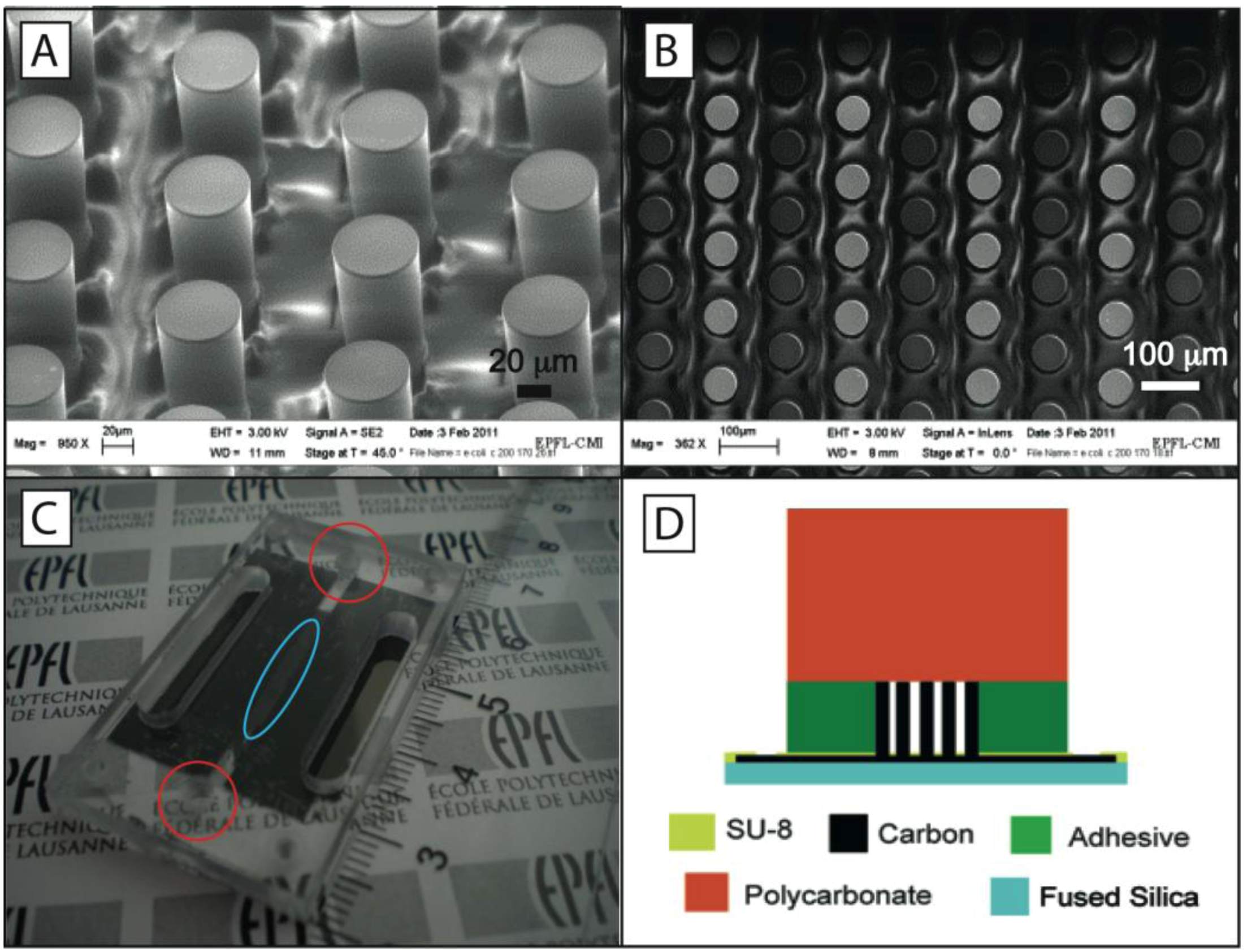
      <p>The device used here features 3D glass-like carbon microelectrodes derived by the pyrolysis, heating to high temperatures in an inert atmosphere, of a previously shaped organic polymer in a process known as Carbon MEMS (C-MEMS). The use of 3D carbon electrodes instead of metal electrodes brings many advantages. For example, carbon electrodes have a wider electrochemical stability window than gold and platinum and are highly biocompatible. Furthermore, the fabrication of 3D carbon structures is significantly easier and cheaper than that of precious metals. The complete fabrication process of the device has been detailed elsewhere [<xref ref-type="bibr" rid="B18-micromachines-03-00574">18</xref>]. Briefly, a SU-8 precursor structure is fabricated on a transparent fused silica substrate and then carbonized by heating to 900 °C in a nitrogen atmosphere (<xref ref-type="fig" rid="micromachines-03-00574-f001">Figure 1</xref>(A)). Columns of 3D carbon electrodes are electrically connected such that every other column has the same polarity (<xref ref-type="fig" rid="micromachines-03-00574-f001">Figure 1</xref>(B)). A non-pyrolysed SU8 layer ensures electrical insulation on top of the paths connecting the pillars. The height of the electrodes is around 100 μm. Both the electrode diameter and spacing between electrodes are equal to 58 μm. The microfluidic network is made separate from the carbon electrodes and consists of a stack of pressure-sensitive double-sided adhesive (PSA) and polycarbonate (PC). A microchannel is first cut from a 100-μm thick PSA and is then aligned between inlet and outlet holes previously drilled in a PC substrate. An actual experimental device and its cross section are shown in <xref ref-type="fig" rid="micromachines-03-00574-f001">Figure 1</xref>(C,D), respectively. </p>
      <fig id="micromachines-03-00574-f001" position="anchor">
        <label>Figure 1</label>
        <caption>
          <p>(<bold>A</bold>) Isometric view of the carbon electrodes; (<bold>B</bold>) Top view of carbon electrode array, every other column is connected to a different electric pole, <italic>i.e</italic>., gray circles are connected to the same electrical pole. The average separation between electrodes is 58 μm; (<bold>C</bold>) Actual device used for experiments. Inlet and outlet to and from the channel are shown in the two circles. The carbon electrode array is shown in the ellipse; (<bold>D</bold>) Schematic of the device cross-section.</p>
        </caption>
        <graphic xmlns:xlink="http://www.w3.org/1999/xlink" xlink:href="micromachines-03-00574-g001.tif"/>
      </fig>
    </sec>
    <sec>
      <title>3. Materials and Methods</title>
      <p><italic>Saccharomyces cerevisiae</italic> (Baker’s yeast, Migros, Switzerland) are suspended at a density of 10<sup>8</sup> cells per ml in a phosphate buffer saline (PBS) diluted 100 times in deionized water. The viability of the yeast cells injected into the chip remained at least 95% in all experiments as quantified by propidium iodide staining protocol. Bovine serum albumin (BSA) at 0.1% is added to reduce cell adhesion to the microchannel. The conductivity of the media is around 15 mS/m. T-cell acute lymphoblastic leukemia (T-ALL) cells from line RPMI8402 are transfected to express luciferase intracellularly. They are suspended at a density of 2 × 10<sup>6</sup> cells/mL in a 100-fold PBS dilution in a 300 mM sucrose solution for osmotic balance. Both PBS and BSA are obtained from Sigma-Aldrich. A sample volume of 100 µL containing cells are injected into the device at a flow rate controlled using a syringe pump (PhD2000, Harvard Apparatus). </p>
      <p>Yeast cells pass through the lysis region and are collected from the chip to evaluate their viability using a propidium iodide (PI) staining protocol. A 100 μL plug of diluted PBS is passed through immediately after the sample to take the cells out of the dead volume of the chip. This two-fold dilution is taken into account for the calculation of the results. A similar protocol for sample injection and retrieval is used for mammalian cells. However, in this case the cell lysate recovered from the chip is analyzed using a luminescence assay to measure the extracted luciferase. A volume of 100 μL from the chip is placed in a 96-well plate where the dual luciferase kit (E1910, Promega) is added. The plate is then inserted in a Tecan 500 plate reader to read out luciferase concentration. The obtained results are compared to chemical lysis, which is performed on 100 μL of sample during 10 min at room temperature in the passive lysis buffer included in the luciferase kit (E1910, Promega). </p>
    </sec>
    <sec sec-type="results">
      <title>4. Results and Discussion</title>
      <p>The results of electrical lysis experiments on yeast cells are summarized in <xref ref-type="table" rid="micromachines-03-00574-t001">Table 1</xref>. The lysis efficiency, defined as the percentage of dead cells after application of a lysing electric field, depends on the lysis voltage applied between electrodes and on the rate of sample flow through the electrode. A cell must be exposed to a strong-enough electric field for a minimum time to be lysed. The frequency of the lysis voltage is chosen at 10 kHz to optimize cell lysis efficiency while avoiding bubble formation at the electrodes. At an initial voltage of 52 V<sub>pp</sub> the lysis efficiency is above 80% when using flow rates up to 50 μL /min. Unfortunately, such low flow rates are not desired because of low throughput and because they can lead to particle sedimentation in the channel, as previously detailed by one of us in a similar device [<xref ref-type="bibr" rid="B19-micromachines-03-00574">19</xref>]. Indeed, the measured cell loss likely due to sedimentation increases from almost 0% at flows of 100 μL /min up to around 40% at flows of 20 μL /min. The cell lysis efficiency remains high when implementing higher flow rates as long as the voltage is increased accordingly; almost all cells injected at 100 μL /min when using a voltage of 65 V<sub>pp</sub> are still lysed. If higher flow rates are required, the lysis voltage must be further increased. Following such rationale, the use of 130 V<sub>pp</sub> leads to a 90% efficiency in cell lysis at 600 μL /min, corresponding to 60 millions cells lysed per second. The use of voltages higher than 130 V<sub>pp</sub> led to breakdown of the sample and origination of bubbles inside the channel. Consequently, the implementation of faster flows at this voltage limit at 130 V<sub>pp</sub> leads to a gradual decrease on lysis efficiency as shown in the last row of <xref ref-type="table" rid="micromachines-03-00574-t001">Table 1</xref>.</p>
      <table-wrap id="micromachines-03-00574-t001" position="anchor">
        <object-id pub-id-type="pii">micromachines-03-00574-t001_Table 1</object-id>
        <label>Table 1</label>
        <caption>
          <p>Lysis efficiency and transit times inside the chip for different values of applied voltage and flow rate. The lysis efficiency is defined as the percentage of cells lysed during the experiment, as obtained by propidium iodide staining. The concentration of yeast cells in the sample is 10<sup>8</sup> cells/mL.</p>
        </caption>
        <table>
          <thead>
            <tr align="center">
              <th valign="middle">Lysis voltage</th>
              <th valign="middle">Flow rate (l/min)</th>
              <th valign="middle">Transit time inside chip</th>
              <th valign="middle">Lysis efficiency (%)</th>
            </tr>
          </thead>
          <tbody>
            <tr align="center">
              <td valign="middle">52 V<sub>pp</sub></td>
              <td valign="middle">10</td>
              <td valign="middle">24 s</td>
              <td valign="middle">89%</td>
            </tr>
            <tr align="center">
              <td valign="middle">52 V<sub>pp</sub></td>
              <td valign="middle">50</td>
              <td valign="middle">4.8 s</td>
              <td valign="middle">84%</td>
            </tr>
            <tr align="center">
              <td valign="middle">52 V<sub>pp</sub></td>
              <td valign="middle">200</td>
              <td valign="middle">1.2 s</td>
              <td valign="middle">42%</td>
            </tr>
            <tr align="center">
              <td valign="middle">65 V<sub>pp</sub></td>
              <td valign="middle">100</td>
              <td valign="middle">2.4 s</td>
              <td valign="middle">98%</td>
            </tr>
            <tr align="center">
              <td valign="middle">65 V<sub>pp</sub></td>
              <td valign="middle">600</td>
              <td valign="middle">400 ms</td>
              <td valign="middle">3%</td>
            </tr>
            <tr align="center">
              <td valign="middle">130 V<sub>pp</sub></td>
              <td valign="middle">600</td>
              <td valign="middle">400 ms</td>
              <td valign="middle">90%</td>
            </tr>
            <tr align="center">
              <td valign="middle">130 V<sub>pp</sub></td>
              <td valign="middle">2000</td>
              <td valign="middle">120 ms</td>
              <td valign="middle">5%</td>
            </tr>
          </tbody>
        </table>
		</table-wrap>
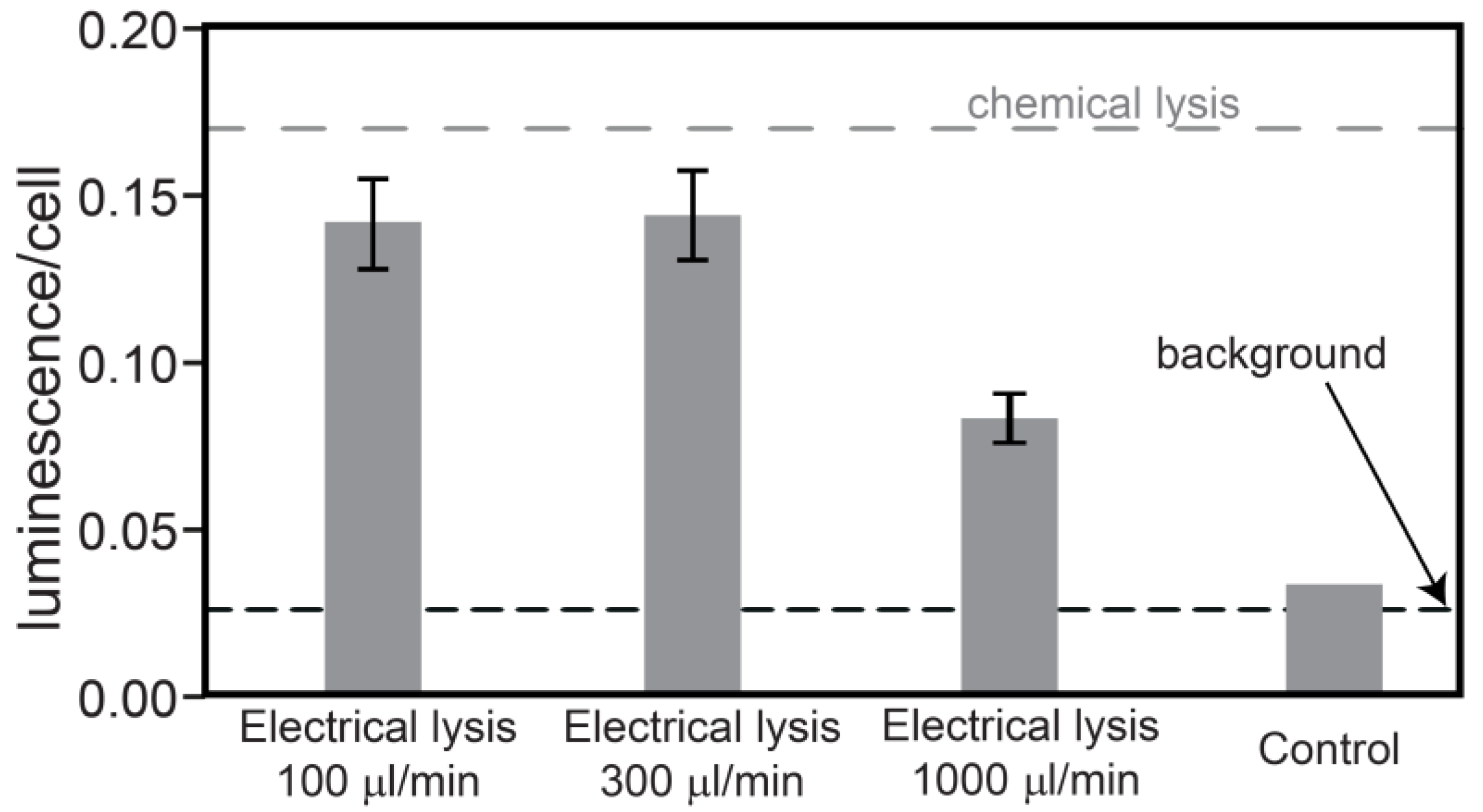
      <p>Incorporation of propidium iodide inside the cells does not necessarily prove that the entire cell interior is released, but at least proves that the membrane has been permeabilized. The device ability to extract intracellular compounds for further analysis has been evaluated with mammalian cells. T-cell acute lymphoblastic leukemia (T-ALL) cells from lines RPMI8402 are transfected to express luciferase intracellularly. Mammalian cells do not require as high electrical fields as yeast cells to be lysed because they are bigger and breakdown at lower trans-membrane potentials [<xref ref-type="bibr" rid="B20-micromachines-03-00574">20</xref>]. The lysis voltage applied here was only 44 V<sub>pp</sub> at 10 kHz. The results of the luminescence assay to detect intracellular compounds at flow rates of 100, 300 and 1,000 μL/min are shown in <xref ref-type="fig" rid="micromachines-03-00574-f002">Figure 2</xref>. The measured amount of luminescence is divided by the number of cells placed in the luminescence meter to provide an estimation of the luciferase extraction in arbitrary units. Flow rates of 100 and 300 μL/min give similar results, around 0.15. In comparison, chemical lysis, also performed by us, gives a luminescence per cell equal to 0.17 (dashed grey line). This difference can be explained by the fact that there is still a small percentage of cells not being lysed by our device, especially cells flowing on the edges of the channel, which are exposed to a lower electrical field. At flow rates of 1 mL/min the luminescence per cell drops significantly suggesting inefficient extraction of intracellular compounds. The dashed black line represents the background for living cells. The last column shows a control experiment obtained by flowing the cells through a non-polarized electrode array. The luminescence level is comparable to the background level, indicating no content extraction in that case.</p>
      <p>The use of electrical lysis over chemical processes offers the main advantage of being able to recover relatively intact cytosol for downstream analysis. The device presented here advances the state-of-the-art in electrical lysis in terms of throughput and offers a powerful tool for cell lysis in lab-on-a-chip applications. Important advantages include high throughput and extraction of large amounts of intracellular compounds. The enabling improvements over existent devices are the use of large channels and the incorporation of 3D electrodes, as tall as the channel, penetrating the bulk of the sample.</p>
      <p>The use of carbon electrodes instead of metal ones allows for relatively easy and inexpensive fabrication of very tall electrodes that are separated by very narrow gaps [<xref ref-type="bibr" rid="B19-micromachines-03-00574">19</xref>]. In this way, the throughput is improved by increasing the channel cross-section, but the low voltage needed for cell lysis is maintained thanks to the close gap between electrodes. Indeed, the throughput achieved by this device, often the limitation of electrical lysis devices, is sufficient to consider electrical lysis as an advantageous alternative to chemical lysis. For example, a sample volume of milliliters can be treated in only a few minutes, faster than the reaction time required to chemically lyse similar volumes, while providing enough intracellular content for multiple analyses. Besides the low dead volume, another significant advantage of this device over bulk chemical lysis is that the delay between lysis and cytosol analysis can be minimized, as the total time including lysis and sample transport is smaller. This is very critical as extracted compounds degrade with time. This delay could be further reduced by integration of the analysis in the same microdevice. The ability to lyse cells at high densities is also essential as it guarantees that the concentration of extracted compounds can be measured accurately using post-lysis analyses. </p>
      <fig id="micromachines-03-00574-f002" position="anchor">
        <label>Figure 2</label>
        <caption>
          <p>Measured luminescence divided by number of cells, giving an indication of the luciferase extraction. The values correspond to the average of 3 electrical lysis experiments, error bars referring to the standard deviation. The last column is a control experiment without applied voltage. The grey line corresponds to chemical lysis experiments, whereas the black line is the background signal for living cells.</p>
        </caption>
        <graphic xmlns:xlink="http://www.w3.org/1999/xlink" xlink:href="micromachines-03-00574-g002.tif"/>
      </fig>
      
	  <p>In the context of bioreactors used in the pharmaceutical industry, lysis speed is an important factor to be able to regularly monitor the cell batch. A faster throughput allows more frequent monitoring (if the analysis systems situated afterwards are not limiting it), leading to a better optimization of the production process.</p>
    </sec>
    <sec sec-type="conclusions">
      <title>4. Conclusions</title>
      <p>We have presented a microfluidic device able to lyse cells at very high throughput, using a large channel cross-section and 3D carbon electrodes. The device has shown very high lysis efficiency (90%) of yeast cells at high density (10<sup>8</sup> cells per mL) and at very high throughput (600 μL/min). This contrasts with conventional throughput of microfluidic devices, which are often around 1 μL /min. The device has also been tested with mammalian cells, indicating effective extraction of intracellular molecules, comparable with chemical lysis results. Furthermore, the electrical lysis performed here is faster than conventional chemical lysis, and does not require the addition of reagents that could interfere with downstream analysis. It also features a very small dead volume compared to bulk lysis. This device can be used either as a standalone unit, or could be integrated to other functions in the same chip, such as sample analysis.</p>
    </sec>
    
  </body>
  <back>
    <ack>
      <title>Acknowledgments</title>
      <p>The authors acknowledge partial funding from the European Community's Seventh Framework Programme (FP7/2007–2013), grant #227243. </p>
    </ack>
	<ref-list>
      <title>References</title>
      <ref id="B1-micromachines-03-00574">
        <label>1.</label>
        <citation citation-type="journal">
          <person-group person-group-type="author">
            <name>
              <surname>Zimmermann</surname>
              <given-names>U.</given-names>
            </name>
            <name>
              <surname>Pilwat</surname>
              <given-names>G.</given-names>
            </name>
            <name>
              <surname>Holzapfel</surname>
              <given-names>C.</given-names>
            </name>
            <name>
              <surname>Rosenheck</surname>
              <given-names>K.</given-names>
            </name>
          </person-group>
          <article-title>Electrical hemolysis of human and bovine red blood cells</article-title>
          <source>J. Membr. Biol.</source>
          <year>1976</year>
          <volume>30</volume>
          <fpage>135</fpage>
          <lpage>152</lpage>
          <pub-id pub-id-type="doi">10.1007/BF01869664</pub-id>
        </citation>
      </ref>
      <ref id="B2-micromachines-03-00574">
        <label>2.</label>
        <citation citation-type="journal">
          <person-group person-group-type="author">
            <name>
              <surname>Salton</surname>
              <given-names>M.R.J.</given-names>
            </name>
          </person-group>
          <article-title>Cell structure and the enzymic lysis of bacteria</article-title>
          <source>J. Gen. Microbiol.</source>
          <year>1953</year>
          <volume>9</volume>
          <fpage>512</fpage>
          <lpage>523</lpage>
          <pub-id pub-id-type="doi">10.1099/00221287-9-3-512</pub-id>
        </citation>
      </ref>
      <ref id="B3-micromachines-03-00574">
        <label>3.</label>
        <citation citation-type="journal">
          <person-group person-group-type="author">
            <name>
              <surname>Bramley</surname>
              <given-names>T.A.</given-names>
            </name>
            <name>
              <surname>Colemana</surname>
              <given-names>R.</given-names>
            </name>
            <name>
              <surname>Fineana</surname>
              <given-names>J.B.</given-names>
            </name>
          </person-group>
          <article-title>Chemical, enzymological and permeability properties of human erythrocyte ghosts prepared by hypotonic lysis in media of different osmolarities</article-title>
          <source>Biochim. Biophys. Acta Biomembr.</source>
          <year>1971</year>
          <volume>241</volume>
          <fpage>752</fpage>
          <lpage>769</lpage>
          <pub-id pub-id-type="doi">10.1016/0005-2736(71)90003-4</pub-id>
        </citation>
      </ref>
      <ref id="B4-micromachines-03-00574">
        <label>4.</label>
        <citation citation-type="journal">
          <person-group person-group-type="author">
            <name>
              <surname>Irimia</surname>
              <given-names>D.</given-names>
            </name>
            <name>
              <surname>Tompkins</surname>
              <given-names>R.G.</given-names>
            </name>
            <name>
              <surname>Toner</surname>
              <given-names>M.</given-names>
            </name>
          </person-group>
          <article-title>Single-cell chemical lysis in picoliter-scale closed volumes using a microfabricated device</article-title>
          <source>Anal. Chem.</source>
          <year>2004</year>
          <volume>76</volume>
          <fpage>6137</fpage>
          <lpage>6143</lpage>
          <pub-id pub-id-type="doi">10.1021/ac0497508</pub-id>
        </citation>
      </ref>
      <ref id="B5-micromachines-03-00574">
        <label>5.</label>
        <citation citation-type="journal">
          <person-group person-group-type="author">
            <name>
              <surname>Jeltsch</surname>
              <given-names>E.</given-names>
            </name>
            <name>
              <surname>Zimmermann</surname>
              <given-names>U.</given-names>
            </name>
          </person-group>
          <article-title>Particles in a homogeneous electrical field: A model for the electrical breakdown of living cells in a coulter counter</article-title>
          <source>J. Electroanal. Chem.</source>
          <year>1979</year>
          <volume>104</volume>
          <fpage>349</fpage>
          <lpage>384</lpage>
          <pub-id pub-id-type="doi">10.1016/S0022-0728(79)81045-1</pub-id>
        </citation>
      </ref>
      <ref id="B6-micromachines-03-00574">
        <label>6.</label>
        <citation citation-type="journal">
          <person-group person-group-type="author">
            <name>
              <surname>Han</surname>
              <given-names>F.</given-names>
            </name>
            <name>
              <surname>Wang</surname>
              <given-names>Y.</given-names>
            </name>
            <name>
              <surname>Sims</surname>
              <given-names>C.E.</given-names>
            </name>
            <name>
              <surname>Bachman</surname>
              <given-names>M.</given-names>
            </name>
            <name>
              <surname>Chang</surname>
              <given-names>R.</given-names>
            </name>
            <name>
              <surname>Li</surname>
              <given-names>G.P.</given-names>
            </name>
            <name>
              <surname>Allbritton</surname>
              <given-names>N.L.</given-names>
            </name>
          </person-group>
          <article-title>Fast electrical lysis of cells for capillary electrophoresis</article-title>
          <source>Anal. Chem.</source>
          <year>2003</year>
          <volume>75</volume>
          <fpage>3688</fpage>
          <lpage>3696</lpage>
          <pub-id pub-id-type="doi">10.1021/ac0341970</pub-id>
        </citation>
      </ref>
      <ref id="B7-micromachines-03-00574">
        <label>7.</label>
        <citation citation-type="journal">
          <person-group person-group-type="author">
            <name>
              <surname>Pethica</surname>
              <given-names>B.A.</given-names>
            </name>
          </person-group>
          <article-title>Lysis by physical and chemical methods</article-title>
          <source>J. Gen. Microbiol.</source>
          <year>1958</year>
          <volume>18</volume>
          <fpage>473</fpage>
          <lpage>480</lpage>
          <pub-id pub-id-type="doi">10.1099/00221287-18-2-473</pub-id>
        </citation>
      </ref>
      <ref id="B8-micromachines-03-00574">
        <label>8.</label>
        <citation citation-type="journal">
          <person-group person-group-type="author">
            <name>
              <surname>Di Carlo</surname>
              <given-names>D.</given-names>
            </name>
            <name>
              <surname>Jeong</surname>
              <given-names>K.H.</given-names>
            </name>
            <name>
              <surname>Lee</surname>
              <given-names>L.P.</given-names>
            </name>
          </person-group>
          <article-title>Reagentless mechanical cell lysis by nanoscale barbs in microchannels for sample preparation</article-title>
          <source>Lab Chip</source>
          <year>2003</year>
          <volume>3</volume>
          <fpage>287</fpage>
          <lpage>291</lpage>
          <pub-id pub-id-type="doi">10.1039/b305162e</pub-id>
        </citation>
      </ref>
      <ref id="B9-micromachines-03-00574">
        <label>9.</label>
        <citation citation-type="journal">
          <person-group person-group-type="author">
            <name>
              <surname>Rau</surname>
              <given-names>K.R.</given-names>
            </name>
            <name>
              <surname>Guerra</surname>
              <given-names>A.</given-names>
            </name>
            <name>
              <surname>Vogel</surname>
              <given-names>A.</given-names>
            </name>
          </person-group>
          <article-title>Investigation of laser-induced cell lysis using time-resolved imaging</article-title>
          <source>Appl. Phys. Lett.</source>
          <year>2004</year>
          <volume>84</volume>
          <fpage>2940</fpage>
          <lpage>2942</lpage>
          <pub-id pub-id-type="doi">10.1063/1.1705728</pub-id>
        </citation>
      </ref>
      <ref id="B10-micromachines-03-00574">
        <label>10.</label>
        <citation citation-type="journal">
          <person-group person-group-type="author">
            <name>
              <surname>Dhawan</surname>
              <given-names>M.D.</given-names>
            </name>
            <name>
              <surname>Wise</surname>
              <given-names>F.</given-names>
            </name>
            <name>
              <surname>Baeumner</surname>
              <given-names>A.J.</given-names>
            </name>
          </person-group>
          <article-title>Development of a laser-induced cell lysis system</article-title>
          <source>Anal. Bional. Chem.</source>
          <year>2002</year>
          <volume>374</volume>
          <fpage>421</fpage>
          <lpage>426</lpage>
          <pub-id pub-id-type="doi">10.1007/s00216-002-1489-2</pub-id>
        </citation>
      </ref>
      <ref id="B11-micromachines-03-00574">
        <label>11.</label>
        <citation citation-type="journal">
          <person-group person-group-type="author">
            <name>
              <surname>Wang</surname>
              <given-names>H.-Y.</given-names>
            </name>
            <name>
              <surname>Bhunia</surname>
              <given-names>A.K.</given-names>
            </name>
            <name>
              <surname>Lu</surname>
              <given-names>C.</given-names>
            </name>
          </person-group>
          <article-title>A microfluidic flow-through device for high throughput electrical lysis of bacterial cells based on continuous dc voltage</article-title>
          <source>Biosens. Bioelectron.</source>
          <year>2006</year>
          <volume>22</volume>
          <fpage>582</fpage>
          <lpage>588</lpage>
          <pub-id pub-id-type="doi">10.1016/j.bios.2006.01.032</pub-id>
        </citation>
      </ref>
      <ref id="B12-micromachines-03-00574">
        <label>12.</label>
        <citation citation-type="journal">
          <person-group person-group-type="author">
            <name>
              <surname>Lu</surname>
              <given-names>H.</given-names>
            </name>
            <name>
              <surname>Schmidt</surname>
              <given-names>M.A.</given-names>
            </name>
            <name>
              <surname>Jensen</surname>
              <given-names>K.F.</given-names>
            </name>
          </person-group>
          <article-title>A microfluidic electroporation device for cell lysis</article-title>
          <source>Lab Chip</source>
          <year>2005</year>
          <volume>5</volume>
          <fpage>23</fpage>
          <lpage>29</lpage>
          <pub-id pub-id-type="doi">10.1039/b406205a</pub-id>
        </citation>
      </ref>
      <ref id="B13-micromachines-03-00574">
        <label>13.</label>
        <citation citation-type="journal">
          <person-group person-group-type="author">
            <name>
              <surname>Mernier</surname>
              <given-names>G.</given-names>
            </name>
            <name>
              <surname>Piacentini</surname>
              <given-names>N.</given-names>
            </name>
            <name>
              <surname>Renaud</surname>
              <given-names>P.</given-names>
            </name>
          </person-group>
          <article-title>Continuous-flow electrical lysis device with integrated control by dielectrophoretic cell sorting</article-title>
          <source>Lab Chip</source>
          <year>2010</year>
          <volume>10</volume>
          <fpage>2077</fpage>
          <lpage>2082</lpage>
          <pub-id pub-id-type="doi">10.1039/c000977f</pub-id>
        </citation>
      </ref>
      <ref id="B14-micromachines-03-00574">
        <label>14.</label>
        <citation citation-type="journal">
          <person-group person-group-type="author">
            <name>
              <surname>Mernier</surname>
              <given-names>G.</given-names>
            </name>
            <name>
              <surname>Hasenkamp</surname>
              <given-names>W.</given-names>
            </name>
            <name>
              <surname>Piacentini</surname>
              <given-names>N.</given-names>
            </name>
            <name>
              <surname>Renaud</surname>
              <given-names>P.</given-names>
            </name>
          </person-group>
          <article-title>Multiple-frequency impedance measurements in continuous flow for automated evaluation of yeast cell lysis</article-title>
          <source>Sens Actuators B</source>
          <year>2010</year>
          <pub-id pub-id-type="doi">10.1016/j.snb.2010.10.050</pub-id>
        </citation>
      </ref>
      <ref id="B15-micromachines-03-00574">
        <label>15.</label>
        <citation citation-type="journal">
          <person-group person-group-type="author">
            <name>
              <surname>Lee</surname>
              <given-names>D.W.</given-names>
            </name>
            <name>
              <surname>Cho</surname>
              <given-names>Y.H.</given-names>
            </name>
          </person-group>
          <article-title>A continuous electrical cell lysis device using a low dc voltage for a cell transport and rupture</article-title>
          <source>Sens. Actuators B</source>
          <year>2007</year>
          <volume>124</volume>
          <fpage>84</fpage>
          <lpage>89</lpage>
          <pub-id pub-id-type="doi">10.1016/j.snb.2006.11.054</pub-id>
        </citation>
      </ref>
      <ref id="B16-micromachines-03-00574">
        <label>16.</label>
        <citation citation-type="journal">
          <person-group person-group-type="author">
            <name>
              <surname>Mernier</surname>
              <given-names>G.</given-names>
            </name>
            <name>
              <surname>Piacentini</surname>
              <given-names>N.</given-names>
            </name>
            <name>
              <surname>Renaud</surname>
              <given-names>P.</given-names>
            </name>
          </person-group>
          <article-title>Multiple-frequency impedance measurements in continuous flow for the evaluation of electrical lysis of yeast cells</article-title>
          <source>Procedia Eng.</source>
          <year>2010</year>
          <volume>5</volume>
          <fpage>37</fpage>
          <lpage>40</lpage>
          <pub-id pub-id-type="doi">10.1016/j.proeng.2010.09.042</pub-id>
        </citation>
      </ref>
      <ref id="B17-micromachines-03-00574">
        <label>17.</label>
        <citation citation-type="journal">
          <person-group person-group-type="author">
            <name>
              <surname>Shahini</surname>
              <given-names>M.</given-names>
            </name>
            <name>
              <surname>Yeow</surname>
              <given-names>J.T.W.</given-names>
            </name>
          </person-group>
          <article-title>Carbon nanotubes for voltage reduction and throughput enhancement of electrical cell lysis on a lab-on-a-chip</article-title>
          <source>Nanotechnology</source>
          <year>2011</year>
          <volume>22</volume>
          <pub-id pub-id-type="doi">10.1088/0957-4484/22/32/325705</pub-id>
        </citation>
      </ref>
      <ref id="B18-micromachines-03-00574">
        <label>18.</label>
        <citation citation-type="journal">
          <person-group person-group-type="author">
            <name>
              <surname>Martinez-Duarte</surname>
              <given-names>R.</given-names>
            </name>
            <name>
              <surname>Renaud</surname>
              <given-names>P.</given-names>
            </name>
            <name>
              <surname>Madou</surname>
              <given-names>M.</given-names>
            </name>
          </person-group>
          <article-title>A novel approach to Dielectrophoresis using carbon electrodes</article-title>
          <source>Electrophoresis</source>
          <year>2011</year>
          <volume>32</volume>
          <fpage>2385</fpage>
          <lpage>2392</lpage>
        <pub-id pub-id-type="pmid">21792991</pub-id></citation>
      </ref>
      <ref id="B19-micromachines-03-00574">
        <label>19.</label>
        <citation citation-type="journal">
          <person-group person-group-type="author">
            <name>
              <surname>Martinez-Duarte</surname>
              <given-names>R.</given-names>
            </name>
            <name>
              <surname>Gorkin</surname>
              <given-names>R.</given-names>
            </name>
            <name>
              <surname>Abi-Samra</surname>
              <given-names>K.</given-names>
            </name>
            <name>
              <surname>Madou</surname>
              <given-names>M.</given-names>
            </name>
          </person-group>
          <article-title>The integration of 3D carbon-electrode dielectrophoresis on a CD-like centrifugal microfluidic platform</article-title>
          <source>Lab Chip</source>
          <year>2010</year>
          <volume>10</volume>
          <fpage>1030</fpage>
          <lpage>1043</lpage>
          <pub-id pub-id-type="doi">10.1039/b925456k</pub-id>
        </citation>
      </ref>
      <ref id="B20-micromachines-03-00574">
        <label>20.</label>
        <citation citation-type="journal">
          <person-group person-group-type="author">
            <name>
              <surname>Müller</surname>
              <given-names>K.J.</given-names>
            </name>
            <name>
              <surname>Sukhorukov</surname>
              <given-names>V.L.</given-names>
            </name>
            <name>
              <surname>Zimmermann</surname>
              <given-names>U.</given-names>
            </name>
          </person-group>
          <article-title>Intracellular delivery of trehalose into mammalian cells by electropermeabilization</article-title>
          <source>J. Membr. Biol.</source>
          <year>2001</year>
          <volume>184</volume>
          <fpage>161</fpage>
          <lpage>170</lpage>
          <pub-id pub-id-type="doi">10.1007/s00232-001-0084-3</pub-id>
        </citation>
      </ref>
    </ref-list>
  </back>
</article>