<?xml version="1.0" encoding="UTF-8"?>
<!DOCTYPE article PUBLIC "-//NLM//DTD Journal Publishing DTD v2.3 20070202//EN" "journalpublishing.dtd">
<article xmlns:mml="http://www.w3.org/1998/Math/MathML" xmlns:xlink="http://www.w3.org/1999/xlink" xml:lang="en" article-type="research-article">
  <front>
    <journal-meta>
      <journal-id journal-id-type="publisher-id">toxins</journal-id>
      <journal-title>Toxins</journal-title>
      <abbrev-journal-title abbrev-type="publisher">Toxins</abbrev-journal-title>
      <abbrev-journal-title abbrev-type="pubmed">Toxins</abbrev-journal-title>
      <issn pub-type="epub">2072-6651</issn>
      <publisher>
        <publisher-name>MDPI</publisher-name>
      </publisher>
    </journal-meta>
    <article-meta>
      <article-id pub-id-type="doi">10.3390/toxins4020042</article-id>
      <article-id pub-id-type="publisher-id">toxins-04-00042</article-id>
      <article-categories>
        <subj-group>
          <subject>Article</subject>
        </subj-group>
      </article-categories>
      <title-group>
        <article-title>Ochratoxigenic Black Species of Aspergilli in Grape Fruits of Northern Italy Identified by an Improved PCR-RFLP Procedure </article-title>
      </title-group>
      <contrib-group>
        <contrib contrib-type="author">
          <name>
            <surname>Spadaro</surname>
            <given-names>Davide</given-names>
          </name>
          <xref rid="af1-toxins-04-00042" ref-type="aff">1</xref>
          <xref rid="af2-toxins-04-00042" ref-type="aff">2</xref>
          <xref rid="c1-toxins-04-00042" ref-type="corresp">*</xref>
        </contrib>
        <contrib contrib-type="author">
          <name>
            <surname>Patharajan</surname>
            <given-names>Subban</given-names>
          </name>
          <xref rid="af1-toxins-04-00042" ref-type="aff">1</xref>
        </contrib>
        <contrib contrib-type="author">
          <name>
            <surname>Lorè</surname>
            <given-names>Alessia</given-names>
          </name>
          <xref rid="af1-toxins-04-00042" ref-type="aff">1</xref>
        </contrib>
        <contrib contrib-type="author">
          <name>
            <surname>Garibaldi</surname>
            <given-names>Angelo</given-names>
          </name>
          <xref rid="af1-toxins-04-00042" ref-type="aff">1</xref>
        </contrib>
        <contrib contrib-type="author">
          <name>
            <surname>Gullino</surname>
            <given-names>Maria Lodovica</given-names>
          </name>
          <xref rid="af1-toxins-04-00042" ref-type="aff">1</xref>
        </contrib>
      </contrib-group>
      <aff id="af1-toxins-04-00042"><label>1 </label>Centre of Competence for the Innovation in the Agro-environmental Sector, Università degli Studi di Torino, Via L. da Vinci 44, Grugliasco (TO) I-10095, Italy; Email: <email>subban.patharajan@unito.it</email> (S.P.); <email>alessia.lore@unito.it</email> (A.L.); <email>angelo.garibaldi@unito.it</email> (A.G.); <email>marialodovica.gullino@unito.it</email> (M.L.G.)</aff>
      <aff id="af2-toxins-04-00042"><label>2 </label>DiVaPRA-Plant Pathology, Università degli Studi di Torino, via L. da Vinci 44, Grugliasco (TO) I-10095, Italy</aff>
      <author-notes>
        <corresp id="c1-toxins-04-00042"><label>*</label> Author to whom correspondence should be addressed; Email: <email>davide.spadaro@unito.it</email>; Tel.: +39-011-6708942; Fax: +39-011-6709307.</corresp>
      </author-notes>
      <pub-date pub-type="epub">
        <day>30</day>
        <month>01</month>
        <year>2012</year>
      </pub-date>
      <pub-date pub-type="collection">
        <month>02</month>
        <year>2012</year>
      </pub-date>
      <volume>4</volume>
      <issue>2</issue>
      <fpage>42</fpage>
      <lpage>54</lpage>
      <history>
        <date date-type="received">
          <day>01</day>
          <month>12</month>
          <year>2011</year>
        </date>
        <date date-type="rev-recd">
          <day>16</day>
          <month>01</month>
          <year>2012</year>
        </date>
        <date date-type="accepted">
          <day>17</day>
          <month>01</month>
          <year>2012</year>
        </date>
      </history>
      <permissions>
        <copyright-statement>© 2012 by the authors; licensee MDPI, Basel, Switzerland.</copyright-statement>
        <copyright-year>2012</copyright-year>
        <license xmlns:xlink="http://www.w3.org/1999/xlink" license-type="open-access" xlink:href="http://creativecommons.org/licenses/by/3.0/">
          <p>This article is an open-access article distributed under the terms and conditions of the Creative Commons Attribution license (http://creativecommons.org/licenses/by/3.0/).</p>
        </license>
      </permissions>
      <abstract>
        <p>A collection of 356 isolates of <italic>Aspergillus</italic> spp. collected during 2006 and 2007 from grapevines in northern Italy were identified through Internal Transcribed Spacer based Restriction Fragment Length Polymorphism (ITS-RFLP) and tested for ochratoxin A (OTA) production. Restriction endonuclease digestion of the ITS products using the endonucleases <italic>Hha</italic>I, <italic>Hinf</italic>I and <italic>Rsa</italic>I, distinguished five different RFLPs. From each pattern, three samples were sequenced and the nucleotide sequences showed different species corresponding to <italic>Aspergillus niger</italic>, <italic>A. carbonarius</italic>, <italic>A. tubingensis</italic>, <italic>A. japonicus</italic> and <italic>A. aculeatus</italic>. By comparing the sequences of the ITS regions, also the uniseriate species <italic>A. japonicus</italic> and <italic>A. aculeatus</italic> could be differentiated by <italic>Hinf</italic>I digestion of the ITS products. Among the aspergilli, <italic>A. niger</italic> was the major species associated with grapes during 2006 (57.4%), while <italic>A. carbonarius</italic> was the major species during 2007 (46.6%). All the strains of <italic>Aspergillus </italic>were tested for their ability to produce OTA on Yeast extract sucrose medium (YES), as it was tested as an optimal substrate for the evaluation of OTA production by black aspergilli. Out of 356 isolates, 63 (17.7%) isolates produced OTA ranging from 0.05 to 3.0 µg mL<sup>−1</sup>. Most of the ochratoxigenic isolates were <italic>A. carbonarius </italic>(46) in both years, but also some strains of <italic>A. tubingensis</italic> (11) and <italic>A. japonicus</italic> (6) produced lower amounts of OTA. </p>
      </abstract>
      <kwd-group>
        <kwd><italic>Aspergillus </italic>section <italic>Nigri</italic></kwd>
        <kwd>grapes</kwd>
        <kwd>ochratoxin A</kwd>
        <kwd>ribosomal DNA</kwd>
        <kwd>wine</kwd>
      </kwd-group>
    </article-meta>
  </front>
  <body>
    <sec sec-type="intro">
      <title>1. Introduction</title>
      <p>Ochratoxin A (OTA) is a major mycotoxin in grapes and grape products [<xref ref-type="bibr" rid="B1-toxins-04-00042">1</xref>,<xref ref-type="bibr" rid="B2-toxins-04-00042">2</xref>,<xref ref-type="bibr" rid="B3-toxins-04-00042">3</xref>]. OTA is nephrotoxic, hepatotoxic, genotoxic, teratogenic and immunotoxic to animals and its carcinogenicity in rats and mice is well-established [<xref ref-type="bibr" rid="B4-toxins-04-00042">4</xref>]. It has been associated with the aetiology of Balkan Endemic Nephropathy [<xref ref-type="bibr" rid="B5-toxins-04-00042">5</xref>] and the development of tumours in the urinary tract in humans [<xref ref-type="bibr" rid="B6-toxins-04-00042">6</xref>]. The International Agency for Research on Cancer classified OTA as a possible carcinogen to humans (group 2B) [<xref ref-type="bibr" rid="B7-toxins-04-00042">7</xref>]. The contamination of grapes and their by-products by OTA has emerged as a big problem for the health risk related to the consumption of such products by human beings [<xref ref-type="bibr" rid="B8-toxins-04-00042">8</xref>,<xref ref-type="bibr" rid="B9-toxins-04-00042">9</xref>]. The European Union has introduced limits (2 μg L<sup>−1</sup>) for OTA in wine and grape products in order to minimize exposure to OTA in the diet (EC Regulation No 1881/2006). Ochratoxin A is produced during the infection on grapes in vineyards by toxigenic species of black aspergilli belonging to <italic>Aspergillus</italic> section <italic>Nigri</italic>, in particular <italic>A</italic>. <italic>niger</italic> and <italic>A</italic>. <italic>carbonarius</italic> [<xref ref-type="bibr" rid="B10-toxins-04-00042">10</xref>,<xref ref-type="bibr" rid="B11-toxins-04-00042">11</xref>,<xref ref-type="bibr" rid="B12-toxins-04-00042">12</xref>]. <italic>A. carbonarius</italic> is predominantly responsible for the production of OTA in grapes and wine [<xref ref-type="bibr" rid="B2-toxins-04-00042">2</xref>,<xref ref-type="bibr" rid="B13-toxins-04-00042">13</xref>,<xref ref-type="bibr" rid="B14-toxins-04-00042">14</xref>,<xref ref-type="bibr" rid="B15-toxins-04-00042">15</xref>], followed by some isolates of the <italic>A. niger</italic> aggregate [<xref ref-type="bibr" rid="B16-toxins-04-00042">16</xref>]. In the present study, <italic>Aspergillus niger </italic>and <italic>Aspergillus tubingensis</italic> were considered two separate species according to Kusters-van Someren <italic>et al</italic>. [<xref ref-type="bibr" rid="B17-toxins-04-00042">17</xref>]. Some authors claim the production of OTA by <italic>A. japonicus </italic>[<xref ref-type="bibr" rid="B18-toxins-04-00042">18</xref>], however such ability is still unconfirmed. The percentage of <italic>A. niger</italic> aggregate isolates able to produce OTA is much lower than the share of <italic>A. carbonarius</italic> isolates [<xref ref-type="bibr" rid="B19-toxins-04-00042">19</xref>]. The main OTA contamination in grapes and wine was reported in different countries but high levels of OTA were found in southern Europe [<xref ref-type="bibr" rid="B18-toxins-04-00042">18</xref>,<xref ref-type="bibr" rid="B20-toxins-04-00042">20</xref>], in particular in regions with a Mediterranean climate [<xref ref-type="bibr" rid="B21-toxins-04-00042">21</xref>,<xref ref-type="bibr" rid="B22-toxins-04-00042">22</xref>,<xref ref-type="bibr" rid="B23-toxins-04-00042">23</xref>,<xref ref-type="bibr" rid="B24-toxins-04-00042">24</xref>].</p>
      <p>An accurate identification of the species of <italic>Aspergillus</italic> is of great importance because the toxin profiles of each species vary, and the fungi present limit and define potential toxicological risks. Black aspergilli are difficult to classify and the taxonomy of this section is still unclear [<xref ref-type="bibr" rid="B25-toxins-04-00042">25</xref>,<xref ref-type="bibr" rid="B26-toxins-04-00042">26</xref>]. Various molecular approaches have been proposed, though the taxonomy of <italic>Aspergillus</italic> section <italic>Nigri</italic> is not completely resolved, especially within the <italic>A. niger</italic> aggregate [<xref ref-type="bibr" rid="B26-toxins-04-00042">26</xref>,<xref ref-type="bibr" rid="B27-toxins-04-00042">27</xref>,<xref ref-type="bibr" rid="B28-toxins-04-00042">28</xref>,<xref ref-type="bibr" rid="B29-toxins-04-00042">29</xref>]. Among the molecular tools proposed, restriction fragment length polymorphism (RFLP) has been used successfully to identify <italic>Aspergillus</italic> species [<xref ref-type="bibr" rid="B26-toxins-04-00042">26</xref>]. Those findings were confirmed by RFLP on genomic DNA with different endonucleases, combined with rDNA hybridization probes [<xref ref-type="bibr" rid="B30-toxins-04-00042">30</xref>], by RFLP on mtDNA [<xref ref-type="bibr" rid="B31-toxins-04-00042">31</xref>,<xref ref-type="bibr" rid="B32-toxins-04-00042">32</xref>], and by RAPD analysis [<xref ref-type="bibr" rid="B30-toxins-04-00042">30</xref>]. Accensi <italic>et al</italic>. [<xref ref-type="bibr" rid="B33-toxins-04-00042">33</xref>] proposed a new PCR-RFLP method to distinguish the <italic>A. niger</italic> aggregate and identified two types, N (corresponding to <italic>A. niger</italic>) and T (corresponding to <italic>A. tubingensis</italic>). More recently, a new group of ochratoxigenic strains, closely related to <italic>A. tubingensis</italic>, has been identified by ITS-RFLP method [<xref ref-type="bibr" rid="B34-toxins-04-00042">34</xref>]. Moreover, some strains belonging to the uniseriate species <italic>Aspergillus aculeatus</italic> and <italic>A</italic>. <italic>japonicus</italic> showed to produce OTA [<xref ref-type="bibr" rid="B21-toxins-04-00042">21</xref>], but their PCR-RFLP profile was not able to differentiate the two species.</p>
      <p>The first objective was to monitor the population of black aspergilli in Northern Italian vineyards during the year 2006 and 2007, and the second objective was to assess the mycotoxigenicity of all the isolates. The collateral objective of this study was the optimization of a restriction fragment length polymorphism (RFLP) method to distinguish the five species of <italic>Aspergillus</italic> present on grapes cultivated in Northern Italy. </p>
    </sec>
    <sec>
      <title>2. Materials and Methods</title>
      <sec>
        <title>2.1. Collection of Grape Samples and Isolation of <italic>Aspergillus</italic> spp.</title>
        <p>During 2006 and 2007, grape samples were collected at harvesting stage from Albenga, Liguria region, Italy. The isolates were collected from grape bunches belonging to six different grapevine varieties (Lumassina, Rossese, Vermentino, Ormeasco, Pigato and Vermentino 84). At harvest, 10 bunches were picked from 10 different plants located approximately along two diagonals crossing the vineyard. Each bunch was collected in a separate paper bag and samples were brought to the laboratory. Five berries were taken randomly from each bunch and they were surface decontaminated using a 0.1% sodium hypochlorite solution for 30 s followed by two rinses with sterile-distilled water. The samples were plated on Potato dextrose agar (PDA, Merck) dishes containing streptomycin 50 mg L<sup>−1</sup> (Merck). Plates were incubated at 25 °C for 7 days. The fungal colonies were picked up and transferred to PDA slants for further studies. The initial identification of isolates of <italic>Aspergillus </italic>spp. was achieved through macroscopic and microscopic observation with the aid of guidelines [<xref ref-type="bibr" rid="B35-toxins-04-00042">35</xref>]. Other genera of fungi, isolated during the experiments, were not considered in the present study. Some reference strains of <italic>Aspergillus</italic> spp. were obtained from the Centralbureau voor Schimmelcultures (CBS, Utrecht, The Netherlands): CBS 113.80 (<italic>Aspergillus carbonarius</italic>); CBS 107.55 (<italic>Aspergillus tubingensis</italic>); CBS 113.46 (<italic>Aspergillus niger</italic>); CBS 116.80 (<italic>Aspergillus aculeatus</italic>); and CBS 114.51 (<italic>Aspergillus japonicus</italic>).</p>
      </sec>
      <sec>
        <title>2.2. Culture Conditions and Extraction of DNA</title>
        <p>For the extraction of DNA, all the strains of <italic>Aspergillus </italic>spp. were grown in Yeast extract sucrose (YES) broth at 25 °C for 9 days. Then, the mycelia were collected through Whatman No.1 filter paper. Three hundred mg of mycelium from the individual strains was frozen in liquid nitrogen and ground to a fine powder. DNA extractions were performed with 100 mg of powder using the commercial NucleoSpin Plant DNA kit (Macherey-Nagel, Iuren, Germany) according to the manufacturer’s instructions. </p>
      </sec>
      <sec>
        <title>2.3. PCR Conditions and DNA Digestions</title>
        <p>The 5.8 S-ITS region was amplified by PCR using universal primers ITS 5 and ITS 4 [<xref ref-type="bibr" rid="B36-toxins-04-00042">36</xref>]. PCR reactions were performed in 20 μL as the final volume, containing 3 μL of 10× buffer (with 2.5 mmol L<sup>−1</sup> MgCl<sub>2</sub>), 1 μL of 2 mmol L<sup>−1</sup> dNTP mixture, 3 μL of 2 mol L<sup>−1</sup> each primer, 0.2 μL (1 U) of Taq DNA polymerase (Invitrogen, USA), 7.8 μL of dH<sub>2</sub>O and 2 μL of (50 ng) DNA template. The reaction mixtures were performed in a Thermocycler (Biometra, Germany) with 35 cycles consisting of 1 min at 95 °C, 1 min at 52 °C and 2 min at 72 °C and the final extension time with 10 min. Then, the PCR products were purified by using Qiagen (Valencia, CA, USA) PCR purification kit and digested with the restriction enzymes <italic>Hha</italic>I, <italic>Hinf</italic>I and <italic>Rsa</italic>I (Promega, Madison, WI, USA). Each 20 μL reaction mixture contained 2 μL of 10X reaction buffer, 0.2 μL of BSA (10 μg μL<sup>−1</sup>), 0.5 μL of restriction enzyme (10 U μL<sup>−1</sup>), 5 μL of purified DNA and 12.3 μL of dH<sub>2</sub>O and incubated at 37 °C for 2 h. The restriction fragments were separated on 2% agarose gel at 50 V, stained SYBR-safe (Invitrogen) and photographed using a Gel Doc 1000 system. Size of the restriction fragments were estimated by comparison with a marker (50 bp DNA ladder-Gelpilot, Qiagen).</p>
      </sec>
      <sec>
        <title>2.4. Sequencing Analysis</title>
        <p>The PCR products of three samples for each RFLP pattern were sequenced. They were purified using a QIAquick PCR purification kit (Qiagen) and measured with a spectrophotometer. They were cloned with a pDrive cloning vector using the Qiagen cloning kit according to manufacturer’s instructions. Plasmids were purified from bacterial cells following manufac–turer’s instruction (Qiagen) and were sequenced by the BMR Genomics Centre (Padova, Italy) using the ABI PRISM 3730Xl DNA Sequencer. The ITS sequences from the different <italic>Aspergillus</italic> spp. were submitted to the GenBank of the National Centre for Biotechnology Information (NCBI, New York, NY, USA) with the following accessions: GQ118984, GQ359404, GQ359405 (<italic>A</italic>. <italic>carbonarius</italic>); GQ118985, GQ359406, GQ359407 (<italic>A</italic>. <italic>niger</italic>); GQ129209, GQ359408, GQ359409 (<italic>A</italic>. <italic>tubingensis</italic>), GQ129210, GQ359410, GQ359411 (<italic>A</italic>. <italic>aculeatus</italic>); GQ129211, GQ359412, GQ359413 (<italic>A</italic>. <italic>japonicus</italic>). The 5.8S-ITS region sequences were aligned using the multiple sequence alignment program CLUSTAL X. The genetic distances were calculated using the Jukes-Cantor model and the phylogenetic inference was obtained by UPGMA (Unweighted Pair Group Method with Arithmetic Mean) method. The statistical confidence of a particular group of sequences in the tree, evaluated by bootstrap test (10,000 pseudo replicates) [<xref ref-type="bibr" rid="B38-toxins-04-00042">38</xref>], using the computer program MEGA version 2.0 [<xref ref-type="bibr" rid="B39-toxins-04-00042">39</xref>]. </p>
      </sec>
      <sec>
        <title>2.5. Production of OTA by <italic>Aspergillus</italic> spp.</title>
        <p>The isolates of <italic>Aspergillus</italic> spp.—all of them were black aspergilli–were tested for their ability to produce OTA on flasks containing 300 mL YES broth. For the production of OTA the isolates were grown for 9 days by shaking (100 rpm) at 25 °C. Three ml of the culture filtrates were withdrawn and centrifuged at 10,000 rpm for 10 min. Then, each sample was diluted ten times with distilled water and OTA was extracted from the individual culture filtrate using Ochra Test<sup>TM</sup> columns (Vicam, Watertown, USA) as per the manufacturer instructions. Samples were analyzed in a HPLC Agilent series 1100 formed by a degasser, an autosampler, a quaternary pump, a thermostated column and a fluorimeter. An analytical column RP-18 (150 mm × 4.6 mm i.d., 5 μm) with a pre-column was used. The mobile phase, eluting at 1 mL min<sup>−1</sup>, consisted of an isocratic mixture of acetonitrile:water:acetic acid (45:45:10) for 18 min. 100 μL of sample were injected onto the HPLC column and the retention time of OTA was 6.15 min. The amount of OTA in the final solution was determined by using a calibration graph of concentration versus peak area and expressed as ng/mL, achieved by injection onto the HPLC column of 100 μL of standard solutions of OTA (Sigma Chemical Co.). The standard solutions had concentrations of 0.5, 1.0, 5.0, 10.0, 25.0, 50.0 and 100.0 ng mL<sup>−1</sup>. The recovery was determined on a blank YES broth spiked at three concentrations of OTA (0.1, 2.0 and 10.0 ng mL<sup>−1</sup>). Samples were processed for estimation of OTA as described above. Recovery experiments were done in four replicates. Recoveries ranged from 90.8% to 92.1%. The repeatability ranged from 2.64% to 2.71% for replicate analysis. The detection limit of the analysis was 0.01 ng OTA mL<sup>−1</sup> of YES medium. </p>
      </sec>
    </sec>
    <sec sec-type="results">
      <title>3. Results</title>
      <sec>
        <title>3.1. ITS-RFLP of <italic>Aspergillus</italic> Isolates</title>
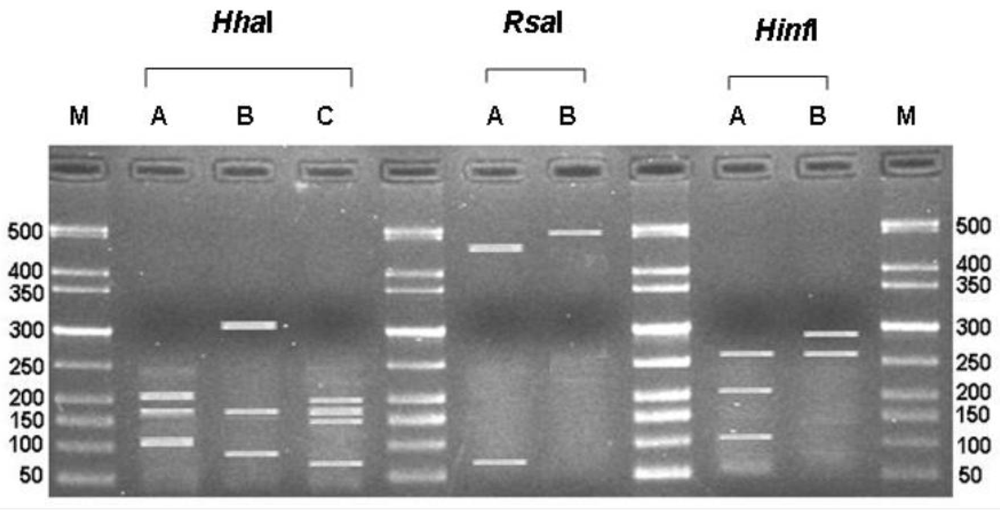
        <p>During a two year survey, we could isolate from the grapes coming from Liguria region (Italy) and identify 356 isolates of <italic>Aspergillus</italic> spp. based on morphological characteristics. The other genera of fungi isolated were not considered in the present study. All the isolates were characterized at species level using an ITS-RFLP based method. The size of all amplified PCR products was estimated at around 546–596 bp. On the basis of the ITS sequences, the endonucleases <italic>Hha</italic>I, <italic>Hinf</italic>I and <italic>Rsa</italic>I were chosen for the restriction analysis in order to differentiate among isolates. Their typical restriction patterns are shown in <xref ref-type="fig" rid="toxins-04-00042-f001">Figure 1</xref>. </p>
        <fig id="toxins-04-00042-f001" position="anchor">
          <label>Figure 1</label>
          <caption>
            <p>Ribosomal DNA restriction patterns exhibited by <italic>Aspergillus</italic> isolates from grapes after digestion with the restriction endonucleases <italic>Hha</italic>I, <italic>Rsa</italic>I and <italic>Hinf</italic>I. Lane M corresponds to the 50 bp molecular weight marker (Gelpilot, Qiagen).</p>
          </caption>
          <graphic xmlns:xlink="http://www.w3.org/1999/xlink" xlink:href="toxins-04-00042-g001.tif"/>
        </fig>
        <p>The individual profiles designated with the letters A–C, can be combined into composite restriction patterns or RFLP types (<xref ref-type="table" rid="toxins-04-00042-t001">Table 1</xref>). The restriction patterns obtained for the different isolates were compared with those obtained from the reference strains of <italic>Aspergillus</italic> species. The analysis of the <italic>Aspergillus</italic> isolates showed five different RFLP types (<xref ref-type="table" rid="toxins-04-00042-t001">Table 1</xref>).</p>
        <table-wrap id="toxins-04-00042-t001" position="anchor">
          <object-id pub-id-type="pii">toxins-04-00042-t001_Table 1</object-id>
          <label>Table 1</label>
          <caption>
            <p>Ribosomal restriction patterns and composite patterns exhibited by the <italic>Aspergillus</italic> isolates analyzed in the present study.</p>
          </caption>
          <table>
            <thead>
              <tr>
                <th rowspan="2" align="center" valign="top">Type</th>
                <th rowspan="2" align="center" valign="top">Species</th>
                <th rowspan="2" align="center" valign="top">No of isolates</th>
                <th colspan="3" align="center" valign="top" style="border-bottom: solid thin">Restriction patterns &amp; size of the fragments (bp)</th>
              </tr>
              <tr>
                <th align="center" valign="top"><italic>Hha</italic>I</th>
                <th align="center" valign="top"><italic>Rsa</italic>I</th>
                <th align="center" valign="top">
                  <italic>HinfI</italic>
                </th>
              </tr>
            </thead>
            <tbody>
              <tr>
                <td rowspan="2" align="center" valign="top">N</td>
                <td rowspan="2" align="left" valign="top">
                  <italic>A. niger</italic>
                </td>
                <td rowspan="2" align="center" valign="top">153</td>
                <td align="center" valign="top">A</td>
                <td align="center" valign="top">A</td>
                <td align="center" valign="top">A</td>
              </tr>
              <tr>
                <td align="center" valign="top">207, 178, 114</td>
                <td align="center" valign="top">480, 66</td>
                <td align="center" valign="top">269, 202, 110</td>
              </tr>
              <tr>
                <td rowspan="2" align="center" valign="top">C</td>
                <td rowspan="2" align="left" valign="top">
                  <italic>A. carbonarius</italic>
                </td>
                <td rowspan="2" align="center" valign="top">107</td>
                <td align="center" valign="top">B</td>
                <td align="center" valign="top">A</td>
                <td align="center" valign="top">B</td>
              </tr>
              <tr>
                <td align="center" valign="top">318, 178, 91</td>
                <td align="center" valign="top">480, 66</td>
                <td align="center" valign="top">294, 270</td>
              </tr>
              <tr>
                <td rowspan="2" align="center" valign="top">T</td>
                <td rowspan="2" align="left" valign="top">
                  <italic>A. tubingensis </italic>
                </td>
                <td rowspan="2" align="center" valign="top">72</td>
                <td align="center" valign="top">A</td>
                <td align="center" valign="top">B</td>
                <td align="center" valign="top">A</td>
              </tr>
              <tr>
                <td align="center" valign="top">207, 178, 114</td>
                <td align="center" valign="top">500</td>
                <td align="center" valign="top">269, 202, 110</td>
              </tr>
              <tr>
                <td rowspan="2" align="center" valign="top">A</td>
                <td rowspan="2" align="left" valign="top">
                  <italic>A. japonicus </italic>
                </td>
                <td rowspan="2" align="center" valign="top">20</td>
                <td align="center" valign="top">C</td>
                <td align="center" valign="top">A</td>
                <td align="center" valign="top">B</td>
              </tr>
              <tr>
                <td align="center" valign="top">185, 174, 156, 75</td>
                <td align="center" valign="top">480, 66</td>
                <td align="center" valign="top">294, 270</td>
              </tr>
              <tr>
                <td rowspan="2" align="center" valign="top">J</td>
                <td rowspan="2" align="left" valign="top">
                  <italic>A. aculeatus</italic>
                </td>
                <td rowspan="2" align="center" valign="top">4</td>
                <td align="center" valign="top">C</td>
                <td align="center" valign="top">A</td>
                <td align="center" valign="top">A</td>
              </tr>
              <tr>
                <td align="center" valign="top">185, 174, 156, 75</td>
                <td align="center" valign="top">480, 66</td>
                <td align="center" valign="top">269, 202, 110</td>
              </tr>
            </tbody>
          </table>
        </table-wrap>
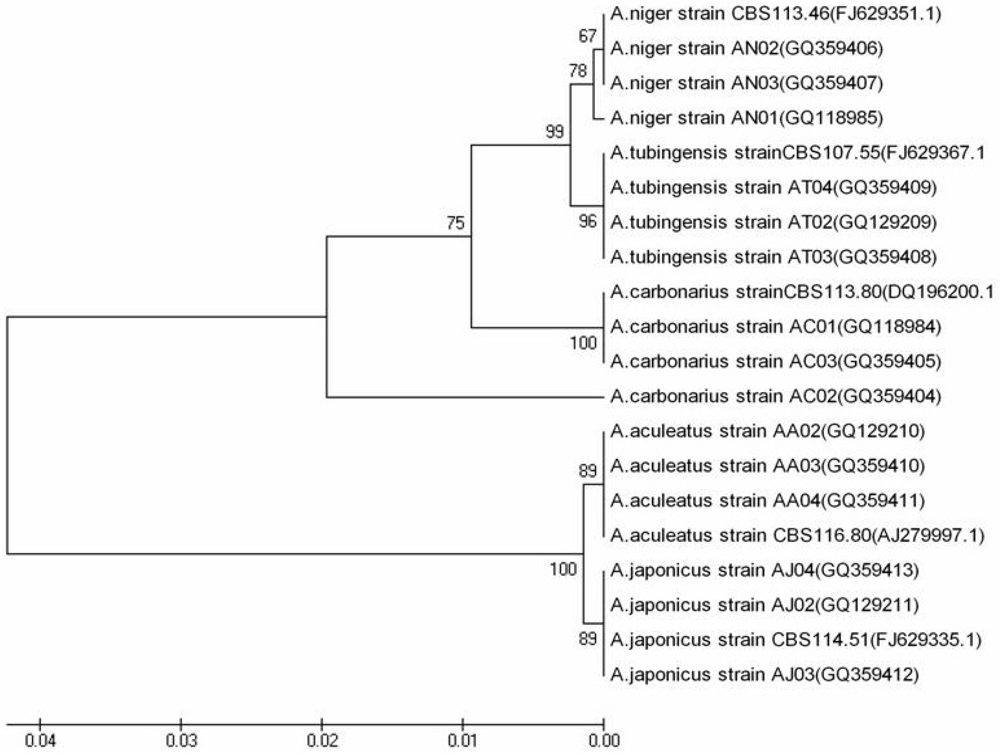
        <p>The phylogenetic relationship between the isolates of <italic>Aspergillus</italic> species is illustrated in a UPGMA cluster analysis (<xref ref-type="fig" rid="toxins-04-00042-f002">Figure 2</xref>). Three sequences from each <italic>Aspergillus</italic> species were perfectly aligned with the CBS reference strains. The ITS sequences strongly identified two main groups with 100% bootstrap value: uniseriate black aspergilli were clearly separated from the biseriate black aspergilli. The isolates of <italic>A. tubingensis</italic> and <italic>A. niger</italic> were separated into two subdivisions (99% bootstrap value) and clustered with the CBS reference strains. Within the isolates <italic>A. carbonarius</italic>, the strain AC02 showed a slightly different sequence but it clustered with the other isolates of <italic>A. carbonarius</italic>. The sequence of AC02, when blasted in NCBI, showed 100% homology with <italic>A. carbonarius </italic>and just 91% homology with <italic>A. ibericus</italic>. More interestingly, <italic>A. japonicus</italic> and <italic>A. aculeatus</italic> were further divided into two subgroups (89% bootstrap value) and aligned perfectly with the CBS reference strains.</p>
        <fig id="toxins-04-00042-f002" position="anchor">
          <label>Figure 2</label>
          <caption>
            <p>Phylogenetic tree constructed for 15 isolates of <italic>Aspergillus</italic> spp. and 5 Centralbureau voor Schimmelcultures (CBS) reference strains of <italic>Aspergillus</italic> spp. by the Unweighted Pair Group Method with Arithmetic Mean (UPGMA) Methods from 5.8S-ITS sequences, aligned using the multiple sequence alignment program CLUSTAL X. The genetic distances were calculated using the Jukes-Cantor model. Numbers at the nodes represent the proportion of 10,000 bootstrap samples, in which a clade was found.</p>
          </caption>
          <graphic xmlns:xlink="http://www.w3.org/1999/xlink" xlink:href="toxins-04-00042-g002.tif"/>
        </fig>
      </sec>
      <sec>
        <title>3.2. OTA Producing Ability of <italic>Aspergillus</italic> Isolates</title>
        <p>All the 356 isolates of <italic>Aspergillus</italic> spp., identified through RFLP, were tested for their ability to produce OTA in YES medium. HPLC analysis showed that 63 isolates were able to produce OTA (17.7% of the total population: <xref ref-type="table" rid="toxins-04-00042-t002">Table 2</xref>). Among these 63 isolates, 46 belonged to the species <italic>A. carbonarius</italic> and produced high amount of OTA ranging from 0.3–3.0 μg mL<sup>−1</sup>. Eleven isolates of <italic>A. tubingensis</italic> produced OTA ranging from 0.05-0.8 μg mL<sup>−1</sup>, and 6 isolates of <italic>A. aculeatus</italic> produced 0.05–0.4 μg mL<sup>−1</sup> of OTA. The isolates of <italic>A. niger</italic> and <italic>A. japonicus</italic> were not able to produce OTA. </p>
        <table-wrap id="toxins-04-00042-t002" position="anchor">
          <object-id pub-id-type="pii">toxins-04-00042-t002_Table 2</object-id>
          <label>Table 2</label>
          <caption>
            <p>Ochratoxin A (OTA) production by <italic>Aspergillus </italic>spp. isolated from grapes during 2006–2007.</p>
          </caption>
          <table>
<thead>
              <tr>
                <th rowspan="2" align="center" valign="top">Species</th>
                <th colspan="2" align="center" valign="top">Total No. of isolates and percentage</th>
                <th colspan="2" align="center" valign="top">No of OTA producers (%)</th>
                <th rowspan="2" align="center" valign="top">OTA content (range µg mL<sup>−1</sup>)</th>
              </tr>
              <tr style="border-top:solid thin">
                <th align="center" valign="top">2006</th>
                <th align="center" valign="top">2007</th>
                <th align="center" valign="top">2006</th>
                <th align="center" valign="top">2007</th>
              </tr>
            </thead>
            <tbody>
              <tr>
                <td align="left" valign="top">
                  <italic>A. niger</italic>
                </td>
                <td align="center" valign="top">(57.4%) 112</td>
                <td align="center" valign="top">(25.5%) 41</td>
                <td align="center" valign="top">0</td>
                <td align="center" valign="top">0</td>
                <td align="center" valign="top">ND</td>
              </tr>
              <tr>
                <td align="left" valign="top">
                  <italic>A. carbonarius</italic>
                </td>
                <td align="center" valign="top">(16.4%) 32</td>
                <td align="center" valign="top">(46.6%) 75</td>
                <td align="center" valign="top">11 (34.4%)</td>
                <td align="center" valign="top">35 (46.7%)</td>
                <td align="center" valign="top">0.30 ± 0.10–3.0 ± 0.60</td>
              </tr>
              <tr>
                <td align="left" valign="top">
                  <italic>A. tubingensis</italic>
                </td>
                <td align="center" valign="top">(14.4%) 28</td>
                <td align="center" valign="top">(27.3%) 44</td>
                <td align="center" valign="top">6 (21.4%)</td>
                <td align="center" valign="top">5 (11.4%)</td>
                <td align="center" valign="top">0.05 ± 0.01–0.8 ± 0.38</td>
              </tr>
              <tr>
                <td align="left" valign="top">
                  <italic>A. japonicus</italic>
                </td>
                <td align="center" valign="top">(9.7%) 19</td>
                <td align="center" valign="top">(6.2%) 1</td>
                <td align="center" valign="top">5 (26.3%)</td>
                <td align="center" valign="top">1 (100.0%)</td>
                <td align="center" valign="top">0.05 ± 0.02–0.4 ± 0.09</td>
              </tr>
              <tr>
                <td align="left" valign="top">
                  <italic>A. aculeatus</italic>
                </td>
                <td align="center" valign="top">(2.1%) 4</td>
                <td align="center" valign="top">(0.0%) 0</td>
                <td align="center" valign="top">0</td>
                <td align="center" valign="top">0</td>
                <td align="center" valign="top">ND</td>
              </tr>
              <tr>
                <td align="left" valign="top">Total</td>
                <td align="center" valign="top">195</td>
                <td align="center" valign="top">161</td>
                <td align="center" valign="top">22 (11.3%)</td>
                <td align="center" valign="top">41 (25.5%)</td>
                <td align="center" valign="top">-</td>
              </tr>
            </tbody>
          </table>
		  <table-wrap-foot>
		  <fn>
          <p>ND, Not detected; ±, standard deviation. </p>
		  </fn>
		  </table-wrap-foot>
        </table-wrap>
      </sec>
    </sec>
    <sec sec-type="discussion">
      <title>4. Discussion</title>
      <p>In the present study restriction digestion analysis of the ITS products was tested to assess its effectiveness as a rapid method to identify different species of <italic>Aspergillus</italic> isolated from grapes comparing with reference strains. The other fungal genera isolated were not considered in the present study. The ITS-5.8S rDNA fragments of 356 <italic>Aspergillus</italic> strains isolated from grapes were amplified and their PCR amplicons were digested in order to differentiate the strains using the RFLP technique. Five different RFLP patterns were identified among the <italic>Aspergillus</italic> isolates using the endonucleases <italic>Hha</italic>I, <italic>Hinf</italic>I and <italic>Rsa</italic>I. By comparing the sequence analysis of the 356 isolates with that of some reference strains, all the isolates showed high similarity (&gt;99%) with one of the five reference species and were considered as isolates of the species <italic>A. niger</italic>, <italic>A. carbonarius</italic>, <italic>A. tubingensis</italic>, <italic>A. japonicus</italic>, or <italic>A. aculeatus</italic>. No other species of <italic>Aspergillus </italic>were identified during the monitoring. </p>
      <p>In a previous study, Martínez-Culebras and Ramón [<xref ref-type="bibr" rid="B34-toxins-04-00042">34</xref>] digested the ITS region of several strains of <italic>Aspergillus </italic>coming from Spanish grapes with the endonucleases <italic>Hha</italic>I, <italic>Nla</italic>III, and <italic>Rsa</italic>I, and distinguished five different RFLP patterns corresponding to <italic>A. niger</italic>, <italic>A. tubingensis</italic>, <italic>A. tubingensis</italic>-like, <italic>A. carbonarius</italic>, and <italic>A. aculeatus</italic>. They obtained two restriction profiles using endonuclease <italic>Rsa</italic>I. One profile was specific for <italic>A</italic>. <italic>niger</italic>, <italic>A</italic>. <italic>aculeatus </italic>and <italic>A</italic>. <italic>carbonarius</italic>, and the second profile identified <italic>A</italic>. <italic>tubingensis</italic>. Similar results were obtained in the present study by using the endonuclease <italic>Rsa</italic>I. Similarly, Accensi <italic>et al</italic>. [<xref ref-type="bibr" rid="B33-toxins-04-00042">33</xref>] described the restriction endonuclease <italic>Rsa</italic>I as a useful tool to separate the isolates of <italic>A. niger</italic> aggregate into <italic>A. niger</italic> (corresponding to pattern N) and <italic>A. tubingensis</italic> (corresponding to pattern T). The results of the current study confirmed that the endonuclease <italic>Rsa</italic>I can be used as a target for distinguishing the isolates of <italic>A. niger</italic> and <italic>A. tubingensis</italic>. This classification supports previous RFLP studies suggesting the division of <italic>A. niger</italic> aggregate into over two species, including <italic>A. niger</italic> and <italic>A. tubingensis</italic> [<xref ref-type="bibr" rid="B33-toxins-04-00042">33</xref>,<xref ref-type="bibr" rid="B34-toxins-04-00042">34</xref>,<xref ref-type="bibr" rid="B40-toxins-04-00042">40</xref>].</p>
      <p>The endonuclease <italic>Hha</italic>I distinguished three profiles [<xref ref-type="bibr" rid="B34-toxins-04-00042">34</xref>]: profile A (specific for <italic>A</italic>. <italic>niger</italic>, <italic>A</italic>. <italic>tubingensis</italic>-like and <italic>A</italic>. <italic>tubingensis</italic>), profile B (<italic>A</italic>. <italic>carbonarius</italic>), and profile C (<italic>A</italic>. <italic>aculateus</italic>). The isolates <italic>A</italic>. <italic>tubingensis</italic>-like and <italic>A</italic>. <italic>tubingensis</italic> were not distinguished with the endonuclease <italic>Rsa</italic>I and <italic>Hha</italic>I, and an additional endonuclease <italic>Nla</italic>III was proposed for the new RFLP type that was called <italic>A. tubingensis</italic>-like. In the present study we could not differentiate the species <italic>A</italic>. <italic>aculeatus</italic> and <italic>A</italic>. <italic>japonicus</italic> with endonuclease <italic>Rsa</italic>I and <italic>Hha</italic>I. An alternative restriction enzyme <italic>Hinf</italic>I was used successfully to distinguish the two uniseriate species. Previously, Parenicová <italic>et al</italic>. [<xref ref-type="bibr" rid="B41-toxins-04-00042">41</xref>] reported that the ITS-5.8S ribosomal region could not be used to distinguish between <italic>A. japonicus</italic> and <italic>A. aculeatus</italic>. Anyway, the same authors, by using Southern blotting with hybridization probes on the pyruvate kinase (<italic>pkiA</italic>), the pectine lyase A (<italic>peIA</italic>) and the 28S rRNA, found a clear polymorphism between <italic>A. japonicus</italic> and <italic>A. aculeatus</italic> [<xref ref-type="bibr" rid="B41-toxins-04-00042">41</xref>]. Similarly, Palencia <italic>et al.</italic> [<xref ref-type="bibr" rid="B42-toxins-04-00042">42</xref>] reported the potential of a barcoding tool based on the rep-PCR, to differentiate between the two <italic>Aspergillus</italic> species. Our PCR-RFLP method can simply and easily differentiate five species of <italic>Aspergillus</italic>, including <italic>A. japonicus</italic> and <italic>A. aculeatus</italic>, present on grapes. </p>
      <p>The phylogenetic analysis based on the 5.8S rRNA gene and the non-coding and variable regions (ITS1 and ITS2) showed that the isolates of five different <italic>Aspergillus</italic> species coming from Liguria region clustered with the CBS reference strains belonging to the same species. The isolates of <italic>A. tubingensis</italic> and <italic>A. niger</italic> were clearly separated into two distinct groups within the <italic>A. niger</italic> aggregate. These results are consistent with the work of Martínez-Culebras <italic>et al</italic>. [<xref ref-type="bibr" rid="B41-toxins-04-00042">41</xref>], who recently used the ap-PCR method to distinguish <italic>A. tubingensis</italic> and <italic>A. niger</italic>, and with previous studies [<xref ref-type="bibr" rid="B14-toxins-04-00042">14</xref>,<xref ref-type="bibr" rid="B33-toxins-04-00042">33</xref>,<xref ref-type="bibr" rid="B34-toxins-04-00042">34</xref>,<xref ref-type="bibr" rid="B40-toxins-04-00042">40</xref>]. More interestingly, the ITS sequences of the two uniseriate species of <italic>A. aculeatus</italic> and <italic>A. japonicus</italic> within the <italic>Aspergillus</italic> section <italic>Nigri</italic> were separated into two different subgroups by cluster analysis. Martínez-Culebras <italic>et al</italic>. [<xref ref-type="bibr" rid="B41-toxins-04-00042">41</xref>] reported that the isolates of <italic>A. aculeatus</italic> and <italic>A. japonicus</italic> could not be separated by ITS or IGS sequences. </p>
      <p>In our 2-year survey, we monitored the presence of isolates of <italic>Aspergillus </italic>spp. associated with vineyards grown in Northern Italy. The absolute dominance of black aspergilli on grapes before harvesting was reported by other surveys in other countries, including Italy [<xref ref-type="bibr" rid="B21-toxins-04-00042">21</xref>,<xref ref-type="bibr" rid="B23-toxins-04-00042">23</xref>,<xref ref-type="bibr" rid="B43-toxins-04-00042">43</xref>], France [<xref ref-type="bibr" rid="B44-toxins-04-00042">44</xref>], Argentina [<xref ref-type="bibr" rid="B45-toxins-04-00042">45</xref>] and Spain [<xref ref-type="bibr" rid="B34-toxins-04-00042">34</xref>,<xref ref-type="bibr" rid="B46-toxins-04-00042">46</xref>]. No other species of <italic>Aspergillus </italic>were isolated and identified in our study. Among the black aspergilli, <italic>A. niger</italic> was the major species associated with grapes during 2006, while <italic>A. carbonarius</italic> was the major species during 2007. All the cultivars monitored possessed the same species and the same order of dominance over the two year period. We considered the average meteorological data of Liguria region (Italy) during the 2006 and 2007 trimesters characterized by grapevine ripening and harvest (July, August and September). The average temperatures in July, August and September 2006 were 26.0, 21.5 and 20.2 °C, while the same in 2007 were 22.7, 21.3 and 19.1 °C. By considering the rainfall of the trimester, in 2006 the total precipitation reached 546 mm, while it accounted for just 182 mm in 2007. The first year was characterized by higher temperatures on an average, especially in July, and three times more precipitation. These climatic conditions could have influenced the composition of the black aspergilla found in vineyard. Maximum growth for <italic>A. carbonarius</italic> occurred at 30 °C, while it occurred at higher temperatures (35 °C) for <italic>A. niger</italic> [<xref ref-type="bibr" rid="B26-toxins-04-00042">26</xref>,<xref ref-type="bibr" rid="B47-toxins-04-00042">47</xref>]. Also the water activity (a<sub>w</sub>) could influence the maximum growth that occurred at <italic>a</italic><sub>w</sub> values of 0.965 <italic>a</italic><sub>w</sub> for <italic>A. carbonarius</italic> and 0.98 for <italic>A. niger</italic> [<xref ref-type="bibr" rid="B48-toxins-04-00042">48</xref>].</p>
      <p>YES medium was chosen as it was previously evaluated as an optimal substrate for the evaluation of OTA production on black aspergilli [<xref ref-type="bibr" rid="B49-toxins-04-00042">49</xref>]. Other studies considered the production of OTA by species of <italic>Aspergillus </italic>on other substrates, such as CYA (Czapek Yeast Extract agar). By a comparison of different <italic>Aspergillus </italic>isolates grown on YES or CYA, both culture media could be used for evaluating the OTA production [<xref ref-type="bibr" rid="B50-toxins-04-00042">50</xref>].</p>
      <p>Most of the ochratoxigenic strains were belonging to <italic>A. carbonarius</italic> in both years. This result confirmed previous surveys carried out in Italy from 2000 to 2003 showing that <italic>A. carbonarius</italic> was never the dominant species in any phonological phase of grapevine, but its isolates were the most toxigenic ones in different grape varieties grown in several Italian regions [<xref ref-type="bibr" rid="B1-toxins-04-00042">1</xref>,<xref ref-type="bibr" rid="B14-toxins-04-00042">14</xref>]. Similar results were obtained in other European countries where a lower share of <italic>A. carbonarius</italic> was responsible for most of the OTA contamination [<xref ref-type="bibr" rid="B22-toxins-04-00042">22</xref>,<xref ref-type="bibr" rid="B34-toxins-04-00042">34</xref>,<xref ref-type="bibr" rid="B51-toxins-04-00042">51</xref>]. Ochratoxin A was measured during 2006 and 2007 on the wine produced from the grapes monitored, and the level of contamination was generally low, but higher during 2007 (0.15 µg L<sup>−1</sup>) compared to 2006 (0.09 µg L<sup>−1</sup>). Within the <italic>Aspergillus niger </italic>aggregate, no ochratoxigenic isolates of <italic>A. niger</italic> were detected, but 6 and 5 isolates of <italic>A. tubingensis</italic>, respectively in 2006 and 2007, were able to produce low amounts of OTA <italic>in vitro</italic>. The percentages of isolates of <italic>A. tubingensis </italic>able to produce OTA were 21.4% and 11.4% in 2006 and 2007. Our results are in accordance with Medina <italic>et al</italic>. [<xref ref-type="bibr" rid="B52-toxins-04-00042">52</xref>] and Martínez-Culebras and Ramón [<xref ref-type="bibr" rid="B34-toxins-04-00042">34</xref>], but another study of Accensi <italic>et al</italic>. [<xref ref-type="bibr" rid="B53-toxins-04-00042">53</xref>] showed that the isolates producing OTA belonged to <italic>A. niger</italic>, while none of the isolates of <italic>A. tubingensis</italic> was able to produce OTA. Recently some studies showed that also isolates of <italic>A. tubingensis</italic> can produce ochratoxin A [<xref ref-type="bibr" rid="B27-toxins-04-00042">27</xref>,<xref ref-type="bibr" rid="B41-toxins-04-00042">41</xref>]. The geographical origin of the isolates might be a reason for the disagreement in the results reported by different authors. Experimental conditions used in extraction and detection of OTA (culture medium, pH, incubation time and/or temperature) might also lead to different result. The ability of uniseriate black aspergilli to produce OTA is a controversial issue. In our study, 6 isolates of <italic>A. japonicus </italic>out of 20 were ochratoxigenic, and our result is similar to the results of Battilani <italic>et al. </italic>[<xref ref-type="bibr" rid="B21-toxins-04-00042">21</xref>].</p>
      <p>The availability of reliable molecular markers for <italic>Aspergillus</italic> section <italic>Nigri</italic> occurring on grapes is of great interest since an early diagnosis of <italic>A. carbonarius </italic>occurrence in the field would provide very important information on possible OTA contamination in grapes. In conclusion, the identification of a large number of isolates using ITS-RFLP technique enables easy and rapid identification of the <italic>Aspergillus</italic> isolates from grapes and their assignation to different species. This kind of information could help to understand the epidemiology and distribution of OTA producing <italic>Aspergilli</italic> in grapes, where large amounts of isolates should be screened in a short time.</p>
    </sec>
  </body>
  <back>
    <ack>
      <title>Acknowledgements</title>
      <p>This research was carried out partly with a grant from the Piedmont Region under the project “Evaluation of the risk, prevention and management of the mycotoxins present in the wine production chain of Piedmont” and partly with a grant from the Fondazione Cassa di Risparmio di Torino “Evaluation and prevention of the risk of ochratoxin A in the Piedmontese wine chain” to AGROINNOVA. Moreover, Subban Patharajan acknowledges the Italian Ministry for University and Research and the Compagnia di San Paolo for the PostDoc grant “Borse a favore di giovani ricercatori indiani”. </p>
    </ack>
    <notes>
      <title>Conflict of Interest</title>
      <p>The authors declare no conflict of interest. </p>
    </notes>
    <ref-list>
      <title>References</title>
      <ref id="B1-toxins-04-00042">
        <label>1.</label>
        <citation citation-type="journal">
          <person-group person-group-type="author">
            <name>
              <surname>Battilani</surname>
              <given-names>P.</given-names>
            </name>
            <name>
              <surname>Giorni</surname>
              <given-names>P.</given-names>
            </name>
            <name>
              <surname>Bertuzzi</surname>
              <given-names>T.</given-names>
            </name>
            <name>
              <surname>Formenti</surname>
              <given-names>S.</given-names>
            </name>
            <name>
              <surname>Pietri</surname>
              <given-names>A.</given-names>
            </name>
          </person-group>
          <article-title>Black aspergilli and ochratoxin A in grapes in Italy.</article-title>
          <source>Int. J. Food Microbiol.</source>
          <year>2006</year>
          <volume>111</volume>
          <fpage>S53</fpage>
          <lpage>S60</lpage>
        <pub-id pub-id-type="doi">10.1016/j.ijfoodmicro.2006.03.006</pub-id><pub-id pub-id-type="pmid">16713645</pub-id></citation>
      </ref>
      <ref id="B2-toxins-04-00042">
        <label>2.</label>
        <citation citation-type="journal">
          <person-group person-group-type="author">
            <name>
              <surname>Serra</surname>
              <given-names>R.</given-names>
            </name>
            <name>
              <surname>Mendonca</surname>
              <given-names>C.</given-names>
            </name>
            <name>
              <surname>Venàncio</surname>
              <given-names>A.</given-names>
            </name>
          </person-group>
          <article-title>Ochratoxin A occurrence and formation in Portuguese wine grapes at various stages of maturation.</article-title>
          <source>Int. J. Food Microbiol.</source>
          <year>2006</year>
          <volume>111</volume>
          <fpage>S35</fpage>
          <lpage>S39</lpage>
        <pub-id pub-id-type="doi">10.1016/j.ijfoodmicro.2006.03.007</pub-id><pub-id pub-id-type="pmid">16707182</pub-id></citation>
      </ref>
      <ref id="B3-toxins-04-00042">
        <label>3.</label>
        <citation citation-type="journal">
          <person-group person-group-type="author">
            <name>
              <surname>Spadaro</surname>
              <given-names>D.</given-names>
            </name>
            <name>
              <surname>Lorè</surname>
              <given-names>A.</given-names>
            </name>
            <name>
              <surname>Garibaldi</surname>
              <given-names>A.</given-names>
            </name>
            <name>
              <surname>Gullino</surname>
              <given-names>M.L.</given-names>
            </name>
          </person-group>
          <article-title>Occurrence of ochratoxin A before bottling in DOC and DOCG wines produced in Piedmont (northern Italy).</article-title>
          <source>Food Control</source>
          <year>2010</year>
          <volume>21</volume>
          <fpage>1294</fpage>
          <lpage>1297</lpage>
        <pub-id pub-id-type="doi">10.1016/j.foodcont.2010.02.017</pub-id></citation>
      </ref>
      <ref id="B4-toxins-04-00042">
        <label>4.</label>
        <citation citation-type="journal">
          <person-group person-group-type="author">
            <name>
              <surname>Castegnaro</surname>
              <given-names>M.</given-names>
            </name>
            <name>
              <surname>Mohr</surname>
              <given-names>U.</given-names>
            </name>
            <name>
              <surname>Pfohl-Leszkowicz</surname>
              <given-names>A.</given-names>
            </name>
            <name>
              <surname>Esteve</surname>
              <given-names>J.</given-names>
            </name>
            <name>
              <surname>Steinmann</surname>
              <given-names>J.</given-names>
            </name>
            <name>
              <surname>Tillmann</surname>
              <given-names>J.</given-names>
            </name>
            <name>
              <surname>Michelson</surname>
              <given-names>T.</given-names>
            </name>
            <name>
              <surname>Bartsch</surname>
              <given-names>J.</given-names>
            </name>
          </person-group>
          <article-title>Sex- and strain-specific induction of renal tumors by ochratoxin A in rats correlated with DNA adduction.</article-title>
          <source>Int. J. Cancer</source>
          <year>1998</year>
          <volume>77</volume>
          <fpage>70</fpage>
          <lpage>75</lpage>
        <pub-id pub-id-type="doi">10.1002/(SICI)1097-0215(19980703)77:1&lt;70::AID-IJC12&gt;3.0.CO;2-D</pub-id><pub-id pub-id-type="pmid">9639396</pub-id></citation>
      </ref>
      <ref id="B5-toxins-04-00042">
        <label>5.</label>
        <citation citation-type="journal">
          <person-group person-group-type="author">
            <name>
              <surname>Radic</surname>
              <given-names>B.</given-names>
            </name>
            <name>
              <surname>Fuchs</surname>
              <given-names>R.</given-names>
            </name>
            <name>
              <surname>Peraica</surname>
              <given-names>M.</given-names>
            </name>
            <name>
              <surname>Lucis</surname>
              <given-names>A.</given-names>
            </name>
          </person-group>
          <article-title>Ochratoxin A in human sera in the area with endemic nephropathy in Croatia.</article-title>
          <source>Toxicol. Lett.</source>
          <year>1997</year>
          <volume>91</volume>
          <fpage>105</fpage>
          <lpage>109</lpage>
        <pub-id pub-id-type="doi">10.1016/S0378-4274(97)03877-0</pub-id><pub-id pub-id-type="pmid">9175846</pub-id></citation>
      </ref>
      <ref id="B6-toxins-04-00042">
        <label>6.</label>
        <citation citation-type="journal">
          <person-group person-group-type="author">
            <name>
              <surname>Wafa</surname>
              <given-names>E.W.</given-names>
            </name>
            <name>
              <surname>Yahya</surname>
              <given-names>R.S.</given-names>
            </name>
            <name>
              <surname>Sobh</surname>
              <given-names>M.A.</given-names>
            </name>
            <name>
              <surname>Eraky</surname>
              <given-names>I.</given-names>
            </name>
            <name>
              <surname>El-Baz</surname>
              <given-names>M.</given-names>
            </name>
            <name>
              <surname>El-Gayar</surname>
              <given-names>H.A.M.</given-names>
            </name>
            <name>
              <surname>Betbeder</surname>
              <given-names>A.M.</given-names>
            </name>
            <name>
              <surname>Creppy</surname>
              <given-names>E.E.</given-names>
            </name>
          </person-group>
          <article-title>Human ochratoxicosis and nephropathy in Egypt: A preliminary study.</article-title>
          <source>Hum. Exp. Toxicol.</source>
          <year>1998</year>
          <volume>17</volume>
          <fpage>124</fpage>
          <lpage>129</lpage>
        <pub-id pub-id-type="doi">10.1191/096032798678908369</pub-id><pub-id pub-id-type="pmid">9506263</pub-id></citation>
      </ref>
      <ref id="B7-toxins-04-00042">
        <label>7.</label>
        <citation citation-type="gov">
          <collab>International Agency for Research on Cancer (IARC)</collab>
          <source>Some Naturally Occurring Substances: Food Items and Constituents. Heterocyclic Aromatic Amines and Mycotoxins</source>
          <publisher-name>World Health Organization</publisher-name>
          <publisher-loc>Lyon, France</publisher-loc>
          <year>1993</year>
          <volume>56</volume>
        </citation>
      </ref>
      <ref id="B8-toxins-04-00042">
        <label>8.</label>
        <citation citation-type="journal">
          <person-group person-group-type="author">
            <name>
              <surname>Otteneder</surname>
              <given-names>H.</given-names>
            </name>
            <name>
              <surname>Majerus</surname>
              <given-names>P.</given-names>
            </name>
          </person-group>
          <article-title>Occurrence of ochratoxin A (OTA) in wines: influence of the type of wine and its geographical origin.</article-title>
          <source>Food Addit. Contam.</source>
          <year>2000</year>
          <volume>17</volume>
          <fpage>793</fpage>
          <lpage>798</lpage>
        <pub-id pub-id-type="doi">10.1080/026520300415345</pub-id><pub-id pub-id-type="pmid">11091793</pub-id></citation>
      </ref>
      <ref id="B9-toxins-04-00042">
        <label>9.</label>
        <citation citation-type="journal">
          <person-group person-group-type="author">
            <name>
              <surname>Zimmerli</surname>
              <given-names>B.</given-names>
            </name>
            <name>
              <surname>Dick</surname>
              <given-names>R.</given-names>
            </name>
          </person-group>
          <article-title>Ochratoxin A in table wine and grape-juice: Occurrence and risk assessment.</article-title>
          <source>Food Addit. Contam.</source>
          <year>1996</year>
          <volume>13</volume>
          <fpage>655</fpage>
          <lpage>668</lpage>
        <pub-id pub-id-type="doi">10.1080/02652039609374451</pub-id><pub-id pub-id-type="pmid">8871123</pub-id></citation>
      </ref>
      <ref id="B10-toxins-04-00042">
        <label>10.</label>
        <citation citation-type="journal">
          <person-group person-group-type="author">
            <name>
              <surname>Leong</surname>
              <given-names>S.L.</given-names>
            </name>
            <name>
              <surname>Hocking</surname>
              <given-names>A.D.</given-names>
            </name>
            <name>
              <surname>Scott</surname>
              <given-names>E.S.</given-names>
            </name>
          </person-group>
          <article-title><italic>Aspergillus</italic> species producing ochratoxin A: Isolation from vineyard soils and infection of Semillon bunches in Australia.</article-title>
          <source>J. Appl. Microbiol.</source>
          <year>2007</year>
          <volume>102</volume>
          <fpage>124</fpage>
          <lpage>133</lpage>
          <pub-id pub-id-type="doi">10.1111/j.1365-2672.2006.03056.x</pub-id>
        </citation>
      </ref>
      <ref id="B11-toxins-04-00042">
        <label>11.</label>
        <citation citation-type="journal">
          <person-group person-group-type="author">
            <name>
              <surname>Magnoli</surname>
              <given-names>C.</given-names>
            </name>
            <name>
              <surname>Astoreca</surname>
              <given-names>A.</given-names>
            </name>
            <name>
              <surname>Ponsone</surname>
              <given-names>M.L.</given-names>
            </name>
            <name>
              <surname>Fernández-Juri</surname>
              <given-names>M.G.</given-names>
            </name>
            <name>
              <surname>Barberis</surname>
              <given-names>C.</given-names>
            </name>
            <name>
              <surname>Dalcero</surname>
              <given-names>A.M.</given-names>
            </name>
          </person-group>
          <article-title>Ochratoxin A and <italic>Aspergillus </italic>section <italic>Nigri </italic>in peanut seeds at different months of storage in Córdoba, Argentina.</article-title>
          <source>Int. J. Microbiol.</source>
          <year>2007</year>
          <volume>119</volume>
          <fpage>213</fpage>
          <lpage>218</lpage>
          <pub-id pub-id-type="doi">10.1016/j.ijfoodmicro.2007.07.056</pub-id>
        </citation>
      </ref>
      <ref id="B12-toxins-04-00042">
        <label>12.</label>
        <citation citation-type="journal">
          <person-group person-group-type="author">
            <name>
              <surname>Spadaro</surname>
              <given-names>D.</given-names>
            </name>
            <name>
              <surname>Patharajan</surname>
              <given-names>S.</given-names>
            </name>
            <name>
              <surname>Karthikeyan</surname>
              <given-names>M.</given-names>
            </name>
            <name>
              <surname>Lorè</surname>
              <given-names>A.</given-names>
            </name>
            <name>
              <surname>Garibaldi</surname>
              <given-names>A.</given-names>
            </name>
            <name>
              <surname>Gullino</surname>
              <given-names>M.L.</given-names>
            </name>
          </person-group>
          <article-title>Specific PCR primers for the detection of isolates of <italic>Aspergillus carbonarius</italic> producing ochratoxin A on grapevine.</article-title>
          <source>Ann. Microbiol.</source>
          <year>2011</year>
          <volume>61</volume>
          <fpage>267</fpage>
          <lpage>272</lpage>
          <pub-id pub-id-type="doi">10.1007/s13213-010-0131-3</pub-id>
        </citation>
      </ref>
      <ref id="B13-toxins-04-00042">
        <label>13.</label>
        <citation citation-type="journal">
          <person-group person-group-type="author">
            <name>
              <surname>Cabañes</surname>
              <given-names>F.J.</given-names>
            </name>
            <name>
              <surname>Accensi</surname>
              <given-names>F.</given-names>
            </name>
            <name>
              <surname>Bragulat</surname>
              <given-names>M.R.</given-names>
            </name>
            <name>
              <surname>Abarca</surname>
              <given-names>M.L.</given-names>
            </name>
            <name>
              <surname>Castellá</surname>
              <given-names>G.</given-names>
            </name>
            <name>
              <surname>Minguez</surname>
              <given-names>S.</given-names>
            </name>
            <name>
              <surname>Pons</surname>
              <given-names>A.</given-names>
            </name>
          </person-group>
          <article-title>What is the source of ochratoxin A in wine?</article-title>
          <source>Int. J. Food Microbiol.</source>
          <year>2002</year>
          <volume>79</volume>
          <fpage>213</fpage>
          <lpage>215</lpage>
          <pub-id pub-id-type="doi">10.1016/S0168-1605(02)00087-9</pub-id>
        </citation>
      </ref>
      <ref id="B14-toxins-04-00042">
        <label>14.</label>
        <citation citation-type="journal">
          <person-group person-group-type="author">
            <name>
              <surname>Perrone</surname>
              <given-names>G.</given-names>
            </name>
            <name>
              <surname>Mule</surname>
              <given-names>G.</given-names>
            </name>
            <name>
              <surname>Susca</surname>
              <given-names>A.</given-names>
            </name>
            <name>
              <surname>Battilani</surname>
              <given-names>P.</given-names>
            </name>
            <name>
              <surname>Pietri</surname>
              <given-names>A.</given-names>
            </name>
            <name>
              <surname>Logrieco</surname>
              <given-names>A.</given-names>
            </name>
          </person-group>
          <article-title>Ochratoxin A production and amplified fragment length polymorphism analysis of <italic>Aspergillus carbonarius</italic>, <italic>Aspergillus tubingensis</italic>, and <italic>Aspergillus niger</italic> strains isolated from grapes in Italy.</article-title>
          <source>Appl. Environ. Microbiol.</source>
          <year>2006</year>
          <volume>72</volume>
          <fpage>680</fpage>
          <lpage>685</lpage>
          <pub-id pub-id-type="doi">10.1128/AEM.72.1.680-685.2006</pub-id>
        </citation>
      </ref>
      <ref id="B15-toxins-04-00042">
        <label>15.</label>
        <citation citation-type="journal">
          <person-group person-group-type="author">
            <name>
              <surname>Horie</surname>
              <given-names>Y.</given-names>
            </name>
          </person-group>
          <article-title>Productivity of ochratoxin A of <italic>Aspergillus carbonarius</italic> in <italic>Aspergillus</italic> section Nigri.</article-title>
          <source>Nippon Kingakukai Kaiho</source>
          <year>1995</year>
          <volume>36</volume>
          <fpage>73</fpage>
          <lpage>76</lpage>
        </citation>
      </ref>
      <ref id="B16-toxins-04-00042">
        <label>16.</label>
        <citation citation-type="journal">
          <person-group person-group-type="author">
            <name>
              <surname>Abarca</surname>
              <given-names>M.L.</given-names>
            </name>
            <name>
              <surname>Bragulat</surname>
              <given-names>M.R.</given-names>
            </name>
            <name>
              <surname>Castellá</surname>
              <given-names>G.</given-names>
            </name>
            <name>
              <surname>Cabañes</surname>
              <given-names>F.J.</given-names>
            </name>
          </person-group>
          <article-title>Ochratoxin A production by strains of <italic>Aspergillus niger</italic> var.<italic> niger</italic>.</article-title>
          <source>Appl. Environ. Microbiol.</source>
          <year>1994</year>
          <volume>60</volume>
          <fpage>2650</fpage>
          <lpage>2652</lpage>
        <pub-id pub-id-type="pmid">8074536</pub-id></citation>
      </ref>
      <ref id="B17-toxins-04-00042">
        <label>17.</label>
        <citation citation-type="journal">
          <person-group person-group-type="author">
            <name>
              <surname>Kusters van Someren</surname>
              <given-names>M.A.</given-names>
            </name>
            <name>
              <surname>Samson</surname>
              <given-names>R.A.</given-names>
            </name>
            <name>
              <surname>Visser</surname>
              <given-names>J.</given-names>
            </name>
          </person-group>
          <article-title>The use of RFLP analysis in classification of the black Aspergilli: Reinterpretation of <italic>Aspergillus niger</italic> aggregate.</article-title>
          <source>Curr. Genet.</source>
          <year>1991</year>
          <volume>19</volume>
          <fpage>21</fpage>
          <lpage>26</lpage>
          <pub-id pub-id-type="doi">10.1007/BF00362083</pub-id>
        </citation>
      </ref>
      <ref id="B18-toxins-04-00042">
        <label>18.</label>
        <citation citation-type="journal">
          <person-group person-group-type="author">
            <name>
              <surname>Battilani</surname>
              <given-names>P.</given-names>
            </name>
            <name>
              <surname>Giorni</surname>
              <given-names>P.</given-names>
            </name>
            <name>
              <surname>Pietri</surname>
              <given-names>A.</given-names>
            </name>
          </person-group>
          <article-title>Epidemiology of toxin-producing fungi and ochratoxin A occurrence in grape.</article-title>
          <source>Eur. J. Plant Pathol.</source>
          <year>2003</year>
          <volume>109</volume>
          <fpage>715</fpage>
          <lpage>722</lpage>
        <pub-id pub-id-type="doi">10.1023/A:1026030408338</pub-id></citation>
      </ref>
      <ref id="B19-toxins-04-00042">
        <label>19.</label>
        <citation citation-type="journal">
          <person-group person-group-type="author">
            <name>
              <surname>Abarca</surname>
              <given-names>M.L.</given-names>
            </name>
            <name>
              <surname>Accensi</surname>
              <given-names>F.</given-names>
            </name>
            <name>
              <surname>Bragulat</surname>
              <given-names>M.R.</given-names>
            </name>
            <name>
              <surname>Cabañes</surname>
              <given-names>F.J.</given-names>
            </name>
          </person-group>
          <article-title>Current importance of ochratoxin A-producing <italic>Aspergillus </italic>species.</article-title>
          <source>J. Food Prot.</source>
          <year>2001</year>
          <volume>64</volume>
          <fpage>903</fpage>
          <lpage>906</lpage>
        <pub-id pub-id-type="pmid">11403149</pub-id></citation>
      </ref>
      <ref id="B20-toxins-04-00042">
        <label>20.</label>
        <citation citation-type="journal">
          <person-group person-group-type="author">
            <name>
              <surname>Lopez de Cerain</surname>
              <given-names>A.</given-names>
            </name>
            <name>
              <surname>Gonzàlez-Peñas</surname>
              <given-names>E.</given-names>
            </name>
            <name>
              <surname>Jiménez</surname>
              <given-names>A.M.</given-names>
            </name>
            <name>
              <surname>Bello</surname>
              <given-names>J.</given-names>
            </name>
          </person-group>
          <article-title>Contribution to the study of ochratoxin A in Spanish wines.</article-title>
          <source>Food Addit. Contam.</source>
          <year>2002</year>
          <volume>19</volume>
          <fpage>1058</fpage>
          <lpage>1064</lpage>
        <pub-id pub-id-type="doi">10.1080/02652030210145928</pub-id><pub-id pub-id-type="pmid">12456277</pub-id></citation>
      </ref>
      <ref id="B21-toxins-04-00042">
        <label>21.</label>
        <citation citation-type="journal">
          <person-group person-group-type="author">
            <name>
              <surname>Battilani</surname>
              <given-names>P.</given-names>
            </name>
            <name>
              <surname>Pietri</surname>
              <given-names>A.</given-names>
            </name>
            <name>
              <surname>Bertuzzi</surname>
              <given-names>T.</given-names>
            </name>
            <name>
              <surname>Languasco</surname>
              <given-names>L.</given-names>
            </name>
            <name>
              <surname>Giorni</surname>
              <given-names>P.</given-names>
            </name>
            <name>
              <surname>Kozakiewicz</surname>
              <given-names>Z.</given-names>
            </name>
          </person-group>
          <article-title>Occurrence of ochratoxin A-producing fungi in grapes grown in Italy.</article-title>
          <source>J. Food Prot.</source>
          <year>2003</year>
          <volume>66</volume>
          <fpage>633</fpage>
          <lpage>636</lpage>
        <pub-id pub-id-type="pmid">12696687</pub-id></citation>
      </ref>
      <ref id="B22-toxins-04-00042">
        <label>22.</label>
        <citation citation-type="journal">
          <person-group person-group-type="author">
            <name>
              <surname>Bellí</surname>
              <given-names>N.</given-names>
            </name>
            <name>
              <surname>Mitchell</surname>
              <given-names>D.</given-names>
            </name>
            <name>
              <surname>Marín</surname>
              <given-names>S.</given-names>
            </name>
            <name>
              <surname>Alegre</surname>
              <given-names>I.</given-names>
            </name>
            <name>
              <surname>Ramos</surname>
              <given-names>A.J.</given-names>
            </name>
            <name>
              <surname>Magan</surname>
              <given-names>N.</given-names>
            </name>
            <name>
              <surname>Sanchis</surname>
              <given-names>V.</given-names>
            </name>
          </person-group>
          <article-title>Ochratoxin A-producing fungi in Spanish wine grapes and their relationship with meteorological conditions.</article-title>
          <source>Eur. J. Plant Pathol.</source>
          <year>2005</year>
          <volume>113</volume>
          <fpage>233</fpage>
          <lpage>239</lpage>
        <pub-id pub-id-type="doi">10.1007/s10658-005-5547-4</pub-id></citation>
      </ref>
      <ref id="B23-toxins-04-00042">
        <label>23.</label>
        <citation citation-type="journal">
          <person-group person-group-type="author">
            <name>
              <surname>Gullino</surname>
              <given-names>M.L.</given-names>
            </name>
            <name>
              <surname>Lorè</surname>
              <given-names>A.</given-names>
            </name>
            <name>
              <surname>Muthusamy</surname>
              <given-names>K.</given-names>
            </name>
            <name>
              <surname>Spadaro</surname>
              <given-names>D.</given-names>
            </name>
            <name>
              <surname>Garibaldi</surname>
              <given-names>A.</given-names>
            </name>
          </person-group>
          <article-title>Monitoring of ochratoxin producing <italic>Aspergillus carbonarius</italic> in grapevine using molecular markers.</article-title>
          <source>Phytopathology</source>
          <year>2008</year>
          <volume>98</volume>
          <fpage>S64</fpage>
        </citation>
      </ref>
      <ref id="B24-toxins-04-00042">
        <label>24.</label>
        <citation citation-type="journal">
          <person-group person-group-type="author">
            <name>
              <surname>Serra</surname>
              <given-names>R.</given-names>
            </name>
            <name>
              <surname>Braga</surname>
              <given-names>A.</given-names>
            </name>
            <name>
              <surname>Venàncio</surname>
              <given-names>A.</given-names>
            </name>
          </person-group>
          <article-title>Mycotoxin-producing and other fungi isolated from grapes for wine production, with particular emphasis on ochratoxin A</article-title>
          <source>Res. Microbiol.</source>
          <year>2005</year>
          <volume>156</volume>
          <fpage>515</fpage>
          <lpage>521</lpage>
        <pub-id pub-id-type="doi">10.1016/j.resmic.2004.12.005</pub-id><pub-id pub-id-type="pmid">15862450</pub-id></citation>
      </ref>
      <ref id="B25-toxins-04-00042">
        <label>25.</label>
        <citation citation-type="journal">
          <person-group person-group-type="author">
            <name>
              <surname>Geiser</surname>
              <given-names>D.M.</given-names>
            </name>
            <name>
              <surname>Klich</surname>
              <given-names>M.A.</given-names>
            </name>
            <name>
              <surname>Frisvad</surname>
              <given-names>J.C.</given-names>
            </name>
            <name>
              <surname>Peterson</surname>
              <given-names>S.W.</given-names>
            </name>
            <name>
              <surname>Varga</surname>
              <given-names>J.</given-names>
            </name>
            <name>
              <surname>Samson</surname>
              <given-names>R.A.</given-names>
            </name>
          </person-group>
          <article-title>The current status of species recognition and identification in <italic>Aspergillus</italic>.</article-title>
          <source>Stud. Mycol.</source>
          <year>2007</year>
          <volume>59</volume>
          <fpage>1</fpage>
          <lpage>10</lpage>
          <pub-id pub-id-type="doi">10.3114/sim.2007.59.01</pub-id>
        </citation>
      </ref>
      <ref id="B26-toxins-04-00042">
        <label>26.</label>
        <citation citation-type="journal">
          <person-group person-group-type="author">
            <name>
              <surname>Samson</surname>
              <given-names>R.A.</given-names>
            </name>
            <name>
              <surname>Noomin</surname>
              <given-names>P.</given-names>
            </name>
            <name>
              <surname>Meijer</surname>
              <given-names>M.</given-names>
            </name>
            <name>
              <surname>Houbraken</surname>
              <given-names>J.</given-names>
            </name>
            <name>
              <surname>Frisvad</surname>
              <given-names>J.C.</given-names>
            </name>
            <name>
              <surname>Varga</surname>
              <given-names>J.</given-names>
            </name>
          </person-group>
          <article-title>Diagnostic tools to identify black aspergilli.</article-title>
          <source>Stud. Mycol.</source>
          <year>2007</year>
          <volume>59</volume>
          <fpage>129</fpage>
          <lpage>145</lpage>
        <pub-id pub-id-type="doi">10.3114/sim.2007.59.13</pub-id><pub-id pub-id-type="pmid">18490945</pub-id></citation>
      </ref>
      <ref id="B27-toxins-04-00042">
        <label>27.</label>
        <citation citation-type="journal">
          <person-group person-group-type="author">
            <name>
              <surname>Perrone</surname>
              <given-names>G.</given-names>
            </name>
            <name>
              <surname>Susca</surname>
              <given-names>A.</given-names>
            </name>
            <name>
              <surname>Cozzi</surname>
              <given-names>K.</given-names>
            </name>
            <name>
              <surname>Ehrlich</surname>
              <given-names>J.</given-names>
            </name>
            <name>
              <surname>Varga</surname>
              <given-names>J.</given-names>
            </name>
            <name>
              <surname>Frisvad</surname>
              <given-names>J.C.</given-names>
            </name>
            <name>
              <surname>Meijer</surname>
              <given-names>M.</given-names>
            </name>
            <name>
              <surname>Noomin</surname>
              <given-names>P.</given-names>
            </name>
            <name>
              <surname>Mahakarnchanakul</surname>
              <given-names>W.</given-names>
            </name>
            <name>
              <surname>Samson</surname>
              <given-names>R.A.</given-names>
            </name>
          </person-group>
          <article-title>Biodiversity of <italic>Aspergillus </italic>species in some important agricultural products.</article-title>
          <source>Stud. Mycol.</source>
          <year>2007</year>
          <volume>59</volume>
          <fpage>53</fpage>
          <lpage>66</lpage>
          <pub-id pub-id-type="doi">10.3114/sim.2007.59.07</pub-id>
        </citation>
      </ref>
      <ref id="B28-toxins-04-00042">
        <label>28.</label>
        <citation citation-type="journal">
          <person-group person-group-type="author">
            <name>
              <surname>Ponsone</surname>
              <given-names>M.L.</given-names>
            </name>
            <name>
              <surname>Combina</surname>
              <given-names>M.</given-names>
            </name>
            <name>
              <surname>Dalcero</surname>
              <given-names>A.</given-names>
            </name>
            <name>
              <surname>Chulze</surname>
              <given-names>S.N.</given-names>
            </name>
          </person-group>
          <article-title>Ochratoxin A and ochratoxigenic <italic>Aspergillus </italic>species in Argentinean wine grapes cultivated under organic and non-organic systems.</article-title>
          <source>Int. J. Food Microbiol.</source>
          <year>2007</year>
          <volume>114</volume>
          <fpage>131</fpage>
          <lpage>135</lpage>
          <pub-id pub-id-type="doi">10.1016/j.ijfoodmicro.2006.07.001</pub-id>
        </citation>
      </ref>
      <ref id="B29-toxins-04-00042">
        <label>29.</label>
        <citation citation-type="journal">
          <person-group person-group-type="author">
            <name>
              <surname>Samson</surname>
              <given-names>R.A.</given-names>
            </name>
            <name>
              <surname>Houbraken</surname>
              <given-names>J.A.M.P.</given-names>
            </name>
            <name>
              <surname>Kuijpers</surname>
              <given-names>A.F.A.</given-names>
            </name>
            <name>
              <surname>Frank</surname>
              <given-names>J.M.</given-names>
            </name>
            <name>
              <surname>Frisvad</surname>
              <given-names>J.C.</given-names>
            </name>
          </person-group>
          <article-title>New ochratoxin A or sclerotium producing species in <italic>Aspergillus </italic>section <italic>Nigri</italic>.</article-title>
          <source>Stud. Mycol.</source>
          <year>2004</year>
          <volume>50</volume>
          <fpage>45</fpage>
          <lpage>61</lpage>
        </citation>
      </ref>
      <ref id="B30-toxins-04-00042">
        <label>30.</label>
        <citation citation-type="journal">
          <person-group person-group-type="author">
            <name>
              <surname>Mégnégneau</surname>
              <given-names>B.</given-names>
            </name>
            <name>
              <surname>Debets</surname>
              <given-names>F.</given-names>
            </name>
            <name>
              <surname>Hoekstra</surname>
              <given-names>R.F.</given-names>
            </name>
          </person-group>
          <article-title>Genetic variability and relatedness in the complex group of black aspergilli based on random amplification of polymorphic DNA.</article-title>
          <source>Curr. Genet.</source>
          <year>1993</year>
          <volume>23</volume>
          <fpage>323</fpage>
          <lpage>329</lpage>
        <pub-id pub-id-type="doi">10.1007/BF00310893</pub-id><pub-id pub-id-type="pmid">8096800</pub-id></citation>
      </ref>
      <ref id="B31-toxins-04-00042">
        <label>31.</label>
        <citation citation-type="journal">
          <person-group person-group-type="author">
            <name>
              <surname>Varga</surname>
              <given-names>J.</given-names>
            </name>
            <name>
              <surname>Kevei</surname>
              <given-names>F.</given-names>
            </name>
            <name>
              <surname>Fekete</surname>
              <given-names>C.</given-names>
            </name>
            <name>
              <surname>Coenen</surname>
              <given-names>A.</given-names>
            </name>
            <name>
              <surname>Kozakiewicz</surname>
              <given-names>Z.</given-names>
            </name>
            <name>
              <surname>Croft</surname>
              <given-names>J.H.</given-names>
            </name>
          </person-group>
          <article-title>Restriction fragment length polymorphism in the mitochondrial DNAs of <italic>Aspergillus niger</italic> aggregate.</article-title>
          <source>Mycol. Res.</source>
          <year>1993</year>
          <volume>97</volume>
          <fpage>1207</fpage>
          <lpage>1212</lpage>
          <pub-id pub-id-type="doi">10.1016/S0953-7562(09)81286-0</pub-id>
        </citation>
      </ref>
      <ref id="B32-toxins-04-00042">
        <label>32.</label>
        <citation citation-type="journal">
          <person-group person-group-type="author">
            <name>
              <surname>Varga</surname>
              <given-names>J.</given-names>
            </name>
            <name>
              <surname>Kevei</surname>
              <given-names>F.</given-names>
            </name>
            <name>
              <surname>Vriesema</surname>
              <given-names>A.</given-names>
            </name>
            <name>
              <surname>Debets</surname>
              <given-names>F.</given-names>
            </name>
            <name>
              <surname>Kozakiewicz</surname>
              <given-names>Z.</given-names>
            </name>
            <name>
              <surname>Croft</surname>
              <given-names>J.H.</given-names>
            </name>
          </person-group>
          <article-title>Mitochondrial DNA restriction fragment length polymorphism in field isolates of the <italic>Aspergillus niger </italic>aggregate.</article-title>
          <source>Can. J. Microbiol.</source>
          <year>1994</year>
          <volume>40</volume>
          <fpage>612</fpage>
          <lpage>621</lpage>
          <pub-id pub-id-type="doi">10.1139/m94-098</pub-id>
        </citation>
      </ref>
      <ref id="B33-toxins-04-00042">
        <label>33.</label>
        <citation citation-type="journal">
          <person-group person-group-type="author">
            <name>
              <surname>Accensi</surname>
              <given-names>F.</given-names>
            </name>
            <name>
              <surname>Cano</surname>
              <given-names>J.</given-names>
            </name>
            <name>
              <surname>Figuera</surname>
              <given-names>L.</given-names>
            </name>
            <name>
              <surname>Abarca</surname>
              <given-names>M.L.</given-names>
            </name>
            <name>
              <surname>Cabañes</surname>
              <given-names>F.J.</given-names>
            </name>
          </person-group>
          <article-title>New PCR method to differentiate species in the <italic>Aspergillus niger</italic> aggregate.</article-title>
          <source>FEMS Microbiol. Lett.</source>
          <year>1999</year>
          <volume>180</volume>
          <fpage>191</fpage>
          <lpage>196</lpage>
          <pub-id pub-id-type="doi">10.1111/j.1574-6968.1999.tb08795.x</pub-id>
        </citation>
      </ref>
      <ref id="B34-toxins-04-00042">
        <label>34.</label>
        <citation citation-type="journal">
          <person-group person-group-type="author">
            <name>
              <surname>Martínez-Culebras</surname>
              <given-names>P.V.</given-names>
            </name>
            <name>
              <surname>Ramón</surname>
              <given-names>D.</given-names>
            </name>
          </person-group>
          <article-title>An ITS-RFLP method to identify black <italic>Aspergillus</italic> isolates responsible for OTA contamination in grapes and wine.</article-title>
          <source>Int. J. Food Microbiol.</source>
          <year>2007</year>
          <volume>13</volume>
          <fpage>147</fpage>
          <lpage>153</lpage>
        </citation>
      </ref>
      <ref id="B35-toxins-04-00042">
        <label>35.</label>
        <citation citation-type="book">
          <person-group person-group-type="author">
            <name>
              <surname>Klich</surname>
              <given-names>M.A.</given-names>
            </name>
          </person-group>
          <source>Identification of Common Aspergillus Species</source>
          <publisher-name>Centraalbureau voor Schimmelcultures</publisher-name>
          <publisher-loc>Utrecht, The Netherlands</publisher-loc>
          <year>2002</year>
        </citation>
      </ref>
      <ref id="B36-toxins-04-00042">
        <label>36.</label>
        <citation citation-type="book">
          <person-group person-group-type="author">
            <name>
              <surname>White</surname>
              <given-names>T.J.</given-names>
            </name>
            <name>
              <surname>Bruns</surname>
              <given-names>T.</given-names>
            </name>
            <name>
              <surname>Lee</surname>
              <given-names>S.</given-names>
            </name>
            <name>
              <surname>Taylor</surname>
              <given-names>J.</given-names>
            </name>
          </person-group>
          <article-title>Amplification and Direct Sequencing of Fungal Ribosomal RNA Genes for Phylogenetics.</article-title>
          <source>PCR Protocols: A Guide to Methods and Applications</source>
          <person-group person-group-type="editor">
            <name>
              <surname>Innis</surname>
              <given-names>M.A.</given-names>
            </name>
            <name>
              <surname>Gelfand</surname>
              <given-names>D.H.</given-names>
            </name>
            <name>
              <surname>Shinsky</surname>
              <given-names>J.J.</given-names>
            </name>
            <name>
              <surname>White</surname>
              <given-names>T.J.</given-names>
            </name>
          </person-group>
          <publisher-name>Academic Press</publisher-name>
          <publisher-loc>San Diego, CA, USA</publisher-loc>
          <year>1990</year>
          <fpage>315</fpage>
          <lpage>322</lpage>
        </citation>
      </ref>
      <ref id="B37-toxins-04-00042">
        <label>37.</label>
        <citation citation-type="journal">
          <person-group person-group-type="author">
            <name>
              <surname>Hanahan</surname>
              <given-names>D.</given-names>
            </name>
          </person-group>
          <article-title>Studies on transformation of <italic>Escherichia coli</italic> with plasmids.</article-title>
          <source>J. Mol. Biol.</source>
          <year>1983</year>
          <volume>166</volume>
          <fpage>557</fpage>
          <lpage>580</lpage>
          <pub-id pub-id-type="doi">10.1016/S0022-2836(83)80284-8</pub-id>
        </citation>
      </ref>
      <ref id="B38-toxins-04-00042">
        <label>38.</label>
        <citation citation-type="journal">
          <person-group person-group-type="author">
            <name>
              <surname>Hills</surname>
              <given-names>D.M.</given-names>
            </name>
            <name>
              <surname>Bull</surname>
              <given-names>J.J.</given-names>
            </name>
          </person-group>
          <article-title>An empirical test of bootstrapping as a method for assessing confidence in phylogenetic analysis.</article-title>
          <source>Syst. Biol.</source>
          <year>1993</year>
          <volume>42</volume>
          <fpage>182</fpage>
          <lpage>192</lpage>
        </citation>
      </ref>
      <ref id="B39-toxins-04-00042">
        <label>39.</label>
        <citation citation-type="journal">
          <person-group person-group-type="author">
            <name>
              <surname>Kumar</surname>
              <given-names>S.</given-names>
            </name>
            <name>
              <surname>Tamura</surname>
              <given-names>K.</given-names>
            </name>
            <name>
              <surname>Jakobsen</surname>
              <given-names>I.B.</given-names>
            </name>
            <name>
              <surname>Nei</surname>
              <given-names>M.</given-names>
            </name>
          </person-group>
          <article-title>MEGA2: Molecular evolutionary genetic analysis software.</article-title>
          <source>Bioinformatics</source>
          <year>2001</year>
          <volume>17</volume>
          <fpage>1244</fpage>
          <lpage>1245</lpage>
        <pub-id pub-id-type="doi">10.1093/bioinformatics/17.12.1244</pub-id><pub-id pub-id-type="pmid">11751241</pub-id></citation>
      </ref>
      <ref id="B40-toxins-04-00042">
        <label>40.</label>
        <citation citation-type="journal">
          <person-group person-group-type="author">
            <name>
              <surname>Parenicová</surname>
              <given-names>L.</given-names>
            </name>
            <name>
              <surname>Skouboe</surname>
              <given-names>P.</given-names>
            </name>
            <name>
              <surname>Frisvad</surname>
              <given-names>J.</given-names>
            </name>
            <name>
              <surname>Samson</surname>
              <given-names>R.</given-names>
            </name>
            <name>
              <surname>Rossen</surname>
              <given-names>L.</given-names>
            </name>
            <name>
              <surname>Hoor-Suykerbyuk</surname>
              <given-names>M.T.</given-names>
            </name>
            <name>
              <surname>Visser</surname>
              <given-names>J.</given-names>
            </name>
          </person-group>
          <article-title>Combined molecular and biochemical approach identifies <italic>Aspergillus japonicus</italic> and <italic>Aspergillus aculeatus</italic> as two species.</article-title>
          <source>Appl. Environ. Microbiol.</source>
          <year>2001</year>
          <volume>67</volume>
          <fpage>521</fpage>
          <lpage>527</lpage>
          <pub-id pub-id-type="doi">10.1128/AEM.67.2.521-527.2001</pub-id>
        </citation>
      </ref>
      <ref id="B41-toxins-04-00042">
        <label>41.</label>
        <citation citation-type="journal">
          <person-group person-group-type="author">
            <name>
              <surname>Martínez-Culebras</surname>
              <given-names>V.</given-names>
            </name>
            <name>
              <surname>Sempere</surname>
              <given-names>C.A.</given-names>
            </name>
            <name>
              <surname>Hervás</surname>
              <given-names>S.M.</given-names>
            </name>
            <name>
              <surname>Elizaquivel</surname>
              <given-names>P.</given-names>
            </name>
            <name>
              <surname>Aznar</surname>
              <given-names>R.</given-names>
            </name>
            <name>
              <surname>Ramón</surname>
              <given-names>D.</given-names>
            </name>
          </person-group>
          <article-title>Molecular characterization of the black <italic>Aspergillus </italic>isolates responsible for ochratoxin A contamination in grapes and wine in relation to taxonomy of <italic>Aspergillus </italic>section <italic>Nigri</italic>.</article-title>
          <source>Int. J. Food Microbiol.</source>
          <year>2009</year>
          <volume>132</volume>
          <fpage>33</fpage>
          <lpage>41</lpage>
          <pub-id pub-id-type="doi">10.1016/j.ijfoodmicro.2009.03.015</pub-id>
        </citation>
      </ref>
      <ref id="B42-toxins-04-00042">
        <label>42.</label>
        <citation citation-type="journal">
          <person-group person-group-type="author">
            <name>
              <surname>Palencia</surname>
              <given-names>E.R.</given-names>
            </name>
            <name>
              <surname>Klich</surname>
              <given-names>M.A.</given-names>
            </name>
            <name>
              <surname>Glenn</surname>
              <given-names>A.E.</given-names>
            </name>
          </person-group>
          <article-title>Use of a rep-PCR system to predict species in the <italic>Aspergillus </italic>section Nigri.</article-title>
          <source>J. Microbiol. Methods</source>
          <year>2009</year>
          <volume>79</volume>
          <fpage>1</fpage>
          <lpage>7</lpage>
          <pub-id pub-id-type="doi">10.1016/j.mimet.2009.07.012</pub-id>
        </citation>
      </ref>
      <ref id="B43-toxins-04-00042">
        <label>43.</label>
        <citation citation-type="journal">
          <person-group person-group-type="author">
            <name>
              <surname>Battilani</surname>
              <given-names>P.</given-names>
            </name>
            <name>
              <surname>Pietri</surname>
              <given-names>A.</given-names>
            </name>
          </person-group>
          <article-title>Ochratoxin A in grapes and wine.</article-title>
          <source>Eur. J. Plant Pathol.</source>
          <year>2002</year>
          <volume>108</volume>
          <fpage>639</fpage>
          <lpage>643</lpage>
        <pub-id pub-id-type="doi">10.1023/A:1020693410428</pub-id></citation>
      </ref>
      <ref id="B44-toxins-04-00042">
        <label>44.</label>
        <citation citation-type="journal">
          <person-group person-group-type="author">
            <name>
              <surname>Bejaoui</surname>
              <given-names>H.</given-names>
            </name>
            <name>
              <surname>Mathieu</surname>
              <given-names>F.</given-names>
            </name>
            <name>
              <surname>Taillandier</surname>
              <given-names>P.</given-names>
            </name>
            <name>
              <surname>Lebrihi</surname>
              <given-names>A.</given-names>
            </name>
          </person-group>
          <article-title>Black aspergilli and ochratoxin A production in French vineyards.</article-title>
          <source>Int. J. Food Microbiol.</source>
          <year>2006</year>
          <volume>111</volume>
          <fpage>S46</fpage>
          <lpage>S52</lpage>
        <pub-id pub-id-type="doi">10.1016/j.ijfoodmicro.2006.03.004</pub-id><pub-id pub-id-type="pmid">16698102</pub-id></citation>
      </ref>
      <ref id="B45-toxins-04-00042">
        <label>45.</label>
        <citation citation-type="journal">
          <person-group person-group-type="author">
            <name>
              <surname>Da Rocha Rosa</surname>
              <given-names>C.A.</given-names>
            </name>
            <name>
              <surname>Palacios</surname>
              <given-names>V.</given-names>
            </name>
            <name>
              <surname>Combina</surname>
              <given-names>M.</given-names>
            </name>
            <name>
              <surname>Fraga</surname>
              <given-names>M.E.</given-names>
            </name>
            <name>
              <surname>De Oliveira Rekson</surname>
              <given-names>A.</given-names>
            </name>
            <name>
              <surname>Magnoli</surname>
              <given-names>C.E.</given-names>
            </name>
            <name>
              <surname>Dalcero</surname>
              <given-names>A.M.</given-names>
            </name>
          </person-group>
          <article-title>Potential ochratoxin A producers from wine grapes in Argentina and Brazil.</article-title>
          <source>Food Addit. Contam.</source>
          <year>2002</year>
          <volume>19</volume>
          <fpage>408</fpage>
          <lpage>414</lpage>
        <pub-id pub-id-type="doi">10.1080/02652030110092748</pub-id><pub-id pub-id-type="pmid">11962699</pub-id></citation>
      </ref>
      <ref id="B46-toxins-04-00042">
        <label>46.</label>
        <citation citation-type="journal">
          <person-group person-group-type="author">
            <name>
              <surname>Bellí</surname>
              <given-names>N.</given-names>
            </name>
            <name>
              <surname>Bau</surname>
              <given-names>M.</given-names>
            </name>
            <name>
              <surname>Marín</surname>
              <given-names>S.</given-names>
            </name>
            <name>
              <surname>Abarca</surname>
              <given-names>M.L.</given-names>
            </name>
            <name>
              <surname>Ramos</surname>
              <given-names>A.J.</given-names>
            </name>
            <name>
              <surname>Bragulat</surname>
              <given-names>M.R.</given-names>
            </name>
          </person-group>
          <article-title>Mycobiota and ochratoxin A producing fungi from Spanish wine grapes.</article-title>
          <source>Int. J. Food Microbiol.</source>
          <year>2006</year>
          <volume>111</volume>
          <fpage>S40</fpage>
          <lpage>S45</lpage>
        <pub-id pub-id-type="doi">10.1016/j.ijfoodmicro.2006.03.011</pub-id><pub-id pub-id-type="pmid">16687184</pub-id></citation>
      </ref>
      <ref id="B47-toxins-04-00042">
        <label>47.</label>
        <citation citation-type="journal">
          <person-group person-group-type="author">
            <name>
              <surname>Leong</surname>
              <given-names>S.L.</given-names>
            </name>
            <name>
              <surname>Hocking</surname>
              <given-names>A.D.</given-names>
            </name>
            <name>
              <surname>Scott</surname>
              <given-names>E.S.</given-names>
            </name>
          </person-group>
          <article-title>Effect of temperature and water activity on growth and ochratoxin A production by Australian <italic>Aspergillus carbonarius</italic> and <italic>A. niger</italic> isolates on a simulated grape juice medium.</article-title>
          <source>Int. J. Food Microbiol.</source>
          <year>2006</year>
          <volume>110</volume>
          <fpage>209</fpage>
          <lpage>216</lpage>
          <pub-id pub-id-type="doi">10.1016/j.ijfoodmicro.2006.04.005</pub-id>
        </citation>
      </ref>
      <ref id="B48-toxins-04-00042">
        <label>48.</label>
        <citation citation-type="journal">
          <person-group person-group-type="author">
            <name>
              <surname>Palacios-Cabrera</surname>
              <given-names>H.</given-names>
            </name>
            <name>
              <surname>Taniwaki</surname>
              <given-names>M.H.</given-names>
            </name>
            <name>
              <surname>Hashimoto</surname>
              <given-names>J.M.</given-names>
            </name>
            <name>
              <surname>Menezes</surname>
              <given-names>H.C.</given-names>
            </name>
          </person-group>
          <article-title>Growth of <italic>Aspergillus ochraceus</italic>, <italic>A. carbonarius</italic> and <italic>A. niger</italic> on culture media at different water activities and temperatures.</article-title>
          <source>Braz. J. Microbiol.</source>
          <year>2005</year>
          <volume>36</volume>
          <fpage>24</fpage>
          <lpage>28</lpage>
          <pub-id pub-id-type="doi">10.1590/S1517-83822005000100005</pub-id>
        </citation>
      </ref>
      <ref id="B49-toxins-04-00042">
        <label>49.</label>
        <citation citation-type="journal">
          <person-group person-group-type="author">
            <name>
              <surname>Spadaro</surname>
              <given-names>D.</given-names>
            </name>
            <name>
              <surname>Patharajan</surname>
              <given-names>S.</given-names>
            </name>
            <name>
              <surname>Lorè</surname>
              <given-names>A.</given-names>
            </name>
            <name>
              <surname>Gullino</surname>
              <given-names>M.L.</given-names>
            </name>
            <name>
              <surname>Garibaldi</surname>
              <given-names>A.</given-names>
            </name>
          </person-group>
          <article-title>Effect of pH, water activity and temperature on the growth and level of ochratoxin A produced by three strains of <italic>Aspergillus carbonarius</italic> isolated from Italian vineyards.</article-title>
          <source>Phytopathol. Mediterr.</source>
          <year>2010</year>
          <volume>49</volume>
          <fpage>65</fpage>
          <lpage>73</lpage>
        </citation>
      </ref>
      <ref id="B50-toxins-04-00042">
        <label>50.</label>
        <citation citation-type="journal">
          <person-group person-group-type="author">
            <name>
              <surname>Bragulat</surname>
              <given-names>M.R.</given-names>
            </name>
            <name>
              <surname>Abarca</surname>
              <given-names>M.L.</given-names>
            </name>
            <name>
              <surname>Cabañes</surname>
              <given-names>F.J.</given-names>
            </name>
          </person-group>
          <article-title>An easy screening method for fungi producing ochratoxin A in pure culture.</article-title>
          <source>Int. J. Food Microbiol.</source>
          <year>2001</year>
          <volume>71</volume>
          <fpage>139</fpage>
          <lpage>144</lpage>
        <pub-id pub-id-type="doi">10.1016/S0168-1605(01)00581-5</pub-id><pub-id pub-id-type="pmid">11789931</pub-id></citation>
      </ref>
      <ref id="B51-toxins-04-00042">
        <label>51.</label>
        <citation citation-type="journal">
          <person-group person-group-type="author">
            <name>
              <surname>Bau</surname>
              <given-names>M.</given-names>
            </name>
            <name>
              <surname>Bragulat</surname>
              <given-names>M.R.</given-names>
            </name>
            <name>
              <surname>Abarca</surname>
              <given-names>M.L.</given-names>
            </name>
            <name>
              <surname>Minguez</surname>
              <given-names>S.</given-names>
            </name>
            <name>
              <surname>Cabañes</surname>
              <given-names>F.J.</given-names>
            </name>
          </person-group>
          <article-title>Ochratoxin species from Spanish wine grapes.</article-title>
          <source>Int. J. Food Microbiol.</source>
          <year>2005</year>
          <volume>98</volume>
          <fpage>125</fpage>
          <lpage>130</lpage>
        <pub-id pub-id-type="doi">10.1016/j.ijfoodmicro.2004.05.015</pub-id><pub-id pub-id-type="pmid">15681040</pub-id></citation>
      </ref>
      <ref id="B52-toxins-04-00042">
        <label>52.</label>
        <citation citation-type="journal">
          <person-group person-group-type="author">
            <name>
              <surname>Medina</surname>
              <given-names>A.</given-names>
            </name>
            <name>
              <surname>Mateo</surname>
              <given-names>R.</given-names>
            </name>
            <name>
              <surname>López-Ocaña</surname>
              <given-names>L.</given-names>
            </name>
            <name>
              <surname>Valle-Algarra</surname>
              <given-names>F.M.</given-names>
            </name>
            <name>
              <surname>Jimenez</surname>
              <given-names>M.</given-names>
            </name>
          </person-group>
          <article-title>Study of Spanish grape mycobiota and ochratoxin A production by isolates of <italic>Aspergillus tubingensis</italic> and other members of <italic>Aspergillus</italic> section Nigri.</article-title>
          <source>Appl. Environ. Microbiol.</source>
          <year>2005</year>
          <volume>71</volume>
          <fpage>4696</fpage>
          <lpage>4702</lpage>
          <pub-id pub-id-type="doi">10.1128/AEM.71.8.4696-4702.2005</pub-id>
        </citation>
      </ref>
      <ref id="B53-toxins-04-00042">
        <label>53.</label>
        <citation citation-type="journal">
          <person-group person-group-type="author">
            <name>
              <surname>Accensi</surname>
              <given-names>F.</given-names>
            </name>
            <name>
              <surname>Abarca</surname>
              <given-names>M.L.</given-names>
            </name>
            <name>
              <surname>Cano</surname>
              <given-names>J.</given-names>
            </name>
            <name>
              <surname>Figuera</surname>
              <given-names>L.</given-names>
            </name>
            <name>
              <surname>Cabañes</surname>
              <given-names>F.J.</given-names>
            </name>
          </person-group>
          <article-title>Distribution of ochratoxin A producing strains in the <italic>A. niger</italic> aggregate.</article-title>
          <source>Antonie Leeuwenhoek</source>
          <year>2001</year>
          <volume>79</volume>
          <fpage>365</fpage>
          <lpage>370</lpage>
          <pub-id pub-id-type="doi">10.1023/A:1012003813985</pub-id>
        </citation>
      </ref>
    </ref-list>
  </back>
</article>