<?xml version="1.0" encoding="UTF-8"?>
<!DOCTYPE article PUBLIC "-//NLM//DTD Journal Publishing DTD v2.3 20070202//EN" "journalpublishing.dtd">
<article xmlns:mml="http://www.w3.org/1998/Math/MathML" xmlns:xlink="http://www.w3.org/1999/xlink" xml:lang="en" article-type="review-article">
  <front>
    <journal-meta>
      <journal-id journal-id-type="publisher-id">toxins</journal-id>
      <journal-title>Toxins</journal-title>
      <abbrev-journal-title abbrev-type="publisher">Toxins</abbrev-journal-title>
      <abbrev-journal-title abbrev-type="pubmed">Toxins</abbrev-journal-title>
      <issn pub-type="epub">2072-6651</issn>
      <publisher>
        <publisher-name>MDPI</publisher-name>
      </publisher>
    </journal-meta>
    <article-meta>
      <article-id pub-id-type="doi">10.3390/toxins3060566</article-id>
      <article-id pub-id-type="publisher-id">toxins-03-00566</article-id>
      <article-categories>
        <subj-group>
          <subject>Review</subject>
        </subj-group>
      </article-categories>
      <title-group>
        <article-title>Aflatoxin B<sub>1</sub> in Affecting Broiler’s Performance, Immunity, and Gastrointestinal Tract: A Review of History and Contemporary Issues</article-title>
      </title-group>
      
      <contrib-group>
        <contrib contrib-type="author">
          <name>
            <surname>Yunus</surname>
            <given-names>Agha W.</given-names>
          </name>
          <xref rid="af1-toxins-03-00566" ref-type="aff">1</xref>
          <xref rid="c1-toxins-03-00566" ref-type="corresp">*</xref>
        </contrib>
        <contrib contrib-type="author">
          <name>
            <surname>Razzazi-Fazeli</surname>
            <given-names>E.</given-names>
          </name>
          <xref rid="af2-toxins-03-00566" ref-type="aff">2</xref>
        </contrib>
        <contrib contrib-type="author">
          <name>
            <surname>Bohm</surname>
            <given-names>Josef</given-names>
          </name>
          <xref rid="af1-toxins-03-00566" ref-type="aff">1</xref>
        </contrib>
      </contrib-group>
      <aff id="af1-toxins-03-00566"><label>1</label> Institute of Animal Nutrition, University of Veterinary Medicine Vienna, A-1210 Vienna, Austria; Email: <email>Josef.Boehm@vetmeduni.ac.at</email></aff>
      <aff id="af2-toxins-03-00566"><label>2</label> VetCore Facility for Research, Proteomics Unit, University of Veterinary Medicine Vienna, A-1210 Vienna, Austria; Email: <email>ebrahim.razzazi@vetmeduni.ac.at</email></aff>
      <author-notes>
        <corresp id="c1-toxins-03-00566"><label>*</label> Author to whom correspondence should be addressed; Email: <email>aghawaqaryunus@yahoo.com</email>; Tel.: +43-1-250773216; Fax: +43-1-250773290.</corresp>
      </author-notes>
      <pub-date pub-type="epub">
        <day>14</day>
        <month>06</month>
        <year>2011</year>
      </pub-date>
      <pub-date pub-type="collection">
        <month>06</month><year>2011</year>
      </pub-date>
      <volume>3</volume>
      <issue>6</issue>
      <fpage>566</fpage>
      <lpage>590</lpage>
      <history>
        <date date-type="received">
          <day>16</day>
          <month>03</month>
          <year>2011</year>
        </date>
        <date date-type="rev-recd">
          <day>11</day>
          <month>05</month>
          <year>2011</year>
        </date>
        <date date-type="accepted">
          <day>16</day>
          <month>05</month>
          <year>2011</year>
        </date>
      </history>
      <permissions>
        <copyright-statement>© 2011 by the authors; licensee MDPI, Basel, Switzerland.</copyright-statement>
        <copyright-year>2011</copyright-year>
        <license xmlns:xlink="http://www.w3.org/1999/xlink" license-type="open-access" xlink:href="http://creativecommons.org/licenses/by/3.0/">
          <p>This article is an open-access article distributed under the terms and conditions of the Creative Commons Attribution license (http://creativecommons.org/licenses/by/3.0/).</p>
        </license>
      </permissions>
      <abstract>
        <p>Aflatoxin B<sub>1</sub> is a common contaminant of poultry feeds in tropical and subtropical climates. Research during the last five decades has well established the negative effects of the mycotoxin on health of poultry. However, the last ten years of relevant data have accentuated the potential of low levels of aflatoxin B<sub>1</sub> to deteriorate broiler performance. In this regard, any attempt to establish a dose-effect relationship between aflatoxin B<sub>1</sub> level and broiler performance is also complicated due to differences in types of broilers and length of exposure to the mycotoxin in different studies. Contrary to the prevalent notion regarding literature saturation with respect to aflatoxicosis of chicken, many areas of aflatoxicosis still need to be explored. Literature regarding effects of the mycotoxin on the gastrointestinal tract in this regard is particular scanty and non-conclusive. In addition to these issues, the metabolism of aflatoxin B<sub>1</sub> and recently proposed hypotheses regarding biphasic effects of the mycotoxin in broilers are briefly discussed.</p>
      </abstract>
      <kwd-group>
        <kwd>aflatoxin</kwd>
        <kwd>broiler</kwd>
        <kwd>chicken</kwd>
        <kwd>hormesis</kwd>
      </kwd-group>
    </article-meta>
  </front>
  <body>
    <sec sec-type="intro">
      <title>1. Introduction</title>
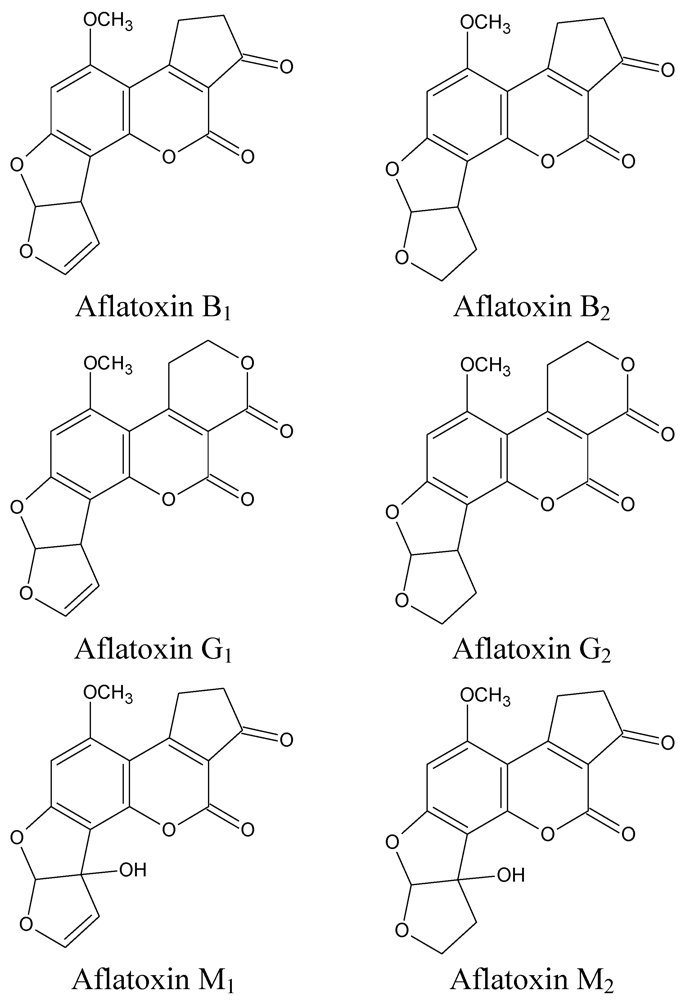
      <p>Aflatoxins, secondary metabolites of various <italic>Aspergillus</italic> spp., commonly contaminate a wide variety of tropical and subtropical food/feed stuffs. These mycotoxins are known to have strong hepatotoxic and carcinogenic effects and are regulated by feed/food law in at least 100 countries [<xref ref-type="bibr" rid="B1-toxins-03-00566">1</xref>]. Chemically, aflatoxins are difuranocoumarin compounds and include B<sub>1</sub>, B<sub>2</sub>, G<sub>1</sub>, G<sub>2</sub>, M<sub>1</sub>, and M<sub>2</sub> [<xref ref-type="bibr" rid="B2-toxins-03-00566">2</xref>] (<xref ref-type="fig" rid="toxins-03-00566-f001">Figure 1</xref>). These mycotoxins contaminate a wide variety of agricultural commodities including oilseed meals, dried fruits, spices, and cereals [<xref ref-type="bibr" rid="B3-toxins-03-00566">3</xref>]. Aflatoxins M<sub>1</sub> and M<sub>2</sub> however, mainly occur in milk (AFM<sub>1</sub> in small quantities also reported in eggs) as metabolites of the B<sub>1</sub> and B<sub>2</sub>. Among the various types of aflatoxins, aflatoxin B<sub>1</sub> (AFB<sub>1</sub>) is most commonly encountered and it is also considered to have higher toxicity than other aflatoxins.</p>
      <fig id="toxins-03-00566-f001" position="anchor">
        <label>Figure 1</label>
        <caption>
          <p>Structure of aflatoxins.</p>
        </caption>
        <graphic xmlns:xlink="http://www.w3.org/1999/xlink" xlink:href="toxins-03-00566-g001.tif"/>
      </fig>
      <p>The discovery and isolation of aflatoxins is well known to be a result of investigations on the mysterious Turkey-X disease of 1960 which resulted in loss of several thousand turkey poults in the United Kingdom. The cause of enormous mortality in turkey poults and of similar outbreaks in other farm animals could be linked with the use of moldy Brazilian peanut meal in the diet of affected animals [<xref ref-type="bibr" rid="B4-toxins-03-00566">4</xref>]. The suspected toxic factor was found to be extractable by using chloroform [<xref ref-type="bibr" rid="B5-toxins-03-00566">5</xref>]. Its association with <italic>Aspergillus flavus</italic> could then be established in the year 1961 [<xref ref-type="bibr" rid="B6-toxins-03-00566">6</xref>]. In 1962, the name “aflatoxin”, using first letter from “Aspergillus” and the first 3 letters from “flavus” was proposed [<xref ref-type="bibr" rid="B7-toxins-03-00566">7</xref>]. Aflatoxin was in the same year isolated in crystalline form in the Netherlands [<xref ref-type="bibr" rid="B8-toxins-03-00566">8</xref>], and separated into two components, B and G in the United Kingdom [<xref ref-type="bibr" rid="B9-toxins-03-00566">9</xref>]. This was followed by a further division of the aflatoxin B into B<sub>1</sub> and B<sub>2</sub> and later their chemical characterization by Asao <italic>et al.</italic> [<xref ref-type="bibr" rid="B10-toxins-03-00566">10</xref>]. Details of these landmarks and other studies have been reported in earlier reviews [<xref ref-type="bibr" rid="B7-toxins-03-00566">7</xref>,<xref ref-type="bibr" rid="B11-toxins-03-00566">11</xref>].</p>
      <p>Since the discovery of aflatoxins, their negative effects on animal health have been an active area of research. In this regard, research during the last five decades has well elucidated the negative effects of aflatoxins on animal performance and immunity. To date, various aspects of the aflatoxicosis in farm animals including effects on animal performance and metabolism, metabolism of the toxin, and carryover of toxic residues to animal products have been the subjects of several comprehensive reviews [<xref ref-type="bibr" rid="B12-toxins-03-00566">12</xref>]. However, some aspects of aflatoxicosis, particularly effects on gastrointestinal tract (GIT), are not well documented. The present review therefore intends to encompass these areas of aflatoxicosis in broilers. Furthermore, contemporary issues regarding dose-effect relationship between dietary levels of AFB<sub>1</sub> and broiler performance [<xref ref-type="bibr" rid="B13-toxins-03-00566">13</xref>], and recently proposed biphasic effects of the toxin on broiler’s weight gain [<xref ref-type="bibr" rid="B14-toxins-03-00566">14</xref>] are discussed. The latter hypothesis regarding aflatoxicosis is extended to other variables of broiler health wherever sufficient data are available.</p>
    </sec>
    <sec>
      <title>2. Metabolism of Aflatoxin B<sub>1</sub></title>
      <p>Relative sensitivity of various animal species to AFB<sub>1</sub> has been presented in <xref ref-type="table" rid="toxins-03-00566-t001">Table 1</xref>. The sensitivity of chicken is comparative to that of rats, and both species appear to be insensitive on a comparative scale. The difference regarding sensitivity of various animal species towards AFB<sub>1</sub> is thought to be linked with differential state of the toxin’s metabolism and the types of metabolites formed [<xref ref-type="bibr" rid="B15-toxins-03-00566">15</xref>]. However, many aspects of metabolism of AFB<sub>1</sub> in chickens need to be investigated.</p>
      <table-wrap id="toxins-03-00566-t001" position="anchor">
        <object-id pub-id-type="pii">toxins-03-00566-t001_Table 1</object-id>
        <label>Table 1</label>
        <caption>
          <p>Comparison of LD<sub>50</sub> and acute effects of AFB<sub>1</sub> on liver of various animal species <sup>1</sup>.</p>
        </caption>
        <table>
          <thead>
            <tr>
              <th rowspan="2" align="left" valign="middle">Species</th>
              <th rowspan="2" align="left" valign="middle">LD<sub>50</sub></th>
              <th colspan="6" align="center" valign="middle">Lesions in Liver</th>
            </tr>
            <tr>
              <th align="center" valign="middle">Necrosis and Hemorrhage</th>
              <th align="center" valign="middle">Fibrosis</th>
              <th align="center" valign="middle">Regeneration of Nodules</th>
              <th align="center" valign="middle">Bile Duct Proliferation/Hyperplasia</th>
              <th align="center" valign="middle">Vacuolation and Fatty Infiltration</th>
              <th align="center" valign="middle">Enlarged Hepatic Cells</th>
            </tr>
          </thead>
          <tbody>
            <tr>
              <td align="left" valign="middle">Rabbit</td>
              <td align="center" valign="middle">0.4</td>
              <td align="center" valign="middle">+</td>
              <td align="center" valign="middle">-</td>
              <td align="center" valign="middle">+</td>
              <td align="center" valign="middle">+</td>
              <td align="center" valign="middle">-</td>
              <td align="center" valign="middle">+</td>
            </tr>
            <tr>
              <td align="left" valign="middle">Duckling</td>
              <td align="center" valign="middle">2.8</td>
              <td align="center" valign="middle">+</td>
              <td align="center" valign="middle">-</td>
              <td align="center" valign="middle">+</td>
              <td align="center" valign="middle">+</td>
              <td align="center" valign="middle">+</td>
              <td align="center" valign="middle">+</td>
            </tr>
            <tr>
              <td align="left" valign="middle">Pig</td>
              <td align="center" valign="middle">3.9</td>
              <td align="center" valign="middle">+</td>
              <td align="center" valign="middle">+</td>
              <td align="center" valign="middle">+</td>
              <td align="center" valign="middle">+</td>
              <td align="center" valign="middle">+</td>
              <td align="center" valign="middle">+</td>
            </tr>
            <tr>
              <td align="left" valign="middle">Dog</td>
              <td align="center" valign="middle">6.3</td>
              <td align="center" valign="middle">+</td>
              <td align="center" valign="middle">+</td>
              <td align="center" valign="middle">+</td>
              <td align="center" valign="middle">+</td>
              <td align="center" valign="middle">+</td>
              <td align="center" valign="middle">+</td>
            </tr>
            <tr>
              <td align="left" valign="middle">Guinea pig</td>
              <td align="center" valign="middle">10.6</td>
              <td align="center" valign="middle">+</td>
              <td align="center" valign="middle">-</td>
              <td align="center" valign="middle">+</td>
              <td align="center" valign="middle">+</td>
              <td align="center" valign="middle">+</td>
              <td align="center" valign="middle">+</td>
            </tr>
            <tr>
              <td align="left" valign="middle">Sheep <sup>2</sup></td>
              <td align="center" valign="middle">12.5</td>
              <td align="center" valign="middle"> </td>
              <td align="center" valign="middle"> </td>
              <td align="center" valign="middle"> </td>
              <td align="center" valign="middle"> </td>
              <td align="center" valign="middle"> </td>
              <td align="center" valign="middle"> </td>
            </tr>
            <tr>
              <td align="left" valign="middle">Mouse</td>
              <td align="center" valign="middle">56.3</td>
              <td align="center" valign="middle">-</td>
              <td align="center" valign="middle">-</td>
              <td align="center" valign="middle">-</td>
              <td align="center" valign="middle">-</td>
              <td align="center" valign="middle">+</td>
              <td align="center" valign="middle">+</td>
            </tr>
            <tr>
              <td align="left" valign="middle">Chicken</td>
              <td align="center" valign="middle">72.0</td>
              <td align="center" valign="middle">-</td>
              <td align="center" valign="middle">-</td>
              <td align="center" valign="middle">-</td>
              <td align="center" valign="middle">+</td>
              <td align="center" valign="middle">+</td>
              <td align="center" valign="middle">+</td>
            </tr>
            <tr>
              <td align="left" valign="middle">Rat</td>
              <td align="center" valign="middle">73.3</td>
              <td align="center" valign="middle">+</td>
              <td align="center" valign="middle">-</td>
              <td align="center" valign="middle">+</td>
              <td align="center" valign="middle">+</td>
              <td align="center" valign="middle">+</td>
              <td align="center" valign="middle">+</td>
            </tr>
          </tbody>
        </table>
        <table-wrap-foot><fn><p><sup>1</sup> Modified from Patterson [<xref ref-type="bibr" rid="B7-toxins-03-00566">7</xref>], with data on chicken from Miazzo <italic>et al.</italic> [<xref ref-type="bibr" rid="B16-toxins-03-00566">16</xref>], and Denli <italic>et al.</italic> [<xref ref-type="bibr" rid="B17-toxins-03-00566">17</xref>]. LD<sub>50</sub> in mg/kg body weight. <sup>2</sup> Data not available, however metabolism of AFB<sub>1</sub> is slower in sheep [<xref ref-type="bibr" rid="B15-toxins-03-00566">15</xref>]. Sufficient data indicate reduced weight of liver [<xref ref-type="bibr" rid="B18-toxins-03-00566">18</xref>], and hepatic carcinoma [<xref ref-type="bibr" rid="B19-toxins-03-00566">19</xref>] in sheep. Abbrev.: + noted effects; - effects not noted; empty cells indicate lack of data.</p></fn></table-wrap-foot>
      </table-wrap>
      
      <sec>
        <title>2.1. Absorption and Excretion</title>
        <p>Work done utilizing murine models indicate that absorption of aflatoxins is a very fast process that follows first order kinetics [<xref ref-type="bibr" rid="B20-toxins-03-00566">20</xref>,<xref ref-type="bibr" rid="B21-toxins-03-00566">21</xref>]. Approximately all of the orally administered AFB<sub>1</sub> has been noted to be absorbed in rats [<xref ref-type="bibr" rid="B22-toxins-03-00566">22</xref>,<xref ref-type="bibr" rid="B23-toxins-03-00566">23</xref>]. Absorption is followed by an extensive transformation into metabolites primarily in liver [<xref ref-type="bibr" rid="B24-toxins-03-00566">24</xref>]. However, the elimination of aflatoxins from body is slower as compared to the case of other mycotoxins especially trichothecenes. Wong and Hsieh [<xref ref-type="bibr" rid="B25-toxins-03-00566">25</xref>] investigated the excretion of <sup>14</sup>C-labelled AFB<sub>1</sub> in mice, rats, and monkeys. These authors found the excretion of AFB<sub>1</sub> to be high during initial 24 h of the i.v. injection. However, the total recovery of the administered AFB<sub>1</sub> was between 72 and 80% during the first 100 h after the i.v. injection. In case of laying hens, 71% of the <sup>14</sup>C-labelled AFB<sub>1</sub> administered into crop could be recovered within 7 days post-administration [<xref ref-type="bibr" rid="B26-toxins-03-00566">26</xref>]. In this study, only 28% of the administered dose of AFB<sub>1</sub> could be recovered during first 24 h. On day 1, 4, and 7 of post-administration of <sup>14</sup>C-labelled AFB<sub>1</sub>, the accumulation of radioactivity was estimated by these authors to be 1.3, 1, and 1.1% of the total administered dose. Liver and reproductive organs were found to be the main sites for accumulation of radioactivity. In a contemporary study, Mabee and Chipley [<xref ref-type="bibr" rid="B27-toxins-03-00566">27</xref>] investigated the metabolism of AFB<sub>1</sub> during continuous exposure. These authors administered <sup>14</sup>C-labelled AFB<sub>1</sub> to laying hen by using crop intubation tube for 14 consecutive days. At 5 h post-intubation of the last dose, the total radioactivity in hens was approximately equal to the daily dose of the toxin. It was therefore concluded that most of the <sup>14</sup>C-labelled AFB<sub>1</sub> administered during first 13 days was excreted before administration of the final dose on 14th day—providing a clue that elimination AFB<sub>1</sub> is faster during continuous exposure. Wolzak <italic>et al.</italic> [<xref ref-type="bibr" rid="B28-toxins-03-00566">28</xref>] have reported that tissue residues of aflatoxins were highest in kidney, gizzard, and liver (average conc. 3 μg/kg mass) when broilers were exposed for 4 weeks to a mixture of AFB<sub>1</sub> and AFB<sub>2</sub>. After 7 days of removal of the contaminated feed, aflatoxin residues could not be detected in aforementioned tissues. In this regard, a recent study by Hussain <italic>et al.</italic> also indicates that the elimination of AFB<sub>1</sub> in chicken increase during longer exposure to AFB<sub>1</sub> [<xref ref-type="bibr" rid="B29-toxins-03-00566">29</xref>]. These authors fed broiler chicks on rations containing 0, 1.6, 3.2, and 6.4 µg AFB<sub>1</sub>/kg for 7, 14, or 28 days age. After 2 to 3 days of exposure, AFB<sub>1</sub> could be detected in livers of the birds exposed to 1.6 µg AFB<sub>1</sub>/kg and higher dietary levels of the toxin. After cessation of toxin feeding, AFB<sub>1</sub> residues decreased in livers and muscles of all the birds, with lower levels at 10 days post-cessation in the birds exposed to higher toxin levels. These authors concluded that the residues of AFB<sub>1</sub> in tissues increase with increase in dietary concentration of the toxin but decrease with increase in age (or after longer exposure) of broiler chicks. The elimination of AFB<sub>1</sub> from tissues was rapid in older birds than in younger birds.</p>
      </sec>
      <sec>
        <title>2.2. Metabolism</title>
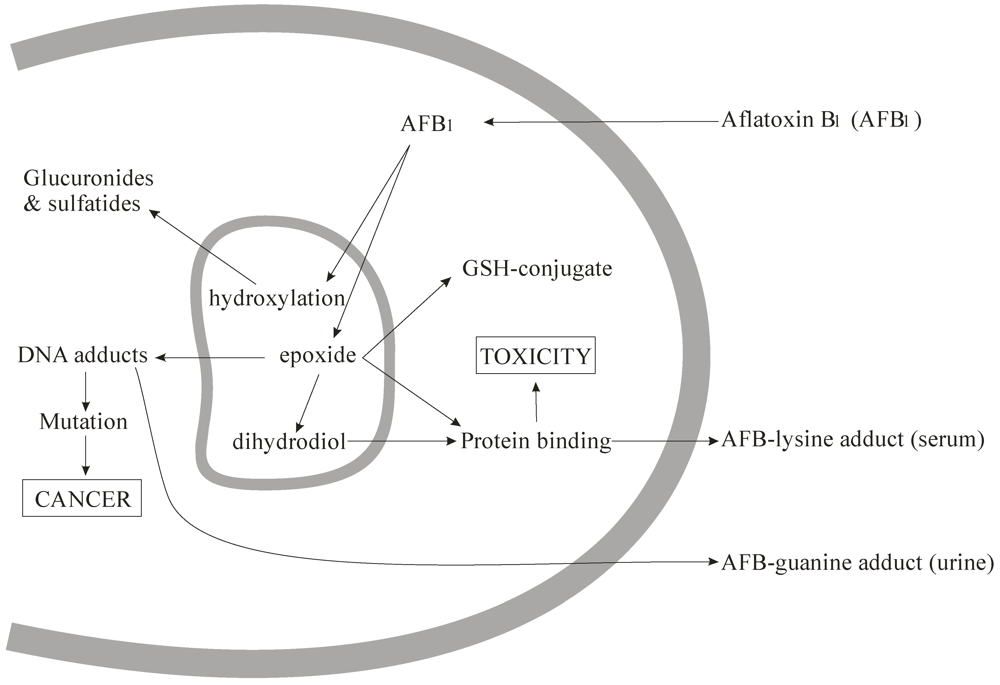
        <p>Besides being the primary organ of AFB<sub>1</sub> accumulation and metabolism, liver is also the main site where AFB<sub>1</sub> is metabolized and where the metabolites bind with nucleic acids and proteins. Kidneys also take part in detoxification of aflatoxins and are also among the organs where most of the aflatoxin residues are detected [<xref ref-type="bibr" rid="B26-toxins-03-00566">26</xref>,<xref ref-type="bibr" rid="B30-toxins-03-00566">30</xref>]. The metabolism of AFB<sub>1</sub> after absorption has been previously reviewed in detail [<xref ref-type="bibr" rid="B7-toxins-03-00566">7</xref>,<xref ref-type="bibr" rid="B24-toxins-03-00566">24</xref>,<xref ref-type="bibr" rid="B31-toxins-03-00566">31</xref>,<xref ref-type="bibr" rid="B32-toxins-03-00566">32</xref>,<xref ref-type="bibr" rid="B33-toxins-03-00566">33</xref>,<xref ref-type="bibr" rid="B34-toxins-03-00566">34</xref>,<xref ref-type="bibr" rid="B35-toxins-03-00566">35</xref>]. In summary, cytochrome P450 enzymes (CYP) (including CYP1A2, CYP3A4 and CYP2A6) in the liver and other tissues convert AFB<sub>1</sub> to epoxides (AFB<sub>1</sub>-8,9-exo-epoxide, and AFB<sub>1</sub>-8,9-endo-epoxide), and to AFM<sub>1</sub>, AFP<sub>1</sub>, AFQ<sub>1</sub>, and its reduced form aflatoxicol (<xref ref-type="fig" rid="toxins-03-00566-f002">Figure 2</xref>). Of the epoxides, the AFB<sub>1</sub>-8,9-exo-epoxide (and not the AFB<sub>1</sub>-8,9-endo-epoxide) can form covalent bonds with DNA and serum albumin resulting in AFB<sub>1</sub>-N7-guanine and lysine adducts, respectively. Like AFB<sub>1</sub>, AFM<sub>1</sub> can also be activated to form AFM<sub>1</sub>-8,9-epoxide that binds to DNA resulting in AFM<sub>1</sub>-N7-guanine adducts. These guanine and lysine adducts have been noted to appear in urine. The metabolites AFP<sub>1</sub>, AFQ<sub>1</sub>, and aflatoxicol are thought to be inactive and are excreted as such in urine, or in the form of glucuronyl conjugates from bile in feces.</p>
        
        <p>In case of chicken exposed to AFB<sub>1</sub> contaminated rations, AFB<sub>1</sub>, AFM<sub>1</sub>, and aflatoxicol have been detected in liver, kidneys, and thigh muscles [<xref ref-type="bibr" rid="B36-toxins-03-00566">36</xref>]. Besides these, AFB<sub>2a</sub> has also been detected in livers of both broilers and layers on a ration contaminated with a mixture of aflatoxins (AFB<sub>1</sub> 80%; AFB<sub>2</sub> 2.6%; AFG<sub>1</sub> 16.8%; and AFG<sub>2</sub> 0.1%) [<xref ref-type="bibr" rid="B30-toxins-03-00566">30</xref>]. Recent studies have shown that CYP2A6 and to a lesser extent YP1A1 are responsible for bio-activation of AFB<sub>1</sub> into epoxide form in the liver of chicken and quail [<xref ref-type="bibr" rid="B37-toxins-03-00566">37</xref>]. More data are however needed to fully understand the differences in metabolism of chicken with species which are comparatively more sensitive to AFB<sub>1</sub>.</p>
        <fig id="toxins-03-00566-f002" position="anchor">
          <label>Figure 2</label>
          <caption>
            <p>Mechanisms of AFB<sub>1</sub> toxicity [<xref ref-type="bibr" rid="B32-toxins-03-00566">32</xref>]. In the endoplasmic reticulum, AFB<sub>1</sub> is converted to hydroxylated metabolites (via monooxygenases) which are then metabolized to glucuronide and sulfate conjugates. An alternate pathway is the oxidation of AFB<sub>1</sub> to form AFB<sub>1</sub>-8,9-epoxide which can further undergo hydrolysis to form AFB<sub>1</sub>-8,9-dihydrodial. The epoxide can also be conjugated (to form GSH-conjugate) and thus detoxified by glutathione <italic>S</italic>-transferases.</p>
          </caption>
          <graphic xmlns:xlink="http://www.w3.org/1999/xlink" xlink:href="toxins-03-00566-g002.tif"/>
        </fig>
      </sec>
    </sec>
    <sec>
      <title>3. Effects of Aflatoxin B<sub>1</sub> on Performance and Serum Chemistry</title>
      <p>Various reports on effects of aflatoxins on bird performance and serum chemistry have been previously reviewed by Patterson [<xref ref-type="bibr" rid="B7-toxins-03-00566">7</xref>], Dersjant-Li <italic>et al.</italic> [<xref ref-type="bibr" rid="B13-toxins-03-00566">13</xref>], and Devegowda and Murthy [<xref ref-type="bibr" rid="B38-toxins-03-00566">38</xref>]. There is a general agreement that dietary aflatoxins reduce weight gain, feed intake, and increase feed conversion ratio. Information from the aforementioned reviews and some recent studies is summarized in <xref ref-type="table" rid="toxins-03-00566-t002">Table 2</xref>. These data indicate that AFB<sub>1</sub> has the capability to reduce broiler performance and increase the incidence of bruising in carcass when present at levels of more than 0.5 mg/kg diet. Dersjant-Li <italic> et al.</italic> in this regard concluded in their review that each mg of AFB<sub>1</sub>/kg diet would decrease the growth performance of broilers by 5% [<xref ref-type="bibr" rid="B13-toxins-03-00566">13</xref>]. However, data published during last decade regarding effect of low doses of AFB<sub>1</sub> on weight gain is not consistent with this generalization. For instance, Raju and Devegowda [<xref ref-type="bibr" rid="B39-toxins-03-00566">39</xref>] noted 21% decrease in final body weight at 35 days age in broilers fed on 0.3 mg AFB<sub>1</sub>/kg diet. Contrary to this, Tedesco <italic>et al.</italic> [<xref ref-type="bibr" rid="B40-toxins-03-00566">40</xref>] noted only 10% reduction in weight gain of broilers at 28 days of exposure to 0.8 mg AFB<sub>1</sub>/kg diet. For levels of AFB<sub>1</sub> of 1 mg/kg diet, 10% reduction in weight gain was noted by Zhao <italic> et al.</italic> [<xref ref-type="bibr" rid="B41-toxins-03-00566">41</xref>] at 21 days of exposure while 15% reduction at 42 days exposure was noted by Denli <italic> et al.</italic> [<xref ref-type="bibr" rid="B17-toxins-03-00566">17</xref>]. At further higher levels of 3 mg AFB<sub>1</sub>/kg diet, only 11% reduction in weight gain at 21 days exposure was noted by Valdivia <italic> et al.</italic> [<xref ref-type="bibr" rid="B42-toxins-03-00566">42</xref>]. Similarly, Miazzo <italic> et al.</italic> [<xref ref-type="bibr" rid="B16-toxins-03-00566">16</xref>] found 11% reduction in weight gain when 2.5 mg AFB<sub>1</sub>/kg diet was fed to broilers from 21 to 42 days of age. From these reports, it is evident that both the level and length of AFB<sub>1</sub> exposure affect the amount of reduction in weight gain of broilers. Furthermore, different type of and rations used in different studies make it impractical to generalize the dose-response relationship regarding weight gain.</p>
      <table-wrap id="toxins-03-00566-t002" position="anchor">
        <object-id pub-id-type="pii">toxins-03-00566-t002_Table 2</object-id>
        <label>Table 2</label>
        <caption>
          <p>Summary of effects of AFB<sub>1</sub> on gross performance variables in chicken.</p>
        </caption>
        <table>
          <thead>
            <tr>
              <th rowspan="2" align="center" valign="middle">AFB<sub>1</sub> (mg/kg)</th>
              <th rowspan="2" align="center" valign="middle">Performance *<sup>,1,2,4</sup></th>
              <th rowspan="2" align="center" valign="middle">Bruising <sup>3</sup></th>
              <th colspan="3" align="center" valign="middle">Weight of Organs</th>
              <th align="center" valign="middle"> </th>
              <th colspan="2" align="center" valign="middle">Serum <sup>1,3,4</sup></th>
            </tr>
            <tr>
              <th align="center" valign="middle">Liver <sup>1,4</sup></th>
              <th align="center" valign="middle">Spleen <sup>1,4</sup></th>
              <th align="center" valign="middle">Bursa and Thymus <sup>5</sup></th>
              <th align="center" valign="middle"> </th>
              <th align="center" valign="middle">Lipid</th>
              <th align="center" valign="middle">Protein</th>
            </tr>
          </thead>
          <tbody>
            <tr>
              <td align="left" valign="middle">≤0.1</td>
              <td align="center" valign="middle">~</td>
              <td align="center" valign="middle"> </td>
              <td align="center" valign="middle">~</td>
              <td align="center" valign="middle"> </td>
              <td align="center" valign="middle"> </td>
              <td align="center" valign="middle"> </td>
              <td align="center" valign="middle">~</td>
              <td align="center" valign="middle">~</td>
            </tr>
            <tr>
              <td align="left" valign="middle">0.5</td>
              <td align="center" valign="middle">↓</td>
              <td align="center" valign="middle">~</td>
              <td align="center" valign="middle">~</td>
              <td align="center" valign="middle"> </td>
              <td align="center" valign="middle"> </td>
              <td align="center" valign="middle"> </td>
              <td align="center" valign="middle">~</td>
              <td align="center" valign="middle">~</td>
            </tr>
            <tr>
              <td align="left" valign="middle">1.0</td>
              <td align="center" valign="middle">↓</td>
              <td align="center" valign="middle">↑</td>
              <td align="center" valign="middle">↑</td>
              <td align="center" valign="middle"> </td>
              <td align="center" valign="middle">↓</td>
              <td align="center" valign="middle"> </td>
              <td align="center" valign="middle">↓</td>
              <td align="center" valign="middle">↓</td>
            </tr>
            <tr>
              <td align="left" valign="middle">2.5</td>
              <td align="center" valign="middle">↓</td>
              <td align="center" valign="middle">↑</td>
              <td align="center" valign="middle">↑</td>
              <td align="center" valign="middle">↑</td>
              <td align="center" valign="middle">↓</td>
              <td align="center" valign="middle"> </td>
              <td align="center" valign="middle">↓</td>
              <td align="center" valign="middle">↓</td>
            </tr>
            <tr>
              <td align="left" valign="middle">≥5.0</td>
              <td align="center" valign="middle">↓</td>
              <td align="center" valign="middle">↑</td>
              <td align="center" valign="middle">↑</td>
              <td align="center" valign="middle">↑</td>
              <td align="center" valign="middle"> </td>
              <td align="center" valign="middle"> </td>
              <td align="center" valign="middle">↓</td>
              <td align="center" valign="middle">↓</td>
            </tr>
          </tbody>
        </table>
        <table-wrap-foot><fn><p>* Bird performance variables include body weight gain, feed consumption. Abbrev.: empty cells indicate lack of effect; ~ indicates inconsistent data; ↑ indicate increase; ↓ indicate decrease; ? indicates lack of data; enzyme activity in terms of lysosomal enzyme activity; TP, total protein; wt., weight. <sup>1</sup> [<xref ref-type="bibr" rid="B7-toxins-03-00566">7</xref>]; <sup>2</sup> [<xref ref-type="bibr" rid="B13-toxins-03-00566">13</xref>]; <sup>3</sup> [<xref ref-type="bibr" rid="B38-toxins-03-00566">38</xref>]; <sup>4</sup> [<xref ref-type="bibr" rid="B16-toxins-03-00566">16</xref>,<xref ref-type="bibr" rid="B17-toxins-03-00566">17</xref>,<xref ref-type="bibr" rid="B39-toxins-03-00566">39</xref>,<xref ref-type="bibr" rid="B40-toxins-03-00566">40</xref>,<xref ref-type="bibr" rid="B41-toxins-03-00566">41</xref>,<xref ref-type="bibr" rid="B42-toxins-03-00566">42</xref>,<xref ref-type="bibr" rid="B43-toxins-03-00566">43</xref>,<xref ref-type="bibr" rid="B44-toxins-03-00566">44</xref>,<xref ref-type="bibr" rid="B45-toxins-03-00566">45</xref>,<xref ref-type="bibr" rid="B46-toxins-03-00566">46</xref>,<xref ref-type="bibr" rid="B47-toxins-03-00566">47</xref>,<xref ref-type="bibr" rid="B48-toxins-03-00566">48</xref>,]; <sup>5</sup> [<xref ref-type="bibr" rid="B49-toxins-03-00566">49</xref>,<xref ref-type="bibr" rid="B50-toxins-03-00566">50</xref>].</p></fn></table-wrap-foot>
      </table-wrap>
      
      <p>It is interesting to mention that many authors who reviewed the studies conducted prior to the 1980s considered 1.25 mg AFB<sub>1</sub>/kg diet as not having any negative effects on broiler performance [<xref ref-type="bibr" rid="B7-toxins-03-00566">7</xref>]. Recent literature, as briefly reviewed in the preceding paragraph, on the other hand documents negative effects of lower levels of the toxin on broiler performance. Even the levels of AFB<sub>1</sub> as low as 0.02 mg/kg diet have been indicated to decrease weight gain of broilers by 5% (<italic>P</italic> &lt; 0.05) in a 3 weeks feeding study [<xref ref-type="bibr" rid="B48-toxins-03-00566">48</xref>]. One explanation of these differences in earlier and recent reports could be the difference in the performance of broilers available at the time of study. Modern broiler in this connection is known to gain more weight by utilizing less feed in shorter time [<xref ref-type="bibr" rid="B51-toxins-03-00566">51</xref>,<xref ref-type="bibr" rid="B52-toxins-03-00566">52</xref>,<xref ref-type="bibr" rid="B53-toxins-03-00566">53</xref>]. As AFB<sub>1</sub> is known as hepatotoxic, it might result in more profound negative effects in birds with more efficient nutrient conversion demanding faster hepatic metabolism. Differences in the susceptibility of broilers and layers in this regard have been already postulated to be due to differences in metabolic rate of these bird types. Yet another possible cause of these differences could be sensitivity of analytical methods available at the time of previous and present studies.</p>
      <p>In a recent review, Diaz <italic>et al.</italic> proposed that the effects of AFB<sub>1</sub> on weight gain in broilers could be of biphasic nature (hormesis), <italic>i.e.</italic>, improvement at low doses while reduction at high doses [<xref ref-type="bibr" rid="B14-toxins-03-00566">14</xref>]. In the review of Diaz <italic>et al.</italic>, the maximum improvement in weight gain of broilers was stated to be 3 to 4% during exposure to low levels of AFB<sub>1</sub>. In the aforementioned report of Tedesco <italic>et al.</italic> [<xref ref-type="bibr" rid="B40-toxins-03-00566">40</xref>] these authors however noted 13% improvement in weight gain of broilers during 2nd week of exposure to 0.8 mg AFB<sub>1</sub>/kg diet. After 2nd week of exposure the weight gain of broilers started to decline under AFB<sub>1</sub> diet with statistically significant effects apparent during 4th week of exposure. It therefore seems that the length of exposure to AFB<sub>1</sub> besides its level could also influence the type of response regarding weight gain. However these improvements in weight gain, though might be of economic importance, were never reported to be of any statistical significance.</p>
      <p>Studies conducted during last decade on effects of AFB<sub>1</sub> on serum chemistry are summarized in <xref ref-type="table" rid="toxins-03-00566-t003">Table 3</xref>. From the presented data, it is apparent that AFB<sub>1</sub> at levels of up to 0.3 mg/kg decreases serum cholesterol levels. As the dietary level of AFB<sub>1</sub> increases to 1 mg/kg, total serum protein and albumin contents are decreased. At further higher levels of 2 mg/kg diet, lower serum glucose, Ca, and inorganic P levels are recorded. Though Raju and Devegowda [<xref ref-type="bibr" rid="B39-toxins-03-00566">39</xref>] reported lower total serum protein in broilers exposed to 0.3 mg AFB<sub>1</sub>/kg diet, several other authors including Tedesco <italic>et al.</italic> [<xref ref-type="bibr" rid="B40-toxins-03-00566">40</xref>] could not note any effects of higher doses of AFB<sub>1</sub> on this variable. From the presented data, it is also not possible to draw a dose-effect relationship for levels of serum enzymes including alkaline phosphatase, alanine transferase, γ-glutamyl transferase. However, altered concentrations of these enzymes are usually noted at 1 mg AFB<sub>1</sub>/kg diet. Besides these effects, AFB<sub>1</sub> is also known to induce glutathione depletion and result in lipid peroxidation [<xref ref-type="bibr" rid="B54-toxins-03-00566">54</xref>].</p>
       <table-wrap id="toxins-03-00566-t003" position="anchor">
        <object-id pub-id-type="pii">toxins-03-00566-t003_Table 3</object-id>
        <label>Table 3</label>
        <caption>
          <p>Effect of AFB<sub>1</sub> on hematology and serum chemistry, as noted in recent studies.</p>
        </caption>
        <table>
          <thead>
            <tr>
              <th align="left" valign="middle">AFB<sub>1</sub> Level (ppm)</th>
              <th rowspan="2" align="center" valign="middle"><italic>n</italic> *</th>
              <th colspan="2" align="center" valign="middle">Hematology and Serum Chemistry</th>
              <th rowspan="2" align="center" valign="middle">Year of Study and Reference</th>
            </tr>
            <tr>
              <th align="left" valign="middle">Bird Type, and Age (days)</th>
              <th align="left" valign="middle">Effects</th>
              <th align="left" valign="middle">No Effects</th>
            </tr>
          </thead>
          <tbody>
            <tr>
              <td align="left" valign="middle">0, 0.1</td>
              <td align="center" valign="middle">4</td>
              <td rowspan="2" align="left" valign="middle">↓ AP</td>
              <td rowspan="2" align="left" valign="middle">AST, γ-GT, TP, Chl, BUN, creatinine</td>
              <td rowspan="2" align="center" valign="middle">2010 [<xref ref-type="bibr" rid="B55-toxins-03-00566">55</xref>]</td>
            </tr>
            <tr>
              <td align="left" valign="middle">♂Ross308, 427–457 </td>
              <td align="center" valign="middle">(12)</td>
            </tr>
            <tr>
              <td align="left" valign="middle">0, 0.3</td>
              <td rowspan="2" align="center" valign="middle">12</td>
              <td align="left" valign="middle">↓ TP and Chl at 21 days</td>
              <td rowspan="2" align="left" valign="middle">BUN, ALT, γ-GT, AST at 21 days. BUN, ALT, Hb at 35 days</td>
              <td rowspan="2" align="center" valign="middle">2000 [<xref ref-type="bibr" rid="B39-toxins-03-00566">39</xref>]</td>
            </tr>
            <tr>
              <td align="left" valign="middle">Broilers, 1–35 </td>
              <td align="left" valign="middle">↓ TP, Chl, γ-GT, AST at 35 days</td>
            </tr>
            <tr>
              <td align="left" valign="middle">0, 0.8</td>
              <td rowspan="2" align="center" valign="middle">7</td>
              <td rowspan="2" align="left" valign="middle">↓ ALT</td>
              <td rowspan="2" align="left" valign="middle">TP, albumin, globulin, Glc., AST, γ-GT, Ca, P</td>
              <td rowspan="2" align="center" valign="middle">2004 [<xref ref-type="bibr" rid="B40-toxins-03-00566">40</xref>]</td>
            </tr>
            <tr>
              <td align="left" valign="middle">♂Broilers, 14–49 </td>
            </tr>
            <tr>
              <td align="left" valign="middle">0, 1.0</td>
              <td align="center" valign="middle">4</td>
              <td rowspan="2" align="left" valign="middle">↓ TP, albumin, Chl, Ca</td>
              <td rowspan="2" align="left" valign="middle">Uric acid, γ-GT, P</td>
              <td rowspan="2" align="center" valign="middle">2008 [<xref ref-type="bibr" rid="B47-toxins-03-00566">47</xref>]</td>
            </tr>
            <tr>
              <td align="left" valign="middle">♂Cobb, 1–21 </td>
              <td align="center" valign="middle">(8)</td>
            </tr>
            <tr>
              <td align="left" valign="middle">0, 1.0</td>
              <td rowspan="2" align="center" valign="middle">10</td>
              <td rowspan="2" align="left" valign="middle">↑ AP</td>
              <td rowspan="2" align="left" valign="middle">TP, albumin, AST, γ-GT, uric acid, Chl, triglyceride</td>
              <td rowspan="2" align="center" valign="middle">2009 [<xref ref-type="bibr" rid="B17-toxins-03-00566">17</xref>]</td>
            </tr>
            <tr>
              <td align="left" valign="middle">♂Ross308, 1–42 </td>
            </tr>
            <tr>
              <td align="left" valign="middle">0, 1.0</td>
              <td align="center" valign="middle">5</td>
              <td rowspan="2" align="left" valign="middle">↓ TP, albumin, globulin</td>
              <td rowspan="2" align="left" valign="middle">BUN, Glc., AP, AST, γ-GT, CK, Na, K, Cl, Ca, P</td>
              <td rowspan="2" align="center" valign="middle">2010 [<xref ref-type="bibr" rid="B41-toxins-03-00566">41</xref>]</td>
            </tr>
            <tr>
              <td align="left" valign="middle">broilers, 1–21 </td>
              <td align="center" valign="middle">(15)</td>
            </tr>
            <tr>
              <td align="left" valign="middle">0, 2</td>
              <td align="center" valign="middle">5</td>
              <td rowspan="2" align="left" valign="middle">↓ TP, albumin, globulin, AP, Glc, Ca, P</td>
              <td rowspan="2" align="left" valign="middle">BUN, AST, γ-GT, CK, uric acid, Na, K, Cl</td>
              <td rowspan="2" align="center" valign="middle">2010 [<xref ref-type="bibr" rid="B41-toxins-03-00566">41</xref>]</td>
            </tr>
            <tr>
              <td align="left" valign="middle">broilers, 1–21</td>
              <td align="center" valign="middle">(15)</td>
            </tr>
            <tr>
              <td align="left" valign="middle">0, 3</td>
              <td rowspan="2" align="center" valign="middle">20</td>
              <td align="left" valign="middle">↓ TP, ALT</td>
              <td rowspan="2" align="center" valign="middle">-</td>
              <td rowspan="2" align="center" valign="middle">2001 [<xref ref-type="bibr" rid="B42-toxins-03-00566">42</xref>]</td>
            </tr>
            <tr>
              <td align="left" valign="middle">Hubb, 1–21</td>
              <td align="left" valign="middle">↑ AST</td>
            </tr>
            <tr>
              <td align="left" valign="middle">0, 3.5</td>
              <td align="center" valign="middle">6</td>
              <td rowspan="2" align="left" valign="middle">↓ TP, albumin, Chl, creatinine, Ca, MCV</td>
              <td rowspan="2" align="left" valign="middle">AP, ALT, P, RBC, MCH, MCHC</td>
              <td rowspan="2" align="center" valign="middle">1997 [<xref ref-type="bibr" rid="B45-toxins-03-00566">45</xref>]</td>
            </tr>
            <tr>
              <td align="left" valign="middle">broilers, 1–21</td>
              <td align="center" valign="middle">(18)</td>
            </tr>
            <tr>
              <td align="left" valign="middle">0, 4</td>
              <td align="center" valign="middle">6</td>
              <td rowspan="2" align="left" valign="middle">↓ TP, BUN, Chl, PMCV, hematocrit %</td>
              <td rowspan="2" align="center" valign="middle">-</td>
              <td rowspan="2" align="center" valign="middle">1997 [<xref ref-type="bibr" rid="B43-toxins-03-00566">43</xref>]</td>
            </tr>
            <tr>
              <td align="left" valign="middle">♂PetxHubb, 1–21 </td>
              <td align="center" valign="middle">(12)</td>
            </tr>
            <tr>
              <td align="left" valign="middle">0, 4</td>
              <td align="center" valign="middle">5</td>
              <td align="left" valign="middle">↓ TP, albumin, globulin, Chl, Glc., Ca, P</td>
              <td rowspan="2" align="center" valign="middle">-</td>
              <td rowspan="2" align="center" valign="middle">1998 [<xref ref-type="bibr" rid="B46-toxins-03-00566">46</xref>]</td>
            </tr>
            <tr>
              <td align="left" valign="middle">♂broilers, 1–21 </td>
              <td align="center" valign="middle">(15)</td>
              <td align="left" valign="middle">↑ Na, Cl</td>
            </tr>
            <tr>
              <td align="left" valign="middle">0, 5</td>
              <td align="center" valign="middle">6</td>
              <td align="left" valign="middle">↓ TP, albumin, Chl, uric acid, AP, Ca.</td>
              <td rowspan="2" align="center" valign="middle">P</td>
              <td rowspan="2" align="center" valign="middle">1998 [<xref ref-type="bibr" rid="B56-toxins-03-00566">56</xref>]</td>
            </tr>
            <tr>
              <td align="left" valign="middle">AAxPet, 1–21 </td>
              <td align="center" valign="middle">(12)</td>
              <td align="left" valign="middle">↑ CK</td>
            </tr>
            <tr>
              <td align="left" valign="middle">0, 5</td>
              <td align="center" valign="middle">6</td>
              <td align="left" valign="middle">↓ TP, albumin, Chl</td>
              <td rowspan="2" align="center" valign="middle">-</td>
              <td rowspan="2" align="center" valign="middle">1998 [<xref ref-type="bibr" rid="B45-toxins-03-00566">45</xref>]</td>
            </tr>
            <tr>
              <td align="left" valign="middle">broilers, 1–21 </td>
              <td align="center" valign="middle">(12)</td>
              <td align="left" valign="middle">↑ BUN, CK</td>
            </tr>
          </tbody>
        </table>
        <table-wrap-foot><fn><p>* Number of replicates. The figure in parenthesis indicates number of animals per replicate. Abbrev.: AA, Arbor Acres; ALT, alanine transferase; AP, alkaline phosphatase; AST, aspartate amino transferase; BUN, blood urea nitrogen; Chl, cholesterol; CK, creatinine kinase; conc., concentration; Glc, glucose; Hb, hemoglobin; Hubb, Hubbard; Pet, Peterson; MCV, mean corpuscular volume; MCH, mean corpuscular hemoglobin; MCHC, mean corpuscular hemoglobin concentration; RBC, red blood cell; γ-GT, γ-glutamyl transferase.</p></fn></table-wrap-foot>
      </table-wrap>
      
    </sec>
    <sec>
      <title>4. Effects of Aflatoxin B<sub>1</sub> on Adaptive Immunity</title>
      <p>Secondary to the effects on liver, the immunosupressive nature of AFB<sub>1</sub> is the best documented area of its toxicity. Recent epidemiological data also indicate high correlation between outbreaks of Newcastle disease (ND) and aflatoxin contamination of broiler rations [<xref ref-type="bibr" rid="B57-toxins-03-00566">57</xref>,<xref ref-type="bibr" rid="B58-toxins-03-00566">58</xref>].</p>
      <p>Generally, the immunotoxic dose of AFB<sub>1</sub> is considered as less than the dose required eliciting a reduction in bird performance. Selected studies on the effects of AFB<sub>1</sub> on response from vaccines (humoral immunity), and cell mediated immunity are presented in <xref ref-type="table" rid="toxins-03-00566-t004">Table 4</xref>. Though several contradictory reports are available, the threshold dose of AFB<sub>1</sub> may be generalized to be 0.4 and 1 mg/kg for the negative effects on cell mediated and humoral immunity, respectively. However, the question regarding susceptibility of modern broiler regarding immunotoxicity remains yet to be answered. Furthermore, there is evidence regarding biphasic nature of the effects of AFB<sub>1</sub> on humoral immunity. In this regard our recent data (<xref ref-type="table" rid="toxins-03-00566-t005">Table 5</xref>) indicate that humoral immune response from broilers could increase and decrease depending upon the level and length of exposure to the toxin. </p>
      <table-wrap id="toxins-03-00566-t004" position="anchor">
        <object-id pub-id-type="pii">toxins-03-00566-t004_Table 4</object-id>
        <label>Table 4</label>
        <caption>
          <p>Effects of AFB<sub>1</sub> on humoral and cell mediated immunity in chicken.</p>
        </caption>
        <table>
          <thead>
            <tr>
              <th align="left" valign="middle">AFB<sub>1</sub> Level (ppm)</th>
              <th rowspan="2" align="left" valign="middle">Vaccine Age</th>
              <th rowspan="2" align="left" valign="middle">Effects</th>
              <th rowspan="2" align="left" valign="middle">No Effects</th>
              <th rowspan="2" align="left" valign="middle">Year of Study and Reference</th>
            </tr>
            <tr>
              <th align="left" valign="middle">Bird Type, Age (days)</th>
            </tr>
          </thead>
          <tbody>
            <tr>
              <td colspan="2" align="left" valign="middle"><italic>Humoral immunity</italic>:</td>
              <td align="left" valign="middle"> </td>
              <td align="left" valign="middle"> </td>
              <td align="left" valign="middle"> </td>
            </tr>
            <tr>
              <td align="left" valign="middle">0.1, 0.2, 0.4, 0.5, 1.0</td>
              <td rowspan="2" align="left" valign="middle">?</td>
              <td rowspan="2" align="center" valign="middle">-</td>
              <td rowspan="2" align="left" valign="middle">Titers to ND and fowl cholera</td>
              <td rowspan="2" align="center" valign="middle">1985 [<xref ref-type="bibr" rid="B59-toxins-03-00566">59</xref>]</td>
            </tr>
            <tr>
              <td align="left" valign="middle">Broiler, 14–49 </td>
            </tr>
            <tr>
              <td align="left" valign="middle">0.1, 0.2, 0.4, 0.8</td>
              <td rowspan="2" align="left" valign="middle">?</td>
              <td rowspan="2" align="center" valign="middle">-</td>
              <td rowspan="2" align="left" valign="middle">Titers to ND and fowl cholera</td>
              <td rowspan="2" align="center" valign="middle">1985 [<xref ref-type="bibr" rid="B60-toxins-03-00566">60</xref>]</td>
            </tr>
            <tr>
              <td align="left" valign="middle">broiler, 14-–49 </td>
            </tr>
            <tr>
              <td align="left" valign="middle">1 (AF)</td>
              <td rowspan="2" align="left" valign="middle">14 days</td>
              <td rowspan="2" align="left" valign="middle">↓ ND titers at 1 and 3 weeks post vaccination</td>
              <td rowspan="2" align="left" valign="middle">ND titers at 2, 4, and 5 weeks post vaccination</td>
              <td rowspan="2" align="center" valign="middle">2003 [<xref ref-type="bibr" rid="B61-toxins-03-00566">61</xref>]</td>
            </tr>
            <tr>
              <td align="left" valign="middle">Broiler, 7–49</td>
            </tr>
            <tr>
              <td align="left" valign="middle">2.5 (AF)</td>
              <td rowspan="2" align="left" valign="middle">7 + 21 days</td>
              <td rowspan="2" align="left" valign="middle">↓ ND titers at 28 days age</td>
              <td rowspan="2" align="center" valign="middle">-</td>
              <td rowspan="2" align="center" valign="middle">2000 [<xref ref-type="bibr" rid="B62-toxins-03-00566">62</xref>]</td>
            </tr>
            <tr>
              <td align="left" valign="middle">Faobro, 1–21</td>
            </tr>
            <tr>
              <td align="left" valign="middle">0, 0.6, 1.2, 2.5</td>
              <td rowspan="2" align="left" valign="middle">-</td>
              <td rowspan="2" align="left" valign="middle">↓ total complement activity at 2.5 ppm</td>
              <td rowspan="2" align="left" valign="middle">total complement activity at 0.6 and 1.2 ppm</td>
              <td rowspan="2" align="center" valign="middle">1985 [<xref ref-type="bibr" rid="B63-toxins-03-00566">63</xref>]</td>
            </tr>
            <tr>
              <td align="left" valign="middle">Broiler, 1–42</td>
            </tr>
            <tr>
              <td align="left" valign="middle">5</td>
              <td rowspan="2" align="left" valign="middle">1 + 21 days </td>
              <td rowspan="2" align="left" valign="middle">↑ secondary antibodies against IBD at 28 and 35 days</td>
              <td rowspan="2" align="center" valign="middle">-</td>
              <td rowspan="2" align="center" valign="middle">1997 [<xref ref-type="bibr" rid="B64-toxins-03-00566">64</xref>]</td>
            </tr>
            <tr>
              <td align="left" valign="middle">Broiler, 1–35 </td>
            </tr>
            <tr>
              <td align="left" valign="middle">0.2</td>
              <td rowspan="2" align="left" valign="middle">?</td>
              <td rowspan="2" align="left" valign="middle">↓ antibody titers to ND, IB, and IBD</td>
              <td rowspan="2" align="center" valign="middle">-</td>
              <td rowspan="2" align="center" valign="middle">1998 [<xref ref-type="bibr" rid="B65-toxins-03-00566">65</xref>]</td>
            </tr>
            <tr>
              <td align="left" valign="middle">♀Leghorn, 126–280</td>
            </tr>
            <tr>
              <td align="left" valign="middle">2.5</td>
              <td rowspan="2" align="left" valign="middle">21 days</td>
              <td rowspan="2" align="center" valign="middle">-</td>
              <td rowspan="2" align="left" valign="middle">ND, IB titers; at 35 days susceptibility to ND</td>
              <td rowspan="2" align="center" valign="middle">1978 [<xref ref-type="bibr" rid="B66-toxins-03-00566">66</xref>]</td>
            </tr>
            <tr>
              <td align="left" valign="middle">♂Leghorn, 1–28</td>
            </tr>
            <tr>
              <td align="left" valign="middle">2.5</td>
              <td rowspan="2" align="left" valign="middle">21 days</td>
              <td rowspan="2" align="center" valign="middle">-</td>
              <td rowspan="2" align="left" valign="middle">ND titers; susceptibility to ND at 35 days</td>
              <td rowspan="2" align="center" valign="middle">1978 [<xref ref-type="bibr" rid="B66-toxins-03-00566">66</xref>]</td>
            </tr>
            <tr>
              <td align="left" valign="middle">♂Leghorn, 1–49</td>
            </tr>
            <tr>
              <td colspan="2" align="left" valign="middle"><italic>Cell mediated immunity</italic>:</td>
              <td align="left" valign="middle"> </td>
              <td align="left" valign="middle"> </td>
              <td align="left" valign="middle"> </td>
            </tr>
            <tr>
              <td align="left" valign="middle">0, 0.1, 0.2, 0.4, 0.8</td>
              <td rowspan="2" align="left" valign="middle">-</td>
              <td rowspan="2" align="left" valign="middle">↓ DHST from 0.2 ppm</td>
              <td rowspan="2" align="center" valign="middle">-</td>
              <td rowspan="2" align="center" valign="middle">1985 [<xref ref-type="bibr" rid="B60-toxins-03-00566">60</xref>]</td>
            </tr>
            <tr>
              <td align="left" valign="middle">Broiler, 14-49 </td>
            </tr>
            <tr>
              <td align="left" valign="middle">0.1, 0.2, 0.4, 0.5, 1.0</td>
              <td rowspan="2" align="left" valign="middle">-</td>
              <td rowspan="2" align="left" valign="middle">↓DHST at 0.4 ppm AFB<sub>1</sub> + AFB<sub>2</sub></td>
              <td rowspan="2" align="left" valign="middle">DHST on AFB<sub>1</sub> alone</td>
              <td rowspan="2" align="center" valign="middle">1985 [<xref ref-type="bibr" rid="B59-toxins-03-00566">59</xref>]</td>
            </tr>
            <tr>
              <td align="left" valign="middle">Broiler, 14–49 </td>
            </tr>
            <tr>
              <td align="left" valign="middle">1</td>
              <td rowspan="2" align="left" valign="middle">-</td>
              <td rowspan="2" align="left" valign="middle">↓ DHST</td>
              <td rowspan="2" align="center" valign="middle">-</td>
              <td rowspan="2" align="center" valign="middle">2003 [<xref ref-type="bibr" rid="B61-toxins-03-00566">61</xref>]</td>
            </tr>
            <tr>
              <td align="left" valign="middle">Broiler, 7–49 </td>
            </tr>
            <tr>
              <td align="left" valign="middle">0.3</td>
              <td rowspan="2" align="left" valign="middle">-</td>
              <td rowspan="2" align="left" valign="middle">↓ DHST at 30, 45, and 60 days age</td>
              <td rowspan="2" align="center" valign="middle">-</td>
              <td rowspan="2" align="center" valign="middle">1988 [<xref ref-type="bibr" rid="B67-toxins-03-00566">67</xref>]</td>
            </tr>
            <tr>
              <td align="left" valign="middle">Leghorn, 1–42</td>
            </tr>
          </tbody>
        </table>
        <table-wrap-foot><fn><p>Abbrev.: ↓ reduction; ↑ increase; ? not specified; - data not relevant; DHST, delayed hypersensitivity skin test; IB, infectious bronchitis; IBD, infectious bursal disease; ND, Newcastle disease.</p></fn></table-wrap-foot>
      </table-wrap>
      
      
      <p>The data presented in <xref ref-type="table" rid="toxins-03-00566-t005">Table 5</xref> are not the first observations of increase in humoral immune response during initial stages of exposure to low levels of AFB<sub>1</sub>. Similar results, <italic>i.e.</italic>, an initial increase followed by a decrease in humoral immune response, have been documented in at least two previous reports. However, these effects of AFB<sub>1</sub> were not discussed in any of these reports and thus had remained overlooked. For instance, Giambrone <italic>et al.</italic> [<xref ref-type="bibr" rid="B59-toxins-03-00566">59</xref>] who conducted two separate experiments in 1985 on Hubbard broilers, noted a non-significant increasing trend in ND titers with increase in the AFB<sub>1</sub> content of ration from zero to 0.5 mg/kg in one of these experiments. Also, a higher (<italic>P</italic> &lt; 0.05) response from fowl cholera vaccine was noted in the birds fed 0.5 mg AFB<sub>1</sub>/kg diet. In the other experiment, higher (<italic>P</italic> &lt; 0.05) ND, and fowl cholera titers were noted in birds fed 0.1 mg, and 0.2 mg AFB<sub>1</sub>/kg diet, respectively. The increase in titers against ND and fowl cholera in birds fed on AFB<sub>1</sub> contaminated ration was not seen in the birds fed on rations containing mixtures of AFB<sub>1</sub> and AFB<sub>2</sub>. In a latter study, these authors reported non-significantly higher titers against ND and fowl cholera in birds fed on 0.1 to 0.8 mg AFB<sub>1</sub>/kg rations as compared to the birds fed on control ration [<xref ref-type="bibr" rid="B60-toxins-03-00566">60</xref>]. The underlying mechanisms for this temporary increase in humoral immune response are not known. As a matter of fact, the exact mechanisms of even immunosuppression during aflatoxicosis are not clearly understood in spite of 50 years of research on the mycotoxin. In this regard, Corrier [<xref ref-type="bibr" rid="B68-toxins-03-00566">68</xref>], and Surai and Dvorska [<xref ref-type="bibr" rid="B54-toxins-03-00566">54</xref>] have reviewed some aspects of AFB<sub>1</sub>-induced immunotoxicity. A brief but comprehensive discussion on the subject can also be found in an article by Celik <italic>et al.</italic> [<xref ref-type="bibr" rid="B49-toxins-03-00566">49</xref>]. It is a general observation that size of lymphoid organs is not normal in birds exposed to AFB<sub>1</sub> (<xref ref-type="table" rid="toxins-03-00566-t002">Table 2</xref>). In such animals, lymphoid cell depletion in thymus, spleen, and bursa of Fabricius has been described [<xref ref-type="bibr" rid="B61-toxins-03-00566">61</xref>]. Thus one explanation of immunotoxicity of AFB<sub>1</sub>, as also proposed by Azzam and Gabal [<xref ref-type="bibr" rid="B65-toxins-03-00566">65</xref>,<xref ref-type="bibr" rid="B69-toxins-03-00566">69</xref>], could be inhibition of antibody production through the toxin’s effects on lymphocytes leading to enhanced turnover of serum antibodies and consequently to decreased antibody half-life.</p>
      <table-wrap id="toxins-03-00566-t005" position="anchor">
        <object-id pub-id-type="pii">toxins-03-00566-t005_Table 5</object-id>
        <label>Table 5</label>
        <caption>
          <p>Effects of level and length of AFB<sub>1</sub> exposure on ELISA titers against Newcastle disease and serum protein in Ross 308 broilers <sup>1</sup>.</p>
        </caption>
        <table>
          <thead>
            <tr>
              <th align="center" valign="middle">Item</th>
              <th align="center" valign="middle">2nd Week Exposure</th>
              <th align="center" valign="middle">4th Week Exposure</th>
              <th align="center" valign="middle">5th Week Exposure</th>
            </tr>
          </thead>
          <tbody>
            <tr>
              <td align="left" valign="middle"><italic>Titers against ND</italic>:</td>
              <td align="center" valign="middle"> </td>
              <td align="center" valign="middle"> </td>
              <td align="center" valign="middle"> </td>
            </tr>
            <tr>
              <td align="left" valign="middle">0.07 mg AFB<sub>1</sub>/kg diet</td>
              <td align="center" valign="middle">33%</td>
              <td align="center" valign="middle">407%</td>
              <td align="center" valign="middle">−27%</td>
            </tr>
            <tr>
              <td align="left" valign="middle">0.75 mg AFB<sub>1</sub>/kg diet</td>
              <td align="center" valign="middle">127% *</td>
              <td align="center" valign="middle">594%</td>
              <td align="center" valign="middle">−28%</td>
            </tr>
            <tr>
              <td align="left" valign="middle"><italic>Serum protein</italic>:</td>
              <td align="center" valign="middle"> </td>
              <td align="center" valign="middle"> </td>
              <td align="center" valign="middle"> </td>
            </tr>
            <tr>
              <td align="left" valign="middle">0.07 mg AFB<sub>1</sub>/kg diet</td>
              <td align="center" valign="middle">5%</td>
              <td align="center" valign="middle">−2%</td>
              <td align="center" valign="middle">2.6%</td>
            </tr>
            <tr>
              <td align="left" valign="middle">0.75 mg AFB<sub>1</sub>/kg diet</td>
              <td align="center" valign="middle">−32% **</td>
              <td align="center" valign="middle">−32% *</td>
              <td align="center" valign="middle">−21% *</td>
            </tr>
          </tbody>
        </table>
        <table-wrap-foot><fn><p>Significant differences with regards to control with * at <italic>P</italic> &lt; 0.05, ** at <italic>P</italic> &lt; 0.01. Data presented as percentage change over control. <sup>1</sup> Experiment conducted in 2010 (author’s unpublished data). Statistical analysis by using ANOVA and LSD (<italic>n</italic> = 7/treatment).</p></fn></table-wrap-foot>
      </table-wrap>
      
      
      <p>During earlier studies on effects of AFB<sub>1</sub>, Tung <italic>et al.</italic> [<xref ref-type="bibr" rid="B70-toxins-03-00566">70</xref>] described the toxin-induced increase in lysosomal enzyme activity in liver and skeletal muscles of chicken. These authors postulated that this increase in lysosomal activity, besides other factors, could negatively affect tissue integrity during aflatoxicosis. In this regard, dietary AFB<sub>1</sub> has been found by Çelik <italic>et al.</italic> [<xref ref-type="bibr" rid="B49-toxins-03-00566">49</xref>] to result in degeneration of follicle associated epithelium (FAE) in bursa of Fabricius and destruction of thymic cortex in chicken. On the grounds of the report of Tung <italic>et al.</italic>, it was therefore urged that any impaired function of FAE might result in serious deficiencies in both cellular and antibody responsiveness of the chicken immune system [<xref ref-type="bibr" rid="B49-toxins-03-00566">49</xref>]. This is because FAE of bursal follicles play a crucial role in antigen presentation to the lymphoid cell population. Besides the effects on lymphocytes, non-specific effects of the toxin on protein synthesis through inhibition of RNA polymerase, lipid peroxidation, and liver injury are also considered to result in reduced immunoglobulin production. The data presented in <xref ref-type="table" rid="toxins-03-00566-t005">Table 5</xref> however indicate modulation of serum protein and antibody titers in different directions. This indicates that AFB<sub>1</sub>-induced modulation of humoral immunity in broilers may not be a result of the toxin’s non-specific effects on protein metabolism.</p>
    </sec>
    <sec>
      <title>5. Effects of Aflatoxin B<sub>1</sub> on Gastrointestinal Tract</title>
      <p>Gastrointestinal tract is the main site where conversion and absorption of food components takes place. The host-derived physiological processes, the residing microorganisms, and healthy absorptive surfaces are all equally important to ensure normal nutrient supply. Gastrointestinal tract is the first organ coming into contact with mycotoxins of dietary origin and should be expected to be affected by AFB<sub>1</sub> with greater potency as compared to other organs. However, this aspect of aflatoxicosis is the often neglected area of mycotoxin research and available literature is non-conclusive. </p>
      <sec>
        <title>5.1. Aflatoxin B<sub>1</sub> and Gut Morphology</title>
        <p>Various studies documenting effects of AFB<sub>1</sub> on weight and histological characteristics of different segments of GIT are summarized in <xref ref-type="table" rid="toxins-03-00566-t006">Table 6</xref>. The weights of proventriculus, gizzard, and pancreas relative to body weight of broilers have not been reported to be affected at levels of AFB<sub>1</sub> up to 3.5 mg/kg diet [<xref ref-type="bibr" rid="B39-toxins-03-00566">39</xref>,<xref ref-type="bibr" rid="B44-toxins-03-00566">44</xref>,<xref ref-type="bibr" rid="B48-toxins-03-00566">48</xref>]. However, at a dietary level of 4 mg AFB<sub>1</sub>/kg or higher, the relative weight of these organs has been noted to decrease by some authors [<xref ref-type="bibr" rid="B45-toxins-03-00566">45</xref>,<xref ref-type="bibr" rid="B56-toxins-03-00566">56</xref>], while increase by other [<xref ref-type="bibr" rid="B46-toxins-03-00566">46</xref>]. However, Edrington <italic>et al.</italic> could not find any effect of 4 mg AFB<sub>1</sub>/kg diet on the relative weight of gizzard and pancreas [<xref ref-type="bibr" rid="B43-toxins-03-00566">43</xref>].</p>
        
        <p>Literature on the effects of AFB<sub>1</sub> on histology of GIT is scanty and not conclusive. In this regard, the density of whole intestine (weight/length) has been reported to decrease after 3 weeks of dietary exposure to AFB<sub>1</sub> at levels as low as 0.02 mg/kg [<xref ref-type="bibr" rid="B48-toxins-03-00566">48</xref>] and 0.7 mg/kg [<xref ref-type="bibr" rid="B71-toxins-03-00566">71</xref>]. As the width of muscularis tends of be relatively constant, the density of intestine could be a good indicator of unit absorptive area. On this variable, the effects of higher AFB<sub>1</sub> dosage in broilers are not known. At higher levels of 1 mg AFB<sub>1</sub>/kg diet, Kumar and Balachandran however noted catarrhal enteritis with lymphocytic or mononuclear cell infiltrations in the intestine of broilers fed on the toxin contaminated ration for 4 weeks [<xref ref-type="bibr" rid="B72-toxins-03-00566">72</xref>]. Contrary to these reports, no histopathological changes in duodenum, jejunum, cecum, and ileum could be noted by Ledoux <italic>et al.</italic> when male broilers were exposed to 4 mg AFB<sub>1</sub>/kg diet for 3 weeks [<xref ref-type="bibr" rid="B46-toxins-03-00566">46</xref>]. Similarly, breaking strength, size, and collagen content of large intestine was not found to be affected in broilers (male Cobb × Cobb; exposure age 1 to 21 days) exposed to 0, 0.6, 1.2, 2.5, 5.0, and 10 mg AFB<sub>1</sub>/kg diet in the earlier report by Warren and Hamilton [<xref ref-type="bibr" rid="B73-toxins-03-00566">73</xref>]. Lipid content of large intestine was decreased only at the highest level of AFB<sub>1</sub> (10 mg/kg) in that report.</p>
        <p>From the aforementioned studies, it is difficult to draw a dose-effect relationship between AFB<sub>1</sub> and histological changes in the GIT. This is because specific sections of GIT, studied variables, and length of exposure were different in the aforementioned studies. Furthermore, the type and specific line of chicken used in various studies may also affect the reaction of intestine towards chronic aflatoxicosis. This hypothesis is supported by the recent observations regarding aflatoxicosis in layers (Hyline W36; exposure age from 140 to 154 days) by Applegate <italic>et al.</italic> [<xref ref-type="bibr" rid="B74-toxins-03-00566">74</xref>]. Contrary to the observations in broilers, these authors noted a linear increase in the crypt depth in distal jejunum with the increasing levels of AFB<sub>1</sub> in the diet as 0, 0.6, 1.2, and 2.5 mg/kg, but no effect of the toxin on villus height and number of goblet cells. However, the duration of exposure to AFB<sub>1</sub> was short as compared with other studies and may not be long enough to provoke morphological changes in jejunum of layers.</p>
        <table-wrap id="toxins-03-00566-t006" position="anchor">
          <object-id pub-id-type="pii">toxins-03-00566-t006_Table 6</object-id>
          <label>Table 6</label>
          <caption>
            <p>Weight and histology of individual segments of gut in chicken during exposure to AFB<sub>1</sub>.</p>
          </caption>
          <table>
            <thead>
              <tr>
                <th align="center" valign="middle">AFB<sub>1</sub> Level (ppm)</th>
                <th rowspan="2" align="center" valign="middle"><italic>n</italic> *</th>
                <th colspan="2" align="center" valign="middle">Characteristics of Gut</th>
                <th rowspan="2" align="center" valign="middle">Year of Study and Reference</th>
              </tr>
              <tr>
                <th align="center" valign="middle">Bird Type, Age (days)</th>
                <th align="center" valign="middle">Effects</th>
                <th align="center" valign="middle">No Effects</th>
              </tr>
            </thead>
            <tbody>
              <tr>
                <td align="left" valign="middle">0.07, 0.7</td>
                <td rowspan="2" align="center" valign="middle">(7)</td>
                <td align="left" valign="middle">↓ Density of duodenum and jejunum</td>
                <td rowspan="2" align="left" valign="middle">Weight of proventriculus and gizzard </td>
                <td rowspan="2" align="center" valign="middle">2011 [<xref ref-type="bibr" rid="B71-toxins-03-00566">71</xref>]</td>
              </tr>
              <tr>
                <td align="left" valign="middle">♂ Ross308, 7–29 </td>
                <td align="left" valign="middle">↑ Length of duodenum and jejunum</td>
              </tr>
              <tr>
                <td align="left" valign="middle">0.02</td>
                <td rowspan="2" align="center" valign="middle">5</td>
                <td rowspan="2" align="left" valign="middle">↓ Density of intestine</td>
                <td rowspan="2" align="left" valign="middle">Gizzard weight; intestinal weight and length</td>
                <td rowspan="2" align="center" valign="middle">2010 [<xref ref-type="bibr" rid="B48-toxins-03-00566">48</xref>]</td>
              </tr>
              <tr>
                <td align="left" valign="middle">♂ Hybro, 21–49 </td>
              </tr>
              <tr>
                <td align="left" valign="middle">0.1</td>
                <td align="center" valign="middle">4</td>
                <td rowspan="2" align="center" valign="middle">-</td>
                <td rowspan="2" align="left" valign="middle">Pancreas weight</td>
                <td rowspan="2" align="center" valign="middle">2010 [<xref ref-type="bibr" rid="B57-toxins-03-00566">57</xref>]</td>
              </tr>
              <tr>
                <td align="left" valign="middle">♂ Ross308, 427–457 </td>
                <td align="center" valign="middle">(3)</td>
              </tr>
              <tr>
                <td align="left" valign="middle">0.3</td>
                <td rowspan="2" align="center" valign="middle">12</td>
                <td rowspan="2" align="center" valign="middle">-</td>
                <td rowspan="2" align="left" valign="middle">Gizzard weight</td>
                <td rowspan="2" align="center" valign="middle">2000 [<xref ref-type="bibr" rid="B39-toxins-03-00566">39</xref>]</td>
              </tr>
              <tr>
                <td align="left" valign="middle">Broilers, 1–35 </td>
              </tr>
              <tr>
                <td align="left" valign="middle">1</td>
                <td align="center" valign="middle">2</td>
                <td rowspan="2" align="left" valign="middle">Necrosis/fibrosis in crop and proventriculus. Catarrhal enteritis in intestine</td>
                <td rowspan="2" align="center" valign="middle">-</td>
                <td rowspan="2" align="center" valign="middle">2009 [<xref ref-type="bibr" rid="B72-toxins-03-00566">72</xref>]</td>
              </tr>
              <tr>
                <td align="left" valign="middle">Broiler, 1–28 </td>
                <td align="center" valign="middle">(5)</td>
              </tr>
              <tr>
                <td align="left" valign="middle">0.6, 1.2, 2.5</td>
                <td rowspan="2" align="center" valign="middle">8</td>
                <td rowspan="2" align="left" valign="middle">linear effect: ↑ crypt length in distal jejunum</td>
                <td rowspan="2" align="left" valign="middle">Number and density of goblet cell in jejunum</td>
                <td rowspan="2" align="center" valign="middle">2009 [<xref ref-type="bibr" rid="B74-toxins-03-00566">74</xref>]</td>
              </tr>
              <tr>
                <td align="left" valign="middle">♀ W36, 140–154 </td>
              </tr>
              <tr>
                <td align="left" valign="middle">3.5</td>
                <td align="center" valign="middle">6</td>
                <td rowspan="2" align="center" valign="middle">-</td>
                <td rowspan="2" align="left" valign="middle">Gizzard weight</td>
                <td rowspan="2" align="center" valign="middle">1997 [<xref ref-type="bibr" rid="B44-toxins-03-00566">44</xref>]</td>
              </tr>
              <tr>
                <td align="left" valign="middle">Broilers, 1–21 </td>
                <td align="center" valign="middle">(4)</td>
              </tr>
              <tr>
                <td align="left" valign="middle">4</td>
                <td align="center" valign="middle">6</td>
                <td rowspan="2" align="center" valign="middle">-</td>
                <td rowspan="2" align="left" valign="middle">Gizzard and pancreas weight</td>
                <td rowspan="2" align="center" valign="middle">1997 [<xref ref-type="bibr" rid="B43-toxins-03-00566">43</xref>]</td>
              </tr>
              <tr>
                <td align="left" valign="middle">♂PetxHubb, 1–21 </td>
                <td align="center" valign="middle">(3)</td>
              </tr>
              <tr>
                <td align="left" valign="middle">4</td>
                <td align="center" valign="middle">5</td>
                <td rowspan="2" align="left" valign="middle">↑ Proventriculus and pancreas weight</td>
                <td rowspan="2" align="left" valign="middle">Microscopic evaluation of pancreas and whole GIT</td>
                <td rowspan="2" align="center" valign="middle">1998 [<xref ref-type="bibr" rid="B46-toxins-03-00566">46</xref>]</td>
              </tr>
              <tr>
                <td align="left" valign="middle">♂ Broilers, 1–21 </td>
                <td align="center" valign="middle">(3)</td>
              </tr>
              <tr>
                <td align="left" valign="middle">5</td>
                <td align="center" valign="middle">6</td>
                <td rowspan="2" align="left" valign="middle">↑ Gizzard and pancreas weight</td>
                <td rowspan="2" align="left" valign="middle">Proventriculus weight</td>
                <td rowspan="2" align="center" valign="middle">1998 [<xref ref-type="bibr" rid="B56-toxins-03-00566">56</xref>]</td>
              </tr>
              <tr>
                <td align="left" valign="middle">AA x Pet, 1–21 </td>
                <td align="center" valign="middle">(2)</td>
              </tr>
              <tr>
                <td align="left" valign="middle">5</td>
                <td align="center" valign="middle">6</td>
                <td rowspan="2" align="left" valign="middle">↑ Proventriculus and pancreas weight</td>
                <td rowspan="2" align="center" valign="middle">-</td>
                <td rowspan="2" align="center" valign="middle">1998 [<xref ref-type="bibr" rid="B45-toxins-03-00566">45</xref>]</td>
              </tr>
              <tr>
                <td align="left" valign="middle">Broilers, 1–21 </td>
                <td align="center" valign="middle">(2)</td>
              </tr>
              <tr>
                <td align="left" valign="middle">0, 0.6, 1.2, 2.5, 5, 10</td>
                <td align="center" valign="middle">4</td>
                <td rowspan="2" align="center" valign="middle">-</td>
                <td rowspan="2" align="left" valign="middle">Breaking strength and size of large intestine</td>
                <td rowspan="2" align="center" valign="middle">1980 [<xref ref-type="bibr" rid="B73-toxins-03-00566">73</xref>]</td>
              </tr>
              <tr>
                <td align="left" valign="middle">♂CobbxCobb, 1–21 </td>
                <td align="center" valign="middle">(10)</td>
              </tr>
            </tbody>
          </table>
          <table-wrap-foot><fn><p>* Number of replicates. The figure in parenthesis indicates number of animals per replicate. AA, Arbor Acres; Hubb, Hubbard; Pet, Peterson; W36, Hyline W36.</p></fn></table-wrap-foot>
        </table-wrap>
        
        <p>From the recent studies of Kana <italic>et al.</italic> [<xref ref-type="bibr" rid="B48-toxins-03-00566">48</xref>], Yunus <italic>et al.</italic> [<xref ref-type="bibr" rid="B71-toxins-03-00566">71</xref>], and Kumar and Balachandran [<xref ref-type="bibr" rid="B72-toxins-03-00566">72</xref>] in broilers, it appears that the unit absorptive surface of small intestine would deteriorate during a chronic exposure to low levels of AFB<sub>1</sub>. However, broilers have been noted to compensate the reduced unit absorptive surface by increasing the length of small intestine in one study [<xref ref-type="bibr" rid="B71-toxins-03-00566">71</xref>]. Such a reaction of intestinal tissues to low levels of AFB<sub>1</sub>, if also proven in future studies, would certainly add to the present understanding regarding intestinal adaptability to chronic AFB<sub>1</sub> exposure.</p>
      </sec>
      <sec>
        <title>5.2. Aflatoxin B<sub>1</sub> and Active Transport of Nutrients</title>
        <p>After a thorough search of various databases only two reports could be found in which the issue of intestinal active transport of nutrients during aflatoxicosis was addressed. In this connection Ruff and Wyatt showed that 3 weeks feeding of 1.25 to 5 mg AFB<sub>1</sub>/kg diet has no effect on <italic>in vitro</italic> absorption of glucose and methionine in the intestine of broilers [<xref ref-type="bibr" rid="B75-toxins-03-00566">75</xref>]. However, a high dose of 10 mg AFB<sub>1</sub>/kg diet, for more than 1 week, increased both the mediated and diffusion components of glucose and methionine absorption. Absorption of glucose and methionine was not affected in broilers exposed to these high amounts of AFB<sub>1</sub> for only one week in the study of Ruff and Wyatt. In the second study which utilized murine <italic>in vitro</italic> model, acute exposure to AFB<sub>1</sub> (5 µg/mL of buffer) was not found to affect glucose uptake in everted rat jejunum [<xref ref-type="bibr" rid="B76-toxins-03-00566">76</xref>].</p>
        <p>In some studies, active nutrient uptake was not addressed but movement of ions across intestinal epithelia and activity of ion transporters was studied. These studies may give some insight into the possible mechanisms of effects of AFB<sub>1</sub> on active transport of nutrients including glucose absorption. This is because the active absorption of glucose through sodium glucose co-transporter (SGLT1) is influenced by intracellular levels of Na<sup>+</sup> and movement of other ions across a cell. In this regard, Chotinski <italic>et al.</italic> [<xref ref-type="bibr" rid="B77-toxins-03-00566">77</xref>] studied the effects of 7 weeks of dietary exposure to 0.25 and 0.6 mg AFB<sub>1</sub>/kg diet on activity of Mg<sup>2+</sup>(Na<sup>+</sup>/K<sup>+</sup>)-ATP in small intestinal mucosa of broilers. In this study, 0.6 mg AFB<sub>1</sub>/kg diet was found to suppress the activity of Mg<sup>2+</sup>(Na<sup>+</sup>/K<sup>+</sup>)-ATP in small intestinal mucosa. Recently, acute AFB<sub>1</sub> exposure has been reported to evoke acetylcholine-sensitive contractions in the rat ileum [<xref ref-type="bibr" rid="B78-toxins-03-00566">78</xref>]. One effect of acetylcholine and other cholinergic secretagogues is to increase basolateral K<sup>+</sup> efflux and apical Cl<sup>−</sup> secretion in epithelia [<xref ref-type="bibr" rid="B79-toxins-03-00566">79</xref>]. During higher outgo of anions from epithelia, a lower absorption of Na<sup>+</sup> and consequently lower absorption of glucose is expected. In this regard <italic>in vitro</italic> AFB<sub>1</sub> has been found to evoke cholinergic secretion of Cl<sup>−</sup> and negatively affect glucose absorption in broiler’s jejunum [<xref ref-type="bibr" rid="B80-toxins-03-00566">80</xref>]. However, these effects of acute exposure could not be established for a chronic exposure of broiler’s to low levels of AFB<sub>1</sub> [<xref ref-type="bibr" rid="B71-toxins-03-00566">71</xref>]. It therefore seems that intestinal tissues may adapt to an on-going dietary challenge to low levels of AFB<sub>1</sub> as far as active transport of nutrients is concerned.</p>
      </sec>
      <sec>
        <title>5.3. Aflatoxin B<sub>1</sub>, and Digestibility and Activity of Digestive Enzymes</title>
        <p>Aflatoxin B<sub>1</sub> is widely believed to result in malabsorption syndrome regarding macro nutrients and also in reduced activity of digestive enzymes [<xref ref-type="bibr" rid="B38-toxins-03-00566">38</xref>,<xref ref-type="bibr" rid="B54-toxins-03-00566">54</xref>]. However, many reports contrary to this notion are available. For instance, Nelson <italic>et al</italic>. did not find any effect of AFB<sub>1</sub> (natural contamination of corn with <italic>A. flavus</italic>) on dry matter (DM), and amino acid digestibility, and energy utilization in chicken [<xref ref-type="bibr" rid="B81-toxins-03-00566">81</xref>]. Applegate <italic> et al</italic>. did not find any effect of 0.6, 1.2, and 2.5 mg AFB<sub>1</sub>/kg diet on digestibility of DM and nitrogen (N) per hen/day [<xref ref-type="bibr" rid="B74-toxins-03-00566">74</xref>]. At 0.6 and 1.2 mg AFB<sub>1</sub>/kg diet, the apparent metabolizable energy (AME) was however found to be reduced in their study. Regarding the activity of pancreatic enzymes, Mathur <italic> et al.</italic> found higher amylase and chymotrypsin activity, while lower lipase activity after exposure of Ross 308 female birds to 0.1 mg AFB<sub>1</sub>/kg diet (at 427 to 457 days age) [<xref ref-type="bibr" rid="B55-toxins-03-00566">55</xref>]. The activity of trypsin in pancreas was not affected by AFB<sub>1</sub> treatment. These results, except for reduction in lipase activity, are supported by earlier work of Richardson and Hamilton on layers [<xref ref-type="bibr" rid="B82-toxins-03-00566">82</xref>]. These authors reported that 4 mg AFB<sub>1</sub>/kg diet increases the activity of pancreatic chymotrypsin, amylase, and lipase. Pancreatic trypsin was not affected by AFB<sub>1</sub> in their study and the noted changes in the pancreatic secretions were also not reflected in the lipid content of the feces. Contrary to these two reports, Osborne and Hamilton noted lower activity of pancreatic amylase, trypsin, lipase, RNase, and DNase when broilers were exposed to 1.25 and 2.5 mg AFB<sub>1</sub>/kg diet [<xref ref-type="bibr" rid="B83-toxins-03-00566">83</xref>].</p>
        <p>Regarding activity of intestinal enzymes, Mathur <italic>et al.</italic> in their aforementioned report found lower lipase activity in duodenum after exposure of Ross 308 female birds to 0.1 mg AFB<sub>1</sub>/kg diet [<xref ref-type="bibr" rid="B55-toxins-03-00566">55</xref>]. These authors found that AFB<sub>1</sub> at the tested low level had no effect on amylase and chymotrypsin activity in duodenum and jejunum, and lipase activity in jejunum. The activity of trypsin in duodenum, and jejunum was also not affected by the AFB<sub>1</sub> treatment. Contrary to the case of broilers, Applegate <italic>et al.</italic> found the intestinal maltase activity to increase quadratically up to the doses of 1.2 mg AFB<sub>1</sub> while decrease at 2.5 mg AFB<sub>1</sub> with the exposure of layers (from 140 to 154 days age) to 0, 0.6, 1.2, and 2.5 mg AFB<sub>1</sub>/kg diet [<xref ref-type="bibr" rid="B74-toxins-03-00566">74</xref>]. These changes were however not found to affect digestibility and retention of DM and N.</p>
        <p>From the presented literature, it is impractical to draw any conclusions regarding effects of a certain level of AFB<sub>1</sub> on digestive functionality in broilers. Some studies, in the past decade however indicate that the decreased nutrient utilization observed in those studies might be a factor of the effects of the toxin on systemic metabolism rather than an effect on digestive functionality [<xref ref-type="bibr" rid="B84-toxins-03-00566">84</xref>,<xref ref-type="bibr" rid="B85-toxins-03-00566">85</xref>]. This notion is also supported by the fact that apparent metabolizable energy of AFB<sub>1</sub>-contaminated rations was noted to be negatively affected by all the authors who included this variable in their studies and did not find any effect of the toxin on nutrient digestibility. More studies are no doubt needed in this direction.</p>
      </sec>
      <sec>
        <title>5.4. Aflatoxin B<sub>1</sub> and Intestinal Innate Immunity</title>
        <p>The innate immune system of intestine plays a vital role in maintaining the integrity of the intestine and also participates with adaptive immune system in ensuring the subtle equilibrium between immune tolerance and immune response in the GIT [<xref ref-type="bibr" rid="B86-toxins-03-00566">86</xref>]. Intestinal intraepithelial cells (IEC) in this regard produce a diversity of antimicrobial peptides and enzymes that protect intestinal mucosa and crypts against microbes. Some of these molecules also function in alarming the adaptive immune system. Contrary to many other mycotoxins, AFB<sub>1</sub> has not been considered to date for possible effects on these peptides and enzymes. Furthermore, the barrier function of IEC during aflatoxicosis has not been subjected to extensive research. This passive barrier is formed by the IECs themselves, the tight junctions sealing the intercellular spaces, and the mucus secreted by them. This barrier provides a passive means to prevent most bacteria and antigens entering the body, and at the same time minimizes electrolyte and fluid loss into the intestinal lumen. Transepithelial electrical resistance (TEER) is an important indicator of barrier function of IEC. Limited data related with intestinal health suggests that AFB<sub>1</sub> can only moderately affect TEER during acute exposure to the toxin [<xref ref-type="bibr" rid="B80-toxins-03-00566">80</xref>]. In the report of Warren and Hamilton, mentioned under Section 5.1, a 3 weeks administration of AFB<sub>1</sub> at the levels of 0, 0.6, 1.2, 2.5, 5.0, and 10 mg/kg diet to broiler chicks however did not affect the gross variable of breaking strength of large intestine [<xref ref-type="bibr" rid="B73-toxins-03-00566">73</xref>].</p>
        <p>In murine models, AFB<sub>1</sub> has been found in some studies to result in morphologically damaged intestinal mucosal linings [<xref ref-type="bibr" rid="B87-toxins-03-00566">87</xref>]), and in decreased cell proliferation [<xref ref-type="bibr" rid="B88-toxins-03-00566">88</xref>]). In this regard, Watzl <italic>et al.</italic> found AFB<sub>1</sub> to induce genotoxicity (comet assay) in isolated rat jejunal epithelial cells. However, oral exposure of rats to moderate doses of AFB<sub>1</sub> (100 µg/kg body weight once a week for 5 consecutive weeks), in the same study, was not found to induce DNA damage in jejunal epithelium [<xref ref-type="bibr" rid="B89-toxins-03-00566">89</xref>]. Most recent report in this connection is of García <italic>et al.</italic>, who reported that AFB<sub>1</sub> acts in synergy with fumonisins in affecting intestinal barrier function as determined by cellular proliferation, cellular damage, and synthesis of IL-8 in porcine intestinal epithelial cell line [<xref ref-type="bibr" rid="B90-toxins-03-00566">90</xref>]. Aflatoxin B<sub>1</sub> alone was found in this report to only affect the morphological characteristics of the cells and not other variables. From reports on species other than chicken, moderate and indirect effects (secondary to systemic) of AFB<sub>1</sub> on TEER of small intestine may be speculated. The practical significance of any such effect has been a subject of three different studies. In this connection, Rao <italic> et al.</italic> studied the clinical signs and gross lesions caused by <italic>Eimeria uzura</italic> in Japanese quail during intercurrent dietary aflatoxicosis [<xref ref-type="bibr" rid="B91-toxins-03-00566">91</xref>,<xref ref-type="bibr" rid="B92-toxins-03-00566">92</xref>]. In these studies, no significant differences in the mucosal morphology of the intestine were evident histologically. However, these authors found that the combination of <italic>E. uzura</italic> infection and aflatoxicosis causes reduced packed cell volume and hemoglobin, weight loss, increased coccidian oocyst production, and higher morbidity (60 <italic>vs.</italic> 8.3%) and mortality (28.3 <italic>vs.</italic> 6.6 and 21.6%) as compared to the coccidia or toxin alone. It was concluded that aflatoxicosis may influence the course of coccidial infection due to additive effects. In an earlier study on broiler’s exposure to 2.5 μg AFB<sub>1</sub> and/or <italic>Eimeria acervulina</italic>, Ruff <italic>et al.</italic> also concluded that the birds exposed to combined treatment gain significantly less weight with greater plasma depigmentation (deduced from plasma β-carotene level), but without apparent differences in gross lesions in intestine caused by the coccidian [<xref ref-type="bibr" rid="B93-toxins-03-00566">93</xref>].</p>
      </sec>
      <sec>
        <title>5.5. Interaction of Aflatoxin B<sub>1</sub> with Gut Microbes</title>
        <p>Since the 1940s various studies have shown antimicrobial potential of several mycotoxins [<xref ref-type="bibr" rid="B94-toxins-03-00566">94</xref>,<xref ref-type="bibr" rid="B95-toxins-03-00566">95</xref>,<xref ref-type="bibr" rid="B96-toxins-03-00566">96</xref>,<xref ref-type="bibr" rid="B97-toxins-03-00566">97</xref>,<xref ref-type="bibr" rid="B98-toxins-03-00566">98</xref>]. Regarding aflatoxins, the study of Burmeister and Hesseltine in 1966 was probably the first comprehensive study in which several microorganisms (329 spp.) were tested for their sensitivity against AFB<sub>1</sub> [<xref ref-type="bibr" rid="B99-toxins-03-00566">99</xref>]. Among the strains tested in that investigation, 12 species of genus <italic>Bacillus</italic>, a <italic>Streptomyces</italic> sp. and <italic>Clostridium sporogenes</italic> were inhibited when various levels of AFB<sub>1</sub> (15–30 μg/mL) were incorporated into the growth substrate. None of the yeast strains tested in the study was affected by AFB<sub>1</sub> even at 40 μg/mL concentration. <italic>Bacillus megaterium</italic> and <italic>B</italic>. <italic>brevis</italic> were most susceptible to AFB<sub>1</sub>, and many of the subsequent studies demonstrated the extreme sensitivity of <italic>B</italic>. <italic>megaterium</italic> to AFB<sub>1</sub> (as low as 1 μg AFB<sub>1</sub>/mL) [<xref ref-type="bibr" rid="B100-toxins-03-00566">100</xref>,<xref ref-type="bibr" rid="B101-toxins-03-00566">101</xref>,<xref ref-type="bibr" rid="B102-toxins-03-00566">102</xref>]. Contrary to the study of Burmeister and Hesseltine, inhibitory effects of AFB<sub>1</sub> on many fungal strains including <italic>A. flavus</italic> itself, <italic>A</italic>. <italic>awamori</italic>, <italic>Penicillium chrysogenum</italic>, and <italic>P</italic>. <italic>duclauxi</italic> were reported later [<xref ref-type="bibr" rid="B103-toxins-03-00566">103</xref>]. Similarly, 10 ppm AFB<sub>1</sub> was found to inhibit the enzyme activity of <italic>Mucor hiemalis</italic> [<xref ref-type="bibr" rid="B104-toxins-03-00566">104</xref>]. In other contemporary studies <italic>A. niger</italic>, <italic>A</italic>. <italic>parasiticus</italic>, <italic>P. expansum</italic>, <italic>Cladosporium herbarum</italic>, <italic>Rhizopus nigricans</italic>, <italic>Thamnidium elegans</italic>, and <italic>Neurospora crassa</italic> were also identified as being sensitive to 50 to 100 μg AFB<sub>1</sub>/mL [<xref ref-type="bibr" rid="B105-toxins-03-00566">105</xref>,<xref ref-type="bibr" rid="B106-toxins-03-00566">106</xref>,<xref ref-type="bibr" rid="B107-toxins-03-00566">107</xref>,<xref ref-type="bibr" rid="B108-toxins-03-00566">108</xref>]. A comprehensive review of these studies has been presented earlier by Reiss [<xref ref-type="bibr" rid="B109-toxins-03-00566">109</xref>]. In recent studies, AFB<sub>1</sub> was found to selectively inhibit <italic>Streptococcus agalactiae</italic>, <italic>S. aureus</italic>, and <italic>Yersinia enterocolitica</italic> [<xref ref-type="bibr" rid="B110-toxins-03-00566">110</xref>]. </p>
        <p>Most of the earlier literature was dedicated to finding suitable bacterial test strains for mycotoxin bioassays. However, the biological methods for detection of aflatoxins were found to be of little use in the surveillance of the toxin [<xref ref-type="bibr" rid="B111-toxins-03-00566">111</xref>]. Several <italic>E</italic>. <italic>coli</italic>, <italic>Salmonella</italic> typhimurium, and <italic>Bacillus</italic> strains on the other hand have found uses as testers in genotoxic studies [<xref ref-type="bibr" rid="B112-toxins-03-00566">112</xref>,<xref ref-type="bibr" rid="B113-toxins-03-00566">113</xref>,<xref ref-type="bibr" rid="B114-toxins-03-00566">114</xref>,<xref ref-type="bibr" rid="B115-toxins-03-00566">115</xref>,<xref ref-type="bibr" rid="B116-toxins-03-00566">116</xref>]. Other than the genotoxic effects, the toxic effects of aflatoxin on various microbes have been proposed to be as inhibition of oxygen [<xref ref-type="bibr" rid="B117-toxins-03-00566">117</xref>] and inulin uptake [<xref ref-type="bibr" rid="B118-toxins-03-00566">118</xref>], generation of oxygen radicals [<xref ref-type="bibr" rid="B119-toxins-03-00566">119</xref>] and formaldehyde and its reaction products [<xref ref-type="bibr" rid="B120-toxins-03-00566">120</xref>], and damage to cell membrane causing leakage of cell contents [<xref ref-type="bibr" rid="B118-toxins-03-00566">118</xref>,<xref ref-type="bibr" rid="B121-toxins-03-00566">121</xref>]. An interesting feature of these antimicrobial effects is that during continuous exposure to AFB<sub>1</sub>, some sensitive bacterial species (<italic>B. cereus</italic>, <italic>Proteus mirabilis</italic>) are able to survive the toxic effects to the extent that their growth is enhanced by presence of the mycotoxin [<xref ref-type="bibr" rid="B122-toxins-03-00566">122</xref>] indicating ability to metabolize AFB<sub>1</sub>.</p>
        <p>In spite of the indicated antimicrobial potential of AFB<sub>1</sub>, data regarding effects of the toxin on gut microbial population and fermentation are scanty. Kubena <italic>et al.</italic> in this regard performed two, 10-days experiments to study cecal VFA’s and broiler chick susceptibility to <italic>Salmonella</italic> typhimurium colonisation as affected by 2.5 and 7.5 mg aflatoxins/kg diet [<xref ref-type="bibr" rid="B123-toxins-03-00566">123</xref>]. In one of these experiments no effects of aflatoxins were found on <italic>Salmonella</italic> colonization and on cecal VFA production. However, in the second experiment, both dietary levels of aflatoxins resulted in significant increase in total VFA’s at 5 days age. The lower aflatoxin dose (2.5 mg/kg diet) appeared to be more effective as it also resulted in significantly higher total VFA’s at 7 days age.</p>
        <p>Related to the issue of effects of AFB<sub>1</sub> on gut microbes, interesting data were presented in an earlier study of Larsen <italic>et al.</italic> [<xref ref-type="bibr" rid="B124-toxins-03-00566">124</xref>]. These authors studied the effect of AFB<sub>1</sub> on susceptibility of hamsters to orally administered <italic>Mycobacterium paratuberculosis</italic>. In the negative control group, the bacillus passed the epithelial barrier of the intestine and infection was established in small intestine and mesentric lymph nodes. In the positive control and test groups, aflatoxin-treated hamsters grew slowly and showed signs of AFB<sub>1</sub> toxicity. Interestingly, the addition of AFB<sub>1</sub> to the rations did not increase the susceptibility of hamsters to <italic>M. paratuberculosis</italic>, rather it decreased susceptibility to the bacillus. Hamsters not treated with AFB<sub>1</sub> and infected with <italic>M</italic>. <italic>paratuberculosis</italic> had higher intestinal bacterial counts than did infected hamsters that had been treated with AFB<sub>1</sub>. These results are substantiated by the study of Abdelhamid <italic>et al.</italic> who found that effects of AFB<sub>1</sub> on rumen fermentation may be like antibiotics: Affecting the harmful flora and encouraging the rumen microflora as noted by slight improvements regarding <italic>in vitro</italic> rumen fermentation of wheat straw and berseem (<italic>Trifolium alexandrinum</italic>) hay after dietary AFB<sub>1</sub> exposure [<xref ref-type="bibr" rid="B125-toxins-03-00566">125</xref>]. In this regard, fermentation patterns of <italic>Saccharomyces cerevisiae</italic>, and several <italic>Lactobacillus</italic> spp. have been noted to change under the influence of AFB<sub>1</sub> [<xref ref-type="bibr" rid="B126-toxins-03-00566">126</xref>,<xref ref-type="bibr" rid="B127-toxins-03-00566">127</xref>]. Sutic and Banina in this regard reported that under the influence of AFB<sub>1</sub>, <italic>Lactobacillus casei</italic>, <italic>L</italic>. <italic>plantarum</italic>, and <italic>Streptococcus lactis</italic>, well known as not producing gas from glucose and other sugars, became heterofermentative and started producing significant amount of gas [<xref ref-type="bibr" rid="B128-toxins-03-00566">128</xref>]. However, these studies do not warrant any positive effects of AFB<sub>1</sub> on intestinal microbial population.</p>
      </sec>
    </sec>
    <sec sec-type="conclusions">
      <title>6. Conclusions</title>
      <p>Recent literature documents the negative effects of those low dietary levels of aflatoxins which were previously thought to have no impact on broiler performance. Furthermore, available data indicate that both the level and the length of exposure influence the response of broilers towards chronic aflatoxin challenge. Therefore any attempt to establish dose-effect relationship between dietary aflatoxin level and broiler’s performance would be influenced by these factors. Scanty data also indicate that some variables including bird performance and humoral immunity might improve during initial phases of exposure to aflatoxin.</p>
      <p>In spite of 50 years of continuous research on aflatoxins, several areas of aflatoxicosis remain yet to be explored. These areas, as discussed in the present attempt, include comparative hepatic metabolism of aflatoxin, and response of gastrointestinal tract to the toxin. Literature available, regarding effects of the toxin on gastrointestinal tract, is particularly non-conclusive. However, there is evidence that gastrointestinal tract may adapt in some ways to a chronic aflatoxin challenge. As gastrointestinal tract is the first organ coming into contact with dietary aflatoxin challenge, its response toward the toxin may yield interesting data regarding tissue adaptability during chronic aflatoxicosis. </p>
    </sec>
  </body>
  <back>
    <ref-list>
      <title>References</title>
      <ref id="B1-toxins-03-00566">
        <label>1.</label>
        <citation citation-type="journal">
          <person-group person-group-type="author">
            <name>
              <surname>van Egmond</surname>
              <given-names>H.P.</given-names>
            </name>
            <name>
              <surname>Jonker</surname>
              <given-names>M.A.</given-names>
            </name>
          </person-group>
          <article-title>Worldwide regulations on aflatoxins-the situation in 2002</article-title>
          <source>J. Toxicol. Toxin Rev.</source>
          <year>2004</year>
          <volume>23</volume>
          <fpage>273</fpage>
          <lpage>293</lpage>
        <pub-id pub-id-type="doi">10.1081/TXR-200027844</pub-id></citation>
      </ref>
      <ref id="B2-toxins-03-00566">
        <label>2.</label>
        <citation citation-type="book">
          <person-group person-group-type="author">
            <name>
              <surname>Bilgrami</surname>
              <given-names>K.S.</given-names>
            </name>
            <name>
              <surname>Choudhary</surname>
              <given-names>A.K.</given-names>
            </name>
          </person-group>
          <article-title>Mycotoxins in preharvest contamination of agricultural crops</article-title>
          <source>Mycotoxins in Agriculture and Food Safety</source>
          <person-group person-group-type="editor">
            <name>
              <surname>Sinha</surname>
              <given-names>K.K.</given-names>
            </name>
            <name>
              <surname>Bhatnagar</surname>
              <given-names>D.</given-names>
            </name>
          </person-group>
          <publisher-name>Marcel Dekker</publisher-name>
          <publisher-loc>New York, NY, USA</publisher-loc>
          <year>1998</year>
          <fpage>1</fpage>
          <lpage>43</lpage>
        </citation>
      </ref>
      <ref id="B3-toxins-03-00566">
        <label>3.</label>
        <citation citation-type="book">
          <person-group person-group-type="author">
            <name>
              <surname>Galvano</surname>
              <given-names>F.</given-names>
            </name>
            <name>
              <surname>Ritieni</surname>
              <given-names>A.</given-names>
            </name>
            <name>
              <surname>Piva</surname>
              <given-names>G.</given-names>
            </name>
            <name>
              <surname>Pietri</surname>
              <given-names>A.</given-names>
            </name>
          </person-group>
          <article-title>Mycotoxins in the human food chain</article-title>
          <source>The Mycotoxin Blue Book</source>
          <person-group person-group-type="editor">
            <name>
              <surname>Diaz</surname>
              <given-names>D.E.</given-names>
            </name>
          </person-group>
          <publisher-name>Nottingham University Press</publisher-name>
          <publisher-loc>Nottingham, UK</publisher-loc>
          <year>2005</year>
          <fpage>187</fpage>
          <lpage>224</lpage>
        </citation>
      </ref>
      <ref id="B4-toxins-03-00566">
        <label>4.</label>
        <citation citation-type="journal">
          <person-group person-group-type="author">
            <name>
              <surname>Blount</surname>
              <given-names>W.P.</given-names>
            </name>
          </person-group>
          <article-title>Turkey “X” disease</article-title>
          <source>Turkeys</source>
          <year>1961</year>
          <volume>9</volume>
          <fpage>52</fpage>
          <lpage>54</lpage>
        </citation>
      </ref>
      <ref id="B5-toxins-03-00566">
        <label>5.</label>
        <citation citation-type="journal">
          <person-group person-group-type="author">
            <name>
              <surname>Allcroft</surname>
              <given-names>R.</given-names>
            </name>
            <name>
              <surname>Carnaghan</surname>
              <given-names>R.B.A.</given-names>
            </name>
            <name>
              <surname>Sargeant</surname>
              <given-names>K.</given-names>
            </name>
            <name>
              <surname>O’Kelly</surname>
              <given-names>J.</given-names>
            </name>
          </person-group>
          <article-title>A toxic factor in Brazillian groundnut meal</article-title>
          <source>Vet. Rec.</source>
          <year>1961</year>
          <volume>73</volume>
          <fpage>428</fpage>
          <lpage>429</lpage>
        </citation>
      </ref>
      <ref id="B6-toxins-03-00566">
        <label>6.</label>
        <citation citation-type="journal">
          <person-group person-group-type="author">
            <name>
              <surname>Sargeant</surname>
              <given-names>K.</given-names>
            </name>
            <name>
              <surname>Sheridan</surname>
              <given-names>A.</given-names>
            </name>
            <name>
              <surname>O’Kelly</surname>
              <given-names>J.</given-names>
            </name>
            <name>
              <surname>Carnaghan</surname>
              <given-names>R.B.</given-names>
            </name>
          </person-group>
          <article-title>Toxicity associated with certain samples of groundnuts</article-title>
          <source>Nature</source>
          <year>1961</year>
          <volume>192</volume>
          <fpage>1096</fpage>
          <lpage>1097</lpage>
        <pub-id pub-id-type="doi">10.1038/1921096a0</pub-id></citation>
      </ref>
      <ref id="B7-toxins-03-00566">
        <label>7.</label>
        <citation citation-type="book">
          <person-group person-group-type="author">
            <name>
              <surname>Patterson</surname>
              <given-names>D.S.P.</given-names>
            </name>
          </person-group>
          <article-title>Aflatoxin and related compounds: Introduction</article-title>
          <source>Mycotoxic Fungi, Mycotoxins, Mycotoxicoses, an Encyclopaedic Handbook</source>
          <edition>1st</edition>
          <person-group person-group-type="editor">
            <name>
              <surname>Wyllie</surname>
              <given-names>T.D.</given-names>
            </name>
            <name>
              <surname>Morehouse</surname>
              <given-names>L.G.</given-names>
            </name>
          </person-group>
          <publisher-name>Marcel Dekker Inc.</publisher-name>
          <publisher-loc>New York, NY, USA</publisher-loc>
          <year>1977</year>
          <volume>1</volume>
          <fpage>131</fpage>
          <lpage>135</lpage>
        </citation>
      </ref>
      <ref id="B8-toxins-03-00566">
        <label>8.</label>
        <citation citation-type="journal">
          <person-group person-group-type="author">
            <name>
              <surname>Van der Zijden</surname>
              <given-names>A.S.M.</given-names>
            </name>
            <name>
              <surname>Koelensmid</surname>
              <given-names>W.A.A.B.</given-names>
            </name>
            <name>
              <surname>Boldingh</surname>
              <given-names>J.</given-names>
            </name>
            <name>
              <surname>Barrett</surname>
              <given-names>C.B.</given-names>
            </name>
            <name>
              <surname>Ord</surname>
              <given-names>W.O.</given-names>
            </name>
            <name>
              <surname>Philp</surname>
              <given-names>J.</given-names>
            </name>
          </person-group>
          <article-title>Isolation in crystalline form of a toxin responsible for turkey X disease</article-title>
          <source>Nature</source>
          <year>1962</year>
          <volume>195</volume>
          <fpage>1060</fpage>
          <lpage>1062</lpage>
        <pub-id pub-id-type="doi">10.1038/1951060a0</pub-id></citation>
      </ref>
      <ref id="B9-toxins-03-00566">
        <label>9.</label>
        <citation citation-type="journal">
          <person-group person-group-type="author">
            <name>
              <surname>Nesbitt</surname>
              <given-names>B.F.</given-names>
            </name>
            <name>
              <surname>O’Kelly</surname>
              <given-names>J.</given-names>
            </name>
            <name>
              <surname>Sargeant</surname>
              <given-names>K.</given-names>
            </name>
            <name>
              <surname>Sheridan</surname>
              <given-names>A.</given-names>
            </name>
          </person-group>
          <article-title>Toxic metabolites of <italic>Aspergillus flavus</italic></article-title>
          <source>Nature</source>
          <year>1962</year>
          <volume>195</volume>
          <fpage>1062</fpage>
          <lpage>1063</lpage>
        <pub-id pub-id-type="doi">10.1038/1951062a0</pub-id><pub-id pub-id-type="pmid">14479064</pub-id></citation>
      </ref>
      <ref id="B10-toxins-03-00566">
        <label>10.</label>
        <citation citation-type="journal">
          <person-group person-group-type="author">
            <name>
              <surname>Asao</surname>
              <given-names>T.</given-names>
            </name>
            <name>
              <surname>Büchi</surname>
              <given-names>G.</given-names>
            </name>
            <name>
              <surname>Abdel-Kadar</surname>
              <given-names>M.M.</given-names>
            </name>
            <name>
              <surname>Chang</surname>
              <given-names>S.B.</given-names>
            </name>
            <name>
              <surname>Wick</surname>
              <given-names>E.L.</given-names>
            </name>
            <name>
              <surname>Wogan</surname>
              <given-names>G.N.</given-names>
            </name>
          </person-group>
          <article-title>Structures of aflatoxins B<sub>1</sub> and G<sub>1</sub></article-title>
          <source>J. Am. Chem. Soc.</source>
          <year>1965</year>
          <volume>87</volume>
          <fpage>882</fpage>
          <lpage>886</lpage>
        <pub-id pub-id-type="doi">10.1021/ja01082a031</pub-id><pub-id pub-id-type="pmid">14284616</pub-id></citation>
      </ref>
      <ref id="B11-toxins-03-00566">
        <label>11.</label>
        <citation citation-type="book">
          <person-group person-group-type="author">
            <name>
              <surname>Butler</surname>
              <given-names>W.H.</given-names>
            </name>
          </person-group>
          <article-title>Aflatoxin</article-title>
          <source>Mycotoxins</source>
          <person-group person-group-type="editor">
            <name>
              <surname>Purchase</surname>
              <given-names>I.F.H.</given-names>
            </name>
          </person-group>
          <publisher-name>Elsevier Scientific Publishing Company</publisher-name>
          <publisher-loc>Amsterdam, The Netherlands</publisher-loc>
          <year>1974</year>
          <fpage>1</fpage>
          <lpage>3</lpage>
        </citation>
      </ref>
      <ref id="B12-toxins-03-00566">
        <label>12.</label>
        <citation citation-type="book">
          <person-group person-group-type="author">
            <name>
              <surname>Diaz</surname>
              <given-names>D.E.</given-names>
            </name>
          </person-group>
          <source>The Mycotoxin Blue Book</source>
          <edition>1st</edition>
          <publisher-name>Nottingham University Press</publisher-name>
          <publisher-loc>Nottingham, UK</publisher-loc>
          <year>2005</year>
          <fpage>25</fpage>
          <lpage>56</lpage>
        </citation>
      </ref>
      <ref id="B13-toxins-03-00566">
        <label>13.</label>
        <citation citation-type="journal">
          <person-group person-group-type="author">
            <name>
              <surname>Dersjant-Li</surname>
              <given-names>Y.</given-names>
            </name>
            <name>
              <surname>Verstegen</surname>
              <given-names>M.W.A.</given-names>
            </name>
            <name>
              <surname>Gerrits</surname>
              <given-names>W.J.J.</given-names>
            </name>
          </person-group>
          <article-title>The impact of low concentrations of aflatoxin, deoxynivalenol or fumonisin in diets on growing pigs and poultry</article-title>
          <source>Nutr. Res. Rev.</source>
          <year>2003</year>
          <volume>16</volume>
          <fpage>223</fpage>
          <lpage>239</lpage>
        <pub-id pub-id-type="doi">10.1079/NRR200368</pub-id><pub-id pub-id-type="pmid">19087391</pub-id></citation>
      </ref>
      <ref id="B14-toxins-03-00566">
        <label>14.</label>
        <citation citation-type="journal">
          <person-group person-group-type="author">
            <name>
              <surname>Diaz</surname>
              <given-names>G.J.</given-names>
            </name>
            <name>
              <surname>Calabrese</surname>
              <given-names>E.</given-names>
            </name>
            <name>
              <surname>Blain</surname>
              <given-names>R.</given-names>
            </name>
          </person-group>
          <article-title>Aflatoxicosis in chickens (<italic>Gallus gallus</italic>): An example of hormesis?</article-title>
          <source>Poult. Sci.</source>
          <year>2008</year>
          <volume>87</volume>
          <fpage>727</fpage>
          <lpage>732</lpage>
          <pub-id pub-id-type="pmid">18339995</pub-id>
          <pub-id pub-id-type="doi">10.3382/ps.2007-00403</pub-id>
        </citation>
      </ref>
      <ref id="B15-toxins-03-00566">
        <label>15.</label>
        <citation citation-type="journal">
          <person-group person-group-type="author">
            <name>
              <surname>Emafo</surname>
              <given-names>P.O.</given-names>
            </name>
          </person-group>
          <article-title>Species differences in the metabolism of aflatoxin B<sub>1</sub></article-title>
          <source>Afr. J. Med. Med. Sci.</source>
          <year>1976</year>
          <volume>5</volume>
          <fpage>55</fpage>
          <lpage>62</lpage>
        <pub-id pub-id-type="pmid">829706</pub-id></citation>
      </ref>
      <ref id="B16-toxins-03-00566">
        <label>16.</label>
        <citation citation-type="journal">
          <person-group person-group-type="author">
            <name>
              <surname>Miazzo</surname>
              <given-names>R.</given-names>
            </name>
            <name>
              <surname>Rosa</surname>
              <given-names>C.</given-names>
            </name>
            <name>
              <surname>de Queiroz</surname>
              <given-names>C.E.</given-names>
            </name>
            <name>
              <surname>Magnoli</surname>
              <given-names>C.</given-names>
            </name>
            <name>
              <surname>Chiacchiera</surname>
              <given-names>S.</given-names>
            </name>
            <name>
              <surname>Palacio</surname>
              <given-names>G.</given-names>
            </name>
            <name>
              <surname>Saenz</surname>
              <given-names>M.</given-names>
            </name>
            <name>
              <surname>Kikot</surname>
              <given-names>A.</given-names>
            </name>
            <name>
              <surname>Basaldella</surname>
              <given-names>E.</given-names>
            </name>
            <name>
              <surname>Dalcero</surname>
              <given-names>A.</given-names>
            </name>
          </person-group>
          <article-title>Efficacy of synthetic zeolite to reduce the toxicity of aflatoxin in broiler chicks</article-title>
          <source>Poult. Sci.</source>
          <year>2000</year>
          <volume>79</volume>
          <fpage>1</fpage>
          <lpage>6</lpage>
        <pub-id pub-id-type="pmid">10976346</pub-id></citation>
      </ref>
      <ref id="B17-toxins-03-00566">
        <label>17.</label>
        <citation citation-type="journal">
          <person-group person-group-type="author">
            <name>
              <surname>Denli</surname>
              <given-names>M.</given-names>
            </name>
            <name>
              <surname>Blandon</surname>
              <given-names>J.C.</given-names>
            </name>
            <name>
              <surname>Guynot</surname>
              <given-names>M.E.</given-names>
            </name>
            <name>
              <surname>Salado</surname>
              <given-names>S.</given-names>
            </name>
            <name>
              <surname>Perez</surname>
              <given-names>J.F.</given-names>
            </name>
          </person-group>
          <article-title>Effects of dietary AflaDetox on performance, serum biochemistry, histopathological changes, and aflatoxin residues in broilers exposed to aflatoxin B<sub>1</sub></article-title>
          <source>Poult. Sci.</source>
          <year>2009</year>
          <volume>88</volume>
          <fpage>1444</fpage>
          <lpage>1451</lpage>
        <pub-id pub-id-type="doi">10.3382/ps.2008-00341</pub-id><pub-id pub-id-type="pmid">19531716</pub-id></citation>
      </ref>
      <ref id="B18-toxins-03-00566">
        <label>18.</label>
        <citation citation-type="journal">
          <person-group person-group-type="author">
            <name>
              <surname>Fernández</surname>
              <given-names>A.</given-names>
            </name>
            <name>
              <surname>Ramos</surname>
              <given-names>J.J.</given-names>
            </name>
            <name>
              <surname>Sanz</surname>
              <given-names>M.D.C.</given-names>
            </name>
            <name>
              <surname>Saez</surname>
              <given-names>T.</given-names>
            </name>
            <name>
              <surname>de Luco</surname>
              <given-names>D.F.</given-names>
            </name>
          </person-group>
          <article-title>Alterations in the performance, haematology and clinical biochemistry of growing lambs fed with aflatoxin in the diet</article-title>
          <source>J. Appl. Toxicol.</source>
          <year>1996</year>
          <volume>16</volume>
          <fpage>85</fpage>
          <lpage>91</lpage>
        <pub-id pub-id-type="doi">10.1002/(SICI)1099-1263(199601)16:1&lt;85::AID-JAT315&gt;3.0.CO;2-T</pub-id><pub-id pub-id-type="pmid">8821681</pub-id></citation>
      </ref>
      <ref id="B19-toxins-03-00566">
        <label>19.</label>
        <citation citation-type="journal">
          <person-group person-group-type="author">
            <name>
              <surname>Larsson</surname>
              <given-names>P.</given-names>
            </name>
            <name>
              <surname>Busk</surname>
              <given-names>L.</given-names>
            </name>
            <name>
              <surname>Tjälve</surname>
              <given-names>H.</given-names>
            </name>
          </person-group>
          <article-title>Hepatic and extrahepatic bioactivation and GSH conjugation of aflatoxin B<sub>1</sub> in sheep</article-title>
          <source>Carcinogenesis</source>
          <year>1994</year>
          <volume>15</volume>
          <fpage>947</fpage>
          <lpage>955</lpage>
        <pub-id pub-id-type="doi">10.1093/carcin/15.5.947</pub-id><pub-id pub-id-type="pmid">8200100</pub-id></citation>
      </ref>
      <ref id="B20-toxins-03-00566">
        <label>20.</label>
        <citation citation-type="book">
          <person-group person-group-type="author">
            <name>
              <surname>Hsieh</surname>
              <given-names>D.P.H.</given-names>
            </name>
            <name>
              <surname>Wong</surname>
              <given-names>J.J.</given-names>
            </name>
          </person-group>
          <article-title>Pharmacokinetics and excretion of aflatoxins</article-title>
          <source>The Toxicology of Aflatoxins. Human Health, Veterinary and Agricultural Significance</source>
          <person-group person-group-type="editor">
            <name>
              <surname>Eaton</surname>
              <given-names>D.L.</given-names>
            </name>
            <name>
              <surname>Groopman</surname>
              <given-names>J.D.</given-names>
            </name>
          </person-group>
          <publisher-name>Academic Press</publisher-name>
          <publisher-loc>San Diego, CA, USA</publisher-loc>
          <year>1994</year>
          <fpage>73</fpage>
          <lpage>88</lpage>
        </citation>
      </ref>
      <ref id="B21-toxins-03-00566">
        <label>21.</label>
        <citation citation-type="journal">
          <person-group person-group-type="author">
            <name>
              <surname>Ramos</surname>
              <given-names>A.J.</given-names>
            </name>
            <name>
              <surname>Hernández</surname>
              <given-names>E.</given-names>
            </name>
          </person-group>
          <article-title><italic>In situ</italic> absorption of aflatoxins in rat small intestine</article-title>
          <source>Mycopathologia</source>
          <year>1996</year>
          <volume>134</volume>
          <fpage>27</fpage>
          <lpage>30</lpage>
        <pub-id pub-id-type="doi">10.1007/BF00437049</pub-id><pub-id pub-id-type="pmid">8817938</pub-id></citation>
      </ref>
      <ref id="B22-toxins-03-00566">
        <label>22.</label>
        <citation citation-type="journal">
          <person-group person-group-type="author">
            <name>
              <surname>Wogan</surname>
              <given-names>G.N.</given-names>
            </name>
            <name>
              <surname>Edwards</surname>
              <given-names>G.S.</given-names>
            </name>
            <name>
              <surname>Shank</surname>
              <given-names>R.C.</given-names>
            </name>
          </person-group>
          <article-title>Excretion and tissue distribution of radioactivity from aflatoxin B1-14-C in rats</article-title>
          <source>Cancer Res.</source>
          <year>1967</year>
          <volume>27</volume>
          <fpage>1729</fpage>
          <lpage>1736</lpage>
        <pub-id pub-id-type="pmid">6064951</pub-id></citation>
      </ref>
      <ref id="B23-toxins-03-00566">
        <label>23.</label>
        <citation citation-type="journal">
          <person-group person-group-type="author">
            <name>
              <surname>Coulombe</surname>
              <given-names>R.A.</given-names>
              <suffix>Jr.</suffix>
            </name>
            <name>
              <surname>Sharma</surname>
              <given-names>R.P.</given-names>
            </name>
          </person-group>
          <article-title>Clearance and excretion of intratracheally and orally administered aflatoxin B<sub>1</sub> in the rat</article-title>
          <source>Food Chem. Toxicol.</source>
          <year>1985</year>
          <volume>23</volume>
          <fpage>827</fpage>
          <lpage>830</lpage>
        <pub-id pub-id-type="doi">10.1016/0278-6915(85)90283-2</pub-id><pub-id pub-id-type="pmid">3930357</pub-id></citation>
      </ref>
      <ref id="B24-toxins-03-00566">
        <label>24.</label>
        <citation citation-type="journal">
          <person-group person-group-type="author">
            <name>
              <surname>Eaton</surname>
              <given-names>D.L.</given-names>
            </name>
            <name>
              <surname>Gallagher</surname>
              <given-names>E.P.</given-names>
            </name>
          </person-group>
          <article-title>Mechanisms of aflatoxin carcinogenesis</article-title>
          <source>Annu. Rev. Pharmacol. Toxicol.</source>
          <year>1994</year>
          <volume>34</volume>
          <fpage>135</fpage>
          <lpage>172</lpage>
        <pub-id pub-id-type="doi">10.1146/annurev.pa.34.040194.001031</pub-id><pub-id pub-id-type="pmid">8042848</pub-id></citation>
      </ref>
      <ref id="B25-toxins-03-00566">
        <label>25.</label>
        <citation citation-type="journal">
          <person-group person-group-type="author">
            <name>
              <surname>Wong</surname>
              <given-names>Z.A.</given-names>
            </name>
            <name>
              <surname>Hsieh</surname>
              <given-names>D.P.H.</given-names>
            </name>
          </person-group>
          <article-title>The comparative metabolism and toxicokinetics of aflatoxin B<sub>1</sub> in the monkey, rat, and mouse</article-title>
          <source>Toxicol. Appl. Pharmacol.</source>
          <year>1980</year>
          <volume>55</volume>
          <fpage>115</fpage>
          <lpage>125</lpage>
        <pub-id pub-id-type="doi">10.1016/0041-008X(80)90227-6</pub-id><pub-id pub-id-type="pmid">7423498</pub-id></citation>
      </ref>
      <ref id="B26-toxins-03-00566">
        <label>26.</label>
        <citation citation-type="journal">
          <person-group person-group-type="author">
            <name>
              <surname>Sawhney</surname>
              <given-names>D.S.</given-names>
            </name>
            <name>
              <surname>Vadehra</surname>
              <given-names>D.V.</given-names>
            </name>
            <name>
              <surname>Baker</surname>
              <given-names>R.C.</given-names>
            </name>
          </person-group>
          <article-title>The metabolism of 14C aflatoxins in laying hens</article-title>
          <source>Poult. Sci.</source>
          <year>1973</year>
          <volume>52</volume>
          <fpage>1302</fpage>
          <lpage>1309</lpage>
        <pub-id pub-id-type="doi">10.3382/ps.0521302</pub-id><pub-id pub-id-type="pmid">4204150</pub-id></citation>
      </ref>
      <ref id="B27-toxins-03-00566">
        <label>27.</label>
        <citation citation-type="journal">
          <person-group person-group-type="author">
            <name>
              <surname>Mabee</surname>
              <given-names>M.S.</given-names>
            </name>
            <name>
              <surname>Chipley</surname>
              <given-names>J.R.</given-names>
            </name>
          </person-group>
          <article-title>Tissue distribution and metabolism of aflatoxin B 1-14 C in Broiler chickens</article-title>
          <source>Appl. Microbiol.</source>
          <year>1973</year>
          <volume>25</volume>
          <fpage>763</fpage>
          <lpage>769</lpage>
        <pub-id pub-id-type="pmid">4715554</pub-id></citation>
      </ref>
      <ref id="B28-toxins-03-00566">
        <label>28.</label>
        <citation citation-type="journal">
          <person-group person-group-type="author">
            <name>
              <surname>Wolzak</surname>
              <given-names>A.</given-names>
            </name>
            <name>
              <surname>Pearson</surname>
              <given-names>A.M.</given-names>
            </name>
            <name>
              <surname>Coleman</surname>
              <given-names>T.H.</given-names>
            </name>
          </person-group>
          <article-title>Aflatoxin carryover and clearance from tissues of laying hens</article-title>
          <source>Food Chem. Toxicol.</source>
          <year>1986</year>
          <volume>24</volume>
          <fpage>37</fpage>
          <lpage>41</lpage>
        <pub-id pub-id-type="doi">10.1016/0278-6915(86)90262-0</pub-id><pub-id pub-id-type="pmid">3949267</pub-id></citation>
      </ref>
      <ref id="B29-toxins-03-00566">
        <label>29.</label>
        <citation citation-type="journal">
          <person-group person-group-type="author">
            <name>
              <surname>Hussain</surname>
              <given-names>Z.</given-names>
            </name>
            <name>
              <surname>Khan</surname>
              <given-names>M.Z.</given-names>
            </name>
            <name>
              <surname>Khan</surname>
              <given-names>A.</given-names>
            </name>
            <name>
              <surname>Javed</surname>
              <given-names>I.</given-names>
            </name>
            <name>
              <surname>Saleemi</surname>
              <given-names>M.K.</given-names>
            </name>
            <name>
              <surname>Mahmood</surname>
              <given-names>S.</given-names>
            </name>
            <name>
              <surname>Asi</surname>
              <given-names>M.R.</given-names>
            </name>
          </person-group>
          <article-title>Residues of aflatoxin B<sub>1</sub> in broiler meat: Effect of age and dietary aflatoxin B<sub>1</sub> levels</article-title>
          <source>Food Chem. Toxicol.</source>
          <year>2010</year>
          <volume>48</volume>
          <fpage>3304</fpage>
          <lpage>3307</lpage>
        <pub-id pub-id-type="doi">10.1016/j.fct.2010.08.016</pub-id><pub-id pub-id-type="pmid">20728501</pub-id></citation>
      </ref>
      <ref id="B30-toxins-03-00566">
        <label>30.</label>
        <citation citation-type="journal">
          <person-group person-group-type="author">
            <name>
              <surname>Fernandez</surname>
              <given-names>A.</given-names>
            </name>
            <name>
              <surname>Verde</surname>
              <given-names>M.T.</given-names>
            </name>
            <name>
              <surname>Gascon</surname>
              <given-names>M.</given-names>
            </name>
            <name>
              <surname>Ramos</surname>
              <given-names>J.J.</given-names>
            </name>
            <name>
              <surname>Gomez</surname>
              <given-names>J.</given-names>
            </name>
          </person-group>
          <article-title>Aflatoxin and its metabolites in tissues from laying hens and broiler chickens fed a contaminated diet</article-title>
          <source>J. Sci. Food Agric.</source>
          <year>1994</year>
          <volume>65</volume>
          <fpage>407</fpage>
          <lpage>414</lpage>
        <pub-id pub-id-type="doi">10.1002/jsfa.2740650407</pub-id></citation>
      </ref>
      <ref id="B31-toxins-03-00566">
        <label>31.</label>
        <citation citation-type="gov">
          <collab>IARC</collab>
          <source>IARC Monograph on the Evaluation of Carcinogenic Risk to Humans, Some Naturally Occurring Substances: Food Items and Constituents, Heteroyclic Aromatic Amines and Mycotoxins</source>
          <publisher-name>The International Agency for Research on Cancer</publisher-name>
          <publisher-loc>Lyon, France</publisher-loc>
          <year>1993</year>
          <volume>56</volume>
        </citation>
      </ref>
      <ref id="B32-toxins-03-00566">
        <label>32.</label>
        <citation citation-type="journal">
          <person-group person-group-type="author">
            <name>
              <surname>Eaton</surname>
              <given-names>D.L.</given-names>
            </name>
            <name>
              <surname>Gallagher</surname>
              <given-names>E.P.</given-names>
            </name>
          </person-group>
          <article-title>Mechanisms of aflatoxin carcinogenesis</article-title>
          <source>Annu. Rev. Pharmacol. Toxicol.</source>
          <year>1994</year>
          <volume>34</volume>
          <fpage>135</fpage>
          <lpage>172</lpage>
        <pub-id pub-id-type="doi">10.1146/annurev.pa.34.040194.001031</pub-id><pub-id pub-id-type="pmid">8042848</pub-id></citation>
      </ref>
      <ref id="B33-toxins-03-00566">
        <label>33.</label>
        <citation citation-type="journal">
          <person-group person-group-type="author">
            <name>
              <surname>Nigam</surname>
              <given-names>S.K.</given-names>
            </name>
            <name>
              <surname>Ghosh</surname>
              <given-names>S.K.</given-names>
            </name>
            <name>
              <surname>Malaviya</surname>
              <given-names>R.</given-names>
            </name>
          </person-group>
          <article-title>Aflatoxin, its metabolism and carcinogenesis-A historical review</article-title>
          <source>J. Toxicol. Toxin Rev.</source>
          <year>1994</year>
          <volume>13</volume>
          <fpage>179</fpage>
          <lpage>203</lpage>
        <pub-id pub-id-type="doi">10.3109/15569549409089959</pub-id></citation>
      </ref>
      <ref id="B34-toxins-03-00566">
        <label>34.</label>
        <citation citation-type="gov">
          <collab>IARC</collab>
          <source>IARC Monograph on the Evaluation of Carcinogenic Risk of Chemicals to Humans, Some Traditional Herbal Medicines, Some Mycotoxins, Naphthalene and Styrene</source>
          <publisher-name>The International Agency for Research on Cancer</publisher-name>
          <publisher-loc>Lyon, France</publisher-loc>
          <year>2002</year>
          <volume>82</volume>
        </citation>
      </ref>
      <ref id="B35-toxins-03-00566">
        <label>35.</label>
        <citation citation-type="journal">
          <person-group person-group-type="author">
            <name>
              <surname>Do</surname>
              <given-names>J.H.</given-names>
            </name>
            <name>
              <surname>Choi</surname>
              <given-names>D.K.</given-names>
            </name>
          </person-group>
          <article-title>Aflatoxins: Detection, toxicity, and biosynthesis</article-title>
          <source>Biotechnol. Bioprocess Eng.</source>
          <year>2007</year>
          <volume>12</volume>
          <fpage>585</fpage>
          <lpage>593</lpage>
        <pub-id pub-id-type="doi">10.1007/BF02931073</pub-id></citation>
      </ref>
      <ref id="B36-toxins-03-00566">
        <label>36.</label>
        <citation citation-type="journal">
          <person-group person-group-type="author">
            <name>
              <surname>Micco</surname>
              <given-names>C.</given-names>
            </name>
            <name>
              <surname>Miraglia</surname>
              <given-names>M.</given-names>
            </name>
            <name>
              <surname>Onori</surname>
              <given-names>R.</given-names>
            </name>
            <name>
              <surname>Brera</surname>
              <given-names>C.</given-names>
            </name>
            <name>
              <surname>Mantovani</surname>
              <given-names>A.</given-names>
            </name>
            <name>
              <surname>Ioppolo</surname>
              <given-names>A.</given-names>
            </name>
            <name>
              <surname>Stasolla</surname>
              <given-names>D.</given-names>
            </name>
          </person-group>
          <article-title>Long-term administration of low doses of mycotoxins to poultry. 1. Residues of aflatoxin B<sub>1</sub> and its metabolites in broilers and laying hens</article-title>
          <source>Food Addit. Contam.</source>
          <year>1988</year>
          <volume>5</volume>
          <fpage>303</fpage>
          <lpage>308</lpage>
          <pub-id pub-id-type="pmid">3135210</pub-id>
          <pub-id pub-id-type="doi">10.1080/02652038809373708</pub-id>
        </citation>
      </ref>
      <ref id="B37-toxins-03-00566">
        <label>37.</label>
        <citation citation-type="journal">
          <person-group person-group-type="author">
            <name>
              <surname>Diaz</surname>
              <given-names>G.</given-names>
            </name>
            <name>
              <surname>Murcia</surname>
              <given-names>H.W.</given-names>
            </name>
            <name>
              <surname>Cepeda</surname>
              <given-names>S.M.</given-names>
            </name>
          </person-group>
          <article-title>Cytochrome P450 enzymes involved in the metabolism of aflatoxin B<sub>1</sub> in chickens and quail</article-title>
          <source>Poult. Sci.</source>
          <year>2010</year>
          <volume>89</volume>
          <fpage>2461</fpage>
          <lpage>2469</lpage>
        <pub-id pub-id-type="doi">10.3382/ps.2010-00864</pub-id><pub-id pub-id-type="pmid">20952710</pub-id></citation>
      </ref>
      <ref id="B38-toxins-03-00566">
        <label>38.</label>
        <citation citation-type="book">
          <person-group person-group-type="author">
            <name>
              <surname>Devegowda</surname>
              <given-names>G.</given-names>
            </name>
            <name>
              <surname>Murthy</surname>
              <given-names>T.N.K.</given-names>
            </name>
          </person-group>
          <article-title>Mycotoxins: Their effects in poultry and some practical solutions</article-title>
          <source>The Mycotoxin Blue Book</source>
          <person-group person-group-type="editor">
            <name>
              <surname>Diaz</surname>
              <given-names>D.E.</given-names>
            </name>
          </person-group>
          <publisher-name>Nottingham University Press</publisher-name>
          <publisher-loc>Nottingham, UK</publisher-loc>
          <year>2005</year>
          <fpage>25</fpage>
          <lpage>56</lpage>
        </citation>
      </ref>
      <ref id="B39-toxins-03-00566">
        <label>39.</label>
        <citation citation-type="journal">
          <person-group person-group-type="author">
            <name>
              <surname>Raju</surname>
              <given-names>M.V.L.N.</given-names>
            </name>
            <name>
              <surname>Devegowda</surname>
              <given-names>G.</given-names>
            </name>
          </person-group>
          <article-title>Influence of esterified-glucomannan on performance and organ morphology, serum biochemistry and haematology in broilers exposed to individual and combined mycotoxicosis (aflatoxin, ochratoxin and T-2 toxin)</article-title>
          <source>Br. Poult. Sci.</source>
          <year>2000</year>
          <volume>41</volume>
          <fpage>640</fpage>
          <lpage>650</lpage>
          <pub-id pub-id-type="pmid">11201446</pub-id>
          <pub-id pub-id-type="doi">10.1080/713654986</pub-id>
        </citation>
      </ref>
      <ref id="B40-toxins-03-00566">
        <label>40.</label>
        <citation citation-type="journal">
          <person-group person-group-type="author">
            <name>
              <surname>Tedesco</surname>
              <given-names>D.</given-names>
            </name>
            <name>
              <surname>Steidler</surname>
              <given-names>S.</given-names>
            </name>
            <name>
              <surname>Galletti</surname>
              <given-names>S.</given-names>
            </name>
            <name>
              <surname>Tameni</surname>
              <given-names>M.</given-names>
            </name>
            <name>
              <surname>Sonzogni</surname>
              <given-names>O.</given-names>
            </name>
            <name>
              <surname>Ravarotto</surname>
              <given-names>L.</given-names>
            </name>
          </person-group>
          <article-title>Efficacy of silymarin-phospholipid complex in reducing the toxicity of aflatoxin B<sub>1</sub> in broiler chicks</article-title>
          <source>Poult. Sci.</source>
          <year>2004</year>
          <volume>83</volume>
          <fpage>1839</fpage>
          <lpage>1843</lpage>
        <pub-id pub-id-type="pmid">15554059</pub-id></citation>
      </ref>
      <ref id="B41-toxins-03-00566">
        <label>41.</label>
        <citation citation-type="journal">
          <person-group person-group-type="author">
            <name>
              <surname>Zhao</surname>
              <given-names>J.</given-names>
            </name>
            <name>
              <surname>Shirley</surname>
              <given-names>R.B.</given-names>
            </name>
            <name>
              <surname>Dibner</surname>
              <given-names>J.D.</given-names>
            </name>
            <name>
              <surname>Uraizee</surname>
              <given-names>F.</given-names>
            </name>
            <name>
              <surname>Officer</surname>
              <given-names>M.</given-names>
            </name>
            <name>
              <surname>Kitchell</surname>
              <given-names>M.</given-names>
            </name>
            <name>
              <surname>Vazquez-Anon</surname>
              <given-names>M.</given-names>
            </name>
            <name>
              <surname>Knight</surname>
              <given-names>C.D.</given-names>
            </name>
          </person-group>
          <article-title>Comparison of hydrated sodium calcium aluminosilicate and yeast cell wall on counteracting aflatoxicosis in broiler chicks</article-title>
          <source>Poult. Sci.</source>
          <year>2010</year>
          <volume>89</volume>
          <fpage>2147</fpage>
          <lpage>2156</lpage>
        <pub-id pub-id-type="doi">10.3382/ps.2009-00608</pub-id><pub-id pub-id-type="pmid">20852106</pub-id></citation>
      </ref>
      <ref id="B42-toxins-03-00566">
        <label>42.</label>
        <citation citation-type="journal">
          <person-group person-group-type="author">
            <name>
              <surname>Valdivia</surname>
              <given-names>A.</given-names>
            </name>
            <name>
              <surname>Martinez</surname>
              <given-names>A.</given-names>
            </name>
            <name>
              <surname>Damian</surname>
              <given-names>F.</given-names>
            </name>
            <name>
              <surname>Quezada</surname>
              <given-names>T.</given-names>
            </name>
            <name>
              <surname>Ortiz</surname>
              <given-names>R.</given-names>
            </name>
            <name>
              <surname>Martinez</surname>
              <given-names>C.</given-names>
            </name>
            <name>
              <surname>Llamas</surname>
              <given-names>J.</given-names>
            </name>
            <name>
              <surname>Rodriguez</surname>
              <given-names>M.</given-names>
            </name>
            <name>
              <surname>Yamamoto</surname>
              <given-names>L.</given-names>
            </name>
            <name>
              <surname>Jaramillo</surname>
              <given-names>F.</given-names>
            </name>
            <etal/>
          </person-group>
          <article-title>Efficacy of <italic>N</italic>-acetylcysteine to reduce the effects of aflatoxin B1 intoxication in broiler chickens</article-title>
          <source>Poult. Sci.</source>
          <year>2001</year>
          <volume>80</volume>
          <fpage>727</fpage>
          <lpage>734</lpage>
          <pub-id pub-id-type="pmid">11441839</pub-id>
        </citation>
      </ref>
      <ref id="B43-toxins-03-00566">
        <label>43.</label>
        <citation citation-type="journal">
          <person-group person-group-type="author">
            <name>
              <surname>Edrington</surname>
              <given-names>T.</given-names>
            </name>
            <name>
              <surname>Kubena</surname>
              <given-names>L.</given-names>
            </name>
            <name>
              <surname>Harvey</surname>
              <given-names>R.</given-names>
            </name>
            <name>
              <surname>Rottinghaus</surname>
              <given-names>G.</given-names>
            </name>
          </person-group>
          <article-title>Influence of a superactivated charcoal on the toxic effects of aflatoxin or T-2 toxin in growing broilers</article-title>
          <source>Poult. Sci.</source>
          <year>1997</year>
          <volume>76</volume>
          <fpage>1205</fpage>
          <lpage>1211</lpage>
        <pub-id pub-id-type="pmid">9276881</pub-id></citation>
      </ref>
      <ref id="B44-toxins-03-00566">
        <label>44.</label>
        <citation citation-type="journal">
          <person-group person-group-type="author">
            <name>
              <surname>Kubena</surname>
              <given-names>L.</given-names>
            </name>
            <name>
              <surname>Harvey</surname>
              <given-names>R.</given-names>
            </name>
            <name>
              <surname>Buckley</surname>
              <given-names>S.</given-names>
            </name>
            <name>
              <surname>Edrington</surname>
              <given-names>T.</given-names>
            </name>
            <name>
              <surname>Rottinghaus</surname>
              <given-names>G.</given-names>
            </name>
          </person-group>
          <article-title>Individual and combined effects of moniliformin present in Fusarium fujikuroi culture material and aflatoxin in broiler chicks</article-title>
          <source>Poult. Sci.</source>
          <year>1997</year>
          <volume>76</volume>
          <fpage>265</fpage>
          <lpage>270</lpage>
        <pub-id pub-id-type="pmid">9057205</pub-id></citation>
      </ref>
      <ref id="B45-toxins-03-00566">
        <label>45.</label>
        <citation citation-type="journal">
          <person-group person-group-type="author">
            <name>
              <surname>Kubena</surname>
              <given-names>L.</given-names>
            </name>
            <name>
              <surname>Harvey</surname>
              <given-names>R.</given-names>
            </name>
            <name>
              <surname>Bailey</surname>
              <given-names>R.</given-names>
            </name>
            <name>
              <surname>Buckley</surname>
              <given-names>S.</given-names>
            </name>
            <name>
              <surname>Rottinghaus</surname>
              <given-names>G.</given-names>
            </name>
          </person-group>
          <article-title>Effects of a hydrated sodium calcium aluminosilicate (T-Bind) on mycotoxicosis in young broiler chickens</article-title>
          <source>Poult. Sci.</source>
          <year>1998</year>
          <volume>77</volume>
          <fpage>1502</fpage>
          <lpage>1509</lpage>
        <pub-id pub-id-type="pmid">9776058</pub-id></citation>
      </ref>
      <ref id="B46-toxins-03-00566">
        <label>46.</label>
        <citation citation-type="journal">
          <person-group person-group-type="author">
            <name>
              <surname>Ledoux</surname>
              <given-names>D.</given-names>
            </name>
            <name>
              <surname>Rottinghaus</surname>
              <given-names>G.</given-names>
            </name>
            <name>
              <surname>Bermudez</surname>
              <given-names>A.</given-names>
            </name>
            <name>
              <surname>Alonso-Debolt</surname>
              <given-names>M.</given-names>
            </name>
          </person-group>
          <article-title>Efficacy of a hydrated sodium calcium aluminosilicate to ameliorate the toxic effects of aflatoxin in broiler chicks</article-title>
          <source>Poult. Sci.</source>
          <year>1999</year>
          <volume>78</volume>
          <fpage>204</fpage>
          <lpage>210</lpage>
        <pub-id pub-id-type="pmid">10051032</pub-id></citation>
      </ref>
      <ref id="B47-toxins-03-00566">
        <label>47.</label>
        <citation citation-type="journal">
          <person-group person-group-type="author">
            <name>
              <surname>Gowda</surname>
              <given-names>N.K.S.</given-names>
            </name>
            <name>
              <surname>Ledoux</surname>
              <given-names>D.R.</given-names>
            </name>
            <name>
              <surname>Rottinghaus</surname>
              <given-names>G.E.</given-names>
            </name>
            <name>
              <surname>Bermudez</surname>
              <given-names>A.J.</given-names>
            </name>
            <name>
              <surname>Chen</surname>
              <given-names>Y.C.</given-names>
            </name>
          </person-group>
          <article-title>Efficacy of turmeric (curcuma longa), containing a known level of curcumin, and a hydrated sodium calcium aluminosilicate to ameliorate the adverse effects of aflatoxin in broiler chicks</article-title>
          <source>Poult. Sci.</source>
          <year>2008</year>
          <volume>87</volume>
          <fpage>1125</fpage>
          <lpage>1130</lpage>
        <pub-id pub-id-type="doi">10.3382/ps.2007-00313</pub-id><pub-id pub-id-type="pmid">18493001</pub-id></citation>
      </ref>
      <ref id="B48-toxins-03-00566">
        <label>48.</label>
        <citation citation-type="journal">
          <person-group person-group-type="author">
            <name>
              <surname>Kana</surname>
              <given-names>J.R.</given-names>
            </name>
            <name>
              <surname>Teguia</surname>
              <given-names>A.</given-names>
            </name>
            <name>
              <surname>Tchoumboue</surname>
              <given-names>J.</given-names>
            </name>
          </person-group>
          <article-title>Effect of dietary plant charcoal from <italic>Canarium  schweinfurthii</italic> Engl. and maize cob on aflatoxin B<sub>1</sub> toxicosis in broiler chickens</article-title>
          <source>Adv. Anim. Biosci.</source>
          <year>2010</year>
          <volume>1</volume>
          <fpage>462</fpage>
          <lpage>463</lpage>
          <pub-id pub-id-type="doi">10.1017/S2040470010000841</pub-id>
        </citation>
      </ref>
      <ref id="B49-toxins-03-00566">
        <label>49.</label>
        <citation citation-type="journal">
          <person-group person-group-type="author">
            <name>
              <surname>Çelik</surname>
              <given-names>I.</given-names>
            </name>
            <name>
              <surname>Oğuz</surname>
              <given-names>H.</given-names>
            </name>
            <name>
              <surname>Demet</surname>
              <given-names>Ö.</given-names>
            </name>
            <name>
              <surname>Dönmez</surname>
              <given-names>H.H.</given-names>
            </name>
            <name>
              <surname>Boydak</surname>
              <given-names>M.</given-names>
            </name>
            <name>
              <surname>Sur</surname>
              <given-names>E.</given-names>
            </name>
          </person-group>
          <article-title>Efficacy of polyvinylpolypyrrolidone in reducing the immunotoxicity of aflatoxin in growing broilers</article-title>
          <source>Br. Poult. Sci.</source>
          <year>2000</year>
          <volume>41</volume>
          <fpage>430</fpage>
          <lpage>439</lpage>
          <pub-id pub-id-type="pmid">11215492</pub-id>
          <pub-id pub-id-type="doi">10.1080/713654954</pub-id>
        </citation>
      </ref>
      <ref id="B50-toxins-03-00566">
        <label>50.</label>
        <citation citation-type="journal">
          <person-group person-group-type="author">
            <name>
              <surname>Verma</surname>
              <given-names>J.</given-names>
            </name>
            <name>
              <surname>Johri</surname>
              <given-names>T.S.</given-names>
            </name>
            <name>
              <surname>Swain</surname>
              <given-names>B.K.</given-names>
            </name>
            <name>
              <surname>Ameena</surname>
              <given-names>S.</given-names>
            </name>
          </person-group>
          <article-title>Effect of graded levels of aflatoxin, ochratoxin and their combinations on the performance and immune response of broilers</article-title>
          <source>Br. Poult. Sci.</source>
          <year>2004</year>
          <volume>45</volume>
          <fpage>512</fpage>
          <lpage>518</lpage>
        <pub-id pub-id-type="doi">10.1080/00071660412331286226</pub-id><pub-id pub-id-type="pmid">15484726</pub-id></citation>
      </ref>
      <ref id="B51-toxins-03-00566">
        <label>51.</label>
        <citation citation-type="journal">
          <person-group person-group-type="author">
            <name>
              <surname>Havenstein</surname>
              <given-names>G.B.</given-names>
            </name>
            <name>
              <surname>Ferket</surname>
              <given-names>P.R.</given-names>
            </name>
            <name>
              <surname>Scheideler</surname>
              <given-names>S.E.</given-names>
            </name>
            <name>
              <surname>Larson</surname>
              <given-names>B.T.</given-names>
            </name>
          </person-group>
          <article-title>Growth, livability, and feed conversion of 1991 <italic>vs.</italic> 1957 broilers when fed “typical” 1957 and 1991 broiler diets</article-title>
          <source>Poult. Sci.</source>
          <year>1994</year>
          <volume>73</volume>
          <fpage>1785</fpage>
          <lpage>1794</lpage>
          <pub-id pub-id-type="pmid">7877934</pub-id>
        </citation>
      </ref>
      <ref id="B52-toxins-03-00566">
        <label>52.</label>
        <citation citation-type="journal">
          <person-group person-group-type="author">
            <name>
              <surname>Havenstein</surname>
              <given-names>G.B.</given-names>
            </name>
            <name>
              <surname>Ferket</surname>
              <given-names>P.R.</given-names>
            </name>
            <name>
              <surname>Qureshi</surname>
              <given-names>M.A.</given-names>
            </name>
          </person-group>
          <article-title>Growth, livability, and feed conversion of 1991 vs. 1957 broilers when fed “typical” 1957 and 2001 broiler diets</article-title>
          <source>Poult. Sci.</source>
          <year>2003</year>
          <volume>82</volume>
          <fpage>1500</fpage>
          <lpage>1508</lpage>
          <pub-id pub-id-type="pmid">14601725</pub-id>
        </citation>
      </ref>
      <ref id="B53-toxins-03-00566">
        <label>53.</label>
        <citation citation-type="journal">
          <person-group person-group-type="author">
            <name>
              <surname>Dozier</surname>
              <given-names>W.A.</given-names>
              <suffix>III</suffix>
            </name>
            <name>
              <surname>Kidd</surname>
              <given-names>M.T.</given-names>
            </name>
            <name>
              <surname>Corzo</surname>
              <given-names>A.</given-names>
            </name>
          </person-group>
          <article-title>Dietary amino acid responses of broiler chickens</article-title>
          <source>J. Appl. Poult. Res.</source>
          <year>2008</year>
          <volume>17</volume>
          <fpage>157</fpage>
          <lpage>167</lpage>
          <pub-id pub-id-type="doi">10.3382/japr.2007-00071</pub-id>
        </citation>
      </ref>
      <ref id="B54-toxins-03-00566">
        <label>54.</label>
        <citation citation-type="book">
          <person-group person-group-type="author">
            <name>
              <surname>Surai</surname>
              <given-names>P.F.</given-names>
            </name>
            <name>
              <surname>Dvorska</surname>
              <given-names>J.E.</given-names>
            </name>
          </person-group>
          <article-title>Effects of mycotoxins on antioxidant status and immunity</article-title>
          <source>The Mycotoxin Blue Book</source>
          <person-group person-group-type="editor">
            <name>
              <surname>Diaz</surname>
              <given-names>D.E.</given-names>
            </name>
          </person-group>
          <publisher-name>Nottingham University Press</publisher-name>
          <publisher-loc>Nottingham, UK</publisher-loc>
          <year>2005</year>
          <fpage>93</fpage>
          <lpage>137</lpage>
        </citation>
      </ref>
      <ref id="B55-toxins-03-00566">
        <label>55.</label>
        <citation citation-type="journal">
          <person-group person-group-type="author">
            <name>
              <surname>Matur</surname>
              <given-names>E.</given-names>
            </name>
            <name>
              <surname>Ergul</surname>
              <given-names>E.</given-names>
            </name>
            <name>
              <surname>Akyazi</surname>
              <given-names>I.</given-names>
            </name>
            <name>
              <surname>Eraslan</surname>
              <given-names>E.</given-names>
            </name>
            <name>
              <surname>Cirakli</surname>
              <given-names>Z.T.</given-names>
            </name>
          </person-group>
          <article-title>The effects of <italic>Saccharomyces cerevisiae</italic> extract on the weight of some organs, liver, and pancreatic digestive enzyme activity in breeder hens fed diets contaminated with aflatoxins</article-title>
          <source>Poult. Sci.</source>
          <year>2010</year>
          <volume>89</volume>
          <fpage>2213</fpage>
          <lpage>2220</lpage>
        <pub-id pub-id-type="doi">10.3382/ps.2010-00821</pub-id><pub-id pub-id-type="pmid">20852112</pub-id></citation>
      </ref>
      <ref id="B56-toxins-03-00566">
        <label>56.</label>
        <citation citation-type="journal">
          <person-group person-group-type="author">
            <name>
              <surname>Bailey</surname>
              <given-names>R.</given-names>
            </name>
            <name>
              <surname>Kubena</surname>
              <given-names>L.</given-names>
            </name>
            <name>
              <surname>Harvey</surname>
              <given-names>R.</given-names>
            </name>
            <name>
              <surname>Buckley</surname>
              <given-names>S.</given-names>
            </name>
            <name>
              <surname>Rottinghaus</surname>
              <given-names>G.</given-names>
            </name>
          </person-group>
          <article-title>Efficacy of various inorganic sorbents to reduce the toxicity of aflatoxin and T-2 toxin in broiler chickens</article-title>
          <source>Poult. Sci.</source>
          <year>1998</year>
          <volume>77</volume>
          <fpage>1623</fpage>
          <lpage>1630</lpage>
        <pub-id pub-id-type="pmid">9835335</pub-id></citation>
      </ref>
      <ref id="B57-toxins-03-00566">
        <label>57.</label>
        <citation citation-type="journal">
          <person-group person-group-type="author">
            <name>
              <surname>Yunus</surname>
              <given-names>A.W.</given-names>
            </name>
            <name>
              <surname>Nasir</surname>
              <given-names>M.K.</given-names>
            </name>
            <name>
              <surname>Farooq</surname>
              <given-names>U.</given-names>
            </name>
            <name>
              <surname>Böhm</surname>
              <given-names>J.</given-names>
            </name>
          </person-group>
          <article-title>Prevalence of poultry diseases in district Chakwal and their interactrion with mycotoxicosis: 1. Effects of age and flock size</article-title>
          <source>J. Anim. Plant Sci.</source>
          <year>2008</year>
          <volume>18</volume>
          <fpage>107</fpage>
          <lpage>113</lpage>
        </citation>
      </ref>
      <ref id="B58-toxins-03-00566">
        <label>58.</label>
        <citation citation-type="journal">
          <person-group person-group-type="author">
            <name>
              <surname>Yunus</surname>
              <given-names>A.W.</given-names>
            </name>
            <name>
              <surname>Nasir</surname>
              <given-names>M.K.</given-names>
            </name>
            <name>
              <surname>Aziz</surname>
              <given-names>T.</given-names>
            </name>
            <name>
              <surname>Böhm</surname>
              <given-names>J.</given-names>
            </name>
          </person-group>
          <article-title>Prevalence of poultry diseases in district Chakwal and their interactrion with mycotoxicosis: 2. Effects of season and feed</article-title>
          <source>J. Anim. Plant Sci.</source>
          <year>2009</year>
          <volume>19</volume>
          <fpage>1</fpage>
          <lpage>5</lpage>
        </citation>
      </ref>
      <ref id="B59-toxins-03-00566">
        <label>59.</label>
        <citation citation-type="journal">
          <person-group person-group-type="author">
            <name>
              <surname>Giambrone</surname>
              <given-names>J.J.</given-names>
            </name>
            <name>
              <surname>Diener</surname>
              <given-names>U.L.</given-names>
            </name>
            <name>
              <surname>Davis</surname>
              <given-names>N.D.</given-names>
            </name>
            <name>
              <surname>Panangala</surname>
              <given-names>V.S.</given-names>
            </name>
            <name>
              <surname>Hoerr</surname>
              <given-names>F.J.</given-names>
            </name>
          </person-group>
          <article-title>Effects of purified aflatoxin on broiler chickens</article-title>
          <source>Poult. Sci.</source>
          <year>1985</year>
          <volume>64</volume>
          <fpage>852</fpage>
          <lpage>858</lpage>
        <pub-id pub-id-type="doi">10.3382/ps.0640852</pub-id><pub-id pub-id-type="pmid">3923464</pub-id></citation>
      </ref>
      <ref id="B60-toxins-03-00566">
        <label>60.</label>
        <citation citation-type="journal">
          <person-group person-group-type="author">
            <name>
              <surname>Giambrone</surname>
              <given-names>J.J.</given-names>
            </name>
            <name>
              <surname>Diener</surname>
              <given-names>U.L.</given-names>
            </name>
            <name>
              <surname>Davis</surname>
              <given-names>N.D.</given-names>
            </name>
            <name>
              <surname>Panangala</surname>
              <given-names>V.S.</given-names>
            </name>
            <name>
              <surname>Hoerr</surname>
              <given-names>F.J.</given-names>
            </name>
          </person-group>
          <article-title>Effects of aflatoxin on young turkeys and broiler chickens</article-title>
          <source>Poult. Sci.</source>
          <year>1985</year>
          <volume>64</volume>
          <fpage>1678</fpage>
          <lpage>1684</lpage>
        <pub-id pub-id-type="doi">10.3382/ps.0641678</pub-id><pub-id pub-id-type="pmid">4048060</pub-id></citation>
      </ref>
      <ref id="B61-toxins-03-00566">
        <label>61.</label>
        <citation citation-type="journal">
          <person-group person-group-type="author">
            <name>
              <surname>Shivachandra</surname>
              <given-names>S.B.</given-names>
            </name>
            <name>
              <surname>Sah</surname>
              <given-names>R.L.</given-names>
            </name>
            <name>
              <surname>Singh</surname>
              <given-names>S.D.</given-names>
            </name>
            <name>
              <surname>Kataria</surname>
              <given-names>J.M.</given-names>
            </name>
            <name>
              <surname>Manimaran</surname>
              <given-names>K.</given-names>
            </name>
          </person-group>
          <article-title>Immunosuppression in broiler chicks fed aflatoxin and inoculated with fowl adenovirus serotype-4 (FAV-4) associated with hydropericardium syndrome</article-title>
          <source>Vet. Res. Commum.</source>
          <year>2003</year>
          <volume>27</volume>
          <fpage>39</fpage>
          <lpage>51</lpage>
        </citation>
      </ref>
      <ref id="B62-toxins-03-00566">
        <label>62.</label>
        <citation citation-type="journal">
          <person-group person-group-type="author">
            <name>
              <surname>Ibrahim</surname>
              <given-names>I.K.</given-names>
            </name>
            <name>
              <surname>Shareef</surname>
              <given-names>A.M.</given-names>
            </name>
            <name>
              <surname>Al-Joubory</surname>
              <given-names>K.M.T.</given-names>
            </name>
          </person-group>
          <article-title>Ameliorative effects of sodium bentonite on phagocytosis and Newcastle disease antibody formation in broiler chickens during aflatoxicosis</article-title>
          <source>Res. Vet. Sci.</source>
          <year>2000</year>
          <volume>69</volume>
          <fpage>119</fpage>
          <lpage>122</lpage>
        <pub-id pub-id-type="doi">10.1053/rvsc.2000.0390</pub-id><pub-id pub-id-type="pmid">11020361</pub-id></citation>
      </ref>
      <ref id="B63-toxins-03-00566">
        <label>63.</label>
        <citation citation-type="journal">
          <person-group person-group-type="author">
            <name>
              <surname>Stewart</surname>
              <given-names>R.G.</given-names>
            </name>
            <name>
              <surname>Skeeles</surname>
              <given-names>J.K.</given-names>
            </name>
            <name>
              <surname>Wyatt</surname>
              <given-names>R.D.</given-names>
            </name>
            <name>
              <surname>Brown</surname>
              <given-names>J.</given-names>
            </name>
            <name>
              <surname>Page</surname>
              <given-names>R.K.</given-names>
            </name>
            <name>
              <surname>Russell</surname>
              <given-names>I.D.</given-names>
            </name>
            <name>
              <surname>Lukert</surname>
              <given-names>P.D.</given-names>
            </name>
          </person-group>
          <article-title>The effect of aflatoxin on complement activity in broiler chickens</article-title>
          <source>Poult. Sci.</source>
          <year>1985</year>
          <volume>64</volume>
          <fpage>616</fpage>
          <lpage>619</lpage>
        <pub-id pub-id-type="doi">10.3382/ps.0640616</pub-id><pub-id pub-id-type="pmid">3923459</pub-id></citation>
      </ref>
      <ref id="B64-toxins-03-00566">
        <label>64.</label>
        <citation citation-type="journal">
          <person-group person-group-type="author">
            <name>
              <surname>Okotie-Eboh</surname>
              <given-names>G.O.</given-names>
            </name>
            <name>
              <surname>Kubena</surname>
              <given-names>L.F.</given-names>
            </name>
            <name>
              <surname>Chinnah</surname>
              <given-names>A.D.</given-names>
            </name>
            <name>
              <surname>Bailey</surname>
              <given-names>C.A.</given-names>
            </name>
          </person-group>
          <article-title>Effects of β-Carotene and Canthaxanthin on Aflatoxicosis in Broilers</article-title>
          <source>Poult. Sci.</source>
          <year>1997</year>
          <volume>76</volume>
          <fpage>1337</fpage>
          <lpage>1341</lpage>
        <pub-id pub-id-type="pmid">9316107</pub-id></citation>
      </ref>
      <ref id="B65-toxins-03-00566">
        <label>65.</label>
        <citation citation-type="journal">
          <person-group person-group-type="author">
            <name>
              <surname>Azzam</surname>
              <given-names>A.H.</given-names>
            </name>
            <name>
              <surname>Gabal</surname>
              <given-names>M.A.</given-names>
            </name>
          </person-group>
          <article-title>Aflatoxin and immunity in layer hens</article-title>
          <source>Avian Pathol.</source>
          <year>1998</year>
          <volume>27</volume>
          <fpage>570</fpage>
          <lpage>577</lpage>
        <pub-id pub-id-type="doi">10.1080/03079459808419386</pub-id><pub-id pub-id-type="pmid">18484045</pub-id></citation>
      </ref>
      <ref id="B66-toxins-03-00566">
        <label>66.</label>
        <citation citation-type="journal">
          <person-group person-group-type="author">
            <name>
              <surname>Giambrone</surname>
              <given-names>J.J.</given-names>
            </name>
            <name>
              <surname>Partadiredja</surname>
              <given-names>M.</given-names>
            </name>
            <name>
              <surname>Eidson</surname>
              <given-names>C.S.</given-names>
            </name>
            <name>
              <surname>Kleven</surname>
              <given-names>S.H.</given-names>
            </name>
            <name>
              <surname>Wyatt</surname>
              <given-names>R.D.</given-names>
            </name>
          </person-group>
          <article-title>Interaction of aflatoxin with infectious bursal disease virus infection in young chickens</article-title>
          <source>Avian Dis.</source>
          <year>1978</year>
          <volume>22</volume>
          <fpage>431</fpage>
          <lpage>439</lpage>
        <pub-id pub-id-type="doi">10.2307/1589298</pub-id><pub-id pub-id-type="pmid">212001</pub-id></citation>
      </ref>
      <ref id="B67-toxins-03-00566">
        <label>67.</label>
        <citation citation-type="journal">
          <person-group person-group-type="author">
            <name>
              <surname>Kadian</surname>
              <given-names>S.K.</given-names>
            </name>
            <name>
              <surname>Monga</surname>
              <given-names>D.P.</given-names>
            </name>
            <name>
              <surname>Goel</surname>
              <given-names>M.C.</given-names>
            </name>
          </person-group>
          <article-title>Effect of aflatoxin B<sub>1</sub> on the delayed type hypersensitivity and phagocytic activity of reticuloendothelial system in chickens</article-title>
          <source>Mycopathologia</source>
          <year>1988</year>
          <volume>104</volume>
          <fpage>33</fpage>
          <lpage>36</lpage>
        <pub-id pub-id-type="doi">10.1007/BF00437921</pub-id><pub-id pub-id-type="pmid">3146027</pub-id></citation>
      </ref>
      <ref id="B68-toxins-03-00566">
        <label>68.</label>
        <citation citation-type="journal">
          <person-group person-group-type="author">
            <name>
              <surname>Corrier</surname>
              <given-names>D.E.</given-names>
            </name>
          </person-group>
          <article-title>Mycotoxins: Mechanism of immunosuppression</article-title>
          <source>Vet. Immunol. Immunopathol.</source>
          <year>1991</year>
          <volume>30</volume>
          <fpage>73</fpage>
          <lpage>87</lpage>
        <pub-id pub-id-type="doi">10.1016/0165-2427(91)90010-A</pub-id><pub-id pub-id-type="pmid">1781158</pub-id></citation>
      </ref>
      <ref id="B69-toxins-03-00566">
        <label>69.</label>
        <citation citation-type="journal">
          <person-group person-group-type="author">
            <name>
              <surname>Azzam</surname>
              <given-names>A.H.</given-names>
            </name>
            <name>
              <surname>Gabal</surname>
              <given-names>M.A.</given-names>
            </name>
          </person-group>
          <article-title>Interaction of aflatoxin in the feed and immunization against selected infectious diseases in poultry. I. Infectious bursal disease</article-title>
          <source>Avian Pathol.</source>
          <year>1997</year>
          <volume>26</volume>
          <fpage>317</fpage>
          <lpage>325</lpage>
          <pub-id pub-id-type="pmid">18484263</pub-id>
          <pub-id pub-id-type="doi">10.1080/03079459708419214</pub-id>
        </citation>
      </ref>
      <ref id="B70-toxins-03-00566">
        <label>70.</label>
        <citation citation-type="journal">
          <person-group person-group-type="author">
            <name>
              <surname>Tung</surname>
              <given-names>H.-T.</given-names>
            </name>
            <name>
              <surname>Donaldson</surname>
              <given-names>W.E.</given-names>
            </name>
            <name>
              <surname>Hamilton</surname>
              <given-names>P.B.</given-names>
            </name>
          </person-group>
          <article-title>Effects of aflatoxin on some marker enzymes of lysosomes</article-title>
          <source>Biochim. Biophys. Acta Gen. Subj.</source>
          <year>1970</year>
          <volume>222</volume>
          <fpage>665</fpage>
          <lpage>667</lpage>
        <pub-id pub-id-type="doi">10.1016/0304-4165(70)90194-7</pub-id></citation>
      </ref>
      <ref id="B71-toxins-03-00566">
        <label>71.</label>
        <citation citation-type="journal">
          <person-group person-group-type="author">
            <name>
              <surname>Yunus</surname>
              <given-names>A.W.</given-names>
            </name>
            <name>
              <surname>Ghareeb</surname>
              <given-names>K.</given-names>
            </name>
            <name>
              <surname>Abd-El-Fattah</surname>
              <given-names>A.A.M.</given-names>
            </name>
            <name>
              <surname>Twaruzek</surname>
              <given-names>M.</given-names>
            </name>
            <name>
              <surname>Böhm</surname>
              <given-names>B.</given-names>
            </name>
          </person-group>
          <article-title>Gross intestinal adaptations in relation to broiler performance during a chronic aflatoxin exposure</article-title>
          <source>Poult. Sci.</source>
          <year>2011</year>
          <volume>90</volume>
          <comment>in press</comment>
        <pub-id pub-id-type="doi">10.3382/ps.2010-00736</pub-id><pub-id pub-id-type="pmid">21325240</pub-id></citation>
      </ref>
      <ref id="B72-toxins-03-00566">
        <label>72.</label>
        <citation citation-type="journal">
          <person-group person-group-type="author">
            <name>
              <surname>Kumar</surname>
              <given-names>R.</given-names>
            </name>
            <name>
              <surname>Balachandran</surname>
              <given-names>C.</given-names>
            </name>
          </person-group>
          <article-title>Histopathological changes in broiler chickens fed aflatoxin and cyclopiazonic acid</article-title>
          <source>Vet. Arhiv.</source>
          <year>2009</year>
          <volume>79</volume>
          <fpage>31</fpage>
          <lpage>40</lpage>
        </citation>
      </ref>
      <ref id="B73-toxins-03-00566">
        <label>73.</label>
        <citation citation-type="journal">
          <person-group person-group-type="author">
            <name>
              <surname>Warren</surname>
              <given-names>M.F.</given-names>
            </name>
            <name>
              <surname>Hamilton</surname>
              <given-names>P.B.</given-names>
            </name>
          </person-group>
          <article-title>Intestinal fragility during ochratoxicosis and aflatoxicosis in broiler chickens</article-title>
          <source>Appl. Environ. Microbiol.</source>
          <year>1980</year>
          <volume>40</volume>
          <fpage>641</fpage>
          <lpage>645</lpage>
        <pub-id pub-id-type="pmid">7425618</pub-id></citation>
      </ref>
      <ref id="B74-toxins-03-00566">
        <label>74.</label>
        <citation citation-type="journal">
          <person-group person-group-type="author">
            <name>
              <surname>Applegate</surname>
              <given-names>T.J.</given-names>
            </name>
            <name>
              <surname>Schatzmayr</surname>
              <given-names>G.</given-names>
            </name>
            <name>
              <surname>Pricket</surname>
              <given-names>K.</given-names>
            </name>
            <name>
              <surname>Troche</surname>
              <given-names>C.</given-names>
            </name>
            <name>
              <surname>Jiang</surname>
              <given-names>Z.</given-names>
            </name>
          </person-group>
          <article-title>Effect of aflatoxin culture on intestinal function and nutrient loss in laying hens</article-title>
          <source>Poult. Sci.</source>
          <year>2009</year>
          <volume>88</volume>
          <fpage>1235</fpage>
          <lpage>1241</lpage>
        <pub-id pub-id-type="doi">10.3382/ps.2008-00494</pub-id><pub-id pub-id-type="pmid">19439635</pub-id></citation>
      </ref>
      <ref id="B75-toxins-03-00566">
        <label>75.</label>
        <citation citation-type="journal">
          <person-group person-group-type="author">
            <name>
              <surname>Ruff</surname>
              <given-names>M.D.</given-names>
            </name>
            <name>
              <surname>Wyatt</surname>
              <given-names>R.D.</given-names>
            </name>
          </person-group>
          <article-title>Intestinal absorption of L-methionine and glucose in chickens with aflatoxicosis</article-title>
          <source>Toxicol. Appl. Pharmacol.</source>
          <year>1976</year>
          <volume>37</volume>
          <fpage>257</fpage>
          <lpage>262</lpage>
        <pub-id pub-id-type="doi">10.1016/0041-008X(76)90088-0</pub-id><pub-id pub-id-type="pmid">982451</pub-id></citation>
      </ref>
      <ref id="B76-toxins-03-00566">
        <label>76.</label>
        <citation citation-type="journal">
          <person-group person-group-type="author">
            <name>
              <surname>Carrillo</surname>
              <given-names>M.C.</given-names>
            </name>
            <name>
              <surname>Monti</surname>
              <given-names>J.A.</given-names>
            </name>
            <name>
              <surname>Grosman</surname>
              <given-names>M.E.</given-names>
            </name>
            <name>
              <surname>Rodriguez Garay</surname>
              <given-names>E.A.</given-names>
            </name>
          </person-group>
          <article-title>Effect of pH on aflatoxin B<sub>1</sub> transfer in the everted rat jejunum</article-title>
          <source>Toxicol. Lett.</source>
          <year>1985</year>
          <volume>27</volume>
          <fpage>35</fpage>
          <lpage>44</lpage>
        <pub-id pub-id-type="doi">10.1016/0378-4274(85)90117-1</pub-id><pub-id pub-id-type="pmid">3933147</pub-id></citation>
      </ref>
      <ref id="B77-toxins-03-00566">
        <label>77.</label>
        <citation citation-type="journal">
          <person-group person-group-type="author">
            <name>
              <surname>Chotinski</surname>
              <given-names>D.</given-names>
            </name>
            <name>
              <surname>Profirov</surname>
              <given-names>I.</given-names>
            </name>
            <name>
              <surname>Voǐnova</surname>
              <given-names>R.</given-names>
            </name>
            <name>
              <surname>Borisova</surname>
              <given-names>L.</given-names>
            </name>
          </person-group>
          <article-title>SH group content and hydrolase activity of the small intestine mucosa in chickens fed a mixture containing aflatoxin B1</article-title>
          <source>Vet. Med. Nauki</source>
          <year>1987</year>
          <volume>24</volume>
          <fpage>48</fpage>
          <lpage>51</lpage>
        <pub-id pub-id-type="pmid">3450081</pub-id></citation>
      </ref>
      <ref id="B78-toxins-03-00566">
        <label>78.</label>
        <citation citation-type="journal">
          <person-group person-group-type="author">
            <name>
              <surname>Gursoy</surname>
              <given-names>N.</given-names>
            </name>
            <name>
              <surname>Sarac</surname>
              <given-names>B.</given-names>
            </name>
            <name>
              <surname>Durmus</surname>
              <given-names>N.</given-names>
            </name>
            <name>
              <surname>Parlak</surname>
              <given-names>A.</given-names>
            </name>
            <name>
              <surname>Yildirim</surname>
              <given-names>S.</given-names>
            </name>
            <name>
              <surname>Kaya</surname>
              <given-names>T.</given-names>
            </name>
            <name>
              <surname>Bagcivan</surname>
              <given-names>I.</given-names>
            </name>
          </person-group>
          <article-title>Changes in spontaneous contractions of rat ileum by aflatoxin <italic>in vitro</italic></article-title>
          <source>Food Chem. Toxicol.</source>
          <year>2008</year>
          <volume>46</volume>
          <fpage>2124</fpage>
          <lpage>2127</lpage>
        <pub-id pub-id-type="doi">10.1016/j.fct.2008.02.005</pub-id><pub-id pub-id-type="pmid">18353519</pub-id></citation>
      </ref>
      <ref id="B79-toxins-03-00566">
        <label>79.</label>
        <citation citation-type="journal">
          <person-group person-group-type="author">
            <name>
              <surname>Winding</surname>
              <given-names>B.</given-names>
            </name>
            <name>
              <surname>Winding</surname>
              <given-names>H.</given-names>
            </name>
            <name>
              <surname>Bindslev</surname>
              <given-names>N.</given-names>
            </name>
          </person-group>
          <article-title>Second messengers and ion channels in acetylcholine-induced chloride secretion</article-title>
          <source>Comp. Biochem. Physiol. C-Pharmacol. Toxicol. Endocrinol.</source>
          <year>1992</year>
          <volume>103</volume>
          <fpage>195</fpage>
          <lpage>205</lpage>
          <pub-id pub-id-type="doi">10.1016/0742-8413(92)90252-3</pub-id>
        </citation>
      </ref>
      <ref id="B80-toxins-03-00566">
        <label>80.</label>
        <citation citation-type="journal">
          <person-group person-group-type="author">
            <name>
              <surname>Yunus</surname>
              <given-names>A.W.</given-names>
            </name>
            <name>
              <surname>Awad</surname>
              <given-names>W.A.</given-names>
            </name>
            <name>
              <surname>Kröger</surname>
              <given-names>A.</given-names>
            </name>
            <name>
              <surname>Zentek</surname>
              <given-names>J.</given-names>
            </name>
            <name>
              <surname>Böhm</surname>
              <given-names>J.</given-names>
            </name>
          </person-group>
          <article-title><italic>In vitro</italic> aflatoxin B<sub>1</sub> exposure decreases response to carbamycholine in the hehunal epithelium of broilers</article-title>
          <source>Poult. Sci.</source>
          <year>2010</year>
          <volume>89</volume>
          <fpage>1372</fpage>
          <lpage>1378</lpage>
        <pub-id pub-id-type="doi">10.3382/ps.2009-00617</pub-id><pub-id pub-id-type="pmid">20548064</pub-id></citation>
      </ref>
      <ref id="B81-toxins-03-00566">
        <label>81.</label>
        <citation citation-type="journal">
          <person-group person-group-type="author">
            <name>
              <surname>Nelson</surname>
              <given-names>T.S.</given-names>
            </name>
            <name>
              <surname>Johnson</surname>
              <given-names>Z.B.</given-names>
            </name>
            <name>
              <surname>Kirby</surname>
              <given-names>L.K.</given-names>
            </name>
            <name>
              <surname>Beasley</surname>
              <given-names>J.N.</given-names>
            </name>
          </person-group>
          <article-title>Digestion of dry matter and amino acids and energy utilization by chicks fed molded corn containing mycotoxins</article-title>
          <source>Poult. Sci.</source>
          <year>1982</year>
          <volume>61</volume>
          <fpage>584</fpage>
          <lpage>585</lpage>
        <pub-id pub-id-type="doi">10.3382/ps.0610584</pub-id><pub-id pub-id-type="pmid">7088812</pub-id></citation>
      </ref>
      <ref id="B82-toxins-03-00566">
        <label>82.</label>
        <citation citation-type="journal">
          <person-group person-group-type="author">
            <name>
              <surname>Richardson</surname>
              <given-names>K.E.</given-names>
            </name>
            <name>
              <surname>Hamilton</surname>
              <given-names>P.B.</given-names>
            </name>
          </person-group>
          <article-title>Enhanced production of pancreatic digestive enzymes during aflatoxicosis in egg-type chickens</article-title>
          <source>Poult. Sci.</source>
          <year>1987</year>
          <volume>66</volume>
          <fpage>640</fpage>
          <lpage>644</lpage>
        <pub-id pub-id-type="doi">10.3382/ps.0660640</pub-id><pub-id pub-id-type="pmid">3615325</pub-id></citation>
      </ref>
      <ref id="B83-toxins-03-00566">
        <label>83.</label>
        <citation citation-type="journal">
          <person-group person-group-type="author">
            <name>
              <surname>Osborne</surname>
              <given-names>D.J.</given-names>
            </name>
            <name>
              <surname>Hamilton</surname>
              <given-names>P.B.</given-names>
            </name>
          </person-group>
          <article-title>Decreased pancreatic digestive enzymes during aflatoxicosis</article-title>
          <source>Poult. Sci.</source>
          <year>1981</year>
          <volume>60</volume>
          <fpage>1818</fpage>
          <lpage>1821</lpage>
        <pub-id pub-id-type="doi">10.3382/ps.0601818</pub-id><pub-id pub-id-type="pmid">6172784</pub-id></citation>
      </ref>
      <ref id="B84-toxins-03-00566">
        <label>84.</label>
        <citation citation-type="journal">
          <person-group person-group-type="author">
            <name>
              <surname>Verma</surname>
              <given-names>J.</given-names>
            </name>
            <name>
              <surname>Swain</surname>
              <given-names>B.K.</given-names>
            </name>
            <name>
              <surname>Johri</surname>
              <given-names>T.S.</given-names>
            </name>
          </person-group>
          <article-title>Effect of various levels of aflatoxin and ochratoxin A and combinations thereof on protein and energy utilisation in broilers</article-title>
          <source>J. Sci. Food Agric.</source>
          <year>2002</year>
          <volume>82</volume>
          <fpage>1412</fpage>
          <lpage>1417</lpage>
        <pub-id pub-id-type="doi">10.1002/jsfa.1203</pub-id></citation>
      </ref>
      <ref id="B85-toxins-03-00566">
        <label>85.</label>
        <citation citation-type="journal">
          <person-group person-group-type="author">
            <name>
              <surname>Verma</surname>
              <given-names>J.</given-names>
            </name>
            <name>
              <surname>Johri</surname>
              <given-names>T.S.</given-names>
            </name>
            <name>
              <surname>Swain</surname>
              <given-names>B.K.</given-names>
            </name>
          </person-group>
          <article-title>Effect of aflatoxin, ochratoxin and their combination on protein and energy utilisation in white leghorn laying hens</article-title>
          <source>J. Sci. Food Agric.</source>
          <year>2007</year>
          <volume>87</volume>
          <fpage>760</fpage>
          <lpage>764</lpage>
        <pub-id pub-id-type="doi">10.1002/jsfa.2655</pub-id></citation>
      </ref>
      <ref id="B86-toxins-03-00566">
        <label>86.</label>
        <citation citation-type="journal">
          <person-group person-group-type="author">
            <name>
              <surname>Müller</surname>
              <given-names>C.C.</given-names>
            </name>
            <name>
              <surname>Autenrieth</surname>
              <given-names>I.B.</given-names>
            </name>
            <name>
              <surname>Peschel</surname>
              <given-names>A.</given-names>
            </name>
          </person-group>
          <article-title>Innate defences of the intestinal epithelial barrier</article-title>
          <source>Cell. Mol. Life Sci.</source>
          <year>2005</year>
          <volume>52</volume>
          <fpage>1297</fpage>
          <lpage>1307</lpage>
        </citation>
      </ref>
      <ref id="B87-toxins-03-00566">
        <label>87.</label>
        <citation citation-type="journal">
          <person-group person-group-type="author">
            <name>
              <surname>Gaikwad</surname>
              <given-names>S.S.</given-names>
            </name>
            <name>
              <surname>Pillai</surname>
              <given-names>M.M.</given-names>
            </name>
          </person-group>
          <article-title>Effect of aflatoxin B<sub>1</sub> in gastrointestine of mice</article-title>
          <source>J. Ecophys. Occup. Health</source>
          <year>2004</year>
          <volume>4</volume>
          <fpage>153</fpage>
          <lpage>159</lpage>
        </citation>
      </ref>
      <ref id="B88-toxins-03-00566">
        <label>88.</label>
        <citation citation-type="journal">
          <person-group person-group-type="author">
            <name>
              <surname>Fleming</surname>
              <given-names>S.E.</given-names>
            </name>
            <name>
              <surname>Youngman</surname>
              <given-names>L.D.</given-names>
            </name>
            <name>
              <surname>Ames</surname>
              <given-names>B.N.</given-names>
            </name>
          </person-group>
          <article-title>Intestinal cell proliferation is influenced by intakes of protein and energy, aflatoxin, and Whole-body radiation</article-title>
          <source>Nutr. Cancer</source>
          <year>1994</year>
          <volume>22</volume>
          <fpage>11</fpage>
          <lpage>30</lpage>
          <pub-id pub-id-type="pmid">11304907</pub-id>
          <pub-id pub-id-type="doi">10.1080/01635589409514328</pub-id>
        </citation>
      </ref>
      <ref id="B89-toxins-03-00566">
        <label>89.</label>
        <citation citation-type="journal">
          <person-group person-group-type="author">
            <name>
              <surname>Watzl</surname>
              <given-names>B.</given-names>
            </name>
            <name>
              <surname>Neudecker</surname>
              <given-names>C.</given-names>
            </name>
            <name>
              <surname>Hänsch</surname>
              <given-names>G.M.</given-names>
            </name>
            <name>
              <surname>Rechkemmer</surname>
              <given-names>G.</given-names>
            </name>
            <name>
              <surname>Pool-Zobel</surname>
              <given-names>B.L.</given-names>
            </name>
          </person-group>
          <article-title>Short-term moderate aflatoxin B<sub>1</sub> exposure has only minor effects on the gut-associated lymphoid tissue of Brown Norway rats</article-title>
          <source>Toxicology</source>
          <year>1999</year>
          <volume>138</volume>
          <fpage>93</fpage>
          <lpage>102</lpage>
        <pub-id pub-id-type="doi">10.1016/S0300-483X(99)00088-8</pub-id><pub-id pub-id-type="pmid">10576586</pub-id></citation>
      </ref>
      <ref id="B90-toxins-03-00566">
        <label>90.</label>
        <citation citation-type="journal">
          <person-group person-group-type="author">
            <name>
              <surname>García</surname>
              <given-names>J.C.D.R.</given-names>
            </name>
            <name>
              <surname>Ramos</surname>
              <given-names>C.M.</given-names>
            </name>
            <name>
              <surname>Pinton</surname>
              <given-names>P.</given-names>
            </name>
            <name>
              <surname>Elvira</surname>
              <given-names>S.M.</given-names>
            </name>
            <name>
              <surname>Oswald</surname>
              <given-names>I.P.</given-names>
            </name>
          </person-group>
          <article-title>Evaluation of the cytotoxicity of AFB<sub>1</sub>, FB<sub>1</sub> and AFB<sub>1</sub>/FB<sub>1</sub> in intestinal cell</article-title>
          <source>Revista Iberoamericana de Micologia</source>
          <year>2007</year>
          <volume>24</volume>
          <fpage>136</fpage>
          <lpage>141</lpage>
        <pub-id pub-id-type="doi">10.1016/S1130-1406(07)70029-3</pub-id><pub-id pub-id-type="pmid">17604433</pub-id></citation>
      </ref>
      <ref id="B91-toxins-03-00566">
        <label>91.</label>
        <citation citation-type="journal">
          <person-group person-group-type="author">
            <name>
              <surname>Rao</surname>
              <given-names>J.R.</given-names>
            </name>
            <name>
              <surname>Sharma</surname>
              <given-names>N.N.</given-names>
            </name>
            <name>
              <surname>Iyer</surname>
              <given-names>P.K.</given-names>
            </name>
            <name>
              <surname>Sharma</surname>
              <given-names>A.K.</given-names>
            </name>
          </person-group>
          <article-title>Interaction between <italic>Eimeria uzura</italic> infection and aflatoxicosis in Japanese quail (<italic>Coturnix coturnix</italic> japonica).</article-title>
          <source>Vet. Parasitol.</source>
          <year>1990</year>
          <volume>35</volume>
          <fpage>259</fpage>
          <lpage>267</lpage>
        <pub-id pub-id-type="doi">10.1016/0304-4017(90)90060-O</pub-id><pub-id pub-id-type="pmid">2111599</pub-id></citation>
      </ref>
      <ref id="B92-toxins-03-00566">
        <label>92.</label>
        <citation citation-type="journal">
          <person-group person-group-type="author">
            <name>
              <surname>Rao</surname>
              <given-names>J.R.</given-names>
            </name>
            <name>
              <surname>Sharma</surname>
              <given-names>N.N.</given-names>
            </name>
            <name>
              <surname>Johri</surname>
              <given-names>T.S.</given-names>
            </name>
          </person-group>
          <article-title>Influence of dietary aflatoxin on <italic>Eimeria uzura</italic> infection in Japanese quail (<italic>Coturnix coturnix japonica</italic>)</article-title>
          <source>Vet. Parasitol.</source>
          <year>1995</year>
          <volume>56</volume>
          <fpage>17</fpage>
          <lpage>22</lpage>
        <pub-id pub-id-type="doi">10.1016/0304-4017(94)00669-4</pub-id><pub-id pub-id-type="pmid">7732641</pub-id></citation>
      </ref>
      <ref id="B93-toxins-03-00566">
        <label>93.</label>
        <citation citation-type="journal">
          <person-group person-group-type="author">
            <name>
              <surname>Ruff</surname>
              <given-names>M.D.</given-names>
            </name>
          </person-group>
          <article-title>Influence of dietary aflatoxin on the severity of <italic>Eimeria acervulina</italic> infection in broiler chickens</article-title>
          <source>Avian Dis.</source>
          <year>1978</year>
          <volume>22</volume>
          <fpage>471</fpage>
          <lpage>480</lpage>
        <pub-id pub-id-type="doi">10.2307/1589302</pub-id><pub-id pub-id-type="pmid">697658</pub-id></citation>
      </ref>
      <ref id="B94-toxins-03-00566">
        <label>94.</label>
        <citation citation-type="journal">
          <person-group person-group-type="author">
            <name>
              <surname>Geiger</surname>
              <given-names>W.B.</given-names>
            </name>
            <name>
              <surname>Conn</surname>
              <given-names>J.E.</given-names>
            </name>
          </person-group>
          <article-title>The mechanism of the antibiotic action of clavacin and penicillic acid <sup>1,2</sup></article-title>
          <source>J. Am. Chem. Soc.</source>
          <year>1945</year>
          <volume>67</volume>
          <fpage>112</fpage>
          <lpage>116</lpage>
        <pub-id pub-id-type="doi">10.1021/ja01217a038</pub-id></citation>
      </ref>
      <ref id="B95-toxins-03-00566">
        <label>95.</label>
        <citation citation-type="journal">
          <person-group person-group-type="author">
            <name>
              <surname>Rinderknecht</surname>
              <given-names>H.</given-names>
            </name>
            <name>
              <surname>Ward</surname>
              <given-names>J.L.</given-names>
            </name>
            <name>
              <surname>Bergel</surname>
              <given-names>F.</given-names>
            </name>
            <name>
              <surname>Morrison</surname>
              <given-names>A.L.</given-names>
            </name>
          </person-group>
          <article-title>Studies on antibiotics: 2. Bacteriological activity and possible mode of action of certain non-nitrogenous natural and synthetic antibiotics</article-title>
          <source>Biochem. J.</source>
          <year>1947</year>
          <volume>41</volume>
          <fpage>463</fpage>
          <lpage>469</lpage>
        <pub-id pub-id-type="pmid">20266533</pub-id></citation>
      </ref>
      <ref id="B96-toxins-03-00566">
        <label>96.</label>
        <citation citation-type="journal">
          <person-group person-group-type="author">
            <name>
              <surname>Brian</surname>
              <given-names>P.W.</given-names>
            </name>
            <name>
              <surname>Dawkins</surname>
              <given-names>A.W.</given-names>
            </name>
            <name>
              <surname>Grove</surname>
              <given-names>J.F.</given-names>
            </name>
            <name>
              <surname>Hemming</surname>
              <given-names>H.G.</given-names>
            </name>
            <name>
              <surname>Lowe</surname>
              <given-names>D.</given-names>
            </name>
            <name>
              <surname>Norris</surname>
              <given-names>G.L.F.</given-names>
            </name>
          </person-group>
          <article-title>Phytotoxic compounds produced by <italic>Fusarium equiseti</italic></article-title>
          <source>J. Exp. Bot.</source>
          <year>1961</year>
          <volume>12</volume>
          <fpage>1</fpage>
          <lpage>12</lpage>
        <pub-id pub-id-type="doi">10.1093/jxb/12.1.1</pub-id></citation>
      </ref>
      <ref id="B97-toxins-03-00566">
        <label>97.</label>
        <citation citation-type="book">
          <person-group person-group-type="author">
            <name>
              <surname>Ciegler</surname>
              <given-names>A.</given-names>
            </name>
          </person-group>
          <article-title>Patulin</article-title>
          <source>Mycotoxins in Human and Animal Health</source>
          <person-group person-group-type="editor">
            <name>
              <surname>Rodricks</surname>
              <given-names>J.V.C.</given-names>
            </name>
            <name>
              <surname>Hesseltine</surname>
              <given-names>W.</given-names>
            </name>
            <name>
              <surname>Mehlman</surname>
              <given-names>M.A.</given-names>
            </name>
          </person-group>
          <publisher-name>Pathotox Publishers Inc.</publisher-name>
          <publisher-loc>Park Forest South, IL, USA</publisher-loc>
          <year>1977</year>
          <fpage>609</fpage>
          <lpage>624</lpage>
        </citation>
      </ref>
      <ref id="B98-toxins-03-00566">
        <label>98.</label>
        <citation citation-type="journal">
          <person-group person-group-type="author">
            <name>
              <surname>Wehner</surname>
              <given-names>F.C.</given-names>
            </name>
            <name>
              <surname>Thiel</surname>
              <given-names>P.G.</given-names>
            </name>
            <name>
              <surname>Van Rensburg</surname>
              <given-names>S.J.</given-names>
            </name>
            <name>
              <surname>Demasius</surname>
              <given-names>I.P.C.</given-names>
            </name>
          </person-group>
          <article-title>Mutagenicity to <italic>Salmonella typhimurium</italic> of some Aspergillus and Penicillium mycotoxins</article-title>
          <source>Mutat. Res.</source>
          <year>1978</year>
          <volume>58</volume>
          <fpage>193</fpage>
          <lpage>203</lpage>
        <pub-id pub-id-type="doi">10.1016/0165-1218(78)90009-5</pub-id><pub-id pub-id-type="pmid">370570</pub-id></citation>
      </ref>
      <ref id="B99-toxins-03-00566">
        <label>99.</label>
        <citation citation-type="journal">
          <person-group person-group-type="author">
            <name>
              <surname>Burmeister</surname>
              <given-names>H.R.</given-names>
            </name>
            <name>
              <surname>Hesseltine</surname>
              <given-names>C.W.</given-names>
            </name>
          </person-group>
          <article-title>Survey of the sensitivity of microorganisms to aflatoxin</article-title>
          <source>Appl. Microbiol.</source>
          <year>1966</year>
          <volume>14</volume>
          <fpage>403</fpage>
          <lpage>404</lpage>
        <pub-id pub-id-type="pmid">5970826</pub-id></citation>
      </ref>
      <ref id="B100-toxins-03-00566">
        <label>100.</label>
        <citation citation-type="journal">
          <person-group person-group-type="author">
            <name>
              <surname>Burmeister</surname>
              <given-names>H.R.</given-names>
            </name>
            <name>
              <surname>Hesseltine</surname>
              <given-names>C.W.</given-names>
            </name>
          </person-group>
          <article-title>Aflatoxin sensitivities of an L form and <italic>Bacillus megaterium</italic></article-title>
          <source>Bacteriol. Proc.</source>
          <year>1967</year>
          <volume>17</volume>
          <fpage>A97</fpage>
        </citation>
      </ref>
      <ref id="B101-toxins-03-00566">
        <label>101.</label>
        <citation citation-type="journal">
          <person-group person-group-type="author">
            <name>
              <surname>Lillehoj</surname>
              <given-names>E.B.</given-names>
            </name>
            <name>
              <surname>Ciegler</surname>
              <given-names>A.</given-names>
            </name>
          </person-group>
          <article-title>Aflatoxin B<sub>1</sub> binding and toxic effects on <italic>Bacillus megaterium</italic></article-title>
          <source>J. Gen. Microbiol.</source>
          <year>1968</year>
          <volume>54</volume>
          <fpage>185</fpage>
          <lpage>194</lpage>
        <pub-id pub-id-type="pmid">4977730</pub-id></citation>
      </ref>
      <ref id="B102-toxins-03-00566">
        <label>102.</label>
        <citation citation-type="journal">
          <person-group person-group-type="author">
            <name>
              <surname>Beuchat</surname>
              <given-names>L.R.</given-names>
            </name>
            <name>
              <surname>Lechowich</surname>
              <given-names>R.V.</given-names>
            </name>
          </person-group>
          <article-title>Morphological alterations in <italic>Bacillus megaterium</italic> as produced by aflatoxin B<sub>1</sub></article-title>
          <source>Appl. Microbiol.</source>
          <year>1971</year>
          <volume>21</volume>
          <fpage>124</fpage>
          <lpage>131</lpage>
        <pub-id pub-id-type="pmid">4993228</pub-id></citation>
      </ref>
      <ref id="B103-toxins-03-00566">
        <label>103.</label>
        <citation citation-type="journal">
          <person-group person-group-type="author">
            <name>
              <surname>Lillehoj</surname>
              <given-names>E.B.</given-names>
            </name>
            <name>
              <surname>Ciegler</surname>
              <given-names>A.</given-names>
            </name>
            <name>
              <surname>Hall</surname>
              <given-names>H.H.</given-names>
            </name>
          </person-group>
          <article-title>Fungistatic action of aflatoxin B<sub>1</sub></article-title>
          <source>Experientia</source>
          <year>1967</year>
          <volume>23</volume>
          <fpage>187</fpage>
          <lpage>188</lpage>
        <pub-id pub-id-type="doi">10.1007/BF02136277</pub-id><pub-id pub-id-type="pmid">6055892</pub-id></citation>
      </ref>
      <ref id="B104-toxins-03-00566">
        <label>104.</label>
        <citation citation-type="journal">
          <person-group person-group-type="author">
            <name>
              <surname>Reiss</surname>
              <given-names>J.</given-names>
            </name>
          </person-group>
          <article-title>Untersuchungen über den Einfluss von Aflatoxin B1 auf die Morphologie und die cytochemisch fassbare Aktivität einiger Enzyme von Mucor hiemalis (Mucorales).</article-title>
          <source>Mycopathol. Mycol. Appl.</source>
          <year>1970</year>
          <volume>42</volume>
          <fpage>225</fpage>
          <lpage>231</lpage>
        <pub-id pub-id-type="doi">10.1007/BF02051950</pub-id><pub-id pub-id-type="pmid">4322088</pub-id></citation>
      </ref>
      <ref id="B105-toxins-03-00566">
        <label>105.</label>
        <citation citation-type="journal">
          <person-group person-group-type="author">
            <name>
              <surname>Ong</surname>
              <given-names>T.M.</given-names>
            </name>
          </person-group>
          <article-title>Mutagenicity of aflatoxins in <italic>Neurospora crassa</italic></article-title>
          <source>Mutat. Res.</source>
          <year>1970</year>
          <volume>9</volume>
          <fpage>615</fpage>
          <lpage>618</lpage>
        <pub-id pub-id-type="doi">10.1016/0027-5107(70)90107-7</pub-id><pub-id pub-id-type="pmid">5424724</pub-id></citation>
      </ref>
      <ref id="B106-toxins-03-00566">
        <label>106.</label>
        <citation citation-type="journal">
          <person-group person-group-type="author">
            <name>
              <surname>Ong</surname>
              <given-names>T.M.</given-names>
            </name>
          </person-group>
          <article-title>Mutagenic activities of aflatoxin B<sub>1</sub> and G<sub>1</sub> in Neurospora crassa</article-title>
          <source>Mol. Gen. Genet.</source>
          <year>1971</year>
          <volume>111</volume>
          <fpage>159</fpage>
          <lpage>170</lpage>
        <pub-id pub-id-type="doi">10.1007/BF00267790</pub-id><pub-id pub-id-type="pmid">5564467</pub-id></citation>
      </ref>
      <ref id="B107-toxins-03-00566">
        <label>107.</label>
        <citation citation-type="journal">
          <person-group person-group-type="author">
            <name>
              <surname>Reiss</surname>
              <given-names>J.</given-names>
            </name>
          </person-group>
          <article-title>Inhibition of fungal sporulation by aflatoxin</article-title>
          <source>Arch. Mikrobiol.</source>
          <year>1971</year>
          <volume>76</volume>
          <fpage>219</fpage>
          <lpage>222</lpage>
        <pub-id pub-id-type="doi">10.1007/BF00409118</pub-id><pub-id pub-id-type="pmid">5102620</pub-id></citation>
      </ref>
      <ref id="B108-toxins-03-00566">
        <label>108.</label>
        <citation citation-type="journal">
          <person-group person-group-type="author">
            <name>
              <surname>Reiss</surname>
              <given-names>J.</given-names>
            </name>
          </person-group>
          <article-title>Hypha abnormalities in Thamnidium elegans Link due to aflatoxin B<sub>1</sub></article-title>
          <source>Z. Allg. Mikrobiol.</source>
          <year>1971</year>
          <volume>11</volume>
          <fpage>637</fpage>
          <lpage>638</lpage>
        <pub-id pub-id-type="doi">10.1002/jobm.3630110711</pub-id><pub-id pub-id-type="pmid">5152884</pub-id></citation>
      </ref>
      <ref id="B109-toxins-03-00566">
        <label>109.</label>
        <citation citation-type="book">
          <person-group person-group-type="author">
            <name>
              <surname>Reiss</surname>
              <given-names>J.</given-names>
            </name>
          </person-group>
          <article-title>Effects of mycotoxins on higher plants, algae, fungi, and bacteria</article-title>
          <source>Mycotoxic Fungi Mycotoxins Mycotoxicoses. Mycotoxicoses of Man and Plants: Mycotoxin Control and Regulatory Practices</source>
          <edition>1st</edition>
          <person-group person-group-type="editor">
            <name>
              <surname>Wyllie</surname>
              <given-names>T.D.</given-names>
            </name>
            <name>
              <surname>Morehouse</surname>
              <given-names>L.G.</given-names>
            </name>
          </person-group>
          <publisher-name>Marcel Dekker, Inc.</publisher-name>
          <publisher-loc>New York, NY, USA</publisher-loc>
          <year>1978</year>
          <volume>3</volume>
          <fpage>125</fpage>
          <lpage>126</lpage>
        </citation>
      </ref>
      <ref id="B110-toxins-03-00566">
        <label>110.</label>
        <citation citation-type="journal">
          <person-group person-group-type="author">
            <name>
              <surname>Ali-Vehmas</surname>
              <given-names>T.</given-names>
            </name>
            <name>
              <surname>Rizzo</surname>
              <given-names>A.</given-names>
            </name>
            <name>
              <surname>Westermarck</surname>
              <given-names>T.</given-names>
            </name>
            <name>
              <surname>Atroshi</surname>
              <given-names>F.</given-names>
            </name>
          </person-group>
          <article-title>Measurement of antibacterial activities of T-2 toxin, deoxynivalenol, ochratoxin A, aflatoxin B<sub>1</sub> and fumonisin B<sub>1</sub> Using microtitration tray-based turbidimetric techiques</article-title>
          <source>Zentralbl. Veterinarmed. A</source>
          <year>1998</year>
          <volume>45</volume>
          <fpage>453</fpage>
          <lpage>458</lpage>
          <pub-id pub-id-type="pmid">9838857</pub-id>
        </citation>
      </ref>
      <ref id="B111-toxins-03-00566">
        <label>111.</label>
        <citation citation-type="journal">
          <person-group person-group-type="author">
            <name>
              <surname>Watson</surname>
              <given-names>D.H.</given-names>
            </name>
            <name>
              <surname>Lindsay</surname>
              <given-names>D.G.</given-names>
            </name>
          </person-group>
          <article-title>A critical review of biological methods for the detection of fungal toxins in foods and foodstuffs</article-title>
          <source>J. Sci. Food Agric.</source>
          <year>1982</year>
          <volume>33</volume>
          <fpage>59</fpage>
          <lpage>67</lpage>
        <pub-id pub-id-type="doi">10.1002/jsfa.2740330112</pub-id><pub-id pub-id-type="pmid">6279961</pub-id></citation>
      </ref>
      <ref id="B112-toxins-03-00566">
        <label>112.</label>
        <citation citation-type="journal">
          <person-group person-group-type="author">
            <name>
              <surname>Kranendonk</surname>
              <given-names>M.</given-names>
            </name>
            <name>
              <surname>Pintado</surname>
              <given-names>F.</given-names>
            </name>
            <name>
              <surname>Mesquita</surname>
              <given-names>P.</given-names>
            </name>
            <name>
              <surname>Laires</surname>
              <given-names>A.</given-names>
            </name>
            <name>
              <surname>Vermeulen</surname>
              <given-names>N.P.</given-names>
            </name>
            <name>
              <surname>Rueff</surname>
              <given-names>J.</given-names>
            </name>
          </person-group>
          <article-title>MX100, a new <italic>Escherichia coli</italic> tester strain for use in genotoxicity studies</article-title>
          <source>Mutagenesis</source>
          <year>1996</year>
          <volume>11</volume>
          <fpage>327</fpage>
          <lpage>333</lpage>
        <pub-id pub-id-type="doi">10.1093/mutage/11.4.327</pub-id><pub-id pub-id-type="pmid">8671756</pub-id></citation>
      </ref>
      <ref id="B113-toxins-03-00566">
        <label>113.</label>
        <citation citation-type="journal">
          <person-group person-group-type="author">
            <name>
              <surname>Mejia</surname>
              <given-names>G.E.</given-names>
            </name>
            <name>
              <surname>Ramos-Gomez</surname>
              <given-names>M.</given-names>
            </name>
            <name>
              <surname>Loarca-Pina</surname>
              <given-names>G.</given-names>
            </name>
          </person-group>
          <article-title>Antimutagenic activity of natural xanthophylls against aflatoxin B<sub>1</sub> in <italic>Salmonella typhimurium</italic></article-title>
          <source>Environ. Mol. Mutagen.</source>
          <year>1997</year>
          <volume>30</volume>
          <fpage>346</fpage>
          <lpage>353</lpage>
        <pub-id pub-id-type="doi">10.1002/(SICI)1098-2280(1997)30:3&lt;346::AID-EM14&gt;3.0.CO;2-D</pub-id><pub-id pub-id-type="pmid">9366914</pub-id></citation>
      </ref>
      <ref id="B114-toxins-03-00566">
        <label>114.</label>
        <citation citation-type="journal">
          <person-group person-group-type="author">
            <name>
              <surname>Miyazawa</surname>
              <given-names>M.</given-names>
            </name>
            <name>
              <surname>Okuno</surname>
              <given-names>Y.</given-names>
            </name>
            <name>
              <surname>Oshiro</surname>
              <given-names>K.</given-names>
            </name>
            <name>
              <surname>Kasahara</surname>
              <given-names>H.</given-names>
            </name>
            <name>
              <surname>Shimamura</surname>
              <given-names>H.</given-names>
            </name>
            <name>
              <surname>Nakamura</surname>
              <given-names>S.I.</given-names>
            </name>
            <name>
              <surname>Kameoka</surname>
              <given-names>H.</given-names>
            </name>
          </person-group>
          <article-title>Suppression of the SOS-inducing activity of Trp-P-1 and aflatoxin B<sub>1</sub> by meso-dihydroguaiaretic acid from <italic>Machilus thunbergii</italic> in the <italic>Salmonella typhimurium</italic> TA1535/pSK1002 umu test</article-title>
          <source>Biosci. Biotechnol. Biochem.</source>
          <year>1998</year>
          <volume>62</volume>
          <fpage>1425</fpage>
          <lpage>1427</lpage>
        <pub-id pub-id-type="doi">10.1271/bbb.62.1425</pub-id><pub-id pub-id-type="pmid">9720227</pub-id></citation>
      </ref>
      <ref id="B115-toxins-03-00566">
        <label>115.</label>
        <citation citation-type="journal">
          <person-group person-group-type="author">
            <name>
              <surname>Engler</surname>
              <given-names>K.H.</given-names>
            </name>
            <name>
              <surname>Coker</surname>
              <given-names>R.D.</given-names>
            </name>
            <name>
              <surname>Evans</surname>
              <given-names>I.H.</given-names>
            </name>
          </person-group>
          <article-title>Uptake of aflatoxin B<sub>1</sub> and T-2 toxin by two mycotoxin bioassay microorganisms: <italic>Kluyveromyces marxianus</italic> and <italic>Bacillus megaterium</italic></article-title>
          <source>Arch. Microbiol.</source>
          <year>2000</year>
          <volume>174</volume>
          <fpage>381</fpage>
          <lpage>385</lpage>
        <pub-id pub-id-type="doi">10.1007/s002030000215</pub-id><pub-id pub-id-type="pmid">11195092</pub-id></citation>
      </ref>
      <ref id="B116-toxins-03-00566">
        <label>116.</label>
        <citation citation-type="journal">
          <person-group person-group-type="author">
            <name>
              <surname>Gomes-Carneiro</surname>
              <given-names>M.R.</given-names>
            </name>
            <name>
              <surname>Dias</surname>
              <given-names>D.M.</given-names>
            </name>
            <name>
              <surname>Paumgartten</surname>
              <given-names>F.J.</given-names>
            </name>
          </person-group>
          <article-title>Study on the mutagenicity and antimutagenicity of beta-ionone in the <italic>Salmonella</italic>/microsome assay</article-title>
          <source>Food Chem. Toxicol.</source>
          <year>2006</year>
          <volume>44</volume>
          <fpage>522</fpage>
          <lpage>527</lpage>
        <pub-id pub-id-type="doi">10.1016/j.fct.2005.08.026</pub-id><pub-id pub-id-type="pmid">16223554</pub-id></citation>
      </ref>
      <ref id="B117-toxins-03-00566">
        <label>117.</label>
        <citation citation-type="journal">
          <person-group person-group-type="author">
            <name>
              <surname>Uwaifo</surname>
              <given-names>O.A.</given-names>
            </name>
          </person-group>
          <article-title>Reversion by vitamin K of aflatoxin B<sub>1</sub> (AFB)-induced inhibition of oxygen uptake in three AFB-susceptible bacteria</article-title>
          <source>Toxicol. Lett.</source>
          <year>1983</year>
          <volume>15</volume>
          <fpage>57</fpage>
          <lpage>60</lpage>
        <pub-id pub-id-type="doi">10.1016/0378-4274(83)90169-8</pub-id><pub-id pub-id-type="pmid">6404009</pub-id></citation>
      </ref>
      <ref id="B118-toxins-03-00566">
        <label>118.</label>
        <citation citation-type="journal">
          <person-group person-group-type="author">
            <name>
              <surname>Tiwari</surname>
              <given-names>R.P.</given-names>
            </name>
            <name>
              <surname>Dham</surname>
              <given-names>C.K.</given-names>
            </name>
            <name>
              <surname>Bhalla</surname>
              <given-names>T.C.</given-names>
            </name>
          </person-group>
          <article-title>Mechanism of action of aflatoxin B<sub>1</sub> in <italic>Bacillus megaterium</italic></article-title>
          <source>Appl. Environ. Microbiol.</source>
          <year>1985</year>
          <volume>49</volume>
          <fpage>904</fpage>
          <lpage>907</lpage>
        <pub-id pub-id-type="pmid">3923926</pub-id></citation>
      </ref>
      <ref id="B119-toxins-03-00566">
        <label>119.</label>
        <citation citation-type="journal">
          <person-group person-group-type="author">
            <name>
              <surname>Atroshi</surname>
              <given-names>F.</given-names>
            </name>
            <name>
              <surname>Rizzo</surname>
              <given-names>A.</given-names>
            </name>
            <name>
              <surname>Westermarck</surname>
              <given-names>T.</given-names>
            </name>
            <name>
              <surname>Ali-Vehmas</surname>
              <given-names>T.</given-names>
            </name>
          </person-group>
          <article-title>Effects of tamoxifen, melatonin, coenzyme Q10, and L-carnitine supplementation on bacterial growth in the presence of mycotoxins</article-title>
          <source>Pharmacol. Res.</source>
          <year>1998</year>
          <volume>38</volume>
          <fpage>289</fpage>
          <lpage>295</lpage>
        <pub-id pub-id-type="doi">10.1006/phrs.1998.0363</pub-id><pub-id pub-id-type="pmid">9774492</pub-id></citation>
      </ref>
      <ref id="B120-toxins-03-00566">
        <label>120.</label>
        <citation citation-type="journal">
          <person-group person-group-type="author">
            <name>
              <surname>Moricz</surname>
              <given-names>A.M.</given-names>
            </name>
            <name>
              <surname>Ott</surname>
              <given-names>P.G.</given-names>
            </name>
            <name>
              <surname>Szilagyi</surname>
              <given-names>M.</given-names>
            </name>
            <name>
              <surname>Otta</surname>
              <given-names>K.H.</given-names>
            </name>
            <name>
              <surname>Tyihak</surname>
              <given-names>E.</given-names>
            </name>
          </person-group>
          <article-title>Opposite effect of Cu(II) and Se(IV) ions on the antibacterial-toxic action of mycotoxins</article-title>
          <source>Acta Biol. Hung.</source>
          <year>2007</year>
          <volume>58</volume>
          <fpage>301</fpage>
          <lpage>310</lpage>
        <pub-id pub-id-type="doi">10.1556/ABiol.58.2007.3.6</pub-id><pub-id pub-id-type="pmid">17899787</pub-id></citation>
      </ref>
      <ref id="B121-toxins-03-00566">
        <label>121.</label>
        <citation citation-type="journal">
          <person-group person-group-type="author">
            <name>
              <surname>Tiwari</surname>
              <given-names>R.P.</given-names>
            </name>
            <name>
              <surname>Singh</surname>
              <given-names>G.</given-names>
            </name>
            <name>
              <surname>Vadehra</surname>
              <given-names>D.V.</given-names>
            </name>
          </person-group>
          <article-title>Drug resistance patterns and susceptibility to aflatoxin B<sub>1</sub> of strains of <italic>Escherichia coli</italic> and <italic>Staphylococcus aureus</italic></article-title>
          <source>J. Med. Microbiol.</source>
          <year>1986</year>
          <volume>22</volume>
          <fpage>115</fpage>
          <lpage>118</lpage>
        <pub-id pub-id-type="doi">10.1099/00222615-22-2-115</pub-id><pub-id pub-id-type="pmid">3091837</pub-id></citation>
      </ref>
      <ref id="B122-toxins-03-00566">
        <label>122.</label>
        <citation citation-type="journal">
          <person-group person-group-type="author">
            <name>
              <surname>Weekley</surname>
              <given-names>L.B.</given-names>
            </name>
            <name>
              <surname>Sherertz</surname>
              <given-names>P.C.</given-names>
            </name>
            <name>
              <surname>Kimbrough</surname>
              <given-names>T.D.</given-names>
            </name>
            <name>
              <surname>Llewellyn</surname>
              <given-names>G.C.</given-names>
            </name>
          </person-group>
          <article-title>Altered bacterial culture density following exposure to aflatoxins</article-title>
          <source>J. Ind. Microbiol. Biotechnol.</source>
          <year>1989</year>
          <volume>4</volume>
          <fpage>275</fpage>
          <lpage>278</lpage>
        </citation>
      </ref>
      <ref id="B123-toxins-03-00566">
        <label>123.</label>
        <citation citation-type="journal">
          <person-group person-group-type="author">
            <name>
              <surname>Kubena</surname>
              <given-names>L.F.</given-names>
            </name>
            <name>
              <surname>Bailey</surname>
              <given-names>R.H.</given-names>
            </name>
            <name>
              <surname>Byrd</surname>
              <given-names>J.A.</given-names>
            </name>
            <name>
              <surname>Young</surname>
              <given-names>C.R.</given-names>
            </name>
            <name>
              <surname>Corrier</surname>
              <given-names>D.E.</given-names>
            </name>
            <name>
              <surname>Stanker</surname>
              <given-names>L.H.</given-names>
            </name>
            <name>
              <surname>Rottinghaust</surname>
              <given-names>G.E.</given-names>
            </name>
          </person-group>
          <article-title>Cecal volatile fatty acids and broiler chick susceptibility to <italic>Salmonella typhimurium</italic> colonization as affected by aflatoxins and T-2 toxin</article-title>
          <source>Poult. Sci.</source>
          <year>2001</year>
          <volume>80</volume>
          <fpage>411</fpage>
          <lpage>417</lpage>
        <pub-id pub-id-type="pmid">11297278</pub-id></citation>
      </ref>
      <ref id="B124-toxins-03-00566">
        <label>124.</label>
        <citation citation-type="journal">
          <person-group person-group-type="author">
            <name>
              <surname>Larsen</surname>
              <given-names>A.B.</given-names>
            </name>
            <name>
              <surname>Cysewski</surname>
              <given-names>S.J.</given-names>
            </name>
            <name>
              <surname>Miller</surname>
              <given-names>J.M.</given-names>
            </name>
          </person-group>
          <article-title>Effect of aflatoxin on susceptibility of hamsters to <italic>Mycobacterium paratuberculosis</italic></article-title>
          <source>Am. J. Vet. Res.</source>
          <year>1975</year>
          <volume>36</volume>
          <fpage>1545</fpage>
          <lpage>1547</lpage>
        <pub-id pub-id-type="pmid">1190596</pub-id></citation>
      </ref>
      <ref id="B125-toxins-03-00566">
        <label>125.</label>
        <citation citation-type="journal">
          <person-group person-group-type="author">
            <name>
              <surname>Abdelhamid</surname>
              <given-names>A.M.</given-names>
            </name>
            <name>
              <surname>El-Ayouty</surname>
              <given-names>S.A.</given-names>
            </name>
            <name>
              <surname>El-Saadany</surname>
              <given-names>H.H.</given-names>
            </name>
          </person-group>
          <article-title>The influence of contamination with separate mycotoxins (aflatoxins, ochratoxin A, citrinin, patulin, penicillic acid or sterigmatocystin) on the <italic>in vitro</italic> dry matter and organic matter digestibilities of some roughages (berseem hay and wheat straw)</article-title>
          <source>Arch. Anim. Nutr.</source>
          <year>1992</year>
          <volume>42</volume>
          <fpage>179</fpage>
          <lpage>185</lpage>
        </citation>
      </ref>
      <ref id="B126-toxins-03-00566">
        <label>126.</label>
        <citation citation-type="journal">
          <person-group person-group-type="author">
            <name>
              <surname>Reiss</surname>
              <given-names>J.</given-names>
            </name>
          </person-group>
          <article-title>Influence of the mycotoxins aflatoxin B<sub>1</sub>, rubratoxin B, patulin and diacetoxyscirpenol on the fermentation activity of baker’s yeast</article-title>
          <source>Mycopathologia</source>
          <year>1973</year>
          <volume>51</volume>
          <fpage>337</fpage>
          <lpage>345</lpage>
        </citation>
      </ref>
      <ref id="B127-toxins-03-00566">
        <label>127.</label>
        <citation citation-type="journal">
          <person-group person-group-type="author">
            <name>
              <surname>Mohran</surname>
              <given-names>M.A.</given-names>
            </name>
            <name>
              <surname>Megalla</surname>
              <given-names>S.E.</given-names>
            </name>
            <name>
              <surname>Said</surname>
              <given-names>M.R.</given-names>
            </name>
          </person-group>
          <article-title>Effect of aflatoxin B-1 on the proteolytic activity of some lactic-acid bacteria</article-title>
          <source>Mycopathologia</source>
          <year>1984</year>
          <volume>86</volume>
          <fpage>99</fpage>
          <lpage>101</lpage>
        <pub-id pub-id-type="doi">10.1007/BF00436494</pub-id><pub-id pub-id-type="pmid">6429542</pub-id></citation>
      </ref>
      <ref id="B128-toxins-03-00566">
        <label>128.</label>
        <citation citation-type="journal">
          <person-group person-group-type="author">
            <name>
              <surname>Sutic</surname>
              <given-names>M.</given-names>
            </name>
            <name>
              <surname>Banina</surname>
              <given-names>A.</given-names>
            </name>
          </person-group>
          <article-title>Influence of aflatoxin B<sub>1</sub> on gas production by lactic acid bacteria</article-title>
          <source>J. Environ. Pathol. Toxicol. Oncol.</source>
          <year>1990</year>
          <volume>10</volume>
          <fpage>149</fpage>
          <lpage>153</lpage>
        <pub-id pub-id-type="pmid">2123930</pub-id></citation>
      </ref>
    </ref-list>
  </back>
</article>