<?xml version="1.0" encoding="UTF-8"?>
<!DOCTYPE article PUBLIC "-//NLM//DTD Journal Publishing DTD v2.3 20070202//EN" "journalpublishing.dtd">
<article xmlns:mml="http://www.w3.org/1998/Math/MathML" xmlns:xlink="http://www.w3.org/1999/xlink" xml:lang="en" article-type="review-article">
  <front>
    <journal-meta>
      <journal-id journal-id-type="publisher-id">toxins</journal-id>
      <journal-title>Toxins</journal-title>
      <abbrev-journal-title abbrev-type="publisher">Toxins</abbrev-journal-title>
      <abbrev-journal-title abbrev-type="pubmed">Toxins</abbrev-journal-title>
      <issn pub-type="epub">2072-6651</issn>
      <publisher>
        <publisher-name>MDPI</publisher-name>
      </publisher>
    </journal-meta>
    <article-meta>
      <article-id pub-id-type="doi">10.3390/toxins3121569</article-id>
      <article-id pub-id-type="publisher-id">toxins-03-01569</article-id>
      <article-categories>
        <subj-group>
          <subject>Review</subject>
        </subj-group>
      </article-categories>
      <title-group>
        <article-title>Phytotoxins Produced by Fungi Associated with Grapevine Trunk Diseases</article-title>
      </title-group>
      <contrib-group>
        <contrib contrib-type="author">
          <name>
            <surname>Andolfi</surname>
            <given-names>Anna</given-names>
          </name>
          <xref rid="af1-toxins-03-01569" ref-type="aff">1</xref>
          <xref rid="c1-toxins-03-01569" ref-type="corresp">*</xref>
        </contrib>
        <contrib contrib-type="author">
          <name>
            <surname>Mugnai</surname>
            <given-names>Laura</given-names>
          </name>
          <xref rid="af2-toxins-03-01569" ref-type="aff">2</xref>
          <xref rid="c1-toxins-03-01569" ref-type="corresp">*</xref>
        </contrib>
        <contrib contrib-type="author">
          <name>
            <surname>Luque</surname>
            <given-names>Jordi</given-names>
          </name>
          <xref rid="af3-toxins-03-01569" ref-type="aff">3</xref>
        </contrib>
        <contrib contrib-type="author">
          <name>
            <surname>Surico</surname>
            <given-names>Giuseppe</given-names>
          </name>
          <xref rid="af2-toxins-03-01569" ref-type="aff">2</xref>
        </contrib>
        <contrib contrib-type="author">
          <name>
            <surname>Cimmino</surname>
            <given-names>Alessio</given-names>
          </name>
          <xref rid="af1-toxins-03-01569" ref-type="aff">1</xref>
        </contrib>
        <contrib contrib-type="author">
          <name>
            <surname>Evidente</surname>
            <given-names>Antonio</given-names>
          </name>
          <xref rid="af1-toxins-03-01569" ref-type="aff">1</xref>
        </contrib>
      </contrib-group>
      <aff id="af1-toxins-03-01569"><label>1 </label>Dipartimento di Scienze del Suolo, della Pianta, dell’Ambiente e delle Produzioni Animali, Università di Napoli Federico II, Via Università 100, Portici I-80055, Italy; Email: <email>alessio.cimmino@unina.it</email> (A.C.); <email>evidente@unina.it</email> (A.E.)</aff>
      <aff id="af2-toxins-03-01569"><label>2 </label>Dipartimento di Biotecnologie Agrarie, Sezione Protezione delle piante, Università degli Studi di Firenze, P.le delle Cascine 28, Firenze I-50144, Italy; Email: <email>giuseppe.surico@unifi.it</email></aff>
      <aff id="af3-toxins-03-01569"><label>3 </label>Departament de Patologia Vegetal, IRTA, Ctra. de Cabrils km 2, Cabrils E-08348, Spain; Email: <email>jordi.luque@irta.cat</email></aff>
      <author-notes>
        <corresp id="c1-toxins-03-01569"><label>*</label> Authors  to whom correspondence should be addressed; Email: <email>andolfi@unina.it</email> (A.A.); <email>laura.mugnai@unifi.it</email> (L.M.); Tel.: +39-081-2539-179 (A.A.); +39-055-3288-274 (L.M.); Fax: +39-081-2539-186 (A.A.); +39-055-3288-273 (L.M.).</corresp>
      </author-notes>
      <pub-date pub-type="epub">
        <day>20</day>
        <month>12</month>
        <year>2011</year>
      </pub-date>
      <pub-date pub-type="collection">
        <month>12</month><year>2011</year>
      </pub-date>
      <volume>3</volume>
      <issue>12</issue>
      <fpage>1569</fpage>
      <lpage>1605</lpage>
      <history>
        <date date-type="received">
          <day>08</day>
          <month>11</month>
          <year>2011</year>
        </date>
        <date date-type="rev-recd">
          <day>29</day>
          <month>11</month>
          <year>2011</year>
        </date>
        <date date-type="accepted">
          <day>30</day>
          <month>11</month>
          <year>2011</year>
        </date>
      </history>
      <permissions>
        <copyright-statement>©  2011 by the authors; licensee MDPI, Basel, Switzerland.</copyright-statement>
        <copyright-year>2011</copyright-year>
        <license xmlns:xlink="http://www.w3.org/1999/xlink" license-type="open-access" xlink:href="http://creativecommons.org/licenses/by/3.0/">
          <p>This article is an open-access article distributed under the terms and conditions of the Creative Commons Attribution license (http://creativecommons.org/licenses/by/3.0/).</p>
        </license>
      </permissions>
      <abstract>
        <p> Up to 60 species of fungi in the Botryosphaeriaceae family, genera Cadophora, Cryptovalsa, Cylindrocarpon, Diatrype, Diatrypella, Eutypa, Eutypella, Fomitiporella, Fomitiporia, Inocutis, Phaeoacremonium and Phaeomoniella have been isolated from decline-affected grapevines all around the World. The main grapevine trunk diseases of mature vines are Eutypa dieback, the esca complex and cankers caused by the Botryospheriaceae, while in young vines the main diseases are Petri and black foot diseases. To understand the mechanism of these decline-associated diseases and the symptoms associated with them, the toxins produced by the pathogens involved in these diseases were isolated and characterised chemically and biologically. So far the toxins of only a small number of these decline fungi have been studied. This paper presents an overview of the toxins produced by the most serious of these vine wood pathogens: Eutypa lata, Phaeomoniella chlamydospora, Phaeoacremonium aleophilum and some taxa in the Botryosphaeriaceae family, and examines how these toxins produce decline symptoms. The chemical structure of these metabolites and in some cases their vivotoxin nature are also discussed.</p>
      </abstract>
      <kwd-group>
        <kwd> black dead arm</kwd>
        <kwd>Botryosphaeria canker</kwd>
        <kwd>esca</kwd>
        <kwd>Eutypa dieback</kwd>
        <kwd>eutypiosis</kwd>
        <kwd>grapevine trunk diseases</kwd>
        <kwd>phytotoxins</kwd>
        <kwd>
          <italic>Phaeomoniella</italic>
        </kwd>
        <kwd>
          <italic>Phaeoacremonium</italic>
        </kwd>
        <kwd>
          <italic>Fomitiporia</italic>
        </kwd>
      </kwd-group>
    </article-meta>
  </front>
  <body>
    <sec sec-type="intro">
      <title>1. Introduction</title>
      <p>Grapevine trunk diseases cause a slow decline and yield loss in grapevines at all stages of growth. The symptoms of these diseases include the death of spurs, arms, and cordons, and the eventual death of the vines due to a progressive wood necrosis and decay of plant tissue [<xref ref-type="bibr" rid="B1-toxins-03-01569">1</xref>,<xref ref-type="bibr" rid="B2-toxins-03-01569">2</xref>,<xref ref-type="bibr" rid="B3-toxins-03-01569">3</xref>,<xref ref-type="bibr" rid="B4-toxins-03-01569">4</xref>,<xref ref-type="bibr" rid="B5-toxins-03-01569">5</xref>,<xref ref-type="bibr" rid="B6-toxins-03-01569">6</xref>]. Besides causing various types of wood necrosis and decay, most of these diseases also produce leaf symptoms, which include chlorosis, necrosis, deformation, and stunting.</p>
      <p>Many fungi are involved in grapevine trunk diseases. They include species in the Botryosphaeriaceae, which cause dieback and canker, <italic>Eutypa lata</italic>, the agent of Eutypa dieback or eutypiosis, species of <italic>Cylindrocarpon</italic> and <italic>Campylocarpon</italic>, causing black foot disease, <italic>Phaeomoniella chlamydospora</italic> and <italic>Phaeoacremonium aleophilum</italic>, the main agents of the vascular diseases within the esca complex, including Petri disease, and species of <italic>Fomitiporia</italic>, <italic>Fomitiporella</italic>, <italic>Inocutis</italic> and other basidiomycetes, causing wood decay [<xref ref-type="bibr" rid="B1-toxins-03-01569">1</xref>,<xref ref-type="bibr" rid="B3-toxins-03-01569">3</xref>,<xref ref-type="bibr" rid="B4-toxins-03-01569">4</xref>,<xref ref-type="bibr" rid="B5-toxins-03-01569">5</xref>,<xref ref-type="bibr" rid="B6-toxins-03-01569">6</xref>,<xref ref-type="bibr" rid="B7-toxins-03-01569">7</xref>]. Recent research has established that, besides <italic>E. lata</italic>, some other species also in the family Diatrypaceae likewise cause trunk diseases of grapevine. These are <italic>Eutypa leptoplaca</italic>, <italic>Cryptovalsa ampelina</italic>, <italic>Cryptosphaeria pullmanensis</italic>, and some further species in the genera <italic>Diatrype</italic>, <italic>Diatrypella</italic> and <italic>Eutypa</italic> [<xref ref-type="bibr" rid="B8-toxins-03-01569">8</xref>,<xref ref-type="bibr" rid="B9-toxins-03-01569">9</xref>]. Most of these fungi grow slowly in the vine wood, and foliar symptoms do not appear until several years after the onset of infection, so that by the time the symptoms become visible the fungi are well-established [<xref ref-type="bibr" rid="B2-toxins-03-01569">2</xref>,<xref ref-type="bibr" rid="B6-toxins-03-01569">6</xref>,<xref ref-type="bibr" rid="B10-toxins-03-01569">10</xref>].</p>
      <p>In addition, pathogenicity has been confirmed recently for some less well-known fungi such as <italic>Cadophora luteo-olivacea</italic> [<xref ref-type="bibr" rid="B11-toxins-03-01569">11</xref>,<xref ref-type="bibr" rid="B12-toxins-03-01569">12</xref>], but many characteristic factors regarding the pathogenicity of these fungi and their mechanism of action remain to be investigated.</p>
      <p>There is no effective cure for grapevine trunk diseases, but some remedial practices on affected vines are possible; these include the removal of dead vine parts, and re-training or re-grafting affected vines [<xref ref-type="bibr" rid="B13-toxins-03-01569">13</xref>,<xref ref-type="bibr" rid="B14-toxins-03-01569">14</xref>]. Moreover, the application of chemical and biological protectants on pruning wounds has been recommended to reduce the spread of these diseases [<xref ref-type="bibr" rid="B15-toxins-03-01569">15</xref>,<xref ref-type="bibr" rid="B16-toxins-03-01569">16</xref>,<xref ref-type="bibr" rid="B17-toxins-03-01569">17</xref>,<xref ref-type="bibr" rid="B18-toxins-03-01569">18</xref>,<xref ref-type="bibr" rid="B19-toxins-03-01569">19</xref>]. Some grapevine trunk pathogens can also infect the grapevine material used in the propagation process of vines. An integrated management program including hot water treatment of vine propagation material, and the application of chemical pesticides and/or biocontrol agents at different growth stages of new vines have shown some interesting results in controlling these diseases [<xref ref-type="bibr" rid="B20-toxins-03-01569">20</xref>,<xref ref-type="bibr" rid="B21-toxins-03-01569">21</xref>,<xref ref-type="bibr" rid="B22-toxins-03-01569">22</xref>].</p>
      <p>Several pathogens involved in grapevine trunk diseases produce toxic metabolites. Many of these metabolites have been chemically characterised and tested for their toxicity on the protoplasts, calli and leaves of various <italic>Vitis</italic> species and on <italic>V. vinifera</italic> cultivars. The mode of action of some of these metabolites is well documented. This review examines the role of these toxic metabolites, the factors that ensure their virulence and their mode of action.</p>
    </sec>
    <sec>
      <title>2. Eutypa Dieback</title>
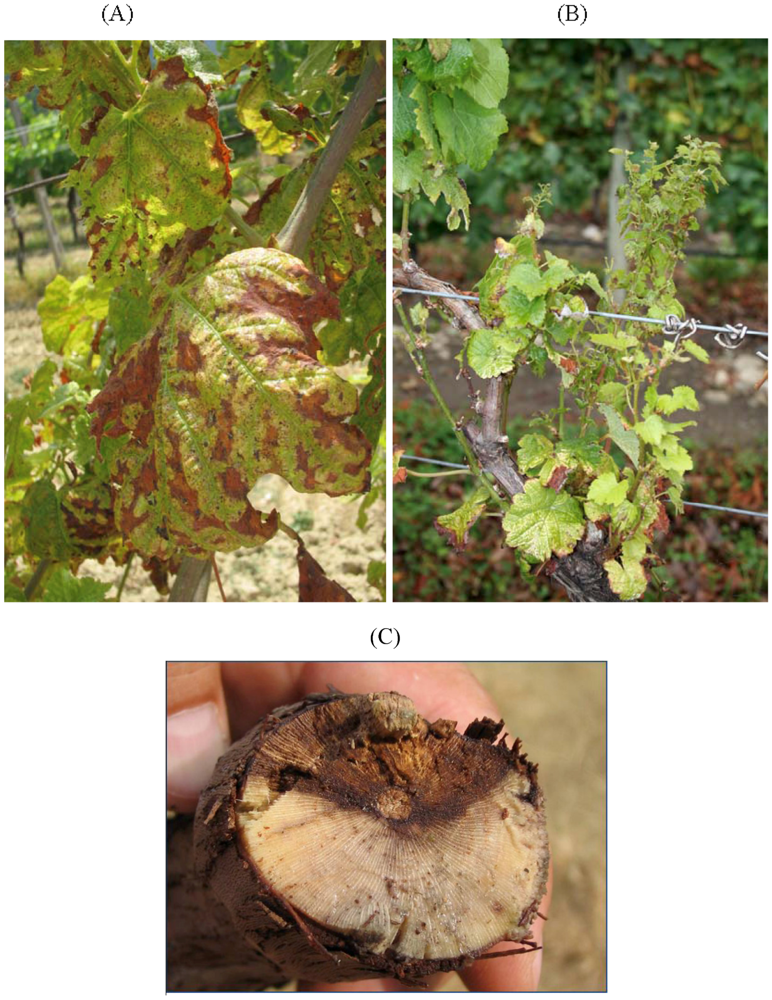
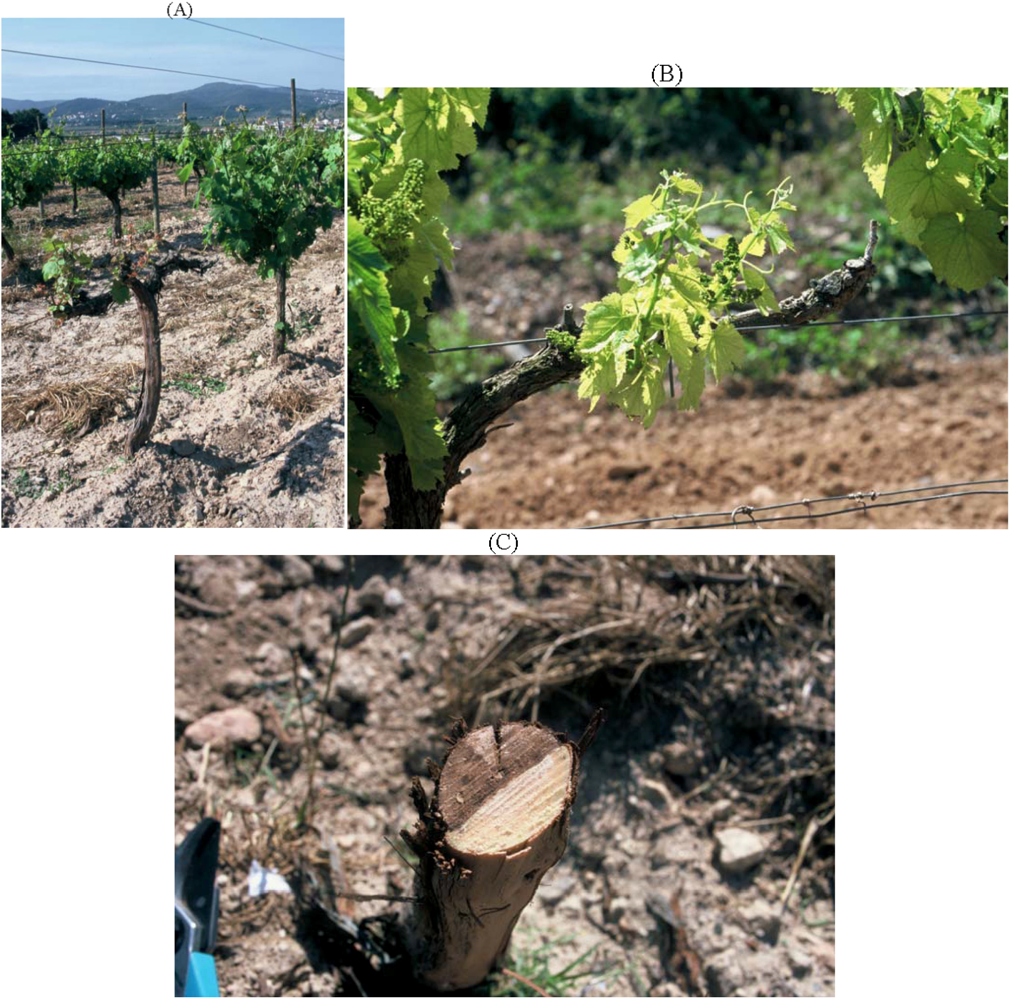
      <p><italic>Eutypa lata</italic> causes Eutypa dieback, a serious disease that has been known for over 60 years. It causes losses in older vineyards. Its most recognised symptoms are: stunting of new shoots early in the growing season, small, cupped, chlorotic and tattered leaves, and short internodes (<xref ref-type="fig" rid="toxins-03-01569-f001">Figure 1</xref>A,B). Internal wood symptoms when arms and trunks are cross-sectioned include characteristic V-shaped necrosis (<xref ref-type="fig" rid="toxins-03-01569-f001">Figure 1</xref>C). External cankers developing from old pruning wounds also occur [<xref ref-type="bibr" rid="B1-toxins-03-01569">1</xref>,<xref ref-type="bibr" rid="B23-toxins-03-01569">23</xref>]. </p>
      <fig id="toxins-03-01569-f001" position="anchor">
        <label>Figure 1</label>
        <caption>
          <p>Symptoms of Eutypa dieback in (<bold>A</bold>) vine leaves and (<bold>B</bold>) new vine shoots; (<bold>C</bold>) Characteristic V-shaped necrosis of a vine trunk.</p>
        </caption>
        <graphic xmlns:xlink="http://www.w3.org/1999/xlink" xlink:href="toxins-03-01569-g001.tif"/>
      </fig>
      <sec>
        <title>2.1. Toxins Produced by <italic>Eutypa lata</italic></title>
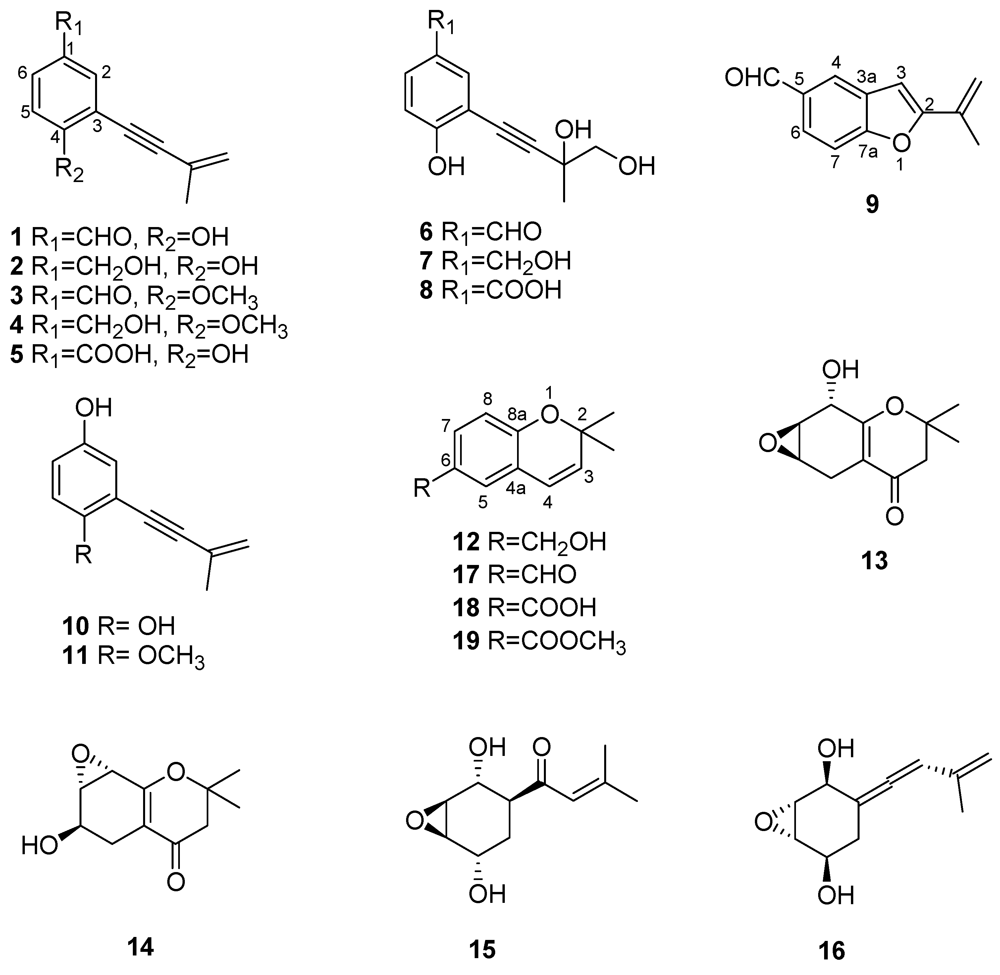
        <p><italic>Eutypa lata</italic> produces a number of structurally related secondary metabolites, mainly acetylenic phenols and their heterocyclic analogues. Eutypine (<bold>1</bold>, <xref ref-type="fig" rid="toxins-03-01569-f002">Figure 2</xref>), or 4-hydroxy-3-(3-methylbut-3-ene-1-ynyl)-benzaldehyde, is the most toxic. It was isolated from the cultures of an unspecified strain of <italic>E. lata</italic> and characterised [<xref ref-type="bibr" rid="B24-toxins-03-01569">24</xref>,<xref ref-type="bibr" rid="B25-toxins-03-01569">25</xref>]. It has an unusual five-carbon acetylenic side chain. Some other, structurally related metabolites were isolated from organic extracts of the same fungal culture such as eutypinol, <italic>O</italic>-methyleutypin, <italic>O</italic>-methyleutypinol, eutypin carboxylic acid analogue (<bold>2-5</bold>, <xref ref-type="fig" rid="toxins-03-01569-f002">Figure 2</xref>), as well as the compounds produced by hydroxylation of the terminal vinyl group of eutypine, eutypinol and the carboxylic anologue (<bold>6-8</bold>, <xref ref-type="fig" rid="toxins-03-01569-f002">Figure 2</xref>) [<xref ref-type="bibr" rid="B25-toxins-03-01569">25</xref>,<xref ref-type="bibr" rid="B26-toxins-03-01569">26</xref>,<xref ref-type="bibr" rid="B27-toxins-03-01569">27</xref>]. Under low acidic conditions, eutypine is converted into 2-<italic>iso</italic>-propenyl-5-formylbenzofuran (<bold>9</bold>, <xref ref-type="fig" rid="toxins-03-01569-f002">Figure 2</xref>). This bicyclic product was also detected in <italic>E. lata</italic> culture filtrates [<xref ref-type="bibr" rid="B26-toxins-03-01569">26</xref>].</p>
        <fig id="toxins-03-01569-f002" position="anchor">
          <label>Figure 2</label>
          <caption>
            <p>Chemical structures of <italic>Eutypa lata</italic> metabolites and derivatives: eutypine, eutypinol, <italic>O</italic>-methyleutypine, <italic>O</italic>-methyleutypinol, eutypin carboxylic acid analogue (<bold>1-5</bold>), 3-(3,4-dihydroxy-3-methyl-1-butynyl)-4-hydroxy-benzaldehyde, 2-(3,4-dihydroxy-3-methyl-1-butynyl)-4-hydroxymethyl-phenol, 3-(3,4-dihydroxy-3-methyl-1-butynyl)-4-hydroxy-benzoic acid (<bold>6-8</bold>), 2-<italic>iso</italic>-propenyl-5-formylbenzofuran, siccayne, eulatinol (<bold>9-11</bold>), eulatachromene and its derivatives (<bold>12 and 17-19</bold>), epoxidised chromanones (<bold>13-14</bold>), eutypoxide B and allenic epoxycyclohexane (<bold>15-16</bold>). </p>
          </caption>
          <graphic xmlns:xlink="http://www.w3.org/1999/xlink" xlink:href="toxins-03-01569-g002.tif"/>
        </fig>
        <p>Biological assays on excised tomato plants and vine leaves have shown that of all these metabolites eutypine is the most phytotoxic [<xref ref-type="bibr" rid="B26-toxins-03-01569">26</xref>]. A comparative study was carried out on the metabolites from three strains of <italic>E. lata</italic>: strain E120 from grapevine in California, strain E125 from grapevine in Italy, and isolate E178 from oak in California. The metabolites were grown on malt yeast broth (MYB) and on potato dextrose broth (PDB) [<xref ref-type="bibr" rid="B27-toxins-03-01569">27</xref>]. Eutypine, occurred in only one of the strains but the main metabolite was eutypinol, which is a detoxification product of <bold>1</bold> (<xref ref-type="fig" rid="toxins-03-01569-f002">Figure 2</xref>) [<xref ref-type="bibr" rid="B27-toxins-03-01569">27</xref>]. A novel metabolite, named eulatinol (<bold>11</bold>, <xref ref-type="fig" rid="toxins-03-01569-f002">Figure 2</xref>) was isolated from the Italian strain E125, together with its <italic>O</italic>-demethyl derivate, siccayene (<bold>10</bold>, <xref ref-type="fig" rid="toxins-03-01569-f002">Figure 2</xref>). The chromene analogue, 6-hydroxymethyl-2,2-dimethyl-2H-chromene, named eulatachromene (<bold>12</bold>, <xref ref-type="fig" rid="toxins-03-01569-f002">Figure 2</xref>) as well as <bold>1</bold> and <bold>2</bold> (<xref ref-type="fig" rid="toxins-03-01569-f002">Figure 2</xref>) were isolated from the California strain E120 [<xref ref-type="bibr" rid="B18-toxins-03-01569">18</xref>]. As previously reported, eutypine was readily cyclised into benzofuran (<bold>9</bold>, <xref ref-type="fig" rid="toxins-03-01569-f002">Figure 2</xref>) in the presence of traces of acid, and eutypinol was the main metabolite under most culture conditions [<xref ref-type="bibr" rid="B27-toxins-03-01569">27</xref>].</p>
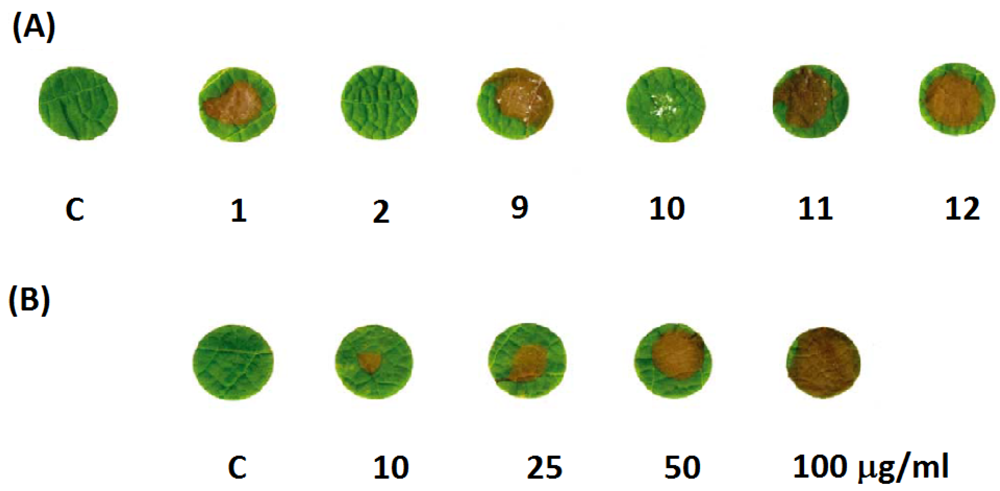
        <p>The phytotoxicity of <italic>E. lata</italic> metabolites was tested in a leaf disk bioassay on “<italic>Cabernet Sauvignon</italic>” leaves (<xref ref-type="fig" rid="toxins-03-01569-f003">Figure 3</xref>A) [<xref ref-type="bibr" rid="B28-toxins-03-01569">28</xref>]. Activity at 50 μg/mL of metabolites <bold>1, 2, and 9-12</bold> (<xref ref-type="fig" rid="toxins-03-01569-f002">Figure 2</xref>) indicated that neither eutypinol nor siccayne were phytotoxic; while eutypine, benzofuran, eulatinol, and eulatacromene (<bold>1, 9, 11 and 12</bold>, <xref ref-type="fig" rid="toxins-03-01569-f002">Figure 2</xref>) had a toxic effect, producing necrotic spots on the leaves (<xref ref-type="fig" rid="toxins-03-01569-f003">Figure 3</xref>A). Eulatacromene and benzofuran were more toxic than the acetylenic phenols. However eulatachromene (<bold>12</bold>, <xref ref-type="fig" rid="toxins-03-01569-f002">Figure 2</xref>) was also examined for toxicity at various concentrations from 10 to 100 μg/mL. At its lowest concentration, <bold>12</bold> (<xref ref-type="fig" rid="toxins-03-01569-f002">Figure 2</xref>) caused necrosis on some disks, and at its highest concentration it caused necrosis on all disks (<xref ref-type="fig" rid="toxins-03-01569-f003">Figure 3</xref>B) [<xref ref-type="bibr" rid="B28-toxins-03-01569">28</xref>].</p>
        <p>Two highly oxygenated cyclohexene oxides were also isolated from <italic>E. lata</italic>: eutypoxide B [<xref ref-type="bibr" rid="B29-toxins-03-01569">29</xref>] and the novel allenic epoxycyclohexane (<bold>13 and 14</bold>, <xref ref-type="fig" rid="toxins-03-01569-f002">Figure 2</xref>) [<xref ref-type="bibr" rid="B25-toxins-03-01569">25</xref>]. </p>
        <fig id="toxins-03-01569-f003" position="anchor">
          <label>Figure 3</label>
          <caption>
            <p>(A) Comparison, after 24 h and at 50 μg/mL, of the toxicity of the methanol control (C) and of the primary metabolites eutypine <bold>1</bold>, eutypinol <bold>2</bold>, 2-<italic>iso</italic>-propenyl-5-formylbenzofuran <bold>9</bold>, siccayene <bold>10</bold>, eulatinol <bold>11</bold>, and eulatachromene <bold>12</bold>, in a grape leaf bioassay; (<bold>B</bold>) comparison, after 24 h and at 10, 25, 50 and 100 μg/mL, of phytotoxicity of the methanol control (<bold>C</bold>) and eulatachromene (<bold>12</bold>) (redrawn with modifications from <xref ref-type="fig" rid="toxins-03-01569-f005">Figure 5</xref> in [<xref ref-type="bibr" rid="B28-toxins-03-01569">28</xref>]).</p>
          </caption>
          <graphic xmlns:xlink="http://www.w3.org/1999/xlink" xlink:href="toxins-03-01569-g003.tif"/>
        </fig>
        <p>To elucidate the biochemistry of <italic>E. lata</italic>, both its sterol composition and its total sterol content were investigated in solid and in liquid culture [<xref ref-type="bibr" rid="B30-toxins-03-01569">30</xref>]. The total amount of sterols was 1.58 and 1.12 μg/mg dry weight mycelium in solid and liquid cultures respectively. The major sterol was identified as ergosterol. This accounted for 88% of the total sterols in a solid medium and 78% when the fungus was grown in a liquid medium. In addition to ergosterol, four minor sterols, ergosta-5,7,9(11),22-tetraen-3β-ol, ergosta-7,22-dien-3β-ol, fecosterol and episterol also occurred. They accounted for 1-4% and 1.8-13% in solid and liquid culture respectively. These results suggest that the sterol biosynthesis pathway of <italic>E. lata</italic> is very similar to that of other pathogenic filamentous fungi [<xref ref-type="bibr" rid="B30-toxins-03-01569">30</xref>].</p>
      </sec>
      <sec>
        <title>2.2. Structure-Toxicity Relationship Studies</title>
        <p>Preliminary studies on the structure-toxicity relationship, carried out on the acetylenic phenols, showed that the occurrence of the aldehydic group and a free OH group in <italic>para</italic>-position were important for phytotoxic activity [<xref ref-type="bibr" rid="B26-toxins-03-01569">26</xref>]. </p>
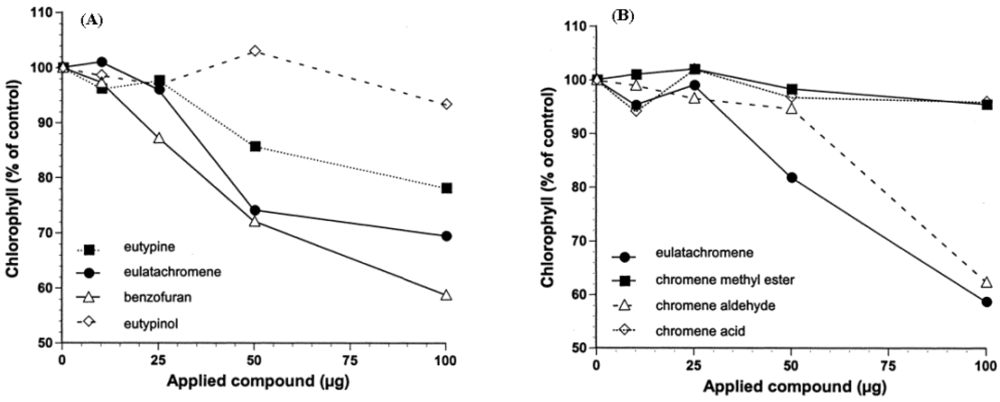
        <p>Smith <italic>et al.</italic> [<xref ref-type="bibr" rid="B31-toxins-03-01569">31</xref>] in their study of the structure-phytotoxicity relationships compared the activity of metabolites from various strains of <italic>E. lata</italic> and from their chromene analogues, such as the corresponding aldehyde, acid and methyl esters (<bold>17-19</bold>, <xref ref-type="fig" rid="toxins-03-01569-f002">Figure 2</xref>) [<xref ref-type="bibr" rid="B31-toxins-03-01569">31</xref>]. They synthesised the chromene analogue in quantities sufficient for evaluation, and carried out a rapid quantitative bioassay, involving the topical application of individual compounds to culture disks of grape leaves with subsequent measurement of chlorophyll loss to measure tissue damage (<xref ref-type="fig" rid="toxins-03-01569-f004">Figure 4</xref>A,B) [<xref ref-type="bibr" rid="B31-toxins-03-01569">31</xref>]. In this assay, eulatachromene was more phytotoxic than eutypine (<xref ref-type="fig" rid="toxins-03-01569-f004">Figure 4</xref>A). The bicyclic product <bold>9</bold> (<xref ref-type="fig" rid="toxins-03-01569-f002">Figure 2</xref>) was also quite toxic, while the reduction product eutypinol, as well as the quinol siccayne (<xref ref-type="fig" rid="toxins-03-01569-f004">Figure 4</xref>A), were not toxic [<xref ref-type="bibr" rid="B31-toxins-03-01569">31</xref>]. When eulatachromene was compared with its three synthetic analogues <bold>17-19</bold> (<xref ref-type="fig" rid="toxins-03-01569-f002">Figure 2</xref>) only the corresponding aldehyde <bold>17</bold> (<xref ref-type="fig" rid="toxins-03-01569-f002">Figure 2</xref>) had a toxicity similar to <bold>12</bold> (<xref ref-type="fig" rid="toxins-03-01569-f002">Figure 2</xref>), while <bold>18 and 19</bold> (<xref ref-type="fig" rid="toxins-03-01569-f002">Figure 2</xref>) were not toxic (<xref ref-type="fig" rid="toxins-03-01569-f004">Figure 4</xref>B) [<xref ref-type="bibr" rid="B31-toxins-03-01569">31</xref>]. Consequently the active chromenes <bold>12</bold> and <bold>17</bold>, along with benzofuran <bold>9</bold> (<xref ref-type="fig" rid="toxins-03-01569-f002">Figure 2</xref>), were more toxic than eutypine and eutypinol [<xref ref-type="bibr" rid="B31-toxins-03-01569">31</xref>]. </p>
        <fig id="toxins-03-01569-f004" position="anchor">
          <label>Figure 4</label>
          <caption>
            <p>Toxicity of metabolites of <italic>Eutypa lata</italic> and their synthetic analogues measured in the grapeleaf disk bioassay as a per-cent reduction in chlorophyll relative to the control. (A) <italic>E. lata</italic> metabolites eutypine, eutypinol, 2-<italic>iso</italic>-propenyl-5-formylbenzofuran, siccayne and eulatachromene (<bold>1, 2, 9, 10 and 12</bold>, <xref ref-type="fig" rid="toxins-03-01569-f002">Figure 2</xref>). (B) Eulatachromene and its synthetic analogues 6-carboxymethylchromene, 6-formylchromene, and 6-carboxychromene (<bold>12, 17-19</bold>, <xref ref-type="fig" rid="toxins-03-01569-f002">Figure 2</xref>) (redrawn with modifications from <xref ref-type="fig" rid="toxins-03-01569-f005">Figure 5</xref> in [<xref ref-type="bibr" rid="B31-toxins-03-01569">31</xref>]).</p>
          </caption>
          <graphic xmlns:xlink="http://www.w3.org/1999/xlink" xlink:href="toxins-03-01569-g004.tif"/>
        </fig>
      </sec>
      <sec>
        <title>2.3. Mechanism of Action of <italic>Eutypa lata</italic> Toxins</title>
        <p>The biological action of eutypine (<bold>1</bold>, <xref ref-type="fig" rid="toxins-03-01569-f002">Figure 2</xref>) in grapevines has been extensively studied [<xref ref-type="bibr" rid="B32-toxins-03-01569">32</xref>]. Eutypine is synthesised by the fungus in the trunk and is thought to be transported by the sap to the herbaceous parts of the plant, where it spreads through the leaves and inflorescences to participate in the expression of disease symptoms [<xref ref-type="bibr" rid="B33-toxins-03-01569">33</xref>]. Eutypine has weak acid properties and a marked lipophilic character. It penetrates the vine cells by passive diffusion and accumulates in the cytoplasm due to an ion-trapping mechanism related to the ionisation state of the compound [<xref ref-type="bibr" rid="B33-toxins-03-01569">33</xref>]. In this case the experiments were carried out on the plasmalemma of three models: <italic>V. vinifera</italic>, <italic>Beta vulgaris</italic> and <italic>Minosa pudica</italic>. These biological models were suitable for particular physiological processes. The observations obtained from these studies showed that eutypine was unspecific since it indifferently acted on all three plant cell models used [<xref ref-type="bibr" rid="B33-toxins-03-01569">33</xref>] (<xref ref-type="table" rid="toxins-03-01569-t001">Table 1</xref>).</p>
        <table-wrap id="toxins-03-01569-t001" position="anchor">
          <object-id pub-id-type="pii">toxins-03-01569-t001_Table 1</object-id>
          <label>Table 1</label>
          <caption>
            <p>Metabolites isolated from <italic>Eutypa lata</italic> and phytotoxicity assays.</p>
          </caption>
          <table>
            <thead>
              <tr>
                <th align="left" valign="middle">Metabolite (<xref ref-type="fig" rid="toxins-03-01569-f002">Figure 2</xref>)</th>
                <th align="left" valign="middle">Plant matrix used for phytotoxicity assays</th>
                <th align="left" valign="middle">References</th>
              </tr>
            </thead>
            <tbody>
              <tr>
                <td align="left" valign="middle">Eutypine (<bold>1</bold>)</td>
                <td align="left" valign="middle">Grapevine leaves, tomato leaves, grapevine, mimosa and sugar beet membranes, mitochondria</td>
                <td align="center" valign="middle">[<xref ref-type="bibr" rid="B26-toxins-03-01569">26</xref>,<xref ref-type="bibr" rid="B27-toxins-03-01569">27</xref>,<xref ref-type="bibr" rid="B28-toxins-03-01569">28</xref>,<xref ref-type="bibr" rid="B31-toxins-03-01569">31</xref>,<xref ref-type="bibr" rid="B31-toxins-03-01569">33</xref>,<xref ref-type="bibr" rid="B34-toxins-03-01569">34</xref>,<xref ref-type="bibr" rid="B35-toxins-03-01569">35</xref>]</td>
              </tr>
              <tr>
                <td align="left" valign="middle">Eutypinol (<bold>2</bold>)</td>
                <td align="left" valign="middle">Grapevine and tomato leaves</td>
                <td align="center" valign="middle">[<xref ref-type="bibr" rid="B26-toxins-03-01569">26</xref>,<xref ref-type="bibr" rid="B27-toxins-03-01569">27</xref>,<xref ref-type="bibr" rid="B28-toxins-03-01569">28</xref>,<xref ref-type="bibr" rid="B31-toxins-03-01569">31</xref>]</td>
              </tr>
              <tr>
                <td align="left" valign="middle"><italic>O</italic>-Methyleutypine (<bold>3</bold>)</td>
                <td align="left" valign="middle">Grapevine and tomato leaves, mitochondria</td>
                <td align="center" valign="middle">[<xref ref-type="bibr" rid="B26-toxins-03-01569">26</xref>,<xref ref-type="bibr" rid="B34-toxins-03-01569">34</xref>,<xref ref-type="bibr" rid="B35-toxins-03-01569">35</xref>,<xref ref-type="bibr" rid="B36-toxins-03-01569">36</xref>]</td>
              </tr>
              <tr>
                <td align="left" valign="middle"><italic>O</italic>-Methyleutypinol (<bold>4</bold>)</td>
                <td align="left" valign="middle">Grapevine leaves, tomato leaves</td>
                <td align="center" valign="middle">[<xref ref-type="bibr" rid="B26-toxins-03-01569">26</xref>]</td>
              </tr>
              <tr>
                <td align="left" valign="middle">Eutypin carboxylic acid anologue (<bold>5</bold>)</td>
                <td align="left" valign="middle">Grapevine leaves, tomato leaves</td>
                <td align="center" valign="middle">[<xref ref-type="bibr" rid="B26-toxins-03-01569">26</xref>]</td>
              </tr>
              <tr>
                <td align="left" valign="middle">3-(3,4-Dihydroxy-3-methyl-1-butynyl)-4-hydroxy-benzaldehyde (<bold>6</bold>)</td>
                <td align="left" valign="middle">Grapevine leaves, tomato leaves</td>
                <td align="center" valign="middle">[<xref ref-type="bibr" rid="B26-toxins-03-01569">26</xref>]</td>
              </tr>
              <tr>
                <td align="left" valign="middle">2-(3,4-Dihydroxy-3-methyl-1-butynyl)-4-hydroxymethyl-phenol (<bold>7</bold>)</td>
                <td align="left" valign="middle">Grapevine and tomato leaves</td>
                <td align="center" valign="middle">[<xref ref-type="bibr" rid="B26-toxins-03-01569">26</xref>]</td>
              </tr>
              <tr>
                <td align="left" valign="middle">3-(3,4-Dihydroxy-3-methyl-1-butynyl)-4-hydroxy-benzoic acid (<bold>8</bold>)</td>
                <td align="left" valign="middle">Grapevine leaves, tomato leaves</td>
                <td align="center" valign="middle">[<xref ref-type="bibr" rid="B26-toxins-03-01569">26</xref>]</td>
              </tr>
              <tr>
                <td align="left" valign="middle">2-<italic>iso</italic>-Propenyl-5-formylbenzofuran (<bold>9</bold>)</td>
                <td align="left" valign="middle">Grapevine and tomato leaves</td>
                <td align="center" valign="middle">[<xref ref-type="bibr" rid="B26-toxins-03-01569">26</xref>,<xref ref-type="bibr" rid="B28-toxins-03-01569">28</xref>,<xref ref-type="bibr" rid="B31-toxins-03-01569">31</xref>]</td>
              </tr>
              <tr>
                <td align="left" valign="middle">Siccayne (<bold>10</bold>)</td>
                <td align="left" valign="middle">Grapevine leaves</td>
                <td align="center" valign="middle">[<xref ref-type="bibr" rid="B28-toxins-03-01569">28</xref>,<xref ref-type="bibr" rid="B31-toxins-03-01569">31</xref>]</td>
              </tr>
              <tr>
                <td align="left" valign="middle">Eulatinol (<bold>11</bold>)</td>
                <td align="left" valign="middle">Grapevine leaves</td>
                <td align="center" valign="middle">[<xref ref-type="bibr" rid="B28-toxins-03-01569">28</xref>]</td>
              </tr>
              <tr>
                <td align="left" valign="middle">Eulatachromene (<bold>12</bold>)</td>
                <td align="left" valign="middle">Grapevine leaves</td>
                <td align="center" valign="middle">[<xref ref-type="bibr" rid="B28-toxins-03-01569">28</xref>,<xref ref-type="bibr" rid="B31-toxins-03-01569">31</xref>]</td>
              </tr>
              <tr>
                <td align="left" valign="middle">Epoxidised chromanones (<bold>13, 14</bold>)</td>
                <td align="left" valign="middle">Grapevine leaves</td>
                <td align="center" valign="middle">[<xref ref-type="bibr" rid="B26-toxins-03-01569">26</xref>]</td>
              </tr>
              <tr>
                <td align="left" valign="middle">Eutypoxide B (<bold>15</bold>)</td>
                <td align="left" valign="middle">Grapevine leaves</td>
                <td align="center" valign="middle">[<xref ref-type="bibr" rid="B29-toxins-03-01569">29</xref>]</td>
              </tr>
              <tr>
                <td align="left" valign="middle">Allenic epoxycyclohexane (<bold>16</bold>)</td>
                <td align="left" valign="middle">Grapevine leaves</td>
                <td align="center" valign="middle">[<xref ref-type="bibr" rid="B29-toxins-03-01569">29</xref>]</td>
              </tr>
            </tbody>
          </table>
        </table-wrap>
        <p>That eutypine targets the mitochondria is suggested by the fact that it modifies the rate of respiration of the grapevine cell and its energy balance [<xref ref-type="bibr" rid="B34-toxins-03-01569">34</xref>,<xref ref-type="bibr" rid="B35-toxins-03-01569">35</xref>,<xref ref-type="bibr" rid="B36-toxins-03-01569">36</xref>].</p>
        <p>The molecular mode of action of eutypine at the mitochondrial level, and of <italic>O</italic>-methyleutypine (<bold>3</bold>, <xref ref-type="fig" rid="toxins-03-01569-f002">Figure 2</xref>), the non-deprotonatable derivative of <bold>1</bold> (<xref ref-type="fig" rid="toxins-03-01569-f002">Figure 2</xref>), was investigated [<xref ref-type="bibr" rid="B34-toxins-03-01569">34</xref>]. The effects of these molecules on mitochondrial respiration and on the membrane potential were compared using isolated mitochondria from grapevine cells in suspension cultures. Eutypine caused marked stimulation of oxygen consumption and had a depolarising effect, while methyleutypine had a very slight effect on both the rate of oxygen uptake and membrane potential. High eutypine concentrations had a mixed effect, with a direct inhibition of electron transport and uncoupling. At concentrations below 200 mM, eutypine displayed a linear relationship between the oxidation rate and the membrane potential, similar to that of the traditional protonophore carbonyl cyanide <italic>m-</italic>chlorophenylhydrazone (CCCP). But unlike CCCP, eutypine induced a potential-dependent proton conductance, which was probably due to a potential-dependent migration of the dissociated form of the toxin across the membrane. It was thus concluded that eutypine uncouples mitochondrial oxidative phosphorylation and decreases the ADP/O ratio in grapevine cells by increasing proton leaks, which it accomplishes by means of a cyclic protonophore mechanism [<xref ref-type="bibr" rid="B35-toxins-03-01569">35</xref>,<xref ref-type="bibr" rid="B36-toxins-03-01569">36</xref>].</p>
        <p>A further study of five mutant strains of <italic>Saccharomyces cerevisiae</italic> showed that eutypinol and eulatachromene (<bold>2 and 12</bold>, <xref ref-type="fig" rid="toxins-03-01569-f002">Figure 2</xref>) inhibited mitochondrial respiration in wild-type yeast, and that 2-<italic>iso</italic>-prenyl-5-formyl-benzofuran and siccayne (<bold>9 and 10</bold>, <xref ref-type="fig" rid="toxins-03-01569-f002">Figure 2</xref>) inhibited respiration in the strain lacking in mitochondrial respiration and vacuolar acidification. These effects of eutypinol and eulatachromene were confirmed using a strain with mitochondrial dysfunction and hypersensitivity to oxidative stress [<xref ref-type="bibr" rid="B32-toxins-03-01569">32</xref>]. This study was not conducted on grapevine cells (<xref ref-type="table" rid="toxins-03-01569-t001">Table 1</xref>).</p>
      </sec>
      <sec>
        <title>2.4. <italic>Eutyta lata</italic> Toxins as Virulence Factors</title>
        <p><italic>Eutypa lata</italic> toxins are non-specific and appear to be important virulence factors in causing the symptoms of Eutypa dieback [<xref ref-type="bibr" rid="B35-toxins-03-01569">35</xref>]. However, a lack of toxin-deficient mutants of the fungus, as well as the long time the fungus needs to incubate in the trunk before symptoms appeared, prevented a much-needed critical study of these toxins in grapevine. Nevertheless, it was confirmed that eutypine in grapevine cells is metabolised into the corresponding alcohol, eutypinol (<bold>2</bold>, <xref ref-type="fig" rid="toxins-03-01569-f002">Figure 2</xref>), through the enzymatic reduction of eutypine by a NADPH-dependent enzyme [<xref ref-type="bibr" rid="B37-toxins-03-01569">37</xref>,<xref ref-type="bibr" rid="B38-toxins-03-01569">38</xref>]. Eutypinol was not toxic to grapevine and had no protonophoric activity. The high affinity of the eutypine reductase enzyme (ERE) for eutypine indicated that ERE may play an important role in the detoxification of eutypine. It was also found that eutypinol did not have any uncoupling activity in the mitochondria [<xref ref-type="bibr" rid="B39-toxins-03-01569">39</xref>] unlike what was seen with <italic>S. cerevisiae</italic> [<xref ref-type="bibr" rid="B32-toxins-03-01569">32</xref>]. When the detoxification of leaf tissue by two genotypes of <italic>V. vinifera</italic> is compared, there seems to be a relationship between the susceptibility of vine cultivars to Eutypa dieback and the degree to which these vines deactivate eutypine [<xref ref-type="bibr" rid="B40-toxins-03-01569">40</xref>]. Novel NADPH-dependent aldehyde reductase genes conferring resistance to eutypine have been reported from <italic>Vigna radiata</italic> [<xref ref-type="bibr" rid="B40-toxins-03-01569">40</xref>,<xref ref-type="bibr" rid="B41-toxins-03-01569">41</xref>]. This suggests that detoxification enhances the resistance of the vines to the toxin [<xref ref-type="bibr" rid="B39-toxins-03-01569">39</xref>].</p>
      </sec>
      <sec>
        <title>2.5. Analytical Detection of <italic>Eutypa lata</italic> Toxins <italic>in Vitro</italic> and <italic>in Planta</italic></title>
        <p><italic>Eutypa lata</italic> synthesises a variety of metabolites, whose role in causing dieback is quite unclear. This role needs to be elucidated before any attempt can be made to apply these metabolites in order to diagnose <italic>E. lata</italic> dieback. Some studies have been carried out to determine the best growing conditions for <italic>E. lata</italic>, and to optimise its production of toxic metabolites in an artificial environment, especially on grapevine wood and wood extracts. Molyneux <italic>et al</italic>. [<xref ref-type="bibr" rid="B27-toxins-03-01569">27</xref>] studied <italic>in vitro</italic> variations in the metabolite production of three <italic>E. lata</italic> isolates, using two growth media [malt yeast broth (MYB) and potato dextrose broth (PDB)], and a longer term, than previously reported. These researchers examined three representative strains of <italic>E. lata</italic>, two from grapevine (E120 and E125), and one strain from oak in California, to serve as a representative non-grapevine host species (E178). Metabolite composition and yield differed significantly between strains and between growth media, but yield usually peaked after 24-30 days [<xref ref-type="bibr" rid="B27-toxins-03-01569">27</xref>]. Metabolites were identified by gas chromatography/mass spectrometry of their trimethylsilyl ether derivatives and analysed. This method proved to be generally applicable to all the metabolites subsequently isolated, with the trimethylsilyl derivatives well resolved [<xref ref-type="bibr" rid="B27-toxins-03-01569">27</xref>]. Eutypine, eutypinol, siccayene and eulatinol (<bold>1, 2, 10, 11</bold>, <xref ref-type="fig" rid="toxins-03-01569-f002">Figure 2</xref>) were quantified by high-performance liquid chromatography (HPLC) in the three strains on MYB and PDB. Eutypine (<bold>1</bold>) was detected in only one of the strains (E125) on both media. The primary metabolite was the detoxification product eutypinol (<bold>2</bold>). This metabolite was produced in large quantities by one of the strains grown on PDB, but it was detected in all strains [<xref ref-type="bibr" rid="B18-toxins-03-01569">18</xref>]. Strain E178 from oak did not produce these metabolites [<xref ref-type="bibr" rid="B27-toxins-03-01569">27</xref>].</p>
        <p>Subsequently, the HPLC procedure was optimised to establish the phenolic metabolite profiles of eleven <italic>E. lata</italic> strains grown on four growth media and to determine how the growth of these strains in these media differed from their growth on “<italic>Cabernet Sauvignon</italic>” vine wood and wood extracts [<xref ref-type="bibr" rid="B28-toxins-03-01569">28</xref>]. The same technique was used to evaluate secondary metabolite production of 30 isolates of <italic>E. lata</italic> grown on media derived from the canes of three grapevine cultivars, two of which (Merlot and Semillom) were tolerant to <italic>E. lata</italic>, and one (Shiraz) susceptible [<xref ref-type="bibr" rid="B10-toxins-03-01569">10</xref>]. Eutypine, eutypinol, <italic>O</italic>-methyl-eutypinol, 2-<italic>iso</italic>-propenyl-5-formylbenzofuran, eulatinol and eulatachromene (<bold>1, 2, 4, 9, 11 and 12</bold>, <xref ref-type="fig" rid="toxins-03-01569-f002">Figure 2</xref>) were detected in all culture filtrates. The most abundant metabolites were eutypinol and <italic>O</italic>-methyl-eutypinol, which were produced by 97 and 83% of isolates respectively. No correlation was found between secondary metabolite levels in the media containing ground canes from the three grapevine cultivars, and the tolerance/susceptibility of these cultivars to Eutypa dieback. In addition, no secondary metabolites of <italic>E. lata</italic> were detected from any isolates of other fungi commonly isolated from grapevine trunks in Australia such as <italic>Cryptovalsa ampelina</italic>, <italic>Libertella</italic> sp., <italic>Pa. chlamydospora</italic>, <italic>Pm. aleophilum</italic>, and various species of Botryosphaeriaceae and <italic>Fomitiporia</italic> that were grown on ground canes. This suggests that these metabolites are specific to <italic>E. lata</italic> [<xref ref-type="bibr" rid="B10-toxins-03-01569">10</xref>]. To detect the secondary metabolites <italic>in planta</italic>, micropropagated grapevine plantlets were treated with purified and crude culture filtrates of nine <italic>E. lata</italic> isolates grown on MYB. The secondary metabolites 1, 2, 4, 9, 11 and 12 (<xref ref-type="fig" rid="toxins-03-01569-f002">Figure 2</xref>) were identified in some of the treated plantlets, but no single metabolite was detected consistently in all plantlets. Eutypinol was detected in micropropagated grapevine plantlets inoculated with <italic>E. lata</italic> mycelium; however, no metabolites were detected in the sap of plotted vines that had been mechanically inoculated with the pathogen [<xref ref-type="bibr" rid="B10-toxins-03-01569">10</xref>]. </p>
        <p>As mentioned above, eutypinol is not toxic when applied to grapevine leaf disks [<xref ref-type="bibr" rid="B19-toxins-03-01569">19</xref>,<xref ref-type="bibr" rid="B23-toxins-03-01569">23</xref>]. However, this lack of toxicity does not preclude the use of this metabolite as a chemical marker, since the pathogenicity of <italic>E. lata</italic> is not due solely to the phenolic metabolites it produces, but also to the fact that it colonises grapevine wood and degrades the xylem. Consequently, whenever a non-toxic metabolite of <italic>E. lata</italic> such as eutypinol is detected in a vine, it is a positive indication of the occurrence of <italic>E. lata</italic> itself [<xref ref-type="bibr" rid="B28-toxins-03-01569">28</xref>]. </p>
        <p>DNA-based markers to identify <italic>E. lata</italic> in infected vine wood have been developed [<xref ref-type="bibr" rid="B42-toxins-03-01569">42</xref>,<xref ref-type="bibr" rid="B43-toxins-03-01569">43</xref>]. Although identification techniques based on DNA analysis are sensitive enough, they are destructive and the particular vine portion sampled must actually contain <italic>E. lata</italic>; if healthy tissues from an infected vine are sampled, a false negative reading may result. However, the metabolites of <italic>E. lata</italic> are likely to be distributed throughout the vascular tissue and foliage of infected vines, especially in spring when the foliar symptoms are most evident. A diagnosis based on identifying such specific metabolites of <italic>E. lata in planta</italic> can therefore be carried out early in the season, even before the pathogen itself has spread throughout the vine. False negatives are in any case possible since foliar symptoms, and hence also toxin translocation, fluctuate from year to year on infected spurs or branches, as is common in leaf stripe disease [<xref ref-type="bibr" rid="B44-toxins-03-01569">44</xref>].</p>
      </sec>
    </sec>
    <sec>
      <title>3. Esca, A Complex of Diseases</title>
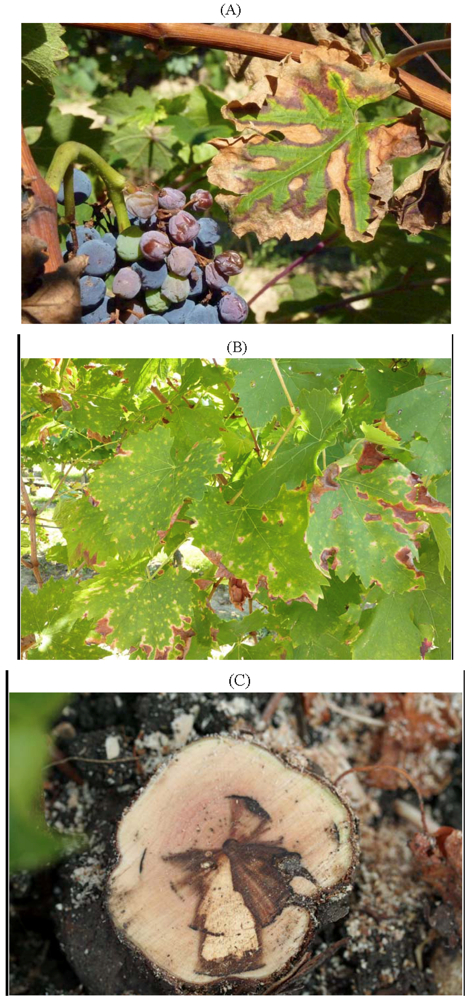
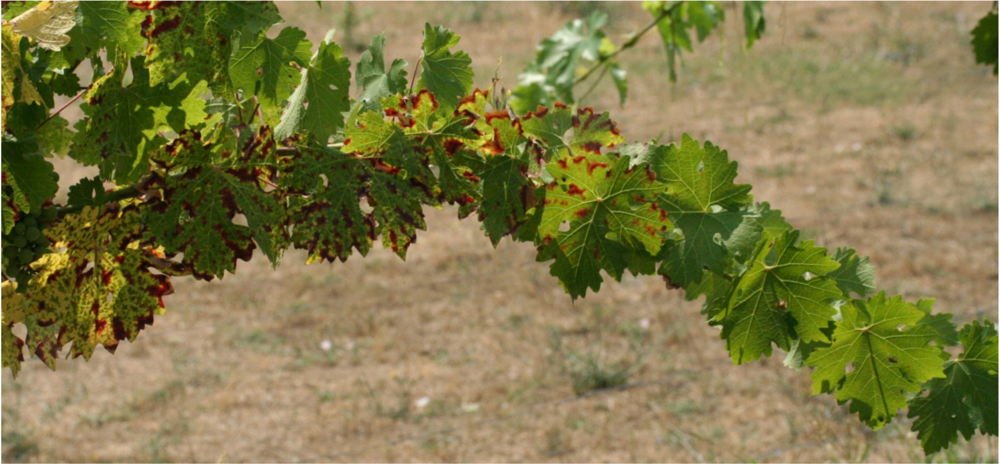
      <p>The term esca complex was introduced at the end of the last century [<xref ref-type="bibr" rid="B45-toxins-03-01569">45</xref>,<xref ref-type="bibr" rid="B46-toxins-03-01569">46</xref>] and has more recently been redefined. The esca complex is a complex of two diseases, which may co-occur in the same vine: a wood rot (also called esca, in its redefined sense), and a vascular disease [<xref ref-type="bibr" rid="B2-toxins-03-01569">2</xref>,<xref ref-type="bibr" rid="B47-toxins-03-01569">47</xref>,<xref ref-type="bibr" rid="B48-toxins-03-01569">48</xref>,<xref ref-type="bibr" rid="B49-toxins-03-01569">49</xref>,<xref ref-type="bibr" rid="B50-toxins-03-01569">50</xref>,<xref ref-type="bibr" rid="B51-toxins-03-01569">51</xref>,<xref ref-type="bibr" rid="B52-toxins-03-01569">52</xref>]. The vascular disease in turn comprises three syndromes, all of which are caused by <italic>Pa. chlamydospora</italic> and <italic>Pm.</italic> <italic>aleophilum. Pm. aleophilum</italic> is by far the most common [<xref ref-type="bibr" rid="B2-toxins-03-01569">2</xref>,<xref ref-type="bibr" rid="B52-toxins-03-01569">52</xref>] of the twenty-four <italic>Phaeoacremonium</italic> species that have been isolated from both symptomatic and asymptomatic grapevine wood in different parts of the world [<xref ref-type="bibr" rid="B7-toxins-03-01569">7</xref>,<xref ref-type="bibr" rid="B48-toxins-03-01569">48</xref>]. The three vascular syndromes are: brown wood streaking, Petri disease, and grapevine leaf-stripe disease, previously known as young esca [<xref ref-type="bibr" rid="B2-toxins-03-01569">2</xref>,<xref ref-type="bibr" rid="B47-toxins-03-01569">47</xref>]. Brown wood streaking is an infection of pre-planting propagation material, and produces wood discolouration and necrosis of the vessels, occurring at a stage where the vine has not yet got any leaves. Petri disease is a decline occurring in young vineyards, in which some individual vines lose their vigour and exhibit weak growth, with thin stems and a faint aspecific chlorosis or marginal necrosis of the leaves [<xref ref-type="bibr" rid="B48-toxins-03-01569">48</xref>,<xref ref-type="bibr" rid="B49-toxins-03-01569">49</xref>,<xref ref-type="bibr" rid="B50-toxins-03-01569">50</xref>,<xref ref-type="bibr" rid="B51-toxins-03-01569">51</xref>]. These symptoms are more severe in grafted than in self-rooted cuttings. The internal symptoms of visibly declining vines but also of vines that are still asymptomatic, show up as brown-black streaking of the wood in cross-section (just like brown streaking in diseased vine cuttings). Streaks often form a black ring around the pith, or appear as scattered black dots [<xref ref-type="bibr" rid="B2-toxins-03-01569">2</xref>,<xref ref-type="bibr" rid="B52-toxins-03-01569">52</xref>]. The symptoms of leaf stripe disease are wood necrosis (but not wood rot), brown-red discolouration, and vascular necrosis or black streaking with black gummy exudates. These symptoms are linked to the typical foliar interveinal necrosis, were the leaf blade is necrotic and is surrounded by yellow or red margins, but the area immediately surrounding the main veins remains fully green, thus giving the leaf a typical tiger-stripe pattern (<xref ref-type="fig" rid="toxins-03-01569-f005">Figure 5</xref>). </p>
     <p>In the Mediterranean area wood decay is caused almost exclusively by <italic>Fomitiporia mediterranea</italic>, while elsewhere it is caused by other basidiomycete species (other species of <italic>Fomitiporia</italic>, species of <italic>Fomitiporella</italic>, <italic>Inocutis</italic> and others) [<xref ref-type="bibr" rid="B1-toxins-03-01569">1</xref>,<xref ref-type="bibr" rid="B3-toxins-03-01569">3</xref>]. Symptoms are internal white decay or wood rot on artificially or naturally infected vines, but no association with any type of foliar symptom has been found. </p>
      <p>Lastly, since two of the diseases of the esca complex, white decay and the vascular disease, are very often found on the same vine in the field, the term esca proper also denotes a vine (especially an older vine) affected with both these diseases.</p>
      <p>The terms chronic (or mild) esca and acute esca should therefore be abandoned. The acute form of esca indicated an apoplexy or sudden death of a vine and appears to be related to white decay, while chronic esca referred to vines showing tiger like symptoms on the leaves, which is the equivalent of what is now termed leaf-stripe disease. </p>
      <fig id="toxins-03-01569-f005" position="anchor">
        <label>Figure 5</label>
        <caption>
          <p>(<bold>A</bold>) Vine leaf showing leaf stripe disease (previously young esca) and an affected grape cluster; (<bold>B</bold>) leaves showing the initial interveinal chlorotic spots; (<bold>C</bold>) black gummy material from <italic>Phaeomoniella chlamydospora</italic> infected wood, brown red wood and white decay caused by <italic>Fomitiporia mediterranea</italic>.</p>
        </caption>
        <graphic xmlns:xlink="http://www.w3.org/1999/xlink" xlink:href="toxins-03-01569-g005.tif"/>
      </fig>
       <p>This complex of diseases causes serious losses especially in all European wine-growing countries and in the USA. While the leaf-stripe symptoms appear to be linked to the vascular disease, a sudden wilt (known as apoplexy) also occurs, which eventually leads to the death of the vine. Apoplexy occurs both in vines affected with the leaf-stripe symptoms and in vines with white rot which is itself the combined effect of on the one hand extensive wood deterioration caused by the rot fungi, and on the other hand certain toxins produced by <italic>Pa. chlamydospora</italic> and/or <italic>Pm. aleophilum</italic> [<xref ref-type="bibr" rid="B53-toxins-03-01569">53</xref>]. The shoots, leaves, and berries also become affected (<xref ref-type="fig" rid="toxins-03-01569-f005">Figure 5</xref>).</p>
      <p>To simplify the reading of this review, only the term esca will be used from now on to refer to the esca complex in general.</p>
      <sec>
        <title>3.1. Toxins Produced by <italic>Phaeomoniella chlamydospora</italic> and <italic>Phaeoacremonium aleophilum</italic>, Main Causal Agents of Leaf Stripe Disease</title>
        <sec>
          <title>3.1.1. Lipophilic Low-Molecular Weight Metabolites</title>
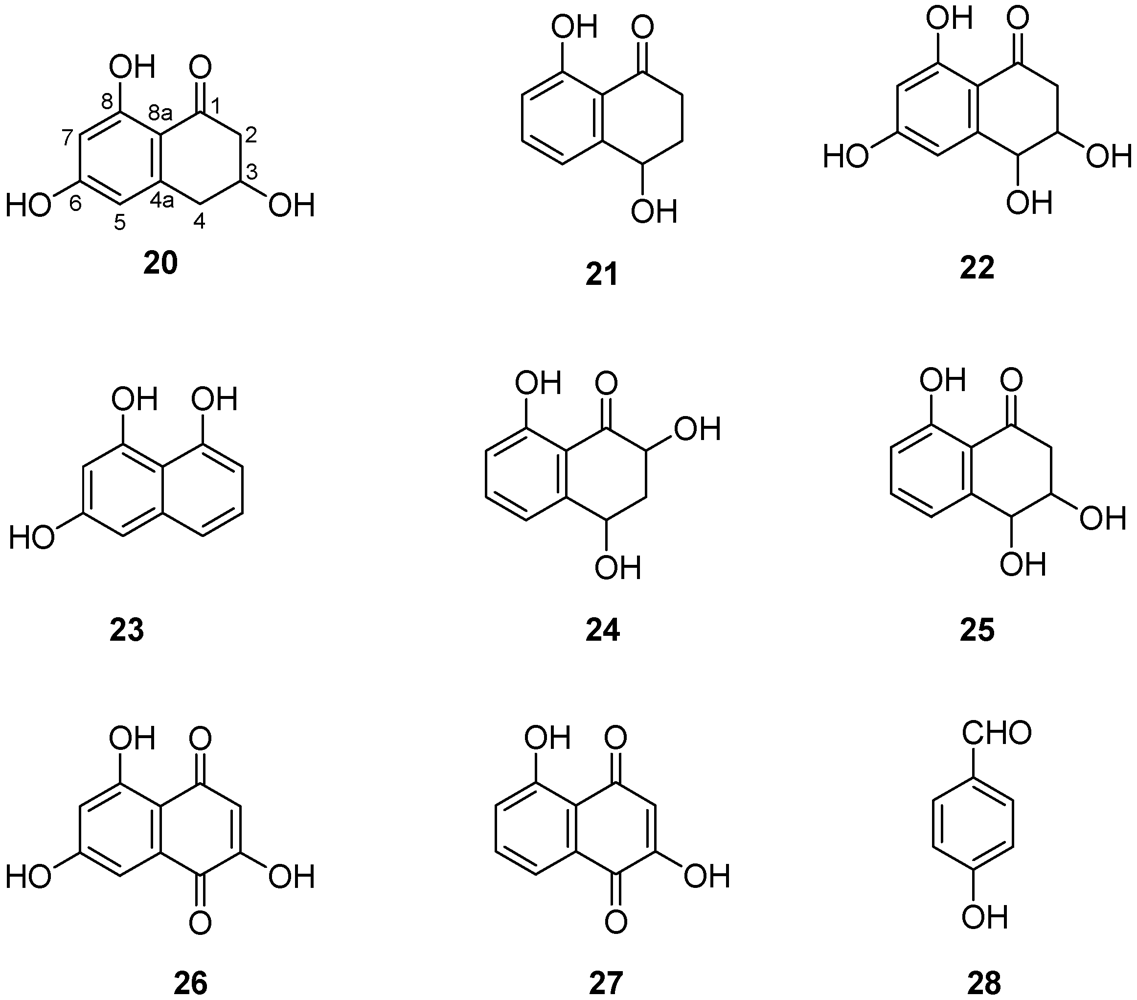
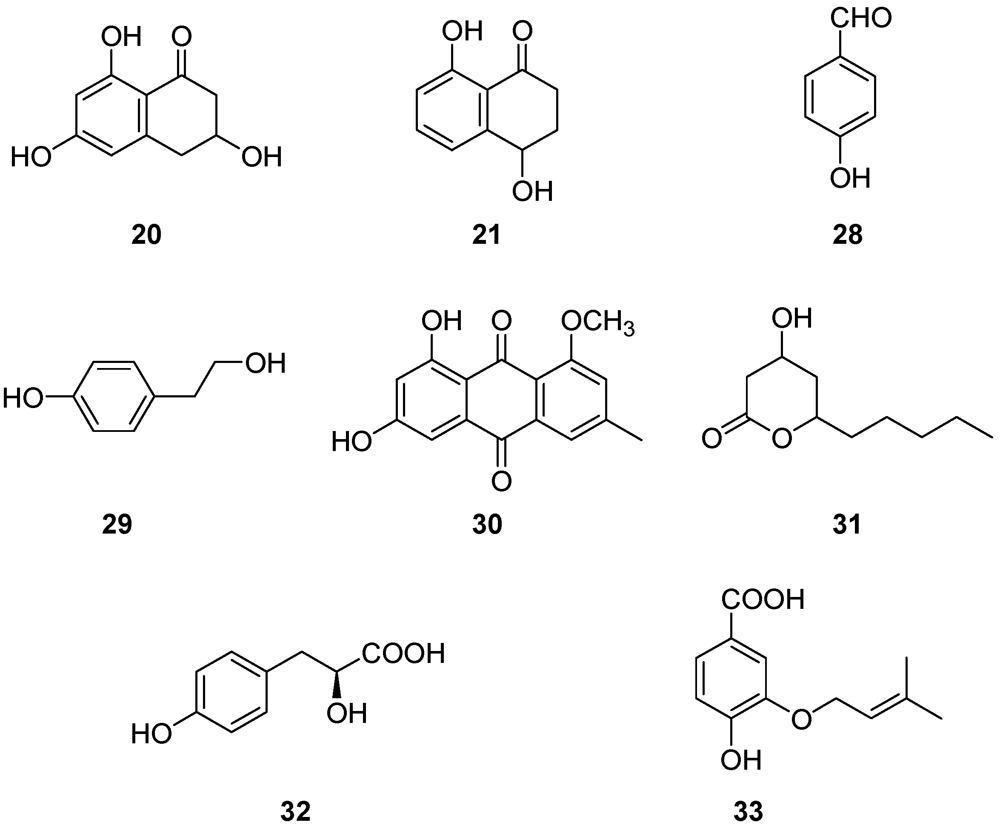
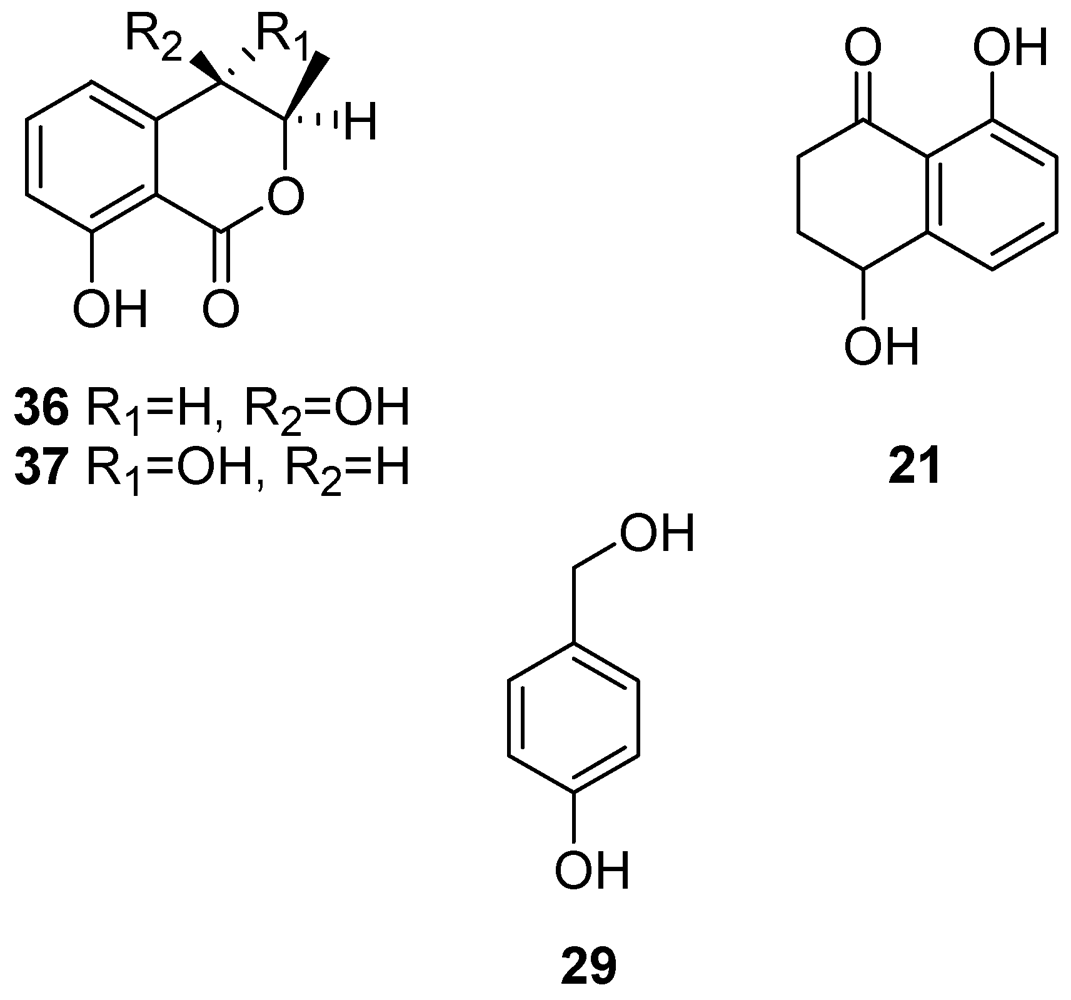
			  <p>Various metabolites, representing different classes of natural compounds, have been isolated and identified from culture filtrates of <italic>Pm. aleophilum</italic> and <italic>Pa. chlamydospora.</italic> They include naphthalenone pentaketides. From liquid culture of <italic>Pm. aleophilum</italic> were isolated scytalone, isosclerone [<xref ref-type="bibr" rid="B54-toxins-03-01569">54</xref>,<xref ref-type="bibr" rid="B55-toxins-03-01569">55</xref>], <italic>cis</italic>-4-hydroxy-scytalone, 1,3,8-trihydroxynaphtalene (1,3,8-THN), 2,4,8-trihydroxytetralone (2,4,8-THT), 3,4,8-trihydroxytetralone (3,4,8-THT), flavioline, 2-hydroxyjuglone (2-HJ, traces), and 4-hydroxybenzaldehyde (<bold>20-28</bold>, <xref ref-type="fig" rid="toxins-03-01569-f006">Figure 6</xref>) [<xref ref-type="bibr" rid="B55-toxins-03-01569">55</xref>]. Liquid cultures of <italic>Pa. chlamydospora</italic>, have yielded, besides scytalone, isosclerone and 4-hydroxybenzaldehyde already mentioned (compounds <bold>20, 21, 28</bold>, <xref ref-type="fig" rid="toxins-03-01569-f007">Figure 7</xref>) [<xref ref-type="bibr" rid="B55-toxins-03-01569">55</xref>], also tyrosol, 1-<italic>O</italic>-methylemodine, 3-hydroxy-5-decanolide, (<italic>S</italic>)-4-hydroxyphenyllactic acid and 4-hydroxy-3-(3-methyl-2-butenyloxy)-benzoic acid (<bold>29-33</bold>, <xref ref-type="fig" rid="toxins-03-01569-f007">Figure 7</xref>) [<xref ref-type="bibr" rid="B55-toxins-03-01569">55</xref>].</p>
          <fig id="toxins-03-01569-f006" position="anchor">
            <label>Figure 6</label>
            <caption>
              <p>Chemical structures of <italic>Phaeoacremonium aleophilum</italic> metabolites: scytalone, isosclerone, <italic>cis</italic>-4-hydroxyscytalone, 1,3,8-trihydroxynaphtalene, 2,4,8-trihydroxytetralone, 3,4,8-trihydroxytetralone, flavioline, 2-hydroyjuglone and 4-hydroxybenzaldehyde <bold>20-28</bold>.</p>
            </caption>
            <graphic xmlns:xlink="http://www.w3.org/1999/xlink" xlink:href="toxins-03-01569-g006.tif"/>
          </fig>
          <fig id="toxins-03-01569-f007" position="anchor">
            <label>Figure 7</label>
            <caption>
              <p>Chemical structures of <italic>Phaeomoniella chlamydospora</italic> metabolites: scytalone, isosclerone (<bold>20-21</bold>), 4-hydroxybenzaldeide, tyrosol, 1-<italic>O</italic>-methylemodine, 3-hydroxy-5-decanolide, (<italic>S</italic>)-4-hydroxyphenyllactic acid, 3-(3-methyl-2-butenyloxy)-4-hydroxybenzoic acid (<bold>28-33</bold>). </p>
            </caption>
            <graphic xmlns:xlink="http://www.w3.org/1999/xlink" xlink:href="toxins-03-01569-g007.tif"/>
          </fig>
          <p>The biological activity of metabolites produced by <italic>Pm. aleophilum</italic> and <italic>Pa. chlamydospora</italic> were evaluated against grapevine leaves, calli and living protoplasts (<xref ref-type="table" rid="toxins-03-01569-t002">Table 2</xref>).</p>
          <table-wrap id="toxins-03-01569-t002" position="anchor">
            <object-id pub-id-type="pii">toxins-03-01569-t002_Table 2</object-id>
            <label>Table 2</label>
            <caption>
              <p>Metabolites isolated from <italic>Phaeoacremonium aleophilum</italic> and <italic>Phaeomoniella chlamydospora</italic> and phytotoxicity assays.</p>
            </caption>
            <table>
              <thead>
                <tr>
                  <th align="left" valign="middle">Metabolite (<xref ref-type="fig" rid="toxins-03-01569-f006">Figure 6</xref> and <xref ref-type="fig" rid="toxins-03-01569-f007">Figure 7</xref>)</th>
                  <th align="left" valign="middle">Plant matrix used for phytotoxicity assays</th>
                  <th align="left" valign="middle">References</th>
                </tr>
              </thead>
              <tbody>
                <tr>
                  <td align="left" valign="middle">Scytalone (<bold>20</bold>)</td>
                  <td align="left" valign="middle">Grapevine leaves Grapevine callus and protoplasts <italic>Arabidopsis thaliana</italic></td>
                  <td align="left" valign="middle">[<xref ref-type="bibr" rid="B54-toxins-03-01569">54</xref>,<xref ref-type="bibr" rid="B55-toxins-03-01569">55</xref>,<xref ref-type="bibr" rid="B56-toxins-03-01569">56</xref>,<xref ref-type="bibr" rid="B57-toxins-03-01569">57</xref>]</td>
                </tr>
                <tr>
                  <td align="left" valign="middle">Isosclerone (<bold>21</bold>)</td>
                  <td align="left" valign="middle">Grapevine leaves Grapevine callus and protoplasts <italic>Arabidopsis thaliana</italic></td>
                  <td align="left" valign="middle">[<xref ref-type="bibr" rid="B54-toxins-03-01569">54</xref>,<xref ref-type="bibr" rid="B55-toxins-03-01569">55</xref>,<xref ref-type="bibr" rid="B56-toxins-03-01569">56</xref>,<xref ref-type="bibr" rid="B57-toxins-03-01569">57</xref>]</td>
                </tr>
                <tr>
                  <td align="left" valign="middle"><italic>cis</italic>-4-Hydroxyscytalone (<bold>22</bold>)</td>
                  <td align="left" valign="middle">Grapevine callus and protoplasts</td>
                  <td align="left" valign="middle">[<xref ref-type="bibr" rid="B57-toxins-03-01569">57</xref>]</td>
                </tr>
                <tr>
                  <td align="left" valign="middle">1,3,8-Trihydroxynaphthalene (1,3,8-THN) (<bold>23</bold>)</td>
                  <td align="left" valign="middle">Grapevine callus</td>
                  <td align="left" valign="middle">[<xref ref-type="bibr" rid="B57-toxins-03-01569">57</xref>]</td>
                </tr>
                <tr>
                  <td align="left" valign="middle">2,4,8-Trihydroxy-tetralone (2,4,8-THT) (<bold>24</bold>)</td>
                  <td align="left" valign="middle">Grapevine callus <italic>Arabidopsis thaliana</italic></td>
                  <td align="left" valign="middle">[<xref ref-type="bibr" rid="B57-toxins-03-01569">57</xref>]</td>
                </tr>
                <tr>
                  <td align="left" valign="middle">3,4,8-Trihydroxytetralone (3,4,8-THT) (<bold>25</bold>)</td>
                  <td align="left" valign="middle">Grapevine callus <italic>Arabidopsis thaliana</italic></td>
                  <td align="left" valign="middle">[<xref ref-type="bibr" rid="B57-toxins-03-01569">57</xref>]</td>
                </tr>
                <tr>
                  <td align="left" valign="middle">Flavioline (<bold>26</bold>)</td>
                  <td align="left" valign="middle">Grapevine callus <italic>Arabidopsis thaliana</italic></td>
                  <td align="left" valign="middle">[<xref ref-type="bibr" rid="B55-toxins-03-01569">55</xref>]</td>
                </tr>
                <tr>
                  <td align="left" valign="middle">2-Hydroyjuglone (<bold>27</bold>)</td>
                  <td align="left" valign="middle">Grapevine callus</td>
                  <td align="left" valign="middle">[<xref ref-type="bibr" rid="B57-toxins-03-01569">57</xref>]</td>
                </tr>
                <tr>
                  <td align="left" valign="middle">4-Hydroxybenzaldehyde (<bold>28</bold>)</td>
                  <td align="left" valign="middle">Grapevine callus and protoplasts</td>
                  <td align="left" valign="middle">[<xref ref-type="bibr" rid="B55-toxins-03-01569">55</xref>,<xref ref-type="bibr" rid="B57-toxins-03-01569">57</xref>]</td>
                </tr>
                <tr>
                  <td align="left" valign="middle">(<italic>S</italic>)-4-Hydroxy-phenyllatic acid (<bold>32</bold>)</td>
                  <td align="left" valign="middle">Grapevine callus and protoplasts</td>
                  <td align="left" valign="middle">[<xref ref-type="bibr" rid="B55-toxins-03-01569">55</xref>]</td>
                </tr>
                <tr>
                  <td align="left" valign="middle">3-(3-Methyl-2-butenyloxy)-4-hydroxybenzoic acid (<bold>33</bold>)</td>
                  <td align="left" valign="middle">Grapevine callus and protoplasts</td>
                  <td align="left" valign="middle">[<xref ref-type="bibr" rid="B55-toxins-03-01569">55</xref>]</td>
                </tr>
              </tbody>
            </table>
         </table-wrap>
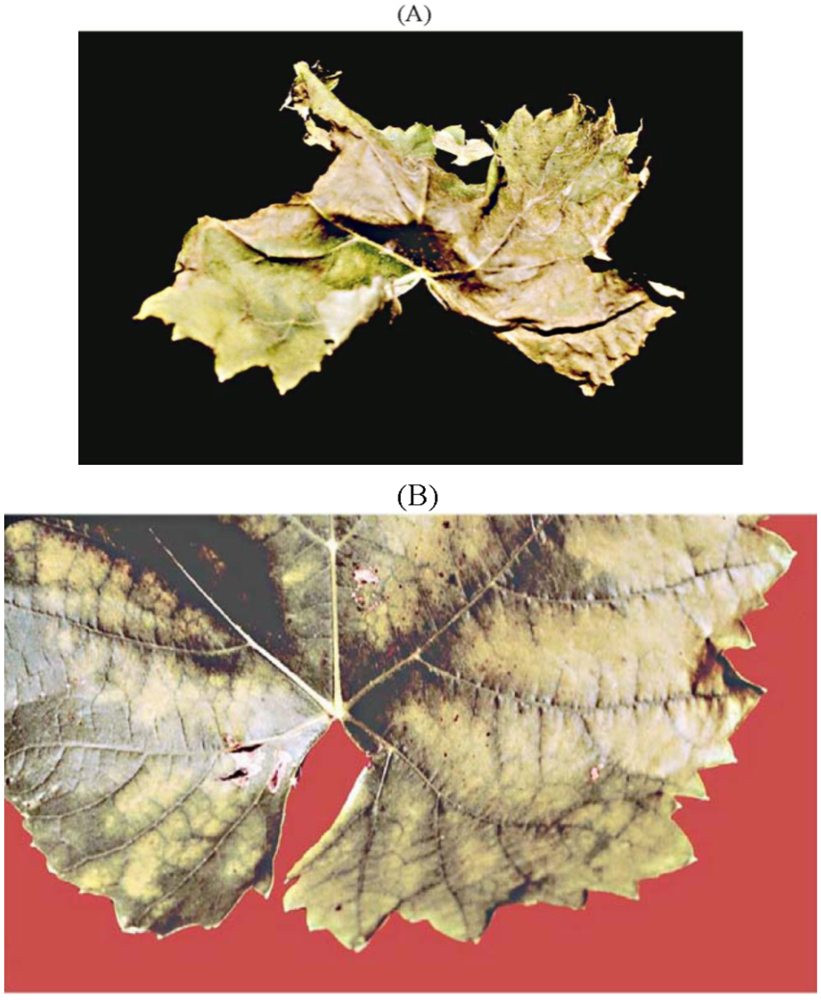
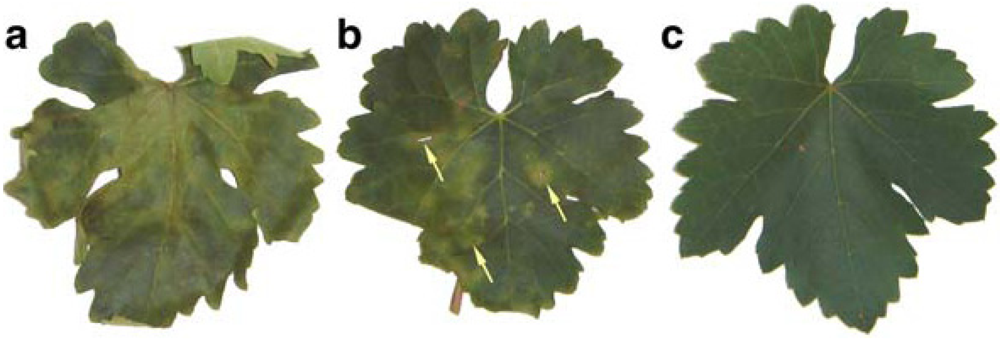
          <p>Other metabolite activities, usually related to the natural ageing of the leaves (loss of cell membrane semipermeability-causing ion leakage-and membrane-lipid peroxidase) were also examined. Scytalone (<bold>20</bold>, <xref ref-type="fig" rid="toxins-03-01569-f006">Figure 6</xref> and <xref ref-type="fig" rid="toxins-03-01569-f007">Figure 7</xref>) assayed at 0.05 mg/mL on grapevine cv. Italia leaves, produced spots that were light-green to chlorotic, round to irregular, and that became coalescent or remained spread out over the leaf blade (<xref ref-type="fig" rid="toxins-03-01569-f008">Figure 8</xref>A). Isosclerone (<bold>21</bold>, <xref ref-type="fig" rid="toxins-03-01569-f006">Figure 6</xref> and <xref ref-type="fig" rid="toxins-03-01569-f007">Figure 7</xref>), assayed at 0.1 mg/mL, caused large yellowish spots that slowly became coalescent and necrotic, and that were followed by distortion and withering of the leaf lamina (<xref ref-type="fig" rid="toxins-03-01569-f008">Figure 8</xref>B) [<xref ref-type="bibr" rid="B54-toxins-03-01569">54</xref>]. In a number of <italic>in vitro</italic> tests, leaf cultures from grapevine cv. Thompson absorbing 0.1 and 0.05 mg/mL solutions containing scytalone or isosclerone only showed some marginal browning, slightly stronger at the higher concentration [<xref ref-type="bibr" rid="B56-toxins-03-01569">56</xref>]. Scytalone was tested for factors relating to leaf ageing, but no real effect was seen (scytalone caused higher peroxidation, but only in the first 30 min). On the other hand both scytalone and isosclerone increased ion leakage, and when leaf disks were soaked in a scytalone solution at a concentration of 0.05 μg/mL, membrane semipermeability was impaired.</p>
          <fig id="toxins-03-01569-f008" position="anchor">
            <label>Figure 8</label>
            <caption>
              <p>Absorption of (<bold>A</bold>) 3 mL of 0.05 mg mL<sup>−1</sup> scytalone and (<bold>B</bold>) 0.1 mg mL<sup>−1</sup> isoslerone by detached leaves of grapevine cv. Italia exposed to these solutions for a few hours .(Reproduced with permission from the authors of [<xref ref-type="bibr" rid="B54-toxins-03-01569">54</xref>]). </p>
            </caption>
            <graphic xmlns:xlink="http://www.w3.org/1999/xlink" xlink:href="toxins-03-01569-g008.tif"/>
          </fig>
          <p>Scytalone and isosclerone (<bold>20-21</bold>, <xref ref-type="fig" rid="toxins-03-01569-f006">Figure 6</xref> and <xref ref-type="fig" rid="toxins-03-01569-f007">Figure 7</xref>) increased growth <italic>in vitro</italic> of calli of <italic>V. vinifera</italic> cv. Gamay at the lowest concentrations, 0.1 and 0.25 mM respectively. Similar increases in callus growth were achieved with 3,4,8-THT (<bold>25</bold>, <xref ref-type="fig" rid="toxins-03-01569-f006">Figure 6</xref>) at 0.1 mM. On the other hand, the naphthoquinones such as juglone, 2-hydroxyjuglone (2-HJ) and 3-hydroxyjuglone (3-HJ) inhibited callus growth at 0.1 nM, and flaviolin (<bold>26</bold>, <xref ref-type="fig" rid="toxins-03-01569-f006">Figure 6</xref>) inhibited callus growth at 0.25 mM [<xref ref-type="bibr" rid="B57-toxins-03-01569">57</xref>]. These results differed slightly from the trials on calli from cv. Thompson and cv. Cabernet. When callus cultures from these cultivars were grown on a medium containing scytalone and isosclerone solutions at concentration increasing from 0.02 to 0.05 and 0.1 mg/mL, the callus cultures became increasingly brown going from light brown to black; however, callus discolouration did not stop or reduce callus growth on either cv. Thompson seedless or cv. Cabernet [<xref ref-type="bibr" rid="B56-toxins-03-01569">56</xref>].</p>
          <p>The biological activity of 4-hydroxybenzaldehyde, (<italic>S</italic>)-4-hydroxyphenyllactic acid and 4-hydroxy-3-(3-methyl-2-butenyloxy)-benzoic acid (<bold>28, 32-33</bold>, <xref ref-type="fig" rid="toxins-03-01569-f007">Figure 7</xref>) was determined on living protoplasts, from a hydroponic culture of <italic>Vitis vinifera</italic> cvs. Cabernet Sauvignon and Ugni blanc, by calculating the percentage of surviving protoplasts after growing them for 24 h together with the compounds at concentrations of from 10<sup>−5</sup> to 10<sup>−6</sup> M. 4-Hydroxybenzaldehyde (<bold>28</bold>, <xref ref-type="fig" rid="toxins-03-01569-f006">Figure 6</xref> and <xref ref-type="fig" rid="toxins-03-01569-f007">Figure 7</xref>) caused 20% mortality of protoplasts at 100 nM and 100% mortality at 1 mM. Metabolites <bold>32 and 33</bold> (<xref ref-type="fig" rid="toxins-03-01569-f007">Figure 7</xref>) were active on the protoplasts even at a concentration of 1 mM [<xref ref-type="bibr" rid="B57-toxins-03-01569">57</xref>] (<xref ref-type="table" rid="toxins-03-01569-t002">Table 2</xref>). </p>
        </sec>
        <sec>
          <title>3.1.2. Hydrophilic High-Molecular Weight Metabolites</title>
        </sec>
        <sec>
          <title>3.1.2.1. Polysaccharides</title>
          <p>When <italic>Pa. chlamydospora</italic> and <italic>Pm. aleophilum</italic> were grown in liquid culture, they produced exopolysaccharides (EPSs) in some tests [<xref ref-type="bibr" rid="B58-toxins-03-01569">58</xref>]. In recent years, the structure of a large number of EPSs has been determined due to advances in ways to purify and chemically characterise these compounds [<xref ref-type="bibr" rid="B59-toxins-03-01569">59</xref>].</p>
          <p>That EPSs are involved in bacterial and fungal diseases has been reported by Hogdson <italic>et al</italic>. (1949); Harborne (1983) and Denny (1995) [<xref ref-type="bibr" rid="B60-toxins-03-01569">60</xref>,<xref ref-type="bibr" rid="B61-toxins-03-01569">61</xref>], but their activity as phytotoxins still remains to be clarified [<xref ref-type="bibr" rid="B62-toxins-03-01569">62</xref>,<xref ref-type="bibr" rid="B63-toxins-03-01569">63</xref>]. A number of phytopathogenic fungi produced EPSs toxic to plants. These fungi are <italic>Cephalosporium</italic> [<xref ref-type="bibr" rid="B64-toxins-03-01569">64</xref>], <italic>Ceratocystis fagacearum</italic> [<xref ref-type="bibr" rid="B65-toxins-03-01569">65</xref>], <italic>Ophiostoma ulmi</italic> [<xref ref-type="bibr" rid="B66-toxins-03-01569">66</xref>], <italic>Fusarium solani</italic> [<xref ref-type="bibr" rid="B67-toxins-03-01569">67</xref>], and several species of <italic>Phytophthora</italic>, including <italic>P. cinnamomi</italic>, <italic>P. megasperma</italic> var. <italic>sojae</italic> and <italic>P. palmivora</italic>, pathogens of forest, ornamental and agrarian plants such as oak, juniper and soybean [<xref ref-type="bibr" rid="B67-toxins-03-01569">67</xref>]. Moreover, EPSs from the culture filtrates of <italic>P. cinnamomi</italic>, <italic>P. cryptogea</italic> and <italic>P. nicotianae</italic> cause severe wilting on several hosts [<xref ref-type="bibr" rid="B68-toxins-03-01569">68</xref>]. It is thought that these macromolecules interfere with water movement in the plant tissues by plugging the vessels, and that this causes the wilt symptoms [<xref ref-type="bibr" rid="B69-toxins-03-01569">69</xref>]. The wilting seems to be related to the size of the molecules and their viscosity rather than to their structure [<xref ref-type="bibr" rid="B70-toxins-03-01569">70</xref>]. However some other experimental findings on host specificity suggest that the EPSs differently act. In fact, EPSs produced by some bacteria induced leaf spot diseases only on the host plants [<xref ref-type="bibr" rid="B71-toxins-03-01569">71</xref>]. Furthermore, EPSs recently isolated from <italic>Cryphonectria parasitica</italic> [<xref ref-type="bibr" rid="B72-toxins-03-01569">72</xref>], <italic>Phomopsis foeniculi</italic> [<xref ref-type="bibr" rid="B73-toxins-03-01569">73</xref>] and <italic>Neofusicoccum parvum</italic> [<xref ref-type="bibr" rid="B74-toxins-03-01569">74</xref>], were toxic to both hosts and non-host plants, and this suggests that they have non-specific phytoxicity.</p>
          <p>Preliminary investigations, essentially using HPLC, molecular analysis and infrared spectroscopy, have revealed that <italic>Pa. chlamydospora</italic> and <italic>Pm. aleophilum</italic> produce pullulan [<xref ref-type="bibr" rid="B58-toxins-03-01569">58</xref>]. Pullulan is a polysaccharide polymer consisting of maltotriose units, also known as α-(1°4)-; α-(1°6)-glucan. Three glucose units in maltotriose are connected by an α-(1°4)- glycosidic bond, whereas consecutive maltotriose units are connected to each other by an α-(1°6) glycosidic bond. Commercially pullulan is usually produced by the fungus <italic>Aureobasidium pullulans</italic> [<xref ref-type="bibr" rid="B75-toxins-03-01569">75</xref>,<xref ref-type="bibr" rid="B76-toxins-03-01569">76</xref>].</p>
          <p>To establish the role of EPSs in esca, the EPSs were characterised biologically and their occurrence in infected vines was determined. It was found that when EPSs produced by <italic>Pm. aleophilum</italic> and <italic>Pa. chlamydospora</italic> were absorbed at very low doses by detached grapevine leaves, or when they were injected into the woody tissue of the shoots and branches of standing grapevines, they caused foliar symptoms similar to those shown by vines with esca. The same symptoms were produced when the vine leaves were treated with pullulan extracted from the discoloured wood of a grapevine infected with <italic>Pa. chlamydospora</italic>, and with commercial pullulan [<xref ref-type="bibr" rid="B58-toxins-03-01569">58</xref>].</p>
          <p>When culture filtrates of <italic>Pa. chlamydospora</italic>, or weak solutions of purified preparations of scytalone, isosclerone or pullulan, were absorbed by detached leaves and berries they caused symptoms similar to those of vines affected with esca in the field [<xref ref-type="bibr" rid="B77-toxins-03-01569">77</xref>].</p>
        </sec>
        <sec>
          <title>3.1.2.2. Polypeptide Toxic Metabolites</title>
          <p>Luini <italic>et al</italic>. [<xref ref-type="bibr" rid="B78-toxins-03-01569">78</xref>] also reported on the toxic activity of polypeptides secreted by <italic>Pa. chlamydospora</italic> and <italic>Pm. aleophilum</italic> in their culture medium. The structures of these polypeptides have not yet been determined. </p>
          <p>Even though the electrophoretic patterns of the polypeptides differed from those of the EPSs, their biological activity was very similar. They produced anthocyanins on grapevine leaves and, when applied to grapevine cells in culture, they modified proton fluxes, depolarised the cell membrane, inhibited the transport of sucrose and glutamine and, lastly, caused the death of the cells. Moreover, polypeptides can now be traced by immunological methods, as reported by Fleurat-Lessard <italic>et al</italic>. [<xref ref-type="bibr" rid="B79-toxins-03-01569">79</xref>], and this has confirmed that these compounds have a significant role in the disease, and one that deserves further investigation.</p>
        </sec>
      </sec>
      <sec>
        <title>3.2. Toxins Produced by <italic>Fomitiporia mediterranea</italic>, a Causal Agent of Wood Rot in Grapevine.</title>
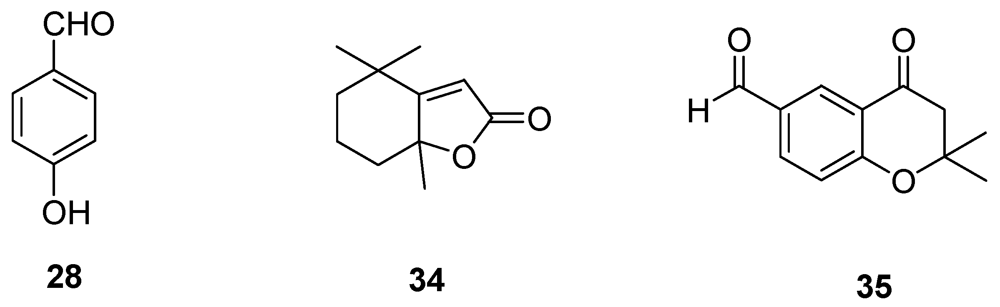
        <p>The toxic metabolites produced by <italic>F. mediterranea</italic>, the basidiomycetous fungus which, in Europe, is most frequently associated with grapevine white rot, were also investigated. Tabacchi <italic>et al</italic>. [<xref ref-type="bibr" rid="B55-toxins-03-01569">55</xref>] reported that the culture filtrate of <italic>F. punctata</italic> (current nomenclature: <italic>F. mediterranea</italic>) produced 4-hydroxy-benzaldehyde (<bold>28</bold>, <xref ref-type="fig" rid="toxins-03-01569-f009">Figure 9</xref>), dihydroactinolide and a novel chromanone, called 6-formyl-2,2-dimethyl-4-chromanone, and biogenetically related to eutypine (<bold>34-35</bold>, <xref ref-type="fig" rid="toxins-03-01569-f009">Figure 9</xref>).</p>
        <fig id="toxins-03-01569-f009" position="anchor">
          <label>Figure 9</label>
          <caption>
            <p>Chemical structures of <italic>Fomitiporia mediterranea</italic> metabolites: 4-hydroxybenzaldeide (<bold>28</bold>), dihydroactinolide (<bold>34</bold>) and 6-formyl-2,2-methyl-4-chromanone (<bold>35</bold>).</p>
          </caption>
          <graphic xmlns:xlink="http://www.w3.org/1999/xlink" xlink:href="toxins-03-01569-g009.tif"/>
        </fig>
        <p>White [<xref ref-type="bibr" rid="B80-toxins-03-01569">80</xref>] reported that ten basidiomycetes isolated from grapevine in South Africa (8 novel species in the genera <italic>Fomitiporella</italic>, <italic>Fomitiporia</italic>, <italic>Inonotus</italic>, <italic>Inocutis</italic>, and <italic>Phellinus</italic>, and two species in an undetermined genus) produced <italic>in vitro</italic> 4-hydroxybenzaldehyde at fairly low concentrations ranging from 0.005 to 0.06 mg/L. The level of 4-hydroxybenzaldehyde was not related to a specific taxon and varied within each taxon [<xref ref-type="bibr" rid="B80-toxins-03-01569">80</xref>]. </p>
      </sec>
      <sec>
        <title>3.3. Mechanism of Action of Toxins Involved in the Esca Complex (Vascular Disease and Wood Rot)</title>
        <p>The mode of action of the toxins, essentially naphthoquinones, produced by the fungi involved in esca may be related to their oxidant property. The quinones are extensively used in studies of oxidative stress because of the important role they play in plant defence [<xref ref-type="bibr" rid="B81-toxins-03-01569">81</xref>]. Scytalone levels in particular may be related to the intensity of the brown-black colour of infected vine wood and to the occurrence of dark material in the xylem vessels.</p>
        <fig id="toxins-03-01569-f010" position="anchor">
          <label>Figure 10</label>
          <caption>
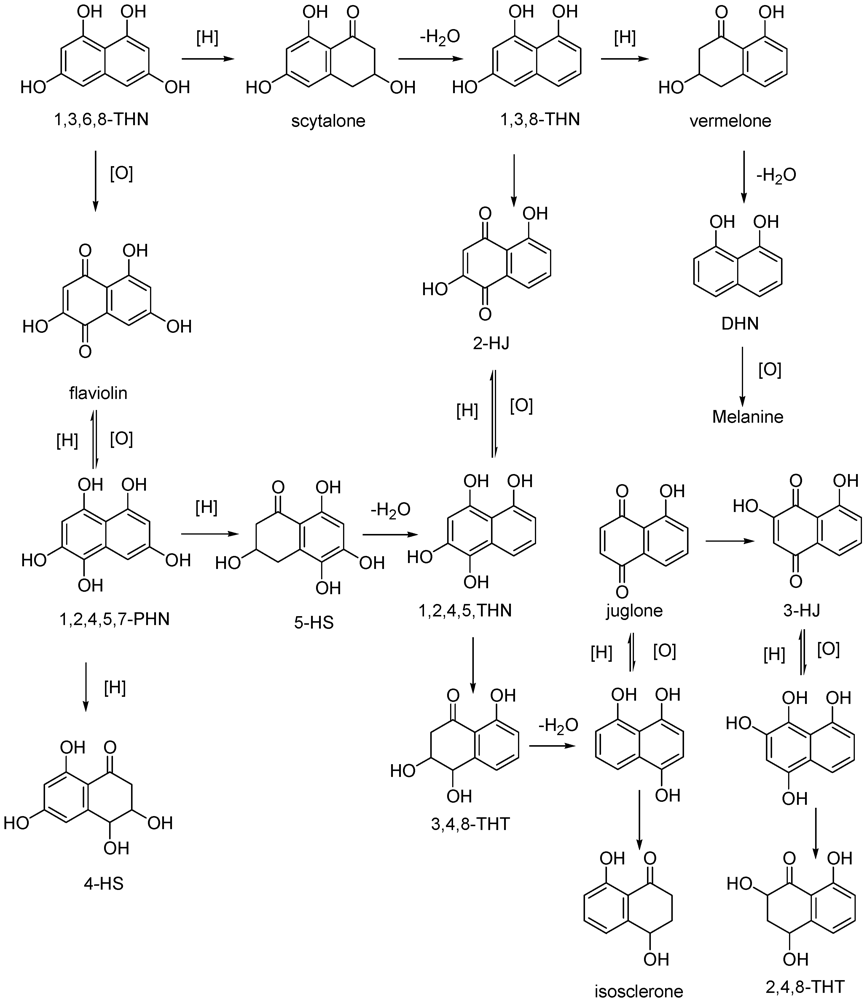
            <p>The pentaketide pathway of melanin synthesis with flavioline and 2-hydroxyjuglone (2-HJ). 1,3,6,8-tetrahydroxynaphthalene (1,3,6,8-THN); 1,3,8-tri- hydroxynaphthalene (1,3,8-THN); 1,2,4,5,7-pentahydroxynaphthalene (1,2,4,5,7-PHN); 5-hydroxyscytalone (5-HS); cis-4-hydroxyscytalone (4-HS); 1,2,4,5-tetrahydroxy- naphthalene (1,2,4,5-THN); 3,4,8-trihydroxytetralone (3,4,8-THT); 2,4,8-trihydroxy- tetralone (2,4,8-THT). (Reproduced with permission from the authors of [<xref ref-type="bibr" rid="B56-toxins-03-01569">56</xref>])</p>
          </caption>
          <graphic xmlns:xlink="http://www.w3.org/1999/xlink" xlink:href="toxins-03-01569-g010.tif"/>
        </fig>
        <p>Scytalone and the naphthoquinones produced by <italic>Pa. chlamydospora</italic> and <italic>Pm. aleophilum</italic> are intermediate metabolites resulting from the biosyntesis of dihydroxynaphthale (DHN) melanins. Some studies examined the pentaketide pathway of melanin synthesis in some black fungi pathogenic to humans and plants [<xref ref-type="bibr" rid="B82-toxins-03-01569">82</xref>,<xref ref-type="bibr" rid="B83-toxins-03-01569">83</xref>]. As shown in <xref ref-type="fig" rid="toxins-03-01569-f010">Figure 10</xref>, scytalone may be produced by the oxidation of 1,3,8-THN.</p>
        <p>Melanins are dark pigments of a phenolic nature with a high molecular weight, which occur in animals, plants and micro-organisms. The structure of these pigments is unknown, and they probably are not necessary for the life of the producing organism, but they increase the capacity of that organism to survive under certain conditions. For example the occurrence of melanins in the cell wall of some fungi [<xref ref-type="bibr" rid="B84-toxins-03-01569">84</xref>,<xref ref-type="bibr" rid="B85-toxins-03-01569">85</xref>,<xref ref-type="bibr" rid="B86-toxins-03-01569">86</xref>] increases the resistance of these fungi to physical agents such as UV radiation [<xref ref-type="bibr" rid="B86-toxins-03-01569">86</xref>,<xref ref-type="bibr" rid="B87-toxins-03-01569">87</xref>].</p>
        <p>The role of melanins in virulence in may be due to various factors. Bürki <italic>et al</italic>. [<xref ref-type="bibr" rid="B88-toxins-03-01569">88</xref>] reported that the naphthoquinones are cytotoxic, and they are thought to act by forming a covalent adduct through a Michael 1,4 addition between the quinone and a protein thiol or amino group [<xref ref-type="bibr" rid="B89-toxins-03-01569">89</xref>]. Of these compounds, the most widely studied is juglone, which is highly toxic to plants and animals [<xref ref-type="bibr" rid="B61-toxins-03-01569">61</xref>]. In fungal cells, juglone generates superoxide radicals, diminishing the cellular pool of reduced pyridine nucleotides which are particularly necessary for cells exposed to oxidative stress. It is well known that one of the main ways of plants to respond to phytopathogenic invasion is by generating O<sub>2</sub><sup>−</sup> and H<sub>2</sub>O<sub>2</sub> [<xref ref-type="bibr" rid="B90-toxins-03-01569">90</xref>,<xref ref-type="bibr" rid="B91-toxins-03-01569">91</xref>]. Many plants also produce auto-oxidisable quinone defence compounds, which oxidise NAD(P)H in plant and pathogenic cells, leading to the formation of superoxide radicals and hydrogen peroxide [<xref ref-type="bibr" rid="B92-toxins-03-01569">92</xref>]. In response to these attempts of the plant to defend itself, the pathogenic fungi synthesise the naphthoquinones, which are toxic and suppress the defence reaction [<xref ref-type="bibr" rid="B93-toxins-03-01569">93</xref>].</p>
        <p>The naphthoquinones lower the resistance of plants to pathogenic fungi and hence enhance the virulence of those fungi. The production of naphthoquinone pigments appears to be an important component of the disease process as these pigments act as non-specific virulence factors inhibiting the plant defence reaction, resulting in plant hypersensitivity [<xref ref-type="bibr" rid="B94-toxins-03-01569">94</xref>].</p>
        <p>It has been reported that actively melanising cell-like appressoria of <italic>P. oryzae</italic> produce higher levels of melanin intermediates or their derivatives (phenols and quinones) in the presence of agents blocking melanin biosynthesis such as Tricyclazole<sup>®</sup> or Carpropamide<sup>®</sup> [<xref ref-type="bibr" rid="B95-toxins-03-01569">95</xref>]. As phenols and quinones are highly toxic to living cells, an abnormal accumulation of metabolites such as 2-HJ probably prevents the appressoria from functioning [<xref ref-type="bibr" rid="B96-toxins-03-01569">96</xref>].</p>
        <p>Not much is known about how these metabolites act in the vine cells or tissues. The physiological changes that occur in the chlorotic portion of leaves with tiger-stripes, in the surrounding green portion of these leaves, and in the asymptomatic leaves of vine arms that also bear tiger-striped leaves, indirectly suggest that these changes are caused by toxic metabolites. Physiological changes include alterations in the rate of gas exchange, chlorophyll concentration, net photosynthesis, stomatic conductance, intercellular concentration of CO<sub>2</sub>, and transpiration rate [<xref ref-type="bibr" rid="B97-toxins-03-01569">97</xref>,<xref ref-type="bibr" rid="B98-toxins-03-01569">98</xref>]. Tiger-striped leaves also show higher levels of fructose and glucose and lower levels of sucrose. Starch goes down while abscissic acid goes up, as do the free amino-acids, especially proline [<xref ref-type="bibr" rid="B98-toxins-03-01569">98</xref>,<xref ref-type="bibr" rid="B99-toxins-03-01569">99</xref>]. The mechanism whereby these disorders are produced has not yet been elucidated, but the changes may be an indirect effect of the toxins produced by the fungi colonising the vine wood, and perhaps even by some non-pathogenic fungi which also abundantly colonise the vine wood. In that case these changes would be a response of the vine to the disease. For example, the increase of abcissic acid in the leaves, as also the increase in soluble sugars and amino-acids, appears to be a stress-response to an impairment of the conducting vessels [<xref ref-type="bibr" rid="B100-toxins-03-01569">100</xref>]. </p>
        <p>Scytalone and isosclerone also cause peroxidation of the membrane lipids, and this is known to be related to leaf senescence [<xref ref-type="bibr" rid="B56-toxins-03-01569">56</xref>]. Toxic polypeptides could also be involved in this early senescence process, since they cause an increase in the anthocyanin levels of vine leaves [<xref ref-type="bibr" rid="B78-toxins-03-01569">78</xref>].</p>
      </sec>
      <sec>
        <title>3.4. Chemical and Immunological Detection of Esca-Related Metabolites</title>
        <p>As a rule, esca is first detected by visual inspection of the foliar symptoms. Visual inspection is completed by isolating on a growth medium the fungal colonies growing out of a piece of infected wood tissue and by identifying the growing fungus using microscopic inspection of the mycelium and the conidia, and/or by molecular methods. </p>
        <p>A new means of detection is to employ HPLC or immunological techniques to identify the secondary metabolites secreted by the pathogen that is to be detected. Studies based on these techniques have established that secondary metabolites have a role as vivotoxins [<xref ref-type="bibr" rid="B101-toxins-03-01569">101</xref>]</p>
        <sec>
          <title>3.4.1. HPLC Technique</title>
          <p>The role of fungal metabolites in causing symptoms on esca-affected vine leaves and berries was studied in a vineyard of <italic>V. vinifera</italic> cv. Italia located in southern Italy [<xref ref-type="bibr" rid="B102-toxins-03-01569">102</xref>]. During early spring, two to four branches per vine were pruned and samples of xylem sap were collected. Vine bleeding, assessed as mL day<sup>−1</sup> vine<sup>−1</sup>, peaked at bud burst and stopped within 28 days. During this period, the leaf water potential of diseased vines progressively increased (<italic>i.e.</italic>, values became less negative), indicating a dysfunction in the supply of water and nutrients to the new growth. Fungi were isolated both from the xylem sap and from the woody tissue of the branches and trunks of diseased vines. Conidia isolated from the sap showed a high germination rate (&gt;90%). Bioactive concentrations of the two pentaketides were detected in the xylem sap, leaves and berries at various stages of seasonal growth [<xref ref-type="bibr" rid="B58-toxins-03-01569">58</xref>,<xref ref-type="bibr" rid="B103-toxins-03-01569">103</xref>]. Exopolysaccharides, including pullulan, were found in the xylem sap. </p>
        </sec>
        <sec>
          <title>3.4.2. Immunological Techniques: Flow Cytometry</title>
          <p>A study has recently been carried out to develop a rapid and specific method for the production of polyclonal antibodies against the EPSs produced by <italic>Pa. chlamydospora</italic> and to detect these EPSs in the leaves of esca-affected grapevines [<xref ref-type="bibr" rid="B103-toxins-03-01569">103</xref>]. The <italic>Pa. chlamydospora</italic> EPSs were unequivocally identified in diseased vines using flow cytometry. Antibodies raised against <italic>Pa. chlamydospora</italic> EPSs were used as an antigen to immunise rats. Their specificity was also tested against other <italic>Pa. chlamydospora</italic> strains (<xref ref-type="fig" rid="toxins-03-01569-f011">Figure 11</xref>A). The antibodies did not recognise control EPSs from <italic>P. foeniculi</italic> or from <italic>P. exigua</italic> var. <italic>heteromorpha</italic>, nor EPSs from <italic>Pm. aleophilum</italic>, <italic>Neofusicoccum luteum</italic> or <italic>Neofusicoccum parvum</italic>, indicating that these antibodies were specific to the EPSs of <italic>Pa. chlamydsopora</italic> [<xref ref-type="bibr" rid="B103-toxins-03-01569">103</xref>]. Flow cytometry used <italic>in planta</italic> positively detected <italic>Pa. chlamydospora</italic> EPSs from esca-affected leaves showing interveinal and marginal discolouration, and necrosis (<xref ref-type="fig" rid="toxins-03-01569-f012">Figure 12</xref>) [<xref ref-type="bibr" rid="B103-toxins-03-01569">103</xref>].</p>
          <fig id="toxins-03-01569-f011" position="anchor">
            <label>Figure 11</label>
            <caption>
              <p>(<bold>A</bold>) Cytofluorimetric profiles of <italic>Phaeomoniella chlamydospora</italic> extracts from strains CBS 229.95, 7, 31, 135, 551 and 606. (<bold>B</bold>) Cytofluorimetric profile of leaf extracts of asymptomatic vine leaves from asymptomatic vine no. 61 (AAA) and from symptomatic vine no. 58. The position on the x-axis clearly indicates no recognition by the antibody-labelled beads of the extracts from leaves from asymptomatic vines, and from asymptomatic leaves from asymptomatic shoots (ADD), not even when the leaves were close (ACD) or distal (AFD) to a symptomatic leaf in a symptomatic shoot (ADD). In contrast when the extracts of leaves with incipient chlorotic symptoms or leaves with fully developed symptoms from a diseased vine were tested (samples D and S, respectively), the position of the profiles on the x-axis indicated there was strong recognition by the antibodies. Axis of abscissa is FL-1og height; axis of ordinate is number of particles. (Reproduced with permission from the authors of [<xref ref-type="bibr" rid="B103-toxins-03-01569">103</xref>]). </p>
            </caption>
            <graphic xmlns:xlink="http://www.w3.org/1999/xlink" xlink:href="toxins-03-01569-g011.tif"/>
          </fig>
          <fig id="toxins-03-01569-f012" position="anchor">
            <label>Figure 12</label>
            <caption>
              <p>Esca-diseased grapevine leaves with tiger-stripe discoloration: a shoot showing the acropetal symptom gradient. (Reproduced with permission from the authors of [<xref ref-type="bibr" rid="B103-toxins-03-01569">103</xref>]) </p>
            </caption>
            <graphic xmlns:xlink="http://www.w3.org/1999/xlink" xlink:href="toxins-03-01569-g012.tif"/>
          </fig>
        </sec>
        <sec>
          <title>3.4.3. Immunological Techniques: Serological Test</title>
          <p><italic>Phaeomoniella chlamydospora</italic> in a culture medium secretes a variety of polypeptides [<xref ref-type="bibr" rid="B104-toxins-03-01569">104</xref>,<xref ref-type="bibr" rid="B105-toxins-03-01569">105</xref>], the biochemical nature of which made it possible to devise a serological test to detect them [<xref ref-type="bibr" rid="B79-toxins-03-01569">79</xref>]. Polyclonal antibodies raised in rabbit against the polypeptide fraction produced by a <italic>Pa. chlamydospora</italic> culture medium recognised small amounts of the secreted fungal proteins (commonly 1 ng). These antibodies had a valuable specificity because they cross-reacted with the polypeptides secreted by various strains of <italic>Pa. chlamydospora</italic> but not with polypeptides secreted by any of the many other fungal pathogens commonly found in fungus-infected vine wood. Importantly, as shown by the enzyme-linked immunosorbent assay (ELISA) and by immunolocalisation on ultrathin sections, they did not cross-react with the polypeptides secreted by fungi causing other types of wood decay such as <italic>E. lata</italic>, or fungi causing cankers such as the Botryosphaeriaceae <italic>D. seriata</italic> and <italic>N. parvum</italic>. <italic>Pa. chlamydospora</italic> was detected serologically in canes of mechanically infected cuttings [<xref ref-type="bibr" rid="B79-toxins-03-01569">79</xref>]. The specificity of the antibodies was tested against fungal proteins from four strains of <italic>Pa. chlamydospora</italic>, since it is essential that the antibodies raised towards one strain should also be selective towards other strains of the same fungus. Western blot analysis confirmed that the antibodies directed towards the secreted proteins of strain PC-PC37 also recognised the other strains, although the response intensity differed between strains in some areas of the transferred bands (e.g., see the 98 kDa bands). The global response measured by ELISA showed that the intensity of the reaction presented slight variations depending on the origin of the secreted antigen [<xref ref-type="bibr" rid="B79-toxins-03-01569">79</xref>]. This made it possible to detect <italic>Pa. chlamydospora</italic> in grapevine with a dot blot method that was simple, rapid, reliable and non-destructive of the vines tested [<xref ref-type="bibr" rid="B79-toxins-03-01569">79</xref>].</p>
        </sec>
      </sec>
      <sec>
        <title>3.5. NMR Metabolomics of Esca</title>
        <p>To study the metabolic changes in grapevine plants affected with esca, leaves were analysed from both symptomatic and non-symptomatic cordons of <italic>V. vinifera</italic> cv. Alvarinho, collected in the Vinho Verde region, Portugal. The metabolite composition of leaves from infected cordons with visible symptoms [diseased leaves (DL)] and from asymptomatic cordons [healthy leaves (HL)] was evaluated by 1D and 2D <sup>1</sup>H-nuclear magnetic resonance (NMR) spectroscopy [<xref ref-type="bibr" rid="B106-toxins-03-01569">106</xref>]. </p>
        <p>Principal component analysis (PCA) of the NMR spectra showed a clear separation between DL and HL leaves, indicating that the compounds produced by these two types of leaves differed. NMR/PCA analysis identified the compounds belonging to each of the groups.</p>
        <p>Altogether, levels of phenolic compounds were significantly higher in DL leaves than in HL leaves, and carbohydrate levels were significantly less, suggesting that the diseased leaves were rerouting carbon and energy from primary to secondary metabolism. The diseased leaves also had higher levels of methanol, alanine, and <italic>γ</italic>-aminobutyric acid, which may have been caused by the activation of other defence mechanisms [<xref ref-type="bibr" rid="B106-toxins-03-01569">106</xref>]</p>
      </sec>
    </sec>
    <sec>
      <title>4. Botryosphaeriaceae Species Involved in Grapevine Trunk Diseases</title>
      <p>In recent years an increasing number of Botryosphaeriaceae species have been associated with grapevine decline worldwide [<xref ref-type="bibr" rid="B6-toxins-03-01569">6</xref>,<xref ref-type="bibr" rid="B107-toxins-03-01569">107</xref>,<xref ref-type="bibr" rid="B108-toxins-03-01569">108</xref>]. Several diseases caused by these pathogens in grapevines are known, or have been known in the past, under a variety of names such as black dead arm (BDA), <italic>Botryosphaeria</italic> canker, excoriose, <italic>Diplodia</italic> cane dieback and bunch rot [<xref ref-type="bibr" rid="B6-toxins-03-01569">6</xref>,<xref ref-type="bibr" rid="B109-toxins-03-01569">109</xref>,<xref ref-type="bibr" rid="B110-toxins-03-01569">110</xref>,<xref ref-type="bibr" rid="B111-toxins-03-01569">111</xref>,<xref ref-type="bibr" rid="B112-toxins-03-01569">112</xref>]. External symptoms of these diseases include death of the cordons, canes, shoots and buds, canker formation, stunting, delayed bud burst, bud necrosis, bleached canes, reduced bunch set and bunch rots, all of which have been extensively documented [<xref ref-type="bibr" rid="B6-toxins-03-01569">6</xref>,<xref ref-type="bibr" rid="B109-toxins-03-01569">109</xref>,<xref ref-type="bibr" rid="B110-toxins-03-01569">110</xref>,<xref ref-type="bibr" rid="B111-toxins-03-01569">111</xref>,<xref ref-type="bibr" rid="B112-toxins-03-01569">112</xref>,<xref ref-type="bibr" rid="B113-toxins-03-01569">113</xref>,<xref ref-type="bibr" rid="B114-toxins-03-01569">114</xref>,<xref ref-type="bibr" rid="B115-toxins-03-01569">115</xref>,<xref ref-type="bibr" rid="B116-toxins-03-01569">116</xref>]. Internal symptoms on the trunks or canes of declining vines such as brown wood streaking and wedge-shaped discolourations are commonly associated with Botryosphaeriaceae species [<xref ref-type="bibr" rid="B6-toxins-03-01569">6</xref>,<xref ref-type="bibr" rid="B111-toxins-03-01569">111</xref>,<xref ref-type="bibr" rid="B112-toxins-03-01569">112</xref>,<xref ref-type="bibr" rid="B113-toxins-03-01569">113</xref>,<xref ref-type="bibr" rid="B116-toxins-03-01569">116</xref>]. Some of the symptoms, both external and internal, are shown in <xref ref-type="fig" rid="toxins-03-01569-f013">Figure 13</xref>.</p>
      <fig id="toxins-03-01569-f013" position="anchor">
        <label>Figure 13</label>
        <caption>
          <p>Symptoms of grapevine affected with various species of Botryosphaeriaceae. (<bold>A</bold>) Stunting early in the season; <bold>B</bold>) Foliar chlorosis; (<bold>C</bold>) wedge-shaped necrosis in a trunk cross-section.</p>
        </caption>
        <graphic xmlns:xlink="http://www.w3.org/1999/xlink" xlink:href="toxins-03-01569-g013.tif"/>
      </fig>
      <sec>
        <title>4.1. Phytotoxic Metabolites from Botryosphaeriaceae Species</title>
        <p>Five species isolated from declining grapevines in Spain, <italic>Botryosphaeria dothidea</italic>, <italic>Diplodia seriata</italic>, <italic>Dothiorella viticola</italic>, <italic>Neofusicoccum luteum</italic> and <italic>N. parvum</italic> were examined for toxin production in liquid cultures of Czapek-Dox broth for different lengths of time [<xref ref-type="bibr" rid="B74-toxins-03-01569">74</xref>]. All fungi produced high-molecular weight hydrophilic compounds with toxic properties (<xref ref-type="fig" rid="toxins-03-01569-f014">Figure 14</xref>).</p>
        <fig id="toxins-03-01569-f014" position="anchor">
          <label>Figure 14</label>
          <caption>
            <p>Toxic activity of organic extracts and related acqueous phases obtained from culture filtrates of <italic>Botryosphaeria dothidea</italic>, <italic>Diplodia seriata</italic>, <italic>Dothiorella viticola</italic>, <italic>Neofusicoccum luteum</italic> and <italic>N. parvum</italic> assayed on tomato plants. (Reproduced with permission from the authors of [<xref ref-type="bibr" rid="B74-toxins-03-01569">74</xref>])</p>
          </caption>
          <graphic xmlns:xlink="http://www.w3.org/1999/xlink" xlink:href="toxins-03-01569-g014.tif"/>
        </fig>
        <p>Toxin production of <italic>D. seriata</italic> and <italic>N. parvum</italic> peaked after 14 days in culture, while that of other species peaked after 21 days. The effect of 14 day-old <italic>N. parvum</italic> culture filtrate on grapevine leaves cv. Tempranillo is shown in <xref ref-type="fig" rid="toxins-03-01569-f015">Figure 15</xref>. </p>
        <fig id="toxins-03-01569-f015" position="anchor">
          <label>Figure 15</label>
          <caption>
            <p>Symptoms caused on grapevine leaves of the cv. Tempranillo by 14-day-old culture filtrates of <italic>Neofusicoccum parvum</italic>: (<bold>A</bold>) severe withering; (<bold>B</bold>) partial withering with necrotic spots (arrows); (<bold>C</bold>) symptomless leaf (control immersed in distilled water). (Reproduced with permission from the authors of [<xref ref-type="bibr" rid="B74-toxins-03-01569">74</xref>])</p>
          </caption>
          <graphic xmlns:xlink="http://www.w3.org/1999/xlink" xlink:href="toxins-03-01569-g015.tif"/>
        </fig>
        <p>The high-molecular weight hydrophilic toxic compounds produced by <italic>N. parvum</italic>, which were later identified as EPSs, were further tested. GC-MS analysis of the acetylated <italic>O</italic>-methyl glycosides of these EPSs revealed that these compounds consisted mainly of glucose, mannose and galactose, and that they differed from the botryosphaerans [<xref ref-type="bibr" rid="B70-toxins-03-01569">70</xref>]. The botryosphaerans are branched β-(1→3; 1→6)-D-glucans produced by <italic>B. rhodina</italic> [<xref ref-type="bibr" rid="B117-toxins-03-01569">117</xref>] and by an unidentified ligninolytic <italic>Botryosphaeria</italic> sp. [<xref ref-type="bibr" rid="B70-toxins-03-01569">70</xref>]. The role of EPSs in bacterial and fungal diseases has been revised in depth [<xref ref-type="bibr" rid="B118-toxins-03-01569">118</xref>]. In addition, <italic>N. luteum</italic> and <italic>N. parvum</italic> produce low molecular weight lipophilic phytotoxins (<xref ref-type="fig" rid="toxins-03-01569-f014">Figure 14</xref>), that do not invariably occur in all the remaining species [<xref ref-type="bibr" rid="B74-toxins-03-01569">74</xref>].</p>
        <p>The sections following deal with the toxins produced by the most familiar Botryosphaeriaceae species associated with grapevine, <italic>N. parvum</italic> and <italic>D. seriata</italic>. However, further investigation, such as that into the toxins produced by other botryosphaeriaceous fungi and that into the toxic compounds of infected grapevines, is needed to better understand the role that these and other toxic compounds play in symptom expression.</p>
      </sec>
      <sec>
        <title>4.2. Toxins Produced by <italic>Neofusicoccum parvum</italic></title>
        <p>In a recent study has isolated the metabolites produced by <italic>N. parvum</italic> (strain CBS 121486) in optimised culture condition and characterised them chemically and biologically [<xref ref-type="bibr" rid="B119-toxins-03-01569">119</xref>]. Four toxic metabolites were isolated from the organic extract and identified by spectroscopic and physical examination as (3<italic>R</italic>,4<italic>R</italic>)-(-)-4-hydroxy- and (3<italic>R</italic>,4<italic>S</italic>)-(-)-4-hydroxy-mellein, isosclerone, and tyrosol (<bold>36, 37, 21, 29</bold>, <xref ref-type="fig" rid="toxins-03-01569-f016">Figure 16</xref>), which were reported as being produced by <italic>N. parvum</italic> [<xref ref-type="bibr" rid="B119-toxins-03-01569">119</xref>] for the first time.</p>
       <p>When assayed on tomato cuttings all four metabolites (<bold>21, 29, 36, 37</bold>, <xref ref-type="fig" rid="toxins-03-01569-f016">Figure 16</xref>) were toxic, producing symptoms ranging from slight to severe leaf wilting (<xref ref-type="table" rid="toxins-03-01569-t003">Table 3</xref>). (3<italic>R</italic>,4<italic>R</italic>)-(-)-4-hydroxymellein and isosclerone were the most toxic. All these toxins have already been reported as being produced by many phytopathogenic fungi [<xref ref-type="bibr" rid="B54-toxins-03-01569">54</xref>,<xref ref-type="bibr" rid="B120-toxins-03-01569">120</xref>,<xref ref-type="bibr" rid="B121-toxins-03-01569">121</xref>,<xref ref-type="bibr" rid="B122-toxins-03-01569">122</xref>,<xref ref-type="bibr" rid="B123-toxins-03-01569">123</xref>,<xref ref-type="bibr" rid="B124-toxins-03-01569">124</xref>,<xref ref-type="bibr" rid="B125-toxins-03-01569">125</xref>,<xref ref-type="bibr" rid="B126-toxins-03-01569">126</xref>,<xref ref-type="bibr" rid="B127-toxins-03-01569">127</xref>]. </p>
       <p>Moreover, isosclerone (<bold>21</bold>, <xref ref-type="fig" rid="toxins-03-01569-f016">Figure 16</xref>) was reported for the first time as produced by a Botryosphaeriaceae species [<xref ref-type="bibr" rid="B119-toxins-03-01569">119</xref>]. (3<italic>R</italic>,4<italic>R</italic>)-(-)-4-hydroxymellein (<bold>36</bold>, <xref ref-type="fig" rid="toxins-03-01569-f016">Figure 16</xref>) is produced, together with other melleins and tyrosol (<bold>29</bold>, <xref ref-type="fig" rid="toxins-03-01569-f016">Figure 16</xref>), by a strain of <italic>B. obtusa</italic> (syn. <italic>D. seriata</italic>) that causes frogeye leaf spot and black rot of apple [<xref ref-type="bibr" rid="B125-toxins-03-01569">125</xref>,<xref ref-type="bibr" rid="B128-toxins-03-01569">128</xref>]. The same 4-hydroxymellein as well as its steroisomer (3<italic>R</italic>,4<italic>S</italic>)-(-)-4-hydroxymellein and mellein are also produced by <italic>Diplodia pinea</italic> (Desm.) Kickx, another Botryosphaeriaceae species, which causes decline of <italic>Pinus radiata</italic> D. Don in Sardinia, Italy [<xref ref-type="bibr" rid="B127-toxins-03-01569">127</xref>].</p>
        <fig id="toxins-03-01569-f016" position="anchor">
          <label>Figure 16</label>
          <caption>
            <p>Structures of (3<italic>R</italic>,4<italic>R</italic>)-(-)-4-hydroxymellein, (3<italic>R</italic>,4<italic>S</italic>)-(-)-4-hydroxymellein, isosclerone and tyrosol (<bold>36, 37, 21, 29</bold>).</p>
          </caption>
          <graphic xmlns:xlink="http://www.w3.org/1999/xlink" xlink:href="toxins-03-01569-g016.tif"/>
        </fig>
        <table-wrap id="toxins-03-01569-t003" position="anchor">
          <object-id pub-id-type="pii">toxins-03-01569-t003_Table 3</object-id>
          <label>Table 3</label>
          <caption>
            <p>Metabolites isolated from <italic>Neofusicoccum parvum</italic> and their toxicity assayed on tomato plants. (Reproduced with permission from the authors of [<xref ref-type="bibr" rid="B118-toxins-03-01569">118</xref>])</p>
          </caption>
          <table>
            <thead>
              <tr>
                <th rowspan="2" align="center" valign="middle">Metabolite</th>
                <th rowspan="2" align="center" valign="middle">Concentration (M)</th>
                <th colspan="3" align="center" valign="middle">Toxicity rating a</th>
                <th rowspan="2" align="center" valign="middle">Mean toxicity rating ± S.E.</th>
              </tr>
              <tr>
                <th align="center" valign="middle">Rep 1</th>
                <th align="center" valign="middle">Rep 2</th>
                <th align="center" valign="middle">Rep 3</th>
              </tr>
            </thead>
            <tbody>
              <tr>
                <td rowspan="3" align="center" valign="middle">(3<italic>R</italic>,4<italic>R</italic>)-(-)-4-Hydroxymellein (<bold>36</bold>)</td>
                <td align="center" valign="middle">0.26 × 10<sup>−3</sup></td>
                <td align="center" valign="middle">2</td>
                <td align="center" valign="middle">2</td>
                <td align="center" valign="middle">3</td>
                <td align="center" valign="middle">2.3 ± 0.33</td>
              </tr>
              <tr>
                <td align="center" valign="middle">0.13 × 10<sup>−3</sup></td>
                <td align="center" valign="middle">1</td>
                <td align="center" valign="middle">1</td>
                <td align="center" valign="middle">3</td>
                <td align="center" valign="middle">1.7 ± 0.67</td>
              </tr>
              <tr>
                <td align="center" valign="middle">0.26 × 10<sup>−4</sup></td>
                <td align="center" valign="middle">1</td>
                <td align="center" valign="middle">1</td>
                <td align="center" valign="middle">2</td>
                <td align="center" valign="middle">1.3 ± 0.33</td>
              </tr>
              <tr>
                <td rowspan="3" align="center" valign="middle">(3<italic>R</italic>,4<italic>S</italic>)-(-)-4-Hydroxymellein (<bold>37</bold>)</td>
                <td align="center" valign="middle">0.26 × 10<sup>−3</sup></td>
                <td align="center" valign="middle">0</td>
                <td align="center" valign="middle">1</td>
                <td align="center" valign="middle">2</td>
                <td align="center" valign="middle">1.0 ± 0.58</td>
              </tr>
              <tr>
                <td align="center" valign="middle">0.13 × 10<sup>−3</sup></td>
                <td align="center" valign="middle">0</td>
                <td align="center" valign="middle">1</td>
                <td align="center" valign="middle">1</td>
                <td align="center" valign="middle">0.7 ± 0.33</td>
              </tr>
              <tr>
                <td align="center" valign="middle">0.26 × 10<sup>−4</sup></td>
                <td align="center" valign="middle">0</td>
                <td align="center" valign="middle">1</td>
                <td align="center" valign="middle">0</td>
                <td align="center" valign="middle">0.3 ± 0.33</td>
              </tr>
              <tr>
                <td align="center" valign="middle">Isosclerone (<bold>21</bold>)</td>
                <td align="center" valign="middle">0.31 × 10<sup>−3</sup></td>
                <td align="center" valign="middle">2</td>
                <td align="center" valign="middle">3</td>
                <td align="center" valign="middle">1</td>
                <td align="center" valign="middle">2.0 ± 0.57</td>
              </tr>
              <tr>
                <td align="center" valign="middle">Tyrosol (<bold>29</bold>)</td>
                <td align="center" valign="middle">1.60 × 10<sup>−3</sup></td>
                <td align="center" valign="middle">2</td>
                <td align="center" valign="middle">2</td>
                <td align="center" valign="middle">1</td>
                <td align="center" valign="middle">1.7 ± 0.33</td>
              </tr>
              <tr>
                <td align="center" valign="middle">Control/Czapek-Dox</td>
                <td align="center" valign="middle"> </td>
                <td align="center" valign="middle">0</td>
                <td align="center" valign="middle">0</td>
                <td align="center" valign="middle">0</td>
                <td align="center" valign="middle">0.0 ± 0.00</td>
              </tr>
              <tr>
                <td align="center" valign="middle">Control/H<sub>2</sub>O</td>
                <td align="center" valign="middle"> </td>
                <td align="center" valign="middle">0</td>
                <td align="center" valign="middle">1</td>
                <td align="center" valign="middle">0</td>
                <td align="center" valign="middle">0.3 ± 0.33</td>
              </tr>
            </tbody>
          </table>
		  <table-wrap-foot><fn>
          <p><sup>a</sup> Lesion symptoms were evaluated using a 0-3 scale: (0) no symptoms; (1) slight wilting in one leaf; (2) moderate wilting on some leaves; (3) severe wilting on leaves (with necrotic spots on leaves occurring occasionally). Three plants (Rep 1 to Rep 3) were used for each sample tested.</p>
 		  </fn></table-wrap-foot>
        </table-wrap>
        <p>Botryosphaeriaceae species were reported by Larignon <italic>et al</italic>. [<xref ref-type="bibr" rid="B95-toxins-03-01569">95</xref>] to cause foliar symptoms (<italic>i.e.</italic>, tiger-striped chlorosis and necrosis) but these cannot be clearly distinguished from the symptoms of grapevine leaf stripe (previously young esca). Those symptoms were described as belonging to a disease called black dead arm (BDA) which was attributed to several species of Botryosphaeriaceae. The difficulty encountered in distinguishing between different diseases having basically the same symptoms has been commented on by several authors [<xref ref-type="bibr" rid="B5-toxins-03-01569">5</xref>,<xref ref-type="bibr" rid="B53-toxins-03-01569">53</xref>,<xref ref-type="bibr" rid="B129-toxins-03-01569">129</xref>]. Since isosclerone (<bold>21</bold>, <xref ref-type="fig" rid="toxins-03-01569-f016">Figure 16</xref>) and EPS are both produced by esca-associated fungi such as <italic>Pa. chlamydospora</italic>, <italic>Pm. aleophilum</italic> [<xref ref-type="bibr" rid="B54-toxins-03-01569">54</xref>,<xref ref-type="bibr" rid="B55-toxins-03-01569">55</xref>,<xref ref-type="bibr" rid="B58-toxins-03-01569">58</xref>], <italic>N. parvum</italic> [<xref ref-type="bibr" rid="B74-toxins-03-01569">74</xref>,<xref ref-type="bibr" rid="B119-toxins-03-01569">119</xref>], and possibly other Botryosphaeriaceae species as well, it is necessary to clarify whether these toxins are related to the foliar symptoms of leaf stripe disease (young esca) or to BDA, if this disease is confirmed. If the symptoms cannot be distinguished, it would explain the confusion about how to diagnose these diseases if the diagnosis is based solely on the foliar symptoms. Although the cause of the chloro-necrotic foliar symptoms of esca still needs to be fully elucidated [<xref ref-type="bibr" rid="B5-toxins-03-01569">5</xref>], it is possible to hypothesise that the foliar symptoms are the result of the synergistic action of the toxic metabolites produced by these pathogens, all of which colonise grapevine.</p>
        <p>While isosclerone is produced by both the pathogenic botryosphaeriaceous fungi and the fungi causing esca, the melleins and their derivatives appear to be produced only by the botryosphaeriaceous fungi [<xref ref-type="bibr" rid="B125-toxins-03-01569">125</xref>,<xref ref-type="bibr" rid="B127-toxins-03-01569">127</xref>,<xref ref-type="bibr" rid="B130-toxins-03-01569">130</xref>]. Tyrosol (<bold>29</bold>, <xref ref-type="fig" rid="toxins-03-01569-f016">Figure 16</xref>) is another toxic metabolite produced by plants and fungi, including <italic>B. obtusa</italic> [<xref ref-type="bibr" rid="B123-toxins-03-01569">123</xref>,<xref ref-type="bibr" rid="B125-toxins-03-01569">125</xref>,<xref ref-type="bibr" rid="B131-toxins-03-01569">131</xref>].</p>
        <p>The fact that <italic>N. parvum</italic> produce isosclerone and exopolysaccharides is very interesting not only because these compounds are also produced by <italic>Pa. chlamydospora</italic> but because they are also involved in causing foliar symptoms of young esca and grapevine leaf-stripe disease [<xref ref-type="bibr" rid="B58-toxins-03-01569">58</xref>,<xref ref-type="bibr" rid="B103-toxins-03-01569">103</xref>]. Although the exact cause of these chloro-necrotic foliar symptoms is still unclear [<xref ref-type="bibr" rid="B5-toxins-03-01569">5</xref>], they could be the result, wholly or in part, of the synergistic action of the toxic metabolites produced by species of Botryosphaeriaceae and <italic>Pa. chlamydospora</italic> [<xref ref-type="bibr" rid="B132-toxins-03-01569">132</xref>].</p>
      </sec>
      <sec>
        <title>4.3. Toxins Produced by <italic>Diplodia Seriata</italic></title>
        <p><italic>Diplodia seriata</italic> (teleomorph: <italic>Botryosphaeria obtusa</italic>) is frequently associated with wood cankers of grapevine, sometimes named black dead arm or BDA [<xref ref-type="bibr" rid="B112-toxins-03-01569">112</xref>,<xref ref-type="bibr" rid="B133-toxins-03-01569">133</xref>], although this disease was initially reported by Lehoczky [<xref ref-type="bibr" rid="B134-toxins-03-01569">134</xref>] as being caused not by <italic>D. seriata</italic> but by <italic>D. mutila</italic>. <italic>D. seriata</italic> also causes black rot of apple fruit, and produces several phenolic dihydroisocoumarins, such as mellein, <italic>cis</italic>-(3<italic>R</italic>,4<italic>R</italic>)-4-hydroxymellin and 5-hydroxymellein [<xref ref-type="bibr" rid="B125-toxins-03-01569">125</xref>,<xref ref-type="bibr" rid="B128-toxins-03-01569">128</xref>]. However, Djoukeng <italic>et al</italic>. [<xref ref-type="bibr" rid="B130-toxins-03-01569">130</xref>] identified four phytotoxic compounds from a culture filtrate of <italic>D. seriata</italic> strain F-99-2, isolated from the vine cv. Cabernet Sauvignon. From an organic extract of the culture filtrates they isolated three known melleins, which on the basis of their spectroscopic data were identified as mellein, (3<italic>R</italic>,4<italic>R</italic>)-4-hydroxymellein, (3<italic>R</italic>)-7-hydroxymellein and (3<italic>R</italic>,4<italic>R</italic>)-4,7-dihydroxymellein (<bold>38, 36 and 39</bold>, <xref ref-type="fig" rid="toxins-03-01569-f017">Figure 17</xref>). Using the same technique they further isolated a unknown mellein, characterised as (3<italic>R</italic>,4<italic>R</italic>)-4,7-dihydroxymellein (<bold>40</bold>, <xref ref-type="fig" rid="toxins-03-01569-f017">Figure 17</xref>). A bioassay of vine cv. Gamay leaves found that (3<italic>R</italic>,4<italic>R</italic>)-4,7-dihydroxy-mellein was the most active metabolite, causing full leaf necrosis with a minimum inhibitory concentration (MIC) of 2 μg mL<sup>−1</sup>, although compounds <bold>36, 38, and 39</bold> (<xref ref-type="fig" rid="toxins-03-01569-f017">Figure 17</xref>) had a similar degree of toxicity with a MIC of 3 μg mL<sup>−1</sup>[<xref ref-type="bibr" rid="B130-toxins-03-01569">130</xref>]. These authors using a HPLC DAD-MS analysis found that mellein (<bold>38</bold>, <xref ref-type="fig" rid="toxins-03-01569-f017">Figure 17</xref>) also occurred in infected vine wood inoculated with <italic>D. seriata</italic>. In that case, mellein would be a good diagnostic marker for <italic>D. seriata</italic> in diseased vines, and could be used to differentiate between esca and BDA at an early stage, since the melleins and their derivatives are not produced by esca-associated pathogens such as <italic>Pa. chlamydospora</italic>, <italic>Pm. aleophilum</italic> or <italic>F. mediterranea</italic> [<xref ref-type="bibr" rid="B130-toxins-03-01569">130</xref>]. Mellein and its derivatives are also produced by many other non-botryosphaeriaceous fungi, including the genera <italic>Aspergillus</italic>, <italic>Cercospora</italic>, <italic>Cryptosporiopsis</italic>, <italic>Hypoxylon</italic>, <italic>Phoma</italic>, <italic>Pezicula</italic>, <italic>Plectophomella</italic>, <italic>Septoria</italic> and <italic>Xylaria</italic>, and they have phytotoxic, zootoxic and moderate antifungal activities [<xref ref-type="bibr" rid="B124-toxins-03-01569">124</xref>,<xref ref-type="bibr" rid="B127-toxins-03-01569">127</xref>].</p>
        <fig id="toxins-03-01569-f017" position="anchor">
          <label>Figure 17</label>
          <caption>
            <p>Structures of mellein, of (3<italic>R</italic>,4<italic>R</italic>)-(-)-4-hydroxymellein, of (3<italic>R</italic>)-7-hydroxymellein and of (3<italic>R</italic>, 4<italic>R</italic>)-<italic>cis</italic>-4,7-dihydroxymellein (<bold>38, 36, 39, 40</bold>), produced by <italic>Botryosphaeria obtusa</italic>.</p>
          </caption>
          <graphic xmlns:xlink="http://www.w3.org/1999/xlink" xlink:href="toxins-03-01569-g017.tif"/>
        </fig>
        <p>As regards other toxins of <italic>D. seriata</italic>, it has been reported that tyrosol and <italic>p</italic>-hydroxybenzaldehyde were also produced by this pathogen, but only from an isolate obtained from apple [<xref ref-type="bibr" rid="B125-toxins-03-01569">125</xref>,<xref ref-type="bibr" rid="B128-toxins-03-01569">128</xref>]. Recently tyrosol has further been detected from <italic>N. parvum</italic> [<xref ref-type="bibr" rid="B119-toxins-03-01569">119</xref>], and it cannot be excluded that some day <italic>D. seriata</italic> isolates will also be found to produce this toxin. </p>
      </sec>
    </sec>
    <sec>
      <title>5. Grouping in Different Chemical Families of Phytoxins Produced by Different Fungi</title>
      <p>Frequently fungi produced toxins belonging to different classes of natural compounds and some of them are also produced by other fungi. However, a single toxin could be synthesized by one species and it would represents a taxonomical mark. A breakdown of the fungi and the toxins they produce is as follows:</p>
      <p><italic>Pm. aleophilum</italic> produces naphthalenone pentaketides and polyphenols; <italic>Pa. chlamydospora:</italic> naphthalenone pentaketides, polyphenols and anthraquinones; <italic>E. lata:</italic> acetylenic polyphenols, heterocyclic analogues and dihydro-γ-pyrones; and the Botryosphaeria species: naphthalenone pentaketides, melleins and polyphenols.</p>
      <p>In these groupings the naphthalenone pentaketides and polyphenols are common to <italic>Pm. aleophilum</italic>, <italic>Pa. chlamydospora</italic> and Botryosphaeria species. Toxins produced (among others) by only one fungus, and which may serve to detect that fungus, are: the anthraquinones, found only in <italic>Pa. chlamydospora</italic>, the acetylenic phenols and dihydro-γ-pyrones, both specific to <italic>E. lata</italic>, and the melleins exclusive to the Botryosphaeriaceous species.</p>
    </sec>
    <sec sec-type="conclusions">
      <title>6. Conclusions</title>
      <p>Of the several diseases affecting grapevine, trunk diseases caused by fungi are important since they cause devastating epidemics and also considerable annual yield losses. Studies on toxins produced by grapevine trunk pathogens have become more frequent in the last two decades, and one of the findings has been that most of these pathogens produce secondary metabolites that are toxic to plants. </p>
      <p>These phytotoxic substances have been at least in part chemically characterised, but their mode of action remains mostly to be elucidated. They have not yet been made the subject of particular study, except for eutypine, eutypinol, eulatinol and other metabolites produced by <italic>E. lata</italic> [<xref ref-type="bibr" rid="B32-toxins-03-01569">32</xref>,<xref ref-type="bibr" rid="B33-toxins-03-01569">33</xref>,<xref ref-type="bibr" rid="B34-toxins-03-01569">34</xref>,<xref ref-type="bibr" rid="B35-toxins-03-01569">35</xref>,<xref ref-type="bibr" rid="B38-toxins-03-01569">38</xref>]. The toxicity of <italic>E. lata</italic> is probably due to a number of metabolites that are structurally related, each having a different level of toxicity and different molecular targets within the vine cell [<xref ref-type="bibr" rid="B32-toxins-03-01569">32</xref>]. Of the toxins produced by the other trunk pathogens we know little that is significant (something is known only about the action of the naphthalenones, whose toxicity is thought to be linked to their oxidant properties). </p>
      <p>All the bioactive substances produced by <italic>Pa. chlamydospora</italic>, <italic>Pm. aleophilum</italic>, and the botryosphaeriaceous species were toxic to vines and other plants in toxicity tests on the leaves, calli or protoplasts of the host plants; when tested on the leaves of healthy plants at least some of these substances reproduced to a certain extent the original symptoms of the disease they caused [<xref ref-type="bibr" rid="B24-toxins-03-01569">24</xref>,<xref ref-type="bibr" rid="B33-toxins-03-01569">33</xref>,<xref ref-type="bibr" rid="B55-toxins-03-01569">55</xref>,<xref ref-type="bibr" rid="B56-toxins-03-01569">56</xref>,<xref ref-type="bibr" rid="B58-toxins-03-01569">58</xref>,<xref ref-type="bibr" rid="B60-toxins-03-01569">60</xref>,<xref ref-type="bibr" rid="B74-toxins-03-01569">74</xref>,<xref ref-type="bibr" rid="B78-toxins-03-01569">78</xref>]. These findings, though significant, are not generally thought to be sufficient to prove that these substances have a role in the diseases caused by the fungal pathogens; for now, such a conclusion would be mere speculation. </p>
      <p>Some phytotoxic metabolites, such as the EPSs, the naphtalenone pentaketides and the polyphenols are common to more than one fungus, whereas other metabolites (the anthraquinones, the acetylenic polyphenols and dihydro-γ-pyrones and the mulleins) are specific to an individual fungus. Since the main pathogens examined in this review produce both localised symptoms in the wood and also in some cases symptoms on the leaves, it can be hypothesised that the metabolites first act at the place in the wood where they are produced, causing darkening of the tissues, necrosis of the parenchyma cells surrounding the vessels, exudation of dark gum into the vessels, and occlusion of the xylem vessels, and that subsequently some of these metabolites also act at a distance from the place of production, since they accumulate in the leaves.</p>
      <p>As regards the leaves, it has been mentioned that in vines affected with grapevine leaf stripe (one of the vascular syndromes in the esca complex), significant physiological changes take place in both the chlorotic portion and the surrounding green portion of the leaves with tiger-stripes, and even in the (still) asymptomatic leaves of those vine arms that also bear tiger-striped leaves. These physiological changes mainly impair photosynthesis, so that it seems reasonable to assume that one or more of the metabolites, including the EPSs, act directly or indirectly on the plant metabolism and on the functionality of the chloroplasts. As for the mode of action of EPSs, it has been hypothesised that their main effect is to plug the xylem vessels, but, since the EPSs also accumulate in the leaf mesophyll, a direct effect of these macromolecules on the chloroplasts cannot be excluded, either by the EPSs in their original form, or after they have been partially degraded, a process which reduces their molecular weight but increases their mobility.</p>
      <p>As stated above, the chlorosis and necrosis of esca-affected leaves can also be interpreted as a premature senescence resulting, at least in part, from the peroxidation of the membrane lipids [<xref ref-type="bibr" rid="B56-toxins-03-01569">56</xref>], as shown by the increase in anthocyanin levels caused by the toxic polypeptides produced by <italic>Pa. chlamydospora</italic> [<xref ref-type="bibr" rid="B78-toxins-03-01569">78</xref>]. An increase in the anthocyanin levels of vine leaves is also a first stage in the formation of tiger stripes, and it is clear that the fully formed leaf stripe symptoms resemble senescent leaves about to fall. </p>
      <p>Toxin levels and the rate of increase of these levels in the leaves may also explain some other characteristics of grapevine trunk diseases, particularly why leaf symptoms vary over time and over space. It is well known that vines affected with esca do not all begin to show foliar symptoms at the same time in a growing season. Foliar symptoms generally appear in June-July, but they can also appear in May, or in August-September, and in some infected vines they do not appear at all, or not on all leaves, for one or even more growing seasons. With these infected but temporarily asymptomatic vines it is not possible to predict in what growing season any of these vines, or any portion of their vine crown, will again begin to show leaf symptoms. <italic>E. lata</italic> dieback and Botryosphaeriaceae species share some of the same peculiarities. While all biological phenomena are naturally subjected to variation, it seems that with these diseases, at least some of the reactions recorded were due to the type and the particular mixture of the toxins that accumulated in the leaves, and this in turn was partly the result of the physiological status of the vine and the environmental conditions.</p>
      <p>As regards the basidiomycetes, common agents of wood rot in grapevine (<italic>F. mediterranea</italic> in Europe and the Mediterranean area; other basidiomycetes in other vine growing areas), the main virulence factors of these fungi consist in their degrading enzymes. However, recent studies have shown that these fungi also produce toxic metabolites <italic>in vitro.</italic> The role of these toxins <italic>in planta</italic> during symptom development remains to be elucidated [<xref ref-type="bibr" rid="B80-toxins-03-01569">80</xref>].</p>
      <p>In conclusion, some of the studies discussed in this review suggest that toxic metabolites have a notable role in causing the symptoms of grapevine trunk diseases. However, the exact mode of operation of these toxins, and the way in which they contribute, individually or jointly, to the expression of symptoms, is still not well understood. Further research is needed to elucidate the interaction between the phytotoxins and other abiotic factors which are involved in disease development, such as rainfall and the temperature regime [<xref ref-type="bibr" rid="B44-toxins-03-01569">44</xref>,<xref ref-type="bibr" rid="B135-toxins-03-01569">135</xref>].</p>
    </sec>
  </body>
  <back>
    <ref-list>
      <title>References</title>
      <ref id="B1-toxins-03-01569">
        <label>1.</label>
        <citation citation-type="book">
          <person-group person-group-type="author">
            <name>
              <surname>Carter</surname>
              <given-names>M.V.</given-names>
            </name>
          </person-group>
          <article-title><italic>The Status of</italic> Eutypa Lata <italic>as a Pathogen</italic></article-title>
          <source>Phytopathological Paper No. 32</source>
          <publisher-name>CAB International</publisher-name>
          <publisher-loc>Wallingford, Oxon, UK</publisher-loc>
          <year>1991</year>
        </citation>
      </ref>
      <ref id="B2-toxins-03-01569">
        <label>2.</label>
        <citation citation-type="journal">
          <person-group person-group-type="author">
            <name>
              <surname>Mugnai</surname>
              <given-names>L.</given-names>
            </name>
            <name>
              <surname>Graniti</surname>
              <given-names>A.</given-names>
            </name>
            <name>
              <surname>Surico</surname>
              <given-names>G.</given-names>
            </name>
          </person-group>
          <article-title>Esca (black measles) and brown wood-streaking: Two old and elusive diseases of grapevines.</article-title>
          <source>Plant Dis.</source>
          <year>1999</year>
          <volume>83</volume>
          <fpage>404</fpage>
          <lpage>418</lpage>
        <pub-id pub-id-type="doi">10.1094/PDIS.1999.83.5.404</pub-id></citation>
      </ref>
      <ref id="B3-toxins-03-01569">
        <label>3.</label>
        <citation citation-type="journal">
          <person-group person-group-type="author">
            <name>
              <surname>Fischer</surname>
              <given-names>M.</given-names>
            </name>
          </person-group>
          <article-title>Biodiversity and geographic distribution of basidiomycetes causing esca-associated white rot in grapevine: A worldwide perspective.</article-title>
          <source>Phytopathol. Mediterr.</source>
          <year>2006</year>
          <volume>45</volume>
          <fpage>S30</fpage>
          <lpage>S42</lpage>
        </citation>
      </ref>
      <ref id="B4-toxins-03-01569">
        <label>4.</label>
        <citation citation-type="journal">
          <person-group person-group-type="author">
            <name>
              <surname>Halleen</surname>
              <given-names>F.</given-names>
            </name>
            <name>
              <surname>Fourie</surname>
              <given-names>P.H.</given-names>
            </name>
            <name>
              <surname>Crous</surname>
              <given-names>P.W.</given-names>
            </name>
          </person-group>
          <article-title>A review of black foot disease of grapevine.</article-title>
          <source>Phytopathol. Mediterr.</source>
          <year>2006</year>
          <volume>45</volume>
          <fpage>S55</fpage>
          <lpage>S67</lpage>
        </citation>
      </ref>
      <ref id="B5-toxins-03-01569">
        <label>5.</label>
        <citation citation-type="journal">
          <person-group person-group-type="author">
            <name>
              <surname>Surico</surname>
              <given-names>G.</given-names>
            </name>
            <name>
              <surname>Mugnai</surname>
              <given-names>L.</given-names>
            </name>
            <name>
              <surname>Marchi</surname>
              <given-names>G.</given-names>
            </name>
          </person-group>
          <article-title>Older and more recent observations on esca: A critical overview.</article-title>
          <source>Phytopathol. Mediterr.</source>
          <year>2006</year>
          <volume>45</volume>
          <fpage>S68</fpage>
          <lpage>S86</lpage>
        </citation>
      </ref>
      <ref id="B6-toxins-03-01569">
        <label>6.</label>
        <citation citation-type="journal">
          <person-group person-group-type="author">
            <name>
              <surname>Van Niekerk</surname>
              <given-names>J.M.</given-names>
            </name>
            <name>
              <surname>Fourie</surname>
              <given-names>P.H.</given-names>
            </name>
            <name>
              <surname>Halleen</surname>
              <given-names>F.</given-names>
            </name>
            <name>
              <surname>Crous</surname>
              <given-names>P.W.</given-names>
            </name>
          </person-group>
          <article-title><italic>Botryosphaeria</italic> spp. as grapevine trunk pathogens.</article-title>
          <source>Phytopathol. Mediterr.</source>
          <year>2006</year>
          <volume>45</volume>
          <fpage>S43</fpage>
          <lpage>S54</lpage>
        </citation>
      </ref>
      <ref id="B7-toxins-03-01569">
        <label>7.</label>
        <citation citation-type="journal">
          <person-group person-group-type="author">
            <name>
              <surname>Mostert</surname>
              <given-names>L.</given-names>
            </name>
            <name>
              <surname>Halleen</surname>
              <given-names>F.</given-names>
            </name>
            <name>
              <surname>Fourie</surname>
              <given-names>P.</given-names>
            </name>
            <name>
              <surname>Crous</surname>
              <given-names>P.W.</given-names>
            </name>
          </person-group>
          <article-title>A review of <italic>Phaeoacremonium</italic> species involved in Petri disease and esca of grapevines.</article-title>
          <source>Phytopathol. Mediterr.</source>
          <year>2006</year>
          <volume>45</volume>
          <fpage>S12</fpage>
          <lpage>S29</lpage>
        </citation>
      </ref>
      <ref id="B8-toxins-03-01569">
        <label>8.</label>
        <citation citation-type="journal">
          <person-group person-group-type="author">
            <name>
              <surname>Trouillas</surname>
              <given-names>F.P.</given-names>
            </name>
            <name>
              <surname>Gubler</surname>
              <given-names>W.D.</given-names>
            </name>
          </person-group>
          <article-title>Pathogenicity of Diatrypaceae species in grapevines in California.</article-title>
          <source>Plant Dis.</source>
          <year>2010</year>
          <volume>94</volume>
          <fpage>867</fpage>
          <lpage>872</lpage>
        <pub-id pub-id-type="doi">10.1094/PDIS-94-7-0867</pub-id></citation>
      </ref>
      <ref id="B9-toxins-03-01569">
        <label>9.</label>
        <citation citation-type="journal">
          <person-group person-group-type="author">
            <name>
              <surname>Trouillas</surname>
              <given-names>F.P.</given-names>
            </name>
            <name>
              <surname>Úrbez-Torres</surname>
              <given-names>J.R.</given-names>
            </name>
            <name>
              <surname>Gubler</surname>
              <given-names>W.D.</given-names>
            </name>
          </person-group>
          <article-title>Diversity of diatrypaceous fungi associated with grapevine canker diseases in California.</article-title>
          <source>Mycologia</source>
          <year>2010</year>
          <volume>102</volume>
          <fpage>319</fpage>
          <lpage>336</lpage>
          <pub-id pub-id-type="pmid">20361500</pub-id>
          <pub-id pub-id-type="doi">10.3852/08-185</pub-id>
        </citation>
      </ref>
      <ref id="B10-toxins-03-01569">
        <label>10.</label>
        <citation citation-type="journal">
          <person-group person-group-type="author">
            <name>
              <surname>Lardner</surname>
              <given-names>R.</given-names>
            </name>
            <name>
              <surname>Mahoney</surname>
              <given-names>N.</given-names>
            </name>
            <name>
              <surname>Zanker</surname>
              <given-names>T.P.</given-names>
            </name>
            <name>
              <surname>Molyneux</surname>
              <given-names>R.J.</given-names>
            </name>
            <name>
              <surname>Scott</surname>
              <given-names>E.S.</given-names>
            </name>
          </person-group>
          <article-title>Secondary metabolite production by the fungal pathogen <italic>Eutypa lata</italic>: Analysis of the extracts from grapevine cultures and detection of those metabolites <italic>in planta</italic>.</article-title>
          <source>Aust. J. Grape Wine Res.</source>
          <year>2006</year>
          <volume>12</volume>
          <fpage>107</fpage>
          <lpage>114</lpage>
          <pub-id pub-id-type="doi">10.1111/j.1755-0238.2006.tb00049.x</pub-id>
        </citation>
      </ref>
      <ref id="B11-toxins-03-01569">
        <label>11.</label>
        <citation citation-type="journal">
          <person-group person-group-type="author">
            <name>
              <surname>Halleen</surname>
              <given-names>F.</given-names>
            </name>
            <name>
              <surname>Mostert</surname>
              <given-names>L.</given-names>
            </name>
            <name>
              <surname>Crous</surname>
              <given-names>P.W.</given-names>
            </name>
          </person-group>
          <article-title>Pathogenicity testing of lesser-known vascular fungi of grapevines.</article-title>
          <source>Australas. Plant Pathol.</source>
          <year>2007</year>
          <volume>36</volume>
          <fpage>277</fpage>
          <lpage>285</lpage>
        <pub-id pub-id-type="doi">10.1071/AP07019</pub-id></citation>
      </ref>
      <ref id="B12-toxins-03-01569">
        <label>12.</label>
        <citation citation-type="journal">
          <person-group person-group-type="author">
            <name>
              <surname>Gramaje</surname>
              <given-names>D.</given-names>
            </name>
            <name>
              <surname>Mostert</surname>
              <given-names>L.</given-names>
            </name>
            <name>
              <surname>Armengol</surname>
              <given-names>J.</given-names>
            </name>
          </person-group>
          <article-title>Characterization of <italic>Cadophora luteo-olivacea</italic> and <italic>C. melinii</italic> isolates obtained from grapevines and environmental samples from grapevine nurseries in Spain.</article-title>
          <source>Phytopathol. Mediterr.</source>
          <year>2011</year>
          <volume>50</volume>
          <fpage>S112</fpage>
          <lpage>S126</lpage>
        </citation>
      </ref>
      <ref id="B13-toxins-03-01569">
        <label>13.</label>
        <citation citation-type="journal">
          <person-group person-group-type="author">
            <name>
              <surname>Sosnowski</surname>
              <given-names>M.R.</given-names>
            </name>
            <name>
              <surname>Wicks</surname>
              <given-names>T.W.</given-names>
            </name>
            <name>
              <surname>Scott</surname>
              <given-names>E.S.</given-names>
            </name>
          </person-group>
          <article-title>Control of <italic>Eutypa</italic> dieback in grapevines using remedial surgery Phytopathol.</article-title>
          <source>Mediterr.</source>
          <year>2011</year>
          <volume>50</volume>
          <fpage>S277</fpage>
          <lpage>S284</lpage>
        </citation>
      </ref>
      <ref id="B14-toxins-03-01569">
        <label>14.</label>
        <citation citation-type="journal">
          <person-group person-group-type="author">
            <name>
              <surname>Herche</surname>
              <given-names>R.</given-names>
            </name>
          </person-group>
          <article-title>Control Strategies for Trunk Diseases of Grapevine <italic>(Vitis vinifera L.</italic>).</article-title>
          <year>2009</year>
          <fpage>56</fpage>
          <comment>M.Agr. Thesis, University of California-Davis, CA, USA</comment>
        </citation>
      </ref>
      <ref id="B15-toxins-03-01569">
        <label>15.</label>
        <citation citation-type="journal">
          <person-group person-group-type="author">
            <name>
              <surname>Rolshausen</surname>
              <given-names>P.E.</given-names>
            </name>
            <name>
              <surname>Gubler</surname>
              <given-names>W.D.</given-names>
            </name>
          </person-group>
          <article-title>Use of boron for the control of <italic>Eutypa</italic> dieback of grapevines.</article-title>
          <source>Plant Dis.</source>
          <year>2005</year>
          <volume>89</volume>
          <fpage>734</fpage>
          <lpage>738</lpage>
          <pub-id pub-id-type="doi">10.1094/PD-89-0734</pub-id>
        </citation>
      </ref>
      <ref id="B16-toxins-03-01569">
        <label>16.</label>
        <citation citation-type="journal">
          <person-group person-group-type="author">
            <name>
              <surname>John</surname>
              <given-names>S.</given-names>
            </name>
            <name>
              <surname>Wicks</surname>
              <given-names>T.J.</given-names>
            </name>
            <name>
              <surname>Hunt</surname>
              <given-names>J.S.</given-names>
            </name>
            <name>
              <surname>Lorimer</surname>
              <given-names>M.F.</given-names>
            </name>
            <name>
              <surname>Oakey</surname>
              <given-names>H.</given-names>
            </name>
            <name>
              <surname>Scott</surname>
              <given-names>E.S.</given-names>
            </name>
          </person-group>
          <article-title>Protection of grapevine pruning wounds from infection by <italic>Eutypa lata</italic> using <italic>Trichoderma harzianum</italic> and <italic>Fusarium lateritium</italic>.</article-title>
          <source>Australas. Plant Pathol.</source>
          <year>2005</year>
          <volume>34</volume>
          <fpage>569</fpage>
          <lpage>575</lpage>
          <pub-id pub-id-type="doi">10.1071/AP05075</pub-id>
        </citation>
      </ref>
      <ref id="B17-toxins-03-01569">
        <label>17.</label>
        <citation citation-type="journal">
          <person-group person-group-type="author">
            <name>
              <surname>Bester</surname>
              <given-names>W.</given-names>
            </name>
            <name>
              <surname>Crous</surname>
              <given-names>P.W.</given-names>
            </name>
            <name>
              <surname>Fourie</surname>
              <given-names>P.H.</given-names>
            </name>
          </person-group>
          <article-title>Evaluation of fungicides as potential grapevine pruning wound protectants against <italic>Botryosphaeria</italic> species.</article-title>
          <source>Australas. Plant Pathol.</source>
          <year>2007</year>
          <volume>36</volume>
          <fpage>73</fpage>
          <lpage>77</lpage>
        <pub-id pub-id-type="doi">10.1071/AP06086</pub-id></citation>
      </ref>
      <ref id="B18-toxins-03-01569">
        <label>18.</label>
        <citation citation-type="journal">
          <person-group person-group-type="author">
            <name>
              <surname>Sosnowski</surname>
              <given-names>M.R.</given-names>
            </name>
            <name>
              <surname>Creaser</surname>
              <given-names>M.L.</given-names>
            </name>
            <name>
              <surname>Wicks</surname>
              <given-names>T.J.</given-names>
            </name>
            <name>
              <surname>Lardner</surname>
              <given-names>R.</given-names>
            </name>
            <name>
              <surname>Scott</surname>
              <given-names>E.S.</given-names>
            </name>
          </person-group>
          <article-title>Protection of grapevine pruning wounds from infection by <italic>Eutypa lata</italic>.</article-title>
          <source>Aust. J. Grape Wine Res.</source>
          <year>2008</year>
          <volume>14</volume>
          <fpage>134</fpage>
          <lpage>142</lpage>
          <pub-id pub-id-type="doi">10.1111/j.1755-0238.2008.00015.x</pub-id>
        </citation>
      </ref>
      <ref id="B19-toxins-03-01569">
        <label>19.</label>
        <citation citation-type="journal">
          <person-group person-group-type="author">
            <name>
              <surname>Kotze</surname>
              <given-names>C.</given-names>
            </name>
            <name>
              <surname>Van Niekerk</surname>
              <given-names>J.</given-names>
            </name>
            <name>
              <surname>Mostert</surname>
              <given-names>L.</given-names>
            </name>
            <name>
              <surname>Halleen</surname>
              <given-names>F.</given-names>
            </name>
            <name>
              <surname>Fourie</surname>
              <given-names>P.</given-names>
            </name>
          </person-group>
          <article-title>Evaluation of biocontrol agents for grapevine pruning wound protection against trunk pathogen infection.</article-title>
          <source>Phytopathol. Mediterr.</source>
          <year>2011</year>
          <volume>50</volume>
          <fpage>S247</fpage>
          <lpage>S263</lpage>
        </citation>
      </ref>
      <ref id="B20-toxins-03-01569">
        <label>20.</label>
        <citation citation-type="journal">
          <person-group person-group-type="author">
            <name>
              <surname>Fourie</surname>
              <given-names>P.H.</given-names>
            </name>
            <name>
              <surname>Halleen</surname>
              <given-names>F.</given-names>
            </name>
          </person-group>
          <article-title>Proactive control of Petri disease of grapevine through treatment of propagation material.</article-title>
          <source>Plant Dis.</source>
          <year>2004</year>
          <volume>88</volume>
          <fpage>1241</fpage>
          <lpage>1245</lpage>
        <pub-id pub-id-type="doi">10.1094/PDIS.2004.88.11.1241</pub-id></citation>
      </ref>
      <ref id="B21-toxins-03-01569">
        <label>21.</label>
        <citation citation-type="journal">
          <person-group person-group-type="author">
            <name>
              <surname>Fourie</surname>
              <given-names>P.H.</given-names>
            </name>
            <name>
              <surname>Halleen</surname>
              <given-names>F.</given-names>
            </name>
          </person-group>
          <article-title>Chemical and biological protection of grapevine propagation material from trunk disease pathogens.</article-title>
          <source>Eur. J. Plant Pathol.</source>
          <year>2006</year>
          <volume>116</volume>
          <fpage>255</fpage>
          <lpage>265</lpage>
        <pub-id pub-id-type="doi">10.1007/s10658-006-9057-9</pub-id></citation>
      </ref>
      <ref id="B22-toxins-03-01569">
        <label>22.</label>
        <citation citation-type="journal">
          <person-group person-group-type="author">
            <name>
              <surname>Gramaje</surname>
              <given-names>D.</given-names>
            </name>
            <name>
              <surname>Armengol</surname>
              <given-names>J.</given-names>
            </name>
          </person-group>
          <article-title>Fungal trunk pathogens in the grapevine propagation process: Potential inoculum sources, detection, identification, and management strategies.</article-title>
          <source>Plant Dis.</source>
          <year>2011</year>
          <volume>95</volume>
          <fpage>1040</fpage>
          <lpage>1055</lpage>
          <pub-id pub-id-type="doi">10.1094/PDIS-01-11-0025</pub-id>
        </citation>
      </ref>
      <ref id="B23-toxins-03-01569">
        <label>23.</label>
        <citation citation-type="book">
          <person-group person-group-type="author">
            <name>
              <surname>Carter</surname>
              <given-names>M.V.</given-names>
            </name>
          </person-group>
          <article-title><italic>Eutypa</italic> Dieback.</article-title>
          <source>Compendium of Grape Diseases</source>
          <person-group person-group-type="editor">
            <name>
              <surname>Pearson</surname>
              <given-names>R.C.</given-names>
            </name>
            <name>
              <surname>Goheen</surname>
              <given-names>A.C.</given-names>
            </name>
          </person-group>
          <publisher-name>APS Press</publisher-name>
          <publisher-loc>St. Paul, MN, USA</publisher-loc>
          <year>1988</year>
          <fpage>32</fpage>
          <lpage>34</lpage>
        </citation>
      </ref>
      <ref id="B24-toxins-03-01569">
        <label>24.</label>
        <citation citation-type="journal">
          <person-group person-group-type="author">
            <name>
              <surname>Tsoupras</surname>
              <given-names>G.</given-names>
            </name>
            <name>
              <surname>de Angelis</surname>
              <given-names>P.</given-names>
            </name>
            <name>
              <surname>Zesiger</surname>
              <given-names>T.</given-names>
            </name>
            <name>
              <surname>Renoud</surname>
              <given-names>J.M.</given-names>
            </name>
            <name>
              <surname>Tabacchi</surname>
              <given-names>R.</given-names>
            </name>
          </person-group>
          <article-title>Biologically-active natural acetylenes from the culture medium of <italic>Eutypa lata</italic>.</article-title>
          <source>Bioact. Mol.</source>
          <year>1988</year>
          <fpage>93</fpage>
          <lpage>100</lpage>
        </citation>
      </ref>
      <ref id="B25-toxins-03-01569">
        <label>25.</label>
        <citation citation-type="journal">
          <person-group person-group-type="author">
            <name>
              <surname>Renoud</surname>
              <given-names>J.M.</given-names>
            </name>
            <name>
              <surname>Tsoupras</surname>
              <given-names>G.</given-names>
            </name>
            <name>
              <surname>Stoeckli-Evans</surname>
              <given-names>H.</given-names>
            </name>
            <name>
              <surname>Tabacchi</surname>
              <given-names>R.</given-names>
            </name>
          </person-group>
          <article-title>A novel allenic epoxycyclohexane and related compounds from <italic>Eutypa lata</italic> (Pers:F.) Tul.</article-title>
          <source>Helv.Chim. Act</source>
          <year>1989</year>
          <volume>72</volume>
          <fpage>1262</fpage>
          <lpage>1267</lpage>
          <pub-id pub-id-type="doi">10.1002/hlca.19890720612</pub-id>
        </citation>
      </ref>
      <ref id="B26-toxins-03-01569">
        <label>26.</label>
        <citation citation-type="journal">
          <person-group person-group-type="author">
            <name>
              <surname>Renoud</surname>
              <given-names>J.M.</given-names>
            </name>
            <name>
              <surname>Tsoupras</surname>
              <given-names>G.</given-names>
            </name>
            <name>
              <surname>Tabacchi</surname>
              <given-names>R.</given-names>
            </name>
          </person-group>
          <article-title>Biologically active natural acetylenic compounds from <italic>Eutypa lata</italic> (Pers:F.) Tul.</article-title>
          <source>Helv. Chim. Acta</source>
          <year>1989</year>
          <volume>72</volume>
          <fpage>929</fpage>
          <lpage>932</lpage>
        <pub-id pub-id-type="doi">10.1002/hlca.19890720508</pub-id></citation>
      </ref>
      <ref id="B27-toxins-03-01569">
        <label>27.</label>
        <citation citation-type="journal">
          <person-group person-group-type="author">
            <name>
              <surname>Molyneux</surname>
              <given-names>R.J.</given-names>
            </name>
            <name>
              <surname>Mahoney</surname>
              <given-names>N.</given-names>
            </name>
            <name>
              <surname>Bayman</surname>
              <given-names>P.</given-names>
            </name>
            <name>
              <surname>Wong</surname>
              <given-names>R.Y.</given-names>
            </name>
            <name>
              <surname>Meyer</surname>
              <given-names>K.</given-names>
            </name>
            <name>
              <surname>Irelan</surname>
              <given-names>N.</given-names>
            </name>
          </person-group>
          <article-title><italic>Eutypa</italic> dieback in grapevines: Differential production of acetylenic phenol metabolites by strains of <italic>Eutypa lata</italic>.</article-title>
          <source>J. Agric. Food Chem.</source>
          <year>2002</year>
          <volume>50</volume>
          <fpage>1393</fpage>
          <lpage>1399</lpage>
          <pub-id pub-id-type="pmid">11879009</pub-id>
        </citation>
      </ref>
      <ref id="B28-toxins-03-01569">
        <label>28.</label>
        <citation citation-type="journal">
          <person-group person-group-type="author">
            <name>
              <surname>Mahoney</surname>
              <given-names>N.</given-names>
            </name>
            <name>
              <surname>Lardner</surname>
              <given-names>R.</given-names>
            </name>
            <name>
              <surname>Molyneux</surname>
              <given-names>R.J.</given-names>
            </name>
            <name>
              <surname>Scott</surname>
              <given-names>E.S.</given-names>
            </name>
            <name>
              <surname>Smith</surname>
              <given-names>L.R.</given-names>
            </name>
            <name>
              <surname>Schoch</surname>
              <given-names>T.K.</given-names>
            </name>
          </person-group>
          <article-title>Phenolic and heterocyclic metabolite profiles of the grapevine pathogen <italic>Eutypa lata</italic>.</article-title>
          <source>Phytochemistry</source>
          <year>2003</year>
          <volume>64</volume>
          <fpage>475</fpage>
          <lpage>484</lpage>
          <pub-id pub-id-type="pmid">12943765</pub-id>
        </citation>
      </ref>
      <ref id="B29-toxins-03-01569">
        <label>29.</label>
        <citation citation-type="journal">
          <person-group person-group-type="author">
            <name>
              <surname>Defrancq</surname>
              <given-names>E.</given-names>
            </name>
            <name>
              <surname>Gordon</surname>
              <given-names>J.</given-names>
            </name>
            <name>
              <surname>Brodard</surname>
              <given-names>A.</given-names>
            </name>
            <name>
              <surname>Tabacchi</surname>
              <given-names>R.</given-names>
            </name>
          </person-group>
          <article-title>The synthesis of a novel epoxycyclohexane from the fungus <italic>Eutypa lata</italic> (Pers:F) Tul.</article-title>
          <source>Helv. Chim. Acta</source>
          <year>1992</year>
          <volume>75</volume>
          <fpage>276</fpage>
          <lpage>281</lpage>
          <pub-id pub-id-type="doi">10.1002/hlca.19920750123</pub-id>
        </citation>
      </ref>
      <ref id="B30-toxins-03-01569">
        <label>30.</label>
        <citation citation-type="journal">
          <person-group person-group-type="author">
            <name>
              <surname>Chapuis</surname>
              <given-names>L.</given-names>
            </name>
            <name>
              <surname>Corio-Costet</surname>
              <given-names>M.F.</given-names>
            </name>
            <name>
              <surname>Malosse</surname>
              <given-names>C.</given-names>
            </name>
          </person-group>
          <article-title>Sterol composition of the woody plant pathogenic fungus <italic>Eutypa lata</italic>.</article-title>
          <source>Phytochemistry</source>
          <year>1996</year>
          <volume>42</volume>
          <fpage>1599</fpage>
          <lpage>1601</lpage>
          <pub-id pub-id-type="doi">10.1016/0031-9422(96)00227-0</pub-id>
        </citation>
      </ref>
      <ref id="B31-toxins-03-01569">
        <label>31.</label>
        <citation citation-type="journal">
          <person-group person-group-type="author">
            <name>
              <surname>Smith</surname>
              <given-names>L.R.</given-names>
            </name>
            <name>
              <surname>Mahoney</surname>
              <given-names>N.</given-names>
            </name>
            <name>
              <surname>Molyneux</surname>
              <given-names>R.J.</given-names>
            </name>
          </person-group>
          <article-title>Synthesis and structure-phytotoxicity relationships of acetylenic phenols and chromene metabolites, and their analogues, from the grapevine pathogen <italic>Eutypa lata</italic>.</article-title>
          <source>J. Nat. Prod.</source>
          <year>2003</year>
          <volume>66</volume>
          <fpage>169</fpage>
          <lpage>176</lpage>
          <pub-id pub-id-type="pmid">12608846</pub-id>
          <pub-id pub-id-type="doi">10.1021/np020415t</pub-id>
        </citation>
      </ref>
      <ref id="B32-toxins-03-01569">
        <label>32.</label>
        <citation citation-type="journal">
          <person-group person-group-type="author">
            <name>
              <surname>Kim</surname>
              <given-names>J.H.</given-names>
            </name>
            <name>
              <surname>Mahoney</surname>
              <given-names>N.</given-names>
            </name>
            <name>
              <surname>Chan</surname>
              <given-names>K.L.</given-names>
            </name>
            <name>
              <surname>Molyneux</surname>
              <given-names>R.J.</given-names>
            </name>
            <name>
              <surname>Campbell</surname>
              <given-names>B.C.</given-names>
            </name>
          </person-group>
          <article-title>Secondary metabolites of the grapevine pathogen <italic>Eutypa lata</italic> inhibit mitochondrial respiration, based on a model bioassay using the yeast <italic>Saccharomyces cerevisiae</italic>.</article-title>
          <source>Curr. Microbiol.</source>
          <year>2004</year>
          <volume>49</volume>
          <fpage>282</fpage>
          <lpage>287</lpage>
          <pub-id pub-id-type="pmid">15386117</pub-id>
        </citation>
      </ref>
      <ref id="B33-toxins-03-01569">
        <label>33.</label>
        <citation citation-type="journal">
          <person-group person-group-type="author">
            <name>
              <surname>Amborabé</surname>
              <given-names>B.E.</given-names>
            </name>
            <name>
              <surname>Fleurat-Lessard</surname>
              <given-names>P.</given-names>
            </name>
            <name>
              <surname>Bonmort</surname>
              <given-names>J.</given-names>
            </name>
            <name>
              <surname>Roustan</surname>
              <given-names>J.P.</given-names>
            </name>
            <name>
              <surname>Roblin</surname>
              <given-names>G.</given-names>
            </name>
          </person-group>
          <article-title>Effects of eutypine, a toxin from <italic>Eutypa lata</italic>, on plant cell plasma membrane: Possible subsequent implication in disease development.</article-title>
          <source>Plant Physiol. Biochem. (Paris)</source>
          <year>2001</year>
          <volume>39</volume>
          <fpage>51</fpage>
          <lpage>58</lpage>
        <pub-id pub-id-type="doi">10.1016/S0981-9428(00)01216-X</pub-id></citation>
      </ref>
      <ref id="B34-toxins-03-01569">
        <label>34.</label>
        <citation citation-type="journal">
          <person-group person-group-type="author">
            <name>
              <surname>Deswarte</surname>
              <given-names>C.</given-names>
            </name>
            <name>
              <surname>Eychenne</surname>
              <given-names>J.</given-names>
            </name>
            <name>
              <surname>Davy de Virville</surname>
              <given-names>J.</given-names>
            </name>
            <name>
              <surname>Roustan</surname>
              <given-names>J.</given-names>
            </name>
            <name>
              <surname>Moreau</surname>
              <given-names>F.</given-names>
            </name>
            <name>
              <surname>Fallot</surname>
              <given-names>J.</given-names>
            </name>
          </person-group>
          <article-title>Protonophoric activity of eutypine, a toxin from <italic>Eutypa lata</italic>, in plant mitochondri.</article-title>
          <source>Arch. Biochem. Biophys.</source>
          <year>1996</year>
          <volume>334</volume>
          <fpage>200</fpage>
          <lpage>205</lpage>
          <pub-id pub-id-type="pmid">8900393</pub-id>
          <pub-id pub-id-type="doi">10.1006/abbi.1996.0447</pub-id>
        </citation>
      </ref>
      <ref id="B35-toxins-03-01569">
        <label>35.</label>
        <citation citation-type="journal">
          <person-group person-group-type="author">
            <name>
              <surname>Deswarte</surname>
              <given-names>C.</given-names>
            </name>
            <name>
              <surname>Canut</surname>
              <given-names>H.</given-names>
            </name>
            <name>
              <surname>Klaebe</surname>
              <given-names>A.</given-names>
            </name>
            <name>
              <surname>Roustain</surname>
              <given-names>J.P.</given-names>
            </name>
            <name>
              <surname>Fallot</surname>
              <given-names>J.</given-names>
            </name>
          </person-group>
          <article-title>Transport, cytoplasmatic accumulation, and mechanism of action of the toxic eutypine in <italic>Vitis vinifera</italic> cell.</article-title>
          <source>J. Plant Pathol.</source>
          <year>1996</year>
          <volume>149</volume>
          <fpage>336</fpage>
          <lpage>342</lpage>
        </citation>
      </ref>
      <ref id="B36-toxins-03-01569">
        <label>36.</label>
        <citation citation-type="journal">
          <person-group person-group-type="author">
            <name>
              <surname>Fallot</surname>
              <given-names>J.</given-names>
            </name>
            <name>
              <surname>Deswarte</surname>
              <given-names>C.</given-names>
            </name>
            <name>
              <surname>Dalmayrac</surname>
              <given-names>S.</given-names>
            </name>
            <name>
              <surname>Colrat</surname>
              <given-names>S.</given-names>
            </name>
            <name>
              <surname>Roustan</surname>
              <given-names>J.P.</given-names>
            </name>
          </person-group>
          <article-title>L’Eutypiose de la vigne: Isolement d’une molécule synthétisée par <italic>Eutypa lata</italic> et toxique pour la vigne.</article-title>
          <source>Comptes Rendus Acad. Sci. Ser. III</source>
          <year>1997</year>
          <volume>320</volume>
          <fpage>149</fpage>
          <lpage>158</lpage>
        </citation>
      </ref>
      <ref id="B37-toxins-03-01569">
        <label>37.</label>
        <citation citation-type="journal">
          <person-group person-group-type="author">
            <name>
              <surname>Colrat</surname>
              <given-names>S.</given-names>
            </name>
            <name>
              <surname>Deswarte</surname>
              <given-names>C.</given-names>
            </name>
            <name>
              <surname>Latché</surname>
              <given-names>A.</given-names>
            </name>
            <name>
              <surname>Klaebe</surname>
              <given-names>A.</given-names>
            </name>
            <name>
              <surname>Bouzayen</surname>
              <given-names>M.</given-names>
            </name>
            <name>
              <surname>Fallot</surname>
              <given-names>J.</given-names>
            </name>
            <name>
              <surname>Roustan</surname>
              <given-names>J.P.</given-names>
            </name>
          </person-group>
          <article-title>Enzymic detoxification of eutypine, a toxin from <italic>Eutypa lata</italic>, by <italic>Vitis vinifera</italic> cells. Partial purification of an NADPH-dependent aldehyde reductase.</article-title>
          <source>Planta </source>
          <year>1999</year>
          <volume>207</volume>
          <fpage>544</fpage>
          <lpage>550</lpage>
          <pub-id pub-id-type="doi">10.1007/s004250050516</pub-id>
        </citation>
      </ref>
      <ref id="B38-toxins-03-01569">
        <label>38.</label>
        <citation citation-type="journal">
          <person-group person-group-type="author">
            <name>
              <surname>Afifi</surname>
              <given-names>M.</given-names>
            </name>
            <name>
              <surname>Monje</surname>
              <given-names>M.C.</given-names>
            </name>
            <name>
              <surname>Legrand</surname>
              <given-names>V.</given-names>
            </name>
            <name>
              <surname>Roustan</surname>
              <given-names>J.P.</given-names>
            </name>
          </person-group>
          <article-title>Metabolisation of eutypine by plant tissues: An HPLC determination.</article-title>
          <source>Anal. Chim. Acta</source>
          <year>2004</year>
          <volume>513</volume>
          <fpage>21</fpage>
          <lpage>27</lpage>
        <pub-id pub-id-type="doi">10.1016/j.aca.2003.10.018</pub-id></citation>
      </ref>
      <ref id="B39-toxins-03-01569">
        <label>39.</label>
        <citation citation-type="journal">
          <person-group person-group-type="author">
            <name>
              <surname>Colrat</surname>
              <given-names>S.</given-names>
            </name>
            <name>
              <surname>Latché</surname>
              <given-names>A.</given-names>
            </name>
            <name>
              <surname>Guis</surname>
              <given-names>M.</given-names>
            </name>
            <name>
              <surname>Pech</surname>
              <given-names>J.C.</given-names>
            </name>
            <name>
              <surname>Bouzayen</surname>
              <given-names>M.</given-names>
            </name>
            <name>
              <surname>Fallot</surname>
              <given-names>J.</given-names>
            </name>
            <name>
              <surname>Roustan</surname>
              <given-names>J.P.</given-names>
            </name>
          </person-group>
          <article-title>Purification and characterization of a NADPH-dependent aldehyde reductase from mung bean that detoxifies eutypine, a toxin from <italic>Eutypa lata</italic>.</article-title>
          <source>Plant Physiol.</source>
          <year>1999</year>
          <volume>119</volume>
          <fpage>621</fpage>
          <lpage>626</lpage>
          <pub-id pub-id-type="pmid">9952458</pub-id>
          <pub-id pub-id-type="doi">10.1104/pp.119.2.621</pub-id>
        </citation>
      </ref>
      <ref id="B40-toxins-03-01569">
        <label>40.</label>
        <citation citation-type="journal">
          <person-group person-group-type="author">
            <name>
              <surname>Legrand</surname>
              <given-names>V.</given-names>
            </name>
            <name>
              <surname>Dalmayrac</surname>
              <given-names>S.</given-names>
            </name>
            <name>
              <surname>Latché</surname>
              <given-names>A.</given-names>
            </name>
            <name>
              <surname>Pech</surname>
              <given-names>J.C.</given-names>
            </name>
            <name>
              <surname>Bouzayen</surname>
              <given-names>M.</given-names>
            </name>
            <name>
              <surname>Fallot</surname>
              <given-names>J.</given-names>
            </name>
            <name>
              <surname>Torregrosa</surname>
              <given-names>L.</given-names>
            </name>
            <name>
              <surname>Bouquet</surname>
              <given-names>A.</given-names>
            </name>
            <name>
              <surname>Roustan</surname>
              <given-names>J.P.</given-names>
            </name>
          </person-group>
          <article-title>Constitutive expression of <italic>Vr-ERE</italic> gene in transformed grapevines confers enhanced resistance to eutypine, a toxin from <italic>Eutypa lata</italic>.</article-title>
          <source>Plant Sci.</source>
          <year>2003</year>
          <volume>164</volume>
          <fpage>809</fpage>
          <lpage>814</lpage>
          <pub-id pub-id-type="doi">10.1016/S0168-9452(03)00069-4</pub-id>
        </citation>
      </ref>
      <ref id="B41-toxins-03-01569">
        <label>41.</label>
        <citation citation-type="journal">
          <person-group person-group-type="author">
            <name>
              <surname>Guillen</surname>
              <given-names>P.</given-names>
            </name>
            <name>
              <surname>Guis</surname>
              <given-names>M.</given-names>
            </name>
            <name>
              <surname>Martínez-Reina</surname>
              <given-names>G.</given-names>
            </name>
            <name>
              <surname>Colrat</surname>
              <given-names>S.</given-names>
            </name>
            <name>
              <surname>Dalmayrac</surname>
              <given-names>S.</given-names>
            </name>
            <name>
              <surname>Deswarte</surname>
              <given-names>C.</given-names>
            </name>
            <name>
              <surname>Bouzayen</surname>
              <given-names>M.</given-names>
            </name>
            <name>
              <surname>Roustan</surname>
              <given-names>J.P.</given-names>
            </name>
            <name>
              <surname>Fallot</surname>
              <given-names>J.</given-names>
            </name>
            <name>
              <surname>Pech</surname>
              <given-names>J.C.</given-names>
            </name>
            <etal/>
          </person-group>
          <article-title>A novel NADPH-dependent aldehyde reductase gene from <italic>Vigna radiata</italic> confers resistance to the grapevine fungal toxin eutypine.</article-title>
          <source>Plant J.</source>
          <year>1998</year>
          <volume>16</volume>
          <fpage>335</fpage>
          <lpage>343</lpage>
          <pub-id pub-id-type="pmid">9881154</pub-id>
          <pub-id pub-id-type="doi">10.1046/j.1365-313x.1998.00303.x</pub-id>
        </citation>
      </ref>
      <ref id="B42-toxins-03-01569">
        <label>42.</label>
        <citation citation-type="journal">
          <person-group person-group-type="author">
            <name>
              <surname>Lecomte</surname>
              <given-names>P.</given-names>
            </name>
            <name>
              <surname>Péros</surname>
              <given-names>J.P.</given-names>
            </name>
            <name>
              <surname>Blancard</surname>
              <given-names>D.</given-names>
            </name>
            <name>
              <surname>Bastien</surname>
              <given-names>N.</given-names>
            </name>
            <name>
              <surname>Délye</surname>
              <given-names>C.</given-names>
            </name>
          </person-group>
          <article-title>PCR assays that identify the grapevine dieback fungus <italic>Eutypa lata</italic>.</article-title>
          <source>Appl. Environ. Microbiol.</source>
          <year>2000</year>
          <volume>66</volume>
          <fpage>4475</fpage>
          <lpage>4480</lpage>
          <pub-id pub-id-type="pmid">11010901</pub-id>
        </citation>
      </ref>
      <ref id="B43-toxins-03-01569">
        <label>43.</label>
        <citation citation-type="journal">
          <person-group person-group-type="author">
            <name>
              <surname>Lardner</surname>
              <given-names>R.</given-names>
            </name>
            <name>
              <surname>Stummer</surname>
              <given-names>B.E.</given-names>
            </name>
            <name>
              <surname>Sosnowski</surname>
              <given-names>M.R.</given-names>
            </name>
            <name>
              <surname>Scott</surname>
              <given-names>E.S.</given-names>
            </name>
          </person-group>
          <article-title>Molecular identification and detection of <italic>Eutypa lata</italic> in grapevine.</article-title>
          <source>Mycol. Res.</source>
          <year>2005</year>
          <volume>109</volume>
          <fpage>799</fpage>
          <lpage>808</lpage>
          <pub-id pub-id-type="pmid">16121566</pub-id>
          <pub-id pub-id-type="doi">10.1017/S0953756205002893</pub-id>
        </citation>
      </ref>
      <ref id="B44-toxins-03-01569">
        <label>44.</label>
        <citation citation-type="journal">
          <person-group person-group-type="author">
            <name>
              <surname>Sosnowski</surname>
              <given-names>M.R.</given-names>
            </name>
            <name>
              <surname>Shtienberg</surname>
              <given-names>D.</given-names>
            </name>
            <name>
              <surname>Creaser</surname>
              <given-names>M.L.</given-names>
            </name>
            <name>
              <surname>Wicks</surname>
              <given-names>T.J.</given-names>
            </name>
            <name>
              <surname>Lardner</surname>
              <given-names>R.</given-names>
            </name>
            <name>
              <surname>Scott</surname>
              <given-names>E.S.</given-names>
            </name>
          </person-group>
          <article-title>The influence of climate on foliar symptoms of eutypa dieback in grapevines.</article-title>
          <source>Phytopathology</source>
          <year>2007</year>
          <volume>97</volume>
          <fpage>1284</fpage>
          <lpage>1289</lpage>
          <pub-id pub-id-type="pmid">18943686</pub-id>
        </citation>
      </ref>
      <ref id="B45-toxins-03-01569">
        <label>45.</label>
        <citation citation-type="journal">
          <person-group person-group-type="author">
            <name>
              <surname>Viala</surname>
              <given-names>P.</given-names>
            </name>
          </person-group>
          <article-title>Recherches sur les maladies de la vigne. Esca.</article-title>
          <source>Annales des Epiphyties</source>
          <year>1926</year>
          <volume>12</volume>
          <fpage>5</fpage>
          <lpage>108</lpage>
        </citation>
      </ref>
      <ref id="B46-toxins-03-01569">
        <label>46.</label>
        <citation citation-type="journal">
          <person-group person-group-type="author">
            <name>
              <surname>Marsais</surname>
              <given-names>P.</given-names>
            </name>
          </person-group>
          <article-title>Maladie de l’esca.</article-title>
          <source>Rev. de Vit.</source>
          <year>1923</year>
          <volume>59</volume>
          <fpage>8</fpage>
          <lpage>14</lpage>
        </citation>
      </ref>
      <ref id="B47-toxins-03-01569">
        <label>47.</label>
        <citation citation-type="journal">
          <person-group person-group-type="author">
            <name>
              <surname>Surico</surname>
              <given-names>G.</given-names>
            </name>
          </person-group>
          <article-title>Towards a redefinition of the diseases within the esca complex of grapevine.</article-title>
          <source>Phytopathol. Mediterr.</source>
          <year>2009</year>
          <volume>48</volume>
          <fpage>S487</fpage>
          <lpage>S490</lpage>
        </citation>
      </ref>
      <ref id="B48-toxins-03-01569">
        <label>48.</label>
        <citation citation-type="journal">
          <person-group person-group-type="author">
            <name>
              <surname>Mostert</surname>
              <given-names>L.</given-names>
            </name>
            <name>
              <surname>Groenewald</surname>
              <given-names>J.Z.</given-names>
            </name>
            <name>
              <surname>Summerbell</surname>
              <given-names>R.C.</given-names>
            </name>
            <name>
              <surname>Gams</surname>
              <given-names>W.</given-names>
            </name>
            <name>
              <surname>Crous</surname>
              <given-names>P.W.</given-names>
            </name>
          </person-group>
          <article-title>Taxonomy and pathology of <italic>Togninia</italic> (Diaporthales) and its <italic>Phaeoacremonium</italic> anamorphs.</article-title>
          <source>Stud. Mycol.</source>
          <year>2006</year>
          <volume>54</volume>
          <fpage>1</fpage>
          <lpage>115</lpage>
          <pub-id pub-id-type="doi">10.3114/sim.54.1.1</pub-id>
        </citation>
      </ref>
      <ref id="B49-toxins-03-01569">
        <label>49.</label>
        <citation citation-type="journal">
          <person-group person-group-type="author">
            <name>
              <surname>Essakhi</surname>
              <given-names>S.</given-names>
            </name>
            <name>
              <surname>Mugnai</surname>
              <given-names>L.</given-names>
            </name>
            <name>
              <surname>Crous</surname>
              <given-names>P.W.</given-names>
            </name>
            <name>
              <surname>Groenewald</surname>
              <given-names>J.Z.</given-names>
            </name>
            <name>
              <surname>Surico</surname>
              <given-names>G.</given-names>
            </name>
          </person-group>
          <article-title>Molecular and phenotypic characterisation of novel <italic>Phaeoacremonium</italic> species isolated from esca diseased grapevines.</article-title>
          <source>Persoonia</source>
          <year>2008</year>
          <volume>21</volume>
          <fpage>119</fpage>
          <lpage>134</lpage>
          <pub-id pub-id-type="pmid">20396582</pub-id>
          <pub-id pub-id-type="doi">10.3767/003158508X374385</pub-id>
        </citation>
      </ref>
      <ref id="B50-toxins-03-01569">
        <label>50.</label>
        <citation citation-type="journal">
          <person-group person-group-type="author">
            <name>
              <surname>Graham</surname>
              <given-names>A.B.</given-names>
            </name>
            <name>
              <surname>Johnston</surname>
              <given-names>P.R.</given-names>
            </name>
            <name>
              <surname>Weir</surname>
              <given-names>B.S.</given-names>
            </name>
          </person-group>
          <article-title>Three new <italic>Phaeoacremonium</italic> species on grapevines in New Zealand.</article-title>
          <source>Australas. Plant Pathol.</source>
          <year>2009</year>
          <volume>38</volume>
          <fpage>505</fpage>
          <lpage>513</lpage>
          <pub-id pub-id-type="doi">10.1071/AP09035</pub-id>
        </citation>
      </ref>
      <ref id="B51-toxins-03-01569">
        <label>51.</label>
        <citation citation-type="journal">
          <person-group person-group-type="author">
            <name>
              <surname>Gramaje</surname>
              <given-names>D.</given-names>
            </name>
            <name>
              <surname>Armengol</surname>
              <given-names>J.</given-names>
            </name>
            <name>
              <surname>Mohammadi</surname>
              <given-names>H.</given-names>
            </name>
            <name>
              <surname>Banihashemi</surname>
              <given-names>Z.</given-names>
            </name>
            <name>
              <surname>Mostert</surname>
              <given-names>L.</given-names>
            </name>
          </person-group>
          <article-title>Novel <italic>Phaeoacremonium</italic> species associated with Petri disease and esca of grapevine in Iran and Spain.</article-title>
          <source>Mycologia</source>
          <year>2009</year>
          <volume>101</volume>
          <fpage>920</fpage>
          <lpage>929</lpage>
          <pub-id pub-id-type="pmid">19927758</pub-id>
          <pub-id pub-id-type="doi">10.3852/08-222</pub-id>
        </citation>
      </ref>
      <ref id="B52-toxins-03-01569">
        <label>52.</label>
        <citation citation-type="book">
          <person-group person-group-type="author">
            <name>
              <surname>Surico</surname>
              <given-names>G.</given-names>
            </name>
            <name>
              <surname>Mugnai</surname>
              <given-names>L.</given-names>
            </name>
            <name>
              <surname>Marchi</surname>
              <given-names>G.</given-names>
            </name>
          </person-group>
          <article-title>The Esca Disease Complex</article-title>
          <source>Integrated Management of Diseases Caused by Fungi, Phytoplasma and Bacteria</source>
          <publisher-name>Springer</publisher-name>
          <publisher-loc>Heidelberg, Germany</publisher-loc>
          <year>2008</year>
          <fpage>119</fpage>
          <lpage>136</lpage>
        </citation>
      </ref>
      <ref id="B53-toxins-03-01569">
        <label>53.</label>
        <citation citation-type="journal">
          <person-group person-group-type="author">
            <name>
              <surname>Luque</surname>
              <given-names>J.</given-names>
            </name>
            <name>
              <surname>Martos</surname>
              <given-names>S.</given-names>
            </name>
            <name>
              <surname>Aroca</surname>
              <given-names>A.</given-names>
            </name>
            <name>
              <surname>Raposo</surname>
              <given-names>R.</given-names>
            </name>
            <name>
              <surname>Garcia-Figueres</surname>
              <given-names>F.</given-names>
            </name>
          </person-group>
          <article-title>Symptoms and fungi associated with declining mature grapevine plants in northeast Spain.</article-title>
          <source>J. Plant Pathol.</source>
          <year>2009</year>
          <volume>91</volume>
          <fpage>381</fpage>
          <lpage>390</lpage>
        </citation>
      </ref>
      <ref id="B54-toxins-03-01569">
        <label>54.</label>
        <citation citation-type="journal">
          <person-group person-group-type="author">
            <name>
              <surname>Evidente</surname>
              <given-names>A.</given-names>
            </name>
            <name>
              <surname>Sparapano</surname>
              <given-names>L.</given-names>
            </name>
            <name>
              <surname>Andolfi</surname>
              <given-names>A.</given-names>
            </name>
            <name>
              <surname>Bruno</surname>
              <given-names>G.</given-names>
            </name>
          </person-group>
          <article-title>Two naphthalenone pentaketides from liquid cultures of <italic>Phaeoacremonium aleophilum</italic>, a fungus associated with esca of grapevine.</article-title>
          <source>Phytopathol. Mediterr.</source>
          <year>2000</year>
          <volume>39</volume>
          <fpage>162</fpage>
          <lpage>168</lpage>
        </citation>
      </ref>
      <ref id="B55-toxins-03-01569">
        <label>55.</label>
        <citation citation-type="journal">
          <person-group person-group-type="author">
            <name>
              <surname>Tabacchi</surname>
              <given-names>R.</given-names>
            </name>
            <name>
              <surname>Fkyerat</surname>
              <given-names>A.</given-names>
            </name>
            <name>
              <surname>Poliart</surname>
              <given-names>C.</given-names>
            </name>
            <name>
              <surname>Dubin</surname>
              <given-names>G.M.</given-names>
            </name>
          </person-group>
          <article-title>Phytotoxins from fungi of esca of grapevine.</article-title>
          <source>Phytopathol. Mediterr.</source>
          <year>2000</year>
          <volume>39</volume>
          <fpage>156</fpage>
          <lpage>161</lpage>
        </citation>
      </ref>
      <ref id="B56-toxins-03-01569">
        <label>56.</label>
        <citation citation-type="book">
          <person-group person-group-type="author">
            <name>
              <surname>Evidente</surname>
              <given-names>A.</given-names>
            </name>
            <name>
              <surname>Peduto</surname>
              <given-names>F.</given-names>
            </name>
            <name>
              <surname>Andolfi</surname>
              <given-names>A.</given-names>
            </name>
            <name>
              <surname>Marchi</surname>
              <given-names>G.</given-names>
            </name>
            <name>
              <surname>Mugnai</surname>
              <given-names>L.</given-names>
            </name>
            <name>
              <surname>Surico</surname>
              <given-names>G.</given-names>
            </name>
          </person-group>
          <article-title>Fattori di Virulenza dei Funghi Dell’esca. Fitotossine da <italic>Phaeomoniella chlamydospora</italic>, <italic>Phaeoacremonium aleophilum</italic> e <italic>Fomitiporia mediterranea</italic>: Produzione e Attività Biologica.</article-title>
          <source>Il Mal dell’Esca della Vite: Interventi di ricerca e Sperimentazione per il Contenimento Della Malattia. Progetto MesVit</source>
          <person-group person-group-type="editor">
            <name>
              <surname>Surico</surname>
              <given-names>G.</given-names>
            </name>
            <name>
              <surname>Mugnai</surname>
              <given-names>L.</given-names>
            </name>
          </person-group>
          <publisher-name>Arsia Regione Toscana</publisher-name>
          <publisher-loc>Firenze, Italy</publisher-loc>
          <year>2010</year>
          <fpage>214</fpage>
          <lpage>231</lpage>
        </citation>
      </ref>
      <ref id="B57-toxins-03-01569">
        <label>57.</label>
        <citation citation-type="journal">
          <person-group person-group-type="author">
            <name>
              <surname>Abou-Mansour</surname>
              <given-names>E.</given-names>
            </name>
            <name>
              <surname>Couche</surname>
              <given-names>E.</given-names>
            </name>
            <name>
              <surname>Tabacchi</surname>
              <given-names>R.</given-names>
            </name>
          </person-group>
          <article-title>Do fungal naphthalenones have a role in the development of esca symptoms?</article-title>
          <source>Phytopathol. Mediterr.</source>
          <year>2004</year>
          <volume>43</volume>
          <fpage>75</fpage>
          <lpage>82</lpage>
        </citation>
      </ref>
      <ref id="B58-toxins-03-01569">
        <label>58.</label>
        <citation citation-type="journal">
          <person-group person-group-type="author">
            <name>
              <surname>Sparapano</surname>
              <given-names>L.</given-names>
            </name>
            <name>
              <surname>Bruno</surname>
              <given-names>G.</given-names>
            </name>
            <name>
              <surname>Graniti</surname>
              <given-names>A.</given-names>
            </name>
          </person-group>
          <article-title>Effects on plants of metabolites produced in culture by <italic>Phaeoacremonium chlamydosporum</italic>, <italic>P. aleophilum</italic> and <italic>Fomitiporia punctata</italic>.</article-title>
          <source>Phytopathol. Mediterr.</source>
          <year>2000</year>
          <volume>39</volume>
          <fpage>169</fpage>
          <lpage>177</lpage>
        </citation>
      </ref>
      <ref id="B59-toxins-03-01569">
        <label>59.</label>
        <citation citation-type="journal">
          <person-group person-group-type="author">
            <name>
              <surname>Seviour</surname>
              <given-names>T.</given-names>
            </name>
            <name>
              <surname>Lambert</surname>
              <given-names>L.K.</given-names>
            </name>
            <name>
              <surname>Pijuan</surname>
              <given-names>M.</given-names>
            </name>
            <name>
              <surname>Yuan</surname>
              <given-names>Z.</given-names>
            </name>
          </person-group>
          <article-title>Structural determination of a key exopolysaccharide in mixed culture aerobic sludge granules using NMR spectroscopy.</article-title>
          <source>Environ. Sci. Technol.</source>
          <year>2010</year>
          <volume>44</volume>
          <fpage>8964</fpage>
          <lpage>8970</lpage>
          <pub-id pub-id-type="pmid">21033741</pub-id>
        </citation>
      </ref>
      <ref id="B60-toxins-03-01569">
        <label>60.</label>
        <citation citation-type="journal">
          <person-group person-group-type="author">
            <name>
              <surname>Hogdson</surname>
              <given-names>R.</given-names>
            </name>
            <name>
              <surname>Peterson</surname>
              <given-names>W.H.</given-names>
            </name>
            <name>
              <surname>Riker</surname>
              <given-names>A.J.</given-names>
            </name>
          </person-group>
          <article-title>The toxicity of polysaccharides and other large molecules to tomato cuttings.</article-title>
          <source>Phytopathology</source>
          <year>1949</year>
          <volume>39</volume>
          <fpage>47</fpage>
          <lpage>62</lpage>
        </citation>
      </ref>
      <ref id="B61-toxins-03-01569">
        <label>61.</label>
        <citation citation-type="book">
          <person-group person-group-type="author">
            <name>
              <surname>Harborne</surname>
              <given-names>J.B.</given-names>
            </name>
          </person-group>
          <article-title>Toxins of Plant-Fungal.</article-title>
          <source>Interaction. In Handbook of Natural Toxins: Plant and Fungal Toxins</source>
          <person-group person-group-type="editor">
            <name>
              <surname>Keelr</surname>
              <given-names>R.F.</given-names>
            </name>
            <name>
              <surname>Tu</surname>
              <given-names>A.</given-names>
            </name>
          </person-group>
          <publisher-name>Marcel Dekker</publisher-name>
          <publisher-loc>New York, NY, USA</publisher-loc>
          <year>1983</year>
        </citation>
      </ref>
      <ref id="B62-toxins-03-01569">
        <label>62.</label>
        <citation citation-type="journal">
          <person-group person-group-type="author">
            <name>
              <surname>Denny</surname>
              <given-names>T.P.</given-names>
            </name>
          </person-group>
          <article-title>Involvement of bacterial polysaccharides in plant pathogenesis.</article-title>
          <source>Ann. Rev. Phytopathol.</source>
          <year>1995</year>
          <volume>33</volume>
          <fpage>173</fpage>
          <lpage>197</lpage>
        <pub-id pub-id-type="doi">10.1146/annurev.py.33.090195.001133</pub-id></citation>
      </ref>
      <ref id="B63-toxins-03-01569">
        <label>63.</label>
        <citation citation-type="journal">
          <person-group person-group-type="author">
            <name>
              <surname>van Alfen</surname>
              <given-names>N.K.</given-names>
            </name>
          </person-group>
          <article-title>Reassessment of plant wilt toxins.</article-title>
          <source>Ann. Rev. Phytopathol.</source>
          <year>1989</year>
          <volume>27</volume>
          <fpage>533</fpage>
          <lpage>550</lpage>
        <pub-id pub-id-type="doi">10.1146/annurev.py.27.090189.002533</pub-id></citation>
      </ref>
      <ref id="B64-toxins-03-01569">
        <label>64.</label>
        <citation citation-type="journal">
          <person-group person-group-type="author">
            <name>
              <surname>Spalding</surname>
              <given-names>D.H.</given-names>
            </name>
            <name>
              <surname>Bruehl</surname>
              <given-names>G.W.</given-names>
            </name>
            <name>
              <surname>Foster</surname>
              <given-names>R.J.</given-names>
            </name>
          </person-group>
          <article-title>Possible role of pectinolytic enzymes and polysaccharide in pathogenesis by <italic>Cephalosporium gramineum</italic> in wheat.</article-title>
          <source>Phytopathology</source>
          <year>1961</year>
          <volume>51</volume>
          <fpage>227</fpage>
          <lpage>235</lpage>
        </citation>
      </ref>
      <ref id="B65-toxins-03-01569">
        <label>65.</label>
        <citation citation-type="journal">
          <person-group person-group-type="author">
            <name>
              <surname>McWain</surname>
              <given-names>P.</given-names>
            </name>
            <name>
              <surname>Gregory</surname>
              <given-names>G.F.</given-names>
            </name>
          </person-group>
          <article-title>A neutral mannan from <italic>Ceratocystis fagacearum</italic> culture filtrate.</article-title>
          <source>Phytochemistry</source>
          <year>1972</year>
          <volume>11</volume>
          <fpage>2609</fpage>
          <lpage>2612</lpage>
          <pub-id pub-id-type="doi">10.1016/S0031-9422(00)88549-0</pub-id>
        </citation>
      </ref>
      <ref id="B66-toxins-03-01569">
        <label>66.</label>
        <citation citation-type="journal">
          <person-group person-group-type="author">
            <name>
              <surname>Strobel</surname>
              <given-names>G.A.</given-names>
            </name>
            <name>
              <surname>van Alfen</surname>
              <given-names>N.</given-names>
            </name>
            <name>
              <surname>Hapner</surname>
              <given-names>K.D.</given-names>
            </name>
            <name>
              <surname>McNeil</surname>
              <given-names>M.</given-names>
            </name>
            <name>
              <surname>Albersheim</surname>
              <given-names>P.</given-names>
            </name>
          </person-group>
          <article-title>Some phytotoxic glycopeptides from <italic>Ceratocystis ulmi</italic>, the Dutch Elm Disease pathogen.</article-title>
          <source>Biochim. Biophys. Acta</source>
          <year>1978</year>
          <volume>538</volume>
          <fpage>60</fpage>
          <lpage>75</lpage>
          <pub-id pub-id-type="pmid">620063</pub-id>
        </citation>
      </ref>
      <ref id="B67-toxins-03-01569">
        <label>67.</label>
        <citation citation-type="journal">
          <person-group person-group-type="author">
            <name>
              <surname>Thomas</surname>
              <given-names>C.A.</given-names>
            </name>
          </person-group>
          <article-title>A wilt-inducing polysaccharide from <italic>Fusarium solani</italic> f. eumartii.</article-title>
          <source>Phytopathology</source>
          <year>1949</year>
          <volume>39</volume>
          <fpage>572</fpage>
          <lpage>579</lpage>
        </citation>
      </ref>
      <ref id="B68-toxins-03-01569">
        <label>68.</label>
        <citation citation-type="journal">
          <person-group person-group-type="author">
            <name>
              <surname>Keen</surname>
              <given-names>N.T.</given-names>
            </name>
            <name>
              <surname>Wang</surname>
              <given-names>M.C.</given-names>
            </name>
            <name>
              <surname>Bartnicki-Garcia</surname>
              <given-names>S.</given-names>
            </name>
            <name>
              <surname>Zentmeyer</surname>
              <given-names>G.A.</given-names>
            </name>
          </person-group>
          <article-title>Phytotoxicity of myco-laminarans-β-l,3-glucans from <italic>Phytophthora</italic> spp.</article-title>
          <source>Physiol. Plant Pathol.</source>
          <year>1975</year>
          <volume>7</volume>
          <fpage>91</fpage>
          <lpage>97</lpage>
        <pub-id pub-id-type="doi">10.1016/0048-4059(75)90062-4</pub-id></citation>
      </ref>
      <ref id="B69-toxins-03-01569">
        <label>69.</label>
        <citation citation-type="journal">
          <person-group person-group-type="author">
            <name>
              <surname>Woodward</surname>
              <given-names>J.R.</given-names>
            </name>
            <name>
              <surname>Keane</surname>
              <given-names>P.J.</given-names>
            </name>
            <name>
              <surname>Stone</surname>
              <given-names>B.A.</given-names>
            </name>
          </person-group>
          <article-title>Structures and properties of wilt-inducing polysaccharides from <italic>Phytophthora</italic> spp.</article-title>
          <source>Physiol. Plant Pathol.</source>
          <year>1980</year>
          <volume>16</volume>
          <fpage>439</fpage>
          <lpage>454</lpage>
        </citation>
      </ref>
      <ref id="B70-toxins-03-01569">
        <label>70.</label>
        <citation citation-type="journal">
          <person-group person-group-type="author">
            <name>
              <surname>Barbosa</surname>
              <given-names>A.M.</given-names>
            </name>
            <name>
              <surname>Steluti</surname>
              <given-names>R.M.</given-names>
            </name>
            <name>
              <surname>Dekker</surname>
              <given-names>R.F.H.</given-names>
            </name>
            <name>
              <surname>Cardoso</surname>
              <given-names>M.S.</given-names>
            </name>
            <name>
              <surname>Corradi da Silva</surname>
              <given-names>M.L.</given-names>
            </name>
          </person-group>
          <article-title>Structural characterization of Botryosphaeran: A (1→3;1→6)-β-D-glucan produced by the ascomyceteous fungus, <italic>Botryosphaeria</italic> sp.</article-title>
          <source>Carbohyd. Res.</source>
          <year>2003</year>
          <volume>338</volume>
          <fpage>1691</fpage>
          <lpage>1698</lpage>
          <pub-id pub-id-type="doi">10.1016/S0008-6215(03)00240-4</pub-id>
        </citation>
      </ref>
      <ref id="B71-toxins-03-01569">
        <label>71.</label>
        <citation citation-type="book">
          <person-group person-group-type="author">
            <name>
              <surname>Rudolph</surname>
              <given-names>K.W.E.</given-names>
            </name>
            <name>
              <surname>Gross</surname>
              <given-names>M.</given-names>
            </name>
            <name>
              <surname>Neugebauer</surname>
              <given-names>M.</given-names>
            </name>
            <name>
              <surname>Hokawat</surname>
              <given-names>S.</given-names>
            </name>
            <name>
              <surname>Zachowski</surname>
              <given-names>A.</given-names>
            </name>
            <name>
              <surname>Wanddra</surname>
              <given-names>K.</given-names>
            </name>
            <name>
              <surname>Klement</surname>
              <given-names>Z.</given-names>
            </name>
          </person-group>
          <article-title>Extracellular Polysaccharides as Determinants of Leaf Spot Diseases Caused by <italic>Pseudomonads</italic> and <italic>Xanthomonads</italic>.</article-title>
          <source>Phytotoxins and Plant Pathogenesis, NATO ASI Series, Series H: Cell Biology</source>
          <person-group person-group-type="editor">
            <name>
              <surname>Graniti</surname>
              <given-names>A.</given-names>
            </name>
            <name>
              <surname>Durbin</surname>
              <given-names>R.D.</given-names>
            </name>
            <name>
              <surname>Ballio</surname>
              <given-names>A.</given-names>
            </name>
          </person-group>
          <publisher-name>Springer Verlag</publisher-name>
          <publisher-loc>Berlin, Germany</publisher-loc>
          <year>1989</year>
          <fpage>177</fpage>
          <lpage>218</lpage>
        </citation>
      </ref>
      <ref id="B72-toxins-03-01569">
        <label>72.</label>
        <citation citation-type="journal">
          <person-group person-group-type="author">
            <name>
              <surname>Corsaro</surname>
              <given-names>M.M.</given-names>
            </name>
            <name>
              <surname>de Castro</surname>
              <given-names>C.</given-names>
            </name>
            <name>
              <surname>Evidente</surname>
              <given-names>A.</given-names>
            </name>
            <name>
              <surname>Lanzetta</surname>
              <given-names>R.</given-names>
            </name>
            <name>
              <surname>Molinaro</surname>
              <given-names>A.</given-names>
            </name>
            <name>
              <surname>Parrilli</surname>
              <given-names>M.</given-names>
            </name>
            <name>
              <surname>Sparapano</surname>
              <given-names>L.</given-names>
            </name>
          </person-group>
          <article-title>Phytotoxic extracellular polysaccharide fractions from <italic>Cryphonectria  parasitica</italic> (Murr.).</article-title>
          <source>Barr. Carbohyd. Polym.</source>
          <year>1998</year>
          <volume>37</volume>
          <fpage>167</fpage>
          <lpage>172</lpage>
          <pub-id pub-id-type="doi">10.1016/S0144-8617(98)00050-2</pub-id>
        </citation>
      </ref>
      <ref id="B73-toxins-03-01569">
        <label>73.</label>
        <citation citation-type="journal">
          <person-group person-group-type="author">
            <name>
              <surname>Corsaro</surname>
              <given-names>M.M.</given-names>
            </name>
            <name>
              <surname>de Castro</surname>
              <given-names>C.</given-names>
            </name>
            <name>
              <surname>Evidente</surname>
              <given-names>A.</given-names>
            </name>
            <name>
              <surname>Lanzetta</surname>
              <given-names>R.</given-names>
            </name>
            <name>
              <surname>Molinaro</surname>
              <given-names>A.</given-names>
            </name>
            <name>
              <surname>Mugnai</surname>
              <given-names>L.</given-names>
            </name>
            <name>
              <surname>Parrilli</surname>
              <given-names>M.</given-names>
            </name>
            <name>
              <surname>Surico</surname>
              <given-names>G.</given-names>
            </name>
          </person-group>
          <article-title>Chemical structure of two phytotoxic exopolysaccharides produced by <italic>Phomopsis foeniculi</italic>.</article-title>
          <source>Carbohydr. Res.</source>
          <year>1998</year>
          <volume>308</volume>
          <fpage>349</fpage>
          <lpage>357</lpage>
          <pub-id pub-id-type="pmid">9711828</pub-id>
          <pub-id pub-id-type="doi">10.1016/S0008-6215(98)00085-8</pub-id>
        </citation>
      </ref>
      <ref id="B74-toxins-03-01569">
        <label>74.</label>
        <citation citation-type="journal">
          <person-group person-group-type="author">
            <name>
              <surname>Martos</surname>
              <given-names>S.</given-names>
            </name>
            <name>
              <surname>Andolfi</surname>
              <given-names>A.</given-names>
            </name>
            <name>
              <surname>Luque</surname>
              <given-names>J.</given-names>
            </name>
            <name>
              <surname>Mugnai</surname>
              <given-names>L.</given-names>
            </name>
            <name>
              <surname>Surico</surname>
              <given-names>G.</given-names>
            </name>
            <name>
              <surname>Evidente</surname>
              <given-names>A.</given-names>
            </name>
          </person-group>
          <article-title>Production of phytotoxic metabolites by five species of Botryosphaeriaceae causing decline on grapevine, with special interest in the species <italic>Neofusicoccum luteum</italic> and <italic>N. parvum</italic>.</article-title>
          <source>Eur. J. Plant Pathol.</source>
          <year>2008</year>
          <volume>121</volume>
          <fpage>451</fpage>
          <lpage>461</lpage>
          <pub-id pub-id-type="doi">10.1007/s10658-007-9263-0</pub-id>
        </citation>
      </ref>
      <ref id="B75-toxins-03-01569">
        <label>75.</label>
        <citation citation-type="book">
          <person-group person-group-type="author">
            <name>
              <surname>Leathers</surname>
              <given-names>T.D.</given-names>
            </name>
          </person-group>
          <article-title>Pullulan</article-title>
          <source>Polysaccharides II: Polysaccharides from Eukaryotes</source>
          <person-group person-group-type="editor">
            <name>
              <surname>Vandamme</surname>
              <given-names>E.J.</given-names>
            </name>
            <name>
              <surname>de Baets</surname>
              <given-names>S.</given-names>
            </name>
            <name>
              <surname>Steinbuchel</surname>
              <given-names>A.</given-names>
            </name>
          </person-group>
          <publisher-name>Wiley-VCH</publisher-name>
          <publisher-loc>Weinheim, Germany</publisher-loc>
          <year>2002</year>
        </citation>
      </ref>
      <ref id="B76-toxins-03-01569">
        <label>76.</label>
        <citation citation-type="journal">
          <person-group person-group-type="author">
            <name>
              <surname>Campbell</surname>
              <given-names>B.S.</given-names>
            </name>
            <name>
              <surname>Siddique</surname>
              <given-names>A.B.M.</given-names>
            </name>
            <name>
              <surname>McDougall</surname>
              <given-names>B.M.</given-names>
            </name>
            <name>
              <surname>Seviour</surname>
              <given-names>R.J.</given-names>
            </name>
          </person-group>
          <article-title>Which morphological forms of the fungus <italic>Aureobasidium pullulans</italic> are responsible for pullulan production?</article-title>
          <source>FEMS Microb. Lett.</source>
          <year>2004</year>
          <volume>232</volume>
          <fpage>225</fpage>
          <lpage>228</lpage>
          <pub-id pub-id-type="doi">10.1016/S0378-1097(04)00076-X</pub-id>
        </citation>
      </ref>
      <ref id="B77-toxins-03-01569">
        <label>77.</label>
        <citation citation-type="journal">
          <person-group person-group-type="author">
            <name>
              <surname>Bruno</surname>
              <given-names>G.</given-names>
            </name>
            <name>
              <surname>Sparapano</surname>
              <given-names>L.</given-names>
            </name>
            <name>
              <surname>Graniti</surname>
              <given-names>A.A.</given-names>
            </name>
          </person-group>
          <article-title>Effects of three esca-associated fungi on <italic>Vitis vinifera</italic> L.: IV. Diffusion through the xylem of metabolites produced by two tracheiphilous fungi in the woody tissue of grapevine leads to esca-like symptoms on leaves and berries.</article-title>
          <source>Physiol. Mol. Plant Pathol</source>
          <year>2007</year>
          <volume>71</volume>
          <fpage>106</fpage>
          <lpage>124</lpage>
          <pub-id pub-id-type="doi">10.1016/j.pmpp.2007.12.004</pub-id>
        </citation>
      </ref>
      <ref id="B78-toxins-03-01569">
        <label>78.</label>
        <citation citation-type="journal">
          <person-group person-group-type="author">
            <name>
              <surname>Luini</surname>
              <given-names>E.</given-names>
            </name>
            <name>
              <surname>Fleurat-Lessard</surname>
              <given-names>P.</given-names>
            </name>
            <name>
              <surname>Rousseau</surname>
              <given-names>L.</given-names>
            </name>
            <name>
              <surname>Roblin</surname>
              <given-names>G.</given-names>
            </name>
            <name>
              <surname>Berjeaud</surname>
              <given-names>J.</given-names>
            </name>
          </person-group>
          <article-title>Inhibitory effects of polypeptides secreted by the grapevine pathogens <italic>Phaeomoniella chlamydospora</italic> and <italic>Phaeoacremonium aleophilum</italic> on plant cell activities.</article-title>
          <source>Physiol. Mol. Plant Pathol.</source>
          <year>2010</year>
          <volume>74</volume>
          <fpage>403</fpage>
          <lpage>411</lpage>
          <pub-id pub-id-type="doi">10.1016/j.pmpp.2010.06.007</pub-id>
        </citation>
      </ref>
      <ref id="B79-toxins-03-01569">
        <label>79.</label>
        <citation citation-type="journal">
          <person-group person-group-type="author">
            <name>
              <surname>Fleurat-Lessard</surname>
              <given-names>P.</given-names>
            </name>
            <name>
              <surname>Luini</surname>
              <given-names>E.</given-names>
            </name>
            <name>
              <surname>Berjeaud</surname>
              <given-names>J.M.</given-names>
            </name>
            <name>
              <surname>Roblin</surname>
              <given-names>G.</given-names>
            </name>
          </person-group>
          <article-title>Diagnosis of grapevine esca disease by immunological detection of <italic>Phaeomoniella chlamydospora</italic>.</article-title>
          <source>Aust. J. Grape Wine Res.</source>
          <year>2010</year>
          <volume>16</volume>
          <fpage>455</fpage>
          <lpage>463</lpage>
          <pub-id pub-id-type="doi">10.1111/j.1755-0238.2010.00106.x</pub-id>
        </citation>
      </ref>
      <ref id="B80-toxins-03-01569">
        <label>80.</label>
        <citation citation-type="thesis">
          <person-group person-group-type="author">
            <name>
              <surname>White</surname>
              <given-names>C.L.</given-names>
            </name>
          </person-group>
          <article-title>The Characterization of the Basidiomycetes and Other Fungi Associated with Esca of Grapevines in South Africa.</article-title>
          <year>2010</year>
          <comment>Master Thesis, Stellenbosch University, Stellenbosch, South Africa, 2010</comment>
        </citation>
      </ref>
      <ref id="B81-toxins-03-01569">
        <label>81.</label>
        <citation citation-type="journal">
          <person-group person-group-type="author">
            <name>
              <surname>Castro</surname>
              <given-names>F.A.V.</given-names>
            </name>
            <name>
              <surname>Mariani</surname>
              <given-names>D.</given-names>
            </name>
            <name>
              <surname>Panek</surname>
              <given-names>A.D.</given-names>
            </name>
            <name>
              <surname>Eleutherio</surname>
              <given-names>E.C.A.</given-names>
            </name>
            <name>
              <surname>Pereira</surname>
              <given-names>M.D. </given-names>
            </name>
          </person-group>
          <article-title>Cytotoxicity mechanism of two naphthoquinones (menadione and plumbagin) in <italic>Saccharomyces cerevisiae</italic>.</article-title>
          <source>PLoS One</source>
          <year>2008</year>
          <volume>3</volume>
          <pub-id pub-id-type="doi">10.1371/journal.pone.0003999</pub-id>
        </citation>
      </ref>
      <ref id="B82-toxins-03-01569">
        <label>82.</label>
        <citation citation-type="journal">
          <person-group person-group-type="author">
            <name>
              <surname>Butler</surname>
              <given-names>M.</given-names>
            </name>
            <name>
              <surname>Gardiner</surname>
              <given-names>R.</given-names>
            </name>
            <name>
              <surname>Day</surname>
              <given-names>A.</given-names>
            </name>
          </person-group>
          <article-title>Melanin synthesis by <italic>Sclerotinia sclerotiorum</italic>.</article-title>
          <source>Mycologia</source>
          <year>2009</year>
          <volume>101</volume>
          <fpage>296</fpage>
          <lpage>304</lpage>
          <pub-id pub-id-type="pmid">19537203</pub-id>
          <pub-id pub-id-type="doi">10.3852/08-120</pub-id>
        </citation>
      </ref>
      <ref id="B83-toxins-03-01569">
        <label>83.</label>
        <citation citation-type="journal">
          <person-group person-group-type="author">
            <name>
              <surname>Wheeler</surname>
              <given-names>M.H.</given-names>
            </name>
            <name>
              <surname>Abramczyk</surname>
              <given-names>D.</given-names>
            </name>
            <name>
              <surname>Puckhaber</surname>
              <given-names>L.S.</given-names>
            </name>
            <name>
              <surname>Naruse</surname>
              <given-names>M.</given-names>
            </name>
            <name>
              <surname>Ebizuka</surname>
              <given-names>Y.</given-names>
            </name>
            <name>
              <surname>Fujii</surname>
              <given-names>I.</given-names>
            </name>
            <name>
              <surname>Szaniszlo</surname>
              <given-names>P.J.</given-names>
            </name>
          </person-group>
          <article-title>New biosynthetic step in the melanin pathway of <italic>Wangiella (Exophiala) dermatitidis</italic>: Evidence for 2-acetyl-1,3,6,8-tetrahydroxynaphthalene as a novel precursor.</article-title>
          <source>Eukaryot. Cell</source>
          <year>2008</year>
          <volume>7</volume>
          <fpage>1699</fpage>
          <lpage>1711</lpage>
          <pub-id pub-id-type="pmid">18676950</pub-id>
          <pub-id pub-id-type="doi">10.1128/EC.00179-08</pub-id>
        </citation>
      </ref>
      <ref id="B84-toxins-03-01569">
        <label>84.</label>
        <citation citation-type="journal">
          <person-group person-group-type="author">
            <name>
              <surname>Kwon-Chung</surname>
              <given-names>K.J.</given-names>
            </name>
            <name>
              <surname>Polacheck</surname>
              <given-names>I.</given-names>
            </name>
          </person-group>
          <article-title>Melanin-lacking mutants of <italic>Cryptococcus neoformans</italic> and their virulence for mice.</article-title>
          <source>J. Bacteriol.</source>
          <year>1982</year>
          <volume>150</volume>
          <fpage>1414</fpage>
          <lpage>1421</lpage>
          <pub-id pub-id-type="pmid">6804444</pub-id>
        </citation>
      </ref>
      <ref id="B85-toxins-03-01569">
        <label>85.</label>
        <citation citation-type="journal">
          <person-group person-group-type="author">
            <name>
              <surname>Geis</surname>
              <given-names>P.A.</given-names>
            </name>
            <name>
              <surname>Wheeler</surname>
              <given-names>M.H.</given-names>
            </name>
            <name>
              <surname>Szaniszlo</surname>
              <given-names>P.J.</given-names>
            </name>
          </person-group>
          <article-title>Pentaketide metabolites of melanin synthesis in the dematiaceous fungus <italic>Wangiella dermatitidis</italic>.</article-title>
          <source>Arch. Microbiol.</source>
          <year>1984</year>
          <volume>137</volume>
          <fpage>324</fpage>
          <lpage>328</lpage>
          <pub-id pub-id-type="pmid">6539583</pub-id>
          <pub-id pub-id-type="doi">10.1007/BF00410729</pub-id>
        </citation>
      </ref>
      <ref id="B86-toxins-03-01569">
        <label>86.</label>
        <citation citation-type="book">
          <person-group person-group-type="author">
            <name>
              <surname>Dixon</surname>
              <given-names>D.M.</given-names>
            </name>
            <name>
              <surname>Szaniszlo</surname>
              <given-names>P.J.</given-names>
            </name>
            <name>
              <surname>Polak</surname>
              <given-names>A.</given-names>
            </name>
          </person-group>
          <article-title>Dihydroxynaphthalene (DHN) Melanin and its Relationship with Virulence in the Early Stages of Phaeohyphomycosis</article-title>
          <source>The Fungal Spore and Disease Initiation in Plants and Animals</source>
          <person-group person-group-type="editor">
            <name>
              <surname>Cole</surname>
              <given-names>G.T.</given-names>
            </name>
            <name>
              <surname>Hock</surname>
              <given-names>H.C.</given-names>
            </name>
          </person-group>
          <publisher-name>Plenum Press</publisher-name>
          <publisher-loc>New York, NY, USA</publisher-loc>
          <year>1991</year>
          <fpage>297</fpage>
          <lpage>318</lpage>
        </citation>
      </ref>
      <ref id="B87-toxins-03-01569">
        <label>87.</label>
        <citation citation-type="journal">
          <person-group person-group-type="author">
            <name>
              <surname>Durrell</surname>
              <given-names>L.W.</given-names>
            </name>
          </person-group>
          <article-title>The composition and structure of walls of dark fungus spores.</article-title>
          <source>Mycopathol. Mycol. Appl.</source>
          <year>1964</year>
          <volume>23</volume>
          <fpage>339</fpage>
          <lpage>345</lpage>
        <pub-id pub-id-type="doi">10.1007/BF02049005</pub-id></citation>
      </ref>
      <ref id="B88-toxins-03-01569">
        <label>88.</label>
        <citation citation-type="journal">
          <person-group person-group-type="author">
            <name>
              <surname>Bürki</surname>
              <given-names>N.</given-names>
            </name>
            <name>
              <surname>Michel</surname>
              <given-names>A.</given-names>
            </name>
            <name>
              <surname>Tabacchi</surname>
              <given-names>R.</given-names>
            </name>
          </person-group>
          <article-title>Naphthalenones and isocoumarins of the fungus <italic>Ceratocystis fimbriata</italic> sp. platani.</article-title>
          <source>Phytopathol. Mediterr.</source>
          <year>2003</year>
          <volume>42</volume>
          <fpage>191</fpage>
          <lpage>198</lpage>
        </citation>
      </ref>
      <ref id="B89-toxins-03-01569">
        <label>89.</label>
        <citation citation-type="confproc">
          <person-group person-group-type="author">
            <name>
              <surname>Oberth</surname>
              <given-names>C.H.</given-names>
            </name>
            <name>
              <surname>Jones</surname>
              <given-names>A.D.</given-names>
            </name>
            <name>
              <surname>Shibamoto</surname>
              <given-names>T.</given-names>
            </name>
          </person-group>
          <article-title>Retro-Michael Fragmentation in Tandem Mass Spectrometry of Modified Peptides.</article-title>
          <source>Proceedings of the 40th ASMS Conference on Mass SpectrometryWashington</source>
          <conf-loc>DC, USA</conf-loc>
          <conf-date>31 May-5 June 1992</conf-date>
          <fpage>1715</fpage>
        </citation>
      </ref>
      <ref id="B90-toxins-03-01569">
        <label>90.</label>
        <citation citation-type="journal">
          <person-group person-group-type="author">
            <name>
              <surname>Scandalios</surname>
              <given-names>J.G.</given-names>
            </name>
          </person-group>
          <article-title>Response of plant antioxidant defense genes to environment stress.</article-title>
          <source>Adv. Genet.</source>
          <year>1990</year>
          <volume>28</volume>
          <fpage>2</fpage>
          <lpage>35</lpage>
        </citation>
      </ref>
      <ref id="B91-toxins-03-01569">
        <label>91.</label>
        <citation citation-type="journal">
          <person-group person-group-type="author">
            <name>
              <surname>Dangl</surname>
              <given-names>J.L.</given-names>
            </name>
            <name>
              <surname>Deetrich</surname>
              <given-names>R.A.</given-names>
            </name>
            <name>
              <surname>Richberg</surname>
              <given-names>M.H.</given-names>
            </name>
          </person-group>
          <article-title>Death don’t have no mercy: Cell death programs in plant-microbe interactions.</article-title>
          <source>Plant Cell</source>
          <year>1996</year>
          <volume>8</volume>
          <fpage>1793</fpage>
          <lpage>1807</lpage>
        <pub-id pub-id-type="pmid">12239362</pub-id></citation>
      </ref>
      <ref id="B92-toxins-03-01569">
        <label>92.</label>
        <citation citation-type="book">
          <person-group person-group-type="author">
            <name>
              <surname>Thomson</surname>
              <given-names>R.H.</given-names>
            </name>
          </person-group>
          <source>Naturally Occuring Quinones</source>
          <publisher-name>Academic Press</publisher-name>
          <publisher-loc>London, UK</publisher-loc>
          <year>1971</year>
          <fpage>39</fpage>
          <lpage>92</lpage>
        </citation>
      </ref>
      <ref id="B93-toxins-03-01569">
        <label>93.</label>
        <citation citation-type="journal">
          <person-group person-group-type="author">
            <name>
              <surname>Medentsev</surname>
              <given-names>A.G.</given-names>
            </name>
            <name>
              <surname>Akimenko</surname>
              <given-names>V.K.</given-names>
            </name>
          </person-group>
          <article-title>Naphthoquinone metabolites of the fungi.</article-title>
          <source>Phytochemistry</source>
          <year>1998</year>
          <volume>47</volume>
          <fpage>933</fpage>
          <lpage>959</lpage>
        </citation>
      </ref>
      <ref id="B94-toxins-03-01569">
        <label>94.</label>
        <citation citation-type="book">
          <person-group person-group-type="author">
            <name>
              <surname>Lattanzio</surname>
              <given-names>V.</given-names>
            </name>
            <name>
              <surname>Lattanzio</surname>
              <given-names>V.M.T.</given-names>
            </name>
            <name>
              <surname>Cardinali</surname>
              <given-names>A.</given-names>
            </name>
          </person-group>
          <article-title>Role of Phenolics in the Resistance Mechanisms of Plants Against Fungal Pathogens and insects.</article-title>
          <source>Phytochemistry: Advances in Research</source>
          <person-group person-group-type="editor">
            <name>
              <surname>Imperato</surname>
              <given-names>F.</given-names>
            </name>
          </person-group>
          <publisher-name>Research Signpost</publisher-name>
          <publisher-loc>Kerala, India</publisher-loc>
          <year>2006</year>
          <fpage>23</fpage>
          <lpage>67</lpage>
        </citation>
      </ref>
      <ref id="B95-toxins-03-01569">
        <label>95.</label>
        <citation citation-type="journal">
          <person-group person-group-type="author">
            <name>
              <surname>Kurahashi</surname>
              <given-names>Y.</given-names>
            </name>
            <name>
              <surname>Sakawa</surname>
              <given-names>S.</given-names>
            </name>
            <name>
              <surname>Kinbara</surname>
              <given-names>T.</given-names>
            </name>
            <name>
              <surname>Tanaka</surname>
              <given-names>K.</given-names>
            </name>
            <name>
              <surname>Kagabu</surname>
              <given-names>S.</given-names>
            </name>
          </person-group>
          <article-title>Biological activity of carpropamid (KTU 3616): A new fungicide for rice blast disease.</article-title>
          <source>J. Pest. Sci.</source>
          <year>1997</year>
          <volume>22</volume>
          <fpage>108</fpage>
          <lpage>112</lpage>
        <pub-id pub-id-type="doi">10.1584/jpestics.22.108</pub-id></citation>
      </ref>
      <ref id="B96-toxins-03-01569">
        <label>96.</label>
        <citation citation-type="journal">
          <person-group person-group-type="author">
            <name>
              <surname>Yumita</surname>
              <given-names>T.</given-names>
            </name>
            <name>
              <surname>Shojiand</surname>
              <given-names>A.</given-names>
            </name>
            <name>
              <surname>Yamamoto</surname>
              <given-names>I.</given-names>
            </name>
          </person-group>
          <article-title>Metabolism of mepronil (basitac) in rice plants.</article-title>
          <source>J. Pest. Sci.</source>
          <year>1983</year>
          <volume>5</volume>
          <fpage>347</fpage>
          <lpage>349</lpage>
        </citation>
      </ref>
      <ref id="B97-toxins-03-01569">
        <label>97.</label>
        <citation citation-type="journal">
          <person-group person-group-type="author">
            <name>
              <surname>Petit</surname>
              <given-names>A.N.</given-names>
            </name>
            <name>
              <surname>Vaillant</surname>
              <given-names>N.</given-names>
            </name>
            <name>
              <surname>Boulay</surname>
              <given-names>M.</given-names>
            </name>
            <name>
              <surname>Clement</surname>
              <given-names>C.</given-names>
            </name>
            <name>
              <surname>Fontaine</surname>
              <given-names>F.</given-names>
            </name>
          </person-group>
          <article-title>Alteration of photosynthesis in grapevines affected by esca.</article-title>
          <source>Phytopathology</source>
          <year>2006</year>
          <volume>96</volume>
          <fpage>1060</fpage>
          <lpage>1066</lpage>
        <pub-id pub-id-type="doi">10.1094/PHYTO-96-1060</pub-id><pub-id pub-id-type="pmid">18943493</pub-id></citation>
      </ref>
      <ref id="B98-toxins-03-01569">
        <label>98.</label>
        <citation citation-type="book">
          <person-group person-group-type="author">
            <name>
              <surname>Mattii</surname>
              <given-names>G.B.</given-names>
            </name>
            <name>
              <surname>Bardi</surname>
              <given-names>E.</given-names>
            </name>
            <name>
              <surname>Calabrese</surname>
              <given-names>C.</given-names>
            </name>
            <name>
              <surname>Giorgini</surname>
              <given-names>A.</given-names>
            </name>
          </person-group>
          <article-title>Alterazioni Degli Scambi Gassosi Causati dal Mal Dell’esca-Misurazioni su Foglia Singola e SULL’INTERA Chioma di Piante di Vite in Vaso. 2010</article-title>
          <source>Il mal Dell’esca Della Vite: Interventi di Ricerca e Sperimentazione per il Contenimento Della Malattia.Progetto MesVit</source>
          <person-group person-group-type="editor">
            <name>
              <surname>Surico</surname>
              <given-names>G.</given-names>
            </name>
            <name>
              <surname>Mugnai</surname>
              <given-names>L.</given-names>
            </name>
          </person-group>
          <publisher-name>Arsia Regione Toscana</publisher-name>
          <publisher-loc>Firenze, Italy</publisher-loc>
          <year>2010</year>
          <fpage>241</fpage>
          <lpage>260</lpage>
        </citation>
      </ref>
      <ref id="B99-toxins-03-01569">
        <label>99.</label>
        <citation citation-type="journal">
          <person-group person-group-type="author">
            <name>
              <surname>Calamai</surname>
              <given-names>L.</given-names>
            </name>
            <name>
              <surname>Mattii</surname>
              <given-names>G.</given-names>
            </name>
            <name>
              <surname>Mugnai</surname>
              <given-names>L.</given-names>
            </name>
            <name>
              <surname>Surico</surname>
              <given-names>G.</given-names>
            </name>
          </person-group>
          <article-title>Physiological alterations in esca-diseased vines and the detection of scytalone and isosclerone in the tiger-striped vine leaves.</article-title>
          <source>Phytopathol. Mediterr.</source>
          <year>2009</year>
          <volume>48</volume>
          <fpage>168</fpage>
          <lpage>169</lpage>
        </citation>
      </ref>
      <ref id="B100-toxins-03-01569">
        <label>100.</label>
        <citation citation-type="book">
          <person-group person-group-type="author">
            <name>
              <surname>Calamai</surname>
              <given-names>L.</given-names>
            </name>
            <name>
              <surname>Zini</surname>
              <given-names>E.</given-names>
            </name>
            <name>
              <surname>Cantalupo</surname>
              <given-names>L.</given-names>
            </name>
            <name>
              <surname>Comparini</surname>
              <given-names>C.</given-names>
            </name>
          </person-group>
          <article-title>Monitoraggio di Marcatori Chimici di Stress Idrico in Foglie di Vite Con Sintomi di Esca</article-title>
          <source>Il Mal dell’esca Della Vite: Interventi di Ricerca e Sperimentazione per il Contenimento Della Malattia.Progetto MesVit</source>
          <person-group person-group-type="editor">
            <name>
              <surname>Surico</surname>
              <given-names>G.</given-names>
            </name>
            <name>
              <surname>Mugnai</surname>
              <given-names>L.</given-names>
            </name>
          </person-group>
          <publisher-name>Arsia Regione Toscana</publisher-name>
          <publisher-loc>Firenze, Italy</publisher-loc>
          <year>2010</year>
          <fpage>232</fpage>
          <lpage>240</lpage>
        </citation>
      </ref>
      <ref id="B101-toxins-03-01569">
        <label>101.</label>
        <citation citation-type="journal">
          <person-group person-group-type="author">
            <name>
              <surname>Dimond</surname>
              <given-names>A.E.</given-names>
            </name>
            <name>
              <surname>Waggoner</surname>
              <given-names>P.E.</given-names>
            </name>
          </person-group>
          <article-title>On the nature and role of vivotoxins in plant diseases.</article-title>
          <source>Phytopathology</source>
          <year>1953</year>
          <volume>43</volume>
          <fpage>229</fpage>
          <lpage>235</lpage>
        </citation>
      </ref>
      <ref id="B102-toxins-03-01569">
        <label>102.</label>
        <citation citation-type="journal">
          <person-group person-group-type="author">
            <name>
              <surname>Bruno</surname>
              <given-names>G.</given-names>
            </name>
            <name>
              <surname>Sparapano</surname>
              <given-names>L.</given-names>
            </name>
          </person-group>
          <article-title>Effects of three esca-associated fungi on <italic>Vitis vinifera</italic> L. II.Characterization of biomolecules in xylem sap and leaves of healthy and diseased vines.</article-title>
          <source>Physiol. Mol. Plant Pathology</source>
          <year>2007</year>
          <volume>69</volume>
          <fpage>195</fpage>
          <lpage>208</lpage>
        </citation>
      </ref>
      <ref id="B103-toxins-03-01569">
        <label>103.</label>
        <citation citation-type="journal">
          <person-group person-group-type="author">
            <name>
              <surname>Andolfi</surname>
              <given-names>A.</given-names>
            </name>
            <name>
              <surname>Cimmino</surname>
              <given-names>A.</given-names>
            </name>
            <name>
              <surname>Evidente</surname>
              <given-names>A.</given-names>
            </name>
            <name>
              <surname>Iannacone</surname>
              <given-names>M.</given-names>
            </name>
            <name>
              <surname>Capparelli</surname>
              <given-names>R.</given-names>
            </name>
            <name>
              <surname>Mugnai</surname>
              <given-names>L.</given-names>
            </name>
            <name>
              <surname>Surico</surname>
              <given-names>G.</given-names>
            </name>
          </person-group>
          <article-title>A new flow cytometry technique to identify <italic>Phaeomoniella chlamydospora</italic> exopolysaccharides and study mechanisms of esca grapevine foliar symptoms.</article-title>
          <source>Plant Dis.</source>
          <year>2009</year>
          <volume>93</volume>
          <fpage>680</fpage>
          <lpage>684</lpage>
          <pub-id pub-id-type="doi">10.1094/PDIS-93-7-0680</pub-id>
        </citation>
      </ref>
      <ref id="B104-toxins-03-01569">
        <label>104.</label>
        <citation citation-type="journal">
          <person-group person-group-type="author">
            <name>
              <surname>Santos</surname>
              <given-names>C.</given-names>
            </name>
            <name>
              <surname>Fragoeiro</surname>
              <given-names>S.</given-names>
            </name>
            <name>
              <surname>Valentim</surname>
              <given-names>H.</given-names>
            </name>
            <name>
              <surname>Phillips</surname>
              <given-names>A.</given-names>
            </name>
          </person-group>
          <article-title>Phenotypic characterisation of Phaeacremoniumand <italic>Phaemoniella</italic> strains isolated from grapevines: Enzyme production and virulence of extra-cellular filtrate on grapevine callus.</article-title>
          <source>Sci. Hortic.</source>
          <year>2006</year>
          <volume>107</volume>
          <fpage>123</fpage>
          <lpage>130</lpage>
        <pub-id pub-id-type="doi">10.1016/j.scienta.2005.04.014</pub-id></citation>
      </ref>
      <ref id="B105-toxins-03-01569">
        <label>105.</label>
        <citation citation-type="journal">
          <person-group person-group-type="author">
            <name>
              <surname>Bruno</surname>
              <given-names>G.</given-names>
            </name>
            <name>
              <surname>Sparapano</surname>
              <given-names>L.</given-names>
            </name>
          </person-group>
          <article-title>Effects of three esca associated fungi on <italic>Vitis vinifera</italic> L.: III. Enzymes produced by the pathogens and their role in fungus-to-plant or in fungus-to-fungus interactions.</article-title>
          <source>Physiol. Mol. Plant Pathol.</source>
          <year>2006</year>
          <volume>69</volume>
          <fpage>182</fpage>
          <lpage>194</lpage>
          <pub-id pub-id-type="doi">10.1016/j.pmpp.2007.04.006</pub-id>
        </citation>
      </ref>
      <ref id="B106-toxins-03-01569">
        <label>106.</label>
        <citation citation-type="journal">
          <person-group person-group-type="author">
            <name>
              <surname>Lima</surname>
              <given-names>M.R.M.</given-names>
            </name>
            <name>
              <surname>Felgueiras</surname>
              <given-names>M.L.</given-names>
            </name>
            <name>
              <surname>Graça</surname>
              <given-names>G.</given-names>
            </name>
            <name>
              <surname>João</surname>
              <given-names>E.A.R.</given-names>
            </name>
            <name>
              <surname>Barros</surname>
              <given-names>A.</given-names>
            </name>
            <name>
              <surname>Gil</surname>
              <given-names>G.</given-names>
            </name>
            <name>
              <surname>Dias</surname>
              <given-names>A.C.P.</given-names>
            </name>
          </person-group>
          <article-title>NMR metabolomics of esca disease-affected <italic>Vitis vinifera</italic> cv. Alvarinho leaves.</article-title>
          <source>J. Exp. Bot.</source>
          <year>2010</year>
          <volume>61</volume>
          <fpage>4033</fpage>
          <lpage>4042</lpage>
          <pub-id pub-id-type="pmid">20709726</pub-id>
          <pub-id pub-id-type="doi">10.1093/jxb/erq214</pub-id>
        </citation>
      </ref>
      <ref id="B107-toxins-03-01569">
        <label>107.</label>
        <citation citation-type="journal">
          <person-group person-group-type="author">
            <name>
              <surname>Úrbez-Torres</surname>
              <given-names>J.R.</given-names>
            </name>
            <name>
              <surname>Gubler</surname>
              <given-names>W.D.</given-names>
            </name>
            <name>
              <surname>Luque</surname>
              <given-names>J.</given-names>
            </name>
          </person-group>
          <article-title>First report of <italic>Botryosphaeria iberica</italic> and <italic>Botryosphaeria viticola</italic> associated with grapevine decline in California.</article-title>
          <source>Plant Dis.</source>
          <year>2007</year>
          <volume>91</volume>
          <pub-id pub-id-type="doi">10.1094/PDIS-91-6-0772C</pub-id>
        </citation>
      </ref>
      <ref id="B108-toxins-03-01569">
        <label>108.</label>
        <citation citation-type="journal">
          <person-group person-group-type="author">
            <name>
              <surname>rbez-Torres</surname>
              <given-names>J.R.</given-names>
            </name>
          </person-group>
          <article-title>The status of Botryosphaeriaceae species infecting grapevines.</article-title>
          <source>Phytopathol. Mediterr.</source>
          <year>2011</year>
          <volume>50</volume>
          <fpage>S5</fpage>
          <lpage>S45</lpage>
        </citation>
      </ref>
      <ref id="B109-toxins-03-01569">
        <label>109.</label>
        <citation citation-type="book">
          <person-group person-group-type="author">
            <name>
              <surname>Hewitt</surname>
              <given-names>R.D.</given-names>
            </name>
          </person-group>
          <article-title>Diplodia Cane Dieback and Bunch Ro</article-title>
          <source>Compendium of Grape Diseases</source>
          <publisher-name>The American Phytopathological Society (APS) Press</publisher-name>
          <publisher-loc>St. Paul, MN, USA</publisher-loc>
          <year>1988</year>
          <fpage>25</fpage>
          <lpage>26</lpage>
        </citation>
      </ref>
      <ref id="B110-toxins-03-01569">
        <label>110.</label>
        <citation citation-type="journal">
          <person-group person-group-type="author">
            <name>
              <surname>Phillips</surname>
              <given-names>A.J.L.</given-names>
            </name>
          </person-group>
          <article-title><italic>Botryosphaeria dothidea</italic> and other fungi associated with excoriose and dieback of grapevines in Portugal.</article-title>
          <source>J. Phytopathol.</source>
          <year>1998</year>
          <volume>146</volume>
          <fpage>327</fpage>
          <lpage>332</lpage>
          <pub-id pub-id-type="doi">10.1111/j.1439-0434.1998.tb04700.x</pub-id>
        </citation>
      </ref>
      <ref id="B111-toxins-03-01569">
        <label>111.</label>
        <citation citation-type="journal">
          <person-group person-group-type="author">
            <name>
              <surname>Phillips</surname>
              <given-names>A.J.L.</given-names>
            </name>
          </person-group>
          <article-title><italic>Botryosphaeria</italic> species associated with diseases of grapevines in Portugal.</article-title>
          <source>Phytopathol. Mediterr.</source>
          <year>2002</year>
          <volume>41</volume>
          <fpage>3</fpage>
          <lpage>18</lpage>
        </citation>
      </ref>
      <ref id="B112-toxins-03-01569">
        <label>112.</label>
        <citation citation-type="journal">
          <person-group person-group-type="author">
            <name>
              <surname>Larignon</surname>
              <given-names>P.</given-names>
            </name>
            <name>
              <surname>Fulchic</surname>
              <given-names>R.</given-names>
            </name>
            <name>
              <surname>Cere</surname>
              <given-names>L.</given-names>
            </name>
            <name>
              <surname>Dubos</surname>
              <given-names>B.</given-names>
            </name>
          </person-group>
          <article-title>Observation on black dead arm in French vineyards.</article-title>
          <source>Phytopathol. Mediterr.</source>
          <year>2001</year>
          <volume>40</volume>
          <fpage>S336</fpage>
          <lpage>S342</lpage>
        </citation>
      </ref>
      <ref id="B113-toxins-03-01569">
        <label>113.</label>
        <citation citation-type="journal">
          <person-group person-group-type="author">
            <name>
              <surname>Castillo-Pando</surname>
              <given-names>M.</given-names>
            </name>
            <name>
              <surname>Somers</surname>
              <given-names>A.</given-names>
            </name>
            <name>
              <surname>Green</surname>
              <given-names>C.D.</given-names>
            </name>
            <name>
              <surname>Priest</surname>
              <given-names>M.</given-names>
            </name>
            <name>
              <surname>Sriskanthades</surname>
              <given-names>M.</given-names>
            </name>
          </person-group>
          <article-title>Fungi associated with dieback of Semillon grapevines in the Hunter Valley of New South Wales.</article-title>
          <source>Australas. Plant Pathol.</source>
          <year>2001</year>
          <volume>30</volume>
          <fpage>59</fpage>
          <lpage>63</lpage>
        <pub-id pub-id-type="doi">10.1071/AP00068</pub-id></citation>
      </ref>
      <ref id="B114-toxins-03-01569">
        <label>114.</label>
        <citation citation-type="journal">
          <person-group person-group-type="author">
            <name>
              <surname>Taylor</surname>
              <given-names>A.</given-names>
            </name>
            <name>
              <surname>Hardy</surname>
              <given-names>G.E.S.</given-names>
            </name>
            <name>
              <surname>Wood</surname>
              <given-names>P.</given-names>
            </name>
            <name>
              <surname>Burgess</surname>
              <given-names>T.</given-names>
            </name>
          </person-group>
          <article-title>Identification and pathogenicity of <italic>Botryosphaeria</italic> species associated with grapevine decline in Western Australia.</article-title>
          <source>Australas. Plant Pathol.</source>
          <year>2005</year>
          <volume>34</volume>
          <fpage>187</fpage>
          <lpage>195</lpage>
          <pub-id pub-id-type="doi">10.1071/AP05018</pub-id>
        </citation>
      </ref>
      <ref id="B115-toxins-03-01569">
        <label>115.</label>
        <citation citation-type="confproc">
          <person-group person-group-type="author">
            <name>
              <surname>Wunderlich</surname>
              <given-names>N.</given-names>
            </name>
            <name>
              <surname>Steel</surname>
              <given-names>C.C.</given-names>
            </name>
            <name>
              <surname>Ash</surname>
              <given-names>G.</given-names>
            </name>
            <name>
              <surname>Raman</surname>
              <given-names>H.</given-names>
            </name>
            <name>
              <surname>Savocchia</surname>
              <given-names>S.</given-names>
            </name>
          </person-group>
          <article-title>Identification of Botryosphaeria spp. and First Report of <italic>Dothiorella Viticola (“Botryosphaeria”Viticola)</italic> Associated with Bunch Rot in Australia.</article-title>
          <source>Proceedings of the 6th International Workshop on Grapevine Trunk Diseases</source>
          <conf-loc>Florence, Italy</conf-loc>
          <conf-date>1-3 September 2008</conf-date>
        </citation>
      </ref>
      <ref id="B116-toxins-03-01569">
        <label>116.</label>
        <citation citation-type="journal">
          <person-group person-group-type="author">
            <name>
              <surname>Savocchia</surname>
              <given-names>S.</given-names>
            </name>
            <name>
              <surname>Steel</surname>
              <given-names>C.C.</given-names>
            </name>
            <name>
              <surname>Stodart</surname>
              <given-names>B.J.</given-names>
            </name>
            <name>
              <surname>Somers</surname>
              <given-names>A.</given-names>
            </name>
          </person-group>
          <article-title>Pathogenicity of <italic>Botryosphaeria</italic> species isolated from declining grapevines in sub-tropical regions of eastern Australia.</article-title>
          <source>Vitis</source>
          <year>2007</year>
          <volume>46</volume>
          <fpage>27</fpage>
          <lpage>32</lpage>
        </citation>
      </ref>
      <ref id="B117-toxins-03-01569">
        <label>117.</label>
        <citation citation-type="journal">
          <person-group person-group-type="author">
            <name>
              <surname>Corradi da Silva</surname>
              <given-names>M.L.</given-names>
            </name>
            <name>
              <surname>Izeli</surname>
              <given-names>N.L.</given-names>
            </name>
            <name>
              <surname>Martinez</surname>
              <given-names>P.F.</given-names>
            </name>
            <name>
              <surname>Silva</surname>
              <given-names>I.R.</given-names>
            </name>
            <name>
              <surname>Costantino</surname>
              <given-names>C.J.L.</given-names>
            </name>
            <name>
              <surname>Cardoso</surname>
              <given-names>M.S.</given-names>
            </name>
            <name>
              <surname>Barbosa</surname>
              <given-names>A.M.</given-names>
            </name>
            <name>
              <surname>Dekker</surname>
              <given-names>R.F.H.</given-names>
            </name>
            <name>
              <surname>da Silva</surname>
              <given-names>G.V.J.</given-names>
            </name>
          </person-group>
          <article-title>Purification and structural characterisation of (1→3;1→6)-β-D-glucans (botryosphaerans) from <italic>Botryosphaeria rhodina</italic> grown on sucrose and fructose as carbon sources. a comparative study.</article-title>
          <source>Carbohyd. Polym.</source>
          <year>2005</year>
          <volume>61</volume>
          <fpage>10</fpage>
          <lpage>17</lpage>
          <pub-id pub-id-type="doi">10.1016/j.carbpol.2005.01.002</pub-id>
        </citation>
      </ref>
      <ref id="B118-toxins-03-01569">
        <label>118.</label>
        <citation citation-type="book">
          <person-group person-group-type="author">
            <name>
              <surname>Evidente</surname>
              <given-names>A.</given-names>
            </name>
            <name>
              <surname>Motta</surname>
              <given-names>A.</given-names>
            </name>
          </person-group>
          <article-title>Phytotoxins from Fungi Pathogenic for Agrarian, Forestal and Weedy Plants.</article-title>
          <source>Bioactive Compounds from Natural Sources: Isolation, Characterization, and Biological Properties</source>
          <publisher-name>Taylor &amp; Francis Group</publisher-name>
          <publisher-loc>London, UK</publisher-loc>
          <year>2001</year>
          <fpage>473</fpage>
          <lpage>525</lpage>
        </citation>
      </ref>
      <ref id="B119-toxins-03-01569">
        <label>119.</label>
        <citation citation-type="journal">
          <person-group person-group-type="author">
            <name>
              <surname>Evidente</surname>
              <given-names>A.</given-names>
            </name>
            <name>
              <surname>Punzo</surname>
              <given-names>B.</given-names>
            </name>
            <name>
              <surname>Andolfi</surname>
              <given-names>A.</given-names>
            </name>
            <name>
              <surname>Cimmino</surname>
              <given-names>A.</given-names>
            </name>
            <name>
              <surname>Melck</surname>
              <given-names>D.</given-names>
            </name>
            <name>
              <surname>Luque</surname>
              <given-names>J.</given-names>
            </name>
          </person-group>
          <article-title>Lipophilic phytotoxins produced by <italic>Neofusicoccum parvum</italic>, a grapevine canker agent.</article-title>
          <source>Phytopathol. Mediterr.</source>
          <year>2010</year>
          <volume>49</volume>
          <fpage>74</fpage>
          <lpage>79</lpage>
        </citation>
      </ref>
      <ref id="B120-toxins-03-01569">
        <label>120.</label>
        <citation citation-type="journal">
          <person-group person-group-type="author">
            <name>
              <surname>Aldridge</surname>
              <given-names>D.C.</given-names>
            </name>
            <name>
              <surname>Galt</surname>
              <given-names>S.</given-names>
            </name>
            <name>
              <surname>Giles</surname>
              <given-names>D.</given-names>
            </name>
            <name>
              <surname>Turner</surname>
              <given-names>W.B.</given-names>
            </name>
          </person-group>
          <article-title>Metabolites of <italic>Lasiodiplodia theobromae</italic>.</article-title>
          <source>J. Chem. Soc.</source>
          <year>1971</year>
          <fpage>1623</fpage>
          <lpage>1627</lpage>
        </citation>
      </ref>
      <ref id="B121-toxins-03-01569">
        <label>121.</label>
        <citation citation-type="journal">
          <person-group person-group-type="author">
            <name>
              <surname>Kimura</surname>
              <given-names>Y.</given-names>
            </name>
            <name>
              <surname>Tamura</surname>
              <given-names>S.</given-names>
            </name>
          </person-group>
          <article-title>Isolation of l-β-phenyllactic acid and tyrosol as plant-growth regulators from <italic>Gloeosporium laeticolor</italic>.</article-title>
          <source>Agric. Biol. Chem.</source>
          <year>1973</year>
          <volume>37</volume>
          <fpage>2925</fpage>
          <lpage>2925</lpage>
          <pub-id pub-id-type="doi">10.1271/bbb1961.37.2925</pub-id>
        </citation>
      </ref>
      <ref id="B122-toxins-03-01569">
        <label>122.</label>
        <citation citation-type="journal">
          <person-group person-group-type="author">
            <name>
              <surname>Morita</surname>
              <given-names>T.</given-names>
            </name>
            <name>
              <surname>Aoki</surname>
              <given-names>H.</given-names>
            </name>
          </person-group>
          <article-title>Isosclerone, a new metabolite of <italic>Sclerotinia sclerotiorum</italic> (Lib.) De Bary.</article-title>
          <source>Agric. Biol. Chem.</source>
          <year>1974</year>
          <volume>38</volume>
          <fpage>1501</fpage>
          <lpage>1504</lpage>
          <pub-id pub-id-type="doi">10.1271/bbb1961.38.1501</pub-id>
        </citation>
      </ref>
      <ref id="B123-toxins-03-01569">
        <label>123.</label>
        <citation citation-type="book">
          <person-group person-group-type="author">
            <name>
              <surname>Cole</surname>
              <given-names>R.J.</given-names>
            </name>
            <name>
              <surname>Cox</surname>
              <given-names>R.H.</given-names>
            </name>
          </person-group>
          <source>Handbook of Toxic Fungal Metabolites</source>
          <publisher-name>Academic Press</publisher-name>
          <publisher-loc>New York, NY, USA</publisher-loc>
          <year>1981</year>
        </citation>
      </ref>
      <ref id="B124-toxins-03-01569">
        <label>124.</label>
        <citation citation-type="book">
          <person-group person-group-type="author">
            <name>
              <surname>Turner</surname>
              <given-names>W.B.</given-names>
            </name>
            <name>
              <surname>Aldridge</surname>
              <given-names>D.C.</given-names>
            </name>
          </person-group>
          <source>Fungal Metabolites II</source>
          <publisher-name>Academic Press</publisher-name>
          <publisher-loc>London, UK</publisher-loc>
          <year>1983</year>
          <fpage>82</fpage>
          <lpage>109</lpage>
        </citation>
      </ref>
      <ref id="B125-toxins-03-01569">
        <label>125.</label>
        <citation citation-type="journal">
          <person-group person-group-type="author">
            <name>
              <surname>Venkatasubbaiah</surname>
              <given-names>P.</given-names>
            </name>
            <name>
              <surname>Chilton</surname>
              <given-names>W.S.</given-names>
            </name>
          </person-group>
          <article-title>Phytotoxins of <italic>Botryosphaeria obtusa</italic>.</article-title>
          <source>J. Nat. Prod.</source>
          <year>1990</year>
          <volume>53</volume>
          <fpage>1628</fpage>
          <lpage>1630</lpage>
          <pub-id pub-id-type="doi">10.1021/np50072a044</pub-id>
        </citation>
      </ref>
      <ref id="B126-toxins-03-01569">
        <label>126.</label>
        <citation citation-type="journal">
          <person-group person-group-type="author">
            <name>
              <surname>Devys</surname>
              <given-names>M.</given-names>
            </name>
            <name>
              <surname>Barbier</surname>
              <given-names>M.</given-names>
            </name>
            <name>
              <surname>Bousquet</surname>
              <given-names>J.F.</given-names>
            </name>
            <name>
              <surname>Kollmann</surname>
              <given-names>A.</given-names>
            </name>
          </person-group>
          <article-title>Isolation of the new (-)-(3<italic>R</italic>,4<italic>S</italic>)-4-hydroxymellein from the fungus <italic>Septoria nodorum</italic> Berk.</article-title>
          <source>Z. Naturforsch. B.</source>
          <year>1992</year>
          <volume>47</volume>
          <fpage>779</fpage>
          <lpage>881</lpage>
        </citation>
      </ref>
      <ref id="B127-toxins-03-01569">
        <label>127.</label>
        <citation citation-type="journal">
          <person-group person-group-type="author">
            <name>
              <surname>Cabras</surname>
              <given-names>A.</given-names>
            </name>
            <name>
              <surname>Mannoni</surname>
              <given-names>M.A.</given-names>
            </name>
            <name>
              <surname>Serra</surname>
              <given-names>S.</given-names>
            </name>
            <name>
              <surname>Andolfi</surname>
              <given-names>A.</given-names>
            </name>
            <name>
              <surname>Fiore</surname>
              <given-names>M.</given-names>
            </name>
          </person-group>
          <article-title>Occurrence, isolation and biological activity of phytotoxic metabolites produced <italic>in vitro</italic> by <italic>Sphaeropsis sapinea</italic>, pathogenic of <italic>Pinus radiata</italic>.</article-title>
          <source>Eur. J. Plant Pathol.</source>
          <year>2006</year>
          <volume>115</volume>
          <fpage>187</fpage>
          <lpage>193</lpage>
          <pub-id pub-id-type="doi">10.1007/s10658-006-9006-7</pub-id>
        </citation>
      </ref>
      <ref id="B128-toxins-03-01569">
        <label>128.</label>
        <citation citation-type="journal">
          <person-group person-group-type="author">
            <name>
              <surname>Venkatasubbaiah</surname>
              <given-names>P.</given-names>
            </name>
            <name>
              <surname>Sutton</surname>
              <given-names>T.B.</given-names>
            </name>
            <name>
              <surname>Chilton</surname>
              <given-names>W.S.</given-names>
            </name>
          </person-group>
          <article-title>Effect of phytotoxins produced by <italic>Botryosphaeria obtusa</italic>, the cause of black rot of apple fruit and frogeye leaf spot.</article-title>
          <source>Phytopathology</source>
          <year>1991</year>
          <volume>81</volume>
          <fpage>243</fpage>
          <lpage>247</lpage>
          <pub-id pub-id-type="doi">10.1094/Phyto-81-243</pub-id>
        </citation>
      </ref>
      <ref id="B129-toxins-03-01569">
        <label>129.</label>
        <citation citation-type="journal">
          <person-group person-group-type="author">
            <name>
              <surname>Lecomte</surname>
              <given-names>P.</given-names>
            </name>
            <name>
              <surname>Leyo</surname>
              <given-names>M.</given-names>
            </name>
            <name>
              <surname>Louvet</surname>
              <given-names>G.</given-names>
            </name>
            <name>
              <surname>Corio-Costet</surname>
              <given-names>M.F.</given-names>
            </name>
            <name>
              <surname>Gaudillère</surname>
              <given-names>J.P.</given-names>
            </name>
            <name>
              <surname>Blancard</surname>
              <given-names>D.</given-names>
            </name>
          </person-group>
          <article-title>Le Black Dead Arm, genèse des symptômes.</article-title>
          <source>Phytoma La Défense des Végetaux</source>
          <year>2005</year>
          <volume>587</volume>
          <fpage>29</fpage>
          <lpage>37</lpage>
        </citation>
      </ref>
      <ref id="B130-toxins-03-01569">
        <label>130.</label>
        <citation citation-type="journal">
          <person-group person-group-type="author">
            <name>
              <surname>Djoukeng</surname>
              <given-names>J.D.</given-names>
            </name>
            <name>
              <surname>Polli</surname>
              <given-names>S.</given-names>
            </name>
            <name>
              <surname>Larignon</surname>
              <given-names>P.</given-names>
            </name>
            <name>
              <surname>Mansour</surname>
              <given-names>E.A.</given-names>
            </name>
          </person-group>
          <article-title>Identification of phytotoxins from <italic>Botryosphaeria obtusa</italic>, a pathogen of black dead arm disease of grapevine.</article-title>
          <source>Eur. J. Plant Pathol.</source>
          <year>2009</year>
          <volume>124</volume>
          <fpage>303</fpage>
          <lpage>308</lpage>
          <pub-id pub-id-type="doi">10.1007/s10658-008-9419-6</pub-id>
        </citation>
      </ref>
      <ref id="B131-toxins-03-01569">
        <label>131.</label>
        <citation citation-type="journal">
          <person-group person-group-type="author">
            <name>
              <surname>Capasso</surname>
              <given-names>R.</given-names>
            </name>
            <name>
              <surname>Cristinzio</surname>
              <given-names>G.</given-names>
            </name>
            <name>
              <surname>Evidente</surname>
              <given-names>A.</given-names>
            </name>
            <name>
              <surname>Scognamiglio</surname>
              <given-names>F.</given-names>
            </name>
          </person-group>
          <article-title>Isolation, spectroscopy and selective phytotoxic effects of polyphenols from vegetable waste waters</article-title>
          <source>Phytochemistry</source>
          <year>1992</year>
          <volume>31</volume>
          <fpage>4125</fpage>
          <lpage>4128</lpage>
        <pub-id pub-id-type="doi">10.1016/0031-9422(92)80426-F</pub-id></citation>
      </ref>
      <ref id="B132-toxins-03-01569">
        <label>132.</label>
        <citation citation-type="journal">
          <person-group person-group-type="author">
            <name>
              <surname>Spagnolo</surname>
              <given-names>A.</given-names>
            </name>
            <name>
              <surname>Marchi</surname>
              <given-names>G.</given-names>
            </name>
            <name>
              <surname>Peduto</surname>
              <given-names>F.</given-names>
            </name>
            <name>
              <surname>Phillips</surname>
              <given-names>A.J.L.</given-names>
            </name>
            <name>
              <surname>Surico</surname>
              <given-names>G.</given-names>
            </name>
          </person-group>
          <article-title>Detection of Botryosphaeriaceae species within grapevine woody tissues by nested PCR, with particular emphasis on the <italic>Neofusicoccum parvum/N. ribis</italic> complex.</article-title>
          <source>Eur. J. Plant Pathol.</source>
          <year>2011</year>
          <volume>129</volume>
          <fpage>485</fpage>
          <lpage>500</lpage>
          <pub-id pub-id-type="doi">10.1007/s10658-010-9715-9</pub-id>
        </citation>
      </ref>
      <ref id="B133-toxins-03-01569">
        <label>133.</label>
        <citation citation-type="journal">
          <person-group person-group-type="author">
            <name>
              <surname>Cristinzio</surname>
              <given-names>G.</given-names>
            </name>
          </person-group>
          <article-title>Gravi attacchi di <italic>Botryosphaeria obtusa</italic> su vite in provincia di Isernia.</article-title>
          <source>Inf. Fitopatol.</source>
          <year>1978</year>
          <volume>6</volume>
          <fpage>21</fpage>
          <lpage>23</lpage>
        </citation>
      </ref>
      <ref id="B134-toxins-03-01569">
        <label>134.</label>
        <citation citation-type="book">
          <person-group person-group-type="author">
            <name>
              <surname>Lehoczky</surname>
              <given-names>J.</given-names>
            </name>
          </person-group>
          <article-title>Black Dead Arm</article-title>
          <source>Compendium of Grape Diseases</source>
          <person-group person-group-type="editor">
            <name>
              <surname>Pearson</surname>
              <given-names>R.C.</given-names>
            </name>
            <name>
              <surname>Goheen</surname>
              <given-names>A.C.</given-names>
            </name>
          </person-group>
          <publisher-name>The American Phytopathological Society (APS) Press</publisher-name>
          <publisher-loc>St. Paul, MN, USA</publisher-loc>
          <year>1988</year>
          <fpage>35</fpage>
        </citation>
      </ref>
      <ref id="B135-toxins-03-01569">
        <label>135.</label>
        <citation citation-type="journal">
          <person-group person-group-type="author">
            <name>
              <surname>Marchi</surname>
              <given-names>G.</given-names>
            </name>
            <name>
              <surname>Peduto</surname>
              <given-names>F.</given-names>
            </name>
            <name>
              <surname>Mugnai</surname>
              <given-names>L.</given-names>
            </name>
            <name>
              <surname>di Marco</surname>
              <given-names>S.</given-names>
            </name>
            <name>
              <surname>Calzarano</surname>
              <given-names>F.</given-names>
            </name>
            <name>
              <surname>Surico</surname>
              <given-names>G.</given-names>
            </name>
          </person-group>
          <article-title>Some observations on the relationship of manifest and hidden esca to rainfall.</article-title>
          <source>Phytopathol. Mediterr.</source>
          <year>2006</year>
          <volume>45</volume>
          <fpage>117</fpage>
          <lpage>126</lpage>
        </citation>
      </ref>
    </ref-list>
  </back>
</article>