<?xml version="1.0" encoding="UTF-8"?>
<!DOCTYPE article PUBLIC "-//NLM//DTD Journal Publishing DTD v2.3 20070202//EN" "journalpublishing.dtd">
<article xmlns:mml="http://www.w3.org/1998/Math/MathML" xmlns:xlink="http://www.w3.org/1999/xlink" xml:lang="en" article-type="review-article">
  <front>
    <journal-meta>
      <journal-id journal-id-type="publisher-id">toxins</journal-id>
      <journal-title>Toxins</journal-title>
      <abbrev-journal-title abbrev-type="publisher">Toxins</abbrev-journal-title>
      <abbrev-journal-title abbrev-type="pubmed">Toxins</abbrev-journal-title>
      <issn pub-type="epub">2072-6651</issn>
      <publisher>
        <publisher-name>MDPI</publisher-name>
      </publisher>
    </journal-meta>
    <article-meta>
      <article-id pub-id-type="doi">10.3390/toxins2061381</article-id>
      <article-id pub-id-type="publisher-id">toxins-02-01381</article-id>
      <article-categories>
        <subj-group>
          <subject>Review</subject>
        </subj-group>
      </article-categories>
      <title-group>
        <article-title>Molecular Mechanism of Ochratoxin A Transport in the Kidney</article-title>
      </title-group>
      <contrib-group>
        <contrib contrib-type="author">
          <name>
            <surname>Anzai</surname>
            <given-names>Naohiko</given-names>
          </name>
          <xref rid="af1-toxins-02-01381" ref-type="aff">1</xref>
          <xref rid="c1-toxins-02-01381" ref-type="corresp">*</xref>
        </contrib>
        <contrib contrib-type="author">
          <name>
            <surname>Jutabha</surname>
            <given-names>Promsuk</given-names>
          </name>
          <xref rid="af1-toxins-02-01381" ref-type="aff">1</xref>
        </contrib>
        <contrib contrib-type="author">
          <name>
            <surname>Endou</surname>
            <given-names>Hitoshi</given-names>
          </name>
          <xref rid="af1-toxins-02-01381" ref-type="aff">1</xref>
          <xref rid="af2-toxins-02-01381" ref-type="aff">2</xref>
        </contrib>
      </contrib-group>
      <aff id="af1-toxins-02-01381"><label>1</label>Department of Pharmacology and Toxicology, Kyorin University School of Medicine, 6-20-2, Shinkawa, Mitaka-shi, Tokyo 181-8611, Japan; Email: <email>promsuk@ks.kyorin-u.ac.jp</email> (P.J.); <email>endouh@ks.kyorin-u.ac.jp</email> (H.E.) </aff>
      <aff id="af2-toxins-02-01381"><label>2</label>J-Pharma Co. Ltd., 2-16-8, Shinjuku, Shinjuku-ku, Tokyo 160-0022, Japan</aff>
      <author-notes>
        <corresp id="c1-toxins-02-01381"><label>*</label> Author to whom correspondence should be addressed; Email: <email>anzai@ks.kyorin-u.ac.jp</email>; Tel.: +81-422-47-5511 (ext. 3452); Fax: +81-422-79-1321.</corresp>
      </author-notes>
      <pub-date pub-type="epub">
        <day>09</day>
        <month>06</month>
        <year>2010</year>
      </pub-date>
      <pub-date pub-type="collection">
        <month>06</month><year>2010</year>
      </pub-date>
      <volume>2</volume>
      <issue>6</issue>
      <fpage>1381</fpage>
      <lpage>1398</lpage>
      <history>
        <date date-type="received">
          <day>15</day>
          <month>04</month>
          <year>2010</year>
        </date>
        <date date-type="rev-recd">
          <day>11</day>
          <month>05</month>
          <year>2010</year>
        </date>
        <date date-type="accepted">
          <day>09</day>
          <month>06</month>
          <year>2010</year>
        </date>
      </history>
      <permissions>
        <copyright-statement>©  2010 by the authors; licensee MDPI, Basel, Switzerland</copyright-statement>
        <copyright-year>2010</copyright-year>
        <license xmlns:xlink="http://www.w3.org/1999/xlink" license-type="open-access" xlink:href="http://creativecommons.org/licenses/by/3.0/">
          <p>This article is an open-access article distributed under the terms and conditions of the Creative Commons Attribution license (http://creativecommons.org/licenses/by/3.0/).</p>
        </license>
      </permissions>
      <abstract>
        <p>The mycotoxin, ochratoxin A (OTA), is thought to be responsible for Balkan endemic nephropathy. OTA accumulates in several tissues, especially in the kidneys and liver. The excretion of OTA into urine is thought to be mainly by tubular secretion, presumably via the organic anion transport system. Recently, several families of multispecific organic anion transporters have been identified: organic anion transporters (OATs), organic anion-transporting polypeptides (OATPs), oligopeptide transporters (PEPTs), and ATP-binding cassette (ABC) transporters, such as MRP2 and BCRP. These renal transporters mediate the transmembrane transport of OTA and play a pivotal role in the development of OTA-induced nephrotoxicity.</p>
      </abstract>
      <kwd-group>
        <kwd>ochratoxin A</kwd>
        <kwd>mycotoxin</kwd>
        <kwd>organic anion transporter</kwd>
        <kwd>kidney</kwd>
        <kwd>nephrotoxicity</kwd>
      </kwd-group>
    </article-meta>
  </front>
  <body>
    <sec sec-type="intro">
      <title>1. Introduction</title>
      <p>Ochratoxin A (OTA), a structural analog of phenylalanine that contains a chlorinated dihydroisocoumarin moiety [<xref ref-type="bibr" rid="B1-toxins-02-01381">1</xref>], is a mycotoxin produced as a secondary metabolite in different species of <italic>Aspergillus ochraceus</italic> and <italic>Penicillium verrucosum</italic> [<xref ref-type="bibr" rid="B2-toxins-02-01381">2</xref>]. OTA may be distributed extensively in agricultural commodities and in the natural environment [<xref ref-type="bibr" rid="B3-toxins-02-01381">3</xref>]. Contamination of foods with OTA, particularly of cereals, nuts, and coffee beans, has been noted in Eastern and Central Europe, North Africa, North America, and Japan [<xref ref-type="bibr" rid="B4-toxins-02-01381">4</xref>]. Recently, OTA has received considerable attention because of its deleterious effects on human and animal health [<xref ref-type="bibr" rid="B5-toxins-02-01381">5</xref>,<xref ref-type="bibr" rid="B6-toxins-02-01381">6</xref>,<xref ref-type="bibr" rid="B7-toxins-02-01381">7</xref>]. OTA accumulates in several tissues in the body, with the kidney being its main target, where it exerts toxic and carcinogenic effects [<xref ref-type="bibr" rid="B8-toxins-02-01381">8</xref>,<xref ref-type="bibr" rid="B9-toxins-02-01381">9</xref>]. Three forms of human renal disease, Balkan endemic nephropathy (BEN), chronic interstitial nephritis, and karyomegalic interstitial nephritis, appear to be caused, at least in part, by enhanced exposure to OTA [<xref ref-type="bibr" rid="B10-toxins-02-01381">10</xref>]. However, the pathophysiological role of OTA in human renal disease has not yet been completely determined.</p>
      <p>In the kidney, OTA mainly impairs proximal tubular functions and causes glucosuria, enzymuria, and a decrease in the transport of <italic>para</italic>-aminohippuric acid (PAH), a prototypical renal organic anion [<xref ref-type="bibr" rid="B11-toxins-02-01381">11</xref>,<xref ref-type="bibr" rid="B12-toxins-02-01381">12</xref>,<xref ref-type="bibr" rid="B13-toxins-02-01381">13</xref>]. An <italic>in vivo</italic> study revealed that probenecid, a typical inhibitor of organic anion transporters (OATs), inhibited the renal clearance of OTA [<xref ref-type="bibr" rid="B14-toxins-02-01381">14</xref>]. In addition, glomerular filtration of OTA is considered to be minimal, since more than 99% of OTA is bound to plasma proteins [<xref ref-type="bibr" rid="B15-toxins-02-01381">15</xref>,<xref ref-type="bibr" rid="B16-toxins-02-01381">16</xref>]. From these results, it is thought that the excretion of OTA into the urine is mainly by tubular secretion, presumably via the OAT system, and that this may play an important role in OTA accumulation and in the development of nephrotoxicity. Thus, knowledge of the fate of OTA that has reached the tubular lumen for its elimination is of crucial importance to understanding how OTA accumulates in renal tubular cells, and for developing possible strategies for prevention of OTA-induced nephrotoxicity.</p>
      <p>In this review, we first summarize the findings from classical transport studies of OTA. Second, we briefly introduce the molecular identification of renal organic anion transporters. Third, we describe, by cloned OATs, the OTA transport properties. Through the text, we discuss the current idea implicating the function of the renal organic anion transporters as a determinant of OTA-induced nephrotoxicity. For further information concerning the roles of OTA as a signal modulator in the kidney, please refer to a precise review [<xref ref-type="bibr" rid="B17-toxins-02-01381">17</xref>].</p>
    </sec>
    <sec>
      <title>2. OTA Transport Systems in Classical Studies</title>
      <p>Before the molecular identification of renal OATs, there were several lines of evidence that showed transcellular transport of OTA occurred via carriers (transporters). </p>
      <sec>
        <title>2.1. Renal Slice Study</title>
        <p>In 1979, Berndt and Hayes [<xref ref-type="bibr" rid="B18-toxins-02-01381">18</xref>] found that daily administration of OTA in rats caused altered renal slice transport of several organic compounds. In addition, there was persistent urinary hypoosmolality coupled with excessive glucose and protein excretion. They also examined the direct addition of OTA to fresh renal cortex slices and observed depressed transport of some organic compounds. Based on these findings, they concluded that OTA has the capacity to produce alterations in renal function that are suggestive of nephrotoxicity.</p>
        <p>Friis <italic>et al.</italic> [<xref ref-type="bibr" rid="B19-toxins-02-01381">19</xref>] also found, by using pig renal cortical slices, that OTA enters proximal tubular cells by the common organic anion transport system for PAH and phenolsulphophthalein (PSP).</p>
      </sec>
      <sec>
        <title>2.2. Membrane Vesicle Study</title>
        <p>In 1988, Sokol <italic>et al.</italic> [<xref ref-type="bibr" rid="B20-toxins-02-01381">20</xref>] examined that the effect of OTA on the transport of [<sup>3</sup>H]PAH in brush border membrane vesicles (BBMV) and in basolateral membrane vesicles (BLMV) from canine kidneys. OTA was as effective an inhibitor of PAH uptake, in both membranes, as probenecid. Based on the finding that OTA produced <italic>trans</italic>-stimulation of PAH transport in both BBMV and BLMV, they concluded that OTA is transported across both of these membranes via the renal organic anion transport system. </p>
      </sec>
      <sec>
        <title>2.3. Micropuncture Study</title>
        <p>In 1997, Zingerle <italic>et al.</italic> [<xref ref-type="bibr" rid="B21-toxins-02-01381">21</xref>] micropunctured <italic>in situ</italic> the superficial early proximal and early distal tubules of male Wistar rats and showed, after microinfusion of OTA into superficial nephrons, that OTA was reabsorbed in the proximal as well as the distal parts of the nephron. They also reported that: (1) one-third of reabsorption takes place in the distal tubule or the collecting duct, or both, and two-thirds take place in the proximal tubule; (2) "distal" reabsorption can be explained, at least partially, by nonionic diffusion; (3) "proximal" reabsorption was partially mediated by the H<sup>+</sup>-dipeptide cotransporter and (4) reabsorption of filtered and secreted OTA delay its excretion and may lead to accumulation of the toxin in the renal tissue. </p>
      </sec>
      <sec>
        <title>2.4. Tubular Suspension Study</title>
        <p>Groves’s group [<xref ref-type="bibr" rid="B22-toxins-02-01381">22</xref>] examined the transport of OTA across the renal peritubular membrane in suspensions of rabbit renal proximal tubules. OTA transport across the peritubular membrane was a high-affinity, low-capacity carrier-mediated process with a K<sub>m</sub> value of 1.4 µM. The apparent K<sub>i</sub> value for [<sup>3</sup>H]PAH uptake by OTA inhibition was 1.5 µM, which is similar to the K<sub>m</sub> value for OTA uptake in tubule suspensions, and suggests that OTA could be a substrate for the organic anion pathway. The capacity and affinity for peritubular OTA transport were 40-fold lower and more than 100-fold greater, respectively, than those measured for the peritubular uptake of [<sup>3</sup>H]PAH in tubule suspensions. Probenecid-sensitive, PAH-insensitive uptake of OTA suggested that at least one mediated pathway, other than the organic anion transporter, was involved in the peritubular uptake of OTA. The ability of octanoic acid to inhibit OTA transport to the same extent as probenecid, and to a greater extent than PAH, suggests that a separate fatty acid transport pathway may be involved in the accumulation of OTA in suspensions of rabbit renal proximal tubules.</p>
      </sec>
      <sec>
        <title>2.5. Isolated Tubular Study</title>
        <p>Groves <italic>et al.</italic> [<xref ref-type="bibr" rid="B23-toxins-02-01381">23</xref>] studied the transepithelial transport of OTA using primary cultures of rabbit renal proximal tubule cells grown under improved culture conditions. The basal-to-apical (B-to-A) transepithelial flux, <italic>i.e.</italic>, secretion, of this fluorescent organic acid was measured in the primary cultures of rabbit renal proximal tubule cells. The B-to-A flux of OTA increased with time and reached a steady state after 12 h. On the other hand, the A-to-B flux, <italic>i.e.</italic>, reabsorption, of OTA was minimal over time. The secretory flux of OTA was as much as eight-fold greater than the reabsorptive flux, indicating that a net secretion is the primary mechanism for OTA clearance by the proximal tubule. The high affinity measured for the B-to-A flux of OTA suggests that at concentrations typical of naturally occurring exposures, transepithelial secretion by the organic anion transport pathway represents a significant avenue for excretion of this mycotoxin by the renal proximal tubule.</p>
      </sec>
      <sec>
        <title>2.6. Cell Monolayer Study</title>
        <p>Schwerdt <italic>et al.</italic> [<xref ref-type="bibr" rid="B24-toxins-02-01381">24</xref>] investigated the transepithelial transport of OTA across monolayers of two collecting duct-derived cell clones (Madin-Darby canine kidney cells (MDCK)-C7 and MDCK-C11 cells, resembling principal and intercalated cells, respectively), either from the apical to the basolateral side, or <italic>vice versa</italic>, on permeable supports. They showed that OTA is transported across the apical membrane of MDCK cells by both non-ionic diffusion and by an H<sup>+</sup>-dipeptide cotransporter, and concluded that the reabsorption of OTA in the collecting duct contributes to the observed long half-life of OTA in the mammalian body. </p>
        <p>Then, Schwerdt <italic>et al.</italic> [<xref ref-type="bibr" rid="B25-toxins-02-01381">25</xref>] studied, in detail, the characteristics of apical uptake of [<sup>3</sup>H]OTA in MDCK-C11 cells. They showed that apical uptake of OTA occurs by a Na<sup>+</sup>-independent transport. The uptake is mediated partly by H<sup>+</sup>-dipeptide cotransport (30%), partly by organic anion transporter (20%), and partly by diffusion (20%). The remaining part occurs by as-yet-unidentified, but pH-dependent transport mechanisms. Acidic urine in distal parts of the nephron thus provides the main risk for the OTA uptake that leads to its reabsorption. Thus, alkalinization of the urine should help prevent this reabsorption. Bahnemann <italic>et al.</italic> [<xref ref-type="bibr" rid="B26-toxins-02-01381">26</xref>] investigated the kinetics of secretion and the extent of urine and tissue accumulation <italic>in situ</italic> by using a non-filtering amphibian kidney model. They demonstrated that transepithelial secretion is an effective way of accumulating OTA in the tubular lumen, and thus, of promoting OTA’s urinary excretion. Basolateral transport, via the organic anion carrier and an amino acid carrier, involves the active steps of transepithelial secretion. Luminal exit of OTA is a passive process. Furthermore, tissue accumulation by basolateral active transport supports the toxic action of OTA on proximal tubular cells. </p>
        <p>Next, Sauvant <italic>et al.</italic> [<xref ref-type="bibr" rid="B27-toxins-02-01381">27</xref>] investigated the effect of OTA on proximal tubule-derived opossum kidney (OK) cells, because a decline in the net secretion of PAH was observed after chronic exposure to OTA <italic>in vivo</italic>. They found that long-term incubation with free OTA in the nanomolar range reduces the activity of the organic anion transporter without influencing general cell function, and that OTA seems to act preferentially on organic anion transport, by affecting the exchange of organic anions and dicarboxylates. This effect leads to the reduction of its own secretion.</p>
        <p>Welborn <italic>et al.</italic> [<xref ref-type="bibr" rid="B28-toxins-02-01381">28</xref>] studied the peritubular transport of fluorescent OTA into single proximal tubule segments of the rabbit by using epifluorescence microscopy. Initial rates of OTA uptake into the S2 segments were saturable and adequately described by Michaelis-Menten kinetics (K<sub>m</sub>: 2.2 µM). Several lines of evidence indicated that peritubular uptake of OTA in S2 segments was effectively limited to the “classical” organic anion transporter. The high affinity and relatively high capacity of this pathway for OTA suggests that the peritubular uptake may be a significant avenue for the entry of this toxin into proximal tubule cells.</p>
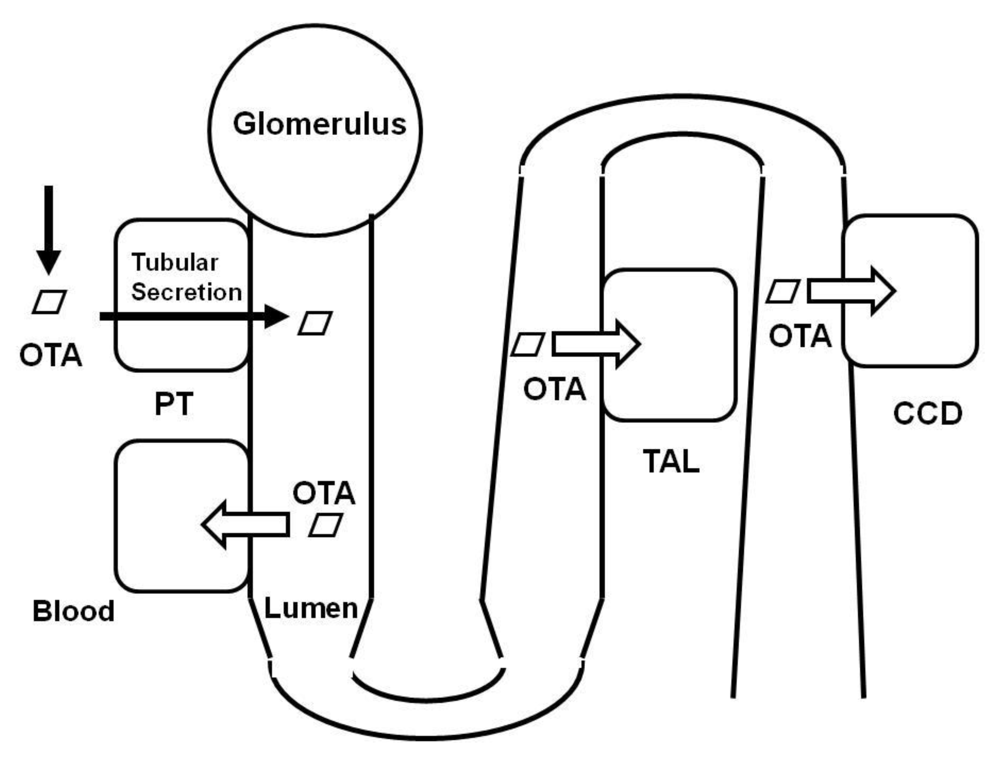
        <p><xref ref-type="fig" rid="toxins-02-01381-f001">Figure 1</xref> depicts the summary of the classical concept for OTA transport systems in the kidneys. Tubular secretion of OTA is mainly performed by the organic anion transport system in the proximal tubules and secreted OTA was reabsorbed in the proximal tubules, distal tubules (TAL), and the collecting ducts (CCD) by several transport systems, leading to the delay of OTA excretion and the accumulation of OTA in tubular cells.</p>
        <fig id="toxins-02-01381-f001" position="anchor">
          <label>Figure 1</label>
          <caption>
            <p>Transport systems for OTA along the nephron. OTA secretion is performed by the proximal tubular organic anion secretion pathway. OTA is reabsorbed along the nephron from apical side. Abbreviations, PT: proximal tubules, TAL: thick ascending limb of the loop of Henle, CD: collecting duct.</p>
          </caption>
          <graphic xmlns:xlink="http://www.w3.org/1999/xlink" xlink:href="toxins-02-01381-g001.tif"/>
        </fig>
      </sec>
    </sec>
    <sec>
      <title>3. Molecular Identities of Renal Organic Anion Transporters</title>
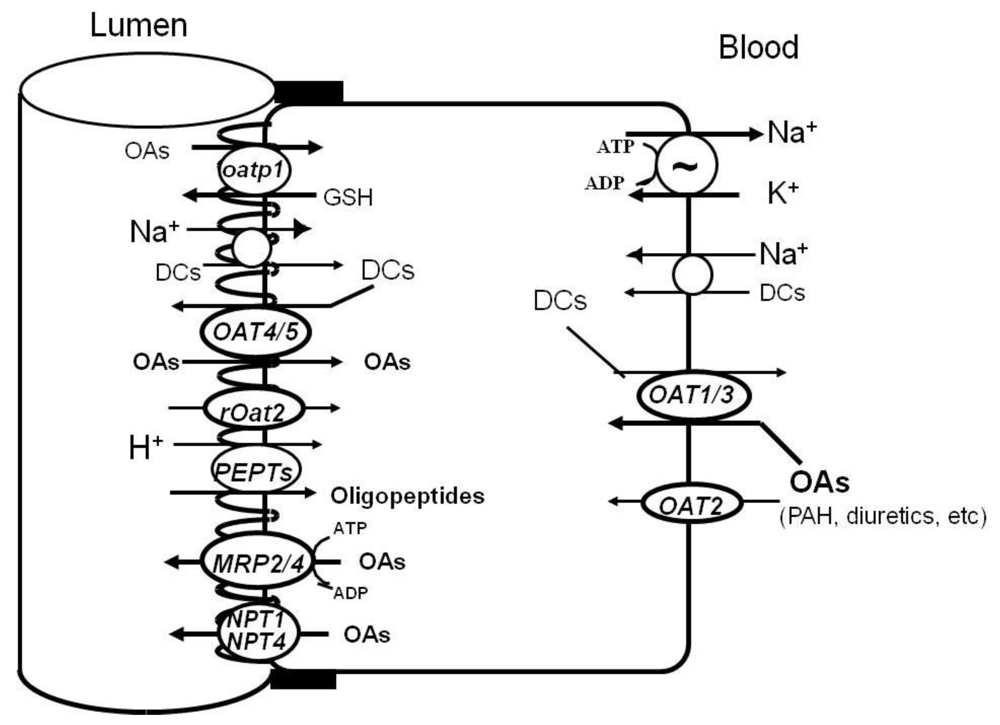
      <p>In this section, we will briefly introduce the renal transporters for organic anionic drugs. A number of reviews [<xref ref-type="bibr" rid="B29-toxins-02-01381">29</xref>,<xref ref-type="bibr" rid="B30-toxins-02-01381">30</xref>,<xref ref-type="bibr" rid="B31-toxins-02-01381">31</xref>,<xref ref-type="bibr" rid="B32-toxins-02-01381">32</xref>,<xref ref-type="bibr" rid="B33-toxins-02-01381">33</xref>,<xref ref-type="bibr" rid="B34-toxins-02-01381">34</xref>] on organic anion transporters are available. <xref ref-type="fig" rid="toxins-02-01381-f002">Figure 2</xref> shows cloned organic anion transporters of renal proximal tubules that have been reported to date.</p>
      <fig id="toxins-02-01381-f002" position="anchor">
        <label>Figure 2</label>
        <caption>
          <p>Proposed model of organic anion transporters in renal proximal tubules. Abbreviations, OAs: organic anions, DCs: dicarboxylates, MCs: monocarboxylates, GSH: glutathione.</p>
        </caption>
        <graphic xmlns:xlink="http://www.w3.org/1999/xlink" xlink:href="toxins-02-01381-g002.tif"/>
      </fig>
      <sec>
        <title>3.1. Organic Anion Transporter (OAT) Family SLC22</title>
        <p><bold>OAT1:</bold> Rat Oat1 mRNA is expressed predominantly in the kidneys and weakly in the brain [<xref ref-type="bibr" rid="B35-toxins-02-01381">35</xref>]. In the kidneys, OAT1 protein is localized in the basolateral membrane of proximal tubular cells. OAT1-mediated uptake of PAH is stimulated by an outwardly directed concentration gradient of dicarboxylates, such as α-ketoglutarate. The substrate selectivity of OAT1 is markedly broad. These substrates include endogenous substances, such as dicarboxylates, cyclic nucleotides, and prostaglandins, and exogenous substances, such as various anionic drugs and environmental compounds [<xref ref-type="bibr" rid="B36-toxins-02-01381">36</xref>].</p>
        <p><bold>OAT2:</bold> Oat2 was originally isolated from the rat liver as a novel liver-specific transport protein with an unknown function [<xref ref-type="bibr" rid="B37-toxins-02-01381">37</xref>]. OAT2 is expressed predominantly in the liver and weakly in the kidneys. The typical substrates of OAT2 are salicylate, acetylsalicylate, prostaglandin E<sub>2</sub> (PGE<sub>2</sub>), dicarboxylates, PAH, zidovudine (AZT), and tetracycline [<xref ref-type="bibr" rid="B31-toxins-02-01381">31</xref>].</p>
        <p><bold>OAT3:</bold> Oat3 was initially isolated from the rat brain [<xref ref-type="bibr" rid="B38-toxins-02-01381">38</xref>]. OAT3 mRNA is expressed in the kidneys and the brain. In the kidneys, OAT3 is localized in the basolateral membrane of proximal tubular cells. Like OAT1, OAT3 recognizes a broad spectrum of substrates. It mediates the high affinity transport of PAH, estrone sulfate (ES), OTA, and various drugs, including the cationic drug cimetidine, in exchange for dicarboxylates inside cells [<xref ref-type="bibr" rid="B31-toxins-02-01381">31</xref>].</p>
        <p><bold>OAT4:</bold> OAT4 was cloned from human kidneys [<xref ref-type="bibr" rid="B39-toxins-02-01381">39</xref>]. OAT4 mRNA is expressed in the kidneys and is localized in the apical membrane of proximal tubular cells. When expressed in <italic>Xenopus</italic> oocytes, OAT4 mediates the Na<sup>+</sup>-independent, high-affinity transport of ES, dehydroepiandrosterone sulfate, OTA, PGE<sub>2</sub>, and PGF<sub>2</sub>α [<xref ref-type="bibr" rid="B31-toxins-02-01381">31</xref>].</p>
        <p><bold>Oat5:</bold> Oat5 was identified from the rat kidney [<xref ref-type="bibr" rid="B40-toxins-02-01381">40</xref>]. It is expressed exclusively in the kidneys. Rat Oat5 is localized in the apical side of proximal tubules. Oat5 mediates the transport of steroid sulfates, as well as OTA.</p>
        <p><bold>Oat8:</bold> Oat8 was recently identified from the rat kidney [<xref ref-type="bibr" rid="B41-toxins-02-01381">41</xref>]. It is expressed exclusively in the kidneys. Rat Oat8 protein is localized in the collecting duct. Additionally, it is colocalized with V-ATPase in plasma membranes and the intracellular vesicles of various subtypes of intercalated cells. Like Oat5, Oat8 mediates the transport of steroid sulfates, as well as OTA.</p>
        <p><bold>Oat9:</bold> Oat9 has recently been identified from the mouse kidney [<xref ref-type="bibr" rid="B42-toxins-02-01381">42</xref>]. It is expressed in the kidneys and in the liver. Oat9 has two isoforms: a long form and a short form. The short form of Oat9 (Oat9S) is functional and mediates the transport of zwitterion L-carnitine, as well as cimetidine and salicylic acid. Oat9 is localized in the apical side of proximal tubules.</p>
        <p><bold>OAT10:</bold> Bahn <italic>et al.</italic> showed that hORCTL3 (human organic cation transporter like 3; OCTL1), an orphan transporter expressed mainly in the kidneys, transports nicotinate, PAH, and uric acid. They renamed it OAT10 [<xref ref-type="bibr" rid="B43-toxins-02-01381">43</xref>]. They suggested that OAT10 is the molecule responsible for cyclosporine A-induced hyperuricemia.</p>
      </sec>
      <sec>
        <title>3.2. Organic Anion Transporting Polypeptide (OATP) Family SLC21/SLCO</title>
        <p>The first member of this family, oatp1, was identified from the rat liver, by an expression cloning method, as a sodium-independent bile acid transporter [<xref ref-type="bibr" rid="B44-toxins-02-01381">44</xref>]. Thus far, 11 human isoforms and 14 rat isoforms have been identified in the OATP family [<xref ref-type="bibr" rid="B45-toxins-02-01381">45</xref>]. Although some OATPs are selectively involved in the hepatic uptake of bulky and relatively hydrophobic organic anions, most OATPs are expressed in many tissues, such as the blood-brain barrier, choroid plexus, lungs, heart, intestine, kidneys, placenta, and testes. The OATP family is divided into six sub-families (OATP1–OATP6). There are considerable species differences in the OATP families among rodents and humans. Among human OATPs, only OATP4C1 is mainly expressed in the kidneys [<xref ref-type="bibr" rid="B46-toxins-02-01381">46</xref>]. Oatp1a3v1 (previous name: Oat-k1) and Oatp1a3v2 (previous name: Oat-k2) are specifically expressed in the rat. Oatp1a1 (previous name: oatp1), Oatp1a5 (previous name: oatp3), Oatp1a6 (previous name: oatp5), and Oatp4c1 are expressed in rodent kidneys. Orthologs of these isoforms, except of OATP4C1, are absent in humans. Because of the above-mentioned remarkable species differences in OATP, it is difficult to assign distinct physiological roles to each OATP in the kidneys. Several important substances, which are mainly excreted via the kidneys, are preferable substrates for the OATP family. Recently, OATP4C1 has been revealed to be a digoxin transporter [<xref ref-type="bibr" rid="B46-toxins-02-01381">46</xref>]. OATP4C1 is expressed exclusively in the basolateral membrane of proximal tubular cells and mediates the high-affinity transport of digoxin (K<sub>m</sub>: 7.8 µM) and ouabain (K<sub>m</sub>: 0.38 µM), as well as thyroid hormones, such as triiodothyronine (K<sub>m</sub>: 5.9 µM). </p>
      </sec>
      <sec>
        <title>3.3. Type I Sodium/Phosphate Transporter (NPT) Family SLC17</title>
        <p>Molecular studies have revealed that type I phosphate transporters (SLC17), a family of proteins initially characterized as phosphate carriers, are expressed at the apical membrane of renal proximal tubular cells. They mediate the transport of organic anions [<xref ref-type="bibr" rid="B47-toxins-02-01381">47</xref>]. Mouse and human NPT1 were shown to mediate the transport of various organic anions in a chloride-dependent manner. Moreover, because human NPT1 exhibits an affinity for PAH, which corresponds to the results of previous studies using brush-border membrane vesicles, NPT1 has also been suggested to represent a classical voltage-dependent PAH transporter. However, the influence of membrane potential on PAH transport was not demonstrated [<xref ref-type="bibr" rid="B48-toxins-02-01381">48</xref>]. </p>
        <p>Recently, we have found that the SLC17 family member, NPT4, mediates the transport of PAH in a voltage-sensitive manner, indicating that NPT4 may be involved in the apical drug efflux pathway [<xref ref-type="bibr" rid="B49-toxins-02-01381">49</xref>].</p>
      </sec>
      <sec>
        <title>3.4. Oligopeptide Transporter (PEPT) Family SLC15</title>
        <p>Peptide transporters are involved in the electrogenic, H<sup>+</sup>-dependent transport of small peptides. They are also involved in the transport of various peptide-like drugs, such as β-lactam antibiotics, angiotensin-converting enzyme (ACE) inhibitors, and anticancer drugs [<xref ref-type="bibr" rid="B50-toxins-02-01381">50</xref>]. Two peptide transporters, designated as PEPT1 and PEPT2, have been cloned. PEPT1, a low-affinity/high-capacity transporter, was first cloned from the rabbit intestine, and subsequently, from the rat and human intestines. Rat Pept1 is localized to the apical side of intestinal epithelial cells and in early regions (S1 segments) of the apical proximal tubules. PEPT2, a high-affinity/low-capacity transporter, appears to have a different tissue localization than that of PEPT1. PEPT2 is highly expressed in the kidney, but not in the intestine. Rat Pept2 is localized to the apical side of the proximal tubule in more distal regions (S3 segments).</p>
      </sec>
      <sec>
        <title>3.5. Multidrug Resistance-Associated Protein (MRP) Family ABCC</title>
        <p>The MRP family consists of primarily active transporters with ATP-binding cassette motifs. The prototype of this family is P-gp [<xref ref-type="bibr" rid="B51-toxins-02-01381">51</xref>], which extrudes various hydrophobic molecules. P-gp particularly extrudes antineoplastic compounds, such as vincristine, vinblastine, adriamycin, and daunorubicin. P-gp confers multidrug resistance upon cancer cells [<xref ref-type="bibr" rid="B52-toxins-02-01381">52</xref>]. MRP1 and MRP2 were isolated from multidrug resistant cancer cells that did not express P-gp. In addition to antineoplastic drugs, MRP2 transports glucronides and cysteine conjugates. MRP2 is expressed in the canalicular membrane of hepatocytes [<xref ref-type="bibr" rid="B53-toxins-02-01381">53</xref>]. To date, many isoforms have been identified in the MRP family. Several of these isoforms are expressed in the apical membrane of proximal tubular cells. MRP members in proximal tubular cells supposedly function as extrusion pumps for organic anions, especially for large and hydrophobic organic anions, from the apical membrane. Regarding the family’s renal physiology and pharmacology, particular attention should be paid to two isoforms, namely, MRP2 and MRP4. MRP2 has been shown to transport PAH, but its affinity for PAH is low (K<sub>m</sub>: 2 mM). In contrast, human MRP4, which is also localized in the apical membrane of proximal tubular cells, transports PAH with a much higher affinity (K<sub>m</sub>: 160 µM) than that of MRP2. Furthermore, real-time PCR and Western blot analysis have shown that the renal cortical expression of MRP4 is approximately five-fold higher than that of MRP2 [<xref ref-type="bibr" rid="B54-toxins-02-01381">54</xref>]. These data demonstrate that MRP4 plays a certain role in the efflux of PAH and several small hydrophilic organic anions, such as urate, cAMP, and cGMP, into the tubular lumen [<xref ref-type="bibr" rid="B55-toxins-02-01381">55</xref>].</p>
      </sec>
      <sec>
        <title>3.6. Breast Caner Resistance-Associated Protein (BCRP) ABCG2</title>
        <p>BCRP, a member of the ABC transporter family to which MRP4 belongs, was recently reported to transport uric acid [<xref ref-type="bibr" rid="B56-toxins-02-01381">56</xref>]. In addition, the finding that the Q141K polymorphism associated with gout leads to decreased urate excretion capacity suggests that ABCG2 contributes to urate excretion at the apical membrane of renal proximal tubules or at the luminal membrane of the intestine [<xref ref-type="bibr" rid="B56-toxins-02-01381">56</xref>], or both.</p>
      </sec>
    </sec>
    <sec>
      <title>4. OTA Transport Properties in Cloned Organic Anion Transporters</title>
      <sec>
        <title>4.1. Basolateral OATs</title>
        <p>Tsuda <italic>et al.</italic> [<xref ref-type="bibr" rid="B57-toxins-02-01381">57</xref>] investigated the transport of OTA by rat kidney-specific organic anion transporter 1 (rOat1). When expressed in <italic>Xenopus</italic> oocytes, rOat1 mediated the sodium-independent uptake of OTA (K<sub>m</sub>: 2.1 µM). Piroxicam, which has been shown to prevent the nephrotoxicity of OTA, inhibited rOat1-mediated uptake of OTA. The research group investigated the transport of OTA and OTA’s effect on cell proliferation and viability by using cells derived from the mouse kidney terminal proximal tubule (S3) that were transfected with rOat1 cDNA (S3 rOat1). S3 rOat1 mediated the saturable transport of OTA (K<sub>m</sub>: 0.57 µM). Proliferation of S3 rOat1 cells was suppressed when exposed to OTA (2 and 10 µM). This suppression was rescued by the addition of PAH (1 mM) to the media. These results indicated that OTA is transported by rOat1 and that the accumulation of OTA via rOat1 in proximal tubular cells is the primary event in the development of OTA-induced nephrotoxicity.</p>
        <p>Jung <italic>et al.</italic> [<xref ref-type="bibr" rid="B58-toxins-02-01381">58</xref>] then investigated the characteristics of OTA transport by multispecific human organic anion transporters (hOAT1 and hOAT3, respectively) using cells from the second segment of the proximal tubule (S2) from mice that stably expressed hOAT1 and hOAT3 (S2 hOAT1 and S2 hOAT3). S2 hOAT1 and S2 hOAT3 exhibited a time- and concentration-dependent uptake of [<sup>3</sup>H]OTA (K<sub>m</sub>: 0.42 µM for hOAT1, 0.75 µM for hOAT3). PAH, probenecid, piroxicam, octanoate, and citrinin inhibited [<sup>3</sup>H]OTA uptake by hOAT1 and hOAT3 in a competitive manner (K<sub>i</sub>: 4.29-3080 µM), with different orders of potency for hOAT1 and for hOAT3. These results indicate that hOAT1and hOAT3 both mediate the high-affinity transport of OTA on the basolateral side of the proximal tubule. Additionally, the results show that hOAT1-mediated and hOAT3-mediated OTA transport differs in how they are influenced by the substrates of OATs. These pharmacological characteristics of hOAT1 and hOAT3 may be significantly related to the development of OTA-induced nephrotoxicity in the human kidney.</p>
        <p>Zhang <italic>et al.</italic> [<xref ref-type="bibr" rid="B59-toxins-02-01381">59</xref>] compared the characteristics of several cloned rabbit organic ion transporters expressed in cultured cells with their behavior in intact rabbit renal proximal tubules (RPT) to determine the contribution of each to the basolateral uptake of OTA. The activity of organic anion transporters OAT1 and OAT3 proved to be distinguishable because OAT1 had a high affinity for PAH (K <sub>t</sub> of 20 µM), and did not support estrone sulfate (ES) transport, whereas OAT3 had a high affinity for ES (K<sub>t</sub> of 4.5 µM), and had a weak interaction with PAH (IC<sub>50</sub> &gt; 1 mM). In contrast, both transporters robustly accumulated OTA. Intact RPT also accumulated OTA, with OAT1 and OAT3 each being responsible for approximately 50%; ES and PAH each reduced uptake by approximately 50%, and the combination of the two eliminated mediated OTA uptake. They concluded that the fractional contribution of different organic ion transporters to renal secretion is influenced by their affinity for substrate and by their relative expression level in RPT.</p>
      </sec>
      <sec>
        <title>4.2. Apical OATs</title>
        <p>Babu <italic>et al.</italic>, using mouse proximal tubule cells stably transfected with OAT4 (S2 OAT4) [<xref ref-type="bibr" rid="B60-toxins-02-01381">60</xref>], examined the characteristics of OTA transport by OAT4. Immunohistochemical analysis revealed that the OAT4 protein was localized to the apical side of the proximal tubule. S2 OAT4 exhibited a time- and concentration-dependent increase in OTA uptake (K<sub>m</sub>: 22.9 µM). OAT4-mediated OTA uptake was inhibited by several substrates for OATs. Probenecid, piroxicam, octanoate, and citrinin inhibited OTA uptake by OAT4 in a competitive manner (K<sub>i</sub>: 44.4–336.4 µM). The addition of OTA resulted in a slight decrease in the viability of S2 OAT4 when compared with the mock. These results indicate that hOAT4 mediates the high-affinity transport of OTA on the apical side of the proximal tubule. Considering the driving force of OAT4, as indicated by Ekaratanawong <italic>et al.</italic> [<xref ref-type="bibr" rid="B61-toxins-02-01381">61</xref>], OAT4 seems to function as a reabsorption pathway for OTA at the apical membrane of renal proximal tubules.</p>
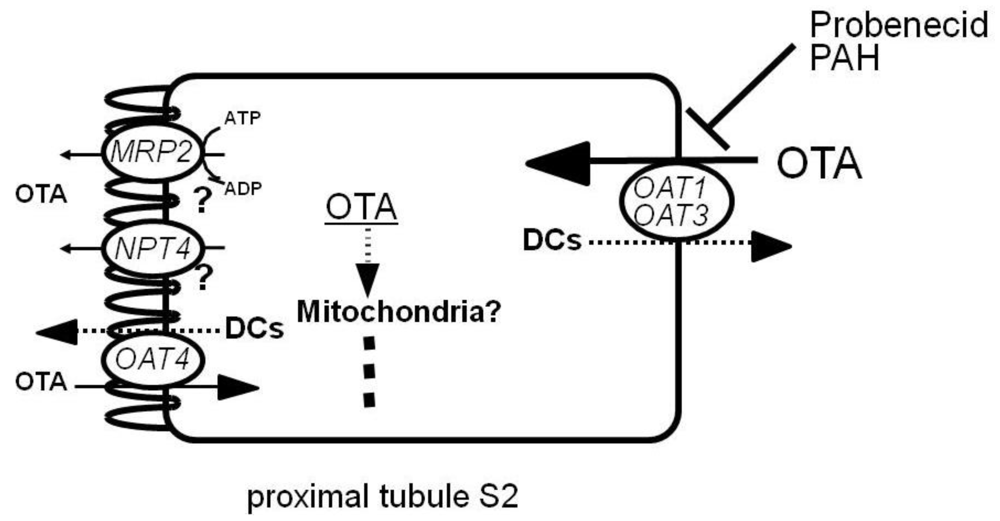
        <p>Recently, we have identified an orphan transporter, NPT4 (<italic>SLC17A3</italic>), as a novel human voltage-driven organic anion transporter at the apical side of proximal tubules. We characterized its multispecific transport properties for organic anions, including PAH and several diuretics [<xref ref-type="bibr" rid="B49-toxins-02-01381">49</xref>]. We also examined whether or not NPT4 mediates OTA transport by using <italic>Xenopus</italic> oocytes expressing hNPT4 [<xref ref-type="bibr" rid="B62-toxins-02-01381">62</xref>]. hNPT4 demonstrated time- and concentration-dependent uptake of OTA. Like in the transport of PAH, OTA uptake by hNPT4 was enhanced in the medium with replacement of K<sup>+</sup> by Na<sup>+</sup>. This suggests voltage-driven transport of OTA by hNPT4. hNPT4-mediated OTA uptake was inhibited by several organic anions, such as probenecid and piroxicam. These results indicate that hNPT4 is an apical efflux pathway for OTA entering via basolateral OAT1 or OAT3 (or both) in renal proximal tubules (<xref ref-type="fig" rid="toxins-02-01381-f003">Figure 3</xref>).</p>
        <fig id="toxins-02-01381-f003" position="anchor">
          <label>Figure 3</label>
          <caption>
            <p>OTA secretion in proximal tubular cells in humans. Organic anion/dicarboxylates (DCs) exchangers OAT1 and OAT3 function as entrance pathways for OTA, and NPT4 and MRP2 may be its exit route in proximal tubular cells. OAT4 at the apical membrane may function as a reabsorptive pathway for OTA. When probenecid (inhibitor of OATs) or PAH (substrate for both OAT1 and OAT3) is coadministered with OTA, they inhibit the tubular secretion of OTA, thus reducing its potential risk.</p>
          </caption>
          <graphic xmlns:xlink="http://www.w3.org/1999/xlink" xlink:href="toxins-02-01381-g003.tif"/>
        </fig>
      </sec>
      <sec>
        <title>4.3. OATPs</title>
        <p>Takeuchi <italic>et al.</italic> characterized the interactions of various compounds with kidney-specific organic anion transporters Oat-k1 and Oat-k2 [<xref ref-type="bibr" rid="B63-toxins-02-01381">63</xref>]. By using MDCK cells stably transfected with Oat-k1 or Oat-k2 cDNA, the antitumor drug methotrexate, OTA, endogenous organic anions (thyroid hormones, taurocholic acid, and conjugated steroids), and the antiretroviral drug zidovudine were shown to be substrates for these transporters. These results suggested that Oat-k1 and Oat-k2 could serve as multispecific transporters, mediating the transport of a wide variety of endogenous substances, xenobiotics, and their metabolites in the kidney, presumably via several interaction sites in their molecules.</p>
      </sec>
      <sec>
        <title>4.4. MRP2</title>
        <p>The ATP-dependent membrane transporters, P-glycoprotein (P-gp), MRP2, and BCRP, are localized in the luminal membranes of the intestines and liver, as well as in the kidney. They counteract absorption and increase excretion of xenobiotics and drugs. Leier <italic>et al.</italic> investigated the transport function of renal apical multidrug resistance protein MRP2 (ABCC2) using PAH and OTA as transport substrates [<xref ref-type="bibr" rid="B64-toxins-02-01381">64</xref>]. Membrane vesicles from HEK-MRP2 cells containing recombinant human MRP2 and from control vector-transfected HEK-Co cells were incubated with various concentrations of [<sup>3</sup>H]PAH and [<sup>3</sup>H]OTA. The net ATP-dependent transport into inside-out vesicles was determined (K<sub>m</sub> for PAH: 880 µM). OTA inhibited MRP2-mediated PAH transport (IC<sub>50</sub>: 58 µM). OTA was itself a substrate for MRP2. </p>
        <p>Schrickx <italic>et al.</italic> [<xref ref-type="bibr" rid="B65-toxins-02-01381">65</xref>] investigated the absorption and secretion of OTA in a Caco-2 cell model. Caco-2 cells secreted OTA to the luminal side in a concentration-dependent manner. This secretory permeability was higher than the absorptive permeability, while the absorptive permeability remained constant for all OTA concentrations tested. The secretion decreased and absorption increased in the presence of the MRP-inhibitor MK571, the P-gp and BCRP inhibitor GF120918, and the BCRP-inhibitor Ko143, suggesting that the secretion of OTA is mediated by MRP2 and BCRP. Cyclosporine A also decreased the secretory permeability, but did not affect absorptive permeability. PSC833 changed neither the absorption nor the secretion of OTA. Hence, it can be suggested that OTA is a substrate for MRP2 as well as for BCRP. These findings are of interest for evaluating mycotoxin absorption after oral ingestion, tissue distribution, and particularly, mycotoxin excretion pathways, including renal, biliary, and mammary gland excretion.</p>
      </sec>
    </sec>
    <sec>
      <title>5. Transport of OTA in Extrarenal Tissues</title>
      <sec>
        <title>5.1. Intestine</title>
        <p>OTA is absorbed from the small intestine and binds to serum albumin in plasma. The prolonged half-life of OTA results from its reabsorption by the proximal tubules and via enterohepatic circulation. Berger <italic>et al.</italic> [<xref ref-type="bibr" rid="B66-toxins-02-01381">66</xref>] investigated the mechanism by which OTA crosses the intestine. They used a cell culture system consisting of Caco-2 cells as an <italic>in vitro</italic> model of the human intestinal epithelium. Cytotoxicity assays on proliferating Caco-2 cells showed that OTA (0.4 µM) inhibits MTT reduction by 50%. Transepithelial transport and intracellular accumulation of OTA were studied in Caco-2 cells and were differentiated in bicameral inserts. At pH 7.4, OTA is transported preferentially in the basolateral (BL) to apical (A) direction, suggesting a net secretion. Conditions closer to the <italic>in vivo</italic> situation in the duodenum (A: pH 6.0, BL: pH 7.4) increased intracellular accumulation and transepithelial transport. A to BL transport becomes higher than BL to A transport, suggesting OTA absorption. Addition of serum albumin in the BL compartment further increases OTA absorption across Caco-2 cells and suggests that <italic>in vivo</italic> OTA transport from the serosal to the luminal side of enterocytes is prevented, due to its binding to plasma proteins. A and BL transport and intracellular accumulation of OTA are increased in the presence of non-specific inhibitors of MRPs (indomethacin, genistein, and probenecid) and in the presence of 1-chloro-2,4-dinitrobenzene (biotransformed into 2,4-dinitrophenyl-glutathione, a specific inhibitor of MRPs), but are not affected by verapamil, an inhibitor of P-gp. This suggests that MRP2 might be involved in transepithelial transport. Therefore, absorption of OTA across the intestinal mucosa would be limited, due to its excretion through MRP2 at the apical pole of enterocytes.</p>
        <p>In addition, as mentioned in section <italic>3.5</italic>, ABC transporters, such as P-gp, MRP2, and BCRP, which are localized in the luminal membranes of the intestine, counteract absorption and increase excretion of xenobiotics and drugs. Schrickx <italic>et al.</italic> [<xref ref-type="bibr" rid="B65-toxins-02-01381">65</xref>] suggested that OTA is a substrate for MRP2 as well as for BCRP.</p>
      </sec>
      <sec>
        <title>5.2. Liver</title>
        <p>Upon intestinal absorption, a large part of OTA is taken up by hepatocytes and eliminated into bile. Kontaxi <italic>et al.</italic> [<xref ref-type="bibr" rid="B67-toxins-02-01381">67</xref>] characterized hepatocellular uptake of [<sup>3</sup>H]OTA in isolated rat hepatocytes. A saturable (K<sub>m</sub>: 18.9 µM) and energy-dependent OTA transport was found. This uptake was inhibited by various bile acids, sulfobromophthalein (BSP), and the thrombin inhibitor CRC 220. Because all inhibitors are substrates of the organic anion-transporting polypeptide (oatp), a hepatic carrier [<xref ref-type="bibr" rid="B44-toxins-02-01381">44</xref>], uptake experiments were performed in oatp cRNA-injected <italic>Xenopus</italic> oocytes. These studies revealed an oatp-specific OTA uptake (K<sub>m</sub>: 16.6 µM). Known oatp substrates <italic>cis</italic>-inhibited OTA uptake in oatp cRNA-injected oocytes in close correlation with the results obtained from isolated hepatocytes. These results reveal OTA as a substrate for oatp. They further support the multispecific nature of oatp-mediated transport and stress the importance of this carrier for hepatic clearance of xenobiotics.</p>
        <p>As mentioned before, Schrickx <italic>et al.</italic> [<xref ref-type="bibr" rid="B65-toxins-02-01381">65</xref>] suggested that OTA is a substrate for MRP2 and BCRP, which are localized in the canalicular membranes of the liver.</p>
      </sec>
      <sec>
        <title>5.3. Blood-brain Barrier</title>
        <p>Ose <italic>et al.</italic> [<xref ref-type="bibr" rid="B68-toxins-02-01381">68</xref>] investigated the role of a multispecific organic anion transporter, Oatp1a4/Slco1a4, in drug transport across the blood-brain barrier. <italic>In vitro</italic> transport studies using HEK293 cells expressing mouse Oatp1a4 revealed the following compounds as Oatp1a4 substrates: pitavastatin (K<sub>m</sub>: 8.3 µM), rosuvastatin (K<sub>m</sub>: 12 µM), pravastatin, taurocholate (K<sub>m</sub>: 40 µM), digoxin, and OTA. Double immunohistochemical staining of Oatp1a4 with P-gp or glial fibrillary acidic protein demonstrated that Oatp1a4 signals partly colocalized with P-gp signals, but not with glial fibrillary acidic protein, suggesting that Oatp1a4 is expressed in both the luminal and the abluminal membranes of mouse brain capillary endothelial cells. The brain-to-blood transport of pitavastatin, rosuvastatin, pravastatin, and taurocholate after microinjection into the cerebral cortex was significantly decreased in Oatp1a4(−/−) mice, compared with that in wild-type mice. The blood-to-brain transport of pitavastatin, rosuvastatin, taurocholate, and OTA, determined by <italic>in situ</italic> brain perfusion, was significantly lower in Oatp1a4(−/−) mice than in wild-type mice.</p>
      </sec>
    </sec>
    <sec>
      <title>6. OTA as a Regulator of Transporter Expression</title>
      <p>In rodents, OTA intoxication impairs various proximal tubule functions, including secretion of PAH, possibly via affecting the renal organic anion transporters (Oat). However, an effect of OTA on the activity/expression of specific Oats in the mammalian kidney has not been reported. Zlender <italic>et al.</italic> studied tubular integrity by microscopy, abundance of basolateral (rOat1, rOat3) and brush-border (rOat2, rOat5) rOat proteins by immunochemical methods, and expression of rOats mRNA by RT-PCR in kidneys from male rats gavaged with various doses of OTA every second day for 10 days [<xref ref-type="bibr" rid="B69-toxins-02-01381">69</xref>]. The OTA treatment caused (1) dose-dependent damage of the cells in the S3 segments of medullary rays; (2) a dual effect upon rOats in the proximal tubules with low doses upregulating the abundance of all rOats and high doses downregulating the abundance of rOat1, and (3) unchanged mRNA expression for all rOats at low OTA doses, and downregulation of rOats at high OTA doses. Changes in the expression of renal Oats were associated with enhanced OTA accumulation in tissue and excretion in urine, whereas the indicators of oxidative stress either remained unchanged (malondialdehyde, glutathione, 8-hydroxydeoxyguanosine) or became deranged (microtubules). While OTA accumulation and downregulation of rOats in the kidney are consistent with the previously reported impaired renal PAH secretion in rodents intoxicated with high OTA doses, the post-transcriptional upregulation of Oats at low OTA doses may contribute to OTA accumulation and development of nephrotoxicity.</p>
    </sec>
    <sec>
      <title>7. Conclusion</title>
      <p>Renal organic anion transporters function as an entrance pathway for several xenobiotics and contribute to their accumulation in proximal tubular cells. In this review, we showed that nephrotoxic compounds, such as OTA, are substrates for renal drug transporters by transporter-stably expressing cell lines [<xref ref-type="bibr" rid="B57-toxins-02-01381">57</xref>,<xref ref-type="bibr" rid="B58-toxins-02-01381">58</xref>,<xref ref-type="bibr" rid="B60-toxins-02-01381">60</xref>]. Use of transporter-stably expressing cells (S2 OATs), together with non-expressing cells (S2 mock), is helpful for checking the possibility of transporter-mediated nephrotoxicity. Thus, transporter-stably expressing cell lines seem to be useful systems as an animal alternative model for the screening of potential nephrotoxic compounds.</p>
      <p>Besides OTA, the nephrotoxic effects of carbapenem antibiotics and antiviral drugs, such as adefovir and cidofovir, are closely associated with OATs [<xref ref-type="bibr" rid="B70-toxins-02-01381">70</xref>]. The nephrotoxicity of these compounds could be reduced by the coadministration of other substrates of OATs or of inhibitors of OATs. Indeed, recently, a new application of probenecid as a nephroprotectant in therapy with the antiviral drug cidofovir was determined [<xref ref-type="bibr" rid="B71-toxins-02-01381">71</xref>]. When probenecid is coadministered with cidofovir, probenecid inhibits the tubular accumulation of cidofovir, leading to the reduction of its potential risk. Thus, blockade of transport by competitors eliminates or reduces the nephrotoxic response.</p>
      <p>An understanding of the molecular mechanism of renal organic transport is essential to achieving desired therapeutic outcomes in response to chemical exposure and drug interactions, to understanding the progression of some disease states, and to predicting the influence of genetic variation upon these processes.</p>
      <p>Renal tubular secretion and reabsorption of OTA, presumably via the OAT system, may play an important role in OTA accumulation and development of nephrotoxicity. Neverthess it should be kept in mind that albumin binding impacts transport <italic>in vitro</italic> and thus must be considered when thinking about the clearance of OTA <italic>in vivo</italic> [<xref ref-type="bibr" rid="B72-toxins-02-01381">72</xref>]. Thus, a molecular understanding of renal OTA transport will lead to the development of possible strategies for the prevention of OTA-induced nephrotoxicity.</p>
    </sec>
  </body>
  <back>
    <ack>
      <title>Acknowledgements</title>
      <p>This work was supported in part by grants from the Japan Society for the Promotion of Science (KAKENHI 21390073, 21659216, 21890245), the Nakatomi Foundation, and Gout Research Foundation of Japan.</p>
    </ack>
    <ref-list>
      <title>References</title>
      <ref id="B1-toxins-02-01381">
        <label>1.</label>
        <citation citation-type="journal">
          <person-group person-group-type="author">
            <name>
              <surname>van der Merwe</surname>
              <given-names>K.J.</given-names>
            </name>
            <name>
              <surname>Steyn</surname>
              <given-names>P.S.</given-names>
            </name>
            <name>
              <surname>Fourie</surname>
              <given-names>L.</given-names>
            </name>
            <name>
              <surname>Scott</surname>
              <given-names>D.B.</given-names>
            </name>
            <name>
              <surname>Theron</surname>
              <given-names>J.J.</given-names>
            </name>
          </person-group>
          <article-title>Ochratoxin A, a toxic metabolite produced by <italic>Aspergillus ochraceus</italic> Wilh</article-title>
          <source>Nature</source>
          <year>1965</year>
          <volume>205</volume>
          <fpage>1112</fpage>
          <lpage>1113</lpage>
        <pub-id pub-id-type="doi">10.1038/2051112a0</pub-id><pub-id pub-id-type="pmid">5833211</pub-id></citation>
      </ref>
      <ref id="B2-toxins-02-01381">
        <label>2.</label>
        <citation citation-type="book">
          <person-group person-group-type="author">
            <name>
              <surname>Harwig</surname>
              <given-names>J.</given-names>
            </name>
            <name>
              <surname>Kuiper-Goodmann</surname>
              <given-names>T.</given-names>
            </name>
            <name>
              <surname>Scott</surname>
              <given-names>P.M.</given-names>
            </name>
            <name>
              <surname>Rechcigl</surname>
              <given-names>M.</given-names>
            </name>
          </person-group>
          <source>Handbook of Foodborne Diseases of Biological Origin</source>
          <publisher-name>CRC Press</publisher-name>
          <publisher-loc>Boca Raton, FL, USA</publisher-loc>
          <year>1983</year>
          <fpage>193</fpage>
          <lpage>238</lpage>
        </citation>
      </ref>
      <ref id="B3-toxins-02-01381">
        <label>3.</label>
        <citation citation-type="journal">
          <person-group person-group-type="author">
            <name>
              <surname>Krogh</surname>
              <given-names>P.</given-names>
            </name>
            <name>
              <surname>Hald</surname>
              <given-names>B.</given-names>
            </name>
            <name>
              <surname>Pedersen</surname>
              <given-names>E.J.</given-names>
            </name>
          </person-group>
          <article-title>Occurrence of ochratoxin A and citrinin in cereals associated with mycotoxic porcine nephropathy</article-title>
          <source>Acta Pathol. Microbio. Scand. Sect. B</source>
          <year>1973</year>
          <volume>81</volume>
          <fpage>689</fpage>
          <lpage>695</lpage>
        </citation>
      </ref>
      <ref id="B4-toxins-02-01381">
        <label>4.</label>
        <citation citation-type="gov">
          <collab collab-type="author">WHO</collab>
          <article-title>Selected mycotoxins: Ochratoxins, trichothecenes, and ergot</article-title>
          <source>Environmental Health Criteria</source>
          <publisher-name>World Health Organization</publisher-name>
          <publisher-loc>Geneva, Switzerland</publisher-loc>
          <year>1990</year>
          <fpage>105</fpage>
        </citation>
      </ref>
      <ref id="B5-toxins-02-01381">
        <label>5.</label>
        <citation citation-type="journal">
          <person-group person-group-type="author">
            <name>
              <surname>Dietrich</surname>
              <given-names>D.R.</given-names>
            </name>
            <name>
              <surname>Heussner</surname>
              <given-names>A.H.</given-names>
            </name>
            <name>
              <surname>O'Brien</surname>
              <given-names>E.</given-names>
            </name>
          </person-group>
          <article-title>Ochratoxin A: Comparative pharmacokinetics and toxicological implications (experimental and domestic animals and humans)</article-title>
          <source>Food Addit. Contam.</source>
          <year>2005</year>
          <volume>22</volume>
          <fpage>45</fpage>
          <lpage>52</lpage>
          <supplement>(Suppl. 1)</supplement>
          <pub-id pub-id-type="pmid">16332621</pub-id>
          <pub-id pub-id-type="doi">10.1080/02652030500309327</pub-id>
        </citation>
      </ref>
      <ref id="B6-toxins-02-01381">
        <label>6.</label>
        <citation citation-type="journal">
          <person-group person-group-type="author">
            <name>
              <surname>Clark</surname>
              <given-names>H.A.</given-names>
            </name>
            <name>
              <surname>Snedeker</surname>
              <given-names>S.M.</given-names>
            </name>
          </person-group>
          <article-title>Ochratoxin A: Its cancer risk and potential for exposure</article-title>
          <source>J. Toxicol. Environ. Health B. Crit. Rev.</source>
          <year>2006</year>
          <volume>9</volume>
          <fpage>265</fpage>
          <lpage>296</lpage>
        <pub-id pub-id-type="doi">10.1080/15287390500195570</pub-id><pub-id pub-id-type="pmid">16621780</pub-id></citation>
      </ref>
      <ref id="B7-toxins-02-01381">
        <label>7.</label>
        <citation citation-type="journal">
          <person-group person-group-type="author">
            <name>
              <surname>Manderville</surname>
              <given-names>R.A.</given-names>
            </name>
            <name>
              <surname>Pfohl-Leszkowicz</surname>
              <given-names>A.</given-names>
            </name>
          </person-group>
          <article-title>Bioactivation and DNA adduction as a rationale for ochratoxin A carcinogenesis</article-title>
          <source>World Mycotoxin J.</source>
          <year>2008</year>
          <volume>1</volume>
          <fpage>357</fpage>
          <lpage>367</lpage>
        <pub-id pub-id-type="doi">10.3920/WMJ2008.x039</pub-id></citation>
      </ref>
      <ref id="B8-toxins-02-01381">
        <label>8.</label>
        <citation citation-type="journal">
          <person-group person-group-type="author">
            <name>
              <surname>Kuiper-Goodman</surname>
              <given-names>T.</given-names>
            </name>
            <name>
              <surname>Scott</surname>
              <given-names>P.M.</given-names>
            </name>
          </person-group>
          <article-title>Risk assessment of the mycotoxin ochratoxin A</article-title>
          <source>Biomed. Environ. Sci.</source>
          <year>1989</year>
          <volume>2</volume>
          <fpage>179</fpage>
          <lpage>248</lpage>
        <pub-id pub-id-type="pmid">2692617</pub-id></citation>
      </ref>
      <ref id="B9-toxins-02-01381">
        <label>9.</label>
        <citation citation-type="journal">
          <person-group person-group-type="author">
            <name>
              <surname>Pfohl-Leszkowicz</surname>
              <given-names>A.</given-names>
            </name>
            <name>
              <surname>Manderville</surname>
              <given-names>R.A.</given-names>
            </name>
          </person-group>
          <article-title>Ochratoxin A: An overview on toxicity and carcinogenicity in animals and humans</article-title>
          <source>Mol. Nutr. Food Res.</source>
          <year>2007</year>
          <volume>51</volume>
          <fpage>61</fpage>
          <lpage>99</lpage>
        <pub-id pub-id-type="doi">10.1002/mnfr.200600137</pub-id><pub-id pub-id-type="pmid">17195275</pub-id></citation>
      </ref>
      <ref id="B10-toxins-02-01381">
        <label>10.</label>
        <citation citation-type="journal">
          <person-group person-group-type="author">
            <name>
              <surname>Simon</surname>
              <given-names>P.</given-names>
            </name>
          </person-group>
          <article-title>Ochratoxin and kidney disease in the human</article-title>
          <source>J. Toxicol.</source>
          <year>1996</year>
          <volume>15</volume>
          <fpage>239</fpage>
          <lpage>249</lpage>
        <pub-id pub-id-type="doi">10.3109/10915819609008716</pub-id></citation>
      </ref>
      <ref id="B11-toxins-02-01381">
        <label>11.</label>
        <citation citation-type="journal">
          <person-group person-group-type="author">
            <name>
              <surname>Gekle</surname>
              <given-names>M.</given-names>
            </name>
            <name>
              <surname>Silbernagl</surname>
              <given-names>S.</given-names>
            </name>
          </person-group>
          <article-title>Mechanism of ochratoxin A-induced reduction of glomerular filtration rate in rats</article-title>
          <source>J. Pharmacol. Exp. Ther.</source>
          <year>1993</year>
          <volume>267</volume>
          <fpage>316</fpage>
          <lpage>321</lpage>
        <pub-id pub-id-type="pmid">8229758</pub-id></citation>
      </ref>
      <ref id="B12-toxins-02-01381">
        <label>12.</label>
        <citation citation-type="journal">
          <person-group person-group-type="author">
            <name>
              <surname>Gekle</surname>
              <given-names>M.</given-names>
            </name>
            <name>
              <surname>Silbernagl</surname>
              <given-names>S.</given-names>
            </name>
          </person-group>
          <article-title>The role of the proximal tubule in ochratoxin A nephrotoxicity <italic>in vivo</italic>: Toxicodynamic and toxokinetic aspects</article-title>
          <source>Renal Physiol. Biochem.</source>
          <year>1994</year>
          <volume>17</volume>
          <fpage>40</fpage>
          <lpage>49</lpage>
        <pub-id pub-id-type="pmid">7509502</pub-id></citation>
      </ref>
      <ref id="B13-toxins-02-01381">
        <label>13.</label>
        <citation citation-type="journal">
          <person-group person-group-type="author">
            <name>
              <surname>Dahlmann</surname>
              <given-names>A.</given-names>
            </name>
            <name>
              <surname>Dantzler</surname>
              <given-names>W.H.</given-names>
            </name>
            <name>
              <surname>Silbernagl</surname>
              <given-names>S.</given-names>
            </name>
            <name>
              <surname>Gekle</surname>
              <given-names>M.</given-names>
            </name>
          </person-group>
          <article-title>Detailed mapping of ochratoxin A reabsorption along the rat nephron <italic>in vivo</italic>: The nephrotoxin can be reabsorbed in all nephron segments by different mechanisms</article-title>
          <source>J. Pharmacol. Exp. Ther.</source>
          <year>1998</year>
          <volume>286</volume>
          <fpage>157</fpage>
          <lpage>162</lpage>
        <pub-id pub-id-type="pmid">9655855</pub-id></citation>
      </ref>
      <ref id="B14-toxins-02-01381">
        <label>14.</label>
        <citation citation-type="journal">
          <person-group person-group-type="author">
            <name>
              <surname>Stein</surname>
              <given-names>A.F.</given-names>
            </name>
            <name>
              <surname>Phillips</surname>
              <given-names>T.D.</given-names>
            </name>
            <name>
              <surname>Kubena</surname>
              <given-names>L.F.</given-names>
            </name>
            <name>
              <surname>Harvey</surname>
              <given-names>R.B.</given-names>
            </name>
          </person-group>
          <article-title>Renal tubular secretion and reabsorption as factors in ochratoxicosis: Effects of probenecid on nephrotoxicity</article-title>
          <source>J. Toxicol. Environ. Health</source>
          <year>1985</year>
          <volume>16</volume>
          <fpage>593</fpage>
          <lpage>605</lpage>
        <pub-id pub-id-type="doi">10.1080/15287398509530766</pub-id><pub-id pub-id-type="pmid">4087321</pub-id></citation>
      </ref>
      <ref id="B15-toxins-02-01381">
        <label>15.</label>
        <citation citation-type="journal">
          <person-group person-group-type="author">
            <name>
              <surname>Stojković</surname>
              <given-names>R.</given-names>
            </name>
            <name>
              <surname>Hult</surname>
              <given-names>K.</given-names>
            </name>
            <name>
              <surname>Gamulin</surname>
              <given-names>S.</given-names>
            </name>
            <name>
              <surname>Plestina</surname>
              <given-names>R.</given-names>
            </name>
          </person-group>
          <article-title>High affinity binding of ochratoxin A to plasma constituents</article-title>
          <source>Biochem. Int.</source>
          <year>1984</year>
          <volume>9</volume>
          <fpage>33</fpage>
          <lpage>38</lpage>
          <pub-id pub-id-type="pmid">6477636</pub-id>
        </citation>
      </ref>
      <ref id="B16-toxins-02-01381">
        <label>16.</label>
        <citation citation-type="journal">
          <person-group person-group-type="author">
            <name>
              <surname>Hagelberg</surname>
              <given-names>S.</given-names>
            </name>
            <name>
              <surname>Hult</surname>
              <given-names>K.</given-names>
            </name>
            <name>
              <surname>Fuchs</surname>
              <given-names>R.</given-names>
            </name>
          </person-group>
          <article-title>Toxicokinetics of ochratoxin A in several species and its plasma-binding properties</article-title>
          <source>J. Appl. Toxicol.</source>
          <year>1989</year>
          <volume>9</volume>
          <fpage>91</fpage>
          <lpage>96</lpage>
        <pub-id pub-id-type="doi">10.1002/jat.2550090204</pub-id><pub-id pub-id-type="pmid">2715571</pub-id></citation>
      </ref>
      <ref id="B17-toxins-02-01381">
        <label>17.</label>
        <citation citation-type="journal">
          <person-group person-group-type="author">
            <name>
              <surname>Gekle</surname>
              <given-names>M.</given-names>
            </name>
            <name>
              <surname>Sauvant</surname>
              <given-names>C.</given-names>
            </name>
            <name>
              <surname>Schwerdt</surname>
              <given-names>G.</given-names>
            </name>
          </person-group>
          <article-title>Ochratoxin A at nanomolar concentrations: A signal modulator in renal cells</article-title>
          <source>Mol. Nutr. Food Res.</source>
          <year>2005</year>
          <volume>49</volume>
          <fpage>118</fpage>
          <lpage>130</lpage>
        <pub-id pub-id-type="doi">10.1002/mnfr.200400062</pub-id><pub-id pub-id-type="pmid">15635689</pub-id></citation>
      </ref>
      <ref id="B18-toxins-02-01381">
        <label>18.</label>
        <citation citation-type="journal">
          <person-group person-group-type="author">
            <name>
              <surname>Berndt</surname>
              <given-names>W.O.</given-names>
            </name>
            <name>
              <surname>Hayes</surname>
              <given-names>A.W.</given-names>
            </name>
          </person-group>
          <article-title><italic>In vivo</italic> and <italic>in vitro</italic> changes in renal function caused by ochratoxin A in the rat</article-title>
          <source>Toxicology</source>
          <year>1979</year>
          <volume>12</volume>
          <fpage>5</fpage>
          <lpage>17</lpage>
        <pub-id pub-id-type="doi">10.1016/0300-483X(79)90027-1</pub-id><pub-id pub-id-type="pmid">473225</pub-id></citation>
      </ref>
      <ref id="B19-toxins-02-01381">
        <label>19.</label>
        <citation citation-type="journal">
          <person-group person-group-type="author">
            <name>
              <surname>Friis</surname>
              <given-names>C.</given-names>
            </name>
            <name>
              <surname>Brinn</surname>
              <given-names>R.</given-names>
            </name>
            <name>
              <surname>Hald</surname>
              <given-names>B.</given-names>
            </name>
          </person-group>
          <article-title>Uptake of ochratoxin A by slices of pig kidney cortex</article-title>
          <source>Toxicology</source>
          <year>1988</year>
          <volume>52</volume>
          <fpage>209</fpage>
          <lpage>217</lpage>
        <pub-id pub-id-type="doi">10.1016/0300-483X(88)90205-3</pub-id><pub-id pub-id-type="pmid">3188033</pub-id></citation>
      </ref>
      <ref id="B20-toxins-02-01381">
        <label>20.</label>
        <citation citation-type="journal">
          <person-group person-group-type="author">
            <name>
              <surname>Sokol</surname>
              <given-names>P.P.</given-names>
            </name>
            <name>
              <surname>Ripich</surname>
              <given-names>G.</given-names>
            </name>
            <name>
              <surname>Holohan</surname>
              <given-names>P.D.</given-names>
            </name>
            <name>
              <surname>Ross</surname>
              <given-names>C.R.</given-names>
            </name>
          </person-group>
          <article-title>Mechanism of ochratoxin A transport in kidney</article-title>
          <source>J. Pharmacol. Exp. Ther.</source>
          <year>1988</year>
          <volume>246</volume>
          <fpage>460</fpage>
          <lpage>465</lpage>
        <pub-id pub-id-type="pmid">2969975</pub-id></citation>
      </ref>
      <ref id="B21-toxins-02-01381">
        <label>21.</label>
        <citation citation-type="journal">
          <person-group person-group-type="author">
            <name>
              <surname>Zingerle</surname>
              <given-names>M.</given-names>
            </name>
            <name>
              <surname>Silbernagl</surname>
              <given-names>S.</given-names>
            </name>
            <name>
              <surname>Gekle</surname>
              <given-names>M.</given-names>
            </name>
          </person-group>
          <article-title>Reabsorption of the nephrotoxin ochratoxin A along the rat nephron <italic>in vivo</italic></article-title>
          <source>J. Pharmacol. Exp. Ther.</source>
          <year>1997</year>
          <volume>280</volume>
          <fpage>220</fpage>
          <lpage>224</lpage>
          <pub-id pub-id-type="pmid">8996199</pub-id>
        </citation>
      </ref>
      <ref id="B22-toxins-02-01381">
        <label>22.</label>
        <citation citation-type="journal">
          <person-group person-group-type="author">
            <name>
              <surname>Groves</surname>
              <given-names>C.E.</given-names>
            </name>
            <name>
              <surname>Morales</surname>
              <given-names>M.</given-names>
            </name>
            <name>
              <surname>Wright</surname>
              <given-names>S.H.</given-names>
            </name>
          </person-group>
          <article-title>Peritubular transport of ochratoxin A in rabbit renal proximal tubules</article-title>
          <source>J. Pharmacol. Exp. Ther.</source>
          <year>1998</year>
          <volume>284</volume>
          <fpage>943</fpage>
          <lpage>948</lpage>
        <pub-id pub-id-type="pmid">9495853</pub-id></citation>
      </ref>
      <ref id="B23-toxins-02-01381">
        <label>23.</label>
        <citation citation-type="journal">
          <person-group person-group-type="author">
            <name>
              <surname>Groves</surname>
              <given-names>C.E.</given-names>
            </name>
            <name>
              <surname>Nowak</surname>
              <given-names>G.</given-names>
            </name>
            <name>
              <surname>Morales</surname>
              <given-names>M.</given-names>
            </name>
          </person-group>
          <article-title>Ochratoxin A secretion in primary cultures of rabbit renal proximal tubule cells</article-title>
          <source>J. Am. Soc. Nephrol.</source>
          <year>1999</year>
          <volume>10</volume>
          <fpage>13</fpage>
          <lpage>20</lpage>
        <pub-id pub-id-type="pmid">9890304</pub-id></citation>
      </ref>
      <ref id="B24-toxins-02-01381">
        <label>24.</label>
        <citation citation-type="journal">
          <person-group person-group-type="author">
            <name>
              <surname>Schwerdt</surname>
              <given-names>G.</given-names>
            </name>
            <name>
              <surname>Gekle</surname>
              <given-names>M.</given-names>
            </name>
            <name>
              <surname>Freudinger</surname>
              <given-names>R.</given-names>
            </name>
            <name>
              <surname>Mildenberger</surname>
              <given-names>S.</given-names>
            </name>
            <name>
              <surname>Silbernagl</surname>
              <given-names>S.</given-names>
            </name>
          </person-group>
          <article-title>Apical-to-basolateral transepithelial transport of Ochratoxin A by two subtypes of Madin-Darby canine kidney cells</article-title>
          <source>Biochim. Biophys. Acta</source>
          <year>1997</year>
          <volume>1324</volume>
          <fpage>191</fpage>
          <lpage>199</lpage>
        <pub-id pub-id-type="doi">10.1016/S0005-2736(96)00224-6</pub-id><pub-id pub-id-type="pmid">9092706</pub-id></citation>
      </ref>
      <ref id="B25-toxins-02-01381">
        <label>25.</label>
        <citation citation-type="journal">
          <person-group person-group-type="author">
            <name>
              <surname>Schwerdt</surname>
              <given-names>G.</given-names>
            </name>
            <name>
              <surname>Freudinger</surname>
              <given-names>R.</given-names>
            </name>
            <name>
              <surname>Silbernagl</surname>
              <given-names>S.</given-names>
            </name>
            <name>
              <surname>Gekle</surname>
              <given-names>M.</given-names>
            </name>
          </person-group>
          <article-title>Apical uptake of radiolabelled ochratoxin A into Madin-Darby canine kidney cells</article-title>
          <source>Toxicology</source>
          <year>1998</year>
          <volume>131</volume>
          <fpage>193</fpage>
          <lpage>202</lpage>
        <pub-id pub-id-type="doi">10.1016/S0300-483X(98)00135-8</pub-id><pub-id pub-id-type="pmid">9928634</pub-id></citation>
      </ref>
      <ref id="B26-toxins-02-01381">
        <label>26.</label>
        <citation citation-type="journal">
          <person-group person-group-type="author">
            <name>
              <surname>Bahnemann</surname>
              <given-names>E.</given-names>
            </name>
            <name>
              <surname>Kerling</surname>
              <given-names>H.P.</given-names>
            </name>
            <name>
              <surname>Ensminger</surname>
              <given-names>S.</given-names>
            </name>
            <name>
              <surname>Schwerdt</surname>
              <given-names>G.</given-names>
            </name>
            <name>
              <surname>Silbernagl</surname>
              <given-names>S.</given-names>
            </name>
            <name>
              <surname>Gekle</surname>
              <given-names>M.</given-names>
            </name>
          </person-group>
          <article-title>Renal transepithelial secretion of ochratoxin A in the non-filtering toad kidney</article-title>
          <source>Toxicology</source>
          <year>1997</year>
          <volume>120</volume>
          <fpage>11</fpage>
          <lpage>17</lpage>
        <pub-id pub-id-type="doi">10.1016/S0300-483X(97)03625-1</pub-id><pub-id pub-id-type="pmid">9160104</pub-id></citation>
      </ref>
      <ref id="B27-toxins-02-01381">
        <label>27.</label>
        <citation citation-type="journal">
          <person-group person-group-type="author">
            <name>
              <surname>Sauvant</surname>
              <given-names>C.</given-names>
            </name>
            <name>
              <surname>Silbernagl</surname>
              <given-names>S.</given-names>
            </name>
            <name>
              <surname>Gekle</surname>
              <given-names>M.</given-names>
            </name>
          </person-group>
          <article-title>Exposure to ochratoxin A impairs organic anion transport in proximal-tubule-derived opossum kidney cells</article-title>
          <source>J. Pharmacol. Exp. Ther.</source>
          <year>1998</year>
          <volume>287</volume>
          <fpage>13</fpage>
          <lpage>20</lpage>
        <pub-id pub-id-type="pmid">9765316</pub-id></citation>
      </ref>
      <ref id="B28-toxins-02-01381">
        <label>28.</label>
        <citation citation-type="journal">
          <person-group person-group-type="author">
            <name>
              <surname>Welborn</surname>
              <given-names>J.R.</given-names>
            </name>
            <name>
              <surname>Groves</surname>
              <given-names>C.E.</given-names>
            </name>
            <name>
              <surname>Wright</surname>
              <given-names>S.H.</given-names>
            </name>
          </person-group>
          <article-title>Peritubular transport of ochratoxin A by single rabbit renal proximal tubules</article-title>
          <source>J. Am. Soc. Nephrol.</source>
          <year>1998</year>
          <volume>9</volume>
          <fpage>1973</fpage>
          <lpage>1982</lpage>
        <pub-id pub-id-type="pmid">9808082</pub-id></citation>
      </ref>
      <ref id="B29-toxins-02-01381">
        <label>29.</label>
        <citation citation-type="journal">
          <person-group person-group-type="author">
            <name>
              <surname>Burckhardt</surname>
              <given-names>B.C.</given-names>
            </name>
            <name>
              <surname>Burckhardt</surname>
              <given-names>G.</given-names>
            </name>
          </person-group>
          <article-title>Transport of organic anions across the basolateral membrane of proximal tubule cells</article-title>
          <source>Rev. Physiol. Biochem. Pharmacol.</source>
          <year>2003</year>
          <volume>146</volume>
          <fpage>95</fpage>
          <lpage>158</lpage>
        <pub-id pub-id-type="pmid">12605306</pub-id></citation>
      </ref>
      <ref id="B30-toxins-02-01381">
        <label>30.</label>
        <citation citation-type="journal">
          <person-group person-group-type="author">
            <name>
              <surname>Wright</surname>
              <given-names>S.H.</given-names>
            </name>
            <name>
              <surname>Dantzler</surname>
              <given-names>W.H.</given-names>
            </name>
          </person-group>
          <article-title>Molecular and cellular physiology of renal organic cation and anion transport</article-title>
          <source>Physiol. Rev.</source>
          <year>2004</year>
          <volume>84</volume>
          <fpage>987</fpage>
          <lpage>1049</lpage>
        <pub-id pub-id-type="doi">10.1152/physrev.00040.2003</pub-id><pub-id pub-id-type="pmid">15269342</pub-id></citation>
      </ref>
      <ref id="B31-toxins-02-01381">
        <label>31.</label>
        <citation citation-type="journal">
          <person-group person-group-type="author">
            <name>
              <surname>Anzai</surname>
              <given-names>N.</given-names>
            </name>
            <name>
              <surname>Kanai</surname>
              <given-names>Y.</given-names>
            </name>
            <name>
              <surname>Endou</surname>
              <given-names>H.</given-names>
            </name>
          </person-group>
          <article-title>Organic anion transporter family: Current knowledge</article-title>
          <source>J. Pharmacol. Sci.</source>
          <year>2006</year>
          <volume>100</volume>
          <fpage>411</fpage>
          <lpage>426</lpage>
        <pub-id pub-id-type="doi">10.1254/jphs.CRJ06006X</pub-id><pub-id pub-id-type="pmid">16799257</pub-id></citation>
      </ref>
      <ref id="B32-toxins-02-01381">
        <label>32.</label>
        <citation citation-type="book">
          <person-group person-group-type="author">
            <name>
              <surname>Anzai</surname>
              <given-names>N.</given-names>
            </name>
            <name>
              <surname>Endou</surname>
              <given-names>H.</given-names>
            </name>
          </person-group>
          <article-title>Drug Transport in the Kidney</article-title>
          <source>Drug Transporters Molecular Characterization and Role in Drug Disposition</source>
          <person-group person-group-type="editor">
            <name>
              <surname>You</surname>
              <given-names>G.</given-names>
            </name>
            <name>
              <surname>Morris</surname>
              <given-names>M.E.</given-names>
            </name>
          </person-group>
          <publisher-name>John Wiley &amp; Sons, Inc.</publisher-name>
          <publisher-loc>Hoboken, NJ, USA</publisher-loc>
          <year>2007</year>
          <fpage>463</fpage>
          <lpage>493</lpage>
        </citation>
      </ref>
      <ref id="B33-toxins-02-01381">
        <label>33.</label>
        <citation citation-type="journal">
          <person-group person-group-type="author">
            <name>
              <surname>Srimaroeng</surname>
              <given-names>C.</given-names>
            </name>
            <name>
              <surname>Perry</surname>
              <given-names>J.L.</given-names>
            </name>
            <name>
              <surname>Pritchard</surname>
              <given-names>J.B.</given-names>
            </name>
          </person-group>
          <article-title>Physiology, structure, and regulation of the cloned organic anion transporters</article-title>
          <source>Xenobiotica</source>
          <year>2008</year>
          <volume>38</volume>
          <fpage>889</fpage>
          <lpage>935</lpage>
        <pub-id pub-id-type="doi">10.1080/00498250801927435</pub-id><pub-id pub-id-type="pmid">18668434</pub-id></citation>
      </ref>
      <ref id="B34-toxins-02-01381">
        <label>34.</label>
        <citation citation-type="journal">
          <person-group person-group-type="author">
            <name>
              <surname>Ahn</surname>
              <given-names>S.Y.</given-names>
            </name>
            <name>
              <surname>Bhatnagar</surname>
              <given-names>V.</given-names>
            </name>
          </person-group>
          <article-title>Update on the molecular physiology of organic anion transporters</article-title>
          <source>Curr. Opin. Nephrol. Hypertens.</source>
          <year>2008</year>
          <volume>17</volume>
          <fpage>499</fpage>
          <lpage>505</lpage>
        <pub-id pub-id-type="doi">10.1097/MNH.0b013e32830b5d5d</pub-id><pub-id pub-id-type="pmid">18695391</pub-id></citation>
      </ref>
      <ref id="B35-toxins-02-01381">
        <label>35.</label>
        <citation citation-type="journal">
          <person-group person-group-type="author">
            <name>
              <surname>Sekine</surname>
              <given-names>T.</given-names>
            </name>
            <name>
              <surname>Watanabe</surname>
              <given-names>N.</given-names>
            </name>
            <name>
              <surname>Hosoyamada</surname>
              <given-names>M.</given-names>
            </name>
            <name>
              <surname>Kanai</surname>
              <given-names>Y.</given-names>
            </name>
            <name>
              <surname>Endou</surname>
              <given-names>H.</given-names>
            </name>
          </person-group>
          <article-title>Expression cloning and characterization of a novel multispecific organic anion transporter</article-title>
          <source>J. Biol. Chem.</source>
          <year>1997</year>
          <volume>272</volume>
          <fpage>18526</fpage>
          <lpage>18529</lpage>
        <pub-id pub-id-type="doi">10.1074/jbc.272.30.18526</pub-id><pub-id pub-id-type="pmid">9228014</pub-id></citation>
      </ref>
      <ref id="B36-toxins-02-01381">
        <label>36.</label>
        <citation citation-type="journal">
          <person-group person-group-type="author">
            <name>
              <surname>Sekine</surname>
              <given-names>T.</given-names>
            </name>
            <name>
              <surname>Cha</surname>
              <given-names>S.H.</given-names>
            </name>
            <name>
              <surname>Endou</surname>
              <given-names>H.</given-names>
            </name>
          </person-group>
          <article-title>The multispecific organic anion transporter (OAT) family</article-title>
          <source>Pflugers Arch.</source>
          <year>2000</year>
          <volume>440</volume>
          <fpage>337</fpage>
          <lpage>350</lpage>
        <pub-id pub-id-type="doi">10.1007/s004240000297</pub-id><pub-id pub-id-type="pmid">10954321</pub-id></citation>
      </ref>
      <ref id="B37-toxins-02-01381">
        <label>37.</label>
        <citation citation-type="journal">
          <person-group person-group-type="author">
            <name>
              <surname>Sekine</surname>
              <given-names>T.</given-names>
            </name>
            <name>
              <surname>Cha</surname>
              <given-names>S.H.</given-names>
            </name>
            <name>
              <surname>Tsuda</surname>
              <given-names>M.</given-names>
            </name>
            <name>
              <surname>Apiwattanakul</surname>
              <given-names>N.</given-names>
            </name>
            <name>
              <surname>Nakajima</surname>
              <given-names>N.</given-names>
            </name>
            <name>
              <surname>Kanai</surname>
              <given-names>Y.</given-names>
            </name>
            <name>
              <surname>Endou</surname>
              <given-names>H.</given-names>
            </name>
          </person-group>
          <article-title>Identification of multispecific organic anion transporter 2 expressed predominantly in the liver</article-title>
          <source>FEBS Lett.</source>
          <year>1998</year>
          <volume>429</volume>
          <fpage>179</fpage>
          <lpage>182</lpage>
        <pub-id pub-id-type="doi">10.1016/S0014-5793(98)00585-7</pub-id><pub-id pub-id-type="pmid">9650585</pub-id></citation>
      </ref>
      <ref id="B38-toxins-02-01381">
        <label>38.</label>
        <citation citation-type="journal">
          <person-group person-group-type="author">
            <name>
              <surname>Kusuhara</surname>
              <given-names>H.</given-names>
            </name>
            <name>
              <surname>Sekine</surname>
              <given-names>T.</given-names>
            </name>
            <name>
              <surname>Utsunomiya-Tate</surname>
              <given-names>N.</given-names>
            </name>
            <name>
              <surname>Tsuda</surname>
              <given-names>M.</given-names>
            </name>
            <name>
              <surname>Kojima</surname>
              <given-names>R.</given-names>
            </name>
            <name>
              <surname>Cha</surname>
              <given-names>S.H.</given-names>
            </name>
            <name>
              <surname>Sugiyama</surname>
              <given-names>Y.</given-names>
            </name>
            <name>
              <surname>Kanai</surname>
              <given-names>Y.</given-names>
            </name>
            <name>
              <surname>Endou</surname>
              <given-names>H.</given-names>
            </name>
          </person-group>
          <article-title>Molecular cloning and characterization of a new multispecific organic anion transporter from rat brain</article-title>
          <source>J. Biol. Chem.</source>
          <year>1999</year>
          <volume>274</volume>
          <fpage>13675</fpage>
          <lpage>13680</lpage>
        <pub-id pub-id-type="doi">10.1074/jbc.274.19.13675</pub-id><pub-id pub-id-type="pmid">10224140</pub-id></citation>
      </ref>
      <ref id="B39-toxins-02-01381">
        <label>39.</label>
        <citation citation-type="journal">
          <person-group person-group-type="author">
            <name>
              <surname>Cha</surname>
              <given-names>S.H.</given-names>
            </name>
            <name>
              <surname>Sekine</surname>
              <given-names>T.</given-names>
            </name>
            <name>
              <surname>Kusuhara</surname>
              <given-names>H.</given-names>
            </name>
            <name>
              <surname>Yu</surname>
              <given-names>E.</given-names>
            </name>
            <name>
              <surname>Kim</surname>
              <given-names>J.Y.</given-names>
            </name>
            <name>
              <surname>Kim</surname>
              <given-names>D.K.</given-names>
            </name>
            <name>
              <surname>Sugiyama</surname>
              <given-names>Y.</given-names>
            </name>
            <name>
              <surname>Kanai</surname>
              <given-names>Y.</given-names>
            </name>
            <name>
              <surname>Endou</surname>
              <given-names>H.</given-names>
            </name>
          </person-group>
          <article-title>Molecular cloning and characterization of multispecific organic anion transporter 4 expressed in the placenta</article-title>
          <source>J. Biol. Chem.</source>
          <year>2000</year>
          <volume>275</volume>
          <fpage>4507</fpage>
          <lpage>4512</lpage>
        <pub-id pub-id-type="doi">10.1074/jbc.275.6.4507</pub-id><pub-id pub-id-type="pmid">10660625</pub-id></citation>
      </ref>
      <ref id="B40-toxins-02-01381">
        <label>40.</label>
        <citation citation-type="journal">
          <person-group person-group-type="author">
            <name>
              <surname>Anzai</surname>
              <given-names>N.</given-names>
            </name>
            <name>
              <surname>Jutabha</surname>
              <given-names>P.</given-names>
            </name>
            <name>
              <surname>Enomoto</surname>
              <given-names>A.</given-names>
            </name>
            <name>
              <surname>Yokoyama</surname>
              <given-names>H.</given-names>
            </name>
            <name>
              <surname>Nonoguchi</surname>
              <given-names>H.</given-names>
            </name>
            <name>
              <surname>Hirata</surname>
              <given-names>T.</given-names>
            </name>
            <name>
              <surname>Shiraya</surname>
              <given-names>K.</given-names>
            </name>
            <name>
              <surname>He</surname>
              <given-names>X.</given-names>
            </name>
            <name>
              <surname>Cha</surname>
              <given-names>S.H.</given-names>
            </name>
            <name>
              <surname>Takeda</surname>
              <given-names>M.</given-names>
            </name>
            <name>
              <surname>Miyazaki</surname>
              <given-names>H.</given-names>
            </name>
            <name>
              <surname>Sakata</surname>
              <given-names>T.</given-names>
            </name>
            <name>
              <surname>Tomita</surname>
              <given-names>K.</given-names>
            </name>
            <name>
              <surname>Igarashi</surname>
              <given-names>T.</given-names>
            </name>
            <name>
              <surname>Kanai</surname>
              <given-names>Y.</given-names>
            </name>
            <name>
              <surname>Endou</surname>
              <given-names>H.</given-names>
            </name>
          </person-group>
          <article-title>Functional characterization of rat organic anion transporter 5(Slc22a19) at the apical membrane of renal proximal tubules</article-title>
          <source>J. Pharmacol. Exp. Ther.</source>
          <year>2005</year>
          <volume>315</volume>
          <fpage>534</fpage>
          <lpage>544</lpage>
        <pub-id pub-id-type="doi">10.1124/jpet.105.088583</pub-id><pub-id pub-id-type="pmid">16079298</pub-id></citation>
      </ref>
      <ref id="B41-toxins-02-01381">
        <label>41.</label>
        <citation citation-type="journal">
          <person-group person-group-type="author">
            <name>
              <surname>Yokoyama</surname>
              <given-names>H.</given-names>
            </name>
            <name>
              <surname>Anzai</surname>
              <given-names>N.</given-names>
            </name>
            <name>
              <surname>Ljubojevic</surname>
              <given-names>M.</given-names>
            </name>
            <name>
              <surname>Ohtsu</surname>
              <given-names>N.</given-names>
            </name>
            <name>
              <surname>Sakata</surname>
              <given-names>T.</given-names>
            </name>
            <name>
              <surname>Miyazaki</surname>
              <given-names>H.</given-names>
            </name>
            <name>
              <surname>Nonoguchi</surname>
              <given-names>H.</given-names>
            </name>
            <name>
              <surname>Islam</surname>
              <given-names>R.</given-names>
            </name>
            <name>
              <surname>Onozato</surname>
              <given-names>M.</given-names>
            </name>
            <name>
              <surname>Tojo</surname>
              <given-names>A.</given-names>
            </name>
            <name>
              <surname>Tomita</surname>
              <given-names>K.</given-names>
            </name>
            <name>
              <surname>Kanai</surname>
              <given-names>Y.</given-names>
            </name>
            <name>
              <surname>Igarashi</surname>
              <given-names>T.</given-names>
            </name>
            <name>
              <surname>Sabolic</surname>
              <given-names>I.</given-names>
            </name>
            <name>
              <surname>Endou</surname>
              <given-names>H. </given-names>
            </name>
          </person-group>
          <article-title>Functional and immunochemical characterization of a novel organic anion transporter Oat8 (Slc22a9) in rat renal collecting duct</article-title>
          <source>Cell. Physiol. Biochem.</source>
          <year>2008</year>
          <volume>21</volume>
          <fpage>269</fpage>
          <lpage>278</lpage>
          <pub-id pub-id-type="pmid">18441515</pub-id>
          <pub-id pub-id-type="doi">10.1159/000129385</pub-id>
        </citation>
      </ref>
      <ref id="B42-toxins-02-01381">
        <label>42.</label>
        <citation citation-type="journal">
          <person-group person-group-type="author">
            <name>
              <surname>Tsuchida</surname>
              <given-names>H.</given-names>
            </name>
            <name>
              <surname>Anzai</surname>
              <given-names>N.</given-names>
            </name>
            <name>
              <surname>Shin</surname>
              <given-names>H.J.</given-names>
            </name>
            <name>
              <surname>Wempe</surname>
              <given-names>M.F.</given-names>
            </name>
            <name>
              <surname>Jutabha</surname>
              <given-names>P.</given-names>
            </name>
            <name>
              <surname>Enomoto</surname>
              <given-names>A.</given-names>
            </name>
            <name>
              <surname>Cha</surname>
              <given-names>S.H.</given-names>
            </name>
            <name>
              <surname>Satoh</surname>
              <given-names>T.</given-names>
            </name>
            <name>
              <surname>Ishida</surname>
              <given-names>M.</given-names>
            </name>
            <name>
              <surname>Sakurai</surname>
              <given-names>H.</given-names>
            </name>
            <name>
              <surname>Endou</surname>
              <given-names>H.</given-names>
            </name>
          </person-group>
          <article-title>Identification of a novel organic anion transporter mediating carnitine transport in mouse liver and kidney</article-title>
          <source>Cell. Physiol. Biochem.</source>
          <year>2010</year>
          <volume>25</volume>
          <fpage>511</fpage>
          <lpage>522</lpage>
        <pub-id pub-id-type="doi">10.1159/000303060</pub-id><pub-id pub-id-type="pmid">20332632</pub-id></citation>
      </ref>
      <ref id="B43-toxins-02-01381">
        <label>43.</label>
        <citation citation-type="journal">
          <person-group person-group-type="author">
            <name>
              <surname>Bahn</surname>
              <given-names>A.</given-names>
            </name>
            <name>
              <surname>Hagos</surname>
              <given-names>Y.</given-names>
            </name>
            <name>
              <surname>Reuter</surname>
              <given-names>S.</given-names>
            </name>
            <name>
              <surname>Balen</surname>
              <given-names>D.</given-names>
            </name>
            <name>
              <surname>Brzica</surname>
              <given-names>H.</given-names>
            </name>
            <name>
              <surname>Krick</surname>
              <given-names>W.</given-names>
            </name>
            <name>
              <surname>Burckhardt</surname>
              <given-names>B.C.</given-names>
            </name>
            <name>
              <surname>Sabolic</surname>
              <given-names>I.</given-names>
            </name>
            <name>
              <surname>Burckhardt</surname>
              <given-names>G.</given-names>
            </name>
          </person-group>
          <article-title>Identification of a new urate and high affinity nicotinate transporter, hOAT10 (SLC22A13)</article-title>
          <source>J. Biol. Chem.</source>
          <year>2008</year>
          <volume>283</volume>
          <fpage>16332</fpage>
          <lpage>16241</lpage>
        <pub-id pub-id-type="doi">10.1074/jbc.M800737200</pub-id><pub-id pub-id-type="pmid">18411268</pub-id></citation>
      </ref>
      <ref id="B44-toxins-02-01381">
        <label>44.</label>
        <citation citation-type="journal">
          <person-group person-group-type="author">
            <name>
              <surname>Jacquemin</surname>
              <given-names>E.</given-names>
            </name>
            <name>
              <surname>Hagenbuch</surname>
              <given-names>B.</given-names>
            </name>
            <name>
              <surname>Stieger</surname>
              <given-names>B.</given-names>
            </name>
            <name>
              <surname>Wolkoff</surname>
              <given-names>A.W.</given-names>
            </name>
            <name>
              <surname>Meier</surname>
              <given-names>P.J.</given-names>
            </name>
          </person-group>
          <article-title>Expression cloning of a rat liver Na+-independent organic anion transporter</article-title>
          <source>Proc. Natl. Acad. Sci. USA</source>
          <year>1994</year>
          <volume>91</volume>
          <fpage>133</fpage>
          <lpage>137</lpage>
        <pub-id pub-id-type="doi">10.1073/pnas.91.1.133</pub-id><pub-id pub-id-type="pmid">8278353</pub-id></citation>
      </ref>
      <ref id="B45-toxins-02-01381">
        <label>45.</label>
        <citation citation-type="journal">
          <person-group person-group-type="author">
            <name>
              <surname>Hagenbuch</surname>
              <given-names>B.</given-names>
            </name>
            <name>
              <surname>Meier</surname>
              <given-names>P.J.</given-names>
            </name>
          </person-group>
          <article-title>Organic anion transporting polypeptides of the OATP/ SLC21 family: Phylogenetic classification as OATP/ SLCO superfamily, new nomenclature and molecular/functional properties</article-title>
          <source>Pfluegers Arch.</source>
          <year>2004</year>
          <volume>447</volume>
          <fpage>653</fpage>
          <lpage>665</lpage>
        <pub-id pub-id-type="doi">10.1007/s00424-003-1168-y</pub-id></citation>
      </ref>
      <ref id="B46-toxins-02-01381">
        <label>46.</label>
        <citation citation-type="journal">
          <person-group person-group-type="author">
            <name>
              <surname>Mikkaichi</surname>
              <given-names>T.</given-names>
            </name>
            <name>
              <surname>Suzuki</surname>
              <given-names>T.</given-names>
            </name>
            <name>
              <surname>Onogawa</surname>
              <given-names>T.</given-names>
            </name>
            <name>
              <surname>Tanemoto</surname>
              <given-names>M.</given-names>
            </name>
            <name>
              <surname>Mizutamari</surname>
              <given-names>H.</given-names>
            </name>
            <name>
              <surname>Okada</surname>
              <given-names>M.</given-names>
            </name>
            <name>
              <surname>Chaki</surname>
              <given-names>T.</given-names>
            </name>
            <name>
              <surname>Masuda</surname>
              <given-names>S.</given-names>
            </name>
            <name>
              <surname>Tokui</surname>
              <given-names>T.</given-names>
            </name>
            <name>
              <surname>Eto</surname>
              <given-names>N.</given-names>
            </name>
            <name>
              <surname>Abe</surname>
              <given-names>M.</given-names>
            </name>
            <name>
              <surname>Satoh</surname>
              <given-names>F.</given-names>
            </name>
            <name>
              <surname>Unno</surname>
              <given-names>M.</given-names>
            </name>
            <name>
              <surname>Hishinuma</surname>
              <given-names>T.</given-names>
            </name>
            <name>
              <surname>Inui</surname>
              <given-names>K.</given-names>
            </name>
            <name>
              <surname>Ito</surname>
              <given-names>S.</given-names>
            </name>
            <name>
              <surname>Goto</surname>
              <given-names>J.</given-names>
            </name>
            <name>
              <surname>Abe</surname>
              <given-names>T.</given-names>
            </name>
          </person-group>
          <article-title>Isolation and characterization of a digoxin transporter and its rat homologue expressed in the kidney</article-title>
          <source>Proc. Natl. Acad. Sci. USA</source>
          <year>2004</year>
          <volume>101</volume>
          <fpage>3569</fpage>
          <lpage>3574</lpage>
        <pub-id pub-id-type="doi">10.1073/pnas.0304987101</pub-id><pub-id pub-id-type="pmid">14993604</pub-id></citation>
      </ref>
      <ref id="B47-toxins-02-01381">
        <label>47.</label>
        <citation citation-type="journal">
          <person-group person-group-type="author">
            <name>
              <surname>Reimer</surname>
              <given-names>R.J.</given-names>
            </name>
            <name>
              <surname>Edwards</surname>
              <given-names>R.H.</given-names>
            </name>
          </person-group>
          <article-title>Organic anion transport is the primary function of the SLC17/type I phosphate transporter family</article-title>
          <source>Pfluegers Arch.</source>
          <year>2004</year>
          <volume>447</volume>
          <fpage>629</fpage>
          <lpage>635</lpage>
        <pub-id pub-id-type="doi">10.1007/s00424-003-1087-y</pub-id></citation>
      </ref>
      <ref id="B48-toxins-02-01381">
        <label>48.</label>
        <citation citation-type="journal">
          <person-group person-group-type="author">
            <name>
              <surname>Uchino</surname>
              <given-names>H.</given-names>
            </name>
            <name>
              <surname>Tamai</surname>
              <given-names>I.</given-names>
            </name>
            <name>
              <surname>Yamashita</surname>
              <given-names>K.</given-names>
            </name>
            <name>
              <surname>Minemoto</surname>
              <given-names>Y.</given-names>
            </name>
            <name>
              <surname>Sai</surname>
              <given-names>Y.</given-names>
            </name>
            <name>
              <surname>Yabuuchi</surname>
              <given-names>H.</given-names>
            </name>
            <name>
              <surname>Miyamoto</surname>
              <given-names>K.</given-names>
            </name>
            <name>
              <surname>Takeda</surname>
              <given-names>E.</given-names>
            </name>
            <name>
              <surname>Tsuji</surname>
              <given-names>A.</given-names>
            </name>
          </person-group>
          <article-title>p-aminohippuric acid transport at renal apical membrane mediated by human inorganic phosphate transporter NPT1</article-title>
          <source>Biochem. Biophys. Res. Commun.</source>
          <year>2000</year>
          <volume>270</volume>
          <fpage>254</fpage>
          <lpage>259</lpage>
        <pub-id pub-id-type="doi">10.1006/bbrc.2000.2407</pub-id><pub-id pub-id-type="pmid">10733936</pub-id></citation>
      </ref>
      <ref id="B49-toxins-02-01381">
        <label>49.</label>
        <citation citation-type="journal">
          <person-group person-group-type="author">
            <name>
              <surname>Jutabha</surname>
              <given-names>P.</given-names>
            </name>
            <name>
              <surname>Anzai</surname>
              <given-names>N.</given-names>
            </name>
            <name>
              <surname>Kitamura</surname>
              <given-names>K.</given-names>
            </name>
            <name>
              <surname>Taniguchi</surname>
              <given-names>A.</given-names>
            </name>
            <name>
              <surname>Kaneko</surname>
              <given-names>S.</given-names>
            </name>
            <name>
              <surname>Yamada</surname>
              <given-names>H.</given-names>
            </name>
            <name>
              <surname>Shimada</surname>
              <given-names>H.</given-names>
            </name>
            <name>
              <surname>Uchimura</surname>
              <given-names>K.</given-names>
            </name>
            <name>
              <surname>Hayata</surname>
              <given-names>M.</given-names>
            </name>
            <name>
              <surname>Morinaga</surname>
              <given-names>J.</given-names>
            </name>
            <name>
              <surname>Urano</surname>
              <given-names>W.</given-names>
            </name>
            <name>
              <surname>Seki</surname>
              <given-names>G.</given-names>
            </name>
            <name>
              <surname>Uchida</surname>
              <given-names>S.</given-names>
            </name>
            <name>
              <surname>Endou</surname>
              <given-names>H.</given-names>
            </name>
            <name>
              <surname>Sakurai</surname>
              <given-names>H.</given-names>
            </name>
          </person-group>
          <article-title>Mutations in renal drug efflux transporter hOATv1 cause hyperuricemia</article-title>
          <source>Endocrine J.</source>
          <year>2010</year>
          <volume>57</volume>
          <fpage>S563</fpage>
          <supplement>(Suppl. 2)</supplement>
        </citation>
      </ref>
      <ref id="B50-toxins-02-01381">
        <label>50.</label>
        <citation citation-type="journal">
          <person-group person-group-type="author">
            <name>
              <surname>Terada</surname>
              <given-names>T.</given-names>
            </name>
            <name>
              <surname>Inui</surname>
              <given-names>K.</given-names>
            </name>
          </person-group>
          <article-title>Peptide transporters: structure, function, regulation and application for drug delivery</article-title>
          <source>Curr. Drug Metab.</source>
          <year>2004</year>
          <volume>5</volume>
          <fpage>85</fpage>
          <lpage>94</lpage>
        <pub-id pub-id-type="doi">10.2174/1389200043489153</pub-id><pub-id pub-id-type="pmid">14965252</pub-id></citation>
      </ref>
      <ref id="B51-toxins-02-01381">
        <label>51.</label>
        <citation citation-type="journal">
          <person-group person-group-type="author">
            <name>
              <surname>Ford</surname>
              <given-names>J.M.</given-names>
            </name>
            <name>
              <surname>Hait</surname>
              <given-names>W.N.</given-names>
            </name>
          </person-group>
          <article-title>Pharmacology of drugs that alter multidrug resistance in cancer</article-title>
          <source>Pharmacol. Rev.</source>
          <year>1990</year>
          <volume>42</volume>
          <fpage>155</fpage>
          <lpage>199</lpage>
        <pub-id pub-id-type="pmid">2217530</pub-id></citation>
      </ref>
      <ref id="B52-toxins-02-01381">
        <label>52.</label>
        <citation citation-type="journal">
          <person-group person-group-type="author">
            <name>
              <surname>Gottesman</surname>
              <given-names>M.M.</given-names>
            </name>
            <name>
              <surname>Fojo</surname>
              <given-names>T.</given-names>
            </name>
            <name>
              <surname>Bates</surname>
              <given-names>S.E.</given-names>
            </name>
          </person-group>
          <article-title>Multidrug resistance in cancer: role of ATP-dependent transporters</article-title>
          <source>Nat. Rev. Cancer.</source>
          <year>2002</year>
          <volume>2</volume>
          <fpage>48</fpage>
          <lpage>58</lpage>
        <pub-id pub-id-type="doi">10.1038/nrc706</pub-id><pub-id pub-id-type="pmid">11902585</pub-id></citation>
      </ref>
      <ref id="B53-toxins-02-01381">
        <label>53.</label>
        <citation citation-type="journal">
          <person-group person-group-type="author">
            <name>
              <surname>Russel</surname>
              <given-names>F.G.</given-names>
            </name>
            <name>
              <surname>Masereeuw</surname>
              <given-names>R.</given-names>
            </name>
            <name>
              <surname>van Aubel</surname>
              <given-names>R.A.</given-names>
            </name>
          </person-group>
          <article-title>Molecular aspects of renal anionic drug transport</article-title>
          <source>Annu. Rev. Physiol.</source>
          <year>2002</year>
          <volume>64</volume>
          <fpage>563</fpage>
          <lpage>594</lpage>
        <pub-id pub-id-type="doi">10.1146/annurev.physiol.64.081501.155913</pub-id><pub-id pub-id-type="pmid">11826280</pub-id></citation>
      </ref>
      <ref id="B54-toxins-02-01381">
        <label>54.</label>
        <citation citation-type="journal">
          <person-group person-group-type="author">
            <name>
              <surname>Smeets</surname>
              <given-names>P.H.</given-names>
            </name>
            <name>
              <surname>van Aubel</surname>
              <given-names>R.A.</given-names>
            </name>
            <name>
              <surname>Wouterse</surname>
              <given-names>A.C.</given-names>
            </name>
            <name>
              <surname>van den Heuvel</surname>
              <given-names>J.J.</given-names>
            </name>
            <name>
              <surname>Russel</surname>
              <given-names>F.G.</given-names>
            </name>
          </person-group>
          <article-title>Contribution of multidrug resistance protein 2 (MRP2/ABCC2) to the renal excretion of p-aminohippurate (PAH) and identification of MRP4 (ABCC4) as a novel PAH transporter</article-title>
          <source>J. Am. Soc. Nephrol.</source>
          <year>2004</year>
          <volume>15</volume>
          <fpage>2828</fpage>
          <lpage>2835</lpage>
        <pub-id pub-id-type="doi">10.1097/01.ASN.0000143473.64430.AC</pub-id><pub-id pub-id-type="pmid">15504935</pub-id></citation>
      </ref>
      <ref id="B55-toxins-02-01381">
        <label>55.</label>
        <citation citation-type="journal">
          <person-group person-group-type="author">
            <name>
              <surname>van Aubel</surname>
              <given-names>R.A.</given-names>
            </name>
            <name>
              <surname>Smeets</surname>
              <given-names>P.H.</given-names>
            </name>
            <name>
              <surname>van den Heuvel</surname>
              <given-names>J.J.</given-names>
            </name>
            <name>
              <surname>Russel</surname>
              <given-names>F.G.</given-names>
            </name>
          </person-group>
          <article-title>Human organic anion transporter MRP4 (ABCC4) is an efflux pump for the purine end metabolite urate with multiple allosteric substrate binding sites</article-title>
          <source>Am. J. Physiol. Renal Physiol.</source>
          <year>2005</year>
          <volume>288</volume>
          <fpage>F327</fpage>
          <lpage>F333</lpage>
        <pub-id pub-id-type="pmid">15454390</pub-id></citation>
      </ref>
      <ref id="B56-toxins-02-01381">
        <label>56.</label>
        <citation citation-type="journal">
          <person-group person-group-type="author">
            <name>
              <surname>Ishikawa</surname>
              <given-names>T.</given-names>
            </name>
            <name>
              <surname>Nakagawa</surname>
              <given-names>H.</given-names>
            </name>
          </person-group>
          <article-title>Human ABC transporter ABCG2 in cancer chemotherapy and pharmacogenomics</article-title>
          <source>J. Exp. Ther. Oncol.</source>
          <year>2009</year>
          <volume>8</volume>
          <fpage>5</fpage>
          <lpage>24</lpage>
        <pub-id pub-id-type="pmid">19827267</pub-id></citation>
      </ref>
      <ref id="B57-toxins-02-01381">
        <label>57.</label>
        <citation citation-type="journal">
          <person-group person-group-type="author">
            <name>
              <surname>Tsuda</surname>
              <given-names>M.</given-names>
            </name>
            <name>
              <surname>Sekine</surname>
              <given-names>T.</given-names>
            </name>
            <name>
              <surname>Takeda</surname>
              <given-names>M.</given-names>
            </name>
            <name>
              <surname>Cha</surname>
              <given-names>S.H.</given-names>
            </name>
            <name>
              <surname>Kanai</surname>
              <given-names>Y.</given-names>
            </name>
            <name>
              <surname>Kimura</surname>
              <given-names>M.</given-names>
            </name>
            <name>
              <surname>Endou</surname>
              <given-names>H.</given-names>
            </name>
          </person-group>
          <article-title>Transport of ochratoxin A by renal multispecific organic anion transporter 1</article-title>
          <source>J. Pharmacol. Exp. Ther.</source>
          <year>1999</year>
          <volume>289</volume>
          <fpage>1301</fpage>
          <lpage>1305</lpage>
        <pub-id pub-id-type="pmid">10336520</pub-id></citation>
      </ref>
      <ref id="B58-toxins-02-01381">
        <label>58.</label>
        <citation citation-type="journal">
          <person-group person-group-type="author">
            <name>
              <surname>Jung</surname>
              <given-names>K.Y.</given-names>
            </name>
            <name>
              <surname>Takeda</surname>
              <given-names>M.</given-names>
            </name>
            <name>
              <surname>Kim</surname>
              <given-names>D.K.</given-names>
            </name>
            <name>
              <surname>Tojo</surname>
              <given-names>A.</given-names>
            </name>
            <name>
              <surname>Narikawa</surname>
              <given-names>S.</given-names>
            </name>
            <name>
              <surname>Yoo</surname>
              <given-names>B.S.</given-names>
            </name>
            <name>
              <surname>Hosoyamada</surname>
              <given-names>M.</given-names>
            </name>
            <name>
              <surname>Cha</surname>
              <given-names>S.H.</given-names>
            </name>
            <name>
              <surname>Sekine</surname>
              <given-names>T.</given-names>
            </name>
            <name>
              <surname>Endou</surname>
              <given-names>H.</given-names>
            </name>
          </person-group>
          <article-title>Characterization of ochratoxin A transport by human organic anion transporters</article-title>
          <source>Life Sci.</source>
          <year>2001</year>
          <volume>69</volume>
          <fpage>2123</fpage>
          <lpage>2135</lpage>
        <pub-id pub-id-type="doi">10.1016/S0024-3205(01)01296-6</pub-id><pub-id pub-id-type="pmid">11669456</pub-id></citation>
      </ref>
      <ref id="B59-toxins-02-01381">
        <label>59.</label>
        <citation citation-type="journal">
          <person-group person-group-type="author">
            <name>
              <surname>Zhang</surname>
              <given-names>X.</given-names>
            </name>
            <name>
              <surname>Groves</surname>
              <given-names>C.E.</given-names>
            </name>
            <name>
              <surname>Bahn</surname>
              <given-names>A.</given-names>
            </name>
            <name>
              <surname>Barendt</surname>
              <given-names>W.M.</given-names>
            </name>
            <name>
              <surname>Prado</surname>
              <given-names>M.D.</given-names>
            </name>
            <name>
              <surname>Rödiger</surname>
              <given-names>M.</given-names>
            </name>
            <name>
              <surname>Chatsudthipong</surname>
              <given-names>V.</given-names>
            </name>
            <name>
              <surname>Burckhardt</surname>
              <given-names>G.</given-names>
            </name>
            <name>
              <surname>Wright</surname>
              <given-names>S.H.</given-names>
            </name>
          </person-group>
          <article-title>Relative contribution of OAT and OCT transporters to organic electrolyte transport in rabbit proximal tubule</article-title>
          <source>Am. J. Physiol. Renal Physiol.</source>
          <year>2004</year>
          <volume>287</volume>
          <fpage>F999</fpage>
          <lpage>F1010</lpage>
        <pub-id pub-id-type="doi">10.1152/ajprenal.00156.2004</pub-id><pub-id pub-id-type="pmid">15251863</pub-id></citation>
      </ref>
      <ref id="B60-toxins-02-01381">
        <label>60.</label>
        <citation citation-type="journal">
          <person-group person-group-type="author">
            <name>
              <surname>Babu</surname>
              <given-names>E.</given-names>
            </name>
            <name>
              <surname>Takeda</surname>
              <given-names>M.</given-names>
            </name>
            <name>
              <surname>Narikawa</surname>
              <given-names>S.</given-names>
            </name>
            <name>
              <surname>Kobayashi</surname>
              <given-names>Y.</given-names>
            </name>
            <name>
              <surname>Enomoto</surname>
              <given-names>A.</given-names>
            </name>
            <name>
              <surname>Tojo</surname>
              <given-names>A.</given-names>
            </name>
            <name>
              <surname>Cha</surname>
              <given-names>S.H.</given-names>
            </name>
            <name>
              <surname>Sekine</surname>
              <given-names>T.</given-names>
            </name>
            <name>
              <surname>Sakthisekaran</surname>
              <given-names>D.</given-names>
            </name>
            <name>
              <surname>Endou</surname>
              <given-names>H.</given-names>
            </name>
          </person-group>
          <article-title>Role of human organic anion transporter 4 in the transport of ochratoxin A</article-title>
          <source>Biochim. Biophys. Acta</source>
          <year>2002</year>
          <volume>1590</volume>
          <fpage>64</fpage>
          <lpage>75</lpage>
        <pub-id pub-id-type="doi">10.1016/S0167-4889(02)00187-8</pub-id><pub-id pub-id-type="pmid">12063169</pub-id></citation>
      </ref>
      <ref id="B61-toxins-02-01381">
        <label>61.</label>
        <citation citation-type="journal">
          <person-group person-group-type="author">
            <name>
              <surname>Ekaratanawong</surname>
              <given-names>S.</given-names>
            </name>
            <name>
              <surname>Anzai</surname>
              <given-names>N.</given-names>
            </name>
            <name>
              <surname>Jutabha</surname>
              <given-names>P.</given-names>
            </name>
            <name>
              <surname>Miyazaki</surname>
              <given-names>H.</given-names>
            </name>
            <name>
              <surname>Noshiro</surname>
              <given-names>R.</given-names>
            </name>
            <name>
              <surname>Takeda</surname>
              <given-names>M.</given-names>
            </name>
            <name>
              <surname>Kanai</surname>
              <given-names>Y.</given-names>
            </name>
            <name>
              <surname>Sophasan</surname>
              <given-names>S.</given-names>
            </name>
            <name>
              <surname>Endou</surname>
              <given-names>H.</given-names>
            </name>
          </person-group>
          <article-title>Human organic anion transporter 4 is a renal apical organic anion/dicarboxylate exchanger in the proximal tubules</article-title>
          <source>J. Pharmacol. Sci.</source>
          <year>2004</year>
          <volume>94</volume>
          <fpage>297</fpage>
          <lpage>304</lpage>
        <pub-id pub-id-type="doi">10.1254/jphs.94.297</pub-id><pub-id pub-id-type="pmid">15037815</pub-id></citation>
      </ref>
      <ref id="B62-toxins-02-01381">
        <label>62.</label>
        <citation citation-type="journal">
          <person-group person-group-type="author">
            <name>
              <surname>Jutabha</surname>
              <given-names>P.</given-names>
            </name>
            <name>
              <surname>Anzai</surname>
              <given-names>N.</given-names>
            </name>
            <name>
              <surname>Thammapratip</surname>
              <given-names>T.</given-names>
            </name>
            <name>
              <surname>Endou</surname>
              <given-names>H.</given-names>
            </name>
            <name>
              <surname>Sakurai</surname>
              <given-names>H.</given-names>
            </name>
          </person-group>
          <article-title>Ochratoxin A transport mediated by a novel human voltage-driven organic anion transporter hOATv1</article-title>
          <source>J. Tox. Sci.</source>
          <year>2010</year>
          <volume>35</volume>
          <fpage>S219</fpage>
          <supplement>(Suppl. 1)</supplement>
        </citation>
      </ref>
      <ref id="B63-toxins-02-01381">
        <label>63.</label>
        <citation citation-type="journal">
          <person-group person-group-type="author">
            <name>
              <surname>Takeuchi</surname>
              <given-names>A.</given-names>
            </name>
            <name>
              <surname>Masuda</surname>
              <given-names>S.</given-names>
            </name>
            <name>
              <surname>Saito</surname>
              <given-names>H.</given-names>
            </name>
            <name>
              <surname>Abe</surname>
              <given-names>T.</given-names>
            </name>
            <name>
              <surname>Inui</surname>
              <given-names>K.</given-names>
            </name>
          </person-group>
          <article-title>Multispecific substrate recognition of kidney-specific organic anion transporters OAT-K1 and OAT-K2</article-title>
          <source>J. Pharmacol. Exp. Ther.</source>
          <year>2001</year>
          <volume>299</volume>
          <fpage>261</fpage>
          <lpage>267</lpage>
        <pub-id pub-id-type="pmid">11561088</pub-id></citation>
      </ref>
      <ref id="B64-toxins-02-01381">
        <label>64.</label>
        <citation citation-type="journal">
          <person-group person-group-type="author">
            <name>
              <surname>Leier</surname>
              <given-names>I.</given-names>
            </name>
            <name>
              <surname>Hummel-Eisenbeiss</surname>
              <given-names>J.</given-names>
            </name>
            <name>
              <surname>Cui</surname>
              <given-names>Y.</given-names>
            </name>
            <name>
              <surname>Keppler</surname>
              <given-names>D.</given-names>
            </name>
          </person-group>
          <article-title>ATP-dependent para-aminohippurate transport by apical multidrug resistance protein MRP2</article-title>
          <source>Kidney Int.</source>
          <year>2000</year>
          <volume>57</volume>
          <fpage>1636</fpage>
          <lpage>1642</lpage>
        <pub-id pub-id-type="doi">10.1046/j.1523-1755.2000.00007.x</pub-id><pub-id pub-id-type="pmid">10760098</pub-id></citation>
      </ref>
      <ref id="B65-toxins-02-01381">
        <label>65.</label>
        <citation citation-type="journal">
          <person-group person-group-type="author">
            <name>
              <surname>Schrickx</surname>
              <given-names>J.</given-names>
            </name>
            <name>
              <surname>Lektarau</surname>
              <given-names>Y.</given-names>
            </name>
            <name>
              <surname>Fink-Gremmels</surname>
              <given-names>J.</given-names>
            </name>
          </person-group>
          <article-title>Ochratoxin A secretion by ATP-dependent membrane transporters in Caco-2 cells</article-title>
          <source>Arch. Toxicol.</source>
          <year>2006</year>
          <volume>80</volume>
          <fpage>243</fpage>
          <lpage>249</lpage>
        <pub-id pub-id-type="doi">10.1007/s00204-005-0041-5</pub-id><pub-id pub-id-type="pmid">16244858</pub-id></citation>
      </ref>
      <ref id="B66-toxins-02-01381">
        <label>66.</label>
        <citation citation-type="journal">
          <person-group person-group-type="author">
            <name>
              <surname>Berger</surname>
              <given-names>V.</given-names>
            </name>
            <name>
              <surname>Gabriel</surname>
              <given-names>A.F.</given-names>
            </name>
            <name>
              <surname>Sergent</surname>
              <given-names>T.</given-names>
            </name>
            <name>
              <surname>Trouet</surname>
              <given-names>A.</given-names>
            </name>
            <name>
              <surname>Larondelle</surname>
              <given-names>Y.</given-names>
            </name>
            <name>
              <surname>Schneider</surname>
              <given-names>Y.J.</given-names>
            </name>
          </person-group>
          <article-title>Interaction of ochratoxin A with human intestinal Caco-2 cells: Possible implication of a multidrug resistance-associated protein (MRP2)</article-title>
          <source>Toxicol. Lett.</source>
          <year>2003</year>
          <volume>140–141</volume>
          <fpage>465</fpage>
          <lpage>476</lpage>
          <pub-id pub-id-type="pmid">12676495</pub-id>
          <pub-id pub-id-type="doi">10.1016/S0378-4274(03)00043-2</pub-id>
        </citation>
      </ref>
      <ref id="B67-toxins-02-01381">
        <label>67.</label>
        <citation citation-type="journal">
          <person-group person-group-type="author">
            <name>
              <surname>Kontaxi</surname>
              <given-names>M.</given-names>
            </name>
            <name>
              <surname>Echkardt</surname>
              <given-names>U.</given-names>
            </name>
            <name>
              <surname>Hagenbuch</surname>
              <given-names>B.</given-names>
            </name>
            <name>
              <surname>Stieger</surname>
              <given-names>B.</given-names>
            </name>
            <name>
              <surname>Meier</surname>
              <given-names>P.J.</given-names>
            </name>
            <name>
              <surname>Petzinger</surname>
              <given-names>E.</given-names>
            </name>
          </person-group>
          <article-title>Uptake of the mycotoxin ochratoxin A in liver cells occurs via the cloned organic anion transporting polypeptide</article-title>
          <source>J. Pharmacol. Exp. Ther.</source>
          <year>1996</year>
          <volume>279</volume>
          <fpage>1507</fpage>
          <lpage>1513</lpage>
        <pub-id pub-id-type="pmid">8968376</pub-id></citation>
      </ref>
      <ref id="B68-toxins-02-01381">
        <label>68.</label>
        <citation citation-type="journal">
          <person-group person-group-type="author">
            <name>
              <surname>Ose</surname>
              <given-names>A.</given-names>
            </name>
            <name>
              <surname>Kusuhara</surname>
              <given-names>H.</given-names>
            </name>
            <name>
              <surname>Endo</surname>
              <given-names>C.</given-names>
            </name>
            <name>
              <surname>Tohyama</surname>
              <given-names>K.</given-names>
            </name>
            <name>
              <surname>Miyajima</surname>
              <given-names>M.</given-names>
            </name>
            <name>
              <surname>Kitamura</surname>
              <given-names>S.</given-names>
            </name>
            <name>
              <surname>Sugiyama</surname>
              <given-names>Y.</given-names>
            </name>
          </person-group>
          <article-title>Functional characterization of mouse organic anion transporting peptide 1a4 in the uptake and efflux of drugs across the blood-brain barrier</article-title>
          <source>Drug Metab. Dispos.</source>
          <year>2010</year>
          <volume>38</volume>
          <fpage>168</fpage>
          <lpage>176</lpage>
        <pub-id pub-id-type="doi">10.1124/dmd.109.029454</pub-id><pub-id pub-id-type="pmid">19833843</pub-id></citation>
      </ref>
      <ref id="B69-toxins-02-01381">
        <label>69.</label>
        <citation citation-type="journal">
          <person-group person-group-type="author">
            <name>
              <surname>Zlender</surname>
              <given-names>V.</given-names>
            </name>
            <name>
              <surname>Breljak</surname>
              <given-names>D.</given-names>
            </name>
            <name>
              <surname>Ljubojević</surname>
              <given-names>M.</given-names>
            </name>
            <name>
              <surname>Flajs</surname>
              <given-names>D.</given-names>
            </name>
            <name>
              <surname>Balen</surname>
              <given-names>D.</given-names>
            </name>
            <name>
              <surname>Brzica</surname>
              <given-names>H.</given-names>
            </name>
            <name>
              <surname>Domijan</surname>
              <given-names>A.M.</given-names>
            </name>
            <name>
              <surname>Peraica</surname>
              <given-names>M.</given-names>
            </name>
            <name>
              <surname>Fuchs</surname>
              <given-names>R.</given-names>
            </name>
            <name>
              <surname>Anzai</surname>
              <given-names>N.</given-names>
            </name>
            <name>
              <surname>Sabolić</surname>
              <given-names>I.</given-names>
            </name>
          </person-group>
          <article-title>Low doses of ochratoxin A upregulate the protein expression of organic anion transporters Oat1, Oat2, Oat3 and Oat5 in rat kidney cortex</article-title>
          <source>Toxicol. Appl. Pharmacol.</source>
          <year>2009</year>
          <volume>239</volume>
          <fpage>284</fpage>
          <lpage>296</lpage>
        <pub-id pub-id-type="doi">10.1016/j.taap.2009.06.008</pub-id><pub-id pub-id-type="pmid">19538982</pub-id></citation>
      </ref>
      <ref id="B70-toxins-02-01381">
        <label>70.</label>
        <citation citation-type="journal">
          <person-group person-group-type="author">
            <name>
              <surname>Cihlar</surname>
              <given-names>T.</given-names>
            </name>
            <name>
              <surname>Lin</surname>
              <given-names>D.C.</given-names>
            </name>
            <name>
              <surname>Pritchard</surname>
              <given-names>J.B.</given-names>
            </name>
            <name>
              <surname>Fuller</surname>
              <given-names>M.D.</given-names>
            </name>
            <name>
              <surname>Mendel</surname>
              <given-names>D.B.</given-names>
            </name>
            <name>
              <surname>Sweet</surname>
              <given-names>D.H.</given-names>
            </name>
          </person-group>
          <article-title>The antiviral nucleotide analogs cidofovir and adefovir are novel substrates for human and rat renal organic anion transporter 1</article-title>
          <source>Mol. Pharmacol.</source>
          <year>1999</year>
          <volume>56</volume>
          <fpage>570</fpage>
          <lpage>580</lpage>
        <pub-id pub-id-type="pmid">10462545</pub-id></citation>
      </ref>
      <ref id="B71-toxins-02-01381">
        <label>71.</label>
        <citation citation-type="journal">
          <person-group person-group-type="author">
            <name>
              <surname>Lacy</surname>
              <given-names>S.A.</given-names>
            </name>
            <name>
              <surname>Hitchcock</surname>
              <given-names>M.J.</given-names>
            </name>
            <name>
              <surname>Lee</surname>
              <given-names>W.A.</given-names>
            </name>
            <name>
              <surname>Tellier</surname>
              <given-names>P.</given-names>
            </name>
            <name>
              <surname>Cundy</surname>
              <given-names>K.C.</given-names>
            </name>
          </person-group>
          <article-title>Effect of oral probenecid coadministration on the chronic toxicity and pharmacokinetics of intravenous cidofovir in cynomolgus monkeys</article-title>
          <source>Toxicol. Sci.</source>
          <year>1998</year>
          <volume>44</volume>
          <fpage>97</fpage>
          <lpage>106</lpage>
        <pub-id pub-id-type="doi">10.1093/toxsci/44.2.97</pub-id><pub-id pub-id-type="pmid">9742650</pub-id></citation>
      </ref>
      <ref id="B72-toxins-02-01381">
        <label>72.</label>
        <citation citation-type="journal">
          <person-group person-group-type="author">
            <name>
              <surname>Dai</surname>
              <given-names>J.</given-names>
            </name>
            <name>
              <surname>Park</surname>
              <given-names>G.</given-names>
            </name>
            <name>
              <surname>Perry</surname>
              <given-names>J.L.</given-names>
            </name>
            <name>
              <surname>Il'ichev</surname>
              <given-names>Y.V.</given-names>
            </name>
            <name>
              <surname>Bow</surname>
              <given-names>D.A.</given-names>
            </name>
            <name>
              <surname>Pritchard</surname>
              <given-names>J.B.</given-names>
            </name>
            <name>
              <surname>Faucet</surname>
              <given-names>V.</given-names>
            </name>
            <name>
              <surname>Pfohl-Leszkowicz</surname>
              <given-names>A.</given-names>
            </name>
            <name>
              <surname>Manderville</surname>
              <given-names>R.A.</given-names>
            </name>
            <name>
              <surname>Simon</surname>
              <given-names>J.D.</given-names>
            </name>
          </person-group>
          <article-title>Molecular aspects of the transport and toxicity of ochratoxin A</article-title>
          <source>Acc. Chem. Res.</source>
          <year>2004</year>
          <volume>37</volume>
          <fpage>874</fpage>
          <lpage>881</lpage>
        <pub-id pub-id-type="doi">10.1021/ar0302134</pub-id><pub-id pub-id-type="pmid">15612677</pub-id></citation>
      </ref>
    </ref-list>
  </back>
</article>