<?xml version="1.0" encoding="UTF-8"?>
<!DOCTYPE article PUBLIC "-//NLM//DTD Journal Publishing DTD v2.3 20070202//EN" "journalpublishing.dtd">
<article xmlns:mml="http://www.w3.org/1998/Math/MathML" xmlns:xlink="http://www.w3.org/1999/xlink" xml:lang="en" article-type="review-article">
<front>
<journal-meta>
<journal-id journal-id-type="publisher-id">toxins</journal-id>
<journal-title>Toxins</journal-title>
<abbrev-journal-title>Toxins</abbrev-journal-title>
<issn pub-type="epub">2072-6651</issn>
<publisher>
<publisher-name>Molecular Diversity Preservation International</publisher-name>
</publisher>
</journal-meta>
<article-meta>
<article-id pub-id-type="doi">10.3390/toxins2040367</article-id>
<article-id pub-id-type="publisher-id">toxins-02-00367</article-id>
<article-categories>
<subj-group>
<subject>Review</subject>
</subj-group>
</article-categories>
<title-group>
<article-title>Role of the Osmotic Stress Regulatory Pathway in Morphogenesis and Secondary Metabolism in Filamentous Fungi</article-title>
</title-group>
<contrib-group>
<contrib contrib-type="author">
<name>
<surname>Duran</surname>
<given-names>Rocio</given-names>
</name>
<xref rid="af1-toxins-02-00367" ref-type="aff">1</xref>
</contrib>
<contrib contrib-type="author">
<name>
<surname>Cary</surname>
<given-names>Jeffrey W.</given-names>
</name>
<xref rid="af2-toxins-02-00367" ref-type="aff">2</xref>
</contrib>
<contrib contrib-type="author">
<name>
<surname>Calvo</surname>
<given-names>Ana M.</given-names>
</name>
<xref rid="af1-toxins-02-00367" ref-type="aff">1</xref>
<xref rid="c1-toxins-02-00367" ref-type="corresp">*</xref>
</contrib>
</contrib-group>
<aff id="af1-toxins-02-00367"><label>1</label>Department of Biological Sciences, Lincoln Hwy. 1425W., Montgomery Hall, Northern Illinois University, DeKalb, IL 60115, USA</aff>
<aff id="af2-toxins-02-00367"><label>2</label>Food and Feed Safety Research Unit USDA, ARS, Southern Regional Research Center, 1100 Robert E. Lee Blvd, New Orleans, LA 70124, USA; Email: <email>jeff.cary@ars.usda.gov</email></aff>
<author-notes>
<corresp id="c1-toxins-02-00367"><label>*</label> Author to whom correspondence should be addressed; Email: <email>amcalvo@niu.edu</email>; Tel.: +1-815-753-0451; Fax: +1-815-753-0461.</corresp>
</author-notes>
<pub-date pub-type="collection">
<month>04</month><year>2010</year>
</pub-date>
<pub-date pub-type="epub">
<day>24</day>
<month>03</month>
<year>2010</year>
</pub-date>
<volume>2</volume>
<issue>4</issue>
<fpage>367</fpage>
<lpage>381</lpage>
<history>
<date date-type="received">
<day>19</day>
<month>02</month>
<year>2010</year>
</date>
<date date-type="rev-recd">
<day>16</day>
<month>03</month>
<year>2010</year>
</date>
<date date-type="accepted">
<day>17</day>
<month>03</month>
<year>2010</year>
</date>
</history>
<permissions>
<copyright-statement>©  2010 by the authors; licensee Molecular Diversity Preservation International, Basel, Switzerland</copyright-statement>
<copyright-year>2010</copyright-year>
<license xmlns:xlink="http://www.w3.org/1999/xlink" license-type="open-access" xlink:href="http://creativecommons.org/licenses/by/3.0/">
<p>This article is an open-access article distributed under the terms and conditions of the Creative Commons Attribution license (http://creativecommons.org/licenses/by/3.0/).</p>
</license>
</permissions>
<abstract>
<p>Environmental stimuli trigger an adaptative cellular response to optimize the probability of survival and proliferation. In eukaryotic organisms from mammals to fungi osmotic stress, mainly through the action of the high osmolarity glycerol (HOG) pathway, leads to a response necessary for adapting and surviving hyperosmotic environments. In this review we show that the osmoadaptative response is conserved but not identical in different fungi. The osmoadaptative response system is also intimately linked to morphogenesis in filamentous fungi, including mycotoxin producers. Previous studies indicate that the response to osmotic stress is also coupled to the biosynthesis of natural products, including mycotoxins.</p>
</abstract>
<kwd-group>
<kwd>
<italic>Aspergillus</italic>
</kwd>
<kwd>osmotic stress</kwd>
<kwd>regulation</kwd>
<kwd>morphogenesis</kwd>
<kwd>secondary metabolism</kwd>
</kwd-group>
</article-meta>
</front>
<body>
<sec sec-type="intro">
<title>1. Introduction</title>
<p>Filamentous fungi are ubiquitous in nature, capable of inhabiting very diverse ecological niches. Many filamentous fungi propagate by means of dispersal of asexual spores termed conidia. Spores can traverse very long distances through the air which allows them to come to rest in environments that can be very different from that of their origin. In order for the fungus to proliferate and thrive in nature, it must be capable of adapting quickly to any particular environment it may find itself in. Even when acclimated to their particular niche, perturbations can occur from time to time in the surrounding environment either as a result of natural causes (<italic>i.e.</italic>, drought) or man-made causes (<italic>i.e.</italic>, modern agriculture). To adapt to such environmental changes fungi must continually adjust their physiology in order to enhance survival. At the molecular level, fungi possess complex signal transduction pathways that allow the fungus to respond appropriately to alterations in external stimuli. These stimuli can include biotic stress, and abiotic stresses such as changes in temperature, pH, nutrient availability, oxidative stress and osmotic stress. In this report we will be focusing on the role that osmotic stress plays in the growth and development of filamentous fungi and the molecular mechanisms that control the fungus’ response to alterations in osmotic pressure.</p>
<p>Many of the studies that first identified genes involved in the molecular regulation of cellular responses to osmotic pressure were performed in the yeast <italic>Saccharomyces cerevisiae</italic> (reviewed in [<xref ref-type="bibr" rid="B1-toxins-02-00367">1</xref>]). These included the identification of MAP kinase signaling pathways and the high osmolarity glycerol (HOG) pathway involved in response to osmotic pressure [<xref ref-type="bibr" rid="B2-toxins-02-00367">2</xref>]. In addition to providing information gleaned from studies using <italic>S. cerevisiae</italic>, we will also focus on research involving filamentous fungi, particularly of the genus Aspergillus. <italic>A. nidulans</italic> has been used extensively as a model fungus for the study of the molecular genetics of responses to osmotic stress due in large part to the availability of a vast number of genetic markers and a sexual stage that allows for genetic recombination studies [<xref ref-type="bibr" rid="B3-toxins-02-00367">3</xref>,<xref ref-type="bibr" rid="B4-toxins-02-00367">4</xref>]. <italic>A. nidulans</italic> also produces the mycotoxin sterigmatocystin, which is synthesized through the same conserved pathway that leads to production of aflatoxin in other Aspergilli. Both compounds are potent carcinogenic mycotoxins. In addition to A. nid<italic>ulans</italic>, the genus <italic>Aspergillus</italic> includes a number of species that are of great importance both economically and medically. For example, the agriculturally important aflatoxin-producing species <italic>A. flavus</italic> and <italic>A. parasiticus</italic> [<xref ref-type="bibr" rid="B5-toxins-02-00367">5</xref>]; <italic>A. oryzae</italic> and <italic>A. niger</italic> as industrially important sources of enzymes [<xref ref-type="bibr" rid="B6-toxins-02-00367">6</xref>,<xref ref-type="bibr" rid="B7-toxins-02-00367">7</xref>]; and medically important species such as the causal agent of human aspergillosis, the gliotoxin-producer <italic>A. fumigatus</italic> [<xref ref-type="bibr" rid="B8-toxins-02-00367">8</xref>]. A number of studies have reported on the effects of osmotic stress on <italic>Aspergillus</italic> spp. as influenced by water content, water activity (Aw), and solute concentrations. Lillehoj <italic>et al.</italic> [<xref ref-type="bibr" rid="B9-toxins-02-00367">9</xref>] reported on the effect of moisture (measured as percent moisture content or osmotic pressure) and substrate variation in developing cottonseed and corn. They found that osmotic pressure and other factors such as oil and starch content of seeds determine the physiological responses of <italic>A. parasiticus</italic>. Maximum accumulation of aflatoxin was observed in corn kernels and cottonseed that were inoculated at 52 and 70% moisture content, respectively. A water availability in the 600 kPa range of osmotic pressure provided optimum conditions for <italic>A. parasiticus</italic> development in corn kernels. Osmotic stress has also been shown to be a critical factor in enzyme production, relevant in industrial fermentations that utilize aspergilli. It was found that increased osmotic pressure as determined by NaCl concentration resulted in increased production and secretion of glucose oxidase during fermentation by <italic>A. niger</italic> [<xref ref-type="bibr" rid="B10-toxins-02-00367">10</xref>]. Kobayashi <italic>et al.</italic> [<xref ref-type="bibr" rid="B11-toxins-02-00367">11</xref>] found that glucoamylase activity by <italic>A. oryzae</italic> showed an increase of about 20-fold as water content of the wheat bran substrate was increased.</p>
<p>Scientists have made great strides in elucidating some of the basic molecular mechanisms that allow fungi to survive and proliferate under different environmental conditions. The fact that osmoadaptation is easy to manage and mimic in a lab setting has aided in studies of fungal responses to osmotic stress both at the cellular and molecular level. The advent of whole genome sequencing and functional genomics has also provided another tool to dissect the regulatory factors and signal transduction pathways that respond to osmotic stress. A recent review of annotated stress proteins by Miskei <italic>et al</italic>. [<xref ref-type="bibr" rid="B12-toxins-02-00367">12</xref>] identified a number of genes in different <italic>Aspergillus</italic> species (<italic>A. nidulans, A. flavus, A fumigatus, A. niger, A. terreus, A. oryzae, A clavatus</italic> and <italic>N. fisheri)</italic>, that are orthologous to those encoding components of the <italic>S. cerevisiae</italic> HOG pathway [<xref ref-type="bibr" rid="B2-toxins-02-00367">2</xref>]. These studies have facilitated the generation of <italic>A. nidulans</italic> strains that harbor mutations in several members of the HOG pathway [<xref ref-type="bibr" rid="B13-toxins-02-00367">13</xref>,<xref ref-type="bibr" rid="B14-toxins-02-00367">14</xref>]. Miskei <italic>et al.</italic> [<xref ref-type="bibr" rid="B12-toxins-02-00367">12</xref>] also proposed in this report that the response of the HOG pathway in filamentous fungi is not exclusively due to the fungus’ response to osmotic stress but also to oxidative stress. In this review we strive to present a compilation of information on the genes involved in the molecular regulation of the response to osmotic pressure in filamentous fungi mainly from studies with the model fungus <italic>A. nidulans</italic> and the model yeast <italic>S. cerevisiae</italic>. We also include an overview of the effect of osmotic stress on development and secondary metabolism in filamentous fungi, particularly those associated with mycotoxin production. In addition, we present information from our labs on the velvet gene (<italic>veA</italic>) and its role in filamentous fungi as a light-responsive factor that can integrate external stimuli, including osmotic stress to bring about physiological responses that are often manifested as alterations in secondary metabolism and/or morphogenesis. </p>
</sec>
<sec>
<title>2. Osmoadaptation Mechanisms in Yeast</title>
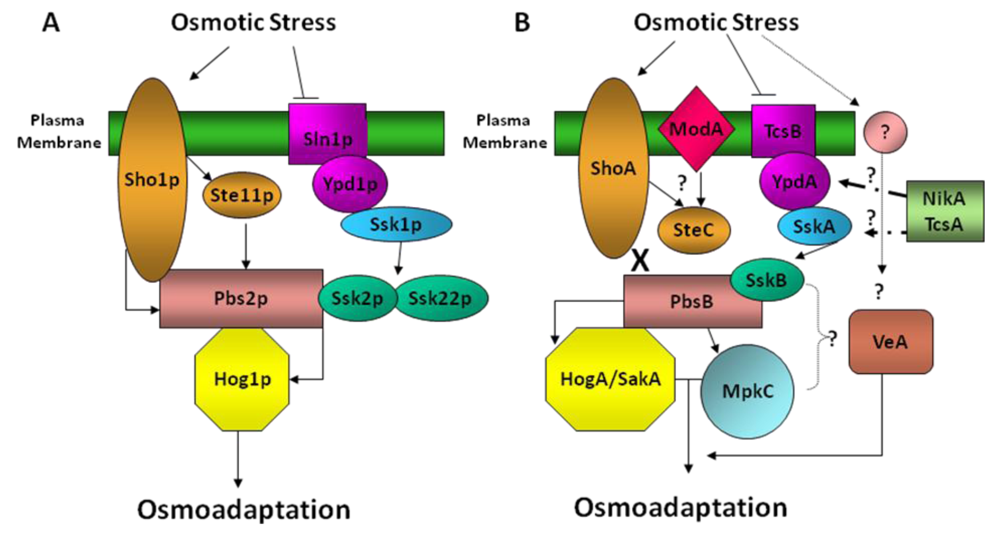
<p>Numerous studies conducted in the yeast <italic>S. cerevisiae</italic> have contributed to the understanding of the high osmolarity glycerol (HOG) pathway (reviewed in [<xref ref-type="bibr" rid="B1-toxins-02-00367">1</xref>]). Activation of the HOG pathway depends on an increase in osmotic pressure resulting in a change in the expression of several genes. The molecular response to osmotic stress in <italic>S. cerevisiae</italic> is mediated by mitogen-activated protein kinase (MAPK) signaling pathways. Hog1p MAPK plays a central role in this signaling system, where Hog1p is activated by a two-component His-to-Asp phosphorelay system that includes Sln1p, a histidine kinase sensor; Ypd1p, a histidine-containing phosphotransfer protein; and Ssk1p and Skn7p response regulators [<xref ref-type="bibr" rid="B15-toxins-02-00367">15</xref>,<xref ref-type="bibr" rid="B16-toxins-02-00367">16</xref>] (<xref ref-type="fig" rid="toxins-02-00367-f001">Figure 1</xref>). Sln1p protein consists of an extracellular sensor, a kinase and a response regulator domain, giving a transmembrane hybrid-type histidine kinase. Under low-osmolarity, a specific histidine residue (His576) within the histidine kinase domain is autophosphorylated. Then, the phosphate group of the histidine kinase domain is transferred to an aspartate residue (Asp1144) within the receiver domain of Sln1p. Through a His-Asp phosphorelay, the phosphate group is transferred to the downstream Ypd1p phosphotransmitter, and then to the Ssk1p response regulator [<xref ref-type="bibr" rid="B12-toxins-02-00367">12</xref>,<xref ref-type="bibr" rid="B15-toxins-02-00367">15</xref>,<xref ref-type="bibr" rid="B17-toxins-02-00367">17</xref>]. Phosphorylated Ssk1p fail to interact with the redundant pair of MAPKKK Ssk2p/Ssk22p, resulting in an inactive Ssk2p/Ssk22p-Pbs2p (MAPKK)-Hog1p form [<xref ref-type="bibr" rid="B18-toxins-02-00367">18</xref>]. However, when yeast are exposed to osmotic stress, Sln1p is inhibited resulting in dephosphorylated forms of Ypd1p and Ssk1p, leading to Ssk1p-Ssk2p/Ssk22p interactions and finally the activation of Hog1p by phosphorylation [<xref ref-type="bibr" rid="B18-toxins-02-00367">18</xref>]. In hyperosmotic environments, activated Hog1p migrates to the nucleus. This action is mediated by Gsp1p, a small GTP-binding protein, and the importin homologue Nmd5p; and it is independent of the NLS-binding importin/heterodimer [<xref ref-type="bibr" rid="B19-toxins-02-00367">19</xref>]. Activation of the HOG pathway leads to the induction of genes required for osmotic stress response, for example glycerol biosynthesis genes such as the genes encoding a glycerol-3-phosphate dehydrogenase (GPD1) and glycerol-3-phosphatase (GPP2) [<xref ref-type="bibr" rid="B20-toxins-02-00367">20</xref>,<xref ref-type="bibr" rid="B21-toxins-02-00367">21</xref>].</p>
<p>A nuclear exchange sequence receptor protein called Crm1p exports dephosphorylated Hog1p back to the cytoplasm [<xref ref-type="bibr" rid="B19-toxins-02-00367">19</xref>]. Negative regulation of Hog1p is exerted through phosphotyrosine phosphatases, Ptp2p and Ptp3p, in both the nucleus and the cytoplasm, respectively [<xref ref-type="bibr" rid="B22-toxins-02-00367">22</xref>]; and the phosphatase Ptc1p, Ptc2p and Ptc3p [<xref ref-type="bibr" rid="B23-toxins-02-00367">23</xref>,<xref ref-type="bibr" rid="B24-toxins-02-00367">24</xref>]. Ptc1p dephosphorylates Hog1p <italic>via</italic> a docking interaction between Ptc1p, Hog1p, and Pbs2p joining a small adaptor named Nbp2p [<xref ref-type="bibr" rid="B25-toxins-02-00367">25</xref>,<xref ref-type="bibr" rid="B26-toxins-02-00367">26</xref>].</p>
<fig id="toxins-02-00367-f001" position="anchor">
<label>Figure 1</label>
<caption>
<p>Comparison of <italic>S. cerevisiae</italic> (A) and <italic>A. nidulans</italic> (B) HOG regulatory pathways.</p>
</caption>
<graphic xmlns:xlink="http://www.w3.org/1999/xlink" xlink:href="toxins-02-00367-g001.tif"/>
</fig>
<p>In addition, in yeast Hog1p is regulated by a second mechanism, which includes a transmembrane sensor kinase called Sho1p (<xref ref-type="fig" rid="toxins-02-00367-f001">Figure 1</xref>). In the Sho1 branch, a multi-component signaling complex consisting of Sho1p, Cdc42p, Ste20p/Cla4p, Ste50p, Ste11p (MAPKKK), Pbs2p is formed in hyperosmotic environments. Pbs2p is localized to the membrane by its proline-based motif and an SH3 domain on Sho1. Pbs2p binds the MAPKKK Ste11p which is phosphorylated by the PAK-like kinase Ste20p, which is itself recruited to the membrane by activated Cdc42. Activated Ste11p then phosphorylates Pbs2p which in turn activates the downstream Hog pathway [<xref ref-type="bibr" rid="B26-toxins-02-00367">26</xref>,<xref ref-type="bibr" rid="B27-toxins-02-00367">27</xref>]. Hkr1p and Msb2p, mucin-like transmembrane proteins [<xref ref-type="bibr" rid="B27-toxins-02-00367">27</xref>], are potential sensors for the Sho1p mechanism that activates Hog1p when the yeast is exposed to osmotic stress.</p>
<p>Activation of Hog1p can also lead to phosphorylation of the Sko1p bZip-type repressor, which results in the disassembly of Sko1p-Tup1p-Ssn6p repressor complexes [<xref ref-type="bibr" rid="B28-toxins-02-00367">28</xref>]. Phosphorylated Hog1p interacts with the RCS chromatin-remodeling complex to mediate its recruitment to osmo-responsive genes [<xref ref-type="bibr" rid="B29-toxins-02-00367">29</xref>]. Hog1p also recruits the Rpd3p histone deacetylase to osmoresponsive gene promoters inducing their expression during osmotic stress [<xref ref-type="bibr" rid="B30-toxins-02-00367">30</xref>]. Hog1p is necessary for the activation and increase of the RNA polymerase II complex and mRNA, behaving as a transcriptional elongation factor specific for genes induced upon osmotic stress [<xref ref-type="bibr" rid="B29-toxins-02-00367">29</xref>,<xref ref-type="bibr" rid="B31-toxins-02-00367">31</xref>]. Phosphorylated Hog1p is also necessary for the activation of Msn2p/Msn4p C2H2 zinc finger transcription factors involved in general stress response [<xref ref-type="bibr" rid="B32-toxins-02-00367">32</xref>,<xref ref-type="bibr" rid="B33-toxins-02-00367">33</xref>,<xref ref-type="bibr" rid="B34-toxins-02-00367">34</xref>,<xref ref-type="bibr" rid="B35-toxins-02-00367">35</xref>].</p>
<p>Other Hog1p targets include Sgd1p, a novel essential nuclear protein. <italic>SGD1</italic> was identified as a high-copy-number suppressor of the osmosensitive phenotype of pbs2D and hog1D deletion mutants [<xref ref-type="bibr" rid="B36-toxins-02-00367">36</xref>,<xref ref-type="bibr" rid="B37-toxins-02-00367">37</xref>]. In addition, Hog1p interacts and phosphorylates the transcription factor Smp1 upon osmotic stress controlling a subset of the responses induced by the MAPK [<xref ref-type="bibr" rid="B38-toxins-02-00367">38</xref>]. Activated Hog1p can phosphorylate the Rck2p protein kinase, which participates in G2 checkpoint control and the osmotic stress triggered attenuation of protein synthesis [<xref ref-type="bibr" rid="B39-toxins-02-00367">39</xref>,<xref ref-type="bibr" rid="B40-toxins-02-00367">40</xref>]. </p>
<p>In addition to the HOG signaling pathway, c-AMP dependent kinases have been shown to affect gene expression under osmotic stress [<xref ref-type="bibr" rid="B41-toxins-02-00367">41</xref>]. However, this response is not exclusive to osmotic stress but a general stress response to a variety of additional stimuli such as nutrient starvation, heat shock, and oxidative stress among others [<xref ref-type="bibr" rid="B42-toxins-02-00367">42</xref>,<xref ref-type="bibr" rid="B43-toxins-02-00367">43</xref>,<xref ref-type="bibr" rid="B44-toxins-02-00367">44</xref>]. Osmotic shock can also stimulate the production of compounds such as phosphatidylinositol-3,5-bisphosphate, which could participate as a second messenger in the activation of the osmotic signaling response [<xref ref-type="bibr" rid="B45-toxins-02-00367">45</xref>].</p>
</sec>
<sec>
<title>3. Hog Pathway in <italic>Aspergillus nidulans</italic></title>
<p>As in the case of <italic>S. cerevisiae</italic>, the HogA (SakA) pathway of <italic>A. nidulans</italic> (<xref ref-type="fig" rid="toxins-02-00367-f001">Figure 1</xref>) is activated in the osmotic [<xref ref-type="bibr" rid="B13-toxins-02-00367">13</xref>,<xref ref-type="bibr" rid="B14-toxins-02-00367">14</xref>,<xref ref-type="bibr" rid="B46-toxins-02-00367">46</xref>,<xref ref-type="bibr" rid="B47-toxins-02-00367">47</xref>,<xref ref-type="bibr" rid="B48-toxins-02-00367">48</xref>] and oxidative [<xref ref-type="bibr" rid="B46-toxins-02-00367">46</xref>,<xref ref-type="bibr" rid="B47-toxins-02-00367">47</xref>] response by the <italic>A. nidulans</italic> Ssk1p ortholog, SskA. Interestingly, a <italic>sakA</italic> null mutant presented only slight sensitivity to high osmolarity stress, indicating that osmoregulation in <italic>A. nidulans</italic> differs from that described in yeast [<xref ref-type="bibr" rid="B14-toxins-02-00367">14</xref>,<xref ref-type="bibr" rid="B46-toxins-02-00367">46</xref>]. Other upstream components of this pathway are the Sln1p homolog, TcsB [<xref ref-type="bibr" rid="B49-toxins-02-00367">49</xref>]; the Ypd1p ortholog, YpdA [<xref ref-type="bibr" rid="B14-toxins-02-00367">14</xref>,<xref ref-type="bibr" rid="B48-toxins-02-00367">48</xref>]; and also NikA, a dispensible Mak2-type histidine kinase in the osmotic stress response that has been demonstrated to transmit fungicide-induced stress signals such as those generated in the presence of fludioxonil and iprodione [<xref ref-type="bibr" rid="B48-toxins-02-00367">48</xref>,<xref ref-type="bibr" rid="B50-toxins-02-00367">50</xref>] (<xref ref-type="fig" rid="toxins-02-00367-f001">Figure 1</xref>). A <italic>tcsB</italic> deletion (<italic>tcsB</italic>) mutant did not present an osmosensitive phenotype [<xref ref-type="bibr" rid="B51-toxins-02-00367">51</xref>] most likely due to redundancy of function with other histidine kinase genes present in <italic>A. nidulans</italic> genome [<xref ref-type="bibr" rid="B48-toxins-02-00367">48</xref>,<xref ref-type="bibr" rid="B52-toxins-02-00367">52</xref>]. However, the <italic>A. nidulans</italic> TcsB–YpdA–SskA system might have a role similar to that of Sln1p–Ypd1p–Ssk1p proteins in yeast [<xref ref-type="bibr" rid="B14-toxins-02-00367">14</xref>]. A non-essential sensor kinase, TcsA, may be involved in conidiation [<xref ref-type="bibr" rid="B53-toxins-02-00367">53</xref>] however, a TcsA–YpdA–response regulator signalling pathway has not been demonstrated. </p>
<p>Interestingly, it is likely that the Sho1p signaling pathway in <italic>A. nidulans</italic> might not be involved in osmoregulation but instead may be carrying out other signaling functions [<xref ref-type="bibr" rid="B54-toxins-02-00367">54</xref>]. <italic>A. nidulans</italic> PbsB (homolog to <italic>S. cerevisiae</italic> Pbs1p) lacks a typical Pro-rich motif necessary for the binding with Sho1p [<xref ref-type="bibr" rid="B14-toxins-02-00367">14</xref>,<xref ref-type="bibr" rid="B55-toxins-02-00367">55</xref>]. Furthermore, proteins such as ModA, a Cdc42p-like protein [<xref ref-type="bibr" rid="B56-toxins-02-00367">56</xref>], similar to Sho1p, have a role in morphogenesis. SteC, similar to Ste11p, regulates sexual development [<xref ref-type="bibr" rid="B57-toxins-02-00367">57</xref>]. Differently from yeast, <italic>A. nidulans</italic> PbsB MAPKK activates another Hog1p ortholog, MpkC, not present in yeast. Although MpkC is not necessary for osmoregulation, overexpression of <italic>mpkC</italic> suppresses the slight high-osmolarity sensitivity of <italic>hogA</italic> strains [<xref ref-type="bibr" rid="B14-toxins-02-00367">14</xref>]. An <italic>A. nidulans</italic> orthologue of <italic>S. cerevisiae</italic> Skn7p, SrrA, plays a role in both oxidative stress and osmotic stress resistance [<xref ref-type="bibr" rid="B47-toxins-02-00367">47</xref>,<xref ref-type="bibr" rid="B48-toxins-02-00367">48</xref>].</p>
<p>Little is known about SakA and YpdA import/export to the nucleus, although putative orthologues of Gsp1p (RanA), Nmd5p importin and Crm1p (KapK) export factor have be identified [<xref ref-type="bibr" rid="B12-toxins-02-00367">12</xref>]. Dephosphorylation of HogA/SakA in <italic>A. nidulans</italic> is mainly unknown, except for the up-regulation of <italic>ptpA</italic> (encoding a putative protein phosphatase) when the fungus is exposed to osmotic stress [<xref ref-type="bibr" rid="B13-toxins-02-00367">13</xref>]. Several SakA-dependent regulators have been identified, such as RpdA (Rpd3p ortholog), AtfA (putative ortholog of <italic>S. pombe</italic> Atf1) [<xref ref-type="bibr" rid="B58-toxins-02-00367">58</xref>,<xref ref-type="bibr" rid="B59-toxins-02-00367">59</xref>], and RcoA (<italic>S. cerevisiae</italic> Tup1 ortholog). Msn2p/Msn4p-type protein, MsnA, has been found in <italic>A. nidulans</italic>, and was shown to be induced by different types of stress [<xref ref-type="bibr" rid="B13-toxins-02-00367">13</xref>]. In <italic>A. nidulans</italic>, potential target genes of SakA and SrrA (<italic>S. cerevisiae</italic> Skn7p homolog) includes <italic>gfdB</italic> (<italic>S. cerevisiae</italic> GPD2 ortholog) [<xref ref-type="bibr" rid="B13-toxins-02-00367">13</xref>,<xref ref-type="bibr" rid="B60-toxins-02-00367">60</xref>] and <italic>enaA</italic> [<xref ref-type="bibr" rid="B13-toxins-02-00367">13</xref>]. </p>
<p>The process of osmotic adaptation by activation of the HOG pathway, in both yeast and filamentous fungi, results in the biosynthesis and accumulation of compatible molecules such as proline, trehalose, polyols and glycerol to counterbalance the osmotic pressure and prevent loss of water. In <italic>A. nidulans</italic>, SskA (<italic>S. cerevisiae</italic> Ssk1p homolog) regulates the expression of genes involved in conidial tolerance to stress, including genes involved in glycerol and trehalose metabolism (<italic>gfdA</italic> and <italic>gfdB</italic>, glycerol-3-phosphate dehydrogenases; <italic>gldB</italic>, glycerol dehydrogenase; <italic>tpsA</italic>, trehalose-6-phosphate synthase; <italic>orlA</italic>, trehalose-6-phosphate phosphatase; <italic>treB</italic>, neutral trehalase) [<xref ref-type="bibr" rid="B13-toxins-02-00367">13</xref>,<xref ref-type="bibr" rid="B61-toxins-02-00367">61</xref>,<xref ref-type="bibr" rid="B62-toxins-02-00367">62</xref>,<xref ref-type="bibr" rid="B63-toxins-02-00367">63</xref>,<xref ref-type="bibr" rid="B64-toxins-02-00367">64</xref>,<xref ref-type="bibr" rid="B65-toxins-02-00367">65</xref>].</p>
</sec>
<sec>
<title>4. Examples of the Osmoadaptation Signaling Pathway in Other Aspergilli</title>
<p>Regulatory pathways including those signaling pathways responsive to stress are relatively conserved, but not identical, in the genus Aspergillus [<xref ref-type="bibr" rid="B12-toxins-02-00367">12</xref>]. For example, conserved SakA plays an important role in the oxidative stress response in the opportunistic human pathogen and gliotoxin-producer <italic>Aspergillus fumigatus</italic>, while the TcsB histidine kinase was not crucial [<xref ref-type="bibr" rid="B66-toxins-02-00367">66</xref>]. In <italic>A. fumigatus</italic>, MpkC plays other roles such as in carbon source utilization, however it was not determined to be involved in osmoadaptation [<xref ref-type="bibr" rid="B67-toxins-02-00367">67</xref>]. <italic>Aspergillus niger</italic>, an important citric acid, gluconic acid and hydrolytic enzyme producing fungus, does not have TcsB-type histidine kinase homologs. Other aspergilli, such as <italic>A. nidulans</italic> mentioned above, present TscB but it is dispensable in the osmoadaptation response. It is likely that TcsB is dispensable or not present in other aspergilli [<xref ref-type="bibr" rid="B51-toxins-02-00367">51</xref>,<xref ref-type="bibr" rid="B66-toxins-02-00367">66</xref>]. </p>
<p>Interestingly, the important aflatoxin-producer <italic>Aspergillus flavus</italic> harbors two orthologs of the <italic>A. nidulans</italic> SskA response regulator in its genome (ORFs AFL2G_06337 and AFL2G_12585), and two orthologs of the <italic>A. nidulans</italic> ortholog RpdA histone deacetylase (ORFs AFL2G_08263 and AFL2G_03062). This suggests that <italic>A. flavus</italic> has a more sophisticated osmotadaptation system compared to other aspergilli that may include genes with redundant functions.</p>
</sec>
<sec>
<title>5. Role of the Osmotic Stress-response Pathway on Fungal Development and Secondary Metabolism</title>
<p>The study of the HOG pathway and its implications in morphological development and secondary metabolism in filamentous fungi are still at the earliest stages. In <italic>A. nidulans</italic>, a <italic>sakA</italic> deletion mutant shows development and cell-specific phenotypes [<xref ref-type="bibr" rid="B46-toxins-02-00367">46</xref>]. This mutant is characterized by premature sexual development. In addition, deletion of <italic>sakA</italic> results in conidia that are highly sensitive to oxidative and heat shock stress and lose viability overtime. This evidence supports the role of SakA as a repressor of sexual development and asexual spore stress resistance and survival. As mentioned in section 3, another member of the <italic>A. nidulans</italic> HOG pathway, SskA is important in regulating the tolerance of conidia to osmotic stress. SakA was also shown to be involved in conidia viability in <italic>A. fumigatus</italic>, where the <italic>sakA</italic> mutant presented alterations in conidia germination in a nitrogen source-dependent manner [<xref ref-type="bibr" rid="B68-toxins-02-00367">68</xref>]. The bZip-type transcription factor AtfA (putative ortholog of <italic>S. pombe</italic> Atf1), that functions downstream of the HogA MAPK in the course of fludioxonil and osmotic stress response, is also involved in conidia stress tolerance [<xref ref-type="bibr" rid="B58-toxins-02-00367">58</xref>,<xref ref-type="bibr" rid="B59-toxins-02-00367">59</xref>,<xref ref-type="bibr" rid="B69-toxins-02-00367">69</xref>,<xref ref-type="bibr" rid="B70-toxins-02-00367">70</xref>]. Also in <italic>A. fumigatus</italic>, mutations in MA21, a homolog of the <italic>S. cerevisiae</italic> transmembrane sensor kinase <italic>SHO</italic> gene, showed a reduction in growth and germination rates. It demonstrated irregular hyphal morphology with a decrease in phialides and conidia [<xref ref-type="bibr" rid="B71-toxins-02-00367">71</xref>]. Development is also affected by osmoregulation in dimorphic fungi such as <italic>Candida albicans</italic>, where the HOG homolog is necessary for chlamydospore formation [<xref ref-type="bibr" rid="B72-toxins-02-00367">72</xref>]. </p>
<p>Additionally, studies on <italic>A. nidulans</italic> SteC revealed its role in morphogenesis. Deletion of the <italic>steC</italic> gene results in a slower growth rate, increase of branched hyphae, alteration of conidiophore morphology, inhibition of heterokaryon formation and a blockage of cleistothecial development. The gene is transcriptionally activated during asexual development and controls the phosphorylation of two putative MAP kinases [<xref ref-type="bibr" rid="B57-toxins-02-00367">57</xref>]. Also, RcoA (homolog of <italic>S. cerevisiae</italic> Tup1p) affects growth and sexual/asexual development in <italic>A. nidulans</italic> [<xref ref-type="bibr" rid="B73-toxins-02-00367">73</xref>,<xref ref-type="bibr" rid="B74-toxins-02-00367">74</xref>]. The response regulators SrrA and SskA are not only involved in osmotic and oxidative stress signal transduction but also in regulation of asexual development in <italic>A. nidulans</italic>. Deletion of any one of these genes results in a reduction in conidiation and spore viability [<xref ref-type="bibr" rid="B48-toxins-02-00367">48</xref>].</p>
<p>The evidence provided by <italic>A. nidulans</italic> studies as well as studies in other fungi clearly indicates a connection between the osmotic stress regulatory system and fungal development. Recently in our laboratories we found that osmotic stress caused by high concentrations of sodium chloride, sorbitol or potassium chloride positively affects vegetative growth leads to an increase in conidiation in <italic>A. flavus</italic> (Duran <italic>et al.</italic>, manuscript in preparation). Han <italic>et al</italic>. [<xref ref-type="bibr" rid="B75-toxins-02-00367">75</xref>] also reported an increase of conidiation in the presence of high amount of sorbitol in <italic>A. nidulans</italic>. In contrast, in a study by Mert and Ekmekci [<xref ref-type="bibr" rid="B76-toxins-02-00367">76</xref>] where <italic>A. flavus</italic> was inoculated on NaCl medium, a reduction of conidia was observed. The <italic>A. flavus</italic> strains are genetically diverse and they have been sub-divided into two strain types, S and L, based differences in sclerotial size [<xref ref-type="bibr" rid="B77-toxins-02-00367">77</xref>]. It is possible that this variability in conidiation could be the result of different <italic>A. flavus</italic> strains used in these studies leading to different responses to osmotic stress and salinity. It is also possible that other culture conditions could have caused the observed differences in conidiation under induced osmotic stress. In addition, our recent study showed the light-dependent global regulator VeA, known to control sexual/asexual morphogenesis and secondary metabolism in filamentous fungi [<xref ref-type="bibr" rid="B78-toxins-02-00367">78</xref>], to be associated with the osmotic-stress response in <italic>A. flavus</italic> (Duran <italic>et al.</italic>, manuscript in preparation and <xref ref-type="fig" rid="toxins-02-00367-f001">Figure 1</xref>). Specifically, osmostress enhances hyperconidiation in the <italic>A. flavus veA</italic> deletion strain, suggesting that <italic>veA</italic> is involved in modulating osmotic stress-induced conidiation. On the other hand, salinity stress has been shown to have an inhibitory effect on the formation of sclerotia in fungal species, including <italic>Sclerotinia sclerotiorum</italic>, <italic>Rhizoctonia solani</italic> and <italic>Sclerotium rolfsii</italic> [<xref ref-type="bibr" rid="B79-toxins-02-00367">79</xref>]. In the mycotoxin producer <italic>Aspergillus ochraceus</italic> osmotic stress had little effect on sclerotia production, [<xref ref-type="bibr" rid="B80-toxins-02-00367">80</xref>]. In <italic>Botrytis cinerea</italic> sclerotia production was also reduced as osmotic stress increased [<xref ref-type="bibr" rid="B81-toxins-02-00367">81</xref>]. In <italic>A. flavus</italic>, hyperosmotic media caused a delay in sclerotial maturation (Duran <italic>et al.</italic>, manuscript in preparation). These studies suggest that under stress caused by hyperosmolarity the fungus favors investment of material and energy towards developmental programs (conidiation) that are conducive to survival <italic>via</italic> dissemination to a more favorable environment versus survival in the unfavorable hyperosmotic environment.</p>
<p>Previous studies support an association of fungal morphogenesis with secondary metabolism, including mycotoxin production [<xref ref-type="bibr" rid="B82-toxins-02-00367">82</xref>]. Aflatoxin is one of the most potent natural carcinogenic compounds described. Surprisingly, hyperosmotic levels of NaCl, KCl or sorbitol did not affect the biosynthesis of this mycotoxin (Duran <italic>et al.</italic>, manuscript in preparation). Some osmotic stress genetic response elements have been demonstrated to be linked to toxin production in <italic>A. nidulans</italic>, specifically, RcoA (Tup1p homolog) affects not only fungal growth and development, but also is necessary for the production of sterigmatocystin in <italic>A. nidulans</italic> [<xref ref-type="bibr" rid="B83-toxins-02-00367">83</xref>]. Additionally, osmotic stress does affect the production of other secondary metabolites in aspergilli, for example pigments. The <italic>A. fumigatus sakA</italic> deletion mutant is unable to produce pigmentation as observed in the wild-type strain, indicating that secondary metabolism is affected by the HOG signaling pathway in this fungus [<xref ref-type="bibr" rid="B68-toxins-02-00367">68</xref>].</p>
<p>Across fungal genera, the role of MAPK cascades in the osmotic stress response is quite diverse. In the filamentous fungus <italic>Fusarium graminearum</italic>, a significant relationship between osmotic stress and secondary metabolism has been observed. <italic>F. graminearum</italic> is a common pathogen of grain producing crops. Among the several secondary metabolites generated by this fungus, the synthesis of trichothecene toxins and a reddish colored pigment called aurofusarin are affected by osmotic stress. Ochiai <italic>et al.</italic> [<xref ref-type="bibr" rid="B84-toxins-02-00367">84</xref>] described the participation of several histidine kinases, components of the osmotic response signalling pathway, in the regulation of secondary metabolism of <italic>F. graminearum.</italic> These authors showed that production of trichothecenes is markedly suppressed by NaCl, without a significant effect on fungal growth. A null mutant of <italic>FgOs1</italic> (encoding the osmosensor histidine kinase) produced a reduced amount of the red pigment aurofusarin however it was unaltered in its ability to produce trichothecenes. Deletion null mutants of <italic>FgOs4</italic> (encoding MAPKKK), <italic>FgOs5</italic> (MAPKK), and <italic>FgOs2</italic> (MAPK) all showed markedly enhanced pigmentation and failed to produce trichothecenes, coinciding with a marked reduction of expression of <italic>Tri4</italic> and <italic>Tri6</italic> (trichothecene biosynthetic pathway and regulatory genes). In the maize pathogen, <italic>Cochliobolus heterostrophus</italic>, <italic>hog1</italic> mutants are more pigmented than the wild-type and demonstrate smaller appressoria and reduced virulence [<xref ref-type="bibr" rid="B85-toxins-02-00367">85</xref>]. In <italic>cpmk1</italic> (<italic>hog1</italic> homolog) mutants of <italic>Cryphonectria parasitica</italic>, there was an increase in osmosensitivity along with reduced pigmentation, conidiation, and virulence on chestnut trees compared to a wild-type strain [<xref ref-type="bibr" rid="B86-toxins-02-00367">86</xref>] In the rice pathogen, <italic>Magnaporthe grisea</italic>, <italic>osm1</italic> (<italic>hog1</italic> homolog) mutants were more sensitive to osmotic stress and showed some morphological defects. However, glycerol accumulation and appressorial turgor generation was unaltered compared to wild-type and virulence was not affected [<xref ref-type="bibr" rid="B87-toxins-02-00367">87</xref>].</p>
</sec>
<sec sec-type="conclusions">
<title>6. Conclusions</title>
<p>The ability to adapt is essential for filamentous fungi and yeast to survive and proliferate under non-optimal osmotic environments. Fungi sense and then transduce external changes in osmotic pressure mainly through cellular signaling pathways such as the HOG pathway that is mediated by MAPK cascades. Activated MAPKs phosphorylate a number of substrates including transcriptional activators that in turn modulate patterns of gene expression and subsequent protein synthesis. In fungi, responses to osmotic stress include the production of osmoprotectant compounds such as glycerol, reorganization of the cytoskeleton, and cell wall biogenesis. A fungus’ response to high osmotic pressures in an artificial environment such as during an industrial fermentation that utilizes controlled environmental and nutritional parameters is fairly straightforward. However, during a host-fungal pathogen interaction, the degree to which a fungus’ response to changes in osmotic pressure impacts its ability to successfully invade and survive in the host is not so clear. During the infection process, a pathogenic fungus would be expected to encounter a complex nutritional milieu upon lysis of plant cells that may include increased osmotic pressure. The entomopathogenic fungus, <italic>Metarhizium anisopliae</italic>, kills insects by direct penetration of the cuticle followed by multiplication in the hemolymph. The solute-rich hemolymph is characterized by high osmotic pressure [<xref ref-type="bibr" rid="B88-toxins-02-00367">88</xref>] that could initiate a stress response in the fungus. <italic>M. anisopliae</italic> strains that were defective in the MOS1 osmosensor (SHO1 in yeast) displayed increased sensitivity to osmotic pressure as well as reduced virulence against larvae of <italic>Manduca sexta</italic> [<xref ref-type="bibr" rid="B89-toxins-02-00367">89</xref>]. In the case of a plant necrotophic fungus, the breakdown of cell walls by fungal hydrolases and the generalized hypersensitive response by the host plant may result in the invading fungus being isolated in a region of high osmotic pressure. In addition, activation of the Hog1 MAPK pathway has been observed in <italic>Candida albicans</italic> cells exposed to the human antimicrobial peptide, histantin 5 [<xref ref-type="bibr" rid="B90-toxins-02-00367">90</xref>]. It is possible that antimicrobial compounds elicited by the host may also trigger activation of the osmotic stress response in an invading plant or human pathogenic fungus leading to accumulation of osmolytes such as glycerol and reorganization of cell wall structure in an attempt to stave off death. With the ever increasing number of organisms whose genomes and proteomes have now been sequenced and annotated, it should be possible to better elucidate the impact that genes involved in the osmotic stress response have on host-fungal pathogen interactions. </p>
<p>The literature cited in this review indicates that the osmoadaptative response is conserved but not identical in different fungi and that it is intimately linked to morphogenesis. The ability to alter morphogenic programs in response to changes in osmotic pressure can play a significant role in the fungus’ capacity to survive and flourish in nature. One developmental response to an increase in osmotic stress often observed in fungi is an increase in conidiation. This increases the fungus’ chances of survival as conidia can be dispersed by wind over wide areas thus removing the fungus from an inhospitable environment and potentially allowing it to take up residence in a more favorable environment. Furthermore, some of the studies mentioned in this review have also shown that in some cases the response to osmotic stress by fungi is linked to the biosynthesis of natural products, including mycotoxins. However, examples of this are few and more studies will be necessary to gain further insight into the interaction between osmotic stress regulation and secondary metabolism.</p>
</sec>
</body>
<back>
<ack>
<title>Acknowledgements</title>
<p>This work was supported by Northern Illinois University.</p>
</ack>
<ref-list>
<title>References</title>
<ref id="B1-toxins-02-00367">
<label>1.</label>
<citation citation-type="journal">
<person-group person-group-type="author">
<name>
<surname>Hohmann</surname>
<given-names>S.</given-names>
</name>
<name>
<surname>Krantz</surname>
<given-names>M.</given-names>
</name>
<name>
<surname>Nordlander</surname>
<given-names>B.</given-names>
</name>
</person-group>
<article-title>Yeast osmoregulation</article-title>
<source>Methods Enzymol.</source>
<year>2007</year>
<volume>428</volume>
<fpage>29</fpage>
<lpage>45</lpage>
<pub-id pub-id-type="pmid">17875410</pub-id>
</citation>
</ref>
<ref id="B2-toxins-02-00367">
<label>2.</label>
<citation citation-type="journal">
<person-group person-group-type="author">
<name>
<surname>Hohmann</surname>
<given-names>S.</given-names>
</name>
</person-group>
<article-title>Osmotic stress signaling and osmoadaptation in yeasts</article-title>
<source>Microbiol. Mol. Biol. Rev.</source>
<year>2002</year>
<volume>66</volume>
<fpage>300</fpage>
<lpage>372</lpage>
<pub-id pub-id-type="pmid">12040128</pub-id>
</citation>
</ref>
<ref id="B3-toxins-02-00367">
<label>3.</label>
<citation citation-type="journal">
<person-group person-group-type="author">
<name>
<surname>Todd</surname>
<given-names>R.B.</given-names>
</name>
<name>
<surname>Davis</surname>
<given-names>M.A.</given-names>
</name>
<name>
<surname>Hynes</surname>
<given-names>M.J.</given-names>
</name>
</person-group>
<article-title>Genetic manipulation of Aspergillus nidulans: Meiotic progeny for genetic analysis and strain construction</article-title>
<source>Nat. Protoc.</source>
<year>2007</year>
<volume>2</volume>
<fpage>811</fpage>
<lpage>821</lpage>
<pub-id pub-id-type="pmid">17446881</pub-id>
</citation>
</ref>
<ref id="B4-toxins-02-00367">
<label>4.</label>
<citation citation-type="journal">
<person-group person-group-type="author">
<name>
<surname>Bennett</surname>
<given-names>J.W.</given-names>
</name>
</person-group>
<article-title>Aspergillus: A primer for the novice</article-title>
<source>Med. Mycol.</source>
<year>2009</year>
<volume>47</volume>
<fpage>S5</fpage>
<lpage>S12</lpage>
<pub-id pub-id-type="pmid">19253144</pub-id>
<pub-id pub-id-type="doi">10.1080/13693780802712515</pub-id>
</citation>
</ref>
<ref id="B5-toxins-02-00367">
<label>5.</label>
<citation citation-type="book">
<person-group person-group-type="author">
<name>
<surname>Cary</surname>
<given-names>J.W.</given-names>
</name>
<name>
<surname>Linz</surname>
<given-names>J.E.</given-names>
</name>
<name>
<surname>Bhatnagar</surname>
<given-names>D.</given-names>
</name>
</person-group>
<article-title>Aflatoxins: Biological significance and regulation of biosynthesis</article-title>
<source>Microbial Foodborne Diseases: Mechanisms of Pathogenesis and Toxin Synthesis</source>
<person-group person-group-type="editor">
<name>
<surname>Cary</surname>
<given-names>J.W.</given-names>
</name>
<name>
<surname>Linz</surname>
<given-names>J.E.</given-names>
</name>
<name>
<surname>Bhatnagar</surname>
<given-names>D.</given-names>
</name>
</person-group>
<publisher-name>Technomic Publishing Co.</publisher-name>
<publisher-loc>Lancaster, PA, USA</publisher-loc>
<year>2000</year>
<fpage>317</fpage>
<lpage>361</lpage>
</citation>
</ref>
<ref id="B6-toxins-02-00367">
<label>6.</label>
<citation citation-type="journal">
<person-group person-group-type="author">
<name>
<surname>Roukas</surname>
<given-names>T.</given-names>
</name>
</person-group>
<article-title>Citric and gluconic acid production from fig by <italic>Aspergillus niger</italic> using solid-state fermentation</article-title>
<source>J. Ind. Microbiol. Biotechnol.</source>
<year>2000</year>
<volume>25</volume>
<fpage>298</fpage>
<lpage>304</lpage>
<pub-id pub-id-type="pmid">11320416</pub-id>
</citation>
</ref>
<ref id="B7-toxins-02-00367">
<label>7.</label>
<citation citation-type="journal">
<person-group person-group-type="author">
<name>
<surname>Machida</surname>
<given-names>M.</given-names>
</name>
<name>
<surname>Yamada</surname>
<given-names>O.</given-names>
</name>
<name>
<surname>Gomi</surname>
<given-names>K.</given-names>
</name>
</person-group>
<article-title>Genomics of <italic>Aspergillus oryzae</italic>: Learning from the history of Koji mold and exploration of its future</article-title>
<source>DNA Res.</source>
<year>2008</year>
<volume>15</volume>
<fpage>173</fpage>
<lpage>183</lpage>
<pub-id pub-id-type="pmid">18820080</pub-id>
</citation>
</ref>
<ref id="B8-toxins-02-00367">
<label>8.</label>
<citation citation-type="journal">
<person-group person-group-type="author">
<name>
<surname>Latge</surname>
<given-names>J.P.</given-names>
</name>
</person-group>
<article-title><italic>Aspergillus fumigatus</italic> and <italic>aspergillosis</italic></article-title>
<source>Clin. Microbiol. Rev.</source>
<year>1999</year>
<volume>12</volume>
<fpage>310</fpage>
<lpage>350</lpage>
<pub-id pub-id-type="pmid">10194462</pub-id>
</citation>
</ref>
<ref id="B9-toxins-02-00367">
<label>9.</label>
<citation citation-type="journal">
<person-group person-group-type="author">
<name>
<surname>Lillehoj</surname>
<given-names>E.B.</given-names>
</name>
<name>
<surname>Wall</surname>
<given-names>J.H.</given-names>
</name>
<name>
<surname>Bowers</surname>
<given-names>E.J.</given-names>
</name>
</person-group>
<article-title>Preharvest aflatoxin contamination: Effect of moisture and substrate variation in developing cottonseed and corn kernels</article-title>
<source>Appl. Environ. Microbiol.</source>
<year>1987</year>
<volume>53</volume>
<fpage>584</fpage>
<lpage>586</lpage>
<pub-id pub-id-type="pmid">3579271</pub-id>
</citation>
</ref>
<ref id="B10-toxins-02-00367">
<label>10.</label>
<citation citation-type="journal">
<person-group person-group-type="author">
<name>
<surname>Fiedurek</surname>
<given-names>J.</given-names>
</name>
</person-group>
<article-title>Effect of osmotic stress on glucose oxidase production and secretion by <italic>Aspergillus niger</italic></article-title>
<source>J. Basic Microbiol.</source>
<year>1998</year>
<volume>38</volume>
<fpage>107</fpage>
<lpage>112</lpage>
<pub-id pub-id-type="pmid">9637011</pub-id>
</citation>
</ref>
<ref id="B11-toxins-02-00367">
<label>11.</label>
<citation citation-type="journal">
<person-group person-group-type="author">
<name>
<surname>Kobayashi</surname>
<given-names>A.</given-names>
</name>
<name>
<surname>Sano</surname>
<given-names>M.</given-names>
</name>
<name>
<surname>Oda</surname>
<given-names>K.</given-names>
</name>
<name>
<surname>Hisada</surname>
<given-names>H.</given-names>
</name>
<name>
<surname>Hata</surname>
<given-names>Y.</given-names>
</name>
<name>
<surname>Ohashi</surname>
<given-names>S.</given-names>
</name>
</person-group>
<article-title>The glucoamylase-encoding gene (glaB) is expressed in solid-state culture with a low water content</article-title>
<source>Biosci. Biotechnol. Biochem.</source>
<year>2007</year>
<volume>71</volume>
<fpage>1797</fpage>
<lpage>1799</lpage>
<pub-id pub-id-type="pmid">17617703</pub-id>
</citation>
</ref>
<ref id="B12-toxins-02-00367">
<label>12.</label>
<citation citation-type="journal">
<person-group person-group-type="author">
<name>
<surname>Miskei</surname>
<given-names>M.</given-names>
</name>
<name>
<surname>Karanyi</surname>
<given-names>Z.</given-names>
</name>
<name>
<surname>Pocsi</surname>
<given-names>I.</given-names>
</name>
</person-group>
<article-title>Annotation of stress-response proteins in the <italic>aspergilli</italic></article-title>
<source>Fungal Genet. Biol.</source>
<year>2009</year>
<volume>46</volume>
<fpage>S105</fpage>
<lpage>S120</lpage>
<pub-id pub-id-type="pmid">18703157</pub-id>
</citation>
</ref>
<ref id="B13-toxins-02-00367">
<label>13.</label>
<citation citation-type="journal">
<person-group person-group-type="author">
<name>
<surname>Han</surname>
<given-names>K.H.</given-names>
</name>
<name>
<surname>Prade</surname>
<given-names>R.A.</given-names>
</name>
</person-group>
<article-title>Osmotic stress-coupled maintenance of polar growth in <italic>Aspergillus nidulans</italic></article-title>
<source>Mol. Microbiol.</source>
<year>2002</year>
<volume>43</volume>
<fpage>1065</fpage>
<lpage>1078</lpage>
<pub-id pub-id-type="pmid">11918796</pub-id>
</citation>
</ref>
<ref id="B14-toxins-02-00367">
<label>14.</label>
<citation citation-type="journal">
<person-group person-group-type="author">
<name>
<surname>Furukawa</surname>
<given-names>K.</given-names>
</name>
<name>
<surname>Hoshi</surname>
<given-names>Y.</given-names>
</name>
<name>
<surname>Maeda</surname>
<given-names>T.</given-names>
</name>
<name>
<surname>Nakajima</surname>
<given-names>T.</given-names>
</name>
<name>
<surname>Abe</surname>
<given-names>K.</given-names>
</name>
</person-group>
<article-title>Aspergillus nidulans HOG pathway is activated only by two-component signalling pathway in response to osmotic stress</article-title>
<source>Mol. Microbiol.</source>
<year>2005</year>
<volume>56</volume>
<fpage>1246</fpage>
<lpage>1261</lpage>
<pub-id pub-id-type="pmid">15882418</pub-id>
</citation>
</ref>
<ref id="B15-toxins-02-00367">
<label>15.</label>
<citation citation-type="journal">
<person-group person-group-type="author">
<name>
<surname>Posas</surname>
<given-names>F.</given-names>
</name>
<name>
<surname>Wurgler-Murphy</surname>
<given-names>S.M.</given-names>
</name>
<name>
<surname>Maeda</surname>
<given-names>T.</given-names>
</name>
<name>
<surname>Witten</surname>
<given-names>E.A.</given-names>
</name>
<name>
<surname>Thai</surname>
<given-names>T.C.</given-names>
</name>
<name>
<surname>Saito</surname>
<given-names>H.</given-names>
</name>
</person-group>
<article-title>Yeast HOG1 MAP kinase cascade is regulated by a multistep phosphorelay mechanism in the SLN1-YPD1-SSK1 "two-component" osmosensor</article-title>
<source>Cell</source>
<year>1996</year>
<volume>86</volume>
<fpage>865</fpage>
<lpage>875</lpage>
<pub-id pub-id-type="pmid">8808622</pub-id>
</citation>
</ref>
<ref id="B16-toxins-02-00367">
<label>16.</label>
<citation citation-type="journal">
<person-group person-group-type="author">
<name>
<surname>Li</surname>
<given-names>S.</given-names>
</name>
<name>
<surname>Ault</surname>
<given-names>A.</given-names>
</name>
<name>
<surname>Malone</surname>
<given-names>C.L.</given-names>
</name>
<name>
<surname>Raitt</surname>
<given-names>D.</given-names>
</name>
<name>
<surname>Dean</surname>
<given-names>S.</given-names>
</name>
<name>
<surname>Johnston</surname>
<given-names>L.H.</given-names>
</name>
<name>
<surname>Deschenes</surname>
<given-names>R.J.</given-names>
</name>
<name>
<surname>Fassler</surname>
<given-names>J.S.</given-names>
</name>
</person-group>
<article-title>The yeast histidine protein kinase, Sln1p, mediates phosphotransfer to two response regulators, Ssk1p and Skn7p</article-title>
<source>EMBO J.</source>
<year>1998</year>
<volume>17</volume>
<fpage>6952</fpage>
<lpage>6962</lpage>
<pub-id pub-id-type="pmid">9843501</pub-id>
</citation>
</ref>
<ref id="B17-toxins-02-00367">
<label>17.</label>
<citation citation-type="journal">
<person-group person-group-type="author">
<name>
<surname>Maeda</surname>
<given-names>T.</given-names>
</name>
<name>
<surname>Wurgler-Murphy</surname>
<given-names>S.M.</given-names>
</name>
<name>
<surname>Saito</surname>
<given-names>H.</given-names>
</name>
</person-group>
<article-title>A two-component system that regulates an osmosensing MAP kinase cascade in yeast</article-title>
<source>Nature</source>
<year>1994</year>
<volume>369</volume>
<fpage>242</fpage>
<lpage>245</lpage>
<pub-id pub-id-type="pmid">8183345</pub-id>
</citation>
</ref>
<ref id="B18-toxins-02-00367">
<label>18.</label>
<citation citation-type="journal">
<person-group person-group-type="author">
<name>
<surname>Posas</surname>
<given-names>F.</given-names>
</name>
<name>
<surname>Saito</surname>
<given-names>H.</given-names>
</name>
</person-group>
<article-title>Activation of the yeast SSK2 MAP kinase kinase kinase by the SSK1 two-component response regulator</article-title>
<source>EMBO J.</source>
<year>1998</year>
<volume>17</volume>
<fpage>1385</fpage>
<lpage>1394</lpage>
<pub-id pub-id-type="pmid">9482735</pub-id>
</citation>
</ref>
<ref id="B19-toxins-02-00367">
<label>19.</label>
<citation citation-type="journal">
<person-group person-group-type="author">
<name>
<surname>Ferrigno</surname>
<given-names>P.</given-names>
</name>
<name>
<surname>Posas</surname>
<given-names>F.</given-names>
</name>
<name>
<surname>Koepp</surname>
<given-names>D.</given-names>
</name>
<name>
<surname>Saito</surname>
<given-names>H.</given-names>
</name>
<name>
<surname>Silver</surname>
<given-names>P.A.</given-names>
</name>
</person-group>
<article-title>Regulated nucleo/cytoplasmic exchange of HOG1 MAPK requires the importin beta homologs NMD5 and XPO1</article-title>
<source>EMBO J.</source>
<year>1998</year>
<volume>17</volume>
<fpage>5606</fpage>
<lpage>5614</lpage>
<pub-id pub-id-type="pmid">9755161</pub-id>
</citation>
</ref>
<ref id="B20-toxins-02-00367">
<label>20.</label>
<citation citation-type="journal">
<person-group person-group-type="author">
<name>
<surname>Albertyn</surname>
<given-names>J.</given-names>
</name>
<name>
<surname>Hohmann</surname>
<given-names>S.</given-names>
</name>
<name>
<surname>Thevelein</surname>
<given-names>J.M.</given-names>
</name>
<name>
<surname>Prior</surname>
<given-names>B.A.</given-names>
</name>
</person-group>
<article-title>GPD1, which encodes glycerol-3-phosphate dehydrogenase, is essential for growth under osmotic stress in Saccharomyces cerevisiae, and its expression is regulated by the high-osmolarity glycerol response pathway</article-title>
<source>Mol. Cell Biol.</source>
<year>1994</year>
<volume>14</volume>
<fpage>4135</fpage>
<lpage>4144</lpage>
<pub-id pub-id-type="pmid">8196651</pub-id>
</citation>
</ref>
<ref id="B21-toxins-02-00367">
<label>21.</label>
<citation citation-type="journal">
<person-group person-group-type="author">
<name>
<surname>Norbeck</surname>
<given-names>J.</given-names>
</name>
<name>
<surname>Pahlman</surname>
<given-names>A.K.</given-names>
</name>
<name>
<surname>Akhtar</surname>
<given-names>N.</given-names>
</name>
<name>
<surname>Blomberg</surname>
<given-names>A.</given-names>
</name>
<name>
<surname>Adler</surname>
<given-names>L.</given-names>
</name>
</person-group>
<article-title>Purification and characterization of two isoenzymes of DL-glycerol-3-phosphatase from <italic>Saccharomyces cerevisiae</italic>. Identification of the corresponding GPP1 and GPP2 genes and evidence for osmotic regulation of Gpp2p expression by the osmosensing mitogen-activated protein kinase signal transduction pathway</article-title>
<source>J. Biol. Chem.</source>
<year>1996</year>
<volume>271</volume>
<fpage>13875</fpage>
<lpage>13881</lpage>
<pub-id pub-id-type="pmid">8662716</pub-id>
</citation>
</ref>
<ref id="B22-toxins-02-00367">
<label>22.</label>
<citation citation-type="journal">
<person-group person-group-type="author">
<name>
<surname>Mattison</surname>
<given-names>C.P.</given-names>
</name>
<name>
<surname>Ota</surname>
<given-names>I.M.</given-names>
</name>
</person-group>
<article-title>Two protein tyrosine phosphatases, Ptp2 and Ptp3, modulate the subcellular localization of the Hog1 MAP kinase in yeast</article-title>
<source>Gene. Develop.</source>
<year>2000</year>
<volume>14</volume>
<fpage>1229</fpage>
<lpage>1235</lpage>
</citation>
</ref>
<ref id="B23-toxins-02-00367">
<label>23.</label>
<citation citation-type="journal">
<person-group person-group-type="author">
<name>
<surname>Warmka</surname>
<given-names>J.</given-names>
</name>
<name>
<surname>Hanneman</surname>
<given-names>J.</given-names>
</name>
<name>
<surname>Lee</surname>
<given-names>J.</given-names>
</name>
<name>
<surname>Amin</surname>
<given-names>D.</given-names>
</name>
<name>
<surname>Ota</surname>
<given-names>I.</given-names>
</name>
</person-group>
<article-title>Ptc1, a type 2C Ser/Thr phosphatase, inactivates the HOG pathway by dephosphorylating the mitogen-activated protein kinase Hog1</article-title>
<source>Mol. Cell Biol.</source>
<year>2001</year>
<volume>21</volume>
<fpage>51</fpage>
<lpage>60</lpage>
<pub-id pub-id-type="pmid">11113180</pub-id>
<pub-id pub-id-type="doi">10.1128/MCB.21.1.51-60.2001</pub-id>
</citation>
</ref>
<ref id="B24-toxins-02-00367">
<label>24.</label>
<citation citation-type="journal">
<person-group person-group-type="author">
<name>
<surname>Young</surname>
<given-names>C.</given-names>
</name>
<name>
<surname>Mapes</surname>
<given-names>J.</given-names>
</name>
<name>
<surname>Hanneman</surname>
<given-names>J.</given-names>
</name>
<name>
<surname>Al-Zarban</surname>
<given-names>S.</given-names>
</name>
<name>
<surname>Ota</surname>
<given-names>I.</given-names>
</name>
</person-group>
<article-title>Role of Ptc2 type 2C Ser/Thr phosphatase in yeast high-osmolarity glycerol pathway inactivation</article-title>
<source>Eukaryot Cell</source>
<year>2002</year>
<volume>1</volume>
<fpage>1032</fpage>
<lpage>1040</lpage>
<pub-id pub-id-type="pmid">12477803</pub-id>
</citation>
</ref>
<ref id="B25-toxins-02-00367">
<label>25.</label>
<citation citation-type="journal">
<person-group person-group-type="author">
<name>
<surname>Mapes</surname>
<given-names>J.</given-names>
</name>
<name>
<surname>Ota</surname>
<given-names>I.M.</given-names>
</name>
</person-group>
<article-title>Nbp2 targets the Ptc1-type 2C Ser/Thr phosphatase to the HOG MAPK pathway</article-title>
<source>EMBO J.</source>
<year>2004</year>
<volume>23</volume>
<fpage>302</fpage>
<lpage>311</lpage>
<pub-id pub-id-type="pmid">14685261</pub-id>
</citation>
</ref>
<ref id="B26-toxins-02-00367">
<label>26.</label>
<citation citation-type="journal">
<person-group person-group-type="author">
<name>
<surname>Saito</surname>
<given-names>H.</given-names>
</name>
<name>
<surname>Tatebayashi</surname>
<given-names>K.</given-names>
</name>
</person-group>
<article-title>Regulation of the osmoregulatory HOG MAPK cascade in yeast</article-title>
<source>J. Biochem.</source>
<year>2004</year>
<volume>136</volume>
<fpage>267</fpage>
<lpage>272</lpage>
<pub-id pub-id-type="pmid">15598881</pub-id>
</citation>
</ref>
<ref id="B27-toxins-02-00367">
<label>27.</label>
<citation citation-type="journal">
<person-group person-group-type="author">
<name>
<surname>Tatebayashi</surname>
<given-names>K.</given-names>
</name>
<name>
<surname>Yamamoto</surname>
<given-names>K.</given-names>
</name>
<name>
<surname>Tanaka</surname>
<given-names>K.</given-names>
</name>
<name>
<surname>Tomida</surname>
<given-names>T.</given-names>
</name>
<name>
<surname>Maruoka</surname>
<given-names>T.</given-names>
</name>
<name>
<surname>Kasukawa</surname>
<given-names>E.</given-names>
</name>
<name>
<surname>Saito</surname>
<given-names>H.</given-names>
</name>
</person-group>
<article-title>Adaptor functions of Cdc42, Ste50, and Sho1 in the yeast osmoregulatory HOG MAPK pathway</article-title>
<source>EMBO J.</source>
<year>2006</year>
<volume>25</volume>
<fpage>3033</fpage>
<lpage>3044</lpage>
<pub-id pub-id-type="pmid">16778768</pub-id>
<pub-id pub-id-type="doi">10.1038/sj.emboj.7601192</pub-id>
</citation>
</ref>
<ref id="B28-toxins-02-00367">
<label>28.</label>
<citation citation-type="journal">
<person-group person-group-type="author">
<name>
<surname>Proft</surname>
<given-names>M.</given-names>
</name>
<name>
<surname>Pascual-Ahuir</surname>
<given-names>A.</given-names>
</name>
<name>
<surname>de Nadal</surname>
<given-names>E.</given-names>
</name>
<name>
<surname>Arino</surname>
<given-names>J.</given-names>
</name>
<name>
<surname>Serrano</surname>
<given-names>R.</given-names>
</name>
<name>
<surname>Posas</surname>
<given-names>F.</given-names>
</name>
</person-group>
<article-title>Regulation of the Sko1 transcriptional repressor by the Hog1 MAP kinase in response to osmotic stress</article-title>
<source>EMBO J.</source>
<year>2001</year>
<volume>20</volume>
<fpage>1123</fpage>
<lpage>1133</lpage>
<pub-id pub-id-type="pmid">11230135</pub-id>
</citation>
</ref>
<ref id="B29-toxins-02-00367">
<label>29.</label>
<citation citation-type="journal">
<person-group person-group-type="author">
<name>
<surname>Mas</surname>
<given-names>G.</given-names>
</name>
<name>
<surname>de Nadal</surname>
<given-names>E.</given-names>
</name>
<name>
<surname>Dechant</surname>
<given-names>R.</given-names>
</name>
<name>
<surname>Rodriguez de la Concepcion</surname>
<given-names>M.L.</given-names>
</name>
<name>
<surname>Logie</surname>
<given-names>C.</given-names>
</name>
<name>
<surname>Jimeno-Gonzalez</surname>
<given-names>S.</given-names>
</name>
<name>
<surname>Chavez</surname>
<given-names>S.</given-names>
</name>
<name>
<surname>Ammerer</surname>
<given-names>G.</given-names>
</name>
<name>
<surname>Posas</surname>
<given-names>F.</given-names>
</name>
</person-group>
<article-title>Recruitment of a chromatin remodelling complex by the Hog1 MAP kinase to stress genes</article-title>
<source>EMBO J.</source>
<year>2009</year>
<volume>28</volume>
<fpage>326</fpage>
<lpage>336</lpage>
<pub-id pub-id-type="pmid">19153600</pub-id>
</citation>
</ref>
<ref id="B30-toxins-02-00367">
<label>30.</label>
<citation citation-type="journal">
<person-group person-group-type="author">
<name>
<surname>De Nadal</surname>
<given-names>E.</given-names>
</name>
<name>
<surname>Zapater</surname>
<given-names>M.</given-names>
</name>
<name>
<surname>Alepuz</surname>
<given-names>P.M.</given-names>
</name>
<name>
<surname>Sumoy</surname>
<given-names>L.</given-names>
</name>
<name>
<surname>Mas</surname>
<given-names>G.</given-names>
</name>
<name>
<surname>Posas</surname>
<given-names>F.</given-names>
</name>
</person-group>
<article-title>The MAPK Hog1 recruits Rpd3 histone deacetylase to activate osmoresponsive genes</article-title>
<source>Nature</source>
<year>2004</year>
<volume>427</volume>
<fpage>370</fpage>
<lpage>374</lpage>
<pub-id pub-id-type="pmid">14737171</pub-id>
</citation>
</ref>
<ref id="B31-toxins-02-00367">
<label>31.</label>
<citation citation-type="journal">
<person-group person-group-type="author">
<name>
<surname>Alepuz</surname>
<given-names>P.M.</given-names>
</name>
<name>
<surname>de Nadal</surname>
<given-names>E.</given-names>
</name>
<name>
<surname>Zapater</surname>
<given-names>M.</given-names>
</name>
<name>
<surname>Ammerer</surname>
<given-names>G.</given-names>
</name>
<name>
<surname>Posas</surname>
<given-names>F.</given-names>
</name>
</person-group>
<article-title>Osmostress-induced transcription by Hot1 depends on a Hog1-mediated recruitment of the RNA Pol II</article-title>
<source>EMBO J.</source>
<year>2003</year>
<volume>22</volume>
<fpage>2433</fpage>
<lpage>2442</lpage>
<pub-id pub-id-type="pmid">12743037</pub-id>
</citation>
</ref>
<ref id="B32-toxins-02-00367">
<label>32.</label>
<citation citation-type="journal">
<person-group person-group-type="author">
<name>
<surname>Moskvina</surname>
<given-names>E.</given-names>
</name>
<name>
<surname>Schuller</surname>
<given-names>C.</given-names>
</name>
<name>
<surname>Maurer</surname>
<given-names>C.T.</given-names>
</name>
<name>
<surname>Mager</surname>
<given-names>W.H.</given-names>
</name>
<name>
<surname>Ruis</surname>
<given-names>H.</given-names>
</name>
</person-group>
<article-title>A search in the genome of Saccharomyces cerevisiae for genes regulated <italic>via</italic> stress response elements</article-title>
<source>Yeast</source>
<year>1998</year>
<volume>14</volume>
<fpage>1041</fpage>
<lpage>1050</lpage>
<pub-id pub-id-type="pmid">9730283</pub-id>
</citation>
</ref>
<ref id="B33-toxins-02-00367">
<label>33.</label>
<citation citation-type="journal">
<person-group person-group-type="author">
<name>
<surname>Causton</surname>
<given-names>H.C.</given-names>
</name>
<name>
<surname>Ren</surname>
<given-names>B.</given-names>
</name>
<name>
<surname>Koh</surname>
<given-names>S.S.</given-names>
</name>
<name>
<surname>Harbison</surname>
<given-names>C.T.</given-names>
</name>
<name>
<surname>Kanin</surname>
<given-names>E.</given-names>
</name>
<name>
<surname>Jennings</surname>
<given-names>E.G.</given-names>
</name>
<name>
<surname>Lee</surname>
<given-names>T.I.</given-names>
</name>
<name>
<surname>True</surname>
<given-names>H.L.</given-names>
</name>
<name>
<surname>Lander</surname>
<given-names>E.S.</given-names>
</name>
<name>
<surname>Young</surname>
<given-names>R.A.</given-names>
</name>
</person-group>
<article-title>Remodeling of yeast genome expression in response to environmental changes</article-title>
<source>Mol. Biol. Cell</source>
<year>2001</year>
<volume>12</volume>
<fpage>323</fpage>
<lpage>337</lpage>
<pub-id pub-id-type="pmid">11179418</pub-id>
</citation>
</ref>
<ref id="B34-toxins-02-00367">
<label>34.</label>
<citation citation-type="journal">
<person-group person-group-type="author">
<name>
<surname>Gasch</surname>
<given-names>A.P.</given-names>
</name>
</person-group>
<article-title>Comparative genomics of the environmental stress response in ascomycete fungi</article-title>
<source>Yeast</source>
<year>2007</year>
<volume>24</volume>
<fpage>961</fpage>
<lpage>976</lpage>
<pub-id pub-id-type="pmid">17605132</pub-id>
</citation>
</ref>
<ref id="B35-toxins-02-00367">
<label>35.</label>
<citation citation-type="journal">
<person-group person-group-type="author">
<name>
<surname>O'Rourke</surname>
<given-names>S.M.</given-names>
</name>
<name>
<surname>Herskowitz</surname>
<given-names>I.</given-names>
</name>
<name>
<surname>O'Shea</surname>
<given-names>E.K.</given-names>
</name>
</person-group>
<article-title>Yeast go the whole HOG for the hyperosmotic response</article-title>
<source>Trends Genet.</source>
<year>2002</year>
<volume>18</volume>
<fpage>405</fpage>
<lpage>412</lpage>
<pub-id pub-id-type="pmid">12142009</pub-id>
</citation>
</ref>
<ref id="B36-toxins-02-00367">
<label>36.</label>
<citation citation-type="journal">
<person-group person-group-type="author">
<name>
<surname>Akhtar</surname>
<given-names>N.</given-names>
</name>
<name>
<surname>Pahlman</surname>
<given-names>A.K.</given-names>
</name>
<name>
<surname>Larsson</surname>
<given-names>K.</given-names>
</name>
<name>
<surname>Corbett</surname>
<given-names>A.H.</given-names>
</name>
<name>
<surname>Adler</surname>
<given-names>L.</given-names>
</name>
</person-group>
<article-title>SGD1 encodes an essential nuclear protein of <italic>Saccharomyces cerevisiae</italic> that affects expression of the GPD1 gene for glycerol 3-phosphate dehydrogenase</article-title>
<source>FEBS Lett.</source>
<year>2000</year>
<volume>483</volume>
<fpage>87</fpage>
<lpage>92</lpage>
<pub-id pub-id-type="pmid">11042259</pub-id>
</citation>
</ref>
<ref id="B37-toxins-02-00367">
<label>37.</label>
<citation citation-type="journal">
<person-group person-group-type="author">
<name>
<surname>Lin</surname>
<given-names>H.</given-names>
</name>
<name>
<surname>Nguyen</surname>
<given-names>P.</given-names>
</name>
<name>
<surname>Vancura</surname>
<given-names>A.</given-names>
</name>
</person-group>
<article-title>Phospholipase C interacts with Sgd1p and is required for expression of GPD1 and osmoresistance in <italic>Saccharomyces cerevisiae</italic></article-title>
<source>Mol. Genet. Genomics.</source>
<year>2002</year>
<volume>267</volume>
<fpage>313</fpage>
<lpage>320</lpage>
<pub-id pub-id-type="pmid">12073033</pub-id>
</citation>
</ref>
<ref id="B38-toxins-02-00367">
<label>38.</label>
<citation citation-type="journal">
<person-group person-group-type="author">
<name>
<surname>de Nadal</surname>
<given-names>E.</given-names>
</name>
<name>
<surname>Casadome</surname>
<given-names>L.</given-names>
</name>
<name>
<surname>Posas</surname>
<given-names>F.</given-names>
</name>
</person-group>
<article-title>Targeting the MEF2-like transcription factor Smp1 by the stress-activated Hog1 mitogen-activated protein kinase</article-title>
<source>Mol. Cell. Biol.</source>
<year>2003</year>
<volume>23</volume>
<fpage>229</fpage>
<lpage>237</lpage>
<pub-id pub-id-type="pmid">12482976</pub-id>
</citation>
</ref>
<ref id="B39-toxins-02-00367">
<label>39.</label>
<citation citation-type="journal">
<person-group person-group-type="author">
<name>
<surname>Bilsland-Marchesan</surname>
<given-names>E.</given-names>
</name>
<name>
<surname>Arino</surname>
<given-names>J.</given-names>
</name>
<name>
<surname>Saito</surname>
<given-names>H.</given-names>
</name>
<name>
<surname>Sunnerhagen</surname>
<given-names>P.</given-names>
</name>
<name>
<surname>Posas</surname>
<given-names>F.</given-names>
</name>
</person-group>
<article-title>Rck2 kinase is a substrate for the osmotic stress-activated mitogen-activated protein kinase Hog1</article-title>
<source>Mol. Cell. Biol.</source>
<year>2000</year>
<volume>20</volume>
<fpage>3887</fpage>
<lpage>3895</lpage>
<pub-id pub-id-type="pmid">10805732</pub-id>
</citation>
</ref>
<ref id="B40-toxins-02-00367">
<label>40.</label>
<citation citation-type="journal">
<person-group person-group-type="author">
<name>
<surname>Teige</surname>
<given-names>M.</given-names>
</name>
<name>
<surname>Scheikl</surname>
<given-names>E.</given-names>
</name>
<name>
<surname>Reiser</surname>
<given-names>V.</given-names>
</name>
<name>
<surname>Ruis</surname>
<given-names>H.</given-names>
</name>
<name>
<surname>Ammerer</surname>
<given-names>G.</given-names>
</name>
</person-group>
<article-title>Rck2, a member of the calmodulin-protein kinase family, links protein synthesis to high osmolarity MAP kinase signaling in budding yeast</article-title>
<source>Proc. Natl. Acad. Sci. USA</source>
<year>2001</year>
<volume>98</volume>
<fpage>5625</fpage>
<lpage>5630</lpage>
<pub-id pub-id-type="doi">10.1073/pnas.091610798</pub-id>
</citation>
</ref>
<ref id="B41-toxins-02-00367">
<label>41.</label>
<citation citation-type="journal">
<person-group person-group-type="author">
<name>
<surname>Norbeck</surname>
<given-names>J.</given-names>
</name>
<name>
<surname>Blomberg</surname>
<given-names>A.</given-names>
</name>
</person-group>
<article-title>The level of cAMP-dependent protein kinase A activity strongly affects osmotolerance and osmo-instigated gene expression changes in <italic>Saccharomyces cerevisiae</italic></article-title>
<source>Yeast</source>
<year>2000</year>
<volume>16</volume>
<fpage>121</fpage>
<lpage>137</lpage>
<pub-id pub-id-type="pmid">10641035</pub-id>
</citation>
</ref>
<ref id="B42-toxins-02-00367">
<label>42.</label>
<citation citation-type="journal">
<person-group person-group-type="author">
<name>
<surname>Marchler</surname>
<given-names>G.</given-names>
</name>
<name>
<surname>Schuller</surname>
<given-names>C.</given-names>
</name>
<name>
<surname>Adam</surname>
<given-names>G.</given-names>
</name>
<name>
<surname>Ruis</surname>
<given-names>H.</given-names>
</name>
</person-group>
<article-title>A <italic>Saccharomyces cerevisiae</italic> UAS element controlled by protein kinase A activates transcription in response to a variety of stress conditions</article-title>
<source>EMBO J.</source>
<year>1993</year>
<volume>12</volume>
<fpage>1997</fpage>
<lpage>2003</lpage>
<pub-id pub-id-type="pmid">8387917</pub-id>
</citation>
</ref>
<ref id="B43-toxins-02-00367">
<label>43.</label>
<citation citation-type="journal">
<person-group person-group-type="author">
<name>
<surname>Ruis</surname>
<given-names>H.</given-names>
</name>
<name>
<surname>Schuller</surname>
<given-names>C.</given-names>
</name>
</person-group>
<article-title>Stress signaling in yeast</article-title>
<source>Bioessays</source>
<year>1995</year>
<volume>17</volume>
<fpage>959</fpage>
<lpage>965</lpage>
<pub-id pub-id-type="pmid">8526890</pub-id>
</citation>
</ref>
<ref id="B44-toxins-02-00367">
<label>44.</label>
<citation citation-type="book">
<person-group person-group-type="author">
<name>
<surname>Siderius</surname>
<given-names>M.M.</given-names>
</name>
<name>
<surname>Mager</surname>
<given-names>W.H.</given-names>
</name>
</person-group>
<article-title>The general stress response in search for a common denominator</article-title>
<source>Yeast Stress Responses</source>
<edition>1st</edition>
<person-group person-group-type="editor">
<name>
<surname>Hohmann</surname>
<given-names>S.M.</given-names>
</name>
<name>
<surname>Mager</surname>
<given-names>W.H.</given-names>
</name>
</person-group>
<publisher-name>R.G. Landes Company</publisher-name>
<publisher-loc>Austin, TX, USA</publisher-loc>
<year>1997</year>
<fpage>213</fpage>
<lpage>230</lpage>
</citation>
</ref>
<ref id="B45-toxins-02-00367">
<label>45.</label>
<citation citation-type="journal">
<person-group person-group-type="author">
<name>
<surname>Dove</surname>
<given-names>S.K.</given-names>
</name>
<name>
<surname>Cooke</surname>
<given-names>F.T.</given-names>
</name>
<name>
<surname>Douglas</surname>
<given-names>M.R.</given-names>
</name>
<name>
<surname>Sayers</surname>
<given-names>L.G.</given-names>
</name>
<name>
<surname>Parker</surname>
<given-names>P.J.</given-names>
</name>
<name>
<surname>Michell</surname>
<given-names>R.H.</given-names>
</name>
</person-group>
<article-title>Osmotic stress activates phosphatidylinositol-3,5-bisphosphate synthesis</article-title>
<source>Nature</source>
<year>1997</year>
<volume>390</volume>
<fpage>187</fpage>
<lpage>192</lpage>
<pub-id pub-id-type="pmid">9367158</pub-id>
</citation>
</ref>
<ref id="B46-toxins-02-00367">
<label>46.</label>
<citation citation-type="journal">
<person-group person-group-type="author">
<name>
<surname>Kawasaki</surname>
<given-names>L.</given-names>
</name>
<name>
<surname>Sanchez</surname>
<given-names>O.</given-names>
</name>
<name>
<surname>Shiozaki</surname>
<given-names>K.</given-names>
</name>
<name>
<surname>Aguirre</surname>
<given-names>J.</given-names>
</name>
</person-group>
<article-title>SakA MAP kinase is involved in stress signal transduction, sexual development and spore viability in <italic>Aspergillus nidulans</italic></article-title>
<source>Mol. Microbiol.</source>
<year>2002</year>
<volume>45</volume>
<fpage>1153</fpage>
<lpage>1163</lpage>
<pub-id pub-id-type="pmid">12180932</pub-id>
<pub-id pub-id-type="doi">10.1046/j.1365-2958.2002.03087.x</pub-id>
</citation>
</ref>
<ref id="B47-toxins-02-00367">
<label>47.</label>
<citation citation-type="journal">
<person-group person-group-type="author">
<name>
<surname>Hagiwara</surname>
<given-names>D.</given-names>
</name>
<name>
<surname>Asano</surname>
<given-names>Y.</given-names>
</name>
<name>
<surname>Marui</surname>
<given-names>J.</given-names>
</name>
<name>
<surname>Furukawa</surname>
<given-names>K.</given-names>
</name>
<name>
<surname>Kanamaru</surname>
<given-names>K.</given-names>
</name>
<name>
<surname>Kato</surname>
<given-names>M.</given-names>
</name>
<name>
<surname>Abe</surname>
<given-names>K.</given-names>
</name>
<name>
<surname>Kobayashi</surname>
<given-names>T.</given-names>
</name>
<name>
<surname>Yamashino</surname>
<given-names>T.</given-names>
</name>
<name>
<surname>Mizuno</surname>
<given-names>T.</given-names>
</name>
</person-group>
<article-title>The SskA and SrrA response regulators are implicated in oxidative stress responses of hyphae and asexual spores in the phosphorelay signaling network of <italic>Aspergillus nidulans</italic></article-title>
<source>Biosci. Biotechnol. Biochem.</source>
<year>2007</year>
<volume>71</volume>
<fpage>1003</fpage>
<lpage>1014</lpage>
<pub-id pub-id-type="pmid">17420584</pub-id>
</citation>
</ref>
<ref id="B48-toxins-02-00367">
<label>48.</label>
<citation citation-type="journal">
<person-group person-group-type="author">
<name>
<surname>Vargas-Perez</surname>
<given-names>I.</given-names>
</name>
<name>
<surname>Sanchez</surname>
<given-names>O.</given-names>
</name>
<name>
<surname>Kawasaki</surname>
<given-names>L.</given-names>
</name>
<name>
<surname>Georgellis</surname>
<given-names>D.</given-names>
</name>
<name>
<surname>Aguirre</surname>
<given-names>J.</given-names>
</name>
</person-group>
<article-title>Response regulators SrrA and SskA are central components of a phosphorelay system involved in stress signal transduction and asexual sporulation in <italic>Aspergillus nidulans</italic></article-title>
<source>Eukaryotic Cell</source>
<year>2007</year>
<volume>6</volume>
<fpage>1570</fpage>
<lpage>1583</lpage>
<pub-id pub-id-type="pmid">17630329</pub-id>
</citation>
</ref>
<ref id="B49-toxins-02-00367">
<label>49.</label>
<citation citation-type="journal">
<person-group person-group-type="author">
<name>
<surname>Catlett</surname>
<given-names>N.L.</given-names>
</name>
<name>
<surname>Yoder</surname>
<given-names>O.C.</given-names>
</name>
<name>
<surname>Turgeon</surname>
<given-names>B.G.</given-names>
</name>
</person-group>
<article-title>Whole-genome analysis of two-component signal transduction genes in fungal pathogens</article-title>
<source>Eukaryotic Cell</source>
<year>2003</year>
<volume>2</volume>
<fpage>1151</fpage>
<lpage>1161</lpage>
<pub-id pub-id-type="pmid">14665450</pub-id>
</citation>
</ref>
<ref id="B50-toxins-02-00367">
<label>50.</label>
<citation citation-type="journal">
<person-group person-group-type="author">
<name>
<surname>Hagiwara</surname>
<given-names>D.</given-names>
</name>
<name>
<surname>Matsubayashi</surname>
<given-names>Y.</given-names>
</name>
<name>
<surname>Marui</surname>
<given-names>J.</given-names>
</name>
<name>
<surname>Furukawa</surname>
<given-names>K.</given-names>
</name>
<name>
<surname>Yamashino</surname>
<given-names>T.</given-names>
</name>
<name>
<surname>Kanamaru</surname>
<given-names>K.</given-names>
</name>
<name>
<surname>Kato</surname>
<given-names>M.</given-names>
</name>
<name>
<surname>Abe</surname>
<given-names>K.</given-names>
</name>
<name>
<surname>Kobayashi</surname>
<given-names>T.</given-names>
</name>
<name>
<surname>Mizuno</surname>
<given-names>T.</given-names>
</name>
</person-group>
<article-title>Characterization of the NikA histidine kinase implicated in the phosphorelay signal transduction of <italic>Aspergillus nidulans</italic>, with special reference to fungicide responses</article-title>
<source>Biosci. Biotechnol. Biochem.</source>
<year>2007</year>
<volume>71</volume>
<fpage>844</fpage>
<lpage>847</lpage>
<pub-id pub-id-type="pmid">17341812</pub-id>
</citation>
</ref>
<ref id="B51-toxins-02-00367">
<label>51.</label>
<citation citation-type="journal">
<person-group person-group-type="author">
<name>
<surname>Furukawa</surname>
<given-names>K.</given-names>
</name>
<name>
<surname>Katsuno</surname>
<given-names>Y.</given-names>
</name>
<name>
<surname>Urao</surname>
<given-names>T.</given-names>
</name>
<name>
<surname>Yabe</surname>
<given-names>T.</given-names>
</name>
<name>
<surname>Yamada-Okabe</surname>
<given-names>T.</given-names>
</name>
<name>
<surname>Yamada-Okabe</surname>
<given-names>H.</given-names>
</name>
<name>
<surname>Yamagata</surname>
<given-names>Y.</given-names>
</name>
<name>
<surname>Abe</surname>
<given-names>K.</given-names>
</name>
<name>
<surname>Nakajima</surname>
<given-names>T.</given-names>
</name>
</person-group>
<article-title>Isolation and functional analysis of a gene, tcsB, encoding a transmembrane hybrid-type histidine kinase from <italic>Aspergillus nidulans</italic></article-title>
<source>Appl. Environ. Microbiol.</source>
<year>2002</year>
<volume>68</volume>
<fpage>5304</fpage>
<lpage>5310</lpage>
<pub-id pub-id-type="pmid">12406718</pub-id>
<pub-id pub-id-type="doi">10.1128/AEM.68.11.5304-5310.2002</pub-id>
</citation>
</ref>
<ref id="B52-toxins-02-00367">
<label>52.</label>
<citation citation-type="journal">
<person-group person-group-type="author">
<name>
<surname>Suzuki</surname>
<given-names>A.</given-names>
</name>
<name>
<surname>Kanamaru</surname>
<given-names>K.</given-names>
</name>
<name>
<surname>Azuma</surname>
<given-names>N.</given-names>
</name>
<name>
<surname>Kato</surname>
<given-names>M.</given-names>
</name>
<name>
<surname>Kobayashi</surname>
<given-names>T. </given-names>
</name>
</person-group>
<article-title>GFP-tagged expression analysis revealed that some histidine kinases of Aspergillus nidulans show temporally and spatially different expression during the life cycle</article-title>
<source>Biosci. Biotechnol. Biochem.</source>
<year>2008</year>
<volume>72</volume>
<fpage>428</fpage>
<lpage>434</lpage>
<pub-id pub-id-type="pmid">18256501</pub-id>
<pub-id pub-id-type="doi">10.1271/bbb.70543</pub-id>
</citation>
</ref>
<ref id="B53-toxins-02-00367">
<label>53.</label>
<citation citation-type="journal">
<person-group person-group-type="author">
<name>
<surname>Virginia</surname>
<given-names>M.</given-names>
</name>
<name>
<surname>Appleyard</surname>
<given-names>C.L.</given-names>
</name>
<name>
<surname>McPheat</surname>
<given-names>W.L.</given-names>
</name>
<name>
<surname>Stark</surname>
<given-names>M.J.</given-names>
</name>
</person-group>
<article-title>A novel 'two-component' protein containing histidine kinase and response regulator domains required for sporulation in <italic>Aspergillus nidulans</italic></article-title>
<source>Curr. Genet.</source>
<year>2000</year>
<volume>37</volume>
<fpage>364</fpage>
<lpage>372</lpage>
<pub-id pub-id-type="pmid">10905426</pub-id>
</citation>
</ref>
<ref id="B54-toxins-02-00367">
<label>54.</label>
<citation citation-type="journal">
<person-group person-group-type="author">
<name>
<surname>Krantz</surname>
<given-names>M.</given-names>
</name>
<name>
<surname>Becit</surname>
<given-names>E.</given-names>
</name>
<name>
<surname>Hohmann</surname>
<given-names>S.</given-names>
</name>
</person-group>
<article-title>Comparative genomics of the HOG-signalling system in fungi</article-title>
<source>Curr. Genet.</source>
<year>2006</year>
<volume>49</volume>
<fpage>137</fpage>
<lpage>151</lpage>
<pub-id pub-id-type="pmid">16468042</pub-id>
</citation>
</ref>
<ref id="B55-toxins-02-00367">
<label>55.</label>
<citation citation-type="journal">
<person-group person-group-type="author">
<name>
<surname>Zarrinpar</surname>
<given-names>A.</given-names>
</name>
<name>
<surname>Park</surname>
<given-names>S.H.</given-names>
</name>
<name>
<surname>Lim</surname>
<given-names>W.A.</given-names>
</name>
</person-group>
<article-title>Optimization of specificity in a cellular protein interaction network by negative selection</article-title>
<source>Nature</source>
<year>2003</year>
<volume>426</volume>
<fpage>676</fpage>
<lpage>680</lpage>
<pub-id pub-id-type="pmid">14668868</pub-id>
</citation>
</ref>
<ref id="B56-toxins-02-00367">
<label>56.</label>
<citation citation-type="journal">
<person-group person-group-type="author">
<name>
<surname>Virag</surname>
<given-names>A.</given-names>
</name>
<name>
<surname>Lee</surname>
<given-names>M.P.</given-names>
</name>
<name>
<surname>Si</surname>
<given-names>H.</given-names>
</name>
<name>
<surname>Harris</surname>
<given-names>S.D.</given-names>
</name>
</person-group>
<article-title>Regulation of hyphal morphogenesis by cdc42 and rac1 homologues in <italic>Aspergillus nidulans</italic></article-title>
<source>Mol. Microbiol.</source>
<year>2007</year>
<volume>66</volume>
<fpage>1579</fpage>
<lpage>1596</lpage>
<pub-id pub-id-type="pmid">18005099</pub-id>
</citation>
</ref>
<ref id="B57-toxins-02-00367">
<label>57.</label>
<citation citation-type="journal">
<person-group person-group-type="author">
<name>
<surname>Wei</surname>
<given-names>H.</given-names>
</name>
<name>
<surname>Requena</surname>
<given-names>N.</given-names>
</name>
<name>
<surname>Fischer</surname>
<given-names>R.</given-names>
</name>
</person-group>
<article-title>The MAPKK kinase SteC regulates conidiophore morphology and is essential for heterokaryon formation and sexual development in the homothallic fungus <italic>Aspergillus nidulans</italic></article-title>
<source>Mol. Microbiol.</source>
<year>2003</year>
<volume>47</volume>
<fpage>1577</fpage>
<lpage>1588</lpage>
<pub-id pub-id-type="pmid">12622813</pub-id>
</citation>
</ref>
<ref id="B58-toxins-02-00367">
<label>58.</label>
<citation citation-type="journal">
<person-group person-group-type="author">
<name>
<surname>Graessle</surname>
<given-names>S.</given-names>
</name>
<name>
<surname>Dangl</surname>
<given-names>M.</given-names>
</name>
<name>
<surname>Haas</surname>
<given-names>H.</given-names>
</name>
<name>
<surname>Mair</surname>
<given-names>K.</given-names>
</name>
<name>
<surname>Trojer</surname>
<given-names>P.</given-names>
</name>
<name>
<surname>Brandtner</surname>
<given-names>E.M.</given-names>
</name>
<name>
<surname>Walton</surname>
<given-names>J.D.</given-names>
</name>
<name>
<surname>Loidl</surname>
<given-names>P.</given-names>
</name>
<name>
<surname>Brosch</surname>
<given-names>G.</given-names>
</name>
</person-group>
<article-title>Characterization of two putative histone deacetylase genes from <italic>Aspergillus nidulans</italic></article-title>
<source>Biochim. Biophys. Acta</source>
<year>2000</year>
<volume>1492</volume>
<fpage>120</fpage>
<lpage>126</lpage>
<pub-id pub-id-type="pmid">11004483</pub-id>
</citation>
</ref>
<ref id="B59-toxins-02-00367">
<label>59.</label>
<citation citation-type="journal">
<person-group person-group-type="author">
<name>
<surname>Aguirre</surname>
<given-names>J.</given-names>
</name>
<name>
<surname>Rios-Momberg</surname>
<given-names>M.</given-names>
</name>
<name>
<surname>Hewitt</surname>
<given-names>D.</given-names>
</name>
<name>
<surname>Hansberg</surname>
<given-names>W.</given-names>
</name>
</person-group>
<article-title>Reactive oxygen species and development in microbial eukaryotes</article-title>
<source>Trends Microbiol.</source>
<year>2005</year>
<volume>13</volume>
<fpage>111</fpage>
<lpage>118</lpage>
<pub-id pub-id-type="pmid">15737729</pub-id>
</citation>
</ref>
<ref id="B60-toxins-02-00367">
<label>60.</label>
<citation citation-type="journal">
<person-group person-group-type="author">
<name>
<surname>Furukawa</surname>
<given-names>K.</given-names>
</name>
<name>
<surname>Yoshimi</surname>
<given-names>A.</given-names>
</name>
<name>
<surname>Furukawa</surname>
<given-names>T.</given-names>
</name>
<name>
<surname>Hoshi</surname>
<given-names>Y.</given-names>
</name>
<name>
<surname>Hagiwara</surname>
<given-names>D.</given-names>
</name>
<name>
<surname>Sato</surname>
<given-names>N.</given-names>
</name>
<name>
<surname>Fujioka</surname>
<given-names>T.</given-names>
</name>
<name>
<surname>Mizutani</surname>
<given-names>O.</given-names>
</name>
<name>
<surname>Mizuno</surname>
<given-names>T.</given-names>
</name>
<name>
<surname>Kobayashi</surname>
<given-names>T.</given-names>
</name>
<etal/>
</person-group>
<article-title>Novel reporter gene expression systems for monitoring activation of the <italic>Aspergillus nidulans</italic> HOG pathway</article-title>
<source>Biosci. Biotechnol. Biochem.</source>
<year>2007</year>
<volume>71</volume>
<fpage>1724</fpage>
<lpage>1730</lpage>
<pub-id pub-id-type="pmid">17617716</pub-id>
</citation>
</ref>
<ref id="B61-toxins-02-00367">
<label>61.</label>
<citation citation-type="journal">
<person-group person-group-type="author">
<name>
<surname>Borgia</surname>
<given-names>P.T.</given-names>
</name>
<name>
<surname>Miao</surname>
<given-names>Y.</given-names>
</name>
<name>
<surname>Dodge</surname>
<given-names>C.L.</given-names>
</name>
</person-group>
<article-title>The orlA gene from <italic>Aspergillus nidulans</italic> encodes a trehalose-6-phosphate phosphatase necessary for normal growth and chitin synthesis at elevated temperatures</article-title>
<source>Mol. Microbiol.</source>
<year>1996</year>
<volume>20</volume>
<fpage>1287</fpage>
<lpage>1296</lpage>
<pub-id pub-id-type="pmid">8809779</pub-id>
</citation>
</ref>
<ref id="B62-toxins-02-00367">
<label>62.</label>
<citation citation-type="journal">
<person-group person-group-type="author">
<name>
<surname>d'Enfert</surname>
<given-names>C.</given-names>
</name>
<name>
<surname>Fontaine</surname>
<given-names>T.</given-names>
</name>
</person-group>
<article-title>Molecular characterization of the <italic>Aspergillus nidulans</italic> treA gene encoding an acid trehalase required for growth on trehalose</article-title>
<source>Mol. Microbiol.</source>
<year>1997</year>
<volume>24</volume>
<fpage>203</fpage>
<lpage>216</lpage>
<pub-id pub-id-type="pmid">9140977</pub-id>
</citation>
</ref>
<ref id="B63-toxins-02-00367">
<label>63.</label>
<citation citation-type="journal">
<person-group person-group-type="author">
<name>
<surname>Fillinger</surname>
<given-names>S.</given-names>
</name>
<name>
<surname>Chaveroche</surname>
<given-names>M.K.</given-names>
</name>
<name>
<surname>van Dijck</surname>
<given-names>P.</given-names>
</name>
<name>
<surname>de Vries</surname>
<given-names>R.</given-names>
</name>
<name>
<surname>Ruijter</surname>
<given-names>G.</given-names>
</name>
<name>
<surname>Thevelein</surname>
<given-names>J.</given-names>
</name>
<name>
<surname>d'Enfert</surname>
<given-names>C.</given-names>
</name>
</person-group>
<article-title>Trehalose is required for the acquisition of tolerance to a variety of stresses in the filamentous fungus Aspergillus nidulans</article-title>
<source>Microbiology</source>
<year>2001</year>
<volume>147</volume>
<fpage>1851</fpage>
<lpage>1862</lpage>
<pub-id pub-id-type="pmid">11429462</pub-id>
</citation>
</ref>
<ref id="B64-toxins-02-00367">
<label>64.</label>
<citation citation-type="journal">
<person-group person-group-type="author">
<name>
<surname>Fillinger</surname>
<given-names>S.</given-names>
</name>
<name>
<surname>Ruijter</surname>
<given-names>G.</given-names>
</name>
<name>
<surname>Tamas</surname>
<given-names>M.J.</given-names>
</name>
<name>
<surname>Visser</surname>
<given-names>J.</given-names>
</name>
<name>
<surname>Thevelein</surname>
<given-names>J.M.</given-names>
</name>
<name>
<surname>d'Enfert</surname>
<given-names>C.</given-names>
</name>
</person-group>
<article-title>Molecular and physiological characterization of the NAD-dependent glycerol 3-phosphate dehydrogenase in the filamentous fungus <italic>Aspergillus nidulans</italic></article-title>
<source>Mol. Microbiol.</source>
<year>2001</year>
<volume>39</volume>
<fpage>145</fpage>
<lpage>157</lpage>
<pub-id pub-id-type="pmid">11123696</pub-id>
</citation>
</ref>
<ref id="B65-toxins-02-00367">
<label>65.</label>
<citation citation-type="journal">
<person-group person-group-type="author">
<name>
<surname>de Vries</surname>
<given-names>R.P.</given-names>
</name>
<name>
<surname>Flitter</surname>
<given-names>S.J.</given-names>
</name>
<name>
<surname>van de Vondervoort</surname>
<given-names>P.J.</given-names>
</name>
<name>
<surname>Chaveroche</surname>
<given-names>M.K.</given-names>
</name>
<name>
<surname>Fontaine</surname>
<given-names>T.</given-names>
</name>
<name>
<surname>Fillinger</surname>
<given-names>S.</given-names>
</name>
<name>
<surname>Ruijter</surname>
<given-names>G.J.</given-names>
</name>
<name>
<surname>d'Enfert</surname>
<given-names>C.</given-names>
</name>
<name>
<surname>Visser</surname>
<given-names>J.</given-names>
</name>
</person-group>
<article-title>Glycerol dehydrogenase, encoded by gldB is essential for osmotolerance in <italic>Aspergillus nidulans</italic></article-title>
<source>Mol. Microbiol.</source>
<year>2003</year>
<volume>49</volume>
<fpage>131</fpage>
<lpage>141</lpage>
<pub-id pub-id-type="pmid">12823816</pub-id>
<pub-id pub-id-type="doi">10.1046/j.1365-2958.2003.03554.x</pub-id>
</citation>
</ref>
<ref id="B66-toxins-02-00367">
<label>66.</label>
<citation citation-type="journal">
<person-group person-group-type="author">
<name>
<surname>Du</surname>
<given-names>C.</given-names>
</name>
<name>
<surname>Sarfati</surname>
<given-names>J.</given-names>
</name>
<name>
<surname>Latge</surname>
<given-names>J.P.</given-names>
</name>
<name>
<surname>Calderone</surname>
<given-names>R.</given-names>
</name>
</person-group>
<article-title>The role of the sakA (Hog1) and tcsB (sln1) genes in the oxidant adaptation of <italic>Aspergillus fumigatus</italic></article-title>
<source>Med. Mycol.</source>
<year>2006</year>
<volume>44</volume>
<fpage>211</fpage>
<lpage>218</lpage>
<pub-id pub-id-type="pmid">16702099</pub-id>
</citation>
</ref>
<ref id="B67-toxins-02-00367">
<label>67.</label>
<citation citation-type="journal">
<person-group person-group-type="author">
<name>
<surname>Reyes</surname>
<given-names>G.</given-names>
</name>
<name>
<surname>Romans</surname>
<given-names>A.</given-names>
</name>
<name>
<surname>Nguyen</surname>
<given-names>C.K.</given-names>
</name>
<name>
<surname>May</surname>
<given-names>G.S.</given-names>
</name>
</person-group>
<article-title>Novel mitogen-activated protein kinase MpkC of <italic>Aspergillus fumigatus</italic> is required for utilization of polyalcohol sugars</article-title>
<source>Eukaryotic Cell</source>
<year>2006</year>
<volume>5</volume>
<fpage>1934</fpage>
<lpage>1940</lpage>
<pub-id pub-id-type="pmid">16998074</pub-id>
</citation>
</ref>
<ref id="B68-toxins-02-00367">
<label>68.</label>
<citation citation-type="journal">
<person-group person-group-type="author">
<name>
<surname>Xue</surname>
<given-names>T.</given-names>
</name>
<name>
<surname>Nguyen</surname>
<given-names>C.K.</given-names>
</name>
<name>
<surname>Romans</surname>
<given-names>A.</given-names>
</name>
<name>
<surname>May</surname>
<given-names>G.S.</given-names>
</name>
</person-group>
<article-title>A mitogen-activated protein kinase that senses nitrogen regulates conidial germination and growth in <italic>Aspergillus fumigatus</italic></article-title>
<source>Eukaryotic Cell</source>
<year>2004</year>
<volume>3</volume>
<fpage>557</fpage>
<lpage>560</lpage>
<pub-id pub-id-type="pmid">15075285</pub-id>
</citation>
</ref>
<ref id="B69-toxins-02-00367">
<label>69.</label>
<citation citation-type="journal">
<person-group person-group-type="author">
<name>
<surname>Hagiwara</surname>
<given-names>D.</given-names>
</name>
<name>
<surname>Mizuno</surname>
<given-names>T.</given-names>
</name>
<name>
<surname>Abe</surname>
<given-names>K.</given-names>
</name>
</person-group>
<article-title>Characterization of NikA histidine kinase and two response regulators with special reference to osmotic adaptation and asexual development in <italic>Aspergillus nidulans</italic></article-title>
<source>Biosci. Biotechnol. Biochem.</source>
<year>2009</year>
<volume>73</volume>
<fpage>1566</fpage>
<lpage>1571</lpage>
<pub-id pub-id-type="pmid">19584543</pub-id>
</citation>
</ref>
<ref id="B70-toxins-02-00367">
<label>70.</label>
<citation citation-type="journal">
<person-group person-group-type="author">
<name>
<surname>Hagiwara</surname>
<given-names>D.</given-names>
</name>
<name>
<surname>Asano</surname>
<given-names>Y.</given-names>
</name>
<name>
<surname>Marui</surname>
<given-names>J.</given-names>
</name>
<name>
<surname>Yoshimi</surname>
<given-names>A.</given-names>
</name>
<name>
<surname>Mizuno</surname>
<given-names>T.</given-names>
</name>
<name>
<surname>Abe</surname>
<given-names>K.</given-names>
</name>
</person-group>
<article-title>Transcriptional profiling for <italic>Aspergillus nidulans</italic> HogA MAPK signaling pathway in response to fludioxonil and osmotic stress</article-title>
<source>Fungal Genet. Biol.</source>
<year>2009</year>
<volume>46</volume>
<fpage>868</fpage>
<lpage>878</lpage>
<pub-id pub-id-type="pmid">19596074</pub-id>
</citation>
</ref>
<ref id="B71-toxins-02-00367">
<label>71.</label>
<citation citation-type="journal">
<person-group person-group-type="author">
<name>
<surname>Ma</surname>
<given-names>Y.</given-names>
</name>
<name>
<surname>Qiao</surname>
<given-names>J.</given-names>
</name>
<name>
<surname>Liu</surname>
<given-names>W.</given-names>
</name>
<name>
<surname>Wan</surname>
<given-names>Z.</given-names>
</name>
<name>
<surname>Wang</surname>
<given-names>X.</given-names>
</name>
<name>
<surname>Calderone</surname>
<given-names>R.</given-names>
</name>
<name>
<surname>Li</surname>
<given-names>R.</given-names>
</name>
</person-group>
<article-title>The sho1 sensor regulates growth, morphology, and oxidant adaptation in <italic>Aspergillus fumigatus</italic> but is not essential for development of invasive pulmonary <italic>aspergillosis</italic></article-title>
<source>Infect Immun.</source>
<year>2008</year>
<volume>76</volume>
<fpage>1695</fpage>
<lpage>1701</lpage>
<pub-id pub-id-type="pmid">18227163</pub-id>
</citation>
</ref>
<ref id="B72-toxins-02-00367">
<label>72.</label>
<citation citation-type="journal">
<person-group person-group-type="author">
<name>
<surname>Alonso-Monge</surname>
<given-names>R.</given-names>
</name>
<name>
<surname>Navarro-Garcia</surname>
<given-names>F.</given-names>
</name>
<name>
<surname>Roman</surname>
<given-names>E.</given-names>
</name>
<name>
<surname>Negredo</surname>
<given-names>A.I.</given-names>
</name>
<name>
<surname>Eisman</surname>
<given-names>B.</given-names>
</name>
<name>
<surname>Nombela</surname>
<given-names>C.</given-names>
</name>
<name>
<surname>Pla</surname>
<given-names>J.</given-names>
</name>
</person-group>
<article-title>The Hog1 mitogen-activated protein kinase is essential in the oxidative stress response and chlamydospore formation in <italic>Candida albicans</italic></article-title>
<source>Eukaryotic Cell</source>
<year>2003</year>
<volume>2</volume>
<fpage>351</fpage>
<lpage>361</lpage>
<pub-id pub-id-type="pmid">12684384</pub-id>
</citation>
</ref>
<ref id="B73-toxins-02-00367">
<label>73.</label>
<citation citation-type="journal">
<person-group person-group-type="author">
<name>
<surname>Hicks</surname>
<given-names>J.</given-names>
</name>
<name>
<surname>Lockington</surname>
<given-names>R.A.</given-names>
</name>
<name>
<surname>Strauss</surname>
<given-names>J.</given-names>
</name>
<name>
<surname>Dieringer</surname>
<given-names>D.</given-names>
</name>
<name>
<surname>Kubicek</surname>
<given-names>C.P.</given-names>
</name>
<name>
<surname>Kelly</surname>
<given-names>J.</given-names>
</name>
<name>
<surname>Keller</surname>
<given-names>N.</given-names>
</name>
</person-group>
<article-title>RcoA has pleiotropic effects on <italic>Aspergillus nidulans</italic> cellular development</article-title>
<source>Mol. Microbiol.</source>
<year>2001</year>
<volume>39</volume>
<fpage>1482</fpage>
<lpage>1493</lpage>
<pub-id pub-id-type="pmid">11260466</pub-id>
</citation>
</ref>
<ref id="B74-toxins-02-00367">
<label>74.</label>
<citation citation-type="journal">
<person-group person-group-type="author">
<name>
<surname>Todd</surname>
<given-names>R.B.</given-names>
</name>
<name>
<surname>Hynes</surname>
<given-names>M.J.</given-names>
</name>
<name>
<surname>Andrianopoulos</surname>
<given-names>A.</given-names>
</name>
</person-group>
<article-title>The <italic>Aspergillus nidulans</italic> rcoA gene is required for veA-dependent sexual development</article-title>
<source>Genetics</source>
<year>2006</year>
<volume>174</volume>
<fpage>1685</fpage>
<lpage>1688</lpage>
<pub-id pub-id-type="pmid">16980390</pub-id>
</citation>
</ref>
<ref id="B75-toxins-02-00367">
<label>75.</label>
<citation citation-type="journal">
<person-group person-group-type="author">
<name>
<surname>Han</surname>
<given-names>K.H.</given-names>
</name>
<name>
<surname>Seo</surname>
<given-names>J.A.</given-names>
</name>
<name>
<surname>Yu</surname>
<given-names>J.H.</given-names>
</name>
</person-group>
<article-title>A putative G protein-coupled receptor controls growth, germination and coordinated development in <italic>Aspergillus nidulans</italic></article-title>
<source>Fungal Genet. Newsl.</source>
<year>2003</year>
<volume>50</volume>
</citation>
</ref>
<ref id="B76-toxins-02-00367">
<label>76.</label>
<citation citation-type="journal">
<person-group person-group-type="author">
<name>
<surname>Mert</surname>
<given-names>H.H.</given-names>
</name>
<name>
<surname>Ekmekci</surname>
<given-names>S.</given-names>
</name>
</person-group>
<article-title>The effect of salinity and osmotic pressure of the medium on the growth, sporulation and changes in the total organic acid content of <italic>Aspergillus flavus</italic> and <italic>Penicillium chrysogenum</italic></article-title>
<source>Mycopathologia</source>
<year>1987</year>
<volume>100</volume>
<fpage>85</fpage>
<lpage>89</lpage>
<pub-id pub-id-type="pmid">3122048</pub-id>
<pub-id pub-id-type="doi">10.1007/BF00467099</pub-id>
</citation>
</ref>
<ref id="B77-toxins-02-00367">
<label>77.</label>
<citation citation-type="journal">
<person-group person-group-type="author">
<name>
<surname>Cotty</surname>
<given-names>P.J.</given-names>
</name>
</person-group>
<article-title>Virulence and cultural characteristics of two <italic>Aspergillus flavus</italic> strains pathogenic on cotton</article-title>
<source>Phytopathology</source>
<year>1989</year>
<volume>79</volume>
<fpage>808</fpage>
<lpage>814</lpage>
<pub-id pub-id-type="doi">10.1094/Phyto-79-808</pub-id></citation>
</ref>
<ref id="B78-toxins-02-00367">
<label>78.</label>
<citation citation-type="journal">
<person-group person-group-type="author">
<name>
<surname>Calvo</surname>
<given-names>A.M.</given-names>
</name>
</person-group>
<article-title>The VeA regulatory system and its role in morphological and chemical development in fungi</article-title>
<source>Fungal Genet. Biol.</source>
<year>2008</year>
<volume>45</volume>
<fpage>1053</fpage>
<lpage>1061</lpage>
<pub-id pub-id-type="pmid">18457967</pub-id>
</citation>
</ref>
<ref id="B79-toxins-02-00367">
<label>79.</label>
<citation citation-type="journal">
<person-group person-group-type="author">
<name>
<surname>El-Abyad</surname>
<given-names>M.S.</given-names>
</name>
<name>
<surname>Hindorf</surname>
<given-names>H.</given-names>
</name>
<name>
<surname>Rizk</surname>
<given-names>M.A.</given-names>
</name>
</person-group>
<article-title>Impact of salinity stress on soil-borne fungi of sugarbeet</article-title>
<source>Plant Soil</source>
<year>1988</year>
<volume>110</volume>
<fpage>27</fpage>
<lpage>32</lpage>
<pub-id pub-id-type="doi">10.1007/BF02143535</pub-id></citation>
</ref>
<ref id="B80-toxins-02-00367">
<label>80.</label>
<citation citation-type="journal">
<person-group person-group-type="author">
<name>
<surname>Ramos</surname>
<given-names>A.J.M.</given-names>
</name>
<name>
<surname>Magan</surname>
<given-names>N.</given-names>
</name>
<name>
<surname>Sanchis</surname>
<given-names>V.</given-names>
</name>
</person-group>
<article-title>Osmotic and matric potential effects on growth, sclerotia and partitioning of polyols and sugars in colonies and spores of <italic>Aspergillus ochraceus</italic></article-title>
<source>Mycol. Res.</source>
<year>1999</year>
<volume>103</volume>
<fpage>141</fpage>
<lpage>147</lpage>
<pub-id pub-id-type="doi">10.1017/S0953756298006819</pub-id>
</citation>
</ref>
<ref id="B81-toxins-02-00367">
<label>81.</label>
<citation citation-type="journal">
<person-group person-group-type="author">
<name>
<surname>Whipps</surname>
<given-names>J.M.M.</given-names>
</name>
<name>
<surname>Magan</surname>
<given-names>N.</given-names>
</name>
</person-group>
<article-title>Effects of nutrient status and water potential of media on fungal growth and antagonist-pathogen interactions</article-title>
<source>EPPO Bulletin</source>
<year>1986</year>
<volume>17</volume>
<fpage>581</fpage>
<lpage>591</lpage>
<pub-id pub-id-type="doi">10.1111/j.1365-2338.1987.tb00078.x</pub-id>
</citation>
</ref>
<ref id="B82-toxins-02-00367">
<label>82.</label>
<citation citation-type="journal">
<person-group person-group-type="author">
<name>
<surname>Calvo</surname>
<given-names>A.M.</given-names>
</name>
<name>
<surname>Wilson</surname>
<given-names>R.A.</given-names>
</name>
<name>
<surname>Bok</surname>
<given-names>J.W.</given-names>
</name>
<name>
<surname>Keller</surname>
<given-names>N.P.</given-names>
</name>
</person-group>
<article-title>Relationship between secondary metabolism and fungal development</article-title>
<source>Microbiol. Mol. Biol. Rev.</source>
<year>2002</year>
<volume>66</volume>
<fpage>447</fpage>
<lpage>459</lpage>
<pub-id pub-id-type="pmid">12208999</pub-id>
</citation>
</ref>
<ref id="B83-toxins-02-00367">
<label>83.</label>
<citation citation-type="journal">
<person-group person-group-type="author">
<name>
<surname>Hicks</surname>
<given-names>J.</given-names>
</name>
<name>
<surname>Lockington</surname>
<given-names>R.A.</given-names>
</name>
<name>
<surname>Strauss</surname>
<given-names>J.</given-names>
</name>
<name>
<surname>Dieringer</surname>
<given-names>D.</given-names>
</name>
<name>
<surname>Kubicek</surname>
<given-names>C.P.</given-names>
</name>
<name>
<surname>Kelly</surname>
<given-names>J.</given-names>
</name>
<name>
<surname>Keller</surname>
<given-names>N.</given-names>
</name>
</person-group>
<article-title>RcoA has pleiotropic effects on <italic>Aspergillus nidulans</italic> cellular development</article-title>
<source>Mol. Microbiol.</source>
<year>2001</year>
<volume>39</volume>
<fpage>1482</fpage>
<lpage>1493</lpage>
<pub-id pub-id-type="pmid">11260466</pub-id>
</citation>
</ref>
<ref id="B84-toxins-02-00367">
<label>84.</label>
<citation citation-type="journal">
<person-group person-group-type="author">
<name>
<surname>Ochiai</surname>
<given-names>N.</given-names>
</name>
<name>
<surname>Tokai</surname>
<given-names>T.</given-names>
</name>
<name>
<surname>Nishiuchi</surname>
<given-names>T.</given-names>
</name>
<name>
<surname>Takahashi-Ando</surname>
<given-names>N.</given-names>
</name>
<name>
<surname>Fujimura</surname>
<given-names>M.</given-names>
</name>
<name>
<surname>Kimura</surname>
<given-names>M.</given-names>
</name>
</person-group>
<article-title>Involvement of the osmosensor histidine kinase and osmotic stress-activated protein kinases in the regulation of secondary metabolism in <italic>Fusarium graminearum</italic></article-title>
<source>Biochem. Biophys. Res. Commun.</source>
<year>2007</year>
<volume>363</volume>
<fpage>639</fpage>
<lpage>644</lpage>
<pub-id pub-id-type="pmid">17897620</pub-id>
</citation>
</ref>
<ref id="B85-toxins-02-00367">
<label>85.</label>
<citation citation-type="journal">
<person-group person-group-type="author">
<name>
<surname>Igbaria</surname>
<given-names>A.</given-names>
</name>
<name>
<surname>Lev</surname>
<given-names>S.</given-names>
</name>
<name>
<surname>Rose</surname>
<given-names>M.S.</given-names>
</name>
<name>
<surname>Lee</surname>
<given-names>B.N.</given-names>
</name>
<name>
<surname>Hadar</surname>
<given-names>R.</given-names>
</name>
<name>
<surname>Degani</surname>
<given-names>O.</given-names>
</name>
<name>
<surname>Horwitz</surname>
<given-names>B.A.</given-names>
</name>
</person-group>
<article-title>Distinct and combined roles of the MAP kinases of Cochliobolus heterostrophus in virulence and stress responses</article-title>
<source>Mol. Plant Microbe Interact.</source>
<year>2008</year>
<volume>21</volume>
<fpage>769</fpage>
<lpage>780</lpage>
<pub-id pub-id-type="pmid">18473669</pub-id>
</citation>
</ref>
<ref id="B86-toxins-02-00367">
<label>86.</label>
<citation citation-type="journal">
<person-group person-group-type="author">
<name>
<surname>Park</surname>
<given-names>S.M.</given-names>
</name>
<name>
<surname>Choi</surname>
<given-names>E.S.</given-names>
</name>
<name>
<surname>Kim</surname>
<given-names>M.J.</given-names>
</name>
<name>
<surname>Cha</surname>
<given-names>B.J.</given-names>
</name>
<name>
<surname>Yang</surname>
<given-names>M.S.</given-names>
</name>
<name>
<surname>Kim</surname>
<given-names>D.H.</given-names>
</name>
</person-group>
<article-title>Characterization of HOG1 homologue, CpMK1, from Cryphonectria parasitica and evidence for hypovirus-mediated perturbation of its phosphorylation in response to hypertonic stress</article-title>
<source>Mol. Microbiol.</source>
<year>2004</year>
<volume>51</volume>
<fpage>1267</fpage>
<lpage>1277</lpage>
<pub-id pub-id-type="pmid">14982623</pub-id>
<pub-id pub-id-type="doi">10.1111/j.1365-2958.2004.03919.x</pub-id>
</citation>
</ref>
<ref id="B87-toxins-02-00367">
<label>87.</label>
<citation citation-type="journal">
<person-group person-group-type="author">
<name>
<surname>Dixon</surname>
<given-names>K.P.</given-names>
</name>
<name>
<surname>Xu</surname>
<given-names>J.R.</given-names>
</name>
<name>
<surname>Smirnoff</surname>
<given-names>N.</given-names>
</name>
<name>
<surname>Talbot</surname>
<given-names>N.J.</given-names>
</name>
</person-group>
<article-title>Independent signaling pathways regulate cellular turgor during hyperosmotic stress and appressorium-mediated plant infection by Magnaporthe grisea</article-title>
<source>Plant Cell</source>
<year>1999</year>
<volume>11</volume>
<fpage>2045</fpage>
<lpage>2058</lpage>
<pub-id pub-id-type="pmid">10521531</pub-id>
</citation>
</ref>
<ref id="B88-toxins-02-00367">
<label>88.</label>
<citation citation-type="book">
<person-group person-group-type="author">
<name>
<surname>Chapmann</surname>
<given-names>R.F.</given-names>
</name>
</person-group>
<source>The Insects: Structure and Function</source>
<publisher-name>Cambridge University Press</publisher-name>
<publisher-loc>Cambridge, UK</publisher-loc>
<year>1998</year>
</citation>
</ref>
<ref id="B89-toxins-02-00367">
<label>89.</label>
<citation citation-type="journal">
<person-group person-group-type="author">
<name>
<surname>Wang</surname>
<given-names>C.</given-names>
</name>
<name>
<surname>Duan</surname>
<given-names>Z.</given-names>
</name>
<name>
<surname>St Leger</surname>
<given-names>R.J.</given-names>
</name>
</person-group>
<article-title>MOS1 osmosensor of Metarhizium anisopliae is required for adaptation to insect host hemolymph</article-title>
<source>Eukaryotic Cell</source>
<year>2008</year>
<volume>7</volume>
<fpage>302</fpage>
<lpage>309</lpage>
<pub-id pub-id-type="pmid">18055914</pub-id>
</citation>
</ref>
<ref id="B90-toxins-02-00367">
<label>90.</label>
<citation citation-type="journal">
<person-group person-group-type="author">
<name>
<surname>Vylkova</surname>
<given-names>S.</given-names>
</name>
<name>
<surname>Jang</surname>
<given-names>W.S.</given-names>
</name>
<name>
<surname>Li</surname>
<given-names>W.</given-names>
</name>
<name>
<surname>Nayyar</surname>
<given-names>N.</given-names>
</name>
<name>
<surname>Edgerton</surname>
<given-names>M.</given-names>
</name>
</person-group>
<article-title>Histatin 5 initiates osmotic stress response in Candida albicans <italic>via</italic> activation of the Hog1 mitogen-activated protein kinase pathway</article-title>
<source>Eukaryotic Cell</source>
<year>2007</year>
<volume>6</volume>
<fpage>1876</fpage>
<lpage>1888</lpage>
<pub-id pub-id-type="pmid">17715369</pub-id>
</citation>
</ref>
</ref-list>
</back>
</article>