
<?xml version="1.0" encoding="UTF-8"?>
<!DOCTYPE article PUBLIC "-//NLM//DTD Journal Publishing DTD v2.3 20070202//EN" "journalpublishing.dtd">
<article xmlns:mml="http://www.w3.org/1998/Math/MathML" xmlns:xlink="http://www.w3.org/1999/xlink" xml:lang="en" article-type="review-article">
  <front>
    <journal-meta>
      <journal-id journal-id-type="publisher-id">toxins</journal-id>
      <journal-title>Toxins</journal-title>
      <abbrev-journal-title abbrev-type="publisher">Toxins</abbrev-journal-title>
      <abbrev-journal-title abbrev-type="pubmed">Toxins</abbrev-journal-title>
      <issn pub-type="epub">2072-6651</issn>
      <publisher>
<publisher-name>MDPI</publisher-name>
      </publisher>
    </journal-meta>
    <article-meta>
      <article-id pub-id-type="doi">10.3390/toxins2122851</article-id>
      <article-id pub-id-type="publisher-id">toxins-02-02851</article-id>
      <article-categories>
        <subj-group>
          <subject>Review</subject>
        </subj-group>
      </article-categories>
      <title-group>
        <article-title>
          Spider-Venom Peptides as Therapeutics

        </article-title>
      </title-group>
      <contrib-group>
        <contrib contrib-type="author">
          <name>
            <surname>Saez</surname>
            <given-names>Natalie J.</given-names>
          </name>
        </contrib>
        <contrib contrib-type="author">
          <name>
            <surname>Senff</surname>
            <given-names>Sebastian</given-names>
          </name>
        </contrib>
        <contrib contrib-type="author">
          <name>
            <surname>Jensen</surname>
            <given-names>Jonas E.</given-names>
          </name>
        </contrib>
        <contrib contrib-type="author">
          <name>
            <surname>Er</surname>
            <given-names>Sing Yan</given-names>
          </name>
        </contrib>
        <contrib contrib-type="author">
          <name>
            <surname>Herzig</surname>
            <given-names>Volker</given-names>
          </name>
        </contrib>
        <contrib contrib-type="author">
          <name>
            <surname>Rash</surname>
            <given-names>Lachlan D.</given-names>
          </name>
        </contrib>
        <contrib contrib-type="author">
          <name>
            <surname>King</surname>
            <given-names>Glenn F.</given-names>
          </name>
          <xref rid="c1-toxins-02-02851" ref-type="corresp">*</xref>
        </contrib>
      </contrib-group>
            <aff id="af1-toxins-02-02851">Institute for Molecular Bioscience, The University of Queensland, St Lucia, Queensland, 4072, Australia; Email: <email>n.saez@imb.uq.edu.au</email> (N.J.S.); <email>s.senff@imb.uq.edu.au</email> (S.S.); <email>j.jensen@imb.uq.edu.au</email> (J.E.J.); <email>s.er@imb.uq.edu.au</email> (S.Y.E.); <email>v.herzig@imb.uq.edu.au</email> (V.H.); <email>l.rash@imb.uq.edu.au</email> (L.D.R.)</aff>
      <author-notes>
        <corresp id="c1-toxins-02-02851"><label>*</label> Author to whom correspondence should be addressed; Email: <email>glenn.king@imb.uq.edu.au</email>; Tel.: 61-7-3346-2025; Fax: 61-7-3346-2021.</corresp>
      </author-notes>
      <pub-date pub-type="epub">
        <day>20</day>
        <month>12</month>
        <year>2010</year>
      </pub-date>
      <pub-date pub-type="collection">
        <month>12</month><year>2010</year>
      </pub-date>
      <volume>2</volume>
      <issue>12</issue>
      <fpage>2851</fpage>
      <lpage>2871</lpage>
      <history>
        <date date-type="received">
          <day>16</day>
          <month>11</month>
          <year>2010</year>
        </date>
        <date date-type="rev-recd">
          <day>17</day>
          <month>12</month>
          <year>2010</year>
        </date>
        <date date-type="accepted">
          <day>17</day>
          <month>12</month>
          <year>2010</year>
        </date>
      </history>
      <permissions>
        <copyright-statement>©  2010 by the authors; licensee MDPI, Basel, Switzerland</copyright-statement>
        <copyright-year>2010</copyright-year>
        <license xmlns:xlink="http://www.w3.org/1999/xlink" license-type="open-access" xlink:href="http://creativecommons.org/licenses/by/3.0/">
          <p>This article is an open-access article distributed under the terms and conditions of the Creative Commons Attribution license (http://creativecommons.org/licenses/by/3.0/).</p>
        </license>
      </permissions>
      <abstract>
        <p>Spiders are the most successful venomous animals and the most abundant terrestrial predators. Their remarkable success is due in large part to their ingenious exploitation of silk and the evolution of pharmacologically complex venoms that ensure rapid subjugation of prey. Most spider venoms are dominated by disulfide-rich peptides that typically have high affinity and specificity for particular subtypes of ion channels and receptors. Spider venoms are conservatively predicted to contain more than 10 million bioactive peptides, making them a valuable resource for drug discovery. Here we review the structure and pharmacology of spider-venom peptides that are being used as leads for the development of therapeutics against a wide range of pathophysiological conditions including cardiovascular disorders, chronic pain, inflammation, and erectile dysfunction.</p>
      </abstract>
      <kwd-group>
        <kwd>spider venom</kwd>
        <kwd>peptide</kwd>
        <kwd>therapeutics</kwd>
        <kwd>drugs</kwd>
        <kwd>drug discovery</kwd>
        <kwd>cystine knot</kwd>
      </kwd-group>
    </article-meta>
  </front>
  <body>
    <sec sec-type="intro">
      <title>1. Introduction: The Diverse Pharmacology of Spider Venoms</title>
      <p>Spiders are the most successful venomous animals with an estimated 100,000 extant species [<xref ref-type="bibr" rid="B1-toxins-02-02851">1</xref>]. The vast majority of spiders employ a lethal cocktail to rapidly subdue their prey, which are often many times their own size. However, despite their fearsome reputation, less than a handful of these insect assassins are harmful to humans [<xref ref-type="bibr" rid="B2-toxins-02-02851">2</xref>,<xref ref-type="bibr" rid="B3-toxins-02-02851">3</xref>]. Nevertheless, it is this small group of medically important species that first prompted scientists more than half a century ago to begin exploring the remarkable pharmacological diversity of spider venoms.</p>
      <p>Amongst the ranks of animals that employ venom for their survival, spiders are the most successful, the most geographically widespread, and arguably consume the most diverse range of prey. Although the predominant items on a spider’s dinner menu are other arthropods, larger species will readily kill and feed on small fish, reptiles, amphibians, birds, and mammals. Thus, spider venoms contain a wealth of toxins that target a diverse range of receptors, channels, and enzymes in a wide range of vertebrate and invertebrate species.</p>
      <p>Spider venoms are complex cocktails composed of a variety of compounds, including salts, small organic molecules, peptides, and proteins [<xref ref-type="bibr" rid="B4-toxins-02-02851">4</xref>,<xref ref-type="bibr" rid="B5-toxins-02-02851">5</xref>,<xref ref-type="bibr" rid="B6-toxins-02-02851">6</xref>,<xref ref-type="bibr" rid="B7-toxins-02-02851">7</xref>,<xref ref-type="bibr" rid="B8-toxins-02-02851">8</xref>,<xref ref-type="bibr" rid="B9-toxins-02-02851">9</xref>]. However, peptides are the primary components of spider venoms, and some species produce venom containing &gt;1000 unique peptides of mass 2–8 kDa [<xref ref-type="bibr" rid="B10-toxins-02-02851">10</xref>]. Based on the number of described spider species and a relatively conservative estimate of the complexity of their venom it has been estimated that the potential number of unique spider venom peptides could be upwards of 12 million [<xref ref-type="bibr" rid="B11-toxins-02-02851">11</xref>]. In recent years there has been an exponential increase in the number of spider-toxin sequences being reported [<xref ref-type="bibr" rid="B12-toxins-02-02851">12</xref>] due to the application of high-throughput proteomic [<xref ref-type="bibr" rid="B13-toxins-02-02851">13</xref>,<xref ref-type="bibr" rid="B14-toxins-02-02851">14</xref>] and transcriptomic [<xref ref-type="bibr" rid="B15-toxins-02-02851">15</xref>,<xref ref-type="bibr" rid="B16-toxins-02-02851">16</xref>,<xref ref-type="bibr" rid="B17-toxins-02-02851">17</xref>] approaches, or a combination of these methods [<xref ref-type="bibr" rid="B10-toxins-02-02851">10</xref>,<xref ref-type="bibr" rid="B18-toxins-02-02851">18</xref>,<xref ref-type="bibr" rid="B19-toxins-02-02851">19</xref>]. In the last 18 months alone the number of toxins in the ArachnoServer spider-toxin database [<xref ref-type="bibr" rid="B20-toxins-02-02851">20</xref>,<xref ref-type="bibr" rid="B21-toxins-02-02851">21</xref>] has more than doubled, and is now excess of 900 (see <uri>http://www.arachnoserver.org/</uri>). Nevertheless, our knowledge of the diversity of spider-venom peptides is still rudimentary, with less than 0.01% of potential peptides having been isolated and studied.</p>
      <p>Although only a small number of spider venom peptides have been pharmacologically characterized, the array of known biological activities is impressive [<xref ref-type="bibr" rid="B9-toxins-02-02851">9</xref>]. In addition to the well known neurotoxic effects of spider venoms, they contain peptides with antiarrhythmic, antimicrobial, analgesic, antiparasitic, cytolytic, haemolytic, and enzyme inhibitory activity. Furthermore, the crude venom of <italic>Macrothele raveni</italic> has antitumor activity, for which the responsible component has not yet been identified [<xref ref-type="bibr" rid="B22-toxins-02-02851">22</xref>,<xref ref-type="bibr" rid="B23-toxins-02-02851">23</xref>]. Finally, larger toxins such as the latrotoxins from the infamous black widow spider (<italic>Latrodectus mactans</italic>) and related species induce neurotransmitter release and they have played an important role in dissecting the process of synaptic vesicle exocytosis [<xref ref-type="bibr" rid="B24-toxins-02-02851">24</xref>].</p>
      <p>Since spiders employ their venom primarily to paralyse prey, it is no surprise that these venoms contain an abundance of peptides that modulate the activity of neuronal ion channels and receptors. Indeed, the majority of characterized spider-venom peptides target voltage-gated potassium (K<sub>V</sub>) [<xref ref-type="bibr" rid="B25-toxins-02-02851">25</xref>], calcium (Ca<sub>V</sub>) [<xref ref-type="bibr" rid="B26-toxins-02-02851">26</xref>,<xref ref-type="bibr" rid="B27-toxins-02-02851">27</xref>], or sodium (Na<sub>V</sub>) [<xref ref-type="bibr" rid="B26-toxins-02-02851">26</xref>,<xref ref-type="bibr" rid="B28-toxins-02-02851">28</xref>] channels. More recently, novel spider-venom peptides have been found that interact with ligand-gated channels (e.g., purinergic receptors [<xref ref-type="bibr" rid="B29-toxins-02-02851">29</xref>]) and recently discovered families of channels such as acid sensing ion channels [<xref ref-type="bibr" rid="B30-toxins-02-02851">30</xref>], mechanosensitive channels [<xref ref-type="bibr" rid="B31-toxins-02-02851">31</xref>], and transient receptor potential channels [<xref ref-type="bibr" rid="B32-toxins-02-02851">32</xref>]. Not only do most of these peptides have selectivity for a given <italic>class</italic> of ion channel, they can have anything from mild preference to exquisite selectivity for a given channel <italic>subtype</italic>. This potential for high target affinity and selectivity makes spider-venom peptides an ideal natural source for the discovery of novel therapeutic leads [<xref ref-type="bibr" rid="B33-toxins-02-02851">33</xref>].</p>
      <p>Despite the advent of automation and the rise of high-throughput and high-content screening in the pharmaceutical industry there has been a sharp decline in the rate of discovery and development of novel chemical entities [<xref ref-type="bibr" rid="B34-toxins-02-02851">34</xref>,<xref ref-type="bibr" rid="B35-toxins-02-02851">35</xref>]. We recently reviewed the emerging role that venom-derived components can play in addressing this decline with an emphasis on technical advances that can aid the discovery process [<xref ref-type="bibr" rid="B36-toxins-02-02851">36</xref>]. It is worth noting that, as of 2008, two of the 20 FDA-approved peptide pharmaceuticals were derived from animal venoms (<italic>i.e.</italic>, ziconitide and exendin-4) [<xref ref-type="bibr" rid="B37-toxins-02-02851">37</xref>]. In this review we specifically examine the structure, targets, and mechanisms of action of spider-venom peptides with potential therapeutic applications.</p>
    </sec>
    <sec>
      <title>2. Peptide Nomenclature</title>
      <p>All peptide names are based on the rational nomenclature for naming peptide toxins that has been adopted by ArachnoServer and UniProtKB [<xref ref-type="bibr" rid="B12-toxins-02-02851">12</xref>]. Common synonyms are also provided.</p>
    </sec>
    <sec>
      <title>3. The Magical Properties of the Inhibitor Cystine Knot</title>
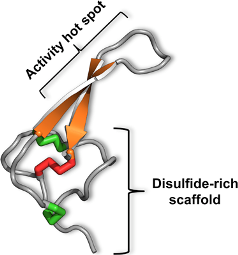
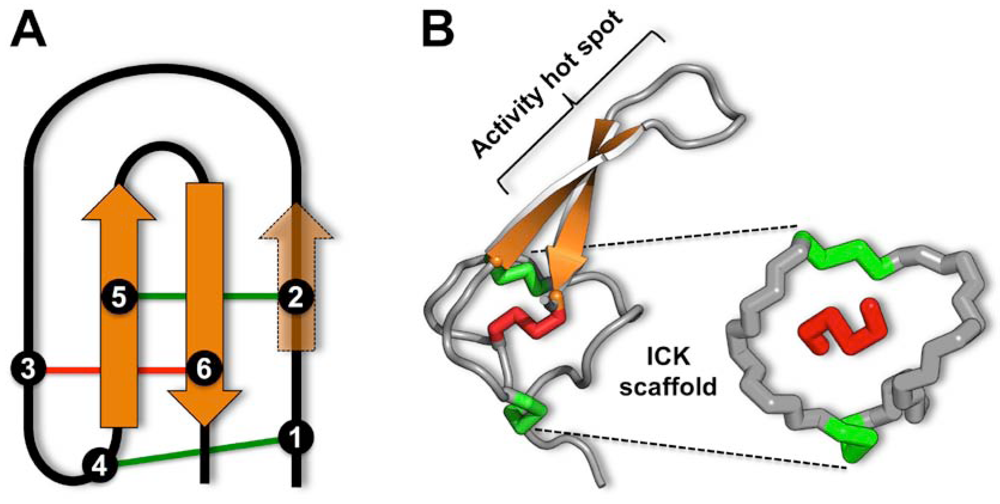
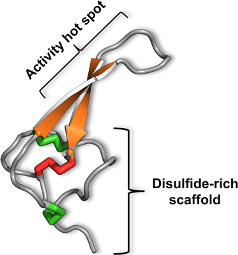
      <p>Peptides have generally been considered poor candidates for human therapeutics because of their susceptibility to proteolytic degradation <italic>in vivo</italic> and their limited penetration of intestinal mucosa [<xref ref-type="bibr" rid="B37-toxins-02-02851">37</xref>,<xref ref-type="bibr" rid="B38-toxins-02-02851">38</xref>]. However, in contrast with most peptides, the presence of an inhibitor cystine knot (ICK) in most spider-venom toxins provides these peptides with extraordinary stability. The inhibitor cystine knot (ICK) is defined as an antiparallel β sheet stabilized by a cystine knot [<xref ref-type="bibr" rid="B39-toxins-02-02851">39</xref>,<xref ref-type="bibr" rid="B40-toxins-02-02851">40</xref>,<xref ref-type="bibr" rid="B41-toxins-02-02851">41</xref>]. In spider toxins, the β sheet typically comprises only two β strands although a third N-terminal strand is sometimes present (<xref ref-type="fig" rid="toxins-02-02851-f001">Figure 1</xref>A) [<xref ref-type="bibr" rid="B42-toxins-02-02851">42</xref>]. The cystine knot comprises a ring formed by two disulfides and the intervening sections of polypeptide backbone, with a third disulfide piercing the ring to create a pseudo-knot (<xref ref-type="fig" rid="toxins-02-02851-f001">Figure 1</xref>B). The compact hydrophobic core of the ICK motif consists primarily of the two central disulfide bridges that emanate from the two β strands that characterize the ICK fold [<xref ref-type="bibr" rid="B43-toxins-02-02851">43</xref>]. Except for the special case of cyclic ICK peptides, cystine knots are not true knots in the mathematical sense as they can be untied by a non-bond-breaking geometrical transformation [<xref ref-type="bibr" rid="B44-toxins-02-02851">44</xref>]. Nevertheless, the cystine knot converts ICK toxins into hyperstable mini-proteins with tremendous chemical, thermal, and biological stability. ICK toxins are typically resistant to extremes of pH, organic solvents, and high temperatures [<xref ref-type="bibr" rid="B45-toxins-02-02851">45</xref>]. However, from a therapeutic perspective, their most important property is their resistance to proteases; ICK peptides are typically stable in human serum for several days and have half-lives in simulated gastric fluid [<xref ref-type="bibr" rid="B46-toxins-02-02851">46</xref>] of &gt;12 hours (GFK and VH, unpublished). It was recently demonstrated that stabilization of a 16-residue α-conotoxin through cyclization dramatically increased its oral activity [<xref ref-type="bibr" rid="B47-toxins-02-02851">47</xref>], and it is therefore possible that the inherent stability of ICK peptides might impart them with oral activity without the need to introduce exotic modifications.</p>
      <p>ICK toxins have proliferated in spider venoms to the point where they now dominate most spider-venom peptidomes. The marked insensitivity of this structural scaffold to changes in intercystine residues has enabled spiders to develop diverse pharmacologies using the same disulfide framework [<xref ref-type="bibr" rid="B48-toxins-02-02851">48</xref>]. Moreover, many of these ICK peptides not only have high affinity but also exquisite selectivity for their cognate targets. With the exception of those with antibacterial/antifungal activity, all of the spider-venom peptides to be discussed in this review contain an ICK motif.</p>
      <fig id="toxins-02-02851-f001" position="anchor">
        <label>Figure 1</label>
        <caption>
          <p>(A) The inhibitor cystine knot (ICK) motif comprises an antiparallel β sheet stabilized by a cystine knot. β strands are shown in orange and the six cysteine residues that form the cystine knot are labeled 1–6. In spider toxins, the β sheet typically comprises only the two β strands housing cysteine residues 5 and 6, although a third N-terminal strand encompassing cysteine 2 is sometimes present. The two “outer” disulfide bonds are shown in green and the “inner” disulfide bridge is red. (B) The cystine knot of the 37-residue spider-venom peptide ω-hexatoxin-Hv1a [<xref ref-type="bibr" rid="B43-toxins-02-02851">43</xref>].The cystine knot comprises a ring formed by two disulfides (green) and the intervening sections of polypeptide backbone (gray), with a third disulfide (red) piercing the ring to create a pseudo-knot. The hydrophobic core of the toxin consists primarily of the two central disulfide bridges connected to the β strands. Key functional residues in ICK toxins are often located in the β hairpin that projects from the central disulfide-rich core of the peptide.</p>
        </caption>
        <graphic xmlns:xlink="http://www.w3.org/1999/xlink" xlink:href="toxins-02-02851-g001.tif"/>
      </fig>
    </sec>
    <sec>
      <title>4. No Pain, Much Gain: Spider Toxins with Analgesic Potential</title>
      <p>Normal nociceptive pain is a key adaptive response that limits our exposure to potentially damaging or life-threatening events. In contrast, aberrant long-lasting pain transforms this adaptive response into a debilitating and often poorly managed disease. About 20% of adults suffer from chronic pain, a figure that increases to 50% for those older than 65 [<xref ref-type="bibr" rid="B49-toxins-02-02851">49</xref>]. In 2007, global sales of pain medications totaled $34 billion [<xref ref-type="bibr" rid="B50-toxins-02-02851">50</xref>], highlighting the pervasive nature of this condition. Nevertheless, there are few drugs available for treatment of chronic pain, and many of these have limited efficacy and significant side-effects. Recently, a number of ion channels have been shown to be critical players in the pathophysiology of pain, and in many cases the most potent and selective blockers of these channels are spider-venom peptides. Here we review some of these peptides with promise as drug leads or as analgesics in their own right.</p>
      <sec>
        <title>4.1. Modulators of Acid Sensing Ion Channels</title>
        <p>Acid sensing ion channels (ASICs) are proton-gated sodium channels that open in response to low pH. They belong to the epithelial sodium channel/degenerin (ENaC/DEG) superfamily of ion channels which have the same overall topology and selectivity for transporting sodium [<xref ref-type="bibr" rid="B51-toxins-02-02851">51</xref>]. However, ASICs are distinguished by their restriction to chordates, their predominantly neuronal distribution, and their activation by decreases in extracellular pH [<xref ref-type="bibr" rid="B52-toxins-02-02851">52</xref>,<xref ref-type="bibr" rid="B53-toxins-02-02851">53</xref>]. To date, seven ASIC subunits have been identified: ASIC1a, ASIC1b, and ASIC1b2 (splice isoforms from the ASIC1 gene), ASIC2a and ASIC2b (splice isoforms of the ASIC2 gene), ASIC3 and ASIC4. Functional ASIC channels comprise either homomeric or heteromeric trimers of these subunits. ASIC2b and ASIC4 are insensitive to protons and do not form homomeric channels, but rather are incorporated into heteromeric channels and may modify the kinetics of channel activation and inactivation. The different combinations of subunits allow the different trimeric channels to sense a wide range of extracellular pH changes.</p>
        <p>ASIC1a is the most abundant ASIC subunit in the central nervous system (CNS) and it has the highest affinity for protons [<xref ref-type="bibr" rid="B53-toxins-02-02851">53</xref>]. It has been implicated as a novel therapeutic target for a broad range of pathophysiological conditions including pain, ischemic stroke, depression, and autoimmune and neurodegenerative diseases such as multiple sclerosis, Huntington’s Disease, and Parkinson’s Disease [<xref ref-type="bibr" rid="B53-toxins-02-02851">53</xref>,<xref ref-type="bibr" rid="B54-toxins-02-02851">54</xref>,<xref ref-type="bibr" rid="B55-toxins-02-02851">55</xref>,<xref ref-type="bibr" rid="B56-toxins-02-02851">56</xref>]. Inhibitors of ASIC1a might therefore be therapeutically valuable for some of these conditions. The only potent and specific inhibitor of ASIC1a that has been identified to date is π-theraphotoxin-Pc1a (π-TRTX-Pc1a; also known as psalmotoxin-1 (PcTx1)), a 40-residue ICK peptide isolated from the venom of the Trinidad chevron tarantula <italic>Psalmopoeus cambridgei.</italic>π-TRTX-Pc1a inhibits homomeric ASIC1a channels, but not other ASIC subtypes, with an IC<sub>50</sub> of 0.9 nM [<xref ref-type="bibr" rid="B30-toxins-02-02851">30</xref>]. π-TRTX-Pc1a was shown to be an effective analgesic, comparable to morphine, in rat models of acute pain [<xref ref-type="bibr" rid="B57-toxins-02-02851">57</xref>] and peripheral administration of this peptide resulted in neuroprotection in a mouse model of ischemic stroke even when administered hours after injury [<xref ref-type="bibr" rid="B58-toxins-02-02851">58</xref>].</p>
        <p>π-TRTX-Pc1a is only effective when administered intrathecally or by intracerebroventricular injection [<xref ref-type="bibr" rid="B57-toxins-02-02851">57</xref>]. Thus, native π-TRTX-Pc1a is unlikely to be a clinically useful analgesic except in the most chronic pain sufferers as intrathecal administration is an invasive method of drug delivery with inherent risks [<xref ref-type="bibr" rid="B59-toxins-02-02851">59</xref>]. As for Prialt®, a peptide from cone snail venom that was recently approved for the treatment of chronic pain [<xref ref-type="bibr" rid="B60-toxins-02-02851">60</xref>], intrathecal π-TRTX-Pc1a use would likely be limited to management of severe chronic pain in patients who are intolerant or refractory to other treatments. Thus, there is much interest in developing mimetics of π-TRTX-Pc1a that might be orally active or at least deliverable via subcutaneous or intramuscular injection. Thus, several attempts have been made to model the π-TRTX-Pc1a:ASIC1a interaction [<xref ref-type="bibr" rid="B61-toxins-02-02851">61</xref>,<xref ref-type="bibr" rid="B62-toxins-02-02851">62</xref>] with a view to providing a template that can be used for <italic>in silico</italic> screening and/or rational design to develop small-molecule mimetics of π-TRTX-Pc1a. Thus, even in cases where a spider-venom peptide itself may not be a viable therapeutic, it can still be an invaluable tool for target validation and for providing a pharmacophore for rational drug design.</p>
      </sec>
      <sec>
        <title>4.2. Modulators of Voltage-Gated Sodium Channels</title>
        <p>Voltage-gated sodium (Na<sub>V</sub>) channels provide a current pathway for the rapid depolarization of excitable cells that is required to initiate an action potential. Functional channels are composed of a pore forming α subunit whose gating and kinetics is modified via association with one of four β subunits. The α subunits are classified into nine different subtypes, denoted Na<sub>V</sub>1.1 to Na<sub>V</sub>1.9 [<xref ref-type="bibr" rid="B63-toxins-02-02851">63</xref>], and they are further characterized by their sensitivity to tetrodotoxin (TTX). Na<sub>V</sub>1.5, Na<sub>V</sub>1.8 and Na<sub>V</sub>1.9 are TTX-resistant whereas all other subtypes are TTX-sensitive.</p>
        <p>Of the nine Na<sub>V</sub> subtypes, Na<sub>V</sub>1.3, Na<sub>V</sub>1.7, and Na<sub>V</sub>1.8 are involved in pain signaling [<xref ref-type="bibr" rid="B64-toxins-02-02851">64</xref>,<xref ref-type="bibr" rid="B65-toxins-02-02851">65</xref>]. However, in recent years, Na<sub>V</sub>1.7 has emerged as perhaps the best validated pain target based on several remarkable human genetic studies. Gain-of-function mutations in the gene encoding the α subunit of Na<sub>V</sub>1.7 (<italic>SCN9A</italic>) underlie two painful neuropathies known as paroxysmal extreme pain disorder (PEPD) and inherited erythromelalgia (IE) [<xref ref-type="bibr" rid="B66-toxins-02-02851">66</xref>,<xref ref-type="bibr" rid="B67-toxins-02-02851">67</xref>], whereas loss-of-function mutations in <italic>SCN9A</italic> result in a <italic>congenital indifference to all forms of pain</italic> [<xref ref-type="bibr" rid="B68-toxins-02-02851">68</xref>,<xref ref-type="bibr" rid="B69-toxins-02-02851">69</xref>]. Remarkably, apart from their complete inability to sense pain, partial loss of smell (hyposmia) is the only other sensory impairment in individuals with this channelopathy [<xref ref-type="bibr" rid="B70-toxins-02-02851">70</xref>]; they have no motor or autonomic dysfunction, with normal blood pressure and temperature regulation. Na<sub>V</sub>1.7 is located at the terminal of sensory neurons, where it is ideally positioned to serve its proposed role as a threshold channel that amplifies pain signals transmitted above a certain level [<xref ref-type="bibr" rid="B71-toxins-02-02851">71</xref>].</p>
        <p>The preferential expression of Na<sub>V</sub>1.7 in peripheral sensory and sympathetic neurons makes it an ideal target for novel analgesics. Indeed, it is probable that the known analgesic effects of a number of nonspecific Na<sub>V</sub> channel blockers such as the local anaesthetic lidocaine, tricyclic antidepressants such as amitriptyline, and anticonvulsants such as carbamezepine are at least in part mediated through their effects on Na<sub>V</sub>1.7. However, the nonspecific block of Na<sub>V</sub> channels by these drugs means that they are only efficacious at or near toxic levels, with numerous CNS-related side-effects such as dizziness and ataxia [<xref ref-type="bibr" rid="B64-toxins-02-02851">64</xref>]. Thus, <italic>subtype-specific</italic> blockers of Na<sub>V</sub>1.7 are likely to be useful drugs for treatment of chronic pain as well as inherited neuropathies such as IE and PEPD [<xref ref-type="bibr" rid="B64-toxins-02-02851">64</xref>,<xref ref-type="bibr" rid="B65-toxins-02-02851">65</xref>,<xref ref-type="bibr" rid="B71-toxins-02-02851">71</xref>]. Recent studies have revealed that spider venoms may provide an excellent source of such subtype-specific blockers.</p>
        <p>Modulation of Na<sub>V</sub> channels is a dominant pharmacology in spider venoms [<xref ref-type="bibr" rid="B72-toxins-02-02851">72</xref>], indicating that spiders long ago evolved the capacity to block Na<sub>V</sub> channels as a mechanism for killing insect prey. Since the insect Na<sub>V</sub> channel shares 55–60% identity with each of the vertebrate Na<sub>V</sub> subtypes [<xref ref-type="bibr" rid="B28-toxins-02-02851">28</xref>] it is perhaps not surprising that numerous spider toxins have been isolated with activity against vertebrate Na<sub>V</sub> channels. However, according to ArachnoServer [<xref ref-type="bibr" rid="B20-toxins-02-02851">20</xref>,<xref ref-type="bibr" rid="B21-toxins-02-02851">21</xref>], only three peptide toxins have been isolated thus far with activity against vertebrate Na<sub>V</sub>1.7 channel, and only six toxins in total have been isolated with submicromolar potency against Na<sub>V</sub>1.3, Na<sub>V</sub>1.7, or Na<sub>V</sub>1.8 (<xref ref-type="table" rid="toxins-02-02851-t001">Table 1</xref>). All of these toxins were isolated from members of the Theraphosidae family (commonly known as tarantulas).</p>
        <table-wrap id="toxins-02-02851-t001" position="anchor">
          <object-id pub-id-type="pii">toxins-02-02851-t001_Table 1</object-id>
          <label>Table 1</label>
          <caption>
            <p>Spider-venom peptides with submicromolar potency against Na<sub>V</sub>1.3, Na<sub>V</sub>1.7, or Na<sub>V</sub>1.8<sup>1</sup>.</p>
          </caption>
          <table>
            <thead>
              <tr>
                <th rowspan="2" align="left" valign="middle">Toxin Name</th>
                <th rowspan="2" align="center" valign="middle">No. of Residues</th>
                <th rowspan="2" align="center" valign="middle">ICK Scaffold</th>
                <th colspan="8" align="center" valign="middle">IC<sub>50</sub> (nM) against Various Na<sub>V</sub> Subtypes</th>
              </tr>
              <tr>
                <th align="center" valign="middle">1.1</th>
                <th align="center" valign="middle">1.2</th>
                <th align="center" valign="middle">1.3</th>
                <th align="center" valign="middle">1.4</th>
                <th align="center" valign="middle">1.5</th>
                <th align="center" valign="middle">1.6</th>
                <th align="center" valign="middle">1.7</th>
                <th align="center" valign="middle">1.8</th>
              </tr>
            </thead>
            <tbody>
              <tr>
                <td align="left" valign="middle">β-TRTX-Tp1a</td>
                <td align="center" valign="middle">35</td>
                <td align="center" valign="middle">Yes</td>
                <td align="center" valign="middle">NA<sup>2</sup></td>
                <td align="center" valign="middle">NA</td>
                <td align="center" valign="middle">NA</td>
                <td align="center" valign="middle">NA</td>
                <td align="center" valign="middle">NA</td>
                <td align="center" valign="middle">NA</td>
                <td align="center" valign="middle">51</td>
                <td align="center" valign="middle"><underline>27<sup>3</sup></underline></td>
              </tr>
              <tr>
                <td align="left" valign="middle">β-TRTX-Tp2a</td>
                <td align="center" valign="middle">30</td>
                <td align="center" valign="middle">Yes</td>
                <td align="center" valign="middle">NA</td>
                <td align="center" valign="middle">41</td>
                <td align="center" valign="middle">102</td>
                <td align="center" valign="middle">NA</td>
                <td align="center" valign="middle">79</td>
                <td align="center" valign="middle">26</td>
                <td align="center" valign="middle"><underline>0.3</underline></td>
                <td align="center" valign="middle">146</td>
              </tr>
              <tr>
                <td align="left" valign="middle">β-TRTX-Ps1a</td>
                <td align="center" valign="middle">34</td>
                <td align="center" valign="middle">Yes</td>
                <td align="center" valign="middle">610</td>
                <td align="center" valign="middle"><underline>0.6</underline></td>
                <td align="center" valign="middle">42</td>
                <td align="center" valign="middle">288</td>
                <td align="center" valign="middle">72</td>
                <td align="center" valign="middle">NA</td>
                <td align="center" valign="middle">NA</td>
                <td align="center" valign="middle">&gt;1000</td>
              </tr>
              <tr>
                <td align="left" valign="middle">β-TRTX-Cm1a</td>
                <td align="center" valign="middle">33</td>
                <td align="center" valign="middle">Yes</td>
                <td align="center" valign="middle">523</td>
                <td align="center" valign="middle"><underline>3</underline></td>
                <td align="center" valign="middle">NA</td>
                <td align="center" valign="middle">888</td>
                <td align="center" valign="middle">323</td>
                <td align="center" valign="middle">NA</td>
                <td align="center" valign="middle">NA</td>
                <td align="center" valign="middle">&gt;1000</td>
              </tr>
              <tr>
                <td align="left" valign="middle">β-TRTX-Cm1b</td>
                <td align="center" valign="middle">33</td>
                <td align="center" valign="middle">Yes</td>
                <td align="center" valign="middle">407</td>
                <td align="center" valign="middle"><underline>8</underline></td>
                <td align="center" valign="middle">88</td>
                <td align="center" valign="middle">400</td>
                <td align="center" valign="middle">1634</td>
                <td align="center" valign="middle">NA</td>
                <td align="center" valign="middle">NA</td>
                <td align="center" valign="middle">&gt;2000</td>
              </tr>
              <tr>
                <td align="left" valign="middle">δ-TRTX-Cj1a<sup>4</sup></td>
                <td align="center" valign="middle">33</td>
                <td align="center" valign="middle">Yes</td>
                <td align="center" valign="middle">NA</td>
                <td align="center" valign="middle">NA</td>
                <td align="center" valign="middle">NA</td>
                <td align="center" valign="middle">NA</td>
                <td align="center" valign="middle"><underline>32</underline></td>
                <td align="center" valign="middle">130</td>
                <td align="center" valign="middle">130</td>
                <td align="center" valign="middle">NA</td>
              </tr>
            </tbody>
          </table> 
          <table-wrap-foot><fn><p>1. Data extracted from ArachnoServer (<uri>http://www.arachnoserver.org</uri>) on 01/11/10; 2. NA indicates data not available; 3.The Na<sub>V</sub> subtype against which a toxin is most active is underlined; 4. This toxin does not block the channel but rather delays its inactivation.</p></fn>
           </table-wrap-foot>
        </table-wrap> 
        <p>The most potent known blocker of human Na<sub>V</sub>1.7, with an IC<sub>50</sub> of 0.3 nM, is β-TRTX-Tp2a (Protoxin II), a 30-residue ICK peptide isolated from the venom of the Green velvet tarantula <italic>Thrixopelma pruriens</italic>. This toxin has a 100-fold selectivity for human Na<sub>V</sub>1.7 compared with Na<sub>V</sub>1.2, Na<sub>V</sub>1.3, Na<sub>V</sub>1.5, Na<sub>V</sub>1.6 and Na<sub>V</sub>1.8 [<xref ref-type="bibr" rid="B73-toxins-02-02851">73</xref>,<xref ref-type="bibr" rid="B74-toxins-02-02851">74</xref>]. Nevertheless, β-TRTX-Tp2a still has relatively high potency against Na<sub>V</sub>1.2 (IC<sub>50</sub> = 41 nM) and Na<sub>V</sub>1.5 (IC<sub>50</sub> = 79 nM) and consequently it is lethal to rats when injected intravenously at 1.0 mg/kg or by intrathecal administration at 0.1 mg/kg. In contrast, intrathecal administration of β-TRTX-Gr1b, a related toxin from the venom of the Chilean rose tarantula <italic>Grammostola rosea</italic> that is 89% identical to β-TRTX-Tp2a, induced analgesia in a variety of rat pain models without any confounding side-effects, and the peptide did not exhibit cross tolerance with morphine [<xref ref-type="bibr" rid="B75-toxins-02-02851">75</xref>]. It is therefore likely that the Na<sub>V</sub> subtype selectivity of β-TRTX-Gr1b, which remains to be determined, is very different to that of β-TRTX-Tp2a. Structure-function studies of closely related spider-venom peptides with different Na<sub>V</sub> selectivity profiles, such as β-TRTX-Tp2a and β-TRTX-Gr1b, should provide structure-activity relationships that can be used to rationally design selective blockers of Na<sub>V</sub>1.7 with therapeutic potential as novel analgesics.</p>
      </sec>
      <sec>
        <title>4.3. Modulators of P2X Receptors</title>
        <p>P2X purinergic receptors are ATP-gated non-selective ion channels permeable to Na<sup>+</sup>, K<sup>+</sup> and Ca<sup>2+</sup> [<xref ref-type="bibr" rid="B76-toxins-02-02851">76</xref>]. Currently, seven subunits (P2X<sub>1-7</sub>) are known [<xref ref-type="bibr" rid="B77-toxins-02-02851">77</xref>] and functional P2X channels are formed by association of these subunits to form homomeric or heteromeric trimers [<xref ref-type="bibr" rid="B78-toxins-02-02851">78</xref>]. To date, six different heteromeric channels with unique pharmacological properties have been discovered [<xref ref-type="bibr" rid="B77-toxins-02-02851">77</xref>]. Of these, P2X<sub>3</sub> [<xref ref-type="bibr" rid="B79-toxins-02-02851">79</xref>], P2X<sub>4</sub> [<xref ref-type="bibr" rid="B80-toxins-02-02851">80</xref>], and P2X<sub>7</sub> [<xref ref-type="bibr" rid="B77-toxins-02-02851">77</xref>] are involved in a range of pain states. Several antagonists of these receptors have been patented and some P2X<sub>7</sub> antagonists have already entered Phase I and II clinical trials [<xref ref-type="bibr" rid="B81-toxins-02-02851">81</xref>].</p>
        <p>P2X<sub>3</sub> is the best-studied subtype with regards to pain. Consistent with its localization on ascending nociceptive sensory neurons [<xref ref-type="bibr" rid="B79-toxins-02-02851">79</xref>], it has been found to be involved in acute pain, inflammatory pain, chronic neuropathic pain, visceral pain, migraine pain, and cancer pain [<xref ref-type="bibr" rid="B79-toxins-02-02851">79</xref>,<xref ref-type="bibr" rid="B82-toxins-02-02851">82</xref>]. Very few subtype-specific antagonists of P2X<sub>3</sub> are known [<xref ref-type="bibr" rid="B83-toxins-02-02851">83</xref>,<xref ref-type="bibr" rid="B84-toxins-02-02851">84</xref>,<xref ref-type="bibr" rid="B85-toxins-02-02851">85</xref>]. Recently, however, a potent and selective modulator of P2X<sub>3</sub> was isolated from the venom of the central Asian spider <italic>Geolycosa sp.</italic> and named purotoxin-1 (PT1) [<xref ref-type="bibr" rid="B29-toxins-02-02851">29</xref>]. PT1 is a 35-residue peptide with four disulfide bonds, three of which form an ICK motif. It has a complex pharmacology that leads to a concentration-dependent prolongation of channel desensitization, with an IC<sub>50</sub> of ~12 nM [<xref ref-type="bibr" rid="B29-toxins-02-02851">29</xref>].</p>
        <p>The analgesic potential of PT1 was measured in rat models of acute and chronic inflammatory pain in which hind paw withdrawal latency was measured after induction of thermal hyperalgesia by injection of either carrageenan or Freund’s complete adjuvant, respectively. PT1 exhibited similar analgesic effects as the P2X<sub>3</sub> antagonist A-317491, but the amount of PT1 required was three orders of magnitude lower [<xref ref-type="bibr" rid="B29-toxins-02-02851">29</xref>]. PT1 was also effective in reducing the number of nocifensive events triggered by the injection of capsaicin or formalin [<xref ref-type="bibr" rid="B29-toxins-02-02851">29</xref>]. Thus, PT1 appears to be a promising lead compound for the development of analgesics that target P2X<sub>3</sub> receptors. PT1 is the first P2X modulator isolated from spider venoms and therefore it will be interesting in future studies to examine how widespread this pharmacology is in the venoms of these animals.</p>
        </sec>
        <sec>
          <title>4.4 Spider-Venom Peptides that Modulate Other Pain Targets</title>
        <p>In addition to the molecular targets discussed above, there are several other ion channels and receptors that have either been validated or are being actively investigated as analgesic targets. For example, Ziconitide (Prialt®), an analgesic peptide derived from cone snail venom, targets Ca<sub>V</sub>2.2 channels [<xref ref-type="bibr" rid="B86-toxins-02-02851">86</xref>], while another cone snail peptide that targets the norepinephrine transporter [<xref ref-type="bibr" rid="B87-toxins-02-02851">87</xref>] is currently in Phase II clinical trials for the treatment of post-operative pain. Several transient receptor potential (TRP) channels including TRPV1, TRPV4, TRPA1, and TRPM8 are also being investigated as analgesic targets and a number of TRPV1 antagonists are in clinical trials [<xref ref-type="bibr" rid="B88-toxins-02-02851">88</xref>,<xref ref-type="bibr" rid="B89-toxins-02-02851">89</xref>]. Spider venoms represent a potential source of modulators for all of these drug targets. For example, block of Ca<sub>V</sub> channels is a dominant pharmacology in spider venoms [<xref ref-type="bibr" rid="B72-toxins-02-02851">72</xref>]; more than 65 blockers of vertebrate Ca<sub>V</sub> channels are currently listed in the ArachnoServer database, of which 17 are active on Ca<sub>V</sub>2.2. In addition, several spider-venom peptides have been isolated that modulate that activity of TRPV1 [<xref ref-type="bibr" rid="B32-toxins-02-02851">32</xref>]. However, very few studies have explored whether spider-venom peptides are capable of targeting ligand-gated receptors, G-protein coupled receptors, or neurotransmitter transporters, and this is likely to be a fruitful line of enquiry for future research.</p>
      </sec>
    </sec>
    <sec>
      <title>5. Antiarrhythmic Drugs from Spider Venoms</title>
      <p>Mechanosensitive channels (MSCs), sometimes referred to as stretch-activated channels, are found in all cells [<xref ref-type="bibr" rid="B90-toxins-02-02851">90</xref>], but mechanosensitivity is best viewed as a phenotype rather than a genotype [<xref ref-type="bibr" rid="B91-toxins-02-02851">91</xref>]. Only two selective inhibitors of MSCs have been isolated, namely M-TRTX-Gr1a (GsMTx4) and κ-TRTX-Gr2a from the venom of the tarantula <italic>Grammostola rosea</italic> [<xref ref-type="bibr" rid="B92-toxins-02-02851">92</xref>,<xref ref-type="bibr" rid="B93-toxins-02-02851">93</xref>]; the latter peptide is identical to κ-TRTX-Ps1b (Phrixotoxin-2) isolated from venom of the Chilean copper tarantula <italic>Paraphysa scrofa</italic>. κ-TRTX-Gr2a/κ-TRTX-Ps1b is a low affinity blocker of MSCs, with a <italic>K</italic><sub>d</sub> of 6 μM in rat astrocytes, but it potently inhibits K<sub>V</sub>4.2 and K<sub>V</sub>4.3 channels, with IC<sub>50</sub> values of 34 and 71 nM, respectively. In contrast, M-TRTX-Gr1a is a significantly more potent inhibitor of MSCs, with a <italic>K</italic><sub>d</sub> of 630 nM in rat astrocytes [<xref ref-type="bibr" rid="B92-toxins-02-02851">92</xref>], and it has proved to be a valuable tool for study of MSCs [<xref ref-type="bibr" rid="B31-toxins-02-02851">31</xref>].</p>
      <p>Atrial fibrillation results from stretching of the atrial chamber, which has been associated with the activity of mechanosensitive channels. Block of these channels presumably explains the remarkable observation that M-TRTX-Gr1a suppresses atrial fibrillation in dilatated rabbit heart [<xref ref-type="bibr" rid="B94-toxins-02-02851">94</xref>]. This suggests that MSCs might be a novel target for antiarrhythmic agents. M-TRTX-Gr1a itself is unlikely to be a useful therapeutic agent because of its unusual mode of action. It does not interact directly with MSCs, since an enantiomer comprised entirely of D-amino acids is equipotent with the native peptide [<xref ref-type="bibr" rid="B31-toxins-02-02851">31</xref>]. Rather, the peptide perturbs the channel-bilayer boundary by partitioning into the membrane [<xref ref-type="bibr" rid="B95-toxins-02-02851">95</xref>,<xref ref-type="bibr" rid="B96-toxins-02-02851">96</xref>], and this membrane-disrupting activity presumably also underlies its antimicrobial activity [<xref ref-type="bibr" rid="B97-toxins-02-02851">97</xref>]. Nevertheless, M-TRTX-Gr1a is likely to be a useful tool for determining the potential of MSCs as a therapeutic target for the treatment of pathologies as diverse as cardiac arrhythmias, spinal cord damage, muscular dystrophy, and gliomas [<xref ref-type="bibr" rid="B31-toxins-02-02851">31</xref>].</p>
    </sec>
    <sec>
      <title>6. Spider Toxins for Treating Erectile Dysfunction</title>
      <p>Penile erection is a complex process initiated by activation of parasympathetic pelvic nerves, resulting in arterial dilatation followed by relaxation of corpora cavernosa [<xref ref-type="bibr" rid="B98-toxins-02-02851">98</xref>]. Nitric oxide (NO) plays a major role in the generation and maintenance of intracavernous pressure and penile erection [<xref ref-type="bibr" rid="B99-toxins-02-02851">99</xref>]. NO, which is released from nitrergic nerves within the trabecular and arterial tissues as well as by the endothelial tissue of penile arteries, exerts its relaxing action by activating soluble guanylyl cyclase. This causes an increase in intracellular cGMP which relaxes the smooth muscles of the cavernous body and results in penile erection.</p>
      <p>There are several drugs on the market today for treatment of erectile dysfuncion (ED), including sildenafil (Viagra®), tadalafil (Cialis®), and vardenafil (Levitra®) [<xref ref-type="bibr" rid="B100-toxins-02-02851">100</xref>]. These drugs all affect phosphodiesterase type 5 (PDE5), which is present in large amounts in the penis. Inhibition of PDE5 leads to increased levels of cGMP and hence increased blood flow to the penis [<xref ref-type="bibr" rid="B101-toxins-02-02851">101</xref>]. The aforementioned PDE5-blocking drugs have similar side effects including headache, flushing, dyspepsia, nasal congestion, impaired vision, photophobia and blurred vision [<xref ref-type="bibr" rid="B102-toxins-02-02851">102</xref>]. Hence, there is a need for better drugs with fewer side effects for the treatment of ED.</p>
      <p>In South America, humans bitten by the “armed-spider” <italic>Phoneutria nigriventer</italic> experience a variety of symptoms including priapism. The toxin responsible for this effect, δ-ctenitoxin-Pn2a (δ-CNTX-Pn2a; Tx2-6) was isolated in 1992 [<xref ref-type="bibr" rid="B103-toxins-02-02851">103</xref>] and subsequently found to modulate the activity of Na<sub>V</sub> channels [<xref ref-type="bibr" rid="B104-toxins-02-02851">104</xref>]. δ-CNTX-Pn2a is a 48-residue toxin with five disulfide bonds; it is unclear whether it contains an ICK motif. The toxin has a complex pharmacology that results in inhibition of Na<sub>V</sub> channel inactivation and a hyperpolarizing shift in the channel activation potential [<xref ref-type="bibr" rid="B104-toxins-02-02851">104</xref>]. <italic>Intracerebroventricular</italic> injection of δ-CNTX-Pn2a into mice results in scratching, hypersalivation, lachrymation, sweating, and agitation followed by spastic paralysis of the anterior and posterior extremities and death [<xref ref-type="bibr" rid="B103-toxins-02-02851">103</xref>]. However, <italic>subcutaneous</italic> injection of δ-CNTX-Pn2a into rats induced erection, and rats with severely depressed erectile function could be normalized by subcutaneous administration of δ-CNTX-Pn2a [<xref ref-type="bibr" rid="B105-toxins-02-02851">105</xref>]. A minimum dose of only 0.006 μg/kg was required to cause an erection in mice when injected directly into the corpus cavernosum; at this dose, no local and systemic collateral toxic effects were observed and the erection was lost after 120–140 min [<xref ref-type="bibr" rid="B106-toxins-02-02851">106</xref>].</p>
      <p>The potency and specificity of δ-CNTX-Pn2a makes it an attractive lead molecule for the development of new therapeutics for ED treatment that might have fewer side effects than current drugs. The pharmacology inherent in δ-CNTX-Pn2a may be widespread in spider venoms, at least amongst members of the Ctenidae family (which currently comprises 475 species [<xref ref-type="bibr" rid="B107-toxins-02-02851">107</xref>]), since orthologous toxins are found in several other <italic>Phoneutria</italic> species as well as a related ctenid spider (see ArachnoServer entry <uri>http://www.arachnoserver.org/toxincard.html?id=16</uri>).</p>
    </sec>
    <sec>
      <title>7. Antibacterial and Antifungal Toxins</title>
      <p>The introduction of antibiotics in the 1930s and 1940s was in large part responsible for the dramatic decline in the mortality rate from communicable diseases in developed countries [<xref ref-type="bibr" rid="B108-toxins-02-02851">108</xref>]. However, bacteria are remarkably proficient at adapting to environmental stresses, and they have evolved at least one mechanism of resistance for all 17 classes of antibiotics that have been developed to date [<xref ref-type="bibr" rid="B109-toxins-02-02851">109</xref>]. The recent widespread emergence of antibiotic resistance in clinically important bacterial pathogens such as <italic>Staphylococcus aureus</italic>, <italic>Streptococcus pneumoniae</italic>, and <italic>Enterococcus faecalis</italic>, combined with a dramatic decrease in the rate of development of new antibiotics, has led some to suggest that we may be approaching the post-antibiotic era [<xref ref-type="bibr" rid="B109-toxins-02-02851">109</xref>]. While this may overstate the problem, there is nevertheless an urgent need to develop new antimicrobials with novel mechanisms of action.</p>
      <p>The recent successful introduction of the lipopeptide antibiotic daptomycin [<xref ref-type="bibr" rid="B110-toxins-02-02851">110</xref>] has rekindled interest in antimicrobial peptides [<xref ref-type="bibr" rid="B111-toxins-02-02851">111</xref>]. To date, 40 membrane-acting antimicrobial peptides (MAMPs) have been isolated from the venom of four different families of araneomorphs, suggesting that antimicrobial activity is widespread in this infraorder of spiders. These MAMPs often have a wide range of antimicrobial activities, with some toxins active against Gram-positive and Gram-negative bacteria as well as fungal pathogens such as <italic>Candida albicans</italic> [<xref ref-type="bibr" rid="B112-toxins-02-02851">112</xref>]. Some MAMPs also have anti-trypanosomal activity [<xref ref-type="bibr" rid="B113-toxins-02-02851">113</xref>]. Curiously, no MAMPs have thus far been isolated from the venom of mygalomorph spiders. It is possible that MAMPs were recruited into araneomorph venoms following the split from mygalomorphs around 280 million years ago [<xref ref-type="bibr" rid="B114-toxins-02-02851">114</xref>]. </p>
      <p>MAMPs differ from most other spider-venom peptides in their structure and mode of action. Rather than utilizing the ICK fold common to most spider toxins, MAMPs are α-helical amphipathic peptides that interact with and perturb cell membranes to yield their antimicrobial effects [<xref ref-type="bibr" rid="B115-toxins-02-02851">115</xref>,<xref ref-type="bibr" rid="B116-toxins-02-02851">116</xref>,<xref ref-type="bibr" rid="B117-toxins-02-02851">117</xref>,<xref ref-type="bibr" rid="B118-toxins-02-02851">118</xref>]. This mode of action can be potentially problematic from a therapeutic perspective since MAMPS that interact nonspecifically with cell membranes are cytolytic [<xref ref-type="bibr" rid="B119-toxins-02-02851">119</xref>]. Indeed, this property is likely to be the basis of their biological function in spider venoms. Although it has been proposed that MAMPS might protect the spider’s venom apparatus against infection [<xref ref-type="bibr" rid="B115-toxins-02-02851">115</xref>] their primary role is more likely to be as membrane disrupting agents that augment the activity of the disulfide-rich neurotoxic peptides by facilitating their spread [<xref ref-type="bibr" rid="B120-toxins-02-02851">120</xref>,<xref ref-type="bibr" rid="B121-toxins-02-02851">121</xref>].</p>
      <p>It has been shown that the cytolytic activity of at least some spider-venom MAMPs can be minimized by truncation without significantly disrupting their antimicrobial activity [<xref ref-type="bibr" rid="B122-toxins-02-02851">122</xref>]. Nevertheless, the therapeutic use of these peptides is likely to be limited by their inherent susceptibility to proteolysis, which is likely to result in short gut and plasma half-lives. Whether this problem can be solved by strategies such as cyclization or grafting key sequence elements onto more stable ICK scaffolds [<xref ref-type="bibr" rid="B123-toxins-02-02851">123</xref>] remains to be seen.</p>
    </sec>
    <sec>
      <title>8. Antimalarial Toxins</title>
      <p>The antimicrobial action of spider toxins is not limited to bacteria and fungi, but also extends to the malaria parasite. There were 243 million cases of malaria in 2008, resulting in a death every 35 seconds, and most of these were children under the age of five [<xref ref-type="bibr" rid="B124-toxins-02-02851">124</xref>]. Malaria is caused by <italic>Plasmodium</italic> infections spread by female anopheline mosquitoes. There are five genera of <italic>Plasmodium</italic> that cause malaria, with <italic>Plasmodium falciparum</italic> being the most virulent. Widespread resistance to chloroquine has made this drug largely ineffective for treating <italic>Plasmodium falciparum</italic> in high-transmission areas and few cheap alternatives are available [<xref ref-type="bibr" rid="B125-toxins-02-02851">125</xref>].</p>
      <p>U<sub>1</sub>-TRTX-Pc1a (Psalmopeotoxin I) and U<sub>2</sub>-TRTX-Pc1a (Psalmopeotoxin II) are ICK peptides isolated from the venom of the Trinidad chevron tarantula <italic>Psalmopoeus cambridgei</italic> that are effective against the intra-erythrocyte stage of <italic>Plasmodium falciparum</italic>. Interestingly, this is the same spider from which π-TRTX-Pc1a, the most potent known blocker of ASIC1a, was isolated, indicating that a single spider can provide multiple therapeutic leads. U<sub>1</sub>-TRTX-Pc1a and U<sub>2</sub>-TRTX-Pc1a are unrelated peptides that comprise 33 and 28 residues, respectively. They inhibit intra-erythrocyte development of <italic>Plasmodium falciparum</italic> with ED<sub>50</sub> values of 1.1–1.6 μM but, unlike most MAMPS, they do not have hemolytic, antibacterial or antifungal activity. The mode of action of these peptides is unknown. It seems unlikely that they directly target the malaria parasite since this would require the peptides to traverse both the erythrocyte membrane as well as the parasitophorous vacuolar membrane that encapsulates the parasite. One possibility is that these toxins target the new permeability pathways that are established in the erythrocyte membrane following parasite invasion [<xref ref-type="bibr" rid="B126-toxins-02-02851">126</xref>]. Thus, in addition to being useful therapeutic leads, these peptide toxins might help validate a new anti-malarial drug target.</p>
    </sec>
    <sec sec-type="discussion">
      <title>9. Discussion</title>
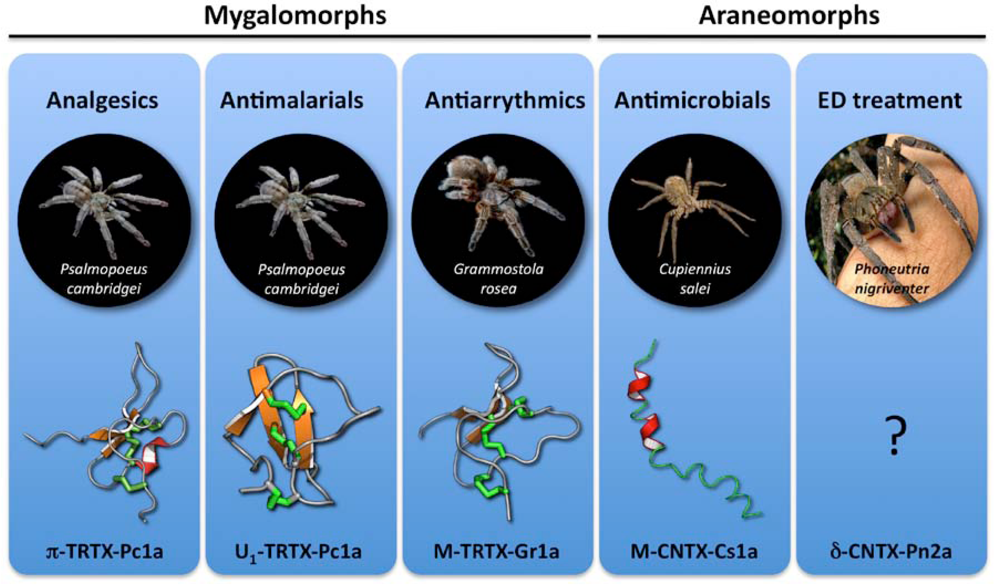
      <p>In the preceding sections we surveyed a number of spider-venom peptides with potential therapeutic applications (<xref ref-type="fig" rid="toxins-02-02851-f002">Figure 2</xref>). With the exception of the MAMPs that have antimicrobial/antifungal activity, all of these peptides are stabilized by an inhibitor cystine knot motif. Thus, they are unlikely to suffer from one of the major problems typically associated with peptide drugs, namely rapid proteolytic degradation. As any surviving bite victim will attest, the devastating <italic>in vivo</italic> efficacy of the 42-residue lethal Na<sub>V</sub> channel toxin from the Australian funnel-web spider [<xref ref-type="bibr" rid="B42-toxins-02-02851">42</xref>,<xref ref-type="bibr" rid="B127-toxins-02-02851">127</xref>] plainly demonstrates how minute quantities of ICK peptides can be effective in humans. Should rapid proteolysis prove to be an issue for a spider-venom peptide of therapeutic interest, strategies such as D-amino acid substitution of susceptible residues, cyclization to reduce conformational flexibility, and protection of the termini via C-terminal amidation or use of N-terminal pyroglutamate could be employed to improve proteolytic resistance [<xref ref-type="bibr" rid="B37-toxins-02-02851">37</xref>,<xref ref-type="bibr" rid="B128-toxins-02-02851">128</xref>,<xref ref-type="bibr" rid="B129-toxins-02-02851">129</xref>]. Indeed, spiders routinely employ C-terminal amidation as a protection strategy, with ~12% of all known spider toxins containing this posttranslational modification [<xref ref-type="bibr" rid="B21-toxins-02-02851">21</xref>].</p>
      <p>Because of their inherent proteolytic resistance, the plasma half-life of ICK peptides is likely to be determined by the rate at which they are cleared by glomerular filtration, which efficiently removes small proteins and peptides that are not bound to carrier proteins such as serum albumin [<xref ref-type="bibr" rid="B130-toxins-02-02851">130</xref>]. However, there are a variety of strategies that can be employed to reduce peptide clearance rates, such as increasing the peptide mass by PEGylation, conjugation to carrier proteins, or by making peptides more hydrophobic in order to enhance their association with serum albumin; the latter approach can also cause hydrophobic depoting, which provides sustained release from a subcutaneous injection [<xref ref-type="bibr" rid="B37-toxins-02-02851">37</xref>]. </p>
      <p>For acute life-threatening conditions as well as chronic conditions such as persistent pain, subcutaneous injection is likely to be an acceptable route of peptide-drug administration. In certain pathologies where quality of life is dramatically reduced, intrathecal administration may even be a viable option if the difficulties associated with peptide delivery are outweighed by the benefits of treatment. Generally, however, oral delivery is likely to be desirable. The intrinsic stability of ICK peptides is likely to facilitate the development of oral delivery strategies since they will presumably have much longer gut and plasma residence times than typical peptides. Moreover, spider-venom ICK peptides are small enough to consider alternative routes of administration such as intranasal, transdermal, and pulmonary [<xref ref-type="bibr" rid="B131-toxins-02-02851">131</xref>].</p>
            <fig id="toxins-02-02851-f002" position="anchor">
        <label>Figure 2</label>
        <caption>
          <p>Spider-venom peptides that are serving as therapeutic leads. A photo of the spider from which each toxin was isolated is shown, and the name and 3D structure of the toxin is indicated at the bottom of each panel. Disulfide bonds are shown as green tubes, while β strands and α helices are highlighted in orange and red, respectively. The structure of δ-CNTX-Pn2a has not yet been determined. Note that therapeutic leads have been isolated from both “modern” (araneomorph) and “primitive” (mygalomorph) spiders [<xref ref-type="bibr" rid="B3-toxins-02-02851">3</xref>].</p>
        </caption>
        <graphic xmlns:xlink="http://www.w3.org/1999/xlink" xlink:href="toxins-02-02851-g002.tif"/>
      </fig>
      <p>An alternative but complementary approach is to develop small-molecule mimetics of spider-venom peptides. The epitope (pharmacophore) that mediates the interaction of these peptides with their cognate receptors or ion channels can be remarkably small. For example, the interaction between the spider-venom peptide ω-hexatoxin-Hv1a and invertebrate Ca<sub>V</sub> channels is mediated by a pharmacophore comprising only three spatially contiguous residues with a solvent-accessible surface area of ~200 Å [<xref ref-type="bibr" rid="B132-toxins-02-02851">132</xref>,<xref ref-type="bibr" rid="B133-toxins-02-02851">133</xref>], which approximates the typical solvent-accessible surface area of a small drug [<xref ref-type="bibr" rid="B134-toxins-02-02851">134</xref>]. As long as a high-quality structure of the peptide is available, this enables <italic>ab initio</italic> design of nonpeptide mimetics [<xref ref-type="bibr" rid="B135-toxins-02-02851">135</xref>,<xref ref-type="bibr" rid="B136-toxins-02-02851">136</xref>], identification of small molecule mimetics via <italic>in silico</italic> screening of chemical libraries, or a combination of these approaches.</p>
    </sec>
    <sec sec-type="conclusions">
      <title>10. Conclusions</title>
      <p>Over a period of more than 300 million years, spiders have evolved an extensive library of bioactive peptides. Moreover, in contrast with man-made combinatorial peptide libraries, spider-venom peptides have been pre-optimized for high affinity and selectivity against a diverse range of molecular targets. It is therefore not surprising that numerous spider-venom peptides have been characterized that potently and selectively modulate the activity of a diverse range of therapeutic targets. These include peptides that target Na<sub>V</sub> channels, ASICs, MSCs, and purinergic receptors as well as peptides with antimalarial and antimicrobial activity. Most of these peptides contain an ICK motif, and their extraordinary stability provides a variety of delivery options for therapeutic administration. Only a small fraction of spider-venom peptides have been characterized, and continued technical advances in the venoms-based drug discovery process are likely to uncover many new therapeutic leads from spider venoms.</p>
    </sec>
  </body>
  <back>
    <ack>
      <title>Acknowledgements</title>
      <p>We acknowledge financial support from the Australian National Health &amp; Medical Research Council (Project Grant 511067 to L.D.R. and G.F.K.) and the Australian Research Council (Discovery Grant DP1095728 to G.F.K.). All spider photos in <xref ref-type="fig" rid="toxins-02-02851-f002">Figure 2</xref> are courtesy of Bastian Rast, except for that of <italic>Phoneutria nigriventer</italic> which is by João P. Burini.</p>
    </ack>
    <ref-list>
      <title>References</title>
      <ref id="B1-toxins-02-02851">
        <label>1.</label>
        <citation citation-type="journal">
          <person-group person-group-type="author">
            <name>
              <surname>Coddington</surname>
              <given-names>J.A.</given-names>
            </name>
            <name>
              <surname>Levi</surname>
              <given-names>H.W.</given-names>
            </name>
          </person-group>
          <article-title>Systematics and evolution of spiders (Araneae)</article-title>
          <source>Annu. Rev. Ecol. Syst.</source>
          <year>1991</year>
          <volume>22</volume>
          <fpage>565</fpage>
          <lpage>592</lpage>
        <pub-id pub-id-type="doi">10.1146/annurev.es.22.110191.003025</pub-id></citation>
      </ref>
      <ref id="B2-toxins-02-02851">
        <label>2.</label>
        <citation citation-type="journal">
          <person-group person-group-type="author">
            <name>
              <surname>Isbister</surname>
              <given-names>G.K.</given-names>
            </name>
            <name>
              <surname>White</surname>
              <given-names>J.</given-names>
            </name>
          </person-group>
          <article-title>Clinical consequences of spider bite: recent advances in our understanding</article-title>
          <source>Toxicon</source>
          <year>2004</year>
          <volume>43</volume>
          <fpage>477</fpage>
          <lpage>492</lpage>
        <pub-id pub-id-type="doi">10.1016/j.toxicon.2004.02.002</pub-id><pub-id pub-id-type="pmid">15066408</pub-id></citation>
      </ref>
      <ref id="B3-toxins-02-02851">
        <label>3.</label>
        <citation citation-type="journal">
          <person-group person-group-type="author">
            <name>
              <surname>King</surname>
              <given-names>G.F.</given-names>
            </name>
          </person-group>
          <article-title>The wonderful world of spiders: preface to the special Toxicon issue on spider venoms</article-title>
          <source>Toxicon</source>
          <year>2004</year>
          <volume>43</volume>
          <fpage>471</fpage>
          <lpage>476</lpage>
        <pub-id pub-id-type="doi">10.1016/j.toxicon.2004.02.001</pub-id><pub-id pub-id-type="pmid">15066407</pub-id></citation>
      </ref>
      <ref id="B4-toxins-02-02851">
        <label>4.</label>
        <citation citation-type="journal">
          <person-group person-group-type="author">
            <name>
              <surname>Escoubas</surname>
              <given-names>P.</given-names>
            </name>
            <name>
              <surname>Diochot</surname>
              <given-names>S.</given-names>
            </name>
            <name>
              <surname>Corzo</surname>
              <given-names>G.</given-names>
            </name>
          </person-group>
          <article-title>Structure and pharmacology of spider venom neurotoxins</article-title>
          <source>Biochimie</source>
          <year>2000</year>
          <volume>82</volume>
          <fpage>893</fpage>
          <lpage>907</lpage>
        <pub-id pub-id-type="doi">10.1016/S0300-9084(00)01166-4</pub-id><pub-id pub-id-type="pmid">11086219</pub-id></citation>
      </ref>
      <ref id="B5-toxins-02-02851">
        <label>5.</label>
        <citation citation-type="journal">
          <person-group person-group-type="author">
            <name>
              <surname>Rash</surname>
              <given-names>L.D.</given-names>
            </name>
            <name>
              <surname>Hodgson</surname>
              <given-names>W.C.</given-names>
            </name>
          </person-group>
          <article-title>Pharmacology and biochemistry of spider venoms</article-title>
          <source>Toxicon</source>
          <year>2002</year>
          <volume>40</volume>
          <fpage>225</fpage>
          <lpage>254</lpage>
        <pub-id pub-id-type="doi">10.1016/S0041-0101(01)00199-4</pub-id><pub-id pub-id-type="pmid">11711120</pub-id></citation>
      </ref>
      <ref id="B6-toxins-02-02851">
        <label>6.</label>
        <citation citation-type="journal">
          <person-group person-group-type="author">
            <name>
              <surname>Tedford</surname>
              <given-names>H.W.</given-names>
            </name>
            <name>
              <surname>Sollod</surname>
              <given-names>B.L.</given-names>
            </name>
            <name>
              <surname>Maggio</surname>
              <given-names>F.</given-names>
            </name>
            <name>
              <surname>King</surname>
              <given-names>G.F.</given-names>
            </name>
          </person-group>
          <article-title>Australian funnel-web spiders: Master insecticide chemists</article-title>
          <source>Toxicon</source>
          <year>2004</year>
          <volume>43</volume>
          <fpage>601</fpage>
          <lpage>618</lpage>
        <pub-id pub-id-type="doi">10.1016/j.toxicon.2004.02.010</pub-id><pub-id pub-id-type="pmid">15066416</pub-id></citation>
      </ref>
      <ref id="B7-toxins-02-02851">
        <label>7.</label>
        <citation citation-type="journal">
          <person-group person-group-type="author">
            <name>
              <surname>Escoubas</surname>
              <given-names>P.</given-names>
            </name>
            <name>
              <surname>Rash</surname>
              <given-names>L.</given-names>
            </name>
          </person-group>
          <article-title>Tarantulas: Eight-legged pharmacists and combinatorial chemists</article-title>
          <source>Toxicon</source>
          <year>2004</year>
          <volume>43</volume>
          <fpage>555</fpage>
          <lpage>574</lpage>
        <pub-id pub-id-type="doi">10.1016/j.toxicon.2004.02.007</pub-id><pub-id pub-id-type="pmid">15066413</pub-id></citation>
      </ref>
      <ref id="B8-toxins-02-02851">
        <label>8.</label>
        <citation citation-type="journal">
          <person-group person-group-type="author">
            <name>
              <surname>Estrada</surname>
              <given-names>G.</given-names>
            </name>
            <name>
              <surname>Villegas</surname>
              <given-names>E.</given-names>
            </name>
            <name>
              <surname>Corzo</surname>
              <given-names>G.</given-names>
            </name>
          </person-group>
          <article-title>Spider venoms: a rich source of acylpolyamines and peptides as new leads for CNS drugs</article-title>
          <source>Nat. Prod. Rep.</source>
          <year>2007</year>
          <volume>24</volume>
          <fpage>145</fpage>
          <lpage>161</lpage>
        <pub-id pub-id-type="doi">10.1039/b603083c</pub-id><pub-id pub-id-type="pmid">17268611</pub-id></citation>
      </ref>
      <ref id="B9-toxins-02-02851">
        <label>9.</label>
        <citation citation-type="journal">
          <person-group person-group-type="author">
            <name>
              <surname>Vassilevski</surname>
              <given-names>A.A.</given-names>
            </name>
            <name>
              <surname>Kozlov</surname>
              <given-names>S.A.</given-names>
            </name>
            <name>
              <surname>Grishin</surname>
              <given-names>E.V.</given-names>
            </name>
          </person-group>
          <article-title>Molecular diversity of spider venom</article-title>
          <source>Biochemistry</source>
          <year>2009</year>
          <volume>74</volume>
          <fpage>1505</fpage>
          <lpage>1534</lpage>
        <pub-id pub-id-type="pmid">20210706</pub-id></citation>
      </ref>
      <ref id="B10-toxins-02-02851">
        <label>10.</label>
        <citation citation-type="journal">
          <person-group person-group-type="author">
            <name>
              <surname>Escoubas</surname>
              <given-names>P.</given-names>
            </name>
            <name>
              <surname>Sollod</surname>
              <given-names>B.</given-names>
            </name>
            <name>
              <surname>King</surname>
              <given-names>G.F.</given-names>
            </name>
          </person-group>
          <article-title>Venom landscapes: mining the complexity of spider venoms via a combined cDNA and mass spectrometric approach</article-title>
          <source>Toxicon</source>
          <year>2006</year>
          <volume>47</volume>
          <fpage>650</fpage>
          <lpage>663</lpage>
        <pub-id pub-id-type="doi">10.1016/j.toxicon.2006.01.018</pub-id><pub-id pub-id-type="pmid">16574177</pub-id></citation>
      </ref>
      <ref id="B11-toxins-02-02851">
        <label>11.</label>
        <citation citation-type="journal">
          <person-group person-group-type="author">
            <name>
              <surname>Escoubas</surname>
              <given-names>P.</given-names>
            </name>
            <name>
              <surname>King</surname>
              <given-names>G.F.</given-names>
            </name>
          </person-group>
          <article-title>Venomics as a drug discovery platform</article-title>
          <source>Expert Rev. Proteomics</source>
          <year>2009</year>
          <volume>6</volume>
          <fpage>221</fpage>
          <lpage>224</lpage>
        <pub-id pub-id-type="doi">10.1586/epr.09.45</pub-id><pub-id pub-id-type="pmid">19489692</pub-id></citation>
      </ref>
      <ref id="B12-toxins-02-02851">
        <label>12.</label>
        <citation citation-type="journal">
          <person-group person-group-type="author">
            <name>
              <surname>King</surname>
              <given-names>G.F.</given-names>
            </name>
            <name>
              <surname>Gentz</surname>
              <given-names>M.C.</given-names>
            </name>
            <name>
              <surname>Escoubas</surname>
              <given-names>P.</given-names>
            </name>
            <name>
              <surname>Nicholson</surname>
              <given-names>G.M.</given-names>
            </name>
          </person-group>
          <article-title>A rational nomenclature for naming peptide toxins from spiders and other venomous animals</article-title>
          <source>Toxicon</source>
          <year>2008</year>
          <volume>52</volume>
          <fpage>264</fpage>
          <lpage>276</lpage>
        <pub-id pub-id-type="doi">10.1016/j.toxicon.2008.05.020</pub-id><pub-id pub-id-type="pmid">18619481</pub-id></citation>
      </ref>
      <ref id="B13-toxins-02-02851">
        <label>13.</label>
        <citation citation-type="journal">
          <person-group person-group-type="author">
            <name>
              <surname>Liao</surname>
              <given-names>Z.</given-names>
            </name>
            <name>
              <surname>Cao</surname>
              <given-names>J.</given-names>
            </name>
            <name>
              <surname>Li</surname>
              <given-names>S.</given-names>
            </name>
            <name>
              <surname>Yan</surname>
              <given-names>X.</given-names>
            </name>
            <name>
              <surname>Hu</surname>
              <given-names>W.</given-names>
            </name>
            <name>
              <surname>He</surname>
              <given-names>Q.</given-names>
            </name>
            <name>
              <surname>Chen</surname>
              <given-names>J.</given-names>
            </name>
            <name>
              <surname>Tang</surname>
              <given-names>J.</given-names>
            </name>
            <name>
              <surname>Xie</surname>
              <given-names>J.</given-names>
            </name>
            <name>
              <surname>Liang</surname>
              <given-names>S.</given-names>
            </name>
          </person-group>
          <article-title>Proteomic and peptidomic analysis of the venom from Chinese tarantula <italic>Chilobrachys jingzhao</italic></article-title>
          <source>Proteomics</source>
          <year>2007</year>
          <volume>7</volume>
          <fpage>1892</fpage>
          <lpage>1907</lpage>
        <pub-id pub-id-type="doi">10.1002/pmic.200600785</pub-id><pub-id pub-id-type="pmid">17476710</pub-id></citation>
      </ref>
      <ref id="B14-toxins-02-02851">
        <label>14.</label>
        <citation citation-type="journal">
          <person-group person-group-type="author">
            <name>
              <surname>Richardson</surname>
              <given-names>M.</given-names>
            </name>
            <name>
              <surname>Pimenta</surname>
              <given-names>A.M.</given-names>
            </name>
            <name>
              <surname>Bemquerer</surname>
              <given-names>M.P.</given-names>
            </name>
            <name>
              <surname>Santoro</surname>
              <given-names>M.M.</given-names>
            </name>
            <name>
              <surname>Beirao</surname>
              <given-names>P.S.</given-names>
            </name>
            <name>
              <surname>Lima</surname>
              <given-names>M.E.</given-names>
            </name>
            <name>
              <surname>Figueiredo</surname>
              <given-names>S.G.</given-names>
            </name>
            <name>
              <surname>Bloch</surname>
              <given-names>C.</given-names>
              <suffix>Jr.</suffix>
            </name>
            <name>
              <surname>Vasconcelos</surname>
              <given-names>E.A.</given-names>
            </name>
            <name>
              <surname>Campos</surname>
              <given-names>F.A.</given-names>
            </name>
            <name>
              <surname>Gomes</surname>
              <given-names>P.C.</given-names>
            </name>
            <name>
              <surname>Cordeiro</surname>
              <given-names>M.N.</given-names>
            </name>
          </person-group>
          <article-title>Comparison of the partial proteomes of the venoms of Brazilian spiders of the genus <italic>Phoneutria</italic></article-title>
          <source>Comp. Biochem. Physiol. C Toxicol. Pharmacol.</source>
          <year>2006</year>
          <volume>142</volume>
          <fpage>173</fpage>
          <lpage>187</lpage>
          <pub-id pub-id-type="pmid">16278100</pub-id>
        </citation>
      </ref>
      <ref id="B15-toxins-02-02851">
        <label>15.</label>
        <citation citation-type="journal">
          <person-group person-group-type="author">
            <name>
              <surname>de F Fernandes-Pedrosa</surname>
              <given-names>M.</given-names>
            </name>
            <name>
              <surname>de LM Junqueira-de-Azevedo</surname>
              <given-names>I.</given-names>
            </name>
            <name>
              <surname>Gonçalves-de-Andrade</surname>
              <given-names>R.M.</given-names>
            </name>
            <name>
              <surname>Kobashi</surname>
              <given-names>L.S.</given-names>
            </name>
            <name>
              <surname>Almeida</surname>
              <given-names>D.D.</given-names>
            </name>
            <name>
              <surname>Ho</surname>
              <given-names>P.L.</given-names>
            </name>
            <name>
              <surname>Tambourgi</surname>
              <given-names>D.V.</given-names>
            </name>
          </person-group>
          <article-title>Transcriptome analysis of <italic>Loxosceles laeta</italic> (Araneae, Sicariidae) spider venomous gland using expressed sequence tags</article-title>
          <source>BMC Genomics</source>
          <year>2008</year>
          <volume>9</volume>
          <fpage>279</fpage>
          <pub-id pub-id-type="pmid">18547439</pub-id>
        </citation>
      </ref>
      <ref id="B16-toxins-02-02851">
        <label>16.</label>
        <citation citation-type="journal">
          <person-group person-group-type="author">
            <name>
              <surname>Jiang</surname>
              <given-names>L.</given-names>
            </name>
            <name>
              <surname>Peng</surname>
              <given-names>L.</given-names>
            </name>
            <name>
              <surname>Chen</surname>
              <given-names>J.</given-names>
            </name>
            <name>
              <surname>Zhang</surname>
              <given-names>Y.</given-names>
            </name>
            <name>
              <surname>Xiong</surname>
              <given-names>X.</given-names>
            </name>
            <name>
              <surname>Liang</surname>
              <given-names>S.</given-names>
            </name>
          </person-group>
          <article-title>Molecular diversification based on analysis of expressed sequence tags from the venom glands of the Chinese bird spider <italic>Ornithoctonus huwena</italic></article-title>
          <source>Toxicon</source>
          <year>2008</year>
          <volume>51</volume>
          <fpage>1479</fpage>
          <lpage>1489</lpage>
          <pub-id pub-id-type="pmid">18482741</pub-id>
          <pub-id pub-id-type="doi">10.1016/j.toxicon.2008.03.024</pub-id>
        </citation>
      </ref>
      <ref id="B17-toxins-02-02851">
        <label>17.</label>
        <citation citation-type="journal">
          <person-group person-group-type="author">
            <name>
              <surname>Kozlov</surname>
              <given-names>S.</given-names>
            </name>
            <name>
              <surname>Malyavka</surname>
              <given-names>A.</given-names>
            </name>
            <name>
              <surname>McCutchen</surname>
              <given-names>B.</given-names>
            </name>
            <name>
              <surname>Lu</surname>
              <given-names>A.</given-names>
            </name>
            <name>
              <surname>Schepers</surname>
              <given-names>E.</given-names>
            </name>
            <name>
              <surname>Herrmann</surname>
              <given-names>R.</given-names>
            </name>
            <name>
              <surname>Grishin</surname>
              <given-names>E.</given-names>
            </name>
          </person-group>
          <article-title>A novel strategy for the identification of toxinlike structures in spider venom</article-title>
          <source>Proteins</source>
          <year>2005</year>
          <volume>59</volume>
          <fpage>131</fpage>
          <lpage>140</lpage>
        <pub-id pub-id-type="doi">10.1002/prot.20390</pub-id><pub-id pub-id-type="pmid">15688451</pub-id></citation>
      </ref>
      <ref id="B18-toxins-02-02851">
        <label>18.</label>
        <citation citation-type="journal">
          <person-group person-group-type="author">
            <name>
              <surname>Diego-Garcia</surname>
              <given-names>E.</given-names>
            </name>
            <name>
              <surname>Peigneur</surname>
              <given-names>S.</given-names>
            </name>
            <name>
              <surname>Waelkens</surname>
              <given-names>E.</given-names>
            </name>
            <name>
              <surname>Debaveye</surname>
              <given-names>S.</given-names>
            </name>
            <name>
              <surname>Tytgat</surname>
              <given-names>J.</given-names>
            </name>
          </person-group>
          <article-title>Venom components from <italic>Citharischius crawshayi</italic> spider (Family Theraphosidae): Exploring transcriptome, venomics, and function</article-title>
          <source>Cell. Mol. Life Sci.</source>
          <year>2010</year>
          <volume>67</volume>
          <fpage>2799</fpage>
          <lpage>2813</lpage>
          <pub-id pub-id-type="pmid">20372963</pub-id>
          <pub-id pub-id-type="doi">10.1007/s00018-010-0359-x</pub-id>
        </citation>
      </ref>
      <ref id="B19-toxins-02-02851">
        <label>19.</label>
        <citation citation-type="journal">
          <person-group person-group-type="author">
            <name>
              <surname>Tang</surname>
              <given-names>X.</given-names>
            </name>
            <name>
              <surname>Zhang</surname>
              <given-names>Y.</given-names>
            </name>
            <name>
              <surname>Hu</surname>
              <given-names>W.</given-names>
            </name>
            <name>
              <surname>Xu</surname>
              <given-names>D.</given-names>
            </name>
            <name>
              <surname>Tao</surname>
              <given-names>H.</given-names>
            </name>
            <name>
              <surname>Yang</surname>
              <given-names>X.</given-names>
            </name>
            <name>
              <surname>Li</surname>
              <given-names>Y.</given-names>
            </name>
            <name>
              <surname>Jiang</surname>
              <given-names>L.</given-names>
            </name>
            <name>
              <surname>Liang</surname>
              <given-names>S.</given-names>
            </name>
          </person-group>
          <article-title>Molecular diversification of peptide toxins from the tarantula <italic>Haplopelma hainanum</italic> (<italic>Ornithoctonus hainana</italic>) venom based on transcriptomic, peptidomic, and genomic analyses</article-title>
          <source>J. Proteome Res.</source>
          <year>2010</year>
          <volume>9</volume>
          <fpage>2550</fpage>
          <lpage>2564</lpage>
          <pub-id pub-id-type="pmid">20192277</pub-id>
          <pub-id pub-id-type="doi">10.1021/pr1000016</pub-id>
        </citation>
      </ref>
      <ref id="B20-toxins-02-02851">
        <label>20.</label>
        <citation citation-type="journal">
          <person-group person-group-type="author">
            <name>
              <surname>Wood</surname>
              <given-names>D.L.</given-names>
            </name>
            <name>
              <surname>Miljenovic</surname>
              <given-names>T.</given-names>
            </name>
            <name>
              <surname>Cai</surname>
              <given-names>S.</given-names>
            </name>
            <name>
              <surname>Raven</surname>
              <given-names>R.J.</given-names>
            </name>
            <name>
              <surname>Kaas</surname>
              <given-names>Q.</given-names>
            </name>
            <name>
              <surname>Escoubas</surname>
              <given-names>P.</given-names>
            </name>
            <name>
              <surname>Herzig</surname>
              <given-names>V.</given-names>
            </name>
            <name>
              <surname>Wilson</surname>
              <given-names>D.</given-names>
            </name>
            <name>
              <surname>King</surname>
              <given-names>G.F.</given-names>
            </name>
          </person-group>
          <article-title>ArachnoServer: A database of protein toxins from spiders</article-title>
          <source>BMC Genomics</source>
          <year>2009</year>
          <volume>10</volume>
          <fpage>375</fpage>
        <pub-id pub-id-type="doi">10.1186/1471-2164-10-375</pub-id><pub-id pub-id-type="pmid">19674480</pub-id></citation>
      </ref>
      <ref id="B21-toxins-02-02851">
        <label>21.</label>
        <citation citation-type="journal">
          <person-group person-group-type="author">
            <name>
              <surname>Herzig</surname>
              <given-names>V.</given-names>
            </name>
            <name>
              <surname>Wood</surname>
              <given-names>D.L.A.</given-names>
            </name>
            <name>
              <surname>Newell</surname>
              <given-names>F.</given-names>
            </name>
            <name>
              <surname>Chaumeil</surname>
              <given-names>P.-A.</given-names>
            </name>
            <name>
              <surname>Kaas</surname>
              <given-names>Q.</given-names>
            </name>
            <name>
              <surname>Binford</surname>
              <given-names>G.J.</given-names>
            </name>
            <name>
              <surname>Nicholson</surname>
              <given-names>G.M.</given-names>
            </name>
            <name>
              <surname>Gorse</surname>
              <given-names>D.</given-names>
            </name>
            <name>
              <surname>King</surname>
              <given-names>G.F.</given-names>
            </name>
          </person-group>
          <article-title>ArachnoServer 2.0, an updated online resource for spider toxin sequences and structures</article-title>
          <source>Nucl. Acids Res.</source>
          <year>2010</year>
        </citation>
      </ref>
      <ref id="B22-toxins-02-02851">
        <label>22.</label>
        <citation citation-type="journal">
          <person-group person-group-type="author">
            <name>
              <surname>Gao</surname>
              <given-names>L.</given-names>
            </name>
            <name>
              <surname>Shan</surname>
              <given-names>B.E.</given-names>
            </name>
            <name>
              <surname>Chen</surname>
              <given-names>J.</given-names>
            </name>
            <name>
              <surname>Liu</surname>
              <given-names>J.H.</given-names>
            </name>
            <name>
              <surname>Song</surname>
              <given-names>D.X.</given-names>
            </name>
            <name>
              <surname>Zhu</surname>
              <given-names>B.C.</given-names>
            </name>
          </person-group>
          <article-title>Effects of spider <italic>Macrothele raven</italic> venom on cell proliferation and cytotoxicity in HeLa cells</article-title>
          <source>Acta Pharmacol. Sin.</source>
          <year>2005</year>
          <volume>26</volume>
          <fpage>369</fpage>
          <lpage>376</lpage>
          <pub-id pub-id-type="pmid">15715936</pub-id>
        </citation>
      </ref>
      <ref id="B23-toxins-02-02851">
        <label>23.</label>
        <citation citation-type="journal">
          <person-group person-group-type="author">
            <name>
              <surname>Gao</surname>
              <given-names>L.</given-names>
            </name>
            <name>
              <surname>Yu</surname>
              <given-names>S.</given-names>
            </name>
            <name>
              <surname>Wu</surname>
              <given-names>Y.</given-names>
            </name>
            <name>
              <surname>Shan</surname>
              <given-names>B.</given-names>
            </name>
          </person-group>
          <article-title>Effect of spider venom on cell apoptosis and necrosis rates in MCF-7 cells</article-title>
          <source>DNA Cell Biol.</source>
          <year>2007</year>
          <volume>26</volume>
          <fpage>485</fpage>
          <lpage>489</lpage>
        <pub-id pub-id-type="doi">10.1089/dna.2007.0579</pub-id><pub-id pub-id-type="pmid">17630852</pub-id></citation>
      </ref>
      <ref id="B24-toxins-02-02851">
        <label>24.</label>
        <citation citation-type="journal">
          <person-group person-group-type="author">
            <name>
              <surname>Ushkaryov</surname>
              <given-names>Y.A.</given-names>
            </name>
            <name>
              <surname>Volynski</surname>
              <given-names>K.E.</given-names>
            </name>
            <name>
              <surname>Ashton</surname>
              <given-names>A.C.</given-names>
            </name>
          </person-group>
          <article-title>The multiple actions of black widow spider toxins and their selective use in neurosecretion studies</article-title>
          <source>Toxicon</source>
          <year>2004</year>
          <volume>43</volume>
          <fpage>527</fpage>
          <lpage>542</lpage>
        <pub-id pub-id-type="doi">10.1016/j.toxicon.2004.02.008</pub-id><pub-id pub-id-type="pmid">15066411</pub-id></citation>
      </ref>
      <ref id="B25-toxins-02-02851">
        <label>25.</label>
        <citation citation-type="journal">
          <person-group person-group-type="author">
            <name>
              <surname>Swartz</surname>
              <given-names>K.J.</given-names>
            </name>
            <name>
              <surname>MacKinnon</surname>
              <given-names>R.</given-names>
            </name>
          </person-group>
          <article-title>An inhibitor of the Kv2.1 potassium channel isolated from the venom of a Chilean tarantula</article-title>
          <source>Neuron</source>
          <year>1995</year>
          <volume>15</volume>
          <fpage>941</fpage>
          <lpage>949</lpage>
          <pub-id pub-id-type="pmid">7576642</pub-id>
          <pub-id pub-id-type="doi">10.1016/0896-6273(95)90184-1</pub-id>
        </citation>
      </ref>
      <ref id="B26-toxins-02-02851">
        <label>26.</label>
        <citation citation-type="journal">
          <person-group person-group-type="author">
            <name>
              <surname>Adams</surname>
              <given-names>M.E.</given-names>
            </name>
          </person-group>
          <article-title>Agatoxins: Ion channel specific toxins from the American funnel web spider, <italic>Agelenopsis aperta</italic></article-title>
          <source>Toxicon</source>
          <year>2004</year>
          <volume>43</volume>
          <fpage>509</fpage>
          <lpage>525</lpage>
          <pub-id pub-id-type="pmid">15066410</pub-id>
          <pub-id pub-id-type="doi">10.1016/j.toxicon.2004.02.004</pub-id>
        </citation>
      </ref>
      <ref id="B27-toxins-02-02851">
        <label>27.</label>
        <citation citation-type="journal">
          <person-group person-group-type="author">
            <name>
              <surname>King</surname>
              <given-names>G.F.</given-names>
            </name>
          </person-group>
          <article-title>Modulation of insect Ca<sub>V</sub> channels by peptidic spider toxins</article-title>
          <source>Toxicon</source>
          <year>2007</year>
          <volume>49</volume>
          <fpage>513</fpage>
          <lpage>530</lpage>
        <pub-id pub-id-type="doi">10.1016/j.toxicon.2006.11.012</pub-id><pub-id pub-id-type="pmid">17197008</pub-id></citation>
      </ref>
      <ref id="B28-toxins-02-02851">
        <label>28.</label>
        <citation citation-type="journal">
          <person-group person-group-type="author">
            <name>
              <surname>King</surname>
              <given-names>G.F.</given-names>
            </name>
            <name>
              <surname>Escoubas</surname>
              <given-names>P.</given-names>
            </name>
            <name>
              <surname>Nicholson</surname>
              <given-names>G.M.</given-names>
            </name>
          </person-group>
          <article-title>Peptide toxins that selectively target insect Na<sub>V</sub> and Ca<sub>V</sub> channels</article-title>
          <source>Channels</source>
          <year>2008</year>
          <volume>2</volume>
          <fpage>100</fpage>
          <lpage>116</lpage>
        <pub-id pub-id-type="doi">10.4161/chan.2.2.6022</pub-id><pub-id pub-id-type="pmid">18849658</pub-id></citation>
      </ref>
      <ref id="B29-toxins-02-02851">
        <label>29.</label>
        <citation citation-type="journal">
          <person-group person-group-type="author">
            <name>
              <surname>Grishin</surname>
              <given-names>E.V.</given-names>
            </name>
            <name>
              <surname>Savchenko</surname>
              <given-names>G.A.</given-names>
            </name>
            <name>
              <surname>Vassilevski</surname>
              <given-names>A.A.</given-names>
            </name>
            <name>
              <surname>Korolkova</surname>
              <given-names>Y.V.</given-names>
            </name>
            <name>
              <surname>Boychuk</surname>
              <given-names>Y.A.</given-names>
            </name>
            <name>
              <surname>Viatchenko-Karpinski</surname>
              <given-names>V.Y.</given-names>
            </name>
            <name>
              <surname>Nadezhdin</surname>
              <given-names>K.D.</given-names>
            </name>
            <name>
              <surname>Arseniev</surname>
              <given-names>A.S.</given-names>
            </name>
            <name>
              <surname>Pluzhnikov</surname>
              <given-names>K.A.</given-names>
            </name>
            <name>
              <surname>Kulyk</surname>
              <given-names>V.B.</given-names>
            </name>
            <name>
              <surname>Voitenko</surname>
              <given-names>N.V.</given-names>
            </name>
            <name>
              <surname>Krishtal</surname>
              <given-names>O.O.</given-names>
            </name>
          </person-group>
          <article-title>Novel peptide from spider venom inhibits P2X3 receptors and inflammatory pain</article-title>
          <source>Ann. Neurol.</source>
          <year>2010</year>
          <volume>67</volume>
          <fpage>680</fpage>
          <lpage>683</lpage>
        <pub-id pub-id-type="pmid">20437566</pub-id></citation>
      </ref>
      <ref id="B30-toxins-02-02851">
        <label>30.</label>
        <citation citation-type="journal">
          <person-group person-group-type="author">
            <name>
              <surname>Escoubas</surname>
              <given-names>P.</given-names>
            </name>
            <name>
              <surname>De Weille</surname>
              <given-names>J.R.</given-names>
            </name>
            <name>
              <surname>Lecoq</surname>
              <given-names>A.</given-names>
            </name>
            <name>
              <surname>Diochot</surname>
              <given-names>S.</given-names>
            </name>
            <name>
              <surname>Waldmann</surname>
              <given-names>R.</given-names>
            </name>
            <name>
              <surname>Champigny</surname>
              <given-names>G.</given-names>
            </name>
            <name>
              <surname>Moinier</surname>
              <given-names>D.</given-names>
            </name>
            <name>
              <surname>Menez</surname>
              <given-names>A.</given-names>
            </name>
            <name>
              <surname>Lazdunski</surname>
              <given-names>M.</given-names>
            </name>
          </person-group>
          <article-title>Isolation of a tarantula toxin specific for a class of proton-gated Na<sup>+</sup> channels</article-title>
          <source>J. Biol. Chem.</source>
          <year>2000</year>
          <volume>275</volume>
          <fpage>25116</fpage>
          <lpage>25121</lpage>
        <pub-id pub-id-type="doi">10.1074/jbc.M003643200</pub-id><pub-id pub-id-type="pmid">10829030</pub-id></citation>
      </ref>
      <ref id="B31-toxins-02-02851">
        <label>31.</label>
        <citation citation-type="journal">
          <person-group person-group-type="author">
            <name>
              <surname>Bowman</surname>
              <given-names>C.L.</given-names>
            </name>
            <name>
              <surname>Gottlieb</surname>
              <given-names>P.A.</given-names>
            </name>
            <name>
              <surname>Suchyna</surname>
              <given-names>T.M.</given-names>
            </name>
            <name>
              <surname>Murphy</surname>
              <given-names>Y.K.</given-names>
            </name>
            <name>
              <surname>Sachs</surname>
              <given-names>F.</given-names>
            </name>
          </person-group>
          <article-title>Mechanosensitive ion channels and the peptide inhibitor GsMTx-4: history, properties, mechanisms and pharmacology</article-title>
          <source>Toxicon</source>
          <year>2007</year>
          <volume>49</volume>
          <fpage>249</fpage>
          <lpage>270</lpage>
          <pub-id pub-id-type="pmid">17157345</pub-id>
          <pub-id pub-id-type="doi">10.1016/j.toxicon.2006.09.030</pub-id>
        </citation>
      </ref>
      <ref id="B32-toxins-02-02851">
        <label>32.</label>
        <citation citation-type="journal">
          <person-group person-group-type="author">
            <name>
              <surname>Siemens</surname>
              <given-names>J.</given-names>
            </name>
            <name>
              <surname>Zhou</surname>
              <given-names>S.</given-names>
            </name>
            <name>
              <surname>Piskorowski</surname>
              <given-names>R.</given-names>
            </name>
            <name>
              <surname>Nikai</surname>
              <given-names>T.</given-names>
            </name>
            <name>
              <surname>Lumpkin</surname>
              <given-names>E.A.</given-names>
            </name>
            <name>
              <surname>Basbaum</surname>
              <given-names>A.I.</given-names>
            </name>
            <name>
              <surname>King</surname>
              <given-names>D.</given-names>
            </name>
            <name>
              <surname>Julius</surname>
              <given-names>D.</given-names>
            </name>
          </person-group>
          <article-title>Spider toxins activate the capsaicin receptor to produce inflammatory pain</article-title>
          <source>Nature</source>
          <year>2006</year>
          <volume>444</volume>
          <fpage>208</fpage>
          <lpage>212</lpage>
        <pub-id pub-id-type="doi">10.1038/nature05285</pub-id><pub-id pub-id-type="pmid">17093448</pub-id></citation>
      </ref>
      <ref id="B33-toxins-02-02851">
        <label>33.</label>
        <citation citation-type="journal">
          <person-group person-group-type="author">
            <name>
              <surname>Escoubas</surname>
              <given-names>P.</given-names>
            </name>
            <name>
              <surname>Bosmans</surname>
              <given-names>F.</given-names>
            </name>
          </person-group>
          <article-title>Spider peptide toxins as leads for drug development</article-title>
          <source>Expert Opin. Drug Discov.</source>
          <year>2007</year>
          <volume>2</volume>
          <fpage>823</fpage>
          <lpage>835</lpage>
        <pub-id pub-id-type="doi">10.1517/17460441.2.6.823</pub-id></citation>
      </ref>
      <ref id="B34-toxins-02-02851">
        <label>34.</label>
        <citation citation-type="journal">
          <person-group person-group-type="author">
            <name>
              <surname>Walker</surname>
              <given-names>M.J.A.</given-names>
            </name>
            <name>
              <surname>Barrett</surname>
              <given-names>T.</given-names>
            </name>
            <name>
              <surname>Guppy</surname>
              <given-names>L.J.</given-names>
            </name>
          </person-group>
          <article-title>Functional pharmacology: The drug discovery bottleneck?</article-title>
          <source>Drug Discov. Today</source>
          <year>2004</year>
          <volume>3</volume>
          <fpage>208</fpage>
          <lpage>215</lpage>
        <pub-id pub-id-type="doi">10.1016/S1741-8372(04)02449-1</pub-id></citation>
      </ref>
      <ref id="B35-toxins-02-02851">
        <label>35.</label>
        <citation citation-type="journal">
          <person-group person-group-type="author">
            <name>
              <surname>Billingsley</surname>
              <given-names>M.L.</given-names>
            </name>
          </person-group>
          <article-title>Druggable targets and targeted drugs: enhancing the development of new therapeutics</article-title>
          <source>Pharmacology</source>
          <year>2008</year>
          <volume>82</volume>
          <fpage>239</fpage>
          <lpage>244</lpage>
        <pub-id pub-id-type="doi">10.1159/000157624</pub-id><pub-id pub-id-type="pmid">18802381</pub-id></citation>
      </ref>
      <ref id="B36-toxins-02-02851">
        <label>36.</label>
        <citation citation-type="journal">
          <person-group person-group-type="author">
            <name>
              <surname>Vetter</surname>
              <given-names>I.</given-names>
            </name>
            <name>
              <surname>Davis</surname>
              <given-names>J.L.</given-names>
            </name>
            <name>
              <surname>Rash</surname>
              <given-names>L.D.</given-names>
            </name>
            <name>
              <surname>Anangi</surname>
              <given-names>R.</given-names>
            </name>
            <name>
              <surname>Mobli</surname>
              <given-names>M.</given-names>
            </name>
            <name>
              <surname>Alewood</surname>
              <given-names>P.F.</given-names>
            </name>
            <name>
              <surname>Lewis</surname>
              <given-names>R.J.</given-names>
            </name>
            <name>
              <surname>King</surname>
              <given-names>G.F. </given-names>
            </name>
          </person-group>
          <article-title>Venomics: a new paradigm for natural products-based drug discovery</article-title>
          <source>Amino Acids</source>
          <year>2010</year>
        </citation>
      </ref>
      <ref id="B37-toxins-02-02851">
        <label>37.</label>
        <citation citation-type="journal">
          <person-group person-group-type="author">
            <name>
              <surname>Nestor</surname>
              <given-names>J.J.</given-names>
              <suffix>Jr.</suffix>
            </name>
          </person-group>
          <article-title>The medicinal chemistry of peptides</article-title>
          <source>Curr. Med. Chem.</source>
          <year>2009</year>
          <volume>16</volume>
          <fpage>4399</fpage>
          <lpage>4418</lpage>
        <pub-id pub-id-type="doi">10.2174/092986709789712907</pub-id><pub-id pub-id-type="pmid">19835565</pub-id></citation>
      </ref>
      <ref id="B38-toxins-02-02851">
        <label>38.</label>
        <citation citation-type="journal">
          <person-group person-group-type="author">
            <name>
              <surname>Hamman</surname>
              <given-names>J.H.</given-names>
            </name>
            <name>
              <surname>Enslin</surname>
              <given-names>G.M.</given-names>
            </name>
            <name>
              <surname>Kotze</surname>
              <given-names>A.F.</given-names>
            </name>
          </person-group>
          <article-title>Oral delivery of peptide drugs: Barriers and developments</article-title>
          <source>BioDrugs</source>
          <year>2005</year>
          <volume>19</volume>
          <fpage>165</fpage>
          <lpage>177</lpage>
        <pub-id pub-id-type="doi">10.2165/00063030-200519030-00003</pub-id><pub-id pub-id-type="pmid">15984901</pub-id></citation>
      </ref>
      <ref id="B39-toxins-02-02851">
        <label>39.</label>
        <citation citation-type="journal">
          <person-group person-group-type="author">
            <name>
              <surname>Pallaghy</surname>
              <given-names>P.K.</given-names>
            </name>
            <name>
              <surname>Nielsen</surname>
              <given-names>K.J.</given-names>
            </name>
            <name>
              <surname>Craik</surname>
              <given-names>D.J.</given-names>
            </name>
            <name>
              <surname>Norton</surname>
              <given-names>R.S.</given-names>
            </name>
          </person-group>
          <article-title>A common structural motif incorporating a cystine knot and a triple-stranded β-sheet in toxic and inhibitory polypeptides</article-title>
          <source>Protein Sci.</source>
          <year>1994</year>
          <volume>3</volume>
          <fpage>1833</fpage>
          <lpage>1839</lpage>
        <pub-id pub-id-type="doi">10.1002/pro.5560031022</pub-id><pub-id pub-id-type="pmid">7849598</pub-id></citation>
      </ref>
      <ref id="B40-toxins-02-02851">
        <label>40.</label>
        <citation citation-type="journal">
          <person-group person-group-type="author">
            <name>
              <surname>Norton</surname>
              <given-names>R.S.</given-names>
            </name>
            <name>
              <surname>Pallaghy</surname>
              <given-names>P.K.</given-names>
            </name>
          </person-group>
          <article-title>The cystine knot structure of ion channel toxins and related polypeptides</article-title>
          <source>Toxicon</source>
          <year>1998</year>
          <volume>36</volume>
          <fpage>1573</fpage>
          <lpage>1583</lpage>
        <pub-id pub-id-type="doi">10.1016/S0041-0101(98)00149-4</pub-id><pub-id pub-id-type="pmid">9792173</pub-id></citation>
      </ref>
      <ref id="B41-toxins-02-02851">
        <label>41.</label>
        <citation citation-type="journal">
          <person-group person-group-type="author">
            <name>
              <surname>King</surname>
              <given-names>G.F.</given-names>
            </name>
            <name>
              <surname>Tedford</surname>
              <given-names>H.W.</given-names>
            </name>
            <name>
              <surname>Maggio</surname>
              <given-names>F.</given-names>
            </name>
          </person-group>
          <article-title>Structure and function of insecticidal neurotoxins from Australian funnel-web spiders</article-title>
          <source>J. Toxicol. Toxin Rev.</source>
          <year>2002</year>
          <volume>21</volume>
          <fpage>359</fpage>
          <lpage>389</lpage>
        </citation>
      </ref>
      <ref id="B42-toxins-02-02851">
        <label>42.</label>
        <citation citation-type="journal">
          <person-group person-group-type="author">
            <name>
              <surname>Fletcher</surname>
              <given-names>J.I.</given-names>
            </name>
            <name>
              <surname>Chapman</surname>
              <given-names>B.E.</given-names>
            </name>
            <name>
              <surname>Mackay</surname>
              <given-names>J.P.</given-names>
            </name>
            <name>
              <surname>Howden</surname>
              <given-names>M.E.H.</given-names>
            </name>
            <name>
              <surname>King</surname>
              <given-names>G.F.</given-names>
            </name>
          </person-group>
          <article-title>The structure of versutoxin (δ-atracotoxin-Hv1) provides insights into the binding of site 3 neurotoxins to the voltage-gated sodium channel</article-title>
          <source>Structure</source>
          <year>1997</year>
          <volume>5</volume>
          <fpage>1525</fpage>
          <lpage>1535</lpage>
        <pub-id pub-id-type="doi">10.1016/S0969-2126(97)00301-8</pub-id><pub-id pub-id-type="pmid">9384567</pub-id></citation>
      </ref>
      <ref id="B43-toxins-02-02851">
        <label>43.</label>
        <citation citation-type="journal">
          <person-group person-group-type="author">
            <name>
              <surname>Fletcher</surname>
              <given-names>J.I.</given-names>
            </name>
            <name>
              <surname>Smith</surname>
              <given-names>R.</given-names>
            </name>
            <name>
              <surname>O'Donoghue</surname>
              <given-names>S.I.</given-names>
            </name>
            <name>
              <surname>Nilges</surname>
              <given-names>M.</given-names>
            </name>
            <name>
              <surname>Connor</surname>
              <given-names>M.</given-names>
            </name>
            <name>
              <surname>Howden</surname>
              <given-names>M.E.H.</given-names>
            </name>
            <name>
              <surname>Christie</surname>
              <given-names>M.J.</given-names>
            </name>
            <name>
              <surname>King</surname>
              <given-names>G.F.</given-names>
            </name>
          </person-group>
          <article-title>The structure of a novel insecticidal neurotoxin, ω-atracotoxin-HV1, from the venom of an Australian funnel web spider</article-title>
          <source>Nat. Struct. Biol.</source>
          <year>1997</year>
          <volume>4</volume>
          <fpage>559</fpage>
          <lpage>566</lpage>
          <pub-id pub-id-type="pmid">9228949</pub-id>
          <pub-id pub-id-type="doi">10.1038/nsb0797-559</pub-id>
        </citation>
      </ref>
      <ref id="B44-toxins-02-02851">
        <label>44.</label>
        <citation citation-type="journal">
          <person-group person-group-type="author">
            <name>
              <surname>Craik</surname>
              <given-names>D.J.</given-names>
            </name>
            <name>
              <surname>Daly</surname>
              <given-names>N.L.</given-names>
            </name>
            <name>
              <surname>Waine</surname>
              <given-names>C.</given-names>
            </name>
          </person-group>
          <article-title>The cystine knot motif in toxins and implications for drug design</article-title>
          <source>Toxicon</source>
          <year>2001</year>
          <volume>39</volume>
          <fpage>43</fpage>
          <lpage>60</lpage>
        <pub-id pub-id-type="doi">10.1016/S0041-0101(00)00160-4</pub-id><pub-id pub-id-type="pmid">10936622</pub-id></citation>
      </ref>
      <ref id="B45-toxins-02-02851">
        <label>45.</label>
        <citation citation-type="journal">
          <person-group person-group-type="author">
            <name>
              <surname>Colgrave</surname>
              <given-names>M.L.</given-names>
            </name>
            <name>
              <surname>Craik</surname>
              <given-names>D.J.</given-names>
            </name>
          </person-group>
          <article-title>Thermal, chemical, and enzymatic stability of the cyclotide kalata B1: The importance of the cyclic cystine knot</article-title>
          <source>Biochemistry</source>
          <year>2004</year>
          <volume>43</volume>
          <fpage>5965</fpage>
          <lpage>5975</lpage>
          <pub-id pub-id-type="pmid">15147180</pub-id>
          <pub-id pub-id-type="doi">10.1021/bi049711q</pub-id>
        </citation>
      </ref>
      <ref id="B46-toxins-02-02851">
        <label>46.</label>
        <citation citation-type="journal">
          <person-group person-group-type="author">
            <name>
              <surname>Fu</surname>
              <given-names>T.J.</given-names>
            </name>
            <name>
              <surname>Abbott</surname>
              <given-names>U.R.</given-names>
            </name>
            <name>
              <surname>Hatzos</surname>
              <given-names>C.</given-names>
            </name>
          </person-group>
          <article-title>Digestibility of food allergens and nonallergenic proteins in simulated gastric fluid and simulated intestinal fluid—A comparative study</article-title>
          <source>J. Agric. Food Chem.</source>
          <year>2002</year>
          <volume>50</volume>
          <fpage>7154</fpage>
          <lpage>7160</lpage>
        <pub-id pub-id-type="doi">10.1021/jf020599h</pub-id><pub-id pub-id-type="pmid">12428975</pub-id></citation>
      </ref>
      <ref id="B47-toxins-02-02851">
        <label>47.</label>
        <citation citation-type="journal">
          <person-group person-group-type="author">
            <name>
              <surname>Clark</surname>
              <given-names>R.J.</given-names>
            </name>
            <name>
              <surname>Jensen</surname>
              <given-names>J.</given-names>
            </name>
            <name>
              <surname>Nevin</surname>
              <given-names>S.T.</given-names>
            </name>
            <name>
              <surname>Callaghan</surname>
              <given-names>B.P.</given-names>
            </name>
            <name>
              <surname>Adams</surname>
              <given-names>D.J.</given-names>
            </name>
            <name>
              <surname>Craik</surname>
              <given-names>D.J.</given-names>
            </name>
          </person-group>
          <article-title>The engineering of an orally active conotoxin for the treatment of neuropathic pain</article-title>
          <source>Angew. Chem. Int. Ed.</source>
          <year>2010</year>
          <volume>49</volume>
          <fpage>6545</fpage>
          <lpage>6548</lpage>
        <pub-id pub-id-type="doi">10.1002/anie.201000620</pub-id></citation>
      </ref>
      <ref id="B48-toxins-02-02851">
        <label>48.</label>
        <citation citation-type="journal">
          <person-group person-group-type="author">
            <name>
              <surname>Sollod</surname>
              <given-names>B.L.</given-names>
            </name>
            <name>
              <surname>Wilson</surname>
              <given-names>D.</given-names>
            </name>
            <name>
              <surname>Zhaxybayeva</surname>
              <given-names>O.</given-names>
            </name>
            <name>
              <surname>Gogarten</surname>
              <given-names>J.P.</given-names>
            </name>
            <name>
              <surname>Drinkwater</surname>
              <given-names>R.</given-names>
            </name>
            <name>
              <surname>King</surname>
              <given-names>G.F.</given-names>
            </name>
          </person-group>
          <article-title>Were arachnids the first to use combinatorial peptide libraries?</article-title>
          <source>Peptides</source>
          <year>2005</year>
          <volume>26</volume>
          <fpage>131</fpage>
          <lpage>139</lpage>
          <pub-id pub-id-type="pmid">15626513</pub-id>
          <pub-id pub-id-type="doi">10.1016/j.peptides.2004.07.016</pub-id>
        </citation>
      </ref>
      <ref id="B49-toxins-02-02851">
        <label>49.</label>
        <citation citation-type="journal">
          <person-group person-group-type="author">
            <name>
              <surname>Brennan</surname>
              <given-names>F.</given-names>
            </name>
            <name>
              <surname>Carr</surname>
              <given-names>D.B.</given-names>
            </name>
            <name>
              <surname>Cousins</surname>
              <given-names>M.</given-names>
            </name>
          </person-group>
          <article-title>Pain management: A fundamental human right</article-title>
          <source>Anesth. Analg.</source>
          <year>2007</year>
          <volume>105</volume>
          <fpage>205</fpage>
          <lpage>221</lpage>
        <pub-id pub-id-type="doi">10.1213/01.ane.0000268145.52345.55</pub-id><pub-id pub-id-type="pmid">17578977</pub-id></citation>
      </ref>
      <ref id="B50-toxins-02-02851">
        <label>50.</label>
        <citation citation-type="book">
          <source>The global pain market, 2008–2023</source>
          <publisher-name>Visiongain ltd.</publisher-name>
          <publisher-loc>London, UK</publisher-loc>
          <year>2008</year>
        </citation>
      </ref>
      <ref id="B51-toxins-02-02851">
        <label>51.</label>
        <citation citation-type="journal">
          <person-group person-group-type="author">
            <name>
              <surname>Kellenberger</surname>
              <given-names>S.</given-names>
            </name>
            <name>
              <surname>Schild</surname>
              <given-names>L.</given-names>
            </name>
          </person-group>
          <article-title>Epithelial sodium channel/degenerin family of ion channels: A variety of functions for a shared structure</article-title>
          <source>Physiol. Rev.</source>
          <year>2002</year>
          <volume>82</volume>
          <fpage>735</fpage>
          <lpage>767</lpage>
        <pub-id pub-id-type="pmid">12087134</pub-id></citation>
      </ref>
      <ref id="B52-toxins-02-02851">
        <label>52.</label>
        <citation citation-type="journal">
          <person-group person-group-type="author">
            <name>
              <surname>Lingueglia</surname>
              <given-names>E.</given-names>
            </name>
          </person-group>
          <article-title>Acid-sensing ion channels in sensory perception</article-title>
          <source>J. Biol. Chem.</source>
          <year>2007</year>
          <volume>282</volume>
          <fpage>17325</fpage>
          <lpage>17329</lpage>
        <pub-id pub-id-type="doi">10.1074/jbc.R700011200</pub-id><pub-id pub-id-type="pmid">17430882</pub-id></citation>
      </ref>
      <ref id="B53-toxins-02-02851">
        <label>53.</label>
        <citation citation-type="journal">
          <person-group person-group-type="author">
            <name>
              <surname>Gründer</surname>
              <given-names>S.</given-names>
            </name>
            <name>
              <surname>Chen</surname>
              <given-names>X.</given-names>
            </name>
          </person-group>
          <article-title>Structure, function, and pharmacology of acid-sensing ion channels (ASICs): Focus on ASIC1a</article-title>
          <source>Int. J. Physiol. Pathophysiol. Pharmacol.</source>
          <year>2010</year>
          <volume>2</volume>
          <fpage>73</fpage>
          <lpage>94</lpage>
          <pub-id pub-id-type="pmid">21383888</pub-id>
        </citation>
      </ref>
      <ref id="B54-toxins-02-02851">
        <label>54.</label>
        <citation citation-type="journal">
          <person-group person-group-type="author">
            <name>
              <surname>Wemmie</surname>
              <given-names>J.A.</given-names>
            </name>
            <name>
              <surname>Price</surname>
              <given-names>M.P.</given-names>
            </name>
            <name>
              <surname>Welsh</surname>
              <given-names>M.J.</given-names>
            </name>
          </person-group>
          <article-title>Acid-sensing ion channels: Advances, questions and therapeutic opportunities</article-title>
          <source>Trends Neurosci.</source>
          <year>2006</year>
          <volume>29</volume>
          <fpage>578</fpage>
          <lpage>586</lpage>
        <pub-id pub-id-type="doi">10.1016/j.tins.2006.06.014</pub-id><pub-id pub-id-type="pmid">16891000</pub-id></citation>
      </ref>
      <ref id="B55-toxins-02-02851">
        <label>55.</label>
        <citation citation-type="journal">
          <person-group person-group-type="author">
            <name>
              <surname>Xiong</surname>
              <given-names>Z.G.</given-names>
            </name>
            <name>
              <surname>Pignataro</surname>
              <given-names>G.</given-names>
            </name>
            <name>
              <surname>Li</surname>
              <given-names>M.</given-names>
            </name>
            <name>
              <surname>Chang</surname>
              <given-names>S.Y.</given-names>
            </name>
            <name>
              <surname>Simon</surname>
              <given-names>R.P.</given-names>
            </name>
          </person-group>
          <article-title>Acid-sensing ion channels (ASICs) as pharmacological targets for neurodegenerative diseases</article-title>
          <source>Curr. Opin. Pharmacol.</source>
          <year>2008</year>
          <volume>8</volume>
          <fpage>25</fpage>
          <lpage>32</lpage>
        <pub-id pub-id-type="doi">10.1016/j.coph.2007.09.001</pub-id><pub-id pub-id-type="pmid">17945532</pub-id></citation>
      </ref>
      <ref id="B56-toxins-02-02851">
        <label>56.</label>
        <citation citation-type="journal">
          <person-group person-group-type="author">
            <name>
              <surname>Sluka</surname>
              <given-names>K.A.</given-names>
            </name>
            <name>
              <surname>Winter</surname>
              <given-names>O.C.</given-names>
            </name>
            <name>
              <surname>Wemmie</surname>
              <given-names>J.A.</given-names>
            </name>
          </person-group>
          <article-title>Acid-sensing ion channels: a new target for pain and CNS diseases</article-title>
          <source>Curr. Opin. Drug Discov. Devel.</source>
          <year>2009</year>
          <volume>12</volume>
          <fpage>693</fpage>
          <lpage>704</lpage>
        <pub-id pub-id-type="pmid">19736627</pub-id></citation>
      </ref>
      <ref id="B57-toxins-02-02851">
        <label>57.</label>
        <citation citation-type="journal">
          <person-group person-group-type="author">
            <name>
              <surname>Mazzuca</surname>
              <given-names>M.</given-names>
            </name>
            <name>
              <surname>Heurteaux</surname>
              <given-names>C.</given-names>
            </name>
            <name>
              <surname>Alloui</surname>
              <given-names>A.</given-names>
            </name>
            <name>
              <surname>Diochot</surname>
              <given-names>S.</given-names>
            </name>
            <name>
              <surname>Baron</surname>
              <given-names>A.</given-names>
            </name>
            <name>
              <surname>Voilley</surname>
              <given-names>N.</given-names>
            </name>
            <name>
              <surname>Blondeau</surname>
              <given-names>N.</given-names>
            </name>
            <name>
              <surname>Escoubas</surname>
              <given-names>P.</given-names>
            </name>
            <name>
              <surname>Gelot</surname>
              <given-names>A.</given-names>
            </name>
            <name>
              <surname>Cupo</surname>
              <given-names>A.</given-names>
            </name>
            <name>
              <surname>Zimmer</surname>
              <given-names>A.</given-names>
            </name>
            <name>
              <surname>Zimmer</surname>
              <given-names>A.M.</given-names>
            </name>
            <name>
              <surname>Eschalier</surname>
              <given-names>A.</given-names>
            </name>
            <name>
              <surname>Lazdunski</surname>
              <given-names>M.</given-names>
            </name>
          </person-group>
          <article-title>A tarantula peptide against pain via ASIC1a channels and opioid mechanisms</article-title>
          <source>Nat. Neurosci.</source>
          <year>2007</year>
          <volume>10</volume>
          <fpage>943</fpage>
          <lpage>945</lpage>
        <pub-id pub-id-type="doi">10.1038/nn1940</pub-id><pub-id pub-id-type="pmid">17632507</pub-id></citation>
      </ref>
      <ref id="B58-toxins-02-02851">
        <label>58.</label>
        <citation citation-type="journal">
          <person-group person-group-type="author">
            <name>
              <surname>Pignataro</surname>
              <given-names>G.</given-names>
            </name>
            <name>
              <surname>Simon</surname>
              <given-names>R.P.</given-names>
            </name>
            <name>
              <surname>Xiong</surname>
              <given-names>Z.G.</given-names>
            </name>
          </person-group>
          <article-title>Prolonged activation of ASIC1a and the time window for neuroprotection in cerebral ischaemia</article-title>
          <source>Brain</source>
          <year>2007</year>
          <volume>130</volume>
          <fpage>151</fpage>
          <lpage>158</lpage>
        <pub-id pub-id-type="pmid">17114797</pub-id></citation>
      </ref>
      <ref id="B59-toxins-02-02851">
        <label>59.</label>
        <citation citation-type="journal">
          <person-group person-group-type="author">
            <name>
              <surname>Smith</surname>
              <given-names>H.S.</given-names>
            </name>
            <name>
              <surname>Deer</surname>
              <given-names>T.R.</given-names>
            </name>
            <name>
              <surname>Staats</surname>
              <given-names>P.S.</given-names>
            </name>
            <name>
              <surname>Singh</surname>
              <given-names>V.</given-names>
            </name>
            <name>
              <surname>Sehgal</surname>
              <given-names>N.</given-names>
            </name>
            <name>
              <surname>Cordner</surname>
              <given-names>H.</given-names>
            </name>
          </person-group>
          <article-title>Intrathecal drug delivery</article-title>
          <source>Pain Physician</source>
          <year>2008</year>
          <volume>11</volume>
          <fpage>S89</fpage>
          <lpage>S104</lpage>
        <pub-id pub-id-type="pmid">18443642</pub-id></citation>
      </ref>
      <ref id="B60-toxins-02-02851">
        <label>60.</label>
        <citation citation-type="journal">
          <person-group person-group-type="author">
            <name>
              <surname>Kress</surname>
              <given-names>H.G.</given-names>
            </name>
            <name>
              <surname>Simpson</surname>
              <given-names>K.H.</given-names>
            </name>
            <name>
              <surname>Marchettini</surname>
              <given-names>P.</given-names>
            </name>
            <name>
              <surname>Ver Donck</surname>
              <given-names>A.</given-names>
            </name>
            <name>
              <surname>Varrassi</surname>
              <given-names>G.</given-names>
            </name>
          </person-group>
          <article-title>Intrathecal therapy: what has changed with the introduction of ziconotide</article-title>
          <source>Pain Pract.</source>
          <year>2009</year>
          <volume>9</volume>
          <fpage>338</fpage>
          <lpage>347</lpage>
        <pub-id pub-id-type="doi">10.1111/j.1533-2500.2009.00308.x</pub-id><pub-id pub-id-type="pmid">19740270</pub-id></citation>
      </ref>
      <ref id="B61-toxins-02-02851">
        <label>61.</label>
        <citation citation-type="journal">
          <person-group person-group-type="author">
            <name>
              <surname>Qadri</surname>
              <given-names>Y.J.</given-names>
            </name>
            <name>
              <surname>Berdiev</surname>
              <given-names>B.K.</given-names>
            </name>
            <name>
              <surname>Song</surname>
              <given-names>Y.</given-names>
            </name>
            <name>
              <surname>Lippton</surname>
              <given-names>H.L.</given-names>
            </name>
            <name>
              <surname>Fuller</surname>
              <given-names>C.M.</given-names>
            </name>
            <name>
              <surname>Benos</surname>
              <given-names>D.J.</given-names>
            </name>
          </person-group>
          <article-title>Psalmotoxin-1 docking to human acid-sensing ion channel-1</article-title>
          <source>J. Biol. Chem.</source>
          <year>2009</year>
          <volume>284</volume>
          <fpage>17625</fpage>
          <lpage>17633</lpage>
        <pub-id pub-id-type="doi">10.1074/jbc.M109.003913</pub-id><pub-id pub-id-type="pmid">19395383</pub-id></citation>
      </ref>
      <ref id="B62-toxins-02-02851">
        <label>62.</label>
        <citation citation-type="journal">
          <person-group person-group-type="author">
            <name>
              <surname>Pietra</surname>
              <given-names>F.</given-names>
            </name>
          </person-group>
          <article-title>Docking and MD simulations of the interaction of the tarantula peptide psalmotoxin-1 with ASIC1a channels using a homology model</article-title>
          <source>J. Chem. Inf. Model.</source>
          <year>2009</year>
          <volume>49</volume>
          <fpage>972</fpage>
          <lpage>977</lpage>
        <pub-id pub-id-type="doi">10.1021/ci800463h</pub-id><pub-id pub-id-type="pmid">19309113</pub-id></citation>
      </ref>
      <ref id="B63-toxins-02-02851">
        <label>63.</label>
        <citation citation-type="journal">
          <person-group person-group-type="author">
            <name>
              <surname>Yu</surname>
              <given-names>F.H.</given-names>
            </name>
            <name>
              <surname>Catterall</surname>
              <given-names>W.A.</given-names>
            </name>
          </person-group>
          <article-title>Overview of the voltage-gated sodium channel family</article-title>
          <source>Genome Biol.</source>
          <year>2003</year>
          <volume>4</volume>
          <fpage>207</fpage>
        <pub-id pub-id-type="doi">10.1186/gb-2003-4-3-207</pub-id><pub-id pub-id-type="pmid">12620097</pub-id></citation>
      </ref>
      <ref id="B64-toxins-02-02851">
        <label>64.</label>
        <citation citation-type="journal">
          <person-group person-group-type="author">
            <name>
              <surname>Krafte</surname>
              <given-names>D.S.</given-names>
            </name>
            <name>
              <surname>Bannon</surname>
              <given-names>A.W.</given-names>
            </name>
          </person-group>
          <article-title>Sodium channels and nociception: Recent concepts and therapeutic opportunities</article-title>
          <source>Current Opin. Pharmacol.</source>
          <year>2008</year>
          <volume>8</volume>
          <fpage>50</fpage>
          <lpage>56</lpage>
        <pub-id pub-id-type="doi">10.1016/j.coph.2007.09.007</pub-id></citation>
      </ref>
      <ref id="B65-toxins-02-02851">
        <label>65.</label>
        <citation citation-type="journal">
          <person-group person-group-type="author">
            <name>
              <surname>Priest</surname>
              <given-names>B.T.</given-names>
            </name>
          </person-group>
          <article-title>Future potential and status of selective sodium channel blockers for the treatment of pain</article-title>
          <source>Curr. Opin. Drug Discov. Devel.</source>
          <year>2009</year>
          <volume>12</volume>
          <fpage>682</fpage>
          <lpage>692</lpage>
        <pub-id pub-id-type="pmid">19736626</pub-id></citation>
      </ref>
      <ref id="B66-toxins-02-02851">
        <label>66.</label>
        <citation citation-type="journal">
          <person-group person-group-type="author">
            <name>
              <surname>Yang</surname>
              <given-names>Y.</given-names>
            </name>
            <name>
              <surname>Wang</surname>
              <given-names>Y.</given-names>
            </name>
            <name>
              <surname>Li</surname>
              <given-names>S.</given-names>
            </name>
            <name>
              <surname>Xu</surname>
              <given-names>Z.</given-names>
            </name>
            <name>
              <surname>Li</surname>
              <given-names>H.</given-names>
            </name>
            <name>
              <surname>Ma</surname>
              <given-names>L.</given-names>
            </name>
            <name>
              <surname>Fan</surname>
              <given-names>J.</given-names>
            </name>
            <name>
              <surname>Bu</surname>
              <given-names>D.</given-names>
            </name>
            <name>
              <surname>Liu</surname>
              <given-names>B.</given-names>
            </name>
            <name>
              <surname>Fan</surname>
              <given-names>Z.</given-names>
            </name>
            <name>
              <surname>Wu</surname>
              <given-names>G.</given-names>
            </name>
            <name>
              <surname>Jin</surname>
              <given-names>J.</given-names>
            </name>
            <name>
              <surname>Ding</surname>
              <given-names>B.</given-names>
            </name>
            <name>
              <surname>Zhu</surname>
              <given-names>X.</given-names>
            </name>
            <name>
              <surname>Shen</surname>
              <given-names>Y.</given-names>
            </name>
          </person-group>
          <article-title>Mutations in <italic>SCN9A</italic>, encoding a sodium channel alpha subunit, in patients with primary erythermalgia</article-title>
          <source>J. Med. Genet.</source>
          <year>2004</year>
          <volume>41</volume>
          <fpage>171</fpage>
          <lpage>174</lpage>
          <pub-id pub-id-type="pmid">14985375</pub-id>
          <pub-id pub-id-type="doi">10.1136/jmg.2003.012153</pub-id>
        </citation>
      </ref>
      <ref id="B67-toxins-02-02851">
        <label>67.</label>
        <citation citation-type="journal">
          <person-group person-group-type="author">
            <name>
              <surname>Fertleman</surname>
              <given-names>C.R.</given-names>
            </name>
            <name>
              <surname>Baker</surname>
              <given-names>M.D.</given-names>
            </name>
            <name>
              <surname>Parker</surname>
              <given-names>K.A.</given-names>
            </name>
            <name>
              <surname>Moffatt</surname>
              <given-names>S.</given-names>
            </name>
            <name>
              <surname>Elmslie</surname>
              <given-names>F.V.</given-names>
            </name>
            <name>
              <surname>Abrahamsen</surname>
              <given-names>B.</given-names>
            </name>
            <name>
              <surname>Ostman</surname>
              <given-names>J.</given-names>
            </name>
            <name>
              <surname>Klugbauer</surname>
              <given-names>N.</given-names>
            </name>
            <name>
              <surname>Wood</surname>
              <given-names>J.N.</given-names>
            </name>
            <name>
              <surname>Gardiner</surname>
              <given-names>R.M.</given-names>
            </name>
            <name>
              <surname>Rees</surname>
              <given-names>M.</given-names>
            </name>
          </person-group>
          <article-title><italic>SCN9A</italic> mutations in paroxysmal extreme pain disorder: Allelic variants underlie distinct channel defects and phenotypes</article-title>
          <source>Neuron</source>
          <year>2006</year>
          <volume>52</volume>
          <fpage>767</fpage>
          <lpage>774</lpage>
          <pub-id pub-id-type="pmid">17145499</pub-id>
          <pub-id pub-id-type="doi">10.1016/j.neuron.2006.10.006</pub-id>
        </citation>
      </ref>
      <ref id="B68-toxins-02-02851">
        <label>68.</label>
        <citation citation-type="journal">
          <person-group person-group-type="author">
            <name>
              <surname>Cox</surname>
              <given-names>J.J.</given-names>
            </name>
            <name>
              <surname>Reimann</surname>
              <given-names>F.</given-names>
            </name>
            <name>
              <surname>Nicholas</surname>
              <given-names>A.K.</given-names>
            </name>
            <name>
              <surname>Thornton</surname>
              <given-names>G.</given-names>
            </name>
            <name>
              <surname>Roberts</surname>
              <given-names>E.</given-names>
            </name>
            <name>
              <surname>Springell</surname>
              <given-names>K.</given-names>
            </name>
            <name>
              <surname>Karbani</surname>
              <given-names>G.</given-names>
            </name>
            <name>
              <surname>Jafri</surname>
              <given-names>H.</given-names>
            </name>
            <name>
              <surname>Mannan</surname>
              <given-names>J.</given-names>
            </name>
            <name>
              <surname>Raashid</surname>
              <given-names>Y.</given-names>
            </name>
            <name>
              <surname>Al-Gazali</surname>
              <given-names>L.</given-names>
            </name>
            <name>
              <surname>Hamamy</surname>
              <given-names>H.</given-names>
            </name>
            <name>
              <surname>Valente</surname>
              <given-names>E.M.</given-names>
            </name>
            <name>
              <surname>Gorman</surname>
              <given-names>S.</given-names>
            </name>
            <name>
              <surname>Williams</surname>
              <given-names>R.</given-names>
            </name>
            <name>
              <surname>McHale</surname>
              <given-names>D.P.</given-names>
            </name>
            <name>
              <surname>Wood</surname>
              <given-names>J.N.</given-names>
            </name>
            <name>
              <surname>Gribble</surname>
              <given-names>F.M.</given-names>
            </name>
            <name>
              <surname>Woods</surname>
              <given-names>C.G.</given-names>
            </name>
          </person-group>
          <article-title>An <italic>SCN9A</italic> channelopathy causes congenital inability to experience pain</article-title>
          <source>Nature</source>
          <year>2006</year>
          <volume>444</volume>
          <fpage>894</fpage>
          <lpage>898</lpage>
          <pub-id pub-id-type="pmid">17167479</pub-id>
        </citation>
      </ref>
      <ref id="B69-toxins-02-02851">
        <label>69.</label>
        <citation citation-type="journal">
          <person-group person-group-type="author">
            <name>
              <surname>Goldberg</surname>
              <given-names>Y.P.</given-names>
            </name>
            <name>
              <surname>MacFarlane</surname>
              <given-names>J.</given-names>
            </name>
            <name>
              <surname>MacDonald</surname>
              <given-names>M.L.</given-names>
            </name>
            <name>
              <surname>Thompson</surname>
              <given-names>J.</given-names>
            </name>
            <name>
              <surname>Dube</surname>
              <given-names>M.P.</given-names>
            </name>
            <name>
              <surname>Mattice</surname>
              <given-names>M.</given-names>
            </name>
            <name>
              <surname>Fraser</surname>
              <given-names>R.</given-names>
            </name>
            <name>
              <surname>Young</surname>
              <given-names>C.</given-names>
            </name>
            <name>
              <surname>Hossain</surname>
              <given-names>S.</given-names>
            </name>
            <name>
              <surname>Pape</surname>
              <given-names>T.</given-names>
            </name>
            <name>
              <surname>Payne</surname>
              <given-names>B.</given-names>
            </name>
            <name>
              <surname>Radomski</surname>
              <given-names>C.</given-names>
            </name>
            <name>
              <surname>Donaldson</surname>
              <given-names>G.</given-names>
            </name>
            <name>
              <surname>Ives</surname>
              <given-names>E.</given-names>
            </name>
            <name>
              <surname>Cox</surname>
              <given-names>J.</given-names>
            </name>
            <name>
              <surname>Younghusband</surname>
              <given-names>H.B.</given-names>
            </name>
            <name>
              <surname>Green</surname>
              <given-names>R.</given-names>
            </name>
            <name>
              <surname>Duff</surname>
              <given-names>A.</given-names>
            </name>
            <name>
              <surname>Boltshauser</surname>
              <given-names>E.</given-names>
            </name>
            <name>
              <surname>Grinspan</surname>
              <given-names>G.A.</given-names>
            </name>
            <name>
              <surname>Dimon</surname>
              <given-names>J.H.</given-names>
            </name>
            <name>
              <surname>Sibley</surname>
              <given-names>B.G.</given-names>
            </name>
            <name>
              <surname>Andria</surname>
              <given-names>G.</given-names>
            </name>
            <name>
              <surname>Toscano</surname>
              <given-names>E.</given-names>
            </name>
            <name>
              <surname>Kerdraon</surname>
              <given-names>J.</given-names>
            </name>
            <name>
              <surname>Bowsher</surname>
              <given-names>D.</given-names>
            </name>
            <name>
              <surname>Pimstone</surname>
              <given-names>S.N.</given-names>
            </name>
            <name>
              <surname>Samuels</surname>
              <given-names>M.E.</given-names>
            </name>
            <name>
              <surname>Sherrington</surname>
              <given-names>R.</given-names>
            </name>
            <name>
              <surname>Hayden</surname>
              <given-names>M.R.</given-names>
            </name>
          </person-group>
          <article-title>Loss-of-function mutations in the Na<sub>V</sub>1.7 gene underlie congenital indifference to pain in multiple human populations</article-title>
          <source>Clin. Genet.</source>
          <year>2007</year>
          <volume>71</volume>
          <fpage>311</fpage>
          <lpage>319</lpage>
          <pub-id pub-id-type="pmid">17470132</pub-id>
          <pub-id pub-id-type="doi">10.1111/j.1399-0004.2007.00790.x</pub-id>
        </citation>
      </ref>
      <ref id="B70-toxins-02-02851">
        <label>70.</label>
        <citation citation-type="journal">
          <person-group person-group-type="author">
            <name>
              <surname>Nilsen</surname>
              <given-names>K.B.</given-names>
            </name>
            <name>
              <surname>Nicholas</surname>
              <given-names>A.K.</given-names>
            </name>
            <name>
              <surname>Woods</surname>
              <given-names>C.G.</given-names>
            </name>
            <name>
              <surname>Mellgren</surname>
              <given-names>S.I.</given-names>
            </name>
            <name>
              <surname>Nebuchennykh</surname>
              <given-names>M.</given-names>
            </name>
            <name>
              <surname>Aasly</surname>
              <given-names>J.</given-names>
            </name>
          </person-group>
          <article-title>Two novel SCN9A mutations causing insensitivity to pain</article-title>
          <source>Pain</source>
          <year>2009</year>
          <volume>143</volume>
          <fpage>155</fpage>
          <lpage>158</lpage>
        <pub-id pub-id-type="doi">10.1016/j.pain.2009.02.016</pub-id><pub-id pub-id-type="pmid">19304393</pub-id></citation>
      </ref>
      <ref id="B71-toxins-02-02851">
        <label>71.</label>
        <citation citation-type="journal">
          <person-group person-group-type="author">
            <name>
              <surname>Clare</surname>
              <given-names>J.J.</given-names>
            </name>
          </person-group>
          <article-title>Targeting voltage-gated sodium channels for pain therapy</article-title>
          <source>Expert Opin. Invest. Drugs</source>
          <year>2010</year>
          <volume>19</volume>
          <fpage>45</fpage>
          <lpage>62</lpage>
        <pub-id pub-id-type="doi">10.1517/13543780903435340</pub-id></citation>
      </ref>
      <ref id="B72-toxins-02-02851">
        <label>72.</label>
        <citation citation-type="book">
          <person-group person-group-type="author">
            <name>
              <surname>Maggio</surname>
              <given-names>F.</given-names>
            </name>
            <name>
              <surname>Sollod</surname>
              <given-names>B.L.</given-names>
            </name>
            <name>
              <surname>Tedford</surname>
              <given-names>H.W.</given-names>
            </name>
            <name>
              <surname>Herzig</surname>
              <given-names>V.</given-names>
            </name>
            <name>
              <surname>King</surname>
              <given-names>G.F.</given-names>
            </name>
          </person-group>
          <article-title>Spider toxins and their potential for insect control</article-title>
          <source>Insect Pharmacology: Channels, Receptors, Toxins and Enzymes</source>
          <person-group person-group-type="editor">
            <name>
              <surname>Gilbert</surname>
              <given-names>L.I.</given-names>
            </name>
            <name>
              <surname>Gill</surname>
              <given-names>S.S.</given-names>
            </name>
          </person-group>
          <publisher-name>Academic Press</publisher-name>
          <publisher-loc>London, UK</publisher-loc>
          <year>2010</year>
          <fpage>101</fpage>
          <lpage>123</lpage>
        </citation>
      </ref>
      <ref id="B73-toxins-02-02851">
        <label>73.</label>
        <citation citation-type="journal">
          <person-group person-group-type="author">
            <name>
              <surname>Middleton</surname>
              <given-names>R.E.</given-names>
            </name>
            <name>
              <surname>Warren</surname>
              <given-names>V.A.</given-names>
            </name>
            <name>
              <surname>Kraus</surname>
              <given-names>R.L.</given-names>
            </name>
            <name>
              <surname>Hwang</surname>
              <given-names>J.C.</given-names>
            </name>
            <name>
              <surname>Liu</surname>
              <given-names>C.J.</given-names>
            </name>
            <name>
              <surname>Dai</surname>
              <given-names>G.</given-names>
            </name>
            <name>
              <surname>Brochu</surname>
              <given-names>R.M.</given-names>
            </name>
            <name>
              <surname>Kohler</surname>
              <given-names>M.G.</given-names>
            </name>
            <name>
              <surname>Gao</surname>
              <given-names>Y.D.</given-names>
            </name>
            <name>
              <surname>Garsky</surname>
              <given-names>V.M.</given-names>
            </name>
            <name>
              <surname>Bogusky</surname>
              <given-names>M.J.</given-names>
            </name>
            <name>
              <surname>Mehl</surname>
              <given-names>J.T.</given-names>
            </name>
            <name>
              <surname>Cohen</surname>
              <given-names>C.J.</given-names>
            </name>
            <name>
              <surname>Smith</surname>
              <given-names>M.M.</given-names>
            </name>
          </person-group>
          <article-title>Two tarantula peptides inhibit activation of multiple sodium channels</article-title>
          <source>Biochemistry</source>
          <year>2002</year>
          <volume>41</volume>
          <fpage>14734</fpage>
          <lpage>14747</lpage>
        <pub-id pub-id-type="doi">10.1021/bi026546a</pub-id><pub-id pub-id-type="pmid">12475222</pub-id></citation>
      </ref>
      <ref id="B74-toxins-02-02851">
        <label>74.</label>
        <citation citation-type="journal">
          <person-group person-group-type="author">
            <name>
              <surname>Schmalhofer</surname>
              <given-names>W.A.</given-names>
            </name>
            <name>
              <surname>Calhoun</surname>
              <given-names>J.</given-names>
            </name>
            <name>
              <surname>Burrows</surname>
              <given-names>R.</given-names>
            </name>
            <name>
              <surname>Bailey</surname>
              <given-names>T.</given-names>
            </name>
            <name>
              <surname>Kohler</surname>
              <given-names>M.G.</given-names>
            </name>
            <name>
              <surname>Weinglass</surname>
              <given-names>A.B.</given-names>
            </name>
            <name>
              <surname>Kaczorowski</surname>
              <given-names>G.J.</given-names>
            </name>
            <name>
              <surname>Garcia</surname>
              <given-names>M.L.</given-names>
            </name>
            <name>
              <surname>Koltzenburg</surname>
              <given-names>M.</given-names>
            </name>
            <name>
              <surname>Priest</surname>
              <given-names>B.T.</given-names>
            </name>
          </person-group>
          <article-title>ProTx-II, a selective inhibitor of Na<sub>V</sub>1.7 sodium channels, blocks action potential propagation in nociceptors</article-title>
          <source>Mol. Pharmacol.</source>
          <year>2008</year>
          <volume>74</volume>
          <fpage>1476</fpage>
          <lpage>1484</lpage>
          <pub-id pub-id-type="pmid">18728100</pub-id>
          <pub-id pub-id-type="doi">10.1124/mol.108.047670</pub-id>
        </citation>
      </ref>
      <ref id="B75-toxins-02-02851">
        <label>75.</label>
        <citation citation-type="patent">
          <person-group person-group-type="author">
            <name>
              <surname>Lampe</surname>
              <given-names>R.A.</given-names>
            </name>
          </person-group>
          <article-title>Analgesic peptides from the venom of Grammostola spatulata</article-title>
          <source>U.S. Patent</source>
          <patent>5,877,026</patent>
          <year>1999</year>
          <month>March</month>
          <day>2</day>
        </citation>
      </ref>
      <ref id="B76-toxins-02-02851">
        <label>76.</label>
        <citation citation-type="journal">
          <person-group person-group-type="author">
            <name>
              <surname>Khakh</surname>
              <given-names>B.S.</given-names>
            </name>
            <name>
              <surname>North</surname>
              <given-names>R.A.</given-names>
            </name>
          </person-group>
          <article-title>P2X receptors as cell-surface ATP sensors in health and disease</article-title>
          <source>Nature</source>
          <year>2006</year>
          <volume>442</volume>
          <fpage>527</fpage>
          <lpage>532</lpage>
        <pub-id pub-id-type="doi">10.1038/nature04886</pub-id><pub-id pub-id-type="pmid">16885977</pub-id></citation>
      </ref>
      <ref id="B77-toxins-02-02851">
        <label>77.</label>
        <citation citation-type="journal">
          <person-group person-group-type="author">
            <name>
              <surname>Skaper</surname>
              <given-names>S.D.</given-names>
            </name>
            <name>
              <surname>Debetto</surname>
              <given-names>P.</given-names>
            </name>
            <name>
              <surname>Giusti</surname>
              <given-names>P.</given-names>
            </name>
          </person-group>
          <article-title>The P2X7 purinergic receptor: from physiology to neurological disorders</article-title>
          <source>FASEB J.</source>
          <year>2010</year>
          <volume>24</volume>
          <fpage>337</fpage>
          <lpage>345</lpage>
        <pub-id pub-id-type="doi">10.1096/fj.09-138883</pub-id><pub-id pub-id-type="pmid">19812374</pub-id></citation>
      </ref>
      <ref id="B78-toxins-02-02851">
        <label>78.</label>
        <citation citation-type="journal">
          <person-group person-group-type="author">
            <name>
              <surname>Nicke</surname>
              <given-names>A.</given-names>
            </name>
            <name>
              <surname>Baumert</surname>
              <given-names>H.G.</given-names>
            </name>
            <name>
              <surname>Rettinger</surname>
              <given-names>J.</given-names>
            </name>
            <name>
              <surname>Eichele</surname>
              <given-names>A.</given-names>
            </name>
            <name>
              <surname>Lambrecht</surname>
              <given-names>G.</given-names>
            </name>
            <name>
              <surname>Mutschler</surname>
              <given-names>E.</given-names>
            </name>
            <name>
              <surname>Schmalzing</surname>
              <given-names>G.</given-names>
            </name>
          </person-group>
          <article-title>P2X1 and P2X3 receptors form stable trimers: a novel structural motif of ligand-gated ion channels</article-title>
          <source>EMBO J.</source>
          <year>1998</year>
          <volume>17</volume>
          <fpage>3016</fpage>
          <lpage>3028</lpage>
        <pub-id pub-id-type="doi">10.1093/emboj/17.11.3016</pub-id><pub-id pub-id-type="pmid">9606184</pub-id></citation>
      </ref>
      <ref id="B79-toxins-02-02851">
        <label>79.</label>
        <citation citation-type="journal">
          <person-group person-group-type="author">
            <name>
              <surname>Wirkner</surname>
              <given-names>K.</given-names>
            </name>
            <name>
              <surname>Sperlagh</surname>
              <given-names>B.</given-names>
            </name>
            <name>
              <surname>Illes</surname>
              <given-names>P.</given-names>
            </name>
          </person-group>
          <article-title>P2X3 receptor involvement in pain states</article-title>
          <source>Mol. Neurobiol.</source>
          <year>2007</year>
          <volume>36</volume>
          <fpage>165</fpage>
          <lpage>183</lpage>
        <pub-id pub-id-type="doi">10.1007/s12035-007-0033-y</pub-id><pub-id pub-id-type="pmid">17952660</pub-id></citation>
      </ref>
      <ref id="B80-toxins-02-02851">
        <label>80.</label>
        <citation citation-type="journal">
          <person-group person-group-type="author">
            <name>
              <surname>Tsuda</surname>
              <given-names>M.</given-names>
            </name>
            <name>
              <surname>Shigemoto-Mogami</surname>
              <given-names>Y.</given-names>
            </name>
            <name>
              <surname>Koizumi</surname>
              <given-names>S.</given-names>
            </name>
            <name>
              <surname>Mizokoshi</surname>
              <given-names>A.</given-names>
            </name>
            <name>
              <surname>Kohsaka</surname>
              <given-names>S.</given-names>
            </name>
            <name>
              <surname>Salter</surname>
              <given-names>M.W.</given-names>
            </name>
            <name>
              <surname>Inoue</surname>
              <given-names>K.</given-names>
            </name>
          </person-group>
          <article-title>P2X4 receptors induced in spinal microglia gate tactile allodynia after nerve injury</article-title>
          <source>Nature</source>
          <year>2003</year>
          <volume>424</volume>
          <fpage>778</fpage>
          <lpage>783</lpage>
        <pub-id pub-id-type="doi">10.1038/nature01786</pub-id><pub-id pub-id-type="pmid">12917686</pub-id></citation>
      </ref>
      <ref id="B81-toxins-02-02851">
        <label>81.</label>
        <citation citation-type="journal">
          <person-group person-group-type="author">
            <name>
              <surname>Gunosewoyo</surname>
              <given-names>H.</given-names>
            </name>
            <name>
              <surname>Kassiou</surname>
              <given-names>M.</given-names>
            </name>
          </person-group>
          <article-title>P2X purinergic receptor ligands: recently patented compounds</article-title>
          <source>Expert Opin. Ther. Pat.</source>
          <year>2010</year>
          <volume>20</volume>
          <fpage>625</fpage>
          <lpage>646</lpage>
        <pub-id pub-id-type="doi">10.1517/13543771003702424</pub-id><pub-id pub-id-type="pmid">20205618</pub-id></citation>
      </ref>
      <ref id="B82-toxins-02-02851">
        <label>82.</label>
        <citation citation-type="journal">
          <person-group person-group-type="author">
            <name>
              <surname>North</surname>
              <given-names>R.A.</given-names>
            </name>
          </person-group>
          <article-title>P2X3 receptors and peripheral pain mechanisms</article-title>
          <source>J. Physiol.</source>
          <year>2004</year>
          <volume>554</volume>
          <fpage>301</fpage>
          <lpage>308</lpage>
        <pub-id pub-id-type="pmid">12832496</pub-id></citation>
      </ref>
      <ref id="B83-toxins-02-02851">
        <label>83.</label>
        <citation citation-type="journal">
          <person-group person-group-type="author">
            <name>
              <surname>Jarvis</surname>
              <given-names>M.F.</given-names>
            </name>
            <name>
              <surname>Burgard</surname>
              <given-names>E.C.</given-names>
            </name>
            <name>
              <surname>McGaraughty</surname>
              <given-names>S.</given-names>
            </name>
            <name>
              <surname>Honore</surname>
              <given-names>P.</given-names>
            </name>
            <name>
              <surname>Lynch</surname>
              <given-names>K.</given-names>
            </name>
            <name>
              <surname>Brennan</surname>
              <given-names>T.J.</given-names>
            </name>
            <name>
              <surname>Subieta</surname>
              <given-names>A.</given-names>
            </name>
            <name>
              <surname>Van Biesen</surname>
              <given-names>T.</given-names>
            </name>
            <name>
              <surname>Cartmell</surname>
              <given-names>J.</given-names>
            </name>
            <name>
              <surname>Bianchi</surname>
              <given-names>B.</given-names>
            </name>
            <name>
              <surname>Niforatos</surname>
              <given-names>W.</given-names>
            </name>
            <name>
              <surname>Kage</surname>
              <given-names>K.</given-names>
            </name>
            <name>
              <surname>Yu</surname>
              <given-names>H.</given-names>
            </name>
            <name>
              <surname>Mikusa</surname>
              <given-names>J.</given-names>
            </name>
            <name>
              <surname>Wismer</surname>
              <given-names>C.T.</given-names>
            </name>
            <name>
              <surname>Zhu</surname>
              <given-names>C.Z.</given-names>
            </name>
            <name>
              <surname>Chu</surname>
              <given-names>K.</given-names>
            </name>
            <name>
              <surname>Lee</surname>
              <given-names>C.H.</given-names>
            </name>
            <name>
              <surname>Stewart</surname>
              <given-names>A.O.</given-names>
            </name>
            <name>
              <surname>Polakowski</surname>
              <given-names>J.</given-names>
            </name>
            <name>
              <surname>Cox</surname>
              <given-names>B.F.</given-names>
            </name>
            <name>
              <surname>Kowaluk</surname>
              <given-names>E.</given-names>
            </name>
            <name>
              <surname>Williams</surname>
              <given-names>M.</given-names>
            </name>
            <name>
              <surname>Sullivan</surname>
              <given-names>J.</given-names>
            </name>
            <name>
              <surname>Faltynek</surname>
              <given-names>C.</given-names>
            </name>
          </person-group>
          <article-title>A-317491, a novel potent and selective non-nucleotide antagonist of P2X3 and P2X2/3 receptors, reduces chronic inflammatory and neuropathic pain in the rat</article-title>
          <source>Proc. Natl. Acad. Sci. USA</source>
          <year>2002</year>
          <volume>99</volume>
          <fpage>17179</fpage>
          <lpage>17184</lpage>
        <pub-id pub-id-type="doi">10.1073/pnas.252537299</pub-id><pub-id pub-id-type="pmid">12482951</pub-id></citation>
      </ref>
      <ref id="B84-toxins-02-02851">
        <label>84.</label>
        <citation citation-type="journal">
          <person-group person-group-type="author">
            <name>
              <surname>Hausmann</surname>
              <given-names>R.</given-names>
            </name>
            <name>
              <surname>Rettinger</surname>
              <given-names>J.</given-names>
            </name>
            <name>
              <surname>Gerevich</surname>
              <given-names>Z.</given-names>
            </name>
            <name>
              <surname>Meis</surname>
              <given-names>S.</given-names>
            </name>
            <name>
              <surname>Kassack</surname>
              <given-names>M.U.</given-names>
            </name>
            <name>
              <surname>Illes</surname>
              <given-names>P.</given-names>
            </name>
            <name>
              <surname>Lambrecht</surname>
              <given-names>G.</given-names>
            </name>
            <name>
              <surname>Schmalzing</surname>
              <given-names>G.</given-names>
            </name>
          </person-group>
          <article-title>The suramin analog 4,4',4'',4'''-(carbonylbis(imino-5,1,3-benzenetriylbis (carbonylimino)))tetra-kis-benzenesulfonic acid (NF110) potently blocks P2X3 receptors: Subtype selectivity is determined by location of sulfonic acid groups</article-title>
          <source>Mol. Pharmacol.</source>
          <year>2006</year>
          <volume>69</volume>
          <fpage>2058</fpage>
          <lpage>2067</lpage>
        <pub-id pub-id-type="doi">10.1124/mol.106.022665</pub-id><pub-id pub-id-type="pmid">16551782</pub-id></citation>
      </ref>
      <ref id="B85-toxins-02-02851">
        <label>85.</label>
        <citation citation-type="journal">
          <person-group person-group-type="author">
            <name>
              <surname>Jung</surname>
              <given-names>K.Y.</given-names>
            </name>
            <name>
              <surname>Moon</surname>
              <given-names>H.D.</given-names>
            </name>
            <name>
              <surname>Lee</surname>
              <given-names>G.E.</given-names>
            </name>
            <name>
              <surname>Lim</surname>
              <given-names>H.H.</given-names>
            </name>
            <name>
              <surname>Park</surname>
              <given-names>C.S.</given-names>
            </name>
            <name>
              <surname>Kim</surname>
              <given-names>Y.C.</given-names>
            </name>
          </person-group>
          <article-title>Structure-activity relationship studies of spinorphin as a potent and selective human P2X(3) receptor antagonist</article-title>
          <source>J. Med. Chem.</source>
          <year>2007</year>
          <volume>50</volume>
          <fpage>4543</fpage>
          <lpage>4547</lpage>
        <pub-id pub-id-type="doi">10.1021/jm070114m</pub-id><pub-id pub-id-type="pmid">17676725</pub-id></citation>
      </ref>
      <ref id="B86-toxins-02-02851">
        <label>86.</label>
        <citation citation-type="journal">
          <person-group person-group-type="author">
            <name>
              <surname>Miljanich</surname>
              <given-names>G.P.</given-names>
            </name>
          </person-group>
          <article-title>Ziconotide: neuronal calcium channel blocker for treating severe chronic pain</article-title>
          <source>Curr. Med. Chem.</source>
          <year>2004</year>
          <volume>11</volume>
          <fpage>3029</fpage>
          <lpage>3040</lpage>
        <pub-id pub-id-type="doi">10.2174/0929867043363884</pub-id><pub-id pub-id-type="pmid">15578997</pub-id></citation>
      </ref>
      <ref id="B87-toxins-02-02851">
        <label>87.</label>
        <citation citation-type="journal">
          <person-group person-group-type="author">
            <name>
              <surname>Sharpe</surname>
              <given-names>I.A.</given-names>
            </name>
            <name>
              <surname>Gehrmann</surname>
              <given-names>J.</given-names>
            </name>
            <name>
              <surname>Loughnan</surname>
              <given-names>M.L.</given-names>
            </name>
            <name>
              <surname>Thomas</surname>
              <given-names>L.</given-names>
            </name>
            <name>
              <surname>Adams</surname>
              <given-names>D.A.</given-names>
            </name>
            <name>
              <surname>Atkins</surname>
              <given-names>A.</given-names>
            </name>
            <name>
              <surname>Palant</surname>
              <given-names>E.</given-names>
            </name>
            <name>
              <surname>Craik</surname>
              <given-names>D.J.</given-names>
            </name>
            <name>
              <surname>Adams</surname>
              <given-names>D.J.</given-names>
            </name>
            <name>
              <surname>Alewood</surname>
              <given-names>P.F.</given-names>
            </name>
            <name>
              <surname>Lewis</surname>
              <given-names>R.J.</given-names>
            </name>
          </person-group>
          <article-title>Two new classes of conopeptides inhibit the α1-adrenoceptor and noradrenaline transporter</article-title>
          <source>Nat. Neurosci.</source>
          <year>2001</year>
          <volume>4</volume>
          <fpage>902</fpage>
          <lpage>907</lpage>
        <pub-id pub-id-type="doi">10.1038/nn0901-902</pub-id><pub-id pub-id-type="pmid">11528421</pub-id></citation>
      </ref>
      <ref id="B88-toxins-02-02851">
        <label>88.</label>
        <citation citation-type="journal">
          <person-group person-group-type="author">
            <name>
              <surname>Patapoutian</surname>
              <given-names>A.</given-names>
            </name>
            <name>
              <surname>Tate</surname>
              <given-names>S.</given-names>
            </name>
            <name>
              <surname>Woolf</surname>
              <given-names>C.J.</given-names>
            </name>
          </person-group>
          <article-title>Transient receptor potential channels: Targeting pain at the source</article-title>
          <source>Nat. Rev. Drug Discov.</source>
          <year>2009</year>
          <volume>8</volume>
          <fpage>55</fpage>
          <lpage>68</lpage>
        <pub-id pub-id-type="doi">10.1038/nrd2757</pub-id><pub-id pub-id-type="pmid">19116627</pub-id></citation>
      </ref>
      <ref id="B89-toxins-02-02851">
        <label>89.</label>
        <citation citation-type="journal">
          <person-group person-group-type="author">
            <name>
              <surname>Cortright</surname>
              <given-names>D.N.</given-names>
            </name>
            <name>
              <surname>Szallasi</surname>
              <given-names>A.</given-names>
            </name>
          </person-group>
          <article-title>TRP channels and pain</article-title>
          <source>Curr. Pharm. Des.</source>
          <year>2009</year>
          <volume>15</volume>
          <fpage>1736</fpage>
          <lpage>1749</lpage>
        <pub-id pub-id-type="doi">10.2174/138161209788186308</pub-id><pub-id pub-id-type="pmid">19442187</pub-id></citation>
      </ref>
      <ref id="B90-toxins-02-02851">
        <label>90.</label>
        <citation citation-type="journal">
          <person-group person-group-type="author">
            <name>
              <surname>Martinac</surname>
              <given-names>B.</given-names>
            </name>
            <name>
              <surname>Kloda</surname>
              <given-names>A.</given-names>
            </name>
          </person-group>
          <article-title>Evolutionary origins of mechanosensitive ion channels</article-title>
          <source>Prog. Biophys. Mol. Biol.</source>
          <year>2003</year>
          <volume>82</volume>
          <fpage>11</fpage>
          <lpage>24</lpage>
        <pub-id pub-id-type="doi">10.1016/S0079-6107(03)00002-6</pub-id><pub-id pub-id-type="pmid">12732265</pub-id></citation>
      </ref>
      <ref id="B91-toxins-02-02851">
        <label>91.</label>
        <citation citation-type="journal">
          <person-group person-group-type="author">
            <name>
              <surname>Sachs</surname>
              <given-names>F.</given-names>
            </name>
          </person-group>
          <article-title>Stretch-activated ion channels: What are they?</article-title>
          <source>Physiology</source>
          <year>2010</year>
          <volume>25</volume>
          <fpage>50</fpage>
          <lpage>56</lpage>
          <pub-id pub-id-type="pmid">20134028</pub-id>
          <pub-id pub-id-type="doi">10.1152/physiol.00042.2009</pub-id>
        </citation>
      </ref>
      <ref id="B92-toxins-02-02851">
        <label>92.</label>
        <citation citation-type="journal">
          <person-group person-group-type="author">
            <name>
              <surname>Suchyna</surname>
              <given-names>T.M.</given-names>
            </name>
            <name>
              <surname>Johnson</surname>
              <given-names>J.H.</given-names>
            </name>
            <name>
              <surname>Hamer</surname>
              <given-names>K.</given-names>
            </name>
            <name>
              <surname>Leykam</surname>
              <given-names>J.F.</given-names>
            </name>
            <name>
              <surname>Gage</surname>
              <given-names>D.A.</given-names>
            </name>
            <name>
              <surname>Clemo</surname>
              <given-names>H.F.</given-names>
            </name>
            <name>
              <surname>Baumgarten</surname>
              <given-names>C.M.</given-names>
            </name>
            <name>
              <surname>Sachs</surname>
              <given-names>F.</given-names>
            </name>
          </person-group>
          <article-title>Identification of a peptide toxin from <italic>Grammostola spatulata</italic> spider venom that blocks cation-selective stretch-activated channels</article-title>
          <source>J. Gen. Physiol.</source>
          <year>2000</year>
          <volume>115</volume>
          <fpage>583</fpage>
          <lpage>598</lpage>
          <pub-id pub-id-type="pmid">10779316</pub-id>
          <pub-id pub-id-type="doi">10.1085/jgp.115.5.583</pub-id>
        </citation>
      </ref>
      <ref id="B93-toxins-02-02851">
        <label>93.</label>
        <citation citation-type="journal">
          <person-group person-group-type="author">
            <name>
              <surname>Oswald</surname>
              <given-names>R.E.</given-names>
            </name>
            <name>
              <surname>Suchyna</surname>
              <given-names>T.M.</given-names>
            </name>
            <name>
              <surname>McFeeters</surname>
              <given-names>R.</given-names>
            </name>
            <name>
              <surname>Gottlieb</surname>
              <given-names>P.</given-names>
            </name>
            <name>
              <surname>Sachs</surname>
              <given-names>F.</given-names>
            </name>
          </person-group>
          <article-title>Solution structure of peptide toxins that block mechanosensitive ion channels</article-title>
          <source>J. Biol. Chem.</source>
          <year>2002</year>
          <volume>277</volume>
          <fpage>34443</fpage>
          <lpage>34450</lpage>
        <pub-id pub-id-type="doi">10.1074/jbc.M202715200</pub-id><pub-id pub-id-type="pmid">12082099</pub-id></citation>
      </ref>
      <ref id="B94-toxins-02-02851">
        <label>94.</label>
        <citation citation-type="journal">
          <person-group person-group-type="author">
            <name>
              <surname>Bode</surname>
              <given-names>F.</given-names>
            </name>
            <name>
              <surname>Sachs</surname>
              <given-names>F.</given-names>
            </name>
            <name>
              <surname>Franz</surname>
              <given-names>M.R.</given-names>
            </name>
          </person-group>
          <article-title>Tarantula peptide inhibits atrial fibrillation</article-title>
          <source>Nature</source>
          <year>2001</year>
          <volume>409</volume>
          <fpage>35</fpage>
          <lpage>36</lpage>
        <pub-id pub-id-type="doi">10.1038/35051165</pub-id><pub-id pub-id-type="pmid">11343101</pub-id></citation>
      </ref>
      <ref id="B95-toxins-02-02851">
        <label>95.</label>
        <citation citation-type="journal">
          <person-group person-group-type="author">
            <name>
              <surname>Suchyna</surname>
              <given-names>T.M.</given-names>
            </name>
            <name>
              <surname>Tape</surname>
              <given-names>S.E.</given-names>
            </name>
            <name>
              <surname>Koeppe</surname>
              <given-names>R.E.</given-names>
              <suffix>2nd</suffix>
            </name>
            <name>
              <surname>Andersen</surname>
              <given-names>O.S.</given-names>
            </name>
            <name>
              <surname>Sachs</surname>
              <given-names>F.</given-names>
            </name>
            <name>
              <surname>Gottlieb</surname>
              <given-names>P.A.</given-names>
            </name>
          </person-group>
          <article-title>Bilayer-dependent inhibition of mechanosensitive channels by neuroactive peptide enantiomers</article-title>
          <source>Nature</source>
          <year>2004</year>
          <volume>430</volume>
          <fpage>235</fpage>
          <lpage>240</lpage>
          <pub-id pub-id-type="pmid">15241420</pub-id>
        </citation>
      </ref>
      <ref id="B96-toxins-02-02851">
        <label>96.</label>
        <citation citation-type="journal">
          <person-group person-group-type="author">
            <name>
              <surname>Garcia</surname>
              <given-names>M.L.</given-names>
            </name>
          </person-group>
          <article-title>Ion channels: Gate expectations</article-title>
          <source>Nature</source>
          <year>2004</year>
          <volume>430</volume>
          <fpage>153</fpage>
          <lpage>155</lpage>
        <pub-id pub-id-type="doi">10.1038/430153a</pub-id><pub-id pub-id-type="pmid">15241399</pub-id></citation>
      </ref>
      <ref id="B97-toxins-02-02851">
        <label>97.</label>
        <citation citation-type="journal">
          <person-group person-group-type="author">
            <name>
              <surname>Jung</surname>
              <given-names>H.J.</given-names>
            </name>
            <name>
              <surname>Kim</surname>
              <given-names>P.I.</given-names>
            </name>
            <name>
              <surname>Lee</surname>
              <given-names>S.K.</given-names>
            </name>
            <name>
              <surname>Lee</surname>
              <given-names>C.W.</given-names>
            </name>
            <name>
              <surname>Eu</surname>
              <given-names>Y.J.</given-names>
            </name>
            <name>
              <surname>Lee</surname>
              <given-names>D.G.</given-names>
            </name>
            <name>
              <surname>Earm</surname>
              <given-names>Y.E.</given-names>
            </name>
            <name>
              <surname>Kim</surname>
              <given-names>J.I.</given-names>
            </name>
          </person-group>
          <article-title>Lipid membrane interaction and antimicrobial activity of GsMTx-4, an inhibitor of mechanosensitive channel</article-title>
          <source>Biochem. Biophys. Res. Commun.</source>
          <year>2006</year>
          <volume>340</volume>
          <fpage>633</fpage>
          <lpage>638</lpage>
        <pub-id pub-id-type="doi">10.1016/j.bbrc.2005.12.046</pub-id><pub-id pub-id-type="pmid">16376854</pub-id></citation>
      </ref>
      <ref id="B98-toxins-02-02851">
        <label>98.</label>
        <citation citation-type="journal">
          <person-group person-group-type="author">
            <name>
              <surname>Andersson</surname>
              <given-names>K.E.</given-names>
            </name>
            <name>
              <surname>Wagner</surname>
              <given-names>G.</given-names>
            </name>
          </person-group>
          <article-title>Physiology of penile erection</article-title>
          <source>Physiol. Rev.</source>
          <year>1995</year>
          <volume>75</volume>
          <fpage>191</fpage>
          <lpage>236</lpage>
        <pub-id pub-id-type="pmid">7831397</pub-id></citation>
      </ref>
      <ref id="B99-toxins-02-02851">
        <label>99.</label>
        <citation citation-type="journal">
          <person-group person-group-type="author">
            <name>
              <surname>Toda</surname>
              <given-names>N.</given-names>
            </name>
            <name>
              <surname>Ayajiki</surname>
              <given-names>K.</given-names>
            </name>
            <name>
              <surname>Okamura</surname>
              <given-names>T.</given-names>
            </name>
          </person-group>
          <article-title>Nitric oxide and penile erectile function</article-title>
          <source>Pharmacol. Therapeut.</source>
          <year>2005</year>
          <volume>106</volume>
          <fpage>233</fpage>
          <lpage>266</lpage>
        <pub-id pub-id-type="doi">10.1016/j.pharmthera.2004.11.011</pub-id></citation>
      </ref>
      <ref id="B100-toxins-02-02851">
        <label>100.</label>
        <citation citation-type="journal">
          <person-group person-group-type="author">
            <name>
              <surname>Fusco</surname>
              <given-names>F.</given-names>
            </name>
            <name>
              <surname>Razzoli</surname>
              <given-names>E.</given-names>
            </name>
            <name>
              <surname>Imbimbo</surname>
              <given-names>C.</given-names>
            </name>
            <name>
              <surname>Rossi</surname>
              <given-names>A.</given-names>
            </name>
            <name>
              <surname>Verze</surname>
              <given-names>P.</given-names>
            </name>
            <name>
              <surname>Mirone</surname>
              <given-names>V.</given-names>
            </name>
          </person-group>
          <article-title>A new era in the treatment of erectile dysfunction: Chronic phosphodiesterase type 5 inhibition</article-title>
          <source>BJU Int.</source>
          <year>2010</year>
          <volume>105</volume>
          <fpage>1634</fpage>
          <lpage>1639</lpage>
        <pub-id pub-id-type="pmid">20553468</pub-id></citation>
      </ref>
      <ref id="B101-toxins-02-02851">
        <label>101.</label>
        <citation citation-type="journal">
          <person-group person-group-type="author">
            <name>
              <surname>Webb</surname>
              <given-names>D.J.</given-names>
            </name>
            <name>
              <surname>Freestone</surname>
              <given-names>S.</given-names>
            </name>
            <name>
              <surname>Allen</surname>
              <given-names>M.J.</given-names>
            </name>
            <name>
              <surname>Muirhead</surname>
              <given-names>G.J.</given-names>
            </name>
          </person-group>
          <article-title>Sildenafil citrate and blood-pressure-lowering drugs: Results of drug interaction studies with an organic nitrate and a calcium antagonist</article-title>
          <source>Am. J. Cardiol.</source>
          <year>1999</year>
          <volume>83</volume>
          <fpage>21</fpage>
          <lpage>28</lpage>
        <pub-id pub-id-type="pmid">10073779</pub-id></citation>
      </ref>
      <ref id="B102-toxins-02-02851">
        <label>102.</label>
        <citation citation-type="journal">
          <person-group person-group-type="author">
            <name>
              <surname>Wright</surname>
              <given-names>P.J.</given-names>
            </name>
          </person-group>
          <article-title>Comparison of phosphodiesterase type 5 (PDE5) inhibitors</article-title>
          <source>Int. J. Clin. Pract.</source>
          <year>2006</year>
          <volume>60</volume>
          <fpage>967</fpage>
          <lpage>975</lpage>
        <pub-id pub-id-type="doi">10.1111/j.1742-1241.2006.01049.x</pub-id><pub-id pub-id-type="pmid">16780568</pub-id></citation>
      </ref>
      <ref id="B103-toxins-02-02851">
        <label>103.</label>
        <citation citation-type="journal">
          <person-group person-group-type="author">
            <name>
              <surname>Cordeiro</surname>
              <given-names>M.N.</given-names>
            </name>
            <name>
              <surname>Diniz</surname>
              <given-names>C.R.</given-names>
            </name>
            <name>
              <surname>Valentim</surname>
              <given-names>A.C.</given-names>
            </name>
            <name>
              <surname>von Eickstedt</surname>
              <given-names>V.R.D.</given-names>
            </name>
            <name>
              <surname>Gilroy</surname>
              <given-names>J.</given-names>
            </name>
            <name>
              <surname>Richardson</surname>
              <given-names>M.</given-names>
            </name>
          </person-group>
          <article-title>The purification and amino acid sequences of four Tx2 neurotoxins from the venom of the Brazilian 'armed' spider <italic>Phoneutria nigriventer</italic> (Keys)</article-title>
          <source>FEBS Lett.</source>
          <year>1992</year>
          <volume>310</volume>
          <fpage>153</fpage>
          <lpage>156</lpage>
        <pub-id pub-id-type="doi">10.1016/0014-5793(92)81318-G</pub-id><pub-id pub-id-type="pmid">1397265</pub-id></citation>
      </ref>
      <ref id="B104-toxins-02-02851">
        <label>104.</label>
        <citation citation-type="journal">
          <person-group person-group-type="author">
            <name>
              <surname>Matavel</surname>
              <given-names>A.</given-names>
            </name>
            <name>
              <surname>Fleury</surname>
              <given-names>C.</given-names>
            </name>
            <name>
              <surname>Oliveira</surname>
              <given-names>L.C.</given-names>
            </name>
            <name>
              <surname>Molina</surname>
              <given-names>F.</given-names>
            </name>
            <name>
              <surname>de Lima</surname>
              <given-names>M.E.</given-names>
            </name>
            <name>
              <surname>Cruz</surname>
              <given-names>J.S.</given-names>
            </name>
            <name>
              <surname>Cordeiro</surname>
              <given-names>M.N.</given-names>
            </name>
            <name>
              <surname>Richardson</surname>
              <given-names>M.</given-names>
            </name>
            <name>
              <surname>Ramos</surname>
              <given-names>C.H.</given-names>
            </name>
            <name>
              <surname>Beirao</surname>
              <given-names>P.S.</given-names>
            </name>
          </person-group>
          <article-title>Structure and activity analysis of two spider toxins that alter sodium channel inactivation kinetics</article-title>
          <source>Biochemistry</source>
          <year>2009</year>
          <volume>48</volume>
          <fpage>3078</fpage>
          <lpage>3088</lpage>
        <pub-id pub-id-type="doi">10.1021/bi802158p</pub-id><pub-id pub-id-type="pmid">19231838</pub-id></citation>
      </ref>
      <ref id="B105-toxins-02-02851">
        <label>105.</label>
        <citation citation-type="journal">
          <person-group person-group-type="author">
            <name>
              <surname>Nunes</surname>
              <given-names>K.P.</given-names>
            </name>
            <name>
              <surname>Costa-Goncalves</surname>
              <given-names>A.</given-names>
            </name>
            <name>
              <surname>Lanza</surname>
              <given-names>L.F.</given-names>
            </name>
            <name>
              <surname>Cortes</surname>
              <given-names>S.F.</given-names>
            </name>
            <name>
              <surname>Cordeiro</surname>
              <given-names>M.N.</given-names>
            </name>
            <name>
              <surname>Richardson</surname>
              <given-names>M.</given-names>
            </name>
            <name>
              <surname>Pimenta</surname>
              <given-names>A.M.</given-names>
            </name>
            <name>
              <surname>Webb</surname>
              <given-names>R.C.</given-names>
            </name>
            <name>
              <surname>Leite</surname>
              <given-names>R.</given-names>
            </name>
            <name>
              <surname>De Lima</surname>
              <given-names>M.E.</given-names>
            </name>
          </person-group>
          <article-title>Tx2-6 toxin of the Phoneutria nigriventer spider potentiates rat erectile function</article-title>
          <source>Toxicon</source>
          <year>2008</year>
          <volume>51</volume>
          <fpage>1197</fpage>
          <lpage>1206</lpage>
        <pub-id pub-id-type="doi">10.1016/j.toxicon.2008.02.010</pub-id><pub-id pub-id-type="pmid">18397797</pub-id></citation>
      </ref>
      <ref id="B106-toxins-02-02851">
        <label>106.</label>
        <citation citation-type="journal">
          <person-group person-group-type="author">
            <name>
              <surname>Andrade</surname>
              <given-names>E.</given-names>
            </name>
            <name>
              <surname>Villanova</surname>
              <given-names>F.</given-names>
            </name>
            <name>
              <surname>Borra</surname>
              <given-names>P.</given-names>
            </name>
            <name>
              <surname>Leite</surname>
              <given-names>K.</given-names>
            </name>
            <name>
              <surname>Troncone</surname>
              <given-names>L.</given-names>
            </name>
            <name>
              <surname>Cortez</surname>
              <given-names>I.</given-names>
            </name>
            <name>
              <surname>Messina</surname>
              <given-names>L.</given-names>
            </name>
            <name>
              <surname>Paranhos</surname>
              <given-names>M.</given-names>
            </name>
            <name>
              <surname>Claro</surname>
              <given-names>J.</given-names>
            </name>
            <name>
              <surname>Srougi</surname>
              <given-names>M.</given-names>
            </name>
          </person-group>
          <article-title>Penile erection induced <italic>in vivo</italic> by a purified toxin from the Brazilian spider <italic>Phoneutria nigriventer</italic></article-title>
          <source>BJU Int.</source>
          <year>2008</year>
          <volume>102</volume>
          <fpage>835</fpage>
          <lpage>837</lpage>
          <pub-id pub-id-type="pmid">18537953</pub-id>
          <pub-id pub-id-type="doi">10.1111/j.1464-410X.2008.07762.x</pub-id>
        </citation>
      </ref>
      <ref id="B107-toxins-02-02851">
        <label>107.</label>
        <citation citation-type="book">
          <person-group person-group-type="author">
            <name>
              <surname>Platnick</surname>
              <given-names>N.I.</given-names>
            </name>
          </person-group>
          <source>Advances in Spider Taxonomy,1992–1995: With Redescriptions 1940–1980</source>
          <publisher-name>New York Entomological Society &amp; The American Museum of Natural History</publisher-name>
          <publisher-loc>New York, NY, USA</publisher-loc>
          <year>1997</year>
        </citation>
      </ref>
      <ref id="B108-toxins-02-02851">
        <label>108.</label>
        <citation citation-type="journal">
          <person-group person-group-type="author">
            <name>
              <surname>Bi</surname>
              <given-names>P.</given-names>
            </name>
            <name>
              <surname>Whitby</surname>
              <given-names>M.</given-names>
            </name>
            <name>
              <surname>Walker</surname>
              <given-names>S.</given-names>
            </name>
            <name>
              <surname>Parton</surname>
              <given-names>K.A.</given-names>
            </name>
          </person-group>
          <article-title>Trends in mortality rates for infectious and parasitic diseases in Australia: 1907–1997</article-title>
          <source>Intern. Med. J.</source>
          <year>2003</year>
          <volume>33</volume>
          <fpage>152</fpage>
          <lpage>162</lpage>
        <pub-id pub-id-type="doi">10.1046/j.1445-5994.2003.00354.x</pub-id><pub-id pub-id-type="pmid">12680980</pub-id></citation>
      </ref>
      <ref id="B109-toxins-02-02851">
        <label>109.</label>
        <citation citation-type="journal">
          <person-group person-group-type="author">
            <name>
              <surname>Alanis</surname>
              <given-names>A.J.</given-names>
            </name>
          </person-group>
          <article-title>Resistance to antibiotics: Are we in the post-antibiotic era?</article-title>
          <source>Arch Med. Res.</source>
          <year>2005</year>
          <volume>36</volume>
          <fpage>697</fpage>
          <lpage>705</lpage>
          <pub-id pub-id-type="pmid">16216651</pub-id>
          <pub-id pub-id-type="doi">10.1016/j.arcmed.2005.06.009</pub-id>
        </citation>
      </ref>
      <ref id="B110-toxins-02-02851">
        <label>110.</label>
        <citation citation-type="journal">
          <person-group person-group-type="author">
            <name>
              <surname>Robbel</surname>
              <given-names>L.</given-names>
            </name>
            <name>
              <surname>Marahiel</surname>
              <given-names>M.A.</given-names>
            </name>
          </person-group>
          <article-title>Daptomycin, a bacterial lipopeptide synthesized by a nonribosomal machinery</article-title>
          <source>J. Biol. Chem.</source>
          <year>2010</year>
          <volume>285</volume>
          <fpage>27501</fpage>
          <lpage>27508</lpage>
        <pub-id pub-id-type="doi">10.1074/jbc.R110.128181</pub-id><pub-id pub-id-type="pmid">20522545</pub-id></citation>
      </ref>
      <ref id="B111-toxins-02-02851">
        <label>111.</label>
        <citation citation-type="journal">
          <person-group person-group-type="author">
            <name>
              <surname>Vooturi</surname>
              <given-names>S.K.</given-names>
            </name>
            <name>
              <surname>Firestine</surname>
              <given-names>S.M.</given-names>
            </name>
          </person-group>
          <article-title>Synthetic membrane-targeted antibiotics</article-title>
          <source>Curr. Med. Chem.</source>
          <year>2010</year>
          <volume>17</volume>
          <fpage>2292</fpage>
          <lpage>2300</lpage>
        <pub-id pub-id-type="doi">10.2174/092986710791331059</pub-id><pub-id pub-id-type="pmid">20459377</pub-id></citation>
      </ref>
      <ref id="B112-toxins-02-02851">
        <label>112.</label>
        <citation citation-type="journal">
          <person-group person-group-type="author">
            <name>
              <surname>Yan</surname>
              <given-names>L.</given-names>
            </name>
            <name>
              <surname>Adams</surname>
              <given-names>M.E.</given-names>
            </name>
          </person-group>
          <article-title>Lycotoxins, antimicrobial peptides from venom of the wolf spider <italic>Lycosa carolinensis</italic></article-title>
          <source>J. Biol. Chem.</source>
          <year>1998</year>
          <volume>273</volume>
          <fpage>2059</fpage>
          <lpage>2066</lpage>
        <pub-id pub-id-type="doi">10.1074/jbc.273.4.2059</pub-id><pub-id pub-id-type="pmid">9442044</pub-id></citation>
      </ref>
      <ref id="B113-toxins-02-02851">
        <label>113.</label>
        <citation citation-type="journal">
          <person-group person-group-type="author">
            <name>
              <surname>Kuhn-Nentwig</surname>
              <given-names>L.</given-names>
            </name>
            <name>
              <surname>Muller</surname>
              <given-names>J.</given-names>
            </name>
            <name>
              <surname>Schaller</surname>
              <given-names>J.</given-names>
            </name>
            <name>
              <surname>Walz</surname>
              <given-names>A.</given-names>
            </name>
            <name>
              <surname>Dathe</surname>
              <given-names>M.</given-names>
            </name>
            <name>
              <surname>Nentwig</surname>
              <given-names>W.</given-names>
            </name>
          </person-group>
          <article-title>Cupiennin 1, a new family of highly basic antimicrobial peptides in the venom of the spider <italic>Cupiennius salei</italic> (Ctenidae)</article-title>
          <source>J. Biol. Chem.</source>
          <year>2002</year>
          <volume>277</volume>
          <fpage>11208</fpage>
          <lpage>11216</lpage>
        <pub-id pub-id-type="doi">10.1074/jbc.M111099200</pub-id><pub-id pub-id-type="pmid">11792701</pub-id></citation>
      </ref>
      <ref id="B114-toxins-02-02851">
        <label>114.</label>
        <citation citation-type="journal">
          <person-group person-group-type="author">
            <name>
              <surname>Ballweber</surname>
              <given-names>P.</given-names>
            </name>
            <name>
              <surname>Markl</surname>
              <given-names>J.</given-names>
            </name>
            <name>
              <surname>Burmester</surname>
              <given-names>T.</given-names>
            </name>
          </person-group>
          <article-title>Complete hemocyanin subunit sequences of the hunting spider <italic>Cupiennius salei</italic>: Recent hemocyanin remodeling in entelegyne spiders</article-title>
          <source>J. Biol. Chem.</source>
          <year>2002</year>
          <volume>277</volume>
          <fpage>14451</fpage>
          <lpage>14457</lpage>
          <pub-id pub-id-type="pmid">11842087</pub-id>
        </citation>
      </ref>
      <ref id="B115-toxins-02-02851">
        <label>115.</label>
        <citation citation-type="journal">
          <person-group person-group-type="author">
            <name>
              <surname>Kuhn-Nentwig</surname>
              <given-names>L.</given-names>
            </name>
          </person-group>
          <article-title>Antimicrobial and cytolytic peptides of venomous arthropods</article-title>
          <source>Cell. Mol. Life Sci.</source>
          <year>2003</year>
          <volume>60</volume>
          <fpage>2651</fpage>
          <lpage>2668</lpage>
        <pub-id pub-id-type="doi">10.1007/s00018-003-3106-8</pub-id><pub-id pub-id-type="pmid">14685689</pub-id></citation>
      </ref>
      <ref id="B116-toxins-02-02851">
        <label>116.</label>
        <citation citation-type="journal">
          <person-group person-group-type="author">
            <name>
              <surname>Nomura</surname>
              <given-names>K.</given-names>
            </name>
            <name>
              <surname>Corzo</surname>
              <given-names>G.</given-names>
            </name>
          </person-group>
          <article-title>The effect of binding of spider-derived antimicrobial peptides, oxyopinins, on lipid membranes</article-title>
          <source>Biochim. Biophys. Acta</source>
          <year>2006</year>
          <volume>1758</volume>
          <fpage>1475</fpage>
          <lpage>1482</lpage>
        <pub-id pub-id-type="doi">10.1016/j.bbamem.2006.04.022</pub-id><pub-id pub-id-type="pmid">16777059</pub-id></citation>
      </ref>
      <ref id="B117-toxins-02-02851">
        <label>117.</label>
        <citation citation-type="journal">
          <person-group person-group-type="author">
            <name>
              <surname>Pukala</surname>
              <given-names>T.L.</given-names>
            </name>
            <name>
              <surname>Boland</surname>
              <given-names>M.P.</given-names>
            </name>
            <name>
              <surname>Gehman</surname>
              <given-names>J.D.</given-names>
            </name>
            <name>
              <surname>Kuhn-Nentwig</surname>
              <given-names>L.</given-names>
            </name>
            <name>
              <surname>Separovic</surname>
              <given-names>F.</given-names>
            </name>
            <name>
              <surname>Bowie</surname>
              <given-names>J.H.</given-names>
            </name>
          </person-group>
          <article-title>Solution structure and interaction of cupiennin 1a, a spider venom peptide, with phospholipid bilayers</article-title>
          <source>Biochemistry</source>
          <year>2007</year>
          <volume>46</volume>
          <fpage>3576</fpage>
          <lpage>3585</lpage>
          <pub-id pub-id-type="pmid">17319697</pub-id>
        </citation>
      </ref>
      <ref id="B118-toxins-02-02851">
        <label>118.</label>
        <citation citation-type="journal">
          <person-group person-group-type="author">
            <name>
              <surname>Dubovskii</surname>
              <given-names>P.</given-names>
            </name>
            <name>
              <surname>Volynsky</surname>
              <given-names>P.E.</given-names>
            </name>
            <name>
              <surname>Polyansky</surname>
              <given-names>A.A.</given-names>
            </name>
            <name>
              <surname>Karpunin</surname>
              <given-names>D.V.</given-names>
            </name>
            <name>
              <surname>Chupin</surname>
              <given-names>V.V.</given-names>
            </name>
            <name>
              <surname>Efremov</surname>
              <given-names>R.G.</given-names>
            </name>
            <name>
              <surname>Arseniev</surname>
              <given-names>A.S.</given-names>
            </name>
          </person-group>
          <article-title>Three-dimensional structure/hydrophobicity of latarcins specifies their mode of membrane activity</article-title>
          <source>Biochemistry</source>
          <year>2008</year>
          <volume>47</volume>
          <fpage>3525</fpage>
          <lpage>3233</lpage>
        <pub-id pub-id-type="doi">10.1021/bi702203w</pub-id><pub-id pub-id-type="pmid">18293934</pub-id></citation>
      </ref>
      <ref id="B119-toxins-02-02851">
        <label>119.</label>
        <citation citation-type="journal">
          <person-group person-group-type="author">
            <name>
              <surname>Vorontsova</surname>
              <given-names>O.V.</given-names>
            </name>
            <name>
              <surname>Egorova</surname>
              <given-names>N.S.</given-names>
            </name>
            <name>
              <surname>Arseniev</surname>
              <given-names>A.S.</given-names>
            </name>
            <name>
              <surname>Feofanov</surname>
              <given-names>A.V.</given-names>
            </name>
          </person-group>
          <article-title>Haemolytic and cytotoxic action of latarcin Ltc2a</article-title>
          <source>Biochimie</source>
          <year>2010</year>
        </citation>
      </ref>
      <ref id="B120-toxins-02-02851">
        <label>120.</label>
        <citation citation-type="journal">
          <person-group person-group-type="author">
            <name>
              <surname>Corzo</surname>
              <given-names>G.</given-names>
            </name>
            <name>
              <surname>Villegas</surname>
              <given-names>E.</given-names>
            </name>
            <name>
              <surname>Gomez-Lagunas</surname>
              <given-names>F.</given-names>
            </name>
            <name>
              <surname>Possani</surname>
              <given-names>L.D.</given-names>
            </name>
            <name>
              <surname>Belokoneva</surname>
              <given-names>O.S.</given-names>
            </name>
            <name>
              <surname>Nakajima</surname>
              <given-names>T.</given-names>
            </name>
          </person-group>
          <article-title>Oxyopinins, large amphipathic peptides isolated from the venom of the wolf spider <italic>Oxyopes kitabensis</italic> with cytolytic properties and positive insecticidal cooperativity with spider neurotoxins</article-title>
          <source>J. Biol. Chem.</source>
          <year>2002</year>
          <volume>277</volume>
          <fpage>23627</fpage>
          <lpage>23637</lpage>
          <pub-id pub-id-type="pmid">11976325</pub-id>
        </citation>
      </ref>
      <ref id="B121-toxins-02-02851">
        <label>121.</label>
        <citation citation-type="journal">
          <person-group person-group-type="author">
            <name>
              <surname>Kuhn-Nentwig</surname>
              <given-names>L.</given-names>
            </name>
            <name>
              <surname>Schaller</surname>
              <given-names>J.</given-names>
            </name>
            <name>
              <surname>Nentwig</surname>
              <given-names>W.</given-names>
            </name>
          </person-group>
          <article-title>Biochemistry, toxicology and ecology of the venom of the spider <italic>Cupiennius salei</italic> (Ctenidae)</article-title>
          <source>Toxicon</source>
          <year>2004</year>
          <volume>43</volume>
          <fpage>543</fpage>
          <lpage>553</lpage>
          <pub-id pub-id-type="pmid">15066412</pub-id>
          <pub-id pub-id-type="doi">10.1016/j.toxicon.2004.02.009</pub-id>
        </citation>
      </ref>
      <ref id="B122-toxins-02-02851">
        <label>122.</label>
        <citation citation-type="journal">
          <person-group person-group-type="author">
            <name>
              <surname>Adão</surname>
              <given-names>R.</given-names>
            </name>
            <name>
              <surname>Seixas</surname>
              <given-names>R.</given-names>
            </name>
            <name>
              <surname>Gomes</surname>
              <given-names>P.</given-names>
            </name>
            <name>
              <surname>Pessoa</surname>
              <given-names>J.C.</given-names>
            </name>
            <name>
              <surname>Bastos</surname>
              <given-names>M.</given-names>
            </name>
          </person-group>
          <article-title>Membrane structure and interactions of a short Lycotoxin I analogue</article-title>
          <source>J. Pept. Sci.</source>
          <year>2008</year>
          <volume>14</volume>
          <fpage>528</fpage>
          <lpage>534</lpage>
        <pub-id pub-id-type="doi">10.1002/psc.993</pub-id><pub-id pub-id-type="pmid">18098329</pub-id></citation>
      </ref>
      <ref id="B123-toxins-02-02851">
        <label>123.</label>
        <citation citation-type="journal">
          <person-group person-group-type="author">
            <name>
              <surname>Henriques</surname>
              <given-names>S.T.</given-names>
            </name>
            <name>
              <surname>Craik</surname>
              <given-names>D.J.</given-names>
            </name>
          </person-group>
          <article-title>Cyclotides as templates in drug design</article-title>
          <source>Drug Discov. Today</source>
          <year>2010</year>
          <volume>15</volume>
          <fpage>57</fpage>
          <lpage>64</lpage>
        <pub-id pub-id-type="doi">10.1016/j.drudis.2009.10.007</pub-id><pub-id pub-id-type="pmid">19878736</pub-id></citation>
      </ref>
      <ref id="B124-toxins-02-02851">
        <label>124.</label>
        <citation citation-type="gov">
          <collab collab-type="authors">World Health Organization</collab>
          <source>World Malaria Report 2009</source>
          <publisher-name>WHO Press</publisher-name>
          <publisher-loc>Geneva, Switzerland</publisher-loc>
          <year>2009</year>
        </citation>
      </ref>
      <ref id="B125-toxins-02-02851">
        <label>125.</label>
        <citation citation-type="journal">
          <person-group person-group-type="author">
            <name>
              <surname>Enayati</surname>
              <given-names>A.</given-names>
            </name>
            <name>
              <surname>Hemingway</surname>
              <given-names>J.</given-names>
            </name>
          </person-group>
          <article-title>Malaria management: past, present, and future</article-title>
          <source>Annu. Rev. Entomol.</source>
          <year>2010</year>
          <volume>55</volume>
          <fpage>569</fpage>
          <lpage>591</lpage>
          <pub-id pub-id-type="pmid">19754246</pub-id>
          <pub-id pub-id-type="doi">10.1146/annurev-ento-112408-085423</pub-id>
        </citation>
      </ref>
      <ref id="B126-toxins-02-02851">
        <label>126.</label>
        <citation citation-type="journal">
          <person-group person-group-type="author">
            <name>
              <surname>Staines</surname>
              <given-names>H.M.</given-names>
            </name>
            <name>
              <surname>Ellory</surname>
              <given-names>J.C.</given-names>
            </name>
            <name>
              <surname>Chibale</surname>
              <given-names>K.</given-names>
            </name>
          </person-group>
          <article-title>The new permeability pathways: targets and selective routes for the development of new antimalarial agents</article-title>
          <source>Comb. Chem. High Throughput Screen</source>
          <year>2005</year>
          <volume>8</volume>
          <fpage>81</fpage>
          <lpage>88</lpage>
        <pub-id pub-id-type="doi">10.2174/1386207053328138</pub-id><pub-id pub-id-type="pmid">15720199</pub-id></citation>
      </ref>
      <ref id="B127-toxins-02-02851">
        <label>127.</label>
        <citation citation-type="journal">
          <person-group person-group-type="author">
            <name>
              <surname>Nicholson</surname>
              <given-names>G.M.</given-names>
            </name>
            <name>
              <surname>Graudins</surname>
              <given-names>A.</given-names>
            </name>
          </person-group>
          <article-title>Spiders of medical importance in the Asia-Pacific: atracotoxin, latrotoxin and related spider neurotoxins</article-title>
          <source>Clin. Exp. Pharmacol. Physiol.</source>
          <year>2002</year>
          <volume>29</volume>
          <fpage>785</fpage>
          <lpage>794</lpage>
        <pub-id pub-id-type="doi">10.1046/j.1440-1681.2002.03741.x</pub-id><pub-id pub-id-type="pmid">12165044</pub-id></citation>
      </ref>
      <ref id="B128-toxins-02-02851">
        <label>128.</label>
        <citation citation-type="journal">
          <person-group person-group-type="author">
            <name>
              <surname>Craik</surname>
              <given-names>D.J.</given-names>
            </name>
            <name>
              <surname>Adams</surname>
              <given-names>D.J.</given-names>
            </name>
          </person-group>
          <article-title>Chemical modification of conotoxins to improve stability and activity</article-title>
          <source>ACS Chem. Biol.</source>
          <year>2007</year>
          <volume>2</volume>
          <fpage>457</fpage>
          <lpage>468</lpage>
        <pub-id pub-id-type="doi">10.1021/cb700091j</pub-id><pub-id pub-id-type="pmid">17649970</pub-id></citation>
      </ref>
      <ref id="B129-toxins-02-02851">
        <label>129.</label>
        <citation citation-type="journal">
          <person-group person-group-type="author">
            <name>
              <surname>Vlieghe</surname>
              <given-names>P.</given-names>
            </name>
            <name>
              <surname>Lisowski</surname>
              <given-names>V.</given-names>
            </name>
            <name>
              <surname>Martinez</surname>
              <given-names>J.</given-names>
            </name>
            <name>
              <surname>Khrestchatisky</surname>
              <given-names>M.</given-names>
            </name>
          </person-group>
          <article-title>Synthetic therapeutic peptides: science and market</article-title>
          <source>Drug Discov. Today</source>
          <year>2010</year>
          <volume>15</volume>
          <fpage>40</fpage>
          <lpage>56</lpage>
        <pub-id pub-id-type="doi">10.1016/j.drudis.2009.10.009</pub-id><pub-id pub-id-type="pmid">19879957</pub-id></citation>
      </ref>
      <ref id="B130-toxins-02-02851">
        <label>130.</label>
        <citation citation-type="journal">
          <person-group person-group-type="author">
            <name>
              <surname>Knauf</surname>
              <given-names>M.J.</given-names>
            </name>
            <name>
              <surname>Bell</surname>
              <given-names>D.P.</given-names>
            </name>
            <name>
              <surname>Hirtzer</surname>
              <given-names>P.</given-names>
            </name>
            <name>
              <surname>Luo</surname>
              <given-names>Z.P.</given-names>
            </name>
            <name>
              <surname>Young</surname>
              <given-names>J.D.</given-names>
            </name>
            <name>
              <surname>Katre</surname>
              <given-names>N.V.</given-names>
            </name>
          </person-group>
          <article-title>Relationship of effective molecular-size to systemic clearance in rats of recombinant interleukin-2 chemically modified with water-soluble polymers</article-title>
          <source>J. Biol. Chem.</source>
          <year>1988</year>
          <volume>263</volume>
          <fpage>15064</fpage>
          <lpage>15070</lpage>
        <pub-id pub-id-type="pmid">3049599</pub-id></citation>
      </ref>
      <ref id="B131-toxins-02-02851">
        <label>131.</label>
        <citation citation-type="journal">
          <person-group person-group-type="author">
            <name>
              <surname>Pettit</surname>
              <given-names>D.K.</given-names>
            </name>
            <name>
              <surname>Gombotz</surname>
              <given-names>W.R.</given-names>
            </name>
          </person-group>
          <article-title>The development of site-specific drug-delivery systems for protein and peptide biopharmaceuticals</article-title>
          <source>Trends Biotechnol.</source>
          <year>1998</year>
          <volume>16</volume>
          <fpage>343</fpage>
          <lpage>349</lpage>
        <pub-id pub-id-type="doi">10.1016/S0167-7799(98)01186-X</pub-id><pub-id pub-id-type="pmid">9720323</pub-id></citation>
      </ref>
      <ref id="B132-toxins-02-02851">
        <label>132.</label>
        <citation citation-type="journal">
          <person-group person-group-type="author">
            <name>
              <surname>Tedford</surname>
              <given-names>H.W.</given-names>
            </name>
            <name>
              <surname>Fletcher</surname>
              <given-names>J.I.</given-names>
            </name>
            <name>
              <surname>King</surname>
              <given-names>G.F.</given-names>
            </name>
          </person-group>
          <article-title>Functional significance of the β-hairpin in the insecticidal neurotoxin ω-atracotoxin-Hv1a</article-title>
          <source>J. Biol. Chem.</source>
          <year>2001</year>
          <volume>276</volume>
          <fpage>26568</fpage>
          <lpage>26576</lpage>
        <pub-id pub-id-type="doi">10.1074/jbc.M102199200</pub-id><pub-id pub-id-type="pmid">11313356</pub-id></citation>
      </ref>
      <ref id="B133-toxins-02-02851">
        <label>133.</label>
        <citation citation-type="journal">
          <person-group person-group-type="author">
            <name>
              <surname>Tedford</surname>
              <given-names>H.W.</given-names>
            </name>
            <name>
              <surname>Gilles</surname>
              <given-names>N.</given-names>
            </name>
            <name>
              <surname>Ménez</surname>
              <given-names>A.</given-names>
            </name>
            <name>
              <surname>Doering</surname>
              <given-names>C.J.</given-names>
            </name>
            <name>
              <surname>Zamponi</surname>
              <given-names>G.W.</given-names>
            </name>
            <name>
              <surname>King</surname>
              <given-names>G.F.</given-names>
            </name>
          </person-group>
          <article-title>Scanning mutagenesis of ω-atracotoxin-Hv1a reveals a spatially restricted epitope that confers selective activity against invertebrate calcium channels</article-title>
          <source>J. Biol. Chem.</source>
          <year>2004</year>
          <volume>279</volume>
          <fpage>44133</fpage>
          <lpage>44140</lpage>
        <pub-id pub-id-type="doi">10.1074/jbc.M404006200</pub-id><pub-id pub-id-type="pmid">15308644</pub-id></citation>
      </ref>
      <ref id="B134-toxins-02-02851">
        <label>134.</label>
        <citation citation-type="journal">
          <person-group person-group-type="author">
            <name>
              <surname>Gadek</surname>
              <given-names>T.R.</given-names>
            </name>
            <name>
              <surname>Nicholas</surname>
              <given-names>J.B.</given-names>
            </name>
          </person-group>
          <article-title>Small molecule antagonists of proteins</article-title>
          <source>Biochem. Pharmacol.</source>
          <year>2003</year>
          <volume>65</volume>
          <fpage>1</fpage>
          <lpage>8</lpage>
        <pub-id pub-id-type="doi">10.1016/S0006-2952(02)01479-X</pub-id><pub-id pub-id-type="pmid">12473372</pub-id></citation>
      </ref>
      <ref id="B135-toxins-02-02851">
        <label>135.</label>
        <citation citation-type="journal">
          <person-group person-group-type="author">
            <name>
              <surname>Baell</surname>
              <given-names>J.B.</given-names>
            </name>
            <name>
              <surname>Duggan</surname>
              <given-names>P.J.</given-names>
            </name>
            <name>
              <surname>Lok</surname>
              <given-names>Y.P.</given-names>
            </name>
          </person-group>
          <article-title>ω-Conotoxins and approaches to their nonpeptide mimetics</article-title>
          <source>Aust. J. Chem.</source>
          <year>2004</year>
          <volume>57</volume>
          <fpage>179</fpage>
          <lpage>185</lpage>
        <pub-id pub-id-type="doi">10.1071/CH03242</pub-id></citation>
      </ref>
      <ref id="B136-toxins-02-02851">
        <label>136.</label>
        <citation citation-type="journal">
          <person-group person-group-type="author">
            <name>
              <surname>Harvey</surname>
              <given-names>A.J.</given-names>
            </name>
            <name>
              <surname>Gable</surname>
              <given-names>R.W.</given-names>
            </name>
            <name>
              <surname>Baell</surname>
              <given-names>J.B.</given-names>
            </name>
          </person-group>
          <article-title>A three-residue, continuous binding epitope peptidomimetic of ShK toxin as a Kv1.3 inhibitor</article-title>
          <source>Bioorg. Med. Chem. Lett.</source>
          <year>2005</year>
          <volume>15</volume>
          <fpage>3193</fpage>
          <lpage>3196</lpage>
          <pub-id pub-id-type="pmid">15935664</pub-id>
        </citation>
      </ref>
    </ref-list>
  </back>
</article>