<?xml version="1.0" encoding="UTF-8"?>
<!DOCTYPE article PUBLIC "-//NLM//DTD Journal Publishing DTD v2.3 20070202//EN" "journalpublishing.dtd">
<article xmlns:mml="http://www.w3.org/1998/Math/MathML" xmlns:xlink="http://www.w3.org/1999/xlink" xml:lang="en" article-type="research-article">
<front>
<journal-meta>
<journal-id journal-id-type="publisher-id">toxins</journal-id>
<journal-title>Toxins</journal-title>
<abbrev-journal-title abbrev-type="publisher">Toxins</abbrev-journal-title>
<abbrev-journal-title abbrev-type="pubmed">Toxins</abbrev-journal-title>
<issn pub-type="epub">2072-6651</issn>
<publisher>
<publisher-name>Molecular Diversity Preservation International</publisher-name>
</publisher>
</journal-meta>
<article-meta>
<article-id pub-id-type="doi">10.3390/toxins2010095</article-id>
<article-id pub-id-type="publisher-id">toxins-02-00095</article-id>
<article-categories>
<subj-group>
<subject>Article</subject>
</subj-group>
</article-categories>
<title-group>
<article-title>Calprotectin (S100A8/S100A9) and Myeloperoxidase: Co-Regulators of Formation of Reactive Oxygen Species</article-title>
</title-group>
<contrib-group>
<contrib contrib-type="author">
<name>
<surname>Bøyum</surname>
<given-names>Arne</given-names>
</name>
<xref rid="af1-toxins-02-00095" ref-type="aff">1</xref>
<xref rid="af4-toxins-02-00095" ref-type="aff">4</xref>
<xref rid="c1-toxins-02-00095" ref-type="corresp">*</xref>
</contrib>
<contrib contrib-type="author">
<name>
<surname>Skrede</surname>
<given-names>Knut Kristian</given-names>
</name>
<xref rid="af1-toxins-02-00095" ref-type="aff">1</xref>
<xref rid="fn1-toxins-02-00095" ref-type="fn">†</xref>
</contrib>
<contrib contrib-type="author">
<name>
<surname>Myhre</surname>
<given-names>Oddvar</given-names>
</name>
<xref rid="af1-toxins-02-00095" ref-type="aff">1</xref>
</contrib>
<contrib contrib-type="author">
<name>
<surname>Tennfjord</surname>
<given-names>Vivi-Ann</given-names>
</name>
<xref rid="af1-toxins-02-00095" ref-type="aff">1</xref>
</contrib>
<contrib contrib-type="author">
<name>
<surname>Neurauter</surname>
<given-names>Christine Gran</given-names>
</name>
<xref rid="af2-toxins-02-00095" ref-type="aff">2</xref>
</contrib>
<contrib contrib-type="author">
<name>
<surname>Tolleshaug</surname>
<given-names>Helge</given-names>
</name>
<xref rid="af3-toxins-02-00095" ref-type="aff">3</xref>
</contrib>
<contrib contrib-type="author">
<name>
<surname>Knudsen</surname>
<given-names>Eirunn</given-names>
</name>
<xref rid="af4-toxins-02-00095" ref-type="aff">4</xref>
</contrib>
<contrib contrib-type="author">
<name>
<surname>Opstad</surname>
<given-names>Per Kristian</given-names>
</name>
<xref rid="af1-toxins-02-00095" ref-type="aff">1</xref>
</contrib>
<contrib contrib-type="author">
<name>
<surname>Bjørås</surname>
<given-names>Magnar</given-names>
</name>
<xref rid="af2-toxins-02-00095" ref-type="aff">2</xref>
</contrib>
<contrib contrib-type="author">
<name>
<surname>Benestad</surname>
<given-names>Haakon B.</given-names>
</name>
<xref rid="af4-toxins-02-00095" ref-type="aff">4</xref>
</contrib>
</contrib-group>
<aff id="af1-toxins-02-00095"><label>1</label>Norwegian Defence Research Establishment, Division for Protection, P.O.B. 25, 2027 Kjeller, Norway; Email: <email>Oddvar.Myhre@ffi.no</email> (O.M.); <email>tenv@sb-hf.no</email> (V.-N.T.); <email>Per-Kristian.Opstad@ffi.no</email> (P.K.O.)</aff>
<aff id="af2-toxins-02-00095"><label>2</label>Institute of Medical Microbiology, National Hospital, 0027 Oslo, Norway; Email: <email>Christine.Gran@rr-research.no</email> (C.G.N.); <email>Magnar.bjoras@rr-research.no</email> (M.B.)</aff>
<aff id="af3-toxins-02-00095"><label>3</label>Department of Molecular Biosciences, University of Oslo, P.O. Box 1041 Blindern, NO-0316 Oslo, Norway; Email: <email>Helge.Tolleshaug@online.no</email> (H.T.)</aff>
<aff id="af4-toxins-02-00095"><label>4</label>Department of Physiology, Institute of Basic Medical Sciences, University of Oslo, P.O.B. 1103 Blindern, N-0317, Oslo University of Oslo, Norway; Email: <email>eirunn.knudsen@medisin.uio.no</email> (E.K.); <email>h.b.benestad@medisin.uio.no</email> (H.B.B.)</aff>
<author-notes>
<fn id="fn1-toxins-02-00095" fn-type="deceased">
<label>†</label>
<p>Deceased on 18 October 2009.</p>
</fn>
<corresp id="c1-toxins-02-00095"><label>*</label> Author to whom correspondence should be addressed; Email: <email>arne.boyum@medisin.uio.no</email>; Tel.: +47 22851409; Fax: +47 22851249.</corresp>
</author-notes>
<pub-date pub-type="collection">
<month>01</month><year>2010</year>
</pub-date>
<pub-date pub-type="epub">
<day>20</day>
<month>01</month>
<year>2010</year>
</pub-date>
<volume>2</volume>
<issue>1</issue>
<fpage>95</fpage>
<lpage>115</lpage>
<history>
<date date-type="received">
<day>12</day>
<month>12</month>
<year>2009</year>
</date>
<date date-type="accepted">
<day>18</day>
<month>01</month>
<year>2010</year>
</date>
</history>
<permissions>
<copyright-statement>©  2010 by the authors; licensee Molecular Diversity Preservation International, Basel, Switzerland</copyright-statement>
<copyright-year>2010</copyright-year>
<license xmlns:xlink="http://www.w3.org/1999/xlink" license-type="open-access" xlink:href="http://creativecommons.org/licenses/by/3.0/">
<p>This article is an open-access article distributed under the terms and conditions of the Creative Commons Attribution license (http://creativecommons.org/licenses/by/3.0/).</p>
</license>
</permissions>
<abstract>
<p>Inflammatory mediators trigger polymorphonuclear neutrophils (PMN) to produce reactive oxygen species (ROS: O<sub>2</sub><sup>-</sup>, H<sub>2</sub>O<sub>2</sub>, ∙OH). Mediated by myeloperoxidase in PMN, HOCl is formed, detectable in a chemiluminescence (CL) assay. We have shown that the abundant cytosolic PMN protein calprotectin (S100A8/A9) similarly elicits CL in response to H<sub>2</sub>O<sub>2</sub> in a cell-free system. Myeloperoxidase and calprotectin worked synergistically. Calprotectin-induced CL increased, whereas myeloperoxidase-triggered CL decreased with pH &gt; 7.5. Myeloperoxidase needed NaCl for CL, calprotectin did not. 4-hydroxybenzoic acid, binding ∙OH, almost abrogated calprotectin CL, but moderately increased myeloperoxidase activity. The combination of native calprotectin, or recombinant S100A8/A9 proteins, with NaOCl markedly enhanced CL. NaOCl may be the synergistic link between myeloperoxidase and calprotectin. Surprisingly- and unexplained- at higher concentration of S100A9 the stimulation vanished, suggesting a switch from pro-oxidant to anti-oxidant function. We propose that the ∙OH is predominant in ROS production by calprotectin, a function not described before.</p>
</abstract>
<kwd-group>
<kwd> chemiluminescence</kwd>
<kwd>polymorphonuclear neutrophils (PMN)</kwd>
<kwd>myeloperoxidase</kwd>
<kwd>calprotectin</kwd>
<kwd>S100A8/A9</kwd>
<kwd>NaOCl</kwd>
<kwd>albumin</kwd>
<kwd>cytidine deaminase</kwd>
<kwd>4-hydroxy-benzoic acid</kwd>
</kwd-group>
</article-meta>
</front>
<body>
<sec sec-type="intro">
<title>1. Introduction</title>
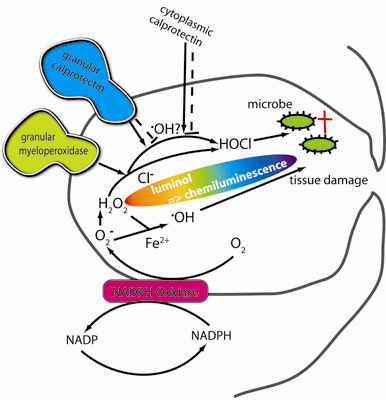
<p>During phagocytosis of microorganisms polymorphonuclear neutrophils (PMN) rapidly and heavily increase oxygen consumption, mainly due to production of reactive oxygen species (ROS) [<xref ref-type="bibr" rid="B1-toxins-02-00095">1</xref>]. This respiratory burst, which can be triggered from various surface receptors of PMN, can be measured as chemiluminescence (CL) in a luminometer. During ROS formation oxygen is reduced to superoxide (O<sub>2</sub><sup>-</sup>), which is converted to H<sub>2</sub>O<sub>2</sub>, either spontaneously or by the catalytic action of superoxide dismutase. Further reactions generate two potent reaction products, hydroxyl radicals (∙OH), in the presence of iron, and hypochlorous acid (HOCl), catalysed by myeloperoxidase (MPO) and chloride ions. In neutrophils approximately 30-40% of the detectable superoxide is converted to HOCl [<xref ref-type="bibr" rid="B2-toxins-02-00095">2</xref>]. Unfortunately, ROS not only kill microbes, but they can also cause tissue damage by modifying DNA, lipids, proteins, and carbohydrates [<xref ref-type="bibr" rid="B1-toxins-02-00095">1</xref>,<xref ref-type="bibr" rid="B3-toxins-02-00095">3</xref>]. It is therefore necessary to control the cellular redox state to balance beneficial and harmful effects of these agents.</p>
<p>MPO, the catalyst of HOCl production, may amount to 5% [<xref ref-type="bibr" rid="B4-toxins-02-00095">4</xref>] of total protein in PMN, being mostly present in the primary granules [<xref ref-type="bibr" rid="B5-toxins-02-00095">5</xref>]. We wanted to examine whether the most abundant cytosolic PMN protein, calprotectin, might interact with this important generator of ROS. Another cytosolic protein, cytidine deaminase, was chosen as control.</p>
<p>Calprotectin [<xref ref-type="bibr" rid="B6-toxins-02-00095">6</xref>,<xref ref-type="bibr" rid="B7-toxins-02-00095">7</xref>] is a heterodimer composed of 11 and 13 kDa subunits, whose precise functions are still unknown. It belongs to the S100 [<xref ref-type="bibr" rid="B8-toxins-02-00095">8</xref>] (S100A8/S100A9) protein family [<xref ref-type="bibr" rid="B9-toxins-02-00095">9</xref>]. This calcium-binding protein with antimicrobial activity constitutes about 5% of total PMN protein [<xref ref-type="bibr" rid="B7-toxins-02-00095">7</xref>] and as much as 40-50% of cytosolic protein [<xref ref-type="bibr" rid="B10-toxins-02-00095">10</xref>]. Calprotectin takes part in inflammatory processes [<xref ref-type="bibr" rid="B11-toxins-02-00095">11</xref>], but it is not known how. Increased concentrations of calprotectin, extracellularly in various body fluids and probably released by PMN, are found in many types of infectious diseases [<xref ref-type="bibr" rid="B7-toxins-02-00095">7</xref>].</p>
<p>Cytidine deaminase has, apart from its enzyme function, a suppressive effect on hematopoietic colony formation <italic>in vitro</italic> [<xref ref-type="bibr" rid="B12-toxins-02-00095">12</xref>,<xref ref-type="bibr" rid="B13-toxins-02-00095">13</xref>]. One granulocyte contains approximately 0.1 pg cytidine deaminase [<xref ref-type="bibr" rid="B14-toxins-02-00095">14</xref>], which may correspond to 0.3-1.0% of cellular protein extractable with water. Plasma concentrations of cytidine deaminase increase markedly in response to physical stress [<xref ref-type="bibr" rid="B14-toxins-02-00095">14</xref>] and during sepsis [<xref ref-type="bibr" rid="B15-toxins-02-00095">15</xref>].</p>
<p>Since calprotectin and cytidine deaminase co-exist with MPO in PMN, it is difficult to evaluate their individual contribution to ROS production in intact cells-if any. Therefore, we used the MPO-H<sub>2</sub>O<sub>2</sub>-system as a cell-free model of the respiratory burst [<xref ref-type="bibr" rid="B16-toxins-02-00095">16</xref>,<xref ref-type="bibr" rid="B17-toxins-02-00095">17</xref>], to examine the effects of added calprotectin or cytidine deaminase. Luminol was used as effective amplifier of MPO-dependent CL. We compared ROS-induction by MPO and calprotectin acting alone, but also together and by varying pH, temperature, and several putatively enhancing or inhibiting ingredients. The results were compared with responses elicited by intact PMN and macrophages.</p>
</sec>
<sec sec-type="results">
<title>2. Results</title>
<sec>
<title>2.1. Basic response pattern</title>
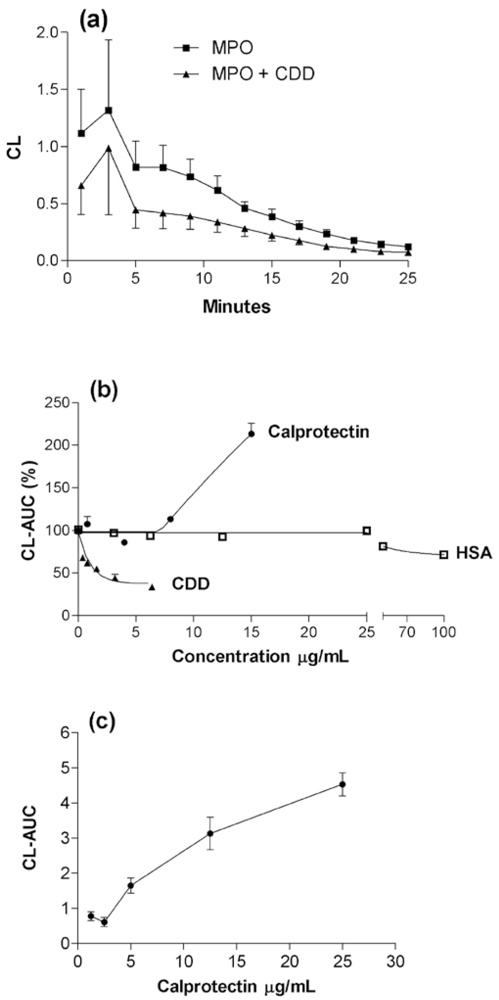
<p>The cell-free H<sub>2</sub>O<sub>2</sub>-MPO-Cl<sup>‾</sup>-luminol system was designed to model the respiratory burst. The CL peaked within a few minutes, then tapered off for the next 23 minutes of recording (<xref ref-type="fig" rid="toxins-02-00095-f001">Figure 1</xref>a). Calprotectin increased (p &lt; 0.05) CL (<xref ref-type="fig" rid="toxins-02-00095-f001">Figure 1</xref>b), whereas cytidine deaminase inhibited it already after one minute (p &lt; 0.05). </p>
<fig id="toxins-02-00095-f001" position="anchor">
<label>Figure 1</label>
<caption>
<p>Luminol-dependent chemiluminescence (CL) of myeloperoxidase (MPO) is modified by addition of calprotectin, cytidine deaminase (CDD), and human serum albumin (HSA). CL was measured in duplicate every minute (not all values plotted) for 25 minutes at pH 7.4. (a): Time-response pattern obtained with a mixture of H<sub>2</sub>O<sub>2</sub> (500 µM) + MPO (0.1 µg/mL) in HBBS (120-130 mM NaCl), ±CDD (3.2 µg/mL). The CL was measured as relative light units. Mean values with SEM (sometimes hidden in the symbols) from five experiments. (b): CL was induced as described in (a), and the effects of calprotectin, CDD and HSA are presented as area under the 0-25 minutes curve (CL-AUC). The values are given in per cent of MPO alone control. The combined effect of MPO and calprotectin was measured in duplicate in four experiments, of cytidine deaminase and HSA in triplicate in three parallel experiments. The percent inhibition by CDD gave almost identical results (three experiments) when carried out at room temperature and 37 <sup>o</sup>C. (c): CL-AUC, dose-response curve for calprotectin (without MPO); H<sub>2</sub>O<sub>2</sub> 500 µM, pH 7.8. Two experiments.</p>
</caption>
<graphic xmlns:xlink="http://www.w3.org/1999/xlink" xlink:href="toxins-02-00095-g001.tif"/>
</fig>
<p>In the four experiments depicted in <xref ref-type="fig" rid="toxins-02-00095-f001">Figure 1</xref> MPO (0.1-0.3 µg/mL) and calprotectin (16 µg/mL) in combination had an additive effect on light emission (p &lt; 0.05). A moderate increase (21%) was also observed for 8.0 µg/mL calprotectin (p &lt; 0.05), provided that the data for only the first 10 minutes were used. For a total of nine experiments the effect was not only additive (p &lt; 0.001), but also potentiated synergistic (p &lt; 0.01); the average CL integrals being MPO 8.9, calprotectin 4.8 and MPO + calprotectin 19.1. Even though stimulation by calprotectin varied considerably (see below), it was not significantly affected by addition of, or preincubation with, calcium (1-2 mM). It is noteworthy that PMN may contain &gt;10.000 µg/mL calprotectin [<xref ref-type="bibr" rid="B7-toxins-02-00095">7</xref>].</p>
<p>Dose-response experiments showed that the CL was enhanced more than linearly with increased concentrations of MPO (0.1-0.4 μg/mL), and at high activity of MPO (not shown) the inhibitory effect of a constant cytidine deaminase concentration (3.2 µg/mL) was reduced (p &lt; 0.01). On the other hand, with a constant MPO concentration, cytidine deaminase exerted increasing inhibition in the dose range 0.8-6.4 µg/mL (<xref ref-type="fig" rid="toxins-02-00095-f001">Figure 1</xref>b). The PMN concentration of cytidine deaminase has been measured to be 100-200 µg/mL [<xref ref-type="bibr" rid="B14-toxins-02-00095">14</xref>].</p>
<p>In the same molar or mass concentration ranges used for cytidine deaminase and calprotectin, control human serum albumin (HSA) had no effect on MPO-CL, but inhibited the response at concentrations ≥100 µg/mL (p &lt; 0.05). CL was not induced with MPO or calprotectin when luminol was replaced by lucigenin (0.1 mM), which is supposed to mostly reflect superoxide formation. The calprotectin had no detectable peroxidase activity in the ECL assay.</p>
<fig id="toxins-02-00095-f002" position="anchor">
<label>Figure 2</label>
<caption>
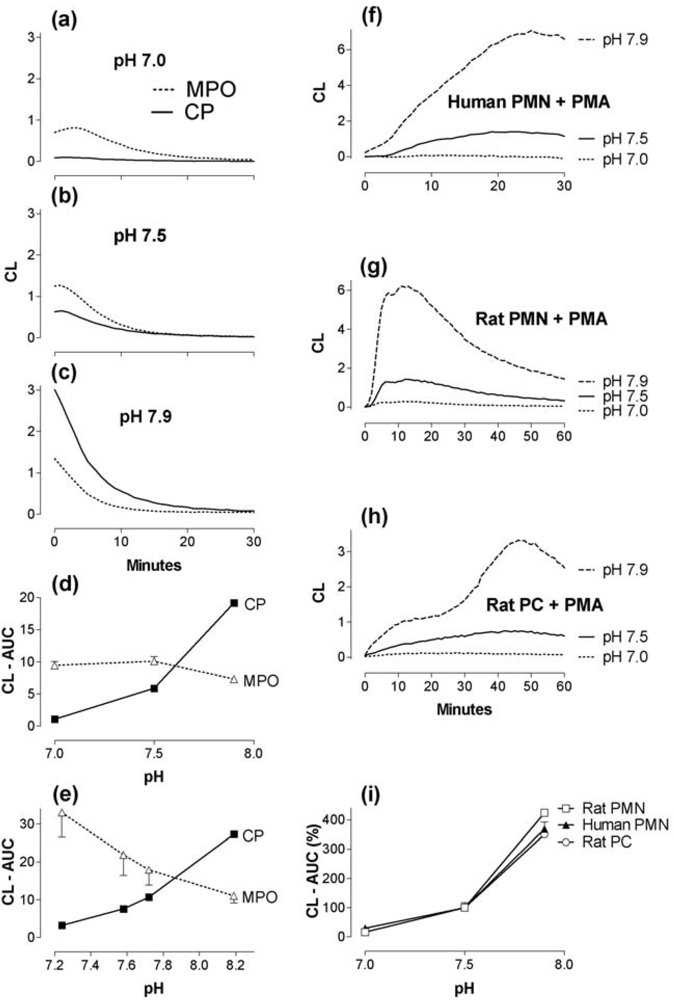
<p>The effect of pH (a-e) on CL elicited by H<sub>2</sub>O<sub>2</sub>-stimulated (500 µM) MPO (0.1 µg/mL) and calprotectin (CP; 8 µg/mL); comparison with PMA-evoked cell responses (in phosphate buffers, 80-85 mM, osmolality 290 mOsm/kg). (a-c): Triplicate measurements of MPO- and CP-induced CL in two experiments with pH 7.0, 7.5 and 7.9 show the kinetics of the response during 30 minutes and (d) gives the corresponding AUC (e): CL elicited by MPO and CP in Dulbecco’s phosphate-buffered (~6 mM) saline (~105 mM NaCl)-pH adjusted with NaOH (f): CL elicited by PMA-stimulated human granulocytes (2 × 10<sup>5</sup>/well). (g): rat granulocytes (1.5 × 10<sup>5</sup>/well) and (h): rat peritoneal cells (PC; 3 × 10<sup>5</sup>/ well). PMA was 10<sup>-7</sup> M for human cells and 4 × 10<sup>-7</sup> M for rat cells. Mean values from two experiments. The graphs (f, g, h) show CL responses for three different pH values and the integrals (AUC) are shown in (i), in per cent of integrals obtained with pH 7.5. The pH (except e) was adjusted by appropriate portions of Na<sub>2</sub>HPO<sub>4</sub> and NaH<sub>2</sub>PO<sub>4</sub> (85 mM phosphate, 63 mM NaCl).</p>
</caption>
<graphic xmlns:xlink="http://www.w3.org/1999/xlink" xlink:href="toxins-02-00095-g002.tif"/>
</fig>
</sec>
<sec>
<title>2.2. The effect of pH changes on MPO- and calprotectin-chemiluminescence, and responses by granulocytes and peritoneal cells</title>
<p>As demonstrated for the first time here, calprotectin itself can induce CL. However, the activity of calprotectin was lower than for MPO, and we wanted to test if it could be enhanced by modifying the experimental procedure. At first we tested pH changes and found that the response (AUC) to calprotectin (8 µg/mL) was increased from 1 to 19 (p &lt; 0.001) and the MPO-dependent response decreased (AUC from 10 to 7.3, p &lt; 0.01) along with elevation of pH from 7.0 to 7.9 (<xref ref-type="fig" rid="toxins-02-00095-f002">Figure 2</xref>a-d). In four new experiments these results were confirmed with another buffer (Dulbecco’s phosphate-buffered saline), and calprotectin luminescence could be markedly enhanced by a pH increase from 7.1 to 7.4. In additional tests we found that 2-4 µg/mL of calprotectin, with pH 7.9 and 60-500 µM H<sub>2</sub>O<sub>2</sub> was appropriate for routine use. </p>
<p>Controls, relevant according to molar and mass concentrations, with HSA (up to 1000 µg/mL) or human immunoglobulin (20 µg/mL) yielded CL (AUC) of ~1 or less (not shown). A pH-dependent pattern was also observed for CL elicited by PMA-stimulated human granulocytes, rat granulocytes, and rat peritoneal cells (<xref ref-type="fig" rid="toxins-02-00095-f002">Figure 2</xref>f-h). This response (<xref ref-type="fig" rid="toxins-02-00095-f002">Figure 2</xref>i) resembled the pH dependency of the calprotectin-response more than that of the MPO-response (<xref ref-type="fig" rid="toxins-02-00095-f002">Figure 2</xref>d, <xref ref-type="fig" rid="toxins-02-00095-f002">Figure 2</xref>e).</p>
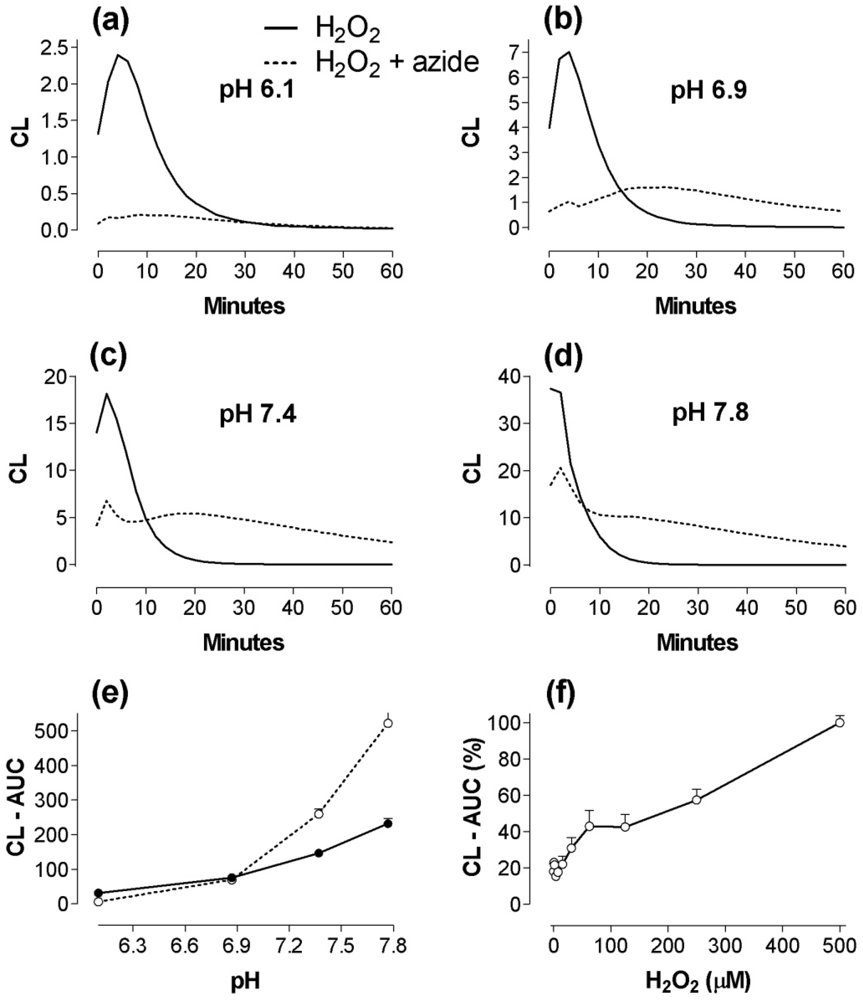
<p>This pattern was confirmed when H<sub>2</sub>O<sub>2</sub> instead of PMA was used as stimulator of human PMN (<xref ref-type="fig" rid="toxins-02-00095-f003">Figure 3</xref>), thereby presumably bypassing the contribution by phagocyte NADPH oxidase. This H<sub>2</sub>O<sub>2</sub> response was almost aborted by azide (1 mM) at pH 6.1, and the 12-minute response was consistently reduced at pH 6.9-7.8, probably reflecting an inhibitory effect of azide on the heme enzyme (MPO). However, as pH increased, the response in the azide groups was changed (<xref ref-type="fig" rid="toxins-02-00095-f003">Figure 3</xref>a-d), and the 60-minute CL integral (at pH 7.4 and 7.8) was increased above control without azide (<xref ref-type="fig" rid="toxins-02-00095-f003">Figure 3</xref>e, p &lt; 0.01). With 20000 PMN/well (<xref ref-type="fig" rid="toxins-02-00095-f003">Figure 3</xref>f), we found that 16 µM of H<sub>2</sub>O<sub>2</sub> was sufficient to yield a significant (p &lt; 0.05) response.</p>
<fig id="toxins-02-00095-f003" position="anchor">
<label>Figure 3</label>
<caption>
<p>The effect of pH on kinetics of H<sub>2</sub>O<sub>2</sub>-mediated (500 µM) CL-responses in human PMN (2 × 10<sup>5</sup>/well) monitored for 60 minutes in phosphate buffer, without and with 1 mM Na-azide (a-d). Triplicate measurements from three experiments. (e) gives the 60-minute integrals (AUC) as a function of pH. (f): Dose-response curve for H<sub>2</sub>O<sub>2</sub> when human PMN (2 × 10 <sup>4</sup>/well) were examined for 30 minutes in a buffer with pH 7.8. Mean values from three experiments in per cent of CL-AUC with 500 µM. Note different scales on Y axes (a-d).</p>
</caption>
<graphic xmlns:xlink="http://www.w3.org/1999/xlink" xlink:href="toxins-02-00095-g003.tif"/>
</fig>
</sec>
<sec>
<title>2.3. CL responses of calprotectin and MPO to H<sub>2</sub>O<sub>2</sub>, azide, NaCl, melatonin, and cysteine supplements to the reaction mixtures</title>
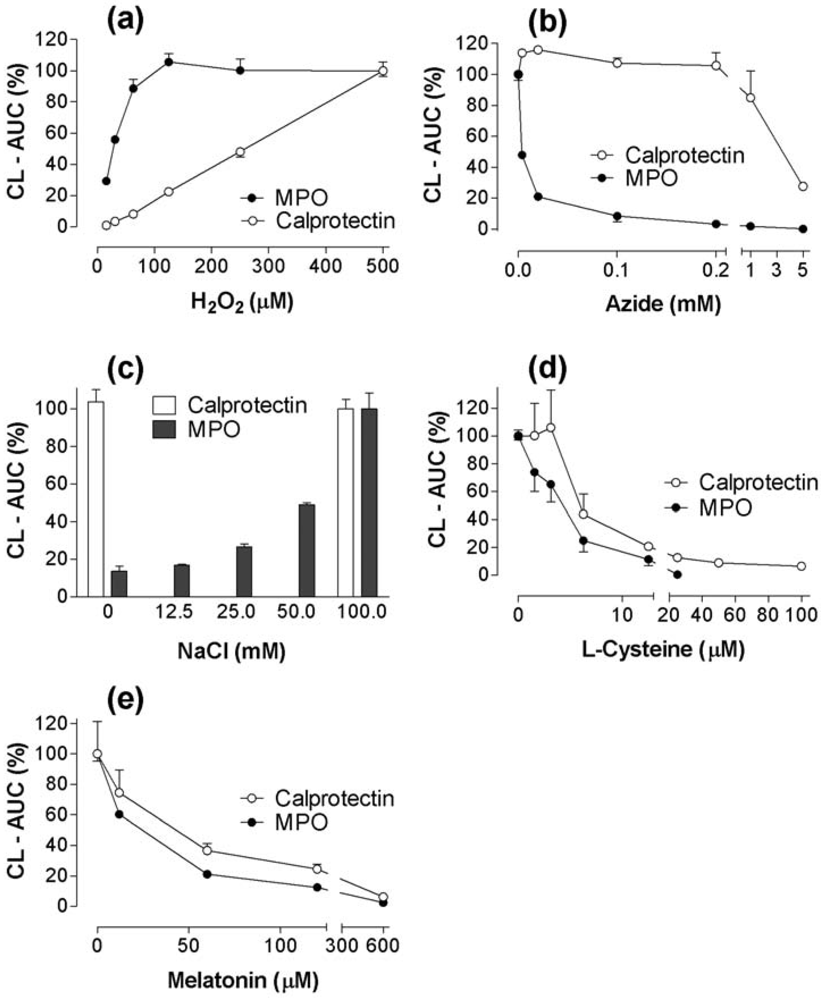
<p>We also wanted to compare responses of MPO and calprotectin to different reactants, some of them known to affect MPO. The responses of MPO and calprotectin to increasing concentrations of H<sub>2</sub>O<sub>2</sub> were very different (<xref ref-type="fig" rid="toxins-02-00095-f004">Figure 4</xref>a), even though both agents showed H<sub>2</sub>O<sub>2</sub>-dependency. H<sub>2</sub>O<sub>2</sub> (500 µM) + luminol, alone, yielded a slight response (AUC~0.9) only at high pH (7.8). MPO was much more sensitive than calprotectin to the inhibitory effect of azide (<xref ref-type="fig" rid="toxins-02-00095-f004">Figure 4</xref>b). In fact, there was a slight stimulation of calprotectin-H<sub>2</sub>O<sub>2</sub>-CL at 0.02-0.1 mM azide (p &lt; 0.05). Calprotectin-H<sub>2</sub>O<sub>2</sub>-CL was independent of the presence of NaCl, whereas MPO-H<sub>2</sub>O<sub>2</sub>-CL required a high NaCl concentration (<xref ref-type="fig" rid="toxins-02-00095-f004">Figure 4</xref>c), presumably for HOCl production. The response pattern was similar for inhibition of MPO and calprotectin by added cysteine and melatonin - added as anti-oxidants [<xref ref-type="bibr" rid="B18-toxins-02-00095">18</xref>]-with MPO the more sensitive (p &lt; 0.01) (<xref ref-type="fig" rid="toxins-02-00095-f004">Figure 4</xref>d, <xref ref-type="fig" rid="toxins-02-00095-f004">Figure 4</xref>e).</p>
<fig id="toxins-02-00095-f004" position="anchor">
<label>Figure 4</label>
<caption>
<p>Comparative studies of MPO and calprotectin. Triplicate measurements during 30 minutes. (a): Dose-response of H<sub>2</sub>O<sub>2</sub>-induced MPO-CL and calprotectin-CL. The values are given in per cent (with SEM) of groups with 500 µM H<sub>2</sub>O<sub>2</sub>. Phosphate-buffer with pH 7.8. Mean values from two experiments. (b): Dose-response of Na-azide. MPO (0.16 µg/mL, ~1.3 × 10<sup>-8</sup> M). Calprotectin (8 µg/mL, ~0.4 × 10<sup>-6</sup> M). Phosphate-buffered saline, pH 7.4. The values from two experiments are given in per cent of controls (±SEM) without azide. (c) The effect of NaCl on luminol-dependent MPO-CL and calprotectin-CL. MPO (0.1 µg/mL, pH 7.4). Calprotectin (4 µg/mL, pH 7.8). The calprotectin had been dialysed against a NaCl-free solution. The values are given in per cent of groups with 100 mM NaCl. Five experiments with and without 100 mM NaCl. (d): Dose-response of cysteine on MPO-CL and calprotectin-CL (2 experiments). (e): Dose-response of melatonin on MPO-CL and calprotectin-CL (2 experiments). MPO (0.05 µg/mL, pH 7.4), calprotectin (4 µg/mL, pH 7.8) in (d) and (e). </p>
</caption>
<graphic xmlns:xlink="http://www.w3.org/1999/xlink" xlink:href="toxins-02-00095-g004.tif"/>
</fig>
</sec>
<sec>
<title>2.4. The combined effect of calprotectin and NaOCl</title>
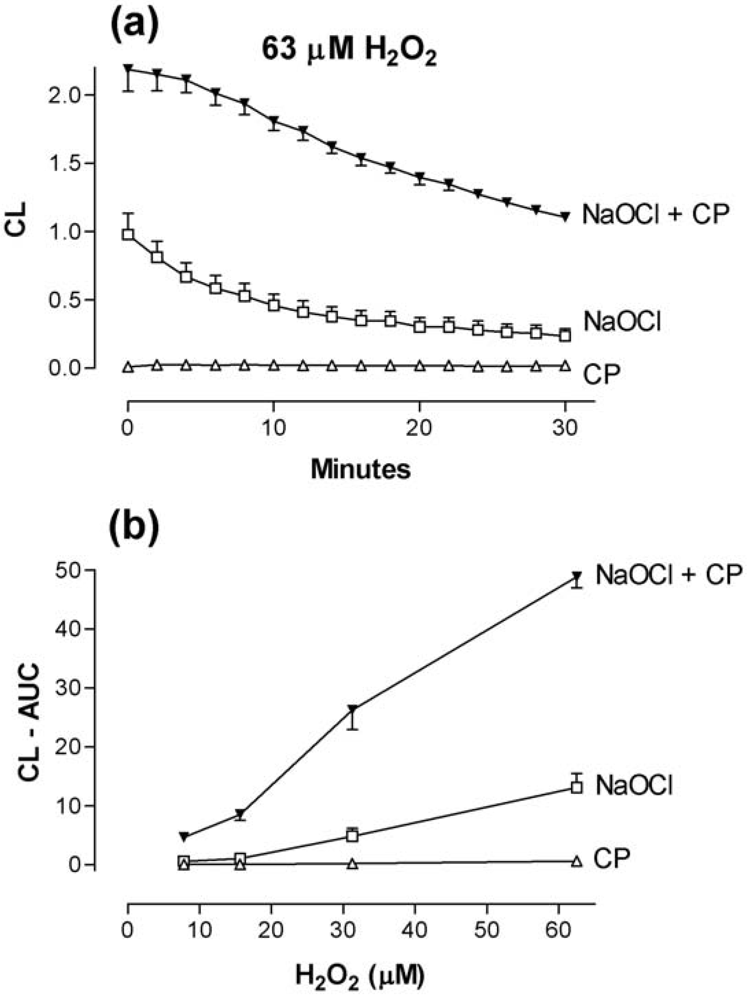
<p>The combination of calprotectin (4 µg/mL) and NaOCl (20 µM) strongly enhanced CL in the presence of H<sub>2</sub>O<sub>2</sub> (<xref ref-type="fig" rid="toxins-02-00095-f005">Figure 5</xref>), possibly caused by oxidation of calprotectin by NaOCl [<xref ref-type="bibr" rid="B19-toxins-02-00095">19</xref>]. Since HOCl is the end product in the MPO-system, this finding may explain the synergy observed by combining MPO and calprotectin (<xref ref-type="fig" rid="toxins-02-00095-f001">Figure 1</xref>). NaOCl itself may generate significant CL, but high background values are largely avoided at low concentrations of H<sub>2</sub>O<sub>2</sub> (<xref ref-type="fig" rid="toxins-02-00095-f005">Figure 5</xref>). Noteworthy, it was necessary to incubate the mixture of calprotectin and NaOCl for 17-20 minutes at room temperature in these experiments, before the CL reaction could be initiated by adding luminol and H<sub>2</sub>O<sub>2</sub> and enhancement demonstrated [<xref ref-type="bibr" rid="B19-toxins-02-00095">19</xref>]. Dose-response experiments showed that a calprotectin concentration of 0.5-1.0 µg/mL was sufficient, when combined with NaOCl and H<sub>2</sub>O<sub>2</sub> (&gt;16 µM), to induce a significant CL response, whereas no response was observed in the absence of NaOCl. </p>
<fig id="toxins-02-00095-f005" position="anchor">
<label>Figure 5</label>
<caption>
<p>Luminol-enhanced combined effect of calprotectin (CP; 4 µg/mL) and NaOCl (20 µM) in phosphate buffer with pH 7.8. CP and NaOCl were incubated at room temperature for 17 minutes [<xref ref-type="bibr" rid="B19-toxins-02-00095">19</xref>] before luminol and H<sub>2</sub>O<sub>2</sub> were added to initiate ROS formation. (a): Time-course of CL responses recorded during 30 minutes with 63 µM H<sub>2</sub>O<sub>2</sub> (b): Effect of increasing concentrations of H<sub>2</sub>O<sub>2</sub> on CL induced by NaOCl, CP, and NaOCl + CP. Two experiments. </p>
</caption>
<graphic xmlns:xlink="http://www.w3.org/1999/xlink" xlink:href="toxins-02-00095-g005.tif"/>
</fig>
</sec>
<sec>
<title>2.5. Recombinant S100A8 (A8) and S100A9 (A9)</title>
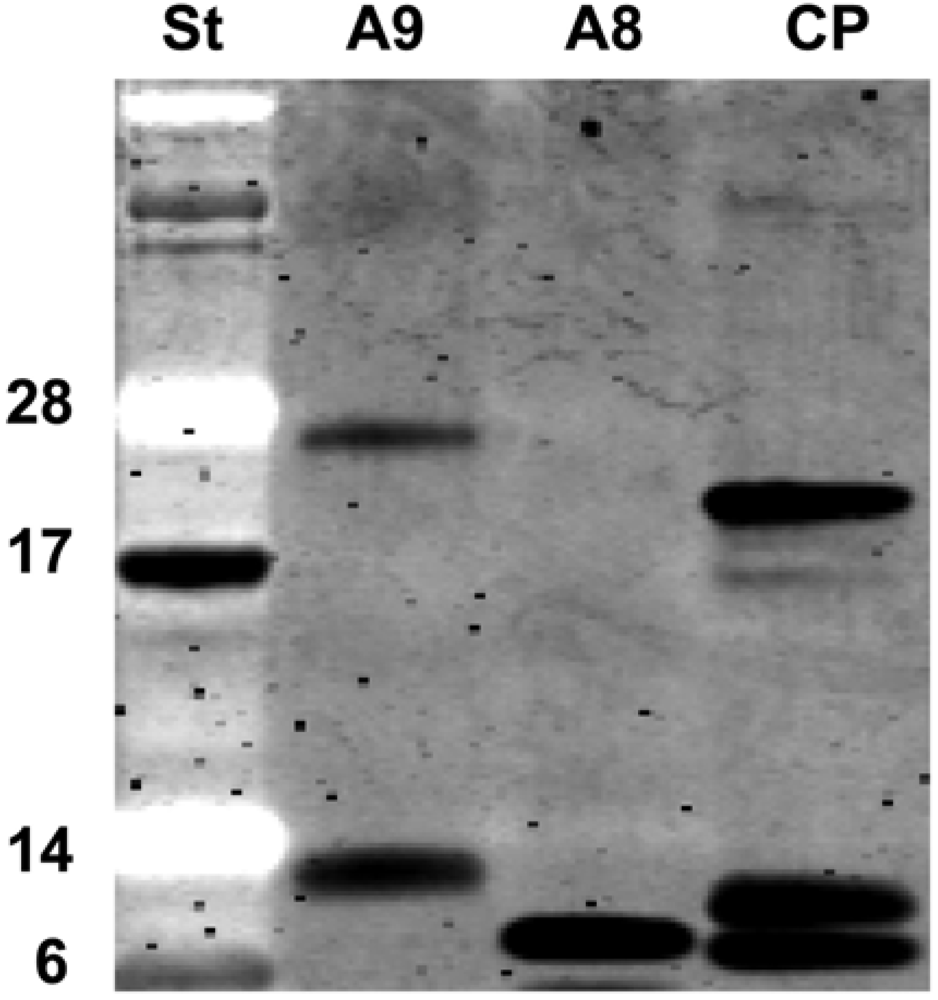
<p>A8 remained a monomer in solution while A9 formed a dimer as well (<xref ref-type="fig" rid="toxins-02-00095-f006">Figure 6</xref>), but to a different extent in different batches. Dimerization apparently enhanced the capacity to generate CL in the presence of H<sub>2</sub>O<sub>2</sub> (data not shown). </p>
<fig id="toxins-02-00095-f006" position="anchor">
<label>Figure 6</label>
<caption>
<p>Recombinant S100A8 and S100A9, and calprotectin (CP), were separated on SD-PAGE prior to SYPRO Ruby staining. A9 tended to form homodimers, whereas with the mixture of leucocyte-derived A8 and A9 (CP), the proteins migrated as monomers, homodimers or heterodimers. Standard (St) with molecular weight markers (6, 14, 17, 28) in kDa.</p>
</caption>
<graphic xmlns:xlink="http://www.w3.org/1999/xlink" xlink:href="toxins-02-00095-g006.tif"/>
</fig>
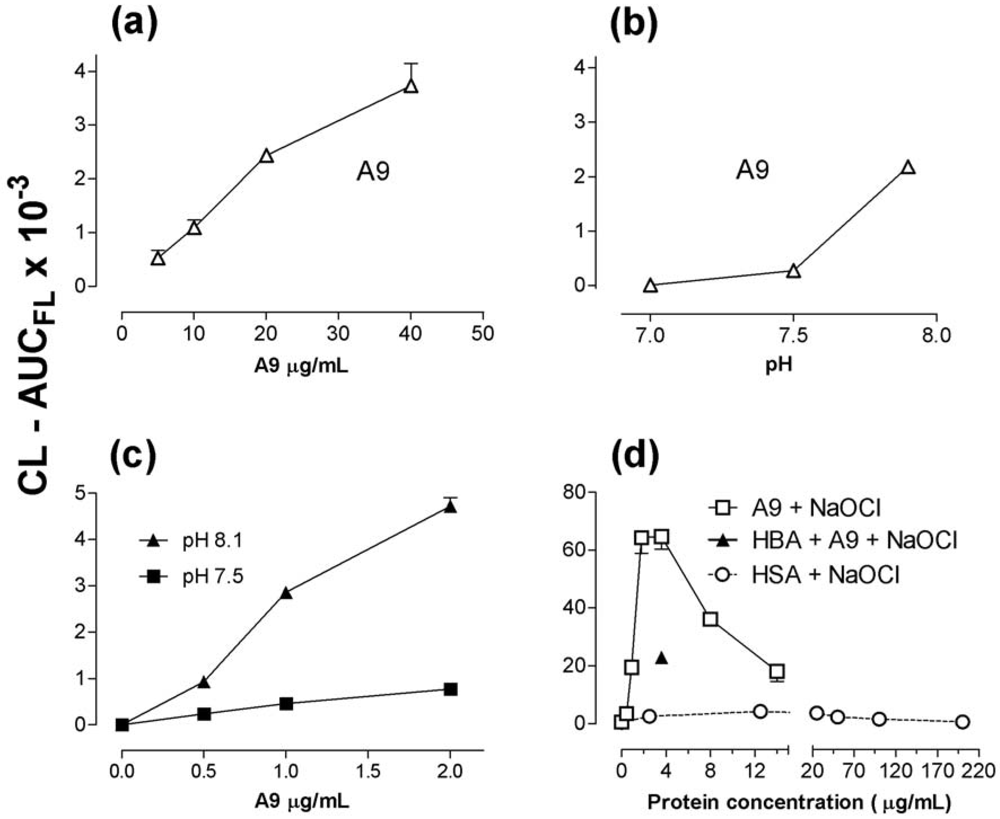
<p>The activity of A9 (<xref ref-type="fig" rid="toxins-02-00095-f007">Figure 7</xref>a, <xref ref-type="fig" rid="toxins-02-00095-f007">Figure 7</xref>b) clearly depended upon both protein concentration (5-40 µg/mL) and pH, as did A8, which produced less CL (not shown). Mercaptoethanol-treated A9 elicited no detectable CL. A9 with NaOCl + 32 μM H<sub>2</sub>O<sub>2</sub> gave a marked pH-dependent CL-response (<xref ref-type="fig" rid="toxins-02-00095-f007">Figure 7</xref>c). An even stronger response was observed with 63 μM H<sub>2</sub>O<sub>2</sub> (<xref ref-type="fig" rid="toxins-02-00095-f007">Figure 7</xref>d). However, increasing concentrations above 3.6 µg/mL led to a gradual decrease of the CL, in contrast to the set-up without NaOCl included (<xref ref-type="fig" rid="toxins-02-00095-f007">Figure 7</xref>a). Similarly, HSA + NaOCl evoked a slight increase of CL up to 25 µg/mL albumin, declining to no response at 200-1,000 µg/mL. HSA without NaOCl did not cause any CL (2.5 to 1,000 µg/mL). At pH 7.8 similar responses were observed for A8 and A9 when combined with NaOCl (not shown). The activity of mercaptoethanol-exposed A9 was also restored by NaOCl. </p>
<fig id="toxins-02-00095-f007" position="anchor">
<label>Figure 7</label>
<caption>
<p>Dose-response curves and pH-dependency for CL generated by A9 and HSA in a H<sub>2</sub>O<sub>2</sub>-luminol system. (a) shows CL at different concentrations of A9 (pH 7.9); (b) shows CL induced by A9 (20 µg/mL) at three different pH. The H<sub>2</sub>O<sub>2</sub> concentration (a, b) was 500 µM. (c) gives dose-response curves for A9 at two different pH values; 32 µM H<sub>2</sub>O<sub>2</sub>. (d) shows CL induced by A9 + NaOCl (20 µM), or HSA + NaOCl (20 µM). The effect of 4-hydroxy-benzoic acid (HBA, 2 mM ), an ∙OH trapping compound, was assayed at one A9 concentration (3.6 µg/mL). All set-ups in (d) with 63 µM H<sub>2</sub>O<sub>2</sub>. Mean values from two experiments, corrected for background values in buffers. The experiments were carried out with the FLx800 luminometer at room temperature. </p>
</caption>
<graphic xmlns:xlink="http://www.w3.org/1999/xlink" xlink:href="toxins-02-00095-g007.tif"/>
</fig>
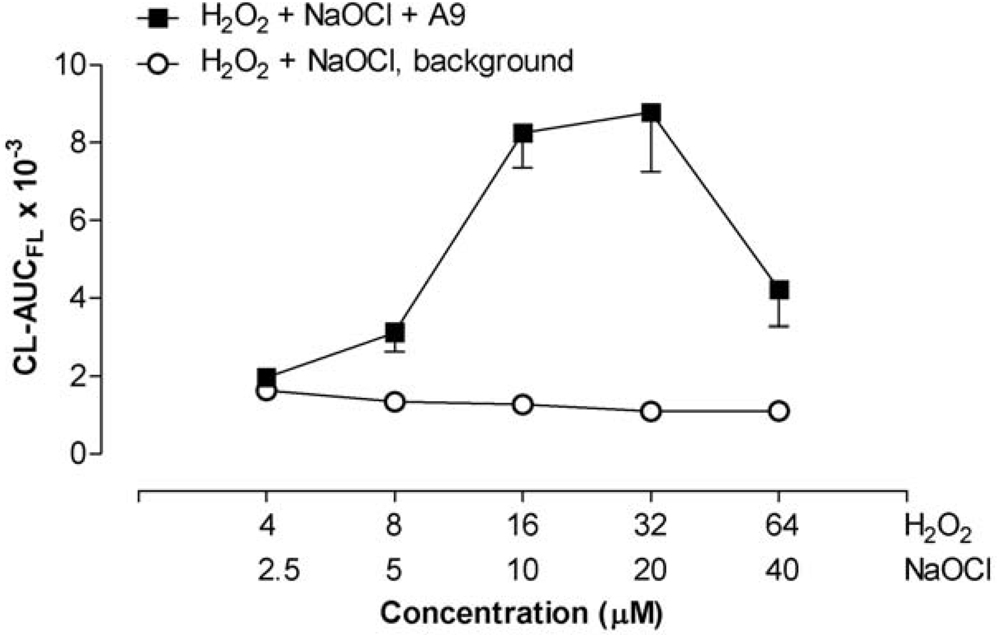
<p>A molar ratio of 1.6-3.2 between H<sub>2</sub>O<sub>2</sub> and NaOCl proved to be optimal for A9-induced CL. We assessed the procedure by keeping the ratio constant at 1.6 in the dose ranges of 4-64 µM for H<sub>2</sub>O<sub>2</sub> and 2.5-40 µM for NaOCl and obtained a bell-shaped curve for A9-CL, with 1.2 µg A9 per mL (<xref ref-type="fig" rid="toxins-02-00095-f008">Figure 8</xref>). Low background levels of the NaOCl + H<sub>2</sub>O<sub>2</sub> were maintained. We saw A9-CL significantly above background (p &lt; 0.05) with only 5.0 µM NaOCl + 8 µM H<sub>2</sub>O<sub>2.</sub> These values of NaOCl and H<sub>2</sub>O<sub>2</sub> are in the physiological range [<xref ref-type="bibr" rid="B4-toxins-02-00095">4</xref>,<xref ref-type="bibr" rid="B20-toxins-02-00095">20</xref>,<xref ref-type="bibr" rid="B21-toxins-02-00095">21</xref>]. It is possible to trigger ROS formation even more by increasing the H<sub>2</sub>O<sub>2</sub> concentration (with constant NaOCl), but this tends to elevate the NaOCl-induced background levels and leads to more variable responses. For routine use, 10 or 20 µM NaOCl and H<sub>2</sub>O<sub>2</sub> in the 16-64 µM range is recommended.</p>
<fig id="toxins-02-00095-f008" position="anchor">
<label>Figure 8</label>
<caption>
<p>Chemiluminescence at constant H<sub>2</sub>O<sub>2</sub>/NaOCl ratio (=1.6). A9 1.2 µg/mL. Phosphate buffer with pH 7.8. Mean values with SEM from three experiments, with the FLx800 luminometer at room temperature.</p>
</caption>
<graphic xmlns:xlink="http://www.w3.org/1999/xlink" xlink:href="toxins-02-00095-g008.tif"/>
</fig>
</sec>
<sec>
<title>2.6. 4-hydroxy-benzoic acid (4-HBA) and L-histidine</title>
<p>4-HBA (2 mM), considered to be an agent trapping hydroxyl radicals [<xref ref-type="bibr" rid="B22-toxins-02-00095">22</xref>,<xref ref-type="bibr" rid="B23-toxins-02-00095">23</xref>,<xref ref-type="bibr" rid="B24-toxins-02-00095">24</xref>], stimulated (p &lt; 0.05) the luminol-H<sub>2</sub>O<sub>2</sub>- dependent (500 µM H<sub>2</sub>O<sub>2</sub>) MPO-response by 28% (five experiments). On the contrary, 4-HBA abrogated CL (p &lt; 0.05) by A8 (500 µM H<sub>2</sub>O<sub>2</sub>, three experiments) and A9 (500 µM H<sub>2</sub>O<sub>2</sub>, two experiments). In five experiments 4-HBA did not affect CL elicited by NaOCl alone, but suppressed (see <xref ref-type="fig" rid="toxins-02-00095-f007">Figure 7</xref>d) the intense CL generated by NaOCl + A9 (1.2 µg/mL) + H<sub>2</sub>O<sub>2</sub> (63 µM) by 65% (p &lt; 0.001). </p>
<fig id="toxins-02-00095-f009" position="anchor">
<label>Figure 9</label>
<caption>
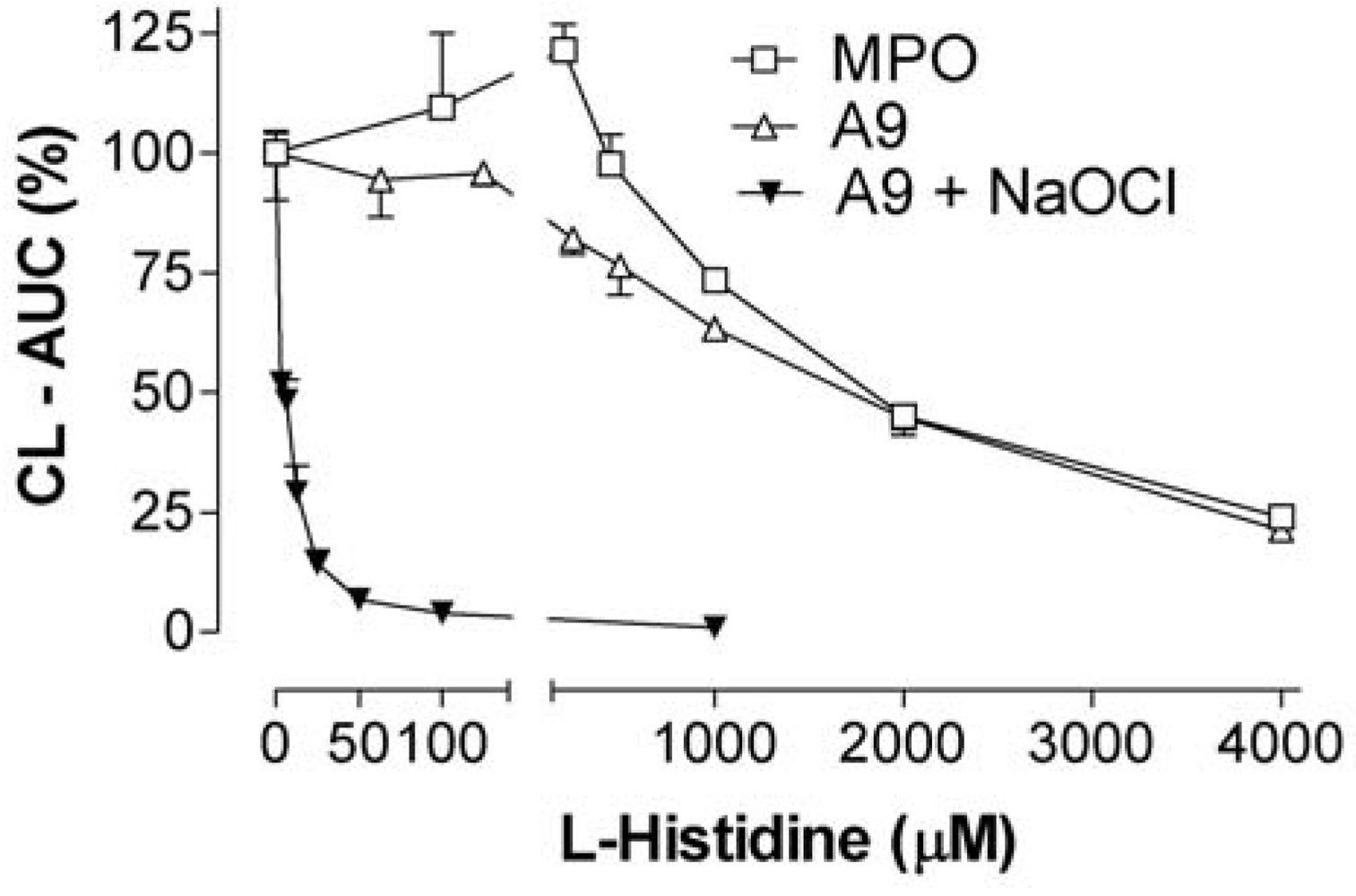
<p>The effect of L-histidine, a putative singlet oxygen scavenger, on CL-integrals of MPO (0.05 µg/mL) and recombinant A9 (8.0 µg/mL), both with 500 µM H<sub>2</sub>O<sub>2</sub>, and A9 (0.6 µg/mL) + NaOCl (20 µM) with 63 µM H<sub>2</sub>O<sub>2</sub>. Two experiments. Values in per cent of control without histidine. The results with A9 + NaOCl were confirmed (four experiments) with the FLx800 luminometer.</p>
</caption>
<graphic xmlns:xlink="http://www.w3.org/1999/xlink" xlink:href="toxins-02-00095-g009.tif"/>
</fig>
<p>Histidine, assumed to be a singlet oxygen scavenger [<xref ref-type="bibr" rid="B25-toxins-02-00095">25</xref>], strongly inhibited the NaOCl-increased CL induced by A9, whereas inhibition was weaker in the absence of NaOCl, and then similar to the effect on H<sub>2</sub>O<sub>2</sub>-induced MPO responses (<xref ref-type="fig" rid="toxins-02-00095-f009">Figure 9</xref>). </p>
</sec>
<sec>
<title>2.7. Temperature effects</title>
<p>A temperature increase from 24 to 37°C consistently enhanced CL integrals induced by A8 and A9 in combination with H<sub>2</sub>O<sub>2</sub>, but only with NaOCl in the reaction mixture (p &lt; 0.001; data not shown). With MPO, or A9, + H<sub>2</sub>O<sub>2</sub>, we observed no consistent effect of temperature change. </p>
</sec>
<sec>
<title>2.8. The effect of iron and iron chelators</title>
<p>In the absence of NaOCl, iron ions (FeSO<sub>4</sub>, 140 µM) enhanced luminol-H<sub>2</sub>O<sub>2</sub>-CL, and the effect was additive when the iron salt was combined with calprotectin. FeCl<sub>3</sub> had a similar effect. Lower concentrations (10-20 µM) stimulated only marginally. When NaOCl was included, there was no additional stimulatory effect of iron ions (0.1-100 µM). Deferoxamine, an iron chelator (200 µM), significantly (two experiments) reduced the CL-response (p &lt; 0.01) elicited by A8, A9, A9 + NaOCl, NaOCl alone, and MPO. The strongest reduction (90%) was observed with A9 + NaOCl, whereas an approximately 50% decline was obtained for MPO and NaOCl set-ups. The interpretation of these results is difficult since deferoxamine not only chelates iron, but may also bind and inactivate OH-radicals and possibly other ROS [<xref ref-type="bibr" rid="B26-toxins-02-00095">26</xref>]. Taken together, the possibility exists that trace amounts of iron or other metals can activate calprotectin.</p>
</sec>
</sec>
<sec sec-type="discussion">
<title>3. Discussion</title>
<p>We have shown that two major PMN cytosolic proteins, calprotectin and cytidine deaminase (CDD), had opposite effects on the <italic>in vitro</italic> luminol-amplified chemiluminescence (CL) elicited by the H<sub>2</sub>O<sub>2</sub>-MPO-Cl<sup>-</sup> cell-free system. Calprotectin stimulated CL, whereas cytidine deaminase inhibited it. Calprotectin alone, without myeloperoxidase (MPO), also triggered CL. However, at pH 7.4 this effect was detectable only at concentrations of 10-20 µg/mL (~1 µM) or more, but 0.05-0.3 µg/mL (0.5-3 × 10<sup>-9</sup> M) was sufficient for MPO.</p>
<p>We interpret the results as follows: The ROS formation by MPO and calprotectin both depended upon H<sub>2</sub>O<sub>2</sub>. Both reactions were inhibited by L-cysteine and melatonin (<xref ref-type="fig" rid="toxins-02-00095-f004">Figure 4</xref>). For MPO it might be due to interaction with HOCl, which is the CL promoting end product of the MPO reaction chain [<xref ref-type="bibr" rid="B2-toxins-02-00095">2</xref>]. For calprotectin the inhibiting mechanism may be different. Calprotectin presumably does not generate HOCl, since it, unlike MPO, did not need the presence of chloride for CL (<xref ref-type="fig" rid="toxins-02-00095-f004">Figure 4</xref>c). Other findings indicated different CL mechanisms as well: ROS generation by calprotectin or by phagocytes (granulocytes, peritoneal cells) markedly increased with increasing pH (<xref ref-type="fig" rid="toxins-02-00095-f002">Figure 2</xref>), but tended to decrease in the MPO system. Comparing calprotectin and MPO we found that these two proteins also reacted differently to 4-hydroxybenzoic acid, allegedly capable of quenching hydroxyl radicals. Calprotectin had no detectable peroxidase activity as measured with the ECL assay. Taken together, these findings suggest that MPO and calprotectin stimulate CL by different mechanisms. </p>
<p>The synergistic effect of the MPO-calprotectin combination (<xref ref-type="fig" rid="toxins-02-00095-f001">Figure 1</xref>b) may be due to MPO-induced HOCl, which stimulates calprotectin activity [<xref ref-type="bibr" rid="B19-toxins-02-00095">19</xref>]. Notably, CL in H<sub>2</sub>O<sub>2</sub>-stimulated human granulocytes (<xref ref-type="fig" rid="toxins-02-00095-f003">Figure 3</xref>) looked like a two-component response, putatively exerted by MPO and calprotectin in combination. The MPO response, which seemed to predominate at low pH (<xref ref-type="fig" rid="toxins-02-00095-f003">Figure 3</xref>a), was almost aborted by azide, in line with the known azide-sensitivity of MPO. At increasing pH, a larger fraction of the total CL can tentatively be ascribed to the more azide-resistant calprotectin (<xref ref-type="fig" rid="toxins-02-00095-f004">Figure 4</xref>b).</p>
<p>The reduced MPO-chemiluminescence in response to a rise of pH contrasts some previous findings [<xref ref-type="bibr" rid="B27-toxins-02-00095">27</xref>], but agrees with the results of Albert and Jungi [<xref ref-type="bibr" rid="B28-toxins-02-00095">28</xref>]. The CL generated by intact PMN increased with pH (<xref ref-type="fig" rid="toxins-02-00095-f002">Figure 2</xref> and <xref ref-type="fig" rid="toxins-02-00095-f003">Figure 3</xref>), in accordance with previous findings [<xref ref-type="bibr" rid="B29-toxins-02-00095">29</xref>]. Following phagocytosis there is first a pH rise to ~ 7.8 in the phagosomes, followed by a gradual decrease towards 5-6 [<xref ref-type="bibr" rid="B30-toxins-02-00095">30</xref>], indicating that a pH of 7.8 might be within the physiological range. It is noteworthy that a rise of pH from 7 to 8 may change the configuration and increase thermal stability of calprotectin [<xref ref-type="bibr" rid="B31-toxins-02-00095">31</xref>].</p>
<p>ROS detection is based upon exitation/oxidation of luminol, which relaxes to ground state by emitting light. For granulocytes, luminol amplifies a weak luminescence that also can be observed in a luminol-free medium, supposedly without changing the pattern of ROS formation [<xref ref-type="bibr" rid="B32-toxins-02-00095">32</xref>]. The speed of occurence and size of the CL pattern can be controlled by varying the concentrations of luminol, H<sub>2</sub>O<sub>2</sub>, and NaOCl [<xref ref-type="bibr" rid="B33-toxins-02-00095">33</xref>,<xref ref-type="bibr" rid="B34-toxins-02-00095">34</xref>]. In our study we found that H<sub>2</sub>O<sub>2</sub> triggered luminol-dependent ROS formation by calprotectin (A8/A9) and this response was strongly enhanced by adding NaOCl as the fourth component. This seems to imply that calprotectin activation is linked to NADPH oxidase and MPO. In any case, a mechanism of this kind in phagocytes could probably enhance their ability to fight microorganisms. Presumably, hydroxyl radicals, generated by calprotectin, amplify the cells’ microbiocidal power. If both MPO and calprotectin can normally engage, independently of each other, creating ROS in phagocytes, this might explain why most patients who lack MPO are spared from serious infections in spite of their deficiency [<xref ref-type="bibr" rid="B35-toxins-02-00095">35</xref>].</p>
<p>Clearly, there are several elements that need to be evaluated to identify the physiological role of calprotectin. Calprotectin is easily oxidized by NaOCl [<xref ref-type="bibr" rid="B19-toxins-02-00095">19</xref>], which may modify its functional properties [<xref ref-type="bibr" rid="B36-toxins-02-00095">36</xref>]. This points to the possibility that we may be dealing with an active redox system [<xref ref-type="bibr" rid="B37-toxins-02-00095">37</xref>,<xref ref-type="bibr" rid="B38-toxins-02-00095">38</xref>], with calprotectin conceivably playing a dual role during inflammation. One or the other of these roles may become the leading one, determined by environmental signals. In fact, a change of concentrations may transform reactants from pro-oxidants to anti-oxidants [<xref ref-type="bibr" rid="B37-toxins-02-00095">37</xref>], as we observed by increasing the concentration of A9 (<xref ref-type="fig" rid="toxins-02-00095-f007">Figure 7</xref>d), which suggests that A9 may act as a scavenger of NaOCl. So far, most investigations have focused on inflammatory stimulation by S100A8/A9 proteins [<xref ref-type="bibr" rid="B39-toxins-02-00095">39</xref>]. However, recent research has indicated that oxidation of these proteins may trigger a switch, whereby they come to display anti-inflammatory functions [<xref ref-type="bibr" rid="B40-toxins-02-00095">40</xref>]. These may be enhanced by nitrosylation [<xref ref-type="bibr" rid="B41-toxins-02-00095">41</xref>]. Furthermore, the function of A8 and A9 might be determined also by polymerization, i.e. whether they exist as momomers, homodimers, heterodimers or tetramers [<xref ref-type="bibr" rid="B42-toxins-02-00095">42</xref>]. Proper refolding may also be important for the protein’s function. Such a mechanism could possibly explain why recombinant A8/A9 exposed to mercaptoethanol did not generate ROS. In any case this multitude of possible molecular forms could mean that the capacity to generate or scavenge ROS be present in only a small fraction of a heterogeneous multimeric complex.</p>
<p>It is true that a substantial part of our results are shown at an unphysiological pH and probably also hydrogen peroxide concentration. However, ours is a very artificial, simplified cell-free <italic>in vitro</italic> system, devised to explore possible oxidative and anti-oxidative phagocyte functions of calprotectin, as well as interactions with the better known ROS-generating cellular components. By varying concentrations of H<sup>+</sup>-ions, H<sub>2</sub>O<sub>2</sub>, NaOCl, and proteins we have been able to establish procedures in which the different variables are balanced within assumedly physiological limits. Whether our findings can be validated under conditions present in intact cells or in an inflammatory, extracellular environment has to be explored in further experiments. </p>
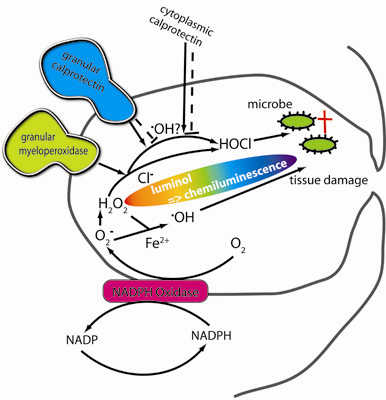
<p>In the intact organism the putative interplay between MPO and calprotectin will be largely restricted to PMN, monocytes and possibly early B-lymphocytes, in which MPO gene expression has been demonstrated [<xref ref-type="bibr" rid="B43-toxins-02-00095">43</xref>]. We suggest that on stimulation of PMN, as an initial step, O<sub>2</sub><sup>-</sup>, generated by NADPH-oxidase, is converted to H<sub>2</sub>O<sub>2</sub>, which next may react with MPO. Its two reaction products, H<sub>2</sub>O<sub>2</sub> and HOCl, are membrane permeable, so they might reach cytoplasmic calprotectin. Cellular H<sub>2</sub>O<sub>2</sub> may also be generated in other metabolic pathways. For instance, electrons leaking from the mitochondria [<xref ref-type="bibr" rid="B44-toxins-02-00095">44</xref>] lead to O<sub>2</sub><sup>-</sup> and H<sub>2</sub>O<sub>2</sub> formation. In this way, calprotectin may become an integral part of cytoplasmic redox regulation or microbial defense mechanisms or both. Considering the very high calprotectin concentration in some cell types (PMN) and its widespread distribution, together with H<sub>2</sub>O<sub>2</sub>, it is hardly surprising that calprotectin has been clinically related to many disease conditions-Even in atherosclerosis [<xref ref-type="bibr" rid="B31-toxins-02-00095">31</xref>,<xref ref-type="bibr" rid="B45-toxins-02-00095">45</xref>]. </p>
</sec>
<sec>
<title>4. Experimental Section</title>
<sec>
<title>4.1. Chemicals</title>
<p>Hydrogen peroxide (30%), 5-amino-2,3-dihydro-1,4-phtalazinedione (luminol), bis-<italic>N</italic>-methylacridinium nitrate (lucigenin), myeloperoxidase (MPO), phorbol 12-myristate 13-acetate (PMA), mercaptoethanol, deferoxamine mesylate, 4-hydroxybenzoic acid, sodium azide, melatonin, L-cysteine, L-histidine and human serum albumin (HSA, MW ~ 67 kDa) were purchased from Sigma (St. Louis, USA), and Hepes buffer from BioWhittaker (Walkersville, MD, USA). Dextran 500 (Pharmacia, Uppsala, Sweden) was dissolved in 0.9% NaCl and used as a 3 or 6% solution. Sodium hypochlorite (NaOCl, 0.5 M in 0.1 M NaOH), purchased from BDH (Dorset, England), was diluted with water. Luminol and PMA were dissolved in dimethylsulphoxide (Sigma) and further diluted in water or a buffered salt solution. Phosphate-buffers of different pH were made by mixing appropriate portions of 0.2 M NaH<sub>2</sub>PO<sub>4</sub> and 0.2 M Na<sub>2</sub>HPO<sub>4</sub>. Peroxidase was measured with the enhanced chemiluminescence method (ECL, Amersham Pharmacia Biotech, Oslo). Calprotectin, purified from human neutrophils [<xref ref-type="bibr" rid="B46-toxins-02-00095">46</xref>], was generously provided by Axis-Shield (Oslo, Norway) and dialysed against Hanks’ balanced salt solution (HBSS, Invitrogen, Norway) or phosphate-buffered saline before use. The two subunits (S100A8 and S100A9) preferentially combine as a heterodimer, and tend to remain associated during purification [<xref ref-type="bibr" rid="B47-toxins-02-00095">47</xref>]. However, they may also combine as homodimers and even trimers or tetramers [<xref ref-type="bibr" rid="B47-toxins-02-00095">47</xref>], so exact characterization by MW is not always possible. Cytidine deaminase (MW~52 kDa) was produced as recombinant protein [<xref ref-type="bibr" rid="B13-toxins-02-00095">13</xref>] and dissolved in HBSS.</p>
</sec>
<sec>
<title>4.2. Purification of recombinant S100A8 and S100A9</title>
<p>Competent <italic>E. coli</italic> BL21 CodonPlus(DE3)-RIL cells were transformed with pET28-S100A8 or pET28-S100A9 [<xref ref-type="bibr" rid="B48-toxins-02-00095">48</xref>], grown in 2 L of LB medium with 25 μg/mL kanamycin to OD<sub>600</sub> of 1 and induced with 1 mM isopropyl-β-D-thiogalactopyranoside (IPTG, Sigma) for 4 h at 30 ºC. Extract was prepared by sonication of the cell pellet in 40 mM Na<sub>2</sub>PO<sub>4</sub>, pH 8.0, 300 mM NaCl (sonication buffer) and cleared with centrifugation. The cell extract was applied on a Ni-column equilibrated with sonication buffer. The column was eluted with a gradient of 50-300 mM imidazole in sonication buffer, and purification of A8 and A9 (with and without mercaptoethanol) was monitored by protein gel electrophoresis. The <italic>N</italic>-terminal 6xHis were removed by Thrombin (T-4648, Sigma) cleavage, which enhanced the CL-inducing activity of the dialysed proteins. The purified A8 migrated as a monomer of apparent molecular weight 10 kDa, while A9 migrated as a monomer and a dimer of apparent molecular weight 13 and 26 kDa (<xref ref-type="fig" rid="toxins-02-00095-f006">Figure 6</xref>), respectively. Protein concentration was determined by the Bio-Rad protein assay (Bio-Rad), with BSA as a standard.</p>
</sec>
<sec>
<title>4.3. Chemiluminescence</title>
<p>A cell-free system was used as model of the respiratory burst in PMN: H<sub>2</sub>O<sub>2</sub> + MPO + chloride + luminol. In some experiments MPO was replaced by calprotectin. The luminol-enhanced CL was measured as relative light units in a luminometer (Luminoskan, Termo Labsystems, Helsinki, Finland), reading the samples in 96-well plates (White Cliniplate, Thermo Fisher Scientific, Vantaa-Finland). In some experiments (<xref ref-type="fig" rid="toxins-02-00095-f007">Figure 7</xref>, <xref ref-type="fig" rid="toxins-02-00095-f008">Figure 8</xref>) we used a FLx800 luminometer (Biotek Instruments, Inc. Winooski, Vermont, USA). In relative terms the results were similar with the two luminometers, but the observed values (arbitrary light units) were quite different. Unless otherwise indicated, the recording was done at 37 <sup>o</sup>C. Each well contained 25 µL H<sub>2</sub>O<sub>2</sub> solution (final concentrations are indicated), 5-10 µL MPO, 50 µL luminol (0.1 mM), 10-20 µL test substance and buffer (140-170 µL) to yield a total volume of 250 µL. MPO (10-40 µg) was dissolved in 1 mL water and stored at 4 <sup>o</sup>C. The activity was stable for some months, but upon further dilution it was often strongly reduced after a couple of days. The chemiluminescence was recorded (2-4 wells per group) at 1-2 minute intervals for 25-30 (or 60 minutes, <xref ref-type="fig" rid="toxins-02-00095-f003">Figure 3</xref>) minutes, and the integral of the response curve (AUC, area under the curve) was calculated. MPO concentration of 0.05-0.3 µg/mL mostly yielded AUC in the 5-30 range, but substantially increased responses were sometimes observed with modified procedures. Significant responses with MPO, calprotectin or cells were observed with 8-16 µM H<sub>2</sub>O<sub>2</sub> as stimulator. However, consistent results were best obtained at higher concentration (30-500 µM). A control group with buffer, but without luminol and H<sub>2</sub>O<sub>2</sub> was always included. Tris-buffers should be avoided because it triggers substantial CL when combined with NaOCl. </p>
</sec>
<sec>
<title>4.4. Cell separation</title>
<p>Human blood from healthy colleagues was collected into vacutainers containing EDTA. The granulocytes were separated as described previously [<xref ref-type="bibr" rid="B49-toxins-02-00095">49</xref>]. Male Fisher 344 rats (Møllegaard Breeding Centre, Ejby, Denmark) were also used. They were treated in accordance with institutional and national guidelines for animal research. Rat granulocytes were prepared as follows: The rats were anaesthetized with CO<sub>2</sub> and killed by decapitation, and the trunk blood was collected into tubes containing EDTA. One part (3-6 mL) of EDTA-blood was mixed with one part of dextran 3% to cause aggregation and sedimentation of erythrocytes. Then 3 mL of Lymphoprep (Axis-Shield, Oslo, Norway) was installed underneath leucocyte-rich dextran-plasma (4-8 mL) in 15 mL tubes and centrifuged for 15 min at 600 g at room temperature. The bottom fraction, comprising &gt;95% granulocytes, was collected and washed once. The cell button was suspended in 4 mL lysis solution (0.15 M NH<sub>4</sub>Cl, 1 mM KHCO<sub>3</sub>, 0.1 mM EDTA) and incubated at room temperature for 7 minutes to lyse remaining red cells. If necessary, the procedure was repeated. Rat peritoneal cells were obtained by washing the peritoneum of dead animals with 25 mL phosphate-buffered saline. The cells were pelleted by centrifugation and resuspended in phosphate buffer or HBSS supplied with 20 mM Hepes buffer (pH 7.4) and 5 mM glucose. </p>
</sec>
<sec>
<title>4.5. Statistics</title>
<p>The results are given as means with their standard error (SEM). An analysis of variance (ANOVA) procedure was used to test for dose-response of cytidine deaminase and calprotectin. Student’s t-test was used to assess the difference between two groups. Two-sided P values &lt; 0.05 were considered statistically significant.</p>
</sec>
</sec>
<sec sec-type="conclusions">
<title>5. Conclusions</title>
<p>Calprotectin (S100A8/A9), together with H<sub>2</sub>O<sub>2</sub>, induced luminol-dependent chemiluminescence (CL), and thus triggered formation of reactive oxygen species (ROS). Calprotectin and myeloperoxidase (MPO) might thereby collaborate on microbial killing. The CL responses elicited by calprotectin and MPO were differentially increased or decreased by varying the experimental conditions in several ways. Calprotectin CL was enhanced by addition of NaOCl to the reaction mixture. Surprisingly, however, at constant NaOCl concentration, this augmentation vanished when the calprotectin concentration was increased, suggesting a switch from pro-oxidant to anti-oxidant function. Possibly, calprotectin may launch an attack on microbes, but also protect our own tissues from excessive ROS exposure.</p>
</sec>
<sec>
<title>Acknowledgements:</title>
<p>Expression plasmids pET28-S100A8 and pET28-S100A9 were a kind gift from Philippe Tessier [<xref ref-type="bibr" rid="B48-toxins-02-00095">48</xref>]. We also wish to thank Trine Reistad for valuable help with establishing the CL procedure.</p>
</sec>
</body>
<back>
<ref-list>
<title>References</title>
<ref id="B1-toxins-02-00095">
<label>1.</label>
<citation citation-type="journal">
<person-group person-group-type="author">
<name>
<surname>Hampton</surname>
<given-names>M.B.</given-names>
</name>
<name>
<surname>Kettle</surname>
<given-names>A.J.</given-names>
</name>
<name>
<surname>Winterbourn</surname>
<given-names>C.C.</given-names>
</name>
</person-group>
<article-title>Inside the neutrophil phagosome: Oxidants, myeloperoxidase, and bacterial killing</article-title>
<source>Blood</source>
<year>1998</year>
<volume>92</volume>
<fpage>3007</fpage>
<lpage>3017</lpage>
<pub-id pub-id-type="pmid">9787133</pub-id>
</citation>
</ref>
<ref id="B2-toxins-02-00095">
<label>2.</label>
<citation citation-type="journal">
<person-group person-group-type="author">
<name>
<surname>Kettle</surname>
<given-names>A.J.</given-names>
</name>
<name>
<surname>Winterbourn</surname>
<given-names>C.C.</given-names>
</name>
</person-group>
<article-title>Superoxide enhances hypochlorous acid production by stimulated human neutrophils</article-title>
<source>Biochim. Biophys. Acta</source>
<year>1990</year>
<volume>1052</volume>
<fpage>379</fpage>
<lpage>385</lpage>
<pub-id pub-id-type="pmid">2162215</pub-id>
</citation>
</ref>
<ref id="B3-toxins-02-00095">
<label>3.</label>
<citation citation-type="book">
<person-group person-group-type="author">
<name>
<surname>Halliwell</surname>
<given-names>B.</given-names>
</name>
</person-group>
<article-title>Free radicals and oxidative damage in biology and medicine: An introduction</article-title>
<source>Oxidative Stress in Skeletal Muscle</source>
<person-group person-group-type="editor">
<name>
<surname>Reznick</surname>
<given-names>Z.A.</given-names>
</name>
<name>
<surname>Packer</surname>
<given-names>L.</given-names>
</name>
<name>
<surname>Sen</surname>
<given-names>C.K.</given-names>
</name>
<name>
<surname>Holloszy</surname>
<given-names>J.O.</given-names>
</name>
<name>
<surname>Jackson</surname>
<given-names>M.J.</given-names>
</name>
</person-group>
<publisher-name>Birkhäuser Verlag</publisher-name>
<publisher-loc>Basel, Switzerland</publisher-loc>
<year>1998</year>
<fpage>1</fpage>
<lpage>28</lpage>
</citation>
</ref>
<ref id="B4-toxins-02-00095">
<label>4.</label>
<citation citation-type="journal">
<person-group person-group-type="author">
<name>
<surname>Kettle</surname>
<given-names>A.J.</given-names>
</name>
<name>
<surname>Winterbourn</surname>
<given-names>C.C.</given-names>
</name>
</person-group>
<article-title>Myeloperoxidase: A key regulator of neutrophil oxidant production</article-title>
<source>Redox Rep.</source>
<year>1997</year>
<volume>3</volume>
<fpage>3</fpage>
<lpage>15</lpage>
</citation>
</ref>
<ref id="B5-toxins-02-00095">
<label>5.</label>
<citation citation-type="book">
<person-group person-group-type="author">
<name>
<surname>Tobler</surname>
<given-names>A.</given-names>
</name>
<name>
<surname>Koeffler</surname>
<given-names>H.P.</given-names>
</name>
</person-group>
<article-title>Myeloperoxidase: Localization, structure, and function</article-title>
<source>Blood Cell Biochemistry</source>
<person-group person-group-type="editor">
<name>
<surname>Harris</surname>
<given-names>J.R.</given-names>
</name>
</person-group>
<publisher-name>Plenum Press</publisher-name>
<publisher-loc>New York, NY, USA</publisher-loc>
<year>1991</year>
<volume>Vol. 3, Chapter 10</volume>
<fpage>255</fpage>
<lpage>288</lpage>
</citation>
</ref>
<ref id="B6-toxins-02-00095">
<label>6.</label>
<citation citation-type="journal">
<person-group person-group-type="author">
<name>
<surname>Fagerhol</surname>
<given-names>M.K.</given-names>
</name>
<name>
<surname>Dale</surname>
<given-names>I.</given-names>
</name>
<name>
<surname>Andersson</surname>
<given-names>T.</given-names>
</name>
</person-group>
<article-title>Release and quantitation of a leukocyte derived protein (L1)</article-title>
<source>Scand. J. Haematol.</source>
<year>1980</year>
<volume>24</volume>
<fpage>393</fpage>
<lpage>398</lpage>
</citation>
</ref>
<ref id="B7-toxins-02-00095">
<label>7.</label>
<citation citation-type="journal">
<person-group person-group-type="author">
<name>
<surname>Johne</surname>
<given-names>B.</given-names>
</name>
<name>
<surname>Fagerhol</surname>
<given-names>M.K.</given-names>
</name>
<name>
<surname>Lyberg</surname>
<given-names>T.</given-names>
</name>
<name>
<surname>Prydz</surname>
<given-names>H.</given-names>
</name>
<name>
<surname>Brandtzæg</surname>
<given-names>P.</given-names>
</name>
<name>
<surname>Naess-Andresen</surname>
<given-names>C.F.</given-names>
</name>
<name>
<surname>Dale</surname>
<given-names>I.</given-names>
</name>
</person-group>
<article-title>Functional and clinical aspects of the myelomonocyte protein calprotectin</article-title>
<source>J. Clin. Pathol.-Mol. Pathol.</source>
<year>1997</year>
<volume>50</volume>
<fpage>113</fpage>
<lpage>123</lpage>
<pub-id pub-id-type="doi">10.1136/mp.50.3.113</pub-id></citation>
</ref>
<ref id="B8-toxins-02-00095">
<label>8.</label>
<citation citation-type="journal">
<person-group person-group-type="author">
<name>
<surname>Nacken</surname>
<given-names>W.</given-names>
</name>
<name>
<surname>Roth</surname>
<given-names>J.</given-names>
</name>
<name>
<surname>Sorg</surname>
<given-names>C.</given-names>
</name>
<name>
<surname>Kerkhoff</surname>
<given-names>C.</given-names>
</name>
</person-group>
<article-title>S100A9/S100A8: Myeloid representatives of the S100 protein family as prominent players in innate immunity</article-title>
<source>Microsc. Res. Tech.</source>
<year>2003</year>
<volume>60</volume>
<fpage>569</fpage>
<lpage>580</lpage>
<pub-id pub-id-type="pmid">12645005</pub-id>
</citation>
</ref>
<ref id="B9-toxins-02-00095">
<label>9.</label>
<citation citation-type="journal">
<person-group person-group-type="author">
<name>
<surname>Donato</surname>
<given-names>R.</given-names>
</name>
</person-group>
<article-title>S100: A multigenic family of calcium-modulated proteins of the EF-hand type with intracellular and extracellular functional roles</article-title>
<source>Int. J. Biochem. Cell Biol.</source>
<year>2001</year>
<volume>33</volume>
<fpage>637</fpage>
<lpage>668</lpage>
<pub-id pub-id-type="pmid">11390274</pub-id>
</citation>
</ref>
<ref id="B10-toxins-02-00095">
<label>10.</label>
<citation citation-type="journal">
<person-group person-group-type="author">
<name>
<surname>Corbin</surname>
<given-names>B.D.</given-names>
</name>
<name>
<surname>Seeley</surname>
<given-names>E.H.</given-names>
</name>
<name>
<surname>Raab</surname>
<given-names>A.</given-names>
</name>
<name>
<surname>Feldmann</surname>
<given-names>J.</given-names>
</name>
<name>
<surname>Miller</surname>
<given-names>M.R.</given-names>
</name>
<name>
<surname>Torres</surname>
<given-names>V.J.</given-names>
</name>
<name>
<surname>Anderson</surname>
<given-names>K.L.</given-names>
</name>
<name>
<surname>Dattilo</surname>
<given-names>B.M.</given-names>
</name>
<name>
<surname>Dunman</surname>
<given-names>P.M.</given-names>
</name>
<name>
<surname>Gerads</surname>
<given-names>R.</given-names>
</name>
<name>
<surname>Caprioli</surname>
<given-names>R.M.</given-names>
</name>
<name>
<surname>Nacken</surname>
<given-names>W.</given-names>
</name>
<name>
<surname>Chazin</surname>
<given-names>W.J.</given-names>
</name>
<name>
<surname>Skaar</surname>
<given-names>E.P.</given-names>
</name>
</person-group>
<article-title>Metal chelation and inhibition of bacterial growth in tissue abscesses</article-title>
<source>Science</source>
<year>2008</year>
<volume>319</volume>
<fpage>962</fpage>
<lpage>965</lpage>
<pub-id pub-id-type="pmid">18276893</pub-id>
</citation>
</ref>
<ref id="B11-toxins-02-00095">
<label>11.</label>
<citation citation-type="journal">
<person-group person-group-type="author">
<name>
<surname>Foell</surname>
<given-names>D.</given-names>
</name>
<name>
<surname>Wittkowski</surname>
<given-names>H.</given-names>
</name>
<name>
<surname>Vogl</surname>
<given-names>T.</given-names>
</name>
<name>
<surname>Roth</surname>
<given-names>J.</given-names>
</name>
</person-group>
<article-title>S100 proteins expressed in phagocytes: A novel group of damage-associated molecular pattern molecules</article-title>
<source>J. Leukoc. Biol.</source>
<year>2007</year>
<volume>81</volume>
<fpage>28</fpage>
<lpage>37</lpage>
<pub-id pub-id-type="pmid">16943388</pub-id>
</citation>
</ref>
<ref id="B12-toxins-02-00095">
<label>12.</label>
<citation citation-type="journal">
<person-group person-group-type="author">
<name>
<surname>Bøyum</surname>
<given-names>A.</given-names>
</name>
<name>
<surname>Løvhaug</surname>
<given-names>D.</given-names>
</name>
<name>
<surname>Seeberg</surname>
<given-names>E.</given-names>
</name>
<name>
<surname>Nordlie</surname>
<given-names>E.M.</given-names>
</name>
</person-group>
<article-title>Identification of cytidine deaminase as inhibitor of granulocyte-macrophage colony formation</article-title>
<source>Exp. Hematol.</source>
<year>1994</year>
<volume>22</volume>
<fpage>208</fpage>
<lpage>214</lpage>
<pub-id pub-id-type="pmid">7507861</pub-id>
</citation>
</ref>
<ref id="B13-toxins-02-00095">
<label>13.</label>
<citation citation-type="journal">
<person-group person-group-type="author">
<name>
<surname>Gran</surname>
<given-names>C.</given-names>
</name>
<name>
<surname>Bøyum</surname>
<given-names>A.</given-names>
</name>
<name>
<surname>Johansen</surname>
<given-names>R.F.</given-names>
</name>
<name>
<surname>Løvhaug</surname>
<given-names>D.</given-names>
</name>
<name>
<surname>Seeberg</surname>
<given-names>E.C.</given-names>
</name>
</person-group>
<article-title>Growth inhibition of granulocyte-macrophage colony-forming cells by human cytidine deaminase requires the catalytic function of the protein</article-title>
<source>Blood</source>
<year>1998</year>
<volume>91</volume>
<fpage>4127</fpage>
<lpage>4135</lpage>
<pub-id pub-id-type="pmid">9596658</pub-id>
</citation>
</ref>
<ref id="B14-toxins-02-00095">
<label>14.</label>
<citation citation-type="journal">
<person-group person-group-type="author">
<name>
<surname>Bøyum</surname>
<given-names>A.</given-names>
</name>
<name>
<surname>Rønsen</surname>
<given-names>O.</given-names>
</name>
<name>
<surname>Tennfjord</surname>
<given-names>V.A.</given-names>
</name>
<name>
<surname>Tollefsen</surname>
<given-names>S.</given-names>
</name>
<name>
<surname>Haugen</surname>
<given-names>A.H.</given-names>
</name>
<name>
<surname>Opstad</surname>
<given-names>P.K.</given-names>
</name>
<name>
<surname>Bahr</surname>
<given-names>R.</given-names>
</name>
</person-group>
<article-title>Chemiluminescence response of granulocytes from elite athletes during recovery from one or two intense bouts of exercise</article-title>
<source>Eur. J. Appl. Physiol.</source>
<year>2002</year>
<volume>88</volume>
<fpage>20</fpage>
<lpage>28</lpage>
<pub-id pub-id-type="pmid">12436267</pub-id>
</citation>
</ref>
<ref id="B15-toxins-02-00095">
<label>15.</label>
<citation citation-type="journal">
<person-group person-group-type="author">
<name>
<surname>Bøyum</surname>
<given-names>A.</given-names>
</name>
<name>
<surname>Tennfjord</surname>
<given-names>V.A.</given-names>
</name>
<name>
<surname>Gran</surname>
<given-names>C.</given-names>
</name>
<name>
<surname>Løvhaug</surname>
<given-names>D.</given-names>
</name>
<name>
<surname>Øktedalen</surname>
<given-names>O.</given-names>
</name>
<name>
<surname>Brandtzæg</surname>
<given-names>P.</given-names>
</name>
</person-group>
<article-title>Bioactive cytidine deaminase,an inhibitor of granulocyte-macrophage colony-forming cells,is massively released in fulminant meningococcal sepsis</article-title>
<source>J. Infect. Dis.</source>
<year>2000</year>
<volume>182</volume>
<fpage>1784</fpage>
<lpage>1787</lpage>
<pub-id pub-id-type="pmid">11069255</pub-id>
<pub-id pub-id-type="doi">10.1086/317596</pub-id>
</citation>
</ref>
<ref id="B16-toxins-02-00095">
<label>16.</label>
<citation citation-type="journal">
<person-group person-group-type="author">
<name>
<surname>Briheim</surname>
<given-names>G.</given-names>
</name>
<name>
<surname>Stendahl</surname>
<given-names>O.</given-names>
</name>
<name>
<surname>Dahlgren</surname>
<given-names>C.</given-names>
</name>
</person-group>
<article-title>Intracellular and extracellular events in luminol-dependent chemi-luminescence of polymorphonuclear leukocytes</article-title>
<source>Infect. Immun.</source>
<year>1984</year>
<volume>45</volume>
<fpage>1</fpage>
<lpage>5</lpage>
<pub-id pub-id-type="pmid">6329953</pub-id>
</citation>
</ref>
<ref id="B17-toxins-02-00095">
<label>17.</label>
<citation citation-type="journal">
<person-group person-group-type="author">
<name>
<surname>Yildiz</surname>
<given-names>G.</given-names>
</name>
<name>
<surname>Demiryürek</surname>
<given-names>A.T.</given-names>
</name>
<name>
<surname>Sahin-Erdemli</surname>
<given-names>I.</given-names>
</name>
<name>
<surname>Kanzik</surname>
<given-names>I.</given-names>
</name>
</person-group>
<article-title>Comparison of antioxidant activities of aminoguanidine, methylguanidine and guanidine by luminol-enhanced chemiluminescence</article-title>
<source>Br. J. Pharmacol.</source>
<year>1998</year>
<volume>124</volume>
<fpage>905</fpage>
<lpage>910</lpage>
<pub-id pub-id-type="pmid">9692775</pub-id>
<pub-id pub-id-type="doi">10.1038/sj.bjp.0701924</pub-id>
</citation>
</ref>
<ref id="B18-toxins-02-00095">
<label>18.</label>
<citation citation-type="journal">
<person-group person-group-type="author">
<name>
<surname>Mates</surname>
<given-names>J.M.</given-names>
</name>
</person-group>
<article-title>Effects of antioxidant enzymes in the molecular control of reactive oxygen species toxicology</article-title>
<source>Toxicology</source>
<year>2000</year>
<volume>153</volume>
<fpage>83</fpage>
<lpage>104</lpage>
<pub-id pub-id-type="pmid">11090949</pub-id>
</citation>
</ref>
<ref id="B19-toxins-02-00095">
<label>19.</label>
<citation citation-type="journal">
<person-group person-group-type="author">
<name>
<surname>Harrison</surname>
<given-names>C.A.</given-names>
</name>
<name>
<surname>Raftery</surname>
<given-names>M.J.</given-names>
</name>
<name>
<surname>Walsh</surname>
<given-names>J.</given-names>
</name>
<name>
<surname>Alewood</surname>
<given-names>P.</given-names>
</name>
<name>
<surname>Iismaa</surname>
<given-names>S.E.</given-names>
</name>
<name>
<surname>Thliveris</surname>
<given-names>S.</given-names>
</name>
<name>
<surname>Geczy</surname>
<given-names>C.L.</given-names>
</name>
</person-group>
<article-title>Oxidation regulates the inflammatory properties of the murine S100 protein S100A8</article-title>
<source>J. Biol. Chem.</source>
<year>1999</year>
<volume>274</volume>
<fpage>8561</fpage>
<lpage>8569</lpage>
<pub-id pub-id-type="pmid">10085090</pub-id>
</citation>
</ref>
<ref id="B20-toxins-02-00095">
<label>20.</label>
<citation citation-type="journal">
<person-group person-group-type="author">
<name>
<surname>Test</surname>
<given-names>S.T.</given-names>
</name>
<name>
<surname>Weiss</surname>
<given-names>S.J.</given-names>
</name>
</person-group>
<article-title>Quantitative and temporal characterization of the extracellular H2O2 pool generated by human neutrophils</article-title>
<source>J. Biol. Chem.</source>
<year>1984</year>
<volume>259</volume>
<fpage>399</fpage>
<lpage>405</lpage>
<pub-id pub-id-type="pmid">6323407</pub-id>
</citation>
</ref>
<ref id="B21-toxins-02-00095">
<label>21.</label>
<citation citation-type="journal">
<person-group person-group-type="author">
<name>
<surname>Valko</surname>
<given-names>M.</given-names>
</name>
<name>
<surname>Leibfritz</surname>
<given-names>D.</given-names>
</name>
<name>
<surname>Moncol</surname>
<given-names>J.</given-names>
</name>
<name>
<surname>Cronin</surname>
<given-names>M.T.</given-names>
</name>
<name>
<surname>Mazur</surname>
<given-names>M.</given-names>
</name>
<name>
<surname>Telser</surname>
<given-names>J.</given-names>
</name>
</person-group>
<article-title>Free radicals and antioxidants in normal physiological functions and human disease</article-title>
<source>Int. J. Biochem. Cell Biol.</source>
<year>2007</year>
<volume>39</volume>
<fpage>44</fpage>
<lpage>84</lpage>
<pub-id pub-id-type="pmid">16978905</pub-id>
</citation>
</ref>
<ref id="B22-toxins-02-00095">
<label>22.</label>
<citation citation-type="journal">
<person-group person-group-type="author">
<name>
<surname>Freinbichler</surname>
<given-names>W.</given-names>
</name>
<name>
<surname>Bianchi</surname>
<given-names>L.</given-names>
</name>
<name>
<surname>Colivicchi</surname>
<given-names>M.A.</given-names>
</name>
<name>
<surname>Ballini</surname>
<given-names>C.</given-names>
</name>
<name>
<surname>Tipton</surname>
<given-names>K.F.</given-names>
</name>
<name>
<surname>Linert</surname>
<given-names>W.</given-names>
</name>
<name>
<surname>Corte</surname>
<given-names>L.D.</given-names>
</name>
</person-group>
<article-title>The detection of hydroxyl radicals <italic>in vivo</italic></article-title>
<source>J. Inorg. Biochem.</source>
<year>2008</year>
<volume>102</volume>
<fpage>1329</fpage>
<lpage>1333</lpage>
<pub-id pub-id-type="pmid">18262275</pub-id>
</citation>
</ref>
<ref id="B23-toxins-02-00095">
<label>23.</label>
<citation citation-type="journal">
<person-group person-group-type="author">
<name>
<surname>Ste-Marie</surname>
<given-names>L.</given-names>
</name>
<name>
<surname>Boismenu</surname>
<given-names>D.</given-names>
</name>
<name>
<surname>Vachon</surname>
<given-names>L.</given-names>
</name>
<name>
<surname>Montgomery</surname>
<given-names>J.</given-names>
</name>
</person-group>
<article-title>Evaluation of sodium 4-hydroxybenzoate as an hydroxyl radical trap using gas chromatography-mass spectrometry and high-performance liquid chromatography with electrochemical detection</article-title>
<source>Anal. Biochem.</source>
<year>1996</year>
<volume>241</volume>
<fpage>67</fpage>
<lpage>74</lpage>
<pub-id pub-id-type="pmid">8921167</pub-id>
</citation>
</ref>
<ref id="B24-toxins-02-00095">
<label>24.</label>
<citation citation-type="journal">
<person-group person-group-type="author">
<name>
<surname>Myhre</surname>
<given-names>O.</given-names>
</name>
<name>
<surname>Vestad</surname>
<given-names>T.A.</given-names>
</name>
<name>
<surname>Sagstuen</surname>
<given-names>E.</given-names>
</name>
<name>
<surname>Aarnes</surname>
<given-names>H.</given-names>
</name>
<name>
<surname>Fonnum</surname>
<given-names>F.</given-names>
</name>
</person-group>
<article-title>The effects of aliphatic (n-nonane), naphtenic (1,2, 4-trimethylcyclohexane), and aromatic (1,2,4-trimethylbenzene) hydrocarbons on respiratory burst in human neutrophil granulocytes</article-title>
<source>Toxicol. Appl. Pharmacol.</source>
<year>2000</year>
<volume>167</volume>
<fpage>222</fpage>
<lpage>230</lpage>
<pub-id pub-id-type="pmid">10986013</pub-id>
<pub-id pub-id-type="doi">10.1006/taap.2000.9008</pub-id>
</citation>
</ref>
<ref id="B25-toxins-02-00095">
<label>25.</label>
<citation citation-type="journal">
<person-group person-group-type="author">
<name>
<surname>Steinbeck</surname>
<given-names>M.J.</given-names>
</name>
<name>
<surname>Khan</surname>
<given-names>A.U.</given-names>
</name>
<name>
<surname>Karnovsky</surname>
<given-names>M.J.</given-names>
</name>
</person-group>
<article-title>Extracellular production of singlet oxygen by stimulated macrophages quantified using 9,10-diphenylanthracene and perylene in a polystyrene film</article-title>
<source>J. Biol. Chem.</source>
<year>1993</year>
<volume>268</volume>
<fpage>15649</fpage>
<lpage>15654</lpage>
<pub-id pub-id-type="pmid">8340389</pub-id>
</citation>
</ref>
<ref id="B26-toxins-02-00095">
<label>26.</label>
<citation citation-type="journal">
<person-group person-group-type="author">
<name>
<surname>Halliwell</surname>
<given-names>B.</given-names>
</name>
<name>
<surname>Gutteridge</surname>
<given-names>J.M.</given-names>
</name>
</person-group>
<article-title>Oxygen toxicity, oxygen radicals, transition metals and disease</article-title>
<source>Biochem. J.</source>
<year>1984</year>
<volume>219</volume>
<fpage>1</fpage>
<lpage>14</lpage>
<pub-id pub-id-type="pmid">6326753</pub-id>
</citation>
</ref>
<ref id="B27-toxins-02-00095">
<label>27.</label>
<citation citation-type="journal">
<person-group person-group-type="author">
<name>
<surname>Dahlgren</surname>
<given-names>C.</given-names>
</name>
<name>
<surname>Briheim</surname>
<given-names>G.</given-names>
</name>
</person-group>
<article-title>Comparison between the luminol-dependent chemiluminescence of polymorphonuclear leukocytes and of the myeloperoxidase-hooh system - influence of pH, cations and protein</article-title>
<source>Photochem. Photobiol.</source>
<year>1985</year>
<volume>41</volume>
<fpage>605</fpage>
<lpage>610</lpage>
<pub-id pub-id-type="pmid">2989957</pub-id>
<pub-id pub-id-type="doi">10.1111/j.1751-1097.1985.tb03533.x</pub-id>
</citation>
</ref>
<ref id="B28-toxins-02-00095">
<label>28.</label>
<citation citation-type="journal">
<person-group person-group-type="author">
<name>
<surname>Albrecht</surname>
<given-names>D.</given-names>
</name>
<name>
<surname>Jungi</surname>
<given-names>T.W.</given-names>
</name>
</person-group>
<article-title>Luminol-enhanced chemiluminescence induced in peripheral blood-derived human phagocytes: Obligatory requirement of myeloperoxidase exocytosis by monocytes</article-title>
<source>J. Leukoc. Biol.</source>
<year>1993</year>
<volume>54</volume>
<fpage>300</fpage>
<lpage>306</lpage>
<pub-id pub-id-type="pmid">8409752</pub-id>
</citation>
</ref>
<ref id="B29-toxins-02-00095">
<label>29.</label>
<citation citation-type="journal">
<person-group person-group-type="author">
<name>
<surname>Gyllenhammar</surname>
<given-names>H.</given-names>
</name>
</person-group>
<article-title>Effects of extracellular pH on neutrophil superoxide anion production, and chemiluminescence augmented with luminol, lucigenin or DMNH</article-title>
<source>J. Clin. Lab Immunol.</source>
<year>1989</year>
<volume>28</volume>
<fpage>97</fpage>
<lpage>102</lpage>
<pub-id pub-id-type="pmid">2545879</pub-id>
</citation>
</ref>
<ref id="B30-toxins-02-00095">
<label>30.</label>
<citation citation-type="journal">
<person-group person-group-type="author">
<name>
<surname>Segal</surname>
<given-names>A.W.</given-names>
</name>
<name>
<surname>Geisow</surname>
<given-names>M.</given-names>
</name>
<name>
<surname>Garcia</surname>
<given-names>R.</given-names>
</name>
<name>
<surname>Harper</surname>
<given-names>A.</given-names>
</name>
<name>
<surname>Miller</surname>
<given-names>R.</given-names>
</name>
</person-group>
<article-title>The respiratory burst of phagocytic cells is associated with a rise in vacuolar pH</article-title>
<source>Nature</source>
<year>1981</year>
<volume>290</volume>
<fpage>406</fpage>
<lpage>409</lpage>
<pub-id pub-id-type="pmid">7219526</pub-id>
</citation>
</ref>
<ref id="B31-toxins-02-00095">
<label>31.</label>
<citation citation-type="journal">
<person-group person-group-type="author">
<name>
<surname>Yousefi</surname>
<given-names>R.</given-names>
</name>
<name>
<surname>Imani</surname>
<given-names>M.</given-names>
</name>
<name>
<surname>Ardestani</surname>
<given-names>S.K.</given-names>
</name>
<name>
<surname>Saboury</surname>
<given-names>A.A.</given-names>
</name>
<name>
<surname>Gheibi</surname>
<given-names>N.</given-names>
</name>
<name>
<surname>Ranjbar</surname>
<given-names>B.</given-names>
</name>
</person-group>
<article-title>Human calprotectin: Effect of calcium and zinc on its secondary and tertiary structures, and role of pH in its thermal stability</article-title>
<source>Acta Biochim. Biophys. Sinica</source>
<year>2007</year>
<volume>39</volume>
<fpage>795</fpage>
<lpage>802</lpage>
<pub-id pub-id-type="doi">10.1111/j.1745-7270.2007.00343.x</pub-id>
</citation>
</ref>
<ref id="B32-toxins-02-00095">
<label>32.</label>
<citation citation-type="book">
<person-group person-group-type="author">
<name>
<surname>Trush</surname>
<given-names>M.A.</given-names>
</name>
<name>
<surname>Wilson</surname>
<given-names>M.E.</given-names>
</name>
<name>
<surname>van Dyke</surname>
<given-names>K.</given-names>
</name>
</person-group>
<article-title>The generation of chemiluminescence (CL) by phagocytic cells</article-title>
<source>Methods in Enzymology</source>
<person-group person-group-type="editor">
<name>
<surname>de Luca</surname>
<given-names>M.A.</given-names>
</name>
</person-group>
<publisher-name>Academic Press, Inc.</publisher-name>
<publisher-loc>New York, NY, USA</publisher-loc>
<year>1978</year>
</citation>
</ref>
<ref id="B33-toxins-02-00095">
<label>33.</label>
<citation citation-type="journal">
<person-group person-group-type="author">
<name>
<surname>Brestel</surname>
<given-names>E.P.</given-names>
</name>
</person-group>
<article-title>Co-oxidation of luminol by hypochlorite and hydrogen peroxide implications for neutrophil chemi-luminescence</article-title>
<source>Biochem. Biophys. Res. Commun.</source>
<year>1985</year>
<volume>126</volume>
<fpage>482</fpage>
<lpage>488</lpage>
<pub-id pub-id-type="pmid">2982377</pub-id>
</citation>
</ref>
<ref id="B34-toxins-02-00095">
<label>34.</label>
<citation citation-type="journal">
<person-group person-group-type="author">
<name>
<surname>Arnhold</surname>
<given-names>J.</given-names>
</name>
<name>
<surname>Mueller</surname>
<given-names>S.</given-names>
</name>
<name>
<surname>Arnold</surname>
<given-names>K.</given-names>
</name>
<name>
<surname>Grimm</surname>
<given-names>E.</given-names>
</name>
</person-group>
<article-title>Chemiluminescence intensities and spectra of luminol oxidation by sodium hypochlorite in the presence of hydrogen peroxide</article-title>
<source>J. Biolumin. Chemilumin.</source>
<year>1991</year>
<volume>6</volume>
<fpage>189</fpage>
<lpage>192</lpage>
<pub-id pub-id-type="pmid">1746319</pub-id>
</citation>
</ref>
<ref id="B35-toxins-02-00095">
<label>35.</label>
<citation citation-type="journal">
<person-group person-group-type="author">
<name>
<surname>Stendahl</surname>
<given-names>O.</given-names>
</name>
<name>
<surname>Coble</surname>
<given-names>B.I.</given-names>
</name>
<name>
<surname>Dahlgren</surname>
<given-names>C.</given-names>
</name>
<name>
<surname>Hed</surname>
<given-names>J.</given-names>
</name>
<name>
<surname>Molin</surname>
<given-names>L.</given-names>
</name>
</person-group>
<article-title>Myeloperoxidase modulates the phagocytic-activity of polymorphonuclear neutrophil leukocytes. Studies with cells from a myeloperoxidase-deficient patient</article-title>
<source>J. Clin. Invest.</source>
<year>1984</year>
<volume>73</volume>
<fpage>366</fpage>
<lpage>373</lpage>
<pub-id pub-id-type="pmid">6321554</pub-id>
<pub-id pub-id-type="doi">10.1172/JCI111221</pub-id>
</citation>
</ref>
<ref id="B36-toxins-02-00095">
<label>36.</label>
<citation citation-type="journal">
<person-group person-group-type="author">
<name>
<surname>Sroussi</surname>
<given-names>H.Y.</given-names>
</name>
<name>
<surname>Berline</surname>
<given-names>J.</given-names>
</name>
<name>
<surname>Palefsky</surname>
<given-names>J.M.</given-names>
</name>
</person-group>
<article-title>Oxidation of methionine 63 and 83 regulates the effect of S100A9 on the migration of neutrophils <italic>in vitro</italic></article-title>
<source>J. Leukoc. Biol.</source>
<year>2007</year>
<volume>81</volume>
<fpage>818</fpage>
<lpage>824</lpage>
<pub-id pub-id-type="pmid">17138858</pub-id>
</citation>
</ref>
<ref id="B37-toxins-02-00095">
<label>37.</label>
<citation citation-type="journal">
<person-group person-group-type="author">
<name>
<surname>Joshi</surname>
<given-names>S.</given-names>
</name>
<name>
<surname>Husain</surname>
<given-names>M.M.</given-names>
</name>
<name>
<surname>Chandra</surname>
<given-names>R.</given-names>
</name>
<name>
<surname>Hasan</surname>
<given-names>S.K.</given-names>
</name>
<name>
<surname>Srivastava</surname>
<given-names>R.C.</given-names>
</name>
</person-group>
<article-title>Hydroxyl radical formation resulting from the interaction of nickel complexes of L-histidine, glutathione or L-cysteine and hydrogen peroxide</article-title>
<source>Hum. Exp. Toxicol.</source>
<year>2005</year>
<volume>24</volume>
<fpage>13</fpage>
<lpage>17</lpage>
<pub-id pub-id-type="pmid">15727051</pub-id>
<pub-id pub-id-type="doi">10.1191/0960327105ht493oa</pub-id>
</citation>
</ref>
<ref id="B38-toxins-02-00095">
<label>38.</label>
<citation citation-type="journal">
<person-group person-group-type="author">
<name>
<surname>Bonomini</surname>
<given-names>F.</given-names>
</name>
<name>
<surname>Tengattini</surname>
<given-names>S.</given-names>
</name>
<name>
<surname>Fabiano</surname>
<given-names>A.</given-names>
</name>
<name>
<surname>Bianchi</surname>
<given-names>R.</given-names>
</name>
<name>
<surname>Rezzani</surname>
<given-names>R.</given-names>
</name>
</person-group>
<article-title>Atherosclerosis and oxidative stress</article-title>
<source>Histol. Histopathol.</source>
<year>2008</year>
<volume>23</volume>
<fpage>381</fpage>
<lpage>390</lpage>
<pub-id pub-id-type="pmid">18072094</pub-id>
</citation>
</ref>
<ref id="B39-toxins-02-00095">
<label>39.</label>
<citation citation-type="journal">
<person-group person-group-type="author">
<name>
<surname>Ehrchen</surname>
<given-names>J.M.</given-names>
</name>
<name>
<surname>Sunderkotter</surname>
<given-names>C.</given-names>
</name>
<name>
<surname>Foell</surname>
<given-names>D.</given-names>
</name>
<name>
<surname>Vogl</surname>
<given-names>T.</given-names>
</name>
<name>
<surname>Roth</surname>
<given-names>J.</given-names>
</name>
</person-group>
<article-title>The endogenous Toll-like receptor 4 agonist S100A8/S100A9 (calprotectin) as innate amplifier of infection, autoimmunity, and cancer</article-title>
<source>J. Leukoc. Biol.</source>
<year>2009</year>
<volume>86</volume>
<fpage>557</fpage>
<lpage>566</lpage>
<pub-id pub-id-type="pmid">19451397</pub-id>
<pub-id pub-id-type="doi">10.1189/jlb.1008647</pub-id>
</citation>
</ref>
<ref id="B40-toxins-02-00095">
<label>40.</label>
<citation citation-type="journal">
<person-group person-group-type="author">
<name>
<surname>Lim</surname>
<given-names>S.Y.</given-names>
</name>
<name>
<surname>Raftery</surname>
<given-names>M.J.</given-names>
</name>
<name>
<surname>Goyette</surname>
<given-names>J.</given-names>
</name>
<name>
<surname>Hsu</surname>
<given-names>K.</given-names>
</name>
<name>
<surname>Geczy</surname>
<given-names>C.L.</given-names>
</name>
</person-group>
<article-title>Oxidative modifications of S100 proteins: Functional regulation by redox</article-title>
<source>J. Leukoc. Biol.</source>
<year>2009</year>
<volume>86</volume>
<fpage>577</fpage>
<lpage>587</lpage>
<pub-id pub-id-type="pmid">19237640</pub-id>
</citation>
</ref>
<ref id="B41-toxins-02-00095">
<label>41.</label>
<citation citation-type="journal">
<person-group person-group-type="author">
<name>
<surname>Lim</surname>
<given-names>S.Y.</given-names>
</name>
<name>
<surname>Raftery</surname>
<given-names>M.</given-names>
</name>
<name>
<surname>Cai</surname>
<given-names>H.</given-names>
</name>
<name>
<surname>Hsu</surname>
<given-names>K.</given-names>
</name>
<name>
<surname>Yan</surname>
<given-names>W.X.</given-names>
</name>
<name>
<surname>Hseih</surname>
<given-names>H.L.</given-names>
</name>
<name>
<surname>Watts</surname>
<given-names>R.N.</given-names>
</name>
<name>
<surname>Richardson</surname>
<given-names>D.</given-names>
</name>
<name>
<surname>Thomas</surname>
<given-names>S.</given-names>
</name>
<name>
<surname>Perry</surname>
<given-names>M.</given-names>
</name>
<name>
<surname>Geczy</surname>
<given-names>C.L.</given-names>
</name>
</person-group>
<article-title>S-nitrosylated S100A8: Novel anti-inflammatory properties</article-title>
<source>J. Immunol.</source>
<year>2008</year>
<volume>181</volume>
<fpage>5627</fpage>
<lpage>5636</lpage>
<pub-id pub-id-type="pmid">18832721</pub-id>
</citation>
</ref>
<ref id="B42-toxins-02-00095">
<label>42.</label>
<citation citation-type="journal">
<person-group person-group-type="author">
<name>
<surname>Korndörfer</surname>
<given-names>I.P.</given-names>
</name>
<name>
<surname>Brueckner</surname>
<given-names>F.</given-names>
</name>
<name>
<surname>Skerra</surname>
<given-names>A.</given-names>
</name>
</person-group>
<article-title>The crystal structure of the human (S100A8/S100A9)2 heterotetramer, calprotectin, illustrates how conformational changes of interacting alpha-helices can determine specific association of two EF-hand proteins</article-title>
<source>J. Mol. Biol.</source>
<year>2007</year>
<volume>370</volume>
<fpage>887</fpage>
<lpage>898</lpage>
<pub-id pub-id-type="pmid">17553524</pub-id>
<pub-id pub-id-type="doi">10.1016/j.jmb.2007.04.065</pub-id>
</citation>
</ref>
<ref id="B43-toxins-02-00095">
<label>43.</label>
<citation citation-type="journal">
<person-group person-group-type="author">
<name>
<surname>Hystad</surname>
<given-names>M.E.</given-names>
</name>
<name>
<surname>Myklebust</surname>
<given-names>J.H.</given-names>
</name>
<name>
<surname>Bø</surname>
<given-names>T.H.</given-names>
</name>
<name>
<surname>Sivertsen</surname>
<given-names>E.A.</given-names>
</name>
<name>
<surname>Rian</surname>
<given-names>E.</given-names>
</name>
<name>
<surname>Forfang</surname>
<given-names>L.</given-names>
</name>
<name>
<surname>Munthe</surname>
<given-names>E.</given-names>
</name>
<name>
<surname>Rosenwald</surname>
<given-names>A.</given-names>
</name>
<name>
<surname>Chiorazzi</surname>
<given-names>M.</given-names>
</name>
<name>
<surname>Jonassen</surname>
<given-names>I.</given-names>
</name>
<name>
<surname>Staudt</surname>
<given-names>L.M.</given-names>
</name>
<name>
<surname>Smeland</surname>
<given-names>E.B.</given-names>
</name>
</person-group>
<article-title>Characterization of early stages of human B cell development by gene expression profiling</article-title>
<source>J. Immunol.</source>
<year>2007</year>
<volume>179</volume>
<fpage>3662</fpage>
<lpage>3671</lpage>
<pub-id pub-id-type="pmid">17785802</pub-id>
</citation>
</ref>
<ref id="B44-toxins-02-00095">
<label>44.</label>
<citation citation-type="journal">
<person-group person-group-type="author">
<name>
<surname>Cadenas</surname>
<given-names>E.</given-names>
</name>
<name>
<surname>Davies</surname>
<given-names>K.J.A.</given-names>
</name>
</person-group>
<article-title>Mitochondrial free radical generation, oxidative stress, and aging</article-title>
<source>Free Rad. Biol. Med.</source>
<year>2000</year>
<volume>29</volume>
<fpage>222</fpage>
<lpage>230</lpage>
<pub-id pub-id-type="doi">10.1016/S0891-5849(00)00317-8</pub-id>
</citation>
</ref>
<ref id="B45-toxins-02-00095">
<label>45.</label>
<citation citation-type="journal">
<person-group person-group-type="author">
<name>
<surname>McCormick</surname>
<given-names>M.M.</given-names>
</name>
<name>
<surname>Rahimi</surname>
<given-names>F.</given-names>
</name>
<name>
<surname>Bobryshev</surname>
<given-names>Y.V.</given-names>
</name>
<name>
<surname>Gaus</surname>
<given-names>K.</given-names>
</name>
<name>
<surname>Zreiqat</surname>
<given-names>H.</given-names>
</name>
<name>
<surname>Cai</surname>
<given-names>H.</given-names>
</name>
<name>
<surname>Lord</surname>
<given-names>R.S.</given-names>
</name>
<name>
<surname>Geczy</surname>
<given-names>C.L.</given-names>
</name>
</person-group>
<article-title>S100A8 and S100A9 in human arterial wall. Implications for atherogenesis</article-title>
<source>J. Biol. Chem.</source>
<year>2005</year>
<volume>280</volume>
<fpage>41521</fpage>
<lpage>41529</lpage>
<pub-id pub-id-type="pmid">16216873</pub-id>
</citation>
</ref>
<ref id="B46-toxins-02-00095">
<label>46.</label>
<citation citation-type="journal">
<person-group person-group-type="author">
<name>
<surname>Dale</surname>
<given-names>I.</given-names>
</name>
<name>
<surname>Fagerhol</surname>
<given-names>M.K.</given-names>
</name>
<name>
<surname>Naesgaard</surname>
<given-names>I.</given-names>
</name>
</person-group>
<article-title>Purification and partial characterization of a highly immunogenic human leukocyte protein, the L1-antigen</article-title>
<source>Eur. J. Biochem.</source>
<year>1983</year>
<volume>134</volume>
<fpage>1</fpage>
<lpage>6</lpage>
<pub-id pub-id-type="pmid">6861753</pub-id>
<pub-id pub-id-type="doi">10.1111/j.1432-1033.1983.tb07522.x</pub-id>
</citation>
</ref>
<ref id="B47-toxins-02-00095">
<label>47.</label>
<citation citation-type="journal">
<person-group person-group-type="author">
<name>
<surname>Teigelkamp</surname>
<given-names>S.</given-names>
</name>
<name>
<surname>Bhardwaj</surname>
<given-names>R.S.</given-names>
</name>
<name>
<surname>Roth</surname>
<given-names>J.</given-names>
</name>
<name>
<surname>Meinardus-Hager</surname>
<given-names>G.</given-names>
</name>
<name>
<surname>Karas</surname>
<given-names>M.</given-names>
</name>
<name>
<surname>Sorg</surname>
<given-names>C.</given-names>
</name>
</person-group>
<article-title>Calcium-dependent complex assembly of the myeloic differentiation proteins Mrp-8 and Mrp-14</article-title>
<source>J. Biol. Chem.</source>
<year>1991</year>
<volume>266</volume>
<fpage>13462</fpage>
<lpage>13467</lpage>
<pub-id pub-id-type="pmid">2071612</pub-id>
</citation>
</ref>
<ref id="B48-toxins-02-00095">
<label>48.</label>
<citation citation-type="journal">
<person-group person-group-type="author">
<name>
<surname>Ryckman</surname>
<given-names>C.</given-names>
</name>
<name>
<surname>Vandal</surname>
<given-names>K.</given-names>
</name>
<name>
<surname>Rouleau</surname>
<given-names>P.</given-names>
</name>
<name>
<surname>Talbot</surname>
<given-names>M.</given-names>
</name>
<name>
<surname>Tessier</surname>
<given-names>P.A.</given-names>
</name>
</person-group>
<article-title>Proinflammatory activities of S100: Proteins S10OA8, S10OA9, and S100A8/A9 induce neutrophil chemotaxis and adhesion</article-title>
<source>J. Immunol.</source>
<year>2003</year>
<volume>170</volume>
<fpage>3233</fpage>
<lpage>3242</lpage>
<pub-id pub-id-type="pmid">12626582</pub-id>
</citation>
</ref>
<ref id="B49-toxins-02-00095">
<label>49.</label>
<citation citation-type="journal">
<person-group person-group-type="author">
<name>
<surname>Bøyum</surname>
<given-names>A.</given-names>
</name>
<name>
<surname>Løvhaug</surname>
<given-names>D.</given-names>
</name>
<name>
<surname>Tresland</surname>
<given-names>L.</given-names>
</name>
<name>
<surname>Nordlie</surname>
<given-names>E.M.</given-names>
</name>
</person-group>
<article-title>Separation of leukocytes-improved cell purity by fine adjustments of gradient medium density and osmolality</article-title>
<source>Scand. J. Immunol.</source>
<year>1991</year>
<volume>34</volume>
<fpage>697</fpage>
<lpage>712</lpage>
<pub-id pub-id-type="pmid">1749920</pub-id>
</citation>
</ref>
</ref-list>
</back>
</article>