<?xml version="1.0" encoding="UTF-8"?>
<!DOCTYPE article PUBLIC "-//NLM//DTD Journal Publishing DTD v2.3 20070202//EN" "journalpublishing.dtd">
<article xmlns:mml="http://www.w3.org/1998/Math/MathML" xmlns:xlink="http://www.w3.org/1999/xlink" xml:lang="en" article-type="review-article">
  <front>
    <journal-meta>
      <journal-id journal-id-type="publisher-id">nutrients</journal-id>
      <journal-title>Nutrients</journal-title>
      <abbrev-journal-title abbrev-type="publisher">Nutrients</abbrev-journal-title>
      <abbrev-journal-title abbrev-type="pubmed">Nutrients</abbrev-journal-title>
      <issn pub-type="epub">2072-6643</issn>
      <publisher>
        <publisher-name>Molecular Diversity Preservation International</publisher-name>
      </publisher>
    </journal-meta>
    <article-meta>
      <article-id pub-id-type="doi">10.3390/nu2030355</article-id>
      <article-id pub-id-type="publisher-id">nutrients-02-00355</article-id>
      <article-categories>
        <subj-group>
          <subject>Review</subject>
        </subj-group>
      </article-categories>
      <title-group>
        <article-title>Omega-3 Fatty Acids and Inflammatory Processes</article-title>
      </title-group>
        <contrib-group>
        <contrib contrib-type="author">
          <name>
            <surname>Calder</surname>
            <given-names>Philip C.</given-names>
          </name>
        </contrib>
      </contrib-group>
      <aff id="af1-nutrients-02-00355"> Institute of Human Nutrition, School of Medicine, University of Southampton, MP887 Southampton General Hospital, Tremona Road, Southampton SO16 6YD, UK; Email: <email>pcc@soton.ac.uk</email> </aff>
      <pub-date pub-type="epub">
        <day>18</day>
        <month>03</month>
        <year>2010</year>
      </pub-date>
      <pub-date pub-type="collection">
        <month>03</month><year>2010</year>
      </pub-date>
      <volume>2</volume>
      <issue>3</issue>
      <fpage>355</fpage>
      <lpage>374</lpage>
      <history>
        <date date-type="received">
          <day>20</day>
          <month>02</month>
          <year>2010</year>
        </date>
        <date date-type="rev-recd">
          <day>16</day>
          <month>03</month>
          <year>2010</year>
        </date>
        <date date-type="accepted">
          <day>16</day>
          <month>03</month>
          <year>2010</year>
        </date>
      </history>
      <permissions>
        <copyright-statement>©  2010 by the authors; licensee Molecular Diversity Preservation International, Basel, Switzerland.</copyright-statement>
        <copyright-year>2010</copyright-year>
        <license xmlns:xlink="http://www.w3.org/1999/xlink" license-type="open-access" xlink:href="http://creativecommons.org/licenses/by/3.0/">
          <p>This article is an open-access article distributed under the terms and conditions of the Creative Commons Attribution license (http://creativecommons.org/licenses/by/3.0/).</p>
        </license>
      </permissions>
      <abstract>
        <p>Long chain fatty acids influence inflammation through a variety of mechanisms; many of these are mediated by, or at least associated with, changes in fatty acid composition of cell membranes. Changes in these compositions can modify membrane fluidity, cell signaling leading to altered gene expression, and the pattern of lipid mediator production. Cell involved in the inflammatory response are typically rich in the n-6 fatty acid arachidonic acid, but the contents of arachidonic acid and of the n-3 fatty acids eicosapentaenoic acid (EPA) and docosahexaenoic acid (DHA) can be altered through oral administration of EPA and DHA. Eicosanoids produced from arachidonic acid have roles in inflammation. EPA also gives rise to eicosanoids and these often have differing properties from those of arachidonic acid-derived eicosanoids. EPA and DHA give rise to newly discovered resolvins which are anti-inflammatory and inflammation resolving. Increased membrane content of EPA and DHA (and decreased arachidonic acid content) results in a changed pattern of production of eicosanoids and resolvins. Changing the fatty acid composition of cells involved in the inflammatory response also affects production of peptide mediators of inflammation (adhesion molecules, cytokines <italic>etc.</italic>). Thus, the fatty acid composition of cells involved in the inflammatory response influences their function; the contents of arachidonic acid, EPA and DHA appear to be especially important. The anti-inflammatory effects of marine n-3 PUFAs suggest that they may be useful as therapeutic agents in disorders with an inflammatory component. </p>
      </abstract>
      <kwd-group>
        <kwd>leukocyte</kwd>
        <kwd>neutrophil</kwd>
        <kwd>macrophage</kwd>
        <kwd>monocyte</kwd>
        <kwd>eicosanoid</kwd>
        <kwd>cytokine</kwd>
        <kwd>interleukin</kwd>
        <kwd>fish oil</kwd>
      </kwd-group>
    </article-meta>
  </front>
  <body>
    <sec sec-type="intro">
      <title>1. Introduction</title>
      <p>Inflammation is a normal defense mechanism that protects the host from infection and other insults; it initiates pathogen killing as well as tissue repair processes and helps to restore homeostasis at infected or damaged sites. It is typified by redness, swelling, heat, pain and loss of function, and involves interactions amongst many cell types and the production of, and responses to, a number of chemical mediators. Where an inflammatory response does occur, it is normally well regulated in order that it does not cause excessive damage to the host, is self-limiting and resolves rapidly. This self-regulation involves the activation of negative feedback mechanisms such as the secretion of anti-inflammatory mediators, inhibition of pro-inflammatory signaling cascades, shedding of receptors for inflammatory mediators, and activation of regulatory cells. As such, when controlled properly, regulated inflammatory responses are essential to remain healthy and maintain homeostasis. Pathological inflammation involves a loss of tolerance and/or of regulatory processes [<xref ref-type="bibr" rid="B1-nutrients-02-00355">1</xref>]. Where this becomes excessive, irreparable damage to host tissues and disease can occur. Irrespective of the cause of the inflammation, the response involves four major events:</p>
      <list list-type="bullet">
        <list-item>
          <p>An increased blood supply to the site of inflammation;</p>
        </list-item>
        <list-item>
          <p>Increased capillary permeability caused by retraction of endothelial cells. This permits larger molecules, not normally capable of traversing the endothelium, to do so and thus delivers soluble mediators to the site of inflammation;</p>
        </list-item>
        <list-item>
          <p>Leukocyte migration from the capillaries into the surrounding tissue. This is promoted by release of chemoattractants from the site of inflammation and by the upregulation of adhesion molecules on the endothelium. Once in the tissue the leukocytes move to the site of inflammation;</p>
        </list-item>
        <list-item>
          <p>Release of mediators from leukocytes at the site of inflammation. These may include lipid mediators (e.g., prostaglandins (PGs), leukotrienes (LTs)), peptide mediators (e.g., cytokines), reactive oxygen species (e.g., superoxide), amino acid derivatives (e.g., histamine), and enzymes (e.g., matrix proteases) depending upon the cell type involved, the nature of the inflammatory stimulus, the anatomical site involved, and the stage during the inflammatory response. These mediators normally would play a role in host defense, but when produced inappropriately or in an unregulated fashion they can cause damage to host tissues, leading to disease. Several of these mediators may act to amplify the inflammatory process acting, for example, as chemoattractants. Some of the inflammatory mediators may escape the inflammatory site into the circulation and from there they can exert systemic effects. For example, the cytokine interleukin (IL)-6 induces hepatic synthesis of the acute phase protein C-reactive protein, while the cytokine tumour necrosis factor (TNF)-α elicits metabolic effects within skeletal muscle, adipose tissue and bone.</p>
        </list-item>
      </list>
    </sec>
    <sec>
      <title>2. Fatty Acid Composition of Cells Involved in Inflammation and its Modification by Marine n-3 Fatty Acids</title>
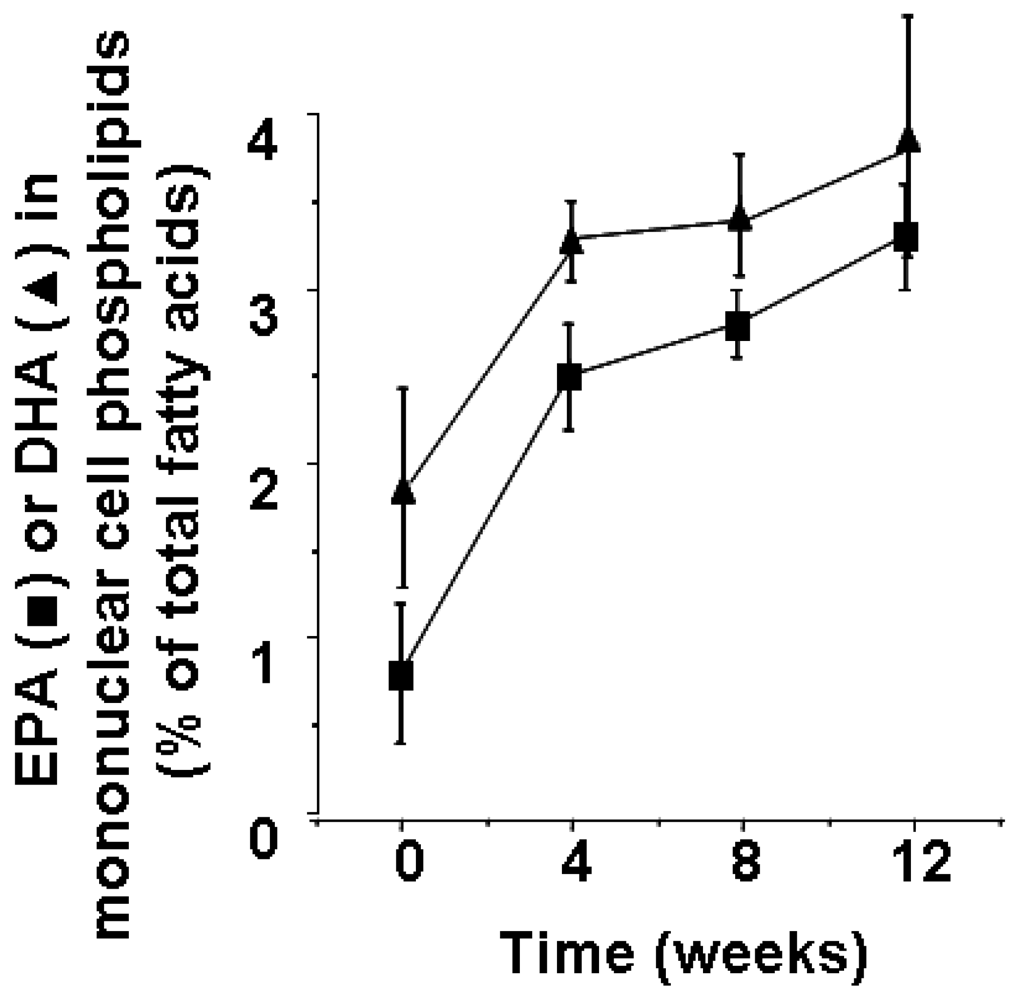
      <p>Polyunsaturated fatty acids (PUFAs) are important constituents of the phospholipids of all cell membranes. Laboratory animals that have been maintained on standard chow have a high content of arachidonic acid (20:4n-6) and low contents of eicosapentaenoic acid (20:5n-3; EPA) and docosahexaenoic acid (22:6n-3; DHA) in the bulk phospholipids of tissue lymphocytes [<xref ref-type="bibr" rid="B2-nutrients-02-00355">2</xref>,<xref ref-type="bibr" rid="B3-nutrients-02-00355">3</xref>], peritoneal macrophages [<xref ref-type="bibr" rid="B4-nutrients-02-00355">4</xref>,<xref ref-type="bibr" rid="B5-nutrients-02-00355">5</xref>,<xref ref-type="bibr" rid="B6-nutrients-02-00355">6</xref>,<xref ref-type="bibr" rid="B7-nutrients-02-00355">7</xref>,<xref ref-type="bibr" rid="B8-nutrients-02-00355">8</xref>], alveolar macrophages [<xref ref-type="bibr" rid="B9-nutrients-02-00355">9</xref>,<xref ref-type="bibr" rid="B10-nutrients-02-00355">10</xref>], Kupffer cells [<xref ref-type="bibr" rid="B10-nutrients-02-00355">10</xref>], and alveolar neutrophils [<xref ref-type="bibr" rid="B11-nutrients-02-00355">11</xref>,<xref ref-type="bibr" rid="B12-nutrients-02-00355">12</xref>,<xref ref-type="bibr" rid="B13-nutrients-02-00355">13</xref>]. Feeding laboratory animals a diet containing fish oil, which provides EPA and DHA, results in a higher content of these fatty acids in lymphocytes [<xref ref-type="bibr" rid="B3-nutrients-02-00355">3</xref>], macrophages [<xref ref-type="bibr" rid="B4-nutrients-02-00355">4</xref>,<xref ref-type="bibr" rid="B5-nutrients-02-00355">5</xref>,<xref ref-type="bibr" rid="B6-nutrients-02-00355">6</xref>,<xref ref-type="bibr" rid="B7-nutrients-02-00355">7</xref>,<xref ref-type="bibr" rid="B9-nutrients-02-00355">9</xref>,<xref ref-type="bibr" rid="B10-nutrients-02-00355">10</xref>], Kupffer cells [<xref ref-type="bibr" rid="B10-nutrients-02-00355">10</xref>] and neutrophils [<xref ref-type="bibr" rid="B11-nutrients-02-00355">11</xref>,<xref ref-type="bibr" rid="B12-nutrients-02-00355">12</xref>,<xref ref-type="bibr" rid="B13-nutrients-02-00355">13</xref>]; typically enrichment in marine n-3 PUFAs is accompanied by a decrease in content of arachidonic acid. The bulk phospholipids of blood cells representing those that become involved in inflammatory responses (e.g., neutrophils, lymphocytes, monocytes) and collected from humans consuming typical Western diets contain about 10 to 20% of fatty acids as arachidonic acid, with about 0.5 to 1% EPA and about 2 to 4% DHA [<xref ref-type="bibr" rid="B14-nutrients-02-00355">14</xref>,<xref ref-type="bibr" rid="B15-nutrients-02-00355">15</xref>,<xref ref-type="bibr" rid="B16-nutrients-02-00355">16</xref>,<xref ref-type="bibr" rid="B17-nutrients-02-00355">17</xref>,<xref ref-type="bibr" rid="B18-nutrients-02-00355">18</xref>,<xref ref-type="bibr" rid="B19-nutrients-02-00355">19</xref>,<xref ref-type="bibr" rid="B20-nutrients-02-00355">20</xref>,<xref ref-type="bibr" rid="B21-nutrients-02-00355">21</xref>,<xref ref-type="bibr" rid="B22-nutrients-02-00355">22</xref>,<xref ref-type="bibr" rid="B23-nutrients-02-00355">23</xref>,<xref ref-type="bibr" rid="B24-nutrients-02-00355">24</xref>,<xref ref-type="bibr" rid="B25-nutrients-02-00355">25</xref>], although there are differences between the different phospholipid classes in terms of the content of these fatty acids [<xref ref-type="bibr" rid="B16-nutrients-02-00355">16</xref>]. The fatty acid composition of these cells can be modified by increasing intake of marine n-3 fatty acids [<xref ref-type="bibr" rid="B14-nutrients-02-00355">14</xref>,<xref ref-type="bibr" rid="B15-nutrients-02-00355">15</xref>,<xref ref-type="bibr" rid="B16-nutrients-02-00355">16</xref>,<xref ref-type="bibr" rid="B17-nutrients-02-00355">17</xref>,<xref ref-type="bibr" rid="B18-nutrients-02-00355">18</xref>,<xref ref-type="bibr" rid="B19-nutrients-02-00355">19</xref>,<xref ref-type="bibr" rid="B20-nutrients-02-00355">20</xref>,<xref ref-type="bibr" rid="B21-nutrients-02-00355">21</xref>,<xref ref-type="bibr" rid="B23-nutrients-02-00355">23</xref>,<xref ref-type="bibr" rid="B24-nutrients-02-00355">24</xref>,<xref ref-type="bibr" rid="B25-nutrients-02-00355">25</xref>,<xref ref-type="bibr" rid="B21-nutrients-02-00355">21</xref>,<xref ref-type="bibr" rid="B23-nutrients-02-00355">23</xref>]. This occurs in a dose response fashion [<xref ref-type="bibr" rid="B25-nutrients-02-00355">25</xref>] and over a period of days to weeks, with a new steady-state composition reached within about 4 weeks (<xref ref-type="fig" rid="nutrients-02-00355-f001">Figure 1</xref>). Typically the increase in content of n-3 PUFAs occurs at the expense of n-6 PUFAs, especially arachidonic acid. </p>
      <fig id="nutrients-02-00355-f001" position="anchor">
        <label>Figure 1</label>
        <caption>
          <p>Time course of incorporation of EPA and DHA into human blood mononuclear cells. Healthy subjects supplemented their diet with fish oil capsules providing 2.1 g EPA plus 1.1 g DHA per day for a period of 12 weeks. Blood mononuclear cell phospholipids were isolated at 0, 4, 8 and 12 weeks and their fatty acid composition determined by gas chromatography. Data are mean ± SEM from 8 subjects and are from Yaqoob <italic>et al.</italic> [<xref ref-type="bibr" rid="B19-nutrients-02-00355">19</xref>].</p>
        </caption>
        <graphic xmlns:xlink="http://www.w3.org/1999/xlink" xlink:href="nutrients-02-00355-g001.tif"/>
      </fig>
    </sec>
    <sec>
      <title>3. Mechanisms by which Polyunsaturated Fatty Acids can Influence Inflammatory Cell Function</title>
      <p>PUFAs can influence inflammatory cell function, and so inflammatory processes, by a variety of mechanisms as follows:</p>
      <list list-type="bullet">
        <list-item>
          <p>PUFA intake can influence complex lipid, lipoprotein, metabolite and hormone concentrations that in turn influence inflammation;</p>
        </list-item>
        <list-item>
          <p>Non-esterified PUFAs can act directly on inflammatory cells via surface or intracellular “fatty acid receptors” – the latter may include transcription factors like peroxisome proliferator activated receptors (PPARs);</p>
        </list-item>
        <list-item>
          <p>PUFAs can be oxidized (enzymatically or non-enzymatically) and the oxidized derivatives can act directly on inflammatory cells via surface or intracellular receptors – oxidation can occur to the non-esterified form of the PUFA or to PUFAs esterified into more complex lipids including circulating or cell membrane phospholipids and intact lipoproteins such as low density lipoprotein (LDL);</p>
        </list-item>
        <list-item>
          <p>PUFAs can be incorporated into the phospholipids of inflammatory cell membranes(as described above). Here they play important roles assuring the correct environment for membrane protein function, maintaining membrane order (“fluidity”) and influencing lipid raft formation [<xref ref-type="bibr" rid="B26-nutrients-02-00355">26</xref>]. Membrane phospholipids are substrates for the generation of second messengers like diacylglycerol and it has been demonstrated that the fatty acid composition of such second messengers, which is determined by that of the precursor phospholipid, can influence their activity [<xref ref-type="bibr" rid="B27-nutrients-02-00355">27</xref>]. In addition, membrane phospholipids are substrates for the release of (non-esterfied) PUFAs intracellularly – the released PUFAs can act as signaling molecules, ligands (or precursors of ligands) for transcription factors, or precursors for biosynthesis of lipid mediators which are involved in regulation of many cell and tissue responses, including aspects of inflammation and immunity (see below). Thus, changes in membrane phospholipid fatty acid composition, as described above, can influence the function of cells involved in inflammation via:</p>
          <list list-type="simple">
            <list-item>
              <p>○ alterations in the physical properties of the membrane such as membrane order and raft structure;</p>
            </list-item>
            <list-item>
              <p>○ effects on cell signaling pathways, either through modifying the expression, activity or avidity of membrane receptors or modifying intracellular signal transduction mechanisms that lead to altered transcription factor activity and changes in gene expression;</p>
            </list-item>
            <list-item>
              <p>○ alterations in the pattern of lipid mediators produced, with the different mediators having different biological activities and potencies (see below).</p>
            </list-item>
          </list>
        </list-item>
      </list>
      <p>The multitude of potential mechanisms involved and their complexity has made it difficult to fully understand the actions of PUFAs within inflammatory processes. This difficulty has been further compounded by the variety of experimental approaches that have been used, including the method of presentation of PUFAs of interest to inflammatory cells in order to study their effects. For example, many <italic>in vitro</italic> studies have exposed cells to non-esterified fatty acids, often at concentrations that might not be achieved physiologically. Thus, effects of non-esterified PUFAs on responses of lymphocytes [<xref ref-type="bibr" rid="B2-nutrients-02-00355">2</xref>], monocytes [<xref ref-type="bibr" rid="B28-nutrients-02-00355">28</xref>], macrophages [<xref ref-type="bibr" rid="B8-nutrients-02-00355">8</xref>,<xref ref-type="bibr" rid="B29-nutrients-02-00355">29</xref>,<xref ref-type="bibr" rid="B30-nutrients-02-00355">30</xref>,<xref ref-type="bibr" rid="B31-nutrients-02-00355">31</xref>,<xref ref-type="bibr" rid="B32-nutrients-02-00355">32</xref>,<xref ref-type="bibr" rid="B33-nutrients-02-00355">33</xref>], neutrophils [<xref ref-type="bibr" rid="B34-nutrients-02-00355">34</xref>,<xref ref-type="bibr" rid="B35-nutrients-02-00355">35</xref>,<xref ref-type="bibr" rid="B36-nutrients-02-00355">36</xref>] and endothelial cells [<xref ref-type="bibr" rid="B37-nutrients-02-00355">37</xref>,<xref ref-type="bibr" rid="B38-nutrients-02-00355">38</xref>,<xref ref-type="bibr" rid="B39-nutrients-02-00355">39</xref>] have been demonstrated. These effects may involve a direct effect of the non-esterified PUFA or of an oxidized derivative of the PUFA [<xref ref-type="bibr" rid="B40-nutrients-02-00355">40</xref>,<xref ref-type="bibr" rid="B41-nutrients-02-00355">41</xref>,<xref ref-type="bibr" rid="B42-nutrients-02-00355">42</xref>] or they may be secondary to incorporation of the PUFA into cell membrane phospholipids. Physiologically, the concentration of non-esterified n-3 PUFAs (and also arachidonic acid) is quite low. These fatty acids are carried in the bloodstream at much higher concentrations in more complex lipids (triglycerides, phospholipds, cholesteryl esters) within lipoproteins. Many of the cell types involved in inflammatory responses express lipoprotein receptors (e.g., LDL receptor, very low density lipoprotein receptor, scavenger receptors) and so are able to take up intact lipoproteins, subsequently utilising the fatty acid components. Thus, lipoproteins may affect inflammatory cell function [<xref ref-type="bibr" rid="B43-nutrients-02-00355">43</xref>,<xref ref-type="bibr" rid="B44-nutrients-02-00355">44</xref>], perhaps due to their component fatty acids. Inflammatory cells may also access fatty acids from lipoproteins by hydrolysing them extracellularly as has been demonstrated for macrophages [<xref ref-type="bibr" rid="B45-nutrients-02-00355">45</xref>] and lymphocytes [<xref ref-type="bibr" rid="B46-nutrients-02-00355">46</xref>]. Thus, cells involved in inflammatory processes are exposed to fatty acids, including PUFAs, in many different forms, and they may access fatty acids from their environment by a variety of mechanisms. The effect of the form of presentation of PUFAs to inflammatory cells can be examined in the cell culture setting and studies to date indicate that non-esterified fatty acids [<xref ref-type="bibr" rid="B28-nutrients-02-00355">28</xref>,<xref ref-type="bibr" rid="B29-nutrients-02-00355">29</xref>,<xref ref-type="bibr" rid="B30-nutrients-02-00355">30</xref>,<xref ref-type="bibr" rid="B31-nutrients-02-00355">31</xref>,<xref ref-type="bibr" rid="B32-nutrients-02-00355">32</xref>,<xref ref-type="bibr" rid="B33-nutrients-02-00355">33</xref>,<xref ref-type="bibr" rid="B34-nutrients-02-00355">34</xref>,<xref ref-type="bibr" rid="B35-nutrients-02-00355">35</xref>,<xref ref-type="bibr" rid="B36-nutrients-02-00355">36</xref>,<xref ref-type="bibr" rid="B37-nutrients-02-00355">37</xref>,<xref ref-type="bibr" rid="B38-nutrients-02-00355">38</xref>,<xref ref-type="bibr" rid="B39-nutrients-02-00355">39</xref>], complex lipids like triglycerides [<xref ref-type="bibr" rid="B46-nutrients-02-00355">46</xref>], intact lipoproteins [<xref ref-type="bibr" rid="B44-nutrients-02-00355">44</xref>], and oxidized forms of fatty acids and other lipids [<xref ref-type="bibr" rid="B40-nutrients-02-00355">40</xref>,<xref ref-type="bibr" rid="B41-nutrients-02-00355">41</xref>,<xref ref-type="bibr" rid="B42-nutrients-02-00355">42</xref>] all influence inflammatory cell responses, frequently with different effects or different potencies of n-6 and n-3 PUFAs. </p>
      <p>Following increased dietary intake of marine n-3 PUFAs their concentrations increase in complex lipids within the bloodstream (triglycerides, phospholipids, cholesteryl esters), as well as within the membrane phospholipids of cells and tissues including those involved in inflammatory responses (see above), and there is a small increase in their concentration within the circulating non-esterfied fatty acid pool; the latter increase is small because circulating non-esterfied fatty acids derive principally from adipose tissue triglyceride breakdown and adipose tissue triglycerides contain very little EPA and DHA. Thus, following increased intake of EPA and DHA, both the cells involved in inflammation and their extracellular environment (e.g., blood plasma) are enriched in those fatty acids, so that the n-3 PUFA enriched inflammatory cells will be in contact with n-3 PUFA-rich complex lipids and lipoproteins. Many studies have examined the effect of increased intake of marine n-3 PUFAs on the function of cells typically involved in inflammation taken from the bloodstream (neutrophils, eosinophils, monocytes, lymphocytes) or, in the case of animal studies tissues and subsequently cultured. In many, probably most, cases the <italic>in vivo</italic> situation is not maintained during the <italic>ex vivo</italic> culture period, in that the n-3 PUFA enriched cells are maintained in an environment that is different from that to which they were exposed <italic>in vivo i.e.,</italic> to an n-3 PUFA poor environment. Thus, the <italic>in vivo</italic> situation is not replicated in the <italic>ex vivo</italic> setting. This hampers the full interpretation of the findings of such research. </p>
    </sec>
    <sec>
      <title>4. Lipid Mediators: Biosynthesis, Roles in Inflammation, and the Impact of Marine n-3 fatty acids</title>
      <sec>
        <title>4.1. Eicosanoids Generated from Arachidonic Acid</title>
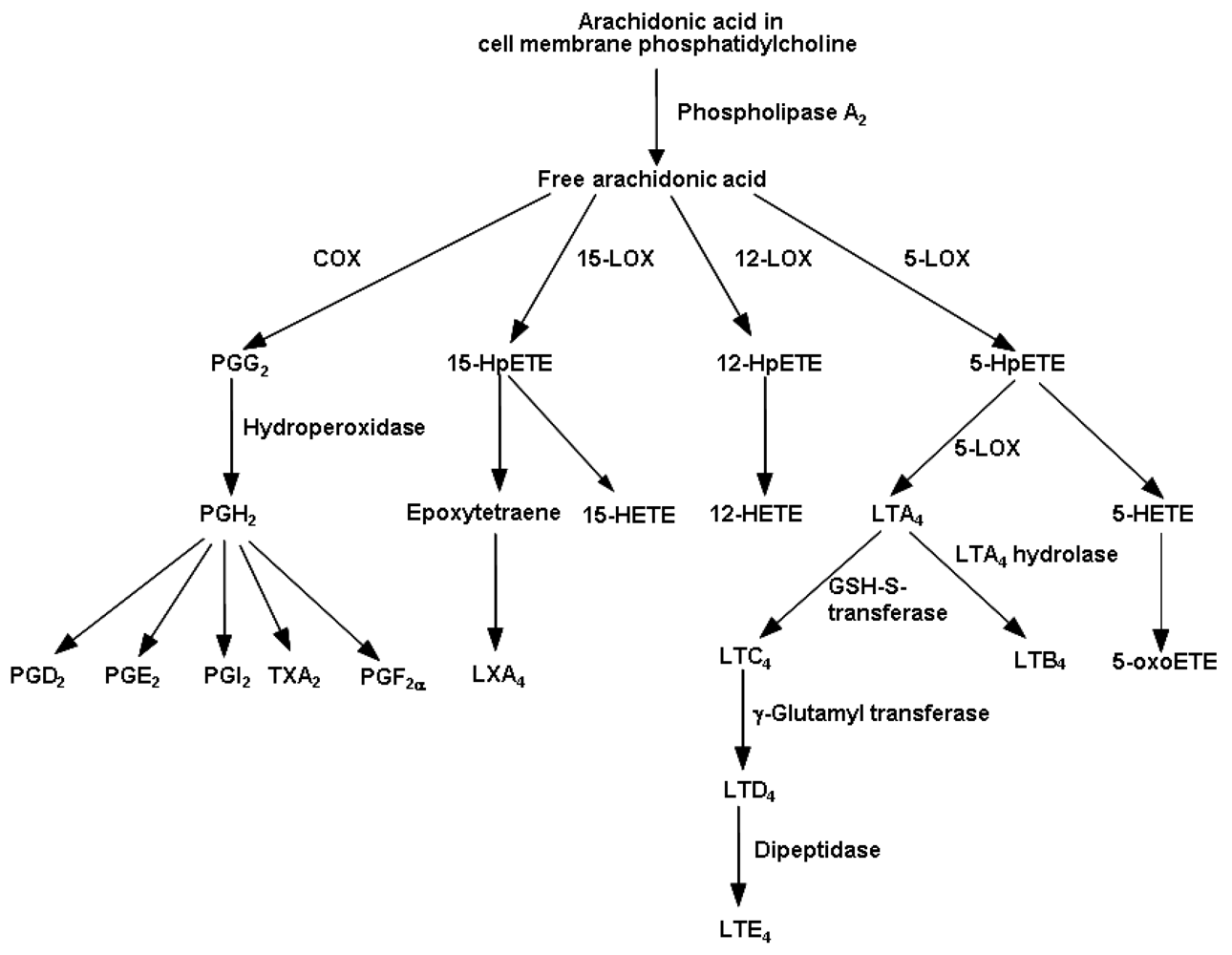
        <p>Eicosanoids are key mediators and regulators of inflammation and immunity and are generated from 20 carbon PUFAs. Eicosanoids, which include PGs, thromboxanes, LTs and other oxidised derivatives, are generated from arachidonic acid by the metabolic processes summarized in <xref ref-type="fig" rid="nutrients-02-00355-f002">Figure 2</xref>. Eicosanoids are involved in modulating the intensity and duration of inflammatory responses [<xref ref-type="bibr" rid="B47-nutrients-02-00355">47</xref>,<xref ref-type="bibr" rid="B48-nutrients-02-00355">48</xref>], have cell- and stimulus-specific sources and frequently have opposing effects. Thus, the overall physiological (or pathophysiological) outcome will depend upon the cells present, the nature of the stimulus, the timing of eicosanoid generation, the concentrations of different eicosanoids generated and the sensitivity of target cells and tissues to the eicosanoids generated. Because of the relatively high amount of arachidonic acid in membrane phospholipids of cells involved in inflammation, this fatty acid is typically the major precursor for eicosanoid mediators, which are produced in greatly increased amounts upon cellular stimulation. Thus, amongst the mix of eicosanoids produced, those synthesized from arachidonic acid (e.g., PGE<sub>2</sub> and LTB<sub>4</sub>) predominate although the exact eicosanoid profile depends upon the cell type concerned (e.g., neutrophils and mast cells produce a lot of PGD<sub>2</sub> whereas monocytes produce a lot of PGE<sub>2</sub>) and the nature of the stimulus; the profile will also change over time as the nature of the response to the stimulus alters. In general arachidonic acid-derived eicosanoids act in a pro-inflammatory way, although this is an over-simplification since it is now recognised that PGE<sub>2</sub>, for example, has both pro- and anti-inflammatory effects, and that another eicosanoid derived from arachidonic acid, lipoxin A<sub>4</sub>, is anti-inflammatory [<xref ref-type="bibr" rid="B49-nutrients-02-00355">49</xref>,<xref ref-type="bibr" rid="B50-nutrients-02-00355">50</xref>,<xref ref-type="bibr" rid="B51-nutrients-02-00355">51</xref>,<xref ref-type="bibr" rid="B52-nutrients-02-00355">52</xref>].</p>
        <fig id="nutrients-02-00355-f002" position="anchor">
          <label>Figure 2</label>
          <caption>
            <p>Outline of the pathway of eicosanoid biosynthesis from arachidonic acid. COX, cyclooxygenase; HETE, hydroxyeicosatetraenoic acid; HpETE, hydroperoxyeicosatetraenoic acid; LOX, lipoxygenase; LT, leukotriene; LX, lipoxin; oxoETE, oxoeicosatetraenoic acid; PG, prostaglandin; TX, thromboxane. </p>
          </caption>
          <graphic xmlns:xlink="http://www.w3.org/1999/xlink" xlink:href="nutrients-02-00355-g002.tif"/>
        </fig>
      </sec>
      <sec>
        <title>4.2. Fatty Acid Modification of Eicosanoid Profiles</title>
        <p>Animal studies have shown a direct relationship between arachidonic acid content of inflammatory cell phospholipids and ability of those cells to produce PGE<sub>2</sub> [<xref ref-type="bibr" rid="B53-nutrients-02-00355">53</xref>], such that PGE<sub>2</sub> production is increased by arachidonic acid feeding [<xref ref-type="bibr" rid="B53-nutrients-02-00355">53</xref>] and decreased by EPA or DHA feeding [<xref ref-type="bibr" rid="B53-nutrients-02-00355">53</xref>,<xref ref-type="bibr" rid="B54-nutrients-02-00355">54</xref>,<xref ref-type="bibr" rid="B55-nutrients-02-00355">55</xref>]. It is well documented that PGE<sub>2</sub> and 4 series-LT production by human inflammatory cells can be significantly decreased by fish oil supplementation of the diet for a period of weeks to months [<xref ref-type="bibr" rid="B14-nutrients-02-00355">14</xref>,<xref ref-type="bibr" rid="B15-nutrients-02-00355">15</xref>,<xref ref-type="bibr" rid="B16-nutrients-02-00355">16</xref>,<xref ref-type="bibr" rid="B18-nutrients-02-00355">18</xref>,<xref ref-type="bibr" rid="B56-nutrients-02-00355">56</xref>,<xref ref-type="bibr" rid="B57-nutrients-02-00355">57</xref>]. </p>
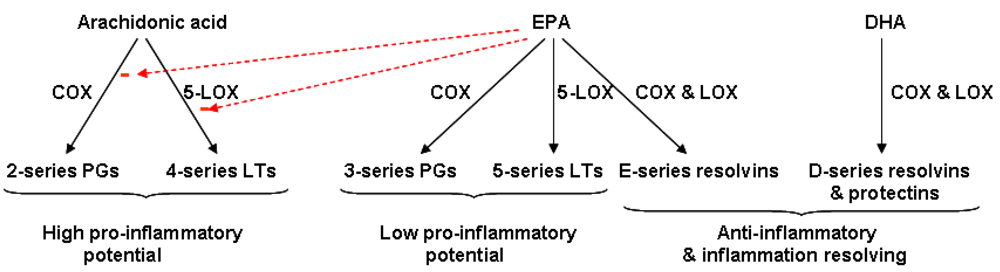
        <p>EPA is also a substrate for the cyclooxygenase and lipoxygenase enzymes that produce eicosanoids, but the mediators produced have a different structure from the arachidonic acid-derived mediators, and this influences their potency. Increased generation of 5-series LTs has been demonstrated using macrophages from fish oil-fed mice [<xref ref-type="bibr" rid="B55-nutrients-02-00355">55</xref>] and neutrophils from humans supplemented with oral fish oil for several weeks [<xref ref-type="bibr" rid="B14-nutrients-02-00355">14</xref>,<xref ref-type="bibr" rid="B15-nutrients-02-00355">15</xref>,<xref ref-type="bibr" rid="B16-nutrients-02-00355">16</xref>]. The functional significance of the generation of eicosanoids from EPA is that EPA-derived mediators are often much less biologically active than those produced from arachidonic acid (<xref ref-type="fig" rid="nutrients-02-00355-f003">Figure 3</xref>). For example EPA-derived LTB<sub>5</sub> is 10- to 100-fold less potent as a neutrophil chemoattractant compared with LTB<sub>4</sub>[<xref ref-type="bibr" rid="B58-nutrients-02-00355">58</xref>,<xref ref-type="bibr" rid="B59-nutrients-02-00355">59</xref>]. Furthermore, EPA-derived eicosanoids may antagonise the action of those produced from arachidonic acid, as was recently demonstrated for PGD<sub>3</sub> vs. PGD<sub>2</sub>[<xref ref-type="bibr" rid="B60-nutrients-02-00355">60</xref>]. However, in some cases arachidonic acid-derived and EPA-derived eicosanoids appear to behave with similar potency (e.g., inhibition of TNF-α production by monocytes [<xref ref-type="bibr" rid="B61-nutrients-02-00355">61</xref>,<xref ref-type="bibr" rid="B62-nutrients-02-00355">62</xref>]). </p>
        <fig id="nutrients-02-00355-f003" position="anchor">
          <label>Figure 3</label>
          <caption>
            <p>General overview of synthesis and actions of lipid mediators produced from arachidonic acid, EPA and DHA. COX, cyclooxygenase; LOX, lipoxygenase; LT, leukotriene; PG, prostaglandin. </p>
          </caption>
          <graphic xmlns:xlink="http://www.w3.org/1999/xlink" xlink:href="nutrients-02-00355-g003.tif"/>
        </fig>
      </sec>
      <sec>
        <title>4.3. Resolvins: Novel Anti-Inflammatory and Inflammation Resolving Mediators Produced from EPA and DHA</title>
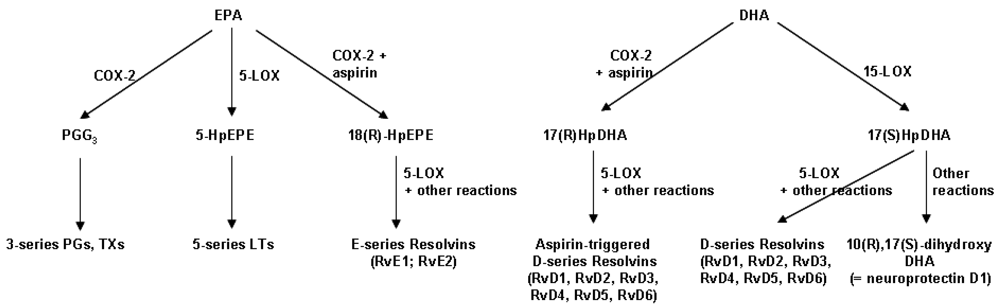
        <p>EPA and DHA also give rise to resolvins and related compounds (e.g., protectins) through pathways involving cyclooxygenase and lipoxygenase enzymes (<xref ref-type="fig" rid="nutrients-02-00355-f004">Figure 4</xref>) [<xref ref-type="bibr" rid="B63-nutrients-02-00355">63</xref>,<xref ref-type="bibr" rid="B64-nutrients-02-00355">64</xref>,<xref ref-type="bibr" rid="B65-nutrients-02-00355">65</xref>]. These mediators have been demonstrated in cell culture and animal feeding studies to be anti-inflammatory and inflammation resolving (<xref ref-type="fig" rid="nutrients-02-00355-f003">Figure 3</xref>). For example, resolvin E1, resolvin D1 and protectin D1 all inhibit transendothelial migration of neutrophils, so preventing neutrophilic infiltration at sites of inflammation, resolvin D1 inhibits IL-1β production, and protectin D1 inhibits TNF and IL-1β production (see [<xref ref-type="bibr" rid="B65-nutrients-02-00355">65</xref>] for references). The role of resolvins and related compounds may be very important because resolution of inflammation is important in shutting off the ongoing inflammatory process and in limiting tissue damage.</p>        
      </sec>
    </sec>
    <sec>
      <title>5. Influence of Marine n-3 Fatty Acids on Leukocyte Chemotaxis</title>
      <p>A number of dietary supplementation studies with fish oil have demonstrated a time-dependent decrease in chemotaxis of human neutrophils and monocytes towards various chemoattractants including LTB<sub>4</sub>, bacterial peptides and human serum [<xref ref-type="bibr" rid="B14-nutrients-02-00355">14</xref>,<xref ref-type="bibr" rid="B15-nutrients-02-00355">15</xref>,<xref ref-type="bibr" rid="B16-nutrients-02-00355">16</xref>,<xref ref-type="bibr" rid="B66-nutrients-02-00355">66</xref>,<xref ref-type="bibr" rid="B67-nutrients-02-00355">67</xref>,<xref ref-type="bibr" rid="B68-nutrients-02-00355">68</xref>,<xref ref-type="bibr" rid="B16-nutrients-02-00355">16</xref>,<xref ref-type="bibr" rid="B66-nutrients-02-00355">66</xref>]. Both the distance of cell migration and the number of cells migrating were decreased. Despite the high dose of marine n-3 PUFAs used in many of these studies (3.1 to 14.4 g EPA+DHA/day), a dose response study by Schmidt <italic>et al.</italic> [<xref ref-type="bibr" rid="B69-nutrients-02-00355">69</xref>] suggests that near-maximum inhibition of chemotaxis occurs at an intake of 1.3 g EPA+DHA/day. Some studies report no effect of n-3 PUFAs on neutrophil chemotaxis [<xref ref-type="bibr" rid="B20-nutrients-02-00355">20</xref>,<xref ref-type="bibr" rid="B70-nutrients-02-00355">70</xref>,<xref ref-type="bibr" rid="B71-nutrients-02-00355">71</xref>]. An explanation for this lack of effect with regard to one of these studies [<xref ref-type="bibr" rid="B70-nutrients-02-00355">70</xref>] may be that the dose of EPA+DHA used was too low to be active (0.55 g EPA+DHA/day). However the other two studies [<xref ref-type="bibr" rid="B20-nutrients-02-00355">20</xref>,<xref ref-type="bibr" rid="B71-nutrients-02-00355">71</xref>] used higher doses of EPA+DHA, but in both cases this was a DHA-rich preparation with little EPA being provided. If this is the explanation for the lack of effect, then this suggests that the anti-chemotactic effects of fish oil might be due to EPA rather than DHA. There have been no studies attempting to discriminate the effects of EPA and DHA on chemotaxis. The mechanism by which n-3 PUFAs inhibit chemotaxis is not clear but may relate to reduced expression or antagonism of receptors for chemoattractants.</p>
      <fig id="nutrients-02-00355-f004" position="anchor">
          <label>Figure 4</label>
          <caption>
            <p>Outline of the pathway of synthesis of resolvins and related mediators from EPA and DHA. COX, cyclooxygenase; HpDHA, hydroperoxydocosahexaenoic acid; HpEPE, hydroperoxyeicosapentaenoic acid; LOX, lipoxygenase; LT, leukotriene; PG, prostaglandin; Rv, resolvin; TX, thromboxane</p>
          </caption>
          <graphic xmlns:xlink="http://www.w3.org/1999/xlink" xlink:href="nutrients-02-00355-g004.tif"/>
        </fig>
    </sec>
    <sec>
      <title>6. Influence of Marine n-3 Fatty Acids on Adhesion Molecules and Adhesive Interactions</title>
      <p>Cell culture [<xref ref-type="bibr" rid="B28-nutrients-02-00355">28</xref>,<xref ref-type="bibr" rid="B37-nutrients-02-00355">37</xref>,<xref ref-type="bibr" rid="B38-nutrients-02-00355">38</xref>,<xref ref-type="bibr" rid="B39-nutrients-02-00355">39</xref>] and animal feeding studies [<xref ref-type="bibr" rid="B72-nutrients-02-00355">72</xref>,<xref ref-type="bibr" rid="B73-nutrients-02-00355">73</xref>] report decreased expression of some adhesion molecules on the surface of monocytes [<xref ref-type="bibr" rid="B28-nutrients-02-00355">28</xref>], macrophages [<xref ref-type="bibr" rid="B72-nutrients-02-00355">72</xref>], lymphocytes [<xref ref-type="bibr" rid="B73-nutrients-02-00355">73</xref>] or endothelial cells [<xref ref-type="bibr" rid="B37-nutrients-02-00355">37</xref>,<xref ref-type="bibr" rid="B38-nutrients-02-00355">38</xref>,<xref ref-type="bibr" rid="B39-nutrients-02-00355">39</xref>] following exposure to marine n-3 PUFAs. In some cases this was shown to result in decreased adhesion between leukocytes and endothelial cells. Supplementing the diet of healthy humans with fish oil providing about 1.5 g EPA+DHA/day resulted in a lower level of expression of ICAM-1 on the surface of blood monocytes stimulated <italic>ex vivo</italic> with interferon-γ [<xref ref-type="bibr" rid="B74-nutrients-02-00355">74</xref>]. Dietary fish oil providing 1.1 g EPA+DHA/day was found to decrease circulating levels of soluble VCAM-1 in elderly subjects [<xref ref-type="bibr" rid="B75-nutrients-02-00355">75</xref>], but it is not clear if this represents decreased surface expression of VCAM-1.</p>
    </sec>
    <sec>
      <title>7. Influence of Marine n-3 Fatty Acids on Inflammatory Cytokines</title>
      <sec>
        <title>7.1. Transcription Factors Involved in Regulating Inflammatory Gene Expression</title>
        <p>In addition to effects on inflammation mediated by changes in the pattern of eicosanoids and other lipid mediators produced, marine n-3 PUFAs have also been shown to alter the production of inflammatory proteins including chemokines, cytokines, growth factors and matrix proteases. This effect may be mediated by altered activation of key transcription factors involved in regulating inflammatory gene expression. Two transcription factors that are likely to play a role in inflammation are nuclear factor κ B (NFκB) and PPAR-γ. NFκB is the principal transcription factor involved in upregulation of inflammatory cytokine, adhesion molecule and cyclooxygenase-2 genes [<xref ref-type="bibr" rid="B76-nutrients-02-00355">76</xref>,<xref ref-type="bibr" rid="B77-nutrients-02-00355">77</xref>]. NFκB is activated as a result of a signalling cascade triggered by extracellular inflammatory stimuli and involving phosphorylation of an inhibitory subunit (inhibitory subunit of NFκB (IκB)) which then allows translocation of the remaining NFκB dimer to the nucleus [<xref ref-type="bibr" rid="B78-nutrients-02-00355">78</xref>]. The second transcription factor, PPAR-γ, is believed to act in an anti-inflammatory manner. While PPAR-γ directly regulates inflammatory gene expression, it also interferes with the activation of NFκB creating an intriguing interaction between these two transcription factors [<xref ref-type="bibr" rid="B79-nutrients-02-00355">79</xref>]. Both NFκB and PPAR-γ may be regulated by n-3 PUFAs.</p>
      </sec>
      <sec>
        <title>7.2. Fatty Acid Modulation of Inflammatory Cytokine Production and of Transcription Factor Activation</title>
        <p>EPA and DHA inhibited endotoxin-stimulated production of IL-6 and IL-8 by cultured human endothelial cells [<xref ref-type="bibr" rid="B38-nutrients-02-00355">38</xref>,<xref ref-type="bibr" rid="B80-nutrients-02-00355">80</xref>] and EPA or fish oil inhibited endotoxin-induced TNF-α production by cultured monocytes [<xref ref-type="bibr" rid="B29-nutrients-02-00355">29</xref>,<xref ref-type="bibr" rid="B30-nutrients-02-00355">30</xref>]. EPA or fish oil decreased endotoxin-induced activation of NFκB in human monocytes and this was associated with decreased IκB phosphorylation [<xref ref-type="bibr" rid="B31-nutrients-02-00355">31</xref>], perhaps due to decreased activation of mitogen-activated protein kinases [<xref ref-type="bibr" rid="B32-nutrients-02-00355">32</xref>]. These observations suggest effects of marine n-3 PUFAs on inflammatory gene expression via inhibition of activation of the transcription factor NFκB.</p>
        <p>Animal feeding studies with fish oil support the observations made in cell culture with respect to the effects of marine n-3 PUFAs on NFκB activation and inflammatory cytokine production. Compared with feeding corn oil, fish oil lowered NFκB activation in endotoxin-activated murine spleen lymphocytes [<xref ref-type="bibr" rid="B81-nutrients-02-00355">81</xref>]. Feeding fish oil to mice decreased <italic>ex vivo</italic> production of TNF-α, IL-1β and IL-6 by endotoxin-stimulated macrophages [<xref ref-type="bibr" rid="B54-nutrients-02-00355">54</xref>,<xref ref-type="bibr" rid="B82-nutrients-02-00355">82</xref>,<xref ref-type="bibr" rid="B83-nutrients-02-00355">83</xref>]. Several studies in healthy human volunteers involving supplementation of the diet with fish oil have demonstrated decreased production of TNF-α, IL-1β, IL-6 and various growth factors by endotoxin-stimulated monocytes or mononuclear cells (a mixture of lymphocytes and monocytes) [<xref ref-type="bibr" rid="B15-nutrients-02-00355">15</xref>,<xref ref-type="bibr" rid="B18-nutrients-02-00355">18</xref>,<xref ref-type="bibr" rid="B56-nutrients-02-00355">56</xref>,<xref ref-type="bibr" rid="B84-nutrients-02-00355">84</xref>,<xref ref-type="bibr" rid="B85-nutrients-02-00355">85</xref>,<xref ref-type="bibr" rid="B86-nutrients-02-00355">86</xref>], although not all studies confirm this effect. Some of the studies that fail to show an effect of n-3 PUFAs on cytokine production have provided &lt; 2 g EPA+DHA/day [<xref ref-type="bibr" rid="B70-nutrients-02-00355">70</xref>,<xref ref-type="bibr" rid="B87-nutrients-02-00355">87</xref>,<xref ref-type="bibr" rid="B88-nutrients-02-00355">88</xref>,<xref ref-type="bibr" rid="B89-nutrients-02-00355">89</xref>,<xref ref-type="bibr" rid="B90-nutrients-02-00355">90</xref>], which may be an insufficient dose, although others have provided higher doses [<xref ref-type="bibr" rid="B19-nutrients-02-00355">19</xref>,<xref ref-type="bibr" rid="B24-nutrients-02-00355">24</xref>,<xref ref-type="bibr" rid="B91-nutrients-02-00355">91</xref>,<xref ref-type="bibr" rid="B92-nutrients-02-00355">92</xref>,<xref ref-type="bibr" rid="B93-nutrients-02-00355">93</xref>,<xref ref-type="bibr" rid="B94-nutrients-02-00355">94</xref>]. It is not clear what the reason for these discrepancies in the literature is, but technical factors are likely to be contributing factors, as discussed in detail elsewhere [<xref ref-type="bibr" rid="B95-nutrients-02-00355">95</xref>]. The relative contributions of EPA and DHA might also be important in determining the effect of fish oil. One other factor that has recently been identified is polymorphisms in genes affecting cytokine production [<xref ref-type="bibr" rid="B96-nutrients-02-00355">96</xref>]. In this study it was found that the effect of dietary fish oil upon cytokine production by human mononuclear cells was dependent upon the nature of the -308 TNF-α and the +252 TNF-β polymorphisms. </p>
      </sec>
    </sec>
    <sec>
      <title>8. Anti-Inflammatory Effects of Marine n-3 Fatty Acids Suggest a Therapeutic Value</title>
      <p>Inflammation is an overt or covert component of numerous human conditions and diseases (<xref ref-type="table" rid="nutrients-02-00355-t001">Table 1</xref>) [<xref ref-type="bibr" rid="B1-nutrients-02-00355">1</xref>]. Although the inflammation may afflict different body compartments, one common characteristic of these conditions and diseases is excessive or inappropriate production of inflammatory mediators including eicosanoids and cytokines [<xref ref-type="bibr" rid="B1-nutrients-02-00355">1</xref>]. The foregoing discussion has highlighted that marine n-3 PUFAs can act in a number of ways to reduce inflammation. They:</p>
      <list list-type="bullet">
        <list-item>
          <p>decrease production of eicosanoid mediators from arachidonic acid, many of which have pro-inflammatory roles;</p>
        </list-item>
        <list-item>
          <p>increase production of weakly inflammatory or anti-inflammatory eicosanoids from EPA;</p>
        </list-item>
        <list-item>
          <p>increase production of anti-inflammatory and inflammation resolving resolvins from EPA and DHA;</p>
        </list-item>
        <list-item>
          <p>decrease chemotactic responses of leukocytes;</p>
        </list-item>
        <list-item>
          <p>decrease adhesion molecule expression on leukocytes and on endothelial cells and decrease intercellular adhesive interactions;</p>
        </list-item>
        <list-item>
          <p>decrease production of pro-inflammatory cytokines and other pro-inflammatory proteins induced via the NFκB system.</p>
        </list-item>
      </list>
      <p>The roles marine n-3 PUFAs in shaping and regulating inflammatory processes and responses suggest that the level of exposure to these fatty acids might be important in determining the development and severity of inflammatory diseases. The recognition that marine n-3 PUFAs have anti-inflammatory actions has lead to the idea that supplementation of the diet of patients with inflammatory diseases may be of clinical benefit. Each of the diseases or conditions listed in <xref ref-type="table" rid="nutrients-02-00355-t001">Table 1</xref> is a possible therapeutic target for marine n-3 PUFAs. Perhaps unsurprisingly, supplementation trials have been conducted in most of these diseases. Those conducted in patients with rheumatoid arthritis appear to be the most successful with most trials reporting several clinical benefits [<xref ref-type="bibr" rid="B97-nutrients-02-00355">97</xref>]; these benefits are supported by meta-analyses of the available data [<xref ref-type="bibr" rid="B98-nutrients-02-00355">98</xref>,<xref ref-type="bibr" rid="B99-nutrients-02-00355">99</xref>]. Studies in patients with inflammatory bowel diseases (Crohn’s disease and ulcerative colitis) provide equivocal findings with some showing some benefits and others not [<xref ref-type="bibr" rid="B100-nutrients-02-00355">100</xref>,<xref ref-type="bibr" rid="B101-nutrients-02-00355">101</xref>]. Likewise studies conducted in patients with asthma do not provide a clear picture; most studies conducted in adults do not show a clinical benefit, while there are indications of benefits of marine n-3 PUFAs in children and adolescents, although there are few studies in those groups [<xref ref-type="bibr" rid="B102-nutrients-02-00355">102</xref>]. An extension of the latter studies is recent work in pregnancy which shows an impact of marine n-3 PUFAs on the maternal and foetal immune system [<xref ref-type="bibr" rid="B103-nutrients-02-00355">103</xref>,<xref ref-type="bibr" rid="B104-nutrients-02-00355">104</xref>,<xref ref-type="bibr" rid="B105-nutrients-02-00355">105</xref>], that may reduce risk of development of allergic type diseases in infancy [<xref ref-type="bibr" rid="B104-nutrients-02-00355">104</xref>] and childhood [<xref ref-type="bibr" rid="B106-nutrients-02-00355">106</xref>]. Although this is an emerging area with few published studies at present, the possibility of an early effect of marine n-3 PUFAs on immune maturation hints at an important, novel role for these fatty acids in early development [<xref ref-type="bibr" rid="B102-nutrients-02-00355">102</xref>,<xref ref-type="bibr" rid="B107-nutrients-02-00355">107</xref>,<xref ref-type="bibr" rid="B108-nutrients-02-00355">108</xref>]. In most other inflammatory diseases and conditions there are too few studies to draw a clear conclusion of the possible efficacy of marine n-3 PUFAs as a treatment. One exception to this may be related to cardiovascular disease morbidity and mortality. There is evidence that marine n-3 PUFAs slow the progress of atherosclerosis [<xref ref-type="bibr" rid="B109-nutrients-02-00355">109</xref>,<xref ref-type="bibr" rid="B110-nutrients-02-00355">110</xref>], which has an inflammatory component [<xref ref-type="bibr" rid="B111-nutrients-02-00355">111</xref>,<xref ref-type="bibr" rid="B112-nutrients-02-00355">112</xref>]. Further, marine n-3 PUFAs decrease mortality due to cardiovascular disease [<xref ref-type="bibr" rid="B113-nutrients-02-00355">113</xref>,<xref ref-type="bibr" rid="B114-nutrients-02-00355">114</xref>]; this may be, in part, due to stabilization of atherosclerotic plaques against rupture [<xref ref-type="bibr" rid="B115-nutrients-02-00355">115</xref>], which again has an inflammatory component [<xref ref-type="bibr" rid="B112-nutrients-02-00355">112</xref>,<xref ref-type="bibr" rid="B116-nutrients-02-00355">116</xref>]. Thus, the anti-inflammatory effects of marine n-3 PUFAs may contribute to their protective actions towards atherosclerosis, plaque rupture and cardiovascular mortality. </p>
      <table-wrap id="nutrients-02-00355-t001" position="anchor">
        <object-id pub-id-type="pii">nutrients-02-00355-t001_Table 1</object-id>
        <label>Table 1</label>
        <caption>
          <p>List of diseases and conditions with an inflammatory component in which marine n-3 fatty acids might be of benefit. Note: this list is not exhaustive.</p>
        </caption>
        <table>
        <thead>
            <tr>
              <td align="left" valign="middle">Disease/condition</td>
            </tr>
        </thead>
          <tbody>

            <tr>
              <td align="left" valign="middle">Rheumatoid arthritis</td>
            </tr>
            <tr>
              <td align="left" valign="middle">Crohn’s disease</td>
            </tr>
            <tr>
              <td align="left" valign="middle">Ulcerative colitis</td>
            </tr>
            <tr>
              <td align="left" valign="middle">Lupus</td>
            </tr>
            <tr>
              <td align="left" valign="middle">Type-1 diabetes</td>
            </tr>
            <tr>
              <td align="left" valign="middle">Cystic fibrosis</td>
            </tr>
            <tr>
              <td align="left" valign="middle">Childhood asthma</td>
            </tr>
            <tr>
              <td align="left" valign="middle">Adult asthma</td>
            </tr>
            <tr>
              <td align="left" valign="middle">Allergic disease</td>
            </tr>
            <tr>
              <td align="left" valign="middle">Chronic obstructive pulmonary disease</td>
            </tr>
            <tr>
              <td align="left" valign="middle">Psoriasis</td>
            </tr>
            <tr>
              <td align="left" valign="middle">Multiple sclerosis</td>
            </tr>
            <tr>
              <td align="left" valign="middle">Atherosclerosis</td>
            </tr>
            <tr>
              <td align="left" valign="middle">Acute cardiovascular events</td>
            </tr>
            <tr>
              <td align="left" valign="middle">Obesity</td>
            </tr>
            <tr>
              <td align="left" valign="middle">Neurodegenerative diseases of ageing</td>
            </tr>
            <tr>
              <td align="left" valign="middle">Systemic inflammatory response to surgery, trauma and critical illness </td>
            </tr>
          </tbody>
        </table>
      </table-wrap>
      <p>The dose of marine n-3 PUFAs required to prevent or to treat different inflammatory conditions is not clear, although it is evident that the anti-inflammatory effects of these fatty acids are dose-dependent [<xref ref-type="bibr" rid="B25-nutrients-02-00355">25</xref>]. As alluded to above, studies in healthy human volunteers suggest that an intake of &gt;2 g EPA+DHA/day is required to affect inflammatory processes. There are few dose response studies investigating the effect of marine n-3 PUFAs in patients with inflammatory conditions. Studies in rheumatoid arthritis have used 1.5 to 7 g EPA+DHA/day (average about 3.5 g/day) and have been of long duration (3 to 12 months), with effects becoming apparent after some months [<xref ref-type="bibr" rid="B97-nutrients-02-00355">97</xref>]. One study that used two doses of n-3 PUFAS [<xref ref-type="bibr" rid="B117-nutrients-02-00355">117</xref>] reported that both doses induced benefit, but that the effect was seen earlier with the higher dose. If doses of 2 g, or even more, of EPA+DHA per day are required before an anti-inflammatory effect is seen, it is possible that some studies in patients fail to show a benefit because they have used an insufficient dose, or been of insufficient duration. It is not known whether different doses of marine n-3 PUFAs are required to treat different inflammatory conditions, but this is a possibility because the precise nature of the inflammation (<italic>i.e.,</italic> the cells, mediators and signaling systems involved) will differ from condition to condition [<xref ref-type="bibr" rid="B1-nutrients-02-00355">1</xref>] and it may be that these different components of inflammation show different sensitivities to n-3 PUFAs. </p>
    </sec>
    <sec sec-type="conclusions">
      <title>9. Conclusions</title>
      <p>Fatty acids influence inflammation through a variety of mechanisms; many of these are mediated by, or at least associated with, changes in fatty acid composition of cell membranes. Changes in these compositions can modify membrane fluidity, cell signaling leading to altered gene expression, and the pattern of lipid mediator production. Cells involved in the inflammatory response are typically rich in the n-6 fatty acid arachidonic acid, but the contents of arachidonic acid and of the n-3 fatty acids EPA and DHA can be altered through oral administration of EPA and DHA. Eicosanoids produced from arachidonic acid have roles in inflammation. EPA also gives rise to eicosanoids and these may have differing properties from those of arachidonic acid-derived eicosanoids. EPA and DHA give rise to newly discovered resolvins which are anti-inflammatory and inflammation resolving. Increased membrane content of EPA and DHA (and decreased arachidonic acid content) results in a changed pattern of production of eicosanoids and probably also of resolvins. Changing the fatty acid composition of inflammatory cells also affects production of peptide mediators of inflammation (adhesion molecules, cytokines <italic>etc.</italic>). Thus, the fatty acid composition of human inflammatory cells influences their function; the contents of arachidonic acid, EPA and DHA appear to be especially important. As a result of their anti-inflammatory actions marine n-3 PUFAs have therapeutic efficacy in rheumatoid arthritis, although benefits in other inflammatory diseases and conditions have not been unequivocally demonstrated. The anti-inflammatory effects of marine n-3 PUFAs may contribute to their protective actions towards atherosclerosis, plaque rupture and cardiovascular mortality.</p>
    </sec>
  </body>
  <back>
    <ref-list>
      <title>References</title>
      <ref id="B1-nutrients-02-00355">
        <label>1.</label>
        <citation citation-type="journal">
          <person-group person-group-type="author">
            <name>
              <surname>Calder</surname>
              <given-names>P.C.</given-names>
            </name>
            <name>
              <surname>Albers</surname>
              <given-names>R.</given-names>
            </name>
            <name>
              <surname>Antoine</surname>
              <given-names>J.M.</given-names>
            </name>
            <name>
              <surname>Blum</surname>
              <given-names>S.</given-names>
            </name>
            <name>
              <surname>Bourdet-Sicard</surname>
              <given-names>R.</given-names>
            </name>
            <name>
              <surname>Ferns</surname>
              <given-names>G.A.</given-names>
            </name>
            <name>
              <surname>Folkerts</surname>
              <given-names>G.</given-names>
            </name>
            <name>
              <surname>Friedmann</surname>
              <given-names>P.S.</given-names>
            </name>
            <name>
              <surname>Frost</surname>
              <given-names>G.S.</given-names>
            </name>
            <name>
              <surname>Guarner</surname>
              <given-names>F.</given-names>
            </name>
            <name>
              <surname>Løvik</surname>
              <given-names>M.</given-names>
            </name>
            <name>
              <surname>Macfarlane</surname>
              <given-names>S.</given-names>
            </name>
            <name>
              <surname>Meyer</surname>
              <given-names>P.D.</given-names>
            </name>
            <name>
              <surname>M'Rabet</surname>
              <given-names>L.</given-names>
            </name>
            <name>
              <surname>Serafini</surname>
              <given-names>M.</given-names>
            </name>
            <name>
              <surname>van Eden</surname>
              <given-names>W.</given-names>
            </name>
            <name>
              <surname>van Loo</surname>
              <given-names>J.</given-names>
            </name>
            <name>
              <surname>Vas Dias</surname>
              <given-names>W.</given-names>
            </name>
            <name>
              <surname>Vidry</surname>
              <given-names>S.</given-names>
            </name>
            <name>
              <surname>Winklhofer-Roob</surname>
              <given-names>B.M.</given-names>
            </name>
            <name>
              <surname>Zhao</surname>
              <given-names>J.</given-names>
            </name>
          </person-group>
          <article-title>Inflammatory disease processes and interactions with nutrition</article-title>
          <source>Brit. J. Nutr.</source>
          <year>2009</year>
          <volume>101</volume>
          <fpage>S1</fpage>
          <lpage>S45</lpage>
        <pub-id pub-id-type="pmid">19586558</pub-id></citation>
      </ref>
      <ref id="B2-nutrients-02-00355">
        <label>2.</label>
        <citation citation-type="journal">
          <person-group person-group-type="author">
            <name>
              <surname>Calder</surname>
              <given-names>P.C.</given-names>
            </name>
            <name>
              <surname>Yaqoob</surname>
              <given-names>P.</given-names>
            </name>
            <name>
              <surname>Harvey</surname>
              <given-names>D.J.</given-names>
            </name>
            <name>
              <surname>Watts</surname>
              <given-names>A.</given-names>
            </name>
            <name>
              <surname>Newsholme</surname>
              <given-names>E.A.</given-names>
            </name>
          </person-group>
          <article-title>The incorporation of fatty acids by lymphocytes and the effect on fatty acid composition and membrane fluidity</article-title>
          <source>Biochem. J.</source>
          <year>1994</year>
          <volume>300</volume>
          <fpage>509</fpage>
          <lpage>518</lpage>
        <pub-id pub-id-type="pmid">8002957</pub-id></citation>
      </ref>
      <ref id="B3-nutrients-02-00355">
        <label>3.</label>
        <citation citation-type="journal">
          <person-group person-group-type="author">
            <name>
              <surname>Yaqoob</surname>
              <given-names>P.</given-names>
            </name>
            <name>
              <surname>Newsholme</surname>
              <given-names>E.A.</given-names>
            </name>
            <name>
              <surname>Calder</surname>
              <given-names>P.C.</given-names>
            </name>
          </person-group>
          <article-title>Influence of cell culture conditions on diet-induced changes in lymphocyte fatty acid composition</article-title>
          <source>Biochimica et Biophysica Acta</source>
          <year>1995</year>
          <volume>1225</volume>
          <fpage>333</fpage>
          <lpage>340</lpage>
        </citation>
      </ref>
      <ref id="B4-nutrients-02-00355">
        <label>4.</label>
        <citation citation-type="journal">
          <person-group person-group-type="author">
            <name>
              <surname>Lokesh</surname>
              <given-names>B.R.</given-names>
            </name>
            <name>
              <surname>Hsieh</surname>
              <given-names>H.L.</given-names>
            </name>
            <name>
              <surname>Kinsella</surname>
              <given-names>J.E.</given-names>
            </name>
          </person-group>
          <article-title>Peritoneal macrophages from mice fed dietary (n-3) polyunsaturated fatty acids secrete low levels of prostaglandins</article-title>
          <source>J. Nutr.</source>
          <year>1986</year>
          <volume>116</volume>
          <fpage>2547</fpage>
          <lpage>2552</lpage>
        <pub-id pub-id-type="pmid">3806247</pub-id></citation>
      </ref>
      <ref id="B5-nutrients-02-00355">
        <label>5.</label>
        <citation citation-type="journal">
          <person-group person-group-type="author">
            <name>
              <surname>Chapkin</surname>
              <given-names>R.S.</given-names>
            </name>
            <name>
              <surname>Akoh</surname>
              <given-names>C.C.</given-names>
            </name>
            <name>
              <surname>Lewis</surname>
              <given-names>R.E.</given-names>
            </name>
          </person-group>
          <article-title>Dietary fish oil modulation of <italic>in vivo</italic> peritoneal macrophage leukotriene production and phagocytosis</article-title>
          <source>J. Nutr. Biochem.</source>
          <year>1992</year>
          <volume>3</volume>
          <fpage>599</fpage>
          <lpage>604</lpage>
          <pub-id pub-id-type="doi">10.1016/0955-2863(92)90054-M</pub-id>
        </citation>
      </ref>
      <ref id="B6-nutrients-02-00355">
        <label>6.</label>
        <citation citation-type="journal">
          <person-group person-group-type="author">
            <name>
              <surname>Brouard</surname>
              <given-names>C.</given-names>
            </name>
            <name>
              <surname>Pascaud</surname>
              <given-names>M.</given-names>
            </name>
          </person-group>
          <article-title>Effects of moderate dietary supplementations with n-3 fatty acids on macrophage and lymphocyte phospholipids and macrophage eicosanoid synthesis in the rat</article-title>
          <source>Biochimica et Biophysica Acta</source>
          <year>1990</year>
          <volume>1047</volume>
          <fpage>19</fpage>
          <lpage>28</lpage>
        <pub-id pub-id-type="doi">10.1016/0005-2760(90)90255-V</pub-id><pub-id pub-id-type="pmid">2123401</pub-id></citation>
      </ref>
      <ref id="B7-nutrients-02-00355">
        <label>7.</label>
        <citation citation-type="journal">
          <person-group person-group-type="author">
            <name>
              <surname>Surette</surname>
              <given-names>M.E.</given-names>
            </name>
            <name>
              <surname>Whelan</surname>
              <given-names>J.</given-names>
            </name>
            <name>
              <surname>Lu</surname>
              <given-names>G.</given-names>
            </name>
            <name>
              <surname>Hardard'ottir</surname>
              <given-names>I.</given-names>
            </name>
            <name>
              <surname>Kinsella</surname>
              <given-names>J.E.</given-names>
            </name>
          </person-group>
          <article-title>Dietary n - 3 polyunsaturated fatty acids modify Syrian hamster platelet and macrophage phospholipid fatty acyl composition and eicosanoid synthesis: a controlled study</article-title>
          <source>Biochimica et Biophysica Acta</source>
          <year>1995</year>
          <volume>1255</volume>
          <fpage>185</fpage>
          <lpage>191</lpage>
          <pub-id pub-id-type="pmid">7696333</pub-id>
        </citation>
      </ref>
      <ref id="B8-nutrients-02-00355">
        <label>8.</label>
        <citation citation-type="journal">
          <person-group person-group-type="author">
            <name>
              <surname>Calder</surname>
              <given-names>P.C.</given-names>
            </name>
            <name>
              <surname>Bond</surname>
              <given-names>J.A.</given-names>
            </name>
            <name>
              <surname>Harvey</surname>
              <given-names>D.J.</given-names>
            </name>
            <name>
              <surname>Gordon</surname>
              <given-names>S.</given-names>
            </name>
            <name>
              <surname>Newsholme</surname>
              <given-names>E.A.</given-names>
            </name>
          </person-group>
          <article-title>Uptake and incorporation of saturated and unsaturated fatty acids into macrophage lipids and their effect upon macrophage adhesion and phagocytosis</article-title>
          <source>Biochem. J.</source>
          <year>1990</year>
          <volume>269</volume>
          <fpage>807</fpage>
          <lpage>814</lpage>
        <pub-id pub-id-type="pmid">2117922</pub-id></citation>
      </ref>
      <ref id="B9-nutrients-02-00355">
        <label>9.</label>
        <citation citation-type="journal">
          <person-group person-group-type="author">
            <name>
              <surname>Fritsche</surname>
              <given-names>K.L.</given-names>
            </name>
            <name>
              <surname>Alexander</surname>
              <given-names>D.W.</given-names>
            </name>
            <name>
              <surname>Cassity</surname>
              <given-names>N.A.</given-names>
            </name>
            <name>
              <surname>Huang</surname>
              <given-names>S.C.</given-names>
            </name>
          </person-group>
          <article-title>Maternally-supplied fish oil alters piglet immune cell fatty acid profile and eicosanoid production</article-title>
          <source>Lipids</source>
          <year>1993</year>
          <volume>28</volume>
          <fpage>677</fpage>
          <lpage>682</lpage>
        <pub-id pub-id-type="doi">10.1007/BF02535986</pub-id><pub-id pub-id-type="pmid">8377580</pub-id></citation>
      </ref>
      <ref id="B10-nutrients-02-00355">
        <label>10.</label>
        <citation citation-type="journal">
          <person-group person-group-type="author">
            <name>
              <surname>Palombo</surname>
              <given-names>J.D.</given-names>
            </name>
            <name>
              <surname>DeMichele</surname>
              <given-names>S.J.</given-names>
            </name>
            <name>
              <surname>Lydon</surname>
              <given-names>E.</given-names>
            </name>
            <name>
              <surname>Bistrian</surname>
              <given-names>B.R.</given-names>
            </name>
          </person-group>
          <article-title>Cyclic vs continuous enteral feeding with omega-3 and gamma-linolenic fatty acids: effects on modulation of phospholipid fatty acids in rat lung and liver immune cells</article-title>
          <source>JPEN J. Parent. Enter. Nutr.</source>
          <year>1997</year>
          <volume>21</volume>
          <fpage>123</fpage>
          <lpage>132</lpage>
        <pub-id pub-id-type="doi">10.1177/0148607197021003123</pub-id></citation>
      </ref>
      <ref id="B11-nutrients-02-00355">
        <label>11.</label>
        <citation citation-type="journal">
          <person-group person-group-type="author">
            <name>
              <surname>Careaga-Houck</surname>
              <given-names>M.</given-names>
            </name>
            <name>
              <surname>Sprecher</surname>
              <given-names>H.</given-names>
            </name>
          </person-group>
          <article-title>Effect of a fish oil diet on the composition of rat neutrophil lipids and the molecular species of choline and ethanolamine glycerophospholipids</article-title>
          <source>J. Lipid Res.</source>
          <year>1989</year>
          <volume>30</volume>
          <fpage>77</fpage>
          <lpage>87</lpage>
        <pub-id pub-id-type="pmid">2918252</pub-id></citation>
      </ref>
      <ref id="B12-nutrients-02-00355">
        <label>12.</label>
        <citation citation-type="journal">
          <person-group person-group-type="author">
            <name>
              <surname>James</surname>
              <given-names>M.J.</given-names>
            </name>
            <name>
              <surname>Cleland</surname>
              <given-names>L.G.</given-names>
            </name>
            <name>
              <surname>Gibson</surname>
              <given-names>R.A.</given-names>
            </name>
            <name>
              <surname>Hawkes</surname>
              <given-names>J.S.</given-names>
            </name>
          </person-group>
          <article-title>Interaction between fish and vegetable oils in relation to rat leucocyte leukotriene production</article-title>
          <source>J. Nutr.</source>
          <year>1991</year>
          <volume>121</volume>
          <fpage>631</fpage>
          <lpage>637</lpage>
        <pub-id pub-id-type="pmid">1850455</pub-id></citation>
      </ref>
      <ref id="B13-nutrients-02-00355">
        <label>13.</label>
        <citation citation-type="journal">
          <person-group person-group-type="author">
            <name>
              <surname>de La Puerta Vázquez</surname>
              <given-names>R.</given-names>
            </name>
            <name>
              <surname>Martínez-Domínguez</surname>
              <given-names>E.</given-names>
            </name>
            <name>
              <surname>Sánchez Perona</surname>
              <given-names>J.</given-names>
            </name>
            <name>
              <surname>Ruiz-Gutiérrez</surname>
              <given-names>V.</given-names>
            </name>
          </person-group>
          <article-title>Effects of different dietary oils on inflammatory mediator generation and fatty acid composition in rat neutrophils</article-title>
          <source>Metabolism</source>
          <year>2004</year>
          <volume>53</volume>
          <fpage>59</fpage>
          <lpage>65</lpage>
        <pub-id pub-id-type="doi">10.1016/j.metabol.2003.08.010</pub-id><pub-id pub-id-type="pmid">14681843</pub-id></citation>
      </ref>
      <ref id="B14-nutrients-02-00355">
        <label>14.</label>
        <citation citation-type="journal">
          <person-group person-group-type="author">
            <name>
              <surname>Lee</surname>
              <given-names>T.H.</given-names>
            </name>
            <name>
              <surname>Hoover</surname>
              <given-names>R.L.</given-names>
            </name>
            <name>
              <surname>Williams</surname>
              <given-names>J.D.</given-names>
            </name>
            <name>
              <surname>Sperling</surname>
              <given-names>R.I.</given-names>
            </name>
            <name>
              <surname>Ravalese</surname>
              <given-names>J.</given-names>
            </name>
            <name>
              <surname>Spur</surname>
              <given-names>B.W.</given-names>
            </name>
            <name>
              <surname>Robinson</surname>
              <given-names>D.R.</given-names>
            </name>
            <name>
              <surname>Corey</surname>
              <given-names>E.J.</given-names>
            </name>
            <name>
              <surname>Lewis</surname>
              <given-names>R.A.</given-names>
            </name>
            <name>
              <surname>Austen</surname>
              <given-names>K.F.</given-names>
            </name>
          </person-group>
          <article-title>Effects of dietary enrichment with eicosapentaenoic acid and docosahexaenoic acid on <italic>in vitro</italic> neutrophil and monocyte leukotriene generation and neutrophil function</article-title>
          <source>N. Engl. J. Med.</source>
          <year>1985</year>
          <volume>312</volume>
          <fpage>1217</fpage>
          <lpage>1224</lpage>
          <pub-id pub-id-type="pmid">2985986</pub-id>
        </citation>
      </ref>
      <ref id="B15-nutrients-02-00355">
        <label>15.</label>
        <citation citation-type="journal">
          <person-group person-group-type="author">
            <name>
              <surname>Endres</surname>
              <given-names>S.</given-names>
            </name>
            <name>
              <surname>Ghorbani</surname>
              <given-names>R.</given-names>
            </name>
            <name>
              <surname>Kelley</surname>
              <given-names>V.E.</given-names>
            </name>
            <name>
              <surname>Georgilis</surname>
              <given-names>K.</given-names>
            </name>
            <name>
              <surname>Lonnemann</surname>
              <given-names>G.</given-names>
            </name>
            <name>
              <surname>van der Meer</surname>
              <given-names>J.M.W.</given-names>
            </name>
            <name>
              <surname>Cannon</surname>
              <given-names>J.G.</given-names>
            </name>
            <name>
              <surname>Rogers</surname>
              <given-names>T.S.</given-names>
            </name>
            <name>
              <surname>Klempner</surname>
              <given-names>M.S.</given-names>
            </name>
            <name>
              <surname>Weber</surname>
              <given-names>P.C.</given-names>
            </name>
            <name>
              <surname>Schaeffer</surname>
              <given-names>E.J.</given-names>
            </name>
            <name>
              <surname>Wolff</surname>
              <given-names>S.M.</given-names>
            </name>
            <name>
              <surname>Dinarello</surname>
              <given-names>C.A.</given-names>
            </name>
          </person-group>
          <article-title>The effect of dietary supplementation with n-3 polyunsaturated fatty acids on the synthesis of interleukin-1 and tumor necrosis factor by mononuclear cells</article-title>
          <source>N. Engl. J. Med.</source>
          <year>1989</year>
          <volume>320</volume>
          <fpage>265</fpage>
          <lpage>271</lpage>
        <pub-id pub-id-type="doi">10.1056/NEJM198902023200501</pub-id><pub-id pub-id-type="pmid">2783477</pub-id></citation>
      </ref>
      <ref id="B16-nutrients-02-00355">
        <label>16.</label>
        <citation citation-type="journal">
          <person-group person-group-type="author">
            <name>
              <surname>Sperling</surname>
              <given-names>R.I.</given-names>
            </name>
            <name>
              <surname>Benincaso</surname>
              <given-names>A.I.</given-names>
            </name>
            <name>
              <surname>Knoell</surname>
              <given-names>C.T.</given-names>
            </name>
            <name>
              <surname>Larkin</surname>
              <given-names>J.K.</given-names>
            </name>
            <name>
              <surname>Austen</surname>
              <given-names>K.F.</given-names>
            </name>
            <name>
              <surname>Robinson</surname>
              <given-names>D.R.</given-names>
            </name>
          </person-group>
          <article-title>Dietary ω-3 polyunsaturated fatty acids inhibit phosphoinositide formation and chemotaxis in neutrophils</article-title>
          <source>J. Clin. Investig.</source>
          <year>1993</year>
          <volume>91</volume>
          <fpage>651</fpage>
          <lpage>960</lpage>
        <pub-id pub-id-type="doi">10.1172/JCI116245</pub-id><pub-id pub-id-type="pmid">8381824</pub-id></citation>
      </ref>
      <ref id="B17-nutrients-02-00355">
        <label>17.</label>
        <citation citation-type="journal">
          <person-group person-group-type="author">
            <name>
              <surname>Gibney</surname>
              <given-names>M.J.</given-names>
            </name>
            <name>
              <surname>Hunter</surname>
              <given-names>B.</given-names>
            </name>
          </person-group>
          <article-title>The effects of short- and long-term supplementation with fish oil on the incorporation of n-3 polyunsaturated fatty acids into cells of the immune system in healthy volunteers</article-title>
          <source>Eur. J. Clin. Nutr.</source>
          <year>1993</year>
          <volume>47</volume>
          <fpage>255</fpage>
          <lpage>259</lpage>
        <pub-id pub-id-type="pmid">8491162</pub-id></citation>
      </ref>
      <ref id="B18-nutrients-02-00355">
        <label>18.</label>
        <citation citation-type="journal">
          <person-group person-group-type="author">
            <name>
              <surname>Caughey</surname>
              <given-names>G.E.</given-names>
            </name>
            <name>
              <surname>Mantzioris</surname>
              <given-names>E.</given-names>
            </name>
            <name>
              <surname>Gibson</surname>
              <given-names>R.A.</given-names>
            </name>
            <name>
              <surname>Cleland</surname>
              <given-names>L.G.</given-names>
            </name>
            <name>
              <surname>James</surname>
              <given-names>M.J.</given-names>
            </name>
          </person-group>
          <article-title>The effect on human tumor necrosis factor α and interleukin 1β production of diets enriched in n-3 fatty acids from vegetable oil or fish oil</article-title>
          <source>Am. J. Clin. Nutr.</source>
          <year>1996</year>
          <volume>63</volume>
          <fpage>116</fpage>
          <lpage>122</lpage>
        <pub-id pub-id-type="pmid">8604658</pub-id></citation>
      </ref>
      <ref id="B19-nutrients-02-00355">
        <label>19.</label>
        <citation citation-type="journal">
          <person-group person-group-type="author">
            <name>
              <surname>Yaqoob</surname>
              <given-names>P.</given-names>
            </name>
            <name>
              <surname>Pala</surname>
              <given-names>H.S.</given-names>
            </name>
            <name>
              <surname>Cortina-Borja</surname>
              <given-names>M.</given-names>
            </name>
            <name>
              <surname>Newsholme</surname>
              <given-names>E.A.</given-names>
            </name>
            <name>
              <surname>Calder</surname>
              <given-names>P.C.</given-names>
            </name>
          </person-group>
          <article-title>Encapsulated fish oil enriched in α-tocopherol alters plasma phospholipid and mononuclear cell fatty acid compositions but not mononuclear cell functions</article-title>
          <source>J. Clin. Investig.</source>
          <year>2000</year>
          <volume>30</volume>
          <fpage>260</fpage>
          <lpage>274</lpage>
        <pub-id pub-id-type="doi">10.1046/j.1365-2362.2000.00623.x</pub-id></citation>
      </ref>
      <ref id="B20-nutrients-02-00355">
        <label>20.</label>
        <citation citation-type="journal">
          <person-group person-group-type="author">
            <name>
              <surname>Healy</surname>
              <given-names>D.A.</given-names>
            </name>
            <name>
              <surname>Wallace</surname>
              <given-names>F.A.</given-names>
            </name>
            <name>
              <surname>Miles</surname>
              <given-names>E.A.</given-names>
            </name>
            <name>
              <surname>Calder</surname>
              <given-names>P.C.</given-names>
            </name>
            <name>
              <surname>Newsholme</surname>
              <given-names>P.</given-names>
            </name>
          </person-group>
          <article-title>The effect of low to moderate amounts of dietary fish oil on neutrophil lipid composition and function</article-title>
          <source>Lipids</source>
          <year>2000</year>
          <volume>35</volume>
          <fpage>763</fpage>
          <lpage>768</lpage>
        <pub-id pub-id-type="doi">10.1007/s11745-000-0583-1</pub-id><pub-id pub-id-type="pmid">10941877</pub-id></citation>
      </ref>
      <ref id="B21-nutrients-02-00355">
        <label>21.</label>
        <citation citation-type="journal">
          <person-group person-group-type="author">
            <name>
              <surname>Thies</surname>
              <given-names>F.</given-names>
            </name>
            <name>
              <surname>Nebe-von-Caron</surname>
              <given-names>G.</given-names>
            </name>
            <name>
              <surname>Powell</surname>
              <given-names>J.R.</given-names>
            </name>
            <name>
              <surname>Yaqoob</surname>
              <given-names>P.</given-names>
            </name>
            <name>
              <surname>Newsholme</surname>
              <given-names>E.A.</given-names>
            </name>
            <name>
              <surname>Calder</surname>
              <given-names>P.C.</given-names>
            </name>
          </person-group>
          <article-title>Dietary supplementation with γ-linolenic acid or fish oil decreases T lymphocyte proliferation in healthy older humans</article-title>
          <source>J. Nutr.</source>
          <year>2001</year>
          <volume>131</volume>
          <fpage>1918</fpage>
          <lpage>1927</lpage>
        <pub-id pub-id-type="pmid">11435508</pub-id></citation>
      </ref>
      <ref id="B22-nutrients-02-00355">
        <label>22.</label>
        <citation citation-type="journal">
          <person-group person-group-type="author">
            <name>
              <surname>Kew</surname>
              <given-names>S.</given-names>
            </name>
            <name>
              <surname>Banerjee</surname>
              <given-names>T.</given-names>
            </name>
            <name>
              <surname>Minihane</surname>
              <given-names>A.M.</given-names>
            </name>
            <name>
              <surname>Finnegan</surname>
              <given-names>Y.E.</given-names>
            </name>
            <name>
              <surname>Williams</surname>
              <given-names>C.M.</given-names>
            </name>
            <name>
              <surname>Calder</surname>
              <given-names>P.C.</given-names>
            </name>
          </person-group>
          <article-title>Relation between the fatty acid composition of peripheral blood mononuclear cells and measures of immune cell function in healthy, free-living subjects aged 25–72 y</article-title>
          <source>Am. J. Clin. Nutr.</source>
          <year>2003</year>
          <volume>77</volume>
          <fpage>1278</fpage>
          <lpage>1286</lpage>
        <pub-id pub-id-type="pmid">12716683</pub-id></citation>
      </ref>
      <ref id="B23-nutrients-02-00355">
        <label>23.</label>
        <citation citation-type="journal">
          <person-group person-group-type="author">
            <name>
              <surname>Miles</surname>
              <given-names>E.A.</given-names>
            </name>
            <name>
              <surname>Banerjee</surname>
              <given-names>T.</given-names>
            </name>
            <name>
              <surname>Calder</surname>
              <given-names>P.C.</given-names>
            </name>
          </person-group>
          <article-title>The influence of different combinations of gamma-linolenic, stearidonic and eicosapentaenoic acids on the fatty acid composition of blood lipids and mononuclear cells in human volunteers</article-title>
          <source>Prostagland. Leuk. Essent. Fatty Acids</source>
          <year>2004</year>
          <volume>70</volume>
          <fpage>529</fpage>
          <lpage>538</lpage>
        <pub-id pub-id-type="doi">10.1016/j.plefa.2003.11.008</pub-id></citation>
      </ref>
      <ref id="B24-nutrients-02-00355">
        <label>24.</label>
        <citation citation-type="journal">
          <person-group person-group-type="author">
            <name>
              <surname>Kew</surname>
              <given-names>S.</given-names>
            </name>
            <name>
              <surname>Mesa</surname>
              <given-names>M.D.</given-names>
            </name>
            <name>
              <surname>Tricon</surname>
              <given-names>S.</given-names>
            </name>
            <name>
              <surname>Buckley</surname>
              <given-names>R.</given-names>
            </name>
            <name>
              <surname>Minihane</surname>
              <given-names>A.M.</given-names>
            </name>
            <name>
              <surname>Yaqoob</surname>
              <given-names>P.</given-names>
            </name>
          </person-group>
          <article-title>Effects of oils rich in eicosapentaenoic and docosahexaenoic acids on immune cell composition and function in healthy humans</article-title>
          <source>Am. J. Clin. Nutr.</source>
          <year>2004</year>
          <volume>79</volume>
          <fpage>674</fpage>
          <lpage>681</lpage>
        <pub-id pub-id-type="pmid">15051614</pub-id></citation>
      </ref>
      <ref id="B25-nutrients-02-00355">
        <label>25.</label>
        <citation citation-type="journal">
          <person-group person-group-type="author">
            <name>
              <surname>Rees</surname>
              <given-names>D.</given-names>
            </name>
            <name>
              <surname>Miles</surname>
              <given-names>E.A.</given-names>
            </name>
            <name>
              <surname>Banerjee</surname>
              <given-names>T.</given-names>
            </name>
            <name>
              <surname>Wells</surname>
              <given-names>S.J.</given-names>
            </name>
            <name>
              <surname>Roynette</surname>
              <given-names>C.E.</given-names>
            </name>
            <name>
              <surname>Wahle</surname>
              <given-names>K.W.J.W.</given-names>
            </name>
            <name>
              <surname>Calder</surname>
              <given-names>P.C.</given-names>
            </name>
          </person-group>
          <article-title>Dose-related effects of eicosapentaenoic acid on innate immune function in healthy humans: a comparison of young and older men</article-title>
          <source>Am. J. Clin. Nutr.</source>
          <year>2006</year>
          <volume>83</volume>
          <fpage>331</fpage>
          <lpage>342</lpage>
        <pub-id pub-id-type="pmid">16469992</pub-id></citation>
      </ref>
      <ref id="B26-nutrients-02-00355">
        <label>26.</label>
        <citation citation-type="journal">
          <person-group person-group-type="author">
            <name>
              <surname>Yaqoob</surname>
              <given-names>P.</given-names>
            </name>
          </person-group>
          <article-title>The nutritional significance of lipid rafts</article-title>
          <source>Annu. Rev. Nutr.</source>
          <year>2009</year>
          <volume>29</volume>
          <fpage>257</fpage>
          <lpage>282</lpage>
        <pub-id pub-id-type="pmid">19400697</pub-id></citation>
      </ref>
      <ref id="B27-nutrients-02-00355">
        <label>27.</label>
        <citation citation-type="journal">
          <person-group person-group-type="author">
            <name>
              <surname>Miles</surname>
              <given-names>E.A.</given-names>
            </name>
            <name>
              <surname>Calder</surname>
              <given-names>P.C.</given-names>
            </name>
          </person-group>
          <article-title>Modulation of immune function by dietary fatty acids</article-title>
          <source>Proc. Nutr. Soc.</source>
          <year>1998</year>
          <volume>57</volume>
          <fpage>277</fpage>
          <lpage>292</lpage>
        <pub-id pub-id-type="doi">10.1079/PNS19980042</pub-id><pub-id pub-id-type="pmid">9656331</pub-id></citation>
      </ref>
      <ref id="B28-nutrients-02-00355">
        <label>28.</label>
        <citation citation-type="journal">
          <person-group person-group-type="author">
            <name>
              <surname>Hughes</surname>
              <given-names>D.A.</given-names>
            </name>
            <name>
              <surname>Southon</surname>
              <given-names>S.</given-names>
            </name>
            <name>
              <surname>Pinder</surname>
              <given-names>A.C.</given-names>
            </name>
          </person-group>
          <article-title>(n-3) Polyunsaturated fatty acids modulate the expression of functionally associated molecules on human monocytes <italic>in vitro</italic></article-title>
          <source>J. Nutr.</source>
          <year>1996</year>
          <volume>126</volume>
          <fpage>603</fpage>
          <lpage>610</lpage>
          <pub-id pub-id-type="pmid">8598544</pub-id>
        </citation>
      </ref>
      <ref id="B29-nutrients-02-00355">
        <label>29.</label>
        <citation citation-type="journal">
          <person-group person-group-type="author">
            <name>
              <surname>Babcock</surname>
              <given-names>T.A.</given-names>
            </name>
            <name>
              <surname>Novak</surname>
              <given-names>T.</given-names>
            </name>
            <name>
              <surname>Ong</surname>
              <given-names>E.</given-names>
            </name>
            <name>
              <surname>Jho</surname>
              <given-names>D.H.</given-names>
            </name>
            <name>
              <surname>Helton</surname>
              <given-names>W.S.</given-names>
            </name>
            <name>
              <surname>Espat</surname>
              <given-names>N.J.</given-names>
            </name>
          </person-group>
          <article-title>Modulation of lipopolysaccharide-stimulated macrophage tumor necrosis factor-α production by ω-3 fatty acid is associated with differential cyclooxygenase-2 protein expression and is independent of interleukin-10</article-title>
          <source>J. Surg. Res.</source>
          <year>2002</year>
          <volume>107</volume>
          <fpage>135</fpage>
          <lpage>139</lpage>
        <pub-id pub-id-type="pmid">12384076</pub-id></citation>
      </ref>
      <ref id="B30-nutrients-02-00355">
        <label>30.</label>
        <citation citation-type="journal">
          <person-group person-group-type="author">
            <name>
              <surname>Lo</surname>
              <given-names>C.J.</given-names>
            </name>
            <name>
              <surname>Chiu</surname>
              <given-names>K.C.</given-names>
            </name>
            <name>
              <surname>Fu</surname>
              <given-names>M.</given-names>
            </name>
            <name>
              <surname>Lo</surname>
              <given-names>R.</given-names>
            </name>
            <name>
              <surname>Helton</surname>
              <given-names>S.</given-names>
            </name>
          </person-group>
          <article-title>Fish oil decreases macrophage tumor necrosis factor gene transcription by altering the NF kappa B activity</article-title>
          <source>J. Surg. Res.</source>
          <year>1999</year>
          <volume>82</volume>
          <fpage>216</fpage>
          <lpage>221</lpage>
        <pub-id pub-id-type="doi">10.1006/jsre.1998.5524</pub-id><pub-id pub-id-type="pmid">10090832</pub-id></citation>
      </ref>
      <ref id="B31-nutrients-02-00355">
        <label>31.</label>
        <citation citation-type="journal">
          <person-group person-group-type="author">
            <name>
              <surname>Novak</surname>
              <given-names>T.E.</given-names>
            </name>
            <name>
              <surname>Babcock</surname>
              <given-names>T.A.</given-names>
            </name>
            <name>
              <surname>Jho</surname>
              <given-names>D.H.</given-names>
            </name>
            <name>
              <surname>Helton</surname>
              <given-names>W.S.</given-names>
            </name>
            <name>
              <surname>Espat</surname>
              <given-names>N.J.</given-names>
            </name>
          </person-group>
          <article-title>NF-kappa B inhibition by omega -3 fatty acids modulates LPS-stimulated macrophage TNF-alpha transcription</article-title>
          <source>Am. J. Physiol.</source>
          <year>2003</year>
          <volume>284</volume>
          <fpage>L84</fpage>
          <lpage>L89</lpage>
        </citation>
      </ref>
      <ref id="B32-nutrients-02-00355">
        <label>32.</label>
        <citation citation-type="journal">
          <person-group person-group-type="author">
            <name>
              <surname>Lo</surname>
              <given-names>C.J.</given-names>
            </name>
            <name>
              <surname>Chiu</surname>
              <given-names>K.C.</given-names>
            </name>
            <name>
              <surname>Fu</surname>
              <given-names>M.</given-names>
            </name>
            <name>
              <surname>Chu</surname>
              <given-names>A.</given-names>
            </name>
            <name>
              <surname>Helton</surname>
              <given-names>S.</given-names>
            </name>
          </person-group>
          <article-title>Fish oil modulates macrophage P44/P42 mitogen-activated protein kinase activity induced by lipopolysaccharide</article-title>
          <source>JPEN</source>
          <year>2000</year>
          <volume>24</volume>
          <fpage>159</fpage>
          <lpage>163</lpage>
        <pub-id pub-id-type="doi">10.1177/0148607100024003159</pub-id></citation>
      </ref>
      <ref id="B33-nutrients-02-00355">
        <label>33.</label>
        <citation citation-type="journal">
          <person-group person-group-type="author">
            <name>
              <surname>Bates</surname>
              <given-names>E.J.</given-names>
            </name>
            <name>
              <surname>Ferrante</surname>
              <given-names>A.</given-names>
            </name>
            <name>
              <surname>Harvey</surname>
              <given-names>D.P.</given-names>
            </name>
            <name>
              <surname>Nandoskar</surname>
              <given-names>M.</given-names>
            </name>
            <name>
              <surname>Poulos</surname>
              <given-names>A.</given-names>
            </name>
          </person-group>
          <article-title>Docosahexanoic acid (22:6, n-3) but not eicosapentaenoic acid (20:5, n-3) can induce neutrophil-mediated injury of cultured endothelial cells: involvement of neutrophil elastase</article-title>
          <source>J. Leukocyte Biol.</source>
          <year>1993</year>
          <volume>54</volume>
          <fpage>590</fpage>
          <lpage>598</lpage>
        <pub-id pub-id-type="pmid">8245712</pub-id></citation>
      </ref>
      <ref id="B34-nutrients-02-00355">
        <label>34.</label>
        <citation citation-type="journal">
          <person-group person-group-type="author">
            <name>
              <surname>Ferrante</surname>
              <given-names>A.</given-names>
            </name>
            <name>
              <surname>Goh</surname>
              <given-names>D.</given-names>
            </name>
            <name>
              <surname>Harvey</surname>
              <given-names>D.P.</given-names>
            </name>
            <name>
              <surname>Robinson</surname>
              <given-names>B.S.</given-names>
            </name>
            <name>
              <surname>Hii</surname>
              <given-names>C.S.</given-names>
            </name>
            <name>
              <surname>Bates</surname>
              <given-names>E.J.</given-names>
            </name>
            <name>
              <surname>Hardy</surname>
              <given-names>S.J.</given-names>
            </name>
            <name>
              <surname>Johnson</surname>
              <given-names>D.W.</given-names>
            </name>
            <name>
              <surname>Poulos</surname>
              <given-names>A.</given-names>
            </name>
          </person-group>
          <article-title>Neutrophil migration inhibitory properties of polyunsaturated fatty acids. The role of fatty acid structure, metabolism, and possible second messenger systems</article-title>
          <source>J. Clin. Investig.</source>
          <year>1994</year>
          <volume>93</volume>
          <fpage>1063</fpage>
          <lpage>1070</lpage>
          <pub-id pub-id-type="doi">10.1172/JCI117056</pub-id>
        </citation>
      </ref>
      <ref id="B35-nutrients-02-00355">
        <label>35.</label>
        <citation citation-type="journal">
          <person-group person-group-type="author">
            <name>
              <surname>Ferrante</surname>
              <given-names>J.V.</given-names>
            </name>
            <name>
              <surname>Huang</surname>
              <given-names>Z.H.</given-names>
            </name>
            <name>
              <surname>Nandoskar</surname>
              <given-names>M.</given-names>
            </name>
            <name>
              <surname>Hii</surname>
              <given-names>C.S.</given-names>
            </name>
            <name>
              <surname>Robinson</surname>
              <given-names>B.S.</given-names>
            </name>
            <name>
              <surname>Rathjen</surname>
              <given-names>D.A.</given-names>
            </name>
            <name>
              <surname>Poulos</surname>
              <given-names>A.</given-names>
            </name>
            <name>
              <surname>Morris</surname>
              <given-names>C.P.</given-names>
            </name>
            <name>
              <surname>Ferrante</surname>
              <given-names>A.</given-names>
            </name>
          </person-group>
          <article-title>Altered responses of human macrophages to lipopolysaccharide by hydroperoxy eicosatetraenoic acid, hydroxy eicosatetraenoic acid, and arachidonic acid. Inhibition of tumor necrosis factor production</article-title>
          <source>J. Clin. Investig.</source>
          <year>1997</year>
          <volume>99</volume>
          <fpage>1445</fpage>
          <lpage>1452</lpage>
          <pub-id pub-id-type="doi">10.1172/JCI119303</pub-id>
        </citation>
      </ref>
      <ref id="B36-nutrients-02-00355">
        <label>36.</label>
        <citation citation-type="journal">
          <person-group person-group-type="author">
            <name>
              <surname>Moghaddami</surname>
              <given-names>N.</given-names>
            </name>
            <name>
              <surname>Irvine</surname>
              <given-names>J.</given-names>
            </name>
            <name>
              <surname>Gao</surname>
              <given-names>X.</given-names>
            </name>
            <name>
              <surname>Grover</surname>
              <given-names>P.K.</given-names>
            </name>
            <name>
              <surname>Costabile</surname>
              <given-names>M.</given-names>
            </name>
            <name>
              <surname>Hii</surname>
              <given-names>C.S.</given-names>
            </name>
            <name>
              <surname>Ferrante</surname>
              <given-names>A.</given-names>
            </name>
          </person-group>
          <article-title>Novel action of n-3 polyunsaturated fatty acids: inhibition of arachidonic acid-induced increase in tumor necrosis factor receptor expression on neutrophils and a role for proteases</article-title>
          <source>Arthritis Rheum.</source>
          <year>2007</year>
          <volume>56</volume>
          <fpage>799</fpage>
          <lpage>808</lpage>
        <pub-id pub-id-type="doi">10.1002/art.22432</pub-id><pub-id pub-id-type="pmid">17328054</pub-id></citation>
      </ref>
      <ref id="B37-nutrients-02-00355">
        <label>37.</label>
        <citation citation-type="journal">
          <person-group person-group-type="author">
            <name>
              <surname>De Caterina</surname>
              <given-names>R.</given-names>
            </name>
            <name>
              <surname>Cybulsky</surname>
              <given-names>M.I.</given-names>
            </name>
            <name>
              <surname>Clinton</surname>
              <given-names>S.K.</given-names>
            </name>
            <name>
              <surname>Gimbrone</surname>
              <given-names>M.A.</given-names>
            </name>
            <name>
              <surname>Libby</surname>
              <given-names>P.</given-names>
            </name>
          </person-group>
          <article-title>The omega-3 fatty acid docosahexaenoate reduces cytokine-induced expression of proatherogenic and proinflammatory proteins in human endothelial cells</article-title>
          <source>Arteriosclerosis Thromb.</source>
          <year>1994</year>
          <volume>14</volume>
          <fpage>1829</fpage>
          <lpage>1836</lpage>
        <pub-id pub-id-type="doi">10.1161/01.ATV.14.11.1829</pub-id></citation>
      </ref>
      <ref id="B38-nutrients-02-00355">
        <label>38.</label>
        <citation citation-type="journal">
          <person-group person-group-type="author">
            <name>
              <surname>De Caterina</surname>
              <given-names>R.</given-names>
            </name>
            <name>
              <surname>Libby</surname>
              <given-names>P.</given-names>
            </name>
          </person-group>
          <article-title>Control of endothelial leukocyte adhesion molecules by fatty acids</article-title>
          <source>Lipids</source>
          <year>1996</year>
          <volume>31</volume>
          <fpage>S57</fpage>
          <lpage>S63</lpage>
        <pub-id pub-id-type="doi">10.1007/BF02637052</pub-id><pub-id pub-id-type="pmid">8729095</pub-id></citation>
      </ref>
      <ref id="B39-nutrients-02-00355">
        <label>39.</label>
        <citation citation-type="journal">
          <person-group person-group-type="author">
            <name>
              <surname>Collie-Duguid</surname>
              <given-names>E.S.</given-names>
            </name>
            <name>
              <surname>Wahle</surname>
              <given-names>K.W.</given-names>
            </name>
          </person-group>
          <article-title>Inhibitory effect of fish oil n-3 polyunsaturated fatty acids on the expression of endothelial cell adhesion molecules</article-title>
          <source>Biochem. Biophys. Res. Commun.</source>
          <year>1996</year>
          <volume>220</volume>
          <fpage>969</fpage>
          <lpage>974</lpage>
        <pub-id pub-id-type="doi">10.1006/bbrc.1996.0516</pub-id><pub-id pub-id-type="pmid">8607877</pub-id></citation>
      </ref>
      <ref id="B40-nutrients-02-00355">
        <label>40.</label>
        <citation citation-type="journal">
          <person-group person-group-type="author">
            <name>
              <surname>Ferrante</surname>
              <given-names>J.V.</given-names>
            </name>
            <name>
              <surname>Ferrante</surname>
              <given-names>A.</given-names>
            </name>
          </person-group>
          <article-title>Novel role of lipoxygenases in the inflammatory response: promotion of TNF mRNA decay by 15-hydroperoxyeicosatetraenoic acid in a monocytic cell line</article-title>
          <source>J. Immunol.</source>
          <year>2005</year>
          <volume>174</volume>
          <fpage>3169</fpage>
          <lpage>3172</lpage>
        <pub-id pub-id-type="pmid">15749845</pub-id></citation>
      </ref>
      <ref id="B41-nutrients-02-00355">
        <label>41.</label>
        <citation citation-type="journal">
          <person-group person-group-type="author">
            <name>
              <surname>Sethi</surname>
              <given-names>S.</given-names>
            </name>
            <name>
              <surname>Ziouzenkova</surname>
              <given-names>O.</given-names>
            </name>
            <name>
              <surname>Ni</surname>
              <given-names>H.</given-names>
            </name>
            <name>
              <surname>Wagner</surname>
              <given-names>D.D.</given-names>
            </name>
            <name>
              <surname>Plutzky</surname>
              <given-names>J.</given-names>
            </name>
            <name>
              <surname>Mayadas</surname>
              <given-names>T.N.</given-names>
            </name>
          </person-group>
          <article-title>Oxidized omega-3 fatty acids in fish oil inhibit leukocyte-endothelial interactions through activation of PPAR alpha</article-title>
          <source>Blood</source>
          <year>2002</year>
          <volume>100</volume>
          <fpage>1340</fpage>
          <lpage>1346</lpage>
        <pub-id pub-id-type="doi">10.1182/blood-2002-01-0316</pub-id><pub-id pub-id-type="pmid">12149216</pub-id></citation>
      </ref>
      <ref id="B42-nutrients-02-00355">
        <label>42.</label>
        <citation citation-type="journal">
          <person-group person-group-type="author">
            <name>
              <surname>Mishra</surname>
              <given-names>A.</given-names>
            </name>
            <name>
              <surname>Chaudhary</surname>
              <given-names>A.</given-names>
            </name>
            <name>
              <surname>Sethi</surname>
              <given-names>S.</given-names>
            </name>
          </person-group>
          <article-title>Oxidized omega-3 fatty acids inhibit NF-kappaB activation via a PPARalpha-dependent pathway</article-title>
          <source>Arteriosclerosis Thromb. Vasc. Biol.</source>
          <year>2004</year>
          <volume>24</volume>
          <fpage>1621</fpage>
          <lpage>1627</lpage>
        <pub-id pub-id-type="doi">10.1161/01.ATV.0000137191.02577.86</pub-id></citation>
      </ref>
      <ref id="B43-nutrients-02-00355">
        <label>43.</label>
        <citation citation-type="journal">
          <person-group person-group-type="author">
            <name>
              <surname>De Sanctis</surname>
              <given-names>J.B.</given-names>
            </name>
            <name>
              <surname>Blanca</surname>
              <given-names>I.</given-names>
            </name>
            <name>
              <surname>Bianco</surname>
              <given-names>N.E.</given-names>
            </name>
          </person-group>
          <article-title>Expression of different lipoprotein receptors in natural killer cells and their effect on natural killer proliferative and cytotoxic activity</article-title>
          <source>Immunology</source>
          <year>1995</year>
          <volume>86</volume>
          <fpage>399</fpage>
          <lpage>407</lpage>
        <pub-id pub-id-type="pmid">8550077</pub-id></citation>
      </ref>
      <ref id="B44-nutrients-02-00355">
        <label>44.</label>
        <citation citation-type="journal">
          <person-group person-group-type="author">
            <name>
              <surname>Jeffery</surname>
              <given-names>N.M.</given-names>
            </name>
            <name>
              <surname>Yaqoob</surname>
              <given-names>P.</given-names>
            </name>
            <name>
              <surname>Wiggins</surname>
              <given-names>D.</given-names>
            </name>
            <name>
              <surname>Gibbons</surname>
              <given-names>G.F.</given-names>
            </name>
            <name>
              <surname>Newsholme</surname>
              <given-names>E.A.</given-names>
            </name>
            <name>
              <surname>Calder</surname>
              <given-names>P.C.</given-names>
            </name>
          </person-group>
          <article-title>Characterisation of lipoprotein composition in rats fed different dietary lipids and the effect of lipoproteins upon lymphocyte proliferation</article-title>
          <source>J. Nutr. Biochem.</source>
          <year>1996</year>
          <volume>7</volume>
          <fpage>282</fpage>
          <lpage>292</lpage>
        <pub-id pub-id-type="doi">10.1016/0955-2863(96)00029-0</pub-id></citation>
      </ref>
      <ref id="B45-nutrients-02-00355">
        <label>45.</label>
        <citation citation-type="journal">
          <person-group person-group-type="author">
            <name>
              <surname>Mahoney</surname>
              <given-names>E.M.</given-names>
            </name>
            <name>
              <surname>Khoo</surname>
              <given-names>J.C.</given-names>
            </name>
            <name>
              <surname>Steinberg</surname>
              <given-names>D.</given-names>
            </name>
          </person-group>
          <article-title>Lipoprotein lipase secretion by human monocytes and rabbit alveolar macrophages in culture</article-title>
          <source>PNAS</source>
          <year>1982</year>
          <volume>79</volume>
          <fpage>1639</fpage>
          <lpage>1642</lpage>
        <pub-id pub-id-type="doi">10.1073/pnas.79.5.1639</pub-id><pub-id pub-id-type="pmid">6951202</pub-id></citation>
      </ref>
      <ref id="B46-nutrients-02-00355">
        <label>46.</label>
        <citation citation-type="journal">
          <person-group person-group-type="author">
            <name>
              <surname>Calder</surname>
              <given-names>P.C.</given-names>
            </name>
            <name>
              <surname>Yaqoob</surname>
              <given-names>P.</given-names>
            </name>
            <name>
              <surname>Newsholme</surname>
              <given-names>E.A.</given-names>
            </name>
          </person-group>
          <article-title>Triacylglycerol metabolism by lymphocytes and the effect of triacylglycerols on lymphocyte proliferation</article-title>
          <source>Biochem. J.</source>
          <year>1994</year>
          <volume>298</volume>
          <fpage>605</fpage>
          <lpage>611</lpage>
        <pub-id pub-id-type="pmid">8141773</pub-id></citation>
      </ref>
      <ref id="B47-nutrients-02-00355">
        <label>47.</label>
        <citation citation-type="journal">
          <person-group person-group-type="author">
            <name>
              <surname>Lewis</surname>
              <given-names>R.A.</given-names>
            </name>
            <name>
              <surname>Austen</surname>
              <given-names>K.F.</given-names>
            </name>
            <name>
              <surname>Soberman</surname>
              <given-names>R.J.</given-names>
            </name>
          </person-group>
          <article-title>Leukotrienes and other products of the 5-lipoxygenase pathway: biochemistry and relation to pathobiology in human diseases</article-title>
          <source>N. Engl. J. Med.</source>
          <year>1990</year>
          <volume>323</volume>
          <fpage>645</fpage>
          <lpage>655</lpage>
        <pub-id pub-id-type="doi">10.1056/NEJM199009063231006</pub-id><pub-id pub-id-type="pmid">2166915</pub-id></citation>
      </ref>
      <ref id="B48-nutrients-02-00355">
        <label>48.</label>
        <citation citation-type="journal">
          <person-group person-group-type="author">
            <name>
              <surname>Tilley</surname>
              <given-names>S.L.</given-names>
            </name>
            <name>
              <surname>Coffman</surname>
              <given-names>T.M.</given-names>
            </name>
            <name>
              <surname>Koller</surname>
              <given-names>B.H.</given-names>
            </name>
          </person-group>
          <article-title>Mixed messages: modulation of inflammation and immune responses by prostaglandins and thromboxanes</article-title>
          <source>J. Clin. Investig.</source>
          <year>2001</year>
          <volume>108</volume>
          <fpage>15</fpage>
          <lpage>23</lpage>
        <pub-id pub-id-type="pmid">11435451</pub-id></citation>
      </ref>
      <ref id="B49-nutrients-02-00355">
        <label>49.</label>
        <citation citation-type="journal">
          <person-group person-group-type="author">
            <name>
              <surname>Levy</surname>
              <given-names>B.D.</given-names>
            </name>
            <name>
              <surname>Clish</surname>
              <given-names>C.B.</given-names>
            </name>
            <name>
              <surname>Schmidt</surname>
              <given-names>B.</given-names>
            </name>
            <name>
              <surname>Gronert</surname>
              <given-names>K.</given-names>
            </name>
            <name>
              <surname>Serhan</surname>
              <given-names>C.N.</given-names>
            </name>
          </person-group>
          <article-title>Lipid mediator class switching during acute inflammation: signals in resolution</article-title>
          <source>Nature Immunol.</source>
          <year>2001</year>
          <volume>2</volume>
          <fpage>612</fpage>
          <lpage>619</lpage>
        <pub-id pub-id-type="doi">10.1038/89759</pub-id></citation>
      </ref>
      <ref id="B50-nutrients-02-00355">
        <label>50.</label>
        <citation citation-type="journal">
          <person-group person-group-type="author">
            <name>
              <surname>Vachier</surname>
              <given-names>I.</given-names>
            </name>
            <name>
              <surname>Chanez</surname>
              <given-names>P.</given-names>
            </name>
            <name>
              <surname>Bonnans</surname>
              <given-names>C.</given-names>
            </name>
            <name>
              <surname>Godard</surname>
              <given-names>P.</given-names>
            </name>
            <name>
              <surname>Bousquet</surname>
              <given-names>J.</given-names>
            </name>
            <name>
              <surname>Chavis</surname>
              <given-names>C.</given-names>
            </name>
          </person-group>
          <article-title>Endogenous anti-inflammatory mediators from arachidonate in human neutrophils</article-title>
          <source>Biochem. Biophys. Res. Commun.</source>
          <year>2002</year>
          <volume>290</volume>
          <fpage>219</fpage>
          <lpage>224</lpage>
        <pub-id pub-id-type="doi">10.1006/bbrc.2001.6155</pub-id><pub-id pub-id-type="pmid">11779156</pub-id></citation>
      </ref>
      <ref id="B51-nutrients-02-00355">
        <label>51.</label>
        <citation citation-type="journal">
          <person-group person-group-type="author">
            <name>
              <surname>Gewirtz</surname>
              <given-names>A.T.</given-names>
            </name>
            <name>
              <surname>Collier-Hyams</surname>
              <given-names>L.S.</given-names>
            </name>
            <name>
              <surname>Young</surname>
              <given-names>A.N.</given-names>
            </name>
            <name>
              <surname>Kucharzik</surname>
              <given-names>T.</given-names>
            </name>
            <name>
              <surname>Guilford</surname>
              <given-names>W.J.</given-names>
            </name>
            <name>
              <surname>Parkinson</surname>
              <given-names>J.F.</given-names>
            </name>
            <name>
              <surname>Williams</surname>
              <given-names>I.R.</given-names>
            </name>
            <name>
              <surname>Neish</surname>
              <given-names>A.S.</given-names>
            </name>
            <name>
              <surname>Madara</surname>
              <given-names>J.L.</given-names>
            </name>
          </person-group>
          <article-title>Lipoxin A4 analogs attenuate induction of intestinal epithelial proinflammatory gene expression and reduce the severity of dextran sodium sulfate-induced colitis</article-title>
          <source>J. Immunol.</source>
          <year>2002</year>
          <volume>168</volume>
          <fpage>5260</fpage>
          <lpage>5267</lpage>
        <pub-id pub-id-type="pmid">11994483</pub-id></citation>
      </ref>
      <ref id="B52-nutrients-02-00355">
        <label>52.</label>
        <citation citation-type="journal">
          <person-group person-group-type="author">
            <name>
              <surname>Serhan</surname>
              <given-names>C.N.</given-names>
            </name>
            <name>
              <surname>Jain</surname>
              <given-names>A.</given-names>
            </name>
            <name>
              <surname>Marleau</surname>
              <given-names>S.</given-names>
            </name>
            <name>
              <surname>Clish</surname>
              <given-names>C.</given-names>
            </name>
            <name>
              <surname>Kantarci</surname>
              <given-names>A.</given-names>
            </name>
            <name>
              <surname>Behbehani</surname>
              <given-names>B.</given-names>
            </name>
            <name>
              <surname>Colgan</surname>
              <given-names>S.P.</given-names>
            </name>
            <name>
              <surname>Stahl</surname>
              <given-names>G.L.</given-names>
            </name>
            <name>
              <surname>Merched</surname>
              <given-names>A.</given-names>
            </name>
            <name>
              <surname>Petasis</surname>
              <given-names>N.A.</given-names>
            </name>
            <name>
              <surname>Chan</surname>
              <given-names>L.</given-names>
            </name>
            <name>
              <surname>Van Dyke</surname>
              <given-names>T.E.</given-names>
            </name>
          </person-group>
          <article-title>Reduced inflammation and tissue damage in transgenic rabbits overexpressing 15-lipoxygenase and endogenous anti-inflammatory lipid mediators</article-title>
          <source>J. Immunol.</source>
          <year>2003</year>
          <volume>171</volume>
          <fpage>6856</fpage>
          <lpage>6865</lpage>
        <pub-id pub-id-type="pmid">14662892</pub-id></citation>
      </ref>
      <ref id="B53-nutrients-02-00355">
        <label>53.</label>
        <citation citation-type="journal">
          <person-group person-group-type="author">
            <name>
              <surname>Peterson</surname>
              <given-names>L.D.</given-names>
            </name>
            <name>
              <surname>Jeffery</surname>
              <given-names>N.M.</given-names>
            </name>
            <name>
              <surname>Thies</surname>
              <given-names>F.</given-names>
            </name>
            <name>
              <surname>Sanderson</surname>
              <given-names>P.</given-names>
            </name>
            <name>
              <surname>Newsholme</surname>
              <given-names>E.A.</given-names>
            </name>
            <name>
              <surname>Calder</surname>
              <given-names>P.C.</given-names>
            </name>
          </person-group>
          <article-title>Eicosapentaenoic and docosahexaenoic acids alter rat spleen leukocyte fatty acid composition and prostaglandin E<sub>2</sub> production but have different effects on lymphocyte functions and cell-mediated immunity</article-title>
          <source>Lipids</source>
          <year>1998</year>
          <volume>33</volume>
          <fpage>171</fpage>
          <lpage>180</lpage>
        <pub-id pub-id-type="doi">10.1007/s11745-998-0193-y</pub-id><pub-id pub-id-type="pmid">9507239</pub-id></citation>
      </ref>
      <ref id="B54-nutrients-02-00355">
        <label>54.</label>
        <citation citation-type="journal">
          <person-group person-group-type="author">
            <name>
              <surname>Yaqoob</surname>
              <given-names>P.</given-names>
            </name>
            <name>
              <surname>Calder</surname>
              <given-names>P.C.</given-names>
            </name>
          </person-group>
          <article-title>Effects of dietary lipid manipulation upon inflammatory mediator production by murine macrophages</article-title>
          <source>Cell. Immunol.</source>
          <year>1995</year>
          <volume>163</volume>
          <fpage>120</fpage>
          <lpage>128</lpage>
        <pub-id pub-id-type="doi">10.1006/cimm.1995.1106</pub-id><pub-id pub-id-type="pmid">7758122</pub-id></citation>
      </ref>
      <ref id="B55-nutrients-02-00355">
        <label>55.</label>
        <citation citation-type="journal">
          <person-group person-group-type="author">
            <name>
              <surname>Chapkin</surname>
              <given-names>R.S.</given-names>
            </name>
            <name>
              <surname>Akoh</surname>
              <given-names>C.C.</given-names>
            </name>
            <name>
              <surname>Miller</surname>
              <given-names>C.C.</given-names>
            </name>
          </person-group>
          <article-title>Influence of dietary n-3 fatty acids on macrophage glycerophospholipid molecular species and peptidoleukotriene synthesis</article-title>
          <source>J. Lipid Res.</source>
          <year>1991</year>
          <volume>32</volume>
          <fpage>1205</fpage>
          <lpage>1213</lpage>
        <pub-id pub-id-type="pmid">1940643</pub-id></citation>
      </ref>
      <ref id="B56-nutrients-02-00355">
        <label>56.</label>
        <citation citation-type="journal">
          <person-group person-group-type="author">
            <name>
              <surname>Meydani</surname>
              <given-names>S.N.</given-names>
            </name>
            <name>
              <surname>Endres</surname>
              <given-names>S.</given-names>
            </name>
            <name>
              <surname>Woods</surname>
              <given-names>M.M,</given-names>
            </name>
            <name>
              <surname>Goldin</surname>
              <given-names>B.R.</given-names>
            </name>
            <name>
              <surname>Soo</surname>
              <given-names>C.</given-names>
            </name>
            <name>
              <surname>Morrill-Labrode</surname>
              <given-names>A.</given-names>
            </name>
            <name>
              <surname>Dinarello</surname>
              <given-names>C.</given-names>
            </name>
            <name>
              <surname>Gorbach</surname>
              <given-names>S.L.</given-names>
            </name>
          </person-group>
          <article-title>Oral (n-3) fatty acid supplementation suppresses cytokine production and lymphocyte proliferation: comparison between young and older women</article-title>
          <source>J. Nutr.</source>
          <year>1991</year>
          <volume>121</volume>
          <fpage>547</fpage>
          <lpage>555</lpage>
          <pub-id pub-id-type="pmid">2007907</pub-id>
        </citation>
      </ref>
      <ref id="B57-nutrients-02-00355">
        <label>57.</label>
        <citation citation-type="journal">
          <person-group person-group-type="author">
            <name>
              <surname>Von Schacky</surname>
              <given-names>C.</given-names>
            </name>
            <name>
              <surname>Kiefl</surname>
              <given-names>R.</given-names>
            </name>
            <name>
              <surname>Jendraschak</surname>
              <given-names>E.</given-names>
            </name>
            <name>
              <surname>Kaminski</surname>
              <given-names>W.E.</given-names>
            </name>
          </person-group>
          <article-title>N-3 fatty acids and cysteinyl-leukotriene formation in humans <italic>in vitro</italic>, <italic>ex vivo</italic> and <italic>in vivo</italic></article-title>
          <source>J. Lab. Clin. Med.</source>
          <year>1993</year>
          <volume>121</volume>
          <fpage>302</fpage>
          <lpage>309</lpage>
          <pub-id pub-id-type="pmid">8381847</pub-id>
        </citation>
      </ref>
      <ref id="B58-nutrients-02-00355">
        <label>58.</label>
        <citation citation-type="journal">
          <person-group person-group-type="author">
            <name>
              <surname>Goldman</surname>
              <given-names>D.W.</given-names>
            </name>
            <name>
              <surname>Pickett</surname>
              <given-names>W.C.</given-names>
            </name>
            <name>
              <surname>Goetzl</surname>
              <given-names>E.J.</given-names>
            </name>
          </person-group>
          <article-title>Human neutrophil chemotactic and degranulating activities of leukotriene B<sub>5</sub> (LTB<sub>5</sub>) derived from eicosapentaenoic acid</article-title>
          <source>Biochem. Biophys. Res. Commun.</source>
          <year>1983</year>
          <volume>117</volume>
          <fpage>282</fpage>
          <lpage>288</lpage>
        <pub-id pub-id-type="doi">10.1016/0006-291X(83)91572-3</pub-id><pub-id pub-id-type="pmid">6318749</pub-id></citation>
      </ref>
      <ref id="B59-nutrients-02-00355">
        <label>59.</label>
        <citation citation-type="journal">
          <person-group person-group-type="author">
            <name>
              <surname>Lee</surname>
              <given-names>T.H.</given-names>
            </name>
            <name>
              <surname>Mencia-Huerta</surname>
              <given-names>J.M.</given-names>
            </name>
            <name>
              <surname>Shih</surname>
              <given-names>C.</given-names>
            </name>
            <name>
              <surname>Corey</surname>
              <given-names>E.J.</given-names>
            </name>
            <name>
              <surname>Lewis</surname>
              <given-names>R.A.</given-names>
            </name>
            <name>
              <surname>Austen</surname>
              <given-names>K.F.</given-names>
            </name>
          </person-group>
          <article-title>Characterization and biologic properties of 5,12-dihydroxy derivatives of eicosapentaenoic acid, including leukotriene-B5 and the double lipoxygenase product</article-title>
          <source>J. Biol. Chem.</source>
          <year>1984</year>
          <volume>259</volume>
          <fpage>2383</fpage>
          <lpage>2389</lpage>
        <pub-id pub-id-type="pmid">6321468</pub-id></citation>
      </ref>
      <ref id="B60-nutrients-02-00355">
        <label>60.</label>
        <citation citation-type="journal">
          <person-group person-group-type="author">
            <name>
              <surname>Tull</surname>
              <given-names>S.P.</given-names>
            </name>
            <name>
              <surname>Yates</surname>
              <given-names>C.M.</given-names>
            </name>
            <name>
              <surname>Maskrey</surname>
              <given-names>B.H.</given-names>
            </name>
            <name>
              <surname>O'Donnell</surname>
              <given-names>V.B.</given-names>
            </name>
            <name>
              <surname>Madden</surname>
              <given-names>J.</given-names>
            </name>
            <name>
              <surname>Grimble</surname>
              <given-names>R.F.</given-names>
            </name>
            <name>
              <surname>Calder</surname>
              <given-names>P.C.</given-names>
            </name>
            <name>
              <surname>Nash</surname>
              <given-names>G.B.</given-names>
            </name>
            <name>
              <surname>Rainger</surname>
              <given-names>G.E.</given-names>
            </name>
          </person-group>
          <article-title>Omega-3 Fatty acids and inflammation: novel interactions reveal a new step in neutrophil recruitment</article-title>
          <source>PLoS Biol.</source>
          <year>2009</year>
          <volume>7</volume>
          <fpage>e1000177</fpage>
        <pub-id pub-id-type="doi">10.1371/journal.pbio.1000177</pub-id><pub-id pub-id-type="pmid">19707265</pub-id></citation>
      </ref>
      <ref id="B61-nutrients-02-00355">
        <label>61.</label>
        <citation citation-type="journal">
          <person-group person-group-type="author">
            <name>
              <surname>Dooper</surname>
              <given-names>M.M.B.W.</given-names>
            </name>
            <name>
              <surname>Wassink</surname>
              <given-names>L.</given-names>
            </name>
            <name>
              <surname>M’Rabet</surname>
              <given-names>L.</given-names>
            </name>
            <name>
              <surname>Graus</surname>
              <given-names>Y.M.F.</given-names>
            </name>
          </person-group>
          <article-title>The modulatory effects of prostaglandin-E on cytokine production by human peripheral blood mononuclear cells are independent of the prostaglandin subtype</article-title>
          <source>Immunology</source>
          <year>2002</year>
          <volume>107</volume>
          <fpage>152</fpage>
          <lpage>159</lpage>
        <pub-id pub-id-type="doi">10.1046/j.1365-2567.2002.01474.x</pub-id><pub-id pub-id-type="pmid">12225374</pub-id></citation>
      </ref>
      <ref id="B62-nutrients-02-00355">
        <label>62.</label>
        <citation citation-type="journal">
          <person-group person-group-type="author">
            <name>
              <surname>Miles</surname>
              <given-names>E.A.</given-names>
            </name>
            <name>
              <surname>Allen</surname>
              <given-names>E.</given-names>
            </name>
            <name>
              <surname>Calder</surname>
              <given-names>P.C.</given-names>
            </name>
          </person-group>
          <article-title><italic>In vitro</italic> effects of eicosanoids derived from different 20-carbon fatty acids on production of monocyte-derived cytokines in human whole blood cultures</article-title>
          <source>Cytokine</source>
          <year>2002</year>
          <volume>20</volume>
          <fpage>215</fpage>
          <lpage>223</lpage>
          <pub-id pub-id-type="pmid">12550106</pub-id>
          <pub-id pub-id-type="doi">10.1006/cyto.2002.2007</pub-id>
        </citation>
      </ref>
      <ref id="B63-nutrients-02-00355">
        <label>63.</label>
        <citation citation-type="journal">
          <person-group person-group-type="author">
            <name>
              <surname>Serhan</surname>
              <given-names>C.N.</given-names>
            </name>
            <name>
              <surname>Clish</surname>
              <given-names>C.B.</given-names>
            </name>
            <name>
              <surname>Brannon</surname>
              <given-names>J.</given-names>
            </name>
            <name>
              <surname>Colgan</surname>
              <given-names>S.P.</given-names>
            </name>
            <name>
              <surname>Chiang</surname>
              <given-names>N.</given-names>
            </name>
            <name>
              <surname>Gronert</surname>
              <given-names>K.</given-names>
            </name>
          </person-group>
          <article-title>Novel functional sets of lipid-derived mediators with antinflammatory actions generated from omega-3 fatty acids via cyclooxygenase 2-nonsteroidal antiinflammatory drugs and transcellular processing</article-title>
          <source>J. Exp. Med.</source>
          <year>2000</year>
          <volume>192</volume>
          <fpage>1197</fpage>
          <lpage>1204</lpage>
        <pub-id pub-id-type="doi">10.1084/jem.192.8.1197</pub-id><pub-id pub-id-type="pmid">11034610</pub-id></citation>
      </ref>
      <ref id="B64-nutrients-02-00355">
        <label>64.</label>
        <citation citation-type="journal">
          <person-group person-group-type="author">
            <name>
              <surname>Serhan</surname>
              <given-names>C.N.</given-names>
            </name>
            <name>
              <surname>Hong</surname>
              <given-names>S.</given-names>
            </name>
            <name>
              <surname>Gronert</surname>
              <given-names>K.</given-names>
            </name>
            <name>
              <surname>Colgan</surname>
              <given-names>S.P.</given-names>
            </name>
            <name>
              <surname>Devchand</surname>
              <given-names>P.R.</given-names>
            </name>
            <name>
              <surname>Mirick</surname>
              <given-names>G.</given-names>
            </name>
            <name>
              <surname>Moussignac</surname>
              <given-names>R-L.</given-names>
            </name>
          </person-group>
          <article-title>Resolvins: a family of bioactive products of omega-3 fatty acid transformation circuits initiated by aspirin treatment that counter pro-inflammation signals</article-title>
          <source>J. Exp. Med.</source>
          <year>2002</year>
          <volume>196</volume>
          <fpage>1025</fpage>
          <lpage>1037</lpage>
          <pub-id pub-id-type="pmid">12391014</pub-id>
          <pub-id pub-id-type="doi">10.1084/jem.20020760</pub-id>
        </citation>
      </ref>
      <ref id="B65-nutrients-02-00355">
        <label>65.</label>
        <citation citation-type="journal">
          <person-group person-group-type="author">
            <name>
              <surname>Serhan</surname>
              <given-names>C.N</given-names>
            </name>
            <name>
              <surname>Chiang</surname>
              <given-names>N.</given-names>
            </name>
            <name>
              <surname>van Dyke</surname>
              <given-names>T.E.</given-names>
            </name>
          </person-group>
          <article-title>Resolving inflammation: dual anti-inflammatory and pro-resolution lipid mediators</article-title>
          <source>Nature Rev. Immunol.</source>
          <year>2008</year>
          <volume>8</volume>
          <fpage>349</fpage>
          <lpage>361</lpage>
          <pub-id pub-id-type="doi">10.1038/nri2294</pub-id>
        </citation>
      </ref>
      <ref id="B66-nutrients-02-00355">
        <label>66.</label>
        <citation citation-type="journal">
          <person-group person-group-type="author">
            <name>
              <surname>Schmidt</surname>
              <given-names>E.B.</given-names>
            </name>
            <name>
              <surname>Pedersen</surname>
              <given-names>J.O.</given-names>
            </name>
            <name>
              <surname>Ekelund</surname>
              <given-names>S.</given-names>
            </name>
            <name>
              <surname>Grunnet</surname>
              <given-names>N.</given-names>
            </name>
            <name>
              <surname>Jersild</surname>
              <given-names>C.</given-names>
            </name>
            <name>
              <surname>Dyerberg</surname>
              <given-names>J.</given-names>
            </name>
          </person-group>
          <article-title>Cod liver oil inhibits neutrophil and monocyte chemotaxis in healthy males</article-title>
          <source>Atherosclerosis</source>
          <year>1989</year>
          <volume>77</volume>
          <fpage>53</fpage>
          <lpage>57</lpage>
        <pub-id pub-id-type="doi">10.1016/0021-9150(89)90009-9</pub-id><pub-id pub-id-type="pmid">2719762</pub-id></citation>
      </ref>
      <ref id="B67-nutrients-02-00355">
        <label>67.</label>
        <citation citation-type="journal">
          <person-group person-group-type="author">
            <name>
              <surname>Schmidt</surname>
              <given-names>E.B.</given-names>
            </name>
            <name>
              <surname>Varming</surname>
              <given-names>K.</given-names>
            </name>
            <name>
              <surname>Perdersen</surname>
              <given-names>J.O.</given-names>
            </name>
            <name>
              <surname>Lervang</surname>
              <given-names>H.H.</given-names>
            </name>
            <name>
              <surname>Grunnet</surname>
              <given-names>N.</given-names>
            </name>
            <name>
              <surname>Jersild</surname>
              <given-names>C.</given-names>
            </name>
            <name>
              <surname>Dyerberg</surname>
              <given-names>J.</given-names>
            </name>
          </person-group>
          <article-title>Long term supplementation with n-3 fatty acids. ii. Effect on neutrophil and monocyte chemotaxis</article-title>
          <source>Scandanavian J. Clin. Lab. Investig.</source>
          <year>1992</year>
          <volume>52</volume>
          <fpage>229</fpage>
          <lpage>236</lpage>
          <pub-id pub-id-type="doi">10.3109/00365519209088790</pub-id>
        </citation>
      </ref>
      <ref id="B68-nutrients-02-00355">
        <label>68.</label>
        <citation citation-type="journal">
          <person-group person-group-type="author">
            <name>
              <surname>Luostarinen</surname>
              <given-names>R.</given-names>
            </name>
            <name>
              <surname>Siegbahn</surname>
              <given-names>A.</given-names>
            </name>
            <name>
              <surname>Saldeen</surname>
              <given-names>T.</given-names>
            </name>
          </person-group>
          <article-title>Effect of dietary fish oil supplemented with different doses of vitamin E on neutrophil chemotaxis in healthy volunteers</article-title>
          <source>Nutr. Res.</source>
          <year>1992</year>
          <volume>12</volume>
          <fpage>1419</fpage>
          <lpage>1430</lpage>
        <pub-id pub-id-type="doi">10.1016/S0271-5317(05)80184-8</pub-id></citation>
      </ref>
      <ref id="B69-nutrients-02-00355">
        <label>69.</label>
        <citation citation-type="journal">
          <person-group person-group-type="author">
            <name>
              <surname>Schmidt</surname>
              <given-names>E.B.</given-names>
            </name>
            <name>
              <surname>Pedersen</surname>
              <given-names>J.O.</given-names>
            </name>
            <name>
              <surname>Varming</surname>
              <given-names>K.</given-names>
            </name>
            <name>
              <surname>Ernst</surname>
              <given-names>E.</given-names>
            </name>
            <name>
              <surname>Jersild</surname>
              <given-names>C.</given-names>
            </name>
            <name>
              <surname>Grunnet</surname>
              <given-names>N.</given-names>
            </name>
            <name>
              <surname>Dyerberg</surname>
              <given-names>J.</given-names>
            </name>
          </person-group>
          <article-title>N-3 fatty acids and leukocyte chemotaxis: effects in hyperlipidemia, and dose-response studies in healthy males</article-title>
          <source>Arteriosclerosis Thromb.</source>
          <year>1991</year>
          <volume>11</volume>
          <fpage>429</fpage>
          <lpage>435</lpage>
          <pub-id pub-id-type="doi">10.1161/01.ATV.11.2.429</pub-id>
        </citation>
      </ref>
      <ref id="B70-nutrients-02-00355">
        <label>70.</label>
        <citation citation-type="journal">
          <person-group person-group-type="author">
            <name>
              <surname>Schmidt</surname>
              <given-names>E.B.</given-names>
            </name>
            <name>
              <surname>Varming</surname>
              <given-names>K.</given-names>
            </name>
            <name>
              <surname>Moller</surname>
              <given-names>J.M.</given-names>
            </name>
            <name>
              <surname>Bulow Pederson</surname>
              <given-names>I.</given-names>
            </name>
            <name>
              <surname>Madsen</surname>
              <given-names>P.</given-names>
            </name>
            <name>
              <surname>Dyerberg</surname>
              <given-names>J.</given-names>
            </name>
          </person-group>
          <article-title>No effect of a very low dose of n-3 fatty acids on monocyte function in healthy humans</article-title>
          <source>Scandinavian J. Clin. Investig.</source>
          <year>1996</year>
          <volume>56</volume>
          <fpage>87</fpage>
          <lpage>92</lpage>
        <pub-id pub-id-type="doi">10.3109/00365519609088592</pub-id></citation>
      </ref>
      <ref id="B71-nutrients-02-00355">
        <label>71.</label>
        <citation citation-type="journal">
          <person-group person-group-type="author">
            <name>
              <surname>Hill</surname>
              <given-names>A.M.</given-names>
            </name>
            <name>
              <surname>Worthley</surname>
              <given-names>C.</given-names>
            </name>
            <name>
              <surname>Murphy</surname>
              <given-names>K.J.</given-names>
            </name>
            <name>
              <surname>Buckley</surname>
              <given-names>J.D.</given-names>
            </name>
            <name>
              <surname>Ferrante</surname>
              <given-names>A.</given-names>
            </name>
            <name>
              <surname>Howe</surname>
              <given-names>P.R.</given-names>
            </name>
          </person-group>
          <article-title>n-3 Fatty acid supplementation and regular moderate exercise: differential effects of a combined intervention on neutrophil function</article-title>
          <source>Brit. J. Nutr.</source>
          <year>2007</year>
          <volume>98</volume>
          <fpage>300</fpage>
          <lpage>309</lpage>
        <pub-id pub-id-type="doi">10.1017/S0007114507707286</pub-id><pub-id pub-id-type="pmid">17391558</pub-id></citation>
      </ref>
      <ref id="B72-nutrients-02-00355">
        <label>72.</label>
        <citation citation-type="journal">
          <person-group person-group-type="author">
            <name>
              <surname>Miles</surname>
              <given-names>E.A.</given-names>
            </name>
            <name>
              <surname>Wallace</surname>
              <given-names>F.A.</given-names>
            </name>
            <name>
              <surname>Calder</surname>
              <given-names>P.C.</given-names>
            </name>
          </person-group>
          <article-title>Dietary fish oil reduces intercellular adhesion molecule 1 and scavenger receptor expression on murine macrophages</article-title>
          <source>Atherosclerosis</source>
          <year>2000</year>
          <volume>152</volume>
          <fpage>43</fpage>
          <lpage>50</lpage>
        <pub-id pub-id-type="doi">10.1016/S0021-9150(99)00446-3</pub-id><pub-id pub-id-type="pmid">10996338</pub-id></citation>
      </ref>
      <ref id="B73-nutrients-02-00355">
        <label>73.</label>
        <citation citation-type="journal">
          <person-group person-group-type="author">
            <name>
              <surname>Sanderson</surname>
              <given-names>P.</given-names>
            </name>
            <name>
              <surname>Calder</surname>
              <given-names>P.C.</given-names>
            </name>
          </person-group>
          <article-title>Dietary fish oil diminishes lymphocyte adhesion to macrophage and endothelial cell monolayers</article-title>
          <source>Immunology</source>
          <year>1998</year>
          <volume>94</volume>
          <fpage>79</fpage>
          <lpage>87</lpage>
        <pub-id pub-id-type="pmid">9708190</pub-id></citation>
      </ref>
      <ref id="B74-nutrients-02-00355">
        <label>74.</label>
        <citation citation-type="journal">
          <person-group person-group-type="author">
            <name>
              <surname>Hughes</surname>
              <given-names>D.A.</given-names>
            </name>
            <name>
              <surname>Pinder</surname>
              <given-names>A.C.</given-names>
            </name>
            <name>
              <surname>Piper</surname>
              <given-names>Z.</given-names>
            </name>
            <name>
              <surname>Johnson</surname>
              <given-names>I.T.</given-names>
            </name>
            <name>
              <surname>Lund</surname>
              <given-names>E.K.</given-names>
            </name>
          </person-group>
          <article-title>Fish oil supplementation inhibits the expression of major histocompatibility complex class II molecules and adhesion molecules on human monocytes</article-title>
          <source>Am. J. Clin. Nutr.</source>
          <year>1996</year>
          <volume>63</volume>
          <fpage>267</fpage>
          <lpage>272</lpage>
        <pub-id pub-id-type="pmid">8561070</pub-id></citation>
      </ref>
      <ref id="B75-nutrients-02-00355">
        <label>75.</label>
        <citation citation-type="journal">
          <person-group person-group-type="author">
            <name>
              <surname>Miles</surname>
              <given-names>E.A.</given-names>
            </name>
            <name>
              <surname>Thies</surname>
              <given-names>F.</given-names>
            </name>
            <name>
              <surname>Wallace</surname>
              <given-names>F.A.</given-names>
            </name>
            <name>
              <surname>Powell</surname>
              <given-names>J.R.</given-names>
            </name>
            <name>
              <surname>Hirst</surname>
              <given-names>T.L.</given-names>
            </name>
            <name>
              <surname>Newsholme</surname>
              <given-names>E.A.</given-names>
            </name>
            <name>
              <surname>Calder</surname>
              <given-names>P.C.</given-names>
            </name>
          </person-group>
          <article-title>Influence of age and dietary fish oil on plasma soluble adhesion molecule concentrations</article-title>
          <source>Clin. Sci.</source>
          <year>2001</year>
          <volume>100</volume>
          <fpage>91</fpage>
          <lpage>100</lpage>
        <pub-id pub-id-type="doi">10.1042/CS20000198</pub-id><pub-id pub-id-type="pmid">11115423</pub-id></citation>
      </ref>
      <ref id="B76-nutrients-02-00355">
        <label>76.</label>
        <citation citation-type="journal">
          <person-group person-group-type="author">
            <name>
              <surname>Kumar</surname>
              <given-names>A.</given-names>
            </name>
            <name>
              <surname>Takada</surname>
              <given-names>Y.</given-names>
            </name>
            <name>
              <surname>Boriek</surname>
              <given-names>A.M.</given-names>
            </name>
            <name>
              <surname>Aggarwal</surname>
              <given-names>B.B.</given-names>
            </name>
          </person-group>
          <article-title>Nuclear factor-kappaB: its role in health and disease</article-title>
          <source>J. Mol. Med.</source>
          <year>2004</year>
          <volume>82</volume>
          <fpage>434</fpage>
          <lpage>448</lpage>
        <pub-id pub-id-type="pmid">15175863</pub-id></citation>
      </ref>
      <ref id="B77-nutrients-02-00355">
        <label>77.</label>
        <citation citation-type="journal">
          <person-group person-group-type="author">
            <name>
              <surname>Sigal</surname>
              <given-names>L.H.</given-names>
            </name>
          </person-group>
          <article-title>Basic science for the clinician 39: NF-kappaB-function, activation, control, and consequences</article-title>
          <source>J. Clin. Rheumatol.</source>
          <year>2006</year>
          <volume>12</volume>
          <fpage>207</fpage>
          <lpage>211</lpage>
          <pub-id pub-id-type="pmid">16891930</pub-id>
          <pub-id pub-id-type="doi">10.1097/01.rhu.0000231385.94784.e4</pub-id>
        </citation>
      </ref>
      <ref id="B78-nutrients-02-00355">
        <label>78.</label>
        <citation citation-type="journal">
          <person-group person-group-type="author">
            <name>
              <surname>Perkins</surname>
              <given-names>N.D.</given-names>
            </name>
          </person-group>
          <article-title>Integrating cell-signalling pathways with NF-kappaB and IκK function</article-title>
          <source>Nature Rev. Mol. Cell Biol.</source>
          <year>2007</year>
          <volume>8</volume>
          <fpage>49</fpage>
          <lpage>62</lpage>
        <pub-id pub-id-type="doi">10.1038/nrm2083</pub-id></citation>
      </ref>
      <ref id="B79-nutrients-02-00355">
        <label>79.</label>
        <citation citation-type="journal">
          <person-group person-group-type="author">
            <name>
              <surname>Van den Berghe</surname>
              <given-names>W.</given-names>
            </name>
            <name>
              <surname>Vermeulen</surname>
              <given-names>L.</given-names>
            </name>
            <name>
              <surname>Delerive</surname>
              <given-names>P.</given-names>
            </name>
            <name>
              <surname>De Bosscher</surname>
              <given-names>K.</given-names>
            </name>
            <name>
              <surname>Staels</surname>
              <given-names>B.</given-names>
            </name>
            <name>
              <surname>Haegeman</surname>
              <given-names>G.</given-names>
            </name>
          </person-group>
          <article-title>A paradigm for gene regulation: inflammation, NF-kappaB and PPAR</article-title>
          <source>Adv. Exp. Med. Biol.</source>
          <year>2003</year>
          <volume>544</volume>
          <fpage>181</fpage>
          <lpage>196</lpage>
        <pub-id pub-id-type="pmid">14713228</pub-id></citation>
      </ref>
      <ref id="B80-nutrients-02-00355">
        <label>80.</label>
        <citation citation-type="journal">
          <person-group person-group-type="author">
            <name>
              <surname>Khalfoun</surname>
              <given-names>B.</given-names>
            </name>
            <name>
              <surname>Thibault</surname>
              <given-names>F.</given-names>
            </name>
            <name>
              <surname>Watier</surname>
              <given-names>H.</given-names>
            </name>
            <name>
              <surname>Bardos</surname>
              <given-names>P.</given-names>
            </name>
            <name>
              <surname>Lebranchu</surname>
              <given-names>Y.</given-names>
            </name>
          </person-group>
          <article-title>Docosahexaenoic and eicosapentaenoic acids inhibit <italic>in vitro</italic> human endothelial cell production of interleukin-6</article-title>
          <source>Adv. Exp. Med. Biol.</source>
          <year>1997</year>
          <volume>400</volume>
          <fpage>589</fpage>
          <lpage>597</lpage>
        </citation>
      </ref>
      <ref id="B81-nutrients-02-00355">
        <label>81.</label>
        <citation citation-type="journal">
          <person-group person-group-type="author">
            <name>
              <surname>Xi</surname>
              <given-names>S.</given-names>
            </name>
            <name>
              <surname>Cohen</surname>
              <given-names>D.</given-names>
            </name>
            <name>
              <surname>Barve</surname>
              <given-names>S.</given-names>
            </name>
            <name>
              <surname>Chen</surname>
              <given-names>L.H.</given-names>
            </name>
          </person-group>
          <article-title>Fish oil suppressed cytokines and nuclear factor κB induced by murine AIDS virus infection</article-title>
          <source>Nutr. Res.</source>
          <year>2001</year>
          <volume>21</volume>
          <fpage>865</fpage>
          <lpage>878</lpage>
        <pub-id pub-id-type="doi">10.1016/S0271-5317(01)00290-1</pub-id></citation>
      </ref>
      <ref id="B82-nutrients-02-00355">
        <label>82.</label>
        <citation citation-type="journal">
          <person-group person-group-type="author">
            <name>
              <surname>Billiar</surname>
              <given-names>T.</given-names>
            </name>
            <name>
              <surname>Bankey</surname>
              <given-names>P.</given-names>
            </name>
            <name>
              <surname>Svingen</surname>
              <given-names>B.</given-names>
            </name>
            <name>
              <surname>Curran</surname>
              <given-names>R.D.</given-names>
            </name>
            <name>
              <surname>West</surname>
              <given-names>M.A.</given-names>
            </name>
            <name>
              <surname>Holman</surname>
              <given-names>R.T.</given-names>
            </name>
            <name>
              <surname>Simmons</surname>
              <given-names>R.L.</given-names>
            </name>
            <name>
              <surname>Cerra</surname>
              <given-names>F.B.</given-names>
            </name>
          </person-group>
          <article-title>Fatty acid uptake and Kupffer Cell function: fish oil alters eicosanoid and monokine production to endotoxin stimulation</article-title>
          <source>Surgery</source>
          <year>1988</year>
          <volume>104</volume>
          <fpage>343</fpage>
          <lpage>349</lpage>
        <pub-id pub-id-type="pmid">3041642</pub-id></citation>
      </ref>
      <ref id="B83-nutrients-02-00355">
        <label>83.</label>
        <citation citation-type="journal">
          <person-group person-group-type="author">
            <name>
              <surname>Renier</surname>
              <given-names>G.</given-names>
            </name>
            <name>
              <surname>Skamene</surname>
              <given-names>E.</given-names>
            </name>
            <name>
              <surname>de Sanctis</surname>
              <given-names>J.</given-names>
            </name>
            <name>
              <surname>Radzioch</surname>
              <given-names>D.</given-names>
            </name>
          </person-group>
          <article-title>Dietary n-3 polyunsaturated fatty acids prevent the development of atherosclerotic lesions in mice: modulation of macrophage secretory activities</article-title>
          <source>Arteriosclerosis Thomb.</source>
          <year>1993</year>
          <volume>13</volume>
          <fpage>1515</fpage>
          <lpage>1524</lpage>
        <pub-id pub-id-type="doi">10.1161/01.ATV.13.10.1515</pub-id></citation>
      </ref>
      <ref id="B84-nutrients-02-00355">
        <label>84.</label>
        <citation citation-type="journal">
          <person-group person-group-type="author">
            <name>
              <surname>Baumann</surname>
              <given-names>K.H.</given-names>
            </name>
            <name>
              <surname>Hessel</surname>
              <given-names>F.</given-names>
            </name>
            <name>
              <surname>Larass</surname>
              <given-names>I.</given-names>
            </name>
            <name>
              <surname>Muller</surname>
              <given-names>T.</given-names>
            </name>
            <name>
              <surname>Angerer</surname>
              <given-names>P.</given-names>
            </name>
            <name>
              <surname>Kiefl</surname>
              <given-names>R.</given-names>
            </name>
            <name>
              <surname>von Schacky</surname>
              <given-names>C.</given-names>
            </name>
          </person-group>
          <article-title>Dietary ω-3, ω-6, and ω-9 unsaturated fatty acids and growth factor and cytokine gene expression in unstimulated and stimulated monocytes</article-title>
          <source>Arteriosclerosis Thromb. Vascular Biol.</source>
          <year>1999</year>
          <volume>19</volume>
          <fpage>59</fpage>
          <lpage>66</lpage>
          <pub-id pub-id-type="doi">10.1161/01.ATV.19.1.59</pub-id>
        </citation>
      </ref>
      <ref id="B85-nutrients-02-00355">
        <label>85.</label>
        <citation citation-type="journal">
          <person-group person-group-type="author">
            <name>
              <surname>Trebble</surname>
              <given-names>T.</given-names>
            </name>
            <name>
              <surname>Arden</surname>
              <given-names>N.K.</given-names>
            </name>
            <name>
              <surname>Stroud</surname>
              <given-names>M.A.</given-names>
            </name>
            <name>
              <surname>Wootton</surname>
              <given-names>S.A.</given-names>
            </name>
            <name>
              <surname>Burdge</surname>
              <given-names>G.C.</given-names>
            </name>
            <name>
              <surname>Miles</surname>
              <given-names>E.A.</given-names>
            </name>
            <name>
              <surname>Ballinger</surname>
              <given-names>A.B.</given-names>
            </name>
            <name>
              <surname>Thompson</surname>
              <given-names>R.L.</given-names>
            </name>
            <name>
              <surname>Calder</surname>
              <given-names>P.C.</given-names>
            </name>
          </person-group>
          <article-title>Inhibition of tumour necrosis factor-α and interleukin-6 production by mononuclear cells following dietary fish-oil supplementation in healthy men and response to antioxidant co-supplementation</article-title>
          <source>Brit. J. Nutr.</source>
          <year>2003</year>
          <volume>90</volume>
          <fpage>405</fpage>
          <lpage>412</lpage>
        <pub-id pub-id-type="doi">10.1079/BJN2003892</pub-id><pub-id pub-id-type="pmid">12908901</pub-id></citation>
      </ref>
      <ref id="B86-nutrients-02-00355">
        <label>86.</label>
        <citation citation-type="journal">
          <person-group person-group-type="author">
            <name>
              <surname>Abbate</surname>
              <given-names>R.</given-names>
            </name>
            <name>
              <surname>Gori</surname>
              <given-names>A.M.</given-names>
            </name>
            <name>
              <surname>Martini</surname>
              <given-names>F.</given-names>
            </name>
            <name>
              <surname>Brunelli</surname>
              <given-names>T.</given-names>
            </name>
            <name>
              <surname>Filippini</surname>
              <given-names>M.</given-names>
            </name>
            <name>
              <surname>Francalanci</surname>
              <given-names>I.</given-names>
            </name>
            <name>
              <surname>Paniccia</surname>
              <given-names>R.</given-names>
            </name>
            <name>
              <surname>Prisco</surname>
              <given-names>D.</given-names>
            </name>
            <name>
              <surname>Gensini</surname>
              <given-names>G.F.</given-names>
            </name>
            <name>
              <surname>Serneri</surname>
              <given-names>G.G.N.</given-names>
            </name>
          </person-group>
          <article-title>N-3 PUFA supplementation, monocyte PCA expression and interleukin-6 production</article-title>
          <source>Prostagland. Leuk. Essent. Fatty Acids</source>
          <year>1996</year>
          <volume>54</volume>
          <fpage>439</fpage>
          <lpage>444</lpage>
        <pub-id pub-id-type="doi">10.1016/S0952-3278(96)90028-9</pub-id></citation>
      </ref>
      <ref id="B87-nutrients-02-00355">
        <label>87.</label>
        <citation citation-type="journal">
          <person-group person-group-type="author">
            <name>
              <surname>Thies</surname>
              <given-names>F.</given-names>
            </name>
            <name>
              <surname>Miles</surname>
              <given-names>E.A.</given-names>
            </name>
            <name>
              <surname>Nebe-von-Caron</surname>
              <given-names>G.</given-names>
            </name>
            <name>
              <surname>Powell</surname>
              <given-names>J.R.</given-names>
            </name>
            <name>
              <surname>Hurst</surname>
              <given-names>T.L.</given-names>
            </name>
            <name>
              <surname>Newsholme</surname>
              <given-names>E.A.</given-names>
            </name>
            <name>
              <surname>Calder</surname>
              <given-names>P.C.</given-names>
            </name>
          </person-group>
          <article-title>Influence of dietary supplementation with long chain n-3 or n-6 polyunsaturated fatty acids on blood inflammatory cell populations and functions and on plasma soluble adhesion molecules in healthy adults</article-title>
          <source>Lipids</source>
          <year>2001</year>
          <volume>36</volume>
          <fpage>1183</fpage>
          <lpage>1193</lpage>
        <pub-id pub-id-type="doi">10.1007/s11745-001-0831-4</pub-id><pub-id pub-id-type="pmid">11795850</pub-id></citation>
      </ref>
      <ref id="B88-nutrients-02-00355">
        <label>88.</label>
        <citation citation-type="journal">
          <person-group person-group-type="author">
            <name>
              <surname>Kew</surname>
              <given-names>S.</given-names>
            </name>
            <name>
              <surname>Banerjee</surname>
              <given-names>T.</given-names>
            </name>
            <name>
              <surname>Minihane</surname>
              <given-names>A.M.</given-names>
            </name>
            <name>
              <surname>Finnegan</surname>
              <given-names>Y.E.</given-names>
            </name>
            <name>
              <surname>Muggli</surname>
              <given-names>R.</given-names>
            </name>
            <name>
              <surname>Albers</surname>
              <given-names>R.</given-names>
            </name>
            <name>
              <surname>Williams</surname>
              <given-names>C.M.</given-names>
            </name>
            <name>
              <surname>Calder</surname>
              <given-names>P.C.</given-names>
            </name>
          </person-group>
          <article-title>Lack of effect of foods enriched with plant- or marine-derived n-3 fatty acids on human immune function</article-title>
          <source>Am. J. Clin. Nutr.</source>
          <year>2003</year>
          <volume>77</volume>
          <fpage>1287</fpage>
          <lpage>1295</lpage>
        <pub-id pub-id-type="pmid">12716684</pub-id></citation>
      </ref>
      <ref id="B89-nutrients-02-00355">
        <label>89.</label>
        <citation citation-type="journal">
          <person-group person-group-type="author">
            <name>
              <surname>Cooper</surname>
              <given-names>A.L.</given-names>
            </name>
            <name>
              <surname>Gibbins</surname>
              <given-names>L.</given-names>
            </name>
            <name>
              <surname>Horan</surname>
              <given-names>M.A.</given-names>
            </name>
            <name>
              <surname>Little</surname>
              <given-names>R.A.</given-names>
            </name>
            <name>
              <surname>Rothwell</surname>
              <given-names>N.J.</given-names>
            </name>
          </person-group>
          <article-title>Effect of dietary fish oil supplementation on fever and cytokine production in human volunteers</article-title>
          <source>Clin. Nutr.</source>
          <year>1993</year>
          <volume>12</volume>
          <fpage>321</fpage>
          <lpage>328</lpage>
        <pub-id pub-id-type="doi">10.1016/0261-5614(93)90027-2</pub-id><pub-id pub-id-type="pmid">16843333</pub-id></citation>
      </ref>
      <ref id="B90-nutrients-02-00355">
        <label>90.</label>
        <citation citation-type="journal">
          <person-group person-group-type="author">
            <name>
              <surname>Wallace</surname>
              <given-names>F.A.</given-names>
            </name>
            <name>
              <surname>Miles</surname>
              <given-names>E.A.</given-names>
            </name>
            <name>
              <surname>Calder</surname>
              <given-names>P.C.</given-names>
            </name>
          </person-group>
          <article-title>Comparison of the effects of linseed oil and different doses of fish oil on mononuclear cell function in healthy human subjects</article-title>
          <source>Brit. J. Nutr.</source>
          <year>2003</year>
          <volume>89</volume>
          <fpage>679</fpage>
          <lpage>689</lpage>
        <pub-id pub-id-type="doi">10.1079/BJN2002821</pub-id><pub-id pub-id-type="pmid">12720588</pub-id></citation>
      </ref>
      <ref id="B91-nutrients-02-00355">
        <label>91.</label>
        <citation citation-type="journal">
          <person-group person-group-type="author">
            <name>
              <surname>Miles</surname>
              <given-names>E.A.</given-names>
            </name>
            <name>
              <surname>Banerjee</surname>
              <given-names>T.</given-names>
            </name>
            <name>
              <surname>Dooper</surname>
              <given-names>M.W.B.W.</given-names>
            </name>
            <name>
              <surname>M'Rabet</surname>
              <given-names>L.</given-names>
            </name>
            <name>
              <surname>Graus</surname>
              <given-names>Y.M.F.</given-names>
            </name>
            <name>
              <surname>Calder</surname>
              <given-names>P.C.</given-names>
            </name>
          </person-group>
          <article-title>The influence of different combinations of γ-linolenic acid, stearidonic acid and EPA on immune function in healthy young male subjects</article-title>
          <source>Brit. J. Nutr.</source>
          <year>2004</year>
          <volume>91</volume>
          <fpage>893</fpage>
          <lpage>903</lpage>
          <pub-id pub-id-type="doi">10.1079/BJN20041131</pub-id>
        </citation>
      </ref>
      <ref id="B92-nutrients-02-00355">
        <label>92.</label>
        <citation citation-type="journal">
          <person-group person-group-type="author">
            <name>
              <surname>Blok</surname>
              <given-names>W.L.</given-names>
            </name>
            <name>
              <surname>Deslypere</surname>
              <given-names>J-P.</given-names>
            </name>
            <name>
              <surname>Demacker</surname>
              <given-names>P.N.M.</given-names>
            </name>
            <name>
              <surname>van der Ven-Jonggekrijg</surname>
              <given-names>J.</given-names>
            </name>
            <name>
              <surname>Hectors</surname>
              <given-names>M.P.C.</given-names>
            </name>
            <name>
              <surname>van der Meer</surname>
              <given-names>J.M.W.</given-names>
            </name>
            <name>
              <surname>Katan</surname>
              <given-names>M.B.</given-names>
            </name>
          </person-group>
          <article-title>Pro- and anti-inflammatory cytokines in healthy volunteers fed various doses of fish oil for 1 year</article-title>
          <source>Eur. J. Clin. Investig.</source>
          <year>1997</year>
          <volume>27</volume>
          <fpage>1003</fpage>
          <lpage>1008</lpage>
        <pub-id pub-id-type="doi">10.1046/j.1365-2362.1997.2240775.x</pub-id></citation>
      </ref>
      <ref id="B93-nutrients-02-00355">
        <label>93.</label>
        <citation citation-type="journal">
          <person-group person-group-type="author">
            <name>
              <surname>Cannon</surname>
              <given-names>J.G.</given-names>
            </name>
            <name>
              <surname>Fiatarone</surname>
              <given-names>M.A.</given-names>
            </name>
            <name>
              <surname>Meydani</surname>
              <given-names>M.</given-names>
            </name>
            <name>
              <surname>Gong</surname>
              <given-names>J.</given-names>
            </name>
            <name>
              <surname>Scott</surname>
              <given-names>L.</given-names>
            </name>
            <name>
              <surname>Blumberg</surname>
              <given-names>J.B.</given-names>
            </name>
            <name>
              <surname>Evans</surname>
              <given-names>W.J.</given-names>
            </name>
          </person-group>
          <article-title>Aging and dietary modulation of elastase and interleukin-2 beta secretion</article-title>
          <source>Am. J. Physiol.</source>
          <year>1995</year>
          <volume>268</volume>
          <fpage>R208</fpage>
          <lpage>R213</lpage>
        <pub-id pub-id-type="pmid">7840322</pub-id></citation>
      </ref>
      <ref id="B94-nutrients-02-00355">
        <label>94.</label>
        <citation citation-type="journal">
          <person-group person-group-type="author">
            <name>
              <surname>Molvig</surname>
              <given-names>J.</given-names>
            </name>
            <name>
              <surname>Pociot</surname>
              <given-names>F.</given-names>
            </name>
            <name>
              <surname>Worsaae</surname>
              <given-names>H.</given-names>
            </name>
            <name>
              <surname>Wogensen</surname>
              <given-names>L.D.</given-names>
            </name>
            <name>
              <surname>Baek</surname>
              <given-names>L.</given-names>
            </name>
            <name>
              <surname>Christensen</surname>
              <given-names>P.</given-names>
            </name>
            <name>
              <surname>Mandruppoulsen</surname>
              <given-names>T.</given-names>
            </name>
            <name>
              <surname>Andersen</surname>
              <given-names>K.</given-names>
            </name>
            <name>
              <surname>Madsen</surname>
              <given-names>P.</given-names>
            </name>
            <name>
              <surname>Dyerberg</surname>
              <given-names>J.</given-names>
            </name>
            <name>
              <surname>Nerup</surname>
              <given-names>J.</given-names>
            </name>
          </person-group>
          <article-title>Dietary supplementation with omega 3 polyunsaturated fatty acids decreases mononuclear cell proliferation and interleukin 1 beta content but not monokine secretion in healthy and insulin dependent diabetic individuals</article-title>
          <source>Scand. J. Immunol.</source>
          <year>1991</year>
          <volume>34</volume>
          <fpage>399</fpage>
          <lpage>410</lpage>
        <pub-id pub-id-type="doi">10.1111/j.1365-3083.1991.tb01563.x</pub-id><pub-id pub-id-type="pmid">1656517</pub-id></citation>
      </ref>
      <ref id="B95-nutrients-02-00355">
        <label>95.</label>
        <citation citation-type="journal">
          <person-group person-group-type="author">
            <name>
              <surname>Calder</surname>
              <given-names>P.C.</given-names>
            </name>
          </person-group>
          <article-title>n-3 Polyunsaturated fatty acids, inflammation and immunity: pouring oil on troubled waters or another fishy tale?</article-title>
          <source>Nutr. Res.</source>
          <year>2001</year>
          <volume>21</volume>
          <fpage>309</fpage>
          <lpage>341</lpage>
          <pub-id pub-id-type="doi">10.1016/S0271-5317(00)00287-6</pub-id>
        </citation>
      </ref>
      <ref id="B96-nutrients-02-00355">
        <label>96.</label>
        <citation citation-type="journal">
          <person-group person-group-type="author">
            <name>
              <surname>Grimble</surname>
              <given-names>R.F.</given-names>
            </name>
            <name>
              <surname>Howell</surname>
              <given-names>W.M.</given-names>
            </name>
            <name>
              <surname>O'Reilly</surname>
              <given-names>G.</given-names>
            </name>
            <name>
              <surname>Turner</surname>
              <given-names>S.J.</given-names>
            </name>
            <name>
              <surname>Markovic</surname>
              <given-names>O.</given-names>
            </name>
            <name>
              <surname>Hirrell</surname>
              <given-names>S.</given-names>
            </name>
            <name>
              <surname>East</surname>
              <given-names>J.M.</given-names>
            </name>
            <name>
              <surname>Calder</surname>
              <given-names>P.C.</given-names>
            </name>
          </person-group>
          <article-title>The ability of fish oil to suppress tumor necrosis factor-α production by peripheral blood mononuclear cells in healthy men is associated with polymorphisms in genes that influence tumor necrosis factor α production</article-title>
          <source>Am. J. Clin. Nutr.</source>
          <year>2002</year>
          <volume>76</volume>
          <fpage>454</fpage>
          <lpage>459</lpage>
        <pub-id pub-id-type="pmid">12145022</pub-id></citation>
      </ref>
      <ref id="B97-nutrients-02-00355">
        <label>97.</label>
        <citation citation-type="journal">
          <person-group person-group-type="author">
            <name>
              <surname>Calder</surname>
              <given-names>P.C.</given-names>
            </name>
          </person-group>
          <article-title>PUFA, inflammatory processes and rheumatoid arthritis</article-title>
          <source>Proc. Nutr. Soc.</source>
          <year>2008</year>
          <volume>67</volume>
          <fpage>409</fpage>
          <lpage>418</lpage>
        <pub-id pub-id-type="doi">10.1017/S0029665108008690</pub-id><pub-id pub-id-type="pmid">18847518</pub-id></citation>
      </ref>
      <ref id="B98-nutrients-02-00355">
        <label>98.</label>
        <citation citation-type="journal">
          <person-group person-group-type="author">
            <name>
              <surname>Fortin</surname>
              <given-names>P.R.</given-names>
            </name>
            <name>
              <surname>Lew</surname>
              <given-names>R.A.</given-names>
            </name>
            <name>
              <surname>Liang</surname>
              <given-names>M.H.</given-names>
            </name>
            <name>
              <surname>Wright</surname>
              <given-names>E.A.</given-names>
            </name>
            <name>
              <surname>Beckett</surname>
              <given-names>L.A.</given-names>
            </name>
            <name>
              <surname>Chalmers</surname>
              <given-names>T.C.</given-names>
            </name>
            <name>
              <surname>Sperling</surname>
              <given-names>R.I.</given-names>
            </name>
          </person-group>
          <article-title>Validation of a meta-analysis: the effects of fish oil in rheumatoid arthritis</article-title>
          <source>J. Clin. Epidemiol.</source>
          <year>1995</year>
          <volume>48</volume>
          <fpage>1379</fpage>
          <lpage>1390</lpage>
        <pub-id pub-id-type="doi">10.1016/0895-4356(95)00028-3</pub-id><pub-id pub-id-type="pmid">7490601</pub-id></citation>
      </ref>
      <ref id="B99-nutrients-02-00355">
        <label>99.</label>
        <citation citation-type="journal">
          <person-group person-group-type="author">
            <name>
              <surname>Goldberg</surname>
              <given-names>R.J.</given-names>
            </name>
            <name>
              <surname>Katz</surname>
              <given-names>J.</given-names>
            </name>
          </person-group>
          <article-title>A meta-analysis of the analgesic effects of omega-3 polyunsaturated fatty acid supplementation for inflammatory joint pain</article-title>
          <source>Pain</source>
          <year>2007</year>
          <volume>129</volume>
          <fpage>210</fpage>
          <lpage>223</lpage>
        <pub-id pub-id-type="doi">10.1016/j.pain.2007.01.020</pub-id><pub-id pub-id-type="pmid">17335973</pub-id></citation>
      </ref>
      <ref id="B100-nutrients-02-00355">
        <label>100.</label>
        <citation citation-type="journal">
          <person-group person-group-type="author">
            <name>
              <surname>Calder</surname>
              <given-names>P.C.</given-names>
            </name>
          </person-group>
          <article-title>Polyunsaturated fatty acids, inflammatory processes and inflammatory bowel diseases</article-title>
          <source>Mol. Nutr. Food Res.</source>
          <year>2008</year>
          <volume>52</volume>
          <fpage>885</fpage>
          <lpage>897</lpage>
        <pub-id pub-id-type="doi">10.1002/mnfr.200700289</pub-id><pub-id pub-id-type="pmid">18504706</pub-id></citation>
      </ref>
      <ref id="B101-nutrients-02-00355">
        <label>101.</label>
        <citation citation-type="journal">
          <person-group person-group-type="author">
            <name>
              <surname>Calder</surname>
              <given-names>P.C.</given-names>
            </name>
          </person-group>
          <article-title>Fatty acids and immune function: relevance to inflammatory bowel diseases</article-title>
          <source>Int. Rev. Immunol.</source>
          <year>2009</year>
          <volume>28</volume>
          <fpage>506</fpage>
          <lpage>534</lpage>
        <pub-id pub-id-type="doi">10.3109/08830180903197480</pub-id><pub-id pub-id-type="pmid">19954361</pub-id></citation>
      </ref>
      <ref id="B102-nutrients-02-00355">
        <label>102.</label>
        <citation citation-type="journal">
          <person-group person-group-type="author">
            <name>
              <surname>Kremmyda</surname>
              <given-names>L.S.</given-names>
            </name>
            <name>
              <surname>Vlachava</surname>
              <given-names>M.</given-names>
            </name>
            <name>
              <surname>Noakes</surname>
              <given-names>P.S.</given-names>
            </name>
            <name>
              <surname>Diaper</surname>
              <given-names>N.D.</given-names>
            </name>
            <name>
              <surname>Miles</surname>
              <given-names>E.A.</given-names>
            </name>
            <name>
              <surname>Calder</surname>
              <given-names>P.C.</given-names>
            </name>
          </person-group>
          <article-title>Atopy risk in infants and children in relation to early exposure to fish, oily fish, or long-chain omega-3 fatty acids: A systematic review</article-title>
          <source>Clin. Rev. Allergy and Immunol.</source>
          <year>2009</year>
          <pub-id pub-id-type="doi">10.1007/s12016-009-8186-2</pub-id>
        </citation>
      </ref>
      <ref id="B103-nutrients-02-00355">
        <label>103.</label>
        <citation citation-type="journal">
          <person-group person-group-type="author">
            <name>
              <surname>Dunstan</surname>
              <given-names>J.A.</given-names>
            </name>
            <name>
              <surname>Mori</surname>
              <given-names>T.A.</given-names>
            </name>
            <name>
              <surname>Barden</surname>
              <given-names>A.</given-names>
            </name>
            <name>
              <surname>Beilin</surname>
              <given-names>L.J.</given-names>
            </name>
            <name>
              <surname>Taylor</surname>
              <given-names>A.L.</given-names>
            </name>
            <name>
              <surname>Holt</surname>
              <given-names>P.G.</given-names>
            </name>
            <name>
              <surname>Prescott</surname>
              <given-names>S.L.</given-names>
            </name>
          </person-group>
          <article-title>Maternal fish oil supplementation in pregnancy reduces interleukin-13 levels in cord blood of infants at high risk of atopy</article-title>
          <source>Clin. Exp. Allergy</source>
          <year>2003</year>
          <volume>33</volume>
          <fpage>442</fpage>
          <lpage>448</lpage>
          <pub-id pub-id-type="pmid">12680858</pub-id>
        </citation>
      </ref>
      <ref id="B104-nutrients-02-00355">
        <label>104.</label>
        <citation citation-type="journal">
          <person-group person-group-type="author">
            <name>
              <surname>Dunstan</surname>
              <given-names>J.A.</given-names>
            </name>
            <name>
              <surname>Mori</surname>
              <given-names>T.A.</given-names>
            </name>
            <name>
              <surname>Barden</surname>
              <given-names>A.</given-names>
            </name>
            <name>
              <surname>Beilin</surname>
              <given-names>L.J.</given-names>
            </name>
            <name>
              <surname>Taylor</surname>
              <given-names>A.L.</given-names>
            </name>
            <name>
              <surname>Holt</surname>
              <given-names>P.G.</given-names>
            </name>
            <name>
              <surname>Prescott</surname>
              <given-names>S.L.</given-names>
            </name>
          </person-group>
          <article-title>Fish oil supplementation in pregnancy modifies neonatal allergen-specific immune responses and clinical outcomes in infants at high risk of atopy: a randomized, controlled trial</article-title>
          <source>J. Allergy Clin. Immunol.</source>
          <year>2003</year>
          <volume>112</volume>
          <fpage>1178</fpage>
          <lpage>1184</lpage>
        <pub-id pub-id-type="doi">10.1016/j.jaci.2003.09.009</pub-id><pub-id pub-id-type="pmid">14657879</pub-id></citation>
      </ref>
      <ref id="B105-nutrients-02-00355">
        <label>105.</label>
        <citation citation-type="journal">
          <person-group person-group-type="author">
            <name>
              <surname>Krauss-Etschmann</surname>
              <given-names>S.</given-names>
            </name>
            <name>
              <surname>Hartl</surname>
              <given-names>D.</given-names>
            </name>
            <name>
              <surname>Rzehak</surname>
              <given-names>P.</given-names>
            </name>
            <name>
              <surname>Heinrich</surname>
              <given-names>J.</given-names>
            </name>
            <name>
              <surname>Shadid</surname>
              <given-names>R.</given-names>
            </name>
            <name>
              <surname>Del Carmen Ramírez-Tortosa</surname>
              <given-names>M.</given-names>
            </name>
            <name>
              <surname>Campoy</surname>
              <given-names>C.</given-names>
            </name>
            <name>
              <surname>Pardillo</surname>
              <given-names>S.</given-names>
            </name>
            <name>
              <surname>Schendel</surname>
              <given-names>D.J.</given-names>
            </name>
            <name>
              <surname>Decsi</surname>
              <given-names>T.</given-names>
            </name>
            <name>
              <surname>Demmelmair</surname>
              <given-names>H.</given-names>
            </name>
            <name>
              <surname>Koletzko</surname>
              <given-names>B.V.</given-names>
            </name>
          </person-group>
          <collab collab-type="authors">Nutraceuticals for Healthier Life Study Group.</collab>
          <article-title>Decreased cord blood IL-4, IL-13, and CCR4 and increased TGF-beta levels after fish oil supplementation of pregnant women</article-title>
          <source>J. Allergy Clin. Immunol.</source>
          <year>2008</year>
          <volume>121</volume>
          <fpage>464</fpage>
          <lpage>470</lpage>
          <pub-id pub-id-type="pmid">17980419</pub-id>
        </citation>
      </ref>
      <ref id="B106-nutrients-02-00355">
        <label>106.</label>
        <citation citation-type="journal">
          <person-group person-group-type="author">
            <name>
              <surname>Olsen</surname>
              <given-names>S.F.</given-names>
            </name>
            <name>
              <surname>Østerdal</surname>
              <given-names>M.L.</given-names>
            </name>
            <name>
              <surname>Salvig</surname>
              <given-names>J.D.</given-names>
            </name>
            <name>
              <surname>Mortensen</surname>
              <given-names>L.M.</given-names>
            </name>
            <name>
              <surname>Rytter</surname>
              <given-names>D.</given-names>
            </name>
            <name>
              <surname>Secher</surname>
              <given-names>N.J.</given-names>
            </name>
            <name>
              <surname>Henriksen</surname>
              <given-names>T.B.</given-names>
            </name>
          </person-group>
          <article-title>Fish oil intake compared with olive oil intake in late pregnancy and asthma in the offspring: 16 y of registry-based follow-up from a randomized controlled trial</article-title>
          <source>Am. J. Clin. Nutr.</source>
          <year>2008</year>
          <volume>88</volume>
          <fpage>167</fpage>
          <lpage>175</lpage>
          <pub-id pub-id-type="pmid">18614738</pub-id>
        </citation>
      </ref>
      <ref id="B107-nutrients-02-00355">
        <label>107.</label>
        <citation citation-type="journal">
          <person-group person-group-type="author">
            <name>
              <surname>Sala-Vila</surname>
              <given-names>A.</given-names>
            </name>
            <name>
              <surname>Miles</surname>
              <given-names>E.A.</given-names>
            </name>
            <name>
              <surname>Calder</surname>
              <given-names>P.C.</given-names>
            </name>
          </person-group>
          <article-title>Fatty acid composition abnormalities in atopic disease: evidence explored and role in the disease process examined</article-title>
          <source>Clin. Exp. Allergy</source>
          <year>2008</year>
          <volume>38</volume>
          <fpage>1432</fpage>
          <lpage>1450</lpage>
          <pub-id pub-id-type="pmid">18665842</pub-id>
          <pub-id pub-id-type="doi">10.1111/j.1365-2222.2008.03072.x</pub-id>
        </citation>
      </ref>
      <ref id="B108-nutrients-02-00355">
        <label>108.</label>
        <citation citation-type="journal">
          <person-group person-group-type="author">
            <name>
              <surname>Calder</surname>
              <given-names>P.C.</given-names>
            </name>
            <name>
              <surname>Krauss-Etschmann</surname>
              <given-names>S.</given-names>
            </name>
            <name>
              <surname>de Jong</surname>
              <given-names>E.C.</given-names>
            </name>
            <name>
              <surname>Dupont</surname>
              <given-names>C.</given-names>
            </name>
            <name>
              <surname>Frick</surname>
              <given-names>J-S.</given-names>
            </name>
            <name>
              <surname>Frokiaer</surname>
              <given-names>H.</given-names>
            </name>
            <name>
              <surname>Garn</surname>
              <given-names>H.</given-names>
            </name>
            <name>
              <surname>Koletzko</surname>
              <given-names>S.</given-names>
            </name>
            <name>
              <surname>Lack</surname>
              <given-names>G.</given-names>
            </name>
            <name>
              <surname>Mattelio</surname>
              <given-names>G.</given-names>
            </name>
            <name>
              <surname>Renz</surname>
              <given-names>H.</given-names>
            </name>
            <name>
              <surname>Sangild</surname>
              <given-names>P.T.</given-names>
            </name>
            <name>
              <surname>Schrezenmeir</surname>
              <given-names>J.</given-names>
            </name>
            <name>
              <surname>Stulnig</surname>
              <given-names>T.M.</given-names>
            </name>
            <name>
              <surname>Thymann</surname>
              <given-names>T.</given-names>
            </name>
            <name>
              <surname>Wold</surname>
              <given-names>A.E.</given-names>
            </name>
            <name>
              <surname>Koletzko</surname>
              <given-names>B.</given-names>
            </name>
          </person-group>
          <article-title>Workshop Report: Early nutrition and immunity – progress and perspectives</article-title>
          <source>Brit. J. Nutr.</source>
          <year>2006</year>
          <volume>96</volume>
          <fpage>774</fpage>
          <lpage>790</lpage>
        <pub-id pub-id-type="pmid">17010239</pub-id></citation>
      </ref>
      <ref id="B109-nutrients-02-00355">
        <label>109.</label>
        <citation citation-type="journal">
          <person-group person-group-type="author">
            <name>
              <surname>Calder</surname>
              <given-names>P.C.</given-names>
            </name>
          </person-group>
          <article-title>N-3 fatty acids and cardiovascular disease: evidence explained and mechanisms explored</article-title>
          <source>Clin. Sci.</source>
          <year>2004</year>
          <volume>107</volume>
          <fpage>1</fpage>
          <lpage>11</lpage>
        <pub-id pub-id-type="doi">10.1042/CS20040119</pub-id><pub-id pub-id-type="pmid">15132735</pub-id></citation>
      </ref>
      <ref id="B110-nutrients-02-00355">
        <label>110.</label>
        <citation citation-type="journal">
          <person-group person-group-type="author">
            <name>
              <surname>Calder</surname>
              <given-names>P.C.</given-names>
            </name>
            <name>
              <surname>Yaqoob</surname>
              <given-names>P.</given-names>
            </name>
          </person-group>
          <article-title>Omega-3 (n-3) fatty acids, cardiovascular disease and stability of atherosclerotic plaques</article-title>
          <source>Cell. Mol. Biol.</source>
          <year>2010</year>
          <volume>56</volume>
          <fpage>28</fpage>
          <lpage>37</lpage>
        <pub-id pub-id-type="pmid">20196967</pub-id></citation>
      </ref>
      <ref id="B111-nutrients-02-00355">
        <label>111.</label>
        <citation citation-type="journal">
          <person-group person-group-type="author">
            <name>
              <surname>Ross</surname>
              <given-names>R.</given-names>
            </name>
          </person-group>
          <article-title>Mechanisms of disease - Atherosclerosis - An inflammatory disease</article-title>
          <source>N. Engl. J. Med.</source>
          <year>1999</year>
          <volume>340</volume>
          <fpage>115</fpage>
          <lpage>126</lpage>
        <pub-id pub-id-type="doi">10.1056/NEJM199901143400207</pub-id><pub-id pub-id-type="pmid">9887164</pub-id></citation>
      </ref>
      <ref id="B112-nutrients-02-00355">
        <label>112.</label>
        <citation citation-type="journal">
          <person-group person-group-type="author">
            <name>
              <surname>Glass</surname>
              <given-names>C.K.</given-names>
            </name>
            <name>
              <surname>Witztum</surname>
              <given-names>J.L.</given-names>
            </name>
          </person-group>
          <article-title>Atherosclerosis: The road ahead</article-title>
          <source>Cell</source>
          <year>2001</year>
          <volume>104</volume>
          <fpage>503</fpage>
          <lpage>516</lpage>
        <pub-id pub-id-type="doi">10.1016/S0092-8674(01)00238-0</pub-id><pub-id pub-id-type="pmid">11239408</pub-id></citation>
      </ref>
      <ref id="B113-nutrients-02-00355">
        <label>113.</label>
        <citation citation-type="journal">
          <person-group person-group-type="author">
            <name>
              <surname>Bucher</surname>
              <given-names>H.C.</given-names>
            </name>
            <name>
              <surname>Hengstler</surname>
              <given-names>P.</given-names>
            </name>
            <name>
              <surname>Schindler</surname>
              <given-names>C.</given-names>
            </name>
            <name>
              <surname>Meier</surname>
              <given-names>G.</given-names>
            </name>
          </person-group>
          <article-title>N-3 polyunsaturated fatty acids in coronary heart disease: a meta-analysis of randomized controlled trials</article-title>
          <source>Am. J. Med.</source>
          <year>2002</year>
          <volume>112</volume>
          <fpage>298</fpage>
          <lpage>304</lpage>
          <pub-id pub-id-type="pmid">11893369</pub-id>
          <pub-id pub-id-type="doi">10.1016/S0002-9343(01)01114-7</pub-id>
        </citation>
      </ref>
      <ref id="B114-nutrients-02-00355">
        <label>114.</label>
        <citation citation-type="journal">
          <person-group person-group-type="author">
            <name>
              <surname>Studer</surname>
              <given-names>M.</given-names>
            </name>
            <name>
              <surname>Briel</surname>
              <given-names>M.</given-names>
            </name>
            <name>
              <surname>Leimenstoll</surname>
              <given-names>B.</given-names>
            </name>
            <name>
              <surname>Glass</surname>
              <given-names>T.R.</given-names>
            </name>
            <name>
              <surname>Bucher</surname>
              <given-names>H.C.</given-names>
            </name>
          </person-group>
          <article-title>Effect of different antilipidemic agents and diets on mortality: a systemic review</article-title>
          <source>Arch. Intern. Med.</source>
          <year>2005</year>
          <volume>165</volume>
          <fpage>725</fpage>
          <lpage>730</lpage>
        <pub-id pub-id-type="doi">10.1001/archinte.165.7.725</pub-id><pub-id pub-id-type="pmid">15824290</pub-id></citation>
      </ref>
      <ref id="B115-nutrients-02-00355">
        <label>115.</label>
        <citation citation-type="journal">
          <person-group person-group-type="author">
            <name>
              <surname>Thies</surname>
              <given-names>F.</given-names>
            </name>
            <name>
              <surname>Garry</surname>
              <given-names>J.M.C.</given-names>
            </name>
            <name>
              <surname>Yaqoob</surname>
              <given-names>P.</given-names>
            </name>
            <name>
              <surname>Rerkasem</surname>
              <given-names>K.</given-names>
            </name>
            <name>
              <surname>Williams</surname>
              <given-names>J.</given-names>
            </name>
            <name>
              <surname>Shearman</surname>
              <given-names>C.P.</given-names>
            </name>
            <name>
              <surname>Gallagher</surname>
              <given-names>P.J.</given-names>
            </name>
            <name>
              <surname>Calder</surname>
              <given-names>P.C.</given-names>
            </name>
            <name>
              <surname>Grimble</surname>
              <given-names>R.F.</given-names>
            </name>
          </person-group>
          <article-title>Association of n-3 polyunsaturated fatty acids with stability of atherosclerotic plaques: a randomised controlled trial</article-title>
          <source>Lancet</source>
          <year>2003</year>
          <volume>361</volume>
          <fpage>477</fpage>
          <lpage>485</lpage>
        <pub-id pub-id-type="doi">10.1016/S0140-6736(03)12468-3</pub-id><pub-id pub-id-type="pmid">12583947</pub-id></citation>
      </ref>
      <ref id="B116-nutrients-02-00355">
        <label>116.</label>
        <citation citation-type="journal">
          <person-group person-group-type="author">
            <name>
              <surname>Plutzky</surname>
              <given-names>J.</given-names>
            </name>
          </person-group>
          <article-title>Atherosclerotic plaque rupture: emerging insights and opportunities</article-title>
          <source>Am. J. Cardiol.</source>
          <year>1999</year>
          <volume>84</volume>
          <fpage>15J</fpage>
          <lpage>20J</lpage>
        <pub-id pub-id-type="doi">10.1016/S0002-9149(99)00352-5</pub-id><pub-id pub-id-type="pmid">10418853</pub-id></citation>
      </ref>
      <ref id="B117-nutrients-02-00355">
        <label>117.</label>
        <citation citation-type="journal">
          <person-group person-group-type="author">
            <name>
              <surname>Kremer</surname>
              <given-names>J.M.</given-names>
            </name>
            <name>
              <surname>Lawrence</surname>
              <given-names>D.A.</given-names>
            </name>
            <name>
              <surname>Jubiz</surname>
              <given-names>W.</given-names>
            </name>
            <name>
              <surname>DiGiacomo</surname>
              <given-names>R.</given-names>
            </name>
            <name>
              <surname>Rynes</surname>
              <given-names>R.</given-names>
            </name>
            <name>
              <surname>Bartholomew</surname>
              <given-names>L.E.</given-names>
            </name>
            <name>
              <surname>Sherman</surname>
              <given-names>M.</given-names>
            </name>
          </person-group>
          <article-title>Dietary fish oil and olive oil supplementation in patients with rheumatoid arthritis</article-title>
          <source>Arthritis Rheum.</source>
          <year>1990</year>
          <volume>33</volume>
          <fpage>810</fpage>
          <lpage>820</lpage>
        <pub-id pub-id-type="doi">10.1002/art.1780330607</pub-id><pub-id pub-id-type="pmid">2363736</pub-id></citation>
      </ref>
    </ref-list>
  </back>
</article>