<?xml version="1.0" encoding="UTF-8"?>
<!DOCTYPE article PUBLIC "-//NLM//DTD Journal Publishing DTD v2.3 20070202//EN" "journalpublishing.dtd">
<article xmlns:mml="http://www.w3.org/1998/Math/MathML" xmlns:xlink="http://www.w3.org/1999/xlink" xml:lang="en" article-type="editorial">
  <front>
    <journal-meta>
      <journal-id journal-id-type="publisher-id">futureinternet</journal-id>
      <journal-title>Future Internet</journal-title>
      <abbrev-journal-title abbrev-type="publisher">Future Internet</abbrev-journal-title>
      <abbrev-journal-title abbrev-type="pubmed">futureinternet</abbrev-journal-title>
      <issn pub-type="epub">1999-5903</issn>
      <publisher>
        <publisher-name>MDPI</publisher-name>
      </publisher>
    </journal-meta>
    <article-meta>
      <article-id pub-id-type="doi">10.3390/fi4030852</article-id>
      <article-id pub-id-type="publisher-id">futureinternet-04-00852</article-id>
      <article-categories>
        <subj-group>
          <subject>Editorial</subject>
        </subj-group>
      </article-categories>
      <title-group>
        <article-title>When the Social Meets the Semantic: Social Semantic Web or Web 2.5 </article-title>

      </title-group>
	  <contrib-group>
        <contrib contrib-type="author">
          <name>
            <surname>Pileggi</surname>
            <given-names>Salvatore F.</given-names>
          </name>
          <xref rid="c1-futureinternet-04-00852" ref-type="corresp">*</xref>
        </contrib>
        <contrib contrib-type="author">
          <name>
            <surname>Fernandez-Llatas</surname>
            <given-names>Carlos</given-names>
          </name>
        </contrib>
        <contrib contrib-type="author">
          <name>
            <surname>Traver</surname>
            <given-names>Vicente</given-names>
          </name>
        </contrib>
      </contrib-group>
      
      <aff id="af1-futureinternet-04-00852">Health and Wellbeing Technologies—Institute for the Application of Advanced Information and Communication Technologies (TSB-ITACA), Polytechnic University of Valencia, Valencia 46022, Spain; Email: <email>cfllatas@itaca.upv.es</email> (C.F.-L.); <email>vtraver@itaca.upv.es</email> (V.T.)</aff>
      <author-notes>
        <corresp id="c1-futureinternet-04-00852"><label>*</label> Author to whom correspondence should be addressed; Email: <email>salpi@upvnet.upv.es</email>; Tel.: +34-6777-88341.</corresp>
      </author-notes>
      <pub-date pub-type="epub">
        <day>21</day>
        <month>09</month>
        <year>2012</year>
      </pub-date>
      <pub-date pub-type="collection">
	  <month>09</month>
        <year>2012</year>
      </pub-date>
      <volume>4</volume>
      <issue>3</issue>
      <fpage>852</fpage>
      <lpage>864</lpage>
      <history>
        <date date-type="received">
          <day>30</day>
          <month>05</month>
          <year>2012</year>
        </date>
        <date date-type="rev-recd">
          <day>28</day>
          <month>06</month>
          <year>2012</year>
        </date>
        <date date-type="accepted">
          <day>07</day>
          <month>09</month>
          <year>2012</year>
        </date>
      </history>
      <permissions>
        <copyright-statement>©  2012 by the authors; licensee MDPI, Basel, Switzerland.</copyright-statement>
        <copyright-year>2012</copyright-year>
        <license xmlns:xlink="http://www.w3.org/1999/xlink" license-type="open-access" xlink:href="http://creativecommons.org/licenses/by/3.0/">
          <p>This article is an open-access article distributed under the terms and conditions of the Creative Commons Attribution license (<uri>http://creativecommons.org/licenses/by/3.0/</uri>).</p>
        </license>
      </permissions>
      <abstract>
        <p>The social trend is progressively becoming the key feature of current Web understanding (Web 2.0). This trend appears irrepressible as millions of users, directly or indirectly connected through social networks, are able to share and exchange any kind of content, information, feeling or experience. Social interactions radically changed the user approach. Furthermore, the socialization of content around social objects provides new unexplored commercial marketplaces and business opportunities. On the other hand, the progressive evolution of the web towards the Semantic Web (or Web 3.0) provides a formal representation of knowledge based on the meaning of data. When the social meets semantics, the social intelligence can be formed in the context of a semantic environment in which user and community profiles as well as any kind of interaction is semantically represented (Semantic Social Web). This paper first provides a conceptual analysis of the second and third version of the Web model. That discussion is aimed at the definition of a middle concept (Web 2.5) resulting in the convergence and integration of key features from the current and next generation Web. The Semantic Social Web (Web 2.5) has a clear theoretical meaning, understood as the bridge between the overused Web 2.0 and the not yet mature Semantic Web (Web 3.0).</p>
      </abstract>
      <kwd-group>
        <kwd>Social Web</kwd>
        <kwd>Semantic Web</kwd>
        <kwd>social semantics</kwd>
        <kwd>semantic technologies</kwd>
        <kwd>social and community intelligence </kwd>
      </kwd-group>
    </article-meta>
  </front>
  <body>
    <sec sec-type="intro">
      <title>1. Introduction</title>
      <p>If the Web 2.0 (or Social Web) is a “fact”, the Web 3.0 (or Semantic Web) is a rather clear conceptual model that experiments with certain difficulties deployed and applied in practice environments. Looking at the state of the art and the evolution of the last few years, there is a constant feeling of a technological and probably also conceptual gap between the Web 2.0 and Web 3.0. On one hand, there is the need to provide a new generation of Social Web focused on the social/community intelligence. On the other hand, there exists a set of semantic technologies that, at the moment, appear difficult to be applicable for generic purposes (Semantic Web) but that could propose extreme effectiveness in specific contexts (in this case, Social Semantics).</p>
      <p>That gap motivates the formalization of a middle concept between the Web 2.0 and the Web 3.0. For the meaning the concept has and the “role” that it is assuming, this concept is naturally understood and referred to as Web 2.5. Even if most researchers agree that Web 2.5 should be defined according to the real evolution of the web, a formal definition reflecting a common understanding is not yet available. </p>
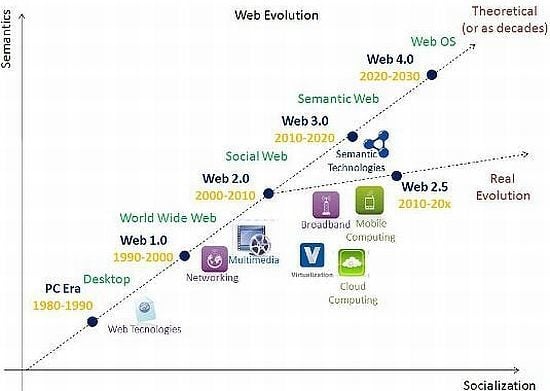
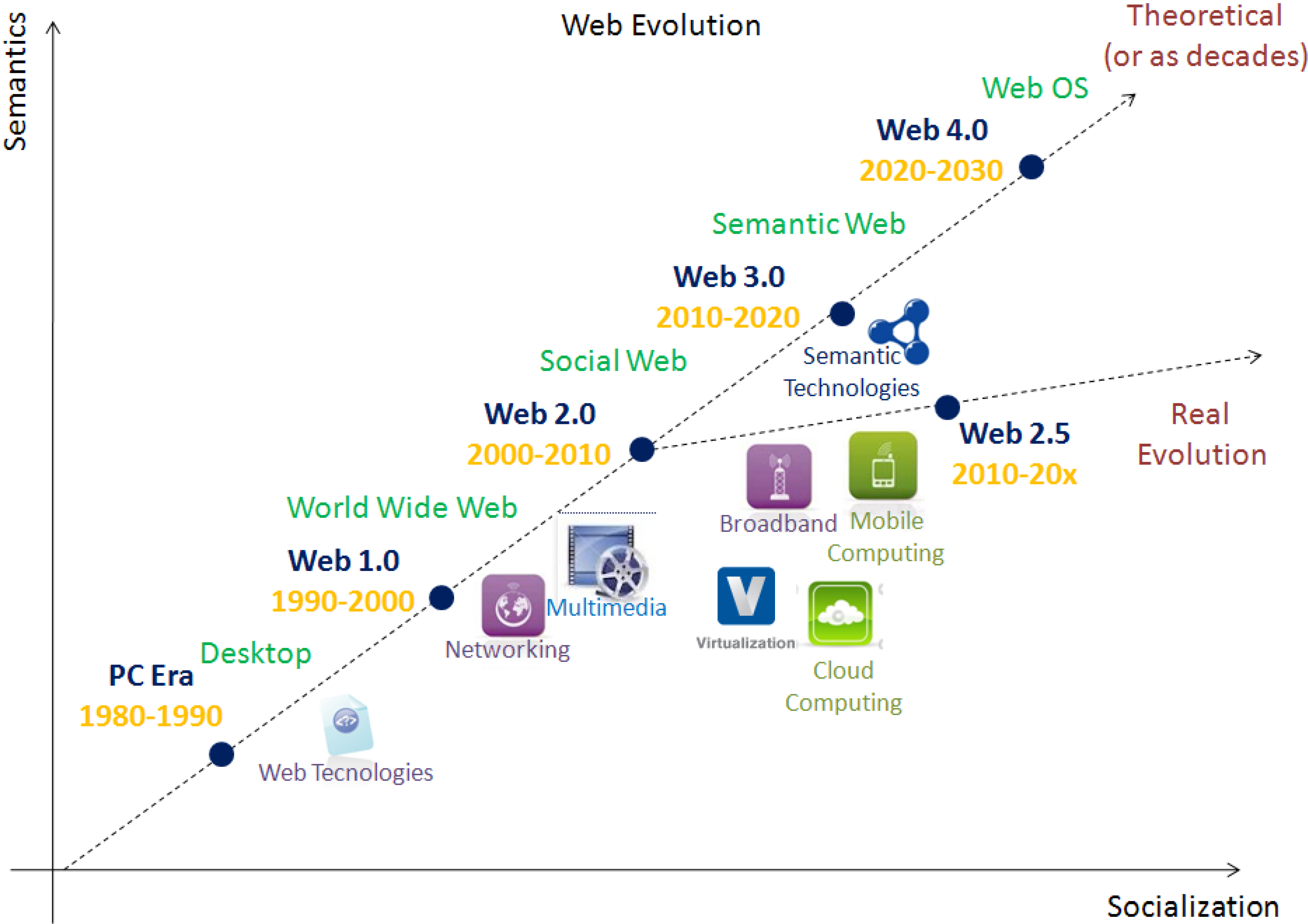
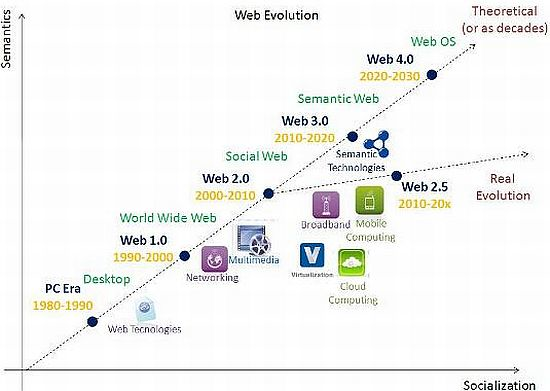
      <p>The nature, the role and the understanding of Web 2.5 is represented in <xref ref-type="fig" rid="futureinternet-04-00852-f001">Figure 1</xref>, where the theoretical evolution of the Web (in decades) is compared with the real evolution. As showed, the socialization is related to the application of semantics. The linear relation between them (as represented in the <xref ref-type="fig" rid="futureinternet-04-00852-f001">Figure 1</xref>) is just theoretical. The first decade of the computer (1980–1990) is commonly understood as the PC era (<xref ref-type="fig" rid="futureinternet-04-00852-f001">Figure 1</xref>), where the computation normally matches the “Desktop vision” that assumes individual computers have a strongly limited degree of co-operation. </p>
      <fig id="futureinternet-04-00852-f001" position="anchor">
        <label>Figure 1</label>
        <caption>
          <p>Theoretical <italic>vs</italic>. real Web evolution.</p>
        </caption>
        <graphic xmlns:xlink="http://www.w3.org/1999/xlink" xlink:href="futureinternet-04-00852-g001.tif"/>
      </fig>
      <p>The need for networking progressively addresses the first version of the Web and of the development of related technologies (web technologies). The Web 1.0 is also referred as syntactic web and it is associated with the decade between 1990–2000. In this period, the World Wide Web vision progressively replaces the Desktop vision.</p>
      <p>The second version of the Web (Social Web or Web 2.0) is related to the decade between 2000–2010. The strong socialization of the Web is clearly proven [<xref ref-type="bibr" rid="B1-futureinternet-04-00852">1</xref>]: improved multimedia capabilities [<xref ref-type="bibr" rid="B2-futureinternet-04-00852">2</xref>,<xref ref-type="bibr" rid="B3-futureinternet-04-00852">3</xref>] as well as content sharing facilities [<xref ref-type="bibr" rid="B4-futureinternet-04-00852">4</xref>] provided by broadband are a fact that determined not only web applications but also Rich Internet Applications [<xref ref-type="bibr" rid="B5-futureinternet-04-00852">5</xref>]. According to the theoretical evolution of the Web (<xref ref-type="fig" rid="futureinternet-04-00852-f001">Figure 1</xref>), the third decade should provide the thorough application of semantics [<xref ref-type="bibr" rid="B6-futureinternet-04-00852">6</xref>], although considering the strong advances of the last generation of semantic technologies, there is an objective delay. On the other hand, during the past few years, virtualization techniques (e.g., [<xref ref-type="bibr" rid="B7-futureinternet-04-00852">7</xref>]), cloud vision [<xref ref-type="bibr" rid="B8-futureinternet-04-00852">8</xref>] and above all, mobile computing [<xref ref-type="bibr" rid="B9-futureinternet-04-00852">9</xref>] alongside the increasing use of smart devices, provides interesting new scenarios. These scenarios, both with the latest advancement in the development of semantic technologies, are converging on the Web 2.5 concept to address a model of the Web beyond the social (Web 2.0) but not yet semantic (Web 3.0). If the analysis in <xref ref-type="fig" rid="futureinternet-04-00852-f001">Figure 1</xref> is focused just on the relation between socialization and semantics, according to the forecasts, it should have been evolving in accordance with a linear relation. The facts are highlighting socialization as a faster process than the affirmation of semantics. This non linear relation produced the Web 2.5 and not (yet) the Web 3.0.</p>
      <p>This paper presents a formalization of the Web 2.5, based on the most natural understanding: the convergence between the socialization of the web and semantic technologies [<xref ref-type="bibr" rid="B10-futureinternet-04-00852">10</xref>,<xref ref-type="bibr" rid="B11-futureinternet-04-00852">11</xref>,<xref ref-type="bibr" rid="B12-futureinternet-04-00852">12</xref>,<xref ref-type="bibr" rid="B13-futureinternet-04-00852">13</xref>].</p>
      <p>The first part of the paper shortly discusses the Web 2.0 and the Web 3.0 as well as the technological (and probably also conceptual) gap between them.</p>
      <p>The key models are lightly formalized by using concept maps. Concept maps propose an approach for knowledge representation similar to semantic networks that build semantic relations among concepts through a directed or undirected graph consisting of vertices, which represent concepts, and edges. One of the benefits of using concept maps is that any conceptualization can start with less formal constraints, then increase (if required) formality gradually and eventually end up with the formation of an ontology. Furthermore, even though they can be considered just a simple tool, concept maps are a very expressive and powerful way for defining and representing knowledge. Simple relations or complex knowledge environments can be provided by using concept maps.</p>
      <p>The second part of the paper focuses on the definition of an alternative understanding of the Web 2.5 concept. This understanding from an application point of view mainly matches the technological requirements of a new emerging research field (known as Social and Community Intelligence) and related research areas (such as social computing, reality mining, urban computing, human-centric sensing). From a more conceptual point of view, the proposed understanding of Web 2.5 is the convergence between the social and semantics.</p>
    </sec>
    <sec>
      <title>2. From Web 2.0 to Web 3.0</title>
      <p>In this section a formalization of Web 2.0 and Web 3.0 is proposed on the basis of what are most likely their most popular definitions and understanding. The scope of the discussion is a brief overview of the main features of these models. An exhaustive analysis is beyond the paper scope.</p>
      <sec>
        <title>2.1. Social Web</title>
        <p>During the past decade, a new understanding of the concept of the Web, resulting in the progressive integration of Web application features that facilitate participatory information sharing, interoperability, user-centered design, and collaboration, has become increasingly more popular [<xref ref-type="bibr" rid="B14-futureinternet-04-00852">14</xref>]. A Web 2.0 site allows users to interact and collaborate with each other in social media dialogue as creators of user-generated content in a virtual community, in contrast to websites where users are limited to the passive viewing of content that was created for them [<xref ref-type="bibr" rid="B14-futureinternet-04-00852">14</xref>]. Examples of Web 2.0 include social networking sites, blogs, wikis, video sharing sites, hosted services, web applications, mashups and folksonomies [<xref ref-type="bibr" rid="B14-futureinternet-04-00852">14</xref>].</p>
        <p>Any Web 2.0 definitions that actually exist in literature are quite generic; some definitions are probably not too formal but none of them perfectly catch the key and critical issue: in the past, the Web evolved according to its progressive socialization.</p>
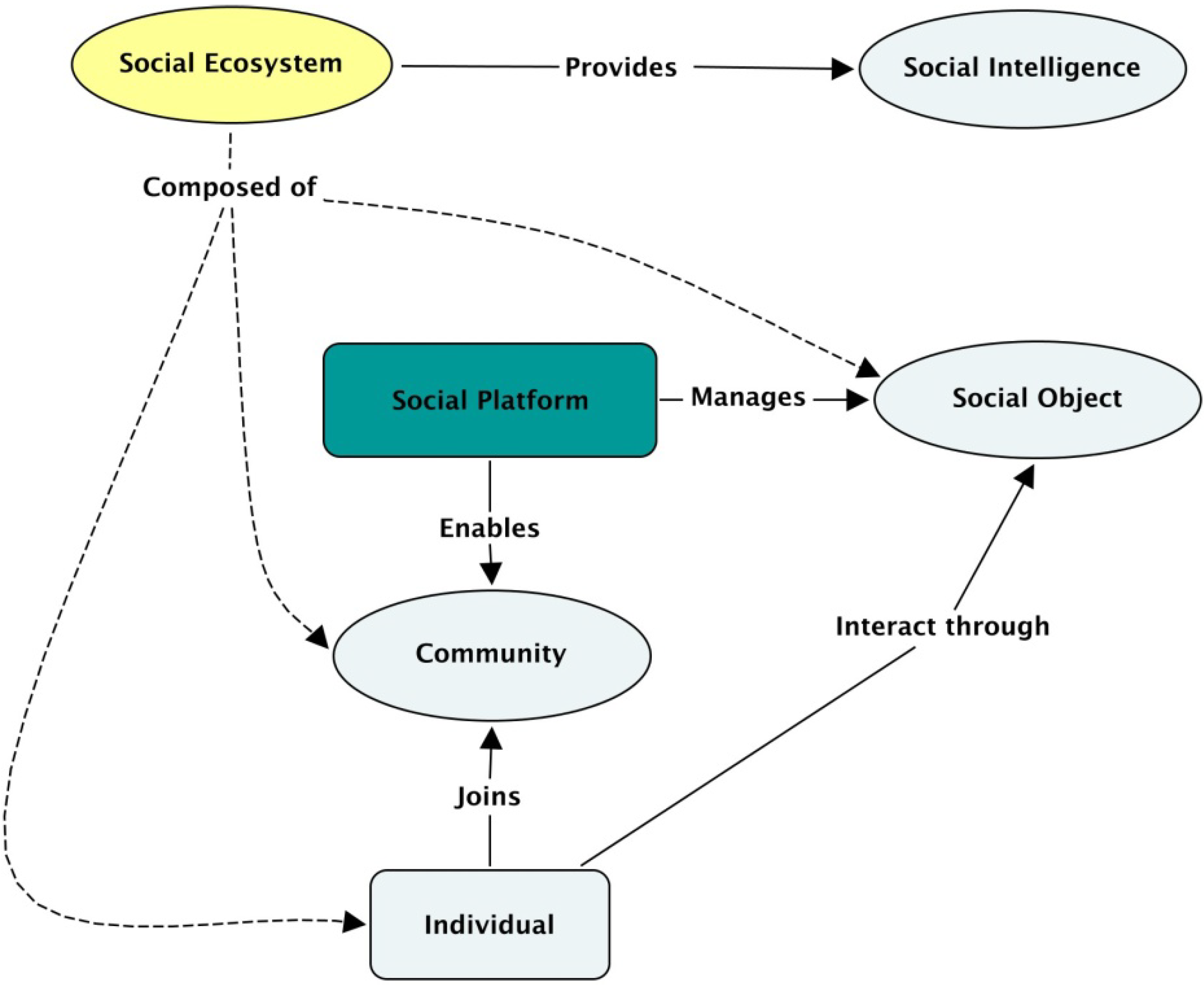
        <p>People are now considered not only as individual subjects but also (and above all) as members of communities (<xref ref-type="fig" rid="futureinternet-04-00852-f002">Figure 2</xref>). Communities are enabled by social platforms (<xref ref-type="fig" rid="futureinternet-04-00852-f002">Figure 2</xref>) that manage Social Objects (<xref ref-type="fig" rid="futureinternet-04-00852-f002">Figure 2</xref>). Social Objects link people in a relationship: they can be a text, a word or just a link.</p>
        <fig id="futureinternet-04-00852-f002" position="anchor">
          <label>Figure 2</label>
          <caption>
            <p>A light model for the Social Web by using concept maps.</p>
          </caption>
          <graphic xmlns:xlink="http://www.w3.org/1999/xlink" xlink:href="futureinternet-04-00852-g002.tif"/>
        </fig>
        <p>The interactions among individuals (inside and outside well defined communities) with the Social Objects that allow interactions define a Social Ecosystem (<xref ref-type="fig" rid="futureinternet-04-00852-f002">Figure 2</xref>).</p>
        <p>From a conceptual point of view, the most relevant feature of a Social Ecosystem is the intrinsic intelligence (Social Intelligence) that the ecosystem provides. From a more practical point of view, the “understanding” of related people interconnected through well-defined or generic tools can be approached in a completely different way with respect to individual subjects.</p>
        <p>According to this, Social Intelligence research has achieved a great level of importance in the last few years. There are more and more research groups interested in the creation of applications dependent on critical information that can be inferred from Social Ecosystems [<xref ref-type="bibr" rid="B15-futureinternet-04-00852">15</xref>,<xref ref-type="bibr" rid="B16-futureinternet-04-00852">16</xref>,<xref ref-type="bibr" rid="B17-futureinternet-04-00852">17</xref>,<xref ref-type="bibr" rid="B18-futureinternet-04-00852">18</xref>]. This scenario is creating an updated version of the Web.</p>
      </sec>
      <sec>
        <title>2.2. Semantic Web</title>
        <p>The Web was designed and developed as an overall information space composed of distributed content. The current Web concept is perfectly suitable for human-machine interaction as well as for human-human communication.</p>
        <p>If the interaction model is extended to the machine-to-machine interaction (meaning machines would be able to understand, participate and help), the current information model, explicitly designed for human consumption, is one of the major obstacles to evolution. The Semantic Web approach develops languages for expressing information in a way machines can process.</p>
        <p>The Semantic Web is not a completely new understanding of the current Web. It is not a separate Web but an extension of the current concept, in which information is provided according to rich schemas that allow computers and people to work in cooperation [<xref ref-type="bibr" rid="B19-futureinternet-04-00852">19</xref>]. Like the Internet, the Semantic Web will be as decentralized as possible [<xref ref-type="bibr" rid="B19-futureinternet-04-00852">19</xref>].</p>
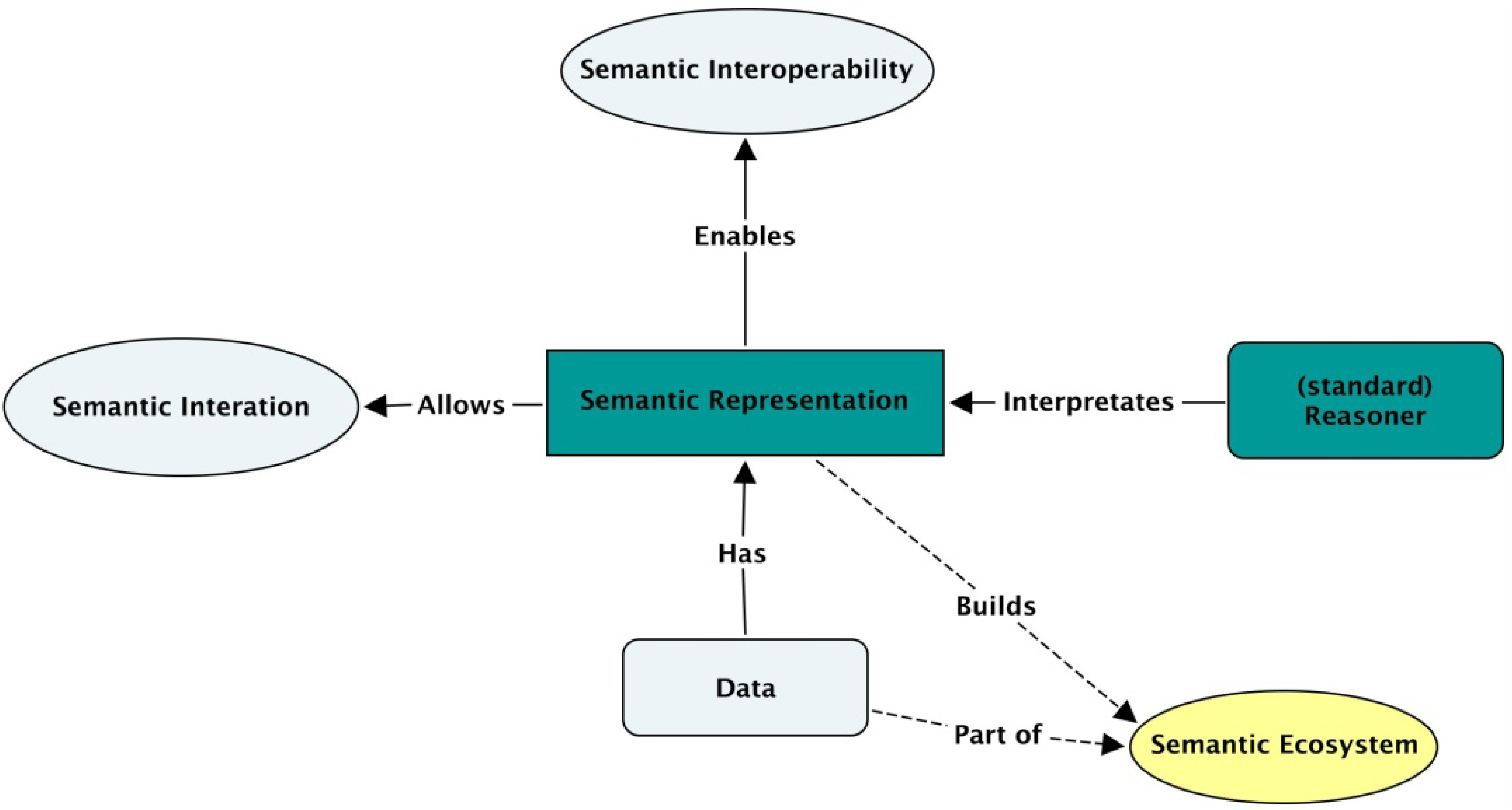
        <p>Semantic technologies are partially inverting the common view of knowledge building and artificial intelligence. The common interaction model, which assumes intelligent actors working with the information, is radically changed in a new interaction model (semantic interaction): actors (that are understood as standard interpreters called reasoners) are able to process and understand rich data models as “intelligence” and are implicitly resident in the knowledge model itself. In other words, schemas contain information and the “code” to interpret it.</p>
        <p>This new view of the interaction model also implies a new understanding of interoperability (Semantic Interoperability). Semantic interoperability improves common interoperability models [<xref ref-type="bibr" rid="B20-futureinternet-04-00852">20</xref>]: basic interoperability assumes the interchange of messages among systems without any interpretation [<xref ref-type="bibr" rid="B20-futureinternet-04-00852">20</xref>]; functional interoperability integrates basic interoperability models with the ability of interpreting data in context under the assumption of a shared schema for accessing data fields [<xref ref-type="bibr" rid="B20-futureinternet-04-00852">20</xref>]; semantic interoperability introduces the interpretation of the means of data [<xref ref-type="bibr" rid="B21-futureinternet-04-00852">21</xref>,<xref ref-type="bibr" rid="B22-futureinternet-04-00852">22</xref>,<xref ref-type="bibr" rid="B23-futureinternet-04-00852">23</xref>]. Semantic interoperability is a concretely applicable interaction model under the assumption of adopting rich data models (mostly called Ontology) composed of concepts within a domain and the relationships among those concepts.</p>
        <p>As with the Web 2.0/Social Web, the Semantic Web concept [<xref ref-type="bibr" rid="B19-futureinternet-04-00852">19</xref>] increasingly became very popular and it is considered one of the hottest research topics inside the scientific community. Due to its importance, a collaborative movement led by the World Wide Web Consortium (W3C) promotes common formats for data on the World Wide Web. By encouraging the inclusion of semantic content in web pages, the Semantic Web aims at converting the current web of unstructured documents into a “web of data” [<xref ref-type="bibr" rid="B10-futureinternet-04-00852">10</xref>]. According to the W3C, “The Semantic Web provides a common framework that allows data to be shared and reused across application, enterprise, and community boundaries.” </p>
        <p>There are lots of similar definitions of semantic web available in literature.</p>
        <p>In 2001 Tim Berners-Lee proposed an intuitive definition for Semantic Web: “The Semantic Web is an extension of the current Web in which information is given well-defined meaning, better enabling computers and people to work in co-operation” [<xref ref-type="bibr" rid="B19-futureinternet-04-00852">19</xref>].</p>
        <p>Another definition approaching the technical solution is presented in [<xref ref-type="bibr" rid="B24-futureinternet-04-00852">24</xref>]: “The explicit representation of the semantics of data, accompanied with schema definitions, will enable a Web that provides a qualitatively new level of service”.</p>
        <p>In [<xref ref-type="bibr" rid="B25-futureinternet-04-00852">25</xref>] the concept of interconnection of actionable information is added: “The Semantic Web is a Web of actionable information, derived from data through a semantic theory for interpreting the symbols. The semantic theory provides an account of “meaning” in which logical connection of terms establishes interoperability among systems.”</p>
        <p>Finally, in a more recent work [<xref ref-type="bibr" rid="B26-futureinternet-04-00852">26</xref>], the idea of machine interpretation is included: “The Semantic Web complements the current Web with machine process ability. Thus computers or machines become entities that extract and interpret information, rather than being just devices to post and render information for human users”.</p>
        <p>In <xref ref-type="fig" rid="futureinternet-04-00852-f003">Figure 3</xref>, a light model for the Semantic Web is proposed as a simple concept map: the semantic representation of data allows semantic ecosystems among semantic actors in a context of semantic interoperability.</p>
        <fig id="futureinternet-04-00852-f003" position="anchor">
          <label>Figure 3</label>
          <caption>
            <p>A light model for the Semantic Web by using concept maps.</p>
          </caption>
          <graphic xmlns:xlink="http://www.w3.org/1999/xlink" xlink:href="futureinternet-04-00852-g003.tif"/>
        </fig>
        <p>Even if the Semantic Web is a well-known concept and a clear evolving scenario, the current status of Semantic Technologies development permits thought in a futuristic and not yet mature technological environment. </p>
      </sec>
    </sec>
    <sec>
      <title>3. Social/Community Intelligence and Semantic Technologies: Web 2.5?</title>
      <p>The time gap between the first understanding of the Web 2.0 and the present has not been a static period. On the contrary, as previously mentioned, the Web was constantly evolving according to different needs and requirements from business and technology. </p>
      <p>A rather clear aspect that potentially provides one of the most effective methods to monitor the Web evolution is the increased and extended use of techniques that improve the current understanding of Web intelligence on the basis of Social Intelligence.</p>
      <p>There are a great number of projects and initiatives that are currently working in this line. A consistent general example is the power to manage social objects in the same way as other web contents. That would allow a new trend for knowledge discovery and building. </p>
      <p>Within this environment, some works focused on more specific purposes in the discovery of social information that are growing more and more in literature. For example, Never Ending Learning Language (NELL) [<xref ref-type="bibr" rid="B27-futureinternet-04-00852">27</xref>] is continuously gathering information in pairs, correlating all the information available on the net in order to create a big database of inferred information. That information can be processed in order to allow a large scale Social Intelligence. This research is normally interested in measuring the general emotions and opinions of people in determined communities [<xref ref-type="bibr" rid="B28-futureinternet-04-00852">28</xref>,<xref ref-type="bibr" rid="B29-futureinternet-04-00852">29</xref>,<xref ref-type="bibr" rid="B30-futureinternet-04-00852">30</xref>]. These emotions and general opinions can be used to take the emotional pulse and general and particular opinions of Social Communities. This information is very important for enterprises, politicians, governments, <italic>et</italic><italic>c.</italic> to know, for example, if the users accept their products, the popularity of specific personalities or the citizen’s opinion about the government. The interest of such a powerful stakeholder has increased the research in those areas. The last generation solutions [<xref ref-type="bibr" rid="B31-futureinternet-04-00852">31</xref>] are providing more advanced approaches. In [<xref ref-type="bibr" rid="B32-futureinternet-04-00852">32</xref>] the authors studied the correlation between book sales and their appearance in opinion blogs. In [<xref ref-type="bibr" rid="B33-futureinternet-04-00852">33</xref>] there is published a work that allows the user to predict the number of spectators in films by processing the critical opinions and spectators. In [<xref ref-type="bibr" rid="B34-futureinternet-04-00852">34</xref>] the sentiment propagation is evaluated: by using some experiments, authors have created Sentiment Maps to analyze how the emotions are propagated through the web. According this study, the individuals in communities are not affected in the same way as in Social Ecosystems. There are some key individuals that spread their own characteristics over their own relatives propagating more and more their opinions and sentiment and affecting positively or negatively Social Ecosystem.</p>
      <p>According to the growth of the need for new research on social intelligence, the techniques that allow this are increasing in their importance in research environments. This is the case of pattern recognition techniques. Pattern recognition research [<xref ref-type="bibr" rid="B35-futureinternet-04-00852">35</xref>] is usually based on using mathematic algorithms to process raw data in order to approximate the inherent models that explain the examples. High quantity of information from a variety of different writers and languages and the lack of a common structure in Web 2.0, has meant that pattern recognition technologies have been used as the most adequate resource for solving usual problems in this field. Techniques such as information retrieval [<xref ref-type="bibr" rid="B36-futureinternet-04-00852">36</xref>,<xref ref-type="bibr" rid="B37-futureinternet-04-00852">37</xref>], which supports the classification of web documents and are used by search engines to select the most adequate in each user search; Information Extraction [<xref ref-type="bibr" rid="B27-futureinternet-04-00852">27</xref>,<xref ref-type="bibr" rid="B33-futureinternet-04-00852">33</xref>], which looks for specific data like relationships, dates, definition of concepts, <italic>etc</italic>… within free text on the internet; opinion Mining [<xref ref-type="bibr" rid="B29-futureinternet-04-00852">29</xref>], or other Statistical based classifiers [<xref ref-type="bibr" rid="B38-futureinternet-04-00852">38</xref>], are examples of how Pattern Recognition is growing in importance in order to take profit of the Social Intelligence.</p>
      <p>It is evident that the conceptual and technological gap between the Social and the Semantic Web is higher than expected and the advances of the last few years are becoming more than middle steps to semantics. Evidently, the definition of various decimals (Web 2.<italic>x</italic>) could result not just an academic formalization, but the feeling for the need of something in the middle is more than a fact. So, how can Web 2.5 be defined?</p>
      <p>At the moment, there are not many “formal” definitions in literature. For example in [<xref ref-type="bibr" rid="B39-futureinternet-04-00852">39</xref>]: “A new form of symbiosis is developing on the Web. The current e-commerce model, which relies heavily on the supply of ‘free’ content, has made individuals and commercial enterprises mutually dependent: enterprises have built business models reliant on a currency of personal data, while individuals expect free access to services supplied by search engines, email systems and social networking sites and media services such as YouTube and Hulu. These ‘free’ services use personal data to generate revenues through targeted advertising, profile building, and the direct brokering of personal data. The symbiosis is essentially benign—it lies behind many recent positive developments. Both users and the businesses that provide online services benefit”. </p>
      <p>On the contrary, the term Web 2.5 is progressively becoming more popular in several specialized forums (such as blogs) where the concept is used in different contexts and meanings. By providing a short overview, Web 2.5 is associated with the Cloud an understanding of the Web [<xref ref-type="bibr" rid="B40-futureinternet-04-00852">40</xref>], as well as to the platform-as-a-service model; others refer to the concept as a light semantic model. Furthermore, a kind of concept derived directly or indirectly by mobile computation is often cited. Other definitions refer to the increasing integration, mobility and ubiquity of the Web or to improved multimedia and/or other web capabilities.</p>
      <p>If researchers assume there is a need to define middle concepts between the Social Web and the Semantic Web, then correspondent formal definitions and related conceptualizations should also be provided. The informal definitions previously summarized in this section focus on specific technological/social/business aspects of the current Web model but perhaps they are not completely addressing the semantic of Web 2.5.</p>
      <p>In the authors’ opinion, Web 2.0 definition should be driven by two simple different (but correlated) facts:</p>
      <list>
        <list-item>
          <p>(1) All advanced applications that currently work on social data are strongly limited by a fundamental lack of semantics in the background.</p>
        </list-item>
        <list-item>
          <p>(2) As of today, semantics cannot be widely applied, in a context of efficiency and effectiveness, for general purposes. That is not completely true for specific purposes, where the use of ontology and semantic annotations is objectively simpler than for a generic approach.</p>
        </list-item>
      </list>
      <p>If the main limitation of the most innovative approaches to the social intelligence is the lack of semantics and semantics can be applied to specific purpose, then the most clear and direct conclusion is that semantics could be applied to improve the social features of the Web. </p>
      <p>This approach also has certain coherence from a technological point of view:</p>
      <list>
        <list-item>
          <p>• Semantics are applied to the main feature of Web 2.0.</p>
        </list-item>
        <list-item>
          <p>• This is an ideal bridge to Web 3.0.</p>
        </list-item>
      </list>
      <p>That understanding of Web 2.5 completely matches the concept of the Social Semantic Web, which can be defined as a Web model in which social interactions on the Web lead to the creation of explicit and semantically rich knowledge representations [<xref ref-type="bibr" rid="B11-futureinternet-04-00852">11</xref>,<xref ref-type="bibr" rid="B12-futureinternet-04-00852">12</xref>,<xref ref-type="bibr" rid="B41-futureinternet-04-00852">41</xref>,<xref ref-type="bibr" rid="B42-futureinternet-04-00852">42</xref>]. The Social Semantic Web can be seen as a Web of collective knowledge systems, which are able to provide useful information based on human contributions and which get better as more people participate [<xref ref-type="bibr" rid="B11-futureinternet-04-00852">11</xref>,<xref ref-type="bibr" rid="B12-futureinternet-04-00852">12</xref>,<xref ref-type="bibr" rid="B41-futureinternet-04-00852">41</xref>,<xref ref-type="bibr" rid="B42-futureinternet-04-00852">42</xref>]. The Social Semantic Web combines technologies, strategies and methodologies from the Semantic Web, social software and the Web 2.0 [<xref ref-type="bibr" rid="B41-futureinternet-04-00852">41</xref>].</p>
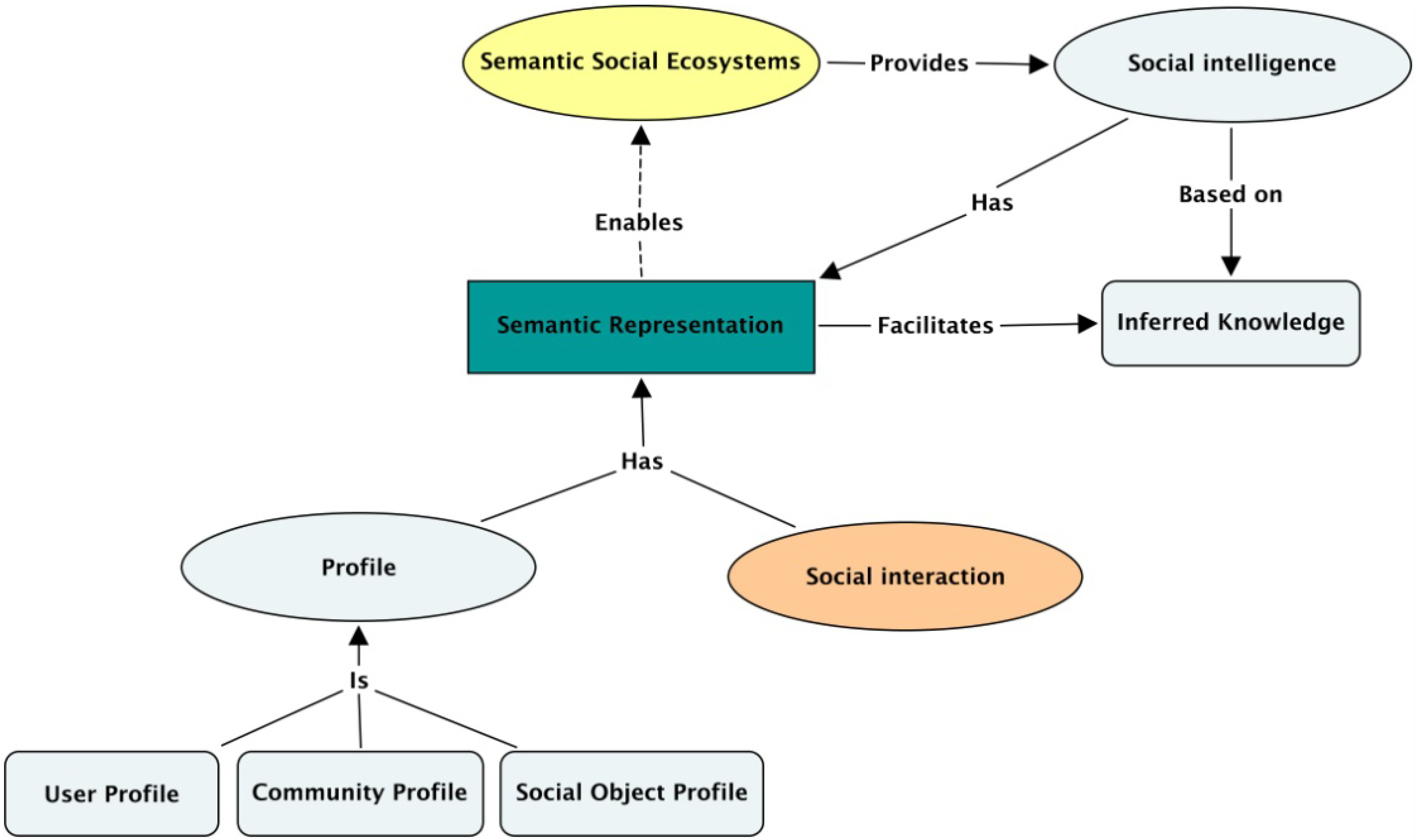
      <p>Also in this case, the most popular definitions are rather generic and probably quite ambiguous. In <xref ref-type="fig" rid="futureinternet-04-00852-f003">Figure 3</xref>, a conceptual map describing the most relevant features and concepts (as well as main relations between them) of the Social Semantic Web is proposed.</p>
      <p>The concept map in <xref ref-type="fig" rid="futureinternet-04-00852-f004">Figure 4</xref> is clearly a merging of the corresponding maps describing the Social Web (<xref ref-type="fig" rid="futureinternet-04-00852-f002">Figure 2</xref>) and the Semantic Web (<xref ref-type="fig" rid="futureinternet-04-00852-f003">Figure 3</xref>). The key and critical aspect is the semantic representation of any kind of profile (user, community, social object) involved in social interactions (<xref ref-type="fig" rid="futureinternet-04-00852-f004">Figure 4</xref>). The user profile is defined as in the most common understanding but it could have specific features in function of the concrete application field. The community profile can have several perspectives because a community can be centered on users (user-centric community), on social objects (e.g., interests, or atomic contents, <italic>etc</italic>.), on locations (geographic communities), <italic>etc</italic>. A full analysis of community models is out of the paper scope. Specific applications could use one or more perspectives for the community. The social object profile is also a root concept since social objects can be different among them (multimedia contents, text, interests, <italic>etc</italic>.). As for the community, the paper has not the aim of providing a deep and exhaustive analysis of the modeling. Specific applications can work on one or more perspectives of social objects as well as by using specific semantic representations. One of the most innovative aspects of the Social Semantic Web is that Social Interaction itself could also have a semantic representation, enabling advanced scenarios and capabilities for the next generation applications. </p>
      <p>Semantic representations allow social ecosystems defined by rich semantic data (Semantic Social Ecosystems). In this way, the Social Intelligence, as well as any other kind of knowledge, can be built or inferred by using the classic benefits of semantics. Furthermore, a knowledge model based on semantic technologies could provide increased and improved capabilities for the management of open models (e.g., open link data) where statements within social interaction could be better understood by semantic analysis of messages exchanged.</p>
      <p>Simple but consistent examples of benefits provided by semantic technologies to typical Web 2.0 applications are Semantic Wikis and Semantic Desktop. </p>
      <p>Wikis are a powerful tool for knowledge sharing typical of the Web 2.0. Nevertheless, the different concepts provided by different writers out of various semantic schemas produce semantic and conceptual inconsistencies among the different definitions [<xref ref-type="bibr" rid="B43-futureinternet-04-00852">43</xref>]. In this way, the concept of Semantic Wiki [<xref ref-type="bibr" rid="B44-futureinternet-04-00852">44</xref>,<xref ref-type="bibr" rid="B45-futureinternet-04-00852">45</xref>] is becoming an important technology in finding a solution to this problem: the Semantic Wiki proposes the use of semantic technologies to unify and link equivalent concepts, to establish relationships among heterogeneous concepts and to bridge together semantic concepts and knowledge.</p>
	  <fig id="futureinternet-04-00852-f004" position="anchor">
        <label>Figure 4</label>
        <caption>
          <p>A light model for the Social Semantic Web by using concept maps.</p>
        </caption>
        <graphic xmlns:xlink="http://www.w3.org/1999/xlink" xlink:href="futureinternet-04-00852-g004.tif"/>
      </fig>
      
      <p>On the other hand, current user computers have a great quantity of information stored. It is more than usual that users can not deal with this quantity of data, losing a lot of time looking for specific content. Indexing algorithms are able to accelerate these searches. Nevertheless, like a wiki, the query concepts are inconsistent and it is necessary to unify them. Semantic desktops [<xref ref-type="bibr" rid="B46-futureinternet-04-00852">46</xref>,<xref ref-type="bibr" rid="B47-futureinternet-04-00852">47</xref>] are the solution provided in order to allow semantic queries within the computer documents.</p>
    </sec>
    <sec sec-type="conclusions">
      <title>4. Conclusions</title>
      <p>The evolution of the Web is an active process that involves technological, social and most likely, economic factors. The progressive socialization of the Web, together with the related requirements in terms of interoperability, produced the model normally referred as Social Web or Web 2.0.</p>
      <p>In this way, as usual, researchers have been progressively focusing on the next generation Web (the third one) by proposing semantic technologies as the further step for the Web evolution. The technological gap between Web 2.0 and Web 3.0 appears much more consistent than in the first forecast. It is commonly assumed that Web 3.0 is not yet mature. That “delay” has determined a long period of time between these two models. This period is not a “static time” or a timeout for the Web evolution. On the contrary, the web is evolving in several directions. This is the main reason for providing a middle concept (the Web 2.5) between the current overused definition of Web 2.0 and the next generation (3.0) of the Web, yet-to-be- realized for the most part. </p>
      <p>So the question remains: what is Web 2.5? The answer is evidently related to the evolution over the last few years from the “original” version of the Web 2.0. There are different possibilities: for example, the ever popular Cloud model for the Web.</p>
      <p>In this paper, the definition of the Web 2.5 is directly associated to the convergence between social and semantic technologies (exactly as the term suggests). The application of semantic technologies in order to improve the socialization of the web, on one hand, could provide further capabilities by assuring the common benefits provided by semantics. On the other hand, a further step to the web 3.0 is taken: semantics are not widely used but they are focused on specific aspects of knowledge building and representation (social objects and so on). In that way, most of the problems related to the management of vocabularies are avoided as well, as it is relatively easy to agree on standards. </p>
    </sec>
  </body>
  <back>
    <ref-list>
      <title>References</title>
      <ref id="B1-futureinternet-04-00852">
        <label>1.</label>
        <citation citation-type="journal">
          <person-group person-group-type="author">
            <name>
              <surname>Chi</surname>
              <given-names>E.H.</given-names>
            </name>
          </person-group>
          <article-title>The social web: Research and opportunities</article-title>
          <source>Computer</source>
          <year>2008</year>
          <volume>41</volume>
          <fpage>88</fpage>
          <lpage>91</lpage>
          <pub-id pub-id-type="doi">10.1109/MC.2008.401</pub-id>
        </citation>
      </ref>
      <ref id="B2-futureinternet-04-00852">
        <label>2.</label>
        <citation citation-type="journal">
          <person-group person-group-type="author">
            <name>
              <surname>Bulterman</surname>
              <given-names>D.C.A.</given-names>
            </name>
          </person-group>
          <article-title>SMIL 2.0 part 1: Overview, concepts, and structure</article-title>
          <source>Multimed. IEEE</source>
          <year>2001</year>
          <volume>8</volume>
          <fpage>82</fpage>
          <lpage>88</lpage>
          <pub-id pub-id-type="doi">10.1109/93.959106</pub-id>
        </citation>
      </ref>
      <ref id="B3-futureinternet-04-00852">
        <label>3.</label>
        <citation citation-type="journal">
          <person-group person-group-type="author">
            <name>
              <surname>Boll</surname>
              <given-names>S.</given-names>
            </name>
          </person-group>
          <article-title>MultiTube—Where Web 2.0 and multimedia could meet</article-title>
          <source>Multimed. IEEE</source>
          <year>2007</year>
          <volume>14</volume>
          <fpage>9</fpage>
          <lpage>13</lpage>
          <pub-id pub-id-type="doi">10.1109/MMUL.2007.17</pub-id>
        </citation>
      </ref>
      <ref id="B4-futureinternet-04-00852">
        <label>4.</label>
        <citation citation-type="confproc">
          <person-group person-group-type="author">
            <name>
              <surname>Kurkovsky</surname>
              <given-names>S.</given-names>
            </name>
            <name>
              <surname>Strimple</surname>
              <given-names>D.</given-names>
            </name>
            <name>
              <surname>Nuzzi</surname>
              <given-names>E.</given-names>
            </name>
            <name>
              <surname>Verdecchia</surname>
              <given-names>K.</given-names>
            </name>
          </person-group>
          <article-title>Convergence of Web 2.0 and SOA: Taking Advantage of Web Services to Implement a Multimodal Social Networking System</article-title>
          <source>Proceedings of the 11th IEEE International Conference on Computational Science and Engineering Workshops</source>
          <conf-loc>Sao Paulo, Brasil</conf-loc>
          <conf-date>16–18 July 2008</conf-date>
          <fpage>227</fpage>
          <lpage>232</lpage>
        </citation>
      </ref>
      <ref id="B5-futureinternet-04-00852">
        <label>5.</label>
        <citation citation-type="journal">
          <person-group person-group-type="author">
            <name>
              <surname>Fraternali</surname>
              <given-names>P.</given-names>
            </name>
            <name>
              <surname>Rossi</surname>
              <given-names>G.</given-names>
            </name>
            <name>
              <surname>Sánchez-Figueroa</surname>
              <given-names>F.</given-names>
            </name>
          </person-group>
          <article-title>Rich internet applications</article-title>
          <source>IEEE Int. Comput.</source>
          <year>2010</year>
          <volume>14</volume>
          <fpage>9</fpage>
          <lpage>12</lpage>
          <pub-id pub-id-type="doi">10.1109/MIC.2010.76</pub-id>
        </citation>
      </ref>
      <ref id="B6-futureinternet-04-00852">
        <label>6.</label>
        <citation citation-type="journal">
          <person-group person-group-type="author">
            <name>
              <surname>Lassila</surname>
              <given-names>O.</given-names>
            </name>
            <name>
              <surname>Hendler</surname>
              <given-names>J.</given-names>
            </name>
          </person-group>
          <article-title>Embracing “Web 3.0”</article-title>
          <source>Int. Comput. IEEE</source>
          <year>2007</year>
          <volume>11</volume>
          <fpage>90</fpage>
          <lpage>93</lpage>
          <pub-id pub-id-type="doi">10.1109/MIC.2007.52</pub-id>
        </citation>
      </ref>
      <ref id="B7-futureinternet-04-00852">
        <label>7.</label>
        <citation citation-type="confproc">
          <person-group person-group-type="author">
            <name>
              <surname>Papagianni</surname>
              <given-names>C.</given-names>
            </name>
            <name>
              <surname>Karagiannis</surname>
              <given-names>G.</given-names>
            </name>
            <name>
              <surname>Tselikas</surname>
              <given-names>N.D.</given-names>
            </name>
            <name>
              <surname>Sfakianakis</surname>
              <given-names>E.</given-names>
            </name>
            <name>
              <surname>Chochliouros</surname>
              <given-names>I.P.</given-names>
            </name>
            <name>
              <surname>Kabilafkas</surname>
              <given-names>D.</given-names>
            </name>
            <name>
              <surname>Cinkler</surname>
              <given-names>T.</given-names>
            </name>
            <name>
              <surname>Westberg</surname>
              <given-names>L.</given-names>
            </name>
            <name>
              <surname>Sjodin</surname>
              <given-names>P.</given-names>
            </name>
            <name>
              <surname>Hidell</surname>
              <given-names>M.</given-names>
            </name>
            <etal/>
          </person-group>
          <article-title>Supporting End-to-End Resource Virtualization for Web 2.0 Applications Using Service Oriented Architecture</article-title>
          <source>Proceedings of the IEEE Globecom Workshops</source>
          <conf-loc>New Orleans, LA, USA</conf-loc>
          <conf-date>30 November–4 December 2008</conf-date>
        </citation>
      </ref>
      <ref id="B8-futureinternet-04-00852">
        <label>8.</label>
        <citation citation-type="journal">
          <person-group person-group-type="author">
            <name>
              <surname>Dikaiakos</surname>
              <given-names>M.D.</given-names>
            </name>
            <name>
              <surname>Katsaros</surname>
              <given-names>D.</given-names>
            </name>
            <name>
              <surname>Mehra</surname>
              <given-names>P.</given-names>
            </name>
            <name>
              <surname>Pallis</surname>
              <given-names>G.</given-names>
            </name>
            <name>
              <surname>Vakali</surname>
              <given-names>A.</given-names>
            </name>
          </person-group>
          <article-title>Cloud computing: Distributed internet computing for IT and scientific research</article-title>
          <source>Int. Comput. IEEE</source>
          <year>2009</year>
          <volume>13</volume>
          <fpage>10</fpage>
          <lpage>13</lpage>
        </citation>
      </ref>
      <ref id="B9-futureinternet-04-00852">
        <label>9.</label>
        <citation citation-type="journal">
          <person-group person-group-type="author">
            <name>
              <surname>Mangione-Smith</surname>
              <given-names>W.H.</given-names>
            </name>
          </person-group>
          <article-title>Mobile computing and smart spaces</article-title>
          <source>Concurr. IEEE</source>
          <year>1998</year>
          <volume>6</volume>
          <fpage>5</fpage>
          <lpage>7</lpage>
          <pub-id pub-id-type="doi">10.1109/4434.736391</pub-id>
        </citation>
      </ref>
      <ref id="B10-futureinternet-04-00852">
        <label>10.</label>
        <citation citation-type="book">
          <person-group person-group-type="author">
            <name>
              <surname>Wahlster</surname>
              <given-names>W.</given-names>
            </name>
            <name>
              <surname>Dengel</surname>
              <given-names>A.</given-names>
            </name>
          </person-group>
          <article-title>Web 3.0: Convergence of Web 2.0 and the Semantic Web</article-title>
          <source>Technology Radar, Feature Paper</source>
          <edition>2nd</edition>
          <publisher-name>Deutsche Telekom Laboratories</publisher-name>
          <publisher-loc>Berlin, Germany</publisher-loc>
          <year>2006</year>
          <fpage>1</fpage>
          <lpage>23</lpage>
        </citation>
      </ref>
      <ref id="B11-futureinternet-04-00852">
        <label>11.</label>
        <citation citation-type="journal">
          <person-group person-group-type="author">
            <name>
              <surname>Greaves</surname>
              <given-names>M.</given-names>
            </name>
          </person-group>
          <article-title>Semantic Web 2.0</article-title>
          <source>Intell. Syst. IEEE</source>
          <year>2007</year>
          <volume>22</volume>
          <fpage>94</fpage>
          <lpage>96</lpage>
          <pub-id pub-id-type="doi">10.1109/MIS.2007.40</pub-id>
        </citation>
      </ref>
      <ref id="B12-futureinternet-04-00852">
        <label>12.</label>
        <citation citation-type="journal">
          <person-group person-group-type="author">
            <name>
              <surname>Bojars</surname>
              <given-names>U.</given-names>
            </name>
          </person-group>
          <article-title>Interlinking the social web with semantics</article-title>
          <source>Intell. Syst. IEEE</source>
          <year>2008</year>
          <volume>23</volume>
          <fpage>29</fpage>
          <lpage>40</lpage>
          <pub-id pub-id-type="doi">10.1109/MIS.2008.50</pub-id>
        </citation>
      </ref>
      <ref id="B13-futureinternet-04-00852">
        <label>13.</label>
        <citation citation-type="confproc">
          <person-group person-group-type="author">
            <name>
              <surname>Mika</surname>
              <given-names>P.</given-names>
            </name>
          </person-group>
          <article-title>Social Networks and the Semantic Web</article-title>
          <source>Proceedings of IEEE/WIC/ACM International Conference on Web Intelligence</source>
          <conf-loc>Beijing, China</conf-loc>
          <conf-date>20–24 September 2004</conf-date>
          <fpage>285</fpage>
          <lpage>291</lpage>
        </citation>
      </ref>
      <ref id="B14-futureinternet-04-00852">
        <label>14.</label>
        <citation citation-type="web">
          <person-group person-group-type="author">
            <name>
              <surname>O’Reilly</surname>
              <given-names>T.</given-names>
            </name>
          </person-group>
          <article-title>Definition of Web 2.0</article-title>
          <year>2012</year>
          <access-date>(accessed on 10 June 2012)</access-date>
          <comment>Available online:<ext-link xmlns:xlink="http://www.w3.org/1999/xlink" xlink:href="http://www.oreillynet.com/pub/a/oreilly/tim/news/2005/09/30/what-is-web-20.html" ext-link-type="uri">http://www.oreillynet.com/pub/a/oreilly/tim/news/2005/09/30/what-is-web-20.html</ext-link></comment>
        </citation>
      </ref>
      <ref id="B15-futureinternet-04-00852">
        <label>15.</label>
        <citation citation-type="journal">
          <person-group person-group-type="author">
            <name>
              <surname>Zhang</surname>
              <given-names>D.</given-names>
            </name>
            <name>
              <surname>Guo</surname>
              <given-names>B.</given-names>
            </name>
            <name>
              <surname>Yu</surname>
              <given-names>Z.</given-names>
            </name>
          </person-group>
          <article-title>The emergence of social and community intelligence</article-title>
          <source>Computer</source>
          <year>2011</year>
          <volume>44</volume>
          <fpage>21</fpage>
          <lpage>28</lpage>
          <pub-id pub-id-type="doi">10.1109/MC.2011.65</pub-id>
        </citation>
      </ref>
      <ref id="B16-futureinternet-04-00852">
        <label>16.</label>
        <citation citation-type="journal">
          <person-group person-group-type="author">
            <name>
              <surname>Pentland</surname>
              <given-names>A.</given-names>
            </name>
          </person-group>
          <article-title>Socially aware computation and communication</article-title>
          <source>Computer</source>
          <year>2005</year>
          <volume>38</volume>
          <fpage>33</fpage>
          <lpage>40</lpage>
          <pub-id pub-id-type="doi">10.1109/MC.2005.104</pub-id>
        </citation>
      </ref>
      <ref id="B17-futureinternet-04-00852">
        <label>17.</label>
        <citation citation-type="journal">
          <person-group person-group-type="author">
            <name>
              <surname>Staab</surname>
              <given-names>S.</given-names>
            </name>
            <name>
              <surname>Domingos</surname>
              <given-names>P.</given-names>
            </name>
            <name>
              <surname>Mike</surname>
              <given-names>P.</given-names>
            </name>
            <name>
              <surname>Golbeck</surname>
              <given-names>J.</given-names>
            </name>
            <name>
              <surname>Ding</surname>
              <given-names>L.</given-names>
            </name>
            <name>
              <surname>Finin</surname>
              <given-names>T.</given-names>
            </name>
            <name>
              <surname>Joshi</surname>
              <given-names>A.</given-names>
            </name>
            <name>
              <surname>Nowak</surname>
              <given-names>A.</given-names>
            </name>
            <name>
              <surname>Vallacher</surname>
              <given-names>R.R.</given-names>
            </name>
          </person-group>
          <article-title>Social networks applied</article-title>
          <source>IEEE Intell. Syst.</source>
          <year>2005</year>
          <volume>20</volume>
          <fpage>80</fpage>
          <lpage>93</lpage>
          <pub-id pub-id-type="doi">10.1109/MIS.2005.16</pub-id>
        </citation>
      </ref>
      <ref id="B18-futureinternet-04-00852">
        <label>18.</label>
        <citation citation-type="journal">
          <person-group person-group-type="author">
            <name>
              <surname>Wang</surname>
              <given-names>F.</given-names>
            </name>
            <name>
              <surname>Kathleen</surname>
              <given-names>M.C.</given-names>
            </name>
            <name>
              <surname>Zeng</surname>
              <given-names>D.</given-names>
            </name>
            <name>
              <surname>Mao</surname>
              <given-names>W.</given-names>
            </name>
          </person-group>
          <article-title>Social computing: from social informatics to social intelligence</article-title>
          <source>IEEE Intell. Syst.</source>
          <year>2005</year>
          <volume>20</volume>
          <fpage>79</fpage>
          <lpage>83</lpage>
        </citation>
      </ref>
      <ref id="B19-futureinternet-04-00852">
        <label>19.</label>
        <citation citation-type="web">
          <person-group person-group-type="author">
            <name>
              <surname>Berners-Lee</surname>
              <given-names>T.</given-names>
            </name>
            <name>
              <surname>Hendler</surname>
              <given-names>J.</given-names>
            </name>
            <name>
              <surname>Lassila</surname>
              <given-names>O.</given-names>
            </name>
          </person-group>
          <article-title>The Semantic Web</article-title>
          <source>Scientific American</source>
          <year>2001</year>
          <volume>279</volume>
          <access-date>(accessed on 18 September 2012)</access-date>
          <comment>Available online:<ext-link xmlns:xlink="http://www.w3.org/1999/xlink" xlink:href="http://www.scientificamerican.com/article.cfm?id=the-semantic-web" ext-link-type="uri">http://www.scientificamerican.com/article.cfm?id=the-semantic-web</ext-link></comment>
        </citation>
      </ref>
      <ref id="B20-futureinternet-04-00852">
        <label>20.</label>
        <citation citation-type="confproc">
          <person-group person-group-type="author">
            <name>
              <surname>Pileggi</surname>
              <given-names>S.F.</given-names>
            </name>
            <name>
              <surname>Palau</surname>
              <given-names>C.E.</given-names>
            </name>
            <name>
              <surname>Esteve</surname>
              <given-names>M.</given-names>
            </name>
          </person-group>
          <article-title>Building Semantic Sensor Web: Knowledge and Interoperability</article-title>
          <source>Proceedings of the International Workshop on Semantic Sensor Web (SSW)</source>
          <conf-loc>Valencia, Spain</conf-loc>
          <conf-date>27–28 October 2010</conf-date>
        </citation>
      </ref>
      <ref id="B21-futureinternet-04-00852">
        <label>21.</label>
        <citation citation-type="journal">
          <person-group person-group-type="author">
            <name>
              <surname>Decker</surname>
              <given-names>S.</given-names>
            </name>
            <name>
              <surname>Melnik</surname>
              <given-names>S.</given-names>
            </name>
            <name>
              <surname>van Harmelen</surname>
              <given-names>F.</given-names>
            </name>
            <name>
              <surname>Fensel</surname>
              <given-names>D.</given-names>
            </name>
            <name>
              <surname>Klein</surname>
              <given-names>M.</given-names>
            </name>
            <name>
              <surname>Broekstra</surname>
              <given-names>J.</given-names>
            </name>
            <name>
              <surname>Erdmann</surname>
              <given-names>M.</given-names>
            </name>
            <name>
              <surname>Horrocks</surname>
              <given-names>I.</given-names>
            </name>
          </person-group>
          <article-title>The Semantic Web: The roles of XML and RDF</article-title>
          <source>Int. Comput. IEEE</source>
          <year>2000</year>
          <volume>4</volume>
          <fpage>63</fpage>
          <lpage>73</lpage>
        </citation>
      </ref>
      <ref id="B22-futureinternet-04-00852">
        <label>22.</label>
        <citation citation-type="web">
          <article-title>OWL Web Ontology Language Overview</article-title>
          <access-date>(accessed on 10 June 2012)</access-date>
          <comment>Available online:<ext-link xmlns:xlink="http://www.w3.org/1999/xlink" xlink:href="http://www.w3.org/TR/owl-features/" ext-link-type="uri">http://www.w3.org/TR/owl-features/</ext-link></comment>
        </citation>
      </ref>
      <ref id="B23-futureinternet-04-00852">
        <label>23.</label>
        <citation citation-type="journal">
          <person-group person-group-type="author">
            <name>
              <surname>Lenzerini</surname>
              <given-names>M.</given-names>
            </name>
          </person-group>
          <article-title>Models for semantic interoperability in service-oriented architectures</article-title>
          <source>IBM Syst. J.</source>
          <year>2005</year>
          <volume>44</volume>
          <fpage>887</fpage>
          <lpage>903</lpage>
          <pub-id pub-id-type="doi">10.1147/sj.444.0887</pub-id>
        </citation>
      </ref>
      <ref id="B24-futureinternet-04-00852">
        <label>24.</label>
        <citation citation-type="journal">
          <person-group person-group-type="author">
            <name>
              <surname>Fensel</surname>
              <given-names>D.</given-names>
            </name>
            <name>
              <surname>Musen</surname>
              <given-names>M.A.</given-names>
            </name>
          </person-group>
          <article-title>The Semantic Web: A brain for humankind</article-title>
          <source>IEEE Intell. Syst.</source>
          <year>2001</year>
          <volume>2</volume>
          <fpage>24</fpage>
          <lpage>25</lpage>
          <pub-id pub-id-type="doi">10.1109/MIS.2001.920595</pub-id>
        </citation>
      </ref>
      <ref id="B25-futureinternet-04-00852">
        <label>25.</label>
        <citation citation-type="journal">
          <person-group person-group-type="author">
            <name>
              <surname>Shadbolt</surname>
              <given-names>N.</given-names>
            </name>
            <name>
              <surname>Hall</surname>
              <given-names>W.</given-names>
            </name>
            <name>
              <surname>Berners-Lee</surname>
              <given-names>T.</given-names>
            </name>
          </person-group>
          <article-title>The semantic web revisited</article-title>
          <source>Intell. Syst. IEEE</source>
          <year>2006</year>
          <volume>21</volume>
          <fpage>96</fpage>
          <lpage>101</lpage>
        </citation>
      </ref>
      <ref id="B26-futureinternet-04-00852">
        <label>26.</label>
        <citation citation-type="book">
          <person-group person-group-type="author">
            <name>
              <surname>Fensel</surname>
              <given-names>D.</given-names>
            </name>
            <name>
              <surname>Facca</surname>
              <given-names>F.M.</given-names>
            </name>
            <name>
              <surname>Simperl</surname>
              <given-names>E.</given-names>
            </name>
            <name>
              <surname>Toma</surname>
              <given-names>I.</given-names>
            </name>
            <name>
              <surname>Fensel</surname>
              <given-names>D.</given-names>
            </name>
            <name>
              <surname>Facca</surname>
              <given-names>F.M.</given-names>
            </name>
            <name>
              <surname>Simperl</surname>
              <given-names>E.</given-names>
            </name>
            <name>
              <surname>Toma</surname>
              <given-names>I.</given-names>
            </name>
          </person-group>
          <article-title>Semantic Web</article-title>
          <source>Semantic Web Services</source>
          <publisher-name>Springer</publisher-name>
          <publisher-loc>Berlin, Germany</publisher-loc>
          <year>2011</year>
          <fpage>87</fpage>
          <lpage>104</lpage>
        </citation>
      </ref>
      <ref id="B27-futureinternet-04-00852">
        <label>27.</label>
        <citation citation-type="confproc">
          <person-group person-group-type="author">
            <name>
              <surname>Talukdar</surname>
              <given-names>P.P.</given-names>
            </name>
            <name>
              <surname>Wijaya</surname>
              <given-names>D.</given-names>
            </name>
            <name>
              <surname>Mitchell</surname>
              <given-names>T.</given-names>
            </name>
          </person-group>
          <article-title>Coupled Temporal Scoping of Relational Facts</article-title>
          <source>Proceedings of the Fifth ACM International Conference on Web Search and Data Mining (WSDM) Association for Computing Machinery</source>
          <conf-loc>Washington, DC, USA</conf-loc>
          <conf-date>8–12 February 2012</conf-date>
        </citation>
      </ref>
      <ref id="B28-futureinternet-04-00852">
        <label>28.</label>
        <citation citation-type="journal">
          <person-group person-group-type="author">
            <name>
              <surname>Dodds</surname>
              <given-names>P.S.</given-names>
            </name>
            <name>
              <surname>Danforth</surname>
              <given-names>C.M.</given-names>
            </name>
          </person-group>
          <article-title>Measuring the happiness of large-scale written expression: Songs, blogs, and presidents</article-title>
          <source>J. Happiness Stud.</source>
          <year>2010</year>
          <volume>11</volume>
          <fpage>441</fpage>
          <lpage>456</lpage>
          <pub-id pub-id-type="doi">10.1007/s10902-009-9150-9</pub-id>
        </citation>
      </ref>
      <ref id="B29-futureinternet-04-00852">
        <label>29.</label>
        <citation citation-type="journal">
          <person-group person-group-type="author">
            <name>
              <surname>Pang</surname>
              <given-names>B.</given-names>
            </name>
            <name>
              <surname>Lee</surname>
              <given-names>L.</given-names>
            </name>
          </person-group>
          <article-title>Opinion mining and sentiment analysis</article-title>
          <source>Found. Trends Inf. Retr.</source>
          <year>2008</year>
          <volume>1</volume>
          <fpage>1</fpage>
          <lpage>135</lpage>
          <pub-id pub-id-type="doi">10.1561/1500000011</pub-id>
        </citation>
      </ref>
      <ref id="B30-futureinternet-04-00852">
        <label>30.</label>
        <citation citation-type="journal">
          <person-group person-group-type="author">
            <name>
              <surname>Thelwall</surname>
              <given-names>M.</given-names>
            </name>
            <name>
              <surname>Buckley</surname>
              <given-names>K.</given-names>
            </name>
            <name>
              <surname>Paltoglou</surname>
              <given-names>G.</given-names>
            </name>
          </person-group>
          <article-title>Sentiment in Twitter events</article-title>
          <source>J. Am. Soc. Inf. Sci. Technol.</source>
          <year>2012</year>
          <volume>63</volume>
          <fpage>163</fpage>
          <lpage>173</lpage>
          <pub-id pub-id-type="doi">10.1002/asi.21662</pub-id>
        </citation>
      </ref>
      <ref id="B31-futureinternet-04-00852">
        <label>31.</label>
        <citation citation-type="web">
          <article-title>Blogmeter</article-title>
          <access-date>(accessed on 10 June 2012)</access-date>
          <comment>Available online:<ext-link xmlns:xlink="http://www.w3.org/1999/xlink" xlink:href="http://www.blogmeter.it/" ext-link-type="uri">http://www.blogmeter.it/</ext-link></comment>
        </citation>
      </ref>
      <ref id="B32-futureinternet-04-00852">
        <label>32.</label>
        <citation citation-type="confproc">
          <person-group person-group-type="author">
            <name>
              <surname>Gruhl</surname>
              <given-names>D.</given-names>
            </name>
            <name>
              <surname>Guha</surname>
              <given-names>R.</given-names>
            </name>
            <name>
              <surname>Kumar</surname>
              <given-names>R.</given-names>
            </name>
            <name>
              <surname>Novak</surname>
              <given-names>J.</given-names>
            </name>
            <name>
              <surname>Tomkins</surname>
              <given-names>A.</given-names>
            </name>
          </person-group>
          <article-title>The Predictive Power of Online Chatter</article-title>
          <source>Proceeding of the Eleventh ACM SIGKDD International Conference on Knowledge Discovery in Data Mining</source>
          <conf-loc>Chicago, IL, USA</conf-loc>
          <conf-date>21–24 August 2005</conf-date>
        </citation>
      </ref>
      <ref id="B33-futureinternet-04-00852">
        <label>33.</label>
        <citation citation-type="confproc">
          <person-group person-group-type="author">
            <name>
              <surname>Joshi</surname>
              <given-names>M.</given-names>
            </name>
            <name>
              <surname>Das</surname>
              <given-names>D.</given-names>
            </name>
            <name>
              <surname>Gimpel</surname>
              <given-names>K.</given-names>
            </name>
            <name>
              <surname>Smith</surname>
              <given-names>N.A.</given-names>
            </name>
          </person-group>
          <article-title>Movie Reviews and Revenues: An Experiment in Text Regression</article-title>
          <source>Proceedings of North American Chapter of the Association for Computational Linguistics-Human Language Technologies (NAACL-HLT)</source>
          <conf-loc>Los Angeles, CA, USA</conf-loc>
          <conf-date>5 June 2010</conf-date>
        </citation>
      </ref>
      <ref id="B34-futureinternet-04-00852">
        <label>34.</label>
        <citation citation-type="journal">
          <person-group person-group-type="author">
            <name>
              <surname>Christakis</surname>
              <given-names>N.A.</given-names>
            </name>
            <name>
              <surname>Fowler</surname>
              <given-names>J.H.</given-names>
            </name>
          </person-group>
          <article-title>Social network sensors for early detection of contagious outbreaks</article-title>
          <source>PLoS One</source>
          <year>2010</year>
          <volume>5</volume>
          <fpage>e12948</fpage>
          <pub-id pub-id-type="doi">10.1371/journal.pone.0012948</pub-id>
        </citation>
      </ref>
      <ref id="B35-futureinternet-04-00852">
        <label>35.</label>
        <citation citation-type="book">
          <person-group person-group-type="author">
            <name>
              <surname>Schalkoff</surname>
              <given-names>R.J.</given-names>
            </name>
          </person-group>
          <source>Pattern Recognition: Statistical, Structural and Neural Approaches</source>
          <publisher-name>John Wiley Sons, Inc.</publisher-name>
          <publisher-loc>New York, NY, USA</publisher-loc>
          <year>1991</year>
        </citation>
      </ref>
      <ref id="B36-futureinternet-04-00852">
        <label>36.</label>
        <citation citation-type="journal">
          <person-group person-group-type="author">
            <name>
              <surname>Gamon</surname>
              <given-names>M.</given-names>
            </name>
            <name>
              <surname>Aue</surname>
              <given-names>A.</given-names>
            </name>
            <name>
              <surname>Corston-Oliver</surname>
              <given-names>S.</given-names>
            </name>
            <name>
              <surname>Ringger</surname>
              <given-names>E.</given-names>
            </name>
          </person-group>
          <article-title>Pulse: Mining customer opinions from free text</article-title>
          <source>Lect. Notes Comput. Sci.</source>
          <year>3646</year>
          <fpage>121</fpage>
          <lpage>132</lpage>
        </citation>
      </ref>
      <ref id="B37-futureinternet-04-00852">
        <label>37.</label>
        <citation citation-type="journal">
          <person-group person-group-type="author">
            <name>
              <surname>Jansen</surname>
              <given-names>B.J.</given-names>
            </name>
            <name>
              <surname>Zhang</surname>
              <given-names>M.</given-names>
            </name>
            <name>
              <surname>Sobel</surname>
              <given-names>K.</given-names>
            </name>
            <name>
              <surname>Chowdury</surname>
              <given-names>A.</given-names>
            </name>
          </person-group>
          <article-title>Twitter power: Tweets as electronic word of mouth</article-title>
          <source>J. Am. Soc. Inf. Sci. Technol.</source>
          <year>2009</year>
          <volume>60</volume>
          <fpage>2169</fpage>
          <lpage>2188</lpage>
          <pub-id pub-id-type="doi">10.1002/asi.21149</pub-id>
        </citation>
      </ref>
      <ref id="B38-futureinternet-04-00852">
        <label>38.</label>
        <citation citation-type="confproc">
          <person-group person-group-type="author">
            <name>
              <surname>Asur</surname>
              <given-names>S.</given-names>
            </name>
            <name>
              <surname>Huberman</surname>
              <given-names>B.A.</given-names>
            </name>
          </person-group>
          <article-title>Predicting the Future with Social Media</article-title>
          <source>Proceedings of Web Intelligence and Intelligent Agent Technology (WIIAT)</source>
          <conf-loc>Silicon Valley, CA, USA</conf-loc>
          <conf-date>31 August–3 September 2010</conf-date>
        </citation>
      </ref>
      <ref id="B39-futureinternet-04-00852">
        <label>39.</label>
        <citation citation-type="journal">
          <person-group person-group-type="author">
            <name>
              <surname>Bernal</surname>
              <given-names>P.A.</given-names>
            </name>
          </person-group>
          <article-title>Web 2.5: The Symbiotic Web</article-title>
          <source>Int. Rev. Law Comput. Technol.</source>
          <year>2010</year>
          <volume>24</volume>
          <fpage>25</fpage>
          <lpage>37</lpage>
          <pub-id pub-id-type="doi">10.1080/13600860903570145</pub-id>
        </citation>
      </ref>
      <ref id="B40-futureinternet-04-00852">
        <label>40.</label>
        <citation citation-type="confproc">
          <person-group person-group-type="author">
            <name>
              <surname>Zhang</surname>
              <given-names>S.</given-names>
            </name>
            <name>
              <surname>Zhang</surname>
              <given-names>S.</given-names>
            </name>
            <name>
              <surname>Chen</surname>
              <given-names>X.</given-names>
            </name>
            <name>
              <surname>Huo</surname>
              <given-names>X.</given-names>
            </name>
          </person-group>
          <article-title>Cloud Computing Research and Development Trend</article-title>
          <source>Proceedings of the Second International Conference on Future Networks (ICFN)</source>
          <conf-loc>Sanya, China</conf-loc>
          <conf-date>22–24 January 2010</conf-date>
        </citation>
      </ref>
      <ref id="B41-futureinternet-04-00852">
        <label>41.</label>
        <citation citation-type="book">
          <person-group person-group-type="author">
            <name>
              <surname>Weller</surname>
              <given-names>K.</given-names>
            </name>
          </person-group>
          <source>Knowledge Representation in the Social Semantic Web, Knowledge Information</source>
          <publisher-name>De Gruyter</publisher-name>
          <publisher-loc>Berlin, Germany</publisher-loc>
          <year>2010</year>
          <volume>3</volume>
        </citation>
      </ref>
      <ref id="B42-futureinternet-04-00852">
        <label>42.</label>
        <citation citation-type="journal">
          <person-group person-group-type="author">
            <name>
              <surname>Mikroyannidis</surname>
              <given-names>A.</given-names>
            </name>
          </person-group>
          <article-title>Toward a social semantic web</article-title>
          <source>Computer</source>
          <year>2007</year>
          <volume>40</volume>
          <fpage>113</fpage>
          <lpage>115</lpage>
          <pub-id pub-id-type="doi">10.1109/MC.2007.405</pub-id>
        </citation>
      </ref>
      <ref id="B43-futureinternet-04-00852">
        <label>43.</label>
        <citation citation-type="confproc">
          <person-group person-group-type="author">
            <name>
              <surname>Ghidini</surname>
              <given-names>C.</given-names>
            </name>
            <name>
              <surname>Rospocher</surname>
              <given-names>M.</given-names>
            </name>
            <name>
              <surname>Serafini</surname>
              <given-names>L.</given-names>
            </name>
          </person-group>
          <article-title>Conceptual Modeling in Wikis: A Reference Architecture and a Tool</article-title>
          <source>Proceedings of the eKNOW2012: The Fourth International Conference on Information, Process, and Knowledge Management</source>
          <conf-loc>Valencia, Spain</conf-loc>
          <conf-date>30 January–4 February 2012</conf-date>
          <fpage>128</fpage>
          <lpage>135</lpage>
        </citation>
      </ref>
      <ref id="B44-futureinternet-04-00852">
        <label>44.</label>
        <citation citation-type="journal">
          <person-group person-group-type="author">
            <name>
              <surname>Jung</surname>
              <given-names>J.J.</given-names>
            </name>
          </person-group>
          <article-title>Computational reputation model based on selecting consensus choices: An empirical study on semantic wiki platform</article-title>
          <source>Exp. Syst. Appl.</source>
          <year>2012</year>
          <volume>39</volume>
          <fpage>9002</fpage>
          <lpage>9007</lpage>
          <pub-id pub-id-type="doi">10.1016/j.eswa.2012.02.035</pub-id>
        </citation>
      </ref>
      <ref id="B45-futureinternet-04-00852">
        <label>45.</label>
        <citation citation-type="confproc">
          <person-group person-group-type="author">
            <name>
              <surname>Kaur</surname>
              <given-names>P.</given-names>
            </name>
            <name>
              <surname>Patwar</surname>
              <given-names>S.</given-names>
            </name>
            <name>
              <surname>Sylvester</surname>
              <given-names>A.G.</given-names>
            </name>
            <name>
              <surname>Venkataraman</surname>
              <given-names>B.</given-names>
            </name>
          </person-group>
          <article-title>Use of Semantic Wiki Tool to Build a Repository of Reusable Information Objects in Agricultural Education and Extension: Results from a Preliminary Study</article-title>
          <source>Proceedings of the Web2fordev Conference</source>
          <conf-loc>Rome, Italy</conf-loc>
          <conf-date>25–27 September 2007</conf-date>
        </citation>
      </ref>
      <ref id="B46-futureinternet-04-00852">
        <label>46.</label>
        <citation citation-type="book">
          <person-group person-group-type="author">
            <name>
              <surname>Moulin</surname>
              <given-names>C.</given-names>
            </name>
            <name>
              <surname>Lai</surname>
              <given-names>C.</given-names>
            </name>
          </person-group>
          <article-title>Semantic Desktop: A Common Gate on Local and Distributed Indexed Resources</article-title>
          <source>Information Retrieval and Mining in Distributed Environments</source>
          <person-group person-group-type="editor">
            <name>
              <surname>Soro</surname>
              <given-names>A.</given-names>
            </name>
            <name>
              <surname>Vargiu</surname>
              <given-names>E.</given-names>
            </name>
            <name>
              <surname>Armano</surname>
              <given-names>G.</given-names>
            </name>
            <name>
              <surname>Paddeu</surname>
              <given-names>G.</given-names>
            </name>
          </person-group>
          <publisher-name>Springer</publisher-name>
          <publisher-loc>Berlin, Germany</publisher-loc>
          <year>2011</year>
          <fpage>61</fpage>
          <lpage>76</lpage>
        </citation>
      </ref>
      <ref id="B47-futureinternet-04-00852">
        <label>47.</label>
        <citation citation-type="confproc">
          <person-group person-group-type="author">
            <name>
              <surname>Drăgan</surname>
              <given-names>L.</given-names>
            </name>
            <name>
              <surname>Handschuh</surname>
              <given-names>S.</given-names>
            </name>
            <name>
              <surname>Decker</surname>
              <given-names>S.</given-names>
            </name>
          </person-group>
          <article-title>The Semantic Desktop at Work: Interlinking Notes</article-title>
          <source>Proceedings of the 7th International Conference on Semantic Systems</source>
          <publisher-name>ACM</publisher-name>
          <publisher-loc>New York, NY, USA</publisher-loc>
          <year>2011</year>
          <fpage>17</fpage>
          <lpage>24</lpage>
        </citation>
      </ref>
    </ref-list>
  </back>
</article>