<?xml version="1.0" encoding="UTF-8"?>
<!DOCTYPE article PUBLIC "-//NLM//DTD Journal Publishing DTD v2.3 20070202//EN" "journalpublishing.dtd">
<article xmlns:mml="http://www.w3.org/1998/Math/MathML" xmlns:xlink="http://www.w3.org/1999/xlink" xml:lang="en" article-type="research-article">
  <front>
    <journal-meta>
      <journal-id journal-id-type="publisher-id">futureinternet</journal-id>
      <journal-title>Future Internet</journal-title>
      <abbrev-journal-title abbrev-type="publisher">Future Internet</abbrev-journal-title>
      <abbrev-journal-title abbrev-type="pubmed">futureinternet</abbrev-journal-title>
      <issn pub-type="epub">1999-5903</issn>
      <publisher>
        <publisher-name>MDPI</publisher-name>
      </publisher>
    </journal-meta>
    <article-meta>
      <article-id pub-id-type="doi">10.3390/fi4020528</article-id>
      <article-id pub-id-type="publisher-id">futureinternet-04-00528</article-id>
      <article-categories>
        <subj-group>
          <subject>Article</subject>
        </subj-group>
      </article-categories>
      <title-group>
        <article-title>Assessing the Adoption of e-Government Services by Teachers in Greece</article-title>
      </title-group>
      
      <contrib-group>
        <contrib contrib-type="author">
          <name>
            <surname>Zafiropoulos</surname>
            <given-names>Kostas</given-names>
          </name>
          <xref rid="af1-futureinternet-04-00528" ref-type="aff">1</xref>
          <xref rid="c1-futureinternet-04-00528" ref-type="corresp">*</xref>
        </contrib>
        <contrib contrib-type="author">
          <name>
            <surname>Karavasilis</surname>
            <given-names>Ioannis</given-names>
          </name>
          <xref rid="af1-futureinternet-04-00528" ref-type="aff">1</xref>
        </contrib>
        <contrib contrib-type="author">
          <name>
            <surname>Vrana</surname>
            <given-names>Vasiliki</given-names>
          </name>
          <xref rid="af2-futureinternet-04-00528" ref-type="aff">2</xref>
        </contrib>
      </contrib-group>
      <aff id="af1-futureinternet-04-00528"><label>1 </label>Department of International and European Studies, University of Macedonia, Egnatia 156, Thessaloniki 54006, Greece; Email: <email>karavasil@uom.gr</email></aff>
      <aff id="af2-futureinternet-04-00528"><label>2 </label>Department of Business Administration, Technological Education Institute of Serres, Terma Magnesias, Serres 62124, Greece; Email: <email>vrana@teiser.gr</email></aff>
      <author-notes>
        <corresp id="c1-futureinternet-04-00528"><label>*</label> Author  to whom correspondence should be addressed; Email: <email>kz@uom.gr</email>; Tel.: +30-2310-891-487; Fax: +30-2310-891-285.</corresp>
      </author-notes>
      <pub-date pub-type="epub">
        <day>21</day>
        <month>05</month>
        <year>2012</year>
      </pub-date>
      <pub-date pub-type="collection"><month>06</month>
        <year>2012</year>
      </pub-date>
      <volume>4</volume>
      <issue>2</issue>
      <fpage>528</fpage>
      <lpage>544</lpage>
      <history>
        <date date-type="received">
          <day>26</day>
          <month>03</month>
          <year>2012</year>
        </date>
        <date date-type="rev-recd">
          <day>27</day>
          <month>04</month>
          <year>2012</year>
        </date>
        <date date-type="accepted">
          <day>10</day>
          <month>05</month>
          <year>2012</year>
        </date>
      </history>
      <permissions>
        <copyright-statement>©  2012 by the authors; licensee MDPI, Basel, Switzerland.</copyright-statement>
        <copyright-year>2012</copyright-year>
        <license xmlns:xlink="http://www.w3.org/1999/xlink" license-type="open-access" xlink:href="http://creativecommons.org/licenses/by/3.0/">
          <p>This article is an open-access article distributed under the terms and conditions of the Creative Commons Attribution license (http://creativecommons.org/licenses/by/3.0/).</p>
        </license>
      </permissions>
      <abstract>
        <p>Technological developments and governments’ understanding of what citizens need usually determine the design of public online services. For successful implementation of e-Government services, governments have to place the user in the center of future developments, understand what citizens need and measure what increases citizens’ willingness to adopt e-government services. The paper uses the Technology Acceptance Model (TAM), the extended TAM, the Diffusion of Innovations (DOI) theory and the important determinants of user acceptance perceived risk and trust, in order to describe teachers’ behavioral intensions to adopt e-Government services. A model containing trust and risk, along with cognitive, social and intrinsic factors is used to study the intentions of e-Government use by Greek primary and secondary education teachers. Two hundred and thirty teachers responded to an online survey. Findings reveal that cognitive and intrinsic factors have significant effects on intentions to use e-Government websites.</p>
      </abstract>
      <kwd-group>
        <kwd>e-Government adoption</kwd>
        <kwd>teachers</kwd>
        <kwd>Greece</kwd>
        <kwd>SEM</kwd>
        <kwd>trust</kwd>
        <kwd>risk</kwd>
        <kwd>TAM</kwd>
        <kwd>DOI</kwd>
      </kwd-group>
    </article-meta>
  </front>
  <body>
    <sec sec-type="intro">
      <title>1. Introduction</title>
      <p>e-Government was conceptualized in 1993 in the United States [<xref ref-type="bibr" rid="B1-futureinternet-04-00528">1</xref>]. Ever since, governments both in developed and developing countries [<xref ref-type="bibr" rid="B2-futureinternet-04-00528">2</xref>] are moving forward in e-Government development [<xref ref-type="bibr" rid="B3-futureinternet-04-00528">3</xref>]. e-Government involves the use of information technology and the internet to improve the delivery of government services to citizens, businesses, and other government agencies, 24 hours a day, seven days a week [<xref ref-type="bibr" rid="B4-futureinternet-04-00528">4</xref>]. In order to assess e-Government status, indices have been developed. The e-Government readiness index was undertaken by the United Nations in 2001 and is defined as ‘The generic capacity or aptitude of the public sector to use ICT (Information Communications Technology) for encapsulating in public services and deploying to the public, high quality information (explicit knowledge) and effective communication tools that support human development’ [<xref ref-type="bibr" rid="B5-futureinternet-04-00528">5</xref>]. The UN e-Government readiness report [<xref ref-type="bibr" rid="B6-futureinternet-04-00528">6</xref>] ranked Greece’s e-Government project as number 44 worldwide among 192 countries, with an e-Government readiness index 0.5718. Greece dropped from the 35<sup>th</sup> position in 2005, to the 44 th in 2008. In 2010, in order to better reflect the higher expectations of e-Government, the United Nations introduced the e-Government development index (EGDI), which is a comprehensive scoring of the willingness and capacity of national administrations to use online and mobile technology in the execution of government functions [<xref ref-type="bibr" rid="B7-futureinternet-04-00528">7</xref>]. In the UN e-Government Survey [<xref ref-type="bibr" rid="B7-futureinternet-04-00528">7</xref>], Greece is placed in the 41<sup>st</sup> position with an EGDI index of 0.5708, and lags behind other EU countries.</p>
      <p>“e-Government has virtually galloped to occupy the centre stage in governance worldwide” claimed Misra [<xref ref-type="bibr" rid="B2-futureinternet-04-00528">2</xref>]. The terms ‘e-Government’ and ‘e-Governance’ are frequently used interchangeably [<xref ref-type="bibr" rid="B8-futureinternet-04-00528">8</xref>], however, whereas e-Government focuses on the use of ICT to provided services, e-Governance focuses on the use of ICT in the administration procedures of government. Thus, e-Governance can be defined as the use of information and communication technologies to transform and support the processes and structures of a governance system [<xref ref-type="bibr" rid="B8-futureinternet-04-00528">8</xref>] and according to Misuraca ([<xref ref-type="bibr" rid="B9-futureinternet-04-00528">9</xref>] p. 210) it is “the use of the electronic medium to facilitate an efficient, speedy and transparent process of disseminating information to the public and other agencies, and for performing government administration activities”. e-Governance is a political issue [<xref ref-type="bibr" rid="B10-futureinternet-04-00528">10</xref>] and involves the implementation of decisions, proper leadership [<xref ref-type="bibr" rid="B8-futureinternet-04-00528">8</xref>], public sector reform [<xref ref-type="bibr" rid="B11-futureinternet-04-00528">11</xref>], reshaping the democratic processes; refocusing management and structure in order to better serve the public interest [<xref ref-type="bibr" rid="B12-futureinternet-04-00528">12</xref>] and measuring success [<xref ref-type="bibr" rid="B8-futureinternet-04-00528">8</xref>]. This transition from passive information-giving to active citizen involvement in the decision-making process [<xref ref-type="bibr" rid="B13-futureinternet-04-00528">13</xref>] may lead to the provision of quality services to citizens [<xref ref-type="bibr" rid="B14-futureinternet-04-00528">14</xref>], may reduce corruption [<xref ref-type="bibr" rid="B8-futureinternet-04-00528">8</xref>], enhance decentralization, accountability and transparency [<xref ref-type="bibr" rid="B15-futureinternet-04-00528">15</xref>], and greater public confidence in the policymaking process [<xref ref-type="bibr" rid="B16-futureinternet-04-00528">16</xref>].</p>
      <p>The introduction of e-Government systems and their adoption by citizens are not only technical issues, but also social ones, and many factors are involved [<xref ref-type="bibr" rid="B17-futureinternet-04-00528">17</xref>]. However, governments’ investment in electronic services is usually based on their understanding of what citizens, businesses and employees, and customers of Government need and without measuring what increases their willingness to adopt e-Government services. For successful implementation of e-Government, governments need to define priorities within the framework of their national policy goals, vision and strategic objectives [<xref ref-type="bibr" rid="B9-futureinternet-04-00528">9</xref>], understand the variables that influence citizens’ adoption of e-Government services and take them into consideration when delivering services online [<xref ref-type="bibr" rid="B18-futureinternet-04-00528">18</xref>]. The provision of e-Government services is customer driven and governments should take into consideration customers’ internal and external needs, attitudes and requirements for developing implementation strategies for e-Government services. Security issues [<xref ref-type="bibr" rid="B19-futureinternet-04-00528">19</xref>], trust issues [<xref ref-type="bibr" rid="B20-futureinternet-04-00528">20</xref>,<xref ref-type="bibr" rid="B21-futureinternet-04-00528">21</xref>,<xref ref-type="bibr" rid="B22-futureinternet-04-00528">22</xref>] risk issues [<xref ref-type="bibr" rid="B20-futureinternet-04-00528">20</xref>], the “digital divide’’ [<xref ref-type="bibr" rid="B18-futureinternet-04-00528">18</xref>], personal characteristics of adopters [<xref ref-type="bibr" rid="B23-futureinternet-04-00528">23</xref>,<xref ref-type="bibr" rid="B24-futureinternet-04-00528">24</xref>] and cognitive determinants [<xref ref-type="bibr" rid="B24-futureinternet-04-00528">24</xref>,<xref ref-type="bibr" rid="B25-futureinternet-04-00528">25</xref>] can impact on the adoption e-Government services. </p>
      <p>Employees are internal customers of Governments. In Greece, teachers are the internal customers of the Ministry of Education, Lifelong Learning and Religious affairs (<uri>http://www.ypepth.gr</uri>). According to this Ministry, 150,798 teachers are permanent civil servants, while according to the Ministry of the Interior (<uri>http://www.ypes.gr</uri>) Greece has 370,517 permanent civil servants and approximately 550,000 on specific term employment contracts. It is interesting to investigate attitudes of teachers as they represent a percentage of 40.69% of permanent civil servants and 16.38% of all civil servants in Greece. Also, they are all holders of University degrees. In a country like Greece the use of e-Government services is limited and considerations about security and trust in e-services and the internet are widespread. Moreover, trust in the Government is low among Greek primary and secondary education teachers [<xref ref-type="bibr" rid="B26-futureinternet-04-00528">26</xref>]. The study investigates factors that determine the adoption of educational e-Government websites by teachers of primary and secondary education in Greece. The term “educational e-Government websites” refers to the webpages of the Greek School Network, the Ministry of Education, Lifelong Learning and Religious affairs, websites of Regional Primary and Secondary Education Administrations, and websites of Primary and Secondary Education Administrations. The Greek educational system is centralized and is characterized by intense bureaucracy, strict hierarchical structures, extensive legislation and formalism [<xref ref-type="bibr" rid="B26-futureinternet-04-00528">26</xref>]. Educational websites provide public access to up-to-date information on educational topics, statistics, legislation and laws [<xref ref-type="bibr" rid="B10-futureinternet-04-00528">10</xref>]. Their use may enhance transparency in public administration, communication and participation to the administration, speed up procedures and increase their efficiency and reactivity. </p>
      <p>The study uses constructs from the Technology Acceptance Model (TAM), the extended Technology Acceptance Model (TAM 2), and Diffusion of Innovation (DOI) and integrates the constructs of trust and risk in the model. Thus, cognitive factors, perceived social forces and intrinsic characteristics are included in a unified model along with Trust and Perceived Risk. The study measures intention-to-use e-Government websites. Intention-to-use has been found to be a strong predictor of actual system usage in the IS literature [<xref ref-type="bibr" rid="B23-futureinternet-04-00528">23</xref>]. The study uses an online survey to record teachers’ opinions and attitudes. It analyzes the data using a refinement procedure, controlling reliability and validity, and validates the proposed model using Structural Equation Modeling.</p>
    </sec>
    <sec>
      <title>2. Technology Acceptance Model</title>
      <p>TAM [<xref ref-type="bibr" rid="B27-futureinternet-04-00528">27</xref>] and the Diffusion of Innovation–DOI [<xref ref-type="bibr" rid="B28-futureinternet-04-00528">28</xref>] are two research models and theories frequently used in technology adoption research. The goal of TAM, is “to provide an explanation of the determinants of computer acceptance that is general, capable of explaining user behavior across a broad range of end-user computing technologies and user populations, while at the same time being both parsimonious and theoretically justified” ([<xref ref-type="bibr" rid="B29-futureinternet-04-00528">29</xref>] p. 985). </p>
      <p>Perceived ease of use and perceived usefulness, fundamental constructs of TAM, have been considered important in determining the individuals’ acceptance and use of IT [<xref ref-type="bibr" rid="B30-futureinternet-04-00528">30</xref>,<xref ref-type="bibr" rid="B31-futureinternet-04-00528">31</xref>,<xref ref-type="bibr" rid="B32-futureinternet-04-00528">32</xref>]. Perceived ease of use is defined as “the degree to which a person believes that using a particular system would be free of physical and mental effort” and perceived usefulness of the system as “the degree to which a person believes that using a particular system would enhance his or her job performance” ([<xref ref-type="bibr" rid="B27-futureinternet-04-00528">27</xref>] p. 320). </p>
      <p>TAM has been successfully applied to investigations concerning user adoption behavior in virtually any computer-related field and building technology acceptance frameworks in very narrow areas [<xref ref-type="bibr" rid="B33-futureinternet-04-00528">33</xref>]. The major advantage of TAM is that it can be extended when new technologies are introduced [<xref ref-type="bibr" rid="B34-futureinternet-04-00528">34</xref>]. Depending on the specific technology context, additional domain-specific constructs and explanatory variables may be needed beyond the ease of use and usefulness constructs [<xref ref-type="bibr" rid="B35-futureinternet-04-00528">35</xref>]. Al-adawi <italic>et al</italic>. [<xref ref-type="bibr" rid="B36-futureinternet-04-00528">36</xref>], Colesca and Dobrica [<xref ref-type="bibr" rid="B23-futureinternet-04-00528">23</xref>], Sang <italic>et al</italic>. [<xref ref-type="bibr" rid="B24-futureinternet-04-00528">24</xref>] and Jaeger and Matteson [<xref ref-type="bibr" rid="B37-futureinternet-04-00528">37</xref>] investigated TAM in the e-Government context. TAM alone was not able to explain issues of technology adoption related to e-Government. Additional factors, such as costs, technology maturity, trust and risk and constructs from TAM2 and DOI are considered as well. </p>
    </sec>
    <sec>
      <title>3. The Extended Technology Acceptance Model</title>
      <p>The Extended Technology Acceptance Model (TAM2) was proposed by Venkatesh and Davis [<xref ref-type="bibr" rid="B38-futureinternet-04-00528">38</xref>], and incorporates two additional theoretical constructs: cognitive instrumental processes and social influence processes. It omitted attitude-to-use due to weak predictors of either behavioral intention to use or actual system use. Job relevance is an individual’s perception of the degree to which the technology is applicable to his or her job. Output quality is an individual’s perception of how well a system performs tasks necessary to his or her job. Result demonstrability is the tangibility of the results of using the technology. Subjective norm is defined as a person’s perception that people who are important to him/her think he/she should or should not use the technology. Image is the degree to which one perceives the use of the technology as a means of enhancing one’s status within a social group. Finally, elective is the extent to which one perceives the adoption decision as non-mandatory. Experience and elective are moderating factors of subjective norm.</p>
      <p>In the proposed model, the constructs “elective” and “experience” are omitted. “Elective” is omitted because use of e-Government websites is not being mandated, nor is there any expectation that it would be mandated in the foreseeable future. The construct “experience” is intended to be used for studies after subjects have worked with a system [<xref ref-type="bibr" rid="B39-futureinternet-04-00528">39</xref>]. Chismar and Wiley-Patton [<xref ref-type="bibr" rid="B39-futureinternet-04-00528">39</xref>] found that two of the three cognitive instrumental determinants, namely job relevance and output quality of perceived usefulness were significant. Taking this into consideration, Sang and Lee [<xref ref-type="bibr" rid="B40-futureinternet-04-00528">40</xref>] omitted the result demonstrability construct in their Conceptual Model of e-Government Acceptance in the Public Sector. Sang and Lee’s [<xref ref-type="bibr" rid="B40-futureinternet-04-00528">40</xref>] approach is adopted in the proposed model.</p>
    </sec>
    <sec>
      <title>4. Diffusion of Innovations Theory</title>
      <p>According to the Diffusion of Innovations theory [<xref ref-type="bibr" rid="B28-futureinternet-04-00528">28</xref>], five attributes affect the rate of diffusion, namely: relative advantage, compatibility, complexity, ‘triability’ and observability. Relative advantage is defined as “the degree to which an innovation is perceived as better than the idea it supersedes”. Compatibility is defined as “the degree to which an innovation is perceived as consistent with the existing values, past experiences, and needs of potential adopter”. Complexity is the “degree to which an innovation is perceived as difficult to understand and use”. Triability is the “degree to which an innovation may be experimented with on a limited basis” and finally observability is the “degree to which the results of an innovation are visible to others”. An e-Government website is a technological innovation [<xref ref-type="bibr" rid="B41-futureinternet-04-00528">41</xref>]. In this vein, Carter and Bélanger [<xref ref-type="bibr" rid="B42-futureinternet-04-00528">42</xref>], Patel and Jacobson [<xref ref-type="bibr" rid="B43-futureinternet-04-00528">43</xref>] and Sang <italic>et al</italic>. [<xref ref-type="bibr" rid="B24-futureinternet-04-00528">24</xref>] investigated e-Government acceptance using DOI. Agarwal and Prasad [<xref ref-type="bibr" rid="B44-futureinternet-04-00528">44</xref>] and Carter and Bélanger [<xref ref-type="bibr" rid="B43-futureinternet-04-00528">43</xref>] claimed that relative advantage, compatibility and complexity are more important than others in predicting intention to use a technology and Sang <italic>et al</italic>. [<xref ref-type="bibr" rid="B24-futureinternet-04-00528">24</xref>] claimed that the complexity construct in the DOI is often considered as the perceived ease of use construct in the TAM, and triability and observability have no strong correlations between them and users’ attitude toward IT adoption. Therefore, they included only relative advantage and compatibility constructs in their research model. Sang’s <italic>et al</italic>. [<xref ref-type="bibr" rid="B24-futureinternet-04-00528">24</xref>] views are adopted in this paper.</p>
    </sec>
    <sec>
      <title>5. Trust and Risk in e-Government Websites</title>
      <p>Trust in e-Government websites refers to “individuals’ perception of the trustworthiness of the technology used in producing and delivering the governmental services” ([<xref ref-type="bibr" rid="B45-futureinternet-04-00528">45</xref>] p. 8). Trust in e-Government websites plays a vital role in helping citizens overcome perceived risks [<xref ref-type="bibr" rid="B46-futureinternet-04-00528">46</xref>], which in turn has a significant impact on use intentions [<xref ref-type="bibr" rid="B47-futureinternet-04-00528">47</xref>]. Perceived risk is defined as “the citizen’s subjective expectation of suffering a loss in pursuit of a desired outcome” ([<xref ref-type="bibr" rid="B48-futureinternet-04-00528">48</xref>] p. 160) and gives the trust dilemma its basic character [<xref ref-type="bibr" rid="B36-futureinternet-04-00528">36</xref>]. It is the impersonal nature of the online environment, the use of technology, and the uncertainty and risk of using open infrastructures that shape a citizen’s trust [<xref ref-type="bibr" rid="B49-futureinternet-04-00528">49</xref>]. Different types of risks and uncertainties prevail in online transactions [<xref ref-type="bibr" rid="B41-futureinternet-04-00528">41</xref>], so placing trust in e-Government means “suspending, discounting, bracketing the risk, acting as if the risk were not existent” ([<xref ref-type="bibr" rid="B50-futureinternet-04-00528">50</xref>] p. 31).</p>
      <p>Trust encompasses the intention of users to receive information, to provide information, and to request e-Government services [<xref ref-type="bibr" rid="B24-futureinternet-04-00528">24</xref>]. Previous studies identified the lack of trust as a major barrier to e-service adoption [<xref ref-type="bibr" rid="B21-futureinternet-04-00528">21</xref>]. Teo <italic>et al</italic>. [<xref ref-type="bibr" rid="B41-futureinternet-04-00528">41</xref>] claimed that trust and risk act responsibly when a citizen visits or transacts with an e-Government website and Karavasilis <italic>et al</italic>. [<xref ref-type="bibr" rid="B51-futureinternet-04-00528">51</xref>] argued that trust and perceived risk are key research constructs influencing directly or indirectly the intention to continue using e-Government websites. For these reasons, trust and perceived risk are taken into consideration to explain citizens’ intention to use e-Government websites.</p>
    </sec>
    <sec>
      <title>6. Hypotheses Formulation</title>
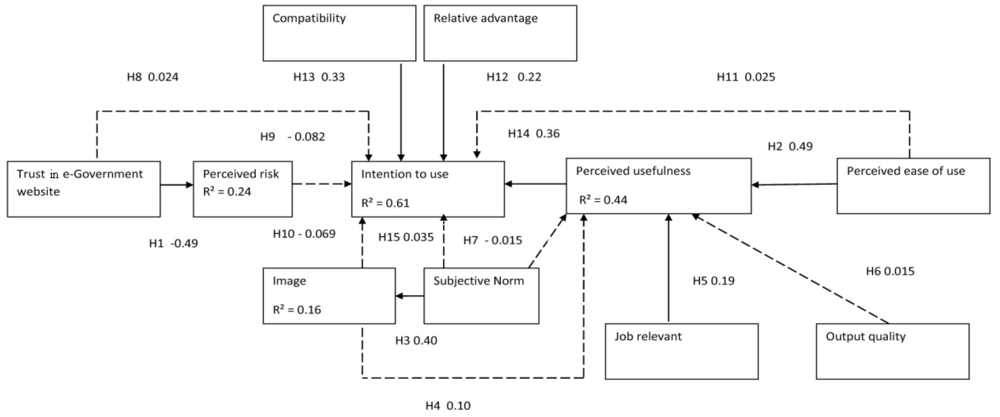
      <p>This paper proposes a model, which unifies (a) cognitive factors or cognitive instrumental processes, such as job relevance, output quality; (b) perceived social forces or social influence processes, such as subjective norm, image; (c) intrinsic characteristics of innovations compatibility, relative advantage, along with (d) trust; and (e) perceived risk. <xref ref-type="fig" rid="futureinternet-04-00528-f001">Figure 1</xref> presents the unified model along with formulated hypotheses to be tested. Consequently, in the unified model, the following hypotheses are tested:</p>      
      <list list-type="simple">
        <list-item>
          <p><italic>H1.</italic> <italic>Trust in government websites has a direct effect on perceived risk.</italic></p>
        </list-item>
        <list-item>
          <p><italic>H2.</italic> <italic>Perceived ease of use has a positive direct effect on perceived usefulness.</italic></p>
        </list-item>
        <list-item>
          <p><italic>H3.</italic> <italic>Subjective norm has a direct effect on image.</italic></p>
        </list-item>
        <list-item>
          <p><italic>H4.</italic> <italic>Image has a positive direct effect on perceived usefulness.</italic></p>
        </list-item>
        <list-item>
          <p><italic>H5.</italic> <italic>Job relevance has a positive direct effect on perceived usefulness.</italic></p>
        </list-item>
        <list-item>
          <p><italic>H6.</italic> <italic>Output quality has a direct effect on perceived usefulness.</italic></p>
        </list-item>
        <list-item>
          <p><italic>H7.</italic> <italic>Subjective norm has a direct effect on perceived usefulness.</italic></p>
        </list-item>
        <list-item>
          <p><italic>H8.</italic> <italic>Trust in e-Government websites has a direct effect on intention to use.</italic></p>
        </list-item>
        <list-item>
          <p><italic>H9.</italic> <italic>Perceived risk has a direct effect on intention to use.</italic></p>
        </list-item>
        <list-item>
          <p><italic>H10.</italic> <italic>Image has a direct effect on intention to use.</italic></p>
        </list-item>
        <list-item>
          <p><italic>H11.</italic> <italic>Perceived ease of use has a positive direct effect on intention to use.</italic></p>
        </list-item>
        <list-item>
          <p><italic>H12.</italic> <italic>Relative advantage has a positive direct effect on intention to use.</italic></p>
        </list-item>
        <list-item>
          <p><italic>H13.</italic> <italic>Compatibility has a positive direct effect on intention to use.</italic></p>
        </list-item>
        <list-item>
          <p><italic>H14.</italic> <italic>Perceived usefulness has a direct positive effect on intention to use.</italic></p>
        </list-item>
        <list-item>
          <p><italic>H15.</italic> <italic>Subjective norm has a direct effect on intention to use.</italic></p>
        </list-item>
      </list>
      <fig id="futureinternet-04-00528-f001" position="anchor">
        <label>Figure 1</label>
        <caption>
          <p>The research model after validation.</p>
        </caption>
        <graphic xmlns:xlink="http://www.w3.org/1999/xlink" xlink:href="futureinternet-04-00528-g001.tif"/>
      </fig>
    </sec>
    <sec sec-type="methods">
      <title>7. Methodology</title>
      <p>An empirical research study was conducted using an online survey. Internet users have been chosen to be surveyed. The reason is that lack of e-Government usage focuses primarily on the “digital divide” [<xref ref-type="bibr" rid="B18-futureinternet-04-00528">18</xref>]. Colesca ([<xref ref-type="bibr" rid="B22-futureinternet-04-00528">22</xref>] p. 32) wrote: “non-users haven’t favorable attitudes towards the use of electronic services in relation to the governmental agencies”. Therefore, the research does not investigate people who are electronically incapable of accessing services.</p>
      <p>A link to the main webpage of the Greek School Network (<uri>http://www.sch.gr</uri>) notified users of the website about the online questionnaire website. Users willing to participate visited a tailor-made web site and responded to the questionnaire. The data were recorded in a database. The Greek School Network offers email accounts (<email>username@sch.gr</email> form) and fully personalized access to education staff. In order to ensure that the responder was a teacher, the email of the responder was recorded. From all questionnaires that were received, only those of <email>username@sch.gr</email> form were admitted. Finally, 230 completed and usable questionnaires were recorded. </p>
      <p>The questionnaire used in this study was adopted from previous studies. Five point Likert scales were used, ranging from strongly disagree to strongly agree. The questionnaire consisted of 11 parts: (1) Trust in e-Government websites; (2) Perceived ease of use; (3) Perceived usefulness; (4) Perceived risk; (5) Subjective norm; (6) Image; (7) Compatibility; (8) Output quality; (9) Relative advantage; (10) Job relevance; (11) Intention to use.</p>
      <p>A pilot study using an extended questionnaire containing all the scales proposed in the literature review was conducted by administering the questionnaire to 50 primary and secondary education teachers. Finally, for each construct, in the final questionnaire, it was decided to include the scale presenting the largest Cronbach’s alpha (<xref ref-type="table" rid="futureinternet-04-00528-t001">Table 1</xref>). Scales and items used in the questionnaire and the analysis have been successfully used in previous studies to measure e-Government adoption by the general population of citizens. In the absence of available questions and items to measure e-Government adoption specifically for teachers (as is the case in this study), the paper adopts these previous approaches. In this present study, using scales introduced previously to measure attitudes of a general population may present some limitations. For example, these particular scales may not be adequate for measuring attitudes of the particular target group of Greek teachers. However, reliability and validity analysis performed hereafter proves that the scales constitute a reliable and valid instrument for measuring e-Government by Greek teachers.</p>
      <table-wrap id="futureinternet-04-00528-t001" position="anchor">
        <object-id pub-id-type="pii">futureinternet-04-00528-t001_Table 1</object-id>
        <label>Table 1</label>
        <caption>
          <p>Items used.</p>
        </caption>
        <table rules="rows" style="border: solid thin">           
          <tbody>
            <tr>
              <td align="left" valign="middle">Scales and items</td>
            </tr>
            <tr>
              <td align="left" valign="middle">
                <bold>Trust in e-Government websites</bold><break/>
                <bold>Adopted by Teo <italic>et al</italic>. [<xref ref-type="bibr" rid="B41-futureinternet-04-00528">41</xref>]. Constructs also tested in pilot study: Colesca and Dobrica’s [<xref ref-type="bibr" rid="B23-futureinternet-04-00528">23</xref>], Sang’s <italic>et al</italic>. [<xref ref-type="bibr" rid="B24-futureinternet-04-00528">24</xref>]</bold>
              </td>
            </tr>
            <tr>
              <td align="left" valign="middle">1 e-Government Web sites are trustworthy</td>
            </tr>
            <tr>
              <td align="left" valign="middle">2 e-Government Web sites seem to be honest and truthful to me</td>
            </tr>
            <tr>
              <td align="left" valign="middle">3 e-Government Web sites can be trusted</td>
            </tr>
            <tr>
              <td align="left" valign="middle">
                <bold>Perceived Risk</bold>
              </td>
            </tr>
            <tr>
              <td align="left" valign="middle">
                <bold>Adopted from Bélanger and Carter [<xref ref-type="bibr" rid="B20-futureinternet-04-00528">20</xref>]</bold>
              </td>
            </tr>
            <tr>
              <td align="left" valign="middle">1 The decision of whether to use a state e-Government service is risky</td>
            </tr>
            <tr>
              <td align="left" valign="middle">2 In general, I believe using state government services over the internet is risky</td>
            </tr>
            <tr>
              <td align="left" valign="middle"><bold>Subjective norms </bold><break/><bold>Adapted from Hung <italic>et al</italic>. [<xref ref-type="bibr" rid="B52-futureinternet-04-00528">52</xref>]</bold>.<bold>Constructs also tested in pilot study: </bold><bold>Sang <italic>et al</italic>. [<xref ref-type="bibr" rid="B24-futureinternet-04-00528">24</xref>]</bold></td>
            </tr>
            <tr>
              <td align="left" valign="middle">1 People (peers and experts) important to me supported my use of online systems.</td>
            </tr>
            <tr>
              <td align="left" valign="middle">2 People who influenced my behavior wanted me to use online systems instead of any alternative means.</td>
            </tr>
            <tr>
              <td align="left" valign="middle">3 People whose opinions I value preferred that I use online systems.</td>
            </tr>
            <tr>
              <td align="left" valign="middle">
                <bold>Image </bold><break/>
                <bold>Adopted from  Sang <italic>et al</italic>. [<xref ref-type="bibr" rid="B24-futureinternet-04-00528">24</xref>]. Constructs also tested in pilot study:  Carter and Bélanger [<xref ref-type="bibr" rid="B42-futureinternet-04-00528">42</xref>] </bold>
              </td>
            </tr>
            <tr>
              <td align="left" valign="middle">1 People in my organization who use e-Government systems would have more prestige than those who do not.</td>
            </tr>
            <tr>
              <td align="left" valign="middle">2 People in my organization who use e-Government systems would have a high profile.</td>
            </tr>
            <tr>
              <td align="left" valign="middle">3 Having e-Government systems would be a status symbol in my organization</td>
            </tr>
            <tr>
              <td align="left" valign="middle">
                <bold>Job Relevance </bold><break/>
                <bold>Adapted from Sang <italic>et al</italic>. [<xref ref-type="bibr" rid="B24-futureinternet-04-00528">24</xref>]. </bold>
              </td>
            </tr>
            <tr>
              <td align="left" valign="middle">1 In my job, usage of e-Government systems would be important.</td>
            </tr>
            <tr>
              <td align="left" valign="middle">2 In my job, usage of e-Government systems would be relevant.</td>
            </tr>
            <tr>
              <td align="left" valign="middle">
                <bold>Compatibility </bold><break/>
                <bold>Adopted from Sang <italic>et al</italic>. [<xref ref-type="bibr" rid="B24-futureinternet-04-00528">24</xref>]. Constructs also tested in pilot study:  Carter and Bélanger [<xref ref-type="bibr" rid="B42-futureinternet-04-00528">42</xref>] </bold>
              </td>
            </tr>
            <tr>
              <td align="left" valign="middle">1 I think using e-Government systems would fit well with the way that I like to gather information from government agencies.</td>
            </tr>
            <tr>
              <td align="left" valign="middle">2 I think using e-Government systems would fit well with the way that I like to interact with government agencies.</td>
            </tr>
            <tr>
              <td align="left" valign="middle">3 Using e-Government systems to interact with government agencies would fit into my lifestyle.</td>
            </tr>
            <tr>
              <td align="left" valign="middle">4 Using e-Government systems to interact with government agencies would be compatible with how I like to do things.</td>
            </tr>
            <tr>
              <td align="left" valign="middle">
                <bold>Output Quality</bold><break/>
                <bold>Adopted from Sang <italic>et al</italic>. [<xref ref-type="bibr" rid="B24-futureinternet-04-00528">24</xref>]</bold>
              </td>
            </tr>
            <tr>
              <td align="left" valign="middle">1 The quality of the output I get from e-Government systems would be high.</td>
            </tr>
            <tr>
              <td align="left" valign="middle">2 I would have no problem with the quality of e-Government systems’ output</td>
            </tr>
            <tr>
              <td align="left" valign="middle">
                <bold>Relative advantage </bold><break/>
                <bold>Adopted from Sang <italic>et al</italic>. [<xref ref-type="bibr" rid="B24-futureinternet-04-00528">24</xref>]. Constructs also tested in pilot study: Carter and Bélanger [<xref ref-type="bibr" rid="B42-futureinternet-04-00528">42</xref>] </bold>
              </td>
            </tr>
            <tr>
              <td align="left" valign="middle">1 Using e-Government systems would enhance my efficiency in gathering information from government agencies.</td>
            </tr>
            <tr>
              <td align="left" valign="middle">2 Using e-Government systems would enhance my efficiency in interacting with government agencies.</td>
            </tr>
            <tr>
              <td align="left" valign="middle">3 Using e-Government systems would make it easier to interact with government agencies.</td>
            </tr>
            <tr>
              <td align="left" valign="middle">4 Using e-Government systems would give me greater control over my interaction with government agencies.</td>
            </tr>
            <tr>
              <td align="left" valign="middle">
                <bold>Perceived Ease of Use </bold><break/>
                <bold>Adopted from Carter and Bélanger [<xref ref-type="bibr" rid="B42-futureinternet-04-00528">42</xref>]. Constructs also tested in pilot study: Teo’s <italic>et al</italic>. [<xref ref-type="bibr" rid="B41-futureinternet-04-00528">41</xref>], Colesca and Dobrica’s [<xref ref-type="bibr" rid="B23-futureinternet-04-00528">23</xref>], Sang’s <italic>et al</italic>. [<xref ref-type="bibr" rid="B24-futureinternet-04-00528">24</xref>], Shih’s [<xref ref-type="bibr" rid="B34-futureinternet-04-00528">34</xref>]</bold>
              </td>
            </tr>
            <tr>
              <td align="left" valign="middle">1 Learning to interact with a state government Website would be easy for me. </td>
            </tr>
            <tr>
              <td align="left" valign="middle">2 I believe interacting with a state government Website would be a clear and understandable process. </td>
            </tr>
            <tr>
              <td align="left" valign="middle">3 I would find most state government Websites to be flexible to interact with. </td>
            </tr>
            <tr>
              <td align="left" valign="middle">4 It would be easy for me to become skilful at using a state government Website.</td>
            </tr>
            <tr>
              <td align="left" valign="middle">
                <bold>Perceived Usefulness</bold><break/>
                <bold>Adopted from  Wangpipatwong <italic>et al</italic>. [<xref ref-type="bibr" rid="B53-futureinternet-04-00528">53</xref>]. Constructs also tested in pilot study: Teo’s <italic>et al</italic>. [<xref ref-type="bibr" rid="B42-futureinternet-04-00528">42</xref>], Colesca and Dobrica’s [<xref ref-type="bibr" rid="B23-futureinternet-04-00528">23</xref>], Sang’s <italic>et al</italic>. [<xref ref-type="bibr" rid="B24-futureinternet-04-00528">24</xref>] and Shih’s [<xref ref-type="bibr" rid="B34-futureinternet-04-00528">34</xref>]. </bold>
              </td>
            </tr>
            <tr>
              <td align="left" valign="middle">1 Using e-Government websites enables me to do business with the government any time, and not limited to regular business hours.</td>
            </tr>
            <tr>
              <td align="left" valign="middle">2 Using e-Government websites enables me to accomplish tasks more quickly.</td>
            </tr>
            <tr>
              <td align="left" valign="middle">3 The results of using e-Government websites are apparent to me.</td>
            </tr>
            <tr>
              <td align="left" valign="middle">4 Using e-Government websites can cut traveling expense.</td>
            </tr>
            <tr>
              <td align="left" valign="middle">5 Using e-Government websites can lower traveling and queuing time.</td>
            </tr>
            <tr>
              <td align="left" valign="middle">
                <bold>Intention to use</bold><break/>
                <bold>Adopted from Carter and Bélanger [<xref ref-type="bibr" rid="B42-futureinternet-04-00528">42</xref>]. Constructs also tested in pilot study: Al-adawi’s <italic>et al</italic>. [<xref ref-type="bibr" rid="B36-futureinternet-04-00528">36</xref>], Bélanger and Carter’s [<xref ref-type="bibr" rid="B20-futureinternet-04-00528">20</xref>], Hung’s <italic>et al</italic>. [<xref ref-type="bibr" rid="B52-futureinternet-04-00528">52</xref>] and Sang’s <italic>et al</italic>. [<xref ref-type="bibr" rid="B24-futureinternet-04-00528">24</xref>].</bold>
              </td>
            </tr>
            <tr>
              <td align="left" valign="middle">1 I would use the Web for gathering state government information. </td>
            </tr>
            <tr>
              <td align="left" valign="middle">2 I would use state government services provided over the Web. </td>
            </tr>
            <tr>
              <td align="left" valign="middle">3 Interacting with the state government over the Web is something that I would do. </td>
            </tr>
            <tr>
              <td align="left" valign="middle">4 I would use the Web to inquire about state government services. </td>
            </tr>
          </tbody>
        </table>
      </table-wrap>
    </sec>
    <sec>
      <title>8. Findings</title>
      <p>LISREL 8.8 was used to analyze the data. Model estimation was done using the maximum likelihood approach, with the item covariance matrix used as input. </p>
      <p>The measurement model was first examined for validating and refining the research constructs, followed by an analysis of the Structural Equation Model for testing the research hypotheses in the research model.</p>
      <p>Confirmatory Factor Analysis was used for model refinement. Testing the measurement model involves examining the convergent validity, discriminant validity, and internal consistency of the constructs. Reliability and convergent validity of the measurements are estimated by the item factor loadings, Composite Reliability, and Average Variance Extracted [<xref ref-type="bibr" rid="B54-futureinternet-04-00528">54</xref>]. </p>
      <p>Convergent validity refers to the extent to which the items under each construct are actually measuring the same construct. Two methods were applied to assess convergent validity. First, item reliability was examined for each item, which suggested that the factor loading of each item on its corresponding construct must be higher than 0.55 [<xref ref-type="bibr" rid="B41-futureinternet-04-00528">41</xref>]. All items had a loading above the suggested threshold. Convergent validity was assessed by examining the average variance extracted (AVE) for each construct. The AVE for a construct reflects the ratio of the construct’s variance to the total variances among the items of the construct. The average extracted variances, presented in <xref ref-type="table" rid="futureinternet-04-00528-t002">Table 2</xref>, are all above the recommended 0.50 level [<xref ref-type="bibr" rid="B41-futureinternet-04-00528">41</xref>,<xref ref-type="bibr" rid="B55-futureinternet-04-00528">55</xref>]. </p>
      <p>Discriminant validity refers to the extent to which a given construct differs from other constructs. An Exploratory Factor Analysis (Principal Component Analysis with Varimax Rotation), demonstrated that all items loaded more heavily on their corresponding constructs rather than on other constructs. Further, the square roots of all AVEs were larger than correlations among constructs, thereby satisfying discriminant validity. Compared to Cronbach’s alpha, which assumes equal weights of all the items of a construct and is influenced by the number of items, Composite Reliability relies on actual loadings to compute the factor scores and thus provides a better indicator for measuring internal consistency [<xref ref-type="bibr" rid="B41-futureinternet-04-00528">41</xref>]. As shown in <xref ref-type="table" rid="futureinternet-04-00528-t002">Table 2</xref>, Composite Reliabilities are above the threshold of 0.7. Overall, the measures in this study are reliable and valid. </p>
      <table-wrap id="futureinternet-04-00528-t002" position="anchor">
        <object-id pub-id-type="pii">futureinternet-04-00528-t002_Table 2</object-id>
        <label>Table 2</label>
        <caption>
          <p>Composite Reliability (CR), and Average Variance Extracted (AVE).</p>
        </caption>
        <table rules="all" style="border: solid thin">
          <thead>
            <tr>
              <th align="left" valign="middle"> </th>
              <th align="center" valign="middle">AVE</th>
              <th align="center" valign="middle">CR</th>
            </tr>
          </thead>
          <tbody>
            <tr>
              <td align="left" valign="middle">Trust in e-Government website </td>
              <td align="center" valign="middle">0.83</td>
              <td align="center" valign="middle">0.94</td>
            </tr>
            <tr>
              <td align="left" valign="middle">Perceived risk</td>
              <td align="center" valign="middle">0.84</td>
              <td align="center" valign="middle">0.91</td>
            </tr>
            <tr>
              <td align="left" valign="middle">Subjective norm</td>
              <td align="center" valign="middle">0.77</td>
              <td align="center" valign="middle">0.91</td>
            </tr>
            <tr>
              <td align="left" valign="middle">Image</td>
              <td align="center" valign="middle">0.74</td>
              <td align="center" valign="middle">0.89</td>
            </tr>
            <tr>
              <td align="left" valign="middle">Job relevance</td>
              <td align="center" valign="middle">0.65</td>
              <td align="center" valign="middle">0.79</td>
            </tr>
            <tr>
              <td align="left" valign="middle">Perceived ease of use</td>
              <td align="center" valign="middle">0.64</td>
              <td align="center" valign="middle">0.87</td>
            </tr>
            <tr>
              <td align="left" valign="middle">Perceived usefulness</td>
              <td align="center" valign="middle">0.75</td>
              <td align="center" valign="middle">0.94</td>
            </tr>
            <tr>
              <td align="left" valign="middle">Compatibility</td>
              <td align="center" valign="middle">0.74</td>
              <td align="center" valign="middle">0.92</td>
            </tr>
            <tr>
              <td align="left" valign="middle">Outpour quality</td>
              <td align="center" valign="middle">0.60</td>
              <td align="center" valign="middle">0.73</td>
            </tr>
            <tr>
              <td align="left" valign="middle">Relative advantage</td>
              <td align="center" valign="middle">0.69</td>
              <td align="center" valign="middle">0.90</td>
            </tr>
            <tr>
              <td align="left" valign="middle">Intention to use</td>
              <td align="center" valign="middle">0.76</td>
              <td align="center" valign="middle">0.93</td>
            </tr>
          </tbody>
        </table>
      </table-wrap>
      
      <p><xref ref-type="table" rid="futureinternet-04-00528-t003">Table 3</xref> shows that all the inter-construct correlations are below 0.9. Also, the estimated correlation between all construct pairs is below the suggested cutoff of 0.9, and this implies distinctness in construct content or discriminant validity [<xref ref-type="bibr" rid="B41-futureinternet-04-00528">41</xref>,<xref ref-type="bibr" rid="B56-futureinternet-04-00528">56</xref>].</p>
      <table-wrap id="futureinternet-04-00528-t003" position="anchor">
        <object-id pub-id-type="pii">futureinternet-04-00528-t003_Table 3</object-id>
        <label>Table 3</label>
        <caption>
          <p>Inter-Construct Correlations.</p>
        </caption>
           <table>
          <thead>
            <tr>
              <th align="left" valign="middle"> </th>
              <th align="center" valign="bottom">Trust in e-Government website</th>
              <th align="center" valign="bottom">Perceived risk</th>
              <th align="center" valign="bottom">Subjective norm</th>
              <th align="center" valign="bottom">Image</th>
              <th align="center" valign="bottom">Job relevance</th>
              <th align="center" valign="bottom">Perceived ease of use</th>
              <th align="center" valign="bottom">Perceived usefulness</th>
              <th align="center" valign="bottom">Compatibility</th>
              <th align="center" valign="bottom">Outpour quality</th>
              <th align="center" valign="bottom">Relative advantage</th>
            </tr>
          </thead>
          <tbody>
            <tr>
              <td align="left" valign="middle">Perceived risk</td>
              <td align="center" valign="middle">−0.48</td>
              <td align="center" valign="middle"> </td>
              <td align="center" valign="middle"> </td>
              <td align="center" valign="middle"> </td>
              <td align="center" valign="middle"> </td>
              <td align="center" valign="middle"> </td>
              <td align="center" valign="middle"> </td>
              <td align="center" valign="middle"> </td>
              <td align="center" valign="middle"> </td>
              <td align="center" valign="middle"> </td>
            </tr>
            <tr>
              <td align="left" valign="middle">Subjective norm</td>
              <td align="center" valign="middle">0.22</td>
              <td align="center" valign="middle">−0.06</td>
              <td align="center" valign="middle"> </td>
              <td align="center" valign="middle"> </td>
              <td align="center" valign="middle"> </td>
              <td align="center" valign="middle"> </td>
              <td align="center" valign="middle"> </td>
              <td align="center" valign="middle"> </td>
              <td align="center" valign="middle"> </td>
              <td align="center" valign="middle"> </td>
            </tr>
            <tr>
              <td align="left" valign="middle">Image</td>
              <td align="center" valign="middle">0.08</td>
              <td align="center" valign="middle">−0.01</td>
              <td align="center" valign="middle">0.40</td>
              <td align="center" valign="middle"> </td>
              <td align="center" valign="middle"> </td>
              <td align="center" valign="middle"> </td>
              <td align="center" valign="middle"> </td>
              <td align="center" valign="middle"> </td>
              <td align="center" valign="middle"> </td>
              <td align="center" valign="middle"> </td>
            </tr>
            <tr>
              <td align="left" valign="middle">Job relevance</td>
              <td align="center" valign="middle">0.28</td>
              <td align="center" valign="middle">−0.27</td>
              <td align="center" valign="middle">0.36</td>
              <td align="center" valign="middle">0.34</td>
              <td align="center" valign="middle"> </td>
              <td align="center" valign="middle"> </td>
              <td align="center" valign="middle"> </td>
              <td align="center" valign="middle"> </td>
              <td align="center" valign="middle"> </td>
              <td align="center" valign="middle"> </td>
            </tr>
            <tr>
              <td align="left" valign="middle">Perceived ease of use</td>
              <td align="center" valign="middle">0.40</td>
              <td align="center" valign="middle">−0.30</td>
              <td align="center" valign="middle">0.34</td>
              <td align="center" valign="middle">0.31</td>
              <td align="center" valign="middle">0.59</td>
              <td align="center" valign="middle"> </td>
              <td align="center" valign="middle"> </td>
              <td align="center" valign="middle"> </td>
              <td align="center" valign="middle"> </td>
              <td align="center" valign="middle"> </td>
            </tr>
            <tr>
              <td align="left" valign="middle">Perceived usefulness</td>
              <td align="center" valign="middle">0.39</td>
              <td align="center" valign="middle">−0.35</td>
              <td align="center" valign="middle">0.31</td>
              <td align="center" valign="middle">0.32</td>
              <td align="center" valign="middle">0.52</td>
              <td align="center" valign="middle">0.62</td>
              <td align="center" valign="middle"> </td>
              <td align="center" valign="middle"> </td>
              <td align="center" valign="middle"> </td>
              <td align="center" valign="middle"> </td>
            </tr>
            <tr>
              <td align="left" valign="middle">Compatibility</td>
              <td align="center" valign="middle">0.51</td>
              <td align="center" valign="middle">−0.41</td>
              <td align="center" valign="middle">0.29</td>
              <td align="center" valign="middle">0.27</td>
              <td align="center" valign="middle">0.48</td>
              <td align="center" valign="middle">0.59</td>
              <td align="center" valign="middle">0.56</td>
              <td align="center" valign="middle"> </td>
              <td align="center" valign="middle"> </td>
              <td align="center" valign="middle"> </td>
            </tr>
            <tr>
              <td align="left" valign="middle">Outpour quality</td>
              <td align="center" valign="middle">0.46</td>
              <td align="center" valign="middle">−0.24</td>
              <td align="center" valign="middle">0.35</td>
              <td align="center" valign="middle">0.20</td>
              <td align="center" valign="middle">0.33</td>
              <td align="center" valign="middle">0.42</td>
              <td align="center" valign="middle">0.32</td>
              <td align="center" valign="middle">0.39</td>
              <td align="center" valign="middle"> </td>
              <td align="center" valign="middle"> </td>
            </tr>
            <tr>
              <td align="left" valign="middle">Relative advantage</td>
              <td align="center" valign="middle">0.45</td>
              <td align="center" valign="middle">−0.31</td>
              <td align="center" valign="middle">0.34</td>
              <td align="center" valign="middle">0.26</td>
              <td align="center" valign="middle">0.47</td>
              <td align="center" valign="middle">0.64</td>
              <td align="center" valign="middle">0.55</td>
              <td align="center" valign="middle">0.71</td>
              <td align="center" valign="middle">0.44</td>
              <td align="center" valign="middle"> </td>
            </tr>
            <tr>
              <td align="left" valign="middle">Intention to use</td>
              <td align="center" valign="middle">0.46</td>
              <td align="center" valign="middle">−0.41</td>
              <td align="center" valign="middle">0.25</td>
              <td align="center" valign="middle">0.19</td>
              <td align="center" valign="middle">0.46</td>
              <td align="center" valign="middle">0.57</td>
              <td align="center" valign="middle">0.67</td>
              <td align="center" valign="middle">0.70</td>
              <td align="center" valign="middle">0.31</td>
              <td align="center" valign="middle">0.66</td>
            </tr>
          </tbody>
        </table>
      </table-wrap>
    </sec>
    <sec>
      <title>9. The Model Testing</title>
      <p>The first step in model testing is to estimate the goodness-of-fit of the research model. The indices recommended for evaluating the overall model fitness are those suggested from previous studies [<xref ref-type="bibr" rid="B55-futureinternet-04-00528">55</xref>,<xref ref-type="bibr" rid="B57-futureinternet-04-00528">57</xref>]: goodness-of-fit index (GFI), normed fit index (NFI), non-normed fit index (NNFI), comparative fit index (CFI), and the root-mean-square error of approximation (RMSEA). The chi-square test provides a statistical test for the null hypothesis that the model fits the data, but it is too sensitive to sample size differences, especially where the sample sizes exceed 200 respondents [<xref ref-type="bibr" rid="B54-futureinternet-04-00528">54</xref>]. Bagozzi and Yi [<xref ref-type="bibr" rid="B57-futureinternet-04-00528">57</xref>] suggested a chi-square per degrees of freedom instead. All of the fit indexes indicate that the structural model has a good fit (<xref ref-type="table" rid="futureinternet-04-00528-t004">Table 4</xref>). </p>
      <table-wrap id="futureinternet-04-00528-t004" position="anchor">
        <object-id pub-id-type="pii">futureinternet-04-00528-t004_Table 4</object-id>
        <label>Table 4</label>
        <caption>
          <p>Analysis of the goodness-of-fit of the overall model.</p>
        </caption>
        <table rules="all" style="border: solid thin">
          <thead>
            <tr>
              <th align="left" valign="middle">Fit index compared to the Recommended value</th>
              <th align="center" valign="middle">Research model</th>
            </tr>
          </thead>
          <tbody>
            <tr>
              <td align="left" valign="middle">Chi-square/d.f. ≤3.0</td>
              <td align="center" valign="middle">2.04</td>
            </tr>
            <tr>
              <td align="left" valign="middle">GFI ≥ 0.80</td>
              <td align="center" valign="middle">0.84</td>
            </tr>
            <tr>
              <td align="left" valign="middle">AGFI ≥ 0.80</td>
              <td align="center" valign="middle">0.81</td>
            </tr>
            <tr>
              <td align="left" valign="middle">NFI ≥ 0.90</td>
              <td align="center" valign="middle">0.95</td>
            </tr>
            <tr>
              <td align="left" valign="middle">NNFI ≥ 0.90</td>
              <td align="center" valign="middle">0.97</td>
            </tr>
            <tr>
              <td align="left" valign="middle">RMSEA ≤ 0.08</td>
              <td align="center" valign="middle">0.07</td>
            </tr>
            <tr>
              <td align="left" valign="middle">CFI ≥ 0.90</td>
              <td align="center" valign="middle">0.97</td>
            </tr>
          </tbody>
        </table>
      </table-wrap>
      <p>The second step in model estimation is to examine the path significance of each hypothesized association in the research model and variance explained (R<sup>2</sup>) by each path. <xref ref-type="fig" rid="futureinternet-04-00528-f001">Figure 1</xref> presents the research model after validation along with the hypotheses. The standardized path coefficients, and explained variances of the structure model are shown. Non-significant estimates (<italic>p</italic> &gt; 0.05) are presented with dotted lines. </p>
      <p>From <xref ref-type="fig" rid="futureinternet-04-00528-f001">Figure 1</xref> it is obvious that:</p>
      <list list-type="bullet">
        <list-item>
          <p>Hypothesis H1 is supported since the effect of Trust in e-Government websites to Perceived risk is significant, and equals -0.49. The negative value implies that risk is perceived to be low by users who trust e-Government websites. R<sup>2</sup> equals 0.24, thus Perceived risk is largely explained by trust. H2 is also supported, since perceived ease of use affects significantly and positively Perceived usefulness (γ = 0.49). Also, H3 is supported since Subjective norm has a positive direct effect on Image (γ = 0.4).</p>
        </list-item>
        <list-item>
          <p>The effect of Image to Perceived usefulness is not statistically significant thus H4 is not supported. On the contrary, the effect of Job relevance on Perceived usefulness is significant (γ = 0.19). Further, Output quality has no significant direct effect on Perceived usefulness, so H6 is not supported. Subjective norm has no significant effect on Perceived usefulness (H7 not supported). In conclusion, Perceived usefulness is affected by Perceived ease of use, and job relevance and the effect of perceived ease of use is larger than that of Job relevance. Totally, 44% of Perceived usefulness is explained by these variables.</p>
        </list-item>
        <list-item>
          <p>Perceived risk has no significant direct effect on Intention to use (H9 not supported). Trust in e-Government websites has no significant effect on Intention to use, thus neither H8 is supported. Also, Image has no significant direct effect on intention to use (H10 not supported). Finally, Perceived ease of use has no significant direct effect on Intention to use. Although H11 is not supported, there is, however, an indirect effect of Perceived ease of use on Intention to use, through Perceived usefulness (0.1764). Intention to use is not affected, directly or indirectly, by subjective norm since there is no significant effect of subjective norm, either directly to intention of use, or indirectly via perceived usefulness. H15 is therefore not supported.</p>
        </list-item>
        <list-item>
          <p>Hypotheses H12, H13 and H14 are supported. Perceived usefulness has a direct effect (β = 0.36) on Intention to use, Compatibility has a somewhat smaller effect (γ = 0.33) and Relative advantage comes last with γ = 0.22. Overall, a large portion of the variance of Intention to use is explained by the predictors (R<sup>2</sup> = 0.61). Job relevance affects Intention to use via Perceived usefulness (0.0684).</p>
        </list-item>
        <list-item>
          <p>Overall, Intention to use is affected by Perceived usefulness (β = 0.36), Compatibility (γ = 0.33), Relative advantage (γ = 0.22), Perceived ease of use (0.1764), and Job relevance (0.0684). On the other hand, Trust, Risk, Image, Subjective norm, and output quality have no significant effect directly or indirectly on intention to use.</p>
        </list-item>
      </list>
    </sec>
    <sec sec-type="discussion">
      <title>10. Discussion</title>
      <p>Previous research on the same field has provided evidence of the effects that Trust has on Intention to use e-Government services [<xref ref-type="bibr" rid="B58-futureinternet-04-00528">58</xref>] and Perceived Risk has on Continuance Intention for teachers in Greece [<xref ref-type="bibr" rid="B51-futureinternet-04-00528">51</xref>]. Findings from the present study suggest that in the presence of both attitudinal variables (trust, perceived risk) and operational variables (compatibility, advantage, <italic>etc</italic>.) it is the second set that has a significant effect on intention to use. In more detail: Compatibility, Relative advantage and Job relevance, along with Perceived usefulness and Perceived ease of use are the five factors that influence intention to use e-Government services. Trust, Perceived Risk, Image, Subjective norm and Output quality, although included in the model, do not significantly affect intention to use. Thus, perceived social forces or social influence processes <italic>i.e.</italic>, subjective norm and image, and trust and perceived risk, are weak predictors of intention to use, compared to cognitive factors and intrinsic characteristics of innovation compatibility. In a previous work, the authors suggested that for an effective adoption of e-Government websites, state government agencies should communicate websites to citizens through widespread and attractive awareness campaigns. Emphasizing advantages of the websites and real benefits that users would gain will lead to higher levels of perceived usefulness which subsequently will lead to higher levels of intention to use e-Government websites [<xref ref-type="bibr" rid="B58-futureinternet-04-00528">58</xref>]. On the other hand, it becomes more important to raise the issue of Trust. If the state wishes to promote the use of e-Government services, then it is in its best interests to alter Trust of the citizens in e-Government [<xref ref-type="bibr" rid="B58-futureinternet-04-00528">58</xref>]. Considering this finding, policy makers could focus on raising teachers’ Trust in the internet as a means of getting information and accomplishing transactions, for example, training teachers in IT and internet skill on a regular basis. The present paper modifies and enriches previous findings, but considers the importance of operational variables. The analysis suggests that in the presence of operational factors, it is the operational factors that influence intention to use e-Government websites, compared to trust and perceived risk. Practical implications and suggestions should not avoid enhancing trust of citizens on the one hand and diminishing their perception of risk using e-Government on the other. What the findings of this paper suggest is that along with emphasizing and augmenting social benefits of using e-Government services, a greater and primary effort should be made in providing efficient and effective e-Government practices. These could satisfy citizens and engage them to use e-Government services further. Raising trust and diminishing perceived risk are important steps, but providing results and efficient solutions to citizens through e-Government services is more important in raising their intentions to use them.</p>
      <p>If a campaign could give a solution aimed at enhancing the trust of citizens and diminishing their perception of risk, along with empowering a citizen’s image, it would not have the expected results unless it provides practical implications regarding ease of use, recognition of relative advantage and especially usefulness. Users find e-Government systems useful when they relate to their intrinsic characteristics, their interest and their working settings. Users will use e-Government systems if they help them to work more efficiently and effectively. </p>
      <p>Two axes arise regarding usefulness of educational e-Government systems in Greece. The first concerns the provision of useful information that citizens want or the information that will help them to perform administrative transactions. More specifically, this information usually concerns the legislative framework and practical solutions, such as filling in and submitting an application or a form. The second axis concerns teachers training in modern and prevailing pedagogic, psychological teaching models. Educational e-Government websites would be more useful if they offer theoretical models along with instructive courses of teaching. A good practice would be to undertake action research towards the direction of continuing self-improvement and teaching improvement.</p>
      <p>In Greece, both teachers’ unions and political leadership constantly pursue teacher training as a means to quality education. The Pedagogical Institute is an advisory institution responsible for strategic educational planning and policy of the Ministry of Education, lifelong learning and Religious Affairs. The Pedagogical Institute and Regional Training Centers are responsible for teacher training. However, an effective solution in teacher training has not been applied yet. </p>
    </sec>
    <sec sec-type="conclusions">
      <title>11. Conclusions</title>
      <p>The paper made a contribution to the study of adoption of e-Government services by applying a model which joins TAM, TAM2 and DOI, along with trust and perceived risk. The effort was to measure the contribution of the separate variables in the presence of a multitude of effects. In this fashion, it is clear from the findings that for the adoption of e-Government services by Greek teachers, practical and operational issues regarding the efficiency of services should be considered first. </p>
      <p>In Greece, which lags behind other EU countries in e-Government, few studies have been undertaken regarding e-Government adoption. The study can serve as a starting point for other e-Government adoption researches. The user has to be placed at the center of future developments, thus, governments should take into consideration user needs, established marketing practices to promote the services and provide training to users in order to make the systems attractive to them. Training programs should stress the potential of e-Governnment systems and should help users to understand the relative advantage, job relevance and generally the value of them over existing bureaucratic systems. </p>
      <p>The findings can also provide useful recommendations to the development of practice and policy making. Policy makers can improve strategic e-Government planning and development through monitoring Compatibility, Relative advantage, Job relevance, Perceived usefulness and Perceived ease of use, the five factors that influence intention to use e-Government services. </p>
    </sec>
  </body>
  <back>
    <ref-list>
      <title>References</title>
      <ref id="B1-futureinternet-04-00528">
        <label>1.</label>
        <citation citation-type="web">
          <person-group person-group-type="author">
            <name>
              <surname>Kamensky</surname>
              <given-names>J.</given-names>
            </name>
          </person-group>
          <article-title>A Brief History of Vice President Al Gore’s National Partnership for Reinventing Government during the Administration of President Bill Clinton 1993–2001,12 January 2001</article-title>
          <access-date>(accessed on 12 April 2009)</access-date>
          <comment>Available online:<ext-link xmlns:xlink="http://www.w3.org/1999/xlink" xlink:href="http://govinfo.library.unt.edu/npr/whoweare/historyofnpr.html" ext-link-type="uri">http://govinfo.library.unt.edu/npr/whoweare/historyofnpr.html</ext-link></comment>
        </citation>
      </ref>
      <ref id="B2-futureinternet-04-00528">
        <label>2.</label>
        <citation citation-type="confproc">
          <person-group person-group-type="author">
            <name>
              <surname>Misra</surname>
              <given-names>D.C.</given-names>
            </name>
          </person-group>
          <article-title>Select Aspects of Conceptual Foundations of E-government: Clearing the Fog for a Better Vision</article-title>
          <source>Proceeding of the 5th International Conference on e-Governance</source>
          <conf-loc>Hyderabad, India</conf-loc>
          <conf-date>28–30 December 2007</conf-date>
        </citation>
      </ref>
      <ref id="B3-futureinternet-04-00528">
        <label>3.</label>
        <citation citation-type="journal">
          <person-group person-group-type="author">
            <name>
              <surname>Panagis</surname>
              <given-names>Y.</given-names>
            </name>
            <name>
              <surname>Sakkopoulos</surname>
              <given-names>E.</given-names>
            </name>
            <name>
              <surname>Tsakalidis</surname>
              <given-names>A.</given-names>
            </name>
            <name>
              <surname>Tzimas</surname>
              <given-names>G.</given-names>
            </name>
            <name>
              <surname>Sirmakessis</surname>
              <given-names>S.</given-names>
            </name>
            <name>
              <surname>Lytras</surname>
              <given-names>M.D.</given-names>
            </name>
          </person-group>
          <article-title>Techniques for mining the design of e-government services to enhance end-user experience</article-title>
          <source>Int. J. Electron. Democr.</source>
          <year>2008</year>
          <volume>1</volume>
          <fpage>32</fpage>
          <lpage>50</lpage>
          <pub-id pub-id-type="doi">10.1504/IJED.2008.021277</pub-id>
        </citation>
      </ref>
      <ref id="B4-futureinternet-04-00528">
        <label>4.</label>
        <citation citation-type="confproc">
          <person-group person-group-type="author">
            <name>
              <surname>Jain Palvia</surname>
              <given-names>S.</given-names>
            </name>
            <name>
              <surname>Sharma</surname>
              <given-names>S.</given-names>
            </name>
          </person-group>
          <article-title>E-Government and E-Governance: Definitions/Domain Framework and Status around the World</article-title>
          <source>Proceeding of the 5th International Conference on e-Governance</source>
          <conf-loc>Hyderabad, India</conf-loc>
          <conf-date>28–30 December 2007</conf-date>
        </citation>
      </ref>
      <ref id="B5-futureinternet-04-00528">
        <label>5.</label>
        <citation citation-type="web">
		  <collab>United Nations (UN)</collab>
           <article-title>UN Global e-Government Survey 2003</article-title>
          <access-date>(accessed on 12 August 2011)</access-date>
          <comment>Available online:<ext-link xmlns:xlink="http://www.w3.org/1999/xlink" xlink:href="http://unpan1.un.org/intradoc/groups/public/documents/un/unpan016066.pdf" ext-link-type="uri">http://unpan1.un.org/intradoc/groups/public/documents/un/unpan016066.pdf</ext-link></comment>
        </citation>
      </ref>
      <ref id="B6-futureinternet-04-00528">
        <label>6.</label>
        <citation citation-type="web">
		  <collab>United Nations (UN)</collab>
           <article-title>UN e-Government Survey 2008—From E-Government to connected governance</article-title>
          <access-date>(accessed on 12 August 2011)</access-date>
          <comment>Available online:<ext-link xmlns:xlink="http://www.w3.org/1999/xlink" xlink:href="http://unpan1.un.org/intradoc/groups/public/documents/UN/UNPAN028607.pdf" ext-link-type="uri">http://unpan1.un.org/intradoc/groups/public/documents/UN/UNPAN028607.pdf</ext-link></comment>
        </citation>
      </ref>
      <ref id="B7-futureinternet-04-00528">
        <label>7.</label>
        <citation citation-type="web">
		  <collab>United Nations (UN)</collab>
           <article-title>United Nations E-Government Survey 2010: Leveraging e-Government at a Time of Financial and Economic Crisis</article-title>
          <access-date>(accessed on 12 August 2011)</access-date>
          <comment>Available online:<ext-link xmlns:xlink="http://www.w3.org/1999/xlink" xlink:href="http://www2.unpan.org/egovkb/global_reports/10report.htm" ext-link-type="uri">http://www2.unpan.org/egovkb/global_reports/10report.htm</ext-link></comment>
        </citation>
      </ref>
      <ref id="B8-futureinternet-04-00528">
        <label>8.</label>
        <citation citation-type="confproc">
          <person-group person-group-type="author">
            <name>
              <surname>Godse</surname>
              <given-names>V.</given-names>
            </name>
            <name>
              <surname>Garg</surname>
              <given-names>A.</given-names>
            </name>
          </person-group>
          <article-title>From E-government to E-governance</article-title>
          <source>Proceeding of the 5th International Conference on e-Governance</source>
          <conf-loc>Hyderabad, India</conf-loc>
          <conf-date>28–30 December 2007</conf-date>
        </citation>
      </ref>
      <ref id="B9-futureinternet-04-00528">
        <label>9.</label>
        <citation citation-type="confproc">
          <person-group person-group-type="author">
            <name>
              <surname>Misuraca</surname>
              <given-names>G.</given-names>
            </name>
          </person-group>
          <article-title>e-Governance in Africa, from Theory to Action: A Practical-Oriented Research and Case Studies on ICTs for Local Governance</article-title>
          <source>Proceedings of the 2006 International Conference on Digital Government Research</source>
          <publisher-name>ACM</publisher-name>
          <publisher-loc>New York, NY, USA</publisher-loc>
          <year>2006</year>
          <volume>151</volume>
          <fpage>209</fpage>
          <lpage>218</lpage>
        </citation>
      </ref>
      <ref id="B10-futureinternet-04-00528">
        <label>10.</label>
        <citation citation-type="confproc">
          <person-group person-group-type="author">
            <name>
              <surname>Vrana</surname>
              <given-names>V.</given-names>
            </name>
            <name>
              <surname>Zafiropoulos</surname>
              <given-names>K.</given-names>
            </name>
            <name>
              <surname>Karavasilis</surname>
              <given-names>I.</given-names>
            </name>
          </person-group>
          <source>Quality Evaluation of Local Government Website. A Case of a Primary Education Administration</source>
          <conf-name>10th Toulon-Verona conference</conf-name>
          <conf-loc>Thessaloniki, Greece</conf-loc>
          <conf-date>3–4 September 2007</conf-date>
        </citation>
      </ref>
      <ref id="B11-futureinternet-04-00528">
        <label>11.</label>
        <citation citation-type="journal">
          <person-group person-group-type="author">
            <name>
              <surname>Schware</surname>
              <given-names>R.</given-names>
            </name>
            <name>
              <surname>Deane</surname>
              <given-names>A.</given-names>
            </name>
          </person-group>
          <article-title>Deploying e-government programs: The strategic importance of “I” before “E”</article-title>
          <source>Info</source>
          <year>2003</year>
          <volume>5</volume>
          <fpage>10</fpage>
          <lpage>19</lpage>
        <pub-id pub-id-type="doi">10.1108/14636690310495193</pub-id></citation>
      </ref>
      <ref id="B12-futureinternet-04-00528">
        <label>12.</label>
        <citation citation-type="book">
          <person-group person-group-type="author">
            <name>
              <surname>Kachnowski</surname>
              <given-names>S.</given-names>
            </name>
          </person-group>
          <article-title>Healthcare e-governance in Post 9/11 America</article-title>
          <source>Promises of e-Governance. Operational Challenges</source>
          <person-group person-group-type="editor">
            <name>
              <surname>Gupta</surname>
              <given-names>M.</given-names>
            </name>
          </person-group>
          <publisher-name>Power Grid Corporation of India Limited</publisher-name>
          <publisher-loc>New Delhi, India</publisher-loc>
          <year>2004</year>
        </citation>
      </ref>
      <ref id="B13-futureinternet-04-00528">
        <label>13.</label>
        <citation citation-type="web">
		  <collab>UNESCO</collab>
           <source>E-governance Capacity Building</source>
          <access-date>(accessed on 23 April 2009)</access-date>
          <comment>Available online:<ext-link xmlns:xlink="http://www.w3.org/1999/xlink" xlink:href="http://www.unesco.org/webworld/e-governance" ext-link-type="uri">http://www.unesco.org/webworld/e-governance</ext-link></comment>
        </citation>
      </ref>
      <ref id="B14-futureinternet-04-00528">
        <label>14.</label>
        <citation citation-type="confproc">
          <person-group person-group-type="author">
            <name>
              <surname>Homburg</surname>
              <given-names>V.</given-names>
            </name>
          </person-group>
          <article-title>E-Government and NPM: A perfect Marriage?”</article-title>
          <source>Proceedings 6th International Conference on Electronic Commerce</source>
          <person-group person-group-type="editor">
            <name>
              <surname>Janssen</surname>
              <given-names>M.</given-names>
            </name>
            <name>
              <surname>Sol</surname>
              <given-names>H.</given-names>
            </name>
            <name>
              <surname>Wagenaar</surname>
              <given-names>R.</given-names>
            </name>
          </person-group>
          <publisher-name>ACM</publisher-name>
          <publisher-loc>New York, NY, USA</publisher-loc>
          <year>2004</year>
          <fpage>547</fpage>
          <lpage>555</lpage>
        </citation>
      </ref>
      <ref id="B15-futureinternet-04-00528">
        <label>15.</label>
        <citation citation-type="web">
		 <collab>IDRC</collab>
           <article-title>From e-Government to e-Governance: A paradigmatic shift. The International Development research center. Science for Humanity, 2007</article-title>
          <access-date>(accessed on 20 April 2009)</access-date>
          <comment>Available online:<ext-link xmlns:xlink="http://www.w3.org/1999/xlink" xlink:href="http://www.idrc.ca/en/ev-115662-201-1-DO_TOPIC.html" ext-link-type="uri">http://www.idrc.ca/en/ev-115662-201-1-DO_TOPIC.html</ext-link></comment>
        </citation>
      </ref>
      <ref id="B16-futureinternet-04-00528">
        <label>16.</label>
        <citation citation-type="web">
          <person-group person-group-type="author">
            <name>
              <surname>Norris</surname>
              <given-names>P.</given-names>
            </name>
          </person-group>
          <source>e-Governance</source>
          <access-date>(accessed on 12 March 2009)</access-date>
          <comment>Available online:<ext-link xmlns:xlink="http://www.w3.org/1999/xlink" xlink:href="http://www.hks.harvard.edu/fs/pnorris/Acrobat/digitalch6.pdf" ext-link-type="uri">http://www.hks.harvard.edu/fs/pnorris/Acrobat/digitalch6.pdf</ext-link></comment>
        </citation>
      </ref>
      <ref id="B17-futureinternet-04-00528">
        <label>17.</label>
        <citation citation-type="journal">
          <person-group person-group-type="author">
            <name>
              <surname>Luo</surname>
              <given-names>G.</given-names>
            </name>
          </person-group>
          <article-title>e-government, people and social change: A case study of China</article-title>
          <source>Electron. J. Inf. Syst. Dev. ctries.</source>
          <year>2009</year>
          <volume>38</volume>
          <fpage>1</fpage>
          <lpage>23</lpage>
        </citation>
      </ref>
      <ref id="B18-futureinternet-04-00528">
        <label>18.</label>
        <citation citation-type="journal">
          <person-group person-group-type="author">
            <name>
              <surname>Mofleh</surname>
              <given-names>S.</given-names>
            </name>
            <name>
              <surname>Wanous</surname>
              <given-names>M.</given-names>
            </name>
          </person-group>
          <article-title>Understanding factors influencing citizens adoption of e-government services in the developing world: Jordan as a case study</article-title>
          <source>J. Comput. Sci.</source>
          <year>2008</year>
          <volume>7</volume>
          <fpage>1</fpage>
          <lpage>11</lpage>
        </citation>
      </ref>
      <ref id="B19-futureinternet-04-00528">
        <label>19.</label>
        <citation citation-type="web">
          <person-group person-group-type="author">
            <name>
              <surname>Al-Shafi</surname>
              <given-names>S.</given-names>
            </name>
            <name>
              <surname>Weerakkody</surname>
              <given-names>V.</given-names>
            </name>
          </person-group>
          <article-title>Understanding Citizens’ Behavioral Intention in the Adoption of e-Government Services in the State of Qatar</article-title>
          <source>Proceeding of 17th European Conference on Information Systems</source>
          <conf-loc>Verona, Italy</conf-loc>
          <conf-date>8–9 June 2009</conf-date>
          <access-date>(accessed on 15 December 2009)</access-date>
          <comment>Available online:<ext-link xmlns:xlink="http://www.w3.org/1999/xlink" xlink:href="http://www.ecis2009.it/papers/ecis2009-0420.pdf" ext-link-type="uri">http://www.ecis2009.it/papers/ecis2009-0420.pdf</ext-link></comment>
        </citation>
      </ref>
      <ref id="B20-futureinternet-04-00528">
        <label>20.</label>
        <citation citation-type="journal">
          <person-group person-group-type="author">
            <name>
              <surname>Bélanger</surname>
              <given-names>F.</given-names>
            </name>
            <name>
              <surname>Carter</surname>
              <given-names>L.</given-names>
            </name>
          </person-group>
          <article-title>Trust and risk in e-government adoption</article-title>
          <source>J. Strateg. Inf. Syst.</source>
          <year>2008</year>
          <volume>17</volume>
          <fpage>165</fpage>
          <lpage>176</lpage>
          <pub-id pub-id-type="doi">10.1016/j.jsis.2007.12.002</pub-id>
        </citation>
      </ref>
      <ref id="B21-futureinternet-04-00528">
        <label>21.</label>
        <citation citation-type="journal">
          <person-group person-group-type="author">
            <name>
              <surname>Carter</surname>
              <given-names>L.</given-names>
            </name>
            <name>
              <surname>Weerakkody</surname>
              <given-names>V.</given-names>
            </name>
          </person-group>
          <article-title>E-Government adoption: A cultural comparison</article-title>
          <source>Inf. Syst. Front.</source>
          <year>2008</year>
          <volume>10</volume>
          <fpage>473</fpage>
          <lpage>482</lpage>
          <pub-id pub-id-type="doi">10.1007/s10796-008-9103-6</pub-id>
        </citation>
      </ref>
      <ref id="B22-futureinternet-04-00528">
        <label>22.</label>
        <citation citation-type="journal">
          <person-group person-group-type="author">
            <name>
              <surname>Colesca</surname>
              <given-names>S.E.</given-names>
            </name>
          </person-group>
          <article-title>Increasing e-trust: A solution to minimize risk in the e-government adoption</article-title>
          <source>J. Appl. Quant. Methods</source>
          <year>2009</year>
          <volume>4</volume>
          <fpage>31</fpage>
          <lpage>44</lpage>
        </citation>
      </ref>
      <ref id="B23-futureinternet-04-00528">
        <label>23.</label>
        <citation citation-type="journal">
          <person-group person-group-type="author">
            <name>
              <surname>Colesca</surname>
              <given-names>S.E.</given-names>
            </name>
            <name>
              <surname>Dobrica</surname>
              <given-names>L.</given-names>
            </name>
          </person-group>
          <article-title>Adoption and use of e-government services: The case of Romania</article-title>
          <source>J. Appl. Res. Technol.</source>
          <year>2008</year>
          <volume>6</volume>
          <fpage>204</fpage>
          <lpage>217</lpage>
        </citation>
      </ref>
      <ref id="B24-futureinternet-04-00528">
        <label>24.</label>
        <citation citation-type="journal">
          <person-group person-group-type="author">
            <name>
              <surname>Sang</surname>
              <given-names>S.</given-names>
            </name>
            <name>
              <surname>Lee</surname>
              <given-names>J.D.</given-names>
            </name>
            <name>
              <surname>Lee</surname>
              <given-names>J.</given-names>
            </name>
          </person-group>
          <article-title>E-government adoption in ASEAN: the case of Cambodia</article-title>
          <source>Internet Res.</source>
          <year>2009</year>
          <volume>19</volume>
          <fpage>517</fpage>
          <lpage>534</lpage>
          <pub-id pub-id-type="doi">10.1108/10662240910998869</pub-id>
        </citation>
      </ref>
      <ref id="B25-futureinternet-04-00528">
        <label>25.</label>
        <citation citation-type="journal">
          <person-group person-group-type="author">
            <name>
              <surname>Venkatesh</surname>
              <given-names>V.</given-names>
            </name>
            <name>
              <surname>Bola</surname>
              <given-names>H.</given-names>
            </name>
          </person-group>
          <article-title>Technology acceptance model 3 and a research agenda on interventions</article-title>
          <source>Decis. Sci.</source>
          <year>2008</year>
          <volume>39</volume>
          <fpage>273</fpage>
          <lpage>315</lpage>
          <pub-id pub-id-type="doi">10.1111/j.1540-5915.2008.00192.x</pub-id>
        </citation>
      </ref>
      <ref id="B26-futureinternet-04-00528">
        <label>26.</label>
        <citation citation-type="journal">
          <person-group person-group-type="author">
            <name>
              <surname>Davis</surname>
              <given-names>F.</given-names>
            </name>
          </person-group>
          <article-title>Perceived usefulness, perceived ease of use, and user acceptance of information technology</article-title>
          <source>MIS Q.</source>
          <year>1980</year>
          <volume>13</volume>
          <fpage>318</fpage>
          <lpage>341</lpage>
        </citation>
      </ref>
      <ref id="B27-futureinternet-04-00528">
        <label>27.</label>
        <citation citation-type="confproc">
          <person-group person-group-type="author">
            <name>
              <surname>Karavasilis</surname>
              <given-names>I.</given-names>
            </name>
            <name>
              <surname>Zafiropoulos</surname>
              <given-names>K.</given-names>
            </name>
            <name>
              <surname>Vrana</surname>
              <given-names>V.</given-names>
            </name>
          </person-group>
          <article-title>Factors Affecting the Adoption of eGovernance by Teachers in Greece</article-title>
          <source>Proceedings of the 10th European Conference on eGovernment</source>
          <conf-loc>Limerick, Ireland</conf-loc>
          <conf-date>17–18 June 2010</conf-date>
        </citation>
      </ref>
      <ref id="B28-futureinternet-04-00528">
        <label>28.</label>
        <citation citation-type="book">
          <person-group person-group-type="author">
            <name>
              <surname>Rogers</surname>
              <given-names>E.M.</given-names>
            </name>
          </person-group>
          <source>Diffusion of Innovations</source>
          <edition>4th</edition>
          <publisher-name>Free Press</publisher-name>
          <publisher-loc>New York, NY, USA</publisher-loc>
          <year>1995</year>
        </citation>
      </ref>
      <ref id="B29-futureinternet-04-00528">
        <label>29.</label>
        <citation citation-type="journal">
          <person-group person-group-type="author">
            <name>
              <surname>Davis</surname>
              <given-names>F.</given-names>
            </name>
            <name>
              <surname>Bagozzi</surname>
              <given-names>R.</given-names>
            </name>
            <name>
              <surname>Warshaw</surname>
              <given-names>P.</given-names>
            </name>
          </person-group>
          <article-title>User acceptance of computer technology: A comparison of two theoretical models</article-title>
          <source>Manag. Sci.</source>
          <year>1989</year>
          <volume>35</volume>
          <fpage>982</fpage>
          <lpage>1003</lpage>
          <pub-id pub-id-type="doi">10.1287/mnsc.35.8.982</pub-id>
        </citation>
      </ref>
      <ref id="B30-futureinternet-04-00528">
        <label>30.</label>
        <citation citation-type="journal">
          <person-group person-group-type="author">
            <name>
              <surname>Gefen</surname>
              <given-names>D.</given-names>
            </name>
          </person-group>
          <article-title>Customer loyalty in e-commerce</article-title>
          <source>J. Assoc. Inf. Syst.</source>
          <year>2002</year>
          <volume>3</volume>
          <fpage>27</fpage>
          <lpage>51</lpage>
        </citation>
      </ref>
      <ref id="B31-futureinternet-04-00528">
        <label>31.</label>
        <citation citation-type="journal">
          <person-group person-group-type="author">
            <name>
              <surname>Moon</surname>
              <given-names>J.W.</given-names>
            </name>
            <name>
              <surname>Kim</surname>
              <given-names>Y.G.</given-names>
            </name>
          </person-group>
          <article-title>Extending the TAM for a World-Wide-Web context</article-title>
          <source>Inf. Manag.</source>
          <year>2001</year>
          <volume>38</volume>
          <fpage>217</fpage>
          <lpage>230</lpage>
          <pub-id pub-id-type="doi">10.1016/S0378-7206(00)00061-6</pub-id>
        </citation>
      </ref>
      <ref id="B32-futureinternet-04-00528">
        <label>32.</label>
        <citation citation-type="journal">
          <person-group person-group-type="author">
            <name>
              <surname>Sabramanian</surname>
              <given-names>G.</given-names>
            </name>
          </person-group>
          <article-title>A replication of perceived usefulness and perceived ease of use</article-title>
          <source>Decis. Sci.</source>
          <year>1994</year>
          <volume>25</volume>
          <fpage>863</fpage>
          <lpage>874</lpage>
          <pub-id pub-id-type="doi">10.1111/j.1540-5915.1994.tb01873.x</pub-id>
        </citation>
      </ref>
      <ref id="B33-futureinternet-04-00528">
        <label>33.</label>
        <citation citation-type="journal">
          <person-group person-group-type="author">
            <name>
              <surname>Serenko</surname>
              <given-names>A.</given-names>
            </name>
            <name>
              <surname>Bontis</surname>
              <given-names>N.</given-names>
            </name>
          </person-group>
          <article-title>A model of user adoption of mobile portal</article-title>
          <source>Quart. J. Electron. Commer.</source>
          <year>2004</year>
          <volume>4</volume>
          <fpage>69</fpage>
          <lpage>98</lpage>
        </citation>
      </ref>
      <ref id="B34-futureinternet-04-00528">
        <label>34.</label>
        <citation citation-type="journal">
          <person-group person-group-type="author">
            <name>
              <surname>Shih</surname>
              <given-names>H.P.</given-names>
            </name>
          </person-group>
          <article-title>Extended technology acceptance model of Internet utilization behavior</article-title>
          <source>Inf. Manag.</source>
          <year>2004</year>
          <volume>41</volume>
          <fpage>719</fpage>
          <lpage>729</lpage>
          <pub-id pub-id-type="doi">10.1016/j.im.2003.08.009</pub-id>
        </citation>
      </ref>
      <ref id="B35-futureinternet-04-00528">
        <label>35.</label>
        <citation citation-type="confproc">
          <person-group person-group-type="author">
            <name>
              <surname>King</surname>
              <given-names>R.</given-names>
            </name>
            <name>
              <surname>Gribbins</surname>
              <given-names>M.</given-names>
            </name>
          </person-group>
          <article-title>Internet Technology Adoption as an Organizational Event: An Exploratory Study across Industries</article-title>
          <source>Proceeding of 35th Hawaii International Conference on System Sciences</source>
          <publisher-name>IEEE Computer Society</publisher-name>
          <publisher-loc>Washington, DC, USA</publisher-loc>
          <year>2002</year>
          <volume>7</volume>
        </citation>
      </ref>
      <ref id="B36-futureinternet-04-00528">
        <label>36.</label>
        <citation citation-type="confproc">
          <person-group person-group-type="author">
            <name>
              <surname>Al-adawi</surname>
              <given-names>Z.</given-names>
            </name>
            <name>
              <surname>Yousafzai</surname>
              <given-names>Z.</given-names>
            </name>
            <name>
              <surname>Pallister</surname>
              <given-names>J.</given-names>
            </name>
          </person-group>
          <article-title>Conceptual Model of Citizen Adoption of e-Government</article-title>
          <source>the Second International Conference on Innovations in Information Technology (IIT’05)</source>
          <conf-loc>Dubai, UAE</conf-loc>
          <conf-date>26–28 September 2005</conf-date>
        </citation>
      </ref>
      <ref id="B37-futureinternet-04-00528">
        <label>37.</label>
        <citation citation-type="journal">
          <person-group person-group-type="author">
            <name>
              <surname>Jaeger</surname>
              <given-names>P.T.</given-names>
            </name>
            <name>
              <surname>Matteson</surname>
              <given-names>M.</given-names>
            </name>
          </person-group>
          <article-title>e-government and technology acceptance: The case of the implementation of section 508 guidelines for websites</article-title>
          <source>Electron. J. e-Gov.</source>
          <year>2009</year>
          <volume>7</volume>
          <fpage>87</fpage>
          <lpage>98</lpage>
        </citation>
      </ref>
      <ref id="B38-futureinternet-04-00528">
        <label>38.</label>
        <citation citation-type="journal">
          <person-group person-group-type="author">
            <name>
              <surname>Venkatesh</surname>
              <given-names>V.</given-names>
            </name>
            <name>
              <surname>Davis</surname>
              <given-names>F.</given-names>
            </name>
          </person-group>
          <article-title>A theoretical extension of the technology acceptance model: Four longitudinal field studies</article-title>
          <source>Manag. Sci.</source>
          <year>2000</year>
          <volume>46</volume>
          <fpage>186</fpage>
          <lpage>204</lpage>
          <pub-id pub-id-type="doi">10.1287/mnsc.46.2.186.11926</pub-id>
        </citation>
      </ref>
      <ref id="B39-futureinternet-04-00528">
        <label>39.</label>
        <citation citation-type="book">
          <person-group person-group-type="author">
            <name>
              <surname>Chismar</surname>
              <given-names>W.G.</given-names>
            </name>
            <name>
              <surname>Wiley-Patton</surname>
              <given-names>S.</given-names>
            </name>
          </person-group>
          <article-title>Does the Extended Technology Acceptance Model Apply to Physicians</article-title>
          <source>Proceeding of 36th Annual Hawaii International Conference on System Sciences (HICSS’03)</source>
          <publisher-name>IEEE Computer Society</publisher-name>
          <publisher-loc>Washington, DC, USA</publisher-loc>
          <year>2003</year>
          <volume>6</volume>
          <fpage>160a</fpage>
        </citation>
      </ref>
      <ref id="B40-futureinternet-04-00528">
        <label>40.</label>
        <citation citation-type="book">
          <person-group person-group-type="author">
            <name>
              <surname>Sang</surname>
              <given-names>S.</given-names>
            </name>
            <name>
              <surname>Lee</surname>
              <given-names>J.D.</given-names>
            </name>
          </person-group>
          <source>A Conceptual Model of e-Government Acceptance in Public Sector Third International Conference on Digital Society</source>
          <publisher-name>IEEE Computer Society</publisher-name>
          <publisher-loc>Washington, DC, USA</publisher-loc>
          <year>2009</year>
          <fpage>71</fpage>
          <lpage>76</lpage>
        </citation>
      </ref>
      <ref id="B41-futureinternet-04-00528">
        <label>41.</label>
        <citation citation-type="journal">
          <person-group person-group-type="author">
            <name>
              <surname>Teo</surname>
              <given-names>T.</given-names>
            </name>
            <name>
              <surname>Srivastava</surname>
              <given-names>S.</given-names>
            </name>
            <name>
              <surname>Jiang</surname>
              <given-names>L.</given-names>
            </name>
          </person-group>
          <article-title>Trust and electronic government success: An empirical study</article-title>
          <source>J. Manag. Inf. Syst.</source>
          <year>2008</year>
          <volume>25</volume>
          <fpage>99</fpage>
          <lpage>131</lpage>
        <pub-id pub-id-type="doi">10.1080/10580530801941447</pub-id></citation>
      </ref>
      <ref id="B42-futureinternet-04-00528">
        <label>42.</label>
        <citation citation-type="journal">
          <person-group person-group-type="author">
            <name>
              <surname>Carter</surname>
              <given-names>L.</given-names>
            </name>
            <name>
              <surname>Bélanger</surname>
              <given-names>F.</given-names>
            </name>
          </person-group>
          <article-title>The utilization of e-government services: Citizen trust, innovation and acceptance factors</article-title>
          <source>Inf. Syst. J.</source>
          <year>2005</year>
          <volume>15</volume>
          <fpage>5</fpage>
          <lpage>25</lpage>
          <pub-id pub-id-type="doi">10.1111/j.1365-2575.2005.00183.x</pub-id>
        </citation>
      </ref>
      <ref id="B43-futureinternet-04-00528">
        <label>43.</label>
        <citation citation-type="confproc">
          <person-group person-group-type="author">
            <name>
              <surname>Patel</surname>
              <given-names>H.</given-names>
            </name>
            <name>
              <surname>Jacobson</surname>
              <given-names>D.</given-names>
            </name>
          </person-group>
          <article-title>Factors Influencing Citizen Adoption of E-Government: A Review and Critical Assessment</article-title>
          <source>Proceeding of 16th European Conference on Information Systems</source>
          <person-group person-group-type="editor">
            <name>
              <surname>Acton</surname>
              <given-names>G.</given-names>
            </name>
            <name>
              <surname>Conboy</surname>
              <given-names>T.</given-names>
            </name>
            <name>
              <surname>van der Heijden</surname>
              <given-names>H.</given-names>
            </name>
            <name>
              <surname>Tuunainen</surname>
              <given-names>V.K.</given-names>
            </name>
          </person-group>
          <publisher-name>Galway, Ireland</publisher-name>
          <publisher-loc>9–11 June 2008</publisher-loc>
          <fpage>1058</fpage>
          <lpage>1069</lpage>
        </citation>
      </ref>
      <ref id="B44-futureinternet-04-00528">
        <label>44.</label>
        <citation citation-type="journal">
          <person-group person-group-type="author">
            <name>
              <surname>Agarwal</surname>
              <given-names>R.</given-names>
            </name>
            <name>
              <surname>Prasad</surname>
              <given-names>J.</given-names>
            </name>
          </person-group>
          <article-title>A conceptual and operational definition of personal innovativeness in the domain of information technology</article-title>
          <source>Inf. Syst. Res.</source>
          <year>1998</year>
          <volume>9</volume>
          <fpage>204</fpage>
          <lpage>215</lpage>
          <pub-id pub-id-type="doi">10.1287/isre.9.2.204</pub-id>
        </citation>
      </ref>
      <ref id="B45-futureinternet-04-00528">
        <label>45.</label>
        <citation citation-type="book">
          <person-group person-group-type="author">
            <name>
              <surname>Mäntymäki</surname>
              <given-names>M.</given-names>
            </name>
          </person-group>
          <article-title>Does E-government Trust in e-Commerce when Investigating Trust? A Review of rust Literature in E-Commerce and egovernment Domains</article-title>
          <source>Towards Sustainable Society on Ubiquitous Networks</source>
          <person-group person-group-type="editor">
            <name>
              <surname>Oya</surname>
              <given-names>M.</given-names>
            </name>
            <name>
              <surname>Uda</surname>
              <given-names>R.</given-names>
            </name>
            <name>
              <surname>Yasunobu</surname>
              <given-names>C.</given-names>
            </name>
          </person-group>
          <publisher-name>Springer</publisher-name>
          <publisher-loc>Boston, MA, USA</publisher-loc>
          <year>2008</year>
          <fpage>253</fpage>
          <lpage>264</lpage>
        </citation>
      </ref>
      <ref id="B46-futureinternet-04-00528">
        <label>46.</label>
        <citation citation-type="journal">
          <person-group person-group-type="author">
            <name>
              <surname>Alsaghier</surname>
              <given-names>H.</given-names>
            </name>
            <name>
              <surname>Ford</surname>
              <given-names>M.</given-names>
            </name>
            <name>
              <surname>Nguyen</surname>
              <given-names>A.</given-names>
            </name>
            <name>
              <surname>Hexel</surname>
              <given-names>R.</given-names>
            </name>
          </person-group>
          <article-title>Conceptualising citizen’s trust in e-government: Application of Q methodology</article-title>
          <source>Electron. J. e-Gov.</source>
          <year>2009</year>
          <volume>7</volume>
          <fpage>295</fpage>
          <lpage>310</lpage>
        </citation>
      </ref>
      <ref id="B47-futureinternet-04-00528">
        <label>47.</label>
        <citation citation-type="journal">
          <person-group person-group-type="author">
            <name>
              <surname>Fu</surname>
              <given-names>J.R.</given-names>
            </name>
            <name>
              <surname>Farn</surname>
              <given-names>C.K.</given-names>
            </name>
            <name>
              <surname>Chao</surname>
              <given-names>W.P.</given-names>
            </name>
          </person-group>
          <article-title>Acceptance of electronic tax filing: A study of taxpayer intentions</article-title>
          <source>Inf. Manag.</source>
          <year>2006</year>
          <volume>43</volume>
          <fpage>109</fpage>
          <lpage>126</lpage>
          <pub-id pub-id-type="doi">10.1016/j.im.2005.04.001</pub-id>
        </citation>
      </ref>
      <ref id="B48-futureinternet-04-00528">
        <label>48.</label>
        <citation citation-type="journal">
          <person-group person-group-type="author">
            <name>
              <surname>Warkentin</surname>
              <given-names>M.</given-names>
            </name>
            <name>
              <surname>Gefen</surname>
              <given-names>D.</given-names>
            </name>
            <name>
              <surname>Pavlou</surname>
              <given-names>P.A.</given-names>
            </name>
            <name>
              <surname>Rose</surname>
              <given-names>G.</given-names>
            </name>
          </person-group>
          <article-title>Encouraging citizen adoption of eGovernment by building trust</article-title>
          <source>Electron. Markets</source>
          <year>2002</year>
          <volume>12</volume>
          <fpage>157</fpage>
          <lpage>162</lpage>
          <pub-id pub-id-type="doi">10.1080/101967802320245929</pub-id>
        </citation>
      </ref>
      <ref id="B49-futureinternet-04-00528">
        <label>49.</label>
        <citation citation-type="book">
          <person-group person-group-type="author">
            <name>
              <surname>AlAwadhi</surname>
              <given-names>S.</given-names>
            </name>
            <name>
              <surname>Morris</surname>
              <given-names>A.</given-names>
            </name>
          </person-group>
          <article-title>The Use of the UTAUT Model in the Adoption of E-government Services in Kuwait</article-title>
          <source>Proceeding of 41st Hawaii International Conference on System Sciences</source>
          <publisher-name>IEEE Computer Society</publisher-name>
          <publisher-loc>Washington, DC, USA</publisher-loc>
          <year>2008</year>
          <fpage>1</fpage>
          <lpage>11</lpage>
        </citation>
      </ref>
      <ref id="B50-futureinternet-04-00528">
        <label>50.</label>
        <citation citation-type="book">
          <person-group person-group-type="author">
            <name>
              <surname>Sztompka</surname>
              <given-names>P.</given-names>
            </name>
          </person-group>
          <source>Trust: A Sociological Theory</source>
          <publisher-name>Cambridge University Press</publisher-name>
          <publisher-loc>Cambridge, UK</publisher-loc>
          <year>2003</year>
        </citation>
      </ref>
      <ref id="B51-futureinternet-04-00528">
        <label>51.</label>
        <citation citation-type="confproc">
          <person-group person-group-type="author">
            <name>
              <surname>Karavasilis</surname>
              <given-names>I.</given-names>
            </name>
            <name>
              <surname>Zafiropoulos</surname>
              <given-names>K.</given-names>
            </name>
            <name>
              <surname>Vrana</surname>
              <given-names>V.</given-names>
            </name>
          </person-group>
          <article-title>Factors Affection the adoption of e-Governance by teachers in Greece</article-title>
          <source>Proceeding of 10th European Conference on E-Government</source>
          <conf-date>17–18 June 2010</conf-date>
          <conf-loc>University of Limerick, Ireland</conf-loc>
        </citation>
      </ref>
      <ref id="B52-futureinternet-04-00528">
        <label>52.</label>
        <citation citation-type="journal">
          <person-group person-group-type="author">
            <name>
              <surname>Hung</surname>
              <given-names>S.Y.</given-names>
            </name>
            <name>
              <surname>Chang</surname>
              <given-names>C.M.</given-names>
            </name>
            <name>
              <surname>Yu</surname>
              <given-names>T.Y.</given-names>
            </name>
          </person-group>
          <article-title>Determinants of user acceptance of the e-Government services: The case of online tax filing and payment system</article-title>
          <source>Gov. Inf. Q.</source>
          <year>2006</year>
          <volume>23</volume>
          <fpage>97</fpage>
          <lpage>122</lpage>
          <pub-id pub-id-type="doi">10.1016/j.giq.2005.11.005</pub-id>
        </citation>
      </ref>
      <ref id="B53-futureinternet-04-00528">
        <label>53.</label>
        <citation citation-type="journal">
          <person-group person-group-type="author">
            <name>
              <surname>Wangpipatwong</surname>
              <given-names>S.</given-names>
            </name>
            <name>
              <surname>Chutimaskul</surname>
              <given-names>W.</given-names>
            </name>
            <name>
              <surname>Papasratorn</surname>
              <given-names>B.</given-names>
            </name>
          </person-group>
          <article-title>Understanding citizen’s continuance intention to use e-government website: A composite view of technology acceptance model and computer self-efficacy</article-title>
          <source>Electron. J. e-Gov.</source>
          <year>2008</year>
          <volume>6</volume>
          <fpage>55</fpage>
          <lpage>64</lpage>
        </citation>
      </ref>
      <ref id="B54-futureinternet-04-00528">
        <label>54.</label>
        <citation citation-type="journal">
          <person-group person-group-type="author">
            <name>
              <surname>Fornell</surname>
              <given-names>C.</given-names>
            </name>
            <name>
              <surname>Larcker</surname>
              <given-names>D.F.</given-names>
            </name>
          </person-group>
          <article-title>Evaluating structural equation models with unbearable and measurement error</article-title>
          <source>J. Mark. Res.</source>
          <year>1981</year>
          <volume>18</volume>
          <fpage>39</fpage>
          <lpage>50</lpage>
        <pub-id pub-id-type="doi">10.2307/3151312</pub-id></citation>
      </ref>
      <ref id="B55-futureinternet-04-00528">
        <label>55.</label>
        <citation citation-type="book">
          <person-group person-group-type="author">
            <name>
              <surname>Hair</surname>
              <given-names>J.F.</given-names>
            </name>
            <name>
              <surname>Anderson</surname>
              <given-names>R.E.</given-names>
            </name>
            <name>
              <surname>Tatham</surname>
              <given-names>R.L.</given-names>
            </name>
            <name>
              <surname>Black</surname>
              <given-names>W.C.</given-names>
            </name>
          </person-group>
          <source>Multivariate Data Analysis</source>
          <edition>5th</edition>
          <publisher-name>Prentice Hall</publisher-name>
          <publisher-loc>Upper Saddle River, NJ, USA</publisher-loc>
          <year>1998</year>
        </citation>
      </ref>
      <ref id="B56-futureinternet-04-00528">
        <label>56.</label>
        <citation citation-type="journal">
          <person-group person-group-type="author">
            <name>
              <surname>Gold</surname>
              <given-names>A.H.</given-names>
            </name>
            <name>
              <surname>Malhotra</surname>
              <given-names>A.</given-names>
            </name>
            <name>
              <surname>Segars</surname>
              <given-names>A.H.</given-names>
            </name>
          </person-group>
          <article-title>Knowledge management: an organization capabilities perspective</article-title>
          <source>J. Manag. Inf. Syst.</source>
          <year>2001</year>
          <volume>18</volume>
          <fpage>185</fpage>
          <lpage>214</lpage>
        </citation>
      </ref>
      <ref id="B57-futureinternet-04-00528">
        <label>57.</label>
        <citation citation-type="journal">
          <person-group person-group-type="author">
            <name>
              <surname>Bagozzi</surname>
              <given-names>R.P.</given-names>
            </name>
            <name>
              <surname>Yi</surname>
              <given-names>Y.</given-names>
            </name>
          </person-group>
          <article-title>On the evaluation of structure equation models</article-title>
          <source>J. Acad. Mark. Sci.</source>
          <year>1988</year>
          <volume>16</volume>
          <fpage>74</fpage>
          <lpage>94</lpage>
        <pub-id pub-id-type="doi">10.1007/BF02723327</pub-id></citation>
      </ref>
      <ref id="B58-futureinternet-04-00528">
        <label>58.</label>
        <citation citation-type="journal">
          <person-group person-group-type="author">
            <name>
              <surname>Zafiropoulos</surname>
              <given-names>K.</given-names>
            </name>
            <name>
              <surname>Karavasilis</surname>
              <given-names>I.</given-names>
            </name>
            <name>
              <surname>Vrana</surname>
              <given-names>V.</given-names>
            </name>
          </person-group>
          <article-title>Exploring E-governance Acceptance by Primary and Secondary Education Teachers in Greece</article-title>
          <source>Int. J. Electron. Democr.</source>
          <year>2012</year>
          <comment>in press</comment>
        </citation>
      </ref>
    </ref-list>
  </back>
</article>