
<?xml version="1.0" encoding="UTF-8"?>
<!DOCTYPE article PUBLIC "-//NLM//DTD Journal Publishing DTD v2.3 20070202//EN" "journalpublishing.dtd">
<article xmlns:mml="http://www.w3.org/1998/Math/MathML" xmlns:xlink="http://www.w3.org/1999/xlink" xml:lang="en" article-type="review-article">
  <front>
    <journal-meta>
      <journal-id journal-id-type="publisher-id">viruses</journal-id>
      <journal-title>Viruses</journal-title>
      <abbrev-journal-title abbrev-type="publisher">Viruses</abbrev-journal-title>
      <abbrev-journal-title abbrev-type="pubmed">Viruses</abbrev-journal-title>
      <issn pub-type="epub">1999-4915</issn>
      <publisher>
        <publisher-name>MDPI</publisher-name>
      </publisher>
    </journal-meta>
    <article-meta>
      <article-id pub-id-type="doi">10.3390/v4102162</article-id>
      <article-id pub-id-type="publisher-id">viruses-04-02162</article-id>
      <article-categories>
        <subj-group>
          <subject>Review</subject>
        </subj-group>
      </article-categories>
      <title-group>
        <article-title>Envelope Glycoprotein of Arenaviruses</article-title>
      </title-group>
	  <contrib-group>
        <contrib contrib-type="author">
          <name>
            <surname>Burri</surname>
            <given-names>Dominique J.</given-names>
          </name>
        </contrib>
        <contrib contrib-type="author">
          <name>
            <surname>da Palma</surname>
            <given-names>Joel Ramos</given-names>
          </name>
        </contrib>
        <contrib contrib-type="author">
          <name>
            <surname>Kunz</surname>
            <given-names>Stefan</given-names>
          </name>
        </contrib>
        <contrib contrib-type="author">
          <name>
            <surname>Pasquato</surname>
            <given-names>Antonella</given-names>
          </name>
          <xref rid="c1-viruses-04-02162" ref-type="corresp">*</xref>
        </contrib>
      </contrib-group>
      
      <aff id="af1-viruses-04-02162">Institute of Microbiology, University Hospital Center and University of Lausanne, Lausanne, Rue du Bugnon 48, 1011, Switzerland; Email: <email>dominique.burri@chuv.ch</email> (DJ.B); <email>joel.palma@chuv.ch</email> (J.R.P); <email>stefan.kunz@chuv.ch</email> (S.K)</aff>
      <author-notes>
        <corresp id="c1-viruses-04-02162"><label>*</label> Author to whom correspondence should be addressed; Email: <email>antonella.pasquato@chuv.ch</email>; Tel:  +41-213-147-743; Fax: +41-213-144-060.</corresp>
      </author-notes>
      <pub-date pub-type="epub">
        <day>17</day>
        <month>10</month>
        <year>2012</year>
      </pub-date>
      <pub-date pub-type="collection">
	  <month>10</month>
        <year>2012</year>
      </pub-date>
      <volume>4</volume>
      <issue>10</issue>
      <fpage>2162</fpage>
      <lpage>2181</lpage>
      <history>
        <date date-type="received">
          <day>04</day>
          <month>09</month>
          <year>2012</year>
        </date>
        <date date-type="rev-recd">
          <day>05</day>
          <month>10</month>
          <year>2012</year>
        </date>
        <date date-type="accepted">
          <day>05</day>
          <month>10</month>
          <year>2012</year>
        </date>
      </history>
      <permissions>
        <copyright-statement>©  2012 by the authors; licensee MDPI, Basel, Switzerland.</copyright-statement>
        <copyright-year>2012</copyright-year>
        <license xmlns:xlink="http://www.w3.org/1999/xlink" license-type="open-access" xlink:href="http://creativecommons.org/licenses/by/3.0/">
          <p>This article is an open-access article distributed under the terms and conditions of the Creative Commons Attribution license (<uri>http://creativecommons.org/licenses/by/3.0/</uri>).</p>
        </license>
      </permissions>
      <abstract>
        <p>Arenaviruses include lethal human pathogens which pose serious public health threats. So far, no FDA approved vaccines are available against arenavirus infections, and therapeutic options are limited, making the identification of novel drug targets for the development of efficacious therapeutics an urgent need. Arenaviruses are comprised of two RNA genome segments and four proteins, the polymerase L, the envelope glycoprotein GP, the matrix protein Z, and the nucleoprotein NP. A crucial step in the arenavirus life-cycle is the biosynthesis and maturation of the GP precursor (GPC) by cellular signal peptidases and the cellular enzyme Subtilisin Kexin Isozyme-1 (SKI-1)/Site-1 Protease (S1P) yielding a tripartite mature GP complex formed by GP1/GP2 and a stable signal peptide (SSP). GPC cleavage by SKI-1/S1P is crucial for fusion competence and incorporation of mature GP into nascent budding virion particles. In a first part of our review, we cover basic aspects and newer developments in the biosynthesis of arenavirus GP and its molecular interaction with SKI-1/S1P. A second part will then highlight the potential of SKI-1/S1P-mediated processing of arenavirus GPC as a novel target for therapeutic intervention to combat human pathogenic arenaviruses. </p>
      </abstract>
      <kwd-group>
        <kwd>Arenavirus</kwd>
        <kwd>anti-viral</kwd>
        <kwd>drug</kwd>
        <kwd>GPC</kwd>
        <kwd>SKI-1/S1P</kwd>
        <kwd>PF-429242</kwd>
      </kwd-group>
    </article-meta>
  </front>
  <body>
    <sec sec-type="intro">
      <title>1. Introduction</title>
      <sec>
        <title>1.1. Arenaviruses are important human pathogens</title>
        <p>Arenaviruses are world-wide distributed negative strand RNA viruses that include a number of important human pathogens. The prototypic arenavirus lymphocytic choriomeningitis virus (LCMV) was discovered by Armstrong and Lille upon passage of infectious material derived from a fatal case of encephalitis during the 1933 outbreak in St Louis (USA) [<xref ref-type="bibr" rid="B1-viruses-04-02162">1</xref>]. Independently and almost at the same time, Rivers and Scott were able to isolate the same virus from patients with manifestations of aseptic meningitis [<xref ref-type="bibr" rid="B2-viruses-04-02162">2</xref>], while Traub established that asymptomatic healthy mice can be carriers of the virus isolated from a mouse colony at the Rockefeller Institute [<xref ref-type="bibr" rid="B3-viruses-04-02162">3</xref>]. During the following 30 years, several other viruses sharing the same unique features of LCMV were discovered and described giving rise to a new family of virus named <italic>Arenaviridae</italic>. The “sandy” appearance of the viral particles in electron microscopy, due to the presence of host ribosomes, is at the origin of the family name, which has its roots in the Latin word “<italic>arena”</italic>, meaning sand.</p>
        <p>Currently, 22 species of arenaviruses, belonging to one singe genus, are recognized [<xref ref-type="bibr" rid="B4-viruses-04-02162">4</xref>]. Based on serological, genetic and geographical data, arenaviruses are divided into two major subgroups: the Old World (OW) and the New World (NW) complex. The Old World lineage consists of the prototypic LCMV and other viruses endemic to the African continent, including Lassa (LASV), Mopeia (MOPV), Ippy, and Mobala (MOBV) viruses. The larger New World complex is further divided into three clades, A, B and C. Clade B is the most important in term of human disease, since it contains the major viruses causing hemorrhagic fevers (HF) in South America, i.e. Junín (JUNV), Machupo (MACV), Guanarito (GTOV) and Sabia (SABV) viruses but also other non-pathogenic viruses, like Tacaribe (TCRV) and Amapari virus (AMPV). The geographical distribution of the different viral species is intrinsically connected to the distribution of their natural hosts, and inherently the specific diseases associated to each virus follow a similar spatial distribution.</p>
        <p>Several arenaviruses are causative agents of severe viral hemorrhagic fevers (VHF) in humans which are among the most devastating human diseases [<xref ref-type="bibr" rid="B5-viruses-04-02162">5</xref>]. Among these, LASV is a major concern due to its high prevalence in Western Africa, where it causes several hundred thousand cases of Lassa fever every year, associated with high levels of morbidity and mortality [<xref ref-type="bibr" rid="B6-viruses-04-02162">6</xref>]. Likewise, VHFs are also associated with several arenaviruses endemic in the South American continent, including JUNV, MACV, GTOV, and SABV, which are etiological agents of severe VHF in Argentina, Venezuela, Bolivia, and Brazil, respectively [<xref ref-type="bibr" rid="B7-viruses-04-02162">7</xref>,<xref ref-type="bibr" rid="B8-viruses-04-02162">8</xref>]. Among these, JUNV raises most concern due to its seasonal epidemics of Argentine hemorrhagic fevers [<xref ref-type="bibr" rid="B9-viruses-04-02162">9</xref>,<xref ref-type="bibr" rid="B10-viruses-04-02162">10</xref>] and high prevalence in rural areas while MACV, GTOV and SABV cause only sporadic outbreaks. The viral hemorrhagic fevers caused by arenaviruses are characterized by a broad range of clinical signs and symptoms and the differential diagnosis based on early clinical symptoms is often difficult. After and incubation period of 1-2 weeks, arenavirus VHF patients develop fever, weakness and general malaise, including cough, severe headache, and sore throat. Gastrointestinal symptoms are usually present with nausea, diarrhea, and vomiting. Clinical complications such as pleural effusions, facial edema, neurological complications and bleeding from mucosal surfaces indicate a poor diagnosis. In severe cases, deterioration is rapid and at terminal stage patients often succumb to shock, although the mild blood loss alone does not account for the death of the patient. </p>
        <p>The worldwide distributed LCMV is recognized as a neglected human pathogen of clinical significance. Being rarely fatal in immune-competent individuals causing only asymptomatic or mild, self-limited disease, it represents however a major risk to transplanted patients under immune-suppressive treatment [<xref ref-type="bibr" rid="B11-viruses-04-02162">11</xref>]. LCMV further poses a significant risk to the fetus and the newborn <italic>via</italic> vertical transmission from acutely infected mothers <italic>in utero</italic> or perinatally resulting in severe brain malformation including hydrocephalus, chorioretinitis and mental retardation [<xref ref-type="bibr" rid="B12-viruses-04-02162">12</xref>]. Employees of rodent breeding facilities are also at risk due to the exposure to chronicle infected animals as illustrated by a recent study conducted by the CDC where a mice breeding facility in Indiana (USA) showed that 20% of the mice had LCMV-reactive serum and 25% of the facility workers showed immunological evidence of recent LCMV exposure [<xref ref-type="bibr" rid="B13-viruses-04-02162">13</xref>].</p>
        <p>Of concern is also the fast emergence of new arenavirus associated with VHF syndromes. Recent examples are Chapare virus, discovered in Bolivia, which is closely related to other South American arenaviruses [<xref ref-type="bibr" rid="B14-viruses-04-02162">14</xref>], and Lujo virus, identified during a nosocomial outbreak of VHF with high mortality in Zambia and South Africa in 2008 that caused the death of four out of five patients [<xref ref-type="bibr" rid="B15-viruses-04-02162">15</xref>]. The discovery of this virus represents the first new HF-associated arenavirus to be isolated and identified in Africa in nearly 40 years. The continued emergence of previously unrecognized arenaviruses associated with fatal human disease in recent years suggests that many others could be identified in the future, raising serious concerns. Furthermore, increasing international air traffic coming from regions where arenavirus VHFs are endemic raises the fear of importation into non-endemic regions, putting local populations at risk. Indeed, since 1970, there have been several cases of Lassa fever imported into Europe or North America [<xref ref-type="bibr" rid="B16-viruses-04-02162">16</xref>]. </p>
      </sec>
      <sec>
        <title>1.2. Arenavirus life-cycle</title>
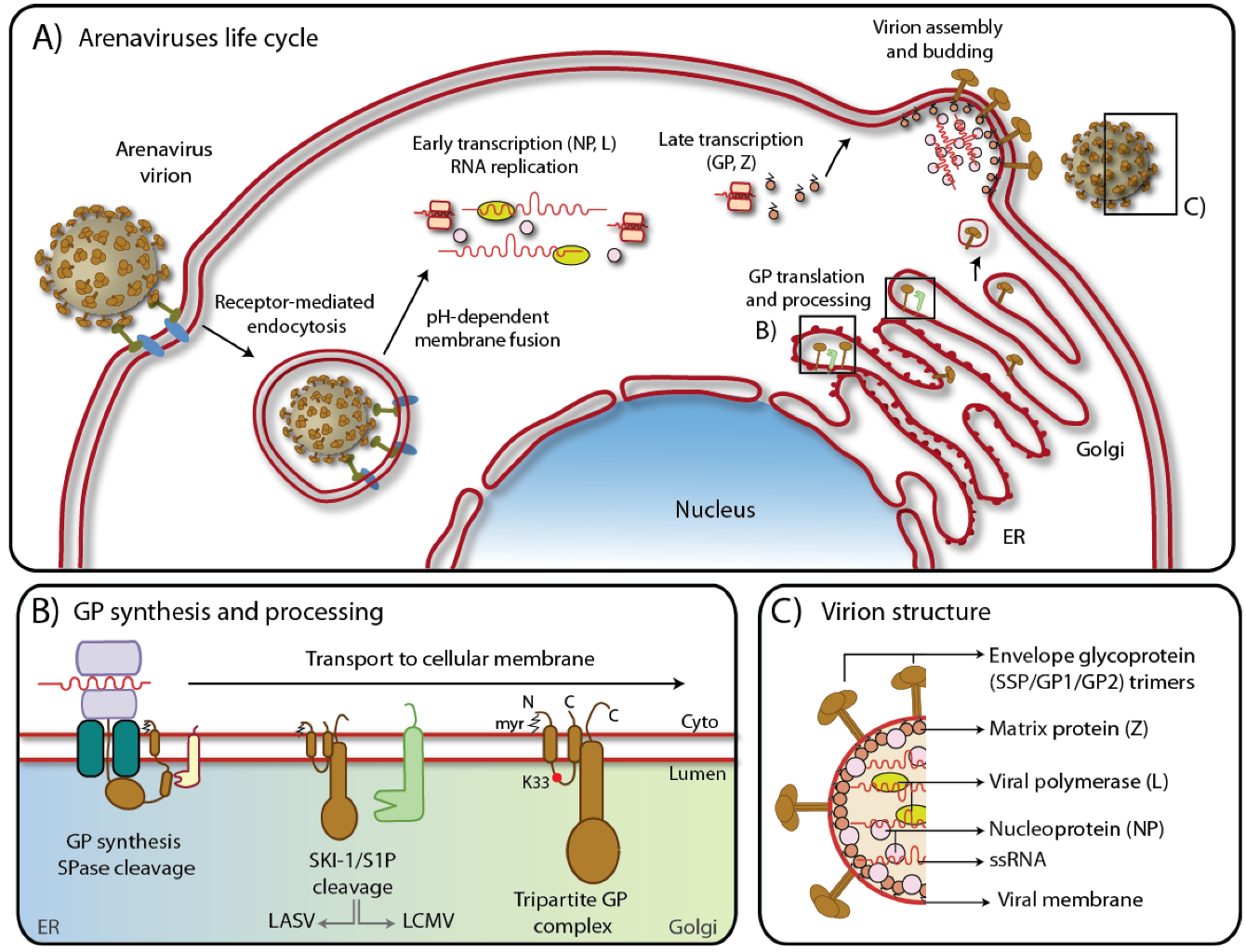
        <p>Arenavirus replication has been covered by excellent recent reviews [<xref ref-type="bibr" rid="B17-viruses-04-02162">17</xref>,<xref ref-type="bibr" rid="B18-viruses-04-02162">18</xref>] and only a short overview will be given here. All arenaviruses consist of a nucleocapsid surrounded by a membrane envelope and have a non-lytic life cycle restricted to the cytoplasm (<xref ref-type="fig" rid="viruses-04-02162-f001">Figure 1</xref>A). Arenaviruses use an ambisense coding strategy and each genomic segment, L and S directs the synthesis of two polypeptides in opposite orientations, separated by a noncoding intergenic region (IGR) [<xref ref-type="bibr" rid="B19-viruses-04-02162">19</xref>]. The S RNA encodes the nucleoprotein (NP; ca 63 kDa) and the viral glycoprotein precursor (GPC; ca 75 kDa) that is post-translationally cleaved by a cellular enzyme into the mature virion glycoproteins (GPs) GP1(44 kDa) and GP2 (35 kDa) (<xref ref-type="fig" rid="viruses-04-02162-f001">Figure 1</xref>B). Mature GPs form trimers [<xref ref-type="bibr" rid="B20-viruses-04-02162">20</xref>]. The L RNA encodes the viral RNA-dependent RNA polymerase (RdRp, or L polymerase; ca 200 kDa), and a small RING finger protein (Z; ca 11 kDa) [<xref ref-type="bibr" rid="B21-viruses-04-02162">21</xref>] (<xref ref-type="fig" rid="viruses-04-02162-f001">Figure 1</xref>C). This ambisense organization means that while the NP and L proteins are translated directly from the genomic complementary mRNA, the GPC and Z proteins are synthesized from the genomic sense mRNAs that are transcribed using the corresponding antigenome RNA (agRNA) species [<xref ref-type="bibr" rid="B21-viruses-04-02162">21</xref>]. Since the genomic RNA of arenaviruses cannot serve directly as a template for translation, arenaviruses behave like true negative strand RNA viruses. </p>
        <p>The arenaviruses life cycle starts with its attachment to the host cell. As for most viruses this early step is mediated by the interaction of a viral attachment protein to host cell-receptor(s). In the case of the prototypic LCMV, its broad cell tropism early suggested ubiquitous expression of conserved cellular receptor(s). In 1998, dystroglycan (DG) was identified as the first cellular receptor for LCMV and LASV [<xref ref-type="bibr" rid="B22-viruses-04-02162">22</xref>] and subsequently for other OW arenaviruses and Clade C NW viruses [<xref ref-type="bibr" rid="B23-viruses-04-02162">23</xref>]. In contrast, Clade B NW arenaviruses use transferrin receptor 1 (TfR1) as cellular receptor [<xref ref-type="bibr" rid="B24-viruses-04-02162">24</xref>]. While pathogenic NW viruses like JUNV, MACV, GTOV, and SABV recognize human TfR1, non-pathogenic Clade B viruses use murine TfR1 orthologues [<xref ref-type="bibr" rid="B25-viruses-04-02162">25</xref>]. The cellular receptors of Clade A NW arenaviruses remain currently unknown. The entry pathway of OW and Clade C NW arenaviruses is unusual, being independent of known regulatory proteins associated with endocytosis. LASV and LCMV infections are independent of clathrin, caveolin, dynamin, and actin, and dependent on lysobisphosphatidic acid (LBPA), an unusual phospholipid that is involved in the formation of intraluminal vesicles of the multivesicular body of the late endosome [<xref ref-type="bibr" rid="B26-viruses-04-02162">26</xref>]. We speculate that the virus bound to the receptor gets internalized hijacking a pathway normally associated with endocytosis and degradation of α-DG. Productive infection with LASV and LCMV requires the endosomal sorting complex required for transport (ESCRT) components Hrs, Tsg101, Vps22, and Vps24, as well as the ESCRT-associated ATPase Vps4 and Alix [<xref ref-type="bibr" rid="B26-viruses-04-02162">26</xref>]. This peculiar pathway may represent a strategy of the virus to avoid recognition by the innate immunity sensors [<xref ref-type="bibr" rid="B27-viruses-04-02162">27</xref>]. A very different scenario is found in the case of the NW arenaviruses that use TfR1 for internalization. Similarly to α-DG, TfR1 localizes on the cellular surface of the target cells but, differently from α-DG, TfR1 possesses ligands which are known to be internalized by the receptor [<xref ref-type="bibr" rid="B28-viruses-04-02162">28</xref>]. A strong Type I IFN response is usually associated with early stage of JUNV infection [<xref ref-type="bibr" rid="B29-viruses-04-02162">29</xref>].</p>
        <p>Upon receptor binding, mediated by the membrane-distal GP1, arenaviruses are taken up by endocytosis and delivered to acidified endosomes [<xref ref-type="bibr" rid="B30-viruses-04-02162">30</xref>]. There, a pH-dependent membrane fusion step, mediated by the GP2 portion of arenavirus GP, results in the release of the viral ribonucleoprotein (RNP) into the cytoplasm of the infected cell, followed by viral RNA genome replication and gene transcription. Transcription by the viral L polymerase is initiated at promoters on each 5’end of the RNA segments, transcribing mRNA coding for the NP and L proteins. Transcription is terminated by structural motifs at the IGR downstream of the 3’end of each open reading frame [<xref ref-type="bibr" rid="B31-viruses-04-02162">31</xref>]. Low levels of NP at the beginning of infection seem to prevent the virus polymerase from reading through the IGR, hence favoring transcription over replication. Subsequently, as NP accumulates, the viral polymerase shifts to a replicase mode and moves across the IGR, generating a full-length agRNAs which will serve as template for the synthesis of the GPC and Z mRNAs [<xref ref-type="bibr" rid="B32-viruses-04-02162">32</xref>]. Complete viral genome is also amplified from the agRNA templates. Arenavirus infection induces discrete cytosolic structures for RNA replication [<xref ref-type="bibr" rid="B33-viruses-04-02162">33</xref>]. </p>
        <p>The formation and release of arenavirus infectious progeny requires that assembled viral RNPs associate at the cell surface with membranes that are enriched in mature viral GP. Virion assembly and budding is orchestrated by the <italic>bona fide</italic> matrix protein Z involving late (L) domain motifs (PTAP and PPPY) [<xref ref-type="bibr" rid="B34-viruses-04-02162">34</xref>,<xref ref-type="bibr" rid="B35-viruses-04-02162">35</xref>,<xref ref-type="bibr" rid="B36-viruses-04-02162">36</xref>]. Incorporation of arenavirus GPs into virion particles depends on the interaction of GP with Z [<xref ref-type="bibr" rid="B37-viruses-04-02162">37</xref>], which recruits components of the endosomal sorting complex required for transport (ESCRT), in particular the ESCRT-I component Tsg101, that is crucial for virion budding [<xref ref-type="bibr" rid="B34-viruses-04-02162">34</xref>,<xref ref-type="bibr" rid="B35-viruses-04-02162">35</xref>]. </p>
		<fig id="viruses-04-02162-f001" position="anchor">
          <label>Figure 1</label>
          <caption>
            <p><bold>A</bold>) Schematic representation of arenavirus life cycle. Boxed regions refer to <bold>B</bold>) and <bold>C</bold>). For details, please see text. <bold>B</bold>) Biosynthesis of GPC in the ER with SSP cleavage by signal peptidase and maturation by the cellular protease SKI-1/S1P along the secretory pathway. The myristoylation modification and lysine 33 are also shown. Note that while LASV GP is cleaved early in the ER, LCMV GP is cleaved later in Golgi/TGN [<xref ref-type="bibr" rid="B38-viruses-04-02162">38</xref>]. C) Arenavirus virion structure showing the tripartite GP protein complex, the Zinc finger matrix protein (Z), the RNA dependent polymerase (L), the nucleoprotein (NP) and the negative single stranded ambisense RNA genome.</p>
          </caption>
          <graphic xmlns:xlink="http://www.w3.org/1999/xlink" xlink:href="viruses-04-02162-g001.tif"/>
        </fig>
        
      </sec>
    </sec>
    <sec>
      <title>2. The biosynthesis of the glycoprotein precursor</title>
      <p>The envelope glycoprotein of Arenaviruses is synthesized as a polypeptide composed of an N-terminal stable signal peptide (SSP) and the SSP-containing GPC. Upon cleavage by cellular signal peptidases in the ER, GPC is further processed by the cellular proprotein convertase (PC) Subtilisin Kexin Isozyme-1 (SKI-1)/Site-1 Protease (S1P) into the GP1 and GP2 subunits [<xref ref-type="bibr" rid="B39-viruses-04-02162">39</xref>,<xref ref-type="bibr" rid="B40-viruses-04-02162">40</xref>,<xref ref-type="bibr" rid="B41-viruses-04-02162">41</xref>] (<xref ref-type="fig" rid="viruses-04-02162-f001">Figure 1</xref>B). Post-translationally, the SSP acquires a myristoyl moiety at a Gly residue at position 2 [<xref ref-type="bibr" rid="B42-viruses-04-02162">42</xref>] while the GP1/GP2 complex undergoes extensive N-glycosylation at multiple sites [<xref ref-type="bibr" rid="B43-viruses-04-02162">43</xref>]. The interactions among the three subunits of the envelope glycoprotein, SSP, GP1, and GP2 are complex and not yet fully understood.</p>
      <sec>
        <title>2.1. The signal peptide is not degraded and forms a stable tripartite complex with GP1/GP2</title>
        <p>The role of the stable signal peptide (SSP) of arenaviruses has been comprehensively reviewed by a recent excellent review [<xref ref-type="bibr" rid="B44-viruses-04-02162">44</xref>]. The arenavirus SSP has several unique characteristics in addition to its conventional function of targeting the nascent GPC polypeptide into the ER. Processing of nascent GPC by cellular signal peptidases occurs co-translationally and results in an unusually long (58 amino acids) signal peptide which does not undergo immediate degradation, but has a half-life of &gt; 6h [<xref ref-type="bibr" rid="B45-viruses-04-02162">45</xref>,<xref ref-type="bibr" rid="B46-viruses-04-02162">46</xref>,<xref ref-type="bibr" rid="B47-viruses-04-02162">47</xref>]. Standard signal peptides contain only one hydrophobic transmembrane domain but arenavirus SSP possess two hydrophobic regions separated by a hydrophilic loop containing a conserved positively charged Lys residue at position 33 (K33) [<xref ref-type="bibr" rid="B45-viruses-04-02162">45</xref>]. Analysis of the JUNV SSP membrane topology revealed that both hydrophobic domains span the membrane with the N- and C-termini located in the cytosol and K33 facing the lumen/extracellular space [<xref ref-type="bibr" rid="B38-viruses-04-02162">38</xref>]. SSP K33 is an important determinant for the pH-dependent fusion of the glycoprotein with the host cell membrane [<xref ref-type="bibr" rid="B48-viruses-04-02162">48</xref>,<xref ref-type="bibr" rid="B49-viruses-04-02162">49</xref>]. The SSP associates with the GP2 subunit, involving a Zn-binding motif [<xref ref-type="bibr" rid="B42-viruses-04-02162">42</xref>,<xref ref-type="bibr" rid="B50-viruses-04-02162">50</xref>,<xref ref-type="bibr" rid="B51-viruses-04-02162">51</xref>,<xref ref-type="bibr" rid="B52-viruses-04-02162">52</xref>,<xref ref-type="bibr" rid="B53-viruses-04-02162">53</xref>]. Interestingly, recently discovered small molecule inhibitors of arenavirus cell entry target the molecular interface between SSP and GP2 [<xref ref-type="bibr" rid="B54-viruses-04-02162">54</xref>], resulting in inhibition of pH-induced fusion. Lack of SSP myristoylation also affects fusion but not the formation of the SSP/GP1/GP2 complex [<xref ref-type="bibr" rid="B42-viruses-04-02162">42</xref>]. The unusual arenavirus SSP is strictly required for proteolytic maturation of the GPC precursor [<xref ref-type="bibr" rid="B43-viruses-04-02162">43</xref>,<xref ref-type="bibr" rid="B53-viruses-04-02162">53</xref>]. Trans-complementation and interchanges among arenavirus GPC SSPs [<xref ref-type="bibr" rid="B55-viruses-04-02162">55</xref>] are allowed but arenavirus SSP replacement with a generic signal peptide is not. In the case of JUNV GPC, the SSP was shown to be necessary for the GP to exit the ER by masking an ER-retention motif located on GP2 [<xref ref-type="bibr" rid="B53-viruses-04-02162">53</xref>]. Lack of SSP would prevent the GP from being transported to the Golgi where SKI-1/S1P resides, thus averting maturation. </p>
      </sec>
      <sec>
        <title>2.2. Glycosylation of the GP1/GP2 complex</title>
        <p>N-linked glycosylation is an essential process to help correct folding and intracellular transport of viral envelope GPs [<xref ref-type="bibr" rid="B56-viruses-04-02162">56</xref>]. Analysis of the potential sites of N-glycosylation on arenavirus GPs revealed 4 conserved residues located on GP2 (with the exception of LCMV, DANV and LUJV), whereas the predicted sites on GP1 are multiple and show a lower degree conservation [<xref ref-type="bibr" rid="B43-viruses-04-02162">43</xref>,<xref ref-type="bibr" rid="B57-viruses-04-02162">57</xref>]. Recent studies showed that of the nine potential N-glycosylation sites of LCMV GPC, all the available sites were used on GP1 and two of three on GP2 [<xref ref-type="bibr" rid="B57-viruses-04-02162">57</xref>]. All predicted N-glycosylation sites on LASV GPC (7 on GP1 and 4 on GP2) are used [<xref ref-type="bibr" rid="B43-viruses-04-02162">43</xref>]. Mutation of some N-glycosylation sites prevented proteolytic processing, whereas others were dispensable for GPC cleavage. The role of N-glycosylation for GPC maturation and transport is complex and may be different according to the arenavirus species. Eichler <italic>et al.</italic> demonstrated that uncleaved LASV GPC present on the cell-surface remain EndoH sensitive, indicating the presence of mannose glycans, but absence of hybrid and complex N-glycans. Based on this result, cleavage of LASV GPC into GP1 and GP2 was suggested to be required for complex N-glycosylation upon exit from the ER [<xref ref-type="bibr" rid="B43-viruses-04-02162">43</xref>]. Conversely, LCMV GPC cleavage was shown to occur after trimming of the mannose-rich N-glycans and their extension to complex N-linked sugars. </p>
      </sec>
      <sec>
        <title>2.3. GPC is cleaved by the cellular protease SKI-1/S1P</title>
        <p>The majority of enveloped viruses shares a common mechanism of maturation based on the priming of their envelope GP precursors by host proteases in order to attain fusogenic properties [<xref ref-type="bibr" rid="B58-viruses-04-02162">58</xref>,<xref ref-type="bibr" rid="B59-viruses-04-02162">59</xref>,<xref ref-type="bibr" rid="B60-viruses-04-02162">60</xref>,<xref ref-type="bibr" rid="B61-viruses-04-02162">61</xref>,<xref ref-type="bibr" rid="B62-viruses-04-02162">62</xref>,<xref ref-type="bibr" rid="B63-viruses-04-02162">63</xref>]. Cleavage releases the fusion peptide, a hydrophobic stretch of 20-30 amino acids, which is able to act as an anchor in the target membrane, lowering the rupture tension of the lipid monolayer and promoting a negative curvature to ultimately allow joining the host-derived and virus membranes [<xref ref-type="bibr" rid="B64-viruses-04-02162">64</xref>]. This strategy allows the envelope GP subunits to fold and oligomerize prior to assume, upon cleavage, a metastable conformation which undergoes drastic changes following receptor binding and/or drop of pH. The envelope precursor processing is also a mechanism to efficiently generate infectious particles since incorporation of mature envelope GPs is in general preferred over the uncleaved and fusion-incompetent ones [<xref ref-type="bibr" rid="B40-viruses-04-02162">40</xref>,<xref ref-type="bibr" rid="B65-viruses-04-02162">65</xref>,<xref ref-type="bibr" rid="B66-viruses-04-02162">66</xref>]. Relative tissue abundance of the specific enzyme responsible for the processing contributes to determine the tropism of the enveloped virus whose growth may therefore be limited to specific cells/organs. </p>
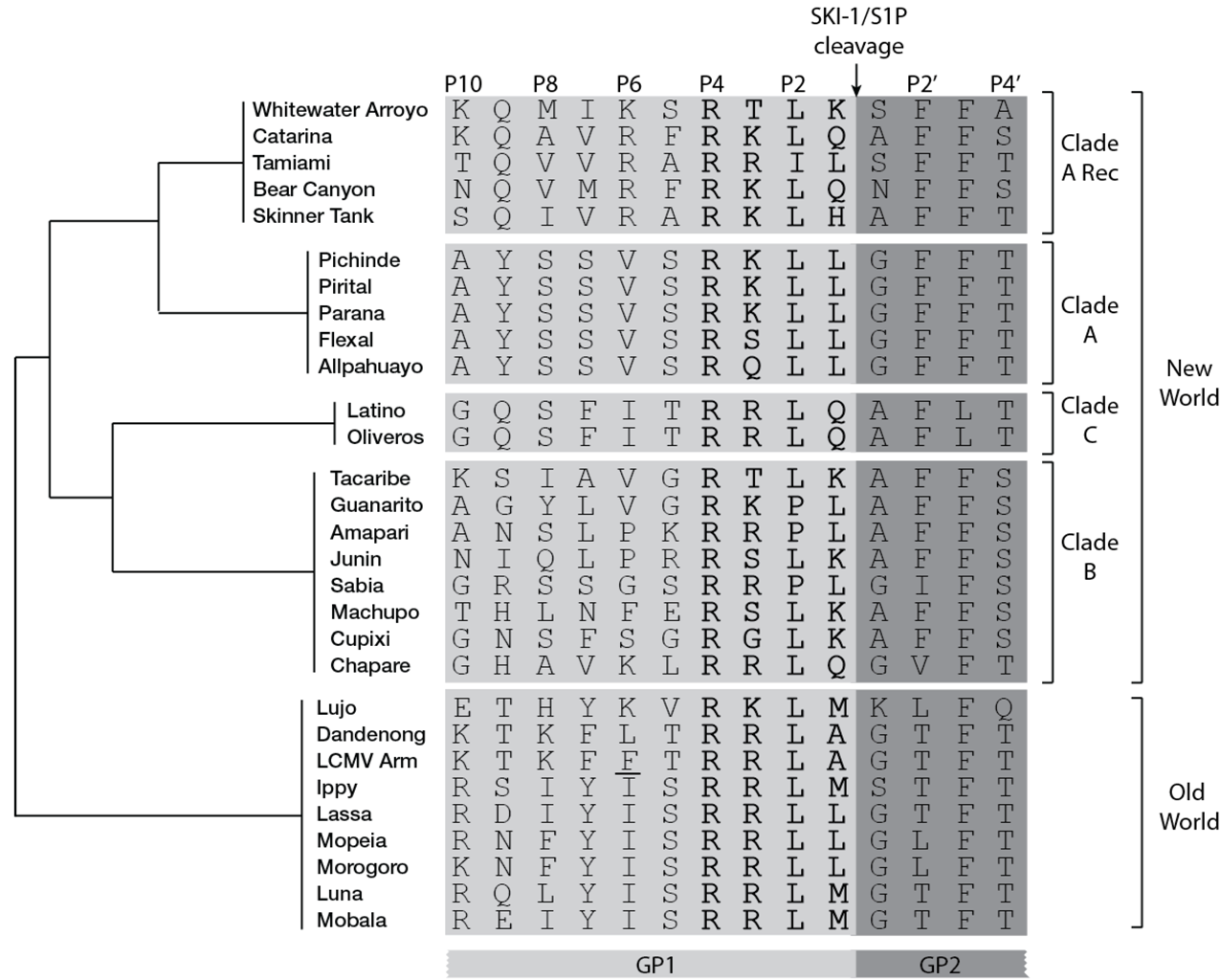
        <p>The arenavirus GPC is post-translationally cleaved at the highly conserved motif RX(hydrophobic)X↓, where X is any amino acid and hydrophobic is preferentially Leu (<xref ref-type="fig" rid="viruses-04-02162-f002">Figure 2</xref>) [<xref ref-type="bibr" rid="B67-viruses-04-02162">67</xref>]. In the absence of GP1, GP2 spontaneously forms a trimer, in which each subunit is folded in a “hairpin”-like postfusion conformation of class I viral fusion proteins [<xref ref-type="bibr" rid="B68-viruses-04-02162">68</xref>,<xref ref-type="bibr" rid="B69-viruses-04-02162">69</xref>]. SKI-1/S1P is responsible for the cleavage of the GPCs of both OW [<xref ref-type="bibr" rid="B40-viruses-04-02162">40</xref>] [<xref ref-type="bibr" rid="B39-viruses-04-02162">39</xref>] and NW [<xref ref-type="bibr" rid="B41-viruses-04-02162">41</xref>] arenaviruses. SKI-1/S1P belongs to the proprotein convertase (PC) family, which counts 9 members, so far, including 7 basic PCs (furin, PC1/3, PC2, PC4, PACE4, PC5/6, and PC7) and the self-inhibited proprotein convertase Subtilisin/Kexin type 9 (PCSK9). Differently from the other active members of PCs that cleave after clusters of (multi)basic motifs, the peculiar consensus sequence of SKI-1/S1P contains hydrophobic residues [<xref ref-type="bibr" rid="B70-viruses-04-02162">70</xref>,<xref ref-type="bibr" rid="B71-viruses-04-02162">71</xref>]. The protease is synthesized as an inactive zymogen that requires auto-processing of the N-terminal pro-domain at the B/B’ (RKVF↓RSLK↓) and C (RRLL↓) sites to attain full maturation [<xref ref-type="bibr" rid="B72-viruses-04-02162">72</xref>]. In the cell, mature SKI-1/S1P localizes in the early Golgi, where the majority of its cellular substrates are cleaved, but also in the lysosomes and in the extracellular space, in a shed enzymatic form [<xref ref-type="bibr" rid="B71-viruses-04-02162">71</xref>]. </p>
        <p>The biological activities of SKI-1/S1P are numerous and affect essential cellular functions. Among the best characterized SKI-1/S1P substrates are the Sterol Regulating Element Binding Proteins (SREBPs), transcription factors activated via limited proteolysis to control cell lipid homeostasis [<xref ref-type="bibr" rid="B72-viruses-04-02162">72</xref>,<xref ref-type="bibr" rid="B73-viruses-04-02162">73</xref>]. <italic>In vivo</italic> studies suggest that blocking SKI-1/S1P activity may be an alternative approach to lower plasma cholesterol [<xref ref-type="bibr" rid="B74-viruses-04-02162">74</xref>]. The SREBPs activation process, common to other transcription factors, is known as regulated intramembrane proteolysis (RIP) and involves translocation to the Golgi compartment upon specific stimuli and subsequent proteolytic cleavage. Member of the CREB/ATF family of transcription factors including ATF6 [<xref ref-type="bibr" rid="B75-viruses-04-02162">75</xref>] CREBH, Luman, CREB3L4, CREB4, and OASIS, have been identified as SKI-1/S1P substrates, related to the unfolded protein response (UPR) [<xref ref-type="bibr" rid="B76-viruses-04-02162">76</xref>]. Very few cellular examples of non-transcription factor proteins are known to be cleaved by SKI-1/S1P. Examples are N-acetylglucosamine-1-phosphotransferase, a key enzyme for the sorting of proteins into the lysosomal compartment [<xref ref-type="bibr" rid="B77-viruses-04-02162">77</xref>], pro-brain derived neurotrophic factor (BDNF) [<xref ref-type="bibr" rid="B78-viruses-04-02162">78</xref>] and repulsive guidance molecule (RGMa) [<xref ref-type="bibr" rid="B79-viruses-04-02162">79</xref>]. SKI-1/S1P cleaves proBDNF within its pro-domain but the biological significance of this processing is not known. Similarly, RGMa processing by SKI-1/S1P seems to be required although the cleavage sites have not yet been identified. The protease was also found to be crucial for normal bone and cartilage formation [<xref ref-type="bibr" rid="B80-viruses-04-02162">80</xref>,<xref ref-type="bibr" rid="B81-viruses-04-02162">81</xref>], and mice coat pigmentation [<xref ref-type="bibr" rid="B82-viruses-04-02162">82</xref>], but the substrates involved in these biological processes are still to be discovered. In mice, SKI-1/S1P K.O. shows a lethal phenotype with the embryos dying at an early developmental stage [<xref ref-type="bibr" rid="B83-viruses-04-02162">83</xref>]. Even incomplete inhibition of SKI-1/S1P causes severe effects: homozygosity for the <italic>woodrat</italic> mutation, which shows partial loss of enzyme function, leads to hypersensitivity to dextran sodium sulfate-induced colitis [<xref ref-type="bibr" rid="B84-viruses-04-02162">84</xref>], and causes enhanced embryonic mortality [<xref ref-type="bibr" rid="B85-viruses-04-02162">85</xref>].</p>
		<fig id="viruses-04-02162-f002" position="anchor">
          <label>Figure 2</label>
          <caption>
            <p>Amino acid sequence aligment of arenaviruses GPC residues surrounding the cleavage site (indicated by arrow). Residues of mature GP1 are in light gray while residues of mature GP2 are in darkgray. The four amino acids of clevage site motif are in bold. The schematic cladogram indicates the phylogenetic relationships between the viral clades is shown on the right. The LCMV cl13 strain amino acid variant F260L is underlined. Accession numbers are in supplementary table 1.</p>
          </caption>
          <graphic xmlns:xlink="http://www.w3.org/1999/xlink" xlink:href="viruses-04-02162-g002.tif"/>
        </fig>
      
        <p>In contrast to cellular substrates of SKI-1/S1P that are processed in the median Golgi, LASV GPC is cleaved in the ER/cis-Golgi and LCMV GPC in a late Golgi compartment [<xref ref-type="bibr" rid="B39-viruses-04-02162">39</xref>,<xref ref-type="bibr" rid="B71-viruses-04-02162">71</xref>,<xref ref-type="bibr" rid="B86-viruses-04-02162">86</xref>]. The way the virus is able to hijack active SKI-1/S1P in these specific subcellular compartments is not known. However, switching the LCMV GPC RRLA↓ motif into RRLL↓ present in LASV GPC re-direct the cleavage of the latter from a late Golgi compartment to the ER/cis-Golgi. In contrast, a LASV GPC chimera carrying the LCMV “RRLA↓” motif, is not cleaved despite following normal sorting to the plasma membrane [<xref ref-type="bibr" rid="B86-viruses-04-02162">86</xref>]. Thus, available evidence suggests that the specific amino acid sequence at the cleavage site may contribute to the processing at specific sub-cellular localizations. No clear information is currently available about the maturation of other arenavirus GPCs, although some evidences suggest JUNV GPC processing in the Golgi [<xref ref-type="bibr" rid="B87-viruses-04-02162">87</xref>]. </p>
        <p>A characteristic common to most arenavirus GPCs [<xref ref-type="bibr" rid="B67-viruses-04-02162">67</xref>] (<xref ref-type="fig" rid="viruses-04-02162-f002">Figure 2</xref>) is the striking resemblance of their processing sites to SKI-1/S1P auto-cleavage motifs: while African OW and NW clade B arenavirus GPCs mimic the C-auto-processing site “RRLL↓”, NW arenavirus GPCs resemble the B-auto-processing site “RSLK↓”. The mimicry indicates convergent evolution towards a common maturation mechanism resembling SKI-1/S1P auto-processing, which is not evident in other cellular SKI-1/S1P substrates. The advantage may account for the virus’ ability to avoid interference with cellular functions in order to persist in the reservoir rodent host. Accordingly, the SKI-1/S1P-dependent activation of ATF6 is normally induced by LCMV GPC during acute infection. As soon as GPC expression is down-regulated during the transition from acute to persistent infection [<xref ref-type="bibr" rid="B88-viruses-04-02162">88</xref>], the UPR response triggered by ATF6 disappears [<xref ref-type="bibr" rid="B89-viruses-04-02162">89</xref>]. However, the reason behind the selective association “RRLL↓”-OW arenavirus and “RSLK↓”-NW arenavirus are currently unclear.</p>
        <p>Specific GPC residues surrounding the cleavage site were shown to influence maturation. An F259A point mutation at P7 position of LCMV GPC greatly impairs processing [<xref ref-type="bibr" rid="B39-viruses-04-02162">39</xref>]. Analysis of peptides mimicking the cleavage site of LASV GPC revealed that cleavage efficiency may be negatively affected by the presence of a non-aromatic residue at P7 position, indicating the presence of an unusually large catalytic pocket able to accommodate residues distal from the actual processing site [<xref ref-type="bibr" rid="B70-viruses-04-02162">70</xref>]. Indeed, in comparative studies, the <underline>Y</underline>ISRRLL↓ sequence mimicking the cleavage site of LASV GPC is the best substrate to assess <italic>in vitro </italic>SKI-1/S1P enzymatic activity [<xref ref-type="bibr" rid="B77-viruses-04-02162">77</xref>,<xref ref-type="bibr" rid="B78-viruses-04-02162">78</xref>,<xref ref-type="bibr" rid="B90-viruses-04-02162">90</xref>]. </p>
        <p>The N-terminus of LASV GP2 contains two stretches of highly conserved hydrophobic amino acids. Alanine scanning of the N-terminal 260-266 and 276-298 sequences revealed that maturation of the envelope GPC does not occur in presence of single point mutations at positions 260, 261, 262, 280, 284, 285, 286, 292, and 293, despite GPC folding and reaching the plasma membrane [<xref ref-type="bibr" rid="B91-viruses-04-02162">91</xref>]. Indeed, GPC cleavage is not essential for transport to the plasma membrane, yet only the fully mature complex is found on budding particles [<xref ref-type="bibr" rid="B66-viruses-04-02162">66</xref>,<xref ref-type="bibr" rid="B72-viruses-04-02162">72</xref>,<xref ref-type="bibr" rid="B74-viruses-04-02162">74</xref>]. A similar effect is observed in the case of the LASV GPC N-glycosylation mutants S367A and S375A, which are transported normally to the cell surface but fail to be cleaved [<xref ref-type="bibr" rid="B43-viruses-04-02162">43</xref>]. LASV GP1 glycosylation at position 81, 91, 101, and 121 are required for proteolytic processing but not cell surface localization. In contrast, mutations that abolish normal glycosylation at positions 111, 169, and 226 are not crucial for the precursor maturation [<xref ref-type="bibr" rid="B43-viruses-04-02162">43</xref>]. The data at hand thus suggest that SKI-1/S1P-mediated processing may require specific tertiary/quaternary structures of the GP1/GP2 complex that are disrupted by specific point mutations deletions. </p>
        <p>A large body of evidence indicate a crucial role of the cytoplasmic domains of viral envelope GPs in assembly, fusogenicity, and infectivity of enveloped viruses, including Newcastle disease virus [<xref ref-type="bibr" rid="B92-viruses-04-02162">92</xref>] Measles virus [<xref ref-type="bibr" rid="B93-viruses-04-02162">93</xref>], and HIV-1 [<xref ref-type="bibr" rid="B94-viruses-04-02162">94</xref>]. Similar observations have been made with arenaviruses. Removal of the entire LCMV GP2 cytosolic tail as well as partial deletion of the three C-terminal amino acids RRK prevent maturation of GPC without interfering with its normal transport to the cell surface [<xref ref-type="bibr" rid="B65-viruses-04-02162">65</xref>]. As similar role of amino acid residues in the cytoplasmic domain for GPC cleavage was observed by Schlie et al. in the context of LASV GPC [<xref ref-type="bibr" rid="B95-viruses-04-02162">95</xref>]. In arenaviruses, lack of cleavage has thus a drastic impact on infectious particles production since the process of GP incorporation into nascent virions discriminates processed over unprocessed GPC.</p>
      </sec>
      <sec>
        <title>2.4. Targeting GPC maturation is a promising strategy against arenavirus infection</title>
        <p>Similarly to other enveloped viruses, whose GPs are processed by PCs, such as HIV-1 and influenza virus, arenaviruses strictly rely on SKI-1/S1P for productive infection. In SKI-1/S1P-deficient cells, uncleaved GPCs are correctly transported to the plasma membrane but fail to be incorporated into budding particles, which remain “naked”, and lack infectivity [<xref ref-type="bibr" rid="B40-viruses-04-02162">40</xref>,<xref ref-type="bibr" rid="B51-viruses-04-02162">51</xref>,<xref ref-type="bibr" rid="B65-viruses-04-02162">65</xref>]. Thus, GPC maturation represents an attractive drug target for complementary therapeutic intervention in addition to ribavirin. Over the past ten years, several SKI-1/S1P inhibitors have been synthesized and identified [<xref ref-type="bibr" rid="B67-viruses-04-02162">67</xref>,<xref ref-type="bibr" rid="B70-viruses-04-02162">70</xref>,<xref ref-type="bibr" rid="B96-viruses-04-02162">96</xref>], but only few showed potential applications based on their cell-permeability, cytotoxicity and specificity. We [<xref ref-type="bibr" rid="B97-viruses-04-02162">97</xref>] and others have shown that peptide- (dec-RRLL-cmk) or protein-(PDX-variants) [<xref ref-type="bibr" rid="B98-viruses-04-02162">98</xref>] based SKI-1/S1P inhibitors efficiently blocks arenavirus cell-to-cell propagation. The on-target effect of dec-RRLL-cmk was demonstrated by using a recombinant LCMV bearing a furin-cleavable GPC, which was only slightly affected by the treatment [<xref ref-type="bibr" rid="B97-viruses-04-02162">97</xref>]. More importantly, these investigations provided proof-of-concept that inhibition of GPC processing can contain the infection. Unfortunately, the use of the small molecule dec-RRLL-cmk was restricted due to its toxicity and follow-up studies <italic>in vivo</italic> were not feasible [<xref ref-type="bibr" rid="B99-viruses-04-02162">99</xref>]. Rational design of SKI-1/S1P inhibitors is limited by the lack of structural information about the enzyme. As an alternative approach, Pfizer Inc. performed high-throughput small molecule screening using a homogeneous enzyme activity assay format based on purified soluble SKI-1/S1P that lead to the discovery of the aminopyrrolidineamide-based inhibitor PF-429242 with an <italic>in vitro</italic> IC<sub>50</sub> in the nanomolar range [<xref ref-type="bibr" rid="B100-viruses-04-02162">100</xref>]. The compound was potent in blocking SREBP-2 activation <italic>in vivo</italic>, significantly lowering plasma cholesterol levels [<xref ref-type="bibr" rid="B74-viruses-04-02162">74</xref>]. PF-429242 is a potent inhibitor of cell-to-cell propagation of OW arenaviruses <italic>via</italic> direct interference with the SKI-1/S1P-mediated GPC cleavage [<xref ref-type="bibr" rid="B101-viruses-04-02162">101</xref>]. The on-target effect of PF-429242 was confirmed <italic>in vitro</italic> on synthetic peptides mimicking the cleavage site of the LASV GPC: processing of the LASV GPC derived Ac-IYISRRLL-MCA peptide is inhibited by PF-429242 with an IC<sub>50</sub> of 130 nM [<xref ref-type="bibr" rid="B99-viruses-04-02162">99</xref>]. The small drug molecule appears to be effective against NW arenaviruses as well [<xref ref-type="bibr" rid="B99-viruses-04-02162">99</xref>]. Combinatorial PF-429242 treatment with the well known broad anti-viral ribavirin shows a synergetic effect <italic>in vitro</italic> [<xref ref-type="bibr" rid="B99-viruses-04-02162">99</xref>], suggesting that the administration of a SKI-1/S1P inhibitor may help to combat the infection. </p>
        <p>A hallmark of persistent infection is the down-regulation of GPC expression to almost undetectable levels with respect to the viral NP [<xref ref-type="bibr" rid="B102-viruses-04-02162">102</xref>]. During this phase, infectious particles are still produced. It is conceivable that any perturbation of the GPC maturation may have drastic effects, as the envelope GP becomes the limiting factor for virus production and its inhibition cannot be compensated easily. Accordingly, in LCMV persistently infected cells the virus is rapidly cleared by PF-429242 treatment with apparently no emergence of escape variants [<xref ref-type="bibr" rid="B99-viruses-04-02162">99</xref>]. Early studies in SKI-1/S1P-deficient cells showed that LCMV and JUNV can persist over long periods with a low probability of emergence of SKI-1/S1P independency before extinction [<xref ref-type="bibr" rid="B97-viruses-04-02162">97</xref>]. In terms of drug development, this is of great importance because it suggests that the emergence of SKI-1/S1P-independent arenaviral variants is a rare event, further supporting the potential of SKI-1/S1P inhibitors as an anti-viral strategy. It is currently unclear why arenaviruses cannot escape SKI-1/S1P deficiency. Possibly, SKI-1/S1P-mediated GPC cleavage is crucial not only for the liberation of the N-terminal GP2 fusion peptide. Interestingly, addition of exogenous SKI-1/S1P is incapable of maturating GPC expressed at the surface of SKI-1/S1P null cells, suggesting that processing must occur in a specific sub-cellular compartment [<xref ref-type="bibr" rid="B86-viruses-04-02162">86</xref>]. The relevance for SKI-1/S1P for productive arenavirus infection <italic>in vivo</italic> is further illustrated in mice homozygous for the hypomorphic <italic>Mbtps1</italic> wrt allele (woodrat mutation), carrying a defective but still partially active SKI-1/S1P are resistant to LCMV infection [<xref ref-type="bibr" rid="B85-viruses-04-02162">85</xref>]. </p>
        <p>Given the importance of arenavirus envelope GPC processing for productive infection and its dependency on a protease involved in several crucial host functions, efforts have been made to understand how viral substrate and the enzyme interact, with the goal to eventually develop substrate-specific drugs. Biochemical characterization of SKI-1/S1P-GPC interaction revealed that auto-processing at the B/B’ sites of SKI-1/S1P is crucial for effective GPC maturation but not cellular SREBP-2 activation [<xref ref-type="bibr" rid="B86-viruses-04-02162">86</xref>]. The exact reasons for the specific requirement of B/B’ autoprocessing for efficient cleavage of viral, but not cellular substrates are currently not known. However, this remarkable difference suggests that inhibitors of SKI-1/S1P autoprocessing may show some specificity for viral substrates with less of an effect on processing of cellular substrates. Moreover, the data at hand indicate that viral and cellular substrates of SKI-1/S1P are processed in distinct subcellular compartments. In uninfected cells, membrane-associated SKI-1/S1P is found predominantly in the early Golgi where cellular SKI-1/S1P substrates are cleaved [<xref ref-type="bibr" rid="B103-viruses-04-02162">103</xref>]. In contrast, LASV GPC is cleaved early in the secretory pathway and LCMV GPC was shown to be processed in a late Golgi or post-Golgi compartment [<xref ref-type="bibr" rid="B86-viruses-04-02162">86</xref>]. The non-overlapping sub-cellular localization of viral and cellular substrates has been further supported by the finding that SKI-1/S1P mediated processing of ATF-6 is unaffected upon infection [<xref ref-type="bibr" rid="B89-viruses-04-02162">89</xref>]. Targeting the protease in specific sub-cellular compartments may thus affect predominantly processing of viral GPCs. In this context, the recent reported protein inhibitor SKI-1/S1P Spn4A.RRLL(r), a modified serpin with SKI-1/S1P specificity, coupled to HDEL ER-retention sequence [<xref ref-type="bibr" rid="B104-viruses-04-02162">104</xref>] may act as a LASV specific inhibitor. Accordingly, Spn4A.RRLL(r) does inhibit SKI-1/S1P <italic>in vitro</italic> without affecting the SREBP-2 pathway. As mentioned above, residues surrounding GPC processing site affect substrate-enzyme recognition. In particular, an aromatic amino acid at P7 was found to be crucial for processing of both LASV [<xref ref-type="bibr" rid="B70-viruses-04-02162">70</xref>] and LCMV GPC [<xref ref-type="bibr" rid="B39-viruses-04-02162">39</xref>], making this region of the GPC an attractive anti-viral drug target given that the interference with P7-S7 interaction should not perturb the catalytic triad and thus general enzymatic activity.</p>
        <p>The envelope glycoprotein processing is a key step in arenavirus life-cycle. <italic>In vitro</italic> inhibition of SKI-1/S1P-mediated processing of GPC greatly limits virus cell-to-cell propagation, thus representing a promising antiviral strategy. <italic>In vivo</italic> evaluation of SKI-1/S1P inhibitors as antivirals, e.g. PF-429242, would be of great importance to understand the efficacy of interfering with normal GPC maturation on arenavirus infections. During drug treatment, dietary supplementation of cholesterol and other lipids may be taken into account to compensate for plasma cholesterol reduction, resulting from SREBPs inhibition. Novel substrate specific SKI-1/S1P inhibitors may be of great value to minimize side effects. </p>
      </sec>
    </sec>
    <sec>
      <title>3. Role of the envelope glycoprotein on virus assembly and particle formation</title>
      <p>Viral infection induces a global reprogramming of cellular processes, including alterations the organization of intracellular membranes and organelles [<xref ref-type="bibr" rid="B105-viruses-04-02162">105</xref>,<xref ref-type="bibr" rid="B106-viruses-04-02162">106</xref>]. Assembly of the viral components, and in particular GP, to form progeny infectious particle is still a process that remains for many aspects unknown. As introduced above, the driving force for arenaviruses budding is the matrix protein Z [<xref ref-type="bibr" rid="B34-viruses-04-02162">34</xref>,<xref ref-type="bibr" rid="B35-viruses-04-02162">35</xref>] which interacts <italic>via</italic> its late or RING domain with Tsg101, a member of the ESCRT machinery [<xref ref-type="bibr" rid="B34-viruses-04-02162">34</xref>,<xref ref-type="bibr" rid="B36-viruses-04-02162">36</xref>]. Myristoylation of Z is crucial for the correct matrix protein localization and therefore budding [<xref ref-type="bibr" rid="B107-viruses-04-02162">107</xref>]. Z possesses <italic>per se</italic> budding properties and does not require any other viral protein to accomplish its function. However, the ability to produce infectious particles resides on the assembly of the four different viral proteins in a synchronized fashion. Thus, Z is required to interact with the SSP/GP1/GP2 complex that decorates the surface of the nascent particle. Confocal and biochemical analyses showed a direct LCMV and LASV GP1/GP2-Z interaction, dependent on the stable signal peptide of the GP complex [<xref ref-type="bibr" rid="B37-viruses-04-02162">37</xref>]. Cells that express LASV GPC together with Z show a partial co-localization in vesicle-like structures near the nucleus [<xref ref-type="bibr" rid="B108-viruses-04-02162">108</xref>]. Sub-cellular localization of the envelope glycoprotein is not modified by the presence of Z [<xref ref-type="bibr" rid="B34-viruses-04-02162">34</xref>]. Z myristoylation, but not on the Z late (L) or RING domain was shown to be responsible for the matrix protein binding to the envelope GP in OW arenaviruses [<xref ref-type="bibr" rid="B37-viruses-04-02162">37</xref>]. However, disrupting the Z RING domain resulted in a drastic loss of TCRV and JUNV GP incorporation, suggesting some differences in the detailed molecular interactions underlying virion assembly in OW and NW viruses [<xref ref-type="bibr" rid="B109-viruses-04-02162">109</xref>]. Further analyses are required to better understand the role of the GP complex in the virus budding events. The mechanisms underlying the selective incorporation of cleaved over uncleaved envelope GPs remain unclear and may involve different tertiary/quaternary structures of the mature SSP/GP1/GP2 complex in comparison to immature GPC [<xref ref-type="bibr" rid="B20-viruses-04-02162">20</xref>]. Inhibition of virus assembly and budding is becoming more and more attractive as a drug target, opening the possibility to block egress of progeny virions from already infected cells. A detailed analysis of the molecular interactions underlying the recruitment of processed GP, Z, and the RNP into budding zones in infected cells will likely reveal promising drug targets for novel therapeutics to combat human arenavirus infection. </p>
    </sec>
  </body>
  <back><ack>
      <title>Acknowledgments</title>
      <p>This research was supported by the Swiss National Science Foundation grant FN 31003A-135536 (S.K.) and funds from the University of Lausanne.</p>
    </ack>
    <notes>
      <title>Conflict of Interest</title>
      <p>The authors declare no conflict of interest. </p>
    </notes>
    <ref-list>
      <title>References and Notes</title>
      <ref id="B1-viruses-04-02162">
        <label>1.</label>
        <citation citation-type="journal">
          <person-group person-group-type="author">
            <name>
              <surname>Armstrong</surname>
              <given-names>C.</given-names>
            </name>
            <name>
              <surname>Lillie</surname>
              <given-names>R.</given-names>
            </name>
          </person-group>
          <article-title>Experimental lymphocytic choriomeningitis of monkeys and mice produced by a virus encountered in studies of the 1933 St. Luis encephalitis epidemic</article-title>
          <source>Publ Health Rep</source>
          <year>1934</year>
          <volume>49</volume>
          <fpage>1019</fpage>
          <lpage>1024</lpage>
          <pub-id pub-id-type="doi">10.2307/4581290</pub-id>
        </citation>
      </ref>
      <ref id="B2-viruses-04-02162">
        <label>2.</label>
        <citation citation-type="journal">
          <person-group person-group-type="author">
            <name>
              <surname>Rivers</surname>
              <given-names>T.M.</given-names>
            </name>
            <name>
              <surname>McNair Scott</surname>
              <given-names>T.F.</given-names>
            </name>
          </person-group>
          <article-title>Meningitis in Man Caused by a Filterable Virus</article-title>
          <source>Science</source>
          <year>1935</year>
          <volume>81</volume>
          <fpage>439</fpage>
          <lpage>440</lpage>
        <pub-id pub-id-type="pmid">17750171</pub-id></citation>
      </ref>
      <ref id="B3-viruses-04-02162">
        <label>3.</label>
        <citation citation-type="journal">
          <person-group person-group-type="author">
            <name>
              <surname>Traub</surname>
              <given-names>E.</given-names>
            </name>
          </person-group>
          <article-title>A Filterable Virus Recovered from White Mice</article-title>
          <source>Science</source>
          <year>1935</year>
          <volume>81, (2099)</volume>
          <fpage>298</fpage>
          <lpage>299</lpage>
        </citation>
      </ref>
      <ref id="B4-viruses-04-02162">
        <label>4.</label>
        <citation citation-type="journal">
          <person-group person-group-type="author">
            <name>
              <surname>Charrel</surname>
              <given-names>R.N.</given-names>
            </name>
            <name>
              <surname>Coutard</surname>
              <given-names>B.</given-names>
            </name>
            <name>
              <surname>Baronti</surname>
              <given-names>C.</given-names>
            </name>
            <name>
              <surname>Canard</surname>
              <given-names>B.</given-names>
            </name>
            <name>
              <surname>Nougairede</surname>
              <given-names>A.</given-names>
            </name>
            <name>
              <surname>Frangeul</surname>
              <given-names>A.</given-names>
            </name>
            <name>
              <surname>Morin</surname>
              <given-names>B.</given-names>
            </name>
            <name>
              <surname>Jamal</surname>
              <given-names>S.</given-names>
            </name>
            <name>
              <surname>Schmidt</surname>
              <given-names>C.L.</given-names>
            </name>
            <name>
              <surname>Hilgenfeld</surname>
              <given-names>R.</given-names>
            </name>
            <name>
              <surname>Klempa</surname>
              <given-names>B.</given-names>
            </name>
            <name>
              <surname>de Lamballerie</surname>
              <given-names>X.</given-names>
            </name>
          </person-group>
          <article-title>Arenaviruses and hantaviruses: from epidemiology and genomics to antivirals</article-title>
          <source>Antiviral research</source>
          <year>2011</year>
          <volume>90</volume>
          <fpage>102</fpage>
          <lpage>114</lpage>
          <pub-id pub-id-type="doi">10.1016/j.antiviral.2011.02.009</pub-id>
        </citation>
      </ref>
      <ref id="B5-viruses-04-02162">
        <label>5.</label>
        <citation citation-type="journal">
          <person-group person-group-type="author">
            <name>
              <surname>Geisbert</surname>
              <given-names>T.W.</given-names>
            </name>
            <name>
              <surname>Jahrling</surname>
              <given-names>P.B.</given-names>
            </name>
          </person-group>
          <article-title>Exotic emerging viral diseases: progress and challenges</article-title>
          <source>Nature medicine</source>
          <year>2004</year>
          <volume>10</volume>
          <fpage>S110</fpage>
          <lpage>S121</lpage>
          <pub-id pub-id-type="doi">10.1038/nm1142</pub-id>
        </citation>
      </ref>
      <ref id="B6-viruses-04-02162">
        <label>6.</label>
        <citation citation-type="journal">
          <person-group person-group-type="author">
            <name>
              <surname>McCormick</surname>
              <given-names>J.B.</given-names>
            </name>
            <name>
              <surname>King</surname>
              <given-names>I.J.</given-names>
            </name>
            <name>
              <surname>Webb</surname>
              <given-names>P.A.</given-names>
            </name>
            <name>
              <surname>Johnson</surname>
              <given-names>K.M.</given-names>
            </name>
            <name>
              <surname>O'Sullivan</surname>
              <given-names>R.</given-names>
            </name>
            <name>
              <surname>Smith</surname>
              <given-names>E.S.</given-names>
            </name>
            <name>
              <surname>Trippel</surname>
              <given-names>S.</given-names>
            </name>
            <name>
              <surname>Tong</surname>
              <given-names>T.C.</given-names>
            </name>
          </person-group>
          <article-title>A case-control study of the clinical diagnosis and course of Lassa fever</article-title>
          <source>The Journal of infectious diseases</source>
          <year>1987</year>
          <volume>155</volume>
          <fpage>445</fpage>
          <lpage>455</lpage>
          <pub-id pub-id-type="doi">10.1093/infdis/155.3.445</pub-id>
        </citation>
      </ref>
      <ref id="B7-viruses-04-02162">
        <label>7.</label>
        <citation citation-type="journal">
          <person-group person-group-type="author">
            <name>
              <surname>Peters</surname>
              <given-names>C.J.</given-names>
            </name>
          </person-group>
          <article-title>Human infection with arenaviruses in the Americas</article-title>
          <source>Current topics in microbiology and immunology</source>
          <year>2002</year>
          <volume>262</volume>
          <fpage>65</fpage>
          <lpage>74</lpage>
          <pub-id pub-id-type="doi">10.1007/978-3-642-56029-3_3</pub-id>
        </citation>
      </ref>
      <ref id="B8-viruses-04-02162">
        <label>8.</label>
        <citation citation-type="journal">
          <person-group person-group-type="author">
            <name>
              <surname>Maiztegui</surname>
              <given-names>J.I.</given-names>
            </name>
          </person-group>
          <article-title>Clinical and epidemiological patterns of Argentine haemorrhagic fever</article-title>
          <source>Bulletin of the World Health Organization</source>
          <year>1975</year>
          <volume>52</volume>
          <fpage>567</fpage>
          <lpage>575</lpage>
        <pub-id pub-id-type="pmid">1085212</pub-id></citation>
      </ref>
      <ref id="B9-viruses-04-02162">
        <label>9.</label>
        <citation citation-type="journal">
          <person-group person-group-type="author">
            <name>
              <surname>Parodi</surname>
              <given-names>A.S.</given-names>
            </name>
            <name>
              <surname>Greenway</surname>
              <given-names>D.J.</given-names>
            </name>
            <name>
              <surname>Rugiero</surname>
              <given-names>H.R.</given-names>
            </name>
            <name>
              <surname>Frigerio</surname>
              <given-names>M.</given-names>
            </name>
            <name>
              <surname>De La Barrera</surname>
              <given-names>J.M.</given-names>
            </name>
            <name>
              <surname>Mettler</surname>
              <given-names>N.</given-names>
            </name>
            <name>
              <surname>Garzon</surname>
              <given-names>F.</given-names>
            </name>
            <name>
              <surname>Boxaca</surname>
              <given-names>M.</given-names>
            </name>
            <name>
              <surname>Guerrero</surname>
              <given-names>L.</given-names>
            </name>
            <name>
              <surname>Nota</surname>
              <given-names>N.</given-names>
            </name>
          </person-group>
          <article-title>[Concerning the epidemic outbreak in Junin]</article-title>
          <source>El Dia medico</source>
          <year>1958</year>
          <volume>30</volume>
          <fpage>2300</fpage>
          <lpage>2301</lpage>
        <pub-id pub-id-type="pmid">13586110</pub-id></citation>
      </ref>
      <ref id="B10-viruses-04-02162">
        <label>10.</label>
        <citation citation-type="journal">
          <person-group person-group-type="author">
            <name>
              <surname>Weissenbacher</surname>
              <given-names>M.C.</given-names>
            </name>
            <name>
              <surname>Laguens</surname>
              <given-names>R.P.</given-names>
            </name>
            <name>
              <surname>Coto</surname>
              <given-names>C.E.</given-names>
            </name>
          </person-group>
          <article-title>Argentine hemorrhagic fever</article-title>
          <source>Current topics in microbiology and immunology</source>
          <year>1987</year>
          <volume>134</volume>
          <fpage>79</fpage>
          <lpage>116</lpage>
        <pub-id pub-id-type="pmid">3034513</pub-id></citation>
      </ref>
      <ref id="B11-viruses-04-02162">
        <label>11.</label>
        <citation citation-type="journal">
          <person-group person-group-type="author">
            <name>
              <surname>Razonable</surname>
              <given-names>R.R.</given-names>
            </name>
          </person-group>
          <article-title>Rare, unusual, and less common virus infections after organ transplantation</article-title>
          <source>Current opinion in organ transplantation</source>
          <year>2011</year>
          <volume>16</volume>
          <fpage>580</fpage>
          <lpage>587</lpage>
          <pub-id pub-id-type="doi">10.1097/MOT.0b013e32834cdaf2</pub-id>
        </citation>
      </ref>
      <ref id="B12-viruses-04-02162">
        <label>12.</label>
        <citation citation-type="journal">
          <person-group person-group-type="author">
            <name>
              <surname>Bonthius</surname>
              <given-names>D.J.</given-names>
            </name>
          </person-group>
          <article-title>Lymphocytic choriomeningitis virus: a prenatal and postnatal threat</article-title>
          <source>Advances in pediatrics</source>
          <year>2009</year>
          <volume>56</volume>
          <fpage>75</fpage>
          <lpage>86</lpage>
          <pub-id pub-id-type="doi">10.1016/j.yapd.2009.08.007</pub-id>
        </citation>
      </ref>
      <ref id="B13-viruses-04-02162">
        <label>13.</label>
        <citation citation-type="journal">
          <person-group person-group-type="author">
            <name>
              <surname>Mahy</surname>
              <given-names>B.W.</given-names>
            </name>
            <name>
              <surname>Dykewicz</surname>
              <given-names>C.</given-names>
            </name>
            <name>
              <surname>Fisher-Hoch</surname>
              <given-names>S.</given-names>
            </name>
            <name>
              <surname>Ostroff</surname>
              <given-names>S.</given-names>
            </name>
            <name>
              <surname>Tipple</surname>
              <given-names>M.</given-names>
            </name>
            <name>
              <surname>Sanchez</surname>
              <given-names>A.</given-names>
            </name>
          </person-group>
          <article-title>Virus zoonoses and their potential for contamination of cell cultures</article-title>
          <source>Developments in biological standardization</source>
          <year>1991</year>
          <volume>75</volume>
          <fpage>183</fpage>
          <lpage>189</lpage>
        <pub-id pub-id-type="pmid">1794619</pub-id></citation>
      </ref>
      <ref id="B14-viruses-04-02162">
        <label>14.</label>
        <citation citation-type="journal">
          <person-group person-group-type="author">
            <name>
              <surname>Delgado</surname>
              <given-names>S.</given-names>
            </name>
            <name>
              <surname>Erickson</surname>
              <given-names>B.R.</given-names>
            </name>
            <name>
              <surname>Agudo</surname>
              <given-names>R.</given-names>
            </name>
            <name>
              <surname>Blair</surname>
              <given-names>P.J.</given-names>
            </name>
            <name>
              <surname>Vallejo</surname>
              <given-names>E.</given-names>
            </name>
            <name>
              <surname>Albarino</surname>
              <given-names>C.G.</given-names>
            </name>
            <name>
              <surname>Vargas</surname>
              <given-names>J.</given-names>
            </name>
            <name>
              <surname>Comer</surname>
              <given-names>J.A.</given-names>
            </name>
            <name>
              <surname>Rollin</surname>
              <given-names>P.E.</given-names>
            </name>
            <name>
              <surname>Ksiazek</surname>
              <given-names>T.G.</given-names>
            </name>
            <name>
              <surname>Olson</surname>
              <given-names>J.G.</given-names>
            </name>
            <name>
              <surname>Nichol</surname>
              <given-names>S.T.</given-names>
            </name>
          </person-group>
          <article-title>Chapare virus, a newly discovered arenavirus isolated from a fatal hemorrhagic fever case in Bolivia</article-title>
          <source>PLoS pathogens</source>
          <year>2008</year>
          <volume>4</volume>
          <fpage>e1000047</fpage>
          <pub-id pub-id-type="doi">10.1371/journal.ppat.1000047</pub-id>
        </citation>
      </ref>
      <ref id="B15-viruses-04-02162">
        <label>15.</label>
        <citation citation-type="journal">
          <person-group person-group-type="author">
            <name>
              <surname>Briese</surname>
              <given-names>T.</given-names>
            </name>
            <name>
              <surname>Paweska</surname>
              <given-names>J.T.</given-names>
            </name>
            <name>
              <surname>McMullan</surname>
              <given-names>L.K.</given-names>
            </name>
            <name>
              <surname>Hutchison</surname>
              <given-names>S.K.</given-names>
            </name>
            <name>
              <surname>Street</surname>
              <given-names>C.</given-names>
            </name>
            <name>
              <surname>Palacios</surname>
              <given-names>G.</given-names>
            </name>
            <name>
              <surname>Khristova</surname>
              <given-names>M.L.</given-names>
            </name>
            <name>
              <surname>Weyer</surname>
              <given-names>J.</given-names>
            </name>
            <name>
              <surname>Swanepoel</surname>
              <given-names>R.</given-names>
            </name>
            <name>
              <surname>Egholm</surname>
              <given-names>M.</given-names>
            </name>
            <name>
              <surname>Nichol</surname>
              <given-names>S.T.</given-names>
            </name>
            <name>
              <surname>Lipkin</surname>
              <given-names>W.I.</given-names>
            </name>
          </person-group>
          <article-title>Genetic detection and characterization of Lujo virus, a new hemorrhagic fever-associated arenavirus from southern Africa</article-title>
          <source>PLoS pathogens</source>
          <year>2009</year>
          <volume>5</volume>
          <fpage>e1000455</fpage>
          <pub-id pub-id-type="doi">10.1371/journal.ppat.1000455</pub-id>
        </citation>
      </ref>
      <ref id="B16-viruses-04-02162">
        <label>16.</label>
        <citation citation-type="journal">
          <person-group person-group-type="author">
            <name>
              <surname>Kohl</surname>
              <given-names>K.S.</given-names>
            </name>
            <name>
              <surname>Arthur</surname>
              <given-names>R.R.</given-names>
            </name>
            <name>
              <surname>O'Connor</surname>
              <given-names>R.</given-names>
            </name>
            <name>
              <surname>Fernandez</surname>
              <given-names>J.</given-names>
            </name>
          </person-group>
          <article-title>Assessment of public health events through International Health Regulations, United States, 2007-2011</article-title>
          <source>Emerging infectious diseases</source>
          <year>2012</year>
          <volume>18</volume>
          <fpage>1047</fpage>
          <lpage>1053</lpage>
          <pub-id pub-id-type="doi">10.3201/eid1807.120231</pub-id>
        </citation>
      </ref>
      <ref id="B17-viruses-04-02162">
        <label>17.</label>
        <citation citation-type="journal">
          <person-group person-group-type="author">
            <name>
              <surname>de la Torre</surname>
              <given-names>J.C.</given-names>
            </name>
          </person-group>
          <article-title>Molecular and cell biology of the prototypic arenavirus LCMV: implications for understanding and combating hemorrhagic fever arenaviruses</article-title>
          <source>Annals of the New York Academy of Sciences</source>
          <year>2009</year>
          <volume>1171 Suppl 1</volume>
          <fpage>E57</fpage>
          <lpage>E64</lpage>
          <pub-id pub-id-type="doi">10.1111/j.1749-6632.2009.05048.x</pub-id>
        </citation>
      </ref>
      <ref id="B18-viruses-04-02162">
        <label>18.</label>
        <citation citation-type="book">
          <person-group person-group-type="author">
            <name>
              <surname>Buchmeier</surname>
              <given-names>M.J.</given-names>
            </name>
            <name>
              <surname>de la Torre</surname>
              <given-names>J.C.</given-names>
            </name>
            <name>
              <surname>Peters</surname>
              <given-names>C.J.</given-names>
            </name>
          </person-group>
          <article-title>Arenaviridae: the viruses and their replication</article-title>
          <source>Fields Virology</source>
          <edition>4th</edition>
          <person-group person-group-type="editor">
            <name>
              <surname>Knipe D.</surname>
              <given-names>L.</given-names>
            </name>
            <name>
              <surname>Howley P.</surname>
              <given-names>M.</given-names>
            </name>
          </person-group>
          <publisher-name>Lippincott-Raven</publisher-name>
          <publisher-loc>Philadelphia</publisher-loc>
          <year>2007</year>
          <fpage>1791</fpage>
          <lpage>1828</lpage>
        </citation>
      </ref>
      <ref id="B19-viruses-04-02162">
        <label>19.</label>
        <citation citation-type="book">
          <person-group person-group-type="author">
            <name>
              <surname>Emonet</surname>
              <given-names>S.F.</given-names>
            </name>
            <name>
              <surname>de la Torre</surname>
              <given-names>J.C.</given-names>
            </name>
            <name>
              <surname>Domingo</surname>
              <given-names>E.</given-names>
            </name>
            <name>
              <surname>Sevilla</surname>
              <given-names>N.</given-names>
            </name>
          </person-group>
          <article-title>Arenavirus genetic diversity and its biological implications</article-title>
          <source>Infection, genetics and evolution : journal of molecular epidemiology and evolutionary genetics in infectious diseases</source>
          <year>2009</year>
          <volume>9</volume>
          <fpage>417</fpage>
          <lpage>429</lpage>
        </citation>
      </ref>
      <ref id="B20-viruses-04-02162">
        <label>20.</label>
        <citation citation-type="journal">
          <person-group person-group-type="author">
            <name>
              <surname>Schlie</surname>
              <given-names>K.</given-names>
            </name>
            <name>
              <surname>Maisa</surname>
              <given-names>A.</given-names>
            </name>
            <name>
              <surname>Lennartz</surname>
              <given-names>F.</given-names>
            </name>
            <name>
              <surname>Stroher</surname>
              <given-names>U.</given-names>
            </name>
            <name>
              <surname>Garten</surname>
              <given-names>W.</given-names>
            </name>
            <name>
              <surname>Strecker</surname>
              <given-names>T.</given-names>
            </name>
          </person-group>
          <article-title>Characterization of Lassa virus glycoprotein oligomerization and influence of cholesterol on virus replication</article-title>
          <source>Journal of virology</source>
          <year>2010</year>
          <volume>84</volume>
          <fpage>983</fpage>
          <lpage>992</lpage>
          <pub-id pub-id-type="doi">10.1128/JVI.02039-09</pub-id>
        </citation>
      </ref>
      <ref id="B21-viruses-04-02162">
        <label>21.</label>
        <citation citation-type="book">
          <person-group person-group-type="author">
            <name>
              <surname>Fields</surname>
              <given-names>B.</given-names>
            </name>
            <name>
              <surname>Knipe</surname>
              <given-names>D.M.</given-names>
            </name>
            <name>
              <surname>Howley</surname>
              <given-names>P.M.</given-names>
            </name>
          </person-group>
          <source>Fields Virology</source>
          <edition>5th</edition>
          <year>2007</year>
        </citation>
      </ref>
      <ref id="B22-viruses-04-02162">
        <label>22.</label>
        <citation citation-type="journal">
          <person-group person-group-type="author">
            <name>
              <surname>Cao</surname>
              <given-names>W.</given-names>
            </name>
            <name>
              <surname>Henry</surname>
              <given-names>M.D.</given-names>
            </name>
            <name>
              <surname>Borrow</surname>
              <given-names>P.</given-names>
            </name>
            <name>
              <surname>Yamada</surname>
              <given-names>H.</given-names>
            </name>
            <name>
              <surname>Elder</surname>
              <given-names>J.H.</given-names>
            </name>
            <name>
              <surname>Ravkov</surname>
              <given-names>E.V.</given-names>
            </name>
            <name>
              <surname>Nichol</surname>
              <given-names>S.T.</given-names>
            </name>
            <name>
              <surname>Compans</surname>
              <given-names>R.W.</given-names>
            </name>
            <name>
              <surname>Campbell</surname>
              <given-names>K.P.</given-names>
            </name>
            <name>
              <surname>Oldstone</surname>
              <given-names>M.B.</given-names>
            </name>
          </person-group>
          <article-title>Identification of alpha-dystroglycan as a receptor for lymphocytic choriomeningitis virus and Lassa fever virus</article-title>
          <source>Science</source>
          <year>1998</year>
          <volume>282, (5396)</volume>
          <fpage>2079</fpage>
          <lpage>2081</lpage>
        </citation>
      </ref>
      <ref id="B23-viruses-04-02162">
        <label>23.</label>
        <citation citation-type="journal">
          <person-group person-group-type="author">
            <name>
              <surname>Kunz</surname>
              <given-names>S.</given-names>
            </name>
            <name>
              <surname>Borrow</surname>
              <given-names>P.</given-names>
            </name>
            <name>
              <surname>Oldstone</surname>
              <given-names>M.B.</given-names>
            </name>
          </person-group>
          <article-title>Receptor structure, binding, and cell entry of arenavirus</article-title>
          <source>Current topics in microbiology and immunology</source>
          <year>2002</year>
          <volume>262</volume>
          <fpage>111</fpage>
          <lpage>137</lpage>
          <pub-id pub-id-type="doi">10.1007/978-3-642-56029-3_5</pub-id>
        </citation>
      </ref>
      <ref id="B24-viruses-04-02162">
        <label>24.</label>
        <citation citation-type="journal">
          <person-group person-group-type="author">
            <name>
              <surname>Radoshitzky</surname>
              <given-names>S.R.</given-names>
            </name>
            <name>
              <surname>Abraham</surname>
              <given-names>J.</given-names>
            </name>
            <name>
              <surname>Spiropoulou</surname>
              <given-names>C.F.</given-names>
            </name>
            <name>
              <surname>Kuhn</surname>
              <given-names>J.H.</given-names>
            </name>
            <name>
              <surname>Nguyen</surname>
              <given-names>D.</given-names>
            </name>
            <name>
              <surname>Li</surname>
              <given-names>W.</given-names>
            </name>
            <name>
              <surname>Nagel</surname>
              <given-names>J.</given-names>
            </name>
            <name>
              <surname>Schmidt</surname>
              <given-names>P.J.</given-names>
            </name>
            <name>
              <surname>Nunberg</surname>
              <given-names>J.H.</given-names>
            </name>
            <name>
              <surname>Andrews</surname>
              <given-names>N.C.</given-names>
            </name>
            <name>
              <surname>Farzan</surname>
              <given-names>M.</given-names>
            </name>
            <name>
              <surname>Choe</surname>
              <given-names>H.</given-names>
            </name>
          </person-group>
          <article-title>Transferrin receptor 1 is a cellular receptor for New World haemorrhagic fever arenaviruses</article-title>
          <source>Nature</source>
          <year>2007</year>
          <volume>446</volume>
          <fpage>92</fpage>
          <lpage>96</lpage>
          <pub-id pub-id-type="doi">10.1038/nature05539</pub-id>
        </citation>
      </ref>
      <ref id="B25-viruses-04-02162">
        <label>25.</label>
        <citation citation-type="journal">
          <person-group person-group-type="author">
            <name>
              <surname>Radoshitzky</surname>
              <given-names>S.R.</given-names>
            </name>
            <name>
              <surname>Kuhn</surname>
              <given-names>J.H.</given-names>
            </name>
            <name>
              <surname>Spiropoulou</surname>
              <given-names>C.F.</given-names>
            </name>
            <name>
              <surname>Albarino</surname>
              <given-names>C.G.</given-names>
            </name>
            <name>
              <surname>Nguyen</surname>
              <given-names>D.P.</given-names>
            </name>
            <name>
              <surname>Salazar-Bravo</surname>
              <given-names>J.</given-names>
            </name>
            <name>
              <surname>Dorfman</surname>
              <given-names>T.</given-names>
            </name>
            <name>
              <surname>Lee</surname>
              <given-names>A.S.</given-names>
            </name>
            <name>
              <surname>Wang</surname>
              <given-names>E.</given-names>
            </name>
            <name>
              <surname>Ross</surname>
              <given-names>S.R.</given-names>
            </name>
            <name>
              <surname>Choe</surname>
              <given-names>H.</given-names>
            </name>
            <name>
              <surname>Farzan</surname>
              <given-names>M.</given-names>
            </name>
          </person-group>
          <article-title>Receptor determinants of zoonotic transmission of New World hemorrhagic fever arenaviruses</article-title>
          <source>Proc Natl Acad Sci U S A</source>
          <year>2008</year>
          <volume>105, (7)</volume>
          <fpage>2664</fpage>
          <lpage>2669</lpage>
        </citation>
      </ref>
      <ref id="B26-viruses-04-02162">
        <label>26.</label>
        <citation citation-type="journal">
          <person-group person-group-type="author">
            <name>
              <surname>Pasqual</surname>
              <given-names>G.</given-names>
            </name>
            <name>
              <surname>Rojek</surname>
              <given-names>J.M.</given-names>
            </name>
            <name>
              <surname>Masin</surname>
              <given-names>M.</given-names>
            </name>
            <name>
              <surname>Chatton</surname>
              <given-names>J.Y.</given-names>
            </name>
            <name>
              <surname>Kunz</surname>
              <given-names>S.</given-names>
            </name>
          </person-group>
          <article-title>Old world arenaviruses enter the host cell via the multivesicular body and depend on the endosomal sorting complex required for transport</article-title>
          <source>PLoS pathogens</source>
          <year>2011</year>
          <volume>7</volume>
          <fpage>e1002232</fpage>
          <pub-id pub-id-type="doi">10.1371/journal.ppat.1002232</pub-id>
        </citation>
      </ref>
      <ref id="B27-viruses-04-02162">
        <label>27.</label>
        <citation citation-type="journal">
          <person-group person-group-type="author">
            <name>
              <surname>Pythoud</surname>
              <given-names>C.</given-names>
            </name>
            <name>
              <surname>Rodrigo</surname>
              <given-names>W.W.</given-names>
            </name>
            <name>
              <surname>Pasqual</surname>
              <given-names>G.</given-names>
            </name>
            <name>
              <surname>Rothenberger</surname>
              <given-names>S.</given-names>
            </name>
            <name>
              <surname>Martinez-Sobrido</surname>
              <given-names>L.</given-names>
            </name>
            <name>
              <surname>de la Torre</surname>
              <given-names>J.C.</given-names>
            </name>
            <name>
              <surname>Kunz</surname>
              <given-names>S.</given-names>
            </name>
          </person-group>
          <article-title>Arenavirus nucleoprotein targets interferon regulatory factor-activating kinase IKKepsilon</article-title>
          <source>Journal of virology</source>
          <year>2012</year>
          <volume>86</volume>
          <fpage>7728</fpage>
          <lpage>7738</lpage>
        <pub-id pub-id-type="doi">10.1128/JVI.00187-12</pub-id><pub-id pub-id-type="pmid">22532683</pub-id></citation>
      </ref>
      <ref id="B28-viruses-04-02162">
        <label>28.</label>
        <citation citation-type="journal">
          <person-group person-group-type="author">
            <name>
              <surname>Aisen</surname>
              <given-names>P.</given-names>
            </name>
          </person-group>
          <article-title>Transferrin receptor 1</article-title>
          <source>The international journal of biochemistry &amp; cell biology</source>
          <year>2004</year>
          <volume>36</volume>
          <fpage>2137</fpage>
          <lpage>2143</lpage>
        <pub-id pub-id-type="doi">10.1016/j.biocel.2004.02.007</pub-id></citation>
      </ref>
      <ref id="B29-viruses-04-02162">
        <label>29.</label>
        <citation citation-type="journal">
          <person-group person-group-type="author">
            <name>
              <surname>Huang</surname>
              <given-names>C.</given-names>
            </name>
            <name>
              <surname>Kolokoltsova</surname>
              <given-names>O.A.</given-names>
            </name>
            <name>
              <surname>Yun</surname>
              <given-names>N.E.</given-names>
            </name>
            <name>
              <surname>Seregin</surname>
              <given-names>A.V.</given-names>
            </name>
            <name>
              <surname>Poussard</surname>
              <given-names>A.L.</given-names>
            </name>
            <name>
              <surname>Walker</surname>
              <given-names>A.G.</given-names>
            </name>
            <name>
              <surname>Brasier</surname>
              <given-names>A.R.</given-names>
            </name>
            <name>
              <surname>Zhao</surname>
              <given-names>Y.</given-names>
            </name>
            <name>
              <surname>Tian</surname>
              <given-names>B.</given-names>
            </name>
            <name>
              <surname>de la Torre</surname>
              <given-names>J.C.</given-names>
            </name>
            <name>
              <surname>Paessler</surname>
              <given-names>S.</given-names>
            </name>
          </person-group>
          <article-title>Junin virus infection activates the type I interferon pathway in a RIG-I-dependent manner</article-title>
          <source>PLoS neglected tropical diseases</source>
          <year>2012</year>
          <volume>6</volume>
          <fpage>e1659</fpage>
          <pub-id pub-id-type="doi">10.1371/journal.pntd.0001659</pub-id>
        </citation>
      </ref>
      <ref id="B30-viruses-04-02162">
        <label>30.</label>
        <citation citation-type="journal">
          <person-group person-group-type="author">
            <name>
              <surname>Pasqual</surname>
              <given-names>G.</given-names>
            </name>
            <name>
              <surname>Rojek</surname>
              <given-names>J.M.</given-names>
            </name>
            <name>
              <surname>Masin</surname>
              <given-names>M.</given-names>
            </name>
            <name>
              <surname>Chatton</surname>
              <given-names>J.Y.</given-names>
            </name>
            <name>
              <surname>Kunz</surname>
              <given-names>S.</given-names>
            </name>
          </person-group>
          <article-title>Old world arenaviruses enter the host cell via the multivesicular body and depend on the endosomal sorting complex required for transport</article-title>
          <source>PLoS Pathog</source>
          <year>2011</year>
          <volume>7, (9)</volume>
          <fpage>e1002232</fpage>
        </citation>
      </ref>
      <ref id="B31-viruses-04-02162">
        <label>31.</label>
        <citation citation-type="journal">
          <person-group person-group-type="author">
            <name>
              <surname>Iapalucci</surname>
              <given-names>S.</given-names>
            </name>
            <name>
              <surname>Lopez</surname>
              <given-names>N.</given-names>
            </name>
            <name>
              <surname>Franze-Fernandez</surname>
              <given-names>M.T.</given-names>
            </name>
          </person-group>
          <article-title>The 3' end termini of the Tacaribe arenavirus subgenomic RNAs</article-title>
          <source>Virology</source>
          <year>1991</year>
          <volume>182</volume>
          <fpage>269</fpage>
          <lpage>278</lpage>
          <pub-id pub-id-type="doi">10.1016/0042-6822(91)90670-7</pub-id>
        </citation>
      </ref>
      <ref id="B32-viruses-04-02162">
        <label>32.</label>
        <citation citation-type="journal">
          <person-group person-group-type="author">
            <name>
              <surname>Perez</surname>
              <given-names>M.</given-names>
            </name>
            <name>
              <surname>de la Torre</surname>
              <given-names>J.C.</given-names>
            </name>
          </person-group>
          <article-title>Characterization of the genomic promoter of the prototypic arenavirus lymphocytic choriomeningitis virus</article-title>
          <source>Journal of virology</source>
          <year>2003</year>
          <volume>77</volume>
          <fpage>1184</fpage>
          <lpage>1194</lpage>
          <pub-id pub-id-type="doi">10.1128/JVI.77.2.1184-1194.2003</pub-id>
        </citation>
      </ref>
      <ref id="B33-viruses-04-02162">
        <label>33.</label>
        <citation citation-type="journal">
          <person-group person-group-type="author">
            <name>
              <surname>Baird</surname>
              <given-names>N.L.</given-names>
            </name>
            <name>
              <surname>York</surname>
              <given-names>J.</given-names>
            </name>
            <name>
              <surname>Nunberg</surname>
              <given-names>J.H.</given-names>
            </name>
          </person-group>
          <article-title>Arenavirus infection induces discrete cytosolic structures for RNA replication</article-title>
          <source>Journal of virology</source>
          <year>2012</year>
        </citation>
      </ref>
      <ref id="B34-viruses-04-02162">
        <label>34.</label>
        <citation citation-type="journal">
          <person-group person-group-type="author">
            <name>
              <surname>Perez</surname>
              <given-names>M.</given-names>
            </name>
            <name>
              <surname>Craven</surname>
              <given-names>R.C.</given-names>
            </name>
            <name>
              <surname>de la Torre</surname>
              <given-names>J.C.</given-names>
            </name>
          </person-group>
          <article-title>The small RING finger protein Z drives arenavirus budding: implications for antiviral strategies</article-title>
          <source>Proc Natl Acad Sci U S A</source>
          <year>2003</year>
          <volume>100, (22)</volume>
          <fpage>12978</fpage>
          <lpage>12983</lpage>
        </citation>
      </ref>
      <ref id="B35-viruses-04-02162">
        <label>35.</label>
        <citation citation-type="journal">
          <person-group person-group-type="author">
            <name>
              <surname>Strecker</surname>
              <given-names>T.</given-names>
            </name>
            <name>
              <surname>Eichler</surname>
              <given-names>R.</given-names>
            </name>
            <name>
              <surname>Meulen</surname>
              <given-names>J.</given-names>
            </name>
            <name>
              <surname>Weissenhorn</surname>
              <given-names>W.</given-names>
            </name>
            <name>
              <surname>Dieter Klenk</surname>
              <given-names>H.</given-names>
            </name>
            <name>
              <surname>Garten</surname>
              <given-names>W.</given-names>
            </name>
            <name>
              <surname>Lenz</surname>
              <given-names>O.</given-names>
            </name>
          </person-group>
          <article-title>Lassa virus Z protein is a matrix protein and sufficient for the release of virus-like particles [corrected]</article-title>
          <source>Journal of virology</source>
          <year>2003</year>
          <volume>77</volume>
          <fpage>10700</fpage>
          <lpage>10705</lpage>
        <pub-id pub-id-type="doi">10.1128/JVI.77.19.10700-10705.2003</pub-id><pub-id pub-id-type="pmid">12970458</pub-id></citation>
      </ref>
      <ref id="B36-viruses-04-02162">
        <label>36.</label>
        <citation citation-type="journal">
          <person-group person-group-type="author">
            <name>
              <surname>Urata</surname>
              <given-names>S.</given-names>
            </name>
            <name>
              <surname>Noda</surname>
              <given-names>T.</given-names>
            </name>
            <name>
              <surname>Kawaoka</surname>
              <given-names>Y.</given-names>
            </name>
            <name>
              <surname>Yokosawa</surname>
              <given-names>H.</given-names>
            </name>
            <name>
              <surname>Yasuda</surname>
              <given-names>J.</given-names>
            </name>
          </person-group>
          <article-title>Cellular factors required for Lassa virus budding</article-title>
          <source>Journal of virology</source>
          <year>2006</year>
          <volume>80</volume>
          <fpage>4191</fpage>
          <lpage>4195</lpage>
          <pub-id pub-id-type="doi">10.1128/JVI.80.8.4191-4195.2006</pub-id>
        </citation>
      </ref>
      <ref id="B37-viruses-04-02162">
        <label>37.</label>
        <citation citation-type="journal">
          <person-group person-group-type="author">
            <name>
              <surname>Capul</surname>
              <given-names>A.A.</given-names>
            </name>
            <name>
              <surname>Perez</surname>
              <given-names>M.</given-names>
            </name>
            <name>
              <surname>Burke</surname>
              <given-names>E.</given-names>
            </name>
            <name>
              <surname>Kunz</surname>
              <given-names>S.</given-names>
            </name>
            <name>
              <surname>Buchmeier</surname>
              <given-names>M.J.</given-names>
            </name>
            <name>
              <surname>de la Torre</surname>
              <given-names>J.C.</given-names>
            </name>
          </person-group>
          <article-title>Arenavirus Z-glycoprotein association requires Z myristoylation but not functional RING or late domains</article-title>
          <source>J Virol</source>
          <year>2007</year>
          <volume>81, (17)</volume>
          <fpage>9451</fpage>
          <lpage>9460</lpage>
        </citation>
      </ref>
      <ref id="B38-viruses-04-02162">
        <label>38.</label>
        <citation citation-type="journal">
          <person-group person-group-type="author">
            <name>
              <surname>Agnihothram</surname>
              <given-names>S.S.</given-names>
            </name>
            <name>
              <surname>York</surname>
              <given-names>J.</given-names>
            </name>
            <name>
              <surname>Trahey</surname>
              <given-names>M.</given-names>
            </name>
            <name>
              <surname>Nunberg</surname>
              <given-names>J.H.</given-names>
            </name>
          </person-group>
          <article-title>Bitopic membrane topology of the stable signal peptide in the tripartite Junin virus GP-C envelope glycoprotein complex</article-title>
          <source>Journal of virology</source>
          <year>2007</year>
          <volume>81</volume>
          <fpage>4331</fpage>
          <lpage>4337</lpage>
          <pub-id pub-id-type="doi">10.1128/JVI.02779-06</pub-id>
        </citation>
      </ref>
      <ref id="B39-viruses-04-02162">
        <label>39.</label>
        <citation citation-type="journal">
          <person-group person-group-type="author">
            <name>
              <surname>Beyer</surname>
              <given-names>W.R.</given-names>
            </name>
            <name>
              <surname>Popplau</surname>
              <given-names>D.</given-names>
            </name>
            <name>
              <surname>Garten</surname>
              <given-names>W.</given-names>
            </name>
            <name>
              <surname>von Laer</surname>
              <given-names>D.</given-names>
            </name>
            <name>
              <surname>Lenz</surname>
              <given-names>O.</given-names>
            </name>
          </person-group>
          <article-title>Endoproteolytic processing of the lymphocytic choriomeningitis virus glycoprotein by the subtilase SKI-1/S1P</article-title>
          <source>Journal of virology</source>
          <year>2003</year>
          <volume>77</volume>
          <fpage>2866</fpage>
          <lpage>2872</lpage>
          <pub-id pub-id-type="doi">10.1128/JVI.77.5.2866-2872.2003</pub-id>
        </citation>
      </ref>
      <ref id="B40-viruses-04-02162">
        <label>40.</label>
        <citation citation-type="confproc">
          <person-group person-group-type="author">
            <name>
              <surname>Lenz</surname>
              <given-names>O.</given-names>
            </name>
            <name>
              <surname>ter Meulen</surname>
              <given-names>J.</given-names>
            </name>
            <name>
              <surname>Klenk</surname>
              <given-names>H.D.</given-names>
            </name>
            <name>
              <surname>Seidah</surname>
              <given-names>N.G.</given-names>
            </name>
            <name>
              <surname>Garten</surname>
              <given-names>W.</given-names>
            </name>
          </person-group>
          <article-title>The Lassa virus glycoprotein precursor GP-C is proteolytically processed by subtilase SKI-1/S1P</article-title>
          <source>Proceedings of the National Academy of Sciences of the United States of America</source>
          <year>2001</year>
          <volume>98</volume>
          <fpage>12701</fpage>
          <lpage>12705</lpage>
        </citation>
      </ref>
      <ref id="B41-viruses-04-02162">
        <label>41.</label>
        <citation citation-type="journal">
          <person-group person-group-type="author">
            <name>
              <surname>Rojek</surname>
              <given-names>J.M.</given-names>
            </name>
            <name>
              <surname>Lee</surname>
              <given-names>A.M.</given-names>
            </name>
            <name>
              <surname>Nguyen</surname>
              <given-names>N.</given-names>
            </name>
            <name>
              <surname>Spiropoulou</surname>
              <given-names>C.F.</given-names>
            </name>
            <name>
              <surname>Kunz</surname>
              <given-names>S.</given-names>
            </name>
          </person-group>
          <article-title>Site 1 protease is required for proteolytic processing of the glycoproteins of the South American hemorrhagic fever viruses Junin, Machupo, and Guanarito</article-title>
          <source>Journal of virology</source>
          <year>2008</year>
          <volume>82</volume>
          <fpage>6045</fpage>
          <lpage>6051</lpage>
          <pub-id pub-id-type="doi">10.1128/JVI.02392-07</pub-id>
        </citation>
      </ref>
      <ref id="B42-viruses-04-02162">
        <label>42.</label>
        <citation citation-type="journal">
          <person-group person-group-type="author">
            <name>
              <surname>York</surname>
              <given-names>J.</given-names>
            </name>
            <name>
              <surname>Romanowski</surname>
              <given-names>V.</given-names>
            </name>
            <name>
              <surname>Lu</surname>
              <given-names>M.</given-names>
            </name>
            <name>
              <surname>Nunberg</surname>
              <given-names>J.H.</given-names>
            </name>
          </person-group>
          <article-title>The signal peptide of the Junin arenavirus envelope glycoprotein is myristoylated and forms an essential subunit of the mature G1-G2 complex</article-title>
          <source>Journal of virology</source>
          <year>2004</year>
          <volume>78</volume>
          <fpage>10783</fpage>
          <lpage>10792</lpage>
          <pub-id pub-id-type="doi">10.1128/JVI.78.19.10783-10792.2004</pub-id>
        </citation>
      </ref>
      <ref id="B43-viruses-04-02162">
        <label>43.</label>
        <citation citation-type="journal">
          <person-group person-group-type="author">
            <name>
              <surname>Eichler</surname>
              <given-names>R.</given-names>
            </name>
            <name>
              <surname>Lenz</surname>
              <given-names>O.</given-names>
            </name>
            <name>
              <surname>Garten</surname>
              <given-names>W.</given-names>
            </name>
            <name>
              <surname>Strecker</surname>
              <given-names>T.</given-names>
            </name>
          </person-group>
          <article-title>The role of single N-glycans in proteolytic processing and cell surface transport of the Lassa virus glycoprotein GP-C</article-title>
          <source>Virology journal</source>
          <year>2006</year>
          <volume>3</volume>
          <fpage>41</fpage>
          <pub-id pub-id-type="doi">10.1186/1743-422X-3-41</pub-id>
        </citation>
      </ref>
      <ref id="B44-viruses-04-02162">
        <label>44.</label>
        <citation citation-type="journal">
          <person-group person-group-type="author">
            <name>
              <surname>Nunberg</surname>
              <given-names>J.H.</given-names>
            </name>
            <name>
              <surname>York</surname>
              <given-names>J.</given-names>
            </name>
          </person-group>
          <article-title>The curious case of arenavirus entry, and its inhibition</article-title>
          <source>Viruses</source>
          <year>2012</year>
          <volume>4, (1)</volume>
          <fpage>83</fpage>
          <lpage>101</lpage>
          <pub-id pub-id-type="doi">10.3390/v4010083</pub-id>
        </citation>
      </ref>
      <ref id="B45-viruses-04-02162">
        <label>45.</label>
        <citation citation-type="journal">
          <person-group person-group-type="author">
            <name>
              <surname>Froeschke</surname>
              <given-names>M.</given-names>
            </name>
            <name>
              <surname>Basler</surname>
              <given-names>M.</given-names>
            </name>
            <name>
              <surname>Groettrup</surname>
              <given-names>M.</given-names>
            </name>
            <name>
              <surname>Dobberstein</surname>
              <given-names>B.</given-names>
            </name>
          </person-group>
          <article-title>Long-lived signal peptide of lymphocytic choriomeningitis virus glycoprotein pGP-C</article-title>
          <source>J Biol Chem</source>
          <year>2003</year>
          <volume>278, (43)</volume>
          <fpage>41914</fpage>
          <lpage>41920</lpage>
        </citation>
      </ref>
      <ref id="B46-viruses-04-02162">
        <label>46.</label>
        <citation citation-type="journal">
          <person-group person-group-type="author">
            <name>
              <surname>Eichler</surname>
              <given-names>R.</given-names>
            </name>
            <name>
              <surname>Lenz</surname>
              <given-names>O.</given-names>
            </name>
            <name>
              <surname>Strecker</surname>
              <given-names>T.</given-names>
            </name>
            <name>
              <surname>Garten</surname>
              <given-names>W.</given-names>
            </name>
          </person-group>
          <article-title>Signal peptide of Lassa virus glycoprotein GP-C exhibits an unusual length</article-title>
          <source>FEBS Lett</source>
          <year>2003</year>
          <volume>538, (1-3)</volume>
          <fpage>203</fpage>
          <lpage>206</lpage>
        </citation>
      </ref>
      <ref id="B47-viruses-04-02162">
        <label>47.</label>
        <citation citation-type="journal">
          <person-group person-group-type="author">
            <name>
              <surname>York</surname>
              <given-names>J.</given-names>
            </name>
            <name>
              <surname>Romanowski</surname>
              <given-names>V.</given-names>
            </name>
            <name>
              <surname>Lu</surname>
              <given-names>M.</given-names>
            </name>
            <name>
              <surname>Nunberg</surname>
              <given-names>J.H.</given-names>
            </name>
          </person-group>
          <article-title>The signal peptide of the Junin arenavirus envelope glycoprotein is myristoylated and forms an essential subunit of the mature G1-G2 complex</article-title>
          <source>J Virol.</source>
          <year>2004</year>
          <volume>78, (19)</volume>
          <fpage>10783</fpage>
          <lpage>10792</lpage>
        </citation>
      </ref>
      <ref id="B48-viruses-04-02162">
        <label>48.</label>
        <citation citation-type="journal">
          <person-group person-group-type="author">
            <name>
              <surname>York</surname>
              <given-names>J.</given-names>
            </name>
            <name>
              <surname>Nunberg</surname>
              <given-names>J.H.</given-names>
            </name>
          </person-group>
          <article-title>Role of the stable signal peptide of Junin arenavirus envelope glycoprotein in pH-dependent membrane fusion</article-title>
          <source>J Virol</source>
          <year>2006</year>
          <volume>80, (15)</volume>
          <fpage>7775</fpage>
          <lpage>7780</lpage>
        </citation>
      </ref>
      <ref id="B49-viruses-04-02162">
        <label>49.</label>
        <citation citation-type="journal">
          <person-group person-group-type="author">
            <name>
              <surname>York</surname>
              <given-names>J.</given-names>
            </name>
            <name>
              <surname>Nunberg</surname>
              <given-names>J.H.</given-names>
            </name>
          </person-group>
          <article-title>Intersubunit interactions modulate pH-induced activation of membrane fusion by the Junin virus envelope glycoprotein GPC</article-title>
          <source>J Virol</source>
          <year>2009</year>
          <volume>83, (9)</volume>
          <fpage>4121</fpage>
          <lpage>4126</lpage>
        </citation>
      </ref>
      <ref id="B50-viruses-04-02162">
        <label>50.</label>
        <citation citation-type="journal">
          <person-group person-group-type="author">
            <name>
              <surname>Eichler</surname>
              <given-names>R.</given-names>
            </name>
            <name>
              <surname>Lenz</surname>
              <given-names>O.</given-names>
            </name>
            <name>
              <surname>Strecker</surname>
              <given-names>T.</given-names>
            </name>
            <name>
              <surname>Eickmann</surname>
              <given-names>M.</given-names>
            </name>
            <name>
              <surname>Klenk</surname>
              <given-names>H.D.</given-names>
            </name>
            <name>
              <surname>Garten</surname>
              <given-names>W.</given-names>
            </name>
          </person-group>
          <article-title>Identification of Lassa virus glycoprotein signal peptide as a trans-acting maturation factor</article-title>
          <source>EMBO reports</source>
          <year>2003</year>
          <volume>4, (11)</volume>
          <fpage>1084</fpage>
          <lpage>1088</lpage>
        </citation>
      </ref>
      <ref id="B51-viruses-04-02162">
        <label>51.</label>
        <citation citation-type="journal">
          <person-group person-group-type="author">
            <name>
              <surname>York</surname>
              <given-names>J.</given-names>
            </name>
            <name>
              <surname>Nunberg</surname>
              <given-names>J.H.</given-names>
            </name>
          </person-group>
          <article-title>Distinct requirements for signal peptidase processing and function in the stable signal peptide subunit of the Junin virus envelope glycoprotein</article-title>
          <source>Virology</source>
          <year>2007</year>
          <volume>359</volume>
          <fpage>72</fpage>
          <lpage>81</lpage>
          <pub-id pub-id-type="doi">10.1016/j.virol.2006.08.048</pub-id>
        </citation>
      </ref>
      <ref id="B52-viruses-04-02162">
        <label>52.</label>
        <citation citation-type="journal">
          <person-group person-group-type="author">
            <name>
              <surname>Albarino</surname>
              <given-names>C.G.</given-names>
            </name>
            <name>
              <surname>Bird</surname>
              <given-names>B.H.</given-names>
            </name>
            <name>
              <surname>Chakrabarti</surname>
              <given-names>A.K.</given-names>
            </name>
            <name>
              <surname>Dodd</surname>
              <given-names>K.A.</given-names>
            </name>
            <name>
              <surname>White</surname>
              <given-names>D.M.</given-names>
            </name>
            <name>
              <surname>Bergeron</surname>
              <given-names>E.</given-names>
            </name>
            <name>
              <surname>Shrivastava-Ranjan</surname>
              <given-names>P.</given-names>
            </name>
            <name>
              <surname>Nichol</surname>
              <given-names>S.T.</given-names>
            </name>
          </person-group>
          <article-title>Reverse genetics generation of chimeric infectious Junin/Lassa virus is dependent on interaction of homologous glycoprotein stable signal peptide and G2 cytoplasmic domains</article-title>
          <source>Journal of virology</source>
          <year>2011</year>
          <volume>85</volume>
          <fpage>112</fpage>
          <lpage>122</lpage>
          <pub-id pub-id-type="doi">10.1128/JVI.01837-10</pub-id>
        </citation>
      </ref>
      <ref id="B53-viruses-04-02162">
        <label>53.</label>
        <citation citation-type="journal">
          <person-group person-group-type="author">
            <name>
              <surname>Agnihothram</surname>
              <given-names>S.S.</given-names>
            </name>
            <name>
              <surname>York</surname>
              <given-names>J.</given-names>
            </name>
            <name>
              <surname>Nunberg</surname>
              <given-names>J.H.</given-names>
            </name>
          </person-group>
          <article-title>Role of the stable signal peptide and cytoplasmic domain of G2 in regulating intracellular transport of the Junin virus envelope glycoprotein complex</article-title>
          <source>Journal of virology</source>
          <year>2006</year>
          <volume>80</volume>
          <fpage>5189</fpage>
          <lpage>5198</lpage>
          <pub-id pub-id-type="doi">10.1128/JVI.00208-06</pub-id>
        </citation>
      </ref>
      <ref id="B54-viruses-04-02162">
        <label>54.</label>
        <citation citation-type="journal">
          <person-group person-group-type="author">
            <name>
              <surname>York</surname>
              <given-names>J.</given-names>
            </name>
            <name>
              <surname>Dai</surname>
              <given-names>D.</given-names>
            </name>
            <name>
              <surname>Amberg</surname>
              <given-names>S.M.</given-names>
            </name>
            <name>
              <surname>Nunberg</surname>
              <given-names>J.H.</given-names>
            </name>
          </person-group>
          <article-title>pH-induced activation of arenavirus membrane fusion is antagonized by small-molecule inhibitors</article-title>
          <source>Journal of virology</source>
          <year>2008</year>
          <volume>82</volume>
          <fpage>10932</fpage>
          <lpage>10939</lpage>
          <pub-id pub-id-type="doi">10.1128/JVI.01140-08</pub-id>
        </citation>
      </ref>
      <ref id="B55-viruses-04-02162">
        <label>55.</label>
        <citation citation-type="journal">
          <person-group person-group-type="author">
            <name>
              <surname>Messina</surname>
              <given-names>E.L.</given-names>
            </name>
            <name>
              <surname>York</surname>
              <given-names>J.</given-names>
            </name>
            <name>
              <surname>Nunberg</surname>
              <given-names>J.H.</given-names>
            </name>
          </person-group>
          <article-title>Dissection of the role of the stable signal peptide of the arenavirus envelope glycoprotein in membrane fusion</article-title>
          <source>Journal of virology</source>
          <year>2012</year>
          <volume>86</volume>
          <fpage>6138</fpage>
          <lpage>6145</lpage>
        <pub-id pub-id-type="doi">10.1128/JVI.07241-11</pub-id><pub-id pub-id-type="pmid">22438561</pub-id></citation>
      </ref>
      <ref id="B56-viruses-04-02162">
        <label>56.</label>
        <citation citation-type="journal">
          <person-group person-group-type="author">
            <name>
              <surname>Braakman</surname>
              <given-names>I.</given-names>
            </name>
            <name>
              <surname>van Anken</surname>
              <given-names>E.</given-names>
            </name>
          </person-group>
          <article-title>Folding of viral envelope glycoproteins in the endoplasmic reticulum</article-title>
          <source>Traffic</source>
          <year>2000</year>
          <volume>1</volume>
          <fpage>533</fpage>
          <lpage>539</lpage>
          <pub-id pub-id-type="doi">10.1034/j.1600-0854.2000.010702.x</pub-id>
        </citation>
      </ref>
      <ref id="B57-viruses-04-02162">
        <label>57.</label>
        <citation citation-type="journal">
          <person-group person-group-type="author">
            <name>
              <surname>Bonhomme</surname>
              <given-names>C.J.</given-names>
            </name>
            <name>
              <surname>Capul</surname>
              <given-names>A.A.</given-names>
            </name>
            <name>
              <surname>Lauron</surname>
              <given-names>E.J.</given-names>
            </name>
            <name>
              <surname>Bederka</surname>
              <given-names>L.H.</given-names>
            </name>
            <name>
              <surname>Knopp</surname>
              <given-names>K.A.</given-names>
            </name>
            <name>
              <surname>Buchmeier</surname>
              <given-names>M.J.</given-names>
            </name>
          </person-group>
          <article-title>Glycosylation modulates arenavirus glycoprotein expression and function</article-title>
          <source>Virology</source>
          <year>2011</year>
          <volume>409, (2)</volume>
          <fpage>223</fpage>
          <lpage>233</lpage>
        </citation>
      </ref>
      <ref id="B58-viruses-04-02162">
        <label>58.</label>
        <citation citation-type="journal">
          <person-group person-group-type="author">
            <name>
              <surname>Kido</surname>
              <given-names>H.</given-names>
            </name>
            <name>
              <surname>Okumura</surname>
              <given-names>Y.</given-names>
            </name>
            <name>
              <surname>Takahashi</surname>
              <given-names>E.</given-names>
            </name>
            <name>
              <surname>Pan</surname>
              <given-names>H.Y.</given-names>
            </name>
            <name>
              <surname>Wang</surname>
              <given-names>S.</given-names>
            </name>
            <name>
              <surname>Chida</surname>
              <given-names>J.</given-names>
            </name>
            <name>
              <surname>Le</surname>
              <given-names>T.Q.</given-names>
            </name>
            <name>
              <surname>Yano</surname>
              <given-names>M.</given-names>
            </name>
          </person-group>
          <article-title>Host envelope glycoprotein processing proteases are indispensable for entry into human cells by seasonal and highly pathogenic avian influenza viruses</article-title>
          <source>Journal of molecular and genetic medicine : an international journal of biomedical research</source>
          <year>2008</year>
          <volume>3</volume>
          <fpage>167</fpage>
          <lpage>175</lpage>
        </citation>
      </ref>
      <ref id="B59-viruses-04-02162">
        <label>59.</label>
        <citation citation-type="journal">
          <person-group person-group-type="author">
            <name>
              <surname>Hallenberger</surname>
              <given-names>S.</given-names>
            </name>
            <name>
              <surname>Bosch</surname>
              <given-names>V.</given-names>
            </name>
            <name>
              <surname>Angliker</surname>
              <given-names>H.</given-names>
            </name>
            <name>
              <surname>Shaw</surname>
              <given-names>E.</given-names>
            </name>
            <name>
              <surname>Klenk</surname>
              <given-names>H.D.</given-names>
            </name>
            <name>
              <surname>Garten</surname>
              <given-names>W.</given-names>
            </name>
          </person-group>
          <article-title>Inhibition of furin-mediated cleavage activation of HIV-1 glycoprotein gp160</article-title>
          <source>Nature</source>
          <year>1992</year>
          <volume>360</volume>
          <fpage>358</fpage>
          <lpage>361</lpage>
          <pub-id pub-id-type="doi">10.1038/360358a0</pub-id>
        </citation>
      </ref>
      <ref id="B60-viruses-04-02162">
        <label>60.</label>
        <citation citation-type="journal">
          <person-group person-group-type="author">
            <name>
              <surname>Kido</surname>
              <given-names>H.</given-names>
            </name>
            <name>
              <surname>Okumura</surname>
              <given-names>Y.</given-names>
            </name>
            <name>
              <surname>Yamada</surname>
              <given-names>H.</given-names>
            </name>
            <name>
              <surname>Mizuno</surname>
              <given-names>D.</given-names>
            </name>
            <name>
              <surname>Higashi</surname>
              <given-names>Y.</given-names>
            </name>
            <name>
              <surname>Yano</surname>
              <given-names>M.</given-names>
            </name>
          </person-group>
          <article-title>Secretory leukoprotease inhibitor and pulmonary surfactant serve as principal defenses against influenza A virus infection in the airway and chemical agents up-regulating their levels may have therapeutic potential</article-title>
          <source>Biological chemistry</source>
          <year>2004</year>
          <volume>385</volume>
          <fpage>1029</fpage>
          <lpage>1034</lpage>
        <pub-id pub-id-type="pmid">15576322</pub-id></citation>
      </ref>
      <ref id="B61-viruses-04-02162">
        <label>61.</label>
        <citation citation-type="journal">
          <person-group person-group-type="author">
            <name>
              <surname>Blair</surname>
              <given-names>W.S.</given-names>
            </name>
            <name>
              <surname>Cao</surname>
              <given-names>J.</given-names>
            </name>
            <name>
              <surname>Jackson</surname>
              <given-names>L.</given-names>
            </name>
            <name>
              <surname>Jimenez</surname>
              <given-names>J.</given-names>
            </name>
            <name>
              <surname>Peng</surname>
              <given-names>Q.</given-names>
            </name>
            <name>
              <surname>Wu</surname>
              <given-names>H.</given-names>
            </name>
            <name>
              <surname>Isaacson</surname>
              <given-names>J.</given-names>
            </name>
            <name>
              <surname>Butler</surname>
              <given-names>S.L.</given-names>
            </name>
            <name>
              <surname>Chu</surname>
              <given-names>A.</given-names>
            </name>
            <name>
              <surname>Graham</surname>
              <given-names>J.</given-names>
            </name>
            <name>
              <surname>Malfait</surname>
              <given-names>A.M.</given-names>
            </name>
            <name>
              <surname>Tortorella</surname>
              <given-names>M.</given-names>
            </name>
            <name>
              <surname>Patick</surname>
              <given-names>A.K.</given-names>
            </name>
          </person-group>
          <article-title>Identification and characterization of UK-201844, a novel inhibitor that interferes with human immunodeficiency virus type 1 gp160 processing</article-title>
          <source>Antimicrobial agents and chemotherapy</source>
          <year>2007</year>
          <volume>51</volume>
          <fpage>3554</fpage>
          <lpage>3561</lpage>
          <pub-id pub-id-type="doi">10.1128/AAC.00643-07</pub-id>
        </citation>
      </ref>
      <ref id="B62-viruses-04-02162">
        <label>62.</label>
        <citation citation-type="journal">
          <person-group person-group-type="author">
            <name>
              <surname>Watanabe</surname>
              <given-names>M.</given-names>
            </name>
            <name>
              <surname>Hirano</surname>
              <given-names>A.</given-names>
            </name>
            <name>
              <surname>Stenglein</surname>
              <given-names>S.</given-names>
            </name>
            <name>
              <surname>Nelson</surname>
              <given-names>J.</given-names>
            </name>
            <name>
              <surname>Thomas</surname>
              <given-names>G.</given-names>
            </name>
            <name>
              <surname>Wong</surname>
              <given-names>T.C.</given-names>
            </name>
          </person-group>
          <article-title>Engineered serine protease inhibitor prevents furin-catalyzed activation of the fusion glycoprotein and production of infectious measles virus</article-title>
          <source>Journal of virology</source>
          <year>1995</year>
          <volume>69</volume>
          <fpage>3206</fpage>
          <lpage>3210</lpage>
        <pub-id pub-id-type="pmid">7707552</pub-id></citation>
      </ref>
      <ref id="B63-viruses-04-02162">
        <label>63.</label>
        <citation citation-type="journal">
          <person-group person-group-type="author">
            <name>
              <surname>Ozden</surname>
              <given-names>S.</given-names>
            </name>
            <name>
              <surname>Lucas-Hourani</surname>
              <given-names>M.</given-names>
            </name>
            <name>
              <surname>Ceccaldi</surname>
              <given-names>P.E.</given-names>
            </name>
            <name>
              <surname>Basak</surname>
              <given-names>A.</given-names>
            </name>
            <name>
              <surname>Valentine</surname>
              <given-names>M.</given-names>
            </name>
            <name>
              <surname>Benjannet</surname>
              <given-names>S.</given-names>
            </name>
            <name>
              <surname>Hamelin</surname>
              <given-names>J.</given-names>
            </name>
            <name>
              <surname>Jacob</surname>
              <given-names>Y.</given-names>
            </name>
            <name>
              <surname>Mamchaoui</surname>
              <given-names>K.</given-names>
            </name>
            <name>
              <surname>Mouly</surname>
              <given-names>V.</given-names>
            </name>
            <name>
              <surname>Despres</surname>
              <given-names>P.</given-names>
            </name>
            <name>
              <surname>Gessain</surname>
              <given-names>A.</given-names>
            </name>
            <name>
              <surname>Butler-Browne</surname>
              <given-names>G.</given-names>
            </name>
            <name>
              <surname>Chretien</surname>
              <given-names>M.</given-names>
            </name>
            <name>
              <surname>Tangy</surname>
              <given-names>F.</given-names>
            </name>
            <name>
              <surname>Vidalain</surname>
              <given-names>P.O.</given-names>
            </name>
            <name>
              <surname>Seidah</surname>
              <given-names>N.G.</given-names>
            </name>
          </person-group>
          <article-title>Inhibition of Chikungunya virus infection in cultured human muscle cells by furin inhibitors: impairment of the maturation of the E2 surface glycoprotein</article-title>
          <source>The Journal of biological chemistry</source>
          <year>2008</year>
          <volume>283</volume>
          <fpage>21899</fpage>
          <lpage>21908</lpage>
        <pub-id pub-id-type="doi">10.1074/jbc.M802444200</pub-id><pub-id pub-id-type="pmid">18559340</pub-id></citation>
      </ref>
      <ref id="B64-viruses-04-02162">
        <label>64.</label>
        <citation citation-type="journal">
          <person-group person-group-type="author">
            <name>
              <surname>White</surname>
              <given-names>J.M.</given-names>
            </name>
            <name>
              <surname>Delos</surname>
              <given-names>S.E.</given-names>
            </name>
            <name>
              <surname>Brecher</surname>
              <given-names>M.</given-names>
            </name>
            <name>
              <surname>Schornberg</surname>
              <given-names>K.</given-names>
            </name>
          </person-group>
          <article-title>Structures and mechanisms of viral membrane fusion proteins: multiple variations on a common theme</article-title>
          <source>Critical reviews in biochemistry and molecular biology</source>
          <year>2008</year>
          <volume>43</volume>
          <fpage>189</fpage>
          <lpage>219</lpage>
          <pub-id pub-id-type="doi">10.1080/10409230802058320</pub-id>
        </citation>
      </ref>
      <ref id="B65-viruses-04-02162">
        <label>65.</label>
        <citation citation-type="journal">
          <person-group person-group-type="author">
            <name>
              <surname>Kunz</surname>
              <given-names>S.</given-names>
            </name>
            <name>
              <surname>Edelmann</surname>
              <given-names>K.H.</given-names>
            </name>
            <name>
              <surname>de la Torre</surname>
              <given-names>J.C.</given-names>
            </name>
            <name>
              <surname>Gorney</surname>
              <given-names>R.</given-names>
            </name>
            <name>
              <surname>Oldstone</surname>
              <given-names>M.B.</given-names>
            </name>
          </person-group>
          <article-title>Mechanisms for lymphocytic choriomeningitis virus glycoprotein cleavage, transport, and incorporation into virions</article-title>
          <source>Virology</source>
          <year>2003</year>
          <volume>314</volume>
          <fpage>168</fpage>
          <lpage>178</lpage>
          <pub-id pub-id-type="doi">10.1016/S0042-6822(03)00421-5</pub-id>
        </citation>
      </ref>
      <ref id="B66-viruses-04-02162">
        <label>66.</label>
        <citation citation-type="journal">
          <person-group person-group-type="author">
            <name>
              <surname>Damonte</surname>
              <given-names>E.B.</given-names>
            </name>
            <name>
              <surname>Mersich</surname>
              <given-names>S.E.</given-names>
            </name>
            <name>
              <surname>Candurra</surname>
              <given-names>N.A.</given-names>
            </name>
          </person-group>
          <article-title>Intracellular processing and transport of Junin virus glycoproteins influences virion infectivity</article-title>
          <source>Virus research</source>
          <year>1994</year>
          <volume>34</volume>
          <fpage>317</fpage>
          <lpage>326</lpage>
          <pub-id pub-id-type="doi">10.1016/0168-1702(94)90131-7</pub-id>
        </citation>
      </ref>
      <ref id="B67-viruses-04-02162">
        <label>67.</label>
        <citation citation-type="journal">
          <person-group person-group-type="author">
            <name>
              <surname>Pasquato</surname>
              <given-names>A.</given-names>
            </name>
            <name>
              <surname>Burri</surname>
              <given-names>D.J.</given-names>
            </name>
            <name>
              <surname>Traba</surname>
              <given-names>E.G.</given-names>
            </name>
            <name>
              <surname>Hanna-El-Daher</surname>
              <given-names>L.</given-names>
            </name>
            <name>
              <surname>Seidah</surname>
              <given-names>N.G.</given-names>
            </name>
            <name>
              <surname>Kunz</surname>
              <given-names>S.</given-names>
            </name>
          </person-group>
          <article-title>Arenavirus envelope glycoproteins mimic autoprocessing sites of the cellular proprotein convertase subtilisin kexin isozyme-1/site-1 protease</article-title>
          <source>Virology</source>
          <year>2011</year>
          <volume>417</volume>
          <fpage>18</fpage>
          <lpage>26</lpage>
          <pub-id pub-id-type="doi">10.1016/j.virol.2011.04.021</pub-id>
        </citation>
      </ref>
      <ref id="B68-viruses-04-02162">
        <label>68.</label>
        <citation citation-type="journal">
          <person-group person-group-type="author">
            <name>
              <surname>Eschli</surname>
              <given-names>B.</given-names>
            </name>
            <name>
              <surname>Quirin</surname>
              <given-names>K.</given-names>
            </name>
            <name>
              <surname>Wepf</surname>
              <given-names>A.</given-names>
            </name>
            <name>
              <surname>Weber</surname>
              <given-names>J.</given-names>
            </name>
            <name>
              <surname>Zinkernagel</surname>
              <given-names>R.</given-names>
            </name>
            <name>
              <surname>Hengartner</surname>
              <given-names>H.</given-names>
            </name>
          </person-group>
          <article-title>Identification of an N-terminal trimeric coiled-coil core within arenavirus glycoprotein 2 permits assignment to class I viral fusion proteins</article-title>
          <source>J Virol.</source>
          <year>2006</year>
          <volume>80, (12)</volume>
          <fpage>5897</fpage>
          <lpage>5907</lpage>
        </citation>
      </ref>
      <ref id="B69-viruses-04-02162">
        <label>69.</label>
        <citation citation-type="confproc">
          <person-group person-group-type="author">
            <name>
              <surname>Igonet</surname>
              <given-names>S.</given-names>
            </name>
            <name>
              <surname>Vaney</surname>
              <given-names>M.C.</given-names>
            </name>
            <name>
              <surname>Vonhrein</surname>
              <given-names>C.</given-names>
            </name>
            <name>
              <surname>Bricogne</surname>
              <given-names>G.</given-names>
            </name>
            <name>
              <surname>Stura</surname>
              <given-names>E.A.</given-names>
            </name>
            <name>
              <surname>Hengartner</surname>
              <given-names>H.</given-names>
            </name>
            <name>
              <surname>Eschli</surname>
              <given-names>B.</given-names>
            </name>
            <name>
              <surname>Rey</surname>
              <given-names>F.A.</given-names>
            </name>
          </person-group>
          <article-title>X-ray structure of the arenavirus glycoprotein GP2 in its postfusion hairpin conformation</article-title>
          <source>Proceedings of the National Academy of Sciences of the United States of America</source>
          <year>2011</year>
          <volume>108</volume>
          <fpage>19967</fpage>
          <lpage>19972</lpage>
        </citation>
      </ref>
      <ref id="B70-viruses-04-02162">
        <label>70.</label>
        <citation citation-type="journal">
          <person-group person-group-type="author">
            <name>
              <surname>Pasquato</surname>
              <given-names>A.</given-names>
            </name>
            <name>
              <surname>Pullikotil</surname>
              <given-names>P.</given-names>
            </name>
            <name>
              <surname>Asselin</surname>
              <given-names>M.C.</given-names>
            </name>
            <name>
              <surname>Vacatello</surname>
              <given-names>M.</given-names>
            </name>
            <name>
              <surname>Paolillo</surname>
              <given-names>L.</given-names>
            </name>
            <name>
              <surname>Ghezzo</surname>
              <given-names>F.</given-names>
            </name>
            <name>
              <surname>Basso</surname>
              <given-names>F.</given-names>
            </name>
            <name>
              <surname>Di Bello</surname>
              <given-names>C.</given-names>
            </name>
            <name>
              <surname>Dettin</surname>
              <given-names>M.</given-names>
            </name>
            <name>
              <surname>Seidah</surname>
              <given-names>N.G.</given-names>
            </name>
          </person-group>
          <article-title>The proprotein convertase SKI-1/S1P. In vitro analysis of Lassa virus glycoprotein-derived substrates and ex vivo validation of irreversible peptide inhibitors</article-title>
          <source>The Journal of biological chemistry</source>
          <year>2006</year>
          <volume>281</volume>
          <fpage>23471</fpage>
          <lpage>23481</lpage>
        <pub-id pub-id-type="doi">10.1074/jbc.M513675200</pub-id><pub-id pub-id-type="pmid">16790437</pub-id></citation>
      </ref>
      <ref id="B71-viruses-04-02162">
        <label>71.</label>
        <citation citation-type="journal">
          <person-group person-group-type="author">
            <name>
              <surname>Elagoz</surname>
              <given-names>A.</given-names>
            </name>
            <name>
              <surname>Benjannet</surname>
              <given-names>S.</given-names>
            </name>
            <name>
              <surname>Mammarbassi</surname>
              <given-names>A.</given-names>
            </name>
            <name>
              <surname>Wickham</surname>
              <given-names>L.</given-names>
            </name>
            <name>
              <surname>Seidah</surname>
              <given-names>N.G.</given-names>
            </name>
          </person-group>
          <article-title>Biosynthesis and cellular trafficking of the convertase SKI-1/S1P: ectodomain shedding requires SKI-1 activity</article-title>
          <source>The Journal of biological chemistry</source>
          <year>2002</year>
          <volume>277</volume>
          <fpage>11265</fpage>
          <lpage>11275</lpage>
        <pub-id pub-id-type="doi">10.1074/jbc.M109011200</pub-id><pub-id pub-id-type="pmid">11756446</pub-id></citation>
      </ref>
      <ref id="B72-viruses-04-02162">
        <label>72.</label>
        <citation citation-type="journal">
          <person-group person-group-type="author">
            <name>
              <surname>Espenshade</surname>
              <given-names>P.J.</given-names>
            </name>
            <name>
              <surname>Cheng</surname>
              <given-names>D.</given-names>
            </name>
            <name>
              <surname>Goldstein</surname>
              <given-names>J.L.</given-names>
            </name>
            <name>
              <surname>Brown</surname>
              <given-names>M.S.</given-names>
            </name>
          </person-group>
          <article-title>Autocatalytic processing of site-1 protease removes propeptide and permits cleavage of sterol regulatory element-binding proteins</article-title>
          <source>The Journal of biological chemistry</source>
          <year>1999</year>
          <volume>274</volume>
          <fpage>22795</fpage>
          <lpage>22804</lpage>
        <pub-id pub-id-type="doi">10.1074/jbc.274.32.22795</pub-id><pub-id pub-id-type="pmid">10428864</pub-id></citation>
      </ref>
      <ref id="B73-viruses-04-02162">
        <label>73.</label>
        <citation citation-type="journal">
          <person-group person-group-type="author">
            <name>
              <surname>Sakai</surname>
              <given-names>J.</given-names>
            </name>
            <name>
              <surname>Rawson</surname>
              <given-names>R.B.</given-names>
            </name>
            <name>
              <surname>Espenshade</surname>
              <given-names>P.J.</given-names>
            </name>
            <name>
              <surname>Cheng</surname>
              <given-names>D.</given-names>
            </name>
            <name>
              <surname>Seegmiller</surname>
              <given-names>A.C.</given-names>
            </name>
            <name>
              <surname>Goldstein</surname>
              <given-names>J.L.</given-names>
            </name>
            <name>
              <surname>Brown</surname>
              <given-names>M.S.</given-names>
            </name>
          </person-group>
          <article-title>Molecular identification of the sterol-regulated luminal protease that cleaves SREBPs and controls lipid composition of animal cells</article-title>
          <source>Molecular cells</source>
          <year>1998</year>
          <volume>2</volume>
          <fpage>505</fpage>
          <lpage>514</lpage>
          <pub-id pub-id-type="doi">10.1016/S1097-2765(00)80150-1</pub-id>
        </citation>
      </ref>
      <ref id="B74-viruses-04-02162">
        <label>74.</label>
        <citation citation-type="journal">
          <person-group person-group-type="author">
            <name>
              <surname>Hawkins</surname>
              <given-names>J.L.</given-names>
            </name>
            <name>
              <surname>Robbins</surname>
              <given-names>M.D.</given-names>
            </name>
            <name>
              <surname>Warren</surname>
              <given-names>L.C.</given-names>
            </name>
            <name>
              <surname>Xia</surname>
              <given-names>D.</given-names>
            </name>
            <name>
              <surname>Petras</surname>
              <given-names>S.F.</given-names>
            </name>
            <name>
              <surname>Valentine</surname>
              <given-names>J.J.</given-names>
            </name>
            <name>
              <surname>Varghese</surname>
              <given-names>A.H.</given-names>
            </name>
            <name>
              <surname>Wang</surname>
              <given-names>I.K.</given-names>
            </name>
            <name>
              <surname>Subashi</surname>
              <given-names>T.A.</given-names>
            </name>
            <name>
              <surname>Shelly</surname>
              <given-names>L.D.</given-names>
            </name>
            <name>
              <surname>Hay</surname>
              <given-names>B.A.</given-names>
            </name>
            <name>
              <surname>Landschulz</surname>
              <given-names>K.T.</given-names>
            </name>
            <name>
              <surname>Geoghegan</surname>
              <given-names>K.F.</given-names>
            </name>
            <name>
              <surname>Harwood</surname>
              <given-names>H.J.</given-names>
              <suffix>Jr.</suffix>
            </name>
          </person-group>
          <article-title>Pharmacologic inhibition of site 1 protease activity inhibits sterol regulatory element-binding protein processing and reduces lipogenic enzyme gene expression and lipid synthesis in cultured cells and experimental animals</article-title>
          <source>The Journal of pharmacology and experimental therapeutics</source>
          <year>2008</year>
          <volume>326</volume>
          <fpage>801</fpage>
          <lpage>808</lpage>
          <pub-id pub-id-type="doi">10.1124/jpet.108.139626</pub-id>
        </citation>
      </ref>
      <ref id="B75-viruses-04-02162">
        <label>75.</label>
        <citation citation-type="journal">
          <person-group person-group-type="author">
            <name>
              <surname>Ye</surname>
              <given-names>J.</given-names>
            </name>
            <name>
              <surname>Rawson</surname>
              <given-names>R.B.</given-names>
            </name>
            <name>
              <surname>Komuro</surname>
              <given-names>R.</given-names>
            </name>
            <name>
              <surname>Chen</surname>
              <given-names>X.</given-names>
            </name>
            <name>
              <surname>Dave</surname>
              <given-names>U.P.</given-names>
            </name>
            <name>
              <surname>Prywes</surname>
              <given-names>R.</given-names>
            </name>
            <name>
              <surname>Brown</surname>
              <given-names>M.S.</given-names>
            </name>
            <name>
              <surname>Goldstein</surname>
              <given-names>J.L.</given-names>
            </name>
          </person-group>
          <article-title>ER stress induces cleavage of membrane-bound ATF6 by the same proteases that process SREBPs</article-title>
          <source>Molecular cell</source>
          <year>2000</year>
          <volume>6</volume>
          <fpage>1355</fpage>
          <lpage>1364</lpage>
          <pub-id pub-id-type="doi">10.1016/S1097-2765(00)00133-7</pub-id>
        </citation>
      </ref>
      <ref id="B76-viruses-04-02162">
        <label>76.</label>
        <citation citation-type="journal">
          <person-group person-group-type="author">
            <name>
              <surname>Schroder</surname>
              <given-names>M.</given-names>
            </name>
          </person-group>
          <article-title>Endoplasmic reticulum stress responses</article-title>
          <source>Cellular and molecular life sciences : CMLS</source>
          <year>2008</year>
          <volume>65</volume>
          <fpage>862</fpage>
          <lpage>894</lpage>
          <pub-id pub-id-type="doi">10.1007/s00018-007-7383-5</pub-id>
        </citation>
      </ref>
      <ref id="B77-viruses-04-02162">
        <label>77.</label>
        <citation citation-type="journal">
          <person-group person-group-type="author">
            <name>
              <surname>Marschner</surname>
              <given-names>K.</given-names>
            </name>
            <name>
              <surname>Kollmann</surname>
              <given-names>K.</given-names>
            </name>
            <name>
              <surname>Schweizer</surname>
              <given-names>M.</given-names>
            </name>
            <name>
              <surname>Braulke</surname>
              <given-names>T.</given-names>
            </name>
            <name>
              <surname>Pohl</surname>
              <given-names>S.</given-names>
            </name>
          </person-group>
          <article-title>A key enzyme in the biogenesis of lysosomes is a protease that regulates cholesterol metabolism</article-title>
          <source>Science</source>
          <year>2011</year>
          <volume>333</volume>
          <fpage>87</fpage>
          <lpage>90</lpage>
        <pub-id pub-id-type="doi">10.1126/science.1205677</pub-id><pub-id pub-id-type="pmid">21719679</pub-id></citation>
      </ref>
      <ref id="B78-viruses-04-02162">
        <label>78.</label>
        <citation citation-type="confproc">
          <person-group person-group-type="author">
            <name>
              <surname>Seidah</surname>
              <given-names>N.G.</given-names>
            </name>
            <name>
              <surname>Mowla</surname>
              <given-names>S.J.</given-names>
            </name>
            <name>
              <surname>Hamelin</surname>
              <given-names>J.</given-names>
            </name>
            <name>
              <surname>Mamarbachi</surname>
              <given-names>A.M.</given-names>
            </name>
            <name>
              <surname>Benjannet</surname>
              <given-names>S.</given-names>
            </name>
            <name>
              <surname>Toure</surname>
              <given-names>B.B.</given-names>
            </name>
            <name>
              <surname>Basak</surname>
              <given-names>A.</given-names>
            </name>
            <name>
              <surname>Munzer</surname>
              <given-names>J.S.</given-names>
            </name>
            <name>
              <surname>Marcinkiewicz</surname>
              <given-names>J.</given-names>
            </name>
            <name>
              <surname>Zhong</surname>
              <given-names>M.</given-names>
            </name>
            <name>
              <surname>Barale</surname>
              <given-names>J.C.</given-names>
            </name>
            <name>
              <surname>Lazure</surname>
              <given-names>C.</given-names>
            </name>
            <name>
              <surname>Murphy</surname>
              <given-names>R.A.</given-names>
            </name>
            <name>
              <surname>Chretien</surname>
              <given-names>M.</given-names>
            </name>
            <name>
              <surname>Marcinkiewicz</surname>
              <given-names>M.</given-names>
            </name>
          </person-group>
          <article-title>Mammalian subtilisin/kexin isozyme SKI-1: A widely expressed proprotein convertase with a unique cleavage specificity and cellular localization</article-title>
          <source>Proceedings of the National Academy of Sciences of the United States of America</source>
          <year>1999</year>
          <volume>96</volume>
          <fpage>1321</fpage>
          <lpage>1326</lpage>
        </citation>
      </ref>
      <ref id="B79-viruses-04-02162">
        <label>79.</label>
        <citation citation-type="journal">
          <person-group person-group-type="author">
            <name>
              <surname>Tassew</surname>
              <given-names>N.G.</given-names>
            </name>
            <name>
              <surname>Charish</surname>
              <given-names>J.</given-names>
            </name>
            <name>
              <surname>Seidah</surname>
              <given-names>N.G.</given-names>
            </name>
            <name>
              <surname>Monnier</surname>
              <given-names>P.P.</given-names>
            </name>
          </person-group>
          <article-title>SKI-1 and Furin generate multiple RGMa fragments that regulate axonal growth</article-title>
          <source>Developmental cell</source>
          <year>2012</year>
          <volume>22</volume>
          <fpage>391</fpage>
          <lpage>402</lpage>
          <pub-id pub-id-type="doi">10.1016/j.devcel.2011.11.022</pub-id>
        </citation>
      </ref>
      <ref id="B80-viruses-04-02162">
        <label>80.</label>
        <citation citation-type="journal">
          <person-group person-group-type="author">
            <name>
              <surname>Gorski</surname>
              <given-names>J.P.</given-names>
            </name>
            <name>
              <surname>Huffman</surname>
              <given-names>N.T.</given-names>
            </name>
            <name>
              <surname>Cui</surname>
              <given-names>C.</given-names>
            </name>
            <name>
              <surname>Henderson</surname>
              <given-names>E.P.</given-names>
            </name>
            <name>
              <surname>Midura</surname>
              <given-names>R.J.</given-names>
            </name>
            <name>
              <surname>Seidah</surname>
              <given-names>N.G.</given-names>
            </name>
          </person-group>
          <article-title>Potential role of proprotein convertase SKI-1 in the mineralization of primary bone</article-title>
          <source>Cells, tissues, organs</source>
          <year>2009</year>
          <volume>189</volume>
          <fpage>25</fpage>
          <lpage>32</lpage>
          <pub-id pub-id-type="doi">10.1159/000151723</pub-id>
        </citation>
      </ref>
      <ref id="B81-viruses-04-02162">
        <label>81.</label>
        <citation citation-type="confproc">
          <person-group person-group-type="author">
            <name>
              <surname>Schlombs</surname>
              <given-names>K.</given-names>
            </name>
            <name>
              <surname>Wagner</surname>
              <given-names>T.</given-names>
            </name>
            <name>
              <surname>Scheel</surname>
              <given-names>J.</given-names>
            </name>
          </person-group>
          <article-title>Site-1 protease is required for cartilage development in zebrafish</article-title>
          <source>Proceedings of the National Academy of Sciences of the United States of America</source>
          <year>2003</year>
          <volume>100</volume>
          <fpage>14024</fpage>
          <lpage>14029</lpage>
        </citation>
      </ref>
      <ref id="B82-viruses-04-02162">
        <label>82.</label>
        <citation citation-type="journal">
          <person-group person-group-type="author">
            <name>
              <surname>Rutschmann</surname>
              <given-names>S.</given-names>
            </name>
            <name>
              <surname>Crozat</surname>
              <given-names>K.</given-names>
            </name>
            <name>
              <surname>Li</surname>
              <given-names>X.</given-names>
            </name>
            <name>
              <surname>Du</surname>
              <given-names>X.</given-names>
            </name>
            <name>
              <surname>Hanselman</surname>
              <given-names>J.C.</given-names>
            </name>
            <name>
              <surname>Shigeoka</surname>
              <given-names>A.A.</given-names>
            </name>
            <name>
              <surname>Brandl</surname>
              <given-names>K.</given-names>
            </name>
            <name>
              <surname>Popkin</surname>
              <given-names>D.L.</given-names>
            </name>
            <name>
              <surname>McKay</surname>
              <given-names>D.B.</given-names>
            </name>
            <name>
              <surname>Xia</surname>
              <given-names>Y.</given-names>
            </name>
            <name>
              <surname>Moresco</surname>
              <given-names>E.M.</given-names>
            </name>
            <name>
              <surname>Beutler</surname>
              <given-names>B.</given-names>
            </name>
          </person-group>
          <article-title>Hypopigmentation and maternal-zygotic embryonic lethality caused by a hypomorphic mbtps1 mutation in mice</article-title>
          <source>G3</source>
          <year>2012</year>
          <volume>2</volume>
          <fpage>499</fpage>
          <lpage>504</lpage>
          <pub-id pub-id-type="doi">10.1534/g3.112.002196</pub-id>
        </citation>
      </ref>
      <ref id="B83-viruses-04-02162">
        <label>83.</label>
        <citation citation-type="journal">
          <person-group person-group-type="author">
            <name>
              <surname>Mitchell</surname>
              <given-names>K.J.</given-names>
            </name>
            <name>
              <surname>Pinson</surname>
              <given-names>K.I.</given-names>
            </name>
            <name>
              <surname>Kelly</surname>
              <given-names>O.G.</given-names>
            </name>
            <name>
              <surname>Brennan</surname>
              <given-names>J.</given-names>
            </name>
            <name>
              <surname>Zupicich</surname>
              <given-names>J.</given-names>
            </name>
            <name>
              <surname>Scherz</surname>
              <given-names>P.</given-names>
            </name>
            <name>
              <surname>Leighton</surname>
              <given-names>P.A.</given-names>
            </name>
            <name>
              <surname>Goodrich</surname>
              <given-names>L.V.</given-names>
            </name>
            <name>
              <surname>Lu</surname>
              <given-names>X.</given-names>
            </name>
            <name>
              <surname>Avery</surname>
              <given-names>B.J.</given-names>
            </name>
            <name>
              <surname>Tate</surname>
              <given-names>P.</given-names>
            </name>
            <name>
              <surname>Dill</surname>
              <given-names>K.</given-names>
            </name>
            <name>
              <surname>Pangilinan</surname>
              <given-names>E.</given-names>
            </name>
            <name>
              <surname>Wakenight</surname>
              <given-names>P.</given-names>
            </name>
            <name>
              <surname>Tessier-Lavigne</surname>
              <given-names>M.</given-names>
            </name>
            <name>
              <surname>Skarnes</surname>
              <given-names>W.C.</given-names>
            </name>
          </person-group>
          <article-title>Functional analysis of secreted and transmembrane proteins critical to mouse development</article-title>
          <source>Nature genetics</source>
          <year>2001</year>
          <volume>28</volume>
          <fpage>241</fpage>
          <lpage>249</lpage>
          <pub-id pub-id-type="doi">10.1038/90074</pub-id>
        </citation>
      </ref>
      <ref id="B84-viruses-04-02162">
        <label>84.</label>
        <citation citation-type="confproc">
          <person-group person-group-type="author">
            <name>
              <surname>Brandl</surname>
              <given-names>K.</given-names>
            </name>
            <name>
              <surname>Rutschmann</surname>
              <given-names>S.</given-names>
            </name>
            <name>
              <surname>Li</surname>
              <given-names>X.</given-names>
            </name>
            <name>
              <surname>Du</surname>
              <given-names>X.</given-names>
            </name>
            <name>
              <surname>Xiao</surname>
              <given-names>N.</given-names>
            </name>
            <name>
              <surname>Schnabl</surname>
              <given-names>B.</given-names>
            </name>
            <name>
              <surname>Brenner</surname>
              <given-names>D.A.</given-names>
            </name>
            <name>
              <surname>Beutler</surname>
              <given-names>B.</given-names>
            </name>
          </person-group>
          <article-title>Enhanced sensitivity to DSS colitis caused by a hypomorphic Mbtps1 mutation disrupting the ATF6-driven unfolded protein response</article-title>
          <source>Proceedings of the National Academy of Sciences of the United States of America</source>
          <year>2009</year>
          <volume>106</volume>
          <fpage>3300</fpage>
          <lpage>3305</lpage>
        </citation>
      </ref>
      <ref id="B85-viruses-04-02162">
        <label>85.</label>
        <citation citation-type="journal">
          <person-group person-group-type="author">
            <name>
              <surname>Popkin</surname>
              <given-names>D.L.</given-names>
            </name>
            <name>
              <surname>Teijaro</surname>
              <given-names>J.R.</given-names>
            </name>
            <name>
              <surname>Sullivan</surname>
              <given-names>B.M.</given-names>
            </name>
            <name>
              <surname>Urata</surname>
              <given-names>S.</given-names>
            </name>
            <name>
              <surname>Rutschmann</surname>
              <given-names>S.</given-names>
            </name>
            <name>
              <surname>de la Torre</surname>
              <given-names>J.C.</given-names>
            </name>
            <name>
              <surname>Kunz</surname>
              <given-names>S.</given-names>
            </name>
            <name>
              <surname>Beutler</surname>
              <given-names>B.</given-names>
            </name>
            <name>
              <surname>Oldstone</surname>
              <given-names>M.</given-names>
            </name>
          </person-group>
          <article-title>Hypomorphic mutation in the site-1 protease Mbtps1 endows resistance to persistent viral infection in a cell-specific manner</article-title>
          <source>Cell host &amp; microbe</source>
          <year>2011</year>
          <volume>9, (3)</volume>
          <fpage>212</fpage>
          <lpage>222</lpage>
        </citation>
      </ref>
      <ref id="B86-viruses-04-02162">
        <label>86.</label>
        <citation citation-type="journal">
          <person-group person-group-type="author">
            <name>
              <surname>Burri</surname>
              <given-names>D.J.</given-names>
            </name>
            <name>
              <surname>Pasqual</surname>
              <given-names>G.</given-names>
            </name>
            <name>
              <surname>Rochat</surname>
              <given-names>C.</given-names>
            </name>
            <name>
              <surname>Seidah</surname>
              <given-names>N.G.</given-names>
            </name>
            <name>
              <surname>Pasquato</surname>
              <given-names>A.</given-names>
            </name>
            <name>
              <surname>Kunz</surname>
              <given-names>S.</given-names>
            </name>
          </person-group>
          <article-title>Molecular characterization of the processing of arenavirus envelope glycoprotein precursors by subtilisin kexin isozyme-1/site-1 protease</article-title>
          <source>Journal of virology</source>
          <year>2012</year>
          <volume>86</volume>
          <fpage>4935</fpage>
          <lpage>4946</lpage>
          <pub-id pub-id-type="doi">10.1128/JVI.00024-12</pub-id>
        </citation>
      </ref>
      <ref id="B87-viruses-04-02162">
        <label>87.</label>
        <citation citation-type="journal">
          <person-group person-group-type="author">
            <name>
              <surname>Candurra</surname>
              <given-names>N.A.</given-names>
            </name>
            <name>
              <surname>Damonte</surname>
              <given-names>E.B.</given-names>
            </name>
          </person-group>
          <article-title>Effect of inhibitors of the intracellular exocytic pathway on glycoprotein processing and maturation of Junin virus</article-title>
          <source>Archives of virology</source>
          <year>1997</year>
          <volume>142</volume>
          <fpage>2179</fpage>
          <lpage>2193</lpage>
          <pub-id pub-id-type="doi">10.1007/s007050050234</pub-id>
        </citation>
      </ref>
      <ref id="B88-viruses-04-02162">
        <label>88.</label>
        <citation citation-type="journal">
          <person-group person-group-type="author">
            <name>
              <surname>Oldstone</surname>
              <given-names>M.B.</given-names>
            </name>
            <name>
              <surname>Buchmeier</surname>
              <given-names>M.J.</given-names>
            </name>
          </person-group>
          <article-title>Restricted expression of viral glycoprotein in cells of persistently infected mice</article-title>
          <source>Nature.</source>
          <year>1982</year>
          <volume>300, (5890)</volume>
          <fpage>360</fpage>
          <lpage>362</lpage>
        </citation>
      </ref>
      <ref id="B89-viruses-04-02162">
        <label>89.</label>
        <citation citation-type="journal">
          <person-group person-group-type="author">
            <name>
              <surname>Pasqual</surname>
              <given-names>G.</given-names>
            </name>
            <name>
              <surname>Burri</surname>
              <given-names>D.J.</given-names>
            </name>
            <name>
              <surname>Pasquato</surname>
              <given-names>A.</given-names>
            </name>
            <name>
              <surname>de la Torre</surname>
              <given-names>J.C.</given-names>
            </name>
            <name>
              <surname>Kunz</surname>
              <given-names>S.</given-names>
            </name>
          </person-group>
          <article-title>Role of the host cell's unfolded protein response in arenavirus infection</article-title>
          <source>Journal of virology</source>
          <year>2011</year>
          <volume>85</volume>
          <fpage>1662</fpage>
          <lpage>1670</lpage>
          <pub-id pub-id-type="doi">10.1128/JVI.01782-10</pub-id>
        </citation>
      </ref>
      <ref id="B90-viruses-04-02162">
        <label>90.</label>
        <citation citation-type="journal">
          <person-group person-group-type="author">
            <name>
              <surname>Basak</surname>
              <given-names>A.</given-names>
            </name>
            <name>
              <surname>Chretien</surname>
              <given-names>M.</given-names>
            </name>
            <name>
              <surname>Seidah</surname>
              <given-names>N.G.</given-names>
            </name>
          </person-group>
          <article-title>A rapid fluorometric assay for the proteolytic activity of SKI-1/S1P based on the surface glycoprotein of the hemorrhagic fever Lassa virus</article-title>
          <source>FEBS letters</source>
          <year>2002</year>
          <volume>514</volume>
          <fpage>333</fpage>
          <lpage>339</lpage>
          <pub-id pub-id-type="doi">10.1016/S0014-5793(02)02394-3</pub-id>
        </citation>
      </ref>
      <ref id="B91-viruses-04-02162">
        <label>91.</label>
        <citation citation-type="journal">
          <person-group person-group-type="author">
            <name>
              <surname>Klewitz</surname>
              <given-names>C.</given-names>
            </name>
            <name>
              <surname>Klenk</surname>
              <given-names>H.D.</given-names>
            </name>
            <name>
              <surname>ter Meulen</surname>
              <given-names>J.</given-names>
            </name>
          </person-group>
          <article-title>Amino acids from both N-terminal hydrophobic regions of the Lassa virus envelope glycoprotein GP-2 are critical for pH-dependent membrane fusion and infectivity</article-title>
          <source>The Journal of general virology</source>
          <year>2007</year>
          <volume>88</volume>
          <fpage>2320</fpage>
          <lpage>2328</lpage>
          <pub-id pub-id-type="doi">10.1099/vir.0.82950-0</pub-id>
        </citation>
      </ref>
      <ref id="B92-viruses-04-02162">
        <label>92.</label>
        <citation citation-type="journal">
          <person-group person-group-type="author">
            <name>
              <surname>Sergel</surname>
              <given-names>T.</given-names>
            </name>
            <name>
              <surname>Morrison</surname>
              <given-names>T.G.</given-names>
            </name>
          </person-group>
          <article-title>Mutations in the cytoplasmic domain of the fusion glycoprotein of Newcastle disease virus depress syncytia formation</article-title>
          <source>Virology</source>
          <year>1995</year>
          <volume>210</volume>
          <fpage>264</fpage>
          <lpage>272</lpage>
          <pub-id pub-id-type="doi">10.1006/viro.1995.1343</pub-id>
        </citation>
      </ref>
      <ref id="B93-viruses-04-02162">
        <label>93.</label>
        <citation citation-type="journal">
          <person-group person-group-type="author">
            <name>
              <surname>Cathomen</surname>
              <given-names>T.</given-names>
            </name>
            <name>
              <surname>Naim</surname>
              <given-names>H.Y.</given-names>
            </name>
            <name>
              <surname>Cattaneo</surname>
              <given-names>R.</given-names>
            </name>
          </person-group>
          <article-title>Measles viruses with altered envelope protein cytoplasmic tails gain cell fusion competence</article-title>
          <source>Journal of virology</source>
          <year>1998</year>
          <volume>72</volume>
          <fpage>1224</fpage>
          <lpage>1234</lpage>
        <pub-id pub-id-type="pmid">9445022</pub-id></citation>
      </ref>
      <ref id="B94-viruses-04-02162">
        <label>94.</label>
        <citation citation-type="journal">
          <person-group person-group-type="author">
            <name>
              <surname>Gabuzda</surname>
              <given-names>D.H.</given-names>
            </name>
            <name>
              <surname>Lever</surname>
              <given-names>A.</given-names>
            </name>
            <name>
              <surname>Terwilliger</surname>
              <given-names>E.</given-names>
            </name>
            <name>
              <surname>Sodroski</surname>
              <given-names>J.</given-names>
            </name>
          </person-group>
          <article-title>Effects of deletions in the cytoplasmic domain on biological functions of human immunodeficiency virus type 1 envelope glycoproteins</article-title>
          <source>Journal of virology</source>
          <year>1992</year>
          <volume>66</volume>
          <fpage>3306</fpage>
          <lpage>3315</lpage>
        <pub-id pub-id-type="pmid">1583717</pub-id></citation>
      </ref>
      <ref id="B95-viruses-04-02162">
        <label>95.</label>
        <citation citation-type="journal">
          <person-group person-group-type="author">
            <name>
              <surname>Schlie</surname>
              <given-names>K.</given-names>
            </name>
            <name>
              <surname>Strecker</surname>
              <given-names>T.</given-names>
            </name>
            <name>
              <surname>Garten</surname>
              <given-names>W.</given-names>
            </name>
          </person-group>
          <article-title>Maturation cleavage within the ectodomain of Lassa virus glycoprotein relies on stabilization by the cytoplasmic tail</article-title>
          <source>FEBS letters</source>
          <year>2010</year>
          <volume>584</volume>
          <fpage>4379</fpage>
          <lpage>4382</lpage>
          <pub-id pub-id-type="doi">10.1016/j.febslet.2010.09.032</pub-id>
        </citation>
      </ref>
      <ref id="B96-viruses-04-02162">
        <label>96.</label>
        <citation citation-type="journal">
          <person-group person-group-type="author">
            <name>
              <surname>Mohottalage</surname>
              <given-names>D.</given-names>
            </name>
            <name>
              <surname>Goto</surname>
              <given-names>N.</given-names>
            </name>
            <name>
              <surname>Basak</surname>
              <given-names>A.</given-names>
            </name>
          </person-group>
          <article-title>Subtilisin kexin isozyme-1 (SKI-1): production, purification, inhibitor design and biochemical applications</article-title>
          <source>Advances in experimental medicine and biology</source>
          <year>2009</year>
          <volume>611</volume>
          <fpage>83</fpage>
          <lpage>84</lpage>
        <pub-id pub-id-type="pmid">19400104</pub-id></citation>
      </ref>
      <ref id="B97-viruses-04-02162">
        <label>97.</label>
        <citation citation-type="journal">
          <person-group person-group-type="author">
            <name>
              <surname>Rojek</surname>
              <given-names>J.M.</given-names>
            </name>
            <name>
              <surname>Pasqual</surname>
              <given-names>G.</given-names>
            </name>
            <name>
              <surname>Sanchez</surname>
              <given-names>A.B.</given-names>
            </name>
            <name>
              <surname>Nguyen</surname>
              <given-names>N.T.</given-names>
            </name>
            <name>
              <surname>de la Torre</surname>
              <given-names>J.C.</given-names>
            </name>
            <name>
              <surname>Kunz</surname>
              <given-names>S.</given-names>
            </name>
          </person-group>
          <article-title>Targeting the proteolytic processing of the viral glycoprotein precursor is a promising novel antiviral strategy against arenaviruses</article-title>
          <source>Journal of virology</source>
          <year>2010</year>
          <volume>84</volume>
          <fpage>573</fpage>
          <lpage>584</lpage>
          <pub-id pub-id-type="doi">10.1128/JVI.01697-09</pub-id>
        </citation>
      </ref>
      <ref id="B98-viruses-04-02162">
        <label>98.</label>
        <citation citation-type="journal">
          <person-group person-group-type="author">
            <name>
              <surname>Maisa</surname>
              <given-names>A.</given-names>
            </name>
            <name>
              <surname>Stroher</surname>
              <given-names>U.</given-names>
            </name>
            <name>
              <surname>Klenk</surname>
              <given-names>H.D.</given-names>
            </name>
            <name>
              <surname>Garten</surname>
              <given-names>W.</given-names>
            </name>
            <name>
              <surname>Strecker</surname>
              <given-names>T.</given-names>
            </name>
          </person-group>
          <article-title>Inhibition of Lassa virus glycoprotein cleavage and multicycle replication by site 1 protease-adapted alpha(1)-antitrypsin variants</article-title>
          <source>PLoS neglected tropical diseases</source>
          <year>2009</year>
          <volume>3</volume>
          <fpage>e446</fpage>
          <pub-id pub-id-type="doi">10.1371/journal.pntd.0000446</pub-id>
        </citation>
      </ref>
      <ref id="B99-viruses-04-02162">
        <label>99.</label>
        <citation citation-type="journal">
          <person-group person-group-type="author">
            <name>
              <surname>Pasquato</surname>
              <given-names>A.</given-names>
            </name>
            <name>
              <surname>Rochat</surname>
              <given-names>C.</given-names>
            </name>
            <name>
              <surname>Burri</surname>
              <given-names>D.J.</given-names>
            </name>
            <name>
              <surname>Pasqual</surname>
              <given-names>G.</given-names>
            </name>
            <name>
              <surname>de la Torre</surname>
              <given-names>J.C.</given-names>
            </name>
            <name>
              <surname>Kunz</surname>
              <given-names>S.</given-names>
            </name>
          </person-group>
          <article-title>Evaluation of the anti-arenaviral activity of the subtilisin kexin isozyme-1/site-1 protease inhibitor PF-429242</article-title>
          <source>Virology</source>
          <year>2012</year>
          <volume>423</volume>
          <fpage>14</fpage>
          <lpage>22</lpage>
          <pub-id pub-id-type="doi">10.1016/j.virol.2011.11.008</pub-id>
        </citation>
      </ref>
      <ref id="B100-viruses-04-02162">
        <label>100.</label>
        <citation citation-type="journal">
          <person-group person-group-type="author">
            <name>
              <surname>Hay</surname>
              <given-names>B.A.</given-names>
            </name>
            <name>
              <surname>Abrams</surname>
              <given-names>B.</given-names>
            </name>
            <name>
              <surname>Zumbrunn</surname>
              <given-names>A.Y.</given-names>
            </name>
            <name>
              <surname>Valentine</surname>
              <given-names>J.J.</given-names>
            </name>
            <name>
              <surname>Warren</surname>
              <given-names>L.C.</given-names>
            </name>
            <name>
              <surname>Petras</surname>
              <given-names>S.F.</given-names>
            </name>
            <name>
              <surname>Shelly</surname>
              <given-names>L.D.</given-names>
            </name>
            <name>
              <surname>Xia</surname>
              <given-names>A.</given-names>
            </name>
            <name>
              <surname>Varghese</surname>
              <given-names>A.H.</given-names>
            </name>
            <name>
              <surname>Hawkins</surname>
              <given-names>J.L.</given-names>
            </name>
            <name>
              <surname>Van Camp</surname>
              <given-names>J.A.</given-names>
            </name>
            <name>
              <surname>Robbins</surname>
              <given-names>M.D.</given-names>
            </name>
            <name>
              <surname>Landschulz</surname>
              <given-names>K.</given-names>
            </name>
            <name>
              <surname>Harwood</surname>
              <given-names>H.J.</given-names>
              <suffix>Jr.</suffix>
            </name>
          </person-group>
          <article-title>Aminopyrrolidineamide inhibitors of site-1 protease</article-title>
          <source>Bioorganic &amp; medicinal chemistry letters</source>
          <year>2007</year>
          <volume>17</volume>
          <fpage>4411</fpage>
          <lpage>4414</lpage>
        <pub-id pub-id-type="doi">10.1016/j.bmcl.2007.06.031</pub-id></citation>
      </ref>
      <ref id="B101-viruses-04-02162">
        <label>101.</label>
        <citation citation-type="journal">
          <person-group person-group-type="author">
            <name>
              <surname>Urata</surname>
              <given-names>S.</given-names>
            </name>
            <name>
              <surname>Yun</surname>
              <given-names>N.</given-names>
            </name>
            <name>
              <surname>Pasquato</surname>
              <given-names>A.</given-names>
            </name>
            <name>
              <surname>Paessler</surname>
              <given-names>S.</given-names>
            </name>
            <name>
              <surname>Kunz</surname>
              <given-names>S.</given-names>
            </name>
            <name>
              <surname>de la Torre</surname>
              <given-names>J.C.</given-names>
            </name>
          </person-group>
          <article-title>Antiviral activity of a small-molecule inhibitor of arenavirus glycoprotein processing by the cellular site 1 protease</article-title>
          <source>Journal of virology</source>
          <year>2011</year>
          <volume>85</volume>
          <fpage>795</fpage>
          <lpage>803</lpage>
          <pub-id pub-id-type="doi">10.1128/JVI.02019-10</pub-id>
        </citation>
      </ref>
      <ref id="B102-viruses-04-02162">
        <label>102.</label>
        <citation citation-type="journal">
          <person-group person-group-type="author">
            <name>
              <surname>Oldstone</surname>
              <given-names>M.B.</given-names>
            </name>
            <name>
              <surname>Buchmeier</surname>
              <given-names>M.J.</given-names>
            </name>
          </person-group>
          <article-title>Restricted expression of viral glycoprotein in cells of persistently infected mice</article-title>
          <source>Nature</source>
          <year>1982</year>
          <volume>300</volume>
          <fpage>360</fpage>
          <lpage>362</lpage>
          <pub-id pub-id-type="doi">10.1038/300360a0</pub-id>
        </citation>
      </ref>
      <ref id="B103-viruses-04-02162">
        <label>103.</label>
        <citation citation-type="journal">
          <person-group person-group-type="author">
            <name>
              <surname>Pullikotil</surname>
              <given-names>P.</given-names>
            </name>
            <name>
              <surname>Benjannet</surname>
              <given-names>S.</given-names>
            </name>
            <name>
              <surname>Mayne</surname>
              <given-names>J.</given-names>
            </name>
            <name>
              <surname>Seidah</surname>
              <given-names>N.G.</given-names>
            </name>
          </person-group>
          <article-title>The proprotein convertase SKI-1/S1P: alternate translation and subcellular localization</article-title>
          <source>The Journal of biological chemistry</source>
          <year>2007</year>
          <volume>282</volume>
          <fpage>27402</fpage>
          <lpage>27413</lpage>
        <pub-id pub-id-type="doi">10.1074/jbc.M703200200</pub-id><pub-id pub-id-type="pmid">17623657</pub-id></citation>
      </ref>
      <ref id="B104-viruses-04-02162">
        <label>104.</label>
        <citation citation-type="journal">
          <person-group person-group-type="author">
            <name>
              <surname>Olmstead</surname>
              <given-names>A.D.</given-names>
            </name>
            <name>
              <surname>Knecht</surname>
              <given-names>W.</given-names>
            </name>
            <name>
              <surname>Lazarov</surname>
              <given-names>I.</given-names>
            </name>
            <name>
              <surname>Dixit</surname>
              <given-names>S.B.</given-names>
            </name>
            <name>
              <surname>Jean</surname>
              <given-names>F.</given-names>
            </name>
          </person-group>
          <article-title>Human subtilase SKI-1/S1P is a master regulator of the HCV Lifecycle and a potential host cell target for developing indirect-acting antiviral agents</article-title>
          <source>PLoS Pathog</source>
          <year>2012</year>
          <volume>8, (1)</volume>
          <fpage>e1002468</fpage>
        </citation>
      </ref>
      <ref id="B105-viruses-04-02162">
        <label>105.</label>
        <citation citation-type="journal">
          <person-group person-group-type="author">
            <name>
              <surname>Hsu</surname>
              <given-names>N.Y.</given-names>
            </name>
            <name>
              <surname>Ilnytska</surname>
              <given-names>O.</given-names>
            </name>
            <name>
              <surname>Belov</surname>
              <given-names>G.</given-names>
            </name>
            <name>
              <surname>Santiana</surname>
              <given-names>M.</given-names>
            </name>
            <name>
              <surname>Chen</surname>
              <given-names>Y.H.</given-names>
            </name>
            <name>
              <surname>Takvorian</surname>
              <given-names>P.M.</given-names>
            </name>
            <name>
              <surname>Pau</surname>
              <given-names>C.</given-names>
            </name>
            <name>
              <surname>van der Schaar</surname>
              <given-names>H.</given-names>
            </name>
            <name>
              <surname>Kaushik-Basu</surname>
              <given-names>N.</given-names>
            </name>
            <name>
              <surname>Balla</surname>
              <given-names>T.</given-names>
            </name>
            <name>
              <surname>Cameron</surname>
              <given-names>C.E.</given-names>
            </name>
            <name>
              <surname>Ehrenfeld</surname>
              <given-names>E.</given-names>
            </name>
            <name>
              <surname>van Kuppeveld</surname>
              <given-names>F.J.</given-names>
            </name>
            <name>
              <surname>Altan-Bonnet</surname>
              <given-names>N.</given-names>
            </name>
          </person-group>
          <article-title>Viral reorganization of the secretory pathway generates distinct organelles for RNA replication</article-title>
          <source>Cell</source>
          <year>2010</year>
          <volume>141</volume>
          <fpage>799</fpage>
          <lpage>811</lpage>
          <pub-id pub-id-type="doi">10.1016/j.cell.2010.03.050</pub-id>
        </citation>
      </ref>
      <ref id="B106-viruses-04-02162">
        <label>106.</label>
        <citation citation-type="journal">
          <person-group person-group-type="author">
            <name>
              <surname>Perera</surname>
              <given-names>R.</given-names>
            </name>
            <name>
              <surname>Riley</surname>
              <given-names>C.</given-names>
            </name>
            <name>
              <surname>Isaac</surname>
              <given-names>G.</given-names>
            </name>
            <name>
              <surname>Hopf-Jannasch</surname>
              <given-names>A.S.</given-names>
            </name>
            <name>
              <surname>Moore</surname>
              <given-names>R.J.</given-names>
            </name>
            <name>
              <surname>Weitz</surname>
              <given-names>K.W.</given-names>
            </name>
            <name>
              <surname>Pasa-Tolic</surname>
              <given-names>L.</given-names>
            </name>
            <name>
              <surname>Metz</surname>
              <given-names>T.O.</given-names>
            </name>
            <name>
              <surname>Adamec</surname>
              <given-names>J.</given-names>
            </name>
            <name>
              <surname>Kuhn</surname>
              <given-names>R.J.</given-names>
            </name>
          </person-group>
          <article-title>Dengue virus infection perturbs lipid homeostasis in infected mosquito cells</article-title>
          <source>PLoS pathogens</source>
          <year>2012</year>
          <volume>8</volume>
          <fpage>e1002584</fpage>
        <pub-id pub-id-type="doi">10.1371/journal.ppat.1002584</pub-id><pub-id pub-id-type="pmid">22457619</pub-id></citation>
      </ref>
      <ref id="B107-viruses-04-02162">
        <label>107.</label>
        <citation citation-type="journal">
          <person-group person-group-type="author">
            <name>
              <surname>Perez</surname>
              <given-names>M.</given-names>
            </name>
            <name>
              <surname>Greenwald</surname>
              <given-names>D.L.</given-names>
            </name>
            <name>
              <surname>de la Torre</surname>
              <given-names>J.C.</given-names>
            </name>
          </person-group>
          <article-title>Myristoylation of the RING finger Z protein is essential for arenavirus budding</article-title>
          <source>J Virol</source>
          <year>2004</year>
          <volume>78, (20)</volume>
          <fpage>11443</fpage>
          <lpage>11448</lpage>
        </citation>
      </ref>
      <ref id="B108-viruses-04-02162">
        <label>108.</label>
        <citation citation-type="journal">
          <person-group person-group-type="author">
            <name>
              <surname>Schlie</surname>
              <given-names>K.</given-names>
            </name>
            <name>
              <surname>Maisa</surname>
              <given-names>A.</given-names>
            </name>
            <name>
              <surname>Freiberg</surname>
              <given-names>F.</given-names>
            </name>
            <name>
              <surname>Groseth</surname>
              <given-names>A.</given-names>
            </name>
            <name>
              <surname>Strecker</surname>
              <given-names>T.</given-names>
            </name>
            <name>
              <surname>Garten</surname>
              <given-names>W.</given-names>
            </name>
          </person-group>
          <article-title>Viral protein determinants of Lassa virus entry and release from polarized epithelial cells</article-title>
          <source>Journal of virology</source>
          <year>2010</year>
          <volume>84</volume>
          <fpage>3178</fpage>
          <lpage>3188</lpage>
          <pub-id pub-id-type="doi">10.1128/JVI.02240-09</pub-id>
        </citation>
      </ref>
      <ref id="B109-viruses-04-02162">
        <label>109.</label>
        <citation citation-type="journal">
          <person-group person-group-type="author">
            <name>
              <surname>Casabona</surname>
              <given-names>J.C.</given-names>
            </name>
            <name>
              <surname>Levingston Macleod</surname>
              <given-names>J.M.</given-names>
            </name>
            <name>
              <surname>Loureiro</surname>
              <given-names>M.E.</given-names>
            </name>
            <name>
              <surname>Gomez</surname>
              <given-names>G.A.</given-names>
            </name>
            <name>
              <surname>Lopez</surname>
              <given-names>N.</given-names>
            </name>
          </person-group>
          <article-title>The RING domain and the L79 residue of Z protein are involved in both the rescue of nucleocapsids and the incorporation of glycoproteins into infectious chimeric arenavirus-like particles</article-title>
          <source>Journal of virology</source>
          <year>2009</year>
          <volume>83</volume>
          <fpage>7029</fpage>
          <lpage>7039</lpage>
          <pub-id pub-id-type="doi">10.1128/JVI.00329-09</pub-id>
        </citation>
      </ref>
    </ref-list>
  </back>
</article>