<?xml version="1.0" encoding="UTF-8"?>
<!DOCTYPE article PUBLIC "-//NLM//DTD Journal Publishing DTD v2.3 20070202//EN" "journalpublishing.dtd">
<article xmlns:mml="http://www.w3.org/1998/Math/MathML" xmlns:xlink="http://www.w3.org/1999/xlink" article-type="research-article">
	<front>
		<journal-meta>
			<journal-id journal-id-type="publisher-id">7</journal-id>
			<journal-title>Viruses</journal-title>
			<abbrev-journal-title abbrev-type="publisher">Viruses</abbrev-journal-title>
			<abbrev-journal-title abbrev-type="pubmed">Viruses</abbrev-journal-title>
			<abbrev-journal-title abbrev-type="system">viruses</abbrev-journal-title>
			<abbrev-journal-title>Viruses</abbrev-journal-title>
			<issn pub-type="epub">1999-4915</issn>
			<publisher>
				<publisher-name>Molecular Diversity Preservation International</publisher-name>
			</publisher>
		<abbrev-journal-title abbrev-type="publisher">Viruses</abbrev-journal-title><abbrev-journal-title abbrev-type="pubmed">Viruses</abbrev-journal-title><abbrev-journal-title abbrev-type="system">viruses</abbrev-journal-title></journal-meta>
		<article-meta><article-id pub-id-type="pii">viruses-02-00867</article-id>
			<article-id pub-id-type="pii">viruses-02-00867</article-id>
			<article-id pub-id-type="doi">10.3390/v2040867</article-id>
			<article-id pub-id-type="publisher-id">v2040867</article-id>
			<article-categories>
				<subj-group>
					<subject>Article</subject>
				</subj-group>
			</article-categories>
			<title-group>
				<article-title>The Effect of Antiretroviral Combination Treatment on Epstein-Barr Virus (EBV) Genome Load in HIV-Infected Patients </article-title>

			</title-group>
			<contrib-group>
				<contrib contrib-type="author">
					<name>
						<surname>Friis</surname>
						<given-names>Anna M. C.</given-names>
					</name>
					<xref rid="aff1" ref-type="aff">1</xref>
				</contrib>
				<contrib contrib-type="author">
					<name>
						<surname>Gyllensten</surname>
						<given-names>Katarina</given-names>
					</name>
					<xref rid="aff2" ref-type="aff">2</xref>
				</contrib>
				<contrib contrib-type="author">
					<name>
						<surname>Aleman</surname>
						<given-names>Anna</given-names>
					</name>
					<xref rid="aff1" ref-type="aff">1</xref>
				</contrib>
				<contrib contrib-type="author">
					<name>
						<surname>Ernberg</surname>
						<given-names>Ingemar</given-names>
					</name>
					<xref rid="aff1" ref-type="aff">1</xref>
					<xref rid="c1" ref-type="corresp">*</xref>
				</contrib>
				<contrib contrib-type="author">
					<name>
						<surname>Åkerlund</surname>
						<given-names>Börje</given-names>
					</name>
					<xref rid="aff3" ref-type="aff">3</xref>
				</contrib>
			</contrib-group>
			<aff id="aff1">
				<label>1</label>Microbiology and Tumor Biology Center, Karolinska Institute, SE-171 65 Stockholm, Sweden; E-Mails: anna.friis@ki.se (A.M.C.F.); anna.aleman@ki.se (A.A.)</aff>
			<aff id="aff2">
				<label>2</label>Gay Men’s Health Clinic, Karolinska Institutet, Department of Clinical Science and Education, Södersjukhuset, SE-118 83 Stockholm, Sweden; E-Mail: katarina.gyllensten@sodersjukhuset.se (K.G.)</aff>
			<aff id="aff3">
				<label>3</label>Department of Infectious Diseases, Karolinska University Hospital, Huddinge, SE-141 86 Stockholm, Sweden; E-Mail: borje.akerlund@karolinska.se (B.Å.)</aff>
			<author-notes>
				<corresp id="c1">Author to whom correspondence should be addressed; E-Mail: ingemar.ernberg@ki.se;Tel.: +46 8 5248 6262; Fax: +46 8 31 94 70.</corresp>
			</author-notes>
			<pub-date pub-type="epub">
				<day>29</day>
				<month>03</month>
				<year>2010</year>
			</pub-date>
			<volume>2</volume>
			<issue>4</issue>
			<fpage>867</fpage>
			<lpage>879</lpage>
			<history>
				<date date-type="received">
					<day>02</day>
					<month>12</month>
					<year>2009</year>
				</date>
				<date date-type="rev-recd">
					<day>24</day>
					<month>02</month>
					<year>2010</year>
				</date>
				<date date-type="accepted">
					<day>02</day>
					<month>03</month>
					<year>2010</year>
				</date>
			</history>
			<permissions>
				<copyright-statement>©  2010 by the authors; licensee Molecular Diversity Preservation International, Basel, Switzerland</copyright-statement>
				<copyright-year>2010</copyright-year>
				<license xmlns:xlink="http://www.w3.org/1999/xlink" license-type="open-access" xlink:href="http://creativecommons.org/licenses/by/3.0/">
					<p>This is an open-access article distributed under the terms of the Creative Commons Attribution License, which permits unrestricted use, distribution, and reproduction in any medium, provided the original work is properly cited.</p>
				</license>
			</permissions>
			<abstract>
				<p> We evaluated the effect of combination anti-retroviral treatment (cART) on the host control of EBV infection in moderately immunosuppressed HIV-1 patients. Twenty HIV-1 infected individuals were followed for five years with repeated measurements of EBV DNA load in peripheral blood lymphocytes in relation to HIV-RNA titers and CD4+ cell counts. Individuals with optimal response, <italic>i.e.</italic> durable non-detectable HIV-RNA, showed a decline of EBV load to the level of healthy controls. Individuals with non-optimal HIV-1 control did not restore their EBV control. Long-lasting suppression of HIV-replication after early initiation of cART is a prerequisite for re-establishing the immune control of EBV.</p>
			</abstract>
			<kwd-group>
				<kwd>Epstein-Barr virus</kwd>
				<kwd>HIV-1</kwd>
				<kwd>antiretroviral treatment</kwd>
				<kwd>host virus relationship</kwd>
			</kwd-group>
		<supplement>2010</supplement></article-meta>
	</front>
	<body>
		<sec sec-type="intro">
			<title>1. Introduction</title>
			<p>Before the introduction of effective combination anti-retroviral treatment (cART) of HIV-1 infection in 1996, HIV-infected patients had an over a 1000-fold increased risk of developing non-Hodgkin lymphomas (NHL) [<xref ref-type="bibr" rid="B1">1</xref>,<xref ref-type="bibr" rid="B2">2</xref>]. Such an increased risk of NHL was previously observed among post-transplant patients [<xref ref-type="bibr" rid="B3">3</xref>,<xref ref-type="bibr" rid="B4">4</xref>]. The pathogenic role of Epstein Barr virus (EBV) in the development of those malignancies is of great concern. In HIV-1 infected individuals, almost all primary central nervous system lymphomas are EBV positive [<xref ref-type="bibr" rid="B5">5</xref>,<xref ref-type="bibr" rid="B6">6</xref>]. In contrast, HIV-associated peripheral lymphomas display a lower frequency of EBV positivity [<xref ref-type="bibr" rid="B7">7</xref>]. EBV latency associated genes, Epstein-Barr nuclear antigens (EBNA)-1, EBNA-2 and latent membrane protein (LMP) have been expressed in varying frequencies in the lymphomas of HIV-infected patients. The role of disrupted immunosurveillance and T-cell immunity in the control of EBV replication was shown early in the epidemic [<xref ref-type="bibr" rid="B8">8</xref>]. After the introduction of cART, a general improvement of immune function in HIV-infected patients was observed, together with a significant decrease of NHL [<xref ref-type="bibr" rid="B9">9</xref>]. In AIDS patients, an association between EBV DNA load and the loss of EBV-specific CD8+ T cell function has been demonstrated [<xref ref-type="bibr" rid="B10">10</xref>]. There is also a correlation between EBV DNA load, numbers of CD4+ cells, and numbers of functional T-cells [<xref ref-type="bibr" rid="B10">10</xref>].</p>
			<p>During the pre-cART period, we analyzed EBV load in several subgroups of HIV-infected patients. A particularly prominent increase in EBV load (40–50-fold) was seen in patients participating in a placebo controlled trial with recombinant gp-160 vaccine. Twenty HIV-patients with moderate immune deficiency, who had previously taken part in this trial [<xref ref-type="bibr" rid="B11">11</xref>], were regularly tested during a five year follow up. The virological and immunological effects of cART measured by HIV-1 RNA titers and CD4+ cell counts were analyzed in relation to EBV load.</p>
		</sec>
		<sec sec-type="results|discussion">
			<title>2. Results and Discussion </title>
			<p>In the samples from HIV-infected patients, the EBV load varied considerably with a range between 0.003 to 6700 EBV DNA copies per 1000 B-cells (approximately 250,000-fold difference). The intra-individual variation was much lower (approximately 2500-fold difference). Four patients showed a very high EBV load (&gt;100) on at least one occasion. In contrast, all repeated values were below 0.6 EBV copies per 1000 B-cells (median 0.05: range: 0.01–0.6) in 10 HIV-negative controls. The intra-individual variation seen in the control group was less than two-fold. </p>
			<p>Based on the HIV-1 RNA levels, there were three main patterns crystallized regarding the patients virological and immunological response to cART and the impact of the treatment on the EBV load. Group I showed HIV-1 RNA levels constantly below the detection limit after initiation of cART, indicating optimal inhibition of HIV-1 replication. Patients of group II had most but not all HIV-1 RNA levels below the detection limit; while in group III almost all values were above the detection limit. There was no difference in the frequency of HIV-RNA measurements between the three groups. Three patients were lost to extended follow up and one patient was treated only with a single NRTI-drug. These patients were excluded from this analysis. There were no differences in gender, median age, route of transmission or ethnicity between the groups.</p>
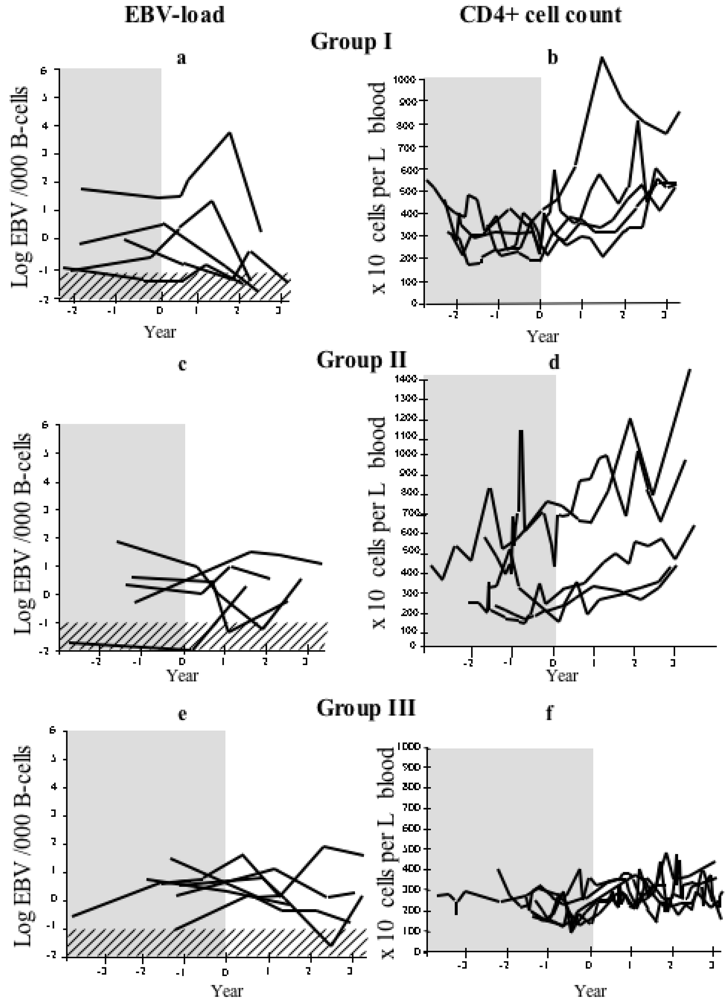
			<p>After 1–2 years of cART treatment, all patients in group I (n = 5) showed a decrease in the EBV- load, which approached levels seen in healthy controls. However, some group I patients showed a temporary increase of EBV-DNA load during the second year after the initiation of cART (<xref ref-type="fig" rid="figure1">Figure 1</xref>)a.</p>
			<fig id="figure1" position="float">
				<label>Figure 1</label>
				<caption>
					<p>The effect of cART treatment on CD4 counts and EBV load over time. Upper limit of EBV load in healthy controls is stipled and time before cART is shadowed.<bold> (a) </bold>EBV load in group I (with constant undetectable HIV-values after introduction of cART) and<bold> (b) </bold>CD4 levels in group I.<bold> (c) </bold>EBV load in group II (with most but not all HIV-values below detection limit after introduction of cART) and<bold> (d) </bold>CD4 levels in group II. <bold>(e)</bold> EBV load group III (with most HIV-RNA values above detection limit after introduction of cART) and <bold>(f) </bold>CD4 levels group III.</p>
				</caption>
				<graphic xmlns:xlink="http://www.w3.org/1999/xlink" xlink:href="viruses-02-00867-g001.tif" scale="0"/>
			</fig>
			<p>The patients in group I showed increased median CD4+ cell counts: from 285 × 10<sup>6</sup>/L during the year before cART (subsequently called pre-treatment levels) to 530 × 10<sup>6</sup>/L (p &lt; 0.05) at the end of the study (<xref ref-type="fig" rid="figure1">Figure 1b</xref>). </p>
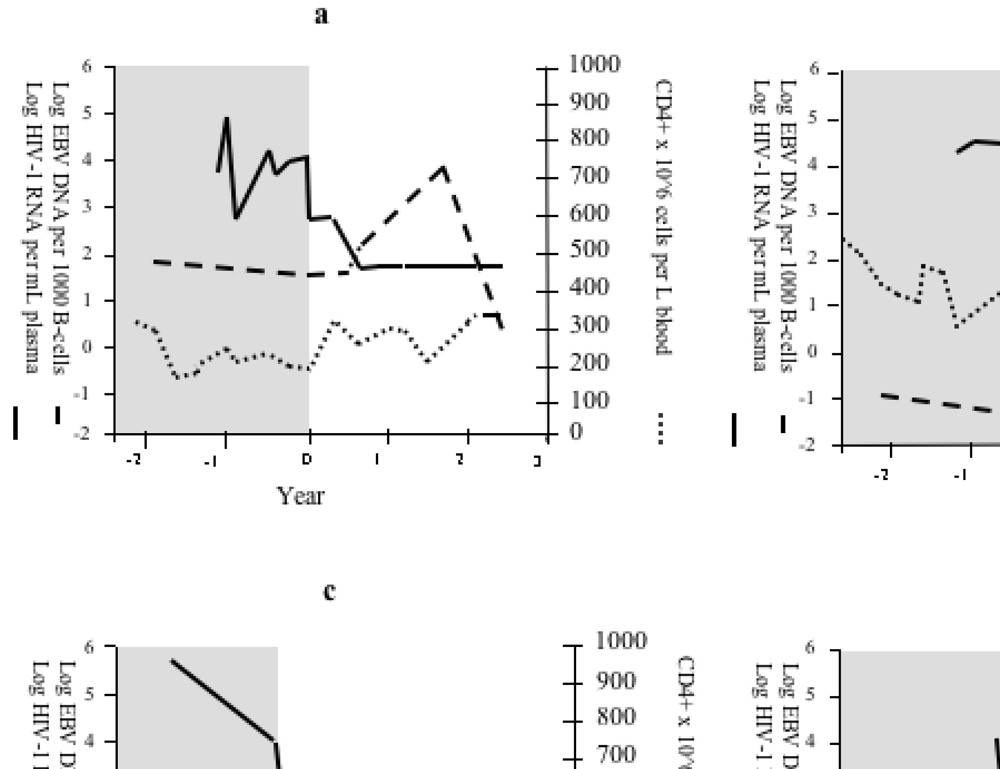
			<p>Figures 2a and 2b exemplify two individuals from group I. These two patients differed in their initial CD4 status: one had a median pre-treatment CD4+ cell count of 200 × 10<sup>6</sup>/L and the other a median pre-treatment CD4+ count of 380 × 10<sup>6</sup>/L. In the more immunodeficient patient, the EBV control seemed initially absent and an initial increase of the EBV load was seen. However, after two years of cART treatment the levels of the EBV load decreased. The second patient, with higher initial CD4+ cell counts, displayed an EBV load comparable to that seen in healthy individuals both before and during cART treatment. </p>
			<fig id="figure2" position="float">
				<label>Figure 2</label>
				<caption>
					<p>Examples of individual responses of patients from all three groups. EBV load (10-log) (dashed line), HIV-RNA titer (10-log) (solid line), and CD4+ cell count (dotted line) over time. Time 0 is defined as the start of cART. Time before cART is shadowed.<bold/>Panel<bold> (a) </bold>and<bold> (b) </bold>represent two patients from group I. Patient A had CD4+ cell count of 200 × 10<sup>6</sup>/L the year before cART; patient B had a median CD4+ cell count of 380 × 10<sup>6</sup>/L the year before cART.<bold> (c) </bold>Example of a patient from group II. <bold>(d) </bold>Example of a patient from group III.</p>
				</caption>
				<graphic xmlns:xlink="http://www.w3.org/1999/xlink" xlink:href="viruses-02-00867-g002.tif" scale="0"/>
			</fig>			
			<p>Patients in group II (n = 5) showed a continuous improvement of CD4 cell counts without restoration of EBV control, <italic>i.e.</italic>, no decrease of the EBV load (exemplified in <xref ref-type="fig" rid="figure2">Figure 2c</xref>). In these patients, the CD4+ cell counts increased during treatment from a median pre-treatment value of 180 × 10<sup>6</sup>/L to 570 × 10<sup>6</sup>/L (p &lt; 0.05) at the end of the study. In this group, the two patients with the highest pre-treatment CD4+ cell counts had a slightly lower EBV load at the end of observation time than before treatment, while the others showed a variable pattern with no consistent decrease in the EBV load (<xref ref-type="fig" rid="figure1">Figure 1c</xref> respectively <xref ref-type="fig" rid="figure1">Figure 1d</xref>).</p>
			<fig id="figure3" position="float">
				<label>Figure 3</label>
				<caption>
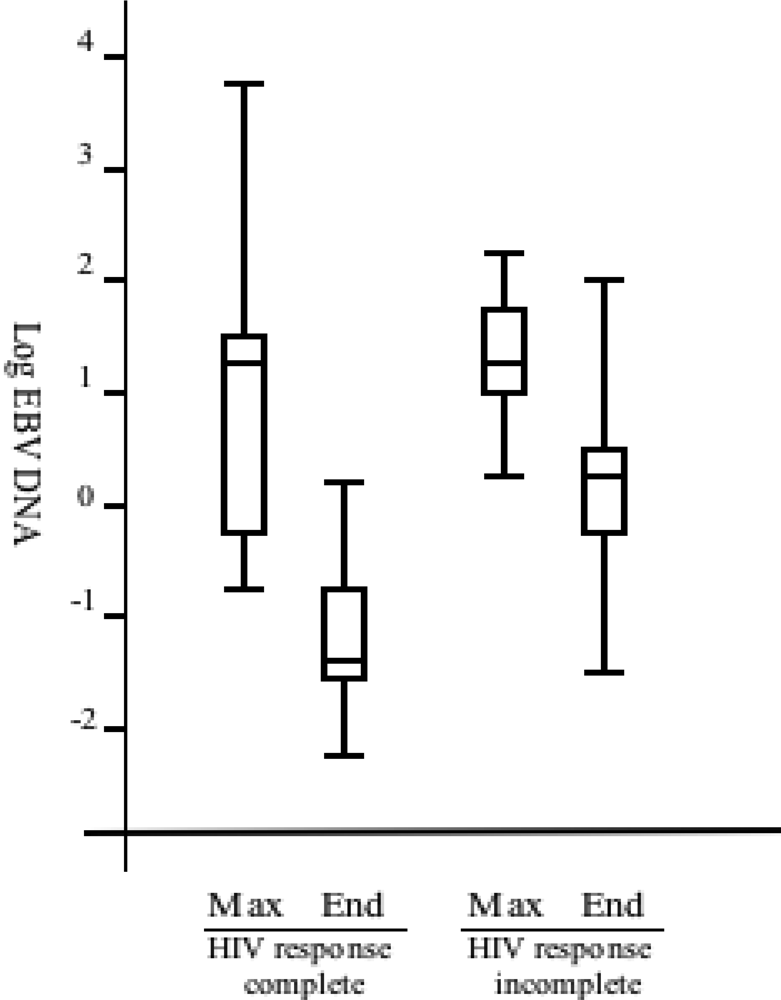
					<p>Box plot representing median values and distribution of EBV load in patients grouped according to HIV-RNA response after initiation of cART. Maximum EBV load and EBV load at the end of the study (&gt;1.5 years after introduction of treatment initiation) in relation in groups I and III. The boxes represent 50% of patients in first quartile to third quartile. Bars under and above the boxes represent distribution of all the values. The horizontal line marks the median.</p>
				</caption>
				<graphic xmlns:xlink="http://www.w3.org/1999/xlink" xlink:href="viruses-02-00867-g003.tif" scale="0"/>
			</fig>			
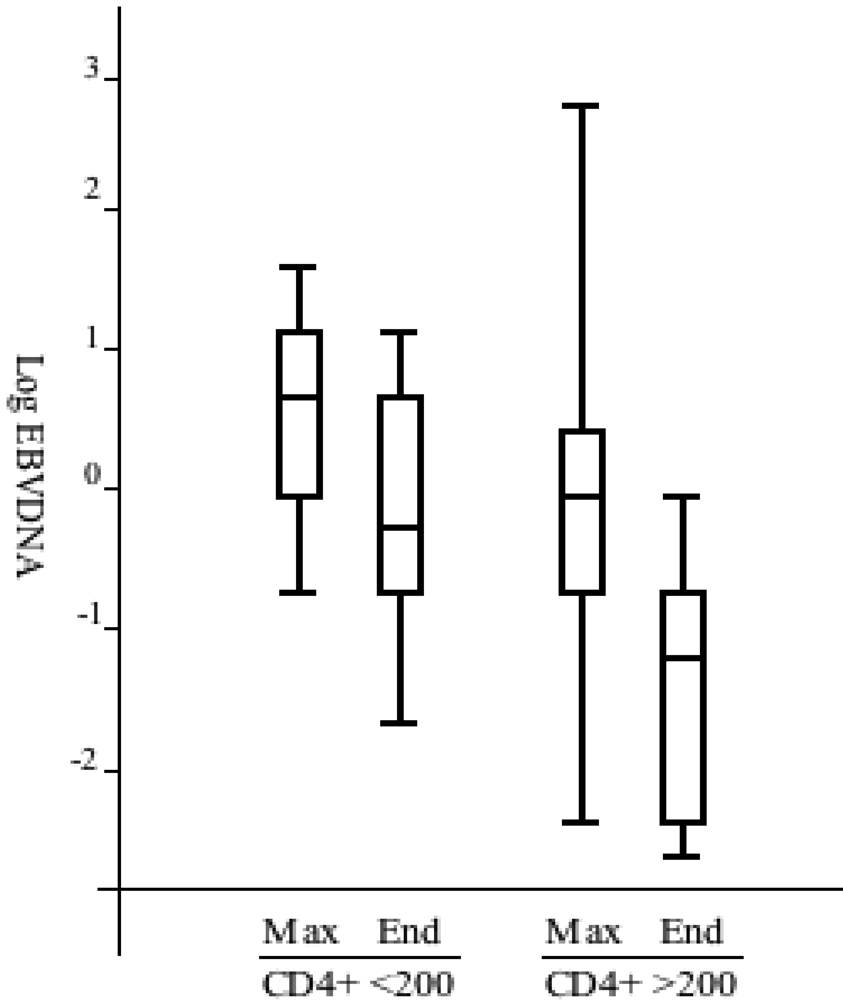
			<p>In group III (n = 6), the EBV load was high and showed a fluctuation, which indicated poor virological and immunological control (<xref ref-type="fig" rid="figure1">Figure 1</xref>e). Only a moderate increase in CD4+ cell counts was observed: from the median pre-treatment value of 200 × 10<sup>6</sup>/L to 240 × 10<sup>6</sup>/L at the end of the study (<xref ref-type="fig" rid="figure1">Figure 1</xref>)f. This might be due to an incomplete response to treatment (as exemplified in <xref ref-type="fig" rid="figure2">Figure 2</xref>d). For more than one year preceding the initiation of treatment with protease inhibitor (PI) or other drugs from the non-nucleoside analog reverse transcriptase inhibitors (NRTIs) category, all group III patients had been treated with one or two NRTIs. Four of these patients showed an increase in the EBV-DNA levels during study period. The effect on EBV load is summarized in <xref ref-type="fig" rid="figure3">Figure 3</xref>. We further analyzed EBV response in relation to CD4+ levels before treatment (<xref ref-type="fig" rid="figure4">Figure 4</xref>). For this purpose, the patients with sufficient number of CD4-count measurements were divided in two groups according to the median pre-treatment CD4+ cell count (below and above 200 × 10<sup>6</sup>/L). There were six and 13 patients in the low and high CD4-count groups, respectively. The median peak EBV value, <italic>i.e.</italic>, the highest value detected, was one 10-log higher in the group with low CD4 levels when compared to those with high CD4 levels. The median EBV load one year after the initiation of cART was within normal range in the group with higher pre-treatment CD4 levels, but remained high in the patient group with lower CD4 values. </p>
			<p>Although the association between HIV-1 infection and the development of lymphoma was noted early in the epidemic [<xref ref-type="bibr" rid="B12">12</xref>,<xref ref-type="bibr" rid="B13">13</xref>], the pathogenic mechanisms have not been clarified. Immune suppression as well as a general immune activation is likely to play a crucial role in the pathogenesis [<xref ref-type="bibr" rid="B14">14</xref>]. In addition, EBV is considered to be a strong predisposing, or even a causative, factor. Transplant patients represent another group with a high risk of EBV-positive NHL. In these patients, the constant immune modulation with modern immune suppressants in combination with minor mismatches may explain the high NHL risk [<xref ref-type="bibr" rid="B15">15</xref>]. EBV load has been suggested as a predictor for risk of lymphoproliferative disease in this group [<xref ref-type="bibr" rid="B16">16</xref>,<xref ref-type="bibr" rid="B17">17</xref>,<xref ref-type="bibr" rid="B18">18</xref>].</p>
			<fig id="figure4" position="float">
				<label>Figure 4</label>
				<caption>
					<p>Box plot representing median values and distribution of EBV load in patients grouped according to median CD4 values and patient grouping. A) Maximum EBV load (Max) and EBV load at one year after introduction of cART (End), respectively, in patients with CD4+ cell count median values &lt;200 × 10<sup>6</sup>/L (n = 6) and <underline>&gt;</underline> 200 × 10<sup>6</sup>/L (n = 13) during the 12 months before introduction of cART. The boxes represent 50% of patients in first quartile to third quartile. Bars under and above the boxes represent distribution of all the values. The horizontal line marks the median.</p>
				</caption>
				<graphic xmlns:xlink="http://www.w3.org/1999/xlink" xlink:href="viruses-02-00867-g004.tif" scale="0"/>
			</fig>			
			<p>After the introduction of cART in 1996, the incidence of HIV-related NHL has been considerably reduced [<xref ref-type="bibr" rid="B19">19</xref>]. In the current study, we observed differences between various groups of cART treated HIV patients in the dynamics of the balance between EBV infection and host response, in relation to the pre-treatment CD4 levels and the efficiency of cART in controlling HIV-RNA levels. We noticed some patients with an incomplete EBV control, who had an adequate effect of cART treatment on the HIV-1 RNA levels. Our results may indicate that an HIV-induced immune dysregulation persists even after reduction of HIV-1 load to undetectable levels [<xref ref-type="bibr" rid="B14">14</xref>]. Similar to other studies , we noticed a lack of EBV control in patients with an initially low CD4+ cell count (&lt;200 × 10<sup>6</sup>/L) and labile virological response to cART [<xref ref-type="bibr" rid="B20">20</xref>], sometimes resulting in a biphasic EBV response. This phenomenon is similar to hepatitis B, hepatitis C and Varicella-Zoster virus flares, which were earlier described in the process of immune restoration in HIV-patients following cART treatment [<xref ref-type="bibr" rid="B21">21</xref>]. It is likely that an increased lymphoma risk remains during the period with high EBV load and probably exists until the establishment of permanent EBV control as also suggested by others [<xref ref-type="bibr" rid="B22">22</xref>,<xref ref-type="bibr" rid="B23">23</xref>]. In patients with non-successful HIV-therapy this risk may be more pronounced due to the higher EBV DNA levels. The latter phenomenon is exemplified both by patients with most HIV RNA values as well as those with some HIV values just above the detection limit. It is also in line with the most recent international recommendation to initiate antiretroviral therapy when CD4+ cell counts fall below 350 × 10<sup>6</sup>/L to prevent a decrease to values as low as 200 × 10<sup>6</sup>/L. However, consequences of persistent high EBV-DNA load in each individual HIV-infected patient have not yet been elucidated. If high EBV load precedes lymphoma, the results of our study might indicate a need for EBV-monitoring in patients initiating cART with CD4 values below 200 × 10<sup>6</sup>/L and in non- successfully treated HIV-infected patients. Patients at risk for NHL could be identified at an earlier stage by monitoring EBV load, as is routinely done in post-transplant patients [<xref ref-type="bibr" rid="B18">18</xref>,<xref ref-type="bibr" rid="B24">24</xref>,<xref ref-type="bibr" rid="B25">25</xref>]. However, the nature of EBV infection in HIV-positive subjects is very different from that in post-transplant patients. In these (re-)appearance of EBV-specific CD8(+) T cells leads to an immediate decrease in EBV load [<xref ref-type="bibr" rid="B26">26</xref>]. This may be due to that the HIV carriers have a continuous exhaustive deregulation of the normal B cell biology and a reduction in immunity plays a role in developing NHL. In post-transplant patients, a modified immunosuppressive therapy or an antiviral EBV-treatment can prevent the development of malignancies from a preceding polyclonal lymphoproliferative disease [<xref ref-type="bibr" rid="B24">24</xref>,<xref ref-type="bibr" rid="B25">25</xref>]. However, the lymphoma risk did not increase during a long term follow up in a group of HIV-1 infected patients with temporarily high EBV load in PBMC [<xref ref-type="bibr" rid="B27">27</xref>]. None of our patients developed lymphoma during the follow up period of two to six years, although some patients showed extremely high EBV load values. This is interesting since a combination of high EBV load with the reduced function of specific EBV-reactive T-cells has been suggested to affect the risk of NHL [<xref ref-type="bibr" rid="B10">10</xref>].</p>
			<p>Similar to our results, Righetta <italic>et al. </italic>[<xref ref-type="bibr" rid="B20">20</xref>] observed an elevated EBV load as well as a biphasic EBV response after cART initiation in a study of highly immunocompromised HIV-1 patients. They also observed a correlation between an increase of EBV-DNA and anti-EA or anti-VCA. In a study by Stevens <italic>et al.</italic> [<xref ref-type="bibr" rid="B28">28</xref>], no difference in the EBV load was detected between patients with and without cART. In this study, the median time of cART treatment was only 13 months. According to our observations, this is an insufficient time for re-establishing EBV control. The absence of restored EBV control is also reflected in serologic analysis where anti-EBNA-IgG was reduced and anti-VCA-IgG increased as shown by others [<xref ref-type="bibr" rid="B20">20</xref>].</p>
		</sec>
		<sec sec-type="methods">
			<title>3. Experimental</title>
			<sec>
				<title>3.1. Patients</title>
				<p>Twenty HIV-infected patients, selected from a recombinant gp-160 vaccine trial, were followed with repeated analyses of the EBV load, HIV-RNA titer and CD4+ cell counts, at Karolinska University Hospital, Huddinge (KUHH), between 1995 and 2000. At inclusion, the median CD4+ cell count was 255 × 10<sup>6</sup>/L (range 120–480) and the first analysis of HIV-RNA done in the end of 1995 or the beginning of 1996 showed a median value of 37,000 copies/mL (range &lt;500–1,200,000). In <xref ref-type="table" rid="table1">Table 1</xref> we summarize the clinical characteristics of the patients. HIV negative controls were recruited among healthy laboratory staff and were not matched for age, sex, or risk group.</p>
				<p>The cART treatment was initiated and given independently of this study according to clinical practice.</p>
				<table-wrap id="table1" position="float"><object-id pub-id-type="pii">viruses-02-00867_table1</object-id>
					<object-id pub-id-type="pii">viruses-02-00867_table1</object-id>
					<label>Table 1</label>
					<caption>
						<p>Demographic patient data and route of transmission <sup>(1)</sup>.</p>
					</caption>
					<table>
						<thead>
							<tr>
								<th align="left" valign="middle">Patients</th>
								<th align="left" valign="middle">n</th>
							</tr>
						</thead>
						<tbody>
							<tr>
								<td align="left" valign="middle">Number of patients</td>
								<td align="left" valign="middle">20</td>
							</tr>
							<tr>
								<td align="left" valign="middle">Females</td>
								<td align="left" valign="middle">3</td>
							</tr>
							<tr>
								<td align="left" valign="middle">Median age</td>
								<td align="left" valign="middle">40(31–65)</td>
							</tr>
							<tr>
								<td align="left" valign="middle">
									<bold>Route of infection</bold>
								</td>
								<td align="left" valign="middle"> </td>
							</tr>
							<tr>
								<td align="left" valign="middle">Heterosexual</td>
								<td align="left" valign="middle">9</td>
							</tr>
							<tr>
								<td align="left" valign="middle">MSM*</td>
								<td align="left" valign="middle">10</td>
							</tr>
							<tr>
								<td align="left" valign="middle">Unknown</td>
								<td align="left" valign="middle">1</td>
							</tr>
							<tr>
								<td align="left" valign="middle">
									<bold>Origin</bold>
								</td>
								<td align="left" valign="middle"> </td>
							</tr>
							<tr>
								<td align="left" valign="middle">Northern Europe</td>
								<td align="left" valign="middle">15</td>
							</tr>
							<tr>
								<td align="left" valign="middle">Africa</td>
								<td align="left" valign="middle">5</td>
							</tr>
						</tbody>
					</table>
<table-wrap-foot>
<fn>
<p>* Men who have sex with men.</p>
</fn>
<fn>
				<p>
					<sup>(1) </sup>Patients were divided in three groups based on HIV-load. There were no differences in gender, median age and route of transmission between the groups. Group I: constant undetectable HIV-values after introduction of cART. Group II: most but not all HIV-values below detection limit after introduction of cART: Group III: almost all HIV-RNA values above detection limit. </p>
</fn>
</table-wrap-foot>					
				</table-wrap>
				<p>All 20 patients had IgG-antibodies to VCA and to EBNA as a result of the EBV-carrier status. Sixteen of the patients also had detectable anti-EA-titers. While the anti-EBNA titers were within normal range, the anti-VCA and anti-EA titers were elevated in the majority of the patients (anti-VCA GMT: 960, range 1:160–5120; anti-EA GMT: 80, range: 1:20–640). At the time of sampling for serology, the median CD4+ cell count was 365 × 10<sup>6</sup>/L (170–1010). The CD4+ cell counts, HIV-RNA values, and clinical data were collected from patient files. </p>
				<p>None of the patients were diagnosed with lymphoma or AIDS and no deaths occurred during the study period. Five patients were on ART at the start of the study (three on dual drug- and two mono-drug therapy). All patients except one received cART during the study period; 18 received combination therapy, with nucleoside reverse transcriptase inhibitor (NRTI) in combination with protease inhibitor and/or a non NRTI. One patient received only a dual NRTI combination, and one patient continued mono-therapy with azidothymidine.</p>
			</sec>
			<sec>
				<title>3.2. EBV-DNA Analysis </title>
				<p>CD19 positive B lymphocytes were isolated according to Ehlin-Henriksson <italic>et al</italic>. [<xref ref-type="bibr" rid="B29">29</xref>]. The enriched B cells were suspended in 100 μL PCR-lysate buffer [<xref ref-type="bibr" rid="B30">30</xref>]. The samples were then stored at −20 °C and proteinase-K was inactivated by heating for 15 minutes at 94 °C before PCR. PCR amplification of viral DNA was performed according to Gustafsson <italic>et al.</italic> [<xref ref-type="bibr" rid="B31">31</xref>] using a set of nested primers specific for the LMP1-promotor and its upstream control sequence (LRS) region (co-ordinates in B-95-8 prototype strain in parentheses): the outer primer pair was LSY: 5'-CCT TTC TAC GCT TAC ATG CAC ACA C-3' (169 678 to 169 654), and LAY: 5'-TGG ACA GAG AAG GTC TCT TCT GAA G-3' (169 239 to 169 263); the inner primer pair was LSI: 5'-CTA CAT CCC AAG AAA CAC GCG TTA-3' (169 586 to 169 561), and LAI: 5'-AAG CAT GAG AGC AAA GGA ATA GAG-3' (169 290 to 169 314). The EBV genome number was calculated according to Gustavsson <italic>et al</italic>. [<xref ref-type="bibr" rid="B31">31</xref>]. The EBV negative cell line BJAB [<xref ref-type="bibr" rid="B14">14</xref>], water and lysis buffer without DNA were included as negative controls. Namalwa cells with one EBV genome copy per cell were used as a positive control. [<xref ref-type="bibr" rid="B15">15</xref>]. Sensitivity of the PCR-assay was established to one genome. </p>
				<p>The method has been validated against Real-Time (RT-) PCR and the results correlated strongly. However RT-PCR occasionally provided no values on clinical samples due to unsatisfactory DNA quality, while this problem was not noticed using our semi-quantitative method. </p>
			</sec>
			<sec>
				<title>3.3. EBV Serology</title>
				<p>Serology for Epstein-Barr virus was tested according to Svahn <italic>et al.</italic> [<xref ref-type="bibr" rid="B32">32</xref>]. Titration of serum antibodies to EA and VCA was performed using the EBV-positive cell line B 95-8 as target. Antibodies against EBNA1 proteins were performed using an ELISA against peptide p107 from the EBNA 1 sequence.</p>
			</sec>
			<sec>
				<title>3.4. Analysis of Lymphocyte Subsets and HIV-RNA</title>
				<p>Data on subsets of T-lymphocytes, CD4 and CD8, as well as HIV-RNA were obtained by routine assays performed in a standardized clinical laboratory. </p>
			</sec>
			<sec>
				<title>3.5. Statistics</title>
				<p>The EBV genome numbers were calculated based on the fraction of positive reactions at each dilution according to Reed-Muench [<xref ref-type="bibr" rid="B33">33</xref>] and by the Poisson distribution formula, using a method originally designed to determine the precursor frequency of antigen-specific T cells [<xref ref-type="bibr" rid="B34">34</xref>].</p>
			</sec>
		</sec>
		<sec sec-type="conclusions">
			<title>4. Conclusions </title>
			<p>In this long term follow up of moderately immune suppressed HIV-infected patients, we observed a high individual variation of EBV-DNA levels. cART induced virological control of the HIV-infection with undetectable HIV-RNA levels seems to be an insufficient prerequisite for an optimal EBV control, as indicated by Gerard <italic>et al.</italic> [<xref ref-type="bibr" rid="B35">35</xref>]. CD4+ cell counts may better reflect the restoration of the patient’s control of persisting EBV infection, as suggested by Kostense <italic>et al.</italic> [<xref ref-type="bibr" rid="B36">36</xref>]. This reconstitution of the immune system in HIV-infection takes place during one to several years after the introduction of cART, as reflected by the continuous increase in CD4+ cell counts [<xref ref-type="bibr" rid="B37">37</xref>]. EBV load may therefore be considered as a qualitative marker of the actual immune competence in cART treated patients, as also suggested for post-transplant patients [<xref ref-type="bibr" rid="B18">18</xref>,<xref ref-type="bibr" rid="B38">38</xref>]. Although immunological recovery depends on suppression of HIV-replication, the recovery of the EBV-host balance is certainly not an immediate consequence of the achieved control of HIV.</p>
		</sec>
	</body>
	<back>
		<ack>
			<p>Permission for the study was obtained from the local Ethical Committee at the KUHH. We are grateful to Margit Halvarson, research nurse at Huddinge hospital, for assistance with sample collection and patient care. This study was supported by the Swedish Medical Research Council and the Swedish Cancer Society.</p>
		</ack>
		<ref-list>
		<title>References</title>
			<ref id="B1">
				<citation citation-type="journal">
					<person-group person-group-type="author">
						<name>
							<surname>Ernberg</surname>
							<given-names>I.</given-names>
						</name>
					</person-group>
					<article-title>The role of Epstein-Barr virus in lymphomas of homosexual males</article-title>
					<source>Prog. Allergy</source>
					<year>1986</year>
					<volume>37</volume>
					<fpage>301</fpage>
					<lpage>318</lpage>
					<pub-id pub-id-type="pmid">3008166</pub-id>
				</citation>
			</ref>
			<ref id="B2">
				<citation citation-type="journal">
					<person-group person-group-type="author">
						<name>
							<surname>Gaidano</surname>
							<given-names>G.</given-names>
						</name>
						<name>
							<surname>Dalla-Favera</surname>
							<given-names>R.</given-names>
						</name>
					</person-group>
					<article-title>Molecular pathogenesis of AIDS-related lymphomas</article-title>
					<source>Adv. Cancer Res.</source>
					<year>1995</year>
					<volume>67</volume>
					<fpage>113</fpage>
					<lpage>153</lpage>
					<pub-id pub-id-type="pmid">8571813</pub-id>
				</citation>
			</ref>
			<ref id="B3">
				<citation citation-type="journal">
					<person-group person-group-type="author">
						<name>
							<surname>Gerritsen</surname>
							<given-names>E.J.</given-names>
						</name>
						<name>
							<surname>Stam</surname>
							<given-names>E.D.</given-names>
						</name>
						<name>
							<surname>Hermans</surname>
							<given-names>J.</given-names>
						</name>
						<name>
							<surname>van den Berg</surname>
							<given-names>H.</given-names>
						</name>
						<name>
							<surname>Haraldsson</surname>
							<given-names>A.</given-names>
						</name>
						<name>
							<surname>van Tol</surname>
							<given-names>M.J.</given-names>
						</name>
						<name>
							<surname>van den Bergh</surname>
							<given-names>R.L.</given-names>
						</name>
						<name>
							<surname>Waaijer</surname>
							<given-names>J.L.</given-names>
						</name>
						<name>
							<surname>Kroes</surname>
							<given-names>A.C.</given-names>
						</name>
						<name>
							<surname>Kluin</surname>
							<given-names>P.M.</given-names>
						</name>
						<name>
							<surname>Vossen</surname>
							<given-names>J.M.</given-names>
						</name>
					</person-group>
					<article-title>Risk factors for developing EBV-related B cell lymphoproliferative disorders (BLPD) after non-HLA-identical BMT in children</article-title>
					<source>Bone Mar. Transpl.</source>
					<year>1996</year>
					<volume>18</volume>
					<fpage>377</fpage>
					<lpage>382</lpage>
				</citation>
			</ref>
			<ref id="B4">
				<citation citation-type="journal">
					<person-group person-group-type="author">
						<name>
							<surname>Lucas</surname>
							<given-names>K.G.</given-names>
						</name>
						<name>
							<surname>Small</surname>
							<given-names>T.N.</given-names>
						</name>
						<name>
							<surname>Heller</surname>
							<given-names>G.</given-names>
						</name>
						<name>
							<surname>Dupont</surname>
							<given-names>B.</given-names>
						</name>
						<name>
							<surname>O'Reilly</surname>
							<given-names>R.J.</given-names>
						</name>
					</person-group>
					<article-title>The development of cellular immunity to Epstein-Barr virus after allogeneic bone marrow transplantation</article-title>
					<source>Blood</source>
					<year>1996</year>
					<volume>87</volume>
					<fpage>2594</fpage>
					<lpage>2603</lpage>
					<pub-id pub-id-type="pmid">8630428</pub-id>
				</citation>
			</ref>
			<ref id="B5">
				<citation citation-type="journal">
					<person-group person-group-type="author">
						<name>
							<surname>MacMahon</surname>
							<given-names>E.M.E.</given-names>
						</name>
						<name>
							<surname>Glass</surname>
							<given-names>J.D.</given-names>
						</name>
						<name>
							<surname>Hayward</surname>
							<given-names>S.B.</given-names>
						</name>
						<name>
							<surname>Mann</surname>
							<given-names>R.B.</given-names>
						</name>
						<name>
							<surname>Becker</surname>
							<given-names>P.S.</given-names>
						</name>
						<name>
							<surname>Charache</surname>
							<given-names>P.</given-names>
						</name>
						<name>
							<surname>McArthur</surname>
							<given-names>J.C.</given-names>
						</name>
						<name>
							<surname>Armbinder</surname>
							<given-names>R.F.</given-names>
						</name>
					</person-group>
					<article-title>Epstein-Barr virus in AIDS-related primary central nervous system lymphoma</article-title>
					<source>Lancet</source>
					<year>1991</year>
					<volume>338</volume>
					<fpage>969</fpage>
					<lpage>973</lpage>
					<pub-id pub-id-type="pmid">1681341</pub-id>
				<pub-id pub-id-type="doi">10.1016/0140-6736(91)91837-K</pub-id></citation>
			</ref>
			<ref id="B6">
				<citation citation-type="journal">
					<person-group person-group-type="author">
						<name>
							<surname>Camilleri-Broët</surname>
							<given-names>S.</given-names>
						</name>
						<name>
							<surname>Davi</surname>
							<given-names>F.</given-names>
						</name>
						<name>
							<surname>Feuillard</surname>
							<given-names>J.</given-names>
						</name>
						<name>
							<surname>Bourgeois</surname>
							<given-names>C.</given-names>
						</name>
						<name>
							<surname>Seilhean</surname>
							<given-names>D.</given-names>
						</name>
						<name>
							<surname>Hauw</surname>
							<given-names>J.J.</given-names>
						</name>
						<name>
							<surname>Raphaël</surname>
							<given-names>M.</given-names>
						</name>
					</person-group>
					<article-title>High expression of latent membrane protein 1 of Epstein-Barr virus and BCL-2 oncoprotein in acquired immunodeficiency syndrome-related primary brain lymphomas</article-title>
					<source>Blood</source>
					<year>1995</year>
					<volume>86</volume>
					<fpage>432</fpage>
					<lpage>435</lpage>
					<pub-id pub-id-type="pmid">7605982</pub-id>
				</citation>
			</ref>
			<ref id="B7">
				<citation citation-type="journal">
					<person-group person-group-type="author">
						<name>
							<surname>Hamilton-Dutoit</surname>
							<given-names>S.J.</given-names>
						</name>
						<name>
							<surname>Pallesen</surname>
							<given-names>G.</given-names>
						</name>
						<name>
							<surname>Franzmann</surname>
							<given-names>M.B.</given-names>
						</name>
						<name>
							<surname>Karkov</surname>
							<given-names>J.</given-names>
						</name>
						<name>
							<surname>Black</surname>
							<given-names>F.</given-names>
						</name>
						<name>
							<surname>Skinhoj</surname>
							<given-names>P.</given-names>
						</name>
						<name>
							<surname>Pedersen</surname>
							<given-names>C.</given-names>
						</name>
					</person-group>
					<article-title>AIDS-related lymphoma. Histopathology, immunophenotype, and association with Epstein-Barr virus as demonstrated by in situ nucleic acid hybridization</article-title>
					<source>Am. J. Pathol.</source>
					<year>1991</year>
					<volume>138</volume>
					<fpage>149</fpage>
					<lpage>163</lpage>
					<pub-id pub-id-type="pmid">1846263</pub-id>
				</citation>
			</ref>
			<ref id="B8">
				<citation citation-type="journal">
					<person-group person-group-type="author">
						<name>
							<surname>Matsuura</surname>
							<given-names>A.</given-names>
						</name>
					</person-group>
					<article-title>The latent Epstein-Barr virus (EBV) activation and EBV-specific immunological abnormality in human immunodeficiency virus (HIV) infected hemophiliacs</article-title>
					<source>Hokkaido Igaku Zasshi</source>
					<year>1989</year>
					<volume>64</volume>
					<fpage>474</fpage>
					<lpage>483</lpage>
				<pub-id pub-id-type="pmid">2555293</pub-id></citation>
			</ref>
			<ref id="B9">
				<citation citation-type="journal">
					<person-group person-group-type="author">
						<name>
							<surname>Palmieri C.</surname>
							<given-names/>
						</name>
						<name>
							<surname>Treibel T.</surname>
							<given-names/>
						</name>
						<name>
							<surname>Large O</surname>
							<given-names/>
						</name>
						<name>
							<surname>Bower M.</surname>
							<given-names/>
						</name>
					</person-group>
					<article-title>AIDS-related non-Hodgkin's lymphoma in the first decade of highly active antiretroviral therapy</article-title>
					<source>QJM</source>
					<year>2006</year>
					<volume>99</volume>
					<fpage>811</fpage>
					<lpage>826</lpage>
					<pub-id pub-id-type="pmid">17085516</pub-id>
				<pub-id pub-id-type="doi">10.1093/qjmed/hcl115</pub-id></citation>
			</ref>
			<ref id="B10">
				<citation citation-type="journal">
					<person-group person-group-type="author">
						<name>
							<surname>van Baarle</surname>
							<given-names>D.</given-names>
						</name>
						<name>
							<surname>Kostense</surname>
							<given-names>S.</given-names>
						</name>
						<name>
							<surname>Hovenkamp</surname>
							<given-names>E.</given-names>
						</name>
						<name>
							<surname>Ogg</surname>
							<given-names>G.</given-names>
						</name>
						<name>
							<surname>Nanlohy</surname>
							<given-names>N.</given-names>
						</name>
						<name>
							<surname>Callan</surname>
							<given-names>M.F.</given-names>
						</name>
						<name>
							<surname>Dukers</surname>
							<given-names>N.H.</given-names>
						</name>
						<name>
							<surname>McMichael</surname>
							<given-names>A.J.</given-names>
						</name>
						<name>
							<surname>van Oers</surname>
							<given-names>M.H.</given-names>
						</name>
						<name>
							<surname>Miedema</surname>
							<given-names>F.</given-names>
						</name>
					</person-group>
					<article-title>Lack of Epstein-Barr virus- and HIV-specific CD27- CD8+ T cells is associated with progression to viral disease in HIV-infection</article-title>
					<source>AIDS</source>
					<year>2002</year>
					<volume>16</volume>
					<fpage>2001</fpage>
					<lpage>2011</lpage>
					<pub-id pub-id-type="pmid">12370498</pub-id>
				<pub-id pub-id-type="doi">10.1097/00002030-200210180-00004</pub-id></citation>
			</ref>
			<ref id="B11">
				<citation citation-type="journal">
					<person-group person-group-type="author">
						<name>
							<surname>Sandstr?m</surname>
							<given-names>E.</given-names>
						</name>
						<name>
							<surname>Wahren</surname>
							<given-names>B.</given-names>
						</name>
					</person-group>
					<article-title>Therapeutic immunisation with recombinant gp160 in HIV-1 infection: a randomised double-blind placebo-controlled trial. Nordic VAC-04 Study Group</article-title>
					<source>Lancet</source>
					<year>1999</year>
					<volume>353</volume>
					<fpage>1735</fpage>
					<lpage>1742</lpage>
					<pub-id pub-id-type="pmid">10347985</pub-id>
				<pub-id pub-id-type="doi">10.1016/S0140-6736(98)06493-9</pub-id></citation>
			</ref>
			<ref id="B12">
				<citation citation-type="journal">
					<person-group person-group-type="author">
						<name>
							<surname>Herndier</surname>
							<given-names>B.G.</given-names>
						</name>
						<name>
							<surname>Kaplan</surname>
							<given-names>L.D.</given-names>
						</name>
						<name>
							<surname>McGrath</surname>
							<given-names>M.S.</given-names>
						</name>
					</person-group>
					<article-title>Pathogenesis of AIDS lymphomas</article-title>
					<source>AIDS</source>
					<year>1994</year>
					<volume>8</volume>
					<fpage>1025</fpage>
					<lpage>1049</lpage>
				<pub-id pub-id-type="doi">10.1097/00002030-199408000-00003</pub-id><pub-id pub-id-type="pmid">7986399</pub-id></citation>
			</ref>
			<ref id="B13">
				<citation citation-type="journal">
					<person-group person-group-type="author">
						<name>
							<surname>Lyter</surname>
							<given-names>D.</given-names>
						</name>
						<name>
							<surname>Besley</surname>
							<given-names>D.</given-names>
						</name>
						<name>
							<surname>Thackeray</surname>
							<given-names>R.</given-names>
						</name>
						<name>
							<surname>et al.</surname>
							<given-names/>
						</name>
					</person-group>
					<article-title>Incidence of malignancies in the Multicenter AIDS cohort study (MACS), Abstr. 2</article-title>
					<source>Proc. ASCO</source>
					<year>1994</year>
					<volume>13</volume>
					<fpage>50</fpage>
				</citation>
			</ref>
			<ref id="B14">
				<citation citation-type="journal">
					<person-group person-group-type="author">
						<name>
							<surname>Leng</surname>
							<given-names>Q.</given-names>
						</name>
						<name>
							<surname>Borkow</surname>
							<given-names>G.</given-names>
						</name>
						<name>
							<surname>Weisman</surname>
							<given-names>Z.</given-names>
						</name>
						<name>
							<surname>Stein</surname>
							<given-names>M.</given-names>
						</name>
						<name>
							<surname>Kalinkovich</surname>
							<given-names>A.</given-names>
						</name>
						<name>
							<surname>Bentwich</surname>
							<given-names>Z.</given-names>
						</name>
					</person-group>
					<article-title>Immune activation correlates better than HIV plasma viral load with CD4 T-cell decline during HIV infection</article-title>
					<source>AIDS</source>
					<year>2001</year>
					<volume>27</volume>
					<fpage>389</fpage>
					<lpage>397</lpage>
				</citation>
			</ref>
			<ref id="B15">
				<citation citation-type="journal">
					<person-group person-group-type="author">
						<name>
							<surname>Grulich</surname>
							<given-names>A.E.</given-names>
						</name>
						<name>
							<surname>Wan</surname>
							<given-names>X.</given-names>
						</name>
						<name>
							<surname>Law</surname>
							<given-names>M.G.</given-names>
						</name>
						<name>
							<surname>Milliken</surname>
							<given-names>S.T.</given-names>
						</name>
						<name>
							<surname>Lewis</surname>
							<given-names>C.R.</given-names>
						</name>
						<name>
							<surname>Garsia</surname>
							<given-names>R.J.</given-names>
						</name>
						<name>
							<surname>Gold</surname>
							<given-names>J.</given-names>
						</name>
						<name>
							<surname>Finlayson</surname>
							<given-names>R.J.</given-names>
						</name>
						<name>
							<surname>Cooper</surname>
							<given-names>D.A.</given-names>
						</name>
						<name>
							<surname>Kaldor</surname>
							<given-names>J.M.</given-names>
						</name>
					</person-group>
					<article-title>B-cell stimulation and prolonged immune deficiency are risk factors for non-Hodgkin's lymphoma in people with AIDS</article-title>
					<source>AIDS</source>
					<year>2000</year>
					<volume>14</volume>
					<fpage>133</fpage>
					<lpage>140</lpage>
					<pub-id pub-id-type="pmid">10708283</pub-id>
				<pub-id pub-id-type="doi">10.1097/00002030-200001280-00008</pub-id></citation>
			</ref>
			<ref id="B16">
				<citation citation-type="journal">
					<person-group person-group-type="author">
						<name>
							<surname>Rooney</surname>
							<given-names>C.M.</given-names>
						</name>
						<name>
							<surname>Loftin</surname>
							<given-names>S.K.</given-names>
						</name>
						<name>
							<surname>Holladay</surname>
							<given-names>M.S.</given-names>
						</name>
						<name>
							<surname>Brenner</surname>
							<given-names>M.K.</given-names>
						</name>
						<name>
							<surname>Krance</surname>
							<given-names>R.A.</given-names>
						</name>
						<name>
							<surname>Heslop</surname>
							<given-names>H.E.</given-names>
						</name>
					</person-group>
					<article-title>Early identification of Epstein-Barr virus-associated post-transplantation lymphoproliferative disease</article-title>
					<source>Br. J. Haematol.</source>
					<year>1995</year>
					<volume>89</volume>
					<fpage>98</fpage>
					<lpage>103</lpage>
					<pub-id pub-id-type="pmid">7833284</pub-id>
				</citation>
			</ref>
			<ref id="B17">
				<citation citation-type="journal">
					<person-group person-group-type="author">
						<name>
							<surname>Lucas</surname>
							<given-names>K.G.</given-names>
						</name>
						<name>
							<surname>Burton</surname>
							<given-names>R.L.</given-names>
						</name>
						<name>
							<surname>Zimmerman</surname>
							<given-names>S.E.</given-names>
						</name>
						<name>
							<surname>Wang</surname>
							<given-names>J.</given-names>
						</name>
						<name>
							<surname>Cornetta</surname>
							<given-names>K.G.</given-names>
						</name>
						<name>
							<surname>Robertson</surname>
							<given-names>K.A.</given-names>
						</name>
						<name>
							<surname>Lee</surname>
							<given-names>C.H.</given-names>
						</name>
						<name>
							<surname>Emanuel</surname>
							<given-names>D.J.</given-names>
						</name>
					</person-group>
					<article-title>Semiquantitative Epstein-Barr virus (EBV) polymerase chain reaction for the determination of patients at risk for EBV-induced lymphoproliferative disease after stem cell transplantation</article-title>
					<source>Blood</source>
					<year>1998</year>
					<volume>91</volume>
					<fpage>3654</fpage>
					<lpage>3661</lpage>
					<pub-id pub-id-type="pmid">9573001</pub-id>
				</citation>
			</ref>
			<ref id="B18">
				<citation citation-type="journal">
					<person-group person-group-type="author">
						<name>
							<surname>Bakker</surname>
							<given-names>N.</given-names>
						</name>
						<name>
							<surname>Verschuuren</surname>
							<given-names>E.</given-names>
						</name>
						<name>
							<surname>Erasmus</surname>
							<given-names>M.</given-names>
						</name>
						<name>
							<surname>Hepkema</surname>
							<given-names>B.</given-names>
						</name>
						<name>
							<surname>Veeger</surname>
							<given-names>N.</given-names>
						</name>
						<name>
							<surname>Kallenberg</surname>
							<given-names>C.</given-names>
						</name>
						<name>
							<surname>van der Bij</surname>
							<given-names>W.</given-names>
						</name>
					</person-group>
					<article-title>Epstein-Barr virus-DNA load monitoring late after lung transplantation: a surrogate marker of the degree of immunosuppression and a safe guide to reduce immunosuppression</article-title>
					<source>Transplantation</source>
					<year>2007</year>
					<volume>83</volume>
					<fpage>433</fpage>
					<lpage>438</lpage>
					<pub-id pub-id-type="pmid">17318076</pub-id>
				<pub-id pub-id-type="doi">10.1097/01.tp.0000252784.60159.96</pub-id></citation>
			</ref>
			<ref id="B19">
				<citation citation-type="journal">
					<person-group person-group-type="author">
						<name>
							<surname>Bonnet</surname>
							<given-names>F.</given-names>
						</name>
						<name>
							<surname>Chêne</surname>
							<given-names>G.</given-names>
						</name>
					</person-group>
					<article-title>Evolving epidemiology of malignancies in HIV</article-title>
					<source>Curr. Opin. Oncol.</source>
					<year>2008</year>
					<volume>20</volume>
					<fpage>534</fpage>
					<lpage>540</lpage>
					<pub-id pub-id-type="pmid">19106656</pub-id>
				<pub-id pub-id-type="doi">10.1097/CCO.0b013e32830a5080</pub-id></citation>
			</ref>
			<ref id="B20">
				<citation citation-type="journal">
					<person-group person-group-type="author">
						<name>
							<surname>Righetta</surname>
							<given-names>E.</given-names>
						</name>
						<name>
							<surname>Ballon</surname>
							<given-names>G.</given-names>
						</name>
						<name>
							<surname>Ometto</surname>
							<given-names>L.</given-names>
						</name>
						<name>
							<surname>Cattelan</surname>
							<given-names>A.M.</given-names>
						</name>
						<name>
							<surname>Menin</surname>
							<given-names>C.</given-names>
						</name>
						<name>
							<surname>Zanchetta</surname>
							<given-names>M.</given-names>
						</name>
						<name>
							<surname>Chieco-Bianchi</surname>
							<given-names>L.</given-names>
						</name>
						<name>
							<surname>De Rosa</surname>
							<given-names>A.</given-names>
						</name>
					</person-group>
					<article-title>Dynamics of Epstein-Barr virus in HIV-1 infected subjects on highly active antiretroviral therapy</article-title>
					<source>AIDS</source>
					<year>2002</year>
					<volume>16</volume>
					<fpage>63</fpage>
					<lpage>73</lpage>
					<pub-id pub-id-type="pmid">11741164</pub-id>
				<pub-id pub-id-type="doi">10.1097/00002030-200201040-00009</pub-id></citation>
			</ref>
			<ref id="B21">
				<citation citation-type="journal">
					<person-group person-group-type="author">
						<name>
							<surname>Cooney</surname>
							<given-names>E.L.</given-names>
						</name>
					</person-group>
					<article-title>Clinical indicators of immune restoration following highly active antiretroviral therapy</article-title>
					<source>Clin. Inf. Dis.</source>
					<year>2002</year>
					<volume>34</volume>
					<fpage>224</fpage>
					<lpage>233</lpage>
				<pub-id pub-id-type="doi">10.1086/323898</pub-id></citation>
			</ref>
			<ref id="B22">
				<citation citation-type="journal">
					<person-group person-group-type="author">
						<name>
							<surname>Bower</surname>
							<given-names>M.</given-names>
						</name>
						<name>
							<surname>Fisher</surname>
							<given-names>M.</given-names>
						</name>
						<name>
							<surname>Hill</surname>
							<given-names>T.</given-names>
						</name>
						<name>
							<surname>Reeves</surname>
							<given-names>I</given-names>
						</name>
						<name>
							<surname>Walsh</surname>
							<given-names>J</given-names>
						</name>
						<name>
							<surname>Orkin</surname>
							<given-names>C</given-names>
						</name>
						<name>
							<surname>Phillips</surname>
							<given-names>A.N.</given-names>
						</name>
						<name>
							<surname>Bansi</surname>
							<given-names>L.</given-names>
						</name>
						<name>
							<surname>Gilson</surname>
							<given-names>R.</given-names>
						</name>
						<name>
							<surname>Easterbrook</surname>
							<given-names>P,</given-names>
						</name>
						<name>
							<surname>Johnson</surname>
							<given-names>M.</given-names>
						</name>
						<name>
							<surname>Gazzard</surname>
							<given-names>B.</given-names>
						</name>
						<name>
							<surname>Leen</surname>
							<given-names>C.</given-names>
						</name>
						<name>
							<surname>Pillay</surname>
							<given-names>D.</given-names>
						</name>
						<name>
							<surname>Schwenk</surname>
							<given-names>A.</given-names>
						</name>
						<name>
							<surname>Anderson</surname>
							<given-names>J.</given-names>
						</name>
						<name>
							<surname>Porter</surname>
							<given-names>K.</given-names>
						</name>
						<name>
							<surname>Gompels</surname>
							<given-names>M.</given-names>
						</name>
						<name>
							<surname>Sabin</surname>
							<given-names>C.A.</given-names>
						</name>
					</person-group>
					<article-title>CD4 counts and the risk of systemic non-Hodgkin's lymphoma in individuals with HIV in the UK</article-title>
					<source>Haematologica</source>
					<year>2009</year>
					<volume>94</volume>
					<fpage>875</fpage>
					<lpage>880</lpage>
					<pub-id pub-id-type="pmid">19336735</pub-id>
					<pub-id pub-id-type="doi">10.3324/haematol.2008.002691</pub-id>
				</citation>
			</ref>
			<ref id="B23">
				<citation citation-type="journal">
					<person-group person-group-type="author">
						<name>
							<surname>Engels</surname>
							<given-names>E.A.</given-names>
						</name>
						<name>
							<surname>Pfeiffer</surname>
							<given-names>R.M.</given-names>
						</name>
						<name>
							<surname>Landgren</surname>
							<given-names>O.</given-names>
						</name>
						<name>
							<surname>Moore</surname>
							<given-names>R.D.</given-names>
						</name>
					</person-group>
					<article-title>Immunologic and Virologic Predictors of AIDS-Related Non-Hodgkin Lymphoma in the Highly Active Antiretroviral Therapy Era</article-title>
					<source>J. Acquir. Immune. Defic. Syndr.</source>
				</citation>
			</ref>
			<ref id="B24">
				<citation citation-type="journal">
					<person-group person-group-type="author">
						<name>
							<surname>Starzl</surname>
							<given-names>T.</given-names>
						</name>
						<name>
							<surname>Nalesnik</surname>
							<given-names>M.</given-names>
						</name>
						<name>
							<surname>Porter</surname>
							<given-names>K.</given-names>
						</name>
						<name>
							<surname>Ho</surname>
							<given-names>M.</given-names>
						</name>
						<name>
							<surname>Iwatsuki</surname>
							<given-names>S.</given-names>
						</name>
						<name>
							<surname>Griffith</surname>
							<given-names>B.</given-names>
						</name>
						<name>
							<surname>Rosenthal</surname>
							<given-names>J.</given-names>
						</name>
						<name>
							<surname>Hakala</surname>
							<given-names>T.</given-names>
						</name>
						<name>
							<surname>Shaw</surname>
							<given-names>B.</given-names>
						</name>
						<name>
							<surname>Hardesty</surname>
							<given-names>R.</given-names>
						</name>
					</person-group>
					<article-title>Reversibility of lymphomas and lymphoproliferative lesions developing under cyclosporin-steroid therapy</article-title>
					<source>Lancet</source>
					<year>1984</year>
					<volume>1</volume>
					<fpage>583</fpage>
					<lpage>587</lpage>
					<pub-id pub-id-type="pmid">6142304</pub-id>
				<pub-id pub-id-type="doi">10.1016/S0140-6736(84)90994-2</pub-id></citation>
			</ref>
			<ref id="B25">
				<citation citation-type="journal">
					<person-group person-group-type="author">
						<name>
							<surname>Pirsch</surname>
							<given-names>J.D.</given-names>
						</name>
						<name>
							<surname>Stratta</surname>
							<given-names>R.J.</given-names>
						</name>
						<name>
							<surname>Sollinger</surname>
							<given-names>H.W.</given-names>
						</name>
						<name>
							<surname>Hafez</surname>
							<given-names>G.R.</given-names>
						</name>
						<name>
							<surname>D'Alessandro</surname>
							<given-names>A.M.</given-names>
						</name>
						<name>
							<surname>Kalayoglu</surname>
							<given-names>M.</given-names>
						</name>
						<name>
							<surname>Belzer</surname>
							<given-names>F.O.</given-names>
						</name>
					</person-group>
					<article-title>Treatment of severe Epstien-Barr virus-induced lymphoproliferative syndrome with Ganciclovir: Two cases after solid organ transplantation</article-title>
					<source>Am. J. Med.</source>
					<year>1989</year>
					<volume>86</volume>
					<fpage>241</fpage>
					<lpage>244</lpage>
					<pub-id pub-id-type="pmid">2536518</pub-id>
				<pub-id pub-id-type="doi">10.1016/0002-9343(89)90279-9</pub-id></citation>
			</ref>
			<ref id="B26">
				<citation citation-type="journal">
					<person-group person-group-type="author">
						<name>
							<surname>Pietersma</surname>
							<given-names>F.</given-names>
						</name>
						<name>
							<surname>Piriou</surname>
							<given-names>E.</given-names>
						</name>
						<name>
							<surname>van Baarle</surname>
							<given-names>D.</given-names>
						</name>
					</person-group>
					<article-title>Immune surveillance of EBV-infected B cells and the development of non-Hodgkin lymphomas in immunocompromised patients<italic/>
					</article-title>
					<source>Leuk Lymphoma.</source>
					<year>2008</year>
					<volume>6</volume>
					<fpage>1028</fpage>
					<lpage>1041</lpage>
				<pub-id pub-id-type="doi">10.1080/10428190801911662</pub-id></citation>
			</ref>
			<ref id="B27">
				<citation citation-type="journal">
					<person-group person-group-type="author">
						<name>
							<surname>van Baarle</surname>
							<given-names>D.</given-names>
						</name>
						<name>
							<surname>Wolthers</surname>
							<given-names>K.C.</given-names>
						</name>
						<name>
							<surname>Hovenkamp</surname>
							<given-names>E.</given-names>
						</name>
						<name>
							<surname>Niesters</surname>
							<given-names>H.G.M.</given-names>
						</name>
						<name>
							<surname>Osterhaus</surname>
							<given-names>A.D.M.E.</given-names>
						</name>
						<name>
							<surname>Miedema</surname>
							<given-names>F.</given-names>
						</name>
						<name>
							<surname>van Oers</surname>
							<given-names>M.H.J.</given-names>
						</name>
					</person-group>
					<article-title>Absolute Level of Epstein-Barr Virus DNA in Human Immunodeficiency Virus Type 1 Infection Is Not Predictive of AIDS-Related Non-Hodgkin Lymphoma</article-title>
					<source>J. Inf. Dis.</source>
					<year>2002</year>
					<volume>186</volume>
					<fpage>405</fpage>
					<lpage>409</lpage>
				<pub-id pub-id-type="doi">10.1086/341460</pub-id></citation>
			</ref>
			<ref id="B28">
				<citation citation-type="journal">
					<person-group person-group-type="author">
						<name>
							<surname>Stevens</surname>
							<given-names>S.J.C.</given-names>
						</name>
						<name>
							<surname>Blank</surname>
							<given-names>B.S.N.</given-names>
						</name>
						<name>
							<surname>Smits</surname>
							<given-names>P.H.M.</given-names>
						</name>
						<name>
							<surname>Meenhorst</surname>
							<given-names>P.L.</given-names>
						</name>
						<name>
							<surname>Middeldorp</surname>
							<given-names>J.M.</given-names>
						</name>
					</person-group>
					<article-title>High Epstein-Barr virus (EBV) DNA load in HIV-infected patient: correlation with antiretroviral therapy and quantitative EBV serology</article-title>
					<source>AIDS</source>
					<year>2002</year>
					<volume>16</volume>
					<fpage>993</fpage>
					<lpage>1001</lpage>
					<pub-id pub-id-type="pmid">11953465</pub-id>
				<pub-id pub-id-type="doi">10.1097/00002030-200205030-00005</pub-id></citation>
			</ref>
			<ref id="B29">
				<citation citation-type="journal">
					<person-group person-group-type="author">
						<name>
							<surname>Ehlin-Henriksson</surname>
							<given-names>B.</given-names>
						</name>
						<name>
							<surname>Zou</surname>
							<given-names>J.Z.</given-names>
						</name>
						<name>
							<surname>Klein</surname>
							<given-names>G.</given-names>
						</name>
						<name>
							<surname>Ernberg</surname>
							<given-names>I.</given-names>
						</name>
					</person-group>
					<article-title>Epstein-Barr virus genomes are found predominantly in IgA-positive B cells in the blood of healthy carriers</article-title>
					<source>Int. J. Cancer</source>
					<year>1999</year>
					<volume>85</volume>
					<fpage>50</fpage>
					<lpage>54</lpage>
				<pub-id pub-id-type="doi">10.1002/(SICI)1097-0215(19990924)83:1&lt;50::AID-IJC10&gt;3.0.CO;2-1</pub-id></citation>
			</ref>
			<ref id="B30">
				<citation citation-type="journal">
					<person-group person-group-type="author">
						<name>
							<surname>Albert</surname>
							<given-names>J.</given-names>
						</name>
						<name>
							<surname>Fenyö</surname>
							<given-names>E.M.</given-names>
						</name>
					</person-group>
					<source>J. Clin. Microbiol.</source>
					<year>1990</year>
					<volume>28</volume>
					<fpage>1560</fpage>
					<lpage>1564</lpage>
					<pub-id pub-id-type="pmid">2380380</pub-id>
				</citation>
			</ref>
			<ref id="B31">
				<citation citation-type="journal">
					<person-group person-group-type="author">
						<name>
							<surname>Gustafsson</surname>
							<given-names>A.</given-names>
						</name>
						<name>
							<surname>Levitsky</surname>
							<given-names>V.</given-names>
						</name>
						<name>
							<surname>Zou</surname>
							<given-names>J.Z.</given-names>
						</name>
						<name>
							<surname>Frisan</surname>
							<given-names>T.</given-names>
						</name>
						<name>
							<surname>Dalianis</surname>
							<given-names>T.</given-names>
						</name>
						<name>
							<surname>Ljungman</surname>
							<given-names>P.</given-names>
						</name>
						<name>
							<surname>Ringden</surname>
							<given-names>O.</given-names>
						</name>
						<name>
							<surname>Winiarski</surname>
							<given-names>J.</given-names>
						</name>
						<name>
							<surname>Ernberg</surname>
							<given-names>I.</given-names>
						</name>
						<name>
							<surname>Masucci</surname>
							<given-names>M.G.</given-names>
						</name>
					</person-group>
					<article-title>Epstein-Barr virus (EBV) load in bone marrow transplant recipients at risk to develop posttransplant lymphoproliferative disease: prophylactic infusion of EBV-specific cytotoxic T cells</article-title>
					<source>Blood</source>
					<year>2000</year>
					<volume>95</volume>
					<fpage>807</fpage>
					<lpage>814</lpage>
					<pub-id pub-id-type="pmid">10648390</pub-id>
				</citation>
			</ref>
			<ref id="B32">
				<citation citation-type="journal">
					<person-group person-group-type="author">
						<name>
							<surname>Svahn</surname>
							<given-names>A.</given-names>
						</name>
						<name>
							<surname>Magnusson</surname>
							<given-names>M.</given-names>
						</name>
						<name>
							<surname>Jagdahl</surname>
							<given-names>L.</given-names>
						</name>
						<name>
							<surname>Schloss</surname>
							<given-names>L.</given-names>
						</name>
						<name>
							<surname>Kahlmeter</surname>
							<given-names>G.</given-names>
						</name>
						<name>
							<surname>Linde</surname>
							<given-names>A.</given-names>
						</name>
					</person-group>
					<article-title>Evaluation of three commercial enzyme-linked immunosorbent assays and two for diagnosis of primary Epstein-Barr virus infection</article-title>
					<source>J. Clin. Microbiol.</source>
					<year>1997</year>
					<volume>35</volume>
					<fpage>2728</fpage>
					<lpage>3272</lpage>
					<pub-id pub-id-type="pmid">9350722</pub-id>
				</citation>
			</ref>
			<ref id="B33">
				<citation citation-type="journal">
					<person-group person-group-type="author">
						<name>
							<surname>Reed</surname>
							<given-names>L.J.</given-names>
						</name>
						<name>
							<surname>Muench</surname>
							<given-names>H.</given-names>
						</name>
					</person-group>
					<article-title>A simple method of estimating fifty per cent endpoints</article-title>
					<source>An. J. Hyg.</source>
					<year>1938</year>
					<volume>27</volume>
					<fpage>493</fpage>
					<lpage>497</lpage>
				</citation>
			</ref>
			<ref id="B34">
				<citation citation-type="book">
					<person-group person-group-type="author">
						<name>
							<surname>Waldman</surname>
							<given-names>H.</given-names>
						</name>
						<name>
							<surname>Cobbold</surname>
							<given-names>S.</given-names>
						</name>
						<name>
							<surname>Lefkovits</surname>
							<given-names>I.</given-names>
						</name>
					</person-group>
					<article-title>Limitid dilution analysis	</article-title>
					<source>Lymphocytes: a Practical Approach</source>
					<person-group person-group-type="editor">
						<name>
							<surname>Klaus</surname>
							<given-names>G.G.B.</given-names>
						</name>
					</person-group>
					<year>1987</year>
					<publisher-name>IRL Press Oxford</publisher-name>
					<publisher-loc>Oxford, UK</publisher-loc>
				</citation>
			</ref>
			<ref id="B35">
				<citation citation-type="journal">
					<person-group person-group-type="author">
						<name>
							<surname>Gérard</surname>
							<given-names>L.</given-names>
						</name>
						<name>
							<surname>Meignin</surname>
							<given-names>V.</given-names>
						</name>
						<name>
							<surname>Galicier</surname>
							<given-names>L.</given-names>
						</name>
						<name>
							<surname>Fieschi</surname>
							<given-names>C.</given-names>
						</name>
						<name>
							<surname>Leturque</surname>
							<given-names>N.</given-names>
						</name>
						<name>
							<surname>Piketty</surname>
							<given-names>C.</given-names>
						</name>
						<name>
							<surname>Fonquernie</surname>
							<given-names>L.</given-names>
						</name>
						<name>
							<surname>Agbalika</surname>
							<given-names>F.</given-names>
						</name>
						<name>
							<surname>Oksenhendler</surname>
							<given-names>E.</given-names>
						</name>
					</person-group>
					<article-title>Characteristics of non-Hodgkin lymphoma arising in HIV-infected patients with suppressed HIV replication</article-title>
					<source>AIDS</source>
					<year>2009</year>
					<volume>23</volume>
					<fpage>2301</fpage>
					<lpage>2308</lpage>
					<pub-id pub-id-type="pmid">19752717</pub-id>
				<pub-id pub-id-type="doi">10.1097/QAD.0b013e328330f62d</pub-id></citation>
			</ref>
			<ref id="B36">
				<citation citation-type="journal">
					<person-group person-group-type="author">
						<name>
							<surname>Kostense</surname>
							<given-names>S.</given-names>
						</name>
						<name>
							<surname>Otto</surname>
							<given-names>S.A.</given-names>
						</name>
						<name>
							<surname>Knol</surname>
							<given-names>G.J.</given-names>
						</name>
						<name>
							<surname>Manting</surname>
							<given-names>E.H.</given-names>
						</name>
						<name>
							<surname>Nanloh</surname>
							<given-names>N.M.</given-names>
						</name>
						<name>
							<surname>Jansen</surname>
							<given-names>C.</given-names>
						</name>
						<name>
							<surname>Lange</surname>
							<given-names>J.M.</given-names>
						</name>
						<name>
							<surname>van Oers</surname>
							<given-names>M.H.</given-names>
						</name>
						<name>
							<surname>Miedema</surname>
							<given-names>F.</given-names>
						</name>
						<name>
							<surname>van Baarle</surname>
							<given-names>D.</given-names>
						</name>
					</person-group>
					<article-title>Functional restoration of human immunodeficiency virus and Epstein-Barr virus-specific CD8+ T cells during highly active antiretroviral therapy is associated with an increase in CD4+ T cells</article-title>
					<source>Eur. J. Immunol.</source>
					<year>2002</year>
					<volume>32</volume>
					<fpage>1080</fpage>
					<lpage>1089</lpage>
					<pub-id pub-id-type="pmid">11920575</pub-id>
				<pub-id pub-id-type="doi">10.1002/1521-4141(200204)32:4&lt;1080::AID-IMMU1080&gt;3.0.CO;2-R</pub-id></citation>
			</ref>
			<ref id="B37">
				<citation citation-type="journal">
					<person-group person-group-type="author">
						<name>
							<surname>Kaufmann</surname>
							<given-names>G.R.</given-names>
						</name>
						<name>
							<surname>Bloch</surname>
							<given-names>M.</given-names>
						</name>
						<name>
							<surname>Finlayson</surname>
							<given-names>R.</given-names>
						</name>
						<name>
							<surname>Zaunders</surname>
							<given-names>J.</given-names>
						</name>
						<name>
							<surname>Smith</surname>
							<given-names>D.</given-names>
						</name>
						<name>
							<surname>Cooper</surname>
							<given-names>D.A.</given-names>
						</name>
					</person-group>
					<article-title>The extent of HIV-1 related immunodeficiency and age predict the long-term CD4 T lymphocyte response to potent antiretroviral therapy</article-title>
					<source>J. Acquir. Immune. Defic. Syndr.</source>
					<year>2002</year>
					<volume>16</volume>
					<fpage>359</fpage>
					<lpage>367</lpage>
				</citation>
			</ref>
			<ref id="B38">
				<citation citation-type="journal">
					<person-group person-group-type="author">
						<name>
							<surname>van Esser</surname>
							<given-names>J.W.J.</given-names>
						</name>
						<name>
							<surname>Niesters H.G.M.</surname>
							<given-names/>
						</name>
						<name>
							<surname>van der Holt</surname>
							<given-names>B</given-names>
						</name>
						<name>
							<surname>Meijer</surname>
							<given-names>E.</given-names>
						</name>
						<name>
							<surname>Osterhaus</surname>
							<given-names>A.D.M.E.</given-names>
						</name>
						<name>
							<surname>Gratama</surname>
							<given-names>J.W.</given-names>
						</name>
						<name>
							<surname>Verdonck</surname>
							<given-names>L.F.</given-names>
						</name>
						<name>
							<surname>Löwenberg</surname>
							<given-names>B.</given-names>
						</name>
						<name>
							<surname>Cornelissen</surname>
							<given-names>J.J.</given-names>
						</name>
					</person-group>
					<article-title>Prevention of Epstein-Barr virus-lymphoproliferative disease by molecular monitoring and preemptive rituximab in high-risk patients after allogeneic stem cell transplantation</article-title>
					<source>Blood</source>
					<year>2002</year>
					<volume>99</volume>
					<fpage>4364</fpage>
					<lpage>4369</lpage>
					<pub-id pub-id-type="pmid">12036863</pub-id>
				<pub-id pub-id-type="doi">10.1182/blood.V99.12.4364</pub-id></citation>
			</ref>
		</ref-list>
	</back>
</article>