
<?xml version="1.0" encoding="UTF-8"?>
<!DOCTYPE article PUBLIC "-//NLM//DTD Journal Publishing DTD v2.3 20070202//EN" "journalpublishing.dtd">
<article xmlns:mml="http://www.w3.org/1998/Math/MathML" xmlns:xlink="http://www.w3.org/1999/xlink" article-type="review-article">
  <front>
	<journal-meta>
	<journal-id journal-id-type="publisher-id">7</journal-id>
	<journal-title>Viruses</journal-title>
	<abbrev-journal-title abbrev-type="publisher">Viruses</abbrev-journal-title>
	<abbrev-journal-title abbrev-type="pubmed">Viruses</abbrev-journal-title>
	<abbrev-journal-title abbrev-type="system">viruses</abbrev-journal-title>
	<abbrev-journal-title>Viruses</abbrev-journal-title>
	<issn pub-type="epub">1999-4915</issn>
	<publisher>
	<publisher-name>Molecular Diversity Preservation International</publisher-name>
	</publisher>
	<abbrev-journal-title abbrev-type="publisher">Viruses</abbrev-journal-title><abbrev-journal-title abbrev-type="pubmed">Viruses</abbrev-journal-title><abbrev-journal-title abbrev-type="system">viruses</abbrev-journal-title></journal-meta>
	<article-meta><article-id pub-id-type="pii">viruses-02-00298</article-id>
	<article-id pub-id-type="pii">viruses-02-00298</article-id>
	<article-id pub-id-type="doi">10.3390/v2010298</article-id>
	<article-id pub-id-type="publisher-id">v2010298</article-id>
	<article-categories>
	<subj-group>
	<subject>Review</subject>
	</subj-group>
	</article-categories>
      <title-group>
        <article-title>Dual Role of p53 in Innate Antiviral Immunity</article-title>
      </title-group>
      <contrib-group>
        <contrib contrib-type="author">
          <name>
            <surname>Rivas</surname>
            <given-names>Carmen</given-names>
          </name>
          <xref rid="aff1" ref-type="aff">1</xref>
        </contrib>
        <contrib contrib-type="author">
          <name>
            <surname>Aaronson</surname>
            <given-names>Stuart A.</given-names>
          </name>
          <xref rid="aff2" ref-type="aff">2</xref>
        </contrib>
        <contrib contrib-type="author">
          <name>
            <surname>Munoz-Fontela</surname>
            <given-names>Cesar</given-names>
          </name>
          <xref rid="aff2" ref-type="aff">2</xref>
          <xref ref-type="corresp" rid="c1">*</xref>
        </contrib>
      </contrib-group>
<aff id="aff1"><label>1</label>Centro Nacional de Biotecnologia, CSIC, Darwin 3, Campus Universidad Autónoma, Madrid 28049, Spain; E-Mail: crivas@cnb.csic.es (C.R.)</aff>
<aff id="aff2"><label>2</label>Department of Oncological Sciences, Mount Sinai School of Medicine, One Gustave L. Levy Place Box 1130, New York, NY 10029, USA; E-Mail: stuart.aaronson@mssm.edu (S.A.A.)</aff>
      <author-notes>
        <corresp id="c1">Author to whom correspondence should be addressed; E-Mail: cesar.munoz-fontela@mssm.edu; Tel.: +1-212-659-5578; Fax: +1-212 987-2240.</corresp>
      </author-notes>
      <pub-date pub-type="epub">
        <day>22</day>
        <month>01</month>
        <year>2010</year>
      </pub-date>
      <volume>2</volume>
      <issue>1</issue>
      <fpage>298</fpage>
      <lpage>313</lpage>
      <history>
        <date date-type="received">
          <day>01</day>
          <month>09</month>
          <year>2009</year>
        </date>
        <date date-type="rev-recd">
          <day>11</day>
          <month>01</month>
          <year>2010</year>
        </date>
        <date date-type="accepted">
          <day>19</day>
          <month>01</month>
          <year>2010</year>
        </date>
      </history>
      <permissions>
        <copyright-statement>©  2010 by the authors; licensee Molecular Diversity Preservation International, Basel, Switzerland</copyright-statement>
        <copyright-year>2010</copyright-year>
        <license xmlns:xlink="http://www.w3.org/1999/xlink" license-type="open-access" xlink:href="http://creativecommons.org/licenses/by/3.0/">
          <p>This is an open-access article distributed under the terms of the Creative Commons Attribution License, which permits unrestricted use, distribution, and reproduction in any medium, provided the original work is properly cited.</p>
        </license>
      </permissions>
      <abstract>
        <p>Tumor suppressor p53 is widely known as ‘the guardian of the genome’ due to its ability to prevent the emergence of transformed cells by the induction of cell cycle arrest and apoptosis. However, recent studies indicate that p53 is also a direct transcriptional target of type I interferons (IFNs) and thus, it is activated by these cytokines upon viral infection. p53 has been shown to contribute to virus-induced apoptosis, therefore dampening the ability of a wide range of viruses to replicate and spread. Interestingly, recent studies also indicate that several IFN-inducible genes such as interferon regulatory factor 9 (IRF9), IRF5, IFN-stimulated gene 15 (ISG15) and toll-like receptor 3 (TLR3) are in fact, p53 direct transcriptional targets. These findings indicate that p53 may play a key role in antiviral innate immunity by both inducing apoptosis in response to viral infection, and enforcing the type I IFN response, and provide a new insight into the evolutionary reasons why many viruses encode p53 antagonistic proteins. </p>
      </abstract>
      <kwd-group>
        <kwd>p53</kwd>
        <kwd>interferon</kwd>
        <kwd>immunity</kwd>
        <kwd>apoptosis</kwd>
      </kwd-group>
    <supplement>2010</supplement></article-meta>
  </front>
  <body>
    <sec sec-type="intro">
      <title>1. Introduction</title>
      <p>An important host defense mechanism against virus infection, the type I IFNs, are rapidly induced to activate an antiviral state in infected and neighboring uninfected cells. Type I IFNs bind to the type I IFN receptor formed by IFNAR1 and IFNAR2 subunits [<xref ref-type="bibr" rid="B1">1</xref>,<xref ref-type="bibr" rid="B2">2</xref>] and trigger the activation of the canonical Jak/signal transducer and activator of transcription (STAT) signaling pathway and the trans-activation of antiviral genes, through a mechanism that depends to a great extent on STAT1, STAT2 and IRF9 [<xref ref-type="bibr" rid="B3">3</xref>]. These three transcription factors form the trimeric IFN-stimulated gene factor 3 (ISGF3) complex, which is relocated to the nucleus where it binds to the IFN-stimulated response elements (ISREs) in promoters of target genes to activate their transcription. Since type I IFNs stimulate p53 expression and virus infection activates p53 [<xref ref-type="bibr" rid="B4">4</xref>], this tumor suppressor has been recently included as a new component of the cellular antiviral defense mechanisms. Studies by us and others in recent years indicate that p53 is in fact, a key player in innate antiviral immunity by both enforcing the type I IFN response upon viral infection, and inducing apoptosis in infected cells [<xref ref-type="bibr" rid="B5">5-9</xref>]. Both actions coordinated by this tumor suppressor gene, help to thwart the replication of a wide variety of viruses both <italic>in vitro</italic> and <italic>in vivo</italic> [<xref ref-type="bibr" rid="B5">5-9</xref>]. In this review we try to provide a summary of the recent findings that involve p53 in antiviral immunity and that presumably, may help to explain not only why this protein is conserved in invertebrate organisms which do not undergo cancer-related diseases, but also, why this protein is so frequently targeted by viral proteins.</p>
    </sec>
    <sec>
      <title>2. Regulation of p53 functions</title>
      <p>The potent activity of p53 as inducer of cellular apoptosis and cell cycle arrest demands tight control of its function. In normal cells the level of p53 protein is low due to its short half-life [<xref ref-type="bibr" rid="B10">10</xref>] regulated mainly by murine double minute 2 (Mdm2) protein. Mdm2 inhibits p53 transactivation and prompts p53 for proteasomal degradation by promoting its ubiquitylation [<xref ref-type="bibr" rid="B11">11</xref>,<xref ref-type="bibr" rid="B12">12</xref>]. In contrast, p53 is stabilized and activated when, in response to oncogene expression, another tumor suppressor gene, namely ARF, binds to Mdm2 and blocks its ability to inhibit p53 function [<xref ref-type="bibr" rid="B13">13</xref>]. Similarly, the nucleolar protein nucleophosmin (NPM) also interacts with Mdm2 and promotes p53 stability and function [<xref ref-type="bibr" rid="B14">14</xref>]. A recently discovered regulator of p53 activity is the type I IFN pathway. IFN-α/β stimulates transcription of the gene encoding p53, through ISRE sites present in its promoter, resulting in an early induction of the protein [<xref ref-type="bibr" rid="B4">4</xref>], which is later held in time by the action of ARF [<xref ref-type="bibr" rid="B15">15</xref>]. Importantly, type I IFN seems also to induce p53 protein stabilization through posttranslational mechanisms that involve STAT1-dependent transcriptional downregulation of Mdm2 and direct protein interaction with p53, at least upon DNA damage [<xref ref-type="bibr" rid="B16">16</xref>]. In addition, although acute IFN treatment does not cause the activation of p53 [<xref ref-type="bibr" rid="B4">4</xref>], chronic treatment of primary cells with IFN-β leads to p53 phosphorylation at Ser-15 and engagement of p53 downstream genes, indicative of p53 activation [<xref ref-type="bibr" rid="B17">17</xref>]; suggesting that the cellular response to IFN-β is time-dependent. Infection with some viral agents, such as vesicular stomatitis virus (VSV), Newcastle disease virus (NDV) or herpes simplex virus (HSV), probably through the production of interferon, boosts p53 expression, and induces the phosphorylation of p53 at Ser-15 by ataxia telangiectasia mutated (ATM) kinase [<xref ref-type="bibr" rid="B4">4</xref>]. Phosphorylation of p53 in other amino acid residues in response to IFN or virus infection cannot be excluded since p53 has been also identified as a substrate for the double-stranded RNA (dsRNA) activated protein kinase R (PKR), an IFN-inducible protein kinase which can induce the phosphorylation of human p53 at Ser-392 <italic>in vitro</italic> [<xref ref-type="bibr" rid="B18">18</xref>,<xref ref-type="bibr" rid="B19">19</xref>], an event that has been proposed to be related with the stabilization and activation of p53 [<xref ref-type="bibr" rid="B20">20-22</xref>]. In this regard, induction of p53 as a downstream event of tumor necrosis factor alpha (TNF-α)-induced upregulation of PKR has been reported, and impaired p53-mediated responses to doxorubicin in PKR KO cells have been described [<xref ref-type="bibr" rid="B17">17</xref>,<xref ref-type="bibr" rid="B18">18</xref>,<xref ref-type="bibr" rid="B23">23</xref>]. </p>
    </sec>
    <sec>
      <title>3. p53 regulation of apoptosis in the context of viral replication</title>
      <p>p53 induces the expression of a wide number of genes that ultimately impose a state of G1-phase cell cycle arrest or apoptosis. Previous studies indicate that the role of p53 in the control of virus infection depends at least to some extent on its ability to activate apoptosis through the transactivation of p53 classic target genes such as the members of the BH3-only family of proteins PUMA and Noxa [<xref ref-type="bibr" rid="B4">4</xref>,<xref ref-type="bibr" rid="B24">24</xref>]. Interestingly, a recent study also indicates that the type I IFN-inducible protein kinase PKR, is a novel p53 target gene, suggesting that PKR could also play a role in p53-dependent induction of apoptosis upon viral infection [<xref ref-type="bibr" rid="B25">25</xref>]. </p>
      <p>An intriguing unresolved question is whether TNF-related cytokines also contribute to p53-dependent apoptosis in response to viral infection. TNF-α is expressed at high levels upon infection with several viruses such as influenza A, human immunodeficiency virus (HIV) and Ebola virus (EBOV) [<xref ref-type="bibr" rid="B26">26-28</xref>]. Expression of TNF-α by virus-infected cells induces maturation of resident dendritic cells (DCs) through upregulation of the costimulatory molecules CD80 and CD86 [<xref ref-type="bibr" rid="B29">29</xref>]. Besides, TNF-α synergizes with type I IFNs and polarizes the adaptive immune response towards a Th1 type (cellular immunity) [<xref ref-type="bibr" rid="B30">30</xref>,<xref ref-type="bibr" rid="B31">31</xref>]. Moreover, recent reports indicate that TNFR-mediated apoptosis of virus-infected cells may be a key component at the interface between innate and adaptive immunity by allowing DCs to cross-present viral antigens to naïve T cells [<xref ref-type="bibr" rid="B32">32</xref>]. Specifically, the p53 direct target gene TRAIL-R2/DR5/KILLER has been previously shown to promote DC maturation and immune enhancement <italic>in vivo</italic> by activation of caspase 8-dependent apoptosis [<xref ref-type="bibr" rid="B33">33</xref>]. Viral antigens produced by apoptotic virus-infected cells are then engulfed by DCs which have the ability to present them to CD8<sup>+ </sup>T cells through major histocompatibility complex (MHC) class I [<xref ref-type="bibr" rid="B34">34</xref>]. This process may be especially important in triggering immunity against viruses that do not naturally infect DCs, and includes not only TRAIL-R2/DR5/KILLER but also other p53 direct target genes such as Fas/Apo1/CD95 [<xref ref-type="bibr" rid="B35">35</xref>,<xref ref-type="bibr" rid="B36">36</xref>]. Of note, activation of p53 downstream targets that specifically mediate its proapoptotic activity in response to virus infection may be also cell type specific. Thus, although VSV infection induced increased apoptosis in a p53 dose-dependent fashion in mouse embryonic fibroblasts (MEFs) [<xref ref-type="bibr" rid="B5">5</xref>], infection of HCT116 tumor cells retaining wt p53 with VSV, did not elicit an apoptotic response [<xref ref-type="bibr" rid="B37">37</xref>]. These findings also indicate, that virus-induced p53-dependent apoptosis may require the activity of p53 downstream target genes that could be impaired in cancer cell lines such as HCT116. </p>
      <p>p53-dependent apoptosis has been demonstrated as a useful mechanism to control some virus infection, as shown for VSV [<xref ref-type="bibr" rid="B5">5</xref>,<xref ref-type="bibr" rid="B6">6</xref>,<xref ref-type="bibr" rid="B38">38</xref>], influenza A virus [<xref ref-type="bibr" rid="B7">7</xref>], herpes simplex virus (HSV) [<xref ref-type="bibr" rid="B8">8</xref>], or poliovirus [<xref ref-type="bibr" rid="B9">9</xref>]. In sharp contrast other viruses have evolved mechanisms to use p53 activity in its own benefit. Thus, p53 enhances the ability of human cytomegalovirus (HCMV) to replicate in fibroblasts [<xref ref-type="bibr" rid="B39">39</xref>], increases respiratory syncytial virus (RSV) [<xref ref-type="bibr" rid="B40">40</xref>] or adenovirus replication [<xref ref-type="bibr" rid="B41">41</xref>] and its absence has a detrimental effect in the growth of encephalomyocarditis virus (EMCV) and parainfluenza virus [<xref ref-type="bibr" rid="B38">38</xref>]. A possible explanation for this striking observation is that, while early apoptosis is probably detrimental for replication of some viruses, other viruses may benefit from apoptosis late in the replication cycle in order to improve transmission of newly-formed viral particles to other cells or hosts [<xref ref-type="bibr" rid="B42">42</xref>]. </p>
      <p>The complexity of the p53 response to viral infection is supported by studies addressing the role of p53 on dsRNA-induced apoptosis. Although p53 is often considered as a cell death inducer, there are also cell types and situations where the presence of p53 prevents cell death by inducing cell cycle arrest. Thus, the induction of G1 arrest mediated by p53 in response to dsRNA has been suggested as a putative mechanism to delay apoptosis and consequently increase EMCV replication [<xref ref-type="bibr" rid="B38">38</xref>]. Moreover, p53 functions as a transcription factor are also subverted by some viruses in their own benefit. Thus, p53 activates the transcription of the HCMV L44 protein, required for virus replication, and there are 21 exact matches for the p53 binding site within the virus genome, including sites that could influence the expression of proteins involved both in the structure and replication of HCMV [<xref ref-type="bibr" rid="B39">39</xref>]. p53 also cooperates with E1A to enhance transcription from the major late adenovirus promoter, triggering the adenovirus lytic cycle and increasing virus yield [<xref ref-type="bibr" rid="B41">41</xref>]. Finally, p53-dependent downregulation of IL-6 has been suggested to mediate the positive effect of p53 on RSV replication. However, the decrease in the p53 levels induced by RSV to delay apoptosis paradoxically enhances the host inflammation response that hampers virus replication [<xref ref-type="bibr" rid="B40">40</xref>].</p>
    </sec>
    <sec>
      <title>4. p53 direct target genes in the type I interferon pathway</title>
      <p>Takaoka and colleagues [<xref ref-type="bibr" rid="B4">4</xref>] identified p53 as a type I IFN transcriptional target and demonstrated the existence of a crosstalk between p53 and the IFN pathway both in tumor suppression and antiviral defense [<xref ref-type="bibr" rid="B4">4</xref>]. An increasing body of work indicates that in fact, p53 crosstalk takes place both at the level of IFN production and IFN signaling. These findings indicate that p53, through direct transcriptional upregulation of several target genes, influences the type I IFN pathway that further suggests an important role for p53 in innate immunity. Here, we have summarized a list of genes that are transcriptional targets of both type I IFN and p53 and the possible implications of this crosstalk in antiviral immunity.</p>
      <sec>
        <title>4.1. IRF9</title>
        <p>IRF9 is, along with STAT1 and STAT2 [<xref ref-type="bibr" rid="B43">43</xref>], an integral part of the ISGF3 complex, with a critical role in the activation of antiviral genes, as demonstrated by the severely immuno-compromised status of <italic>Irf9</italic>-/- mice [<xref ref-type="bibr" rid="B44">44</xref>]. The ISGF3 complex regulates the expression of antiviral genes harboring ISREs in their promoters, including p53 [<xref ref-type="bibr" rid="B4">4</xref>]. However, IRF9 is also a p53 transcriptional target. We have recently shown that p53 induces the transcriptional upregulation of IRF9, which contributes to enhance the IFN signaling pathway leading to upregulation of ISRE-dependent genes such as IRF7, retinoic acid-inducible gene 1 (RIG-I) or MxA [<xref ref-type="bibr" rid="B6">6</xref>]. Importantly, and probably due to IRF9-dependent activation of IRF7, p53 also contributed to IFN production in cells infected with viruses such as Sendai (SeV), (Cantell strain) [<xref ref-type="bibr" rid="B6">6</xref>]. This link between p53 activity and production of IFN by infected cells has been also described during HIV infection, suggesting that this effect is not dependent on the virus type [<xref ref-type="bibr" rid="B45">45</xref>]. Consistent with an important role of p53 at enforcing the type I IFN signaling pathway, mice that conserve wt p53 were more protected from SeV infection than their p53-/- counterparts [<xref ref-type="bibr" rid="B6">6</xref>]. Similar to our results showing upregulation of IRF9 by p53 at transcriptional level, Shen and colleagues reported that upregulation of p53 induced in response to influenza virus infection resulted also in the transactivation of IRF9 [<xref ref-type="bibr" rid="B46">46</xref>]. Finally, an upregulation of IFN signaling upon Hepatitis C virus (HCV) infection mediated by direct p53-IRF9 protein interaction has been also suggested [<xref ref-type="bibr" rid="B47">47</xref>]. Further research is required to determine whether these cellular responses are dependent on the kinetics of infection and/or the multiplicity of infection (MOI) employed in such experiments. The recent findings by Shen and colleagues indicating that p53 levels are upregulated upon infection with influenza A virus, leading to IRF9 and Bax upregulation [<xref ref-type="bibr" rid="B46">46</xref>], are consistent with previous studies that demonstrated that p53 is important for influenza-induced apoptosis, and thus, cells retaining wt p53 have an enhanced apoptotic response to influenza A infection, which results in impaired viral replication [<xref ref-type="bibr" rid="B7">7</xref>]. These findings indicate that p53 activity contributes to both the enhancement of the type I IFN through IRF9 upregulation as well as virus-induced apoptosis in response to influenza infection. Furthermore, treatment of cancer cells harboring wt p53 with Ribavirin induced mammalian target of rapamycin (mTOR)-dependent activation of p53 that resulted in IRF9 transcriptional upregulation and enhancement of IFN signaling [<xref ref-type="bibr" rid="B48">48</xref>]. These studies indicate that p53 directly regulates IRF9 activity and provides a new link between the type I IFN pathway and p53, not only with implications in antiviral defense but also in tumor suppression. </p>
      </sec>
      <sec>
        <title>4.2. TLR3 </title>
        <p>The first member of the TLR protein family was a <italic>Drosophila </italic>protein implicated in dorsoventral patterning during<italic> </italic>embryonic development [<xref ref-type="bibr" rid="B49">49</xref>]. Further studies indicated that the intracellular domain of <italic>Drosophila </italic>Toll showed striking similarities to the intracellular domain of the mammalian interleukin-1 (IL-1) receptor [<xref ref-type="bibr" rid="B50">50</xref>]. To date different human homologous of <italic>Drosophila </italic>Toll have been identified and shown to induce<italic> </italic>activation of several pro-inflammatory cytokines upon pathogen exposure including type I IFNs, TNF-α and IL-8 [<xref ref-type="bibr" rid="B51">51</xref>]. TLRs are essential components of innate immunity due to their ability to sense pathogen-associated molecular patterns (PAMPs). Thus, TLRs along with other cellular pathogen sensors such as RIG-I or the NOD-like receptor (NLRs) family of proteins are considered pattern recognition receptors (PRRs) [<xref ref-type="bibr" rid="B52">52</xref>]. TLRs are well conserved from mammals to invertebrates underscoring their importance in innate immunity. In mammals, TLRs are composed presumably by 13 family members [<xref ref-type="bibr" rid="B53">53</xref>]. Among TLRs, TLR3, TLR7 and TLR9 play a major role in the recognition of virus infection due to their ability to sense double-stranded RNA (dsRNA), single stranded RNA (ssRNA) and CpG DNA motifs respectively [<xref ref-type="bibr" rid="B53">53</xref>], which are main subproducts of viral replication [<xref ref-type="bibr" rid="B54">54</xref>]. TLR3 is expressed in most cell types even though it might play a major role in recognition of dsRNA by conventional DCs, where it is expressed in cellular endosomes as opposed to fibroblasts in which it is expressed in the cell surface [<xref ref-type="bibr" rid="B55">55</xref>]. Upon recognition of dsRNA, TLR3 induces IFN production as well as IL-8, RANTES, and TNF-α, leading to DC maturation which enhances their ability to present virus-derived antigens to naïve T cells by exposure of such antigens by class I and II histocompatibility complex (MHC-I and MHC-II) [<xref ref-type="bibr" rid="B56">56</xref>]. Therefore, TLR3 plays a major role at the interface between innate and adaptive immunity. </p>
        <p>A recent paper by Taura <italic>et al</italic>. indicated that TLR3 is a direct p53 downstream target gene [<xref ref-type="bibr" rid="B57">57</xref>]. Interestingly, the authors found not only a functional p53 binding site in the TLR3 promoter, but also they showed that TLR3-dependent up-regulation of IL-8 in response to dsRNA, is dependent to a great extent on p53 in the p53 wt HCT116 human colon cancer cell line [<xref ref-type="bibr" rid="B57">57</xref>]. Moreover, TLR3 stimulation with synthetic dsRNA (poly I:C) in wt p53 HCT116 cells induced phosphorylation of the TLR3 downstream target IRF3, a key event for the transactivation of the IFN-β promoter, whereas IRF3 phosphorylation was severely impaired in p53-/- cells [<xref ref-type="bibr" rid="B57">57</xref>]. In agreement with the author’s findings, unpublished results from our group indicate that cells lacking p53 are in fact, severely impaired in their ability to activate the IFN-β promoter. A still open question is whether p53 affects the function of conventional DCs, which express high levels of TLR3. If so, such findings would imply that p53 functions are important not only for innate antiviral immunity, but also to trigger adaptive immunity. Indeed, recent findings indicating that the type I IFN response is important for DC activation and antigen presentation [<xref ref-type="bibr" rid="B58">58</xref>,<xref ref-type="bibr" rid="B59">59</xref>] suggest that this may be actually the case. Moreover, this could also explain why p53-/- mice are more sensitive to some viral infections [<xref ref-type="bibr" rid="B4">4-6</xref>]. Further research is required to evaluate the possible role of p53 in the interface between innate and adaptive immunity as well as other possible cross-talks between p53 and the TLR family.  </p>
      </sec>
      <sec>
        <title>4.3. IRF5 </title>
        <p>IRF family members have been identified as transcription factors that act to prevent different types of cell stress, including viral infection and DNA damage [<xref ref-type="bibr" rid="B60">60</xref>]. In fact, the first IRF member discovered, IRF1, was previously shown to cooperate with p53 in the induction of apoptosis in cells undergoing DNA damage, as well as in the induction of cell cycle arrest through p21 [<xref ref-type="bibr" rid="B61">61</xref>]. Three members of the IRF family of proteins seem to play a major role as direct activators of the type I IFN response upon viral infection, IRF3, IRF7 and IRF5 [<xref ref-type="bibr" rid="B60">60</xref>,<xref ref-type="bibr" rid="B62">62</xref>]. These proteins are phosphorylated and translocated to the nucleus upon recognition of viral PAMPs by TLRs where they form part of a multimeric protein complex containing not only the IRFs, but also ATF-2/c-Jun, and NFkappaB, which leads to transactivation of the IFN-β promoter, namely the type I IFN enhanceosome [<xref ref-type="bibr" rid="B63">63</xref>]. </p>
        <p>IRF5 directly interacts with the TLR adaptor protein MyD88 and regulates TLR-dependent expression of pro-inflammatory cytokines such as IL-6 and IL-12 [<xref ref-type="bibr" rid="B64">64</xref>]. Interestingly, as opposed to IRF3 and IRF7, IRF5 activity over the type I IFN promoters seems to be to some extent virus-specific. IRF5 activity is upregulated in cells infected with NDV rather than in SeV infected cells [<xref ref-type="bibr" rid="B64">64</xref>]. These findings could indicate that IRF5 activity is restricted to viruses that are sensed by TLRs, and not to viruses preferentially recognized by the RIG-I signaling pathway, which seems to be the case of SeV [<xref ref-type="bibr" rid="B65">65</xref>]. Another unique feature of IRF5, as opposed to IRF3 and IRF7, is that its expression seems to be restricted to certain types of tissues. Constitutive expression of IRF5 can be detected primarily in lymphoid tissues and peripheral blood leukocytes (PBLs), and low levels of IRF5 can be found in skeletal muscle and prostate [<xref ref-type="bibr" rid="B66">66</xref>]. In agreement with the idea that IRF5 function is tissue restricted, MEFs from <italic>Irf5-/- </italic>mice did not show any defects in their ability to produce type I IFN when infected <italic>in vitro</italic> with VSV or herpes simplex virus-1 (HSV-1) but these mice were more susceptible to VSV and HSV-1-induced disease <italic>in vivo</italic> [<xref ref-type="bibr" rid="B67">67</xref>]. </p>
        <p>IRF5 was identified as a direct p53 target gene by Mori and colleagues [<xref ref-type="bibr" rid="B68">68</xref>]. In this study the authors noticed an increase in IRF5 levels in cancer cell lines retaining wt p53 exposed to DNA damaging agents, and confirmed that p53 was able to bind to and transactivate the IRF5 promoter [<xref ref-type="bibr" rid="B68">68</xref>]. More recent studies by Yanai and colleagues indicate that, in comparison with IRF1 that cooperates with p53 in both the induction of cell cycle arrest and apoptosis in response to DNA damage [<xref ref-type="bibr" rid="B61">61</xref>], IRF5 cooperates with p53 only in the induction of apoptosis in response to DNA damage but not in cell cycle arrest [<xref ref-type="bibr" rid="B67">67</xref>]. Even though both IRF5 and p53 seem to play an important role in innate immunity, it is currently unknown whether these two proteins cooperate in the induction of type I IFNs and/or antiviral genes. </p>
      </sec>
      <sec>
        <title>4.4. ISG15</title>
        <p>ISG15 is an ubiquitin homolog that regulates the function of multiple IFN-inducible genes upon activation of the type I IFN pathway [<xref ref-type="bibr" rid="B69">69</xref>]. Discovered more than two decades ago, its function as an ubiquitin-like protein modifier (a process that has been termed ISGylation) it’s just starting to be understood [<xref ref-type="bibr" rid="B69">69</xref>,<xref ref-type="bibr" rid="B70">70</xref>]. ISG15-dependent ISGylated proteins include important antiviral proteins such as PKR, RIG-I, or antiviral effector proteins such as MxA [<xref ref-type="bibr" rid="B71">71</xref>]. ISGylation usually drives protein activation since, as opposed to ubiquitylation; ISGylation does not promote protein degradation [<xref ref-type="bibr" rid="B69">69</xref>]. Thus, ISG15 impedes virus-dependent degradation of IRF3, prompting IFN-β transactivation [<xref ref-type="bibr" rid="B72">72</xref>]. However, the specific mechanisms by which ISG15 promotes the activation of its target genes are in most of the cases largely unknown [<xref ref-type="bibr" rid="B69">69</xref>]. </p>
        <p>The importance of ISG15 in the antiviral immune response is underscored by the fact that is one of the earliest IFN-induced genes [<xref ref-type="bibr" rid="B73">73</xref>]. Moreover, ISG15 has been shown to participate in specific aspects of antiviral immunity such as inhibition of EBOV budding and HIV assembly [<xref ref-type="bibr" rid="B74">74</xref>,<xref ref-type="bibr" rid="B75">75</xref>] and ISGylation by ISG15 has been also shown to be inhibited by influenza B non structural protein 1 (NS1) [<xref ref-type="bibr" rid="B76">76</xref>]. </p>
        <p>ISG15 was identified as a p53 direct target gene by Hummer and colleagues in 2001 [<xref ref-type="bibr" rid="B77">77</xref>]. The authors reported the presence of a functional p53 binding site adjacent to the core ISRE site of ISG15 [<xref ref-type="bibr" rid="B77">77</xref>]. Intriguingly, this paper suggests that p53 promotes ISG15 upregulation after dsRNA stimulation rather than in response to IFN treatment or virus infection [<xref ref-type="bibr" rid="B77">77</xref>]. In view of the recent findings that link p53 and TLR3, it is tempting to speculate that the observed effects on ISG15 could be mediated through p53-dependent upregulation of TLR3 activity. Further investigations are required to decipher whether ISG15 may participate in the p53-dependent antiviral response and whether p53 may induce a different panel of genes in response to virus infection or dsRNA treatment. </p>
      </sec>
    </sec>
    <sec>
      <title>5. p53 as a target of viral antagonism</title>
      <p>Upon virus infection, IFN and the tumor suppressor p53 are employed by host cells as components of their antiviral defense mechanisms. Thus, viruses need to tightly oppose these antiviral surveillance mechanisms of the host. Viruses have evolved elaborate mechanisms to subvert p53-mediated host innate immune responses. Either p53 itself or cellular factors involved in its downstream activities are inactivated by various viral proteins either by releasing cells from cell-cycle checkpoints or by protecting cells from p53-dependent apoptosis [<xref ref-type="bibr" rid="B78">78-80</xref>]. The number of viruses that have been shown to interfere with p53 activity has increased during the last years. Simian virus 40 (SV40) large T antigen [<xref ref-type="bibr" rid="B78">78</xref>,<xref ref-type="bibr" rid="B81">81</xref>]; Epstein Barr virus (EBV) BZLF1 [<xref ref-type="bibr" rid="B82">82</xref>] and EBV EBNA3C [<xref ref-type="bibr" rid="B83">83</xref>]; Kaposi’s sarcoma associated herpesvirus (KSHV) LANA, LANA2 and ORF K8 [<xref ref-type="bibr" rid="B84">84-86</xref>]; the Human herpesvirus 6 (HHV6) ORF1 [<xref ref-type="bibr" rid="B87">87</xref>], all interact with p53 and inhibit its activity. Adenovirus E1B-55K and E4-ORF6 proteins, human papillomavirus (HPV) E6, EBV EBNA-5, KSHV vIRF4 and the vaccinia virus (VV) B1R kinase, all induce the degradation of p53 [<xref ref-type="bibr" rid="B88">88-93</xref>]. Other proteins such as Adenovirus E1A or HPV E7 stabilize p53 but inhibit its transcriptional activity [<xref ref-type="bibr" rid="B94">94-98</xref>]. KSHV vIRF1 interacts with the ATM kinase to block its activity, thereby reducing p53 phosphorylation at the serine 15 residue and increasing p53 ubiquitylation [<xref ref-type="bibr" rid="B99">99</xref>,<xref ref-type="bibr" rid="B100">100</xref>]. EBNA-5 and polyoma virus target and inhibit critical ARF-mediated signals for p53 activation [<xref ref-type="bibr" rid="B101">101</xref>,<xref ref-type="bibr" rid="B102">102</xref>]. Other example such as the hepatitis B virus (HBV) X protein has been shown to interact with p53 and inhibits its functional activity in multiple ways [<xref ref-type="bibr" rid="B103">103</xref>]. </p>
      <p>As mentioned earlier, the number of viruses that has been demonstrated to control apoptosis induced by a p53-dependent mechanism has increased in the latest years, however not all the viruses induce p53 downregulation or block apoptosis induced by p53-dependent pathways. Some studies have demonstrated how some viruses induce an increase in p53 levels or activation of p53-regulated pathways. Thus, p53 activation by EBV LMP1, cytomegalovirus (CMV) IE84 or IE72, RSV fusion protein F or HIV-1 [<xref ref-type="bibr" rid="B104">104-107</xref>] and both upregulation and activation of p53 by KSHV viral cyclin [<xref ref-type="bibr" rid="B108">108</xref>] have been reported.</p>
    </sec>
    <sec>
      <title>6. Summary</title>
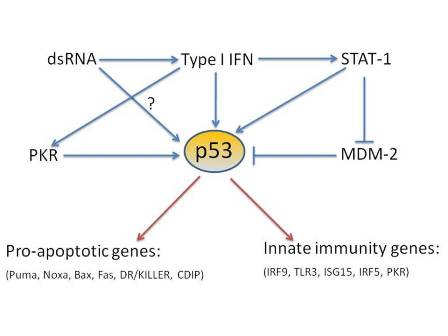
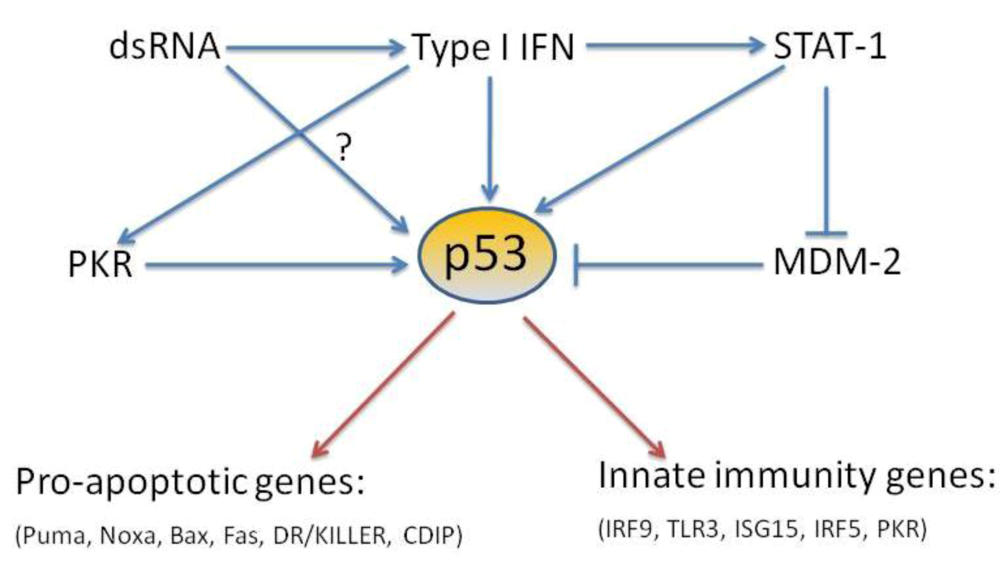
      <p>p53 is a tumor suppressor gene which is found mutated or absent in more than 50% of human cancers [<xref ref-type="bibr" rid="B109">109</xref>]. In fact, due to the ability of p53 to respond in many ways to DNA damaging insults, this protein has been called ‘the guardian of the genome’ [<xref ref-type="bibr" rid="B110">110</xref>]. However, p53 is also present and functional in organisms whose life span precludes them from undergoing cancer-related diseases such as flies and worms [<xref ref-type="bibr" rid="B111">111</xref>,<xref ref-type="bibr" rid="B112">112</xref>]. Moreover, a recent body of work indicates that besides ‘classic’ p53 inducers such as DNA damage and oncogene expression, its function can be also promoted by hypoxia, nutrient deprivation and viral infection [<xref ref-type="bibr" rid="B4">4</xref>,<xref ref-type="bibr" rid="B113">113</xref>,<xref ref-type="bibr" rid="B114">114</xref>]. These findings, and the recently identified functions of p53 in both virus-induced apoptosis and upregulation of the type I IFN response, are summarized in <xref ref-type="fig" rid="figure1">Figure 1</xref>, and suggest, that p53 may act as a virus induced cellular stress sensor. The role of p53 in antiviral immunity may help to explain to some extent why this protein is so highly conserved in evolution. </p>
      <fig id="figure1" position="float">
        <label>Figure 1</label>
        <caption>
          <p>Schematic of the activators and effectors of p53-dependent response in antiviral immunity.</p>
        </caption>
        <graphic xmlns:xlink="http://www.w3.org/1999/xlink" xlink:href="viruses-02-00298-g001.tif" scale="0"/>
      </fig>
    </sec>
  </body>
  <back>
    <ack>
      <p>We thank E. Rodríguez and M. Collado for helpful comments and discussions about the manuscript. C.M.-F. is a recipient of a postdoctoral fellowship from the Spanish Ministry of Education and Science. This work was supported by NIH grants CA80058 and CA85214 to S.A.A. C.R. is funded by Spanish Ministry of Education and Science [BFU2008-03784/BMC] and CSIC [CCG08-CSIC/SAL-3441].</p>
    </ack>
    <ref-list>
    <title>References</title>
      <ref id="B1">
        <citation citation-type="journal">
          <person-group person-group-type="author">
            <name>
              <surname>Stark</surname>
              <given-names>G.R.</given-names>
            </name>
            <name>
              <surname>Kerr</surname>
              <given-names>I.M.</given-names>
            </name>
            <name>
              <surname>Williams</surname>
              <given-names>B.R.</given-names>
            </name>
            <name>
              <surname>Silverman</surname>
              <given-names>R.H.</given-names>
            </name>
            <name>
              <surname>Schreiber</surname>
              <given-names>R.D.</given-names>
            </name>
          </person-group>
          <article-title>How cells respond to interferons</article-title>
          <source>Annu. Rev. Biochem.</source>
          <year>1998</year>
          <volume>67</volume>
          <fpage>227</fpage>
          <lpage>264</lpage>
          <pub-id pub-id-type="doi">10.1146/annurev.biochem.67.1.227</pub-id>
          <pub-id pub-id-type="pmid">9759489</pub-id>
        </citation>
      </ref>
      <ref id="B2">
        <citation citation-type="journal">
          <person-group person-group-type="author">
            <name>
              <surname>García-Sastre</surname>
              <given-names>A.</given-names>
            </name>
            <name>
              <surname>Biron</surname>
              <given-names>C.A.</given-names>
            </name>
          </person-group>
          <article-title>Type 1 interferons and the virus-host relationship: a lesson in détente</article-title>
          <source>Science</source>
          <year>2006</year>
          <volume>312</volume>
          <fpage>879</fpage>
          <lpage>882</lpage>
          <pub-id pub-id-type="doi">10.1126/science.1125676</pub-id>
          <pub-id pub-id-type="pmid">16690858</pub-id>
        </citation>
      </ref>
      <ref id="B3">
        <citation citation-type="journal">
          <person-group person-group-type="author">
            <name>
              <surname>Platanias</surname>
              <given-names>L.C.</given-names>
            </name>
            <name>
              <surname>Fish</surname>
              <given-names>E.N.</given-names>
            </name>
          </person-group>
          <article-title>Signaling pathways activated by interferons</article-title>
          <source>Exp. Hematol.</source>
          <year>1999</year>
          <volume>27</volume>
          <fpage>1583</fpage>
          <lpage>1592</lpage>
          <pub-id pub-id-type="doi">10.1016/S0301-472X(99)00109-5</pub-id>
          <pub-id pub-id-type="pmid">10560905</pub-id>
        </citation>
      </ref>
      <ref id="B4">
        <citation citation-type="journal">
          <person-group person-group-type="author">
            <name>
              <surname>Takaoka</surname>
              <given-names>A.</given-names>
            </name>
            <name>
              <surname>Hayakawa</surname>
              <given-names>S.</given-names>
            </name>
            <name>
              <surname>Yanai</surname>
              <given-names>H.</given-names>
            </name>
            <name>
              <surname>Stoiber</surname>
              <given-names>D.</given-names>
            </name>
            <name>
              <surname>Negishi</surname>
              <given-names>H.</given-names>
            </name>
            <name>
              <surname>Kikuchi</surname>
              <given-names>H.</given-names>
            </name>
            <name>
              <surname>Sasaki</surname>
              <given-names>S.</given-names>
            </name>
            <name>
              <surname>Imai</surname>
              <given-names>K.</given-names>
            </name>
            <name>
              <surname>Shibue</surname>
              <given-names>T.</given-names>
            </name>
            <name>
              <surname>Honda</surname>
              <given-names>K.</given-names>
            </name>
            <name>
              <surname>Taniguchi</surname>
              <given-names>T.</given-names>
            </name>
          </person-group>
          <article-title>Integration of interferon-alpha/beta signalling to p53 responses in tumour suppression and antiviral defence</article-title>
          <source>Nature</source>
          <year>2003</year>
          <volume>424</volume>
          <fpage>516</fpage>
          <lpage>523</lpage>
          <pub-id pub-id-type="doi">10.1038/nature01850</pub-id>
          <pub-id pub-id-type="pmid">12872134</pub-id>
        </citation>
      </ref>
      <ref id="B5">
        <citation citation-type="journal">
          <person-group person-group-type="author">
            <name>
              <surname>Muñoz-Fontela</surname>
              <given-names>C.</given-names>
            </name>
            <name>
              <surname>Garcia</surname>
              <given-names>M.A.</given-names>
            </name>
            <name>
              <surname>Garcia-Cao</surname>
              <given-names>I.</given-names>
            </name>
            <name>
              <surname>Collado</surname>
              <given-names>M.</given-names>
            </name>
            <name>
              <surname>Arroyo</surname>
              <given-names>J.</given-names>
            </name>
            <name>
              <surname>Esteban</surname>
              <given-names>M.</given-names>
            </name>
            <name>
              <surname>Serrano</surname>
              <given-names>M.</given-names>
            </name>
            <name>
              <surname>Rivas</surname>
              <given-names>C.</given-names>
            </name>
          </person-group>
          <article-title>Resistance to viral infection of super p53 mice</article-title>
          <source>Oncogene</source>
          <year>2005</year>
          <volume>24</volume>
          <fpage>3059</fpage>
          <lpage>3062</lpage>
          <pub-id pub-id-type="doi">10.1038/sj.onc.1208477</pub-id>
          <pub-id pub-id-type="pmid">17726827</pub-id>
        </citation>
      </ref>
      <ref id="B6">
        <citation citation-type="journal">
          <person-group person-group-type="author">
            <name>
              <surname>Muñoz-Fontela</surname>
              <given-names>C.</given-names>
            </name>
            <name>
              <surname>Macip</surname>
              <given-names>S.</given-names>
            </name>
            <name>
              <surname>Martínez-Sobrido</surname>
              <given-names>L.</given-names>
            </name>
            <name>
              <surname>Brown</surname>
              <given-names>L.</given-names>
            </name>
            <name>
              <surname>Ashour</surname>
              <given-names>J.</given-names>
            </name>
            <name>
              <surname>García-Sastre</surname>
              <given-names>A.</given-names>
            </name>
            <name>
              <surname>Lee</surname>
              <given-names>S.W.</given-names>
            </name>
            <name>
              <surname>Aaronson</surname>
              <given-names>S.A.</given-names>
            </name>
          </person-group>
          <article-title>Transcriptional role of p53 in interferon-mediated antiviral immunity</article-title>
          <source>J. Exp. Med.</source>
          <year>2008</year>
          <volume>205</volume>
          <fpage>1929</fpage>
          <lpage>1938</lpage>
          <pub-id pub-id-type="doi">10.1084/jem.20080383</pub-id>
          <pub-id pub-id-type="pmid">18663127</pub-id>
        </citation>
      </ref>
      <ref id="B7">
        <citation citation-type="journal">
          <person-group person-group-type="author">
            <name>
              <surname>Turpin</surname>
              <given-names>E.</given-names>
            </name>
            <name>
              <surname>Luke</surname>
              <given-names>K.</given-names>
            </name>
            <name>
              <surname>Jones</surname>
              <given-names>J.</given-names>
            </name>
            <name>
              <surname>Tumpey</surname>
              <given-names>T.</given-names>
            </name>
            <name>
              <surname>Konan</surname>
              <given-names>K.</given-names>
            </name>
            <name>
              <surname>Schultz-Cherry</surname>
              <given-names>S.</given-names>
            </name>
          </person-group>
          <article-title>Influenza virus infection increases p53 activity: role of p53 in cell death and viral replication</article-title>
          <source>J. Virol.</source>
          <year>2005</year>
          <volume>79</volume>
          <fpage>8802</fpage>
          <lpage>8811</lpage>
          <pub-id pub-id-type="doi">10.1128/JVI.79.14.8802-8811.2005</pub-id>
          <pub-id pub-id-type="pmid">15994774</pub-id>
        </citation>
      </ref>
      <ref id="B8">
        <citation citation-type="journal">
          <person-group person-group-type="author">
            <name>
              <surname>Nguyen</surname>
              <given-names>M.L.</given-names>
            </name>
            <name>
              <surname>Kraft</surname>
              <given-names>R.M.</given-names>
            </name>
            <name>
              <surname>Aubert</surname>
              <given-names>M.</given-names>
            </name>
            <name>
              <surname>Goodwin</surname>
              <given-names>E.</given-names>
            </name>
            <name>
              <surname>DiMaio</surname>
              <given-names>D.</given-names>
            </name>
            <name>
              <surname>Blaho</surname>
              <given-names>J.A.</given-names>
            </name>
          </person-group>
          <article-title>p53 and hTERT determine sensitivity to viral apoptosis</article-title>
          <source>J. Virol.</source>
          <year>2007</year>
          <volume>81</volume>
          <fpage>12985</fpage>
          <lpage>12995</lpage>
          <pub-id pub-id-type="doi">10.1128/JVI.01485-07</pub-id>
          <pub-id pub-id-type="pmid">17855516</pub-id>
        </citation>
      </ref>
      <ref id="B9">
        <citation citation-type="journal">
          <person-group person-group-type="author">
            <name>
              <surname>Pampin</surname>
              <given-names>M.</given-names>
            </name>
            <name>
              <surname>Simonin</surname>
              <given-names>Y.</given-names>
            </name>
            <name>
              <surname>Blondel</surname>
              <given-names>B.</given-names>
            </name>
            <name>
              <surname>Percherancier</surname>
              <given-names>Y.</given-names>
            </name>
            <name>
              <surname>Chelbi-Alix</surname>
              <given-names>M.K.</given-names>
            </name>
          </person-group>
          <article-title>Cross talk between PML and p53 during poliovirus infection: implications for antiviral defense</article-title>
          <source>J. Virol.</source>
          <year>2006</year>
          <volume>80</volume>
          <fpage>8582</fpage>
          <lpage>8592</lpage>
          <pub-id pub-id-type="doi">10.1128/JVI.00031-06</pub-id>
          <pub-id pub-id-type="pmid">16912307</pub-id>
        </citation>
      </ref>
      <ref id="B10">
        <citation citation-type="journal">
          <person-group person-group-type="author">
            <name>
              <surname>Maki</surname>
              <given-names>C.G.</given-names>
            </name>
            <name>
              <surname>Huibregtse</surname>
              <given-names>J.M.</given-names>
            </name>
            <name>
              <surname>Howley</surname>
              <given-names>P.M.</given-names>
            </name>
          </person-group>
          <article-title>In vivo ubiquitination and proteasome-mediated degradation of p53(1)</article-title>
          <source>Cancer Res.</source>
          <year>1996</year>
          <volume>56</volume>
          <fpage>2649</fpage>
          <lpage>2654</lpage>
          <pub-id pub-id-type="pmid">8653711</pub-id>
        </citation>
      </ref>
      <ref id="B11">
        <citation citation-type="journal">
          <person-group person-group-type="author">
            <name>
              <surname>Haupt</surname>
              <given-names>Y.</given-names>
            </name>
            <name>
              <surname>Maya</surname>
              <given-names>R.</given-names>
            </name>
            <name>
              <surname>Kazaz</surname>
              <given-names>A.</given-names>
            </name>
            <name>
              <surname>Oren</surname>
              <given-names>M.</given-names>
            </name>
          </person-group>
          <article-title>Mdm2 promotes the rapid degradation of p53</article-title>
          <source>Nature</source>
          <year>1997</year>
          <volume>387</volume>
          <fpage>296</fpage>
          <lpage>269</lpage>
          <pub-id pub-id-type="doi">10.1038/387296a0</pub-id>
          <pub-id pub-id-type="pmid">9153395</pub-id>
        </citation>
      </ref>
      <ref id="B12">
        <citation citation-type="journal">
          <person-group person-group-type="author">
            <name>
              <surname>Momand</surname>
              <given-names>J.</given-names>
            </name>
            <name>
              <surname>Wu</surname>
              <given-names>H.H.</given-names>
            </name>
            <name>
              <surname>Dasgupta</surname>
              <given-names>G.</given-names>
            </name>
          </person-group>
          <article-title>MDM2-master regulator of the p53 tumor suppressor protein</article-title>
          <source>Gene</source>
          <year>2000</year>
          <volume>242</volume>
          <fpage>15</fpage>
          <lpage>29</lpage>
          <pub-id pub-id-type="doi">10.1016/S0378-1119(99)00487-4</pub-id>
          <pub-id pub-id-type="pmid">10721693</pub-id>
        </citation>
      </ref>
      <ref id="B13">
        <citation citation-type="journal">
          <person-group person-group-type="author">
            <name>
              <surname>Watanabe</surname>
              <given-names>H.</given-names>
            </name>
            <name>
              <surname>Shimokado</surname>
              <given-names>K.</given-names>
            </name>
            <name>
              <surname>Asahara</surname>
              <given-names>T.</given-names>
            </name>
            <name>
              <surname>Dohi</surname>
              <given-names>K.</given-names>
            </name>
            <name>
              <surname>Niwa</surname>
              <given-names>O.</given-names>
            </name>
          </person-group>
          <article-title>Analysis of the c-myc, K-ras and p53 genes in methylcholanthrene-induced mouse sarcomas</article-title>
          <source>Jpn. J. Cancer Res.</source>
          <year>1999</year>
          <volume>90</volume>
          <fpage>40</fpage>
          <lpage>47</lpage>
          <pub-id pub-id-type="pmid">10076563</pub-id>
        </citation>
      </ref>
      <ref id="B14">
        <citation citation-type="journal">
          <person-group person-group-type="author">
            <name>
              <surname>Kurki</surname>
              <given-names>S.</given-names>
            </name>
            <name>
              <surname>Peltonen</surname>
              <given-names>K.</given-names>
            </name>
            <name>
              <surname>Latonen</surname>
              <given-names>L.</given-names>
            </name>
            <name>
              <surname>Kiviharju</surname>
              <given-names>T.M.</given-names>
            </name>
            <name>
              <surname>Ojala</surname>
              <given-names>P.M.</given-names>
            </name>
            <name>
              <surname>Meek</surname>
              <given-names>D.</given-names>
            </name>
            <name>
              <surname>Laiho</surname>
              <given-names>M.</given-names>
            </name>
          </person-group>
          <article-title>Nucleolar protein NPM interacts with HDM2 and protects tumor suppressor protein p53 from HDM2-mediated degradation</article-title>
          <source>Cancer Cell</source>
          <year>2004</year>
          <volume>5</volume>
          <fpage>465</fpage>
          <lpage>475</lpage>
          <pub-id pub-id-type="doi">10.1016/S1535-6108(04)00110-2</pub-id>
          <pub-id pub-id-type="pmid">15144954</pub-id>
        </citation>
      </ref>
      <ref id="B15">
        <citation citation-type="journal">
          <person-group person-group-type="author">
            <name>
              <surname>Sandoval</surname>
              <given-names>R.</given-names>
            </name>
            <name>
              <surname>Xue</surname>
              <given-names>J.</given-names>
            </name>
            <name>
              <surname>Pilkinton</surname>
              <given-names>M.</given-names>
            </name>
            <name>
              <surname>Salvi</surname>
              <given-names>D.</given-names>
            </name>
            <name>
              <surname>Kiyokawa</surname>
              <given-names>H.</given-names>
            </name>
            <name>
              <surname>Colamonici</surname>
              <given-names>O.R.</given-names>
            </name>
          </person-group>
          <article-title>Different requirements for the cytostatic and apoptotic effects of type I interferons. Induction of apoptosis requires ARF but not p53 in osteosarcoma cell lines</article-title>
          <source>J. Biol. Chem.</source>
          <year>2004</year>
          <volume>279</volume>
          <fpage>32275</fpage>
          <lpage>32280</lpage>
          <pub-id pub-id-type="doi">10.1074/jbc.M313830200</pub-id>
          <pub-id pub-id-type="pmid">15169789</pub-id>
        </citation>
      </ref>
      <ref id="B16">
        <citation citation-type="journal">
          <person-group person-group-type="author">
            <name>
              <surname>Townsend</surname>
              <given-names>P.A.</given-names>
            </name>
            <name>
              <surname>Scarabelli</surname>
              <given-names>T.M.</given-names>
            </name>
            <name>
              <surname>Davidson</surname>
              <given-names>S.M.</given-names>
            </name>
            <name>
              <surname>Knight Jr.</surname>
              <given-names>R.A.</given-names>
            </name>
            <name>
              <surname>Latchman</surname>
              <given-names>D.S.</given-names>
            </name>
            <name>
              <surname>Stephanou</surname>
              <given-names>A.</given-names>
            </name>
          </person-group>
          <article-title>STAT-1 interacts with p53 to enhance DNA damage-induced apoptosis</article-title>
          <source>J. Biol. Chem.</source>
          <year>2004</year>
          <volume>279</volume>
          <fpage>5811</fpage>
          <lpage>5820</lpage>
          <pub-id pub-id-type="doi">10.1074/jbc.M302637200</pub-id>
          <pub-id pub-id-type="pmid">14602726</pub-id>
        </citation>
      </ref>
      <ref id="B17">
        <citation citation-type="journal">
          <person-group person-group-type="author">
            <name>
              <surname>Moiseeva</surname>
              <given-names>O.</given-names>
            </name>
            <name>
              <surname>Mallette</surname>
              <given-names>F.A.</given-names>
            </name>
            <name>
              <surname>Mukhopadhyay</surname>
              <given-names>U.K.</given-names>
            </name>
            <name>
              <surname>Moores</surname>
              <given-names>A.</given-names>
            </name>
            <name>
              <surname>Ferbeyre</surname>
              <given-names>G.</given-names>
            </name>
          </person-group>
          <article-title>DNA damage signaling and p53-dependent senescence after prolonged beta-interferon stimulation</article-title>
          <source>Mol. Biol. Cell</source>
          <year>2006</year>
          <volume>17</volume>
          <fpage>1583</fpage>
          <lpage>1592</lpage>
          <pub-id pub-id-type="doi">10.1091/mbc.E05-09-0858</pub-id>
          <pub-id pub-id-type="pmid">16436515</pub-id>
        </citation>
      </ref>
      <ref id="B18">
        <citation citation-type="journal">
          <person-group person-group-type="author">
            <name>
              <surname>Cuddihy</surname>
              <given-names>A.R.</given-names>
            </name>
            <name>
              <surname>Wong</surname>
              <given-names>A.H.</given-names>
            </name>
            <name>
              <surname>Tam</surname>
              <given-names>N.W.</given-names>
            </name>
            <name>
              <surname>Li</surname>
              <given-names>S.</given-names>
            </name>
            <name>
              <surname>Koromilas</surname>
              <given-names>A.E.</given-names>
            </name>
          </person-group>
          <article-title>The double-stranded RNA activated protein kinase PKR physically associates with the tumor suppressor p53 protein and phosphorylates human p53 on serine 392 <italic>in vitro</italic></article-title>
          <source>Oncogene</source>
          <year>1999</year>
          <volume>18</volume>
          <fpage>2690</fpage>
          <lpage>2702</lpage>
          <pub-id pub-id-type="doi">10.1038/sj.onc.1202620</pub-id>
          <pub-id pub-id-type="pmid">10348343</pub-id>
        </citation>
      </ref>
      <ref id="B19">
        <citation citation-type="journal">
          <person-group person-group-type="author">
            <name>
              <surname>Cuddihy</surname>
              <given-names>A.R.</given-names>
            </name>
            <name>
              <surname>Li</surname>
              <given-names>S.</given-names>
            </name>
            <name>
              <surname>Tam</surname>
              <given-names>N.W.</given-names>
            </name>
            <name>
              <surname>Wong</surname>
              <given-names>A.H.</given-names>
            </name>
            <name>
              <surname>Taya</surname>
              <given-names>Y.</given-names>
            </name>
            <name>
              <surname>Abraham</surname>
              <given-names>N.</given-names>
            </name>
            <name>
              <surname>Bell</surname>
              <given-names>J.C.</given-names>
            </name>
            <name>
              <surname>Koromilas</surname>
              <given-names>A.E.</given-names>
            </name>
          </person-group>
          <article-title>Double-stranded-RNA-activated protein kinase PKR enhances transcriptional activation by tumor suppressor p53</article-title>
          <source>Mol. Cell Biol.</source>
          <year>1999</year>
          <volume>19</volume>
          <fpage>2475</fpage>
          <lpage>2484</lpage>
          <pub-id pub-id-type="pmid">10082513</pub-id>
        </citation>
      </ref>
      <ref id="B20">
        <citation citation-type="journal">
          <person-group person-group-type="author">
            <name>
              <surname>Ullrich</surname>
              <given-names>S.J.</given-names>
            </name>
            <name>
              <surname>Sakaguchi</surname>
              <given-names>K.</given-names>
            </name>
            <name>
              <surname>Lees-Miller</surname>
              <given-names>S.P.</given-names>
            </name>
            <name>
              <surname>Fiscella</surname>
              <given-names>M.</given-names>
            </name>
            <name>
              <surname>Mercer</surname>
              <given-names>W.E.</given-names>
            </name>
            <name>
              <surname>Anderson</surname>
              <given-names>C.W.</given-names>
            </name>
            <name>
              <surname>Appella</surname>
              <given-names>E.</given-names>
            </name>
          </person-group>
          <article-title>Phosphorylation at Ser-15 and Ser-392 in mutant p53 molecules from human tumors is altered compared to wild-type p53</article-title>
          <source>Proc. Natl. Acad. Sci. USA</source>
          <year>1993</year>
          <volume>90</volume>
          <fpage>5954</fpage>
          <lpage>5958</lpage>
          <pub-id pub-id-type="doi">10.1073/pnas.90.13.5954</pub-id>
        </citation>
      </ref>
      <ref id="B21">
        <citation citation-type="journal">
          <person-group person-group-type="author">
            <name>
              <surname>Sakaguchi</surname>
              <given-names>K.</given-names>
            </name>
            <name>
              <surname>Sakamoto</surname>
              <given-names>H.</given-names>
            </name>
            <name>
              <surname>Lewis</surname>
              <given-names>M.S.</given-names>
            </name>
            <name>
              <surname>Anderson</surname>
              <given-names>C.W.</given-names>
            </name>
            <name>
              <surname>Erickson</surname>
              <given-names>J.W.</given-names>
            </name>
            <name>
              <surname>Appella</surname>
              <given-names>E.</given-names>
            </name>
            <name>
              <surname>Xie</surname>
              <given-names>D.</given-names>
            </name>
          </person-group>
          <article-title>Phosphorylation of serine 392 stabilizes the tetramer formation of tumor suppressor protein p53</article-title>
          <source>Biochemistry</source>
          <year>1997</year>
          <volume>36</volume>
          <fpage>10117</fpage>
          <lpage>10124</lpage>
          <pub-id pub-id-type="doi">10.1021/bi970759w</pub-id>
          <pub-id pub-id-type="pmid">9254608</pub-id>
        </citation>
      </ref>
      <ref id="B22">
        <citation citation-type="journal">
          <person-group person-group-type="author">
            <name>
              <surname>Keller</surname>
              <given-names>D.M.</given-names>
            </name>
            <name>
              <surname>Zeng</surname>
              <given-names>X.</given-names>
            </name>
            <name>
              <surname>Wang</surname>
              <given-names>Y.</given-names>
            </name>
            <name>
              <surname>Zhang</surname>
              <given-names>Q.H.</given-names>
            </name>
            <name>
              <surname>Kapoor</surname>
              <given-names>M.</given-names>
            </name>
            <name>
              <surname>Shu</surname>
              <given-names>H.</given-names>
            </name>
            <name>
              <surname>Goodman</surname>
              <given-names>R.</given-names>
            </name>
            <name>
              <surname>Lozano</surname>
              <given-names>G.</given-names>
            </name>
            <name>
              <surname>Zhao</surname>
              <given-names>Y.</given-names>
            </name>
            <name>
              <surname>Lu</surname>
              <given-names>H.</given-names>
            </name>
          </person-group>
          <article-title>A DNA damage-induced p53 serine 392 kinase complex contains CK2, hSpt16, and SSRP1</article-title>
          <source>Mol. Cell</source>
          <year>2001</year>
          <volume>7</volume>
          <fpage>283</fpage>
          <lpage>292</lpage>
          <pub-id pub-id-type="doi">10.1016/S1097-2765(01)00176-9</pub-id>
          <pub-id pub-id-type="pmid">11239457</pub-id>
        </citation>
      </ref>
      <ref id="B23">
        <citation citation-type="journal">
          <person-group person-group-type="author">
            <name>
              <surname>Yeung</surname>
              <given-names>M.C.</given-names>
            </name>
            <name>
              <surname>Lau</surname>
              <given-names>A.S.</given-names>
            </name>
          </person-group>
          <article-title>Tumor suppressor p53 as a component of the tumor necrosis factor-induced, protein kinase PKR-mediated apoptotic pathway in human promonocytic U937 cells</article-title>
          <source>J. Biol. Chem.</source>
          <year>1998</year>
          <volume>273</volume>
          <fpage>25198</fpage>
          <lpage>25202</lpage>
          <pub-id pub-id-type="doi">10.1074/jbc.273.39.25198</pub-id>
          <pub-id pub-id-type="pmid">9737981</pub-id>
        </citation>
      </ref>
      <ref id="B24">
        <citation citation-type="journal">
          <person-group person-group-type="author">
            <name>
              <surname>Son K.N.</surname>
              <given-names>Pugazhenthi S</given-names>
            </name>
          </person-group>
          <article-title>Activation of tumor suppressor protein p53 is required for Theiler's murine encephalomyelitis virus-induced apoptosis in M1-D macrophages</article-title>
          <source>J. Virol.</source>
          <year>2009</year>
          <volume>83</volume>
          <fpage>10770</fpage>
          <lpage>10777</lpage>
          <pub-id pub-id-type="doi">10.1128/JVI.01030-09</pub-id>
          <pub-id pub-id-type="pmid">19656889</pub-id>
        </citation>
      </ref>
      <ref id="B25">
        <citation citation-type="journal">
          <person-group person-group-type="author">
            <name>
              <surname>Yoon</surname>
              <given-names>C.H.</given-names>
            </name>
            <name>
              <surname>Lee</surname>
              <given-names>E.S.</given-names>
            </name>
            <name>
              <surname>Lim</surname>
              <given-names>D.S.</given-names>
            </name>
            <name>
              <surname>Bae</surname>
              <given-names>Y.S.</given-names>
            </name>
          </person-group>
          <article-title>PKR, a p53 target gene, plays a crucial role in the tumor-suppressor function of p53</article-title>
          <source>Proc. Natl. Acad. Sci. USA</source>
          <year>2009</year>
          <volume>106</volume>
          <fpage>7852</fpage>
          <lpage>7857</lpage>
          <pub-id pub-id-type="doi">10.1073/pnas.0812148106</pub-id>
        </citation>
      </ref>
      <ref id="B26">
        <citation citation-type="journal">
          <person-group person-group-type="author">
            <name>
              <surname>Brown</surname>
              <given-names>L.</given-names>
            </name>
            <name>
              <surname>Ongusaha</surname>
              <given-names>P.P.</given-names>
            </name>
            <name>
              <surname>Kim</surname>
              <given-names>H.G.</given-names>
            </name>
            <name>
              <surname>Nuti</surname>
              <given-names>S.</given-names>
            </name>
            <name>
              <surname>Mandinova</surname>
              <given-names>A.</given-names>
            </name>
            <name>
              <surname>Lee</surname>
              <given-names>J.W.</given-names>
            </name>
            <name>
              <surname>Khosravi-Far</surname>
              <given-names>R.</given-names>
            </name>
            <name>
              <surname>Aaronson</surname>
              <given-names>S.A.</given-names>
            </name>
            <name>
              <surname>Lee</surname>
              <given-names>S.W.</given-names>
            </name>
          </person-group>
          <article-title>CDIP, a novel pro-apoptotic gene, regulates TNFalpha-mediated apoptosis in a p53-dependent manner</article-title>
          <source>EMBO J.</source>
          <year>2007</year>
          <volume>26</volume>
          <fpage>3410</fpage>
          <lpage>3422</lpage>
          <pub-id pub-id-type="doi">10.1038/sj.emboj.7601779</pub-id>
          <pub-id pub-id-type="pmid">17599062</pub-id>
        </citation>
      </ref>
      <ref id="B27">
        <citation citation-type="journal">
          <person-group person-group-type="author">
            <name>
              <surname>Julkunen</surname>
              <given-names>I.</given-names>
            </name>
            <name>
              <surname>Melén</surname>
              <given-names>K.</given-names>
            </name>
            <name>
              <surname>Nyqvist</surname>
              <given-names>M.</given-names>
            </name>
            <name>
              <surname>Pirhonen</surname>
              <given-names>J.</given-names>
            </name>
            <name>
              <surname>Sareneva</surname>
              <given-names>T.</given-names>
            </name>
            <name>
              <surname>Matikainen</surname>
              <given-names>S.</given-names>
            </name>
          </person-group>
          <article-title>Inflammatory responses in influenza A virus infection</article-title>
          <source>Vaccine</source>
          <year>2000</year>
          <volume>19</volume>
          <fpage>S32</fpage>
          <lpage>S37</lpage>
          <pub-id pub-id-type="doi">10.1016/S0264-410X(00)00275-9</pub-id>
          <pub-id pub-id-type="pmid">11163460</pub-id>
        </citation>
      </ref>
      <ref id="B28">
        <citation citation-type="journal">
          <person-group person-group-type="author">
            <name>
              <surname>Roux-Lombard</surname>
              <given-names>P.</given-names>
            </name>
            <name>
              <surname>Modoux</surname>
              <given-names>C.</given-names>
            </name>
            <name>
              <surname>Cruchaud</surname>
              <given-names>A.</given-names>
            </name>
            <name>
              <surname>Dayer</surname>
              <given-names>J.M.</given-names>
            </name>
          </person-group>
          <article-title>Purified blood monocytes from HIV 1-infected patients produce high levels of TNF alpha and IL-1</article-title>
          <source>Clin. Immunol. Immunopathol.</source>
          <year>1989</year>
          <volume>50</volume>
          <fpage>374</fpage>
          <lpage>384</lpage>
          <pub-id pub-id-type="doi">10.1016/0090-1229(89)90144-X</pub-id>
          <pub-id pub-id-type="pmid">2492910</pub-id>
        </citation>
      </ref>
      <ref id="B29">
        <citation citation-type="journal">
          <person-group person-group-type="author">
            <name>
              <surname>Caux</surname>
              <given-names>C.</given-names>
            </name>
            <name>
              <surname>Massacrier</surname>
              <given-names>C.</given-names>
            </name>
            <name>
              <surname>Vanbervliet</surname>
              <given-names>B.</given-names>
            </name>
            <name>
              <surname>Dubois</surname>
              <given-names>B.</given-names>
            </name>
            <name>
              <surname>Van Kooten</surname>
              <given-names>C.</given-names>
            </name>
            <name>
              <surname>Durand</surname>
              <given-names>I.</given-names>
            </name>
            <name>
              <surname>Banchereau</surname>
              <given-names>J.</given-names>
            </name>
          </person-group>
          <article-title>Activation of human dendritic cells through CD40 cross-linking</article-title>
          <source>J. Exp. Med.</source>
          <year>1994</year>
          <volume>180</volume>
          <fpage>1263</fpage>
          <lpage>1272</lpage>
          <pub-id pub-id-type="doi">10.1084/jem.180.4.1263</pub-id>
          <pub-id pub-id-type="pmid">7523569</pub-id>
        </citation>
      </ref>
      <ref id="B30">
        <citation citation-type="journal">
          <person-group person-group-type="author">
            <name>
              <surname>Bartee</surname>
              <given-names>E.</given-names>
            </name>
            <name>
              <surname>Mohamed</surname>
              <given-names>M.R.</given-names>
            </name>
            <name>
              <surname>McFadden</surname>
              <given-names>G.</given-names>
            </name>
          </person-group>
          <article-title>Tumor necrosis factor and interferon: cytokines in harmony</article-title>
          <source>Curr. Opin. Microbiol.</source>
          <year>2008</year>
          <volume>11</volume>
          <fpage>378</fpage>
          <lpage>383</lpage>
          <pub-id pub-id-type="doi">10.1016/j.mib.2008.05.015</pub-id>
          <pub-id pub-id-type="pmid">18595771</pub-id>
        </citation>
      </ref>
      <ref id="B31">
        <citation citation-type="journal">
          <person-group person-group-type="author">
            <name>
              <surname>Belardelli</surname>
              <given-names>F.</given-names>
            </name>
          </person-group>
          <article-title>Role of interferons and other cytokines in the regulation of the immune response</article-title>
          <source>APMIS</source>
          <year>1995</year>
          <volume>103</volume>
          <fpage>161</fpage>
          <lpage>179</lpage>
          <pub-id pub-id-type="doi">10.1111/j.1699-0463.1995.tb01092.x</pub-id>
          <pub-id pub-id-type="pmid">7538771</pub-id>
        </citation>
      </ref>
      <ref id="B32">
        <citation citation-type="journal">
          <person-group person-group-type="author">
            <name>
              <surname>Mandron</surname>
              <given-names>M.</given-names>
            </name>
            <name>
              <surname>Martin</surname>
              <given-names>H.</given-names>
            </name>
            <name>
              <surname>Bonjean</surname>
              <given-names>B.</given-names>
            </name>
            <name>
              <surname>Lulé</surname>
              <given-names>J.</given-names>
            </name>
            <name>
              <surname>Tartour</surname>
              <given-names>E.</given-names>
            </name>
            <name>
              <surname>Davrinche</surname>
              <given-names>C.</given-names>
            </name>
          </person-group>
          <article-title>Dendritic cell-induced apoptosis of human cytomegalovirus-infected fibroblasts promotes cross-presentation of pp65 to CD8+ T cells</article-title>
          <source>J. Gen. Virol.</source>
          <year>2008</year>
          <volume>89</volume>
          <fpage>78</fpage>
          <lpage>86</lpage>
          <pub-id pub-id-type="doi">10.1099/vir.0.83278-0</pub-id>
          <pub-id pub-id-type="pmid">18089731</pub-id>
        </citation>
      </ref>
      <ref id="B33">
        <citation citation-type="journal">
          <person-group person-group-type="author">
            <name>
              <surname>Chattergoon</surname>
              <given-names>M.A.</given-names>
            </name>
            <name>
              <surname>Muthumani</surname>
              <given-names>K.</given-names>
            </name>
            <name>
              <surname>Tamura</surname>
              <given-names>Y.</given-names>
            </name>
            <name>
              <surname>Ramanathan</surname>
              <given-names>M.</given-names>
            </name>
            <name>
              <surname>Shames</surname>
              <given-names>J.P.</given-names>
            </name>
            <name>
              <surname>Saulino</surname>
              <given-names>V.</given-names>
            </name>
            <name>
              <surname>Robinson</surname>
              <given-names>T.M.</given-names>
            </name>
            <name>
              <surname>Montaner</surname>
              <given-names>L.J.</given-names>
            </name>
            <name>
              <surname>Weiner</surname>
              <given-names>D.B.</given-names>
            </name>
          </person-group>
          <article-title>DR5 activation of caspase-8 induces DC maturation and immune enhancement <italic>in vivo</italic></article-title>
          <source>Mol. Ther.</source>
          <year>2008</year>
          <volume>16</volume>
          <fpage>419</fpage>
          <lpage>426</lpage>
          <pub-id pub-id-type="doi">10.1038/sj.mt.6300373</pub-id>
          <pub-id pub-id-type="pmid">18087262</pub-id>
        </citation>
      </ref>
      <ref id="B34">
        <citation citation-type="journal">
          <person-group person-group-type="author">
            <name>
              <surname>Albert</surname>
              <given-names>M.L.</given-names>
            </name>
            <name>
              <surname>Sauter</surname>
              <given-names>B.</given-names>
            </name>
            <name>
              <surname>Bhardwaj</surname>
              <given-names>N.</given-names>
            </name>
          </person-group>
          <article-title>Dendritic cells acquire antigen from apoptotic cells and induce class I-restricted CTLs</article-title>
          <source>Nature</source>
          <year>1998</year>
          <volume>392</volume>
          <fpage>86</fpage>
          <lpage>89</lpage>
          <pub-id pub-id-type="doi">10.1038/32183</pub-id>
          <pub-id pub-id-type="pmid">9510252</pub-id>
        </citation>
      </ref>
      <ref id="B35">
        <citation citation-type="journal">
          <person-group person-group-type="author">
            <name>
              <surname>Müller</surname>
              <given-names>M.</given-names>
            </name>
            <name>
              <surname>Wilder</surname>
              <given-names>S.</given-names>
            </name>
            <name>
              <surname>Bannasch</surname>
              <given-names>D.</given-names>
            </name>
            <name>
              <surname>Israeli</surname>
              <given-names>D.</given-names>
            </name>
            <name>
              <surname>Lehlbach</surname>
              <given-names>K.</given-names>
            </name>
            <name>
              <surname>Li-Weber</surname>
              <given-names>M.</given-names>
            </name>
            <name>
              <surname>Friedman</surname>
              <given-names>S.L.</given-names>
            </name>
            <name>
              <surname>Galle</surname>
              <given-names>P.R.</given-names>
            </name>
            <name>
              <surname>Stremmel</surname>
              <given-names>W.</given-names>
            </name>
            <name>
              <surname>Oren</surname>
              <given-names>M.</given-names>
            </name>
            <name>
              <surname>Krammer</surname>
              <given-names>PH.</given-names>
            </name>
          </person-group>
          <article-title>p53 activates the CD95 (APO-1/Fas) gene in response to DNA damage by anticancer drugs</article-title>
          <source>J. Exp. Med.</source>
          <year>1998</year>
          <volume>188</volume>
          <fpage>2033</fpage>
          <lpage>2045</lpage>
          <pub-id pub-id-type="doi">10.1084/jem.188.11.2033</pub-id>
          <pub-id pub-id-type="pmid">9841917</pub-id>
        </citation>
      </ref>
      <ref id="B36">
        <citation citation-type="journal">
          <person-group person-group-type="author">
            <name>
              <surname>Burns</surname>
              <given-names>T.F.</given-names>
            </name>
            <name>
              <surname>Bernhard</surname>
              <given-names>E.J.</given-names>
            </name>
            <name>
              <surname>El-Deiry</surname>
              <given-names>W.S.</given-names>
            </name>
          </person-group>
          <article-title>Tissue specific expression of p53 target genes suggests a key role for KILLER/DR5 in p53-dependent apoptosis <italic>in vivo</italic></article-title>
          <source>Oncogene</source>
          <year>2001</year>
          <volume>20</volume>
          <fpage>4601</fpage>
          <lpage>4612</lpage>
          <pub-id pub-id-type="doi">10.1038/sj.onc.1204484</pub-id>
          <pub-id pub-id-type="pmid">11498783</pub-id>
        </citation>
      </ref>
      <ref id="B37">
        <citation citation-type="journal">
          <person-group person-group-type="author">
            <name>
              <surname>Huang</surname>
              <given-names>S.</given-names>
            </name>
            <name>
              <surname>Qu</surname>
              <given-names>L.K.</given-names>
            </name>
            <name>
              <surname>Koromilas</surname>
              <given-names>A.E.</given-names>
            </name>
          </person-group>
          <article-title>Induction of p53-dependent apoptosis in HCT116 tumor cells by RNA viruses and possible implications in virus-mediated oncolysis</article-title>
          <source>Cell Cycle</source>
          <year>2004</year>
          <volume>3</volume>
          <fpage>1043</fpage>
          <lpage>1045</lpage>
          <pub-id pub-id-type="pmid">15254403</pub-id>
        </citation>
      </ref>
      <ref id="B38">
        <citation citation-type="journal">
          <person-group person-group-type="author">
            <name>
              <surname>Marques</surname>
              <given-names>J.T.</given-names>
            </name>
            <name>
              <surname>Rebouillat</surname>
              <given-names>D.</given-names>
            </name>
            <name>
              <surname>Ramana</surname>
              <given-names>C.V.</given-names>
            </name>
            <name>
              <surname>Murakami</surname>
              <given-names>J.</given-names>
            </name>
            <name>
              <surname>Hill</surname>
              <given-names>J.E.</given-names>
            </name>
            <name>
              <surname>Gudkov</surname>
              <given-names>A.</given-names>
            </name>
            <name>
              <surname>Silverman</surname>
              <given-names>R.H.</given-names>
            </name>
            <name>
              <surname>Stark</surname>
              <given-names>G.R.</given-names>
            </name>
            <name>
              <surname>Williams</surname>
              <given-names>B.R.</given-names>
            </name>
          </person-group>
          <article-title>Down-regulation of p53 by double-stranded RNA modulates the antiviral response</article-title>
          <source>J. Virol.</source>
          <year>2005</year>
          <volume>79</volume>
          <fpage>11105</fpage>
          <lpage>11114</lpage>
          <pub-id pub-id-type="doi">10.1128/JVI.79.17.11105-11114.2005</pub-id>
          <pub-id pub-id-type="pmid">16103161</pub-id>
        </citation>
      </ref>
      <ref id="B39">
        <citation citation-type="journal">
          <person-group person-group-type="author">
            <name>
              <surname>Casavant</surname>
              <given-names>N.C.</given-names>
            </name>
            <name>
              <surname>Luo</surname>
              <given-names>M.H.</given-names>
            </name>
            <name>
              <surname>Rosenke</surname>
              <given-names>K.</given-names>
            </name>
            <name>
              <surname>Winegardner</surname>
              <given-names>T.</given-names>
            </name>
            <name>
              <surname>Zurawska</surname>
              <given-names>A.</given-names>
            </name>
            <name>
              <surname>Fortunato</surname>
              <given-names>E.A.</given-names>
            </name>
          </person-group>
          <article-title>Potential role for p53 in the permissive life cycle of human cytomegalovirus</article-title>
          <source>J. Virol.</source>
          <year>2006</year>
          <volume>80</volume>
          <fpage>8390</fpage>
          <lpage>83401</lpage>
          <pub-id pub-id-type="doi">10.1128/JVI.00505-06</pub-id>
          <pub-id pub-id-type="pmid">16912290</pub-id>
        </citation>
      </ref>
      <ref id="B40">
        <citation citation-type="journal">
          <person-group person-group-type="author">
            <name>
              <surname>Groskreutz</surname>
              <given-names>D.J.</given-names>
            </name>
            <name>
              <surname>Monick</surname>
              <given-names>M.M.</given-names>
            </name>
            <name>
              <surname>Powers</surname>
              <given-names>L.S.</given-names>
            </name>
            <name>
              <surname>Quelle</surname>
              <given-names>D.E.</given-names>
            </name>
            <name>
              <surname>Varga</surname>
              <given-names>S.M.</given-names>
            </name>
            <name>
              <surname>Look</surname>
              <given-names>D.C.</given-names>
            </name>
            <name>
              <surname>Hunninghake</surname>
              <given-names>G.W.</given-names>
            </name>
          </person-group>
          <article-title>Respiratory syncytial virus decreases p53 protein to prolong survival of airway epithelial cells</article-title>
          <source>J. Immunol.</source>
          <year>2007</year>
          <volume>179</volume>
          <fpage>2741</fpage>
          <lpage>2747</lpage>
          <pub-id pub-id-type="pmid">17709487</pub-id>
        </citation>
      </ref>
      <ref id="B41">
        <citation citation-type="journal">
          <person-group person-group-type="author">
            <name>
              <surname>Royds</surname>
              <given-names>J.A.</given-names>
            </name>
            <name>
              <surname>Hibma</surname>
              <given-names>M.</given-names>
            </name>
            <name>
              <surname>Dix</surname>
              <given-names>B.R.</given-names>
            </name>
            <name>
              <surname>Hananeia</surname>
              <given-names>L.</given-names>
            </name>
            <name>
              <surname>Russell</surname>
              <given-names>I.A.</given-names>
            </name>
            <name>
              <surname>Wiles</surname>
              <given-names>A.</given-names>
            </name>
            <name>
              <surname>Wynford-Thomas</surname>
              <given-names>D.</given-names>
            </name>
            <name>
              <surname>Braithwaite</surname>
              <given-names>A.W.</given-names>
            </name>
          </person-group>
          <article-title>p53 promotes adenoviral replication and increases late viral gene expression</article-title>
          <source>Oncogene</source>
          <year>2006</year>
          <volume>25</volume>
          <fpage>1509</fpage>
          <lpage>1520</lpage>
          <pub-id pub-id-type="doi">10.1038/sj.onc.1209185</pub-id>
          <pub-id pub-id-type="pmid">16247442</pub-id>
        </citation>
      </ref>
      <ref id="B42">
        <citation citation-type="journal">
          <person-group person-group-type="author">
            <name>
              <surname>Teodoro</surname>
              <given-names>J.G.</given-names>
            </name>
            <name>
              <surname>Branton</surname>
              <given-names>P.E.</given-names>
            </name>
          </person-group>
          <article-title>Regulation of apoptosis by viral gene products</article-title>
          <source>J. Virol.</source>
          <year>1997</year>
          <volume>7</volume>
          <fpage>3620</fpage>
          <lpage>3627</lpage>
        </citation>
      </ref>
      <ref id="B43">
        <citation citation-type="journal">
          <person-group person-group-type="author">
            <name>
              <surname>Bluyssen</surname>
              <given-names>A.R.</given-names>
            </name>
            <name>
              <surname>Durbin</surname>
              <given-names>J.E.</given-names>
            </name>
            <name>
              <surname>Levy</surname>
              <given-names>D.E.</given-names>
            </name>
          </person-group>
          <article-title>ISGF3 gamma p48, a specificity switch for interferon activated transcription factors</article-title>
          <source>Cytokine Growth Factor Rev.</source>
          <year>1996</year>
          <volume>7</volume>
          <fpage>11</fpage>
          <lpage>17</lpage>
          <pub-id pub-id-type="doi">10.1016/1359-6101(96)00005-6</pub-id>
          <pub-id pub-id-type="pmid">8864350</pub-id>
        </citation>
      </ref>
      <ref id="B44">
        <citation citation-type="journal">
          <person-group person-group-type="author">
            <name>
              <surname>Kimura</surname>
              <given-names>T.</given-names>
            </name>
            <name>
              <surname>Kadokawa</surname>
              <given-names>Y.</given-names>
            </name>
            <name>
              <surname>Harada</surname>
              <given-names>H.</given-names>
            </name>
            <name>
              <surname>Matsumoto</surname>
              <given-names>M.</given-names>
            </name>
            <name>
              <surname>Sato</surname>
              <given-names>M.</given-names>
            </name>
            <name>
              <surname>Kashiwazaki</surname>
              <given-names>Y.</given-names>
            </name>
            <name>
              <surname>Tarutani</surname>
              <given-names>M.</given-names>
            </name>
            <name>
              <surname>Tan</surname>
              <given-names>R.S.</given-names>
            </name>
            <name>
              <surname>Takasugi</surname>
              <given-names>T.</given-names>
            </name>
            <name>
              <surname>Matsuyama</surname>
              <given-names>T.</given-names>
            </name>
            <name>
              <surname>Mak</surname>
              <given-names>T.W.</given-names>
            </name>
            <name>
              <surname>Noguchi</surname>
              <given-names>S.</given-names>
            </name>
            <name>
              <surname>Taniguchi</surname>
              <given-names>T.</given-names>
            </name>
          </person-group>
          <article-title>Essential and non-redundant roles of p48 (ISGF3 gamma) and IRF-1 in both type I and type II interferon responses, as revealed by gene targeting studies</article-title>
          <source>Genes Cells</source>
          <year>1996</year>
          <volume>1</volume>
          <fpage>115</fpage>
          <lpage>124</lpage>
          <pub-id pub-id-type="doi">10.1046/j.1365-2443.1996.08008.x</pub-id>
          <pub-id pub-id-type="pmid">9078371</pub-id>
        </citation>
      </ref>
      <ref id="B45">
        <citation citation-type="journal">
          <person-group person-group-type="author">
            <name>
              <surname>Imbeault</surname>
              <given-names>M.</given-names>
            </name>
            <name>
              <surname>Ouellet</surname>
              <given-names>M.</given-names>
            </name>
            <name>
              <surname>Tremblay</surname>
              <given-names>M.J.</given-names>
            </name>
          </person-group>
          <article-title>Microarray study reveals that HIV-1 induces rapid type-I interferon-dependent p53 mRNA up-regulation in human primary CD4+ T cells</article-title>
          <source>Retrovirology</source>
          <year>2009</year>
          <volume>6</volume>
          <pub-id pub-id-type="doi">10.1186/1742-4690-6-5</pub-id>
        </citation>
      </ref>
      <ref id="B46">
        <citation citation-type="journal">
          <person-group person-group-type="author">
            <name>
              <surname>Shen</surname>
              <given-names>Y.</given-names>
            </name>
            <name>
              <surname>Wang</surname>
              <given-names>X.</given-names>
            </name>
            <name>
              <surname>Guo</surname>
              <given-names>L.</given-names>
            </name>
            <name>
              <surname>Qiu</surname>
              <given-names>Y.</given-names>
            </name>
            <name>
              <surname>Li</surname>
              <given-names>X.</given-names>
            </name>
            <name>
              <surname>Yu</surname>
              <given-names>H.</given-names>
            </name>
            <name>
              <surname>Xiang</surname>
              <given-names>H.</given-names>
            </name>
            <name>
              <surname>Ma</surname>
              <given-names>Z.</given-names>
            </name>
          </person-group>
          <article-title>Influenza A virus induces p53 accumulation in a biphasic pattern</article-title>
          <source>Biochem. Biophys. Res. Commun.</source>
          <year>2009</year>
          <volume>382</volume>
          <fpage>331</fpage>
          <lpage>335</lpage>
          <pub-id pub-id-type="doi">10.1016/j.bbrc.2009.03.018</pub-id>
          <pub-id pub-id-type="pmid">19275889</pub-id>
        </citation>
      </ref>
      <ref id="B47">
        <citation citation-type="journal">
          <person-group person-group-type="author">
            <name>
              <surname>Dharel</surname>
              <given-names>N.</given-names>
            </name>
            <name>
              <surname>Kato</surname>
              <given-names>N.</given-names>
            </name>
            <name>
              <surname>Muroyama</surname>
              <given-names>R.</given-names>
            </name>
            <name>
              <surname>Taniguchi</surname>
              <given-names>H.</given-names>
            </name>
            <name>
              <surname>Otsuka</surname>
              <given-names>M.</given-names>
            </name>
            <name>
              <surname>Wang</surname>
              <given-names>Y.</given-names>
            </name>
            <name>
              <surname>Jazag</surname>
              <given-names>A.</given-names>
            </name>
            <name>
              <surname>Shao</surname>
              <given-names>R.X.</given-names>
            </name>
            <name>
              <surname>Chang</surname>
              <given-names>J.H.</given-names>
            </name>
            <name>
              <surname>Adler</surname>
              <given-names>M.K.</given-names>
            </name>
            <name>
              <surname>Kawabe</surname>
              <given-names>T.</given-names>
            </name>
            <name>
              <surname>Omata</surname>
              <given-names>M.</given-names>
            </name>
          </person-group>
          <article-title>Potential contribution of tumor suppressor p53 in the host defense against hepatitis C virus</article-title>
          <source>Hepatology</source>
          <year>2008</year>
          <volume>47</volume>
          <fpage>1136</fpage>
          <lpage>1149</lpage>
          <pub-id pub-id-type="doi">10.1002/hep.22176</pub-id>
          <pub-id pub-id-type="pmid">18220274</pub-id>
        </citation>
      </ref>
      <ref id="B48">
        <citation citation-type="journal">
          <person-group person-group-type="author">
            <name>
              <surname>Su</surname>
              <given-names>W.C.</given-names>
            </name>
            <name>
              <surname>Liu</surname>
              <given-names>W.L.</given-names>
            </name>
            <name>
              <surname>Cheng</surname>
              <given-names>C.W.</given-names>
            </name>
            <name>
              <surname>Chou</surname>
              <given-names>Y.B.</given-names>
            </name>
            <name>
              <surname>Hung</surname>
              <given-names>K.H.</given-names>
            </name>
            <name>
              <surname>Huang</surname>
              <given-names>W.H.</given-names>
            </name>
            <name>
              <surname>Wu</surname>
              <given-names>C.L.</given-names>
            </name>
            <name>
              <surname>Li</surname>
              <given-names>Y.T.</given-names>
            </name>
            <name>
              <surname>Shiau</surname>
              <given-names>A.L.</given-names>
            </name>
            <name>
              <surname>Lai</surname>
              <given-names>M.Y.</given-names>
            </name>
          </person-group>
          <article-title>Ribavirin enhances interferon signaling via stimulation of mTOR and p53 activities</article-title>
          <source>FEBS Lett.</source>
          <year>2009</year>
          <volume>583</volume>
          <fpage>2793</fpage>
          <lpage>2798</lpage>
          <pub-id pub-id-type="doi">10.1016/j.febslet.2009.07.027</pub-id>
          <pub-id pub-id-type="pmid">19619545</pub-id>
        </citation>
      </ref>
      <ref id="B49">
        <citation citation-type="journal">
          <person-group person-group-type="author">
            <name>
              <surname>Schneider</surname>
              <given-names>D.S.</given-names>
            </name>
            <name>
              <surname>Hudson</surname>
              <given-names>K.L.</given-names>
            </name>
            <name>
              <surname>Lin</surname>
              <given-names>T.Y.</given-names>
            </name>
            <name>
              <surname>Anderson</surname>
              <given-names>K.V.</given-names>
            </name>
          </person-group>
          <article-title>Dominant and recessive mutations define functional domains of Toll, a transmembrane protein required for dorsal-ventral polarity in the Drosophila embryo</article-title>
          <source>Genes Dev.</source>
          <year>1991</year>
          <volume>5</volume>
          <fpage>797</fpage>
          <lpage>807</lpage>
          <pub-id pub-id-type="doi">10.1101/gad.5.5.797</pub-id>
          <pub-id pub-id-type="pmid">1827421</pub-id>
        </citation>
      </ref>
      <ref id="B50">
        <citation citation-type="journal">
          <person-group person-group-type="author">
            <name>
              <surname>Gay</surname>
              <given-names>N.J.</given-names>
            </name>
            <name>
              <surname>Keith</surname>
              <given-names>F.J.</given-names>
            </name>
          </person-group>
          <article-title>Drosophila Toll and IL-1 receptor</article-title>
          <source>Nature</source>
          <year>1991</year>
          <volume>351</volume>
          <fpage>355</fpage>
          <lpage>356</lpage>
          <pub-id pub-id-type="doi">10.1038/351355b0</pub-id>
          <pub-id pub-id-type="pmid">1851964</pub-id>
        </citation>
      </ref>
      <ref id="B51">
        <citation citation-type="journal">
          <person-group person-group-type="author">
            <name>
              <surname>Kawai</surname>
              <given-names>T.</given-names>
            </name>
            <name>
              <surname>Akira</surname>
              <given-names>S.</given-names>
            </name>
          </person-group>
          <article-title>Antiviral signaling through pattern recognition receptors</article-title>
          <source>J. Biochem.</source>
          <year>2007</year>
          <volume>14</volume>
          <fpage>137</fpage>
          <lpage>145</lpage>
        </citation>
      </ref>
      <ref id="B52">
        <citation citation-type="journal">
          <person-group person-group-type="author">
            <name>
              <surname>Kawai</surname>
              <given-names>T.</given-names>
            </name>
            <name>
              <surname>Akira</surname>
              <given-names>S.</given-names>
            </name>
          </person-group>
          <article-title>Innate immune recognition of viral infection</article-title>
          <source>Nat. Immunol.</source>
          <year>2006</year>
          <volume>7</volume>
          <fpage>131</fpage>
          <lpage>137</lpage>
          <pub-id pub-id-type="doi">10.1038/ni1303</pub-id>
          <pub-id pub-id-type="pmid">16424890</pub-id>
        </citation>
      </ref>
      <ref id="B53">
        <citation citation-type="journal">
          <person-group person-group-type="author">
            <name>
              <surname>Uematsu</surname>
              <given-names>S.</given-names>
            </name>
            <name>
              <surname>Akira</surname>
              <given-names>S.</given-names>
            </name>
          </person-group>
          <article-title>Toll-like receptors and innate immunity</article-title>
          <source>J. Mol. Med.</source>
          <year>2006</year>
          <volume>84</volume>
          <fpage>712</fpage>
          <lpage>725</lpage>
          <pub-id pub-id-type="doi">10.1007/s00109-006-0084-y</pub-id>
          <pub-id pub-id-type="pmid">16924467</pub-id>
        </citation>
      </ref>
      <ref id="B54">
        <citation citation-type="journal">
          <person-group person-group-type="author">
            <name>
              <surname>Akira</surname>
              <given-names>S.</given-names>
            </name>
            <name>
              <surname>Uematsu</surname>
              <given-names>S.</given-names>
            </name>
            <name>
              <surname>Takeuchi</surname>
              <given-names>O.</given-names>
            </name>
          </person-group>
          <article-title>Pathogen recognition and innate immunity</article-title>
          <source>Cell</source>
          <year>2006</year>
          <volume>124</volume>
          <fpage>783</fpage>
          <lpage>801</lpage>
          <pub-id pub-id-type="doi">10.1016/j.cell.2006.02.015</pub-id>
          <pub-id pub-id-type="pmid">16497588</pub-id>
        </citation>
      </ref>
      <ref id="B55">
        <citation citation-type="journal">
          <person-group person-group-type="author">
            <name>
              <surname>Muzio</surname>
              <given-names>M.</given-names>
            </name>
            <name>
              <surname>Bosisio</surname>
              <given-names>D.</given-names>
            </name>
            <name>
              <surname>Polentarutti</surname>
              <given-names>N.</given-names>
            </name>
            <name>
              <surname>Stoppacciaro</surname>
              <given-names>A.</given-names>
            </name>
            <name>
              <surname>Mancinelli</surname>
              <given-names>R.</given-names>
            </name>
            <name>
              <surname>van't Veer</surname>
              <given-names>C.</given-names>
            </name>
            <name>
              <surname>Penton-Rol</surname>
              <given-names>G.</given-names>
            </name>
            <name>
              <surname>Ruco</surname>
              <given-names>L.P.</given-names>
            </name>
            <name>
              <surname>Allavena</surname>
              <given-names>P.</given-names>
            </name>
            <name>
              <surname>Mantovani</surname>
              <given-names>A.</given-names>
            </name>
          </person-group>
          <article-title>Differential expression and regulation of toll-like receptors (TLR) in human leukocytes: selective expression of TLR3 in dendritic cells</article-title>
          <source>J. Immunol.</source>
          <year>2000</year>
          <volume>164</volume>
          <fpage>5998</fpage>
          <lpage>6004</lpage>
          <pub-id pub-id-type="pmid">10820283</pub-id>
        </citation>
      </ref>
      <ref id="B56">
        <citation citation-type="journal">
          <person-group person-group-type="author">
            <name>
              <surname>Kaisho</surname>
              <given-names>T.</given-names>
            </name>
            <name>
              <surname>Akira</surname>
              <given-names>S.</given-names>
            </name>
          </person-group>
          <article-title>Regulation of dendritic cell function through Toll-like receptors</article-title>
          <source>Curr. Mol. Med.</source>
          <year>2003</year>
          <volume>3</volume>
          <fpage>373</fpage>
          <lpage>385</lpage>
          <pub-id pub-id-type="doi">10.2174/1566524033479726</pub-id>
          <pub-id pub-id-type="pmid">12776992</pub-id>
        </citation>
      </ref>
      <ref id="B57">
        <citation citation-type="journal">
          <person-group person-group-type="author">
            <name>
              <surname>Taura</surname>
              <given-names>M.</given-names>
            </name>
            <name>
              <surname>Eguma</surname>
              <given-names>A.</given-names>
            </name>
            <name>
              <surname>Suico</surname>
              <given-names>M.A.</given-names>
            </name>
            <name>
              <surname>Shuto</surname>
              <given-names>T.</given-names>
            </name>
            <name>
              <surname>Koga</surname>
              <given-names>T.</given-names>
            </name>
            <name>
              <surname>Komune</surname>
              <given-names>T.</given-names>
            </name>
            <name>
              <surname>Sato</surname>
              <given-names>T.</given-names>
            </name>
            <name>
              <surname>Saya</surname>
              <given-names>H.</given-names>
            </name>
            <name>
              <surname>Li</surname>
              <given-names>J.D.</given-names>
            </name>
            <name>
              <surname>Kai</surname>
              <given-names>H.</given-names>
            </name>
          </person-group>
          <article-title>p53 regulates Toll-like receptor 3 expression and function in human epithelial cell lines</article-title>
          <source>Mol. Cell. Biol.</source>
          <year>2008</year>
          <volume>28</volume>
          <fpage>6557</fpage>
          <lpage>6567</lpage>
          <pub-id pub-id-type="doi">10.1128/MCB.01202-08</pub-id>
          <pub-id pub-id-type="pmid">18779317</pub-id>
        </citation>
      </ref>
      <ref id="B58">
        <citation citation-type="journal">
          <person-group person-group-type="author">
            <name>
              <surname>Honda</surname>
              <given-names>K.</given-names>
            </name>
            <name>
              <surname>Sakaguchi</surname>
              <given-names>S.</given-names>
            </name>
            <name>
              <surname>Nakajima</surname>
              <given-names>C.</given-names>
            </name>
            <name>
              <surname>Watanabe</surname>
              <given-names>A.</given-names>
            </name>
            <name>
              <surname>Yanai</surname>
              <given-names>H.</given-names>
            </name>
            <name>
              <surname>Matsumoto</surname>
              <given-names>M.</given-names>
            </name>
            <name>
              <surname>Ohteki</surname>
              <given-names>T.</given-names>
            </name>
            <name>
              <surname>Kaisho</surname>
              <given-names>T.</given-names>
            </name>
            <name>
              <surname>Takaoka</surname>
              <given-names>A.</given-names>
            </name>
            <name>
              <surname>Akira</surname>
              <given-names>S.</given-names>
            </name>
            <name>
              <surname>Seya</surname>
              <given-names>T.</given-names>
            </name>
            <name>
              <surname>Taniguchi</surname>
              <given-names>T.</given-names>
            </name>
          </person-group>
          <article-title>Selective contribution of IFN-alpha/beta signaling to the maturation of dendritic cells induced by double-stranded RNA or viral infection</article-title>
          <source>Proc. Natl. Acad. Sci. USA</source>
          <year>2003</year>
          <volume>100</volume>
          <fpage>10872</fpage>
          <lpage>10877</lpage>
          <pub-id pub-id-type="doi">10.1073/pnas.1934678100</pub-id>
        </citation>
      </ref>
      <ref id="B59">
        <citation citation-type="journal">
          <person-group person-group-type="author">
            <name>
              <surname>Le Bon</surname>
              <given-names>A.</given-names>
            </name>
            <name>
              <surname>Etchart</surname>
              <given-names>N.</given-names>
            </name>
            <name>
              <surname>Rossmann</surname>
              <given-names>C.</given-names>
            </name>
            <name>
              <surname>Ashton</surname>
              <given-names>M.</given-names>
            </name>
            <name>
              <surname>Hou</surname>
              <given-names>S.</given-names>
            </name>
            <name>
              <surname>Gewert</surname>
              <given-names>D.</given-names>
            </name>
            <name>
              <surname>Borrow</surname>
              <given-names>P.</given-names>
            </name>
            <name>
              <surname>Tough</surname>
              <given-names>D.F.</given-names>
            </name>
          </person-group>
          <article-title>Cross-priming of CD8+ T cells stimulated by virus-induced type I interferon</article-title>
          <source>Nat. Immunol.</source>
          <year>2003</year>
          <volume>4</volume>
          <fpage>1009</fpage>
          <lpage>1015</lpage>
          <pub-id pub-id-type="doi">10.1038/ni978</pub-id>
        </citation>
      </ref>
      <ref id="B60">
        <citation citation-type="journal">
          <person-group person-group-type="author">
            <name>
              <surname>Honda</surname>
              <given-names>K.</given-names>
            </name>
            <name>
              <surname>Taniguchi</surname>
              <given-names>T.</given-names>
            </name>
          </person-group>
          <article-title>IRFs: master regulators of signalling by Toll-like receptors and cytosolic pattern-recognition receptors</article-title>
          <source>Nat. Rev. Immunol.</source>
          <year>2006</year>
          <volume>6</volume>
          <fpage>644</fpage>
          <lpage>658</lpage>
          <pub-id pub-id-type="doi">10.1038/nri1900</pub-id>
          <pub-id pub-id-type="pmid">16932750</pub-id>
        </citation>
      </ref>
      <ref id="B61">
        <citation citation-type="journal">
          <person-group person-group-type="author">
            <name>
              <surname>Tanaka</surname>
              <given-names>N.</given-names>
            </name>
            <name>
              <surname>Ishihara</surname>
              <given-names>M.</given-names>
            </name>
            <name>
              <surname>Lamphier</surname>
              <given-names>M.S.</given-names>
            </name>
            <name>
              <surname>Nozawa</surname>
              <given-names>H.</given-names>
            </name>
            <name>
              <surname>Matsuyama</surname>
              <given-names>T.</given-names>
            </name>
            <name>
              <surname>Mak</surname>
              <given-names>T.W.</given-names>
            </name>
            <name>
              <surname>Aizawa</surname>
              <given-names>S.</given-names>
            </name>
            <name>
              <surname>Tokino</surname>
              <given-names>T.</given-names>
            </name>
            <name>
              <surname>Oren</surname>
              <given-names>M.</given-names>
            </name>
            <name>
              <surname>Taniguchi</surname>
              <given-names>T.</given-names>
            </name>
          </person-group>
          <article-title>Cooperation of the tumour suppressors IRF-1 and p53 in response to DNA damage</article-title>
          <source>Nature</source>
          <year>1996</year>
          <volume>382</volume>
          <fpage>816</fpage>
          <lpage>818</lpage>
          <pub-id pub-id-type="doi">10.1038/382816a0</pub-id>
          <pub-id pub-id-type="pmid">8752276</pub-id>
        </citation>
      </ref>
      <ref id="B62">
        <citation citation-type="journal">
          <person-group person-group-type="author">
            <name>
              <surname>Barnes</surname>
              <given-names>B.</given-names>
            </name>
            <name>
              <surname>Lubyova</surname>
              <given-names>B.</given-names>
            </name>
            <name>
              <surname>Pitha</surname>
              <given-names>P.M.</given-names>
            </name>
          </person-group>
          <article-title>On the role of IRF in host defense</article-title>
          <source>J. Interferon Cytokine Res.</source>
          <year>2002</year>
          <volume>22</volume>
          <fpage>59</fpage>
          <lpage>71</lpage>
          <pub-id pub-id-type="pmid">11846976</pub-id>
        </citation>
      </ref>
      <ref id="B63">
        <citation citation-type="journal">
          <person-group person-group-type="author">
            <name>
              <surname>Panne</surname>
              <given-names>D.</given-names>
            </name>
            <name>
              <surname>Maniatis</surname>
              <given-names>T.</given-names>
            </name>
            <name>
              <surname>Harrison</surname>
              <given-names>S.C.</given-names>
            </name>
          </person-group>
          <article-title>An atomic model of the interferon-beta enhanceosome</article-title>
          <source>Cell</source>
          <year>2007</year>
          <volume>129</volume>
          <fpage>1111</fpage>
          <lpage>1123</lpage>
          <pub-id pub-id-type="doi">10.1016/j.cell.2007.05.019</pub-id>
          <pub-id pub-id-type="pmid">17574024</pub-id>
        </citation>
      </ref>
      <ref id="B64">
        <citation citation-type="journal">
          <person-group person-group-type="author">
            <name>
              <surname>Takaoka</surname>
              <given-names>A.</given-names>
            </name>
            <name>
              <surname>Yanai</surname>
              <given-names>H.</given-names>
            </name>
            <name>
              <surname>Kondo</surname>
              <given-names>S.</given-names>
            </name>
            <name>
              <surname>Duncan</surname>
              <given-names>G.</given-names>
            </name>
            <name>
              <surname>Negishi</surname>
              <given-names>H.</given-names>
            </name>
            <name>
              <surname>Mizutani</surname>
              <given-names>T.</given-names>
            </name>
            <name>
              <surname>Kano</surname>
              <given-names>S.</given-names>
            </name>
            <name>
              <surname>Honda</surname>
              <given-names>K.</given-names>
            </name>
            <name>
              <surname>Ohba</surname>
              <given-names>Y.</given-names>
            </name>
            <name>
              <surname>Mak</surname>
              <given-names>T.W.</given-names>
            </name>
            <name>
              <surname>Taniguchi</surname>
              <given-names>T.</given-names>
            </name>
          </person-group>
          <article-title>Integral role of IRF-5 in the gene induction programme activated by Toll-like receptors</article-title>
          <source>Nature</source>
          <year>2005</year>
          <volume>434</volume>
          <fpage>243</fpage>
          <lpage>249</lpage>
          <pub-id pub-id-type="doi">10.1038/nature03308</pub-id>
          <pub-id pub-id-type="pmid">15665823</pub-id>
        </citation>
      </ref>
      <ref id="B65">
        <citation citation-type="journal">
          <person-group person-group-type="author">
            <name>
              <surname>López</surname>
              <given-names>C.B.</given-names>
            </name>
            <name>
              <surname>Moltedo</surname>
              <given-names>B.</given-names>
            </name>
            <name>
              <surname>Alexopoulou</surname>
              <given-names>L.</given-names>
            </name>
            <name>
              <surname>Bonifaz</surname>
              <given-names>L.</given-names>
            </name>
            <name>
              <surname>Flavell</surname>
              <given-names>R.A.</given-names>
            </name>
            <name>
              <surname>Moran</surname>
              <given-names/>
            </name>
            <name>
              <surname>T.M.</surname>
              <given-names/>
            </name>
          </person-group>
          <article-title>TLR-independent induction of dendritic cell maturation and adaptive immunity by negative-strand RNA viruses</article-title>
          <source>J. Immunol.</source>
          <year>2004</year>
          <volume>173</volume>
          <fpage>6882</fpage>
          <lpage>6889</lpage>
          <pub-id pub-id-type="pmid">15557183</pub-id>
        </citation>
      </ref>
      <ref id="B66">
        <citation citation-type="journal">
          <person-group person-group-type="author">
            <name>
              <surname>Barnes</surname>
              <given-names>B.J.</given-names>
            </name>
            <name>
              <surname>Moore</surname>
              <given-names>P.A.</given-names>
            </name>
            <name>
              <surname>Pitha</surname>
              <given-names>P.M.</given-names>
            </name>
          </person-group>
          <article-title>Virus-specific activation of a novel interferon regulatory factor, IRF-5, results in the induction of distinct interferon alpha genes</article-title>
          <source>J. Biol. Chem.</source>
          <year>2001</year>
          <volume>276</volume>
          <fpage>23382</fpage>
          <lpage>23390</lpage>
          <pub-id pub-id-type="doi">10.1074/jbc.M101216200</pub-id>
          <pub-id pub-id-type="pmid">11303025</pub-id>
        </citation>
      </ref>
      <ref id="B67">
        <citation citation-type="journal">
          <person-group person-group-type="author">
            <name>
              <surname>Yanai</surname>
              <given-names>H.</given-names>
            </name>
            <name>
              <surname>Chen</surname>
              <given-names>H.M.</given-names>
            </name>
            <name>
              <surname>Inuzuka</surname>
              <given-names>T.</given-names>
            </name>
            <name>
              <surname>Kondo</surname>
              <given-names>S.</given-names>
            </name>
            <name>
              <surname>Mak</surname>
              <given-names>T.W.</given-names>
            </name>
            <name>
              <surname>Takaoka</surname>
              <given-names>A.</given-names>
            </name>
            <name>
              <surname>Honda</surname>
              <given-names>K.</given-names>
            </name>
            <name>
              <surname>Taniguchi</surname>
              <given-names>T.</given-names>
            </name>
          </person-group>
          <article-title>Role of IFN regulatory factor 5 transcription factor in antiviral immunity and tumor suppression</article-title>
          <source>Proc. Natl. Acad. Sci. USA</source>
          <year>2007</year>
          <volume>104</volume>
          <fpage>3402</fpage>
          <lpage>3407</lpage>
          <pub-id pub-id-type="doi">10.1073/pnas.0611559104</pub-id>
        </citation>
      </ref>
      <ref id="B68">
        <citation citation-type="journal">
          <person-group person-group-type="author">
            <name>
              <surname>Mori</surname>
              <given-names>T.</given-names>
            </name>
            <name>
              <surname>Anazawa</surname>
              <given-names>Y.</given-names>
            </name>
            <name>
              <surname>Iiizumi</surname>
              <given-names>M.</given-names>
            </name>
            <name>
              <surname>Fukuda</surname>
              <given-names>S.</given-names>
            </name>
            <name>
              <surname>Nakamura</surname>
              <given-names>Y.</given-names>
            </name>
            <name>
              <surname>Arakawa</surname>
              <given-names>H.</given-names>
            </name>
          </person-group>
          <article-title>Identification of the interferon regulatory factor 5 gene (IRF-5) as a direct target for p53</article-title>
          <source>Oncogene</source>
          <year>2002</year>
          <volume>21</volume>
          <fpage>2914</fpage>
          <lpage>2918</lpage>
          <pub-id pub-id-type="doi">10.1038/sj.onc.1205459</pub-id>
          <pub-id pub-id-type="pmid">11973653</pub-id>
        </citation>
      </ref>
      <ref id="B69">
        <citation citation-type="journal">
          <person-group person-group-type="author">
            <name>
              <surname>Pitha-Rowe</surname>
              <given-names>I.F.</given-names>
            </name>
            <name>
              <surname>Pitha</surname>
              <given-names>P.M.</given-names>
            </name>
          </person-group>
          <article-title>Viral defense, carcinogenesis and ISG15: novel roles for an old ISG</article-title>
          <source>Cytokine Growth Factor Rev.</source>
          <year>2007</year>
          <volume>18</volume>
          <fpage>409</fpage>
          <lpage>417</lpage>
          <pub-id pub-id-type="doi">10.1016/j.cytogfr.2007.06.017</pub-id>
          <pub-id pub-id-type="pmid">17689132</pub-id>
        </citation>
      </ref>
      <ref id="B70">
        <citation citation-type="journal">
          <person-group person-group-type="author">
            <name>
              <surname>Farrell</surname>
              <given-names>P.J.</given-names>
            </name>
            <name>
              <surname>Broeze</surname>
              <given-names>R.J.</given-names>
            </name>
            <name>
              <surname>Lengyel</surname>
              <given-names>P.</given-names>
            </name>
          </person-group>
          <article-title>Accumulation of an mRNA and protein in interferon-treated Ehrlich ascites tumour cells</article-title>
          <source>Nature</source>
          <year>1979</year>
          <volume>279</volume>
          <fpage>523</fpage>
          <lpage>525</lpage>
          <pub-id pub-id-type="doi">10.1038/279523a0</pub-id>
          <pub-id pub-id-type="pmid">571963</pub-id>
        </citation>
      </ref>
      <ref id="B71">
        <citation citation-type="journal">
          <person-group person-group-type="author">
            <name>
              <surname>Zhao</surname>
              <given-names>C.</given-names>
            </name>
            <name>
              <surname>Denison</surname>
              <given-names>C.</given-names>
            </name>
            <name>
              <surname>Huibregtse</surname>
              <given-names>J.M.</given-names>
            </name>
            <name>
              <surname>Gygi</surname>
              <given-names>S.</given-names>
            </name>
            <name>
              <surname>Krug</surname>
              <given-names>R.M.</given-names>
            </name>
          </person-group>
          <article-title>Human ISG15 conjugation targets both IFN-induced and constitutively expressed proteins functioning in diverse cellular pathways</article-title>
          <source>Proc. Natl. Acad. Sci. USA</source>
          <year>2005</year>
          <volume>102</volume>
          <fpage>10200</fpage>
          <lpage>10205</lpage>
          <pub-id pub-id-type="doi">10.1073/pnas.0504754102</pub-id>
        </citation>
      </ref>
      <ref id="B72">
        <citation citation-type="journal">
          <person-group person-group-type="author">
            <name>
              <surname>Lu</surname>
              <given-names>G.</given-names>
            </name>
            <name>
              <surname>Reinert</surname>
              <given-names>J.T.</given-names>
            </name>
            <name>
              <surname>Pitha-Rowe</surname>
              <given-names>I.</given-names>
            </name>
            <name>
              <surname>Okumura</surname>
              <given-names>A.</given-names>
            </name>
            <name>
              <surname>Kellum</surname>
              <given-names>M.</given-names>
            </name>
            <name>
              <surname>Knobeloch</surname>
              <given-names>K. P.</given-names>
            </name>
            <name>
              <surname>Hassel</surname>
              <given-names>B.</given-names>
            </name>
            <name>
              <surname>Pitha</surname>
              <given-names>P.M.</given-names>
            </name>
          </person-group>
          <article-title>ISG15 enhances the innate antiviral response by inhibition of IRF-3 degradation</article-title>
          <source>Cell Mol. Biol. (Noisy-le-grand)</source>
          <year>2006</year>
          <volume>52</volume>
          <fpage>29</fpage>
          <lpage>41</lpage>
          <pub-id pub-id-type="pmid">16914094</pub-id>
        </citation>
      </ref>
      <ref id="B73">
        <citation citation-type="journal">
          <person-group person-group-type="author">
            <name>
              <surname>Blomstrom</surname>
              <given-names>D.C.</given-names>
            </name>
            <name>
              <surname>Fahey</surname>
              <given-names>D.</given-names>
            </name>
            <name>
              <surname>Kutny</surname>
              <given-names>R.</given-names>
            </name>
            <name>
              <surname>Korant</surname>
              <given-names>B.D.</given-names>
            </name>
            <name>
              <surname>Knight Jr.</surname>
              <given-names>E.</given-names>
            </name>
          </person-group>
          <article-title>Molecular characterization of the interferon-induced 15-kDa protein. Molecular cloning and nucleotide and amino acid sequence</article-title>
          <source>J. Biol. Chem.</source>
          <year>1986</year>
          <volume>261</volume>
          <fpage>8811</fpage>
          <lpage>8816</lpage>
          <pub-id pub-id-type="pmid">3087979</pub-id>
        </citation>
      </ref>
      <ref id="B74">
        <citation citation-type="journal">
          <person-group person-group-type="author">
            <name>
              <surname>Okumura</surname>
              <given-names>A.</given-names>
            </name>
            <name>
              <surname>Pitha</surname>
              <given-names>P.M.</given-names>
            </name>
            <name>
              <surname>Harty</surname>
              <given-names>R.N.</given-names>
            </name>
          </person-group>
          <article-title>ISG15 inhibits Ebola VP40 VLP budding in an L-domain-dependent manner by blocking Nedd4 ligase activity</article-title>
          <source>Proc. Natl. Acad. Sci. USA</source>
          <year>2008</year>
          <volume>105</volume>
          <fpage>3974</fpage>
          <lpage>3979</lpage>
          <pub-id pub-id-type="doi">10.1073/pnas.0710629105</pub-id>
        </citation>
      </ref>
      <ref id="B75">
        <citation citation-type="journal">
          <person-group person-group-type="author">
            <name>
              <surname>Okumura</surname>
              <given-names>A.</given-names>
            </name>
            <name>
              <surname>Lu</surname>
              <given-names>G.</given-names>
            </name>
            <name>
              <surname>Pitha-Rowe</surname>
              <given-names>I.</given-names>
            </name>
            <name>
              <surname>Pitha</surname>
              <given-names>P.M.</given-names>
            </name>
          </person-group>
          <article-title>Innate antiviral response targets HIV-1 release by the induction of ubiquitin-like protein ISG15</article-title>
          <source>Proc. Natl. Acad. Sci. USA</source>
          <year>2006</year>
          <volume>103</volume>
          <fpage>1440</fpage>
          <lpage>1445</lpage>
          <pub-id pub-id-type="doi">10.1073/pnas.0510518103</pub-id>
        </citation>
      </ref>
      <ref id="B76">
        <citation citation-type="journal">
          <person-group person-group-type="author">
            <name>
              <surname>Yuan</surname>
              <given-names>W.</given-names>
            </name>
            <name>
              <surname>Krug</surname>
              <given-names>R.M.</given-names>
            </name>
          </person-group>
          <article-title>Influenza B virus NS1 protein inhibits conjugation of the interferon (IFN)-induced ubiquitin-like ISG15 protein</article-title>
          <source>EMBO J.</source>
          <year>2001</year>
          <volume>20</volume>
          <fpage>362</fpage>
          <lpage>371</lpage>
          <pub-id pub-id-type="doi">10.1093/emboj/20.3.362</pub-id>
          <pub-id pub-id-type="pmid">11157743</pub-id>
        </citation>
      </ref>
      <ref id="B77">
        <citation citation-type="journal">
          <person-group person-group-type="author">
            <name>
              <surname>Hummer</surname>
              <given-names>B.T.</given-names>
            </name>
            <name>
              <surname>Li</surname>
              <given-names>X.L.</given-names>
            </name>
            <name>
              <surname>Hassel</surname>
              <given-names>B.A.</given-names>
            </name>
          </person-group>
          <article-title>Role for p53 in gene induction by double-stranded RNA</article-title>
          <source>J. Virol.</source>
          <year>2001</year>
          <volume>75</volume>
          <fpage>7774</fpage>
          <lpage>7777</lpage>
          <pub-id pub-id-type="doi">10.1128/JVI.75.16.7774-7777.2001</pub-id>
          <pub-id pub-id-type="pmid">11462054</pub-id>
        </citation>
      </ref>
      <ref id="B78">
        <citation citation-type="journal">
          <person-group person-group-type="author">
            <name>
              <surname>Levine</surname>
              <given-names>A.J.</given-names>
            </name>
          </person-group>
          <article-title>The common mechanisms of transformation by the small DNA tumor viruses: The inactivation of tumor suppressor gene products: p53</article-title>
          <source>Virology</source>
          <year>2009</year>
          <volume>384</volume>
          <fpage>285</fpage>
          <lpage>293</lpage>
          <pub-id pub-id-type="doi">10.1016/j.virol.2008.09.034</pub-id>
          <pub-id pub-id-type="pmid">19081592</pub-id>
        </citation>
      </ref>
      <ref id="B79">
        <citation citation-type="journal">
          <person-group person-group-type="author">
            <name>
              <surname>Klein</surname>
              <given-names>G.</given-names>
            </name>
          </person-group>
          <article-title>Perspectives in studies of human tumor viruses</article-title>
          <source>Front Biosci.</source>
          <year>2002</year>
          <volume>7</volume>
          <fpage>268</fpage>
          <lpage>274</lpage>
          <pub-id pub-id-type="doi">10.2741/klein</pub-id>
        </citation>
      </ref>
      <ref id="B80">
        <citation citation-type="journal">
          <person-group person-group-type="author">
            <name>
              <surname>Pan</surname>
              <given-names>H.</given-names>
            </name>
            <name>
              <surname>Yin</surname>
              <given-names>C.</given-names>
            </name>
            <name>
              <surname>Van Dyke</surname>
              <given-names>T.</given-names>
            </name>
          </person-group>
          <article-title>Apoptosis and cancer mechanisms</article-title>
          <source>Cancer Surv.</source>
          <year>1997</year>
          <volume>29</volume>
          <fpage>305</fpage>
          <lpage>327</lpage>
          <pub-id pub-id-type="pmid">9338106</pub-id>
        </citation>
      </ref>
      <ref id="B81">
        <citation citation-type="journal">
          <person-group person-group-type="author">
            <name>
              <surname>Martin</surname>
              <given-names>M.E.</given-names>
            </name>
            <name>
              <surname>Berk</surname>
              <given-names>A.J.</given-names>
            </name>
          </person-group>
          <article-title>Adenovirus E1B 55K represses p53 activation <italic>in vitro</italic></article-title>
          <source>J. Virol.</source>
          <year>1998</year>
          <volume>72</volume>
          <fpage>3146</fpage>
          <lpage>3154</lpage>
          <pub-id pub-id-type="pmid">9525640</pub-id>
        </citation>
      </ref>
      <ref id="B82">
        <citation citation-type="journal">
          <person-group person-group-type="author">
            <name>
              <surname>Zhang</surname>
              <given-names>Q.</given-names>
            </name>
            <name>
              <surname>Gutsch</surname>
              <given-names>D.</given-names>
            </name>
            <name>
              <surname>Kenney</surname>
              <given-names>S.</given-names>
            </name>
          </person-group>
          <article-title>Functional and physical interaction between p53 and BZLF1: implications for Epstein-Barr virus latency</article-title>
          <source>Mol. Cell Biol.</source>
          <year>1994</year>
          <volume>14</volume>
          <fpage>1929</fpage>
          <lpage>1938</lpage>
          <pub-id pub-id-type="pmid">8114724</pub-id>
        </citation>
      </ref>
      <ref id="B83">
        <citation citation-type="journal">
          <person-group person-group-type="author">
            <name>
              <surname>Parker</surname>
              <given-names>G.A.</given-names>
            </name>
            <name>
              <surname>Crook</surname>
              <given-names>T.</given-names>
            </name>
            <name>
              <surname>Bain</surname>
              <given-names>M.</given-names>
            </name>
            <name>
              <surname>Sara</surname>
              <given-names>E.A.</given-names>
            </name>
            <name>
              <surname>Farrell</surname>
              <given-names>P.J.</given-names>
            </name>
            <name>
              <surname>Allday</surname>
              <given-names>M.J.</given-names>
            </name>
          </person-group>
          <article-title>Epstein-Barr virus nuclear antigen (EBNA)3C is an immortalizing oncoprotein with similar properties to adenovirus E1A and papillomavirus E7</article-title>
          <source>Oncogene</source>
          <year>1996</year>
          <volume>13</volume>
          <fpage>2541</fpage>
          <lpage>2549</lpage>
          <pub-id pub-id-type="pmid">9000128</pub-id>
        </citation>
      </ref>
      <ref id="B84">
        <citation citation-type="journal">
          <person-group person-group-type="author">
            <name>
              <surname>Friborg Jr.</surname>
              <given-names>J.</given-names>
            </name>
            <name>
              <surname>Kong</surname>
              <given-names>W.</given-names>
            </name>
            <name>
              <surname>Hottiger</surname>
              <given-names>M.O.</given-names>
            </name>
            <name>
              <surname>Nabel</surname>
              <given-names>G.J.</given-names>
            </name>
          </person-group>
          <article-title>p53 inhibition by the LANA protein of KSHV protects against cell death</article-title>
          <source>Nature</source>
          <year>1999</year>
          <volume>402</volume>
          <fpage>889</fpage>
          <lpage>894</lpage>
          <pub-id pub-id-type="pmid">10622254</pub-id>
        </citation>
      </ref>
      <ref id="B85">
        <citation citation-type="journal">
          <person-group person-group-type="author">
            <name>
              <surname>Rivas</surname>
              <given-names>C.</given-names>
            </name>
            <name>
              <surname>Thlick</surname>
              <given-names>A.E.</given-names>
            </name>
            <name>
              <surname>Parravicini</surname>
              <given-names>C.</given-names>
            </name>
            <name>
              <surname>Moore</surname>
              <given-names>P.S.</given-names>
            </name>
            <name>
              <surname>Chang</surname>
              <given-names>Y.</given-names>
            </name>
          </person-group>
          <article-title>Kaposi's sarcoma-associated herpesvirus LANA2 is a B-cell-specific latent viral protein that inhibits p53</article-title>
          <source>J. Virol.</source>
          <year>2001</year>
          <volume>75</volume>
          <fpage>429</fpage>
          <lpage>438</lpage>
          <pub-id pub-id-type="doi">10.1128/JVI.75.1.429-438.2001</pub-id>
          <pub-id pub-id-type="pmid">11119611</pub-id>
        </citation>
      </ref>
      <ref id="B86">
        <citation citation-type="journal">
          <person-group person-group-type="author">
            <name>
              <surname>Damania</surname>
              <given-names>B.</given-names>
            </name>
            <name>
              <surname>Jeong</surname>
              <given-names>J.H.</given-names>
            </name>
            <name>
              <surname>Bowser</surname>
              <given-names>B.S.</given-names>
            </name>
            <name>
              <surname>DeWire</surname>
              <given-names>S.M.</given-names>
            </name>
            <name>
              <surname>Staudt</surname>
              <given-names>M.R.</given-names>
            </name>
            <name>
              <surname>Dittmer</surname>
              <given-names>D.P.</given-names>
            </name>
          </person-group>
          <article-title>Comparison of the Rta/Orf50 transactivator proteins of gamma-2-herpesviruses</article-title>
          <source>J. Virol.</source>
          <year>2004</year>
          <volume>78</volume>
          <fpage>5491</fpage>
          <lpage>5499</lpage>
          <pub-id pub-id-type="doi">10.1128/JVI.78.10.5491-5499.2004</pub-id>
          <pub-id pub-id-type="pmid">15113928</pub-id>
        </citation>
      </ref>
      <ref id="B87">
        <citation citation-type="journal">
          <person-group person-group-type="author">
            <name>
              <surname>Kashanchi</surname>
              <given-names>F.</given-names>
            </name>
            <name>
              <surname>Araujo</surname>
              <given-names>J.</given-names>
            </name>
            <name>
              <surname>Doniger</surname>
              <given-names>J.</given-names>
            </name>
            <name>
              <surname>Muralidhar</surname>
              <given-names>S.</given-names>
            </name>
            <name>
              <surname>Hoch</surname>
              <given-names>R.</given-names>
            </name>
            <name>
              <surname>Khleif</surname>
              <given-names>S.</given-names>
            </name>
            <name>
              <surname>Mendelson</surname>
              <given-names>E.</given-names>
            </name>
            <name>
              <surname>Thompson</surname>
              <given-names>J.</given-names>
            </name>
            <name>
              <surname>Azumi</surname>
              <given-names>N.</given-names>
            </name>
            <name>
              <surname>Brady</surname>
              <given-names>J.N.</given-names>
            </name>
            <name>
              <surname>Luppi</surname>
              <given-names>M.</given-names>
            </name>
            <name>
              <surname>Torelli</surname>
              <given-names>G.</given-names>
            </name>
            <name>
              <surname>Rosenthal</surname>
              <given-names>L.J.</given-names>
            </name>
          </person-group>
          <article-title>Human herpesvirus 6 (HHV-6) ORF-1 transactivating gene exhibits malignant transforming activity and its protein binds to p53</article-title>
          <source>Oncogene</source>
          <year>1997</year>
          <volume>14</volume>
          <fpage>359</fpage>
          <lpage>367</lpage>
          <pub-id pub-id-type="pmid">9018122</pub-id>
        </citation>
      </ref>
      <ref id="B88">
        <citation citation-type="journal">
          <person-group person-group-type="author">
            <name>
              <surname>Zantema</surname>
              <given-names>A.</given-names>
            </name>
            <name>
              <surname>Fransen</surname>
              <given-names>J.A.</given-names>
            </name>
            <name>
              <surname>Davis-Olivier</surname>
              <given-names>A.</given-names>
            </name>
            <name>
              <surname>Ramaekers</surname>
              <given-names>F.C.</given-names>
            </name>
            <name>
              <surname>Vooijs</surname>
              <given-names>G.P.</given-names>
            </name>
            <name>
              <surname>DeLeys</surname>
              <given-names>B.</given-names>
            </name>
            <name>
              <surname>Van der Eb</surname>
              <given-names>A.J.</given-names>
            </name>
          </person-group>
          <article-title>Localization of the E1B proteins of adenovirus 5 in transformed cells, as revealed by interaction with monoclonal antibodies</article-title>
          <source>Virology</source>
          <year>1985</year>
          <volume>142</volume>
          <fpage>44</fpage>
          <lpage>58</lpage>
          <pub-id pub-id-type="doi">10.1016/0042-6822(85)90421-0</pub-id>
          <pub-id pub-id-type="pmid">2932843</pub-id>
        </citation>
      </ref>
      <ref id="B89">
        <citation citation-type="journal">
          <person-group person-group-type="author">
            <name>
              <surname>Dobner</surname>
              <given-names>T.</given-names>
            </name>
            <name>
              <surname>Horikoshi</surname>
              <given-names>N.</given-names>
            </name>
            <name>
              <surname>Rubenwolf</surname>
              <given-names>S.</given-names>
            </name>
            <name>
              <surname>Shenk</surname>
              <given-names>T.</given-names>
            </name>
          </person-group>
          <article-title>Blockage by adenovirus E4orf6 of transcriptional activation by the p53 tumor suppressor</article-title>
          <source>Science</source>
          <year>1996</year>
          <volume>272</volume>
          <fpage>1470</fpage>
          <lpage>1473</lpage>
          <pub-id pub-id-type="pmid">8633237</pub-id>
        </citation>
      </ref>
      <ref id="B90">
        <citation citation-type="journal">
          <person-group person-group-type="author">
            <name>
              <surname>Werness</surname>
              <given-names>B.A.</given-names>
            </name>
            <name>
              <surname>Levine</surname>
              <given-names>A.J.</given-names>
            </name>
            <name>
              <surname>Howley</surname>
              <given-names>P.M.</given-names>
            </name>
          </person-group>
          <article-title>Association of human papillomavirus types 16 and 18 E6 proteins with p53</article-title>
          <source>Science</source>
          <year>1990</year>
          <volume>248</volume>
          <fpage>76</fpage>
          <lpage>79</lpage>
          <pub-id pub-id-type="pmid">2157286</pub-id>
        </citation>
      </ref>
      <ref id="B91">
        <citation citation-type="journal">
          <person-group person-group-type="author">
            <name>
              <surname>Szekely</surname>
              <given-names>L.</given-names>
            </name>
            <name>
              <surname>Selivanova</surname>
              <given-names>G.</given-names>
            </name>
            <name>
              <surname>Magnusson</surname>
              <given-names>K.P.</given-names>
            </name>
            <name>
              <surname>Klein</surname>
              <given-names>G.</given-names>
            </name>
            <name>
              <surname>Wiman</surname>
              <given-names>K.G.</given-names>
            </name>
          </person-group>
          <article-title>EBNA-5, an Epstein-Barr virus-encoded nuclear antigen, binds to the retinoblastoma and p53 proteins</article-title>
          <source>Proc. Natl. Acad. Sci. USA</source>
          <year>1993</year>
          <volume>90</volume>
          <fpage>5455</fpage>
          <lpage>5459</lpage>
          <pub-id pub-id-type="doi">10.1073/pnas.90.12.5455</pub-id>
        </citation>
      </ref>
      <ref id="B92">
        <citation citation-type="journal">
          <person-group person-group-type="author">
            <name>
              <surname>Lee</surname>
              <given-names>H.R.</given-names>
            </name>
            <name>
              <surname>Toth</surname>
              <given-names>Z.</given-names>
            </name>
            <name>
              <surname>Shin</surname>
              <given-names>Y.C.</given-names>
            </name>
            <name>
              <surname>Lee</surname>
              <given-names>J.S.</given-names>
            </name>
            <name>
              <surname>Chang</surname>
              <given-names>H.</given-names>
            </name>
            <name>
              <surname>Gu</surname>
              <given-names>W.</given-names>
            </name>
            <name>
              <surname>Oh</surname>
              <given-names>T.K.</given-names>
            </name>
            <name>
              <surname>Kim</surname>
              <given-names>M.H.</given-names>
            </name>
            <name>
              <surname>Jung</surname>
              <given-names>J.U.</given-names>
            </name>
          </person-group>
          <article-title>Kaposi's sarcoma-associated herpesvirus viral interferon regulatory factor 4 targets MDM2 to deregulate the p53 tumor suppressor pathway</article-title>
          <source>J. Virol.</source>
          <year>2009</year>
          <volume>83</volume>
          <fpage>6739</fpage>
          <lpage>6747</lpage>
          <pub-id pub-id-type="doi">10.1128/JVI.02353-08</pub-id>
          <pub-id pub-id-type="pmid">19369353</pub-id>
        </citation>
      </ref>
      <ref id="B93">
        <citation citation-type="journal">
          <person-group person-group-type="author">
            <name>
              <surname>Santos</surname>
              <given-names>C.R.</given-names>
            </name>
            <name>
              <surname>Vega</surname>
              <given-names>F.M.</given-names>
            </name>
            <name>
              <surname>Blanco</surname>
              <given-names>S.</given-names>
            </name>
            <name>
              <surname>Barcia</surname>
              <given-names>R.</given-names>
            </name>
            <name>
              <surname>Lazo</surname>
              <given-names>P.A.</given-names>
            </name>
          </person-group>
          <article-title>The vaccinia virus B1R kinase induces p53 downregulation by an Mdm2-dependent mechanism</article-title>
          <source>Virology</source>
          <year>2004</year>
          <volume>328</volume>
          <fpage>254</fpage>
          <lpage>265</lpage>
          <pub-id pub-id-type="doi">10.1016/j.virol.2004.08.013</pub-id>
          <pub-id pub-id-type="pmid">15464845</pub-id>
        </citation>
      </ref>
      <ref id="B94">
        <citation citation-type="journal">
          <person-group person-group-type="author">
            <name>
              <surname>Massimi</surname>
              <given-names>P.</given-names>
            </name>
            <name>
              <surname>Banks</surname>
              <given-names>L.</given-names>
            </name>
          </person-group>
          <article-title>Repression of p53 transcriptional activity by the HPV E7 proteins</article-title>
          <source>Virology</source>
          <year>1997</year>
          <volume>227</volume>
          <fpage>255</fpage>
          <lpage>259</lpage>
          <pub-id pub-id-type="doi">10.1006/viro.1996.8315</pub-id>
          <pub-id pub-id-type="pmid">9007083</pub-id>
        </citation>
      </ref>
      <ref id="B95">
        <citation citation-type="journal">
          <person-group person-group-type="author">
            <name>
              <surname>Seavey</surname>
              <given-names>S.E.</given-names>
            </name>
            <name>
              <surname>Holubar</surname>
              <given-names>M.</given-names>
            </name>
            <name>
              <surname>Saucedo</surname>
              <given-names>L.J.</given-names>
            </name>
            <name>
              <surname>Perry</surname>
              <given-names>M.E.</given-names>
            </name>
          </person-group>
          <article-title>The E7 oncoprotein of human papillomavirus type 16 stabilizes p53 through a mechanism independent of p19(ARF)</article-title>
          <source>J. Virol.</source>
          <year>1999</year>
          <volume>73</volume>
          <fpage>7590</fpage>
          <lpage>7598</lpage>
          <pub-id pub-id-type="pmid">10438849</pub-id>
        </citation>
      </ref>
      <ref id="B96">
        <citation citation-type="journal">
          <person-group person-group-type="author">
            <name>
              <surname>Li</surname>
              <given-names>Z</given-names>
            </name>
            <name>
              <surname>Day</surname>
              <given-names>C.P.</given-names>
            </name>
            <name>
              <surname>Yang</surname>
              <given-names>J.Y.</given-names>
            </name>
            <name>
              <surname>Tsai</surname>
              <given-names>W.B.</given-names>
            </name>
            <name>
              <surname>Lozano</surname>
              <given-names>G.</given-names>
            </name>
            <name>
              <surname>Shih</surname>
              <given-names>H.M.</given-names>
            </name>
            <name>
              <surname>Hung</surname>
              <given-names>M.C.</given-names>
            </name>
          </person-group>
          <article-title>Adenoviral E1A targets Mdm4 to stabilize tumor suppressor p53</article-title>
          <source>Cancer Res.</source>
          <year>2004</year>
          <volume>64</volume>
          <fpage>9080</fpage>
          <lpage>9085</lpage>
          <pub-id pub-id-type="doi">10.1158/0008-5472.CAN-04-2419</pub-id>
          <pub-id pub-id-type="pmid">15604276</pub-id>
        </citation>
      </ref>
      <ref id="B97">
        <citation citation-type="journal">
          <person-group person-group-type="author">
            <name>
              <surname>Lowe</surname>
              <given-names>S.W</given-names>
            </name>
            <name>
              <surname>Ruley</surname>
              <given-names>H.E.</given-names>
            </name>
          </person-group>
          <article-title>Stabilization of the p53 tumor suppressor is induced by adenovirus 5 E1A and accompanies apoptosis</article-title>
          <source>Genes Dev.</source>
          <year>1993</year>
          <volume>7</volume>
          <fpage>535</fpage>
          <lpage>545</lpage>
          <pub-id pub-id-type="doi">10.1101/gad.7.4.535</pub-id>
          <pub-id pub-id-type="pmid">8384579</pub-id>
        </citation>
      </ref>
      <ref id="B98">
        <citation citation-type="journal">
          <person-group person-group-type="author">
            <name>
              <surname>de Stanchina</surname>
              <given-names>E</given-names>
            </name>
            <name>
              <surname>McCurrach</surname>
              <given-names>M.E.</given-names>
            </name>
            <name>
              <surname>Zindy</surname>
              <given-names>F.</given-names>
            </name>
            <name>
              <surname>Shieh</surname>
              <given-names>S.Y.</given-names>
            </name>
            <name>
              <surname>Ferbeyre</surname>
              <given-names>G.</given-names>
            </name>
            <name>
              <surname>Samuelson</surname>
              <given-names>A.V.</given-names>
            </name>
            <name>
              <surname>Prives</surname>
              <given-names>C.</given-names>
            </name>
            <name>
              <surname>Roussel</surname>
              <given-names>M.F.</given-names>
            </name>
            <name>
              <surname>Sherr</surname>
              <given-names>C.J.</given-names>
            </name>
            <name>
              <surname>Lowe</surname>
              <given-names>S.W.</given-names>
            </name>
          </person-group>
          <article-title>E1A signaling to p53 involves the p19(ARF) tumor suppressor</article-title>
          <source>Genes Dev.</source>
          <year>1998</year>
          <volume>12</volume>
          <fpage>2434</fpage>
          <lpage>2442</lpage>
          <pub-id pub-id-type="doi">10.1101/gad.12.15.2434</pub-id>
          <pub-id pub-id-type="pmid">9694807</pub-id>
        </citation>
      </ref>
      <ref id="B99">
        <citation citation-type="journal">
          <person-group person-group-type="author">
            <name>
              <surname>Seo</surname>
              <given-names>T.</given-names>
            </name>
            <name>
              <surname>Park</surname>
              <given-names>J.</given-names>
            </name>
            <name>
              <surname>Lee</surname>
              <given-names>D.</given-names>
            </name>
            <name>
              <surname>Hwang</surname>
              <given-names>S.G.</given-names>
            </name>
            <name>
              <surname>Choe</surname>
              <given-names>J.</given-names>
            </name>
          </person-group>
          <article-title>Viral interferon regulatory factor 1 of Kaposi's sarcoma-associated herpesvirus binds to p53 and represses p53-dependent transcription and apoptosis</article-title>
          <source>J. Virol.</source>
          <year>2001</year>
          <volume>75</volume>
          <fpage>6193</fpage>
          <lpage>6198</lpage>
          <pub-id pub-id-type="doi">10.1128/JVI.75.13.6193-6198.2001</pub-id>
          <pub-id pub-id-type="pmid">11390621</pub-id>
        </citation>
      </ref>
      <ref id="B100">
        <citation citation-type="journal">
          <person-group person-group-type="author">
            <name>
              <surname>Shin</surname>
              <given-names>Y.C.</given-names>
            </name>
            <name>
              <surname>Nakamura</surname>
              <given-names>H.</given-names>
            </name>
            <name>
              <surname>Liang</surname>
              <given-names>X.</given-names>
            </name>
            <name>
              <surname>Feng</surname>
              <given-names>P.</given-names>
            </name>
            <name>
              <surname>Chang</surname>
              <given-names>H.</given-names>
            </name>
            <name>
              <surname>Kowalik</surname>
              <given-names>T.F.</given-names>
            </name>
            <name>
              <surname>Jung</surname>
              <given-names>J.U.</given-names>
            </name>
          </person-group>
          <article-title>Inhibition of the ATM/p53 signal transduction pathway by Kaposi's sarcoma-associated herpesvirus interferon regulatory factor 1</article-title>
          <source>J. Virol.</source>
          <year>2006</year>
          <volume>80</volume>
          <fpage>2257</fpage>
          <lpage>2266</lpage>
          <pub-id pub-id-type="doi">10.1128/JVI.80.5.2257-2266.2006</pub-id>
          <pub-id pub-id-type="pmid">16474133</pub-id>
        </citation>
      </ref>
      <ref id="B101">
        <citation citation-type="journal">
          <person-group person-group-type="author">
            <name>
              <surname>Kashuba</surname>
              <given-names>E.</given-names>
            </name>
            <name>
              <surname>Mattsson</surname>
              <given-names>K.</given-names>
            </name>
            <name>
              <surname>Pokrovskaja</surname>
              <given-names>K.</given-names>
            </name>
            <name>
              <surname>Kiss</surname>
              <given-names>C.</given-names>
            </name>
            <name>
              <surname>Protopopova</surname>
              <given-names>M.</given-names>
            </name>
            <name>
              <surname>Ehlin-Henriksson</surname>
              <given-names>B.</given-names>
            </name>
            <name>
              <surname>Klein</surname>
              <given-names>G.</given-names>
            </name>
            <name>
              <surname>Szekely</surname>
              <given-names>L.</given-names>
            </name>
          </person-group>
          <article-title>EBV-encoded EBNA-5 associates with P14ARF in extranucleolar inclusions and prolongs the survival of P14ARF-expressing cells</article-title>
          <source>Int. J. Cancer</source>
          <year>2003</year>
          <volume>105</volume>
          <fpage>644</fpage>
          <lpage>653</lpage>
          <pub-id pub-id-type="doi">10.1002/ijc.11124</pub-id>
          <pub-id pub-id-type="pmid">12740913</pub-id>
        </citation>
      </ref>
      <ref id="B102">
        <citation citation-type="journal">
          <person-group person-group-type="author">
            <name>
              <surname>Moule</surname>
              <given-names>M.G.</given-names>
            </name>
            <name>
              <surname>Collins</surname>
              <given-names>C.H.</given-names>
            </name>
            <name>
              <surname>McCormick</surname>
              <given-names>F.</given-names>
            </name>
            <name>
              <surname>Fried</surname>
              <given-names>M.</given-names>
            </name>
          </person-group>
          <article-title>Role for PP2A in ARF signaling to p53</article-title>
          <source>Proc. Natl. Acad. Sci. USA</source>
          <year>2004</year>
          <volume>101</volume>
          <fpage>14063</fpage>
          <lpage>14066</lpage>
          <pub-id pub-id-type="doi">10.1073/pnas.0405533101</pub-id>
        </citation>
      </ref>
      <ref id="B103">
        <citation citation-type="journal">
          <person-group person-group-type="author">
            <name>
              <surname>Feitelson</surname>
              <given-names>M.A.</given-names>
            </name>
            <name>
              <surname>Zhu</surname>
              <given-names>M.</given-names>
            </name>
            <name>
              <surname>Duan</surname>
              <given-names>L.X.</given-names>
            </name>
            <name>
              <surname>London</surname>
              <given-names>W.T.</given-names>
            </name>
          </person-group>
          <article-title>Hepatitis B x antigen and p53 are associated <italic>in vitro</italic> and in liver tissues from patients with primary hepatocellular carcinoma</article-title>
          <source>Oncogene</source>
          <year>1993</year>
          <volume>8</volume>
          <fpage>1109</fpage>
          <lpage>1117</lpage>
        <pub-id pub-id-type="pmid">8386823</pub-id></citation>
      </ref>
      <ref id="B104">
        <citation citation-type="journal">
          <person-group person-group-type="author">
            <name>
              <surname>Li</surname>
              <given-names>L.</given-names>
            </name>
            <name>
              <surname>Zhou</surname>
              <given-names>S.</given-names>
            </name>
            <name>
              <surname>Chen</surname>
              <given-names>X.</given-names>
            </name>
            <name>
              <surname>Guo</surname>
              <given-names>L.</given-names>
            </name>
            <name>
              <surname>Li</surname>
              <given-names>Z.</given-names>
            </name>
            <name>
              <surname>Hu</surname>
              <given-names>D.</given-names>
            </name>
            <name>
              <surname>Luo</surname>
              <given-names>X.</given-names>
            </name>
            <name>
              <surname>Ma</surname>
              <given-names>X.</given-names>
            </name>
            <name>
              <surname>Tang</surname>
              <given-names>M.</given-names>
            </name>
            <name>
              <surname>Yi</surname>
              <given-names>W.</given-names>
            </name>
            <name>
              <surname>Tsao</surname>
              <given-names>S.W.</given-names>
            </name>
            <name>
              <surname>Cao</surname>
              <given-names>Y.</given-names>
            </name>
          </person-group>
          <article-title>The activation of p53 mediated by Epstein-Barr virus latent membrane protein 1 in SV40 large T-antigen transformed cells</article-title>
          <source>FEBS Lett.</source>
          <year>2008</year>
          <volume>582</volume>
          <fpage>755</fpage>
          <lpage>762</lpage>
          <pub-id pub-id-type="doi">10.1016/j.febslet.2008.01.031</pub-id>
          <pub-id pub-id-type="pmid">18242176</pub-id>
        </citation>
      </ref>
      <ref id="B105">
        <citation citation-type="journal">
          <person-group person-group-type="author">
            <name>
              <surname>Wang</surname>
              <given-names>J.</given-names>
            </name>
            <name>
              <surname>Marker</surname>
              <given-names>P.H.</given-names>
            </name>
            <name>
              <surname>Belcher</surname>
              <given-names>J.D.</given-names>
            </name>
            <name>
              <surname>Wilcken</surname>
              <given-names>D.E.</given-names>
            </name>
            <name>
              <surname>Burns</surname>
              <given-names>L.J.</given-names>
            </name>
            <name>
              <surname>Vercellotti</surname>
              <given-names>G.M.</given-names>
            </name>
            <name>
              <surname>Wang</surname>
              <given-names>X.L.</given-names>
            </name>
          </person-group>
          <article-title>Human cytomegalovirus immediate early proteins upregulate endothelial p53 function</article-title>
          <source>FEBS Lett.</source>
          <year>2000</year>
          <volume>474</volume>
          <fpage>213</fpage>
          <lpage>216</lpage>
          <pub-id pub-id-type="doi">10.1016/S0014-5793(00)01604-5</pub-id>
          <pub-id pub-id-type="pmid">10838087</pub-id>
        </citation>
      </ref>
      <ref id="B106">
        <citation citation-type="journal">
          <person-group person-group-type="author">
            <name>
              <surname>Eckardt-Michel</surname>
              <given-names>J.</given-names>
            </name>
            <name>
              <surname>Lorek</surname>
              <given-names>M.</given-names>
            </name>
            <name>
              <surname>Baxmann</surname>
              <given-names>D.</given-names>
            </name>
            <name>
              <surname>Grunwald</surname>
              <given-names>T.</given-names>
            </name>
            <name>
              <surname>Kei</surname>
              <given-names>G.M.</given-names>
            </name>
            <name>
              <surname>Zimmer</surname>
              <given-names>G.</given-names>
            </name>
          </person-group>
          <article-title>The fusion protein of respiratory syncytial virus triggers p53-dependent apoptosis</article-title>
          <source>J. Virol.</source>
          <year>2008</year>
          <volume>82</volume>
          <fpage>3236</fpage>
          <lpage>3249</lpage>
          <pub-id pub-id-type="doi">10.1128/JVI.01887-07</pub-id>
          <pub-id pub-id-type="pmid">18216092</pub-id>
        </citation>
      </ref>
      <ref id="B107">
        <citation citation-type="journal">
          <person-group person-group-type="author">
            <name>
              <surname>Genini</surname>
              <given-names>D.</given-names>
            </name>
            <name>
              <surname>Sheeter</surname>
              <given-names>D.</given-names>
            </name>
            <name>
              <surname>Rought</surname>
              <given-names>S.</given-names>
            </name>
            <name>
              <surname>Zaunders</surname>
              <given-names>J.J.</given-names>
            </name>
            <name>
              <surname>Susin</surname>
              <given-names>S.A.</given-names>
            </name>
            <name>
              <surname>Kroemer</surname>
              <given-names>G.</given-names>
            </name>
            <name>
              <surname>Richman</surname>
              <given-names>D.D.</given-names>
            </name>
            <name>
              <surname>Carson</surname>
              <given-names>D.A.</given-names>
            </name>
            <name>
              <surname>Corbeil</surname>
              <given-names>J.</given-names>
            </name>
            <name>
              <surname>Leoni</surname>
              <given-names>L.M.</given-names>
            </name>
          </person-group>
          <article-title>HIV induces lymphocyte apoptosis by a p53-initiated, mitochondrial-mediated mechanism</article-title>
          <source>FASEB J.</source>
          <year>2001</year>
          <volume>15</volume>
          <fpage>5</fpage>
          <lpage>6</lpage>
          <pub-id pub-id-type="pmid">11099484</pub-id>
        </citation>
      </ref>
      <ref id="B108">
        <citation citation-type="journal">
          <person-group person-group-type="author">
            <name>
              <surname>Verschuren</surname>
              <given-names>E.W.</given-names>
            </name>
            <name>
              <surname>Klefstrom</surname>
              <given-names>J.</given-names>
            </name>
            <name>
              <surname>Evan</surname>
              <given-names>G.I.</given-names>
            </name>
            <name>
              <surname>Jones</surname>
              <given-names>N.</given-names>
            </name>
          </person-group>
          <article-title>The oncogenic potential of Kaposi's sarcoma-associated herpesvirus cyclin is exposed by p53 loss <italic>in vitro</italic> and <italic>in vivo</italic></article-title>
          <source>Cancer Cell</source>
          <year>2002</year>
          <volume>2</volume>
          <fpage>229</fpage>
          <lpage>241</lpage>
          <pub-id pub-id-type="doi">10.1016/S1535-6108(02)00123-X</pub-id>
          <pub-id pub-id-type="pmid">12242155</pub-id>
        </citation>
      </ref>
      <ref id="B109">
        <citation citation-type="journal">
          <person-group person-group-type="author">
            <name>
              <surname>Pfeifer</surname>
              <given-names>G.P.</given-names>
            </name>
            <name>
              <surname>Besaratinia</surname>
              <given-names>A.</given-names>
            </name>
          </person-group>
          <article-title>Mutational spectra of human cancer</article-title>
          <source>Hum. Genet.</source>
          <year>2009</year>
          <volume>125</volume>
          <fpage>493</fpage>
          <lpage>506</lpage>
          <pub-id pub-id-type="doi">10.1007/s00439-009-0657-2</pub-id>
          <pub-id pub-id-type="pmid">19308457</pub-id>
        </citation>
      </ref>
      <ref id="B110">
        <citation citation-type="journal">
          <person-group person-group-type="author">
            <name>
              <surname>Lane</surname>
              <given-names>D.P.</given-names>
            </name>
          </person-group>
          <article-title>Cancer. p53, guardian of the genome</article-title>
          <source>Nature</source>
          <year>1992</year>
          <volume>58</volume>
          <fpage>15</fpage>
          <lpage>16</lpage>
          <pub-id pub-id-type="doi">10.1038/358015a0</pub-id>
        </citation>
      </ref>
      <ref id="B111">
        <citation citation-type="journal">
          <person-group person-group-type="author">
            <name>
              <surname>Sutcliffe</surname>
              <given-names>J.E.</given-names>
            </name>
            <name>
              <surname>Brehm</surname>
              <given-names>A.</given-names>
            </name>
          </person-group>
          <article-title>Of flies and men; p53, a tumour suppressor</article-title>
          <source>FEBS Lett.</source>
          <year>2004</year>
          <volume>567</volume>
          <fpage>86</fpage>
          <lpage>91</lpage>
          <pub-id pub-id-type="doi">10.1016/j.febslet.2004.03.122</pub-id>
          <pub-id pub-id-type="pmid">15165898</pub-id>
        </citation>
      </ref>
      <ref id="B112">
        <citation citation-type="journal">
          <person-group person-group-type="author">
            <name>
              <surname>Lu</surname>
              <given-names>W.J.</given-names>
            </name>
            <name>
              <surname>Abrams</surname>
              <given-names>J.M.</given-names>
            </name>
          </person-group>
          <article-title>Lessons from p53 in non-mammalian models</article-title>
          <source>Cell Death Differ.</source>
          <year>2006</year>
          <volume>13</volume>
          <fpage>909</fpage>
          <lpage>912</lpage>
          <pub-id pub-id-type="doi">10.1038/sj.cdd.4401922</pub-id>
          <pub-id pub-id-type="pmid">16557266</pub-id>
        </citation>
      </ref>
      <ref id="B113">
        <citation citation-type="journal">
          <person-group person-group-type="author">
            <name>
              <surname>Graeber</surname>
              <given-names>T.G.</given-names>
            </name>
            <name>
              <surname>Peterson</surname>
              <given-names>J.F.</given-names>
            </name>
            <name>
              <surname>Tsai</surname>
              <given-names>M.</given-names>
            </name>
            <name>
              <surname>Monica</surname>
              <given-names>K.</given-names>
            </name>
            <name>
              <surname>Fornace Jr.</surname>
              <given-names>A.J.</given-names>
            </name>
            <name>
              <surname>Giaccia</surname>
              <given-names>A.J.</given-names>
            </name>
          </person-group>
          <article-title>Hypoxia induces accumulation of p53 protein, but activation of a G1-phase checkpoint by low-oxygen conditions is independent of p53 status</article-title>
          <source>Mol. Cell Biol.</source>
          <year>1994</year>
          <volume>14</volume>
          <fpage>6264</fpage>
          <lpage>6277</lpage>
          <pub-id pub-id-type="pmid">8065358</pub-id>
        </citation>
      </ref>
      <ref id="B114">
        <citation citation-type="journal">
          <person-group person-group-type="author">
            <name>
              <surname>Yu</surname>
              <given-names>X.</given-names>
            </name>
            <name>
              <surname>Riley</surname>
              <given-names>T.</given-names>
            </name>
            <name>
              <surname>Levine</surname>
              <given-names>A.J.</given-names>
            </name>
          </person-group>
          <article-title>The regulation of the endosomal compartment by p53 the tumor suppressor gene</article-title>
          <source>FEBS J.</source>
          <year>2009</year>
          <volume>276</volume>
          <fpage>2201</fpage>
          <lpage>2212</lpage>
          <pub-id pub-id-type="doi">10.1111/j.1742-4658.2009.06949.x</pub-id>
          <pub-id pub-id-type="pmid">19302216</pub-id>
        </citation>
      </ref>
    </ref-list>
  </back>
</article>