<?xml version="1.0" encoding="UTF-8"?>
<!DOCTYPE article PUBLIC "-//NLM//DTD Journal Publishing DTD v2.3 20070202//EN" "journalpublishing.dtd">
<article xmlns:mml="http://www.w3.org/1998/Math/MathML" xmlns:xlink="http://www.w3.org/1999/xlink" xml:lang="en" article-type="research-article">
  <front>
    <journal-meta>
      <journal-id journal-id-type="publisher-id">forests</journal-id>
      <journal-title>Forests</journal-title>
      <abbrev-journal-title abbrev-type="publisher">Forests</abbrev-journal-title>
      <abbrev-journal-title abbrev-type="pubmed">Forests</abbrev-journal-title>
      <issn pub-type="epub">1999-4907</issn>
      <publisher>
        <publisher-name>MDPI</publisher-name>
      </publisher>
    </journal-meta>
    <article-meta>
      <article-id pub-id-type="doi">10.3390/f4010106</article-id>
      <article-id pub-id-type="publisher-id">forests-04-00106</article-id>
      <article-categories>
        <subj-group>
          <subject>Article</subject>
        </subj-group>
      </article-categories>
      <title-group>
        <article-title>Changes in Whole-Tree Water Use Following Live-Crown Pruning in Young Plantation-Grown <italic>Eucalyptus pilularis</italic> and <italic>Eucalyptus cloeziana</italic></article-title>
      </title-group>
      
      <contrib-group>
        <contrib contrib-type="author">
          <name>
            <surname>Alcorn</surname>
            <given-names>Philip J.</given-names>
          </name>
          <xref rid="af1-forests-04-00106" ref-type="aff">1</xref>
          <xref rid="af2-forests-04-00106" ref-type="aff">2</xref>
        </contrib>
        <contrib contrib-type="author">
          <name>
            <surname>Forrester</surname>
            <given-names>David I.</given-names>
          </name>
          <xref rid="af3-forests-04-00106" ref-type="aff">3</xref>
          <xref rid="af4-forests-04-00106" ref-type="aff">4</xref>
          <xref rid="c1-forests-04-00106" ref-type="corresp">*</xref>
        </contrib>
        <contrib contrib-type="author">
          <name>
            <surname>Thomas</surname>
            <given-names>Dane S.</given-names>
          </name>
          <xref rid="af5-forests-04-00106" ref-type="aff">5</xref>
          <xref rid="af6-forests-04-00106" ref-type="aff">6</xref>
        </contrib>
        <contrib contrib-type="author">
          <name>
            <surname>James</surname>
            <given-names>Ryde</given-names>
          </name>
          <xref rid="af1-forests-04-00106" ref-type="aff">1</xref>
        </contrib>
        <contrib contrib-type="author">
          <name>
            <surname>Smith</surname>
            <given-names>R. Geoff B.</given-names>
          </name>
          <xref rid="af5-forests-04-00106" ref-type="aff">5</xref>
          <xref rid="af7-forests-04-00106" ref-type="aff">7</xref>
        </contrib>
        <contrib contrib-type="author">
          <name>
            <surname>Nicotra</surname>
            <given-names>Adrienne B.</given-names>
          </name>
          <xref rid="af2-forests-04-00106" ref-type="aff">2</xref>
        </contrib>
        <contrib contrib-type="author">
          <name>
            <surname>Bauhus</surname>
            <given-names>Jürgen</given-names>
          </name>
          <xref rid="af3-forests-04-00106" ref-type="aff">3</xref>
        </contrib>
      </contrib-group>
     <aff id="af1-forests-04-00106"><label>1 </label>Fenner School of Environment and Society, The Australian National University, Canberra, ACT 0200, Australia; E-Mails: <email>phibibert@hotmail.com</email> (P.J.A.); <email>Ryde.james@anu.edu.au</email> (R.J.)</aff>
      <aff id="af2-forests-04-00106"><label>2 </label>Research School of Biology, The Australian National University, Canberra, ACT 0200, Australia; E-Mail: <email>Adrienne.nicotra@anu.edu.au</email></aff>
      <aff id="af3-forests-04-00106"><label>3 </label>Chair of Silviculture, Faculty of Environment and Natural Resources, Freiburg University, D-79085 Freiburg, Germany; E-Mail: <email>Juergen.bauhus@waldbau.uni-freiburg.de</email></aff>
      <aff id="af4-forests-04-00106"><label>4 </label>Cooperative Research Centre for Forestry, Private Bag 12, Hobart 7001, Australia</aff>
      <aff id="af5-forests-04-00106"><label>5 </label>Forests NSW, PO Box J19, Coffs Harbour NSW 2450, Australia; E-Mails: <email>dane.thomas@sa.gov.au</email> (D.S.T.); <email>smith.rgb@gmail.com</email> (R.G.B.S.)</aff>
      <aff id="af6-forests-04-00106"><label>6 </label>South Australian Research and Development Institute (SARDI), Climate Applications, GPO Box 397, Adelaide SA, 5001, Australia</aff>
      <aff id="af7-forests-04-00106"><label>7 </label>Forest Science Centre, School of Environment, Science and Engineering, SCU Lismore NSW 2480, Australia</aff>
      <author-notes>
        <corresp id="c1-forests-04-00106"><label>*</label> Author  to whom correspondence should be addressed; E-Mail: <email>david.forrester@waldbau.uni-freiburg.de</email>; Tel.: +61-761-203-8628; Fax: +61-761-203-3781.</corresp>
      </author-notes>
      <pub-date pub-type="epub">
        <day>05</day>
        <month>02</month>
        <year>2013</year>
      </pub-date>
      <pub-date pub-type="collection"><month>03</month>
        <year>2013</year>
      </pub-date>
      <volume>4</volume>
      <issue>1</issue>
      <fpage>106</fpage>
      <lpage>121</lpage>
      <history>
        <date date-type="received">
          <day>28</day>
          <month>11</month>
          <year>2012</year>
        </date>
        <date date-type="rev-recd">
          <day>23</day>
          <month>01</month>
          <year>2013</year>
        </date>
        <date date-type="accepted">
          <day>01</day>
          <month>02</month>
          <year>2013</year>
        </date>
      </history>
      <permissions>
        <copyright-statement>©  2013 by the authors; licensee MDPI, Basel, Switzerland.</copyright-statement>
        <copyright-year>2013</copyright-year>
        <license xmlns:xlink="http://www.w3.org/1999/xlink" license-type="open-access" xlink:href="http://creativecommons.org/licenses/by/3.0/">
          <p>This article is an open access article distributed under the terms and conditions of the Creative Commons Attribution license (http://creativecommons.org/licenses/by/3.0/).</p>
        </license>
      </permissions>
      <abstract>
        <p>Pruning of live branches is a management option to enhance wood quality in plantation trees. It may also alter whole-tree water use, but little is known about the extent and duration of changes in transpiration. In this study, sap flow sensors were used to measure transpiration for 14 days prior to, and 75 days following the removal, through pruning, of the lower 50% of the live-crown length of 10–11 m tall four-year old <italic>Eucalyptus pilularis</italic> Sm. and <italic>E. cloeziana</italic> F. Muell. trees. Pruning had no effect on stem growth, sapwood water content or radial pattern of sap velocity in either species. Pruning reduced mean daily water use by 39% in <italic>E. pilularis</italic> and 59% in <italic>E. cloeziana</italic> during the first eight days after pruning. Thirty six days after pruning there were no longer any significant differences in transpiration rates between pruned and unpruned trees in either species. Our results show that pruning of live branches had only a short-term effect on whole-tree transpiration in these sub-tropical eucalypt species.</p>
      </abstract>
      <kwd-group>
        <kwd>defoliation</kwd>
        <kwd>eucalypt</kwd>
        <kwd>compensation heat pulse technique</kwd>
        <kwd>sap flow</kwd>
        <kwd>sapwood</kwd>
      </kwd-group>
    </article-meta>
  </front>
  <body>
    <sec sec-type="intro">
      <title>1. Introduction</title>
      <p>Whole-plant water use is influenced by soil nutrient and moisture conditions [<xref ref-type="bibr" rid="B1-forests-04-00106">1</xref>,<xref ref-type="bibr" rid="B2-forests-04-00106">2</xref>,<xref ref-type="bibr" rid="B3-forests-04-00106">3</xref>,<xref ref-type="bibr" rid="B4-forests-04-00106">4</xref>], humidity of air adjacent to leaves [<xref ref-type="bibr" rid="B5-forests-04-00106">5</xref>,<xref ref-type="bibr" rid="B6-forests-04-00106">6</xref>] and the supply of water from conducting stem tissue [<xref ref-type="bibr" rid="B7-forests-04-00106">7</xref>]. Rapid reductions in functional or effective photosynthetic leaf area following shading, disease or defoliation have the potential to dramatically alter whole-plant water use, although not necessarily in proportion to the leaf area reduction [<xref ref-type="bibr" rid="B8-forests-04-00106">8</xref>,<xref ref-type="bibr" rid="B9-forests-04-00106">9</xref>]. For example, tree conductance was immediately reduced following shading of the lower 78% of foliage of a <italic>Pinus radiata</italic> tree [<xref ref-type="bibr" rid="B9-forests-04-00106">9</xref>]. However, when tree conductance was normalised with respect to the illuminated foliage area, water use actually increased by 50%–75%. Similarly, the removal of about 45% [<xref ref-type="bibr" rid="B10-forests-04-00106">10</xref>] or 60% [<xref ref-type="bibr" rid="B11-forests-04-00106">11</xref>] of the leaf area of <italic>Eucalyptus globulus</italic> tree crowns resulted in higher transpiration per unit leaf area. Pruning 75% of the leaf area of <italic>Eucalyptus nitens</italic> trees reduced transpiration of the dominant 200 trees ha<sup>−1</sup> by about 16%, but increased transpiration per unit leaf area, 2–3 years after pruning [<xref ref-type="bibr" rid="B12-forests-04-00106">12</xref>]. </p>
      <p>Enhanced water use by the remaining foliage following a reduction in total photosynthetic foliage area can be partially attributed to short-term compensatory changes in leaf-level processes. Pruning increased rates of stomatal conductance to water vapour or instantaneous rates of transpiration of retained leaves after pruning in <italic>Eucalyptus globulus </italic>or <italic>Eucalyptus nitens</italic> [<xref ref-type="bibr" rid="B12-forests-04-00106">12</xref>,<xref ref-type="bibr" rid="B13-forests-04-00106">13</xref>,<xref ref-type="bibr" rid="B14-forests-04-00106">14</xref>]. Two shading studies demonstrated large increases in stomatal conductance in the illuminated foliage following a reduction in photosynthetic leaf area by shading the lower foliage, and these effects were fully reversed when shade was removed [<xref ref-type="bibr" rid="B8-forests-04-00106">8</xref>,<xref ref-type="bibr" rid="B9-forests-04-00106">9</xref>].</p>
      <p>The magnitude and duration of whole-plant water use reduction following a reduction in total photosynthetic leaf area is influenced by plant architecture and the severity of the change in leaf area. Whole plant and leaf-level compensatory responses differ depending on the position of functional leaf area removal in the plant crown [<xref ref-type="bibr" rid="B2-forests-04-00106">2</xref>,<xref ref-type="bibr" rid="B8-forests-04-00106">8</xref>,<xref ref-type="bibr" rid="B9-forests-04-00106">9</xref>], the proportion of the leaf area removed [<xref ref-type="bibr" rid="B13-forests-04-00106">13</xref>,<xref ref-type="bibr" rid="B15-forests-04-00106">15</xref>] and the frequency of removal [<xref ref-type="bibr" rid="B16-forests-04-00106">16</xref>]. The duration of whole-plant water use reductions following reductions in photosynthetic leaf area depends on the rate of leaf area production in the crown [<xref ref-type="bibr" rid="B17-forests-04-00106">17</xref>]. In fast-growing species with rapid turn-over of leaf area [<xref ref-type="bibr" rid="B18-forests-04-00106">18</xref>], including eucalypts, reductions in water use following defoliation may be relatively short-lived under favourable environmental and climatic conditions. However, such reductions may be useful during short-term periods of low rainfall to reduce the mortality rates and the susceptibility of trees and stands to water stress.</p>
      <p>Removal of live branches (live-crown pruning) is a form of artificial defoliation. It is employed to enhance timber quality in tree plantations. By removing the lower branches from the stem, knots and branch-related defects can be restricted to a central knotty core of the stem and high-value knot-free timber can subsequently be produced in the pruned zones. The compensation heat-pulse method (CHPM) was used to measure transpiration before and after moderate live-crown pruning in two commercially important timber species, <italic>Eucalyptus cloeziana</italic> F. Muell and <italic>E. pilularis</italic> Sm. Both species are grown in plantations in the sub-tropical region of southern Queensland and northern New South Wales, Australia, but contrast in shade tolerance and crown architectures, such that <italic>E. pilularis</italic> is less shade tolerant and has smaller crowns [<xref ref-type="bibr" rid="B19-forests-04-00106">19</xref>]. We hypothesised that live-crown pruning would lead to an initial reduction in whole-tree transpiration, but that this response would be short-lived. While live-crown pruning is of interest from a timber management perspective, the findings of this study are also directly applicable to natural plant defoliation (herbivory).</p>
    </sec>
    <sec>
      <title>2. Materials and Methods</title>
      <sec>
        <title>2.1. Study Site and Treatment Design</title>
        <p>The pruning trial was established in a research plantation near Nana Glen in northeastern New South Wales (30°1′S, 153°8′E), where both species were planted in adjacent stands. This well-drained site contains gently sloping deep (1–1.5 m) brown and yellow earths soils [<xref ref-type="bibr" rid="B20-forests-04-00106">20</xref>] derived from late carboniferous siltstone, mudstone and conglomerate [<xref ref-type="bibr" rid="B21-forests-04-00106">21</xref>]. The site is approximately 165 m above sea level and receives a moderately high annual precipitation of 1437 mm (measured 1920–2004), distributed with a distinct winter minimum and summer/autumn maximum. </p>
        <p>Original site vegetation consisted of a tall open mixed hardwood forest including <italic>E. pilularis</italic>, <italic>E. intermedia </italic>R. Baker and <italic>E. microcorys</italic> F. Muell. The site was cleared early last century and subsequently converted to pasture for grazing. To prepare the site for planting, the soil was ripped in a north-south direction in September 2000 to a depth of 0.7 m and mounded to obtain 4 m wide row spacings. A second cultivation was completed one month later to decrease soil tilth for planting. Herbicides (glyphosate 4 L ha<sup>−1</sup>, simazine 2.5 kg ha<sup>−1</sup> and metolachlor 1.5 L ha<sup>−1</sup>) were applied to mounded soil one month prior to planting in December 2000. <italic>Eucalyptus pilularis</italic> (Whian Whian State Forest seedlot) and <italic>E. cloeziana</italic> (Pomona State Park and Mebbin State Forest plantation seedlot) were planted at a stocking of 1250 trees ha<sup>−1</sup>. Each seedling was fertilised with 9 g elemental nitrogen and 10 g elemental phosphorus in the form of diammonium phosphate at the time of planting. Post-plant weed control involved applications of haloxyfop (0.5 L ha<sup>−1</sup>) and clopyralid (0.8 L ha<sup>−1</sup>) to planted mounds one and four months after planting.</p>
        <p>Six 30 × 30 m blocks of each species were located on a gentle east-facing slope (&lt;4°). Within each block, two trees were selected with a similar diameter at breast height (1.3 m, DBH). These 12 trees per species were of the co-dominant or dominant crown class within the stand [<xref ref-type="bibr" rid="B22-forests-04-00106">22</xref>], straight and single stemmed, free of visible health defects and surrounded by four immediate neighbours in each direction. On the 6 October 2004, one randomly selected tree in each block was pruned to remove the lower 50% of the length of the live-crown. Live-crown length was visually defined as the distance between the tree height and the stem insertion height of the lowest live branch contained within a geometrically regular crown envelope [<xref ref-type="bibr" rid="B23-forests-04-00106">23</xref>]. In practice, pruning regimes for these species are being developed but it is likely that all pruning up to a height of about 5–6 m would be completed by about age five or six years. </p>
      </sec>
      <sec>
        <title>2.2. Sap Flow Measurements</title>
        <p>The twelve selected trees per species were monitored for 87 days with sixteen sap flow sensor units (Model SF100 Greenspan Technology, Warwick, Queensland, Australia). Units were deployed for 12 days before pruning (24 September to 5 October 2004) and 75 days after pruning (7 October to 20 December 2004) using a roaming sensor technique [<xref ref-type="bibr" rid="B24-forests-04-00106">24</xref>,<xref ref-type="bibr" rid="B25-forests-04-00106">25</xref>,<xref ref-type="bibr" rid="B26-forests-04-00106">26</xref>]. Trees were not monitored on the day (6 October 2004) on which pruning occurred. A total of four trees (from the 12 selected trees per species), one unpruned and one pruned per species, were randomly selected as reference trees. Two sensor units (four probesets) were used to take measurements on the northern, southern, eastern and western side of the stem of each reference tree. Thermistor pairs were placed 5 and 10 mm under the cambium in northern and western aspects and 10 and 15 mm under the cambium in the southern and eastern aspects. The remaining eight roaming sensor units were moved from tree to tree among the remaining 20 trees every 4 to 13 days. On each roaming sensor tree, one sensor unit (two probesets) was used, with Probeset 1 placed on the northern side with thermistor pairs 5 and 10 mm under the cambium and Probeset 2 on the eastern side of the tree with thermistor pairs 10 and 15 mm under the cambium. SF300 Model sensors (Greenspan Technology, Warwick, Queensland, Australia) were used to replace problem sensors. This involved placing one set of sensors to obtain sap velocity measurements 10 mm under the cambium. Since the replacement sensors could only provide data from an insertion depth of 10 mm under the cambium, only data collected from this depth were used in the final analysis. </p>
        <p>Each of the 20 roaming sensor trees received a minimum of 4 monitoring days prior to pruning and 12 monitoring days post pruning. The four reference trees however, were measured continuously throughout the entire 87 day monitoring period. This technique of sensor deployment allows measurements of water use obtained from the roaming sensors to be regressed against those obtained with the reference sensors [<xref ref-type="bibr" rid="B24-forests-04-00106">24</xref>,<xref ref-type="bibr" rid="B25-forests-04-00106">25</xref>,<xref ref-type="bibr" rid="B26-forests-04-00106">26</xref>] before and after pruning. The regression equations were used to predict water use in roaming sensor trees outside the period of measurement in those trees thus enabling replication across the entire measurement period [<xref ref-type="bibr" rid="B24-forests-04-00106">24</xref>,<xref ref-type="bibr" rid="B25-forests-04-00106">25</xref>,<xref ref-type="bibr" rid="B26-forests-04-00106">26</xref>].</p>
        <p>All probesets were inserted 0.12 m above ground and no live branch, pruned branch wound or stem deformity occurred within 0.12 m above or below the insertion point. To avoid the onset of wound healing during the measurement period, toothpicks greased with vaseline were placed in thermistor holes when trees were not being monitored. To avoid excessive wounding effects, the probes on the reference trees were reinstalled at intervals of 28 days at a different position at the same height. All probesets were wrapped in aluminium foil to reflect direct radiation. Heat pulses were applied for 1.8 s at 20 min intervals. Heat pulse times greater than 180 s were regarded as indicating a zero rate of sap flow. This insensitivity to slow flow rates (&gt;180 s) is a disadvantage of this equipment, however the total transpiration and hence the higher transpiration rates were of more interest in this study. Values of heat pulse velocity were corrected for wounding by assuming a wound diameter of 2.2 mm [<xref ref-type="bibr" rid="B26-forests-04-00106">26</xref>]. </p>
      </sec>
      <sec>
        <title>2.3. Radial Variation in Sap Velocity</title>
        <p>Radial variation in sapwood conductivity was accounted for by completing sap velocity profiles for each tree at the completion of the experiment [<xref ref-type="bibr" rid="B27-forests-04-00106">27</xref>]. Radial profiles were obtained on the southern side of each tree by moving a sensor in 5 mm increments 1 min before heat pulse (10 min heat pulse interval) on warm clear days. This profile was used in conjunction with point measurements obtained from the northern and eastern side of the tree to determine a correction coefficient (a mean of point to moving sap velocity ratios, weighed by area with depth in the sapwood) for routine point measurements [<xref ref-type="bibr" rid="B27-forests-04-00106">27</xref>]. This method follows recommendations from Zang <italic>et al.</italic> [<xref ref-type="bibr" rid="B27-forests-04-00106">27</xref>] and applied by Hunt and Beadle [<xref ref-type="bibr" rid="B25-forests-04-00106">25</xref>] that sampling on multiple sides was not necessary to obtain accurate estimates of sap velocity in young <italic>Eucalyptus</italic> trees. Correction coefficients for the northern and eastern stationary sensors were applied to routine measurements of sap velocity made 10 mm under the cambium.</p>
      </sec>
      <sec>
        <title>2.4. Sapwood Area, Volume Fractions of Wood and Water and Tree Growth</title>
        <p>At the completion of the experiment two cores were removed from each tree on the northern and eastern aspects using a 5 mm increment corer to calculate sapwood area. Bark thickness was measured and the radius of sapwood on each aspect was determined by staining the core at the heart wood boundary with 5% solution of dimethyl orange indicator. Unstained core sections from each aspect were used for gravimetric determination of the volume fractions of wood (V<sub>w</sub>) and water (V<sub>h</sub>) of each tree.</p>
        <p>To assess changes in tree growth over the monitoring period, measurements of tree height, diameter at breast height (1.3 m, DBH) and stem diameter at insertion height (0.12 m) were completed at the beginning and end of the measurement period on all trees. Height to the live crown base and the four crown radii within and between rows were measured at the beginning of the measurement period to characterise crown dimensions. Height to the live crown base was subtracted from total height to calculate live-crown length. The mean crown radii within and between rows were used to calculate projected crown area using the area of an ellipse. </p>
      </sec>
      <sec>
        <title>2.5. Microclimatic Conditions</title>
        <p>Measurements of rainfall were made using a 0.2 mm tipping-bucket rain gauge with a bucket located 200 m from the experimental site. A Starlogger 6003B Portable Data Logger (Unidata Pty Ltd., Perth, Western Australia, Australia) was attached and programmed to record total rainfall at 15 min intervals. Maximum and minimum temperatures, mean daily EPan and VPD<sub>max</sub> were derived from interpolated climate surfaces for the 88 day experimental period [<xref ref-type="bibr" rid="B28-forests-04-00106">28</xref>]. Average daily maximum and minimum temperatures were between 23.6 and 13.5 °C (1957–2004), with low minimum temperatures confined to winter months. Maximum vapour pressure deficit was derived from the saturated vapour pressure function of Buck [<xref ref-type="bibr" rid="B29-forests-04-00106">29</xref>] using modelled maximum daily temperature and modelled vapour pressure temperature [<xref ref-type="bibr" rid="B28-forests-04-00106">28</xref>]. Average daily pan evaporation (EPan) varied from about 2.8 mm in winter months to 5.9 mm in summer months (1957–2004). </p>
      </sec>
      <sec>
        <title>2.6. Analysis</title>
        <p>Mean daily sap velocity (mm·s<sup>−1</sup>) was calculated for each 24 h period. Sap velocity multiplied by sapwood area was used to determine mean daily transpiration (L day<sup>−1</sup>) in individual trees. Mean daily sap velocity and transpiration for roaming sensor trees were regressed against values obtained from their respective reference trees to estimate mean daily transpiration and mean daily sap velocity of sample trees for the pre- and post-pruning measurement periods [<xref ref-type="bibr" rid="B24-forests-04-00106">24</xref>,<xref ref-type="bibr" rid="B25-forests-04-00106">25</xref>,<xref ref-type="bibr" rid="B26-forests-04-00106">26</xref>]. Significant regressions between mean daily transpiration and mean daily sap velocity were found between all reference and roaming sample trees of both species before and after pruning. Coefficients of determination (<italic>r</italic><sup>2</sup> values) ranged from 0.56 to 0.98 before pruning and from 0.73 to 0.96 after pruning. </p>
        <p>One-way analysis of variance (ANOVA) was used to assess treatment differences within a species in projected crown area, live crown length, mean daily transpiration and mean daily sap velocity before pruning. Treatment differences in DBH, stem area and tree height before and after pruning and sapwood area and width at probe insertion height and the volume fractions of wood and water at the end of the experiment were also assessed using one-way ANOVA. </p>
        <p>Examining the data from all trees over the course of the experiment, it was evident that little difference between treatment trees was observed during days of rain and low VPD<sub>max</sub>. To assess changes in mean daily transpiration over the course of the experiment in more detail, it was necessary to consider conditions where the differences in transpiration between treatment trees were highest. Six periods of fine weather (one six-day period pre-pruning and five eight-day periods post-pruning) were selected and mean daily transpiration of unpruned and pruned trees analyzed for both species.</p>
        <p>Repeated measures ANOVA was used to assess the effects of pruning treatment on mean daily transpiration during the six periods of fine weather (one pre-pruning period and five post-pruning periods). Treatment, time and the interaction of treatment and time were included in the model. All analyses were performed in Genstat (VSN International 2004, Hemel Hempstead, Herts, UK). Post-hoc tests were made using least significant difference.</p>
      </sec>
    </sec>
    <sec sec-type="results">
      <title>3. Results</title>
      <sec>
        <title>3.1. Tree Characteristics</title>
        <p>Before pruning, the DBH ranges were 10.2 to 11.9 cm for <italic>E. pilularis</italic> trees and 10.9 to 13.8 cm for <italic>E. cloeziana</italic> trees. The maximum difference in DBH between trees within any single block was 1.3 cm for <italic>E. pilularis</italic> and 1.4 cm for <italic>E. cloeziana</italic>. At the start of the experiment, DBH, tree basal area, cross-sectional area at the height of probe insertion, tree height, projected crown area and live-crown length, did not differ significantly between treatments (<xref ref-type="table" rid="forests-04-00106-t001">Table 1</xref>). There were still no pruning effects on tree size or growth rates at the completion of the experiment. Pruning did not significantly affect the volumetric fractions of wood or water in either species (<xref ref-type="table" rid="forests-04-00106-t001">Table 1</xref>). The sapwood area of one <italic>E. cloeziana</italic> tree suggested that it was an outlier so the two trees from that block were excluded from all analyses. </p>
        <table-wrap id="forests-04-00106-t001" position="float">
          <object-id pub-id-type="pii">forests-04-00106-t001_Table 1</object-id>
          <label>Table 1</label>
          <caption>
            <p>Summary of tree characteristics measured about two weeks before and 88 days after pruning. Sapwood area and width and the volume fractions of wood (V<sub>w</sub>) and water (V<sub>h</sub>) were measured at the probe insertion height (0.12 m). For a given species and variable no differences were significant (<italic>P</italic> &gt; 0.05). Values in parentheses refer to standard errors of mean. </p>
          </caption>
          <table>
            <thead>
              <tr>
                <th rowspan="2" align="center" valign="middle"> </th>
                <th colspan="2" align="center" valign="middle">
                  <italic>E. pilularis</italic>
                </th>
                <th colspan="2" align="center" valign="middle">
                  <italic>E. cloeziana</italic>
                </th>
              </tr>
              <tr style="border-top: solid thin">
                <th align="center" valign="middle" style="border-top: solid thin">Unpruned</th>
                <th align="center" valign="middle" style="border-top: solid thin">Pruned</th>
                <th align="center" valign="middle" style="border-top: solid thin">Unpruned</th>
                <th align="center" valign="middle" style="border-top: solid thin">Pruned</th>
              </tr>
            </thead>
            <tbody>
              <tr style="border-top: solid thin">
                <td align="center" valign="middle" style="border-top: solid thin">
                  <bold>Before pruning</bold>
                </td>
                <td align="center" valign="middle" style="border-top: solid thin"> </td>
                <td align="center" valign="middle" style="border-top: solid thin"> </td>
                <td align="center" valign="middle" style="border-top: solid thin"> </td>
                <td align="center" valign="middle" style="border-top: solid thin"> </td>
              </tr>
              <tr>
                <td align="center" valign="middle" style="border-top: solid thin">DBH (cm)</td>
                <td align="center" valign="middle" style="border-top: solid thin">11.0 (0.247)</td>
                <td align="center" valign="middle" style="border-top: solid thin">10.9 (0.247)</td>
                <td align="center" valign="middle" style="border-top: solid thin">12.5 (0.190)</td>
                <td align="center" valign="middle" style="border-top: solid thin">11.8 (0.190)</td>
              </tr>
              <tr>
                <td align="center" valign="middle">Basal area at 1.3 m (cm<sup>2</sup>)</td>
                <td align="center" valign="middle">95.0 (4.29)</td>
                <td align="center" valign="middle">92.8 (4.29)</td>
                <td align="center" valign="middle">123.8 (3.70)</td>
                <td align="center" valign="middle">110.3 (3.70)</td>
              </tr>
              <tr>
                <td align="center" valign="middle">Stem area at 0.12 m (cm<sup>2</sup>)</td>
                <td align="center" valign="middle">143.7 (6.38)</td>
                <td align="center" valign="middle">147.7 (6.38)</td>
                <td align="center" valign="middle">194.4 (4.39)</td>
                <td align="center" valign="middle">179.0 (4.39)</td>
              </tr>
              <tr>
                <td align="center" valign="middle">Tree height (m)</td>
                <td align="center" valign="middle">10.2 (0.129)</td>
                <td align="center" valign="middle">10.1 (0.129)</td>
                <td align="center" valign="middle">11.1 (0.337)</td>
                <td align="center" valign="middle">10.8 (0.337)</td>
              </tr>
              <tr>
                <td align="center" valign="middle">Crown area (m<sup>2</sup>)</td>
                <td align="center" valign="middle">10.7 (0.463)</td>
                <td align="center" valign="middle">11.7 (0.463)</td>
                <td align="center" valign="middle">14.9 (1.033)</td>
                <td align="center" valign="middle">15.2 (1.033)</td>
              </tr>
              <tr>
                <td align="center" valign="middle">Live-crown length (m)</td>
                <td align="center" valign="middle">6.7 (0.224)</td>
                <td align="center" valign="middle">6.4 (0.224)</td>
                <td align="center" valign="middle">10.1 (0.351)</td>
                <td align="center" valign="middle">10.1 (0.351)</td>
              </tr>
              <tr>
                <td align="center" valign="middle" style="border-top: solid thin">
                  <bold>88 days after pruning</bold>
                </td>
                <td align="center" valign="middle" style="border-top: solid thin"> </td>
                <td align="center" valign="middle" style="border-top: solid thin"> </td>
                <td align="center" valign="middle" style="border-top: solid thin"> </td>
                <td align="center" valign="middle" style="border-top: solid thin"> </td>
              </tr>
              <tr>
                <td align="center" valign="middle" style="border-top: solid thin">DBH at 1.3 m (cm)</td>
                <td align="center" valign="middle" style="border-top: solid thin">11.6 (0.247)</td>
                <td align="center" valign="middle" style="border-top: solid thin">11.4 (0.247)</td>
                <td align="center" valign="middle" style="border-top: solid thin">13.4 (0.220)</td>
                <td align="center" valign="middle" style="border-top: solid thin">12.6 (0.220)</td>
              </tr>
              <tr>
                <td align="center" valign="middle">Basal area at 1.3 m (cm<sup>2</sup>)</td>
                <td align="center" valign="middle">105.7 (4.49)</td>
                <td align="center" valign="middle">102.7 (4.49)</td>
                <td align="center" valign="middle">141.0 (4.55)</td>
                <td align="center" valign="middle">125.4 (4.55)</td>
              </tr>
              <tr>
                <td align="center" valign="middle">Basal area growth since pruning (cm<sup>2</sup>)</td>
                <td align="center" valign="middle">10.6 (0.99)</td>
                <td align="center" valign="middle">9.9 (1.07)</td>
                <td align="center" valign="middle">17.1 (1.06)</td>
                <td align="center" valign="middle">15.0 (0.94)</td>
              </tr>
              <tr>
                <td align="center" valign="middle">Stem area at 0.12 m (cm<sup>2</sup>)</td>
                <td align="center" valign="middle">153.9 (6.27)</td>
                <td align="center" valign="middle">157.3 (6.27)</td>
                <td align="center" valign="middle">203.8 (5.14)</td>
                <td align="center" valign="middle">184.1 (5.14)</td>
              </tr>
              <tr>
                <td align="center" valign="middle">Sapwood area 0.12 m (cm<sup>2</sup>)</td>
                <td align="center" valign="middle">79.6 (3.93)</td>
                <td align="center" valign="middle">78.9 (3.93)</td>
                <td align="center" valign="middle">102.9 (4.17)</td>
                <td align="center" valign="middle">88.0 (4.17)</td>
              </tr>
              <tr>
                <td align="center" valign="middle">Tree height (m)</td>
                <td align="center" valign="middle">11.0 (0.127)</td>
                <td align="center" valign="middle">11.0 (0.127)</td>
                <td align="center" valign="middle">11.9 (0.434)</td>
                <td align="center" valign="middle">11.7 (0.434)</td>
              </tr>
              <tr>
                <td align="center" valign="middle">V<sub>w</sub></td>
                <td align="center" valign="middle">0.30 (0.02)</td>
                <td align="center" valign="middle">0.33 (0.02)</td>
                <td align="center" valign="middle">0.38 (0.02)</td>
                <td align="center" valign="middle">0.37 (0.02)</td>
              </tr>
              <tr>
                <td align="center" valign="middle">V<sub>h</sub></td>
                <td align="center" valign="middle">0.64 (0.02)</td>
                <td align="center" valign="middle">0.61 (0.02)</td>
                <td align="center" valign="middle">0.56 (0.02)</td>
                <td align="center" valign="middle">0.53 (0.02)</td>
              </tr>
            </tbody>
          </table>
        </table-wrap>
      </sec>
      <sec>
        <title>3.2. Pre-Pruning Transpiration</title>
        <p>To explore the effects of initial tree size on transpiration in both species, mean daily measurements of transpiration were determined for all trees for the 12-day pre-pruning measurement period. Mean daily transpiration was 12 L day<sup>−1</sup> for both pruned and unpruned <italic>E. pilularis</italic> trees during the 12-day pre-pruning measurement period. Higher rates of mean daily transpiration were found in both treatments of <italic>E. cloeziana</italic> than <italic>E. pilularis</italic>, with 16 L day<sup>−1</sup> measured in unpruned trees and 18 L day<sup>−1</sup> measured in pruned trees during the same 12-day pre-pruning period. No significant difference in mean daily transpiration was found between pruned and unpruned trees of either species before pruning took place. </p>
      </sec>
      <sec>
        <title>3.3. Radial Variation in Sap Velocity</title>
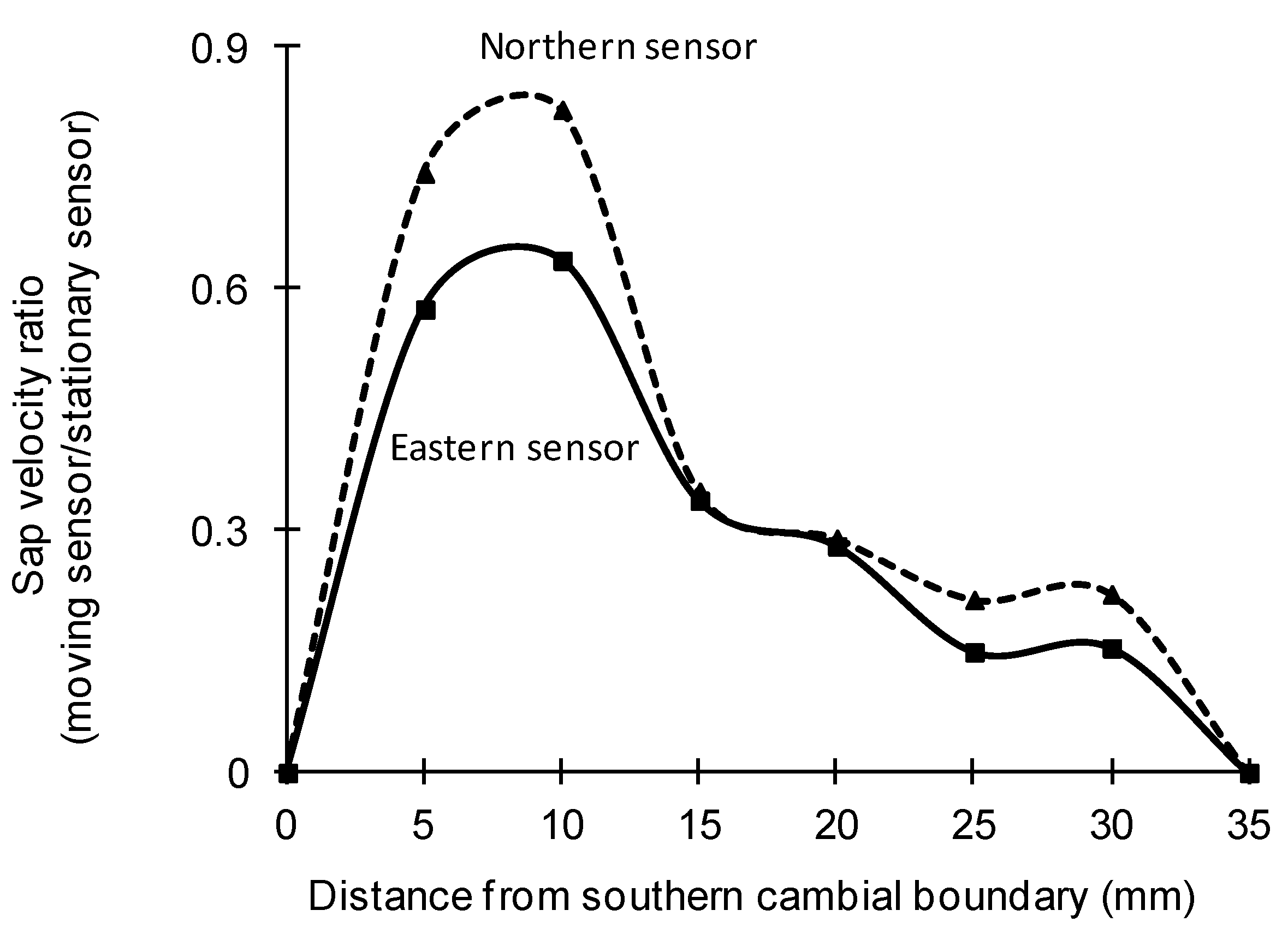
        <p>Sap velocity was higher between 5 and 15 mm under the cambium in all sample trees. Comparisons of sap velocity between the northern and eastern aspect of stems showed that values were generally highest for the eastern aspect but mean correction coefficients calculated from radial profiles (<xref ref-type="fig" rid="forests-04-00106-f001">Figure 1</xref>) for the northern and eastern aspects at a depth of 10 mm under the cambium were not significantly affected by pruning (<xref ref-type="table" rid="forests-04-00106-t002">Table 2</xref>). Nor were there significant differences between correction coefficients calculated for the northern and eastern aspects for either species (<xref ref-type="table" rid="forests-04-00106-t002">Table 2</xref>).</p>
        <fig id="forests-04-00106-f001" position="float">
          <label>Figure 1</label>
          <caption>
            <p>Typical sap velocity ratio profile for a pruned <italic>E. pilularis</italic> tree. Dashed line represents the radial profile for the northern stationary sensor and the solid line represents the radial profile for the eastern stationary sensor. The moving sensor was located on the southern aspect.</p>
          </caption>
          <graphic xmlns:xlink="http://www.w3.org/1999/xlink" xlink:href="forests-04-00106-g001.tif"/>
        </fig>
        <table-wrap id="forests-04-00106-t002" position="float">
          <object-id pub-id-type="pii">forests-04-00106-t002_Table 2</object-id>
          <label>Table 2</label>
          <caption>
            <p>Sap velocity correction coefficients by species and treatment. Values in parentheses refer to standard errors of mean. There were no significant differences (<italic>P</italic> &gt; 0.05) in coefficients within species either between treatments or aspects.</p>
          </caption>
          <table>
            
            <tbody>
              <tr>
                <td rowspan="2" align="center" valign="middle">
                  <bold>Species</bold>
                </td>
                <td rowspan="2" align="center" valign="middle">
                  <bold>Treatment</bold>
                </td>
                <td colspan="2" align="center" valign="middle">
                  <bold>Mean Correction Coefficient</bold>
                </td>
              </tr>
              <tr style="border-top: solid thin">
                <td align="center" valign="middle" style="border-top: solid thin">Northern Aspect</td>
                <td align="center" valign="middle" style="border-top: solid thin">Eastern Aspect</td>
              </tr>
              <tr style="border-top: solid thin">
                <td rowspan="2" align="center" valign="middle" style="border-top: solid thin">
                  <italic>E. pilularis</italic>
                </td>
                <td align="center" valign="middle" style="border-top: solid thin">Unpruned</td>
                <td align="center" valign="middle" style="border-top: solid thin">0.51 (0.08)</td>
                <td align="center" valign="middle" style="border-top: solid thin">0.52 (0.09)</td>
              </tr>
              <tr>
                <td align="center" valign="middle">Pruned</td>
                <td align="center" valign="middle">0.62 (0.08)</td>
                <td align="center" valign="middle">0.65 (0.09)</td>
              </tr>
              <tr>
                <td rowspan="2" align="center" valign="middle">
                  <italic>E. cloeziana</italic>
                </td>
                <td align="center" valign="middle">Unpruned</td>
                <td align="center" valign="middle">0.65 (0.25)</td>
                <td align="center" valign="middle">0.48 (0.11)</td>
              </tr>
              <tr>
                <td align="center" valign="middle">Pruned</td>
                <td align="center" valign="middle">0.57 (0.25)</td>
                <td align="center" valign="middle">0.54 (0.11)</td>
              </tr>
            </tbody>
          </table>
        </table-wrap>
        
      </sec>
      <sec>
        <title>3.4. Water Use Patterns of Reference Trees</title>
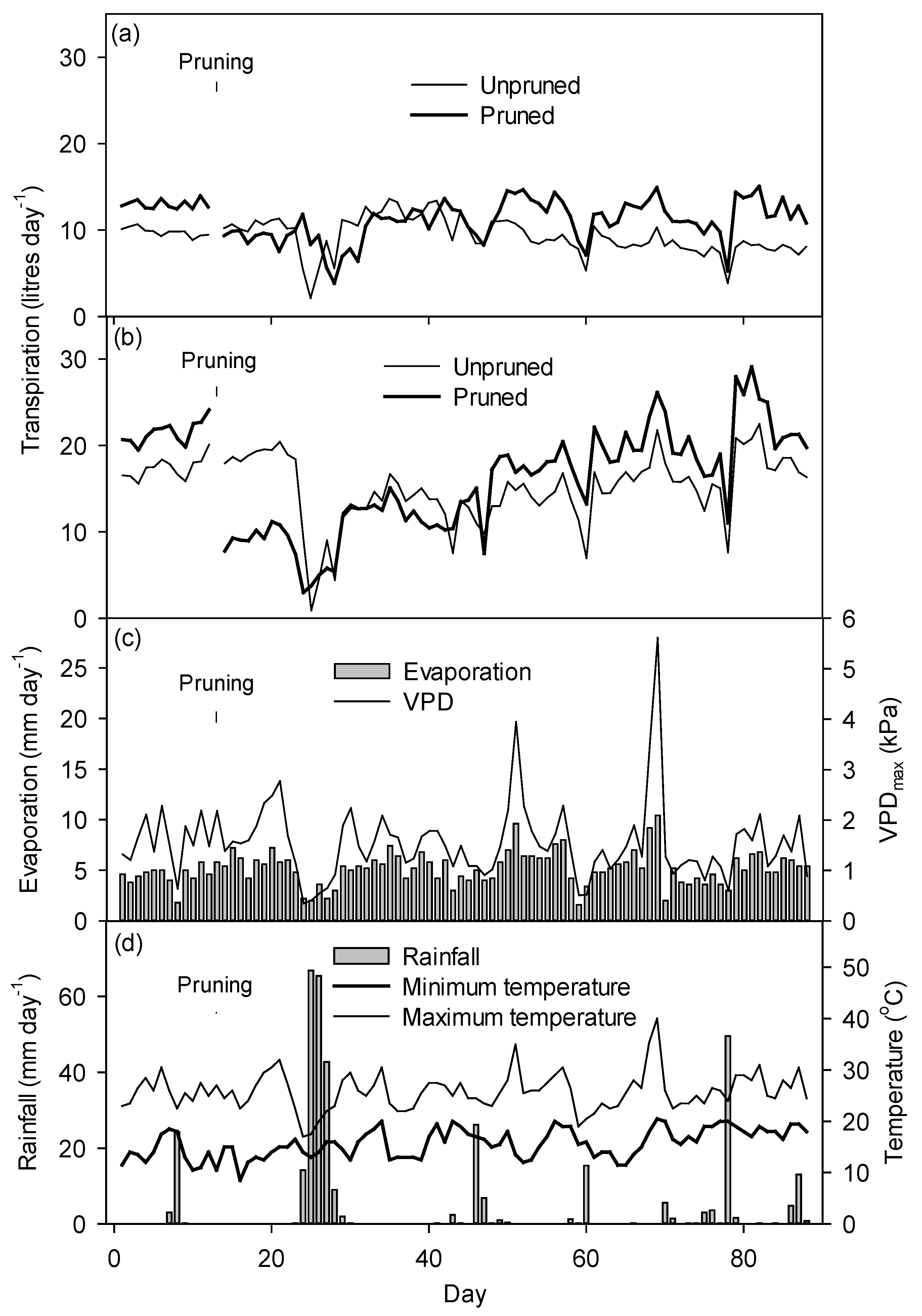
        <p>Mean daily transpiration in the individual unpruned and pruned <italic>E. pilularis</italic> reference trees were 9 L day<sup>−1</sup> and 11 L day<sup>−1</sup>, respectively, over the 87 day measurement period (<xref ref-type="fig" rid="forests-04-00106-f002">Figure 2</xref>a). For this same period, mean daily transpiration in <italic>E. cloeziana</italic> was 15 L day<sup>−1</sup> in the unpruned reference tree and 16 L day<sup>−1</sup> in the pruned reference tree (<xref ref-type="fig" rid="forests-04-00106-f002">Figure 2</xref>b). Values of mean daily transpiration between treatments of both species were reduced during days of wet weather or reduced temperatures (days 24 to 28, 59 to 61 and 75 to 79) (<xref ref-type="fig" rid="forests-04-00106-f002">Figure 2</xref>). During days of fine weather and high temperatures, the difference between treatments of both species was magnified (days 14 to 21, 49 to 57 and 80 to 87). Following pruning, the pruned reference trees of both species showed reductions in mean daily transpiration (<xref ref-type="fig" rid="forests-04-00106-f002">Figure 2</xref>). Following the 198 mm of precipitation between days 24 and 28, the difference in transpiration between pruned and unpruned trees appeared to be reduced in both species. Approximately 37 days after pruning (day 50), the two pruned reference trees had higher rates of transpiration than their respective unpruned counterpart in both species, particularly during periods of fine weather. During the initial 37 day (days 14 to 50) post-pruning monitoring period, mean daily transpiration varied between 2 and 14 L day<sup>−1</sup> in the unpruned and 3 and 15 L day<sup>−1</sup> in the pruned <italic>E. pilularis</italic> reference trees. Similar levels of variation were still present in the final 38 days (days 51 to 88), with transpiration values between 4 and 11 L day<sup>−1</sup> in the unpruned reference tree and between 5 and 15 L day<sup>−1</sup> in pruned <italic>E. pilularis</italic> reference tree. Mean daily transpiration was more variable between the unpruned and pruned <italic>E. cloeziana</italic> reference trees (1 and 20 L day<sup>−1</sup>) than between unpruned and pruned <italic>E. pilularis</italic> reference trees (3 and 19 L day<sup>−1</sup>) during the initial 37 day post-pruning period. Similarly during the final 38 day post-pruning period mean daily transpiration was more variable in <italic>E. cloeziana</italic> reference trees (11 and 29 L day<sup>−1</sup>) than <italic>E. pilualris</italic> (7 and 22 L day<sup>−1</sup>) reference trees. </p>
        <fig id="forests-04-00106-f002" position="float">
          <label>Figure 2</label>
          <caption>
            <p>Daily transpiration for unpruned and pruned <italic>E. pilularis</italic> (<bold>a</bold>) and <italic>E. cloeziana </italic>(<bold>b</bold>) reference trees, before and after pruning, and climatic variables including evaporation (EPan), maximum VPD (<bold>c</bold>), rainfall and air temperature (<bold>d</bold>). The measurement period was from 24 September to 20 December 2004. Pruning occurred on day 13. </p>
          </caption>
          <graphic xmlns:xlink="http://www.w3.org/1999/xlink" xlink:href="forests-04-00106-g002.tif"/>
        </fig>
      </sec>
      <sec>
        <title>3.5. Mean Daily Transpiration</title>
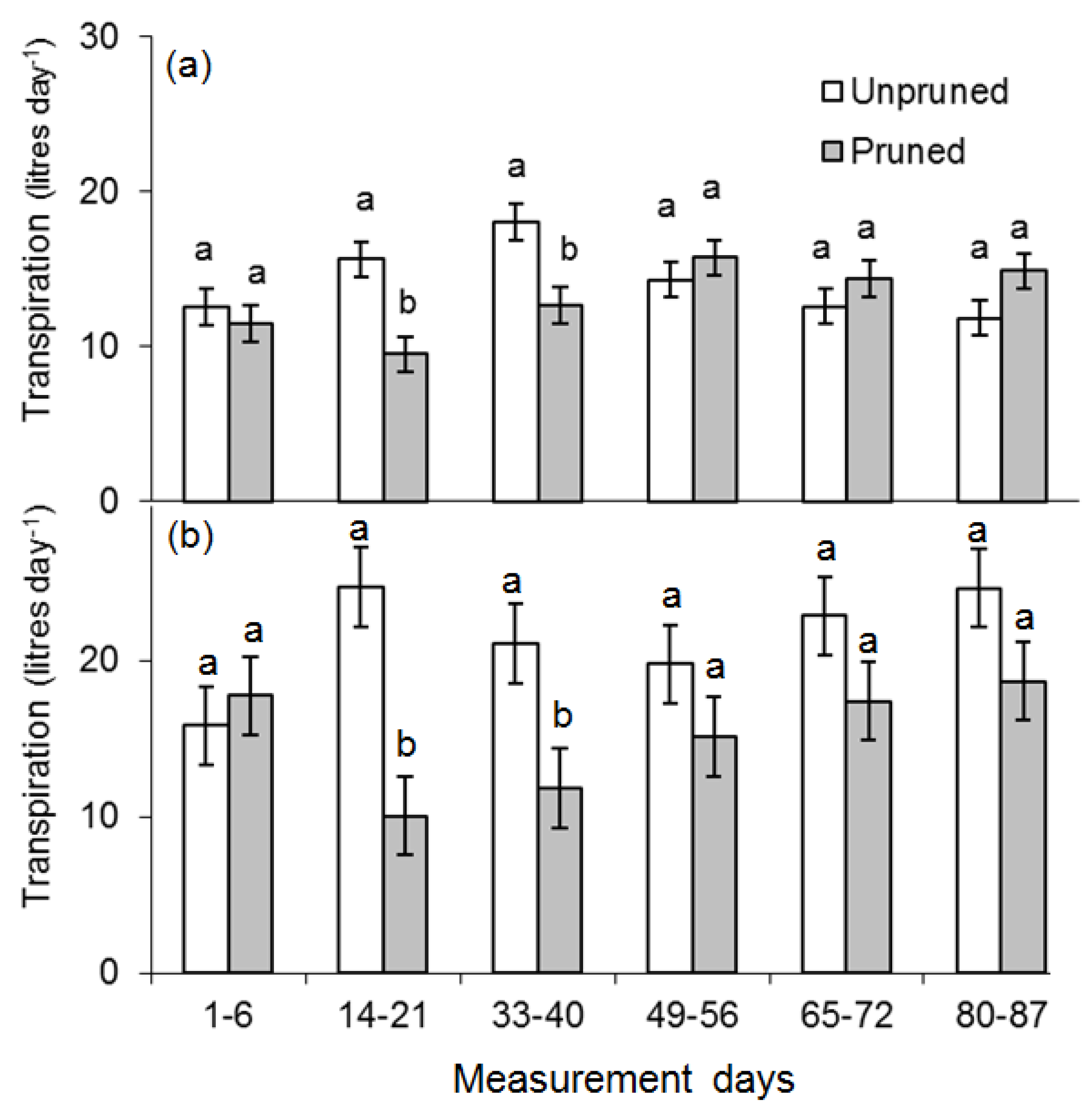
        <p>Significant differences in mean daily transpiration were found between treatments across the six periods of fine weather in both species (<xref ref-type="fig" rid="forests-04-00106-f003">Figure 3</xref>, <xref ref-type="table" rid="forests-04-00106-t003">Table 3</xref>). Prior to pruning, mean daily transpiration was not significantly different between pruned and unpruned trees in either species (<xref ref-type="fig" rid="forests-04-00106-f003">Figure 3</xref>). However, during the two eight-day periods immediately following pruning, mean transpiration was significantly lower in pruned than unpruned trees of both species. Pruning reduced mean daily water use by 39% in <italic>E. pilularis</italic> and 59% in <italic>E. cloeziana</italic> compared to the unpruned trees during the first eight-days immediately following pruning (days 14–21), and 30% in <italic>E. pilularis</italic> and 44% in <italic>E. cloeziana</italic> in the second eight-day period after pruning (days 33–40). Thirty six to forty three days (days 49–56) after pruning and during subsequent fine weather periods, mean daily transpiration was not significantly different between pruned and unpruned trees. </p>
        <fig id="forests-04-00106-f003" position="float">
          <label>Figure 3</label>
          <caption>
            <p>Mean daily transpiration during six periods (one pre-pruning from days 1–6 and five post-pruning) of fine weather throughout the measurement period for pruned and unpruned <italic>E. pilularis</italic> (<bold>a</bold>) and <italic>E. cloeziana</italic> (<bold>b</bold>). Pruning occurred on day 13. Means sharing the same letters are not significantly different for a given period. Error bars are mean standard errors. </p>
          </caption>
          <graphic xmlns:xlink="http://www.w3.org/1999/xlink" xlink:href="forests-04-00106-g003.tif"/>
        </fig>
        <table-wrap id="forests-04-00106-t003" position="float">
          <object-id pub-id-type="pii">forests-04-00106-t003_Table 3</object-id>
          <label>Table 3</label>
          <caption>
            <p>Summary of repeated measures analysis of variance test conducted to determine the effects of pruning treatment (Pruning) on mean daily transpiration during six time periods (Time) of fine weather (one pre-pruning period and five post-pruning periods). Values are shown for variance ratio (<italic>F</italic>), degrees of freedom (df) and probability value (<italic>P</italic>). </p>
          </caption>
          <table>
            <thead>
              <tr>
                <th rowspan="2" align="center" valign="middle"> </th>
                <th colspan="3" align="center" valign="middle">
                  <italic>E. pilularis</italic>
                </th>
                <th colspan="3" align="center" valign="middle">
                  <italic>E. cloeziana</italic>
                </th>
              </tr>
              <tr style="border-top: solid thin">
                <th align="center" valign="middle" style="border-top: solid thin">
                  <italic>F</italic>
                </th>
                <th align="center" valign="middle" style="border-top: solid thin">df</th>
                <th align="center" valign="middle" style="border-top: solid thin">
                  <italic>P</italic>
                </th>
                <th align="center" valign="middle" style="border-top: solid thin">
                  <italic>F</italic>
                </th>
                <th align="center" valign="middle" style="border-top: solid thin">df</th>
                <th align="center" valign="middle" style="border-top: solid thin">
                  <italic>P</italic>
                </th>
              </tr>
            </thead>
            <tbody>
              <tr style="border-top: solid thin">
                <td align="center" valign="middle" style="border-top: solid thin">Pruning</td>
                <td align="center" valign="middle" style="border-top: solid thin">1.50</td>
                <td align="center" valign="middle" style="border-top: solid thin">1</td>
                <td align="center" valign="middle" style="border-top: solid thin">0.275</td>
                <td align="center" valign="middle" style="border-top: solid thin">4.27</td>
                <td align="center" valign="middle" style="border-top: solid thin">1</td>
                <td align="center" valign="middle" style="border-top: solid thin">0.131</td>
              </tr>
              <tr>
                <td align="center" valign="middle">Time</td>
                <td align="center" valign="middle">3.44</td>
                <td align="center" valign="middle">5</td>
                <td align="center" valign="middle">0.052</td>
                <td align="center" valign="middle">4.28</td>
                <td align="center" valign="middle">5</td>
                <td align="center" valign="middle">0.062</td>
              </tr>
              <tr>
                <td align="center" valign="middle">Pruning × Time</td>
                <td align="center" valign="middle">7.56</td>
                <td align="center" valign="middle">5</td>
                <td align="center" valign="middle">0.004</td>
                <td align="center" valign="middle">6.40</td>
                <td align="center" valign="middle">5</td>
                <td align="center" valign="middle">0.027</td>
              </tr>
            </tbody>
          </table>
        </table-wrap>
        
      </sec>
      <sec>
        <title>3.6. Weather</title>
        <p>Total rainfall of 27 mm before pruning and 339 mm after pruning was recorded during the experiment (<xref ref-type="fig" rid="forests-04-00106-f002">Figure 2</xref>d). Daily minimum and maximum temperatures ranged between 9 and 40 °C. VPD<sub>max</sub> averaged 1.6 kPa for the experimental period but did reach 5.6 kPa on one day when maximum temperature was 40 °C (<xref ref-type="fig" rid="forests-04-00106-f002">Figure 2</xref>c). Daily EPan on this day was correspondingly high at 10.2 mm but averaged 5.2 mm over the experimental period.</p>
      </sec>
    </sec>
    <sec sec-type="discussion">
      <title>4. Discussion</title>
      <p>Defoliation through removal of 50% of the live-crown length of <italic>E. pilularis</italic> and <italic>E. cloeziana</italic> trees led to an initial reduction in whole-tree water use of 39% and 59%, respectively. The lower 50% of the live-crown length of trees at this site and age contained 55% and 57% leaf area of <italic>E. pilularis</italic> and <italic>E. cloeziana</italic> trees, respectively [<xref ref-type="bibr" rid="B19-forests-04-00106">19</xref>]. The reduction in transpiration rates were short-lived in both species with rates of daily water use in pruned trees increasing to levels not significantly different from unpruned trees just 36 days after pruning. These findings support our hypothesis that moderate defoliation will lead to an initial reduction in water use but that the duration of these effects is short-lived. Similarly, removal of 45% of the leaf area of <italic>Eucalyptus globulus</italic> trees had no significant effect on transpiration [<xref ref-type="bibr" rid="B10-forests-04-00106">10</xref>]. More intense levels of leaf area removal, where the lower 50% of live-crown length, but 75% of tree leaf area, was pruned, reduced transpiration of the dominant 200 trees ha<sup>−1</sup> by about 16%, 2–3 years after pruning [<xref ref-type="bibr" rid="B12-forests-04-00106">12</xref>]. These results suggest that pruning might be used to reduce stand water use and the susceptibility of trees to drought periods, without having long term influences on stand growth. However, given the rapid recovery of transpiration rates, determining the best time to prune these fast-growing eucalypts in order to achieve the maximum drought-buffering effect requires further study.</p>
      <p>The minor and insignificant reduction in diameter growth is consistent with other pruning studies on <italic>E. pilularis</italic> and <italic>E. cloeziana</italic> that removed the lower 50% of the live-crown length [<xref ref-type="bibr" rid="B30-forests-04-00106">30</xref>]. Pruning also had no significant effect on the above-ground biomass growth of the largest 200 trees ha<sup>−1</sup> of <italic>E. nitens</italic> trees, 2–3 years after pruning [<xref ref-type="bibr" rid="B31-forests-04-00106">31</xref>]. In that study the pruned trees were more water- and light-use efficient, had higher rates of transpiration per unit leaf area, and at the leaf-level, rates of light-saturated photosynthesis were higher for pruned trees compared with unpruned trees [<xref ref-type="bibr" rid="B12-forests-04-00106">12</xref>,<xref ref-type="bibr" rid="B32-forests-04-00106">32</xref>]. Transpiration per unit leaf area probably increased following pruning of <italic>E. pilularis</italic> because pruning reduced tree leaf area by 55% but reduced transpiration by only 39%, during the first eight days after pruning. Transpiration per unit leaf area was probably not significantly changed for <italic>E. cloeziana</italic> because pruning reduced leaf area by 57% and transpiration by 59%. Increased transpiration per unit leaf area for <italic>E. pilularis</italic> may have been associated with up-regulation of photosynthesis, which would be consistent with many other pruning studies [<xref ref-type="bibr" rid="B33-forests-04-00106">33</xref>]. Increased transpiration or conductance per unit leaf area has also been observed following pruning, defoliation or shading in other studies [<xref ref-type="bibr" rid="B2-forests-04-00106">2</xref>,<xref ref-type="bibr" rid="B8-forests-04-00106">8</xref>,<xref ref-type="bibr" rid="B9-forests-04-00106">9</xref>,<xref ref-type="bibr" rid="B10-forests-04-00106">10</xref>,<xref ref-type="bibr" rid="B13-forests-04-00106">13</xref>,<xref ref-type="bibr" rid="B34-forests-04-00106">34</xref>,<xref ref-type="bibr" rid="B35-forests-04-00106">35</xref>,<xref ref-type="bibr" rid="B36-forests-04-00106">36</xref>]. </p>
      <p>Improved soil water moisture conditions soon after pruning may have allowed rapid leaf production following pruning. Annual rainfall for the two years prior to the commencement of pruning was only 63% of the long-term average for this experimental site [<xref ref-type="bibr" rid="B28-forests-04-00106">28</xref>], whereas rainfall during the monitoring period was quite high—almost 14% of the long-term average annual rainfall fell within seventeen days of pruning. Owing to their naked bud system without a pre-determined resting stage for shoot growth [<xref ref-type="bibr" rid="B37-forests-04-00106">37</xref>], eucalypts have an ability to rapidly expand leaf area under favourable conditions of adequate soil moisture and nutrients [<xref ref-type="bibr" rid="B38-forests-04-00106">38</xref>]. High soil moisture following leaf area removal may have provided ideal conditions for rapid leaf area production following pruning in both species. The results from our experiment may have been quite different if soil moisture availability was low. Therefore, replication of these treatments would be required to determine whether such short-term recovery of transpiration and growth could be expected under drier conditions.</p>
      <p>Overall transpiration was generally lower in <italic>E. pilularis</italic> than <italic>E. cloeziana</italic> trees. This is not surprising given the smaller sapwood area, crown length and projected crown area of <italic>E. pilularis</italic> (<xref ref-type="table" rid="forests-04-00106-t001">Table 1</xref>). Leaf area indices have also been found to be 39% lower at this site for <italic>E. pilularis</italic> compared with <italic>E. cloeziana</italic> stands [<xref ref-type="bibr" rid="B19-forests-04-00106">19</xref>]. Thus these trends are consistent with studies where transpiration was related to leaf area at a given site for different eucalypt species [<xref ref-type="bibr" rid="B39-forests-04-00106">39</xref>] or across different sites, ages and silvicultural treatments for a given species [<xref ref-type="bibr" rid="B12-forests-04-00106">12</xref>,<xref ref-type="bibr" rid="B40-forests-04-00106">40</xref>,<xref ref-type="bibr" rid="B41-forests-04-00106">41</xref>]. The trend of increasing rates of transpiration by <italic>E. cloeziana</italic> over the course of the study may also reflect increasing tree and stand leaf areas of this species. In contrast, rates of transpiration for <italic>E. pilularis</italic> did not increase, which may indicate that its leaf area has already peaked, consistent with the fact that <italic>E. pilularis</italic> often has lower leaf areas than <italic>E. cloeziana</italic> [<xref ref-type="bibr" rid="B19-forests-04-00106">19</xref>].</p>
      <p>Higher daily sap velocity observed on the eastern aspect of stems of both species may correspond to the higher crown volume present on this aspect of the tree stem compared to the northern aspect. Axial variation in sap velocity in <italic>Pseudosuga menziesii</italic> (Mirb.) Franco did not correlate with sun position [<xref ref-type="bibr" rid="B42-forests-04-00106">42</xref>] but it may be related to an uneven axial distribution of crown [<xref ref-type="bibr" rid="B25-forests-04-00106">25</xref>]. Since the planting rows in this study were oriented north-south with greater crown competition within rows than between rows, trees of both species had elliptical crowns with the largest volume of the crown on eastern and western aspects. </p>
      <p>Radial variation in sap velocity was observed in this study as in other <italic>Eucalyptus</italic> species [<xref ref-type="bibr" rid="B26-forests-04-00106">26</xref>,<xref ref-type="bibr" rid="B27-forests-04-00106">27</xref>], however, pruning did not alter this variation. If the inner sapwood is the primary conduit to supply water to the earlier-formed lower branches of a tree crown [<xref ref-type="bibr" rid="B43-forests-04-00106">43</xref>,<xref ref-type="bibr" rid="B44-forests-04-00106">44</xref>], then removal of the lower branches through pruning could alter the profile of conductance by reducing sap velocity in the older xylem. In more intensively pruned <italic>E. nitens</italic> trees, where 75% of the leaf area was removed, there was such a reduction in radial sap velocity profiles [<xref ref-type="bibr" rid="B12-forests-04-00106">12</xref>]. However, in this study the pruning intensity was obviously not intense enough to cause such an effect. </p>
    </sec>
    <sec sec-type="conclusions">
      <title>5. Conclusions</title>
      <p>We conclude that <italic>E. pilularis</italic> and <italic>E. cloeziana</italic> can rapidly adjust to a loss of leaf area following moderate intensity pruning. This is associated with rapid rebuilding of the crowns following pruning and faster rates of transpiration (and photosynthesis) in the remaining crown while it is rebuilt. Pruning did not appear to affect sapwood properties or radial sap velocity profiles. Pruning to reduce stand water use might reduce the susceptibility of trees to drought periods, without having long term influences on stand growth. However, this study shows that fast growing plants recovering from a moderate defoliation under favourable conditions may soon use similar quantities of water to non-defoliated plants. Further study is required under water-limited and non-water-limited conditions to determine how water availability influences transpiration response to pruning and the best time to prune in order to achieve maximum drought-buffering effects.</p>
    </sec>
   
  </body>
  <back>
   <ack>
      <title>Acknowledgments</title>
      <p>We thank Forests NSW for the use of the experimental site and financial assistance with this research. Thanks to Piers Harper, John Alcorn and Geoff Heagney for field assistance, Tony O’Grady for advice in sap flow measurements and Debbie Claridge and Clive Hilliker for help in the generation of figures. Philip Alcorn was supported by an Australian Postgraduate Award Industry scholarship (ARC Grant LP0348999 to J. Bauhus) and Cooperative Research Centre for Forestry scholarship. We are also grateful to several anonymous reviewers who provided comments that improved the manuscript.</p>
    </ack>
    <notes>
      <title>Conflict of Interest</title>
      <p>The authors declare no conflict of interest.</p>
    </notes>
    <ref-list>
      <title>References</title>
      <ref id="B1-forests-04-00106">
        <label>1.</label>
        <citation citation-type="journal">
          <person-group person-group-type="author">
            <name>
              <surname>Sosebee</surname>
              <given-names>R.E.</given-names>
            </name>
            <name>
              <surname>Wiebe</surname>
              <given-names>H.H.</given-names>
            </name>
          </person-group>
          <article-title>Effect of water stress and clipping on photosynthate translocation in two grasses</article-title>
          <source>Agron. J.</source>
          <year>1971</year>
          <volume>63</volume>
          <fpage>14</fpage>
          <lpage>17</lpage>
          <pub-id pub-id-type="doi">10.2134/agronj1971.00021962006300010006x</pub-id>
        </citation>
      </ref>
      <ref id="B2-forests-04-00106">
        <label>2.</label>
        <citation citation-type="journal">
          <person-group person-group-type="author">
            <name>
              <surname>Ovaska</surname>
              <given-names>J.</given-names>
            </name>
            <name>
              <surname>Walls</surname>
              <given-names>M.</given-names>
            </name>
            <name>
              <surname>Mutikainen</surname>
              <given-names>P.</given-names>
            </name>
          </person-group>
          <article-title>Changes in leaf gas exchange properties of cloned <italic>Betula pendula </italic>saplings after partial defoliation</article-title>
          <source>J. Exp. Bot.</source>
          <year>1992</year>
          <volume>43</volume>
          <fpage>1301</fpage>
          <lpage>1307</lpage>
          <pub-id pub-id-type="doi">10.1093/jxb/43.10.1301</pub-id>
        </citation>
      </ref>
      <ref id="B3-forests-04-00106">
        <label>3.</label>
        <citation citation-type="journal">
          <person-group person-group-type="author">
            <name>
              <surname>McJannet</surname>
              <given-names>D.</given-names>
            </name>
            <name>
              <surname>Vertessy</surname>
              <given-names>R.</given-names>
            </name>
          </person-group>
          <article-title>Effects of thinning on wood production, leaf area index, transpiration and canopy interception of a plantation subject to drought</article-title>
          <source>Tree Physiol.</source>
          <year>2001</year>
          <volume>21</volume>
          <fpage>1001</fpage>
          <lpage>1008</lpage>
          <pub-id pub-id-type="doi">10.1093/treephys/21.12-13.1001</pub-id>
        </citation>
      </ref>
      <ref id="B4-forests-04-00106">
        <label>4.</label>
        <citation citation-type="journal">
          <person-group person-group-type="author">
            <name>
              <surname>Zeppel</surname>
              <given-names>M.J.B.</given-names>
            </name>
            <name>
              <surname>Murray</surname>
              <given-names>B.R.</given-names>
            </name>
            <name>
              <surname>Barton</surname>
              <given-names>C.</given-names>
            </name>
            <name>
              <surname>Eamus</surname>
              <given-names>D.</given-names>
            </name>
          </person-group>
          <article-title>Seasonal responses of xylem sap velocity to VPD and solar radiation during drought in a stand of native trees in temperate Australia</article-title>
          <source>Funct. Plant Biol.</source>
          <year>2004</year>
          <volume>31</volume>
          <fpage>461</fpage>
          <lpage>470</lpage>
        <pub-id pub-id-type="doi">10.1071/FP03220</pub-id></citation>
      </ref>
      <ref id="B5-forests-04-00106">
        <label>5.</label>
        <citation citation-type="journal">
          <person-group person-group-type="author">
            <name>
              <surname>Whitehead</surname>
              <given-names>D.</given-names>
            </name>
            <name>
              <surname>Jarvis</surname>
              <given-names>P.G.</given-names>
            </name>
            <name>
              <surname>Waring</surname>
              <given-names>R.H.</given-names>
            </name>
          </person-group>
          <article-title>Stomatal conductance, transpiration, and resistance to water uptake in a <italic>Pinus sylvestris</italic> spacing experiment</article-title>
          <source>Can. J. For. Res.</source>
          <year>1984</year>
          <volume>14</volume>
          <fpage>692</fpage>
          <lpage>700</lpage>
          <pub-id pub-id-type="doi">10.1139/x84-124</pub-id>
        </citation>
      </ref>
      <ref id="B6-forests-04-00106">
        <label>6.</label>
        <citation citation-type="journal">
          <person-group person-group-type="author">
            <name>
              <surname>Jarvis</surname>
              <given-names>P.G.</given-names>
            </name>
            <name>
              <surname>McNaughton</surname>
              <given-names>K.G.</given-names>
            </name>
          </person-group>
          <article-title>Stomatal control of transpiration: Scaling up from leaf to region</article-title>
          <source>Adv. Ecol. Res.</source>
          <year>1986</year>
          <volume>15</volume>
          <fpage>1</fpage>
          <lpage>49</lpage>
        </citation>
      </ref>
      <ref id="B7-forests-04-00106">
        <label>7.</label>
        <citation citation-type="journal">
          <person-group person-group-type="author">
            <name>
              <surname>Wullschleger</surname>
              <given-names>S.D.</given-names>
            </name>
            <name>
              <surname>Meinzer</surname>
              <given-names>F.C.</given-names>
            </name>
            <name>
              <surname>Vertessy</surname>
              <given-names>R.A.</given-names>
            </name>
          </person-group>
          <article-title>A review of whole-plant water use studies in trees</article-title>
          <source>Tree Physiol.</source>
          <year>1998</year>
          <volume>18</volume>
          <fpage>499</fpage>
          <lpage>512</lpage>
        <pub-id pub-id-type="doi">10.1093/treephys/18.8-9.499</pub-id><pub-id pub-id-type="pmid">12651336</pub-id></citation>
      </ref>
      <ref id="B8-forests-04-00106">
        <label>8.</label>
        <citation citation-type="journal">
          <person-group person-group-type="author">
            <name>
              <surname>Pepin</surname>
              <given-names>S.</given-names>
            </name>
            <name>
              <surname>Livingston</surname>
              <given-names>N.J.</given-names>
            </name>
            <name>
              <surname>Whitehead</surname>
              <given-names>D.</given-names>
            </name>
          </person-group>
          <article-title>Responses of transpiration and photosynthesis to reversible changes in photosynthetic foliage area in western red cedar (<italic>Thuja plicata</italic>) seedlings</article-title>
          <source>Tree Physiol.</source>
          <year>2002</year>
          <volume>22</volume>
          <fpage>363</fpage>
          <lpage>371</lpage>
          <pub-id pub-id-type="doi">10.1093/treephys/22.6.363</pub-id>
        </citation>
      </ref>
      <ref id="B9-forests-04-00106">
        <label>9.</label>
        <citation citation-type="journal">
          <person-group person-group-type="author">
            <name>
              <surname>Whitehead</surname>
              <given-names>D.</given-names>
            </name>
            <name>
              <surname>Livingston</surname>
              <given-names>N.J.</given-names>
            </name>
            <name>
              <surname>Kelliher</surname>
              <given-names>F.M.</given-names>
            </name>
            <name>
              <surname>Hogan</surname>
              <given-names>K.P.</given-names>
            </name>
            <name>
              <surname>Pepin</surname>
              <given-names>S.</given-names>
            </name>
            <name>
              <surname>McSeveny</surname>
              <given-names>T.M.</given-names>
            </name>
            <name>
              <surname>Byers</surname>
              <given-names>J.N.</given-names>
            </name>
          </person-group>
          <article-title>Response of transpiration and photosynthesis to a transient change in illuminated foliage area for a <italic>Pinus radiata</italic> D. Don tree</article-title>
          <source>Plant Cell Environ.</source>
          <year>1996</year>
          <volume>19</volume>
          <fpage>949</fpage>
          <lpage>957</lpage>
          <pub-id pub-id-type="doi">10.1111/j.1365-3040.1996.tb00459.x</pub-id>
        </citation>
      </ref>
      <ref id="B10-forests-04-00106">
        <label>10.</label>
        <citation citation-type="journal">
          <person-group person-group-type="author">
            <name>
              <surname>Quentin</surname>
              <given-names>A.G.</given-names>
            </name>
            <name>
              <surname>O’Grady</surname>
              <given-names>A.P.</given-names>
            </name>
            <name>
              <surname>Beadle</surname>
              <given-names>C.L.</given-names>
            </name>
            <name>
              <surname>Pinkard</surname>
              <given-names>E.L.</given-names>
            </name>
            <name>
              <surname>Worldege</surname>
              <given-names>D.</given-names>
            </name>
          </person-group>
          <article-title>Resonses of transpiration and canopy conductance to partial defoliation of <italic>Eucalyptus globulus</italic> trees</article-title>
          <source>Agric. For. Meteorol.</source>
          <year>2011</year>
          <volume>151</volume>
          <fpage>356</fpage>
          <lpage>364</lpage>
          <pub-id pub-id-type="doi">10.1016/j.agrformet.2010.11.008</pub-id>
        </citation>
      </ref>
      <ref id="B11-forests-04-00106">
        <label>11.</label>
        <citation citation-type="journal">
          <person-group person-group-type="author">
            <name>
              <surname>Quentin</surname>
              <given-names>A.G.</given-names>
            </name>
            <name>
              <surname>O’Grady</surname>
              <given-names>A.P.</given-names>
            </name>
            <name>
              <surname>Beadle</surname>
              <given-names>C.L.</given-names>
            </name>
            <name>
              <surname>Mohammed</surname>
              <given-names>C.</given-names>
            </name>
            <name>
              <surname>Pinkard</surname>
              <given-names>E.A.</given-names>
            </name>
          </person-group>
          <article-title>Interactive effects of water supply and defoliation on photosynthesis, plant water status and growth of <italic>Eucalyptus globulus </italic>Labill</article-title>
          <source>Tree Physiol.</source>
          <year>2012</year>
          <volume>32</volume>
          <fpage>958</fpage>
          <lpage>967</lpage>
          <pub-id pub-id-type="doi">10.1093/treephys/tps066</pub-id>
        </citation>
      </ref>
      <ref id="B12-forests-04-00106">
        <label>12.</label>
        <citation citation-type="journal">
          <person-group person-group-type="author">
            <name>
              <surname>Forrester</surname>
              <given-names>D.I.</given-names>
            </name>
            <name>
              <surname>Collopy</surname>
              <given-names>J.J.</given-names>
            </name>
            <name>
              <surname>Beadle</surname>
              <given-names>C.L.</given-names>
            </name>
            <name>
              <surname>Warren</surname>
              <given-names>C.R.</given-names>
            </name>
            <name>
              <surname>Baker</surname>
              <given-names>T.G.</given-names>
            </name>
          </person-group>
          <article-title>Effect of thinning, pruning and nitrogen fertiliser application on transpiration, photosynthesis and water-use efficiency in a young <italic>Eucalyptus nitens </italic>plantation</article-title>
          <source>For. Ecol. Manag.</source>
          <year>2012</year>
          <volume>266</volume>
          <fpage>286</fpage>
          <lpage>300</lpage>
          <pub-id pub-id-type="doi">10.1016/j.foreco.2011.11.019</pub-id>
        </citation>
      </ref>
      <ref id="B13-forests-04-00106">
        <label>13.</label>
        <citation citation-type="journal">
          <person-group person-group-type="author">
            <name>
              <surname>Pinkard</surname>
              <given-names>E.A.</given-names>
            </name>
            <name>
              <surname>Beadle</surname>
              <given-names>C.L.</given-names>
            </name>
            <name>
              <surname>Davidson</surname>
              <given-names>N.J.</given-names>
            </name>
            <name>
              <surname>Battaglia</surname>
              <given-names>M. </given-names>
            </name>
          </person-group>
          <article-title>Photosynthetic responses of <italic>Eucalyptus nitens </italic>(Deane and Maiden) Maiden to green pruning</article-title>
          <source>Trees-Struct. Funct.</source>
          <year>1998</year>
          <volume>12</volume>
          <fpage>119</fpage>
          <lpage>129</lpage>
        </citation>
      </ref>
      <ref id="B14-forests-04-00106">
        <label>14.</label>
        <citation citation-type="journal">
          <person-group person-group-type="author">
            <name>
              <surname>Pinkard</surname>
              <given-names>E.A.</given-names>
            </name>
          </person-group>
          <article-title>Physiological and growth responses related to pattern and severity of green pruning in young <italic>Eucalyptus globulus</italic></article-title>
          <source>For. Ecol. Manag.</source>
          <year>2003</year>
          <volume>182</volume>
          <fpage>231</fpage>
          <lpage>245</lpage>
          <pub-id pub-id-type="doi">10.1016/S0378-1127(03)00046-X</pub-id>
        </citation>
      </ref>
      <ref id="B15-forests-04-00106">
        <label>15.</label>
        <citation citation-type="journal">
          <person-group person-group-type="author">
            <name>
              <surname>Heichel</surname>
              <given-names>G.H.</given-names>
            </name>
            <name>
              <surname>Turner</surname>
              <given-names>N.C.</given-names>
            </name>
          </person-group>
          <article-title>Co<sub>2</sub> assimilation of primary and regrowth foliage of red maple (<italic>Acer rubrum </italic>L.) and red oak (<italic>Quercus rubra </italic>L.): Response to defoliation</article-title>
          <source>Oecologia</source>
          <year>1983</year>
          <volume>57</volume>
          <fpage>14</fpage>
          <lpage>19</lpage>
          <pub-id pub-id-type="doi">10.1007/BF00379555</pub-id>
        </citation>
      </ref>
      <ref id="B16-forests-04-00106">
        <label>16.</label>
        <citation citation-type="journal">
          <person-group person-group-type="author">
            <name>
              <surname>Wallace</surname>
              <given-names>L.L.</given-names>
            </name>
            <name>
              <surname>McNaughton</surname>
              <given-names>S.J.</given-names>
            </name>
            <name>
              <surname>Coughenour</surname>
              <given-names>M.B.</given-names>
            </name>
          </person-group>
          <article-title>Compensatory photosynthetic responses of three African graminoids to different fertilization, watering and clipping regimes</article-title>
          <source>Bot. Gazette</source>
          <year>1984</year>
          <volume>145</volume>
          <fpage>151</fpage>
          <lpage>156</lpage>
        <pub-id pub-id-type="doi">10.1086/337440</pub-id></citation>
      </ref>
      <ref id="B17-forests-04-00106">
        <label>17.</label>
        <citation citation-type="journal">
          <person-group person-group-type="author">
            <name>
              <surname>Whitehead</surname>
              <given-names>D.</given-names>
            </name>
            <name>
              <surname>Kelliher</surname>
              <given-names>F.M.</given-names>
            </name>
          </person-group>
          <article-title>A canopy water balance model for a <italic>Pinus radiata </italic>stand before and after thinning</article-title>
          <source>Agric. For. Meteorol.</source>
          <year>1991</year>
          <volume>55</volume>
          <fpage>109</fpage>
          <lpage>126</lpage>
          <pub-id pub-id-type="doi">10.1016/0168-1923(91)90025-L</pub-id>
        </citation>
      </ref>
      <ref id="B18-forests-04-00106">
        <label>18.</label>
        <citation citation-type="journal">
          <person-group person-group-type="author">
            <name>
              <surname>Singh</surname>
              <given-names>K.A.</given-names>
            </name>
            <name>
              <surname>Thompson</surname>
              <given-names>F.B.</given-names>
            </name>
          </person-group>
          <article-title>Effect of lopping on water potential, transpiration, regrowth, <sup>14</sup>C-photosynthate distribution and biomass production in <italic>Alnus glutinosa</italic></article-title>
          <source>Tree Physiol.</source>
          <year>1995</year>
          <volume>15</volume>
          <fpage>197</fpage>
          <lpage>202</lpage>
          <pub-id pub-id-type="doi">10.1093/treephys/15.3.197</pub-id>
        </citation>
      </ref>
      <ref id="B19-forests-04-00106">
        <label>19.</label>
        <citation citation-type="journal">
          <person-group person-group-type="author">
            <name>
              <surname>Alcorn</surname>
              <given-names>P.J.</given-names>
            </name>
            <name>
              <surname>Forrester</surname>
              <given-names>D.I.</given-names>
            </name>
            <name>
              <surname>Smith</surname>
              <given-names>R.G.B.</given-names>
            </name>
            <name>
              <surname>Thomas</surname>
              <given-names>D.S.</given-names>
            </name>
            <name>
              <surname>James</surname>
              <given-names>R.N.</given-names>
            </name>
            <name>
              <surname>Nicotra</surname>
              <given-names>A.B.</given-names>
            </name>
            <name>
              <surname>Bauhus</surname>
              <given-names>J.</given-names>
            </name>
          </person-group>
          <article-title>Crown structure and vertical foliage distribution in 4-year-old plantation-grown <italic>Eucalyptus pilularis</italic> and <italic>Eucalyptus cloeziana</italic></article-title>
          <source>Trees</source>
          <year>2012</year>
          <comment>in press.</comment>
        </citation>
      </ref>
      <ref id="B20-forests-04-00106">
        <label>20.</label>
        <citation citation-type="book">
          <person-group person-group-type="author">
            <name>
              <surname>Milford</surname>
              <given-names>H.B.</given-names>
            </name>
          </person-group>
          <source>Soil Landscapes of the Coffs Harbour 1:100,000 Sheet Map</source>
          <publisher-name>Department of Land and Water Conservation</publisher-name>
          <publisher-loc>Sydney, NSW, Australia</publisher-loc>
          <year>1999</year>
        </citation>
      </ref>
      <ref id="B21-forests-04-00106">
        <label>21.</label>
        <citation citation-type="book">
          <person-group person-group-type="author">
            <name>
              <surname>Gilligan</surname>
              <given-names>L.B.</given-names>
            </name>
            <name>
              <surname>Brownlow</surname>
              <given-names>J.W.</given-names>
            </name>
            <name>
              <surname>Cameron</surname>
              <given-names>R.G.</given-names>
            </name>
            <name>
              <surname>Henley</surname>
              <given-names>H.F.</given-names>
            </name>
          </person-group>
          <source>Dorrigo-Coffs Harbour 1:250,000 Metallogenic Map sh/56–10, sh/56–11: Metallogenic Study and Mineral Deposit Data Sheet</source>
          <publisher-name>Department of Mineral Resources</publisher-name>
          <publisher-loc>Sydney, NSW, Australia</publisher-loc>
          <year>1992</year>
        </citation>
      </ref>
      <ref id="B22-forests-04-00106">
        <label>22.</label>
        <citation citation-type="book">
          <person-group person-group-type="author">
            <name>
              <surname>Smith</surname>
              <given-names>D.M.</given-names>
            </name>
            <name>
              <surname>Larson</surname>
              <given-names>B.C.</given-names>
            </name>
            <name>
              <surname>Kelty</surname>
              <given-names>M.J.</given-names>
            </name>
            <name>
              <surname>Ashton</surname>
              <given-names>P.M.S.</given-names>
            </name>
          </person-group>
          <source>The Practice of Silviculture: Applied Forest Ecology</source>
          <edition>9th</edition>
          <publisher-name>John Wiley and Sons Inc.</publisher-name>
          <publisher-loc>New York, NY, USA</publisher-loc>
          <year>1997</year>
        </citation>
      </ref>
      <ref id="B23-forests-04-00106">
        <label>23.</label>
        <citation citation-type="journal">
          <person-group person-group-type="author">
            <name>
              <surname>Soares</surname>
              <given-names>P.</given-names>
            </name>
            <name>
              <surname>Tomé</surname>
              <given-names>M.</given-names>
            </name>
          </person-group>
          <article-title>A tree crown ratio prediction equation for eucalypt plantations</article-title>
          <source>Ann. For. Sci.</source>
          <year>2001</year>
          <volume>58</volume>
          <fpage>193</fpage>
          <lpage>202</lpage>
        <pub-id pub-id-type="doi">10.1051/forest:2001118</pub-id></citation>
      </ref>
      <ref id="B24-forests-04-00106">
        <label>24.</label>
        <citation citation-type="journal">
          <person-group person-group-type="author">
            <name>
              <surname>Vertessy</surname>
              <given-names>R.A.</given-names>
            </name>
            <name>
              <surname>Benyon</surname>
              <given-names>R.G.</given-names>
            </name>
            <name>
              <surname>O’Sullivan</surname>
              <given-names>S.K.</given-names>
            </name>
            <name>
              <surname>Gribben</surname>
              <given-names>P.R.</given-names>
            </name>
          </person-group>
          <article-title>Relationships between stem diameter, sapwood area, leaf area and transpiration in a young mountain ash forest</article-title>
          <source>Tree Physiol.</source>
          <year>1995</year>
          <volume>15</volume>
          <fpage>559</fpage>
          <lpage>567</lpage>
          <pub-id pub-id-type="doi">10.1093/treephys/15.9.559</pub-id>
        </citation>
      </ref>
      <ref id="B25-forests-04-00106">
        <label>25.</label>
        <citation citation-type="journal">
          <person-group person-group-type="author">
            <name>
              <surname>Hunt</surname>
              <given-names>M.A.</given-names>
            </name>
            <name>
              <surname>Beadle</surname>
              <given-names>C.L.</given-names>
            </name>
          </person-group>
          <article-title>Whole-tree transpiration and water-use partitioning between <italic>Eucalyptus nitens </italic>and <italic>Acacia dealbata</italic> weeds in a short-rotation plantation in northeastern Tasmania</article-title>
          <source>Tree Physiol.</source>
          <year>1998</year>
          <volume>18</volume>
          <fpage>557</fpage>
          <lpage>563</lpage>
          <pub-id pub-id-type="doi">10.1093/treephys/18.8-9.557</pub-id>
        </citation>
      </ref>
      <ref id="B26-forests-04-00106">
        <label>26.</label>
        <citation citation-type="journal">
          <person-group person-group-type="author">
            <name>
              <surname>Medhurst</surname>
              <given-names>J.L.</given-names>
            </name>
            <name>
              <surname>Battaglia</surname>
              <given-names>M.</given-names>
            </name>
            <name>
              <surname>Beadle</surname>
              <given-names>C.L.</given-names>
            </name>
          </person-group>
          <article-title>Measured and predicted changes in tree and stand water use following high-intensity thinning of an 8-year-old <italic>Eucalyptus nitens </italic>plantation</article-title>
          <source>Tree Physiol.</source>
          <year>2002</year>
          <volume>22</volume>
          <fpage>775</fpage>
          <lpage>784</lpage>
          <pub-id pub-id-type="doi">10.1093/treephys/22.11.775</pub-id>
        </citation>
      </ref>
      <ref id="B27-forests-04-00106">
        <label>27.</label>
        <citation citation-type="journal">
          <person-group person-group-type="author">
            <name>
              <surname>Zang</surname>
              <given-names>D.</given-names>
            </name>
            <name>
              <surname>Beadle</surname>
              <given-names>C.L.</given-names>
            </name>
            <name>
              <surname>White</surname>
              <given-names>D.A.</given-names>
            </name>
          </person-group>
          <article-title>Variation of sapflow velocity in <italic>Eucalyptus globulus </italic>with position in sapwood and use of a correction coefficient</article-title>
          <source>Tree Physiol.</source>
          <year>1996</year>
          <volume>16</volume>
          <fpage>697</fpage>
          <lpage>703</lpage>
          <pub-id pub-id-type="doi">10.1093/treephys/16.8.697</pub-id>
        </citation>
      </ref>
      <ref id="B28-forests-04-00106">
        <label>28.</label>
        <citation citation-type="web">
		<collab>NRM Natural Resource Management</collab>
           
          <article-title>Queensland Government Web site, 2005</article-title>
          
          <comment>Available online:<ext-link xmlns:xlink="http://www.w3.org/1999/xlink" xlink:href="www.nrm.qld.gov.au/silo/datadrill" ext-link-type="uri">www.nrm.qld.gov.au/silo/datadrill</ext-link></comment>
		  <access-date>(accessed on 1 January 2005)</access-date>
        </citation>
      </ref>
      <ref id="B29-forests-04-00106">
        <label>29.</label>
        <citation citation-type="journal">
          <person-group person-group-type="author">
            <name>
              <surname>Buck</surname>
              <given-names>A.L.</given-names>
            </name>
          </person-group>
          <article-title>New equations for computing vapor pressure deficit and enhancement factor</article-title>
          <source>J. Appl. Meteorol.</source>
          <year>1981</year>
          <volume>20</volume>
          <fpage>1527</fpage>
          <lpage>1532</lpage>
        <pub-id pub-id-type="doi">10.1175/1520-0450(1981)020&lt;1527:NEFCVP&gt;2.0.CO;2</pub-id></citation>
      </ref>
      <ref id="B30-forests-04-00106">
        <label>30.</label>
        <citation citation-type="journal">
          <person-group person-group-type="author">
            <name>
              <surname>Alcorn</surname>
              <given-names>P.J.</given-names>
            </name>
            <name>
              <surname>Bauhus</surname>
              <given-names>J.</given-names>
            </name>
            <name>
              <surname>Smith</surname>
              <given-names>R.G.B.</given-names>
            </name>
            <name>
              <surname>Thomas</surname>
              <given-names>D.</given-names>
            </name>
            <name>
              <surname>James</surname>
              <given-names>R.</given-names>
            </name>
            <name>
              <surname>Nicotra</surname>
              <given-names>A.</given-names>
            </name>
          </person-group>
          <article-title>Growth response following green crown pruning in plantation-grown <italic>Eucalyptus pilularis </italic>and <italic>E. Cloeziana</italic></article-title>
          <source>Can. J. For. Res.</source>
          <year>2008</year>
          <volume>38</volume>
          <fpage>770</fpage>
          <lpage>781</lpage>
          <pub-id pub-id-type="doi">10.1139/X07-185</pub-id>
        </citation>
      </ref>
      <ref id="B31-forests-04-00106">
        <label>31.</label>
        <citation citation-type="journal">
          <person-group person-group-type="author">
            <name>
              <surname>Forrester</surname>
              <given-names>D.I.</given-names>
            </name>
            <name>
              <surname>Collopy</surname>
              <given-names>J.J.</given-names>
            </name>
            <name>
              <surname>Beadle</surname>
              <given-names>C.L.</given-names>
            </name>
            <name>
              <surname>Baker</surname>
              <given-names>T.G.</given-names>
            </name>
          </person-group>
          <article-title>Interactive effects of simultaneously applied thinning, pruning and fertiliser application treatments on growth, biomass production and crown architecture in a young <italic>Eucalyptus nitens</italic> plantation</article-title>
          <source>For. Ecol. Manag.</source>
          <year>2012</year>
          <volume>267</volume>
          <fpage>104</fpage>
          <lpage>116</lpage>
          <pub-id pub-id-type="doi">10.1016/j.foreco.2011.11.039</pub-id>
        </citation>
      </ref>
      <ref id="B32-forests-04-00106">
        <label>32.</label>
        <citation citation-type="journal">
          <person-group person-group-type="author">
            <name>
              <surname>Forrester</surname>
              <given-names>D.I.</given-names>
            </name>
            <name>
              <surname>Collopy</surname>
              <given-names>J.J.</given-names>
            </name>
            <name>
              <surname>Beadle</surname>
              <given-names>C.L.</given-names>
            </name>
            <name>
              <surname>Baker</surname>
              <given-names>T.G.</given-names>
            </name>
          </person-group>
          <article-title>Effect of thinning, pruning and nitrogen fertiliser application on light interception and light-use efficiency in a young <italic>Eucalyptus nitens </italic>plantation</article-title>
          <source>For. Ecol. Manag.</source>
          <year>2013</year>
          <volume>288</volume>
          <fpage>21</fpage>
          <lpage>30</lpage>
          <pub-id pub-id-type="doi">10.1016/j.foreco.2011.11.024</pub-id>
        </citation>
      </ref>
      <ref id="B33-forests-04-00106">
        <label>33.</label>
        <citation citation-type="journal">
          <person-group person-group-type="author">
            <name>
              <surname>Forrester</surname>
              <given-names>D.I.</given-names>
            </name>
            <name>
              <surname>Medhurst</surname>
              <given-names>J.L.</given-names>
            </name>
            <name>
              <surname>Wood</surname>
              <given-names>M.</given-names>
            </name>
            <name>
              <surname>Beadle</surname>
              <given-names>C.L.</given-names>
            </name>
            <name>
              <surname>Valencia</surname>
              <given-names>J.C.</given-names>
            </name>
          </person-group>
          <article-title>Growth and physiological responses to silviculture for producing solid-wood products from <italic>Eucalyptus </italic>plantations: An australian perspective</article-title>
          <source>For. Ecol. Manag.</source>
          <year>2010</year>
          <volume>259</volume>
          <fpage>1819</fpage>
          <lpage>1835</lpage>
          <pub-id pub-id-type="doi">10.1016/j.foreco.2009.08.029</pub-id>
        </citation>
      </ref>
      <ref id="B34-forests-04-00106">
        <label>34.</label>
        <citation citation-type="journal">
          <person-group person-group-type="author">
            <name>
              <surname>Reich</surname>
              <given-names>P.B.</given-names>
            </name>
            <name>
              <surname>Walters</surname>
              <given-names>M.B.</given-names>
            </name>
            <name>
              <surname>Krause</surname>
              <given-names>S.C.</given-names>
            </name>
            <name>
              <surname>Vanderklein</surname>
              <given-names>D.W.</given-names>
            </name>
            <name>
              <surname>Raffa</surname>
              <given-names>K.F.</given-names>
            </name>
            <name>
              <surname>Tabone</surname>
              <given-names>T.</given-names>
            </name>
          </person-group>
          <article-title>Growth, nutrition and gas exchange of <italic>Pinus resinosa </italic>following artificial defoliation</article-title>
          <source>Trees Struct. Funct.</source>
          <year>1993</year>
          <volume>7</volume>
          <fpage>67</fpage>
          <lpage>77</lpage>
        </citation>
      </ref>
      <ref id="B35-forests-04-00106">
        <label>35.</label>
        <citation citation-type="journal">
          <person-group person-group-type="author">
            <name>
              <surname>Tschaplinski</surname>
              <given-names>T.</given-names>
            </name>
            <name>
              <surname>Blake</surname>
              <given-names>T.J.</given-names>
            </name>
          </person-group>
          <article-title>Growth and carbohydrate status of coppice shoots of hybrid poplar following shoot pruning</article-title>
          <source>Tree Physiol.</source>
          <year>1995</year>
          <volume>15</volume>
          <fpage>333</fpage>
          <lpage>338</lpage>
        <pub-id pub-id-type="doi">10.1093/treephys/15.5.333</pub-id><pub-id pub-id-type="pmid">14965957</pub-id></citation>
      </ref>
      <ref id="B36-forests-04-00106">
        <label>36.</label>
        <citation citation-type="journal">
          <person-group person-group-type="author">
            <name>
              <surname>Pataki</surname>
              <given-names>D.E.</given-names>
            </name>
            <name>
              <surname>Oren</surname>
              <given-names>R.</given-names>
            </name>
            <name>
              <surname>Katul</surname>
              <given-names>G.</given-names>
            </name>
            <name>
              <surname>Sigmon</surname>
              <given-names>J.</given-names>
            </name>
          </person-group>
          <article-title>Canopy conductance of <italic>Pinus taeda</italic>, <italic>Liquidambar styraciflua </italic>and <italic>Quercus phellos </italic>under varying atmospheric and soil water conditions</article-title>
          <source>Tree Physiol.</source>
          <year>1998</year>
          <volume>18</volume>
          <fpage>307</fpage>
          <lpage>315</lpage>
          <pub-id pub-id-type="doi">10.1093/treephys/18.5.307</pub-id>
        </citation>
      </ref>
      <ref id="B37-forests-04-00106">
        <label>37.</label>
        <citation citation-type="book">
          <person-group person-group-type="author">
            <name>
              <surname>Florence</surname>
              <given-names>R.G.</given-names>
            </name>
          </person-group>
          <source>Ecology and Silviculture of Eucalypt Forests</source>
          <publisher-name>CSIRO</publisher-name>
          <publisher-loc>Collingwood, Australia</publisher-loc>
          <year>1996</year>
          <fpage>413</fpage>
        </citation>
      </ref>
      <ref id="B38-forests-04-00106">
        <label>38.</label>
        <citation citation-type="journal">
          <person-group person-group-type="author">
            <name>
              <surname>Whitehead</surname>
              <given-names>D.</given-names>
            </name>
            <name>
              <surname>Beadle</surname>
              <given-names>C.L.</given-names>
            </name>
          </person-group>
          <article-title>Physiological regulation of productivity and water use in <italic>Eucalyptus</italic>: A review</article-title>
          <source>For. Ecol. Manag.</source>
          <year>2004</year>
          <volume>193</volume>
          <fpage>113</fpage>
          <lpage>140</lpage>
        <pub-id pub-id-type="doi">10.1016/j.foreco.2004.01.026</pub-id></citation>
      </ref>
      <ref id="B39-forests-04-00106">
        <label>39.</label>
        <citation citation-type="journal">
          <person-group person-group-type="author">
            <name>
              <surname>Hatton</surname>
              <given-names>T.</given-names>
            </name>
            <name>
              <surname>Reece</surname>
              <given-names>P.</given-names>
            </name>
            <name>
              <surname>Taylor</surname>
              <given-names>P.</given-names>
            </name>
            <name>
              <surname>McEwan</surname>
              <given-names>K.</given-names>
            </name>
          </person-group>
          <article-title>Does leaf water efficiency vary among eucalypts in water-limited environments?</article-title>
          <source>Tree Physiol.</source>
          <year>1998</year>
          <volume>18</volume>
          <fpage>529</fpage>
          <lpage>536</lpage>
          <pub-id pub-id-type="doi">10.1093/treephys/18.8-9.529</pub-id>
        </citation>
      </ref>
      <ref id="B40-forests-04-00106">
        <label>40.</label>
        <citation citation-type="journal">
          <person-group person-group-type="author">
            <name>
              <surname>Benyon</surname>
              <given-names>R.G.</given-names>
            </name>
            <name>
              <surname>Theiveyanathan</surname>
              <given-names>S.</given-names>
            </name>
            <name>
              <surname>Doody</surname>
              <given-names>T.M.</given-names>
            </name>
          </person-group>
          <article-title>Impacts of tree plantations on groundwater in south-eastern Australia</article-title>
          <source>Aust. J. Bot.</source>
          <year>2006</year>
          <volume>54</volume>
          <fpage>181</fpage>
          <lpage>192</lpage>
        <pub-id pub-id-type="doi">10.1071/BT05046</pub-id></citation>
      </ref>
      <ref id="B41-forests-04-00106">
        <label>41.</label>
        <citation citation-type="journal">
          <person-group person-group-type="author">
            <name>
              <surname>Forrester</surname>
              <given-names>D.I.</given-names>
            </name>
            <name>
              <surname>Collopy</surname>
              <given-names>J.J.</given-names>
            </name>
            <name>
              <surname>Morris</surname>
              <given-names>J.D.</given-names>
            </name>
          </person-group>
          <article-title>Transpiration along an age series of <italic>Eucalyptus globulus </italic>plantations in southeastern australia</article-title>
          <source>For. Ecol. Manag.</source>
          <year>2010</year>
          <volume>259</volume>
          <fpage>1754</fpage>
          <lpage>1760</lpage>
          <pub-id pub-id-type="doi">10.1016/j.foreco.2009.04.023</pub-id>
        </citation>
      </ref>
      <ref id="B42-forests-04-00106">
        <label>42.</label>
        <citation citation-type="journal">
          <person-group person-group-type="author">
            <name>
              <surname>Cohen</surname>
              <given-names>Y.</given-names>
            </name>
            <name>
              <surname>Kelliher</surname>
              <given-names>F.M.</given-names>
            </name>
            <name>
              <surname>Black</surname>
              <given-names>T.A.</given-names>
            </name>
          </person-group>
          <article-title>Determination of sap flow in douglas-fir trees using the heat pulse technique</article-title>
          <source>Can. J. For. Res.</source>
          <year>1985</year>
          <volume>15</volume>
          <fpage>422</fpage>
          <lpage>428</lpage>
        <pub-id pub-id-type="doi">10.1139/x85-068</pub-id></citation>
      </ref>
      <ref id="B43-forests-04-00106">
        <label>43.</label>
        <citation citation-type="journal">
          <person-group person-group-type="author">
            <name>
              <surname>Dye</surname>
              <given-names>P.J.</given-names>
            </name>
            <name>
              <surname>Olbrich</surname>
              <given-names>B.W.</given-names>
            </name>
            <name>
              <surname>Poulter</surname>
              <given-names>A.G.</given-names>
            </name>
          </person-group>
          <article-title>The influence of growth rings in <italic>pinus patula </italic>on heat pulse velocity and sap flow measurement</article-title>
          <source>J. Exp. Bot.</source>
          <year>1991</year>
          <volume>42</volume>
          <fpage>867</fpage>
          <lpage>870</lpage>
          <pub-id pub-id-type="doi">10.1093/jxb/42.7.867</pub-id>
        </citation>
      </ref>
      <ref id="B44-forests-04-00106">
        <label>44.</label>
        <citation citation-type="journal">
          <person-group person-group-type="author">
            <name>
              <surname>Jiménez</surname>
              <given-names>M.S.</given-names>
            </name>
            <name>
              <surname>Nadezhdina</surname>
              <given-names>N.</given-names>
            </name>
            <name>
              <surname>Cermak</surname>
              <given-names>J.</given-names>
            </name>
            <name>
              <surname>Morales</surname>
              <given-names>D.</given-names>
            </name>
          </person-group>
          <article-title>Radial variation in sap flow in five laurel forest tree species in tenerife, canary islands</article-title>
          <source>Tree Physiol.</source>
          <year>2000</year>
          <volume>20</volume>
          <fpage>1149</fpage>
          <lpage>1156</lpage>
        <pub-id pub-id-type="doi">10.1093/treephys/20.17.1149</pub-id><pub-id pub-id-type="pmid">12651490</pub-id></citation>
      </ref>
    </ref-list>
  </back>
</article>