


Abstract
Energy efficiency and renewable energy are the main pillars of sustainability and environmental compatibility. This study presents an overview of sustainable and green cellular base stations (BSs), which account for most of the energy consumed in cellular networks. We review the architecture of the BS and the power consumption model, and then summarize the trends in green cellular network research over the past decade. As its major contribution, this study highlights the uses of renewable energy in cellular communication by: (i) investigating the system model and the potential of renewable energy solutions for cellular BSs; (ii) identifying the potential geographical locations for renewable-energy-powered BSs; (iii) performing case studies on renewable-energy-powered cellular BSs and suggesting future research directions based on our findings; (iv) examining the present deployment of sustainable and green BSs; and (v) studying the barriers that prevent the widespread use of renewable-energy-powered BSs and providing recommendations for future work.
1. Introduction
Mobile communication is among the most successful technological innovations in modern history. Cellular networks have developed significantly over the last five years and now offer data-oriented services that include, but are not limited to, multimedia communication, online gaming, and high-quality video streaming [1]. The data traffic and the number of mobile subscribers have also increased exponentially [2], thereby prompting cellular network operators to install additional cellular base stations (BSs) to meet the increasing demand [3]. The number of BSs worldwide has doubled between 2007 and 2012 [4] and exceeded more than four million today [2]. The increasing number of BSs has significantly increased energy consumption because these stations account for around 57% of the total consumed energy in cellular networks [2,3] as shown in Figure 1a; these BSs also increase the operational expenditures (OPEX) of cellular networks that are mostly spent on electricity bills [1,5]. In 2014, more than $22 billion of the OPEX of cellular networks globally have been allocated to electricity consumption [6]. Cellular network operators also actively expand their network coverage, open new markets, and provide services to a billion potential customers in rural areas around the globe [7]. Unfortunately, the low electrification progress in rural areas (Figure 2), which can be attributed to their geographical limitations and economic challenges, has prompted cellular network operators to use diesel generator (DG) in powering their BSs, which increases their OPEX by 10 times [3,8]. However, using DG to power BSs does not present a viable option for those network companies that aim to expand and deliver their services to new customers [8,9].
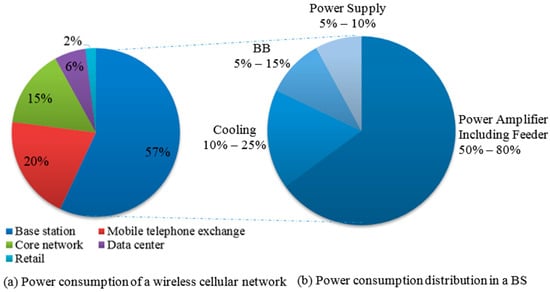
Figure 1.
Breakdown of power consumption in a cellular network and BS [2,3].
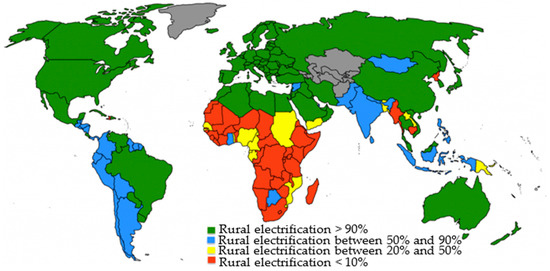
Figure 2.
Electrification progress in rural areas around the world [10].
Cellular network operators endeavor to improve the energy efficiency of cellular networks not only to maintain their profitability but also to reduce the negative environmental effects of their operations. The cellular networks sector has become a major emitter of greenhouse gases (GHG). According to [11], the amount of carbon dioxide (CO2) emitted by the mobile sector will reach 179 MtCO2 by 2020 and account for 51% of the total carbon footprint of the information and communication technologies sector. Therefore, cellular network operators are pressured to meet the demands in environmental conservation and OPEX reduction. Improving the energy efficiency of cellular networks also poses a challenge to researchers, vendors, and mobile operators because of its anticipated economic and ecologic influence in the coming years. Consequently, the relatively new research discipline of “green communication” was recently introduced [2,3].
The green communication initiative primarily aims to improve the energy efficiency, reduce the OPEX, and eliminate the GHG emissions of BSs to guarantee their future evolution [2,3]. Cellular network operators attempt to shift toward green practices using two main approaches. The first approach uses energy-efficient hardware to reduce the energy consumption of BSs at the equipment level and adopts economic power sources to feed these stations. However, the inefficient utilization of network resources can waste a large amount of energy. Therefore, the second approach promotes the intelligent management of network elements based on traffic load variations [12]. Section 3 presents additional details about these approaches.
Most studies on green cellular networks have adopted ideal models. As its name implies, the green communication initiative aims to make cellular networks “greener” by reducing their power consumption using the aforementioned approaches. Additional survey information on the use of green technologies in wireless communication networks can be found in [1,2,3,12,13,14,15,16].
This study examines renewable-energy-powered cellular BSs as a long-term solution to the problems in the mobile cellular network industry [17]. Apart from offering recommendations for future research, this study comprehensively analyzes the related literature, the potential renewable energy solutions for cellular BSs, the potential geographical locations for renewable-energy-powered BSs, the case studies on the use of renewable energy in cellular networks, the open issues on solar panel systems, wind turbines, and fuel cells, the current deployment of renewable-energy-powered BSs, and the barriers that prevent the spread of green BSs. In addition to its advantages and limitations, this study briefly reviews the current research trends in improving the energy efficiency of cellular networks.
The rest of this paper is organized as follows: Section 2 discusses the architecture of BSs, analyzes the power consumption of their parts, and establishes a generic power consumption model to devise energy-efficient solutions for these stations. Section 3 comprehensively analyzes the recent trends, challenges, and barriers in green communication research. Section 4 discusses the renewable energy option. Section 5 concludes the paper.
2. Modelling the Power Consumption of Cellular BSs
To understand the power consumption problems in cellular BSs, one must explore the architecture of these systems and the power consumption of their parts. BSs act as access links that connect mobile stations to a core network. These stations cover a cell that is divided into several sectors, with each sector being covered by a sector antennas [18] as shown in Figure 3. Cellular BSs are classified into macro-, micro-, femto- (indoor), and pico-BSs according to their coverage area, and each cell has a unique size, output power, and data rate [19,20]. Small BSs generally consume less power because of their small coverage range and low radiation power demand [21,22].
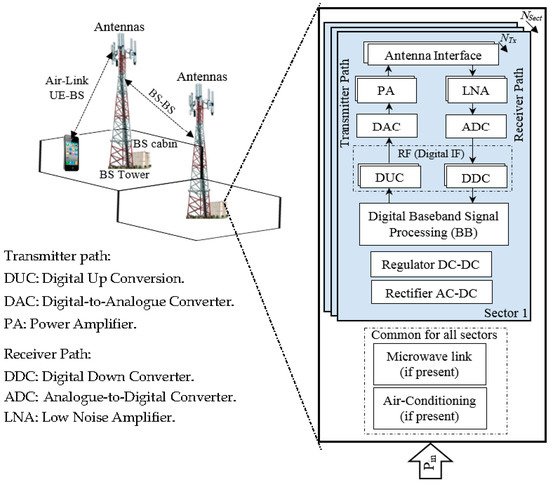
Figure 3.
Block diagram of macro-BS hardware elements [21,22,23].
A macro-BS site typically comprises several pieces of power-consuming equipment as shown in Figure 3. The macro-BS operating power can be mathematically expressed as follows [23,24]:
where PPA, PBB, and PRF denote the power amplifier (PA), digital signal processing or baseband unit (BB), and transceiver (RF) power, respectively. The output of PA is a linear function of BS transmission power (Ptx) and is expressed as Ptx/ηPA, where ηPA denotes PA efficiency. σMS, σDC, and σcool denote the losses incurred by the rectifier, regulator, and active cooling, respectively, which are scaled linearly with the power consumption of the other components [23,24]. Pmw denotes the microwave backhaul link [25], while Pau represents the auxiliary equipment (Pau), such as lighting and closed-circuit television cameras [26]. Given the multiple sectors and antennas in a BS, the power consumption of these components must be multiplied by the number of sectors (NSect), and the power consumption of the BS must be multiplied by the number of transmitting antennas (NTX) for one sector [18].
Air conditioning (σcool) is usually omitted in small BSs (micro- and pico-BSs [23,24], fiber links are used instead of microwave links (Pmw) to communicate with the backhaul network [25], and all sectors are equipped with a rectifier (σMS) and regulator (σDC) [21]. Figure 4 shows the power consumption of the components of BSs per antenna and sector.
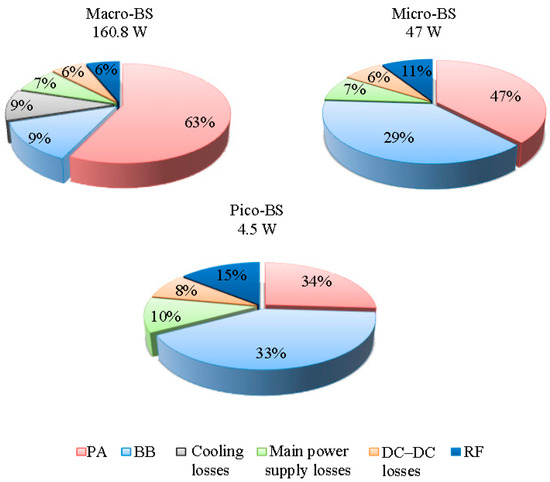
Figure 4.
Power consumption of the components of BSs per antenna and sector [23,24].
The power consumption of a BS differs from one cellular generation to another [27]. Several cellular communication systems have been adopted to date, including the global system for mobile communication (GSM) or “second generation (2G)”, the universal mobile telecommunications system (UMTS) or “third generation (3G)”, and the long-term evolution (LTE) or “fourth generation (4G)” [28]. Table 1 summarizes the power consumption of common cellular BSs for the different cellular generations being used today. The nomenclature n/n/n denotes a three-sector site with n antennas per sector. For example, 2/2/2 means that a BS comprises three sectors with each sector having two antennas.

Table 1.
Total power consumption of a typical macro-BS for different cellular generations.
The fifth generation (5G) technology is rapidly coming into the limelight, and commercial 5G mobile wireless networks are expected to be deployed by 2020 [28]. Energy efficiency presents a key issue in the next generation of cellular networks, and 5G is expected to be more energy efficient than the previous generations [32].
3. Green Communication Research Trends in the Last Decade
Various research projects have been launched in the last decade, such as EARTH, eWIN, OPERA-Net, and Green Radio. The successful project EARTH attempted to develop a new generation of energy-efficient equipment, deployment strategies, and network management solutions [1,12]. Many studies in the last decade have covered a wide range of topics to address the energy efficiency problems of cellular networks. The environmental effects and costs of BSs may be reduced in two ways. First, energy-efficient hardware can: (i) improve the energy consumption of BSs at the equipment level and (ii) facilitate the adoption of renewable energy systems (RESs) as main power sources for BSs. Second, the intelligent management of network elements can be adopted in (i) network operation and management and (ii) network planning deployment based on traffic load variations.
3.1. Energy-Efficient Hardware
3.1.1. Improving the Energy Efficiency of the Hardware Components of a BS
Most components of the current cellular network architecture have an unsatisfactory energy efficiency [2]. Most of the input energy is dissipated as heat in PA, which consumes the largest amount of energy in a typical BS as shown in Figure 1b [2,33]. Figure 5 describes the PA efficiency of various cellular communication generations.
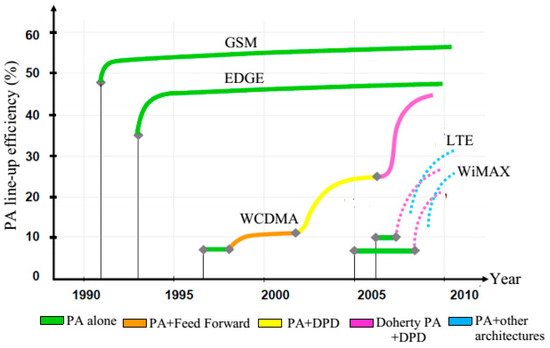
Figure 5.
PA efficiency of different cellular communication generations [34].
PA efficiency decreases in each generation as the peak to average power ratio (PAPR) increases to 6.5 dB in UMTS and 8.5 dB in LTE [34]. Accordingly, many studies aim to improve the energy efficiency of PA [33,35,36,37,38] while maintaining the linearity and increasing the operating bandwidth of BSs.
Previous studies show that the potentially optimized ratio of output power to input power for PA (power efficiency) may reach as high as 60% to 85% [12,33,35,39,40]. Table 2 summarizes the advantages and limitations of the proposed techniques for improving amplifier efficiency. Although necessary for macro- and micro-BSs, these techniques are not employed in small BSs because of the increased PAPR; the PA power consumption for small BSs also accounts for a small percentage of power breakdowns, thereby allowing for a high operating back-off [24]. High-efficiency PA techniques and their classifications are further described in [19,41].
Table 2.
Proposed techniques for improving PA efficiency.
A substantial amount of energy can be saved if additional energy-efficient components are included in the network. However, the aforementioned approaches have a high implementation cost. Network operators must carefully consider both the operational and economical aspects of these approaches before replacing their hardware [2,3].
As for the other elements of BSs, the power consumed by air conditioning in a macro-BS can be reduced by minimizing the operational temperature of BS models or using additional elements, such as heat exchangers, membrane filters, smart fans, or heater modules [8]. The power consumed by signal processing can be reduced using DSP or the field-programmable gate array architectures of integrated circuits, which are often combined to improve efficiency. The AC/DC conversion and efficiency of BSs in high traffic load conditions can be improved using highly efficient converters [42].
3.1.2. Adopting Renewable Energy Resources
The economic, environmental, and social sustainability of power sources present main challenges because power shortages and service outages are strictly prohibited in the cellular mobile sector. The power supply requirements for BSs, including cost-effectiveness, efficiency, sustainability, and reliability, can be satisfied using the technological advancements in renewable energy [8,43]. Renewable-energy-powered cellular BSs offer an ideal long-term solution for the mobile cellular network industry in off-the-grid areas without a mature electric network and in developed countries that suffer from continuous power cuts [17]. Section 4 presents further details on these BSs.
3.2. Intelligent Management of Network Elements
3.2.1. Network Operation and Management
BSs consume the highest amount of energy in cellular networks. The deployment of dense BSs has resulted in small coverage areas and highly random traffic patterns for each BS, thereby making sleep mode operations desirable for these stations. These approaches conserve energy by monitoring the traffic load in the network and deciding whether to switch off/on certain elements of the network. Several studies [44,45,46,47,48,49,50] switch certain elements, including, but not limited to, PAs, signal processing units, cooling equipment, the entire BS, or the whole network, back and forth between the sleep and active modes [51]. However, a minimum number of BSs must always stay on to support the basic operations of the network. Given that sleep mode techniques are based on the current architecture of BSs, they can be easily tested and implemented because they do not require the replacement of any hardware. While switching these elements on/off can conserve energy, this approach may negatively affect the radio service (coverage) and quality of service (QoS) of the network unless specific remedial solutions are adopted [19]. Under an intense traffic demand, few BSs can be switched off and render the sleep-mode-based algorithm ineffective.
Several other techniques have attracted research attention. For instance, [52] investigates the multi-radio access technology with the switching on/off approach, while other studies examine the energy-aware management of individual cellular networks. The cooperation among mobile network providers in the same geographical area can effectively reduce OPEX as stated in [53,54]. In this cooperation, one or more BSs are switched off under low traffic load conditions to manage the coverage with a subset of active BSs through either the same or another operator, with both networks covering the same geographical area.
3.2.2. Network Planning and Deployment
Reducing the distance between the user equipment (UE) and BS can increase the data rate and reduce the transmit power, thereby improving the energy efficiency of both uplink and downlink communication. Small cells deployment [55], relay technique (fixed and user-cooperative relay systems) [56,57,58,59], and heterogeneous network (HetNet) deployment increase energy efficiency by decreasing the propagation distance between UE and BS [20]. However, previous studies have mostly focused on HetNet deployments (multilayer network) [60,61,62,63,64]. In HetNet, a macro BS provides connectivity and service for high mobility users, while small cells, such as micro- and pico-BSs, serve low mobility users at high data rates. Each BS type in this architecture has a unique capability, transmit power, range, power consumption, access, backhaul, and operating functionality [19,20].
Given the short distance between the transmitter and mobile station, low transmit power requirement, high data rate, and low BS power consumption, small cell BSs offer an attractive option for increasing network capacity and energy efficiency [20]. More than 40,000 small cells were deployed in 2015 [65], and this number is expected to increase in the future upon the deployment of 5G technology [66]. As shown in [67], the number of 5G small cells is anticipated to become four times larger than the number of existing macro sites to cover the same service area. The deployment of additional small cells in the future is expected to consume around 4.4 TWh of power by 2020, which will increase both the OPEX and energy consumption of conventional macro cell networks by 5% [2].
Determining the number and location of BSs to be deployed can improve spectral efficiency by reducing the radio interference of neighboring cells and increase energy efficiency by reducing the number of small cell BSs [20]. Accordingly, previous studies have addressed the following issues relating to this aspect: (i) optimizing the layouts of small cells that overlay the conventional cell (macro-cell); and (ii) creating power models for macro- and small cell BSs. Optimizing the layouts of small cells that overlay the conventional cell (macro-cell) by improving energy efficiency has been investigated in [33,63,68,69,70,71,72]. Optimizing BS size, location, and density has been investigated in [73,74,75,76,77]. The power model adapts to the traffic load variations in micro BSs to improve energy efficiency under high user density conditions. The power models for macro and micro BSs at the component level are examined in [78]. A significant amount of energy and traffic capacity can be saved by deploying micro BSs in consideration of other network design parameters. Optimizing the cell structure of the network has been discussed in [69], which examines the role of average micro sites per macro cell, average macro cell size, and changes in number of micro and macro sites in achieving a similar system performance under full load conditions. Integrating the deployment of small cell BSs using sleep mode schemes can save a large amount of energy [2,79]. Ensuring energy efficiency under uniformly distributed traffic has been investigated in [72], which shows that turning the transceivers on and off to match the variations in traffic demand can reduce energy consumption. The type of BSs (micro or macro) to be added or switched off to achieve an optimal BS density subject to a QoS has been examined in [80].
Many practical challenges must be addressed in future research to realize the benefits of integrating small cell BSs deployment with sleep mode schemes, including high backhaul bandwidth to support increasing traffic, inter-tier interference, resource management, and handover process. Given that the 5G technology aims to enhance or support, rather than replace, the existing technologies, the design issues relating to the application of the switch-off mechanism for 5G small cells may also be of interest to researchers, vendors, and mobile operators in the future, specifically after the introduction of millimeter wave (mmWave) frequencies in 5G systems.
Several other techniques have also attracted research attention. For instance, [81] shows that cooperating transmission can effectively reduce the number of deployed BSs while maintaining a low transmission power. Given that PA consumes the largest amount of energy in the entire BS, the performance of different distributed antenna system (DAS) configurations has been investigated in [82,83,84] to improve the spectral efficiency, uniform coverage, and energy efficiency of cellular networks.
In sum, achieving a high energy efficiency requires a fundamental change in the design principles and implementation practices in the mobile telecommunications industry. Using BS sleep mode techniques to reduce the total energy consumption in cellular networks is generally preferred because these techniques do not require upgrade of equipment and have a low implementation cost. These approaches exploit the traffic load variations to turn off certain elements, including, but not limited to, PAs, signal processing units, cooling equipment, the entire BS, or the whole network. In other words, these elements shall “only be activated and transmitted when needed”.
BS sleep mode techniques are particularly effective in cellular networks with low traffic demand. By contrast, only few BSs can be switched off under an intense traffic demand, thereby rendering the sleep-mode-based algorithm ineffective. Given that renewable energy sources are free, clean, widely available, and can meet the energy demands of cellular networks during peak hours, renewable energy systems have been proposed for powering BSs. However, these resources are unpredictable, intermittent, and dynamic. Therefore, renewable energy systems must be integrated with other sources of non-renewable energy (with DG or grid as a backup power source) and/or means of energy storage (batteries) to secure energy supplies, improve system reliability, and prevent mobile service outages.
4. Overview of the Renewable-Energy-Powered Cellular BSs
Using renewable energy in the telecommunication sector is not new. Since the 1970s, renewable energy has been used for powering microwave repeaters in remote areas and for connecting remote towns and homesteads to telecommunication grids, thereby granting them access to radio, telephone, and television services. Telecommunication satellite stations, rural telephony, and telephone exchanges can also be powered by solar energy [85]. Therefore, the use of renewable energy for powering cellular BSs, reducing OPEX, and diminishing GHG has been highlighted. RESs are very practical and easy to install, disassemble, and separate, thereby facilitating the expansion of renewable systems. This section examines the following topics:
- (i)
- the potential use of renewable energy solutions for cellular BSs and the system model;
- (ii)
- the potential geographical locations for deploying renewable-energy-powered BSs and for widely deploying green cellular BSs;
- (iii)
- conducting case studies on the establishment of renewable-energy-powered cellular BSs and recommending future research directions based on the outcome of these studies;
- (iv)
- the current deployment of sustainable and green BSs, which can reflect the practical results of a green communication initiative; and
- (v)
- the barriers that hinder the spread of renewable-energy-powered BSs and recommendations for future research.
4.1. Potential of Renewable Energy Solutions for Cellular BSs and the System Model
Renewable energy is collected from renewable resources (i.e., sunlight, wind, rain, tides, and waves) that are widely available across different geographical areas and offer important opportunities for guaranteeing energy efficiency [86]. Unlike other energy sources that are available in a limited number of countries, solar and wind energies are widely used in the cellular communication sector because of their wide availability [4,12,29]. The use of solar and wind energy in cellular communication may proliferate over the next few decades because they are well-suited to rural and remote areas as well as developing countries [17,87].
The cellular BS is fed directly from the RES, which may have either an autonomous or hybrid design with other means of renewable or non-renewable energy. Renewable energy resources, such as solar radiation and wind speed, have key roles in selecting the optimal RES design. However, these resources are unpredictable, intermittent, and dynamic. Therefore, renewable energy systems must be integrated with other sources of non-renewable energy (with DG or grid as a backup power source) and/or means of energy storage (batteries) to secure energy supplies, improve system reliability, and prevent mobile service outages [8,88]. The backup DG feeds the cellular BS when the RES malfunctions, when the BS demand exceeds the RES power output, and when the batteries reach their maximum depth of discharge (DOD) [43,88]. However, cellular BS are rarely fed from DG because the reachability of RES may increase up to 99.99% with an optimal design [89]. Without any auxiliary power sources, the battery bank can power the BS for at least three days, which is long enough to fix the malfunctions.
4.1.1. System Model of Solar-Powered BS
A solar-powered BS typically comprises photovoltaic (PV) panels, batteries, an integrated power unit, and the load as shown in Figure 6. Connected via an open switch, the DG acts as a backup power source in the case of malfunctions as discussed in the second paragraph of Section 4.1.
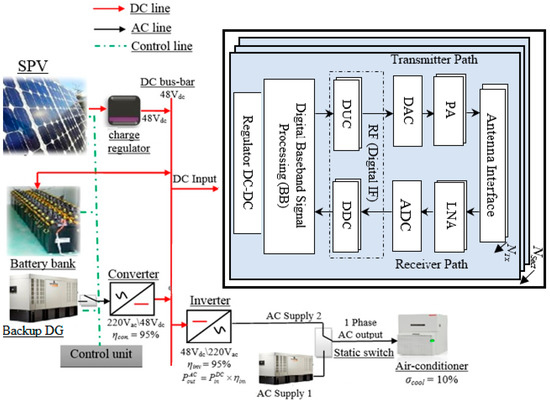
Figure 6.
Scheme of the solar-powered BS.
- (a)
- PV panels absorb and convert shortwave irradiance into direct current (DC) electricity, which provides power for running BSs and for charging batteries. A 1 kW PV panel typically has a 5 m2 area, and the lifetime of a typical PV panel may exceed 25 years [90]. The power generated by a PV panel may be affected by several factors, including the DC rating of the PV panel, geographic location or solar irradiation profile of the site, tilt of the PV panel, and DC–AC loss factor [43]. PV cells based on mono and poly-crystalline silicon are commonly used in large-scale applications with an efficiency of 14% to 19%. PV panels with a DC rating of 1 kW currently cost around $1000 USD [43]. The efficiency of next-generation high concentration solar cells, which are based on germanium, gallium arsenide, and gallium indium phosphide, can reach 40%.
- (b)
- Solar regulator charger: Given that the highest power demand in a typical BS is based on 48 Vdc voltage, DC/DC solar regulator converters that directly convert the unregulated DC output voltage and current from a solar panel into a regulated output voltage for the BS equipment must be used to protect the battery bank [88].
- (c)
- Battery banks store excess electricity for the future consumption of BSs at night, during load-shedding hours, or when the available solar energy cannot sufficiently feed the BS load. A charge controller must be included to protect the battery. A charge controller or battery regulator limits the rate at which the electric current is added to or drawn from the electric batteries, thereby preventing overcharging and overvoltage, which in turn may reduce the performance or lifespan of batteries and pose a safety risk. A charge controller also prevents the battery from completely draining (“deep discharging”) or from releasing controlled discharges, thereby extending battery life depending on the battery technology [88]. Table 3 summarizes the key features of the battery models that are used with cellular BSs.
Table 3. Key features of the battery models that are used with cellular BSs [91].
- (a)
- Inverters convert a low DC-voltage into usable 220 V AC voltage, thereby making these items a main element of the system. Inverters vary according to their output wave format, output power, and installation type. Inverters have also been called as power conditioners that change the form of electric power. The output wave format can be classified into modified sine-wave (MSW) and pure sine-wave. MSW inverters are economical and efficient, while sine wave inverters are usually more sophisticated than MSW, demonstrate a high-end performance, and operate any type of load [88].
- (b)
- The control system serves as the brain of a complex control, regulation, and communication system. Wireless modems or network solutions are the most common communication units in the remote interface [88]. Apart from its control functions, the data logger and alarm memory capabilities of the control system are very important. Those power sources that work in parallel are managed by a sophisticated control system and share the load to prevent power shortages, which are not admissible in the cellular telephony sector.
4.1.2. System Model of Wind-Powered BS
In wind-powered BSs, the wind turbine (WT) acts as the main power source, the DG acts as a backup power source, and the other components serve the similar functions as those of the solar-powered BS as shown in Figure 7. The WT can be connected to the DC-power bus and convert wind energy into a regulated power. Vertical windmills have a 15-year lifetime and show special benefits for a small power load, such as BSs [88]. Given that WTs are installed above tall trees to gain open access to the wind, lightning may prevent the use of WTs in rural areas [92].
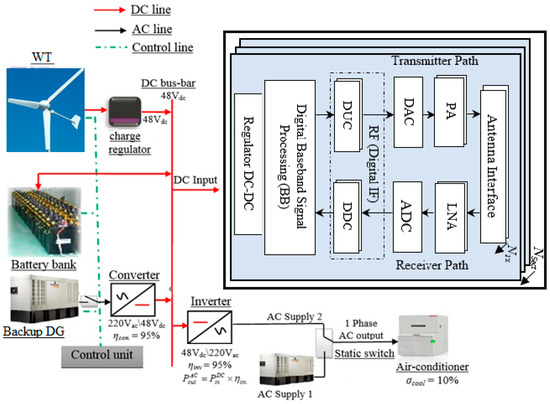
Figure 7.
Scheme of the wind-powered BS.
Fuel cells (FCs) are clean and highly efficient alternatives to generators and batteries for generating prime and backup power, respectively, that have attracted wide usage in cool areas [93,94]. FCs can be used in cellular BS sites as (i) back-up power; (ii) temporary main power supply; and (iii) emergency power supply. The emergency power supply feed the main elements in the BS site to guarantee the availability of radio services.
4.2. Potential Geographic Locations for Deploying Renewable-Energy-Powered BSs
4.2.1. Potential Locations of Solar-Powered BSs
The solar radiation at the Earth’s surface is largely determined by latitude, seasonal variations, and geographical/climatic conditions. Figure 8 shows the global distribution of horizontal irradiation rated by averaged effective hours when the irradiance power of 1 kW/m2 falls on a plane that has the same orientation as the PV generator. The region at mid-latitude between latitude 30° North and South is a preferred region for a solar-powered BS when only solar radiation is considered. The averaged irradiance at this region, except for the inland of China, ranges from 4.5 kWh/m2 to 7.5 kWh/m2.
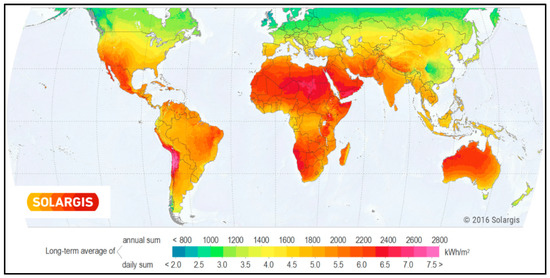
Figure 8.
Global solar irradiation map [95].
As another practical requirement, the electrical energy must be consumed at the neighborhood of the PV system or the PV system must be connected to the electrical grid. Despite the high averaged irradiance, the desert is an unsuitable location for solar-powered BSs because only few residents in this area are using a cellular phone. The same condition is observed in the jungle area at the middle regions of South America.
If the above requirements (i.e., solar irradiation and electrical power consumption) are considered, then the suburbs around the town at low latitudes are identified as the most profitable locations for solar-powered BSs. The western coast of the USA, the northern coast of South America, the Mediterranean littoral, the southern part of Africa, the northwestern part of India, and the eastern coast of Australia all satisfy the requirements for installing these BSs. Those regions with relatively low solar irradiance and favorable economic efficiency are also preferred.
4.2.2. Potential Locations of Wind-Powered BSs
Installing wind- and solar-powered BSs must fulfill the same requirements (i.e., the amount of wind/solar energy and electrical power consumption). To generate electricity from wind energy, the wind speed must exceed the cut-in speed (around 3.5 m/s) or the minimum speed for safely operating the WT. However, unlike solar energy, an extremely high wind speed can damage the wind power generation system. In this case, the wind speed must be maintained below the cut-out speed (around 14 m/s to 20 m/s) or the maximum wind speed at which the WT can be safely operated.
Figure 9 shows the global wind speed as recorded in a 10-year numerical weather prediction model run. The maximum power output, which varies along with wind power, may be obtained at a wind speed of about 10 m/s. The potential locations for wind-powered BSs are largely distributed in mountainous regions and coastal areas. However, the number of these locations may be reduced further by considering the desolate circumstances of mountainous regions. Following these requirements, wind-powered BSs may be located in the northeastern coast of North America, the southern area of South America, England, the northern area of Europe, the northwestern part of India, the southern coast of China, and the coastal area of Japan.
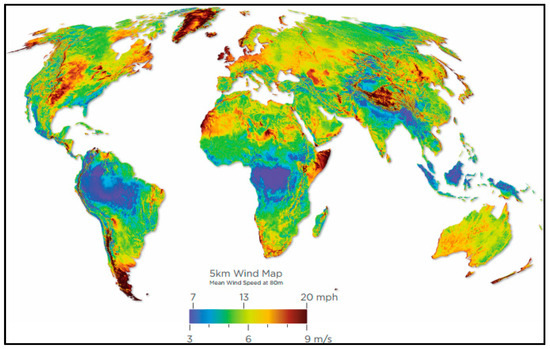
Figure 9.
Global wind speed map [96].
4.3. Case Studies for Enabling Green Cellular BSs
Numerous studies have been conducted in various regions worldwide to help cellular network operators establish a green cellular network. This section presents existing studies on cellular BSs powered by renewable energy sources, investigates the motives behind the use of renewable energy, and proposes directions for future research.
4.3.1. South Korea
Cellular networks in South Korea have developed significantly over the last five years, particularly its LTE cellular network, which offers data-oriented services. The LTE cellular network of South Korea leads in terms of technology, reliability, and global coverage (i.e., cellular phone users in South Korea use LTE 97% of the time). South Korea had 35,255 LTE BSs in 2013; this number increased 4.7-fold and reached 165,193 BSs in 2015 [97]. Such increase intensified both the energy consumption and OPEX of these BSs because of the high prices of energy and fossil fuels.
The average daily solar radiation in South Korea is approximately 4.01 kWh/m2, which is relatively higher than the figures in other countries located at similar latitudes [43]. The performance of solar-powered LTE BSs was analyzed in [43], which found that these stations could save up to 48.6% OPEX compared with that of a DG system. A PV/WT hybrid power system for LTE BSs was examined in [98]; the findings of this study indicated that this hybrid system could save up to 48.52% OPEX compared with that of a DG system. Therefore, the use of solar-powered BSs is a cost-effective option for cellular network operators.
In June 2016, the LG Uplus operator tested a solar-powered LTE BS with an energy storage system (batteries) that could operate between 24 h and 48 h even on cloudy days. The proposed system satisfies the energy requirements of LTE BSs [99], thereby motivating other operators to adopt green energy technologies. However, the adoption of renewable energy sources remains limited in the Korean telecommunications industry because numerous issues on the most cost-effective optimal hybrid power systems, such as integrated PV/FC and PV/WT/FC, are yet to be examined. The supply of renewable energy to 2G and 3G BSs also warrants further study.
4.3.2. Malaysia
The tropical climate of Malaysia provides considerable potential for the use of renewable energy resources, particularly solar energy, because of the high amount of solar radiation (2–6 kWh/m2/day) that the country receives throughout the year. The use of a solar panel measuring 1 m2 can reduce CO2 emissions by 40 kg annually [92]. Thus, several researchers have studied the use of solar energy in telecommunications applications [7,100,101]. The integration of RESs into an electricity grid to supply energy to LTE BSs in on-grid sites was investigated in [100]. Meanwhile, the use of a PV/DG hybrid system for rural LTE BSs was examined in [7]. These studies underscored the benefits of solar energy to cellular network operators in terms of limiting their environmental effects and reducing their OPEX. The Solar Energy Research Institute (SERI) at the University Kebangsaan Malaysia launched a solar-powered BS project in 2015. On the basis of the results of this project, SERI recommended that cellular network operators should install solar-powered BSs and shift toward greener networks. In 2016, Digi operator tested the potential of a hybrid hydrogen FC system to power BSs [102]. However, the application of renewable energy to the Malaysian telecommunications industry remains limited. In addition, several issues, such as using PV/WT/FC and supplying RESs to UMTS BSs, should be examined further.
4.3.3. Turkey
The GSM BS of a Turkish telecommunications operator was used in [103] to test a commercial FC backup power unit under actual operating conditions; the FC backup power unit successfully supplied power to the BS in 256 (out of 260) instances of electric power outages. At the system level, the FC backup power unit achieved 98.5% reliability. However, approximately 90% of the energy consumption of Turkish cellular networks is obtained from purchased electricity, which resulted in the emission of 172,812.3 tons of CO2 in 2015 [104]. Turkey has four seasons and experiences a high solar radiation rate during summer [105,106]. The country had at least 12 solar-powered BSs in 2014 [107]. The potential use of PV/WT, PV/FC, and PV/WT/FC hybrid systems in Turkey and the supply of RESs to UMTS and LTE BSs must be investigated further.
4.3.4. India
Approximately 400,000 BSs in India (over 70% of the total BSs) experience power outages more than 8 h a day. This situation prompts cellular network operators to use DG to power their BSs and prevent cellular service interruptions. The penetration rate of cellular networks in rural India reaches 30% to 40%. These figures indicate that 200 million people are yet to be connected to these networks. Many regions in India have poor grid connectivity, thereby encouraging the use of DG. Cellular network operators also consume over 2 billion L of diesel, spend approximately 1.4 billion USD, and produce more than 5 metric tons of CO2 emissions annually [107,108]. Therefore, operators must adopt economical, clean, reliable, and sustainable power sources to address the aforementioned issues.
Several studies [107,109,110,111,112,113] have examined the potential of hybrid renewable energy to supply power to cellular BSs. Amutha et al. [109] investigated the optimization of hybrid RESs that use DG as a backup power source. PV/DG, PV/WT/DG, PV/WT/DG/FC, PV/WT/FC, and PV/WT hybrid power systems have also been examined in previous studies. The HOMER simulation results show that the hybrid PV/WT/battery/FC/DG is the most economically feasible configuration for GSM BSs with a net present cost (NPC) of $75,515. In the same context, the authors of [110] explored the hybrid PV/WT system for UMTS BSs. Although India has over 3360 solar-powered BSs [107], cellular network operators must still shift toward green cellular networks. Moreover, supplying UMTS and LTE BSs with the required energy based on various hybrid RESs should still be addressed.
4.3.5. Bangladesh
Bangladesh has over 36,679 GSM BSs; among which, 14% lack access to grid electricity. The DG–battery hybrid system feeds 81% of all off-grid sites in the country [114]. Literature [114] also indicates that cellular networks in Bangladesh are likely to consume as much as 642 million kWh of energy. In the same context, GSMA estimates that implementing green technology solutions can save up to 90 million USD.
The potential of using renewable energy was explored in [115], which found that solar power is the most suitable alternative power source for off-grid telecommunications systems and for grid areas that frequently experience power failure. A feasibility study conducted on a solar PV system in grid-connected BS sites was presented in [116]. To achieve the most economically feasible configuration, BSs in Bangladesh must have 2.5 kW PV and sixteen batteries in two parallel strings, as well as two 4 kW DGs with an energy cost of $1.657/kWh. Over 521 solar-powered BSs have been installed in Bangladesh [107], and cellular network operators must further increase this number. The PV/WT hybrid power system also warrants further investigation because the annual average wind speed along the coastal area of Bangladesh exceeds 5 m/s at a height of 30 m [115]. Both UMTS and LTE BSs must also be considered.
4.3.6. Pakistan
Pakistan exhibits considerable potential in using solar energy due to its average daily insulation that ranges from 4 kWh/m2 to 5.3 kWh/m2. Such insulation is particularly high in southwestern provinces with highly suitable conditions for accumulating solar energy. Pakistan experiences 8 h to 8.5 h of sunlight daily or approximately 3000 h annually [117], and wind speed may exceed 7 m/s to 8 m/s [87,118]. However, the green initiatives of the Pakistani telecommunications sector require further development; this sector also depends largely on DG to supply power to its off-grid BSs, and fossil fuel costs account for 64% and 56% of the OPEX in off- and on-grid sites, respectively [87]. Imtiaz et al. [118] proposed a hybrid PV/DG system design for a GSM BS. The HOMER simulation results show that 6 kW PV, 2 kW DG, and eight 200Ah batteries comprise the optimal combination of energy system components. However, Asif et al. [119] identified 5 kW PV, 3 kW DG, and sixteen 225Ah batteries as the optimal combination for PV/DG system components; 1 kW WT, 3 kW DG, and twenty-four 225Ah batteries for WT/DG system components; and 5 kW PV, 5 kW WT, and 5 kW DG for PV/WT/DG system components.
Despite the aforementioned initiatives and continuous support from the government for a shift toward renewable energy use, the number of solar-powered BSs in Pakistan remains below the 602 GSM BSs recorded in 2014 [107]. However, many cellular network operators continuously attempt to increase the number of green BSs [87]. Both UMTS and LTE BSs must also be considered in their future plans.
4.3.7. Nigeria
The electric power infrastructure in Nigeria negatively affects the expansion of cellular network coverage and significantly influences the OPEX of cellular telecommunications systems because of the unavailability of grid power supply. Approximately 11,692 mobile sites in Nigeria are connected to the national grid, and 9%, 10% and 81% of these sites experience up to 6, 6–12, and over 12 h grid outage/day; by contrast, 12,560 sites in the country are completely off-grid [120]. The uncertain availability of power has driven network operators to use DG, which consumes over 500 million L of diesel and emit 1.3 million metric tons of CO2 annually [120]. Nigeria has an average monthly solar radiation of 5.8 kWh/m2 per day and an average daily sunshine of 6 h [121]. The country has an annual average wind speed of approximately 2 m/s in the coastal region and 4 m/s in the far northern region [122].
Several studies [120,123,124,125,126,127] have attempted to encourage a shift toward renewable technologies. Wa et al. [120] studied the optimization of various hybrid RESs, including PV/DG and PV/WT/DG hybrid systems. The HOMER simulation results indicate that the most economically feasible configuration is the PV/DG system with an NPC of 69,811 USD and an electricity cost of 0.409 USD per unit. However, considering that most African countries have a high solar radiation rate (Section 4.2.1), these countries are encouraged to use solar power in other industrial sectors aside from telecommunications.
Vodacom, a cellular operator in the Democratic Republic of Congo, spends over 5 million USD annually for its 157 diesel-powered BSs (approximately 32,000 USD per BS annually) [128]. Kusakana et al. [9] examined the potential of PV, WT, and PV/WT as primary energy sources for remote GSM BSs in Congo. The NPC of a PV system may reach as low as $8336 annually, whereas that of wind and diesel systems may reach as high as $11,420 and $29,773 annually, respectively. The optimization of various RESs (PV/DG/battery, PV/WT/battery, PV/battery, and PV/FC/electrolyzer/battery) for UMTS BSs in the urban and rural areas of Nepal was explored in [89,129], and the hybrid PV/DG/battery and PV/FC/electrolyzer/battery present the most feasible solutions for these two areas, respectively. Martínez-Díaz et al. [130] examined the potential of RESs, PV/DG, WT/DG, and PV/WT/DG in providing power to GSM BSs in Spain. They identified PV/DG as the most economically feasible solution with an energy cost of €0.436/kWh.
Salih et al. [131] studied the potential of RESs (stand-alone PV, PV/DG, and PV/WT/DG) to power remote GSM BSs in Sudan, and identified PV/DG as the most economically feasible configuration with an energy cost of1.157 USD/kWh. Hossam et al. [132] designed four hybrid RESs for GSM BSs in Cairo, Egypt and proposed the use of a PV/electrical grid in urban areas; PV, PV/DG, and PV/DG in remote areas; and DG on cloudy days. The energy costs of PV/electrical grid, PV/DG (on cloudy days), PV, and PV/DG reach as low as $0.1, $0.21, $0.29 and $0.31/kWh, respectively. Therefore, the use of PV/DG on cloudy days is the most economically feasible configuration, and the optimal system architecture comprises 18 kW PV array, 10 kW DG, and 1400Ah battery with a nominal voltage of 6 V.
Belkhiri et al. [133] studied an optimized PV/WT hybrid power system for UMTS BSs in Algiers, Constantine, Ghardaia, and Adrar, and recorded energy costs of $0.417, $0.371, $0.325 and $0.285/kWh, respectively in these areas. The power system for Ardrar with 3 kW PV array, 1 kW WT, and 16 T-105 batteries achieves the lowest energy cost. Kaldellis et al. [134] designed a solar-powered system with DG as a backup power source for a GSM cellular network in Greece. The proposed system can effectively address the lack of energy in remote BSs in Greece given its high reliability and low maintenance requirements in considering the tilt angle of optimum PV panels. Giuseppe et al. [135] proposed two discrete-time Markov chain models for achieving the dimension of the solar power (PV panel size and battery capacity) supply of an LTE macro BS in southern and northern Italy, and found that seasonal behavior significantly influences the dimensioning process. Therefore, both irradiance and battery charge must be carefully selected.
In [136,137], a hybrid solar-grid (or solar–diesel) power system achieved higher energy savings than a purely solar-powered system or a traditional power-grid system over a 10-year period in south European cities (e.g., Torino in Italy) and in locations close to the tropics (e.g., Aswan in Egypt). A framework for estimating the probability of power outage in solar-powered cellular BSs in San Diego, USA and Jaipur, India was proposed in [138], which presented the harvested solar energy, BS load, and battery levels as discrete-time Markov processes. To demonstrate its effectiveness, the proposed model was then compared with the simulation results using empirical traces of solar energy and load data. A framework for avoiding power outages and improving the QoS of a network of off-grid solar-powered BSs was proposed in [139]. Actual BS deployment data and solar energy traces were used in the evaluation, which demonstrated that the proposed framework outperformed existing benchmarks in terms of reducing power outages and ensuring good delay performance.
The application of FC-based hybrid renewable energy systems to off-grid telecommunications stations was evaluated in [94,140] using data collected from 6 of the 13 sites tested during the deployment of an EU-funded project. A hybrid solar–hydrogen system (hybridized with batteries) was tested in [93] to determine its remote telecommunications application potential in Eureka, Canada, which typically experiences extremely cold climate. A case study of 2 kW polymer electrolyte membrane FCs was then conducted to test whether the proposed model could fulfill the load requirements of a telecommunications BS. Off-grid hybrid systems based on the integration of hydrogen technologies into battery and wind/solar power technologies were proposed in [141] to meet the energy requirements of remote telecommunications BSs in the UK. A hybrid configuration of hydrogen and battery technologies can continuously transfer power from an off-grid PV or wind power source to a telecommunications BS. Despite the use of FC-based technology and the integration of various components, the models proposed in the literature have only exhibited acceptable stability and reliability levels. Table 4 summarizes issues that should be considered in future research.
Table 4.
Case studies of enabling green cellular BS and open issues.
4.4. Current Status for Deploying Green Cellular BSs
Figure 10 shows the deployment and locations of green cellular BSs around the world. GSMA predicted that the number of green BSs would increase to 389,800 by 2020 [8], which reflects the growing awareness of cellular network operators about the significant economic and ecological influence of their networks in the coming years.
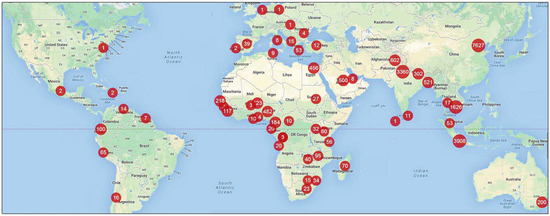
Figure 10.
Worldwide deployment of green cellular BSs [107].
Figure 10 reveals that many cellular network operators in the world have still not shifted toward green cellular BS. Most of these operators are located in developing countries with limited electricity supply and unreliable electric grids. The financial issues in these countries must be investigated further.
4.5. Barriers that Hinder the Spread of Green Cellular BSs and Potential Solutions
Table 5 summarizes the technical and non-technical challenges that hinder the widespread deployment of renewable-energy-powered BSs as well as proposes some potential solutions to these barriers.
Table 5.
Barriers that hinder the spread of green BSs and potential solutions.
5. Conclusions
This paper investigates the sustainability of power resources and the ideal environmental conditions for cellular communication systems. These two key issues may help cellular network operators reduce not only their OPEX but also the negative effects of their operations on the environment. Table 6 compares the approaches presented in this article. This paper specifically focuses on renewable-energy-powered BSs.
Table 6.
Brief comparison of the approaches presented in this article.
Exploiting the available energy from renewable resources presents these operators with an ideal long-term solution to their problems. These resources are particularly useful for those countries without mature or reliable electrical grids. A feasibility assessment must also be conducted to identify those renewable-energy-powered systems that cannot provide sufficient amount of power to BSs. Network operators must carefully consider both the operational and economical aspects of these systems before making decisions regarding their implementation. The location of renewable-energy-powered BSs must also be carefully considered because several locational factors, such as dirt, dust, tree debris, moss, sap, water spots, and mold, can significantly affect the performance of PV systems. Cleaning these panels also presents a challenge to these network operators. Energy-efficient or “green” cellular networks are broad research topics facing several issues that are yet to be addressed. Cellular network operators must shift toward green cellular networks to reduce their expenditures and minimize the environmental effects of their operations.
Acknowledgments
This work was supported by the Human Resources Development of the Korea Institute of Energy Technology Evaluation and Planning (KETEP) grant funded by the Korea government Ministry of Trade, industry & Energy (No. 20164030201340).
Author Contributions
As the first author, Mohammed H. Alsharif wrote the main parts and the first draft of this paper as well as reviewed the literature on sustainable power supply. Jin Hong Kim wrote Section 4.2 and conducted a study on the appropriate geographic locations for the deployment of stations powered by solar or wind power. Jeong Kim revised the final version of paper.
Conflicts of Interest
The authors declare no conflict of interest.
References
- Feng, D.; Jiang, C.; Lim, G.; Cimini, L.J.; Feng, G.; Li, G.Y. A survey of energy-efficient wireless communications. IEEE Commun. Surv. Tutor. 2013, 15, 167–178. [Google Scholar] [CrossRef]
- Wu, J.; Zhang, Y.; Zukerman, M.; Yung, E. Energy-Efficient Base Stations Sleep Mode Techniques in Green Cellular Networks: A Survey. IEEE Commun. Surv. Tutor. 2015, 17, 803–826. [Google Scholar] [CrossRef]
- Hasan, Z.; Boostanimehr, H.; Bhargava, V.K. Green Cellular Networks: A Survey, Some Research Issues and Challenges. IEEE Commun. Surv. Tutor. 2011, 13, 524–540. [Google Scholar] [CrossRef]
- GSMA, “Community Power: Using Mobile to Extend the Grid,” London, UK, January 2010. Available online: http://www.gsma.com/mobilefordevelopment/wp-content/uploads/2012/05/Community-Power-Using-Mobile-to-Extend-the-Grid-January-2010.pdf (accessed on 8 January 2017).
- Oh, E.; Krishnamachari, B.; Liu, X.; Niu, Z. Toward dynamic energy-efficient operation of cellular network infrastructure. IEEE Commun. Mag. 2011, 49, 56–61. [Google Scholar] [CrossRef]
- Oh, E.; Son, K.; Krishnamachari, B. Dynamic base station switching-on/off strategies for green cellular networks. IEEE Trans. Wirel. Commun. 2013, 12, 2126–2136. [Google Scholar] [CrossRef]
- Alsharif, M.H.; Nordin, R.; Ismail, M. Energy optimisation of hybrid off-grid system for remote telecommunication base station deployment in Malaysia. EURASIP J. Wirel. Commun. Netw. 2015, 2015, 1–15. [Google Scholar] [CrossRef]
- Aris, A.M.; Shabani, B. Sustainable power supply solutions for off-grid base stations. Energies 2015, 8, 10904–10941. [Google Scholar] [CrossRef]
- Kusakana, K.; Vermaak, H.J. Hybrid renewable power systems for mobile telephony base stations in developing countries. Renew. Energy 2013, 51, 419–425. [Google Scholar] [CrossRef]
- Berkeley Energy & Resources Collaborative (BERC). Available online: http://berc.berkeley.edu/energy-access-across-world/ (accessed on 8 January 2017).
- Suarez, L.; Nuaymi, L.; Bonnin, J.-M. An overview and classification of research approaches in green wireless networks. EURASIP J. Wirel. Commun. Netw. 2012, 2012, 1–18. [Google Scholar] [CrossRef]
- Alsharif, M.H.; Nordin, R.; Ismail, M. Classification, recent advances and research challenges in energy efficient cellular networks. Wirel. Pers. Commun. 2014, 77, 1249–1269. [Google Scholar] [CrossRef]
- Li, G.Y.; Xu, Z.; Xiong, C.; Yang, C.; Zhang, S.; Chen, Y. Energy-efficient wireless communications: Tutorial, survey, and open issues. IEEE Wirel. Commun. 2011, 18, 28–35. [Google Scholar] [CrossRef]
- Wang, X.; Vasilakos, A.V.; Chen, M.; Liu, Y.; Kwon, T.T. A survey of green mobile networks: Opportunities and challenges. Mob. Netw. Appl. 2012, 17, 4–20. [Google Scholar] [CrossRef]
- Chen, Y.; Zhang, S.; Xu, S.; Li, G.Y. Fundamental trade-offs on green wireless networks. IEEE Commun. Mag. 2011, 49, 30–37. [Google Scholar] [CrossRef]
- Budzisz, Ł.; Ganji, F.; Rizzo, G.; Marsan, M.A.; Meo, M.; Zhang, Y.; Koutitas, G.; Tassiulas, L.; Lambert, S.; Lannoo, B.; et al. Dynamic resource provisioning for energy efficiency in wireless access networks: A survey and an outlook. IEEE Commun. Surv. Tutor. 2014, 16, 2259–2285. [Google Scholar] [CrossRef]
- GSMA, “Green Power for Mobile Interactive Replication Guide,” London, UK, June 2012. Available online: http://www.gsma.com/mobilefordevelopment/wp-content/uploads/2012/06/Indian_ReplicationGuide_300512_Final.pdf (accessed on 8 January 2017).
- Deruyck, M.; Tanghe, E.; Joseph, W.; Martens, L. Modelling and optimization of power consumption in wireless access networks. Comput. Commun. 2011, 34, 2036–2046. [Google Scholar] [CrossRef]
- Alsharif, M.H.; Nordin, R.; Ismail, M. Survey of Green Radio Communications Networks: Techniques and Recent Advances. J. Comput. Netw. Commun. 2013, 2013, 1–21. [Google Scholar] [CrossRef]
- Abdulkafi, A.A.; Kiong, T.S.; Sileh, I.K.; Chieng, D.; Ghaleb, A. A Survey of Energy Efficiency Optimization in Heterogeneous Cellular Networks. KSII Trans. Internet Inf. Syst. 2016, 10, 462–483. [Google Scholar]
- Deruyck, M.; Joseph, W.; Martens, L. Power consumption model for macrocell and microcell base stations. Trans. Emerg. Telecommun. Technol. 2014, 25, 320–333. [Google Scholar] [CrossRef]
- Simić, I.S. Evolution of mobile base station architectures. Microw. Rev. 2007, 13, 29–34. [Google Scholar]
- Auer, G.; Giannini, V.; Desset, C.; Godor, I.; Skillermark, P.; Olsson, M. How much energy is needed to run a wireless network? IEEE Wirel. Commun. 2011, 18, 40–49. [Google Scholar] [CrossRef]
- Imran, M.; Katranaras, E.; Auer, G.; Blume, O.; Giannini, V.; Godor, I.; Jading, Y.; Olsson, M.; Sabella, D.; Skillermark, P. Energy Efficiency Analysis of the Reference Systems, Areas of Improvements and Target Breakdown; ICT-EARTH Project, Deliverable D2. 3; EC-IST Office: Brussels, Belgium, 2011. [Google Scholar]
- Mahloo, M.; Monti, P.; Chen, J.; Wosinska, L. Cost modeling of backhaul for mobile networks. In Proceedings of the IEEE International Conference on Communications Workshops (ICC), Sydney, Australia, 10–14 June 2014; pp. 397–402. [Google Scholar]
- Samdanis, K.; Rost, P.; Maeder, A.; Meo, M.; Verikoukis, C. Green Communications: Principles, Concepts and Practice, 1st ed.; John Wiley & Sons: New York, NY, USA, 2015; Chapter 2; p. 24. [Google Scholar]
- Motorola Reach. Alternative Power for Mobile Telephony Base Stations. Solution Paper, 2007. Available online: http://content.motorolasolutions.com/web/Business/Solutions/Technologies/WiMax/Access%20Services%20Network/_Documents/_Static%20Files/6682_MotDoc.pdf (accessed on 8 January 2017).
- Alsharif, M.H.; Nordin, R. Evolution towards fifth generation (5G) wireless networks: Current trends and challenges in the deployment of millimetre wave, massive MIMO, and small cells. Telecommun. Syst. 2016, 64, 617–637. [Google Scholar] [CrossRef]
- Infinite Focus Group. Alternative and Sustainable Power for Nigerian GSM/Mobile Base Stations. Ireland. Available online: http://infinitefocus-group.com/yahoo_site_admin/assets/docs/WHITE_Paper_Globacom.16865153.pdf (accessed on 8 January 2017).
- Rahman, M.M. Overview of Energy Saving Aspects in 2G and 3G Mobile Communication Networks. Master’s Thesis in Electronics/Telecommunications 2009. Available online: http://www.diva-portal.org/smash/get/diva2:278183/fulltext01.pdf (accessed on 8 January 2017).
- Ofcom, G.C.; Plextek, G.M.; Plextek, C.F.; Eftec, E.O.; Eftec, I.D.; Forster, C. Understanding the Environmental Impact of Communication Systems. 2009. Available online: https://www.ofcom.org.uk/__data/assets/pdf_file/0026/31886/environ.pdf (accessed on 8 January 2017).
- Davaslioglu, K.; Gitlin, R.D. 5G green networking: Enabling technologies, potentials, and challenges. In Proceedings of the 17th IEEE International Conference on Annual Wireless and Microwave Technology (WAMICON), Florida, FL, USA, 11–13 April 2016; pp. 1–6. [Google Scholar]
- Claussen, H.; Ho, L.T.; Pivit, F. Effects of joint macrocell and residential picocell deployment on the network energy efficiency. In Proceedings of the 19th IEEE International Symposium on Personal, Indoor and Mobile Radio Communications, Palais des Festivals Cannes, France, 15–18 September 2008; pp. 1–6. [Google Scholar]
- D DCKTN—Digital Communications Knowledge Transfer Network. Energy Efficient Wireless Communications (Green Radio Access Networks). Technical Report. 2011. Available online: https://connect.innovateuk.org/documents/2849135/3712563/DCKTN+energy+efficient+wireless+communications+positioning+paper+30Mar11.pdf (accessed on 8 January 2017).
- Berglund, B.; Johansson, J.; Lejon, T. High efficiency power amplifiers. Ericsson Rev. 2006, 83, 92–96. [Google Scholar]
- Medina, M. RF Power Amplifiers for Wireless Communications. Ph.D. Thesis, Departement Elektrotechniek, 2008. Available online: https://lirias.kuleuven.be/bitstream/123456789/242050/2/PhD_MYarleque.pdf (accessed on 8 January 2017).
- Kim, W.-J.; Stapleton, S.P.; Kim, J.H.; Edelman, C. Digital predistortion linearizes wireless power amplifiers. IEEE Microw. Mag. 2005, 6, 54–61. [Google Scholar]
- Hammi, O. Efficient Linear Amplification for LTE Base Stations using Digitally Predistorted Overdriven Power Amplifiers. IEEE Trans. Broadcast. 2015, 61, 398–406. [Google Scholar] [CrossRef]
- Chen, T.; Yang, Y.; Zhang, H.; Kim, H.; Horneman, K. Network energy saving technologies for green wireless access networks. IEEE Wirel. Commun. 2011, 18, 30–38. [Google Scholar] [CrossRef]
- Kim, J.; Kim, B.; Woo, Y.Y. Advanced design of linear Doherty amplifier for high efficiency using saturation amplifier. In Proceedings of the 2007 IEEE International Microwave Symposium, Honolulu, HI, USA, 3–8 June 2007; pp. 1573–1576. [Google Scholar]
- Joung, J.; Ho, C.K.; Sun, S. Green wireless communications: A power amplifier perspective. In Proceedings of the Annual Summit and Conference in Signal & Information Processing Association (APSIPA ASC), California, CA, USA, 3–6 December 2012; pp. 1–8. [Google Scholar]
- Trehan, A.K. Energy conservation solutions for mobile networks. In Proceedings of the 2012 IEEE 34th International Conference on Telecommunications Energy, Scottsdale, AZ, USA, 30 September–4 October 2012; pp. 1–5. [Google Scholar]
- Alsharif, M.H.; Kim, J. Optimal Solar Power System for Remote Telecommunication Base Stations: A Case Study Based on the Characteristics of South Korea’s Solar Radiation Exposure. Sustainability 2016, 8, 942. [Google Scholar] [CrossRef]
- Chiaraviglio, L.; Ciullo, D.; Meo, M.; Marsan, M.A.; Torino, I. Energy-aware UMTS access networks. In Proceedings of the IEEE W-GREEN, Lapland, Finland, 8 September 2008; pp. 1–8. [Google Scholar]
- Chiaraviglio, L.; Ciullo, D.; Meo, M.; Marsan, M.A. Energy-efficient management of UMTS access networks. In Proceedings of the 21st International Conference in Teletraffic Congress, Paris, France, 15–17 September 2009; pp. 1–8. [Google Scholar]
- Marsan, M.A.; Chiaraviglio, L.; Ciullo, D.; Meo, M. Optimal energy savings in cellular access networks. In Proceedings of the IEEE International Conference on Communications (ICC) Workshops, Dresden, Germany, 14–18 June 2009; pp. 1–5. [Google Scholar]
- Xiang, L.; Pantisano, F.; Verdone, R.; Ge, X.; Chen, M. Adaptive traffic load-balancing for green cellular networks. In Proceedings of the 22nd IEEE International Conference on Personal Indoor and Mobile Radio Communications (PIMRC), Toronto, ON, Canada, 11–14 September 2011; pp. 41–45. [Google Scholar]
- Lorincz, J.; Capone, A.; Begusic, D. Impact of service rates and base station switching granularity on energy consumption of cellular networks. EURASIP J. Wirel. Commun. Netw. 2012, 2012, 1–24. [Google Scholar] [CrossRef]
- Bousia, A.; Antonopoulos, A.; Alonso, L.; Verikoukis, C. “Green” distance-aware base station sleeping algorithm in LTE-Advanced. In Proceedings of the IEEE International Conference on Communications (ICC), Ottawa, ON, Canada, 10–15 June 2012; pp. 1347–1351. [Google Scholar]
- Niu, Z.; Wu, Y.; Gong, J.; Yang, Z. Cell zooming for cost-efficient green cellular networks. IEEE Commun. Mag. 2010, 48, 74–79. [Google Scholar] [CrossRef]
- Marsan, M.A.; Chiaraviglio, L.; Ciullo, D.; Meo, M. On the effectiveness of single and multiple base station sleep modes in cellular networks. Comput. Netw. 2013, 57, 3276–3290. [Google Scholar] [CrossRef]
- Alsharif, M.H.; Nordin, R.; Ismail, M. Intelligent cooperation management of multi-radio access technology towards the green cellular networks for the twenty-twenty information society. Telecommun. Syst. 2016, 1–14. [Google Scholar] [CrossRef]
- Marsan, M.A.; Meo, M. Energy efficient management of two cellular access networks. ACM SIGMETRICS Perform. Eval. Rev. 2010, 37, 69–73. [Google Scholar] [CrossRef]
- Marsan, M.A.; Meo, M. Energy efficient wireless Internet access with cooperative cellular networks. Comput. Netw. 2011, 55, 386–398. [Google Scholar] [CrossRef]
- Hoydis, J.; Debbah, M. Green, cost-effective, flexible, small cell networks. IEEE Commun. Soc. MMTC 2010, 5, 23–26. [Google Scholar]
- Song, J.-Y.; Lee, H.; Cho, D.-H. Power consumption reduction by multi-hop transmission in cellular networks. In Proceedings of the 60th IEEE Conference on Vehicular Technology, Los Angeles, CA, USA, 26–29 September 2004; pp. 3120–3124. [Google Scholar]
- Rost, P.; Fettweis, G. Green communications in cellular networks with fixed relay nodes. In Cooperative Cellular Wireless Networks Book; Cambragr University Press: Cambridge, UK, 2011; Chapter 11; p. 300. [Google Scholar]
- Sendonaris, A.; Erkip, E.; Aazhang, B. User cooperation diversity. Part I. System description. IEEE Trans. Commun. 2003, 51, 1927–1938. [Google Scholar] [CrossRef]
- Nokleby, M.; Aazhang, B. User cooperation for energy-efficient cellular communications. In Proceedings of the IEEE International Conference on Communications (ICC), Cape Town, South Africa, 23–27 May 2010; pp. 1–5. [Google Scholar]
- Abdulkafi, A.A.; Kiong, T.S.; Chieng, D.; Ting, A.; Koh, J. Energy efficiency improvements in heterogeneous network through traffic load balancing and sleep mode mechanisms. Wirel. Pers. Commun. 2014, 75, 2151–2164. [Google Scholar] [CrossRef]
- Navaratnarajah, S.; Saeed, A.; Dianati, M.; Imran, M.A. Energy efficiency in heterogeneous wireless access networks. IEEE Wirel. Commun. 2013, 20, 37–43. [Google Scholar] [CrossRef]
- Zhang, X.; Su, Z.; Yan, Z.; Wang, W. Energy-efficiency study for two-tier heterogeneous networks (HetNet) under coverage performance constraints. Mob. Netw. Appl. 2013, 18, 567–577. [Google Scholar] [CrossRef]
- Richter, F.; Fettweis, G. Cellular mobile network densification utilizing micro base stations. In Proceedings of the IEEE International Conference on Communications (ICC), Cape Town, South Africa, 23–27 May 2010; pp. 1–6. [Google Scholar]
- Lorincz, J.; Matijevic, T. Energy-efficiency analyses of heterogeneous macro and micro base station sites. Comput. Electr. Eng. 2014, 40, 330–349. [Google Scholar] [CrossRef]
- Jafari, A.H.; López-Pérez, D.; Song, H.; Claussen, H.; Ho, L.; Zhang, J. Small cell backhaul: Challenges and prospective solutions. EURASIP J. Wirel. Commun. Netw. 2015, 2015, 1–18. [Google Scholar] [CrossRef]
- Han, F.; Zhao, S.; Zhang, L.; Wu, J. Survey of strategies for switching off base stations in heterogeneous networks for greener 5G systems. IEEE Access 2016, 4, 4959–4973. [Google Scholar] [CrossRef]
- Sulyman, A.I.; Nassar, A.; Samimi, M.K.; Maccartney, G.; Rappaport, T.S.; Alsanie, A. Radio propagation path loss models for 5G cellular networks in the 28 GHZ and 38 GHZ millimeter-wave bands. IEEE Commun. Mag. 2014, 52, 78–86. [Google Scholar] [CrossRef]
- Ge, X.; Cao, C.; Jo, M.; Chen, M.; Hu, J.; Humar, I. Energy Efficiency Modelling and Analyzing Based on Multi-cell and Multi-antenna Cellular Networks. KSII Trans. Internet Inf. Syst. 2010, 4, 560–574. [Google Scholar] [CrossRef]
- Fehske, A.J.; Richter, F.; Fettweis, G.P. Energy efficiency improvements through micro sites in cellular mobile radio networks. In Proceedings of the 2009 IEEE Globecom Workshops, Hawaii, HI, USA, 30 November–4 December 2009; pp. 1–5. [Google Scholar]
- Richter, F.; Fehske, A.J.; Fettweis, G.P. Energy efficiency aspects of base station deployment strategies for cellular networks. In Proceedings of the 70th IEEE International Conference on Vehicular Technology (VTC 2009-Fall), Alaska, AK, USA, 20–23 September 2009; pp. 1–5. [Google Scholar]
- Khirallah, C.; Thompson, J.S. Energy efficiency of heterogeneous networks in lte-advanced. J. Signal Process. Syst. 2012, 69, 105–113. [Google Scholar] [CrossRef]
- Richter, F.; Fehske, A.J.; Marsch, P.; Fettweis, G.P. Traffic demand and energy efficiency in heterogeneous cellular mobile radio networks. In Proceedings of the 71st IEEE International Conference on Vehicular Technology (VTC 2010-Spring), Taipei, Taiwan, 16–19 May 2010; pp. 1–6. [Google Scholar]
- Badic, B.; O’Farrrell, T.; Loskot, P.; He, J. Energy efficient radio access architectures for green radio: Large versus small cell size deployment. In Proceedings of the 70th IEEE International Conference on Vehicular Technology (VTC 2009-Fall), Alaska, AK, USA, 20–23 September 2009; pp. 1–5. [Google Scholar]
- Chen, Y.; Zhang, S.; Xu, S. Characterizing energy efficiency and deployment efficiency relations for green architecture design. In Proceedings of the 2010 IEEE International Conference on Communications Workshops, Cape Town, South Africa, 23–27 May 2010; pp. 1–5. [Google Scholar]
- Han, T.; Ansari, N. Optimizing cell size for energy saving in cellular networks with hybrid energy supplies. In Proceedings of the 2012 IEEE International Conference on Global Communications Conference (GLOBECOM), California, CA, USA, 3–7 December 2012; pp. 5189–5193. [Google Scholar]
- González-Brevis, P.; Gondzio, J.; Fan, Y.; Poor, H.V.; Thompson, J.; Krikidis, I. Base station location optimization for minimal energy consumption in wireless networks. In Proceedings of the 73rd IEEE International Conference on Vehicular Technology (VTC 2011-Spring), Budapest, Hungary, 15–18 May 2011; pp. 1–5. [Google Scholar]
- Guo, W.; Wang, S.; Chu, X.; Zhang, J.; Chen, J.; Song, H. Automated small-cell deployment for heterogeneous cellular networks. IEEE Commun. Mag. 2013, 51, 46–53. [Google Scholar] [CrossRef]
- Arnold, O.; Richter, F.; Fettweis, G.; Blume, O. Power consumption modeling of different base station types in heterogeneous cellular networks. In Proceedings of the 2010 Future Network & Mobile Summit, Florence, Italy, 16–18 June 2010; pp. 1–8. [Google Scholar]
- Guo, W.; O’Farrell, T. Green cellular network: Deployment solutions, sensitivity and tradeoffs. In Proceedings of the International Conference on Wireless Advanced (WiAd), London, UK, 20–22 June 2011; pp. 42–47. [Google Scholar]
- Di Piazza, F.I.; Mangione, S.; Tinnirello, I. Maximizing network capacity in an heterogeneous macro-micro cellular scenario. In Proceedings of the IEEE Symposium on Computers and Communications (ISCC), Kerkyra, Greece, 28 June–1 July 2011; pp. 365–370. [Google Scholar]
- Niu, Z.; Zhou, S.; Hua, Y.; Zhang, Q.; Cao, D. Energy-aware network planning for wireless cellular system with inter-cell cooperation. IEEE Trans. Wirel. Commun. 2012, 11, 1412–1423. [Google Scholar] [CrossRef]
- He, C.; Sheng, B.; Zhu, P.; You, X. Energy efficiency and spectral efficiency tradeoff in downlink distributed antenna systems. IEEE Wirel. Commun. Lett. 2012, 1, 153–156. [Google Scholar] [CrossRef]
- He, C.; Sheng, B.; Zhu, P.; You, X.; Li, G.Y. Energy-and spectral-efficiency tradeoff for distributed antenna systems with proportional fairness. IEEE J. Sel. Areas Commun. 2013, 31, 894–902. [Google Scholar] [CrossRef]
- Behjati, M.; Alsharif, M.H.; Nordin, R.; Ismail, M. Energy Efficient and High Capacity Tradeoff in Distributed Antenna System for a Green Cellular Network. J. Comput. Netw. Commun. 2015, 2015, 1–23. [Google Scholar] [CrossRef]
- John, P. Let It Shine: The 6000 Year Story of Solar Energy; Revised Edition; New World Library: Novato, CA, USA, 2013; Chapter 23. [Google Scholar]
- Ellabban, O.; Abu-Rub, H.; Blaabjerg, F. Renewable energy resources: Current status, future prospects and their enabling technology. Renew. Sustain. Energy Rev. 2014, 39, 748–764. [Google Scholar] [CrossRef]
- GSMA. Greening Telecoms: Pakistan and Afghanistan Market Analysis. 2013. Available online: http://www.gsma.com/mobilefordevelopment/wp-content/uploads/2013/11/GPM_Pakistan_Afghanistan_Market-Analysis_Oct-2013.pdf (accessed on 8 January 2017).
- Schmitt, G. The Green Base Station. In Proceedings of the 4th International Conference on Telecommunication Energy Special Conference (TELESCON), Vienna, Austria, 10–13 May 2009; pp. 1–6. [Google Scholar]
- Paudel, S.; Shrestha, J.N.; Neto, F.J.; Ferreira, J.A.; Adhikari, M. Optimization of hybrid PV/Wind power system for remote telecom station. In Proceedings of the 2011 International Conference on Power and Energy Systems (ICPS), Chennai, India, 22–24 December 2011; pp. 1–6. [Google Scholar]
- Marsan, M.A.; Bucalo, G.; di Caro, A.; Meo, M.; Zhang, Y. Towards zero grid electricity networking: Powering BSs with renewable energy sources. In Proceedings of the 2013 IEEE International Conference oncommunications (ICC), Budapest, Hungary, 9–13 June 2013; pp. 596–601. [Google Scholar]
- Dufo-López, R.; Bernal-Agustín, J.L. Grid-connected renewable electricity storage: Batteries vs. hydrogen. Adv. Mech. Electron. Eng. 2013, 178, 221–225. [Google Scholar]
- Borhanazad, H.; Mekhilef, S.; Saidur, R.; Boroumandjazi, G. Potential application of renewable energy for rural electrification in Malaysia. Renew. Energy 2013, 59, 210–219. [Google Scholar] [CrossRef]
- Nguyen, H.Q.; Aris, A.M.; Shabani, B. PEM fuel cell heat recovery for preheating inlet air in standalone solar-hydrogen systems for telecommunication applications: An exergy analysis. Int. J. Hydrogen Energy 2016, 41, 2987–3003. [Google Scholar] [CrossRef]
- Cordiner, S.; Mulone, V.; Giordani, A.; Savino, M.; Tomarchio, G.; Malkow, T. Fuel cell based Hybrid Renewable Energy Systems for off-grid telecom stations: Data analysis from on field demonstration tests. Appl. Energy 2016, 192, 508–518. [Google Scholar] [CrossRef]
- Solargis Apps. World Solar Resource Maps. Available online: http://solargis.com/products/maps-and-gis-data/free/download/world (accessed on 8 January 2017).
- Vaisala—A Global Leader in Environmental and Industrial Measurement. Global Wind Speed Map. Available online: http://www.vaisala.com/en/energy/support/Resources/Pages/Free-Wind-And-Solar-Resource-Maps.aspx (accessed on 8 January 2017).
- Netmanias Report, LTE in Korea. Available online: http://www.netmanias.com/en/post/reports/6060/c-ran-fronthaul-kt-korea-lg-u-lte-lte-a-sk-telecom-samsung-wideband-lte/lte-in-korea-2013 (accessed on 8 January 2017).
- Alsharif, M.H.; Kim, J. Hybrid Off-Grid SPV/WTG Power System for Remote Cellular Base Stations towards Green and Sustainable Cellular Networks in South Korea. Energies 2016, 10, 9. [Google Scholar] [CrossRef]
- The Korea Times. LG Uplus Develops Solar-Powered LTE Base Stations. Available online: http://www.koreatimes.co.kr/www/news/tech/2016/06/133_207882.html (accessed on 8 January 2017).
- Alsharif, M.H.; Nordin, R.; Ismail, M. Green wireless network optimisation strategies within smart grid environments for Long Term Evolution (LTE) cellular networks in Malaysia. Renew. Energy 2016, 85, 157–170. [Google Scholar] [CrossRef]
- Abdullah, M.; Yung, V.; Anyi, M.; Othman, A.; Hamid, K.A.; Tarawe, J. Review and comparison study of hybrid diesel/solar/hydro/fuel cell energy schemes for a rural ICT Telecenter. Energy 2010, 35, 639–646. [Google Scholar] [CrossRef]
- DiGi, Malaysia—Telenor Group. Hydrogen-Powered Base Stations. Available online: https://www.telenor.com/media/articles/2016/digi-is-first-in-malaysia-to-test-hydrogen-powered-base-stations/ (accessed on 8 January 2017).
- Serincan, M.F. Reliability considerations of a fuel cell backup power system for telecom applications. J. Power Source 2016, 309, 66–75. [Google Scholar] [CrossRef]
- Vodafone Turkey Sustainability Report 2014–2015. Available online: http://www.vodafone.com.TR/VodafoneHakkinda/2014–15-Report-Eng.pdf (accessed on 8 January 2017).
- Şenkal, O.; Kuleli, T. Estimation of solar radiation over Turkey using artificial neural network and satellite data. Appl. Energy 2009, 86, 1222–1228. [Google Scholar] [CrossRef]
- Toğrul, I.T.; Toğrul, H. Global solar radiation over Turkey: Comparison of predicted and measured data. Renew. Energy 2002, 25, 55–67. [Google Scholar] [CrossRef]
- Chamola, V.; Sikdar, B. Solar powered cellular base stations: Current scenario, issues and proposed solutions. IEEE Commun. Mag. 2016, 54, 108–114. [Google Scholar] [CrossRef]
- Jhunjhunwala, A.; Ramamurthi, B.; Narayanamurthy, S.; Rangarajan, J.; Raj, S. Powering Cellular Base Stations: A Quantitative Analysis of Energy Options; Technical Report; Indian Institute of Technology: Tamil Nadu, India, 2012. [Google Scholar]
- Amutha, W.M.; Rajini, V. Techno-economic evaluation of various hybrid power systems for rural telecom. Renew. Sustain. Energy Rev. 2015, 43, 553–561. [Google Scholar] [CrossRef]
- Nema, P.; Nema, R.; Rangnekar, S. Minimization of green house gases emission by using hybrid energy system for telephony base station site application. Renew. Sustain. Energy Rev. 2010, 14, 1635–1639. [Google Scholar] [CrossRef]
- Rath, S.; Ali, S.; Iqbal, M.N. Strategic Approach of Hybrid Solar-Wind Power for Remote Telecommunication Sites in INDIA. Int. J. Sci. Eng. Res. 2012, 3, 1094–1099. [Google Scholar]
- Sharma, A.; Singh, A.; Khemariya, M. Homer optimization based solar PV; wind energy and diesel generator based hybrid system. Int. J. Soft Comput. Eng. 2013, 3, 2231–2307. [Google Scholar]
- Bajpai, P.; Prakshan, N.; Kishore, N. Renewable hybrid stand-alone telecom power system modeling and analysis. In Proceedings of the 2009 IEEE Region 10 Conference on TENCON, Singapore, Singapore, 23–26 November 2009; pp. 1–6. [Google Scholar]
- GSMA. Extending the Grid: Bangladesh Market Analysis. 2013. Available online: http://www.gsma.com/mobilefordevelopment/wp-content/uploads/2013/03/GPM-Market-Analysis-Bangladesh.pdf (accessed on 8 January 2017).
- Chowdhury, S.A.; Roy, V.; Aziz, S. Renewable energy usage in the telecommunication sector of Bangladesh: Prospect and progress. In Proceedings of the 1st International Conference Developments in Renewable Energy Technology (ICDRET), Dhaka, Bangladesh, 17–19 December 2009; pp. 1–5. [Google Scholar]
- Moury, S.; Khandoker, N.M.; Haider, M.S. Feasibility Study of Solar PV Arrays in Grid Connected Cellular BTS Sites. In Proceedings of the 2012 IEEE International Conference on Advances in Power Conversion and Energy Technologies (APCET), Mylavaram, India, 2–4 August 2012; pp. 1–5. [Google Scholar]
- Ministry of Water and Power. Available online: www.mowp.gov.pk (accessed on 8 January 2017).
- Imtiaz, A.W.; Hafeez, K. Stand Alone PV System for Remote Cell Site in Swat Valley. In Proceedings of the 1st International Conference on Technology and Business Management, Peshawar, Pakistan, 2–4 April 2013; pp. 1–5. [Google Scholar]
- Asif, R.; Khanzada, F. Cellular Base Station Powered by Hybrid Energy Options. Int. J. Comput. Appl. 2015, 115, 35–39. [Google Scholar] [CrossRef]
- Olatomiwa, L.; Mekhilef, S.; Huda, A.; Sanusi, K. Techno-economic analysis of hybrid PV–diesel–battery and PV–wind–diesel–battery power systems for mobile BTS: The way forward for rural development. Energy Sci. Eng. 2015, 3, 271–285. [Google Scholar] [CrossRef]
- Bala, E.; Ojosu, J.; Umar, I. Government policies and programmes on the development of solar-PV Sub-sector in Nigeria. Niger. J. Renew. Energy 2000, 8, 1–6. [Google Scholar]
- Uzoma, C.; Nnaji, C.; Ibeto, C.; Okpara, C.; Nwoke, O.; Obi, I. Renewable energy penetration in Nigeria: A study of the South-East zone. J. Environ. Sci. 2011, 5, 1–5. [Google Scholar]
- Faruk, N.; Ayeni, A.; Muhammad, M.; Olawoyin, L.; Abubakar, A.; Agbakoba, J. Powering cell sites for mobile cellular systems using solar power. Int. J. Eng. Technol. 2012, 2, 732–741. [Google Scholar]
- Anayochukwu, A.V.; Nnene, E.A. Simulation and optimization of hybrid diesel power generation system for GSM base station site in Nigeria. Electron. J. Energy Environ. 2013, 1, 37–56. [Google Scholar] [CrossRef]
- Ani, V.A. Optimal Sizing and Application of Renewable Energy Sources at GSM Base Station Site. Int. J. Renew. Energy Res. 2013, 3, 579–585. [Google Scholar]
- Ani, V.A.; Nzeako, A.N. Potentials of Optimized Hybrid System in Powering Off-Grid Macro Base Transmitter Station Site. Int. J. Renew. Energy Res. 2013, 3, 861–871. [Google Scholar]
- Ani, V.A. Optimal operational strategy for PV/wind-diesel hybrid power generation system with energy storage. Int. J. Energy Optim. Eng. 2014, 3, 101–120. [Google Scholar] [CrossRef]
- Conteh, A. Overcoming the vast challenge of deploying a mobile network in the democratic republic of congo (DRC). Proceedings of VODACOM Singapore Annual Meeting, Singapore, 17 September 2006. [Google Scholar]
- Paudel, S.; Dahal, M.S.; Adhikari, M.; Shrestha, J.N. Technical and Economic Assessment of Renewable Energy Sources for Telecom Application: A Case Study of Nepal Telecom. In Proceedings of the 5th International Conference on Power and Energy Systems, Kathmandu, Nepal, 28–30 October 2013; pp. 1–6. [Google Scholar]
- Martínez-Díaz, M.; Villafáfila-Robles, R.; Montesinos-Miracle, D.; Sudrià-Andreu, A. Study of optimization design criteria for stand-alone hybrid renewable power systems. In Proceedings of the International Conference on Renewable Energies and Power Quality (ICREPQ’13), Bilbao, Spain, 20–22 March 2013; pp. 1–5. [Google Scholar]
- Salih, T.; Wang, Y.; Adam, M.A.A. Renewable micro hybrid system of solar panel and wind turbine for telecommunication equipment in remote areas in Sudan. Energy Procedia 2014, 61, 80–83. [Google Scholar] [CrossRef]
- Hossam, K.; Mikhail, A.R.; Hafez, I.M.; Anis, W.R. Optimum Design of PV Systems for BTS in Remote and Urban Areas. Int. J. Sci. Technol. Res. 2016, 5, 1–9. [Google Scholar]
- Belkhiri, S.; Chaker, A. Optimization of Hybrid PV/Wind System for Remote Telecom Station, a Case Study of Different Sites in Algeria. Int. Proc. Chem. Biol. Environ. Eng. 2016, 91, 17–23. [Google Scholar]
- Kaldellis, J. Optimum hybrid photovoltaic-based solution for remote telecommunication stations. Renew. Energy 2010, 35, 2307–2315. [Google Scholar] [CrossRef]
- Leonardi, G.; Meo, M.; Marsan, M.A. Markovian models of solar power supply for a LTE macro BS. In Proceedings of the IEEE International Conference on Communications (ICC), Kuala Lumpur, Malaysia, 23–27 May 2016; pp. 1–7. [Google Scholar]
- Zhang, Y.; Meo, M.; Gerboni, R.; Marsan, M.A. Minimum cost solar power systems for LTE macro base stations. Comput. Netw. 2017, 112, 12–23. [Google Scholar] [CrossRef]
- Meo, M.; Zhang, Y.; Gerboni, R.; Marsan, M.A. Dimensioning the power supply of a LTE macro BS connected to a PV panel and the power grid. In Proceedings of the IEEE International Conference on Communications (ICC), London, UK, 8–12 June 2015; pp. 178–184. [Google Scholar]
- Chamola, V.; Sikdar, B. Power Outage Estimation and Resource Dimensioning for Solar Powered Cellular Base Stations. IEEE Trans. Commun. 2016, 64, 5278–5289. [Google Scholar] [CrossRef]
- Chamola, V.; Krishnamachari, B.; Sikdar, B. Green Energy and Delay Aware Downlink Power Control and User Association for off-Grid Solar Powered Base Stations. IEEE Syst. J. 2017, 2016, 1–12. [Google Scholar] [CrossRef]
- Bruni, G.; Cordiner, S.; Mulone, V.; Giordani, A.; Savino, M.; Tomarchio, G.; Malkow, T.; Tsotridis, G.; Bodker, G.; Jensen, J.; et al. Fuel cell based power systems to supply power to telecom stations. Int. J. Hydrogen Energy 2014, 39, 21767–21777. [Google Scholar] [CrossRef]
- Scamman, D.; Newborough, M.; Bustamante, H. Hybrid hydrogen-battery systems for renewable off-grid telecom power. Int. J. Hydrogen Energy 2015, 40, 13876–13887. [Google Scholar] [CrossRef]
© 2017 by the authors. Licensee MDPI, Basel, Switzerland. This article is an open access article distributed under the terms and conditions of the Creative Commons Attribution (CC BY) license (http://creativecommons.org/licenses/by/4.0/).