
Adolescents’ Daily Activities and the Restorative Niches that Support Them

Abstract
:
1. Introduction
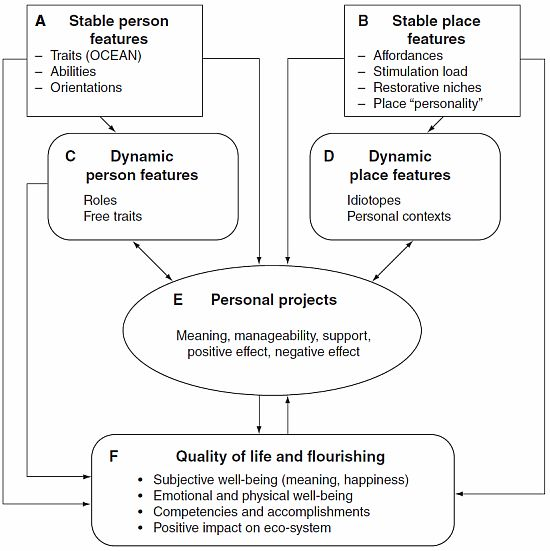
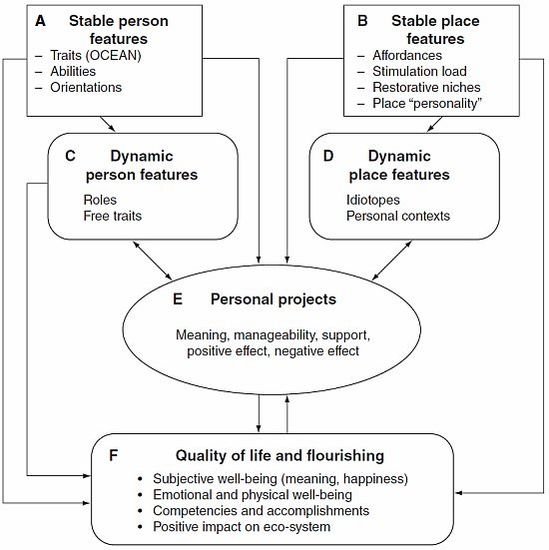
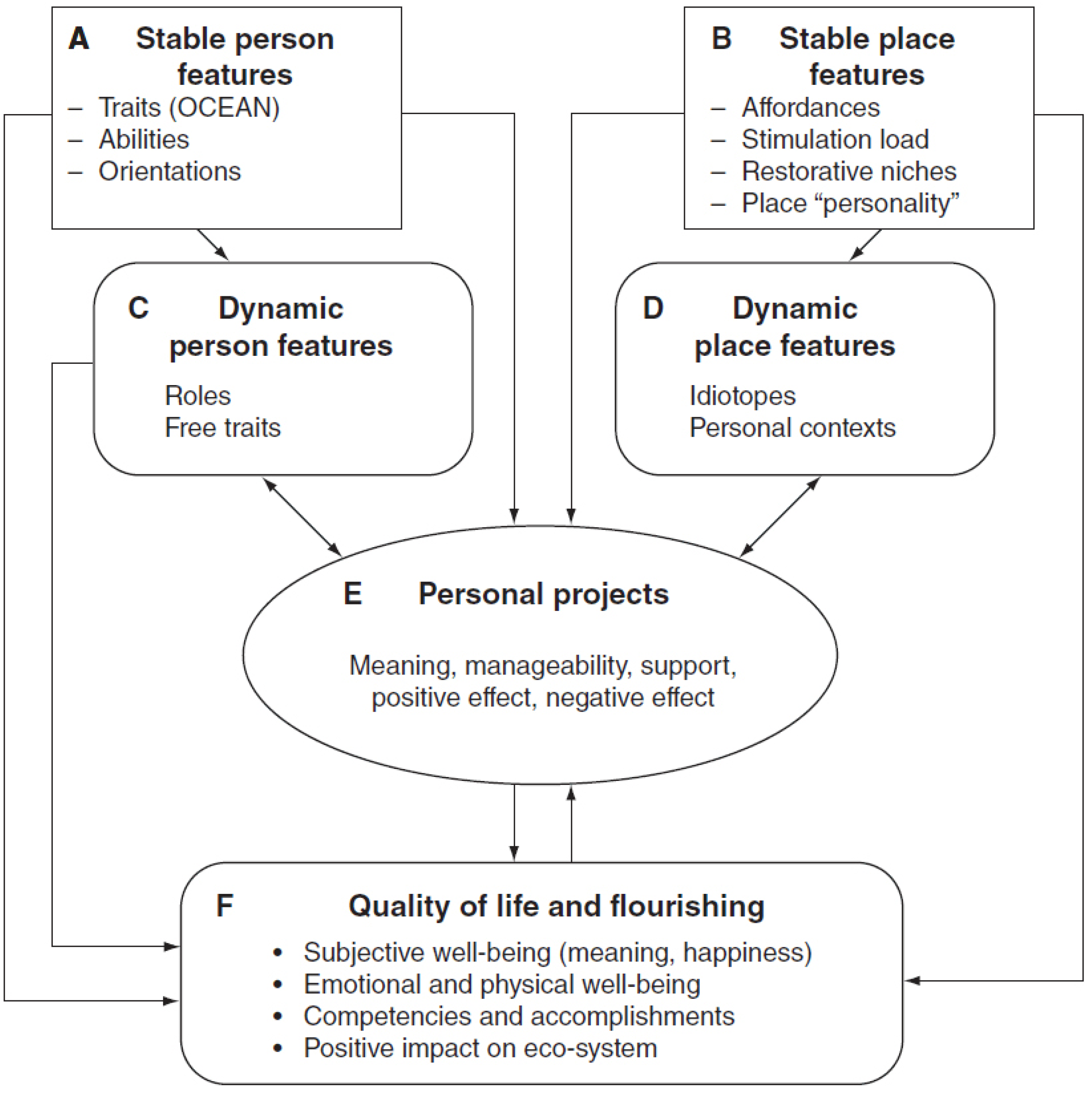
1.1. A Social Ecological Framework for Measuring Human Flourishing
1.2. Restorative Niches
1.3. Young People’s Personal Project System
2. Aim of Study
- (1) What sorts of personal projects are engaging adolescents living in urban Scotland?
- (2) What does the project system tell us about the wellbeing of these adolescents?
- (3) Are project places providing the restorative niche (an environment that supports individual personal projects) necessary to support adolescent wellbeing?
3. Method
3.1. Overview
3.2. Project Elicitation
3.3. Measures
Project Measures
3.4. Scoring and Reliability
3.4.1. Projects
- Interpersonal-family (“help my grandad, he’s quite old”, “get on better with my brother, be less annoyed with him”)
- Interpersonal-friend (“see more of my old friends”, “get on better with my mates’ girlfriend”)
- Self-focused projects (“getting more confident about meeting people”, “express myself, be a bit less shy”)
- Societal (“have a charity sale, maybe a street sale, I’ve done that before”; “take a group camping”; “help people less better off”)
- Sport/Health (“brush up my goal keeping skills”, “improve my fitness, get a wee bit more exercise”)
- Education (“get my homework done on time”, “get better at maths”)
- Career (“go to university, maybe physiotherapy”, “work in the theatre”)
- Hobby (“get better at cooking” “sing more”)
- New Experiences (“scuba diving”, “just explore and stuff”, “go to Barcelona”)
- Autonomy (“I would like to be able to walk or use public transport and use my bike more than ask for lifts”)
3.4.2. Places
4. Results and Discussion
4.1. Descriptive Statistics
4.1.1. What Sorts of Personal Projects are Engaging Young People Living in Urban Scotland?

| Project Type | Relative Mean Frequency (%) ( SD) | ||
|---|---|---|---|
| Total n = 45 | Male n = 26 | Female n = 19 | |
| Sport/health | 0.32 (0.17) | 0.35 (0.02) * | 0.21 (0.09) * |
| Self focused | 0.25 (0.11) | 0.20 (0.09) | 0.28 (0.10) |
| New experiences | 0.24 (0.09) | 0.25 (0.09) | 0.21 (0.07) |
| Interpersonal (family) | 0.23 (0.09) | 0.24 (0.09) | 0.21 (0.09) |
| Interpersonal (friends) | 0.20 (0.07) | 0.22 (0.08) | 0.17 (0.06) |
| Societal | 0.19 (0.08) | 0.16 ( 0.06) * | 0.23 (0.10) * |
| Career | 0.18 ( 0.08) | 0.14 (0.01) * | 0.23 (0.10) * |
| Hobby | 0.17 (0.07) | 0.13 (0.01) * | 0.20 ( 0.08) * |
| Education | 0.16 ( 0.05) | 0.17 (0.05) | 0.13 (0.01) |
| Autonomy | 0.14 (0.08) | 0.13 (0.01) | 0.15 (0.02) |
4.1.2. How are Things Going for the Young People in Our Sample?
| Project Type | Fun Mean (SD) | Stress * Mean (SD) | Efficacy Mean (SD) | Identity Mean (SD) | Support Mean (SD) | Importance * Mean (SD) |
|---|---|---|---|---|---|---|
| Interpersonal family | 3.22 (1.10) | 2.39 (1.13) | 3.25 (0.94) | 2.84 (1.31) | 2.75 (1.30) | 6.07 (1.79) |
| Interpersonal friend | 3.05 (1.07) | 2.39 (1.20) | 3.52 (0.60) | 2.57 (1.33) | 2.57 (1.40) | 4.95 (1.93) |
| Self focused | 2.74 (1.20) | 2.74 (0.99) | 3.19 (0.98) | 3.17 (0.97) | 2.88 (1.20) | 4.57 (2.06) |
| Societal | 3.53 (0.81) | 2.20 (1.16) | 3.34 (0.94) | 2.75 (1.22) | 2.74 (1.21) | 4.69 (2.07) |
| Sport/health | 3.84 (0.52) | 1.87 (0.94) | 3.32 (1.19) | 2.87 (1.19) | 2.79 (1.33) | 3.90 (2.15) |
| Education | 2.51 (1.20) | 2.90 (0.95) | 3.33 (0.82) | 3.33 (0.96) | 2.93 (1.25) | 5.87 (2.11) |
| Career | 3.65 (0.67) | 2.55 (1.05) | 3.57 (0.59) | 2.72 (1.22) | 3.55 (0.74) | 5.03 (2.39) |
| Hobby | 3.71 (0.78) | 1.90 (1.20) | 3.17 (1.22) | 2.45 (1.35) | 2.95 (1.16) | 3.61 (2.23) |
| New experiences | 3.69 (0.78) | 2.25 (1.01) | 3.05 (3.05) | 3.10 (1.13) | 2.48 (1.32) | 3.51 (2.36) |
| Autonomy | 2.60 (1.14) | 2.25 ( 0.50) | 3.20 (1.10) | 2.20 (1.64) | 1.40 (0.54) | 5.00 (0.82) |
4.1.3. What Types of Places are the Projects Being Carried Out in?
| Relative Mean Frequencies (%) ( SD) | ||||
|---|---|---|---|---|
| Project Places | Total n = 45 | Male n = 26 | Female n = 19 | |
| Faraway places (beaches, hills, mountains, overseas) | 0.29 (0.14) | 0.29 (0.15) | 0.28 (0.12) | |
| Home (friend, family) | 0.29 (0.19) | 0.32 (0.21) * | 0.25 (0.15) * | |
| Youth club/School | 0.26 (0.13) | 0.26 (0.12) | 0.27 (0.13) | |
| Local outdoors (street, fields, woods) | 0.25 (0.09) | 0.27 (0.09) * | 0.21 (0.09) * | |
| Sport centre’s (formal) | 0.22 (0.10) | 0.20 (0.12) | 0.25 (0.12) | |
| Town context (shops, cafes, museums) | 0.19 (0.06) | 0.17 (0.06) | 0.25 (0.21) | |
4.2. Latent Class Analysis (LCA)
4.2.1. Results
4.2.2. Latent Class Profiles
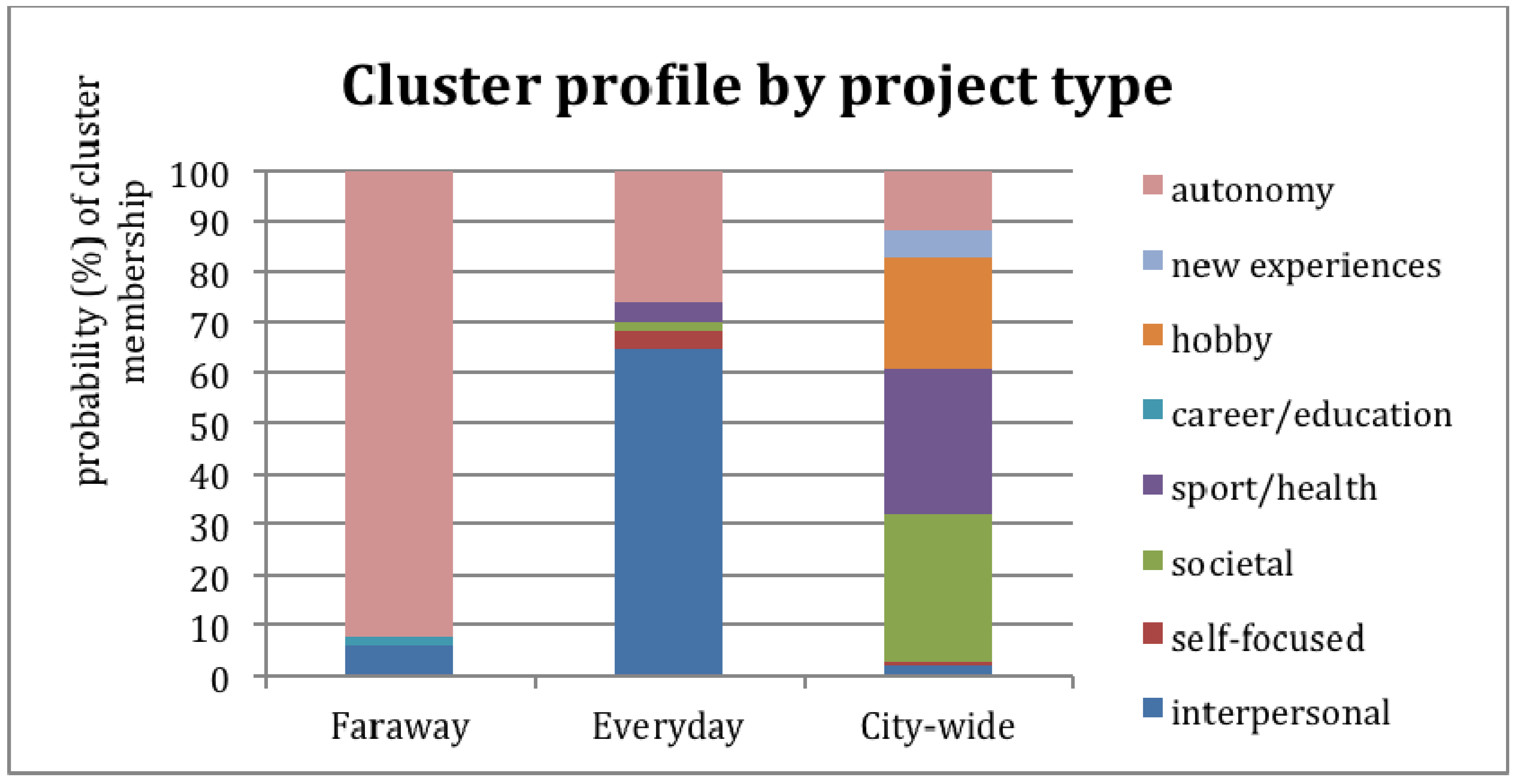
| Cluster 1 | Cluster 2 | Cluster 3 | Wald | p value | R² | |
|---|---|---|---|---|---|---|
| Project place | −2.8602 | 1.2237 | 1.6365 | 25.8119 | 0.0040 | 0.2736 |
| Project type | 0.6685 | 2.1206 | −2.7891 | 27.2128 | 0.018 | 0.3569 |
| Wellbeing Indicators | ||||||
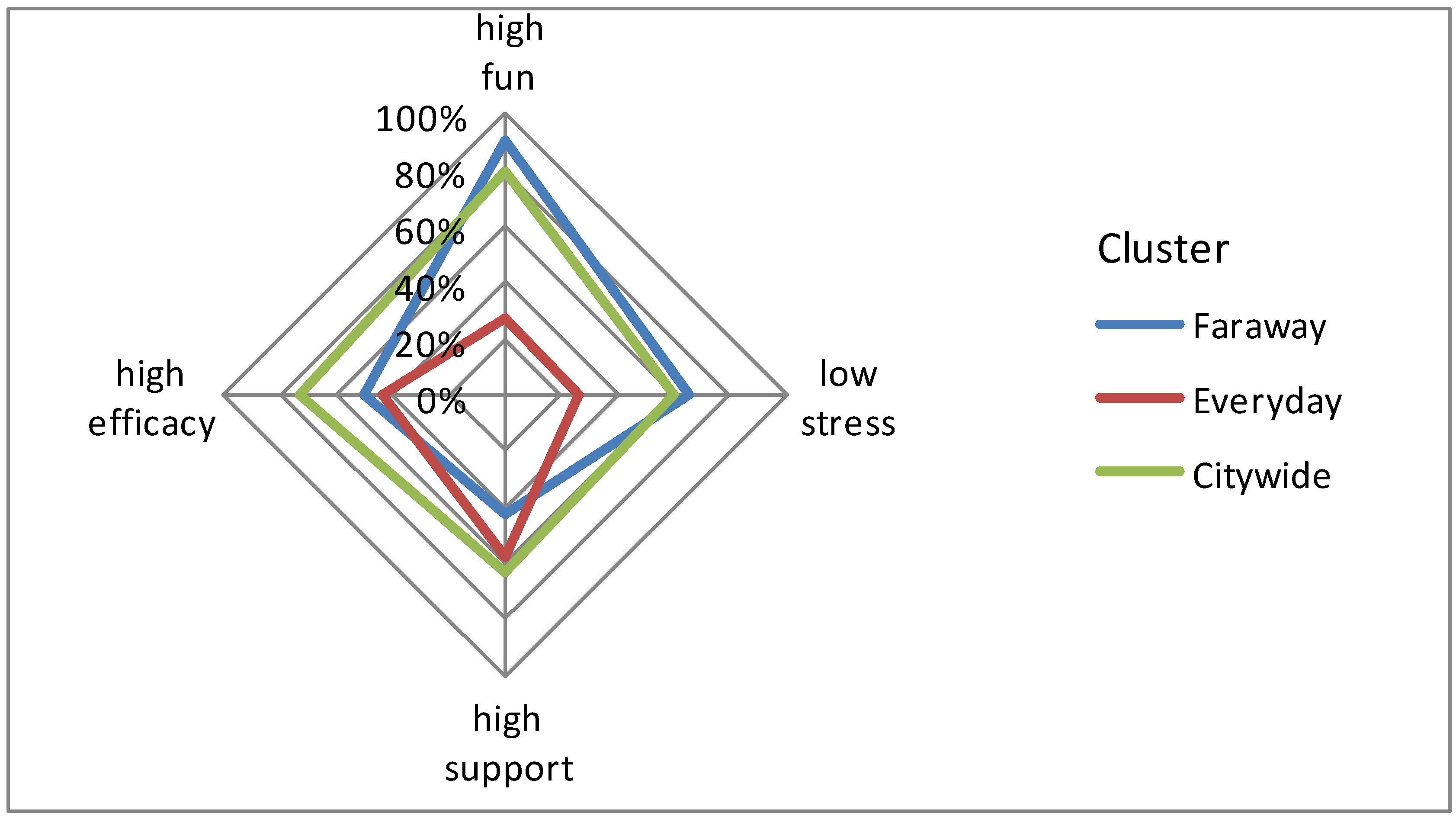
| Fun | 0.8350 | −1.1092 | 0.2741 | 19.8820 | 4.8e–5 | 0.3581 |
| Stress | −0.3752 | 0.6142 | −0.2390 | 10.6165 | 0.0050 | 0.1273 |
| Efficacy | −0.1408 | −0.2838 | 0.4246 | 4.6883 | 0.096 | 0.0579 |
| Support | −0.2797 | 0.0739 | 0.2058 | 3.3959 | 0.18 | 0.0304 |
| Cluster 1 | Cluster 2 | Cluster 3 | |
|---|---|---|---|
| Cluster Size | 0.3549 | 0.3442 | 0.3009 |
| Project Place | |||
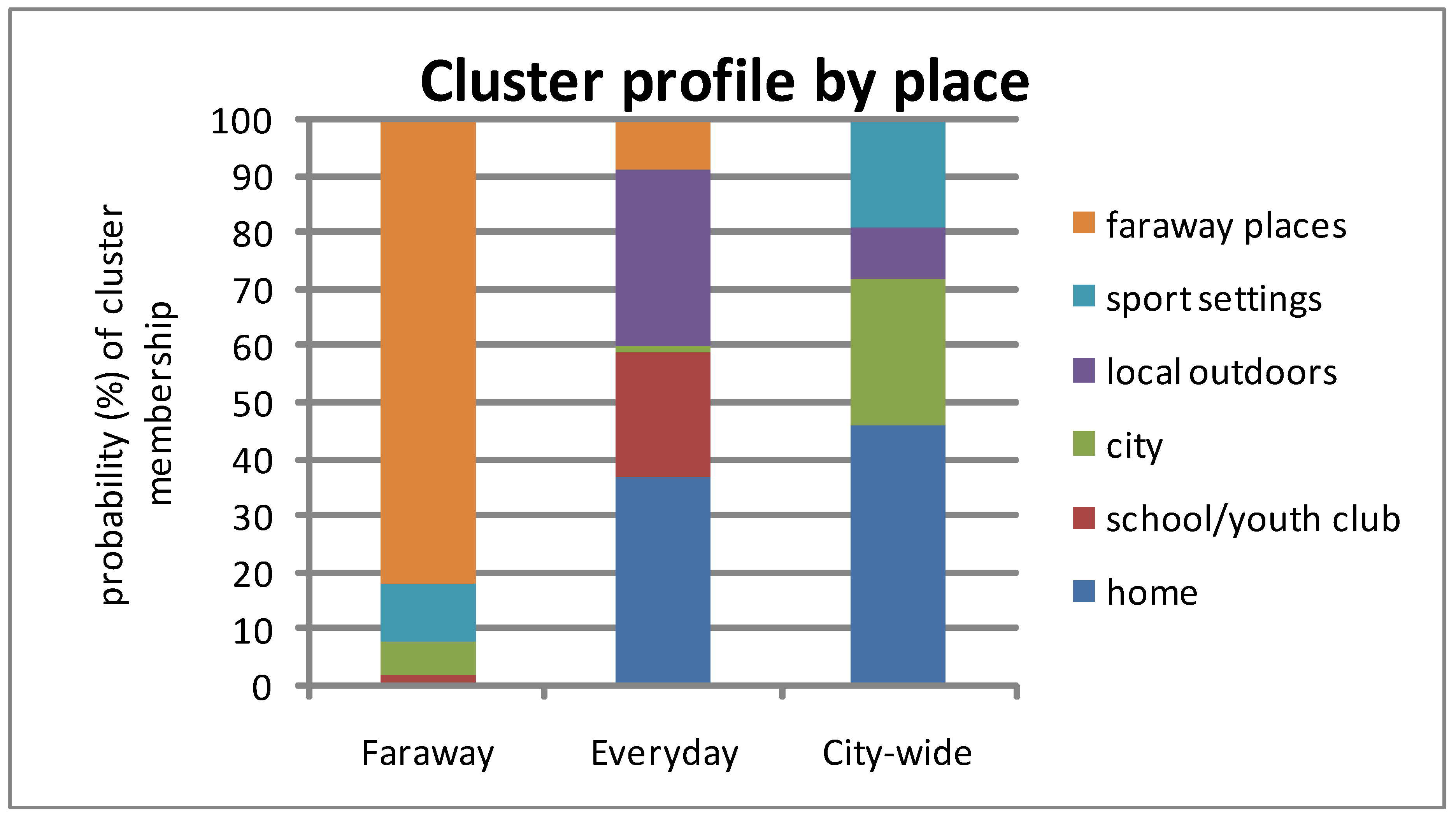
| 1 home | 0.0038 | 0.3702 | 0.4583 |
| 2 school/youth club | 0.0167 | 0.2188 | 0.0007 |
| 3 town | 0.0647 | 0.0092 | 0.2578 |
| 4 local outdoors | 0.0023 | 0.3080 | 0.0881 |
| 5 sports settings | 0.1082 | 0.0008 | 0.1915 |
| 6 faraway places | 0.8043 | 0.0931 | 0.0035 |
| Project Type | |||
| 1 interpersonal | 0.0576 | 0.6543 | 0.0206 |
| 2 self-focused | 0.0001 | 0.0300 | 0.0148 |
| 3 societal | 0.0007 | 0.0255 | 0.2900 |
| 4 sport/health | 0.0013 | 0.0438 | 0.2930 |
| 5 career/education | 0.0208 | 0.0001 | 0.0001 |
| 6 hobby | 0.0006 | 0.0005 | 0.2202 |
| 7 new experiences | 0.0001 | 0.0001 | 0.0490 |
| 8 autonomy | 0.9189 | 0.2457 | 0.1123 |
| Wellbeing | |||
| Fun | |||
| 1–3 (low-mid) | 0.0864 | 0.7272 | 0.1986 |
| 4–4 (high) | 0.9136 | 0.2728 | 0.8014 |
| Mean | 3.8516 | 2.7511 | 3.6589 |
| Stress | |||
| 1–2 (low) | 0.6570 | 0.2593 | 0.6025 |
| 3–4 (high) | 0.3430 | 0.7407 | 0.3975 |
| Mean | 2.0408 | 2.8382 | 2.1500 |
| Efficacy | |||
| 1–3 (low-mid) | 0.4985 | 0.5596 | 0.2735 |
| 4–4 (high) | 0.5015 | 0.4404 | 0.7265 |
| Mean | 3.2441 | 3.1514 | 3.5852 |
| Support | |||
| 1–2 (low) | 0.5727 | 0.4221 | 0.3680 |
| 3–4 (high) | 0.4273 | 0.5779 | 0.6320 |
| Mean | 2.3218 | 2.6912 | 2.8238 |
| Covariates: gender | |||
| Female | 0.3608 | 0.4143 | 0.4545 |
| Male | 0.6392 | 0.5857 | 0.5455 |
4.3. Discussion
Limitations
5. Conclusions
Acknowledgements
References
- Little, B.R. Personal projects: A rationale and method for investigation. Environ. Behav. 1983, 15, 273–309. [Google Scholar] [CrossRef]
- Little, B.R. Prompt and Circumstance: The Generative Context of Personal Project Analysis, Chapter 1. In Personal Project Pursuit: Goals, Action, and Human Flourishing; Little, B.R., Salmela-Aro, K., Phillips, S.D., Eds.; Lawrence Erlbaum Associates: Mahwah, NJ, USA, 2007; pp. 3–50. [Google Scholar]
- Nurmi, J.E. Age, sex, social class, and quality of family interaction as determinants of adolescents’ future orientation: A developmental task interpretation. Adolescence 1987, 22, 977–991. [Google Scholar]
- Cantor, N.; Norem, J.K.; Niedenthal, P.M.; Langston, C.A.; Brower, A.M. Life tasks, self-concept ideals, and cognitive strategies in a life transitio. J. Pers. Soc. Psychol. 1987, 53, 1178–1191. [Google Scholar] [CrossRef]
- Emmons, R.A. Personal strivings: An approach to personality and subjective well-being. J. Pers. Soc. Psychol. 1986, 51, 1058–1068. [Google Scholar] [CrossRef]
- Ward Thompson, C.; Aspinall, P.A. Natural environments and their impact on activity, health and quality of life. Appl. Psychol. Health Wellbeing 2011, 3, 230–260. [Google Scholar] [CrossRef]
- Little, B.R. Opening Space for Project Pursuit: Affordance, Restoration and Chills. In Innovative Approaches to Researching Landscape and Health: Open Space: People Space 2; Ward Thompson, C., Aspinall, P.A., Bell, S., Eds.; Routledge: Abingdon, UK, 2010; pp. 163–178. [Google Scholar]
- Kaplan, R.; Kaplan, S. The Experience of Nature: A Psychological Perspective; Cambridge University Press: New York, NY, USA, 1989. [Google Scholar]
- New Economics Foundation (NEF). Measuring Our Progress, the Power of Wellbeing. 2011. Available online: http://www.neweconomics.org/sites/neweconomics.org/files/Measuring_our_Progress.pdf (accessed on 16 August 2012).
- Seligman, M.E.P. Flourish. A Visionary New Understanding of Happiness and Well-Being; Free Press: New York, NY, USA, 2011. [Google Scholar]
- Hartig, T.; Evans, G.W.; Jamner, L.D.; Davies, D.S.; Garlinge, T. Tracking restoration in natural and urban field settings. J. Environ. Psychol. 2003, 23, 109–123. [Google Scholar] [CrossRef]
- Little, B.R.; Joseph, M.F. Personal Projects and Free Traits: Mutable Selves and Well Beings, Chapter 14. In Personal Project Pursuit: Goals, Action, and Human Flourishing; Little, B.R., Salmela-Aro, K., Phillips, S.D., Eds.; Lawrence Erlbaum Associates: Mahwah, NJ, USA, 2007; pp. 375–400. [Google Scholar]
- Korpela, K.M.; Ylén, M.; Tyrväinen, L.; Silvennoinen, H. Determinants of restorative experiences in everyday favorite places. Health Place 2008, 14, 636–652. [Google Scholar] [CrossRef]
- New Economics Foundation (NEF). The Power and Potential of Well-Being Indicators: Measuring Young People’s Well-Being in Nottingham (Summary). 2004. Available online: http://www.neweconomics.org/sites/neweconomics.org/files/The_Power_and_Potential_of_Well-Being_Indicators_1.pdf (accessed on 16 August 2012).
- Little, B.R. Personal Projects and Fuzzy Selves: Aspects of Self-Identity. In Self and Identity: Perspectives across the Life Span; Honess, T., Yardley, K., Eds.; Routledge & Kegan Paul.: London, UK, 1987; pp. 230–245. [Google Scholar]
- Salmela-Aro, K.; Vuori, J.; Koivisto, P. Adolescents’ motivational orientations, school-subject values, and well-being: A person-centred approach. Hell. J. Psychol. 2007, 4, 310–330. [Google Scholar]
- Bullen, P.L. Identity Projects and Positive Youth Development: The Importance of Efficacy, Integrity and Belonging during Adolescence. Ph.D. Thesis, Department of Psychology, University of Auckland, Auckland, New Zealand, 2010. [Google Scholar]
- Salmela-Aro, K.; Little, B.R. Relational Aspects of Project Pursuit, Chapter 7. In Personal Project Pursuit: Goals, Action, and Human Flourishing; Little, B.R., Salmela-Aro, K., Phillips, S.D., Eds.; Lawrence Erlbaum Associates: Mahwah, NJ, USA, 2007; pp. 199–219. [Google Scholar]
- Wallenius, M. Personal project content and stress: Relations to subjective health and depressive mood. Soc. Indic. Res. 2007, 81, 35–50. [Google Scholar] [CrossRef]
- Harré, N. Community service or activism as an identity project for youth. J. Community Psychol. 2007, 35, 711–724. [Google Scholar] [CrossRef]
- Little, B.R.; Pychyl, T.A.; Gordon, C.C. What’s a Place Like This Doing in a Project Like Me?’. In People Acting in Places—Eastern Psychological Association Conference; New York, NY, USA: 17-20 April 1986.
- Wallenius, M. Personal projects in everyday places: Perceived supportiveness of the environment and psychological well-being. J. Environ. Psychol. 1999, 19, 131–143. [Google Scholar] [CrossRef]
- Carstairs, V.; Morris, R. Deprivation and Health in Scotland; Aberdeen University Press: Aberdeen, Scotland, UK, 1991. [Google Scholar]
- Little, B.R. Personal communication, Department of Social and Developmental Psychology, University of Cambridge: Cambridge, UK, 6 April 2006.
- Nurmi, J.E.; Poole, M.E.; Seginer, R. Tracks and transitions—A comparison of adolescent future-orientated goals, explorations and commitments in Australia, Israel and Finland. Int. J. Psychol. 1995, 30, 355–375. [Google Scholar] [CrossRef]
- Statistical Innovations. Latent Gold Software. Available online: http://www.statisticalinnovations.com (accessed on 16 August 2012).
- McDonald, L.; Hearst, M.; Farbackhsh, K.; Patnode, C.; Forsyth, A.; Sirard, J.; Lytle, L. Adolescent physical activity and the built environment: A latent class analysis approach. Health Place 2012, 18, 191–198. [Google Scholar] [CrossRef]
- Aspinall, P.A. On Quality of Life, Analysis and Evidence-Based Belief. In Open Space, People Space; Ward Thompson, C., Travlou, P., Eds.; Taylor and Francis: London, UK, 2007; pp. 181–194. [Google Scholar]
- Vermunt, J.K.; Magidson, J. Technical Guide for Latent GOLD 4.0: Basic and Advanced; Statistical Innovations Inc.: Belmont, MA, USA, 2005. Available online: http://www.statisticalinnovations. com/products/LGtechnical.pdf (accessed on 16 August 2012).
- Nylund, K.L.; Asparouhov, T.; Muthen, B. Deciding on the number of classes in latent class analysis and growth mixture modeling. A Monte Carlo simulation study. Struct. Equ. Model. 2007, 14, 535–569. [Google Scholar] [CrossRef]
- Currie, C.; Levin, K.; Kirby, J.; Currie, D.; van der Sluijs, W.; Inchley, J. Health Behaviour in School-Aged Children: World Health Organization Collaborative Cross-National Study (HBSC): Findings from the 2010 HBSC Survey in Scotland; Child and Adolescent Health Research Unit, The University of Edinburgh: Edinburgh, UK, 2011. [Google Scholar]
- Schmitt-Rodermund, E.; Vondracek, F.W. Breadth of interests, exploration and identity development in adolescence. J. Vocat. Behav. 1999, 55, 298–317. [Google Scholar] [CrossRef]
- Deci, E.L.; Ryan, R.M. The “what” and “why” of goal pursuits: Human needs and the self-determination of behavior. Psychol. Inq. 2000, 11, 227–268. [Google Scholar] [CrossRef]
- Hartig, T.; Kaiser, F.G.; Bowler, P.A. Further Development of a Measure of Perceived Environmental Restorativeness; Working Paper 5; Institute for Housing Research, Uppsala University: Gävle, Sweden, 1997. [Google Scholar]
© 2012 by the authors; licensee MDPI, Basel, Switzerland. This article is an open-access article distributed under the terms and conditions of the Creative Commons Attribution license (http://creativecommons.org/licenses/by/3.0/).
Share and Cite
Roe, J.J.; Aspinall, P.A. Adolescents’ Daily Activities and the Restorative Niches that Support Them. Int. J. Environ. Res. Public Health 2012, 9, 3227-3244. https://doi.org/10.3390/ijerph9093227
Roe JJ, Aspinall PA. Adolescents’ Daily Activities and the Restorative Niches that Support Them. International Journal of Environmental Research and Public Health. 2012; 9(9):3227-3244. https://doi.org/10.3390/ijerph9093227
Chicago/Turabian StyleRoe, Jenny J., and Peter A. Aspinall. 2012. "Adolescents’ Daily Activities and the Restorative Niches that Support Them" International Journal of Environmental Research and Public Health 9, no. 9: 3227-3244. https://doi.org/10.3390/ijerph9093227