<?xml version="1.0" encoding="UTF-8"?>
<!DOCTYPE article PUBLIC "-//NLM//DTD Journal Publishing DTD v2.3 20070202//EN" "journalpublishing.dtd">
<article xmlns:mml="http://www.w3.org/1998/Math/MathML" xmlns:xlink="http://www.w3.org/1999/xlink" xml:lang="en" article-type="research-article">
  <front>
    <journal-meta>
      <journal-id journal-id-type="publisher-id">ijerph</journal-id>
      <journal-title>International Journal of Environmental Research and Public Health</journal-title>
      <abbrev-journal-title abbrev-type="publisher">Int. J. Environ. Res. Public Health</abbrev-journal-title>
      <abbrev-journal-title abbrev-type="pubmed">International journal of environmental research and public health</abbrev-journal-title>
      <issn pub-type="epub">1660-4601</issn>
      <publisher>
        <publisher-name>MDPI</publisher-name>
      </publisher>
    </journal-meta>
    <article-meta>
      <article-id pub-id-type="doi">10.3390/ijerph9082936</article-id>
      <article-id pub-id-type="publisher-id">ijerph-09-02936</article-id>
      <article-categories>
        <subj-group>
          <subject>Article</subject>
        </subj-group>
      </article-categories>
      <title-group>
        <article-title>Radioactive Iodide (<sup>131</sup>I<sup>−</sup>) Excretion Profiles in Response to Potassium Iodide (KI) and Ammonium Perchlorate (NH<sub>4</sub>ClO<sub>4</sub>) Prophylaxis</article-title>
      </title-group>
      
      <contrib-group>
        <contrib contrib-type="author">
          <name>
            <surname>Harris</surname>
            <given-names>Curtis</given-names>
          </name>
          <xref rid="af1-ijerph-09-02936" ref-type="aff">1</xref>
          <xref rid="c1-ijerph-09-02936" ref-type="corresp">*</xref>
        </contrib>
        <contrib contrib-type="author">
          <name>
            <surname>Dallas</surname>
            <given-names>Cham</given-names>
          </name>
          <xref rid="af1-ijerph-09-02936" ref-type="aff">1</xref>
        </contrib>
        <contrib contrib-type="author">
          <name>
            <surname>Rollor</surname>
            <given-names>Edward</given-names>
			<suffix>III</suffix>
          </name>
          <xref rid="af1-ijerph-09-02936" ref-type="aff">1</xref>
        </contrib>
        <contrib contrib-type="author">
          <name>
            <surname>White</surname>
            <given-names>Catherine</given-names>
          </name>
          <xref rid="af1-ijerph-09-02936" ref-type="aff">1</xref>
        </contrib>
        <contrib contrib-type="author">
          <name>
            <surname>Blount</surname>
            <given-names>Benjamin</given-names>
          </name>
          <xref rid="af2-ijerph-09-02936" ref-type="aff">2</xref>
        </contrib>
        <contrib contrib-type="author">
          <name>
            <surname>Valentin-Blasini</surname>
            <given-names>Liza</given-names>
          </name>
          <xref rid="af2-ijerph-09-02936" ref-type="aff">2</xref>
        </contrib>
        <contrib contrib-type="author">
          <name>
            <surname>Fisher</surname>
            <given-names>Jeffrey</given-names>
          </name>
          <xref rid="af3-ijerph-09-02936" ref-type="aff">3</xref>
        </contrib>
      </contrib-group>
      <aff id="af1-ijerph-09-02936"><label>1 </label>Institute for Health Management and Mass Destruction Defense, College of Public Health, University of Georgia, Athens, GA 30603, USA; Email: <email>cdallas@ihmd.uga.edu</email> (C.D.); <email>erollor@ihmd.uga.edu</email> (E.R.); <email>cwhite@rx.uga.edu</email> (C.W.)</aff>
      <aff id="af2-ijerph-09-02936"><label>2 </label>National Center for Environmental Health, Division of Laboratory Sciences, Centers for Disease Control and Prevention, Atlanta, GA 30341, USA; Email: <email>bkb3@cdc.gov</email> (B.B.); <email>lbv5@cdc.gov</email>‎ (L.V.-B.)</aff>
      <aff id="af3-ijerph-09-02936"><label>3 </label>National Center for Toxicological Research, U.S. Food and Drug Administration, Jefferson, AR 72079, USA; Email: <email>jeffrey.fisher@fda.hhs.gov</email> (J.F.)</aff>
	  <author-notes>
        <corresp id="c1-ijerph-09-02936"><label>*</label> Author to whom correspondence should be addressed; Email: <email>charris@ihmd.uga.edu</email>; Tel.: +1-706-380-1456; Fax: +1-706-542-5254.</corresp>
      </author-notes>
      <pub-date pub-type="epub">
        <day>16</day>
        <month>08</month>
        <year>2012</year>
      </pub-date>
      <pub-date pub-type="ppub"><month>08</month>
        <year>2012</year>
      </pub-date>
      <volume>9</volume>
      <issue>8</issue>
      <fpage>2936</fpage>
      <lpage>2948</lpage>
      <history>
        <date date-type="received">
          <day>21</day>
          <month>06</month>
          <year>2012</year>
        </date>
        <date date-type="rev-recd">
          <day>12</day>
          <month>07</month>
          <year>2012</year>
        </date>
        <date date-type="accepted">
          <day>09</day>
          <month>08</month>
          <year>2012</year>
        </date>
      </history>
      <permissions>
        <copyright-statement>© 2012 by the authors; licensee MDPI, Basel, Switzerland.</copyright-statement>
        <copyright-year>2012</copyright-year>
        <license xmlns:xlink="http://www.w3.org/1999/xlink" license-type="open-access" xlink:href="http://creativecommons.org/licenses/by/3.0/">
          <p>This article is an open-access article distributed under the terms and conditions of the Creative Commons Attribution license (http://creativecommons.org/licenses/by/3.0/).</p>
        </license>
      </permissions>
      <abstract>
        <p>Radioactive iodide (<sup>131</sup>I<sup>−</sup>) protection studies have focused primarily on the thyroid gland and disturbances in the hypothalamic-pituitary-thyroid axis. The objective of the current study was to establish <sup>131</sup>I<sup>−</sup> urinary excretion profiles for saline, and the thyroid protectants, potassium iodide (KI) and ammonium perchlorate over a 75 hour time-course. Rats were administered <sup>131</sup>I<sup>−</sup> and 3 hours later dosed with either saline, 30 mg/kg of NH<sub>4</sub>ClO<sub>4</sub> or 30 mg/kg of KI. Urinalysis of the first 36 hours of the time-course revealed that NH<sub>4</sub>ClO<sub>4</sub> treated animals excreted significantly more <sup>131</sup>I<sup>−</sup> compared with KI and saline treatments. A second study followed the same protocol, but thyroxine (T<sub>4</sub>) was administered daily over a 3 day period. During the first 6–12 hour after <sup>131</sup>I<sup>−</sup> dosing, rats administered NH<sub>4</sub>ClO<sub>4</sub> excreted significantly more <sup>131</sup>I<sup>−</sup> than the other treatment groups. T<sub>4</sub> treatment resulted in increased retention of radioiodide in the thyroid gland 75 hour after <sup>131</sup>I<sup>−</sup> administration. We speculate that the T<sub>4</sub> treatment related reduction in serum TSH caused a decrease synthesis and secretion of thyroid hormones resulting in greater residual radioiodide in the thyroid gland. Our findings suggest that ammonium perchlorate treatment accelerates the elimination rate of radioiodide within the first 24 to 36 hours and thus may be more effective at reducing harmful exposure to <sup>131</sup>I<sup>−</sup> compared to KI treatment for repeated dosing situations. Repeated dosing studies are needed to compare the effectiveness of these treatments to reduce the radioactive iodide burden of the thyroid gland.</p>
      </abstract>
      <kwd-group>
        <kwd>perchlorate</kwd>
        <kwd>iodide</kwd>
        <kwd>radioiodide</kwd>
        <kwd>thyroid</kwd>
      </kwd-group>
    </article-meta>
  </front>
  <body>
    <sec sec-type="intro">
      <title>1. Introduction</title>
      <p>Stable iodide (<sup>127</sup>I<sup>−</sup>), as potassium iodide (KI) or “dietary iodine”, has been recognized for over 30 years as a practical thyroid radioprotectant for people exposed to radioactive isotopes of iodide [<xref ref-type="bibr" rid="B1-ijerph-09-02936">1</xref>,<xref ref-type="bibr" rid="B2-ijerph-09-02936">2</xref>]. In a recent National Academies of Science report on the distribution and administration of KI in the event of a nuclear incident [<xref ref-type="bibr" rid="B3-ijerph-09-02936">3</xref>], sodium perchlorate (Irenat<sup>®</sup>) was recommended for adults if KI treatment was contraindicated, such as in patients with preexisting thyroid disease. Successful thyroid radioprotectant treatments, such as KI or ammonium perchlorate (NH<sub>4</sub>ClO<sub>4</sub>), are judged by their ability to block or limit thyroidal uptake of trace amounts of radioactive iodide (e.g., <sup>131</sup>I<sup>−</sup>), while limited research has focused on treatment doses promoting excretion of the isotopes. Currently, the United States Food and Drug Administration (US FDA) recommends KI tablets as a preventative treatment for <sup>131</sup>I<sup>−</sup> poisoning of the thyroid gland [<xref ref-type="bibr" rid="B4-ijerph-09-02936">4</xref>]. </p>
      <p>Studies utilizing rats in the 1950s and 1960s demonstrated that perchlorate (ClO<sub>4</sub><sup>−</sup>) altered the serum pharmacokinetics of <sup>131</sup>I<sup>−</sup> [<xref ref-type="bibr" rid="B5-ijerph-09-02936">5</xref>,<xref ref-type="bibr" rid="B6-ijerph-09-02936">6</xref>,<xref ref-type="bibr" rid="B7-ijerph-09-02936">7</xref>]. The kinetic profile of <sup>131</sup>I<sup>−</sup> in laboratory animals treated with ClO<sub>4</sub><sup>−</sup> was characterized by decreased serum <sup>131</sup>I<sup>−</sup> levels and increased urine <sup>131</sup>I<sup>−</sup> levels [<xref ref-type="bibr" rid="B6-ijerph-09-02936">6</xref>]. In the presence of ClO<sub>4</sub><sup>−</sup>, <sup>131</sup>I<sup>−</sup> is excreted in urine more rapidly, presumably because perchlorate blocks basolateral and/or apical uptake of <sup>131</sup>I<sup>−</sup> into sodium iodide symporter- or pendrin-protein rich tissues, such as the thyroid and small intestine [<xref ref-type="bibr" rid="B5-ijerph-09-02936">5</xref>,<xref ref-type="bibr" rid="B8-ijerph-09-02936">8</xref>,<xref ref-type="bibr" rid="B9-ijerph-09-02936">9</xref>,<xref ref-type="bibr" rid="B10-ijerph-09-02936">10</xref>,<xref ref-type="bibr" rid="B11-ijerph-09-02936">11</xref>,<xref ref-type="bibr" rid="B12-ijerph-09-02936">12</xref>]. Additionally, perchlorate administration displaces non-organified iodide from the thyroid, and the perchlorate discharge test has been used to diagnose iodide organification defects in humans for decades [<xref ref-type="bibr" rid="B10-ijerph-09-02936">10</xref>]. Perchlorate has been shown to have side effects ranging from rash and fever to several fatal cases of aplastic anemia [<xref ref-type="bibr" rid="B13-ijerph-09-02936">13</xref>,<xref ref-type="bibr" rid="B14-ijerph-09-02936">14</xref>], though these effects typically manifest from large bolus doses administered over weeks or months [<xref ref-type="bibr" rid="B15-ijerph-09-02936">15</xref>]. </p>
      <p>Rats administered ClO<sub>4</sub><sup>−</sup> intravenously (0.1–3.0 mg/kg) excreted approximately 83% of the administered ClO<sub>4</sub><sup>−</sup> dose over 24 hours [<xref ref-type="bibr" rid="B16-ijerph-09-02936">16</xref>]. In a similar experiment, these authors also intravenously dosed rats with 3.3 mg/kg of isotonically labeled ClO<sub>4</sub><sup>−</sup> (<sup>36</sup>ClO<sub>4</sub>) and reported that 96% of the dose was excreted in 24 hours and 99.5% by 48 hours [<xref ref-type="bibr" rid="B17-ijerph-09-02936">17</xref>]. In a recent study, an oral dose of 30 mg/kg of ClO<sub>4</sub><sup>−</sup> was administered to rats, and 38% of the dose was recovered in urine within the first 12 hours after dosing [<xref ref-type="bibr" rid="B15-ijerph-09-02936">15</xref>]. </p>
      <p>In the present rat study, the effectiveness of KI and NH<sub>4</sub>ClO<sub>4</sub> to increase excretion of <sup>131</sup>I<sup>−</sup> into urine over a 3 day period was assessed, with and without T<sub>4</sub> administration. In previous rat studies we reported that over a 15 hour post dosing period, KI and NH<sub>4</sub>ClO<sub>4</sub> were equally effective at reducing thyroid gland exposure to <sup>131</sup>I<sup>−</sup> [<xref ref-type="bibr" rid="B15-ijerph-09-02936">15</xref>]. However, NH<sub>4</sub>ClO<sub>4</sub> was more effective at increasing urinary clearance of <sup>131</sup>I<sup>−</sup> than KI. This study extends the timeframe of the experiment from 15 to 75 hours and also evaluates the influence of T<sub>4</sub> administration on <sup>131</sup>I<sup>−</sup> kinetics. Rats, unlike humans, have short thyroxine half-lives in serum, and are sensitive to up-regulation of the thyroid gland by thyroid stimulating hormone (TSH) [<xref ref-type="bibr" rid="B18-ijerph-09-02936">18</xref>]. To control the potential for TSH mediated stimulation of the thyroid gland, one subset of rats for each treatment group received replacement doses of T<sub>4</sub> to suppress the potential for TSH release [<xref ref-type="bibr" rid="B19-ijerph-09-02936">19</xref>,<xref ref-type="bibr" rid="B20-ijerph-09-02936">20</xref>].</p>
    </sec>
    <sec>
      <title>2. Materials and Methods</title>
      <sec>
        <title>2.1. Chemicals</title>
        <p>Ammonium perchlorate (99.8%), 100% ethanol, and sodium hydroxide were purchased from Aldrich (Milwaukee, WI, USA). Nonradioactive thyroxine was purchased from Sigma Chemical Corporation (St. Louis, MO, USA). Potassium iodide was obtained from J. T. Baker (Phillipsburg, NJ, USA), carrier-free iodide-131 (<sup>131</sup>I<sup>−</sup>) from Amersham Biosciences (29.4 mCi/µg), acepromazine maleate (10 mg/mL) and ketamine HCl (100 mg/mL) from Fort Dodge Animal Health (Fort Dodge, IA, USA) and xylazine (20 mg/mL) from Ben Venue Laboratories (Bedford, OH, USA). Isoflurane (99.9%) was purchased from Abbott Laboratories (Abbott Park, IL, USA). </p>
      </sec>
      <sec>
        <title>2.2. Animals and Experimental Design</title>
        <p>Male Sprague-Dawley rats (330 ± 30 g, approximately 11 weeks old) from Harlan Laboratories (Indianapolis, IN, USA) were provided LabDiet™ Laboratory Rodent Diet 5001 rat chow and water <italic>ad libitum</italic>. The animals used in this study were handled in accordance with the procedures of The University of Georgia Institutional Animal Care and Use Committee (IACUC), AUP# A2005-10110-0. The rats experienced a 12 hour light and dark cycle, with room air temperature at 22 ± 2 °C and relative humidity at 50 ± 20%. </p>
        <p>Rats were housed individually in metabolism cages for a 5 day acclimation period prior to the start of the experiments. Twelve hours before the experiment commenced, food was removed from the animals to ensure complete absorption of the radiotracer and treatment doses. A summary of the experiments is shown in <xref ref-type="table" rid="ijerph-09-02936-t001">Table 1</xref>. The general experimental protocol was to dose rats orally with 2.91 µCi (6 ng/kg) <sup>131</sup>I<sup>−</sup> in saline solution (1 mL) by oral gavage and then return the rats to their metabolism cages. Rats from Group 1 (n = 6 for each treatment group) were removed from their metabolism cages after 3 hours and dosed by oral gavage with 1 mL of either 0.9% saline, 30 mg/kg of KI (calculated as iodide) or 30 mg/kg of NH<sub>4</sub>ClO<sub>4</sub> (calculated as ClO<sub>4</sub><sup>−</sup>) dissolved in 0.9% aqueous saline. Rats from Group 2 (n = 6 for each treatment group) followed the same experimental protocol as Group 1 except each animal received a 0.1 mL intraperitoneal (ip) injection of 15 µg/kg of T<sub>4</sub> (based on euthyroid replacement T<sub>4</sub> doses administered by [<xref ref-type="bibr" rid="B21-ijerph-09-02936">21</xref>]) dissolved in 0.1 M NaOH and 1 animal from each treatment group received a 0.1 mL ip injection of 0.1 M NaOH (controls). Data from animals in Group 2 that received ip injections of NaOH had not statistically different from animals of a similar treatment in Group 1. As a result, data from animals in Group 2 that received ip injections of NaOH were assimilated with animals of a similar treatment in Group 1. The rats were held in metabolism cages for 75 hours for urine collections. Urine from Groups 1 and 2 were collected via metabolism cage vials at +3, 6, 12, 18, 24, 30, 36, 42, 48, 54, 60, 66, 72, and 75 hours. Blood was collected from the tail vein of animals in dose Groups 1 and 2 at 15 hours after dosing with <sup>131</sup>I<sup>−</sup> and at sacrifice. At sacrifice (75 hours after dosing with <sup>131</sup>I<sup>−</sup>), animals in Groups 1 and 2 were anesthetized with a ketamine cocktail (50 mg/kg ketamine, 3.3 mg/kg xylazine, and 3.4 mg/kg acepromazine administered at 0.1 mL per 100 g BW), then killed by asphyxiation at +75 hours. Blood was collected via cardiac puncture and serum prepared by centrifugation at 1,500 rpm at 4 °C for 15 min. Thyroid lobes were removed from the trachea and weighed. Urine was removed from the bladder via syringe. Sera, urine, and thyroid glands were stored at −80 °C until analysis.</p>
        <table-wrap id="ijerph-09-02936-t001" position="anchor">
          <object-id pub-id-type="pii">ijerph-09-02936-t001_Table 1</object-id>
          <label>Table 1</label>
          <caption>
            <p>Summary of experiments in the rat to characterize excretion profiles of <sup>131</sup>I<sup>−</sup> following prophylactic administration of saline, KI, or perchlorate with and without T<sub>4</sub> hormone replacement.</p>
          </caption>
          <table>
            <thead>
              <tr align="center">
                <th valign="middle">Experiment</th>
                <th valign="middle">Description</th>
                <th valign="middle">Dose (mg/kg)</th>
                <th valign="middle">Urine Collection Times (hours)</th>
                <th valign="middle">T<sub>4</sub> Injection Times (hours)</th>
                <th valign="middle">Serum and Thyroid Collection Time (hours)</th>
              </tr>
            </thead>
            <tbody>
              <tr>
                <td align="left" valign="middle"><bold>Group 1</bold> (n = 36) 12 rats each for saline, KI and NH<sub>4</sub>ClO<sub>4</sub> treatment groups</td>
                <td align="center" valign="middle">Single oral dose of <sup>131</sup>I<sup>−</sup> followed 3 hours later by single oral doses of saline, KI, or NH<sub>4</sub>ClO<sub>4</sub></td>
                <td align="center" valign="middle">ORAL <sup>131</sup>I<sup>−</sup>: 6 × 10<sup>−6</sup> KI: 30 ClO<sub>4</sub>: 30</td>
                <td align="center" valign="middle">3, 6, 12, 18, 24, 30, 36, 42, 48, 54, 60, 66, 72, and 75</td>
                <td align="center" valign="middle">---</td>
                <td align="center" valign="middle">Serum: 15 and 75 Thyroid: 75</td>
              </tr>
              <tr style="border-top:solid thin">
                <td align="left" valign="middle"><bold>Group 2</bold> (n = 18) 6 rats each for saline, KI and NH<sub>4</sub>ClO<sub>4</sub> treatment groups</td>
                <td align="center" valign="middle">Equal to Group 1</td>
                <td align="center" valign="middle">Equal to Group 1 ip T<sub>4</sub>: 0.015</td>
                <td align="center" valign="middle">Equal to Group 1</td>
                <td align="center" valign="middle">T<sub>4</sub> doses at time of saline, KI and NH<sub>4</sub>ClO<sub>4</sub> doses, then 24, and 48 hours later</td>
                <td align="center" valign="middle">Serum: 15 and 75 Thyroid: 75</td>
              </tr>
            </tbody>
          </table>
        </table-wrap>
      </sec>
      <sec>
        <title>2.3. <sup>131</sup>I<sup>−</sup> Analysis</title>
        <p>Serial urine samples were placed on a gamma counter (1470 Wallac Wizard) equipped with one detector and <sup>131</sup>I<sup>−</sup> counts/minute (cpm) were measured within 2 hours after collection. <sup>131</sup>I<sup>−</sup> cpm were also assessed in whole thyroids and serum samples within 2 hours of sacrifice. Raw counts were recorded. Urine and sera were then stored at −80 °C for no less than 80 days (10 half-lives for <sup>131</sup>I<sup>−</sup>) in order for the radioactivity to decay.</p>
        <p>Serum TSH measurements were made using a rat TSH radioimmunoassay kit from A. F. Parlow and the National Hormone &amp; Peptide Program (lot numbers AFP329691Rb, AFP11542B, and AFP5512B).</p>
      </sec>
      <sec>
        <title>2.4. <sup>127</sup>I<sup>−</sup> and ClO<sub>4</sub><sup>−</sup> Analysis</title>
        <p>Non-radioactive analytes (<sup>127</sup>I<sup>−</sup> and ClO<sub>4</sub><sup>−</sup>) were quantified using ion chromatography coupled with tandem mass spectrometry. Serum samples were spiked with internal standard (<sup>129</sup>I<sup>−</sup> and Cl<sup>18</sup>O<sub>4</sub><sup>−</sup>), treated to remove proteins, and analyzed by ion chromatography electrospray ionization tandem mass spectrometry [<xref ref-type="bibr" rid="B22-ijerph-09-02936">22</xref>]. Urine samples were spiked with internal standard (<sup>129</sup>I<sup>−</sup> and Cl<sup>18</sup>O<sub>4</sub><sup>−</sup>) and analyzed by ion chromatography electrospray ionization tandem mass spectrometry [<xref ref-type="bibr" rid="B23-ijerph-09-02936">23</xref>]. </p>
      </sec>
      <sec>
        <title>2.5. Urinary Excretion Kinetics of Anions</title>
        <p>All urine samples for Groups 1 and 2 were analyzed for <sup>131</sup>I<sup>−</sup> excretion kinetics. Animals in Groups 1 and 2 that received <sup>127</sup>I<sup>−</sup> or ClO<sub>4</sub><sup>−</sup> also had urine samples analyzed for <sup>127</sup>I<sup>−</sup> or ClO<sub>4</sub><sup>−</sup> excretion kinetics. All half-life calculations were prepared using Win Non Lin 5.2 software. </p>
      </sec>
      <sec>
        <title>2.6. Statistical Analysis</title>
        <p>Single factor analysis of variance (ANOVA) was used initially to determine significance across the treatment groups (control saline, KI and NH<sub>4</sub>ClO<sub>4</sub>) with statistical significance set at <italic>p</italic> &lt; 0.05. Once statistical significance was determined across the treatment groups by ANOVA, a limited number of comparisons were carried out using a two-sample t-test (assuming equal variance) to compare each treatment group (<italic>p</italic> &lt; 0.05) to control and to each other. All calculations were performed using Microsoft Excel. It should be noted that animals in Group 2 that received ip injections of NaOH were lumped together with animals in Group 1 of a similar treatment dose, <italic>i.e.</italic>, saline, KI, or ClO<sub>4</sub><sup>−</sup>.</p>
      </sec>
    </sec>
    <sec sec-type="results">
      <title>3. Results</title>
      <sec>
        <title>3.1. <sup>131</sup>I<sup>−</sup> Excretion in Urine</title>
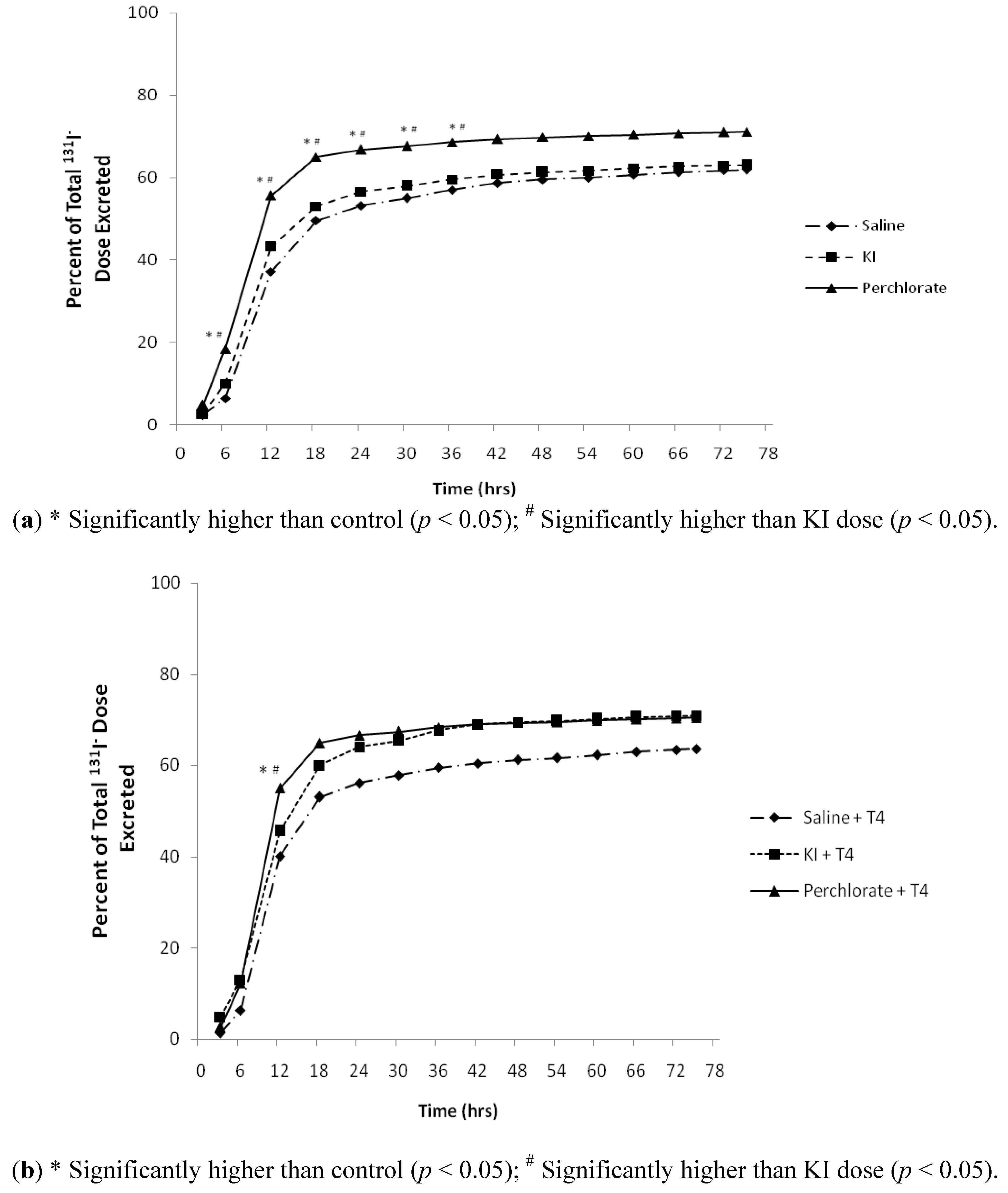
        <p>Rats were administered <sup>131</sup>I<sup>−</sup>, then 3 hours later either saline, 30 mg/kg of KI or 30 mg/kg of NH<sub>4</sub>ClO<sub>4</sub> by oral bolus gavage. Group 2 was distinguished from Group 1 (<xref ref-type="table" rid="ijerph-09-02936-t001">Table 1</xref>) by repeated T<sub>4</sub> administration, first at the time of dosing with saline, KI or NH<sub>4</sub>ClO<sub>4</sub>, then at +27 hours and +51 hours during the time-course. The 3-day cumulative volumes of urine produced were 39.7 ± 7.7 mL for Group 1 and 41.3 ± 5.7 mL for Group 2. In Group 1, 71, 63, and 62% of the administered <sup>131</sup>I<sup>−</sup> doses for NH<sub>4</sub>ClO<sub>4</sub>, KI, and control saline treatment groups, respectively (<xref ref-type="fig" rid="ijerph-09-02936-f001">Figure 1</xref>a), were excreted in urine by 75 hours after dosing with <sup>131</sup>I<sup>−</sup>. In Group 2, 72, 71, and 63% of the administered doses of <sup>131</sup>I<sup>−</sup> were excreted in urine for the NH<sub>4</sub>ClO<sub>4</sub>, KI, and saline control treatment groups, respectively (<xref ref-type="fig" rid="ijerph-09-02936-f001">Figure 1</xref>b) by 75 hours after dosing with <sup>131</sup>I<sup>−</sup>. Most of the <sup>131</sup>I<sup>−</sup> collected over the 3-day period (60.5 ± 6%) was excreted in urine by 24 hours after dosing in all treatments for Groups 1 and 2 (<xref ref-type="fig" rid="ijerph-09-02936-f001">Figure 1</xref>(a,b)). The 24-hour urinary excretion half-lives for <sup>131</sup>I<sup>−</sup> (<xref ref-type="table" rid="ijerph-09-02936-t002">Table 2</xref>) in control and KI treated rats ranged from 3.5 to 4 hours; conversely, NH<sub>4</sub>ClO<sub>4</sub> treated rats excreted <sup>131</sup>I<sup>−</sup> more rapidly (2.6 hour urinary excretion half-life, <italic>p</italic> &lt; 0.001). </p>
        <table-wrap id="ijerph-09-02936-t002" position="anchor">
          <object-id pub-id-type="pii">ijerph-09-02936-t002_Table 2</object-id>
          <label>Table 2</label>
          <caption>
            <p>Twenty four hour urinary excretion half-lives for <sup>131</sup>I<sup>−</sup> for Group 1 and 2 rats.</p>
          </caption>
          <table>
            <thead>
              <tr align="center">
                <th colspan="3" valign="middle"><sup>131</sup>I<sup>−</sup> Excretion Half Lives (hours)</th>
              </tr>
              <tr align="center" style="border-top:solid thin">
                <th valign="middle"> </th>
                <th valign="middle">Group 1 <sup>131</sup>I<sup>−</sup></th>
                <th valign="middle">Group 2 <sup>131</sup>I<sup>−</sup> + T<sub>4</sub></th>
              </tr>
            </thead>
            <tbody>
              <tr align="center">
                <td valign="middle">Saline Control</td>
                <td valign="middle">4.0 ± 0.7</td>
                <td valign="middle">3.7 ± 1.2</td>
              </tr>
              <tr align="center" style="border-top:solid thin">
                <td valign="middle">KI</td>
                <td valign="middle">3.5 ± 0.5</td>
                <td valign="middle">3.8 ± 0.3</td>
              </tr>
              <tr align="center" style="border-top:solid thin">
                <td valign="middle">NH<sub>4</sub>ClO<sub>4</sub></td>
                <td valign="middle">2.6 ± 0.4 <sup>*,#</sup></td>
                <td valign="middle">2.6 ± 0.4 <sup>*,#</sup></td>
              </tr>
            </tbody>
          </table>
		  <table-wrap-foot><fn>
			<p>Rats for each Group were orally dosed with <sup>131</sup>I<sup>−</sup> and then 3 hours later orally dosed with saline, KI (30 mg/kg), or NH<sub>4</sub>ClO<sub>4</sub> (30 mg/kg). Group 2 rats also received ip injections of thyroxine (0.015 mg/kg) 3 hours following <sup>131</sup>I<sup>−</sup> administration and then every 24 hours until the conclusion of the experiment. Urine for each Group was collected for 24 hours; * statistically significantly lower than saline treatment (<italic>p</italic> &lt; 0.001); <sup>#</sup> statistically significantly lower than KI treatment (<italic>p</italic> &lt; 0.001).</p>
		  </fn></table-wrap-foot>
        </table-wrap>
        <fig id="ijerph-09-02936-f001" position="anchor">
          <label>Figure 1</label>
          <caption>
            <p>(<bold>a</bold>) Percent of total <sup>131</sup>I<sup>−</sup> dose excreted in urine 75 hour of Group 1 male rats collected via metabolism cages dosed with <sup>131</sup>I<sup>−</sup> followed by saline, KI (30 mg/kg), or perchlorate (30 mg/kg) 3 hours later (n = 12), statistical analysis was conducted on concentration data for each individual time-point (data not shown); (<bold>b</bold>) Percent of total <sup>131</sup>I<sup>−</sup> dose excreted in 75 hour urine of Group 2 male rats collected via metabolism cages dosed with <sup>131</sup>I<sup>−</sup> followed by saline, KI (30 mg/kg), or perchlorate (30 mg/kg) at +3 hours and dosed with replacement T<sub>4</sub> at +3, +27, and +51 hours (n = 6), statistical analysis was conducted on concentration data for each individual time-point (data not shown).</p>
          </caption>
          <graphic xmlns:xlink="http://www.w3.org/1999/xlink" xlink:href="ijerph-09-02936-g001.tif"/>
        </fig>
        
      </sec>
      <sec>
        <title>3.2. <sup>131</sup>I<sup>−</sup> in Serum and Thyroid</title>
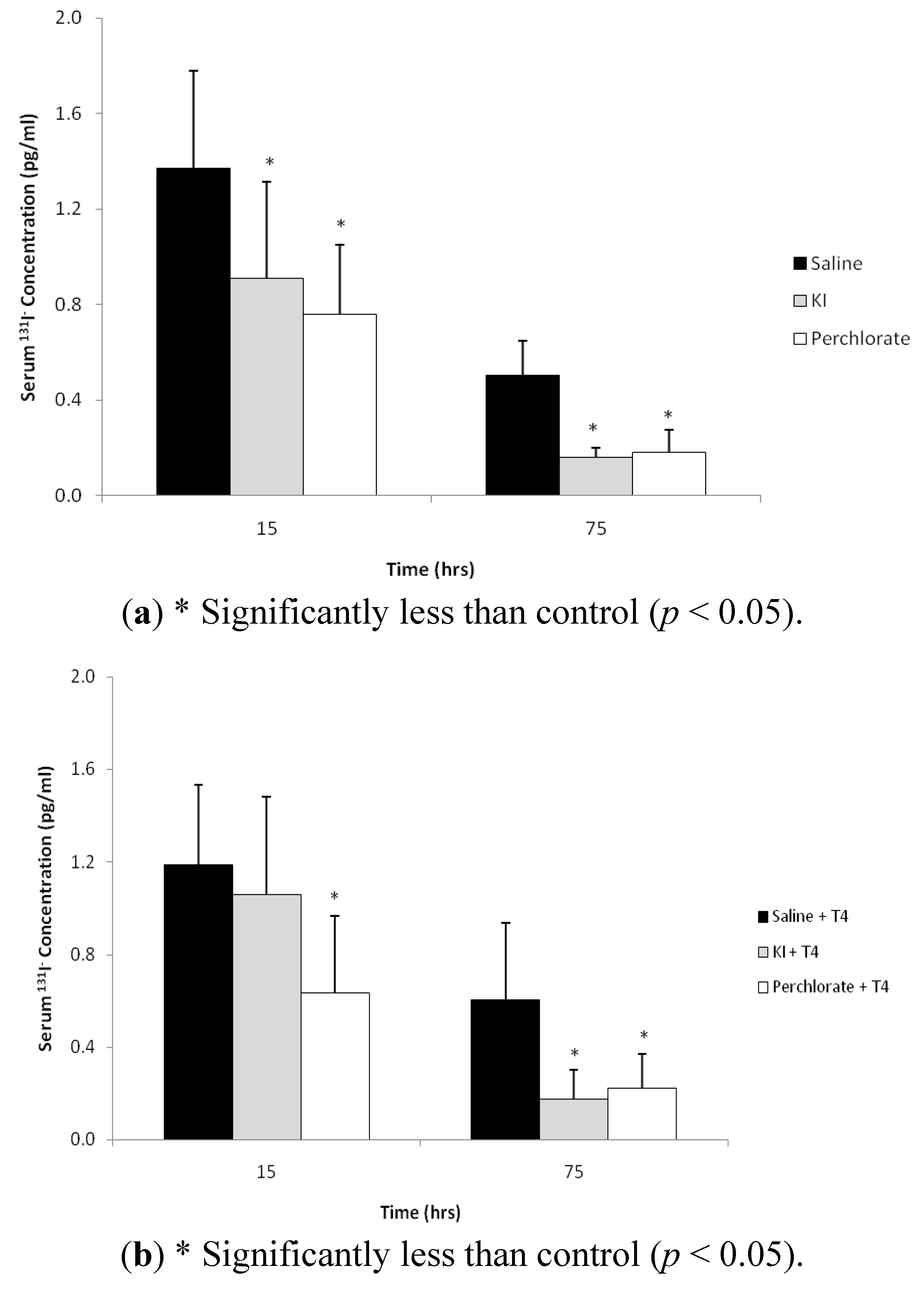
        <p>The mean <sup>131</sup>I<sup>−</sup> concentration in the Group 1 control serum at 15 hours after <sup>131</sup>I<sup>−</sup> dosing was 1.37 ± 0.41 pg/mL and decreased to 0.50 ± 0.15 pg/mL at 75 hours post dosing (<xref ref-type="fig" rid="ijerph-09-02936-f002">Figure 2</xref>a). In Group 1, the mean <sup>131</sup>I<sup>−</sup> serum levels in the KI and the NH<sub>4</sub>ClO<sub>4</sub> treatment groups at 15 hours were 0.91 ± 0.40 and 0.76 ± 0.29 pg/mL, and decreased to 0.16 ± 0.04 and 0.18 ± 0.09 pg/mL, respectively, at 75 hours post dosing. The <sup>131</sup>I<sup>−</sup> serum concentrations in the KI and NH<sub>4</sub>ClO<sub>4</sub> treatment groups were significantly less than saline controls for both sampling times (<italic>p</italic> &lt; 0.05). The addition of T<sub>4</sub> proved to have little effect on mean serum <sup>131</sup>I<sup>−</sup> concentration for Group 2 (<xref ref-type="fig" rid="ijerph-09-02936-f002">Figure 2</xref>b). The mean serum <sup>131</sup>I<sup>−</sup> concentrations at 15 hours following T<sub>4</sub> and saline, KI and NH<sub>4</sub>ClO<sub>4</sub> treatments was 1.2 ± 0.35, 1.06 ± 0.42, and 0.64 ± 0.33 pg/mL respectively, and decreased to 0.61 ± 0.33, 0.17 ± 0.12, and 0.22 ± 0.15 pg/mL at 75 hours post dosing. At 15 hours post <sup>131</sup>I<sup>−</sup> dosing, only the NH<sub>4</sub>ClO<sub>4</sub> treatment group <sup>131</sup>I<sup>−</sup> concentrations were significantly less (<italic>p</italic> &lt; 0.05) than controls, while both KI and NH<sub>4</sub>ClO<sub>4</sub> treatment group <sup>131</sup>I<sup>−</sup> concentrations were significantly less than controls at the 75 hour sampling time.</p>
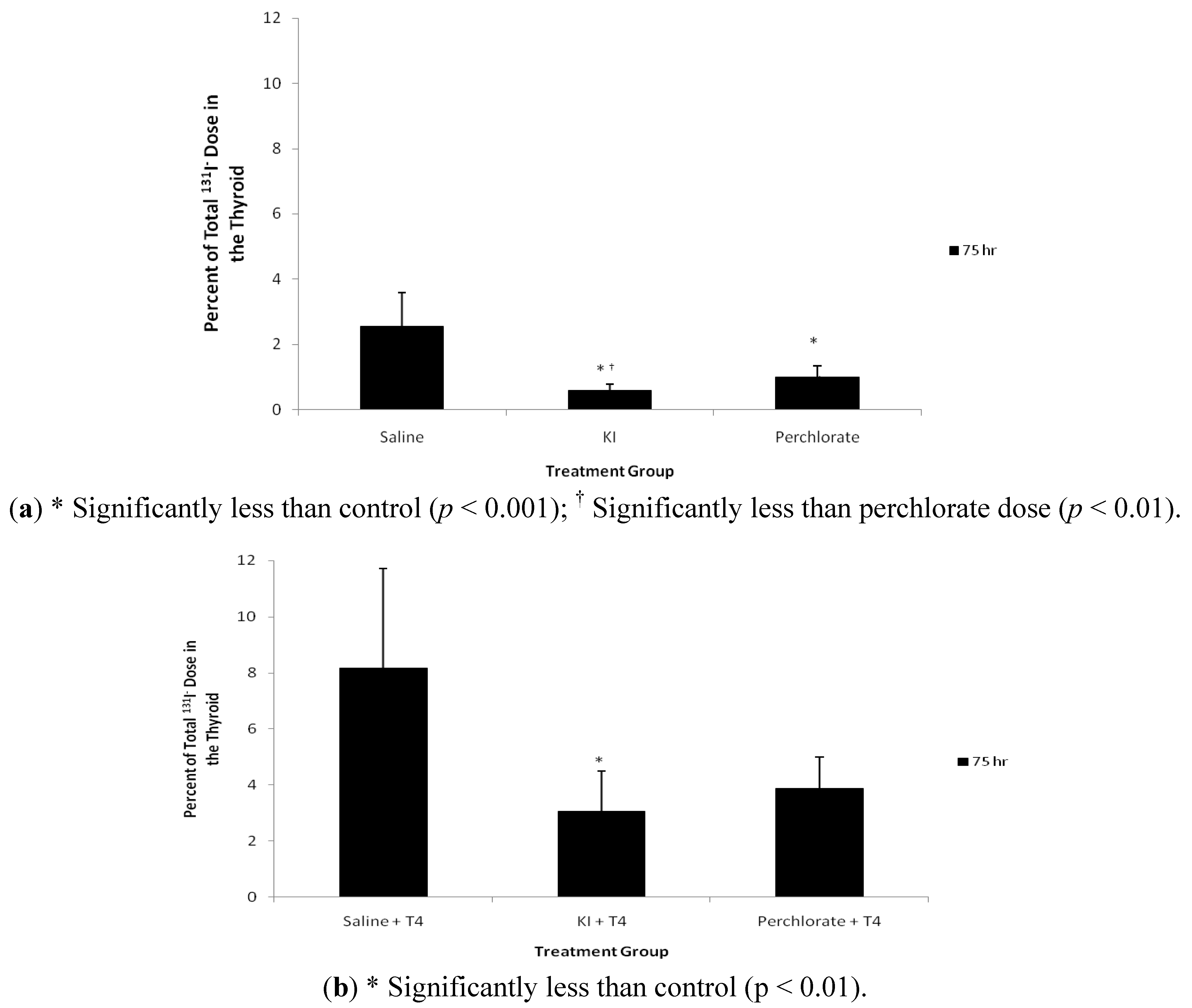
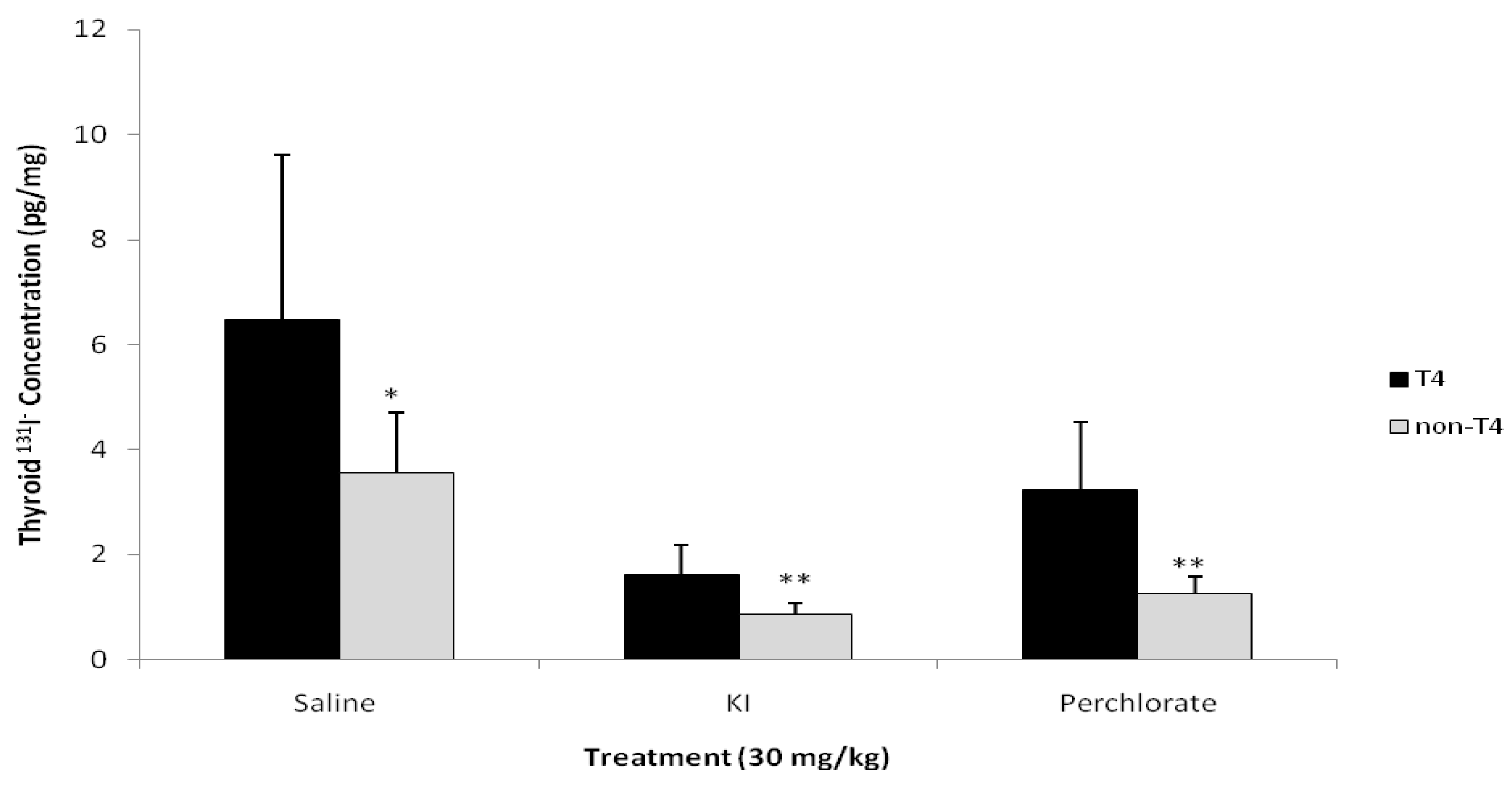
        <p>Compared with control saline, KI and NH<sub>4</sub>ClO<sub>4</sub> treatment reduced levels of <sup>131</sup>I<sup>−</sup> in thyroid gland at 75 hours post exposure (<xref ref-type="fig" rid="ijerph-09-02936-f003">Figure 3</xref>a). Also the residual <sup>131</sup>I<sup>−</sup> levels in the thyroid gland in the KI treatment group were lower than the NH<sub>4</sub>ClO<sub>4</sub> treatment group (<italic>p</italic> &lt; 0.01). KI and NH<sub>4</sub>ClO<sub>4</sub> treatment reduced the thyroid content of <sup>131</sup>I<sup>−</sup> by 77 and 61%, respectively, 3 days after administration of <sup>131</sup>I<sup>−</sup>. Group 2 animals treated with T<sub>4</sub> displayed a different thyroidal <sup>131</sup>I<sup>−</sup> content (<xref ref-type="fig" rid="ijerph-09-02936-f003">Figure 3</xref>b). The mean residual percentage of <sup>131</sup>I<sup>−</sup> doses were less in both the KI (38% of control) and NH<sub>4</sub>ClO<sub>4</sub> (48% of control) treatment groups, compared with saline controls; however, only the KI treatment was significantly less than controls (<italic>p</italic> &lt; 0.01). Interestingly, control, KI, and NH<sub>4</sub>ClO<sub>4</sub> treated rats from Group 2 retained more thyroidal <sup>131</sup>I<sup>−</sup> than rats from Group 1, which did not receive T<sub>4</sub> treatment. <xref ref-type="fig" rid="ijerph-09-02936-f004">Figure 4</xref> compares the thyroidal <sup>131</sup>I<sup>−</sup> concentrations for Groups 1 and 2. In all cases, T<sub>4</sub> treatment resulted in increased thyroidal <sup>131</sup>I<sup>−</sup> concentrations (<italic>p</italic> &lt; 0.05). </p>
       </sec>
      <sec>
        <title>3.3. <sup>127</sup>I<sup>−</sup> and ClO<sub>4</sub><sup>−</sup>: Urinary Excretion and Serum Concentrations</title>
        <p>In Group 1 rats, the cumulative amounts of <sup>127</sup>I<sup>−</sup> and ClO<sub>4</sub><sup>−</sup> excreted in urine over 72 hours were 128 and 92%, respectively, of the administered doses of <sup>127</sup>I<sup>−</sup> as KI, and ClO<sub>4</sub><sup>−</sup>, as NH<sub>4</sub>ClO<sub>4</sub>. Most of the excretion of <sup>127</sup>I<sup>−</sup> (93%) and ClO<sub>4</sub><sup>−</sup> (97%) occurred within 24 hours of dosing. In the T<sub>4</sub> treated group, 106% and 86% of <sup>127</sup>I<sup>−</sup> and ClO<sub>4</sub><sup>−</sup>, respectively, was excreted in urine by 72 hours after dosing. Eighty four and 96% of the excreted <sup>127</sup>I<sup>−</sup> and ClO<sub>4</sub><sup>−</sup> anions occurred within 24 hours.</p>
        <p>Stable iodide urinary half lives determined using 24 h urine collections in rats that were treated with KI for Groups 1 and 2 were 3.5 ± 0.6 and 3.9 ± 0.3 hours respectively, with no significance between groups. Perchlorate 24 hour urinary half lives in rats that were treated with NH<sub>4</sub>ClO<sub>4</sub> for Groups 1 and 2 were 2.5 ± 0.5 and 2.5 ± 0.4 hours, respectively. </p>
        <p>Serum concentrations of <sup>127</sup>I<sup>−</sup> and ClO<sub>4</sub><sup>−</sup> 72 hours after administration were 200.4 ± 199.8 and 81.3 ± 31.6 ng/mL, respectively, in Group 1 and 56.7 ± 15.9 ng/mL and 26.3 ± 14.6 ng/mL, respectively in Group 2.</p>
       <fig id="ijerph-09-02936-f002" position="anchor">
          <label>Figure 2</label>
          <caption>
            <p>(<bold>a</bold>) <sup>131</sup>I<sup>−</sup> concentrations (pg/mL) in serum of Group 1 male rats collected via tail vein bleed at 15 and via cardiac puncture 75 hours after oral administration of <sup>131</sup>I<sup>−</sup> and 12 and 72 hours after oral administration of either saline, KI (30 mg/kg), or perchlorate (30 mg/kg) as described in <xref ref-type="fig" rid="ijerph-09-02936-f001">Figure 1</xref>a. Data are means ± standard deviation (n = 12); (<bold>b</bold>) <sup>131</sup>I<sup>−</sup>concentrations (pg/mL) in serum of Group 2 male rats collected via tail vein bleed at +15 hours and via cardiac puncture at 75 hours after oral administration of <sup>131</sup>I<sup>−</sup>. Animals were dosed with <sup>131</sup>I<sup>−</sup> followed by saline, KI (30 mg/kg), or perchlorate (30 mg/kg) and dosed with replacement T<sub>4</sub> as described in <xref ref-type="fig" rid="ijerph-09-02936-f001">Figure 1</xref>b. Data are means ± standard deviation (n = 6). </p>
          </caption>
          <graphic xmlns:xlink="http://www.w3.org/1999/xlink" xlink:href="ijerph-09-02936-g002.tif"/>
        </fig>
        
		<fig id="ijerph-09-02936-f003" position="anchor">
          <label>Figure 3</label>
          <caption>
            <p>(<bold>a</bold>) 75 hour percent of total <sup>131</sup>I<sup>−</sup> in the thyroid of Group 1 male rats dosed with <sup>131</sup>I<sup>−</sup> via gavage followed by saline, KI (30 mg/kg), or perchlorate (30 mg/kg) as described in <xref ref-type="fig" rid="ijerph-09-02936-f001">Figure 1</xref>a. Data are means ± standard deviation (n = 12); (<bold>b</bold>) 75 hour + T<sub>4</sub> percent of total <sup>131</sup>I<sup>−</sup> in the thyroid of Group 2 male rats dosed with <sup>131</sup>I<sup>−</sup> via gavage followed by saline, KI (30 mg/kg), or perchlorate (30 mg/kg) and dosed with T<sub>4</sub> replacement as described in <xref ref-type="fig" rid="ijerph-09-02936-f001">Figure 1</xref>b. Data are means ± standard deviation (n = 6). </p>
          </caption>
          <graphic xmlns:xlink="http://www.w3.org/1999/xlink" xlink:href="ijerph-09-02936-g003.tif"/>
        </fig>
        <fig id="ijerph-09-02936-f004" position="anchor">
          <label>Figure 4</label>
          <caption>
            <p>Comparison of <sup>131</sup>I<sup>−</sup> concentration in the thyroid of male rats administered T<sub>4</sub> <italic>versus</italic> rats not administered hormone replacement therapy (n = 12 for non-T<sub>4</sub> and n = 6 for T<sub>4</sub>). * Saline treatment without T<sub>4</sub> has a significantly less <sup>131</sup>I<sup>−</sup> thyroid concentration than saline with T<sub>4</sub> (<italic>p</italic> &lt; 0.05); ** KI and perchlorate treatment without T<sub>4</sub> has a significantly less <sup>131</sup>I<sup>−</sup> thyroid concentration than KI and perchlorate with T<sub>4</sub> (<italic>p</italic> &lt; 0.001).</p>
          </caption>
          <graphic xmlns:xlink="http://www.w3.org/1999/xlink" xlink:href="ijerph-09-02936-g004.tif"/>
        </fig>
      
	  </sec>
      <sec>
        <title>3.4. Serum TSH Levels</title>
        <p>The mean serum TSH concentrations for Group 1 was 4.12 ± 1.1, 4.04 ± 1.5, and 3.35 ± 1.8 ng/mL for the saline, KI, and NH<sub>4</sub>ClO<sub>4</sub> treatments, respectively. No statistical significance was determined between treatment groups. Serum TSH concentrations were below the limit of detection of the assay (1.4 ng/mL) in Group 2. </p>
      </sec>
    </sec>
    <sec sec-type="discussion">
      <title>4. Discussion</title>
      <p>The objective of this study was to compare the relative efficacy of stable iodide and perchlorate to purge <sup>131</sup>I<sup>−</sup> from the body of rats. We evaluated the efficacy of these post-exposure treatments by monitoring <sup>131</sup>I<sup>−</sup> in the thyroid gland, urine, and serum for up to 3 days after dosing. This study design was based on a previous study in our laboratory [<xref ref-type="bibr" rid="B15-ijerph-09-02936">15</xref>], which showed that at 15 hours after treatment with KI or NH<sub>4</sub>ClO<sub>4</sub>, the perchlorate treated rats excreted three times the amount of <sup>131</sup>I<sup>−</sup> in urine compared with control treatments, while stable iodide treated rats excreted only twice the amount of <sup>131</sup>I<sup>−</sup> in urine compared with control treatments. In the current study, we confirm our earlier results that perchlorate treatment led to faster <sup>131</sup>I<sup>−</sup> excretion compared with KI treatment (<xref ref-type="table" rid="ijerph-09-02936-t002">Table 2</xref>). Interestingly, by 75 hours after dosing there was no difference in the total amount of <sup>131</sup>I<sup>−</sup> excreted in urine between treatment groups and the controls. This attenuation of the initial efficacy can be attributed to the short half-lives of perchlorate and iodide, 7.3 and 6 hours respectively [<xref ref-type="bibr" rid="B17-ijerph-09-02936">17</xref>,<xref ref-type="bibr" rid="B24-ijerph-09-02936">24</xref>], and suggests that repeated dosing with either treatment may most effectively clear <sup>131</sup>I<sup>−</sup> from the human body and thus protect the thyroid from radiation poisoning. </p>
      <p>One interesting finding in this study is that rats treated with T<sub>4</sub> retained more thyroidal <sup>131</sup>I<sup>−</sup> than rats without T<sub>4</sub> treatment for all treatment groups at 75 hours after dosing (<xref ref-type="fig" rid="ijerph-09-02936-f004">Figure 4</xref>). Other metrics of <sup>131</sup>I<sup>−</sup> internal exposure for urine and serum were comparable for Groups 1 and 2, <italic>i.e</italic>., no significant differences were determined between groups in the cumulative amounts of <sup>131</sup>I<sup>−</sup>, stable iodide, or perchlorate excreted in the urine at 75 hours after dosing or in the concentrations of <sup>131</sup>I<sup>−</sup>, stable iodide, or perchlorate in serum at 15 and 75 hours after dosing. Although the goal of T<sub>4</sub> administration was to inhibit spikes in serum TSH levels after administration of KI or NH<sub>4</sub>ClO<sub>4</sub>, the outcome was diminished serum TSH levels below euthyroid levels, thus altering the thyroid gland function. The stimulatory effect of the reduced levels of TSH in T<sub>4</sub>-treated rats on thyroid hormone secretion was probably very low compared with the non-T<sub>4</sub> treated rats, resulting in increased residual <sup>131</sup>I<sup>−</sup> radioactivity. The increase in residual thyroid radioactivity can likely not be attributed to the well known Wolff-Chaikoff effect given its transient nature relative to the duration of the experiment. However, the Wolff-Chaikoff effect must be considered if multiple doses of the treatments are administered over time. </p>
      <p>The effectiveness of stable iodide and perchlorate as radioprotectants for <sup>131</sup>I<sup>−</sup> uptake into the thyroid gland is time-dependent [<xref ref-type="bibr" rid="B25-ijerph-09-02936">25</xref>,<xref ref-type="bibr" rid="B26-ijerph-09-02936">26</xref>]. Zanzonico and Becker (2000) [<xref ref-type="bibr" rid="B25-ijerph-09-02936">25</xref>] determined that when KI is administered to rats 2 hours after <sup>131</sup>I<sup>−</sup> exposure there is an 80% reduction in uptake of radioactive iodide in the thyroid. However, when KI is administered 8 hours after <sup>131</sup>I<sup>−</sup> exposure the reduction in uptake of radioactive iodide is reduced by 50%. Sinadinovic and Jovanovic (1971) [<xref ref-type="bibr" rid="B26-ijerph-09-02936">26</xref>] concluded that when rats were administered perchlorate and KI 30 min or 24 hours prior to radioiodide tracer administration, the perchlorate treated animals accelerated the elimination of radioiodide from the body, reducing its systemic biological half life, compared to KI treated rats. In our experiments, the KI treated rats excreted the same total amount of radioiodide at 3 days post exposure as perchlorate treated animals, but at a slower excretion rate. We plan further experiments to evaluate the efficacy of repeated treatments of perchlorate and KI.</p>
      <p>In conclusion, our findings suggest that stable iodide and perchlorate appear equally potent at enhancing urinary elimination of radioiodide over a 3 day period. However, the perchlorate treatment offers an accelerated elimination rate of radioiodide within the first 24 to 36 hours and has a significant reduction in the biological half-life of <sup>131</sup>I<sup>−</sup> in the first 24 hours. This suggests that repeated doses of perchlorate post radioiodide exposure may increase the effectiveness of blocking uptake in the thyroid and eliminating radiation in the urine. These data support continued consideration of perchlorate as a prophylactic drug to treat radioiodide poisoning. Intentional and unintentional releases of radiation remain a public health concern in many countries and more research is needed to identify the most effective therapies for protecting the thyroid from radioiodide poisoning. </p>

    </sec>
    <sec>
      <title>Disclaimer</title>
      <p>The findings and conclusions in this report are those of the author(s) and do not necessarily represent the official position of the Centers for Disease Control and Prevention/the Agency for Toxic Substances and Disease Registry or the U.S. Food and Drug Administration. </p>
    </sec>
  </body>
  <back>
    <ref-list>
      <title>References</title>
      <ref id="B1-ijerph-09-02936">
        <label>1.</label>
        <citation citation-type="book">
          <collab>National Committee For Responsive Philanthropy (NCRP)</collab>
          <source>Protection of the Thyroid Gland in the Event of Release of Radioiodine; Report No. 055</source>
          <publisher-name>NCRP</publisher-name>
          <publisher-loc>Bethesda, MD, USA</publisher-loc>
          <year>1977</year>
          <fpage>65</fpage>
        </citation>
      </ref>
      <ref id="B2-ijerph-09-02936">
        <label>2.</label>
        <citation citation-type="journal">
          <person-group person-group-type="author">
            <name>
              <surname>Becker</surname>
              <given-names>D.V.</given-names>
            </name>
            <name>
              <surname>Braverman</surname>
              <given-names>L.E.</given-names>
            </name>
            <name>
              <surname>Dunn</surname>
              <given-names>J.T.</given-names>
            </name>
            <name>
              <surname>Gaitan</surname>
              <given-names>E.</given-names>
            </name>
            <name>
              <surname>Gorman</surname>
              <given-names>C.</given-names>
            </name>
            <name>
              <surname>Maxon</surname>
              <given-names>H.</given-names>
            </name>
            <name>
              <surname>Schneider</surname>
              <given-names>A.B.</given-names>
            </name>
            <name>
              <surname>Van Middlesworth</surname>
              <given-names>L.</given-names>
            </name>
            <name>
              <surname>Wolff</surname>
              <given-names>J.</given-names>
            </name>
          </person-group>
          <article-title>The use of iodine as a thyroidal blocking agent in the event of a reactor accident. Report of the environmental hazards committee of the american thyroid association</article-title>
          <source>JAMA</source>
          <year>1984</year>
          <volume>252</volume>
          <fpage>659</fpage>
          <lpage>661</lpage>
        <pub-id pub-id-type="doi">10.1001/jama.1984.03350050047025</pub-id><pub-id pub-id-type="pmid">6737670</pub-id></citation>
      </ref>
      <ref id="B3-ijerph-09-02936">
        <label>3.</label>
        <citation citation-type="gov">
          <collab>National Apprenticeship Service (NAS)</collab>
          <source>Distribution and Administration of Potassium Iodide in the Event of A Nuclear Incident</source>
          <publisher-name>The National Academies Press</publisher-name>
          <publisher-loc>Washington, DC, USA</publisher-loc>
          <year>2004</year>
          <fpage>248</fpage>
        </citation>
      </ref>
      <ref id="B4-ijerph-09-02936">
        <label>4.</label>
        <citation citation-type="web">
          <collab>Food and Drug Administration (FDA)</collab>
          <source>Radiation Emergencies.</source>
          <access-date>(accessed on 7 November 2011)</access-date>
          <comment>Available online:<ext-link xmlns:xlink="http://www.w3.org/1999/xlink" xlink:href="http://www.fda.gov/Drugs/EmergencyPreparedness/BioterrorismandDrugPreparedness/ucm063807.htm" ext-link-type="uri">http://www.fda.gov/Drugs/EmergencyPreparedness/BioterrorismandDrugPreparedness/ucm063807.htm</ext-link></comment>
        </citation>
      </ref>
      <ref id="B5-ijerph-09-02936">
        <label>5.</label>
        <citation citation-type="journal">
          <person-group person-group-type="author">
            <name>
              <surname>Halmi</surname>
              <given-names>N.S.</given-names>
            </name>
            <name>
              <surname>Stuelke</surname>
              <given-names>R.G.</given-names>
            </name>
            <name>
              <surname>Schnell</surname>
              <given-names>M.D.</given-names>
            </name>
          </person-group>
          <article-title>Radioiodide in the thyroid and in other organs of rats treated with large doses of perchlorate</article-title>
          <source>Endocrinology</source>
          <year>1956</year>
          <volume>58</volume>
          <fpage>634</fpage>
          <lpage>650</lpage>
          <pub-id pub-id-type="doi">10.1210/endo-58-5-634</pub-id>
        </citation>
      </ref>
      <ref id="B6-ijerph-09-02936">
        <label>6.</label>
        <citation citation-type="journal">
          <person-group person-group-type="author">
            <name>
              <surname>Schonbaum</surname>
              <given-names>E.</given-names>
            </name>
            <name>
              <surname>Sellers</surname>
              <given-names>E.A.</given-names>
            </name>
            <name>
              <surname>Gill</surname>
              <given-names>M.J.</given-names>
            </name>
          </person-group>
          <article-title>Some effects of perchlorate on the distribution of 131-iodide</article-title>
          <source>Acta Endocrinol. (Copenhagen)</source>
          <year>1965</year>
          <volume>50</volume>
          <fpage>195</fpage>
          <lpage>201</lpage>
        </citation>
      </ref>
      <ref id="B7-ijerph-09-02936">
        <label>7.</label>
        <citation citation-type="journal">
          <person-group person-group-type="author">
            <name>
              <surname>Ullberg</surname>
              <given-names>S.</given-names>
            </name>
            <name>
              <surname>Ewaldsson</surname>
              <given-names>B.</given-names>
            </name>
          </person-group>
          <article-title>Distribution of radio-iodine studied by whole-body autoradiography</article-title>
          <source>Acta Radiol. Ther. Phys. Biol.</source>
          <year>1964</year>
          <volume>2</volume>
          <fpage>24</fpage>
          <lpage>32</lpage>
        <pub-id pub-id-type="doi">10.3109/05678066409176337</pub-id><pub-id pub-id-type="pmid">14153759</pub-id></citation>
      </ref>
      <ref id="B8-ijerph-09-02936">
        <label>8.</label>
        <citation citation-type="journal">
          <person-group person-group-type="author">
            <name>
              <surname>Anbar</surname>
              <given-names>M.</given-names>
            </name>
            <name>
              <surname>Guttmann</surname>
              <given-names>S.</given-names>
            </name>
            <name>
              <surname>Lewitus</surname>
              <given-names>Z.</given-names>
            </name>
          </person-group>
          <article-title>The mode of action of perchlorate ions on the iodine uptake of the thyroid gland</article-title>
          <source>Int. J. Appl. Radiat. Isot.</source>
          <year>1959</year>
          <volume>7</volume>
          <fpage>87</fpage>
          <lpage>96</lpage>
          <pub-id pub-id-type="doi">10.1016/0020-708X(59)90153-X</pub-id>
        </citation>
      </ref>
      <ref id="B9-ijerph-09-02936">
        <label>9.</label>
        <citation citation-type="journal">
          <person-group person-group-type="author">
            <name>
              <surname>Goldman</surname>
              <given-names>S.J.</given-names>
            </name>
            <name>
              <surname>Stanbury</surname>
              <given-names>J.B.</given-names>
            </name>
          </person-group>
          <article-title>The metabolism of perchlorate in the rat</article-title>
          <source>Endocrinology</source>
          <year>1973</year>
          <volume>92</volume>
          <fpage>1536</fpage>
          <lpage>1538</lpage>
          <pub-id pub-id-type="doi">10.1210/endo-92-5-1536</pub-id>
        </citation>
      </ref>
      <ref id="B10-ijerph-09-02936">
        <label>10.</label>
        <citation citation-type="journal">
          <person-group person-group-type="author">
            <name>
              <surname>Wolff</surname>
              <given-names>J.</given-names>
            </name>
          </person-group>
          <article-title>Perchlorate and the thyroid gland</article-title>
          <source>Pharmacol. Rev.</source>
          <year>1998</year>
          <volume>50</volume>
          <fpage>89</fpage>
          <lpage>105</lpage>
        <pub-id pub-id-type="pmid">9549759</pub-id></citation>
      </ref>
      <ref id="B11-ijerph-09-02936">
        <label>11.</label>
        <citation citation-type="journal">
          <person-group person-group-type="author">
            <name>
              <surname>Tran</surname>
              <given-names>N.</given-names>
            </name>
            <name>
              <surname>Valentin-Blasini</surname>
              <given-names>L.</given-names>
            </name>
            <name>
              <surname>Blount</surname>
              <given-names>B.C.</given-names>
            </name>
            <name>
              <surname>McCuistion</surname>
              <given-names>C.G.</given-names>
            </name>
            <name>
              <surname>Fenton</surname>
              <given-names>M.S.</given-names>
            </name>
            <name>
              <surname>Gin</surname>
              <given-names>E.</given-names>
            </name>
            <name>
              <surname>Salem</surname>
              <given-names>A.</given-names>
            </name>
            <name>
              <surname>Hershman</surname>
              <given-names>J.M.</given-names>
            </name>
          </person-group>
          <article-title>Thyroid-stimulating hormone increases active transport of perchlorate into thyroid cells</article-title>
          <source>Am. J. Physiol. Endocrinol. Metab.</source>
          <year>2008</year>
          <volume>294</volume>
          <fpage>E802</fpage>
          <lpage>E806</lpage>
          <pub-id pub-id-type="doi">10.1152/ajpendo.00013.2008</pub-id>
        </citation>
      </ref>
      <ref id="B12-ijerph-09-02936">
        <label>12.</label>
        <citation citation-type="journal">
          <person-group person-group-type="author">
            <name>
              <surname>Attanasio</surname>
              <given-names>R.</given-names>
            </name>
            <name>
              <surname>Scinicariello</surname>
              <given-names>F.</given-names>
            </name>
            <name>
              <surname>Blount</surname>
              <given-names>B.C.</given-names>
            </name>
            <name>
              <surname>Valentin-Blasini</surname>
              <given-names>L.</given-names>
            </name>
            <name>
              <surname>Rogers</surname>
              <given-names>K.A.</given-names>
            </name>
            <name>
              <surname>Nguyen</surname>
              <given-names>D.C.</given-names>
            </name>
            <name>
              <surname>Murray</surname>
              <given-names>H.E.</given-names>
            </name>
          </person-group>
          <article-title>Pendrin mediates uptake of perchlorate in a mammalian <italic>in vitro</italic> system</article-title>
          <source>Chemosphere</source>
          <year>2011</year>
          <volume>84</volume>
          <fpage>1484</fpage>
          <lpage>1488</lpage>
          <pub-id pub-id-type="doi">10.1016/j.chemosphere.2011.04.038</pub-id>
        </citation>
      </ref>
      <ref id="B13-ijerph-09-02936">
        <label>13.</label>
        <citation citation-type="journal">
          <person-group person-group-type="author">
            <name>
              <surname>Krevans</surname>
              <given-names>J.R.</given-names>
            </name>
            <name>
              <surname>Asper</surname>
              <given-names>S.P.</given-names>
              <suffix>Jr.</suffix>
            </name>
            <name>
              <surname>Rienhoff</surname>
              <given-names>W.F.</given-names>
              <suffix>Jr.</suffix>
            </name>
          </person-group>
          <article-title>Fatal aplastic anemia following use of potassium perchlorate in thyrotoxicosis</article-title>
          <source>JAMA</source>
          <year>1962</year>
          <volume>181</volume>
          <fpage>162</fpage>
          <lpage>164</lpage>
        <pub-id pub-id-type="doi">10.1001/jama.1962.03050280092013c</pub-id><pub-id pub-id-type="pmid">14459623</pub-id></citation>
      </ref>
      <ref id="B14-ijerph-09-02936">
        <label>14.</label>
        <citation citation-type="journal">
          <person-group person-group-type="author">
            <name>
              <surname>Trotter</surname>
              <given-names>W.R.</given-names>
            </name>
          </person-group>
          <article-title>The relative toxicity of antithyroid drugs</article-title>
          <source>J. New Drugs</source>
          <year>1962</year>
          <volume>2</volume>
          <fpage>333</fpage>
          <lpage>343</lpage>
        <pub-id pub-id-type="pmid">13994296</pub-id></citation>
      </ref>
      <ref id="B15-ijerph-09-02936">
        <label>15.</label>
        <citation citation-type="journal">
          <person-group person-group-type="author">
            <name>
              <surname>Harris</surname>
              <given-names>C.A.</given-names>
            </name>
            <name>
              <surname>Fisher</surname>
              <given-names>J.W.</given-names>
            </name>
            <name>
              <surname>Rollor</surname>
              <given-names>E.A.</given-names>
              <suffix>3rd.</suffix>
            </name>
            <name>
              <surname>Ferguson</surname>
              <given-names>D.C.</given-names>
            </name>
            <name>
              <surname>Blount</surname>
              <given-names>B.C.</given-names>
            </name>
            <name>
              <surname>Valentin-Blasini</surname>
              <given-names>L.</given-names>
            </name>
            <name>
              <surname>Taylor</surname>
              <given-names>M.A.</given-names>
            </name>
            <name>
              <surname>Dallas</surname>
              <given-names>C.E.</given-names>
            </name>
          </person-group>
          <article-title>Evaluation of potassium iodide (KI) and ammonium perchlorate (Nh<sub>4</sub>ClO<sub>4</sub>) to ameliorate <sup>131</sup>I<sup>−</sup> exposure in the rat</article-title>
          <source>J. Toxicol. Environ. Health</source>
          <year>2009</year>
          <volume>72</volume>
          <fpage>909</fpage>
          <lpage>914</lpage>
        </citation>
      </ref>
      <ref id="B16-ijerph-09-02936">
        <label>16.</label>
        <citation citation-type="journal">
          <person-group person-group-type="author">
            <name>
              <surname>Fisher</surname>
              <given-names>J.</given-names>
            </name>
            <name>
              <surname>Todd</surname>
              <given-names>P.</given-names>
            </name>
            <name>
              <surname>Mattie</surname>
              <given-names>D.</given-names>
            </name>
            <name>
              <surname>Godfrey</surname>
              <given-names>D.</given-names>
            </name>
            <name>
              <surname>Narayanan</surname>
              <given-names>L.</given-names>
            </name>
            <name>
              <surname>Yu</surname>
              <given-names>K.</given-names>
            </name>
          </person-group>
          <article-title>Preliminary development of a physiological model for perchlorate in the adult male rat: A framework for further studies</article-title>
          <source>Drug Chem. Toxicol.</source>
          <year>2000</year>
          <volume>23</volume>
          <fpage>243</fpage>
          <lpage>258</lpage>
          <pub-id pub-id-type="doi">10.1081/DCT-100100113</pub-id>
        </citation>
      </ref>
      <ref id="B17-ijerph-09-02936">
        <label>17.</label>
        <citation citation-type="journal">
          <person-group person-group-type="author">
            <name>
              <surname>Yu</surname>
              <given-names>K.O.</given-names>
            </name>
            <name>
              <surname>Narayanan</surname>
              <given-names>L.</given-names>
            </name>
            <name>
              <surname>Mattie</surname>
              <given-names>D.R.</given-names>
            </name>
            <name>
              <surname>Godfrey</surname>
              <given-names>R.J.</given-names>
            </name>
            <name>
              <surname>Todd</surname>
              <given-names>P.N.</given-names>
            </name>
            <name>
              <surname>Sterner</surname>
              <given-names>T.R.</given-names>
            </name>
            <name>
              <surname>Mahle</surname>
              <given-names>D.A.</given-names>
            </name>
            <name>
              <surname>Lumpkin</surname>
              <given-names>M.H.</given-names>
            </name>
            <name>
              <surname>Fisher</surname>
              <given-names>J.W.</given-names>
            </name>
          </person-group>
          <article-title>The pharmacokinetics of perchlorate and its effect on the hypothalamus-pituitary-thyroid axis in the male rat</article-title>
          <source>Toxicol. Appl. Pharmacol.</source>
          <year>2002</year>
          <volume>182</volume>
          <fpage>148</fpage>
          <lpage>159</lpage>
          <pub-id pub-id-type="doi">10.1006/taap.2002.9432</pub-id>
        </citation>
      </ref>
      <ref id="B18-ijerph-09-02936">
        <label>18.</label>
        <citation citation-type="journal">
          <person-group person-group-type="author">
            <name>
              <surname>Capen</surname>
              <given-names>C.C.</given-names>
            </name>
          </person-group>
          <article-title>Mechanistic data and risk assessment of selected toxic end points of the thyroid gland</article-title>
          <source>Toxicol. Pathol.</source>
          <year>1997</year>
          <volume>25</volume>
          <fpage>39</fpage>
          <lpage>48</lpage>
          <pub-id pub-id-type="doi">10.1177/019262339702500109</pub-id>
        </citation>
      </ref>
      <ref id="B19-ijerph-09-02936">
        <label>19.</label>
        <citation citation-type="journal">
          <person-group person-group-type="author">
            <name>
              <surname>Connors</surname>
              <given-names>J.M.</given-names>
            </name>
            <name>
              <surname>Hedge</surname>
              <given-names>G.A.</given-names>
            </name>
          </person-group>
          <article-title>Feedback regulation of thyrotropin by thyroxine under physiological conditions</article-title>
          <source>Am. J. Physiol.</source>
          <year>1981</year>
          <volume>240</volume>
          <fpage>E308</fpage>
          <lpage>E313</lpage>
        <pub-id pub-id-type="pmid">7212062</pub-id></citation>
      </ref>
      <ref id="B20-ijerph-09-02936">
        <label>20.</label>
        <citation citation-type="journal">
          <person-group person-group-type="author">
            <name>
              <surname>Larsen</surname>
              <given-names>P.R.</given-names>
            </name>
            <name>
              <surname>Frumess</surname>
              <given-names>R.D.</given-names>
            </name>
          </person-group>
          <article-title>Comparison of the biological effects of thyroxine and triiodothyronine in the rat</article-title>
          <source>Endocrinology</source>
          <year>1977</year>
          <volume>100</volume>
          <fpage>980</fpage>
          <lpage>988</lpage>
          <pub-id pub-id-type="doi">10.1210/endo-100-4-980</pub-id>
        </citation>
      </ref>
      <ref id="B21-ijerph-09-02936">
        <label>21.</label>
        <citation citation-type="journal">
          <person-group person-group-type="author">
            <name>
              <surname>Dratman</surname>
              <given-names>M.B.</given-names>
            </name>
            <name>
              <surname>Crutchfield</surname>
              <given-names>F.L.</given-names>
            </name>
            <name>
              <surname>Gordon</surname>
              <given-names>J.T.</given-names>
            </name>
            <name>
              <surname>Jennings</surname>
              <given-names>A.S.</given-names>
            </name>
          </person-group>
          <article-title>Iodothyronine homeostasis in rat brain during hypo- and hyperthyroidism</article-title>
          <source>Am. J. Physiol.</source>
          <year>1983</year>
          <volume>245</volume>
          <fpage>E185</fpage>
          <lpage>E193</lpage>
        <pub-id pub-id-type="pmid">6881331</pub-id></citation>
      </ref>
      <ref id="B22-ijerph-09-02936">
        <label>22.</label>
        <citation citation-type="journal">
          <person-group person-group-type="author">
            <name>
              <surname>Amitai</surname>
              <given-names>Y.</given-names>
            </name>
            <name>
              <surname>Winston</surname>
              <given-names>G.</given-names>
            </name>
            <name>
              <surname>Sack</surname>
              <given-names>J.</given-names>
            </name>
            <name>
              <surname>Wasser</surname>
              <given-names>J.</given-names>
            </name>
            <name>
              <surname>Lewis</surname>
              <given-names>M.</given-names>
            </name>
            <name>
              <surname>Blount</surname>
              <given-names>B.C.</given-names>
            </name>
            <name>
              <surname>Valentin-Blasini</surname>
              <given-names>L.</given-names>
            </name>
            <name>
              <surname>Fisher</surname>
              <given-names>N.</given-names>
            </name>
            <name>
              <surname>Israeli</surname>
              <given-names>A.</given-names>
            </name>
            <name>
              <surname>Leventhal</surname>
              <given-names>A.</given-names>
            </name>
          </person-group>
          <article-title>Gestational exposure to high perchlorate concentrations in drinking water and neonatal thyroxine levels</article-title>
          <source>Thyroid</source>
          <year>2007</year>
          <volume>17</volume>
          <fpage>843</fpage>
          <lpage>850</lpage>
        <pub-id pub-id-type="doi">10.1089/thy.2006.0336</pub-id><pub-id pub-id-type="pmid">17956158</pub-id></citation>
      </ref>
      <ref id="B23-ijerph-09-02936">
        <label>23.</label>
        <citation citation-type="journal">
          <person-group person-group-type="author">
            <name>
              <surname>Valentin-Blasini</surname>
              <given-names>L.</given-names>
            </name>
            <name>
              <surname>Blount</surname>
              <given-names>B.C.</given-names>
            </name>
            <name>
              <surname>Delinsky</surname>
              <given-names>A.</given-names>
            </name>
          </person-group>
          <article-title>Quantification of iodide and sodium-iodide symporter inhibitors in human urine using ion chromatography tandem mass spectrometry</article-title>
          <source>J. Chromatogr.</source>
          <year>1155</year>
          <fpage>40</fpage>
          <lpage>46</lpage>
        </citation>
      </ref>
      <ref id="B24-ijerph-09-02936">
        <label>24.</label>
        <citation citation-type="journal">
          <person-group person-group-type="author">
            <name>
              <surname>Wolff</surname>
              <given-names>J.</given-names>
            </name>
          </person-group>
          <article-title>Physiological aspects of iodide excess in relation to radiation protection</article-title>
          <source>J. Mol. Med.</source>
          <year>1980</year>
          <volume>4</volume>
          <fpage>151</fpage>
          <lpage>165</lpage>
        </citation>
      </ref>
      <ref id="B25-ijerph-09-02936">
        <label>25.</label>
        <citation citation-type="journal">
          <person-group person-group-type="author">
            <name>
              <surname>Zanzonico</surname>
              <given-names>P.B.</given-names>
            </name>
            <name>
              <surname>Becker</surname>
              <given-names>D.V.</given-names>
            </name>
          </person-group>
          <article-title>Effects of time of administration and dietary iodine levels on potassium iodide (KI) blockade of thyroid irradiation by <sup>131</sup>I from radioactive fallout</article-title>
          <source>Health Phys.</source>
          <year>2000</year>
          <volume>78</volume>
          <fpage>660</fpage>
          <lpage>667</lpage>
          <pub-id pub-id-type="doi">10.1097/00004032-200006000-00008</pub-id>
        </citation>
      </ref>
      <ref id="B26-ijerph-09-02936">
        <label>26.</label>
        <citation citation-type="journal">
          <person-group person-group-type="author">
            <name>
              <surname>Sinadinovic</surname>
              <given-names>J.P.</given-names>
            </name>
            <name>
              <surname>Jovanovic</surname>
              <given-names>M.</given-names>
            </name>
          </person-group>
          <article-title>Effect of perchlorate and stabile iodide on the elimination of radioactive iodine (I 131) from the body</article-title>
          <source>Glas Srp. Akad. Nauka Med.</source>
          <year>1971</year>
          <volume>23</volume>
          <fpage>29</fpage>
          <lpage>36</lpage>
        <pub-id pub-id-type="pmid">4328938</pub-id></citation>
      </ref>
    </ref-list>
  </back>
</article>