<?xml version="1.0" encoding="UTF-8"?>
<!DOCTYPE article PUBLIC "-//NLM//DTD Journal Publishing DTD v2.3 20070202//EN" "journalpublishing.dtd">
<article xmlns:xlink="http://www.w3.org/1999/xlink" xml:lang="en" article-type="research-article">
<front>
<journal-meta>
<journal-id journal-id-type="publisher-id">101238455</journal-id>
<journal-title>International Journal of Environmental Research and Public Health</journal-title>
<issn pub-type="ppub">1661-7827</issn>
<issn pub-type="epub">1660-4601</issn>
<publisher>
<publisher-name>Molecular Diversity Preservation International (MDPI)</publisher-name></publisher></journal-meta>
<article-meta>
<article-id pub-id-type="doi">10.3390/ijerph7072853</article-id>
<article-id pub-id-type="publisher-id">ijerph-07-02853</article-id>
<article-categories>
<subj-group>
<subject>Article</subject></subj-group></article-categories>
<title-group>
<article-title>Is Participation in After-School Physical Activity Associated with Increased Total Physical Activity? A Study of High School Pupils in the Czech Republic</article-title></title-group>
<contrib-group>
<contrib contrib-type="author">
<name><surname>Pelclová</surname><given-names>Jana</given-names></name><xref ref-type="aff" rid="af1-ijerph-07-02853">1</xref></contrib>
<contrib contrib-type="author">
<name><surname>Ansari</surname><given-names>Walid El</given-names></name><xref ref-type="aff" rid="af2-ijerph-07-02853">2</xref><xref ref-type="corresp" rid="c1-ijerph-07-02853">*</xref></contrib>
<contrib contrib-type="author">
<name><surname>Vašíčková</surname><given-names>Jana</given-names></name><xref ref-type="aff" rid="af1-ijerph-07-02853">1</xref></contrib></contrib-group>
<aff id="af1-ijerph-07-02853">
<label>1</label> Center for Kinanthropology Research, Faculty of Physical Culture, Palacky University, Tr. Miru 115, Olomouc 77111, Czech Republic; E-Mails: <email>jana.pelclova@upol.cz</email> (J.P.); <email>jana.vasickova@upol.cz</email> (J.V.)</aff>
<aff id="af2-ijerph-07-02853">
<label>2</label> Faculty of Sport, Health and Social Care, University of Gloucestershire, Oxstalls Campus, Oxstalls Lane, Gloucester GL2 9HW, UK</aff>
<author-notes>
<corresp id="c1-ijerph-07-02853">
<label>*</label>Author to whom correspondence should be addressed; E-Mail: <email>walidansari@glos.ac.uk</email>; Tel.: +44-0-1242-715274; Fax: +44-0-1242-715222.</corresp></author-notes>
<pub-date pub-type="ppub">
<month>7</month>
<year>2010</year></pub-date>
<pub-date pub-type="epub">
<day>13</day>
<month>7</month>
<year>2010</year></pub-date>
<volume>7</volume>
<issue>7</issue>
<fpage>2853</fpage>
<lpage>2865</lpage>
<history>
<date date-type="received">
<day>8</day>
<month>6</month>
<year>2010</year></date>
<date date-type="rev-recd">
<day>7</day>
<month>7</month>
<year>2010</year></date>
<date date-type="accepted">
<day>8</day>
<month>7</month>
<year>2010</year></date></history>
<permissions>
<copyright-statement>© 2010 by the authors; licensee Molecular Diversity Preservation International, Basel, Switzerland.</copyright-statement>
<copyright-year>2010</copyright-year>
<license license-type="open-access" xlink:href="http://creativecommons.org/licenses/by/3.0">
<p>This article is an open-access article distributed under the terms and conditions of the Creative Commons Attribution license (http://creativecommons.org/licenses/by/3.0/).</p></license></permissions>
<abstract>
<p>This study assessed the physical activity (PA) levels and its variability across days, months and seasons of two groups of high school pupils: those who did and those who did not participate in regular organized after-school physical activity (ASPA). Thirteen pupils wore pedometers continuously for one school-year, logged their step counts into record sheets and were then interviewed for information as regards their participation in any ASPA. Repeated measures analysis of variance showed that regardless of the day, month and season, ASPA pupils achieved significantly more mean step counts/day than the non-ASPA pupils. There were no significant fluctuations across months and seasons in PA levels of ASPA pupils when compared to non-ASPA pupils. We conclude that regular organised ASPA might increase the pupils’ total PA levels; and could help to maintain a relatively constant PA level for adolescents across the whole school-year regardless of the influences of a range of weather and meteorological indicators that are related to months/seasons.</p></abstract>
<kwd-group>
<kwd>pedometer</kwd>
<kwd>adolescents</kwd>
<kwd>self-determined physical activity</kwd>
<kwd>day, month and season variability</kwd>
<kwd>physical education</kwd></kwd-group></article-meta></front>
<body>
<sec sec-type="intro">
<label>1.</label>
<title>Introduction</title>
<p>The health benefits of regular PA in youth include the prevention of many risk factors (obesity, high levels of body fat and cholesterol, hypertension) that could set up themselves throughout childhood and project into adulthood [<xref ref-type="bibr" rid="b1-ijerph-07-02853">1</xref>,<xref ref-type="bibr" rid="b2-ijerph-07-02853">2</xref>]. PA in childhood/adolescence seems also linked to educational benefits. Swedish pupils’ academic achievement was associated with PA and fitness [<xref ref-type="bibr" rid="b3-ijerph-07-02853">3</xref>], and in the USA, increasing the opportunities for PA for fourth, sixth and eighth grade pupils supported academic achievement even after controlling for pupils’ weight, ethnicity, gender, grade, and socioeconomic status [<xref ref-type="bibr" rid="b4-ijerph-07-02853">4</xref>].</p>
<p>Children currently expend ≈525 kcal/day less than their counterparts 50 years ago [<xref ref-type="bibr" rid="b5-ijerph-07-02853">5</xref>]. Further, PA drops exponentially during the adolescent period [<xref ref-type="bibr" rid="b6-ijerph-07-02853">6</xref>], and many adolescents place their health at risk due to insufficient PA [<xref ref-type="bibr" rid="b7-ijerph-07-02853">7</xref>]. Indeed, studies in the Czech Republic showed a decline of PA from the preschool period to pupils 12 years old and moreover, between 12–18 years [<xref ref-type="bibr" rid="b8-ijerph-07-02853">8</xref>,<xref ref-type="bibr" rid="b9-ijerph-07-02853">9</xref>]. Such findings have stimulated proposals about the ways by which young people could enhance their PA levels. However, although adolescent PA patterns may differ by time of day, little is known about after-school PA (ASPA) behaviours [<xref ref-type="bibr" rid="b10-ijerph-07-02853">10</xref>]. This is despite the fact that the after school period is a critical interval that defines the propensity of youth for PA [<xref ref-type="bibr" rid="b11-ijerph-07-02853">11</xref>]. After-school hours may represent significant opportunities for educators and researchers to modify adolescents’ PA behaviours. Hence it is important to understand the patterns of adolescents’ PA (during the school and AS periods) and its natural variability across the year in order to guide effective PA interventions.</p>
<p>When compared with the school period of the day, AS periods represent a ‘critical window’ for youth to accumulate necessary health-related PA. In the Czech Republic, 104 preschoolers (aged 5–7 years), 1174 teenagers (aged 12–17 years) and 787 young adults (aged 18–24 years) had approximately three times lower activity energy expenditure during school time compared to the out of school time periods [<xref ref-type="bibr" rid="b8-ijerph-07-02853">8</xref>]. Likewise in New Zealand, high schools pupils (12–18 year old) exhibited substantially lower participation levels in PA during school hours (at recess and lunchtime) than for the time periods that were outside of the school hours (before and after school) [<xref ref-type="bibr" rid="b12-ijerph-07-02853">12</xref>]. Similarly, for both genders, the pedometer-measured steps of British children (7–11 year old) suggested that steps accumulated in weekday leisure time were greater in the high-active groups than in the mid- and low-active groups, with relatively smaller differences between the activity tertiles for steps accumulated at school [<xref ref-type="bibr" rid="b13-ijerph-07-02853">13</xref>]. In northwest England, others have reported that the accelerometer-measured activity of 58 children (aged 7–11 years, monitored on 4 consecutive weekdays) was conversely lower in volume and similarly less stable after school day had ended [<xref ref-type="bibr" rid="b14-ijerph-07-02853">14</xref>]. These findings reinforce the importance of ASPA, especially organized sports activities [<xref ref-type="bibr" rid="b15-ijerph-07-02853">15</xref>]. Indeed, in the U.S.A, youth who participated in organized ASPA achieved significantly more steps/day than their non-participating counterparts [<xref ref-type="bibr" rid="b16-ijerph-07-02853">16</xref>].</p>
<p>In spite of the limited evidence suggesting that AS programs can improve health-related aspects [<xref ref-type="bibr" rid="b17-ijerph-07-02853">17</xref>], there seems consensus that the AS period should be targeted for PA interventions [<xref ref-type="bibr" rid="b16-ijerph-07-02853">16</xref>], probably because AS hours appear to have a great potential for increasing PA levels, which augment a child’s total daily energy expenditure [<xref ref-type="bibr" rid="b16-ijerph-07-02853">16</xref>]. Although PA interventions during the school day hold great prospective and remain important, ASPA programs are emerging as potentially useful and feasible for PA promotion [<xref ref-type="bibr" rid="b17-ijerph-07-02853">17</xref>].</p>
<p>Nevertheless, few studies have examined the differences in PA patterns between regular organized ASPA participants and non-ASPA participants. E.g., Flohr <italic>et al.</italic> [<xref ref-type="bibr" rid="b16-ijerph-07-02853">16</xref>] evaluated the pedometer-assessed PA patterns in children and assessed differences of PA levels in ASPA participants and non-participants for two consecutive weeks; Santos <italic>et al.</italic> [<xref ref-type="bibr" rid="b15-ijerph-07-02853">15</xref>] used a questionnaire and assessed the relationship between participation in organized and non-organized PA, commuting to school and BMI; and, Beets <italic>et al.</italic> [<xref ref-type="bibr" rid="b17-ijerph-07-02853">17</xref>] meta-analyzed the impact of after-school programs on PA and fitness. To the best of our knowledge, there seems no research that investigated regular ASPA participation across longer periods of time e.g., the school-year, thus allowing the examination of its effects across days, months and seasons.</p>
<sec sec-type="methods">
<label>1.1.</label>
<title>Aims of the Study</title>
<p>Therefore, the aim of the present case study was to monitor the pedometer-determined PA over a school-year for two groups of high school pupils: those engaged in regular organized after-school physical activity (ASPA); and those who were not engaged in regular organized after-school physical activity (non-ASPA) in the Czech Republic. The three specific objectives were to:
<disp-quote>
<p>Measure and appraise the pedometer-determined PA by day (weekdays/weekends; provision/non provision of physical education lessons at school), month and season for the two groups of pupils; Compare the pedometer-determined PA levels by day, month and season for the two groups of pupils; and,</p>
<p>Assess the variability in pedometer-determined PA by day, month and season for the two groups of pupils.</p></disp-quote></p></sec></sec>
<sec sec-type="methods">
<label>2.</label>
<title>Methods</title>
<sec sec-type="subjects">
<label>2.1.</label>
<title>Participants</title>
<p>This longitudinal study was approved by Palacky University (Czech Republic). A high school in Olomouc city (Moravia region, Czech Republic) was selected where the study was implemented, premised on previous cooperation between the Center of Kinanthropology Research at Palacky University and the school’s physical education (PE) teachers. Such history of successful past collaboration was important, as effort was required for supervising the use of pedometers across the whole year of the research, as well as motivating and assisting the participating pupils (e.g., adjusting the pedometers, changing the batteries, <italic>etc.</italic>). In line with others [<xref ref-type="bibr" rid="b18-ijerph-07-02853">18</xref>], the selection criterion for pupils to participate in the study was that they were ambulatory and willing to monitor their PA behaviour for one year. All pupils were informed of the study objectives. No incentives were offered to participants, the participating pupils and their parents provided a written consent, and pupils could withdraw from the study anytime if they wished.</p>
<p>After receiving permission from the school, the first author approached two of the four grade 1 classes (each class ≈30 pupils) of the high school in Olomouc city at the beginning of each monitored year. Only two of the four classes were approached each year as these two classes (≈60 pupils) had the same PE teacher who had agreed to support the participating pupils during the monitoring process and also provide the pedometer services mentioned above. Of the 120 pupils approached across the two years, 29 actually agreed to participate and started with the monitoring. However 16 pupils dropped out of the study: some did not wish to complete the one-year monitoring (11 pupils dropped out within 1–2 months of the beginning of the monitoring); whilst another 5 pupils did not appear to wear the pedometer regularly (several breaks in the continuity of the pedometer data, each of a duration of &gt;1 week). Hence only 13 pupils (eleven girls and two boys; mean age 15.6 ± 0.5 years; BMI 21.25 ± 2.46 kg/m<sup>2</sup>—data from the beginning of the research) completed the pedometer self-monitoring across the duration of the school year. Of the 13 participants, eight pupils (mean age 16.1 ± 0.6 years; BMI 23.03 ± 2.08 kg/m<sup>2</sup>) were not engaged in any organized ASPA, whereas five participants (mean age 15.8 ± 0.8 years; BMI 19.79 ± 2.39 kg/m<sup>2</sup>) regularly participated in organized ASPA (floorball players) through the whole year that was monitored.</p></sec>
<sec sec-type="methods">
<label>2.2.</label>
<title>Measures and Procedures</title>
<p>Each of the thirteen pupils wore a pedometer (Omron HJ-105) firmly on the right side of the waist continuously for one year for at least 10 hours per day (except for sleeping, hygiene and bathing). Moreover, participants also logged the number of steps into record sheets that were provided by the research team; and reset the pedometer to zero every morning. At the end of the monitoring year, each participant was also interviewed. The interview questions concerning the ASPA were: a) Did you participate regularly in any organized ASPA across the whole monitored year? and, b) If yes, what kind of activity did you participate in? We also expected differences in pupils’ PA between the days with PE lessons and days without PE lessons [<xref ref-type="bibr" rid="b19-ijerph-07-02853">19</xref>], so the school teachers provided us with the school’s timetables in order to identify the days that included PE lessons.</p>
<p>The same procedures were applied in monitoring the sample of 13 pupils over the period of two academic years (2 cohorts of participants, each cohort monitored for one year). Hence, nine pupils were monitored for 12 months (16 November 2005–15 November 2006); and another 4 pupils for 12 months (16 November 2007–15 November 2008). There were missing data during the summer holiday (July and August) where pupils’ daily programs in the summer holiday differed from their programs during the academic year as they are not supervised by teachers. Hence in order to avoid bias that could be introduced by including these two holiday months, we analyzed only 10 months of each academic year.</p></sec>
<sec sec-type="methods">
<label>2.3.</label>
<title>Statistical Analysis</title>
<p>SPSS version 17.0 was used (SPSS, Inc., Chicago, IL) to process the data. Significance level was set at <italic>p</italic> &lt; 0.05. We collected step values data for 3,234 person-days, which is 82.1% of possible 3,939 person-days (if each pupil would have recorded 303 days of monitoring) <italic>i.e.</italic>, 10 months of the school year. In agreement with Tudor-Locke <italic>et al.</italic> [<xref ref-type="bibr" rid="b18-ijerph-07-02853">18</xref>], missing step values from our dataset were estimated using the Missing Values Analysis EM function of SPSS. Three variables were used to gauge the missing step values for each pupil: the pupil’s unique identifier; day of the week; and month where a given date was missing. About 17.9% of data were supplemented with average values of steps.</p>
<p>The vernal/autumnal equinoxes and the summer/winter solstices marked the seasons: autumn (23 September–20 December); winter (21 December–20 March); spring (21 March–20 June); and summer (21–30 June and 1–22 September). The corrected data (number of steps/day) were analyzed for descriptive statistics (M ± SD, 95% confidence intervals) for the 10 months of the school year: 16 November 2005–15 November 2006; and, 16 November 2007–15 November 2008 (excluding July and August). The number of steps/day for each pupil was compared by day of week; by days with PE classes and days without PE; by month; and by season. Moreover, the participants were divided into two groups according to their engagement or non-engagement in regular organized ASPA.</p>
<p>The variability in pedometer-determined PA by day, month and season for the two groups of participants (ASPA and non-ASPA pupils) was assessed by repeated measures analysis of variance (ANOVA) applied to the corrected data. When there were significant differences between &gt;3 categories of any given variable (e.g., four seasons), Bonferonni post hoc pairwise comparisons were used with statistical significance level set at <italic>p</italic> &lt; 0.001. Repeated measures analysis of variance (ANOVA) also assessed differences in days with/without PE classes and weekends, days of the week, months and seasons between the ASPA pupils (regularly participated in organized after-school PA) and the non-ASPA counterparts (pupils who did not participate in organized after-school PA).</p>
<p>During the initial data analysis we screened for outliers. The data revealed that one of our 13 participants (a girl) who completed the monitoring had a high daily step count across the monitored school year (27,772), which was higher than the means of ASPA and non-ASPA pupils (18,008 ± 8316; 14,306 ± 6,658 respectively). The published literature seems not to offer an agreed consensus on the processing of outliers, hence after discussions between the authors about whether to exclude the outlier data from the current analysis (possibility that it introduces bias), it was decided to retain this outlier in the analysis. On the one hand, analyses that include data that are uncommonly large/small compared to the rest of the data set risk estimating models that are not representative or that introduce variability. On the other hand, analyses that exclude these values without testing their significance as outliers may seriously bias a model [<xref ref-type="bibr" rid="b20-ijerph-07-02853">20</xref>]. Outliers can help to maximise variation across predictor and outcome variables [<xref ref-type="bibr" rid="b21-ijerph-07-02853">21</xref>]. Conversely, outliers can have negative effects in statistical models and are commonly deleted/transformed [<xref ref-type="bibr" rid="b22-ijerph-07-02853">22</xref>,<xref ref-type="bibr" rid="b23-ijerph-07-02853">23</xref>]. However, Altman [<xref ref-type="bibr" rid="b24-ijerph-07-02853">24</xref>] contends that if outlying values are not due to a mistake <italic>i.e.</italic>, a data entry error, and the value is plausible it should be left unchanged. Indeed, there seems no clear set of statistical tools/tests available to find an outlier’s significance [<xref ref-type="bibr" rid="b20-ijerph-07-02853">20</xref>]. In line with Altman [<xref ref-type="bibr" rid="b24-ijerph-07-02853">24</xref>], the research team felt that the step count values of our outlier were: (a) conceivable; and, (b) not the result of a data entry error. Hence we left it unaltered.</p></sec></sec>
<sec sec-type="results">
<label>3.</label>
<title>Results</title>
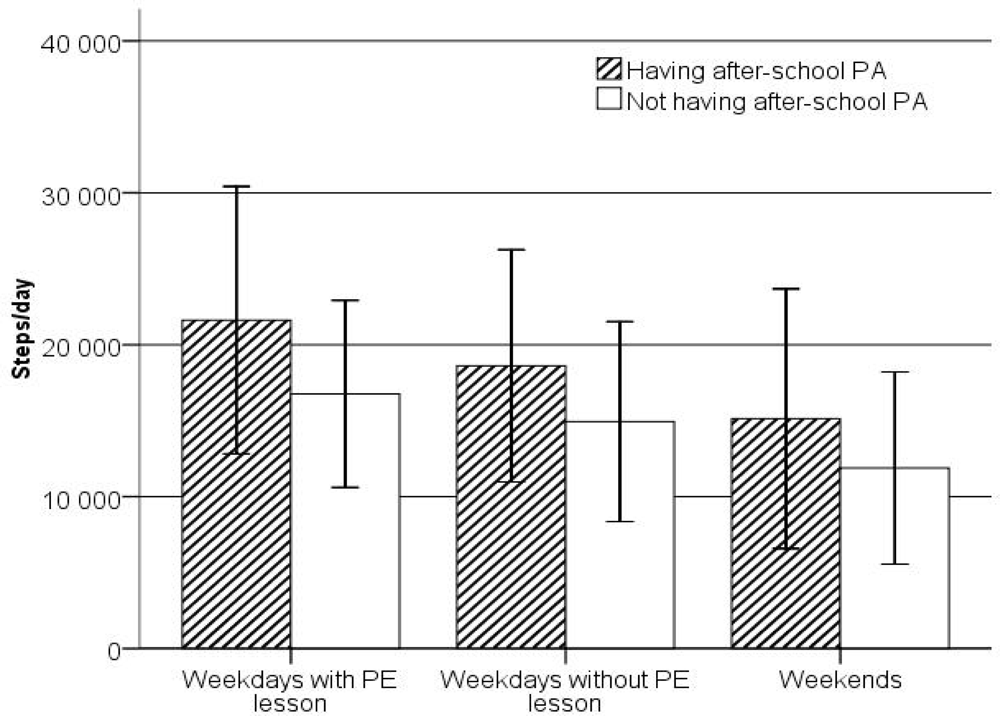
<p>ASPA pupils accumulated significantly higher number of steps/day (18,008 ± 8,316) than their non-ASPA counterparts (14,306 ± 6658). These increases in the number of steps/day were evident on weekdays with PE lesson (F = 51.28, <italic>p</italic> &lt; 0.0001), weekdays without PE lesson (F = 151.63, <italic>p</italic> &lt; 0.0001) and on weekends (F = 52.86, <italic>p</italic> &lt; 0.0001) (<xref ref-type="fig" rid="f1-ijerph-07-02853">Figure 1</xref>). A step-wise decrease in number of steps/day across weekdays with PE lesson, weekdays without PE lesson, and weekends was evident for both groups of pupils. The differences in steps/day across the weekdays with PE lesson, weekdays without PE lesson and weekends were significant in ASPA (F = 48.77, <italic>p</italic> &lt; 0.0001) and non-ASPA pupils (F = 77.87, <italic>p</italic> &lt; 0.0001).</p>
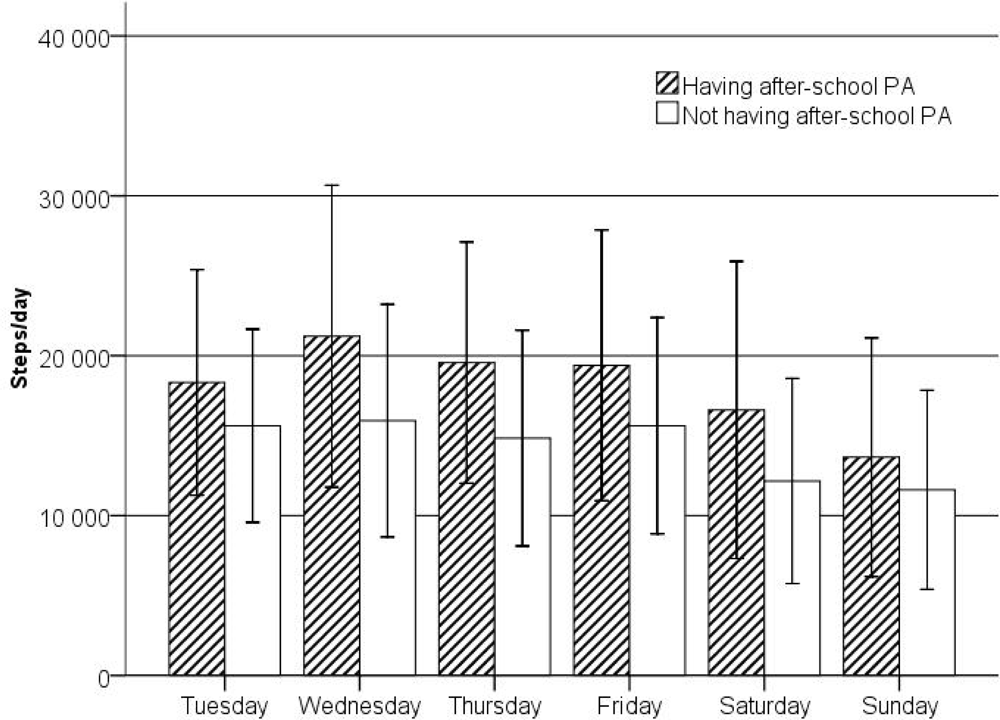
<p>There was significant variability in mean steps achieved on each day of the week in ASPA (F = 20.25, <italic>p</italic> &lt; 0.0001) and non-ASPA pupils (F = 25.02, <italic>p</italic> &lt; 0.0001) (<xref ref-type="fig" rid="f2-ijerph-07-02853">Figure 2</xref>). The differences in steps/day between the two groups of pupils were significant on each day of the week (F<sub>Monday</sub> = 32.06, <italic>p</italic> &lt; 0.0001; F<sub>Tuesday</sub> = 23.55, <italic>p</italic> &lt; 0.0001; F<sub>Wednesday</sub> = 55.19, <italic>p</italic> &lt; 0.0001; F<sub>Thursday</sub> = 60.16, <italic>p</italic> &lt; 0.0001; F<sub>Friday</sub> = 33.99, <italic>p</italic> &lt; 0.0001; F<sub>Saturday</sub> = 44.78, <italic>p</italic> &lt; 0.0001; F<sub>Sunday</sub> = 12.15, <italic>p</italic> = 0.001). The lowest mean step counts were on Sundays regardless of engagement in ASPA (13,653 ± 7,467 for ASPA pupils; 11,613 ± 6,203 steps/day for the non-ASPA pupils).</p>
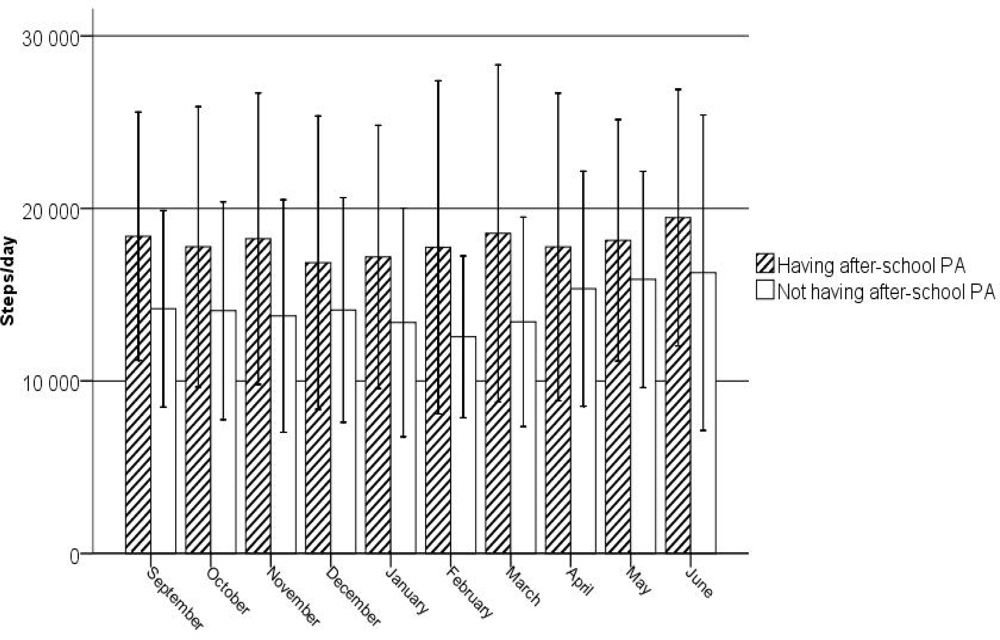
<p><xref ref-type="fig" rid="f3-ijerph-07-02853">Figure 3</xref> shows that across the different months, there were significant differences in the steps achieved per day in non-ASPA pupils (F = 7.67, <italic>p</italic> &lt; 0.0001) (<xref ref-type="fig" rid="f3-ijerph-07-02853">Figure 3</xref>). However, in ASPA pupils, no significant differences were found across the different months (F = 1.18, <italic>p</italic> = 0.306). Regardless of the month of the school year, ASPA pupils had significantly higher mean step counts/day than the non-ASPA pupils (F<sub>September</sub> = 40.00, <italic>p</italic> &lt; 0.0001; F<sub>October</sub> = 26.27, <italic>p</italic> &lt; 0.0001; F<sub>November</sub> = 33.47, <italic>p</italic> &lt; 0.0001; F<sub>December</sub> = 13.31, <italic>p</italic> &lt; 0.0001; F<sub>January</sub> = 27.85, <italic>p</italic> &lt; 0.0001; F<sub>February</sub> = 47.50, <italic>p</italic> &lt; 0.0001; F<sub>March</sub> = 42.30, <italic>p</italic> &lt; 0.0001; F<sub>April</sub> = 9.18, <italic>p</italic> = 0.003; F<sub>May</sub> = 11.40, <italic>p</italic> = 0.001; F<sub>June</sub> = 12.81, <italic>p</italic> &lt; 0.0001). For ASPA and non-ASPA pupils, the highest mean step counts were in June (19,464 ± 7,433 and 16,273 ± 9,146 respectively). However, the lowest mean steps counts were in December for ASPA pupils (16,856 ± 8,506), whereas it was in February for non-ASPA pupils (12,558 ± 4,686).</p>
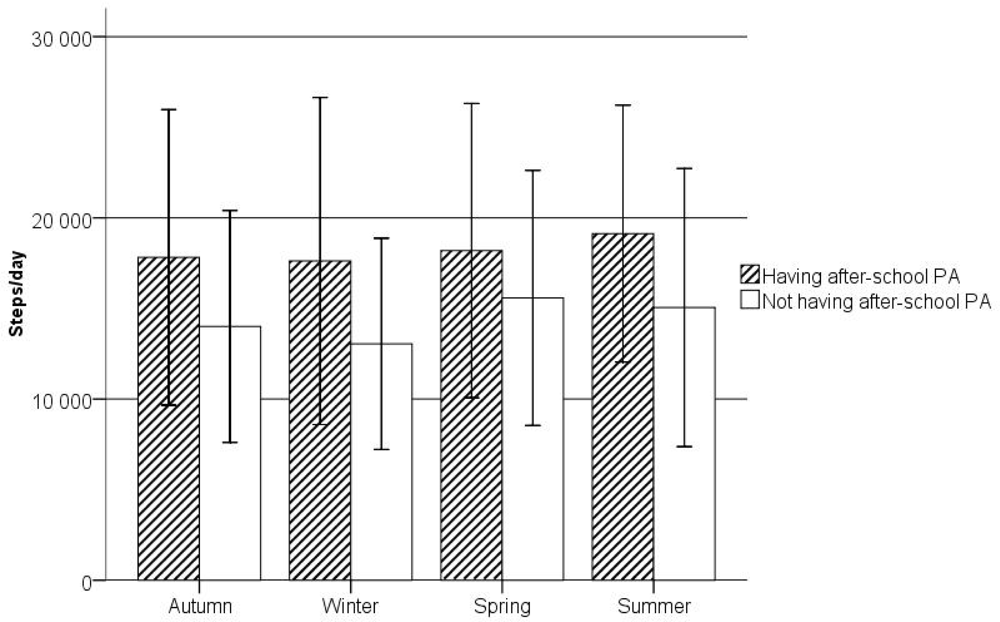
<p><xref ref-type="fig" rid="f4-ijerph-07-02853">Figure 4</xref> illustrates the variability in the mean steps/day by season in both groups that were examined. A point to note is that the significant differences in the mean steps/day across all seasons were found only in non-ASPA pupils (F = 19.52, <italic>p</italic> &lt; 0.0001) compared to the ASPA pupils (F = 1.42, <italic>p</italic> = 0.235). In non-ASPA pupils, the post hoc pairwise comparisons showed differences between summer and winter (<italic>p</italic> &lt; 0.001), autumn and winter (<italic>p</italic> = 0.035), spring and winter (<italic>p</italic> &lt; 0.001), and spring and autumn (<italic>p</italic> &lt; 0.001). Regardless of the season, non-ASPA pupils had significantly lower mean steps/day than the ASPA pupils (F<sub>Spring</sub> = 35.60, <italic>p</italic> = 0.001; F<sub>Summer</sub> = 28.57, <italic>p</italic> &lt; 0.001; F<sub>Autumn</sub> = 78.43, <italic>p</italic> &lt; 0.001; and F<sub>Winter</sub> = 111.19, <italic>p</italic> &lt; 0.001). The biggest difference in mean steps/day between the two groups was in winter (4,571 steps/day), whereas the least difference was in spring (2,613 steps/day).</p></sec>
<sec sec-type="discussion">
<label>4.</label>
<title>Discussion</title>
<p>To the best of our knowledge, the study described in this paper could be the first to pedometer-assess adolescents’ PA levels continuously for the duration of one school year. The implication is that there existed very few studies to compare our findings with. For instance, when our sample (young adolescents) was comparable with other research, the duration of monitoring was different. E.g., only one previous study of 44 young adolescents [<xref ref-type="bibr" rid="b16-ijerph-07-02853">16</xref>] reported patterns of pedometer-assessed steps/day that included weekend days, physical education days <italic>vs.</italic> non-physical education days, and the contribution of ASPA participation. However, Flohr <italic>et al.</italic> [<xref ref-type="bibr" rid="b16-ijerph-07-02853">16</xref>] monitored their participants only for 2 weeks (hence their data were not analyzed by season and month). Likewise, when our period of monitoring (1 year duration) was comparable with other research, the sample was not directly comparable. For instance, only one previous study of 23 adults (mean age = 38 ± 9.9 years) monitored pedometer PA for one year [<xref ref-type="bibr" rid="b18-ijerph-07-02853">18</xref>]. Studies that actually monitored schoolchildren’s PA across different seasons did so for much shorter and interrupted periods of time than the current study undertook e.g., 2 weekends and 2 weekdays days across three seasons (1,115 Auckland children) [<xref ref-type="bibr" rid="b25-ijerph-07-02853">25</xref>], or 4 weekdays across 2 seasons (256 children in Greece) [<xref ref-type="bibr" rid="b26-ijerph-07-02853">26</xref>]. Hence, the current study could be a pioneer in describing the continuous long-term day-to-day patterns and variability of pedometer steps/day in relation to pupils’ ASPA or its lack thereof.</p>
<p>As regards the first objective of this study, we appraised the pedometer-assessed PA levels by day (weekdays/weekends; provision/non provision of PE lessons at school), month and season in the two groups of adolescent pupils. On average, our ASPA pupils accumulated significantly higher number of steps/day (18,008 ± 8316) than their non-ASPA counterparts (14,306 ± 6,658). An encouraging point is that both these step count levels compared favourably with levels from a recent review of 31 studies published since 1999 of pedometer-determined PA in youth that reported comparable weekdays (≈12,000–16,000<sub>boys</sub> steps/day; 10,000–14,000<sub>girls</sub>) and weekend values (≈12,000–13,000<sub>boys</sub> steps/day; 10,000–12,000<sub>girls</sub>) [<xref ref-type="bibr" rid="b27-ijerph-07-02853">27</xref>]. Our findings also compared favourably with levels reported from a 13-country review suggesting that boys and girls from European and Western Pacific countries were more active than young people from U.S. and Canada [<xref ref-type="bibr" rid="b28-ijerph-07-02853">28</xref>]. Furthermore, regardless of attending ASPA, our whole samples’ weekday and weekend values (16,761 ± 7358 and 13,134 ± 7557 steps/day respectively) were also in support of the levels reported by Tudor-Locke <italic>et al.</italic> [<xref ref-type="bibr" rid="b27-ijerph-07-02853">27</xref>]. Similarly, the weekend values for our non-ASPA and ASPA pupils (11,886 ± 6,325; and 15,131 ± 8,548 steps/day respectively) were correspondingly in agreement with other studies [<xref ref-type="bibr" rid="b27-ijerph-07-02853">27</xref>]. Moreover, our ≈3,000 step/day difference between weekdays and weekend values were comparable to a study of 64 Polish adolescent using pedometers for three weeks [<xref ref-type="bibr" rid="b29-ijerph-07-02853">29</xref>].</p>
<p>In connection with objective two, we compared the pedometer-determined PA levels by day, month and season for ASPA and non-ASPA pupils. Adolescents who regularly attended organized ASPA achieved consistently more step/day than those who did not. Moreover, this was true regardless of the ‘type’ of day: <italic>i.e.,</italic> ASPA participants recorded more step counts on all days of week; on days with PE lesson; on days without PE lesson; and also on weekends. In the U.S.A, Flohr <italic>et al.</italic> [<xref ref-type="bibr" rid="b16-ijerph-07-02853">16</xref>] reported similar findings (44 seventh-grade adolescents, mean age 12.4 years), where their ASPA participants achieved 24% more steps on all days as compared to non-ASPA pupils. In agreement with Flohr <italic>et al.</italic> [<xref ref-type="bibr" rid="b16-ijerph-07-02853">16</xref>], our ASPA participants logged about 21% more step/day counts than non-ASPA pupils. To our knowledge, no previous study has described pedometer-assessed PA in adolescents who participated in ASPA and those who did not analysed by month and season of the year. Our finding that ASPA participants accumulated grater total volume of pedometer-determined PA than non-ASPA regardless of month and season has implications for long-term PA promotion strategies.</p>
<p>Regarding objective three, the present study assessed the variability in pedometer-determined PA by day, month and season for ASPA and non-ASPA pupils. Few studies analysed the natural variability of PA across substantially long periods of time. Tudor-Locke <italic>et al.</italic> [<xref ref-type="bibr" rid="b18-ijerph-07-02853">18</xref>] collected 365 days of continuous self-monitored pedometer data (23 adults) to explore the natural variability of PA by month, season, weekday <italic>versus</italic> weekend day, and sport/exercise participation day <italic>versus</italic> non-participation day. However, there seems no previous study of young adolescents that assessed the variability of daily step counts associated with regular participation in organized ASPA analysed by day, month and season.</p>
<p>As regards PA variability by day, we found that the number of daily steps significantly differed by day of the week (weekdays/weekends; provision/non provision of school PE lesson) in both ASPA and non-ASPA participants. This is in support of a study in adults [<xref ref-type="bibr" rid="b18-ijerph-07-02853">18</xref>] where the day-to-day variability in steps/day corresponded to expected fluctuations with classification of the day (weekday <italic>versus</italic> weekend day, and sport/exercise participation day <italic>versus</italic> non-participation day). Our findings also support research of older adults [<xref ref-type="bibr" rid="b30-ijerph-07-02853">30</xref>] in which the day-to-day PA variability noticeably reflected the expected oscillation with classification of day (<italic>i.e.</italic>, PA in scheduled exercising weekdays &gt; non-exercise weekdays &gt; weekend days). However our finding of the variability of PA by day is in contrast with Flohr <italic>et al.</italic> [<xref ref-type="bibr" rid="b16-ijerph-07-02853">16</xref>] who reported that the number of steps/day of young adolescents was consistent across classification of day (<italic>i.e.</italic>, physical education <italic>vs.</italic> health education days <italic>vs.</italic> weekend days). A potential explanation for the lack of PA variability by day reported by Flohr <italic>et al.</italic> [<xref ref-type="bibr" rid="b16-ijerph-07-02853">16</xref>] is that they monitored their participants for a relatively short duration (only for 2 weeks) in one season. This suggested that for variability in PA to be detected in young adolescents, a longer period of monitoring would be recommended, in contrast to older adults where shorter periods (9 days) of monitoring were able detect variability in PA [<xref ref-type="bibr" rid="b30-ijerph-07-02853">30</xref>].</p>
<p>As to the PA variability by month and season, whereas daily steps significantly differed by day of the week in ASPA and non-ASPA participants, significant month and season variability was found only in non-ASPA pupils. This is an important finding of the present study: in non-ASPA pupils, PA decreased in winter months and increased in spring, suggesting that activity levels of non-ASPA pupils may be influenced by exogenous factors (e.g., such as ambient temperature, rainfall, snowfall, day length <italic>etc.</italic>). Previous research supported such a proposition: adult weekly leisure-time energy expenditure was ≈15–20% higher during spring and summer [<xref ref-type="bibr" rid="b31-ijerph-07-02853">31</xref>]. Similarly, primary school children achieved less mean total daily steps counts in winter than in summer [<xref ref-type="bibr" rid="b25-ijerph-07-02853">25</xref>]. Indeed short day length and extremes of ambient temperature could hinder regular participation in outdoor PA [<xref ref-type="bibr" rid="b32-ijerph-07-02853">32</xref>,<xref ref-type="bibr" rid="b33-ijerph-07-02853">33</xref>]. Contrary to our non-ASPA pupils, the differences across months and seasons were not significant in ASPA pupils, suggesting that regular ASPA might contribute to reduce, on achieved PA levels, the possible influence of meteorological (snowfall, wind, hours of sunshine) and winter severity indicators related to months/seasons. Thus, despite our study’s small sample size, the findings suggested the lack of variability in PA levels by month and season for ASPA pupils. For adolescents’ PA behaviour, this could translate into that ASPA participation appears to be a way to maintaining a constant level of PA for adolescents across the whole duration of the school-year.</p>
<p>Collectively, these findings suggested the need for more research into the effects of ASPA, especially organized sports activities [<xref ref-type="bibr" rid="b15-ijerph-07-02853">15</xref>]. There have been proposals that the potential of after-school hours in increasing children’s PA levels may help to augment a child’s total daily energy expenditure [<xref ref-type="bibr" rid="b16-ijerph-07-02853">16</xref>].</p>
<p>Although the current study is unique in terms of day, month and season variability in relation to AS participation, it has limitations. The small sample size, probably due to the burden of continuous long-term (one year) self-monitoring, does not allow generalizations. Further, with a larger (and more representative) sample, the external validity of the findings would be enhanced, and any possible gender effects that underlie the group comparisons could have also been dis-entangled. Relatively high steps/day values across the whole school-year in ASPA and non-ASPA pupils suggested that those pupils who self selected themselves and completed the monitoring across a long time period might have been motivated to walk more. The detailed schedule of the type, duration and weekly frequency of participation in organised ASPA would have helped to better assess the nature and particular features of the associations of ASPA. For instance, a comprehensive outline of the number of steps that participants accumulated during the daily segments (during ASPA or PE) would have provided deeper insights into the distribution of the pupils’ step counts across the time periods of the day. In general, the findings of our study are preliminary and require further investigation. Future research into the effects of regular organised ASPA should consider the limitations highlighted above, and would benefit from recruiting more pupils from different settings that would allow gender comparisons. Studies will also need to document the fine characteristics (e.g., nature, degree, volume, intensity, <italic>etc.</italic>) of the ASPA in order to enable a more detailed analysis of the associations under investigation. Finally a detailed log of the pedometer wear-time for each participant would have allowed comparing and controlling for any differences in the periods when participants actually had their pedometers on them.</p></sec>
<sec sec-type="conclusions">
<label>5.</label>
<title>Conclusions</title>
<p>In spite of the above limitations, this study could be the first to report adolescents’ patterns of pedometer-monitored steps/day that were assessed continuously across the duration of the school year.</p>
<p>In summary, the study findings suggested that month and season variability of PA differed in ASPA and non-ASPA participants. However, the day-to-day variability of PA levels was similar in ASPA and non-ASPA participants implying the fluctuation of daily PA according to the day of the week (weekdays/weekends; provision/non provision of school PE lesson). Hence, on days with a PE lesson, the mean step counts increased regardless of whether pupils participated or did not participate in ASPA. Therefore, incorporating PE lessons several times per week seems to be warranted and perhaps even more so for those who do not participate in ASPA.</p>
<p>Furthermore, the lack of variability in PA levels for ASPA pupils by month and season in comparison with non-ASPA pupils is a key finding. It suggested that in relation to adolescents’ PA behaviour, regular ASPA might help to reduce the possible influences of a range of meteorological indicators related to months/seasons; and that regular organised ASPA seems to be a way to maintaining a relatively constant PA level for adolescents across the whole school-year.</p></sec></body>
<back>
<ack>
<p>The authors thank the pupils who participated in this research. This study was supported by the research grant of Ministry of Education, Youth and Health of the Czech Republic [6198959221]. We also thank the anonymous reviewers for their constructive comments that helped strengthen the article.</p></ack>
<ref-list>
<title>References</title>
<ref id="b1-ijerph-07-02853"><label>1</label><citation citation-type="journal"><person-group person-group-type="author"><name><surname>Sung</surname><given-names>RYT</given-names></name><name><surname>Yu</surname><given-names>CCW</given-names></name><name><surname>Choi</surname><given-names>KC</given-names></name><name><surname>McManus</surname><given-names>A</given-names></name><name><surname>Li</surname><given-names>AMC</given-names></name><name><surname>Xu</surname><given-names>SLY</given-names></name><name><surname>Chan</surname><given-names>D</given-names></name><name><surname>Lo</surname><given-names>AFC</given-names></name><name><surname>Chan</surname><given-names>JCN</given-names></name><name><surname>Fok</surname><given-names>TF</given-names></name></person-group><article-title>Waist circumference and body mass index in Chinese children: Cutoff values for predicting cardiovascular risk factors</article-title><source>Int. J. Obes</source><year>2006</year><volume>31</volume><fpage>550</fpage><lpage>558</lpage></citation></ref>
<ref id="b2-ijerph-07-02853"><label>2</label><citation citation-type="journal"><person-group person-group-type="author"><name><surname>Steinberger</surname><given-names>J</given-names></name><name><surname>Daniels</surname><given-names>SR</given-names></name></person-group><article-title>Obesity, Insulin Resistance, Diabetes, and Cardiovascular Risk in Children: An American Heart Association Scientific Statement from the Atherosclerosis, Hypertension, and Obesity in the Young Committee (Council on Cardiovascular Disease in the Young) and the Diabetes Committee (Council on Nutrition, Physical Activity, and Metabolism)</article-title><source>Circulation</source><year>2003</year><volume>107</volume><fpage>1448</fpage><lpage>1453</lpage><pub-id pub-id-type="doi">10.1161/01.CIR.0000060923.07573.F2</pub-id><pub-id pub-id-type="pmid">12642369</pub-id></citation></ref>
<ref id="b3-ijerph-07-02853"><label>3</label><citation citation-type="journal"><person-group person-group-type="author"><name><surname>Kwak</surname><given-names>L</given-names></name><name><surname>Kremers</surname><given-names>SPJ</given-names></name><name><surname>Bergman</surname><given-names>P</given-names></name><name><surname>Ruiz</surname><given-names>JR</given-names></name><name><surname>Rizzo</surname><given-names>NS</given-names></name><name><surname>Sjöström</surname><given-names>M</given-names></name></person-group><article-title>Associations between physical activity, fitness, and academic achievement</article-title><source>J Pediatr</source><year>2009</year><volume>155</volume><fpage>914</fpage><lpage>918</lpage><fpage>e911</fpage></citation></ref>
<ref id="b4-ijerph-07-02853"><label>4</label><citation citation-type="journal"><person-group person-group-type="author"><name><surname>Chomitz</surname><given-names>VR</given-names></name><name><surname>Slining</surname><given-names>MM</given-names></name><name><surname>McGowan</surname><given-names>RJ</given-names></name><name><surname>Mitchell</surname><given-names>SE</given-names></name><name><surname>Dawson</surname><given-names>GF</given-names></name><name><surname>Hacker</surname><given-names>KA</given-names></name></person-group><article-title>Is there a relationship between physical fitness and academic achievement? Positive results from public school children in the Northeastern United States</article-title><source>J. Sch. Health</source><year>2009</year><volume>79</volume><fpage>30</fpage><lpage>37</lpage><pub-id pub-id-type="doi">10.1111/j.1746-1561.2008.00371.x</pub-id><pub-id pub-id-type="pmid">19149783</pub-id></citation></ref>
<ref id="b5-ijerph-07-02853"><label>5</label><citation citation-type="journal"><person-group person-group-type="author"><name><surname>Boreham</surname><given-names>C</given-names></name><name><surname>Riddoch</surname><given-names>C</given-names></name></person-group><article-title>The physical activity, fitness and health of children</article-title><source>J. Sport Sci</source><year>2001</year><volume>19</volume><fpage>915</fpage><lpage>929</lpage><pub-id pub-id-type="doi">10.1080/026404101317108426</pub-id></citation></ref>
<ref id="b6-ijerph-07-02853"><label>6</label><citation citation-type="journal"><person-group person-group-type="author"><name><surname>Allison</surname><given-names>KR</given-names></name><name><surname>Adlaf</surname><given-names>EM</given-names></name><name><surname>Dwyer</surname><given-names>JJM</given-names></name><name><surname>Lysy</surname><given-names>DC</given-names></name><name><surname>Irving</surname><given-names>HM</given-names></name></person-group><article-title>The decline in physical activity among adolescent students</article-title><source>Can. J. Public Health</source><year>2007</year><volume>98</volume><fpage>97</fpage><lpage>100</lpage><pub-id pub-id-type="pmid">17441530</pub-id></citation></ref>
<ref id="b7-ijerph-07-02853"><label>7</label><citation citation-type="journal"><person-group person-group-type="author"><name><surname>Lowry</surname><given-names>R</given-names></name><name><surname>Galuska</surname><given-names>DA</given-names></name><name><surname>Fulton</surname><given-names>JE</given-names></name><name><surname>Wechsler</surname><given-names>H</given-names></name><name><surname>Kann</surname><given-names>L</given-names></name></person-group><article-title>Weight management goals and practices among U.S. high school students: Associations with physical activity, diet, and smoking</article-title><source>J. Adolesc. Health</source><year>2002</year><volume>31</volume><fpage>133</fpage><lpage>144</lpage><pub-id pub-id-type="doi">10.1016/S1054-139X(01)00408-6</pub-id><pub-id pub-id-type="pmid">12127383</pub-id></citation></ref>
<ref id="b8-ijerph-07-02853"><label>8</label><citation citation-type="journal"><person-group person-group-type="author"><name><surname>Sigmund</surname><given-names>E</given-names></name><name><surname>Croix</surname><given-names>DSM</given-names></name><name><surname>Miklánková</surname><given-names>L</given-names></name><name><surname>Frömel</surname><given-names>K</given-names></name></person-group><article-title>Physical activity patterns of kindergarten children in comparison to teenagers and young adults</article-title><source>Eur. J. Public Health</source><year>2007</year><volume>17</volume><fpage>646</fpage><lpage>651</lpage><pub-id pub-id-type="doi">10.1093/eurpub/ckm033</pub-id><pub-id pub-id-type="pmid">17434876</pub-id></citation></ref>
<ref id="b9-ijerph-07-02853"><label>9</label><citation citation-type="book"><person-group person-group-type="author"><name><surname>Frömel</surname><given-names>K</given-names></name><name><surname>Novosad</surname><given-names>J</given-names></name><name><surname>Svozil</surname><given-names>Z</given-names></name></person-group><source>Pohybová aktivita a sportovní zájmy mládeže;</source><publisher-name>Univerzita Palackeho</publisher-name><publisher-loc>Olomouc, CZE</publisher-loc><year>1999</year></citation></ref>
<ref id="b10-ijerph-07-02853"><label>10</label><citation citation-type="journal"><person-group person-group-type="author"><name><surname>Jago</surname><given-names>R</given-names></name><name><surname>Anderson</surname><given-names>CB</given-names></name><name><surname>Baranowski</surname><given-names>T</given-names></name><name><surname>Watson</surname><given-names>K</given-names></name></person-group><article-title>Adolescent patterns of physical activity: Differences by gender, day, and time of day</article-title><source>Am. J. Prev. Med</source><year>2005</year><volume>28</volume><fpage>447</fpage><lpage>452</lpage><pub-id pub-id-type="doi">10.1016/j.amepre.2005.02.007</pub-id><pub-id pub-id-type="pmid">15894148</pub-id></citation></ref>
<ref id="b11-ijerph-07-02853"><label>11</label><citation citation-type="journal"><person-group person-group-type="author"><name><surname>Mota</surname><given-names>J</given-names></name><name><surname>Santos</surname><given-names>MP</given-names></name><name><surname>Ribeiro</surname><given-names>JC</given-names></name></person-group><article-title>Differences in leisure-time activities according to level of physical activity in adolescents</article-title><source>J. Phys. Act. Health</source><year>2008</year><volume>5</volume><fpage>286</fpage><lpage>293</lpage><pub-id pub-id-type="pmid">18382037</pub-id></citation></ref>
<ref id="b12-ijerph-07-02853"><label>12</label><citation citation-type="journal"><person-group person-group-type="author"><name><surname>Hohepa</surname><given-names>M</given-names></name><name><surname>Scragg</surname><given-names>R</given-names></name><name><surname>Schofield</surname><given-names>G</given-names></name><name><surname>Kolt</surname><given-names>GS</given-names></name><name><surname>Schaaf</surname><given-names>D</given-names></name></person-group><article-title>Self-reported physical activity levels during a segmented school day in a large multiethnic sample of high school students</article-title><source>J. Sci. Med. Sport</source><year>2009</year><volume>12</volume><fpage>284</fpage><lpage>292</lpage><pub-id pub-id-type="doi">10.1016/j.jsams.2007.11.005</pub-id><pub-id pub-id-type="pmid">18328781</pub-id></citation></ref>
<ref id="b13-ijerph-07-02853"><label>13</label><citation citation-type="journal"><person-group person-group-type="author"><name><surname>Hardman</surname><given-names>CA</given-names></name><name><surname>Horne</surname><given-names>PJ</given-names></name><name><surname>Rowlands</surname><given-names>AV</given-names></name></person-group><article-title>Children’s pedometer-determined physical activity during school-time and leisure-time</article-title><source>J. Exerc. Sci. Fit</source><year>2009</year><volume>7</volume><fpage>129</fpage><lpage>134</lpage><pub-id pub-id-type="doi">10.1016/S1728-869X(09)60016-2</pub-id></citation></ref>
<ref id="b14-ijerph-07-02853"><label>14</label><citation citation-type="journal"><person-group person-group-type="author"><name><surname>Fairclough</surname><given-names>SJ</given-names></name><name><surname>Butcher</surname><given-names>ZH</given-names></name><name><surname>Stratton</surname><given-names>G</given-names></name></person-group><article-title>Whole-day and segmented-day physical activity variability of northwest England school children</article-title><source>Prev. Med</source><year>2007</year><volume>44</volume><fpage>421</fpage><lpage>425</lpage><pub-id pub-id-type="doi">10.1016/j.ypmed.2007.01.002</pub-id><pub-id pub-id-type="pmid">17320158</pub-id></citation></ref>
<ref id="b15-ijerph-07-02853"><label>15</label><citation citation-type="journal"><person-group person-group-type="author"><name><surname>Santos</surname><given-names>MP</given-names></name><name><surname>Oliveira</surname><given-names>J</given-names></name><name><surname>Ribeiro</surname><given-names>JC</given-names></name><name><surname>Mota</surname><given-names>J</given-names></name></person-group><article-title>Active travel to school, BMI and participation in organised and non-organised physical activity among Portuguese adolescents</article-title><source>Prev. Med</source><year>2009</year><volume>49</volume><fpage>497</fpage><lpage>499</lpage><pub-id pub-id-type="doi">10.1016/j.ypmed.2009.09.021</pub-id><pub-id pub-id-type="pmid">19815025</pub-id></citation></ref>
<ref id="b16-ijerph-07-02853"><label>16</label><citation citation-type="journal"><person-group person-group-type="author"><name><surname>Flohr</surname><given-names>JA</given-names></name><name><surname>Todd</surname><given-names>MK</given-names></name><name><surname>Tudor-Locke</surname><given-names>CE</given-names></name></person-group><article-title>Pedometer-assessed physical activity in young adolescents</article-title><source>Res. Q. Exerc. Sport</source><year>2006</year><volume>77</volume><fpage>309</fpage><lpage>315</lpage><pub-id pub-id-type="doi">10.5641/027013606X13080769704929</pub-id><pub-id pub-id-type="pmid">17020075</pub-id></citation></ref>
<ref id="b17-ijerph-07-02853"><label>17</label><citation citation-type="journal"><person-group person-group-type="author"><name><surname>Beets</surname><given-names>MW</given-names></name><name><surname>Beighle</surname><given-names>A</given-names></name><name><surname>Erwin</surname><given-names>HE</given-names></name><name><surname>Huberty</surname><given-names>JL</given-names></name></person-group><article-title>After-school program impact on physical activity and fitness: A meta-analysis</article-title><source>Am. J. Prev. Med</source><year>2009</year><volume>36</volume><fpage>527</fpage><lpage>537</lpage><pub-id pub-id-type="doi">10.1016/j.amepre.2009.01.033</pub-id><pub-id pub-id-type="pmid">19362799</pub-id></citation></ref>
<ref id="b18-ijerph-07-02853"><label>18</label><citation citation-type="journal"><person-group person-group-type="author"><name><surname>Tudor-Locke</surname><given-names>CE</given-names></name><name><surname>Bassett</surname><given-names>DR</given-names><suffix>Jr</suffix></name><name><surname>Swartz</surname><given-names>A</given-names></name><name><surname>Strath</surname><given-names>S</given-names></name><name><surname>Parr</surname><given-names>B</given-names></name><name><surname>Reis</surname><given-names>J</given-names></name><name><surname>DuBose</surname><given-names>K</given-names></name><name><surname>Ainsworth</surname><given-names>BE</given-names></name></person-group><article-title>A preliminary study of one year of pedometer self-monitoring</article-title><source>Ann. Behav. Med</source><year>2004</year><volume>28</volume><fpage>158</fpage><lpage>162</lpage><pub-id pub-id-type="doi">10.1207/s15324796abm2803_3</pub-id><pub-id pub-id-type="pmid">15576253</pub-id></citation></ref>
<ref id="b19-ijerph-07-02853"><label>19</label><citation citation-type="journal"><person-group person-group-type="author"><name><surname>Morgan</surname><given-names>CF</given-names></name><name><surname>Beighle</surname><given-names>A</given-names></name><name><surname>Pangrazi</surname><given-names>RP</given-names></name></person-group><article-title>What are the contributory and compensatory relationships between physical education and physical activity in children?</article-title><source>Res. Q. Exerc. Sport</source><year>2007</year><volume>78</volume><fpage>407</fpage><lpage>412</lpage><pub-id pub-id-type="doi">10.5641/193250307X13082505158507</pub-id><pub-id pub-id-type="pmid">18274212</pub-id></citation></ref>
<ref id="b20-ijerph-07-02853"><label>20</label><citation citation-type="web"><person-group person-group-type="author"><name><surname>Seaman</surname><given-names>JE</given-names></name><name><surname>Allen</surname><given-names>IE</given-names></name></person-group><source>Statistics Roundtable. Outlier Options</source><comment>Available online: <ext-link xlink:href="http://www.asq.org/quality-progress/2010/02/statistics-roundtable/outlier-options.html/" ext-link-type="uri">http://www.asq.org/quality-progress/2010/02/statistics-roundtable/outlier-options.html/</ext-link> (accessed on 12 June 2010)</comment></citation></ref>
<ref id="b21-ijerph-07-02853"><label>21</label><citation citation-type="journal"><person-group person-group-type="author"><name><surname>Levy</surname><given-names>JS</given-names></name></person-group><article-title>Case Studies: Types, Designs, and logics of inference</article-title><source>Conflict Manag. Peace Sci</source><year>2008</year><volume>25</volume><fpage>1</fpage><lpage>18</lpage><pub-id pub-id-type="doi">10.1080/07388940701860318</pub-id></citation></ref>
<ref id="b22-ijerph-07-02853"><label>22</label><citation citation-type="book"><person-group person-group-type="author"><name><surname>Field</surname><given-names>A</given-names></name></person-group><source>Discovering Statistics Using SPSS</source><edition>2nd ed</edition><publisher-name>SAGE Publications</publisher-name><publisher-loc>London, UK</publisher-loc><year>2005</year></citation></ref>
<ref id="b23-ijerph-07-02853"><label>23</label><citation citation-type="book"><person-group person-group-type="author"><name><surname>Tabachnick</surname><given-names>BG</given-names></name><name><surname>Fidell</surname><given-names>LS</given-names></name></person-group><source>Using Multivariate Statistics</source><publisher-name>Allyn and Bacon</publisher-name><publisher-loc>Boston, MA, USA</publisher-loc><year>2007</year></citation></ref>
<ref id="b24-ijerph-07-02853"><label>24</label><citation citation-type="book"><person-group person-group-type="author"><name><surname>Altman</surname><given-names>DG</given-names></name></person-group><source>Practical Statistics for Medical Research</source><publisher-name>Chapman and Hall</publisher-name><publisher-loc>London, UK</publisher-loc><year>1991</year></citation></ref>
<ref id="b25-ijerph-07-02853"><label>25</label><citation citation-type="journal"><person-group person-group-type="author"><name><surname>Duncan</surname><given-names>JS</given-names></name><name><surname>Hopkins</surname><given-names>WG</given-names></name><name><surname>Schofield</surname><given-names>G</given-names></name><name><surname>Duncan</surname><given-names>EK</given-names></name></person-group><article-title>Effects of weather on pedometer-determined physical activity in children</article-title><source>Med. Sci. Sports Exerc</source><year>2008</year><volume>40</volume><fpage>1432</fpage><lpage>1438</lpage><pub-id pub-id-type="doi">10.1249/MSS.0b013e31816e2b28</pub-id><pub-id pub-id-type="pmid">18614949</pub-id></citation></ref>
<ref id="b26-ijerph-07-02853"><label>26</label><citation citation-type="journal"><person-group person-group-type="author"><name><surname>Loucaides</surname><given-names>CA</given-names></name><name><surname>Chedzoy</surname><given-names>SM</given-names></name><name><surname>Bennett</surname><given-names>N</given-names></name></person-group><article-title>Differences in physical activity levels between urban and rural school children in Cyprus</article-title><source>Health Educ. Res</source><year>2004</year><volume>19</volume><fpage>138</fpage><lpage>147</lpage><pub-id pub-id-type="doi">10.1093/her/cyg014</pub-id><pub-id pub-id-type="pmid">15031273</pub-id></citation></ref>
<ref id="b27-ijerph-07-02853"><label>27</label><citation citation-type="journal"><person-group person-group-type="author"><name><surname>Tudor-Locke</surname><given-names>CE</given-names></name><name><surname>McClain</surname><given-names>J</given-names></name><name><surname>Hart</surname><given-names>T</given-names></name><name><surname>Sisson</surname><given-names>S</given-names></name><name><surname>Washington</surname><given-names>T</given-names></name></person-group><article-title>Expected values for pedometer-determined physical activity in youth</article-title><source>Res. Q. Exers. Sport</source><year>2009</year><volume>80</volume><fpage>164</fpage><lpage>174</lpage></citation></ref>
<ref id="b28-ijerph-07-02853"><label>28</label><citation citation-type="journal"><person-group person-group-type="author"><name><surname>Beets</surname><given-names>MW</given-names></name><name><surname>Bornstein</surname><given-names>D</given-names></name><name><surname>Beighle</surname><given-names>A</given-names></name><name><surname>Cardinal</surname><given-names>BJ</given-names></name><name><surname>Morgan</surname><given-names>CF</given-names></name></person-group><article-title>Pedometer-measured physical activity patterns of youth: A 13-country review</article-title><source>Am. J. Prev. Med</source><year>2010</year><volume>38</volume><fpage>208</fpage><lpage>216</lpage><pub-id pub-id-type="doi">10.1016/j.amepre.2009.09.045</pub-id><pub-id pub-id-type="pmid">20117578</pub-id></citation></ref>
<ref id="b29-ijerph-07-02853"><label>29</label><citation citation-type="journal"><person-group person-group-type="author"><name><surname>Groffik</surname><given-names>D</given-names></name><name><surname>Frömel</surname><given-names>K</given-names></name><name><surname>Pelclová</surname><given-names>J</given-names></name></person-group><article-title>Pedometers as a method for modification of physical activity in students</article-title><source>J. Hum. Kin</source><year>2008</year><volume>20</volume><fpage>131</fpage><lpage>137</lpage><pub-id pub-id-type="doi">10.2478/v10078-008-0025-7</pub-id></citation></ref>
<ref id="b30-ijerph-07-02853"><label>30</label><citation citation-type="journal"><person-group person-group-type="author"><name><surname>Tudor-Locke</surname><given-names>C</given-names></name><name><surname>Jones</surname><given-names>GR</given-names></name><name><surname>Myers</surname><given-names>AM</given-names></name><name><surname>Paterson</surname><given-names>DH</given-names></name><name><surname>Ecclestone</surname><given-names>NA</given-names></name></person-group><article-title>Contribution of structured exercise class participation and informal walking for exercise to daily physical activity in community-dwelling older adults</article-title><source>Res. Q. Exerc. Sport</source><year>2002</year><volume>73</volume><fpage>350</fpage><lpage>356</lpage><pub-id pub-id-type="pmid">12230344</pub-id></citation></ref>
<ref id="b31-ijerph-07-02853"><label>31</label><citation citation-type="journal"><person-group person-group-type="author"><name><surname>Pivarnik</surname><given-names>JM</given-names></name><name><surname>Reeves</surname><given-names>MJ</given-names></name><name><surname>Rafferty</surname><given-names>AP</given-names></name></person-group><article-title>Seasonal variation in adult leisure-time physical activity</article-title><source>Med. Sci. Sports Exerc</source><year>2003</year><volume>35</volume><fpage>1004</fpage><lpage>1008</lpage><pub-id pub-id-type="doi">10.1249/01.MSS.0000069747.55950.B1</pub-id><pub-id pub-id-type="pmid">12783049</pub-id></citation></ref>
<ref id="b32-ijerph-07-02853"><label>32</label><citation citation-type="journal"><person-group person-group-type="author"><collab>Center for Disease Control and Prevention</collab></person-group><article-title>Monthly estimates of leisure-time physical inactivity–united states, 1994</article-title><source>MMWR Morb. Mortal. Wkly. Rep</source><year>1997</year><volume>46</volume><fpage>393</fpage><lpage>397</lpage><pub-id pub-id-type="pmid">9157273</pub-id></citation></ref>
<ref id="b33-ijerph-07-02853"><label>33</label><citation citation-type="journal"><person-group person-group-type="author"><name><surname>Togo</surname><given-names>F</given-names></name><name><surname>Watanabe</surname><given-names>E</given-names></name><name><surname>Park</surname><given-names>H</given-names></name><name><surname>Shephard</surname><given-names>RJ</given-names></name><name><surname>Aoyagi</surname><given-names>Y</given-names></name></person-group><article-title>Meteorology and the physical activity of the elderly: The Nakanojo study</article-title><source>Int. J. Biometeorol</source><year>2005</year><volume>50</volume><fpage>83</fpage><lpage>89</lpage><pub-id pub-id-type="doi">10.1007/s00484-005-0277-z</pub-id><pub-id pub-id-type="pmid">16044348</pub-id></citation></ref></ref-list>
<sec sec-type="display-objects">
<title>Figures</title>
<fig id="f1-ijerph-07-02853" position="float">
<label>Figure 1</label>
<caption>
<p>Steps per day (<italic>M</italic>; 95% CI) achieved by ASPA and non-ASPA pupils by weekdays with PE lesson, weekdays without PE lesson and weekends.</p></caption><graphic xlink:href="ijerph-07-02853f1.gif"/></fig>
<fig id="f2-ijerph-07-02853" position="float">
<label>Figure 2</label>
<caption>
<p>Steps per day (M; 95% CI) achieved by ASPA and non-ASPA pupils by days of the week.</p></caption><graphic xlink:href="ijerph-07-02853f2.gif"/></fig>
<fig id="f3-ijerph-07-02853" position="float">
<label>Figure 3</label>
<caption>
<p>Steps per day (<italic>M</italic>; 95% CI) achieved by ASPA and non-ASPA pupils by months of the school year.</p></caption><graphic xlink:href="ijerph-07-02853f3.gif"/></fig>
<fig id="f4-ijerph-07-02853" position="float">
<label>Figure 4</label>
<caption>
<p>Steps per day (M; 95% CI) achieved by ASPA and non-ASPA pupils by season of the school year.</p></caption><graphic xlink:href="ijerph-07-02853f4.gif"/></fig></sec></back></article>