
<?xml version="1.0" encoding="UTF-8"?>
<!DOCTYPE article PUBLIC "-//NLM//DTD Journal Publishing DTD v2.3 20070202//EN" "journalpublishing.dtd">
<article xmlns:xlink="http://www.w3.org/1999/xlink" xml:lang="en" article-type="review-article">
<front>
<journal-meta>
<journal-id journal-id-type="publisher-id">101238455</journal-id>
<journal-title>International Journal of Environmental Research and Public Health</journal-title>
<issn pub-type="epub">1660-4601</issn>
<publisher>
<publisher-name>Molecular Diversity Preservation International (MDPI)</publisher-name></publisher></journal-meta>
<article-meta>
<article-id pub-id-type="doi">10.3390/ijerph6051609</article-id>
<article-id pub-id-type="publisher-id">ijerph-06-01609</article-id>
<article-categories>
<subj-group>
<subject>Review</subject></subj-group></article-categories>
<title-group>
<article-title>A Systematic Review of Arsenic Exposure and Its Social and Mental Health Effects with Special Reference to Bangladesh</article-title></title-group>
<contrib-group>
<contrib contrib-type="author">
<name><surname>Brinkel</surname><given-names>Johanna</given-names></name>
<degrees>Md</degrees></contrib>
<contrib contrib-type="author">
<name><surname>Khan</surname><given-names>Mobarak H.</given-names></name><xref ref-type="corresp" rid="c1-ijerph-06-01609">*</xref></contrib>
<contrib contrib-type="author">
<name><surname>Kraemer</surname><given-names>Alexander</given-names></name></contrib>
<aff id="af1-ijerph-06-01609">Department of Public Health Medicine, University of Bielefeld, Bielefeld, Germany; E-Mails:
<email>johanna_katharina.brinkel@uni-bielefeld.de</email> (J.B.);
<email>alexander.kraemer@uni-bielefeld.de</email> (A.K.)</aff></contrib-group>
<author-notes>
<corresp id="c1-ijerph-06-01609">
<label>*</label>Author to whom correspondence should be addressed; E-Mail:
<email>mobarak.khan@uni-bielefeld.de</email>; Tel.: +49-521-106-4262; Fax: +49-521-106-2968</corresp></author-notes>
<pub-date pub-type="ppub">
<month>5</month>
<year>2009</year></pub-date>
<pub-date pub-type="epub">
<day>8</day>
<month>5</month>
<year>2009</year></pub-date>
<volume>6</volume>
<issue>5</issue>
<fpage>1609</fpage>
<lpage>1619</lpage>
<history>
<date date-type="received">
<day>4</day>
<month>1</month>
<year>2009</year></date>
<date date-type="accepted">
<day>9</day>
<month>4</month>
<year>2009</year></date></history>
<permissions>
<copyright-statement>© 2009 by the authors; licensee Molecular Diversity Preservation International, Basel, Switzerland.</copyright-statement>
<copyright-year>2009</copyright-year>
<license license-type="open-access" xlink:href="http://creativecommons.org/licenses/by/3.0">
<p>This article is an open-access article distributed under the terms and conditions of the Creative Commons Attribution license (http://creativecommons.org/licenses/by/3.0/).</p></license></permissions>
<abstract>
<p>Underground water in many regions of the world is contaminated with high concentrations of arsenic and the resulting toxicity has created a major environmental and public health problem in the affected regions. Chronic arsenic exposure can cause many diseases, including various physical and psychological harms. Although the physical problems caused by arsenic toxicity are well reported in literature, unfortunately the consequences of arsenic exposure on mental health are not adequately studied. Therefore we conducted a review of the available literature focusing on the social consequences and detrimental effects of arsenic toxicity on mental health. Chronic arsenic exposures have serious implications for its victims (i.e. arsenicosis patients) and their families including social instability, social discrimination, refusal of victims by community and families, and marriage-related problems. Some studies conducted in arsenic affected areas revealed that arsenic exposures are associated with various neurologic problems. Chronic arsenic exposure can lead to mental retardation and developmental disabilities such as physical, cognitive, psychological, sensory and speech impairments. As health is defined by the World Health Organization as “a state of complete physical, mental and social wellbeing”, the social dimensions have a large impact on individual’s mental health. Furthermore studies in China und Bangladesh have shown that mental health problems (e.g. depression) are more common among the people affected by arsenic contamination. Our study indicates various neurological, mental and social consequences among arsenic affected victims. Further studies are recommended in arsenic-affected areas to understand the underlying mechanisms of poor mental health caused by arsenic exposure.</p></abstract>
<kwd-group>
<kwd>Arsenic</kwd>
<kwd>mental health</kwd>
<kwd>social problems</kwd>
<kwd>Bangladesh</kwd></kwd-group></article-meta></front>
<body>
<sec sec-type="intro">
<label>1.</label>
<title>Introduction</title>
<p>Arsenic (As) is one of the oldest poisons known to men and its applications throughout history are wide and varied [<xref ref-type="bibr" rid="b1-ijerph-06-01609">1</xref>]. Because arsenic in the bedrock is easily dissolved into surrounding water, inorganic arsenic is frequently present at elevated concentrations in groundwater [<xref ref-type="bibr" rid="b2-ijerph-06-01609">2</xref>,<xref ref-type="bibr" rid="b3-ijerph-06-01609">3</xref>]. The catastrophe of arsenic toxicity, caused by arsenic contaminated water, has already been reported in many countries of the world, namely in Bangladesh, India, Nepal, Cambodia, Myanmar, Taiwan, Mongolia, Vietnam, China, Afghanistan, Pakistan, Argentina, Mexico, Chile and the United States [<xref ref-type="bibr" rid="b4-ijerph-06-01609">4</xref>–<xref ref-type="bibr" rid="b8-ijerph-06-01609">8</xref>]. Based on the above-mentioned information, the Asian region is much more affected by arsenic, as compared to other regions of the world. Unfortunately, as a single country Bangladesh has experienced the largest arsenic catastrophe in human history [<xref ref-type="bibr" rid="b5-ijerph-06-01609">5</xref>]. According to the recommendations of the World Health Organization, the maximum permissible level of arsenic in drinking water is 0.05 mg/L in Bangladesh, although this limit is much lower (≤0.01 mg/L) for many other countries [<xref ref-type="bibr" rid="b9-ijerph-06-01609">9</xref>,<xref ref-type="bibr" rid="b10-ijerph-06-01609">10</xref>].</p>
<p>Bangladesh has an abundance of surface and underground water because it is mostly a flat deltaic land formed by the mechanical action of the great Himalayan rivers - the Ganges, Brahmaputra and Meghna [<xref ref-type="bibr" rid="b11-ijerph-06-01609">11</xref>]. Unfortunately in Bangladesh these sources are highly contaminated and pose a great threat to the nation, particularly from the public health point of view. The surface water is contaminated by many pollutants (e.g. originated from industrial activities, household activities, human waste, and poor environmental and garbage management) including micro-organisms related to water-borne diseases. To reduce the burden of water-borne diseases in Bangladesh, the majority of people drink the pathogen free underground water. For instance, about 97% of the rural population drinks underground water through millions of hand-pump tubewells. Unfortunately the underground water of Bangladesh is now widely contaminated by arsenic (&gt;0.05 mg/L). For instance, a higher concentration of arsenic was identified in 61 out of 64 districts and about 29% of the total tubewells was arsenic contaminated [<xref ref-type="bibr" rid="b12-ijerph-06-01609">12</xref>]. Based on estimation, about 35 million and 57 million inhabitants in Bangladesh are at risk of drinking arsenic contaminated water exceeding 0.05 mg/L and 0.01 mg/L, respectively [<xref ref-type="bibr" rid="b4-ijerph-06-01609">4</xref>].</p>
<p>Drinking arsenic-contaminated water for a long time is toxic and affects all organs and systems of the body [<xref ref-type="bibr" rid="b10-ijerph-06-01609">10</xref>,<xref ref-type="bibr" rid="b13-ijerph-06-01609">13</xref>]. Furthermore sufferers of arsenicosis develop cardiovascular, hepatic, renal, gastrointestinal, neurological and reproductive problems and malignancies [<xref ref-type="bibr" rid="b12-ijerph-06-01609">12</xref>]. The most common manifestations among arsenicosis patients are skin lesions [<xref ref-type="bibr" rid="b5-ijerph-06-01609">5</xref>]. Besides these problems, arsenicosis diseases may cause psychological harms and affect mental health [<xref ref-type="bibr" rid="b14-ijerph-06-01609">14</xref>]. However, the effects of arsenic toxicity on mental health and associated social consequences have not been well reported and hence more scientific attention is needed. The primary objective of this review is to report the effects of chronic arsenic exposure on mental health and associated social consequences of arsenic victims. To our knowledge, this is the first article to address such a topic in Bangladesh.</p></sec>
<sec sec-type="methods">
<label>2.</label>
<title>Methods</title>
<p>We conducted this systematic review using electronic databases to report on arsenic-related mental health and social consequences. To find relevant studies we used various databases, including <italic>PubMed, PsycINFO</italic> and <italic>the Cochrane Library.</italic> We also accessed to numerous library catalogues, subject-specific databases and international catalogues, including the databases <italic>Arts and Humanities Citation Index (A&amp;HCI)</italic>, article database <italic>Jade</italic>, <italic>Science Citation Index Expanded (SCI-E)</italic> and <italic>Social Sciences Citation Index (SSCI)</italic> and various journals available at the University of Bielefeld Library. The database of the National Institute of Mental Health (NIMH) and the section of the Occupational and Safety Hazard Administration (OSHA) website (part of the U.S. Department of Labour, Washington) were also used. Additionally we contacted the NIMH, which is an expert institution in the field of mental health, to get relevant studies/information which meets the inclusion criteria of the review.</p>
<p>Relevant studies have been searched by using the following key words: <italic>arsenic</italic> as a single word or <italic>arsenic*</italic> or <italic>arsenicosis</italic> and <italic>“mental health</italic>”, or <italic>depress*</italic>, or <italic>“mental defect</italic>*”, or <italic>“well-being</italic>”, or <italic>psychosis*, or social*, social conclusion*, social hazard*, social influnce*, brain* function*, neurotoxicologi* effect*.</italic></p>
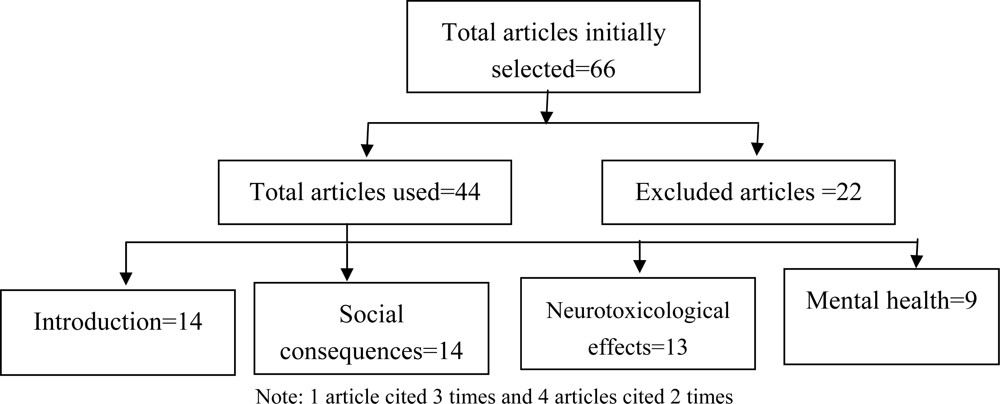
<p>We included all types of relevant studies like journal articles, reports and book chapters into our review, because of limited information regarding our topic of interest. Moreover, our research question could be answered by any type of study. Initially we read all the abstracts to judge the suitability of the studies and then all the suitable references were added to the list of articles. Next we retrieved and saved the full texts of the selected references. We also collected some studies by interlibrary lending. Later we again assessed the contents of the literatures and rated them according to mental health and social risk and social hazard items. A total of 66 articles were assessed, of which 44 articles were finally used in this review (please see the graph below). We excluded those articles which were not written in English and not context-specific.</p></sec>
<sec sec-type="results|discussion">
<label>3.</label>
<title>Results and Discussion</title>
<p>This disease creates enormous social problems like social hazards, poverty, social instability, superstition, ostracism, and marriage related problems. It is also associated with poor mental health and developmental disabilities. These issues based on various studies are discussed below.</p>
<sec>
<label>3.1.</label>
<title>Social Hazards and Poverty</title>
<p>Arsenic is not only a physical but also a social phenomenon [<xref ref-type="bibr" rid="b9-ijerph-06-01609">9</xref>]. Besides arsenic toxicity and arsenicosis diseases, arsenic poisoning creates extensive social implications for its victims and their families in affected areas. A number of socio-economic problems like social uncertainty, social injustice, social isolation and problematic family issues are reported due to arsenicosis [<xref ref-type="bibr" rid="b15-ijerph-06-01609">15</xref>,<xref ref-type="bibr" rid="b16-ijerph-06-01609">16</xref>]. Arsenicosis is found to be more prevalent among the poor [<xref ref-type="bibr" rid="b12-ijerph-06-01609">12</xref>,<xref ref-type="bibr" rid="b17-ijerph-06-01609">17</xref>–<xref ref-type="bibr" rid="b19-ijerph-06-01609">19</xref>] who suffer from dietary deficiency, who have no alternative sources of safe drinking water and who are unable to get proper care and treatment because of financial constraints. The effects of long-term arsenicosis are also severe in the poor and could cause social problems, interrupt the societal ties [<xref ref-type="bibr" rid="b18-ijerph-06-01609">18</xref>] and trigger the social problems. Unfortunately, these social problems in affected areas are still not fully recognized and understood [<xref ref-type="bibr" rid="b18-ijerph-06-01609">18</xref>].</p>
<p>There is a strong link between poverty and arsenicosis diseases. Arsenicosis enhances the economic burden of the poor. The majority of victims are considered as a burden to their family and society. Most of the poor arsenicosis patients remain untreated due to financial restraints. For example, 20–70% of the patients did not receive any treatment in Bangladesh due to financial problems [<xref ref-type="bibr" rid="b18-ijerph-06-01609">18</xref>]. This lack of treatment further deteriorates the overall health and economic conditions of arsenicosis victims. Because poverty rises as the untreated poor victims are incapable of doing hard work and gradually lose strength to move. This disease is associated with social discriminations such as losing jobs, barriers to access new jobs and social rejections. Again, if the poor arsenicosis patients go for treatment, they need to spend a big proportion of their money on this, which finally diminishes the household income and increases the economic burden on the poor victims and their families [<xref ref-type="bibr" rid="b12-ijerph-06-01609">12</xref>]. Moreover, the cost of obtaning arsenic free water also diminishes household income [<xref ref-type="bibr" rid="b18-ijerph-06-01609">18</xref>].</p></sec>
<sec>
<label>3.2.</label>
<title>Social Instability</title>
<p>Chowdhury <italic>et al.</italic> [<xref ref-type="bibr" rid="b18-ijerph-06-01609">18</xref>] and Nasreen [<xref ref-type="bibr" rid="b9-ijerph-06-01609">9</xref>] have described the extreme instability of social life in Bangladesh due to arsenicosis. Arsenic is producing social stigmatization and discrimination [<xref ref-type="bibr" rid="b18-ijerph-06-01609">18</xref>]. Unaffected people are generally scared of arsenicosis, therefore they tend to avoid and isolate arsenic victims [<xref ref-type="bibr" rid="b9-ijerph-06-01609">9</xref>,<xref ref-type="bibr" rid="b18-ijerph-06-01609">18</xref>,<xref ref-type="bibr" rid="b20-ijerph-06-01609">20</xref>,<xref ref-type="bibr" rid="b21-ijerph-06-01609">21</xref>]. Social conflicts over contaminated water destroy the social harmony and network relationships [<xref ref-type="bibr" rid="b9-ijerph-06-01609">9</xref>,<xref ref-type="bibr" rid="b18-ijerph-06-01609">18</xref>]. Arsenic victims are often wrongly identified as leprosy patients and isolated from their close relations [<xref ref-type="bibr" rid="b22-ijerph-06-01609">22</xref>]. In many cases the victims attribute their diseases to their fate [<xref ref-type="bibr" rid="b23-ijerph-06-01609">23</xref>]. Arsenicosis disease hampers socialization by social stigmatization and discrimination [<xref ref-type="bibr" rid="b9-ijerph-06-01609">9</xref>]. For instance, arsenic patients often remain ostracized in all age-groups and barred from social activities. Children of arsenicosis patients are not allowed to attend social and religious functions as well as denied to take water from a neighbour’s tube well and students debarred from school [<xref ref-type="bibr" rid="b9-ijerph-06-01609">9</xref>,<xref ref-type="bibr" rid="b24-ijerph-06-01609">24</xref>]. Affected families are also not allowed to take baths in any of the village ponds [<xref ref-type="bibr" rid="b9-ijerph-06-01609">9</xref>]. Some unaffected people behave in a hostile manner and think that patients should either stay in their homes or leave the village [<xref ref-type="bibr" rid="b15-ijerph-06-01609">15</xref>].</p></sec>
<sec>
<label>3.3.</label>
<title>Ostracism and Marriage Related Problems</title>
<p>Arsenic victims are abandoned, not only by society but also by their family members. There are some instances that arsenicosis leads to a break-down of the marital relationships. For instance, wives were divorced or separated or sent back to their parents’ house because of the arsenicosis disease [<xref ref-type="bibr" rid="b18-ijerph-06-01609">18</xref>,<xref ref-type="bibr" rid="b24-ijerph-06-01609">24</xref>]. There are also some evidences that wives left arsenic affected husbands because they were afraid of arsenicosis [<xref ref-type="bibr" rid="b9-ijerph-06-01609">9</xref>]. Problems before marriage are also notable. For example, it is difficult to find a spouse for an arsenic victim. Generally people are reluctant to establish marital relationships with those families suffering from arsenicosis. Young women and men in the affected families are advised to remain unmarried [<xref ref-type="bibr" rid="b18-ijerph-06-01609">18</xref>]. Such incidents cause unlimited anxiety for both patients and parents of arsenic-affected adult children [<xref ref-type="bibr" rid="b9-ijerph-06-01609">9</xref>,<xref ref-type="bibr" rid="b18-ijerph-06-01609">18</xref>]. In Bangladesh, arsenicosis women are the worst victims of ostracism than arsenicosis men, because they are vulnerable by two ways: firstly by the disease itself and secondly by becoming outcast. Affected women also experience socially undesirable events like dowry, physical torture, and polygamy [<xref ref-type="bibr" rid="b18-ijerph-06-01609">18</xref>]. Due to the patriarchal system and lower socio-cultural position of women in the society, unmarried women and women abandoned by husband and families live inhumanly [<xref ref-type="bibr" rid="b9-ijerph-06-01609">9</xref>,<xref ref-type="bibr" rid="b18-ijerph-06-01609">18</xref>].</p></sec>
<sec>
<label>3.4.</label>
<title>Superstition</title>
<p>Public awareness is necessary to fight against arsenicosis [<xref ref-type="bibr" rid="b18-ijerph-06-01609">18</xref>]. Unfortunately poor people living in rural areas of Bangladesh are not adequately informed about arsenic contamination and arsenicosis [<xref ref-type="bibr" rid="b9-ijerph-06-01609">9</xref>,<xref ref-type="bibr" rid="b12-ijerph-06-01609">12</xref>,<xref ref-type="bibr" rid="b15-ijerph-06-01609">15</xref>,<xref ref-type="bibr" rid="b25-ijerph-06-01609">25</xref>,<xref ref-type="bibr" rid="b26-ijerph-06-01609">26</xref>]. As a result of ignorance, mainly among the illiterate people in the remote villages, some people believe in superstitions, prejudices and fairy tales [<xref ref-type="bibr" rid="b9-ijerph-06-01609">9</xref>,<xref ref-type="bibr" rid="b18-ijerph-06-01609">18</xref>]. For instance, some people think that the disease is ‘an act of the devil/impure air’ or ‘a curse of God’ or ‘the work of evil spirits’ [<xref ref-type="bibr" rid="b9-ijerph-06-01609">9</xref>,<xref ref-type="bibr" rid="b18-ijerph-06-01609">18</xref>]. Due to such superstitions and prejudices, 30 to 80% of the patients in an arsenic affected village in Bangladesh did not receive any treatment [<xref ref-type="bibr" rid="b18-ijerph-06-01609">18</xref>].</p></sec>
<sec>
<label>3.5.</label>
<title>Neurotoxicological Effects</title>
<p>Areas of neurotoxicological impairments include poor cognitive performance and disturbances in visual perception, psychomotor speed, attention, speech and memory [<xref ref-type="bibr" rid="b27-ijerph-06-01609">27</xref>]. Various studies have reported the neurologic sequelae of acute and chronic arsenic exposure in adults and children [<xref ref-type="bibr" rid="b28-ijerph-06-01609">28</xref>–<xref ref-type="bibr" rid="b33-ijerph-06-01609">33</xref>]. Various studies [<xref ref-type="bibr" rid="b34-ijerph-06-01609">34</xref>–<xref ref-type="bibr" rid="b37-ijerph-06-01609">37</xref>] also confirmed that some chemical toxicants have the potential to modify brain physiology and can lead to mental retardation and developmental disabilities such as physical, cognitive, psychological, sensory and speech impairments including socially undesirable outcomes (also see Table <xref ref-type="table" rid="t1-ijerph-06-01609">1</xref>). Two studies conducted in an arsenic affected area of Bangladesh showed that exposure to arsenic from drinking water was associated with reduced intellectual function (such as performance and processing speed) in a dose-response manner even after adjusting the impact of important sociodemographic covariates [<xref ref-type="bibr" rid="b31-ijerph-06-01609">31</xref>,<xref ref-type="bibr" rid="b33-ijerph-06-01609">33</xref>]. The study of Calderon <italic>et al.</italic> [<xref ref-type="bibr" rid="b29-ijerph-06-01609">29</xref>] in Mexico (n=80) found negative relationships between children’s urinary arsenic and verbal intelligence after controlling for a small set of demographic factors. Another recent study based on Mexican schoolchildren reported significantly inverse associations between urinary arsenic and visual-spatial abilities (cognitive performance) such as the Peabody picture vocabulary test, visual search, and letter sequencing tests by a covariate-adjusted model [<xref ref-type="bibr" rid="b27-ijerph-06-01609">27</xref>]. Comparing high school students from an arsenic-affected area with a non-affected area in Taiwan (n=109), poorer scores of neurobehavioral performance were found in 3 of 4 tests in adolescents from the arsenic affected area [<xref ref-type="bibr" rid="b30-ijerph-06-01609">30</xref>]. There are some other studies which also confirmed the detrimental effects of arsenic on children intellectual functions [<xref ref-type="bibr" rid="b32-ijerph-06-01609">32</xref>,<xref ref-type="bibr" rid="b38-ijerph-06-01609">38</xref>,<xref ref-type="bibr" rid="b39-ijerph-06-01609">39</xref>]. The underlying mechanism is not yet clear but the ATSDR [<xref ref-type="bibr" rid="b36-ijerph-06-01609">36</xref>] stated that perhaps chronic long-term exposure to arsenic may intefere with neurotransmitters associated with depressions. Arsenic crosses the blood-brain barrier and has a wide range of effects on the white matter in the brain. Arsenic inhibits the synthesis and liberation of acetylcholine in brain slices and increases the monoamine activity in nervous system [<xref ref-type="bibr" rid="b27-ijerph-06-01609">27</xref>]. Decreased locomotors activity and oxidative stress reactions due to arsenic toxicity may also affect central nervous system [<xref ref-type="bibr" rid="b32-ijerph-06-01609">32</xref>]. Cognitive impairment was reported in two workers in the USA and mental functions returned to normal after withdrawal from arsenic [<xref ref-type="bibr" rid="b28-ijerph-06-01609">28</xref>].</p></sec>
<sec>
<label>3.6.</label>
<title>Mental Health</title>
<p>As health is defined by the World Health Organization as “a state of complete physical, mental and social wellbeing” [<xref ref-type="bibr" rid="b2-ijerph-06-01609">2</xref>], therefore the mentioned psychical and social dimensions have a large impact on individual’s mental health. Chronic illness affects all kind of activities, including the activities of daily living, which deteriorates the quality of life of the victims, as well as subjective well-being and mental health [<xref ref-type="bibr" rid="b24-ijerph-06-01609">24</xref>]. Therefore persons with chronic illness are often in a state of crisis marked by physical, social and mental adverse effects. Taylor and Aspinwall [<xref ref-type="bibr" rid="b40-ijerph-06-01609">40</xref>] have described some common feelings like feelings of fear, anxiety and disorganization due to chronic diseases.</p>
<p>According to the study of Havenaar and van den Brink [<xref ref-type="bibr" rid="b14-ijerph-06-01609">14</xref>], exposure to toxic substances is not only causing physical harms but also psychological harms Although there are few studies available regarding arsenic exposure and mental health in literature, the mental health burden caused by arsenic poisoning seems to be remarkable. For instance, 36% of the arsenic victims (n=63) were suffering from a full or partial Post-traumatic Stress Disorder (PTSD) after the arsenic poisoning in 1998 in an arsenic affected community of West Japan [<xref ref-type="bibr" rid="b41-ijerph-06-01609">41</xref>]. Although Bangladesh is the most arsenic-affected country in the world, only one study has focused on mental health among arsenic victims (n=147) living in Rajarampur area of Chapainawabganj district (one of the arsenic hotspots) in Bangladesh [<xref ref-type="bibr" rid="b24-ijerph-06-01609">24</xref>]. According to this study, mental health scores differed significantly between arsenic-affected and healthy people, with poorer mental health (based on General Health Questionnaire 12) among arsenic-affected people [<xref ref-type="bibr" rid="b24-ijerph-06-01609">24</xref>]. Employing a case-control study in an arsenic-affected rural area in Bangladesh, Khan <italic>et al.</italic> [<xref ref-type="bibr" rid="b12-ijerph-06-01609">12</xref>] also found significantly higher level of depression, weakness, restlessness, insufficient sleep, drowsiness and loss of appetite among the arsenicosis cases as compared to controls. Around 61% of the cases and only around 44% percent of the controls reported depressive feelings with p-value= 0.011. In the same study, the authors also found significant associations between chronic arsenic exposure and subjective symptoms, such as fatigue and gastrointestinal symptoms [<xref ref-type="bibr" rid="b12-ijerph-06-01609">12</xref>] which might reflect mental health problems.</p>
<p>Besides the above-mentioned studies in Bangladesh, a study in the United States reported that people with higher arsenic contamination suffered more from depression [<xref ref-type="bibr" rid="b42-ijerph-06-01609">42</xref>]. The study investigated arsenic exposure and nine self-reported chronic diseases, including depression from a total of 1185 people. Individuals with wells in the mid-strata of arsenic concentrations (between 2 ug/L and 10 ug/L) were significantly more likely to report depression than individuals in the lowest strata (arsenic concentration &lt;2 ug/L) in the United States (adjusted OR=2.74; 95% CI=1.14–6.63) [<xref ref-type="bibr" rid="b42-ijerph-06-01609">42</xref>]. Furthermore, a cross-sectional study in two villages in Inner Mongolia, China found that the mental health of the subjects in the arsenic-affected village was worse than in those in the arsenic-free village (OR= 2.5, 95% CI=1.1.–6.0) [<xref ref-type="bibr" rid="b43-ijerph-06-01609">43</xref>]. In addition, experiences with animals have pointed out that perinatal arsenic exposure was associated with depressive-like behaviors in the affected mouse offspring [<xref ref-type="bibr" rid="b44-ijerph-06-01609">44</xref>].</p></sec></sec>
<sec sec-type="conclusions">
<label>4.</label>
<title>Conclusions</title>
<p>This review provides an overview of the mental health problem and social consequences among the arsenic-affected victims. The huge effects of arsenic on physical and mental health make the arsenic issue a most important public health issue particularly in Bangladesh. According to the World Health Organization, health is not only the absence of disease but the state of complete physical, mental and social well-being. Therefore, both physical and social conditions of the arsenic victims can affect their mental health. Although many studies have already been done regarding physical health outcomes, studies on the association between arsenic and mental health are lacking. The effects of arsenic on mental health deserve further investigation to protect the victims’ mental health and to enhance their psychological well being. This is important because arsenic victims are living with social uncertainty, social injustice, social isolation and problematic family issues. Arsenic can also cause neurotoxicological problems, which often leads to changes in behaviour.</p>
<p>Some of the limitations of this study were as follows: we included only those studies (articles, book chapters and reports) which were written in English. Some of the studies were based on small sample sizes [e.g. <xref ref-type="bibr" rid="b24-ijerph-06-01609">24</xref>,<xref ref-type="bibr" rid="b28-ijerph-06-01609">28</xref>–<xref ref-type="bibr" rid="b30-ijerph-06-01609">30</xref>,<xref ref-type="bibr" rid="b41-ijerph-06-01609">41</xref>]. We did not put any restriction on study design while selecting our studies. As a result, we used studies like ecological [e.g. <xref ref-type="bibr" rid="b42-ijerph-06-01609">42</xref>], case-control [e.g. <xref ref-type="bibr" rid="b12-ijerph-06-01609">12</xref>,<xref ref-type="bibr" rid="b19-ijerph-06-01609">19</xref>,<xref ref-type="bibr" rid="b38-ijerph-06-01609">38</xref>,<xref ref-type="bibr" rid="b43-ijerph-06-01609">43</xref>,<xref ref-type="bibr" rid="b44-ijerph-06-01609">44</xref>], cohort [e.g. <xref ref-type="bibr" rid="b19-ijerph-06-01609">19</xref>,<xref ref-type="bibr" rid="b38-ijerph-06-01609">38</xref>], and cross-sectional [e.g. <xref ref-type="bibr" rid="b27-ijerph-06-01609">27</xref>,<xref ref-type="bibr" rid="b33-ijerph-06-01609">33</xref>,<xref ref-type="bibr" rid="b39-ijerph-06-01609">39</xref>] and case-study [e.g. <xref ref-type="bibr" rid="b28-ijerph-06-01609">28</xref>] in our review. Studies [<xref ref-type="bibr" rid="b12-ijerph-06-01609">12</xref>,<xref ref-type="bibr" rid="b42-ijerph-06-01609">42</xref>] based on self-reported illness may also cause some potential bias.</p>
<p>Sensitization of community members and law enforcement authority to prevent separation and ostracism may be helpful to improve mental health of the arsenic victims. Rehabilitation programs for arsenicosis patients especially for women are needed. To overcome the socio-economic crisis, psychosocial support and employment opportunities should be provided to the patients. Victims need accurate health information as well as supportive counseling to improve their stress situation. Finally, the mental health burden in arsenic-affected areas should be estimated by larger studies and considered in the wider context of public and community health to understand the underlying mechanism of poor mental health due to arsenic and arsenicosis.</p></sec></body>
<back>
<ack>
<p>This work was supported by the School of Public Health, University of Bielefeld, Germany.</p></ack>
<ref-list>
<title>References</title>
<ref id="b1-ijerph-06-01609"><label>1.</label><citation citation-type="journal"><person-group person-group-type="author"><name><surname>Vahidnia</surname><given-names>A</given-names></name><name><surname>van der Voet</surname><given-names>GB</given-names></name><name><surname>de Wolff</surname><given-names>FA</given-names></name></person-group><article-title>Arsenic neurotoxicity – A review</article-title><source>Hum. Exp. Toxicol</source><year>2007</year><volume>26</volume><fpage>823</fpage><lpage>832</lpage><pub-id pub-id-type="doi">10.1177/0960327107084539</pub-id><pub-id pub-id-type="pmid">18025055</pub-id></citation></ref>
<ref id="b2-ijerph-06-01609"><label>2.</label><citation citation-type="book"><person-group person-group-type="author"><collab>WHO</collab></person-group><source>Arsenic and Arsenic Compounds International Programme on Chemical Safety</source><publisher-name>World Health Organization</publisher-name><publisher-loc>Geneva, Switzerland</publisher-loc><year>2001</year></citation></ref>
<ref id="b3-ijerph-06-01609"><label>3.</label><citation citation-type="book"><person-group person-group-type="author"><collab>IARC</collab></person-group><source>Some drinking water disinfectants and Contaminants, including Arsenic</source><publisher-name>International Agency for Research on Cancer</publisher-name><publisher-loc>Lyon, France</publisher-loc><year>2004</year><volume>84</volume></citation></ref>
<ref id="b4-ijerph-06-01609"><label>4.</label><citation citation-type="book"><person-group person-group-type="author"><collab>BGS</collab><collab>DPHE</collab></person-group><article-title>Arsenic contamination of groundwater in Bangladesh</article-title><source>Summary British Geological Survey WC/00/19</source><person-group person-group-type="editor"><name><surname>Kinniburgh</surname><given-names>DG</given-names></name><name><surname>Smedley</surname><given-names>PL</given-names></name></person-group><publisher-name>British Geological Survey</publisher-name><publisher-loc>Keyworth, UK</publisher-loc><year>2001</year><volume>1</volume><fpage>1</fpage><lpage>15</lpage></citation></ref>
<ref id="b5-ijerph-06-01609"><label>5.</label><citation citation-type="journal"><person-group person-group-type="author"><name><surname>Khan</surname><given-names>MMH</given-names></name><name><surname>Sakauchi</surname><given-names>F</given-names></name><name><surname>Sonoda</surname><given-names>T</given-names></name><name><surname>Washio</surname><given-names>M</given-names></name><name><surname>Mori</surname><given-names>M</given-names></name></person-group><article-title>Magnitude of arsenic toxicity in tube-well drinking water in Bangladesh and its adverse effects on human health including cancer: evidence from a review of the literature</article-title><source>Asian Pac. J. Cancer Prev</source><year>2003</year><volume>4</volume><fpage>7</fpage><lpage>14</lpage><pub-id pub-id-type="pmid">12718695</pub-id></citation></ref>
<ref id="b6-ijerph-06-01609"><label>6.</label><citation citation-type="journal"><person-group person-group-type="author"><name><surname>Chowdhury</surname><given-names>AMR</given-names></name></person-group><article-title>Arsenic crisis in Bangladesh</article-title><source>Sci. Am</source><year>2004</year><volume>291</volume><fpage>86</fpage><lpage>91</lpage><pub-id pub-id-type="pmid">15298124</pub-id></citation></ref>
<ref id="b7-ijerph-06-01609"><label>7.</label><citation citation-type="journal"><person-group person-group-type="author"><name><surname>Khan</surname><given-names>MMH</given-names></name><name><surname>Hossain</surname><given-names>MK</given-names></name><name><surname>Kobayashi</surname><given-names>K</given-names></name><name><surname>Sakauchi</surname><given-names>F</given-names></name><name><surname>Yamashita</surname><given-names>T</given-names></name><name><surname>Feroze Ahmed</surname><given-names>M</given-names></name><name><surname>Delwar Hossain</surname><given-names>M</given-names></name><name><surname>Quamruzzaman</surname><given-names>Q</given-names></name><name><surname>Mori</surname><given-names>M</given-names></name></person-group><article-title>Levels of blood and urine chemicals associated with longer duration of having arsenicosis in Bangladesh</article-title><source>Int. J. Environ. Health Res</source><year>2005</year><volume>15</volume><fpage>289</fpage><lpage>301</lpage><pub-id pub-id-type="doi">10.1080/09603120500155831</pub-id><pub-id pub-id-type="pmid">16175745</pub-id></citation></ref>
<ref id="b8-ijerph-06-01609"><label>8.</label><citation citation-type="journal"><person-group person-group-type="author"><name><surname>Mukherjee</surname><given-names>A</given-names></name><name><surname>Sengupta</surname><given-names>MK</given-names></name><name><surname>Hossain</surname><given-names>MA</given-names></name><name><surname>Ahamed</surname><given-names>S</given-names></name><name><surname>Das</surname><given-names>B</given-names></name><name><surname>Nayak</surname><given-names>B</given-names></name><name><surname>Lodh</surname><given-names>D</given-names></name><name><surname>Rahman</surname><given-names>MM</given-names></name><name><surname>Chakraborti</surname><given-names>D</given-names></name></person-group><article-title>Arsenic contamination in groundwater: a global perspective with emphasis on the Asian scenario</article-title><source>J. Health Popul. Nutr</source><year>2006</year><volume>24</volume><fpage>142</fpage><lpage>163</lpage><pub-id pub-id-type="pmid">17195556</pub-id></citation></ref>
<ref id="b9-ijerph-06-01609"><label>9.</label><citation citation-type="book"><person-group person-group-type="author"><name><surname>Nasreen</surname><given-names>M</given-names></name></person-group><article-title>Social impacts of arsenicosis</article-title><source>Arsenic contamination: Bangladesh Perspective</source><person-group person-group-type="editor"><name><surname>Ahmed</surname><given-names>MF</given-names></name></person-group><publisher-name>ITN-Bangladesh</publisher-name><publisher-loc>Dhaka, Bangladesh</publisher-loc><year>2003</year><fpage>340</fpage><lpage>353</lpage></citation></ref>
<ref id="b10-ijerph-06-01609"><label>10.</label><citation citation-type="journal"><person-group person-group-type="author"><name><surname>Khan</surname><given-names>MMH</given-names></name><name><surname>Aklimunnessa</surname><given-names>K</given-names></name><name><surname>Kabir</surname><given-names>M</given-names></name><name><surname>Mori</surname><given-names>M</given-names></name></person-group><article-title>Determinants of drinking arsenic-contaminated tubewell water in Bangladesh</article-title><source>Health Policy Plann</source><year>2007</year><volume>22</volume><fpage>335</fpage><lpage>343</lpage><pub-id pub-id-type="doi">10.1093/heapol/czm018</pub-id></citation></ref>
<ref id="b11-ijerph-06-01609"><label>11.</label><citation citation-type="journal"><person-group person-group-type="author"><name><surname>Safiullah</surname><given-names>S</given-names></name></person-group><article-title>Arsenic pollution in the groundwater in Bangladesh; an overview</article-title><source>Asian J. Water Environ. Pollut</source><year>2006</year><volume>4</volume><fpage>47</fpage><lpage>59</lpage></citation></ref>
<ref id="b12-ijerph-06-01609"><label>12.</label><citation citation-type="journal"><person-group person-group-type="author"><name><surname>Khan</surname><given-names>MMH</given-names></name><name><surname>Aklimunnessa</surname><given-names>K</given-names></name><name><surname>Kabir</surname><given-names>M</given-names></name><name><surname>Mori</surname><given-names>M</given-names></name></person-group><article-title>Case-control study of arsenicosis in some arsenic contaminated villages of Bangladesh</article-title><source>Sapporo Med. J</source><year>2006</year><volume>75</volume><fpage>51</fpage><lpage>61</lpage></citation></ref>
<ref id="b13-ijerph-06-01609"><label>13.</label><citation citation-type="journal"><person-group person-group-type="author"><name><surname>Spallholz</surname><given-names>JE</given-names></name><name><surname>Boylan</surname><given-names>LM</given-names></name><name><surname>Rahman</surname><given-names>MM</given-names></name></person-group><article-title>Environmental hypothesis: is poor dietary selenium intake an underlying factor for arsenicosis and cancer in Bangladesh and West Bengal, India?</article-title><source>Sci. Total Environ</source><year>2004</year><volume>323</volume><fpage>21</fpage><lpage>32</lpage><pub-id pub-id-type="doi">10.1016/j.scitotenv.2003.09.034</pub-id><pub-id pub-id-type="pmid">15081714</pub-id></citation></ref>
<ref id="b14-ijerph-06-01609"><label>14.</label><citation citation-type="journal"><person-group person-group-type="author"><name><surname>Havenaar</surname><given-names>JM</given-names></name><name><surname>van den Brink</surname><given-names>W</given-names></name></person-group><article-title>Psychological factors affecting health after toxicological disasters</article-title><source>Clin. Psychol. Rev</source><year>1997</year><volume>17</volume><fpage>359</fpage><lpage>374</lpage><pub-id pub-id-type="doi">10.1016/S0272-7358(97)00009-3</pub-id><pub-id pub-id-type="pmid">9199857</pub-id></citation></ref>
<ref id="b15-ijerph-06-01609"><label>15.</label><citation citation-type="journal"><person-group person-group-type="author"><name><surname>Hassan</surname><given-names>MM</given-names></name><name><surname>Atkins</surname><given-names>PJ</given-names></name><name><surname>Dunn</surname><given-names>CE</given-names></name></person-group><article-title>Social implications of arsenic poisoning in Bangladesh</article-title><source>Soc. Sci. Med</source><year>2005</year><volume>61</volume><fpage>2201</fpage><lpage>2211</lpage><pub-id pub-id-type="doi">10.1016/j.socscimed.2005.04.021</pub-id><pub-id pub-id-type="pmid">15913864</pub-id></citation></ref>
<ref id="b16-ijerph-06-01609"><label>16.</label><citation citation-type="confproc"><person-group person-group-type="author"><name><surname>Bhuiyan</surname><given-names>RH</given-names></name><name><surname>Islam</surname><given-names>N</given-names></name></person-group><article-title>Coping strategy and health seeking behavior of arsenicosis patients of rural Bangladesh: a case study of Ramganj upzilla, Lakshmipur</article-title><conf-name>Presented at the International Workshop on Arsenic Mitigation</conf-name><conf-loc>Dhaka, Bangladesh</conf-loc><conf-date>January 14–16, 2002</conf-date></citation></ref>
<ref id="b17-ijerph-06-01609"><label>17.</label><citation citation-type="book"><person-group person-group-type="author"><collab>Health Geneva, WHO</collab></person-group><source>Towards an Assessment of the socioeconomic impact of arsenic poisoning in Bangladesh Protection of the Human Environment</source><publisher-name>World Health Organization, Water, Sanitation and Health</publisher-name><publisher-loc>Geneva, Switzerland</publisher-loc><year>2000</year></citation></ref>
<ref id="b18-ijerph-06-01609"><label>18.</label><citation citation-type="journal"><person-group person-group-type="author"><name><surname>Chowdhury</surname><given-names>MAI</given-names></name><name><surname>Uddin</surname><given-names>MT</given-names></name><name><surname>Ahmed</surname><given-names>MF</given-names></name><name><surname>Ali</surname><given-names>MA</given-names></name><name><surname>Rasul</surname><given-names>SMA</given-names></name><name><surname>Hoque</surname><given-names>MA</given-names></name><name><surname>Alam</surname><given-names>R</given-names></name><name><surname>Sharmin</surname><given-names>R</given-names></name><name><surname>Uddin</surname><given-names>SM</given-names></name><name><surname>Islam</surname><given-names>MS</given-names></name></person-group><article-title>Collapse of Socio-economic base of Bangladesh by arsenic contamination in groundwater</article-title><source>Pakistan J. Biol. Sci</source><year>2006</year><volume>9</volume><fpage>1617</fpage><lpage>1627</lpage><pub-id pub-id-type="doi">10.3923/pjbs.2006.1617.1627</pub-id></citation></ref>
<ref id="b19-ijerph-06-01609"><label>19.</label><citation citation-type="journal"><person-group person-group-type="author"><name><surname>Argos</surname><given-names>M</given-names></name><name><surname>Parvez</surname><given-names>F</given-names></name><name><surname>Chen</surname><given-names>Y</given-names></name><name><surname>Hussain</surname><given-names>I</given-names></name><name><surname>Momotaj</surname><given-names>H</given-names></name><name><surname>Howe</surname><given-names>GR</given-names></name><name><surname>Graziano</surname><given-names>JH</given-names></name><name><surname>Ahsan</surname><given-names>H</given-names></name></person-group><article-title>Socioeconomic Status and Risk for Arsenic-Related Skin Lesions in Bangladesh</article-title><source>Am. J. Public Health</source><year>2007</year><volume>97</volume><fpage>825</fpage><lpage>831</lpage><pub-id pub-id-type="doi">10.2105/AJPH.2005.078816</pub-id><pub-id pub-id-type="pmid">17395836</pub-id></citation></ref>
<ref id="b20-ijerph-06-01609"><label>20.</label><citation citation-type="book"><person-group person-group-type="author"><name><surname>Sarker</surname><given-names>PC</given-names></name></person-group><article-title>Beliefs and arsenicosis and their impact on social disintegration in Bangladesh: Challenges to social work interventions</article-title><source>Proceedings of Joint Conference of AASW, IFSW, AASW and AAWWF</source><publisher-name>Brisbane</publisher-name><publisher-loc>Australia</publisher-loc><year>1999</year><fpage>217</fpage><lpage>221</lpage></citation></ref>
<ref id="b21-ijerph-06-01609"><label>21.</label><citation citation-type="journal"><person-group person-group-type="author"><name><surname>Tsutsumi</surname><given-names>A</given-names></name><name><surname>Izutsu</surname><given-names>T</given-names></name><name><surname>Islam</surname><given-names>MDA</given-names></name><name><surname>Amed</surname><given-names>JU</given-names></name><name><surname>Nakahara</surname><given-names>S</given-names></name><name><surname>Takagi</surname><given-names>F</given-names></name><name><surname>Wakai</surname><given-names>S</given-names></name></person-group><article-title>Depressive status of leprosy patients in Bangladesh: Association with self-perception of stigma</article-title><source>Leprosy Rev</source><year>2004</year><volume>75</volume><fpage>57</fpage><lpage>66</lpage><pub-id pub-id-type="pmid">15072127</pub-id></citation></ref>
<ref id="b22-ijerph-06-01609"><label>22.</label><citation citation-type="book"><person-group person-group-type="author"><name><surname>Grunner</surname><given-names>M</given-names></name></person-group><article-title>Leprosy and human dignity</article-title><source>Cultural and Environmental Dimension of Health</source><person-group person-group-type="editor"><name><surname>Chaudhury</surname><given-names>B</given-names></name></person-group><publisher-name>Inter-India Publications</publisher-name><publisher-loc>New Delhi, India</publisher-loc><year>1990</year><fpage>114</fpage><lpage>123</lpage></citation></ref>
<ref id="b23-ijerph-06-01609"><label>23.</label><citation citation-type="journal"><person-group person-group-type="author"><name><surname>Sarker</surname><given-names>PC</given-names></name><name><surname>Mohiudin</surname><given-names>MD</given-names></name></person-group><article-title>Arsenic poisoning and its impact on the socio-economic and cultural life of the people of Bangladesh</article-title><source>South Asian Anthropol</source><year>2002</year><volume>2</volume><fpage>97</fpage><lpage>102</lpage></citation></ref>
<ref id="b24-ijerph-06-01609"><label>24.</label><citation citation-type="journal"><person-group person-group-type="author"><name><surname>Keya</surname><given-names>MK</given-names></name></person-group><article-title>Mental health of arsenic victims in Bangladesh</article-title><source>South African Anthropol</source><year>2004</year><volume>4</volume><fpage>215</fpage><lpage>223</lpage></citation></ref>
<ref id="b25-ijerph-06-01609"><label>25.</label><citation citation-type="journal"><person-group person-group-type="author"><name><surname>Hadi</surname><given-names>A</given-names></name></person-group><article-title>Fighting arsenic at the grassroots: experience of BRAC`s community awareness initiative in Bangladesh</article-title><source>Health Policy Plann</source><year>2003</year><volume>18</volume><fpage>83</fpage><lpage>100</lpage></citation></ref>
<ref id="b26-ijerph-06-01609"><label>26.</label><citation citation-type="journal"><person-group person-group-type="author"><name><surname>Paul</surname><given-names>BK</given-names></name></person-group><article-title>Arsenic contamination awareness among the rural residents in Bangladesh</article-title><source>Soc. Sci. Med</source><year>2004</year><volume>59</volume><fpage>1741</fpage><lpage>1755</lpage><pub-id pub-id-type="doi">10.1016/j.socscimed.2004.01.037</pub-id><pub-id pub-id-type="pmid">15279930</pub-id></citation></ref>
<ref id="b27-ijerph-06-01609"><label>27.</label><citation citation-type="journal"><person-group person-group-type="author"><name><surname>Rosado</surname><given-names>JL</given-names></name><name><surname>Ronquillo</surname><given-names>D</given-names></name><name><surname>Kordas</surname><given-names>K</given-names></name><name><surname>Rojas</surname><given-names>O</given-names></name><name><surname>Alatorre</surname><given-names>J</given-names></name><name><surname>Lopez</surname><given-names>P</given-names></name><name><surname>Garcia-Vargas</surname><given-names>G</given-names></name><name><surname>Caamano</surname><given-names>MC</given-names></name><name><surname>Cebrian</surname><given-names>ME</given-names></name><name><surname>Stoltzfus</surname><given-names>R</given-names></name></person-group><article-title>Arsenic exposure and cognitive performance in mexican schoolchildren</article-title><source>Environ. Health Perspect</source><year>2007</year><volume>155</volume><fpage>1371</fpage><lpage>1375</lpage></citation></ref>
<ref id="b28-ijerph-06-01609"><label>28.</label><citation citation-type="journal"><person-group person-group-type="author"><name><surname>Morton</surname><given-names>WE</given-names></name><name><surname>Caron</surname><given-names>GA</given-names></name></person-group><article-title>Encephalopathy: An uncommon manifestation of workplace arsenic poisoning?</article-title><source>Am. J. Ind. Med</source><year>1989</year><volume>15</volume><fpage>1</fpage><lpage>5</lpage><pub-id pub-id-type="doi">10.1002/ajim.4700150102</pub-id><pub-id pub-id-type="pmid">2929604</pub-id></citation></ref>
<ref id="b29-ijerph-06-01609"><label>29.</label><citation citation-type="journal"><person-group person-group-type="author"><name><surname>Calderon</surname><given-names>J</given-names></name><name><surname>Navarro</surname><given-names>ME</given-names></name><name><surname>Jiminez-Capdeville</surname><given-names>ME</given-names></name><name><surname>Santos-Diaz</surname><given-names>MA</given-names></name><name><surname>Golden</surname><given-names>A</given-names></name><name><surname>Rodriguez-Leyva</surname><given-names>I</given-names></name><name><surname>Borja-Aburto</surname><given-names>V</given-names></name><name><surname>Diaz-Barriga</surname><given-names>F</given-names></name></person-group><article-title>Exposure to arsenic and lead and neuropsychological development in Mexican children</article-title><source>Environ. Res</source><year>2001</year><volume>85</volume><fpage>69</fpage><lpage>76</lpage><pub-id pub-id-type="doi">10.1006/enrs.2000.4106</pub-id><pub-id pub-id-type="pmid">11161656</pub-id></citation></ref>
<ref id="b30-ijerph-06-01609"><label>30.</label><citation citation-type="journal"><person-group person-group-type="author"><name><surname>Tsai</surname><given-names>S-Y</given-names></name><name><surname>Chou</surname><given-names>H-Y</given-names></name><name><surname>The</surname><given-names>HW</given-names></name><name><surname>Chen</surname><given-names>C-M</given-names></name><name><surname>Chen</surname><given-names>C-J</given-names></name></person-group><article-title>The effects of chronic arsenic exposure on the neurobehavioral development in adolescence</article-title><source>NeuroToxicology</source><year>2003</year><volume>24</volume><fpage>747</fpage><lpage>753</lpage><pub-id pub-id-type="doi">10.1016/S0161-813X(03)00029-9</pub-id><pub-id pub-id-type="pmid">12900089</pub-id></citation></ref>
<ref id="b31-ijerph-06-01609"><label>31.</label><citation citation-type="journal"><person-group person-group-type="author"><name><surname>Wasserman</surname><given-names>GA</given-names></name><name><surname>Liu</surname><given-names>X</given-names></name><name><surname>Parvez</surname><given-names>F</given-names></name><name><surname>Ahsan</surname><given-names>H</given-names></name><name><surname>Factor-Litvak</surname><given-names>P</given-names></name><name><surname>Kline</surname><given-names>J</given-names></name><name><surname>van Geen</surname><given-names>A</given-names></name><name><surname>Slavkovich</surname><given-names>V</given-names></name><name><surname>Lolacono</surname><given-names>NJ</given-names></name><name><surname>Cheng</surname><given-names>Z</given-names></name><name><surname>Hussain</surname><given-names>I</given-names></name><name><surname>Momtaj</surname><given-names>H</given-names></name><name><surname>Graziano</surname><given-names>JH</given-names></name></person-group><article-title>Water arsenic exposure and children’s intellectual function in Araihazar, Bangladesh</article-title><source>Environ. Health Perspect</source><year>2004</year><volume>112</volume><fpage>1329</fpage><lpage>1333</lpage><pub-id pub-id-type="doi">10.1289/ehp.6964</pub-id><pub-id pub-id-type="pmid">15345348</pub-id></citation></ref>
<ref id="b32-ijerph-06-01609"><label>32.</label><citation citation-type="journal"><person-group person-group-type="author"><name><surname>Von Ehrenstein</surname><given-names>OS</given-names></name><name><surname>Poddar</surname><given-names>S</given-names></name><name><surname>Yuan</surname><given-names>Y</given-names></name><name><surname>Mazumder</surname><given-names>DG</given-names></name><name><surname>Eskenazi</surname><given-names>B</given-names></name><name><surname>Basu</surname><given-names>A</given-names></name><name><surname>Hira-Smith</surname><given-names>M</given-names></name><name><surname>Ghosh</surname><given-names>N</given-names></name><name><surname>Lahiri</surname><given-names>S</given-names></name><name><surname>Haque</surname><given-names>R</given-names></name><name><surname>Ghosh</surname><given-names>A</given-names></name><name><surname>Kalman</surname><given-names>D</given-names></name><name><surname>Das</surname><given-names>S</given-names></name><name><surname>Smith</surname><given-names>AH</given-names></name></person-group><article-title>Children’s intellectual function in relation to arsenic exposure</article-title><source>Epidemiology</source><year>2007</year><volume>18</volume><fpage>44</fpage><lpage>51</lpage><pub-id pub-id-type="doi">10.1097/01.ede.0000248900.65613.a9</pub-id><pub-id pub-id-type="pmid">17149142</pub-id></citation></ref>
<ref id="b33-ijerph-06-01609"><label>33.</label><citation citation-type="journal"><person-group person-group-type="author"><name><surname>Wasserman</surname><given-names>GA</given-names></name><name><surname>Liu</surname><given-names>X</given-names></name><name><surname>Parvez</surname><given-names>F</given-names></name><name><surname>Ahsan</surname><given-names>H</given-names></name><name><surname>Factor-Litvak</surname><given-names>P</given-names></name><name><surname>Kline</surname><given-names>J</given-names></name><name><surname>van Geen</surname><given-names>A</given-names></name><name><surname>Slavkovich</surname><given-names>V</given-names></name><name><surname>Lolacono</surname><given-names>NJ</given-names></name><name><surname>Levy</surname><given-names>D</given-names></name><name><surname>Cheng</surname><given-names>Z</given-names></name><name><surname>Graziano</surname><given-names>JH</given-names></name></person-group><article-title>Water arsenic exposure and intellectual function in 6-year-old children in Araihazar, Bangladesh</article-title><source>Environ. Health Perspect</source><year>2007</year><volume>115</volume><fpage>285</fpage><lpage>289</lpage><pub-id pub-id-type="pmid">17384779</pub-id></citation></ref>
<ref id="b34-ijerph-06-01609"><label>34.</label><citation citation-type="journal"><person-group person-group-type="author"><name><surname>Goldman</surname><given-names>LR</given-names></name><name><surname>Koduru</surname><given-names>S</given-names></name></person-group><article-title>Chemicals in the environment and developmental toxicity to children: a public health and policy perspective</article-title><source>Environ. Health Perspect</source><year>2000</year><volume>108</volume><fpage>443</fpage><lpage>448</lpage><pub-id pub-id-type="pmid">10852843</pub-id></citation></ref>
<ref id="b35-ijerph-06-01609"><label>35.</label><citation citation-type="journal"><person-group person-group-type="author"><name><surname>Schroeder</surname><given-names>SR</given-names></name></person-group><article-title>Mental retardation and development disabilities influenced by environmental neurotoxic insults</article-title><source>Environ. Health Perspect</source><year>2000</year><volume>108</volume><fpage>395</fpage><lpage>399</lpage><pub-id pub-id-type="pmid">10852834</pub-id></citation></ref>
<ref id="b36-ijerph-06-01609"><label>36.</label><citation citation-type="book"><person-group person-group-type="author"><collab>Agency for toxic substances disease registry (ATSDR)</collab></person-group><source>Toxicological profile for arsenic</source><publisher-name>U.S. Department of Health and Human Services</publisher-name><publisher-loc>Atlanta, GA, USA</publisher-loc><year>2007</year></citation></ref>
<ref id="b37-ijerph-06-01609"><label>37.</label><citation citation-type="journal"><person-group person-group-type="author"><name><surname>Genuis</surname><given-names>SJ</given-names></name></person-group><article-title>Toxicant exposure and mental health-individual, social, and public health consequences</article-title><source>J. Forensic Sci</source><year>2009</year><volume>54</volume><fpage>474</fpage><lpage>477</lpage><pub-id pub-id-type="doi">10.1111/j.1556-4029.2008.00973.x</pub-id><pub-id pub-id-type="pmid">19187449</pub-id></citation></ref>
<ref id="b38-ijerph-06-01609"><label>38.</label><citation citation-type="book"><person-group person-group-type="author"><name><surname>Siripitayakunkit</surname><given-names>U</given-names></name><name><surname>Visudhiphan</surname><given-names>P</given-names></name><name><surname>Pradipasen</surname><given-names>M</given-names></name><name><surname>Vorapongsathron</surname><given-names>T</given-names></name></person-group><article-title>Association between chronic arsenic exposure and children’s intelligence in Thailand</article-title><source>Arsenic Exposure and Health Effects</source><person-group person-group-type="editor"><name><surname>Chappell</surname><given-names>WR</given-names></name><name><surname>Abernathy</surname><given-names>CO</given-names></name><name><surname>Calderon</surname><given-names>RL</given-names></name></person-group><publisher-name>Elsevier Science</publisher-name><publisher-loc>Amsterdam, The Netherlands</publisher-loc><year>1999</year><fpage>141</fpage><lpage>149</lpage></citation></ref>
<ref id="b39-ijerph-06-01609"><label>39.</label><citation citation-type="web"><person-group person-group-type="author"><name><surname>Asadullah</surname><given-names>MN</given-names></name><name><surname>Chaudhury</surname><given-names>N</given-names></name></person-group><source>Poisoning the Mind: Arsenic Contamination and Cognitive Achievement of Children</source>World Bank Policy Research Working Paper No. 4510, 2008; Available online: <ext-link xlink:href="http://www-wds.worldbank.org/external/default/WDSContentServer/IW3P/IB/2008/02/07/000158349_20080207082107/Rendered/PDF/wps4510.pdf" ext-link-type="uri">http://www-wds.worldbank.org/external/default/WDSContentServer/IW3P/IB/2008/02/07/000158349_20080207082107/Rendered/PDF/wps4510.pdf</ext-link> (accessed January 2009).</citation></ref>
<ref id="b40-ijerph-06-01609"><label>40.</label><citation citation-type="book"><person-group person-group-type="author"><name><surname>Taylor</surname><given-names>SE</given-names></name><name><surname>Aspingwall</surname><given-names>LG</given-names></name></person-group><article-title>Psychological aspects of chronic illness</article-title><source>Psychological Aspects of Serious Illness</source><person-group person-group-type="editor"><name><surname>Bos</surname><given-names>V</given-names></name><name><surname>Costa</surname><given-names>PT</given-names><suffix>Jr</suffix></name></person-group><publisher-name>American Psychological Association</publisher-name><publisher-loc>Washington, DC, USA</publisher-loc><year>1990</year></citation></ref>
<ref id="b41-ijerph-06-01609"><label>41.</label><citation citation-type="book"><person-group person-group-type="author"><name><surname>Asuki</surname><given-names>N</given-names></name></person-group><source>Mental Health Effects following Manmade Toxic Disasters: The Sarin Attack and the Arsenic Poisoning Case</source><publisher-name>Prehospital and Disaster Medicine, Department of Social Psychiatry, Tokyo Institute of Psychiatry</publisher-name><publisher-loc>Tokyo, Japan</publisher-loc><year>2003</year></citation></ref>
<ref id="b42-ijerph-06-01609"><label>42.</label><citation citation-type="journal"><person-group person-group-type="author"><name><surname>Zierold</surname><given-names>MK</given-names></name><name><surname>Knobeloch</surname><given-names>L</given-names></name><name><surname>Anderson</surname><given-names>H</given-names></name></person-group><article-title>Prevalence of Chronic Diseases in Adults Exposed to Arsenic-Contaminated Drinking Water</article-title><source>Am. J. Public Health</source><year>2004</year><volume>94</volume><fpage>1936</fpage><lpage>1937</lpage><pub-id pub-id-type="doi">10.2105/AJPH.94.11.1936</pub-id><pub-id pub-id-type="pmid">15514231</pub-id></citation></ref>
<ref id="b43-ijerph-06-01609"><label>43.</label><citation citation-type="journal"><person-group person-group-type="author"><name><surname>Fujino</surname><given-names>Y</given-names></name><name><surname>Guo</surname><given-names>X</given-names></name><name><surname>Liu</surname><given-names>J</given-names></name><name><surname>You</surname><given-names>L</given-names></name><name><surname>Miyatake</surname><given-names>M</given-names></name><name><surname>Yoshimura</surname><given-names>T</given-names></name></person-group><article-title>Japan Inner Mongolia Arsenic Pollution (JIAMP) Study group. Mental health burden amongst inhabitants of an arsenic-affected area in Inner Mongolia, China</article-title><source>Soc. Sci. Med</source><year>2004</year><volume>59</volume><fpage>1969</fpage><lpage>1973</lpage><pub-id pub-id-type="doi">10.1016/j.socscimed.2004.02.031</pub-id><pub-id pub-id-type="pmid">15312930</pub-id></citation></ref>
<ref id="b44-ijerph-06-01609"><label>44.</label><citation citation-type="journal"><person-group person-group-type="author"><name><surname>Martinez</surname><given-names>EJ</given-names></name><name><surname>Kolb</surname><given-names>BL</given-names></name><name><surname>Bell</surname><given-names>A</given-names></name></person-group><article-title>Moderate perinatal arsenic exposure alters neuroendocrine markers associated with depression and increases depressive-like behaviours in adult mouse offspring</article-title><source>Neurotoxicology</source><year>2008</year><volume>29</volume><fpage>647</fpage><lpage>655</lpage><pub-id pub-id-type="doi">10.1016/j.neuro.2008.05.004</pub-id><pub-id pub-id-type="pmid">18573533</pub-id></citation></ref></ref-list>
<sec sec-type="display-objects">
<title>Figure and Table</title>
<fig id="f1-ijerph-06-01609" position="float">
<label>Figure 1.</label>
<caption>
<p>Literature-mapping for the review.</p>
<p>Note: 1 article cited 3 times and 4 articles cited 2 times</p></caption>
<graphic xlink:href="ijerph-06-01609f1.gif"/></fig>
<table-wrap id="t1-ijerph-06-01609" position="float">
<label>Table 1.</label>
<caption>
<p>Neurotoxicological effects due to arsenic exposure among children in arsenic affected countries.</p></caption>
<table frame="box" rules="all">
<thead>
<tr>
<th valign="top" align="left">Authors and years of publication</th>
<th valign="top" align="left">Sample size (target population) and study design</th>
<th valign="top" align="left">Main results</th></tr></thead>
<tbody>
<tr>
<td valign="top" align="left">Rosado <italic>et al.</italic> [<xref ref-type="bibr" rid="b27-ijerph-06-01609">27</xref>].</td>
<td valign="top" align="left">n=602 (6–8 years old school children in Mexico); Cross-sectional</td>
<td valign="top" align="left">Arsenic affected children’s cognitive development after adjusting for age, sex, mother’s education and hemoglobin concentration and so on.</td></tr>
<tr>
<td valign="top" align="left">Wasserman <italic>et al.</italic> [<xref ref-type="bibr" rid="b33-ijerph-06-01609">33</xref>].</td>
<td valign="top" align="left">n=301 (6 years old children in Bangladesh); Cross-sectional</td>
<td valign="top" align="left">Arsenic exposure was negatively associated with children intellectual level after adjusting for many potential variables.</td></tr>
<tr>
<td valign="top" align="left">Wasserman <italic>et al.</italic> [<xref ref-type="bibr" rid="b31-ijerph-06-01609">31</xref>].</td>
<td valign="top" align="left">n=201 (10 years old children in Bangladesh); Cross-sectional</td>
<td valign="top" align="left">Arsenic exposure was negatively associated with children intellectual level after adjusting for many potential variables.</td></tr>
<tr>
<td valign="top" align="left">Tsai <italic>et al.</italic> [<xref ref-type="bibr" rid="b30-ijerph-06-01609">30</xref>].</td>
<td valign="top" align="left">n=109 (School adolescents with an average age of 14 years in Taiwan); Case-control</td>
<td valign="top" align="left">Neurobehavioral development like pattern memory and switching attention were significantly affected by long-term exposure to arsenic after adjusting for education and sex.</td></tr>
<tr>
<td valign="top" align="left">von Ehrenstein <italic>et al. [<xref ref-type="bibr" rid="b32-ijerph-06-01609">32</xref>].</italic></td>
<td valign="top" align="left">n=351 (5 to 15 years old children from the source population in West Bengal, India); Cross-sectional</td>
<td valign="top" align="left">Current arsenic concentrations in urine were associated with small decrements in intellectual testing in school-aged children.</td></tr>
<tr>
<td valign="top" align="left">Calderon <italic>et al.</italic> [<xref ref-type="bibr" rid="b29-ijerph-06-01609">29</xref>].</td>
<td valign="top" align="left">n=80 (6 to 9 years School children in Mexico); Cross-sectional</td>
<td valign="top" align="left">Higher level of urinary arsenic had negative influences on CNS function like verbal comprehension, long-term memory and attention.</td></tr>
<tr>
<td valign="top" align="left">Asadullah and Chaudhury [<xref ref-type="bibr" rid="b39-ijerph-06-01609">39</xref>].</td>
<td valign="top" align="left">n=7,710 (Secondary school children (enrolled in grade 8) in Bangladesh); Cross-sectional</td>
<td valign="top" align="left">Cognitive development of children is significantly negatively affected by arsenic.</td></tr></tbody></table></table-wrap></sec></back></article>