
<?xml version="1.0" encoding="UTF-8"?>
<!DOCTYPE article PUBLIC "-//NLM//DTD Journal Publishing DTD v2.3 20070202//EN" "journalpublishing.dtd">
<article xmlns:xlink="http://www.w3.org/1999/xlink" xml:lang="en" article-type="research-article">
<front>
<journal-meta>
<journal-id journal-id-type="publisher-id">101238455</journal-id>
<journal-title>International Journal of Environmental Research and Public Health</journal-title>
<issn pub-type="ppub">1661-7827</issn>
<issn pub-type="epub">1660-4601</issn>
<publisher>
<publisher-name>Molecular Diversity Preservation International (MDPI)</publisher-name></publisher></journal-meta>
<article-meta>
<article-id pub-id-type="doi">10.3390/ijerph6123169</article-id>
<article-id pub-id-type="publisher-id">ijerph-06-03169</article-id>
<article-categories>
<subj-group>
<subject>Article</subject></subj-group></article-categories>
<title-group>
<article-title>Seasonal and Spatial Variations of Indoor Pollen in a Hospital</article-title></title-group>
<contrib-group>
<contrib contrib-type="author">
<name><surname>Tormo-Molina</surname><given-names>Rafael</given-names></name><xref ref-type="aff" rid="af1-ijerph-06-03169">1</xref><xref ref-type="corresp" rid="c1-ijerph-06-03169">*</xref></contrib>
<contrib contrib-type="author">
<name><surname>Gonzalo-Garijo</surname><given-names>Ángela</given-names></name><xref ref-type="aff" rid="af2-ijerph-06-03169">2</xref></contrib>
<contrib contrib-type="author">
<name><surname>Silva-Palacios</surname><given-names>Inmaculada</given-names></name><xref ref-type="aff" rid="af3-ijerph-06-03169">3</xref></contrib>
<contrib contrib-type="author">
<name><surname>Fernández-Rodríguez</surname><given-names>Santiago</given-names></name><xref ref-type="aff" rid="af1-ijerph-06-03169">1</xref></contrib></contrib-group>
<aff id="af1-ijerph-06-03169">
<label>1</label> Botany Area, Science Faculty, University of Extremadura, Badajoz, Spain; E-Mail: 
<email>santiferro@unex.es</email></aff>
<aff id="af2-ijerph-06-03169">
<label>2</label> Department of Allergology, Infanta Cristina University Hospital, Badajoz, Spain; E-Mail: 
<email>magonzalog@telefonica.net</email></aff>
<aff id="af3-ijerph-06-03169">
<label>3</label> School of Agrarian Engineering, University of Extremadura, Badajoz, Spain; E-Mail: 
<email>insilva@unex.es</email></aff>
<author-notes>
<corresp id="c1-ijerph-06-03169">
<label>*</label> Author to whom correspondence should be addressed; E-Mail: 
<email>ratormo@unex.es</email>; Tel.: +34 924289300; Fax: +34 924289423.</corresp></author-notes>
<pub-date pub-type="ppub">
<month>12</month>
<year>2009</year></pub-date>
<pub-date pub-type="epub">
<day>10</day>
<month>12</month>
<year>2009</year></pub-date>
<volume>6</volume>
<issue>12</issue>
<fpage>3169</fpage>
<lpage>3178</lpage>
<history>
<date date-type="received">
<day>19</day>
<month>11</month>
<year>2009</year></date>
<date date-type="accepted">
<day>5</day>
<month>12</month>
<year>2009</year></date></history>
<permissions>
<copyright-statement>© 2009 by the authors; licensee Molecular Diversity Preservation International, Basel, Switzerland.</copyright-statement>
<copyright-year>2009</copyright-year>
<license license-type="open-access" xlink:href="http://creativecommons.org/licenses/by/3.0">
<p>This article is an open-access article distributed under the terms and conditions of the Creative Commons Attribution license (http://creativecommons.org/licenses/by/3.0/).</p></license></permissions>
<abstract>
<p>The airborne indoor pollen in a hospital of Badajoz (Spain) was monitored over two years using a personal Burkard sampler. The air was sampled in four places indoors—one closed room and one open ward on each of the ground and the third floors—and one place outdoors at the entrance to the hospital. The results were compared with data from a continuous volumetric sampler. While 32 pollen types were identified, nearly 75% of the total counts were represented by just five of them. These were: <italic>Quercus</italic>, Cupressaceae, Poaceae, <italic>Olea</italic>, and <italic>Plantago</italic>. The average indoor concentration was 25.2 grains/m<sup>3</sup>, and the average indoor/outdoor ratio was 0.27. A strong seasonal pattern was found, with the highest levels in spring and winter, and the indoor concentrations were correlated with the outdoor one. Indoor air movement led to great homogeneity in the airborne pollen presence: the indoor results were not influenced by whether or not the room was isolated, the floor level, or the number of people in or transiting the site during sampling. The presence of ornamental vegetation in the area surrounding the building affected the indoor counts directly as sources of the pollen.</p></abstract>
<kwd-group>
<kwd>bioaerosols</kwd>
<kwd>airborne pollen</kwd>
<kwd>allergy</kwd>
<kwd>hospital</kwd>
<kwd>aerobiology</kwd></kwd-group></article-meta></front>
<body>
<sec sec-type="intro">
<label>1.</label>
<title>Introduction</title>
<p>Indoor bioaerosols have been investigated worldwide, mainly because we humans now spend most of our time indoors, the fraction for industrialized countries ranging from 80% [<xref ref-type="bibr" rid="b1-ijerph-06-03169">1</xref>,<xref ref-type="bibr" rid="b2-ijerph-06-03169">2</xref>] to 95% [<xref ref-type="bibr" rid="b3-ijerph-06-03169">3</xref>]. These studies have mainly been concerned with airborne fungi, while the indoor airborne presence of pollen grains has received less attention. Furthermore, pollen allergens in indoor air could occur predominantly as particles of smaller diameter than pollen grains [<xref ref-type="bibr" rid="b4-ijerph-06-03169">4</xref>].</p>
<p>Although the term “sick building syndrome” has been used to denote the origin of indoor allergic and environmental illnesses, the main biological causes of building-related disorders are fungi, bacteria, viruses, protozoa, pollen, house-dust mites, insect pests, algae, pigeons, and rodents [<xref ref-type="bibr" rid="b5-ijerph-06-03169">5</xref>,<xref ref-type="bibr" rid="b6-ijerph-06-03169">6</xref>]. It is recognized that airborne allergies cause more problems worldwide than all other allergies combined. Furthermore, exposure to substances found in the indoor environment is known to trigger such respiratory illnesses as asthma. Studies of the association between human illness and environmental exposure focused initially on the outdoor environment in the form of pollen and mould counts. The emphasis has now shifted, however, to exposure in indoor environments [<xref ref-type="bibr" rid="b7-ijerph-06-03169">7</xref>,<xref ref-type="bibr" rid="b8-ijerph-06-03169">8</xref>], and although pollens as bioaerosols are often not considered in air pollution studies their concentration may measured in air quality standards [<xref ref-type="bibr" rid="b9-ijerph-06-03169">9</xref>].</p>
<p>Different proposals have been made to reduce or eliminate indoor bioaerosols, with efficiencies close to 100%, basically by filtering the air with electrostatically charged activated carbon [<xref ref-type="bibr" rid="b4-ijerph-06-03169">4</xref>,<xref ref-type="bibr" rid="b10-ijerph-06-03169">10</xref>] or using HEPA (high efficiency particulate air) filters [<xref ref-type="bibr" rid="b11-ijerph-06-03169">11</xref>,<xref ref-type="bibr" rid="b12-ijerph-06-03169">12</xref>]. Nevertheless, it has also been argued that the simple use of air-conditioning can reduce indoor bioaerosols [<xref ref-type="bibr" rid="b13-ijerph-06-03169">13</xref>].</p>
<p>Most indoor airborne pollen research has been on homes [<xref ref-type="bibr" rid="b13-ijerph-06-03169">13</xref>–<xref ref-type="bibr" rid="b19-ijerph-06-03169">19</xref>], including mobile homes [<xref ref-type="bibr" rid="b3-ijerph-06-03169">3</xref>]. Other contexts that have been investigated are workplaces [<xref ref-type="bibr" rid="b4-ijerph-06-03169">4</xref>,<xref ref-type="bibr" rid="b20-ijerph-06-03169">20</xref>] and schools [<xref ref-type="bibr" rid="b4-ijerph-06-03169">4</xref>]. Work on airborne pollen in hospital environments has been less frequent [<xref ref-type="bibr" rid="b21-ijerph-06-03169">21</xref>].</p>
<p>Most researchers agree that there is a close relationship between outdoor and indoor pollen, although there are some discrepancies [<xref ref-type="bibr" rid="b14-ijerph-06-03169">14</xref>,<xref ref-type="bibr" rid="b20-ijerph-06-03169">20</xref>]. There are various possible routes by which pollen may enter the indoor airborne environment, such as through the ventilation system [<xref ref-type="bibr" rid="b22-ijerph-06-03169">22</xref>], but there is a trend of thought that humans themselves are the vector, either transporting these bioaerosols [<xref ref-type="bibr" rid="b23-ijerph-06-03169">23</xref>] adhered to their clothing [<xref ref-type="bibr" rid="b16-ijerph-06-03169">16</xref>] or stirring them up from the floor where they are abundant, as people walk about inside a building [<xref ref-type="bibr" rid="b19-ijerph-06-03169">19</xref>,<xref ref-type="bibr" rid="b24-ijerph-06-03169">24</xref>–<xref ref-type="bibr" rid="b26-ijerph-06-03169">26</xref>].</p>
<p>Although there are techniques than permit sampling allergens in the air [<xref ref-type="bibr" rid="b27-ijerph-06-03169">27</xref>] quantification of indoor airborne pollen continues as accurate method of study. Various samplers have been used to detect indoor airborne pollen. Gravimetric samplers were commonly used initially, but have progressively declined in popularity [<xref ref-type="bibr" rid="b28-ijerph-06-03169">28</xref>–<xref ref-type="bibr" rid="b31-ijerph-06-03169">31</xref>]. Personal volumetric samplers are extensively used, examples being the Rotorod [<xref ref-type="bibr" rid="b3-ijerph-06-03169">3</xref>,<xref ref-type="bibr" rid="b15-ijerph-06-03169">15</xref>,<xref ref-type="bibr" rid="b19-ijerph-06-03169">19</xref>,<xref ref-type="bibr" rid="b32-ijerph-06-03169">32</xref>], the button inhalable aerosol sampler [<xref ref-type="bibr" rid="b33-ijerph-06-03169">33</xref>], Lanzoni [<xref ref-type="bibr" rid="b20-ijerph-06-03169">20</xref>,<xref ref-type="bibr" rid="b21-ijerph-06-03169">21</xref>], and the Burkard personal sampler [<xref ref-type="bibr" rid="b17-ijerph-06-03169">17</xref>,<xref ref-type="bibr" rid="b22-ijerph-06-03169">22</xref>]. In some cases, a fixed or continuous sampler has been used to compare indoor and outdoor sampling data, examples being the Burkard seven-day [<xref ref-type="bibr" rid="b18-ijerph-06-03169">18</xref>] and the Lanzoni [<xref ref-type="bibr" rid="b20-ijerph-06-03169">20</xref>] samplers.</p>
<p>The aim of the present work was to sample the indoor atmosphere of a hospital to determine the temporal and spatial variation in pollen concentrations, to compare these concentrations with outdoor measurements, and then to assess the possible factors that might influence the presence of pollen, such as the level of isolation of the room, the number of people transiting the room, the weather, and seasonality.</p></sec>
<sec sec-type="methods">
<label>2.</label>
<title>Material and Methods</title>
<sec sec-type="methods">
<label>2.1.</label>
<title>Study Area and Pollen Sampling Methods</title>
<p>Sampling was carried out in the Hospital Infanta Cristina in Badajoz (Spain). This is an eight-storey building on the outskirts of the city. The sampling period began in April 2007 and ended in March 2009. A total of 60 samples were taken, weekly in three months (April to June, 24 samples) and fortnightly during the rest (July to March, 36 samples), more intensively in spring because is the season when airborne pollens reach the highest concentrations in Mediterranean countries. A personal Burkard sampler was used, with slides with white petrolatum as adhesive. The sampler was placed directly on the floor (a previous study had shown no statistically significant differences between results at floor level and those at a height of one metre [<xref ref-type="bibr" rid="b34-ijerph-06-03169">34</xref>]). Data from a continuous seven-day Burkard sporetrap [<xref ref-type="bibr" rid="b35-ijerph-06-03169">35</xref>] were used to make comparisons. This sampler was located in the Agrarian Engineering School of the University of Extremadura in Badajoz (SW Spain, Lat 38.89° Long −6.97°), on a roof terrace at 6 m above ground level at 2.9 km from the hospital.</p>
<p>One outdoor and four indoor sites were selected. The outdoor site was near the main patients’ entrance to the hospital. The indoor sites were located on the ground and the third floors of the building. In both cases, an open ward and a closed room were selected. On the ground floor, the area of the open ward was 148 m<sup>2</sup>, and that of the closed room 17 m<sup>2</sup> (without windows). On the third floor, the open ward was 49 m<sup>2</sup>, and the closed room 9 m<sup>2</sup> (with a window closed most of the time). For each open ward and the outdoor entrance, a count was made of the number of people seated or in transit during the sampling period. During the outdoor sampling, the number of vehicles at the entrance was also counted. Sampling was performed in the morning between 10:00 h and 12:00 h for ten minutes with Burkard samplers. The sporetraps have an intake air flux of 10 litres/minute, so that a total of 0.1 m<sup>3</sup> of air was sampled. The slides were covered with glycerogelatin, and all the pollen grains in the 14 mm long deposition line were counted under 400× magnification light microscopy. The Regional Meteorological Centre provided weather parameters; the meteorological station was located 0.7 km from the hospital studied and 3.2 km from the continuous spore trap station, daily data when sampling in the hospital were done were used in the comparisons.</p></sec>
<sec sec-type="methods">
<label>2.2.</label>
<title>Statistical Analysis</title>
<p>The Shapiro-Wilk test was used to evaluate the normality of the data. An ANOVA was performed to test for differences by season, year, or site. The Pearson correlation coefficients (r) of the monthly pollen data with the meteorological data (mean temperature, rainfall, wind speed, and relative humidity) were calculated, and with the number of people present in the wards during the sampling period and the number of vehicles at the outdoor entrance.</p></sec></sec>
<sec sec-type="results">
<label>3.</label>
<title>Results</title>
<sec>
<label>3.1.</label>
<title>General Values of Pollen Concentrations</title>
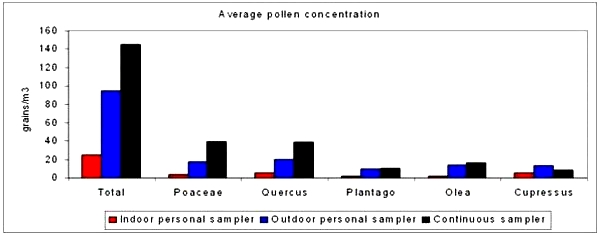
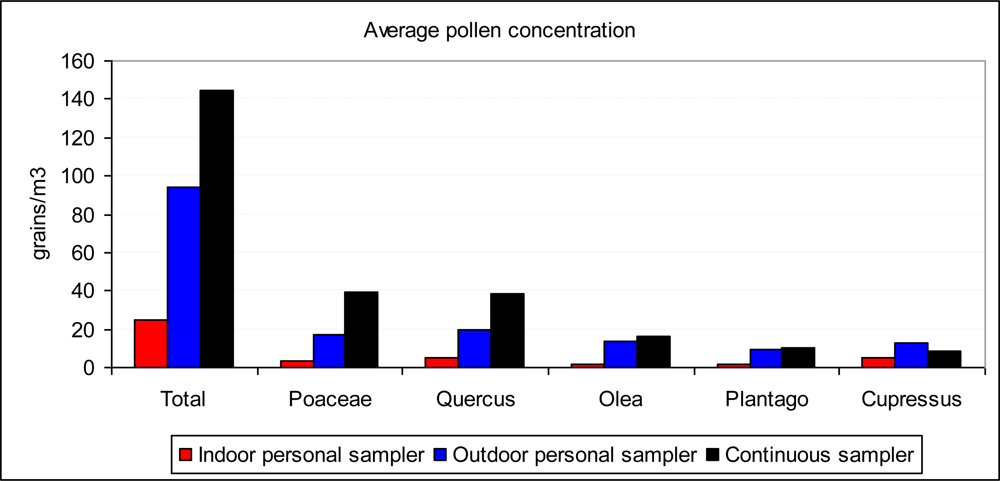
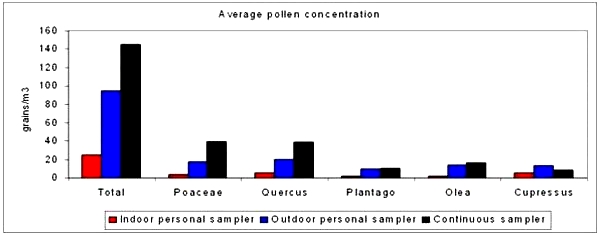
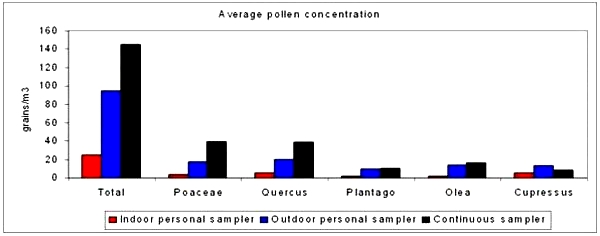
<p>The number of pollen types identified was 32. The most frequent were, in decreasing order: Poaceae, <italic>Quercus</italic>, <italic>Olea</italic>, <italic>Plantago</italic>, and Cupressaceae, representing 74.4% of the total pollen count (<xref ref-type="fig" rid="f1-ijerph-06-03169">Figure 1</xref>). Total pollen concentrations varied over the course of the year, with maxima in spring. The outdoor maximum concentration was 730 grains/m<sup>3</sup> (24 April 2007) using the personal sampler. For indoor sampling, the maximum was 470 grains/m<sup>3</sup> in the third-floor closed room (6 February 2008). The average concentration using the personal sampler was 94.5 grains/m<sup>3</sup> outdoors and 25.1 grains/m<sup>3</sup> indoors for all the samples, and 144.4 grains/m<sup>3</sup> for the continuous sampler. With these figures, the average indoor/outdoor ratio (I/O) was 0.27 using data from the same sampler. This value was different for each pollen type: <italic>Quercus</italic> (0.28), Cupressaceae (0.41), Poaceae (0.22), <italic>Plantago</italic> (0.19), and <italic>Olea</italic> (0.14). Despite the average outdoor concentration measured with the continuous sampler being higher than with the personal sampler (53% higher with the respective daily values given above as measured for the same days), the contrary was the case for the outdoor Cupressaceae concentrations, with the personal sampler giving higher values than the fixed sampler.</p></sec>
<sec>
<label>3.2.</label>
<title>Temporal Variations in Pollen Concentration</title>
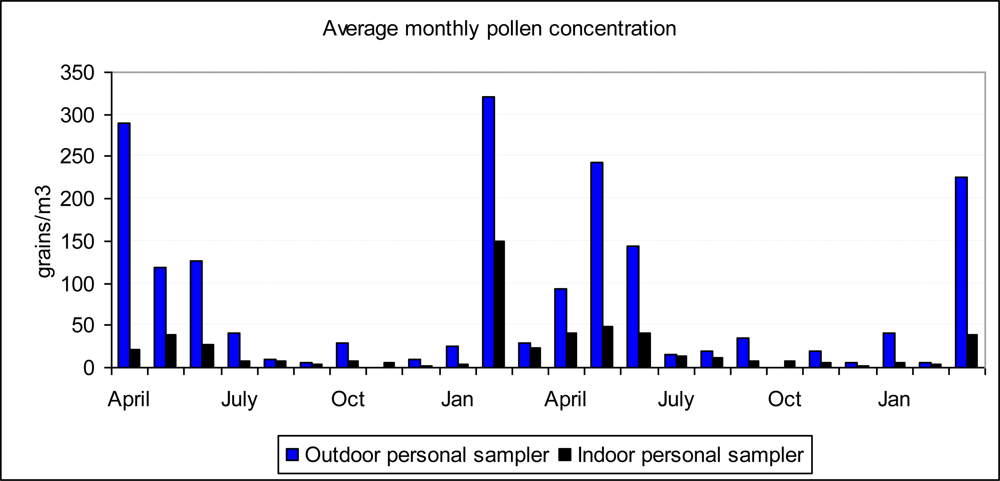
<p>The monthly variation of the indoor and outdoor concentrations is shown in <xref ref-type="fig" rid="f2-ijerph-06-03169">Figure 2</xref>. In this case, the I/O rate varied between 0.075 and 0.917, although on two occasions the measured outdoor pollen monthly concentration was zero. The inclusion of correspondingly very low values would have made the summer ratio somewhat greater. The months February to June are those with the highest concentrations, depending on the year.</p>
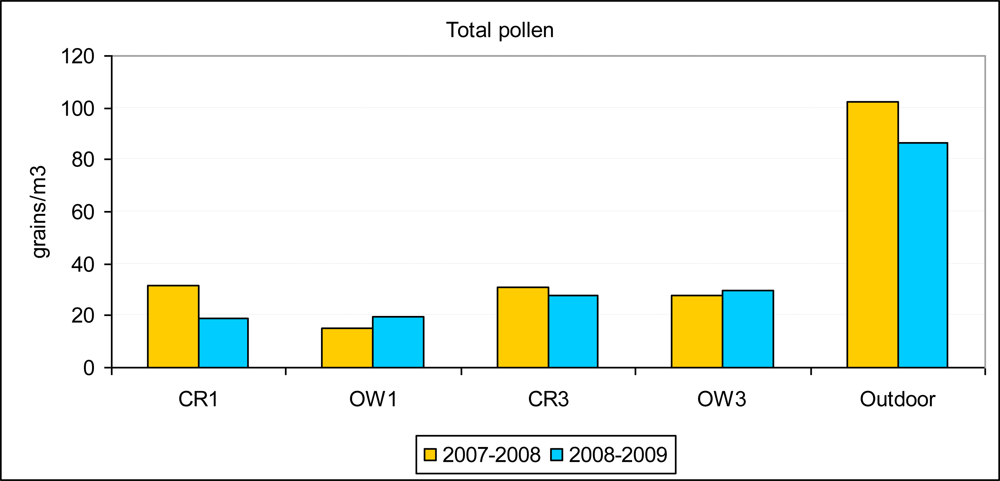
<p>The data were not normally distributed (Shapiro-Wilk 0.705, p-value &lt; 0.000), but were so after applying a logarithmic transformation (log-normal, Shapiro-Wilk 0.975, p-value 0.518). The ANOVA comparing total pollen data between the two years showed them to be statistically indistinguishable (F 0.136, p-value 0.714). <xref ref-type="fig" rid="f3-ijerph-06-03169">Figure 3</xref> shows this in relation to the five sites sampled. Neither did the same analysis for the five main pollen types separately show any difference between years.</p>
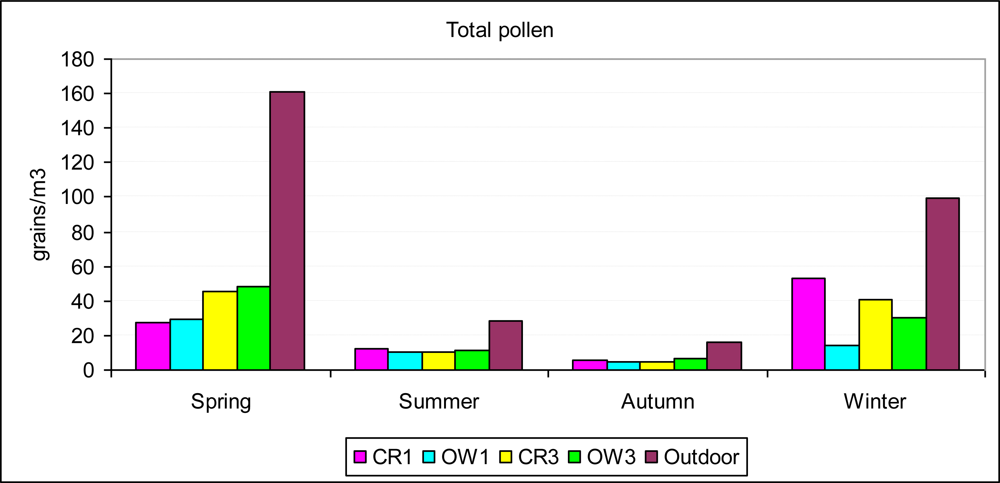
<p>There were major differences between seasons, with the highest values in spring and winter (F 17.869, p-value &lt; 0.000). <xref ref-type="fig" rid="f4-ijerph-06-03169">Figure 4</xref> shows these differences for each sampling site. For <italic>Plantago</italic> and <italic>Olea</italic> the values were nearly zero in summer, autumn, and winter, and for the rest they were very low, except for Cupressaceae in winter.</p></sec>
<sec>
<label>3.3.</label>
<title>Comparisons between Sampling Sites</title>
<p>The ANOVA comparing the five sites showed no differences (F 1.904, p-value 0.132). In view of the strong seasonality, with many zero values, the analysis was repeated with data from only five months (February to June). In this case, there appeared a statistically significant difference (F 5.663, p-value &lt; 0.000), and post-hoc HDS Tukey comparisons showed that the outdoor data were indeed different from the indoor ground floor data.</p>
<p>There was a strong correlation between the indoor and the outdoor data (p-value 0.000 in all cases). This correlation was higher using the data from the two open wards (r 0.529 and r 0.621, ground and third floors, respectively). There was a significant correlation between the data from the two outdoor samplers, continuous and personal (r 0.566, p-value &lt; 0.000). The ANOVA comparing those data showed no statistically significant differences (F 0.426, p-value 0.517), even for the five main pollen types. Nevertheless the concentrations measured with the continuous sampler were higher than with the personal sampler.</p></sec>
<sec>
<label>3.4.</label>
<title>Correlation with Weather Parameters, People and Vehicles</title>
<p>The correlation analysis with the weather parameters showed no significant relationships. The correlation analysis for the two open wards and outdoors with the number of people present during sampling only gave a statistically significant correlation for the case of the outdoor data (r 0.353, p-value 0.030). No correlation was found of the outdoor data with the number of vehicles present.</p></sec></sec>
<sec sec-type="discussion">
<label>4.</label>
<title>Discussion</title>
<p>The average I/O ratio found in the present work (0.27) is higher than most values reported in the literature: 0.02 [<xref ref-type="bibr" rid="b19-ijerph-06-03169">19</xref>,<xref ref-type="bibr" rid="b25-ijerph-06-03169">25</xref>], 0.025 [<xref ref-type="bibr" rid="b33-ijerph-06-03169">33</xref>], 0.041 [<xref ref-type="bibr" rid="b24-ijerph-06-03169">24</xref>], 0.05 [<xref ref-type="bibr" rid="b15-ijerph-06-03169">15</xref>,<xref ref-type="bibr" rid="b20-ijerph-06-03169">20</xref>], 0.083 [<xref ref-type="bibr" rid="b29-ijerph-06-03169">29</xref>], and 0.24 [<xref ref-type="bibr" rid="b3-ijerph-06-03169">3</xref>]. But it is lower than one case: 0.33 [<xref ref-type="bibr" rid="b14-ijerph-06-03169">14</xref>]. These differences could be because the present study corresponded to a place in which there is a great movement of people, and the entrance doors are open much of the time. The summer I/O ratio was the highest (0.39), and the spring ratio the lowest (0.23). This is coherent with the findings of Sterling and Lewis [<xref ref-type="bibr" rid="b3-ijerph-06-03169">3</xref>], who suggested that an explanation for their results could be that air-conditioning, which is most often used in summer, is an entrance route for pollen, or that windows and doors were more likely to be open, thus permitting the entrance of pollen.</p>
<p>The indoor pollen concentration found (25.1 grains/m<sup>3</sup>) is also high compared to most literature values: 1.2 grains/m<sup>3</sup> [<xref ref-type="bibr" rid="b15-ijerph-06-03169">15</xref>,<xref ref-type="bibr" rid="b19-ijerph-06-03169">19</xref>], 10 grains/m<sup>3</sup> [<xref ref-type="bibr" rid="b32-ijerph-06-03169">32</xref>], 16 grains/m<sup>3</sup> [<xref ref-type="bibr" rid="b18-ijerph-06-03169">18</xref>]. But it is lower than one case: 71 grains/m<sup>3</sup> [<xref ref-type="bibr" rid="b33-ijerph-06-03169">33</xref>]. The vegetation surrounding the places sampled in those papers is not reported, but in our case there were abundant ornamental trees and shrubs, mainly Cupressaceae (<italic>Platycladus orientalis, Cupressus arizonica, C. sempervirens</italic>), which would be the origin of the main pollen types found. One must therefore accept that major mixing of indoor and outdoor air is occurring, which is one of the most serious problems of indoor air quality [<xref ref-type="bibr" rid="b36-ijerph-06-03169">36</xref>].</p>
<p>Like other workers [<xref ref-type="bibr" rid="b18-ijerph-06-03169">18</xref>,<xref ref-type="bibr" rid="b20-ijerph-06-03169">20</xref>], we found that the concentrations measured with the continuous sampler were higher than with the personal sampler. This could be because the outdoor site selected for sampling with the personal sampler was at the entrance to the hospital, and protected from the wind. The resulting relative lack of air circulation could therefore have reduced the presence of pollen. As was mentioned above, the exception was the ornamental Cupressaceae, for which the outdoor concentration measured with the personal sampler was higher than with the fixed sampler. A phenological study was conducted for this pollen type in the period 2008–2009 (unpublished data), finding that the highest indoor concentration found in the hospital coincided with the maximum peak for <italic>Platycladus orientalis</italic>, the most abundant ornamental tree around the hospital, in February 2008.</p>
<p>The correlation found between the number of people moving through the entrance and the outdoor pollen counts would seem to support the idea that the pollen is transported by people walking [<xref ref-type="bibr" rid="b19-ijerph-06-03169">19</xref>,<xref ref-type="bibr" rid="b24-ijerph-06-03169">24</xref>,<xref ref-type="bibr" rid="b25-ijerph-06-03169">25</xref>,<xref ref-type="bibr" rid="b26-ijerph-06-03169">26</xref>] or by a re-suspension process that depends directly on particle size [<xref ref-type="bibr" rid="b37-ijerph-06-03169">37</xref>]. However, the outdoor sampling was made about ten metres away from the entrance, so that only simultaneous sampling immediately outside the entrance could support or refute this idea. Furthermore, no correlation was found between the number of people present in the wards and the pollen count.</p></sec>
<sec sec-type="conclusions">
<label>5.</label>
<title>Conclusions</title>
<p>Although people could be the vectors responsible for a certain amount of indoor pollen carried from outdoors to indoors, we consider mainly the doors and windows, and then the air-conditioning system, to have been the principal routes of the entrance of pollen. The indoor pollen concentrations reached somewhat more than a quarter of the outdoor concentration, with peaks as high as some hundreds of pollen grains per cubic metre on some occasions. This pattern depended on the vegetation surrounding the building—mainly ornamental trees and shrubs. Indoor air circulation could have been the reason for there being no differences between indoor open wards and isolated rooms, and even between independent floors. The outdoor pollen seasonality was also observed indoors, as there was a close correlation in the presence of airborne pollen between the two sets of places. Air-conditioning can alter the I/O ratio either directly as a route for the entry of pollen, or because its use affects the likelihood of doors and windows being closed or open.</p></sec></body>
<back>
<ack>
<p>This study was supported in part by a grant from the Junta de Extremadura, Consejería de Sanidad y Consumo, SCSS0536. Special thanks are due to the assistant personnel at the hospital.</p></ack>
<ref-list>
<title>References and Notes</title>
<ref id="b1-ijerph-06-03169"><label>1.</label><citation citation-type="journal"><person-group person-group-type="author"><name><surname>Höppe</surname><given-names>P</given-names></name><name><surname>Martinac</surname><given-names>I</given-names></name></person-group><article-title>Indoor climate and air quality. Review of current and future topics in the field of ISB study group 10</article-title><source>Int. J. Biometeorol</source><year>1998</year><volume>42</volume><fpage>1</fpage><lpage>7</lpage><pub-id pub-id-type="doi">10.1007/s004840050075</pub-id><pub-id pub-id-type="pmid">9780844</pub-id></citation></ref>
<ref id="b2-ijerph-06-03169"><label>2.</label><citation citation-type="journal"><person-group person-group-type="author"><name><surname>Lebowitz</surname><given-names>MD</given-names></name></person-group><article-title>Biological responses to indoor air contaminants</article-title><source>Aerobiologia</source><year>1991</year><volume>7</volume><fpage>10</fpage><lpage>16</lpage><pub-id pub-id-type="doi">10.1007/BF02450011</pub-id></citation></ref>
<ref id="b3-ijerph-06-03169"><label>3.</label><citation citation-type="journal"><person-group person-group-type="author"><name><surname>Sterling</surname><given-names>DA</given-names></name><name><surname>Lewis</surname><given-names>RD</given-names></name></person-group><article-title>Pollen and fungal spores indoor and outdoor of mobile homes</article-title><source>Ann. Allergy Asthma. Immunol</source><year>1998</year><volume>80</volume><fpage>279</fpage><lpage>285</lpage><pub-id pub-id-type="doi">10.1016/S1081-1206(10)62971-7</pub-id><pub-id pub-id-type="pmid">9532979</pub-id></citation></ref>
<ref id="b4-ijerph-06-03169"><label>4.</label><citation citation-type="journal"><person-group person-group-type="author"><name><surname>Holmquist</surname><given-names>L</given-names></name><name><surname>Vesterberg</surname><given-names>O</given-names></name></person-group><article-title>Quantification of birch and grass pollen allergens in indoor air</article-title><source>Indoor Air</source><year>1999</year><volume>9</volume><fpage>85</fpage><lpage>91</lpage><pub-id pub-id-type="doi">10.1111/j.1600-0668.1999.t01-2-00003.x</pub-id><pub-id pub-id-type="pmid">10390933</pub-id></citation></ref>
<ref id="b5-ijerph-06-03169"><label>5.</label><citation citation-type="journal"><person-group person-group-type="author"><name><surname>Bluyssen</surname><given-names>PM</given-names></name></person-group><article-title>Review: Indoor air quality management: a state of the art review and identification of research needs</article-title><source>Indoor Built Environ</source><year>1992</year><volume>1</volume><fpage>326</fpage><lpage>334</lpage><pub-id pub-id-type="doi">10.1177/1420326X9200100603</pub-id></citation></ref>
<ref id="b6-ijerph-06-03169"><label>6.</label><citation citation-type="journal"><person-group person-group-type="author"><name><surname>Singh</surname><given-names>J</given-names></name></person-group><article-title>Impact of indoor air pollution on health, comfort and productivity of the occupants</article-title><source>Aerobiologia</source><year>1996</year><volume>12</volume><fpage>121</fpage><lpage>127</lpage></citation></ref>
<ref id="b7-ijerph-06-03169"><label>7.</label><citation citation-type="journal"><person-group person-group-type="author"><name><surname>Pickering</surname><given-names>CAC</given-names></name></person-group><article-title>Immune respiratory disease associated with the inadequate control of indoor air quality</article-title><source>Indoor Built. Environ</source><year>1992</year><volume>1</volume><fpage>157</fpage><lpage>161</lpage><pub-id pub-id-type="doi">10.1177/1420326X9200100305</pub-id></citation></ref>
<ref id="b8-ijerph-06-03169"><label>8.</label><citation citation-type="journal"><person-group person-group-type="author"><name><surname>Portnoy</surname><given-names>JM</given-names></name><name><surname>Flappan</surname><given-names>S</given-names></name><name><surname>Barnes</surname><given-names>CS</given-names></name></person-group><article-title>A procedure for evaluation of the indoor environment</article-title><source>Aerobiologia</source><year>2001</year><volume>17</volume><fpage>43</fpage><lpage>48</lpage><pub-id pub-id-type="doi">10.1023/A:1007636931182</pub-id></citation></ref>
<ref id="b9-ijerph-06-03169"><label>9.</label><citation citation-type="journal"><person-group person-group-type="author"><name><surname>Kleinman</surname><given-names>MT</given-names></name><name><surname>Eisenbud</surname><given-names>M</given-names></name><name><surname>Lippmann</surname><given-names>M</given-names></name><name><surname>Kne</surname><given-names>TJ</given-names></name></person-group><article-title>The use of tracers to identify sources of airborne particles</article-title><source>Environ. Int</source><year>1980</year><volume>4</volume><fpage>53</fpage><lpage>62</lpage><pub-id pub-id-type="doi">10.1016/0160-4120(80)90094-X</pub-id></citation></ref>
<ref id="b10-ijerph-06-03169"><label>10.</label><citation citation-type="book"><person-group person-group-type="author"><name><surname>Kettrup</surname><given-names>A</given-names></name><name><surname>Schmidt</surname><given-names>PR</given-names></name></person-group><article-title>Methods to reduce allergic effects: elimination of allergens (pollen, mites, indoor dust, bacteria, gases, <italic>etc</italic>) from indoor air</article-title><source>Advances in Aerobiology Proceedings 3rd International Conference Aerobiology</source><person-group person-group-type="editor"><name><surname>Boehm</surname><given-names>G</given-names></name><name><surname>Leuschner</surname><given-names>RM</given-names></name></person-group><publisher-name>Birkhäuser Verlag</publisher-name><publisher-loc>Basel, Switzerland</publisher-loc><year>1987</year><fpage>415</fpage><lpage>417</lpage></citation></ref>
<ref id="b11-ijerph-06-03169"><label>11.</label><citation citation-type="journal"><person-group person-group-type="author"><name><surname>Billings</surname><given-names>CE</given-names></name><name><surname>Vanderslice</surname><given-names>SF</given-names></name></person-group><article-title>Methods for control of indoor air quality</article-title><source>Environ. Int</source><year>1982</year><volume>8</volume><fpage>497</fpage><lpage>504</lpage><pub-id pub-id-type="doi">10.1016/0160-4120(82)90068-X</pub-id></citation></ref>
<ref id="b12-ijerph-06-03169"><label>12.</label><citation citation-type="journal"><person-group person-group-type="author"><name><surname>Cheng</surname><given-names>YS</given-names></name><name><surname>Chun</surname><given-names>JL</given-names></name><name><surname>Chen</surname><given-names>TR</given-names></name></person-group><article-title>Efficiency of a portable indoor air cleaner in removing pollens and fungal spores</article-title><source>Aerosol Sci. Tech</source><year>1998</year><volume>29</volume><fpage>92</fpage><lpage>101</lpage><pub-id pub-id-type="doi">10.1080/02786829808965554</pub-id></citation></ref>
<ref id="b13-ijerph-06-03169"><label>13.</label><citation citation-type="journal"><person-group person-group-type="author"><name><surname>Enomoto</surname><given-names>T</given-names></name><name><surname>Onishi</surname><given-names>S</given-names></name><name><surname>Sogo</surname><given-names>H</given-names></name><name><surname>Dake</surname><given-names>Y</given-names></name><name><surname>Ikeda</surname><given-names>H</given-names></name><name><surname>Funakoshi</surname><given-names>H</given-names></name><name><surname>Shibano</surname><given-names>A</given-names></name><name><surname>Sakoda</surname><given-names>T</given-names></name></person-group><article-title>Japanese cedar pollen in floating indoor house dust after a pollinating season</article-title><source>Allergol. Internat</source><year>2004</year><volume>53</volume><fpage>279</fpage><lpage>285</lpage><pub-id pub-id-type="doi">10.1111/j.1440-1592.2004.00345.x</pub-id></citation></ref>
<ref id="b14-ijerph-06-03169"><label>14.</label><citation citation-type="journal"><person-group person-group-type="author"><name><surname>Stock</surname><given-names>TH</given-names></name><name><surname>Morandi</surname><given-names>MT</given-names></name></person-group><article-title>A characterization of indoor and outdoor microenvironmental concentrations of pollen and spores in two Houston neighbourhoods</article-title><source>Environ. Internat</source><year>1988</year><volume>14</volume><fpage>1</fpage><lpage>9</lpage><pub-id pub-id-type="doi">10.1016/0160-4120(88)90370-4</pub-id></citation></ref>
<ref id="b15-ijerph-06-03169"><label>15.</label><citation citation-type="journal"><person-group person-group-type="author"><name><surname>Lebowitz</surname><given-names>M</given-names></name><name><surname>O’Rourke</surname><given-names>M</given-names></name><name><surname>Dodge</surname><given-names>R</given-names></name><name><surname>Holberg</surname><given-names>G</given-names></name><name><surname>Hoshaw</surname><given-names>R</given-names></name><name><surname>Pinnas</surname><given-names>J</given-names></name><name><surname>Barbee</surname><given-names>R</given-names></name><name><surname>Sneller</surname><given-names>M</given-names></name></person-group><article-title>The adverse health effects of biologic aerosols, other aerosols, and indoor microclimate on asthmatics and nonasthmatics</article-title><source>Environ. Int</source><year>1982</year><volume>8</volume><fpage>375</fpage><lpage>380</lpage><pub-id pub-id-type="doi">10.1016/0160-4120(82)90053-8</pub-id></citation></ref>
<ref id="b16-ijerph-06-03169"><label>16.</label><citation citation-type="journal"><person-group person-group-type="author"><name><surname>Takahashi</surname><given-names>Y</given-names></name><name><surname>Takano</surname><given-names>K</given-names></name><name><surname>Suzuki</surname><given-names>M</given-names></name><name><surname>Nagai</surname><given-names>S</given-names></name><name><surname>Yokosuka</surname><given-names>M</given-names></name><name><surname>Takeshita</surname><given-names>T</given-names></name><name><surname>Saito</surname><given-names>A</given-names></name><name><surname>Yasueda</surname><given-names>H</given-names></name><name><surname>Enomoto</surname><given-names>T</given-names></name></person-group><article-title>Two routes for pollen entering indoors: ventilation and clothes</article-title><source>J. Investig. Allergol. Clin. Immunol</source><year>2009</year><volume>18</volume><fpage>382</fpage><lpage>388</lpage></citation></ref>
<ref id="b17-ijerph-06-03169"><label>17.</label><citation citation-type="journal"><person-group person-group-type="author"><name><surname>Sharma</surname><given-names>D</given-names></name><name><surname>Dutta</surname><given-names>BK</given-names></name><name><surname>Singh</surname><given-names>AB</given-names></name></person-group><article-title>Pollen, fungus and house dust mites survey at the residence of 90 allergic patients in Greater Silchar Area of Assam, India</article-title><source>Res. J. Allergy</source><year>2009</year><volume>1</volume><fpage>1</fpage><lpage>11</lpage><pub-id pub-id-type="doi">10.3923/rja.2009.1.11</pub-id></citation></ref>
<ref id="b18-ijerph-06-03169"><label>18.</label><citation citation-type="journal"><person-group person-group-type="author"><name><surname>O’Rourke</surname><given-names>MK</given-names></name><name><surname>Quackenboss</surname><given-names>JJ</given-names></name><name><surname>Lebowitz</surname><given-names>MD</given-names></name></person-group><article-title>An epidemiological approach investigating respiratory disease response in sensitive individuals to indoor and outdoor pollen exposure in Tucson, Arizona</article-title><source>Aerobiologia</source><year>1989</year><volume>5</volume><fpage>104</fpage><lpage>110</lpage><pub-id pub-id-type="doi">10.1007/BF02486508</pub-id></citation></ref>
<ref id="b19-ijerph-06-03169"><label>19.</label><citation citation-type="journal"><person-group person-group-type="author"><name><surname>O’Rourke</surname><given-names>MK</given-names></name><name><surname>Lebowitz</surname><given-names>MD</given-names></name></person-group><article-title>A comparison of regional atmospheric pollen with pollen collected at and near homes</article-title><source>Grana</source><year>1984</year><volume>23</volume><fpage>55</fpage><lpage>64</lpage><pub-id pub-id-type="doi">10.1080/00173138409428877</pub-id></citation></ref>
<ref id="b20-ijerph-06-03169"><label>20.</label><citation citation-type="journal"><person-group person-group-type="author"><name><surname>Cariñanos</surname><given-names>P</given-names></name><name><surname>Alcázar</surname><given-names>P</given-names></name><name><surname>Galán</surname><given-names>C</given-names></name><name><surname>Navarro</surname><given-names>R</given-names></name><name><surname>Dominguez</surname><given-names>E</given-names></name></person-group><article-title>Aerobiology as a tool to help in episodes of occupational allergy in work places</article-title><source>J. Invest. Allergol. Clin. Immunol</source><year>2004</year><volume>14</volume><fpage>300</fpage><lpage>308</lpage></citation></ref>
<ref id="b21-ijerph-06-03169"><label>21.</label><citation citation-type="journal"><person-group person-group-type="author"><name><surname>D’Amato</surname><given-names>G</given-names></name><name><surname>Russo</surname><given-names>M</given-names></name><name><surname>Liccardi</surname><given-names>G</given-names></name><name><surname>Saggese</surname><given-names>M</given-names></name><name><surname>Gentili</surname><given-names>M</given-names></name><name><surname>Mistrello</surname><given-names>G</given-names></name><name><surname>D’Amato</surname><given-names>M</given-names></name><name><surname>Falagiani</surname><given-names>P</given-names></name></person-group><article-title>Comparison between outdoor and indoor airborne allergenic activity</article-title><source>Ann. Allergy Asthma Immunol</source><year>1996</year><volume>77</volume><fpage>147</fpage><lpage>152</lpage><pub-id pub-id-type="doi">10.1016/S1081-1206(10)63501-6</pub-id><pub-id pub-id-type="pmid">8760781</pub-id></citation></ref>
<ref id="b22-ijerph-06-03169"><label>22.</label><citation citation-type="journal"><person-group person-group-type="author"><name><surname>Comtois</surname><given-names>P</given-names></name><name><surname>Marcoux</surname><given-names>N</given-names></name></person-group><article-title>An indoor air model</article-title><source>Aerobiologia</source><year>1999</year><volume>15</volume><fpage>115</fpage><lpage>120</lpage><pub-id pub-id-type="doi">10.1023/A:1007538513688</pub-id></citation></ref>
<ref id="b23-ijerph-06-03169"><label>23.</label><citation citation-type="book"><person-group person-group-type="author"><name><surname>Muilenberg</surname><given-names>ML</given-names></name></person-group><article-title>Pollen in indoor air: sources, exposures, and health effects</article-title><source>Indoor Air Quality Handbook</source><person-group person-group-type="editor"><name><surname>Spengler</surname><given-names>JD</given-names></name><name><surname>Samet</surname><given-names>JM</given-names></name><name><surname>McCarthy</surname><given-names>JF</given-names></name></person-group><publisher-name>McGraw-Hill</publisher-name><publisher-loc>Hightstown, NJ, USA</publisher-loc><year>2001</year>Chapter 44</citation></ref>
<ref id="b24-ijerph-06-03169"><label>24.</label><citation citation-type="journal"><person-group person-group-type="author"><name><surname>Ishibashi</surname><given-names>Y</given-names></name><name><surname>Ohno</surname><given-names>H</given-names></name><name><surname>Oh-ishi</surname><given-names>S</given-names></name><name><surname>Matsuoka</surname><given-names>T</given-names></name><name><surname>Kizaki</surname><given-names>T</given-names></name><name><surname>Yoshizumi</surname><given-names>K</given-names></name></person-group><article-title>Characterization of pollen dispersion in the neighborhood of Tokyo, Japan in the spring of 2005 and 2006</article-title><source>Int. J. Environ. Res. Public. Health</source><year>2008</year><volume>5</volume><fpage>76</fpage><lpage>85</lpage><pub-id pub-id-type="doi">10.3390/ijerph5020076</pub-id><pub-id pub-id-type="pmid">18441408</pub-id></citation></ref>
<ref id="b25-ijerph-06-03169"><label>25.</label><citation citation-type="journal"><person-group person-group-type="author"><name><surname>Hiromi</surname><given-names>K</given-names></name><name><surname>Susumu</surname><given-names>Y</given-names></name></person-group><article-title>Study on the control of indoor pollen exposure Part 1 Intrusion of airborne pollen into indoor environment and exposure dose</article-title><source>J. Architec. Plan. Environ. Engin</source><year>2001</year><volume>548</volume><fpage>63</fpage><lpage>68</lpage></citation></ref>
<ref id="b26-ijerph-06-03169"><label>26.</label><citation citation-type="journal"><person-group person-group-type="author"><name><surname>Vural</surname><given-names>C</given-names></name><name><surname>İnce</surname><given-names>A</given-names></name></person-group><article-title>Pollen grains in the house dust of Kayseri, Turkey</article-title><source>Internat. J. Nat. Engin. Sci</source><year>2008</year><volume>2</volume><fpage>41</fpage><lpage>44</lpage></citation></ref>
<ref id="b27-ijerph-06-03169"><label>27.</label><citation citation-type="journal"><person-group person-group-type="author"><name><surname>Reed</surname><given-names>CE</given-names></name><name><surname>Swanson</surname><given-names>MC</given-names></name></person-group><article-title>Indoor allergens: identification and quantification</article-title><source>Environ. Int</source><year>1986</year><volume>12</volume><fpage>115</fpage><lpage>120</lpage><pub-id pub-id-type="doi">10.1016/0160-4120(86)90021-8</pub-id></citation></ref>
<ref id="b28-ijerph-06-03169"><label>28.</label><citation citation-type="journal"><person-group person-group-type="author"><name><surname>Adam</surname><given-names>KF</given-names></name><name><surname>Hyde</surname><given-names>HA</given-names></name></person-group><article-title>Pollen grains and fungal spores indoor and out at Cardiff</article-title><source>J. Palynol</source><year>1965</year><volume>1</volume><fpage>67</fpage><lpage>69</lpage></citation></ref>
<ref id="b29-ijerph-06-03169"><label>29.</label><citation citation-type="journal"><person-group person-group-type="author"><name><surname>Yankova</surname><given-names>R</given-names></name></person-group><article-title>Outdoor and indoor pollen grains in Sofia</article-title><source>Grana</source><year>1991</year><volume>30</volume><fpage>171</fpage><lpage>176</lpage><pub-id pub-id-type="doi">10.1080/00173139109427794</pub-id></citation></ref>
<ref id="b30-ijerph-06-03169"><label>30.</label><citation citation-type="book"><person-group person-group-type="author"><name><surname>Loublier</surname><given-names>Y</given-names></name></person-group><article-title>One year indoor pollen and spore and spore deposition: are the contaminations possible?</article-title><source>1st European Symposium on Aerobiology</source><person-group person-group-type="editor"><name><surname>Aira</surname><given-names>MJ</given-names></name><name><surname>Jato</surname><given-names>V</given-names></name><name><surname>Iglesias</surname><given-names>I</given-names></name><name><surname>Gálan</surname><given-names>C</given-names></name></person-group><publisher-name>Universidad de Santiago de Compostela</publisher-name><publisher-loc>Santiago de Compostela, Spain</publisher-loc><year>1996</year><fpage>49</fpage><lpage>40</lpage></citation></ref>
<ref id="b31-ijerph-06-03169"><label>31.</label><citation citation-type="journal"><person-group person-group-type="author"><name><surname>Loublier</surname><given-names>Y</given-names></name></person-group><article-title>Evaluation of indoor passive pollen sedimentation over 1 year: a possible source of contamination?</article-title><source>Aerobiologia</source><year>1998</year><volume>14</volume><fpage>291</fpage><lpage>298</lpage><pub-id pub-id-type="doi">10.1007/BF02694221</pub-id></citation></ref>
<ref id="b32-ijerph-06-03169"><label>32.</label><citation citation-type="journal"><person-group person-group-type="author"><name><surname>Hugg</surname><given-names>T</given-names></name><name><surname>Rantio-Lehtimäki</surname><given-names>A</given-names></name></person-group><article-title>Indoor and outdoor pollen concentrations in private and public spaces during the Betula pollen season</article-title><source>Aerobiologia</source><year>2007</year><volume>23</volume><fpage>119</fpage><lpage>129</lpage><pub-id pub-id-type="doi">10.1007/s10453-007-9057-z</pub-id></citation></ref>
<ref id="b33-ijerph-06-03169"><label>33.</label><citation citation-type="journal"><person-group person-group-type="author"><name><surname>Lee</surname><given-names>T</given-names></name><name><surname>Grinshpun</surname><given-names>SA</given-names></name><name><surname>Martuzevicius</surname><given-names>D</given-names></name><name><surname>Adhikari</surname><given-names>A</given-names></name><name><surname>Crawford</surname><given-names>CM</given-names></name><name><surname>Luo</surname><given-names>J</given-names></name><name><surname>Reponen1</surname><given-names>T</given-names></name></person-group><article-title>Relationship between indoor and outdoor bioaerosols collected with a button inhalable aerosol sampler in urban homes</article-title><source>Indoor Air</source><year>2006</year><volume>16</volume><fpage>37</fpage><lpage>47</lpage><pub-id pub-id-type="doi">10.1111/j.1600-0668.2005.00396.x</pub-id><pub-id pub-id-type="pmid">16420496</pub-id></citation></ref>
<ref id="b34-ijerph-06-03169"><label>34.</label><citation citation-type="journal"><person-group person-group-type="author"><name><surname>Tormo</surname><given-names>R</given-names></name><name><surname>Gonzalo</surname><given-names>MA</given-names></name><name><surname>Muñoz</surname><given-names>AF</given-names></name><name><surname>Silva</surname><given-names>I</given-names></name></person-group><article-title>Pollen and spores in the air of a hospital outpatient ward</article-title><source>Allergol. Immunopathol</source><year>2002</year><volume>30</volume><fpage>232</fpage><lpage>238</lpage></citation></ref>
<ref id="b35-ijerph-06-03169"><label>35.</label><citation citation-type="journal"><person-group person-group-type="author"><name><surname>Hirst</surname><given-names>JM</given-names></name></person-group><article-title>An automatic volumetric spore trap</article-title><source>Ann. Appl. Bio</source><year>1952</year><volume>39</volume><fpage>257</fpage><lpage>265</lpage><pub-id pub-id-type="doi">10.1111/j.1744-7348.1952.tb00904.x</pub-id></citation></ref>
<ref id="b36-ijerph-06-03169"><label>36.</label><citation citation-type="journal"><person-group person-group-type="author"><name><surname>Roe</surname><given-names>FJC</given-names></name></person-group><article-title>Priorities for research in the field of indoor air pollution</article-title><source>Indoor Built. Environ</source><year>1994</year><volume>3</volume><fpage>191</fpage><lpage>199</lpage><pub-id pub-id-type="doi">10.1177/1420326X9400300406</pub-id></citation></ref>
<ref id="b37-ijerph-06-03169"><label>37.</label><citation citation-type="journal"><person-group person-group-type="author"><name><surname>Miguel</surname><given-names>AF</given-names></name><name><surname>Aydin</surname><given-names>M</given-names></name><name><surname>Reis</surname><given-names>AH</given-names></name></person-group><article-title>Indoor deposition and forced re-suspension of respirable particles</article-title><source>Indoor Built Environ</source><year>2005</year><volume>14</volume><fpage>391</fpage><lpage>396</lpage><pub-id pub-id-type="doi">10.1177/1420326X05057948</pub-id></citation></ref></ref-list>
<sec sec-type="display-objects">
<title>Figures</title>
<fig id="f1-ijerph-06-03169" position="float">
<label>Figure 1.</label>
<caption>
<p>Average pollen concentration, total and for the main five pollen types, using indoor and outdoor personal samplers or continuous sampler.</p></caption><graphic xlink:href="ijerph-06-03169f1.gif"/></fig>
<fig id="f2-ijerph-06-03169" position="float">
<label>Figure 2.</label>
<caption>
<p>Average monthly indoor and outdoor pollen concentrations from April 2007 to March 2009.</p></caption><graphic xlink:href="ijerph-06-03169f2.gif"/></fig>
<fig id="f3-ijerph-06-03169" position="float">
<label>Figure 3.</label>
<caption>
<p>Average annual pollen concentrations outdoors and in the four indoor sites sampled (CR1 closed room ground floor, OW open ward ground floor, CR3 closed room third floor, OW3 open ward third floor).</p></caption><graphic xlink:href="ijerph-06-03169f3.gif"/></fig>
<fig id="f4-ijerph-06-03169" position="float">
<label>Figure 4.</label>
<caption>
<p>Average seasonal pollen concentration in the five places sampled (see legend to <xref ref-type="fig" rid="f3-ijerph-06-03169">Figure 3</xref>).</p></caption><graphic xlink:href="ijerph-06-03169f4.gif"/></fig></sec></back></article>