
UVA Photoirradiation of Halogenated-Polycyclic Aromatic Hydrocarbons Leading to Induction of Lipid Peroxidation

Abstract
:Introduction
Materials and Methods
Materials
Synthesis of Halo-PAHs
Light Source
Peroxidation of Methyl Linoleate Initiated by Photoirradiation of Halogenated Pahs and their Parent Pahs with UVA Light
Results and Discussion
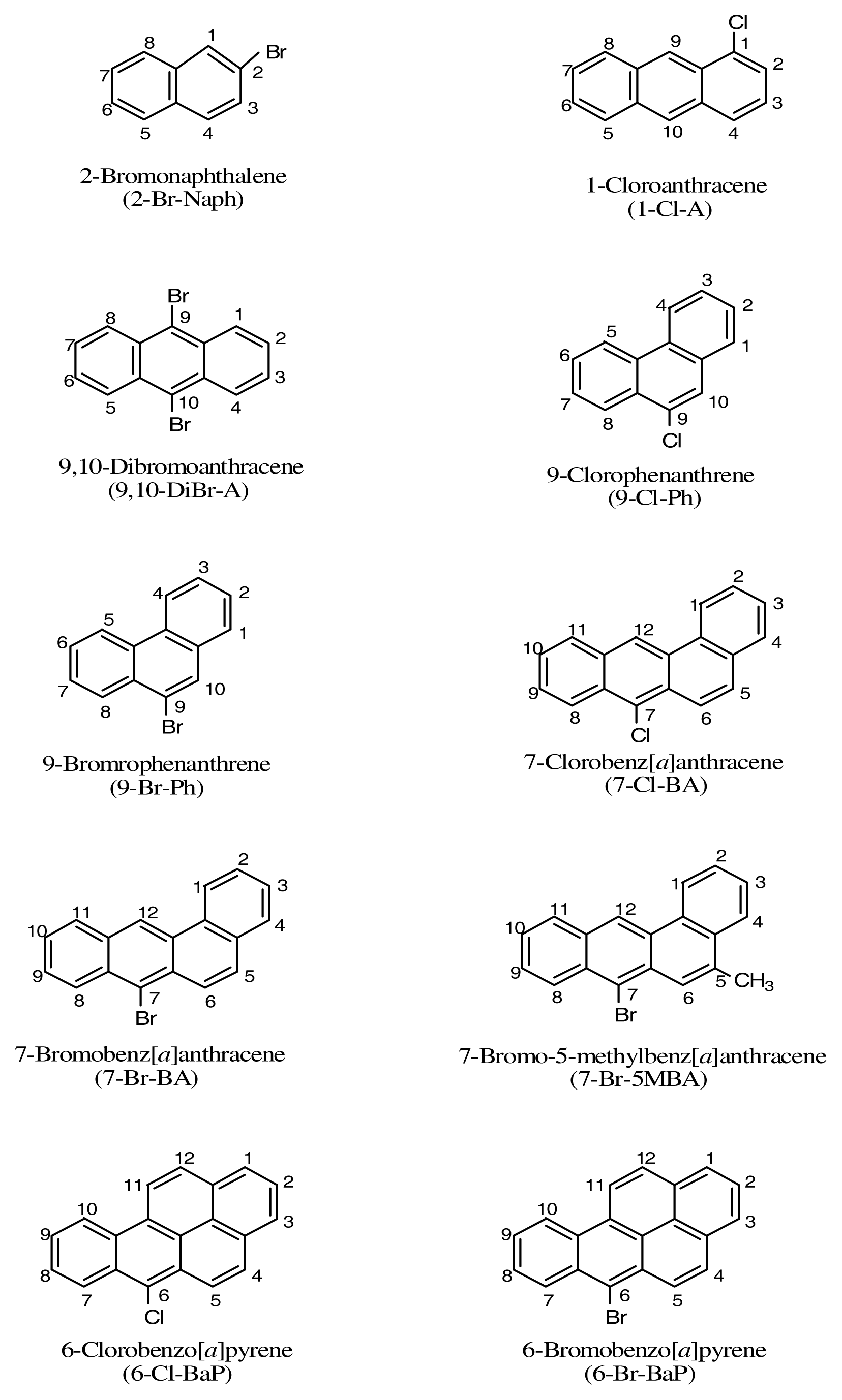
Photoirradiation of Representative Halo-PAHs
Comparison of Level of Lipid Peroxidation Formation
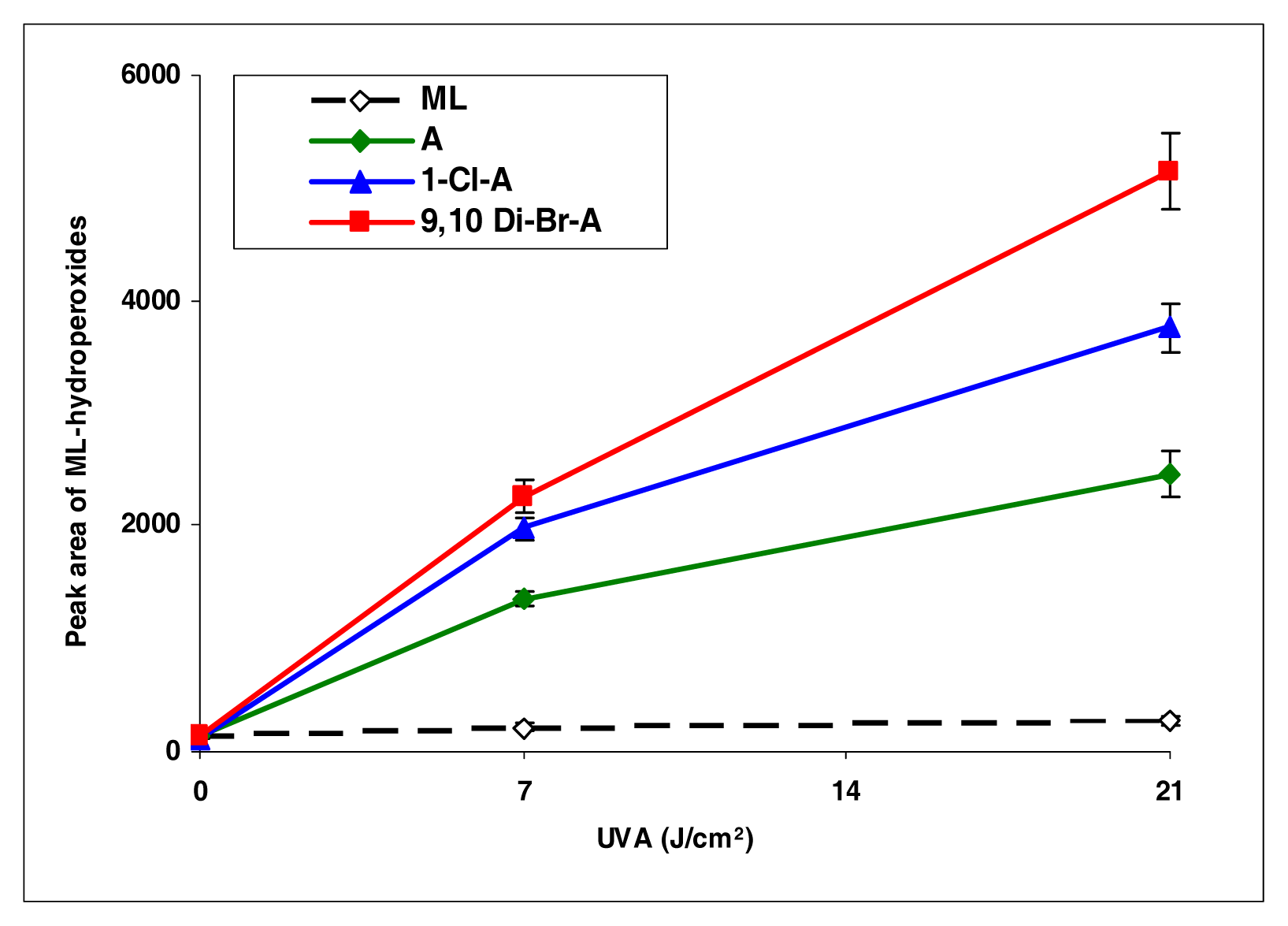
Anthracene Series
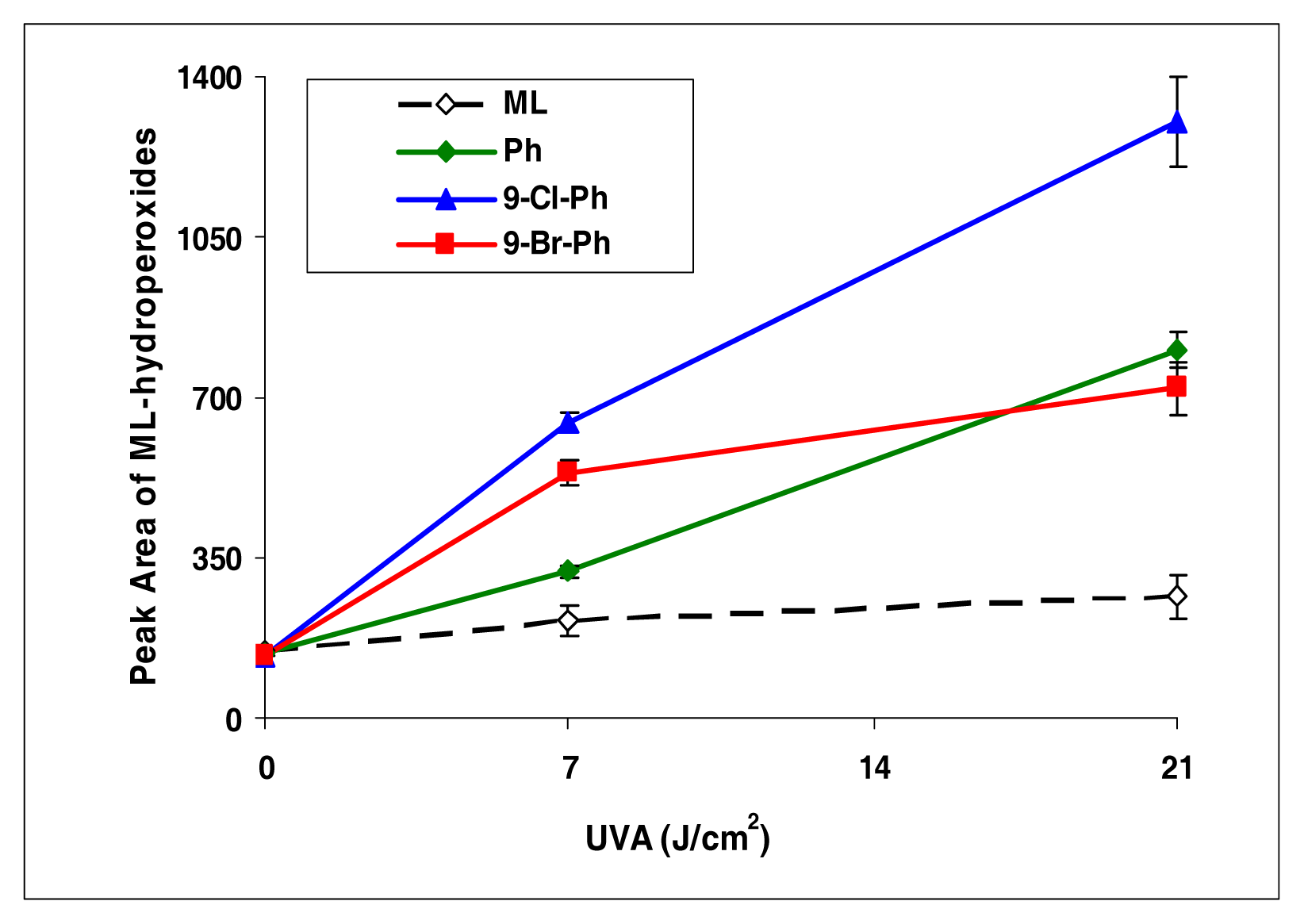
Phenenthrene Series
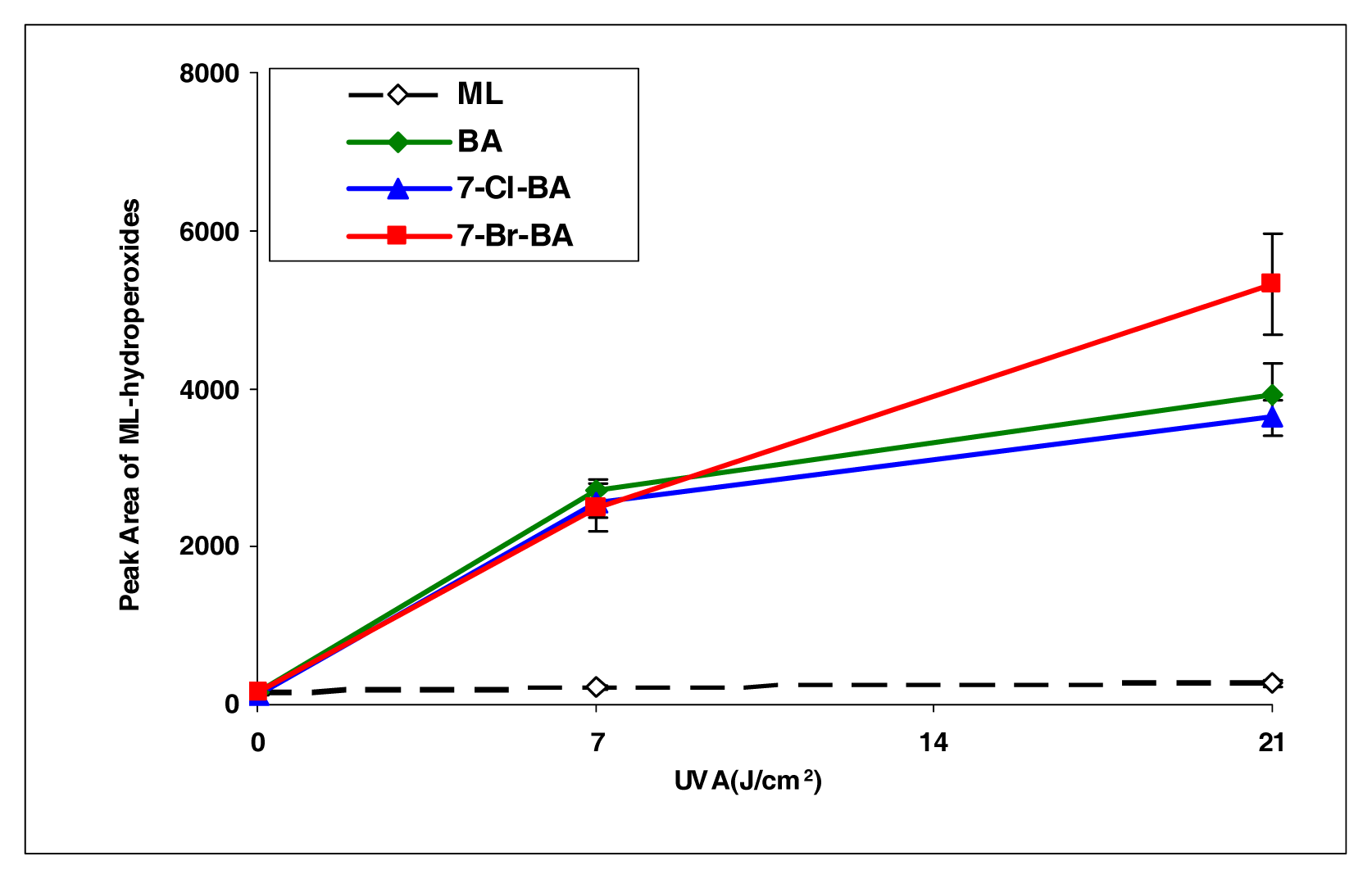
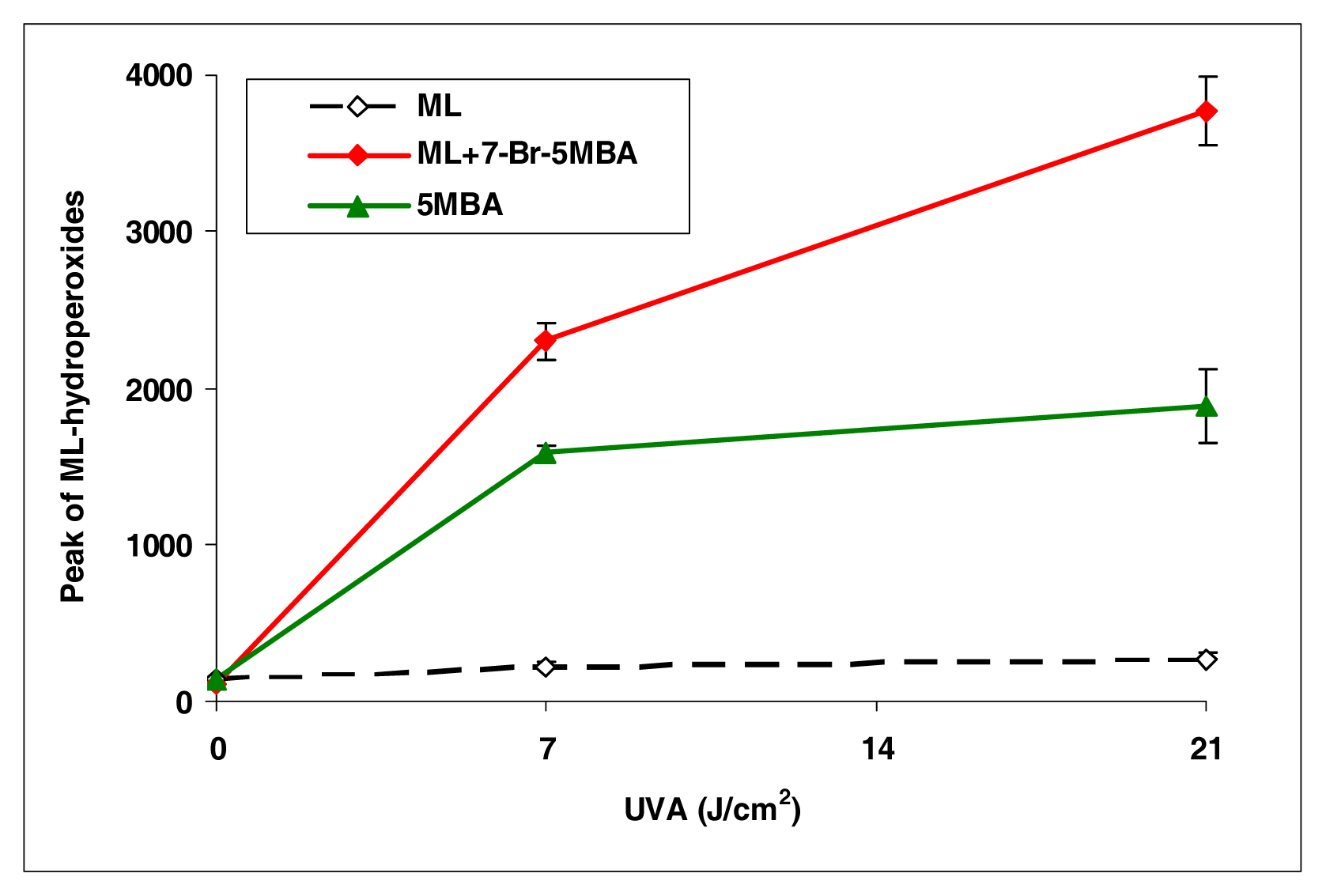
Benz[a]anthracene Series
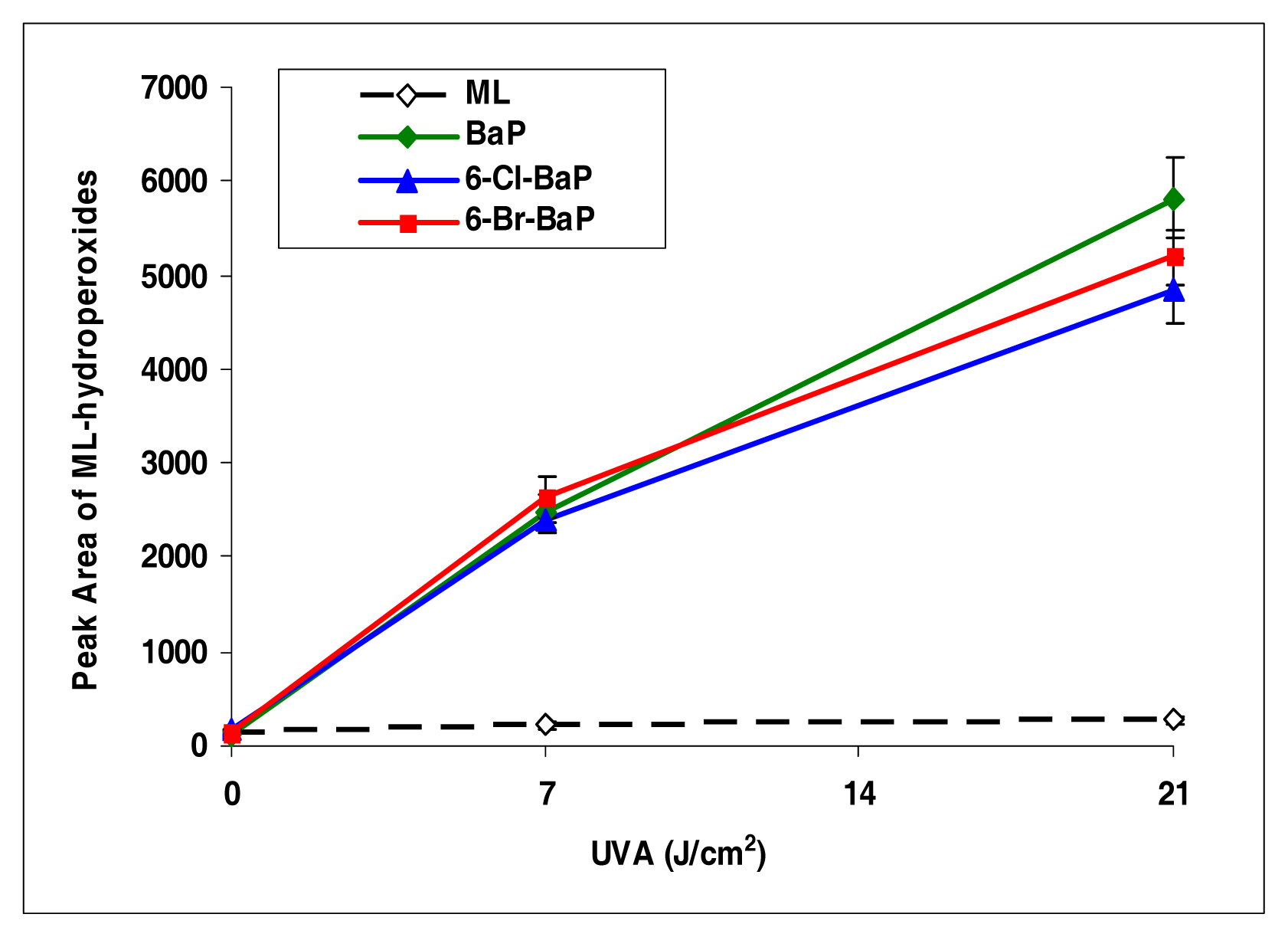
Benzo[a]pyrene Series
Conclusion
- Upon photoirration with UVA light, all the halo-PAHs used in this study induced lipid peroxidation, but with different induction potencies.
- The levels of lipid peroxidation by each halo-PAHs and PAHs were dose (light) dependent.
- In general, the addition of a halogen atom to the parent PAH resulted in lipid peroxidation either increase, decrease or no effect on the capability of induction of lipid peroxidation.
- There was no correlation between the level of lipid peroxidation and the tumorigenic potency of the compounds studied.
- Halo-PAHs are environmental contaminants and, as shown in our study, can induce lipid peroxidation, these compounds may pose adverse health effect in humans.

| Compound | 0 J/cm2 | 7 J/cm2 | 21 J/cm2 |
|---|---|---|---|
| Methyl linoleate (ML) | 145 | 212 ± 34 | 267 ± 47 |
| 2-Br-Naph | 137 | 402 ± 49 | 1135 ± 93 |
| Anthracene (A) | 138 | 1350 ± 66 | 2459 ± 197 |
| 1-Cl-A | 122 | 1976 ± 100 | 3759 ± 218 |
| 9,10-DiBr-A | 137 | 2260 ± 150 | 5144 ± 330 |
| Phenanthrene (Ph) | 144 | 321 ± 13 | 803 ± 37 |
| 9-Cl-Ph | 138 | 645 ± 22 | 1301 ± 100 |
| 9-Br-Ph | 134 | 537 ± 27 | 721 ± 58 |
| Benz[a]anthracene (BA) | 141 | 2719 ± 133 | 3917 ± 403 |
| 7-Cl-BA | 119 | 2540 ± 179 | 3640 ± 225 |
| 7-Br-BA | 137 | 2494 ± 301 | 5309 ± 638 |
| 5MBA | 142 | 1582 ± 58 | 1885 ± 236 |
| 7-Br-5MBA | 115 | 2296 ± 112 | 3769 ± 216 |
| Benzo[a]pyrene (BaP) | 100 | 2467 ± 217 | 5819 ± 425 |
| 6-Cl-BaP | 153 | 2404 ± 29 | 4840 ± 137 |
| 6-Br-BaP | 135 | 2639 ± 224 | 5201 ± 291 |
References
- Fu, P. P.; Von Tungeln, L. S.; Chiu, L.-H.; Own, Z. Y. Halogenateo-polycyclic aromatic hydrocarbons: a class of genotoxic environmental pollutants. Environ. Carcinogen. Ecotoxicol. Rev 1999, C17(2), 71–109. [Google Scholar]
- Dipple, A.; Moschel, R. C.; Bigger, C. A. H. Chemical Carcinogens; Searle, C. E., Ed.; Monograph 182; American Chemical Society: Washington, DC, 1984; p. 41. [Google Scholar]
- Hartwell, J. L. Survey of Compounds Which Have Been Tested for Carcinogenic Activity; U.S. Public Health Service Publication No. 149; Washington, D.C, 1951. [Google Scholar]
- Clar, E. Polycyclic Hydrocarbons; Academic Press: New York, NY, 1964; Volume 1 and 2. [Google Scholar]
- Harvey, R. G. Polycyclic Aromatic Hydrocarbons; Wiley-VCH, Inc, 1997. [Google Scholar]
- Thompson, J. I. & Company, Survey of Compounds Which Have Been Tested for Carcinogenic Activity; U.S. Public Health Service Publication No. 149; Washington, D.C, 1968–1969.
- Fu, P. P.; Yang, S. K. Stereoselective metabolism of 7-bromobenz[a]anthracene by rat liver microsomes: absolute configuration of trans-dihydrodiol metabolites. Carcinogenesis 1983, 4, 979–984. [Google Scholar]
- Chiu, P.-L.; Fu, P. P.; Yang, S. K. Stereoselectivity of rat liver microsomal enzymes in the metabolism of 7-fluorobenz[a]anthracene and mutagenicity of metabolites. Cancer Res 1984, 44, 562–570. [Google Scholar]
- Fu, P. P.; Von Tungeln, L. S.; Unruh, L. E.; Ni, Y-C.; Chou, M. W. Comparative regioselective and stereoselective metabolism of 7-chlorobenz[a]anthracene and 7-bromobenz[a]anthracene by mouse and rat liver microsomes. Carcinogenesis 1991, 12, 371–378. [Google Scholar]
- Xiao, Y.; Von Tungeln, L. S.; Chou, M. W.; Hart, R. W.; Fu, P. P. Effect of caloric restriction on the metabolism of 7-bromobenz[a]anthracene and 7-fluorobenz[a]anthracene by male B6C3F1mouse liver microsomes: Reduction of metabolic activation pathway. Age 1993, 16(4), 160–165. [Google Scholar]
- Xiao, Y.; Von Tungeln, L. S.; Chou, M. W.; Hart, R. W.; Fu, P. P. Effect of caloric restriction on the stereoselective metabolism of 7-chlorobenz[a]anthracene by male B6C3F1mouse liver microsomes. Age 1993, 16(4), 166–172. [Google Scholar]
- Own, Z. Y.; Chiu, L-H.; Von Tungeln, L. S.; Deck, S. J.; Vingiello, F. A.; Fu, P. P. Synthesis and rat liver microsomal metabolism of 2-chlorodibenz[a,l]pyrene and 10-chlorodibenz[a,l]pyrene. Polycyclic Aromat. Cpds 1996, 11, 333–340. [Google Scholar]
- Fu, P.P.; Von Tungeln, L. S.; Zhan, D-J.; Bucci, T. Potent tumorigenicity of 7-chlorobenz[a]anthracene and 7-bromobenz[a]anthracene in the neonatal B6C3F1 male mouse. Cancer Lett 1996, 101, 37–42. [Google Scholar]
- Xia, Q.; Yi, P.; Zhan, D.-J.; Von Tungeln, L. S.; Hart, R. W.; Heflich, R. H.; Fu, P. P. Liver tumors induced in B6C3F1mice by 7-chlorobenz[a]anthracene and 7-bromobenz[a]anthracene contain K-ras oncogene mutations. Cancer Letters 1998, 123, 21–25. [Google Scholar]
- Hong, F.; Von Tungeln, L. S.; Fu, P. P.; Watson, F. Stereoselective metabolism of anthracene, 9-methylanthracene, 9,10-dimethylanthracene, 9-chloroanthracene, and 9-nitroanthracene by liver microsomes of 15-day-old male B6C3F1 mice. Polycyclic Aromat. Cpd 1999, 16, 235–244. [Google Scholar]
- Cherng, S.; Xia, H. Q.; Blankenship, L. R.; Freeman, J. P.; Wamer, W. G.; Howard, P. C.; Fu, P. P. Photodecomposition of retinyl palmitate in ethanol by UVA light - formation of photodecomposition products, reactive oxygen species, and lipid peroxides. Chem. Res. Toxicol 2005, 18, 129–138. [Google Scholar]
- Totika, M. Identification of new geometric isomers of methyl linoleate hydroperoxide and their chromatographic behavior. Biosci. Biotechnol. Biochem 2000, 64, 1044–1056. [Google Scholar]
© 2006 MDPI. All rights reserved.
Share and Cite
Herreno-Sáenz, D.; Xia, Q.; Chiu, L.-T.; Fu, P.P. UVA Photoirradiation of Halogenated-Polycyclic Aromatic Hydrocarbons Leading to Induction of Lipid Peroxidation. Int. J. Environ. Res. Public Health 2006, 3, 191-195. https://doi.org/10.3390/ijerph2006030022
Herreno-Sáenz D, Xia Q, Chiu L-T, Fu PP. UVA Photoirradiation of Halogenated-Polycyclic Aromatic Hydrocarbons Leading to Induction of Lipid Peroxidation. International Journal of Environmental Research and Public Health. 2006; 3(2):191-195. https://doi.org/10.3390/ijerph2006030022
Chicago/Turabian StyleHerreno-Sáenz, Diógenes, Qingsu Xia, Li-Ting Chiu, and Peter P. Fu. 2006. "UVA Photoirradiation of Halogenated-Polycyclic Aromatic Hydrocarbons Leading to Induction of Lipid Peroxidation" International Journal of Environmental Research and Public Health 3, no. 2: 191-195. https://doi.org/10.3390/ijerph2006030022