

Toxicity Thresholds Based on EDTA Extractable Nickel and Barley Root Elongation in Chinese Soils

Abstract
1. Introduction
2. Materials and Methods
2.1. Soil Samples and Treaments
2.2. Extraction of Added Ni in Soils
2.3. Barley Root Elongation Assay
2.4. Statistical Analysis
3. Results and Discussion
3.1. Toxicity Thresholds for Nickel in Soils Based on EDTA Extractions
3.2. The Influence of Leaching on Ni Toxicity
3.3. The Relationships between EDTA Extractable and Total Ni as Affected by Soil Properties
3.4. Toxicity Thresholds Based on EDTA Extractable Ni in Soils as a Function of Soil Properties
3.5. Applications in Risk Assessment and Ecological Criteria Setting
4. Conclusions
Acknowledgments
Author Contributions
Conflicts of Interest
References
- Janssen, C.R.; Schamphelaere, K.D.; Heijerick, D.; Muyssen, B.; Lock, K.; Bossuyt, B.; Vangheluwe, M.; Sprang, P.V. Uncertainties in the Environmental Risk Assessment of Metals. Hum. Ecol. Risk Assess. 2000, 6, 1003–1018. [Google Scholar] [CrossRef] [Scilit]
- Lu, L.; Liu, G.; Wang, J.; Wu, Y. Bioavailability and mobility of heavy metals in soil in vicinity of a coal mine from Huaibei, China. Hum. Ecol. Risk Assess. 2017, 23, 1164–1177. [Google Scholar] [CrossRef] [Scilit]
- Wang, X.Q.; Wei, D.P.; Ma, Y.B.; Mclaughlin, M.J. Soil ecological criteria for nickel as a function of soil properties. Environ. Sci. Pollut. Res. 2018, 25, 2137–2146. [Google Scholar] [CrossRef] [Scilit] [PubMed]
- Smolders, E.; Oorts, K.; Sprang, P.V.; Schoeters, I.; Janssen, C.R.; Mcgrath, S.P.; Mclaughlin, M.J. Toxicity of trace metals in soil as affected by soil type and aging after contamination: Using calibrated bioavailability models to set ecological soil standards. Environ. Toxicol. Chem. 2009, 28, 1663–1670. [Google Scholar] [CrossRef] [Scilit] [PubMed]
- Weng, L.P.; Wolthoorn, A.; Lexmond, T.M.; Temminghoff, E.J.; van Riemsdijk, W.H. Understanding the effects of soil characteristics on phytotoxicity and bioavailability of nickel using speciation models. Environ. Sci. Technol. 2004, 38, 156–162. [Google Scholar] [CrossRef] [Scilit] [PubMed]
- Ren, X.; Zeng, G.; Tang, L.; Wang, J.; Wan, J.; Liu, Y.; Yu, J.; Yi, H.; Ye, S.; Deng, R. Sorption, transport and biodegradation—An insight into bioavailability of persistent organic pollutants in soil. Sci. Total. Environ. 2017, 610–611, 1154–1163. [Google Scholar] [CrossRef] [Scilit] [PubMed]
- Rao, C.R.M.; Sahuquillo, A.; Sanchez, J.F.L. A Review of the Different Methods Applied in Environmental Geochemistry For Single and Sequential Extraction of Trace Elements in Soils and Related Materials. Water Air Soil Pollut. 2008, 189, 291–333. [Google Scholar] [CrossRef] [Scilit]
- Ma, Y.B.; Uren, N.C. The fate and transformations of zinc added to soils. Soil Res. 1997, 35, 727–738. [Google Scholar] [CrossRef] [Scilit]
- Ma, Y.B.; Uren, N.C. Application of a new fractionation scheme for heavy metals in soils. Commun. Soil Sci. Plan Anal. 1995, 26, 3291–3303. [Google Scholar] [CrossRef] [Scilit]
- Krishnamurti, G.S.R. Chapter 20 Chemical methods for assessing contaminant bioavailability in soils. Dev. Soil Sci. 2008, 40, 495–520. [Google Scholar] [CrossRef] [Scilit]
- Quevauviller, P.; Rauret, G.; Rubio, R.; López-Sánchez, J.F.; Ure, A.; Bacon, J.; Muntau, H. Certified reference materials for the quality control of EDTA- and acetic acid-extractable contents of trace elements in sewage sludge amended soils (CRMs 483 and 484). Fresenius J. Anal. Chem. 1997, 357, 611–618. [Google Scholar] [CrossRef] [Scilit]
- Lilleengen, B.; Wibetoe, G. Graphite furnace atomic absorption spectrometry used for determination of total, EDTA and acetic acid extractable chromium and cobalt in soils. Anal. Bioanal. Chem. 2002, 372, 187–195. [Google Scholar] [CrossRef] [Scilit] [PubMed]
- Elliott, H.A.; Dempsey, B.A.; Maille, P.J. Content and fractionation of heavy metals in water treatment sludges. J. Environ. Qual. 1990, 19, 330–334. [Google Scholar] [CrossRef] [Scilit]
- Quevauviller, P.; Rauret, G.; López-Sánchez, J.F.; Rubio, R.; Ure, A.; Muntau, H. Certification of trace metal extractable contents in a sediment reference material (CRM 601) following a three-step sequential extraction procedure. Sci. Total Environ. 1997, 205, 223–234. [Google Scholar] [CrossRef] [Scilit]
- Alvarez, J.M.; Lopez-Valdivia, L.M.; Novillo, J.; Obrador, A.; Rico, M.I. Comparison of EDTA and sequential extraction tests for phytoavailability prediction of manganese and zinc in agricultural alkaline soils. Geoderma 2006, 132, 450–463. [Google Scholar] [CrossRef] [Scilit]
- Ma, Y.B.; Uren, N.C. Transformations of heavy metals added to soil—Application of a new sequential extraction procedure. Geoderma 1998, 84, 157–168. [Google Scholar] [CrossRef] [Scilit]
- Nannoni, F.; Protano, G. Chemical and biological methods to evaluate the availability of heavy metals in soils of the Siena urban area (Italy). Sci. Total Environ. 2016, 568, 1–10. [Google Scholar] [CrossRef] [Scilit] [PubMed]
- Laing, G.D. Analysis and Fractionation of Trace Elements in Soils. In Trace Elements in Soils; Hooda, P.S., Ed.; Wiley-Blackwell: Chichester, UK, 2010; pp. 53–80. ISBN 9781405160377. [Google Scholar] [CrossRef] [Scilit]
- International Organization for Standardization (ISO). Soil Quality—Extraction of Trace Elements Using Dilute Nitric Acid; International Organization for Standardization (ISO): Geneva, Switzerland, 2016. [Google Scholar]
- Rauret, G. Extraction procedures for the determination of heavy metals in contaminated soil and sediment. Talanta 1998, 46, 449–455. [Google Scholar] [CrossRef] [Scilit]
- Quevauviller, P. Operationally defined extraction procedures for soil and sediment analysis. II. Certified reference materials. TrAC-Trend Anal. Chem. 1998, 17, 632–642. [Google Scholar] [CrossRef] [Scilit]
- Quevauviller, P. Operationally-defined extraction procedures for soil and sediment analysis. Part 3: New CRMs for trace-element extractable contents. TrAC-Trend Anal. Chem. 2002, 21, 774–785. [Google Scholar] [CrossRef] [Scilit]
- Echevarria, G.; Morel, J.L.; Fardeau, J.C.; Leclerccessac, E. Assessment of Phytoavailability of Nickel in Soils. J. Environ. Qual. 1998, 27, 1064–1070. [Google Scholar] [CrossRef] [Scilit]
- Nolan, A.L.; Ma, Y.B.; Lombi, E.; Mclaughlin, M.J. Speciation and isotopic exchangeability of nickel in soil solution. J. Environ. Qual. 2009, 38, 485–492. [Google Scholar] [CrossRef] [Scilit] [PubMed]
- Gupta, A.K.; Sinha, S. Chemical fractionation and heavy metal accumulation in the plant of Sesamum indicum (L.) var. T55 grown on soil amended with tannery sludge: Selection of single extractants. Chemosphere 2006, 64, 161–173. [Google Scholar] [CrossRef] [Scilit] [PubMed]
- Manouchehri, N.; Besancon, S.; Bermond, A. Major and trace metal extraction from soil by EDTA: Equilibrium and kinetic studies. Anal. Chim. Acta 2006, 559, 105–112. [Google Scholar] [CrossRef] [Scilit]
- Oorts, K.; Ghesquiere, U.E. Leaching and aging decrease nickel toxicity to soil microbial processes in soils freshly spiked with nickel chloride. Environ. Toxicol. Chem. 2007, 26, 1130–1138. [Google Scholar] [CrossRef] [Scilit] [PubMed]
- Li, B.; Zhang, H.T.; Ma, Y.B.; McLaughlin, M.J. Influences of soil properties and leaching on nickel toxicity to barley root elongation. Ecotoxcol. Environ. Saf. 2011, 74, 459–466. [Google Scholar] [CrossRef] [Scilit] [PubMed]
- Bernhard, A.Z.; Michael, J.M.; Michelle, K.S. The effect of acid digestion technique on the performance of nebulization systems used in inductively coupled plasma spectrometry. Commun. Soil Sci. Plant Anal. 1996, 27, 1331–1354. [Google Scholar] [CrossRef] [Scilit]
- International Organization for Standardization (ISO). Soil-Quality—Determination of Effects of Pollutants on Soil Flora—Part 1: Method for the Measuredment of Inhibition of Root Growth; International Organization for Standardization (ISO): Geneva, Switzerland, 1993. [Google Scholar]
- Haanstra, L.; Doelman, P.; Voshaar, J.H.O. The use of sigmoidal dose response curve in soil ecotoxicological research. Plant Soil. 1985, 84, 293–297. [Google Scholar] [CrossRef] [Scilit]
- Rayment, G.E.; Higginson, F.R. Australian Laboratory Handbook of Soil and Water Chemical Methods; Inkata Press Pty Ltd.: Melbourne, Australia, 1992; p. 330. ISBN 0909605688. [Google Scholar]
- Igor, M. Determination of carbon and nitrogen in samples of various soils by the dry combustion. Commun. Soil Sci. Plan Anal. 1997, 28, 1499–1511. [Google Scholar] [CrossRef] [Scilit]
- Sherrod, L.A.; Dunn, G.; Peterson, G.A.; Kolberg, R.L. Inorganic carbon analysis by modified pressure-calcimeter method. Soil Sci. Soc. Am. J. 2002, 66, 299–305. [Google Scholar] [CrossRef] [Scilit]
- Schwertmann, U. The differentiation of iron oxides in soils by a photochemical extraction with acid ammonium oxalate. J. Plant Nutr. Soil Sci. 1964, 105, 194–201. [Google Scholar] [CrossRef] [Scilit]
- McKeague, J.A.; Day, J.H. Differenzierung- and oxalate-extractable Fe and Al as aids in differentiating various classes of soils. Can. J. Soil Sci. 1966, 46, 13–22. [Google Scholar] [CrossRef] [Scilit]
- Mehra, O.P.; Jackson, M.L. Iron oxide removal from soils and clays by a dithionite-citrate system buffered with sodium bicarbonate. Clay Clay Miner. 1960, 7, 317–327. [Google Scholar] [CrossRef] [Scilit]
- Jackson, M.L.; Lim, C.H.; Zelazny, L.W.; Klute, A. Oxides, hydroxides, and aluminosilicates. In Methods of Soil Analysis. Part 1. Physical and Mineralogical Methods; Klute, A., Ed.; American Society of Agronomy, Inc.: Madison, WI, USA, 1986; pp. 101–150. [Google Scholar]
- Schabenberger, O.; Tharp, B.E.; Kells, J.J.; Penner, D. Statistical Tests for Hormesis and Effective Dosages in Herbicide Dose Response. Agron. J. 1999, 91, 713–721. [Google Scholar] [CrossRef] [Scilit]
- Guo, X.Y.; Ma, Y.B. Advances in the effects, mechanisms and modeling of hormesis in terrestrial ecosystems. Acta Ecol. Sin. 2009, 29, 4408–4419. (In Chinese) [Google Scholar]
- Jiang, B.; Ma, Y.B.; Su, D.C.; Wang, X.Q.; Li, B.; Wang, X.D.; Guo, X.Y. Stronger phytotoxicity of nickel than copper in acidic soils but not in alkaline soils. J. Residuals Sci. Technol. 2017, 29, 835–842. [Google Scholar] [CrossRef]
- Violante, A.; Cozzolino, V.; Perelomov, L.; Caporale, A.G.; Pigna, M. Mobility and bioavailability of heavy metals and metalloids in soil environments. J. Plant Nutr. Soil. Sci. 2010, 10, 266–290. [Google Scholar] [CrossRef] [Scilit]
- Cui, H.; Fan, Y.; Fang, G.; Zhang, H.; Su, B.; Zhou, J. Leachability, availability and bioaccessibility of Cu and Cd in a contaminated soil treated with apatite, lime and charcoal: A five-year field experiment. Ecotoxcol. Environ. Saf. 2016, 134, 148–155. [Google Scholar] [CrossRef] [Scilit] [PubMed]
- Azouzi, R.; Charef, A.; Hamzaoui, A.H. Assessment of effect of pH, temperature and organic matter on zinc mobility in a hydromorphic soil. Environ. Earth Sci. 2015, 74, 1–14. [Google Scholar] [CrossRef] [Scilit]
- Choppala, G.; Bolan, N.; Lamb, D.; Kunhikrishnan, A. Comparative Sorption and Mobility of Cr(III) and Cr(VI) Species in a Range of Soils: Implications to Bioavailability. Water Air Soil Pollut. 2013, 224, 1–12. [Google Scholar] [CrossRef] [Scilit]
- Li, B.; Zhang, H.; Ma, Y.B.; McLaughlin, M.J. Relationships between soil properties and toxicity of copper and nickel to bok choy and tomato in Chinese soils. Environ. Toxicol. Chem. 2013, 32, 2372–2378. [Google Scholar] [CrossRef] [Scilit] [PubMed]

| Silt Name | pH a | CEC b | OC c | CaCO3 | CD d Al | CDFe | CDMn | OX e Al | OXFe | OXMn |
|---|---|---|---|---|---|---|---|---|---|---|
| (1:5) | (cmol+/kg) | (%) | (%) | (mg/kg) | (mg/kg) | (mg/kg) | (mg/kg) | (mg/kg) | (mg/kg) | |
| Haikou, Hainan | 4.93 | 8.75 | 1.5 | <0.5 | 9478 | 83,920 | 574 | 1736 | 1337 | 200 |
| Qiyang, Hunan | 5.31 | 7.47 | 0.9 | <0.5 | 3293 | 26,154 | 422 | 1326 | 1146 | 294 |
| Hailun, Heilongjiang | 6.56 | 33.6 | 3 | <0.5 | 1244 | 6559 | 396 | 1954 | 3298 | 451 |
| Jiaxing, Zhejiang | 6.7 | 19.3 | 1.4 | <0.5 | 794 | 10,824 | 297 | 1106 | 6212 | 261 |
| Hangzhou, Zhejiang | 6.8 | 12.83 | 2.5 | <0.5 | 631 | 8413 | 153 | 1003 | 4980 | 135 |
| Chongqing, Sichuan | 7.12 | 22.3 | 1 | <0.5 | 370 | 7727 | 315 | 603 | 989 | 283 |
| Guangzhou, Guangdong | 7.27 | 8.3 | 1.5 | 0.15 | 1488 | 11,411 | 48 | 532 | 1811 | 33 |
| Lingshan, Beijing | 7.48 | 22.6 | 4.3 | 4.27 | 706 | 6950 | 276 | 1304 | 1697 | 267 |
| Hulunber, Neimeng | 7.66 | 22.7 | 2.7 | 0.27 | 956 | 5259 | 322 | 1441 | 2477 | 307 |
| Gongzhuling, Jilin | 7.82 | 28.7 | 2.2 | 0.27 | 1067 | 6932 | 366 | 1786 | 1447 | 387 |
| Shijiazhuang, Hebei | 8.19 | 11.7 | 1 | 3.84 | 579 | 7544 | 261 | 734 | 826 | 222 |
| Urumchi, Xinjiang | 8.72 | 10.3 | 0.9 | 5.08 | 396 | 4795 | 305 | 551 | 600 | 251 |
| Yangling, Shanxi | 8.83 | 8.46 | 0.6 | 8.92 | 461 | 7193 | 350 | 863 | 707 | 288 |
| Langfang, Hebei | 8.84 | 6.36 | 0.6 | 2.42 | 273 | 3729 | 112 | 291 | 537 | 74 |
| Zhengzhou, Henan | 8.86 | 8.5 | 1.6 | 0.15 | 361 | 4289 | 166 | 482 | 581 | 121 |
| Zhangye, Gansu | 8.86 | 8.08 | 1 | 7.75 | 451 | 8356 | 331 | 674 | 1980 | 233 |
| Dezhou, Shandong | 8.90 | 8.33 | 0.7 | 6.17 | 369 | 4965 | 219 | 497 | 644 | 145 |
| Site | Unleached Soil (mg/kg) | Leached Soil (mg/kg) | ||||
|---|---|---|---|---|---|---|
| EC10 (95% CI) | EC20 (95% CI) | EC50 (95% CI) | EC10 (95% CI) | EC20 (95% CI) | EC50 (95% CI) | |
| Haikou, Hainan | 3 (1–7) | 6 (3–13) | 22 (14–35) | 2 (1–4) | 4 (2–7) | 13 (10–19) |
| Qiyang, Hunan | 11 (4–30) | 21 (10–44) | 63 (44–91) | 6 (3–12) | 14 (8–26) | 65 (46–93) |
| Hailun, Heilongjiang | 384 (170–869) | 431 (250–743) | 527 (477–582) | 384 (247–596) | 504 (365–695) | 803 * (620–1039) |
| Jiaxing, Zhejiang | 136 (88–210) | 147 (115–187) | 167 (151–185) | 414 * (319–537) | 522 * (435–627) | 776 * (715–843) |
| Hangzhou, Zhejiang | 426 (370–491) | 510 (462–563) | 692 (656–731) | 734 * (643–837) | 827 * (751–909) | 1013 * (956–1075) |
| Chongqinga, Sichuan | 71 (57–88) | 87 (73–105) | 124 (104–149) | 48 (35–66) | 77 (61–97) | 171 (148–197) |
| Guangzhoua, Guangdong | 92 (78–107) | 103 (89–117) | 124 (108–142) | 789 (97–6443) | 839 * (162–4349) | 933 * (391–2224) |
| Lingshan, Beijing | 324 (244–430) | 435 (354–536) | 722 (646–806) | 331 (283–387) | 436 (387–491) | 698 (641–761) |
| Hulunber, Neimeng | 341 (177–655) | 424 (272–661) | 617 (466–817) | 594 (491–718) | 715 (618–828) | 982 * (893–1080) |
| Gongzhuling, Jilin | 175 (6–4968) | 179 (18–1789) | 186 (111–312) | 353 (298–419) | 389 (349–435) | 459 * (434–468) |
| Shijiazhuang, Hebei | 106 (90–125) | 141 (127–158) | 231 (215–248) | NC * (-) | NC * (-) | NC * (-) |
| Urumchi, Xinjiang | 32 (11–90) | 47 (21–106) | 93 (52–169) | 27 (1–752) | ≥ 263 * (-) | NC * (-) |
| Yangling, Shanxi | 7 (2–21) | 13 (6–28) | 34 (20–58) | 31 (0–12630) | ≥ 295 * (-) | NC * (-) |
| Langfang, Hebei | 98 (61–158) | 130 (96–178) | 212 (164–274) | 659 * (272–1594) | 676 * (350–1305) | 706 * (538–927) |
| Zhengzhou, Henan | 21 (14–33) | 39 (29–52) | 109 (92–130) | ≥ 650 * (-) | NC * (-) | NC * (-) |
| Zhangye, Gansu | 212 (195–232) | 243 (229–258) | 305 (297–314) | ≥ 480 *(-) | NC * (-) | NC * (-) |
| Dezhou, Shandong | 20 (4–111) | 37 (11–129) | 106 (47–240) | 67 (17–268) | ≥ 180 * (-) | NC * (-) |
| Site | Unleached Soil (mg/kg) | Leached Soil (mg/kg) | ||||
|---|---|---|---|---|---|---|
| EC10 (95% CI) | EC20 (95% CI) | EC50 (95% CI) | EC10 (95% CI) | EC20 (95% CI) | EC50 (95% CI) | |
| Haikou, Hainan | 6 (2–16) | 12 (6–27) | 46 (30–71) | 4 (2–8) | 8 (4–13) | 24 (18–32) |
| Qiyang, Hunan | 17 (7–43) | 31 (16–60) | 85 (61–119) | 12 (6–24) | 25 (15–44) | 92 (66–129) |
| Hailun, Heilongjiang | 617 (20–19226) | 645 (65–6426) | 697 (491–988) | 538 (367–789) | 702 (531–927) | 1104 (894–1363) |
| Jiaxing, Zhejiang | 202 (126–326) | 242 (189–310) | 329 (266–408) | 457 * (345–604) | 586 * (482–713) | 897 * (823–978) |
| Hangzhou, Zhejiang | 603 (530–685) | 718 (656–786) | 970 (924–1019) | 1011 * (897–1138) | 1125 * (1032–1226) | 1352 * (1282–1425) |
| Chongqinga, Sichuan | 130 (113–151) | 154 (136–174) | 203 (181–228) | 83 (60–116) | 125 (97–161) | 252 (212–300) |
| Guangzhoua, Guangdong | 179 (138–231) | 214 (171–268) | 292 (233–366) | 1091 (100–11906) | 1137 (175–7400) | 1220 * (454–3283) |
| Lingshan, Beijing | 428 (327–559) | 569 (468–692) | 927 (834–1029) | 521 (451–602) | 668 (598–747) | 1024 (945–1110) |
| Hulunber, Neimeng | 582 (304–1115) | 715 (459–1115) | 1019 (782–1327) | 943 (778–1144) | 1137 (980–1319) | 1563 * (1419–1721) |
| Gongzhuling, Jilin | 549 (-) | 551 (-) | 555 (-) | 483 (407–574) | 578 (514–649) | 784 (733–840) |
| Shijiazhuang, Hebei | 183 (153–219) | 301 (265–341) | 702 (652–756) | NC * (-) | NC * (-) | NC * (-) |
| Urumchi, Xinjiang | 140 (39–509) | 236 (90–617) | 574 (323–1020) | 72 (1–3551) | ≥ 1058 * (-) | NC * (-) |
| Yangling, Shanxi | 27 (8–84) | 53 (23–119) | 169 (98–290) | 84 (0–178003) | ≥ 1232 * (-) | NC * (-) |
| Langfang, Hebei | 237 (132–425) | 322 (216–480) | 544 (418–707) | 915 (252–3320) | 941 (360–2457) | 987 (662–1470) |
| Zhengzhou, Henan | 129 (65–255) | 269 (174–417) | 949 (739–1219) | ≥ 1339 *(-) | NC * (-) | NC * (-) |
| Zhangye, Gansu | 310 (259–370) | 389 (344–439) | 574 (543–606) | ≥ 81 * (-) | NC * (-) | NC * (-) |
| Dezhou, Shandong | 40 (5–328) | 86 (18–404) | 321 (117–879) | 217 (58–807) | ≥ 648 * (-) | NC * (-) |
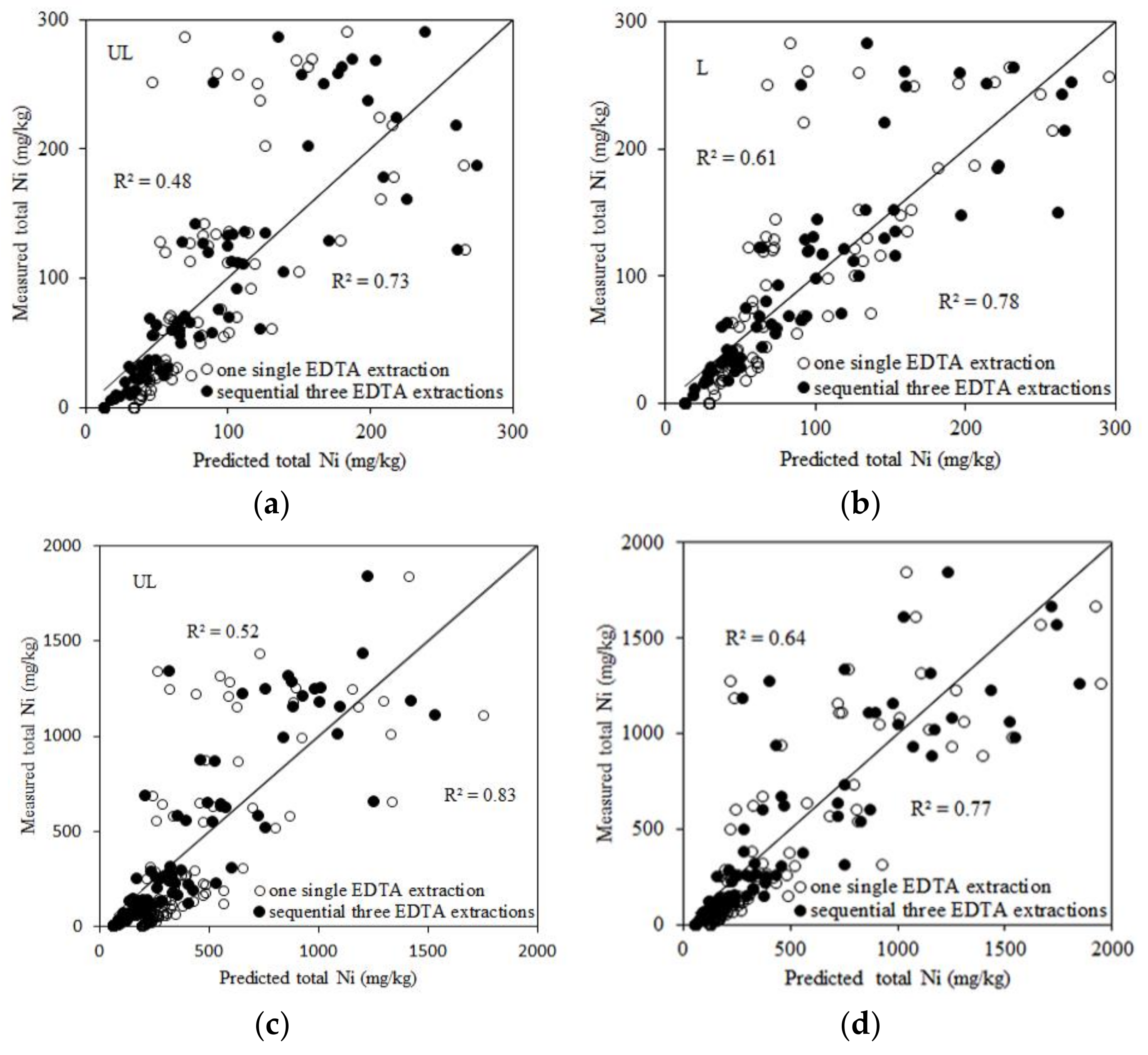
| Extraction Times | Equation | Unleached Soils | R2 | Equation | Leached Soils | R2 |
|---|---|---|---|---|---|---|
| 0 mg/kg < Y < 300 mg/kg | ||||||
| 1 | (1) | Y = 34.327 + 0.168 X1 pH | 0.48 | (5) | Y = 29.535 + 0.180 X1 pH | 0.65 |
| (2) | Y = 53.515 + 0.177 X1 pH + 0.832 CEC − 21.473 OC | 0.52 | (6) | Y = 52.940 + 0.186 X1 pH − 0.6023 CEC − 10.421 OC | 0.65 | |
| 3 | (3) | Y = 13.270 + 0.140 X1 pH | 0.73 | (7) | Y = 13.737 + 0.144 X1 pH | 0.78 |
| (4) | Y = 27.806 + 0.146 X1 pH + 0.832 CEC − 17.774 OC | 0.75 | (8) | Y = 34.725 + 0.148 X1 pH − 0.525 CEC − 9.324 OC | 0.78 | |
| 0 mg/kg < Y < 2000 mg/kg | ||||||
| 1 | (9) | Y = 194.31 + 0.270 X1 pH | 0.52 | (13) | Y = 128.160 + 0.239 X1 pH | 0.64 |
| (10) | Y = 109.957 + 0.296 X1 pH + 4.719 CEC − 195.611 OC | 0.57 | (14) | Y = 217.158 + 0.244 X1 pH + 4.483 CEC − 100.658 OC | 0.65 | |
| 3 | (11) | Y = 64.690 + 0.200 X1 pH | 0.83 | (15) | Y = 61.226 + 0.186 X1 pH | 0.77 |
| (12) | Y = 165.479 + 0.204 X1 pH + 7.747 CEC − 139.907 OC | 0.85 | (16) | Y = 156.497 + 0.190 X1 pH + 3.797 CEC − 98.418 OC | 0.78 | |
| No. | Regression Equations | Radj2 | p | ||||
|---|---|---|---|---|---|---|---|
| Unleached Soils (n = 17) | |||||||
| 1 | Log EC10 = − 0.062 + 1.722 log CEC | 0.326 | 0.010 | ||||
| 2 | Log EC10 = 2.595 + 2.226 log CEC − 1.335 log CDMn | 0.543 | 0.001 | 0.013 | |||
| 3 | Log EC20 = 1.795 + 1.360 log OC | 0.319 | 0.011 | ||||
| 4 | Log EC20 = 4.161 + 1.751 log OC − 0.837 log CDAl | 0.611 | <0.001 | 0.004 | |||
| 5 | Log EC20 = 2.043 + 1.156 log OC − 0.927 log CDAl + 0.783 log OXFe | 0.723 | 0.011 | 0.001 | 0.023 | ||
| 6 | Log EC50 = 2.074 + 1.090 log OC | 0.360 | 0.006 | ||||
| 7 | Log EC50 = 3.896 + 1.392 log OC − 0.644 log CDAl | 0.660 | <0.001 | 0.002 | |||
| Leached Soils | |||||||
| 8 | Log EC10 = 8.678 − 1.659 log CDFe (n = 16) | 0.419 | 0.004 | ||||
| 9 | Log EC10 = 5.638 − 1.961 log CDFe + 1.339 log OXFe (n = 16) | 0.698 | <0.001 | 0.003 | |||
| 10 | Log EC10 = 7.420 - 1.945 log CDFe + 1.516 log OXFe − 1.044 log CDMn (n = 16) | 0.836 | <0.001 | <0.001 | 0.005 | ||
| 11 | Log EC20 = 8.813 − 1.636 log CDFe (n = 14) | 0.640 | <0.001 | ||||
| 12 | Log EC20 = 6.525 − 1.783 log CDFe + 0.905 log OXFe (n = 14) | 0.827 | <0.001 | 0.003 | |||
| 13 | Log EC20 = 7.651 − 1.572 log CDFe + 0.869 log OXFe − 0.765 log CDMn (n = 14) | 0.915 | <0.001 | <0.001 | 0.006 | ||
| 14 | Log EC20 = 1.720 - 0.881 log CDFe + 1.220 log OXFe - 0.666 log CDMn + 0.252 pH (n = 14) | 0.944 | 0.019 | <0.001 | 0.005 | 0.033 | |
| 15 | Log EC20 = 1.658 − 0.957 log CDFe + 0.906 log OXFe − 1.100 log CDMn + 0.258 pH + 0.795 log OXAl (n = 14) | 0.967 | 0.004 | 0.001 | 0.001 | 0.010 | 0.028 |
| 16 | loge C50 = 8.207 − 1.408 log CDFe (n = 11) | 0.727 | 0.001 | ||||
| 17 | log EC50 = 5.707 − 1.392 log CDFe + 0.745 log OXFe (n = 11) | 0.879 | <0.001 | 0.008 | |||
| 18 | Log EC50 = 6.214 − 1.209 log CDFe + 0.787 log OXFe − 0.573 log CDMn (n = 11) | 0.966 | <0.001 | <0.001 | 0.002 | ||
| 19 | Log EC50 = 6.787 − 1.593 log CDFe + 0.755 log OXFe − 0.614 log CDMn + 0.385 log CDAl (n = 11) | 0.982 | <0.001 | <0.001 | <0.001 | 0.032 | |
| 20 | Log EC50 = 6.342 − 1.555 log CDFe + 0.819 log OXFe − 0.616 log CDMn + 0.406 log CDAl + 0.043 CaCO3 (n = 11) | 0.993 | <0.001 | <0.001 | <0.001 | 0.005 | 0.023 |
| No. | Regression Equations | Radj2 | p | |||
|---|---|---|---|---|---|---|
| Unleached soils (n = 17) | ||||||
| 1 | Log EC10 = 6.864 − 1.198 log CDFe | 0.389 | 0.004 | |||
| 2 | Log EC10 = 4.341 − 1.460 log CDFe + 1.130 log OXFe | 0.766 | <0.001 | <0.001 | ||
| 3 | Log EC10 = 5.191 − 1.396 log CDFe + 0.748 log OXFe + 0.746 log OC | 0.823 | <0.001 | 0.012 | 0.037 | |
| 4 | Log EC20 = 6.676 − 1.109 log CDFe | 0.472 | 0.001 | |||
| 5 | Log EC20 = 6.670 − 1.146 log CDFe + 1.115 log OC | 0.795 | <0.001 | <0.001 | ||
| 6 | Log EC20 = 5.519 − 1.251 log CDFe + 0.700 log OC + 0.516 log OXFe | 0.856 | <0.001 | 0.014 | 0.021 | |
| 7 | Log EC50 = 6.355 − 0.956 log CDFe | 0.616 | <0.001 | |||
| 8 | Log EC50 = 6.350 − 0.980 log CDFe + 0.719 log OC | 0.844 | <0.001 | <0.001 | ||
| Leached soils | ||||||
| 9 | Log EC10 = 8.945 − 1.666 log CDFe (n = 16) | 0.521 | 0.001 | |||
| 10 | Log EC10 = 6.566 − 1.901 log CDFe + 1.048 log OXFe (n = 16) | 0.721 | <0.001 | 0.005 | ||
| 11 | Log EC10 = 8.178 − 1.887 log CDFe + 1.208 log OXFe − 0.945 log OXMn (n = 16) | 0.859 | <0.001 | <0.001 | 0.003 | |
| 12 | Log EC20 = 9.365 − 1.709 log CDFe (n = 14) | 0.741 | <0.001 | |||
| 13 | Log EC50 =8.187 − 1.362 log CDFe (n = 11) | 0.751 | <0.001 | |||
| 14 | Log EC50 = 5.952 − 1.348 log CDFe + 0.666 log OXFe (n = 11) | 0.882 | <0.001 | 0.010 | ||
| 15 | Log EC50 = 6.387 - 1.191 log CDFe + 0.701 log OXFe − 0.492 log CDMn (n = 11) | 0.950 | <0.001 | 0.001 | 0.011 | |
| 16 | Log EC50 = 6.257 − 1.251 log CDFe + 0.449 log OXFe − 0.897 log CDMn + 0.717 log OXAl (n = 11) | 0.984 | <0.001 | 0.004 | <0.001 | 0.007 |
© 2018 by the authors. Licensee MDPI, Basel, Switzerland. This article is an open access article distributed under the terms and conditions of the Creative Commons Attribution (CC BY) license (http://creativecommons.org/licenses/by/4.0/).
Share and Cite
Zhu, G.; Jiang, B.; Yang, G.; Li, J.; Ma, Y. Toxicity Thresholds Based on EDTA Extractable Nickel and Barley Root Elongation in Chinese Soils. Int. J. Environ. Res. Public Health 2018, 15, 669. https://doi.org/10.3390/ijerph15040669
Zhu G, Jiang B, Yang G, Li J, Ma Y. Toxicity Thresholds Based on EDTA Extractable Nickel and Barley Root Elongation in Chinese Soils. International Journal of Environmental Research and Public Health. 2018; 15(4):669. https://doi.org/10.3390/ijerph15040669
Chicago/Turabian StyleZhu, Guangyun, Bao Jiang, Guohang Yang, Jumei Li, and Yibing Ma. 2018. "Toxicity Thresholds Based on EDTA Extractable Nickel and Barley Root Elongation in Chinese Soils" International Journal of Environmental Research and Public Health 15, no. 4: 669. https://doi.org/10.3390/ijerph15040669
APA StyleZhu, G., Jiang, B., Yang, G., Li, J., & Ma, Y. (2018). Toxicity Thresholds Based on EDTA Extractable Nickel and Barley Root Elongation in Chinese Soils. International Journal of Environmental Research and Public Health, 15(4), 669. https://doi.org/10.3390/ijerph15040669

