<?xml version="1.0" encoding="UTF-8"?>
<!DOCTYPE article PUBLIC "-//NLM//DTD Journal Publishing DTD v2.3 20070202//EN" "journalpublishing.dtd">
<article xmlns:xlink="http://www.w3.org/1999/xlink" xml:lang="en" article-type="research-article">
<front>
<journal-meta>
<journal-id journal-id-type="publisher-id">MD</journal-id>
<journal-title>Marine Drugs</journal-title>
<abbrev-journal-title>MD</abbrev-journal-title>
<issn pub-type="epub">1660-3397</issn>
<publisher>
<publisher-name>Molecular Diversity Preservation International</publisher-name></publisher></journal-meta>
<article-meta>
<article-id pub-id-type="doi">10.3390/md9091469</article-id>
<article-id pub-id-type="publisher-id">marinedrugs-09-01469</article-id>
<article-categories>
<subj-group>
<subject>Article</subject></subj-group></article-categories>
<title-group>
<article-title>Capilloquinol: A Novel Farnesyl Quinol from the Dongsha Atoll Soft Coral <italic>Sinularia capillosa</italic></article-title></title-group>
<contrib-group>
<contrib contrib-type="author">
<name><surname>Cheng</surname><given-names>Shi-Yie</given-names></name><xref ref-type="aff" rid="af1-marinedrugs-09-01469">1</xref></contrib>
<contrib contrib-type="author">
<name><surname>Huang</surname><given-names>Ki-Jhih</given-names></name><xref ref-type="aff" rid="af1-marinedrugs-09-01469">1</xref></contrib>
<contrib contrib-type="author">
<name><surname>Wang</surname><given-names>Shang-Kwei</given-names></name><xref ref-type="aff" rid="af2-marinedrugs-09-01469">2</xref><xref ref-type="corresp" rid="c1-marinedrugs-09-01469">*</xref></contrib>
<contrib contrib-type="author">
<name><surname>Duh</surname><given-names>Chang-Yih</given-names></name><xref ref-type="aff" rid="af1-marinedrugs-09-01469">1</xref><xref ref-type="aff" rid="af3-marinedrugs-09-01469">3</xref><xref ref-type="corresp" rid="c1-marinedrugs-09-01469">*</xref></contrib></contrib-group>
<aff id="af1-marinedrugs-09-01469">
<label>1</label>Department of Marine Biotechnology and Resources, National Sun Yat-sen University, Kaohsiung 804, Taiwan; E-Mails: <email>shiyie63@yahoo.com.tw</email> (S.-Y.C.); <email>m965020019@student.nsysu.edu.tw</email> (K.-J.H.)</aff>
<aff id="af2-marinedrugs-09-01469">
<label>2</label>Department of Microbiology, Kaohsiung Medical University, Kaohsiung 807, Taiwan</aff>
<aff id="af3-marinedrugs-09-01469">
<label>3</label>Centers for Asia-Pacific Ocean Research and Translational Biopharmaceuticals, National Sun Yat-sen University, Kaohsiung 804, Taiwan</aff>
<author-notes>
<corresp id="c1-marinedrugs-09-01469">
<label>*</label>Authors to whom correspondence should be addressed; E-Mails: <email>yihduh@mail.nsysu.edu.tw</email> (C.-Y.D.); <email>skwang@cc.kmu.edu.tw</email> (S.-K.W.); Tel.: +886-7-525-2000 (ext. 5036) (C.-Y.D.); +886-7-312-1101 (ext. 2150) (S.-K.W.); Fax: +886-7-525-5020 (C.-Y.D.).</corresp></author-notes>
<pub-date pub-type="collection">
<year>2011</year></pub-date>
<pub-date pub-type="epub">
<day>30</day>
<month>8</month>
<year>2011</year></pub-date>
<volume>9</volume>
<issue>9</issue>
<fpage>1469</fpage>
<lpage>1476</lpage>
<history>
<date date-type="received">
<day>25</day>
<month>7</month>
<year>2011</year></date>
<date date-type="rev-recd">
<day>19</day>
<month>8</month>
<year>2011</year></date>
<date date-type="accepted">
<day>24</day>
<month>8</month>
<year>2011</year></date></history>
<permissions>
<copyright-statement>© 2011 by the authors; licensee MDPI, Basel, Switzerland</copyright-statement>
<copyright-year>2011</copyright-year>
<license license-type="open-access" xlink:href="http://creativecommons.org/licenses/by/3.0">
<p>This article is an open-access article distributed under the terms and conditions of the Creative Commons Attribution license (http://creativecommons.org/licenses/by/3.0/).</p></license></permissions>
<abstract>
<p>Capilloquinol (<bold>1</bold>), possessing an unprecedented farnesyl quinoid skeleton, was isolated from the Dongsha Atoll soft coral <italic>Sinularia capillosa</italic>. The structure of capilloquinol was elucidated by extensive analysis of spectroscopic data. The cytotoxicity and antiviral activity against human cytomegalovirus of <bold>1</bold> was evaluated <italic>in vitro</italic>.</p></abstract>
<kwd-group>
<kwd>soft coral</kwd>
<kwd><italic>Sinularia capillosa</italic></kwd>
<kwd>farnesyl quinoid</kwd>
<kwd>cytotoxicity</kwd></kwd-group></article-meta></front>
<body>
<sec sec-type="intro">
<title>1. Introduction</title>
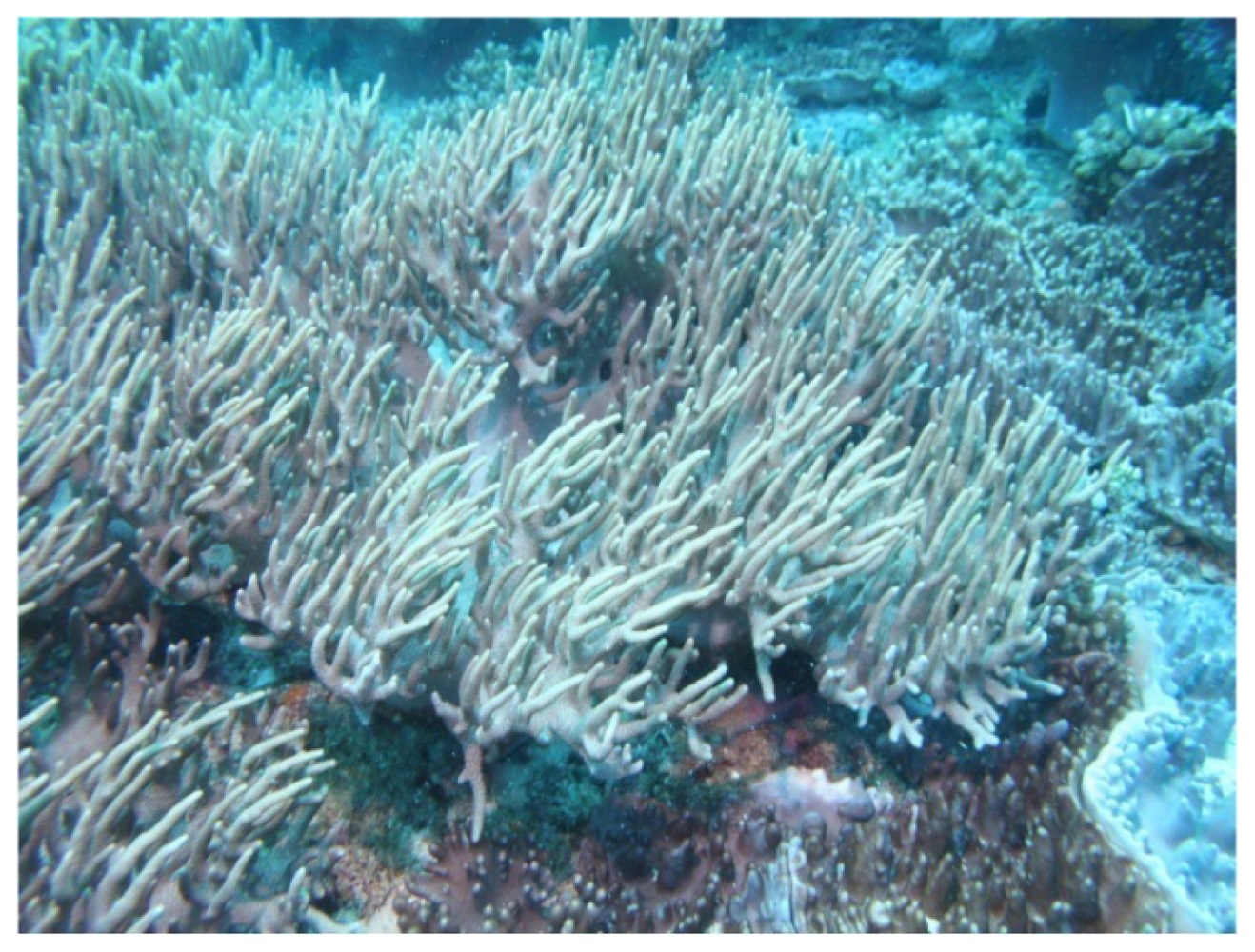
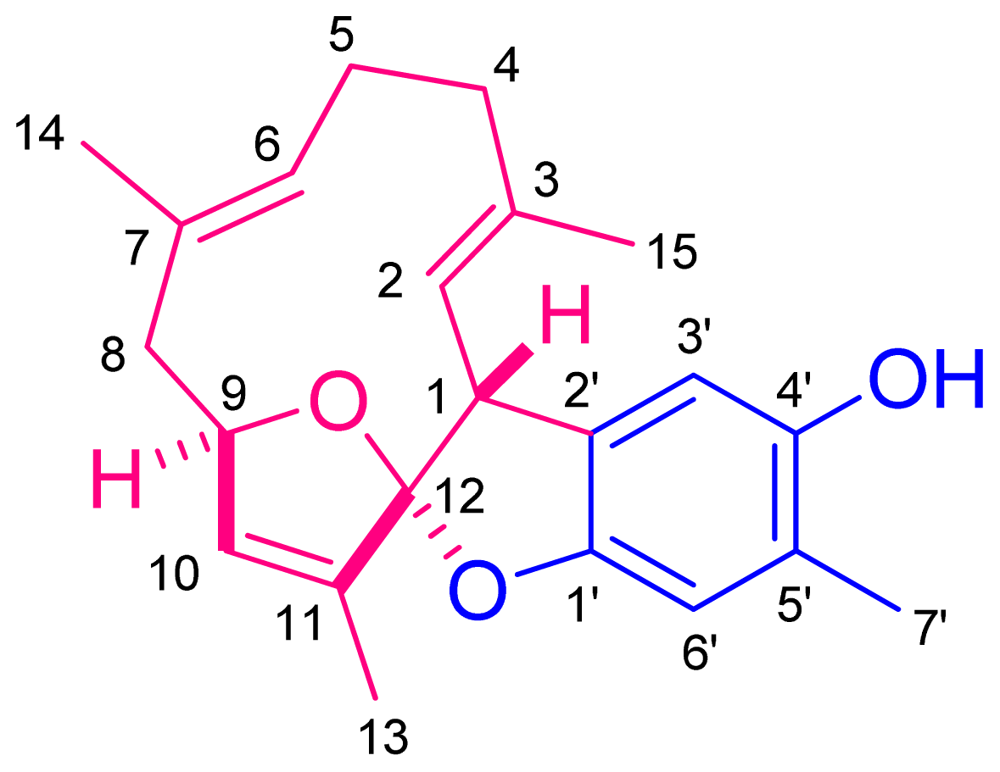
<p>Numerous farnesyl quinones and quinols [<xref ref-type="bibr" rid="b1-marinedrugs-09-01469">1</xref>], possessing a wide range of structural diversity, have been obtained from marine organisms, including sponges [<xref ref-type="bibr" rid="b2-marinedrugs-09-01469">2</xref>–<xref ref-type="bibr" rid="b8-marinedrugs-09-01469">8</xref>], algae [<xref ref-type="bibr" rid="b8-marinedrugs-09-01469">8</xref>,<xref ref-type="bibr" rid="b9-marinedrugs-09-01469">9</xref>], ascidians [<xref ref-type="bibr" rid="b10-marinedrugs-09-01469">10</xref>–<xref ref-type="bibr" rid="b12-marinedrugs-09-01469">12</xref>], and soft corals [<xref ref-type="bibr" rid="b13-marinedrugs-09-01469">13</xref>,<xref ref-type="bibr" rid="b14-marinedrugs-09-01469">14</xref>]. Many of these mixed C<sub>15</sub> + C<sub>6</sub> analogues are of considerable interest due to their cytotoxicity [<xref ref-type="bibr" rid="b4-marinedrugs-09-01469">4</xref>,<xref ref-type="bibr" rid="b6-marinedrugs-09-01469">6</xref>,<xref ref-type="bibr" rid="b7-marinedrugs-09-01469">7</xref>,<xref ref-type="bibr" rid="b12-marinedrugs-09-01469">12</xref>], anti-HIV-1 reverse transcriptase activity [<xref ref-type="bibr" rid="b4-marinedrugs-09-01469">4</xref>,<xref ref-type="bibr" rid="b8-marinedrugs-09-01469">8</xref>,<xref ref-type="bibr" rid="b15-marinedrugs-09-01469">15</xref>], and antimicrobial activity [<xref ref-type="bibr" rid="b4-marinedrugs-09-01469">4</xref>,<xref ref-type="bibr" rid="b6-marinedrugs-09-01469">6</xref>]. As part of a continuing search for bioactive substances from marine invertebrates, chromatographic separation on the acetone extract of the Dongsha Atoll soft coral <italic>S. capillosa</italic> (<xref ref-type="fig" rid="f1-marinedrugs-09-01469">Figure 1</xref>) resulted in the isolation of capilloquinol (<bold>1</bold>) (<xref ref-type="fig" rid="f2-marinedrugs-09-01469">Figure 2</xref>), an unprecedented farnesyl quinoid having novel carbon skeleton. The details of isolation and structural elucidation of metabolite <bold>1</bold> are discussed in this paper. The cytotoxicity against P-388 (mouse lymphocytic leukemia), HT-29 (human colon adenocarcinoma), and A-459 (human lung adenocarcinoma) cancer cell lines as well as antiviral activity against human cytomegalovirus (HCMV) of <bold>1</bold> were evaluated. Meanwhile, the posible biosynthetic pathway for <bold>1</bold> was postulated see below.</p></sec>
<sec sec-type="results|discussion">
<title>2. Results and Discussion</title>
<p>The acetone extract of <italic>S. capillosa</italic> was concentrated to a brown gum, which was partitioned with EtOAc and H<sub>2</sub>O. The EtOAc-soluble residue (60 g) was subjected to Si 60 CC using <italic>n</italic>-hexane–EtOAc mixtures of increasing polarity for elution, to yield 40 fractions. Fraction 14 (0.8 g), which eluted with <italic>n</italic>-hexane–EtOAc (2:1), was applied to a RP-18 gravity column and flushed with MeOH–H<sub>2</sub>O (9:1). The ensuing fraction (72 mg) was further purified by RP-18 High-performance liquid chromatography (HPLC) eluted with MeOH–H<sub>2</sub>O (9:1) to yield <bold>1</bold> (2.0 mg, 0.003%).</p>
<p>Capilloquinol (<bold>1</bold>) was obtained as a colorless, viscous oil. The HRESIMS of <bold>1</bold> exhibited a [M + Na]<sup>+</sup> peak at <italic>m/z</italic> 361.1778, consistent with the molecular formula of C<sub>22</sub>H<sub>26</sub>O<sub>3</sub>, implying ten degrees of unsaturation. Its IR spectrum absorption at 3406 cm<sup>−1</sup> revealed the presence of hydroxyl group(s). The NMR spectroscopic data (<xref ref-type="table" rid="t1-marinedrugs-09-01469">Table 1</xref>) of <bold>1</bold> contained resonances for five trisubstituted double bonds [δ<sub>H</sub> 5.01 (d, <italic>J</italic> = 10.0 Hz, 1H); δ<sub>C</sub> 137.5 (qC) and 125.7 (CH); δ<sub>H</sub> 4.86 (br d, <italic>J</italic> = 10.5 Hz, 1H); δ<sub>C</sub> 130.3 (qC) and 132.2 (CH); δ<sub>H</sub> 5.97 (s, 1H); δ<sub>C</sub> 135.9 (qC) and 131.8 (CH); δ<sub>H</sub> 6.46 (s, 1H); δ<sub>C</sub> 129.7 (qC) and 112.0 (CH); δ<sub>H</sub> 6.45 (s, 1H); δ<sub>C</sub> 152.2 (qC) and 111.7 (CH)] and a tetrasubstituted double bond [δ<sub>C</sub> 150.8 (qC) and 125.0 (qC)]. The above functionalities accounted for six of the ten degrees of unsaturation, implying a tetracyclic structure for <bold>1</bold>.</p>
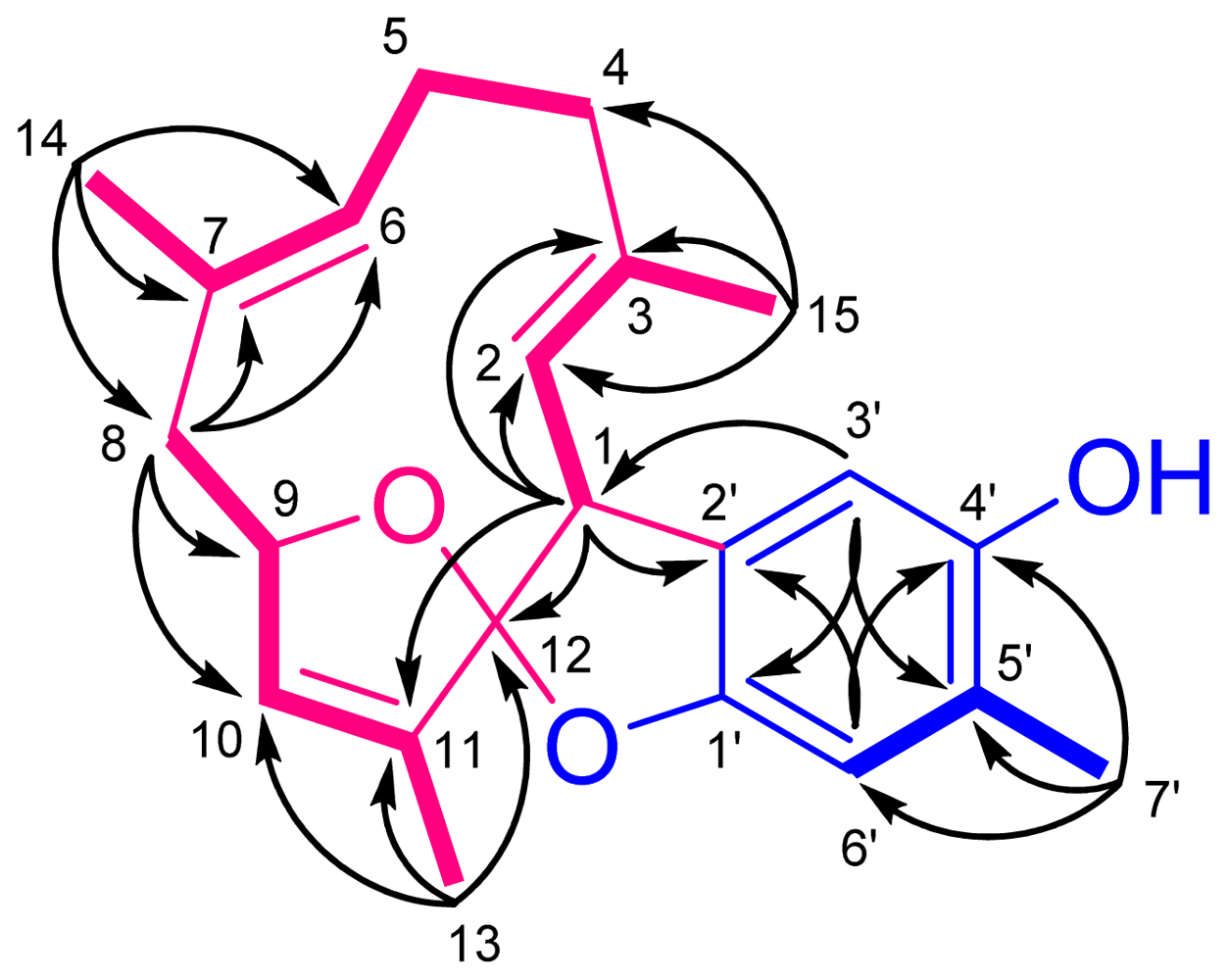
<p>By interpretation of <sup>1</sup>H–<sup>1</sup>H and long range COSY correlations (<xref ref-type="fig" rid="f3-marinedrugs-09-01469">Figure 3</xref>), it was possible to establish three partial structures of consecutive proton systems extending from H-1 to Me-15 through H-2, from H<sub>2</sub>-4 to Me-14 through H<sub>2</sub>-5 and H-6, from H<sub>2</sub>-8 to Me-13 through H-9 and H-10. The linkages between C-3 and C-4; C-7 and C-8; C-11 and C-12; were elucidated on the basis of the HMBC correlations (<xref ref-type="fig" rid="f3-marinedrugs-09-01469">Figure 3</xref>) from Me-15 to C-2, C-3, and C-4, from Me-14 to C-6, C-7, and C-8, and from Me-13 to C-10, C-11, and C-12. The HMBC spectrum showed correlations from H-1 to C-2, C-3, C-11, and C-12, proving the linkages from C-1 to C-11 through C-12. Additionally, the crucial HMBC correlations from H-3′ to C-1′ and C-5′, from H-6′ to C-2′ and C-4′, and from Me-7′ to C-4′, C-5′, and C-6′, demonstrated the presence of a 1,2,4,5-tetrasubstituted benzene ring. These HMBC correlations also confirmed the positioning of the oxygen-bearing quaternary carbons at C-1′ and C-4′ [δ<sub>C</sub> 152.2 (qC) and 150.8 (qC)], and the methyl group at C-5′. Although there were no direct HMBC correlations available, the remaining two degrees of unsaturation indicated that the two oxygen bridges must be present between C-9/C-12 and C-12/C-1′. This assumption was further supported by its NMR spectroscopic data [δ<sub>H</sub> 5.00 (1H, br s, H-9); δ<sub>C</sub> 85.3 (CH, C-9) and 125.6 (qC, C-12)] [<xref ref-type="bibr" rid="b16-marinedrugs-09-01469">16</xref>] and revealed the presences of a 2,3-dihydrobenzofuran-5-ol moiety and an 13-oxa-bicyclo[<xref ref-type="bibr" rid="b8-marinedrugs-09-01469">8</xref>,<xref ref-type="bibr" rid="b2-marinedrugs-09-01469">2</xref>,<xref ref-type="bibr" rid="b1-marinedrugs-09-01469">1</xref>]tridecane ring. Moreover, the crucial HMBC correlation from H-3′ to C-1 established ring fusion at C-1 and C-12. Therefore, the planar structure of <bold>1</bold> was proposed as shown in <xref ref-type="fig" rid="f2-marinedrugs-09-01469">Figure 2</xref>.</p>
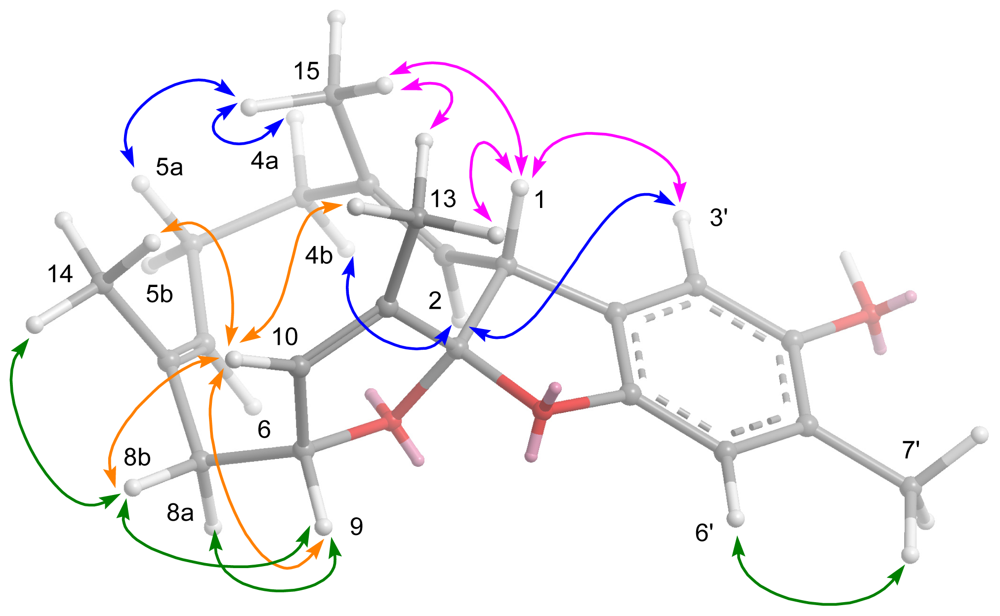
<p>The geometries of the trisubstituted double bonds were assigned as 2<italic>E</italic> and 6<italic>E</italic> based on the crucial NOESY correlations (<xref ref-type="fig" rid="f4-marinedrugs-09-01469">Figure 4</xref>) between H-1/Me-15, H-4b/H-2, and H-8b/H-6. The key NOE correlations between H-1/Me-13, H-1/Me-15, Me-13/Me-15, Me-15/H-4a, Me-15/H-5a, Me-13/H-10, H-10/Me-14, Me-14/H-8b, and H-8b/H-10 suggested that these protons were oriented on the same side of the macrocyclic ring, while H-2, H-4b, H-5b, H-6, H-8a, and H-9 were oriented on the opposite side. The above-mentioned findings indicated the 1<italic>R</italic>*, 9<italic>R</italic>*, and 12<italic>R</italic>* configurations as depicted in <xref ref-type="fig" rid="f4-marinedrugs-09-01469">Figure 4</xref>. The results, together with other detailed NOESY correlations (<xref ref-type="fig" rid="f4-marinedrugs-09-01469">Figure 4</xref>) of <bold>1</bold>, determined the structure of capillosanol as shown in <xref ref-type="fig" rid="f1-marinedrugs-09-01469">Figure 1</xref>.</p>
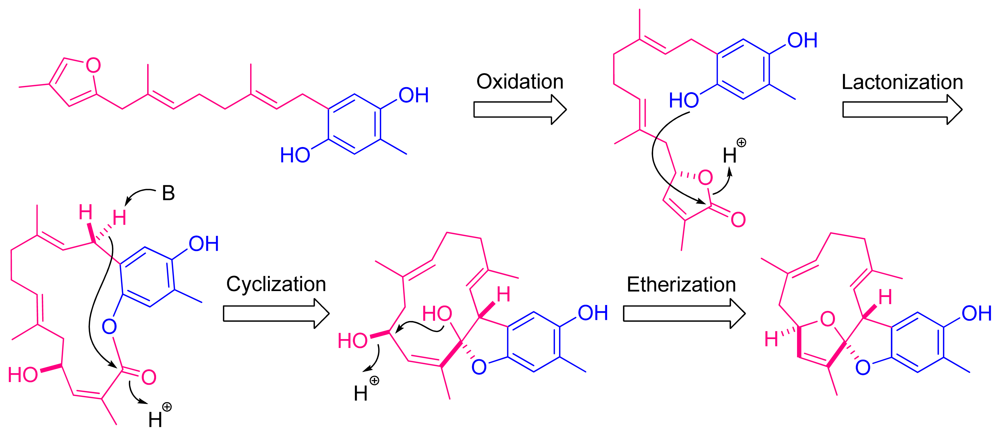
<p>It is worthwhile to mention that the framework of <bold>1</bold> may be involved in the possible biosynthesis of a farnesyl quinol [<xref ref-type="bibr" rid="b13-marinedrugs-09-01469">13</xref>] through oxidation, lactonization, cyclization, and etherization to result in the formation of capilloquinol (<bold>1</bold>) as depicted in <xref ref-type="fig" rid="f5-marinedrugs-09-01469">Scheme 1</xref>.</p>
<p>Capilloquinol (<bold>1</bold>) was evaluated for cytotoxicity against P-388, A-459, and HT-29 cancer cell lines as well as antiviral activity against human cytomegalovirus. Metabolite <bold>1</bold> displayed cytotoxicity against P-388, with an ED<sub>50</sub> of 3.8 μg/mL. With the exception of the above finding, <bold>1</bold> did not show cytotoxic against A-459, and HT-29 cancer cell lines, nor was it active against human cytomegalovirus (HCMV).</p></sec>
<sec>
<title>3. Experimental Section</title>
<sec sec-type="methods">
<title>3.1. General Experimental Procedures</title>
<p>Optical rotations were determined with a JASCO P1020 digital polarimeter. Ultraviolet (UV) and infrared (IR) spectra were obtained on a JASCO V-650 and JASCO FT/IR-4100 spectrophotometers, respectively. The NMR spectra were recorded on a Varian Unity INOVA 500 FT-NMR spectrometer at 500 MHz for <sup>1</sup>H and 125 MHz for <sup>13</sup>C, respectively. Chemical shifts are expressed in δ (ppm) referring to the solvent peaks δ<sub>H</sub> 3.30 and δ<sub>C</sub> 49.0 for CD<sub>3</sub>OD, respectively, and coupling constants are expressed in Hz. ESI-MS were recorded by ESI FT-MS on a Bruker APEX II mass spectrometer. Silica gel 60 (Merck, Germany, 230–400 mesh) and LiChroprep RP-18 (Merck, 40–63 μm) were used for column chromatography. Precoated silica gel plates (Merck, Kieselgel 60 F<sub>254</sub>, 0.25 mm) and precoated RP-18 F<sub>254s</sub> plates (Merck) were used for thin-layer chromatography (TLC) analysis. High-performance liquid chromatography (HPLC) was carried out using a Hitachi L-7100 pump equipped with a Hitachi L-7400 UV detector at 220 nm together with a semi-preparative reversed-phase column (Merck, Hibar LiChrospher RP-18e, 5 μm, 250 × 25 mm).</p></sec>
<sec>
<title>3.2. Animal Material</title>
<p>The soft coral <italic>S. capillosa</italic> was collected by hand using SCUBA along the coast reefs offshore from the Dongsha Atoll in April 2007, at a depth of 8–10 m, and was stored in a freezer at −20 °C for two months until extraction. Identification was kindly verified by Prof. Chang-Feng Dai, Institute of Oceanography, National Taiwan University, Taiwan. A voucher specimen (TS-06) was deposited in the Department of Marine Biotechnology and Resources, National Sun Yat-sen University, Taiwan.</p></sec>
<sec>
<title>3.3. Extraction and Isolation</title>
<p>The acetone extract of <italic>S. capillosa</italic> was concentrated to a brown gum, which was partitioned with EtOAc and H<sub>2</sub>O. The EtOAc-soluble residue (60 g) was subjected to Si 60 CC using <italic>n</italic>-hexane–EtOAc mixtures of increasing polarity for elution, to yield 40 fractions. Fraction 14 (0.8 g) was applied to a RP-18 gravity column to obtain a mixture (72 mg) that was further purified by RP-18 HPLC eluted with MeOH–H<sub>2</sub>O (9:1) to yield <bold>1</bold> (2.0 mg).</p>
<p>The frozen soft coral (2 kg) was chopped into small pieces and extracted exhaustively by maceration with fresh acetone for 24 h at room temperature. The quantity of solvent used for each extraction (2 L) was at least three times the amount of the soft coral material used. The acetone extracts were filtered and concentrated under vacuum to yield a brownish oily residue, which was subsequently partitioned between EtOAc and H<sub>2</sub>O. The resulting EtOAc-soluble residue (60 g) was subjected to column chromatography on silica gel using <italic>n</italic>-hexane with increasing amounts of EtOAc, and finally 100% MeOH as elution, to fractionate roughly 40 fractions on the basis of the <sup>1</sup>H NMR spectroscopic data and TLC analyses. Fraction 14 (0.8 g) eluted with <italic>n</italic>-hexane–EtOAc (2:1) was subjected to was applied to a RP-18 gravity column to obtain a mixture (72 mg) that was further purified by RP-18 HPLC eluted with MeOH–H<sub>2</sub>O (9:1) to yield <bold>1</bold> (2.0 mg).</p>
<p>Capilloquinol (<bold>1</bold>): colorless, viscous oil; [α]<sub>D</sub> <sup>25</sup> +31 (<italic>c</italic> 0.1, CHCl<sub>3</sub>); IR (KBr) ν<sub>max</sub> 3406, 3038, 2973, 2928, 17498, 1457, 1422, 1737 cm<sup>−1; 1</sup>H NMR and <sup>13</sup>C NMR data, see <xref ref-type="table" rid="t1-marinedrugs-09-01469">Table 1</xref>; ESIMS <italic>m/z</italic> 361 [M + Na]<sup>+</sup>; HRESIMS <italic>m/z</italic> 361.1778 [M + Na]<sup>+</sup> (calcd. for C<sub>22</sub>H<sub>26</sub>O<sub>3</sub>Na, 361.1780).</p></sec>
<sec>
<title>3.4. Cytotoxicity Assay</title>
<p>Cytotoxicity was determined against P-388 (mouse lymphocytic leukemia), HT-29 (human colon adenocarcinoma), and A-549 (human lung epithelial carcinoma) tumor cells using a modification of the MTT [3-(4,5-dimethylthiazo-2-yl)-2,5-diphenyltetrazolium bromide] colorimetric method. The provision of the P-388 cell line was provided by J. M. Pezzuto, formerly of the Department of Medicinal Chemistry and Pharmacognosy, University of Illinois at Chicago. HT-29 and A-549 cell lines were purchased from the American Type Culture Collection. The experimental details of this assay were carried out according to a previously described procedure [<xref ref-type="bibr" rid="b17-marinedrugs-09-01469">17</xref>–<xref ref-type="bibr" rid="b19-marinedrugs-09-01469">19</xref>].</p></sec>
<sec>
<title>3.5. Anti-HCMV Assay</title>
<p>To determine the effects of natural product upon HCMV cytopathic effect (CPE), confluent human embryonic lung (HEL) cells grown in 24-well plates were incubated for 1 h in the presence or absence of various concentrations of tested natural product. Then, cells were infected with HCMV at an input of 1000 pfu (plaque forming units) per well of 24-well dish. Antiviral activity was expressed as IC<sub>50</sub> (50% inhibitory concentration), or compound concentration required to reduce virus induced CPE by 50% after 7 days as compared with the untreated control. To monitor the cell growth upon treating with natural products, an MTT-colorimetric assay was employed [<xref ref-type="bibr" rid="b20-marinedrugs-09-01469">20</xref>].</p></sec></sec></body>
<back>
<ack>
<title>Acknowledgments</title>
<p>This research was financially supported by grants from the National Science Council (NSC99-2628-B-110-002-MY3) of Taiwan awarded to C.-Y.D.</p></ack>
<fn-group><fn>
<p><italic>Samples Availability:</italic> Not available.</p></fn></fn-group>
<ref-list>
<title>References</title>
<ref id="b1-marinedrugs-09-01469"><label>1</label><citation citation-type="book"><person-group person-group-type="author"><name><surname>Capon</surname><given-names>RJ</given-names></name></person-group><article-title>Marine sesquiterpene/quinones</article-title><source>Studies in Natural Products Chemistry</source><person-group person-group-type="editor"><name><surname>Atta-ur-Raman</surname></name></person-group><publisher-name>Elsevier Science</publisher-name><publisher-loc>New York, NY, USA</publisher-loc><year>1995</year><volume>5</volume><fpage>289</fpage><lpage>326</lpage></citation></ref>
<ref id="b2-marinedrugs-09-01469"><label>2</label><citation citation-type="journal"><person-group person-group-type="author"><name><surname>Schmitz</surname><given-names>FJ</given-names></name><name><surname>Lakashmi</surname><given-names>V</given-names></name><name><surname>Powell</surname><given-names>DR</given-names></name><name><surname>van der Helm</surname><given-names>D</given-names></name></person-group><article-title>Arenarol and arenarone: Sesquiterpenoids with rearranged drimane skeletons from the marine sponge <italic>Dysidea arenaria</italic></article-title><source>J. Org. Chem</source><year>1984</year><volume>49</volume><fpage>241</fpage><lpage>244</lpage><pub-id pub-id-type="doi">10.1021/jo00176a005</pub-id></citation></ref>
<ref id="b3-marinedrugs-09-01469"><label>3</label><citation citation-type="journal"><person-group person-group-type="author"><name><surname>Venkateswarlu</surname><given-names>Y</given-names></name><name><surname>Faulkner</surname><given-names>DJ</given-names></name><name><surname>Steiner</surname><given-names>JLR</given-names></name><name><surname>Corcoran</surname><given-names>E</given-names></name><name><surname>Clardy</surname><given-names>J</given-names></name></person-group><article-title>Smenochromenes, unusual macrocyclic sesquiterpene hydroquinone derivatives from a Seychelles sponge of the genus <italic>Smenospongia</italic></article-title><source>J. Org. Chem</source><year>1991</year><volume>56</volume><fpage>6271</fpage><lpage>6274</lpage><pub-id pub-id-type="doi">10.1021/jo00022a011</pub-id></citation></ref>
<ref id="b4-marinedrugs-09-01469"><label>4</label><citation citation-type="journal"><person-group person-group-type="author"><name><surname>Hirsch</surname><given-names>S</given-names></name><name><surname>Rudi</surname><given-names>A</given-names></name><name><surname>Kashman</surname><given-names>Y</given-names></name><name><surname>Loya</surname><given-names>L</given-names></name></person-group><article-title>New avarone and avarol derivatives from the marine sponge <italic>Dysidea cinerea</italic></article-title><source>J. Nat. Prod</source><year>1991</year><volume>54</volume><fpage>92</fpage><lpage>97</lpage><pub-id pub-id-type="doi">10.1021/np50073a005</pub-id><pub-id pub-id-type="pmid">1710654</pub-id></citation></ref>
<ref id="b5-marinedrugs-09-01469"><label>5</label><citation citation-type="journal"><person-group person-group-type="author"><name><surname>Rudi</surname><given-names>A</given-names></name><name><surname>Benayahu</surname><given-names>Y</given-names></name><name><surname>Kashman</surname><given-names>Y</given-names></name></person-group><article-title>Likonides A and B: New ansa farnesyl quinols from the marine sponge <italic>Hyatella</italic> sp</article-title><source>Org. Lett</source><year>2004</year><volume>6</volume><fpage>4013</fpage><lpage>4016</lpage><pub-id pub-id-type="doi">10.1021/ol048358d</pub-id><pub-id pub-id-type="pmid">15496087</pub-id></citation></ref>
<ref id="b6-marinedrugs-09-01469"><label>6</label><citation citation-type="journal"><person-group person-group-type="author"><name><surname>Takahashi</surname><given-names>Y</given-names></name><name><surname>Kubota</surname><given-names>T</given-names></name><name><surname>Ito</surname><given-names>J</given-names></name><name><surname>Mikami</surname><given-names>Y</given-names></name><name><surname>Fromont</surname><given-names>J</given-names></name><name><surname>Kobayashi</surname><given-names>J</given-names></name></person-group><article-title>Nakijiquinones G–I, new sesquiterpenoid quinones from marine sponge</article-title><source>Bioorg. Med. Chem</source><year>2008</year><volume>16</volume><fpage>7561</fpage><lpage>7564</lpage><pub-id pub-id-type="doi">10.1016/j.bmc.2008.07.028</pub-id><pub-id pub-id-type="pmid">18676149</pub-id></citation></ref>
<ref id="b7-marinedrugs-09-01469"><label>7</label><citation citation-type="journal"><person-group person-group-type="author"><name><surname>Aoki</surname><given-names>S</given-names></name><name><surname>Kong</surname><given-names>D</given-names></name><name><surname>Matsui</surname><given-names>K</given-names></name><name><surname>Rachmat</surname><given-names>R</given-names></name><name><surname>Kobayashi</surname><given-names>M</given-names></name></person-group><article-title>Sesquiterpene aminoquinones, from a marine sponge, induce erythroid differentiation in human chronic myelogenous leukemia, K562 cells</article-title><source>Chem. Pharm. Bull</source><year>2004</year><volume>52</volume><fpage>935</fpage><lpage>937</lpage><pub-id pub-id-type="doi">10.1248/cpb.52.935</pub-id><pub-id pub-id-type="pmid">15304984</pub-id></citation></ref>
<ref id="b8-marinedrugs-09-01469"><label>8</label><citation citation-type="journal"><person-group person-group-type="author"><name><surname>Talpir</surname><given-names>R</given-names></name><name><surname>Rudi</surname><given-names>A</given-names></name><name><surname>Kashman</surname><given-names>Y</given-names></name></person-group><article-title>Three new sesquiterpene hydroquinones from marine origin</article-title><source>Tetrahedron</source><year>1994</year><volume>50</volume><fpage>4179</fpage><lpage>4184</lpage><pub-id pub-id-type="doi">10.1016/S0040-4020(01)86712-0</pub-id></citation></ref>
<ref id="b9-marinedrugs-09-01469"><label>9</label><citation citation-type="journal"><person-group person-group-type="author"><name><surname>Rochfort</surname><given-names>SJ</given-names></name><name><surname>Capon</surname><given-names>RJ</given-names></name></person-group><article-title>A new sesquiterpene/phenol from the australian marine brown alga <italic>Perithalia caudate</italic></article-title><source>J. Nat. Prod</source><year>1994</year><volume>57</volume><fpage>849</fpage><lpage>851</lpage><pub-id pub-id-type="doi">10.1021/np50108a029</pub-id></citation></ref>
<ref id="b10-marinedrugs-09-01469"><label>10</label><citation citation-type="journal"><person-group person-group-type="author"><name><surname>Fu</surname><given-names>X</given-names></name><name><surname>Hossain</surname><given-names>MB</given-names></name><name><surname>Schmitz</surname><given-names>FJ</given-names></name><name><surname>van der Helm</surname><given-names>D</given-names></name></person-group><article-title>Longithorones, unique prenylated para- and metacyclophane type quinones from the tunicate <italic>Aplidium longithorax</italic></article-title><source>J. Org. Chem</source><year>1997</year><volume>62</volume><fpage>3810</fpage><lpage>3819</lpage><pub-id pub-id-type="doi">10.1021/jo9702204</pub-id></citation></ref>
<ref id="b11-marinedrugs-09-01469"><label>11</label><citation citation-type="journal"><person-group person-group-type="author"><name><surname>Davis</surname><given-names>RA</given-names></name><name><surname>Carroll</surname><given-names>AR</given-names></name><name><surname>Quinn</surname><given-names>RJ</given-names></name></person-group><article-title>Longithorols C–E, three new macrocyclic sesquiterpene hydroquinone metabolites from the Australian ascidian, <italic>Aplidium longithorax</italic></article-title><source>J. Nat. Prod</source><year>1999</year><volume>62</volume><fpage>1405</fpage><lpage>1409</lpage><pub-id pub-id-type="doi">10.1021/np990217a</pub-id><pub-id pub-id-type="pmid">10543902</pub-id></citation></ref>
<ref id="b12-marinedrugs-09-01469"><label>12</label><citation citation-type="journal"><person-group person-group-type="author"><name><surname>Issa</surname><given-names>HH</given-names></name><name><surname>Tanaka</surname><given-names>J</given-names></name><name><surname>Rachmat</surname><given-names>R</given-names></name><name><surname>Higa</surname><given-names>T</given-names></name></person-group><article-title>Floresolides, new metacyclophane hydroquinone lactones from an ascidian, <italic>Aplidium</italic> sp</article-title><source>Tetrahedron Lett</source><year>2003</year><volume>44</volume><fpage>1243</fpage><lpage>1245</lpage><pub-id pub-id-type="doi">10.1016/S0040-4039(02)02812-5</pub-id></citation></ref>
<ref id="b13-marinedrugs-09-01469"><label>13</label><citation citation-type="journal"><person-group person-group-type="author"><name><surname>Coll</surname><given-names>JC</given-names></name><name><surname>Liyanage</surname><given-names>N</given-names></name><name><surname>Stokie</surname><given-names>GJ</given-names></name><name><surname>van Altena</surname><given-names>IA</given-names></name><name><surname>Nemorin</surname><given-names>JNE</given-names></name><name><surname>Sternhell</surname><given-names>S</given-names></name><name><surname>Kazlauska</surname><given-names>R</given-names></name></person-group><article-title>Studies of Australian soft corals. III. A novel furanoquinol from <italic>Sinularia lochmodes</italic></article-title><source>Aust. J. Chem</source><year>1978</year><volume>31</volume><fpage>157</fpage><lpage>162</lpage><pub-id pub-id-type="doi">10.1071/CH9780157</pub-id></citation></ref>
<ref id="b14-marinedrugs-09-01469"><label>14</label><citation citation-type="journal"><person-group person-group-type="author"><name><surname>Bowden</surname><given-names>BF</given-names></name><name><surname>Coll</surname><given-names>JC</given-names></name><name><surname>de Silva</surname><given-names>ED</given-names></name><name><surname>de Costa</surname><given-names>MSL</given-names></name><name><surname>Djura</surname><given-names>PJ</given-names></name><name><surname>Mahendran</surname><given-names>M</given-names></name><name><surname>Tapiolas</surname><given-names>DM</given-names></name></person-group><article-title>Novel furanosesquiterpenes from several sinularian soft corals</article-title><source>Aust. J. Chem</source><year>1983</year><volume>36</volume><fpage>371</fpage><lpage>376</lpage><pub-id pub-id-type="doi">10.1071/CH9830371</pub-id></citation></ref>
<ref id="b15-marinedrugs-09-01469"><label>15</label><citation citation-type="journal"><person-group person-group-type="author"><name><surname>Loya</surname><given-names>S</given-names></name><name><surname>Tal</surname><given-names>R</given-names></name><name><surname>Kashman</surname><given-names>Y</given-names></name><name><surname>Hizi</surname><given-names>A</given-names></name></person-group><article-title>Illimaquinone, a selective inhibitor of the RNase H activity of human immunodeficiency virus type 1 reverse transcriptase</article-title><source>Antimicrob. Agents Chemother</source><year>1990</year><volume>34</volume><fpage>2009</fpage><lpage>2012</lpage><pub-id pub-id-type="doi">10.1128/AAC.34.10.2009</pub-id><pub-id pub-id-type="pmid">1705412</pub-id></citation></ref>
<ref id="b16-marinedrugs-09-01469"><label>16</label><citation citation-type="journal"><person-group person-group-type="author"><name><surname>Chao</surname><given-names>C-H</given-names></name><name><surname>Huang</surname><given-names>L-F</given-names></name><name><surname>Yang</surname><given-names>Y-L</given-names></name><name><surname>Su</surname><given-names>J-H</given-names></name><name><surname>Wang</surname><given-names>G-H</given-names></name><name><surname>Chiang</surname><given-names>MY</given-names></name><name><surname>Wu</surname><given-names>Y-C</given-names></name><name><surname>Dai</surname><given-names>C-F</given-names></name><name><surname>Sheu</surname><given-names>J-H</given-names></name></person-group><article-title>Polyoxygenated steroids from the gorgonian <italic>Isis hippuris</italic></article-title><source>J. Nat. Prod</source><year>2005</year><volume>68</volume><fpage>880</fpage><lpage>885</lpage><pub-id pub-id-type="doi">10.1021/np050033y</pub-id><pub-id pub-id-type="pmid">15974612</pub-id></citation></ref>
<ref id="b17-marinedrugs-09-01469"><label>17</label><citation citation-type="journal"><person-group person-group-type="author"><name><surname>Hou</surname><given-names>RS</given-names></name><name><surname>Duh</surname><given-names>CY</given-names></name><name><surname>Chiang</surname><given-names>MY</given-names></name><name><surname>Lin</surname><given-names>CN</given-names></name></person-group><article-title>Sinugibberol, a new cytotoxic cembranoid diterpene from the soft coral <italic>Sinularia gibberosa</italic></article-title><source>J. Nat. Prod</source><year>1995</year><volume>58</volume><fpage>1126</fpage><lpage>1130</lpage><pub-id pub-id-type="doi">10.1021/np50121a026</pub-id><pub-id pub-id-type="pmid">7561904</pub-id></citation></ref>
<ref id="b18-marinedrugs-09-01469"><label>18</label><citation citation-type="journal"><person-group person-group-type="author"><name><surname>Geran</surname><given-names>RI</given-names></name><name><surname>Greenberg</surname><given-names>NH</given-names></name><name><surname>MacDonald</surname><given-names>MM</given-names></name><name><surname>Schumacher</surname><given-names>AM</given-names></name><name><surname>Abbott</surname><given-names>BJ</given-names></name></person-group><article-title>Protocols for screening chemical agents and natural products against animal tumors and other biological syatems</article-title><source>Cancer Chemother. Rep</source><year>1972</year><volume>3</volume><fpage>1</fpage><lpage>91</lpage></citation></ref>
<ref id="b19-marinedrugs-09-01469"><label>19</label><citation citation-type="journal"><person-group person-group-type="author"><name><surname>Cheng</surname><given-names>S-Y</given-names></name><name><surname>Wen</surname><given-names>Z-H</given-names></name><name><surname>Wang</surname><given-names>S-K</given-names></name><name><surname>Chiou</surname><given-names>S-F</given-names></name><name><surname>Hsu</surname><given-names>C-H</given-names></name><name><surname>Dai</surname><given-names>C-F</given-names></name><name><surname>Duh</surname><given-names>C-Y</given-names></name></person-group><article-title>Anti-inflammatory cembranolides from the soft coral <italic>Lobophytum durum</italic></article-title><source>Bioorg. Med. Chem</source><year>2009</year><volume>17</volume><fpage>3763</fpage><lpage>3769</lpage><pub-id pub-id-type="doi">10.1016/j.bmc.2009.04.053</pub-id><pub-id pub-id-type="pmid">19433363</pub-id></citation></ref>
<ref id="b20-marinedrugs-09-01469"><label>20</label><citation citation-type="journal"><person-group person-group-type="author"><name><surname>Stevens</surname><given-names>M</given-names></name><name><surname>Balzarini</surname><given-names>J</given-names></name><name><surname>Tabarrini</surname><given-names>O</given-names></name><name><surname>Andrei</surname><given-names>G</given-names></name><name><surname>Snoeck</surname><given-names>R</given-names></name><name><surname>Cecchetti</surname><given-names>V</given-names></name><name><surname>Fravolini</surname><given-names>A</given-names></name><name><surname>de Clercq</surname><given-names>E</given-names></name><name><surname>Pannecouque</surname><given-names>C</given-names></name></person-group><article-title>Cell-dependent interference of a series of new 6-aminoquinolone derivatives with viral (HIV/CMV) transactivation</article-title><source>J. Antimicrob. Chemother</source><year>2005</year><volume>56</volume><fpage>847</fpage><lpage>855</lpage><pub-id pub-id-type="doi">10.1093/jac/dki328</pub-id><pub-id pub-id-type="pmid">16150861</pub-id></citation></ref></ref-list>
<sec sec-type="display-objects">
<title>Figures and Table</title>
<fig id="f1-marinedrugs-09-01469" position="float">
<label>Figure 1</label>
<caption>
<p>Soft coral <italic>Sinularia capillosa</italic>.</p></caption>
<graphic xlink:href="marinedrugs-09-01469f1.gif"/></fig>
<fig id="f2-marinedrugs-09-01469" position="float">
<label>Figure 2</label>
<caption>
<p>The structure of capilloquinol (<bold>1</bold>).</p></caption>
<graphic xlink:href="marinedrugs-09-01469f2.gif"/></fig>
<fig id="f3-marinedrugs-09-01469" position="float">
<label>Figure 3</label>
<caption>
<p>Key <sup>1</sup>H–<sup>1</sup>H COSY (<bold>—</bold>) and HMBC (→) correlations of <bold>1</bold>.</p></caption>
<graphic xlink:href="marinedrugs-09-01469f3.gif"/></fig>
<fig id="f4-marinedrugs-09-01469" position="float">
<label>Figure 4</label>
<caption>
<p>Selected NOESY correlations of <bold>1</bold>.</p></caption>
<graphic xlink:href="marinedrugs-09-01469f4.gif"/></fig>
<fig id="f5-marinedrugs-09-01469" position="float">
<label>Scheme 1</label>
<caption>
<p>Possible biogenetic pathway for <bold>1</bold>.</p></caption>
<graphic xlink:href="marinedrugs-09-01469f5.gif"/></fig>
<table-wrap id="t1-marinedrugs-09-01469" position="float">
<label>Table 1</label>
<caption>
<p> <sup>1</sup>H and <sup>13</sup>C NMR Spectroscopic Data of <bold>1</bold> <xref ref-type="table-fn" rid="tfn1-marinedrugs-09-01469">a</xref>.</p></caption>
<table frame="hsides" rules="groups">
<thead>
<tr>
<th align="center" valign="bottom"/>
<th align="center" valign="bottom"><sup>13</sup>C</th>
<th align="center" valign="bottom"><sup>1</sup>H</th></tr></thead>
<tbody>
<tr>
<td align="center" valign="top">1</td>
<td align="left" valign="top">46.5 (CH) <xref ref-type="table-fn" rid="tfn2-marinedrugs-09-01469">b</xref></td>
<td align="left" valign="top">4.31 d (10.0)</td></tr>
<tr>
<td align="center" valign="top">2</td>
<td align="left" valign="top">125.7 (CH)</td>
<td align="left" valign="top">5.01 d (10.0)</td></tr>
<tr>
<td align="center" valign="top">3</td>
<td align="left" valign="top">137.5 (qC)</td>
<td align="left" valign="top"/></tr>
<tr>
<td align="center" valign="top">4</td>
<td align="left" valign="top">40.3 (CH<sub>2</sub>)</td>
<td align="left" valign="top">a: 2.23 dt (12.0, 3.5) <xref ref-type="table-fn" rid="tfn3-marinedrugs-09-01469">c</xref><break/>b: 2.13 dt (12.0, 4.5)</td></tr>
<tr>
<td align="center" valign="top">5</td>
<td align="left" valign="top">26.5 (CH<sub>2</sub>)</td>
<td align="left" valign="top">a: 2.31 dddd (13.0, 12.0, 10.5, 3.5)<break/>b: 2.01 br d (13.0)</td></tr>
<tr>
<td align="center" valign="top">6</td>
<td align="left" valign="top">132.2 (CH)</td>
<td align="left" valign="top">4.86 br d (10.5)</td></tr>
<tr>
<td align="center" valign="top">7</td>
<td align="left" valign="top">130.3 (qC)</td>
<td align="left" valign="top"/></tr>
<tr>
<td align="center" valign="top">8</td>
<td align="left" valign="top">45.1 (CH<sub>2</sub>)</td>
<td align="left" valign="top">a: 2.51 dd (14.0, 4.5)<break/>b: 2.28 br d (14.0)</td></tr>
<tr>
<td align="center" valign="top">9</td>
<td align="left" valign="top">85.3 (CH)</td>
<td align="left" valign="top">5.00 s</td></tr>
<tr>
<td align="center" valign="top">10</td>
<td align="left" valign="top">131.8 (CH)</td>
<td align="left" valign="top">5.97 s</td></tr>
<tr>
<td align="center" valign="top">11</td>
<td align="left" valign="top">135.9 (qC)</td>
<td align="left" valign="top"/></tr>
<tr>
<td align="center" valign="top">12</td>
<td align="left" valign="top">125.6 (qC)</td>
<td align="left" valign="top"/></tr>
<tr>
<td align="center" valign="top">13</td>
<td align="left" valign="top">12.0 (CH<sub>3</sub>)</td>
<td align="left" valign="top">1.85 br s</td></tr>
<tr>
<td align="center" valign="top">14</td>
<td align="left" valign="top">18.9 (CH<sub>3</sub>)</td>
<td align="left" valign="top">1.47 s</td></tr>
<tr>
<td align="center" valign="top">15</td>
<td align="left" valign="top">16.0 (CH<sub>3</sub>)</td>
<td align="left" valign="top">1.57 s</td></tr>
<tr>
<td align="center" valign="top">1′</td>
<td align="left" valign="top">152.2 (qC)</td>
<td align="left" valign="top"/></tr>
<tr>
<td align="center" valign="top">2′</td>
<td align="left" valign="top">129.7 (qC)</td>
<td align="left" valign="top"/></tr>
<tr>
<td align="center" valign="top">3′</td>
<td align="left" valign="top">112.0 (CH)</td>
<td align="left" valign="top">6.45 s</td></tr>
<tr>
<td align="center" valign="top">4′</td>
<td align="left" valign="top">150.8 (qC)</td>
<td align="left" valign="top"/></tr>
<tr>
<td align="center" valign="top">5′</td>
<td align="left" valign="top">125.0 (qC)</td>
<td align="left" valign="top"/></tr>
<tr>
<td align="center" valign="top">6′</td>
<td align="left" valign="top">111.7 (CH)</td>
<td align="left" valign="top">6.46 s</td></tr>
<tr>
<td align="center" valign="top">7′</td>
<td align="left" valign="top">16.7 (CH<sub>3</sub>)</td>
<td align="left" valign="top">2.13 s</td></tr></tbody></table>
<table-wrap-foot><fn id="tfn1-marinedrugs-09-01469">
<label>a</label>
<p>Spectra were measured in CD<sub>3</sub>OD (<sup>1</sup>H, 500 MHz and <sup>13</sup>C, 125 MHz);</p></fn><fn id="tfn2-marinedrugs-09-01469">
<label>b</label>
<p>Multiplicities are deduced by HSQC and DEPT experiments;</p></fn><fn id="tfn3-marinedrugs-09-01469">
<label>c</label>
<p><italic>J</italic> values (in Hz) are in parentheses.</p></fn></table-wrap-foot></table-wrap></sec></back></article>