<?xml version="1.0" encoding="UTF-8"?>
<!DOCTYPE article PUBLIC "-//NLM//DTD Journal Publishing DTD v2.3 20070202//EN" "journalpublishing.dtd">
<article xmlns:xlink="http://www.w3.org/1999/xlink" xml:lang="en" article-type="research-article">
<front>
<journal-meta>
<journal-id journal-id-type="publisher-id">MD</journal-id>
<journal-title>Marine Drugs</journal-title>
<abbrev-journal-title>MD</abbrev-journal-title>
<issn pub-type="epub">1660-3397</issn>
<publisher>
<publisher-name>Molecular Diversity Preservation International</publisher-name></publisher></journal-meta>
<article-meta>
<article-id pub-id-type="doi">10.3390/md9060944</article-id>
<article-id pub-id-type="publisher-id">marinedrugs-09-00944</article-id>
<article-categories>
<subj-group>
<subject>Article</subject></subj-group></article-categories>
<title-group>
<article-title>Bioactive Cembrane-Based Diterpenoids from the Soft Coral <italic>Sinularia triangular</italic></article-title></title-group>
<contrib-group>
<contrib contrib-type="author">
<name><surname>Su</surname><given-names>Jui-Hsin</given-names></name><xref ref-type="aff" rid="af1-marinedrugs-09-00944"><sup>1</sup></xref><xref ref-type="aff" rid="af2-marinedrugs-09-00944"><sup>2</sup></xref><xref ref-type="corresp" rid="c1-marinedrugs-09-00944"><sup>*</sup></xref></contrib>
<contrib contrib-type="author">
<name><surname>Wen</surname><given-names>Zhi-Hong</given-names></name><xref ref-type="aff" rid="af3-marinedrugs-09-00944"><sup>3</sup></xref></contrib></contrib-group>
<aff id="af1-marinedrugs-09-00944">
<label>1</label> National Museum of Marine Biology &amp; Aquarium, Pingtung 944, Taiwan</aff>
<aff id="af2-marinedrugs-09-00944">
<label>2</label> Graduate Institute of Marine Biotechnology, National Dong Hwa University, Pingtung 944, Taiwan</aff>
<aff id="af3-marinedrugs-09-00944">
<label>3</label> Department of Marine Biotechnology and Resources, National Sun Yat-sen University, Kaohsiung 804, Taiwan; E-Mail: <email>wzh@mail.nsysu.edu.tw</email></aff>
<author-notes>
<corresp id="c1-marinedrugs-09-00944">
<label>*</label>Author to whom correspondence should be addressed; E-Mail: <email>x2219@nmmba.gov.tw</email>.</corresp></author-notes>
<pub-date pub-type="collection">
<year>2011</year></pub-date>
<pub-date pub-type="epub">
<day>27</day>
<month>5</month>
<year>2011</year></pub-date>
<volume>9</volume>
<issue>6</issue>
<fpage>944</fpage>
<lpage>951</lpage>
<history>
<date date-type="received">
<day>25</day>
<month>4</month>
<year>2011</year></date>
<date date-type="rev-recd">
<day>19</day>
<month>5</month>
<year>2011</year></date>
<date date-type="accepted">
<day>26</day>
<month>5</month>
<year>2011</year></date></history>
<permissions>
<copyright-statement>© 2011 by the authors; licensee MDPI, Basel, Switzerland.</copyright-statement>
<copyright-year>2011</copyright-year>
<license license-type="open-access" xlink:href="http://creativecommons.org/licenses/by/3.0">
<p>This article is an open-access article distributed under the terms and conditions of the Creative Commons Attribution license (http://creativecommons.org/licenses/by/3.0/).</p></license></permissions>
<abstract>
<p>Chemical examination of the Taiwanese soft coral <italic>Sinularia triangular</italic> led to the isolation of five cembrane-based diterpenoids <bold>1</bold>–<bold>5</bold>, including two new metabolites, triangulenes A (<bold>1</bold>) and B (<bold>2</bold>). The structures of the new metabolites were determined on the basis of extensive spectroscopic analysis, particularly mass spectroscopy and 2D NMR (<sup>1</sup>H–<sup>1</sup>H COSY, HMQC, HMBC, and NOESY) spectroscopy. Metabolites <bold>3</bold> and <bold>5</bold> exhibited moderate cytotoxicity to human tumor cell lines CCRF-CEM and DLD-1. Furthermore, <bold>3</bold>–<bold>5</bold> displayed significant <italic>in vitro</italic> anti-inflammatory activity in lipopolysaccharide-stimulated RAW264.7 macrophage cells by inhibiting the expression of the iNOS protein. Metabolites <bold>4</bold> and <bold>5</bold> also effectively reduced the expression of the COX-2 protein in the macrophages.</p></abstract>
<kwd-group>
<kwd>soft coral</kwd>
<kwd><italic>Sinularia triangular</italic></kwd>
<kwd>cytotoxicity</kwd>
<kwd>anti-inflammatory</kwd></kwd-group></article-meta></front>
<body>
<sec sec-type="intro">
<label>1.</label>
<title>Introduction</title>
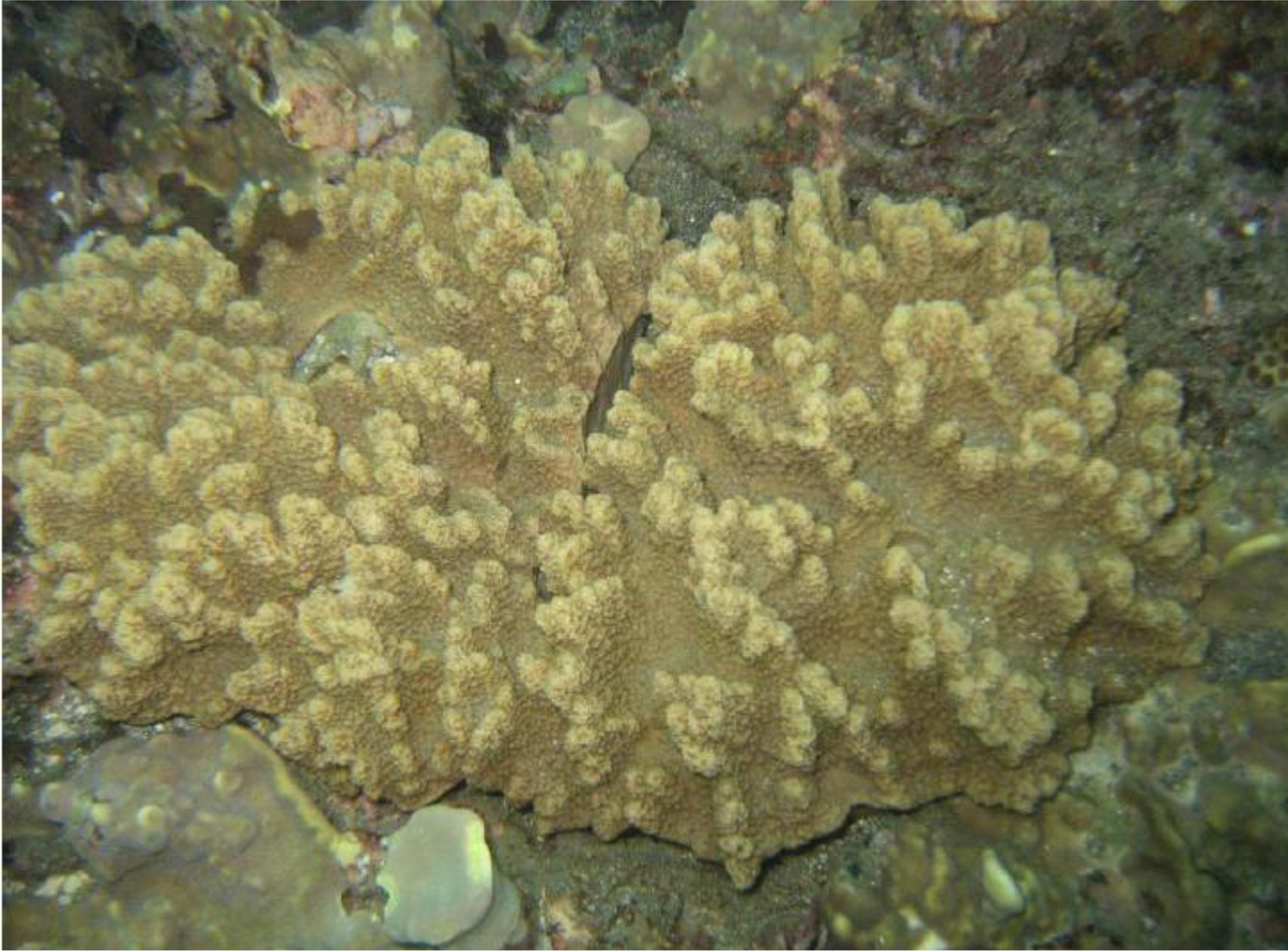
<p>Our previous chemical examination of soft corals of the genus <italic>Sinularia</italic> led to the isolation and identification of various oxygenated cembrane-type metabolites [<xref ref-type="bibr" rid="b1-marinedrugs-09-00944">1</xref>–<xref ref-type="bibr" rid="b5-marinedrugs-09-00944">5</xref>]. Some of these metabolites exhibit anti-inflammatory activity [<xref ref-type="bibr" rid="b2-marinedrugs-09-00944">2</xref>–<xref ref-type="bibr" rid="b4-marinedrugs-09-00944">4</xref>] and/or cytotoxicity to the growth of some cancer cell lines [<xref ref-type="bibr" rid="b1-marinedrugs-09-00944">1</xref>]. Our ongoing research to discover bioactive metabolites from the soft coral <italic>Sinularia triangular</italic> (Tixier-Durivault, 1970; family Alcyoniidae) (<xref ref-type="fig" rid="f1-marinedrugs-09-00944">Figure 1</xref>) led to the isolation of two new cembrane-based diterpenoids, triangulenes A (<bold>1</bold>) and B (<bold>2</bold>), along with three known metabolites, sinularin (<bold>3</bold>) [<xref ref-type="bibr" rid="b6-marinedrugs-09-00944">6</xref>], dihydrosinularin (<bold>4</bold>) [<xref ref-type="bibr" rid="b6-marinedrugs-09-00944">6</xref>], and (−)14-deoxycrassin (<bold>5</bold>) [<xref ref-type="bibr" rid="b7-marinedrugs-09-00944">7</xref>]. The structures of <bold>1</bold> and <bold>2</bold> were established by extensive spectroscopic analysis, including 2D NMR spectroscopy. The cytotoxicity of <bold>1</bold>–<bold>5</bold> to the human tumor cell lines CCRF-CEM (T-cell acute lymphoblastic leukemia) and DLD-1 (colon adenocarcinoma) was studied, and the ability of <bold>1</bold>–<bold>5</bold> to inhibit the expression of the pro-inflammatory iNOS (inducible nitric oxide synthase) and COX-2 (cyclooxygenase-2) proteins in lipopolysaccharide (LPS)–stimulated RAW264.7 macrophage cells was also evaluated.</p></sec>
<sec sec-type="results|discussion">
<label>2.</label>
<title>Results and Discussion</title>
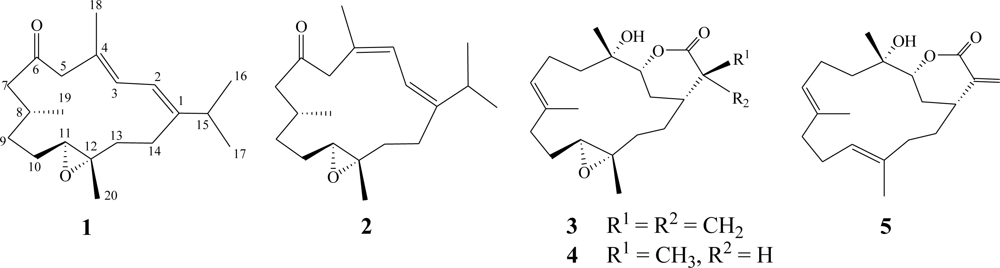
<p>Frozen samples of <italic>S. triangular</italic> were extracted with EtOAc. The dry EtOAc extracts were fractionated by silica gel gravity column chromatography, and the eluted fractions were further purified by HPLC to yield cembranoids <bold>1</bold>–<bold>5</bold> (<xref ref-type="fig" rid="f2-marinedrugs-09-00944">Figure 2</xref>).</p>
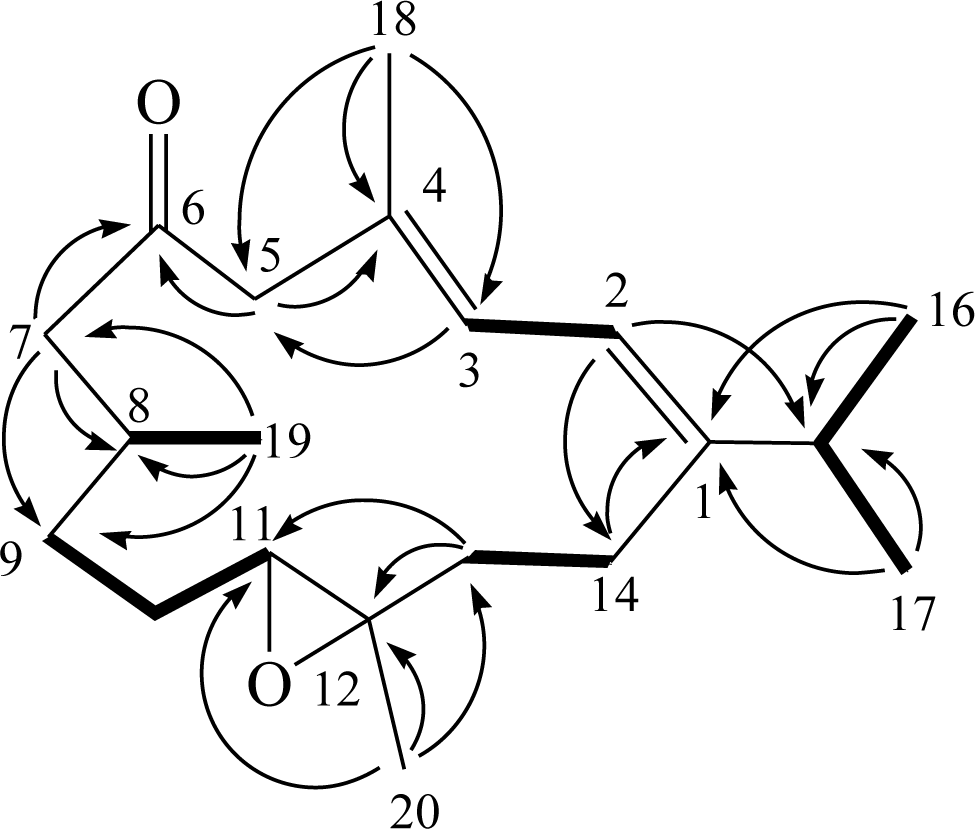
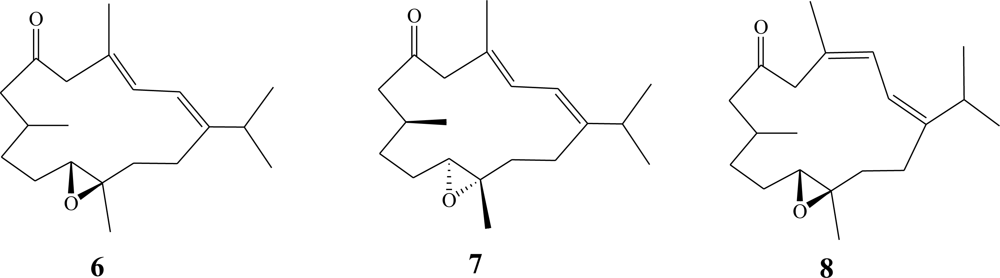
<p>The HRESIMS spectrum of triangulene A (<bold>1</bold>) contained a molecular ion peak consistent with the molecular formula C<sub>20</sub>H<sub>32</sub>O<sub>2</sub>, indicating the molecule has five double-bond equivalent. A UV absorption maxima at 240 nm (log<italic>ɛ</italic> = 4.0) was attributed to double bond conjugation. The IR spectrum of <bold>1</bold> revealed the presence of a carbonyl functionality (ν<sub>max</sub> = 1703 cm<sup>−1</sup>). The <sup>13</sup>C NMR data of <bold>1</bold> showed the presence of 20 carbons (<xref ref-type="table" rid="t1-marinedrugs-09-00944">Table 1</xref>): five methyls, six sp<sup>3</sup> methylenes, three sp<sup>3</sup> methines (including an oxygenated carbon at δ 62.7), two sp<sup>2</sup> methines, and four quaternary carbons (including an oxygenated carbon at δ 61.5, two olefinic carbons with resonances at δ 148.3 and δ 129.3, and a keto-carbonyl at δ 209.8). The <sup>1</sup>H NMR data revealed the presence of two olefinic methine protons as doublets at δ 6.15 and δ 6.06. A proton signal at δ 2.71 (1H, dd, <italic>J</italic> = 8.4, 4.0 Hz) that correlated with a carbon signal at δ 62.7 in the HMQC spectrum of <bold>1</bold> was attributed to the proton of a trisubstituted epoxide. The gross planar structure of <bold>1</bold> was determined by detailed analysis of its 1D and 2D NMR spectra. From the <sup>1</sup>H–<sup>1</sup>H COSY correlations (<xref ref-type="fig" rid="f3-marinedrugs-09-00944">Figure 3</xref>), it was possible to establish five partial structures of consecutive proton spin systems extending from H-2 to H-3; H-8 to H<sub>3</sub>-19; H<sub>2</sub>-9 to H-11; H<sub>2</sub>-13 to H<sub>2</sub>-14; and H-15 to H<sub>3</sub>-16 and H<sub>3</sub>-17. The following key HMBC correlations permitted connection of the carbon skeleton: H-2 to C-1, C-14, and C-15; H-3 to C-5; H-5 to C-4 and C-6 (carbonyl carbon); H-7 to C-6, C-8, and C-9; H-13 to C-11 and C-12; H<sub>3</sub>-16 and H<sub>3</sub>-17 to C-1 and C-15; H<sub>3</sub>-18 to C-3, C-4, and C-5; H<sub>3</sub>-19 to C-7, C-8, and C-9; and H<sub>3</sub>-20 to C-11, C-12, and C-13. Thus, <bold>1</bold> was found to possess a tetrasubstituted diene at C-1/C-2 and C-3/C-4, a ketone group at C-6, and a trisubstituted epoxide at C-11/C-12. The above results indicate that <bold>1</bold> possessed the same molecular framework as known cembranoids <bold>6</bold> and <bold>7</bold> (<xref ref-type="fig" rid="f4-marinedrugs-09-00944">Figure 4</xref>), which were isolated previously from octocorals <italic>Eunicea tourniforti</italic> [<xref ref-type="bibr" rid="b8-marinedrugs-09-00944">8</xref>] and <italic>Eunicea</italic> sp. [<xref ref-type="bibr" rid="b9-marinedrugs-09-00944">9</xref>], respectively.</p>
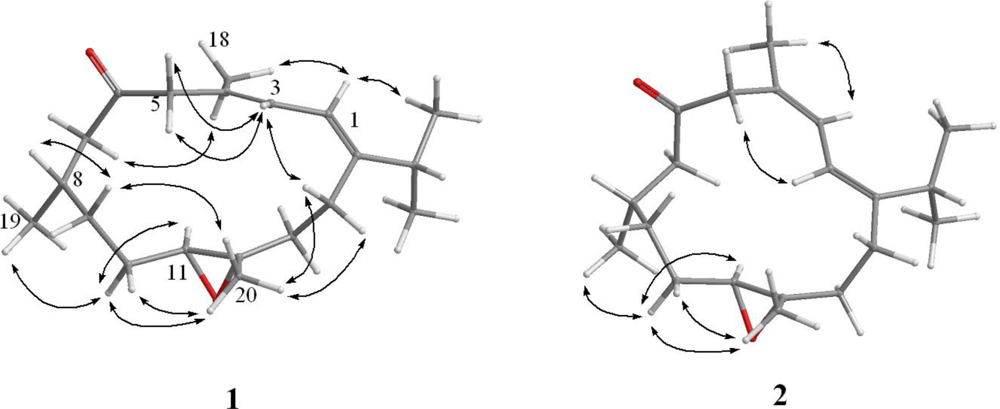
<p>The relative configuration of <bold>1</bold> was determined from NOE correlations observed in the NOESY spectrum (<xref ref-type="fig" rid="f5-marinedrugs-09-00944">Figure 5</xref>). The NOE correlations between H-2 and methyl protons H<sub>3</sub>-16 and H<sub>3</sub>-18 and between H-3 and H<sub>2</sub>-5 indicated <italic>E</italic> configurations for the double bonds at C-1/C-2 and C-3/C-4. In addition, one proton of C-10 methylene (δ 1.92) was found to exhibit correlations with H-11 (δ 2.71, dd, <italic>J</italic> = 8.4, 4.0 Hz) and H<sub>3</sub>-19 (δ 0.93, d, <italic>J</italic> = 6.8 Hz), indicating that these protons were situated on the same face; they were assigned as α protons, as C-20 methyl was β-oriented at C-12, which were verified by the absence of correlation between H-11 and H<sub>3</sub>-20. Furthermore, H<sub>3</sub>-20 correlated with protons of C-10 (δ 1.92 and 1.14) and C-14 (δ 2.37 and 2.28) methylenes, respectively. Consideration of molecular models found that H<sub>3</sub>-20 was reasonably close to H<sub>2</sub>-10 and H<sub>2</sub>-14 when H<sub>3</sub>-20 was β-oriented. Based on the above findings, the structure of <bold>1</bold>, including its relative configuration was established, and the chiral centers for <bold>1</bold> were assigned as 8<italic>S</italic>*, 11<italic>S</italic>*, and 12<italic>S</italic>*. Furthermore, the chemical shifts of <bold>1</bold> were shifted downfield at C-7 (Δ<italic>δ</italic><italic><sub>C</sub></italic> +1.7 ppm) and C-8 (Δ<italic>δ</italic><italic><sub>C</sub></italic> +2.5 ppm) and upfield at C-19 (Δ<italic>δ</italic><italic><sub>C</sub></italic> −0.8 ppm) relative to the corresponding chemical shifts of <bold>7</bold>. On the basis of the above findings, we determined the relative structure of <bold>1</bold>, which was determined to be the C-8 epimer of <bold>7</bold>.</p>
<p>Triangulene B (<bold>2</bold>) had the same molecular formula (C<sub>20</sub>H<sub>32</sub>O<sub>2</sub>) as <bold>1</bold>, as indicated by HRESIMS and NMR spectra (<xref ref-type="table" rid="t1-marinedrugs-09-00944">Table 1</xref>). Comparison of the <sup>1</sup>H and <sup>13</sup>C NMR data of <bold>2</bold> with those of <bold>1</bold> revealed that the two compounds possessed similar structures. The trisubstituted double bonds at C-1/C-2 and C-3/C-4 of <bold>2</bold> had <italic>Z</italic> geometries, as indicated by NOE interactions (<xref ref-type="fig" rid="f5-marinedrugs-09-00944">Figure 5</xref>) between H-3 (δ 6.29) and H<sub>3</sub>-18 (δ 1.93) and between H-2 (δ 6.19) and H-5 (δ 3.90). After determining the structure of <bold>2</bold>, we discovered that its planar structure has been obtained previously as diterpenoid <bold>8</bold> from the octocoral <italic>Eunicea</italic> sp. [<xref ref-type="bibr" rid="b8-marinedrugs-09-00944">8</xref>]. Furthermore, we found that the NMR data for <bold>2</bold> were similar to those of <bold>8</bold>, except that C-7 and C-8 of <bold>2</bold> were shifted markedly downfield (Δδ<sub>C</sub> +3.9 ppm and Δδ<sub>C</sub> +3.6 ppm, respectively) relative to the corresponding carbons of <bold>8</bold>. Further analysis of other NOE interactions revealed that <bold>1</bold> and <bold>2</bold> possessed the same relative configurations at C-8, C-11, and C-12. Thus, the structure of <bold>2</bold> was established unambiguously.</p>
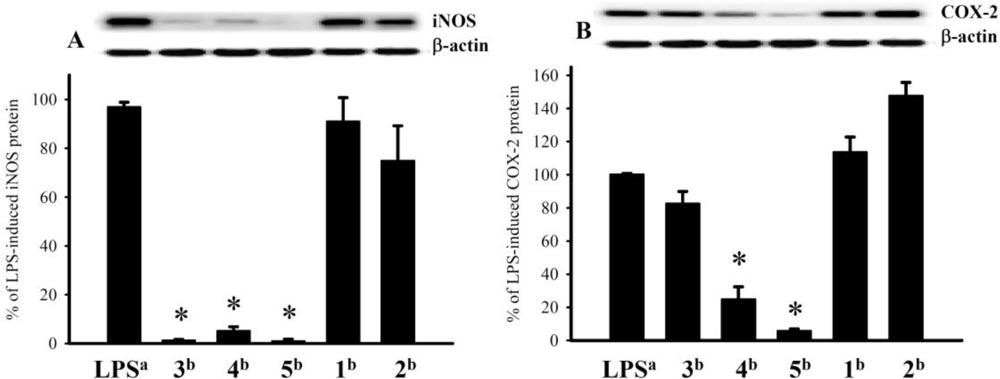
<p>Study of the cytotoxicity of diterpenoids <bold>1</bold>–<bold>5</bold> to human tumor cell lines CCRF-CEM and DLD-1 showed that <bold>3</bold> and <bold>5</bold> moderately inhibited the growth of the tested cell lines (the ED<sub>50</sub> values were 26.0 and 37.1 μM for <bold>3</bold> and 29.8 and 32.2 μM for <bold>5</bold> for CCRF-CEM and DLD-1, respectively). The <italic>in vitro</italic> anti-inflammatory effects of <bold>1</bold>–<bold>5</bold> were also tested. The inhibition of LPS-stimulated upregulation of the pro-inflammatory proteins iNOS and COX-2 in RAW264.7 macrophage cells was measured by immunoblot analysis. At a concentration of 10 μm, <bold>3</bold>–<bold>5</bold> reduced the levels of the iNOS protein to 1.2 ± 0.3%, 5.1 ± 1.6%, and 0.9 ± 0.7%, respectively, of the levels in control cells stimulated with LPS alone (set at 100%). At the same concentration, <bold>4</bold> and <bold>5</bold> markedly reduced the levels of COX-2 to 24.9 ± 7.4% and 5.9 ± 1.0%, respectively, relative to controls (<xref ref-type="fig" rid="f6-marinedrugs-09-00944">Figure 6</xref>).</p></sec>
<sec>
<label>3.</label>
<title>Experimental Section</title>
<sec sec-type="methods">
<label>3.1.</label>
<title>General Experimental Procedures</title>
<p>Melting points were measured on Fargo apparatus and are uncorrected. Optical rotation values were measured with a Jasco P-1010 digital polarimeter. Ultraviolet spectra were recorded on a Jasco V-650 spectrophotometer. IR spectra were obtained with a Varian Digilab FTS 1000 FT-IR spectrophotometer. NMR spectra were recorded with a Varian Mercury Plus 400 FT-NMR, at 400 MHz for <sup>1</sup>H NMR and 100 MHz for <sup>13</sup>C NMR, in CDCl<sub>3</sub>. ESIMS and HRESIMS data were recorded with a Bruker APEX II mass spectrometer. Silica gel 60 (230–400 mesh; Merck, Darmstadt, Germany) was used for column chromatography. Gravity column chromatography was performed on silica gel (230–400 mesh; Merck). TLC was carried out on precoated Kieselgel 60 F254 (0.2 mm; Merck), and spots were visualized by spraying with 10% H<sub>2</sub>SO<sub>4</sub> solution followed by heating. HPLC was performed on a system comprising a Hitachi L-7100 pump, a Hitachi photodiode array detector L-7455, and a Rheodyne 7725 injection port. A semi-preparative reverse-phase column (Hibar 250 × 10 mm, LiChrospher 100 RP-18e, 5 μm, Merck) and a preparative normal-phase column (Hibar 250 × 21 mm, Si-60 column, 7 μm, Merck) were used for HPLC.</p></sec>
<sec>
<label>3.2.</label>
<title>Animal Material</title>
<p>The marine soft coral <italic>S. triangular</italic> (specimen No. 200807-15) was collected by scuba divers at a depth of around 10 m off the coast of Taitung County, Taiwan, in July 2008, and the samples were frozen immediately after collection. A voucher sample was deposited at the Department of Marine Biotechnology and Resources, National Sun Yat-sen University, Taiwan.</p></sec>
<sec>
<label>3.3.</label>
<title>Extraction and Separation</title>
<p>The frozen bodies of <italic>S. triangular</italic> (1.2 kg, wet weight) were minced and exhaustively extracted with EtOAc (1 L × 5). The combined EtOAc extracts (15.5 g) were subjected to silica gel column chromatography with elution by EtOAc in <italic>n</italic>-hexane (0–100%, stepwise) followed by 100% acetone; and the fractions were pooled on the basis of TLC analysis to yield 17 fractions. Fraction 8 (265 mg), which eluted with <italic>n</italic>-hexane–EtOAc (10:1), was subjected to silica gel column chromatography with gradient elution (<italic>n</italic>-hexane–acetone, 12:1 to 6:1) to afford five subfractions (A1–A5). Subfraction A2 (20 mg) was subjected to reverse-phase HPLC with MeOH–H<sub>2</sub>O (5:1) elution to afford <bold>1</bold> (2.5 mg) and <bold>2</bold> (2.0 mg). Subfraction A3 (90 mg) was subjected to normal-phase HPLC using <italic>n</italic>-hexane–acetone (10:1) to afford <bold>5</bold> (50.3 mg). Fraction 11 (160 mg), which eluted with <italic>n</italic>-hexane–EtOAc (5:1), was subjected to silica gel column chromatography with gradient elution (<italic>n</italic>-hexane–acetone, 8:1 to 5:1) to yield six subfractions (B1–B6). Subfraction B3 was subjected to normal-phase HPLC with <italic>n</italic>-hexane–acetone (7:1) elution to afford <bold>3</bold> (20.5 mg) and <bold>4</bold> (10.8 mg).</p>
<p>Triangulene A (<bold>1</bold>): colorless oil; [α]<sup>25</sup><sub>D</sub> +70.8 (<italic>c</italic> 0.5, CHCl<sub>3</sub>); IR (neat) <italic>v</italic><sub>max</sub> 2961, 2928, 1703, 1456, 1385, and 1261 cm<sup>−1</sup>; UV (MeOH) λ<sub>max</sub> 240 (log ɛ = 4.0); <sup>13</sup>C and <sup>1</sup>H NMR data, see <xref ref-type="table" rid="t1-marinedrugs-09-00944">Table 1</xref>; ESIMS <italic>m/z</italic> 327 [M + Na]<sup>+</sup>; HRESIMS <italic>m/z</italic> 327.2302 [M + Na]<sup>+</sup> (calcd for C<sub>20</sub>H<sub>32</sub>O<sub>2</sub>Na, 327.2300).</p>
<p>Triangulene B (<bold>2</bold>): colorless oil; [α]<sup>25</sup><sub>D</sub> +50.6 (<italic>c</italic> 0.5, CHCl<sub>3</sub>); IR (neat) <italic>v</italic><sub>max</sub> 2959, 2928, 1709, 1460, and 1385 cm<sup>−1</sup>; UV (MeOH) λ<sub>max</sub> 239 (log ɛ = 3.8); <sup>13</sup>C and <sup>1</sup>H NMR data, see <xref ref-type="table" rid="t1-marinedrugs-09-00944">Table 1</xref>; ESIMS <italic>m/z</italic> 327 [M + Na]<sup>+</sup>; HRESIMS <italic>m/z</italic> 327.2301 [M + Na]<sup>+</sup> (calcd for C<sub>20</sub>H<sub>32</sub>O<sub>2</sub>Na, 327.2300).</p>
<p>Sinularin (<bold>3</bold>): white powder; mp 151–153 °C; [α]<sup>25</sup><sub>D</sub> −120 (<italic>c</italic> 0.5, CHCl<sub>3</sub>); ESIMS <italic>m/z</italic> 357 [M + Na]<sup>+</sup> [<xref ref-type="bibr" rid="b6-marinedrugs-09-00944">6</xref>].</p>
<p>Dihydrosinularin (<bold>4</bold>): white powder; mp 116–118 °C; [α]<sup>25</sup><sub>D</sub> –42 (<italic>c</italic> 0.3, CHCl<sub>3</sub>); ESIMS <italic>m/z</italic> 359 [M + Na]<sup>+</sup> [<xref ref-type="bibr" rid="b6-marinedrugs-09-00944">6</xref>].</p>
<p>(−)14-Deoxycrassin (<bold>5</bold>): colorless oil; [α]<sup>25</sup><sub>D</sub> −15 (<italic>c</italic> 1.0, CHCl<sub>3</sub>); ESIMS <italic>m/z</italic> 341 [M + Na]<sup>+</sup> [<xref ref-type="bibr" rid="b7-marinedrugs-09-00944">7</xref>].</p></sec>
<sec>
<label>3.4.</label>
<title>Cytotoxicity Testing</title>
<p>The cytotoxicity of <bold>1</bold>–<bold>5</bold> to CCRF-CEM and DLD-1 tumor cells was evaluated by means of the tetrazolium-based colorimetric assay [<xref ref-type="bibr" rid="b10-marinedrugs-09-00944">10</xref>,<xref ref-type="bibr" rid="b11-marinedrugs-09-00944">11</xref>]. As a positive control, we employed doxorubicin, which exhibited cytotoxicity to CCRF-CEM and DLD-1 cells with ED<sub>50</sub> values of 0.57 and 0.25 μm, respectively.</p></sec>
<sec>
<label>3.5.</label>
<title><italic>In Vitro</italic> Anti-Inflammatory Assay</title>
<p>A macrophage (RAW264.7) cell line was purchased from ATCC. We measured the <italic>in vitro</italic> anti-inflammatory activities of <bold>1</bold>–<bold>5</bold> by examining the inhibition of LPS-simulated upregulation of the iNOS (inducible nitric oxide synthetase) and COX-2 (cyclooxygenase-2) proteins in macrophages using western blotting analysis [<xref ref-type="bibr" rid="b12-marinedrugs-09-00944">12</xref>,<xref ref-type="bibr" rid="b13-marinedrugs-09-00944">13</xref>].</p></sec></sec></body>
<back>
<ack>
<p>This research was supported by grants from the National Museum of Marine Biology &amp; Aquarium and the National Science Council (NSC 99-2320-B-291-001), Taiwan, awarded to J.-H. Su.</p></ack>
<fn-group><fn>
<p><italic>Samples Availability:</italic> Not available.</p></fn></fn-group>
<ref-list>
<title>References</title>
<ref id="b1-marinedrugs-09-00944"><label>1.</label><citation citation-type="journal"><person-group person-group-type="author"><name><surname>Su</surname><given-names>J-H</given-names></name><name><surname>Ahmed</surname><given-names>AF</given-names></name><name><surname>Sung</surname><given-names>P-J</given-names></name><name><surname>Chao</surname><given-names>C-H</given-names></name><name><surname>Kuo</surname><given-names>Y-H</given-names></name><name><surname>Sheu</surname><given-names>J-H</given-names></name></person-group><article-title>Manaarenolides A–I, new diterpenoids from the soft coral</article-title><source>Sinularia manaarensis J Nat Prod</source><year>2006</year><volume>69</volume><fpage>1134</fpage><lpage>1139</lpage><pub-id pub-id-type="doi">10.1021/np050483q</pub-id></citation></ref>
<ref id="b2-marinedrugs-09-00944"><label>2.</label><citation citation-type="journal"><person-group person-group-type="author"><name><surname>Lu</surname><given-names>Y</given-names></name><name><surname>Huang</surname><given-names>C-Y</given-names></name><name><surname>Lin</surname><given-names>Y-F</given-names></name><name><surname>Wen</surname><given-names>Z-H</given-names></name><name><surname>Su</surname><given-names>J-H</given-names></name><name><surname>Kuo</surname><given-names>Y-H</given-names></name><name><surname>Chiang</surname><given-names>MY</given-names></name><name><surname>Sheu</surname><given-names>J-H</given-names></name></person-group><article-title>Anti-inflammatory cembranoids from the soft corals <italic>Sinularia querciformis</italic> and</article-title><source>Sinularia granosa J Nat Prod</source><year>2008</year><volume>71</volume><fpage>1754</fpage><lpage>1759</lpage><pub-id pub-id-type="doi">10.1021/np8003563</pub-id></citation></ref>
<ref id="b3-marinedrugs-09-00944"><label>3.</label><citation citation-type="journal"><person-group person-group-type="author"><name><surname>Chen</surname><given-names>B-W</given-names></name><name><surname>Chao</surname><given-names>C-H</given-names></name><name><surname>Su</surname><given-names>J-H</given-names></name><name><surname>Huang</surname><given-names>C-Y</given-names></name><name><surname>Dai</surname><given-names>C-F</given-names></name><name><surname>Wen</surname><given-names>Z-H</given-names></name><name><surname>Sheu</surname><given-names>J-H</given-names></name></person-group><article-title>A novel symmetric sulfur-containing biscembranoid from the Formosan soft coral</article-title><source>Sinularia flexibilis Tetrahedron Lett</source><year>2010</year><volume>44</volume><fpage>5764</fpage><lpage>5766</lpage></citation></ref>
<ref id="b4-marinedrugs-09-00944"><label>4.</label><citation citation-type="journal"><person-group person-group-type="author"><name><surname>Lu</surname><given-names>Y</given-names></name><name><surname>Su</surname><given-names>J-H</given-names></name><name><surname>Huang</surname><given-names>C-Y</given-names></name><name><surname>Liu</surname><given-names>Y-C</given-names></name><name><surname>Kuo</surname><given-names>Y-H</given-names></name><name><surname>Wen</surname><given-names>ZH</given-names></name><name><surname>Hsu</surname><given-names>C-H</given-names></name><name><surname>Sheu</surname><given-names>J-H</given-names></name></person-group><article-title>Cembranoids from the Soft Corals <italic>Sinularia granosa</italic> and</article-title><source>Sinularia querciformis Chem Pharm Bull</source><year>2010</year><volume>58</volume><fpage>464</fpage><lpage>466</lpage><pub-id pub-id-type="doi">10.1248/cpb.58.464</pub-id></citation></ref>
<ref id="b5-marinedrugs-09-00944"><label>5.</label><citation citation-type="journal"><person-group person-group-type="author"><name><surname>Su</surname><given-names>J-H</given-names></name><name><surname>Lin</surname><given-names>Y-F</given-names></name><name><surname>Lu</surname><given-names>Y</given-names></name><name><surname>Yeh</surname><given-names>H-C</given-names></name><name><surname>Wang</surname><given-names>W-H</given-names></name><name><surname>Fan</surname><given-names>T-Y</given-names></name><name><surname>Sheu</surname><given-names>JH</given-names></name></person-group><article-title>Oxygenated cembranoids from the cultured and wild-type soft corals</article-title><source>Sinularia flexibilis Chem Pharm Bull</source><year>2009</year><volume>57</volume><fpage>1189</fpage><lpage>1192</lpage><pub-id pub-id-type="doi">10.1248/cpb.57.1189</pub-id></citation></ref>
<ref id="b6-marinedrugs-09-00944"><label>6.</label><citation citation-type="journal"><person-group person-group-type="author"><name><surname>Weinheimer</surname><given-names>AJ</given-names></name><name><surname>Matson</surname><given-names>JA</given-names></name><name><surname>Hossain</surname><given-names>MB</given-names></name><name><surname>van der Helm</surname><given-names>D</given-names></name></person-group><article-title>Marine anticancer agents: Sinularin and dihydrosinularin, new cembranolides from the soft coral</article-title><source>Sinularia flexibilis Tetrahedron Lett</source><year>1977</year><volume>34</volume><fpage>2923</fpage><lpage>2926</lpage></citation></ref>
<ref id="b7-marinedrugs-09-00944"><label>7.</label><citation citation-type="journal"><person-group person-group-type="author"><name><surname>Wen</surname><given-names>T</given-names></name><name><surname>Ding</surname><given-names>Y</given-names></name><name><surname>Deng</surname><given-names>Z</given-names></name><name><surname>van Ofwegen</surname><given-names>L</given-names></name><name><surname>Proksch</surname><given-names>P</given-names></name><name><surname>Lin</surname><given-names>W</given-names></name></person-group><article-title>Sinulaflexiolides A–K, cembrane-type diterpenoids from the Chinese soft coral</article-title><source>Sinularia flexibilis J Nat Prod</source><year>2008</year><volume>71</volume><fpage>1133</fpage><lpage>1140</lpage><pub-id pub-id-type="doi">10.1021/np070640g</pub-id></citation></ref>
<ref id="b8-marinedrugs-09-00944"><label>8.</label><citation citation-type="journal"><person-group person-group-type="author"><name><surname>Marville</surname><given-names>KI</given-names></name><name><surname>McLean</surname><given-names>S</given-names></name><name><surname>Reynolds</surname><given-names>WF</given-names></name><name><surname>Tinto</surname><given-names>WF</given-names></name></person-group><article-title>New cembrane diterpenes of the marine octocoral <italic>Eunicea tourniforti</italic> from the eastern Caribbean</article-title><source>J Nat Prod</source><year>2003</year><volume>66</volume><fpage>1284</fpage><lpage>1287</lpage><pub-id pub-id-type="doi">10.1021/np030091o</pub-id><pub-id pub-id-type="pmid">14510619</pub-id></citation></ref>
<ref id="b9-marinedrugs-09-00944"><label>9.</label><citation citation-type="journal"><person-group person-group-type="author"><name><surname>Wei</surname><given-names>X</given-names></name><name><surname>Rodríguez</surname><given-names>AD</given-names></name><name><surname>Baran</surname><given-names>P</given-names></name><name><surname>Raptis</surname><given-names>RG</given-names></name><name><surname>Sánchez</surname><given-names>JA</given-names></name><name><surname>Ortega-Barria</surname><given-names>E</given-names></name><name><surname>González</surname><given-names>J</given-names></name></person-group><article-title>Antiplasmodial cembradiene diterpenoids from a Southwestern Caribbean gorgonian octocoral of the genus</article-title><source>Eunicea Tetrahedron</source><year>2004</year><volume>60</volume><fpage>11813</fpage><lpage>11819</lpage><pub-id pub-id-type="doi">10.1016/j.tet.2004.09.108</pub-id></citation></ref>
<ref id="b10-marinedrugs-09-00944"><label>10.</label><citation citation-type="journal"><person-group person-group-type="author"><name><surname>Alley</surname><given-names>MC</given-names></name><name><surname>Scudiero</surname><given-names>DA</given-names></name><name><surname>Monks</surname><given-names>A</given-names></name><name><surname>Hursey</surname><given-names>ML</given-names></name><name><surname>Czerwinski</surname><given-names>MJ</given-names></name><name><surname>Fine</surname><given-names>DL</given-names></name><name><surname>Abbott</surname><given-names>BJ</given-names></name><name><surname>Mayo</surname><given-names>JG</given-names></name><name><surname>Shoemaker</surname><given-names>RH</given-names></name><name><surname>Boyd</surname><given-names>MR</given-names></name></person-group><article-title>Feasibility of drug screening with panels of human tumor cell lines using a microculture tetrazolium assay</article-title><source>Cancer Res</source><year>1988</year><volume>48</volume><fpage>589</fpage><lpage>601</lpage><pub-id pub-id-type="pmid">3335022</pub-id></citation></ref>
<ref id="b11-marinedrugs-09-00944"><label>11.</label><citation citation-type="journal"><person-group person-group-type="author"><name><surname>Scudiero</surname><given-names>DA</given-names></name><name><surname>Shoemaker</surname><given-names>RH</given-names></name><name><surname>Paull</surname><given-names>KD</given-names></name><name><surname>Monks</surname><given-names>A</given-names></name><name><surname>Tierney</surname><given-names>S</given-names></name><name><surname>Nofziger</surname><given-names>TH</given-names></name><name><surname>Currens</surname><given-names>MJ</given-names></name><name><surname>Seniff</surname><given-names>D</given-names></name><name><surname>Boyd</surname><given-names>MR</given-names></name></person-group><article-title>Evaluation of a soluble tetrazolium/formazan assay for cell growth and drug sensitivity in culture using human and other tumor cell lines</article-title><source>Cancer Res</source><year>1988</year><volume>48</volume><fpage>4827</fpage><lpage>4833</lpage><pub-id pub-id-type="pmid">3409223</pub-id></citation></ref>
<ref id="b12-marinedrugs-09-00944"><label>12.</label><citation citation-type="journal"><person-group person-group-type="author"><name><surname>Jean</surname><given-names>Y-H</given-names></name><name><surname>Chen</surname><given-names>W-F</given-names></name><name><surname>Sung</surname><given-names>C-S</given-names></name><name><surname>Duh</surname><given-names>C-Y</given-names></name><name><surname>Huang</surname><given-names>S-Y</given-names></name><name><surname>Lin</surname><given-names>C-S</given-names></name><name><surname>Tai</surname><given-names>M-H</given-names></name><name><surname>Tzeng</surname><given-names>S-F</given-names></name><name><surname>Wen</surname><given-names>Z-H</given-names></name></person-group><article-title>Capnellene, a natural marine compound derived from soft coral, attenuates chronic constriction injury-induced neuropathic pain in rats</article-title><source>Br J Pharmacol</source><year>2009</year><volume>158</volume><fpage>713</fpage><lpage>725</lpage><pub-id pub-id-type="doi">10.1111/j.1476-5381.2009.00323.x</pub-id><pub-id pub-id-type="pmid">19663884</pub-id></citation></ref>
<ref id="b13-marinedrugs-09-00944"><label>13.</label><citation citation-type="journal"><person-group person-group-type="author"><name><surname>Jean</surname><given-names>Y-H</given-names></name><name><surname>Chen</surname><given-names>W-F</given-names></name><name><surname>Duh</surname><given-names>C-Y</given-names></name><name><surname>Huang</surname><given-names>S-Y</given-names></name><name><surname>Hsu</surname><given-names>C-H</given-names></name><name><surname>Lin</surname><given-names>C-S</given-names></name><name><surname>Sung</surname><given-names>C-S</given-names></name><name><surname>Chen</surname><given-names>I-M</given-names></name><name><surname>Wen</surname><given-names>Z-H</given-names></name></person-group><article-title>Inducible nitric oxide synthase and cyclooxygenase-2 participate in anti-inflammatory and analgesic effects of the natural marine compound lemnalol from Formosan soft coral</article-title><source>Lemnalia cervicorni Eur J Pharmacol</source><year>2008</year><volume>578</volume><fpage>323</fpage><lpage>331</lpage><pub-id pub-id-type="doi">10.1016/j.ejphar.2007.08.048</pub-id></citation></ref></ref-list>
<sec sec-type="display-objects">
<title>Figures and Table</title>
<fig id="f1-marinedrugs-09-00944" position="float">
<label>Figure 1</label>
<caption>
<p>Soft coral <italic>Sinularia triangular</italic>.</p></caption>
<graphic xlink:href="marinedrugs-09-00944f1.gif"/></fig>
<fig id="f2-marinedrugs-09-00944" position="float">
<label>Figure 2</label>
<caption>
<p>Structures of <bold>1</bold>–<bold>5</bold>.</p></caption>
<graphic xlink:href="marinedrugs-09-00944f2.gif"/></fig>
<fig id="f3-marinedrugs-09-00944" position="float">
<label>Figure 3</label>
<caption>
<p>Key <sup>1</sup>H–<sup>1</sup>H COSY and HMBC correlations of <bold>1</bold>.</p></caption>
<graphic xlink:href="marinedrugs-09-00944f3.gif"/></fig>
<fig id="f4-marinedrugs-09-00944" position="float">
<label>Figure 4</label>
<caption>
<p>Structures of <bold>6</bold>–<bold>8</bold>.</p></caption>
<graphic xlink:href="marinedrugs-09-00944f4.gif"/></fig>
<fig id="f5-marinedrugs-09-00944" position="float">
<label>Figure 5</label>
<caption>
<p>Selective NOESY correlations of <bold>1</bold> and <bold>2</bold>.</p></caption>
<graphic xlink:href="marinedrugs-09-00944f5.gif"/></fig>
<fig id="f6-marinedrugs-09-00944" position="float">
<label>Figure 6</label>
<caption>
<p>Immunoblot analysis of the effects of <bold>1</bold>–<bold>5</bold> (10 μM) on the expression of the iNOS and COX-2 proteins of RAW264.7 macrophage cells: (<bold>A</bold>) Immunoblots of iNOS and β-actin and (<bold>B</bold>) immunoblots of COX-2 and β-actin. The relative intensity for the cells stimulated with LPS alone was set at 100%. Band intensities were quantified by densitometry and are indicated as percentages relative to the intensities for the LPS-stimulated cells. Western blotting with β-actin was performed to verify that equivalent amounts of protein were loaded in each lane. Values represent mean ± SEM (<italic>n</italic> = 6). *Significantly different from the values for cells stimulated with LPS alone (*<italic>P</italic> &lt; 0.05). <italic><sup>a</sup></italic>Stimulated with LPS alone; <italic><sup>b</sup></italic>stimulated with LPS in the presence of <bold>1</bold>–<bold>5</bold>.</p></caption>
<graphic xlink:href="marinedrugs-09-00944f6.gif"/></fig>
<table-wrap id="t1-marinedrugs-09-00944" position="float">
<label>Table 1</label>
<caption>
<p><sup>1</sup>H and <sup>13</sup>C NMR data for <bold>1</bold> and <bold>2</bold>.</p></caption>
<table frame="hsides" rules="groups">
<thead>
<tr>
<th align="left" valign="top" rowspan="2"/>
<th colspan="2" align="center" valign="top"><bold>1</bold>
<hr/></th>
<th colspan="2" align="center" valign="top"><bold>2</bold>
<hr/></th></tr>
<tr>
<th align="center" valign="top"><sup>1</sup>H<italic><xref ref-type="table-fn" rid="tfn1-marinedrugs-09-00944"><sup>a</sup></xref></italic></th>
<th align="center" valign="top"><sup>13</sup>C<italic><xref ref-type="table-fn" rid="tfn2-marinedrugs-09-00944"><sup>b</sup></xref></italic></th>
<th align="center" valign="top"><sup>1</sup>H<italic><xref ref-type="table-fn" rid="tfn1-marinedrugs-09-00944"><sup>a</sup></xref></italic></th>
<th align="left" valign="top"><sup>13</sup>C<italic><xref ref-type="table-fn" rid="tfn2-marinedrugs-09-00944"><sup>b</sup></xref></italic></th></tr></thead>
<tbody>
<tr>
<td align="left" valign="top">1</td>
<td align="left" valign="top"/>
<td align="center" valign="top">148.3 (C)</td>
<td align="left" valign="top"/>
<td align="left" valign="top">146.7 (C)</td></tr>
<tr>
<td align="left" valign="top">2</td>
<td align="left" valign="top">6.06 d (10.8)</td>
<td align="center" valign="top">118.2 (CH)</td>
<td align="left" valign="top">6.19 d (10.8)</td>
<td align="left" valign="top">118.7 (CH)</td></tr>
<tr>
<td align="left" valign="top">3</td>
<td align="left" valign="top">6.15 d (10.8)</td>
<td align="center" valign="top">125.7 (CH)</td>
<td align="left" valign="top">6.29 d (10.8)</td>
<td align="left" valign="top">124.4 (CH)</td></tr>
<tr>
<td align="left" valign="top">4</td>
<td align="left" valign="top"/>
<td align="center" valign="top">129.3 (C)</td>
<td align="left" valign="top"/>
<td align="left" valign="top">130.5 (C)</td></tr>
<tr>
<td align="left" valign="top">5</td>
<td align="left" valign="top">3.20 d (13.6); 3.06 d (13.6)</td>
<td align="center" valign="top">54.7 (CH<sub>2</sub>)</td>
<td align="left" valign="top">3.90 d (13.6); 2.70 d (13.6)</td>
<td align="left" valign="top">48.9 (CH<sub>2</sub>)</td></tr>
<tr>
<td align="left" valign="top">6</td>
<td align="left" valign="top"/>
<td align="center" valign="top">209.8 (C)</td>
<td align="left" valign="top"/>
<td align="left" valign="top">208.0 (C)</td></tr>
<tr>
<td align="left" valign="top">7</td>
<td align="left" valign="top">2.54 dd (13.2, 8.4); 2.17 m</td>
<td align="center" valign="top">51.2 (CH<sub>2</sub>)</td>
<td align="left" valign="top">2.52 m; 2.12 m</td>
<td align="left" valign="top">52.4 (CH<sub>2</sub>)</td></tr>
<tr>
<td align="left" valign="top">8</td>
<td align="left" valign="top">2.03 m</td>
<td align="center" valign="top">31.2 (CH)</td>
<td align="left" valign="top">1.83 m</td>
<td align="left" valign="top">32.0 (CH)</td></tr>
<tr>
<td align="left" valign="top">9</td>
<td align="left" valign="top">1.48 m; 1.18 m</td>
<td align="center" valign="top">33.1 (CH<sub>2</sub>)</td>
<td align="left" valign="top">1.31 m; 1.14 m</td>
<td align="left" valign="top">33.3 (CH<sub>2</sub>)</td></tr>
<tr>
<td align="left" valign="top">10</td>
<td align="left" valign="top">1.92 m; 1.14 m</td>
<td align="center" valign="top">26.4 (CH<sub>2</sub>)</td>
<td align="left" valign="top">1.88 m; 1.09 m</td>
<td align="left" valign="top">26.4 (CH<sub>2</sub>)</td></tr>
<tr>
<td align="left" valign="top">11</td>
<td align="left" valign="top">2.71 dd (8.4, 4.0)</td>
<td align="center" valign="top">62.7 (CH)</td>
<td align="left" valign="top">2.49 m</td>
<td align="left" valign="top">64.4 (CH)</td></tr>
<tr>
<td align="left" valign="top">12</td>
<td align="left" valign="top"/>
<td align="center" valign="top">61.5 (C)</td>
<td align="left" valign="top"/>
<td align="left" valign="top">60.6 (C)</td></tr>
<tr>
<td align="left" valign="top">13</td>
<td align="left" valign="top">2.15 m; 1.32 m</td>
<td align="center" valign="top">36.7 (CH<sub>2</sub>)</td>
<td align="left" valign="top">2.12 m; 1.36 m</td>
<td align="left" valign="top">36.7 (CH<sub>2</sub>)</td></tr>
<tr>
<td align="left" valign="top">14</td>
<td align="left" valign="top">2.37 m; 2.28 m</td>
<td align="center" valign="top">25.9 (CH<sub>2</sub>)</td>
<td align="left" valign="top">2.73 m; 2.12 m</td>
<td align="left" valign="top">25.7 (CH<sub>2</sub>)</td></tr>
<tr>
<td align="left" valign="top">15</td>
<td align="left" valign="top">2.35 m</td>
<td align="center" valign="top">32.2 (CH)</td>
<td align="left" valign="top">2.35 m</td>
<td align="left" valign="top">30.8 (CH)</td></tr>
<tr>
<td align="left" valign="top">16</td>
<td align="left" valign="top">1.06 d (7.2)</td>
<td align="center" valign="top">22.6 (CH<sub>3</sub>)</td>
<td align="left" valign="top">1.18 d (6.8)</td>
<td align="left" valign="top">20.6 (CH<sub>3</sub>)</td></tr>
<tr>
<td align="left" valign="top">17</td>
<td align="left" valign="top">1.08 d (7.6)</td>
<td align="center" valign="top">22.1 (CH<sub>3</sub>)</td>
<td align="left" valign="top">1.02 d (6.8)</td>
<td align="left" valign="top">23.4 (CH<sub>3</sub>)</td></tr>
<tr>
<td align="left" valign="top">18</td>
<td align="left" valign="top">1.89 s</td>
<td align="center" valign="top">18.2 (CH<sub>3</sub>)</td>
<td align="left" valign="top">1.93 s</td>
<td align="left" valign="top">25.1 (CH<sub>3</sub>)</td></tr>
<tr>
<td align="left" valign="top">19</td>
<td align="left" valign="top">0.93 d (6.8)</td>
<td align="center" valign="top">19.5 (CH<sub>3</sub>)</td>
<td align="left" valign="top">0.85 d (6.4)</td>
<td align="left" valign="top">19.2 (CH<sub>3</sub>)</td></tr>
<tr>
<td align="left" valign="top">20</td>
<td align="left" valign="top">1.20 s</td>
<td align="center" valign="top">17.6 (CH<sub>3</sub>)</td>
<td align="left" valign="top">1.23 s</td>
<td align="left" valign="top">16.3 (CH<sub>3</sub>)</td></tr></tbody></table>
<table-wrap-foot><fn id="tfn1-marinedrugs-09-00944">
<label><italic>a</italic></label>
<p>Spectra were recorded at 400 MHz in CDCl<sub>3</sub>; <italic>J</italic> values (Hz) are given in parentheses;</p></fn><fn id="tfn2-marinedrugs-09-00944">
<label><italic>b</italic></label>
<p>spectra were recorded at 100 MHz in CDCl<sub>3</sub>; attached protons were deduced by DEPT experiments.</p></fn></table-wrap-foot></table-wrap></sec></back></article>