<?xml version="1.0" encoding="UTF-8"?>
<!DOCTYPE article PUBLIC "-//NLM//DTD Journal Publishing DTD v2.3 20070202//EN" "journalpublishing.dtd">
<article xmlns:xlink="http://www.w3.org/1999/xlink" xml:lang="en" article-type="research-article">
<front>
<journal-meta>
<journal-id journal-id-type="publisher-id">MD</journal-id>
<journal-title>Marine Drugs</journal-title>
<abbrev-journal-title>MD</abbrev-journal-title>
<issn pub-type="epub">1660-3397</issn>
<publisher>
<publisher-name>Molecular Diversity Preservation International</publisher-name></publisher></journal-meta>
<article-meta>
<article-id pub-id-type="doi">10.3390/md9061119</article-id>
<article-id pub-id-type="publisher-id">marinedrugs-09-01119</article-id>
<article-categories>
<subj-group>
<subject>Article</subject></subj-group></article-categories>
<title-group>
<article-title>Functional Feed Assessment on <italic>Litopenaeus vannamei</italic> Using 100% Fish Meal Replacement by Soybean Meal, High Levels of Complex Carbohydrates and <italic>Bacillus</italic> Probiotic Strains</article-title></title-group>
<contrib-group>
<contrib contrib-type="author">
<name><surname>Olmos</surname><given-names>Jorge</given-names></name><xref ref-type="corresp" rid="c1-marinedrugs-09-01119"><sup>*</sup></xref></contrib>
<contrib contrib-type="author">
<name><surname>Ochoa</surname><given-names>Leonel</given-names></name></contrib>
<contrib contrib-type="author">
<name><surname>Paniagua-Michel</surname><given-names>Jesus</given-names></name></contrib>
<contrib contrib-type="author">
<name><surname>Contreras</surname><given-names>Rosalia</given-names></name></contrib>
<aff id="af1-marinedrugs-09-01119">Molecular Microbiology Laboratory, Department of Marine Biotechnology, Centro de Investigación Científica y de Educación Superior de Ensenada (CICESE), Ensenada, B.C., Mexico; E-Mails: <email>leonel.ochoa@gmail.com</email> (L.O.); <email>jpaniagu@cicese.mx</email> (J.P.-M.); <email>rcontre@cicese.mx</email> (R.C.)</aff></contrib-group>
<author-notes>
<corresp id="c1-marinedrugs-09-01119">
<label>*</label>Author to whom correspondence should be addressed; E-Mail: <email>jolmos@cicese.mx</email>; Tel.: +52-(646)-175-05-00.</corresp></author-notes>
<pub-date pub-type="collection">
<year>2011</year></pub-date>
<pub-date pub-type="epub">
<day>17</day>
<month>6</month>
<year>2011</year></pub-date>
<volume>9</volume>
<issue>6</issue>
<fpage>1119</fpage>
<lpage>1132</lpage>
<history>
<date date-type="received">
<day>21</day>
<month>3</month>
<year>2011</year></date>
<date date-type="rev-recd">
<day>3</day>
<month>5</month>
<year>2011</year></date>
<date date-type="accepted">
<day>24</day>
<month>5</month>
<year>2011</year></date></history>
<permissions>
<copyright-statement>© 2011 by the authors; licensee MDPI, Basel, Switzerland.</copyright-statement>
<copyright-year>2011</copyright-year>
<license license-type="open-access" xlink:href="http://creativecommons.org/licenses/by/3.0">
<p>This article is an open-access article distributed under the terms and conditions of the Creative Commons Attribution license (http://creativecommons.org/licenses/by/3.0/).</p></license></permissions>
<abstract>
<p>Functional feed supplemented with alternative-economic nutrient sources (protein, carbohydrates, lipids) and probiotics are being considered in shrimp/fish aquaculture production systems as an option to increase yield and profits and to reduce water pollution. In this study the probiotic potential to formulate functional feeds have been evaluated using four dietary treatments: Treatment 1 (B + Bs); <italic>Bacillus subtilis</italic> potential probiotic strain was supplemented to a soybeanmeal (SBM)—carbohydrates (CHO) basal feed. Treatment 2 (B + Bm); <italic>Bacillus megaterium</italic> potential probiotic strain was supplemented to the same SBM-CHO basal feed. In Treatment 3 (B); SBM-CHO basal feed was not supplemented with probiotic strains. Treatment 4 (C); fishmeal commercial feed (FM) was utilized as positive control. Feeding trials evaluated the survival, growth, and food conversion ratio and stress tolerance of juvenile <italic>Litopenaeus vannamei</italic> (Boone) Pacific white shrimp. Best overall shrimp performance was observed for animals fed with Treatment 1 (B+Bs); additionally, stress tolerance and hemolymph metabolites also showed the best performance in this treatment. SBM-CHO basal feed not supplemented with probiotic strains (B) presented smaller growth and lower feed conversion ratio (FCR). Shrimps fed with the fishmeal commercial feed (C) presented the lowest stress tolerance to high ammonia and low oxygen levels. Specifically selected <italic>B. subtilis</italic> strains are recommended to formulate functional and economical feeds containing high levels of vegetable; protein and carbohydrates as main dietary sources in <italic>L. vannamei</italic> cultures.</p></abstract>
<kwd-group>
<kwd><italic>Bacillus</italic></kwd>
<kwd>probiotics</kwd>
<kwd>shrimp</kwd>
<kwd>functional feeds</kwd>
<kwd>soybean meal</kwd></kwd-group></article-meta></front>
<body>
<sec sec-type="intro">
<label>1.</label>
<title>Introduction</title>
<p>Global population demand for aquatic food products is growing in importance; however fisheries capture production has leveled off and most of the main fishing areas have reached their maximum potential [<xref ref-type="bibr" rid="b1-marinedrugs-09-01119">1</xref>]. Due to this, fishmeal prices have increased considerably in recent years. In addition, concern has also arisen about the negative impact of fishmeal production on global fisheries ecology and on the environment [<xref ref-type="bibr" rid="b2-marinedrugs-09-01119">2</xref>,<xref ref-type="bibr" rid="b3-marinedrugs-09-01119">3</xref>]. Aquaculture, probably the fastest growing food-producing sector, presents the greatest potential to meet demands for aquatic food supply. However, in order to accomplish these goals, the sector will face significant challenges to increase aquaculture profitability.</p>
<p>Cultured species depend on our knowledge of nutrition, biochemistry, physiology and genetics, among others. Feeding represents 40 to 60% of total production cost in shrimp farms; therefore, new varieties of feed formulations must be directed to be well-balanced and inexpensive diets [<xref ref-type="bibr" rid="b4-marinedrugs-09-01119">4</xref>]. Use of animal protein sources, such as fishmeal in shrimp feeds, is expected to be considerably reduced as a consequence of increasing economical, environmental and safety issues [<xref ref-type="bibr" rid="b5-marinedrugs-09-01119">5</xref>–<xref ref-type="bibr" rid="b8-marinedrugs-09-01119">8</xref>]. Partial or complete fishmeal substitution of by-product meals by vegetable protein and carbohydrate sources is a major concern to the field [<xref ref-type="bibr" rid="b9-marinedrugs-09-01119">9</xref>,<xref ref-type="bibr" rid="b10-marinedrugs-09-01119">10</xref>].</p>
<p>Soybean meal (SBM) has been one of the most studied ingredients to substitute fishmeal (FM) in aquatic animal feeds; however unsatisfactory results have been obtained due to SBM containing toxic-antinutritional ingredients to monogastric animals [<xref ref-type="bibr" rid="b11-marinedrugs-09-01119">11</xref>,<xref ref-type="bibr" rid="b12-marinedrugs-09-01119">12</xref>]. In addition, soy protein concentrate (SPC) is difficult to produce and expensive for shrimp feed formulation. High levels of complex carbohydrates also represent an important obstacle to shrimp aquaculture, due to shrimp’s limited carbohydrates digestion capabilities [<xref ref-type="bibr" rid="b13-marinedrugs-09-01119">13</xref>–<xref ref-type="bibr" rid="b15-marinedrugs-09-01119">15</xref>].</p>
<p>Functional foods are defined as “foods with dietary ingredients that provide healthy and economical benefits beyond basic nutrition”. Probiotic bacteria, supplemented in functional feeds, could transform aquaculture in a sustainable, competitive and profitable industry [<xref ref-type="bibr" rid="b10-marinedrugs-09-01119">10</xref>,<xref ref-type="bibr" rid="b14-marinedrugs-09-01119">14</xref>]. A probiotic is defined as a living microbial supplement that: (a) positively affects hosts by modifying the host-associated microbial community and immune system; (b) secrete a variety of enzymes to improve feed degradation enhancing its nutritional values; and (c) improves quality of environmental parameters [<xref ref-type="bibr" rid="b10-marinedrugs-09-01119">10</xref>,<xref ref-type="bibr" rid="b16-marinedrugs-09-01119">16</xref>–<xref ref-type="bibr" rid="b18-marinedrugs-09-01119">18</xref>].</p>
<p><italic>Bacillus</italic> probiotic strains have been used to improve <italic>L. vannamei</italic> growth performance, digestive enzyme activity and the immune response, getting good results in all the parameters measured. However, the 100% replacement of FM by SBM and high levels of complex carbohydrates (CHO) has never been done successfully, with and without <italic>Bacillus</italic> strains. The maximum amount of SBM included in <italic>L. vannamei</italic> experimental diets without health problems reach 20%, but always in combination with 20% or more of FM inclusions [<xref ref-type="bibr" rid="b19-marinedrugs-09-01119">19</xref>–<xref ref-type="bibr" rid="b21-marinedrugs-09-01119">21</xref>].</p>
<p>The present study evaluated a functional feed without FM, but supplemented with high levels of SBM, high levels of complex CHOs and a <italic>Bacillus subtilis</italic> probiotic strains. Survival impacts, growth and performance and immune parameters of <italic>Litopenaeus vannamei</italic> were evaluated and excellent results were obtained, opening great opportunities to new shrimp and fish feed formulations.</p></sec>
<sec>
<label>2.</label>
<title>Experimental Section</title>
<sec sec-type="methods">
<label>2.1.</label>
<title>Feeds Preparation and Analysis</title>
<p>Formulations were developed with NUTRION Software containing 28% crude protein and 7% lipids. Macro-ingredients (48% soybean meal, 19% corn flour, 16% wheat flour, 2% algae meal, and 2% corn gluten and 2% wheat gluten) were thoroughly mixed, vitamin and minerals mixture was then incorporated gradually. Oil-based ingredients (fish oil 3%, soybean oil 3% and lecithin 2%) and 30% water was then added to obtain the final consistency. Feeds were supplemented with <italic>B. subtilis</italic> and <italic>B. megaterium</italic> containing both formulations approximately 1.2 × 10<sup>4</sup> CFU/g (1g/Kg) inclusion. A meat grinder of 1.6 mm diameter holes was used to pellet production at temperatures between 70 and 75 °C. Spaghetti-like strings produced were air dried in a vent hood at room temperature overnight. Five minutes treatment at 95 °C was applied to the pellets to test the probiotic temperature resistance. Feeds were broken up, sieved to a convenient pellet size and used to evaluate shrimp behavior. Functional feed proximal analyses are shown in <xref ref-type="table" rid="t1-marinedrugs-09-01119">Table 1</xref>. Treatment 1 (B + Bs); <italic>Bacillus subtilis</italic> potential probiotic strain was supplemented to soybean-meal (SBM)-carbohydrates (CHO) basal feed. Treatment 2 (B + Bm); <italic>Bacillus megaterium</italic> potential probiotic strain was supplemented to the SBM-CHO basal feed. In Treatment 3 (B); SBM-CHO basal feed was not supplemented with any probiotic strain. Treatment 4 (C); fishmeal commercial feed (FM) was utilized as positive control. <italic>Bacillus</italic> potential probiotic strains viability was established through microbiological and molecular methods [<xref ref-type="bibr" rid="b10-marinedrugs-09-01119">10</xref>,<xref ref-type="bibr" rid="b22-marinedrugs-09-01119">22</xref>,<xref ref-type="bibr" rid="b23-marinedrugs-09-01119">23</xref>].</p></sec>
<sec>
<label>2.2.</label>
<title>Shrimp Growth Conditions</title>
<p>Shrimp were purchased from a local hatchery dealer; acclimatized in two fiberglass tanks of 2.5 m<sup>3</sup> each, for a period of 20 days prior to the experiment. Three tanks of 120 L were used for each treatment, containing 30 juvenile shrimps with an average initial weight of 5.83 g ± 0.2 g randomly stocked in each tank. Shrimps were fed to satiation three times per day at 08:00, 14:00 and 22:00 hours, throughout a four weeks period. Feeding was adjusted daily according to ingested rate to be sure feed was totally consumed. Before feeding, molts, feces and dead shrimps were removed and 10% of water in each tank was exchanged daily by new sea water. Feed intake, mortality and water quality parameters were recorded daily. At the end of the trial survival rate was evaluated. Shrimp’s weights were determined at the beginning (Initial Weight) and at the end (Final Weight) of the experiment. Weight gain and feed consumption were used to calculate several parameters; Feed conversion ratio (FCR) = feed consumed (dry weight)/live weight gain (wet weight). Daily Weight Gain (DWG; g/day) was calculated as: (Final weight (g) − Initial weight (g))/days.</p></sec>
<sec>
<label>2.3.</label>
<title>Hemolymph Parameters Measurement</title>
<p>At the end of the trial, twelve shrimps from each treatment were selected and hemolymph parameters were evaluated. Shrimps were bled and 0.5 mL individual samples were obtained from the pericardial cavity using a 1.3 mL syringe containing 1.0 mL of SIC-EDTA anticoagulant (NaCl 450 mM, KCl 10 mM, HEPES 10 mM, EDTA 10 mM; pH 7.3). Samples were place in 5 mL crystal tubes 1.5 mL Eppendorf tubes with anticoagulant and centrifuged at 800 × g for 10 min. Serum Plasma was collected and held at 4 °C; glucose, lactate, and total cholesterol, were measured using ATAC 8000 Equipment Inc. In addition, a 50 μL sub-sample was separated from the beginning to circulating hemocyte count (THC) determination.</p></sec>
<sec>
<label>2.4.</label>
<title>Stress Parameters Evaluation</title>
<p>To evaluate shrimp stress response capabilities acquired throughout feeding, 60 mg/L of ammonia was added to each of the 120 L tanks at the end of the trial. Seawater was maintained at 35 ppt (parts per thousand) and 28 °C and survival was evaluated during 24 h time tests. Oxygen test was run by the static method using seawater at 35 ppt and 28 °C, stabilized at 6.70 mg/L O<sub>2</sub>. Twelve shrimps (12 ± 0.16 g) from each treatment were placed in 38 L aquaria by triplicate and oxygen was not supplemented during 24 h time test. Oxygen LD<sub>50</sub> Percentage survival rate was evaluated and the final survival was reported for each treatment.</p></sec>
<sec>
<label>2.5.</label>
<title>Statistical Analyses</title>
<p>Experimental units (tanks and aquariums) were distributed on a completely randomized way. Quantitative data were checked for normality and homoscedasticity. Data were analyzed by using one way analysis of variance (ANOVA), to search for significant (<italic>p</italic> &lt; 0.05) differences among treatment means [<xref ref-type="bibr" rid="b24-marinedrugs-09-01119">24</xref>]. Duncan’s and Tukey’s multiple comparisons of means were carried out with the Statistica V6 program.</p></sec></sec>
<sec sec-type="results">
<label>3.</label>
<title>Results</title>
<sec sec-type="methods">
<label>3.1.</label>
<title>Functional Feed Analysis</title>
<p>The proximal composition of SBM-CHOs basal feed (B) and FM commercial feed (C) utilized in this work are shown in <xref ref-type="table" rid="t1-marinedrugs-09-01119">Table 1</xref>. Protein percentage almost reached a 10% difference between both feeds, containing higher levels the fishmeal diet (36.39%) than the basal feed (27.41%). In addition, it is important to point out that the basal feed protein source was SBM.</p>
<p>However, carbohydrates concentration was higher in basal feed (49.50%) than in fishmeal formulation (38.40%), exceeding recommended levels to shrimp feeds [<xref ref-type="bibr" rid="b25-marinedrugs-09-01119">25</xref>].</p>
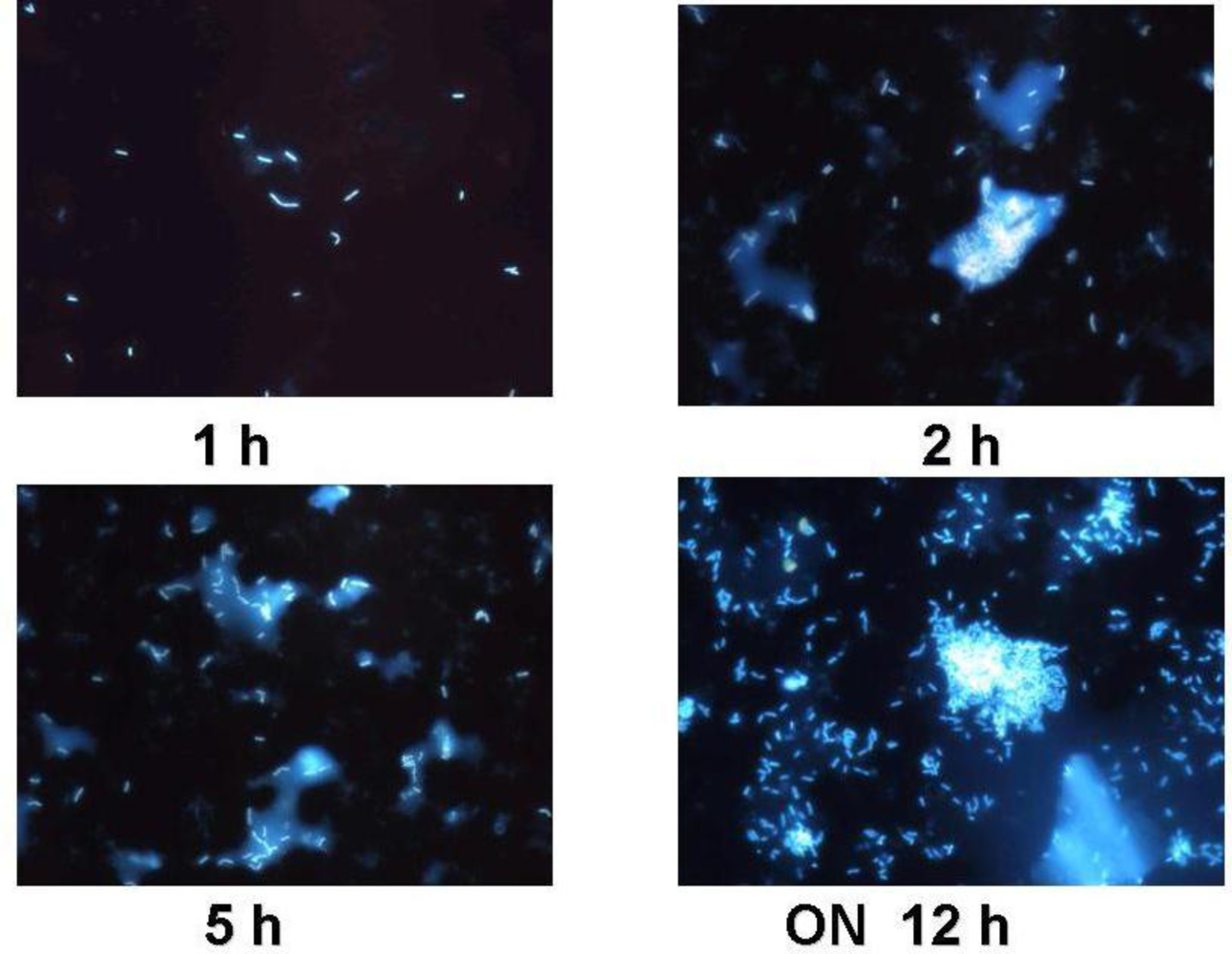
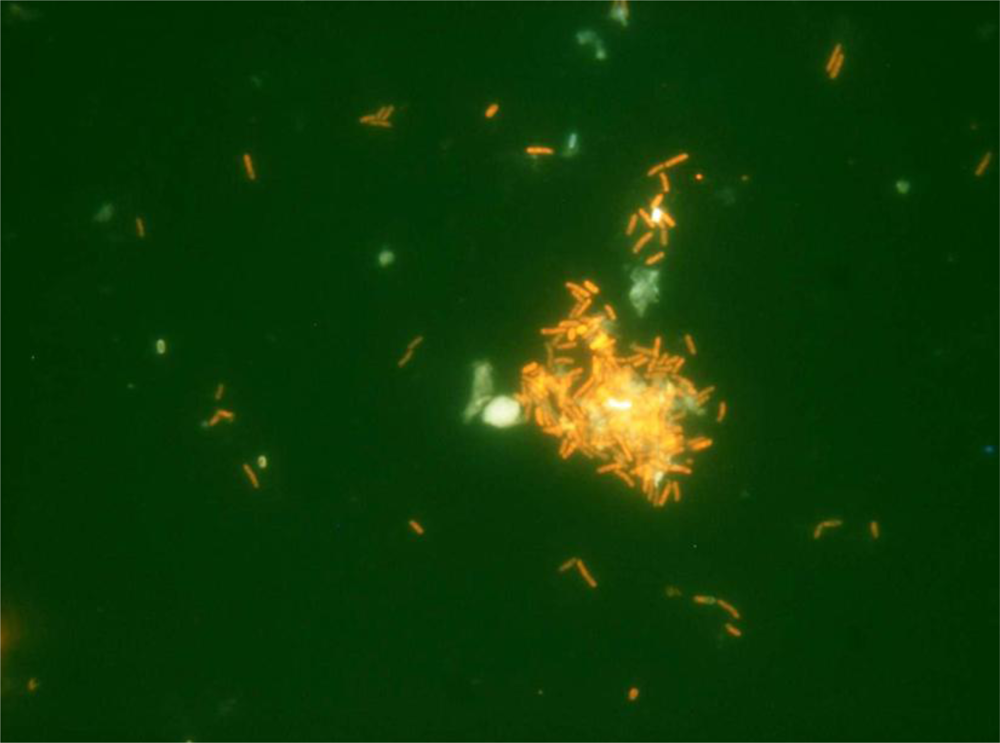
<p>Bacteria were supplemented at the same concentration for Treatment 1 (<italic>B. subtilis</italic>) and Treatment 2 (<italic>B. megaterium</italic>)(<italic>P</italic> &gt; 0.05), containing both formulations approximately 1.2 × 10<sup>4</sup> CFU/g. After a year, feeds did not show any considerable variation in bacterial concentration and viability. <italic>B. subtilis</italic> strain was recovered from B + Bs feed and DAPI stain cells methodology was accomplished for probiotic detection and quantification (<xref ref-type="fig" rid="f1-marinedrugs-09-01119">Figure 1</xref>) [<xref ref-type="bibr" rid="b22-marinedrugs-09-01119">22</xref>,<xref ref-type="bibr" rid="b23-marinedrugs-09-01119">23</xref>]. Furthermore, B + Bs isolated <italic>B. subtilis</italic> strain was grown until middle exponential phase in Shaeffer’s sporulation medium to perform Fluorescent <italic>in situ</italic> Hybridization (FISH) (<xref ref-type="fig" rid="f2-marinedrugs-09-01119">Figure 2</xref>), using low G + C specific probe for cell viability quantification [<xref ref-type="bibr" rid="b23-marinedrugs-09-01119">23</xref>,<xref ref-type="bibr" rid="b26-marinedrugs-09-01119">26</xref>]. In addition, bacterial identification by PCR using <italic>Bacillus</italic> specific oligonucleotides was carried out [<xref ref-type="bibr" rid="b14-marinedrugs-09-01119">14</xref>]. DNA samples from B + Bs feed isolated bacteria amplified a 640 bp expected fragment size, from the <italic>16S rDNA</italic> gene of <italic>B. subtilis</italic> (data not shown).</p></sec>
<sec>
<label>3.2.</label>
<title>Shrimp Growth</title>
<p>Throughout the feeding trials water temperature was maintained at 28.5 ± 2.22 °C, 35.2 ± 1.19 ppt salinity and 6.7 ± 0.20 mg/L of oxygen concentration. Total ammonium 0.1 ± 0.07 mg/L; nitrite 0.03 ± 0.01 mg/L and pH 7.6 ± 0.46; were set within acceptable ranges [<xref ref-type="bibr" rid="b27-marinedrugs-09-01119">27</xref>]. Statistically significant differences within parameters were not observed. Shrimps initial weight was not different among the treatments. However, at the end of the trial organisms fed with Treatment 1 (B + Bs) reached the greatest growth performance. Additionally, they did exhibited significant differences with respect to the other treatments (<xref ref-type="table" rid="t2-marinedrugs-09-01119">Table 2</xref>). It is important to remember that Treatments 1, 2 and 3 were formulated with vegetable protein sources (Experimental Section). In this sense, <italic>B. subtilis</italic> strain utilized produce enzymes to hydrolyze feed ingredients from vegetable origin [<xref ref-type="bibr" rid="b10-marinedrugs-09-01119">10</xref>].</p>
<p>Food Conversion Ratio (FCR) was statistically different between treatments, showing the best results in shrimps fed with Treatment 1, where <italic>B. subtilis</italic> strain had been included (<xref ref-type="table" rid="t2-marinedrugs-09-01119">Table 2</xref>). SBM-CHOs basal feed (B) exhibited the FCR higher values (2.49 ± 0.15) as we expected, due to high levels of vegetable ingredients and non probiotic bacteria inclusion (<xref ref-type="table" rid="t2-marinedrugs-09-01119">Table 2</xref>). SBM-CHOs basal feed + <italic>Bacillus megaterium</italic> (B + Bm) showed less capabilities to digest vegetable ingredients than <italic>B. subtilis</italic> did. However, Treatment 2 shrimps still obtained better FCR than basal feed treatment (B) and no FCR differences were shown with respect to FM commercial feed treatment (C) (<xref ref-type="table" rid="t2-marinedrugs-09-01119">Table 2</xref>). Shrimp survival rate ranged from 96 to 100%, showing no significant differences among treatments (<italic>p</italic> &gt; 0.05). However, shrimps fed with Treatment 1 exhibited a higher survival rate (<xref ref-type="table" rid="t2-marinedrugs-09-01119">Table 2</xref>).</p></sec>
<sec>
<label>3.3.</label>
<title>Hemolymph Metabolites Quantification</title>
<p>Serum Plasma glucose levels, lactate and total cholesterol were positively affected, principally those presented by shrimps from Treatment 1 (<xref ref-type="table" rid="t3-marinedrugs-09-01119">Table 3</xref>). Feeds formulation and growth environmental conditions are dominant factors affecting hemolymph metabolites concentration and shrimp performance [<xref ref-type="bibr" rid="b28-marinedrugs-09-01119">28</xref>]. In this research, hemolymph metabolites were up-regulated by supplementing a vegetable feed formulation with a <italic>B. subtilis</italic> probiotic strain (<xref ref-type="table" rid="t3-marinedrugs-09-01119">Table 3</xref>). High glucose, lactate and cholesterol levels obtained with <italic>B. subtilis</italic> diet (B + Bs), were significantly different with respect to the other treatments (<italic>p</italic> &lt; 0.05). Furthermore, results obtained with Treatments 2, 3 and 4, did not exhibit significant differences between them (<italic>p</italic> &gt; 0.05). Total hemocyte counts (THC) were also positively affected in Treatment 1 and were significantly different (<italic>p</italic> &lt; 0.05) from the other treatments (<xref ref-type="table" rid="t3-marinedrugs-09-01119">Table 3</xref>). Recent studies provide evidence that greater amounts of dietary protein levels improve immune system functionality, increasing shrimp’s hemocytes concentration [<xref ref-type="bibr" rid="b15-marinedrugs-09-01119">15</xref>]. However, in this study Treatment 1 shrimps with 27.41% vegetable protein level have reached greater hemocytes counts than Treatment 4 that contains 36.39% animal protein. SBM protein could be an obstacle to protein digestion and assimilation, due to its anti-nutritional compounds [<xref ref-type="bibr" rid="b9-marinedrugs-09-01119">9</xref>,<xref ref-type="bibr" rid="b29-marinedrugs-09-01119">29</xref>].</p>
<p>Pascual and coworkers also demonstrated the CHOs digestion deficiency from cultivated shrimps. In this sense, low levels of shrimps carbohydrolases is a conditional deficiency from using high amounts of complex carbohydrates, like starch [<xref ref-type="bibr" rid="b13-marinedrugs-09-01119">13</xref>,<xref ref-type="bibr" rid="b14-marinedrugs-09-01119">14</xref>,<xref ref-type="bibr" rid="b25-marinedrugs-09-01119">25</xref>]. However, in this work we demonstrated that using the appropriate probiotic bacteria; protein and carbohydrates origin and levels seems to be not so important.</p></sec>
<sec>
<label>3.4.</label>
<title>Stress Condition Evaluation</title>
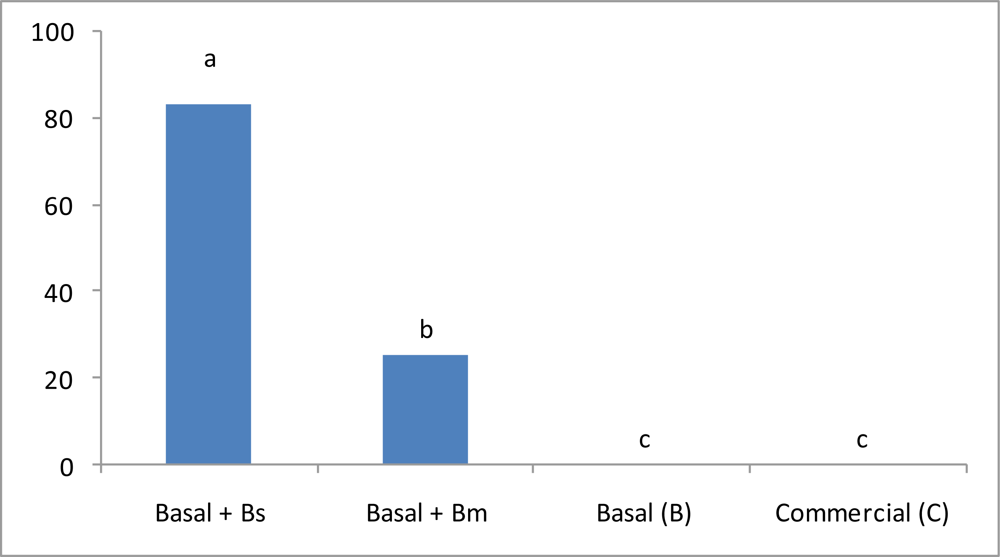
<p>Surprising results were obtained with the ammonia test evaluation. Survival rate was significantly affected and only Treatment 1 shrimps presented good survival results (<xref ref-type="fig" rid="f3-marinedrugs-09-01119">Figure 3</xref>). In this respect, it is conclusive that functional feeds promote response capabilities improving shrimps health status and performance. Treatments without probiotic strains had 100% mortalities in 24 h in the ammonia test.</p>
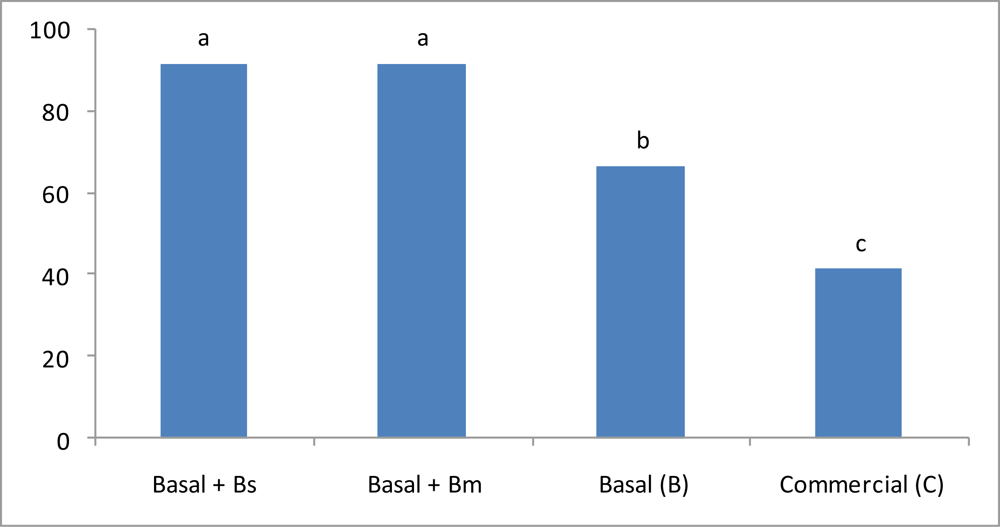
<p>On the other hand, oxygen static test shrimps survival rate was not so drastically affected as in the ammonia test, but oxygen survival results still point out the vital importance of including probiotic feed for shrimp aquaculture (<xref ref-type="fig" rid="f4-marinedrugs-09-01119">Figure 4</xref>). Treatments 1 and 2 shrimps survival rate was over 90% and did not display significant differences (<italic>p</italic> &gt; 0.05). Comparing survival rates between Treatment 1 and Treatment 2, it is clear that even when <italic>B. megaterium</italic> did not have all <italic>B. subtilis</italic> probiotic capabilities, <italic>B. megaterium</italic> is a good candidate for improving culture oxygen concentration (<xref ref-type="fig" rid="f4-marinedrugs-09-01119">Figure 4</xref>).</p></sec></sec>
<sec sec-type="discussion">
<label>4.</label>
<title>Discussion</title>
<p>Functional feed development represents one of the greatest areas of opportunity in the nutritional world. Functional feed must promote growth and health of the cultivated organisms [<xref ref-type="bibr" rid="b29-marinedrugs-09-01119">29</xref>], improve immune system and induce physiological benefits beyond traditional feeds [<xref ref-type="bibr" rid="b30-marinedrugs-09-01119">30</xref>]. In addition, functional feeds must be economically attractive to the aquaculture industry and environmentally friendly.</p>
<p>In this respect, animal products content in feed must be totally or partially eliminated from feed formulations and, inclusion of alternative-economical vegetable protein sources needs to be increased. Furthermore, the type and amounts of carbohydrate content is also of great concern for economical, environmental and health issues. Vegetable protein-carbohydrate well balanced functional feed could maximize benefit to animals, avoiding economical losses, environmental pollutants and diseases. However, proteases and carbohydrolases shrimp deficiency is a major impediment to digest vegetable sources limiting its high level inclusion in shrimp formulations [<xref ref-type="bibr" rid="b10-marinedrugs-09-01119">10</xref>]. Soybean meal antinutritional compounds and starch complex carbohydrates are good examples of undesirable-indigestible ingredients in shrimp vegetable-based feed formulations [<xref ref-type="bibr" rid="b9-marinedrugs-09-01119">9</xref>,<xref ref-type="bibr" rid="b15-marinedrugs-09-01119">15</xref>,<xref ref-type="bibr" rid="b29-marinedrugs-09-01119">29</xref>].</p>
<p>Including probiotic bacteria in feed has emerged as a new field with huge application in the aquaculture industry [<xref ref-type="bibr" rid="b17-marinedrugs-09-01119">17</xref>,<xref ref-type="bibr" rid="b18-marinedrugs-09-01119">18</xref>]. Today, <italic>Bacillus</italic> species are the most investigated bacteria for animal probiotic development due to: its growth nutrients versatility, high enzyme levels production and secretion of antimicrobial peptides [<xref ref-type="bibr" rid="b31-marinedrugs-09-01119">31</xref>–<xref ref-type="bibr" rid="b33-marinedrugs-09-01119">33</xref>]. In addition, <italic>B. subtilis</italic> is generally recognized as safe (GRAS) by the food and drug administration (FDA), meaning it is harmless to animal and humans [<xref ref-type="bibr" rid="b34-marinedrugs-09-01119">34</xref>,<xref ref-type="bibr" rid="b35-marinedrugs-09-01119">35</xref>]. In this work, we used previously characterized <italic>Bacillus</italic> strains as potential probiotics [<xref ref-type="bibr" rid="b10-marinedrugs-09-01119">10</xref>] to formulate shrimps functional feeds. <xref ref-type="table" rid="t1-marinedrugs-09-01119">Table 1</xref> shows proximal composition of vegetable-basal feed and a fishmeal formulation. In this sense, literature indicates that optimal protein and carbohydrates concentration in shrimp feeds must be 30% and 20% respectively [<xref ref-type="bibr" rid="b25-marinedrugs-09-01119">25</xref>,<xref ref-type="bibr" rid="b29-marinedrugs-09-01119">29</xref>]. Higher protein inclusion levels are not necessary for shrimp development and could be an important aspect for water quality deterioration and cost increases. In addition, lower protein levels than recommended induce growth alteration and diseases by changing the immunological response capabilities and health of the shrimps [<xref ref-type="bibr" rid="b28-marinedrugs-09-01119">28</xref>,<xref ref-type="bibr" rid="b29-marinedrugs-09-01119">29</xref>]. Nevertheless, commercial feeds contain almost 40% FM protein increasing costs and environmental deterioration (<xref ref-type="table" rid="t1-marinedrugs-09-01119">Table 1</xref>). In this sense, 100% replacement of FM by SBM has not been successfully achieved in shrimp feeds until now; only replacement of 20% has been obtained [<xref ref-type="bibr" rid="b36-marinedrugs-09-01119">36</xref>]. In this work we obtained significant growth differences between shrimps fed with a commercial FM and a SBM-CHOs feed formulation (<xref ref-type="table" rid="t1-marinedrugs-09-01119">Table 1</xref>) using a specifically selected <italic>B. subtilis</italic> probiotic strain (<xref ref-type="table" rid="t2-marinedrugs-09-01119">Table 2</xref>). Furthermore, FCR results obtained for Treatment 1 shrimps presented significant differences compared to the other treatments (<xref ref-type="table" rid="t2-marinedrugs-09-01119">Table 2</xref>). The inclusion of a specifically selected <italic>B. subtilis</italic> strain in a SBM-CHOs basal-feed, transformed this formulation to an excellent alternative for shrimp nutrition (<xref ref-type="table" rid="t2-marinedrugs-09-01119">Table 2</xref>). Comparing results from Treatment 1 and Treatment 3, where <italic>B. subtilis</italic> was and was not included respectively (<xref ref-type="table" rid="t2-marinedrugs-09-01119">Table 2</xref>), we concluded that <italic>B. subtilis</italic> was the principal factor for SBM-CHOs feed digestion and assimilation. Moreover, group and specific PCR analysis demonstrated that <italic>B. subtilis</italic> represented almost 90% of the total bacterial diversity in shrimp intestine and feces (data not shown) [<xref ref-type="bibr" rid="b22-marinedrugs-09-01119">22</xref>,<xref ref-type="bibr" rid="b23-marinedrugs-09-01119">23</xref>]. In addition to a better growth, survival and FCR presented by Treatment 1 shrimps where <italic>B. subtilis</italic> was included, also; glucose, cholesterol and total hemocyte counts (THC) were higher and significantly different with respect to the other treatments (<xref ref-type="table" rid="t3-marinedrugs-09-01119">Table 3</xref>). Shrimp immune-like system and health has a strong protein-carbohydrate digestion-assimilation relationship [<xref ref-type="bibr" rid="b28-marinedrugs-09-01119">28</xref>]. In this sense, hemolymph metabolites like those previously mentioned could be considered direct indicators of shrimp health. These higher level hemolymph metabolites signal efficient nutrients assimilation when they concord with healthy growth, good survival and a competitive FCR (<xref ref-type="table" rid="t2-marinedrugs-09-01119">Tables 2</xref> and <xref ref-type="table" rid="t3-marinedrugs-09-01119">3</xref>). The THC, glucose and cholesterol levels obtained from Treatment 1 shrimps were higher and significantly different than in the other treatments. In addition, these results are strong evidence that SBM replaced FM without any negative consequence actually; betters results were obtained using SBM and <italic>B. subtilis</italic> (<xref ref-type="table" rid="t2-marinedrugs-09-01119">Tables 2</xref> and <xref ref-type="table" rid="t3-marinedrugs-09-01119">3</xref>). On the other hand, shrimp’s feed containing a high level of carbohydrates could lead to animal deficiencies and even mortality.</p>
<p>Pascual and coworkers demonstrated that hemolymph metabolites including lactate, glucose, proteins and immune response of the wild shrimps were better than those from cultured shrimps [<xref ref-type="bibr" rid="b15-marinedrugs-09-01119">15</xref>]. Essentially, they concluded that wild and farmed shrimp responded differently to diets including the same high levels of carbohydrates by cultured shrimps losing some gene expression capacity. Furthermore, Arena and coworkers in 2003 mentioned that shrimp’s limited starch digestion capacity was related to a repression of amylase alleles that, at the same time, limit dietary CHOs metabolism in general.</p>
<p>The concept that carbohydrates can substitute proteins as energy source in shrimp feed is already documented [<xref ref-type="bibr" rid="b37-marinedrugs-09-01119">37</xref>]. However, as we mentioned previously, cultured shrimps have severe restrictions for dietary CHOs utilization [<xref ref-type="bibr" rid="b15-marinedrugs-09-01119">15</xref>,<xref ref-type="bibr" rid="b38-marinedrugs-09-01119">38</xref>]. Furthermore, the inability of the shrimp’s alfa-1,4-glucosidase to cleave the alfa-1,6-bond of amylopectin resulted in low growth rates and energy waste [<xref ref-type="bibr" rid="b13-marinedrugs-09-01119">13</xref>,<xref ref-type="bibr" rid="b14-marinedrugs-09-01119">14</xref>]. In addition, melibiose, raffinose and stachyose oligosaccharides constitute 15% of SBM and are considered antinutritional compounds to shrimp development [<xref ref-type="bibr" rid="b39-marinedrugs-09-01119">39</xref>]. Probiotic bacteria are frequently used as feed additives to farm and pet animals. In shrimp feeds, the probiotic bacteria can facilitate digestion of protein constituents and carbohydrates, because the enzymes produced by the bacteria can complement the shrimp enzyme activity, increasing food digestibility. In addition, the probiotic enzymes have a broader pH, temperature and target range than the shrimp enzymes prolonging digestion time [<xref ref-type="bibr" rid="b10-marinedrugs-09-01119">10</xref>]. <xref ref-type="table" rid="t3-marinedrugs-09-01119">Table 3</xref> indirectly shows carbohydrates degradation capacity of the <italic>B. subtilis</italic> probiotic enzymes. Glucose, cholesterol and THC from Treatment 1 shrimps where <italic>B. subtilis</italic> was included, were higher and statistically different from the other treatments (<xref ref-type="table" rid="t3-marinedrugs-09-01119">Table 3</xref>). Considering high hemolymph metabolite levels of carbohydrates with regard to probiotic digestion capacity and shrimp health, we concluded that our <italic>B. subtilis</italic> strain enhances CHOs digestion and assimilation and, induced a healthy condition in <italic>L. vannamei</italic> (<xref ref-type="table" rid="t2-marinedrugs-09-01119">Tables 2</xref> and <xref ref-type="table" rid="t3-marinedrugs-09-01119">3</xref>).</p>
<p>Lactate is the end product of glycolysis after a reduction of pyruvate by NADH [<xref ref-type="bibr" rid="b40-marinedrugs-09-01119">40</xref>] and, in this sense [<xref ref-type="bibr" rid="b41-marinedrugs-09-01119">41</xref>], showed that a high percentage of glucose metabolized during glycolysis in Crustacea (50%) is directed to form amino acids through the transamination pathway. In this sense, the almost 50% CHOs added to Treatment 1 where <italic>B. subtilis</italic> was included, in addition to energy production, CHOs seem to be contributing to protein generation, growth and improvement of shrimp immune system, because levels of lactate were higher and statistically different from the other treatments (<xref ref-type="table" rid="t2-marinedrugs-09-01119">Tables 2</xref> and <xref ref-type="table" rid="t3-marinedrugs-09-01119">3</xref>) [<xref ref-type="bibr" rid="b15-marinedrugs-09-01119">15</xref>,<xref ref-type="bibr" rid="b28-marinedrugs-09-01119">28</xref>]. Additionally, high levels of lactate start glycogen synthesis by diminishing hyperglycemic hormone (CHH) and increasing glycogen synthetase [<xref ref-type="bibr" rid="b42-marinedrugs-09-01119">42</xref>]. Glucose is the principal energy source in animals, and shrimps are not the exception. Energy production throughout glycolisis and Krebs cycle depends principally on CHOs type and levels in the formulation. Glycogen is an energy storage source, generated when high levels of glucose-lactate is present in shrimp hemolymph, due to adequate CHOs digestion-assimilation-metabolism processes. Glycogen-glucose reconversion throughout glycogenolisis is carried out to satisfy unexpected requirements of energy, such as during starvation, and for fast response to stress and diseases. In this sense, ammonia stress-experiments carried out in this work have shown that Treatment 1 shrimps, where <italic>B. subtilis</italic> was included, tolerated well high levels of ammonia throughout the 24 hrs of the experiment (<xref ref-type="fig" rid="f3-marinedrugs-09-01119">Figure 3</xref>). Treatment 2, shrimps where <italic>B. megaterium</italic> was included, only presented a 25% survival rate (<xref ref-type="fig" rid="f3-marinedrugs-09-01119">Figure 3</xref>). Different responses between Treatment 1 and 2 could be due to <italic>B. megaterium</italic> inducing: (a) lower levels of glucose-lactate and hence lower levels of energy source; and/or (b) by the lower capacity of <italic>B. megaterium</italic> to convert or transform ammonia in shrimp hemolymph and/or in water. Taking into account that Treatments 3 and 4 do not present survival data and that glucose and lactate were not statistically different between Treatments 2, 3 and 4, we can hypothesize that Treatment 2 shrimps survived by a direct ammonia conversion-transformation reaction accomplished by <italic>B. megaterium</italic>. It is important to remember that Treatments 3 and 4 had no <italic>Bacillus</italic> probiotic strains in its formulation.</p>
<p>In 2000 [<xref ref-type="bibr" rid="b43-marinedrugs-09-01119">43</xref>] reported that 100% mortality occurred at 30 mg/L of ammonia in 24 h of exposure. However, in this work, Treatment 1 shrimps, where <italic>B. subtilis</italic> was included to a SBM-CHOs basal feed, had an 80% survival rate on 60 mg/L of ammonia concentration; results that have not previously been reported (<xref ref-type="fig" rid="f3-marinedrugs-09-01119">Figure 3</xref>). In addition, results obtained with Treatment 1 demonstrated that shrimp health condition generated by the functional feed formulated using the <italic>B. subtilis</italic> probiotic strain and the vegetable basal feed, was better than the other treatments (<xref ref-type="table" rid="t2-marinedrugs-09-01119">Tables 2</xref> and <xref ref-type="table" rid="t3-marinedrugs-09-01119">3</xref>, <xref ref-type="fig" rid="f3-marinedrugs-09-01119">Figure 3</xref>). Further experiments will be conducted to specifically determine the <italic>B. subtilis</italic> ammonia conversion-transformation capacity. On the other hand, even when oxygen depletion stress-experiments do not present such drastic mortality results as the one presented by ammonia experiments, 35 and 60% shrimp mortality was obtained by the basal (B) and commercial feed (C), respectively (<xref ref-type="fig" rid="f4-marinedrugs-09-01119">Figure 4</xref>).</p>
<p>In all aquatic systems, the toxicity of excreted nitrogen compounds is the most limiting parameter once adequate dissolved oxygen levels are maintained [<xref ref-type="bibr" rid="b44-marinedrugs-09-01119">44</xref>]. Ammonia is the main nitrogenous product excreted by crustaceans [<xref ref-type="bibr" rid="b45-marinedrugs-09-01119">45</xref>], and additionally is produced from the ammonification of organic matter in a culture system [<xref ref-type="bibr" rid="b46-marinedrugs-09-01119">46</xref>]. In this sense, basal feed formulated contains almost 25% less protein than the commercial feed (<xref ref-type="table" rid="t1-marinedrugs-09-01119">Table 1</xref>), which could be the reason why Treatment 3 (basal feed) exhibited higher shrimp survival than Treatment 4 (commercial feed)(<xref ref-type="fig" rid="f4-marinedrugs-09-01119">Figure 4</xref>). On the other hand, Treatments 1 and 2 presented approx 90% shrimps survival, even when energy sources, growth and other hemolymph parameters were statistically different between both treatments. In this sense, <xref ref-type="fig" rid="f4-marinedrugs-09-01119">Figure 4</xref> results allowed hypothesizing that Treatment 2 shrimps’ positive effects was due to the accumulation of the 25% ammonia conversion-transformation capacity of <italic>B. megaterium</italic> (<xref ref-type="fig" rid="f3-marinedrugs-09-01119">Figure 3</xref>) plus the 65% shrimp default survival presented by the basal feed (B) (<xref ref-type="fig" rid="f4-marinedrugs-09-01119">Figure 4</xref>). Additionally, 90% shrimp survival in Treatment 1 could be the consequence of several factors, such as: (a) ammonia conversion-transformation by the <italic>B. subtilis</italic> probiotic strain; (b) less content-production of ammonia by the functional feed; (c) ammonia less oxygen consumption by the functional feed; and (d) by the extensive physiological and biochemical parameters exhibited.</p></sec>
<sec sec-type="conclusions">
<label>5.</label>
<title>Conclusions</title>
<p>The results obtained in this work suggest the beginning of a new era shrimp/fish functional feed formulation, where animal products inclusion in feed could be totally replaced with vegetable protein and carbohydrates sources, utilizing the appropriate probiotic bacteria. Specifically selected <italic>B. subtilis</italic> strains are recommended to formulate functional and economical feeds containing high levels of vegetable; protein and carbohydrates as main dietary sources in <italic>L. vannamei</italic> cultures.</p></sec></body>
<back>
<ack>
<p>The authors wish to thank Rosalía Contreras for her technical assistance and Mauro Ochoa for English language assistance. This work was done with support of FUNDACION PRODUCE B.C., Mexico and CONACYT project #CB-131115.</p></ack>
<ref-list>
<title>References</title>
<ref id="b1-marinedrugs-09-01119"><label>1.</label><citation citation-type="book"><collab>FAO</collab><source>The State of World Fisheries and Aquaculture</source><publisher-name>FAO Fisheries Department</publisher-name><publisher-loc>Rome, Italy</publisher-loc><year>2006</year><fpage>159</fpage></citation></ref>
<ref id="b2-marinedrugs-09-01119"><label>2.</label><citation citation-type="book"><person-group person-group-type="author"><name><surname>Tacon</surname><given-names>A</given-names></name><name><surname>Nates</surname><given-names>S</given-names></name><name><surname>McNeil</surname><given-names>R</given-names></name></person-group><article-title>Overview of farming systems for marine shrimp with particular reference to feeds and feeding</article-title><source>Shrimp Culture: Economics, Market and Trade</source><person-group person-group-type="editor"><name><surname>Leung</surname><given-names>P</given-names></name><name><surname>Engle</surname><given-names>C</given-names></name></person-group><publisher-name>Blackwell Publishers</publisher-name><publisher-loc>Ames, IA, USA</publisher-loc><year>2006</year><comment>Chapter 20</comment><fpage>301</fpage><lpage>314</lpage></citation></ref>
<ref id="b3-marinedrugs-09-01119"><label>3.</label><citation citation-type="journal"><person-group person-group-type="author"><name><surname>Tacon</surname><given-names>A</given-names></name><name><surname>Metian</surname><given-names>M</given-names></name></person-group><article-title>Global overview on the use of fish meal and fish oil in industrially compounded aquafeeds: Trends and future prospects</article-title><source>Aquaculture</source><year>2008</year><volume>285</volume><fpage>146</fpage><lpage>158</lpage><pub-id pub-id-type="doi">10.1016/j.aquaculture.2008.08.015</pub-id></citation></ref>
<ref id="b4-marinedrugs-09-01119"><label>4.</label><citation citation-type="journal"><person-group person-group-type="author"><name><surname>Bautista</surname><given-names>M</given-names></name><name><surname>Eusebio</surname><given-names>P</given-names></name><name><surname>Welsh</surname><given-names>T</given-names></name></person-group><article-title>Utilization of feed pea, <italic>Pisum sativum,</italic> meal as a protein source in practical diets juvenile tiger shrimp</article-title><source>Penaeus monodon Aquaculture</source><year>2003</year><volume>225</volume><fpage>121</fpage><lpage>131</lpage><pub-id pub-id-type="doi">10.1016/S0044-8486(03)00284-9</pub-id></citation></ref>
<ref id="b5-marinedrugs-09-01119"><label>5.</label><citation citation-type="journal"><person-group person-group-type="author"><name><surname>Hardy</surname><given-names>RW</given-names></name></person-group><article-title>Alternate protein sources</article-title><source>Feed Management</source><year>1999</year><volume>50</volume><fpage>25</fpage><lpage>28</lpage></citation></ref>
<ref id="b6-marinedrugs-09-01119"><label>6.</label><citation citation-type="journal"><person-group person-group-type="author"><name><surname>Naylor</surname><given-names>RL</given-names></name><name><surname>Goldburg</surname><given-names>RJ</given-names></name><name><surname>Primavera</surname><given-names>JH</given-names></name><name><surname>Kautsky</surname><given-names>N</given-names></name><name><surname>Beveridge</surname><given-names>MCM</given-names></name><name><surname>Clay</surname><given-names>J</given-names></name><name><surname>Folke</surname><given-names>C</given-names></name><name><surname>Lubchenco</surname><given-names>J</given-names></name><name><surname>Mooney</surname><given-names>H</given-names></name><name><surname>Troell</surname><given-names>M</given-names></name></person-group><article-title>Effect of aquaculture on world fish supplies</article-title><source>Nature</source><year>2000</year><volume>405</volume><fpage>1017</fpage><lpage>1024</lpage><pub-id pub-id-type="doi">10.1038/35016500</pub-id><pub-id pub-id-type="pmid">10890435</pub-id></citation></ref>
<ref id="b7-marinedrugs-09-01119"><label>7.</label><citation citation-type="journal"><person-group person-group-type="author"><name><surname>Amaya</surname><given-names>E</given-names></name><name><surname>Daves</surname><given-names>D</given-names></name><name><surname>Rouse</surname><given-names>D</given-names></name></person-group><article-title>Replacement of fish meal in practical diets for the Pacific white shrimp (<italic>Litopenaeus vanname</italic>) reared under pond conditions</article-title><source>Aquaculture</source><year>1997a</year><volume>262</volume><fpage>393</fpage><lpage>401</lpage></citation></ref>
<ref id="b8-marinedrugs-09-01119"><label>8.</label><citation citation-type="journal"><person-group person-group-type="author"><name><surname>Amaya</surname><given-names>EA</given-names></name><name><surname>Daves</surname><given-names>DA</given-names></name><name><surname>Rouse</surname><given-names>DB</given-names></name></person-group><article-title>Alternative diets for the Pacific white shrimp <italic>Litopenaeus vannamei</italic></article-title><source>Aquaculture</source><year>1997b</year><volume>262</volume><fpage>419</fpage><lpage>425</lpage></citation></ref>
<ref id="b9-marinedrugs-09-01119"><label>9.</label><citation citation-type="book"><person-group person-group-type="author"><name><surname>Forster</surname><given-names>I</given-names></name><name><surname>Dominy</surname><given-names>W</given-names></name><name><surname>Tacon</surname><given-names>A</given-names></name></person-group><article-title>The use of concentrates and other soy products in shrimp feeds</article-title><source>Avances en Nutrición Acuícola VI</source><person-group person-group-type="editor"><name><surname>Cruz-Suárez</surname><given-names>L</given-names></name><name><surname>Ricque</surname><given-names>D</given-names></name><name><surname>Tapia</surname><given-names>M</given-names></name><name><surname>Gaxiola</surname><given-names>M</given-names></name><name><surname>Simoes</surname><given-names>N</given-names></name></person-group><publisher-name>Memorias del VI Simposium Internacional de Nutrición Acuícola</publisher-name><publisher-loc>Cancún, Quintana Roo, México</publisher-loc><year>2002</year></citation></ref>
<ref id="b10-marinedrugs-09-01119"><label>10.</label><citation citation-type="journal"><person-group person-group-type="author"><name><surname>Ochoa</surname><given-names>SJL</given-names></name><name><surname>Olmos</surname><given-names>SJ</given-names></name></person-group><article-title>The functional property of <italic>Bacillus</italic> for shrimp feeds</article-title><source>Food Microbiol</source><year>2006</year><volume>23</volume><fpage>519</fpage><lpage>525</lpage><pub-id pub-id-type="doi">10.1016/j.fm.2005.10.004</pub-id><pub-id pub-id-type="pmid">16943046</pub-id></citation></ref>
<ref id="b11-marinedrugs-09-01119"><label>11.</label><citation citation-type="journal"><person-group person-group-type="author"><name><surname>Tacon</surname><given-names>AGJ</given-names></name><name><surname>Dominy</surname><given-names>WG</given-names></name><name><surname>Pruder</surname><given-names>GD</given-names></name></person-group><article-title>Global trends and challenges in aquafeeds for marine shrimp</article-title><source>AquaFeed Int</source><year>1998</year><volume>4</volume><fpage>28</fpage><lpage>35</lpage></citation></ref>
<ref id="b12-marinedrugs-09-01119"><label>12.</label><citation citation-type="journal"><person-group person-group-type="author"><name><surname>Swick</surname><given-names>RA</given-names></name></person-group><article-title>Soybean meal quality: assessing the characteristics of a major aquatic feed ingredient</article-title><source>Glob Aquac Advocate</source><year>1998</year><volume>5</volume><fpage>46</fpage><lpage>49</lpage></citation></ref>
<ref id="b13-marinedrugs-09-01119"><label>13.</label><citation citation-type="journal"><person-group person-group-type="author"><name><surname>Le Chevalier</surname><given-names>P</given-names></name><name><surname>Van Wormhoudt</surname><given-names>A</given-names></name></person-group><article-title>Alpha-glucosidase from the hepatopancreas of the shrimp, <italic>Penaeus vannamei</italic> (Crustacea-Decapoda)</article-title><source>J Exp Zool</source><year>1998</year><volume>280</volume><fpage>384</fpage><lpage>394</lpage><pub-id pub-id-type="doi">10.1002/(SICI)1097-010X(19980415)280:6&lt;384::AID-JEZ2&gt;3.0.CO;2-J</pub-id><pub-id pub-id-type="pmid">9542155</pub-id></citation></ref>
<ref id="b14-marinedrugs-09-01119"><label>14.</label><citation citation-type="journal"><person-group person-group-type="author"><name><surname>Arellano</surname><given-names>CF</given-names></name><name><surname>Olmos</surname><given-names>SJ</given-names></name></person-group><article-title>Thermostable α-1,4- and α-1–6-glucosidase enzymes from <italic>Bacillus</italic> sp. isolated from a marine environment</article-title><source>World J Microbiol Biotechnol</source><year>2002</year><volume>18</volume><fpage>791</fpage><lpage>795</lpage><pub-id pub-id-type="doi">10.1023/A:1020433210432</pub-id></citation></ref>
<ref id="b15-marinedrugs-09-01119"><label>15.</label><citation citation-type="journal"><person-group person-group-type="author"><name><surname>Pascual</surname><given-names>C</given-names></name><name><surname>Arena</surname><given-names>L</given-names></name><name><surname>Cuzon</surname><given-names>G</given-names></name><name><surname>Gaxiola</surname><given-names>G</given-names></name><name><surname>Tabeada</surname><given-names>G</given-names></name><name><surname>Valenzuela</surname><given-names>M</given-names></name><name><surname>Rosas</surname><given-names>C</given-names></name></person-group><article-title>Effect of a size-based selection program on blood metabolites and immune response of <italic>Litopenaeus vannamei</italic> juveniles fed different dietary carbohydrate levels</article-title><source>Aquaculture</source><year>2004a</year><volume>230</volume><fpage>405</fpage><lpage>416</lpage><pub-id pub-id-type="doi">10.1016/S0044-8486(03)00438-1</pub-id></citation></ref>
<ref id="b16-marinedrugs-09-01119"><label>16.</label><citation citation-type="journal"><person-group person-group-type="author"><name><surname>Gatesoupe</surname><given-names>FJ</given-names></name></person-group><article-title>The use of probiotics in aquaculture</article-title><source>Aquaculture</source><year>1999</year><volume>180</volume><fpage>147</fpage><lpage>165</lpage><pub-id pub-id-type="doi">10.1016/S0044-8486(99)00187-8</pub-id></citation></ref>
<ref id="b17-marinedrugs-09-01119"><label>17.</label><citation citation-type="journal"><person-group person-group-type="author"><name><surname>Verschuere</surname><given-names>L</given-names></name><name><surname>Rombaut</surname><given-names>G</given-names></name><name><surname>Sorgeloos</surname><given-names>P</given-names></name><name><surname>Verstraete</surname><given-names>W</given-names></name></person-group><article-title>Probiotic Bacteria as Biological Control Agents in Aquaculture</article-title><source>Microbiol Mol Biol Rev</source><year>2000</year><volume>64</volume><fpage>655</fpage><lpage>671</lpage><pub-id pub-id-type="doi">10.1128/MMBR.64.4.655-671.2000</pub-id><pub-id pub-id-type="pmid">11104813</pub-id></citation></ref>
<ref id="b18-marinedrugs-09-01119"><label>18.</label><citation citation-type="journal"><person-group person-group-type="author"><name><surname>Farzanfar</surname><given-names>A</given-names></name></person-group><article-title>The use of probiotics in shrimp aquaculture</article-title><source>FEMS Immunol Med Microbiol</source><year>2006</year><volume>48</volume><fpage>149</fpage><lpage>158</lpage><pub-id pub-id-type="doi">10.1111/j.1574-695X.2006.00116.x</pub-id><pub-id pub-id-type="pmid">17064272</pub-id></citation></ref>
<ref id="b19-marinedrugs-09-01119"><label>19.</label><citation citation-type="journal"><person-group person-group-type="author"><name><surname>Lin</surname><given-names>HZ</given-names></name><name><surname>Guo</surname><given-names>Z</given-names></name><name><surname>Yang</surname><given-names>Y</given-names></name><name><surname>Zheng</surname><given-names>W</given-names></name><name><surname>Li</surname><given-names>ZJ</given-names></name></person-group><article-title>Effect of dietay probiotics on apparent digestibility coefficients of nutrients of white shrimp <italic>Litopenaeus vannamei</italic> Boone</article-title><source>Aquac Res</source><year>2004</year><volume>35</volume><fpage>1441</fpage><lpage>1447</lpage><pub-id pub-id-type="doi">10.1111/j.1365-2109.2004.01169.x</pub-id></citation></ref>
<ref id="b20-marinedrugs-09-01119"><label>20.</label><citation citation-type="journal"><person-group person-group-type="author"><name><surname>Shen</surname><given-names>WY</given-names></name><name><surname>Fu</surname><given-names>LL</given-names></name><name><surname>Li</surname><given-names>WF</given-names></name><name><surname>Zhu</surname><given-names>YR</given-names></name></person-group><article-title>Effect of dietary supplementation with <italic>Bacillus subtilis</italic> on the growth, performance, immune response and antioxidant activities of the shrimp</article-title><source>Aquac Res</source><year>2010</year><volume>41</volume><fpage>1691</fpage><lpage>1698</lpage><pub-id pub-id-type="doi">10.1111/j.1365-2109.2010.02554.x</pub-id></citation></ref>
<ref id="b21-marinedrugs-09-01119"><label>21.</label><citation citation-type="journal"><person-group person-group-type="author"><name><surname>Wang</surname><given-names>YB</given-names></name></person-group><article-title>Effect of probiotics on growth performance and digestive enzyme activity of the shrimp Penaeus vannamei</article-title><source>Aquaculture</source><year>2007</year><volume>269</volume><fpage>259</fpage><lpage>264</lpage><pub-id pub-id-type="doi">10.1016/j.aquaculture.2007.05.035</pub-id></citation></ref>
<ref id="b22-marinedrugs-09-01119"><label>22.</label><citation citation-type="journal"><person-group person-group-type="author"><name><surname>Hernandez</surname><given-names>ZG</given-names></name><name><surname>Olmos</surname><given-names>SJ</given-names></name></person-group><article-title>Identification of bacterial diversity in the oyster Crassostrea gigas by fluorescent in situ hybridization and polymerase chain reaction</article-title><source>J Appl Microbiol</source><year>2006</year><volume>100</volume><fpage>664</fpage><lpage>672</lpage><pub-id pub-id-type="doi">10.1111/j.1365-2672.2005.02800.x</pub-id><pub-id pub-id-type="pmid">16553721</pub-id></citation></ref>
<ref id="b23-marinedrugs-09-01119"><label>23.</label><citation citation-type="journal"><person-group person-group-type="author"><name><surname>Garcia</surname><given-names>TA</given-names></name><name><surname>Olmos</surname><given-names>SJ</given-names></name></person-group><article-title>Quantification by fluorescent <italic>in situ</italic> hybridization of bacteria associated with <italic>Litopenaeus vannamei</italic> larvae in Mexican shrimp hatchery</article-title><source>Aquaculture</source><year>2007</year><volume>262</volume><fpage>211</fpage><lpage>218</lpage><pub-id pub-id-type="doi">10.1016/j.aquaculture.2006.10.039</pub-id></citation></ref>
<ref id="b24-marinedrugs-09-01119"><label>24.</label><citation citation-type="book"><person-group person-group-type="author"><name><surname>Zar</surname><given-names>JH</given-names></name></person-group><source>Biostatistical Analysis</source><edition>2nd ed</edition><publisher-name>Prentice-Hall Inc</publisher-name><publisher-loc>Englewood Cliffs, NJ, USA</publisher-loc><year>1984</year></citation></ref>
<ref id="b25-marinedrugs-09-01119"><label>25.</label><citation citation-type="journal"><person-group person-group-type="author"><name><surname>Rosas</surname><given-names>C</given-names></name><name><surname>Cuzon</surname><given-names>G</given-names></name><name><surname>Gaxiola</surname><given-names>G</given-names></name><name><surname>Arena</surname><given-names>L</given-names></name><name><surname>Lemaire</surname><given-names>P</given-names></name><name><surname>Zoyez</surname><given-names>C</given-names></name><name><surname>van Wormhoudt</surname><given-names>A</given-names></name></person-group><article-title>Influence of dietary carbohydrate on the metabolism of juvenile <italic>Litopenaeus stylirostris</italic></article-title><source>J Exp Mar Biol Ecol</source><year>2000</year><volume>249</volume><fpage>181</fpage><lpage>198</lpage><pub-id pub-id-type="doi">10.1016/S0022-0981(00)00184-2</pub-id><pub-id pub-id-type="pmid">10841934</pub-id></citation></ref>
<ref id="b26-marinedrugs-09-01119"><label>26.</label><citation citation-type="journal"><person-group person-group-type="author"><name><surname>Frischer</surname><given-names>ME</given-names></name><name><surname>Floriani</surname><given-names>PJ</given-names></name><name><surname>Nierzwicki-Bauer</surname><given-names>SA</given-names></name></person-group><article-title>Differential sensitivity of 16S rRNA targeted oligonucleotide probes used for fluorescence in situ hybridization is a result of ribosomal higher order structure</article-title><source>Can J Microbiol</source><year>1996</year><volume>42</volume><fpage>1061</fpage><lpage>1071</lpage><pub-id pub-id-type="doi">10.1139/m96-136</pub-id><pub-id pub-id-type="pmid">8890483</pub-id></citation></ref>
<ref id="b27-marinedrugs-09-01119"><label>27.</label><citation citation-type="book"><person-group person-group-type="author"><name><surname>Boyd</surname><given-names>CE</given-names></name><name><surname>Tucker</surname><given-names>CS</given-names></name></person-group><source>Pond Aquaculture Water Quality Management</source><publisher-name>Kluwer Academic Publishers</publisher-name><publisher-loc>Boston, MA, USA</publisher-loc><year>1998</year><fpage>700</fpage></citation></ref>
<ref id="b28-marinedrugs-09-01119"><label>28.</label><citation citation-type="journal"><person-group person-group-type="author"><name><surname>Pascual</surname><given-names>C</given-names></name><name><surname>Zenteno</surname><given-names>E</given-names></name><name><surname>Cuzon</surname><given-names>G</given-names></name><name><surname>Sanchez</surname><given-names>A</given-names></name><name><surname>Gaxiola</surname><given-names>G</given-names></name><name><surname>Taboada</surname><given-names>G</given-names></name><name><surname>Suarez</surname><given-names>J</given-names></name><name><surname>Maldonado</surname><given-names>T</given-names></name><name><surname>Rosas</surname><given-names>C</given-names></name></person-group><article-title><italic>Litopenaeus vannamei</italic> juveniles energetic balance and immunological response to dietary protein</article-title><source>Aquaculture</source><year>2004</year><volume>236</volume><fpage>431</fpage><lpage>450</lpage><pub-id pub-id-type="doi">10.1016/j.aquaculture.2004.01.015</pub-id></citation></ref>
<ref id="b29-marinedrugs-09-01119"><label>29.</label><citation citation-type="journal"><person-group person-group-type="author"><name><surname>Kureshy</surname><given-names>N</given-names></name><name><surname>Davis</surname><given-names>DA</given-names></name></person-group><article-title>Protein requirement for maintenance and maximum weight gain for the Pacific white shrimp</article-title><source>Litopenaeus vannamei Aquaculture</source><year>2002</year><volume>204</volume><fpage>125</fpage><lpage>143</lpage></citation></ref>
<ref id="b30-marinedrugs-09-01119"><label>30.</label><citation citation-type="journal"><person-group person-group-type="author"><name><surname>Hong</surname><given-names>HA</given-names></name><name><surname>Duc</surname><given-names>H</given-names></name><name><surname>Cutting</surname><given-names>SM</given-names></name></person-group><article-title>The use of bacterial spore formers as probiotics</article-title><source>FEMS Microbiol Rev</source><year>2005</year><volume>29</volume><fpage>813</fpage><lpage>835</lpage><pub-id pub-id-type="doi">10.1016/j.femsre.2004.12.001</pub-id><pub-id pub-id-type="pmid">16102604</pub-id></citation></ref>
<ref id="b31-marinedrugs-09-01119"><label>31.</label><citation citation-type="journal"><person-group person-group-type="author"><name><surname>Olmos</surname><given-names>SJ</given-names></name><name><surname>Bolaños</surname><given-names>V</given-names></name><name><surname>Causey</surname><given-names>S</given-names></name><name><surname>Ferrari</surname><given-names>E</given-names></name><name><surname>Bolivar</surname><given-names>F</given-names></name><name><surname>Valle</surname><given-names>F</given-names></name></person-group><article-title>A functional SpoOA is required for maximal aprE expresión in <italic>Bacillus subtilis</italic></article-title><source>FEBS Lett</source><year>1996</year><volume>381</volume><fpage>29</fpage><lpage>31</lpage><pub-id pub-id-type="doi">10.1016/0014-5793(96)00070-1</pub-id><pub-id pub-id-type="pmid">8641432</pub-id></citation></ref>
<ref id="b32-marinedrugs-09-01119"><label>32.</label><citation citation-type="journal"><person-group person-group-type="author"><name><surname>Olmos</surname><given-names>SJ</given-names></name><name><surname>DeAnda</surname><given-names>R</given-names></name></person-group><article-title>Regulations of the aprE (subtilisin) gene in abrB mutants of <italic>Bacillus subtilis</italic></article-title><source>Asia Pac J Mol Biol Biotechnol</source><year>1998</year><volume>6</volume><fpage>97</fpage><lpage>103</lpage></citation></ref>
<ref id="b33-marinedrugs-09-01119"><label>33.</label><citation citation-type="journal"><person-group person-group-type="author"><name><surname>Bechard</surname><given-names>J</given-names></name><name><surname>Eastwell</surname><given-names>K</given-names></name><name><surname>Sholberg</surname><given-names>P</given-names></name><name><surname>Mazza</surname><given-names>G</given-names></name><name><surname>SkuraI</surname><given-names>B</given-names></name></person-group><article-title>Isolation and Partial Chemical Characterization of an Antimicrobial Peptide Produced by a Strain of <italic>Bacillus subtilis</italic></article-title><source>J Agric Food Chem</source><year>1998</year><volume>46</volume><fpage>5355</fpage><lpage>5361</lpage><pub-id pub-id-type="doi">10.1021/jf9803987</pub-id></citation></ref>
<ref id="b34-marinedrugs-09-01119"><label>34.</label><citation citation-type="journal"><person-group person-group-type="author"><name><surname>Olmos</surname><given-names>SJ</given-names></name><name><surname>Contreras</surname><given-names>FR</given-names></name></person-group><article-title>Genetic system constructed to overproduce and secrete proinsulin in <italic>Bacillus subtilis</italic></article-title><source>Appl Microbiol Biotechnol</source><year>2003</year><volume>62</volume><fpage>369</fpage><lpage>373</lpage><pub-id pub-id-type="doi">10.1007/s00253-003-1289-4</pub-id><pub-id pub-id-type="pmid">12690416</pub-id></citation></ref>
<ref id="b35-marinedrugs-09-01119"><label>35.</label><citation citation-type="journal"><person-group person-group-type="author"><name><surname>Cheon</surname><given-names>J</given-names></name><name><surname>Seong</surname><given-names>B</given-names></name><name><surname>Seong</surname><given-names>W</given-names></name><name><surname>Jong</surname><given-names>K</given-names></name><name><surname>Kim</surname><given-names>P</given-names></name></person-group><article-title>Characterization of L-Arabinose in <italic>Bacillus,</italic> a GRAS Host, for the Production of Edible Tagatose</article-title><source>Food Biotechnol</source><year>2009</year><volume>23</volume><fpage>8</fpage><lpage>16</lpage><pub-id pub-id-type="doi">10.1080/08905430802671873</pub-id></citation></ref>
<ref id="b36-marinedrugs-09-01119"><label>36.</label><citation citation-type="journal"><person-group person-group-type="author"><name><surname>Lim</surname><given-names>C</given-names></name><name><surname>Dominy</surname><given-names>W</given-names></name></person-group><article-title>Evaluation of soybean meal as a replacement for marine animal protein in diets for shrimp <italic>Penaeus vannamei</italic></article-title><source>Aquaculture</source><year>1990</year><volume>87</volume><fpage>53</fpage><lpage>64</lpage><pub-id pub-id-type="doi">10.1016/0044-8486(90)90210-E</pub-id></citation></ref>
<ref id="b37-marinedrugs-09-01119"><label>37.</label><citation citation-type="journal"><person-group person-group-type="author"><name><surname>Cruz</surname><given-names>LE</given-names></name><name><surname>Ricque</surname><given-names>MD</given-names></name><name><surname>Pinal</surname><given-names>JD</given-names></name><name><surname>Wesche</surname><given-names>P</given-names></name></person-group><article-title>Effect of different carbohydrate sources on the growth of <italic>P. vannamei</italic>: Economical impact</article-title><source>Aquaculture</source><year>1994</year><volume>123</volume><fpage>349</fpage><lpage>360</lpage><pub-id pub-id-type="doi">10.1016/0044-8486(94)90070-1</pub-id></citation></ref>
<ref id="b38-marinedrugs-09-01119"><label>38.</label><citation citation-type="journal"><person-group person-group-type="author"><name><surname>Le Chevalier</surname><given-names>P</given-names></name><name><surname>Sellos</surname><given-names>D</given-names></name><name><surname>van Wormhoudt</surname><given-names>A</given-names></name></person-group><article-title>Molecular cloning of a cDNA encoding alpha-glucosidase in the digestive gland of the shrimp <italic>Litopenaeus vannamei</italic></article-title><source>Cell Mol Life Sci</source><year>2000</year><volume>57</volume><fpage>1135</fpage><lpage>1143</lpage><pub-id pub-id-type="doi">10.1007/PL00000750</pub-id><pub-id pub-id-type="pmid">10961350</pub-id></citation></ref>
<ref id="b39-marinedrugs-09-01119"><label>39.</label><citation citation-type="book"><person-group person-group-type="author"><name><surname>Dersjant-Li</surname><given-names>Y</given-names></name></person-group><article-title>The use of soy protein in aquafeeds</article-title><source>Avances en Nutrición Acuícola VI</source><person-group person-group-type="editor"><name><surname>Cruz-Suárez</surname><given-names>L</given-names></name><name><surname>Ricque</surname><given-names>D</given-names></name><name><surname>Tapia</surname><given-names>M</given-names></name><name><surname>Gaxiola</surname><given-names>M</given-names></name><name><surname>Simoes</surname><given-names>N</given-names></name></person-group><publisher-name>Memorias del VI Simposium Internacional de Nutrición Acuícola</publisher-name><publisher-loc>Cancún, Quintana Roo, México</publisher-loc><year>2002</year></citation></ref>
<ref id="b40-marinedrugs-09-01119"><label>40.</label><citation citation-type="journal"><person-group person-group-type="author"><name><surname>Hochachka</surname><given-names>PW</given-names></name></person-group><article-title>The organization and control of metabolism in the crustaccean gill</article-title><source>Comp Biochem Physiol</source><year>1970</year><volume>33</volume><fpage>529</fpage><lpage>548</lpage><pub-id pub-id-type="doi">10.1016/0010-406X(70)90369-5</pub-id></citation></ref>
<ref id="b41-marinedrugs-09-01119"><label>41.</label><citation citation-type="journal"><person-group person-group-type="author"><name><surname>Huggins</surname><given-names>AK</given-names></name></person-group><article-title>Intermediary metabolism in <italic>Carcinus maenas</italic></article-title><source>Comp Biochem Physiol</source><year>1966</year><volume>18</volume><fpage>283</fpage><lpage>290</lpage><pub-id pub-id-type="doi">10.1016/0010-406X(66)90187-3</pub-id><pub-id pub-id-type="pmid">5964729</pub-id></citation></ref>
<ref id="b42-marinedrugs-09-01119"><label>42.</label><citation citation-type="journal"><person-group person-group-type="author"><name><surname>Santos</surname><given-names>EA</given-names></name><name><surname>Keller</surname><given-names>R</given-names></name></person-group><article-title>Crustacean hyperglicemic hormona (CHH) and the regulation of carbohydrate metabolism: current perspectivas</article-title><source>Comp Biochem Physiol</source><year>1993</year><volume>106a</volume><fpage>105</fpage><lpage>411</lpage></citation></ref>
<ref id="b43-marinedrugs-09-01119"><label>43.</label><citation citation-type="journal"><person-group person-group-type="author"><name><surname>Frias</surname><given-names>MG</given-names></name><name><surname>Harfush</surname><given-names>M</given-names></name><name><surname>Paez</surname><given-names>F</given-names></name></person-group><article-title>Effects of ammonia on mortality and feeding of postlarvae shrimp <italic>Litopenaeus vannamei</italic></article-title><source>Bull Environ Contam Toxicol</source><year>2000</year><volume>65</volume><fpage>98</fpage><lpage>103</lpage><pub-id pub-id-type="doi">10.1007/s001280000100</pub-id><pub-id pub-id-type="pmid">10874086</pub-id></citation></ref>
<ref id="b44-marinedrugs-09-01119"><label>44.</label><citation citation-type="book"><person-group person-group-type="author"><name><surname>Colt</surname><given-names>J</given-names></name><name><surname>Amstrong</surname><given-names>D</given-names></name></person-group><article-title>Nitrogen toxicity to fish, crustaceans and mollusks</article-title><source>Proceedings of the Bioengineering Symposium for Fish Culture</source><publisher-name>American Fisheries Society, Fish Culture Section</publisher-name><publisher-loc>Bethesda, MD, USA</publisher-loc><year>1981</year><fpage>39</fpage><lpage>41</lpage></citation></ref>
<ref id="b45-marinedrugs-09-01119"><label>45.</label><citation citation-type="book"><person-group person-group-type="author"><name><surname>Dall</surname><given-names>W</given-names></name><name><surname>Hill</surname><given-names>B</given-names></name><name><surname>Rothlisberg</surname><given-names>P</given-names></name><name><surname>Sharples</surname><given-names>D</given-names></name></person-group><article-title>The biology of the Penaeidae</article-title><source>Advances in Marine Biology</source><person-group person-group-type="editor"><name><surname>Blaxter</surname><given-names>JHS</given-names></name><name><surname>Southward</surname><given-names>AJ</given-names></name></person-group><publisher-name>Academic Press</publisher-name><publisher-loc>San Diego, CA, USA</publisher-loc><year>1990</year><fpage>489</fpage></citation></ref>
<ref id="b46-marinedrugs-09-01119"><label>46.</label><citation citation-type="journal"><person-group person-group-type="author"><name><surname>Chen</surname><given-names>JC</given-names></name><name><surname>Liu</surname><given-names>PC</given-names></name><name><surname>Lei</surname><given-names>SC</given-names></name></person-group><article-title>Toxicity of ammonia and nitrite to <italic>Penaeus monodon</italic> adolescents</article-title><source>Aquaculture</source><year>1990</year><volume>89</volume><fpage>127</fpage><lpage>137</lpage><pub-id pub-id-type="doi">10.1016/0044-8486(90)90305-7</pub-id></citation></ref></ref-list>
<sec sec-type="display-objects">
<title>Figures and Tables</title>
<fig id="f1-marinedrugs-09-01119" position="float">
<label>Figure 1</label>
<caption>
<p>Kinetic growth and DAPI stained cells of <italic>Bacillus subtilis</italic> recovered from B + Bs treatment.</p></caption>
<graphic xlink:href="marinedrugs-09-01119f1.gif"/></fig>
<fig id="f2-marinedrugs-09-01119" position="float">
<label>Figure 2</label>
<caption>
<p>Fluorescent <italic>in situ</italic> Hybridization (FISH) of feed particles of B + Bs treatment.</p></caption>
<graphic xlink:href="marinedrugs-09-01119f2.gif"/></fig>
<fig id="f3-marinedrugs-09-01119" position="float">
<label>Figure 3</label>
<caption>
<p>Y-axis represents percentage survival rates of <italic>L. vannamei</italic> during and after ammonia. Semi-static method was tested on the different treatments. Means in the same row with different superscripts are significantly different (<italic>P</italic> &lt; 0.05).</p></caption>
<graphic xlink:href="marinedrugs-09-01119f3.gif"/></fig>
<fig id="f4-marinedrugs-09-01119" position="float">
<label>Figure 4</label>
<caption>
<p>Y-axis represents percentage survival rates of <italic>L. vannamei</italic> during and after oxygen. Static method was tested on the different treatments. Means in the same row with different superscripts are significantly different (<italic>P</italic> &lt; 0.05).</p></caption>
<graphic xlink:href="marinedrugs-09-01119f4.gif"/></fig>
<table-wrap id="t1-marinedrugs-09-01119" position="float">
<label>Table 1</label>
<caption>
<p>Proximal composition of basal and commercial diets.</p></caption>
<table frame="hsides" rules="groups">
<thead>
<tr>
<th colspan="3" align="center" valign="top"><bold>Treatments (amount%)</bold></th></tr></thead>
<tbody>
<tr>
<td align="left" valign="top"><bold>Items</bold></td>
<td align="left" valign="top"><bold>Basal diet (B)</bold></td>
<td align="left" valign="top"><bold>Commercial diet (C)</bold></td></tr>
<tr>
<td align="left" valign="top"><bold>Crude Protein</bold></td>
<td align="left" valign="top">27.41</td>
<td align="left" valign="top">36.39</td></tr>
<tr>
<td align="left" valign="top"><bold>Total Lipid</bold></td>
<td align="left" valign="top">6.46</td>
<td align="left" valign="top">3.98</td></tr>
<tr>
<td align="left" valign="top"><bold>Carbohydrates</bold></td>
<td align="left" valign="top">49.50</td>
<td align="left" valign="top">38.42</td></tr>
<tr>
<td align="left" valign="top"><bold>Moisture</bold></td>
<td align="left" valign="top">11.34</td>
<td align="left" valign="top">9.88</td></tr>
<tr>
<td align="left" valign="top"><bold>Ash</bold></td>
<td align="left" valign="top">5.29</td>
<td align="left" valign="top">11.33</td></tr></tbody></table></table-wrap>
<table-wrap id="t2-marinedrugs-09-01119" position="float">
<label>Table 2</label>
<caption>
<p>Effect of treatment on survival and growth performance of shrimps.</p></caption>
<table frame="hsides" rules="groups">
<thead>
<tr>
<th align="left" valign="middle" rowspan="2"><bold>Items</bold></th>
<th colspan="4" align="center" valign="middle"><bold>Treatments</bold>
<hr/></th></tr>
<tr>
<th align="center" valign="middle"><bold>1</bold><break/><bold>Basal + Bs</bold></th>
<th align="center" valign="middle"><bold>2</bold><break/><bold>Basal + Bm</bold></th>
<th align="center" valign="middle"><bold>3</bold><break/><bold>Basal (B)</bold></th>
<th align="center" valign="middle"><bold>4</bold><break/><bold>Commercial (C)</bold></th></tr></thead>
<tbody>
<tr>
<td align="left" valign="top"><bold>Initial weight (g)</bold></td>
<td align="left" valign="top">5.96 ± 0.20 <sup>a</sup></td>
<td align="left" valign="top">5.81 ± 0.15 <sup>a</sup></td>
<td align="left" valign="top">5.98 ± 0.22 <sup>a</sup></td>
<td align="left" valign="top">6.06 ± 0.18 <sup>a</sup></td></tr>
<tr>
<td align="left" valign="top"><bold>Final weight (g)</bold></td>
<td align="left" valign="top">10.71 ± 0.11 <sup>a</sup></td>
<td align="left" valign="top">9.69 ± 0.10 <sup>c</sup></td>
<td align="left" valign="top">9.48 ± 0.13 <sup>c</sup></td>
<td align="left" valign="top">10.38 ± 0.16 <sup>b</sup></td></tr>
<tr>
<td align="left" valign="top"><bold>Daily Weight Gain (DWG; g/day)</bold></td>
<td align="left" valign="top">0.169 ± 0.003 <sup>a</sup></td>
<td align="left" valign="top">0.138 ± 0.004 <sup>b</sup></td>
<td align="left" valign="top">0.125 ± 0.003 <sup>c</sup></td>
<td align="left" valign="top">0.154 ± 0.001 <sup>b</sup></td></tr>
<tr>
<td align="left" valign="top"><bold>Food conversion ratio (FCR)</bold></td>
<td align="left" valign="top">1.54 ± 0.07 <sup>a</sup></td>
<td align="left" valign="top">2.02 ± 0.18 <sup>b</sup></td>
<td align="left" valign="top">2.49 ± 0.15 <sup>c</sup></td>
<td align="left" valign="top">2.06 ± 0.22 <sup>b</sup></td></tr>
<tr>
<td align="left" valign="top"><bold>Survival (%)</bold></td>
<td align="left" valign="top">100 <sup>a</sup></td>
<td align="left" valign="top">96.67 ± 3.87 <sup>a</sup></td>
<td align="left" valign="top">96.67 ± 3.87 <sup>a</sup></td></tr></tbody></table>
<table-wrap-foot><fn id="tfn1-marinedrugs-09-01119">
<p>Means in the same row with different superscripts are significantly different (<italic>P</italic> &lt; 0.05).</p></fn></table-wrap-foot></table-wrap>
<table-wrap id="t3-marinedrugs-09-01119" position="float">
<label>Table 3</label>
<caption>
<p>Hemolymph metabolites values of shrimps fed with different diets.</p></caption>
<table frame="hsides" rules="groups">
<thead>
<tr>
<th align="left" valign="bottom"/>
<th colspan="4" align="center" valign="bottom"><bold>Treatments</bold>
<hr/></th></tr>
<tr>
<th align="left" valign="bottom"><bold>Items</bold></th>
<th align="left" valign="bottom"><bold>Basal + Bs</bold></th>
<th align="left" valign="bottom"><bold>Basal + Bm</bold></th>
<th align="left" valign="bottom"><bold>Basal [B]</bold></th>
<th align="left" valign="bottom"><bold>Commercial [C]</bold></th></tr></thead>
<tbody>
<tr>
<td align="left" valign="top"><bold>Glucose (mmol/L)</bold></td>
<td align="left" valign="top">0.675 ± 0.02 <sup>a</sup></td>
<td align="left" valign="top">0.483 ± 0.03 <sup>b</sup></td>
<td align="left" valign="top">0.470 ± 0.02 <sup>b</sup></td>
<td align="left" valign="top">0.452 ± 0.03 <sup>b</sup></td></tr>
<tr>
<td align="left" valign="top"><bold>Lactate (mmol/L)</bold></td>
<td align="left" valign="top">0.385 <sup>a</sup> ± 0.03 <sup>a</sup></td>
<td align="left" valign="top">0.273 ± 0.03 <sup>b</sup></td>
<td align="left" valign="top">0.261 ± 0.02 <sup>b</sup></td>
<td align="left" valign="top">0.249 ± 0.03 <sup>b</sup></td></tr>
<tr>
<td align="left" valign="top"><bold>Total cholesterol (mmol/L)</bold></td>
<td align="left" valign="top">0.323 ± 0.08 <sup>a</sup></td>
<td align="left" valign="top">0.159 ± 0.01 <sup>b</sup></td>
<td align="left" valign="top">0.134 ± 0.07 <sup>b</sup></td>
<td align="left" valign="top">0.163 ± 0.03 <sup>b</sup></td></tr>
<tr>
<td align="left" valign="top"><bold>Hemocytes (cell/mL)</bold></td>
<td align="left" valign="top">2.02 × 10<sup>7</sup> ± 0.08 <sup>a</sup></td>
<td align="left" valign="top">9.83 × 10<sup>6</sup> ± 0.18 <sup>b</sup></td>
<td align="left" valign="top">9.41 × 10<sup>6</sup> ± 0.15 <sup>b</sup></td>
<td align="left" valign="top">9.63 × 10<sup>6</sup> ± 0.12 <sup>b</sup></td></tr></tbody></table>
<table-wrap-foot><fn id="tfn2-marinedrugs-09-01119">
<p>Means in the same row with different superscripts are significantly different (<italic>P</italic> &lt; 0.05).</p></fn></table-wrap-foot></table-wrap></sec></back></article>