
<?xml version="1.0" encoding="UTF-8"?>
<!DOCTYPE article PUBLIC "-//NLM//DTD Journal Publishing DTD v2.3 20070202//EN" "journalpublishing.dtd">
<article xmlns:xlink="http://www.w3.org/1999/xlink" xml:lang="en" article-type="research-article">
<front>
<journal-meta>
<journal-id journal-id-type="publisher-id">MD</journal-id>
<journal-title>Marine Drugs</journal-title>
<abbrev-journal-title>MD</abbrev-journal-title>
<issn pub-type="epub">1660-3397</issn>
<publisher>
<publisher-name>Molecular Diversity Preservation International</publisher-name></publisher></journal-meta>
<article-meta>
<article-id pub-id-type="doi">10.3390/md9050879</article-id>
<article-id pub-id-type="publisher-id">marinedrugs-09-00879</article-id>
<article-categories>
<subj-group>
<subject>Article</subject></subj-group></article-categories>
<title-group>
<article-title>Bioactive Indole Derivatives from the South Pacific Marine Sponges <italic>Rhopaloeides odorabile</italic> and <italic>Hyrtios</italic> sp.</article-title></title-group>
<contrib-group>
<contrib contrib-type="author">
<name><surname>Longeon</surname><given-names>Arlette</given-names></name><xref ref-type="aff" rid="af1-marinedrugs-09-00879"><sup>1</sup></xref></contrib>
<contrib contrib-type="author">
<name><surname>Copp</surname><given-names>Brent R.</given-names></name><xref ref-type="aff" rid="af2-marinedrugs-09-00879"><sup>2</sup></xref></contrib>
<contrib contrib-type="author">
<name><surname>Quévrain</surname><given-names>Elodie</given-names></name><xref ref-type="aff" rid="af1-marinedrugs-09-00879"><sup>1</sup></xref></contrib>
<contrib contrib-type="author">
<name><surname>Roué</surname><given-names>Mélanie</given-names></name><xref ref-type="aff" rid="af1-marinedrugs-09-00879"><sup>1</sup></xref></contrib>
<contrib contrib-type="author">
<name><surname>Kientz</surname><given-names>Betty</given-names></name><xref ref-type="aff" rid="af1-marinedrugs-09-00879"><sup>1</sup></xref></contrib>
<contrib contrib-type="author">
<name><surname>Cresteil</surname><given-names>Thierry</given-names></name><xref ref-type="aff" rid="af3-marinedrugs-09-00879"><sup>3</sup></xref></contrib>
<contrib contrib-type="author">
<name><surname>Petek</surname><given-names>Sylvain</given-names></name><xref ref-type="aff" rid="af4-marinedrugs-09-00879"><sup>4</sup></xref></contrib>
<contrib contrib-type="author">
<name><surname>Debitus</surname><given-names>Cécile</given-names></name><xref ref-type="aff" rid="af4-marinedrugs-09-00879"><sup>4</sup></xref></contrib>
<contrib contrib-type="author">
<name><surname>Bourguet-Kondracki</surname><given-names>Marie-Lise</given-names></name><xref ref-type="aff" rid="af1-marinedrugs-09-00879"><sup>1</sup></xref><xref ref-type="corresp" rid="c1-marinedrugs-09-00879"><sup>*</sup></xref></contrib></contrib-group>
<aff id="af1-marinedrugs-09-00879">
<label>1</label> Laboratoire Molécules de Communication et Adaptation des Micro-organismes, UMR 7245 MNHN-CNRS, Muséum National d’Histoire Naturelle, 57 rue Cuvier (C.P. 54), 75005 Paris, France; E-Mails: <email>longeon@mnhn.fr</email> (A.L.); <email>quevrain@mnhn.fr</email> (E.Q.); <email>mroue@mnhn.fr</email> (M.R.); <email>kientz@mnhn.fr</email> (B.K.)</aff>
<aff id="af2-marinedrugs-09-00879">
<label>2</label> Department of Chemistry, The University of Auckland, Private Bag 92019, Auckland, New Zealand; E-Mail: <email>b.copp@auckland.ac.nz</email> (B.R.C.)</aff>
<aff id="af3-marinedrugs-09-00879">
<label>3</label> Institut de Chimie des Substances Naturelles, CNRS UPR 2301, Centre de Recherche de Gif, avenue de la Terrasse, 91198 Gif sur Yvette Cedex, France; E-Mail: <email>thierry.cresteil@icsn.cnrs-gif.fr</email> (T.C.)</aff>
<aff id="af4-marinedrugs-09-00879">
<label>4</label> Centre Polynésien de Recherche sur la Biodiversité Insulaire, UMR 7138 CNRS, B.P. 529, 98713 Papeete, Tahiti, Polynésie française, France; E-Mails: <email>sylvain.petek@ird.fr</email> (S.P.); <email>cecile.debitus@ird.fr</email> (C.D.)</aff>
<author-notes>
<corresp id="c1-marinedrugs-09-00879">
<label>*</label>Author to whom correspondence should be addressed; E-Mail: <email>bourguet@mnhn.fr</email>; Tel.: +1-140-795-606; Fax: +1-140-793-135.</corresp></author-notes>
<pub-date pub-type="collection">
<year>2011</year></pub-date>
<pub-date pub-type="epub">
<day>24</day>
<month>5</month>
<year>2011</year></pub-date>
<volume>9</volume>
<issue>5</issue>
<fpage>879</fpage>
<lpage>888</lpage>
<history>
<date date-type="received">
<day>13</day>
<month>4</month>
<year>2011</year></date>
<date date-type="rev-recd">
<day>16</day>
<month>5</month>
<year>2011</year></date>
<date date-type="accepted">
<day>17</day>
<month>5</month>
<year>2011</year></date></history>
<permissions>
<copyright-statement>© 2011 by the authors; licensee MDPI, Basel, Switzerland.</copyright-statement>
<copyright-year>2011</copyright-year>
<license license-type="open-access" xlink:href="http://creativecommons.org/licenses/by/3.0">
<p>This article is an open-access article distributed under the terms and conditions of the Creative Commons Attribution license (http://creativecommons.org/licenses/by/3.0/).</p></license></permissions>
<abstract>
<p>Indole derivatives including bromoindoles have been isolated from the South Pacific marine sponges <italic>Rhopaloeides odorabile</italic> and <italic>Hyrtios</italic> sp. Their structures were established through analysis of mass spectra and 1D and 2D NMR spectroscopic data. Their potential inhibitory phospholipase A<sub>2</sub> (PLA<sub>2</sub>), antioxidant and cytotoxic activities were evaluated. The new derivative 5,6-dibromo-<sc>l</sc>-hypaphorine (<bold>9</bold>) isolated from <italic>Hyrtios</italic> sp. revealed a weak bee venom PLA<sub>2</sub> inhibition (IC<sub>50</sub> 0.2 mM) and a significant antioxidant activity with an Oxygen Radical Absorbance Capacity (ORAC) value of 0.22. The sesquiterpene aureol (<bold>4</bold>), also isolated from <italic>Hyrtios</italic> sp., showed the most potent antioxidant activity with an ORAC value of 0.29.</p></abstract>
<kwd-group>
<kwd>indole derivatives</kwd>
<kwd>bromoindoles</kwd>
<kwd>marine sponge</kwd>
<kwd><italic>Rhopaloeides odorabile</italic></kwd>
<kwd><italic>Hyrtios</italic> sp.</kwd>
<kwd>PLA<sub>2</sub> inhibitor</kwd>
<kwd>antioxidant</kwd>
<kwd>cytotoxic</kwd></kwd-group></article-meta></front>
<body>
<sec sec-type="intro">
<label>1.</label>
<title>Introduction</title>
<p>A great variety of simple and substituted indole derivatives, including halogenated indoles, bisindoles and tryptamine derivatives, have been previously isolated from marine organisms [<xref ref-type="bibr" rid="b1-marinedrugs-09-00879">1</xref>]. Indole derivatives are known to display various bioactivities such as anticancer, antibiotic, and anti-inflammatory activities [<xref ref-type="bibr" rid="b2-marinedrugs-09-00879">2</xref>]. Antioxidant activities were also recently reported for some analogues such as 2,2-diphenyl-1-picrylhydrazyl (DPPH) radical scavengers, highlighting an additional bioactivity in the series [<xref ref-type="bibr" rid="b3-marinedrugs-09-00879">3</xref>].</p>
<p>In our ongoing search for bioactive compounds within the frame of the CRISP program (Coral Reef Initiative in the South Pacific), the crude extracts of two South Pacific marine sponges were investigated, based on their significant anti-PLA<sub>2</sub> activities. One specimen of <italic>Rhopaloeides odorabile</italic> was collected from the Solomon Islands and one specimen of <italic>Hyrtios</italic> sp. from the Fiji Islands. Fractionation of each of the crude extracts led to the isolation of a series of indole derivatives.</p>
<p>Three known monomeric indoles were isolated from the marine sponge <italic>R. odorabile</italic> and five dibromoindole derivatives, including the new derivative, 5,6-dibromo-<sc>l</sc>-hypaphorine (<bold>9</bold>), in addition to the sesquiterpene aureol (<bold>4</bold>) were obtained from the sponge <italic>Hyrtios</italic> sp.</p>
<p>The current report describes the isolation of alkaloids <bold>1</bold>–<bold>9</bold> and structural identification of the new analogue, 5,6-dibromo-<sc>l</sc>-hypaphorine (<bold>9</bold>). Anti-PLA<sub>2</sub>, antioxidant and cytotoxic activities of the series were evaluated and are presented.</p></sec>
<sec sec-type="results|discussion">
<label>2.</label>
<title>Results and Discussion</title>
<sec>
<label>2.1.</label>
<title>Isolation of Indole Derivatives</title>
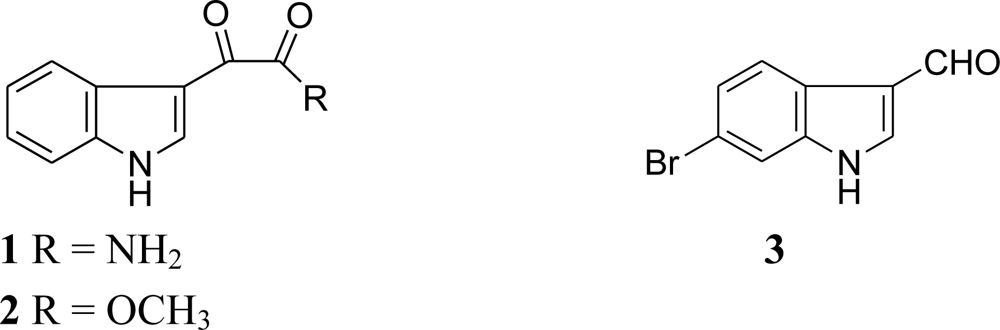
<p>Successive chromatographic fractionation of the CH<sub>2</sub>Cl<sub>2</sub> extract of <italic>R. odorabile</italic> using silica gel column chromatography and purification of the anti-PLA<sub>2</sub> fractions on C18 HPLC afforded three known monoindole alkaloids (1<italic>H</italic>-indol-3-yl) oxoacetamide (<bold>1</bold>) and (1<italic>H</italic>-indol-3-yl) oxoacetic acid methyl ester (<bold>2</bold>), both previously isolated from the marine sponge <italic>Spongosorites</italic> sp. collected off the coast of Jeju Island, Korea [<xref ref-type="bibr" rid="b4-marinedrugs-09-00879">4</xref>] and 6-bromoindole-3-carbaldehyde (<bold>3</bold>) from the marine sponge <italic>Pseudosuberites hyalinus</italic> [<xref ref-type="bibr" rid="b5-marinedrugs-09-00879">5</xref>] (<xref ref-type="fig" rid="f1-marinedrugs-09-00879">Figure 1</xref>).</p>
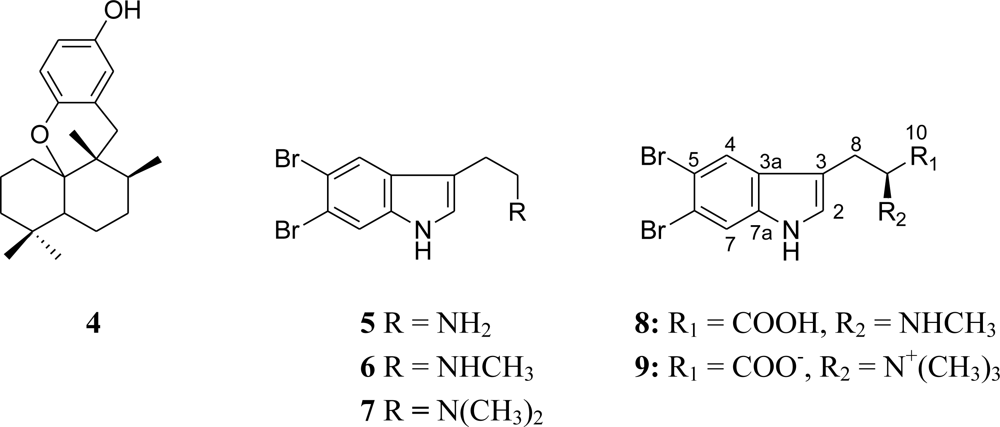
<p>Chromatographic fractionation of the CH<sub>2</sub>Cl<sub>2</sub> extract of <italic>Hyrtios</italic> sp. using silica gel afforded aureol (<bold>4</bold>), rapidly identified by comparison with literature data [<xref ref-type="bibr" rid="b6-marinedrugs-09-00879">6</xref>]. Chromatographic fractionation of the MeOH extract of <italic>Hyrtios</italic> sp. using C18 and LH 20 columns followed by successive ODS C18 HPLC revealed the presence of five dibromoalkaloids <bold>5</bold>–<bold>9</bold>. The structures of the known compounds <bold>5–8</bold> were rapidly determined as 5,6-dibromotryptamine <bold>5</bold>, <italic>N</italic>-methyl-5,6-dibromotryptamine (<bold>6</bold>) [<xref ref-type="bibr" rid="b7-marinedrugs-09-00879">7</xref>], <italic>N</italic>,<italic>N</italic>-dimethyl-5,6-dibromotryptamine (<bold>7</bold>) [<xref ref-type="bibr" rid="b8-marinedrugs-09-00879">8</xref>], and 5,6-dibromoabrine (<bold>8</bold>) [<xref ref-type="bibr" rid="b9-marinedrugs-09-00879">9</xref>] by comparison with literature data. The structure of the new metabolite, 5,6-dibromo-<sc>l</sc>-hypaphorine (<bold>9</bold>), was obtained through detailed examination of mass spectrometric data and extensive 1D and 2D NMR studies (<xref ref-type="fig" rid="f2-marinedrugs-09-00879">Figure 2</xref>).</p></sec>
<sec>
<label>2.2.</label>
<title>Structure Elucidation of 5,6-Dibromo-<sc>l</sc>-hypaphorine (<bold>9</bold>)</title>
<p>Compound <bold>9</bold> was isolated as an optically active pale yellow oil, with [α]<sup>20</sup><sub>D</sub> +28 (<italic>c</italic> 0.06, MeOH–1 N HCl, 8:2). The positive mode ESI mass spectrum of <bold>9</bold> showed a 1:2:1 molecular ion cluster at <italic>m/z</italic> 402.9, 404.9, 406.9, characteristic of the presence of two bromine atoms and corresponding to the molecular formula C<sub>14</sub>H<sub>17</sub>N<sub>2</sub>O<sub>2</sub><sup>79</sup>Br<sub>2</sub> for the pseudomolecular ion [M + H]<sup>+</sup> at <italic>m/z</italic> 402.9667. <sup>1</sup>H and <sup>13</sup>C NMR data for <bold>9</bold> in DMSO-<italic>d</italic><sub>6</sub> were similar to those reported for 5,6-dibromoabrine (<bold>8</bold>), in particular the resonances of three singlet protons in the aromatic region at δ<sub>H</sub> 8.02 (1H, s), 7.72 (1H, s), 7.27 (1H, s), a methine proton at δ<sub>H</sub> 3.67 (1H, dd, <italic>J</italic> = 10.1, 3.3), methylene protons at δ<sub>H</sub> 3.21 (2H, m) and the presence of a carboxylate function at δ<sub>C</sub> 167.0 (C). The main difference between <bold>8</bold> and <bold>9</bold> was the presence of a N<sup>+</sup>Me<sub>3</sub> cation, indicated by a nine-proton singlet in the <sup>1</sup>H NMR spectrum of <bold>9</bold> at δ<sub>H</sub> 3.17 (9H, s). In addition, two broad singlet protons at δ<sub>H</sub> 11.20 (1H, brs) and 8.45 (1H, brs) suggested the presence of an amine and hydroxyl function, respectively. Furthermore, COSY correlations between the methine proton at δ<sub>H</sub> 3.67 with methylene protons at δ<sub>H</sub> 3.21 and between the amine proton at δ<sub>H</sub> 11.20 with proton at δ<sub>H</sub> 7.27 indicated the presence of a CH<sub>2</sub>-CH group and a NH-CH group, respectively. Five non-protonated aromatic carbons at δ<sub>C</sub> 135.7 (C-7a), 128.2 (C-3a), 114.8 (C-6), 112.6 (C-5) and 109.5 (C-3) suggested 5,6 dibromosubstitution of the indole nucleus, which was supported by the observed HMBC correlations as presented in <xref ref-type="table" rid="t1-marinedrugs-09-00879">Table 1</xref> and by comparison with literature values for <bold>8</bold> [<xref ref-type="bibr" rid="b9-marinedrugs-09-00879">9</xref>]. Thus, the new alkaloid, was identified as 5,6-dibromo-<sc>l</sc>-hypaphorine (<bold>9</bold>), a new member of the hypaphorine family. Halogenation on the benzene ring of tryptophan derivatives does not affect the sign of optical rotation [<xref ref-type="bibr" rid="b10-marinedrugs-09-00879">10</xref>], therefore <bold>9</bold> was assigned as <sc>l</sc>-configuration (9<italic>S</italic>) by comparison of its optical rotation value, [α]<sup>20</sup><sub>D</sub> +28 (<italic>c</italic> 0.06, MeOH–1 N HCl, 8:2), with those reported in the literature for 6-bromo-<sc>d</sc> ([α]<sup>17</sup><sub>D</sub>–27 (<italic>c</italic> 0.8, MeOH, TFA, 8:1)) [<xref ref-type="bibr" rid="b11-marinedrugs-09-00879">11</xref>] and <sc>l</sc>-hypaphorine ([α]<sup>15</sup><sub>D</sub> +58 (<italic>c</italic> unspecified, MeOH, TFA, 8:1)) [<xref ref-type="bibr" rid="b12-marinedrugs-09-00879">12</xref>].</p>
<p>Several halogenated indoles bearing a <italic>N</italic>,<italic>N</italic>,<italic>N</italic>-trimethyltryptophane betaine moiety including di- and tri-iodo as well as both chlorine and iodine atoms on the indole nucleus have been reported from the Caribbean sponge <italic>Plakortis simplex</italic> [<xref ref-type="bibr" rid="b10-marinedrugs-09-00879">10</xref>,<xref ref-type="bibr" rid="b13-marinedrugs-09-00879">13</xref>]. The monobromoderivatives <sc>d</sc>-6- and <sc>l</sc>-6- bromohypaphorine were previously reported from the Okinawan marine sponge <italic>Aplysina</italic> sp. and from the sponge <italic>Pachymatisma johnstoni</italic>, respectively [<xref ref-type="bibr" rid="b11-marinedrugs-09-00879">11</xref>,<xref ref-type="bibr" rid="b12-marinedrugs-09-00879">12</xref>] and the dibromoderivative 5,7-dibromo-<sc>l</sc>-hypaphorine was previously obtained by synthesis [<xref ref-type="bibr" rid="b12-marinedrugs-09-00879">12</xref>]. This is the first report of 5,6-dibromo-<sc>l</sc>-hypaphorine (<bold>9</bold>) as a natural product.</p></sec>
<sec>
<label>2.3.</label>
<title>Biological Activities of Compounds <bold>1</bold>–<bold>9</bold></title>
<p>Compounds <bold>1</bold>–<bold>9</bold> were evaluated for their inhibitory activity against bee venom PLA<sub>2</sub> and their antioxidant activity was estimated with the ORAC assay. The results from the <italic>in vitro</italic> assays are presented in <xref ref-type="table" rid="t2-marinedrugs-09-00879">Table 2</xref>. In addition, their cytotoxicity against the human pharyngeal carcinoma cell line was also determined.</p>
<p>Dibromoindoles <bold>5</bold>–<bold>9</bold> exhibited the strongest inhibitory activity against bee venom PLA<sub>2</sub>, with <bold>9</bold> being identified as the most efficient PLA<sub>2</sub> inhibitor of the series albeit with a weak IC<sub>50</sub> value of 0.2 mM.</p>
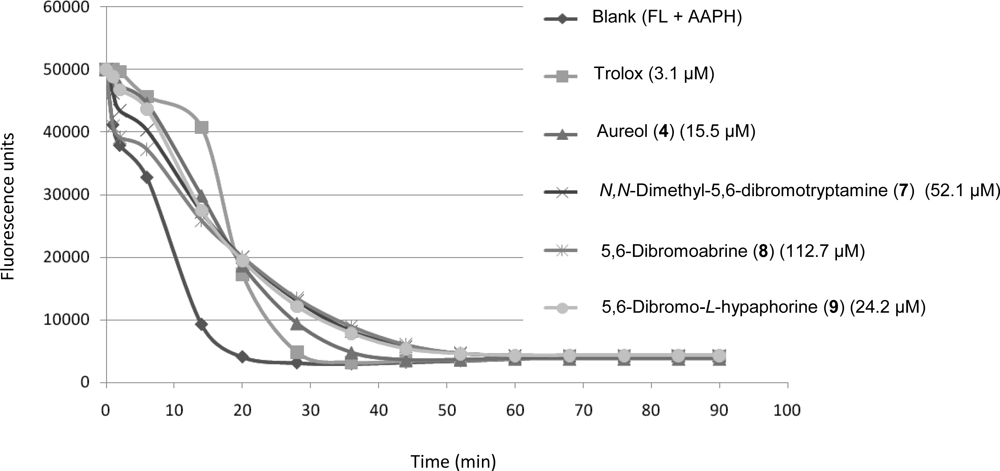
<p>Compounds <bold>4</bold> and <bold>7–9</bold> displayed a positive antioxidant activity as first observed in the qualitative DPPH assay. Their antioxidant capacity was quantified in the ORAC assay measuring the loss of fluorescence of fluorescein (FL) in presence of the oxidative species AAPH (2,2′-azobis(2-amidinopropane dihydrochloride)) and using Trolox<sup>®</sup> (6-hydroxy-2,5,7,8-tetramethylchroman-2-carboxylic acid), a water-soluble analogue of vitamin E, as an anti-oxidant standard against which all the compounds were compared. Compounds <bold>4</bold> and <bold>9</bold> exhibited the strongest antioxidant effect with a relative ORAC value of 0.29 and 0.22, respectively, as compared with Trolox which had value of 1. <xref ref-type="fig" rid="f3-marinedrugs-09-00879">Figure 3</xref> shows the FL fluorescent decay curves of the four derivatives (<bold>4</bold>, <bold>7</bold>–<bold>9</bold>) tested at different concentrations in order to obtain a profile similar to Trolox. Compounds <bold>7</bold> and <bold>8</bold> were the least effective antioxidants. Compound <bold>9</bold> was 4-fold less active than Trolox, displaying a similar curve at 24.2 μM, whilst compound <bold>4</bold> demonstrated a similar curve to Trolox at 15.5 μM, revealing it to be 3-fold less active than Trolox.</p>
<p>None of the isolated compounds demonstrated any cytotoxicity towards KB cells at 10<sup>−4</sup> M except <bold>4</bold> (IC<sub>50</sub> 5 μM), already known for its antitumor activity [<xref ref-type="bibr" rid="b6-marinedrugs-09-00879">6</xref>,<xref ref-type="bibr" rid="b9-marinedrugs-09-00879">9</xref>].</p></sec></sec>
<sec>
<label>3.</label>
<title>Experimental Section</title>
<sec sec-type="methods">
<label>3.1.</label>
<title>General Experimental Procedures</title>
<p>Optical rotations were recorded on a Perkin Elmer 341 polarimeter. UV spectra were recorded on a UVIKON 930 spectrometer and IR spectra were recorded on a FT-IR Shimadzu 8400 S spectrometer. NMR spectra were obtained on a Bruker AVANCE 400 spectrometer. HSQC and HMBC experiments were acquired at 400.13 MHz using a <sup>1</sup>H-<sup>13</sup>C Dual probehead. HMBC spectra were optimized for 7 Hz coupling. Mass spectra were recorded on an API Q-STAR PULSAR I of Applied Biosystem. HPLC were performed with an Alliance apparatus (model 2695, Waters) equipped with a photodiode array detector (model 2998, Waters), an evaporative light-scattering detector (model Sedex 80, Sedere) and the software Empower. HPLC solvents were purchased from Carlo-Erba.</p></sec>
<sec>
<label>3.2.</label>
<title>Animal Material</title>
<p>Specimens of <italic>Rhopaloeides odorabile</italic> (class <italic>Demospongiae</italic>, order <italic>Dictyoceratida</italic>, family <italic>Spongiidae</italic>) and <italic>Hyrtios</italic> sp. (class <italic>Demospongiae</italic>, order <italic>Dictyoceratida</italic>, family <italic>Thorectidae</italic>) were collected from Solomon (8°58.968′S, 159°21.953′E) and Fiji islands (16°13.950′S, 179°01.900′E), respectively. Samples were identified by John Hooper (Queensland Museum, Brisbane). A voucher specimen is available for each under the accession numbers G322727 (<italic>Rhopaloeides odorabile</italic> R3101) and G324650 (<italic>Hyrtios</italic> sp. R3268).</p></sec>
<sec>
<label>3.3.</label>
<title>Extraction and Isolation</title>
<p>Lyophilized sponge sample <italic>Rhopaloeides odorabile</italic> (20 g) was extracted with CH<sub>2</sub>Cl<sub>2</sub> (5 × 200 mL, sonicated each time for 15 min) at room temperature. The five extracts were filtered, combined and concentrated under reduced pressure to yield 4 g of CH<sub>2</sub>Cl<sub>2</sub> extract which was chromatographed on a silica gel (Merck) column using an initial gradient of cyclohexane/ethyl acetate from 80/20 to 60/40 followed by a second gradient of CH<sub>2</sub>Cl<sub>2</sub>/acetone from 80/20 to 60/40. The 80/20 CH<sub>2</sub>Cl<sub>2</sub>/acetone fraction (98 mg) exhibited anti-PLA<sub>2</sub> activity and was submitted to semi-preparative reversed-phase HPLC column chromatography (Interchim, Uptisphere C18 7.8 × 250 mm) and eluted with increasing amounts of MeOH in H<sub>2</sub>O (flow rate: 3 mL/min, wavelength: 254 nm) through a linear gradient (10% to 100% of MeOH) for 35 min and afforded three compounds <bold>1</bold>–<bold>3</bold> (<bold>1</bold>: 20 min MeOH/H<sub>2</sub>O 60/40, <bold>2</bold>: 24 min MeOH/H<sub>2</sub>O 70/30, and <bold>3</bold>: 27 min MeOH/H<sub>2</sub>O 80/20 with amounts of 2.6, 1.0 and 1.1 mg, respectively).</p>
<p>Lyophilized sponge sample <italic>Hyrtios</italic> sp. (16 g) was extracted with MeOH (5 × 200 mL, sonicated each time for 15 min) at room temperature. The five extracts were combined, filtered and concentrated under reduced pressure to yield 3 g of MeOH extract which was treated twice through a solvent partition using CH<sub>2</sub>Cl<sub>2</sub> (150 mL) and MeOH/H<sub>2</sub>O 1:1 (150 mL). After solvent evaporation, 0.9 g of an anti-PLA<sub>2</sub> active CH<sub>2</sub>Cl<sub>2</sub> extract and 2.1 g of an anti-PLA<sub>2</sub> active MeOH/H<sub>2</sub>O were obtained. The MeOH/H<sub>2</sub>O extract was chromatographed on a C18 SPE column (Phenomenex) and eluted with H<sub>2</sub>O, H<sub>2</sub>O/MeOH 2:1, H<sub>2</sub>O/MeOH 1:2 and MeOH (100 mL of each). The anti-PLA<sub>2</sub> active fraction H<sub>2</sub>O/MeOH 1:2 (220 mg) was eluted from an Sephadex LH 20 column (GE Healthcare) with MeOH to give an anti-PLA<sub>2</sub> active yellow fraction (30 mg) which was further submitted to semi-preparative reversed-phase HPLC column chromatography (Interchim, Uptisphere C18 7.8 × 250 mm) with increasing amounts of CH<sub>3</sub>CN/0.1% formic acid in H<sub>2</sub>O/0.1% formic acid as eluent (flow rate: 3 mL/min, wavelength: 254 nm) through a linear gradient for 30 min. Five peaks between 12 and 22 min were obtained, and further purified through an analytical reversed-phase HPLC column (Interchim, Uptisphere C18 4.6 × 250 mm) with increasing amounts of CH<sub>3</sub>CN/0.1% formic acid in H<sub>2</sub>O/0.1% formic acid as eluent (flow rate: 1 mL/min, wavelength: 254 nm) through a linear gradient for 30 min and yielded pure compounds <bold>5</bold>–<bold>9</bold> (0.5 mg for <bold>5</bold>, 1.4 mg for <bold>6</bold>, 1.3 mg for <bold>7</bold>, 1.7 mg for <bold>8</bold>, 3.0 mg for <bold>9</bold>). An aliquot of the crude CH<sub>2</sub>Cl<sub>2</sub> extract (0.4 g) was chromatographed on a silica gel column, using a linear gradient of acetone in CH<sub>2</sub>Cl<sub>2</sub> as eluent. The 50% acetone fraction afforded pure <bold>4</bold> (4 mg).</p>
<p>(<italic>1</italic>H<italic>-Indol-3-yl</italic>)<italic>oxoacetamide</italic> (<bold>1</bold>). White powder; ESI-MS <italic>m/z</italic> 189.0677 [M + H]<sup>+</sup> (calcd. 189.0658 for C<sub>10</sub>H<sub>9</sub>N<sub>2</sub>O<sub>2</sub>); spectroscopic data matched those previously published [<xref ref-type="bibr" rid="b4-marinedrugs-09-00879">4</xref>].</p>
<p>(<italic>1</italic>H<italic>-Indol-3-yl</italic>)<italic>oxoacetic acid methyl ester</italic> (<bold>2</bold>). Yellow powder; ESI-MS <italic>m/z</italic> 204.0657 [M + H]<sup>+</sup> (calcd. 204.0660 for C<sub>11</sub>H<sub>10</sub>NO<sub>3</sub>); spectroscopic data matched those previously published [<xref ref-type="bibr" rid="b4-marinedrugs-09-00879">4</xref>].</p>
<p><italic>6-Bromoindole-3-carbaldehyde</italic> (<bold>3</bold>). Yellow needles; ESI-MS <italic>m/z</italic> 223/225, <italic>m/z</italic> 223.9713 [M + H]<sup>+</sup> (calcd. 223.9711 for C<sub>9</sub>H<sub>7</sub>NO<sup>79</sup>Br); spectroscopic data matched those previously published [<xref ref-type="bibr" rid="b5-marinedrugs-09-00879">5</xref>].</p>
<p><italic>Aureol</italic> (<bold>4</bold>). Brown powder; ESI-MS <italic>m/z</italic> 315.2312 [M + H]<sup>+</sup> (calcd. 315.2324 for C<sub>21</sub>H<sub>31</sub>O<sub>2</sub>); spectroscopic data matched those previously published [<xref ref-type="bibr" rid="b6-marinedrugs-09-00879">6</xref>].</p>
<p><italic>5,6-Dibromotryptamine</italic> (<bold>5</bold>). Light brown powder; ESI-MS <italic>m/z</italic> 317/319/321, <italic>m/z</italic> 316.9302 [M + H]<sup>+</sup> (<italic>m</italic> calcd. 316.9289 for C<sub>10</sub>H<sub>11</sub>N<sub>2</sub><sup>79</sup>Br<sub>2</sub>); spectroscopic data matched those previously published [<xref ref-type="bibr" rid="b7-marinedrugs-09-00879">7</xref>].</p>
<p><italic>N-Methyl-5,6-dibromotryptamine</italic> (<bold>6</bold>). Light brown powder; ESI-MS <italic>m/z</italic> 331/333/335, <italic>m/z</italic> 330.9459 [M + H]<sup>+</sup> (calcd. 330.9439 for C<sub>11</sub>H<sub>13</sub>N<sub>2</sub><sup>79</sup>Br<sub>2</sub>); spectroscopic data matched those previously published [<xref ref-type="bibr" rid="b7-marinedrugs-09-00879">7</xref>].</p>
<p><italic>N,N-Dimethyl-5,6-dibromotryptamine</italic> (<bold>7</bold>). Light brown powder; ESI-MS <italic>m/z</italic> 345/347/349, <italic>m/z</italic> 344.9557 [M + H]<sup>+</sup> (calcd. 344.9602 for C<sub>12</sub>H<sub>15</sub>N<sub>2</sub><sup>79</sup>Br<sub>2</sub>); spectroscopic data matched those previously published [<xref ref-type="bibr" rid="b8-marinedrugs-09-00879">8</xref>].</p>
<p><italic>5,6-</italic><sc>l</sc>-<italic>Dibromoabrine</italic> (<bold>8</bold>). Light brown powder; [α]<sup>20</sup><sub>D</sub> +17 (<italic>c</italic> 0.05, MeOH-1 N HCl, 8:2) (lit.[<xref ref-type="bibr" rid="b9-marinedrugs-09-00879">9</xref>] +44 (<italic>c</italic> 0.05, 1 N HCl)); ESI-MS <italic>m/z</italic> 375/377/379, <italic>m/z</italic> 374.9361 [M + H]<sup>+</sup> (calcd. 374.9338 for C<sub>12</sub>H<sub>13</sub>N<sub>2</sub>O<sub>2</sub><sup>79</sup>Br<sub>2</sub>); spectroscopic data matched those previously published [<xref ref-type="bibr" rid="b9-marinedrugs-09-00879">9</xref>].</p>
<p><italic>5,6-Dibromo-</italic><sc>l</sc><italic>-hypaphorine</italic> (<bold>9</bold>). Pale yellow oil; [<italic>α</italic>]<sup>20</sup><sub>D</sub> +28 (<italic>c</italic> 0.06, MeOH–1 N HCl, 8:2); UV (EtOH) λ<sub>max</sub> (log ε) 210 (11,700), 230 (20,645), 294 (2,903) nm; IR (dry film) ν<sub>max</sub> 3402, 2924, 1597, 1357 cm<sup>−1</sup>; For <sup>1</sup>H and <sup>13</sup>C NMR data, see <xref ref-type="table" rid="t1-marinedrugs-09-00879">Table 1</xref>; ESI-MS <italic>m/z</italic> 403/405/407, <italic>m/z</italic> 402.9667 [M + H]<sup>+</sup> (calcd 402.9651 for C<sub>14</sub>H<sub>17</sub>N<sub>2</sub>O<sub>2</sub><sup>79</sup>Br<sub>2</sub>).</p></sec>
<sec>
<label>3.4.</label>
<title>PLA<sub>2</sub> Inhibition Assay</title>
<p>Bioassay guided fractionation was based on a colorimetric bioassay [<xref ref-type="bibr" rid="b14-marinedrugs-09-00879">14</xref>]. Assays were performed in duplicate in 96 well plates and read on a CERES 900 spectrophotometer. Extracts (250 μg) or fractions (100 μg) dissolved in 10 μL of DMSO were incubated with 2 μL of a PLA<sub>2</sub> solution (1 mg/mL in DMSO) from <italic>Apis mellifera</italic> bee venom (Sigma) for 1 hr at 25 °C. Then 198 μL of the substrate solution <sc>l</sc>-<italic>α</italic>-lecithin (Sigma) 3.5 mM containing Triton X-100 (7 mM), NaCl (100 mM), CaCl<sub>2</sub> (10 mM) and red phenol (0.055 mM) as colorimetric indicator, at pH 7.6 were added and the absorbance at 550 nm read at time 0 and 5 min. Percent inhibition of the enzyme activity was determined by comparison with a control without drug. Manoalide (Aldrich) was used as a positive control.</p></sec>
<sec>
<label>3.5.</label>
<title>Antioxidant Assays</title>
<p><italic>Qualitative DPPH screening</italic>: The potential antioxidant activity of crude extracts and pure compounds were screening using the scavenging activity of the DPPH (Sigma) free radicals. Active extracts were visualized by spraying a purple DPPH solution (2 mg/mL in MeOH) on a Tlc plate (Merck, Silica gel 60 F<sub>254</sub>), where compounds have been deposited. Immediate discoloration of DPPH around tested samples reveals their antioxidant activity.</p>
<p><italic>Quantitative ORAC assay</italic>: The antioxidant activity of pure compounds was assessed with the ORAC assay. The ORAC assay is a kinetic assay measuring the decrease in fluorescence of fluorescein (FL) (Sigma) by adding the oxidative species AAPH (Aldrich, 2.2′-azobis(2-amidinopropane dihydrochloride). Thus, antioxidant protection of compounds was evaluated over time. The antioxidant Trolox (Aldrich, 6-hydroxy-2,5,7,8-tetramethylchroman-2-carboxylic acid) was used as a positive control delaying the loss of FL fluorescence in a dose dependent manner [<xref ref-type="bibr" rid="b15-marinedrugs-09-00879">15</xref>,<xref ref-type="bibr" rid="b16-marinedrugs-09-00879">16</xref>]. The antioxidant activity is normalized to equivalent Trolox units to quantify the antioxidant activity of each compound. The assay was performed with a spectrofluorimeter Berthold Mithras LB 940. Reaction mixtures containing 25 μL of different 2-fold dilutions of pure compounds (dissolved in phosphate buffer 75 mM, pH 7.4 containing 5% DMSO) or Trolox (200 μM–12.5 μM) and 150 μL of FL solution (10 nM in phosphate buffer) were distributed in 96 well microplates in triplicate and incubated at 37°C for 15 min. Fluorescence was measured (Ex. 485 nm, Em. 520 nm) every 90 sec to determine the background signal. After 3 cycles of measurement, 25 μL of an AAPH solution (240 mM in phosphate buffer) was added via an automated injector and 60 fluorescence measurements were taken over a 90 min time period. The final relative ORAC values for tested compounds were calculated by using a regression equation and were expressed as Trolox equivalents according to Ou <italic>et al</italic>. [<xref ref-type="bibr" rid="b16-marinedrugs-09-00879">16</xref>]. Trolox and ascorbic acid (Acros Organics) solutions were used as positive controls and FL solution with AAPH as blank.</p></sec>
<sec>
<label>3.6.</label>
<title>Cytotoxicity Assay</title>
<p>The human KB cell line was obtained from ECACC (Salisbury, UK) and grown in D-MEM medium supplemented with 10% fetal calf serum (Invitrogen), in the presence of penicillin, streptomycin and fungizone in a 75 cm<sup>2</sup> flask under 5% CO<sub>2</sub>. Cells were plated in 96-well tissue culture microplates at a density of 650 cells/well in 200 μL medium and treated 24 hrs later with compounds dissolved in DMSO using a Biomek 3000 automate (Beckman-Coulter). Controls received the same volume of DMSO (1% final volume). After 72 hrs exposure MTS reagent (Celltiter 96 Aqueous One solution, Promega) was added and incubated for 3 hrs at 37°C: the absorbance was monitored at 490 nm and results expressed as the inhibition of cell proliferation calculated as the ratio [(1 – (OD<sub>490</sub> treated/OD<sub>490</sub> control)) × 100]. For IC<sub>50</sub> determinations (50% inhibition of cell proliferation) experiments were performed with compound concentrations ranging from 1 μM to 100 μM in duplicate.</p></sec></sec>
<sec sec-type="conclusions">
<label>4.</label>
<title>Conclusions</title>
<p>In conclusion, our search for new inhibitors of PLA<sub>2</sub> and/or antioxidant natural products has led to the investigation of specimens of the South Pacific marine sponges <italic>Rhopaloeides odorabile</italic> and <italic>Hyrtios</italic> sp. Eight indole derivatives including the new 5,6-dibromo-<sc>l</sc>-hypaphorine (<bold>9</bold>), and the sesquiterpene aureol (<bold>4</bold>) were isolated and their chemical structures were resolved by spectroscopic analysis. Evaluation of anti-PLA<sub>2</sub> and antioxidant activities of the series led to the identification of both <bold>4</bold> and <bold>9</bold> as potential antioxidant compounds. In contrast to <bold>4</bold>, the new derivative <bold>9</bold> did not show any cytotoxic activity towards the human KB cancer cell line. Consequently, <bold>9</bold> could be promising in cosmetics and/or in pharmaceutics due to its anti-inflammatory and antioxidant potentials.</p></sec></body>
<back>
<ack>
<p>This work is part of the CRISP (Coral Reef Initiative in the South Pacific) project and granted by the Agence Française de Développement. We thank the Solomon and the Fiji Islands governments for allowing us to collect there, their Fisheries departments for their help and assistance. We thank the IRD diving team for the collection of the sponges, A. Blond and A. Deville (MNHN, Paris) for NMR spectra, A. Marie and L. Dubost (MNHN, Paris) for MS measurements. Brent R. Copp acknowledges the University of Auckland for research and study leave undertaken in Paris and the MNHN of Paris for welcoming him.</p></ack>
<fn-group><fn>
<p><italic>Samples Availability:</italic> Available from the authors.</p></fn></fn-group>
<ref-list>
<title>References</title>
<ref id="b1-marinedrugs-09-00879"><label>1.</label><citation citation-type="journal"><person-group person-group-type="author"><name><surname>Blunt</surname><given-names>JW</given-names></name><name><surname>Copp</surname><given-names>BR</given-names></name><name><surname>Munro</surname><given-names>MH</given-names></name><name><surname>Northcote</surname><given-names>PT</given-names></name><name><surname>Prinsep</surname><given-names>MR</given-names></name></person-group><article-title>Marine natural products</article-title><source>Nat Prod Rep</source><year>2011</year><volume>28</volume><fpage>196</fpage><lpage>268</lpage><comment>and the previous reviews of this series.</comment><pub-id pub-id-type="doi">10.1039/c005001f</pub-id><pub-id pub-id-type="pmid">21152619</pub-id></citation></ref>
<ref id="b2-marinedrugs-09-00879"><label>2.</label><citation citation-type="journal"><person-group person-group-type="author"><name><surname>Gul</surname><given-names>W</given-names></name><name><surname>Hamann</surname><given-names>MT</given-names></name></person-group><article-title>Indole alkaloid marine natural products: An established source of cancer drug leads with considerable promise for the control of parasitic, neurological and other diseases</article-title><source>Life Sci</source><year>2005</year><volume>78</volume><fpage>442</fpage><lpage>453</lpage><pub-id pub-id-type="doi">10.1016/j.lfs.2005.09.007</pub-id><pub-id pub-id-type="pmid">16236327</pub-id></citation></ref>
<ref id="b3-marinedrugs-09-00879"><label>3.</label><citation citation-type="journal"><person-group person-group-type="author"><name><surname>Sugiyama</surname><given-names>Y</given-names></name><name><surname>Ito</surname><given-names>Y</given-names></name><name><surname>Suzuki</surname><given-names>M</given-names></name><name><surname>Hirota</surname><given-names>A</given-names></name></person-group><article-title>Indole derivatives from a marine sponge-derived yeast as DPPH radical scavengers</article-title><source>J Nat Prod</source><year>2009</year><volume>72</volume><fpage>2069</fpage><lpage>2071</lpage><pub-id pub-id-type="doi">10.1021/np900483g</pub-id><pub-id pub-id-type="pmid">19943625</pub-id></citation></ref>
<ref id="b4-marinedrugs-09-00879"><label>4.</label><citation citation-type="journal"><person-group person-group-type="author"><name><surname>Bao</surname><given-names>B</given-names></name><name><surname>Zhang</surname><given-names>P</given-names></name><name><surname>Lee</surname><given-names>Y</given-names></name><name><surname>Hong</surname><given-names>J</given-names></name><name><surname>Lee</surname><given-names>C-O</given-names></name><name><surname>Jung</surname><given-names>JH</given-names></name></person-group><article-title>Monoindole alkaloids from a marine sponge <italic>Spongosorites</italic> sp</article-title><source>Mar Drugs</source><year>2007</year><volume>5</volume><fpage>31</fpage><lpage>39</lpage><pub-id pub-id-type="doi">10.3390/md502031</pub-id><pub-id pub-id-type="pmid">18463722</pub-id></citation></ref>
<ref id="b5-marinedrugs-09-00879"><label>5.</label><citation citation-type="journal"><person-group person-group-type="author"><name><surname>Rasmussen</surname><given-names>T</given-names></name><name><surname>Jensen</surname><given-names>J</given-names></name><name><surname>Anthoni</surname><given-names>U</given-names></name><name><surname>Christophersen</surname><given-names>C</given-names></name><name><surname>Nielsen</surname><given-names>PH</given-names></name></person-group><article-title>Structure and synthesis of bromoindoles from the marine sponge <italic>Pseudosuberites hyalinus</italic></article-title><source>J Nat Prod</source><year>1993</year><volume>56</volume><fpage>1553</fpage><lpage>1558</lpage><pub-id pub-id-type="doi">10.1021/np50099a014</pub-id></citation></ref>
<ref id="b6-marinedrugs-09-00879"><label>6.</label><citation citation-type="journal"><person-group person-group-type="author"><name><surname>Shen</surname><given-names>YC</given-names></name><name><surname>Liaw</surname><given-names>C</given-names></name><name><surname>Ho</surname><given-names>JR</given-names></name><name><surname>Khalil</surname><given-names>AT</given-names></name><name><surname>Kuo</surname><given-names>YH</given-names></name></person-group><article-title>Isolation of aureol from <italic>Smenospongia</italic> sp. and cytotoxic activity of some aureol derivatives</article-title><source>Nat Prod Res</source><year>2006</year><volume>20</volume><fpage>578</fpage><lpage>585</lpage><pub-id pub-id-type="doi">10.1080/14786410500185253</pub-id><pub-id pub-id-type="pmid">16835091</pub-id></citation></ref>
<ref id="b7-marinedrugs-09-00879"><label>7.</label><citation citation-type="journal"><person-group person-group-type="author"><name><surname>Van Lear</surname><given-names>GE</given-names></name><name><surname>Morton</surname><given-names>GO</given-names></name><name><surname>Fulmor</surname><given-names>W</given-names></name></person-group><article-title>New antibacterial bromoindole metabolites from the marine sponge <italic>Polyfibrospongia maynardii</italic></article-title><source>Tetrahedron Lett</source><year>1973</year><volume>4</volume><fpage>299</fpage><lpage>300</lpage></citation></ref>
<ref id="b8-marinedrugs-09-00879"><label>8.</label><citation citation-type="journal"><person-group person-group-type="author"><name><surname>Djura</surname><given-names>P</given-names></name><name><surname>Stierle</surname><given-names>DB</given-names></name><name><surname>Sullivan</surname><given-names>B</given-names></name><name><surname>Faulkner</surname><given-names>DJ</given-names></name></person-group><article-title>Some metabolites of the marine sponges <italic>Smenospongia aurea</italic> and <italic>Smenospongia (Polyfibrospongia) echina</italic></article-title><source>J Org Chem</source><year>1980</year><volume>45</volume><fpage>1435</fpage><lpage>1441</lpage><pub-id pub-id-type="doi">10.1021/jo01296a019</pub-id></citation></ref>
<ref id="b9-marinedrugs-09-00879"><label>9.</label><citation citation-type="journal"><person-group person-group-type="author"><name><surname>Tasdemir</surname><given-names>D</given-names></name><name><surname>Bugni</surname><given-names>TS</given-names></name><name><surname>Mangalindan</surname><given-names>GC</given-names></name><name><surname>Concepcion</surname><given-names>GP</given-names></name><name><surname>Harper</surname><given-names>MK</given-names></name><name><surname>Ireland</surname><given-names>CM</given-names></name></person-group><article-title>Cytotoxic bromoindole derivatives and terpenes from the Philippine marine sponge <italic>Smenospongia</italic> sp</article-title><source>Z Naturforsch</source><year>2002</year><volume>57c</volume><fpage>914</fpage><lpage>922</lpage></citation></ref>
<ref id="b10-marinedrugs-09-00879"><label>10.</label><citation citation-type="journal"><person-group person-group-type="author"><name><surname>Campagnuolo</surname><given-names>C</given-names></name><name><surname>Fattorusso</surname><given-names>E</given-names></name><name><surname>Taglialatela-Scafati</surname><given-names>O</given-names></name></person-group><article-title>Plakohypaphorines A–C, iodine-containing alkaloids from the Caribbean sponge <italic>Plakortis simplex</italic></article-title><source>Eur J Org Chem</source><year>2003</year><fpage>284</fpage><lpage>287</lpage></citation></ref>
<ref id="b11-marinedrugs-09-00879"><label>11.</label><citation citation-type="journal"><person-group person-group-type="author"><name><surname>Kondo</surname><given-names>K</given-names></name><name><surname>Nishi</surname><given-names>J</given-names></name><name><surname>Ishibashi</surname><given-names>M</given-names></name><name><surname>Kobayashi</surname><given-names>J</given-names></name></person-group><article-title>Two new tryptophan-derived alkaloids from the Okinawan marine sponge <italic>Aplysina</italic> sp</article-title><source>J Nat Prod</source><year>1994</year><volume>57</volume><fpage>1008</fpage><lpage>1011</lpage><pub-id pub-id-type="doi">10.1021/np50109a023</pub-id><pub-id pub-id-type="pmid">7964781</pub-id></citation></ref>
<ref id="b12-marinedrugs-09-00879"><label>12.</label><citation citation-type="journal"><person-group person-group-type="author"><name><surname>Raverty</surname><given-names>WD</given-names></name><name><surname>Thomson</surname><given-names>RH</given-names></name><name><surname>King</surname><given-names>TJ</given-names></name></person-group><article-title>Metabolites from the sponge <italic>Pachymatisma johnstoni; L</italic>-6-bromohypaphorine, a new amino-acid (and its crystal structure)</article-title><source>J Chem Soc, Perkin Trans 1</source><year>1977</year><fpage>1204</fpage><lpage>1211</lpage></citation></ref>
<ref id="b13-marinedrugs-09-00879"><label>13.</label><citation citation-type="journal"><person-group person-group-type="author"><name><surname>Borrelli</surname><given-names>F</given-names></name><name><surname>Campagnuolo</surname><given-names>C</given-names></name><name><surname>Capassa</surname><given-names>R</given-names></name><name><surname>Fattorusso</surname><given-names>E</given-names></name><name><surname>Taglialatela-Scafati</surname><given-names>O</given-names></name></person-group><article-title>Iodinated indole alkaloids from <italic>Plakortis simplex</italic>. New plakohypaphorines and an evaluation of their antihistamine activity</article-title><source>Eur J Org Chem</source><year>2004</year><fpage>3227</fpage><lpage>3232</lpage></citation></ref>
<ref id="b14-marinedrugs-09-00879"><label>14.</label><citation citation-type="journal"><person-group person-group-type="author"><name><surname>Motti</surname><given-names>CA</given-names></name><name><surname>Bourguet-Kondracki</surname><given-names>M-L</given-names></name><name><surname>Longeon</surname><given-names>A</given-names></name><name><surname>Doyle</surname><given-names>JR</given-names></name><name><surname>Llewellyn</surname><given-names>LE</given-names></name><name><surname>Tapiolas</surname><given-names>DM</given-names></name><name><surname>Yin</surname><given-names>P</given-names></name></person-group><article-title>Comparison of the biological properties of several marine sponge-derived sesquiterpenoid quinone</article-title><source>Molecules</source><year>2007</year><volume>12</volume><fpage>1376</fpage><lpage>1388</lpage><pub-id pub-id-type="doi">10.3390/12071376</pub-id><pub-id pub-id-type="pmid">17909493</pub-id></citation></ref>
<ref id="b15-marinedrugs-09-00879"><label>15.</label><citation citation-type="journal"><person-group person-group-type="author"><name><surname>Cao</surname><given-names>G</given-names></name><name><surname>Prior</surname><given-names>RL</given-names></name></person-group><article-title>Measurement of Oxygen Radical Absorbance Capacity in Biological Samples</article-title><source>Methods Enzymol</source><year>1999</year><volume>299</volume><fpage>50</fpage><lpage>61</lpage><pub-id pub-id-type="pmid">9916196</pub-id></citation></ref>
<ref id="b16-marinedrugs-09-00879"><label>16.</label><citation citation-type="journal"><person-group person-group-type="author"><name><surname>Ou</surname><given-names>B</given-names></name><name><surname>Hampsch-Woodill</surname><given-names>M</given-names></name><name><surname>Prior</surname><given-names>RL</given-names></name></person-group><article-title>Development and validation of an improved Oxygen Radical Absorbance Capacity assay using fluorescein as the fluorescent probe</article-title><source>J Agric Food Chem</source><year>2001</year><volume>49</volume><fpage>4619</fpage><lpage>4626</lpage><pub-id pub-id-type="doi">10.1021/jf010586o</pub-id><pub-id pub-id-type="pmid">11599998</pub-id></citation></ref></ref-list>
<sec sec-type="display-objects">
<title>Figures and Tables</title>
<fig id="f1-marinedrugs-09-00879" position="float">
<label>Figure 1.</label>
<caption>
<p>Structures of indole derivatives <bold>1</bold>–<bold>3</bold> isolated from the marine sponge <italic>Rhopaloeides odorabile</italic></p></caption>
<graphic xlink:href="marinedrugs-09-00879f1.gif"/></fig>
<fig id="f2-marinedrugs-09-00879" position="float">
<label>Figure 2.</label>
<caption>
<p>Structures of compounds <bold>4</bold>–<bold>9</bold> isolated from the marine sponge <italic>Hyrtios</italic> sp.</p></caption>
<graphic xlink:href="marinedrugs-09-00879f2.gif"/></fig>
<fig id="f3-marinedrugs-09-00879" position="float">
<label>Figure 3.</label>
<caption>
<p>Fluorescein fluorescence decay curve induced by AAPH in the presence of Trolox or compounds <bold>4</bold>, <bold>7</bold>–<bold>9</bold>.</p></caption>
<graphic xlink:href="marinedrugs-09-00879f3.gif"/></fig>
<table-wrap id="t1-marinedrugs-09-00879" position="float">
<label>Table 1.</label>
<caption>
<p>NMR spectroscopic data of 5,6-dibromo-<sc>l</sc>-hypaphorine (<bold>9</bold>)<xref ref-type="table-fn" rid="tfn1-marinedrugs-09-00879"><sup>a</sup></xref>.</p></caption>
<table frame="hsides" rules="groups">
<thead>
<tr>
<th align="center" valign="middle"><bold>no.</bold></th>
<th align="center" valign="middle"><bold><sup>1</sup>H</bold></th>
<th align="center" valign="middle"><bold><sup>13</sup>C</bold></th>
<th align="center" valign="middle"><bold>HMBC<xref ref-type="table-fn" rid="tfn2-marinedrugs-09-00879"><sup>b</sup></xref></bold></th></tr></thead>
<tbody>
<tr>
<td align="center" valign="middle">1-NH</td>
<td align="center" valign="middle">11.20 brs</td>
<td align="center" valign="middle">-</td>
<td align="center" valign="middle">2, 3</td></tr>
<tr>
<td align="center" valign="middle">2</td>
<td align="center" valign="middle">7.27 s</td>
<td align="center" valign="middle">126.8</td>
<td align="center" valign="middle">3, 3a, 7a</td></tr>
<tr>
<td align="center" valign="middle">3</td>
<td align="center" valign="middle"/>
<td align="center" valign="middle">109.5</td>
<td align="center" valign="middle"/></tr>
<tr>
<td align="center" valign="middle">3a</td>
<td align="center" valign="middle"/>
<td align="center" valign="middle">128.2</td>
<td align="center" valign="middle"/></tr>
<tr>
<td align="center" valign="middle">4</td>
<td align="center" valign="middle">8.02 s</td>
<td align="center" valign="middle">123.1</td>
<td align="center" valign="middle">3, 5, 6, 7a</td></tr>
<tr>
<td align="center" valign="middle">5</td>
<td align="center" valign="middle"/>
<td align="center" valign="middle">112.6 <xref ref-type="table-fn" rid="tfn3-marinedrugs-09-00879"><sup>c</sup></xref></td>
<td align="center" valign="middle"/></tr>
<tr>
<td align="center" valign="middle">6</td>
<td align="center" valign="middle"/>
<td align="center" valign="middle">114.8 <xref ref-type="table-fn" rid="tfn3-marinedrugs-09-00879"><sup>c</sup></xref></td>
<td align="center" valign="middle"/></tr>
<tr>
<td align="center" valign="middle">7</td>
<td align="center" valign="middle">7.72 s</td>
<td align="center" valign="middle">116.0</td>
<td align="center" valign="middle">3a, 5, 6, 7a</td></tr>
<tr>
<td align="center" valign="middle">7a</td>
<td align="center" valign="middle"/>
<td align="center" valign="middle">135.7</td>
<td align="center" valign="middle"/></tr>
<tr>
<td align="center" valign="middle">8</td>
<td align="center" valign="middle">3.21 m</td>
<td align="center" valign="middle">24.2</td>
<td align="center" valign="middle">2, 3, 3a, 9, 10</td></tr>
<tr>
<td align="center" valign="middle">9</td>
<td align="center" valign="middle">3.67 dd (10.1, 3.3)</td>
<td align="center" valign="middle">78.2</td>
<td align="center" valign="middle">3, 8, 10</td></tr>
<tr>
<td align="center" valign="middle">10</td>
<td align="center" valign="middle"/>
<td align="center" valign="middle">167.0</td>
<td align="center" valign="middle"/></tr>
<tr>
<td align="center" valign="middle">OH</td>
<td align="center" valign="middle">8.45 brs</td>
<td align="center" valign="middle"/>
<td align="center" valign="middle">10</td></tr>
<tr>
<td align="center" valign="middle">N(CH<sub>3</sub>)<sub>3</sub></td>
<td align="center" valign="middle">3.17 s</td>
<td align="center" valign="middle">51.0</td>
<td align="center" valign="middle"/></tr></tbody></table>
<table-wrap-foot><fn id="tfn1-marinedrugs-09-00879">
<label>a</label>
<p>Measured in DMSO-<italic>d</italic><sub>6</sub> at 400 MHz for <sup>1</sup>H and 75.15 MHz for <sup>13</sup>C, <italic>J</italic> in Hz;</p></fn><fn id="tfn2-marinedrugs-09-00879">
<label>b</label>
<p>HMBC correlations optimized for 7 Hz, are from proton(s) stated to the indicated carbon;</p></fn><fn id="tfn3-marinedrugs-09-00879">
<label>c</label>
<p>Assignments may be interchanged.</p></fn></table-wrap-foot></table-wrap>
<table-wrap id="t2-marinedrugs-09-00879" position="float">
<label>Table 2.</label>
<caption>
<p>Biological activities of compounds <bold>1</bold>–<bold>9</bold>.</p></caption>
<table frame="hsides" rules="groups">
<thead>
<tr>
<th align="left" valign="top"><bold>Compound</bold></th>
<th align="center" valign="middle"><bold>PLA<sub>2</sub><xref ref-type="table-fn" rid="tfn4-marinedrugs-09-00879"><sup>a</sup></xref></bold></th>
<th align="left" valign="top"><bold>ORAC <sub>FL</sub><xref ref-type="table-fn" rid="tfn5-marinedrugs-09-00879"><sup>b</sup></xref></bold></th></tr></thead>
<tbody>
<tr>
<td align="left" valign="top">(1<italic>H</italic>-Indol-3-yl)oxoacetamide (<bold>1</bold>)</td>
<td align="center" valign="middle">1.17 ± 0.05</td>
<td align="left" valign="middle">nt</td></tr>
<tr>
<td align="left" valign="top">(1<italic>H</italic>-Indol-3-yl)oxoacetic acid methyl ester (<bold>2</bold>)</td>
<td align="center" valign="middle">1.11 ± 0.33</td>
<td align="left" valign="middle">nt</td></tr>
<tr>
<td align="left" valign="top">6-Bromoindole-3-carbaldehyde (<bold>3</bold>)</td>
<td align="center" valign="middle">1.27 ± 0.06</td>
<td align="left" valign="middle">nt</td></tr>
<tr>
<td align="left" valign="top">Aureol (<bold>4</bold>)</td>
<td align="center" valign="middle">0.46 ± 0.02</td>
<td align="left" valign="middle">0.29 ± 0.03</td></tr>
<tr>
<td align="left" valign="top">5,6-Dibromotryptamine (<bold>5</bold>)</td>
<td align="center" valign="middle">0.62 ± 0.01</td>
<td align="left" valign="middle">nt</td></tr>
<tr>
<td align="left" valign="top"><italic>N</italic>-Methyl-5,6-dibromotryptamine (<bold>6</bold>)</td>
<td align="center" valign="middle">0.33 ± 0.03</td>
<td align="left" valign="middle">nt</td></tr>
<tr>
<td align="left" valign="top"><italic>N</italic>,<italic>N</italic>-Dimethyl-5,6-dibromotryptamine (<bold>7</bold>)</td>
<td align="center" valign="middle">0.77 ± 0.05</td>
<td align="left" valign="middle">0.06 ± 0.01</td></tr>
<tr>
<td align="left" valign="top">5,6-Dibromoabrine (<bold>8</bold>)</td>
<td align="center" valign="middle">0.30 ± 0.01</td>
<td align="left" valign="middle">0.07 ± 0.01</td></tr>
<tr>
<td align="left" valign="top">5,6-Dibromo-<sc>l</sc>-hypaphorine (<bold>9</bold>)</td>
<td align="center" valign="middle">0.20 ± 0.01</td>
<td align="left" valign="middle">0.22 ± 0.04</td></tr></tbody></table>
<table-wrap-foot><fn id="tfn4-marinedrugs-09-00879">
<label>a</label>
<p>IC<sub>50</sub> values (mM ± SEM; n = 2) on bee venom PLA<sub>2</sub>. Manoalide (positive control) IC<sub>50</sub> 0.5 ± 0.05 μM.</p></fn><fn id="tfn5-marinedrugs-09-00879">
<label>b</label>
<p>ORAC values are expressed as relative Trolox equivalent. Fluorescein (FL). Relative ORAC value = [(AUC product – AUC blank)/(AUC Trolox – AUC blank)] × (molarity Trolox/molarity product), (n = 3). Molarity in μM. AUC: Area Under the Curve. AUC blank = AUC obtained for the control FL + AAPH. Ascorbic acid (positive control) ORAC<sub>FL</sub> 0.95 ± 0.02; nt: not tested.</p></fn></table-wrap-foot></table-wrap></sec></back></article>