

Palytoxin and Analogs: Biological and Ecological Effects



Abstract
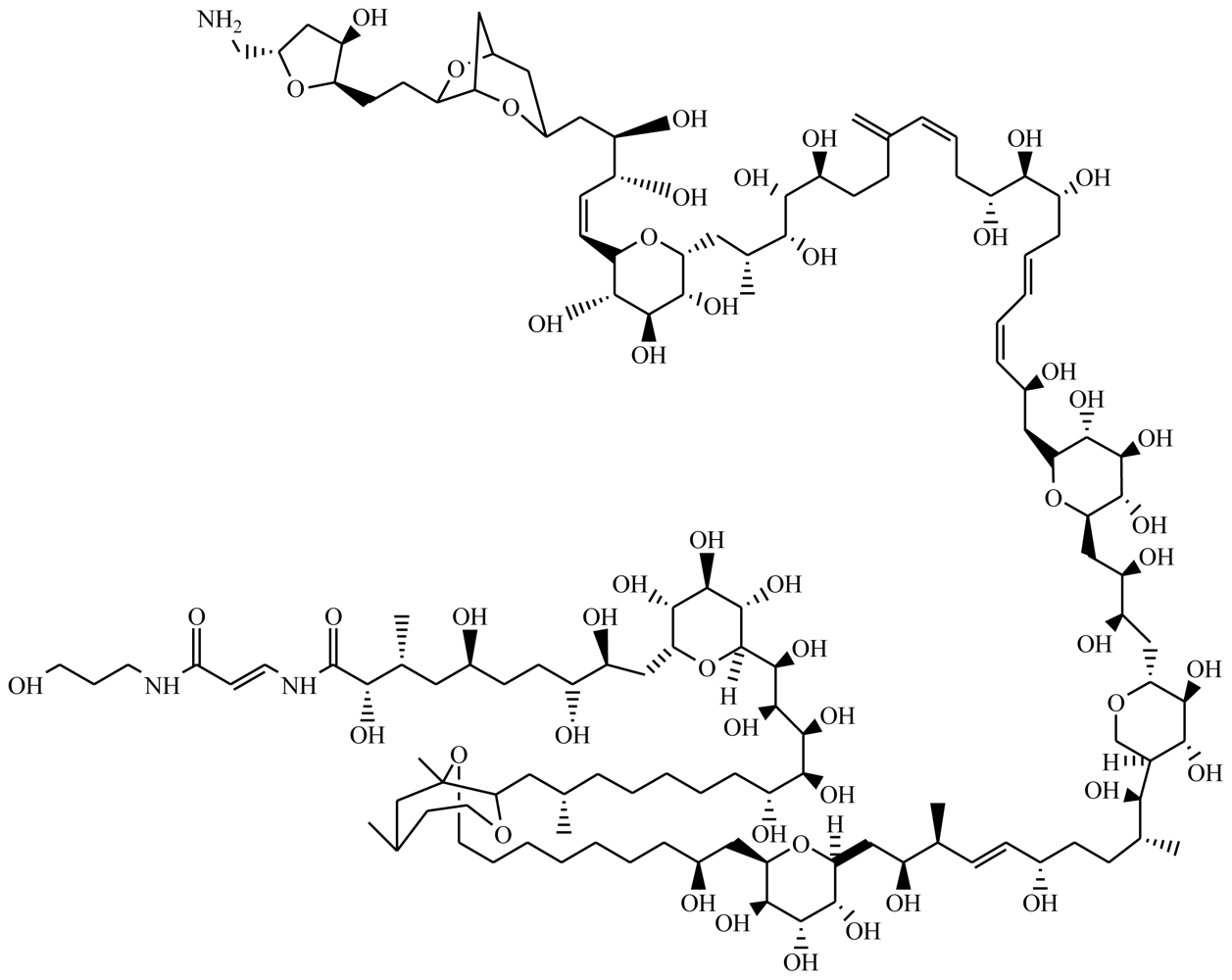
:1. Palytoxin Chemical Properties and Producing Organisms
2. Toxicity of PTX and Its Analogs in Higher Animals
2.1. Toxicity in Humans: Reports, Symptoms and Routes of Exposure
2.2. Toxicity in Other Mammals: Lethal and Sub-Lethal Effects
3. Biological and Ecological Consequences of PTX and Its Analogs
3.1. Effects in Invertebrate Larval Development
3.2. Effects in Vertebrate Reproduction and Development
3.3. Toxins Distribution and Ecological Aspects
4. Summary
Acknowledgments
- Samples Availability: Available from the authors.
References
- Kan, Y; Uemura, D; Hirata, Y; Ishiguro, M; Iwashita, T. Complete NMR signal assignment of palytoxin and N-acetylpalytoxin. Tetrahedron Lett 2001, 42, 3197–3202. [Google Scholar]
- Katikou, P. Botana, LM, Ed.; Chemistry of Palytoxins and Ostreocins. In Phycotoxins, Chemistry and Biochemistry; Blackwell Publishing: Ames, IA, USA, 2007; pp. 75–93. [Google Scholar]
- Moore, RE; Scheuer, PJ. Palytoxin - new marine toxin from a coelenterate. Science 1971, 172, 495–498. [Google Scholar]
- Moore, RE; Bartolini, G. Structure of palytoxin. J. Am. Chem. Soc 1981, 103, 2491–2494. [Google Scholar]
- Uemura, D; Ueda, K; Hirata, Y; Naoki, H; Iwashita, T. Further-studies on palytoxin. II. Structure of palytoxin. Tetrahedron Lett 1981, 22, 2781–2784. [Google Scholar]
- Suh, EM; Kishi, Y. Synthesis of palytoxin from palytoxin carboxylic acid. J. Am. Chem. Soc 1994, 116, 11205–11206. [Google Scholar]
- Usami, M; Satake, M; Ishida, S; Inoue, A; Kan, Y; Yasumoto, T. Palytoxin analogs from the dinoflagellate Ostreopsis siamensis. J. Am. Chem. Soc 1995, 117, 5389–5390. [Google Scholar]
- Ukena, T; Satake, M; Usami, M; Oshima, Y; Naoki, H; Fujita, T; Kan, Y; Yasumoto, T. Structure elucidation of ostreocin D, a palytoxin analog isolated from the dinoflagellate Ostreopsis siamensis. Biosci. Biotech. Bioch 2001, 65, 2585–2588. [Google Scholar]
- Lenoir, S; Ten-Hage, L; Turquet, J; Quod, JP; Bernard, C; Hennion, MC. First evidence of palytoxin analogs from an Ostreopsis mascarenensis (Dinophyceae) benthic bloom in Southwestern Indian Ocean. J. Phycol 2004, 40, 1042–1051. [Google Scholar]
- Lenoir, S; Ten-Hage, L; Turquet, J; Quod, JP; Hennion, MC. Characterization of new analogs of palytoxin isolated from an Ostreopsis mascarenensis bloom in the south-western Indian Ocean. Afr. J. Mar. Sci 2006, 28, 389–391. [Google Scholar]
- Ciminiello, P; Dell’Aversano, C; Fattorusso, E; Forino, M; Tartaglione, L; Grillo, C; Melchiorre, N. Putative palytoxin and its new analog, ovatoxin-a, in Ostreopsis ovata collected along the Ligurian coasts during the 2006 toxic outbreak. J. Am. Soc. Mass Spectrom 2008, 19, 111–120. [Google Scholar]
- Katikou, P. Botana, LM, Ed.; Palytoxin and Analogs: Ecobiology and Origin, Chemistry, Metabolism, and Chemical Analysis. In Seafood and Freshwater Toxins: Pharmacology, Physiology, and Detection, 2nd ed; CRC Press/Taylor & Francis Group: Boca Raton, FL, USA, 2008; pp. 631–663. [Google Scholar]
- Tan, CH; Lau, CO. Botana, LM, Ed.; Chemistry and Detection. In Seafood and Freshwater Toxins: Pharmacology, Physiology and Detection, 1st ed; Marcel Dekker: New York, NY, USA, 2000; pp. 533–548. [Google Scholar]
- Wang, DZ. Neurotoxins from marine dinoflagellates: A brief review. Mar. Drugs 2008, 6, 349–371. [Google Scholar]
- Inuzuka, T; Uemura, D; Arimoto, H. The conformational features of palytoxin in aqueous solution. Tetrahedron 2008, 64, 7718–7723. [Google Scholar]
- Wu, CH. Palytoxin: Membrane mechanisms of action. Toxicon 2009, 54, 1183–1189. [Google Scholar]
- Hilgemann, DW. From a pump to a pore: how palytoxin opens the gates. Proc. Natl. Acad. Sci. USA 2003, 100, 386–388. [Google Scholar]
- Louzao, MC; Ares, IR; Vieytes, MR; Valverde, I; Vieites, JM; Yasumoto, T; Botana, LM. The cytoskeleton, a structure that is susceptible to the toxic mechanism activated by palytoxins in human excitable cells. FEBS J 2007, 274, 1991–2004. [Google Scholar]
- Rodrigues, AM; Almeida, ACG; Infantosi, AFC. Effect of palytoxin on the sodium-potassium pump: model and simulation. Phys. Biol 2008, 5, 036005. [Google Scholar]
- Satoh, E; Ishii, T; Nishimura, M. Palytoxin-induced increase in cytosolic-free Ca2+ in mouse spleen cells. Eur. J. Pharmacol 2003, 465, 9–13. [Google Scholar]
- Valverde, I; Lago, J; Vieites, JM; Cabado, AG. In vitro approaches to evaluate palytoxin-induced toxicity and cell death in intestinal cells. J. Appl. Toxicol 2008, 28, 294–302. [Google Scholar]
- Morton, BE; Fraser, CF; Thenawidjaja, M. Potent inhibition of sperm motility by palytoxin. Exp. Cell Res 1982, 140, 261–265. [Google Scholar]
- Lazzaro, M; Tashjian, AH, Jr; Fujiki, H; Levine, L. Palytoxin: An extraordinarily potent stimulator of prostaglandin production and bone resorption in cultured mouse calvariae. Endocrinology 1987, 120, 1338–1345. [Google Scholar]
- Nagase, H; Karaki, H. Palytoxin-induced contraction and release of prostaglandins and norepinephrine in the aorta. J. Pharmacol. Exp. Ther 1987, 242, 1120–1125. [Google Scholar]
- Nagase, H; Karaki, H; Ozaki, H; Azuma, H. Palytoxin, a novel and potent platelet activator. Jpn. J. Pharmacol 1987, 43, P290. [Google Scholar]
- Ares, IR; Louzao, MC; Vieytes, AR; Yasumoto, T; Botana, LA. Actin cytoskeleton of rabbit intestinal cells is a target for potent marine phycotoxins. J. Exp. Biol 2005, 208, 4345–4354. [Google Scholar]
- Ares, IR; Cagide, E; Louzao, MC; Espina, B; Vieytes, MR; Yasumoto, T; Botana, LM. Ostreocin-D Impact on Globular Actin of Intact Cells. Chem. Res. Toxicol 2009, 22, 374–381. [Google Scholar]
- Louzao, MC; Ares, IR; Cagide, E. Marine toxins and the cytoskeleton: A new view of palytoxin toxicity. FEBS J 2008, 275, 6067–6074. [Google Scholar]
- Munday, R. Botana, LM, Ed.; Occurrence and Toxicology of Palytoxins. In Seafood and Freshwater Toxins: Pharmacology, Physiology, and Detection, 2nd ed; CRC Press/Taylor & Francis Group: Boca Raton, FL, USA, 2008; pp. 693–713. [Google Scholar]
- Wattenberg, EV. Palytoxin: exploiting a novel skin tumor promoter to explore signal transduction and carcinogenesis. Am. J. Physiol. Cell Physiol 2007, 292, C24–C32. [Google Scholar]
- Gleibs, S; Mebs, D. Distribution and sequestration of palytoxin in coral reef animals. Toxicon 1999, 37, 1521–1527. [Google Scholar]
- Maeda, M; Kodama, R; Tanaka, T; Yohizumi, H; Nomyoto, K; Takemoto, T; Fujita, M. Structures of insecticidal substances isolated from a red alga, Chondria armata. Proceedings of the 27th Symposium on the Chemistry of Natural Products, Symposium Organizing Committee, Hiroshima, Japan; 1985; p. 616. [Google Scholar]
- Carballeira, NM; Emiliano, A; Sostre, A; Restituyo, JA; González, IM; Colón, GM; Tosteson, CG; Tosteson, TR. Fatty acid composition of bacteria associated with the toxic dinoflagellate Ostreopsis lenticularis and with Caribbean Palythoa species. Lipids 1998, 33, 627–632. [Google Scholar]
- Seemann, P; Gernert, C; Schmitt, S; Mebs, D; Hentschel, U. Detection of hemolytic bacteria from Palythoa caribaeorum (Cnidaria, Zoantharia) using a novel palytoxin-screening assay. Anton. Leeuw. Int. J. G 2009. [Google Scholar] [CrossRef]
- Frolova, GM; Kuznetsova, TA; Mikhailov, VV; Elyakov, GB. An enzyme linked immunosorbent assay for detecting palytoxin-producing bacteria. Russ. J. Bioorg. Chem 2000, 26, 285–289. [Google Scholar]
- Piel, J. Metabolites from symbiotic bacteria. Nat. Prod. Rep 2009, 26, 338–362. [Google Scholar]
- Botana, LM; Alfonso, A; Botana, A; Vieytes, MR; Vale, C; Vilariño, N; Louzao, C. Functional assays for marine toxins as an alternative, high-throughput-screening solution to animal tests. Trends Analyt. Chem 2009, 28, 603–611. [Google Scholar]
- Deeds, JR; Schwartz, MD. Human risk associated with palytoxin exposure. Toxicon 2009. [Google Scholar] [CrossRef]
- Shears, NT; Ross, PM. Blooms of benthic dinoflagellates of the genus Ostreopsis; an increasing and ecologically important phenomenon on temperate reefs in New Zealand and worldwide. Harmful Algae 2009, 8, 916–925. [Google Scholar]
- Alcala, AC; Alcala, LC; Garth, JS; Yasumura, D; Yasumoto, T. Human fatality due to ingestion of the crab Demania reynaudii that contained a palytoxin-like toxin. Toxicon 1988, 26, 105–107. [Google Scholar]
- Onuma, Y; Satake, M; Ukena, T; Roux, J; Chanteau, S; Rasolofonirina, N; Ratsimaloto, M; Naoki, H; Yasumoto, T. Identification of putative palytoxin as the cause of clupeotoxism. Toxicon 1999, 37, 55–65. [Google Scholar]
- Kodama, AM; Hokama, Y; Yasumoto, T; Fukui, M; Manea, SJ; Sutherland, N. Clinical and laboratory findings implicating palytoxin as cause of ciguatera poisoning due to Decapterus macrosoma (mackerel). Toxicon 1989, 27, 1051–1053. [Google Scholar]
- Taniyama, S; Mahmud, Y; Terada, M; Takatani, T; Arakawa, O; Noguchi, T. Occurrence of a food poisoning incident by palytoxin from a serranid Epinephelus sp. in Japan. J. Nat. Toxins 2002, 11, 277–282. [Google Scholar]
- Okano, H; Masuoka, H; Kamei, S; Seko, T; Koyabu, S; Tsuneoka, K; Tamai, T; Ueda, K; Nakazawa, S; Sugawa, M; Suzuki, H; Watanabe, M; Yatani, R; Nakano, T. Rhabdomyolysis and myocardial damage induced by palytoxin, a toxin of blue humphead parrotfish. Internal Med 1998, 37, 330–333. [Google Scholar]
- Hoffmann, K; Hermanns-Clausen, M; Buhl, C; Buchler, MW; Schemmer, P; Mebs, D; Kauferstein, S. A case of palytoxin poisoning due to contact with zoanthid corals through a skin injury. Toxicon 2008, 51, 1535–1537. [Google Scholar]
- Majlesi, N; Su, MK; Chan, GM; Lee, DC; Greller, HA. A case of inhalational exposure to palytoxin. Clin. Toxicol 2008, 46, 637. [Google Scholar]
- Ciminiello, P; Dell’Aversano, C; Fattorusso, E; Forino, M; Magno, GS; Tartaglione, L; Grillo, C; Melchiorre, N. The Genoa 2005 outbreak. Determination of putative palytoxin in Mediterranean Ostreopsis ovata by a new liquid chromatography tandem mass spectrometry method. Anal. Chem 2006, 78, 6153–6159. [Google Scholar]
- Cagide, E; Louzao, MC; Espiña, B; Vieytes, MR; Jaen, D; Maman, L; Yasumoto, T; Botana, LM. Production of functionally active palytoxin-like compounds by mediterranean Ostreopsis cf. siamensis. Cell. Physiol. Biochem 2009, 23, 431–440. [Google Scholar]
- Wiles, JS; Vick, JA; Christensen, MK. Toxicological evaluation of palytoxin in several animal species. Toxicon 1974, 12, 427–433. [Google Scholar]
- Riobó, P; Paz, B; Franco, JM. Analysis of palytoxin-like in Ostreopsis cultures by liquid chromatography with precolumn derivatization and fluorescence detection. Anal. Chim. Acta 2006, 566, 217–223. [Google Scholar]
- Riobó, P; Paz, B; Franco, JM; Vazquez, JA; Murado, MA; Cacho, E. Mouse bioassay for palytoxin. Specific symptoms and dose-response against dose-death time relationships. Food Chem. Toxicol 2008, 46, 2639–2647. [Google Scholar]
- Vale, C; Ares, IR. Botana, LM, Ed.; Biochemistry of Palytoxins and Ostreocins. In Phycotoxins, Chemistry and Biochemistry; Blackwell Publishing: Ames, IA, USA, 2007; pp. 95–118. [Google Scholar]
- Sosa, S; Del Favero, G; De Bortoli, M; Vita, F; Soranzo, MR; Beltramo, D; Ardizzone, M; Tubaro, A. Palytoxin toxicity after acute oral administration in mice. Toxicol. Lett 2009, 191, 253–259. [Google Scholar]
- Tindall, DR; Miller, DM; Tindall, PM. Granéli, E, Sundström, B, Edler, L, Anderson, DM, Eds.; Toxicity of Ostreopsis lenticularis from the British and United States Virgin Islands. In Toxic Marine Phytoplankton; Elsevier: New York, NY, USA, 1990; pp. 424–429. [Google Scholar]
- Rhodes, LL; Towers, N; Briggs, L; Munday, R; Adamson, J. Uptake of palytoxin-like compounds by shellfish fed Ostreopsis siamensis (Dinophyceae). N. Z. J. Mar. Fresh. Res 2002, 36, 631–636. [Google Scholar]
- Ito, E; Yasumoto, T. Toxicological studies on palytoxin and ostreocin-D administered to mice by three different routes. Toxicon 2009, 54, 244–251. [Google Scholar]
- Rhodes, LL; Smith, KF; Munday, R; Selwood, AI; McNabb, PS; Holland, PT; Bottein, MY. Toxic dinoflagellates (Dinophyceae) from Rarotonga, Cook Islands. Toxicon 2009. [Google Scholar] [CrossRef]
- Vasconcelos, V; Azevedo, J; Silva, M; Ramos, V. Effects of marine toxins on the reproduction and early stages development of aquatic organisms. Mar. Drugs 2010, 8, 59–79. [Google Scholar]
- Rhodes, LL; Adamson, J; Suzuki, T; Briggs, L; Garthwaite, I. Toxic marine epiphytic dinoflagellates, Ostreopsis siamensis and Coolia monotis (Dinophyceae), in New Zealand. N. Z. J. Mar. Fresh. Res 2000, 34, 371–383. [Google Scholar]
- Malagoli, D; Casarini, L; Ottaviani, E. Effects of the marine toxins okadaic acid and palytoxin on mussel phagocytosis. Fish Shellfish Immunol 2008, 24, 180–186. [Google Scholar]
- Franchini, A; Casarini, L; Ottaviani, E. Toxicological effects of marine palytoxin evaluated by FETAX assay. Chemosphere 2008, 73, 267–271. [Google Scholar]
- Adams, DS; Masi, A; Levin, M. H+ pump-dependent changes in membrane voltage are an early mechanism necessary and sufficient to induce Xenopus tail regeneration. Development 2007, 134, 1323–1335. [Google Scholar]
- Fukuyo, Y. Taxonomical study on benthic dinoflagellates collected in coral reefs. Bull. Jpn. Soc. Sci. Fish 1981, 47, 967–978. [Google Scholar]
- Taniyama, S; Arakawa, O; Terada, M; Nishio, S; Takatani, T; Mahmud, Y; Noguchi, T. Ostreopsis sp., a possible origin of palytoxin (PTX) in parrotfish Scarus ovifrons. Toxicon 2003, 42, 29–33. [Google Scholar]
- Pearce, I; Marshall, JA; Hallegraeff, GM. Toxic epiphytic dinoflagellates from East Coast Tasmania, Australia. Harmful Algal Blooms 2000, Proceedings of the 9th International Conference on Harmful Algal Blooms, Australia, 7–11 February 2000; Hallegraeff, GM, Blackburn, SI, Bolch, CJ, Lewis, RJ, Eds.; Intergovernmental Oceanographic Commission of UNESCO: Hobart, Australia, 2001; pp. 54–57. [Google Scholar]
- Granéli, E; Ferreira, CEL; Yasumoto, T; Rodrigues, E; Neves, MB. Sea urchins poisoning by the benthic dinoflagellate Ostreopsis ovata on the Brazilian coast. Proceedings of the 10th International Conference on Harmful Algae, St. Pete Beach, FL, USA, 21–25 October 2002.
- Faust, MA. Three new Ostreopsis species (Dinophyceae): O. marinus sp. nov., O. belizeanus sp. nov., and O. caribbeanus sp. nov. Phycologia 1999, 38, 92–99. [Google Scholar]
- Ballantine, DL; Tosteson, CG; Bardales, AT. Population dynamics and toxicity of natural populations of benthic dinoflagellates in southwestern Puerto Rico. J. Exp. Mar. Biol. Ecol 1988, 119, 201–212. [Google Scholar]
- Vila, M; Garcés, E; Masó, M. Potentially toxic epiphytic dinoflagellates assemblages on macroalgae in the NW Mediterranean. Aquat. Microb. Ecol 2001, 26, 51–60. [Google Scholar]
- Penna, A; Vila, M; Fraga, S; Giacobbe, MG; Francesco, A; Riobó, P; Vernesi, C. Characterization of Ostreopsis and Coolia (Dinophyceae) isolates in the western Mediterranean Sea based on morphology, toxicity and internal transcribed spacer 5.8s rDNA sequences. J. Phycol 2005, 41, 212–225. [Google Scholar]
- Totti, C; Accoroni, S; Cerino, F; Cucchiari, E; Romagnoli, T. Ostreopsis ovata bloom along the Conero Riviera (northern Adriatic Sea): relationships with environmental conditions and substrata. Harmful Algae 2010, 9, 233–239. [Google Scholar]
- Aligizaki, K; Nikolaidis, G. The presence of the potentially toxic genera Ostreopsis and Coolia (Dinophyceae) in the north Aegean sea, Greece. Harmful Algae 2006, 5, 717–730. [Google Scholar]
- Hashimoto, Y; Satake, M; Ishida, S; Inoue, A; Kan, Y; Yasumoto, T. Aluterin: a toxin of filefish, Alutera scripta, probably originating from a zoanthid, Palythoa tuberculosa. Bull. Jpn. Soc. Sci. Fish 1969, 35, 1086–1093. [Google Scholar]
- Mebs, D. Occurrence and sequestration of toxins in food chains. Toxicon 1998, 36, 1519–1522. [Google Scholar]
- Li, S-C; Wang, W-X. Radiotracer studies on the feeding of two marine bivalves on the toxic and nontoxic dinoflagellate Alexandrium tamarense. J. Exp. Mar. Biol. Ecol 2001, 263, 65–75. [Google Scholar]
- Töbe, K; Smith, EA; Gallacher, S; Medlin, LK. Detection of bacteria originally isolated from Alexandrium spp. in the midgut diverticula of Mytilus edulis after water-borne exposure. Harmful Algae 2004, 3, 61–69. [Google Scholar]
- Simoni, F; Gaddi, A; Di Paolo, C; Lepri, L; Mancino, A; Falaschi, A. Further investigation on blooms of Ostreopsis ovata, Coolia monotis, Prorocentrum lima on the macroalgae of artificial and natural reefs in the Northern Tyrrhenian Sea. Harmful Algae News 2004, 26, 5–7. [Google Scholar]

| Test animal | Toxin type | Toxin source | Route of exposure | 24 h LD50 (μg/kg) | References |
|---|---|---|---|---|---|
| Rat | Palytoxin | semi-purified material from Palythoa spp. | intravenous | 0.089 | [38,49] |
| “ “ | “ “ | subcutaneous | 0.4 | [38,49] | |
| “ “ | “ “ | intragastric | >40.0 | [38,49] | |
| “ “ | “ “ | intraperitoneal | 0.63 | [38,49] | |
| “ “ | “ “ | intratracheal | 0.36 | [38,49] | |
| Mouse | Palytoxin | “ “ | intravenous | 0.045 | [38,49] |
| “ “ | “ “ | subcutaneous | 1.39 | [38,49] | |
| “ “ | P. caribaeorum | oral | 510 | [29] | |
| “ “ | P. tuberculosa | “ “ | 767 | [53] | |
| “ “ | “ “ | intraperitoneal | 0.295 | [51] | |
| Ostreocin-D | Ostreopsis siamensis | “ “ | 0.75 | [7,52] | |
| Mascarenotoxin-A | O. mascarenensis | “ “ | 900 | [9,12] | |
| Ostreotoxin * | O. lenticularis | “ “ | 32100 | [12,54] | |
| N.T. | Ovatoxin-A | O. ovata | - | - | [11] |
| Animal species | Toxin type/Producer | Concentrations tested or cell densities | Toxicity/Observed effects | Refs |
|---|---|---|---|---|
| Invertebrates | ||||
| Haliotis virginea (sea snail) | Ostreocin-D/Ostreopsis siamensis | 1000 cells per test well | tM50: 1 h not lethal within 24 h | [59] |
| Artemia salina (brine shrimp) | “ “ | 250 cells per test well | tM50: 4 h TL50: 24 h | [59] |
| “ “ | Ovatoxin-a?/O. ovata | 125 cells per test well | 100% mortality | [52] |
| “ “ | “ “ | 542 – 906 cells mL−1 | 65%–100%, in 24 h | [52,77] |
| Equinometra lucunter (rock boring urchin) | “ “ | Algal bloom outbreak | Exoskeleton changes High mortality | [52] |
| Evechinus chloroticus (New Zealand sea urchin) | “ “ | Algal bloom outbreak | density ↓ 56–60% | [39] |
| Pecten novaezealandiae (New Zealand scallop) | Ostreocin-D/O. siamensis | 0.3 pg PTX equivalents cell−1 | No toxic effects Toxin accumulation | [55] |
| Crassostrea gigas (Pacific oyster) | “ “ | “ “ | “ “ | [55] |
| Perna canaliculus (green-lipped mussel) | “ “ | “ “ | No toxic effects No tissue accumulation | [55] |
| Mytilus galloprovincialis (Mediterranean mussel) | Palytoxin/Palythoa sp.? | 2 ng PTX mL−1 20 ng PTX mL−1 | strongly ↓ phagocytosis lysis of >30% of cells | [60] |
| Vertebrates | ||||
| Xenopus laevis (African clawed frog) | Palytoxin/Palythoa sp. | 370 nM PTX | TL 50: 3 days * | [61] |
© 2010 by the authors; licensee Molecular Diversity Preservation International, Basel, Switzerland This article is an open-access article distributed under the terms and conditions of the Creative Commons Attribution license (http://creativecommons.org/licenses/by/3.0/).
Share and Cite
Ramos, V.; Vasconcelos, V. Palytoxin and Analogs: Biological and Ecological Effects. Mar. Drugs 2010, 8, 2021-2037. https://doi.org/10.3390/md8072021
Ramos V, Vasconcelos V. Palytoxin and Analogs: Biological and Ecological Effects. Marine Drugs. 2010; 8(7):2021-2037. https://doi.org/10.3390/md8072021
Chicago/Turabian StyleRamos, Vítor, and Vítor Vasconcelos. 2010. "Palytoxin and Analogs: Biological and Ecological Effects" Marine Drugs 8, no. 7: 2021-2037. https://doi.org/10.3390/md8072021

