
<?xml version="1.0" encoding="UTF-8"?>
<!DOCTYPE article PUBLIC "-//NLM//DTD Journal Publishing DTD v2.3 20070202//EN" "journalpublishing.dtd">
<article xmlns:xlink="http://www.w3.org/1999/xlink" xml:lang="en" article-type="review-article">
<front>
<journal-meta>
<journal-id journal-id-type="publisher-id">MD</journal-id>
<journal-title>Marine Drugs</journal-title>
<abbrev-journal-title>MD</abbrev-journal-title>
<issn pub-type="epub">1660-3397</issn>
<publisher>
<publisher-name>Molecular Diversity Preservation International</publisher-name></publisher></journal-meta>
<article-meta>
<article-id pub-id-type="doi">10.3390/md8040988</article-id>
<article-id pub-id-type="publisher-id">marinedrugs-08-00988</article-id>
<article-categories>
<subj-group>
<subject>Review</subject></subj-group></article-categories>
<title-group>
<article-title>The Halogenated Metabolism of Brown Algae (Phaeophyta), Its Biological Importance and Its Environmental Significance</article-title></title-group>
<contrib-group>
<contrib contrib-type="author">
<name><surname>La Barre</surname><given-names>Stéphane</given-names></name><xref ref-type="aff" rid="af1-marinedrugs-08-00988">1</xref><xref ref-type="aff" rid="af2-marinedrugs-08-00988">2</xref><xref ref-type="corresp" rid="c1-marinedrugs-08-00988">*</xref></contrib>
<contrib contrib-type="author">
<name><surname>Potin</surname><given-names>Philippe</given-names></name><xref ref-type="aff" rid="af1-marinedrugs-08-00988">1</xref><xref ref-type="aff" rid="af2-marinedrugs-08-00988">2</xref></contrib>
<contrib contrib-type="author">
<name><surname>Leblanc</surname><given-names>Catherine</given-names></name><xref ref-type="aff" rid="af1-marinedrugs-08-00988">1</xref><xref ref-type="aff" rid="af2-marinedrugs-08-00988">2</xref></contrib>
<contrib contrib-type="author">
<name><surname>Delage</surname><given-names>Ludovic</given-names></name><xref ref-type="aff" rid="af1-marinedrugs-08-00988">1</xref><xref ref-type="aff" rid="af2-marinedrugs-08-00988">2</xref></contrib></contrib-group>
<aff id="af1-marinedrugs-08-00988">
<label>1</label> Université Pierre et Marie Curie-Paris 6, UMR 7139 Végétaux marins et Biomolécules, Station Biologique F-29682, Roscoff, France; E-Mails: 
<email>potin@sb-roscoff.fr</email> (P.P.); 
<email>leblanc@sb-roscoff.fr</email> (C.L.); 
<email>delage@sb-roscoff.fr</email> (L.D.)</aff>
<aff id="af2-marinedrugs-08-00988">
<label>2</label> CNRS, UMR 7139 Végétaux marins et Biomolécules, Station Biologique F-29682, Roscoff, France</aff>
<author-notes>
<corresp id="c1-marinedrugs-08-00988">*Author to whom correspondence should be addressed; E-Mail: 
<email>labarre@sb-roscoff.fr</email>; Tel.: +33-298-292-361; Fax: +33-298-292-385.</corresp></author-notes>
<pub-date pub-type="collection">
<year>2010</year></pub-date>
<pub-date pub-type="epub">
<day>31</day>
<month>3</month>
<year>2010</year></pub-date>
<volume>8</volume>
<issue>4</issue>
<fpage>988</fpage>
<lpage>1010</lpage>
<history>
<date date-type="received">
<day>25</day>
<month>2</month>
<year>2010</year></date>
<date date-type="rev-recd">
<day>13</day>
<month>3</month>
<year>2010</year></date>
<date date-type="accepted">
<day>25</day>
<month>3</month>
<year>2010</year></date></history>
<permissions>
<copyright-statement>© 2010 by the authors; licensee Molecular Diversity Preservation International, Basel, Switzerland</copyright-statement>
<copyright-year>2010</copyright-year>
<license license-type="open-access" xlink:href="http://creativecommons.org/licenses/by/3.0">
<p>This article is an open-access article distributed under the terms and conditions of the Creative Commons Attribution license (http://creativecommons.org/licenses/by/3.0/).</p></license></permissions>
<abstract>
<p>Brown algae represent a major component of littoral and sublittoral zones in temperate and subtropical ecosystems. An essential adaptive feature of this independent eukaryotic lineage is the ability to couple oxidative reactions resulting from exposure to sunlight and air with the halogenations of various substrates, thereby addressing various biotic and abiotic stresses <italic>i.e.</italic>, defense against predators, tissue repair, holdfast adhesion, and protection against reactive species generated by oxidative processes. Whereas marine organisms mainly make use of bromine to increase the biological activity of secondary metabolites, some orders of brown algae such as Laminariales have also developed a striking capability to accumulate and to use iodine in physiological adaptations to stress. We review selected aspects of the halogenated metabolism of macrophytic brown algae in the light of the most recent results, which point toward novel functions for iodide accumulation in kelps and the importance of bromination in cell wall modifications and adhesion properties of brown algal propagules. The importance of halogen speciation processes ranges from microbiology to biogeochemistry, through enzymology, cellular biology and ecotoxicology.</p></abstract>
<kwd-group>
<kwd>halogen speciation</kwd>
<kwd>brown algae</kwd>
<kwd>defense metabolites</kwd>
<kwd>haloperoxidases</kwd>
<kwd>biogeochemistry</kwd></kwd-group></article-meta></front>
<body>
<sec sec-type="intro">
<title>1. Introduction</title>
<p>Most organisms seem to have the ability to produce organohalogens, and the reported chemodiversity of this class of compounds (3,800 in 2003) has jumped 20-fold in the last 30 years [<xref ref-type="bibr" rid="b1-marinedrugs-08-00988">1</xref>]. Marine halocarbon producers encompass an extensive phyletic range, and sessile life forms (algae and invertebrates) use a rich repertoire of diffusible and mucus-bound molecules, many of which are halogenated, for communication in the largest sense. Biogenic halogen chemistry is thought to have arisen in prokaryotes in response to the emergence of photosynthesis, the oxygen enrichment of the atmosphere by cyanobacteria in archean times (some three billion years ago), and in response to the cellular generation of toxic reactive oxygen species (ROS) originating from one (<italic>i.e.</italic>, O<sub>2</sub><sup>•−</sup> or HO<sub>2</sub><sup>•</sup>) and two-electron reduction of O<sub>2</sub> (<italic>i.e.</italic>, H<sub>2</sub>O<sub>2</sub>). The call for efficient reducing biochemistries involved chlorine, bromine and iodine available in seawater, and the development of corresponding enzymatic machineries with haloperoxidases. Oxidative H<sub>2</sub>O<sub>2</sub> detoxication strategies, e.g., catalases, offer an alternative to ROS reduction, but there is no mention of their co-occurrence in the Cambrian precursors of extant cyanobacteria [<xref ref-type="bibr" rid="b2-marinedrugs-08-00988">2</xref>]. Therefore, it is likely that the halogen chemistry of marine algae reflects an episode of their polyphyletic evolutionary history. On one hand, the latter has involved a primary endosymbiosis (the engulfing of a prokaryotic cyanobacterium by a heterotrophic host cell), which lead to the emergence of the Plantae, the green lineage (green algae and land plants) and its sister group the red algae. On the other hand, chromophytic algae evolved by an additional process termed secondary endosymbiosis [<xref ref-type="bibr" rid="b3-marinedrugs-08-00988">3</xref>] which includes the endosymbiotic uptake of a eukaryotic alga, presumably an ancestor of modern red algae. Brown algae belong to the Stramenopile lineage, with marine representatives including the unicellular diatoms. While phylogenomic studies have recently validated the various lineages, the evolutionary relationships between the lineages remain partly unresolved [<xref ref-type="bibr" rid="b4-marinedrugs-08-00988">4</xref>]. Surprinsingly, less than 1% of the secondary metabolites from brown algae contain bromine or chlorine compared with 7% of green algal compounds and 90% of those reported for red algae [<xref ref-type="bibr" rid="b5-marinedrugs-08-00988">5</xref>]. Regarding halogen chemistry, iodination is more frequent and chlorination is less frequent in brown algae metabolites than in the red and green lineages.</p>
<p>In this review, we describe the specificity of the evolution of the halogen metabolism in brown algae, pointing towards the emergence of strict specificity for the oxidation of iodide in the most evolved orders of Phaeophyceae, such as the Laminariales, and, consequently, the emergence of novel physiological adaptations with their ecological and atmospheric significance.</p></sec>
<sec>
<title>2. Halogenated Metabolites of Brown Algae</title>
<p>More than 1,140 metabolites have been reported in the Phaeophyceae in 2007 [<xref ref-type="bibr" rid="b6-marinedrugs-08-00988">6</xref>], out of about 3,000 from the three macroalgal lineages and of a total of about 15,000 marine molecules [<xref ref-type="bibr" rid="b7-marinedrugs-08-00988">7</xref>]. However, in contrast to red algae, (i) the number of novel structures in brown algae decreases every year [<xref ref-type="bibr" rid="b8-marinedrugs-08-00988">8</xref>], (ii) surprisingly few brown algal metabolites are halogenated, yet as end products or as potential intermediates, they are involved in a wide range of primary and secondary functions, some of which are not completely established and (iii) no specific pharmacological use has been found for brown algal halogenated metabolites. We will consider the various classes of halogenated metabolites found in brown algae with considerations of their biosynthetic origin where applicable (<xref ref-type="table" rid="t1-marinedrugs-08-00988">Table 1</xref>).</p>
<sec>
<title>2.1. Halogenated alkanes</title>
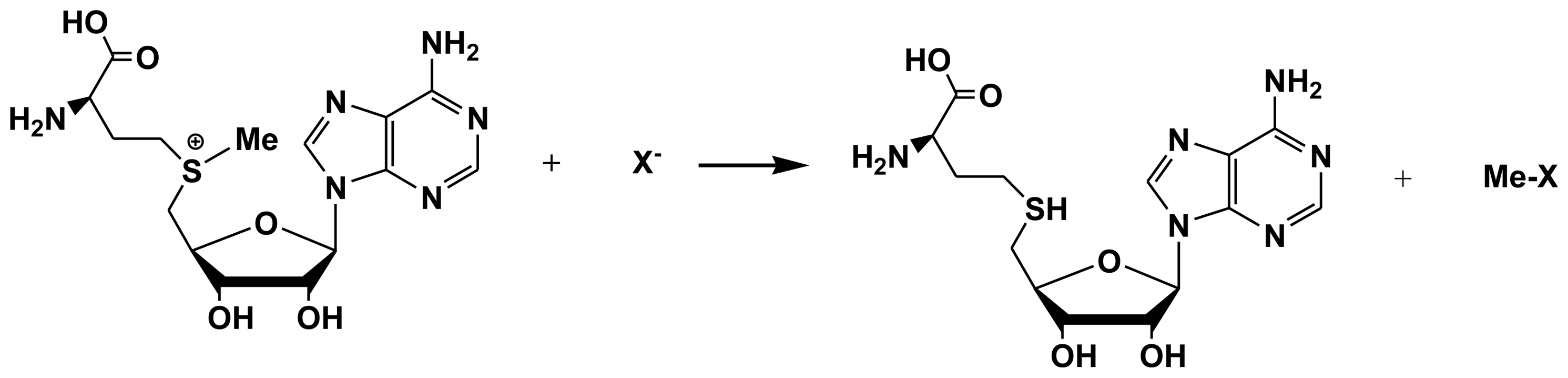
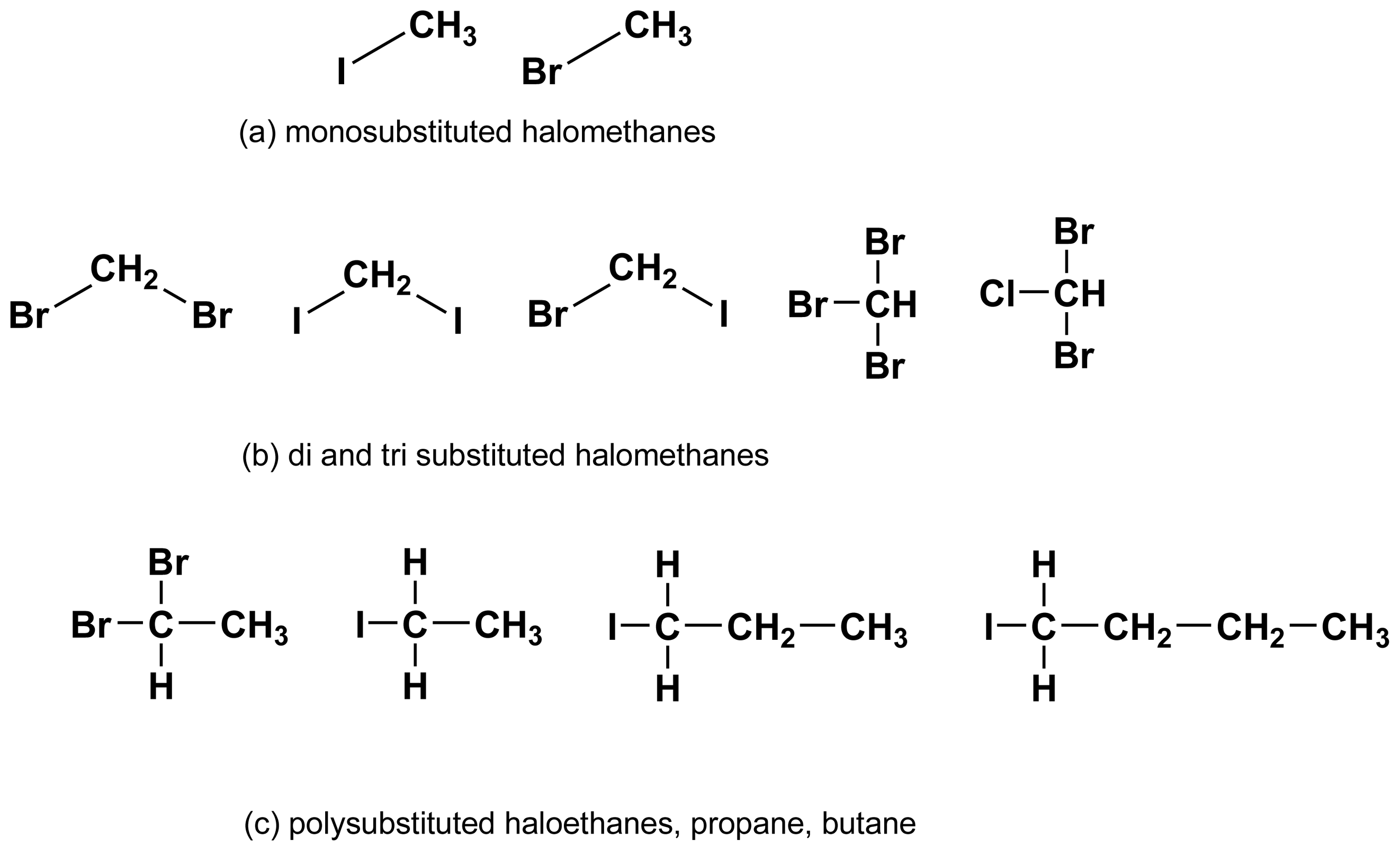
<p>Iodide (I<sup>−</sup>) and bromide (Br<sup>−</sup>) are actively taken up from seawater and (i) may directly undergo halogenation into monosubstituted halomethanes, or (ii) are oxidized respectively as HOI and HOBr by extracellular vanadium-dependent haloperoxidases (V-HPOs) which use photosynthetic hydrogen peroxide on a routine basis, and peroxide generated by oxidative burst under stress conditions, as discussed further. In the first instance, the biosynthesis of methyl bromide and methyl iodide involves the transferase - mediated nucleophilic attack of corresponding halides at the electrophilic CH<sub>3</sub><sup>+</sup>S site of S-Adenosyl Methionine (SAM; <xref ref-type="fig" rid="f1-marinedrugs-08-00988">Figure 1</xref>), but is clearly limited to monohalogenation [<xref ref-type="bibr" rid="b9-marinedrugs-08-00988">9</xref>,<xref ref-type="bibr" rid="b10-marinedrugs-08-00988">10</xref>], <italic>i.e.</italic>, the production of CH<sub>3</sub>I and CH<sub>3</sub>Br (<xref ref-type="fig" rid="f2-marinedrugs-08-00988">Figure 2 (a)</xref>. In the second case, methylation can produce di- and polysubstituted halomethanes, including a variety of hetero-substituted forms (e.g., CHBr<sub>2</sub>I; <xref ref-type="fig" rid="f2-marinedrugs-08-00988">Figure 2 (b)</xref>) as in <italic>Cystoseira barbata</italic> [<xref ref-type="bibr" rid="b11-marinedrugs-08-00988">11</xref>]. Electrophilic reaction of I<sup>+</sup> and especially Br<sup>+</sup> with acceptors (centers of high electron density in e.g., enols, phenolics and phloroglucinol derivatives) can be rationalized on the basis of rearrangement of the double-bond. Hence a plausible mechanism is the successive bromination of the enols of C<sub>2</sub> or C<sub>3</sub> etc. units containing C=O groups followed by the loss of C<sub>1</sub> (CH<sub>2</sub>O from CH<sub>3</sub>CHO and CH<sub>3</sub>CHO from CH<sub>3</sub>.CO.CH<sub>3</sub> with concomitant formation of e.g., CH<sub>2</sub>Br<sub>2</sub> and CHBr<sub>3</sub> [<xref ref-type="bibr" rid="b10-marinedrugs-08-00988">10</xref>–<xref ref-type="bibr" rid="b12-marinedrugs-08-00988">12</xref>]. Whatever their origin (<italic>i.e.</italic>, by cationoid or anionoid halogenation), volatile halogenated organic compounds (VHOCs) globally predominate in brown kelp effluxes and ensure a fast disposal of the ROS detoxification products (HOI and HOBr) while conceivably regulating apoplastic iodine and bromine reserves (see below). Furthermore, excess HOI and HOBr resulting from vanadium-dependant bromoperoxidase (V-BrPO) upregulation under oxidative stress is thought to complement on site destruction of microbial infection by ROS, and prevent microbial biofilm formation [<xref ref-type="bibr" rid="b13-marinedrugs-08-00988">13</xref>] or modulate its architecture (La Barre, unpubl. results), while VHOCs would help discourage reinfection.</p></sec>
<sec>
<title>2.2. Tyrosine-bound halogens</title>
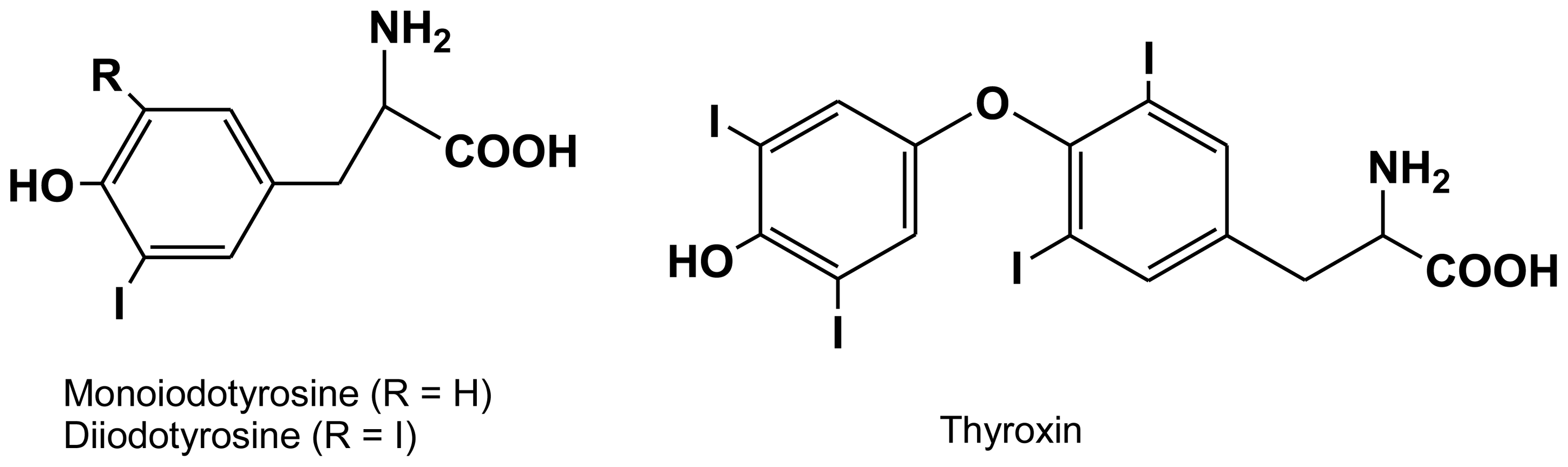
<p>Non-volatile iodine is mainly concentrated from seawater in the peripheral tissues of brown algae [<xref ref-type="bibr" rid="b15-marinedrugs-08-00988">15</xref>]. In Laminariales, several speciation studies have concluded that up to 90% of total iodine is mainly stored in a labile inorganic form identified as iodide [<xref ref-type="bibr" rid="b16-marinedrugs-08-00988">16</xref>–<xref ref-type="bibr" rid="b19-marinedrugs-08-00988">19</xref>], while its organic forms in <italic>Laminaria</italic> are dominated by hormone-like tyrosine derivatives, <italic>i.e.</italic>, monoiodotyrosine or MIT (10–15 ppm), diiodotyrosine or DIT (20–25 ppm), shown in <xref ref-type="fig" rid="f3-marinedrugs-08-00988">Figure 3</xref>. The ubiquity of iodinated tyrosines (e.g., MIT, DIT) across extant eukaryotic phyla has shown their general function as endocrine molecules involved in cell-cell communication (plants) as well as time-coordinated and dose-dependent developmental changes, as reviewed by [<xref ref-type="bibr" rid="b20-marinedrugs-08-00988">20</xref>]. Trophic transfers of thyroxin (TH) and thyroid hormone precursors from primary producers (possibly detected in phytoplankton upon immunological assays) to consumers are essential to the metamorphosis of larvae of marine invertebrates [<xref ref-type="bibr" rid="b21-marinedrugs-08-00988">21</xref>] and gene regulation and signal transcription in vertebrates. Contrary to most organohalogenates of phaeophyte origin, tyrosin halogenations into MIT and DIT is believed to occur spontaneously, <italic>i.e.</italic>, they are not enzyme mediated [<xref ref-type="bibr" rid="b22-marinedrugs-08-00988">22</xref>]. The facile halogenation of MIT and DIT and the emphasis on the signaling role of these ubiquitous metabolites in eukaryotic physiology [<xref ref-type="bibr" rid="b20-marinedrugs-08-00988">20</xref>] makes them possible candidates as hormone-like substances, along with known elicitors (alginate hydrolysates) of kelps [<xref ref-type="bibr" rid="b23-marinedrugs-08-00988">23</xref>].</p></sec>
<sec>
<title>2.3. Halogenated phenolics</title>
<p>Phloroglucinol and derived products are essentially plant products. Singh and Bharate [<xref ref-type="bibr" rid="b24-marinedrugs-08-00988">24</xref>] conveniently separates them into phloroglucinols (mono-, di-, tri-, tetra- and oligomeric) and phlorotannins. According to this classification, only a few phloroglucinols have been isolated from macrophytic algae, whereas phlorotannins are exclusively found in brown algae and are regarded as the functional equivalents of terrestrial tannins. Halogenated monomeric phenolics are also occasionally found in brown algae, as well as in a few red algae.</p>
<sec>
<title>2.3.1. Halogenated phloroglucinols and phenols</title>
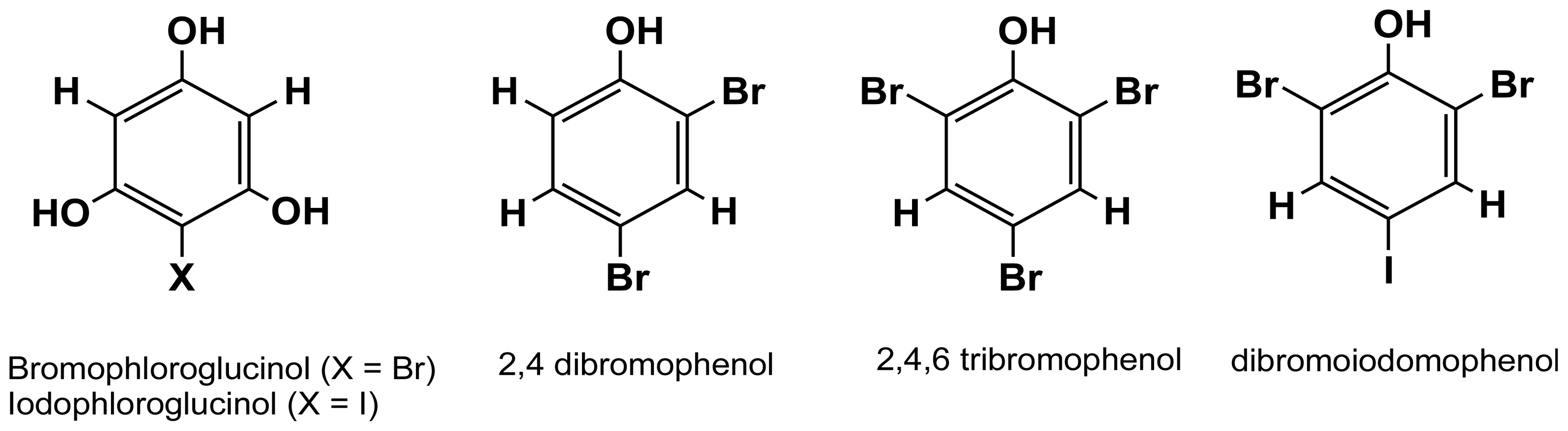
<p>Iodophloroglucinol and bromophloroglucinol have been identified in the Laminariale <italic>Eisenia arborea</italic> [<xref ref-type="bibr" rid="b25-marinedrugs-08-00988">25</xref>]. Interestingly, Shibata <italic>et al.</italic> [<xref ref-type="bibr" rid="b26-marinedrugs-08-00988">26</xref>] have found that the Laminariales <italic>Eisenia bicyclis</italic> and <italic>Ecklonia kurome</italic> release monomeric bromophenols (2,4-dibromophenol, 2,4,6-tribromophenol and dibromo-iodophenol) in the surrounding medium (<xref ref-type="fig" rid="f4-marinedrugs-08-00988">Figure 4</xref>), and retains oligomers and polymers in their tissues. Bromophenols are found in the peripheral tissues of a number of Australian brown algae [<xref ref-type="bibr" rid="b27-marinedrugs-08-00988">27</xref>] and are known to be much more efficient deterrents against grazing predators than phlorotannins, yet no study to date has correlated predation pressure with production and release of monomeric bromophenols in the water column.</p></sec>
<sec>
<title>2.3.2. Halogenated phlorotannins</title>
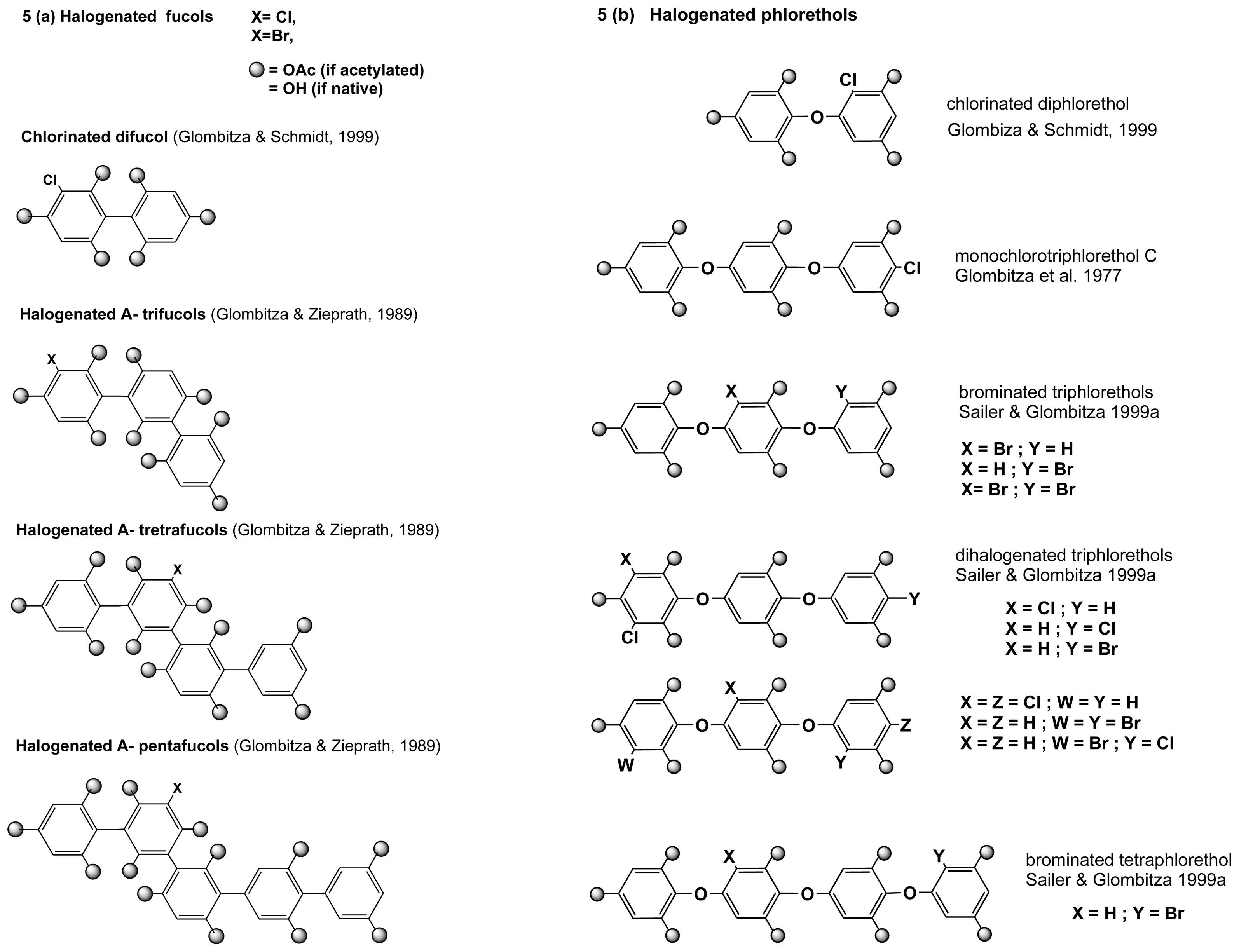
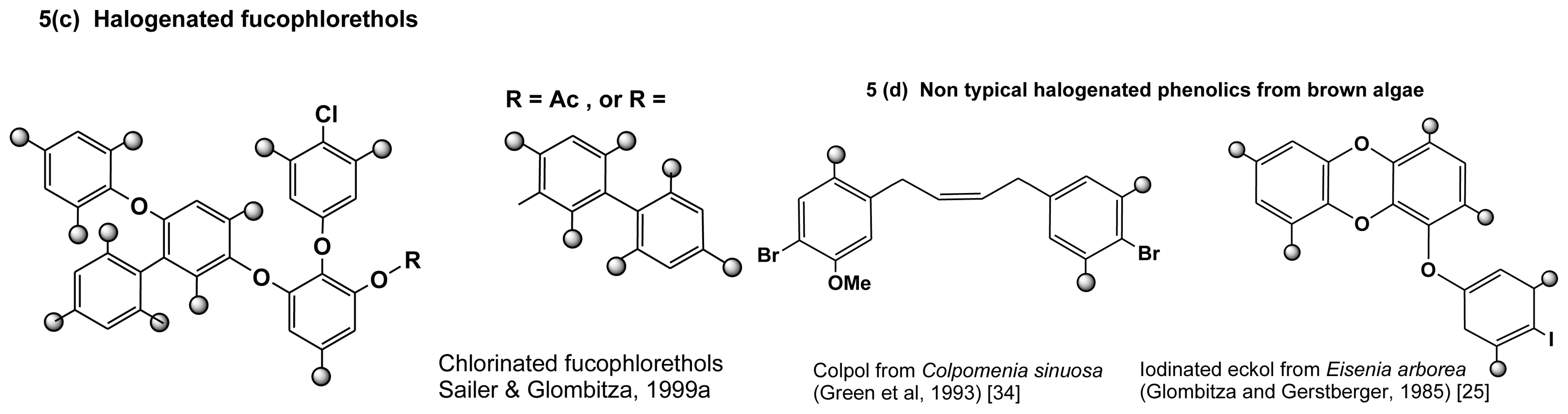
<p>According to linkage type, phlorotannins can be classified into four subclasses, <italic>i.e.</italic>, phlorotannins with an ether linkage (fuhalols and phlorethols), with a phenyl linkage (fucols), with an ether and a phenyl linkage (fucophlorethols), and with a dibenzodioxin linkage (eckols and carmalols), most of which have halogenated representatives in brown algae. The Fucales have been so far the best source of halogenated phlorotannins. For example, Koch and Gregson [<xref ref-type="bibr" rid="b28-marinedrugs-08-00988">28</xref>] have identified bromotriphlorethol in <italic>Cystophora congesta</italic>, and later Sailer and Glombitza [<xref ref-type="bibr" rid="b29-marinedrugs-08-00988">29</xref>] have isolated and characterized no less than 17 halogenated (brominated, chlorinated and iodinated) phlorotannins along with 30 non-halogenated forms [<xref ref-type="bibr" rid="b30-marinedrugs-08-00988">30</xref>] from the Sargassacea <italic>Cystophora retroflexa</italic>. One of these compounds, monochlorotriphlorethol was also found in the Laminariale <italic>Laminaria ochroleuca</italic> by Glombitza <italic>et al.</italic> [<xref ref-type="bibr" rid="b31-marinedrugs-08-00988">31</xref>]. The Sargassacea <italic>Carpophyllum angustifolium</italic>, in addition to chlorophloroglucinol, contains iododiphlorethol, chlorobifuhalol and chlorodifucol [<xref ref-type="bibr" rid="b32-marinedrugs-08-00988">32</xref>]. Monosubstituted eckols have been found in the Laminariale <italic>Eisenia arborea</italic>, along with halogenated phloroglucinols [<xref ref-type="bibr" rid="b25-marinedrugs-08-00988">25</xref>]. Ectocarpales have been little investigated, but chlorinated biaryl phloroglucinol derivatives (fucols) were found in <italic>Analipus japonicus</italic> [<xref ref-type="bibr" rid="b33-marinedrugs-08-00988">33</xref>]. Colpol, a non-typical phenolic derivative was isolated by Green <italic>et al.</italic> [<xref ref-type="bibr" rid="b34-marinedrugs-08-00988">34</xref>] in the Red Sea from a cosmopolitan Scytosiphonale, <italic>Colpomenia sinuosa</italic>. This brominated compound has a biphenyl butene structure, with strong cytotoxic activities. These various structures are shown in <xref ref-type="fig" rid="f5-marinedrugs-08-00988">Figure 5 (a), (b), (c) and (d)</xref>.</p></sec>
<sec>
<title>2.3.3. Biosynthesis of halogenated phlorotannins</title>
<p>The biosynthesis of phenolics such as phloroglucinol with hydroxylations at the <italic>meta</italic> position are derived from the acetate-malonate pathway [<xref ref-type="bibr" rid="b35-marinedrugs-08-00988">35</xref>], in a process which may involve a polyketide synthase-type enzyme complex [<xref ref-type="bibr" rid="b36-marinedrugs-08-00988">36</xref>]. Chemically, condensation initiates intermolecular ring closure to yield hexacyclic ring systems (unstable triketide) which undergo tautomerization into the more stable aromatic form, phloroglucinol. Yet the exact biosynthesis pathway of phlorotannins is not known [<xref ref-type="bibr" rid="b37-marinedrugs-08-00988">37</xref>]. The involvement of apoplastic vanadium-dependent haloperoxidases, in the presence of halide ions and hydrogen peroxide has been demonstrated for <italic>in vitro</italic> cross-linking of phlorotannins [<xref ref-type="bibr" rid="b38-marinedrugs-08-00988">38</xref>,<xref ref-type="bibr" rid="b39-marinedrugs-08-00988">39</xref>], but the presence of halogenated species during the oxidation process is still speculative and is awaiting confirmation by kinetic studies and mass spectral analysis. Sulfated low molecular weight polyphenols are found in a wide range of brown algae [<xref ref-type="bibr" rid="b40-marinedrugs-08-00988">40</xref>], but mixed (sulfated and halogenated) substitutions have never been reported so far.</p></sec></sec>
<sec>
<title>2.4. Halogenated fatty acids</title>
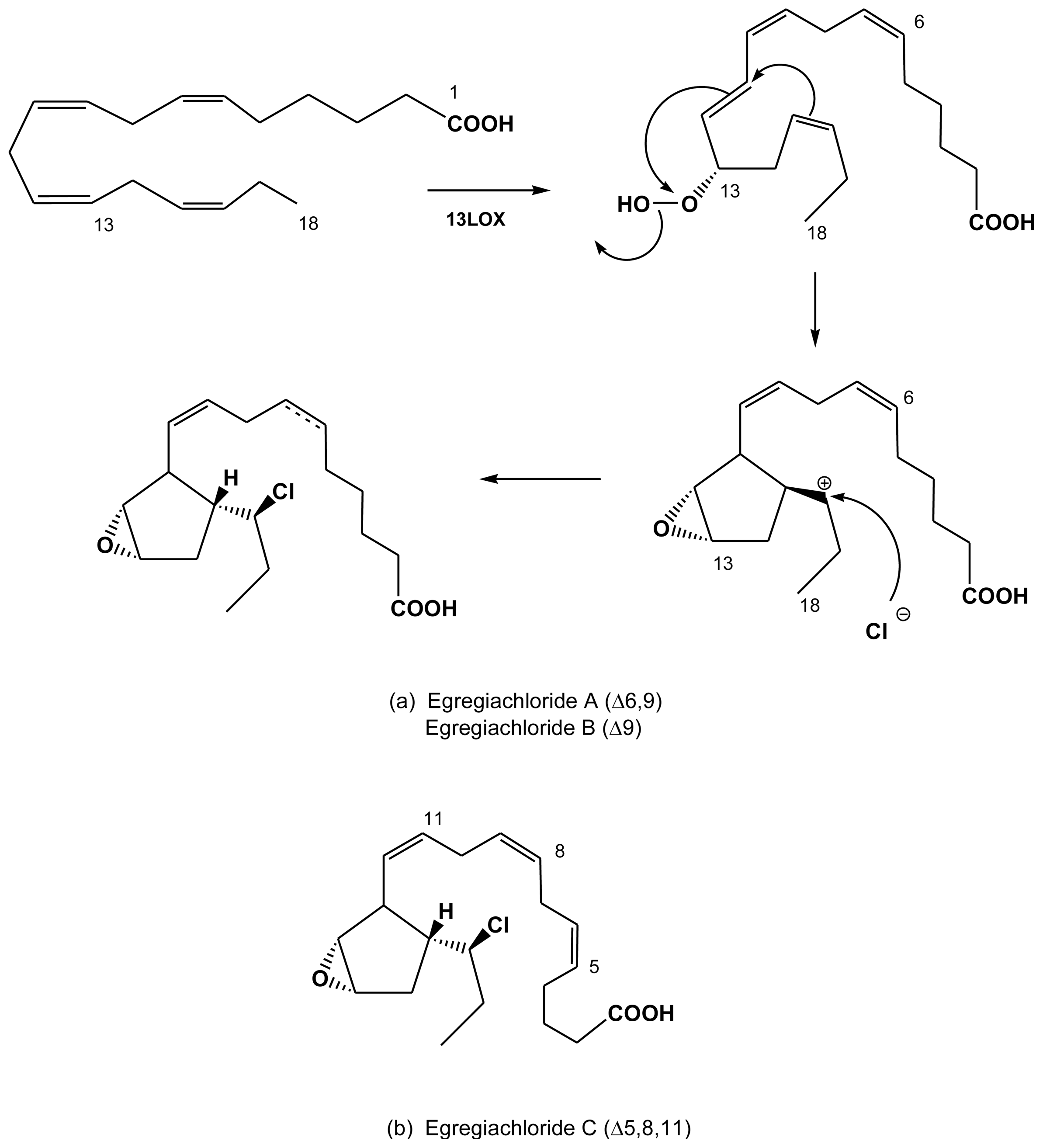
<p>In brown algae, the overall composition in saturated and unsaturated fatty acids is equivalent to that found in red algae, with a high proportion of C18 and C20 polyunsaturated forms (PUFA). Three chlorinated oxylipins were isolated from the Laminariale <italic>Egregia menziesii</italic> (Alariaceae) by Todd <italic>et al.</italic> [<xref ref-type="bibr" rid="b41-marinedrugs-08-00988">41</xref>], two originating from the C18 PUFA stearidonic acid (egregiachloride A and B, <xref ref-type="fig" rid="f6-marinedrugs-08-00988">Figure 6a</xref>) and one from the C20 PUFA eicosapentaenoic acid (egregiachloride C, <xref ref-type="fig" rid="f6-marinedrugs-08-00988">Figure 6b</xref>).</p>
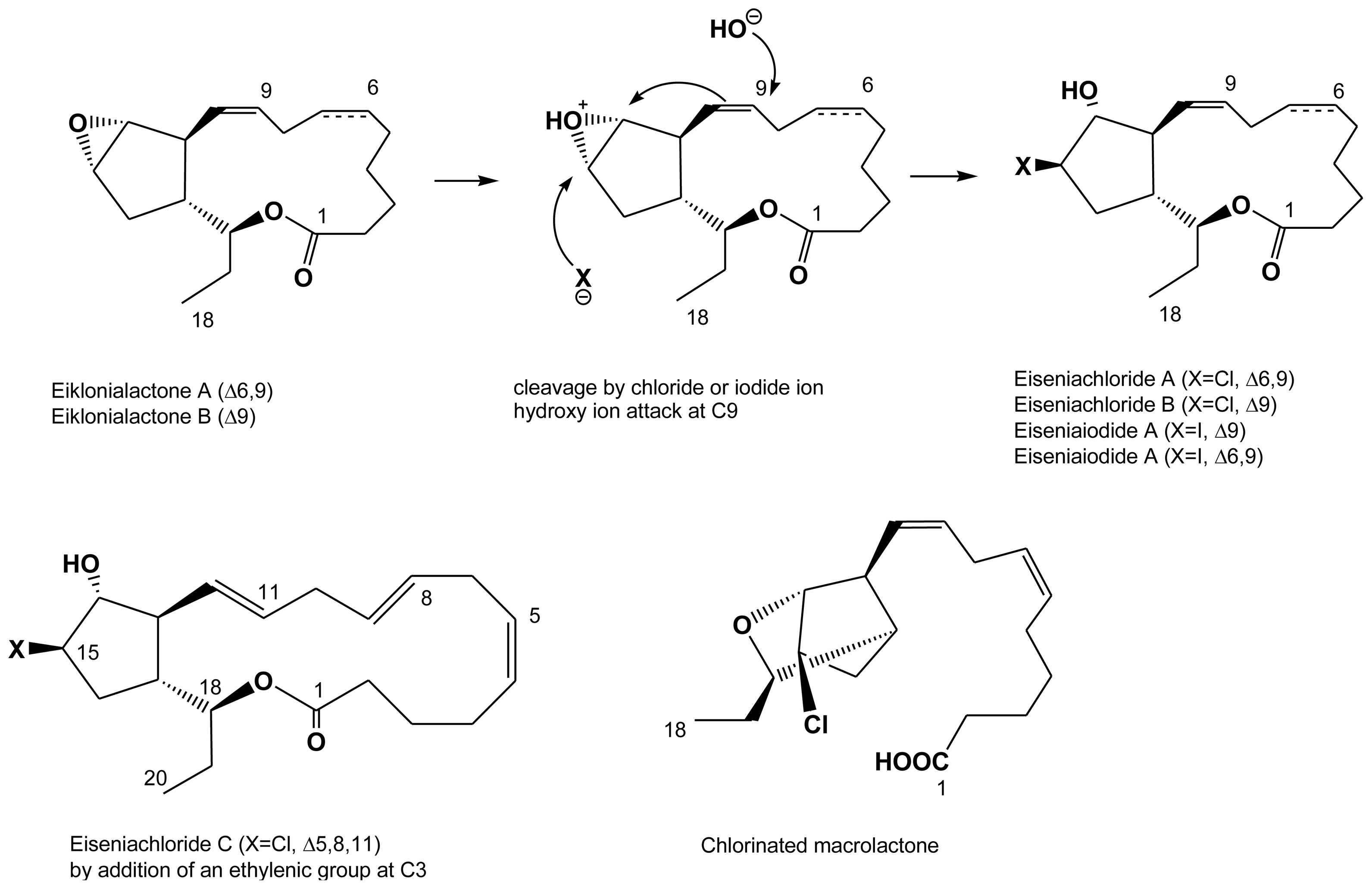
<p>Kousaka <italic>et al.</italic> [<xref ref-type="bibr" rid="b42-marinedrugs-08-00988">42</xref>] isolated six halogenated (eiseniachlorides) or iodinated (eiseniaiodides) species among a whole series of C18 oxylipins from another Alariaceae, <italic>Eisenia bicyclis</italic>, also biosynthesized from a stearidonic acid precursor. Along with eiseniachloride A and B and eiseniaiodide A and B, two cyclization variants (<xref ref-type="fig" rid="f7-marinedrugs-08-00988">Figure 7</xref>), were determined by extensive 2-D NMR analysis. Interestingly, the halogenation (<italic>via</italic> C13 HPOTE resulting from LOX <italic>i.e.</italic>, lipoxygenase oxidation) occurs inside the cell and does not include brominated forms. Finally, a C20 form (<italic>via</italic> addition of an ethylene group) was determined as eiseniachloride C. Anti bacterial assays on <italic>Bacillus subtilis</italic> and on <italic>Staphylococcus aureus</italic> did not shown any improvement of the activities of any of the halogenated forms over the non-halogenated ones [<xref ref-type="bibr" rid="b42-marinedrugs-08-00988">42</xref>]. Ecklonialactones A and B are potential feeding repellents against predating abalone seashell, but no mention is made of this ecological role for their halogenated forms [<xref ref-type="bibr" rid="b42-marinedrugs-08-00988">42</xref>].</p>
<p>Similar to plants, in the brown alga <italic>Saccharina (formerly Laminaria) angustata</italic>, the LOX-derived fatty acid hydroperoxides can be further cleaved to form C-6 (derived from C18 PUFA) and C-9 aldehydes (derived from C20 PUFA) none of which have been reported under halogenated forms (see review [<xref ref-type="bibr" rid="b43-marinedrugs-08-00988">43</xref>]). Although chlorosulpholipids have been reported in a number of freshwater algae, there is no evidence that they occur in marine algae [<xref ref-type="bibr" rid="b44-marinedrugs-08-00988">44</xref>].</p></sec>
<sec>
<title>2.5. Halogenated terpenes</title>
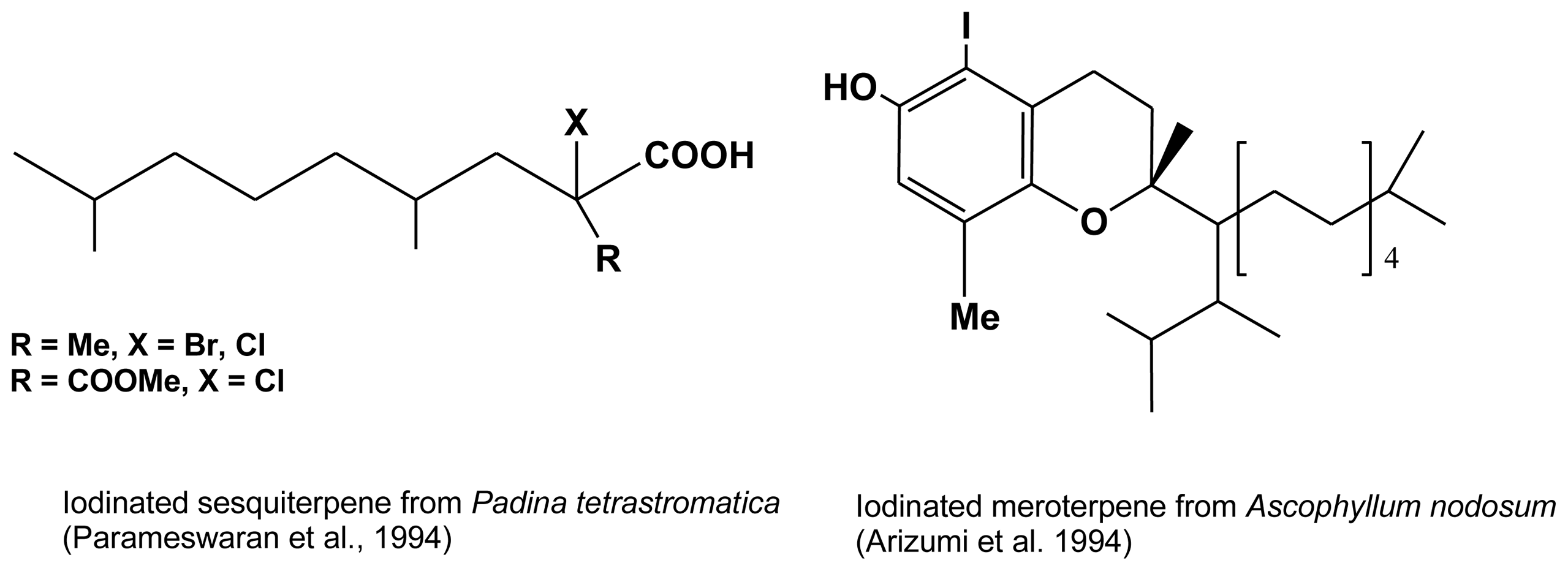
<p>The only phaeophycean halogenated nor-sesquiterpenes were isolated from <italic>Padina tetrastromatica</italic> [<xref ref-type="bibr" rid="b45-marinedrugs-08-00988">45</xref>], possibly oxidation forms of perhydrolinalool. An atypical iodinated meroterpene (terpene with an aromatic moiety) has been characterized in <italic>Ascophyllum nodosum</italic> by Arizumi <italic>et al.</italic> [<xref ref-type="bibr" rid="b46-marinedrugs-08-00988">46</xref>]. This is in sharp contrast to red algae, in which secondary metabolites structures are abundant (over 1,200 structures in 2005), with highly diverse halogenated terpenes (over 800 chlorinated and/or brominated forms many of which have attracted the interest of pharmacologists [<xref ref-type="bibr" rid="b47-marinedrugs-08-00988">47</xref>]), and which probably reflect a capacity to diversify their defense strategies which is not encountered in brown algae.</p></sec>
<sec>
<title>2.6. Halogenated polysaccharides</title>
<p>If sulfatation of carbohydrates is a common feature in brown algae that confers them with specific physical and eco-physiological properties [<xref ref-type="bibr" rid="b48-marinedrugs-08-00988">48</xref>], there has never been any report of halogenated polysaccharides, in contrast to polyphenols in which either substitution (sulfates or halogen) can be found.</p></sec></sec>
<sec>
<title>3. The Enzymology of Halogenation in Brown Algae</title>
<p>Nature’s strategies for incorporating halogens into organic molecules are multiple [<xref ref-type="bibr" rid="b49-marinedrugs-08-00988">49</xref>] and the discovery of new enzymes for halogenation has increased tremendously during the last decade [<xref ref-type="bibr" rid="b14-marinedrugs-08-00988">14</xref>] revealing new metalloenzymes, flavoenzymes, <italic>S</italic>-adenosyl-l-methionine (SAM)-dependent enzymes and others that catalyse halide oxidation using dioxygen, hydrogen peroxide and hydroperoxides, or that promote nucleophilic halide addition reactions [<xref ref-type="bibr" rid="b50-marinedrugs-08-00988">50</xref>]. In brown algae, it is now widely accepted that halogenation involves vanadium-dependent haloperoxidases (V-HPOs). Together with the heme-dependent haloperoxidases, V-HPOs utilize hydrogen peroxide to convert a halide ion (X<sup>−</sup>) to hypohalite (OX<sup>−</sup>) intermediate that is chemically equivalent to an electrophilic “X+”. They are named according to the most electronegative halide that they can oxidize, <italic>i.e.</italic>, chloroperoxidases (V-CPOs) can catalyze the oxidation of chloride as well as of bromide and iodide, bromoperoxidases (V-BrPOs) react with bromide and iodide, whereas iodoperoxidases (V-IPOs) are specific of iodide.</p>
<p>Vanadium-dependent haloperoxidases from marine sources are reviewed in this special issue [<xref ref-type="bibr" rid="b51-marinedrugs-08-00988">51</xref>], and a recent mini-review by Winter and Moore [<xref ref-type="bibr" rid="b52-marinedrugs-08-00988">52</xref>] provides an interesting phylogenetic tree of the different classes and sources of chloro- and bromoperoxidases found in nature. The first V-HPO was discovered in the fucoid brown alga <italic>Ascophyllum nodosum</italic> [<xref ref-type="bibr" rid="b53-marinedrugs-08-00988">53</xref>]. This enzyme has been extensively characterized as a bromoperoxidase at a biochemical and structural level [<xref ref-type="bibr" rid="b54-marinedrugs-08-00988">54</xref>,<xref ref-type="bibr" rid="b55-marinedrugs-08-00988">55</xref>]. As of today [<xref ref-type="bibr" rid="b14-marinedrugs-08-00988">14</xref>] and despite extensive researches on different V-BrPOs and V-ClPOs, the complete catalytic cycle is still uncertain and the origin of halide selectivity remains one of yet unanswered question [<xref ref-type="bibr" rid="b50-marinedrugs-08-00988">50</xref>,<xref ref-type="bibr" rid="b56-marinedrugs-08-00988">56</xref>]. Up to now, V-BrPO activities have been detected in both red and brown macroalgae, whereas V-ClPO are restricted to terrestrial fungi and to bacteria [<xref ref-type="bibr" rid="b52-marinedrugs-08-00988">52</xref>]. In microalgae, halogenation of organic compounds is known to involve halide methyl transferases [<xref ref-type="bibr" rid="b57-marinedrugs-08-00988">57</xref>] and no V-HPO has been yet identified on genomic data obtained from diatoms [<xref ref-type="bibr" rid="b58-marinedrugs-08-00988">58</xref>]. From algal genomic resources, several putative V-HPO homologues and dehalogenase enzymes have been identified in the red alga <italic>Chondrus crispus</italic> [<xref ref-type="bibr" rid="b59-marinedrugs-08-00988">59</xref>]. The first known V-IPO was identified and cloned in <italic>Laminaria digitata</italic> by [<xref ref-type="bibr" rid="b60-marinedrugs-08-00988">60</xref>] and phylogenetic analyses have shown that all brown algal V-HPOs present a monophyletic origin with a common ancestor with V-HPOs from red algae. However, it seems that in <italic>L. digitata</italic> the independent evolution of the two haloperoxidase gene families led to a novel biochemical function specialized in iodine oxidation [<xref ref-type="bibr" rid="b60-marinedrugs-08-00988">60</xref>]. Both V-HPO gene families seem to operate in a coordinate manner. Specific <italic>vIPO</italic> genes (coding for V-IPO enzymes) are upregulated following an oxidative burst to rapidly restore iodine loss, while some V-BrPO coding genes are specifically activated and likely to be involved in oxygen detoxification [<xref ref-type="bibr" rid="b61-marinedrugs-08-00988">61</xref>]. Recent proteomic studies on <italic>Saccharina</italic> (formerly <italic>Laminaria</italic>) <italic>japonica</italic> have revealed that V-BrPO are strongly upregulated during the summer months, in response to elimination of active oxygen species and protection of algal tissues from oxygen injury, as well as discouraging epiphytism which may seasonally hamper proper growth [<xref ref-type="bibr" rid="b62-marinedrugs-08-00988">62</xref>].</p>
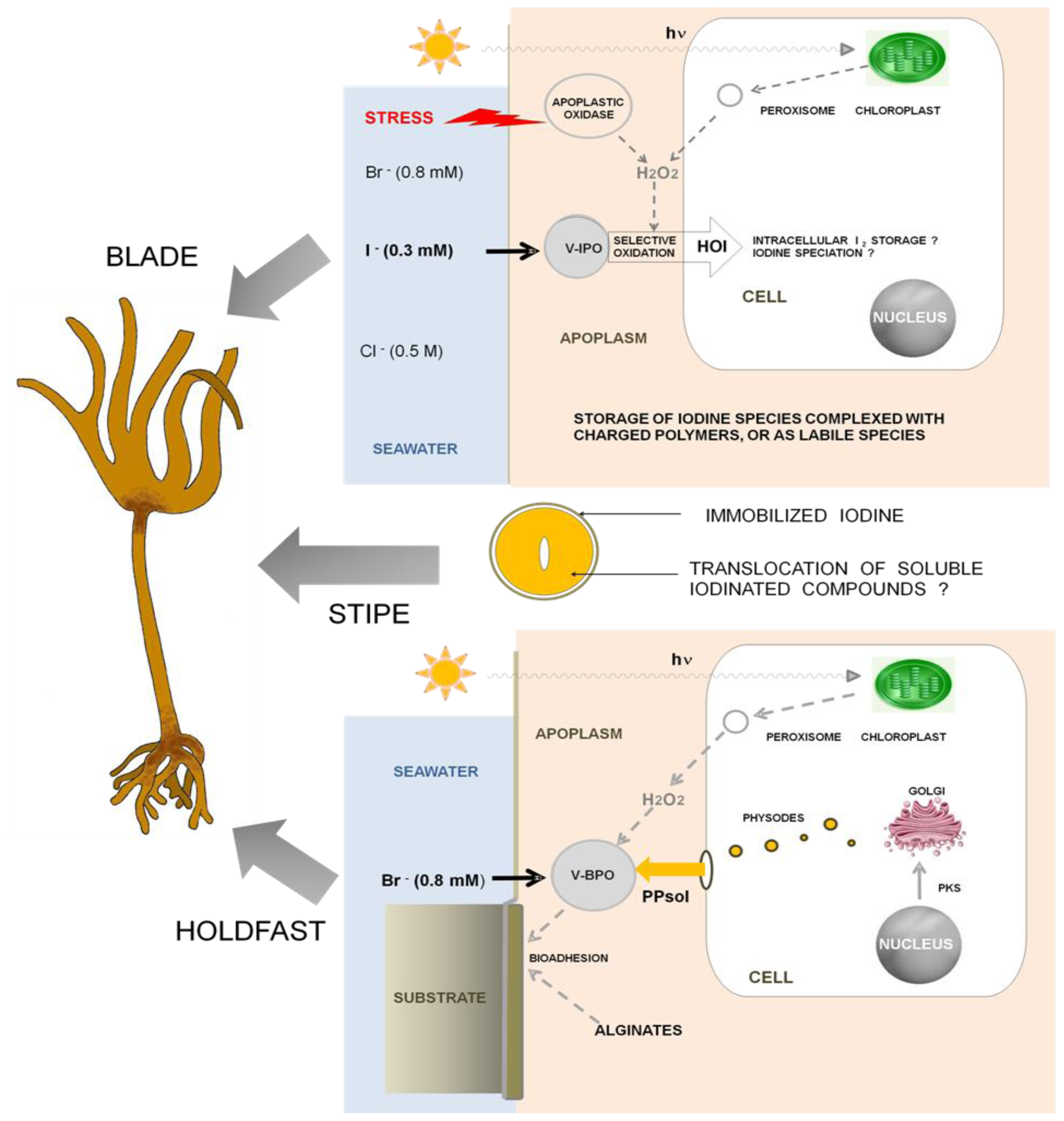
<p>In brown algae, V-HPOs and halides are likely to play a central role in oxidative detoxication, cell wall strengthening, and chemical defense in a context of cellular defense, as well as in substrate adhesion in young sporophytes. These various functions of V-HPOs crystallize large basic and applied interests, (see reviews in [<xref ref-type="bibr" rid="b50-marinedrugs-08-00988">50</xref>,<xref ref-type="bibr" rid="b51-marinedrugs-08-00988">51</xref>]). In <xref ref-type="fig" rid="f9-marinedrugs-08-00988">Figure 9</xref>, the various biological functions of V-HPO are highlighted and contrasted in the various thallus parts in which they prevail, <italic>i.e.</italic>, bioadhesion at the holdfast region, defense against epiphytism, predation and biofouling being optimally expressed at the peri-meristematic region of the blade.</p></sec>
<sec>
<title>4. The Function of Bromination in Brown Algal Adhesion</title>
<p>A model of oxidative cross-linking of secreted phenolics mediated <italic>via</italic> the catalysis of a vanadium bromoperoxidase was proposed about twenty years ago, based on some indirect evidences such as V-BrPO immunolocalization in adherent eggs and spores of fucoid brown algae [<xref ref-type="bibr" rid="b63-marinedrugs-08-00988">63</xref>,<xref ref-type="bibr" rid="b64-marinedrugs-08-00988">64</xref>]. Indeed, this poorly grounded hypothesis [<xref ref-type="bibr" rid="b65-marinedrugs-08-00988">65</xref>] was challenged later when sophisticated techniques were used to investigate cross-linking processes in brown algae. The cross-linking of brown algal phlorotannins catalyzed by the V-BrPO from <italic>A. nodosum</italic> was measured using the quartz crystal microbalance with dissipation monitoring (QCM-D) method [<xref ref-type="bibr" rid="b38-marinedrugs-08-00988">38</xref>]. Phlorotannins adsorbed to a quartz crystal sensor were shown to change their mechanical properties upon the addition of V-BrPO, KBr and H<sub>2</sub>O<sub>2</sub>. The decreased dissipation upon addition of the cross-linking agents was interpreted as intramolecular cross-links formed between different phloroglucinol units in the phlorotannins [<xref ref-type="bibr" rid="b38-marinedrugs-08-00988">38</xref>]. Additionnal measurements using surface plasmon resonance (SPR) and UV/Vis spectroscopy verified the results achieved with QCM-D that all components <italic>i.e.</italic>, V-BrPO, KBr and H<sub>2</sub>O<sub>2</sub> were necessary in order to achieve intramolecular <italic>in vitro</italic> oxidative cross-linking of the polymers. Based on the occurrence of halogenated phlorotannins in brown algae, while in low abundance [<xref ref-type="bibr" rid="b66-marinedrugs-08-00988">66</xref>], the involvement of a V-BrPO in the catalysis of phenolic cross-linking is our favourite hypothesis. Hardening with alginate and/or calcium is essential for high cohesive strength as shown in shear-lap tests that measured the adhesion strength of this assemblage [<xref ref-type="bibr" rid="b67-marinedrugs-08-00988">67</xref>]. All formulations were capable of adhering to a variety of surfaces, however the adhesion properties were influenced by the halide used [<xref ref-type="bibr" rid="b39-marinedrugs-08-00988">39</xref>]. QCM-D results showed that the kinetics of the oxidation was faster with iodide than with bromide. Small angle X-ray scattering (SAXS), light scattering and cryo-Transmission Electron Microscopy (TEM) experiments [<xref ref-type="bibr" rid="b67-marinedrugs-08-00988">67</xref>] revealed that oxidized polyphenols self-assemble into chain-like objects, irrespective of the oxidation conditions [<xref ref-type="bibr" rid="b39-marinedrugs-08-00988">39</xref>]. Yet, slight differences in the aggregate size were detected. Moreover, oxidation with iodide generates stiffer networks, suggesting that the interaction between the alginate and the polyphenol could be the cause of the reduced adhesion [<xref ref-type="bibr" rid="b67-marinedrugs-08-00988">67</xref>]. When coupled with results showing that V-BrPO brings about curing of adhesive extracts more than other catalysts, these data implicate V-BrPO to be the key reagent in controlling the cross-linking of phenolic polymers for the assembly of brown algal adhesives. These conclusions were confirmed by independent studies investigating the interaction between polyphenolics from the brown alga <italic>Padina gymnospora</italic> and alginate from <italic>Fucus vesiculosus</italic> using size exclusion chromatography (SEC) and optical tweezers microscopy [<xref ref-type="bibr" rid="b68-marinedrugs-08-00988">68</xref>]. It revealed the formation of a high-molecular-weight complex only when V-BrPO was added, indicating that the enzyme is essential for the binding process, along with a decrease in alginate viscosity. However, the covalent binding of uronic acid residues with some aromatic rings suggested by Salgado <italic>et al.</italic> [<xref ref-type="bibr" rid="b68-marinedrugs-08-00988">68</xref>] are not yet demonstrated in brown algae and SAXS and cryo-TEM measurements disfavoured this hypothesis (for a detailed discussion see Potin &amp; Leblanc [<xref ref-type="bibr" rid="b69-marinedrugs-08-00988">69</xref>]). In this context, oxidized bromine or iodine in brown algae participates in a number of reactions with organic substrates, in which the resulting metabolites are involved in primary (oxygen detoxication, tissue repair, bioadhesion) and secondary (surface antibacterials) roles.</p></sec>
<sec>
<title>5. The Role of Iodine in Brown Algae</title>
<sec>
<title>5.1. The emergence of specificity for iodine oxidation in brown algae</title>
<p>The element iodine has been discovered in the ashes of brown algal kelps in the beginning of the 19th century. The kelp <italic>Laminaria digitata</italic> presents an average iodine content of 1.0% of dry weight, representing a ca. 30,000-fold accumulation of this element from seawater [<xref ref-type="bibr" rid="b70-marinedrugs-08-00988">70</xref>]. In this brown alga, micro-chemical imaging of iodine distribution reveals an unexpected sub-cellular distribution in the cell walls of peripheral cells [<xref ref-type="bibr" rid="b15-marinedrugs-08-00988">15</xref>], with the predominance of iodide species [<xref ref-type="bibr" rid="b71-marinedrugs-08-00988">71</xref>]. Although <italic>L. digitata</italic> represents one of the most studied models, the biochemical pathways leading to this very efficient iodide trapping and the mechanism responsible for its release into the surroundings are still speculative. Specific oxidation processes are essential in both the mechanisms of iodine uptake and release. In <italic>L. digitata</italic>, iodine is thought to be taken up by a mechanism based on the haloperoxidase-mediated oxidation of iodide, a mechanism which requires a constitutive apoplastic level of hydrogen peroxide of circa 50 μM [<xref ref-type="bibr" rid="b70-marinedrugs-08-00988">70</xref>] and which could involve an apoplastic V-IPO [<xref ref-type="bibr" rid="b60-marinedrugs-08-00988">60</xref>,<xref ref-type="bibr" rid="b72-marinedrugs-08-00988">72</xref>]. Recent studies [<xref ref-type="bibr" rid="b15-marinedrugs-08-00988">15</xref>,<xref ref-type="bibr" rid="b69-marinedrugs-08-00988">69</xref>] have shown that iodide is mainly chelated by apoplastic macromolecules. Such a storage mechanism should provide an abundant and accessible source of reduced iodine, which can be easily remobilized for potential anti-oxidative activities and chemical defense. This unique setup has never been described among all living systems. However, in the presence of exogenously-added 2 mM H<sub>2</sub>O<sub>2</sub>, a net efflux of iodide was observed [<xref ref-type="bibr" rid="b70-marinedrugs-08-00988">70</xref>]. Yet there is no clear answer as to why Laminariales have developed (or retained?) such an important and extensive metabolic dependence to iodine, as compared to most halogen-using marine life forms [<xref ref-type="bibr" rid="b71-marinedrugs-08-00988">71</xref>].</p></sec>
<sec>
<title>5.2. The function of the iodine metabolism</title>
<p>The molecular mass of iodine (126.90 U) is the highest by far of all elements used in biological systems, including metals. The prevalence of iodine chemistry in very early life forms has recently led to interesting speculations as its cornerstone role as a catalyst and inorganic antioxidant [<xref ref-type="bibr" rid="b20-marinedrugs-08-00988">20</xref>] without which the emergence of multicellularity would never have taken place. Indeed, iodine is regarded as an additional biomarker towards the presence of life in extraterrestrial environments. Early prokaryotes (LUCA) had to carry out the conversion of toxic environmental iodate into iodine which could be readily incorporated in the cytoplasm and perform a number of essential catalytic functions, e.g., by coupling with essential organic molecules. The reducing (electron loosing) capacity of halides being proportional to the atomic size of the halogen, the oxidation products of active oxygenated species (AOS) and iodide occur almost readily as compared to bromine or chlorine. Iodine production by iodoperoxidases in several phaeophyte taxa, e.g., several Laminariales, represent a very efficient way of quenching excess hydrogen peroxide and reactive oxygenated radicals, following oxidative burst, or simply accumulating in plastids from regular photosynthesis [<xref ref-type="bibr" rid="b71-marinedrugs-08-00988">71</xref>]. An equivalent functional (primary) role is assigned to highly nucleophilic phlorotannins which are produced in a number of shore Fucales, following seasonal patterns in western Brittany (France), especially during summer with longer exposures to sunlight, and at mid-tide levels [<xref ref-type="bibr" rid="b73-marinedrugs-08-00988">73</xref>]. Interestingly, it was shown that the average iodine contents were lowest in summer months (0.25–0.60% dry weight) and highest in late autumn and in winter (in the range 0.75–1.20% dry weight) in the kelp <italic>Laminaria digitata</italic> [<xref ref-type="bibr" rid="b74-marinedrugs-08-00988">74</xref>]. Taken together, these data may help understand how the two classes of compounds interplay as ROS quenchers. However, in <italic>L. digitata</italic>, soluble phlorotannins are very low [<xref ref-type="bibr" rid="b73-marinedrugs-08-00988">73</xref>] and therefore iodide is likely to play a major role as an antioxidant [<xref ref-type="bibr" rid="b71-marinedrugs-08-00988">71</xref>]. Further studies are required in other species of Laminariales and of Fucales in order to understand the respective roles and the possible alternation between phlorotannins and iodide. Within-thallus translocation has long been documented in red and various brown algae, the sieve elements in both lineages lacking the vascularized phloem structure of higher plants [<xref ref-type="bibr" rid="b75-marinedrugs-08-00988">75</xref>]. In Laminariales, translocation of carbon labeled photosynthates from older parts of the frond towards the meristematic region and to the holdfast haptera has been demonstrated [<xref ref-type="bibr" rid="b76-marinedrugs-08-00988">76</xref>]. Mannitol, malate, citrate, polar amino acids and proteins are non-selectively translocated <italic>via</italic> the sieve tube of <italic>Macrocystis pyrifera</italic>, as well as inorganic cations (K<sup>+</sup>, Na<sup>+</sup>, Mg<sup>2+</sup> and Ca<sup>2+</sup>) and anions among which chloride and bromide [<xref ref-type="bibr" rid="b77-marinedrugs-08-00988">77</xref>]. Iodide was later found to translocate in a source-to-sink manner, compatible with known distribution of this element in Laminariales [<xref ref-type="bibr" rid="b78-marinedrugs-08-00988">78</xref>]. As of now, organic halides have not been identified as translocates, yet there are strong suspicions that regulation of V-HPO genes operates within the context of a systemic response [<xref ref-type="bibr" rid="b61-marinedrugs-08-00988">61</xref>]. Systemy would operate either externally (detection in the water column of an eliciting signal generated in a stressed region of the thallus by a naïve region of the same individual, followed by a defense response), or internally <italic>via</italic> translocation. It could involve halogenated compounds (VHOC) or oxygenated species (aldehydes) which are produced as defense compounds in plantlets of <italic>L. digitata</italic> which are metabolically challenged [<xref ref-type="bibr" rid="b79-marinedrugs-08-00988">79</xref>,<xref ref-type="bibr" rid="b80-marinedrugs-08-00988">80</xref>] and thus are possible pheromone-like candidates, along with known elicitors (alginate hydrolysates) of this particular kelp.</p></sec>
<sec>
<title>5.3. Environmental consequences of the iodine metabolism</title>
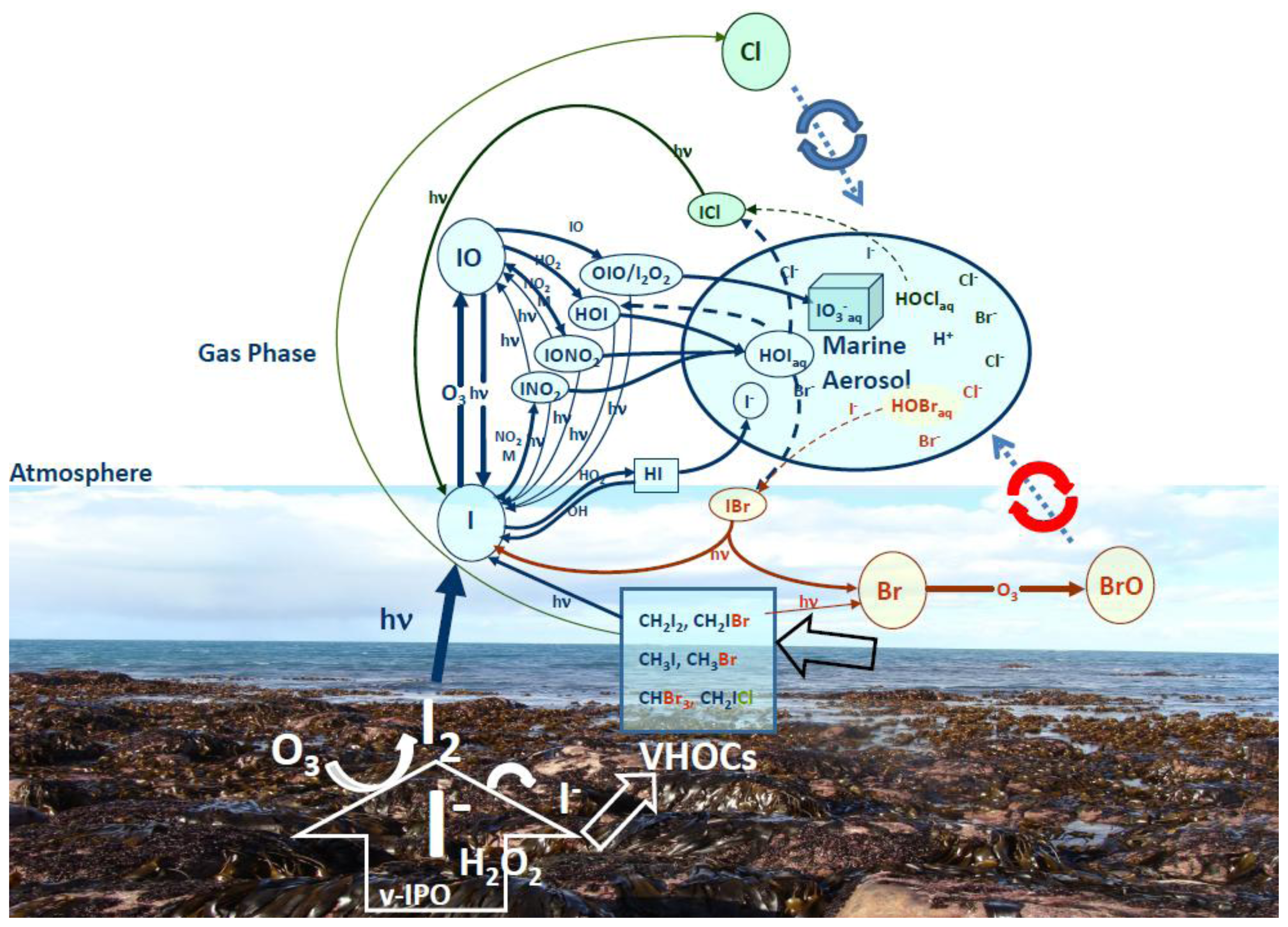
<p>Iodine species are present in the marine boundary layer (MBL) due to the release of I<sub>2</sub> and of photo-labile iodocarbons from macro- and micro-algae (<xref ref-type="fig" rid="f10-marinedrugs-08-00988">Figure 10</xref>). Whilst the primary source of inorganic chlorine and bromine species in the remote ocean is likely to be their release from the significant seasalt halide reservoir in atmospheric aerosol, the direct emission of halocarbons [<xref ref-type="bibr" rid="b81-marinedrugs-08-00988">81</xref>,<xref ref-type="bibr" rid="b82-marinedrugs-08-00988">82</xref>] from intertidal macroalgal species [<xref ref-type="bibr" rid="b79-marinedrugs-08-00988">79</xref>], from phytoplankton [<xref ref-type="bibr" rid="b83-marinedrugs-08-00988">83</xref>] and from biogenic marine aggregates [<xref ref-type="bibr" rid="b84-marinedrugs-08-00988">84</xref>] has been well established and contributes significantly to the coastal atmospheric burden of Reactive Halogen Species (RHS) [<xref ref-type="bibr" rid="b81-marinedrugs-08-00988">81</xref>,<xref ref-type="bibr" rid="b82-marinedrugs-08-00988">82</xref>]. Indeed shallow coastal areas where kelp beds of <italic>Laminaria digitata</italic> correspond to hotspots of biogenic halocarbon emission have been recently investigated with particular attention to iodine speciation. In particular, CH<sub>2</sub>I<sub>2</sub> is the dominant organic iodine species released from kelps [<xref ref-type="bibr" rid="b81-marinedrugs-08-00988">81</xref>,<xref ref-type="bibr" rid="b82-marinedrugs-08-00988">82</xref>] and has it been suggested as one of the initiators of the iodine nanometric particles that function as cloud-forming nuclei [<xref ref-type="bibr" rid="b85-marinedrugs-08-00988">85</xref>]. The most widely-observed coastal inorganic RHS, iodine monoxide (IO), has also consistently been shown to exhibit a tidal signature, but only during daytime, consistent with photochemical formation of IO. In addition to the tidal halogen cycling, studies at Mace Head in Western Ireland revealed the rapid appearance of high concentrations of ultrafine aerosol particles at daytime low tide [<xref ref-type="bibr" rid="b86-marinedrugs-08-00988">86</xref>,<xref ref-type="bibr" rid="b87-marinedrugs-08-00988">87</xref>]. Should even a small fraction of the particles grow sufficiently large that they would act as Cloud Condensation Nuclei (CCN) at supersaturations corresponding to updraughts in typical marine stratocumulus clouds, such particle formation may significantly impact on local and regional radiative forcing and climate.</p>
<p>During the 2006 coastal campaign of the Reactive Halogens in the Marine Boundary Layer (RHaMBLe) project in Roscoff in Western France [<xref ref-type="bibr" rid="b88-marinedrugs-08-00988">88</xref>], it was clearly demonstrated that iodine-mediated coastal particle formation occurs, driven by daytime low tide emission of molecular iodine (I <sub>2</sub>), by macroalgal species fully or partially exposed by the receding waterline. Ultrafine particle concentrations strongly correlate with the rapidly recycled reactive iodine species, IO, produced at high concentrations following photolysis of I<sub>2</sub>. The heterogeneous macroalgal I<sub>2</sub> sources lead to variable relative concentrations of iodine species observed by path-integrated [<xref ref-type="bibr" rid="b89-marinedrugs-08-00988">89</xref>] and <italic>in situ</italic> measurement techniques [<xref ref-type="bibr" rid="b90-marinedrugs-08-00988">90</xref>]. As shown at Roscoff, rockweed (the fucoid alga <italic>A.nodosum</italic>) beds may also emit more constantly than kelps because there are exposed to air more frequently (even during small tides) and for longer periods of time [<xref ref-type="bibr" rid="b91-marinedrugs-08-00988">91</xref>,<xref ref-type="bibr" rid="b92-marinedrugs-08-00988">92</xref>]. However, it was also observed at Cape Grim in Australia, that the contribution to particle formation of the fucoid alga <italic>Durvillaea potatorum</italic> is very limited because this alga does not release I<sub>2</sub> [<xref ref-type="bibr" rid="b93-marinedrugs-08-00988">93</xref>]. These discrepancies have been tentatively explained by different capabilities of accumulation and emission between these two orders of large brown algae [<xref ref-type="bibr" rid="b92-marinedrugs-08-00988">92</xref>]. The evolution of new biochemical adaptations using more specific V-HPO has probably contributed to a better capacity to oxidize iodine and to use halides in kelps. In Laminariales (see section 2), iodoperoxidases activities that are specific for iodide, have been localized at least partly extracellularly in the apoplasm [<xref ref-type="bibr" rid="b60-marinedrugs-08-00988">60</xref>,<xref ref-type="bibr" rid="b94-marinedrugs-08-00988">94</xref>] and may explain the very high amount of iodide accumulated in their cell walls and higher efficiency of kelps for iodine oxidation, even in the absence of strong external oxidants, such as ozone. <italic>Ascophyllum nodosum</italic> was shown to possess two distinct isoforms of V-BrPO, one of them being located very superficially at the thallus surface [<xref ref-type="bibr" rid="b95-marinedrugs-08-00988">95</xref>] which is likely conferring a better capacity to oxidize iodide leading to high I<sub>2</sub> emissions. Interestingly, this agree with the modeling of I<sub>2</sub> emissions in the Roscoff area during the RHaMBLe project [<xref ref-type="bibr" rid="b92-marinedrugs-08-00988">92</xref>], which showed that the occurrence of rockweed in the mid-littoral zone of sheltered habitats complements efficiently the presence of large stands of Laminariales.</p></sec></sec>
<sec>
<title>6. New Approaches, New Answers?</title>
<p>Marine halogenated natural products have important biological functions as signalling molecules and defense compounds for the producing organisms. If their therapeutic potential has attracted the attention of pharmacochemists worldwide since the early seventies [<xref ref-type="bibr" rid="b97-marinedrugs-08-00988">97</xref>], there is a now a strong interest in exploring the enzymes involved in their biosynthesis, in particular the vanadium-dependent haloperoxidases. Some V-HPOs have the ability to halogenate a range of organic compounds in a region- and stereospecific manner as evidenced in at least two orders of Rhodophyta [<xref ref-type="bibr" rid="b98-marinedrugs-08-00988">98</xref>] and by the wealth of bioactive chlorinated/brominated organic molecules found in this lineage [<xref ref-type="bibr" rid="b47-marinedrugs-08-00988">47</xref>]. In the Phaeophyta, the primary function of haloperoxidases is to prevent the accumulation of toxic oxygenated species (the vanadium-containing catalytic site uses two molecules of hydrogen peroxide).</p>
<sec>
<title>Ascophyllum nodosum</title>
<p>V-BrPOs still operate at 70 °C, in up to 60% organic solvents, they resist detergents, and maintain constant activity throughout the catalytic cycle (vanadium remains at VV oxidation state). This structural and functional resilience makes them all the more attractive as potential biocatalysts [<xref ref-type="bibr" rid="b52-marinedrugs-08-00988">52</xref>]. In addition, this particular enzyme is capable in vitro of carrying out sulfoxidation reactions enantioselectively on methyl phenyl substrate [<xref ref-type="bibr" rid="b99-marinedrugs-08-00988">99</xref>]. As biocatalysts of underwater “soft” or flexible adhesives, V-HPOs offer a very interesting alternative to “hard” or cementing biopolymers used by barnacles and many rock-dwelling molluscs. Bacterial haloperoxidases have been revealed by recent genomic studies. The chemistry of prokaryotic haloperoxidases may show new biological functions and thus greatly extend the potential of these enzymes as biocatalysts operating on novel and suitably selected organic substrates. In this area of research with potential impacts in the biosynthesis of marine natural products, it is very likely that structural biology and biotechnology will lead to important breakthroughs toward environment-friendly chemistry. To this end, methods such as exon shuffling for the directed evolution of bacterial and possibly algal enzymes will be employed.</p></sec></sec></body>
<back>
<ref-list>
<title>References</title>
<ref id="b1-marinedrugs-08-00988"><label>1</label><citation citation-type="journal"><person-group person-group-type="author"><name><surname>Gribble</surname><given-names>G</given-names></name></person-group><article-title>The diversity of naturally produced organohalogens</article-title><source>Chemosphere</source><year>2003</year><volume>52</volume><fpage>289</fpage><lpage>297</lpage><pub-id pub-id-type="doi">10.1016/S0045-6535(03)00207-8</pub-id><pub-id pub-id-type="pmid">12738253</pub-id></citation></ref>
<ref id="b2-marinedrugs-08-00988"><label>2</label><citation citation-type="journal"><person-group person-group-type="author"><name><surname>Bernroitner</surname><given-names>M</given-names></name><name><surname>Zamocky</surname><given-names>M</given-names></name><name><surname>Furtmüller</surname><given-names>PG</given-names></name><name><surname>Peschek</surname><given-names>GA</given-names></name><name><surname>Obinger</surname><given-names>C</given-names></name></person-group><article-title>Occurrence, phylogeny, structure, and function of catalases and peroxidases in cyanobacteria</article-title><source>J Exp Bot</source><year>2009</year><volume>60</volume><fpage>423</fpage><lpage>440</lpage><pub-id pub-id-type="doi">10.1093/jxb/ern309</pub-id><pub-id pub-id-type="pmid">19129167</pub-id></citation></ref>
<ref id="b3-marinedrugs-08-00988"><label>3</label><citation citation-type="journal"><person-group person-group-type="author"><name><surname>Palmer</surname><given-names>JD</given-names></name></person-group><article-title>The symbiotic birth and spread of plastids: how many times and whodunit</article-title><source>J Phycol</source><year>2003</year><volume>39</volume><fpage>4</fpage><lpage>11</lpage></citation></ref>
<ref id="b4-marinedrugs-08-00988"><label>4</label><citation citation-type="journal"><person-group person-group-type="author"><name><surname>Phillips</surname><given-names>N</given-names></name><name><surname>Calhoun</surname><given-names>S</given-names></name><name><surname>Moustafa</surname><given-names>A</given-names></name><name><surname>Bhattacharia</surname><given-names>D</given-names></name><name><surname>Braun</surname><given-names>EL</given-names></name></person-group><article-title>Genomic insights into evolutionary relationships among heterokont lineages emphasizing the Phaeophyceae</article-title><source>J Phycol</source><year>2008</year><volume>44</volume><fpage>15</fpage><lpage>18</lpage><pub-id pub-id-type="doi">10.1111/j.1529-8817.2007.00435.x</pub-id></citation></ref>
<ref id="b5-marinedrugs-08-00988"><label>5</label><citation citation-type="book"><person-group person-group-type="author"><name><surname>Harper</surname><given-names>MK</given-names></name><name><surname>Bugni</surname><given-names>TS</given-names></name><name><surname>Copp</surname><given-names>BR</given-names></name><name><surname>James</surname><given-names>RD</given-names></name><name><surname>Lindsay</surname><given-names>BS</given-names></name><name><surname>Richardson</surname><given-names>AD</given-names></name><name><surname>Schnabel</surname><given-names>PC</given-names></name><name><surname>Tasdemir</surname><given-names>D</given-names></name><name><surname>VanWagoner</surname><given-names>RM</given-names></name><name><surname>Verbitzki</surname><given-names>SM</given-names></name><name><surname>Ireland</surname><given-names>CM</given-names></name></person-group><person-group person-group-type="editor"><name><surname>McClintock</surname><given-names>JB</given-names></name><name><surname>Baker</surname><given-names>BJ</given-names></name></person-group><article-title>Introduction to the chemical ecology of marine natural products</article-title><source>Marine Chemical Ecology</source><publisher-name>CRC</publisher-name><publisher-loc>Boca Raton, FL, USA</publisher-loc><year>2001</year><fpage>3</fpage><lpage>71</lpage></citation></ref>
<ref id="b6-marinedrugs-08-00988"><label>6</label><citation citation-type="web"><collab>MarinLit database, Department of Chemistry, University of Canterbury</collab><comment><ext-link xlink:href="http://www.chem.canterbury.ac.nz/marinlit/marinlit.shtml" ext-link-type="uri">http://www.chem.canterbury.ac.nz/marinlit/marinlit.shtml</ext-link></comment><access-date>(accessed January 2010)</access-date></citation></ref>
<ref id="b7-marinedrugs-08-00988"><label>7</label><citation citation-type="book"><person-group person-group-type="author"><name><surname>Maschek</surname><given-names>JA</given-names></name><name><surname>Baker</surname><given-names>BJ</given-names></name></person-group><person-group person-group-type="editor"><name><surname>Amsler</surname><given-names>CD</given-names></name></person-group><article-title>The chemistry of algal secondary metabolism</article-title><source>Algal Chemical Ecology</source><publisher-name>Springer-Verlag Berlin</publisher-name><publisher-loc>Heidelberg, Germany</publisher-loc><year>2008</year><fpage>1</fpage><lpage>24</lpage></citation></ref>
<ref id="b8-marinedrugs-08-00988"><label>8</label><citation citation-type="journal"><person-group person-group-type="author"><name><surname>Blunt</surname><given-names>JW</given-names></name><name><surname>Copp</surname><given-names>BR</given-names></name><name><surname>Hu</surname><given-names>WP</given-names></name><name><surname>Munro</surname><given-names>MHG</given-names></name><name><surname>Northcote</surname><given-names>PT</given-names></name><name><surname>Prinsep</surname><given-names>MR</given-names></name></person-group><article-title>Marine natural products</article-title><source>Nat Prod Rep</source><year>2009</year><volume>26</volume><fpage>170</fpage><lpage>244</lpage><pub-id pub-id-type="doi">10.1039/b805113p</pub-id><pub-id pub-id-type="pmid">19177222</pub-id></citation></ref>
<ref id="b9-marinedrugs-08-00988"><label>9</label><citation citation-type="journal"><person-group person-group-type="author"><name><surname>Amachi</surname><given-names>S</given-names></name><name><surname>Kamagata</surname><given-names>Y</given-names></name><name><surname>Kanagawa</surname><given-names>T</given-names></name><name><surname>Muramatsu</surname><given-names>Y</given-names></name></person-group><article-title>Bacteria mediate methylation of iodine in marine and terrestrial environments</article-title><source>Appl Environ Microbiol</source><year>2006</year><volume>67</volume><fpage>2718</fpage><lpage>2722</lpage></citation></ref>
<ref id="b10-marinedrugs-08-00988"><label>10</label><citation citation-type="book"><person-group person-group-type="author"><name><surname>Neilson</surname><given-names>AH</given-names></name></person-group><person-group person-group-type="editor"><name><surname>Neilson</surname><given-names>AH</given-names></name></person-group><article-title>Biological effects and biosynthesis of brominated metabolites</article-title><source>The Handbook of Environmental Chemistry</source><edition>1st ed</edition><publisher-name>Springer</publisher-name><publisher-loc>Berlin, Germany</publisher-loc><year>2003</year><volume>3</volume><fpage>75</fpage><lpage>204</lpage></citation></ref>
<ref id="b11-marinedrugs-08-00988"><label>11</label><citation citation-type="journal"><person-group person-group-type="author"><name><surname>Milkova</surname><given-names>T</given-names></name><name><surname>Talev</surname><given-names>G</given-names></name><name><surname>Christov</surname><given-names>R</given-names></name><name><surname>Dimitrikova-Konaklieva</surname><given-names>S</given-names></name><name><surname>Popov</surname><given-names>S</given-names></name></person-group><article-title>Sterols and volatiles in <italic>Cystoseira barbata</italic> and <italic>Cystoseira crinita</italic> from the Black Sea</article-title><source>Phytochemistry</source><year>1997</year><volume>45</volume><fpage>93</fpage><lpage>95</lpage><pub-id pub-id-type="doi">10.1016/S0031-9422(96)00588-2</pub-id></citation></ref>
<ref id="b12-marinedrugs-08-00988"><label>12</label><citation citation-type="journal"><person-group person-group-type="author"><name><surname>Nightingale</surname><given-names>PD</given-names></name><name><surname>Malin</surname><given-names>G</given-names></name><name><surname>Liss</surname><given-names>PS</given-names></name></person-group><article-title>Production of chloroform and other low-molecular-weight halocarbons by some species of macroalgae</article-title><source>Limnol Oceanogr</source><year>1995</year><volume>40</volume><fpage>680</fpage><lpage>689</lpage><pub-id pub-id-type="doi">10.4319/lo.1995.40.4.0680</pub-id></citation></ref>
<ref id="b13-marinedrugs-08-00988"><label>13</label><citation citation-type="journal"><person-group person-group-type="author"><name><surname>Borchardt</surname><given-names>SA</given-names></name><name><surname>Allain</surname><given-names>EJ</given-names></name><name><surname>Michels</surname><given-names>JJ</given-names></name><name><surname>Stearns</surname><given-names>GW</given-names></name><name><surname>Kelly</surname><given-names>RF</given-names></name><name><surname>McCoy</surname><given-names>WF</given-names></name></person-group><article-title>Reaction of acylated homoserine lactone bacterial signaling molecules with oxidized halogen antimicrobials</article-title><source>Appl Environ Microbiol</source><year>2001</year><volume>67</volume><fpage>3174</fpage><lpage>3179</lpage><pub-id pub-id-type="doi">10.1128/AEM.67.7.3174-3179.2001</pub-id><pub-id pub-id-type="pmid">11425738</pub-id></citation></ref>
<ref id="b14-marinedrugs-08-00988"><label>14</label><citation citation-type="journal"><person-group person-group-type="author"><name><surname>Wagner</surname><given-names>C</given-names></name><name><surname>El Omari</surname><given-names>M</given-names></name><name><surname>König</surname><given-names>GM</given-names></name></person-group><article-title>Biohalogenation: nature’s way to synthesize halogenated metabolites</article-title><source>J Nat Prod</source><year>2009</year><volume>72</volume><fpage>540</fpage><lpage>553</lpage><pub-id pub-id-type="doi">10.1021/np800651m</pub-id><pub-id pub-id-type="pmid">19245259</pub-id></citation></ref>
<ref id="b15-marinedrugs-08-00988"><label>15</label><citation citation-type="journal"><person-group person-group-type="author"><name><surname>Verhaeghe</surname><given-names>EF</given-names></name><name><surname>Fraysse</surname><given-names>A</given-names></name><name><surname>Guerquin-Kern</surname><given-names>JL</given-names></name><name><surname>Wu</surname><given-names>TD</given-names></name><name><surname>Devès</surname><given-names>G</given-names></name><name><surname>Mioskowski</surname><given-names>C</given-names></name><name><surname>Leblanc</surname><given-names>C</given-names></name><name><surname>Ortega</surname><given-names>R</given-names></name><name><surname>Ambroise</surname><given-names>Y</given-names></name><name><surname>Potin</surname><given-names>P</given-names></name></person-group><article-title>Microchemical imaging of iodine distribution in the brown alga <italic>Laminaria digitata</italic> suggests a new mechanism for its accumulation</article-title><source>J Biol Inorg Chem</source><year>2008</year><volume>13</volume><fpage>257</fpage><lpage>269</lpage><pub-id pub-id-type="doi">10.1007/s00775-007-0319-6</pub-id><pub-id pub-id-type="pmid">18008093</pub-id></citation></ref>
<ref id="b16-marinedrugs-08-00988"><label>16</label><citation citation-type="journal"><person-group person-group-type="author"><name><surname>Tong</surname><given-names>W</given-names></name><name><surname>Chaikoff</surname><given-names>IL</given-names></name></person-group><article-title>Metabolism of <sup>131</sup>I by the marine alga <italic>Nereocystis luetkeana</italic></article-title><source>J Biol Chem</source><year>1955</year><volume>215</volume><fpage>473</fpage><lpage>484</lpage><pub-id pub-id-type="pmid">13242544</pub-id></citation></ref>
<ref id="b17-marinedrugs-08-00988"><label>17</label><citation citation-type="journal"><person-group person-group-type="author"><name><surname>Roche</surname><given-names>J</given-names></name><name><surname>Yagi</surname><given-names>Y</given-names></name></person-group><article-title>Sur la fixation de l’iode radioactif par les algues et sur les constituants iodés des Laminaires</article-title><source>C R Soc Biol Paris</source><year>1952</year><volume>146</volume><fpage>642</fpage><lpage>645</lpage><pub-id pub-id-type="pmid">12998197</pub-id></citation></ref>
<ref id="b18-marinedrugs-08-00988"><label>18</label><citation citation-type="journal"><person-group person-group-type="author"><name><surname>Hou</surname><given-names>X</given-names></name><name><surname>Chai</surname><given-names>C</given-names></name><name><surname>Qian</surname><given-names>Q</given-names></name><name><surname>Yan</surname><given-names>X</given-names></name><name><surname>Fan</surname><given-names>X</given-names></name></person-group><article-title>Determination of chemical species of iodine in some seaweeds (I)</article-title><source>Sci Total Environ</source><year>1997</year><volume>204</volume><fpage>215</fpage><lpage>221</lpage><pub-id pub-id-type="doi">10.1016/S0048-9697(97)00182-4</pub-id></citation></ref>
<ref id="b19-marinedrugs-08-00988"><label>19</label><citation citation-type="journal"><person-group person-group-type="author"><name><surname>Shah</surname><given-names>M</given-names></name><name><surname>Wuilloud</surname><given-names>RG</given-names></name><name><surname>Kannamkumaratha</surname><given-names>SS</given-names></name><name><surname>Caruso</surname><given-names>JA</given-names></name></person-group><article-title>Iodine speciation studies in commercially available seaweed by coupling different chromatographic techniques with UV and ICP-MS detection</article-title><source>J Anal At Spectrom</source><year>2005</year><volume>20</volume><fpage>176</fpage><lpage>182</lpage><pub-id pub-id-type="doi">10.1039/b415756g</pub-id></citation></ref>
<ref id="b20-marinedrugs-08-00988"><label>20</label><citation citation-type="journal"><person-group person-group-type="author"><name><surname>Crockford</surname><given-names>SJ</given-names></name></person-group><article-title>Evolutionary roots of iodine and thyroid hormones in cell cell signaling</article-title><source>Integr Comp Biol</source><year>2009</year><volume>49</volume><fpage>155</fpage><lpage>166</lpage><pub-id pub-id-type="doi">10.1093/icb/icp053</pub-id><pub-id pub-id-type="pmid">21669854</pub-id></citation></ref>
<ref id="b21-marinedrugs-08-00988"><label>21</label><citation citation-type="journal"><person-group person-group-type="author"><name><surname>Heyland</surname><given-names>A</given-names></name><name><surname>Moroz</surname><given-names>LL</given-names></name></person-group><article-title>Cross-kingdom hormonal signaling: an insight from thyroid hormone functions in marine larvae</article-title><source>J Exp Biol</source><year>2005</year><volume>208</volume><fpage>4355</fpage><lpage>4361</lpage><pub-id pub-id-type="doi">10.1242/jeb.01877</pub-id><pub-id pub-id-type="pmid">16339856</pub-id></citation></ref>
<ref id="b22-marinedrugs-08-00988"><label>22</label><citation citation-type="book"><person-group person-group-type="author"><name><surname>Morrison</surname><given-names>M</given-names></name><name><surname>Schonbaum</surname><given-names>GR</given-names></name></person-group><person-group person-group-type="editor"><name><surname>Snell</surname><given-names>EE</given-names></name></person-group><article-title>Peroxide-catalysed halogenations</article-title><source>Annual Review of Biochemistry</source><publisher-name>Annual Reviews Inc</publisher-name><publisher-loc>Palo Alto, CA, USA</publisher-loc><year>1976</year><volume>45</volume><fpage>861</fpage><lpage>888</lpage></citation></ref>
<ref id="b23-marinedrugs-08-00988"><label>23</label><citation citation-type="journal"><person-group person-group-type="author"><name><surname>Küpper</surname><given-names>FC</given-names></name><name><surname>Müller</surname><given-names>D</given-names></name><name><surname>Peters</surname><given-names>A</given-names></name><name><surname>Kloareg</surname><given-names>B</given-names></name><name><surname>Potin</surname><given-names>P</given-names></name></person-group><article-title>Oligoalginate recognition and oxidative burst play a key role in natural and induced resistance of the sporophytes of Laminariales</article-title><source>J Chem Ecol</source><year>2002</year><volume>28</volume><fpage>2037</fpage><lpage>2061</lpage></citation></ref>
<ref id="b24-marinedrugs-08-00988"><label>24</label><citation citation-type="journal"><person-group person-group-type="author"><name><surname>Singh</surname><given-names>IP</given-names></name><name><surname>Bharate</surname><given-names>SB</given-names></name></person-group><article-title>Phloroglucinol compounds of natural origin</article-title><source>Nat Prod Rep</source><year>2006</year><volume>23</volume><fpage>558</fpage><lpage>591</lpage><pub-id pub-id-type="doi">10.1039/b600518g</pub-id><pub-id pub-id-type="pmid">16874390</pub-id></citation></ref>
<ref id="b25-marinedrugs-08-00988"><label>25</label><citation citation-type="journal"><person-group person-group-type="author"><name><surname>Glombitza</surname><given-names>K-W</given-names></name><name><surname>Gerstberger</surname><given-names>G</given-names></name></person-group><article-title>Phlorotannins with dibenzodioxin structural elements from the brown alga <italic>Eisenia arborea</italic></article-title><source>Phytochemistry</source><year>1985</year><volume>24</volume><fpage>543</fpage><lpage>551</lpage><pub-id pub-id-type="doi">10.1016/S0031-9422(00)80764-5</pub-id></citation></ref>
<ref id="b26-marinedrugs-08-00988"><label>26</label><citation citation-type="journal"><person-group person-group-type="author"><name><surname>Shibata</surname><given-names>T</given-names></name><name><surname>Hama</surname><given-names>Y</given-names></name><name><surname>Miyasaki</surname><given-names>T</given-names></name><name><surname>Ito</surname><given-names>M</given-names></name><name><surname>Nakamura</surname><given-names>T</given-names></name></person-group><article-title>Extracellular secretion of phenolic substances from living brown algae</article-title><source>J Appl Phycol</source><year>2006</year><volume>18</volume><fpage>787</fpage><lpage>794</lpage><pub-id pub-id-type="doi">10.1007/s10811-006-9094-y</pub-id></citation></ref>
<ref id="b27-marinedrugs-08-00988"><label>27</label><citation citation-type="journal"><person-group person-group-type="author"><name><surname>Whitfield</surname><given-names>FB</given-names></name><name><surname>Helidoniotis</surname><given-names>F</given-names></name><name><surname>Shaw</surname><given-names>KJ</given-names></name><name><surname>Svoronos</surname><given-names>D</given-names></name></person-group><article-title>Distribution of bromophenols in species of marine algae from Eastern Australia</article-title><source>J Agric Food Chem</source><year>1999</year><volume>47</volume><fpage>2367</fpage><lpage>2373</lpage><pub-id pub-id-type="doi">10.1021/jf981080h</pub-id><pub-id pub-id-type="pmid">10794638</pub-id></citation></ref>
<ref id="b28-marinedrugs-08-00988"><label>28</label><citation citation-type="journal"><person-group person-group-type="author"><name><surname>Koch</surname><given-names>ML</given-names></name><name><surname>Gregson</surname><given-names>RP</given-names></name></person-group><article-title>Brominated phlorethols and non-halogenated phlorotannins from the brown alga <italic>Cystophora congesta</italic></article-title><source>Phytochemistry</source><year>1984</year><volume>13</volume><fpage>2633</fpage><lpage>2637</lpage></citation></ref>
<ref id="b29-marinedrugs-08-00988"><label>29</label><citation citation-type="journal"><person-group person-group-type="author"><name><surname>Sailer</surname><given-names>B</given-names></name><name><surname>Glombitza</surname><given-names>K-W</given-names></name></person-group><article-title>Halogenated phlorethols and fucophlorethols from the brown alga <italic>Cystophora retroflexa</italic></article-title><source>Nat. Toxins</source><year>1999a</year><volume>7</volume><fpage>57</fpage><lpage>62</lpage><pub-id pub-id-type="doi">10.1002/(SICI)1522-7189(199903/04)7:2&lt;57::AID-NT42&gt;3.0.CO;2-F</pub-id></citation></ref>
<ref id="b30-marinedrugs-08-00988"><label>30</label><citation citation-type="journal"><person-group person-group-type="author"><name><surname>Sailer</surname><given-names>B</given-names></name><name><surname>Glombitza</surname><given-names>K-W</given-names></name></person-group><article-title>Phlorethols and fucophlorethols from the brown alga <italic>Cystophora retroflexa</italic></article-title><source>Phytochemistry</source><year>1999b</year><volume>50</volume><fpage>869</fpage><lpage>881</lpage><pub-id pub-id-type="doi">10.1016/S0031-9422(98)00643-8</pub-id></citation></ref>
<ref id="b31-marinedrugs-08-00988"><label>31</label><citation citation-type="journal"><person-group person-group-type="author"><name><surname>Glombitza</surname><given-names>K-W</given-names></name><name><surname>Koch</surname><given-names>M</given-names></name><name><surname>Eckhardt</surname><given-names>G</given-names></name></person-group><article-title>Chlorierte phlorethole aus <italic>Laminaria ochroleuca</italic></article-title><source>Phytochemistry</source><year>1977</year><volume>16</volume><fpage>796</fpage><lpage>798</lpage><pub-id pub-id-type="doi">10.1016/S0031-9422(00)89270-5</pub-id></citation></ref>
<ref id="b32-marinedrugs-08-00988"><label>32</label><citation citation-type="journal"><person-group person-group-type="author"><name><surname>Glombitza</surname><given-names>K-W</given-names></name><name><surname>Schmidt</surname><given-names>A</given-names></name></person-group><article-title>Nonhalogenated and halogenated phlorotannins from the brown alga <italic>Carpophyllum angustifolium</italic></article-title><source>J Nat Prod</source><year>1999</year><volume>62</volume><fpage>1238</fpage><lpage>1240</lpage><pub-id pub-id-type="doi">10.1021/np990076c</pub-id><pub-id pub-id-type="pmid">10514304</pub-id></citation></ref>
<ref id="b33-marinedrugs-08-00988"><label>33</label><citation citation-type="journal"><person-group person-group-type="author"><name><surname>Glombitza</surname><given-names>K-W</given-names></name><name><surname>Zieprath</surname><given-names>G</given-names></name></person-group><article-title>Phlorotannins of the brown alga <italic>Analipus japonicus</italic></article-title><source>Planta Med</source><year>1989</year><volume>55</volume><issue>2</issue><fpage>171</fpage><lpage>175</lpage><pub-id pub-id-type="doi">10.1055/s-2006-961916</pub-id><pub-id pub-id-type="pmid">17262334</pub-id></citation></ref>
<ref id="b34-marinedrugs-08-00988"><label>34</label><citation citation-type="journal"><person-group person-group-type="author"><name><surname>Green</surname><given-names>D</given-names></name><name><surname>Kashman</surname><given-names>Y</given-names></name><name><surname>Miroz</surname><given-names>A</given-names></name></person-group><article-title>Colpol, a new cytotoxic C6-C4-C6 metabolite from the alga <italic>Colpomenia sinuosa</italic></article-title><source>J Nat Prod</source><year>1993</year><volume>56</volume><fpage>1201</fpage><lpage>1202</lpage></citation></ref>
<ref id="b35-marinedrugs-08-00988"><label>35</label><citation citation-type="book"><person-group person-group-type="author"><name><surname>Waterman</surname><given-names>PG</given-names></name><name><surname>Mole</surname><given-names>S</given-names></name></person-group><source>Analysis of phenolic plant metabolites</source><publisher-name>Blackwell Scientific Publications</publisher-name><publisher-loc>Oxford, UK</publisher-loc><year>1994</year></citation></ref>
<ref id="b36-marinedrugs-08-00988"><label>36</label><citation citation-type="journal"><person-group person-group-type="author"><name><surname>Arnold</surname><given-names>TM</given-names></name><name><surname>Targett</surname><given-names>N</given-names></name></person-group><article-title>To grow and defend: lack of tradeoffs for brown algal phlototannins</article-title><source>Oikos</source><year>2003</year><volume>102</volume><fpage>406</fpage><lpage>408</lpage></citation></ref>
<ref id="b37-marinedrugs-08-00988"><label>37</label><citation citation-type="journal"><person-group person-group-type="author"><name><surname>Amsler</surname><given-names>CD</given-names></name><name><surname>Fairhead</surname><given-names>VA</given-names></name></person-group><article-title>Defensive and sensory chemical ecology of brown algae</article-title><source>Adv Bot Res</source><year>2006</year><volume>43</volume><fpage>1</fpage><lpage>73</lpage></citation></ref>
<ref id="b38-marinedrugs-08-00988"><label>38</label><citation citation-type="journal"><person-group person-group-type="author"><name><surname>Berglin</surname><given-names>M</given-names></name><name><surname>Delage</surname><given-names>L</given-names></name><name><surname>Potin</surname><given-names>P</given-names></name><name><surname>Vilter</surname><given-names>H</given-names></name><name><surname>Elwing</surname><given-names>H</given-names></name></person-group><article-title>Enzymatic cross-linking of a phenolic polymer extracted from the marine alga <italic>Fucus serratus</italic></article-title><source>Biomacromolecules</source><year>2004</year><volume>5</volume><fpage>2376</fpage><lpage>2383</lpage><pub-id pub-id-type="pmid">15530054</pub-id></citation></ref>
<ref id="b39-marinedrugs-08-00988"><label>39</label><citation citation-type="journal"><person-group person-group-type="author"><name><surname>Bitton</surname><given-names>R</given-names></name><name><surname>Berglin</surname><given-names>M</given-names></name><name><surname>Elwing</surname><given-names>H</given-names></name><name><surname>Colin</surname><given-names>C</given-names></name><name><surname>Delage</surname><given-names>L</given-names></name><name><surname>Potin</surname><given-names>P</given-names></name><name><surname>Bianco-Peled</surname><given-names>H</given-names></name></person-group><article-title>The influence of halide-mediated oxidation on algae-born adhesives</article-title><source>Macromol Biosci</source><year>2007</year><volume>7</volume><fpage>1280</fpage><lpage>1289</lpage><pub-id pub-id-type="doi">10.1002/mabi.200700099</pub-id><pub-id pub-id-type="pmid">17724788</pub-id></citation></ref>
<ref id="b40-marinedrugs-08-00988"><label>40</label><citation citation-type="journal"><person-group person-group-type="author"><name><surname>Ragan</surname><given-names>MA</given-names></name><name><surname>Jensen</surname><given-names>A</given-names></name></person-group><article-title>Widespread distribution of sulfated polyphenols in brown algae</article-title><source>Phytochemistry</source><year>1979</year><volume>18</volume><fpage>261</fpage><lpage>262</lpage><pub-id pub-id-type="doi">10.1016/0031-9422(79)80066-7</pub-id></citation></ref>
<ref id="b41-marinedrugs-08-00988"><label>41</label><citation citation-type="journal"><person-group person-group-type="author"><name><surname>Todd</surname><given-names>JS</given-names></name><name><surname>Proteau</surname><given-names>PJ</given-names></name><name><surname>Gerwick</surname><given-names>WH</given-names></name></person-group><article-title>Egregiachlorides A-C: new chlorinated oxylipins from the brown marine alga <italic>Egregia menziesii</italic></article-title><source>Tetrahedron Lett</source><year>1993</year><volume>34</volume><fpage>7689</fpage><lpage>7692</lpage></citation></ref>
<ref id="b42-marinedrugs-08-00988"><label>42</label><citation citation-type="journal"><person-group person-group-type="author"><name><surname>Kousaka</surname><given-names>K</given-names></name><name><surname>Ogi</surname><given-names>N</given-names></name><name><surname>Akazawa</surname><given-names>Y</given-names></name><name><surname>Fujieda</surname><given-names>M</given-names></name><name><surname>Yamamoto</surname><given-names>Y</given-names></name><name><surname>Takada</surname><given-names>Y</given-names></name><name><surname>Kimura</surname><given-names>J</given-names></name></person-group><article-title>Novel oxylipin metabolites from the brown alga <italic>Eisenia bicyclis</italic></article-title><source>J Nat Prod</source><year>2003</year><volume>66</volume><fpage>1318</fpage><lpage>1323</lpage><pub-id pub-id-type="pmid">14575430</pub-id></citation></ref>
<ref id="b43-marinedrugs-08-00988"><label>43</label><citation citation-type="journal"><person-group person-group-type="author"><name><surname>Andreou</surname><given-names>A</given-names></name><name><surname>Brodhun</surname><given-names>F</given-names></name><name><surname>Feussner</surname><given-names>I</given-names></name></person-group><article-title>Biosynthesis of oxylipins in non-mammals</article-title><source>Prog Lipid Res</source><year>2009</year><volume>48</volume><fpage>148</fpage><lpage>170</lpage><pub-id pub-id-type="pmid">19268690</pub-id></citation></ref>
<ref id="b44-marinedrugs-08-00988"><label>44</label><citation citation-type="journal"><person-group person-group-type="author"><name><surname>Mercer</surname><given-names>EI</given-names></name><name><surname>Davies</surname><given-names>CL</given-names></name></person-group><article-title>Description of chlorosulfolipids in algae</article-title><source>Phytochemistry</source><year>1979</year><volume>18</volume><fpage>457</fpage><lpage>462</lpage></citation></ref>
<ref id="b45-marinedrugs-08-00988"><label>45</label><citation citation-type="journal"><person-group person-group-type="author"><name><surname>Parameswaran</surname><given-names>PS</given-names></name><name><surname>Bhat</surname><given-names>KL</given-names></name><name><surname>Das</surname><given-names>B</given-names></name><name><surname>Kamat</surname><given-names>SY</given-names></name><name><surname>Harnos</surname><given-names>S</given-names></name></person-group><article-title>Halogenated terpenoids from the brown alga <italic>Padina tetrastromatica</italic> (Hauck)</article-title><source>Indian J Chem Sect B</source><year>1994</year><volume>33</volume><fpage>1006</fpage><lpage>1008</lpage></citation></ref>
<ref id="b46-marinedrugs-08-00988"><label>46</label><citation citation-type="journal"><person-group person-group-type="author"><name><surname>Arizumi</surname><given-names>H</given-names></name><name><surname>Hata</surname><given-names>K</given-names></name><name><surname>Shimizu</surname><given-names>N</given-names></name></person-group><article-title>Isolation and determination of structure of antioxidant chromanol derivative from <italic>Ascophyllum nodosum</italic></article-title><source>Jpn Kokkai Tokyo Koho</source><year>1994</year><volume>122</volume><fpage>160312</fpage></citation></ref>
<ref id="b47-marinedrugs-08-00988"><label>47</label><citation citation-type="journal"><person-group person-group-type="author"><name><surname>Kladi</surname><given-names>M</given-names></name><name><surname>Vagias</surname><given-names>C</given-names></name><name><surname>Roussis</surname><given-names>V</given-names></name></person-group><article-title>Volatile halogenated metabolites from marine red algae</article-title><source>Phytochem Rev</source><year>2004</year><volume>3</volume><fpage>337</fpage><lpage>366</lpage></citation></ref>
<ref id="b48-marinedrugs-08-00988"><label>48</label><citation citation-type="journal"><person-group person-group-type="author"><name><surname>Kloareg</surname><given-names>B</given-names></name><name><surname>Quatrano</surname><given-names>RS</given-names></name></person-group><article-title>Structure of the cell walls of marine algae and ecophysiological functions of the matrix polysaccharides</article-title><source>Oceanogr Mar Biol Ann Rev</source><year>1988</year><volume>26</volume><fpage>259</fpage><lpage>315</lpage></citation></ref>
<ref id="b49-marinedrugs-08-00988"><label>49</label><citation citation-type="journal"><person-group person-group-type="author"><name><surname>Vaillancourt</surname><given-names>FH</given-names></name><name><surname>Yeh</surname><given-names>E</given-names></name><name><surname>Vosburg</surname><given-names>DA</given-names></name><name><surname>Garneau-Tsodikova</surname><given-names>S</given-names></name><name><surname>Walsh</surname><given-names>CT</given-names></name></person-group><article-title>Nature’s Inventory of Halogenation Catalysts: Oxidative Strategies Predominate</article-title><source>Chem Rev</source><year>2006</year><volume>106</volume><fpage>3364</fpage><lpage>3378</lpage><pub-id pub-id-type="pmid">16895332</pub-id></citation></ref>
<ref id="b50-marinedrugs-08-00988"><label>50</label><citation citation-type="journal"><person-group person-group-type="author"><name><surname>Butler</surname><given-names>A</given-names></name><name><surname>Sandy</surname><given-names>M</given-names></name></person-group><article-title>Mechanistic considerations of halogenating enzymes</article-title><source>Nature</source><year>2009</year><volume>460</volume><fpage>848</fpage><lpage>854</lpage><pub-id pub-id-type="doi">10.1038/nature08303</pub-id><pub-id pub-id-type="pmid">19675645</pub-id></citation></ref>
<ref id="b51-marinedrugs-08-00988"><label>51</label><citation citation-type="journal"><person-group person-group-type="author"><name><surname>Natalio</surname><given-names>F</given-names></name><name><surname>Humanes</surname><given-names>M</given-names></name><name><surname>Wever</surname><given-names>R</given-names></name></person-group><article-title>Vanadium Haloperoxidases Versatile enzymes with multiple applications</article-title><source>Mar Drugs</source><year>2010</year><comment>submitted</comment></citation></ref>
<ref id="b52-marinedrugs-08-00988"><label>52</label><citation citation-type="journal"><person-group person-group-type="author"><name><surname>Winter</surname><given-names>JM</given-names></name><name><surname>Moore</surname><given-names>BS</given-names></name></person-group><article-title>Exploring the chemistry and biology of vanadium-dependant haloperoxidases</article-title><source>J Biol Chem</source><year>2009</year><volume>284</volume><fpage>18577</fpage><lpage>18580</lpage><pub-id pub-id-type="doi">10.1074/jbc.R109.001602</pub-id><pub-id pub-id-type="pmid">19363038</pub-id></citation></ref>
<ref id="b53-marinedrugs-08-00988"><label>53</label><citation citation-type="journal"><person-group person-group-type="author"><name><surname>Vilter</surname><given-names>H</given-names></name></person-group><article-title>Peroxidases from Phaeophyceae: a vanadium (V)-dependent peroxidase from <italic>Ascophyllum nodosum</italic></article-title><source>Phytochemistry</source><year>1984</year><volume>23</volume><fpage>1387</fpage><lpage>1390</lpage></citation></ref>
<ref id="b54-marinedrugs-08-00988"><label>54</label><citation citation-type="journal"><person-group person-group-type="author"><name><surname>Weyand</surname><given-names>MH</given-names></name><name><surname>Hecht</surname><given-names>HJ</given-names></name><name><surname>Kiess</surname><given-names>M</given-names></name><name><surname>Liaud</surname><given-names>MF</given-names></name><name><surname>Vilter</surname><given-names>H</given-names></name><name><surname>Schomburg</surname><given-names>D</given-names></name></person-group><article-title>X-ray structure determination of a vanadium-dependant haloperoxidase from <italic>Ascophyllum nodosum</italic> at 2.0 A resolution</article-title><source>J Biol Mol</source><year>1999</year><volume>293</volume><fpage>595</fpage><lpage>611</lpage></citation></ref>
<ref id="b55-marinedrugs-08-00988"><label>55</label><citation citation-type="journal"><person-group person-group-type="author"><name><surname>Feiters</surname><given-names>MC</given-names></name><name><surname>Küpper</surname><given-names>FC</given-names></name><name><surname>Meyer-Klaucke</surname><given-names>W</given-names></name></person-group><article-title>X-ray absorption spectroscopic studies on model compounds for biological iodine and bromine</article-title><source>J Synchrotron Radiat</source><year>2005</year><volume>12</volume><fpage>85</fpage><lpage>93</lpage><pub-id pub-id-type="pmid">15616370</pub-id></citation></ref>
<ref id="b56-marinedrugs-08-00988"><label>56</label><citation citation-type="journal"><person-group person-group-type="author"><name><surname>Leblanc</surname><given-names>C</given-names></name><name><surname>Colin</surname><given-names>C</given-names></name><name><surname>Cosse</surname><given-names>A</given-names></name><name><surname>Delage</surname><given-names>L</given-names></name><name><surname>La Barre</surname><given-names>S</given-names></name><name><surname>Morin</surname><given-names>P</given-names></name><name><surname>Fiévet</surname><given-names>B</given-names></name><name><surname>Voiseux</surname><given-names>C</given-names></name><name><surname>Ambroise</surname><given-names>Y</given-names></name><name><surname>Verhaeghe</surname><given-names>E</given-names></name><etal/></person-group><article-title>Iodine transfers in the coastal marine environment: the key role of brown algae and of their vanadium-dependent haloperoxidases</article-title><source>Biochimie</source><year>2006</year><volume>88</volume><fpage>1773</fpage><lpage>1785</lpage><pub-id pub-id-type="pmid">17007992</pub-id></citation></ref>
<ref id="b57-marinedrugs-08-00988"><label>57</label><citation citation-type="journal"><person-group person-group-type="author"><name><surname>Moore</surname><given-names>RM</given-names></name><name><surname>Groszko</surname><given-names>W</given-names></name><name><surname>Niven</surname><given-names>SJ</given-names></name></person-group><article-title>Ocean-atmosphere exchange of methyl chloride: Results from NW Atlantic and Pacific Ocean studies</article-title><source>J Geophys Res</source><year>1996</year><volume>101</volume><fpage>28529</fpage><lpage>28538</lpage><pub-id pub-id-type="doi">10.1029/96JC02915</pub-id></citation></ref>
<ref id="b58-marinedrugs-08-00988"><label>58</label><citation citation-type="journal"><person-group person-group-type="author"><name><surname>Bowler</surname><given-names>C</given-names></name><name><surname>Allen</surname><given-names>AE</given-names></name><name><surname>Badger</surname><given-names>JH</given-names></name><name><surname>Grimwood</surname><given-names>J</given-names></name><name><surname>Jabbari</surname><given-names>K</given-names></name><name><surname>Kuo</surname><given-names>A</given-names></name><name><surname>Maheswari</surname><given-names>U</given-names></name><name><surname>Martens</surname><given-names>C</given-names></name><name><surname>Maumus</surname><given-names>F</given-names></name><name><surname>Otillar</surname><given-names>RP</given-names></name><etal/></person-group><article-title>The <italic>Phaeodactylum</italic> genome reveals the evolutionary history of diatom genomes</article-title><source>Nature</source><year>2008</year><volume>456</volume><fpage>239</fpage><lpage>244</lpage><pub-id pub-id-type="doi">10.1038/nature07410</pub-id><pub-id pub-id-type="pmid">18923393</pub-id></citation></ref>
<ref id="b59-marinedrugs-08-00988"><label>59</label><citation citation-type="journal"><person-group person-group-type="author"><name><surname>Collén</surname><given-names>J</given-names></name><name><surname>Roeder</surname><given-names>V</given-names></name><name><surname>Rousvoal</surname><given-names>S</given-names></name><name><surname>Collin</surname><given-names>O</given-names></name><name><surname>Kloareg</surname><given-names>B</given-names></name><name><surname>Boyen</surname><given-names>C</given-names></name></person-group><article-title>An expressed sequence tag analysis of thallus and regenerating protoplasts of <italic>Chondrus crispus</italic> (Gigartinales, Rhodophyceae)</article-title><source>J Phycol</source><year>2006</year><volume>42</volume><fpage>104</fpage><lpage>112</lpage></citation></ref>
<ref id="b60-marinedrugs-08-00988"><label>60</label><citation citation-type="journal"><person-group person-group-type="author"><name><surname>Colin</surname><given-names>C</given-names></name><name><surname>Leblanc</surname><given-names>C</given-names></name><name><surname>Michel</surname><given-names>G</given-names></name><name><surname>Wagner</surname><given-names>E</given-names></name><name><surname>Leize-Wagner</surname><given-names>E</given-names></name><name><surname>van Dorsselaer</surname><given-names>A</given-names></name><name><surname>Potin</surname><given-names>P</given-names></name></person-group><article-title>Vanadium-dependent iodoperoxidases in <italic>Laminaria digitata</italic>, a novel biochemical function diverging from brown algal bromoperoxidases</article-title><source>J Biol Inorg Chem</source><year>2005</year><volume>10</volume><fpage>156</fpage><lpage>166</lpage><pub-id pub-id-type="doi">10.1007/s00775-005-0626-8</pub-id><pub-id pub-id-type="pmid">15747134</pub-id></citation></ref>
<ref id="b61-marinedrugs-08-00988"><label>61</label><citation citation-type="journal"><person-group person-group-type="author"><name><surname>Cosse</surname><given-names>A</given-names></name><name><surname>Potin</surname><given-names>P</given-names></name><name><surname>Leblanc</surname><given-names>C</given-names></name></person-group><article-title>Patterns of gene expression induced by oligoguluronates reveal conserved and environment-specific molecular defense responses in the brown alga <italic>Laminaria digitata</italic></article-title><source>New Phytol</source><year>2009</year><volume>182</volume><fpage>239</fpage><lpage>250</lpage><pub-id pub-id-type="pmid">19192194</pub-id></citation></ref>
<ref id="b62-marinedrugs-08-00988"><label>62</label><citation citation-type="journal"><person-group person-group-type="author"><name><surname>Yotsukura</surname><given-names>N</given-names></name><name><surname>Nagai</surname><given-names>K</given-names></name><name><surname>Kimura</surname><given-names>H</given-names></name><name><surname>Morimoto</surname><given-names>K</given-names></name></person-group><article-title>Seasonal changes in proteomic profiles of Japanese kelp <italic>Saccharina japonica</italic> (Laminariales, Phaeophyceae)</article-title><source>J Appl Phycol</source><year>2010</year><pub-id pub-id-type="doi">10.1007/s10811-009-9477-y</pub-id></citation></ref>
<ref id="b63-marinedrugs-08-00988"><label>63</label><citation citation-type="book"><person-group person-group-type="author"><name><surname>Vreeland</surname><given-names>V</given-names></name><name><surname>Laetsch</surname><given-names>WM</given-names></name></person-group><person-group person-group-type="editor"><name><surname>Adair</surname><given-names>WS</given-names></name><name><surname>Mecham</surname><given-names>RP</given-names></name></person-group><article-title>A gelling carbohydrate in algal cell wall formation</article-title><source>Organization and Assembly of Plant and Animal Extracellular Matrix</source><publisher-name>Academic Press</publisher-name><publisher-loc>San Diego, CA, USA</publisher-loc><year>1990</year><fpage>137</fpage><lpage>171</lpage></citation></ref>
<ref id="b64-marinedrugs-08-00988"><label>64</label><citation citation-type="book"><person-group person-group-type="author"><name><surname>Vreeland</surname><given-names>V</given-names></name><name><surname>Epstein</surname><given-names>L</given-names></name></person-group><person-group person-group-type="editor"><name><surname>Linskins</surname><given-names>HF</given-names></name><name><surname>Jackson</surname><given-names>JF</given-names></name></person-group><article-title>Analysis of plant-substratum adhesives</article-title><source>Plant Cell Wall Analysis: Modern Methods of Plant Analysis</source><publisher-name>Springer-Verlag</publisher-name><publisher-loc>Berlin, Germany</publisher-loc><year>1996</year><volume>17</volume><fpage>95</fpage><lpage>116</lpage></citation></ref>
<ref id="b65-marinedrugs-08-00988"><label>65</label><citation citation-type="journal"><person-group person-group-type="author"><name><surname>Vreeland</surname><given-names>V</given-names></name><name><surname>Waite</surname><given-names>JH</given-names></name><name><surname>Epstein</surname><given-names>L</given-names></name></person-group><article-title>Polyphenols and oxydases in substratum adhesion by marine algae and mussels</article-title><source>J Phycol</source><year>1998</year><volume>34</volume><fpage>1</fpage><lpage>8</lpage></citation></ref>
<ref id="b66-marinedrugs-08-00988"><label>66</label><citation citation-type="journal"><person-group person-group-type="author"><name><surname>Ragan</surname><given-names>MA</given-names></name><name><surname>Glombitza</surname><given-names>K-W</given-names></name></person-group><article-title>Phlorotannins, brown algal polyphenols</article-title><source>Progr Phycol Res</source><year>1986</year><volume>4</volume><fpage>129</fpage><lpage>241</lpage></citation></ref>
<ref id="b67-marinedrugs-08-00988"><label>67</label><citation citation-type="journal"><person-group person-group-type="author"><name><surname>Bitton</surname><given-names>R</given-names></name><name><surname>Ben-Yehuda</surname><given-names>M</given-names></name><name><surname>Davidovich</surname><given-names>M</given-names></name><name><surname>Balazs</surname><given-names>Y</given-names></name><name><surname>Potin</surname><given-names>P</given-names></name><name><surname>Delage</surname><given-names>L</given-names></name><name><surname>Colin</surname><given-names>C</given-names></name><name><surname>Bianco-Peled</surname><given-names>H</given-names></name></person-group><article-title>Structure of Algal-Born Phenolic Polymeric Adhesives</article-title><source>Macromol Biosci</source><year>2006</year><volume>7</volume><fpage>1280</fpage><lpage>1289</lpage></citation></ref>
<ref id="b68-marinedrugs-08-00988"><label>68</label><citation citation-type="journal"><person-group person-group-type="author"><name><surname>Salgado</surname><given-names>LT</given-names></name><name><surname>Cinelli</surname><given-names>LP</given-names></name><name><surname>Viana</surname><given-names>NB</given-names></name><name><surname>Tomazetto de Carvalho</surname><given-names>R</given-names></name><name><surname>Mourão</surname><given-names>P</given-names></name><name><surname>Teixeira</surname><given-names>VL</given-names></name><name><surname>Farina</surname><given-names>M</given-names></name><name><surname>Amado Filho</surname><given-names>GM</given-names></name></person-group><article-title>Vanadium bromoperoxidase catalyzes the formation of high-molecular-weight complexes between brown algal phenolic substances and alginates</article-title><source>J Phycol</source><year>2009</year><volume>45</volume><fpage>193</fpage><lpage>202</lpage></citation></ref>
<ref id="b69-marinedrugs-08-00988"><label>69</label><citation citation-type="book"><person-group person-group-type="author"><name><surname>Potin</surname><given-names>P</given-names></name><name><surname>Leblanc</surname><given-names>C</given-names></name></person-group><person-group person-group-type="editor"><name><surname>Smith</surname><given-names>AM</given-names></name><name><surname>Callow</surname><given-names>JA</given-names></name></person-group><article-title>Phenolic-based adhesives of marine brown algae</article-title><source>Biological Adhesives</source><publisher-name>Springer</publisher-name><publisher-loc>Berlin, Germany</publisher-loc><year>2006</year><volume>Chapter 6</volume><fpage>105</fpage><lpage>119</lpage></citation></ref>
<ref id="b70-marinedrugs-08-00988"><label>70</label><citation citation-type="journal"><person-group person-group-type="author"><name><surname>Küpper</surname><given-names>FC</given-names></name><name><surname>Schweigert</surname><given-names>N</given-names></name><name><surname>Ar Gall</surname><given-names>E</given-names></name><name><surname>Legendre</surname><given-names>J-M</given-names></name><name><surname>Vilter</surname><given-names>H</given-names></name><name><surname>Kloareg</surname><given-names>B</given-names></name></person-group><article-title>Iodine uptake in Laminariales involves extracellular, haloperoxidase-mediated oxidation of iodide</article-title><source>Planta</source><year>1998</year><volume>207</volume><fpage>163</fpage><lpage>167</lpage><pub-id pub-id-type="doi">10.1007/s004250050469</pub-id></citation></ref>
<ref id="b71-marinedrugs-08-00988"><label>71</label><citation citation-type="journal"><person-group person-group-type="author"><name><surname>Küpper</surname><given-names>FC</given-names></name><name><surname>Carpenter</surname><given-names>L</given-names></name><name><surname>McFiggans</surname><given-names>GB</given-names></name><name><surname>Palmer</surname><given-names>CJ</given-names></name><name><surname>Waite</surname><given-names>TJ</given-names></name><name><surname>Boneberg</surname><given-names>EM</given-names></name><name><surname>Woitsch</surname><given-names>S</given-names></name><name><surname>Weiller</surname><given-names>M</given-names></name><name><surname>Abela</surname><given-names>R</given-names></name><name><surname>Grolimund</surname><given-names>D</given-names></name><etal/></person-group><article-title>Iodide accumulation provides kelp with an inorganic antioxidant impacting atmospheric chemistry</article-title><source>Proc Natl Acad Sci USA</source><year>2008</year><volume>105</volume><fpage>6954</fpage><lpage>6958</lpage><pub-id pub-id-type="pmid">18458346</pub-id></citation></ref>
<ref id="b72-marinedrugs-08-00988"><label>72</label><citation citation-type="journal"><person-group person-group-type="author"><name><surname>Colin</surname><given-names>C</given-names></name><name><surname>Leblanc</surname><given-names>C</given-names></name><name><surname>Wagner</surname><given-names>E</given-names></name><name><surname>Delage</surname><given-names>L</given-names></name><name><surname>Leize-Wagner</surname><given-names>E</given-names></name><name><surname>van Dorsselaer</surname><given-names>A</given-names></name><name><surname>Kloareg</surname><given-names>B</given-names></name><name><surname>Potin</surname><given-names>P</given-names></name></person-group><article-title>The brown algal kelp <italic>Laminaria digitata</italic> features distinct bromoperoxidase and iodoperoxidase activities</article-title><source>J Biol Chem</source><year>2003</year><volume>278</volume><fpage>23545</fpage><lpage>23552</lpage><pub-id pub-id-type="doi">10.1074/jbc.M300247200</pub-id><pub-id pub-id-type="pmid">12697758</pub-id></citation></ref>
<ref id="b73-marinedrugs-08-00988"><label>73</label><citation citation-type="journal"><person-group person-group-type="author"><name><surname>Connan</surname><given-names>S</given-names></name><name><surname>Delisle</surname><given-names>F</given-names></name><name><surname>Deslandes</surname><given-names>E</given-names></name><name><surname>Ar Gall</surname><given-names>E</given-names></name></person-group><article-title>Intra-thallus phlorotannin content and antioxidant activity in Phaeophyceae of temperate waters</article-title><source>Bot Mar</source><year>2006</year><volume>49</volume><fpage>39</fpage><lpage>46</lpage></citation></ref>
<ref id="b74-marinedrugs-08-00988"><label>74</label><citation citation-type="journal"><person-group person-group-type="author"><name><surname>Ar Gall</surname><given-names>E</given-names></name><name><surname>Küpper</surname><given-names>FC</given-names></name><name><surname>Kloareg</surname><given-names>B</given-names></name></person-group><article-title>A survey of iodine contents in <italic>Laminaria digitata</italic></article-title><source>Bot Mar</source><year>2004</year><volume>47</volume><fpage>30</fpage><lpage>37</lpage></citation></ref>
<ref id="b75-marinedrugs-08-00988"><label>75</label><citation citation-type="book"><person-group person-group-type="author"><name><surname>Lobban</surname><given-names>CS</given-names></name><name><surname>Harrison</surname><given-names>PJ</given-names></name></person-group><person-group person-group-type="editor"><name><surname>Lobban</surname><given-names>CS</given-names></name><name><surname>Harrison</surname><given-names>PJ</given-names></name></person-group><article-title>Light and photosynthesis</article-title><source>Seaweed Ecology and Physiology</source><edition>1st ed</edition><publisher-name>Cambridge University Press</publisher-name><publisher-loc>Cambridge, UK</publisher-loc><year>1994</year><fpage>151</fpage><lpage>153</lpage></citation></ref>
<ref id="b76-marinedrugs-08-00988"><label>76</label><citation citation-type="journal"><person-group person-group-type="author"><name><surname>Lobban</surname><given-names>C</given-names></name></person-group><article-title>Translocation of <sup>14</sup>C in <italic>Macrocystis pyrifera</italic> (Giant Kelp)</article-title><source>Plant Physiol</source><year>1978</year><volume>61</volume><fpage>585</fpage><lpage>589</lpage><pub-id pub-id-type="pmid">16660341</pub-id></citation></ref>
<ref id="b77-marinedrugs-08-00988"><label>77</label><citation citation-type="journal"><person-group person-group-type="author"><name><surname>Manley</surname><given-names>SL</given-names></name></person-group><article-title>Composition of sieve-tube sap from <italic>Macrocystis pyrifera</italic> (Phaeophyta) with emphasis on the inorganic constituents</article-title><source>J Phycol</source><year>1993</year><volume>19</volume><fpage>118</fpage><lpage>121</lpage></citation></ref>
<ref id="b78-marinedrugs-08-00988"><label>78</label><citation citation-type="journal"><person-group person-group-type="author"><name><surname>Amat</surname><given-names>MA</given-names></name><name><surname>Srivastava</surname><given-names>LM</given-names></name></person-group><article-title>Translocation of iodine in <italic>Laminaria saccharina</italic> (Phaeophyta)</article-title><source>J Phycol</source><year>1985</year><volume>21</volume><fpage>330</fpage><lpage>333</lpage></citation></ref>
<ref id="b79-marinedrugs-08-00988"><label>79</label><citation citation-type="journal"><person-group person-group-type="author"><name><surname>Palmer</surname><given-names>CJ</given-names></name><name><surname>Anders</surname><given-names>TL</given-names></name><name><surname>Carpenter</surname><given-names>LJ</given-names></name><name><surname>Küpper</surname><given-names>FC</given-names></name><name><surname>McFiggans</surname><given-names>G</given-names></name></person-group><article-title>Iodine and halocarbon response of <italic>Laminaria digitata</italic> to oxidative stress and links to atmospheric new particle production</article-title><source>Environ Chem</source><year>2005</year><volume>2</volume><fpage>282</fpage><lpage>290</lpage></citation></ref>
<ref id="b80-marinedrugs-08-00988"><label>80</label><citation citation-type="journal"><person-group person-group-type="author"><name><surname>Goulitquer</surname><given-names>S</given-names></name><name><surname>Ritter</surname><given-names>A</given-names></name><name><surname>Thomas</surname><given-names>F</given-names></name><name><surname>Ferec</surname><given-names>C</given-names></name><name><surname>Salaun</surname><given-names>JP</given-names></name><name><surname>Potin</surname><given-names>P</given-names></name></person-group><article-title>Release of volatile aldehydes by the brown algal kelp <italic>Laminaria digitata</italic> in response to both biotic and abiotic stress</article-title><source>ChemBioChem</source><year>2009</year><volume>6</volume><fpage>977</fpage><lpage>982</lpage></citation></ref>
<ref id="b81-marinedrugs-08-00988"><label>81</label><citation citation-type="journal"><person-group person-group-type="author"><name><surname>Carpenter</surname><given-names>LJ</given-names></name><name><surname>Sturges</surname><given-names>WT</given-names></name><name><surname>Liss</surname><given-names>PS</given-names></name><name><surname>Penkett</surname><given-names>SA</given-names></name><name><surname>Alicke</surname><given-names>B</given-names></name><name><surname>Hebestreit</surname><given-names>K</given-names></name><name><surname>Platt</surname><given-names>U</given-names></name></person-group><article-title>Short lived alkyl-iodides and bromides at Mace Head: Links to macroalgal emission and halogen oxide formation</article-title><source>J Geophys Res</source><year>1999</year><volume>104</volume><fpage>1679</fpage></citation></ref>
<ref id="b82-marinedrugs-08-00988"><label>82</label><citation citation-type="journal"><person-group person-group-type="author"><name><surname>Carpenter</surname><given-names>LJ</given-names></name><name><surname>Malin</surname><given-names>G</given-names></name><name><surname>Liss</surname><given-names>PS</given-names></name><name><surname>Küpper</surname><given-names>FC</given-names></name></person-group><article-title>Novel biogenic iodine-containing trihalomethanes and other short-lived halocarbons in the coastal East Atlantic</article-title><source>Global Biogeochem Cycles</source><year>2000</year><volume>14</volume><fpage>1191</fpage><lpage>1204</lpage></citation></ref>
<ref id="b83-marinedrugs-08-00988"><label>83</label><citation citation-type="journal"><person-group person-group-type="author"><name><surname>Hughes</surname><given-names>C</given-names></name><name><surname>Malin</surname><given-names>G</given-names></name><name><surname>Nightingale</surname><given-names>PD</given-names></name><name><surname>Liss</surname><given-names>PS</given-names></name></person-group><article-title>The effect of light stress on the release of volatile iodocarbons by three species of marine microalgae</article-title><source>Limnol Oceanogr</source><year>2006</year><volume>51</volume><fpage>2849</fpage><lpage>2854</lpage></citation></ref>
<ref id="b84-marinedrugs-08-00988"><label>84</label><citation citation-type="journal"><person-group person-group-type="author"><name><surname>Hughes</surname><given-names>C</given-names></name><name><surname>Malin</surname><given-names>G</given-names></name><name><surname>Turley</surname><given-names>C</given-names></name><name><surname>Keely</surname><given-names>B</given-names></name><name><surname>Nightingale</surname><given-names>P</given-names></name><name><surname>Liss</surname><given-names>P</given-names></name></person-group><article-title>The production of volatile iodocarbons by biogenic marine aggregates</article-title><source>Limnol Oceanog</source><year>2008</year><volume>53</volume><fpage>867</fpage><lpage>872</lpage><pub-id pub-id-type="doi">10.4319/lo.2008.53.2.0867</pub-id></citation></ref>
<ref id="b85-marinedrugs-08-00988"><label>85</label><citation citation-type="journal"><person-group person-group-type="author"><name><surname>McFiggans</surname><given-names>G</given-names></name><name><surname>Coe</surname><given-names>H</given-names></name><name><surname>Burgess</surname><given-names>R</given-names></name><name><surname>Allan</surname><given-names>J</given-names></name><name><surname>Cubison</surname><given-names>MR</given-names></name><name><surname>Alfarra</surname><given-names>MR</given-names></name><name><surname>Saunders</surname><given-names>R</given-names></name><name><surname>Saiz-Lopez</surname><given-names>A</given-names></name><name><surname>Plane</surname><given-names>JMC</given-names></name><name><surname>Wevill</surname><given-names>D</given-names></name><etal/></person-group><article-title>Direct evidence for coastal iodine particles from <italic>Laminaria</italic> macroalgae - linkage to emissions of molecular iodine</article-title><source>Atm Chem Phys</source><year>2004</year><volume>4</volume><fpage>701</fpage><lpage>713</lpage></citation></ref>
<ref id="b86-marinedrugs-08-00988"><label>86</label><citation citation-type="journal"><person-group person-group-type="author"><name><surname>O’Dowd</surname><given-names>C</given-names></name><name><surname>McFiggans</surname><given-names>G</given-names></name><name><surname>Creasey</surname><given-names>DJ</given-names></name><name><surname>Pirjola</surname><given-names>L</given-names></name><name><surname>Hoell</surname><given-names>C</given-names></name><name><surname>Smith</surname><given-names>MH</given-names></name><name><surname>Allan</surname><given-names>BJ</given-names></name><name><surname>Plane</surname><given-names>JMC</given-names></name><name><surname>Heard</surname><given-names>DE</given-names></name><name><surname>Lee</surname><given-names>JD</given-names></name><etal/></person-group><article-title>On the photochemical production of new particles in the coastal boundary layer</article-title><source>Geophys Res Lett</source><year>1999</year><volume>26</volume><fpage>1707</fpage><lpage>1710</lpage><pub-id pub-id-type="doi">10.1029/1999GL900335</pub-id></citation></ref>
<ref id="b87-marinedrugs-08-00988"><label>87</label><citation citation-type="journal"><person-group person-group-type="author"><name><surname>O’Dowd</surname><given-names>CD</given-names></name><name><surname>Jimenez</surname><given-names>JL</given-names></name><name><surname>Bahreini</surname><given-names>R</given-names></name><name><surname>Flagan</surname><given-names>R</given-names></name><name><surname>Seinfeld</surname><given-names>JH</given-names></name><name><surname>Hämeri</surname><given-names>K</given-names></name><name><surname>Pirjola</surname><given-names>L</given-names></name><name><surname>Kulmala</surname><given-names>M</given-names></name><name><surname>Jennings</surname><given-names>SG</given-names></name><name><surname>Hoffman</surname><given-names>T</given-names></name></person-group><article-title>Marine aerosol formation from biogenic iodine emissions</article-title><source>Nature</source><year>2002</year><volume>417</volume><fpage>632</fpage><lpage>636</lpage><pub-id pub-id-type="pmid">12050661</pub-id></citation></ref>
<ref id="b88-marinedrugs-08-00988"><label>88</label><citation citation-type="journal"><person-group person-group-type="author"><name><surname>Lee</surname><given-names>JD</given-names></name><name><surname>McFiggans</surname><given-names>G</given-names></name><name><surname>Allan</surname><given-names>JD</given-names></name><name><surname>Baker</surname><given-names>AR</given-names></name><name><surname>Ball</surname><given-names>SM</given-names></name><name><surname>Benton</surname><given-names>AK</given-names></name><name><surname>Carpenter</surname><given-names>LJ</given-names></name><name><surname>Commane</surname><given-names>R</given-names></name><name><surname>Finley</surname><given-names>BD</given-names></name><name><surname>Evans</surname><given-names>M</given-names></name><etal/></person-group><article-title>Iodine-mediated coastal particle formation: an overview of the Reactive Halogens in the Marine Boundary Layer (RHaMBLe) Roscoff coastal study</article-title><source>Atmos Chem Phys Discuss</source><year>2009</year><volume>9</volume><fpage>26421</fpage><lpage>26489</lpage></citation></ref>
<ref id="b89-marinedrugs-08-00988"><label>89</label><citation citation-type="journal"><person-group person-group-type="author"><name><surname>Mahajan</surname><given-names>AS</given-names></name><name><surname>Oetjen</surname><given-names>H</given-names></name><name><surname>Saiz-Lopez</surname><given-names>A</given-names></name><name><surname>Lee</surname><given-names>JD</given-names></name><name><surname>McFiggans</surname><given-names>G</given-names></name><name><surname>Plane</surname><given-names>JMC</given-names></name></person-group><article-title>Reactive iodine species in a semi-polluted environment</article-title><source>Geophys Res Lett</source><year>2009</year><volume>36</volume><fpage>L16803</fpage><pub-id pub-id-type="doi">10.1029/2009GL038018</pub-id></citation></ref>
<ref id="b90-marinedrugs-08-00988"><label>90</label><citation citation-type="journal"><person-group person-group-type="author"><name><surname>Whalley</surname><given-names>LK</given-names></name><name><surname>Furneaux</surname><given-names>KL</given-names></name><name><surname>Gravestock</surname><given-names>T</given-names></name><name><surname>Atkinson</surname><given-names>HM</given-names></name><name><surname>Bale</surname><given-names>CSE</given-names></name><name><surname>Ingham</surname><given-names>T</given-names></name><name><surname>Bloss</surname><given-names>WJ</given-names></name><name><surname>Heard</surname><given-names>DE</given-names></name></person-group><article-title>Detection of iodine monoxide radicals in the Marine Boundary Layer using laser induced fluorescence spectroscopy</article-title><source>J Atmos Chem</source><year>2007</year><volume>58</volume><fpage>19</fpage><lpage>39</lpage></citation></ref>
<ref id="b91-marinedrugs-08-00988"><label>91</label><citation citation-type="journal"><person-group person-group-type="author"><name><surname>Ball</surname><given-names>SM</given-names></name><name><surname>Hollingsworth</surname><given-names>AM</given-names></name><name><surname>Humbles</surname><given-names>J</given-names></name><name><surname>Leblanc</surname><given-names>C</given-names></name><name><surname>Potin</surname><given-names>P</given-names></name><name><surname>Langridge</surname><given-names>JM</given-names></name><name><surname>LeCrane</surname><given-names>JP</given-names></name><name><surname>McFiggans</surname><given-names>G</given-names></name></person-group><article-title>Spectroscopic studies of molecular iodine emitted into the gas phase by seaweed</article-title><source>Atmos Chem Phys Discuss</source><year>2009</year><volume>9</volume><fpage>26329</fpage><lpage>26376</lpage></citation></ref>
<ref id="b92-marinedrugs-08-00988"><label>92</label><citation citation-type="journal"><person-group person-group-type="author"><name><surname>Leigh</surname><given-names>RJ</given-names></name><name><surname>Ball</surname><given-names>SM</given-names></name><name><surname>Whitehead</surname><given-names>J</given-names></name><name><surname>Leblanc</surname><given-names>C</given-names></name><name><surname>Shillings</surname><given-names>AJL</given-names></name><name><surname>Mahajan</surname><given-names>AS</given-names></name><name><surname>Oetjen</surname><given-names>H</given-names></name><name><surname>Dorsey</surname><given-names>JR</given-names></name><name><surname>Gallagher</surname><given-names>M</given-names></name><name><surname>Jones</surname><given-names>RL</given-names></name><etal/></person-group><article-title>Measurements and modelling of molecular iodine emissions, transport and photodestruction in the coastal region around Roscoff</article-title><source>Atmos Chem Phys Discuss</source><year>2009</year><volume>9</volume><fpage>21165</fpage><lpage>21198</lpage></citation></ref>
<ref id="b93-marinedrugs-08-00988"><label>93</label><citation citation-type="journal"><person-group person-group-type="author"><name><surname>Cainey</surname><given-names>JM</given-names></name><name><surname>Keywood</surname><given-names>M</given-names></name><name><surname>Bigg</surname><given-names>EK</given-names></name><name><surname>Grose</surname><given-names>MR</given-names></name><name><surname>Gillett</surname><given-names>RW</given-names></name><name><surname>Meyer</surname><given-names>M</given-names></name></person-group><article-title>Flux chamber study of particle formation from <italic>Durvillaea potatorum</italic></article-title><source>Environ Chem</source><year>2007</year><volume>4</volume><fpage>151</fpage><lpage>154</lpage></citation></ref>
<ref id="b94-marinedrugs-08-00988"><label>94</label><citation citation-type="journal"><person-group person-group-type="author"><name><surname>Almeida</surname><given-names>M</given-names></name><name><surname>Filipe</surname><given-names>S</given-names></name><name><surname>Humanes</surname><given-names>M</given-names></name><name><surname>Maia</surname><given-names>MF</given-names></name><name><surname>Melo</surname><given-names>R</given-names></name><name><surname>Severino</surname><given-names>N</given-names></name><name><surname>da Silva</surname><given-names>JAL</given-names></name><name><surname>Fraùsto da Silva</surname><given-names>JJR</given-names></name><name><surname>Wever</surname><given-names>R</given-names></name></person-group><article-title>Vanadium haloperoxidases from brown algae of the Laminariaceae family</article-title><source>Phytochemistry</source><year>2001</year><volume>57</volume><fpage>633</fpage><lpage>642</lpage><pub-id pub-id-type="pmid">11397428</pub-id></citation></ref>
<ref id="b95-marinedrugs-08-00988"><label>95</label><citation citation-type="journal"><person-group person-group-type="author"><name><surname>Krenn</surname><given-names>BE</given-names></name><name><surname>Tromp</surname><given-names>MG</given-names></name><name><surname>Wever</surname><given-names>R</given-names></name></person-group><article-title>The brown alga <italic>Ascophyllum nodosum</italic> contains two different vanadium bromoperoxidases</article-title><source>J Biol Chem</source><year>1989</year><volume>264</volume><fpage>19287</fpage><lpage>92</lpage><pub-id pub-id-type="pmid">2553736</pub-id></citation></ref>
<ref id="b96-marinedrugs-08-00988"><label>96</label><citation citation-type="journal"><person-group person-group-type="author"><name><surname>Carpenter</surname><given-names>LJ</given-names></name></person-group><article-title>Iodine in the Marine Boundary Layer</article-title><source>Chem Rev</source><year>2003</year><volume>103</volume><fpage>4953</fpage><lpage>4962</lpage><pub-id pub-id-type="doi">10.1021/cr0206465</pub-id><pub-id pub-id-type="pmid">14664638</pub-id></citation></ref>
<ref id="b97-marinedrugs-08-00988"><label>97</label><citation citation-type="book"><person-group person-group-type="author"><name><surname>Kornprobst</surname><given-names>J-M</given-names></name></person-group><person-group person-group-type="editor"><name><surname>Kornprobst</surname><given-names>J-M</given-names></name></person-group><article-title>Les ressources documentaires</article-title><source>Substances Naturelles d’Origine Marine</source><edition>1st ed</edition><publisher-name>Lavoisier Tech &amp; Doc</publisher-name><publisher-loc>Paris, France</publisher-loc><year>2005</year><volume>1</volume><fpage>89</fpage><lpage>101</lpage></citation></ref>
<ref id="b98-marinedrugs-08-00988"><label>98</label><citation citation-type="journal"><person-group person-group-type="author"><name><surname>Carter-Franklin</surname><given-names>J</given-names></name><name><surname>Butler</surname><given-names>A</given-names></name></person-group><article-title>Vanadium bromoperoxidase-catalyzed biosynthesis of halogenated marine natural products</article-title><source>J Am Chem Soc</source><year>2004</year><volume>126</volume><fpage>15060</fpage><lpage>15066</lpage><pub-id pub-id-type="pmid">15548002</pub-id></citation></ref>
<ref id="b99-marinedrugs-08-00988"><label>99</label><citation citation-type="journal"><person-group person-group-type="author"><name><surname>Ten Brink</surname><given-names>HB</given-names></name><name><surname>Schoemaker</surname><given-names>HE</given-names></name><name><surname>Wever</surname><given-names>R</given-names></name></person-group><article-title>Sulfoxidation mechanism of vanadium bromoperoxidase from <italic>Ascophyllum nodosum</italic>-evidence for direct oxygen transfer catalysis</article-title><source>Eur J Biochem</source><year>2001</year><volume>268</volume><fpage>132</fpage><lpage>138</lpage><pub-id pub-id-type="pmid">11121113</pub-id></citation></ref></ref-list>
<sec sec-type="display-objects">
<title>Figures and Table</title>
<fig id="f1-marinedrugs-08-00988" position="float">
<label>Figure 1</label>
<caption>
<p>Methyltransferases mediate the transfer of a methyl group (Me) from SAM to a halide (X: halide ion). After [<xref ref-type="bibr" rid="b14-marinedrugs-08-00988">14</xref>].</p></caption><graphic xlink:href="marinedrugs-08-00988f1.gif"/></fig>
<fig id="f2-marinedrugs-08-00988" position="float">
<label>Figure 2</label>
<caption>
<p>The most common halogenated alkanes found in effluxes from brown algae. (a) monosubstituted haloalkanes generated by action of SAM transferase; (b) and (c) polysubstituted alkanes supposedly generated as secondary products of V-BrPO action on enols. (see text).</p></caption><graphic xlink:href="marinedrugs-08-00988f2.gif"/></fig>
<fig id="f3-marinedrugs-08-00988" position="float">
<label>Figure 3</label>
<caption>
<p>Mono- and diiodotyrosine are found in Laminariales, precursors to thyroxin (found as a thyroid hormone in some invertebrates and in higher animals).</p></caption><graphic xlink:href="marinedrugs-08-00988f3.gif"/></fig>
<fig id="f4-marinedrugs-08-00988" position="float">
<label>Figure 4</label>
<caption>
<p>Halogenated phenolic monomers found in brown algae.</p></caption><graphic xlink:href="marinedrugs-08-00988f4.gif"/></fig>
<fig id="f5-marinedrugs-08-00988" position="float">
<label>Figure 5</label>
<caption>
<p>Halogenated phenolics from brown algae. (a)-Halogenated fucols found in the Laminariale <italic>Analipus japonicus</italic> (after [<xref ref-type="bibr" rid="b33-marinedrugs-08-00988">33</xref>]) and in the Sargassacea <italic>Carpophyllum angustifolium</italic> (after [<xref ref-type="bibr" rid="b32-marinedrugs-08-00988">32</xref>]). Spheres represent acetylation performed for spectroscopic analysis, or hydroxylation for native molecule. (b)-Halogenated phlorethols found in the Sargassacea <italic>Cystophora reflexa</italic> (after [<xref ref-type="bibr" rid="b29-marinedrugs-08-00988">29</xref>] (see also [<xref ref-type="bibr" rid="b32-marinedrugs-08-00988">32</xref>], and in <italic>Laminaria ochroleuca</italic> (after [<xref ref-type="bibr" rid="b31-marinedrugs-08-00988">31</xref>]). (c)-Halogenated fucophlorethols found in the Sargassacea <italic>Cystophora reflexa</italic> (after [<xref ref-type="bibr" rid="b29-marinedrugs-08-00988">29</xref>]). (d)-Non-typical halogenated phenolics from brown algae (after [<xref ref-type="bibr" rid="b34-marinedrugs-08-00988">34</xref>] and [<xref ref-type="bibr" rid="b25-marinedrugs-08-00988">25</xref>]).</p></caption><graphic xlink:href="marinedrugs-08-00988f5a.gif"/><graphic xlink:href="marinedrugs-08-00988f5b.gif"/></fig>
<fig id="f6-marinedrugs-08-00988" position="float">
<label>Figure 6</label>
<caption>
<p>Halogenated eicosanoids (C18 oxylipins derived from stearidonic acid), isolated from the Laminariale <italic>Egregia menziesii</italic> [<xref ref-type="bibr" rid="b41-marinedrugs-08-00988">41</xref>]. (a) Egregiachloride A and B from stearidonic acic catalysis by 13LOX, cyclopentyl cyclization and subsequent carbocation attack at C16 by chlorine anion. (b) Egregiachloride C, similarly synthesized from eicosapentaenoic acid.</p></caption><graphic xlink:href="marinedrugs-08-00988f6.gif"/></fig>
<fig id="f7-marinedrugs-08-00988" position="float">
<label>Figure 7</label>
<caption>
<p>Halogenated eicosanoids (C18 oxylipins derived from stearidonic acid), isolated from the Laminariale <italic>Eisenia bicyclis</italic> [<xref ref-type="bibr" rid="b42-marinedrugs-08-00988">42</xref>].</p></caption><graphic xlink:href="marinedrugs-08-00988f7.gif"/></fig>
<fig id="f8-marinedrugs-08-00988" position="float">
<label>Figure 8</label>
<caption>
<p>Halogenated linear nor-sesquiterpenes isolated from <italic>Padina tetrastromatica</italic> [<xref ref-type="bibr" rid="b45-marinedrugs-08-00988">45</xref>], and iodinated meroterpene isolated from <italic>Ascophyllum nodosum</italic> [<xref ref-type="bibr" rid="b46-marinedrugs-08-00988">46</xref>].</p></caption><graphic xlink:href="marinedrugs-08-00988f8.gif"/></fig>
<fig id="f9-marinedrugs-08-00988" position="float">
<label>Figure 9</label>
<caption>
<p>Halogen chemistry in <italic>Laminaria digitata</italic>.</p>
<p>The different roles of V-HPO enzymes in brown kelp biology are conveniently contrasted in this diagram of a young whole thallus. In growing tissues of the blade (top), active uptake of iodine prevails as V-IPOs are upregulated to replenish iodine stocks to quench excess hydrogen peroxide (among other functions; see text). Iodine imaging revealed extracellular stocks associated with charged polymers for rapid bioavailability, rather than only intracellular I<sub>2</sub>stocks <italic>via</italic> HOI trans-membrane intake as hitherto believed. In the stipe (middle), mechanical resilience is maintained by outer cuticle hardening coinciding with the highest concentration of immobilized iodine. Metabolite translocation occurs in the softer inner matrix as well as signal molecules of suspected systemy. In the holdfast (bottom), soluble phlorotannins (PP) generated in the Golgi apparatus are contained in cytoplasmic physodes, which burst out in the apoplastic space. Bioadhesion is mediated by V-BrPOs, which cross-link the released PP in the presence of hydrogen peroxide and halide ions. The adhesive is thought to result from macromolecular scaffolds between the oxidized polymers and cell wall alginates.</p></caption><graphic xlink:href="marinedrugs-08-00988f9.gif"/></fig>
<fig id="f10-marinedrugs-08-00988" position="float">
<label>Figure 10</label>
<caption>
<p>Iodine biogeochemistry at the Marine Boundary Layer.</p>
<p>Schematic view of the link between kelp iodine species emissions and tropospheric iodine photooxidation, based upon current algal physiology, seaweed iodine speciation [<xref ref-type="bibr" rid="b71-marinedrugs-08-00988">71</xref>] and atmospheric chemistry [<xref ref-type="bibr" rid="b96-marinedrugs-08-00988">96</xref>] knowledge. The photograph features a kelp bed during a spring low tide in the vicinity of Roscoff. The large white arrow represents the contribution of kelps such as <italic>Laminaria digitata</italic> to the release of molecular iodine (I <sub>2</sub>) directly from its apoplastic and peripheral storage in the form of reduced iodide (I<sup>−</sup>). This oxidation is either catalyzed by endogenous specific vanadium iodoperoxidases (V-IPOs) using photosynthesis or stress- generated hydrogen peroxide (H<sub>2</sub>O<sub>2</sub>), or exogenously by the strong oxidant O<sub>3</sub>, when algae are exposed to air at low tide. These oxidative processes also lead to production of volatile halogenated organic compounds (VHOCs) by kelps (thin white arrow), although an estimated 300-fold lower than I<sub>2</sub> fluxes [<xref ref-type="bibr" rid="b88-marinedrugs-08-00988">88</xref>]. Phytoplankton mainly contribute to I cycling through VHOC emission (black arrow above the sea). In the troposphere, atomic iodine (I) released by photolysis from I<sub>2</sub> and photolabile VHOCs, reacts with available O<sub>3</sub> to yield IO, rapidly establishing a photostationary state and consuming O<sub>3</sub> whenever IO reacts either with itself (yielding OIO), HO<sub>2</sub> (yielding HOI) or NO<sub>2</sub> (yielding IONO<sub>2</sub>): rather than being re-photolysed to release I atoms. HOI and IONO<sub>2</sub> may be taken up by aerosol particles, releasing the dihalogen species IBr, ICl or I<sub>2</sub> via aqueous reaction with available Br<sup>−</sup>, Cl<sup>−</sup> or I<sup>−</sup>, respectively, in the presence of sufficient acidity (H<sup>+</sup>). Iodine cycling is also linked to Br and Cl cycling, which speciate through similar chemical reactions in the gas phase leading to similar exchanges with marine aerosols.</p></caption><graphic xlink:href="marinedrugs-08-00988f10.gif"/></fig>
<table-wrap id="t1-marinedrugs-08-00988" position="float">
<label>Table 1</label>
<caption>
<p>Halogenated compounds from brown macrophytic algae reported in the literature. MIT and DIT = mono- and di-iodotyrosine; PG = phloroglucinol; PL = phlorethol; FC = fucol; FP= Fucophlorethol; FH = fuhalol; EK = eckol.</p></caption>
<table frame="hsides" rules="groups">
<thead>
<tr>
<th valign="bottom" align="left">Species (Order)</th>
<th valign="bottom" align="left">Halogenated metabolite</th>
<th valign="bottom" align="left">Reference</th></tr></thead>
<tbody>
<tr>
<td valign="middle" align="left"><bold>Laminariales (La)</bold></td>
<td valign="middle" align="left">MIT, DIT</td>
<td valign="middle" align="left">no specific reference</td></tr>
<tr>
<td valign="middle" align="left"><italic>Laminaria digitata</italic></td>
<td valign="middle" align="left">volatile alkanes (Cl, Br, I)</td>
<td valign="middle" align="left">Nightingale <italic>et al.</italic> (1995) [<xref ref-type="bibr" rid="b12-marinedrugs-08-00988">12</xref>]</td></tr>
<tr>
<td valign="middle" align="left"><italic>Laminaria ochroleuca</italic></td>
<td valign="middle" align="left">monochlorotriPL C</td>
<td valign="middle" align="left">Glombitza <italic>et al.</italic> (1977) [<xref ref-type="bibr" rid="b31-marinedrugs-08-00988">31</xref>]</td></tr>
<tr>
<td valign="middle" align="left"><italic>Laminaria ochroleuca</italic></td>
<td valign="middle" align="left">monochlorotriphenol</td>
<td valign="middle" align="left">Glombitza <italic>et al.</italic> (1977) (<xref ref-type="bibr" rid="b31-marinedrugs-08-00988">31</xref>]</td></tr>
<tr>
<td valign="middle" align="left"><italic>Egregia menziesii</italic></td>
<td valign="middle" align="left">egregiachlorides A, B and C</td>
<td valign="middle" align="left">Todd <italic>et al.</italic> (1993) [<xref ref-type="bibr" rid="b41-marinedrugs-08-00988">41</xref>]</td></tr>
<tr>
<td valign="middle" align="left"><italic>Eisenia bicyclis</italic></td>
<td valign="middle" align="left">eiseniachlorides A, B and C</td>
<td valign="middle" align="left">Kousaka <italic>et al.</italic> (2003) [<xref ref-type="bibr" rid="b42-marinedrugs-08-00988">42</xref>]</td></tr>
<tr>
<td valign="middle" align="left"><italic>Eisenia bicyclis</italic></td>
<td valign="middle" align="left">eiseniaiodides A, B</td>
<td valign="middle" align="left">Kousaka <italic>et al.</italic> (2003) [<xref ref-type="bibr" rid="b42-marinedrugs-08-00988">42</xref>]</td></tr>
<tr>
<td valign="middle" align="left"><italic>Eisenia arborea</italic></td>
<td valign="middle" align="left">PG (I), EK (I)</td>
<td valign="middle" align="left">Glombitza &amp; Gerstberger (1985) [<xref ref-type="bibr" rid="b25-marinedrugs-08-00988">25</xref>]</td></tr>
<tr>
<td valign="middle" colspan="3" align="left"><bold>Fucales (Fu)</bold></td></tr>
<tr>
<td valign="middle" align="left"><italic>Cystoseira barbata</italic></td>
<td valign="middle" align="left">halogenated alkanes</td>
<td valign="middle" align="left">Milkova <italic>et al.</italic> (1997) [<xref ref-type="bibr" rid="b11-marinedrugs-08-00988">11</xref>]</td></tr>
<tr>
<td valign="middle" align="left"><italic>Cystophora congesta</italic></td>
<td valign="middle" align="left">bromotriPL A2</td>
<td valign="middle" align="left">Koch &amp; Gregson. (1984) (<xref ref-type="bibr" rid="b28-marinedrugs-08-00988">28</xref>]</td></tr>
<tr>
<td valign="middle" align="left"><italic>Cystophora reflexa</italic></td>
<td valign="middle" align="left">mono, di, tri, tetraPL (Cl, Br, both), FP (Cl)</td>
<td valign="middle" align="left">Sailer &amp; Glombitza (1999)a [<xref ref-type="bibr" rid="b29-marinedrugs-08-00988">29</xref>]</td></tr>
<tr>
<td valign="middle" align="left"><italic>Ascophyllum nodosum</italic></td>
<td valign="middle" align="left">iodinated meroterpene</td>
<td valign="middle" align="left">Arizumi <italic>et al.</italic> (1994) (<xref ref-type="bibr" rid="b46-marinedrugs-08-00988">46</xref>]</td></tr>
<tr>
<td valign="middle" align="left"><italic>Carpophyllum angustifolium</italic></td>
<td valign="middle" align="left">diFC (Cl), PG (Cl), diPL (I), biFH (Cl)</td>
<td valign="middle" align="left">Glombitza &amp; Schmidt (1999) [<xref ref-type="bibr" rid="b32-marinedrugs-08-00988">32</xref>]</td></tr>
<tr>
<td valign="middle" colspan="3" align="left"><bold>Dictyotales (Di)</bold></td></tr>
<tr>
<td valign="middle" align="left"><italic>Padina tetrastromatica</italic></td>
<td valign="middle" align="left">Cl and Br sesquiterpenes</td>
<td valign="middle" align="left">Parameswaran <italic>et al.</italic> (1994) [<xref ref-type="bibr" rid="b45-marinedrugs-08-00988">45</xref>]</td></tr>
<tr>
<td valign="middle" align="left"><italic>Colpomenia sinuosa</italic></td>
<td valign="middle" align="left">colpol (1,4 diphenylbutene 2)</td>
<td valign="middle" align="left">Green <italic>et al.</italic> (1993) [<xref ref-type="bibr" rid="b34-marinedrugs-08-00988">34</xref>]</td></tr>
<tr>
<td valign="middle" colspan="3" align="left"><bold>Ectocarpales (Ec)</bold></td></tr>
<tr>
<td valign="middle" align="left"><italic>Analipus japonicus</italic></td>
<td valign="middle" align="left">tri, tetra and pentaFC</td>
<td valign="middle" align="left">Glombitza &amp; Zieprath (1989) [<xref ref-type="bibr" rid="b33-marinedrugs-08-00988">33</xref>]</td></tr></tbody></table>
<table-wrap-foot><fn id="tfn1-marinedrugs-08-00988">
<p>Note: letters A, B, C refer to identified egregiachloride structures as shown in <xref ref-type="fig" rid="f6-marinedrugs-08-00988">Figure 6</xref> and to identified eiseniachloride and eiseniaiodide structures as shown in <xref ref-type="fig" rid="f7-marinedrugs-08-00988">Figure 7</xref>.</p></fn></table-wrap-foot></table-wrap></sec></back></article>