<?xml version="1.0" encoding="UTF-8"?>
<!DOCTYPE article PUBLIC "-//NLM//DTD Journal Publishing DTD v2.3 20070202//EN" "journalpublishing.dtd">
<article xmlns:xlink="http://www.w3.org/1999/xlink" xml:lang="en" article-type="review-article">
<front>
<journal-meta>
<journal-id journal-id-type="publisher-id">MD</journal-id>
<journal-title>Marine Drugs</journal-title>
<abbrev-journal-title>MD</abbrev-journal-title>
<issn pub-type="epub">1660-3397</issn>
<publisher>
<publisher-name>Molecular Diversity Preservation International</publisher-name></publisher></journal-meta>
<article-meta>
<article-id pub-id-type="doi">10.3390/md8030577</article-id>
<article-id pub-id-type="publisher-id">marinedrugs-08-00577</article-id>
<article-categories>
<subj-group>
<subject>Review</subject></subj-group></article-categories>
<title-group>
<article-title>The Chemical and Evolutionary Ecology of Tetrodotoxin (TTX) Toxicity in Terrestrial Vertebrates</article-title></title-group>
<contrib-group>
<contrib contrib-type="author">
<name><surname>Hanifin</surname><given-names>Charles T.</given-names></name></contrib>
<aff id="af1-marinedrugs-08-00577">Hopkins Marine Station of Stanford University, 120 Oceanview Blvd. Pacific Grove CA, 93950, USA; E-Mail: 
<email>charlesh@stanford.edu</email>; Tel.: +01-1-831-655-6220</aff></contrib-group>
<pub-date pub-type="collection">
<year>2010</year></pub-date>
<pub-date pub-type="epub">
<day>10</day>
<month>3</month>
<year>2010</year></pub-date>
<volume>8</volume>
<issue>3</issue>
<fpage>577</fpage>
<lpage>593</lpage>
<history>
<date date-type="received">
<day>24</day>
<month>2</month>
<year>2010</year></date>
<date date-type="rev-recd">
<day>3</day>
<month>3</month>
<year>2010</year></date>
<date date-type="accepted">
<day>8</day>
<month>3</month>
<year>2010</year></date></history>
<permissions>
<copyright-statement>© 2010 by the authors; licensee Molecular Diversity Preservation International, Basel, Switzerland</copyright-statement>
<copyright-year>2010</copyright-year>
<license license-type="open-access" xlink:href="http://creativecommons.org/licenses/by/3.0">
<p>This article is an open-access article distributed under the terms and conditions of the Creative Commons Attribution license (http://creativecommons.org/licenses/by/3.0/).</p></license></permissions>
<abstract>
<p>Tetrodotoxin (TTX) is widely distributed in marine taxa, however in terrestrial taxa it is limited to a single class of vertebrates (Amphibia). Tetrodotoxin present in the skin and eggs of TTX-bearing amphibians primarily serves as an antipredator defense and these taxa have provided excellent models for the study of the evolution and chemical ecology of TTX toxicity. The origin of TTX present in terrestrial vertebrates is controversial. In marine organisms the accepted hypothesis is that the TTX present in metazoans results from either dietary uptake of bacterially produced TTX or symbiosis with TTX producing bacteria, but this hypothesis may not be applicable to TTX-bearing amphibians. Here I review the taxonomic distribution and evolutionary ecology of TTX in amphibians with some attention to the origin of TTX present in these taxa.</p></abstract>
<kwd-group>
<kwd>tetrodotoxin</kwd>
<kwd>TTX</kwd>
<kwd>Amphibia</kwd>
<kwd>Caudata</kwd>
<kwd>Anura</kwd>
<kwd>Salamandridae</kwd>
<kwd>Taricha</kwd>
<kwd>Notophthalmus</kwd>
<kwd>Cynops</kwd>
<kwd>Atelopus</kwd></kwd-group></article-meta></front>
<body>
<sec sec-type="intro">
<title>1. Introduction</title>
<p>One of the most intriguing natural toxins isolated and described in the twentieth century is the neurotoxin tetrodotoxin (TTX), a non-proteinaceous, low molecular weight toxin (M.W. = 319.3) with extremely high potency (Human LD50 = 10.2 μg/kg). Interest in TTX results from a number of striking circumstances, most significant of these is the vast array of taxa that are now known to possess TTX [<xref ref-type="bibr" rid="b1-marinedrugs-08-00577">1</xref>–<xref ref-type="bibr" rid="b3-marinedrugs-08-00577">3</xref>]. The presence of TTX in such a wide and disparate array of taxa has been taken as evidence that the ultimate origin of TTX in metazoans must be exogenous and there is good evidence that uptake of bacterially produced TTX is an important component of TTX toxicity in TTX-bearing marine metazoans [<xref ref-type="bibr" rid="b2-marinedrugs-08-00577">2</xref>–<xref ref-type="bibr" rid="b6-marinedrugs-08-00577">6</xref>]. However, this model has been questioned in regards to the TTX present in terrestrial taxa [<xref ref-type="bibr" rid="b1-marinedrugs-08-00577">1</xref>,<xref ref-type="bibr" rid="b7-marinedrugs-08-00577">7</xref>–<xref ref-type="bibr" rid="b10-marinedrugs-08-00577">10</xref>]. Arguments against bacterially sourced TTX in terrestrial metazoans derive, in part, from two major lines of evidence: (1) unlike marine species in which TTX is found in a wide array of taxonomic groups, TTX in terrestrial metazoans appears to be limited to a single class of vertebrates (Amphibia) with limited distribution within this class, and (2) the presence of multiple analogs of TTX (or saxitoxin (STX)) that are present only within a single species (or genus) such as chiriquitoxin (CHTX) and zetekitoxin (ZTX) in <italic>Atelopus</italic> or those (e.g., 6-<italic>epi</italic>TTX) that are common in the TTX profiles of some TTX-bearing amphibians, but are absent, or a very minor components in the TTX profiles of marine taxa or TTX producing bacteria [<xref ref-type="bibr" rid="b11-marinedrugs-08-00577">11</xref>–<xref ref-type="bibr" rid="b20-marinedrugs-08-00577">20</xref>], see also [<xref ref-type="bibr" rid="b1-marinedrugs-08-00577">1</xref>]. This review will focus on the taxonomic distribution and evolutionary ecology of TTX in amphibians as well as a brief discussion of the structure and pharmacology of amphibian specific TTX analogs.</p></sec>
<sec>
<title>2. Background</title>
<p>Tetrodotoxin takes its name from the Teleost fish order Tetrodontiformes from which the toxin was first isolated and described. Tetrodontid fish, which include puffer fish or <italic>fugu</italic>, have long been known to be toxic [<xref ref-type="bibr" rid="b21-marinedrugs-08-00577">21</xref>]. In fact, there is evidence that early Egyptians (5<sup>th</sup> dynasty, ca 2500 BC) were aware of the toxicity associated with these fish [<xref ref-type="bibr" rid="b21-marinedrugs-08-00577">21</xref>]. Chinese herbal medical writings from the first or second century BC also describe pharmacological effects associated with the flesh and eggs of these fish [<xref ref-type="bibr" rid="b22-marinedrugs-08-00577">22</xref>]. Although little formal research was done on TTX until the late 1800’s, European natural historians were aware of these toxic fish through historical texts (e.g., Kaempfer’s History of Japan, from [<xref ref-type="bibr" rid="b22-marinedrugs-08-00577">22</xref>]). The earliest example of formal research into the pharmacology of TTX appears to have been Charles Remy’s work in which he described the symptoms of TTX poisoning and documented the high concentrations of TTX present in the gonads of puffers (Remy, 1883, from [<xref ref-type="bibr" rid="b21-marinedrugs-08-00577">21</xref>]). Later work in the 19<sup>th</sup> century included a comprehensive pharmacology of TTX by Takahashi in 1889, from [<xref ref-type="bibr" rid="b21-marinedrugs-08-00577">21</xref>].</p>
<p>Tetrodotoxin was first formally named in 1909 by Tahara, from [<xref ref-type="bibr" rid="b23-marinedrugs-08-00577">23</xref>], who prepared a crude extract from puffer fish. Pure, crystalline TTX was not isolated until 1950 when A. Yokoo isolated TTX from the ovaries of <italic>Fugu rubripes</italic> and described it as spheroidine after a genus of puffer fish [<xref ref-type="bibr" rid="b23-marinedrugs-08-00577">23</xref>]. The nomenclature of TTX was solidified in 1952 when K. Tsuda and M. Kawamura isolated an identical toxin using chromatographic methods and named it tetrodotoxin (from [<xref ref-type="bibr" rid="b23-marinedrugs-08-00577">23</xref>]).</p>
<p>The complete molecular structure of TTX was first described in 1964 at the Natural Products Symposium of the International Union of Pure and Applied Chemistry by a total of 4 different lab groups including K. Tsuda, T. Goto, R. B. Woodward, and H. S. Mosher [<xref ref-type="bibr" rid="b21-marinedrugs-08-00577">21</xref>]. It is important to note that while three of these groups had been working on toxin isolated from puffer fish, the Mosher group was reporting on compound they named tarichatoxin isolated from eggs of the newt <italic>Taricha torosa</italic> [<xref ref-type="bibr" rid="b24-marinedrugs-08-00577">24</xref>–<xref ref-type="bibr" rid="b26-marinedrugs-08-00577">26</xref>]. Since the 1960’s the chemistry, pharmacology, and synthesis of TTX has been the subject of a voluminous body of work, see [<xref ref-type="bibr" rid="b27-marinedrugs-08-00577">27</xref>], as well as [<xref ref-type="bibr" rid="b1-marinedrugs-08-00577">1</xref>,<xref ref-type="bibr" rid="b3-marinedrugs-08-00577">3</xref>,<xref ref-type="bibr" rid="b21-marinedrugs-08-00577">21</xref>,<xref ref-type="bibr" rid="b23-marinedrugs-08-00577">23</xref>,<xref ref-type="bibr" rid="b28-marinedrugs-08-00577">28</xref>–<xref ref-type="bibr" rid="b31-marinedrugs-08-00577">31</xref>] for partial reviews.</p>
<p>The pharmacology of TTX is well studied and will not be detailed here, see [<xref ref-type="bibr" rid="b27-marinedrugs-08-00577">27</xref>] for recent review. The gross pharmacological effects of TTX (<italic>i.e.</italic>, muscle paralysis and/or death) have long been recognized [<xref ref-type="bibr" rid="b22-marinedrugs-08-00577">22</xref>,<xref ref-type="bibr" rid="b32-marinedrugs-08-00577">32</xref>–<xref ref-type="bibr" rid="b35-marinedrugs-08-00577">35</xref>], also see [<xref ref-type="bibr" rid="b21-marinedrugs-08-00577">21</xref>], but it was not until the 1950’s that a more detailed understanding of the pharmacological properties of TTX began to emerge. Tetrodotoxin was shown to block sodium currents in excitable membranes (e.g., nerve and muscle tissue) [<xref ref-type="bibr" rid="b36-marinedrugs-08-00577">36</xref>–<xref ref-type="bibr" rid="b38-marinedrugs-08-00577">38</xref>]. It is now understood that TTX binds and blocks voltage-gated sodium (Na<sup>+</sup>) channels with remarkably high specificity thereby prevented in the influx of Na<sup>+</sup>. These ion channels are, in part, responsible for the initiation and propagation of action potentials in most metazoans [<xref ref-type="bibr" rid="b28-marinedrugs-08-00577">28</xref>,<xref ref-type="bibr" rid="b36-marinedrugs-08-00577">36</xref>,<xref ref-type="bibr" rid="b39-marinedrugs-08-00577">39</xref>–<xref ref-type="bibr" rid="b41-marinedrugs-08-00577">41</xref>]. The current model of the interaction between TTX and voltage-gated Na<sup>+</sup> channels is that the positively charged amino end of TTX forms complex electrostatic bonds with two charged rings of amino-acid residues in the outer pore of the sodium channel (the selectively filter) [<xref ref-type="bibr" rid="b29-marinedrugs-08-00577">29</xref>,<xref ref-type="bibr" rid="b30-marinedrugs-08-00577">30</xref>,<xref ref-type="bibr" rid="b42-marinedrugs-08-00577">42</xref>]. The remainder of the TTX molecule then blocks the outer pore preventing the influx of Na<sup>+</sup> ions and the associated currents required for membrane depolarization and action potential initiation.</p></sec>
<sec>
<title>3. TTX and TTX Analogs in Amphibians</title>
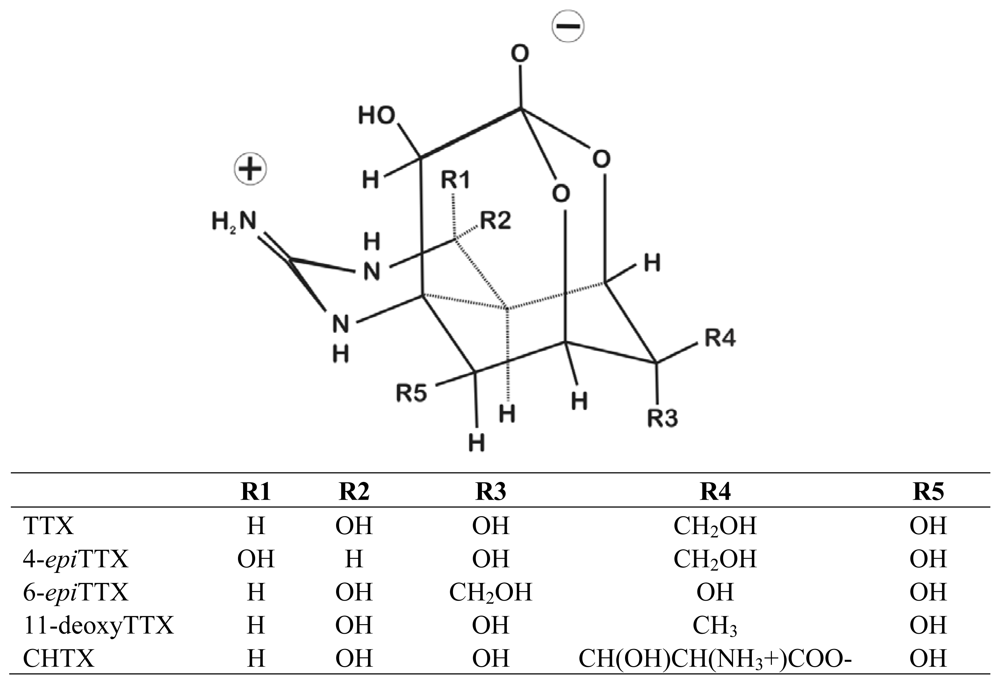
<p>Tetrodotoxin is a guanidium ion with a complex oxygenated cyclohexane framework with both guanidine and ortho-acid functional groups (<xref ref-type="fig" rid="f1-marinedrugs-08-00577">Figure 1</xref>) [<xref ref-type="bibr" rid="b27-marinedrugs-08-00577">27</xref>,<xref ref-type="bibr" rid="b43-marinedrugs-08-00577">43</xref>,<xref ref-type="bibr" rid="b44-marinedrugs-08-00577">44</xref>]. Numerous natural, semi-synthetic, and synthetic analogs of TTX have been reported, reviewed in [<xref ref-type="bibr" rid="b15-marinedrugs-08-00577">15</xref>]. A detailed review of these TTX analogs is beyond the scope of this review, but these analogs can be broadly grouped as either hemilactal, or lactone variants [<xref ref-type="bibr" rid="b15-marinedrugs-08-00577">15</xref>,<xref ref-type="bibr" rid="b44-marinedrugs-08-00577">44</xref>]. Amphibians have been an especially plentiful source of TTX analogs [<xref ref-type="bibr" rid="b11-marinedrugs-08-00577">11</xref>,<xref ref-type="bibr" rid="b12-marinedrugs-08-00577">12</xref>,<xref ref-type="bibr" rid="b14-marinedrugs-08-00577">14</xref>,<xref ref-type="bibr" rid="b16-marinedrugs-08-00577">16</xref>,<xref ref-type="bibr" rid="b19-marinedrugs-08-00577">19</xref>,<xref ref-type="bibr" rid="b45-marinedrugs-08-00577">45</xref>–<xref ref-type="bibr" rid="b47-marinedrugs-08-00577">47</xref>]. The hemilactal forms of TTX are the more common naturally occurring analogs (<xref ref-type="fig" rid="f1-marinedrugs-08-00577">Figure 1</xref>). Many of the commonly seen analogs (e.g., 4-<italic>epi</italic>TTX and anhyrdoTTX) are likely conversion or equilibrium products of TTX and are commonly seen in all TTX-bearing taxa [<xref ref-type="bibr" rid="b44-marinedrugs-08-00577">44</xref>]. As such they are of interest to biochemists and may shed light on the synthesis of TTX but may not be informative in regards to possible differences in the TTX toxicity of marine versus terrestrial taxa. However, other analogs (e.g., CHTX, <xref ref-type="fig" rid="f1-marinedrugs-08-00577">Figure 1</xref>) appear to be present only in amphibians and restricted to one or two closely related species (e.g., CHTX and ZTX are found only in the toad genus <italic>Atelopus</italic>) [<xref ref-type="bibr" rid="b16-marinedrugs-08-00577">16</xref>,<xref ref-type="bibr" rid="b19-marinedrugs-08-00577">19</xref>,<xref ref-type="bibr" rid="b46-marinedrugs-08-00577">46</xref>,<xref ref-type="bibr" rid="b48-marinedrugs-08-00577">48</xref>]. These analogs are extremely potent and have toxicities equivalent or greater than TTX itself [<xref ref-type="bibr" rid="b11-marinedrugs-08-00577">11</xref>,<xref ref-type="bibr" rid="b14-marinedrugs-08-00577">14</xref>,<xref ref-type="bibr" rid="b47-marinedrugs-08-00577">47</xref>,<xref ref-type="bibr" rid="b49-marinedrugs-08-00577">49</xref>]. Understanding their distribution and origin are critically important in the exploration of TTX in Amphibians. The unique structure of these analogs does not inherently support an endogenous origin of TTX in amphibians. Multiple alkaloid toxins unique to species or genera of dendrobatid frogs are now known to come from precursors present in arthropod prey of these frogs [<xref ref-type="bibr" rid="b50-marinedrugs-08-00577">50</xref>]. It is possible that the presence of CHTX and ZTX in <italic>Atelopus</italic> results from similar processes but there is little evidence that supports this hypothesis (but see, [<xref ref-type="bibr" rid="b19-marinedrugs-08-00577">19</xref>] for recent work).</p>
<p>Other analogs present in amphibians are not as potent as TTX (e.g., 6-<italic>epi</italic>TTX, <xref ref-type="fig" rid="f1-marinedrugs-08-00577">Figure 1</xref>), but are of interest because they do not appear to be cross convertible with TTX and appear to form as a result of stereo-specific reactions [<xref ref-type="bibr" rid="b12-marinedrugs-08-00577">12</xref>, <xref ref-type="bibr" rid="b44-marinedrugs-08-00577">44</xref>]. One of these analogs (6-<italic>epi</italic>TTX) was first described in the newt genus <italic>Cynops</italic> [<xref ref-type="bibr" rid="b12-marinedrugs-08-00577">12</xref>]. This analog can represent a significant portion of the total TTX present in TTX-bearing salamanders but appears to be relatively rare in marine taxa [<xref ref-type="bibr" rid="b12-marinedrugs-08-00577">12</xref>,<xref ref-type="bibr" rid="b13-marinedrugs-08-00577">13</xref>,<xref ref-type="bibr" rid="b17-marinedrugs-08-00577">17</xref>,<xref ref-type="bibr" rid="b18-marinedrugs-08-00577">18</xref>,<xref ref-type="bibr" rid="b51-marinedrugs-08-00577">51</xref>–<xref ref-type="bibr" rid="b53-marinedrugs-08-00577">53</xref>]. In populations of <italic>Taricha</italic> the relative levels of TTX to 6-<italic>epi</italic>TTX are invariant within a population, but display significant variation among population [<xref ref-type="bibr" rid="b54-marinedrugs-08-00577">54</xref>]. Similar patterns have also been documented in populations of <italic>Cynops pyrrhogaster</italic> in Japan [<xref ref-type="bibr" rid="b55-marinedrugs-08-00577">55</xref>]. In <italic>Taricha</italic> this variation in toxin profiles can occur over very short distances (&lt;20 km) and among populations that occupy the same watershed as well as similar habitats (unpublished data). Spatial variation in analog profiles has been seen as an additional argument in favor on an exogenous origin for TTX in metazoans [<xref ref-type="bibr" rid="b3-marinedrugs-08-00577">3</xref>], but can also be seen to favor an endogenous origin if seen in the context of generic variation associated with the genes that comprise the biosynthetic pathway of TTX amphibians versus marine bacteria.</p></sec>
<sec>
<title>4. Taxonomic Distribution of TTX and TTX Analogs in Amphibians</title>
<p>Although TTX is broadly distributed across taxonomic classes in aquatic species (reviewed in [<xref ref-type="bibr" rid="b3-marinedrugs-08-00577">3</xref>]), in terrestrial taxa TTX appears to be limited to two orders (Anura, and Caudata) of a single class (Amphibia) of vertebrates [<xref ref-type="bibr" rid="b1-marinedrugs-08-00577">1</xref>]. Tetrodotoxin (or TTX analogs) have been identified in a total of 28 species representing 10 genera and six (or five, see below) families (Anura: Bufonidae, Rhacophoridae, Brachycephalidae, Dendrobatidae; Caudata: Ambystomatidae, Salamandridae) (<xref ref-type="table" rid="t1-marinedrugs-08-00577">Table 1</xref>), but appear to be absent in a total of 38 examined species (<xref ref-type="table" rid="t2-marinedrugs-08-00577">Table 2</xref>), reviewed in [<xref ref-type="bibr" rid="b1-marinedrugs-08-00577">1</xref>].</p>
<p>The earliest confirmation of TTX in amphibians was in eggs of the California Newt <italic>Taricha torosa</italic> (Order: Caudata, Family: Salamandridae) [<xref ref-type="bibr" rid="b24-marinedrugs-08-00577">24</xref>–<xref ref-type="bibr" rid="b26-marinedrugs-08-00577">26</xref>]. However, the presence of a neurotoxin in skin and flesh of this species that had functional similarities to TTX had been known since the 1930’s [<xref ref-type="bibr" rid="b33-marinedrugs-08-00577">33</xref>–<xref ref-type="bibr" rid="b35-marinedrugs-08-00577">35</xref>,<xref ref-type="bibr" rid="b56-marinedrugs-08-00577">56</xref>,<xref ref-type="bibr" rid="b57-marinedrugs-08-00577">57</xref>]. The discovery of TTX, the TTX analog CHTX and the saxitoxin analog ZTX in the toad genus <italic>Atelopus</italic> (Order: Anura, Family: Bufonidae) was the first evidence of TTX in a non-salamandrid [<xref ref-type="bibr" rid="b46-marinedrugs-08-00577">46</xref>], but see also [<xref ref-type="bibr" rid="b58-marinedrugs-08-00577">58</xref>] for earlier work.</p>
<p>Since Daly’s review [<xref ref-type="bibr" rid="b1-marinedrugs-08-00577">1</xref>], TTX has been identified (or confirmed) in two additional species of <italic>Brachycephalus</italic> (<italic>B. ephippium</italic>, and <italic>B. pernix</italic> [<xref ref-type="bibr" rid="b53-marinedrugs-08-00577">53</xref>]), four species of the European newt genus <italic>Triturus</italic> (<italic>Tr. vulgaris</italic>, <italic>Tr. alpestris</italic>, <italic>Tr. cristatus</italic>, and <italic>Tr. helveticus</italic>, [<xref ref-type="bibr" rid="b18-marinedrugs-08-00577">18</xref>]), three species of <italic>Atelopus</italic> (<italic>A. varius</italic>, <italic>A. chiriquiensis</italic>, and <italic>A. zeteki</italic>, [<xref ref-type="bibr" rid="b19-marinedrugs-08-00577">19</xref>]) (<xref ref-type="table" rid="t1-marinedrugs-08-00577">Table 1</xref>). Recent work has also confirmed the presence of 6-<italic>epi</italic>TTX and/or 11-<italic>oxo</italic>TTX in <italic>Triturus</italic> [<xref ref-type="bibr" rid="b18-marinedrugs-08-00577">18</xref>] and <italic>Brachycephalus</italic> [<xref ref-type="bibr" rid="b53-marinedrugs-08-00577">53</xref>] as well as the presence of CHTX in an Atelopid species other than <italic>A. chiriquiensis</italic> (e.g., <italic>A. limosus</italic> and <italic>A. glyphus</italic> [<xref ref-type="bibr" rid="b19-marinedrugs-08-00577">19</xref>]) (<xref ref-type="table" rid="t1-marinedrugs-08-00577">Table 1</xref>).</p>
<p>The identification of TTX in two families of Caudata is somewhat problematic. Although TTX has been identified in both the Salamandridae and Ambystomatidae (<xref ref-type="table" rid="t1-marinedrugs-08-00577">Table 1</xref>), I would argue that in Caudates, TTX is likely limited to a subset of related genera (<italic>Taricha</italic>, <italic>Notophthalmus</italic>, <italic>Triturus</italic>, <italic>Cynops</italic>, and <italic>Paramesotriton</italic>) in the family Salamandridae (see also [<xref ref-type="bibr" rid="b1-marinedrugs-08-00577">1</xref>]) and that reports of the presence of TTX in the Ambystomatidae are likely erroneous. With the exception of two reports (both apparently based on results from the same specimen) of TTX in <italic>Ambystoma tigrinum</italic> [<xref ref-type="bibr" rid="b12-marinedrugs-08-00577">12</xref>,<xref ref-type="bibr" rid="b13-marinedrugs-08-00577">13</xref>], there is no evidence of the presence of TTX in a non-salamandrid Caudate (<xref ref-type="table" rid="t1-marinedrugs-08-00577">Table 1</xref>, <xref ref-type="table" rid="t2-marinedrugs-08-00577">Table 2</xref>). Earlier investigations specifically examined <italic>A. tigrinum</italic> for the presence of TTX and did not detect any evidence of TTX of a TTX-like toxin [<xref ref-type="bibr" rid="b59-marinedrugs-08-00577">59</xref>] nor did an additional examination of a single <italic>Ambystoma tigrinum</italic> using HPLC-FLD by this author (unpublished data). More significantly, species of <italic>Ambystoma</italic> are highly sensitive to TTX [<xref ref-type="bibr" rid="b26-marinedrugs-08-00577">26</xref>,<xref ref-type="bibr" rid="b33-marinedrugs-08-00577">33</xref>,<xref ref-type="bibr" rid="b57-marinedrugs-08-00577">57</xref>,<xref ref-type="bibr" rid="b63-marinedrugs-08-00577">63</xref>], yet other TTX-bearing salamanders (as well as other TTX-bearing vertebrates) are highly resistant to TTX [<xref ref-type="bibr" rid="b22-marinedrugs-08-00577">22</xref>,<xref ref-type="bibr" rid="b25-marinedrugs-08-00577">25</xref>,<xref ref-type="bibr" rid="b26-marinedrugs-08-00577">26</xref>,<xref ref-type="bibr" rid="b32-marinedrugs-08-00577">32</xref>,<xref ref-type="bibr" rid="b60-marinedrugs-08-00577">60</xref>,<xref ref-type="bibr" rid="b63-marinedrugs-08-00577">63</xref>,<xref ref-type="bibr" rid="b77-marinedrugs-08-00577">77</xref>,<xref ref-type="bibr" rid="b78-marinedrugs-08-00577">78</xref>]. Given that the report of TTX in this species is based on a single animal with questionable provenance [<xref ref-type="bibr" rid="b12-marinedrugs-08-00577">12</xref>], a reexamination of the presence of TTX in <italic>Ambystoma</italic> seems to be in order.</p></sec>
<sec>
<title>5. Ecology and Evolution of TTX Toxicity in Amphibians</title>
<p>The ecological role of TTX in metazoans (both marine and terrestrial) is of critical importance, yet it is understudied and poorly understood. Bioaccumulation of TTX (whether through synthesis, symbiosis with bacteria, or dietary uptake and processing) likely results in a significant cost to TTX-bearing taxa [<xref ref-type="bibr" rid="b79-marinedrugs-08-00577">79</xref>]. Additionally, there is evidence that TTX resistance (a necessary trait for accumulation of TTX in TTX-bearing vertebrates) may also come with its own cost [<xref ref-type="bibr" rid="b29-marinedrugs-08-00577">29</xref>,<xref ref-type="bibr" rid="b80-marinedrugs-08-00577">80</xref>,<xref ref-type="bibr" rid="b81-marinedrugs-08-00577">81</xref>]. As a result, metazoans that possess TTX must gain some benefit from their TTX toxicity that outweighs these costs [<xref ref-type="bibr" rid="b79-marinedrugs-08-00577">79</xref>].</p>
<p>Amphibians are present on every continent except for Antarctica and occupy a diverse array of habitats [<xref ref-type="bibr" rid="b82-marinedrugs-08-00577">82</xref>]. Their slow speed, soft bodies, and habitat choices make them attractive targets of predators. In response, amphibian species worldwide have evolved a pharmacopeia of toxic and noxious compounds [<xref ref-type="bibr" rid="b83-marinedrugs-08-00577">83</xref>]. These compounds protect amphibians from predation [<xref ref-type="bibr" rid="b7-marinedrugs-08-00577">7</xref>,<xref ref-type="bibr" rid="b84-marinedrugs-08-00577">84</xref>–<xref ref-type="bibr" rid="b87-marinedrugs-08-00577">87</xref>] as well as infection from pathogens (both fungal and bacterial) [<xref ref-type="bibr" rid="b88-marinedrugs-08-00577">88</xref>–<xref ref-type="bibr" rid="b90-marinedrugs-08-00577">90</xref>]. The TTX present in TTX-bearing amphibians is also assumed to play a defensive role and there is good data to support the hypothesis [<xref ref-type="bibr" rid="b1-marinedrugs-08-00577">1</xref>,<xref ref-type="bibr" rid="b83-marinedrugs-08-00577">83</xref>].</p>
<p>The presence of TTX is associated with aposematic coloration in TTX-bearing amphibians. Species of <italic>Atelopus</italic>, <italic>Brachycephalus</italic>, and <italic>Colostethus</italic> that possess TTX (or CHTX) also possess aposematic coloration, but non-TTX bearing species of <italic>Brachycephalus</italic> do not appear to have TTX [<xref ref-type="bibr" rid="b7-marinedrugs-08-00577">7</xref>,<xref ref-type="bibr" rid="b53-marinedrugs-08-00577">53</xref>,<xref ref-type="bibr" rid="b83-marinedrugs-08-00577">83</xref>]. In one study aposematic efts of <italic>Notophthalmus</italic> were found to be more toxic than non-aposematic adults [<xref ref-type="bibr" rid="b59-marinedrugs-08-00577">59</xref>], but another found the opposite pattern [<xref ref-type="bibr" rid="b51-marinedrugs-08-00577">51</xref>]. Salamandrid newts are well known for an array of defensive warning postures [<xref ref-type="bibr" rid="b84-marinedrugs-08-00577">84</xref>,<xref ref-type="bibr" rid="b91-marinedrugs-08-00577">91</xref>]. TTX-bearing salamandrid newts (e.g., <italic>Taricha</italic>, <italic>Cynops</italic>, and <italic>Notophthalmus</italic>) engage in a well-documented warning pose in which they display orange, red, or yellow present on their ventral surface [<xref ref-type="bibr" rid="b92-marinedrugs-08-00577">92</xref>]. In <italic>Taricha</italic>, at least, this warning posture is frequently associated with secretion from dorsal glands that contain TTX (pers. obs.).</p>
<p>Defensive compounds of amphibians are typically associated with secretory skin glands [<xref ref-type="bibr" rid="b82-marinedrugs-08-00577">82</xref>,<xref ref-type="bibr" rid="b84-marinedrugs-08-00577">84</xref>,<xref ref-type="bibr" rid="b93-marinedrugs-08-00577">93</xref>–<xref ref-type="bibr" rid="b97-marinedrugs-08-00577">97</xref>]. In TTX-bearing amphibians levels of TTX are typically much higher in skin than in other tissues (except for eggs see below) [<xref ref-type="bibr" rid="b8-marinedrugs-08-00577">8</xref>,<xref ref-type="bibr" rid="b13-marinedrugs-08-00577">13</xref>,<xref ref-type="bibr" rid="b17-marinedrugs-08-00577">17</xref>,<xref ref-type="bibr" rid="b18-marinedrugs-08-00577">18</xref>,<xref ref-type="bibr" rid="b20-marinedrugs-08-00577">20</xref>,<xref ref-type="bibr" rid="b46-marinedrugs-08-00577">46</xref>,<xref ref-type="bibr" rid="b53-marinedrugs-08-00577">53</xref>,<xref ref-type="bibr" rid="b59-marinedrugs-08-00577">59</xref>,<xref ref-type="bibr" rid="b64-marinedrugs-08-00577">64</xref>]. Furthermore there is direct evidence than TTX is contained and sequestered in granular skin glands of TTX-bearing salamanders [<xref ref-type="bibr" rid="b61-marinedrugs-08-00577">61</xref>,<xref ref-type="bibr" rid="b64-marinedrugs-08-00577">64</xref>,<xref ref-type="bibr" rid="b98-marinedrugs-08-00577">98</xref>]. <italic>Taricha</italic> and <italic>Cynops</italic> newts actively secrete TTX when directly stimulated or when they encounter a snake predator [<xref ref-type="bibr" rid="b8-marinedrugs-08-00577">8</xref>,<xref ref-type="bibr" rid="b61-marinedrugs-08-00577">61</xref>,<xref ref-type="bibr" rid="b99-marinedrugs-08-00577">99</xref>]. Skin secretions from <italic>Taricha</italic> [<xref ref-type="bibr" rid="b25-marinedrugs-08-00577">25</xref>,<xref ref-type="bibr" rid="b60-marinedrugs-08-00577">60</xref>,<xref ref-type="bibr" rid="b63-marinedrugs-08-00577">63</xref>,<xref ref-type="bibr" rid="b100-marinedrugs-08-00577">100</xref>–<xref ref-type="bibr" rid="b102-marinedrugs-08-00577">102</xref>], and <italic>Notophthalmus</italic> [<xref ref-type="bibr" rid="b103-marinedrugs-08-00577">103</xref>–<xref ref-type="bibr" rid="b109-marinedrugs-08-00577">109</xref>], are known to be lethal to (or deter predation by) potential predators. Reports associated with the toxicity of <italic>Polypedates</italic> also indicate that secretions from this species appear to be toxic to potential predators [<xref ref-type="bibr" rid="b76-marinedrugs-08-00577">76</xref>]. These results are not surprising given the high levels (and potency) of TTX present in these taxa are further support for a defensive role of TTX in amphibians.</p>
<p>The best-documented example of the defensive role of TTX is the coevolutionary interaction between <italic>Taricha</italic> newts and snake predators. Newts of the genus <italic>Taricha</italic> have long been known to possess a TTX resistant predator (garter snakes of the genus <italic>Thamnophis</italic>) [<xref ref-type="bibr" rid="b56-marinedrugs-08-00577">56</xref>,<xref ref-type="bibr" rid="b57-marinedrugs-08-00577">57</xref>,<xref ref-type="bibr" rid="b63-marinedrugs-08-00577">63</xref>]. In some populations that co-occur with newts, garter snakes have evolved resistance to TTX allowing them to prey on toxic newts. This predation by snakes has generated a coevolutionary arms race centered on TTX levels in newts and TTX-resistance in garter snakes [<xref ref-type="bibr" rid="b67-marinedrugs-08-00577">67</xref>,<xref ref-type="bibr" rid="b110-marinedrugs-08-00577">110</xref>–<xref ref-type="bibr" rid="b113-marinedrugs-08-00577">113</xref>]. Although the strength of coevolution between these species is spatially variable, these arms races have generated elevated (and extreme) levels of TTX and TTX resistance in some populations of <italic>Taricha</italic> and <italic>Thamnophis</italic> [<xref ref-type="bibr" rid="b54-marinedrugs-08-00577">54</xref>,<xref ref-type="bibr" rid="b64-marinedrugs-08-00577">64</xref>,<xref ref-type="bibr" rid="b67-marinedrugs-08-00577">67</xref>,<xref ref-type="bibr" rid="b110-marinedrugs-08-00577">110</xref>,<xref ref-type="bibr" rid="b111-marinedrugs-08-00577">111</xref>,<xref ref-type="bibr" rid="b113-marinedrugs-08-00577">113</xref>–<xref ref-type="bibr" rid="b116-marinedrugs-08-00577">116</xref>]. Tetrodotoxin levels present in <italic>Taricha</italic> (and other TTX-bearing Salamandridae) are significantly higher than TTX-bearing anurans (<xref ref-type="table" rid="t1-marinedrugs-08-00577">Table 1</xref>, also see [<xref ref-type="bibr" rid="b1-marinedrugs-08-00577">1</xref>]). Individuals from some populations of <italic>Taricha granulosa</italic> have been measured to possess up to 14 mg of TTX [<xref ref-type="bibr" rid="b67-marinedrugs-08-00577">67</xref>]. In <italic>Taricha</italic>, these elevated levels of TTX result from coevolution with garter snakes [<xref ref-type="bibr" rid="b67-marinedrugs-08-00577">67</xref>,<xref ref-type="bibr" rid="b111-marinedrugs-08-00577">111</xref>]. There is no direct evidence that similar predator-prey interactions have driven elevated TTX levels in other species of Salamandridae, but populations of both <italic>Triturus</italic> in Germany and <italic>Cynops</italic> in Japan show patterns of spatial variability in TTX levels [<xref ref-type="bibr" rid="b18-marinedrugs-08-00577">18</xref>,<xref ref-type="bibr" rid="b55-marinedrugs-08-00577">55</xref>] and environmental factors alone seem an unlikely explanation for these differences or the elevated levels of TTX seen in salamanders.</p>
<p>Tetrodotoxin also serves to defend the eggs of TTX-bearing amphibian species. Ecologically relevant levels of TTX have been found in the eggs of TTX bearing salamanders and <italic>Atelopus</italic> [<xref ref-type="bibr" rid="b1-marinedrugs-08-00577">1</xref>,<xref ref-type="bibr" rid="b25-marinedrugs-08-00577">25</xref>,<xref ref-type="bibr" rid="b46-marinedrugs-08-00577">46</xref>,<xref ref-type="bibr" rid="b59-marinedrugs-08-00577">59</xref>,<xref ref-type="bibr" rid="b65-marinedrugs-08-00577">65</xref>,<xref ref-type="bibr" rid="b71-marinedrugs-08-00577">71</xref>,<xref ref-type="bibr" rid="b100-marinedrugs-08-00577">100</xref>]. In <italic>Taricha</italic>, individual eggs can possess upwards of 2 μg of TTX and the investment of TTX in eggs appears to be an active process [<xref ref-type="bibr" rid="b65-marinedrugs-08-00577">65</xref>]. Recent evidence indicates that Caddis Fly larva are possible predators of <italic>Taricha</italic> eggs and that increased levels of TTX in the eggs of newts may deter predation by these insect predators [<xref ref-type="bibr" rid="b117-marinedrugs-08-00577">117</xref>].</p>
<p>The presence of TTX in adult newts (and possibly in Anurans) has far reaching ripple effects in the communities in which these animals exist [<xref ref-type="bibr" rid="b118-marinedrugs-08-00577">118</xref>]. There are at least two mimicry systems associated with the presence of TTX in N. American newt genera (<italic>Taricha</italic> and <italic>Notophthalmus</italic>, [<xref ref-type="bibr" rid="b119-marinedrugs-08-00577">119</xref>–<xref ref-type="bibr" rid="b122-marinedrugs-08-00577">122</xref>]). Developing evidence suggests that garter snake predators of newts may be capable of sequestering TTX obtained from newts as defense against their own predators [<xref ref-type="bibr" rid="b79-marinedrugs-08-00577">79</xref>, <xref ref-type="bibr" rid="b99-marinedrugs-08-00577">99</xref>]. Tetrodotoxin also seems to serve as warning chemical; allowing larval <italic>Taricha</italic> to sense and avoid cannibalistic predation by adults [<xref ref-type="bibr" rid="b118-marinedrugs-08-00577">118</xref>,<xref ref-type="bibr" rid="b123-marinedrugs-08-00577">123</xref>,<xref ref-type="bibr" rid="b124-marinedrugs-08-00577">124</xref>].</p></sec>
<sec sec-type="conclusions">
<title>6. Conclusions in Regards to the Origin/Biosynthesis of TTX in Amphibians</title>
<p>The ultimate origin or biosynthesis of TTX in amphibians is still a source of some controversy [<xref ref-type="bibr" rid="b1-marinedrugs-08-00577">1</xref>,<xref ref-type="bibr" rid="b3-marinedrugs-08-00577">3</xref>,<xref ref-type="bibr" rid="b8-marinedrugs-08-00577">8</xref>,<xref ref-type="bibr" rid="b18-marinedrugs-08-00577">18</xref>,<xref ref-type="bibr" rid="b19-marinedrugs-08-00577">19</xref>,<xref ref-type="bibr" rid="b67-marinedrugs-08-00577">67</xref>,<xref ref-type="bibr" rid="b125-marinedrugs-08-00577">125</xref>]. A compelling argument has been made that TTX present in marine metazoans is derived from bacterial sources (reviewed in [<xref ref-type="bibr" rid="b3-marinedrugs-08-00577">3</xref>] but see [<xref ref-type="bibr" rid="b126-marinedrugs-08-00577">126</xref>]). However little progress has been made in directly elucidating the genes and enzymatic pathways responsible for the biosynthesis of TTX in bacteria. Studies of TTX biosynthesis in amphibians are mixed and evidence favoring an endogenous origin of TTX in these taxa is indirect at best. In the only study to directly look at TTX synthesis in <italic>Taricha</italic>, animals fed a series of radioactive-labeled (potential) TTX precursors and small molecules did not show evidence of uptake of the radioactive-label [<xref ref-type="bibr" rid="b66-marinedrugs-08-00577">66</xref>]. Adult <italic>Atelopus varius</italic> raised in captivity did not possess measurable levels of TTX or TTX like toxins nor did captive <italic>Cynops pyrrhogaster</italic> [<xref ref-type="bibr" rid="b3-marinedrugs-08-00577">3</xref>,<xref ref-type="bibr" rid="b74-marinedrugs-08-00577">74</xref>]. However <italic>Taricha granulosa</italic> kept in captivity and feed earthworms were capable of maintaining (or increasing) high levels of TTX over multiple years and captive <italic>T</italic>. g<italic>ranulosa</italic> also regenerate large amounts (up to 3 mg) of TTX in relatively brief periods when fed a non-toxic diet [<xref ref-type="bibr" rid="b8-marinedrugs-08-00577">8</xref>,<xref ref-type="bibr" rid="b9-marinedrugs-08-00577">9</xref>,<xref ref-type="bibr" rid="b45-marinedrugs-08-00577">45</xref>]. Similar maintenance of TTX levels over 3 years in captivity has been seen in <italic>Atelopus oxyrhynchus</italic> [<xref ref-type="bibr" rid="b48-marinedrugs-08-00577">48</xref>] An examination of the skin and glands of <italic>T. granulosa</italic> did not yield any evidence of symbiotic TTX producing bacteria in granular secretory glands associated with TTX in salamanders [<xref ref-type="bibr" rid="b10-marinedrugs-08-00577">10</xref>]. More compelling, perhaps, is the limited distribution of TTX analogs in various species of amphibians [<xref ref-type="bibr" rid="b1-marinedrugs-08-00577">1</xref>,<xref ref-type="bibr" rid="b7-marinedrugs-08-00577">7</xref>–<xref ref-type="bibr" rid="b9-marinedrugs-08-00577">9</xref>,<xref ref-type="bibr" rid="b83-marinedrugs-08-00577">83</xref>]. Chiriquitoxin and ZTX have only been described in species of <italic>Atelopus</italic> [<xref ref-type="bibr" rid="b1-marinedrugs-08-00577">1</xref>,<xref ref-type="bibr" rid="b19-marinedrugs-08-00577">19</xref>]. The 6-<italic>epi</italic>TTX stereoisomer of TTX is common in amphibians and can make up a substantive portion of the total TTX’s present in some species (and/or populations) [<xref ref-type="bibr" rid="b12-marinedrugs-08-00577">12</xref>,<xref ref-type="bibr" rid="b13-marinedrugs-08-00577">13</xref>,<xref ref-type="bibr" rid="b17-marinedrugs-08-00577">17</xref>,<xref ref-type="bibr" rid="b18-marinedrugs-08-00577">18</xref>,<xref ref-type="bibr" rid="b44-marinedrugs-08-00577">44</xref>,<xref ref-type="bibr" rid="b54-marinedrugs-08-00577">54</xref>], yet it appears to be very rare in marine species. In <italic>Taricha</italic> the ratio of 6-<italic>epi</italic>TTX to total TTX show little (or no variation) within a locality, but can vary dramatically across localities; a pattern that is difficult to understand in the context of a dietary or symbiotic source of TTX [<xref ref-type="bibr" rid="b54-marinedrugs-08-00577">54</xref>]. Finally, evidence from 40 years of study coevolution between <italic>Taricha</italic> and <italic>Thamnophis</italic> strongly suggest that the elevated (and extreme) levels of TTX seen in the genus likely results from coevolution with snakes and that the evolution of extreme toxicity may have occurred over a relatively short time frame [<xref ref-type="bibr" rid="b67-marinedrugs-08-00577">67</xref>,<xref ref-type="bibr" rid="b111-marinedrugs-08-00577">111</xref>,<xref ref-type="bibr" rid="b127-marinedrugs-08-00577">127</xref>]. These results suggest, in turn, that TTX levels in this genus (and possibly in other salamanders or amphibians) are (to some degree) under genetic control.</p></sec>
<sec>
<title>7. Future Directions</title>
<p>A century after its formal naming interest in TTX is still strong and the molecule is still the focus of extensive research. Although much progress has been made, fundamental questions associated with the synthesis and taxonomic distribution of TTX still remain. The central question facing workers interested in the chemical ecology and evolutionary biology of TTX toxicity in amphibians is still that of an endogenous versus exogenous origin of TTX. Compelling, yet indirect, evidence exists for either position. Any convincing resolution to this problem will have to address the following issues: (1) The presence of TTX analogs that are limited to a single species (or genus) of amphibian, (2) the apparent abundance of TTX analogs such as 6-<italic>epi</italic>TTX and 11-deoxyTTX in the toxin profiles of TTX-bearing amphibians and their corresponding paucity in marine taxa, (3) the extreme spatial variation in toxin profiles and TTX levels seen within populations of some terrestrial TTX-bearing species, (4) the longevity of TTX in (some) captive TTX-bearing species, and (5) the extremely limited taxonomic distribution of TTX in terrestrial vertebrates.</p></sec></body>
<back>
<ack>
<title>Acknowledgments</title>
<p>S. Geffeney provided helpful comments on the preparation of this manuscript. Funding to CTH through an NIH/NRSA award (5F32GM80132).</p></ack>
<fn-group><fn>
<p><italic>Samples Availability:</italic> Available from the authors.</p></fn></fn-group>
<ref-list>
<title>References and Notes</title>
<ref id="b1-marinedrugs-08-00577"><label>1</label><citation citation-type="journal"><person-group person-group-type="author"><name><surname>Daly</surname><given-names>JW</given-names></name></person-group><article-title>Marine toxins and nonmarine toxins: Convergence or symbiotic organisms</article-title><source>J Nat Prod</source><year>2004</year><volume>67</volume><issue>8</issue><fpage>1211</fpage><lpage>1215</lpage><pub-id pub-id-type="doi">10.1021/np040016t</pub-id><pub-id pub-id-type="pmid">15332834</pub-id></citation></ref>
<ref id="b2-marinedrugs-08-00577"><label>2</label><citation citation-type="journal"><person-group person-group-type="author"><name><surname>Miyazawa</surname><given-names>K</given-names></name><name><surname>Noguchi</surname><given-names>T</given-names></name></person-group><article-title>Distribution and origin of tetrodotoxin</article-title><source>J Toxicol: Toxin Rev</source><year>2001</year><volume>20</volume><issue>1</issue><fpage>11</fpage><lpage>33</lpage><pub-id pub-id-type="doi">10.1081/TXR-100103081</pub-id></citation></ref>
<ref id="b3-marinedrugs-08-00577"><label>3</label><citation citation-type="journal"><person-group person-group-type="author"><name><surname>Noguchi</surname><given-names>T</given-names></name><name><surname>Arakawa</surname><given-names>O</given-names></name></person-group><article-title>Tetrodotoxin--distribution and accumulation in aquatic organisms, and cases of human intoxication</article-title><source>Mar Drugs</source><year>2008</year><volume>6</volume><issue>2</issue><fpage>220</fpage><lpage>242</lpage><pub-id pub-id-type="pmid">18728726</pub-id></citation></ref>
<ref id="b4-marinedrugs-08-00577"><label>4</label><citation citation-type="journal"><person-group person-group-type="author"><name><surname>Do</surname><given-names>HK</given-names></name><name><surname>Kogure</surname><given-names>K</given-names></name><name><surname>Simidu</surname><given-names>U</given-names></name></person-group><article-title>Identification of deep-sea-sediment bacteria which produce tetrodotoxin</article-title><source>Appl Environ Microbiol</source><year>1990</year><volume>56</volume><issue>4</issue><fpage>1162</fpage><lpage>1163</lpage><pub-id pub-id-type="pmid">16348162</pub-id></citation></ref>
<ref id="b5-marinedrugs-08-00577"><label>5</label><citation citation-type="journal"><person-group person-group-type="author"><name><surname>Noguchi</surname><given-names>T</given-names></name><name><surname>Jeon</surname><given-names>J.-K</given-names></name><name><surname>Arakawa</surname><given-names>O</given-names></name><name><surname>Sugita</surname><given-names>H</given-names></name><name><surname>Deguchi</surname><given-names>Y</given-names></name><name><surname>Shida</surname><given-names>Y</given-names></name><name><surname>Hashimoto</surname><given-names>K</given-names></name></person-group><article-title>Occurrence of tetrodotoxin and anhydrotetrodotoxin in <italic>Vibrio</italic> sp. isolated from the intestines of a xanthid crab <italic>Atergatis floridus</italic></article-title><source>J Biochem</source><year>1986</year><volume>99</volume><fpage>311</fpage><lpage>314</lpage><pub-id pub-id-type="pmid">3754255</pub-id></citation></ref>
<ref id="b6-marinedrugs-08-00577"><label>6</label><citation citation-type="journal"><person-group person-group-type="author"><name><surname>Yasumoto</surname><given-names>T</given-names></name><name><surname>Yasumura</surname><given-names>D</given-names></name><name><surname>Yotsu</surname><given-names>M</given-names></name><name><surname>Michishita</surname><given-names>T</given-names></name><name><surname>Endo</surname><given-names>A</given-names></name><name><surname>Kotaki</surname><given-names>Y</given-names></name></person-group><article-title>Bacterial production of tetrodotoxin and anhydrotetrodotoxin</article-title><source>Agric Biol Chem</source><year>1986</year><volume>50</volume><issue>3</issue><fpage>793</fpage><lpage>795</lpage><pub-id pub-id-type="doi">10.1271/bbb1961.50.793</pub-id></citation></ref>
<ref id="b7-marinedrugs-08-00577"><label>7</label><citation citation-type="journal"><person-group person-group-type="author"><name><surname>Daly</surname><given-names>JW</given-names></name><name><surname>Myers</surname><given-names>CW</given-names></name><name><surname>Whittaker</surname><given-names>N</given-names></name></person-group><article-title>Further classification of skin alkaloids from neotropical poison frogs (Dendrobatidae), with a general survey of toxic/noxious substances in the amphibia</article-title><source>Toxicon</source><year>1987</year><volume>25</volume><issue>10</issue><fpage>1023</fpage><lpage>1095</lpage><pub-id pub-id-type="doi">10.1016/0041-0101(87)90265-0</pub-id><pub-id pub-id-type="pmid">3321567</pub-id></citation></ref>
<ref id="b8-marinedrugs-08-00577"><label>8</label><citation citation-type="journal"><person-group person-group-type="author"><name><surname>Cardall</surname><given-names>BL</given-names></name><name><surname>Brodie</surname><given-names>ED</given-names><suffix>Jr</suffix></name><name><surname>Brodie</surname><given-names>ED</given-names><suffix>III</suffix></name><name><surname>Hanifin</surname><given-names>CT</given-names></name></person-group><article-title>Secretion and regeneration of tetrodotoxin in the rough-skin newt (<italic>Taricha granulosa</italic>)</article-title><source>Toxicon</source><year>2004</year><volume>44</volume><issue>8</issue><fpage>933</fpage><lpage>938</lpage><pub-id pub-id-type="doi">10.1016/j.toxicon.2004.09.006</pub-id><pub-id pub-id-type="pmid">15530976</pub-id></citation></ref>
<ref id="b9-marinedrugs-08-00577"><label>9</label><citation citation-type="journal"><person-group person-group-type="author"><name><surname>Hanifin</surname><given-names>CT</given-names></name><name><surname>Brodie</surname><given-names>ED</given-names><suffix>III</suffix></name><name><surname>Brodie</surname><given-names>ED</given-names><suffix>Jr</suffix></name></person-group><article-title>Tetrodotoxin levels of the rough-skin newt, <italic>Taricha granulosa</italic>, increase in long-term captivity</article-title><source>Toxicon</source><year>2002</year><volume>40</volume><issue>8</issue><fpage>1149</fpage><lpage>1153</lpage><pub-id pub-id-type="doi">10.1016/S0041-0101(02)00115-0</pub-id><pub-id pub-id-type="pmid">12165318</pub-id></citation></ref>
<ref id="b10-marinedrugs-08-00577"><label>10</label><citation citation-type="journal"><person-group person-group-type="author"><name><surname>Lehman</surname><given-names>EM</given-names></name><name><surname>Brodie</surname><given-names>ED</given-names><suffix>Jr</suffix></name><name><surname>Brodie</surname><given-names>ED</given-names><suffix>III</suffix></name></person-group><article-title>No evidence for an endosymbiotic bacterial origin of tetrodotoxin in the newt <italic>Taricha granulosa</italic></article-title><source>Toxicon</source><year>2004</year><volume>44</volume><issue>3</issue><fpage>243</fpage><lpage>249</lpage><pub-id pub-id-type="doi">10.1016/j.toxicon.2004.05.019</pub-id><pub-id pub-id-type="pmid">15302530</pub-id></citation></ref>
<ref id="b11-marinedrugs-08-00577"><label>11</label><citation citation-type="journal"><person-group person-group-type="author"><name><surname>Kim</surname><given-names>YH</given-names></name><name><surname>Kim</surname><given-names>YB</given-names></name><name><surname>Yotsu-Yamashita</surname><given-names>M</given-names></name></person-group><article-title>Potent neurotoxins: tetrodotoxin, chiriquitoxin, and zetekitoxin from <italic>Atelopus</italic> frogs in Central America</article-title><source>Toxin Rev</source><year>2003</year><volume>22</volume><issue>4</issue><fpage>521</fpage><lpage>532</lpage><pub-id pub-id-type="doi">10.1081/TXR-120026911</pub-id></citation></ref>
<ref id="b12-marinedrugs-08-00577"><label>12</label><citation citation-type="journal"><person-group person-group-type="author"><name><surname>Yasumoto</surname><given-names>T</given-names></name><name><surname>Yotsu</surname><given-names>M</given-names></name><name><surname>Murata</surname><given-names>M</given-names></name></person-group><article-title>New tetrodotoxin analogues from the newt <italic>Cynops ensicauda</italic></article-title><source>J Am Chem Soc</source><year>1988</year><volume>110</volume><fpage>2344</fpage></citation></ref>
<ref id="b13-marinedrugs-08-00577"><label>13</label><citation citation-type="journal"><person-group person-group-type="author"><name><surname>Yotsu</surname><given-names>M</given-names></name><name><surname>Iorizzi</surname><given-names>M</given-names></name><name><surname>Yasumoto</surname><given-names>T</given-names></name></person-group><article-title>Distribution of tetrodotoxin, 6-epitetrodotoxin, and 11-deoxytetrodotoxin in newts</article-title><source>Toxicon</source><year>1990</year><volume>28</volume><issue>2</issue><fpage>238</fpage><lpage>241</lpage><pub-id pub-id-type="doi">10.1016/0041-0101(90)90419-8</pub-id><pub-id pub-id-type="pmid">2339439</pub-id></citation></ref>
<ref id="b14-marinedrugs-08-00577"><label>14</label><citation citation-type="journal"><person-group person-group-type="author"><name><surname>Yotsu</surname><given-names>M</given-names></name><name><surname>Yasumoto</surname><given-names>T</given-names></name><name><surname>Kim</surname><given-names>YH</given-names></name><name><surname>Naoki</surname><given-names>H</given-names></name><name><surname>Kao</surname><given-names>CY</given-names></name></person-group><article-title>The structure of chiriquitoxin from the Costa Rican frog <italic>Atelopus chiriquiensis</italic></article-title><source>Tetrahedron Lett</source><year>1990</year><volume>31</volume><issue>22</issue><fpage>3187</fpage><lpage>3190</lpage><pub-id pub-id-type="doi">10.1016/S0040-4039(00)94728-2</pub-id></citation></ref>
<ref id="b15-marinedrugs-08-00577"><label>15</label><citation citation-type="journal"><person-group person-group-type="author"><name><surname>Yotsu-Yamashita</surname><given-names>M</given-names></name></person-group><article-title>Chemistry of puffer fish toxin</article-title><source>J Toxicol: Toxin Rev</source><year>2001</year><volume>20</volume><issue>1</issue><fpage>51</fpage><lpage>66</lpage><pub-id pub-id-type="doi">10.1081/TXR-100102536</pub-id></citation></ref>
<ref id="b16-marinedrugs-08-00577"><label>16</label><citation citation-type="journal"><person-group person-group-type="author"><name><surname>Yotsu-Yamashita</surname><given-names>M</given-names></name><name><surname>Kim</surname><given-names>YH</given-names></name><name><surname>Dudley</surname><given-names>SC</given-names><suffix>Jr</suffix></name><name><surname>Choudhary</surname><given-names>G</given-names></name><name><surname>Pfahnl</surname><given-names>A</given-names></name><name><surname>Oshima</surname><given-names>Y</given-names></name><name><surname>Daly</surname><given-names>JW</given-names></name></person-group><article-title>The structure of zetekitoxin AB, a saxitoxin analog from the Panamanian golden frog <italic>Atelopus zeteki</italic>: a potent sodium-channel blocker</article-title><source>Proc Natl Acad Sci USA</source><year>2004</year><volume>101</volume><issue>13</issue><fpage>4346</fpage><lpage>4351</lpage><pub-id pub-id-type="doi">10.1073/pnas.0400368101</pub-id><pub-id pub-id-type="pmid">15070720</pub-id></citation></ref>
<ref id="b17-marinedrugs-08-00577"><label>17</label><citation citation-type="journal"><person-group person-group-type="author"><name><surname>Yotsu-Yamashita</surname><given-names>M</given-names></name><name><surname>Mebs</surname><given-names>D</given-names></name></person-group><article-title>The levels of tetrodotoxin and its analogue 6-<italic>epi</italic>tetrodotoxin in the red-spotted newt <italic>Notophthalmus viridescens</italic></article-title><source>Toxicon</source><year>2001</year><volume>39</volume><issue>8</issue><fpage>1261</fpage><lpage>1263</lpage><pub-id pub-id-type="doi">10.1016/S0041-0101(00)00263-4</pub-id><pub-id pub-id-type="pmid">11306140</pub-id></citation></ref>
<ref id="b18-marinedrugs-08-00577"><label>18</label><citation citation-type="journal"><person-group person-group-type="author"><name><surname>Yotsu-Yamashita</surname><given-names>M</given-names></name><name><surname>Mebs</surname><given-names>D</given-names></name><name><surname>Kwet</surname><given-names>A</given-names></name><name><surname>Schneider</surname><given-names>M</given-names></name></person-group><article-title>Tetrodotoxin and its analogue 6-<italic>epi</italic>tetrodotoxin in newts (<italic>Triturus</italic> spp.; Urodela, Salamandridae) from southern Germany</article-title><source>Toxicon</source><year>2007</year><volume>50</volume><issue>2</issue><fpage>306</fpage><lpage>309</lpage><pub-id pub-id-type="doi">10.1016/j.toxicon.2007.03.019</pub-id><pub-id pub-id-type="pmid">17507070</pub-id></citation></ref>
<ref id="b19-marinedrugs-08-00577"><label>19</label><citation citation-type="journal"><person-group person-group-type="author"><name><surname>Yotsu-Yamashita</surname><given-names>M</given-names></name><name><surname>Tateki</surname><given-names>E</given-names></name></person-group><article-title>First report on toxins in the Panamanian toads <italic>Atelopus limosus</italic>, <italic>A. glyphus</italic> and <italic>A certus</italic></article-title><source>Toxicon</source><year>2010</year><volume>55</volume><issue>1</issue><fpage>153</fpage><lpage>156</lpage><pub-id pub-id-type="doi">10.1016/j.toxicon.2009.07.003</pub-id><pub-id pub-id-type="pmid">19596024</pub-id></citation></ref>
<ref id="b20-marinedrugs-08-00577"><label>20</label><citation citation-type="journal"><person-group person-group-type="author"><name><surname>Pires</surname><given-names>OR</given-names><suffix>Jr</suffix></name><name><surname>Sebben</surname><given-names>A</given-names></name><name><surname>Schwartz</surname><given-names>EF</given-names></name><name><surname>Largura</surname><given-names>SW</given-names></name><name><surname>Bloch</surname><given-names>C</given-names><suffix>Jr</suffix></name><name><surname>Morales</surname><given-names>RA</given-names></name><name><surname>Schwartz</surname><given-names>CA</given-names></name></person-group><article-title>Occurrence of tetrodotoxin and its analogues in the Brazilian frog <italic>Brachycephalus ephippium</italic> (Anura: Brachycephalidae)</article-title><source>Toxicon</source><year>2002</year><volume>40</volume><issue>6</issue><fpage>761</fpage><lpage>766</lpage><pub-id pub-id-type="doi">10.1016/S0041-0101(01)00279-3</pub-id><pub-id pub-id-type="pmid">12175613</pub-id></citation></ref>
<ref id="b21-marinedrugs-08-00577"><label>21</label><citation citation-type="journal"><person-group person-group-type="author"><name><surname>Fuhrman</surname><given-names>FA</given-names></name></person-group><article-title>Tetrodotoxin, tarichatoxin, and chiriquitoxin: historical perspectives</article-title><source>Ann NY Acad Sci</source><year>1986</year><volume>479</volume><fpage>1</fpage><lpage>14</lpage><pub-id pub-id-type="pmid">3468842</pub-id></citation></ref>
<ref id="b22-marinedrugs-08-00577"><label>22</label><citation citation-type="journal"><person-group person-group-type="author"><name><surname>Kao</surname><given-names>CY</given-names></name></person-group><article-title>Tetrodotoxin, saxitoxin and their significance in the study of excitation phenomena</article-title><source>Pharmacol Rev</source><year>1966</year><volume>18</volume><issue>2</issue><fpage>997</fpage><lpage>1049</lpage><pub-id pub-id-type="pmid">5328391</pub-id></citation></ref>
<ref id="b23-marinedrugs-08-00577"><label>23</label><citation citation-type="book"><person-group person-group-type="author"><name><surname>Hashimoto</surname><given-names>Y</given-names></name></person-group><source>Marine Toxins and Other Bioactive Marine Metabolites</source><publisher-name>Japan Scientific Societies Press</publisher-name><publisher-loc>Tokyo, Japan</publisher-loc><year>1979</year><fpage>369</fpage></citation></ref>
<ref id="b24-marinedrugs-08-00577"><label>24</label><citation citation-type="journal"><person-group person-group-type="author"><name><surname>Brown</surname><given-names>MS</given-names></name><name><surname>Mosher</surname><given-names>H</given-names></name></person-group><article-title>Tarichatoxin: Isolation and purification</article-title><source>Science</source><year>1963</year><volume>140</volume><fpage>295</fpage><lpage>296</lpage><pub-id pub-id-type="pmid">14016021</pub-id></citation></ref>
<ref id="b25-marinedrugs-08-00577"><label>25</label><citation citation-type="journal"><person-group person-group-type="author"><name><surname>Buchwald</surname><given-names>HD</given-names></name><name><surname>Durham</surname><given-names>L</given-names></name><name><surname>Fischer</surname><given-names>HG</given-names></name><name><surname>Harada</surname><given-names>R</given-names></name><name><surname>Mosher</surname><given-names>HS</given-names></name><name><surname>Kao</surname><given-names>CY</given-names></name><name><surname>Fuhrman</surname><given-names>FA</given-names></name></person-group><article-title>Identity of tarichatoxin and tetrodotoxin</article-title><source>Science</source><year>1964</year><volume>143</volume><fpage>474</fpage><lpage>475</lpage><pub-id pub-id-type="pmid">14080312</pub-id></citation></ref>
<ref id="b26-marinedrugs-08-00577"><label>26</label><citation citation-type="journal"><person-group person-group-type="author"><name><surname>Mosher</surname><given-names>HS</given-names></name><name><surname>Fuhrman</surname><given-names>FA</given-names></name><name><surname>Buchwald</surname><given-names>HD</given-names></name><name><surname>Fischer</surname><given-names>HG</given-names></name></person-group><article-title>Tarichatoxin-tetrodotoxin: A potent neurotoxin</article-title><source>Science</source><year>1964</year><volume>144</volume><fpage>1100</fpage><lpage>1110</lpage><pub-id pub-id-type="doi">10.1126/science.144.3622.1100</pub-id><pub-id pub-id-type="pmid">14148429</pub-id></citation></ref>
<ref id="b27-marinedrugs-08-00577"><label>27</label><citation citation-type="journal"><person-group person-group-type="author"><name><surname>Narahashi</surname><given-names>T</given-names></name></person-group><article-title>Tetrodotoxin: a brief history</article-title><source>Proc Jpn Acad, Ser B Phys Biol Sci</source><year>2008</year><volume>84</volume><issue>5</issue><fpage>147</fpage><lpage>154</lpage><pub-id pub-id-type="doi">10.2183/pjab.84.147</pub-id></citation></ref>
<ref id="b28-marinedrugs-08-00577"><label>28</label><citation citation-type="book"><person-group person-group-type="author"><name><surname>Hille</surname><given-names>B</given-names></name></person-group><source>Ionic Channels of Excitable Membranes</source><publisher-name>Sinauer Associates, Macmillan</publisher-name><publisher-loc>Sunderland, MA, USA</publisher-loc><year>2001</year></citation></ref>
<ref id="b29-marinedrugs-08-00577"><label>29</label><citation citation-type="journal"><person-group person-group-type="author"><name><surname>Geffeney</surname><given-names>S</given-names></name><name><surname>Ruben</surname><given-names>C</given-names></name></person-group><article-title>The Structural Basis and Functional Consequences of Interactions Between Tetrodotoxin and Voltage-Gated Sodium Channels</article-title><source>Mar Drugs</source><year>2006</year><volume>4</volume><issue>3</issue><fpage>143</fpage><lpage>156</lpage><pub-id pub-id-type="doi">10.3390/md403143</pub-id></citation></ref>
<ref id="b30-marinedrugs-08-00577"><label>30</label><citation citation-type="journal"><person-group person-group-type="author"><name><surname>Lipkind</surname><given-names>GM</given-names></name><name><surname>Fozzard</surname><given-names>HA</given-names></name></person-group><article-title>A structural model of the tetrodotoxin and saxitoxin binding site of the Na<sup>+</sup> channel</article-title><source>Biophys J</source><year>1994</year><volume>66</volume><issue>1</issue><fpage>1</fpage><lpage>13</lpage><pub-id pub-id-type="doi">10.1016/S0006-3495(94)80746-5</pub-id><pub-id pub-id-type="pmid">8130328</pub-id></citation></ref>
<ref id="b31-marinedrugs-08-00577"><label>31</label><citation citation-type="journal"><person-group person-group-type="author"><name><surname>Penzotti</surname><given-names>JL</given-names></name><name><surname>Fozzard</surname><given-names>HA</given-names></name><name><surname>Lipkind</surname><given-names>GM</given-names></name><name><surname>Dudley</surname><given-names>SC</given-names><suffix>Jr</suffix></name></person-group><article-title>Differences in saxitoxin and tetrodotoxin binding revealed by mutagenesis of the Na<sup>+</sup> channel outer vestibule</article-title><source>Biophys J</source><year>1998</year><volume>75</volume><issue>6</issue><fpage>2647</fpage><lpage>2657</lpage><pub-id pub-id-type="doi">10.1016/S0006-3495(98)77710-0</pub-id><pub-id pub-id-type="pmid">9826589</pub-id></citation></ref>
<ref id="b32-marinedrugs-08-00577"><label>32</label><citation citation-type="journal"><person-group person-group-type="author"><name><surname>Ishihara</surname><given-names>F</given-names></name></person-group><article-title>Uber die physiologischen Wirkungen des Fugutoxins</article-title><source>Mitteilungen aus der Medizinischen Fakultat der Kaiserlichen Universitat zu Tokyo = Tokyo Teikoku Daigaku Igakubu kiyo</source><year>1918</year><volume>20</volume><fpage>375</fpage><lpage>426</lpage></citation></ref>
<ref id="b33-marinedrugs-08-00577"><label>33</label><citation citation-type="journal"><person-group person-group-type="author"><name><surname>Twitty</surname><given-names>VC</given-names></name></person-group><article-title>Experiments on the phenomenon of paralysis produced by a toxin occurring in <italic>Triturus</italic> embryos</article-title><source>J Exp Zool A Comp Exp Biol</source><year>1937</year><volume>76</volume><issue>1</issue><fpage>67</fpage><lpage>104</lpage><pub-id pub-id-type="doi">10.1002/jez.1400760105</pub-id></citation></ref>
<ref id="b34-marinedrugs-08-00577"><label>34</label><citation citation-type="journal"><person-group person-group-type="author"><name><surname>Twitty</surname><given-names>VC</given-names></name><name><surname>Elliot</surname><given-names>AE</given-names></name></person-group><article-title>The relative growth of the amphibian eye, studied by means of transplantation</article-title><source>J Exp Zool A Comp Exp Biol</source><year>1934</year><volume>68</volume><issue>2</issue><fpage>247</fpage><lpage>291</lpage><pub-id pub-id-type="doi">10.1002/jez.1400680206</pub-id></citation></ref>
<ref id="b35-marinedrugs-08-00577"><label>35</label><citation citation-type="journal"><person-group person-group-type="author"><name><surname>Twitty</surname><given-names>VC</given-names></name><name><surname>Johnson</surname><given-names>HH</given-names></name></person-group><article-title>Motor inhibition in <italic>Amblystoma</italic> produced by <italic>Triturus transplants</italic></article-title><source>Science</source><year>1934</year><volume>80</volume><issue>2064</issue><fpage>78</fpage><lpage>79</lpage><pub-id pub-id-type="doi">10.1126/science.80.2064.78</pub-id><pub-id pub-id-type="pmid">17771587</pub-id></citation></ref>
<ref id="b36-marinedrugs-08-00577"><label>36</label><citation citation-type="journal"><person-group person-group-type="author"><name><surname>Moore</surname><given-names>JW</given-names></name><name><surname>Narahashi</surname><given-names>T</given-names></name></person-group><article-title>Tetrodotoxin’s highly selective blockage of an ionic channel</article-title><source>Fed Proc</source><year>1967</year><volume>26</volume><issue>6</issue><fpage>1655</fpage><lpage>1663</lpage><pub-id pub-id-type="pmid">4294719</pub-id></citation></ref>
<ref id="b37-marinedrugs-08-00577"><label>37</label><citation citation-type="journal"><person-group person-group-type="author"><name><surname>Narahashi</surname><given-names>T</given-names></name><name><surname>Deguchi</surname><given-names>T</given-names></name><name><surname>Urakawa</surname><given-names>M</given-names></name><name><surname>Ohkubo</surname><given-names>Y</given-names></name></person-group><article-title>Stabilization and rectification of muscle fiber membrane by tetrodotoxin</article-title><source>Am J Physiol Endocrinol Metabol</source><year>1960</year><volume>198</volume><fpage>934</fpage><lpage>938</lpage></citation></ref>
<ref id="b38-marinedrugs-08-00577"><label>38</label><citation citation-type="journal"><person-group person-group-type="author"><name><surname>Narahashi</surname><given-names>T</given-names></name><name><surname>Moore</surname><given-names>JW</given-names></name><name><surname>Scott</surname><given-names>WR</given-names></name></person-group><article-title>Tetrodotoxin blockage of sodium conductance increase in lobster giant axons</article-title><source>J Gen Physiol</source><year>1964</year><volume>47</volume><fpage>965</fpage><lpage>974</lpage><pub-id pub-id-type="pmid">14155438</pub-id></citation></ref>
<ref id="b39-marinedrugs-08-00577"><label>39</label><citation citation-type="journal"><person-group person-group-type="author"><name><surname>Narahashi</surname><given-names>T</given-names></name></person-group><article-title>Mechanism of action of tetrodotoxin and saxitoxin on excitable membranes</article-title><source>Fed Proc</source><year>1972</year><volume>31</volume><issue>3</issue><fpage>1124</fpage><lpage>1132</lpage><pub-id pub-id-type="pmid">5032476</pub-id></citation></ref>
<ref id="b40-marinedrugs-08-00577"><label>40</label><citation citation-type="journal"><person-group person-group-type="author"><name><surname>Kao</surname><given-names>CY</given-names></name></person-group><article-title>Structure-activity relations of tetrodotoxin, saxitoxin, and analogues</article-title><source>Ann NY Acad Sci</source><year>1986</year><volume>479</volume><fpage>52</fpage><lpage>67</lpage><pub-id pub-id-type="pmid">2434008</pub-id></citation></ref>
<ref id="b41-marinedrugs-08-00577"><label>41</label><citation citation-type="journal"><person-group person-group-type="author"><name><surname>Kao</surname><given-names>CY</given-names></name></person-group><article-title>Pharmacology of tetrodotoxin and saxitoxin</article-title><source>Fed Proc</source><year>1972</year><volume>31</volume><issue>3</issue><fpage>1117</fpage><lpage>1123</lpage><pub-id pub-id-type="pmid">5032475</pub-id></citation></ref>
<ref id="b42-marinedrugs-08-00577"><label>42</label><citation citation-type="journal"><person-group person-group-type="author"><name><surname>Lipkind</surname><given-names>GM</given-names></name><name><surname>Fozzard</surname><given-names>HA</given-names></name></person-group><article-title>KcsA crystal structure as framework for a molecular model of the Na(+) channel pore</article-title><source>Biochemistry</source><year>2000</year><volume>39</volume><issue>28</issue><fpage>8161</fpage><lpage>8170</lpage><pub-id pub-id-type="doi">10.1021/bi000486w</pub-id><pub-id pub-id-type="pmid">10889022</pub-id></citation></ref>
<ref id="b43-marinedrugs-08-00577"><label>43</label><citation citation-type="journal"><person-group person-group-type="author"><name><surname>Hinman</surname><given-names>A</given-names></name><name><surname>Du Bois</surname><given-names>J</given-names></name></person-group><article-title>A stereoselective synthesis of (−)-tetrodotoxin</article-title><source>J Am Chem Soc</source><year>2003</year><volume>125</volume><issue>38</issue><fpage>11510</fpage><lpage>11511</lpage><pub-id pub-id-type="doi">10.1021/ja0368305</pub-id><pub-id pub-id-type="pmid">13129349</pub-id></citation></ref>
<ref id="b44-marinedrugs-08-00577"><label>44</label><citation citation-type="journal"><person-group person-group-type="author"><name><surname>Yasumoto</surname><given-names>T</given-names></name><name><surname>Yotsu-Yamashita</surname><given-names>M</given-names></name></person-group><article-title>Chemical and etiological studies on tetrodotoxin and its analogs</article-title><source>J Toxicol: Toxin Rev</source><year>1996</year><volume>15</volume><issue>2</issue><fpage>81</fpage><lpage>90</lpage><pub-id pub-id-type="doi">10.3109/15569549609064078</pub-id></citation></ref>
<ref id="b45-marinedrugs-08-00577"><label>45</label><citation citation-type="journal"><person-group person-group-type="author"><name><surname>Kotaki</surname><given-names>Y</given-names></name><name><surname>Shimizu</surname><given-names>Y</given-names></name></person-group><article-title>1-Hydroxy-5,11-dideoxytetrodotoxin, the first N-hydroxy and ring-deoxy derivative of tetrodotoxin found in the newt Taricha granulosa</article-title><source>J Am Chem Soc</source><year>1993</year><volume>115</volume><issue>3</issue><fpage>827</fpage><lpage>830</lpage><pub-id pub-id-type="doi">10.1021/ja00056a001</pub-id></citation></ref>
<ref id="b46-marinedrugs-08-00577"><label>46</label><citation citation-type="journal"><person-group person-group-type="author"><name><surname>Kim</surname><given-names>YH</given-names></name><name><surname>Brown</surname><given-names>GB</given-names></name><name><surname>Mosher</surname><given-names>HS</given-names></name><name><surname>Fuhrman</surname><given-names>FA</given-names></name></person-group><article-title>Tetrodotoxin: Occurrence in atelopid frogs of Costa Rica</article-title><source>Science</source><year>1975</year><volume>189</volume><fpage>151</fpage><lpage>152</lpage><pub-id pub-id-type="pmid">1138374</pub-id></citation></ref>
<ref id="b47-marinedrugs-08-00577"><label>47</label><citation citation-type="journal"><person-group person-group-type="author"><name><surname>Fuhrman</surname><given-names>FA</given-names></name><name><surname>Fuhrman</surname><given-names>GJ</given-names></name><name><surname>Kim</surname><given-names>YH</given-names></name><name><surname>Mosher</surname><given-names>HS</given-names></name></person-group><article-title>Pharmacology and chemistry of chiriquitoxin a new tetrodotoxin-like substance from the Costa Rican frog <italic>Atelopus chiriquiensis</italic></article-title><source>Proc West Pharmacol Soc</source><year>1976</year><volume>19</volume><fpage>381</fpage><lpage>384</lpage><pub-id pub-id-type="pmid">996010</pub-id></citation></ref>
<ref id="b48-marinedrugs-08-00577"><label>48</label><citation citation-type="journal"><person-group person-group-type="author"><name><surname>Yotsu-Yamashita</surname><given-names>M</given-names></name><name><surname>Mebs</surname><given-names>D</given-names></name><name><surname>Yasumoto</surname><given-names>T</given-names></name></person-group><article-title>Tetrodotoxin and its analogues in extracts from the toad <italic>Atelopus oxyrhynchus</italic> (family: Bufonidae)</article-title><source>Toxicon</source><year>1992</year><volume>30</volume><issue>11</issue><fpage>1489</fpage><lpage>1492</lpage><pub-id pub-id-type="doi">10.1016/0041-0101(92)90526-B</pub-id><pub-id pub-id-type="pmid">1336632</pub-id></citation></ref>
<ref id="b49-marinedrugs-08-00577"><label>49</label><citation citation-type="journal"><person-group person-group-type="author"><name><surname>Kao</surname><given-names>CY</given-names></name><name><surname>Yeoh</surname><given-names>PN</given-names></name><name><surname>Goldfinger</surname><given-names>MD</given-names></name><name><surname>Fuhrman</surname><given-names>FA</given-names></name><name><surname>Mosher</surname><given-names>HS</given-names></name></person-group><article-title>Chiriquitoxin, a new tool for mapping ionic channels</article-title><source>J Pharmacol Exp Ther</source><year>1981</year><volume>217</volume><issue>2</issue><fpage>416</fpage><lpage>429</lpage><pub-id pub-id-type="pmid">6262484</pub-id></citation></ref>
<ref id="b50-marinedrugs-08-00577"><label>50</label><citation citation-type="journal"><person-group person-group-type="author"><name><surname>Daly</surname><given-names>JW</given-names></name><name><surname>Kaneko</surname><given-names>T</given-names></name><name><surname>Wilham</surname><given-names>J</given-names></name><name><surname>Garraffo</surname><given-names>HM</given-names></name><name><surname>Spande</surname><given-names>TF</given-names></name><name><surname>Espinosa</surname><given-names>A</given-names></name><name><surname>Donnelly</surname><given-names>MA</given-names></name></person-group><article-title>Bioactive alkaloids of frog skin: combinatorial bioprospecting reveals that pumiliotoxins have an arthropod source</article-title><source>Proc Natl Acad Sci USA</source><year>2002</year><volume>99</volume><issue>22</issue><fpage>13996</fpage><lpage>14001</lpage><pub-id pub-id-type="doi">10.1073/pnas.222551599</pub-id><pub-id pub-id-type="pmid">12381780</pub-id></citation></ref>
<ref id="b51-marinedrugs-08-00577"><label>51</label><citation citation-type="journal"><person-group person-group-type="author"><name><surname>Yotsu-Yamashita</surname><given-names>M</given-names></name><name><surname>Mebs</surname><given-names>D</given-names></name></person-group><article-title>Occurrence of 11-oxotetrodotoxin in the red-spotted newt, <italic>Notophthalmus viridescens</italic>, and further studies on the levels of tetrodotoxin and its analogues in the newt’s efts</article-title><source>Toxicon</source><year>2003</year><volume>41</volume><issue>7</issue><fpage>893</fpage><lpage>897</lpage><pub-id pub-id-type="doi">10.1016/S0041-0101(03)00068-0</pub-id><pub-id pub-id-type="pmid">12782090</pub-id></citation></ref>
<ref id="b52-marinedrugs-08-00577"><label>52</label><citation citation-type="journal"><person-group person-group-type="author"><name><surname>Pires</surname><given-names>OR</given-names></name><name><surname>Sebben</surname><given-names>A</given-names></name><name><surname>Schwartz</surname><given-names>EF</given-names></name><name><surname>Bloch</surname><given-names>C</given-names></name><name><surname>Morales</surname><given-names>RA</given-names></name><name><surname>Schwartz</surname><given-names>CA</given-names></name></person-group><article-title>The occurrence of 11-<italic>oxo</italic>tetrodotoxin, a rare tetrodotoxin analogue, in the Brachycephalidae frog <italic>Brachycephalus ephippium</italic></article-title><source>Toxicon</source><year>2003</year><volume>42</volume><issue>5</issue><fpage>563</fpage><lpage>566</lpage><pub-id pub-id-type="doi">10.1016/S0041-0101(03)00235-6</pub-id><pub-id pub-id-type="pmid">14529740</pub-id></citation></ref>
<ref id="b53-marinedrugs-08-00577"><label>53</label><citation citation-type="journal"><person-group person-group-type="author"><name><surname>Pires</surname><given-names>OR</given-names><suffix>Jr</suffix></name><name><surname>Sebben</surname><given-names>A</given-names></name><name><surname>Schwartz</surname><given-names>EF</given-names></name><name><surname>Morales</surname><given-names>RA</given-names></name><name><surname>Bloch</surname><given-names>C</given-names><suffix>Jr</suffix></name><name><surname>Schwartz</surname><given-names>CA</given-names></name></person-group><article-title>Further report of the occurrence of tetrodotoxin and new analogues in the Anuran family Brachycephalidae</article-title><source>Toxicon</source><year>2005</year><volume>45</volume><issue>1</issue><fpage>73</fpage><lpage>79</lpage><pub-id pub-id-type="doi">10.1016/j.toxicon.2004.09.016</pub-id><pub-id pub-id-type="pmid">15581685</pub-id></citation></ref>
<ref id="b54-marinedrugs-08-00577"><label>54</label><citation citation-type="journal"><person-group person-group-type="author"><name><surname>Hanifin</surname><given-names>CT</given-names></name><name><surname>Yotsu-Yamashita</surname><given-names>M</given-names></name><name><surname>Yasumoto</surname><given-names>T</given-names></name><name><surname>Brodie</surname><given-names>ED</given-names><suffix>III</suffix></name><name><surname>Brodie</surname><given-names>ED</given-names><suffix>Jr</suffix></name></person-group><article-title>Toxicity of dangerous prey: variation of tetrodotoxin levels within and among populations of the newt <italic>Taricha granulosa</italic></article-title><source>J Chem Ecol</source><year>1999</year><volume>25</volume><issue>9</issue><fpage>2161</fpage><lpage>2175</lpage><pub-id pub-id-type="doi">10.1023/A:1021049125805</pub-id></citation></ref>
<ref id="b55-marinedrugs-08-00577"><label>55</label><citation citation-type="journal"><person-group person-group-type="author"><name><surname>Tsuruda</surname><given-names>K</given-names></name><name><surname>Arakawa</surname><given-names>O</given-names></name><name><surname>Noguchi</surname><given-names>T</given-names></name></person-group><article-title>Toxicity and toxin profiles of the newt, <italic>Cynops pyrrhogaster</italic> from western Japan</article-title><source>J Nat Toxins</source><year>2001</year><volume>10</volume><issue>2</issue><fpage>79</fpage><lpage>89</lpage><pub-id pub-id-type="pmid">11405279</pub-id></citation></ref>
<ref id="b56-marinedrugs-08-00577"><label>56</label><citation citation-type="journal"><person-group person-group-type="author"><name><surname>Myers</surname><given-names>GS</given-names></name></person-group><article-title>Notes on Pacific Coast Triturus</article-title><source>Copeia</source><year>1942</year><year>1942 </year><issue>2</issue><fpage>77</fpage><lpage>82</lpage></citation></ref>
<ref id="b57-marinedrugs-08-00577"><label>57</label><citation citation-type="book"><person-group person-group-type="author"><name><surname>Twitty</surname><given-names>VC</given-names></name></person-group><source>Of Scientists and Salamanders</source><publisher-name>WH Freeman &amp; Co</publisher-name><publisher-loc>San Francisco, CA, USA</publisher-loc><year>1966</year></citation></ref>
<ref id="b58-marinedrugs-08-00577"><label>58</label><citation citation-type="journal"><person-group person-group-type="author"><name><surname>Shindelman</surname><given-names>J</given-names></name><name><surname>Mosher</surname><given-names>HS</given-names></name><name><surname>Fuhrman</surname><given-names>FA</given-names></name></person-group><article-title>Atelopidtoxin from the Panamanian frog <italic>Atelopus zeteki</italic></article-title><source>Toxicon</source><year>1969</year><volume>7</volume><fpage>315</fpage><lpage>319</lpage><pub-id pub-id-type="pmid">5368468</pub-id></citation></ref>
<ref id="b59-marinedrugs-08-00577"><label>59</label><citation citation-type="journal"><person-group person-group-type="author"><name><surname>Wakely</surname><given-names>JF</given-names></name><name><surname>Fuhrman</surname><given-names>GJ</given-names></name><name><surname>Fuhrman</surname><given-names>FA</given-names></name><name><surname>Fischer</surname><given-names>HG</given-names></name><name><surname>Mosher</surname><given-names>HS</given-names></name></person-group><article-title>The occurrence of tetrodotoxin (tarichatoxin) in amphibia and the distribution of the toxin in the organs of newts (<italic>Taricha</italic>)</article-title><source>Toxicon</source><year>1966</year><volume>3</volume><issue>3</issue><fpage>195</fpage><lpage>203</lpage><pub-id pub-id-type="doi">10.1016/0041-0101(66)90021-3</pub-id><pub-id pub-id-type="pmid">5938783</pub-id></citation></ref>
<ref id="b60-marinedrugs-08-00577"><label>60</label><citation citation-type="journal"><person-group person-group-type="author"><name><surname>Brodie</surname><given-names>ED</given-names><suffix>Jr</suffix></name><name><surname>Hensel</surname><given-names>JL</given-names></name><name><surname>Johnson</surname><given-names>JA</given-names></name></person-group><article-title>Toxicity of the Urodele amphibians <italic>Taricha</italic>, <italic>Notophthalmus</italic>, <italic>Cynops</italic>, and <italic>Paramesotriton</italic> (Salamandridae)</article-title><source>Copeia</source><year>1974</year><year>1974 </year><issue>2</issue><fpage>506</fpage><lpage>511</lpage></citation></ref>
<ref id="b61-marinedrugs-08-00577"><label>61</label><citation citation-type="journal"><person-group person-group-type="author"><name><surname>Tsuruda</surname><given-names>K</given-names></name><name><surname>Arakawa</surname><given-names>O</given-names></name><name><surname>Kawatsu</surname><given-names>K</given-names></name><name><surname>Hamano</surname><given-names>Y</given-names></name><name><surname>Takatani</surname><given-names>T</given-names></name><name><surname>Noguchi</surname><given-names>T</given-names></name></person-group><article-title>Secretory glands of tetrodotoxin in the skin of the Japanese newt <italic>Cynops pyrrhogaster</italic></article-title><source>Toxicon</source><year>2002</year><volume>40</volume><issue>2</issue><fpage>131</fpage><lpage>136</lpage><pub-id pub-id-type="doi">10.1016/S0041-0101(01)00198-2</pub-id><pub-id pub-id-type="pmid">11689234</pub-id></citation></ref>
<ref id="b62-marinedrugs-08-00577"><label>62</label><citation citation-type="journal"><person-group person-group-type="author"><name><surname>Levenson</surname><given-names>CH</given-names></name><name><surname>Woodhull</surname><given-names>AM</given-names></name></person-group><article-title>The occurrence of a tetrodotoxin-like substance in the red-spotted newt <italic>Notophthalmus viridescens</italic></article-title><source>Toxicon</source><year>1979</year><volume>17</volume><fpage>184</fpage><lpage>187</lpage><pub-id pub-id-type="doi">10.1016/0041-0101(79)90301-5</pub-id><pub-id pub-id-type="pmid">442108</pub-id></citation></ref>
<ref id="b63-marinedrugs-08-00577"><label>63</label><citation citation-type="journal"><person-group person-group-type="author"><name><surname>Brodie</surname><given-names>ED</given-names><suffix>Jr</suffix></name></person-group><article-title>Investigations on the skin toxin of the adult rough-skinned newt <italic>Taricha granulosa</italic></article-title><source>Copeia</source><year>1968</year><year>1968 </year><issue>2</issue><fpage>307</fpage><lpage>313</lpage></citation></ref>
<ref id="b64-marinedrugs-08-00577"><label>64</label><citation citation-type="journal"><person-group person-group-type="author"><name><surname>Hanifin</surname><given-names>CT</given-names></name><name><surname>Brodie</surname><given-names>ED</given-names><suffix>III</suffix></name><name><surname>Brodie</surname><given-names>ED</given-names><suffix>Jr</suffix></name></person-group><article-title>A predictive model to estimate total skin tetrodotoxin in the newt <italic>Taricha granulosa</italic></article-title><source>Toxicon</source><year>2004</year><volume>43</volume><issue>3</issue><fpage>243</fpage><lpage>249</lpage><pub-id pub-id-type="doi">10.1016/j.toxicon.2003.11.025</pub-id><pub-id pub-id-type="pmid">15033321</pub-id></citation></ref>
<ref id="b65-marinedrugs-08-00577"><label>65</label><citation citation-type="journal"><person-group person-group-type="author"><name><surname>Hanifin</surname><given-names>CT</given-names></name><name><surname>Brodie</surname><given-names>ED</given-names><suffix>III</suffix></name><name><surname>Brodie</surname><given-names>ED</given-names><suffix>Jr</suffix></name></person-group><article-title>Tetrodotoxin levels in eggs of the rough-skin newt, <italic>Taricha granulosa</italic>, are correlated with female toxicity</article-title><source>J Chem Ecol</source><year>2003</year><volume>29</volume><issue>8</issue><fpage>1729</fpage><lpage>1739</lpage><pub-id pub-id-type="doi">10.1023/A:1024885824823</pub-id><pub-id pub-id-type="pmid">12956503</pub-id></citation></ref>
<ref id="b66-marinedrugs-08-00577"><label>66</label><citation citation-type="journal"><person-group person-group-type="author"><name><surname>Shimizu</surname><given-names>Y</given-names></name><name><surname>Kobayashi</surname><given-names>M</given-names></name></person-group><article-title>Apparent lack of tetrodotoxin biosynthesis in captured <italic>Taricha torosa</italic> and <italic>Taricha granulosa</italic></article-title><source>Chem Pharm Bull (Tokyo)</source><year>1983</year><volume>31</volume><fpage>3625</fpage><lpage>3631</lpage></citation></ref>
<ref id="b67-marinedrugs-08-00577"><label>67</label><citation citation-type="journal"><person-group person-group-type="author"><name><surname>Hanifin</surname><given-names>CT</given-names></name><name><surname>Brodie</surname><given-names>ED</given-names><suffix>Jr</suffix></name><name><surname>Brodie</surname><given-names>ED</given-names><suffix>III</suffix></name></person-group><article-title>Phenotypic mismatches reveal escape from arms-race coevolution</article-title><source>PLoS Biol</source><year>2008</year><volume>6</volume><issue>3</issue><fpage>e60</fpage><pub-id pub-id-type="doi">10.1371/journal.pbio.0060060</pub-id><pub-id pub-id-type="pmid">18336073</pub-id></citation></ref>
<ref id="b68-marinedrugs-08-00577"><label>68</label><citation citation-type="book"><person-group person-group-type="author"><name><surname>Twitty</surname><given-names>VC</given-names></name></person-group><article-title>Taricha rivularis (Twitty) red-bellied newt</article-title><source>Catalogue of American Amphibians and Reptiles</source><person-group person-group-type="editor"><name><surname>Riemer</surname><given-names>WJ</given-names></name></person-group><publisher-name>American Society of Ichthyologists and Herpetologists</publisher-name><publisher-loc>Kensington, MD, USA</publisher-loc><year>1964</year><fpage>9.1</fpage><lpage>9.2</lpage></citation></ref>
<ref id="b69-marinedrugs-08-00577"><label>69</label><citation citation-type="journal"><person-group person-group-type="author"><name><surname>Sebben</surname><given-names>A</given-names></name><name><surname>Schwartz</surname><given-names>CA</given-names></name><name><surname>Valente</surname><given-names>D</given-names></name><name><surname>Mendes</surname><given-names>EG</given-names></name></person-group><article-title>A tetrodotoxin-like substance found in the Brazilian frog <italic>Brachycephalus ephippium</italic></article-title><source>Toxicon</source><year>1986</year><volume>24</volume><issue>6</issue><fpage>799</fpage><lpage>806</lpage><pub-id pub-id-type="pmid">3775795</pub-id></citation></ref>
<ref id="b70-marinedrugs-08-00577"><label>70</label><citation citation-type="journal"><person-group person-group-type="author"><name><surname>Daly</surname><given-names>JW</given-names></name><name><surname>Gusovsky</surname><given-names>F</given-names></name><name><surname>Myers</surname><given-names>CW</given-names></name><name><surname>Yotsu-Yamashita</surname><given-names>M</given-names></name><name><surname>Yasumoto</surname><given-names>T</given-names></name></person-group><article-title>First occurrence of tetrodotoxin in a dendrobatid frog (<italic>Colostethus inguinalis</italic>), with further reports for the bufonid genus</article-title><source>Atelopus Toxicon</source><year>1994</year><volume>32</volume><issue>3</issue><fpage>279</fpage><lpage>285</lpage><pub-id pub-id-type="doi">10.1016/0041-0101(94)90081-7</pub-id></citation></ref>
<ref id="b71-marinedrugs-08-00577"><label>71</label><citation citation-type="journal"><person-group person-group-type="author"><name><surname>Pavelka</surname><given-names>LA</given-names></name><name><surname>Kim</surname><given-names>YH</given-names></name><name><surname>Mosher</surname><given-names>HS</given-names></name></person-group><article-title>Tetrodotoxin and tetrodotoxin-like compounds from the eggs of the Costa Rican frog <italic>Atelopus chiriquiensis</italic></article-title><source>Toxicon</source><year>1977</year><volume>15</volume><fpage>135</fpage><lpage>139</lpage><pub-id pub-id-type="pmid">854934</pub-id></citation></ref>
<ref id="b72-marinedrugs-08-00577"><label>72</label><citation citation-type="journal"><person-group person-group-type="author"><name><surname>Mebs</surname><given-names>D</given-names></name><name><surname>Schmidt</surname><given-names>K</given-names></name></person-group><article-title>Occurrence of tetrodotoxin in the frog <italic>Atelopus oxyrhynchus</italic></article-title><source>Toxicon</source><year>1989</year><volume>27</volume><issue>7</issue><fpage>819</fpage><lpage>822</lpage><pub-id pub-id-type="doi">10.1016/0041-0101(89)90049-4</pub-id><pub-id pub-id-type="pmid">2781581</pub-id></citation></ref>
<ref id="b73-marinedrugs-08-00577"><label>73</label><citation citation-type="journal"><person-group person-group-type="author"><name><surname>Mebs</surname><given-names>D</given-names></name><name><surname>Yotsu-Yamashita</surname><given-names>M</given-names></name><name><surname>Yasumoto</surname><given-names>T</given-names></name><name><surname>Lotters</surname><given-names>S</given-names></name><name><surname>Schluter</surname><given-names>A</given-names></name></person-group><article-title>Further report of the occurrence of tetrodotoxin in <italic>Atelopus</italic> species (family: Bufonidae)</article-title><source>Toxicon</source><year>1995</year><volume>33</volume><issue>2</issue><fpage>246</fpage><lpage>249</lpage><pub-id pub-id-type="doi">10.1016/0041-0101(94)00149-3</pub-id><pub-id pub-id-type="pmid">7597728</pub-id></citation></ref>
<ref id="b74-marinedrugs-08-00577"><label>74</label><citation citation-type="journal"><person-group person-group-type="author"><name><surname>Daly</surname><given-names>JW</given-names></name><name><surname>Padgett</surname><given-names>WL</given-names></name><name><surname>Saunders</surname><given-names>RL</given-names></name><name><surname>Cover</surname><given-names>JF</given-names><suffix>Jr</suffix></name></person-group><article-title>Absence of tetrodotoxins in a captive-raised riparian frog <italic>Atelopus varius</italic></article-title><source>Toxicon</source><year>1997</year><volume>35</volume><issue>5</issue><fpage>705</fpage><lpage>709</lpage><pub-id pub-id-type="doi">10.1016/S0041-0101(96)00165-1</pub-id><pub-id pub-id-type="pmid">9203295</pub-id></citation></ref>
<ref id="b75-marinedrugs-08-00577"><label>75</label><citation citation-type="journal"><person-group person-group-type="author"><name><surname>Brown</surname><given-names>GB</given-names></name><name><surname>Kim</surname><given-names>YH</given-names></name><name><surname>Kuntzel</surname><given-names>H</given-names></name><name><surname>Mosher</surname><given-names>HS</given-names></name></person-group><article-title>Chemistry and pharmacology of skin toxins from the frog <italic>Atelopus zeteki</italic> (atelopidtoxin: zetekitoxin)</article-title><source>Toxicon</source><year>1977</year><volume>15</volume><issue>2</issue><fpage>115</fpage><lpage>128</lpage><pub-id pub-id-type="doi">10.1016/0041-0101(77)90030-7</pub-id><pub-id pub-id-type="pmid">558664</pub-id></citation></ref>
<ref id="b76-marinedrugs-08-00577"><label>76</label><citation citation-type="journal"><person-group person-group-type="author"><name><surname>Tanu</surname><given-names>MB</given-names></name><name><surname>Mahmud</surname><given-names>Y</given-names></name><name><surname>Tsuruda</surname><given-names>K</given-names></name><name><surname>Arakawa</surname><given-names>O</given-names></name><name><surname>Noguchi</surname><given-names>T</given-names></name></person-group><article-title>Occurrence of tetrodotoxin in the skin of a rhacophoridid frog <italic>Polypedates</italic> sp from Bangladesh</article-title><source>Toxicon</source><year>2001</year><volume>39</volume><issue>7</issue><fpage>937</fpage><lpage>941</lpage><pub-id pub-id-type="doi">10.1016/S0041-0101(00)00231-2</pub-id><pub-id pub-id-type="pmid">11223081</pub-id></citation></ref>
<ref id="b77-marinedrugs-08-00577"><label>77</label><citation citation-type="journal"><person-group person-group-type="author"><name><surname>Hirota</surname><given-names>K</given-names></name><name><surname>Kaneko</surname><given-names>Y</given-names></name></person-group><article-title>Cloning and distribution of a putative tetrodotoxin-resistant Na+ channel in newt retina</article-title><source>Zool Sci</source><year>1999</year><volume>16</volume><fpage>587</fpage><lpage>594</lpage></citation></ref>
<ref id="b78-marinedrugs-08-00577"><label>78</label><citation citation-type="journal"><person-group person-group-type="author"><name><surname>Kaneko</surname><given-names>Y</given-names></name><name><surname>Matsumoto</surname><given-names>G</given-names></name><name><surname>Hanyu</surname><given-names>Y</given-names></name></person-group><article-title>TTX resistivity of Na+ channel in newt retinal neuron</article-title><source>Biochem Biophys Res Commun</source><year>1997</year><volume>240</volume><fpage>651</fpage><lpage>656</lpage><pub-id pub-id-type="pmid">9398620</pub-id></citation></ref>
<ref id="b79-marinedrugs-08-00577"><label>79</label><citation citation-type="journal"><person-group person-group-type="author"><name><surname>Williams</surname><given-names>BL</given-names></name></person-group><article-title>Behavioral and chemical ecology of marine organisms with respect to tetrodotoxin</article-title><source>Mar Drugs</source><year>2010</year><volume>8</volume><fpage>381</fpage><lpage>398</lpage><pub-id pub-id-type="pmid">20411104</pub-id></citation></ref>
<ref id="b80-marinedrugs-08-00577"><label>80</label><citation citation-type="journal"><person-group person-group-type="author"><name><surname>Brodie</surname><given-names>ED</given-names><suffix>III</suffix></name><name><surname>Brodie</surname><given-names>ED</given-names><suffix>Jr</suffix></name></person-group><article-title>Costs of exploiting poisonous prey: evolutionary trade-offs in a predator-prey arms race</article-title><source>Evolution</source><year>1999</year><volume>53</volume><issue>2</issue><fpage>626</fpage><lpage>631</lpage><pub-id pub-id-type="doi">10.2307/2640799</pub-id></citation></ref>
<ref id="b81-marinedrugs-08-00577"><label>81</label><citation citation-type="journal"><person-group person-group-type="author"><name><surname>Lee</surname><given-names>P</given-names></name><name><surname>Ruben</surname><given-names>PC</given-names></name></person-group><article-title>The Biophysical Costs Associated with Tetrodotoxin Resistance in the Garter Snake, Thamnophis sirtalis</article-title><source>Mar Drugs</source><year>2010</year><fpage>8</fpage><comment>submitted</comment></citation></ref>
<ref id="b82-marinedrugs-08-00577"><label>82</label><citation citation-type="book"><person-group person-group-type="author"><name><surname>Duellman</surname><given-names>WE</given-names></name><name><surname>Trueb</surname><given-names>L</given-names></name></person-group><source>Biology of Amphibians</source><edition>1st ed</edition><publisher-name>McGraw-Hill</publisher-name><publisher-loc>New York, NY, USA</publisher-loc><year>1986</year></citation></ref>
<ref id="b83-marinedrugs-08-00577"><label>83</label><citation citation-type="journal"><person-group person-group-type="author"><name><surname>Daly</surname><given-names>JW</given-names></name></person-group><article-title>The chemistry of poisons in amphibian skin</article-title><source>Proc Natl Acad Sci USA</source><year>1995</year><volume>92</volume><issue>1</issue><fpage>9</fpage><lpage>13</lpage><pub-id pub-id-type="doi">10.1073/pnas.92.1.9</pub-id><pub-id pub-id-type="pmid">7816854</pub-id></citation></ref>
<ref id="b84-marinedrugs-08-00577"><label>84</label><citation citation-type="book"><person-group person-group-type="author"><name><surname>Brodie</surname><given-names>ED</given-names><suffix>Jr</suffix></name></person-group><article-title>Antipredator adaptations of salamanders: evolution and convergence among terrestrial species</article-title><source>Plant, animal, and microbial adaptations to terrestrial environment</source><person-group person-group-type="editor"><name><surname>Margaris</surname><given-names>NS</given-names></name><name><surname>Arianoutsu-Faraggitaki</surname><given-names>M</given-names></name><name><surname>Reiter</surname><given-names>RJ</given-names></name></person-group><publisher-name>Plenum</publisher-name><publisher-loc>New York, NY, USA</publisher-loc><year>1983</year></citation></ref>
<ref id="b85-marinedrugs-08-00577"><label>85</label><citation citation-type="journal"><person-group person-group-type="author"><name><surname>Brodie</surname><given-names>ED</given-names><suffix>Jr</suffix></name><name><surname>Ducey</surname><given-names>PK</given-names></name><name><surname>Baness</surname><given-names>EA</given-names></name></person-group><article-title>Antipredator Skin Secretions of Some Tropical Salamanders (Bolitoglossa) are Toxic to Snake Predators</article-title><source>Biotropica</source><year>1991</year><volume>23</volume><issue>1</issue><fpage>58</fpage><lpage>62</lpage><pub-id pub-id-type="doi">10.2307/2388688</pub-id></citation></ref>
<ref id="b86-marinedrugs-08-00577"><label>86</label><citation citation-type="book"><person-group person-group-type="author"><name><surname>Tyler</surname><given-names>MJ</given-names></name></person-group><article-title>Frog and cane toad secretions</article-title><source>Toxic Plants and Animals: A Guide for Australia</source><person-group person-group-type="editor"><name><surname>Covacevich</surname><given-names>J</given-names></name><name><surname>Davies</surname><given-names>P</given-names></name><name><surname>Pearn</surname><given-names>J</given-names></name></person-group><publisher-name>Qld Museum</publisher-name><publisher-loc>Brisbane, Australia</publisher-loc><year>1987</year></citation></ref>
<ref id="b87-marinedrugs-08-00577"><label>87</label><citation citation-type="book"><person-group person-group-type="author"><name><surname>Erspammer</surname><given-names>V</given-names></name></person-group><article-title>Bioactive secretions of amphibian integument</article-title><source>Amphibian Biology</source><person-group person-group-type="editor"><name><surname>Heatwole</surname><given-names>H</given-names></name><name><surname>Barthalmus</surname><given-names>GT</given-names></name></person-group><publisher-name>Surrey Beatty &amp; Sons Pty, Ltd</publisher-name><publisher-loc>Chipping Norton, UK</publisher-loc><year>1994</year></citation></ref>
<ref id="b88-marinedrugs-08-00577"><label>88</label><citation citation-type="journal"><person-group person-group-type="author"><name><surname>Duda</surname><given-names>TF</given-names><suffix>Jr</suffix></name><name><surname>Vanhoye</surname><given-names>D</given-names></name><name><surname>Nicolas</surname><given-names>P</given-names></name></person-group><article-title>Roles of diversifying selection and coordinated evolution in the evolution of amphibian antimicrobial peptides</article-title><source>Mol Biol Evol</source><year>2002</year><volume>19</volume><issue>6</issue><fpage>858</fpage><lpage>864</lpage><pub-id pub-id-type="doi">10.1093/oxfordjournals.molbev.a004143</pub-id><pub-id pub-id-type="pmid">12032242</pub-id></citation></ref>
<ref id="b89-marinedrugs-08-00577"><label>89</label><citation citation-type="journal"><person-group person-group-type="author"><name><surname>Erspamer</surname><given-names>V</given-names></name><name><surname>Erspamer</surname><given-names>GF</given-names></name><name><surname>Mazzanti</surname><given-names>G</given-names></name><name><surname>Endean</surname><given-names>R</given-names></name></person-group><article-title>Active peptides in the skins of one hundred amphibian species from Australia and Papua New Guinea</article-title><source>Comp Biochem Physiol</source><year>1984</year><volume>77C</volume><issue>1</issue><fpage>99</fpage><lpage>108</lpage></citation></ref>
<ref id="b90-marinedrugs-08-00577"><label>90</label><citation citation-type="journal"><person-group person-group-type="author"><name><surname>Mangoni</surname><given-names>ML</given-names></name><name><surname>Maisetta</surname><given-names>G</given-names></name><name><surname>Di Luca</surname><given-names>M</given-names></name><name><surname>Gaddi</surname><given-names>LM</given-names></name><name><surname>Esin</surname><given-names>S</given-names></name><name><surname>Florio</surname><given-names>W</given-names></name><name><surname>Brancatisano</surname><given-names>FL</given-names></name><name><surname>Barra</surname><given-names>D</given-names></name><name><surname>Campa</surname><given-names>M</given-names></name><name><surname>Batoni</surname><given-names>G</given-names></name></person-group><article-title>Comparative analysis of the bactericidal activities of amphibian peptide analogues against multidrug-resistant nosocomial bacterial strains</article-title><source>Antimicrob Agents Chemother</source><year>2008</year><volume>52</volume><issue>1</issue><fpage>85</fpage><lpage>91</lpage><pub-id pub-id-type="doi">10.1128/AAC.00796-07</pub-id><pub-id pub-id-type="pmid">17954700</pub-id></citation></ref>
<ref id="b91-marinedrugs-08-00577"><label>91</label><citation citation-type="journal"><person-group person-group-type="author"><name><surname>Brodie</surname><given-names>ED</given-names><suffix>Jr</suffix></name><name><surname>Nussbaum</surname><given-names>RA</given-names></name><name><surname>DiGiovanni</surname><given-names>M</given-names></name></person-group><article-title>Antipredator adaptations of Asian salamanders (Salamandridae)</article-title><source>Herpetologica</source><year>1984</year><volume>40</volume><issue>1</issue><fpage>56</fpage><lpage>68</lpage></citation></ref>
<ref id="b92-marinedrugs-08-00577"><label>92</label><citation citation-type="journal"><person-group person-group-type="author"><name><surname>Johnson</surname><given-names>JA</given-names></name><name><surname>Brodie</surname><given-names>ED</given-names><suffix>Jr</suffix></name></person-group><article-title>The selective advantage of the defensive posture of the newt <italic>Taricha granulosa</italic></article-title><source>Am Midl Nat</source><year>1975</year><volume>93</volume><issue>1</issue><fpage>139</fpage><lpage>148</lpage><pub-id pub-id-type="doi">10.2307/2424112</pub-id></citation></ref>
<ref id="b93-marinedrugs-08-00577"><label>93</label><citation citation-type="journal"><person-group person-group-type="author"><name><surname>Neuwirth</surname><given-names>M</given-names></name><name><surname>Daly</surname><given-names>JW</given-names></name><name><surname>Myers</surname><given-names>CW</given-names></name><name><surname>Tice</surname><given-names>LW</given-names></name></person-group><article-title>Morphology of the granular secretory glands in skin of poison-dart frogs (Dendrobatidae)</article-title><source>Tissue Cell</source><year>1979</year><volume>11</volume><issue>4</issue><fpage>755</fpage><lpage>771</lpage><pub-id pub-id-type="doi">10.1016/0040-8166(79)90029-6</pub-id><pub-id pub-id-type="pmid">524345</pub-id></citation></ref>
<ref id="b94-marinedrugs-08-00577"><label>94</label><citation citation-type="journal"><person-group person-group-type="author"><name><surname>Chen</surname><given-names>T</given-names></name><name><surname>Farragher</surname><given-names>S</given-names></name><name><surname>Bjourson</surname><given-names>AJ</given-names></name><name><surname>Orr</surname><given-names>DF</given-names></name><name><surname>Rao</surname><given-names>P</given-names></name><name><surname>Shaw</surname><given-names>C</given-names></name></person-group><article-title>Granular gland transcriptomes in stimulated amphibian skin secretions</article-title><source>Biochem J</source><year>2003</year><volume>371</volume><issue>Pt 1</issue><fpage>125</fpage><lpage>130</lpage><pub-id pub-id-type="pmid">12413397</pub-id></citation></ref>
<ref id="b95-marinedrugs-08-00577"><label>95</label><citation citation-type="journal"><person-group person-group-type="author"><name><surname>Kim</surname><given-names>H.-H</given-names></name><name><surname>Noh</surname><given-names>Y.-T</given-names></name><name><surname>Chung</surname><given-names>Y.-W</given-names></name><name><surname>Chi</surname><given-names>Y.-D</given-names></name></person-group><article-title>The ultrastructure of the mucous secreting cells in the amphibians skin</article-title><source>Korean J Zool</source><year>1978</year><volume>21</volume><issue>1</issue><fpage>29</fpage><lpage>39</lpage></citation></ref>
<ref id="b96-marinedrugs-08-00577"><label>96</label><citation citation-type="journal"><person-group person-group-type="author"><name><surname>Elkan</surname><given-names>E</given-names></name><name><surname>Cooper</surname><given-names>JE</given-names></name></person-group><article-title>Skin Biology of Reptiles and Amphibians</article-title><source>Proc R Soc Edinburgh</source><year>1980</year><volume>79b</volume><fpage>115</fpage><lpage>125</lpage></citation></ref>
<ref id="b97-marinedrugs-08-00577"><label>97</label><citation citation-type="journal"><person-group person-group-type="author"><name><surname>Hoffman</surname><given-names>CW</given-names></name><name><surname>Dent</surname><given-names>JN</given-names></name></person-group><article-title>Effects of neurotransmitters upon the discharge of secretory product from the cutaneous glands of the red-spotted newt</article-title><source>J Exper Zool</source><year>1977</year><volume>202</volume><fpage>155</fpage><lpage>162</lpage></citation></ref>
<ref id="b98-marinedrugs-08-00577"><label>98</label><citation citation-type="journal"><person-group person-group-type="author"><name><surname>Toledo</surname><given-names>RC</given-names></name><name><surname>Jared</surname><given-names>C</given-names></name></person-group><article-title>Cutaneous granular glands and amphibian venoms</article-title><source>Comp Biochem Physiol A: Physiol</source><year>1995</year><volume>111A</volume><issue>1</issue><fpage>1</fpage><lpage>29</lpage></citation></ref>
<ref id="b99-marinedrugs-08-00577"><label>99</label><citation citation-type="journal"><person-group person-group-type="author"><name><surname>Williams</surname><given-names>BL</given-names></name><name><surname>Brodie</surname><given-names>ED</given-names><suffix>III</suffix></name><name><surname>Brodie</surname><given-names>ED</given-names><suffix>Jr</suffix></name></person-group><article-title>A resistant predator and its toxic prey: persistence of newt toxin leads to poisonous (not venomous) snakes</article-title><source>J Chem Ecol</source><year>2004</year><volume>30</volume><issue>10</issue><fpage>1901</fpage><lpage>1919</lpage><pub-id pub-id-type="doi">10.1023/B:JOEC.0000045585.77875.09</pub-id><pub-id pub-id-type="pmid">15609827</pub-id></citation></ref>
<ref id="b100-marinedrugs-08-00577"><label>100</label><citation citation-type="journal"><person-group person-group-type="author"><name><surname>Fuhrman</surname><given-names>FA</given-names></name><name><surname>Fuhrman</surname><given-names>GJ</given-names></name><name><surname>Dull</surname><given-names>DL</given-names></name><name><surname>Mosher</surname><given-names>HS</given-names></name></person-group><article-title>Toxins from eggs of fishes and amphibia</article-title><source>J Agric Food Chem</source><year>1969</year><volume>17</volume><fpage>417</fpage><lpage>424</lpage></citation></ref>
<ref id="b101-marinedrugs-08-00577"><label>101</label><citation citation-type="journal"><person-group person-group-type="author"><name><surname>Gregory</surname><given-names>PT</given-names></name><name><surname>Nelson</surname><given-names>KJ</given-names></name></person-group><article-title>Predation on fish and intersite variation in the diet of common garter snakes, Thamnophis sirtalis, on Vancouver Island</article-title><source>Can J Zool/Rev Can Zool</source><year>1991</year><volume>69</volume><fpage>988</fpage><lpage>994</lpage></citation></ref>
<ref id="b102-marinedrugs-08-00577"><label>102</label><citation citation-type="journal"><person-group person-group-type="author"><name><surname>Macartney</surname><given-names>JM</given-names></name><name><surname>Gregory</surname><given-names>PT</given-names></name></person-group><article-title>Differential susceptibility of sympatric garter snake species to amphibian skin secretions</article-title><source>Am Midl Nat</source><year>1981</year><volume>106</volume><issue>2</issue><fpage>271</fpage><lpage>281</lpage><pub-id pub-id-type="doi">10.2307/2425163</pub-id></citation></ref>
<ref id="b103-marinedrugs-08-00577"><label>103</label><citation citation-type="journal"><person-group person-group-type="author"><name><surname>Brandon</surname><given-names>RA</given-names></name><name><surname>Labanick</surname><given-names>GM</given-names></name><name><surname>Huheey</surname><given-names>JE</given-names></name></person-group><article-title>Learned avoidence of brown efts, Notophthalmus viridescen louisianensis (Amphibia, Urodela, Salamandridae), by chickens</article-title><source>J Herpetol</source><year>1979</year><volume>13</volume><issue>2</issue><fpage>171</fpage><lpage>176</lpage><pub-id pub-id-type="doi">10.2307/1563924</pub-id></citation></ref>
<ref id="b104-marinedrugs-08-00577"><label>104</label><citation citation-type="journal"><person-group person-group-type="author"><name><surname>Brodie</surname><given-names>ED</given-names><suffix>Jr</suffix></name></person-group><article-title>Investigations on the Skin Toxin of the Red-Spotted Newt, <italic>Notophthalmus viridescens</italic> viridescens</article-title><source>Am Midl Nat</source><year>1968</year><volume>80</volume><issue>1</issue><fpage>276</fpage><lpage>280</lpage><pub-id pub-id-type="doi">10.2307/2423618</pub-id></citation></ref>
<ref id="b105-marinedrugs-08-00577"><label>105</label><citation citation-type="journal"><person-group person-group-type="author"><name><surname>Brodie</surname><given-names>ED</given-names><suffix>Jr</suffix></name><name><surname>Formanowicz</surname><given-names>DR</given-names><suffix>Jr</suffix></name></person-group><article-title>Larvae of the predaceous diving beetle <italic>Dytiscus verticalis</italic> acquire an avoidance response to skin secretions of the newt <italic>Notophthalmus viridescens</italic></article-title><source>Herpetologica</source><year>1981</year><volume>37</volume><issue>3</issue><fpage>172</fpage><lpage>176</lpage></citation></ref>
<ref id="b106-marinedrugs-08-00577"><label>106</label><citation citation-type="journal"><person-group person-group-type="author"><name><surname>Hurlbert</surname><given-names>SH</given-names></name></person-group><article-title>Predator Responses to the Vermilion-Spotted Newt (Notophthalmus viridescens)</article-title><source>J Herpetol</source><year>1970</year><volume>4</volume><issue>1/2</issue><fpage>47</fpage><lpage>55</lpage><pub-id pub-id-type="doi">10.2307/1562702</pub-id></citation></ref>
<ref id="b107-marinedrugs-08-00577"><label>107</label><citation citation-type="journal"><person-group person-group-type="author"><name><surname>Pough</surname><given-names>FH</given-names></name></person-group><article-title>Leech-repellent property of eastern red-spotted newts, Notophthalmus viridescens</article-title><source>Science</source><year>1971</year><volume>174</volume><fpage>1144</fpage><lpage>1146</lpage><pub-id pub-id-type="pmid">17779402</pub-id></citation></ref>
<ref id="b108-marinedrugs-08-00577"><label>108</label><citation citation-type="journal"><person-group person-group-type="author"><name><surname>Shure</surname><given-names>DJ</given-names></name><name><surname>Wilson</surname><given-names>LA</given-names></name><name><surname>Hochwender</surname><given-names>C</given-names></name></person-group><article-title>Predation on aposematic efts of Notophthalmus viridescens</article-title><source>J Herpetol</source><year>1989</year><volume>23</volume><issue>6</issue><fpage>437</fpage><lpage>439</lpage></citation></ref>
<ref id="b109-marinedrugs-08-00577"><label>109</label><citation citation-type="journal"><person-group person-group-type="author"><name><surname>Webster</surname><given-names>DA</given-names></name></person-group><article-title>Toxicity of the spotted newt, <italic>Notophthalmus viridescens</italic>, to trout</article-title><source>Copeia</source><year>1960</year><year>1960</year><issue>1</issue><fpage>2</fpage></citation></ref>
<ref id="b110-marinedrugs-08-00577"><label>110</label><citation citation-type="journal"><person-group person-group-type="author"><name><surname>Brodie</surname><given-names>ED</given-names><suffix>III</suffix></name><name><surname>Brodie</surname><given-names>ED</given-names><suffix>Jr</suffix></name></person-group><article-title>Tetrodotoxin resistance in garter snakes - an evolutionary response of predators to dangerous prey</article-title><source>Evolution</source><year>1990</year><volume>44</volume><issue>3</issue><fpage>651</fpage><lpage>659</lpage><pub-id pub-id-type="doi">10.2307/2409442</pub-id></citation></ref>
<ref id="b111-marinedrugs-08-00577"><label>111</label><citation citation-type="journal"><person-group person-group-type="author"><name><surname>Brodie</surname><given-names>ED</given-names><suffix>Jr</suffix></name><name><surname>Ridenhour</surname><given-names>BJ</given-names></name><name><surname>Brodie</surname><given-names>ED</given-names><suffix>III</suffix></name></person-group><article-title>The evolutionary response of predators to dangerous prey: hotspots and coldspots in the geographic mosaic of coevolution between garter snakes and newts</article-title><source>Evolution</source><year>2002</year><volume>56</volume><issue>10</issue><fpage>2067</fpage><lpage>2082</lpage><pub-id pub-id-type="pmid">12449493</pub-id></citation></ref>
<ref id="b112-marinedrugs-08-00577"><label>112</label><citation citation-type="journal"><person-group person-group-type="author"><name><surname>Feldman</surname><given-names>CR</given-names></name><name><surname>Brodie</surname><given-names>ED</given-names><suffix>Jr</suffix></name><name><surname>Brodie</surname><given-names>ED</given-names><suffix>3rd</suffix></name><name><surname>Pfrender</surname><given-names>ME</given-names></name></person-group><article-title>The evolutionary origins of beneficial alleles during the repeated adaptation of garter snakes to deadly prey</article-title><source>Proc Natl Acad Sci USA</source><year>2009</year><volume>106</volume><issue>32</issue><fpage>13415</fpage><lpage>13420</lpage><pub-id pub-id-type="doi">10.1073/pnas.0901224106</pub-id><pub-id pub-id-type="pmid">19666534</pub-id></citation></ref>
<ref id="b113-marinedrugs-08-00577"><label>113</label><citation citation-type="journal"><person-group person-group-type="author"><name><surname>Geffeney</surname><given-names>SL</given-names></name><name><surname>Fujimoto</surname><given-names>E</given-names></name><name><surname>Brodie</surname><given-names>ED</given-names><suffix>III</suffix></name><name><surname>Brodie</surname><given-names>ED</given-names><suffix>Jr</suffix></name><name><surname>Ruben</surname><given-names>PC</given-names></name></person-group><article-title>Evolutionary diversification of TTX-resistant sodium channels in a predator-prey interaction</article-title><source>Nature</source><year>2005</year><volume>434</volume><issue>7034</issue><fpage>759</fpage><lpage>763</lpage><pub-id pub-id-type="doi">10.1038/nature03444</pub-id><pub-id pub-id-type="pmid">15815629</pub-id></citation></ref>
<ref id="b114-marinedrugs-08-00577"><label>114</label><citation citation-type="journal"><person-group person-group-type="author"><name><surname>Brodie</surname><given-names>ED</given-names><suffix>III</suffix></name><name><surname>Brodie</surname><given-names>ED</given-names><suffix>Jr</suffix></name></person-group><article-title>Evolutionary response of predators to dangerous prey - reduction of toxicity of newts and resistance of garter snakes in island populations</article-title><source>Evolution</source><year>1991</year><volume>45</volume><issue>1</issue><fpage>221</fpage><lpage>224</lpage><pub-id pub-id-type="doi">10.2307/2409496</pub-id></citation></ref>
<ref id="b115-marinedrugs-08-00577"><label>115</label><citation citation-type="journal"><person-group person-group-type="author"><name><surname>Brodie</surname><given-names>ED</given-names><suffix>III</suffix></name><name><surname>Feldman</surname><given-names>CR</given-names></name><name><surname>Hanifin</surname><given-names>CT</given-names></name><name><surname>Motychak</surname><given-names>JE</given-names></name><name><surname>Mulcahy</surname><given-names>DG</given-names></name><name><surname>Williams</surname><given-names>BL</given-names></name><name><surname>Brodie</surname><given-names>ED</given-names><suffix>Jr</suffix></name></person-group><article-title>Parallel arms races between garter snakes and newts involving tetrodotoxin as the phenotypic interface of coevolution</article-title><source>J Chem Ecol</source><year>2005</year><volume>31</volume><issue>2</issue><fpage>343</fpage><lpage>356</lpage><pub-id pub-id-type="doi">10.1007/s10886-005-1345-x</pub-id><pub-id pub-id-type="pmid">15856788</pub-id></citation></ref>
<ref id="b116-marinedrugs-08-00577"><label>116</label><citation citation-type="journal"><person-group person-group-type="author"><name><surname>Geffeney</surname><given-names>SL</given-names></name><name><surname>Brodie</surname><given-names>ED</given-names><suffix>Jr</suffix></name><name><surname>Ruben</surname><given-names>PC</given-names></name><name><surname>Brodie</surname><given-names>ED</given-names><suffix>III</suffix></name></person-group><article-title>Mechanisms of adaptation in a predator-prey arms race: TTX-resistant sodium channels</article-title><source>Science</source><year>2002</year><volume>297</volume><issue>5585</issue><fpage>1336</fpage><lpage>1339</lpage><pub-id pub-id-type="doi">10.1126/science.1074310</pub-id><pub-id pub-id-type="pmid">12193784</pub-id></citation></ref>
<ref id="b117-marinedrugs-08-00577"><label>117</label><citation citation-type="journal"><person-group person-group-type="author"><name><surname>Gall</surname><given-names>BG</given-names></name><name><surname>Brodie</surname><given-names>ED</given-names><suffix>III</suffix></name><name><surname>Brodie</surname><given-names>ED</given-names><suffix>Jr</suffix></name></person-group><article-title>Predator avoidance during oviposition: female newts avoid depositing eggs near invertebrate predators</article-title><source>Copeia</source><year>2010</year><comment>submitted</comment></citation></ref>
<ref id="b118-marinedrugs-08-00577"><label>118</label><citation citation-type="journal"><person-group person-group-type="author"><name><surname>Zimmer</surname><given-names>RK</given-names></name><name><surname>Ferrer</surname><given-names>RP</given-names></name></person-group><article-title>Neuroecology, chemical defense, and the keystone species concept</article-title><source>Biol Bull Mar Biol Lab Woods Hole</source><year>2007</year><volume>213</volume><issue>3</issue><fpage>208</fpage><lpage>225</lpage><pub-id pub-id-type="doi">10.2307/25066641</pub-id></citation></ref>
<ref id="b119-marinedrugs-08-00577"><label>119</label><citation citation-type="journal"><person-group person-group-type="author"><name><surname>Kuchta</surname><given-names>SR</given-names></name></person-group><article-title>Experimental support for aposematic coloration in the salamander <italic>Ensatina eschscholtzii xanthoptica</italic>: Implications for mimicry of Pacific Newts</article-title><source>Copeia</source><year>2005</year><issue>2</issue><fpage>265</fpage><lpage>271</lpage></citation></ref>
<ref id="b120-marinedrugs-08-00577"><label>120</label><citation citation-type="journal"><person-group person-group-type="author"><name><surname>Kuchta</surname><given-names>SR</given-names></name><name><surname>Krakauer</surname><given-names>AH</given-names></name><name><surname>Sinervo</surname><given-names>B</given-names></name></person-group><article-title>Why does the yellow-eyed <italic>Ensatina</italic> have yellow eyes? Batesian mimicry of Pacific newts (genus <italic>Taricha</italic>) by the salamander <italic>Ensatina eschscholtzii xanthoptica</italic></article-title><source>Evolution</source><year>2008</year><volume>62</volume><issue>4</issue><fpage>984</fpage><lpage>990</lpage><pub-id pub-id-type="doi">10.1111/j.1558-5646.2008.00338.x</pub-id><pub-id pub-id-type="pmid">18248632</pub-id></citation></ref>
<ref id="b121-marinedrugs-08-00577"><label>121</label><citation citation-type="journal"><person-group person-group-type="author"><name><surname>Howard</surname><given-names>RR</given-names></name><name><surname>Brodie</surname><given-names>ED</given-names></name></person-group><article-title>Experimental study of mimicry in salamanders involving <italic>Notophthalmus viridescens viridescens</italic> and <italic>Pseudotriton ruber schencki</italic></article-title><source>Nature</source><year>1971</year><volume>233</volume><issue>5317</issue><fpage>277</fpage><pub-id pub-id-type="doi">10.1038/233277a0</pub-id><pub-id pub-id-type="pmid">16063321</pub-id></citation></ref>
<ref id="b122-marinedrugs-08-00577"><label>122</label><citation citation-type="journal"><person-group person-group-type="author"><name><surname>Huheey</surname><given-names>JE</given-names></name><name><surname>Brandon</surname><given-names>RA</given-names></name></person-group><article-title>Studies in warning coloration and mimicry. VI. Comments on the warning coloration of red efts and their presumed mimicry by red salamanders</article-title><source>Herpetologica</source><year>1974</year><volume>30</volume><issue>2</issue><fpage>149</fpage><lpage>155</lpage></citation></ref>
<ref id="b123-marinedrugs-08-00577"><label>123</label><citation citation-type="journal"><person-group person-group-type="author"><name><surname>Ferrer</surname><given-names>RP</given-names></name><name><surname>Zimmer</surname><given-names>RK</given-names></name></person-group><article-title>Chemical neuroecology and community dynamics</article-title><source>Ann NY Acad Sci</source><year>2009</year><volume>1170</volume><fpage>450</fpage><lpage>455</lpage><pub-id pub-id-type="pmid">19686176</pub-id></citation></ref>
<ref id="b124-marinedrugs-08-00577"><label>124</label><citation citation-type="journal"><person-group person-group-type="author"><name><surname>Zimmer</surname><given-names>RK</given-names></name><name><surname>Schar</surname><given-names>DW</given-names></name><name><surname>Ferrer</surname><given-names>RP</given-names></name><name><surname>Krug</surname><given-names>PJ</given-names></name><name><surname>Kats</surname><given-names>LB</given-names></name><name><surname>Michel</surname><given-names>WC</given-names></name></person-group><article-title>The scent of danger: Tetrodotoxin (TTX) as an olfactory cue of predation risk</article-title><source>Ecol Monogr</source><year>2006</year><volume>76</volume><issue>4</issue><fpage>585</fpage><lpage>600</lpage><pub-id pub-id-type="doi">10.1890/0012-9615(2006)076[0585:TSODTT]2.0.CO;2</pub-id></citation></ref>
<ref id="b125-marinedrugs-08-00577"><label>125</label><citation citation-type="journal"><person-group person-group-type="author"><name><surname>Chau</surname><given-names>R</given-names></name><name><surname>Kalaitzis</surname><given-names>JA</given-names></name><name><surname>Neilan</surname><given-names>BA</given-names></name></person-group><article-title>Biosynthesis of tetrodotoxin and structurally related molecules</article-title><source>Mar Drugs</source><year>2010</year><fpage>8</fpage><comment>submitted</comment></citation></ref>
<ref id="b126-marinedrugs-08-00577"><label>126</label><citation citation-type="journal"><person-group person-group-type="author"><name><surname>Matsumura</surname><given-names>K</given-names></name></person-group><article-title>Reexamination of tetrodotoxin production by bacteria</article-title><source>Appl Environ Microbiol</source><year>1995</year><volume>61</volume><fpage>3468</fpage><lpage>3470</lpage><pub-id pub-id-type="pmid">7574655</pub-id></citation></ref>
<ref id="b127-marinedrugs-08-00577"><label>127</label><citation citation-type="journal"><person-group person-group-type="author"><name><surname>Janzen</surname><given-names>FJ</given-names></name><name><surname>Krenz</surname><given-names>JG</given-names></name><name><surname>Haselkorn</surname><given-names>TS</given-names></name><name><surname>Brodie</surname><given-names>ED</given-names><suffix>Jr</suffix></name><name><surname>Brodie</surname><given-names>ED</given-names><suffix>III</suffix></name></person-group><article-title>Molecular phylogeography of common garter snakes (<italic>Thamnophis sirtalis</italic>) in western North America: implications for regional historical forces</article-title><source>Mol Ecol</source><year>2002</year><volume>11</volume><issue>9</issue><fpage>1739</fpage><lpage>1751</lpage><pub-id pub-id-type="doi">10.1046/j.1365-294X.2002.01571.x</pub-id><pub-id pub-id-type="pmid">12207724</pub-id></citation></ref></ref-list>
<sec sec-type="display-objects">
<title>Figure and Tables</title>
<fig id="f1-marinedrugs-08-00577" position="float">
<label>Figure 1</label>
<caption>
<p>The structure of TTX as well as some TTX analogs associated with amphibians (from Yostu-Yamashita 2001) [<xref ref-type="bibr" rid="b15-marinedrugs-08-00577">15</xref>].</p></caption><graphic xlink:href="marinedrugs-08-00577f1.gif"/></fig>
<table-wrap id="t1-marinedrugs-08-00577" position="float">
<label>Table 1</label>
<caption>
<p>Distribution and levels of TTX and TTX analogs in amphibians.</p></caption>
<table frame="box" rules="all">
<thead>
<tr>
<th align="center" valign="top">Order</th>
<th align="center" valign="top">Family, Species</th>
<th align="left" valign="top">Primary Toxin</th>
<th align="left" valign="top">Estimated amount of TTX (or equivalents) per individual (ug)</th>
<th align="center" valign="top">Additional Analogs</th>
<th align="center" valign="top">References</th></tr></thead>
<tbody>
<tr>
<td align="left" valign="top">Caudata</td>
<td align="left" valign="top"><bold>Ambystomatidae</bold></td><td align="left"/><td align="left"/><td align="left"/><td align="left"/></tr>
<tr><td align="left"/>
<td align="left" valign="top"><italic>Ambystoma tigrinum</italic></td>
<td align="left" valign="top">TTX</td>
<td align="left" valign="top">12.6–17.6</td>
<td align="left" valign="top">6-epiTTX, 11-deoxyTTX</td>
<td align="left" valign="top">[<xref ref-type="bibr" rid="b13-marinedrugs-08-00577">13</xref>]</td></tr>
<tr><td align="left"/>
<td align="left" valign="top"><bold>Salamandridae</bold></td><td align="left"/><td align="left"/><td align="left"/><td align="left"/></tr>
<tr><td align="left"/>
<td align="left" valign="top"><italic>Cynops ensicauda</italic></td>
<td align="left" valign="top">TTX</td>
<td align="left" valign="top">9.6–1540</td>
<td align="left" valign="top">6-epiTTX, 11-deoxyTTX</td>
<td align="left" valign="top">[<xref ref-type="bibr" rid="b12-marinedrugs-08-00577">12</xref>,<xref ref-type="bibr" rid="b13-marinedrugs-08-00577">13</xref>,<xref ref-type="bibr" rid="b26-marinedrugs-08-00577">26</xref>,<xref ref-type="bibr" rid="b59-marinedrugs-08-00577">59</xref>]</td></tr>
<tr><td align="left"/>
<td align="left" valign="top"><italic>Cynops pyrrhogaster</italic></td>
<td align="left" valign="top">TTX</td>
<td align="left" valign="top">8–616</td>
<td align="left" valign="top">6-epiTTX, 11-deoxyTTX</td>
<td align="left" valign="top">[<xref ref-type="bibr" rid="b13-marinedrugs-08-00577">13</xref>,<xref ref-type="bibr" rid="b26-marinedrugs-08-00577">26</xref>,<xref ref-type="bibr" rid="b55-marinedrugs-08-00577">55</xref>,<xref ref-type="bibr" rid="b59-marinedrugs-08-00577">59</xref>–<xref ref-type="bibr" rid="b61-marinedrugs-08-00577">61</xref>]</td></tr>
<tr><td align="left"/>
<td align="left" valign="top"><italic>Notophthalmus viridescens</italic></td>
<td align="left" valign="top">TTX</td>
<td align="left" valign="top">9.6–220</td>
<td align="left" valign="top">6-epiTTX, 11-deoxyTTX</td>
<td align="left" valign="top">[<xref ref-type="bibr" rid="b17-marinedrugs-08-00577">17</xref>,<xref ref-type="bibr" rid="b18-marinedrugs-08-00577">18</xref>,<xref ref-type="bibr" rid="b26-marinedrugs-08-00577">26</xref>,<xref ref-type="bibr" rid="b51-marinedrugs-08-00577">51</xref>,<xref ref-type="bibr" rid="b59-marinedrugs-08-00577">59</xref>,<xref ref-type="bibr" rid="b60-marinedrugs-08-00577">60</xref>,<xref ref-type="bibr" rid="b62-marinedrugs-08-00577">62</xref>]</td></tr>
<tr><td align="left"/>
<td align="left" valign="top"><italic>Paramesotriton hongkongensis</italic></td>
<td align="left" valign="top">TTX</td>
<td align="left" valign="top">8–11</td><td align="left"/>
<td align="left" valign="top">[<xref ref-type="bibr" rid="b13-marinedrugs-08-00577">13</xref>,<xref ref-type="bibr" rid="b60-marinedrugs-08-00577">60</xref>]</td></tr>
<tr><td align="left"/>
<td align="left" valign="top"><italic>Taricha granulosa</italic></td>
<td align="left" valign="top">TTX</td>
<td align="left" valign="top">&lt;1–14,000</td>
<td align="left" valign="top">6-epiTTX, 11-deoxyTTX</td>
<td align="left" valign="top">[<xref ref-type="bibr" rid="b8-marinedrugs-08-00577">8</xref>,<xref ref-type="bibr" rid="b9-marinedrugs-08-00577">9</xref>,<xref ref-type="bibr" rid="b13-marinedrugs-08-00577">13</xref>,<xref ref-type="bibr" rid="b24-marinedrugs-08-00577">24</xref>–<xref ref-type="bibr" rid="b26-marinedrugs-08-00577">26</xref>,<xref ref-type="bibr" rid="b45-marinedrugs-08-00577">45</xref>,<xref ref-type="bibr" rid="b54-marinedrugs-08-00577">54</xref>,<xref ref-type="bibr" rid="b59-marinedrugs-08-00577">59</xref>,<xref ref-type="bibr" rid="b60-marinedrugs-08-00577">60</xref>,<xref ref-type="bibr" rid="b63-marinedrugs-08-00577">63</xref>–<xref ref-type="bibr" rid="b67-marinedrugs-08-00577">67</xref>]</td></tr>
<tr><td align="left"/>
<td align="left" valign="top"><italic>Taricha rivularis</italic></td>
<td align="left" valign="top">TTX</td>
<td align="left" valign="top">96–550</td><td align="left"/>
<td align="left" valign="top">[<xref ref-type="bibr" rid="b56-marinedrugs-08-00577">56</xref>,<xref ref-type="bibr" rid="b59-marinedrugs-08-00577">59</xref>,<xref ref-type="bibr" rid="b60-marinedrugs-08-00577">60</xref>,<xref ref-type="bibr" rid="b68-marinedrugs-08-00577">68</xref>]</td></tr>
<tr><td align="left"/>
<td align="left" valign="top"><italic>Taricha torosa</italic></td>
<td align="left" valign="top">TTX</td>
<td align="left" valign="top">&lt;1–3000</td>
<td align="left" valign="top">6-epiTTX</td>
<td align="left" valign="top">[<xref ref-type="bibr" rid="b59-marinedrugs-08-00577">59</xref>,<xref ref-type="bibr" rid="b60-marinedrugs-08-00577">60</xref>,<xref ref-type="bibr" rid="b66-marinedrugs-08-00577">66</xref>,<xref ref-type="bibr" rid="b67-marinedrugs-08-00577">67</xref>]</td></tr>
<tr><td align="left"/>
<td align="left" valign="top"><italic>Triturus alpestris</italic></td>
<td align="left" valign="top">TTX</td>
<td align="left" valign="top">0–41</td>
<td align="left" valign="top">6-epiTTX</td>
<td align="left" valign="top">[<xref ref-type="bibr" rid="b13-marinedrugs-08-00577">13</xref>,<xref ref-type="bibr" rid="b18-marinedrugs-08-00577">18</xref>,<xref ref-type="bibr" rid="b59-marinedrugs-08-00577">59</xref>]</td></tr>
<tr><td align="left"/>
<td align="left" valign="top"><italic>Triturus cristatus</italic></td>
<td align="left" valign="top">TTX</td>
<td align="left" valign="top">0–9</td>
<td align="left" valign="top">6-epiTTX</td>
<td align="left" valign="top">[<xref ref-type="bibr" rid="b18-marinedrugs-08-00577">18</xref>,<xref ref-type="bibr" rid="b59-marinedrugs-08-00577">59</xref>]</td></tr>
<tr><td align="left"/>
<td align="left" valign="top"><italic>Triturus helveticus</italic></td>
<td align="left" valign="top">TTX</td>
<td align="left" valign="top">0–8</td>
<td align="left" valign="top">6-epiTTX</td>
<td align="left" valign="top">[<xref ref-type="bibr" rid="b18-marinedrugs-08-00577">18</xref>]</td></tr>
<tr><td align="left"/>
<td align="left" valign="top"><italic>Triturus marmoratus</italic></td>
<td align="left" valign="top">TTX</td>
<td align="left" valign="top">0.16–0.66</td><td align="left"/>
<td align="left" valign="top">[<xref ref-type="bibr" rid="b26-marinedrugs-08-00577">26</xref>,<xref ref-type="bibr" rid="b59-marinedrugs-08-00577">59</xref>]</td></tr>
<tr><td align="left"/>
<td align="left" valign="top"><italic>Triturus vulgaris</italic></td>
<td align="left" valign="top">TTX</td>
<td align="left" valign="top">0–8</td>
<td align="left" valign="top">6-epiTTX, 11-deoxyTTX</td>
<td align="left" valign="top">[<xref ref-type="bibr" rid="b13-marinedrugs-08-00577">13</xref>,<xref ref-type="bibr" rid="b18-marinedrugs-08-00577">18</xref>,<xref ref-type="bibr" rid="b59-marinedrugs-08-00577">59</xref>]</td></tr>
<tr>
<td align="left" valign="top">Anura</td>
<td align="left" valign="top"><bold>Brachycephalidae</bold></td><td align="left"/><td align="left"/><td align="left"/><td align="left"/></tr>
<tr><td align="left"/>
<td align="left" valign="top"><italic>Brachycephalus ephippium</italic></td>
<td align="left" valign="top">TTX</td>
<td align="left" valign="top">&lt;1–22.4</td>
<td align="left" valign="top">6-epiTTX, 11-deoxyTTX</td>
<td align="left" valign="top">[<xref ref-type="bibr" rid="b20-marinedrugs-08-00577">20</xref>,<xref ref-type="bibr" rid="b52-marinedrugs-08-00577">52</xref>,<xref ref-type="bibr" rid="b53-marinedrugs-08-00577">53</xref>,<xref ref-type="bibr" rid="b69-marinedrugs-08-00577">69</xref>]</td></tr>
<tr><td align="left"/>
<td align="left" valign="top"><italic>Brachycephalus pernix</italic></td>
<td align="left" valign="top">TTX</td>
<td align="left" valign="top">5</td><td align="left"/>
<td align="left" valign="top">[<xref ref-type="bibr" rid="b53-marinedrugs-08-00577">53</xref>]</td></tr>
<tr><td align="left"/>
<td align="left" valign="top"><bold>Dendrobatidae</bold></td><td align="left"/><td align="left"/><td align="left"/><td align="left"/></tr>
<tr><td align="left"/>
<td align="left" valign="top"><italic>Colostethus inquinalis</italic></td>
<td align="left" valign="top">TTX</td>
<td align="left" valign="top">0.1–1.4</td><td align="left"/>
<td align="left" valign="top">[<xref ref-type="bibr" rid="b70-marinedrugs-08-00577">70</xref>]</td></tr>
<tr><td align="left"/>
<td align="left" valign="top"><bold>Bufonidae</bold></td><td align="left"/><td align="left"/><td align="left"/><td align="left"/></tr>
<tr><td align="left"/>
<td align="left" valign="top"><italic>Atelopus chiriquiensis</italic></td>
<td align="left" valign="top">CHTX</td>
<td align="left" valign="top">33 (TTX), 77 (CHTX)</td>
<td align="left" valign="top">TTX</td>
<td align="left" valign="top">[<xref ref-type="bibr" rid="b14-marinedrugs-08-00577">14</xref>,<xref ref-type="bibr" rid="b19-marinedrugs-08-00577">19</xref>,<xref ref-type="bibr" rid="b46-marinedrugs-08-00577">46</xref>,<xref ref-type="bibr" rid="b47-marinedrugs-08-00577">47</xref>,<xref ref-type="bibr" rid="b71-marinedrugs-08-00577">71</xref>]</td></tr>
<tr><td align="left"/>
<td align="left" valign="top"><italic>Atelopus glyphus</italic></td>
<td align="left" valign="top">CHTX</td>
<td align="left" valign="top">34–79</td><td align="left"/>
<td align="left" valign="top">[<xref ref-type="bibr" rid="b19-marinedrugs-08-00577">19</xref>]</td></tr>
<tr><td align="left"/>
<td align="left" valign="top"><italic>Atelopus ignescens</italic></td>
<td align="left" valign="top">TTX</td>
<td align="left" valign="top">&lt;1.0–1.5</td><td align="left"/>
<td align="left" valign="top">[<xref ref-type="bibr" rid="b70-marinedrugs-08-00577">70</xref>]</td></tr>
<tr><td align="left"/>
<td align="left" valign="top"><italic>Atelopus limosus</italic></td>
<td align="left" valign="top">CHTX</td>
<td align="left" valign="top">8–19</td><td align="left"/>
<td align="left" valign="top">[<xref ref-type="bibr" rid="b19-marinedrugs-08-00577">19</xref>]</td></tr>
<tr><td align="left"/>
<td align="left" valign="top"><italic>Atelopus oxyrhynchus</italic></td>
<td align="left" valign="top">TTX</td>
<td align="left" valign="top">32–198</td><td align="left"/>
<td align="left" valign="top">[<xref ref-type="bibr" rid="b48-marinedrugs-08-00577">48</xref>,<xref ref-type="bibr" rid="b72-marinedrugs-08-00577">72</xref>]</td></tr>
<tr><td align="left"/>
<td align="left" valign="top"><italic>Atelopus peruensis</italic></td>
<td align="left" valign="top">TTX</td>
<td align="left" valign="top">3.2–4.4</td><td align="left"/>
<td align="left" valign="top">[<xref ref-type="bibr" rid="b73-marinedrugs-08-00577">73</xref>]</td></tr>
<tr><td align="left"/>
<td align="left" valign="top"><italic>Atelopus spumarius</italic></td>
<td align="left" valign="top">TTX</td>
<td align="left" valign="top">1.6–3.5</td><td align="left"/>
<td align="left" valign="top">[<xref ref-type="bibr" rid="b70-marinedrugs-08-00577">70</xref>]</td></tr>
<tr><td align="left"/>
<td align="left" valign="top"><italic>Atelopus spurelli</italic></td>
<td align="left" valign="top">TTX</td>
<td align="left" valign="top">&lt;1–1.1</td><td align="left"/>
<td align="left" valign="top">[<xref ref-type="bibr" rid="b70-marinedrugs-08-00577">70</xref>]</td></tr>
<tr><td align="left"/>
<td align="left" valign="top"><italic>Atelopus subornatus</italic></td>
<td align="left" valign="top">TTX</td>
<td align="left" valign="top">3.2–17.6</td><td align="left"/>
<td align="left" valign="top">[<xref ref-type="bibr" rid="b73-marinedrugs-08-00577">73</xref>]</td></tr>
<tr><td align="left"/>
<td align="left" valign="top"><italic>Atelopus varius</italic></td>
<td align="left" valign="top">TTX</td>
<td align="left" valign="top">16–26</td><td align="left"/>
<td align="left" valign="top">[<xref ref-type="bibr" rid="b19-marinedrugs-08-00577">19</xref>,<xref ref-type="bibr" rid="b46-marinedrugs-08-00577">46</xref>,<xref ref-type="bibr" rid="b70-marinedrugs-08-00577">70</xref>,<xref ref-type="bibr" rid="b74-marinedrugs-08-00577">74</xref>]</td></tr>
<tr><td align="left"/>
<td align="left" valign="top"><italic>Atelopus zeteki</italic></td>
<td align="left" valign="top">ZTX</td>
<td align="left" valign="top">&lt;1–264</td><td align="left"/>
<td align="left" valign="top">[<xref ref-type="bibr" rid="b19-marinedrugs-08-00577">19</xref>,<xref ref-type="bibr" rid="b46-marinedrugs-08-00577">46</xref>,<xref ref-type="bibr" rid="b58-marinedrugs-08-00577">58</xref>,<xref ref-type="bibr" rid="b70-marinedrugs-08-00577">70</xref>,<xref ref-type="bibr" rid="b75-marinedrugs-08-00577">75</xref>]</td></tr>
<tr><td align="left"/>
<td align="left" valign="top"><bold>Rhacophoridae</bold></td><td align="left"/><td align="left"/><td align="left"/><td align="left"/></tr>
<tr><td align="left"/>
<td align="left" valign="top"><italic>Polypedates sp.</italic></td>
<td align="left" valign="top">TTX</td>
<td align="left" valign="top">4.8–198</td><td align="left"/>
<td align="left" valign="top">[<xref ref-type="bibr" rid="b76-marinedrugs-08-00577">76</xref>]</td></tr></tbody></table>
<table-wrap-foot><fn id="tfn1-marinedrugs-08-00577">
<label>a</label>
<p>Estimates of per individual TTX in μg are based, in part, on conversion from mouse units (MU) taken from Daly 2004 [<xref ref-type="bibr" rid="b1-marinedrugs-08-00577">1</xref>]. A mouse unit corresponds to 0.16–0.22 μg of TTX. CHTX and ZTX are based on TTX equivalents.</p></fn><fn id="tfn2-marinedrugs-08-00577">
<label>b</label>
<p>Only the presence of 6-<italic>epi</italic>TTX and 11-deoxyTTX are identified here for additional congeners see Daly 2004 [<xref ref-type="bibr" rid="b1-marinedrugs-08-00577">1</xref>].</p></fn></table-wrap-foot></table-wrap>
<table-wrap id="t2-marinedrugs-08-00577" position="float">
<label>Table 2</label>
<caption>
<p>Species of Amphibians that do not appear to possess TTX.</p></caption>
<table frame="hsides" rules="groups">
<thead>
<tr>
<th align="left" valign="top">Order</th>
<th align="left" valign="top">Family, <italic>Species</italic></th>
<th align="left" valign="top">Reference</th></tr></thead>
<tbody>
<tr>
<td align="left" valign="top">Caudata</td>
<td align="left" valign="top"><bold>Ambystomatidae</bold></td><td align="left"/></tr>
<tr><td align="left"/>
<td align="left" valign="top"><italic>Ambystoma tigrinum</italic></td>
<td align="left" valign="top">[<xref ref-type="bibr" rid="b59-marinedrugs-08-00577">59</xref>]</td></tr>
<tr><td align="left"/>
<td align="left" valign="top"><bold>Amphiumadae</bold></td><td align="left"/></tr>
<tr><td align="left"/>
<td align="left" valign="top"><italic>Amphiuma means</italic></td>
<td align="left" valign="top">[<xref ref-type="bibr" rid="b59-marinedrugs-08-00577">59</xref>]</td></tr>
<tr><td align="left"/>
<td align="left" valign="top"><italic>Cryptobranchidae</italic></td><td align="left"/></tr>
<tr><td align="left"/>
<td align="left" valign="top"><italic>Cryptobranchus alleganiensis</italic><break/><italic>Plethidontidae</italic></td>
<td align="left" valign="top">[<xref ref-type="bibr" rid="b59-marinedrugs-08-00577">59</xref>]</td></tr>
<tr><td align="left"/>
<td align="left" valign="top"><italic>Batrachoseps attenuatus</italic></td>
<td align="left" valign="top">[<xref ref-type="bibr" rid="b59-marinedrugs-08-00577">59</xref>]</td></tr>
<tr><td align="left"/>
<td align="left" valign="top"><italic>Ensatina eschscholtzi</italic></td>
<td align="left" valign="top">[<xref ref-type="bibr" rid="b59-marinedrugs-08-00577">59</xref>]</td></tr>
<tr><td align="left"/>
<td align="left" valign="top"><italic>Aneides lugubris</italic></td>
<td align="left" valign="top">[<xref ref-type="bibr" rid="b59-marinedrugs-08-00577">59</xref>]</td></tr>
<tr><td align="left"/>
<td align="left" valign="top"><bold>Proteidae</bold></td><td align="left"/></tr>
<tr><td align="left"/>
<td align="left" valign="top"><italic>Necturus maculosus</italic></td>
<td align="left" valign="top">[<xref ref-type="bibr" rid="b59-marinedrugs-08-00577">59</xref>]</td></tr>
<tr><td align="left"/>
<td align="left" valign="top"><bold>Salamandridae</bold></td><td align="left"/></tr>
<tr><td align="left"/>
<td align="left" valign="top"><italic>Salamandra salamandra</italic></td>
<td align="left" valign="top">[<xref ref-type="bibr" rid="b59-marinedrugs-08-00577">59</xref>]</td></tr>
<tr><td align="left"/>
<td align="left" valign="top"><italic>Echinotriton andersoni</italic></td>
<td align="left" valign="top">From Miyazawa, 2001[<xref ref-type="bibr" rid="b2-marinedrugs-08-00577">2</xref>]</td></tr>
<tr>
<td align="left" valign="top">Anura</td>
<td align="left" valign="top"><bold>Bufonidae</bold></td><td align="left"/></tr>
<tr><td align="left"/>
<td align="left" valign="top"><italic>Atelopus certus</italic></td>
<td align="left" valign="top">[<xref ref-type="bibr" rid="b19-marinedrugs-08-00577">19</xref>]</td></tr>
<tr><td align="left"/>
<td align="left" valign="top"><italic>Bufo boreas</italic></td>
<td align="left" valign="top">[<xref ref-type="bibr" rid="b59-marinedrugs-08-00577">59</xref>]</td></tr>
<tr><td align="left"/>
<td align="left" valign="top"><italic>Bufo regularis</italic></td>
<td align="left" valign="top">[<xref ref-type="bibr" rid="b70-marinedrugs-08-00577">70</xref>]</td></tr>
<tr><td align="left"/>
<td align="left" valign="top"><italic>Dendrophyryniscus minutus</italic></td>
<td align="left" valign="top">[<xref ref-type="bibr" rid="b70-marinedrugs-08-00577">70</xref>,<xref ref-type="bibr" rid="b73-marinedrugs-08-00577">73</xref>]</td></tr>
<tr><td align="left"/>
<td align="left" valign="top"><italic>Melanophryniscus moreirae</italic></td>
<td align="left" valign="top">[<xref ref-type="bibr" rid="b70-marinedrugs-08-00577">70</xref>]</td></tr>
<tr><td align="left"/>
<td align="left" valign="top"><italic>Melanophrynicus stelzneri</italic></td>
<td align="left" valign="top">[<xref ref-type="bibr" rid="b73-marinedrugs-08-00577">73</xref>]</td></tr>
<tr><td align="left"/>
<td align="left" valign="top"><italic>Oreophrynella sp.</italic></td>
<td align="left" valign="top">[<xref ref-type="bibr" rid="b73-marinedrugs-08-00577">73</xref>]</td></tr>
<tr><td align="left"/>
<td align="left" valign="top"><bold>Denrobatidae</bold></td><td align="left"/></tr>
<tr><td align="left"/>
<td align="left" valign="top"><italic>Aromabates nocturnus</italic></td>
<td align="left" valign="top">[<xref ref-type="bibr" rid="b70-marinedrugs-08-00577">70</xref>]</td></tr>
<tr><td align="left"/>
<td align="left" valign="top"><italic>Dendrobates pumilio</italic></td>
<td align="left" valign="top">[<xref ref-type="bibr" rid="b70-marinedrugs-08-00577">70</xref>]</td></tr>
<tr><td align="left"/>
<td align="left" valign="top"><italic>Phyllobates bicolor</italic></td>
<td align="left" valign="top">[<xref ref-type="bibr" rid="b70-marinedrugs-08-00577">70</xref>]</td></tr>
<tr><td align="left"/>
<td align="left" valign="top"><bold>Hylidae</bold></td><td align="left"/></tr>
<tr><td align="left"/>
<td align="left" valign="top"><italic>Cyclorana australis</italic></td>
<td align="left" valign="top">[<xref ref-type="bibr" rid="b70-marinedrugs-08-00577">70</xref>]</td></tr>
<tr><td align="left"/>
<td align="left" valign="top"><italic>Hemiphractus fasciatus</italic></td>
<td align="left" valign="top">[<xref ref-type="bibr" rid="b70-marinedrugs-08-00577">70</xref>]</td></tr>
<tr><td align="left"/>
<td align="left" valign="top"><italic>Hyla cinera</italic></td>
<td align="left" valign="top">[<xref ref-type="bibr" rid="b59-marinedrugs-08-00577">59</xref>]</td></tr>
<tr><td align="left"/>
<td align="left" valign="top"><italic>Litoria albuguttata</italic></td>
<td align="left" valign="top">[<xref ref-type="bibr" rid="b70-marinedrugs-08-00577">70</xref>]</td></tr>
<tr><td align="left"/>
<td align="left" valign="top"><italic>Nyctimystes tympanocryptis</italic></td>
<td align="left" valign="top">[<xref ref-type="bibr" rid="b70-marinedrugs-08-00577">70</xref>]</td></tr>
<tr><td align="left"/>
<td align="left" valign="top"><italic>Osteocephalus taurinus</italic></td>
<td align="left" valign="top">[<xref ref-type="bibr" rid="b70-marinedrugs-08-00577">70</xref>]</td></tr>
<tr><td align="left"/>
<td align="left" valign="top"><italic>Phrynohyas venulosa</italic><break/><italic>Leptodactylidae</italic></td>
<td align="left" valign="top">[<xref ref-type="bibr" rid="b70-marinedrugs-08-00577">70</xref>]</td></tr>
<tr><td align="left"/>
<td align="left" valign="top"><italic>Eleutherodactylus gollmeri</italic><break/><italic>Microhylidae</italic></td>
<td align="left" valign="top">[<xref ref-type="bibr" rid="b70-marinedrugs-08-00577">70</xref>]</td></tr>
<tr><td align="left"/>
<td align="left" valign="top"><italic>Otophryne robusta</italic></td>
<td align="left" valign="top">[<xref ref-type="bibr" rid="b70-marinedrugs-08-00577">70</xref>]</td></tr>
<tr><td align="left"/>
<td align="left" valign="top"><italic>Phrynomerus bifasciatus</italic></td>
<td align="left" valign="top">[<xref ref-type="bibr" rid="b70-marinedrugs-08-00577">70</xref>]</td></tr>
<tr><td align="left"/>
<td align="left" valign="top"><italic>Scaphiophryne marmorata</italic></td>
<td align="left" valign="top">[<xref ref-type="bibr" rid="b70-marinedrugs-08-00577">70</xref>]</td></tr>
<tr><td align="left"/>
<td align="left" valign="top"><bold>Mantellidae</bold></td><td align="left"/></tr>
<tr><td align="left"/>
<td align="left" valign="top"><italic>Mantella aurantiaca</italic><break/><italic>Myobatrachidae</italic></td>
<td align="left" valign="top">[<xref ref-type="bibr" rid="b70-marinedrugs-08-00577">70</xref>]</td></tr>
<tr><td align="left"/>
<td align="left" valign="top"><italic>Heleioporus albopunctatus</italic></td>
<td align="left" valign="top">[<xref ref-type="bibr" rid="b70-marinedrugs-08-00577">70</xref>]</td></tr>
<tr><td align="left"/>
<td align="left" valign="top"><italic>Notaden nichollsi</italic></td>
<td align="left" valign="top">[<xref ref-type="bibr" rid="b70-marinedrugs-08-00577">70</xref>]</td></tr>
<tr><td align="left"/>
<td align="left" valign="top"><italic>Pseudophryne corroboree</italic></td>
<td align="left" valign="top">[<xref ref-type="bibr" rid="b70-marinedrugs-08-00577">70</xref>]</td></tr>
<tr><td align="left"/>
<td align="left" valign="top"><bold>Pipidae</bold></td><td align="left"/></tr>
<tr><td align="left"/>
<td align="left" valign="top"><italic>Xenopus laevis</italic></td>
<td align="left" valign="top">[<xref ref-type="bibr" rid="b59-marinedrugs-08-00577">59</xref>]</td></tr>
<tr><td align="left"/>
<td align="left" valign="top"><bold>Ranidae</bold></td><td align="left"/></tr>
<tr><td align="left"/>
<td align="left" valign="top"><italic>Rana pipiens</italic></td>
<td align="left" valign="top">[<xref ref-type="bibr" rid="b59-marinedrugs-08-00577">59</xref>]</td></tr>
<tr><td align="left"/>
<td align="left" valign="top"><italic>Rana rugulosa</italic></td>
<td align="left" valign="top">[<xref ref-type="bibr" rid="b70-marinedrugs-08-00577">70</xref>]</td></tr>
<tr><td align="left"/>
<td align="left" valign="top"><italic>Rana septentrionalis</italic></td>
<td align="left" valign="top">[<xref ref-type="bibr" rid="b70-marinedrugs-08-00577">70</xref>]</td></tr></tbody></table></table-wrap></sec></back></article>