<?xml version="1.0" encoding="UTF-8"?>
<!DOCTYPE article PUBLIC "-//NLM//DTD Journal Publishing DTD v2.3 20070202//EN" "journalpublishing.dtd">
<article xmlns:xlink="http://www.w3.org/1999/xlink" xml:lang="en" article-type="review-article">
<front>
<journal-meta>
<journal-id journal-id-type="publisher-id">MD</journal-id>
<journal-title>Marine Drugs</journal-title>
<abbrev-journal-title>MD</abbrev-journal-title>
<issn pub-type="epub">1660-3397</issn>
<publisher>
<publisher-name>Molecular Diversity Preservation International</publisher-name></publisher></journal-meta>
<article-meta>
<article-id pub-id-type="doi">10.3390/md8030438</article-id>
<article-id pub-id-type="publisher-id">marinedrugs-08-00438</article-id>
<article-categories>
<subj-group>
<subject>Review</subject></subj-group></article-categories>
<title-group>
<article-title>Development of Novel Drugs from Marine Surface Associated Microorganisms</article-title></title-group>
<contrib-group>
<contrib contrib-type="author">
<name><surname>Penesyan</surname><given-names>Anahit</given-names></name></contrib>
<contrib contrib-type="author">
<name><surname>Kjelleberg</surname><given-names>Staffan</given-names></name></contrib>
<contrib contrib-type="author">
<name><surname>Egan</surname><given-names>Suhelen</given-names></name><xref ref-type="corresp" rid="c1-marinedrugs-08-00438">*</xref></contrib>
<aff id="af1-marinedrugs-08-00438">School of Biotechnology and Biomolecular Sciences and Centre for Marine Bio-Innovation, University of New South Wales, Sydney 2052, Australia; E-Mails: 
<email>A.Penesyan@unsw.edu.au</email> (A.P.); 
<email>S.Kjelleberg@unsw.edu.au</email> (S.K.)</aff></contrib-group>
<author-notes>
<corresp id="c1-marinedrugs-08-00438">* Author to whom correspondence should be addressed; E-Mail: 
<email>S.Egan@unsw.edu.au</email>; Tel.: +61-2-9385 8569; Fax: +61-2-93851779.</corresp></author-notes>
<pub-date pub-type="collection">
<year>2010</year></pub-date>
<pub-date pub-type="epub">
<day>1</day>
<month>3</month>
<year>2010</year></pub-date>
<volume>8</volume>
<issue>3</issue>
<fpage>438</fpage>
<lpage>459</lpage>
<history>
<date date-type="received">
<day>18</day>
<month>1</month>
<year>2010</year></date>
<date date-type="rev-recd">
<day>3</day>
<month>2</month>
<year>2010</year></date>
<date date-type="accepted">
<day>22</day>
<month>2</month>
<year>2010</year></date></history>
<permissions>
<copyright-statement>© 2010 by the authors; licensee Molecular Diversity Preservation International, Basel, Switzerland</copyright-statement>
<copyright-year>2010</copyright-year>
<license license-type="open-access" xlink:href="http://creativecommons.org/licenses/by/3.0">
<p>This article is an open-access article distributed under the terms and conditions of the Creative Commons Attribution license (http://creativecommons.org/licenses/by/3.0/).</p></license></permissions>
<abstract>
<p>While the oceans cover more than 70% of the Earth’s surface, marine derived microbial natural products have been largely unexplored. The marine environment is a habitat for many unique microorganisms, which produce biologically active compounds (“bioactives”) to adapt to particular environmental conditions. For example, marine surface associated microorganisms have proven to be a rich source for novel bioactives because of the necessity to evolve allelochemicals capable of protecting the producer from the fierce competition that exists between microorganisms on the surfaces of marine eukaryotes. Chemically driven interactions are also important for the establishment of cross-relationships between microbes and their eukaryotic hosts, in which organisms producing antimicrobial compounds (“antimicrobials”), may protect the host surface against over colonisation in return for a nutrient rich environment. As is the case for bioactive discovery in general, progress in the detection and characterization of marine microbial bioactives has been limited by a number of obstacles, such as unsuitable culture conditions, laborious purification processes, and a lack of de-replication. However many of these limitations are now being overcome due to improved microbial cultivation techniques, microbial (meta-) genomic analysis and novel sensitive analytical tools for structural elucidation. Here we discuss how these technical advances, together with a better understanding of microbial and chemical ecology, will inevitably translate into an increase in the discovery and development of novel drugs from marine microbial sources in the future.</p></abstract>
<kwd-group>
<kwd>marine epibiotic microoorganisms</kwd>
<kwd>bioactive</kwd>
<kwd>antimicrobial</kwd>
<kwd>natural products</kwd></kwd-group></article-meta></front>
<body>
<sec sec-type="intro">
<title>1. Introduction</title>
<p>The number of natural products, discovered from various living organisms including plants, animals and microbes, to date exceeds 1 million [<xref ref-type="bibr" rid="b1-marinedrugs-08-00438">1</xref>], with the majority (40–60%) derived from terrestrial plants. Of these natural products, 20–25% possess various bioactive properties including antibacterial, antifungal, antiprotozoal, antinematode, anticancer, antiviral and anti-inflammatory activities.</p>
<p>Plants and plant extracts have been used for the treatment of human diseases for millennia, and their use has been recorded in the most ancient archaeological sources. In contrast, the exploration of microorganisms as producers of therapeutical agents only began in the 20th century [<xref ref-type="bibr" rid="b2-marinedrugs-08-00438">2</xref>]. However, despite this relatively short history, nearly 10% of all currently known biologically active natural products are of microbial origin. These include the majority of antibiotics, clearly demonstrating the potential of microorganisms as an emerging source for the production of biologically active products. Indeed, by the 20th century microbially derived bioactives had become the foundation of modern pharmaceuticals [<xref ref-type="bibr" rid="b3-marinedrugs-08-00438">3</xref>]. For example, the production of antimicrobials is observed in 30–80% of actinomycete and fungal strains screened in various studies [<xref ref-type="bibr" rid="b4-marinedrugs-08-00438">4</xref>,<xref ref-type="bibr" rid="b5-marinedrugs-08-00438">5</xref>]. Moreover, mathematical models predict that the number of undiscovered antibiotics from actinomycetes could be in the order of 10<sup>7</sup> [<xref ref-type="bibr" rid="b6-marinedrugs-08-00438">6</xref>].</p>
<p>An emerging source of new bioactives may result from the many recent studies of microbial diversity in the marine environment, particularly those microbes associated with marine plants and animals [<xref ref-type="bibr" rid="b7-marinedrugs-08-00438">7</xref>–<xref ref-type="bibr" rid="b16-marinedrugs-08-00438">16</xref>]. Several studies have demonstrated that “living surfaces” represent an environment rich in epibiotic microorgansims that produce bioactives [<xref ref-type="bibr" rid="b17-marinedrugs-08-00438">17</xref>–<xref ref-type="bibr" rid="b20-marinedrugs-08-00438">20</xref>]. Nevertheless, the vast biotechnological potential of marine epibiotic microorgansims remains mostly unexplored [<xref ref-type="bibr" rid="b21-marinedrugs-08-00438">21</xref>]. This review discusses the importance of exploring new sources potentially rich in bioactives, and highlights the significance of considering the chemical ecology of marine microorganism-host associations for the targeted isolation of bioactive producing microorganisms.</p></sec>
<sec>
<title>2. Exploring the Under-Explored–Marine Microorganisms as a Source of New Drugs</title>
<p>In the past, it was presumed that the marine environment was a “desert” with scarcity of life forms [<xref ref-type="bibr" rid="b22-marinedrugs-08-00438">22</xref>]. However, it is now clear that the oceans are thriving with tremendous diversity of living microorganisms, with cell counts of 10<sup>6</sup>–10<sup>9</sup> cells per milliliter [<xref ref-type="bibr" rid="b7-marinedrugs-08-00438">7</xref>,<xref ref-type="bibr" rid="b8-marinedrugs-08-00438">8</xref>] and levels of species diversity and richness predicted to exceed many of the Earths rainforests [<xref ref-type="bibr" rid="b23-marinedrugs-08-00438">23</xref>–<xref ref-type="bibr" rid="b26-marinedrugs-08-00438">26</xref>]. This microbial diversity is presumed to translate into metabolic diversity resulting in the potential for new bioactives to be discovered. Indeed, in the past decades we have witnessed an increase in the number of marine natural products a large proportion of which are of microbial origin [<xref ref-type="bibr" rid="b27-marinedrugs-08-00438">27</xref>] (MarinLit database, University of Canterbury: <ext-link xlink:href="http://www.chem.canterbury.ac.nz/marinlit/marinlit.shtml" ext-link-type="uri">http://www.chem.canterbury.ac.nz/marinlit/marinlit.shtml</ext-link>). For example, in 2007 there was a significant increase (38%), compared to the preceding year, in the number of new marine microbially derived compounds [<xref ref-type="bibr" rid="b27-marinedrugs-08-00438">27</xref>]. In addition to structural variety, bioactives obtained from marine microorganisms are known for their broad range of biological effects, which include antimicrobial, antiprotozoan, antiparasitic, and antitumour activities [<xref ref-type="bibr" rid="b28-marinedrugs-08-00438">28</xref>–<xref ref-type="bibr" rid="b35-marinedrugs-08-00438">35</xref>], as well as antifouling activities that prevent the surface-settlement of various marine organisms [<xref ref-type="bibr" rid="b36-marinedrugs-08-00438">36</xref>–<xref ref-type="bibr" rid="b38-marinedrugs-08-00438">38</xref>]. Many of these compounds are noted for their high potency, which could be related to the need to overcome the dilution of allelochemicals in the seawater [<xref ref-type="bibr" rid="b26-marinedrugs-08-00438">26</xref>,<xref ref-type="bibr" rid="b39-marinedrugs-08-00438">39</xref>].</p>
<p>Use of bioactive producing marine eukaryotes in large-scale production faces many difficulties mainly due to the fact, that, in many cases, the eukaryotic organism is killed in the process of obtaining the bioactive, and many of these eukaryotes cannot be cultured in laboratory, but need to be hand-picked by SCUBA [<xref ref-type="bibr" rid="b40-marinedrugs-08-00438">40</xref>]. It also raises the issue of sustainability of these organisms in the nature. In contrast, many bioactive producing marine microorganisms can be easily cultured and manipulated in bioreactors and, therefore, represent the best renewable source of biologically active compounds [<xref ref-type="bibr" rid="b41-marinedrugs-08-00438">41</xref>].</p>
<sec>
<title>2.1. Marine Surface Associated Microoorganisms</title>
<p>The marine environment is a complex ecosystem with an enormous diversity of different life forms often existing in close associations. Among these, microorganism-eukaryote associations have gained significant attention in the past decade [<xref ref-type="bibr" rid="b21-marinedrugs-08-00438">21</xref>].</p>
<p>The surfaces of all marine eukaryotes are covered with microbes that live attached in diverse communities often embedded in a matrix, forming a biofilm. The microbial consortia living on various eukaryotes differ significantly from each other and from the microorganisms living in the surrounding seawater [<xref ref-type="bibr" rid="b9-marinedrugs-08-00438">9</xref>–<xref ref-type="bibr" rid="b16-marinedrugs-08-00438">16</xref>,<xref ref-type="bibr" rid="b42-marinedrugs-08-00438">42</xref>,<xref ref-type="bibr" rid="b43-marinedrugs-08-00438">43</xref>]. For example, a DGGE based comparison of the microbial community composition of the coral <italic>Montastraea franksi</italic> and the surrounding seawater revealed almost no overlap [<xref ref-type="bibr" rid="b42-marinedrugs-08-00438">42</xref>]. Likewise, Longford <italic>et al.</italic>, [<xref ref-type="bibr" rid="b10-marinedrugs-08-00438">10</xref>] found only two (out of a total of one hundred) bacterial species that were common to three different marine sessile eukaryotes. Moreover, host specificity has also been illustrated by studies that have shown the presence of unique stable communities living on geographically distant individuals belonging to the same species [<xref ref-type="bibr" rid="b14-marinedrugs-08-00438">14</xref>,<xref ref-type="bibr" rid="b44-marinedrugs-08-00438">44</xref>].</p>
<p>In contrast to free living planktonic microorganisms, which often encounter fluctuations in environmental conditions, requiring quick short-term adaptive responses, surface associated microorganisms supposedly have developed more specialised and stable adaptations, specific to the microenvironment created by a particular host. The high level of specificity of microbial communities on various marine eukaryotes highlights the existence of close cross-relationships between microbial epibionts and their eukaryotic hosts. In fact, some epibiotic microorganisms have been shown to be essential for the normal life and development of the eukaryote, for example, being involved in the development of host morphology [<xref ref-type="bibr" rid="b45-marinedrugs-08-00438">45</xref>–<xref ref-type="bibr" rid="b49-marinedrugs-08-00438">49</xref>]. Host specific bacteria have also been shown to be vertically transferred from the parental eukaryotic organism to its offspring, which indicates the importance of these bacteria for the host. Such inheritance of members of the microbial community has been reported to occur in sponges [<xref ref-type="bibr" rid="b16-marinedrugs-08-00438">16</xref>,<xref ref-type="bibr" rid="b50-marinedrugs-08-00438">50</xref>,<xref ref-type="bibr" rid="b51-marinedrugs-08-00438">51</xref>], bivalves [<xref ref-type="bibr" rid="b52-marinedrugs-08-00438">52</xref>] and ascidians [<xref ref-type="bibr" rid="b53-marinedrugs-08-00438">53</xref>]. While the exact nature of the relationship between the microorganisms and their hosts remains unclear, it has been hypothesized that the microbial partners construct chemical microenvironments with the eukaryotic host and live in syntrophy, participating in cycling of nutrients, as well as preventing predation of the host via the production of bioactive molecules [<xref ref-type="bibr" rid="b50-marinedrugs-08-00438">50</xref>].</p>
<p>Marine surface associated bacteria are often metabolically linked with their host. For example, epiphytes belonging to the <italic>Roseobacter</italic> lineage are known to degrade the algal osmolyte dimethylsulfoniopropionate (DMSP) yielding the climate-relevant gas dimethylsulfide (DMS) and are regarded as major players in sulphur cycling in the ocean [<xref ref-type="bibr" rid="b54-marinedrugs-08-00438">54</xref>,<xref ref-type="bibr" rid="b55-marinedrugs-08-00438">55</xref>]. In contrast, some marine eukaryotes heavily rely on the metabolites produced by their microbial symbionts to survive. For example, some marine sponges use the carbon produced by their associated photosynthetic cyanobacteria [<xref ref-type="bibr" rid="b56-marinedrugs-08-00438">56</xref>] and may even rely on their autotrophic cyanobacterial symbionts to provide more than 50% of their energy requirements, which allows them to grow in low-nutrient environments [<xref ref-type="bibr" rid="b57-marinedrugs-08-00438">57</xref>].</p>
<p>Close metabolic associations between microorganisms and their host can make it difficult to reveal which partner organism is responsible for the production of a particular metabolite. As a result, many bioactive products, previously ascribed to the eukaryotes, have later been found to be produced by associated microorganisms [<xref ref-type="bibr" rid="b58-marinedrugs-08-00438">58</xref>–<xref ref-type="bibr" rid="b66-marinedrugs-08-00438">66</xref>]. For example, the microbial origin of the cytotoxic compound bryostatin was demonstrated by the identification of polyketide synthase genes, involved in its biosynthesis, in the genome of the bryozoan bacterial symbiont “<italic>Candidatus</italic> Endobugula sertula” [<xref ref-type="bibr" rid="b67-marinedrugs-08-00438">67</xref>]. Moreover, it was proposed that microbially derived bryostatin, found on the larvae of bryozoan <italic>Bugula neritina</italic>, serves to defend the larvae against potential predators [<xref ref-type="bibr" rid="b68-marinedrugs-08-00438">68</xref>].</p>
<p>The interactions between the epibiotic microorganisms and their host, in which microorganisms are thought to acquire nutrients from the eukaryote, while the host benefits from the wide range of bioactives produced by its associated microorganism, seems to be widespread in the marine environment [<xref ref-type="bibr" rid="b69-marinedrugs-08-00438">69</xref>]. For example, the gamma-proteobacterium <italic>Pseudoalteromonas tunicata</italic>, known for the production of several bioactive compounds, is proposed to play a role in defending the host against surface colonisation by producing antimicrobial, antilarval and antiprotozoan compounds [<xref ref-type="bibr" rid="b70-marinedrugs-08-00438">70</xref>–<xref ref-type="bibr" rid="b73-marinedrugs-08-00438">73</xref>]. Likewise, the surfaces of the healthy embryos of the lobster <italic>Homarus americanus</italic> are covered almost exclusively by a single gram-negative bacterium, that produces an antifungal compound highly effective against the fungus <italic>Lagenidium callinectes</italic>, a common pathogen of many crustaceans [<xref ref-type="bibr" rid="b74-marinedrugs-08-00438">74</xref>].</p>
<p>The production of antimicrobials by epiphytic microorganisms could also give the producers a distinct advantage in competition with other surface-dwelling microbes. This is especially important given the fierce competition that exists on the surfaces of marine living organisms, that are relatively rich in nutrients compared to seawater, and, therefore, are attractive for numerous microorganisms [<xref ref-type="bibr" rid="b21-marinedrugs-08-00438">21</xref>].</p>
<p>The fact that many marine microorganism-host associations are based on metabolic or chemical interactions may explain the abundance of bioactive producing bacteria on living surfaces [<xref ref-type="bibr" rid="b17-marinedrugs-08-00438">17</xref>–<xref ref-type="bibr" rid="b19-marinedrugs-08-00438">19</xref>,<xref ref-type="bibr" rid="b75-marinedrugs-08-00438">75</xref>,<xref ref-type="bibr" rid="b76-marinedrugs-08-00438">76</xref>]. Thus, a better understanding of the ecological challenges and the underlying mechanisms involved in such interactions should accelerate the search for novel bioactives.</p></sec></sec>
<sec>
<title>3. The Challenges of Microbial Bioactive Natural Product Development from Marine Epibiotic Microorganisms</title>
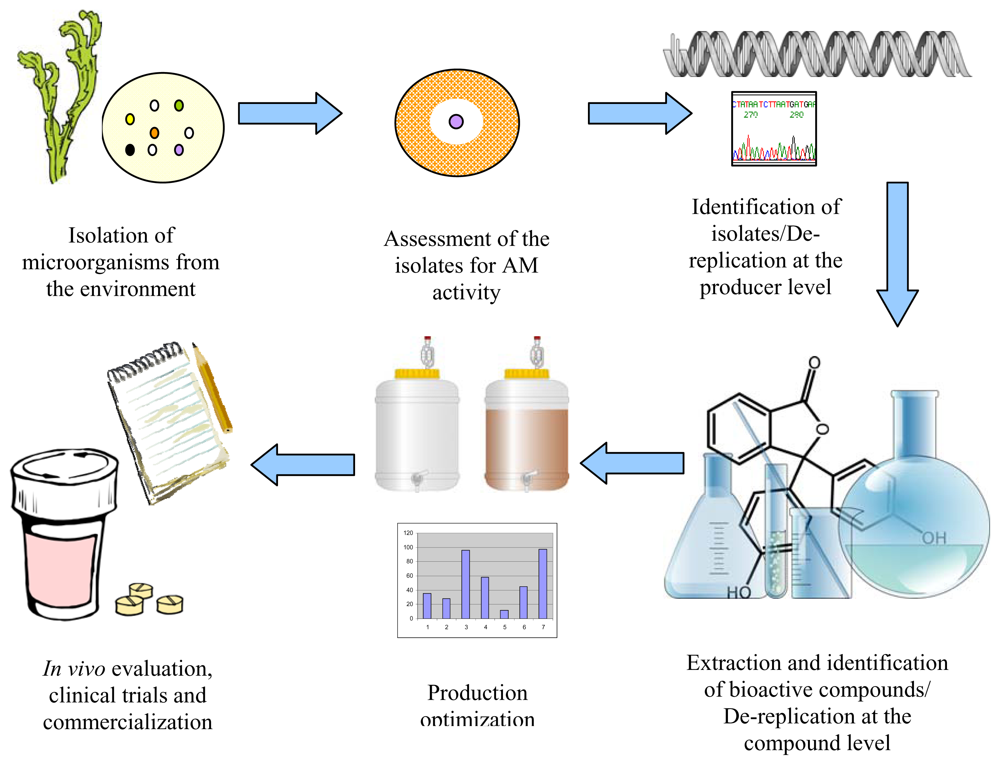
<p>The general procedure for the isolation of natural products from marine epibiotic microorganisms includes several essential steps. The process begins with the isolation of microorganisms from the environment. Often, in the past, the isolation of microorganisms has been a random process. However there is now a growing recognition that the source of microbial samples can be important for increasing the success rate of bioactive discovery [<xref ref-type="bibr" rid="b17-marinedrugs-08-00438">17</xref>,<xref ref-type="bibr" rid="b20-marinedrugs-08-00438">20</xref>]. Thus, as discussed above, due to the various and often chemically mediated interactions that occur between microorganisms and their host and between members of the epibiotic community, isolation of microorganisms from marine living surfaces can significantly increase the chances of obtaining bioactive producing strains. After growing the microorganisms in the laboratory on nutritional media, the screening of individual isolates for biological activity is performed, for example, based on the inhibition of growth of microorganisms surrounding the test organism in the case of antimicrobials. The phylogenetic and phenotypic identification of the bioactive producing organism is then performed as the first de-replication to ensure that the organism has not been previously used for the particular activity and, subsequently, to maximise the possibility of finding a novel bioactive compound. The extraction and purification of biologically active compounds are then performed, followed by chemical structure elucidation. At this stage a second de-replication can be done to exclude already known compounds. Once novel compounds are identified, the various growth conditions of the producer organism can be assessed to optimize their production. Finally, compounds are assessed for use in the treatment of certain diseases [<xref ref-type="bibr" rid="b77-marinedrugs-08-00438">77</xref>,<xref ref-type="bibr" rid="b78-marinedrugs-08-00438">78</xref>] and in a variety of industrial settings (<xref ref-type="fig" rid="f1-marinedrugs-08-00438">Figure 1</xref>).</p>
<sec>
<title>3.1. Improving the Culturability and Production of Bioactives from Marine Microorganisms</title>
<p>The limited ability to culture the majority of environmental strains represents a major bottleneck in classical culture-based screening programs for microbial derived bioactives, including those from marine surfaces. It is estimated that the majority (98–99%) of microorganisms cannot be cultured by traditional techniques [<xref ref-type="bibr" rid="b79-marinedrugs-08-00438">79</xref>–<xref ref-type="bibr" rid="b81-marinedrugs-08-00438">81</xref>]. Nevertheless, marine living surfaces may provide an advantage as, in some cases, a higher percentage of eukaryote associated microorganisms can be readily cultured [<xref ref-type="bibr" rid="b82-marinedrugs-08-00438">82</xref>].</p>
<p>Being able to grow the organism <italic>in vitro</italic> provides great advantages, such as better access to its physiology [<xref ref-type="bibr" rid="b83-marinedrugs-08-00438">83</xref>,<xref ref-type="bibr" rid="b84-marinedrugs-08-00438">84</xref>]. This may allow the manipulation of different growth parameters to achieve the maximum yield of various products and for their large-scale production via fermentation. Among strategies to improve the culturability of microorganisms, those that attempt to grow the organisms under conditions that mimic the physical and chemical parameters of their natural environment, have been the most successful. For example, by using specialised environmental chambers, Kaeberlein <italic>et al.</italic>, [<xref ref-type="bibr" rid="b85-marinedrugs-08-00438">85</xref>] could successfully culture up to 40% of of all microbial cells present in a marine environmental sample.</p>
<p>The close associations often present between marine eukaryotic organisms and their microbial epibionts, clearly impose conditions that are difficult to replicate with standard laboratory procedures. It has, therefore, been proposed that the development of suitable culturing techniques for such organisms should involve conditions that reflect the microenvironment created by their host [<xref ref-type="bibr" rid="b86-marinedrugs-08-00438">86</xref>]. This approach has proven successful for the isolation of the sponge associated bacterium <italic>Oscillatoria spongeliae</italic> [<xref ref-type="bibr" rid="b87-marinedrugs-08-00438">87</xref>], for which hyperosmotic medium, resembling the osmolarity of the sponge mesophyle, was used to cultivate the organism.</p>
<p>Cultivation conditions, such as temperature, aeration, pH of the media, incubation time and media composition, can affect the production of the desired metabolite, and, therefore, must be taken into account and fine-tuned [<xref ref-type="bibr" rid="b88-marinedrugs-08-00438">88</xref>–<xref ref-type="bibr" rid="b94-marinedrugs-08-00438">94</xref>]. Usually this requires a producer strain to be grown in the conditions optimal for the production of the active compound. These conditions can differ significantly from the optimal growth conditions of the strain. In some cases, the producer organism is grown under a variety of conditions in parallel and the differences in metabolic spectra are assessed [<xref ref-type="bibr" rid="b95-marinedrugs-08-00438">95</xref>–<xref ref-type="bibr" rid="b97-marinedrugs-08-00438">97</xref>]. Marine surface associated microorganisms may also require conditions that resemble their native environment in order to produce the maximum amount of bioactives. For example, several studies have shown an increase in the production of antimicrobial compounds when the surface associated bacteria were grown, <italic>in vitro</italic>, to form surface attached biofilms [<xref ref-type="bibr" rid="b41-marinedrugs-08-00438">41</xref>,<xref ref-type="bibr" rid="b98-marinedrugs-08-00438">98</xref>,<xref ref-type="bibr" rid="b99-marinedrugs-08-00438">99</xref>]. In addition, Okazaki <italic>et al.</italic>, [<xref ref-type="bibr" rid="b100-marinedrugs-08-00438">100</xref>] have shown that marine isolate SS-228 was able to produce the antibiotic compound only when the growth medium was supplemented with powdered <italic>Laminaria</italic> seaweeds, common in the habitat from which strain SS-228 was obtained. It is now becoming clear that knowledge of a microorgansims’ natural habitat, including the specifics of the host organism, can improve production of microbial derived bioactives.</p>
<p>Sequence information obtained via the sequencing of the environmental DNA (“metagenome”) can greatly assist in understanding the metabolic potential of the organisms present in the environment, and thus guide the development of specialised cultivation conditions. For example Tyson <italic>et al.</italic>, [<xref ref-type="bibr" rid="b101-marinedrugs-08-00438">101</xref>] successfully cultured <italic>Leptospirillum ferrodiazotrophum</italic> by developing a selective isolation strategy. The predicted nitrogen fixing capability of this organism, based on the sequence information of an acid mine drainage biofilm community, underlined the development of that strategy.</p>
<p>Over the past decade genomics has emerged as an alternative to directly culturing microorganisms for the isolation of new bioactives. In particular, functional metagenomics was first developed to tackle the biotechnological potential of unculturable microorganisms. In this approach the DNA obtained from the environment (“environmental DNA”) is inserted into a host organism, such as <italic>E. coli</italic>, and a functional screen of libraries is performed to detect the desired activity in the clones [<xref ref-type="bibr" rid="b102-marinedrugs-08-00438">102</xref>–<xref ref-type="bibr" rid="b107-marinedrugs-08-00438">107</xref>]. Some of the successes of this approach were the discovery of terragine A [<xref ref-type="bibr" rid="b108-marinedrugs-08-00438">108</xref>], bioactive <italic>N</italic>-acyl-tyrosine derivatives [<xref ref-type="bibr" rid="b109-marinedrugs-08-00438">109</xref>] as well as indirubin [<xref ref-type="bibr" rid="b110-marinedrugs-08-00438">110</xref>] from the soil metagenomes.</p>
<p>Functional (meta-)genomics can provide an insight into the genes and gene clusters involved in the production of certain metabolites, and, thus, provide information about the possible biosynthetic pathway leading to that metabolite [<xref ref-type="bibr" rid="b111-marinedrugs-08-00438">111</xref>]. Such an approach has been used by Burke <italic>et al.</italic>, [<xref ref-type="bibr" rid="b112-marinedrugs-08-00438">112</xref>] to propose the biosynthetic pathway of the antifungal compound tambjamine produced by the marine bacterium <italic>P. tunicata</italic>. Recently the same approach was successful in identifying two positive clones from a <italic>P. tunicata</italic> genome library, with different modes of action against the nematode <italic>Caenorhabditis elegans</italic> (Ballestriero <italic>et al.</italic>, unpublished data). In addition, a functional (meta-) genomics approach provides an advantage for further purification of the bioactive compound produced by a clone, since the “extra” metabolite can be relatively easily pinpointed by using a reference non-bioactive-producing clone [<xref ref-type="bibr" rid="b113-marinedrugs-08-00438">113</xref>].</p>
<p>However, despite some success, currently the hit rate of using metagenomic functional screening to obtain bioactive producing clones generally remains low, in the order of 1 in 10,000 [<xref ref-type="bibr" rid="b109-marinedrugs-08-00438">109</xref>,<xref ref-type="bibr" rid="b114-marinedrugs-08-00438">114</xref>], or even as low as 1 in 730,000 [<xref ref-type="bibr" rid="b115-marinedrugs-08-00438">115</xref>] clones screened. This low hit rate is mainly a result of the limited ability of host expression strains to express compounds of foreign origin [<xref ref-type="bibr" rid="b78-marinedrugs-08-00438">78</xref>,<xref ref-type="bibr" rid="b116-marinedrugs-08-00438">116</xref>,<xref ref-type="bibr" rid="b117-marinedrugs-08-00438">117</xref>]. Therefore it is possible that with improvements of such strains the hit rate for positive clones in metagenomics functional screens will greatly increase. For example, recent studies have demonstrated that the use of a variety of host expression strains can assist in the expression of the desired metabolite [<xref ref-type="bibr" rid="b118-marinedrugs-08-00438">118</xref>–<xref ref-type="bibr" rid="b121-marinedrugs-08-00438">121</xref>]. Specifically, these strains are often chosen based on possible similarities with the producer bacteria (if known), such as, for example, the similarities in codon usage, as well as presence of specific machinery necessary for the production of particular metabolites [<xref ref-type="bibr" rid="b119-marinedrugs-08-00438">119</xref>,<xref ref-type="bibr" rid="b120-marinedrugs-08-00438">120</xref>].</p>
<p>Alternatively, shotgun sequencing of environmental DNA and subsequent data analysis has the potential to identify genes encoding new structures of known compound classes, e.g., polyketide synthases (PKS) and non-ribosomal peptide synthetases (NRPS) usually involved in production of bioactive secondary metabolites [<xref ref-type="bibr" rid="b122-marinedrugs-08-00438">122</xref>]. For example, recent analysis of the genome of <italic>P. tunicata</italic> has revealed the presence of nine NRPS [<xref ref-type="bibr" rid="b123-marinedrugs-08-00438">123</xref>]. Two products of these NRPS with predicted biological activity have been recently identified in the laboratory via heterologous expression, and their presence was confirmed in the original strain of <italic>P. tunicata</italic> by varying its conditions of growth [<xref ref-type="bibr" rid="b124-marinedrugs-08-00438">124</xref>].</p>
<p>Moreover, the availability of sequence data from a variety of microorganisms has further highlighted the importance of developing culturing conditions that would be suitable for the production of bioactives. There are now several examples of genes involved in the biosynthesis of bioactives found in non-bioactive producing organisms, suggesting that, given suitable growth conditions, these organisms have the potential to produce bioactive metabolites. For example, the genome of the myxobacterium <italic>Stigmatella aurantiaca</italic> DW4/3-1 showed the presence of multiple polyketide synthase/non-ribosomal peptide synthetase gene clusters, which had not been previously observed in this organism [<xref ref-type="bibr" rid="b125-marinedrugs-08-00438">125</xref>]. In another example, the previously unknown potential of the production of the antitumour compound terrequinone A in the fungus <italic>Aspergillus nidulans</italic> was revealed [<xref ref-type="bibr" rid="b126-marinedrugs-08-00438">126</xref>].</p></sec>
<sec>
<title>3.2. De-Replication</title>
<p>In the early years of antibiotic discovery the selection of antibiotic producer strains was based on morphology rather than genotypes, resulting in redundancy in many natural product extract libraries [<xref ref-type="bibr" rid="b127-marinedrugs-08-00438">127</xref>,<xref ref-type="bibr" rid="b128-marinedrugs-08-00438">128</xref>]. The initial success in the discovery of many antibiotic compounds from natural sources included thousands of compounds being described within a few decades. However, the lack of a systematic approach often resulted in the frequent re-discovery of known compounds. Therefore, it is important to put considerable effort into the de-replication process for early detection of both the known producer organisms as well as the known bioactive compounds.</p>
<p>Currently, 16S rRNA gene sequencing [<xref ref-type="bibr" rid="b129-marinedrugs-08-00438">129</xref>] and phenotypic characterisation can serve for the identification of producer organisms, and, hence, may reveal whether a given microorganism or its close relatives have been previously known to produce certain bioactives, in order to focus the efforts on organisms with yet uncharacterised activity.</p>
<p>Concerning the early detection of known bioactive compounds, advances in the development of new chemical analysis techniques, coupled with a database evaluation, can serve as tools for rapid detection of known compounds requiring only small quantities of sample and/or minimal efforts in sample preparation [<xref ref-type="bibr" rid="b130-marinedrugs-08-00438">130</xref>–<xref ref-type="bibr" rid="b132-marinedrugs-08-00438">132</xref>]. Hence, they may greatly assist in preventing the waste of resources, which would otherwise be necessary for scale-up and characterisation of the bioactive compounds.</p>
<p>The exploration of relatively unexplored environments can also assist in finding novel microorganisms and chemical structures, and, hence, minimise the re-discovery of known compounds. The oceans have proven to be a habitat for many unique microbes [<xref ref-type="bibr" rid="b133-marinedrugs-08-00438">133</xref>], such as, for example, the recently discovered marine genera <italic>Salinispora</italic> and <italic>Marinophilus</italic> [<xref ref-type="bibr" rid="b133-marinedrugs-08-00438">133</xref>,<xref ref-type="bibr" rid="b134-marinedrugs-08-00438">134</xref>]. In addition, some of the members of these groups were found to produce structurally novel bioactive metabolites, for example, salinosporamides, a family of compounds with cytotoxic activity, were successfully isolated from <italic>Salinnispora tropica</italic> [<xref ref-type="bibr" rid="b135-marinedrugs-08-00438">135</xref>]. Likewise, the structurally novel compounds marineosins [<xref ref-type="bibr" rid="b136-marinedrugs-08-00438">136</xref>] and largazole [<xref ref-type="bibr" rid="b137-marinedrugs-08-00438">137</xref>] have been recently isolated from marine bacteria belonging to the actinomycete and cyanobacterial groups respectively. Recently discovered marine bioactive natural products including compounds with unique structures are reviewed in [<xref ref-type="bibr" rid="b138-marinedrugs-08-00438">138</xref>]. This supports the idea that the unique chemical and physical parameters of the marine environment can lead to the evolution of life forms that could also produce metabolites with novel chemical scaffolds [<xref ref-type="bibr" rid="b139-marinedrugs-08-00438">139</xref>,<xref ref-type="bibr" rid="b140-marinedrugs-08-00438">140</xref>].</p></sec>
<sec>
<title>3.3. Purification of Bioactives from Crude Extracts</title>
<p>Despite their potential, full characterisation of marine microbially derived bioactives, as well as the development of extraction and purification strategies can be a long and laborious process requiring a great deal of manual work, with little room for automation [<xref ref-type="bibr" rid="b78-marinedrugs-08-00438">78</xref>,<xref ref-type="bibr" rid="b141-marinedrugs-08-00438">141</xref>].</p>
<p>Purification and structure elucidation of mass limited sample material is considered a major bottleneck. This is usually because the compound of interest often represents less than 1% of the crude extract, which, in most cases, is a mixture of hundreds of different compounds. Therefore, every extract has its unique combination of “contaminants” necessitating a specific approach; as a result, development of the purification strategies remains largely experimental [<xref ref-type="bibr" rid="b142-marinedrugs-08-00438">142</xref>].</p>
<p>Furthermore, obtaining adequate quantities of bioactive compounds, necessary for structure elucidation and evaluation, usually requires extensive optimization of conditions and scale-up [<xref ref-type="bibr" rid="b143-marinedrugs-08-00438">143</xref>].</p>
<p>To facilitate the chemical characterisation, analytical methods are constantly being developed and improved, one of the major lines of improvement being the possibility of using small quantities of sample and easy sample preparation. For example, the recently developed Ultra High Performance Liquid Chromatography (UPLC) coupled to high resolution mass spectrometers (MS), as well as capillary probe nuclear magnetic resonance spectrometers have greatly assisted the process of natural product discovery from mass limited samples [<xref ref-type="bibr" rid="b130-marinedrugs-08-00438">130</xref>,<xref ref-type="bibr" rid="b144-marinedrugs-08-00438">144</xref>,<xref ref-type="bibr" rid="b145-marinedrugs-08-00438">145</xref>]. Likewise, the newly developed Desorption Electrospray Ionisation Mass Spectrometry (DESI-MS) technique allows for the rapid detection of the compounds requiring minimal effort to be spent on sample preparation [<xref ref-type="bibr" rid="b131-marinedrugs-08-00438">131</xref>,<xref ref-type="bibr" rid="b132-marinedrugs-08-00438">132</xref>]. These techniques may soon eliminate, or, by some estimates, have already eliminated the purification and chemical characterisation step as a major drawback in natural product discovery [<xref ref-type="bibr" rid="b146-marinedrugs-08-00438">146</xref>–<xref ref-type="bibr" rid="b150-marinedrugs-08-00438">150</xref>].</p></sec></sec>
<sec>
<title>4. Is There an Alternative to Natural Product Discovery and Development?</title>
<p>The challenges of natural product research have resulted in a search for an alternative to bioactive product development.</p>
<p>Combinatorial biosynthesis has emerged as one of the alternatives and is defined as “the application of genetic engineering to modify biosynthetic pathways to natural products in order to produce new and altered structures using nature’s biosynthetic machinery” [<xref ref-type="bibr" rid="b151-marinedrugs-08-00438">151</xref>]. It involves the use of genes from different biosynthetic pathways, in various combinations, in order to generate libraries of hybrid structures. However, in practice, this approach is rather problematic. Firstly, it involves the construction of various mutant organisms and, therefore, is very labour-intensive and costly. Secondly, it often relies on the low substrate specificity of enzymes in the biosynthetic pathways, which is not always the case as many enzymes are rather specific [<xref ref-type="bibr" rid="b151-marinedrugs-08-00438">151</xref>].</p>
<p>High-throughput screening (HTS) of synthetic chemical libraries is also regarded as an alternative to bioactive discovery and the development of combinatorial chemistry has allowed for smaller, more drug-like libraries to be screened against defined macromolecular targets. Furthermore, an increase in the availability of genomic data has provided more potential targets for these screens [<xref ref-type="bibr" rid="b142-marinedrugs-08-00438">142</xref>,<xref ref-type="bibr" rid="b152-marinedrugs-08-00438">152</xref>–<xref ref-type="bibr" rid="b157-marinedrugs-08-00438">157</xref>]. However, the first libraries of chemically synthesised compounds provided more quantity than quality; some produced more than million compounds, but were a disappointment, as they yielded very low numbers of, or no, active compounds [<xref ref-type="bibr" rid="b142-marinedrugs-08-00438">142</xref>,<xref ref-type="bibr" rid="b158-marinedrugs-08-00438">158</xref>]. For example, GlaxoSmithKline (<ext-link xlink:href="http://www.gsk.com" ext-link-type="uri">http://www.gsk.com</ext-link>) have recently disclosed the results of a six-year campaign to discover broad-spectrum antibiotics that was abandoned because of the limited chemical diversity of their synthetic screening libraries [<xref ref-type="bibr" rid="b157-marinedrugs-08-00438">157</xref>]. These approaches obviously failed to fulfil initial expectations [<xref ref-type="bibr" rid="b159-marinedrugs-08-00438">159</xref>–<xref ref-type="bibr" rid="b164-marinedrugs-08-00438">164</xref>], and are unlikely to substitute the benefits of natural product development.</p>
<p>In contrast to chemical libraries, bioactives of natural product origin provide a diversity and a structural complexity with densely packed functional groups allowing maximum selectivity and interaction with the target [<xref ref-type="bibr" rid="b77-marinedrugs-08-00438">77</xref>,<xref ref-type="bibr" rid="b165-marinedrugs-08-00438">165</xref>,<xref ref-type="bibr" rid="b166-marinedrugs-08-00438">166</xref>]. Such complexity makes the chemical synthesis of these compounds extremely difficult [<xref ref-type="bibr" rid="b146-marinedrugs-08-00438">146</xref>,<xref ref-type="bibr" rid="b172-marinedrugs-08-00438">172</xref>–<xref ref-type="bibr" rid="b176-marinedrugs-08-00438">176</xref>]. Nevertheless there has been some success with the total synthesis of natural products from marine microorganisms, such as, for example, dinoflagellate toxins azaspiracids and brevetoxins, and the antibiotic compound uncialamycin produced by marine Streptomyces [<xref ref-type="bibr" rid="b167-marinedrugs-08-00438">167</xref>–<xref ref-type="bibr" rid="b171-marinedrugs-08-00438">171</xref>]. It has been suggested that the success of natural compounds is due to the fact that they have undergone natural selection and, therefore, are best suited to perform their activities [<xref ref-type="bibr" rid="b142-marinedrugs-08-00438">142</xref>,<xref ref-type="bibr" rid="b160-marinedrugs-08-00438">160</xref>,<xref ref-type="bibr" rid="b177-marinedrugs-08-00438">177</xref>]. Thus, further research on bioactive natural products may provide a source of new chemical structures that can guide the design of novel chemical compounds [<xref ref-type="bibr" rid="b178-marinedrugs-08-00438">178</xref>,<xref ref-type="bibr" rid="b179-marinedrugs-08-00438">179</xref>], as well as reveal yet unknown modes of action [<xref ref-type="bibr" rid="b180-marinedrugs-08-00438">180</xref>].</p>
<p>The majority of antibiotics currently used in clinical practice are of natural product origin [<xref ref-type="bibr" rid="b77-marinedrugs-08-00438">77</xref>,<xref ref-type="bibr" rid="b161-marinedrugs-08-00438">161</xref>,<xref ref-type="bibr" rid="b181-marinedrugs-08-00438">181</xref>]. For example, 70 out of the 90 antibiotics marketed in the years 1982–2002 originated from natural products [<xref ref-type="bibr" rid="b161-marinedrugs-08-00438">161</xref>]. Notably, the quinolones or fluoroqinones, one of the most successful classes of synthetic antibiotics, are also based on the structure of the natural product quinine [<xref ref-type="bibr" rid="b182-marinedrugs-08-00438">182</xref>]. In fact, chemical modifications based on a natural product scaffold is a widely used approach in modifying the chemical and physical properties of the molecule thus making it useful for a particular pharmacological application [<xref ref-type="bibr" rid="b183-marinedrugs-08-00438">183</xref>,<xref ref-type="bibr" rid="b184-marinedrugs-08-00438">184</xref>]. For example, Jenkins <italic>et al.</italic>, [<xref ref-type="bibr" rid="b185-marinedrugs-08-00438">185</xref>] have recently synthesised four new chemical scaffolds useful for drug development based on novel structures of a number of bioactive natural products such as the histrionicotoxins isolated from the skin of the Colombian poison dart frog, <italic>Dendrobates histrionicus</italic> [<xref ref-type="bibr" rid="b185-marinedrugs-08-00438">185</xref>]. Likewise, the chemically synthesised analogs of epothilones—compounds produced by myxobacterium <italic>Sorangium cellitlosum</italic> [<xref ref-type="bibr" rid="b186-marinedrugs-08-00438">186</xref>], have shown an increased potency against tumour cells compared to the original natural product [<xref ref-type="bibr" rid="b187-marinedrugs-08-00438">187</xref>,<xref ref-type="bibr" rid="b188-marinedrugs-08-00438">188</xref>].</p></sec>
<sec sec-type="conclusions">
<title>5. Conclusions</title>
<p>Despite the challenges, the search and development of natural products remain an indispensable and unparalleled source of biologically active compounds. Thus, research into the diversity of bioactive natural products justifies the resources invested due to the lack of equivalent alternatives in synthetic compounds [<xref ref-type="bibr" rid="b142-marinedrugs-08-00438">142</xref>,<xref ref-type="bibr" rid="b178-marinedrugs-08-00438">178</xref>]. Microorganisms are currently accepted as the best renewable source for bioactives, and the exploration of yet underexplored sources, such as the marine living-surface habitat, has a great potential to deliver novel bioactive producing microbes useful for further drug development. Moreover, a systematic approach that takes into consideration unique ecological relationships in the marine environment, such as those discussed in this review, can greatly assist in maximizing the output of obtaining novel bioactive producing organisms and, thus, may prevent the frequent re-discovery of known compounds and the waste of resources that would be necessary for largescale high-throughput screens.</p></sec></body>
<back>
<ack>
<title>Acknowledgements</title>
<p>The authors thank Tilmann Harder for helpful discussions and review of the manuscript. The authors also thank Australian Research Council Linkage Grant # LP04554677 and the Centre for Marine Bio-Innovation for research funding support.</p></ack>
<ref-list>
<title>References</title>
<ref id="b1-marinedrugs-08-00438"><label>1</label><citation citation-type="journal"><person-group person-group-type="author"><name><surname>Berdy</surname><given-names>J</given-names></name></person-group><article-title>Bioactive microbial metabolites. A personal view</article-title><source>J Antibiot (Tokyo)</source><year>2005</year><volume>58</volume><fpage>1</fpage><lpage>26</lpage><pub-id pub-id-type="doi">10.1038/ja.2005.1</pub-id></citation></ref>
<ref id="b2-marinedrugs-08-00438"><label>2</label><citation citation-type="journal"><person-group person-group-type="author"><name><surname>Monaghan</surname><given-names>RL</given-names></name><name><surname>Tkacz</surname><given-names>JS</given-names></name></person-group><article-title>Bioactive microbial products: Focus upon mechanism of action</article-title><source>Annu Rev Microbiol</source><year>1990</year><volume>44</volume><fpage>271</fpage><lpage>301</lpage><pub-id pub-id-type="doi">10.1146/annurev.mi.44.100190.001415</pub-id><pub-id pub-id-type="pmid">2252385</pub-id></citation></ref>
<ref id="b3-marinedrugs-08-00438"><label>3</label><citation citation-type="journal"><person-group person-group-type="author"><name><surname>Capon</surname><given-names>RJ</given-names></name></person-group><article-title>Marine bioprospecting–Trawling for treasure and pleasure</article-title><source>European J Org Chem</source><year>2001</year><fpage>633</fpage><lpage>645</lpage></citation></ref>
<ref id="b4-marinedrugs-08-00438"><label>4</label><citation citation-type="journal"><person-group person-group-type="author"><name><surname>Basilio</surname><given-names>A</given-names></name><name><surname>Gonzalez</surname><given-names>I</given-names></name><name><surname>Vicente</surname><given-names>MF</given-names></name><name><surname>Gorrochategui</surname><given-names>J</given-names></name><name><surname>Cabello</surname><given-names>A</given-names></name><name><surname>Gonzalez</surname><given-names>A</given-names></name><name><surname>Genilloud</surname><given-names>O</given-names></name></person-group><article-title>Patterns of antimicrobial activities from soil actinomycetes isolated under different conditions of pH and salinity</article-title><source>J Appl Microbiol</source><year>2003</year><volume>95</volume><fpage>814</fpage><lpage>823</lpage><pub-id pub-id-type="doi">10.1046/j.1365-2672.2003.02049.x</pub-id><pub-id pub-id-type="pmid">12969296</pub-id></citation></ref>
<ref id="b5-marinedrugs-08-00438"><label>5</label><citation citation-type="book"><person-group person-group-type="author"><name><surname>Pelaez</surname><given-names>F</given-names></name><name><surname>Genilloud</surname><given-names>O</given-names></name></person-group><article-title>Discovering new drugs from microbial natural products</article-title><source>Microorganisms for Health Care, Food and Enzyme Production</source><person-group person-group-type="editor"><name><surname>Barredo</surname><given-names>JL</given-names></name></person-group><publisher-name>Research Signpost</publisher-name><publisher-loc>Trivendrum, India</publisher-loc><year>2003</year><fpage>1</fpage><lpage>23</lpage></citation></ref>
<ref id="b6-marinedrugs-08-00438"><label>6</label><citation citation-type="journal"><person-group person-group-type="author"><name><surname>Watve</surname><given-names>MG</given-names></name><name><surname>Tickoo</surname><given-names>R</given-names></name><name><surname>Jog</surname><given-names>MM</given-names></name><name><surname>Bhole</surname><given-names>BD</given-names></name></person-group><article-title>How many antibiotics are produced by the genus <italic>Streptomyces</italic></article-title><source>Arch Microbiol</source><year>2001</year><volume>176</volume><fpage>386</fpage><lpage>390</lpage><pub-id pub-id-type="doi">10.1007/s002030100345</pub-id><pub-id pub-id-type="pmid">11702082</pub-id></citation></ref>
<ref id="b7-marinedrugs-08-00438"><label>7</label><citation citation-type="book"><person-group person-group-type="author"><name><surname>Rheinheimer</surname><given-names>G</given-names></name></person-group><source>Aquatic microbiology</source><publisher-name>Wiley</publisher-name><publisher-loc>Chichester; New York, NY, USA</publisher-loc><year>1992</year></citation></ref>
<ref id="b8-marinedrugs-08-00438"><label>8</label><citation citation-type="journal"><person-group person-group-type="author"><name><surname>Fenical</surname><given-names>W</given-names></name><name><surname>Jensen</surname><given-names>PR</given-names></name></person-group><article-title>Developing a new resource for drug discovery: Marine actinomycete bacteria</article-title><source>Nat Chem Biol</source><year>2006</year><volume>2</volume><fpage>666</fpage><lpage>673</lpage><pub-id pub-id-type="doi">10.1038/nchembio841</pub-id><pub-id pub-id-type="pmid">17108984</pub-id></citation></ref>
<ref id="b9-marinedrugs-08-00438"><label>9</label><citation citation-type="journal"><person-group person-group-type="author"><name><surname>Perez-Matos</surname><given-names>AE</given-names></name><name><surname>Rosado</surname><given-names>W</given-names></name><name><surname>Govind</surname><given-names>NS</given-names></name></person-group><article-title>Bacterial diversity associated with the Caribbean tunicate <italic>Ecteinascidia turbinata</italic></article-title><source>Antonie van Leeuwenhoek</source><year>2007</year><volume>92</volume><fpage>155</fpage><lpage>164</lpage><pub-id pub-id-type="doi">10.1007/s10482-007-9143-9</pub-id><pub-id pub-id-type="pmid">17265101</pub-id></citation></ref>
<ref id="b10-marinedrugs-08-00438"><label>10</label><citation citation-type="journal"><person-group person-group-type="author"><name><surname>Longford</surname><given-names>SR</given-names></name><name><surname>Tujula</surname><given-names>NA</given-names></name><name><surname>Crocetti</surname><given-names>GR</given-names></name><name><surname>Holmes</surname><given-names>AJ</given-names></name><name><surname>Holmstrom</surname><given-names>C</given-names></name><name><surname>Kjelleberg</surname><given-names>S</given-names></name><name><surname>Steinberg</surname><given-names>PD</given-names></name><name><surname>Taylor</surname><given-names>MW</given-names></name></person-group><article-title>Comparisons of diversity of bacterial communities associated with three sessile marine eukaryotes</article-title><source>Aquat Microb Ecol</source><year>2007</year><volume>48</volume><fpage>217</fpage><lpage>229</lpage><pub-id pub-id-type="doi">10.3354/ame048217</pub-id></citation></ref>
<ref id="b11-marinedrugs-08-00438"><label>11</label><citation citation-type="journal"><person-group person-group-type="author"><name><surname>Santiago-Vazquez</surname><given-names>LZ</given-names></name><name><surname>Bruck</surname><given-names>TB</given-names></name><name><surname>Bruck</surname><given-names>WM</given-names></name><name><surname>Duque-Alarcon</surname><given-names>AP</given-names></name><name><surname>McCarthy</surname><given-names>PJ</given-names></name><name><surname>Kerr</surname><given-names>RG</given-names></name></person-group><article-title>The diversity of the bacterial communities associated with the azooxanthellate hexacoral <italic>Cirrhipathes lutkeni</italic></article-title><source>ISME J</source><year>2007</year><volume>1</volume><fpage>654</fpage><lpage>659</lpage><pub-id pub-id-type="doi">10.1038/ismej.2007.77</pub-id><pub-id pub-id-type="pmid">18043672</pub-id></citation></ref>
<ref id="b12-marinedrugs-08-00438"><label>12</label><citation citation-type="journal"><person-group person-group-type="author"><name><surname>Rohwer</surname><given-names>F</given-names></name><name><surname>Seguritan</surname><given-names>V</given-names></name><name><surname>Azam</surname><given-names>F</given-names></name><name><surname>Knowlton</surname><given-names>N</given-names></name></person-group><article-title>Diversity and distribution of coral-associated bacteria</article-title><source>Mar Ecol Prog Ser</source><year>2002</year><volume>243</volume><fpage>1</fpage><lpage>10</lpage><pub-id pub-id-type="doi">10.3354/meps243001</pub-id></citation></ref>
<ref id="b13-marinedrugs-08-00438"><label>13</label><citation citation-type="journal"><person-group person-group-type="author"><name><surname>Martinez-Garcia</surname><given-names>M</given-names></name><name><surname>Diaz-Valdes</surname><given-names>M</given-names></name><name><surname>Wanner</surname><given-names>G</given-names></name><name><surname>Ramos-Espla</surname><given-names>A</given-names></name><name><surname>Anton</surname><given-names>J</given-names></name></person-group><article-title>Microbial community associated with the colonial ascidian <italic>Cystodytes dellechiajei</italic></article-title><source>Environ Microbiol</source><year>2007</year><volume>9</volume><fpage>521</fpage><lpage>534</lpage><pub-id pub-id-type="doi">10.1111/j.1462-2920.2006.01170.x</pub-id><pub-id pub-id-type="pmid">17222150</pub-id></citation></ref>
<ref id="b14-marinedrugs-08-00438"><label>14</label><citation citation-type="journal"><person-group person-group-type="author"><name><surname>Webster</surname><given-names>NS</given-names></name><name><surname>Bourne</surname><given-names>D</given-names></name></person-group><article-title>Bacterial community structure associated with the Antarctic soft coral <italic>Alcyonium antarcticum</italic></article-title><source>FEMS Microbiol Ecol</source><year>2007</year><volume>59</volume><fpage>81</fpage><lpage>94</lpage><pub-id pub-id-type="doi">10.1111/j.1574-6941.2006.00195.x</pub-id><pub-id pub-id-type="pmid">17233746</pub-id></citation></ref>
<ref id="b15-marinedrugs-08-00438"><label>15</label><citation citation-type="journal"><person-group person-group-type="author"><name><surname>Bourne</surname><given-names>DG</given-names></name><name><surname>Munn</surname><given-names>CB</given-names></name></person-group><article-title>Diversity of bacteria associated with the coral <italic>Pocillopora damicornis</italic> from the Great Barrier Reef</article-title><source>Environ Microbiol</source><year>2005</year><volume>7</volume><fpage>1162</fpage><lpage>1174</lpage><pub-id pub-id-type="doi">10.1111/j.1462-2920.2005.00793.x</pub-id><pub-id pub-id-type="pmid">16011753</pub-id></citation></ref>
<ref id="b16-marinedrugs-08-00438"><label>16</label><citation citation-type="journal"><person-group person-group-type="author"><name><surname>Enticknap</surname><given-names>JJ</given-names></name><name><surname>Kelly</surname><given-names>M</given-names></name><name><surname>Peraud</surname><given-names>O</given-names></name><name><surname>Hill</surname><given-names>RT</given-names></name></person-group><article-title>Characterization of a culturable alphaproteobacterial symbiont common to many marine sponges and evidence for vertical transmission via sponge larvae</article-title><source>Appl Environ Microbiol</source><year>2006</year><volume>72</volume><fpage>3724</fpage><lpage>3732</lpage><pub-id pub-id-type="doi">10.1128/AEM.72.5.3724-3732.2006</pub-id><pub-id pub-id-type="pmid">16672523</pub-id></citation></ref>
<ref id="b17-marinedrugs-08-00438"><label>17</label><citation citation-type="journal"><person-group person-group-type="author"><name><surname>Penesyan</surname><given-names>A</given-names></name><name><surname>Marshall-Jones</surname><given-names>Z</given-names></name><name><surname>Holmstrom</surname><given-names>C</given-names></name><name><surname>Kjelleberg</surname><given-names>S</given-names></name><name><surname>Egan</surname><given-names>S</given-names></name></person-group><article-title>Antimicrobial activity observed among cultured marine epiphytic bacteria reflects their potential as a source of new drugs: Research article</article-title><source>FEMS Microbiol Ecol</source><year>2009</year><volume>69</volume><fpage>113</fpage><lpage>124</lpage><pub-id pub-id-type="doi">10.1111/j.1574-6941.2009.00688.x</pub-id><pub-id pub-id-type="pmid">19453738</pub-id></citation></ref>
<ref id="b18-marinedrugs-08-00438"><label>18</label><citation citation-type="journal"><person-group person-group-type="author"><name><surname>Hentschel</surname><given-names>U</given-names></name><name><surname>Schmid</surname><given-names>M</given-names></name><name><surname>Wagner</surname><given-names>M</given-names></name><name><surname>Fieseler</surname><given-names>L</given-names></name><name><surname>Gernert</surname><given-names>C</given-names></name><name><surname>Hacker</surname><given-names>J</given-names></name></person-group><article-title>Isolation and phylogenetic analysis of bacteria with antimicrobial activities from the Mediterranean sponges <italic>Aplysina aerophoba</italic> and <italic>Aplysina cavernicola</italic></article-title><source>FEMS Microbiol Ecol</source><year>2001</year><volume>35</volume><fpage>305</fpage><lpage>312</lpage><pub-id pub-id-type="doi">10.1111/j.1574-6941.2001.tb00816.x</pub-id><pub-id pub-id-type="pmid">11311441</pub-id></citation></ref>
<ref id="b19-marinedrugs-08-00438"><label>19</label><citation citation-type="journal"><person-group person-group-type="author"><name><surname>Muscholl-Silberhorn</surname><given-names>A</given-names></name><name><surname>Thiel</surname><given-names>V</given-names></name><name><surname>Imhoff</surname><given-names>J</given-names></name></person-group><article-title>Abundance and bioactivity of cultured sponge-sssociated bacteria from the Mediterranean sea</article-title><source>Microb Ecol</source><year>2008</year><volume>55</volume><fpage>94</fpage><lpage>106</lpage><pub-id pub-id-type="doi">10.1007/s00248-007-9255-9</pub-id><pub-id pub-id-type="pmid">17497228</pub-id></citation></ref>
<ref id="b20-marinedrugs-08-00438"><label>20</label><citation citation-type="journal"><person-group person-group-type="author"><name><surname>Burgess</surname><given-names>JG</given-names></name><name><surname>Jordan</surname><given-names>EM</given-names></name><name><surname>Bregu</surname><given-names>M</given-names></name><name><surname>Mearns-Spragg</surname><given-names>A</given-names></name><name><surname>Boyd</surname><given-names>KG</given-names></name></person-group><article-title>Microbial antagonism: A neglected avenue of natural products research</article-title><source>J Biotechnol</source><year>1999</year><volume>70</volume><fpage>27</fpage><lpage>32</lpage><pub-id pub-id-type="doi">10.1016/S0168-1656(99)00054-1</pub-id><pub-id pub-id-type="pmid">10412203</pub-id></citation></ref>
<ref id="b21-marinedrugs-08-00438"><label>21</label><citation citation-type="journal"><person-group person-group-type="author"><name><surname>Egan</surname><given-names>S</given-names></name><name><surname>Thomas</surname><given-names>T</given-names></name><name><surname>Kjelleberg</surname><given-names>S</given-names></name></person-group><article-title>Unlocking the diversity and biotechnological potential of marine surface associated microbial communities</article-title><source>Curr Opin Microbiol</source><year>2008</year><volume>11</volume><fpage>219</fpage><lpage>225</lpage><pub-id pub-id-type="doi">10.1016/j.mib.2008.04.001</pub-id><pub-id pub-id-type="pmid">18524668</pub-id></citation></ref>
<ref id="b22-marinedrugs-08-00438"><label>22</label><citation citation-type="book"><person-group person-group-type="author"><name><surname>Zobell</surname><given-names>CE</given-names></name></person-group><source>Marine microbiology: A Monograph on Hydrobacteriology</source><publisher-name>Chronica Botanica Co.</publisher-name><publisher-loc>Waltham, MA, USA</publisher-loc><year>1946</year></citation></ref>
<ref id="b23-marinedrugs-08-00438"><label>23</label><citation citation-type="journal"><person-group person-group-type="author"><name><surname>Sogin</surname><given-names>ML</given-names></name><name><surname>Morrison</surname><given-names>HG</given-names></name><name><surname>Huber</surname><given-names>JA</given-names></name><name><surname>Welch</surname><given-names>DM</given-names></name><name><surname>Huse</surname><given-names>SM</given-names></name><name><surname>Neal</surname><given-names>PR</given-names></name><name><surname>Arrieta</surname><given-names>JM</given-names></name><name><surname>Herndl</surname><given-names>GJ</given-names></name></person-group><article-title>Microbial diversity in the deep sea and the underexplored “rare biosphere”</article-title><source>Proc Natl Acad Sci USA</source><year>2006</year><volume>103</volume><fpage>12115</fpage><lpage>12120</lpage><pub-id pub-id-type="doi">10.1073/pnas.0605127103</pub-id><pub-id pub-id-type="pmid">16880384</pub-id></citation></ref>
<ref id="b24-marinedrugs-08-00438"><label>24</label><citation citation-type="journal"><person-group person-group-type="author"><name><surname>Stach</surname><given-names>JEM</given-names></name><name><surname>Bull</surname><given-names>AT</given-names></name></person-group><article-title>Estimating and comparing the diversity of marine actinobacteria</article-title><source>Antonie van Leeuwenhoek</source><year>2005</year><volume>87</volume><fpage>3</fpage><lpage>9</lpage><pub-id pub-id-type="doi">10.1007/s10482-004-6524-1</pub-id><pub-id pub-id-type="pmid">15726285</pub-id></citation></ref>
<ref id="b25-marinedrugs-08-00438"><label>25</label><citation citation-type="journal"><person-group person-group-type="author"><name><surname>Holler</surname><given-names>U</given-names></name><name><surname>Wright</surname><given-names>AD</given-names></name><name><surname>Matthee</surname><given-names>GF</given-names></name><name><surname>Konig</surname><given-names>GM</given-names></name><name><surname>Draeger</surname><given-names>S</given-names></name><name><surname>Aust</surname><given-names>HJ</given-names></name><name><surname>Schulz</surname><given-names>B</given-names></name></person-group><article-title>Fungi from marine sponges: Diversity, biological activity and secondary metabolites</article-title><source>Mycol Res</source><year>2000</year><volume>104</volume><fpage>1354</fpage><lpage>1365</lpage><pub-id pub-id-type="doi">10.1017/S0953756200003117</pub-id></citation></ref>
<ref id="b26-marinedrugs-08-00438"><label>26</label><citation citation-type="journal"><person-group person-group-type="author"><name><surname>Haefner</surname><given-names>B</given-names></name></person-group><article-title>Drugs from the deep: Marine natural products as drug candidates</article-title><source>Drug Discov Today</source><year>2003</year><volume>8</volume><fpage>536</fpage><lpage>544</lpage><pub-id pub-id-type="doi">10.1016/S1359-6446(03)02713-2</pub-id><pub-id pub-id-type="pmid">12821301</pub-id></citation></ref>
<ref id="b27-marinedrugs-08-00438"><label>27</label><citation citation-type="journal"><person-group person-group-type="author"><name><surname>Blunt</surname><given-names>JW</given-names></name><name><surname>Copp</surname><given-names>BR</given-names></name><name><surname>Hu</surname><given-names>WP</given-names></name><name><surname>Munro</surname><given-names>MHG</given-names></name><name><surname>Northcote</surname><given-names>PT</given-names></name><name><surname>Prinsep</surname><given-names>MR</given-names></name></person-group><article-title>Marine natural products</article-title><source>Nat Prod Rep</source><year>2009</year><volume>26</volume><fpage>170</fpage><lpage>244</lpage><pub-id pub-id-type="doi">10.1039/b805113p</pub-id><pub-id pub-id-type="pmid">19177222</pub-id></citation></ref>
<ref id="b28-marinedrugs-08-00438"><label>28</label><citation citation-type="journal"><person-group person-group-type="author"><name><surname>Andrighetti-Frohner</surname><given-names>CR</given-names></name><name><surname>Antonio</surname><given-names>RV</given-names></name><name><surname>Creczynski-Pasa</surname><given-names>TB</given-names></name><name><surname>Barardi</surname><given-names>CRM</given-names></name><name><surname>Simoes</surname><given-names>CMO</given-names></name></person-group><article-title>Cytotoxicity and potential antiviral evaluation of violacein produced by <italic>Chromobacterium violaceum</italic></article-title><source>Mem Inst Oswaldo Cruz</source><year>2003</year><volume>98</volume><fpage>843</fpage><lpage>848</lpage><pub-id pub-id-type="doi">10.1590/S0074-02762003000600023</pub-id><pub-id pub-id-type="pmid">14595466</pub-id></citation></ref>
<ref id="b29-marinedrugs-08-00438"><label>29</label><citation citation-type="journal"><person-group person-group-type="author"><name><surname>Lichstein</surname><given-names>HC</given-names></name><name><surname>Van de Sand</surname><given-names>VF</given-names></name></person-group><article-title>Violacein, an antibiotic pigment produced by <italic>Chromobacterium violaceum</italic></article-title><source>J Infect Dis</source><year>1945</year><volume>76</volume><fpage>47</fpage><lpage>51</lpage><pub-id pub-id-type="doi">10.1093/infdis/76.1.47</pub-id></citation></ref>
<ref id="b30-marinedrugs-08-00438"><label>30</label><citation citation-type="journal"><person-group person-group-type="author"><name><surname>Matz</surname><given-names>C</given-names></name><name><surname>Deines</surname><given-names>P</given-names></name><name><surname>Boenigk</surname><given-names>J</given-names></name><name><surname>Arndt</surname><given-names>H</given-names></name><name><surname>Eberl</surname><given-names>L</given-names></name><name><surname>Kjelleberg</surname><given-names>S</given-names></name><name><surname>Jurgens</surname><given-names>K</given-names></name></person-group><article-title>Impact of violacein-producing bacteria on survival and feeding of bacterivorous nanoflagellates</article-title><source>Appl Environ Microbiol</source><year>2004</year><volume>70</volume><fpage>1593</fpage><lpage>1599</lpage><pub-id pub-id-type="doi">10.1128/AEM.70.3.1593-1599.2004</pub-id><pub-id pub-id-type="pmid">15006783</pub-id></citation></ref>
<ref id="b31-marinedrugs-08-00438"><label>31</label><citation citation-type="journal"><person-group person-group-type="author"><name><surname>James</surname><given-names>SG</given-names></name><name><surname>Holmstrom</surname><given-names>C</given-names></name><name><surname>Kjelleberg</surname><given-names>S</given-names></name></person-group><article-title>Purification and characterization of a novel antibacterial protein from the marine bacterium D2</article-title><source>Appl Environ Microbiol</source><year>1996</year><volume>62</volume><fpage>2783</fpage><lpage>2788</lpage><pub-id pub-id-type="pmid">8702270</pub-id></citation></ref>
<ref id="b32-marinedrugs-08-00438"><label>32</label><citation citation-type="journal"><person-group person-group-type="author"><name><surname>Franks</surname><given-names>A</given-names></name><name><surname>Haywood</surname><given-names>P</given-names></name><name><surname>Holmstrom</surname><given-names>C</given-names></name><name><surname>Egan</surname><given-names>S</given-names></name><name><surname>Kjelleberg</surname><given-names>S</given-names></name><name><surname>Kumar</surname><given-names>N</given-names></name></person-group><article-title>Isolation and structure elucidation of a novel yellow pigment from the marine bacterium <italic>Pseudoalteromonas tunicata</italic></article-title><source>Molecules</source><year>2005</year><volume>10</volume><fpage>1286</fpage><lpage>1291</lpage><pub-id pub-id-type="doi">10.3390/10101286</pub-id><pub-id pub-id-type="pmid">18007521</pub-id></citation></ref>
<ref id="b33-marinedrugs-08-00438"><label>33</label><citation citation-type="journal"><person-group person-group-type="author"><name><surname>Feling</surname><given-names>RH</given-names></name><name><surname>Buchanan</surname><given-names>GO</given-names></name><name><surname>Mincer</surname><given-names>TJ</given-names></name><name><surname>Kauffman</surname><given-names>CA</given-names></name><name><surname>Jensen</surname><given-names>PR</given-names></name><name><surname>Fenical</surname><given-names>W</given-names></name></person-group><article-title>Salinosporamide A: A highly cytotoxic proteasome inhibitor from a novel microbial source, a marine bacterium of the new genus Salinospora</article-title><source>Angewandte Chemie–International Edition</source><year>2003</year><volume>42</volume><fpage>355</fpage><lpage>357</lpage><pub-id pub-id-type="doi">10.1002/anie.200390115</pub-id></citation></ref>
<ref id="b34-marinedrugs-08-00438"><label>34</label><citation citation-type="journal"><person-group person-group-type="author"><name><surname>Ratnayake</surname><given-names>R</given-names></name><name><surname>Lacey</surname><given-names>E</given-names></name><name><surname>Tennant</surname><given-names>S</given-names></name><name><surname>Gill</surname><given-names>JH</given-names></name><name><surname>Capon</surname><given-names>RJ</given-names></name></person-group><article-title>Kibdelones: Novel anticancer polyketides from a rare Australian actinomycete</article-title><source>Chemistry–A European Journal</source><year>2007</year><volume>13</volume><fpage>1610</fpage><lpage>1619</lpage><pub-id pub-id-type="doi">10.1002/chem.200601236</pub-id></citation></ref>
<ref id="b35-marinedrugs-08-00438"><label>35</label><citation citation-type="journal"><person-group person-group-type="author"><name><surname>Fremlin</surname><given-names>LJ</given-names></name><name><surname>Piggott</surname><given-names>AM</given-names></name><name><surname>Lacey</surname><given-names>E</given-names></name><name><surname>Capon</surname><given-names>RJ</given-names></name></person-group><article-title>Cottoquinazoline A and cotteslosins A and B, metabolites from an Australian marine-derived strain of <italic>Aspergillus versicolor</italic></article-title><source>J Nat Prod</source><year>2009</year><volume>72</volume><fpage>666</fpage><lpage>670</lpage><pub-id pub-id-type="doi">10.1021/np800777f</pub-id><pub-id pub-id-type="pmid">19245260</pub-id></citation></ref>
<ref id="b36-marinedrugs-08-00438"><label>36</label><citation citation-type="journal"><person-group person-group-type="author"><name><surname>Xu</surname><given-names>Y</given-names></name><name><surname>He</surname><given-names>H</given-names></name><name><surname>Schulz</surname><given-names>S</given-names></name><name><surname>Liu</surname><given-names>X</given-names></name><name><surname>Fusetani</surname><given-names>N</given-names></name><name><surname>Xiong</surname><given-names>H</given-names></name><name><surname>Xiao</surname><given-names>X</given-names></name><name><surname>Qian</surname><given-names>PY</given-names></name></person-group><article-title>Potent antifouling compounds produced by marine</article-title><source>Streptomyces Bioresource Technol</source><year>2010</year><volume>101</volume><fpage>1331</fpage><lpage>1336</lpage><pub-id pub-id-type="doi">10.1016/j.biortech.2009.09.046</pub-id></citation></ref>
<ref id="b37-marinedrugs-08-00438"><label>37</label><citation citation-type="journal"><person-group person-group-type="author"><name><surname>Dash</surname><given-names>S</given-names></name><name><surname>Jin</surname><given-names>C</given-names></name><name><surname>Lee</surname><given-names>OO</given-names></name><name><surname>Xu</surname><given-names>Y</given-names></name><name><surname>Qian</surname><given-names>PY</given-names></name></person-group><article-title>Antibacterial and antilarval-settlement potential and metabolite profiles of novel sponge-associated marine bacteria</article-title><source>J Ind Microbiol Biotechnol</source><year>2009</year><volume>36</volume><fpage>1047</fpage><lpage>1056</lpage><pub-id pub-id-type="doi">10.1007/s10295-009-0588-x</pub-id><pub-id pub-id-type="pmid">19471982</pub-id></citation></ref>
<ref id="b38-marinedrugs-08-00438"><label>38</label><citation citation-type="journal"><person-group person-group-type="author"><name><surname>Xiong</surname><given-names>H</given-names></name><name><surname>Qi</surname><given-names>S</given-names></name><name><surname>Xu</surname><given-names>Y</given-names></name><name><surname>Miao</surname><given-names>L</given-names></name><name><surname>Qian</surname><given-names>P.-Y</given-names></name></person-group><article-title>Antibiotic and antifouling compound production by the marine-derived fungus <italic>Cladosporium</italic> sp. F14</article-title><source>J Hydro-environ Res</source><year>2009</year><volume>2</volume><fpage>264</fpage><lpage>270</lpage><pub-id pub-id-type="doi">10.1016/j.jher.2008.12.002</pub-id></citation></ref>
<ref id="b39-marinedrugs-08-00438"><label>39</label><citation citation-type="journal"><person-group person-group-type="author"><name><surname>Zhang</surname><given-names>L</given-names></name><name><surname>An</surname><given-names>R</given-names></name><name><surname>Wang</surname><given-names>J</given-names></name><name><surname>Sun</surname><given-names>N</given-names></name><name><surname>Zhang</surname><given-names>S</given-names></name><name><surname>Hu</surname><given-names>J</given-names></name><name><surname>Kuai</surname><given-names>J</given-names></name></person-group><article-title>Exploring novel bioactive compounds from marine microbes</article-title><source>Curr Opin Microbiol</source><year>2005</year><volume>8</volume><fpage>276</fpage><lpage>281</lpage><pub-id pub-id-type="doi">10.1016/j.mib.2005.04.008</pub-id><pub-id pub-id-type="pmid">15939350</pub-id></citation></ref>
<ref id="b40-marinedrugs-08-00438"><label>40</label><citation citation-type="journal"><person-group person-group-type="author"><name><surname>Molinski</surname><given-names>TF</given-names></name><name><surname>Dalisay</surname><given-names>DS</given-names></name><name><surname>Lievens</surname><given-names>SL</given-names></name><name><surname>Saludes</surname><given-names>JP</given-names></name></person-group><article-title>Drug development from marine natural products</article-title><source>Nat Rev Drug Discov</source><year>2009</year><volume>8</volume><fpage>69</fpage><lpage>85</lpage><pub-id pub-id-type="doi">10.1038/nrd2487</pub-id><pub-id pub-id-type="pmid">19096380</pub-id></citation></ref>
<ref id="b41-marinedrugs-08-00438"><label>41</label><citation citation-type="journal"><person-group person-group-type="author"><name><surname>Sarkar</surname><given-names>S</given-names></name><name><surname>Saha</surname><given-names>M</given-names></name><name><surname>Roy</surname><given-names>D</given-names></name><name><surname>Jaisankar</surname><given-names>P</given-names></name><name><surname>Das</surname><given-names>S</given-names></name><name><surname>Gauri Roy</surname><given-names>L</given-names></name><name><surname>Gachhui</surname><given-names>R</given-names></name><name><surname>Sen</surname><given-names>T</given-names></name><name><surname>Mukherjee</surname><given-names>J</given-names></name></person-group><article-title>Enhanced production of antimicrobial compounds by three salt-tolerant actinobacterial strains isolated from the Sundarbans in a niche-mimic bioreactor</article-title><source>Mar Biotechnol</source><year>2008</year><volume>10</volume><fpage>518</fpage><lpage>526</lpage><pub-id pub-id-type="doi">10.1007/s10126-008-9090-0</pub-id><pub-id pub-id-type="pmid">18350335</pub-id></citation></ref>
<ref id="b42-marinedrugs-08-00438"><label>42</label><citation citation-type="journal"><person-group person-group-type="author"><name><surname>Rohwer</surname><given-names>F</given-names></name><name><surname>Breitbart</surname><given-names>M</given-names></name><name><surname>Jara</surname><given-names>J</given-names></name><name><surname>Azam</surname><given-names>F</given-names></name><name><surname>Knowlton</surname><given-names>N</given-names></name></person-group><article-title>Diversity of bacteria associated with the Caribbean coral <italic>Montastraea franksi</italic></article-title><source>Coral Reef</source><year>2001</year><volume>20</volume><fpage>85</fpage><lpage>91</lpage><pub-id pub-id-type="doi">10.1007/s003380100138</pub-id></citation></ref>
<ref id="b43-marinedrugs-08-00438"><label>43</label><citation citation-type="journal"><person-group person-group-type="author"><name><surname>Dobretsov</surname><given-names>S</given-names></name><name><surname>Dahms</surname><given-names>HU</given-names></name><name><surname>Tsoi</surname><given-names>MY</given-names></name><name><surname>Qian</surname><given-names>PY</given-names></name></person-group><article-title>Chemical control of epibiosis by Hong Kong sponges: The effect of sponge extracts on micro- and macrofouling communities</article-title><source>Mar Ecol Prog Ser</source><year>2005</year><volume>297</volume><fpage>119</fpage><lpage>129</lpage><pub-id pub-id-type="doi">10.3354/meps297119</pub-id></citation></ref>
<ref id="b44-marinedrugs-08-00438"><label>44</label><citation citation-type="journal"><person-group person-group-type="author"><name><surname>Taylor</surname><given-names>MW</given-names></name><name><surname>Schupp</surname><given-names>PJ</given-names></name><name><surname>Dahllof</surname><given-names>I</given-names></name><name><surname>Kjelleberg</surname><given-names>S</given-names></name><name><surname>Steinberg</surname><given-names>PD</given-names></name></person-group><article-title>Host specificity in marine sponge-associated bacteria, and potential implications for marine microbial diversity</article-title><source>Environ Microbiol</source><year>2004</year><volume>6</volume><fpage>121</fpage><lpage>130</lpage><pub-id pub-id-type="pmid">14756877</pub-id></citation></ref>
<ref id="b45-marinedrugs-08-00438"><label>45</label><citation citation-type="journal"><person-group person-group-type="author"><name><surname>Provasoli</surname><given-names>L</given-names></name><name><surname>Pintner</surname><given-names>IJ</given-names></name></person-group><article-title>Effect of media and inoculum on morphology of</article-title><source>Ulva J Phycol</source><year>1977</year><volume>13</volume><fpage>56</fpage><lpage>56</lpage></citation></ref>
<ref id="b46-marinedrugs-08-00438"><label>46</label><citation citation-type="journal"><person-group person-group-type="author"><name><surname>Provasoli</surname><given-names>L</given-names></name><name><surname>Pintner</surname><given-names>IJ</given-names></name></person-group><article-title>Bacteria induced polymorphism in an axenic laboratory strain of <italic>Ulva lactuca</italic> (<italic>Chlorophceae</italic>)</article-title><source>J Phycol</source><year>1980</year><volume>16</volume><fpage>196</fpage><lpage>201</lpage><pub-id pub-id-type="doi">10.1111/j.1529-8817.1980.tb03019.x</pub-id></citation></ref>
<ref id="b47-marinedrugs-08-00438"><label>47</label><citation citation-type="journal"><person-group person-group-type="author"><name><surname>Nakanishi</surname><given-names>K</given-names></name><name><surname>Nishijima</surname><given-names>M</given-names></name><name><surname>Nishimura</surname><given-names>M</given-names></name><name><surname>Kuwano</surname><given-names>K</given-names></name><name><surname>Saga</surname><given-names>N</given-names></name></person-group><article-title>Bacteria that induce morphogenesis in <italic>Ulva pertusa</italic> (<italic>Chlorophyta</italic>) grown under axenic conditions</article-title><source>J Phycol</source><year>1996</year><volume>32</volume><fpage>479</fpage><lpage>482</lpage><pub-id pub-id-type="doi">10.1111/j.0022-3646.1996.00479.x</pub-id></citation></ref>
<ref id="b48-marinedrugs-08-00438"><label>48</label><citation citation-type="journal"><person-group person-group-type="author"><name><surname>Nakanishi</surname><given-names>K</given-names></name><name><surname>Nishijima</surname><given-names>M</given-names></name><name><surname>Nomoto</surname><given-names>AM</given-names></name><name><surname>Yamazaki</surname><given-names>A</given-names></name><name><surname>Saga</surname><given-names>N</given-names></name></person-group><article-title>Requisite morphologic interaction for attachment between <italic>Ulva pertusa</italic> (<italic>Chlorophyta</italic>) and symbiotic bacteria</article-title><source>Mar Biotechnol</source><year>1999</year><volume>1</volume><fpage>107</fpage><lpage>111</lpage><pub-id pub-id-type="doi">10.1007/PL00011744</pub-id><pub-id pub-id-type="pmid">10373618</pub-id></citation></ref>
<ref id="b49-marinedrugs-08-00438"><label>49</label><citation citation-type="journal"><person-group person-group-type="author"><name><surname>Matsuo</surname><given-names>Y</given-names></name><name><surname>Suzuki</surname><given-names>M</given-names></name><name><surname>Kasai</surname><given-names>H</given-names></name><name><surname>Shizuri</surname><given-names>Y</given-names></name><name><surname>Harayama</surname><given-names>S</given-names></name></person-group><article-title>Isolation and phylogenetic characterization of bacteria capable of inducing differentiation in the green alga <italic>Monostroma oxyspermum</italic></article-title><source>Environ Microbiol</source><year>2003</year><volume>5</volume><fpage>25</fpage><lpage>35</lpage><pub-id pub-id-type="doi">10.1046/j.1462-2920.2003.00382.x</pub-id><pub-id pub-id-type="pmid">12542710</pub-id></citation></ref>
<ref id="b50-marinedrugs-08-00438"><label>50</label><citation citation-type="journal"><person-group person-group-type="author"><name><surname>Sharp</surname><given-names>KH</given-names></name><name><surname>Eam</surname><given-names>B</given-names></name><name><surname>John Faulkner</surname><given-names>D</given-names></name><name><surname>Haygood</surname><given-names>MG</given-names></name></person-group><article-title>Vertical transmission of diverse microbes in the tropical sponge <italic>Corticium</italic> sp</article-title><source>Appl Environ Microbiol</source><year>2007</year><volume>73</volume><fpage>622</fpage><lpage>629</lpage><pub-id pub-id-type="doi">10.1128/AEM.01493-06</pub-id><pub-id pub-id-type="pmid">17122394</pub-id></citation></ref>
<ref id="b51-marinedrugs-08-00438"><label>51</label><citation citation-type="journal"><person-group person-group-type="author"><name><surname>Schmitt</surname><given-names>S</given-names></name><name><surname>Weisz</surname><given-names>JB</given-names></name><name><surname>Lindquist</surname><given-names>N</given-names></name><name><surname>Hentschel</surname><given-names>U</given-names></name></person-group><article-title>Vertical transmission of a phylogenetically complex microbial consortium in the viviparous sponge <italic>Ircinia felix</italic></article-title><source>Appl Environ Microbiol</source><year>2007</year><volume>73</volume><fpage>2067</fpage><lpage>2078</lpage><pub-id pub-id-type="doi">10.1128/AEM.01944-06</pub-id><pub-id pub-id-type="pmid">17277226</pub-id></citation></ref>
<ref id="b52-marinedrugs-08-00438"><label>52</label><citation citation-type="journal"><person-group person-group-type="author"><name><surname>Cary</surname><given-names>SC</given-names></name></person-group><article-title>Verticial transmission of a chemoautotrophic symbiont in the protobranch bivalve <italic>Solemya reidi</italic></article-title><source>Mol Mar Biol Biotechnol</source><year>1994</year><volume>3</volume><fpage>121</fpage><lpage>130</lpage><pub-id pub-id-type="pmid">7921044</pub-id></citation></ref>
<ref id="b53-marinedrugs-08-00438"><label>53</label><citation citation-type="journal"><person-group person-group-type="author"><name><surname>Hirose</surname><given-names>E</given-names></name><name><surname>Fukuda</surname><given-names>T</given-names></name></person-group><article-title>Vertical transmission of photosymbionts in the colonial ascidian <italic>Didemnum molle</italic>: The larval tunic prevents symbionts from attaching to the anterior part of larvae</article-title><source>Zool Sci</source><year>2006</year><volume>23</volume><fpage>669</fpage><lpage>674</lpage><pub-id pub-id-type="doi">10.2108/zsj.23.669</pub-id><pub-id pub-id-type="pmid">16971784</pub-id></citation></ref>
<ref id="b54-marinedrugs-08-00438"><label>54</label><citation citation-type="journal"><person-group person-group-type="author"><name><surname>Buchan</surname><given-names>A</given-names></name><name><surname>Gonzalez</surname><given-names>JM</given-names></name><name><surname>Moran</surname><given-names>MA</given-names></name></person-group><article-title>Overview of the marine Roseobacter lineage</article-title><source>Appl Environ Microbiol</source><year>2005</year><volume>71</volume><fpage>5665</fpage><lpage>5677</lpage><pub-id pub-id-type="doi">10.1128/AEM.71.10.5665-5677.2005</pub-id><pub-id pub-id-type="pmid">16204474</pub-id></citation></ref>
<ref id="b55-marinedrugs-08-00438"><label>55</label><citation citation-type="journal"><person-group person-group-type="author"><name><surname>Wagner-Dobler</surname><given-names>I</given-names></name><name><surname>Biebl</surname><given-names>H</given-names></name></person-group><article-title>Environmental Biology of the Marine Roseobacter Lineage</article-title><source>Annu Rev Microbiol</source><year>2006</year><volume>60</volume><fpage>255</fpage><lpage>280</lpage><pub-id pub-id-type="doi">10.1146/annurev.micro.60.080805.142115</pub-id><pub-id pub-id-type="pmid">16719716</pub-id></citation></ref>
<ref id="b56-marinedrugs-08-00438"><label>56</label><citation citation-type="book"><person-group person-group-type="author"><name><surname>Wilkinson</surname><given-names>CR</given-names></name></person-group><article-title>Nutrient translocation from symbiotic cyanobacteria to coral reef sponges</article-title><source>Biologie des Spongiaires</source><person-group person-group-type="editor"><name><surname>Levi</surname><given-names>C</given-names></name><name><surname>Boury-Esnault</surname><given-names>N</given-names></name></person-group><publisher-name>Colloques Internationionaux du Centre National de la Recherche Scientifique</publisher-name><publisher-loc>Paris France</publisher-loc><year>1979</year><fpage>373</fpage><lpage>380</lpage></citation></ref>
<ref id="b57-marinedrugs-08-00438"><label>57</label><citation citation-type="journal"><person-group person-group-type="author"><name><surname>Wilkinson</surname><given-names>CR</given-names></name></person-group><article-title>Net primary productivity in coral reef sponges</article-title><source>Science</source><year>1983</year><volume>219</volume><fpage>410</fpage><lpage>412</lpage><pub-id pub-id-type="doi">10.1126/science.219.4583.410</pub-id><pub-id pub-id-type="pmid">17815320</pub-id></citation></ref>
<ref id="b58-marinedrugs-08-00438"><label>58</label><citation citation-type="journal"><person-group person-group-type="author"><name><surname>Stierle</surname><given-names>AC</given-names></name><name><surname>Cardellina Ii</surname><given-names>JH</given-names></name><name><surname>Singleton</surname><given-names>FL</given-names></name></person-group><article-title>A marine <italic>Micrococcus</italic> produces metabolites ascribed to the sponge</article-title><source>Tedania ignis Experientia</source><year>1988</year><volume>44</volume><fpage>1021</fpage><pub-id pub-id-type="doi">10.1007/BF01939910</pub-id></citation></ref>
<ref id="b59-marinedrugs-08-00438"><label>59</label><citation citation-type="journal"><person-group person-group-type="author"><name><surname>Kobayashi</surname><given-names>J</given-names></name><name><surname>Ishibashi</surname><given-names>M</given-names></name></person-group><article-title>Bioactive metabolites of symbiotic marine microorganisms</article-title><source>Chem Rev</source><year>1993</year><volume>93</volume><fpage>1753</fpage><lpage>1769</lpage><pub-id pub-id-type="doi">10.1021/cr00021a005</pub-id></citation></ref>
<ref id="b60-marinedrugs-08-00438"><label>60</label><citation citation-type="journal"><person-group person-group-type="author"><name><surname>Unson</surname><given-names>MD</given-names></name><name><surname>Faulkner</surname><given-names>DJ</given-names></name></person-group><article-title>Cyanobacterial symbiont synthesis of chlorinated metabolites from <italic>Dysidea herbacea</italic> (<italic>Porifera</italic>)</article-title><source>Experientia</source><year>1993</year><volume>44</volume><fpage>1021</fpage><lpage>1022</lpage></citation></ref>
<ref id="b61-marinedrugs-08-00438"><label>61</label><citation citation-type="journal"><person-group person-group-type="author"><name><surname>Unson</surname><given-names>MD</given-names></name><name><surname>Holland</surname><given-names>ND</given-names></name><name><surname>Faulkner</surname><given-names>DJ</given-names></name></person-group><article-title>A brominated secondary metabolite synthesized by the cyanobacterial symbiont of a marine sponge and accumulation of the crystalline metabolite in the sponge tissue</article-title><source>Mar Biol</source><year>1994</year><volume>119</volume><fpage>1</fpage><lpage>12</lpage><pub-id pub-id-type="doi">10.1007/BF00350100</pub-id></citation></ref>
<ref id="b62-marinedrugs-08-00438"><label>62</label><citation citation-type="journal"><person-group person-group-type="author"><name><surname>Oclarit</surname><given-names>JM</given-names></name><name><surname>Okada</surname><given-names>H</given-names></name><name><surname>Ohta</surname><given-names>S</given-names></name><name><surname>Kaminura</surname><given-names>K</given-names></name><name><surname>Yamaoka</surname><given-names>Y</given-names></name><name><surname>Iizuka</surname><given-names>T</given-names></name><name><surname>Miyashiro</surname><given-names>S</given-names></name><name><surname>Ikegami</surname><given-names>S</given-names></name></person-group><article-title>Anti-bacillus substance in the marine sponge, <italic>Hyatella</italic> species, produced by an associated <italic>Vibrio</italic> species bacterium</article-title><source>Microbios</source><year>1994</year><volume>78</volume><fpage>7</fpage><lpage>16</lpage><pub-id pub-id-type="pmid">8022309</pub-id></citation></ref>
<ref id="b63-marinedrugs-08-00438"><label>63</label><citation citation-type="journal"><person-group person-group-type="author"><name><surname>Bewley</surname><given-names>CA</given-names></name><name><surname>Holland</surname><given-names>ND</given-names></name><name><surname>Faulkner</surname><given-names>DJ</given-names></name></person-group><article-title>Two classes of metabolites from <italic>Theonella swinhoei</italic> are localized in distinct populations of bacterial symbionts</article-title><source>Experientia</source><year>1996</year><volume>52</volume><fpage>716</fpage><lpage>722</lpage><pub-id pub-id-type="doi">10.1007/BF01925581</pub-id><pub-id pub-id-type="pmid">8698116</pub-id></citation></ref>
<ref id="b64-marinedrugs-08-00438"><label>64</label><citation citation-type="journal"><person-group person-group-type="author"><name><surname>Schmidt</surname><given-names>EW</given-names></name><name><surname>Obraztsova</surname><given-names>AY</given-names></name><name><surname>Davidson</surname><given-names>SK</given-names></name><name><surname>Faulkner</surname><given-names>DJ</given-names></name><name><surname>Haygood</surname><given-names>MG</given-names></name></person-group><article-title>Identification of the antifungal peptide-containing symbiont of the marine sponge <italic>Theonella swinhoei</italic> as a novel delta-proteobacterium, “<italic>Candidatus</italic> Entotheonella palauensis”</article-title><source>Mar Biol</source><year>2000</year><volume>136</volume><fpage>969</fpage><lpage>977</lpage><pub-id pub-id-type="doi">10.1007/s002270000273</pub-id></citation></ref>
<ref id="b65-marinedrugs-08-00438"><label>65</label><citation citation-type="journal"><person-group person-group-type="author"><name><surname>Schmidt</surname><given-names>EW</given-names></name></person-group><article-title>From chemical structure to environmental biosynthetic pathways: Navigating marine invertebrate-bacteria associations</article-title><source>Trends Biotechnol</source><year>2005</year><volume>23</volume><fpage>437</fpage><lpage>440</lpage><pub-id pub-id-type="doi">10.1016/j.tibtech.2005.07.002</pub-id><pub-id pub-id-type="pmid">16038996</pub-id></citation></ref>
<ref id="b66-marinedrugs-08-00438"><label>66</label><citation citation-type="journal"><person-group person-group-type="author"><name><surname>Konig</surname><given-names>GM</given-names></name><name><surname>Kehraus</surname><given-names>S</given-names></name><name><surname>Seibert</surname><given-names>SF</given-names></name><name><surname>Abdel-Lateff</surname><given-names>A</given-names></name><name><surname>Muller</surname><given-names>D</given-names></name></person-group><article-title>Natural products from marine organisms and their associated microbes</article-title><source>Chembiochem</source><year>2006</year><volume>7</volume><fpage>229</fpage><lpage>238</lpage><pub-id pub-id-type="doi">10.1002/cbic.200500087</pub-id><pub-id pub-id-type="pmid">16247831</pub-id></citation></ref>
<ref id="b67-marinedrugs-08-00438"><label>67</label><citation citation-type="journal"><person-group person-group-type="author"><name><surname>Sudek</surname><given-names>S</given-names></name><name><surname>Lopanik</surname><given-names>NB</given-names></name><name><surname>Waggoner</surname><given-names>LE</given-names></name><name><surname>Hildebrand</surname><given-names>M</given-names></name><name><surname>Anderson</surname><given-names>C</given-names></name><name><surname>Liu</surname><given-names>H</given-names></name><name><surname>Patel</surname><given-names>A</given-names></name><name><surname>Sherman</surname><given-names>DH</given-names></name><name><surname>Haygood</surname><given-names>MG</given-names></name></person-group><article-title>Identification of the putative bryostatin polyketide synthase gene cluster from “<italic>Candidatus</italic> Endobugula sertula”, the uncultivated microbial symbiont of the marine bryozoan <italic>Bugula neritina</italic></article-title><source>J Nat Prod</source><year>2007</year><volume>70</volume><fpage>67</fpage><lpage>74</lpage><pub-id pub-id-type="doi">10.1021/np060361d</pub-id><pub-id pub-id-type="pmid">17253852</pub-id></citation></ref>
<ref id="b68-marinedrugs-08-00438"><label>68</label><citation citation-type="journal"><person-group person-group-type="author"><name><surname>Lopanik</surname><given-names>N</given-names></name><name><surname>Gustafson</surname><given-names>KR</given-names></name><name><surname>Lindquist</surname><given-names>N</given-names></name></person-group><article-title>Structure of bryostatin 20: A symbiont-produced chemical defense for larvae of the host bryozoan <italic>Bugula neritina</italic></article-title><source>J Nat Prod</source><year>2004</year><volume>67</volume><fpage>1412</fpage><lpage>1414</lpage><pub-id pub-id-type="doi">10.1021/np040007k</pub-id><pub-id pub-id-type="pmid">15332866</pub-id></citation></ref>
<ref id="b69-marinedrugs-08-00438"><label>69</label><citation citation-type="book"><person-group person-group-type="author"><name><surname>Harder</surname><given-names>T</given-names></name></person-group><article-title>Marine epibiosis: Concepts, ecological consequences and host defence</article-title><source>Marine and Industrial Biofouling</source><person-group person-group-type="editor"><name><surname>Costerton</surname><given-names>JW</given-names></name></person-group><publisher-name>Springer-Verlag</publisher-name><publisher-loc>Berlin, Germany</publisher-loc><year>2009</year><fpage>219</fpage><lpage>231</lpage></citation></ref>
<ref id="b70-marinedrugs-08-00438"><label>70</label><citation citation-type="journal"><person-group person-group-type="author"><name><surname>Egan</surname><given-names>S</given-names></name><name><surname>James</surname><given-names>S</given-names></name><name><surname>Holmstrom</surname><given-names>C</given-names></name><name><surname>Kjelleberg</surname><given-names>S</given-names></name></person-group><article-title>Inhibition of algal spore germination by the marine bacterium Pseudoalteromonas tunicata</article-title><source>FEMS Microbiol Ecol</source><year>2001</year><volume>35</volume><fpage>67</fpage><lpage>73</lpage><pub-id pub-id-type="doi">10.1111/j.1574-6941.2001.tb00789.x</pub-id><pub-id pub-id-type="pmid">11248391</pub-id></citation></ref>
<ref id="b71-marinedrugs-08-00438"><label>71</label><citation citation-type="journal"><person-group person-group-type="author"><name><surname>Egan</surname><given-names>S</given-names></name><name><surname>James</surname><given-names>S</given-names></name><name><surname>Holmstrom</surname><given-names>C</given-names></name><name><surname>Kjelleberg</surname><given-names>S</given-names></name></person-group><article-title>Correlation between pigmentation and antifouling compounds produced by <italic>Pseudoalteromonas tunicata</italic></article-title><source>Environ Microbiol</source><year>2002</year><volume>4</volume><fpage>433</fpage><lpage>442</lpage><pub-id pub-id-type="doi">10.1046/j.1462-2920.2002.00322.x</pub-id><pub-id pub-id-type="pmid">12153584</pub-id></citation></ref>
<ref id="b72-marinedrugs-08-00438"><label>72</label><citation citation-type="journal"><person-group person-group-type="author"><name><surname>Franks</surname><given-names>A</given-names></name><name><surname>Egan</surname><given-names>S</given-names></name><name><surname>Holmstrom</surname><given-names>C</given-names></name><name><surname>James</surname><given-names>S</given-names></name><name><surname>Lappin-Scott</surname><given-names>H</given-names></name><name><surname>Kjelleberg</surname><given-names>S</given-names></name></person-group><article-title>Inhibition of fungal colonization by <italic>Pseudoalteromonas tunicata</italic> provides a competitive advantage during surface colonization</article-title><source>Appl Environ Microbiol</source><year>2006</year><volume>72</volume><fpage>6079</fpage><lpage>6087</lpage><pub-id pub-id-type="doi">10.1128/AEM.00559-06</pub-id><pub-id pub-id-type="pmid">16957232</pub-id></citation></ref>
<ref id="b73-marinedrugs-08-00438"><label>73</label><citation citation-type="journal"><person-group person-group-type="author"><name><surname>Holmstrom</surname><given-names>C</given-names></name><name><surname>James</surname><given-names>S</given-names></name><name><surname>Neilan</surname><given-names>BA</given-names></name><name><surname>White</surname><given-names>DC</given-names></name><name><surname>Kjelleberg</surname><given-names>S</given-names></name></person-group><article-title><italic>Pseudoalteromonas tunicata</italic> sp. nov., a bacterium that produces antifouling agents</article-title><source>Int J Syst Bacteriol</source><year>1998</year><volume>48</volume><fpage>1205</fpage><lpage>1212</lpage><pub-id pub-id-type="doi">10.1099/00207713-48-4-1205</pub-id><pub-id pub-id-type="pmid">9828422</pub-id></citation></ref>
<ref id="b74-marinedrugs-08-00438"><label>74</label><citation citation-type="journal"><person-group person-group-type="author"><name><surname>Gil-Turnes</surname><given-names>MS</given-names></name><name><surname>Fenical</surname><given-names>W</given-names></name></person-group><article-title>Embryos of <italic>Homarus americanus</italic> are protected by epibiotic bacteria</article-title><source>Biol Bull</source><year>1992</year><volume>182</volume><fpage>105</fpage><lpage>108</lpage><pub-id pub-id-type="doi">10.2307/1542184</pub-id></citation></ref>
<ref id="b75-marinedrugs-08-00438"><label>75</label><citation citation-type="journal"><person-group person-group-type="author"><name><surname>Lemos</surname><given-names>ML</given-names></name><name><surname>Toranzo</surname><given-names>AE</given-names></name><name><surname>Barja</surname><given-names>JL</given-names></name></person-group><article-title>Antibiotic activity of epiphytic bacteria isolated from intertidal seaweeds</article-title><source>Microb Ecol</source><year>1985</year><volume>11</volume><fpage>149</fpage><lpage>163</lpage><pub-id pub-id-type="doi">10.1007/BF02010487</pub-id></citation></ref>
<ref id="b76-marinedrugs-08-00438"><label>76</label><citation citation-type="journal"><person-group person-group-type="author"><name><surname>Wilson</surname><given-names>GS</given-names></name><name><surname>Raftos</surname><given-names>DA</given-names></name><name><surname>Corrigan</surname><given-names>SL</given-names></name><name><surname>Nair</surname><given-names>SV</given-names></name></person-group><article-title>Diversity and antimicrobial activities of surface-attached marine bacteria from Sydney Harbour, Australia</article-title><source>Microbiol Res</source><year>2009</year></citation></ref>
<ref id="b77-marinedrugs-08-00438"><label>77</label><citation citation-type="journal"><person-group person-group-type="author"><name><surname>Singh</surname><given-names>SB</given-names></name><name><surname>Barrett</surname><given-names>JF</given-names></name></person-group><article-title>Empirical antibacterial drug discovery – Foundation in natural products</article-title><source>Biochem Pharmacol</source><year>2006</year><volume>71</volume><fpage>1006</fpage><lpage>1015</lpage><pub-id pub-id-type="doi">10.1016/j.bcp.2005.12.016</pub-id><pub-id pub-id-type="pmid">16412984</pub-id></citation></ref>
<ref id="b78-marinedrugs-08-00438"><label>78</label><citation citation-type="journal"><person-group person-group-type="author"><name><surname>Pelaez</surname><given-names>F</given-names></name></person-group><article-title>The historical delivery of antibiotics from microbial natural products – Can history repeat</article-title><source>Biochem Pharmacol</source><year>2006</year><volume>71</volume><fpage>981</fpage><lpage>990</lpage><pub-id pub-id-type="doi">10.1016/j.bcp.2005.10.010</pub-id><pub-id pub-id-type="pmid">16290171</pub-id></citation></ref>
<ref id="b79-marinedrugs-08-00438"><label>79</label><citation citation-type="journal"><person-group person-group-type="author"><name><surname>Staley</surname><given-names>JT</given-names></name><name><surname>Konopka</surname><given-names>A</given-names></name></person-group><article-title>Measurement of <italic>in situ</italic> activities of nonphotosynthetic microorganisms in aquatic and terrestrial habitats</article-title><source>Annu Rev Microbiol</source><year>1985</year><volume>39</volume><fpage>321</fpage><lpage>346</lpage><pub-id pub-id-type="doi">10.1146/annurev.mi.39.100185.001541</pub-id><pub-id pub-id-type="pmid">3904603</pub-id></citation></ref>
<ref id="b80-marinedrugs-08-00438"><label>80</label><citation citation-type="journal"><person-group person-group-type="author"><name><surname>Pace</surname><given-names>NR</given-names></name></person-group><article-title>A molecular view of microbial diversity and the biosphere</article-title><source>Science</source><year>1997</year><volume>276</volume><fpage>734</fpage><lpage>740</lpage><pub-id pub-id-type="doi">10.1126/science.276.5313.734</pub-id><pub-id pub-id-type="pmid">9115194</pub-id></citation></ref>
<ref id="b81-marinedrugs-08-00438"><label>81</label><citation citation-type="journal"><person-group person-group-type="author"><name><surname>Ward</surname><given-names>DM</given-names></name><name><surname>Weller</surname><given-names>R</given-names></name><name><surname>Bateson</surname><given-names>MM</given-names></name></person-group><article-title>16S rRNA sequences reveal numerous uncultured microorganisms in a natural community</article-title><source>Nature</source><year>1990</year><volume>345</volume><fpage>63</fpage><lpage>65</lpage><pub-id pub-id-type="doi">10.1038/345063a0</pub-id><pub-id pub-id-type="pmid">1691827</pub-id></citation></ref>
<ref id="b82-marinedrugs-08-00438"><label>82</label><citation citation-type="journal"><person-group person-group-type="author"><name><surname>Jensen</surname><given-names>PR</given-names></name><name><surname>Kauffman</surname><given-names>CA</given-names></name><name><surname>Fenical</surname><given-names>W</given-names></name></person-group><article-title>High recovery of culturable bacteria from the surfaces of marine algae</article-title><source>Marine Biology</source><year>1996</year><volume>126</volume><fpage>1</fpage><lpage>7</lpage><pub-id pub-id-type="doi">10.1007/BF00571371</pub-id></citation></ref>
<ref id="b83-marinedrugs-08-00438"><label>83</label><citation citation-type="journal"><person-group person-group-type="author"><name><surname>DeLong</surname><given-names>EF</given-names></name></person-group><article-title>The microbial ocean from genomes to biomes</article-title><source>Nature</source><year>2009</year><volume>459</volume><fpage>200</fpage><lpage>206</lpage><pub-id pub-id-type="doi">10.1038/nature08059</pub-id><pub-id pub-id-type="pmid">19444206</pub-id></citation></ref>
<ref id="b84-marinedrugs-08-00438"><label>84</label><citation citation-type="journal"><person-group person-group-type="author"><name><surname>Tripp</surname><given-names>HJ</given-names></name><name><surname>Kitner</surname><given-names>JB</given-names></name><name><surname>Schwalbach</surname><given-names>MS</given-names></name><name><surname>Dacey</surname><given-names>JWH</given-names></name><name><surname>Wilhelm</surname><given-names>LJ</given-names></name><name><surname>Giovannoni</surname><given-names>SJ</given-names></name></person-group><article-title>SAR11 marine bacteria require exogenous reduced sulphur for growth</article-title><source>Nature</source><year>2008</year><volume>452</volume><fpage>741</fpage><lpage>744</lpage><pub-id pub-id-type="doi">10.1038/nature06776</pub-id><pub-id pub-id-type="pmid">18337719</pub-id></citation></ref>
<ref id="b85-marinedrugs-08-00438"><label>85</label><citation citation-type="journal"><person-group person-group-type="author"><name><surname>Kaeberlein</surname><given-names>T</given-names></name><name><surname>Lewis</surname><given-names>K</given-names></name><name><surname>Epstein</surname><given-names>SS</given-names></name></person-group><article-title>Isolating “uncultivabte” microorganisms in pure culture in a simulated natural environment</article-title><source>Science</source><year>2002</year><volume>296</volume><fpage>1127</fpage><lpage>1129</lpage><pub-id pub-id-type="doi">10.1126/science.1070633</pub-id><pub-id pub-id-type="pmid">12004133</pub-id></citation></ref>
<ref id="b86-marinedrugs-08-00438"><label>86</label><citation citation-type="journal"><person-group person-group-type="author"><name><surname>Osinga</surname><given-names>R</given-names></name><name><surname>Armstrong</surname><given-names>E</given-names></name><name><surname>Grant Burgess</surname><given-names>J</given-names></name><name><surname>Hoffmann</surname><given-names>F</given-names></name><name><surname>Reitner</surname><given-names>J</given-names></name><name><surname>Schumann-Kindel</surname><given-names>G</given-names></name></person-group><article-title>Sponge-microbe associations and their importance for sponge bioprocess engineering</article-title><source>Hydrobiologia</source><year>2001</year><volume>461</volume><fpage>55</fpage><lpage>62</lpage><pub-id pub-id-type="doi">10.1023/A:1012717200362</pub-id></citation></ref>
<ref id="b87-marinedrugs-08-00438"><label>87</label><citation citation-type="journal"><person-group person-group-type="author"><name><surname>Hinde</surname><given-names>R</given-names></name><name><surname>Pironet</surname><given-names>F</given-names></name><name><surname>Borowitzka</surname><given-names>MA</given-names></name></person-group><article-title>Isolation of <italic>Oscillatoria spongeliae</italic>, the filamentous cyanobacterial symbiont of the marine sponge <italic>Dysidea herbacea</italic></article-title><source>Mar Biol</source><year>1994</year><volume>119</volume><fpage>99</fpage><lpage>104</lpage><pub-id pub-id-type="doi">10.1007/BF00350111</pub-id></citation></ref>
<ref id="b88-marinedrugs-08-00438"><label>88</label><citation citation-type="journal"><person-group person-group-type="author"><name><surname>Betina</surname><given-names>V</given-names></name></person-group><article-title>Bioactive secondary metabolites of microorganisms</article-title><source>Prog Ind Microbiol</source><year>1994</year><fpage>30</fpage></citation></ref>
<ref id="b89-marinedrugs-08-00438"><label>89</label><citation citation-type="journal"><person-group person-group-type="author"><name><surname>Aharonowitz</surname><given-names>Y</given-names></name></person-group><article-title>Nitrogen metabolite regulation of antibiotic biosynthesis</article-title><source>Annu Rev Microbiol</source><year>1980</year><volume>34</volume><fpage>209</fpage><lpage>233</lpage><pub-id pub-id-type="doi">10.1146/annurev.mi.34.100180.001233</pub-id><pub-id pub-id-type="pmid">6108090</pub-id></citation></ref>
<ref id="b90-marinedrugs-08-00438"><label>90</label><citation citation-type="journal"><person-group person-group-type="author"><name><surname>Barberel</surname><given-names>SI</given-names></name><name><surname>Walker</surname><given-names>JRL</given-names></name></person-group><article-title>The effect of aeration upon the secondary metabolism of microorganisms</article-title><source>Biotechnol Genet Eng Rev</source><year>2000</year><volume>17</volume><fpage>281</fpage><lpage>323</lpage><pub-id pub-id-type="pmid">11255670</pub-id></citation></ref>
<ref id="b91-marinedrugs-08-00438"><label>91</label><citation citation-type="journal"><person-group person-group-type="author"><name><surname>Pfefferle</surname><given-names>C</given-names></name><name><surname>Theobald</surname><given-names>U</given-names></name><name><surname>Gurtler</surname><given-names>H</given-names></name><name><surname>Fiedler</surname><given-names>H</given-names></name></person-group><article-title>Improved secondary metabolite production in the genus Streptosporangium by optimization of the fermentation conditions</article-title><source>J Biotechnol</source><year>2001</year><volume>23</volume><fpage>135</fpage><lpage>142</lpage></citation></ref>
<ref id="b92-marinedrugs-08-00438"><label>92</label><citation citation-type="journal"><person-group person-group-type="author"><name><surname>Schimana</surname><given-names>J</given-names></name><name><surname>Gebhardt</surname><given-names>K</given-names></name><name><surname>Holtzel</surname><given-names>A</given-names></name><name><surname>Schmid</surname><given-names>DG</given-names></name><name><surname>Sussmuth</surname><given-names>R</given-names></name><name><surname>Muller</surname><given-names>J</given-names></name><name><surname>Pukall</surname><given-names>R</given-names></name><name><surname>Fiedler</surname><given-names>HP</given-names></name></person-group><article-title>Arylomycins A and B new biaryl-bridged lipopeptide antibiotics produced by Streptomyces sp. Tu 6075I. Taxonomy, fermentation, isolation and biological activities</article-title><source>J Antibiot (Tokyo) 2002</source><volume>55</volume><fpage>565</fpage><lpage>570</lpage></citation></ref>
<ref id="b93-marinedrugs-08-00438"><label>93</label><citation citation-type="journal"><person-group person-group-type="author"><name><surname>Saitoh</surname><given-names>K</given-names></name><name><surname>Tenmyo</surname><given-names>O</given-names></name><name><surname>Yamamoto</surname><given-names>S</given-names></name><name><surname>Furumai</surname><given-names>T</given-names></name><name><surname>Oki</surname><given-names>T</given-names></name></person-group><article-title>Pradimicin S, a new pradimicin analog I. Taxonomy, fermentation and biological activities</article-title><source>J Antibiot (Tokyo)</source><year>1993</year><volume>46</volume><fpage>580</fpage><lpage>588</lpage><pub-id pub-id-type="doi">10.7164/antibiotics.46.580</pub-id></citation></ref>
<ref id="b94-marinedrugs-08-00438"><label>94</label><citation citation-type="journal"><person-group person-group-type="author"><name><surname>Shimada</surname><given-names>N</given-names></name><name><surname>Hasegawa</surname><given-names>S</given-names></name><name><surname>Harada</surname><given-names>T</given-names></name></person-group><article-title>Oxetanocin, a novel nucleoside from bacteria</article-title><source>J Antibiot (Tokyo)</source><year>1986</year><volume>39</volume><fpage>1623</fpage><lpage>1625</lpage><pub-id pub-id-type="doi">10.7164/antibiotics.39.1623</pub-id></citation></ref>
<ref id="b95-marinedrugs-08-00438"><label>95</label><citation citation-type="journal"><person-group person-group-type="author"><name><surname>Bills</surname><given-names>GF</given-names></name><name><surname>Platas</surname><given-names>G</given-names></name><name><surname>Fillola</surname><given-names>A</given-names></name><name><surname>Jimenez</surname><given-names>MR</given-names></name><name><surname>Collado</surname><given-names>J</given-names></name><name><surname>Vicente</surname><given-names>F</given-names></name><name><surname>Martin</surname><given-names>J</given-names></name><name><surname>Gonzalez</surname><given-names>A</given-names></name><name><surname>Bur-Zimmermann</surname><given-names>J</given-names></name><name><surname>Tormo</surname><given-names>JR</given-names></name><name><surname>Pelaez</surname><given-names>F</given-names></name></person-group><article-title>Enhancement of antibiotic and secondary metabolite detection from filamentous fungi by growth on nutritional arrays</article-title><source>J Appl Microbiol</source><year>2008</year><volume>104</volume><fpage>1644</fpage><lpage>1658</lpage><pub-id pub-id-type="doi">10.1111/j.1365-2672.2008.03735.x</pub-id><pub-id pub-id-type="pmid">18298532</pub-id></citation></ref>
<ref id="b96-marinedrugs-08-00438"><label>96</label><citation citation-type="journal"><person-group person-group-type="author"><name><surname>Minas</surname><given-names>W</given-names></name><name><surname>Bailey</surname><given-names>JE</given-names></name><name><surname>Duetz</surname><given-names>W</given-names></name></person-group><article-title>Streptomycetes in micro-cultures: Growth, production of secondary metabolites, and storage and retrieval in the 96-well format</article-title><source>Anton Leeuwenhoek Int J Gen M</source><year>2000</year><volume>78</volume><fpage>297</fpage><lpage>305</lpage><pub-id pub-id-type="doi">10.1023/A:1010254013352</pub-id></citation></ref>
<ref id="b97-marinedrugs-08-00438"><label>97</label><citation citation-type="journal"><person-group person-group-type="author"><name><surname>Knight</surname><given-names>V</given-names></name><name><surname>Sanglier</surname><given-names>JJ</given-names></name><name><surname>DiTullio</surname><given-names>D</given-names></name><name><surname>Braccili</surname><given-names>S</given-names></name><name><surname>Bonner</surname><given-names>P</given-names></name><name><surname>Waters</surname><given-names>J</given-names></name><name><surname>Hughes</surname><given-names>D</given-names></name><name><surname>Zhang</surname><given-names>L</given-names></name></person-group><article-title>Diversifying microbial natural products for drug discovery</article-title><source>Appl Microbiol Biotechnol</source><year>2003</year><volume>62</volume><fpage>446</fpage><lpage>458</lpage><pub-id pub-id-type="doi">10.1007/s00253-003-1381-9</pub-id><pub-id pub-id-type="pmid">12838377</pub-id></citation></ref>
<ref id="b98-marinedrugs-08-00438"><label>98</label><citation citation-type="journal"><person-group person-group-type="author"><name><surname>Matz</surname><given-names>C</given-names></name><name><surname>Webb</surname><given-names>JS</given-names></name><name><surname>Schupp</surname><given-names>PJ</given-names></name><name><surname>Phang</surname><given-names>SY</given-names></name><name><surname>Penesyan</surname><given-names>A</given-names></name><name><surname>Egan</surname><given-names>S</given-names></name><name><surname>Steinberg</surname><given-names>P</given-names></name><name><surname>Kjelleberg</surname><given-names>S</given-names></name></person-group><article-title>Marine biofilm bacteria evade eukaryotic predation by targeted chemical defense</article-title><source>PLoS ONE</source><year>2008</year><volume>3</volume><fpage>e2744</fpage><pub-id pub-id-type="doi">10.1371/journal.pone.0002744</pub-id><pub-id pub-id-type="pmid">18648491</pub-id></citation></ref>
<ref id="b99-marinedrugs-08-00438"><label>99</label><citation citation-type="journal"><person-group person-group-type="author"><name><surname>Yan</surname><given-names>L</given-names></name><name><surname>Boyd</surname><given-names>KG</given-names></name><name><surname>Grant Burgess</surname><given-names>J</given-names></name></person-group><article-title>Surface attachment induced production of antimicrobial compounds by marine epiphytic bacteria using modified roller bottle cultivation</article-title><source>Mar Biotechnol</source><year>2002</year><volume>4</volume><fpage>356</fpage><lpage>366</lpage><pub-id pub-id-type="doi">10.1007/s10126-002-0041-x</pub-id><pub-id pub-id-type="pmid">14961247</pub-id></citation></ref>
<ref id="b100-marinedrugs-08-00438"><label>100</label><citation citation-type="journal"><person-group person-group-type="author"><name><surname>Okazaki</surname><given-names>T</given-names></name><name><surname>Kitahara</surname><given-names>T</given-names></name><name><surname>Okami</surname><given-names>Y</given-names></name></person-group><article-title>Studies on marine microorganisms. IV. A new antibiotic SS-228 Y produced by Chainia isolated from shallow sea mud</article-title><source>J Antibiot (Tokyo)</source><year>1975</year><volume>28</volume><fpage>176</fpage><lpage>184</lpage><pub-id pub-id-type="doi">10.7164/antibiotics.28.176</pub-id></citation></ref>
<ref id="b101-marinedrugs-08-00438"><label>101</label><citation citation-type="journal"><person-group person-group-type="author"><name><surname>Tyson</surname><given-names>GW</given-names></name><name><surname>Lo</surname><given-names>I</given-names></name><name><surname>Baker</surname><given-names>BJ</given-names></name><name><surname>Allen</surname><given-names>EE</given-names></name><name><surname>Hugenholtz</surname><given-names>P</given-names></name><name><surname>Banfield</surname><given-names>JF</given-names></name></person-group><article-title>Genome-directed isolation of the key nitrogen fixer <italic>Leptospirillum ferrodiazotrophum</italic> sp. nov. from an acidophilic microbial community</article-title><source>Appl Environ Microbiol</source><year>2005</year><volume>71</volume><fpage>6319</fpage><lpage>6324</lpage><pub-id pub-id-type="doi">10.1128/AEM.71.10.6319-6324.2005</pub-id><pub-id pub-id-type="pmid">16204553</pub-id></citation></ref>
<ref id="b102-marinedrugs-08-00438"><label>102</label><citation citation-type="journal"><person-group person-group-type="author"><name><surname>Handelsman</surname><given-names>J</given-names></name></person-group><article-title>Metagenomics: Application of genomics to uncultured microorganisms</article-title><source>Microbiol Mol Biol Rev</source><year>2004</year><volume>68</volume><fpage>669</fpage><lpage>685</lpage><pub-id pub-id-type="doi">10.1128/MMBR.68.4.669-685.2004</pub-id><pub-id pub-id-type="pmid">15590779</pub-id></citation></ref>
<ref id="b103-marinedrugs-08-00438"><label>103</label><citation citation-type="journal"><person-group person-group-type="author"><name><surname>Handelsman</surname><given-names>J</given-names></name></person-group><article-title>How to find new antibiotics</article-title><source>Scientist</source><year>2005</year><volume>19</volume><fpage>20</fpage><lpage>21</lpage></citation></ref>
<ref id="b104-marinedrugs-08-00438"><label>104</label><citation citation-type="journal"><person-group person-group-type="author"><name><surname>Langer</surname><given-names>M</given-names></name><name><surname>Gabor</surname><given-names>EM</given-names></name><name><surname>Liebeton</surname><given-names>K</given-names></name><name><surname>Meurer</surname><given-names>G</given-names></name><name><surname>Niehaus</surname><given-names>F</given-names></name><name><surname>Schulze</surname><given-names>R</given-names></name><name><surname>Eck</surname><given-names>J</given-names></name><name><surname>Lorenz</surname><given-names>P</given-names></name></person-group><article-title>Metagenomics: An inexhaustible access to nature’s diversity</article-title><source>Biotechnol J</source><year>2006</year><volume>1</volume><fpage>815</fpage><lpage>821</lpage><pub-id pub-id-type="doi">10.1002/biot.200600111</pub-id><pub-id pub-id-type="pmid">16897828</pub-id></citation></ref>
<ref id="b105-marinedrugs-08-00438"><label>105</label><citation citation-type="journal"><person-group person-group-type="author"><name><surname>Sleator</surname><given-names>RD</given-names></name><name><surname>Shortall</surname><given-names>C</given-names></name><name><surname>Hill</surname><given-names>C</given-names></name></person-group><article-title>Metagenomics</article-title><source>Lett Appl Microbiol</source><year>2008</year><volume>47</volume><fpage>361</fpage><lpage>366</lpage><pub-id pub-id-type="doi">10.1111/j.1472-765X.2008.02444.x</pub-id><pub-id pub-id-type="pmid">19146522</pub-id></citation></ref>
<ref id="b106-marinedrugs-08-00438"><label>106</label><citation citation-type="journal"><person-group person-group-type="author"><name><surname>Osburne</surname><given-names>MS</given-names></name><name><surname>Grossman</surname><given-names>TH</given-names></name><name><surname>August</surname><given-names>PR</given-names></name><name><surname>MacNeil</surname><given-names>IA</given-names></name></person-group><article-title>Tapping into microbial diversity for natural products drug discovery</article-title><source>ASM News</source><year>2000</year><volume>66</volume><fpage>411</fpage><lpage>417</lpage></citation></ref>
<ref id="b107-marinedrugs-08-00438"><label>107</label><citation citation-type="journal"><person-group person-group-type="author"><name><surname>Daniel</surname><given-names>R</given-names></name></person-group><article-title>The soil metagenome–A rich resource for the discovery of novel natural products</article-title><source>Curr Opin Biotechnol</source><year>2004</year><volume>15</volume><fpage>199</fpage><lpage>204</lpage><pub-id pub-id-type="doi">10.1016/j.copbio.2004.04.005</pub-id><pub-id pub-id-type="pmid">15193327</pub-id></citation></ref>
<ref id="b108-marinedrugs-08-00438"><label>108</label><citation citation-type="journal"><person-group person-group-type="author"><name><surname>Wang</surname><given-names>GYS</given-names></name><name><surname>Graziani</surname><given-names>E</given-names></name><name><surname>Waters</surname><given-names>B</given-names></name><name><surname>Pan</surname><given-names>W</given-names></name><name><surname>Li</surname><given-names>X</given-names></name><name><surname>McDermott</surname><given-names>J</given-names></name><name><surname>Meurer</surname><given-names>G</given-names></name><name><surname>Saxena</surname><given-names>G</given-names></name><name><surname>Andersen</surname><given-names>RJ</given-names></name><name><surname>Davies</surname><given-names>J</given-names></name></person-group><article-title>Novel natural products from soil DNA libraries in a streptomycete host</article-title><source>Org Lett</source><year>2000</year><volume>2</volume><fpage>2401</fpage><lpage>2404</lpage><pub-id pub-id-type="doi">10.1021/ol005860z</pub-id><pub-id pub-id-type="pmid">10956506</pub-id></citation></ref>
<ref id="b109-marinedrugs-08-00438"><label>109</label><citation citation-type="journal"><person-group person-group-type="author"><name><surname>Brady</surname><given-names>SF</given-names></name><name><surname>Clardy</surname><given-names>J</given-names></name></person-group><article-title>Long-chain N-acyl amino acid antibiotics isolated from heterologously expressed environmental DNA [20]</article-title><source>J Am Chem Soc</source><year>2000</year><volume>122</volume><fpage>12903</fpage><lpage>12904</lpage><pub-id pub-id-type="doi">10.1021/ja002990u</pub-id></citation></ref>
<ref id="b110-marinedrugs-08-00438"><label>110</label><citation citation-type="journal"><person-group person-group-type="author"><name><surname>MacNeil</surname><given-names>IA</given-names></name><name><surname>Tiong</surname><given-names>CL</given-names></name><name><surname>Minor</surname><given-names>C</given-names></name><name><surname>August</surname><given-names>PR</given-names></name><name><surname>Grossman</surname><given-names>TH</given-names></name><name><surname>Loiacono</surname><given-names>KA</given-names></name><name><surname>Lynch</surname><given-names>BA</given-names></name><name><surname>Phillips</surname><given-names>T</given-names></name><name><surname>Narula</surname><given-names>S</given-names></name><name><surname>Sundaramoorthi</surname><given-names>R</given-names></name><name><surname>Tyler</surname><given-names>A</given-names></name><name><surname>Aldredge</surname><given-names>T</given-names></name><name><surname>Long</surname><given-names>H</given-names></name><name><surname>Gilman</surname><given-names>M</given-names></name><name><surname>Holt</surname><given-names>D</given-names></name><name><surname>Osburne</surname><given-names>MS</given-names></name></person-group><article-title>Expression and isolation of antimicrobial small molecules from soil DNA libraries</article-title><source>J Mol Microbiol Biotechnol</source><year>2001</year><volume>3</volume><fpage>301</fpage><lpage>308</lpage><pub-id pub-id-type="pmid">11321587</pub-id></citation></ref>
<ref id="b111-marinedrugs-08-00438"><label>111</label><citation citation-type="journal"><person-group person-group-type="author"><name><surname>Uria</surname><given-names>A</given-names></name><name><surname>Piel</surname><given-names>J</given-names></name></person-group><article-title>Cultivation-independent approaches to investigate the chemistry of marine symbiotic bacteria</article-title><source>Phytochem Rev</source><year>2009</year><fpage>1</fpage><lpage>14</lpage><pub-id pub-id-type="doi">10.3923/rjphyto.2009.1.12</pub-id></citation></ref>
<ref id="b112-marinedrugs-08-00438"><label>112</label><citation citation-type="journal"><person-group person-group-type="author"><name><surname>Burke</surname><given-names>C</given-names></name><name><surname>Thomas</surname><given-names>T</given-names></name><name><surname>Egan</surname><given-names>S</given-names></name><name><surname>Kjelleberg</surname><given-names>S</given-names></name></person-group><article-title>The use of functional genomics for the identification of a gene cluster encoding for the biosynthesis of an antifungal tambjamine in the marine bacterium <italic>Pseudoalteromonas tunicata</italic>: Brief report</article-title><source>Environ Microbiol</source><year>2007</year><volume>9</volume><fpage>814</fpage><lpage>818</lpage><pub-id pub-id-type="doi">10.1111/j.1462-2920.2006.01177.x</pub-id><pub-id pub-id-type="pmid">17298379</pub-id></citation></ref>
<ref id="b113-marinedrugs-08-00438"><label>113</label><citation citation-type="journal"><person-group person-group-type="author"><name><surname>Lefevre</surname><given-names>F</given-names></name><name><surname>Robe</surname><given-names>P</given-names></name><name><surname>Jarrin</surname><given-names>C</given-names></name><name><surname>Ginolhac</surname><given-names>A</given-names></name><name><surname>Zago</surname><given-names>C</given-names></name><name><surname>Auriol</surname><given-names>D</given-names></name><name><surname>Vogel</surname><given-names>TM</given-names></name><name><surname>Simonet</surname><given-names>P</given-names></name><name><surname>Nalin</surname><given-names>R</given-names></name></person-group><article-title>Drugs from hidden bugs: Their discovery via untapped resources</article-title><source>Res Microbiol</source><year>2008</year><volume>159</volume><fpage>153</fpage><lpage>161</lpage><pub-id pub-id-type="doi">10.1016/j.resmic.2007.12.011</pub-id><pub-id pub-id-type="pmid">18375103</pub-id></citation></ref>
<ref id="b114-marinedrugs-08-00438"><label>114</label><citation citation-type="journal"><person-group person-group-type="author"><name><surname>Brady</surname><given-names>SF</given-names></name><name><surname>Chao</surname><given-names>CJ</given-names></name><name><surname>Clardy</surname><given-names>J</given-names></name></person-group><article-title>Long-chain N-acyltyrosine synthases from environmental DNA</article-title><source>Appl Environ Microbiol</source><year>2004</year><volume>70</volume><fpage>6865</fpage><lpage>6870</lpage><pub-id pub-id-type="doi">10.1128/AEM.70.11.6865-6870.2004</pub-id><pub-id pub-id-type="pmid">15528554</pub-id></citation></ref>
<ref id="b115-marinedrugs-08-00438"><label>115</label><citation citation-type="journal"><person-group person-group-type="author"><name><surname>Henne</surname><given-names>A</given-names></name><name><surname>Schmitz</surname><given-names>RA</given-names></name><name><surname>Bomeke</surname><given-names>M</given-names></name><name><surname>Gottschalk</surname><given-names>G</given-names></name><name><surname>Daniel</surname><given-names>R</given-names></name></person-group><article-title>Screening of environmental DNA libraries for the presence of genes conferring lipolytic activity on <italic>Escherichia coli</italic></article-title><source>Appl Environ Microbiol</source><year>2000</year><volume>66</volume><fpage>3113</fpage><lpage>3116</lpage><pub-id pub-id-type="doi">10.1128/AEM.66.7.3113-3116.2000</pub-id><pub-id pub-id-type="pmid">10877816</pub-id></citation></ref>
<ref id="b116-marinedrugs-08-00438"><label>116</label><citation citation-type="journal"><person-group person-group-type="author"><name><surname>Schloss</surname><given-names>PD</given-names></name><name><surname>Handelsman</surname><given-names>J</given-names></name></person-group><article-title>Biotechnological prospects from metagenomics</article-title><source>Curr Opin Biotechnol</source><year>2003</year><volume>14</volume><fpage>303</fpage><lpage>310</lpage><pub-id pub-id-type="doi">10.1016/S0958-1669(03)00067-3</pub-id><pub-id pub-id-type="pmid">12849784</pub-id></citation></ref>
<ref id="b117-marinedrugs-08-00438"><label>117</label><citation citation-type="journal"><person-group person-group-type="author"><name><surname>Handelsman</surname><given-names>J</given-names></name></person-group><article-title>Sorting out metagenomes</article-title><source>Nat Biotechnol</source><year>2005</year><volume>23</volume><fpage>38</fpage><lpage>39</lpage><pub-id pub-id-type="doi">10.1038/nbt0105-38</pub-id><pub-id pub-id-type="pmid">15637617</pub-id></citation></ref>
<ref id="b118-marinedrugs-08-00438"><label>118</label><citation citation-type="journal"><person-group person-group-type="author"><name><surname>Sarovich</surname><given-names>DS</given-names></name><name><surname>Pemberton</surname><given-names>JM</given-names></name></person-group><article-title>pPSX: A novel vector for the cloning and heterologous expression of antitumor antibiotic gene clusters</article-title><source>Plasmid</source><year>2007</year><volume>57</volume><fpage>306</fpage><lpage>313</lpage><pub-id pub-id-type="doi">10.1016/j.plasmid.2006.11.004</pub-id><pub-id pub-id-type="pmid">17218012</pub-id></citation></ref>
<ref id="b119-marinedrugs-08-00438"><label>119</label><citation citation-type="journal"><person-group person-group-type="author"><name><surname>Díaz</surname><given-names>M</given-names></name><name><surname>Ferreras</surname><given-names>E</given-names></name><name><surname>Moreno</surname><given-names>R</given-names></name><name><surname>Yepes</surname><given-names>A</given-names></name><name><surname>Berenguer</surname><given-names>J</given-names></name><name><surname>Santamaría</surname><given-names>R</given-names></name></person-group><article-title>High-level overproduction of <italic>Thermus</italic> enzymes in <italic>Streptomyces lividans</italic></article-title><source>Appl Microbiol Biotechnol</source><year>2008</year><volume>79</volume><fpage>1001</fpage><lpage>1008</lpage><pub-id pub-id-type="doi">10.1007/s00253-008-1495-1</pub-id><pub-id pub-id-type="pmid">18461317</pub-id></citation></ref>
<ref id="b120-marinedrugs-08-00438"><label>120</label><citation citation-type="journal"><person-group person-group-type="author"><name><surname>Butzin</surname><given-names>NC</given-names></name><name><surname>Owen</surname><given-names>HA</given-names></name><name><surname>Collins</surname><given-names>MLP</given-names></name></person-group><article-title>A new system for heterologous expression of membrane proteins: <italic>Rhodospirillum rubrum</italic></article-title><source>Protein Expr Purif</source></citation></ref>
<ref id="b121-marinedrugs-08-00438"><label>121</label><citation citation-type="journal"><person-group person-group-type="author"><name><surname>Li</surname><given-names>C</given-names></name><name><surname>Hazzard</surname><given-names>C</given-names></name><name><surname>Florova</surname><given-names>G</given-names></name><name><surname>Reynolds</surname><given-names>KA</given-names></name></person-group><article-title>High titer production of tetracenomycins by heterologous expression of the pathway in a <italic>Streptomyces cinnamonensis</italic> industrial monensin producer strain</article-title><source>Metab Eng</source><year>2009</year><volume>11</volume><fpage>319</fpage><lpage>327</lpage><pub-id pub-id-type="doi">10.1016/j.ymben.2009.06.004</pub-id><pub-id pub-id-type="pmid">19595787</pub-id></citation></ref>
<ref id="b122-marinedrugs-08-00438"><label>122</label><citation citation-type="journal"><person-group person-group-type="author"><name><surname>Foerstner</surname><given-names>KU</given-names></name><name><surname>Doerks</surname><given-names>T</given-names></name><name><surname>Creevey</surname><given-names>CJ</given-names></name><name><surname>Doerks</surname><given-names>A</given-names></name><name><surname>Bork</surname><given-names>P</given-names></name></person-group><article-title>A computational screen for type I polyketide synthases in metagenomics shotgun data</article-title><source>PLoS ONE</source><year>2008</year><fpage>3</fpage></citation></ref>
<ref id="b123-marinedrugs-08-00438"><label>123</label><citation citation-type="journal"><person-group person-group-type="author"><name><surname>Thomas</surname><given-names>T</given-names></name><name><surname>Evans</surname><given-names>FF</given-names></name><name><surname>Schleheck</surname><given-names>D</given-names></name><name><surname>Mai-Prochnow</surname><given-names>A</given-names></name><name><surname>Burke</surname><given-names>C</given-names></name><name><surname>Penesyan</surname><given-names>A</given-names></name><name><surname>Dalisay</surname><given-names>DS</given-names></name><name><surname>Stelzer-Braid</surname><given-names>S</given-names></name><name><surname>Saunders</surname><given-names>N</given-names></name><name><surname>Johnson</surname><given-names>J</given-names></name><name><surname>Ferriera</surname><given-names>S</given-names></name><name><surname>Kjelleberg</surname><given-names>S</given-names></name><name><surname>Egan</surname><given-names>S</given-names></name></person-group><article-title>Analysis of the <italic>Pseudoalteromonas tunicata</italic> genome reveals properties of a surface-associated life style in the marine environment</article-title><source>PLoS ONE</source><year>2008</year><volume>3</volume><fpage>e3252</fpage><pub-id pub-id-type="doi">10.1371/journal.pone.0003252</pub-id><pub-id pub-id-type="pmid">18813346</pub-id></citation></ref>
<ref id="b124-marinedrugs-08-00438"><label>124</label><citation citation-type="journal"><person-group person-group-type="author"><name><surname>Blasiak</surname><given-names>LC</given-names></name><name><surname>Clardy</surname><given-names>J</given-names></name></person-group><article-title>Discovery of 3-formyl-tyrosine metabolites from <italic>Pseudoalteromonas tunicata</italic> through heterologous expression</article-title><source>J Am Chem Soc</source><year>2009</year></citation></ref>
<ref id="b125-marinedrugs-08-00438"><label>125</label><citation citation-type="journal"><person-group person-group-type="author"><name><surname>Silakowski</surname><given-names>B</given-names></name><name><surname>Kunze</surname><given-names>B</given-names></name><name><surname>Muller</surname><given-names>R</given-names></name></person-group><article-title>Multiple hybrid polyketide synthase/non-ribosomal peptide synthetase gene clusters in the myxobacterium <italic>Stigmatella aurantiaca</italic></article-title><source>Gene</source><year>2001</year><volume>275</volume><fpage>233</fpage><lpage>240</lpage><pub-id pub-id-type="doi">10.1016/S0378-1119(01)00680-1</pub-id><pub-id pub-id-type="pmid">11587850</pub-id></citation></ref>
<ref id="b126-marinedrugs-08-00438"><label>126</label><citation citation-type="journal"><person-group person-group-type="author"><name><surname>Bok</surname><given-names>JW</given-names></name><name><surname>Hoffmeister</surname><given-names>D</given-names></name><name><surname>Maggio-Hall</surname><given-names>LA</given-names></name><name><surname>Murillo</surname><given-names>R</given-names></name><name><surname>Glasner</surname><given-names>JD</given-names></name><name><surname>Keller</surname><given-names>NP</given-names></name></person-group><article-title>Genomic mining for <italic>Aspergillus</italic> natural products</article-title><source>Chem Biol</source><year>2006</year><volume>13</volume><fpage>31</fpage><lpage>37</lpage><pub-id pub-id-type="doi">10.1016/j.chembiol.2005.10.008</pub-id><pub-id pub-id-type="pmid">16426969</pub-id></citation></ref>
<ref id="b127-marinedrugs-08-00438"><label>127</label><citation citation-type="journal"><person-group person-group-type="author"><name><surname>Firn</surname><given-names>RD</given-names></name><name><surname>Jones</surname><given-names>CG</given-names></name></person-group><article-title>The evolution of secondary metabolism–a unifying model</article-title><source>Mol Microbiol</source><year>2000</year><volume>37</volume><fpage>989</fpage><lpage>994</lpage><pub-id pub-id-type="doi">10.1046/j.1365-2958.2000.02098.x</pub-id><pub-id pub-id-type="pmid">10972818</pub-id></citation></ref>
<ref id="b128-marinedrugs-08-00438"><label>128</label><citation citation-type="journal"><person-group person-group-type="author"><name><surname>Handelsman</surname><given-names>J</given-names></name><name><surname>Rondon</surname><given-names>MR</given-names></name><name><surname>Brady</surname><given-names>SF</given-names></name><name><surname>Clardy</surname><given-names>J</given-names></name><name><surname>Goodman</surname><given-names>RM</given-names></name></person-group><article-title>Molecular biological access to the chemistry of unknown soil microbes: A new frontier for natural products</article-title><source>Chem Biol</source><year>1998</year><volume>5</volume><fpage>R245</fpage><lpage>249</lpage><pub-id pub-id-type="doi">10.1016/S1074-5521(98)90108-9</pub-id><pub-id pub-id-type="pmid">9818143</pub-id></citation></ref>
<ref id="b129-marinedrugs-08-00438"><label>129</label><citation citation-type="book"><person-group person-group-type="author"><name><surname>Lane</surname><given-names>DJ</given-names></name></person-group><article-title>16S/23S rRNA sequencing</article-title><source>Nucleic acid techniques in bacterial systematics</source><person-group person-group-type="editor"><name><surname>Stackebrandt</surname><given-names>E</given-names></name><name><surname>Goodfellow</surname><given-names>M</given-names></name></person-group><publisher-name>John WIley &amp; Sons</publisher-name><publisher-loc>New York, NY, USA</publisher-loc><year>1991</year><fpage>115</fpage><lpage>147</lpage></citation></ref>
<ref id="b130-marinedrugs-08-00438"><label>130</label><citation citation-type="journal"><person-group person-group-type="author"><name><surname>Mitova</surname><given-names>MI</given-names></name><name><surname>Murphy</surname><given-names>AC</given-names></name><name><surname>Lang</surname><given-names>G</given-names></name><name><surname>Blunt</surname><given-names>JW</given-names></name><name><surname>Cole</surname><given-names>ALJ</given-names></name><name><surname>Ellis</surname><given-names>G</given-names></name><name><surname>Munro</surname><given-names>MHG</given-names></name></person-group><article-title>Evolving trends in the dereplication of natural product extracts. 2. The isolation of chrysaibol, an antibiotic peptaibol from a New Zealand sample of the mycoparasitic fungus S. <italic>epedonium chrysospermum</italic></article-title><source>J Nat Prod</source><year>2008</year><volume>71</volume><fpage>1600</fpage><lpage>1603</lpage><pub-id pub-id-type="doi">10.1021/np800221b</pub-id><pub-id pub-id-type="pmid">18702471</pub-id></citation></ref>
<ref id="b131-marinedrugs-08-00438"><label>131</label><citation citation-type="journal"><person-group person-group-type="author"><name><surname>Nielen</surname><given-names>MWF</given-names></name><name><surname>Hooijerink</surname><given-names>H</given-names></name><name><surname>Claassen</surname><given-names>FC</given-names></name><name><surname>van Engelen</surname><given-names>MC</given-names></name><name><surname>van Beek</surname><given-names>TA</given-names></name></person-group><article-title>Desorption electrospray ionisation mass spectrometry: A rapid screening tool for veterinary drug preparations and forensic samples from hormone crime investigations</article-title><source>Anal Chim Acta</source><year>2009</year><volume>637</volume><fpage>92</fpage><lpage>100</lpage><pub-id pub-id-type="doi">10.1016/j.aca.2008.08.036</pub-id><pub-id pub-id-type="pmid">19286017</pub-id></citation></ref>
<ref id="b132-marinedrugs-08-00438"><label>132</label><citation citation-type="journal"><person-group person-group-type="author"><name><surname>Williams</surname><given-names>JP</given-names></name><name><surname>Scrivens</surname><given-names>JH</given-names></name></person-group><article-title>Rapid accurate mass desorption electrospray ionisation tandem mass spectrometry of pharmaceutical samples</article-title><source>Rapid Commun Mass Spectrom</source><year>2005</year><volume>19</volume><fpage>3643</fpage><lpage>3650</lpage><pub-id pub-id-type="doi">10.1002/rcm.2251</pub-id><pub-id pub-id-type="pmid">16287035</pub-id></citation></ref>
<ref id="b133-marinedrugs-08-00438"><label>133</label><citation citation-type="journal"><person-group person-group-type="author"><name><surname>Jensen</surname><given-names>PR</given-names></name><name><surname>Mincer</surname><given-names>TJ</given-names></name><name><surname>Williams</surname><given-names>PG</given-names></name><name><surname>Fenical</surname><given-names>W</given-names></name></person-group><article-title>Marine actinomycete diversity and natural product discovery</article-title><source>Anton Leeuwenhoek</source><year>2005</year><volume>87</volume><fpage>43</fpage><lpage>48</lpage><pub-id pub-id-type="doi">10.1007/s10482-004-6540-1</pub-id></citation></ref>
<ref id="b134-marinedrugs-08-00438"><label>134</label><citation citation-type="journal"><person-group person-group-type="author"><name><surname>Maldonado</surname><given-names>LA</given-names></name><name><surname>Fenical</surname><given-names>W</given-names></name><name><surname>Jensen</surname><given-names>PR</given-names></name><name><surname>Kauffman</surname><given-names>CA</given-names></name><name><surname>Mincer</surname><given-names>TJ</given-names></name><name><surname>Ward</surname><given-names>AC</given-names></name><name><surname>Bull</surname><given-names>AT</given-names></name><name><surname>Goodfellow</surname><given-names>M</given-names></name></person-group><article-title><italic>Salinispora arenicola</italic> gen. nov., sp. nov. and <italic>Salinispora tropica</italic> sp. nov., obligate marine actinomycetes belonging to the family Micromonosporaceae</article-title><source>Int J Syst Evol Microbiol</source><year>2005</year><volume>55</volume><fpage>1759</fpage><lpage>1766</lpage><pub-id pub-id-type="doi">10.1099/ijs.0.63625-0</pub-id><pub-id pub-id-type="pmid">16166663</pub-id></citation></ref>
<ref id="b135-marinedrugs-08-00438"><label>135</label><citation citation-type="journal"><person-group person-group-type="author"><name><surname>Williams</surname><given-names>PG</given-names></name><name><surname>Buchanan</surname><given-names>GO</given-names></name><name><surname>Feling</surname><given-names>RH</given-names></name><name><surname>Kauffman</surname><given-names>CA</given-names></name><name><surname>Jensen</surname><given-names>PR</given-names></name><name><surname>Fenical</surname><given-names>W</given-names></name></person-group><article-title>New cytotoxic salinosporamides from the marine actinomycete <italic>Salinispora tropica</italic></article-title><source>J Org Chem</source><year>2005</year><volume>70</volume><fpage>6196</fpage><lpage>6203</lpage><pub-id pub-id-type="doi">10.1021/jo050511+</pub-id><pub-id pub-id-type="pmid">16050677</pub-id></citation></ref>
<ref id="b136-marinedrugs-08-00438"><label>136</label><citation citation-type="journal"><person-group person-group-type="author"><name><surname>Boonlarppradab</surname><given-names>C</given-names></name><name><surname>Kauffman</surname><given-names>CA</given-names></name><name><surname>Jensen</surname><given-names>PR</given-names></name><name><surname>Fenical</surname><given-names>W</given-names></name></person-group><article-title>Marineosins A and B, cytotoxic spiroaminals from a sarine-serived Actinomycete</article-title><source>Org Lett</source><year>2008</year><volume>10</volume><fpage>5505</fpage><lpage>5508</lpage><pub-id pub-id-type="doi">10.1021/ol8020644</pub-id><pub-id pub-id-type="pmid">19007176</pub-id></citation></ref>
<ref id="b137-marinedrugs-08-00438"><label>137</label><citation citation-type="journal"><person-group person-group-type="author"><name><surname>Taori</surname><given-names>K</given-names></name><name><surname>Paul</surname><given-names>VJ</given-names></name><name><surname>Luesch</surname><given-names>H</given-names></name></person-group><article-title>Structure and activity of largazole, a potent anti-proliferative agent from the Floridian marine cyanobacterium <italic>Symploca</italic> sp</article-title><source>J Am Chem Soc</source><year>2008</year><volume>130</volume><fpage>1806</fpage><lpage>1807</lpage><pub-id pub-id-type="doi">10.1021/ja7110064</pub-id><pub-id pub-id-type="pmid">18205365</pub-id></citation></ref>
<ref id="b138-marinedrugs-08-00438"><label>138</label><citation citation-type="journal"><person-group person-group-type="author"><name><surname>Hill</surname><given-names>RA</given-names></name></person-group><article-title>Marine natural products</article-title><source>Annu Rep Prog Chem Sect B: Org Chem</source><year>2009</year><volume>105</volume><fpage>150</fpage><lpage>166</lpage><pub-id pub-id-type="doi">10.1039/b822053k</pub-id></citation></ref>
<ref id="b139-marinedrugs-08-00438"><label>139</label><citation citation-type="journal"><person-group person-group-type="author"><name><surname>Jensen</surname><given-names>PR</given-names></name><name><surname>Fenical</surname><given-names>W</given-names></name></person-group><article-title>Strategies for the discovery of secondary metabolites from marine bacteria: Ecological perspectives</article-title><source>Annu Rev Microbiol</source><year>1994</year><volume>48</volume><fpage>559</fpage><lpage>584</lpage><pub-id pub-id-type="doi">10.1146/annurev.mi.48.100194.003015</pub-id><pub-id pub-id-type="pmid">7826019</pub-id></citation></ref>
<ref id="b140-marinedrugs-08-00438"><label>140</label><citation citation-type="journal"><person-group person-group-type="author"><name><surname>Williams</surname><given-names>PG</given-names></name></person-group><article-title>Panning for chemical gold: Marine bacteria as a source of new therapeutics</article-title><source>Trends Biotechnol</source><year>2009</year><volume>27</volume><fpage>45</fpage><lpage>52</lpage><pub-id pub-id-type="doi">10.1016/j.tibtech.2008.10.005</pub-id><pub-id pub-id-type="pmid">19022511</pub-id></citation></ref>
<ref id="b141-marinedrugs-08-00438"><label>141</label><citation citation-type="journal"><person-group person-group-type="author"><name><surname>Monaghan</surname><given-names>RL</given-names></name><name><surname>Polishook</surname><given-names>JD</given-names></name><name><surname>Pecore</surname><given-names>VJ</given-names></name><name><surname>Bills</surname><given-names>GF</given-names></name><name><surname>Nallin-Omstead</surname><given-names>M</given-names></name><name><surname>Streicher</surname><given-names>SL</given-names></name></person-group><article-title>Discovery of novel secondary metabolites from fungi–Is it really a random walk through a random forest</article-title><source>Can J Bot</source><year>1995</year><volume>73</volume><fpage>S925</fpage><lpage>931</lpage><pub-id pub-id-type="doi">10.1139/b95-340</pub-id></citation></ref>
<ref id="b142-marinedrugs-08-00438"><label>142</label><citation citation-type="journal"><person-group person-group-type="author"><name><surname>Koehn</surname><given-names>FE</given-names></name><name><surname>Carter</surname><given-names>GT</given-names></name></person-group><article-title>The evolving role of natural products in drug discovery</article-title><source>Nat Rev Drug Discov</source><year>2005</year><volume>4</volume><fpage>206</fpage><lpage>220</lpage><pub-id pub-id-type="doi">10.1038/nrd1657</pub-id><pub-id pub-id-type="pmid">15729362</pub-id></citation></ref>
<ref id="b143-marinedrugs-08-00438"><label>143</label><citation citation-type="journal"><person-group person-group-type="author"><name><surname>Strobel</surname><given-names>GA</given-names></name></person-group><article-title>Rainforest endophytes and bioactive products</article-title><source>Crit Rev Biotechnol</source><year>2002</year><volume>22</volume><fpage>315</fpage><lpage>333</lpage><pub-id pub-id-type="doi">10.1080/07388550290789531</pub-id><pub-id pub-id-type="pmid">12487423</pub-id></citation></ref>
<ref id="b144-marinedrugs-08-00438"><label>144</label><citation citation-type="journal"><person-group person-group-type="author"><name><surname>Frenich</surname><given-names>AG</given-names></name><name><surname>Vidal</surname><given-names>JLM</given-names></name><name><surname>Romero-Gonzalez</surname><given-names>R</given-names></name><name><surname>Aguilera-Luiz</surname><given-names>MdM</given-names></name></person-group><article-title>Simple and high-throughput method for the multimycotoxin analysis in cereals and related foods by ultra-high performance liquid chromatography/tandem mass spectrometry</article-title><source>Food Chem</source><year>2009</year><volume>117</volume><fpage>705</fpage><lpage>712</lpage><pub-id pub-id-type="doi">10.1016/j.foodchem.2009.04.045</pub-id></citation></ref>
<ref id="b145-marinedrugs-08-00438"><label>145</label><citation citation-type="journal"><person-group person-group-type="author"><name><surname>Rowe</surname><given-names>B</given-names></name><name><surname>Schmidt</surname><given-names>JJ</given-names></name><name><surname>Smith</surname><given-names>LA</given-names></name><name><surname>Ahmed</surname><given-names>SA</given-names></name></person-group><article-title>Rapid product analysis and increased sensitivity for quantitative determinations of botulinum neurotoxin proteolytic activity</article-title><source>Anal Biochem</source><year>2010</year><volume>396</volume><fpage>188</fpage><lpage>193</lpage><pub-id pub-id-type="doi">10.1016/j.ab.2009.09.034</pub-id><pub-id pub-id-type="pmid">19782037</pub-id></citation></ref>
<ref id="b146-marinedrugs-08-00438"><label>146</label><citation citation-type="journal"><person-group person-group-type="author"><name><surname>Bull</surname><given-names>AT</given-names></name><name><surname>Stach</surname><given-names>JEM</given-names></name></person-group><article-title>Marine actinobacteria: New opportunities for natural product search and discovery</article-title><source>Trends Microbiol</source><year>2007</year><volume>15</volume><fpage>491</fpage><lpage>499</lpage><pub-id pub-id-type="doi">10.1016/j.tim.2007.10.004</pub-id><pub-id pub-id-type="pmid">17997312</pub-id></citation></ref>
<ref id="b147-marinedrugs-08-00438"><label>147</label><citation citation-type="journal"><person-group person-group-type="author"><name><surname>Cardellina</surname><given-names>JH</given-names></name></person-group><article-title>A place for natural products</article-title><source>Screening</source><year>2006</year><volume>7</volume><fpage>28</fpage><lpage>30</lpage></citation></ref>
<ref id="b148-marinedrugs-08-00438"><label>148</label><citation citation-type="journal"><person-group person-group-type="author"><name><surname>Koehn</surname><given-names>FE</given-names></name></person-group><article-title>High impact technologies for natural products screening</article-title><source>Prog Drug Res</source><year>2008</year><volume>65</volume><fpage>176</fpage><lpage>210</lpage></citation></ref>
<ref id="b149-marinedrugs-08-00438"><label>149</label><citation citation-type="journal"><person-group person-group-type="author"><name><surname>Lam</surname><given-names>KS</given-names></name></person-group><article-title>New aspects of natural products in drug discovery</article-title><source>Trends Microbiol</source><year>2007</year><volume>15</volume><fpage>279</fpage><lpage>289</lpage><pub-id pub-id-type="doi">10.1016/j.tim.2007.04.001</pub-id><pub-id pub-id-type="pmid">17433686</pub-id></citation></ref>
<ref id="b150-marinedrugs-08-00438"><label>150</label><citation citation-type="journal"><person-group person-group-type="author"><name><surname>Bugni</surname><given-names>TS</given-names></name><name><surname>Richards</surname><given-names>B</given-names></name><name><surname>Bhoite</surname><given-names>L</given-names></name><name><surname>Cimbora</surname><given-names>D</given-names></name><name><surname>Harper</surname><given-names>MK</given-names></name><name><surname>Ireland</surname><given-names>CM</given-names></name></person-group><article-title>Marine natural product libraries for high-throughput screening and rapid drug discovery</article-title><source>J Nat Prod</source><year>2008</year><volume>71</volume><fpage>1095</fpage><lpage>1098</lpage><pub-id pub-id-type="doi">10.1021/np800184g</pub-id><pub-id pub-id-type="pmid">18505284</pub-id></citation></ref>
<ref id="b151-marinedrugs-08-00438"><label>151</label><citation citation-type="journal"><person-group person-group-type="author"><name><surname>Floss</surname><given-names>HG</given-names></name></person-group><article-title>Combinatorial biosynthesis-Potential and problems</article-title><source>J Biotechnol</source><year>2006</year><volume>124</volume><fpage>242</fpage><lpage>257</lpage><pub-id pub-id-type="doi">10.1016/j.jbiotec.2005.12.001</pub-id><pub-id pub-id-type="pmid">16414140</pub-id></citation></ref>
<ref id="b152-marinedrugs-08-00438"><label>152</label><citation citation-type="journal"><person-group person-group-type="author"><name><surname>Alksne</surname><given-names>LE</given-names></name><name><surname>Dunman</surname><given-names>PM</given-names></name></person-group><article-title>Target-based antimicrobial drug discovery</article-title><source>Methods Mol Biol</source><year>2007</year><volume>431</volume><fpage>271</fpage><lpage>283</lpage></citation></ref>
<ref id="b153-marinedrugs-08-00438"><label>153</label><citation citation-type="journal"><person-group person-group-type="author"><name><surname>Alvarez</surname><given-names>J</given-names></name><name><surname>Vicente</surname><given-names>M</given-names></name></person-group><article-title>Using genomics to identify new targets and counteract resistance to antibiotics</article-title><source>Expert Opin Ther Pat</source><year>2007</year><volume>17</volume><fpage>667</fpage><lpage>674</lpage><pub-id pub-id-type="doi">10.1517/13543776.17.6.667</pub-id></citation></ref>
<ref id="b154-marinedrugs-08-00438"><label>154</label><citation citation-type="journal"><person-group person-group-type="author"><name><surname>Dougherty</surname><given-names>TJ</given-names></name><name><surname>Barrett</surname><given-names>JF</given-names></name><name><surname>Pucci</surname><given-names>MJ</given-names></name></person-group><article-title>Microbial genomics and novel antibiotic discovery: New technology to search for new drugs</article-title><source>Curr Pharm Des</source><year>2002</year><volume>8</volume><fpage>1119</fpage><lpage>1135</lpage><pub-id pub-id-type="doi">10.2174/1381612023394782</pub-id><pub-id pub-id-type="pmid">12052223</pub-id></citation></ref>
<ref id="b155-marinedrugs-08-00438"><label>155</label><citation citation-type="journal"><person-group person-group-type="author"><name><surname>Dougherty</surname><given-names>TJ</given-names></name><name><surname>Miller</surname><given-names>PF</given-names></name></person-group><article-title>Microbial genomics and drug discovery: Exploring innovative routes of drug discovery in the postgenomic era</article-title><source>IDrugs</source><year>2006</year><volume>9</volume><fpage>420</fpage><lpage>422</lpage><pub-id pub-id-type="pmid">16752312</pub-id></citation></ref>
<ref id="b156-marinedrugs-08-00438"><label>156</label><citation citation-type="journal"><person-group person-group-type="author"><name><surname>Monaghan</surname><given-names>RL</given-names></name><name><surname>Barrett</surname><given-names>JF</given-names></name></person-group><article-title>Antibacterial drug discovery–Then, now and the genomics future</article-title><source>Biochem Pharmacol</source><year>2006</year><volume>71</volume><fpage>901</fpage><lpage>909</lpage><pub-id pub-id-type="doi">10.1016/j.bcp.2005.11.023</pub-id><pub-id pub-id-type="pmid">16494849</pub-id></citation></ref>
<ref id="b157-marinedrugs-08-00438"><label>157</label><citation citation-type="journal"><person-group person-group-type="author"><name><surname>Payne</surname><given-names>DJ</given-names></name><name><surname>Gwynn</surname><given-names>MN</given-names></name><name><surname>Holmes</surname><given-names>DJ</given-names></name><name><surname>Pompliano</surname><given-names>DL</given-names></name></person-group><article-title>Drugs for bad bugs: Confronting the challenges of antibacterial discovery</article-title><source>Nat Rev Drug Discov</source><year>2007</year><volume>6</volume><fpage>29</fpage><lpage>40</lpage><pub-id pub-id-type="doi">10.1038/nrd2201</pub-id><pub-id pub-id-type="pmid">17159923</pub-id></citation></ref>
<ref id="b158-marinedrugs-08-00438"><label>158</label><citation citation-type="journal"><person-group person-group-type="author"><name><surname>Walsh</surname><given-names>C</given-names></name></person-group><article-title>Where will new antibiotics come from</article-title><source>Nat Rev Microbiol</source><year>2003</year><volume>1</volume><fpage>65</fpage><lpage>70</lpage><pub-id pub-id-type="doi">10.1038/nrmicro727</pub-id><pub-id pub-id-type="pmid">15040181</pub-id></citation></ref>
<ref id="b159-marinedrugs-08-00438"><label>159</label><citation citation-type="journal"><person-group person-group-type="author"><name><surname>Butler</surname><given-names>MS</given-names></name></person-group><article-title>The role of natural product chemistry in drug discovery</article-title><source>J Nat Prod</source><year>2004</year><volume>67</volume><fpage>2141</fpage><lpage>2153</lpage><pub-id pub-id-type="doi">10.1021/np040106y</pub-id><pub-id pub-id-type="pmid">15620274</pub-id></citation></ref>
<ref id="b160-marinedrugs-08-00438"><label>160</label><citation citation-type="journal"><person-group person-group-type="author"><name><surname>Muller-Kuhrt</surname><given-names>L</given-names></name></person-group><article-title>Putting nature back into drug discovery</article-title><source>Nat Biotechnol</source><year>2003</year><volume>21</volume><fpage>602</fpage><pub-id pub-id-type="doi">10.1038/nbt0603-602</pub-id><pub-id pub-id-type="pmid">12776140</pub-id></citation></ref>
<ref id="b161-marinedrugs-08-00438"><label>161</label><citation citation-type="journal"><person-group person-group-type="author"><name><surname>Newman</surname><given-names>DJ</given-names></name><name><surname>Cragg</surname><given-names>GM</given-names></name><name><surname>Snader</surname><given-names>KM</given-names></name></person-group><article-title>Natural products as a source of new drugs over the period 1981–2002</article-title><source>J. Nat. Prod</source><year>2003</year><volume>66</volume><fpage>1002</fpage><lpage>1037</lpage><pub-id pub-id-type="doi">10.1021/np030117b</pub-id><pub-id pub-id-type="pmid">12880325</pub-id></citation></ref>
<ref id="b162-marinedrugs-08-00438"><label>162</label><citation citation-type="journal"><person-group person-group-type="author"><name><surname>Overbye</surname><given-names>KM</given-names></name><name><surname>Barrett</surname><given-names>JF</given-names></name></person-group><article-title>Antibiotics: Where did we go wrong</article-title><source>Drug Discov Today</source><year>2005</year><volume>10</volume><fpage>45</fpage><lpage>52</lpage><pub-id pub-id-type="doi">10.1016/S1359-6446(04)03285-4</pub-id><pub-id pub-id-type="pmid">15676298</pub-id></citation></ref>
<ref id="b163-marinedrugs-08-00438"><label>163</label><citation citation-type="journal"><person-group person-group-type="author"><name><surname>Norrby</surname><given-names>SR</given-names></name><name><surname>Nord</surname><given-names>CE</given-names></name><name><surname>Finch</surname><given-names>R</given-names></name></person-group><article-title>Lack of development of new antimicrobial drugs: A potential serious threat to public health</article-title><source>Lancet Infect Dis</source><year>2005</year><volume>5</volume><fpage>115</fpage><lpage>119</lpage><pub-id pub-id-type="pmid">15680781</pub-id></citation></ref>
<ref id="b164-marinedrugs-08-00438"><label>164</label><citation citation-type="journal"><person-group person-group-type="author"><name><surname>Projan</surname><given-names>SJ</given-names></name></person-group><article-title>Why is big pharma getting out of antibacterial drug discovery</article-title><source>Curr Opin Microbiol</source><year>2003</year><volume>6</volume><fpage>427</fpage><lpage>430</lpage><pub-id pub-id-type="doi">10.1016/j.mib.2003.08.003</pub-id><pub-id pub-id-type="pmid">14572532</pub-id></citation></ref>
<ref id="b165-marinedrugs-08-00438"><label>165</label><citation citation-type="journal"><person-group person-group-type="author"><name><surname>Larsson</surname><given-names>J</given-names></name><name><surname>Gottfries</surname><given-names>J</given-names></name><name><surname>Muresan</surname><given-names>S</given-names></name><name><surname>Backlund</surname><given-names>A</given-names></name></person-group><article-title>ChemGPS-NP: Tuned for navigation in biologically relevant chemical space</article-title><source>J Nat Prod</source><year>2007</year><volume>70</volume><fpage>789</fpage><lpage>794</lpage><pub-id pub-id-type="doi">10.1021/np070002y</pub-id><pub-id pub-id-type="pmid">17439280</pub-id></citation></ref>
<ref id="b166-marinedrugs-08-00438"><label>166</label><citation citation-type="journal"><person-group person-group-type="author"><name><surname>Larsen</surname><given-names>TO</given-names></name><name><surname>Smedsgaard</surname><given-names>J</given-names></name><name><surname>Nielsen</surname><given-names>KF</given-names></name><name><surname>Hansen</surname><given-names>ME</given-names></name><name><surname>Frisvad</surname><given-names>JC</given-names></name></person-group><article-title>Phenotypic taxonomy and metabolite profiling in microbial drug discovery</article-title><source>ChemInform</source><year>2006</year><fpage>37</fpage></citation></ref>
<ref id="b167-marinedrugs-08-00438"><label>167</label><citation citation-type="journal"><person-group person-group-type="author"><name><surname>Nicolaou</surname><given-names>KC</given-names></name><name><surname>Frederick</surname><given-names>MO</given-names></name><name><surname>Petrovic</surname><given-names>G</given-names></name><name><surname>Cole</surname><given-names>KP</given-names></name><name><surname>Loizidou</surname><given-names>EZ</given-names></name></person-group><article-title>Total synthesis and confirmation of the revised structures of azaspiracid-2 and azaspiracid-3</article-title><source>Angew Chem Int Ed</source><year>2006</year><volume>45</volume><fpage>2609</fpage><lpage>2615</lpage><pub-id pub-id-type="doi">10.1002/anie.200600295</pub-id></citation></ref>
<ref id="b168-marinedrugs-08-00438"><label>168</label><citation citation-type="journal"><person-group person-group-type="author"><name><surname>Nicolaou</surname><given-names>KC</given-names></name><name><surname>Zhang</surname><given-names>H</given-names></name><name><surname>Chen</surname><given-names>JS</given-names></name><name><surname>Crawford</surname><given-names>JJ</given-names></name><name><surname>Pasunoori</surname><given-names>L</given-names></name></person-group><article-title>Total synthesis and stereochemistry of uncialamycin</article-title><source>Angew Chem Int Ed</source><year>2007</year><volume>46</volume><fpage>4704</fpage><lpage>4707</lpage><pub-id pub-id-type="doi">10.1002/anie.200700917</pub-id></citation></ref>
<ref id="b169-marinedrugs-08-00438"><label>169</label><citation citation-type="journal"><person-group person-group-type="author"><name><surname>Tillmann</surname><given-names>U</given-names></name><name><surname>Elbrächter</surname><given-names>M</given-names></name><name><surname>Krock</surname><given-names>B</given-names></name><name><surname>John</surname><given-names>U</given-names></name><name><surname>Cembella</surname><given-names>A</given-names></name></person-group><article-title><italic>Azadinium spinosum</italic> gen. et sp. nov. (<italic>Dinophyceae</italic>) identified as a primary producer of azaspiracid toxins</article-title><source>Eur J Phycol</source><year>2009</year><volume>44</volume><fpage>63</fpage><lpage>79</lpage><pub-id pub-id-type="doi">10.1080/09670260802578534</pub-id></citation></ref>
<ref id="b170-marinedrugs-08-00438"><label>170</label><citation citation-type="journal"><person-group person-group-type="author"><name><surname>Crimmins</surname><given-names>MT</given-names></name><name><surname>Zuccarello</surname><given-names>JL</given-names></name><name><surname>Ellis</surname><given-names>JM</given-names></name><name><surname>McDougall</surname><given-names>PJ</given-names></name><name><surname>Haile</surname><given-names>PA</given-names></name><name><surname>Parrish</surname><given-names>JD</given-names></name><name><surname>Emmitte</surname><given-names>KA</given-names></name></person-group><article-title>Total synthesis of Brevetoxin A</article-title><source>Org Lett</source><year>2009</year><volume>11</volume><fpage>489</fpage><lpage>492</lpage><pub-id pub-id-type="doi">10.1021/ol802710u</pub-id><pub-id pub-id-type="pmid">19099481</pub-id></citation></ref>
<ref id="b171-marinedrugs-08-00438"><label>171</label><citation citation-type="journal"><person-group person-group-type="author"><name><surname>Haywood</surname><given-names>AJ</given-names></name><name><surname>Scholin</surname><given-names>CA</given-names></name><name><surname>Marin Iii</surname><given-names>R</given-names></name><name><surname>Steidinger</surname><given-names>KA</given-names></name><name><surname>Heil</surname><given-names>C</given-names></name><name><surname>Ray</surname><given-names>J</given-names></name></person-group><article-title>Molecular detection of the brevetoxin-producing dinoflagellate Karenia brevis and closely related species using rRNA-targeted probes and a semiautomated sandwich hybridization assay</article-title><source>J Phycol</source><year>2007</year><volume>43</volume><fpage>1271</fpage><lpage>1286</lpage><pub-id pub-id-type="doi">10.1111/j.1529-8817.2007.00407.x</pub-id></citation></ref>
<ref id="b172-marinedrugs-08-00438"><label>172</label><citation citation-type="journal"><person-group person-group-type="author"><name><surname>Feher</surname><given-names>M</given-names></name><name><surname>Schmidt</surname><given-names>JM</given-names></name></person-group><article-title>Property distributions: Differences between drugs, natural products, and molecules from combinatorial chemistry</article-title><source>J Chem Inf Comput Sci</source><year>2003</year><volume>43</volume><fpage>218</fpage><lpage>227</lpage><pub-id pub-id-type="doi">10.1021/ci0200467</pub-id><pub-id pub-id-type="pmid">12546556</pub-id></citation></ref>
<ref id="b173-marinedrugs-08-00438"><label>173</label><citation citation-type="journal"><person-group person-group-type="author"><name><surname>Henkel</surname><given-names>T</given-names></name><name><surname>Brunne</surname><given-names>RM</given-names></name><name><surname>Muller</surname><given-names>H</given-names></name><name><surname>Reichel</surname><given-names>F</given-names></name></person-group><article-title>Statistical investigation into the structural complementarity of natural products and synthetic compounds</article-title><source>Angew Chem Int Ed</source><year>1999</year><volume>38</volume><fpage>643</fpage><lpage>647</lpage><pub-id pub-id-type="doi">10.1002/(SICI)1521-3773(19990301)38:5&lt;643::AID-ANIE643&gt;3.0.CO;2-G</pub-id></citation></ref>
<ref id="b174-marinedrugs-08-00438"><label>174</label><citation citation-type="journal"><person-group person-group-type="author"><name><surname>Verdine</surname><given-names>G</given-names></name></person-group><article-title>The combinatorial chemistry of nature</article-title><source>Nature</source><year>1996</year><volume>384</volume><fpage>11</fpage><lpage>13</lpage><pub-id pub-id-type="doi">10.1038/384011a0</pub-id><pub-id pub-id-type="pmid">8895593</pub-id></citation></ref>
<ref id="b175-marinedrugs-08-00438"><label>175</label><citation citation-type="journal"><person-group person-group-type="author"><name><surname>Tulp</surname><given-names>M</given-names></name><name><surname>Bohlin</surname><given-names>L</given-names></name></person-group><article-title>Unconventional natural sources for future drug discovery</article-title><source>Drug Discov Today</source><year>2004</year><volume>9</volume><fpage>450</fpage><lpage>458</lpage><pub-id pub-id-type="doi">10.1016/S1359-6446(04)03066-1</pub-id><pub-id pub-id-type="pmid">15109950</pub-id></citation></ref>
<ref id="b176-marinedrugs-08-00438"><label>176</label><citation citation-type="book"><person-group person-group-type="author"><name><surname>Newman</surname><given-names>D</given-names></name><name><surname>Cragg</surname><given-names>G</given-names></name><name><surname>Kingston</surname><given-names>D</given-names></name></person-group><article-title>Natural products as pharmaceuticals and sources for lead structures</article-title><source>The Practice of Medicinal Chemistry</source><edition>2nd ed</edition><person-group person-group-type="editor"><name><surname>Wermuth</surname><given-names>CG</given-names></name></person-group><publisher-name>Academic Press</publisher-name><publisher-loc>London, UK</publisher-loc><year>2003</year><fpage>91</fpage><lpage>110</lpage></citation></ref>
<ref id="b177-marinedrugs-08-00438"><label>177</label><citation citation-type="journal"><person-group person-group-type="author"><name><surname>Nisbet</surname><given-names>LJ</given-names></name><name><surname>Moore</surname><given-names>M</given-names></name></person-group><article-title>Will natural products remain an important source of drug research for the future</article-title><source>Curr Opin Biotechnol</source><year>1997</year><volume>8</volume><fpage>708</fpage><lpage>712</lpage><pub-id pub-id-type="doi">10.1016/S0958-1669(97)80124-3</pub-id><pub-id pub-id-type="pmid">9425661</pub-id></citation></ref>
<ref id="b178-marinedrugs-08-00438"><label>178</label><citation citation-type="journal"><person-group person-group-type="author"><name><surname>Nicolaou</surname><given-names>KC</given-names></name><name><surname>Chen</surname><given-names>JS</given-names></name><name><surname>Edmonds</surname><given-names>DJ</given-names></name><name><surname>Estrada</surname><given-names>AA</given-names></name></person-group><article-title>Recent advances in the chemistry and biology of naturally occurring antibiotics</article-title><source>Angew Chem Int Ed</source><year>2009</year><volume>48</volume><fpage>660</fpage><lpage>719</lpage><pub-id pub-id-type="doi">10.1002/anie.200801695</pub-id></citation></ref>
<ref id="b179-marinedrugs-08-00438"><label>179</label><citation citation-type="journal"><person-group person-group-type="author"><name><surname>Breinbauer</surname><given-names>R</given-names></name><name><surname>Vetter</surname><given-names>IR</given-names></name><name><surname>Waldmann</surname><given-names>H</given-names></name></person-group><article-title>From protein domains to drug candidates--natural products as guiding principles in compound library design and synthesis</article-title><source>Ernst Schering Res Found Workshop</source><year>2003</year><fpage>167</fpage><lpage>188</lpage></citation></ref>
<ref id="b180-marinedrugs-08-00438"><label>180</label><citation citation-type="journal"><person-group person-group-type="author"><name><surname>Urizar</surname><given-names>NL</given-names></name><name><surname>Liverman</surname><given-names>AB</given-names></name><name><surname>Dodds</surname><given-names>DT</given-names></name><name><surname>Silva</surname><given-names>FV</given-names></name><name><surname>Ordentlich</surname><given-names>P</given-names></name><name><surname>Yan</surname><given-names>YZ</given-names></name><name><surname>Gonzalez</surname><given-names>FJ</given-names></name><name><surname>Heyman</surname><given-names>RA</given-names></name><name><surname>Mangelsdorf</surname><given-names>DJ</given-names></name><name><surname>Moore</surname><given-names>DD</given-names></name></person-group><article-title>A natural product that lowers cholesterol as an antagonist ligand for FXR</article-title><source>Science</source><year>2002</year><volume>296</volume><fpage>1703</fpage><lpage>1706</lpage><pub-id pub-id-type="doi">10.1126/science.1072891</pub-id><pub-id pub-id-type="pmid">11988537</pub-id></citation></ref>
<ref id="b181-marinedrugs-08-00438"><label>181</label><citation citation-type="journal"><person-group person-group-type="author"><name><surname>Von Nussbaum</surname><given-names>F</given-names></name><name><surname>Brands</surname><given-names>M</given-names></name><name><surname>Hinzen</surname><given-names>B</given-names></name><name><surname>Weigand</surname><given-names>S</given-names></name><name><surname>Habich</surname><given-names>D</given-names></name></person-group><article-title>Antibacterial natural products in medicinal chemistry–Exodus or revival</article-title><source>Angew Chem Int Ed</source><year>2006</year><volume>45</volume><fpage>5072</fpage><lpage>5129</lpage><pub-id pub-id-type="doi">10.1002/anie.200600350</pub-id></citation></ref>
<ref id="b182-marinedrugs-08-00438"><label>182</label><citation citation-type="journal"><person-group person-group-type="author"><name><surname>Demain</surname><given-names>AL</given-names></name><name><surname>Sanchez</surname><given-names>S</given-names></name></person-group><article-title>Microbial drug discovery: 80 Years of progress</article-title><source>J Antibiot (Tokyo)</source><year>2009</year><volume>62</volume><fpage>5</fpage><lpage>16</lpage><pub-id pub-id-type="doi">10.1038/ja.2008.16</pub-id></citation></ref>
<ref id="b183-marinedrugs-08-00438"><label>183</label><citation citation-type="journal"><person-group person-group-type="author"><name><surname>Walters</surname><given-names>WP</given-names></name><name><surname>Murcko</surname><given-names>A</given-names></name><name><surname>Murcko</surname><given-names>MA</given-names></name></person-group><article-title>Recognizing molecules with drug-like properties</article-title><source>Curr Opin Chem Biol</source><year>1999</year><volume>3</volume><fpage>384</fpage><lpage>387</lpage><pub-id pub-id-type="doi">10.1016/S1367-5931(99)80058-1</pub-id><pub-id pub-id-type="pmid">10419858</pub-id></citation></ref>
<ref id="b184-marinedrugs-08-00438"><label>184</label><citation citation-type="journal"><person-group person-group-type="author"><name><surname>Leeson</surname><given-names>PD</given-names></name><name><surname>Davis</surname><given-names>AM</given-names></name><name><surname>Steele</surname><given-names>J</given-names></name></person-group><article-title>Drug-like properties: Guiding principles for design–Or chemical prejudice</article-title><source>Drug Discov Today</source><year>2004</year><volume>1</volume><fpage>189</fpage><lpage>195</lpage><pub-id pub-id-type="doi">10.1016/j.ddtec.2004.11.005</pub-id></citation></ref>
<ref id="b185-marinedrugs-08-00438"><label>185</label><citation citation-type="journal"><person-group person-group-type="author"><name><surname>Jenkins</surname><given-names>ID</given-names></name><name><surname>Lacrampe</surname><given-names>F</given-names></name><name><surname>Ripper</surname><given-names>J</given-names></name><name><surname>Alcaraz</surname><given-names>L</given-names></name><name><surname>Van Le</surname><given-names>P</given-names></name><name><surname>Nikolakopoulos</surname><given-names>G</given-names></name><name><surname>De Leone</surname><given-names>PA</given-names></name><name><surname>White</surname><given-names>RH</given-names></name><name><surname>Quinn</surname><given-names>RJ</given-names></name></person-group><article-title>Synthesis of four novel natural product inspired scaffolds for drug discovery</article-title><source>J Org Chem</source><year>2009</year><volume>74</volume><fpage>1304</fpage><lpage>1313</lpage><pub-id pub-id-type="doi">10.1021/jo802456w</pub-id><pub-id pub-id-type="pmid">19105637</pub-id></citation></ref>
<ref id="b186-marinedrugs-08-00438"><label>186</label><citation citation-type="journal"><person-group person-group-type="author"><name><surname>Bollag</surname><given-names>DM</given-names></name><name><surname>McQueney</surname><given-names>PA</given-names></name><name><surname>Zhu</surname><given-names>J</given-names></name><name><surname>Hensens</surname><given-names>O</given-names></name><name><surname>Koupal</surname><given-names>L</given-names></name><name><surname>Liesch</surname><given-names>J</given-names></name><name><surname>Goetz</surname><given-names>M</given-names></name><name><surname>Lazarides</surname><given-names>E</given-names></name><name><surname>Woods</surname><given-names>CM</given-names></name></person-group><article-title>Epothilones, a new class of microtubule-stabilizing agents with a taxol-like mechanism of action</article-title><source>Cancer Res</source><year>1995</year><volume>55</volume><fpage>2325</fpage><lpage>2333</lpage><pub-id pub-id-type="pmid">7757983</pub-id></citation></ref>
<ref id="b187-marinedrugs-08-00438"><label>187</label><citation citation-type="journal"><person-group person-group-type="author"><name><surname>Nicolaou</surname><given-names>K</given-names></name><name><surname>Scarpelli</surname><given-names>R</given-names></name><name><surname>Bollbuck</surname><given-names>B</given-names></name><name><surname>Werschkun</surname><given-names>B</given-names></name><name><surname>Pereira</surname><given-names>M</given-names></name><name><surname>Wartmann</surname><given-names>M</given-names></name><name><surname>Altmann</surname><given-names>KH</given-names></name><name><surname>Zaharevitz</surname><given-names>D</given-names></name><name><surname>Gussio</surname><given-names>R</given-names></name><name><surname>Giannakakou</surname><given-names>P</given-names></name></person-group><article-title>Chemical synthesis and biological properties of pyridine epothilones</article-title><source>Chem Biol</source><year>2000</year><volume>7</volume><fpage>593</fpage><lpage>599</lpage><pub-id pub-id-type="doi">10.1016/S1074-5521(00)00006-5</pub-id><pub-id pub-id-type="pmid">11048950</pub-id></citation></ref>
<ref id="b188-marinedrugs-08-00438"><label>188</label><citation citation-type="journal"><person-group person-group-type="author"><name><surname>Nicolaou</surname><given-names>KC</given-names></name><name><surname>Pratt</surname><given-names>BA</given-names></name><name><surname>Arseniyadis</surname><given-names>S</given-names></name><name><surname>Wartmann</surname><given-names>M</given-names></name><name><surname>O’Brate</surname><given-names>A</given-names></name><name><surname>Giannakakou</surname><given-names>P</given-names></name></person-group><article-title>Molecular design and chemical synthesis of a highly potent epothilone</article-title><source>ChemMedChem</source><year>2006</year><volume>1</volume><fpage>41</fpage><lpage>44</lpage><pub-id pub-id-type="doi">10.1002/cmdc.200500056</pub-id><pub-id pub-id-type="pmid">16892332</pub-id></citation></ref></ref-list>
<sec sec-type="display-objects">
<title>Figure</title>
<fig id="f1-marinedrugs-08-00438" position="float">
<label>Figure 1</label>
<caption>
<p>General procedure for the discovery of biologically active natural compounds, such as antimicrobials, of microbial origin. The procedure starts with the isolation of microorganisms from the environment, for example, from the surfaces of marine eukaryotes, followed by their antimicrobial activity screening and the identification of the producer organism. The bioactive compound is then purified and the chemical structure elucidated. Production optimization can be performed to maximize the yield of the desired compound for further <italic>in vivo</italic> trials and product development. Clip art images provided by Open Clip Art Library (<ext-link xlink:href="www.openclipart.org" ext-link-type="uri">www.openclipart.org</ext-link>) are used in the figure.</p></caption><graphic xlink:href="marinedrugs-08-00438f1.gif"/></fig></sec></back></article>