
<?xml version="1.0" encoding="UTF-8"?>
<!DOCTYPE article PUBLIC "-//NLM//DTD Journal Publishing DTD v2.3 20070202//EN" "journalpublishing.dtd">
<article xmlns:xlink="http://www.w3.org/1999/xlink" xml:lang="en" article-type="research-article">
<front>
<journal-meta>
<journal-id journal-id-type="publisher-id">MD</journal-id>
<journal-title>Marine Drugs</journal-title>
<abbrev-journal-title>MD</abbrev-journal-title>
<issn pub-type="epub">1660-3397</issn>
<publisher>
<publisher-name>Molecular Diversity Preservation International</publisher-name></publisher></journal-meta>
<article-meta>
<article-id pub-id-type="doi">10.3390/md8020359</article-id>
<article-id pub-id-type="publisher-id">marinedrugs-08-00359</article-id>
<article-categories>
<subj-group>
<subject>Article</subject></subj-group></article-categories>
<title-group>
<article-title>New Lobane and Cembrane Diterpenes from Two Comorian Soft Corals</article-title></title-group>
<contrib-group>
<contrib contrib-type="author">
<name><surname>Bonnard</surname><given-names>Isabelle</given-names></name><xref ref-type="aff" rid="af1-marinedrugs-08-00359">1</xref><xref ref-type="corresp" rid="c1-marinedrugs-08-00359">*</xref></contrib>
<contrib contrib-type="author">
<name><surname>Jhaumeer-Laulloo</surname><given-names>Sabina B.</given-names></name><xref ref-type="aff" rid="af2-marinedrugs-08-00359">2</xref></contrib>
<contrib contrib-type="author">
<name><surname>Bontemps</surname><given-names>Nataly</given-names></name><xref ref-type="aff" rid="af1-marinedrugs-08-00359">1</xref></contrib>
<contrib contrib-type="author">
<name><surname>Banaigs</surname><given-names>Bernard</given-names></name><xref ref-type="aff" rid="af1-marinedrugs-08-00359">1</xref></contrib>
<contrib contrib-type="author">
<name><surname>Aknin</surname><given-names>Maurice</given-names></name><xref ref-type="aff" rid="af3-marinedrugs-08-00359">3</xref></contrib></contrib-group>
<aff id="af1-marinedrugs-08-00359">
<label>1</label> Laboratoire de Chimie des Biomolécules et de l’Environnement, Centre de Phytopharmacie, Université de Perpignan, 52 avenue Paul Alduy, 66860 Perpignan Cedex, France</aff>
<aff id="af2-marinedrugs-08-00359">
<label>2</label> Department of Chemistry, University of Mauritius, Réduit, Mauritius; E-Mail: 
<email>sabina@uom.ac.mu</email></aff>
<aff id="af3-marinedrugs-08-00359">
<label>3</label> Laboratoire de Chimie des Substances Naturelles et des Sciences des Aliments, 15, Faculté des Sciences et Technologies, Université de La Réunion, avenue René Cassin-BP 7151, 97715 Saint Denis, Messag., Cedex 9, France; E-Mail: 
<email>maurice.aknin@reunion.iufm.fr</email></aff>
<author-notes>
<corresp id="c1-marinedrugs-08-00359">* Author to whom correspondence should be addressed; E-Mail: 
<email>isabelle.bonnard@univ-perp.fr</email>; Tel.: +33 04 68 66 22 32; Fax: +33 04 30 19 81 38.</corresp></author-notes>
<pub-date pub-type="collection">
<year>2010</year></pub-date>
<pub-date pub-type="epub">
<day>23</day>
<month>2</month>
<year>2010</year></pub-date>
<volume>8</volume>
<issue>2</issue>
<fpage>359</fpage>
<lpage>372</lpage>
<history>
<date date-type="received">
<day>25</day>
<month>1</month>
<year>2010</year></date>
<date date-type="rev-recd">
<day>8</day>
<month>2</month>
<year>2010</year></date>
<date date-type="accepted">
<day>20</day>
<month>2</month>
<year>2010</year></date></history>
<permissions>
<copyright-statement>© 2010 by the authors; licensee Molecular Diversity Preservation International, Basel, Switzerland</copyright-statement>
<copyright-year>2010</copyright-year>
<license license-type="open-access" xlink:href="http://creativecommons.org/licenses/by/3.0">
<p>This article is an open-access article distributed under the terms and conditions of the Creative Commons Attribution license (http://creativecommons.org/licenses/by/3.0/).</p></license></permissions>
<abstract>
<p>Preliminary biological investigation of a collection of Comorian soft corals resulted in the selection of two specimens, one of <italic>Sarcophyton</italic> and the other of <italic>Lobophytum,</italic> on the basis of their toxicity on larvae of the brine shrimp <italic>(Artemia salina)</italic> and inhibition of acetylcholinesterase, respectively. Bioassay-guided fractionations provided a known antitumor promoter cembrane diterpenoid, (+)-sarcophytol-A (<bold>1</bold>), along with a new lobane diterpenoid, carbomethoxyfuscol (<bold>2</bold>), from <italic>Sarcophyton</italic> sp., and a new cembranoid, crassumolide E (<bold>3</bold>), from <italic>Lobophytum</italic> sp. The structures of compounds <bold>1–3</bold> were determined by spectroscopic analysis and by comparison of the spectral data with previously reported values. The cembranoid <bold>3</bold> was found to exhibit a moderate inhibitory effect on acetylcholinesterase.</p></abstract>
<kwd-group>
<kwd>lobane</kwd>
<kwd>cembrane</kwd>
<kwd>acetylcholinesterase inhibitors</kwd>
<kwd>Sarcophyton</kwd>
<kwd>Lobophytum</kwd></kwd-group></article-meta></front>
<body>
<sec sec-type="intro">
<title>1. Introduction</title>
<p>Alcyonarians are rich sources of sesquiterpenes and diterpenes with unique structural diversity and pronounced biological activities [<xref ref-type="bibr" rid="b1-marinedrugs-08-00359">1</xref>]. Among these, lobane and cembrane diterpenoids are typical of coelenterates of the orders Alcyonacea and Gorgonacea, which have been recognized as the most prolific sources of these classes of diterpenes. Lobanes, which have been isolated from the Gorgonian species <italic>Eunicea fusca</italic> [<xref ref-type="bibr" rid="b2-marinedrugs-08-00359">2</xref>] and from soft corals of the genera <italic>Lobophytum</italic> [<xref ref-type="bibr" rid="b3-marinedrugs-08-00359">3</xref>–<xref ref-type="bibr" rid="b6-marinedrugs-08-00359">6</xref>] and <italic>Sinularia</italic> [<xref ref-type="bibr" rid="b7-marinedrugs-08-00359">7</xref>–<xref ref-type="bibr" rid="b9-marinedrugs-08-00359">9</xref>], are known for their antibacterial, fungicidal and cytotoxic properties. Cembranes, found in several genera of soft corals, in particular <italic>Lobophytum</italic> [<xref ref-type="bibr" rid="b10-marinedrugs-08-00359">10</xref>], <italic>Sinularia</italic> [<xref ref-type="bibr" rid="b11-marinedrugs-08-00359">11</xref>] and <italic>Sarcophyton</italic> [<xref ref-type="bibr" rid="b12-marinedrugs-08-00359">12</xref>], are believed to play a role in the protection of soft corals from predators [<xref ref-type="bibr" rid="b13-marinedrugs-08-00359">13</xref>]. They have been reported to have antitumor, antimicrobial, anti-inflammatory, calcium antagonistic effects and neuroprotective activities.</p>
<p>In our search for bioactive substances from marine organisms, a biological screen of a collection of Comorian soft corals was initiated on toxic activity using brine shrimp <italic>Artemia salina</italic> assay [<xref ref-type="bibr" rid="b14-marinedrugs-08-00359">14</xref>] and on acetylcholinesterase inhibition using a TLC assay [<xref ref-type="bibr" rid="b15-marinedrugs-08-00359">15</xref>]. These two biological assays were chosen specifically because they are simple and rapid. The TLC bioassay gives quick access to the activity and its localization in complex matrices. The latter was also chosen because of the implication of acetylcholinesterase (AChE) inhibitors in the therapeutic approach to the fight against Alzheimer’s disease (AD).</p>
<p>AD is a progressive neurodegenerative disorder of the central nervous system that is characterized by an alteration of the cholinergic system and other neurotransmitter systems. One of the current therapeutic approaches to treating AD is aimed at restoring the native levels of acetylcholine in the central nervous system by using AChE inhibitors. Based on this strategy, AChE inhibitors are the most widely developed class of drugs approved for the symptomatic treatment of the disease. These include synthetic donepezil (Aticept®), rivastigmine (Exelon®) and the naturally occurring alkaloid galanthamine (Razadyne®) [<xref ref-type="bibr" rid="b16-marinedrugs-08-00359">16</xref>,<xref ref-type="bibr" rid="b17-marinedrugs-08-00359">17</xref>]. Some AChE inhibitors are known to have short half-time or strong side-effects. Even treatments with galanthamine, which is a potent long-acting drug with low toxicity, have shown a decline in clinical efficacy with time. The need for new potent selective and low side-effects AChE inhibitors is still enormous. After exploration of the terrestrial domain, marine organisms are being investigated.</p>
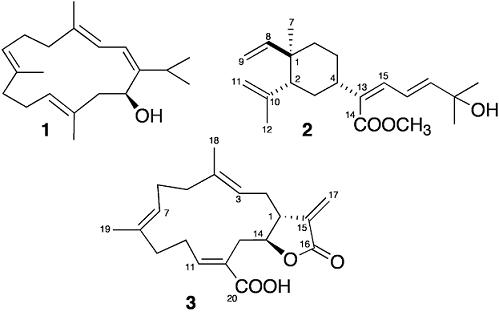
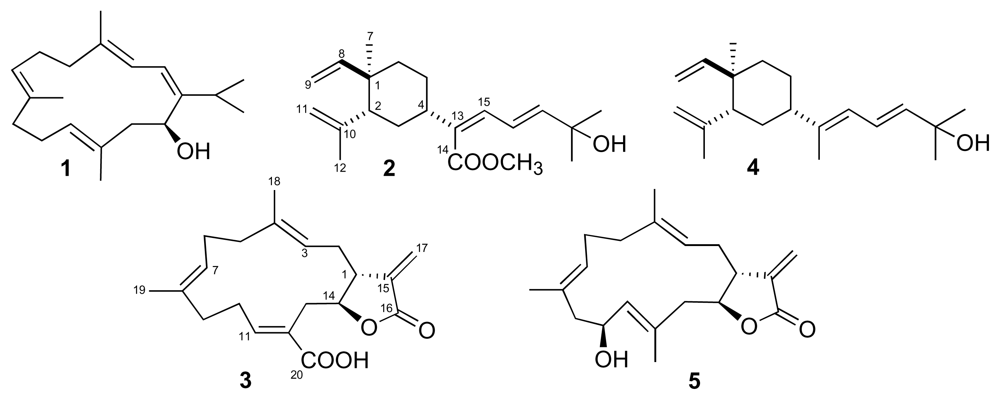
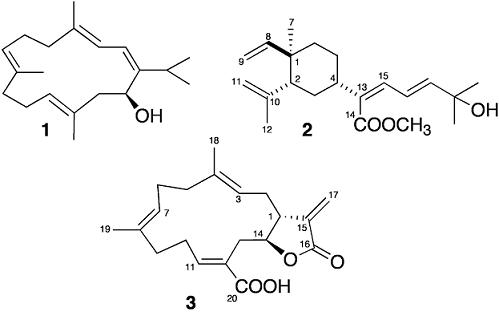
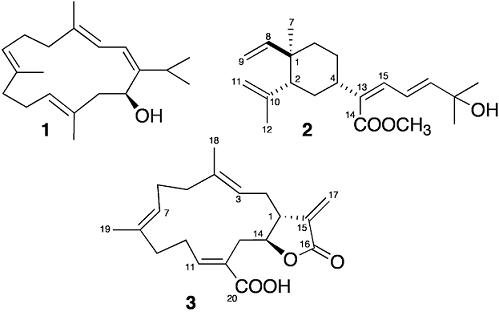
<p>Two specimens of soft corals were selected for their significant bioactivity against larvae of <italic>Artemia salina</italic> and acetylcholinesterase. Bioassays-guided separation resulted in the isolation of a known antitumor cembrane, (+)-sarcophytol-A (<bold>1</bold>), along with a new lobane, carbomethoxyfuscol (<bold>2</bold>) from a <italic>Sarcophyton</italic> sp. (family Alcyoniidae), and the isolation of a new cembranoid, crassumolide E (<bold>3</bold>), inhibitor of the acetylcholinesterase, from a <italic>Lobophytum</italic> sp. (family Alcyoniidae) (<xref ref-type="fig" rid="f1-marinedrugs-08-00359">Figure 1</xref>).</p></sec>
<sec sec-type="results|discussion">
<title>2. Results and Discussion</title>
<p>Specimens of the soft corals <italic>Lobophytum</italic> sp. and <italic>Sarcophyton</italic> sp. were collected by scuba diving at the lagoon of Southern Mayotte, Comoros Island, northwest of Madagascar. All specimens were treated following the same procedure: the freeze-dried biological material was extracted with a mixture of methanol–dichloromethane 1:1 to give a crude extract. The latter was partitioned between ethyl acetate (EtOAc) and water, and the organic phase was subjected to a silica gel column eluted sequentially with hexane, dichloromethane, ethyl acetate and methanol. The EtOAc fractions of both soft corals were selected on the basis of their bioactivity, <italic>i.e.</italic>, the <italic>Sarcophyton</italic> EtOAc fraction showed toxicity against larvae of <italic>Artemia salina,</italic> and the <italic>Lobophytum</italic> EtOAc extract inhibited acetylcholinesterase. Fractions exhibiting activities were further chromatographied on silica gel column using different pentane–EtOAc mixtures. Final purifications were achieved by normal-phase HPLC to afford diterpenes <bold>1</bold>–<bold>2</bold> from <italic>Sarcophyton</italic> and <bold>3</bold> from <italic>Lobophytum</italic>.</p>
<sec>
<title>2.1. Sarcophyton</title>
<p>Compound <bold>1</bold> was identified as (+)-sarcophytol-A by comparison of its spectral data with previously reported values [<xref ref-type="bibr" rid="b18-marinedrugs-08-00359">18</xref>]. The toxic activity against <italic>Artemia salina</italic> was mainly provided by this compound. Sarcophytol A has been reported to show antitumor activity [<xref ref-type="bibr" rid="b19-marinedrugs-08-00359">19</xref>] as well as potent inhibitory activities against several kinds of tumor promoters [<xref ref-type="bibr" rid="b20-marinedrugs-08-00359">20</xref>].</p>
<p>Compound <bold>2</bold> was isolated as a white solid, [α]<sup>20</sup> <sub>D</sub> +3.0° (c 0.86, CHCl<sub>3</sub>). Its molecular formula was established as C<sub>21</sub>H<sub>32</sub>O<sub>3</sub> by HRESIMS analysis (<italic>m/z</italic> 355.2240 [M + Na]<sup>+</sup>, calculated for 355.2244). Its UV absorption (224 and 254 nm) indicated conjugation, and its IR spectrum revealed the presence of a hydroxyl group at 3400 cm<sup>−1</sup> and an α,β-unsaturated carbonyl group at 1690 cm<sup>−1</sup> besides further unsaturations and a terminal vinyl group (1630, 1450 and 895 cm<sup>−1</sup>).</p>
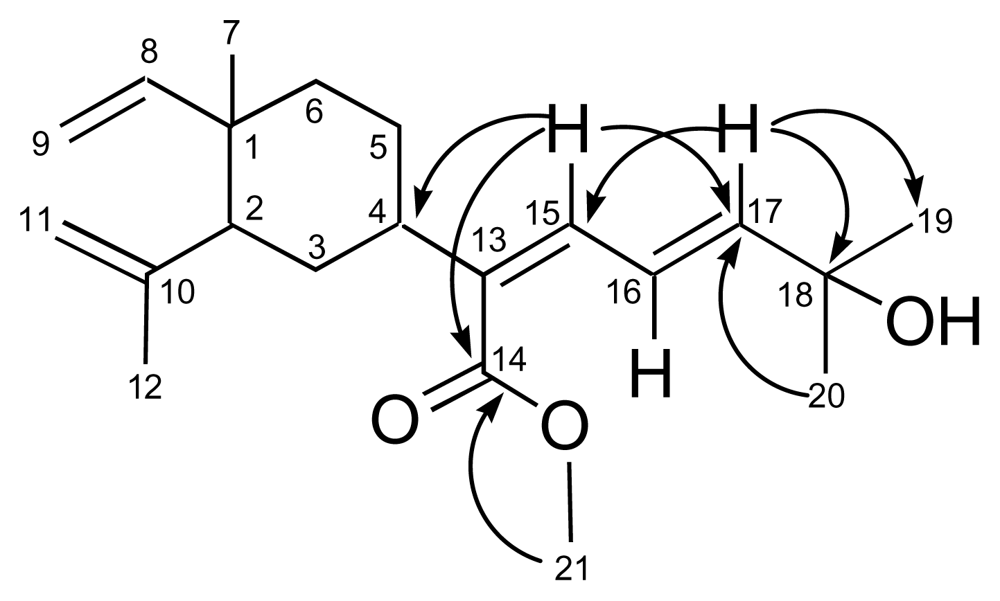
<p>The <sup>1</sup>H and <sup>13</sup>C NMR data were consistent with a lobane derivative (<xref ref-type="table" rid="t1-marinedrugs-08-00359">Table 1</xref>). In particular, the <sup>1</sup>H spectrum revealed the presence of vinyl and isoprenyl systems of a lobane skeleton. In addition, three olefinic protons were observed in the downfield region at δ<sub>H</sub> 6.05 (1H, d, <italic>J</italic> = 15.0 Hz, H-17), 6.33 (1H, d, <italic>J</italic> = 14.0 Hz, H-15), and 6.97 (1H, dd, <italic>J</italic> = 14.0 and 15.0 Hz, H-16), which suggested, according to COSY correlations between H-15/H-16 and H-16/H-17, the presence of a conjugated diene system. The large coupling constants (14.0 and 15.0 Hz) between H-15/H-16 and H-16/H-17 indicated the 13(<italic>Z</italic>),16(<italic>E</italic>) configuration of the diene system. The occurrence of two overlapping methyl signals at δ<sub>H</sub> 1.36 (6H, s, H-19 and H-20) connected to one oxygenated carbon (δ<sub>C</sub> 71.0, C-18) suggested that a hydroxyl group is located at C-18. Confirmation of this site was achieved by an HMBC experiment that unambiguously established the atom connectivities in <bold>2</bold> (<xref ref-type="fig" rid="f2-marinedrugs-08-00359">Figure 2</xref>), <italic>i.e.</italic>, long-range correlations were found between the olefinic proton at δ<sub>H</sub> 6.05 (H-17) and the quaternary carbon at δ<sub>C</sub> 71.0 (C-18), and the methyl carbons at δ<sub>C</sub> 29.6 (C-19 and C-20). Besides, long-range correlations were found between the methyl protons at δ<sub>H</sub> 1.36 and C-17 and C-18. The sp<sup>2</sup> quaternary carbon C-13 could be connected to a carbomethoxy group (δ<sub>C</sub> 167.8, C-14; 51.6, C-21; δ<sub>H</sub> 3.79, 3H, s, H-21) according to long-range correlation from H-15 to C-14. And a long-range correlation from H-15 to C-4 indicated that this quaternary carbon C-13 could be linked to the cyclic moiety. The presence of a carbomethoxy moiety was confirmed by the presence of the fragment ions at <italic>m/z</italic> 273 [M–COOCH<sub>3</sub>]<sup>+</sup> and <italic>m/z</italic> 255 [M–COOCH<sub>3</sub>–H<sub>2</sub>O]<sup>+</sup> in the mass spectrum. The conjugation of the diene with the ester function explained the significant differences in the chemical shifts of C-13, C-15, C-16 and C-17, as well as H-15, H-16 and H-17, compared to the <sup>1</sup>H and <sup>13</sup>C NMR data of fuscol (<bold>4</bold>), a lobane congener isolated from the gorgonian species <italic>Eunicea fusca</italic> [<xref ref-type="bibr" rid="b21-marinedrugs-08-00359">21</xref>] and from the soft coral <italic>Lobophytum microlobulatum</italic> [<xref ref-type="bibr" rid="b22-marinedrugs-08-00359">22</xref>], which present a methyl group instead of the carboxylate function.</p>
<p>The relative configuration of the various assymetric centers was deduced from the comparison with NMR data of diverse lobane congeners (the lobanes have all been described with the same stereochemistry as 1R, 2R, 4S); the similarity in the <sup>13</sup>C chemical shifts of C-1 to C-12 in all compounds indicated the same relative configuration of the cyclohexane system. Thus, <bold>2</bold> was deduced to be methyl (1R*, 2R*, 4S*)-18-hydroxyloba-8, 10, 13(<italic>Z</italic>), 16(<italic>E</italic>)-tetraen-13-carboxylate.</p>
<p>Only one other publication mentions the coexistence of lobane and cembrane diterpenoids in a soft coral: fuscol and isofuscol were isolated with 11, 12-epoxycembra-1, 3, 7-triene, decaryol and 3, 4-epoxycembra-7, 11-dien-15-ol from <italic>Lobophytum microlobulatum</italic> [<xref ref-type="bibr" rid="b22-marinedrugs-08-00359">22</xref>]. The co-occurrence of lobane with sesquiterpenes (Δ<sup>9(15)</sup>-africanene [<xref ref-type="bibr" rid="b5-marinedrugs-08-00359">5</xref>, <xref ref-type="bibr" rid="b23-marinedrugs-08-00359">23</xref>], 15-nor-13-keto-β-elemene [<xref ref-type="bibr" rid="b5-marinedrugs-08-00359">5</xref>, <xref ref-type="bibr" rid="b21-marinedrugs-08-00359">21</xref>, <xref ref-type="bibr" rid="b24-marinedrugs-08-00359">24</xref>]) or with steroids [<xref ref-type="bibr" rid="b5-marinedrugs-08-00359">5</xref>, <xref ref-type="bibr" rid="b6-marinedrugs-08-00359">6</xref>, <xref ref-type="bibr" rid="b21-marinedrugs-08-00359">21</xref>, <xref ref-type="bibr" rid="b25-marinedrugs-08-00359">25</xref>, <xref ref-type="bibr" rid="b26-marinedrugs-08-00359">26</xref>] has also been reported. Until now, lobanes have been exclusively isolated from the Gorgonian species <italic>Eunicea fusca</italic> [<xref ref-type="bibr" rid="b2-marinedrugs-08-00359">2</xref>] and from the soft corals of the genera <italic>Lobophytum</italic> [<xref ref-type="bibr" rid="b3-marinedrugs-08-00359">3</xref>–<xref ref-type="bibr" rid="b6-marinedrugs-08-00359">6</xref>] and <italic>Sinularia</italic> [<xref ref-type="bibr" rid="b7-marinedrugs-08-00359">7</xref>–<xref ref-type="bibr" rid="b9-marinedrugs-08-00359">9</xref>, <xref ref-type="bibr" rid="b27-marinedrugs-08-00359">27</xref>]. It is the first time that a lobane derivative has been isolated from the <italic>Sarcophyton</italic> genus.</p></sec>
<sec>
<title>2.2. Lobophytum</title>
<p>Compound <bold>3</bold> was isolated as a white solid, [α]<sup>20</sup><sub>D</sub> +4.2° (c 2.12, MeOH). HRESIMS established the molecular formula as C<sub>20</sub>H<sub>26</sub>O<sub>4</sub> (<italic>m/z</italic> 353.1727 [M+Na]<sup>+</sup>, calculated for 353.1724). The IR spectrum supported the presence of a γ-butyrolactone moiety (ν 1766 cm<sup>−1</sup>), and an α, β-unsatured carboxyl group (ν3500–2700 and 1683 cm<sup>−1</sup>), which was corroborated by an UV absorption maximum at 231 nm. <sup>1</sup>H and <sup>13</sup>C spectral data (<xref ref-type="table" rid="t2-marinedrugs-08-00359">Table 2</xref>) showed that <bold>3</bold> contained an α-methylene-γ-lactone [δ<sub>H</sub> 2.97 (1H, ddd, <italic>J</italic> = 2.3, 4.3, 11.2 Hz, H-1), 4.11 (1H, ddd, <italic>J</italic> = 2.3, 5.1, 9.6 Hz, H-14), 5.67 (1H, d, <italic>J</italic> = 1.9 Hz, H-17a), 6.29 (1H, d, <italic>J</italic> = 1.9 Hz, H-17b) in the <sup>1</sup>H NMR spectrum and δ<sub>C</sub> 43.7 (d, C-1), 80.8 (d, C-14), 138.7 (s, C-15), 170.3 (s, C-16), 123.2 (t, C-17) in the <sup>13</sup>C NMR spectrum], two methyl-bearing trisubstituted double bonds [δ<sub>H</sub> 1.53 (3H, s, H-18), 4.84 (1H, dd, <italic>J</italic> = 4.0, 10.0 Hz, H-3), 1.58 (3H, s, H-19), 4.95 (1H, dd, <italic>J</italic> = 7.0, 8.0 Hz, H-7), and δ<sub>C</sub> 15.5 (q, C-18), 122.0 (d, C-3), 137.6 (s, C-4), 17.0 (q, C-19), 124.0 (d, C-7), 133.9 (s, C-8)], and a conjugated olefinic system [δ<sub>H</sub> 7.03 (1H, dd, <italic>J</italic> = 4.0, 9.0 Hz, H-11), δ<sub>C</sub> 151.5 (d, C-11), 125.5 (s, C-12)]. The <sup>13</sup>C NMR spectrum also disclosed six methylene carbons [δ<sub>C</sub> 33.6, 39.1, 24.1, 37.5, 27.6, 31.7] and a carboxylic carbon at δ<sub>C</sub> 172.4. The presence of a carboxylic acid was supported by the appearance of an additional signal at δ<sub>H</sub> 12.3, characteristic of a carboxylic proton, in the <sup>1</sup>H NMR spectrum of <bold>3</bold> recorded in DMSO-<italic>d</italic><italic><sub>6</sub></italic>. Moreover, the presence of a conjugated carboxylic acid explained the low-field signal of H-11 at δ<sub>H</sub> 7.03 assignable to the β-proton on the α, β-unsaturated carboxyl group.</p>
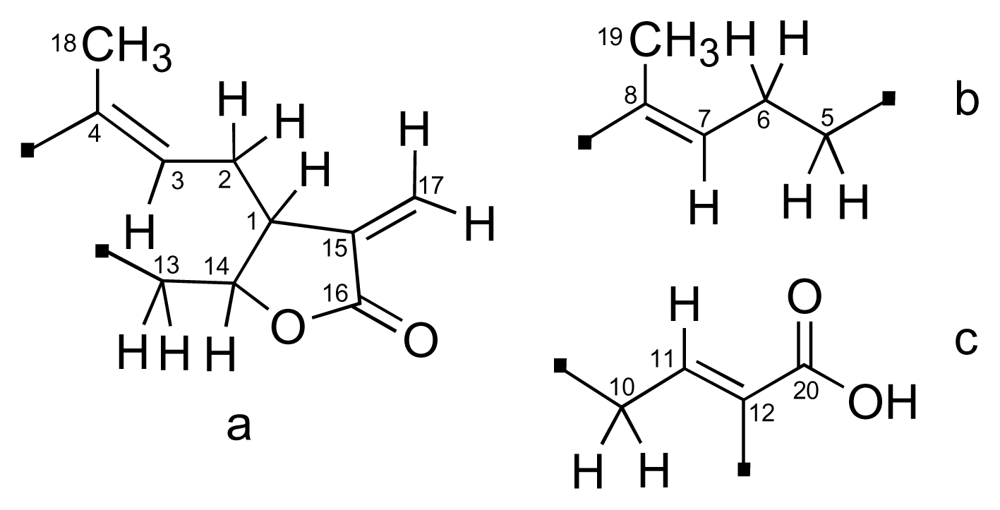
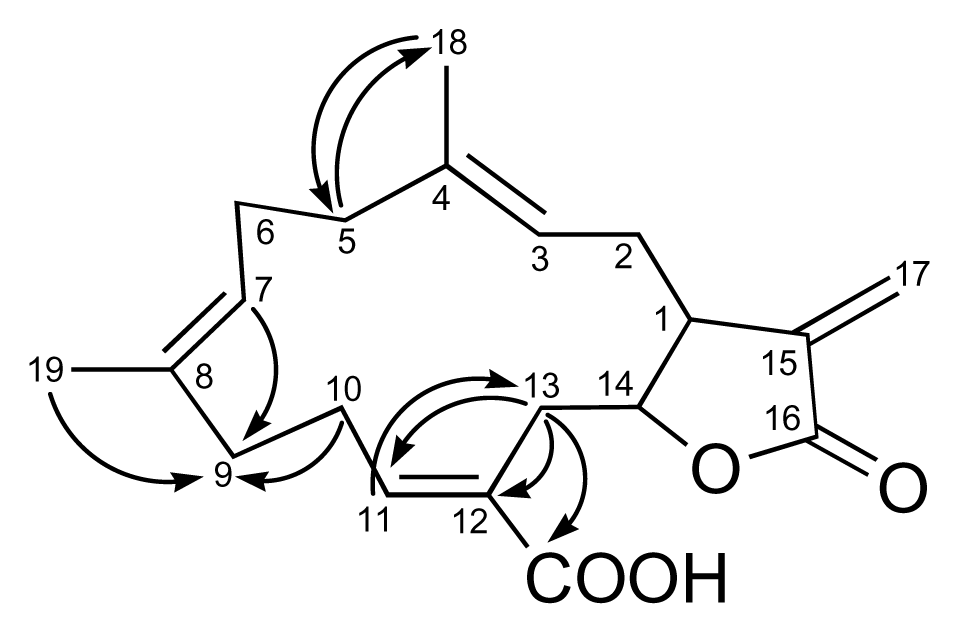
<p>After assignment of each direct C-H bonding based on HSQC data, the partial structures a, b, and c (<xref ref-type="fig" rid="f3-marinedrugs-08-00359">Figure 3</xref>) were established by <sup>1</sup>H-<sup>1</sup>H COSY analysis and supported by long-range HMBC correlations. The partial structures were reasonably connected to each other following HMBC correlations (<xref ref-type="fig" rid="f4-marinedrugs-08-00359">Figure 4</xref>). The link between segments a and b <italic>via</italic> C-4 and C-5 was deduced from longrange correlations between H-5 to C-18. The connection between b and c <italic>via</italic> C-8 and C-10 was revealed by correlations between H-7, H-19, H-10a and H-10b to C-9. Finally, the connection between c and a <italic>via</italic> C-12 and C-13 was determined by correlations between H-13a and H-13b to C-11, C-12, C-20.</p>
<p>The <italic>E</italic>-configuration of the two methyl-substituted olefins was deduced from the <sup>13</sup>C NMR data [δ<sub>C</sub> 15.5 (q, C-18), 17.0 (q, C-19)] [<xref ref-type="bibr" rid="b28-marinedrugs-08-00359">28</xref>]. The <italic>E</italic>-configuration of the carboxylic-substituted olefin was suggested by the large downfield shifts of the vinylic proton (H-11) and carbon C-11 [δ<sub>H</sub> 7.03 (H-11) and δ<sub>C</sub> 151.5 (C-11)] [<xref ref-type="bibr" rid="b29-marinedrugs-08-00359">29</xref>]. In order to deduce the stereochemistry of the lactone ring junction, NOESY experiments have been recorded in different solvent conditions but no dipolar coupling could be observed between H-1 and H-14. According to literature [<xref ref-type="bibr" rid="b30-marinedrugs-08-00359">30</xref>–<xref ref-type="bibr" rid="b33-marinedrugs-08-00359">33</xref>], the coupling constant between the lactone methine protons (<sup>3</sup><italic>J</italic><sub>1,14</sub>) did not permit univocal stereochemical assignments due to the flexibility of the cembrane ring. However, previous studies tended to show that small coupling constants (ranging from 2.9 to 7.5 Hz) indicate a <italic>trans</italic>-fused γ-lactone ring while large coupling constants (from 6.5 to 9.3 Hz) suggest a <italic>cis</italic>-fused γ-lactone ring [<xref ref-type="bibr" rid="b33-marinedrugs-08-00359">33</xref>–<xref ref-type="bibr" rid="b36-marinedrugs-08-00359">36</xref>]. These propositions were done in agreement with several X-ray studies [<xref ref-type="bibr" rid="b29-marinedrugs-08-00359">29</xref>, <xref ref-type="bibr" rid="b33-marinedrugs-08-00359">33</xref>, <xref ref-type="bibr" rid="b37-marinedrugs-08-00359">37</xref>]. The <sup>3</sup><italic>J</italic><sub>1,14</sub> coupling constant of the lactone methine protons for <bold>3</bold> being 2.3 Hz, this suggests a <italic>trans</italic>-fused γ-lactone as in crassumolide A (<bold>5</bold>) [<xref ref-type="bibr" rid="b38-marinedrugs-08-00359">38</xref>], a cembrane isolated from <italic>Lobophytum crassum</italic>, whose structure is very similar. Thus, <bold>3</bold> was proposed as (1<italic>R</italic>*,14<italic>S</italic>*)-cembra-3(<italic>E</italic>),7(<italic>E</italic>),11(<italic>Z</italic>),15(17)-tetraen-14, 16-olide-12-carboxylic acid.</p>
<p>Although cembranes are the most commonly encountered class of secondary metabolites from <italic>Lobophytum</italic> soft corals, this new compound possesses an original functionality: an α, β-unsatured carboxyl group. This functionality is only present in four other marine cembranes: lobohedleolide and 7<italic>Z</italic>-lobohedleolide (isolated from <italic>Lobophytum hedleyi</italic> [<xref ref-type="bibr" rid="b27-marinedrugs-08-00359">27</xref>] and from <italic>Lobophytum crassum</italic> [<xref ref-type="bibr" rid="b34-marinedrugs-08-00359">34</xref>]), 2-epi-11<italic>Z</italic>-lobohedleolide (<italic>Lobophytum</italic> sp. [<xref ref-type="bibr" rid="b39-marinedrugs-08-00359">39</xref>]), and 17-dimethylaminolobohedleolide (<italic>Lobophytum</italic> sp. [<xref ref-type="bibr" rid="b10-marinedrugs-08-00359">10</xref>]). Its position in the cembane ring on C12 is unprecedented and the geometry of the C-11/C-12 double bond is unusual.</p>
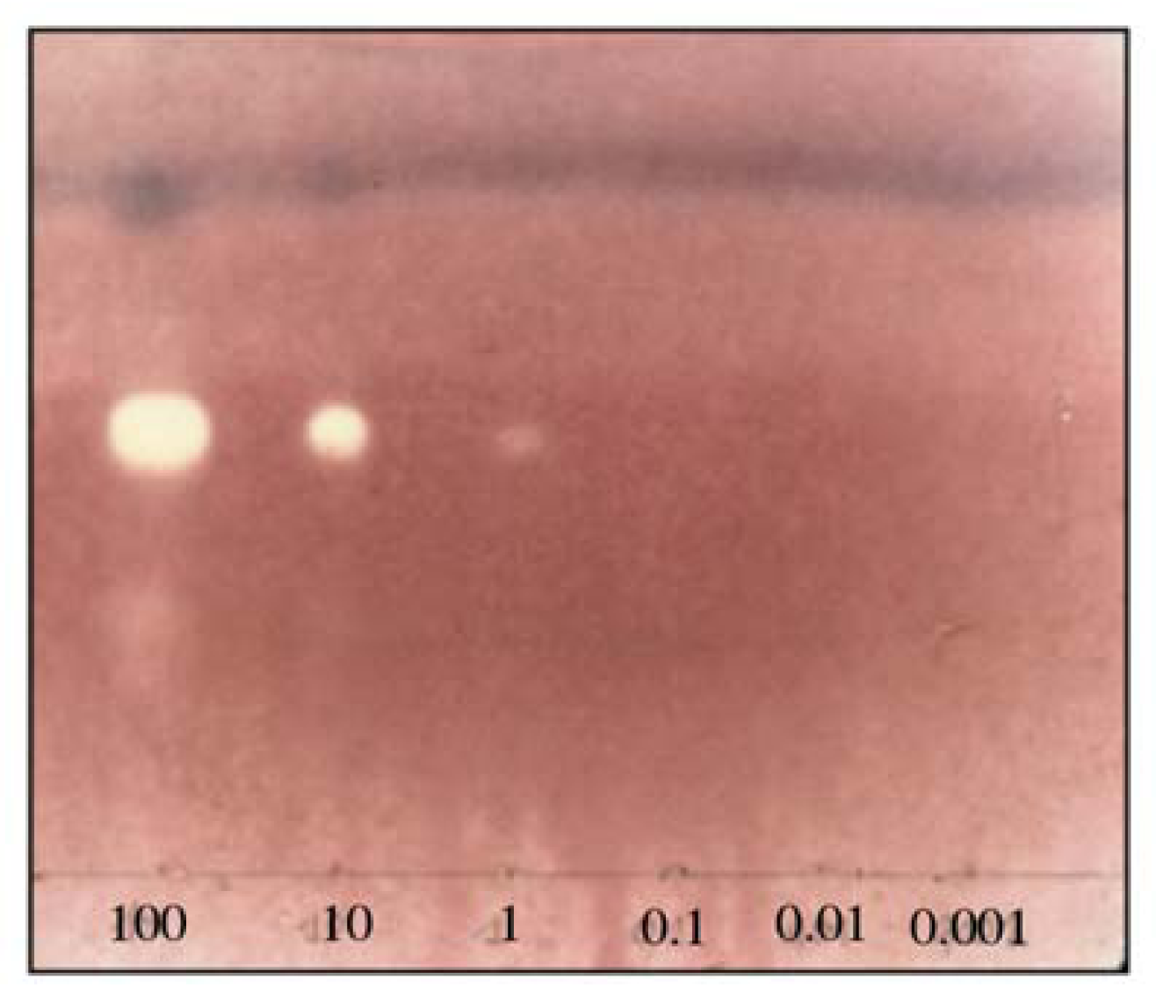
<p>Moreover, this compound was found to exhibit inhibitory effects on AChE. A TLC bioautographic method for detection of acetylcholinesterase inhibitors was used for the screening of soft coral extracts. The active fraction of <italic>Lobophytum</italic> sp. was directly detected on the TLC. After purification on HPLC, the active fraction afforded compound <bold>3</bold>, that was further tested in order to establish the detection limit for its activity (<xref ref-type="fig" rid="f5-marinedrugs-08-00359">Figure 5</xref>). <bold>3</bold> showed weak activity (1 μg at least) as AChE inhibitor, compared to galanthamine, an alkaloid isolated from plants of the Amaryllidaceae family (the smallest amount required 0.01 μg, cf. lit. [<xref ref-type="bibr" rid="b15-marinedrugs-08-00359">15</xref>]).</p>
<p>Only few AChE inhibitors have been isolated from marine organisms. One other terpene from the Alcyonacea family has been found to exhibit a modest AChE inhibition activity: cladidiol isolated from a <italic>Cladiella</italic> species [<xref ref-type="bibr" rid="b40-marinedrugs-08-00359">40</xref>]. Other examples are: a series of natural pigments with tetrazacyclopentazulene skeleton found in the zoanthid coral <italic>Parazoanthus axinellae</italic> (pseudozoanthoxanthins and zoanthoxanthins) [<xref ref-type="bibr" rid="b41-marinedrugs-08-00359">41</xref>], an irreversible inhibitor from the mollusk <italic>Onchidella binneyi</italic> (onchial) [<xref ref-type="bibr" rid="b42-marinedrugs-08-00359">42</xref>], a lipoidal metabolite isolated from the dinoflagellate <italic>Gymnodinium breve</italic> (BTX-B) [<xref ref-type="bibr" rid="b43-marinedrugs-08-00359">43</xref>], a nemertine alkaloid toxin (anabaseine) [<xref ref-type="bibr" rid="b44-marinedrugs-08-00359">44</xref>], a large 3-alkylpyridinium polymer isolated from the sponge <italic>Reniera sarai</italic> (poly-APS) [<xref ref-type="bibr" rid="b45-marinedrugs-08-00359">45</xref>, <xref ref-type="bibr" rid="b46-marinedrugs-08-00359">46</xref>], a bromotyrosine-derived metabolite of an unidentified verongid sponge (aplysamine-4) [<xref ref-type="bibr" rid="b47-marinedrugs-08-00359">47</xref>] and spirocompounds isolated from the mediterranean sponge <italic>Aplysina cavernicola</italic> (aerothionin, homoaerothionin, 11, 19-dideoxyfistularin) [<xref ref-type="bibr" rid="b48-marinedrugs-08-00359">48</xref>], a diiodotyramine derivative from the Japanese gastropod <italic>Turbo marmorata</italic> (turbotoxin A) [<xref ref-type="bibr" rid="b49-marinedrugs-08-00359">49</xref>] and a pyridoacridine alkaloid from a Thai marine sponge <italic>Petrosia</italic> n. sp. (petrosamine) [<xref ref-type="bibr" rid="b50-marinedrugs-08-00359">50</xref>].</p>
<p>The biological interest of the newly isolated cembrane lies not only in its inhibitory effect on AChE, but also in the possibility of using this compound as a tool in the regulation of acetylcholine receptors. Over recent years, new results have emerged demonstrating that AChE inhibitors have additional pharmacological properties, <italic>i.e.</italic>, protection against neurotoxic agents, such as glutamate, and up-regulation of nicotinic acetylcholine receptors (nAChRs). Neuroprotection against toxic insults and use of nAChR modulators appears to be a promising new strategy against neurodegenerative diseases. Several tobacco and marine cembranoids have been found to interact with nAChRs in complex ways: as irreversible inhibitors at the agonist sites, as non competitive inhibitors, or as positive modulators. Studies of neuroprotection by a tobacco cembranoid and by the marine cembranoid sarcophytolide, isolated from the soft coral <italic>Sarcophyton glaucum</italic>, revealed apparent similarities between the two compounds, and allowed one to conclude that neuroprotection is based on a nicotinic mechanism [<xref ref-type="bibr" rid="b51-marinedrugs-08-00359">51</xref>]. It remains to be determined whether the AChR-mediated neuroprotection by those two cembranoids is the exception or a general property of most cembranoids. The isolation of new marine cembranoids with acetylcholinesterase inhibitory effects will give the opportunity to explore the specific action of cembranoids on the nicotinic acetylcholine receptors.</p></sec></sec>
<sec>
<title>3. Experimental Section</title>
<sec sec-type="methods">
<title>3.1. General Experimental Procedures</title>
<p>TLC were performed on pre-coated TLC plates with Sigel 60 F 254 (Marchey–Nagel, Düren, Germany). HPLC was conducted with a MerckLiChrospher Si 60 (250 × 4 mm, 5 μm) column (Merck, Darmstadt, Germany), using different cyclohexane–EtOAc mixtures as eluent, and a refractometric detection. Optical rotations were measured at 20 °C on a Jasco P-1010 polarimeter. Ultraviolet (UV) spectra were recorded in methanol on a Perkin Elmer 551 spectrometer and Infrared (IR) spectra were obtained in chloroform on a Perkin Elmer 1600 FTIR spectrometer. <sup>1</sup>H and <sup>13</sup>C spectra, and 2D-NMR experiments were recorded on Brücker Avance DPX-250 NMR and Jeol EX 400 NMR spectrometers. Chemical shifts are given on a δ (ppm) scale with CHCl<sub>3</sub> (<sup>1</sup>H, 7.26 ppm; <sup>13</sup>C, 77.0 ppm) as internal standard. EI and HRESI mass spectra were acquired on an ATI UNICAM and a micromass LCT (ES) mass spectrometer, respectively.</p></sec>
<sec>
<title>3.2. Biological Material</title>
<p>Specimens of the soft corals <italic>Lobophytum</italic> sp. and <italic>Sarcophyton</italic> sp. were collected at the lagoon of Southern Mayotte, Comoros Islands, northwest of Madagascar, by scuba diving at a depth of 10 meters. Samples were identified by G. Williams (California Academy of Sciences). A positive identification could not be done, but the <italic>Lobophytum</italic> specimen showed similarities to <italic>Lobophytum crassum</italic> (Marenzeller, 1886), and the <italic>Sarcophyton</italic> specimen appeared close to <italic>Sarcophyton infundibuliforme</italic> (Tixier-Durivault, 1956). Voucher fragments are maintained at the California Academy of Sciences.</p></sec>
<sec>
<title>3.3. Extraction and Isolation</title>
<p>The freeze-dried samples of <italic>Lobophytum</italic> (780 g) and <italic>Sarcophyton</italic> (630 g) were extracted with CH<sub>2</sub>Cl<sub>2</sub>–MeOH 1:1 (500 mL × 4). The total extracts were evaporated under reduced pressure and partitioned between EtOAc and H<sub>2</sub>O. The organic fractions were taken to dryness (to provide 12.8 g for <italic>Lobophytum</italic> and 5.4 g for <italic>Sarcophyton</italic>) and subjected to chromatography on a methanol-desactivated silica gel column with hexane, dichloromethane, ethyl acetate and methanol. The EtOAc fractions of both soft corals were selected on the basis of their bioactivity, <italic>i.e.</italic>, the <italic>Sarcophyton</italic> EtOAc fraction showed toxicity against larvae of <italic>Artemia salina</italic> (at a concentration of 100 μg. mL<sup>−1</sup>), and the <italic>Lobophytum</italic> fraction inhibited acetylcholinesterase (at 100 μg. mL<sup>−1</sup>). Fractions exhibiting activities were further subjected to silica gel column (63–200 μm) eluted with different pentane–EtOAc mixtures. The <italic>Sarcophyton</italic> fraction, eluted with pentane–EtOAc 90:10 and active on <italic>Artemia salina</italic>, was purified by normal-phase HPLC using cyclohexane–EtOAc 95:5 as eluent, to afford 5.3 mg of <bold>1</bold>. The <italic>Sarcophyton</italic> fraction, eluted with pentane–EtOAc 70:30, was purified on silica-gel column (40–63 μm) with isochratic elution (pentane–EtOAc 80:20) then by HPLC (cyclohexane–EtOAc 95:5 as eluent), to obtain 5.0 mg of <bold>2</bold>. The <italic>Lobophytum</italic> fraction, eluted with pentane–EtOAc 60:40 and active on acetylcholinesterase, was purified by HPLC (cyclohexane–EtOAc 70:30 as eluent), to afford 240.0 mg of <bold>3</bold>.</p>
<p><italic>(+)-Sarcophytol-A</italic> (<bold>1</bold>) was obtained as a colorless oil: [α]<sup>20</sup><sub>D</sub> +122.0° (c 0.38, CHCl<sub>3</sub>) (lit. +141.0°); <sup>1</sup>H and <sup>13</sup>C NMR data were in agreement with previously reported values [<xref ref-type="bibr" rid="b18-marinedrugs-08-00359">18</xref>].</p>
<p><italic>Methyl (1R*,2R*,4S*)-18-hydroxyloba-8, 10, 13(E),16(E)-tetraen-13-carboxylate</italic> (<bold>2</bold>) was obtained as a white amorphous powder: [α]<sup>20</sup><sub>D</sub> +3.0° (c 0.85, CHCl<sub>3</sub>); UV (MeOH) λ<sub>max</sub> (log ɛ) 224 (3.24), 254 (3.14); IR (CHCl<sub>3</sub>) ν<sub>max</sub> 3400 br, 1690, 1630, 1450, 895 cm<sup>−1; 1</sup>H and <sup>13</sup>C NMR, see <xref ref-type="table" rid="t1-marinedrugs-08-00359">Table 1</xref>; EIMS <italic>m/z</italic> (relative intensity) 289 (4.3), 273 [M–COOCH<sub>3</sub>]<sup>+</sup> (16.0), 255 [M–COOCH<sub>3</sub>–H<sub>2</sub>O]<sup>+</sup> (5.3), 197 (3.0), 173 (5.3), 161 (13.8), 147 (26.4), 135 (45.0), 121 (100.0), 109 (85.6), 95 (78.8), 91 (71.3); HRESIMS <italic>m/z</italic> 355.2240 [M+Na]<sup>+</sup> (calculated for C<sub>21</sub>H<sub>32</sub>O<sub>3</sub>Na, 355.2244).</p>
<p><italic>(1R*,14S*)-cembra-3(E),7(E),11(E),15(17)-tetraen-14, 16-olide-12-carboxylic acid</italic> (<bold>3</bold>) was obtained as a white amorphous powder: [α]<sup>20</sup><sub>D</sub> +4.2° (c 2.12, MeOH); UV (MeOH) λ<sub>max</sub> (log ɛ) 230 (3.12); IR (CHCl<sub>3</sub>) ν<sub>max</sub> 3500–2700, 1766, 1683 cm<sup>−1; 1</sup>H and <sup>13</sup>C NMR, see <xref ref-type="table" rid="t2-marinedrugs-08-00359">Table 2</xref>; EIMS <italic>m/z</italic> (relative intensity) 312 [M–OH]<sup>+</sup> (1.3), 285 [M–COO]<sup>+</sup> (7.9), 256 (3.6), 239 (11.0), 149 (18.7), 141 (27.0), 135 (65.0), 121 (59.0), 107 (100.0), 95 (47.6), 91 (52.0); HRESIMS <italic>m/z</italic> 353.1727 [M+Na]<sup>+</sup> (calculated for C<sub>20</sub>H<sub>26</sub>O<sub>4</sub>Na, 353.1724).</p></sec>
<sec>
<title>3.4. Brine Shrimp Lethality Test</title>
<p>Eggs of <italic>Artemia salina</italic> (Dohse, Aquaristik GmbH, Bonn, Germany) were hatched in a small tank filled with natural sea water at 25 °C under continuous light regime. After 48 h, the phototropic nauplii were collected; 10 shrimps were transferred to each sample vial using a pipette, and seawater was added to a final volume of 180 μL. 20 μL of each sample (solution of 1 mg. mL<sup>−1</sup> in water and 10% EtOH) were added in the 96-well plate. The toxicity was determined after 24 and 48 h of exposure. The experiments were done twice in duplicate.</p></sec>
<sec>
<title>3.5. Acetylcholinesterase Inhibition Test</title>
<p>Acetylcholinesterase (Sigma, St Louis, USA; 1000 U) was dissolved in 150 mL of 0.05 M Tris-hydrochloric acid buffer at pH 7.8, with 150 mg of bovine serum albumin (Merck, Darmstadt, Germany). After deposition of the samples on TLC (100 μg) and migration in a suitable solvent, the TLC plate was dried to remove the solvent, sprayed with the enzyme solution and dried again. The plate was placed in an incubator at 90% humidity and 37 °C for 20 min. For detection of the enzyme, 10 mL of a 1-naphtylacetate solution (250 mg in 100 mL of ethanol) and 40 mL of a Fast Blue Salt solution (400 mg in 160 mL of distilled water) were mixed and sprayed onto the plate to give a purple coloration after 1–2 min. Inhibitors of acetylcholinesterase appear as white spots.</p></sec></sec></body>
<back>
<ack>
<title>Acknowledgements</title>
<p>Authors thank Gary Williams (Academy of Sciences of California) for identification of the soft corals. This project was supported by a grant of AUF (Agence Universitaire de la Francophonie) to S. B. Jhaumeer-Laulloo.</p></ack>
<fn-group><fn>
<p><italic>Samples Availability:</italic> Available from the authors.</p></fn></fn-group>
<ref-list>
<title>References and Notes</title>
<ref id="b1-marinedrugs-08-00359"><label>1</label><citation citation-type="journal"><person-group person-group-type="author"><name><surname>Blunt</surname><given-names>JW</given-names></name><name><surname>Copp</surname><given-names>BR</given-names></name><name><surname>Hu</surname><given-names>W.-P</given-names></name><name><surname>Munro</surname><given-names>MHG</given-names></name><name><surname>Northcote</surname><given-names>PT</given-names></name><name><surname>Princep</surname><given-names>MR</given-names></name></person-group><article-title>Marine Natural products</article-title><source>Nat Prod Rep</source><year>2009</year><volume>26</volume><fpage>170</fpage><lpage>244</lpage><comment>and earlier references in this series cited therein</comment><pub-id pub-id-type="doi">10.1039/b805113p</pub-id><pub-id pub-id-type="pmid">19177222</pub-id></citation></ref>
<ref id="b2-marinedrugs-08-00359"><label>2</label><citation citation-type="journal"><person-group person-group-type="author"><name><surname>Shin</surname><given-names>J</given-names></name><name><surname>Fenical</surname><given-names>W</given-names></name></person-group><article-title>Fuscosides A-D: Antiinflammatory diterpenoid glycosides of new structural classes from the Caribbean gorgonian <italic>Eunicea fusca</italic></article-title><source>J Org Chem</source><year>1991</year><volume>56</volume><fpage>3153</fpage><lpage>3158</lpage><pub-id pub-id-type="doi">10.1021/jo00009a042</pub-id></citation></ref>
<ref id="b3-marinedrugs-08-00359"><label>3</label><citation citation-type="journal"><person-group person-group-type="author"><name><surname>Dunlop</surname><given-names>RW</given-names></name><name><surname>Wells</surname><given-names>RJ</given-names></name></person-group><article-title>Isolation of some novel diterpenes from a soft coral of the genus <italic>Lobophytum</italic></article-title><source>Aust J Chem</source><year>1979</year><volume>32</volume><fpage>1345</fpage><lpage>1351</lpage><pub-id pub-id-type="doi">10.1071/CH9791345</pub-id></citation></ref>
<ref id="b4-marinedrugs-08-00359"><label>4</label><citation citation-type="journal"><person-group person-group-type="author"><name><surname>Edrada</surname><given-names>RA</given-names></name><name><surname>Proksch</surname><given-names>P</given-names></name><name><surname>Wray</surname><given-names>V</given-names></name><name><surname>Witte</surname><given-names>L</given-names></name><name><surname>van Ofwegen</surname><given-names>L</given-names></name></person-group><article-title>Four new bioactive lobane diterpenes of the soft coral <italic>Lobophytum pauciflorum</italic> from Mindoro, Philippines</article-title><source>J Nat Prod</source><year>1998</year><volume>61</volume><fpage>358</fpage><lpage>361</lpage><pub-id pub-id-type="doi">10.1021/np970276t</pub-id><pub-id pub-id-type="pmid">9548875</pub-id></citation></ref>
<ref id="b5-marinedrugs-08-00359"><label>5</label><citation citation-type="journal"><person-group person-group-type="author"><name><surname>Anjaneyulu</surname><given-names>ASR</given-names></name><name><surname>Raju</surname><given-names>KVS</given-names></name></person-group><article-title>A new lobane diterpene acid from the soft coral <italic>Lobophytum microlobulatum</italic> of the Andaman and Nicobar Islands</article-title><source>Indian J Chem</source><year>1996</year><volume>35B</volume><fpage>45</fpage><lpage>48</lpage></citation></ref>
<ref id="b6-marinedrugs-08-00359"><label>6</label><citation citation-type="journal"><person-group person-group-type="author"><name><surname>Anjaneyulu</surname><given-names>ASR</given-names></name><name><surname>Kameswara Rao</surname><given-names>NS</given-names></name></person-group><article-title>Four new lobane diterpenoids from the soft coral <italic>Lobophytum microlobulatum</italic> of the Havellock island of the Andaman and Nicobar group of Islands</article-title><source>Indian J Chem</source><year>1996</year><volume>35B</volume><fpage>1294</fpage><lpage>1303</lpage></citation></ref>
<ref id="b7-marinedrugs-08-00359"><label>7</label><citation citation-type="journal"><person-group person-group-type="author"><name><surname>Hamada</surname><given-names>T</given-names></name><name><surname>Kusumi</surname><given-names>T</given-names></name><name><surname>Ishitsuka</surname><given-names>MO</given-names></name><name><surname>Kakisawa</surname><given-names>H</given-names></name></person-group><article-title>Structures and absolute configurations of the new lobane diterpenoids from the Okinawan soft coral <italic>Sinularia flexibilis</italic></article-title><source>Chem Lett</source><year>1992</year><fpage>33</fpage><lpage>36</lpage></citation></ref>
<ref id="b8-marinedrugs-08-00359"><label>8</label><citation citation-type="journal"><person-group person-group-type="author"><name><surname>Kusumi</surname><given-names>T</given-names></name><name><surname>Hamada</surname><given-names>T</given-names></name><name><surname>Ishitsuka</surname><given-names>MO</given-names></name><name><surname>Ohtani</surname><given-names>I</given-names></name><name><surname>Kakisawa</surname><given-names>H</given-names></name></person-group><article-title>Elucidation of the relative and absolute stereochemistry of lobatriene, a marine diterpene, by a modified Mosher method</article-title><source>J Org Chem</source><year>1992</year><volume>57</volume><fpage>1033</fpage><lpage>1035</lpage><pub-id pub-id-type="doi">10.1021/jo00029a053</pub-id></citation></ref>
<ref id="b9-marinedrugs-08-00359"><label>9</label><citation citation-type="journal"><person-group person-group-type="author"><name><surname>Chai</surname><given-names>M.-C</given-names></name><name><surname>Wang</surname><given-names>S.-K</given-names></name><name><surname>Dai</surname><given-names>C.-F</given-names></name><name><surname>Duh</surname><given-names>C.-Y</given-names></name></person-group><article-title>A cytotoxic lobane diterpene from the Formosan soft coral <italic>Sinularia inelegans</italic></article-title><source>J Nat Prod</source><year>2000</year><volume>63</volume><fpage>843</fpage><lpage>844</lpage><pub-id pub-id-type="doi">10.1021/np990539e</pub-id><pub-id pub-id-type="pmid">10869216</pub-id></citation></ref>
<ref id="b10-marinedrugs-08-00359"><label>10</label><citation citation-type="journal"><person-group person-group-type="author"><name><surname>Rashid</surname><given-names>MA</given-names></name><name><surname>Gustafson</surname><given-names>KR</given-names></name><name><surname>Boyd</surname><given-names>MR</given-names></name></person-group><article-title>HIV-inhibitory cembrane derivatives from a Philippines collection of the soft coral <italic>Lobophytum</italic> species</article-title><source>J Nat Prod</source><year>2000</year><volume>63</volume><fpage>531</fpage><lpage>533</lpage><pub-id pub-id-type="doi">10.1021/np990372p</pub-id><pub-id pub-id-type="pmid">10785433</pub-id></citation></ref>
<ref id="b11-marinedrugs-08-00359"><label>11</label><citation citation-type="journal"><person-group person-group-type="author"><name><surname>Ahmed</surname><given-names>AF</given-names></name><name><surname>Shiue</surname><given-names>R.-T</given-names></name><name><surname>Wang</surname><given-names>G.-H</given-names></name><name><surname>Dai</surname><given-names>C.-F</given-names></name><name><surname>Kuo</surname><given-names>Y.-H</given-names></name><name><surname>Sheu</surname><given-names>J.-H</given-names></name></person-group><article-title>Five novel norcembranoids from <italic>Sinularia leptoclados</italic> and <italic>S parva</italic></article-title><source>Tetrahedron</source><year>2003</year><volume>59</volume><fpage>7337</fpage><lpage>7344</lpage><pub-id pub-id-type="doi">10.1016/S0040-4020(03)01138-4</pub-id></citation></ref>
<ref id="b12-marinedrugs-08-00359"><label>12</label><citation citation-type="journal"><person-group person-group-type="author"><name><surname>Anjaneyulu</surname><given-names>ASR</given-names></name><name><surname>Venkateswara Rao</surname><given-names>GJ</given-names></name></person-group><article-title>Chemical Constituents of the Soft Coral Species of <italic>Sarcophyton</italic> Genus: A Review</article-title><source>J Indian Chem Soc</source><year>1997</year><volume>74</volume><fpage>272</fpage><lpage>278</lpage></citation></ref>
<ref id="b13-marinedrugs-08-00359"><label>13</label><citation citation-type="journal"><person-group person-group-type="author"><name><surname>Coll</surname><given-names>JC</given-names></name></person-group><article-title>The chemistry and the chemical ecology of octocorals (Coelenterata, Anthozoa, Octocorallia)</article-title><source>Chem Rev</source><year>1992</year><volume>92</volume><fpage>613</fpage><lpage>631</lpage><pub-id pub-id-type="doi">10.1021/cr00012a006</pub-id></citation></ref>
<ref id="b14-marinedrugs-08-00359"><label>14</label><citation citation-type="journal"><person-group person-group-type="author"><name><surname>Meyer</surname><given-names>BN</given-names></name><name><surname>Ferrigni</surname><given-names>NR</given-names></name><name><surname>Putnam</surname><given-names>JE</given-names></name></person-group><article-title>Brine shrimp: A convenient general bioassay for active plant constituents</article-title><source>Planta Medica</source><year>1982</year><volume>45</volume><fpage>31</fpage><lpage>34</lpage><pub-id pub-id-type="doi">10.1055/s-2007-971236</pub-id><pub-id pub-id-type="pmid">17396775</pub-id></citation></ref>
<ref id="b15-marinedrugs-08-00359"><label>15</label><citation citation-type="journal"><person-group person-group-type="author"><name><surname>Marston</surname><given-names>A</given-names></name><name><surname>Kissling</surname><given-names>J</given-names></name><name><surname>Hostettmann</surname><given-names>K</given-names></name></person-group><article-title>A rapid TLC bioautographic method for the detection of acetylcholinesterase and butyrylcholinesterase inhibitors in plants</article-title><source>Phytochem Anal</source><year>2002</year><volume>13</volume><fpage>51</fpage><lpage>54</lpage><pub-id pub-id-type="doi">10.1002/pca.623</pub-id><pub-id pub-id-type="pmid">11899607</pub-id></citation></ref>
<ref id="b16-marinedrugs-08-00359"><label>16</label><citation citation-type="journal"><person-group person-group-type="author"><name><surname>Blennow</surname><given-names>K</given-names></name><name><surname>de Leon</surname><given-names>MJ</given-names></name><name><surname>Zetterberg</surname><given-names>H</given-names></name></person-group><article-title>Alzheimer’s disease</article-title><source>Lancet</source><year>2006</year><volume>368</volume><fpage>387</fpage><lpage>403</lpage><pub-id pub-id-type="doi">10.1016/S0140-6736(06)69113-7</pub-id><pub-id pub-id-type="pmid">16876668</pub-id></citation></ref>
<ref id="b17-marinedrugs-08-00359"><label>17</label><citation citation-type="journal"><person-group person-group-type="author"><name><surname>Shah</surname><given-names>RS</given-names></name><name><surname>Lee</surname><given-names>HG</given-names></name><name><surname>Xiongwei</surname><given-names>Z</given-names></name><name><surname>Perry</surname><given-names>G</given-names></name><name><surname>Smith</surname><given-names>MA</given-names></name><name><surname>Castellani</surname><given-names>RJ</given-names></name></person-group><article-title>Current approaches in the treatment of Alzheimer’s disease</article-title><source>Biomedicine &amp; Pharmacotherapy</source><year>2008</year><volume>62</volume><fpage>199</fpage><lpage>207</lpage><pub-id pub-id-type="doi">10.1016/j.biopha.2008.02.005</pub-id></citation></ref>
<ref id="b18-marinedrugs-08-00359"><label>18</label><citation citation-type="journal"><person-group person-group-type="author"><name><surname>Kobayashi</surname><given-names>M</given-names></name><name><surname>Nakagawa</surname><given-names>T</given-names></name><name><surname>Mitsuhashi</surname><given-names>H</given-names></name></person-group><article-title>Marine terpene and terpenoids. I. Structures of four cembrane-type diterpenes; sarcophytol-A, sarcophytol-A acetate, sarcophytol-B, and sarcophytonin-A, from the soft coral <italic>Sarcophyton glaucum</italic></article-title><source>Chem Pharm Bull</source><year>1979</year><volume>27</volume><fpage>2382</fpage><lpage>2387</lpage><pub-id pub-id-type="doi">10.1248/cpb.27.2382</pub-id></citation></ref>
<ref id="b19-marinedrugs-08-00359"><label>19</label><citation citation-type="journal"><person-group person-group-type="author"><name><surname>Yokomatsu</surname><given-names>H</given-names></name><name><surname>Satake</surname><given-names>K</given-names></name><name><surname>Hiura</surname><given-names>A</given-names></name><name><surname>Tsutsumi</surname><given-names>M</given-names></name><name><surname>Suganuma</surname><given-names>M</given-names></name></person-group><article-title>Sarcophytol A: A new chemotherapeutic and chemopreventive agent for pancreatic cancer</article-title><source>Pancreas</source><year>1994</year><volume>9</volume><fpage>526</fpage><lpage>530</lpage><pub-id pub-id-type="doi">10.1097/00006676-199407000-00017</pub-id><pub-id pub-id-type="pmid">7937700</pub-id></citation></ref>
<ref id="b20-marinedrugs-08-00359"><label>20</label><citation citation-type="journal"><person-group person-group-type="author"><name><surname>Suganuma</surname><given-names>M</given-names></name><name><surname>Okabe</surname><given-names>S</given-names></name><name><surname>Sueoka</surname><given-names>E</given-names></name><name><surname>Iida</surname><given-names>N</given-names></name><name><surname>Komori</surname><given-names>A</given-names></name><name><surname>Kim</surname><given-names>S-J</given-names></name><name><surname>Fujiki</surname><given-names>H</given-names></name></person-group><article-title>A new process of cancer prevention mediated through inhibition of tumor necrosis factor a expression</article-title><source>Cancer Res</source><year>1996</year><volume>56</volume><fpage>3711</fpage><lpage>3715</lpage><pub-id pub-id-type="pmid">8706012</pub-id></citation></ref>
<ref id="b21-marinedrugs-08-00359"><label>21</label><citation citation-type="journal"><person-group person-group-type="author"><name><surname>Gopichand</surname><given-names>Y</given-names></name><name><surname>Schmitz</surname><given-names>FJ</given-names></name></person-group><article-title>Marine natural products: Fuscol, a new elemene-type diterpene alcohol from the gorgonian <italic>Eunicea fusca</italic></article-title><source>Tetrahedron Lett</source><year>1978</year><volume>19</volume><fpage>3641</fpage><lpage>3644</lpage><pub-id pub-id-type="doi">10.1016/S0040-4039(01)95018-X</pub-id></citation></ref>
<ref id="b22-marinedrugs-08-00359"><label>22</label><citation citation-type="journal"><person-group person-group-type="author"><name><surname>Coll</surname><given-names>JC</given-names></name><name><surname>Bowden</surname><given-names>BF</given-names></name><name><surname>König</surname><given-names>GM</given-names></name><name><surname>Braslau</surname><given-names>R</given-names></name><name><surname>Price</surname><given-names>IR</given-names></name></person-group><article-title>Studies of Australian soft corals. XXXX. The natural products chemistry of <italic>Alcyonacean</italic> soft corals with special reference to the genus <italic>Lobophytum</italic></article-title><source>Bull Soc Chim Belg</source><year>1986</year><volume>95</volume><fpage>815</fpage><lpage>834</lpage></citation></ref>
<ref id="b23-marinedrugs-08-00359"><label>23</label><citation citation-type="journal"><person-group person-group-type="author"><name><surname>Anjaneyulu</surname><given-names>ASR</given-names></name><name><surname>Venkateswara Rao</surname><given-names>G</given-names></name><name><surname>Raju</surname><given-names>KVS</given-names></name><name><surname>Krishna Murthy</surname><given-names>MVR</given-names></name></person-group><article-title>Two new lobane derivatives from the soft coral <italic>Lobophytum pauciflorum</italic> of the Havelock Island of the Indian Ocean</article-title><source>Indian J Chem</source><year>1995</year><volume>34B</volume><fpage>1074</fpage><lpage>1079</lpage></citation></ref>
<ref id="b24-marinedrugs-08-00359"><label>24</label><citation citation-type="journal"><person-group person-group-type="author"><name><surname>Lakshmana Raju</surname><given-names>B</given-names></name><name><surname>Subbaraju</surname><given-names>GV</given-names></name><name><surname>Bheemasankara Rao</surname><given-names>C</given-names></name><name><surname>Trimurtulu</surname><given-names>G</given-names></name></person-group><article-title>Two new oxygenated lobanes from a soft coral of <italic>Lobophytum</italic> species of the Andaman and Nicobar coasts</article-title><source>J Nat Prod</source><year>1993</year><volume>56</volume><fpage>961</fpage><lpage>966</lpage><pub-id pub-id-type="doi">10.1021/np50096a026</pub-id></citation></ref>
<ref id="b25-marinedrugs-08-00359"><label>25</label><citation citation-type="journal"><person-group person-group-type="author"><name><surname>Anjaneyulu</surname><given-names>V</given-names></name><name><surname>Nageswara Rao</surname><given-names>K</given-names></name><name><surname>Appa Rao</surname><given-names>KMC</given-names></name></person-group><article-title>Isolation of loba-8,10,15-triene-13,17,18- triol-17,18-diacetate from a soft coral of <italic>Lobophytum</italic> species of the Andaman and Nicobar Islands</article-title><source>Indian J Chem</source><year>1995</year><volume>34B</volume><fpage>1071</fpage><lpage>1073</lpage></citation></ref>
<ref id="b26-marinedrugs-08-00359"><label>26</label><citation citation-type="journal"><person-group person-group-type="author"><name><surname>Lakshmana Raju</surname><given-names>B</given-names></name><name><surname>Subbaraju</surname><given-names>GV</given-names></name><name><surname>Vasavi Reddy</surname><given-names>K</given-names></name><name><surname>Bheemasankara Rao</surname><given-names>C</given-names></name></person-group><article-title>Alcyonacean metabolites : part 5. Further metabolites from a soft coral of <italic>Lobophytum</italic> genus of the Andaman and Nicobar coasts</article-title><source>Indian J Chem</source><year>1994</year><volume>33B</volume><fpage>1033</fpage><lpage>1037</lpage></citation></ref>
<ref id="b27-marinedrugs-08-00359"><label>27</label><note><p>A lobane has been reported isolated from <italic>Sclerophytum</italic> sp. but the coral was subsequently reidentified as part of a variable <italic>Lobophytum pauciflorum</italic> complex (cf. reference 23).</p></note></ref>
<ref id="b28-marinedrugs-08-00359"><label>28</label><citation citation-type="book"><person-group person-group-type="author"><name><surname>Stothers</surname><given-names>JB</given-names></name></person-group><source>Carbon-13 NMR Spectroscopy</source><publisher-name>Academic Press</publisher-name><publisher-loc>New York, NY, USA</publisher-loc><year>1972</year><volume>Chapter 11</volume></citation></ref>
<ref id="b29-marinedrugs-08-00359"><label>29</label><citation citation-type="journal"><person-group person-group-type="author"><name><surname>Uchio</surname><given-names>Y</given-names></name><name><surname>Toyota</surname><given-names>J</given-names></name><name><surname>Nozaki</surname><given-names>H</given-names></name><name><surname>Nakayama</surname><given-names>M</given-names></name><name><surname>Nishizono</surname><given-names>Y</given-names></name><name><surname>Hase</surname><given-names>T</given-names></name></person-group><article-title>Lobohedleolide and (<italic>7Z</italic>)-lobohedleolide, new cembranolides from the soft coral <italic>Lobophytum hedleyi</italic> Whitelegge</article-title><source>Tetrahedron Lett</source><year>1981</year><volume>22</volume><fpage>4089</fpage><lpage>4092</lpage><pub-id pub-id-type="doi">10.1016/S0040-4039(01)82073-6</pub-id></citation></ref>
<ref id="b30-marinedrugs-08-00359"><label>30</label><citation citation-type="journal"><person-group person-group-type="author"><name><surname>Coll</surname><given-names>JC</given-names></name><name><surname>Mitchell</surname><given-names>SJ</given-names></name><name><surname>Stokie</surname><given-names>GJ</given-names></name></person-group><article-title>Studies of Australian soft corals. II. A novel cembranoid diterpene from <italic>Lobophytum michaelae</italic></article-title><source>Aust J Chem</source><year>1977</year><volume>30</volume><fpage>1859</fpage><lpage>1863</lpage><pub-id pub-id-type="doi">10.1071/CH9771859</pub-id></citation></ref>
<ref id="b31-marinedrugs-08-00359"><label>31</label><citation citation-type="journal"><person-group person-group-type="author"><name><surname>Bowden</surname><given-names>BF</given-names></name><name><surname>Brittle</surname><given-names>JA</given-names></name><name><surname>Coll</surname><given-names>JC</given-names></name><name><surname>Liyanage</surname><given-names>N</given-names></name><name><surname>Mitchell</surname><given-names>SJ</given-names></name><name><surname>Stokie</surname><given-names>GJ</given-names></name></person-group><article-title>Studies of Australian soft corals. VI. A new cembranolide diterpene from the soft coral <italic>Lobophytum crassum</italic></article-title><source>Tetrahedron Lett</source><year>1977</year><volume>41</volume><fpage>3661</fpage><lpage>3662</lpage></citation></ref>
<ref id="b32-marinedrugs-08-00359"><label>32</label><citation citation-type="journal"><person-group person-group-type="author"><name><surname>Ahond</surname><given-names>A</given-names></name><name><surname>Bowden</surname><given-names>BF</given-names></name><name><surname>Coll</surname><given-names>JC</given-names></name><name><surname>Fourneron</surname><given-names>J-D</given-names></name><name><surname>Mitchell</surname><given-names>SJ</given-names></name></person-group><article-title>Studies of Australian soft corals. XII. Further cembranolide diterpenes from <italic>Lobophytum crassospiculatum</italic> and a correction of a previous stereochemical assignment</article-title><source>Aust J Chem</source><year>1979</year><volume>32</volume><fpage>1273</fpage><lpage>1280</lpage><pub-id pub-id-type="doi">10.1071/CH9791273</pub-id></citation></ref>
<ref id="b33-marinedrugs-08-00359"><label>33</label><citation citation-type="journal"><person-group person-group-type="author"><name><surname>Zhang</surname><given-names>W</given-names></name><name><surname>Krohn</surname><given-names>K</given-names></name><name><surname>Ding</surname><given-names>J</given-names></name><name><surname>Miao</surname><given-names>Z.-H</given-names></name><name><surname>Zhou</surname><given-names>X.-H</given-names></name><name><surname>Chen</surname><given-names>S.-H</given-names></name><name><surname>Pescitelli</surname><given-names>G</given-names></name><name><surname>Salvadori</surname><given-names>P</given-names></name><name><surname>Kurtan</surname><given-names>T</given-names></name><name><surname>Guo</surname><given-names>Y.-W</given-names></name></person-group><article-title>Structural and stereochemical studies of a α-methylene-γ-lactonebearing cembrane diterpenoids from a south China Sea soft coral <italic>Lobophytum crassum</italic></article-title><source>J Nat Prod</source><year>2008</year><volume>71</volume><fpage>961</fpage><lpage>966</lpage><pub-id pub-id-type="doi">10.1021/np800081p</pub-id><pub-id pub-id-type="pmid">18512986</pub-id></citation></ref>
<ref id="b34-marinedrugs-08-00359"><label>34</label><citation citation-type="journal"><person-group person-group-type="author"><name><surname>Duh</surname><given-names>C.-Y</given-names></name><name><surname>Wang</surname><given-names>S.-K</given-names></name><name><surname>Huang</surname><given-names>B.-K</given-names></name><name><surname>Dai</surname><given-names>C.-F</given-names></name></person-group><article-title>Cytotoxic cembrenolide diterpenes from the Formosan soft coral <italic>Lobophytum crassum</italic></article-title><source>J Nat Prod</source><year>2000</year><volume>63</volume><fpage>884</fpage><lpage>885</lpage><pub-id pub-id-type="doi">10.1021/np990620h</pub-id><pub-id pub-id-type="pmid">10869230</pub-id></citation></ref>
<ref id="b35-marinedrugs-08-00359"><label>35</label><citation citation-type="journal"><person-group person-group-type="author"><name><surname>Duh</surname><given-names>C.-Y</given-names></name><name><surname>Wang</surname><given-names>S.-K</given-names></name><name><surname>Chung</surname><given-names>S.-G</given-names></name><name><surname>Chou</surname><given-names>G.-C</given-names></name><name><surname>Dai</surname><given-names>C.-F</given-names></name></person-group><article-title>Cytotoxic cembrenolides and steroids from the Formosan soft coral <italic>Sarcophyton crassaule</italic></article-title><source>J Nat Prod</source><year>2000</year><volume>63</volume><fpage>1634</fpage><lpage>1637</lpage><pub-id pub-id-type="doi">10.1021/np0002381</pub-id><pub-id pub-id-type="pmid">11141104</pub-id></citation></ref>
<ref id="b36-marinedrugs-08-00359"><label>36</label><citation citation-type="journal"><person-group person-group-type="author"><name><surname>Kinamoni</surname><given-names>Z</given-names></name><name><surname>Grosweiss</surname><given-names>A</given-names></name><name><surname>Carmely</surname><given-names>S</given-names></name><name><surname>Kashman</surname><given-names>Y</given-names></name><name><surname>Loya</surname><given-names>Y</given-names></name></person-group><article-title>Several new cembranoid diterpenes from three soft corals of the Red Sea</article-title><source>Tetrahedron</source><year>1983</year><volume>39</volume><fpage>1643</fpage><lpage>1648</lpage><pub-id pub-id-type="doi">10.1016/S0040-4020(01)88575-6</pub-id></citation></ref>
<ref id="b37-marinedrugs-08-00359"><label>37</label><citation citation-type="journal"><person-group person-group-type="author"><name><surname>Wang</surname><given-names>S.-K</given-names></name><name><surname>Duh</surname><given-names>C.-Y</given-names></name><name><surname>Wu</surname><given-names>Y.-C</given-names></name><name><surname>Wang</surname><given-names>Y</given-names></name><name><surname>Cheng</surname><given-names>M.-C</given-names></name><name><surname>Soong</surname><given-names>K</given-names></name><name><surname>Fang</surname><given-names>L.-S</given-names></name></person-group><article-title>Studies on Formosan soft corals, II. Cytotoxic cembranolides from the soft coral <italic>Lobophytum michaelae</italic></article-title><source>J Nat Prod</source><year>1992</year><volume>55</volume><fpage>1430</fpage><lpage>1435</lpage><pub-id pub-id-type="doi">10.1021/np50088a007</pub-id><pub-id pub-id-type="pmid">1360492</pub-id></citation></ref>
<ref id="b38-marinedrugs-08-00359"><label>38</label><citation citation-type="journal"><person-group person-group-type="author"><name><surname>Chao</surname><given-names>C.-H</given-names></name><name><surname>Wen</surname><given-names>Z.-H</given-names></name><name><surname>Wu</surname><given-names>Y.-C</given-names></name><name><surname>Yeh</surname><given-names>H.-C</given-names></name><name><surname>Sheu</surname><given-names>J.-H</given-names></name></person-group><article-title>Cytotoxic and anti-inflammatory cembranoids from the soft coral <italic>Lobophytum crassum</italic></article-title><source>J Nat Prod</source><year>2008</year><volume>71</volume><fpage>1819</fpage><lpage>1824</lpage><pub-id pub-id-type="doi">10.1021/np8004584</pub-id><pub-id pub-id-type="pmid">18973388</pub-id></citation></ref>
<ref id="b39-marinedrugs-08-00359"><label>39</label><citation citation-type="journal"><person-group person-group-type="author"><name><surname>Bheemasankara Rao</surname><given-names>C</given-names></name><name><surname>Ramanan</surname><given-names>KV</given-names></name><name><surname>Kalidindi Raju</surname><given-names>SHSN</given-names></name><name><surname>Sreenivasa Rao</surname><given-names>D</given-names></name><name><surname>Venkata Rao</surname><given-names>D</given-names></name><name><surname>Trimurtulu</surname><given-names>G</given-names></name><name><surname>Faulkner</surname><given-names>DJ</given-names></name></person-group><article-title>Cembrane diterpenes from a new species of the genus <italic>Lobophytum</italic> of the Indian Ocean</article-title><source>Indian J Chem</source><year>1994</year><volume>33B</volume><fpage>1004</fpage><lpage>1005</lpage></citation></ref>
<ref id="b40-marinedrugs-08-00359"><label>40</label><citation citation-type="journal"><person-group person-group-type="author"><name><surname>Ata</surname><given-names>A</given-names></name><name><surname>Ackerman</surname><given-names>J</given-names></name><name><surname>Bayoud</surname><given-names>A</given-names></name><name><surname>Radhika</surname><given-names>P</given-names></name></person-group><article-title>Bioactive Chemical Constituents of <italic>Cladiella</italic> Species</article-title><source>Helv Chim Acta</source><year>2004</year><volume>87</volume><fpage>592</fpage><lpage>597</lpage><pub-id pub-id-type="doi">10.1002/hlca.200490056</pub-id></citation></ref>
<ref id="b41-marinedrugs-08-00359"><label>41</label><citation citation-type="journal"><person-group person-group-type="author"><name><surname>Turk</surname><given-names>T</given-names></name><name><surname>Macek</surname><given-names>P</given-names></name><name><surname>Suput</surname><given-names>D</given-names></name></person-group><article-title>Inhibition of acetylcholinesterase by a pseudozoanthoxanthin-like compound isolated from the zoanthid <italic>Parazoanthus axinellae</italic> (O. Schmidt)</article-title><source>Toxicon</source><year>1995</year><volume>33</volume><fpage>133</fpage><lpage>142</lpage><pub-id pub-id-type="doi">10.1016/0041-0101(94)00153-Y</pub-id><pub-id pub-id-type="pmid">7597717</pub-id></citation></ref>
<ref id="b42-marinedrugs-08-00359"><label>42</label><citation citation-type="journal"><person-group person-group-type="author"><name><surname>Abramson</surname><given-names>SN</given-names></name><name><surname>Radic</surname><given-names>Z</given-names></name><name><surname>Manker</surname><given-names>D</given-names></name><name><surname>Faulkner</surname><given-names>DJ</given-names></name><name><surname>Taylor</surname><given-names>P</given-names></name></person-group><article-title>Onchidal: A naturally occurring irreversible inhibitor of acetylcholinesterase with a novel mechanism of action</article-title><source>Mol Pharmacol</source><year>1989</year><volume>36</volume><fpage>349</fpage><lpage>354</lpage><pub-id pub-id-type="pmid">2779521</pub-id></citation></ref>
<ref id="b43-marinedrugs-08-00359"><label>43</label><citation citation-type="journal"><person-group person-group-type="author"><name><surname>Husain</surname><given-names>K</given-names></name><name><surname>Singh</surname><given-names>R</given-names></name><name><surname>Kaushik</surname><given-names>MP</given-names></name><name><surname>Gupta</surname><given-names>AK</given-names></name></person-group><article-title>Acute toxicity of synthetic <italic>Gymnodinium</italic> brevetoxin metabolite and its analogues in mice</article-title><source>Ecotoxicol Environ Saf</source><year>1996</year><volume>35</volume><fpage>77</fpage><lpage>80</lpage><pub-id pub-id-type="doi">10.1006/eesa.1996.0083</pub-id><pub-id pub-id-type="pmid">8930507</pub-id></citation></ref>
<ref id="b44-marinedrugs-08-00359"><label>44</label><citation citation-type="journal"><person-group person-group-type="author"><name><surname>Kem</surname><given-names>WR</given-names></name></person-group><article-title>Alzheimer’s drug design based upon an invertebrate toxin (anabaseine) which is a potent nicotinic receptor agonist</article-title><source>Invert Neurosci</source><year>1997</year><volume>3</volume><fpage>251</fpage><lpage>259</lpage><pub-id pub-id-type="doi">10.1007/BF02480382</pub-id><pub-id pub-id-type="pmid">9783447</pub-id></citation></ref>
<ref id="b45-marinedrugs-08-00359"><label>45</label><citation citation-type="journal"><person-group person-group-type="author"><name><surname>Sepcic</surname><given-names>K</given-names></name><name><surname>Marcel</surname><given-names>V</given-names></name><name><surname>Klaebe</surname><given-names>A</given-names></name><name><surname>Turk</surname><given-names>T</given-names></name><name><surname>Suput</surname><given-names>D</given-names></name><name><surname>Fournier</surname><given-names>D</given-names></name></person-group><article-title>Inhibition of acetylcholinesterase by an alkylpyridinium polymer from the marine sponge <italic>Reniera sarai</italic></article-title><source>Biochemica Biophysica Acta</source><year>1998</year><volume>1387</volume><fpage>217</fpage><lpage>225</lpage><pub-id pub-id-type="doi">10.1016/S0167-4838(98)00125-3</pub-id></citation></ref>
<ref id="b46-marinedrugs-08-00359"><label>46</label><citation citation-type="journal"><person-group person-group-type="author"><name><surname>Turk</surname><given-names>T</given-names></name><name><surname>Frangez</surname><given-names>R</given-names></name><name><surname>Sepcic</surname><given-names>K</given-names></name></person-group><article-title>Mechanisms of toxicity of 3-alkylpyridinium polymers from marine sponge <italic>Raniera sarai</italic></article-title><source>Mar Drugs</source><year>2007</year><volume>5</volume><fpage>157</fpage><lpage>167</lpage><pub-id pub-id-type="doi">10.3390/MD504157</pub-id><pub-id pub-id-type="pmid">18463730</pub-id></citation></ref>
<ref id="b47-marinedrugs-08-00359"><label>47</label><citation citation-type="journal"><person-group person-group-type="author"><name><surname>Sepcic</surname><given-names>K</given-names></name><name><surname>Mancini</surname><given-names>I</given-names></name><name><surname>Vidic</surname><given-names>I</given-names></name><name><surname>Jovan</surname><given-names>U</given-names></name><name><surname>Frassanito</surname><given-names>R</given-names></name><name><surname>Pietra</surname><given-names>F</given-names></name><name><surname>Macek</surname><given-names>P</given-names></name><name><surname>Turk</surname><given-names>T</given-names></name></person-group><article-title>Antibacterial and anticholinesterase activities of aplysamine-4, a bromotyrosine-derived metabolite of a Red Sea marine sponge</article-title><source>J Nat Toxins</source><year>2001</year><volume>10</volume><fpage>181</fpage><lpage>192</lpage><pub-id pub-id-type="pmid">11491458</pub-id></citation></ref>
<ref id="b48-marinedrugs-08-00359"><label>48</label><citation citation-type="journal"><person-group person-group-type="author"><name><surname>Martinez</surname><given-names>GA</given-names></name><name><surname>Alonso</surname><given-names>GD</given-names></name><name><surname>Dorronsoro</surname><given-names>DI</given-names></name><name><surname>Garcia</surname><given-names>PE</given-names></name><name><surname>Austria</surname><given-names>LC</given-names></name><name><surname>Usan</surname><given-names>EP</given-names></name><name><surname>Del</surname><given-names>MMM</given-names></name><name><surname>Median</surname><given-names>PM</given-names></name></person-group><article-title>Marine compounds with calcium channel blocking properties for Alzheimer’s disease treatment</article-title><source>European Patent</source><year>2005</year><fpage>EP 1609783</fpage></citation></ref>
<ref id="b49-marinedrugs-08-00359"><label>49</label><citation citation-type="journal"><person-group person-group-type="author"><name><surname>Kigoshi</surname><given-names>H</given-names></name><name><surname>Kanematsu</surname><given-names>K</given-names></name><name><surname>Yokota</surname><given-names>K</given-names></name><name><surname>Uemura</surname><given-names>D</given-names></name></person-group><article-title>Turbotoxins A and B, novel diiodotyramine derivatives from the Japanese gastropod <italic>Turbo marmorata</italic></article-title><source>Tetrahedron</source><year>2000</year><volume>56</volume><fpage>9063</fpage><lpage>9070</lpage><pub-id pub-id-type="doi">10.1016/S0040-4020(00)00759-6</pub-id></citation></ref>
<ref id="b50-marinedrugs-08-00359"><label>50</label><citation citation-type="journal"><person-group person-group-type="author"><name><surname>Nukoolkarn</surname><given-names>VS</given-names></name><name><surname>Saen-oon</surname><given-names>S</given-names></name><name><surname>Rungrotmongkol</surname><given-names>T</given-names></name><name><surname>Hannongbua</surname><given-names>S</given-names></name><name><surname>Ingkaninan</surname><given-names>K</given-names></name><name><surname>Suwanborirux</surname><given-names>K</given-names></name></person-group><article-title>Petrosamine, a potent anticholinesterase pyridoacridine alkaloid from a Thai marine sponge <italic>Petrosia</italic> n. sp</article-title><source>Bioorg Med Chem</source><year>2008</year><volume>16</volume><fpage>6560</fpage><lpage>6567</lpage><pub-id pub-id-type="doi">10.1016/j.bmc.2008.05.027</pub-id><pub-id pub-id-type="pmid">18538575</pub-id></citation></ref>
<ref id="b51-marinedrugs-08-00359"><label>51</label><citation citation-type="journal"><person-group person-group-type="author"><name><surname>Ferchmin</surname><given-names>PA</given-names></name><name><surname>Pagan</surname><given-names>OR</given-names></name><name><surname>Ulrich</surname><given-names>H</given-names></name><name><surname>Szeto</surname><given-names>AC</given-names></name><name><surname>Hann</surname><given-names>RM</given-names></name><name><surname>Eterovic</surname><given-names>VA</given-names></name></person-group><article-title>Actions of octocoral and tobacco cembranoids on nicotinic receptors</article-title><source>Toxicon</source><year>2009</year><pub-id pub-id-type="doi">10.1016/j.toxicon.2009.02.033</pub-id></citation></ref></ref-list>
<sec sec-type="display-objects">
<title>Figures and Tables</title>
<fig id="f1-marinedrugs-08-00359" position="float">
<label>Figure 1</label>
<caption>
<p>Structures of compounds <bold>1</bold>–<bold>3</bold>, fuscol (<bold>4</bold>) and crassumolide A (<bold>5</bold>).</p></caption><graphic xlink:href="marinedrugs-08-00359f1.gif"/></fig>
<fig id="f2-marinedrugs-08-00359" position="float">
<label>Figure 2</label>
<caption>
<p>Key HMBC correlations in <bold>2</bold>.</p></caption><graphic xlink:href="marinedrugs-08-00359f2.gif"/></fig>
<fig id="f3-marinedrugs-08-00359" position="float">
<label>Figure 3</label>
<caption>
<p>Partial structures for <bold>3</bold> based on <sup>1</sup>H-<sup>1</sup>H COSY, HSQC and HMBC experiments.</p></caption><graphic xlink:href="marinedrugs-08-00359f3.gif"/></fig>
<fig id="f4-marinedrugs-08-00359" position="float">
<label>Figure 4</label>
<caption>
<p>Key HMBC correlations connecting the three fragments in <bold>3</bold>.</p></caption><graphic xlink:href="marinedrugs-08-00359f4.gif"/></fig>
<fig id="f5-marinedrugs-08-00359" position="float">
<label>Figure 5</label>
<caption>
<p>TLC plate showing the inhibition of acetylcholinesterase by <bold>3</bold> (100–0.001 μg applied). The assay was carried out using a Sigel 60 F 254 plate that had been eluted with hexane–ethyl acetate (70:30).</p></caption><graphic xlink:href="marinedrugs-08-00359f5.gif"/></fig>
<table-wrap id="t1-marinedrugs-08-00359" position="float">
<label>Table 1</label>
<caption>
<p> <sup>1</sup>H and <sup>13</sup>C-NMR data<xref ref-type="table-fn" rid="tfn1-marinedrugs-08-00359">a</xref> of compound <bold>2</bold> in CDCl<sub>3</sub></p></caption>
<table frame="hsides" rules="groups">
<thead>
<tr>
<th align="left">Atom n°</th>
<th align="left"><sup>1</sup>H NMR</th>
<th colspan="2" align="left"><sup>13</sup>C NMR<xref ref-type="table-fn" rid="tfn3-marinedrugs-08-00359">c</xref></th>
<th align="left">COSY</th>
<th align="left">HMBC</th></tr></thead>
<tbody>
<tr>
<td align="left">1</td><td align="left"/>
<td align="left">39.8</td>
<td align="left">Cq</td><td align="left"/><td align="left"/></tr>
<tr>
<td align="left">2</td>
<td align="left">2,20 m</td>
<td align="left">52.7</td>
<td align="left">CH</td>
<td align="left">3</td><td align="left"/></tr>
<tr>
<td align="left">3</td>
<td align="left">1,56 m</td>
<td align="left">33.4</td>
<td align="left">CH<sub>2</sub></td>
<td align="left">2, 4</td><td align="left"/></tr>
<tr>
<td align="left">4</td>
<td align="left">2,02 m</td>
<td align="left">41.5</td>
<td align="left">CH</td>
<td align="left">3</td><td align="left"/></tr>
<tr>
<td align="left">5</td>
<td align="left">1,60–1,57 m<xref ref-type="table-fn" rid="tfn2-marinedrugs-08-00359">b</xref></td>
<td align="left">27.2</td>
<td align="left">CH<sub>2</sub></td><td align="left"/><td align="left"/></tr>
<tr>
<td align="left">6</td>
<td align="left">1,50–1,45 m<xref ref-type="table-fn" rid="tfn2-marinedrugs-08-00359">b</xref></td>
<td align="left">39.7</td>
<td align="left">CH<sub>2</sub></td><td align="left"/><td align="left"/></tr>
<tr>
<td align="left">7</td>
<td align="left">1.08 s</td>
<td align="left">16.6</td>
<td align="left">CH<sub>3</sub></td><td align="left"/>
<td align="left">8</td></tr>
<tr>
<td align="left">8</td>
<td align="left">5.82 dd (11.0, 18.0)</td>
<td align="left">150.0</td>
<td align="left">CH</td>
<td align="left">9a, 9b</td>
<td align="left">7</td></tr>
<tr>
<td align="left">9a</td>
<td align="left">4.91 d (18.0)</td>
<td align="left">110.0</td>
<td align="left">CH<sub>2</sub></td>
<td align="left">8</td>
<td align="left">1, 8</td></tr>
<tr>
<td align="left">9b</td>
<td align="left">4.90 d (11.0)</td><td align="left"/><td align="left"/>
<td align="left">8</td>
<td align="left">1, 8</td></tr>
<tr>
<td align="left">10</td><td align="left"/>
<td align="left">147.4</td>
<td align="left">Cq</td><td align="left"/><td align="left"/></tr>
<tr>
<td align="left">11a</td>
<td align="left">4.82 br s</td>
<td align="left">112.3</td>
<td align="left">CH<sub>2</sub></td><td align="left"/>
<td align="left">2, 12</td></tr>
<tr>
<td align="left">11b</td>
<td align="left">4.58 br s</td><td align="left"/><td align="left"/><td align="left"/>
<td align="left">2, 12</td></tr>
<tr>
<td align="left">12</td>
<td align="left">1.70 s</td>
<td align="left">24.8</td>
<td align="left">CH<sub>3</sub></td>
<td align="left">11a, 11b</td>
<td align="left">10, 11</td></tr>
<tr>
<td align="left">13</td><td align="left"/>
<td align="left">136.8</td>
<td align="left">Cq</td><td align="left"/><td align="left"/></tr>
<tr>
<td align="left">14</td><td align="left"/>
<td align="left">168.7</td>
<td align="left">Cq</td><td align="left"/><td align="left"/></tr>
<tr>
<td align="left">15</td>
<td align="left">6.33 d (14.0)</td>
<td align="left">134.3</td>
<td align="left">CH</td>
<td align="left">16</td>
<td align="left">4, 14, 17</td></tr>
<tr>
<td align="left">16</td>
<td align="left">6.97 dd (14.0, 15.0)</td>
<td align="left">123.6</td>
<td align="left">CH</td>
<td align="left">15, 17</td><td align="left"/></tr>
<tr>
<td align="left">17</td>
<td align="left">6.05 d (15.0)</td>
<td align="left">146.7</td>
<td align="left">CH</td>
<td align="left">16</td>
<td align="left">15, 18, 19/20</td></tr>
<tr>
<td align="left">18</td><td align="left"/>
<td align="left">71.0</td>
<td align="left">Cq</td><td align="left"/><td align="left"/></tr>
<tr>
<td align="left">19</td>
<td align="left">1.36 s</td>
<td align="left">29.6</td>
<td align="left">CH<sub>3</sub></td><td align="left"/>
<td align="left">17, 18</td></tr>
<tr>
<td align="left">20</td>
<td align="left">1.36 s</td>
<td align="left">29.6</td>
<td align="left">CH<sub>3</sub></td><td align="left"/>
<td align="left">17, 18</td></tr>
<tr>
<td align="left">21</td>
<td align="left">3.79 s</td>
<td align="left">51.6</td>
<td align="left">CH<sub>3</sub></td><td align="left"/>
<td align="left">14</td></tr></tbody></table>
<table-wrap-foot><fn id="tfn1-marinedrugs-08-00359">
<label>a</label>
<p><sup>1</sup>H NMR, 400 MHz; <sup>13</sup>C NMR, 100 MHz; chemical shifts are given in δ values relative to CHCl<sub>3</sub> as internal standard and coupling constants in Hz are in parentheses.</p></fn><fn id="tfn2-marinedrugs-08-00359">
<label>b</label>
<p>These protons appears as very broad multiplets in the proton spectrum. H<sub>2</sub>-5 and H<sub>2</sub>-6 data may be interchanged.</p></fn><fn id="tfn3-marinedrugs-08-00359">
<label>c</label>
<p>Carbon atom multiplicity was deduced by DEPT.</p></fn></table-wrap-foot></table-wrap>
<table-wrap id="t2-marinedrugs-08-00359" position="float">
<label>Table 2</label>
<caption>
<p> <sup>1</sup>H and <sup>13</sup>C-NMR data<xref ref-type="table-fn" rid="tfn4-marinedrugs-08-00359">a</xref> of compound <bold>3</bold> in CDCl<sub>3</sub></p></caption>
<table frame="hsides" rules="groups">
<thead>
<tr>
<th align="left">Atom n°</th>
<th align="left"><sup>1</sup>H NMR</th>
<th colspan="2" align="left"><sup>13</sup>C NMR<xref ref-type="table-fn" rid="tfn5-marinedrugs-08-00359">b</xref></th>
<th align="left">COSY</th>
<th align="left">HMBC</th></tr></thead>
<tbody>
<tr>
<td align="left">1</td>
<td align="left">2.97 ddd (2.3, 4.3, 11.2)</td>
<td align="left">43.7</td>
<td align="left">CH</td>
<td align="left">2a, 2b, 17a, 17b</td><td align="left"/></tr>
<tr>
<td align="left">2a</td>
<td align="left">2.18 m</td>
<td align="left">33.6</td>
<td align="left">CH<sub>2</sub></td>
<td align="left">1, 2b, 3</td>
<td align="left">1</td></tr>
<tr>
<td align="left">2b</td>
<td align="left">2.25 m</td><td align="left"/><td align="left"/>
<td align="left">1, 2a, 3</td><td align="left"/></tr>
<tr>
<td align="left">3</td>
<td align="left">4.84 dd (4.0, 10.0)</td>
<td align="left">122.0</td>
<td align="left">CH</td>
<td align="left">2a, 2b, 18</td>
<td align="left">18</td></tr>
<tr>
<td align="left">4</td><td align="left"/>
<td align="left">137.6</td>
<td align="left">Cq</td><td align="left"/><td align="left"/></tr>
<tr>
<td align="left">5</td>
<td align="left">1.95 m</td>
<td align="left">39.1</td>
<td align="left">CH<sub>2</sub></td>
<td align="left">6</td>
<td align="left">6, 18</td></tr>
<tr>
<td align="left">6</td>
<td align="left">2.15 m</td>
<td align="left">24.1</td>
<td align="left">CH<sub>2</sub></td>
<td align="left">5, 7</td>
<td align="left">5</td></tr>
<tr>
<td align="left">7</td>
<td align="left">4.95 dd (7.0, 8.0)</td>
<td align="left">124.0</td>
<td align="left">CH</td>
<td align="left">6, 19</td>
<td align="left">9, 19</td></tr>
<tr>
<td align="left">8</td><td align="left"/>
<td align="left">133.9</td>
<td align="left">Cq</td><td align="left"/><td align="left"/></tr>
<tr>
<td align="left">9</td>
<td align="left">2.22 m</td>
<td align="left">37.5</td>
<td align="left">CH<sub>2</sub></td><td align="left"/><td align="left"/></tr>
<tr>
<td align="left">10a</td>
<td align="left">2.30 m</td>
<td align="left">27.3</td>
<td align="left">CH<sub>2</sub></td>
<td align="left">11</td>
<td align="left">9</td></tr>
<tr>
<td align="left">10b</td>
<td align="left">2.50 m</td><td align="left"/><td align="left"/>
<td align="left">11</td>
<td align="left">9</td></tr>
<tr>
<td align="left">11</td>
<td align="left">7.03 dd (4.8, 9.0)</td>
<td align="left">151.5</td>
<td align="left">CH</td>
<td align="left">10a, 10b</td>
<td align="left">13, 20</td></tr>
<tr>
<td align="left">12</td><td align="left"/>
<td align="left">125.5</td>
<td align="left">Cq</td><td align="left"/><td align="left"/></tr>
<tr>
<td align="left">13a</td>
<td align="left">2.57 m</td>
<td align="left">31.7</td>
<td align="left">CH<sub>2</sub></td>
<td align="left">13b, 14</td>
<td align="left">1, 11, 12, 14, 20</td></tr>
<tr>
<td align="left">13b</td>
<td align="left">2.68 m</td><td align="left"/><td align="left"/>
<td align="left">13a, 14</td>
<td align="left">1, 11, 12, 14, 20</td></tr>
<tr>
<td align="left">14</td>
<td align="left">4.11 ddd (2.3, 5.1, 9.6)</td>
<td align="left">80.8</td>
<td align="left">CH</td><td align="left"/>
<td align="left">2, 16</td></tr>
<tr>
<td align="left">15</td><td align="left"/>
<td align="left">138.7</td>
<td align="left">Cq</td><td align="left"/><td align="left"/></tr>
<tr>
<td align="left">16</td><td align="left"/>
<td align="left">170.3</td>
<td align="left">Cq</td><td align="left"/><td align="left"/></tr>
<tr>
<td align="left">17a</td>
<td align="left">5.67 d (1.9)</td>
<td align="left">123.3</td>
<td align="left">CH<sub>2</sub></td><td align="left"/>
<td align="left">1, 16</td></tr>
<tr>
<td align="left">17b</td>
<td align="left">6.29 d (1.9)</td><td align="left"/><td align="left"/><td align="left"/>
<td align="left">1, 15, 16</td></tr>
<tr>
<td align="left">18</td>
<td align="left">1.53 s</td>
<td align="left">15.5</td>
<td align="left">CH<sub>3</sub></td>
<td align="left">3</td>
<td align="left">3, 4, 5</td></tr>
<tr>
<td align="left">19</td>
<td align="left">1.58 s</td>
<td align="left">17.0</td>
<td align="left">CH<sub>3</sub></td>
<td align="left">7</td>
<td align="left">7, 8, 9</td></tr>
<tr>
<td align="left">20</td><td align="left"/>
<td align="left">172.4</td>
<td align="left">Cq</td><td align="left"/><td align="left"/></tr></tbody></table>
<table-wrap-foot><fn id="tfn4-marinedrugs-08-00359">
<label>a</label>
<p><sup>1</sup>H NMR, 400 MHz; <sup>13</sup>C NMR, 100 MHz; chemical shifts are given in δ values relative to CHCl<sub>3</sub> as internal standard and coupling constants in Hz are in parentheses.</p></fn><fn id="tfn5-marinedrugs-08-00359">
<label>b</label>
<p>Carbon atom multiplicity was deduced by DEPT.</p></fn></table-wrap-foot></table-wrap></sec></back></article>