<?xml version="1.0" encoding="UTF-8"?>
<!DOCTYPE article PUBLIC "-//NLM//DTD Journal Publishing DTD v2.3 20070202//EN" "journalpublishing.dtd">
<article xmlns:xlink="http://www.w3.org/1999/xlink" xml:lang="en" article-type="research-article">
<front>
<journal-meta>
<journal-id journal-id-type="publisher-id">MD</journal-id>
<journal-title>Marine Drugs</journal-title>
<abbrev-journal-title>MD</abbrev-journal-title>
<issn pub-type="epub">1660-3397</issn>
<publisher>
<publisher-name>Molecular Diversity Preservation International</publisher-name></publisher></journal-meta>
<article-meta>
<article-id pub-id-type="doi">10.3390/md7040816</article-id>
<article-id pub-id-type="publisher-id">marinedrugs-07-00816</article-id>
<article-categories>
<subj-group>
<subject>Article</subject></subj-group></article-categories>
<title-group>
<article-title>Isolation of C<sub>11</sub> Cyclopentenones from Two Didemnid Species, <italic>Lissoclinum</italic> sp. and <italic>Diplosoma</italic> sp.</article-title></title-group>
<contrib-group>
<contrib contrib-type="author">
<name><surname>Ogi</surname><given-names>Takayuki</given-names></name><xref ref-type="aff" rid="af1-marinedrugs-07-00816">1</xref><xref ref-type="aff" rid="af2-marinedrugs-07-00816">2</xref></contrib>
<contrib contrib-type="author">
<name><surname>Margiastuti</surname><given-names>Palupi</given-names></name><xref ref-type="aff" rid="af1-marinedrugs-07-00816">1</xref></contrib>
<contrib contrib-type="author">
<name><surname>Teruya</surname><given-names>Toshiaki</given-names></name><xref ref-type="aff" rid="af3-marinedrugs-07-00816">3</xref></contrib>
<contrib contrib-type="author">
<name><surname>Taira</surname><given-names>Junsei</given-names></name><xref ref-type="aff" rid="af4-marinedrugs-07-00816">4</xref></contrib>
<contrib contrib-type="author">
<name><surname>Suenaga</surname><given-names>Kiyotake</given-names></name><xref ref-type="aff" rid="af5-marinedrugs-07-00816">5</xref></contrib>
<contrib contrib-type="author">
<name><surname>Ueda</surname><given-names>Katsuhiro</given-names></name><xref ref-type="aff" rid="af1-marinedrugs-07-00816">1</xref><xref ref-type="corresp" rid="c1-marinedrugs-07-00816">*</xref></contrib></contrib-group>
<aff id="af1-marinedrugs-07-00816">
<label>1</label> Department of Chemistry, Biology and Marine Science, University of the Ryukyus, 1 Senbaru, Nishihara, Okinawa 903-0213, Japan; E-Mail: 
<email>ogitkyuk@pref.okinawa.lg.jp</email> (T.O.)</aff>
<aff id="af2-marinedrugs-07-00816">
<label>2</label> Okinawa Industrial Technology Center, 12-2 Suzaki, Uruma, Okinawa 904-2234, Japan</aff>
<aff id="af3-marinedrugs-07-00816">
<label>3</label> Faculty of Education, University of the Ryukyus, 1 Senbaru, Nishihara, Okinawa 903-0213, Japan; E-Mail: 
<email>teruya@edu.u-ryukyu.ac.jp</email> (T.T.)</aff>
<aff id="af4-marinedrugs-07-00816">
<label>4</label> Department of Bioresources Engineering, Okinawa National College of Technology, 905 Henoko, Nago, Okinawa 905-2192, Japan; E-Mail: 
<email>taira@okinawa-ct.ac.jp</email> (J.T.)</aff>
<aff id="af5-marinedrugs-07-00816">
<label>5</label> Department of Chemistry, Keio University, 3-14-1 Hiyoshi, Kohoku-ku, Yokohama, Kanagawa 223-8522, Japan; E-Mail: 
<email>suenaga@chem.keio.ac.jp</email> (K.S.)</aff>
<author-notes>
<corresp id="c1-marinedrugs-07-00816">
<label>*</label> Author to whom correspondence should be addressed; E-Mail: 
<email>kueda@sci.u-ryukyu.ac.jp</email>; Tel.: +81-98-895-8894; Fax: +81-98-895-8565.</corresp></author-notes>
<pub-date pub-type="collection">
<month>12</month>
<year>2009</year></pub-date>
<pub-date pub-type="epub">
<day>17</day>
<month>12</month>
<year>2009</year></pub-date>
<volume>7</volume>
<issue>4</issue>
<fpage>816</fpage>
<lpage>832</lpage>
<history>
<date date-type="received">
<day>19</day>
<month>11</month>
<year>2009</year></date>
<date date-type="rev-recd">
<day>14</day>
<month>12</month>
<year>2009</year></date>
<date date-type="accepted">
<day>16</day>
<month>12</month>
<year>2009</year></date></history>
<permissions>
<copyright-statement>© 2009 by the authors; licensee Molecular Diversity Preservation International, Basel, Switzerland</copyright-statement>
<copyright-year>2009</copyright-year>
<license license-type="open-access" xlink:href="http://creativecommons.org/licenses/by/3.0">
<p>This article is an open-access article distributed under the terms and conditions of the Creative Commons Attribution license (http://creativecommons.org/licenses/by/3.0/).</p></license></permissions>
<abstract>
<p>A series of new C<sub>11</sub> cyclopentenones <bold>1</bold>–<bold>7</bold> was isolated, together with four known metabolites <bold>9</bold>/<bold>10</bold>, <bold>12</bold> and <bold>13</bold>, from the extract of the didemnid ascidian <italic>Lissoclinum</italic> sp. The other didemnid ascidian <italic>Diplosoma</italic> sp. contained didemnenones <bold>1</bold>, <bold>2</bold> and <bold>5</bold>, and five known metabolites <bold>8–12</bold>. The structures of <bold>1–7</bold> were elucidated by spectroscopic analyses. Cytotoxicity of the isolated compounds was evaluated against three human cancer cell lines (HCT116, A431 and A549).</p></abstract>
<kwd-group>
<kwd>Lissoclinum</kwd>
<kwd>Diplosoma</kwd>
<kwd>cyclopentenone</kwd>
<kwd>didemnenone</kwd>
<kwd>cytotoxicity</kwd></kwd-group></article-meta></front>
<body>
<sec sec-type="intro">
<label>1.</label>
<title>Introduction</title>
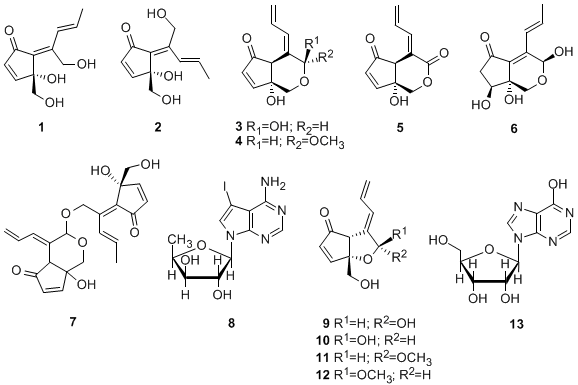
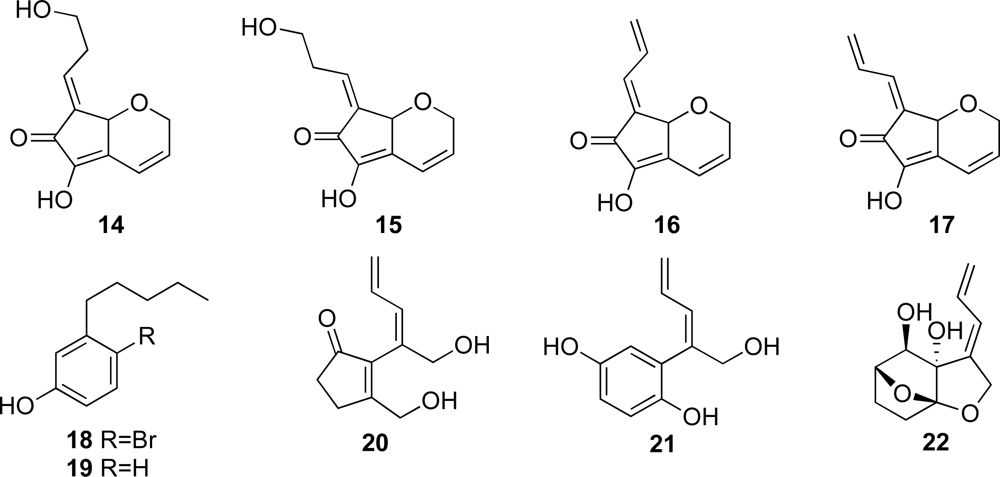
<p>It has been amply demonstrated that ascidians are a prolific source of novel bioactive secondary metabolites [<xref ref-type="bibr" rid="b1-marinedrugs-07-00816">1</xref>–<xref ref-type="bibr" rid="b4-marinedrugs-07-00816">4</xref>]. Ascidians belonging to the family Didemnidae, e.g., <italic>Lissoclinum</italic> spp. and <italic>Diplosoma</italic> spp., harbor obligate cyanobacterial symbionts of the genus <italic>Prochloron</italic> [<xref ref-type="bibr" rid="b5-marinedrugs-07-00816">5</xref>–<xref ref-type="bibr" rid="b7-marinedrugs-07-00816">7</xref>], and have yielded structurally unique and pharmacologically interesting compounds such as patellazoles, varacin, virenamides, haterumalide and haterumaimides [<xref ref-type="bibr" rid="b8-marinedrugs-07-00816">8</xref>–<xref ref-type="bibr" rid="b15-marinedrugs-07-00816">15</xref>]. A series of C<sub>11</sub> compounds having the distinctive exo-allylidene-lactone named didemnenone was isolated from didemnid ascidians, <italic>Trididemnum cyanophorum</italic> (didemnenones A and B) and <italic>Didemnum voeltzkowi</italic> (didemnenones C and D) [<xref ref-type="bibr" rid="b16-marinedrugs-07-00816">16</xref>]. They showed a wide range of biological activities, including cytotoxicity against leukemia cells as well as antimicrobial and antifungal activities [<xref ref-type="bibr" rid="b16-marinedrugs-07-00816">16</xref>–<xref ref-type="bibr" rid="b18-marinedrugs-07-00816">18</xref>]. Their structures were determined based on an X-ray investigation of the methylacetal of didemnenone A and from synthetic results [<xref ref-type="bibr" rid="b16-marinedrugs-07-00816">16</xref>–<xref ref-type="bibr" rid="b18-marinedrugs-07-00816">18</xref>]. As described previously, as part of our ongoing research aiming at the isolation of biologically active metabolites from marine organisms living in the tidal zone, we have isolated several C<sub>11</sub> compounds, dinemnenone congeners <bold>14</bold>–<bold>17</bold> [<xref ref-type="bibr" rid="b19-marinedrugs-07-00816">19</xref>–<xref ref-type="bibr" rid="b22-marinedrugs-07-00816">22</xref>] and pentylphenols <bold>18</bold> and <bold>19</bold> [<xref ref-type="bibr" rid="b22-marinedrugs-07-00816">22</xref>] from ascidian <italic>Diplosoma</italic> spp. (<xref ref-type="fig" rid="f1-marinedrugs-07-00816">Figure 1</xref>).</p>
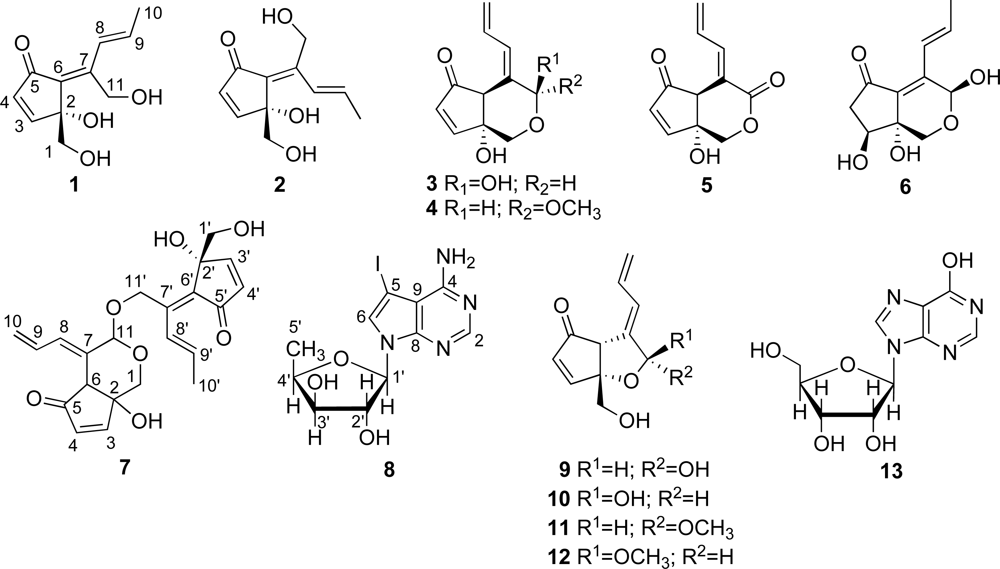
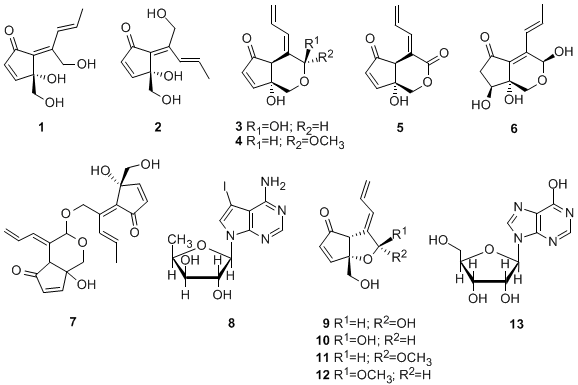
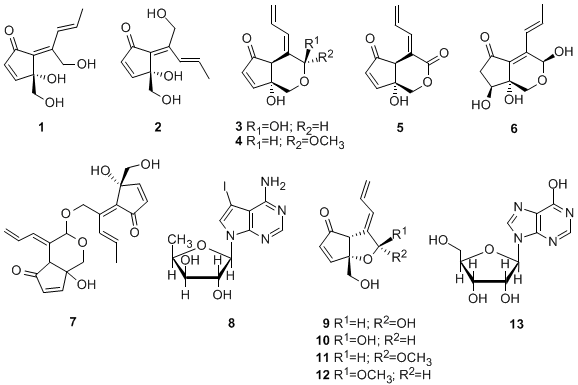
<p>Recently, we examined the constituents of ascidians, <italic>Lissoclinum</italic> sp. collected on the coast of Tarama island and <italic>Diplosoma</italic> sp. from dead corals of Hateruma island. From the <italic>Lissoclinum</italic> sp. we identified the new metabolites <bold>1</bold>–<bold>7</bold>, along with the known metabolites, didemnenones A (<bold>9</bold>) and B (<bold>10</bold>) as an inseparable mixture, a methylacetal of didemnenone B (<bold>12</bold>) [<xref ref-type="bibr" rid="b16-marinedrugs-07-00816">16</xref>], and inosine (<bold>13</bold>) (<xref ref-type="fig" rid="f2-marinedrugs-07-00816">Figure 2</xref>). The <italic>Diplosoma</italic> sp. contained didemnenones <bold>1</bold>, <bold>2</bold> and <bold>5</bold> along with five known metabolites <bold>8</bold>–<bold>12</bold> (<xref ref-type="fig" rid="f2-marinedrugs-07-00816">Figure 2</xref>) [<xref ref-type="bibr" rid="b16-marinedrugs-07-00816">16</xref>,<xref ref-type="bibr" rid="b23-marinedrugs-07-00816">23</xref>–<xref ref-type="bibr" rid="b34-marinedrugs-07-00816">34</xref>]. In this report, we describe the isolation, structure elucidation and bioactivity of these metabolites, and we also discuss the biosynthesis of didemnenones and the related compounds.</p></sec>
<sec sec-type="results|discussion">
<label>2.</label>
<title>Results and Discussion</title>
<p>Specimens of colonial ascidian <italic>Lissoclinum</italic> sp. were collected off the coast of Tarama island, Okinawa, Japan. The specimens were extracted with acetone and the extract was partitioned between EtOAc and H<sub>2</sub>O. The aqueous layer was further partitioned between 1-BuOH and H<sub>2</sub>O. The H<sub>2</sub>O-soluble part was fractionated using RP-MPLC (reversed-phase MPLC) and eluted with a combination of H<sub>2</sub>O and MeOH. Further purification of the obtained fractions using RP-HPLC led to isolation of <bold>1</bold> (0.0059% of wet weight) and <bold>13</bold> (0.00067%). The EtOAc extract was suspended in aqueous MeOH and then successively extracted with hexane, CHCl<sub>3</sub> and 1-BuOH. The resultant BuOH-soluble material was separated by a series of chromatographic steps [RP-OCC (reversed-phase open column chromatography), RP-MPLC and RP-HPLC] to afford <bold>3</bold> (0.0020%), <bold>4</bold> (0.00058%), <bold>6</bold> (0.0029%), <bold>2</bold> (0.011%), <bold>1</bold> (0.0049%), <bold>12</bold> (0.000014%), <bold>5</bold> (0.00030%), <bold>7</bold> (0.000019%) and an inseparable mixture of didemnenones A/B (<bold>9</bold>/<bold>10</bold>, 1:1, 0.00033%).</p>
<p>The colonial ascidian <italic>Diplosoma</italic> sp. was collected off the coast of Hateruma island, Okinawa, Japan. The specimens were extracted with acetone and the extract was partitioned between EtOAc and H<sub>2</sub>O. The EtOAc extract was suspended in aqueous MeOH and then successively extracted with hexane, CHCl<sub>3</sub> and 1-BuOH. The CHCl<sub>3</sub>-soluble material was subjected to RP-OCC and eluted with H<sub>2</sub>O/MeOH, MeOH and MeOH/EtOAc. Further separation of the H<sub>2</sub>O/MeOH fraction by RP-HPLC eluted with a combination of H<sub>2</sub>O, MeOH and MeCN, led to the isolation of <bold>1</bold> (0.0021%), <bold>2</bold> (0.00066%), <bold>5</bold> (0.00047%), <bold>8</bold> (0.018%), <bold>9</bold>/<bold>10</bold> (1:1 mixture, 0.00069%), <bold>11</bold> (0.00098%) and <bold>12</bold> (0.00033%).</p>
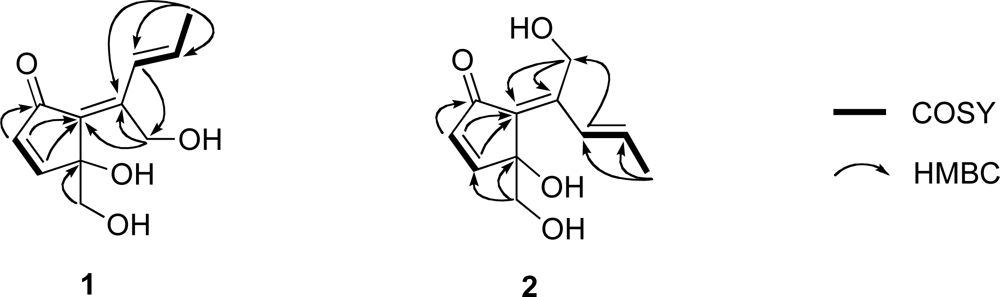
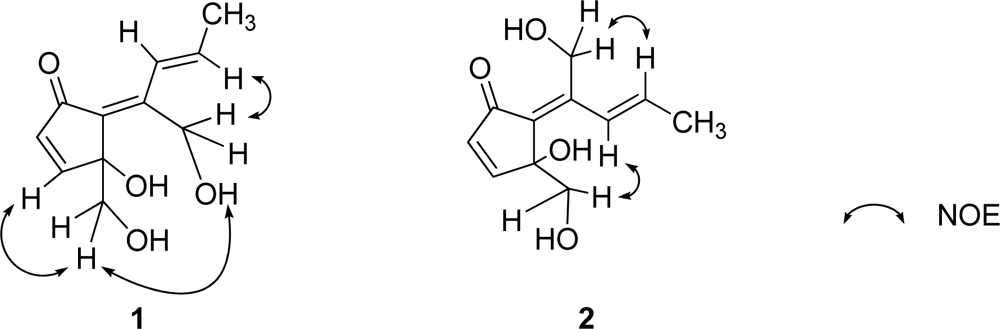
<p>Analysis of <bold>1</bold> by NMR (<xref ref-type="table" rid="t1-marinedrugs-07-00816">Tables 1</xref> and <xref ref-type="table" rid="t2-marinedrugs-07-00816">2</xref>) and HR-ESIMS [<italic>m/z</italic> 233.0786 (M + Na)<sup>+</sup>, calcd. for C<sub>11</sub>H<sub>14</sub>O<sub>4</sub>Na, 233.0784] provided a molecular formula of C<sub>11</sub>H<sub>14</sub>O<sub>4</sub>. The carbon resonating at δ<sub>C</sub> 197.1 (s) suggested the presence of a carbonyl carbon in <bold>1</bold> and the IR absorption band at <italic>v</italic><sub>max</sub> 1675 cm<sup>−1</sup> further supported the presence of the carbonyl group. Extensive analysis of <sup>1</sup>H- and <sup>13</sup>C-NMR data (<xref ref-type="table" rid="t1-marinedrugs-07-00816">Tables 1</xref> and <xref ref-type="table" rid="t2-marinedrugs-07-00816">2</xref>) supported by <sup>1</sup>H-<sup>1</sup>H COSY data indicated the presence of a <italic>cis</italic> double bond [δ<sub>C</sub> 161.4 (d), 134.3 (d); δ<sub>H</sub> 7.35 (d), 6.25 (d)], a <italic>trans</italic> double bond [δ<sub>C</sub> 127.2 (d), 134.8 (d); δ<sub>H</sub> 7.73 (dd, <italic>J</italic> = 1.6, 16.0 Hz), 6.43 (dq, <italic>J</italic> = 16.0, 6.8 Hz)], a tetrasubstituted double bond [δ<sub>C</sub> 133.5 (s), 144.5 (s)], a methyl group [δ<sub>C</sub> 19.1 (t); δ<sub>H</sub> 1.83 (dd)], two oxygenated methylenes [δ<sub>C</sub> 66.8 (t); δ<sub>H</sub> 3.74 (dd), 3.51 (dd) and δ<sub>C</sub> 56.6 (t); δ<sub>H</sub> 4.64 (dd), 4.36 (dd)] and an oxygenated quaternary carbon [δ<sub>C</sub> 80.5 (s)] in <bold>1</bold>. Degrees of unsaturation for these partial structures amount to four. Thus, <bold>1</bold> must be monocyclic to account for the five degrees of unsaturation required by the molecular formula. The connectivity of the aforementioned partial structures was established from the HMBC correlations of H<sub>2</sub>-1/C-2, H-3/C-6, H-4/C-5, H-4/C-6, H-8/C-11, H<sub>3</sub>-10/C-7, H<sub>3</sub>-10/C-8, H<sub>3</sub>-10/C-9, H<sub>2</sub>-11/C-6 and H<sub>2</sub>-11/C-7, as shown in <xref ref-type="fig" rid="f3-marinedrugs-07-00816">Figure 3</xref>, to describe the entire carbon framework of <bold>1</bold>. Geometric configuration of two olefins in <bold>1</bold> at C-6/C-7 and C-8/C-9 were assigned to be <italic>E</italic> by NOEDS experiments (<xref ref-type="fig" rid="f4-marinedrugs-07-00816">Figure 4</xref>), in which irradiation of H-9 caused enhancement of H-11 and irradiation of H-1 resulted in enhancement of the H-3 and OH-11 proton signals. Therefore, the planar structure of <bold>1</bold> was established as a class of didemnenone as shown in <bold>1</bold>.</p>
<p>Compound <bold>2</bold> had the same molecular formula as <bold>1</bold>, C<sub>11</sub>H<sub>14</sub>O<sub>4</sub>, as established by HR-ESIMS [<italic>m/z</italic> 233.0786 (M + Na)<sup>+</sup>, calcd. for C<sub>11</sub>H<sub>14</sub>O<sub>4</sub>Na, 233.0784]. The IR absorption bands at <italic>v</italic><sub>max</sub> 1695 and 3360 cm<sup>−1</sup> indicated the presence of carbonyl and hydroxyl groups. The NMR data (<xref ref-type="table" rid="t1-marinedrugs-07-00816">Tables 1</xref> and <xref ref-type="table" rid="t2-marinedrugs-07-00816">2</xref>) of <bold>2</bold> showed close similarity to those of <bold>1</bold>, except for chemical shifts of H-8. The chemical shift of H-8 in <bold>2</bold> (δ<sub>H</sub> 6.91) was at higher field than in <bold>1</bold> (δ<sub>H</sub> 7.73) due to the magnetic anisotropy effect of the carbonyl group, suggesting a <italic>Z</italic> configuration for the C-6 olefin in <bold>2</bold>. This was confirmed by NOEDS experiments (<xref ref-type="fig" rid="f4-marinedrugs-07-00816">Figure 4</xref>), in which irradiation of H-9 caused enhancement of H-11 and irradiation of H-1 resulted in enhancement of H-8.</p>
<p>Analysis of the <sup>13</sup>C-NMR and HR-ESIMS [<italic>m/z</italic> 231.0632, (M + Na)<sup>+</sup>, calcd for C<sub>11</sub>H<sub>12</sub>O<sub>4</sub>Na, 231.0628] for <bold>3</bold> provided a molecular formula C<sub>11</sub>H<sub>12</sub>O<sub>4</sub>, which suggested six degrees of unsaturation. The carbon resonating at δ<sub>C</sub> 203.8 (s) suggested the presence of a carbonyl carbon in <bold>3</bold> and the IR absorption band at <italic>v</italic><sub>max</sub> 1710 cm<sup>−1</sup> further supported the presence of the carbonyl group. The <sup>1</sup>H- and <sup>13</sup>C-NMR analyses (<xref ref-type="table" rid="t1-marinedrugs-07-00816">Tables 1</xref> and <xref ref-type="table" rid="t2-marinedrugs-07-00816">2</xref>) coupled with <sup>1</sup>H-<sup>1</sup>H COSY data indicated the presence of an α, β-unsaturated ketone moiety [δ<sub>C</sub> 203.8 (s), 132.8 (d), 165.1 (d); δ<sub>H</sub> 6.28 (d), 7.52 (d)], a conjugated diene moiety [δ<sub>C</sub> 135.0 (s), 131.7 (d); δ<sub>H</sub> 6.48 (d) and δ<sub>C</sub> 132.3 (d), 119.9 (t); δ<sub>H</sub> 6.58 (ddd), 5.23 (d), 5.38 (d)], an acetal [δ<sub>C</sub> 91.7 (d); δ<sub>H</sub> 5.10 (brd)], a methine [δ<sub>C</sub> 55.5 (d); δ<sub>H</sub> 3.45 (s)], an oxygenated methylene [δ<sub>C</sub> 63.2 (t); δ<sub>H</sub> 3.53 (d), 3.42 (d)] and an oxygenated quaternary carbon [δ<sub>C</sub> 79.7 (s)] in <bold>3</bold>. Extensive analysis of <sup>1</sup>H-<sup>1</sup>H COSY demonstrated two isolated spin systems, C-3–C-4 and C-8–C-10. The connectivity of the aforementioned partial structures was established from the HMBC correlations of H<sub>2</sub>-1/C-2, H<sub>2</sub>-1/C-3, H<sub>2</sub>-1/C-6, H<sub>2</sub>-1/C-11, H-3/C-2, H-3/C-4, H-3/C-5, H-3/C-6, H-6/C-2, H-6/C-4, H-6/C-5, H-6/C-7, H-6/C-11, H-8/C-6, H-8/C-11, H-9/C-7, H-11/C-1, H-11/C-6 and H-11/C-7, to describe the entire carbon framework of <bold>3</bold>. Geometric configuration of the olefins in <bold>3</bold> at C-7/C-8 was assigned to be <italic>E</italic> by NOEDS experiments, in which irradiation of H-6 caused enhancement of H-9 and irradiation of H-8 caused enhancement of H-11 and H-10. Therefore, the planar structure of <bold>3</bold> was concluded to be a class of didemnenone, as depicted in <bold>3</bold>. The NOE observed between a hydroxyl proton (OH-2) and H-6 revealed a <italic>cis</italic> fusion of two rings. The NOEs; OH-2/H-11; H-1b/H-11 allowed the assignment of the H-11 as α.</p>
<p>The molecular formula of <bold>4</bold> was deduced to be C<sub>12</sub>H<sub>14</sub>O<sub>4</sub> based on HR-ESIMS [<italic>m/z</italic> 245.0794, (M + Na)<sup>+</sup>, calcd for C<sub>12</sub>H<sub>14</sub>O<sub>4</sub>Na, 245.0784]. The <sup>1</sup>H- and <sup>13</sup>C-NMR spectral data (<xref ref-type="table" rid="t1-marinedrugs-07-00816">Tables 1</xref> and <xref ref-type="table" rid="t2-marinedrugs-07-00816">2</xref>) of <bold>4</bold> resembled those of <bold>3</bold>, except for the presence of a proton signal at δ<sub>H</sub> 3.31 (s) and a carbon signal at δ<sub>C</sub> 54.9 (q) in <bold>4</bold>. Geometric configuration of the double bond at C-7/C-8 in <bold>4</bold> was assigned to be <italic>E</italic> by NOEDS experiments, in which irradiation of H-6 caused enhancement of H-9 and irradiation of H-8 caused enhancement of H-11 and H-10. Therefore, the planar structure of <bold>4</bold> was elucidated to be a methylacetal of <bold>3</bold>. The NOE between a hydroxyl proton (OH-2) and H-6 also indicated the ring junction to have the <italic>cis</italic>-geometry. The NOEs; OH-2/ H-1b; H-1a /H-11 allowed the assignment of the H-11 as β. We cannot affirm that <bold>4</bold> is a natural product, because it is conceivable it arises from <bold>3</bold> in the isolation process.</p>
<p>The molecular formula of <bold>5</bold> was determined to be C<sub>11</sub>H<sub>10</sub>O<sub>4</sub>, based on HR-ESIMS [<italic>m/z</italic> 207.0654 (M + H)<sup>+</sup>, calcd for C<sub>11</sub>H<sub>11</sub>O<sub>4</sub>, 207.0652]. The carbons resonating at δ<sub>C</sub> 202.9 (s) and 166.9 (s) suggested the presence of a carbonyl carbon and an ester carbonyl carbon, respectively in <bold>5</bold> (<xref ref-type="table" rid="t2-marinedrugs-07-00816">Table 2</xref>) and the IR absorption band at <italic>v</italic><sub>max</sub> 1717 cm<sup>−1</sup> further supported the presence of the carbonyl groups. The <sup>1</sup>H- and <sup>13</sup>C-NMR (<xref ref-type="table" rid="t1-marinedrugs-07-00816">Tables 1</xref> and <xref ref-type="table" rid="t2-marinedrugs-07-00816">2</xref>) and 2D NMR spectral data of <bold>5</bold> are similar to those of γ-lactone didemnenone [<xref ref-type="bibr" rid="b16-marinedrugs-07-00816">16</xref>], except for the HMBC correlation observed between an oxymethylene proton H<sub>2</sub>-1 at δ<sub>H</sub> 4.13 and a carbonyl carbon C-11 at δ<sub>C</sub> 166.9. Geometric configuration of the double bond at C-7/C-8 in <bold>5</bold> was assigned to be <italic>E</italic> by NOEDS experiments, in which irradiation of H-6 caused enhancement of H-9. Therefore, the planar structure of <bold>5</bold> was concluded to be a class of didemnenone, as depicted in <bold>5</bold>.The NOE between a hydroxyl proton (OH-2) and H-6 allowed the ring junction to be assigned as <italic>cis</italic>.</p>
<p>Analysis of the <sup>13</sup>C-NMR and HR-ESIMS [<italic>m/z</italic> 249.0742, (M + Na)<sup>+</sup>, calcd for C<sub>11</sub>H<sub>14</sub>O<sub>5</sub>Na, 249.0733] for <bold>6</bold> provided a molecular formula C<sub>11</sub>H<sub>14</sub>O<sub>5</sub>. The carbon resonating at δ<sub>C</sub> 206.1 (s) suggested the presence of a carbonyl carbon in <bold>6</bold> (<xref ref-type="table" rid="t2-marinedrugs-07-00816">Table 2</xref>) and the IR absorption band at <italic>v</italic><sub>max</sub> 1720 cm<sup>−1</sup> further supported the presence of the carbonyl group. Extensive analysis of <sup>1</sup>H- and <sup>13</sup>C-NMR data (<xref ref-type="table" rid="t1-marinedrugs-07-00816">Tables 1</xref> and <xref ref-type="table" rid="t2-marinedrugs-07-00816">2</xref>) supported with <sup>1</sup>H-<sup>1</sup>H COSY data indicated the presence of a <italic>trans</italic> double bond [δ<sub>C</sub> 124.4 (d), 135.3 (d); δ<sub>H</sub> 7.27 (dd, <italic>J</italic> = 1.4, 16.0 Hz), 6.31 (dq, <italic>J</italic> = 16.0, 6.8 Hz)], a tetrasubstituted double bond [δ<sub>C</sub> 130.4 (s), 142.3 (s)], an oxygenated methylene [δ<sub>C</sub> 63.1 (t); δ<sub>H</sub> 4.27 (d), 3.50 (d)], two oxygenated methines [δ<sub>C</sub> 86.6 (d); δ<sub>H</sub> 5.51 (d) and δ<sub>C</sub> 70.5 (d); δ<sub>H</sub> 3.99 (brt)], an oxygenated quaternary carbon [δ<sub>C</sub> 73.0 (s)], a methylene [δ<sub>C</sub> 46.3 (t); δ<sub>H</sub> 2.74 (dd), 1.98 (brd)] and a methyl [δ<sub>C</sub> 19.1 (q); δ<sub>H</sub> 1.82 (dd)] in <bold>6</bold>. These functionalities accounted for three of the five degrees of unsaturation, therefore <bold>6</bold> is bicyclic. The connectivity of the aforementioned partial structures was established from the HMBC correlations of H-1/C-2, H-1/C-6, H-1/C-11, H-4/C-5, H-4/C-6, H-8/C-11 and H-11/C-6, to describe the entire carbon framework of <bold>6</bold>. The NOE between H-9 and H-11 also indicated the double bond at C-8 to have the <italic>trans-</italic>geometry, and the NOEs; OH-2/H-1a; OH-2/H-3; H-1a/H-11 allowed the assignment of the 3-OH and the 11-OH both as β.</p>
<p>Analysis of <bold>7</bold> by <sup>13</sup>C-NMR (<xref ref-type="table" rid="t3-marinedrugs-07-00816">Table 3</xref>) and HR-ESIMS [<italic>m/z</italic> 401.1602 (M + H)<sup>+</sup>, calcd for C<sub>22</sub>H<sub>25</sub>O<sub>7</sub>, 401.1595] provided a molecular formula of C<sub>22</sub>H<sub>24</sub>O<sub>7</sub>. Extensive analysis of <sup>1</sup>H- (<xref ref-type="table" rid="t3-marinedrugs-07-00816">Table 3</xref>) and <sup>13</sup>C-NMR data, supported with <sup>1</sup>H-<sup>1</sup>H COSY data, indicated the presence of two α, β-unsaturated ketone moieties [δ<sub>C</sub> 203.6 (s), 132.8 (d), 165.1 (d); δ<sub>H</sub> 6.31 (d), 7.55 (d) and δ<sub>C</sub> 196.7 (s), 134.9 (d), 161.6 (d); δ<sub>H</sub> 6.28 (d), 7.37(d)], a conjugated diene moiety [δ<sub>C</sub> 132.6 (s), 132.8 (d); δ<sub>H</sub> 6.37 (d) and δ<sub>C</sub> 132.2 (d), 120.3 (t); δ<sub>H</sub> 6.59 (ddd), 5.30 (d), 5.26 (d)], a <italic>trans</italic> double bond [δ<sub>C</sub> 126.9 (d), 134.7 (d); G<sub>H</sub> 7.78 (dd, <italic>J</italic> = 1.4, 16.0 Hz), 6.41 (m)], a tetrasubstituted double bond [δ<sub>C</sub> 135.2 (s), 140.7 (s)], an acetal [δ<sub>C</sub> 97.9 (d); δ<sub>H</sub> 5.08 (s)], three oxygenated methylenes [δ<sub>C</sub> 63.3 (t); δ<sub>H</sub> 3.53 (brd), δ<sub>C</sub> 66.6 (t); δ<sub>H</sub> 3.70 (dd), 3.46 (dd) and δ<sub>C</sub> 62.7 (t); δ<sub>H</sub> 4.86 (d), 4.49 (d)], two oxygenated quaternary carbons [δ<sub>C</sub> 79.1 (s), 80.4 (s)], a methine [δ<sub>C</sub> 55.1 (d); δ<sub>H</sub> 3.48 (s)] and a methyl [δ<sub>C</sub> 19.1 (q); δ<sub>H</sub> 1.88 (dd)] in <bold>7</bold>. The structure of <bold>7</bold> was elucidated to be a dimeric didemnenone composed of <bold>1</bold> and <bold>3</bold>, from the molecular formula, the NMR data and the HMBC correlations of H-11/C-11′ and H<sub>2</sub>-11′/C-11. Geometric configuration of three olefins in <bold>7</bold> at C-7/C-8, C-6′/C-7′ and C-8′/C-9′ was assigned to be <italic>E</italic> by NOEDS experiments, in which irradiation of H-6 caused enhancement of H-9, irradiation of H-8 caused enhancement of H-11 and H-10, irradiation of H-9′ caused enhancement of H-11′ and irradiation of H-3′ resulted in enhancement of the H-1′ proton signal. Therefore, the structure of <bold>7</bold> was established as a didemnenone dimer as shown in <bold>7</bold>. We could not determine the C-2/C-6 ring junction stereochemistry owing to decomposition of <bold>7</bold>.</p>
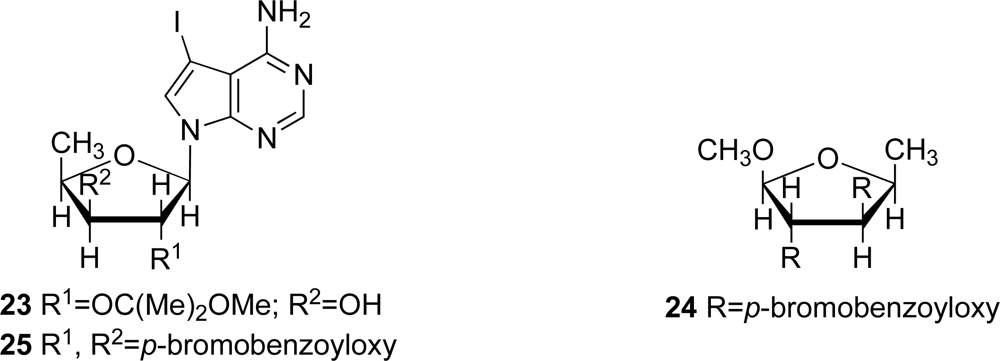
<p>The structure of marine metabolite <bold>8</bold> was determined to be 4-amino-7-(5’-deoxy-β-<sc>d</sc>-xylofuranosyl) -5-iodopyrrolo[2,3-<italic>d</italic>]pyrimidine by 1D and 2D NMR spectra for <bold>8</bold> and <bold>23</bold>, and by CD spectra of compounds <bold>8</bold>, <bold>24</bold> and <bold>25</bold> (<xref ref-type="fig" rid="f5-marinedrugs-07-00816">Figure 5</xref>), as previously described [<xref ref-type="bibr" rid="b23-marinedrugs-07-00816">23</xref>]. The absolute stereochemistry of the new compounds was tentatively deduced to be as depicted in <bold>1</bold>–<bold>7</bold> based on the assumption that there is a similar biogenetic relationship between these compounds and (+)-didemnenone A. (+)Didemnenones <bold>9</bold>–<bold>12</bold> and inosine (<bold>13</bold>) were unambiguously identified by comparison of their spectral data with those described in the literature [<xref ref-type="bibr" rid="b16-marinedrugs-07-00816">16</xref>].</p>
<p>Compounds <bold>1–13</bold> were tested <italic>in vitro</italic> for their cytotoxic activities against the HCT116, A431 and A549 cancer cell lines (<xref ref-type="table" rid="t4-marinedrugs-07-00816">Table 4</xref>). Compounds <bold>1</bold>, <bold>2</bold> and <bold>8</bold> were significantly cytotoxic against the HCT116, A431 and A549 cancer cell lines, and compounds <bold>3</bold>, <bold>4</bold>, <bold>7</bold>, <bold>9</bold>/<bold>10</bold> and <bold>12</bold> were significantly cytotoxic against two cell lines, HCT116 and A431. In contrast to <bold>12</bold> (a β-anomer), its isomer <bold>11</bold> (an α-anomer) was not cytotoxic against any of the three cell lines. Among the isolated compounds tested, the iodinated nucleoside <bold>8</bold> showed the strongest cytotoxic activity against the HCT116, A431 and A549 cancer cell lines, with IC<sub>50</sub> values of 1.8, 3.1 and 3.5 μ g/mL, respectively.</p>
<p>To date, a variety of C<sub>11</sub> compounds have been isolated from ascidians (compounds <bold>9</bold> and <bold>10)</bold>, cyanobacteria (compounds <bold>20</bold> and <bold>21</bold>) and a sponge (compound <bold>22</bold>) (<xref ref-type="fig" rid="f1-marinedrugs-07-00816">Figures 1</xref> and <xref ref-type="fig" rid="f2-marinedrugs-07-00816">2</xref>) [<xref ref-type="bibr" rid="b16-marinedrugs-07-00816">16</xref>,<xref ref-type="bibr" rid="b35-marinedrugs-07-00816">35</xref>,<xref ref-type="bibr" rid="b36-marinedrugs-07-00816">36</xref>]. Compounds <bold>16</bold> and <bold>17</bold> have been isolated from the ascidian <italic>Diplosoma virens</italic> and a sponge <italic>Ulosa</italic> sp. (<xref ref-type="fig" rid="f2-marinedrugs-07-00816">Figure 2</xref>) [<xref ref-type="bibr" rid="b19-marinedrugs-07-00816">19</xref>,<xref ref-type="bibr" rid="b20-marinedrugs-07-00816">20</xref>]. Isolation of a series of the C<sub>11</sub> compounds including compounds <bold>18</bold> and <bold>19</bold> (<xref ref-type="fig" rid="f2-marinedrugs-07-00816">Figure 2</xref>) from unrelated marine organisms supports the potential microbial origin of these compounds. From this viewpoint, we assume that the ascidian <italic>Diplosoma</italic> sp. might not be the actual producer of the C<sub>11</sub> compounds, but suggest a possible microorganism source such as <italic>Prochloron</italic> spp. We conducted, therefore, the following experiments. The <italic>Prochloron</italic> spp., which are obligatory symbionts of ascidians, were separated from the body of the ascidians <italic>Lissoclinum</italic> sp. and <italic>Diplosoma</italic> spp. by squeezing through the plankton net. <sup>1</sup>H-NMR spectra of the acetone extracts of the separated <italic>Prochloron</italic> spp. showed the presence of the same peaks as present in those of didemnenones. This confirms our assumption that <italic>Prochloron</italic> spp. are the actual producers of didemnenones.</p>
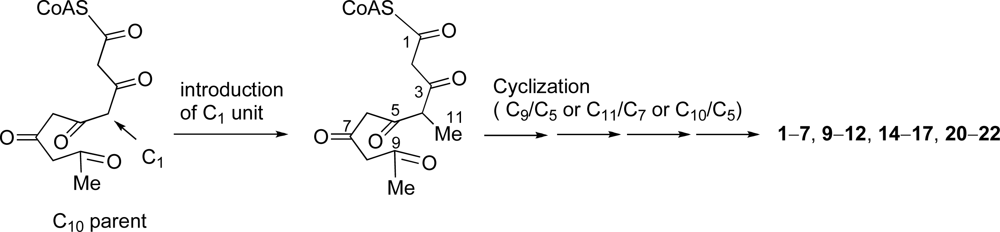
<p>Most C<sub>11</sub> compounds are derived from polyketides (six acetates-C<sub>1</sub>) or polyketides (five acetates + C<sub>1</sub>) [<xref ref-type="bibr" rid="b37-marinedrugs-07-00816">37</xref>]. Pentylphenols such as <bold>18</bold> and <bold>19</bold>, and some compounds which have a carbon skeleton of 5-methyldecane are known to be derived from the former with a loss of CO<sub>2</sub> from C<sub>12</sub> parent (six acetates). Some C<sub>11</sub> metabolites are ascertained to be derived from a polyketide precursor (five acetates + C<sub>1</sub>) which has a carbon skeleton of 4-methyldecane [<xref ref-type="bibr" rid="b37-marinedrugs-07-00816">37</xref>]. We found that didemnenone-related compounds <bold>1</bold>–<bold>7</bold>, <bold>9</bold>–<bold>12</bold>, <bold>14</bold>–<bold>17</bold> and <bold>20</bold>–<bold>22</bold> have a common carbon skeleton of 4-methyldecane from a consideration of the carbon skeleton of these compounds. Consequently, We propose that these compounds should be derived from the polyketides (five acetates + C<sub>1</sub>) <italic>via</italic> cyclization between C-9/C-5, between C-11/C-7 or between C-10/C-5 (<xref ref-type="fig" rid="f6-marinedrugs-07-00816">Scheme 1</xref>).</p></sec>
<sec>
<label>3.</label>
<title>Experimental Section</title>
<sec sec-type="methods">
<label>3.1.</label>
<title>General experimental procedures</title>
<p>Optical rotations were measured on either a JASCO P-1020 or JASCO DIP-1000 polarimeter. Ultraviolet-visible spectra were obtained in methanol on a JASCO V-550 spectrophotometer. Infrared spectra were recorded as dry films on either JASCO FT/IR-300 or Spectrum 2000 Explorer (PERKIN ELMER). CD spectra were recorded on a JASCO J-720W Circular Dichroism Spectrometer. <sup>1</sup>H- and <sup>13</sup>C-NMR spectra were recorded on a JEOL JNM α-500 FT-NMR spectrometer or a JEOL JNM lambda 400 FT-NMR spectrometer, and chemical shifts were referenced to the solvent signals [δ<sub>H</sub> 7.24 and δ<sub>C</sub> 77.0 in chloroform-<italic>d</italic>, δ<sub>H</sub> 2.49 and δ<sub>C</sub> 39.5 in DMSO-<italic>d</italic><sub>6</sub><italic>,</italic> δ<sub>H</sub> 3.30 and δ<sub>C</sub> 49.0 in methanol-<italic>d</italic><sub>4</sub>]. Inversed-detected heteronuclear correlations were measured using HMQC and HMBC pulse sequences with a pulse field gradient. HR-ESIMS data were obtained on a LTQ ORBITRAP (ThermoFisher Scientific, Germany), and HR-FABMS data were obtained on a JEOL JMS-700 mass spectrometer. LR-ESIMS data were measured on a Waters <italic>Quattro micro</italic> API triple quadruple mass analyzer. RP-OCC and RP-MPLC were performed on COSMOSIL<sup>®</sup> 140C<sub>18</sub>-OPN. Preparative RP-HPLC was run on a Waters 600 multi solvent system using ODS columns (YMC-Pack ODS-A, 150 × 20 mm I.D., YMC-Pack ODS-A, 250 × 20 mm I.D., YMC-Pack ODS-C8, 250 × 20 mm I.D., YMC-Pack ODS-AQ, 250 × 20 mm I.D., Develosil ODS-HG-5, 250 × 20 mm I.D. and COSMOSIL<sup>®</sup> -packed C<sub>18</sub>, 250 × 10 mm I.D.). All solvents used were reagent grade.</p></sec>
<sec>
<label>3.2.</label>
<title>Animal material</title>
<p>The colonial brown ascidian was collected by hand at the tidal zone of Tarama island, Okinawa, Japan, and the colonial green ascidian was collected by hand from the coast of Hateruma island, Okinawa, Japan. The ascidians were stored at −15 <sup>°</sup>C until extraction. The brown ascidian and the green ascidian were identified as <italic>Lissoclinum</italic> sp. and <italic>Diplosoma</italic> sp., respectively, by Euichi Hirose, University of the Ryukyus, Japan. The voucher specimens were deposited at the University of the Ryukyus (Specimen no. URKU-801 for the brown ascidian and URKU-802).</p></sec>
<sec>
<label>3.3.</label>
<title>Extraction and isolation</title>
<p>The ascidian <italic>Lissoclinum</italic> sp. (5.7 kg, wet weight) was initially extracted with acetone (18 L) and filtered to remove debris. The filtrate was concentrated <italic>in vacuo</italic> to remove acetone and the resultant mixture was partitioned between EtOAc (3.5 L) and H<sub>2</sub>O (3.5 L). The H<sub>2</sub>O layer was extracted with 1-BuOH to give the 1-BuOH extract (18.3 g) and the H<sub>2</sub>O extract (141.2 g). An aliquot of 27.8 g of the H<sub>2</sub>O-soluble material was subject to RP-MPLC on ODS (COSMOSIL<sup>®</sup> 140C<sub>18</sub>-OPN, 140 μm, 50 × 3 cm I.D.) with H<sub>2</sub>O (500 mL), H<sub>2</sub>O/MeOH (9:1, 500 mL 7:3, 500 mL; 5:5, 500 mL, 3:7, 500 mL; 1:9, 500 mL) and MeOH (500 mL) to give seven fractions. The second fraction (860 mg) was subjected to HPLC on ODS [YMC-Pack ODS-AQ, 250 × 20 mm I.D.; linear gradient elution, H<sub>2</sub>O/MeOH (3:1)-MeOH] to give 18 fractions. The 18th fraction contained pure <bold>1</bold> (66.0 mg). The 14th fraction (84.0 mg) was subjected to HPLC on ODS [YMC-Pack ODS-AQ, 250 × 20 mm I.D.; linear gradient elution, 1% HCOOH /H<sub>2</sub>O (1:9)-1% HCOOH/MeCN (1:9)] to give <bold>13</bold> (7.6 mg). The EtOAc layer was concentrated <italic>in vacuo</italic> to give a brown material (29.3 g). The material was subjected to a modified Kupchan’s partitioning procedure as follows. The material was suspended in a mixture of H<sub>2</sub>O/MeOH (1:1) and then successively extracted with hexane and CHCl<sub>3</sub>. The resultant aqueous phase was concentrated to remove MeOH and then extracted with 1-BuOH. An aliquot of 0.58 g of the BuOH-soluble material (3.93 g) was separated by RP-MPLC (COSMOSIL<sup>®</sup> 140C<sub>18</sub>-OPN, 140 μm, 50 × 3 cm I.D.) using H<sub>2</sub>O (500 mL), H<sub>2</sub>O/MeOH (9:1, 500 mL 7:3, 500 mL; 5:5, 500 mL, 3:7, 500 mL; 1:9, 500 mL) and MeOH (500 mL) to give seven fractions (fr. 1–7). The first fraction (fr. 1, 436 mg) was purified by RP-HPLC [YMC-Pack ODS-A, 250 × 20 mm I.D.; linear gradient elution, H<sub>2</sub>O/MeOH (4:1)-MeOH] to afford <bold>3</bold> (165 mg) and <bold>4</bold> (3.2 mg). The second fraction (fr. 2, 272 mg) was separated by RP-HPLC [YMC-Pack ODS-A, 150 × 20 mm I.D.; linear gradient elution, H<sub>2</sub>O/MeOH (4:1)-MeOH] to give 18 fractions (fr. 2-1–2-18). Purification of the second fraction (fr. 2-2, 170 mg) by RP-HPLC (Develosil ODS-HG-5, 250 × 20 mm I.D.) using H<sub>2</sub>O/MeOH (9:1) led to the isolation of <bold>6</bold> (24.6 mg), <bold>2</bold> (92.3 mg), <bold>1</bold> (92.7 mg) and an inseparable mixture of didemnenones A/B (<bold>9/10</bold>, 2.8 mg). HPLC separation [Develosil ODS-HG-5, 250 × 20 mm I.D., H<sub>2</sub>O/MeOH (9:1)] of seventh fraction (fr. 2–7, 6.8 mg) led to the isolation of <bold>12</bold> (0.8 mg). An aliquot of 3.35 g of the 1-BuOH extract (3.93 g) was chromatographed on ODS (COSMOSIL<sup>®</sup> 140C<sub>18</sub>-OPN, 140 μm, 100 g) with H<sub>2</sub>O/MeOH (3:7, 500 mL; 2:8, 100 mL; 1:9, 100 mL) and MeOH (100 mL) to give nine fractions. The second fraction (1.1 g) was purified by HPLC on ODS [YMC-Pack C8, 250 × 20 mm I.D.; linear gradient elution, H<sub>2</sub>O/MeCN (8:2–1:9)], to give <bold>1</bold> (186.8 mg), <bold>5</bold> (14.6 mg), <bold>4</bold> (29.7 mg) and <bold>7</bold> (0.9 mg).</p>
<p>The ascidian <italic>Diplosoma</italic> sp. (900 g, wet weight) was initially extracted with acetone (2.2 L). After filtration, the extracts were concentrated in <italic>vacuo</italic> to give an acetone extract. The acetone extract was partitioned between EtOAc and H<sub>2</sub>O. The H<sub>2</sub>O layer was further extracted with 1-BuOH. The 1-BuOH layer was concentrated <italic>in vacuo</italic> to give a BuOH-soluble material (2.14 g). The EtOAc layer was concentrated <italic>in vacuo</italic> to give an EtOAc extract (7 g). The EtOAc extract was suspended in H<sub>2</sub>O/MeOH (1:1, 400 mL) and then successively extracted with hexane and CHCl<sub>3</sub> to give a hexane-soluble material (4.0 g), a CHCl<sub>3</sub>-soluble material (2.0 g) and an aqueous material (2.1 g). The aqueous material and the BuOH-soluble material (2.14 g) were combined. The combined polar fraction (4.24 g) was chromatographed on ODS (COSMOSIL<sup>®</sup> 140C<sub>18</sub>-OPN) with H<sub>2</sub>O/MeOH (1:1, 2:1), MeOH and MeOH/EtOAc (9:1) as eluent. The first fraction (2.0 g) contained more than 95% of <bold>1</bold> from its <sup>1</sup>H NMR data. The CHCl<sub>3</sub>-soluble material (2.0 g) was subjected to OCC on ODS [COSMOSIL<sup>®</sup> 140C<sub>18</sub>-OPN, H<sub>2</sub>O/MeOH (1:4), MeOH and MeOH/EtOAc (7:3)]. The first fraction (fr. 1, 1.0 g) was further separated by OCC on ODS (COSMOSIL<sup>®</sup> 140C<sub>18</sub>-OPN) using H<sub>2</sub>O/MeOH (1:1, 2:1), MeOH and MeOH/EtOAc (9:1). The first aqueous methanol fraction (fr. 1-1, 902 mg) was subjected to HPLC on ODS (COSMOSIL<sup>®</sup> -packed C<sub>18</sub>, 250 × 10 mm I.D.) using H<sub>2</sub>O/MeOH (1:1) to give six fractions (fr. 1-1-1-fr. 1-1-6). The first fraction (fr. 1-1-1, 92.9 mg) was separated by HPLC on ODS [COSMOSIL<sup>®</sup> -packed C<sub>18</sub>, 250 × 10 mm I.D., H<sub>2</sub>O/MeCN (1:1)] first, and then by RP-HPLC [COSMOSIL<sup>®</sup>-packed C<sub>18</sub>, 250 × 10 mm I.D., H<sub>2</sub>O/MeOH/MeCN (5:2:2)] to yield <bold>1</bold> (18.7 mg) and <bold>2</bold> (5.9 mg). Further separation of the second fraction (fr. 1-1-2, 61.6 mg) by repeated HPLC [COSMOSIL<sup>®</sup> -packed C<sub>18</sub>, 250 × 10 mm I.D., H<sub>2</sub>O/MeOH/MeCN (50:31:19) and then H<sub>2</sub>O/MeCN (1:1)] to give <bold>5</bold> (4.2 mg). An inseparable mixture (6.2 mg) of didemnenones A and B (<bold>9</bold> and <bold>10</bold>) was obtained along with their methylacetals <bold>11</bold> (8.8 mg) and <bold>12</bold> (3.0 mg) from the fourth fraction (fr. 1-1-4, 70.4 mg) by repeated ODS HPLC [COSMOSIL<sup>®</sup> -packed C<sub>18</sub>, 250 × 10 mm I.D., H<sub>2</sub>O/MeOH/MeCN (50:31:19) and then H<sub>2</sub>O/MeCN (1:1)]. The fifth fraction (fr. 1-1-5, 40.0 mg) was purified by RP-HPLC (COSMOSIL<sup>®</sup>-packed C<sub>18</sub>, 250 × 10 mm I.D.) with H<sub>2</sub>O/MeOH/MeCN (50:31:19) to afford <bold>8</bold> (9.9 mg). The sixth fraction (fr. 1-1-6, 210.7 mg) was purified by HPLC on ODS (COSMOSIL<sup>®</sup>-packed C<sub>18</sub>, 250 × 10 mm I.D.) using MeOH/EtOAc (19:1) to yield <bold>8</bold> (164.4 mg).</p>
<sec>
<label>3.3.1.</label>
<title>Compound <bold>1</bold></title>
<p>Pale yellowish oil; [α]<sup>27</sup><sub>D</sub> +21.0° (<italic>c</italic> 0.66, MeOH); UV (MeOH) <italic>λ</italic><sub>max</sub> (log <italic>ɛ</italic>) 246 (3.39), 308 (3.69) nm; FT/IR (film) <italic>v</italic><sub>max</sub> 3355, 1675, 1035 cm<sup>−1</sup>; <sup>1</sup>H-NMR and <sup>13</sup>C-NMR (DMSO-<italic>d</italic><sub>6</sub>) see <xref ref-type="table" rid="t1-marinedrugs-07-00816">Tables 1</xref> and <xref ref-type="table" rid="t2-marinedrugs-07-00816">2</xref>; LR-ESIMS <italic>m/z</italic> 211 (M + H)<sup>+</sup>, 209 (M − H)<sup>−</sup> HR-ESIMS <italic>m/z</italic> (M + Na)<sup>+</sup> 233.0786 (calcd. for C<sub>11</sub>H<sub>14</sub>O<sub>4</sub>Na, 233.0784).</p></sec>
<sec>
<label>3.3.2.</label>
<title>Compound <bold>2</bold></title>
<p>Pale yellowish oil; [α]<sup>27</sup><sub>D</sub> +22.5° (<italic>c</italic> 0.43, MeOH); UV (MeOH) <italic>λ</italic><sub>max</sub> (log <italic>ɛ</italic>) 245 (3.38), 307 (3.74) nm; FT/IR (film) <italic>v</italic><sub>max</sub> 3359, 1712, 1379 cm<sup>−1</sup>; <sup>1</sup>H-NMR and <sup>13</sup>C-NMR (DMSO-<italic>d</italic><sub>6</sub>) see <xref ref-type="table" rid="t1-marinedrugs-07-00816">Tables 1</xref> and <xref ref-type="table" rid="t2-marinedrugs-07-00816">2</xref>; LR-ESIMS <italic>m/z</italic> 233 (M + Na)<sup>+</sup>, 211 (M + H)<sup>+</sup>, 209 (M − H)<sup>−</sup>; HR-ESIMS <italic>m/z</italic> (M + Na)<sup>+</sup> 233.0786 (calcd. for C<sub>11</sub>H<sub>14</sub>O<sub>4</sub>Na, 233.0784).</p></sec>
<sec>
<label>3.3.3.</label>
<title>Compound <bold>3</bold></title>
<p>Pale yellowish oil; [α]<sup>24</sup><sub>D</sub> +147° (<italic>c</italic> 0.62, H<sub>2</sub>O); UV (H<sub>2</sub>O) <italic>λ</italic><sub>max</sub> (log <italic>ɛ</italic>) 246 (3.51), 274 (3.54); FT/IR (film) <italic>v</italic><sub>max</sub> 3400, 1710, 1050 cm<sup>−1</sup>; <sup>1</sup>H-NMR and <sup>13</sup>C-NMR (DMSO-<italic>d</italic><sub>6</sub>) see <xref ref-type="table" rid="t1-marinedrugs-07-00816">Tables 1</xref> and <xref ref-type="table" rid="t2-marinedrugs-07-00816">2</xref>; LR-ESIMS <italic>m/z</italic> 231 (M + Na)<sup>+</sup>, 207 (M − H)<sup>−</sup>; HR-ESIMS <italic>m/z</italic> (M + Na)<sup>+</sup> 231.0632 (calcd. for C<sub>11</sub>H<sub>12</sub>O<sub>4</sub>Na, 231.0628).</p></sec>
<sec>
<label>3.3.4.</label>
<title>Compound <bold>4</bold></title>
<p>Pale yellowish oil; [α]<sup>24</sup><sub>D</sub> +459° (<italic>c</italic> 0.015, MeOH); UV (MeOH) <italic>λ</italic><sub>max</sub> (log <italic>ɛ</italic>) 249 (3.65); FT/IR (film) <italic>v</italic><sub>max</sub> 3410, 1700, 1045 cm<sup>−1</sup>; <sup>1</sup>H-NMR and <sup>13</sup>C-NMR (DMSO-<italic>d</italic><sub>6</sub>) see <xref ref-type="table" rid="t1-marinedrugs-07-00816">Tables 1</xref> and <xref ref-type="table" rid="t2-marinedrugs-07-00816">2</xref>; LR-ESIMS <italic>m/z</italic> 223 (M + H)<sup>+</sup>; HR-ESIMS <italic>m/z</italic> (M + Na)<sup>+</sup> 245.0794 (calcd. for C<sub>12</sub>H<sub>14</sub>O<sub>4</sub>Na, 245.0784).</p></sec>
<sec>
<label>3.3.5.</label>
<title>Compound <bold>5</bold></title>
<p>Pale yellowish oil; [α]<sup>27</sup><sub>D</sub> + 112° (<italic>c</italic> 0.26, MeOH); UV (MeOH) <italic>λ</italic><sub>max</sub> (log <italic>ɛ</italic>) 273 (3.83); FT/IR (film) <italic>v</italic><sub>max</sub> 3419, 1717, 1049 cm<sup>−1</sup>; <sup>1</sup>H-NMR and <sup>13</sup>C-NMR (DMSO-<italic>d</italic><sub>6</sub>) see <xref ref-type="table" rid="t1-marinedrugs-07-00816">Tables 1</xref> and <xref ref-type="table" rid="t2-marinedrugs-07-00816">2</xref>; LR-ESIMS <italic>m/z</italic> 207 (M + H)<sup>+</sup>, 205 (M − H)<sup>−</sup>; HR-ESIMS <italic>m/z</italic> (M + H)<sup>+</sup> 207.0654 (calcd. for C<sub>11</sub>H<sub>11</sub>O<sub>4</sub>, 207.0652).</p></sec>
<sec>
<label>3.3.6.</label>
<title>Compound <bold>6</bold></title>
<p>Pale yellowish oil; [α]<sup>24</sup><sub>D</sub> +16.3° (<italic>c</italic> 0.17, MeOH); UV (MeOH) <italic>λ</italic><sub>max</sub> (log <italic>ɛ</italic>) 294 (3.91); FT/IR (film) <italic>v</italic><sub>max</sub> 3390, 1720, 1050 cm<sup>−1</sup>; <sup>1</sup>H-NMR and <sup>13</sup>C-NMR (DMSO-<italic>d</italic><sub>6</sub>) see <xref ref-type="table" rid="t1-marinedrugs-07-00816">Tables 1</xref> and <xref ref-type="table" rid="t2-marinedrugs-07-00816">2</xref>; LR-ESIMS <italic>m/z</italic> 249 (M + H)<sup>+</sup>, 223 (M + H)<sup>+</sup>; HR-ESIMS <italic>m/z</italic> (M + Na)<sup>+</sup> 249.0742 (calcd. for C<sub>11</sub>H<sub>14</sub>O<sub>5</sub>Na, 249.0733).</p></sec>
<sec>
<label>3.3.7.</label>
<title>Compound <bold>7</bold></title>
<p>Pale yellowish oil; [λ]<sup>24</sup><sub>D</sub> +11.7° (<italic>c</italic> 0.12, MeOH); UV (MeOH) <italic>λ</italic><sub>max</sub> (log <italic>ɛ</italic>) 248 (3.78), 308 (3.83); FT/IR (film) <italic>v</italic><sub>max</sub> 3400, 1580, 1050 cm<sup>−1</sup>; <sup>1</sup>H-NMR and <sup>13</sup>C-NMR (DMSO-<italic>d</italic><sub>6</sub>) see <xref ref-type="table" rid="t3-marinedrugs-07-00816">Table 3</xref>; LR-ESIMS <italic>m/z</italic> 423 (M + Na)<sup>+</sup>, 401 (M + H)<sup>+</sup>, 399 (M − H)<sup>−</sup>; HR-ESIMS <italic>m/z</italic> (M + Na)<sup>+</sup> 423.1423 (calcd for C<sub>22</sub>H<sub>24</sub>O<sub>7</sub>Na, 423.1414), (M + H)<sup>+</sup> 401.1602 (calcd. for C<sub>22</sub>H<sub>24</sub>O<sub>7</sub>, 401.1595).</p></sec>
<sec>
<label>3.3.8.</label>
<title>Compound <bold>8</bold></title>
<p>Pare yellowish oil: [α]<sup>26</sup><sub>D</sub> −69° (<italic>c</italic> 0.1, MeOH); UV (MeOH) <italic>λ</italic><sub>max</sub> (log <italic>ɛ</italic>) 283 nm (3.59); FT/IR (film) <italic>v</italic><sub>max</sub> 3461, 3317, 3132, 1633, 1584, 1474, 1084, 755 cm<sup>−1</sup>; NMR data were described in the previous paper [<xref ref-type="bibr" rid="b13-marinedrugs-07-00816">13</xref>]. LR-EIMS <italic>m/z</italic> (rel.%) 376 (M<sup>+</sup>, 7), 303 (3), 289 (13), 261 (33), 260 (100), 233 (18). HR-FABMS <italic>m/z</italic> (M)<sup>+</sup> 376.0016 (calcd. for C<sub>11</sub>H<sub>13</sub>IN<sub>4</sub>O<sub>3</sub>, 376.0027).</p></sec>
<sec>
<label>3.3.9.</label>
<title>Acetal <bold>23</bold></title>
<p>To a solution of iodinated nucleoside <bold>8</bold>, (10.0 mg, 26.6 μmol) in 2,2-dimethoxypropane (1 mL) and acetone (2 mL) was added a catalytic amount of camphorsulfonic acid. The mixture was stirred at rt for 24 h and at 45 °C for 4 h. The reaction mixture was diluted with ether, washed with saturated aqueous Na<sub>2</sub>CO<sub>3</sub> and brine. The organic phase was dried (MgSO<sub>4</sub>) and concentrated <italic>in vacuo</italic>. The residual oil was purified by preparative TLC [CHCl<sub>3</sub>-MeOH (3:0.2)] to give the acetal as colorless oil (<bold>23</bold>, 3.0 mg, 25%). HR-FABMS and <sup>1</sup>H NMR data for compound <bold>23</bold> were described in the earlier paper [<xref ref-type="bibr" rid="b23-marinedrugs-07-00816">23</xref>].</p></sec>
<sec>
<label>3.3.10.</label>
<title><italic>Methyl 5-deoxy 2.3-di-O-(4-bromobenzoyl)-β-<sc>l</sc>-xylofuranoside (<bold>24</bold>)</italic></title>
<p>The mixture of methyl 5-deoxy-β-<sc>l</sc>-xylofuranoside [<xref ref-type="bibr" rid="b38-marinedrugs-07-00816">38</xref>,<xref ref-type="bibr" rid="b39-marinedrugs-07-00816">39</xref>] (56.5 mg, 0.11 mmol), 4-bromobenzoyl chloride (250.1 mg, 0.87 mmol), and DMAP (2.2 mg, 0.018 mmol), in pyridine (0.8 mL) was stirred at ambient temperature for 24 h, and water (0.5 mL) was added to the mixture. After being stirred at ambient temperature for 30 min, the mixture was concentrated. The residual solid was purified by HPLC [Develosil ODS-HG-5 (250 × 20 mm I.D.); flow rate 5 mL/min; detection UV 256 nm; solvent 85% MeOH] to give methyl 5-deoxy 2.3-di-<italic>O</italic>-(4-bromobenzoyl)-β-<sc>l</sc>-xylofuranoside (<bold>24</bold>, 17.2 mg, 30%) and its corresponding α-anomer (15.3 mg, 27%), respectively. Spectral data for compound <bold>24</bold> were described in the previous paper [<xref ref-type="bibr" rid="b23-marinedrugs-07-00816">23</xref>].</p></sec>
<sec>
<label>3.3.11.</label>
<title>Dibenzoate <bold>25</bold></title>
<p>The mixture of iodinated nucleoside <bold>8</bold> (5.0 mg, 0.013 mmol), 4-bromobenzoyl chloride (25.2 mg, 0.115 mmol), and DMAP (2.2 mg, 0.018 mmol), in pyridine (0.5 mL) was stirred at ambient temperature for 24 h, and water (0.5 mL) was added to the mixture. After being stirred at ambient temperature for 30 min, the mixture was concentrated. The residual solid was purified by HPLC [Develosil ODS-HG-5 (250 × 20 mm I.D.); flow rate 5 mL/min; detection UV 256 nm; solvent 85% MeOH] to give dibenzoate <bold>25</bold> (2.0 mg, 21%). Spectral data for compound <bold>25</bold> were described in the earlier paper [<xref ref-type="bibr" rid="b23-marinedrugs-07-00816">23</xref>].</p></sec>
<sec>
<label>3.3.12.</label>
<title>Condition of cell cultures</title>
<p>Human colorectal carcinoma (HCT116), human epidermal carcinoma (A431) and human lung cancer (A549) cells were cultured in DMEM medium (including 10% FBS, 100 U/mL penicillin and 100 ng/mL streptomycin) at 37 °C in a 5% CO<sub>2</sub> atmosphere.</p></sec>
<sec>
<label>3.3.13.</label>
<title>Determination of cytotoxicity</title>
<p>Growth inhibition experiments were carried out in quadruplicate on 96-well flat-bottomed microplates, and the amount of viable cells at the end of incubation was determined with the MTT [3-(4,5-dimethylthiazol-2-yl) 2,5-diphenyltetrazolium bromide] dye reduction assay. Test compounds were dissolved in DMSO (4.0 mg/mL) and diluted with H<sub>2</sub>O such that the final DMSO concentration was 0.5%. Viable cells (HCT116, A431 and A549) in the growth medium were seeded on 96-well microplates (1.0 × 10<sup>4</sup> cells/well) and incubated at 37 °C in a 5% CO<sub>2</sub> atmosphere, and continuously cultured without or with five concentrations (20, 10, 5, 2.5, 1.25 μg/mL, final concentration) of test compounds for 48 h from the next day. After incubation, 10 μL of MTT (5 mg/mL in phosphate-buffer saline) was added each well, the samples were again incubated. After standing for 3 h, the medium was removed, and the resulting formazan crystals were dissolved with DMSO (100 μL). The optical density (O.D.) was measured at 570 nm, provided the reference for reading at 655 nm with a microplate reader (Model 550, BIO-RAD, USA).</p></sec></sec></sec>
<sec sec-type="conclusions">
<label>4.</label>
<title>Conclusions</title>
<p>We have isolated seven new didemnenone derivatives <bold>1</bold>–<bold>7</bold> together with four known metabolites <bold>9</bold>/<bold>10</bold>, <bold>12</bold> and <bold>13</bold> from <italic>Lissoclinum</italic> sp. We have also isolated didemnenones <bold>1</bold>, <bold>2</bold> and <bold>5</bold> and five known metabolites <bold>8</bold>–<bold>12</bold> from the other didemnid ascidian <italic>Diplosoma</italic> sp. Compounds <bold>1</bold>–<bold>4</bold>, <bold>7</bold>–<bold>10</bold> and <bold>12</bold> were significantly cytotoxic against the HCT116, A431 and/or A549 cancer cell lines. Didemnenone-related compounds <bold>1</bold>–<bold>7</bold>, <bold>9</bold>–<bold>12</bold>, <bold>14</bold>–<bold>17</bold> and <bold>20</bold>–<bold>22</bold>, which have been ever isolated from marine organisms [<xref ref-type="bibr" rid="b19-marinedrugs-07-00816">19</xref>–<xref ref-type="bibr" rid="b22-marinedrugs-07-00816">22</xref>,<xref ref-type="bibr" rid="b35-marinedrugs-07-00816">35</xref>,<xref ref-type="bibr" rid="b36-marinedrugs-07-00816">36</xref>], were found to have a common carbon skeleton of 4-methyldecane. From consideration of the carbon skeleton of these compounds, a biosynthesis of the carbon skeletons for didemnenones and related compounds was proposed (<xref ref-type="fig" rid="f6-marinedrugs-07-00816">Scheme 1</xref>). <sup>1</sup>H-NMR spectra of the extracts of the separated <italic>Prochloron</italic> spp. from the body of the ascidians <italic>Lissoclinum</italic> sp. and <italic>Diplosoma</italic> spp.showed the presence of the same peaks as present in those of didemnenones, which suggested that <italic>Prochloron</italic> spp. are the actual producers of didemnenones.</p></sec></body>
<back>
<ack>
<p>The authors thank Euichi Hirose (University of the Ryukyus, Japan) for identifying the ascidians, Makoto Kitamura and Daisuke Uemura (Keio University, Japan) for their help with data collection, Michael C. Roy and Takayuki Naito (Okinawa Institute of Science and Technology, Japan) for recording accurate mass spectra.</p></ack>
<fn-group><fn>
<p><italic>Sample Availability:</italic> Samples of the stable compounds are available from the authors.</p></fn></fn-group>
<ref-list>
<title>References</title>
<ref id="b1-marinedrugs-07-00816"><label>1.</label><citation citation-type="journal"><person-group person-group-type="author"><name><surname>Davidson</surname><given-names>BS</given-names></name></person-group><article-title>Ascidians: Producer of amino acid-derived metabolites</article-title><source>Chem Rev</source><year>1993</year><volume>93</volume><fpage>1771</fpage><lpage>1791</lpage><pub-id pub-id-type="doi">10.1021/cr00021a006</pub-id></citation></ref>
<ref id="b2-marinedrugs-07-00816"><label>2.</label><citation citation-type="journal"><person-group person-group-type="author"><name><surname>Faukner</surname><given-names>DJ</given-names></name></person-group><article-title>Marine natural products</article-title><source>Nat Prod Rep</source><year>2002</year><volume>19</volume><fpage>1</fpage><lpage>48</lpage><comment>and previous reports in this series</comment><pub-id pub-id-type="pmid">11902436</pub-id></citation></ref>
<ref id="b3-marinedrugs-07-00816"><label>3.</label><citation citation-type="journal"><person-group person-group-type="author"><name><surname>Blunt</surname><given-names>JW</given-names></name><name><surname>Copp</surname><given-names>BR</given-names></name><name><surname>Hu</surname><given-names>WP</given-names></name><name><surname>Munro</surname><given-names>MHG</given-names></name><name><surname>Northcote</surname><given-names>PT</given-names></name><name><surname>Prinsep</surname><given-names>MRJ</given-names></name></person-group><article-title>Marine natural products</article-title><source>Nat Prod Rep</source><year>2008</year><volume>25</volume><fpage>35</fpage><lpage>94</lpage><comment>and previous reports in this series</comment><pub-id pub-id-type="doi">10.1039/b701534h</pub-id><pub-id pub-id-type="pmid">18250897</pub-id></citation></ref>
<ref id="b4-marinedrugs-07-00816"><label>4.</label><citation citation-type="journal"><person-group person-group-type="author"><name><surname>Rinehart</surname><given-names>KL</given-names></name></person-group><article-title>Antitumor compounds from tunicates</article-title><source>Med Res Rev</source><year>2000</year><volume>20</volume><fpage>1</fpage><lpage>27</lpage><pub-id pub-id-type="doi">10.1002/(SICI)1098-1128(200001)20:1&lt;1::AID-MED1&gt;3.0.CO;2-A</pub-id><pub-id pub-id-type="pmid">10608919</pub-id></citation></ref>
<ref id="b5-marinedrugs-07-00816"><label>5.</label><citation citation-type="journal"><person-group person-group-type="author"><name><surname>Lewin</surname><given-names>RA</given-names></name></person-group><article-title>Prochlorophyta as a proposed new division of algae</article-title><source>Nature</source><year>1976</year><volume>261</volume><fpage>697</fpage><lpage>698</lpage><pub-id pub-id-type="pmid">934315</pub-id></citation></ref>
<ref id="b6-marinedrugs-07-00816"><label>6.</label><citation citation-type="journal"><person-group person-group-type="author"><name><surname>Withers</surname><given-names>N</given-names></name><name><surname>Vidaver</surname><given-names>W</given-names></name><name><surname>Lewin</surname><given-names>RA</given-names></name></person-group><article-title>Pigment composition, photosynthesis and fine structure of a non-blue-green prokaryotic algal symbiont (<italic>Prochloron</italic> sp.) in a didemnid ascidian from Hawaiian waters</article-title><source>Phycologia</source><year>1978</year><volume>17</volume><fpage>167</fpage><lpage>171</lpage><pub-id pub-id-type="doi">10.2216/i0031-8884-17-2-167.1</pub-id></citation></ref>
<ref id="b7-marinedrugs-07-00816"><label>7.</label><citation citation-type="journal"><person-group person-group-type="author"><name><surname>Oka</surname><given-names>TA</given-names></name><name><surname>Hirose</surname><given-names>E</given-names></name></person-group><article-title>Some didemnid ascidians harboring prokaryotic algae from the reef shores in the Yaeyama islands, Okinawa, Japan</article-title><source>Biol Mag Okinawa</source><year>2005</year><volume>43</volume><fpage>45</fpage><lpage>52</lpage></citation></ref>
<ref id="b8-marinedrugs-07-00816"><label>8.</label><citation citation-type="journal"><person-group person-group-type="author"><name><surname>Zabriskie</surname><given-names>TM</given-names></name><name><surname>Mayne</surname><given-names>CL</given-names></name><name><surname>Ireland</surname><given-names>CM</given-names></name><name><surname>Patellazole</surname><given-names>C</given-names></name></person-group><article-title>A novel cytotoxic macrolide from</article-title><source>Lissoclinum patella J Am Chem Soc</source><year>1988</year><volume>110</volume><fpage>7919</fpage><lpage>7920</lpage><pub-id pub-id-type="doi">10.1021/ja00231a077</pub-id></citation></ref>
<ref id="b9-marinedrugs-07-00816"><label>9.</label><citation citation-type="journal"><person-group person-group-type="author"><name><surname>Coreley</surname><given-names>DG</given-names></name><name><surname>Moore</surname><given-names>RE</given-names></name><name><surname>Paul</surname><given-names>VJ</given-names></name><name><surname>Patellazole</surname><given-names>B</given-names></name></person-group><article-title>A novel cytotoxic thiazole-containing macrolide from the marine tunicate <italic>Lissoclinum patella</italic></article-title><source>J Am Chem Soc</source><year>1988</year><volume>110</volume><fpage>7920</fpage><lpage>7922</lpage><pub-id pub-id-type="doi">10.1021/ja00231a078</pub-id></citation></ref>
<ref id="b10-marinedrugs-07-00816"><label>10.</label><citation citation-type="journal"><person-group person-group-type="author"><name><surname>Davidson</surname><given-names>BS</given-names></name><name><surname>Molinski</surname><given-names>TF</given-names></name><name><surname>Barrows</surname><given-names>LR</given-names></name><name><surname>Ireland</surname><given-names>CM</given-names></name></person-group><article-title>Varacin: A novel benzopentathiepin from <italic>Lissoclinum vareau</italic> that is cytotoxic toward a human colon tumor</article-title><source>J Am Chem Soc</source><year>1991</year><volume>113</volume><fpage>4709</fpage><lpage>4710</lpage><pub-id pub-id-type="doi">10.1021/ja00012a065</pub-id></citation></ref>
<ref id="b11-marinedrugs-07-00816"><label>11.</label><citation citation-type="journal"><person-group person-group-type="author"><name><surname>Carroll</surname><given-names>AR</given-names></name><name><surname>Feng</surname><given-names>Y</given-names></name><name><surname>Bowden</surname><given-names>BF</given-names></name><name><surname>Coll</surname><given-names>JC</given-names></name></person-group><article-title>Studies of Australian ascidians. 5. Virenamides A-C, new cytotoxic linear peptides from the colonial didemnid ascidian</article-title><source>Diplosoma virens J Org Chem</source><year>1996</year><volume>12</volume><fpage>4059</fpage><lpage>4061</lpage></citation></ref>
<ref id="b12-marinedrugs-07-00816"><label>12.</label><citation citation-type="journal"><person-group person-group-type="author"><name><surname>Ueda</surname><given-names>K</given-names></name><name><surname>Hu</surname><given-names>Y</given-names></name><name><surname>Haterumalide</surname><given-names>B</given-names></name></person-group><article-title>A new cytotoxic macrolide from an Okinawan ascidian <italic>Lissoclinum</italic> sp</article-title><source>Tetrahedron Lett</source><year>1999</year><volume>40</volume><fpage>6305</fpage><lpage>6308</lpage><pub-id pub-id-type="doi">10.1016/S0040-4039(99)01290-3</pub-id></citation></ref>
<ref id="b13-marinedrugs-07-00816"><label>13.</label><citation citation-type="journal"><person-group person-group-type="author"><name><surname>Uddin</surname><given-names>MJ</given-names></name><name><surname>Kokubo</surname><given-names>S</given-names></name><name><surname>Suenaga</surname><given-names>K</given-names></name><name><surname>Ueda</surname><given-names>K</given-names></name><name><surname>Uemura</surname><given-names>D</given-names></name></person-group><article-title>Haterumaimides A-E five new dichlorolissoclimide-type diterpenoids from an ascidian, <italic>Lissoclinum</italic> sp</article-title><source>Heterocycles</source><year>2001</year><volume>54</volume><fpage>1039</fpage><lpage>1047</lpage><pub-id pub-id-type="doi">10.3987/COM-00-S(I)100</pub-id></citation></ref>
<ref id="b14-marinedrugs-07-00816"><label>14.</label><citation citation-type="journal"><person-group person-group-type="author"><name><surname>Uddin</surname><given-names>MJ</given-names></name><name><surname>Kokubo</surname><given-names>S</given-names></name><name><surname>Ueda</surname><given-names>K</given-names></name><name><surname>Suenaga</surname><given-names>K</given-names></name><name><surname>Uemura</surname><given-names>D</given-names></name></person-group><article-title>Haterumaimides F-I, four new cytotoxic diterpene alkaloids from an ascidian <italic>Lissoclinum</italic> species</article-title><source>J Nat Prod</source><year>2001</year><volume>64</volume><fpage>1169</fpage><lpage>1173</lpage><pub-id pub-id-type="doi">10.1021/np010066n</pub-id><pub-id pub-id-type="pmid">11575950</pub-id></citation></ref>
<ref id="b15-marinedrugs-07-00816"><label>15.</label><citation citation-type="journal"><person-group person-group-type="author"><name><surname>Uddin</surname><given-names>MJ</given-names></name><name><surname>Kokubo</surname><given-names>S</given-names></name><name><surname>Ueda</surname><given-names>K</given-names></name><name><surname>Suenaga</surname><given-names>K</given-names></name><name><surname>Uemura</surname><given-names>D</given-names></name></person-group><article-title>Haterumaimides J and K, potent cytotoxic diterpene alkaloids from the ascidian <italic>Lissoclinum</italic> species</article-title><source>Chem Lett</source><year>2002</year><volume>10</volume><fpage>1028</fpage><lpage>1029</lpage></citation></ref>
<ref id="b16-marinedrugs-07-00816"><label>16.</label><citation citation-type="journal"><person-group person-group-type="author"><name><surname>Lindquist</surname><given-names>N</given-names></name><name><surname>Fenical</surname><given-names>W</given-names></name><name><surname>Sesin</surname><given-names>DF</given-names></name><name><surname>Ireland</surname><given-names>CM</given-names></name><name><surname>Duyne</surname><given-names>GDV</given-names></name><name><surname>Forsyth</surname><given-names>CJ</given-names></name><name><surname>Clardy</surname><given-names>J</given-names></name></person-group><article-title>Isolation and structure determination of the didemnenones, novel cytotoxic metabolites from tunicates</article-title><source>J Am Chem Soc</source><year>1988</year><volume>110</volume><fpage>1308</fpage><lpage>1309</lpage><pub-id pub-id-type="doi">10.1021/ja00212a059</pub-id></citation></ref>
<ref id="b17-marinedrugs-07-00816"><label>17.</label><citation citation-type="journal"><person-group person-group-type="author"><name><surname>Beil</surname><given-names>W</given-names></name><name><surname>Gores</surname><given-names>M</given-names></name><name><surname>Nerenz</surname><given-names>F</given-names></name><name><surname>Winterfeldt</surname><given-names>E</given-names></name></person-group><article-title>Total synthesis of tumor inhibiting didemnenone analogues</article-title><source>J Prakt Chem</source><year>1999</year><volume>341</volume><fpage>384</fpage><lpage>390</lpage><pub-id pub-id-type="doi">10.1002/(SICI)1521-3897(199905)341:4&lt;384::AID-PRAC384&gt;3.0.CO;2-1</pub-id></citation></ref>
<ref id="b18-marinedrugs-07-00816"><label>18.</label><citation citation-type="journal"><person-group person-group-type="author"><name><surname>Forsyth</surname><given-names>CJ</given-names></name><name><surname>Clardy</surname><given-names>J</given-names></name></person-group><article-title>Total synthesis of (+)-didemnenones A and B. Absolute configurations of the didemnenones</article-title><source>J Am Chem Soc</source><year>1988</year><volume>110</volume><fpage>5911</fpage><lpage>5912</lpage><pub-id pub-id-type="doi">10.1021/ja00225a059</pub-id></citation></ref>
<ref id="b19-marinedrugs-07-00816"><label>19.</label><citation citation-type="journal"><person-group person-group-type="author"><name><surname>Ogi</surname><given-names>T</given-names></name><name><surname>Taira</surname><given-names>J</given-names></name><name><surname>Margiastuti</surname><given-names>P</given-names></name><name><surname>Ueda</surname><given-names>K</given-names></name></person-group><article-title>Cytotoxic metabolites from the Okinawan ascidian</article-title><source>Diplosoma virens Molecules</source><year>2008</year><volume>13</volume><fpage>595</fpage><lpage>602</lpage><pub-id pub-id-type="doi">10.3390/molecules13030595</pub-id></citation></ref>
<ref id="b20-marinedrugs-07-00816"><label>20.</label><citation citation-type="journal"><person-group person-group-type="author"><name><surname>Wratten</surname><given-names>SJ</given-names></name><name><surname>Faulkner</surname><given-names>DJ</given-names></name></person-group><article-title>Antimicrobial metabolites from the marine sponge <italic>Ulosa</italic> sp</article-title><source>Tetrahedron Lett</source><year>1978</year><volume>19</volume><fpage>961</fpage><lpage>964</lpage><pub-id pub-id-type="doi">10.1016/S0040-4039(01)85425-3</pub-id></citation></ref>
<ref id="b21-marinedrugs-07-00816"><label>21.</label><citation citation-type="journal"><person-group person-group-type="author"><name><surname>Guzii</surname><given-names>GA</given-names></name><name><surname>Makar’eva</surname><given-names>NT</given-names></name><name><surname>Denisenko</surname><given-names>AV</given-names></name><name><surname>Dmitrenok</surname><given-names>SP</given-names></name><name><surname>Dmitrenok</surname><given-names>SA</given-names></name><name><surname>Grebnev</surname><given-names>BB</given-names></name><name><surname>Stonik</surname><given-names>AV</given-names></name></person-group><article-title>Diosphenol from the ascidian <italic>Diplosoma</italic> sp</article-title><source>Chem Nat Comp</source><year>2008</year><volume>4</volume><fpage>372</fpage><lpage>373</lpage></citation></ref>
<ref id="b22-marinedrugs-07-00816"><label>22.</label><citation citation-type="confproc"><person-group person-group-type="author"><name><surname>Maarisit</surname><given-names>W</given-names></name><name><surname>Rob</surname><given-names>T</given-names></name><name><surname>Ogi</surname><given-names>T</given-names></name><name><surname>Taira</surname><given-names>J</given-names></name><name><surname>Ueda</surname><given-names>K</given-names></name></person-group><article-title>Bioactive metabolites from Okinawan marine organisms</article-title><conf-name>Proceedings of the World Ocean Conference</conf-name><conf-loc>Manado Northsulawesi, Indonesia</conf-loc><conf-date>May 11–15, 2009</conf-date>in press</citation></ref>
<ref id="b23-marinedrugs-07-00816"><label>23.</label><citation citation-type="journal"><person-group person-group-type="author"><name><surname>Margiastuti</surname><given-names>P</given-names></name><name><surname>Ogi</surname><given-names>T</given-names></name><name><surname>Teruya</surname><given-names>T</given-names></name><name><surname>Taira</surname><given-names>J</given-names></name><name><surname>Suenaga</surname><given-names>K</given-names></name><name><surname>Ueda</surname><given-names>K</given-names></name></person-group><article-title>An unusual iodinated 5′-deoxyxylofuranosyl nucleoside from an Okinawan ascidian, <italic>Diplosoma</italic> sp</article-title><source>Chem Lett</source><year>2008</year><volume>37</volume><fpage>448</fpage><lpage>449</lpage><pub-id pub-id-type="doi">10.1246/cl.2008.448</pub-id></citation></ref>
<ref id="b24-marinedrugs-07-00816"><label>24.</label><citation citation-type="journal"><person-group person-group-type="author"><name><surname>Isono</surname><given-names>K</given-names></name></person-group><article-title>Nucleoside antibiotics: Structure, biological activity, and biosynthesis</article-title><source>J Antibiot</source><year>1988</year><volume>41</volume><fpage>1711</fpage><lpage>1739</lpage><pub-id pub-id-type="doi">10.7164/antibiotics.41.1711</pub-id><pub-id pub-id-type="pmid">3061990</pub-id></citation></ref>
<ref id="b25-marinedrugs-07-00816"><label>25.</label><citation citation-type="journal"><person-group person-group-type="author"><name><surname>Isono</surname><given-names>K</given-names></name></person-group><article-title>Current progress on nucleoside antibiotics</article-title><source>Pharmacol Ther</source><year>1991</year><volume>52</volume><fpage>269</fpage><lpage>286</lpage><pub-id pub-id-type="doi">10.1016/0163-7258(91)90028-K</pub-id><pub-id pub-id-type="pmid">1820579</pub-id></citation></ref>
<ref id="b26-marinedrugs-07-00816"><label>26.</label><citation citation-type="journal"><person-group person-group-type="author"><name><surname>Kato</surname><given-names>Y</given-names></name><name><surname>Fusetani</surname><given-names>N</given-names></name><name><surname>Matsunaga</surname><given-names>S</given-names></name><name><surname>Hashimoto</surname><given-names>K</given-names></name></person-group><article-title>Bioactive marine metabolites IX. Mycalisines A and B, novel nucleosides which inhibit cell division of fertilized starfish eggs, from the marine sponge <italic>Image</italic> sp</article-title><source>Tetrahedron Lett</source><year>1985</year><volume>26</volume><fpage>3483</fpage><lpage>3486</lpage><pub-id pub-id-type="doi">10.1016/S0040-4039(00)98670-2</pub-id></citation></ref>
<ref id="b27-marinedrugs-07-00816"><label>27.</label><citation citation-type="journal"><person-group person-group-type="author"><name><surname>Fuhrman</surname><given-names>FA</given-names></name><name><surname>Fuhrman</surname><given-names>GJ</given-names></name><name><surname>Kim</surname><given-names>YH</given-names></name><name><surname>Pavelka</surname><given-names>LA</given-names></name><name><surname>Mosher</surname><given-names>HS</given-names></name></person-group><article-title>Doridosine: A new hypotensive <italic>N</italic>-methylpurine riboside from the nudibranch</article-title><source>Anisodoris nobilis Science</source><year>1980</year><volume>207</volume><fpage>193</fpage><lpage>195</lpage></citation></ref>
<ref id="b28-marinedrugs-07-00816"><label>28.</label><citation citation-type="journal"><person-group person-group-type="author"><name><surname>Demattè</surname><given-names>N</given-names></name><name><surname>Guerriero</surname><given-names>A</given-names></name><name><surname>Lafargue</surname><given-names>F</given-names></name><name><surname>Pietra</surname><given-names>F</given-names></name></person-group><article-title>2′-Deoxynucleoside uronic acids from the ascidian <italic>Aplidium</italic> (=Amaroucium) <italic>fuscum</italic> (Drasche, 1883)</article-title><source>Comp. Biochem Physiol B: Biochem Mol Biol</source><year>1986</year><volume>84</volume><fpage>11</fpage><lpage>13</lpage></citation></ref>
<ref id="b29-marinedrugs-07-00816"><label>29.</label><citation citation-type="journal"><person-group person-group-type="author"><name><surname>Francesconi</surname><given-names>KA</given-names></name><name><surname>Stick</surname><given-names>RV</given-names></name><name><surname>Edmonds</surname><given-names>JS</given-names></name></person-group><article-title>An arsenic-containing nucleoside from the kidney of the giant clam</article-title><source>Tridacna maxima J Chem Soc Chem Commun</source><year>1991</year><fpage>928</fpage><lpage>929</lpage></citation></ref>
<ref id="b30-marinedrugs-07-00816"><label>30.</label><citation citation-type="journal"><person-group person-group-type="author"><name><surname>Kondo</surname><given-names>K</given-names></name><name><surname>Shigemori</surname><given-names>H</given-names></name><name><surname>Ishibashi</surname><given-names>M</given-names></name><name><surname>Kobayashi</surname><given-names>J</given-names></name></person-group><article-title>Aplysidine, a new nucleoside from the Okinawan marine sponge <italic>Aplysina</italic> sp</article-title><source>Tetrahedron</source><year>1992</year><volume>47</volume><fpage>7145</fpage><lpage>7148</lpage></citation></ref>
<ref id="b31-marinedrugs-07-00816"><label>31.</label><citation citation-type="journal"><person-group person-group-type="author"><name><surname>Francesconi</surname><given-names>KA</given-names></name><name><surname>Edmonds</surname><given-names>JS</given-names></name><name><surname>Stick</surname><given-names>RV</given-names></name></person-group><article-title>Arsenic compounds from the kidney of the giant clam <italic>Tridacna maxima</italic>: Isolation and identification of an arsenic-containing nucleoside</article-title><source>J Chem Soc Perkin Trans 1</source><year>1992</year><fpage>1349</fpage><lpage>1357</lpage></citation></ref>
<ref id="b32-marinedrugs-07-00816"><label>32.</label><citation citation-type="journal"><person-group person-group-type="author"><name><surname>Searle</surname><given-names>PA</given-names></name><name><surname>Molinski</surname><given-names>TF</given-names></name></person-group><article-title>Trachycladines A and B: 2′-<italic>C</italic>-Methyl-5′-deoxyribofuranosyl nucleosides from the marine sponge <italic>Trachycladus laevispirulifer</italic></article-title><source>J Org Chem</source><year>1995</year><volume>60</volume><fpage>4296</fpage><lpage>4298</lpage><pub-id pub-id-type="doi">10.1021/jo00118a059</pub-id></citation></ref>
<ref id="b33-marinedrugs-07-00816"><label>33.</label><citation citation-type="journal"><person-group person-group-type="author"><name><surname>Kazlauskas</surname><given-names>R</given-names></name><name><surname>Murphy</surname><given-names>PT</given-names></name><name><surname>Wells</surname><given-names>RJ</given-names></name><name><surname>Baird-Lambert</surname><given-names>JA</given-names></name><name><surname>Jamieson</surname><given-names>DD</given-names></name></person-group><article-title>Halogenated pyrrolo[2,3-<italic>d</italic>]pyrimidine nucleosides from marine organisms</article-title><source>Aust J Chem</source><year>1983</year><volume>36</volume><fpage>165</fpage><lpage>170</lpage><pub-id pub-id-type="doi">10.1071/CH9830165</pub-id></citation></ref>
<ref id="b34-marinedrugs-07-00816"><label>34.</label><citation citation-type="journal"><person-group person-group-type="author"><name><surname>Cimino</surname><given-names>G</given-names></name><name><surname>Crispino</surname><given-names>A</given-names></name><name><surname>de Stefano</surname><given-names>S</given-names></name><name><surname>Gavagnin</surname><given-names>M</given-names></name><name><surname>Sodano</surname><given-names>G</given-names></name></person-group><article-title>A naturally-occurring analog of methylthioadenosine (MTA) from the nudibranch molluse</article-title><source>Doris verrucosa Experientia</source><year>1986</year><volume>42</volume><fpage>1301</fpage><lpage>1302</lpage><pub-id pub-id-type="doi">10.1007/BF01946433</pub-id></citation></ref>
<ref id="b35-marinedrugs-07-00816"><label>35.</label><citation citation-type="journal"><person-group person-group-type="author"><name><surname>Nagle</surname><given-names>DG</given-names></name><name><surname>Gerwick</surname><given-names>WH</given-names></name></person-group><article-title>Nakienones A-C and nakitriol, new cytotoxic cyclic C<sub>11</sub> metabolites from an Okinawan cyanobacterial (<italic>Synechocystis</italic> sp.) overgrowth of coral</article-title><source>Tetrahedron Lett</source><year>1995</year><volume>36</volume><fpage>849</fpage><lpage>852</lpage><pub-id pub-id-type="doi">10.1016/0040-4039(94)02397-T</pub-id></citation></ref>
<ref id="b36-marinedrugs-07-00816"><label>36.</label><citation citation-type="journal"><person-group person-group-type="author"><name><surname>Teruya</surname><given-names>T</given-names></name><name><surname>Nakagawa</surname><given-names>S</given-names></name><name><surname>Koyama</surname><given-names>T</given-names></name><name><surname>Suenaga</surname><given-names>K</given-names></name><name><surname>Uemura</surname><given-names>D</given-names></name></person-group><article-title>Terpiodiene: A novel tricyclic alcohol from the Okinawan sponge</article-title><source>Terpios hoshinota Chem Lett</source><year>2002</year><volume>31</volume><fpage>38</fpage><lpage>39</lpage></citation></ref>
<ref id="b37-marinedrugs-07-00816"><label>37.</label><citation citation-type="book"><person-group person-group-type="author"><name><surname>Mann</surname><given-names>J</given-names></name></person-group><article-title>Secondary metabolites derived from acetate fatty acid and polyketides</article-title><source>Secondary Metabolism</source><person-group person-group-type="editor"><name><surname>Atkins</surname><given-names>PW</given-names></name><name><surname>Holker</surname><given-names>JSE</given-names></name><name><surname>Holiday</surname><given-names>AK</given-names></name></person-group><publisher-name>Oxford University Press</publisher-name><publisher-loc>Walton Street, Oxford, UK</publisher-loc><year>1990</year><fpage>55</fpage><lpage>58</lpage></citation></ref>
<ref id="b38-marinedrugs-07-00816"><label>38.</label><citation citation-type="journal"><person-group person-group-type="author"><name><surname>Moravcová</surname><given-names>J</given-names></name><name><surname>Capková</surname><given-names>J</given-names></name><name><surname>Stanek</surname><given-names>J</given-names></name></person-group><article-title>One-pot synthesis of 1,2-<italic>O</italic>-isopropylidene-α-<sc>d</sc>-xylofuranose</article-title><source>Carbohydr Res</source><year>1994</year><volume>263</volume><fpage>61</fpage><lpage>66</lpage><pub-id pub-id-type="doi">10.1016/0008-6215(94)00165-0</pub-id></citation></ref>
<ref id="b39-marinedrugs-07-00816"><label>39.</label><citation citation-type="journal"><person-group person-group-type="author"><name><surname>Snyder</surname><given-names>JR</given-names></name><name><surname>Serianni</surname><given-names>AS</given-names></name></person-group><article-title>Synthesis and n.m.r.-spectral analysis of unenriched and [1-<sup>13</sup>C]-enriched 5-deoxypentoses and 5-<italic>O</italic>-methylpentoses</article-title><source>Carbohydr Res</source><year>1987</year><volume>163</volume><fpage>169</fpage><lpage>188</lpage><pub-id pub-id-type="doi">10.1016/0008-6215(87)80180-5</pub-id><pub-id pub-id-type="pmid">3621235</pub-id></citation></ref></ref-list>
<sec sec-type="display-objects">
<title>Figures and Tables</title>
<fig id="f1-marinedrugs-07-00816" position="float">
<label>Figure 1.</label>
<caption>
<p>Some C<sub>11</sub> metabolites isolated from marine organisms.</p></caption><graphic xlink:href="marinedrugs-07-00816f1.gif"/></fig>
<fig id="f2-marinedrugs-07-00816" position="float">
<label>Figure 2.</label>
<caption>
<p>Compounds isolated from two didemnid ascidians.</p></caption><graphic xlink:href="marinedrugs-07-00816f2.gif"/></fig>
<fig id="f3-marinedrugs-07-00816" position="float">
<label>Figure 3.</label>
<caption>
<p>Partial structures of <bold>1</bold> and <bold>2</bold> based on COSY (bold line) and some important HMBC–correlations (arrows).</p></caption><graphic xlink:href="marinedrugs-07-00816f3.gif"/></fig>
<fig id="f4-marinedrugs-07-00816" position="float">
<label>Figure 4.</label>
<caption>
<p>Selected NOEs for <bold>1</bold> and <bold>2</bold>.</p></caption><graphic xlink:href="marinedrugs-07-00816f4.gif"/></fig>
<fig id="f5-marinedrugs-07-00816" position="float">
<label>Figure 5.</label>
<caption>
<p>Compounds used for determining the absolute structure of <bold>8</bold>.</p></caption><graphic xlink:href="marinedrugs-07-00816f5.gif"/></fig>
<fig id="f6-marinedrugs-07-00816" position="float">
<label>Scheme 1.</label>
<caption>
<p>Plausible biosynthesis of the carbon skeletons for didemnenones and related compounds.</p></caption><graphic xlink:href="marinedrugs-07-00816f6.gif"/></fig>
<table-wrap id="t1-marinedrugs-07-00816" position="float">
<label>Table 1.</label>
<caption>
<p><sup>1</sup>H-NMR data for compounds <bold>1</bold>–<bold>6</bold>.</p></caption>
<table frame="hsides" rules="groups">
<thead>
<tr>
<th valign="bottom" align="left" rowspan="2"><bold>Pos.</bold></th>
<th valign="bottom" align="center" colspan="6"><bold>δ<sub>H</sub> (mult., <italic>J</italic>/Hz)<sup><xref ref-type="table-fn" rid="tfn1-marinedrugs-07-00816">a</xref></sup></bold><hr/></th></tr>
<tr>
<th valign="bottom" align="center"><bold>1</bold></th>
<th valign="bottom" align="center"><bold>2</bold></th>
<th valign="bottom" align="center"><bold>3</bold></th>
<th valign="bottom" align="center"><bold>4</bold></th>
<th valign="bottom" align="center"><bold>5</bold></th>
<th valign="bottom" align="center"><bold>6</bold></th></tr></thead>
<tbody>
<tr>
<td valign="top" align="left">1a</td>
<td valign="top" align="left">3.74 (dd, 6.0, 11.2)</td>
<td valign="top" align="left">3.68 (dd, 6.2, 10.8)</td>
<td valign="top" align="left">3.53 (d, 11.4)</td>
<td valign="top" align="left">3.49 (d, 11.2)</td>
<td valign="top" align="left">4.26 (d, 11.2)</td>
<td valign="top" align="left">4.27 (d, 11.4)</td></tr>
<tr>
<td valign="top" align="left">1b</td>
<td valign="top" align="left">3.51 (dd, 6.0, 11.2)</td>
<td valign="top" align="left">3.49 (dd, 6.2, 10.8)</td>
<td valign="top" align="left">3.42 (d, 11.4)</td>
<td valign="top" align="left">3.43 (d, 11.2)</td>
<td valign="top" align="left">4.13 (d, 11.2)</td>
<td valign="top" align="left">3.50 (d, 11.4)</td></tr>
<tr>
<td valign="top" align="left">3</td>
<td valign="top" align="left">7.35 (d, 6.0)</td>
<td valign="top" align="left">7.35 (d, 6.2)</td>
<td valign="top" align="left">7.52 (d, 5.6)</td>
<td valign="top" align="left">7.71 (d, 5.6)</td>
<td valign="top" align="left">3.99 (brt, 4.8)</td></tr>
<tr>
<td valign="top" align="left">4a</td>
<td valign="top" align="left">6.25 (d, 6.0)</td>
<td valign="top" align="left">6.27 (d, 6.2)</td>
<td valign="top" align="left">6.28 (d, 5.6)</td>
<td valign="top" align="left">6.30 (d, 5.6)</td>
<td valign="top" align="left">6.40 (d, 5.6)</td>
<td valign="top" align="left">2.74 (dd, 4.8, 18.4)</td></tr>
<tr>
<td valign="top" align="left">4b</td><td valign="top" align="left"/><td valign="top" align="left"/><td valign="top" align="left"/><td valign="top" align="left"/><td valign="top" align="left"/>
<td valign="top" align="left">1.98 (brd, 18.4)</td></tr>
<tr>
<td valign="top" align="left">6</td><td valign="top" align="left"/><td valign="top" align="left"/>
<td valign="top" align="left">3.45 (s)</td>
<td valign="top" align="left">3.48 (s)</td>
<td valign="top" align="left">3.74 (s)</td><td valign="top" align="left"/></tr>
<tr>
<td valign="top" align="left">8</td>
<td valign="top" align="left">7.73 (dd, 1.6, 16.0)</td>
<td valign="top" align="left">6.91 (d, 16.0)</td>
<td valign="top" align="left">6.48 (d, 11.2)</td>
<td valign="top" align="left">6.45 (brd, 10.8)</td>
<td valign="top" align="left">7.22 (d, 11.6)</td>
<td valign="top" align="left">7.27 (dd, 1.4, 16.0)</td></tr>
<tr>
<td valign="top" align="left">9</td>
<td valign="top" align="left">6.43 (dq, 16.0, 6.8)</td>
<td valign="top" align="left">6.43 (dq, 16.0, 5.8)</td>
<td valign="top" align="left">6.58 (ddd, 11.2,</td>
<td valign="top" align="left">6.59 (ddd, 10.4,</td>
<td valign="top" align="left">6.86 (ddd, 10.0,</td>
<td valign="top" align="left">6.31 (dq, 16.0, 6.8)</td></tr>
<tr><td valign="top" align="left"/><td valign="top" align="left"/><td valign="top" align="left"/>
<td valign="top" align="left">11.6, 16.4)</td>
<td valign="top" align="left">10.8, 16.4)</td>
<td valign="top" align="left">11.6, 16.8)</td><td valign="top" align="left"/></tr>
<tr>
<td valign="top" align="left">10a</td>
<td valign="top" align="left">1.83 (dd, 1.6, 6.8)</td>
<td valign="top" align="left">1.85 (d, 5.8)</td>
<td valign="top" align="left">5.38 (d, 16.4)</td>
<td valign="top" align="left">5.40 (brd, 2.0, 16.4)</td>
<td valign="top" align="left">5.85 (dd, 1.6, 10.0)</td>
<td valign="top" align="left">1.82 (dd, 1.4, 6.8)</td></tr>
<tr>
<td valign="top" align="left">10b</td><td valign="top" align="left"/><td valign="top" align="left"/>
<td valign="top" align="left">5.23 (d, 11.6)</td>
<td valign="top" align="left">5.26 (brd, 2.0, 10.0)</td>
<td valign="top" align="left">5.67 (dd, 1.6, 16.8)</td><td valign="top" align="left"/></tr>
<tr>
<td valign="top" align="left">11a</td>
<td valign="top" align="left">4.64 (dd, 6.8, 13.4)</td>
<td valign="top" align="left">4.82 (dd, 5.6, 11.2)</td>
<td valign="top" align="left">5.10 (brd, 5.8)</td>
<td valign="top" align="left">4.82 (s)</td><td valign="top" align="left"/>
<td valign="top" align="left">5.51 (d, 5.4)</td></tr>
<tr>
<td valign="top" align="left">11b</td>
<td valign="top" align="left">4.36 (dd, 6.8, 13.4)</td>
<td valign="top" align="left">4.59 (dd, 5.6, 11.2)</td><td valign="top" align="left"/><td valign="top" align="left"/><td valign="top" align="left"/><td valign="top" align="left"/></tr>
<tr>
<td valign="top" align="left">OH-1</td>
<td valign="top" align="left">4.89 (t, 6.0)</td>
<td valign="top" align="left">4.84 (t, 6.2)</td><td valign="top" align="left"/><td valign="top" align="left"/><td valign="top" align="left"/><td valign="top" align="left"/></tr>
<tr>
<td valign="top" align="left">OH-2</td>
<td valign="top" align="left">5.72 (s)</td>
<td valign="top" align="left">5.73 (s)</td>
<td valign="top" align="left">5.87 (s)</td>
<td valign="top" align="left">5.94 (s)</td>
<td valign="top" align="left">6.33 (brs)</td>
<td valign="top" align="left">5.24 (s)</td></tr>
<tr>
<td valign="top" align="left">OH-3</td><td valign="top" align="left"/><td valign="top" align="left"/><td valign="top" align="left"/><td valign="top" align="left"/><td valign="top" align="left"/>
<td valign="top" align="left">5.14 (brd, 4.8)</td></tr>
<tr>
<td valign="top" align="left">OH-11</td>
<td valign="top" align="left">4.66 (brs)</td>
<td valign="top" align="left">4.53 (t, 5.6)</td>
<td valign="top" align="left">6.73 (d, 5.8)</td><td valign="top" align="left"/><td valign="top" align="left"/>
<td valign="top" align="left">6.59 (d, 5.4)</td></tr>
<tr>
<td valign="top" align="left">OCH<sub>3</sub></td><td valign="top" align="left"/><td valign="top" align="left"/><td valign="top" align="left"/>
<td valign="top" align="left">3.31 (s)</td><td valign="top" align="left"/><td valign="top" align="left"/></tr></tbody></table>
<table-wrap-foot><fn id="tfn1-marinedrugs-07-00816">
<label>a</label>
<p>Recorded at 400 MHz in DMSO-d6.</p></fn></table-wrap-foot></table-wrap>
<table-wrap id="t2-marinedrugs-07-00816" position="float">
<label>Table 2.</label>
<caption>
<p><sup>13</sup>C-NMR data for compounds <bold>1–6</bold>.</p></caption>
<table frame="hsides" rules="groups">
<thead>
<tr>
<th valign="bottom" align="center" colspan="7"><bold>δ<sub>C</sub> (mult.)<sup><xref ref-type="table-fn" rid="tfn2-marinedrugs-07-00816">a</xref></sup></bold><hr/></th></tr>
<tr>
<th valign="bottom" align="left"><bold>C no.</bold></th>
<th valign="bottom" align="center"><bold>1</bold></th>
<th valign="bottom" align="center"><bold>2</bold></th>
<th valign="bottom" align="center"><bold>3</bold></th>
<th valign="bottom" align="center"><bold>4</bold></th>
<th valign="bottom" align="center"><bold>5</bold></th>
<th valign="bottom" align="center"><bold>6</bold></th></tr></thead>
<tbody>
<tr>
<td valign="top" align="left">1</td>
<td valign="top" align="center">66.8 (CH<sub>2</sub>)</td>
<td valign="top" align="center">66.3 (CH<sub>2</sub>)</td>
<td valign="top" align="center">63.2 (CH<sub>2</sub>)</td>
<td valign="top" align="center">63.1 (CH<sub>2</sub>)</td>
<td valign="top" align="center">69.7 (CH<sub>2</sub>)</td>
<td valign="top" align="center">63.1 (CH<sub>2</sub>)</td></tr>
<tr>
<td valign="top" align="left">2</td>
<td valign="top" align="center">80.5 (qC)</td>
<td valign="top" align="center">80.4 (qC)</td>
<td valign="top" align="center">79.7 (qC)</td>
<td valign="top" align="center">79.2 (qC)</td>
<td valign="top" align="center">75.8 (qC)</td>
<td valign="top" align="center">73.0 (qC)</td></tr>
<tr>
<td valign="top" align="left">3</td>
<td valign="top" align="center">161.4 (CH)</td>
<td valign="top" align="center">165.1 (CH)</td>
<td valign="top" align="center">164.9 (CH)</td>
<td valign="top" align="center">70.5 (CH)</td></tr>
<tr>
<td valign="top" align="left">4</td>
<td valign="top" align="center">134.3 (CH)</td>
<td valign="top" align="center">135.1 (CH)</td>
<td valign="top" align="center">132.8 (CH)</td>
<td valign="top" align="center">134.2 (CH)</td>
<td valign="top" align="center">46.3 (CH<sub>2</sub>)</td></tr>
<tr>
<td valign="top" align="left">5</td>
<td valign="top" align="center">197.1 (qC)</td>
<td valign="top" align="center">196.9 (qC)</td>
<td valign="top" align="center">203.8 (qC)</td>
<td valign="top" align="center">203.6 (qC)</td>
<td valign="top" align="center">202.9 (qC)</td>
<td valign="top" align="center">206.1 (qC)</td></tr>
<tr>
<td valign="top" align="left">6</td>
<td valign="top" align="center">133.5 (qC)</td>
<td valign="top" align="center">134.0 (qC)</td>
<td valign="top" align="center">55.5 (CH)</td>
<td valign="top" align="center">55.1 (CH)</td>
<td valign="top" align="center">53.5 (CH)</td>
<td valign="top" align="center">130.4 (qC)</td></tr>
<tr>
<td valign="top" align="left">7</td>
<td valign="top" align="center">144.5 (qC)</td>
<td valign="top" align="center">144.9 (qC)</td>
<td valign="top" align="center">135.0 (qC)</td>
<td valign="top" align="center">132.4 (qC)</td>
<td valign="top" align="center">122.7 (qC)</td>
<td valign="top" align="center">142.3 (qC)</td></tr>
<tr>
<td valign="top" align="left">8</td>
<td valign="top" align="center">127.2 (CH)</td>
<td valign="top" align="center">128.6 (CH)</td>
<td valign="top" align="center">131.7 (CH)</td>
<td valign="top" align="center">132.4 (CH)</td>
<td valign="top" align="center">143.1 (CH)</td>
<td valign="top" align="center">124.4 (CH)</td></tr>
<tr>
<td valign="top" align="left">9</td>
<td valign="top" align="center">134.8 (CH)</td>
<td valign="top" align="center">134.7 (CH)</td>
<td valign="top" align="center">132.3 (CH)</td>
<td valign="top" align="center">132.1 (CH)</td>
<td valign="top" align="center">132.0 (CH)</td>
<td valign="top" align="center">135.3 (CH)</td></tr>
<tr>
<td valign="top" align="left">10</td>
<td valign="top" align="center">19.1 (CH<sub>3</sub>)</td>
<td valign="top" align="center">19.4 (CH<sub>3</sub>)</td>
<td valign="top" align="center">119.9 (CH<sub>2</sub>)</td>
<td valign="top" align="center">120.5 (CH<sub>2</sub>)</td>
<td valign="top" align="center">128.0 (CH<sub>2</sub>)</td>
<td valign="top" align="center">19.1 (CH<sub>3</sub>)</td></tr>
<tr>
<td valign="top" align="left">11</td>
<td valign="top" align="center">56.6 (CH<sub>2</sub>)</td>
<td valign="top" align="center">54.0 (CH<sub>2</sub>)</td>
<td valign="top" align="center">91.7 (CH)</td>
<td valign="top" align="center">98.7 (CH)</td>
<td valign="top" align="center">166.9 (qC)</td>
<td valign="top" align="center">86.6 (CH)</td></tr>
<tr>
<td valign="top" align="left">OCH<sub>3</sub></td><td valign="top" align="center"/><td valign="top" align="center"/><td valign="top" align="center"/>
<td valign="top" align="center">54.9 (CH<sub>3</sub>)</td><td valign="top" align="center"/><td valign="top" align="center"/></tr></tbody></table>
<table-wrap-foot><fn id="tfn2-marinedrugs-07-00816">
<label>a</label>
<p>Recorded at 100 MHz in DMSO-<italic>d<sub>6</sub></italic>.</p></fn></table-wrap-foot></table-wrap>
<table-wrap id="t3-marinedrugs-07-00816" position="float">
<label>Table 3.</label>
<caption>
<p>NMR data (DMSO-<italic>d</italic><sub>6</sub>) for compound <bold>7</bold>.</p></caption>
<table frame="hsides" rules="groups">
<thead>
<tr>
<th valign="bottom" align="center" colspan="8"><bold>7</bold><hr/></th></tr>
<tr>
<th valign="bottom" align="left"><bold>C no.</bold></th>
<th valign="bottom" align="left"><bold>δ<sub>C</sub> (mult.)<sup><xref ref-type="table-fn" rid="tfn3-marinedrugs-07-00816">a</xref></sup></bold></th>
<th valign="bottom" align="left"><bold>δ<sub>H</sub> (mult., <italic>J</italic>/Hz)<sup><xref ref-type="table-fn" rid="tfn4-marinedrugs-07-00816">b</xref></sup></bold></th>
<th valign="bottom" align="left"><bold>HMBC</bold></th>
<th valign="bottom" align="left"><bold>C no.</bold></th>
<th valign="bottom" align="center"><bold>δ<sub>C</sub> (mult.)<sup><xref ref-type="table-fn" rid="tfn3-marinedrugs-07-00816">a</xref></sup></bold></th>
<th valign="bottom" align="left"><bold>δ<sub>H</sub> (mult., <italic>J</italic>/Hz)<sup><xref ref-type="table-fn" rid="tfn4-marinedrugs-07-00816">b</xref></sup></bold></th>
<th valign="bottom" align="left"><bold>HMBC</bold></th></tr></thead>
<tbody>
<tr>
<td valign="top" align="left">1</td>
<td valign="top" align="center">63.3 (CH<sub>2</sub>)</td>
<td valign="top" align="left">3.53 (brd, 8.0)</td>
<td valign="top" align="left">2, 3, 6, 11</td>
<td valign="top" align="left">1′a</td>
<td valign="top" align="center">66.6 (CH2)</td>
<td valign="top" align="left">3.70 (dd, 6.0, 10.8)</td>
<td valign="top" align="left">6′, 3′, 2′</td></tr>
<tr>
<td valign="top" align="left">2</td>
<td valign="top" align="center">79.1 (qC)</td><td valign="top" align="left"/><td valign="top" align="left"/>
<td valign="top" align="left">1′b</td><td valign="top" align="center"/>
<td valign="top" align="left">3.46 (dd, 6.0, 10.8)</td>
<td valign="top" align="left">6′, 3′, 2′</td></tr>
<tr>
<td valign="top" align="left">3</td>
<td valign="top" align="center">165.1 (CH)</td>
<td valign="top" align="left">7.55 (d, 5.6)</td>
<td valign="top" align="left">1, 2, 4, 5, 6,</td>
<td valign="top" align="left">2′</td>
<td valign="top" align="center">80.4 (qC)</td><td valign="top" align="left"/><td valign="top" align="left"/></tr>
<tr>
<td valign="top" align="left">4</td>
<td valign="top" align="center">132.8 (CH)</td>
<td valign="top" align="left">6.31 (d, 5.6)</td>
<td valign="top" align="left">2, 3, 5, 6</td>
<td valign="top" align="left">3′</td>
<td valign="top" align="center">161.6 (CH)</td>
<td valign="top" align="left">7.37 (d, 6.0)</td>
<td valign="top" align="left">6′, 5′, 3′, 2′</td></tr>
<tr>
<td valign="top" align="left">5</td>
<td valign="top" align="center">203.6 (qC)</td><td valign="top" align="left"/><td valign="top" align="left"/>
<td valign="top" align="left">4′</td>
<td valign="top" align="center">134.9 (CH)</td>
<td valign="top" align="left">6.28 (d, 6.0)</td>
<td valign="top" align="left">6′, 5′, 3′, 2′</td></tr>
<tr>
<td valign="top" align="left">6</td>
<td valign="top" align="center">55.1 (CH)</td>
<td valign="top" align="left">3.48 (s)</td>
<td valign="top" align="left">2, 3, 4, 5, 7, 8</td>
<td valign="top" align="left">5′</td>
<td valign="top" align="center">196.7 (qC)</td><td valign="top" align="left"/><td valign="top" align="left"/></tr>
<tr>
<td valign="top" align="left">7</td>
<td valign="top" align="center">132.6 (qC)</td><td valign="top" align="left"/><td valign="top" align="left"/>
<td valign="top" align="left">6′</td>
<td valign="top" align="center">135.2 (qC)</td><td valign="top" align="left"/><td valign="top" align="left"/></tr>
<tr>
<td valign="top" align="left">8</td>
<td valign="top" align="center">132.8 (CH)</td>
<td valign="top" align="left">6.37 (d, 10.0)</td>
<td valign="top" align="left">6, 7, 9, 10, 11</td>
<td valign="top" align="left">7′</td>
<td valign="top" align="center">140.7 (qC)</td><td valign="top" align="left"/><td valign="top" align="left"/></tr>
<tr>
<td valign="top" align="left">9</td>
<td valign="top" align="center">132.2 (CH)</td>
<td valign="top" align="left">6.59 (ddd, 10.0, 10.0, 17.2)</td>
<td valign="top" align="left">8</td>
<td valign="top" align="left">8′</td>
<td valign="top" align="center">126.9 (CH)</td>
<td valign="top" align="left">7.78 (dd, 1.4, 16.0)</td>
<td valign="top" align="left">11′, 7′, 10′</td></tr>
<tr>
<td valign="top" align="left">10a</td>
<td valign="top" align="center">120.3 (CH<sub>2</sub>)</td>
<td valign="top" align="left">5.30 (d, 17.2)</td>
<td valign="top" align="left">8, 9</td>
<td valign="top" align="left">9′</td>
<td valign="top" align="center">134.7 (CH)</td>
<td valign="top" align="left">6.41 (m)</td>
<td valign="top" align="left">8′, 10′</td></tr>
<tr>
<td valign="top" align="left">10b</td><td valign="top" align="center"/>
<td valign="top" align="left">5.26 (d, 10.0)</td>
<td valign="top" align="left">8, 9</td>
<td valign="top" align="left">10′</td>
<td valign="top" align="center">19.1 (CH<sub>3</sub>)</td>
<td valign="top" align="left">1.88 (dd, 1.4, 6.8)</td>
<td valign="top" align="left">8′, 9′</td></tr>
<tr>
<td valign="top" align="left">11</td>
<td valign="top" align="center">97.9 (CH)</td>
<td valign="top" align="left">5.08 (s)</td>
<td valign="top" align="left">1, 7, 8, 11′</td>
<td valign="top" align="left">11′a</td>
<td valign="top" align="center">62.7 (CH<sub>2</sub>)</td>
<td valign="top" align="left">4.86 (d, 10.4)</td>
<td valign="top" align="left">11, 7′, 6′, 8′</td></tr>
<tr>
<td valign="top" align="left">OH-2</td><td valign="top" align="center"/>
<td valign="top" align="left">5.95 (s)</td>
<td valign="top" align="left">1, 2, 3, 6</td>
<td valign="top" align="left">11′b</td><td valign="top" align="center"/>
<td valign="top" align="left">4.49 (d, 10.4)</td>
<td valign="top" align="left">11, 7′, 6′, 8′</td></tr>
<tr><td valign="top" align="left"/><td valign="top" align="center"/><td valign="top" align="left"/><td valign="top" align="left"/>
<td valign="top" align="left">OH-1′</td><td valign="top" align="center"/>
<td valign="top" align="left">4.93 (t, 6.0)</td>
<td valign="top" align="left">1′, 2′</td></tr>
<tr><td valign="top" align="left"/><td valign="top" align="center"/><td valign="top" align="left"/><td valign="top" align="left"/>
<td valign="top" align="left">OH-2′</td><td valign="top" align="center"/>
<td valign="top" align="left">5.80 (s)</td>
<td valign="top" align="left">6′, 2′, 1′</td></tr></tbody></table>
<table-wrap-foot><fn id="tfn3-marinedrugs-07-00816">
<label>a</label>
<p>Recorded at 100 MHz;</p></fn><fn id="tfn4-marinedrugs-07-00816">
<label>b</label>
<p>Recorded at 400 MHz.</p></fn></table-wrap-foot></table-wrap>
<table-wrap id="t4-marinedrugs-07-00816" position="float">
<label>Table 4.</label>
<caption>
<p>Cytotoxic activity of compounds <bold>1</bold>–<bold>13</bold>.</p></caption>
<table frame="hsides" rules="groups">
<thead>
<tr>
<th valign="top" align="left" rowspan="2"><bold>Compounds</bold></th>
<th valign="bottom" align="center" colspan="3"><bold>Cell Line IC<sub>50</sub> (ppm)</bold><hr/></th></tr>
<tr>
<th valign="bottom" align="center"><bold>HCT116<sup><xref ref-type="table-fn" rid="tfn5-marinedrugs-07-00816">a</xref></sup></bold></th>
<th valign="bottom" align="center"><bold>A431<sup><xref ref-type="table-fn" rid="tfn6-marinedrugs-07-00816">b</xref></sup></bold></th>
<th valign="bottom" align="center"><bold>A549<sup><xref ref-type="table-fn" rid="tfn7-marinedrugs-07-00816">c</xref></sup></bold></th></tr></thead>
<tbody>
<tr>
<td valign="top" align="left"><bold>1</bold></td>
<td valign="top" align="center">3.2</td>
<td valign="top" align="center">6.1</td>
<td valign="top" align="center">6.4</td></tr>
<tr>
<td valign="top" align="left"><bold>2</bold></td>
<td valign="top" align="center">3.0</td>
<td valign="top" align="center">6.4</td>
<td valign="top" align="center">4.8</td></tr>
<tr>
<td valign="top" align="left"><bold>3</bold></td>
<td valign="top" align="center">5.2</td>
<td valign="top" align="center">7.5</td>
<td valign="top" align="center">&gt;20</td></tr>
<tr>
<td valign="top" align="left"><bold>4</bold></td>
<td valign="top" align="center">4.7</td>
<td valign="top" align="center">6.6</td>
<td valign="top" align="center">11.1</td></tr>
<tr>
<td valign="top" align="left"><bold>5</bold></td>
<td valign="top" align="center">2.3</td>
<td valign="top" align="center">3.9</td>
<td valign="top" align="center">&gt;20</td></tr>
<tr>
<td valign="top" align="left"><bold>6</bold></td>
<td valign="top" align="center">6.8</td>
<td valign="top" align="center">15.3</td>
<td valign="top" align="center">15.9</td></tr>
<tr>
<td valign="top" align="left"><bold>7</bold></td>
<td valign="top" align="center">2.8</td>
<td valign="top" align="center">9.4</td>
<td valign="top" align="center">12.8</td></tr>
<tr>
<td valign="top" align="left"><bold>8</bold></td>
<td valign="top" align="center">1.8</td>
<td valign="top" align="center">3.1</td>
<td valign="top" align="center">3.5</td></tr>
<tr>
<td valign="top" align="left"><bold>9/10</bold></td>
<td valign="top" align="center">3.1</td>
<td valign="top" align="center">3.6</td>
<td valign="top" align="center">&gt;20</td></tr>
<tr>
<td valign="top" align="left"><bold>11</bold></td>
<td valign="top" align="center">&gt;20</td>
<td valign="top" align="center">&gt;20</td></tr>
<tr>
<td valign="top" align="left"><bold>12</bold></td>
<td valign="top" align="center">2.4</td>
<td valign="top" align="center">3.3</td>
<td valign="top" align="center">&gt;20</td></tr>
<tr>
<td valign="top" align="left"><bold>13</bold></td>
<td valign="top" align="center">7.2</td>
<td valign="top" align="center">&gt;20</td>
<td valign="top" align="center">&gt;20</td></tr></tbody></table>
<table-wrap-foot><fn id="tfn5-marinedrugs-07-00816">
<label>a</label>
<p>HCT116: human colorectal carcinoma;</p></fn><fn id="tfn6-marinedrugs-07-00816">
<label>b</label>
<p>A431: human epidermal carcinoma;</p></fn><fn id="tfn7-marinedrugs-07-00816">
<label>c</label>
<p>A549: human lung cancer.</p></fn></table-wrap-foot></table-wrap></sec></back></article>